<?xml version="1.0"?>
<News hasArchived="false" page="45" pageCount="49" pageSize="10" timestamp="Thu, 23 Apr 2026 09:15:45 -0400" url="https://my3.my.umbc.edu/groups/cbee/posts.xml?page=45">
<NewsItem contentIssues="false" id="63203" important="false" status="posted" url="https://my3.my.umbc.edu/groups/cbee/posts/63203">
<Title>Alum Kafui Dzirasa MD PhD (ChE'01, M8) panelist w/ POTUS</Title>
<Tagline>Brain sci @ White House Frontiers Conference in Pittsburgh</Tagline>
<Body>
<![CDATA[
    <div class="html-content"><div>UMBC CBEE alumnus and Duke neuroscientist Dr. Kafui Dzirasa (<a href="http://www.dzirasalabs.com/" rel="nofollow external" class="bo">lab website</a>; ChE'01, M8) recently spoke as part of a panel with President Barack Obama on Brain Science hosted during the recent White House Frontiers Conference in Pittsburgh. The conference was convened with a "...focus on building U.S. capacity in science, technology, and innovation, and the new technologies, challenges, and goals that will continue to shape the 21st century and beyond."</div><div><br></div><div><a href="http://news.umbc.edu/neuroscientist-kafui-dzirasa-to-receive-presidential-early-career-award-for-scientists-and-engineers-2/" rel="nofollow external" class="bo">Earlier this year</a>, Dr. Dzirasa was awarded the Presidential Early Career Award for Scientists and Engineers (PECASE).</div><div><br></div><div>Check out a video stream of the plenary discussion here:</div><div class="embed-container"><iframe src="https://www.youtube.com/embed/IAoy3ia2ivI" frameborder="0" webkitAllowFullScreen="webkitAllowFullScreen" mozallowfullscreen="mozallowfullscreen" allowFullScreen="allowFullScreen">[Video]</iframe></div><div><br></div><div>Read more about the conference at the White House link below, and in the POTUS guest-edited November issue of WIRED.</div></div>
]]>
</Body>
<Summary>UMBC CBEE alumnus and Duke neuroscientist Dr. Kafui Dzirasa (lab website; ChE'01, M8) recently spoke as part of a panel with President Barack Obama on Brain Science hosted during the recent White...</Summary>
<Website>https://www.presidency.ucsb.edu/documents/fact-sheet-harnessing-the-possibilities-science-technology-and-innovation</Website>
<TrackingUrl>https://my3.my.umbc.edu/api/v0/pixel/news/63203/guest@my.umbc.edu/7f4344ca07db63301002bb2dfac2bc8f/api/pixel</TrackingUrl>
<Group token="cbee">Chemical, Biochemical and Environmental Engineering</Group>
<GroupUrl>https://my3.my.umbc.edu/groups/cbee</GroupUrl>
<AvatarUrl>https://assets4-my.umbc.edu/system/shared/avatars/groups/000/000/771/b5e579e81b2e3624611890fa3ca2716a/xsmall.png?1746794587</AvatarUrl>
<AvatarUrl size="original">https://assets2-my.umbc.edu/system/shared/avatars/groups/000/000/771/b5e579e81b2e3624611890fa3ca2716a/original.png?1746794587</AvatarUrl>
<AvatarUrl size="xxlarge">https://assets1-my.umbc.edu/system/shared/avatars/groups/000/000/771/b5e579e81b2e3624611890fa3ca2716a/xxlarge.png?1746794587</AvatarUrl>
<AvatarUrl size="xlarge">https://assets2-my.umbc.edu/system/shared/avatars/groups/000/000/771/b5e579e81b2e3624611890fa3ca2716a/xlarge.png?1746794587</AvatarUrl>
<AvatarUrl size="large">https://assets2-my.umbc.edu/system/shared/avatars/groups/000/000/771/b5e579e81b2e3624611890fa3ca2716a/large.png?1746794587</AvatarUrl>
<AvatarUrl size="medium">https://assets4-my.umbc.edu/system/shared/avatars/groups/000/000/771/b5e579e81b2e3624611890fa3ca2716a/medium.png?1746794587</AvatarUrl>
<AvatarUrl size="small">https://assets1-my.umbc.edu/system/shared/avatars/groups/000/000/771/b5e579e81b2e3624611890fa3ca2716a/small.png?1746794587</AvatarUrl>
<AvatarUrl size="xsmall">https://assets4-my.umbc.edu/system/shared/avatars/groups/000/000/771/b5e579e81b2e3624611890fa3ca2716a/xsmall.png?1746794587</AvatarUrl>
<AvatarUrl size="xxsmall">https://assets1-my.umbc.edu/system/shared/avatars/groups/000/000/771/b5e579e81b2e3624611890fa3ca2716a/xxsmall.png?1746794587</AvatarUrl>
<Sponsor>Chemical, Biochemical and Environmental Engineering</Sponsor>
<PawCount>3</PawCount>
<CommentCount>0</CommentCount>
<CommentsAllowed>true</CommentsAllowed>
<PostedAt>Mon, 17 Oct 2016 23:41:25 -0400</PostedAt>
<EditAt>Wed, 30 Jun 2021 12:45:13 -0400</EditAt>
</NewsItem>

<NewsItem contentIssues="true" id="63186" important="false" status="posted" url="https://my3.my.umbc.edu/groups/cbee/posts/63186">
<Title>CBEE students Zhang and Seas present at BMES</Title>
<Tagline>Record numbers at the 26th annual meeting of bioengineers</Tagline>
<Body>
<![CDATA[
    <div class="html-content"><div>CBEE 1st year PhD student Michael Zhang (<a href="http://gregoryszeto.com" rel="nofollow external" class="bo">Szeto lab</a>) and senior Andreas Seas presented their research at the annual <a href="http://bmes.org/" rel="nofollow external" class="bo">Biomedical Engineering Society</a> meeting in Minneapolis from Oct 5-8. </div><div><br></div><div>Michael gave a talk in the Cancer Immunoengineering session on Thursday (and was generously funded by a GSA travel award), while Andreas presented a poster on his work Saturday.</div><div><br></div><div>See below for a brief overview of their ongoing research!</div><div><br></div><div><img src="http://my.umbc.edu/groups/cbee/posts/63186/attachments/21970" style="max-width: 100%; height: auto;"></div><div><br></div><div><strong>Michael Zhang: </strong>Our lab is working on ways to more rapidly engineer immune cells to fight cancer. One technology currently being developed is the use of lipid-tailed molecules that rapidly insert into cell membranes. This passive loading process is efficient, doesn't hurt the cells, and can endow them with many new functions. By loading immune-modulating drugs directly onto and into cells isolated from the blood, we can specifically target drugs that would be potentially toxic or ineffective if injected systemically. Our data show that this method can provide signals to enhance the function of the carrier cell to make them impervious to suppressive effects in the body. Other signals can be provided that inactivate suppressive neighboring cells that carrier cells encounter while traveling in the body to kill tumor cells.</div><div><br></div><div><img src="http://my.umbc.edu/groups/cbee/posts/63186/attachments/21951" style="max-width: 100%; height: auto;"></div><div><br></div><div><strong>Andreas Seas: </strong>Peripheral Arterial Disease (PAD) is defined as the partial or total occlusion of the femoral artery in the leg. It is commonly treated through endovascular approaches (I.e. stent placement), yet these procedures have high rates of failure. In this work, artificial networks are introduced as possible tools to help in preoperative planning by providing insight into arterial pathology prior to surgery. It was shown that these networks are able to boost the predictive ability of a set of data beyond linear and multivariate models, as well as provide important insight into the most important factors in PAD development. Future work will involve prediction of mechanical properties using neural networks. </div></div>
]]>
</Body>
<Summary>CBEE 1st year PhD student Michael Zhang (Szeto lab) and senior Andreas Seas presented their research at the annual Biomedical Engineering Society meeting in Minneapolis from Oct 5-8.      Michael...</Summary>
<AttachmentKind>Image</AttachmentKind>
<AttachmentUrl>https://assets4-my.umbc.edu/system/shared/attachments/5fd0b258f96a82b6489b063198316378/69ea1b81/news/000/063/186/ae8bddcb177c34849249800dc684ac2c/IMG_2764.JPG?1476729568</AttachmentUrl>
<Attachments>
<Attachment kind="Image" url="https://my3.my.umbc.edu/groups/cbee/posts/63186/attachments/21951"></Attachment>
<Attachment kind="Image" url="https://my3.my.umbc.edu/groups/cbee/posts/63186/attachments/21970"></Attachment>
</Attachments>
<TrackingUrl>https://my3.my.umbc.edu/api/v0/pixel/news/63186/guest@my.umbc.edu/3e1d7716902f1efaf77a5ba9fa35afa6/api/pixel</TrackingUrl>
<Group token="cbee">Chemical, Biochemical and Environmental Engineering</Group>
<GroupUrl>https://my3.my.umbc.edu/groups/cbee</GroupUrl>
<AvatarUrl>https://assets4-my.umbc.edu/system/shared/avatars/groups/000/000/771/b5e579e81b2e3624611890fa3ca2716a/xsmall.png?1746794587</AvatarUrl>
<AvatarUrl size="original">https://assets2-my.umbc.edu/system/shared/avatars/groups/000/000/771/b5e579e81b2e3624611890fa3ca2716a/original.png?1746794587</AvatarUrl>
<AvatarUrl size="xxlarge">https://assets1-my.umbc.edu/system/shared/avatars/groups/000/000/771/b5e579e81b2e3624611890fa3ca2716a/xxlarge.png?1746794587</AvatarUrl>
<AvatarUrl size="xlarge">https://assets2-my.umbc.edu/system/shared/avatars/groups/000/000/771/b5e579e81b2e3624611890fa3ca2716a/xlarge.png?1746794587</AvatarUrl>
<AvatarUrl size="large">https://assets2-my.umbc.edu/system/shared/avatars/groups/000/000/771/b5e579e81b2e3624611890fa3ca2716a/large.png?1746794587</AvatarUrl>
<AvatarUrl size="medium">https://assets4-my.umbc.edu/system/shared/avatars/groups/000/000/771/b5e579e81b2e3624611890fa3ca2716a/medium.png?1746794587</AvatarUrl>
<AvatarUrl size="small">https://assets1-my.umbc.edu/system/shared/avatars/groups/000/000/771/b5e579e81b2e3624611890fa3ca2716a/small.png?1746794587</AvatarUrl>
<AvatarUrl size="xsmall">https://assets4-my.umbc.edu/system/shared/avatars/groups/000/000/771/b5e579e81b2e3624611890fa3ca2716a/xsmall.png?1746794587</AvatarUrl>
<AvatarUrl size="xxsmall">https://assets1-my.umbc.edu/system/shared/avatars/groups/000/000/771/b5e579e81b2e3624611890fa3ca2716a/xxsmall.png?1746794587</AvatarUrl>
<Sponsor>Chemical, Biochemical and Environmental Engineering</Sponsor>
<PawCount>0</PawCount>
<CommentCount>0</CommentCount>
<CommentsAllowed>true</CommentsAllowed>
<PostedAt>Mon, 17 Oct 2016 23:15:59 -0400</PostedAt>
<EditAt>Mon, 17 Oct 2016 23:50:34 -0400</EditAt>
</NewsItem>

<NewsItem contentIssues="false" id="63074" important="false" status="posted" url="https://my3.my.umbc.edu/groups/cbee/posts/63074">
<Title>Lee Blaney and Govind Rao GRIT-X talks available on UMBCtube</Title>
<Body>
<![CDATA[
    <div class="html-content">As part of UMBC's 50th Anniversary Celebration Weekend, CBEE faculty members Lee Blaney and Govind Rao gave compelling GRIT-X talks to an enthusiastic audience. Videos of their presentations are available now on the University's YouTube channel, <a href="https://www.youtube.com/channel/UCblU02pAw9C5jnDZSGNs_Hw" rel="nofollow external" class="bo">UMBCtube</a>.<br><br>Lee Blaney – Assistant Professor, Chemical, Biochemical &amp; Environmental Engineering: <em>Our Environment is on Drugs<br></em>
    
    
    <div class="embed-container"><iframe src="https://www.youtube.com/embed/_bvCTiTeKmg" frameborder="0" webkitAllowFullScreen="webkitAllowFullScreen" mozallowfullscreen="mozallowfullscreen" allowFullScreen="allowFullScreen">[Video]</iframe></div>
    
    
    <br><br>Govind Rao – Director, Center for Advanced Sensor Technology (CAST) and 
    Professor, Chemical, Biochemical &amp; Environmental 
    Engineering: <em>Inventing Tomorrow at UMBC</em><br>
    
    
    <div class="embed-container"><iframe src="https://www.youtube.com/embed/K8pnsfGvWJI" frameborder="0" webkitAllowFullScreen="webkitAllowFullScreen" mozallowfullscreen="mozallowfullscreen" allowFullScreen="allowFullScreen">[Video]</iframe></div>


    <br> GRIT-X was a series of presentations to celebrate the achievements of 
    UMBC’s alumni and faculty. The program was structured as three distinct 
    30-minute sessions, where select groups of alumni and faculty 
    described interesting and important aspects of UMBC’s impact in the areas
     of research, scholarship and creative achievement. The event was organized 
    and sponsored by the Office of the Vice President for Research and the 
    Office of Institutional Advancement.</div>
]]>
</Body>
<Summary>As part of UMBC's 50th Anniversary Celebration Weekend, CBEE faculty members Lee Blaney and Govind Rao gave compelling GRIT-X talks to an enthusiastic audience. Videos of their presentations are...</Summary>
<TrackingUrl>https://my3.my.umbc.edu/api/v0/pixel/news/63074/guest@my.umbc.edu/6eb77fffb7aa33e9801c5b0b6e2cd964/api/pixel</TrackingUrl>
<Group token="cbee">Chemical, Biochemical and Environmental Engineering</Group>
<GroupUrl>https://my3.my.umbc.edu/groups/cbee</GroupUrl>
<AvatarUrl>https://assets4-my.umbc.edu/system/shared/avatars/groups/000/000/771/b5e579e81b2e3624611890fa3ca2716a/xsmall.png?1746794587</AvatarUrl>
<AvatarUrl size="original">https://assets2-my.umbc.edu/system/shared/avatars/groups/000/000/771/b5e579e81b2e3624611890fa3ca2716a/original.png?1746794587</AvatarUrl>
<AvatarUrl size="xxlarge">https://assets1-my.umbc.edu/system/shared/avatars/groups/000/000/771/b5e579e81b2e3624611890fa3ca2716a/xxlarge.png?1746794587</AvatarUrl>
<AvatarUrl size="xlarge">https://assets2-my.umbc.edu/system/shared/avatars/groups/000/000/771/b5e579e81b2e3624611890fa3ca2716a/xlarge.png?1746794587</AvatarUrl>
<AvatarUrl size="large">https://assets2-my.umbc.edu/system/shared/avatars/groups/000/000/771/b5e579e81b2e3624611890fa3ca2716a/large.png?1746794587</AvatarUrl>
<AvatarUrl size="medium">https://assets4-my.umbc.edu/system/shared/avatars/groups/000/000/771/b5e579e81b2e3624611890fa3ca2716a/medium.png?1746794587</AvatarUrl>
<AvatarUrl size="small">https://assets1-my.umbc.edu/system/shared/avatars/groups/000/000/771/b5e579e81b2e3624611890fa3ca2716a/small.png?1746794587</AvatarUrl>
<AvatarUrl size="xsmall">https://assets4-my.umbc.edu/system/shared/avatars/groups/000/000/771/b5e579e81b2e3624611890fa3ca2716a/xsmall.png?1746794587</AvatarUrl>
<AvatarUrl size="xxsmall">https://assets1-my.umbc.edu/system/shared/avatars/groups/000/000/771/b5e579e81b2e3624611890fa3ca2716a/xxsmall.png?1746794587</AvatarUrl>
<Sponsor>Chemical, Biochemical and Environmental Engineering</Sponsor>
<PawCount>3</PawCount>
<CommentCount>0</CommentCount>
<CommentsAllowed>true</CommentsAllowed>
<PostedAt>Wed, 12 Oct 2016 13:37:01 -0400</PostedAt>
<EditAt>Wed, 12 Oct 2016 13:48:03 -0400</EditAt>
</NewsItem>

<NewsItem contentIssues="false" id="61777" important="false" status="posted" url="https://my3.my.umbc.edu/groups/cbee/posts/61777">
<Title>Erin Lavik presents research at ACS meeting in Philadelphia</Title>
<Tagline>Nanoparticles aid blood clotting; may someday save lives</Tagline>
<Body>
<![CDATA[
    <div class="html-content"><div>


    <div class="embed-container"><iframe src="https://www.youtube.com/embed/_V9RUi7aZPo" frameborder="0" webkitAllowFullScreen="webkitAllowFullScreen" mozallowfullscreen="mozallowfullscreen" allowFullScreen="allowFullScreen">[Video]</iframe></div>
    
                <div><h1><span>Nanoparticles that speed blood clotting may someday save lives</span></h1><p><br></p><div><strong>Streamed live on Aug 23, 2016</strong></div>Whether
     severe trauma occurs on the battlefield or the highway, saving lives 
    often comes down to stopping the bleeding as quickly as possible. Many 
    methods for controlling external bleeding exist, but at this point, only
     surgery can halt blood loss inside the body from injury to internal 
    organs. Now, researchers have developed nanoparticles that congregate 
    wherever injury occurs in the body to help it form blood clots, and 
    they’ve validated these particles in test tubes and in vivo.<br><br>----<br></div>
            
    </div>


                  <div>


    <div>
    
    <div><br><p>PHILADELPHIA, Aug. 22, 2016 — Whether severe trauma occurs on the 
    battlefield or the highway, saving lives often comes down to stopping 
    the bleeding as quickly as possible. Many methods for controlling 
    external bleeding exist, but at this point, only surgery can halt blood 
    loss inside the body from injury to internal organs. Now, researchers 
    have developed nanoparticles that congregate wherever injury occurs in 
    the body to help it form blood clots, and they’ve validated these 
    particles in test tubes and in vivo.</p>
    <p>The researchers will present their work today at the 252<sup>nd</sup>
     National Meeting &amp; Exposition of the American Chemical Society 
    (ACS). ACS, the world’s largest scientific society, is holding the 
    meeting here through Thursday. It features more than 9,000 presentations
     on a wide range of science topics.</p>
    <p>“When you have uncontrolled internal bleeding, that’s when these 
    particles could really make a difference,” says Erin B. Lavik, Sc.D. 
    “Compared to injuries that aren’t treated with the nanoparticles, we can
     cut bleeding time in half and reduce total blood loss.”</p>
    <p>Trauma remains a top killer of children and younger adults, and 
    doctors have few options for treating internal bleeding. To address this
     great need, Lavik’s team developed a nanoparticle that acts as a 
    bridge, binding to activated platelets and helping them join together to
     form clots. To do this, the nanoparticle is decorated with a molecule 
    that sticks to a glycoprotein found only on the activated platelets.</p>
    <p>Initial studies suggested that the nanoparticles, delivered 
    intravenously, helped keep rodents from bleeding out due to brain and 
    spinal injury, Lavik says. But, she acknowledges, there was still one 
    key question: “If you are a rodent, we can save your life, but will it 
    be safe for humans?”</p>
    <p>As a step toward assessing whether their approach would be safe in 
    humans, they tested the immune response toward the particles in pig’s 
    blood. If a treatment triggers an immune response, it would indicate 
    that the body is mounting a defense against the nanoparticle and that 
    side effects are likely. The team added their nanoparticles to pig’s 
    blood and watched for an uptick in complement, a key indicator of immune
     activation. The particles triggered complement in this experiment, so 
    the researchers set out to engineer around the problem.</p>
    <p>“We made a battery of particles with different charges and tested to 
    see which ones didn’t have this immune-response effect,” Lavik explains.
     “The best ones had a neutral charge.” But neutral nanoparticles had 
    their own problems. Without repulsive charge-charge interactions, the 
    nanoparticles have a propensity to aggregate even before being injected.
     To fix this issue, the researchers tweaked their nanoparticle storage 
    solution, adding a slippery polymer to keep the nanoparticles from 
    sticking to each other.</p>
    <p>Lavik also developed nanoparticles that are stable at higher 
    temperatures, up to 50 degrees Celsius (122 degrees Fahrenheit). This 
    would allow the particles to be stored in a hot ambulance or on a 
    sweltering battlefield.</p>
    <p>In future studies, the researchers will test whether the new 
    particles activate complement in human blood. Lavik also plans to 
    identify additional critical safety studies they can perform to move the
     research forward. For example, the team needs to be sure that the 
    nanoparticles do not cause non-specific clotting, which could lead to a 
    stroke. Lavik is hopeful though that they could develop a useful 
    clinical product in the next five to 10 years.</p>
    <p>Lavik acknowledges funding from the <a href="https://www.nih.gov/" rel="nofollow external" class="bo">National Institutes of Health</a> and the <a href="http://www.defense.gov/" rel="nofollow external" class="bo">U.S. Department of Defense</a>.</p>
    <p>The American Chemical Society is a nonprofit organization chartered 
    by the U.S. Congress. With nearly 157,000 members, ACS is the world’s 
    largest scientific society and a global leader in providing access to 
    chemistry-related research through its multiple databases, peer-reviewed
     journals and scientific conferences. Its main offices are in 
    Washington, D.C., and Columbus, Ohio.</p>
    
    </div>
    
    </div>
    </div>


        <p>To automatically receive news releases from the American Chemical Society, contact <a href="mailto:newsroom@acs.org" rel="nofollow external" class="bo">newsroom@acs.org</a>.</p>
    <p>###</p></div>
]]>
</Body>
<Summary>[Video]                 Nanoparticles that speed blood clotting may someday save lives     Streamed live on Aug 23, 2016 Whether  severe trauma occurs on the battlefield or the highway, saving...</Summary>
<Website>https://www.acs.org/content/acs/en/pressroom/newsreleases/2016/august/nanoparticles-that-speed-blood-clotting-may-someday-save-lives.html</Website>
<TrackingUrl>https://my3.my.umbc.edu/api/v0/pixel/news/61777/guest@my.umbc.edu/2069078ca099a8663d2cd3df26f36096/api/pixel</TrackingUrl>
<Group token="cbee">Chemical, Biochemical and Environmental Engineering</Group>
<GroupUrl>https://my3.my.umbc.edu/groups/cbee</GroupUrl>
<AvatarUrl>https://assets4-my.umbc.edu/system/shared/avatars/groups/000/000/771/b5e579e81b2e3624611890fa3ca2716a/xsmall.png?1746794587</AvatarUrl>
<AvatarUrl size="original">https://assets2-my.umbc.edu/system/shared/avatars/groups/000/000/771/b5e579e81b2e3624611890fa3ca2716a/original.png?1746794587</AvatarUrl>
<AvatarUrl size="xxlarge">https://assets1-my.umbc.edu/system/shared/avatars/groups/000/000/771/b5e579e81b2e3624611890fa3ca2716a/xxlarge.png?1746794587</AvatarUrl>
<AvatarUrl size="xlarge">https://assets2-my.umbc.edu/system/shared/avatars/groups/000/000/771/b5e579e81b2e3624611890fa3ca2716a/xlarge.png?1746794587</AvatarUrl>
<AvatarUrl size="large">https://assets2-my.umbc.edu/system/shared/avatars/groups/000/000/771/b5e579e81b2e3624611890fa3ca2716a/large.png?1746794587</AvatarUrl>
<AvatarUrl size="medium">https://assets4-my.umbc.edu/system/shared/avatars/groups/000/000/771/b5e579e81b2e3624611890fa3ca2716a/medium.png?1746794587</AvatarUrl>
<AvatarUrl size="small">https://assets1-my.umbc.edu/system/shared/avatars/groups/000/000/771/b5e579e81b2e3624611890fa3ca2716a/small.png?1746794587</AvatarUrl>
<AvatarUrl size="xsmall">https://assets4-my.umbc.edu/system/shared/avatars/groups/000/000/771/b5e579e81b2e3624611890fa3ca2716a/xsmall.png?1746794587</AvatarUrl>
<AvatarUrl size="xxsmall">https://assets1-my.umbc.edu/system/shared/avatars/groups/000/000/771/b5e579e81b2e3624611890fa3ca2716a/xxsmall.png?1746794587</AvatarUrl>
<Sponsor>Chemical, Biochemical and Environmental Engineering</Sponsor>
<PawCount>3</PawCount>
<CommentCount>0</CommentCount>
<CommentsAllowed>true</CommentsAllowed>
<PostedAt>Mon, 29 Aug 2016 10:43:24 -0400</PostedAt>
<EditAt>Mon, 29 Aug 2016 10:43:37 -0400</EditAt>
</NewsItem>

<NewsItem contentIssues="false" id="61606" important="false" status="posted" url="https://my3.my.umbc.edu/groups/cbee/posts/61606">
<Title>Hennigan highlighted in UMBC Mag's "Bright Futures" feature</Title>
<Body>
<![CDATA[
    <div class="html-content"><h1>Bright Futures</h1>	
    								<div>August 16, 2016 · by <span><a href="http://magazine.umbc.edu/author/umbcalumni/" title="UMBC Alumni" rel="nofollow external" class="bo">UMBC Alumni</a></span> · in <span><a href="http://magazine.umbc.edu/category/stories/" rel="nofollow external" class="bo">Stories</a></span> </div>	
    								
    									
    									<p>UMBC’s growing reputation as a hub for research with 
    powerful impact isn’t founded on the achievements of renowned scholars 
    who have created laboratories or explored the limits of the arts, 
    humanities and social sciences at the university alone. It is also built
     on a growing number of impressive younger scholars who have found a 
    home for their work at UMBC.</p>
    <p>The pedigree of the scholars who will propel research and teaching at
     the university in its next 50 years can be measured in part by the 
    number of early career teaching and research awards these up-and-coming 
    faculty members have received.</p>
    <p>One of the most prestigious of these honors is the National Science 
    Foundation’s Early Career Development (CAREER) award, which was created 
    to support “junior faculty who exemplify the role of teacher-scholar 
    through outstanding research, excellent education, and the integration 
    of education and research within the context of the mission of their 
    organizations.” UMBC faculty members have received 29 NSF CAREER awards 
    over the last two decades.</p>
    <p><em>UMBC Magazine</em> would like to introduce you to some of the 
    faculty who represent the bright future for research and teaching at 
    UMBC – and how they are already making their mark on academia and the 
    world.</p>
    <h3>Christopher Hennigan</h3>
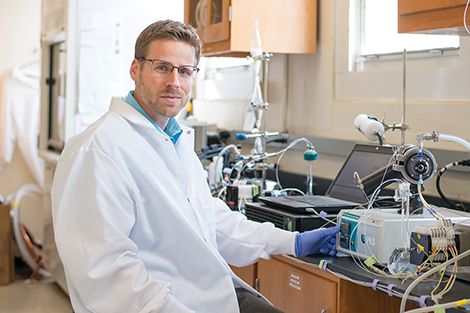
    <p><a href="http://magazine.umbc.edu/wp-content/uploads/2016/08/Su16-brightfuture-hennigan.jpg" rel="nofollow external" class="bo"><img src="http://magazine.umbc.edu/wp-content/uploads/2016/08/Su16-brightfuture-hennigan.jpg" alt="Su16-brightfuture-hennigan" height="313" width="470" style="max-width: 100%; height: auto;"></a></p>
    <p>Everyone dreads a bad air day when it pops up on a weather forecast, 
    but knowing how those conditions are created is essential to finding 
    ways to ameliorate or prevent the damage to health and climate.</p>
    <p><strong>Christopher Hennigan</strong>, assistant professor of 
    chemical, biochemical, and environmental engineering, is at the 
    forefront of analyzing these issues. His work focuses on pollutants 
    known as particulate matter or aerosols—small particles in the air that 
    have detrimental effects on human health and important implications for 
    climate change.</p>
    <p>This work has come to the attention of the National Science 
    Foundation (NSF), which gave Hennigan a CAREER award of $524,606 to 
    characterize the effects of acid-catalyzed reactions on the atmospheric 
    transformation of volatile organic compounds into secondary organic 
    aerosol (SOA).</p>
    <p>SOA is an ubiquitous component in the atmosphere that contributes to 
    aerosol effects on human health and climate, but there has been 
    disagreement between laboratory studies and ambient readings on the role
     of particle acidity in its formation. So Hennigan and his team are 
    developing new methods to rapidly measure particle acidity through 
    automated system that provides the best combination of high time 
    resolution and accuracy.</p>
    <p>When Hennigan’s new technique is deployed, it will provide more 
    accurate models representing SOA formation, thus improving scientists’ 
    ability to make predictions related to ambient aerosol events.</p>
    <p>“The five-year duration of the CAREER award is especially 
    advantageous, as it will allow us to push the work forward in a highly 
    significant way,” says Hennigan.</p>
    <p><em>–Dinah Winnick</em></p></div>
]]>
</Body>
<Summary>Bright Futures            August 16, 2016 · by UMBC Alumni · in Stories                                 UMBC’s growing reputation as a hub for research with  powerful impact isn’t founded on the...</Summary>
<Website>http://magazine.umbc.edu/bright-futures/</Website>
<TrackingUrl>https://my3.my.umbc.edu/api/v0/pixel/news/61606/guest@my.umbc.edu/b5554672d8929f2463a069ac81073a3d/api/pixel</TrackingUrl>
<Group token="cbee">Chemical, Biochemical and Environmental Engineering</Group>
<GroupUrl>https://my3.my.umbc.edu/groups/cbee</GroupUrl>
<AvatarUrl>https://assets4-my.umbc.edu/system/shared/avatars/groups/000/000/771/b5e579e81b2e3624611890fa3ca2716a/xsmall.png?1746794587</AvatarUrl>
<AvatarUrl size="original">https://assets2-my.umbc.edu/system/shared/avatars/groups/000/000/771/b5e579e81b2e3624611890fa3ca2716a/original.png?1746794587</AvatarUrl>
<AvatarUrl size="xxlarge">https://assets1-my.umbc.edu/system/shared/avatars/groups/000/000/771/b5e579e81b2e3624611890fa3ca2716a/xxlarge.png?1746794587</AvatarUrl>
<AvatarUrl size="xlarge">https://assets2-my.umbc.edu/system/shared/avatars/groups/000/000/771/b5e579e81b2e3624611890fa3ca2716a/xlarge.png?1746794587</AvatarUrl>
<AvatarUrl size="large">https://assets2-my.umbc.edu/system/shared/avatars/groups/000/000/771/b5e579e81b2e3624611890fa3ca2716a/large.png?1746794587</AvatarUrl>
<AvatarUrl size="medium">https://assets4-my.umbc.edu/system/shared/avatars/groups/000/000/771/b5e579e81b2e3624611890fa3ca2716a/medium.png?1746794587</AvatarUrl>
<AvatarUrl size="small">https://assets1-my.umbc.edu/system/shared/avatars/groups/000/000/771/b5e579e81b2e3624611890fa3ca2716a/small.png?1746794587</AvatarUrl>
<AvatarUrl size="xsmall">https://assets4-my.umbc.edu/system/shared/avatars/groups/000/000/771/b5e579e81b2e3624611890fa3ca2716a/xsmall.png?1746794587</AvatarUrl>
<AvatarUrl size="xxsmall">https://assets1-my.umbc.edu/system/shared/avatars/groups/000/000/771/b5e579e81b2e3624611890fa3ca2716a/xxsmall.png?1746794587</AvatarUrl>
<Sponsor>Chemical, Biochemical and Environmental Engineering</Sponsor>
<PawCount>2</PawCount>
<CommentCount>0</CommentCount>
<CommentsAllowed>true</CommentsAllowed>
<PostedAt>Fri, 19 Aug 2016 08:20:01 -0400</PostedAt>
</NewsItem>

<NewsItem contentIssues="false" id="61605" important="false" status="posted" url="https://my3.my.umbc.edu/groups/cbee/posts/61605">
<Title>Marten start-up gets nod in UMBC magazine</Title>
<Tagline>Innovation initiatives help bring discoveries to market</Tagline>
<Body>
<![CDATA[
    <div class="html-content"><h2>UMBC professors are navigating the startup economy – and finding harmony between research and commerce.</h2>
    <p><strong>By Elizabeth Heubeck ’91</strong></p><br><a href="http://magazine.umbc.edu/music-to-market/" rel="nofollow external" class="bo"><em>[full article here]</em></a><br><br>...UMBC researchers have found additional resources to pursue 
    entrepreneurship. One resource is Innovation Corps (or I-Corps) – a 
    National Science Foundation-backed program designed to bring university 
    researchers’ discoveries to market.<br><br><p><strong>Mark Marten</strong>, a professor of chemical, biochemical 
    and environmental engineering, was recently selected to participate in 
    I-Corps. His startup, MycoInnovation LLC, is working to develop an 
    additive for chicken feed that would be cheaper and safer than 
    antibiotics, which are currently used in the majority of chicken feed to
     make the animals grow more efficiently. (The startup also received a 
    $100,000 award from the Maryland Innovation Initiative.)</p>
    <p>Marten has been at the university for two decades. He describes 
    I-Corps as “entrepreneurial boot camp,” and he credits the program for 
    making it possible for him to even imagine starting a company. 'We have a
     lot to learn,” he adds. “We’re not business people.”</p></div>
]]>
</Body>
<Summary>UMBC professors are navigating the startup economy – and finding harmony between research and commerce.   By Elizabeth Heubeck ’91  [full article here]  ...UMBC researchers have found additional...</Summary>
<Website>http://magazine.umbc.edu/music-to-market/</Website>
<TrackingUrl>https://my3.my.umbc.edu/api/v0/pixel/news/61605/guest@my.umbc.edu/205979f5281fe369a142f67f274dd1e9/api/pixel</TrackingUrl>
<Group token="cbee">Chemical, Biochemical and Environmental Engineering</Group>
<GroupUrl>https://my3.my.umbc.edu/groups/cbee</GroupUrl>
<AvatarUrl>https://assets4-my.umbc.edu/system/shared/avatars/groups/000/000/771/b5e579e81b2e3624611890fa3ca2716a/xsmall.png?1746794587</AvatarUrl>
<AvatarUrl size="original">https://assets2-my.umbc.edu/system/shared/avatars/groups/000/000/771/b5e579e81b2e3624611890fa3ca2716a/original.png?1746794587</AvatarUrl>
<AvatarUrl size="xxlarge">https://assets1-my.umbc.edu/system/shared/avatars/groups/000/000/771/b5e579e81b2e3624611890fa3ca2716a/xxlarge.png?1746794587</AvatarUrl>
<AvatarUrl size="xlarge">https://assets2-my.umbc.edu/system/shared/avatars/groups/000/000/771/b5e579e81b2e3624611890fa3ca2716a/xlarge.png?1746794587</AvatarUrl>
<AvatarUrl size="large">https://assets2-my.umbc.edu/system/shared/avatars/groups/000/000/771/b5e579e81b2e3624611890fa3ca2716a/large.png?1746794587</AvatarUrl>
<AvatarUrl size="medium">https://assets4-my.umbc.edu/system/shared/avatars/groups/000/000/771/b5e579e81b2e3624611890fa3ca2716a/medium.png?1746794587</AvatarUrl>
<AvatarUrl size="small">https://assets1-my.umbc.edu/system/shared/avatars/groups/000/000/771/b5e579e81b2e3624611890fa3ca2716a/small.png?1746794587</AvatarUrl>
<AvatarUrl size="xsmall">https://assets4-my.umbc.edu/system/shared/avatars/groups/000/000/771/b5e579e81b2e3624611890fa3ca2716a/xsmall.png?1746794587</AvatarUrl>
<AvatarUrl size="xxsmall">https://assets1-my.umbc.edu/system/shared/avatars/groups/000/000/771/b5e579e81b2e3624611890fa3ca2716a/xxsmall.png?1746794587</AvatarUrl>
<Sponsor>Chemical, Biochemical and Environmental Engineering</Sponsor>
<PawCount>1</PawCount>
<CommentCount>0</CommentCount>
<CommentsAllowed>true</CommentsAllowed>
<PostedAt>Fri, 19 Aug 2016 08:15:03 -0400</PostedAt>
<EditAt>Wed, 30 Jun 2021 10:18:25 -0400</EditAt>
</NewsItem>

<NewsItem contentIssues="true" id="60705" important="false" status="posted" url="https://my3.my.umbc.edu/groups/cbee/posts/60705">
<Title>Hollie Adejumo wins 2016 ACS Certificate of Merit</Title>
<Body>
<![CDATA[
    <div class="html-content">Hollie Adejumo, an undergraduate research assistant in the Blaney lab, was awarded the ACS Division of Environmental Chemistry Certificate of Merit for her presentation at the Spring 2016 national meeting in San Diego, CA.  Her presentation was titled, "Antimicrobial activity of fluoroquinolone, sulfonamide, and tetracycline antibiotics: Implications for environmental relevance."</div>
]]>
</Body>
<Summary>Hollie Adejumo, an undergraduate research assistant in the Blaney lab, was awarded the ACS Division of Environmental Chemistry Certificate of Merit for her presentation at the Spring 2016 national...</Summary>
<TrackingUrl>https://my3.my.umbc.edu/api/v0/pixel/news/60705/guest@my.umbc.edu/15b9cbec1721a7e0ca9e5f3323c0580c/api/pixel</TrackingUrl>
<Group token="cbee">Chemical, Biochemical and Environmental Engineering</Group>
<GroupUrl>https://my3.my.umbc.edu/groups/cbee</GroupUrl>
<AvatarUrl>https://assets4-my.umbc.edu/system/shared/avatars/groups/000/000/771/b5e579e81b2e3624611890fa3ca2716a/xsmall.png?1746794587</AvatarUrl>
<AvatarUrl size="original">https://assets2-my.umbc.edu/system/shared/avatars/groups/000/000/771/b5e579e81b2e3624611890fa3ca2716a/original.png?1746794587</AvatarUrl>
<AvatarUrl size="xxlarge">https://assets1-my.umbc.edu/system/shared/avatars/groups/000/000/771/b5e579e81b2e3624611890fa3ca2716a/xxlarge.png?1746794587</AvatarUrl>
<AvatarUrl size="xlarge">https://assets2-my.umbc.edu/system/shared/avatars/groups/000/000/771/b5e579e81b2e3624611890fa3ca2716a/xlarge.png?1746794587</AvatarUrl>
<AvatarUrl size="large">https://assets2-my.umbc.edu/system/shared/avatars/groups/000/000/771/b5e579e81b2e3624611890fa3ca2716a/large.png?1746794587</AvatarUrl>
<AvatarUrl size="medium">https://assets4-my.umbc.edu/system/shared/avatars/groups/000/000/771/b5e579e81b2e3624611890fa3ca2716a/medium.png?1746794587</AvatarUrl>
<AvatarUrl size="small">https://assets1-my.umbc.edu/system/shared/avatars/groups/000/000/771/b5e579e81b2e3624611890fa3ca2716a/small.png?1746794587</AvatarUrl>
<AvatarUrl size="xsmall">https://assets4-my.umbc.edu/system/shared/avatars/groups/000/000/771/b5e579e81b2e3624611890fa3ca2716a/xsmall.png?1746794587</AvatarUrl>
<AvatarUrl size="xxsmall">https://assets1-my.umbc.edu/system/shared/avatars/groups/000/000/771/b5e579e81b2e3624611890fa3ca2716a/xxsmall.png?1746794587</AvatarUrl>
<Sponsor>Chemical, Biochemical and Environmental Engineering</Sponsor>
<ThumbnailUrl size="xxlarge">https://assets4-my.umbc.edu/system/shared/thumbnails/news/000/060/705/9878edc5b56468b6f7af26f42ae2cd5b/xxlarge.jpg?1466441184</ThumbnailUrl>
<ThumbnailUrl size="xlarge">https://assets3-my.umbc.edu/system/shared/thumbnails/news/000/060/705/9878edc5b56468b6f7af26f42ae2cd5b/xlarge.jpg?1466441184</ThumbnailUrl>
<ThumbnailUrl size="large">https://assets4-my.umbc.edu/system/shared/thumbnails/news/000/060/705/9878edc5b56468b6f7af26f42ae2cd5b/large.jpg?1466441184</ThumbnailUrl>
<ThumbnailUrl size="medium">https://assets1-my.umbc.edu/system/shared/thumbnails/news/000/060/705/9878edc5b56468b6f7af26f42ae2cd5b/medium.jpg?1466441184</ThumbnailUrl>
<ThumbnailUrl size="small">https://assets1-my.umbc.edu/system/shared/thumbnails/news/000/060/705/9878edc5b56468b6f7af26f42ae2cd5b/small.jpg?1466441184</ThumbnailUrl>
<ThumbnailUrl size="xsmall">https://assets3-my.umbc.edu/system/shared/thumbnails/news/000/060/705/9878edc5b56468b6f7af26f42ae2cd5b/xsmall.jpg?1466441184</ThumbnailUrl>
<ThumbnailUrl size="xxsmall">https://assets4-my.umbc.edu/system/shared/thumbnails/news/000/060/705/9878edc5b56468b6f7af26f42ae2cd5b/xxsmall.jpg?1466441184</ThumbnailUrl>
<PawCount>83</PawCount>
<CommentCount>22</CommentCount>
<CommentsAllowed>true</CommentsAllowed>
<PostedAt>Mon, 20 Jun 2016 12:46:52 -0400</PostedAt>
</NewsItem>

<NewsItem contentIssues="true" id="60636" important="false" status="posted" url="https://my3.my.umbc.edu/groups/cbee/posts/60636">
<Title>Alumna's cell image featured on cover of Tissue Engineering</Title>
<Tagline>Congratulations, Swarna Balasubramanian ('14)!</Tagline>
<Body>
<![CDATA[
    <div class="html-content">Congratulations to Swarnalatha Balasubramanian, whose cell image is 
    featured on the cover of the June 2016 issue of <em>Tissue Engineering</em>. <br><br>The 
    journal contains Balasubramanian's article entitled "Three-Dimensional 
    Environment Sustains Morphological Heterogeneity and Promotes Phenotypic
     Progression During Astrocyte Development" (Swarnalatha Balasubramanian,
     PhD, John A. Packard, BS Jennie B. Leach, PhD, and Elizabeth M. 
    Powell, PhD)<br><br>Balasubramanian received her Chemical Engineering PhD in December of 2014.<br><br><img src="http://my.umbc.edu/groups/cbee/posts/60636/attachments/20849" style="max-width: 100%; height: auto;"><br><br><br><br><br><br></div>
]]>
</Body>
<Summary>Congratulations to Swarnalatha Balasubramanian, whose cell image is  featured on the cover of the June 2016 issue of Tissue Engineering.   The  journal contains Balasubramanian's article entitled...</Summary>
<Website>https://doi.org/10.1089/ten.tea.2016.0103</Website>
<AttachmentKind>Image</AttachmentKind>
<AttachmentUrl>https://assets4-my.umbc.edu/system/shared/attachments/c6a3e0a629a1df76150cf2481ffb7462/69ea1b81/news/000/060/636/d3036eaa59b31dade3e8ef4916a3e821/termis.jpg?1465931910</AttachmentUrl>
<Attachments>
<Attachment kind="Image" url="https://my3.my.umbc.edu/groups/cbee/posts/60636/attachments/20849"></Attachment>
<Attachment kind="Document" url="https://my3.my.umbc.edu/groups/cbee/posts/60636/attachments/20850"></Attachment>
</Attachments>
<TrackingUrl>https://my3.my.umbc.edu/api/v0/pixel/news/60636/guest@my.umbc.edu/6c697e52add3462bd7dcb0c1b2ba78f2/api/pixel</TrackingUrl>
<Group token="cbee">Chemical, Biochemical and Environmental Engineering</Group>
<GroupUrl>https://my3.my.umbc.edu/groups/cbee</GroupUrl>
<AvatarUrl>https://assets4-my.umbc.edu/system/shared/avatars/groups/000/000/771/b5e579e81b2e3624611890fa3ca2716a/xsmall.png?1746794587</AvatarUrl>
<AvatarUrl size="original">https://assets2-my.umbc.edu/system/shared/avatars/groups/000/000/771/b5e579e81b2e3624611890fa3ca2716a/original.png?1746794587</AvatarUrl>
<AvatarUrl size="xxlarge">https://assets1-my.umbc.edu/system/shared/avatars/groups/000/000/771/b5e579e81b2e3624611890fa3ca2716a/xxlarge.png?1746794587</AvatarUrl>
<AvatarUrl size="xlarge">https://assets2-my.umbc.edu/system/shared/avatars/groups/000/000/771/b5e579e81b2e3624611890fa3ca2716a/xlarge.png?1746794587</AvatarUrl>
<AvatarUrl size="large">https://assets2-my.umbc.edu/system/shared/avatars/groups/000/000/771/b5e579e81b2e3624611890fa3ca2716a/large.png?1746794587</AvatarUrl>
<AvatarUrl size="medium">https://assets4-my.umbc.edu/system/shared/avatars/groups/000/000/771/b5e579e81b2e3624611890fa3ca2716a/medium.png?1746794587</AvatarUrl>
<AvatarUrl size="small">https://assets1-my.umbc.edu/system/shared/avatars/groups/000/000/771/b5e579e81b2e3624611890fa3ca2716a/small.png?1746794587</AvatarUrl>
<AvatarUrl size="xsmall">https://assets4-my.umbc.edu/system/shared/avatars/groups/000/000/771/b5e579e81b2e3624611890fa3ca2716a/xsmall.png?1746794587</AvatarUrl>
<AvatarUrl size="xxsmall">https://assets1-my.umbc.edu/system/shared/avatars/groups/000/000/771/b5e579e81b2e3624611890fa3ca2716a/xxsmall.png?1746794587</AvatarUrl>
<Sponsor>Chemical, Biochemical and Environmental Engineering</Sponsor>
<ThumbnailUrl size="xxlarge">https://assets3-my.umbc.edu/system/shared/thumbnails/news/000/060/636/534377b318b8a31992b8728b55bcd5f6/xxlarge.jpg?1465932047</ThumbnailUrl>
<ThumbnailUrl size="xlarge">https://assets4-my.umbc.edu/system/shared/thumbnails/news/000/060/636/534377b318b8a31992b8728b55bcd5f6/xlarge.jpg?1465932047</ThumbnailUrl>
<ThumbnailUrl size="large">https://assets4-my.umbc.edu/system/shared/thumbnails/news/000/060/636/534377b318b8a31992b8728b55bcd5f6/large.jpg?1465932047</ThumbnailUrl>
<ThumbnailUrl size="medium">https://assets2-my.umbc.edu/system/shared/thumbnails/news/000/060/636/534377b318b8a31992b8728b55bcd5f6/medium.jpg?1465932047</ThumbnailUrl>
<ThumbnailUrl size="small">https://assets3-my.umbc.edu/system/shared/thumbnails/news/000/060/636/534377b318b8a31992b8728b55bcd5f6/small.jpg?1465932047</ThumbnailUrl>
<ThumbnailUrl size="xsmall">https://assets1-my.umbc.edu/system/shared/thumbnails/news/000/060/636/534377b318b8a31992b8728b55bcd5f6/xsmall.jpg?1465932047</ThumbnailUrl>
<ThumbnailUrl size="xxsmall">https://assets1-my.umbc.edu/system/shared/thumbnails/news/000/060/636/534377b318b8a31992b8728b55bcd5f6/xxsmall.jpg?1465932047</ThumbnailUrl>
<PawCount>5</PawCount>
<CommentCount>0</CommentCount>
<CommentsAllowed>true</CommentsAllowed>
<PostedAt>Tue, 14 Jun 2016 15:21:37 -0400</PostedAt>
<EditAt>Tue, 29 Jun 2021 14:43:33 -0400</EditAt>
</NewsItem>

<NewsItem contentIssues="false" id="60445" important="false" status="posted" url="https://my3.my.umbc.edu/groups/cbee/posts/60445">
<Title>Welty project featured in The Philadelphia Inquirer</Title>
<Tagline>Philadelphia keeps stormwater out of sewers; protect rivers</Tagline>
<Body>
<![CDATA[
    <div class="html-content">by <a rel="nofollow external" class="bo"><strong>Tom Avril</strong></a>, Staff Writer<br><br>Tropical Storm Girard unleashed a torrent of water on West Philadelphia in March.<br><br><p>Missed that news? It was not a real storm, but it might as well have been.</p>
    <p>Philadelphia Water Department employees turned on a fire hydrant on 
    West Girard Avenue for three hours, enough to fill up two longish 
    ditches with 35,000 gallons of water - an experimental simulation of 3.5
     inches of rain. Then they watched it disappear.</p>
    <p>The ditches are rain gardens, brimming with grasses, flowers, and 
    monitoring equipment, and they are part of an underground revolution.</p>
    <p>This week marks the fifth anniversary of a consent agreement signed 
    with state environmental regulators, and the city says it has met its 
    target of keeping more than 600 million gallons of rain out of the aging
     sewer system each year.</p>
    <p>It has done so with hundreds of water-absorbing "tools": 
    plant-studded green roofs, parking lots made of permeable pavement, 
    stormwater trenches, and rain gardens such as the two on West Girard.</p>
    <div><div></div>
    </div> <p>The reason for the ambitious program? As in many older 
    communities, most of the city is served by combined sewer systems, 
    meaning that rainwater is directed into the same pipes that carry the 
    flow from showers, sinks, and toilets.</p>
    <p>That is OK in dry weather, but with any amount of significant 
    rainfall, the combined stream of sewage and rainwater starts to overflow
     into creeks and rivers, running afoul of the federal Clean Water Act.</p>
    <p>Some cities have opted to comply with the law by building giant 
    underground tanks to hold stormwater temporarily before sending it off 
    to sewage treatment plants. Philadelphia proposed, instead, to soak as 
    much rain as possible into the ground, the way nature intended, said 
    Christopher S. Crockett, a deputy commissioner for the water department.</p>
    <p>"Instead of creating expressways for the stormwater to get into our 
    system, we're trying to create little traffic jams for the stormwater to
     stay on the site and get into the ground," Crockett said.</p>
    <p>But the job is less than 10 percent completed.</p>
    <p>The city says it has exceeded its five-year pledge to "green" 744 
    acres, defined as acreage where the various rain gardens and other 
    infiltration tools can absorb at least one inch of rain.</p>
    <div><div></div>
    </div>   <p>In the next five years, the agreement calls for the city to 
    triple that amount. And by 2036, the target is 9,564 acres - the 
    equivalent of keeping nearly eight billion gallons out of the sewer 
    system each year. Even then, there would still be occasional sewage 
    overflows.</p>
    <p>How much is eight billion gallons? Imagine a giant tank covering JFK 
    Plaza. That amount of liquid would fill such a tank more than a mile 
    high.</p>
    <p>Still, the water already being kept out the sewers, conservatively 
    estimated at 600 million gallons a year, is more than a drop in the 
    bucket. That amount would still fill an imaginary JFK Plaza tank more 
    than 500 feet high.</p>
    <p>"It's one of the largest-scale implementations of greened acres that 
    we've seen in the nation," said Jon Capacasa, director of the water 
    protection division for the U.S. Environmental Protection Agency's 
    mid-Atlantic region.</p>
    <h4>Collecting data</h4>
    <p>The water department has water-pressure sensors deployed at dozens of
     sites to see how well it works. And at a handful of spots, scientists 
    are busy gathering more detailed data.</p>
    <p>At the West Girard location, among others, Villanova University 
    researchers are measuring near-surface water pressure, temperature, 
    humidity, and other indicators.</p>
    <p>Readings are captured every five minutes, and Cara Albright, who is 
    working on her doctorate in water resources engineering, comes by 
    periodically to download it onto her laptop. Water-pressure readings are
     translated into rates of flow.</p>
    <p>"We basically try to measure everything that's coming into the site and everything that's leaving the site," she said.</p>
    <p>The gardens are planted with purple coneflower, black-eyed Susan, 
    Shenandoah switchgrass, and other hardy species, said Chris Bergerson, a
     water resources engineer for the city water department.</p>
    <p>"They have to be able to withstand periods of drought, and they have to be able to survive when inundated," he said.</p>
    <p>Elsewhere, Swarthmore College is leading an effort to measure 
    underground water pressure at various levels down to seven feet below 
    the surface, in order to calculate how much water is getting to the 
    water table. Measurements are taken beneath "greened" sites as well as 
    under regular patches of grass.</p>
    <h4>Philadelphia as role model</h4>
    <p>It is too soon to report hard numbers, but the differences between 
    greened and un-greened sites appear "dramatic," said team member Claire 
    Welty, a groundwater hydrologist and engineering professor at the 
    University of Maryland-Baltimore County.</p>
    <p>"The whole country is looking to Philadelphia to see how to do it," she said.</p>
    <p>Crockett said it also is too soon to see measurable improvements in 
    the four water bodies into which the combined sewers discharge their 
    flow: the Delaware River and Schuylkill, and the Cobbs and Tacony 
    Creeks.</p>
    <p>But the end result will be cleaner water as well as more natural, stable flow rates.</p>
    <p>Currently, a heavy rain takes the Tacony from ankle-deep to more than
     6 feet deep in some places, Crockett said. That leads to flooding and 
    erosion, and it wreaks havoc on wildlife.</p>
    <div><div></div>
    </div> 
    
    
    <p>The benefits go beyond clean water, Crockett said. The added greenery
     keeps the city cooler in the summer, along with absorbing greenhouse 
    gases that can contribute to climate change. Then there is the improved 
    quality of life when a vacant lot is turned into an inviting urban 
    oasis, he said.</p>
    <p>It is not cheap, with an estimated long-term price tag of more than 
    $2 billion. Some of that comes from business owners, who now pay sewer 
    bills based in part on the amount of impervious cover on their sites - 
    rather than the old method based strictly on water usage. Rates have 
    soared for some.</p>
    <p>The water department says the alternative to the green approach, building large underground holding tanks, would cost even more.</p>
    <p>And such tanks likely would be built with outside labor, whereas the 
    weeding, drain-clearing, and other maintenance required for the green 
    approach is done by hiring city residents.</p>
    <p>"You're really getting many, many benefits in one," said the EPA's Capacasa.</p>
    <p>The tally of green installations changes from week to week, at <a href="http://www.phillywatersheds.org" rel="nofollow external" class="bo">www.phillywatersheds.org</a>, but is well into the hundreds - some built by the city, others by private landowners.</p>
    <p>That is because for all development on sites measuring more than 
    15,000 square feet, the builder is required to install enough rain 
    gardens, green roofs, and the like to handle the first 1.5 inches of 
    runoff.</p>
    <p>Expect to see much more in the coming years. When a real tropical 
    storm hits, rain gardens such as the one on West Girard will be ready.</p>
    <p><a href="mailto:tavril@phillynews.com" rel="nofollow external" class="bo">tavril@phillynews.com</a></p>
    <p>215-854-2430</p>
    <p>@TomAvril1</p><br></div>
]]>
</Body>
<Summary>by Tom Avril, Staff Writer  Tropical Storm Girard unleashed a torrent of water on West Philadelphia in March.   Missed that news? It was not a real storm, but it might as well have been....</Summary>
<Website>http://www.philly.com/philly/news/science/20160530_Philadelphia_keeps_stormwater_out_of_sewers_to_protect_rivers.html</Website>
<TrackingUrl>https://my3.my.umbc.edu/api/v0/pixel/news/60445/guest@my.umbc.edu/1f47d4a4c6b6342b9d3bb9ba9ef9b752/api/pixel</TrackingUrl>
<Group token="cbee">Chemical, Biochemical and Environmental Engineering</Group>
<GroupUrl>https://my3.my.umbc.edu/groups/cbee</GroupUrl>
<AvatarUrl>https://assets4-my.umbc.edu/system/shared/avatars/groups/000/000/771/b5e579e81b2e3624611890fa3ca2716a/xsmall.png?1746794587</AvatarUrl>
<AvatarUrl size="original">https://assets2-my.umbc.edu/system/shared/avatars/groups/000/000/771/b5e579e81b2e3624611890fa3ca2716a/original.png?1746794587</AvatarUrl>
<AvatarUrl size="xxlarge">https://assets1-my.umbc.edu/system/shared/avatars/groups/000/000/771/b5e579e81b2e3624611890fa3ca2716a/xxlarge.png?1746794587</AvatarUrl>
<AvatarUrl size="xlarge">https://assets2-my.umbc.edu/system/shared/avatars/groups/000/000/771/b5e579e81b2e3624611890fa3ca2716a/xlarge.png?1746794587</AvatarUrl>
<AvatarUrl size="large">https://assets2-my.umbc.edu/system/shared/avatars/groups/000/000/771/b5e579e81b2e3624611890fa3ca2716a/large.png?1746794587</AvatarUrl>
<AvatarUrl size="medium">https://assets4-my.umbc.edu/system/shared/avatars/groups/000/000/771/b5e579e81b2e3624611890fa3ca2716a/medium.png?1746794587</AvatarUrl>
<AvatarUrl size="small">https://assets1-my.umbc.edu/system/shared/avatars/groups/000/000/771/b5e579e81b2e3624611890fa3ca2716a/small.png?1746794587</AvatarUrl>
<AvatarUrl size="xsmall">https://assets4-my.umbc.edu/system/shared/avatars/groups/000/000/771/b5e579e81b2e3624611890fa3ca2716a/xsmall.png?1746794587</AvatarUrl>
<AvatarUrl size="xxsmall">https://assets1-my.umbc.edu/system/shared/avatars/groups/000/000/771/b5e579e81b2e3624611890fa3ca2716a/xxsmall.png?1746794587</AvatarUrl>
<Sponsor>Chemical, Biochemical and Environmental Engineering</Sponsor>
<PawCount>2</PawCount>
<CommentCount>0</CommentCount>
<CommentsAllowed>true</CommentsAllowed>
<PostedAt>Wed, 01 Jun 2016 08:21:06 -0400</PostedAt>
<EditAt>Thu, 02 Jun 2016 07:55:58 -0400</EditAt>
</NewsItem>

<NewsItem contentIssues="true" id="60412" important="false" status="posted" url="https://my3.my.umbc.edu/groups/cbee/posts/60412">
<Title>Erin Lavik TEDxBroadway talk featured on UMBC News</Title>
<Tagline>dynamic talk connects theatre and engineering</Tagline>
<Body>
<![CDATA[
    <div class="html-content"><span><a href="http://news.umbc.edu/erin-laviks-dynamic-tedxbroadway-talk-connects-theatre-and-engineering/" rel="nofollow external" class="bo"><u>May 25, 2016</u></a></span><span><span> by <a href="http://news.umbc.edu/author/meganhanks/" rel="nofollow external" class="bo"><u>Megan Hanks</u></a><br><br><br><p><span>When </span><strong>Erin Lavik</strong><span>,
     professor of chemical, biochemical and environmental engineering, was 
    pursuing her graduate degree, she was required to pursue a minor outside
     of her discipline, and she selected playwriting. Lavik found that 
    teamwork was crucial to the success of theatre, and that it also 
    translated well into the scientific field she was pursuing, she 
    explained in her recent TEDx Broadway talk “</span><span>Genius Is Created Through Collaboration.</span><span>”</span></p><p><span>“Theatre
     is the greatest gift you can give an aspiring scientist because theatre
     is dreaming realized,” Lavik said. She shared that she watched people 
    come together with big ideas about stories, lights, and sound, only to 
    surpass their dreams and the dreams of others around them as they moved 
    forward with the creative process.</span></p><p><span>Lavik
     discussed how collaboration is crucial in the scientific discovery 
    process, just as it is essential to a successful production in theatre, 
    and she described how teamwork has impacted her research. She also 
    addressed common stereotypes about the personalities and tendencies of 
    scientists, including that they are male, work in isolation late into 
    the night, and are odd or strange, and said that these stereotypes need 
    to be broken. </span></p><p>She points out that as young children we are
     all scientists, and, as we grow into adulthood and pursue careers, 
    there is great value in continuing to support the intense curiosity and 
    willingness to experiment and learn that children often demonstrate.</p><p><span>As a student interested in pursuing engineering, Lavik said, “Knowing that I could work with other people”</span><span>—</span><span>that science didn’t need to be a solitary enterprise</span><span>—</span><span>“made
     it a little less scary. And I went to college of be an engineer so that
     I could learn about science and apply it to big problems.”</span></p><p><span>The
     big problem that Lavik and her team are working on now is determining 
    how to protect and repair the brain and spinal cord after injury, with a
     focus on stopping internal bleeding.</span></p><p><span>“I
     don’t know if our material will ultimately work in humans,” she said. 
    “But I am absolutely and utterly sure that we wouldn’t have gotten to 
    this point if it wasn’t for the fact that we have a whole team.”</span></p><p><br></p><img src="http://news.umbc.edu/wp-content/uploads/2016/05/Erin-Lavik_tedxbroadway-e1464201232737-1800x768.jpg" style="max-width: 100%; height: auto;"><p><br></p><p>Video available at <a href="https://www.youtube.com/watch?v=AkkmRn3qqFM" rel="nofollow external" class="bo">this link</a><br></p><p><span><br></span></p></span></span></div>
]]>
</Body>
<Summary>May 25, 2016 by Megan Hanks    When Erin Lavik,  professor of chemical, biochemical and environmental engineering, was  pursuing her graduate degree, she was required to pursue a minor outside  of...</Summary>
<Website>http://news.umbc.edu/erin-laviks-dynamic-tedxbroadway-talk-connects-theatre-and-engineering/</Website>
<TrackingUrl>https://my3.my.umbc.edu/api/v0/pixel/news/60412/guest@my.umbc.edu/3cce0d9b8d4e75d8d38960aec837ddd8/api/pixel</TrackingUrl>
<Group token="cbee">Chemical, Biochemical and Environmental Engineering</Group>
<GroupUrl>https://my3.my.umbc.edu/groups/cbee</GroupUrl>
<AvatarUrl>https://assets4-my.umbc.edu/system/shared/avatars/groups/000/000/771/b5e579e81b2e3624611890fa3ca2716a/xsmall.png?1746794587</AvatarUrl>
<AvatarUrl size="original">https://assets2-my.umbc.edu/system/shared/avatars/groups/000/000/771/b5e579e81b2e3624611890fa3ca2716a/original.png?1746794587</AvatarUrl>
<AvatarUrl size="xxlarge">https://assets1-my.umbc.edu/system/shared/avatars/groups/000/000/771/b5e579e81b2e3624611890fa3ca2716a/xxlarge.png?1746794587</AvatarUrl>
<AvatarUrl size="xlarge">https://assets2-my.umbc.edu/system/shared/avatars/groups/000/000/771/b5e579e81b2e3624611890fa3ca2716a/xlarge.png?1746794587</AvatarUrl>
<AvatarUrl size="large">https://assets2-my.umbc.edu/system/shared/avatars/groups/000/000/771/b5e579e81b2e3624611890fa3ca2716a/large.png?1746794587</AvatarUrl>
<AvatarUrl size="medium">https://assets4-my.umbc.edu/system/shared/avatars/groups/000/000/771/b5e579e81b2e3624611890fa3ca2716a/medium.png?1746794587</AvatarUrl>
<AvatarUrl size="small">https://assets1-my.umbc.edu/system/shared/avatars/groups/000/000/771/b5e579e81b2e3624611890fa3ca2716a/small.png?1746794587</AvatarUrl>
<AvatarUrl size="xsmall">https://assets4-my.umbc.edu/system/shared/avatars/groups/000/000/771/b5e579e81b2e3624611890fa3ca2716a/xsmall.png?1746794587</AvatarUrl>
<AvatarUrl size="xxsmall">https://assets1-my.umbc.edu/system/shared/avatars/groups/000/000/771/b5e579e81b2e3624611890fa3ca2716a/xxsmall.png?1746794587</AvatarUrl>
<Sponsor>Chemical, Biochemical and Environmental Engineering</Sponsor>
<PawCount>4</PawCount>
<CommentCount>0</CommentCount>
<CommentsAllowed>true</CommentsAllowed>
<PostedAt>Tue, 31 May 2016 08:09:26 -0400</PostedAt>
<EditAt>Tue, 31 May 2016 08:12:25 -0400</EditAt>
</NewsItem>

</News>