UMBC gets ready to celebrate 30 years of its signature undergraduate research extravaganza
 The band Fever Dream will perform at URCAD. (Photo courtesy of April Householder)
On April 22, more than 450 student presenters and their friends, mentors, and supporters will fill the Retriever Activities Center (RAC) for the 30th anniversary of the Undergraduate Research and Creative Achievement Day.
It’s the first year the annual event, more commonly known as URCAD, will take place in the RAC, where it has moved because of its record-breaking size. The event will feature poetry readings, live music performances, video game demonstrations, scientific research presentations, artistic exhibits, films, and more. The new space provides room for more live performances and exhibits. This year’s URCAD will feature music by the Dana Idnay band, members of the UMBC Jazz Ensemble, the drum circle, the Down and Dirty Dawg Band, and Fever Dream, a band made up of UMBC undergraduate and graduate students and led by biology professors Jeffrey Lieps and Stephen Caruso.
It’s a tradition of the event to invite an outstanding alum as the keynote speaker. This year, Karena Ingram ‘16, music composition, will speak about her work as a composer and arts advocate who brings issues ranging from domestic violence to video gaming into her projects. As a student, she presented her own research at URCAD on the Baltimore-based composer CK Barlow and her influence in the field of electronic music.
Student participants hail from all corners of campus and will showcase their diverse research and creative projects, including investigations into supermassive black holes, patterns of Antarctic tourism, the effects of 9/11 on U.S. immigration, and much more.
“As we celebrate the 30th anniversary, we recognize that URCAD is one of the oldest and largest events of this kind in the state, and that UMBC has one of the highest rates for undergraduates who do mentored research in the country,” says April Householder ’95, director of undergraduate research and prestigious scholarships. “To commemorate, we are throwing back to the 1990s—stop by the photo booth and graffiti wall and make some memories!”


Students pose for a photo and mingle at a poster session during URCAD in 2024. (Marlayna Demond ’11/UMBC)
A lively festival of the mind
The original URCAD was held in 1997 on the 7th floor of the AOK Library, with about 50 scheduled student presenters. Former Vice Provost and Dean of Undergraduate Education Diane Lee, who had the idea for the event, says she was afraid there wouldn’t be enough attendees.
 Former Vice Provost and Dean of Undergraduate Education Diane Lee, who started URCAD 30 years ago, attends the 2024 event. (Marlayna Demond ’11/UMBC)
“We decided to have a midday program and invite [President Emeritus] Dr. Hrabowski to speak. His presence and wonderful snacks including chocolate covered strawberries ensured a good crowd,” she recalls.
Over the years, the event grew ever larger, but it stayed true to its purpose of showcasing the quality of UMBC students and the depth of the questions they investigate. It also serves as a unifying event, where students from diverse disciplines can learn about each other’s work.
Householder says that because of the size of this year’s event, she briefly considered splitting URCAD across two days—one for STEM and one for artists. But she quickly discarded that idea. “What is special about URCAD is that everyone is together in one space,” she says. “A scientist presenting a biochemistry poster can hear music, a poet who is an English major can see an airplane prototype, and an engineer can check out costumes made for the theatre. UMBC is a place where we don’t exist in boxes.”
]]>
The band Fever Dream will perform at URCAD. (Photo courtesy of April Householder) On April 22, more than 450 student presenters and their friends, mentors, and supporters will fill the...
https://umbc.edu/stories/undergraduate-research-urcad-at-30/
https://my3.my.umbc.edu/api/v0/pixel/news/158974/guest@my.umbc.edu/cc61adb5164b6852c7b0b534f70b72de/api/pixel
cahss
cnms
coeit
community
news
story
undergraduate-research
urcad
UMBC News & Magazine
https://my3.my.umbc.edu/groups/umbc-news-magazine
https://assets1-my.umbc.edu/system/shared/avatars/groups/000/001/943/24435aa6207c452e7bc15cc74b42c7bb/xsmall.png?1748556657
https://assets1-my.umbc.edu/system/shared/avatars/groups/000/001/943/24435aa6207c452e7bc15cc74b42c7bb/original.png?1748556657
https://assets2-my.umbc.edu/system/shared/avatars/groups/000/001/943/24435aa6207c452e7bc15cc74b42c7bb/xxlarge.png?1748556657
https://assets2-my.umbc.edu/system/shared/avatars/groups/000/001/943/24435aa6207c452e7bc15cc74b42c7bb/xlarge.png?1748556657
https://assets3-my.umbc.edu/system/shared/avatars/groups/000/001/943/24435aa6207c452e7bc15cc74b42c7bb/large.png?1748556657
https://assets1-my.umbc.edu/system/shared/avatars/groups/000/001/943/24435aa6207c452e7bc15cc74b42c7bb/medium.png?1748556657
https://assets2-my.umbc.edu/system/shared/avatars/groups/000/001/943/24435aa6207c452e7bc15cc74b42c7bb/small.png?1748556657
https://assets1-my.umbc.edu/system/shared/avatars/groups/000/001/943/24435aa6207c452e7bc15cc74b42c7bb/xsmall.png?1748556657
https://assets2-my.umbc.edu/system/shared/avatars/groups/000/001/943/24435aa6207c452e7bc15cc74b42c7bb/xxsmall.png?1748556657
UMBC News & Magazine
0
0
false
Mon, 20 Apr 2026 11:21:22 -0400
Mon, 20 Apr 2026 11:21:22 -0400
Manav Narendra ’26—Applied mathematician and cancer survivor fueled by support at UMBC and at home
Through a rigorous academic curriculum, service as a tutor, internships, tennis pick-up games, close friendships, and more, Manav Narendra ’26, mathematics and computer science, has made the most of his time at UMBC and built a strong foundation for future success in applied math and related fields. A leukemia survivor, Narendra has adopted a posture of gratitude and resilience, crediting in part his mother’s unwavering support and UMBC’s close-knit community for helping him thrive academically and personally. Here, Narendra reflects on his path to date, the people who shaped it, and the lessons he’s carrying forward.
Q: Why did you choose UMBC and your two degrees?
A: As a QuestBridge Scholar in high school, I was able to apply to select colleges with no application fee and the potential for a full-ride scholarship. In the end, UMBC just felt right—it was the closest to home, and I appreciated the smaller, more intimate community feel. I felt like at a bigger school I could’ve gotten lost in the crowd, but here I could actually stand out. Plus, UMBC gave me a merit scholarship, which mattered a lot coming from a single-parent household.
I’ve always loved math—calculus was my favorite class in high school. I originally planned to double major in math and physics, because I wanted to go into astronomy or astrophysics. But the job outlook seemed stronger for computer science, and I’d enjoyed coding since middle school, so I switched to that. Now I’m leaning toward applied math fields like actuarial science, because I enjoy stochastic (chaotic) process modeling and probability analysis more than pure software development.
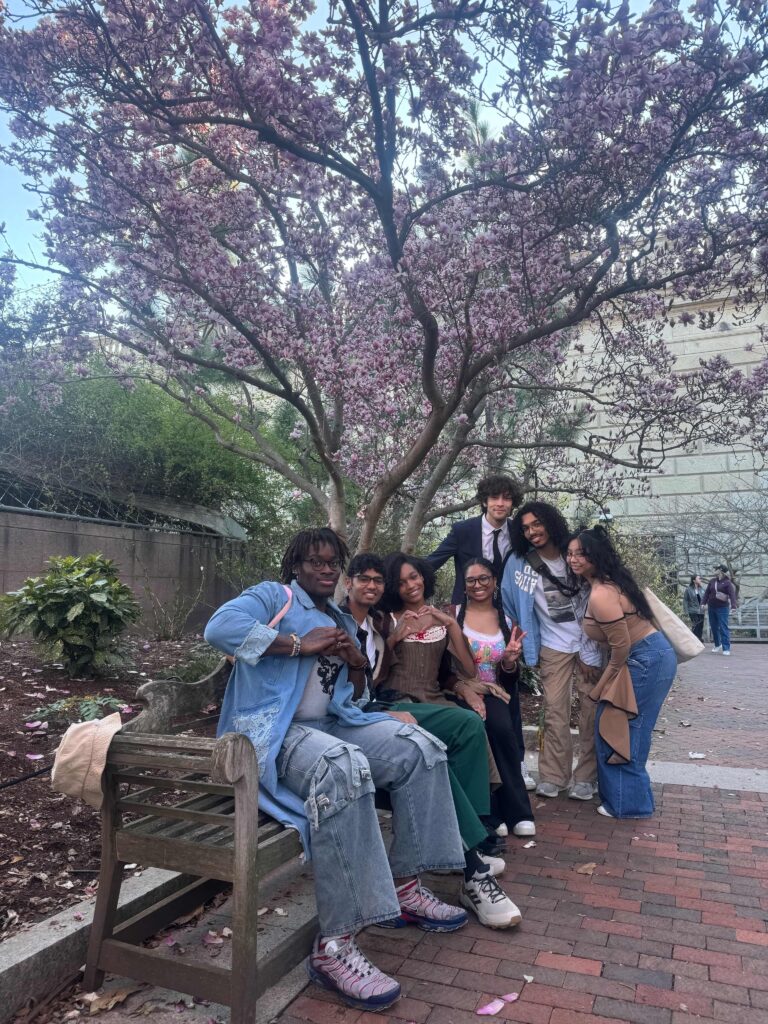
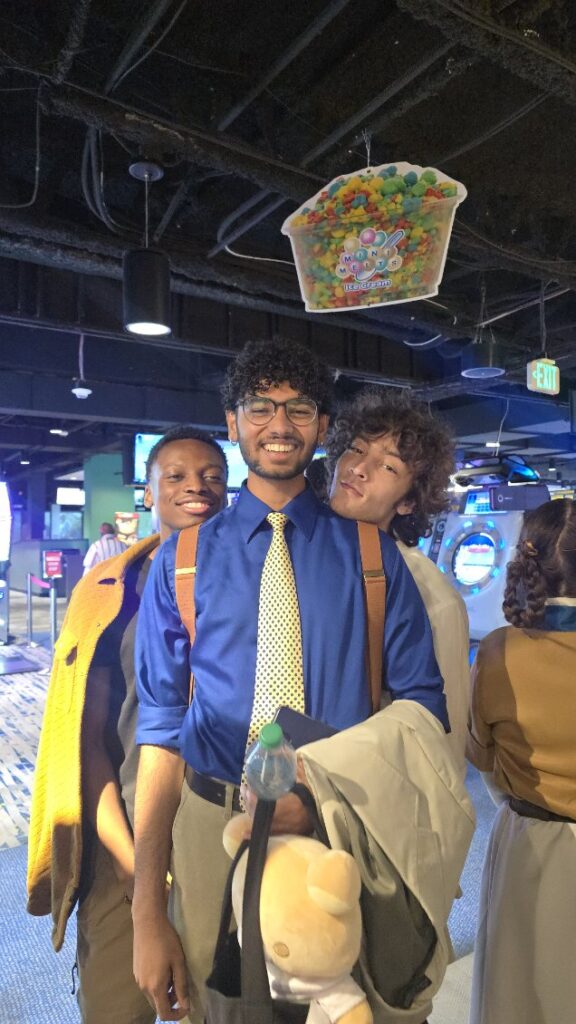 Manav Narendra made friends at UMBC through the discussion and connection possible in smaller classes. (Courtesy of Narendra)
Q: How did your internships enhance your education and influence your career trajectory?
A: I did the same business operations internship at the investor services division of Mitsubishi UFJ Financial Group, where I supported third-party mutual fund administration, twice—after my sophomore and junior years. I’m convinced that talking to company reps in person at the UMBC Career Fair really helped me get the offer. I spent a ton of time in Excel and learned Visual Basic for Applications (VBA), writing programs to automate procedures for other teams at the company. The internship taught me what a corporate environment feels like—being accountable, professional, and how one mistake could have a real effect on production.
The experience was incredibly valuable, even though I don’t think it’s the exact kind of work I want to do long term. I had zero Excel or VBA experience before, and those skills are huge in actuarial work. So even though I realized I want something more independent and creative, the internships gave me practical skills I can take straight into data analysis or actuarial roles. The internships also showed me it’s okay to explore—every experience teaches you something you can carry forward.
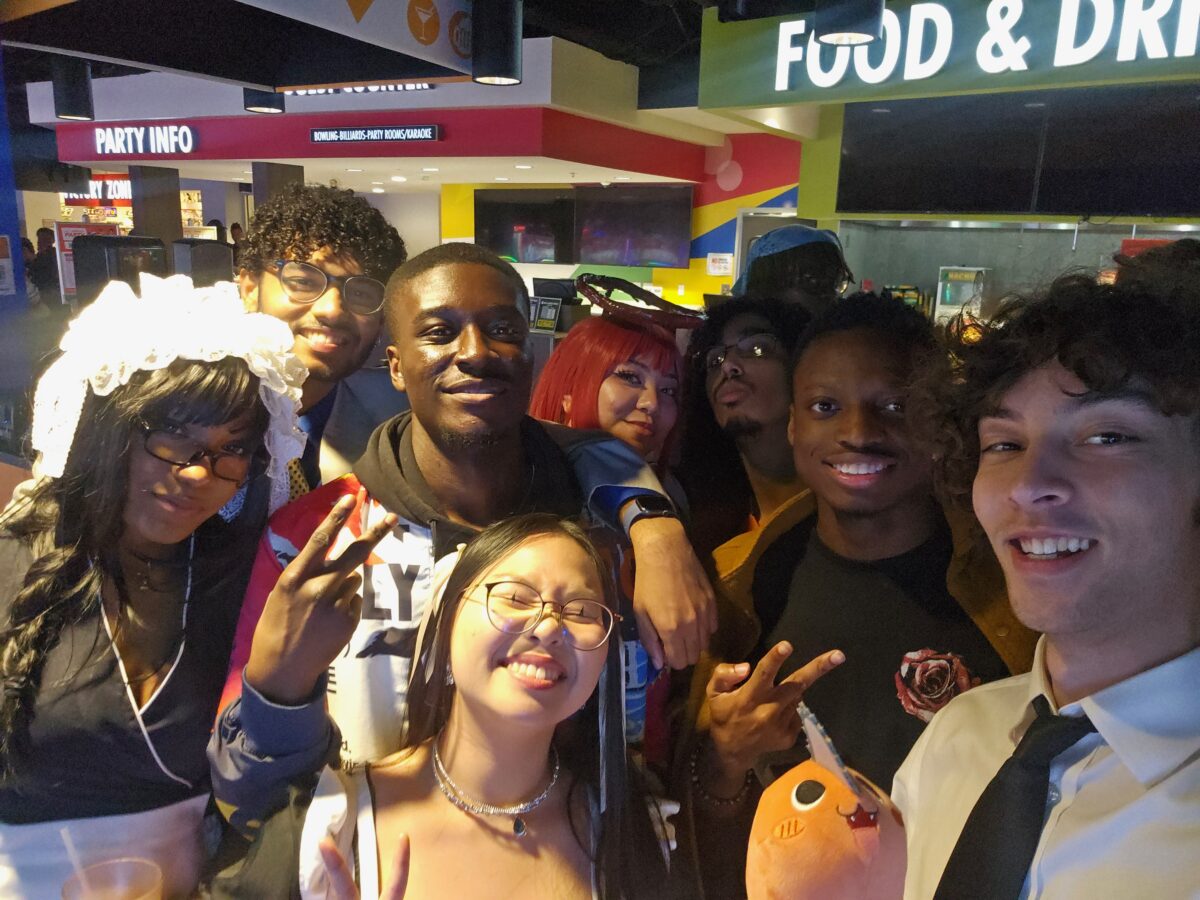 Manav Narendra (back row, left) found plenty of opportunities to spend time with friends despite his demanding academic curriculum. (Courtesy of Narendra)
Q: What’s next for you after graduation?
A: The job market is tough right now, so I’m keeping my options open. I’m considering actuarial positions, data science and analysis, underwriting, even some IT and software roles. I’m open to moving anywhere—I’ve moved a lot in my life, and after five years in Maryland I’m actually getting a little restless!
Certification exams are really important in the fields I want to go into, and I took my first actuarial exam in January. Right now I’m in the Financial Math for Actuaries class at UMBC, which lines up perfectly with the next exam in June. I just want to get my foot in the door somewhere and keep learning.
Q: How have you gotten involved on campus, and how have those experiences supported your well-being and growth?
A: The smaller class sizes at UMBC—especially the 20- to 30-person ones—made everything feel more personal. That’s where I made most of my friends, through connections sparked by real discussion. I also tutored math and Japanese at the Academic Success Center for three years. That was rewarding and kept me grounded.
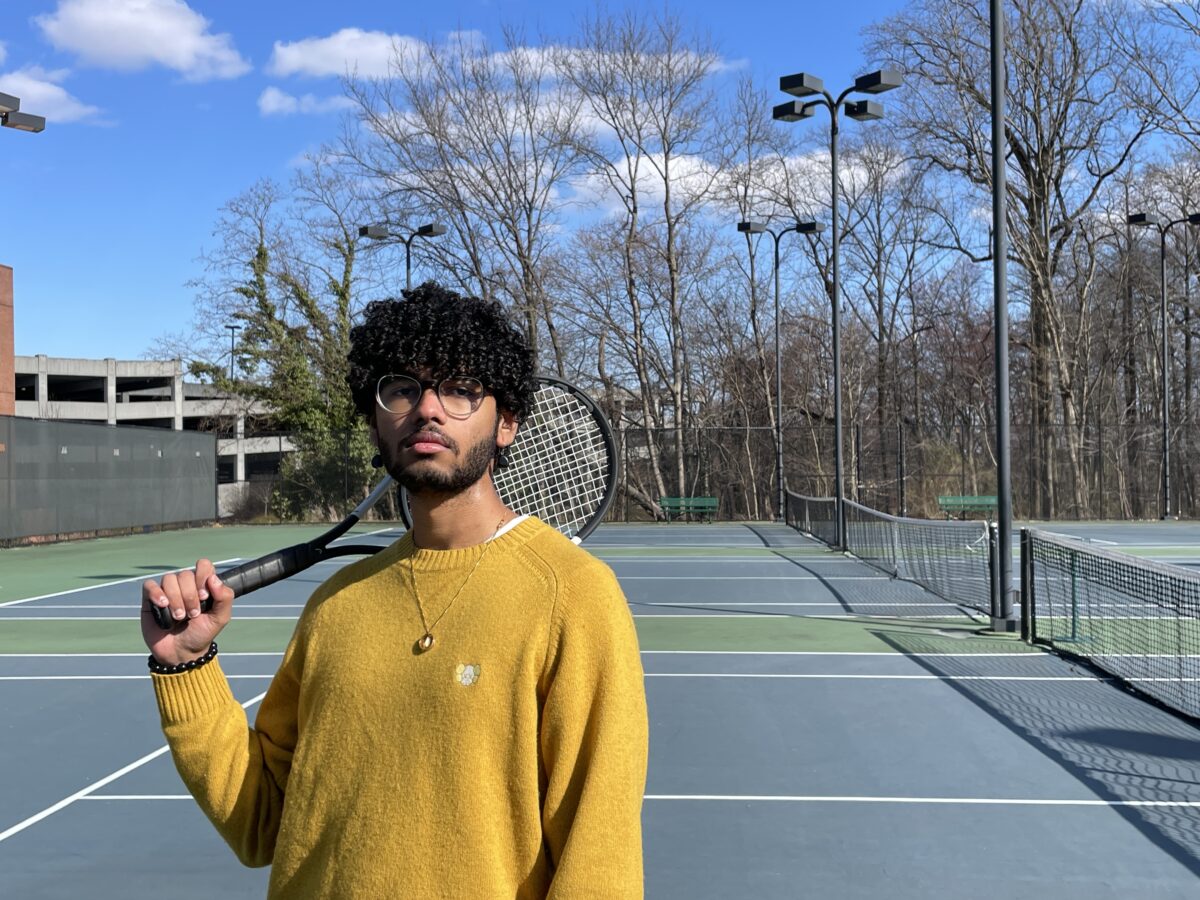 Manav Narendra enjoyed pick-up tennis matches during his time at UMBC. (Courtesy of Narendra)
I’m in the Honors College and the national mathematics honor society, Pi Mu Epsilon, and I just applied to Mu Sigma Rho, the honor society for statistics. My friend is an officer of the Bonsai Club, and I’ve gone to some of their origami and painting events. And I play a lot of pickup tennis—UMBC’s courts are great, and that’s been huge for my physical and mental health and making friends. All of it kept me balanced, especially with a heavy course load to complete both of my degrees in four years.
Q: Who has supported you in your academic and life journey, and what difference has that made?
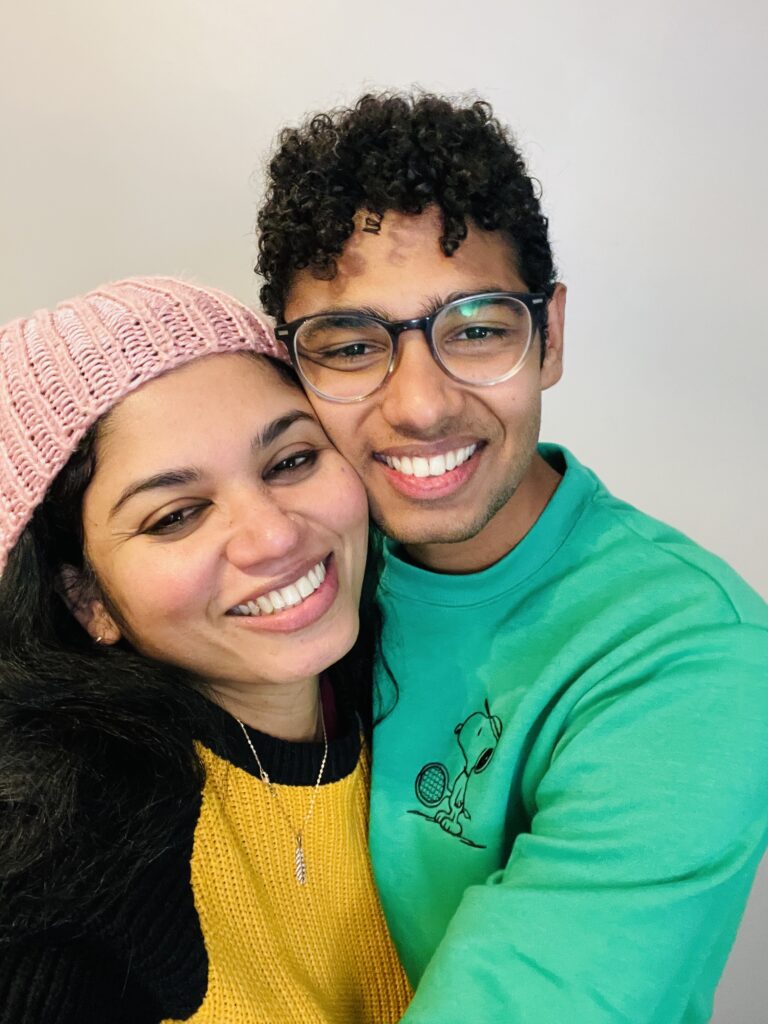 Manav Narendra with his mom, who has provided critical support for him as he underwent cancer treatment and now pursues his professional goals.
A: My mom has been everything. She’s my biggest supporter and my lifelong inspiration, both personally and academically. She stopped working for years to take care of me when I had cancer, getting me to every appointment and advocating for my treatment. I tell people it was much harder for her than for me—I just had to deal with the physical pain, but she handled so much, mentally, emotionally…I wasn’t the brave one during treatment; she was. She’s overcome so much adversity to get me to where I am today, and for that I’m eternally humbled and grateful. Also, at a time in India when women were discouraged from pursuing their dreams and there were large gender disparities in higher education, she embraced her passion for public health and became the first person from her village to earn a doctorate. She later completed a postdoc at Duke—that’s why we first came to the U.S. Her story inspires me every single day to chase after my dreams and always stay true to myself.
At UMBC, Dr. Simon Stacey andDr. Julie Oakes in the Honors College; Dr. Hye-Won Kang and Dr. Kal Nanes in the math department; and pretty much every professor I’ve had have been incredible. They’ve advised me on careers, written recommendation letters, and helped me explore actuarial science. That support made me feel seen and capable.
Q: How did having cancer affect your outlook?
A: When I was 13, I was diagnosed with acute lymphoblastic leukemia (ALL) while we were living in India. The first year of intense chemo was brutal—my brain has blocked out memory of the worst of the agonies. In my debilitated state, I was forced to miss the bulk of 8th grade. Later on, I had GI complications that left me bedridden and using a nasal feeding tube for months, but one silver lining of that time overlapping with the pandemic was that I could join online school right from my bed. Thankfully, I’ve been off treatment since summer 2020, and I’m doing well now. I still have some minor residual issues from treatment—but I’m here!
Cancer gave me resilience. It’s my second chance at life. Challenges that used to feel huge just don’t faze me the same way anymore. That experience put everything in perspective: If I could get through that, I can get through anything. I try to live life to the fullest because of it.
Q: What advice do you have for incoming UMBC students?
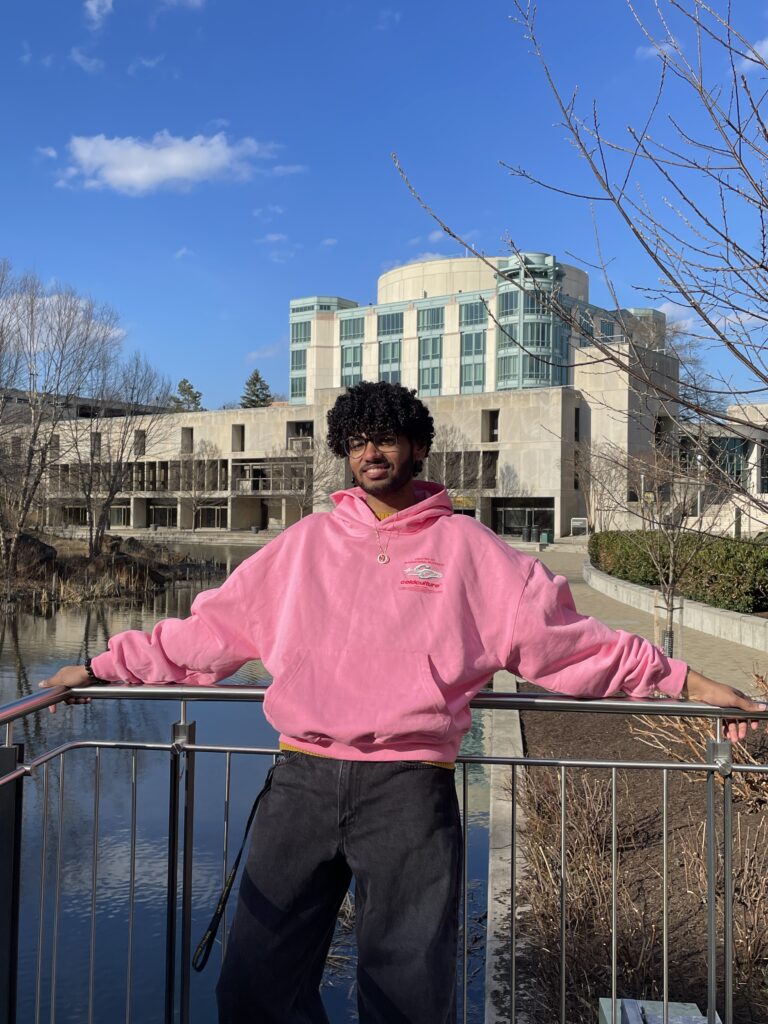 Manav Narendra has come into his own at UMBC, and now he is ready to take on his next chapter. (Courtesy of Narendra)
A: Keep going. Even when things get hard—personal stuff, academics, whatever—just keep moving forward. Break everything into small steps. I’m a serial procrastinator, but I still get everything done by staying consistent with a simple to-do list. Whatever your goal is—an internship, a recital, a competition—just take one small step at a time. Nothing is impossible.
And above all, try to be a good person. I love this Einstein quote: “Try not to become a man of success, but rather try to become a man of value. He is considered successful in our day who gets more out of life than he puts in. But a man of value will give more than he receives.” Be kind. Be empathetic. That matters more than straight As. And UMBC’s community will meet you where you are, and then help you grow, as long as you show up.
]]>
Through a rigorous academic curriculum, service as a tutor, internships, tennis pick-up games, close friendships, and more, Manav Narendra ’26, mathematics and computer science, has made the most...
https://umbc.edu/stories/manav-narendra-mathematician-and-cancer-survivor/
https://my3.my.umbc.edu/api/v0/pixel/news/158897/guest@my.umbc.edu/4e584111e90d8a3ae6e3c320e09c669f/api/pixel
class-of-2026
cnms
coeit
community
csee
mathstat
news
science-and-tech
story
UMBC News & Magazine
https://my3.my.umbc.edu/groups/umbc-news-magazine
https://assets1-my.umbc.edu/system/shared/avatars/groups/000/001/943/24435aa6207c452e7bc15cc74b42c7bb/xsmall.png?1748556657
https://assets1-my.umbc.edu/system/shared/avatars/groups/000/001/943/24435aa6207c452e7bc15cc74b42c7bb/original.png?1748556657
https://assets2-my.umbc.edu/system/shared/avatars/groups/000/001/943/24435aa6207c452e7bc15cc74b42c7bb/xxlarge.png?1748556657
https://assets2-my.umbc.edu/system/shared/avatars/groups/000/001/943/24435aa6207c452e7bc15cc74b42c7bb/xlarge.png?1748556657
https://assets3-my.umbc.edu/system/shared/avatars/groups/000/001/943/24435aa6207c452e7bc15cc74b42c7bb/large.png?1748556657
https://assets1-my.umbc.edu/system/shared/avatars/groups/000/001/943/24435aa6207c452e7bc15cc74b42c7bb/medium.png?1748556657
https://assets2-my.umbc.edu/system/shared/avatars/groups/000/001/943/24435aa6207c452e7bc15cc74b42c7bb/small.png?1748556657
https://assets1-my.umbc.edu/system/shared/avatars/groups/000/001/943/24435aa6207c452e7bc15cc74b42c7bb/xsmall.png?1748556657
https://assets2-my.umbc.edu/system/shared/avatars/groups/000/001/943/24435aa6207c452e7bc15cc74b42c7bb/xxsmall.png?1748556657
UMBC News & Magazine
2
0
false
Fri, 17 Apr 2026 10:19:24 -0400
Fri, 17 Apr 2026 10:19:24 -0400
Spring Update on UMBC’s Settlement Agreement with the DOJ
Dear UMBC Community,
I am writing to provide an update on our efforts following UMBC’s 2024 agreement with the U.S. Department of Justice (DOJ) to strengthen and expand initiatives for preventing and responding to reports of sexual misconduct and sex discrimination under Title IX. The agreement followed a lengthy investigation by the DOJ that found systemic failures in the university’s Title IX compliance between 2015 and 2020.
The agreement is in effect through the 2028 – 29 academic year and commits us to taking many steps to bolster our Title IX office and its work, provide specific support for student-athletes and the Athletics Department, expand training for all members of the community, and provide financial relief to certain individuals, as determined and directed by the DOJ.
The update provided here shares a report of progress since the fall 2025 update. As required by the agreement, UMBC submitted its fourth monitoring report to the DOJ this winter. The university has fully implemented all of the initial provisions of the agreement and remains in the monitoring phase of the agreement. Thus, the work that we continue to do goes above and beyond what is required under the agreement. It is not the agreement that drives our work, but rather our commitment to uphold the highest standards of care, safety, integrity, and accountability for our campus community.
Our recent work includes:
- Increased engagement with our Coordinated Community Response Team to receive feedback on policies, procedures, programming, coordination, and communication efforts;
- Successful implementation of mandatory Title IX training for students and employees;
- Expansion of specialized education and training efforts to include offerings for those designated as confidential resources;
- Targeted support and resources for student-athletes; and
- Integrated use of restorative practices as an informal resolution method as appropriate.
The Office of Equity and Civil Rights (ECR) in particular bears a significant load of this work. And, none of this is possible without the dedicated staff who work tirelessly across campus to uphold our commitment. Thanks to the many campus partners who continue to engage and support these efforts.
Sincerely,
Tanyka M. Barber
Vice President for Institutional Equity and Chief Diversity Officer
]]>
Dear UMBC Community, I am writing to provide an update on our efforts following UMBC’s 2024 agreement with the U.S. Department of Justice (DOJ) to strengthen and expand initiatives for...
https://umbc.edu/stories/spring-update-on-umbcs-settlement-agreement-with-the-doj/
https://my3.my.umbc.edu/api/v0/pixel/news/158778/guest@my.umbc.edu/d6c25617bcb4d7724b62c9474fefb3aa/api/pixel
president
rss
story
UMBC News & Magazine
https://my3.my.umbc.edu/groups/umbc-news-magazine
https://assets1-my.umbc.edu/system/shared/avatars/groups/000/001/943/24435aa6207c452e7bc15cc74b42c7bb/xsmall.png?1748556657
https://assets1-my.umbc.edu/system/shared/avatars/groups/000/001/943/24435aa6207c452e7bc15cc74b42c7bb/original.png?1748556657
https://assets2-my.umbc.edu/system/shared/avatars/groups/000/001/943/24435aa6207c452e7bc15cc74b42c7bb/xxlarge.png?1748556657
https://assets2-my.umbc.edu/system/shared/avatars/groups/000/001/943/24435aa6207c452e7bc15cc74b42c7bb/xlarge.png?1748556657
https://assets3-my.umbc.edu/system/shared/avatars/groups/000/001/943/24435aa6207c452e7bc15cc74b42c7bb/large.png?1748556657
https://assets1-my.umbc.edu/system/shared/avatars/groups/000/001/943/24435aa6207c452e7bc15cc74b42c7bb/medium.png?1748556657
https://assets2-my.umbc.edu/system/shared/avatars/groups/000/001/943/24435aa6207c452e7bc15cc74b42c7bb/small.png?1748556657
https://assets1-my.umbc.edu/system/shared/avatars/groups/000/001/943/24435aa6207c452e7bc15cc74b42c7bb/xsmall.png?1748556657
https://assets2-my.umbc.edu/system/shared/avatars/groups/000/001/943/24435aa6207c452e7bc15cc74b42c7bb/xxsmall.png?1748556657
UMBC News & Magazine
0
0
false
Wed, 15 Apr 2026 13:13:39 -0400
Wed, 15 Apr 2026 13:13:39 -0400
Strategic Plan Survey Deadline is this Friday, April 17
Dear UMBC Community,
Thank you to those of you who have already shared your thoughts and feedback with the Strategic Plan Steering Committee. Today, I write to advise you that the deadline for sharing your ideas about UMBC’s strategic plan and pillars via this survey is Friday, April 17. You can choose which sections of the survey to complete. All responses are anonymous and confidential.
We also want to remind you to visit the strategic planning website and complete the feedback form on the homepage.
We encourage those of you who have not yet provided your thoughts to do so; your voice will ensure the UMBC Strategic Plan is as strong as it can be.
Regards,
Charissa S. L. Cheah
Professor, Psychology and Asian Studies Affiliate Faculty
Chair, Strategic Plan Steering Committee
]]>
Dear UMBC Community, Thank you to those of you who have already shared your thoughts and feedback with the Strategic Plan Steering Committee. Today, I write to advise you that the deadline for...
https://umbc.edu/stories/strategic-plan-survey-deadline-is-this-friday-april-17/
https://my3.my.umbc.edu/api/v0/pixel/news/158735/guest@my.umbc.edu/8ab64f9ebbdbb2311d32455dc03f201d/api/pixel
rss
story
strategic-plan
UMBC News & Magazine
https://my3.my.umbc.edu/groups/umbc-news-magazine
https://assets1-my.umbc.edu/system/shared/avatars/groups/000/001/943/24435aa6207c452e7bc15cc74b42c7bb/xsmall.png?1748556657
https://assets1-my.umbc.edu/system/shared/avatars/groups/000/001/943/24435aa6207c452e7bc15cc74b42c7bb/original.png?1748556657
https://assets2-my.umbc.edu/system/shared/avatars/groups/000/001/943/24435aa6207c452e7bc15cc74b42c7bb/xxlarge.png?1748556657
https://assets2-my.umbc.edu/system/shared/avatars/groups/000/001/943/24435aa6207c452e7bc15cc74b42c7bb/xlarge.png?1748556657
https://assets3-my.umbc.edu/system/shared/avatars/groups/000/001/943/24435aa6207c452e7bc15cc74b42c7bb/large.png?1748556657
https://assets1-my.umbc.edu/system/shared/avatars/groups/000/001/943/24435aa6207c452e7bc15cc74b42c7bb/medium.png?1748556657
https://assets2-my.umbc.edu/system/shared/avatars/groups/000/001/943/24435aa6207c452e7bc15cc74b42c7bb/small.png?1748556657
https://assets1-my.umbc.edu/system/shared/avatars/groups/000/001/943/24435aa6207c452e7bc15cc74b42c7bb/xsmall.png?1748556657
https://assets2-my.umbc.edu/system/shared/avatars/groups/000/001/943/24435aa6207c452e7bc15cc74b42c7bb/xxsmall.png?1748556657
UMBC News & Magazine
0
0
false
Tue, 14 Apr 2026 20:09:05 -0400
Tue, 14 Apr 2026 20:09:05 -0400
Four UMBC student researchers receive prestigious Goldwater Scholarships
Four UMBC students have been named Barry Goldwater Scholars this year. The Barry Goldwater Scholarship and Excellence in Education Foundation supports talented college sophomores and juniors who aspire to become leading researchers in science, engineering, and mathematics in the U.S. The award is one of the most prestigious for undergraduates in STEM.
UMBC juniors Deeya Mistry, biological sciences, Jessica Slaughter, computer engineering, Phoenix Bryant, biological sciences, and sophomore Amir Walton-Irvin, computer engineering, are among the 454 scholars selected nationwide in 2026. They competed with nearly 1,500 students majoring in science, engineering, and mathematics who were nominated by their academic institutions for the award.
This is the third time that a record four UMBC students have received Goldwater Scholarships in the same year.
“I’m always so impressed by the caliber of students at UMBC,” says April Householder ’95, director of undergraduate research and prestigious scholarships, who works with students each year to prepare their Goldwater application materials. “And I’m excited to see what they do next, because this is also a springboard to even bigger and better opportunities.”
Personal stories propel curiosity
The road to a successful scientific career can be arduous, and each of this year’s UMBC Goldwater Scholars have tapped deep curiosity, a drive to make a difference, as well as nurturing family and school support, to take them to this prestigious milestone on their journeys.
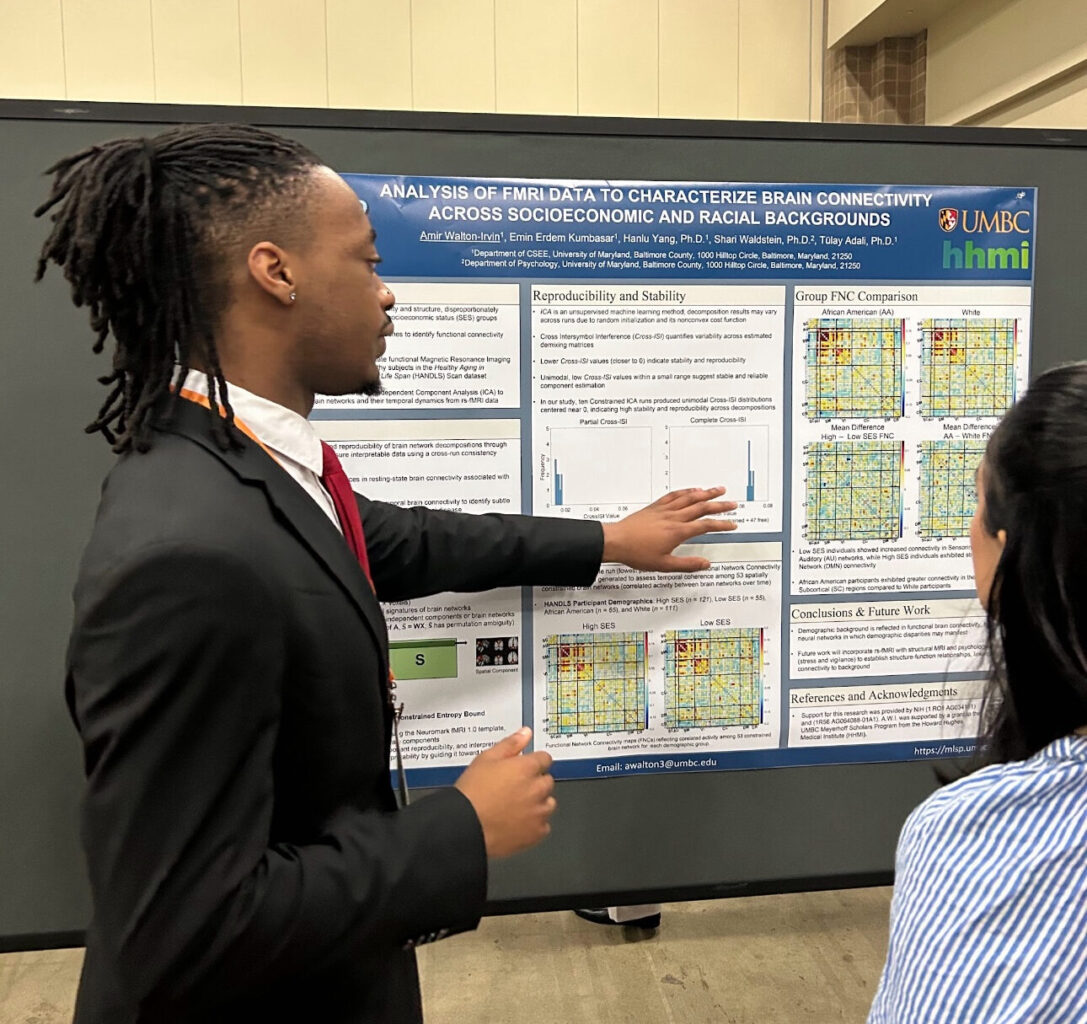 Amir Walton-Irvin presents his research at the 2025 Biomedical Research Conference for Minoritized Scientists. (Photo courtesy of Amir Walton-Irvin)
“I grew up in a household with my mom and my grandmother, who were both mathematics teachers,” Walton-Irvin says. “They both helped nurture my interest in STEM from an early age. My grandmother taught me how to solve math problems, code, and take things apart and put them back together, while my mom encouraged that curiosity by exposing me to engineering camps and science museums.”
Later, when his grandmother started showing signs of dementia, Walton-Irvin found himself facing a host of hard-to-answer questions. “She went from someone who had an answer to every question to not knowing who I was anymore. It was heartbreaking, but it also made me start asking bigger questions: Why did this happen to her, like it has to so many others before her? How does disease change brain function?” He plans to pursue a career at the intersection of machine learning and neuroscience, developing novel neuroimaging analysis methods to investigate neurological disease and health disparities.
 Jessica Slaughter working in Polina Anikeeva’s lab at MIT during a summer internship. (Photo courtesy of Jessica Slaughter)
Bryant experienced a similar personal connection to unanswered scientific questions when her dad was diagnosed with schizoaffective disorder. “I remember asking my mom: ‘Why is he like this?’ And sometimes she’d say: ‘We don’t know that yet.’ And I really wanted to know the answer,” Bryant says. She plans to enter an M.D.-Ph.D. program, and would like to study how environmental factors influence how genes are expressed and may contribute to the development of psychiatric diseases.
Mistry found herself drawn to science since grade school, working to get ever closer to that scientific frontier where new knowledge is created. “Since not everything is known yet, there’s the possibility to uncover more,” she says. “Doing scientific research is an amazing way to pursue my curiosity.” She plans to pursue an M.D.-Ph.D. with a clinical focus in emergency medicine and a Ph.D. studying the molecular makeup of individualized stroke recovery.
“While my clinical and research focuses are different from one another, I was really inspired to study this when I shadowed in the Emergency Department in downtown Baltimore,” she says. “Stroke patients usually come to the Emergency Department first, and everyone’s experience truly is different, because timing is crucial for strokes.”
Slaughter says the possibility of combining new knowledge with helping people drew her to the field of engineering, where she hopes to make a difference by improving global health, especially in disadvantaged areas where resources are limited.
Coming from a family of immigrants, Slaughter watched her grandmother travel over 5,000 miles to the U.S. for surgery, even as her health made the journey difficult. “That experience gave me a window into global healthcare disparities, especially in access to diagnostics and effective treatment, and showed me how engineering can be part of the solution,” she says. It is what drives her to develop low-cost, accessible medical devices and incorporate machine learning.
A supportive family—at home and at school
All the new scholars emphasize how much mentorship, connections, and support have helped them as they worked toward their dreams.
“One of the reasons winning this scholarship is so meaningful to me is because it was only two generations ago when women in my family did not get past a high school education,” says Mistry. She credits her parents with instilling in her a strong work ethic and the confidence to overcome challenges. “My dreams were built on the sacrifice and hard work of my parents and grandparents,” she says.
She also credits the many mentors she met at UMBC. Mistry, Slaughter, Bryant and Walton-Irvin are all part of the Meyerhoff Scholarship Program, which aims to increase diversity among future leaders in science, technology, engineering, and related fields.
“The Meyerhoff program and the COEIT community, particularly Dr. LaBerge and Dr. Marten, have been instrumental to my career,” Slaughter says.
“The advisors in the Meyerhoff program really helped me, and they’re always so supportive,” Bryant echoed.


On left, Deeya Mistry (right) with Mitsue Wiggs, associate director of the Meyerhoff program. (Photo courtesy of Deeya Mistry). On right, Jessica Slaughter (with braids) celebrates winning the limbo contest at the annual Meyerhoff Family Retreat at Centennial Park. “The Meyerhoff program isn’t just a scholarship, but also a family that celebrates every win, big or small,” she says. (Photo courtesy of Jessica Slaughter)
The students also credit their mentors in the labs where they do research on campus. Mistry is investigating the molecular mechanisms that underlie the sex differences in chronic stress susceptibility to understand why females have a higher susceptibility to chronic stress-induced psychiatric disorders such as depression and anxiety in the lab of Tara LeGates. Bryant is studying the biomechanical properties of a protein involved in chromatin regulation in the lab of Erin Green. Slaughter is applying statistical principles to develop bioinformatics applications to facilitate the analysis of dynamic, system-scale “-omics” data in the lab of Mark Marten. And Walton-Irvin is applying machine learning and signal processing methods to investigate functional brain connectivity and health disparities in the lab of Tülay Adali.
On the right path
For the four UMBC students, winning a Goldwater Scholarship is both a validation of the work they have put in so far, and a stepping stone to their next achievement.
“When I saw the email letting me know I’d been selected, I literally screamed, I was so excited,” Slaughter says. “I FaceTimed my family. I FaceTimed all my friends who helped me through this journey. I immediately sent thank you emails to all my mentors.”
Mistry messaged LeGates, her research advisor, and sprinted to her office to celebrate.
Walton-Irvin’s first response was to call his mom, as the news felt both emotional and affirming. “It meant a lot to know that the path I’m trying to build, one rooted in both personal experience and a desire to empower others, was being recognized,” he says. “Awards like this are meaningful, but I see them as part of a much larger journey of doing impactful work.”
 The Goldwater Scholars and some of their mentors strike a fun pose. Back row, from left to right, Ph.D. student Emin Erdem Kumbasar, Amir Walton-Irvin, and Professor Charles Laberge. Middle row, from left to right, Assistant Professor Tara LeGates, Deeya Mistry, Jessica Slaughter, Phoenix Bryant, and Associate Professor Erin Green; front row, April Householder. (Brad Ziegler/UMBC)
Come meet all four Goldwater Scholars at the Undergraduate Research and Creative Achievement Day on April 22 in the RAC, where they will be presenting their research alongside more than 400 other student presenters:
Deeya Mistry: “Investigation of the Circadian Rhythm on Blood Brain Barrier Permeability,” RAC 050, 9:20 – 9:35 a.m.
Phoenix Bryant: “Investigating the Function of the PHD Finger in Chromatin Regulator Set4,” RAC Arena, 10 – 11 a.m., Poster #20
Amir Walton-Irvin: “Analysis of FMRI Data to Characterize Brain Connectivity Across Socioeconomic and Racial Backgrounds,” RAC 230, 11:20 – 11:35 a.m.
Jessica Slaughter: “Open-Source Software Suite of Bioinformatic Tools for Dynamic Omics Data,” RAC Arena, 2 – 3 p.m., Poster #65
]]>
Four UMBC students have been named Barry Goldwater Scholars this year. The Barry Goldwater Scholarship and Excellence in Education Foundation supports talented college sophomores and juniors who...
https://umbc.edu/stories/umbc-goldwater-2026/
https://my3.my.umbc.edu/api/v0/pixel/news/158732/guest@my.umbc.edu/3c3d3b8609cf3cedec6939ce5b5a34a2/api/pixel
biology
cnms
coeit
community
csee
meyerhoff-scholars
news
science-and-tech
story
undergraduate-research
UMBC News & Magazine
https://my3.my.umbc.edu/groups/umbc-news-magazine
https://assets1-my.umbc.edu/system/shared/avatars/groups/000/001/943/24435aa6207c452e7bc15cc74b42c7bb/xsmall.png?1748556657
https://assets1-my.umbc.edu/system/shared/avatars/groups/000/001/943/24435aa6207c452e7bc15cc74b42c7bb/original.png?1748556657
https://assets2-my.umbc.edu/system/shared/avatars/groups/000/001/943/24435aa6207c452e7bc15cc74b42c7bb/xxlarge.png?1748556657
https://assets2-my.umbc.edu/system/shared/avatars/groups/000/001/943/24435aa6207c452e7bc15cc74b42c7bb/xlarge.png?1748556657
https://assets3-my.umbc.edu/system/shared/avatars/groups/000/001/943/24435aa6207c452e7bc15cc74b42c7bb/large.png?1748556657
https://assets1-my.umbc.edu/system/shared/avatars/groups/000/001/943/24435aa6207c452e7bc15cc74b42c7bb/medium.png?1748556657
https://assets2-my.umbc.edu/system/shared/avatars/groups/000/001/943/24435aa6207c452e7bc15cc74b42c7bb/small.png?1748556657
https://assets1-my.umbc.edu/system/shared/avatars/groups/000/001/943/24435aa6207c452e7bc15cc74b42c7bb/xsmall.png?1748556657
https://assets2-my.umbc.edu/system/shared/avatars/groups/000/001/943/24435aa6207c452e7bc15cc74b42c7bb/xxsmall.png?1748556657
UMBC News & Magazine
1
0
false
Tue, 14 Apr 2026 16:29:33 -0400
Tue, 14 Apr 2026 16:29:33 -0400
Restorative practices at UMBC guide students to thrive through accountability
At UMBC, restorative practices have grown from a promising idea into a campus-wide movement—one shaped by dedicated staff and reaching far beyond the university itself.
For Jeff Cullen, UMBC’s director of Student Conduct and Community Standards, this work has been years in the making. Now in his 18th year at the university, Cullen has helped guide the evolution of student conduct from a traditional, punitive model toward something more meaningful: a restorative approach that centers accountability, healing, and community.
“Each student I encounter is unique,” Cullen explains. “I enjoy working with them in a restorative way—offering high levels of support while also demanding high levels of accountability.”
Building a proactive framework
UMBC formally began integrating restorative practices in 2015, after adopting training models inspired by the International Institute for Restorative Practices. What started as an alternative way to resolve disputes has since expanded into a proactive framework for building relationships and fostering authentic communication across campus.
Instead of focusing solely on punishment, restorative practices ask deeper questions. Cullen describes a hypothetical situation: a student returns to their residence hall inebriated, damages a bulletin board, and creates a mess in a shared space. In a traditional system, the outcome might center on sanctions. But a restorative approach broadens the lens.
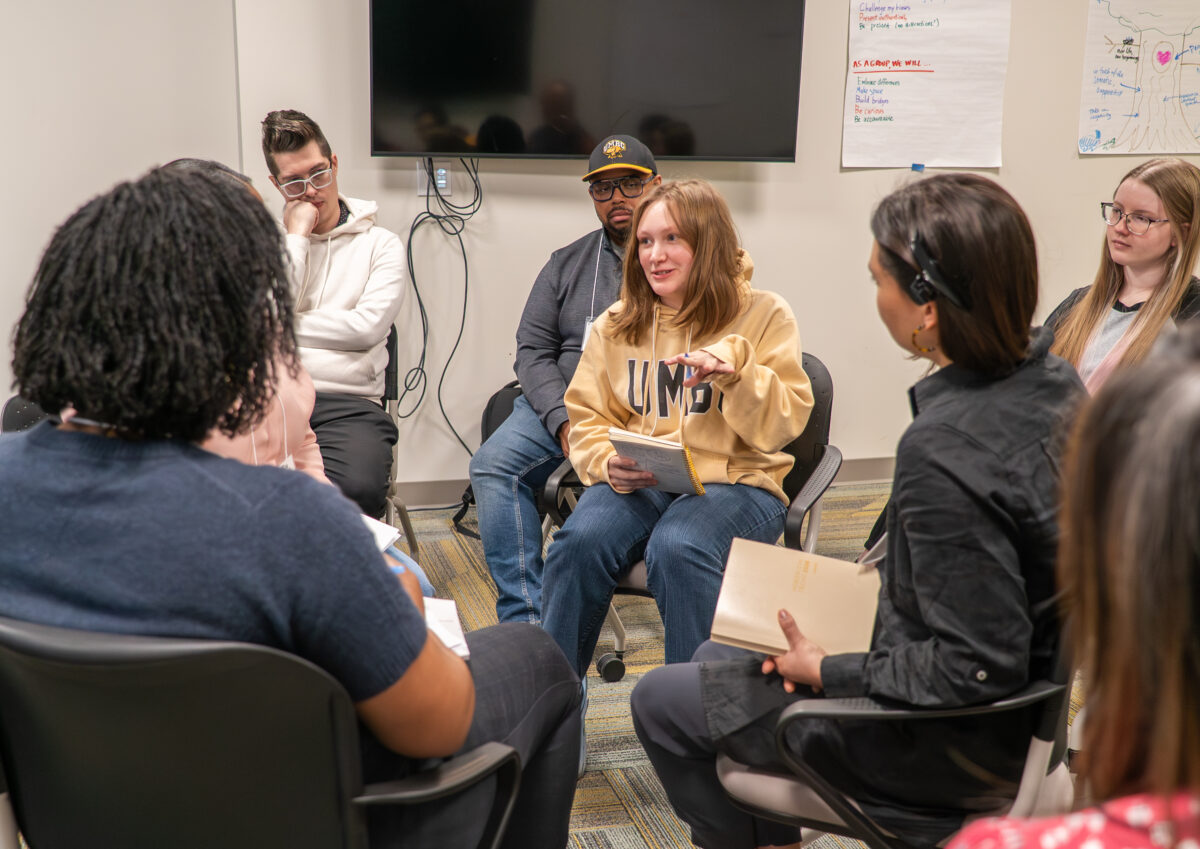 Samantha Kennedy ’25, social work, a graduate assistant for restorative practices in Student Conduct and Community Standards participates in a “fishbowl circle” which can be useful for idea generation and problem solving.
“It’s not just about the student,” Cullen says. “There are custodial staff, residential life staff, and other students who are impacted.”
Through restorative circles, those affected come together—the student, staff members, peers—and engage in guided dialogue. They reflect on what happened, who was harmed, and how to make things right. The result is not only accountability, but also understanding and, often, reintegration into the community.
While the process can feel challenging at first, Cullen notes that participants often leave with a sense of resolution and stronger conflict-resolution skills. Early data and broader research suggest that restorative approaches can reduce repeat offenses, increase satisfaction, and create healthier communities overall.
That impact is not limited to UMBC.
Restorative practices beyond the classroom
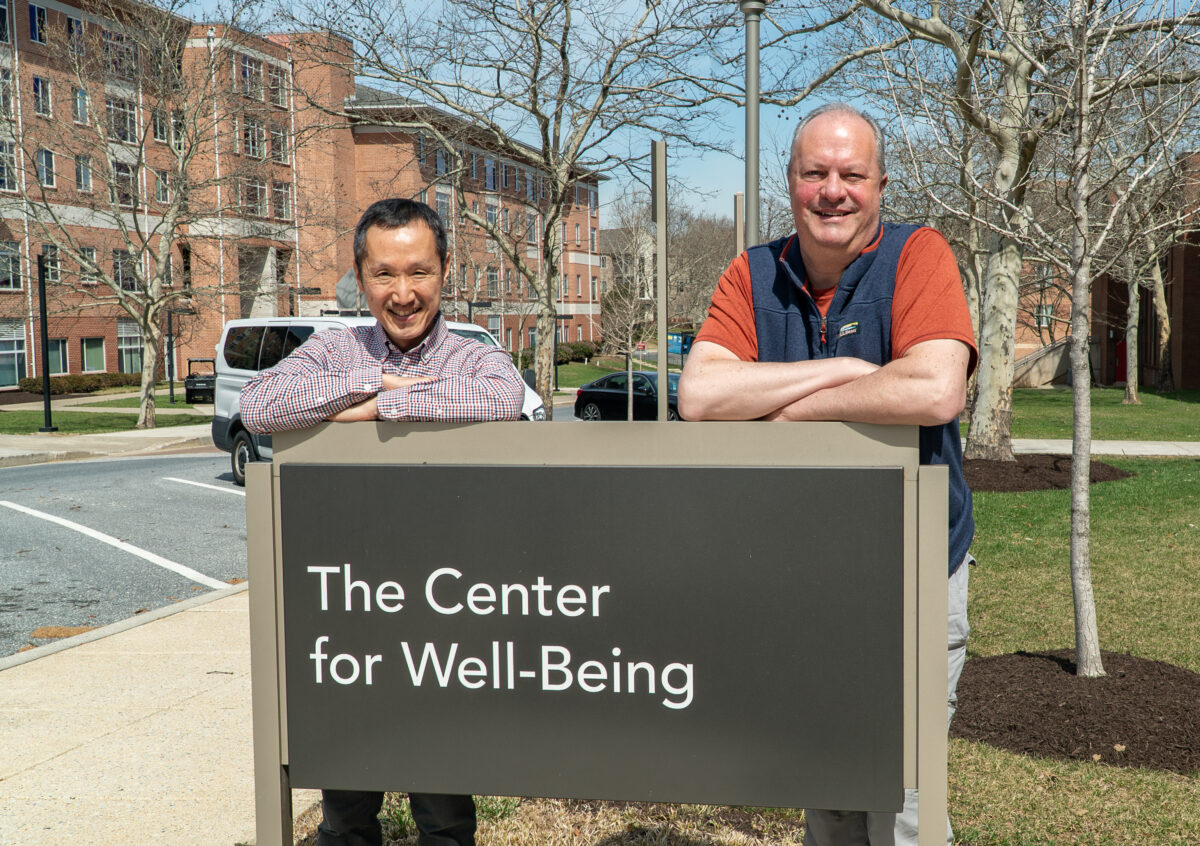
Toshiyasu Tsuruhara, an associate professor at Ritsumeikan Asia Pacific University in Japan, traveled across the globe to attend a 2-day restorative practices workshop at UMBC (combining his trip with another training in San Diego). With a background in conflict mediation—including accreditation as a community mediator in the U.K. and experience working with neighbor disputes and in family court—Tsuruhara was already familiar with restorative justice concepts.
But the workshop offered something new.
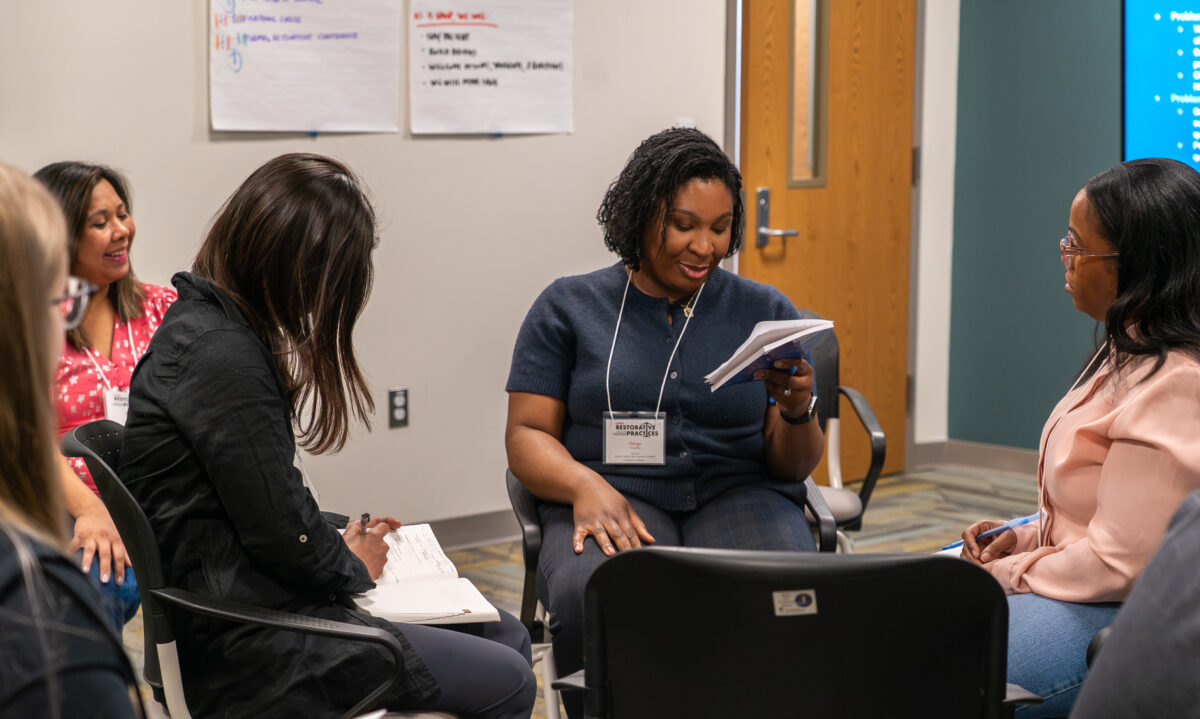
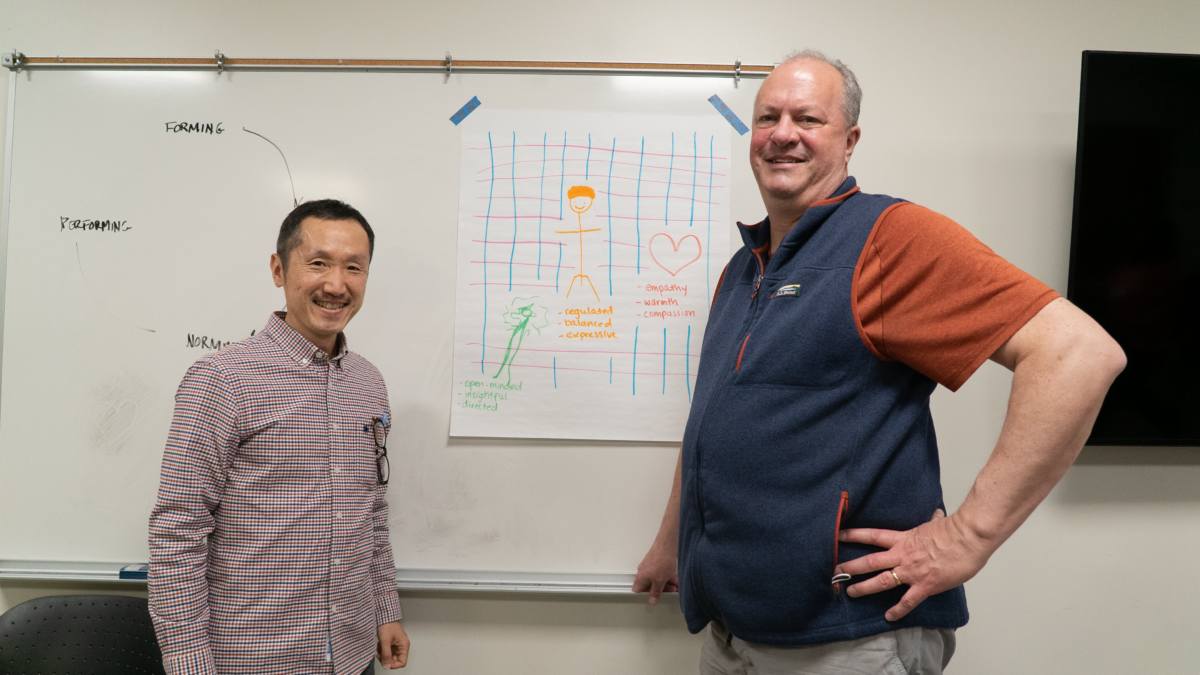 Left: More fishbowl circle work at the 2026 training. Right: Toshiyasu Tsuruhara and Jeff Cullen met during the 2-day training.
“I learned how these tools can be applied in real-life situations,” he explains. “I am interested in restorative practices because they offer tools to repair relationships and bring communities toward peace,” Tsuruhara says. “They are not just for education—they can be applied in work, family, and friendships.”
During his time at UMBC, Tsuruhara engaged closely with students and staff, participating in discussions, collaborative exercises, and even creative activities like short dramatic presentations to explore key concepts. What stood out most was not just the theory, but how actively it was practiced.
For Tsuruhara, the experience also highlighted the value of introducing restorative practices early in students’ lives. He observed how these approaches could help students navigate both academic and social challenges, while also preparing them for professional environments.
“They help maintain peaceful relationships with workmates,” he says. “And if conflict happens, they provide tools to resolve it.”
Inspired by what he learned, Tsuruhara plans to continue to integrate restorative practices into his own teaching. In his “Multicultural Cooperation Workshop,” students from diverse national and cultural backgrounds collaborate on long-term group projects—an environment where conflict can naturally arise. Rather than relying solely on mediation training, he sees restorative practices as a more holistic and educational approach.
One small effort turns into campus-wide movement
Back at UMBC, Cullen reflects on how far the initiative has come. What began over a decade ago as a small effort has grown into a campus-wide movement, with hundreds of students, faculty, and staff trained in restorative methods.
“At UMBC, if you have a good idea, you’re encouraged to implement it,” Cullen says. “We had no idea it would grow like this—but here we are.”
Supported by colleagues in Residential Life and Student Affairs leadership, and shaped through years of collaboration, restorative practices at UMBC continue to evolve—impacting not only the campus community, but also educators and practitioners around the world.
Click here for more resources on restorative practices at UMBC
]]>
At UMBC, restorative practices have grown from a promising idea into a campus-wide movement—one shaped by dedicated staff and reaching far beyond the university itself. For Jeff Cullen,...
https://umbc.edu/stories/restorative-practices-at-umbc-guide-students-to-thrive-through-accountability/
https://my3.my.umbc.edu/api/v0/pixel/news/158721/guest@my.umbc.edu/ed3c5f2fe0eaa7047f980c27a677b65b/api/pixel
campus-life
magazine
story
studentaffairs
UMBC News & Magazine
https://my3.my.umbc.edu/groups/umbc-news-magazine
https://assets1-my.umbc.edu/system/shared/avatars/groups/000/001/943/24435aa6207c452e7bc15cc74b42c7bb/xsmall.png?1748556657
https://assets1-my.umbc.edu/system/shared/avatars/groups/000/001/943/24435aa6207c452e7bc15cc74b42c7bb/original.png?1748556657
https://assets2-my.umbc.edu/system/shared/avatars/groups/000/001/943/24435aa6207c452e7bc15cc74b42c7bb/xxlarge.png?1748556657
https://assets2-my.umbc.edu/system/shared/avatars/groups/000/001/943/24435aa6207c452e7bc15cc74b42c7bb/xlarge.png?1748556657
https://assets3-my.umbc.edu/system/shared/avatars/groups/000/001/943/24435aa6207c452e7bc15cc74b42c7bb/large.png?1748556657
https://assets1-my.umbc.edu/system/shared/avatars/groups/000/001/943/24435aa6207c452e7bc15cc74b42c7bb/medium.png?1748556657
https://assets2-my.umbc.edu/system/shared/avatars/groups/000/001/943/24435aa6207c452e7bc15cc74b42c7bb/small.png?1748556657
https://assets1-my.umbc.edu/system/shared/avatars/groups/000/001/943/24435aa6207c452e7bc15cc74b42c7bb/xsmall.png?1748556657
https://assets2-my.umbc.edu/system/shared/avatars/groups/000/001/943/24435aa6207c452e7bc15cc74b42c7bb/xxsmall.png?1748556657
UMBC News & Magazine
0
0
false
Tue, 14 Apr 2026 12:59:01 -0400
Tue, 14 Apr 2026 12:59:01 -0400
Happy Monday: A Shared Commitment to Shared Governance
Dear UMBC Community,
One of the privileges of serving as president of UMBC is that the role gives me a view of the entirety of the institution and the chance to hear voices from all across it, through a regular cadence of engagement with shared governance groups on our campus.
My calendar was particularly full of such opportunities last week, as I participated in meetings of the Faculty Senate Executive Committee, Exempt Staff Senate, and University Steering Committee (whose members represent every UMBC governance group), as well as an all-staff meeting hosted by the Exempt and Nonexempt Staff senates. These meetings and others connect me to all parts of the community and allow me to join you in the work of thinking through current issues and planning for a shared vision for the future.
Through the questions, feedback, and ideas I heard from so many of you, last week’s meetings reflected the richness of experiences and viewpoints across our institution and were a terrific reminder of the strength of shared governance at UMBC.
Sincerely,
President Valerie Sheares Ashby
]]>
Dear UMBC Community, One of the privileges of serving as president of UMBC is that the role gives me a view of the entirety of the institution and the chance to hear voices from all across it,...
https://umbc.edu/stories/happy-monday-a-shared-commitment-to-shared-governance/
https://my3.my.umbc.edu/api/v0/pixel/news/159230/guest@my.umbc.edu/67b20c9593602741826964b110bb436a/api/pixel
happy-monday
rss
story
UMBC News & Magazine
https://my3.my.umbc.edu/groups/umbc-news-magazine
https://assets1-my.umbc.edu/system/shared/avatars/groups/000/001/943/24435aa6207c452e7bc15cc74b42c7bb/xsmall.png?1748556657
https://assets1-my.umbc.edu/system/shared/avatars/groups/000/001/943/24435aa6207c452e7bc15cc74b42c7bb/original.png?1748556657
https://assets2-my.umbc.edu/system/shared/avatars/groups/000/001/943/24435aa6207c452e7bc15cc74b42c7bb/xxlarge.png?1748556657
https://assets2-my.umbc.edu/system/shared/avatars/groups/000/001/943/24435aa6207c452e7bc15cc74b42c7bb/xlarge.png?1748556657
https://assets3-my.umbc.edu/system/shared/avatars/groups/000/001/943/24435aa6207c452e7bc15cc74b42c7bb/large.png?1748556657
https://assets1-my.umbc.edu/system/shared/avatars/groups/000/001/943/24435aa6207c452e7bc15cc74b42c7bb/medium.png?1748556657
https://assets2-my.umbc.edu/system/shared/avatars/groups/000/001/943/24435aa6207c452e7bc15cc74b42c7bb/small.png?1748556657
https://assets1-my.umbc.edu/system/shared/avatars/groups/000/001/943/24435aa6207c452e7bc15cc74b42c7bb/xsmall.png?1748556657
https://assets2-my.umbc.edu/system/shared/avatars/groups/000/001/943/24435aa6207c452e7bc15cc74b42c7bb/xxsmall.png?1748556657
UMBC News & Magazine
1
0
false
Mon, 13 Apr 2026 16:34:53 -0400
Mon, 13 Apr 2026 16:34:53 -0400
Unlocking motivation: Grad student leads discovery of how two hippocampus regions team up to fuel goal-driven behavior
New UMBC research reveals how two different parts of the hippocampus—the brain’s memory center—team up in a key reward region to help mice, and likely humans, combine memories of places and contexts with the drive to pursue rewards.
 Tara LeGates’ research group works at the intersection of neuroscience and behavior. (Brad Ziegler)
The findings offer fresh insight into how the brain integrates information about “where” and “what feels good” to guide everyday decisions, such as heading to a favorite restaurant to meet friends or seeking out rewarding experiences. Specifically, this discovery, published in the Journal of Neuroscience, shows that inputs from the dorsal and ventral hippocampus converge on the same individual neurons in another brain region, the nucleus accumbens, where they interact in ways that amplify each other’s effects.
“The connection between the hippocampus and nucleus accumbens is where the brain’s map of where to go meets a sense of why it’s worth going,” explains senior author Tara LeGates,assistant professor in UMBC’s Department of Biological Sciences.
For years, scientists viewed the connections from the dorsal hippocampus, which is more closely tied to spatial memory and navigation, and the ventral hippocampus, which is linked more strongly to emotions and motivation, as mostly separate. This paper challenges that understanding.
“A single neuron can receive inputs from different brain regions, and figuring out how it integrates them is crucial for understanding what drives goal-directed actions,” LeGates says.
While the current study focuses on individual cells, the implications reach further. Better knowledge of how these reward-related circuits process and combine information could shed light on conditions where motivation is disrupted, such as depression, addiction, or anxiety disorders.
A close-up on convergence
The research team used advanced methods including using light to stimulate specific pathways (a technique called optogenetics), precise recordings of electrical activity in neurons, and detailed microscope imaging to identify a group of neurons in a specific part of the accumbens that receives direct input from both the dorsal and ventral hippocampus.
Importantly, the synapses involved in these two pathways sit very close together—often within a couple of microns (thousandths of a millimeter)—on the same branches of the neurons’ dendrites, which look like tree roots on nerve cells. That proximity allows them to influence each other quickly. The team found that when both inputs are active at the same time, they produce a stronger combined response than either one alone.
 Tara LeGates (right) discusses hippocampus cell images with Ph.D. student Nick Anderson (left) and undergraduate Branwen She. (Brad Ziegler)
The researchers collaborated with Tagide deCarvalho, director of UMBC’s Keith Porter Imaging Facility, to obtain the high-resolution imaging that confirmed these close partnerships. Upgraded software at the facility allowed the team to capture ultra-thin digital slices (0.2 microns thick) and create 3D reconstructions of neuron branches, clearly demonstrating the close proximity of the synapses that would allow them to interact.
The study’s first author, Ashley Copenhaver ’20, mathematics and biological sciences, Ph.D. ’25, neuroscience and cognitive sciences, led much of the hands-on work in recordings and imaging while mentoring undergraduate team members.
 Tara LeGates’ research group includes a number of graduate and undergraduate students who are gaining experience in techniques like electrophysiology and dissection. (Brad Ziegler)
“One of the most exciting parts of this technically challenging project was performing dual-color optogenetics during electrophysiology—I was literally shining tiny beams of red and blue light onto brain tissue, which was activating the dorsal or ventral hippocampus neurons, so that I could record the electrical responses in the nucleus accumbens neurons. It was magical,” Copenhaver says. “Beyond loving the technique, in my opinion, we identified some really critical and fundamental mechanisms of signal integration within the brain. I’m super excited to see where this work heads next.”
From cells to behavior
Understanding how a single neuron handles signals from different brain areas is key to grasping complex behaviors, says LeGates, who has a secondary appointment in the Department of Pharmacology and Physiology at the University of Maryland School of Medicine. Signals from the dorsal and ventral hippocampus are “probably converging more than we’ve previously appreciated, which could change how people approach questions about motivation and learning,” she adds.
That kind of convergence likely helps animals form associations between rewarding outcomes and the environments where they occur—an essential capability for survival. Similar convergence has been seen in other brain areas involved in emotional learning, LeGates says, suggesting the brain may use this strategy widely to link a particular context with feeling and action.
 Kaela Befano ’24, biological sciences (left), is now a staff researcher in the LeGates laboratory. (Brad Ziegler)
LeGates’ lab is already building on this paper’s foundation by exploring how stress and substances like food, medications, and illicit drugs affect these same connections, with the long-term aim of informing more targeted treatments for various mental health conditions. In the immediate future, the team hopes to record activity from these specially connected neurons during real behaviors to directly link the newly discovered crosstalk between the ventral and dorsal hippocampus to actions.
By uncovering this hidden layer of cooperation between hippocampal pathways, the LeGates lab has advanced our understanding of how the brain weaves together memory and motivation—a fundamental process that shapes the decisions driving daily life.
]]>
New UMBC research reveals how two different parts of the hippocampus—the brain’s memory center—team up in a key reward region to help mice, and likely humans, combine memories of places and...
https://umbc.edu/stories/unlocking-motivation-hippocampus-regions-team-up/
https://my3.my.umbc.edu/api/v0/pixel/news/158537/guest@my.umbc.edu/b6550c10304ec0473895a6317fad8e18/api/pixel
biology
cnms
graduate-research
news
research
science-and-tech
story
UMBC News & Magazine
https://my3.my.umbc.edu/groups/umbc-news-magazine
https://assets1-my.umbc.edu/system/shared/avatars/groups/000/001/943/24435aa6207c452e7bc15cc74b42c7bb/xsmall.png?1748556657
https://assets1-my.umbc.edu/system/shared/avatars/groups/000/001/943/24435aa6207c452e7bc15cc74b42c7bb/original.png?1748556657
https://assets2-my.umbc.edu/system/shared/avatars/groups/000/001/943/24435aa6207c452e7bc15cc74b42c7bb/xxlarge.png?1748556657
https://assets2-my.umbc.edu/system/shared/avatars/groups/000/001/943/24435aa6207c452e7bc15cc74b42c7bb/xlarge.png?1748556657
https://assets3-my.umbc.edu/system/shared/avatars/groups/000/001/943/24435aa6207c452e7bc15cc74b42c7bb/large.png?1748556657
https://assets1-my.umbc.edu/system/shared/avatars/groups/000/001/943/24435aa6207c452e7bc15cc74b42c7bb/medium.png?1748556657
https://assets2-my.umbc.edu/system/shared/avatars/groups/000/001/943/24435aa6207c452e7bc15cc74b42c7bb/small.png?1748556657
https://assets1-my.umbc.edu/system/shared/avatars/groups/000/001/943/24435aa6207c452e7bc15cc74b42c7bb/xsmall.png?1748556657
https://assets2-my.umbc.edu/system/shared/avatars/groups/000/001/943/24435aa6207c452e7bc15cc74b42c7bb/xxsmall.png?1748556657
UMBC News & Magazine
0
0
false
Thu, 09 Apr 2026 15:18:29 -0400
Thu, 09 Apr 2026 15:18:29 -0400
Happy Monday: Our Extraordinary Graduate Students
Dear UMBC Community,
Last week, I had the opportunity to spend time with the Graduate Student Association Executive Council and senators. I left the conversation energized and encouraged.
What struck me was the breadth of who was in the room—graduate students from every college and numerous disciplines, all engaged in a wide range of scholarly creative work. Despite their different fields, questions, and approaches, they share an inspiring commitment to something larger than themselves. Not only are they advancing their own research, but they are also serving their fellow graduate students, building community, and shaping an environment where everyone can thrive.
During the meeting, I was reminded of my own time as a graduate student, when I experienced the excitement of pursuing new questions, the responsibility of teaching and finding my voice in the classroom, and the privilege of mentoring undergraduate students along the way.
I am so grateful that at UMBC, teaching, research, and service are powerfully connected pursuits—a connection that our graduate students live out every day.
Sincerely,
President Valerie Sheares Ashby
]]>
Dear UMBC Community, Last week, I had the opportunity to spend time with the Graduate Student Association Executive Council and senators. I left the conversation energized and encouraged. ...
https://umbc.edu/stories/happy-monday-our-extraordinary-graduate-students/
https://my3.my.umbc.edu/api/v0/pixel/news/159231/guest@my.umbc.edu/d15734ec46437232c960c78fc61c4de0/api/pixel
happy-monday
rss
story
UMBC News & Magazine
https://my3.my.umbc.edu/groups/umbc-news-magazine
https://assets1-my.umbc.edu/system/shared/avatars/groups/000/001/943/24435aa6207c452e7bc15cc74b42c7bb/xsmall.png?1748556657
https://assets1-my.umbc.edu/system/shared/avatars/groups/000/001/943/24435aa6207c452e7bc15cc74b42c7bb/original.png?1748556657
https://assets2-my.umbc.edu/system/shared/avatars/groups/000/001/943/24435aa6207c452e7bc15cc74b42c7bb/xxlarge.png?1748556657
https://assets2-my.umbc.edu/system/shared/avatars/groups/000/001/943/24435aa6207c452e7bc15cc74b42c7bb/xlarge.png?1748556657
https://assets3-my.umbc.edu/system/shared/avatars/groups/000/001/943/24435aa6207c452e7bc15cc74b42c7bb/large.png?1748556657
https://assets1-my.umbc.edu/system/shared/avatars/groups/000/001/943/24435aa6207c452e7bc15cc74b42c7bb/medium.png?1748556657
https://assets2-my.umbc.edu/system/shared/avatars/groups/000/001/943/24435aa6207c452e7bc15cc74b42c7bb/small.png?1748556657
https://assets1-my.umbc.edu/system/shared/avatars/groups/000/001/943/24435aa6207c452e7bc15cc74b42c7bb/xsmall.png?1748556657
https://assets2-my.umbc.edu/system/shared/avatars/groups/000/001/943/24435aa6207c452e7bc15cc74b42c7bb/xxsmall.png?1748556657
UMBC News & Magazine
0
0
false
Mon, 06 Apr 2026 14:04:04 -0400
Strategic Plan Engagement Opportunities for Our Campus Community
Dear UMBC Community,
On behalf of the Strategic Plan Steering Committee, I write to remind you to share your ideas for strengthening UMBC’s strategic plan and pillars via this survey. The survey deadline has been extended from Tuesday, April 7, to Friday, April 17, to ensure as many responses as possible. You can choose which sections to complete based on your interests and experiences. Please note that each section takes approximately 10 – 15 minutes, and all responses are anonymous and confidential.
Our pillar subgroups have started posting engagement events in the myUMBC Strategic Planning group. The Transform Teaching and Learning pillar subgroup is inviting UMBC faculty to two events next week. On Tuesday, April 7, a Virtual Town Hall will be held at 4 p.m., which faculty can register for here. On Wednesday, April 8, an In-Person Town Hall for faculty will take place in Engineering 027 from noon to 1 p.m.
Finally, please visit the strategic planning website for current information, which includes a feedback form on the homepage.
Thank you in advance for sharing your thoughts and feedback; your voice is essential to ensuring a strong UMBC Strategic Plan. We appreciate your support.
Regards,
Charissa S. L. Cheah
Professor, Psychology and Asian Studies Affiliate Faculty
Chair, Strategic Plan Steering Committee
]]>
Dear UMBC Community, On behalf of the Strategic Plan Steering Committee, I write to remind you to share your ideas for strengthening UMBC’s strategic plan and pillars via this survey. The survey...
https://umbc.edu/stories/strategic-plan-engagement-opportunities-for-our-campus-community-2/
https://my3.my.umbc.edu/api/v0/pixel/news/158250/guest@my.umbc.edu/0192826b030782226ac25050fbf7262c/api/pixel
rss
story
strategic-plan
UMBC News & Magazine
https://my3.my.umbc.edu/groups/umbc-news-magazine
https://assets1-my.umbc.edu/system/shared/avatars/groups/000/001/943/24435aa6207c452e7bc15cc74b42c7bb/xsmall.png?1748556657
https://assets1-my.umbc.edu/system/shared/avatars/groups/000/001/943/24435aa6207c452e7bc15cc74b42c7bb/original.png?1748556657
https://assets2-my.umbc.edu/system/shared/avatars/groups/000/001/943/24435aa6207c452e7bc15cc74b42c7bb/xxlarge.png?1748556657
https://assets2-my.umbc.edu/system/shared/avatars/groups/000/001/943/24435aa6207c452e7bc15cc74b42c7bb/xlarge.png?1748556657
https://assets3-my.umbc.edu/system/shared/avatars/groups/000/001/943/24435aa6207c452e7bc15cc74b42c7bb/large.png?1748556657
https://assets1-my.umbc.edu/system/shared/avatars/groups/000/001/943/24435aa6207c452e7bc15cc74b42c7bb/medium.png?1748556657
https://assets2-my.umbc.edu/system/shared/avatars/groups/000/001/943/24435aa6207c452e7bc15cc74b42c7bb/small.png?1748556657
https://assets1-my.umbc.edu/system/shared/avatars/groups/000/001/943/24435aa6207c452e7bc15cc74b42c7bb/xsmall.png?1748556657
https://assets2-my.umbc.edu/system/shared/avatars/groups/000/001/943/24435aa6207c452e7bc15cc74b42c7bb/xxsmall.png?1748556657
UMBC News & Magazine
0
0
false
Fri, 03 Apr 2026 19:56:02 -0400
Fri, 03 Apr 2026 19:56:02 -0400