UMBC launching M.S. in AI program this fall
AI is poised to reshape nearly every sector of the economy in the coming years and UMBC is adapting its curricular offerings in a variety of ways. One specific change: The university is launching a new master’s degree program to prepare students to lead the AI transformation. The new M.S. in AI program, designed for students with some computing background, offers a focused, rigorous pathway into AI research, development, and deployment.
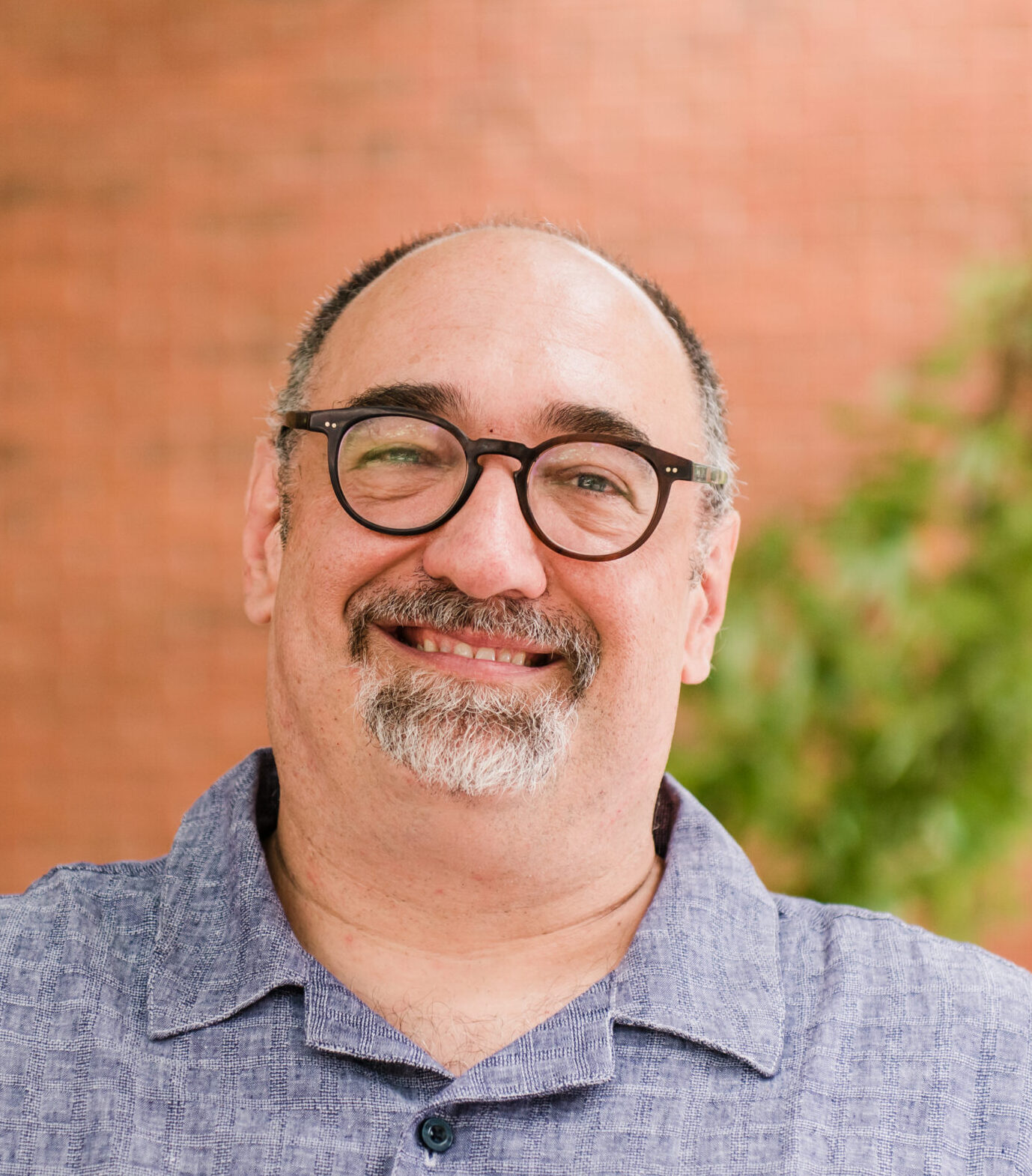
“Within the state of Maryland and our region, there are a number of national labs and industries that are really focused on AI. This program is responding to workforce demands and really preparing students for the world of AI,” says Dmitri Perkins, a professor and director of graduate programs in the Department of Computer Science and Electrical Engineering at UMBC.
The first cohort of students will start classes this coming fall. The new program joins these existing UMBC AI degrees: B.S. in computer science with a specialized track in AI/machine learning and M.S. in information systems with a specialized track in AI.
]]>
AI is poised to reshape nearly every sector of the economy in the coming years and UMBC is adapting its curricular offerings in a variety of ways. One specific change: The university is launching...
https://umbc.edu/stories/umbc-ms-in-ai/
https://my3.my.umbc.edu/api/v0/pixel/news/161058/guest@my.umbc.edu/4738a2c7a81b14963076d8651da1690c/api/pixel
ai
coeit
csee
science-and-tech
stories
story
UMBC News & Magazine
https://my3.my.umbc.edu/groups/umbc-news-magazine
https://assets1-my.umbc.edu/system/shared/avatars/groups/000/001/943/24435aa6207c452e7bc15cc74b42c7bb/xsmall.png?1748556657
https://assets1-my.umbc.edu/system/shared/avatars/groups/000/001/943/24435aa6207c452e7bc15cc74b42c7bb/original.png?1748556657
https://assets2-my.umbc.edu/system/shared/avatars/groups/000/001/943/24435aa6207c452e7bc15cc74b42c7bb/xxlarge.png?1748556657
https://assets2-my.umbc.edu/system/shared/avatars/groups/000/001/943/24435aa6207c452e7bc15cc74b42c7bb/xlarge.png?1748556657
https://assets3-my.umbc.edu/system/shared/avatars/groups/000/001/943/24435aa6207c452e7bc15cc74b42c7bb/large.png?1748556657
https://assets1-my.umbc.edu/system/shared/avatars/groups/000/001/943/24435aa6207c452e7bc15cc74b42c7bb/medium.png?1748556657
https://assets2-my.umbc.edu/system/shared/avatars/groups/000/001/943/24435aa6207c452e7bc15cc74b42c7bb/small.png?1748556657
https://assets1-my.umbc.edu/system/shared/avatars/groups/000/001/943/24435aa6207c452e7bc15cc74b42c7bb/xsmall.png?1748556657
https://assets2-my.umbc.edu/system/shared/avatars/groups/000/001/943/24435aa6207c452e7bc15cc74b42c7bb/xxsmall.png?1748556657
UMBC News & Magazine
0
0
false
Fri, 10 Jul 2026 14:41:38 -0400
UMBC supports promising internal research and creative endeavors with 2026 – 27 START, SURFF awards
UMBC’s Division of Research and Creative Achievement recently announced the recipients of the 2027 Strategic Awards for Research Transitions (START) and the 2026 Summer Research Faculty Fellowship (SURFF) awards, two of the university’s primary, internal funding opportunities that support faculty-led research and creative work.
The latest awards cover diverse projects, including exploring the genetic origins of a neurologic disorder in Siberian huskies, securing smartphones against voice scams, building novel animated sculpture, and exploring the legacy of Argentine-born American cellist Ennio Bolognini.
In total for fiscal year 2027, 12 faculty members and researchers across UMBC’s three colleges and the university’s research centers were awarded up to $25,000 in START funding to advance their research and creative projects. The awards help recipients build research momentum early in their careers and hone their research pitches to pursue external funding. They can also help faculty pivot to new fields of inquiry later in their careers.
For summer 2026, 21 faculty members received a SURFF award, which supports non-tenured, tenure-track faculty members in pursuing research and creative achievement projects during the summer. Recipients are awarded $8,000 in funding.
“Each year when we review applications, we find we have so many faculty who are being very creative and really pushing the edge of what’s known in their various disciplines,” says Don Engel, associate vice president for strategic research initiatives at UMBC, who coordinates the faculty committee that reviews prospective awards. “The proposals really illustrate the breadth of achievement that goes on across the university.”
]]>
UMBC’s Division of Research and Creative Achievement recently announced the recipients of the 2027 Strategic Awards for Research Transitions (START) and the 2026 Summer Research Faculty Fellowship...
https://umbc.edu/stories/umbc-2026-27-start-surff-awards/
https://my3.my.umbc.edu/api/v0/pixel/news/160970/guest@my.umbc.edu/3135e22beb3f1d1bead291c5198c4080/api/pixel
cahss
cnms
coeit
discovery
research
stories
story
UMBC News & Magazine
https://my3.my.umbc.edu/groups/umbc-news-magazine
https://assets1-my.umbc.edu/system/shared/avatars/groups/000/001/943/24435aa6207c452e7bc15cc74b42c7bb/xsmall.png?1748556657
https://assets1-my.umbc.edu/system/shared/avatars/groups/000/001/943/24435aa6207c452e7bc15cc74b42c7bb/original.png?1748556657
https://assets2-my.umbc.edu/system/shared/avatars/groups/000/001/943/24435aa6207c452e7bc15cc74b42c7bb/xxlarge.png?1748556657
https://assets2-my.umbc.edu/system/shared/avatars/groups/000/001/943/24435aa6207c452e7bc15cc74b42c7bb/xlarge.png?1748556657
https://assets3-my.umbc.edu/system/shared/avatars/groups/000/001/943/24435aa6207c452e7bc15cc74b42c7bb/large.png?1748556657
https://assets1-my.umbc.edu/system/shared/avatars/groups/000/001/943/24435aa6207c452e7bc15cc74b42c7bb/medium.png?1748556657
https://assets2-my.umbc.edu/system/shared/avatars/groups/000/001/943/24435aa6207c452e7bc15cc74b42c7bb/small.png?1748556657
https://assets1-my.umbc.edu/system/shared/avatars/groups/000/001/943/24435aa6207c452e7bc15cc74b42c7bb/xsmall.png?1748556657
https://assets2-my.umbc.edu/system/shared/avatars/groups/000/001/943/24435aa6207c452e7bc15cc74b42c7bb/xxsmall.png?1748556657
UMBC News & Magazine
0
0
false
Mon, 06 Jul 2026 15:17:16 -0400
“Don’t be afraid”—Doctoral student Demetrie Garner ’23, public health, and M.P.P ’25, overcame decades of opioid abuse disorder to serve as an overdose response expert
When Demetrie Garner moved from Maryland’s Eastern Shore to Baltimore, he found a wealth of opportunities in Baltimore, a strong spiritual practice, and a supportive network of friends and family. They became necessary anchors for recovering from opioid dependency and managing the workload of a full-time job while earning a bachelor’s, a master’s, and now a doctorate in public health from UMBC.
“My story has a lot of twists and turns. I came to Baltimore in 2018 for treatment for opioid use disorder after experiencing homelessness, incarceration, hospitalizations, and treatment programs. Recovery was a process of 26 years,” says Garner, who now works in the Baltimore City Mayor’s Office of Overdose Response. “When I came to Baltimore, I had a clean slate. I was able to go through an expungement process of criminal records, which was a list of misdemeanors that happened during my drug and alcohol addiction. My journey to UMBC began as an adult learner, at 40 years old, after a year in recovery.”
Understanding the bigger picture
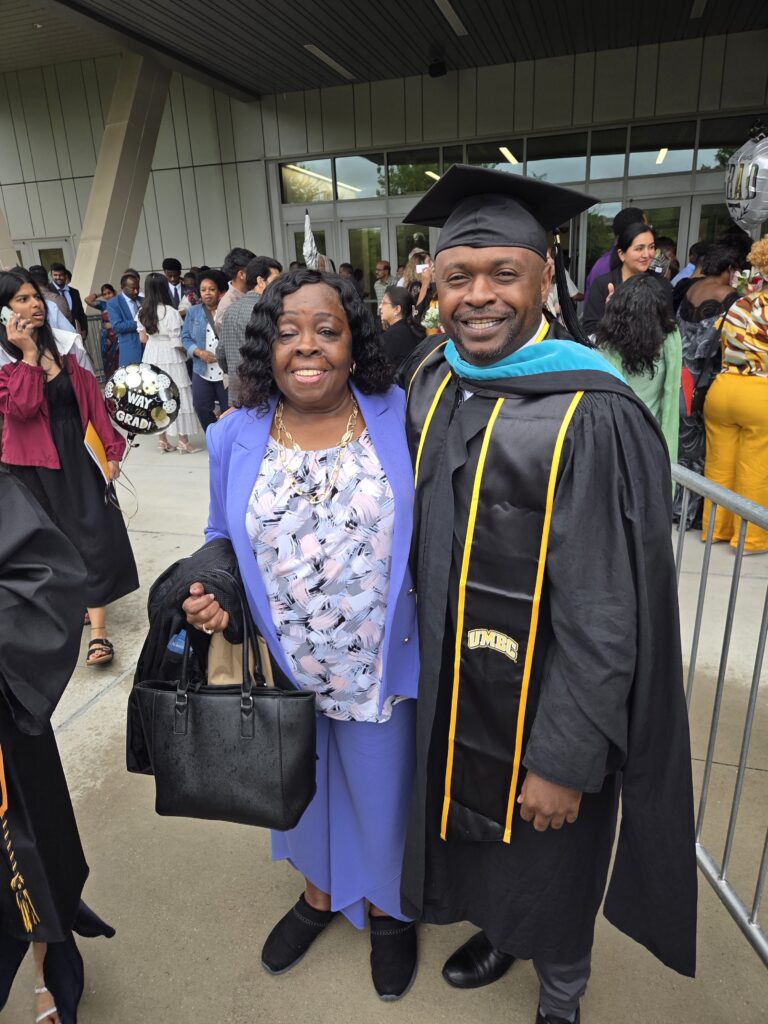 Garner with his mom, Clara Turner.
The inspiration to pursue a bachelor’s degree came from working as a recovery specialist at Franklin Square Hospital in Baltimore County, where he supported patients who had overdosed or were experiencing substance use disorders, many of whom faced significant social and economic conditions that negatively affected their health. Although he connected patients to treatment and recovery resources, he questioned why so many returned to the emergency department with the same challenges. That curiosity sparked a desire to better understand the systems, policies, and social factors driving addiction and recovery.
“I wanted to understand how healthcare is failing people in recovery,” says Garner. “I decided to go back to school. The logical step was to study public health.” Making the leap from working full-time and being a full-time student without a driver’s license posed many challenges. Thankfully, in addition to his faith, friends, and family, Garner also had a team of mentors at UMBC’s School of Public Policy that continue to support him to make his vision possible.
Garner immersed himself in public health research and learned about comorbidities, where patients are managing multiple health needs like substance dependency and mental health. He found that having multiple health needs with little to no healthcare is also exacerbated by homelessness, lack of transportation, inconsistent healthcare, or an environment not conducive to recovery. The emergency room could treat the symptoms but not the root causes.
“My undergrad journey into public health was transformative because the curriculum I was learning for the core courses in public health also exposed me to psychology and epidemiology,” says Garner. “UMBC helped me understand what was needed for me to actually serve. If I wanted to be of service, then I needed to understand not just what leads people into substance use disorder but also what drives the research.”
No limits in sight
Each learning moment inspired great curiosity. Garner sought faculty for advice and opportunities. A game-changing moment came in a research methods course with Pamela R. Bennett, professor of public policy. Bennett encouraged Garner to think beyond what was stated in the research and analyze what was in between the lines.
“I got a D in one discussion post, so I went to Dr. Bennett’s office hours. She told me to stop synthesizing information and to start thinking critically,” says Garner. “That was a game changer because I translated what she said to me into my work.”
UMBC offered me, someone with a lived experience of homelessness and substance use disorder, a door that I would normally not have access to. College is an opportunity to discover who you are and what matters to you. Don’t be afraid to engage with professors, challenge ideas, and use your voice.
Demetrie Garner ’23, public health, and M.P.P ’25
Another game-changing moment came in Lauren Hamilton Edwards‘ class. Hamilton Edwards, associate professor of public policy, told the class at the beginning of the semester that everyone had an A until they didn’t. Garner interpreted that as an incentive to do his best every day. “From the beginning, she gave me the kind of nurturing I needed,” says Garner. “Now, when I have an intern, I make sure that I’m the “Dr. Lauren Hamilton Edwards” to that intern, as she was with me.”
Additional supports like the McNair Scholars Program gave him the foundation and confidence to pursue graduate school, and his first experience presenting his research at UMBC’s Undergraduate Research and Creative Achievement Day was a humbling experience, he says.
 Garner with Baltimore City Mayor
Brandon Scott.
Garner is thriving thanks to the support of the faculty and staff in the public policy and sociology, anthropology, and public health departments, who recognized his potential.
“Associate Professor Andrea Kalfoglou called me Dr. Garner long before I believed it myself. My faculty advisor, Katie Birger, associate teaching professor, recognized my potential early on and encouraged me to pursue the B.A./M.A. pathway,” says Garner. “Now, with Professor Nancy Miller‘s mentorship, I am on track to finish my coursework by the end of the fall semester and begin my dissertation proposal in the spring of 2027.”
“Don’t be afraid”
As Garner’s expertise in public health and policy grew, so did his career opportunities. Today, he serves as the quality assurance manager for Baltimore City’s Behavioral Health Consent Decree. His work focuses on improving outcomes for people experiencing homelessness, substance use disorders, and behavioral health crises, giving him a unique perspective on how public safety and public health intersect to advance overdose prevention and crisis response.
“I no longer see those 26 years to recovery as a period of failure. They gave me lived experience that I now use to help others entering recovery,” says Garner, who, throughout that time, drew strength from the unwavering faith of his grandmother, Hazel Parker; his sister, Shontell Cooper, and his mother, Clara Turner, who never stopped believing change was possible. He hopes his story inspires others to begin their own path to healing.
“UMBC offered me, someone with a lived experience of homelessness and substance use disorder, a door that I would normally not have access to,” says Garner. “College is an opportunity to discover who you are and what matters to you. Don’t be afraid to engage with professors, challenge ideas, and use your voice.”
Learn more about UMBC’s public health programs.
]]>
When Demetrie Garner moved from Maryland’s Eastern Shore to Baltimore, he found a wealth of opportunities in Baltimore, a strong spiritual practice, and a supportive network of friends and family....
https://umbc.edu/stories/demetrie-garner-overcame-decades-of-opioid-abuse-disorder-to-serve-as-an-overdose-response-expert/
https://my3.my.umbc.edu/api/v0/pixel/news/160920/guest@my.umbc.edu/82de84a000ca166fe752f0323fb5678e/api/pixel
alumni
baltimore-city
cahss
mcnair-scholars
policy-and-society
public-policy
saph
stories
story
UMBC News & Magazine
https://my3.my.umbc.edu/groups/umbc-news-magazine
https://assets1-my.umbc.edu/system/shared/avatars/groups/000/001/943/24435aa6207c452e7bc15cc74b42c7bb/xsmall.png?1748556657
https://assets1-my.umbc.edu/system/shared/avatars/groups/000/001/943/24435aa6207c452e7bc15cc74b42c7bb/original.png?1748556657
https://assets2-my.umbc.edu/system/shared/avatars/groups/000/001/943/24435aa6207c452e7bc15cc74b42c7bb/xxlarge.png?1748556657
https://assets2-my.umbc.edu/system/shared/avatars/groups/000/001/943/24435aa6207c452e7bc15cc74b42c7bb/xlarge.png?1748556657
https://assets3-my.umbc.edu/system/shared/avatars/groups/000/001/943/24435aa6207c452e7bc15cc74b42c7bb/large.png?1748556657
https://assets1-my.umbc.edu/system/shared/avatars/groups/000/001/943/24435aa6207c452e7bc15cc74b42c7bb/medium.png?1748556657
https://assets2-my.umbc.edu/system/shared/avatars/groups/000/001/943/24435aa6207c452e7bc15cc74b42c7bb/small.png?1748556657
https://assets1-my.umbc.edu/system/shared/avatars/groups/000/001/943/24435aa6207c452e7bc15cc74b42c7bb/xsmall.png?1748556657
https://assets2-my.umbc.edu/system/shared/avatars/groups/000/001/943/24435aa6207c452e7bc15cc74b42c7bb/xxsmall.png?1748556657
UMBC News & Magazine
7
0
false
Thu, 02 Jul 2026 08:45:04 -0400
Thu, 02 Jul 2026 08:45:04 -0400
Meet a Retriever—Lynn Dutrow ’89, counselor, coach, speaker, and author
Meet Lynn Dutrow. Lynn graduated from UMBC in 1989 with a B.A. in psychology and a certificate in early childhood education. Since then, she has worn many hats, including counselor, coach, and speaker. In 2022, she added another hat—author—when she published her first book, Aligned As F*ck: Transforming Your Inner Assholes (Like Anxiety) into Allies. Much of her work focuses on anxiety, overwhelm, and creating lives that feel more aligned and less exhausting. Lynn is deeply curious about humans and firmly believes humor belongs in serious conversations. Take it away, Lynn!
Q: What brought you to UMBC?
A: I chose UMBC because it felt like the best of both worlds—it was close enough to home that I could get back when I wanted to, but far enough away that I could have the full experience of living on campus and becoming independent.
I actually didn’t know what I wanted to study. My parents wanted me to study business, but after my first psychology class, I was hooked!
Back then there were three dorms and two sets of apartments, only one of which even had kitchens! Living on campus was an education in itself. Some of my most memorable lessons about human behavior came not from textbooks, but from sharing living space with a variety of colorful personalities. In hindsight, my roommates may have unknowingly contributed to my professional training.
Pictured right: Dutrow on stage at her UMBC graduation.

What I remember most and appreciate, even 40 years later, are the approachable and supportive professors and the opportunities to gain hands-on experience through practicums and internships. Those experiences helped me connect what I was learning in the classroom to real people and real situations, something that has remained important throughout my career.
Looking back, I can see how those experiences laid the foundation for work that has taken many forms over the years: from education and school psychology to counseling, coaching, speaking, and writing. While the specific roles have changed, the common thread has always been a fascination with people and a desire to help them better understand themselves and navigate life’s challenges.
If you had told me in 1989 that my psychology degree would eventually lead me to become a counselor, coach, speaker, and author, I probably wouldn’t have believed you. But the curiosity about people that drew me to psychology in the first place has been the common thread through every chapter of my career.
Q: What do you enjoy most about your current work?
A: Much of my work focuses on helping people navigate anxiety, overwhelm, and the exhausting experience of feeling like they’re constantly fighting with themselves. What I love most is helping people realize they aren’t broken. Watching someone shift from “Why am I like this?” to “Ohhh…this part was trying to help” never gets old.
Q: Can you tell us more about your work as an author?
A: People often ask what motivated me to write my book, Aligned As F*ck: Transforming Your Inner Assholes (Like Anxiety) into Allies, and the honest answer is that I realized I was repeating the same conversations over and over again…with clients, friends, family members, and occasionally random strangers. I wanted to put the information I found myself sharing most often into one place where people could return to it when they needed it.
I also hoped, somewhat naively, that writing the book would mean I could stop repeating myself. It turns out that’s not how humans work. What I discovered instead is that people often need to hear the same ideas many times and in many different ways, and I’m grateful to keep being part of those conversations.
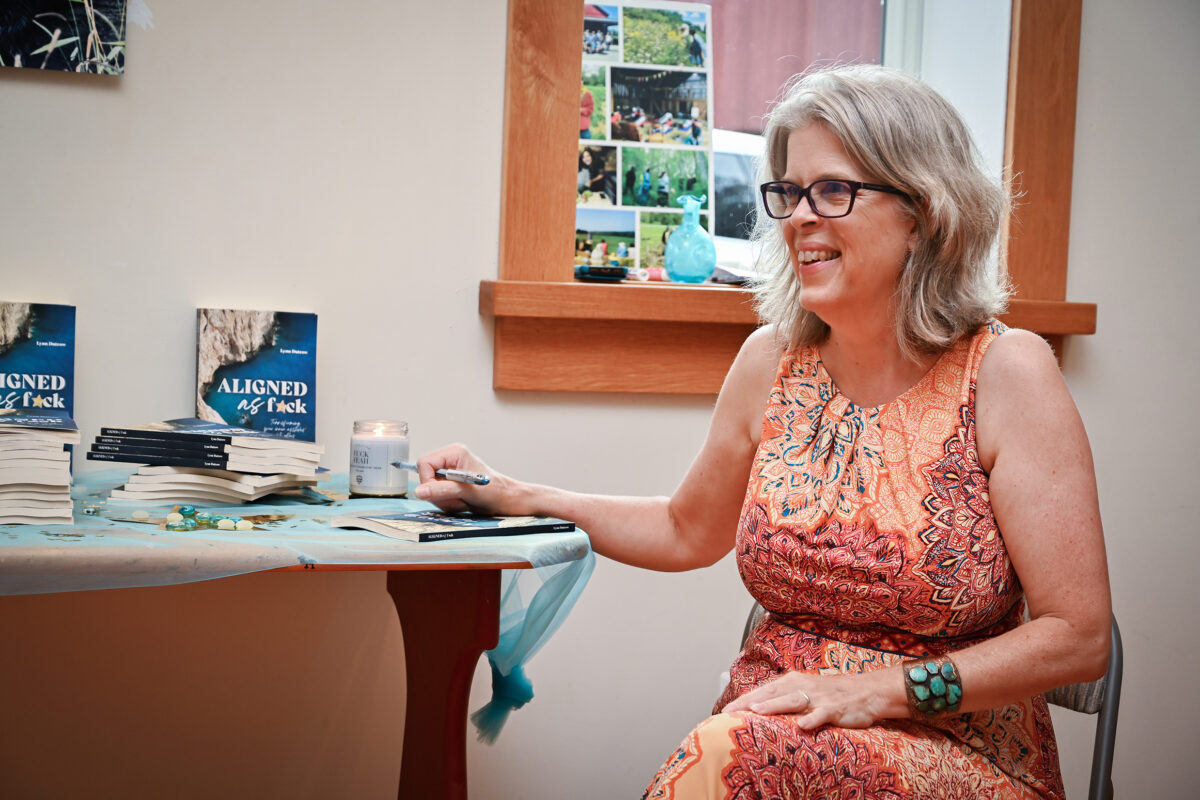 Dutrow at the release party for the author’s first book.
* * * * *
UMBC’s greatest strength is its people. When people meet Retrievers and hear about the passion they bring, the relationships they create, the ways they support each other, and the commitment they have to inclusive excellence, they truly get a sense of our community. That’s what “Meet a Retriever” is all about.
Learn more about how UMBC can help you achieve your goals.
]]>
Meet Lynn Dutrow. Lynn graduated from UMBC in 1989 with a B.A. in psychology and a certificate in early childhood education. Since then, she has worn many hats, including counselor, coach, and...
https://umbc.edu/stories/author-lynn-dutrow/
https://my3.my.umbc.edu/api/v0/pixel/news/160903/guest@my.umbc.edu/4b4ccad25ddfdc8dc623a18d855992bb/api/pixel
alumni
retriever-authors
story
UMBC News & Magazine
https://my3.my.umbc.edu/groups/umbc-news-magazine
https://assets1-my.umbc.edu/system/shared/avatars/groups/000/001/943/24435aa6207c452e7bc15cc74b42c7bb/xsmall.png?1748556657
https://assets1-my.umbc.edu/system/shared/avatars/groups/000/001/943/24435aa6207c452e7bc15cc74b42c7bb/original.png?1748556657
https://assets2-my.umbc.edu/system/shared/avatars/groups/000/001/943/24435aa6207c452e7bc15cc74b42c7bb/xxlarge.png?1748556657
https://assets2-my.umbc.edu/system/shared/avatars/groups/000/001/943/24435aa6207c452e7bc15cc74b42c7bb/xlarge.png?1748556657
https://assets3-my.umbc.edu/system/shared/avatars/groups/000/001/943/24435aa6207c452e7bc15cc74b42c7bb/large.png?1748556657
https://assets1-my.umbc.edu/system/shared/avatars/groups/000/001/943/24435aa6207c452e7bc15cc74b42c7bb/medium.png?1748556657
https://assets2-my.umbc.edu/system/shared/avatars/groups/000/001/943/24435aa6207c452e7bc15cc74b42c7bb/small.png?1748556657
https://assets1-my.umbc.edu/system/shared/avatars/groups/000/001/943/24435aa6207c452e7bc15cc74b42c7bb/xsmall.png?1748556657
https://assets2-my.umbc.edu/system/shared/avatars/groups/000/001/943/24435aa6207c452e7bc15cc74b42c7bb/xxsmall.png?1748556657
UMBC News & Magazine
0
0
false
Wed, 01 Jul 2026 09:50:56 -0400
Wed, 01 Jul 2026 09:50:56 -0400
Who gets to tell the story? The tricky back story of how radio shows can promote empathy but also build up cultural divides
In his new book, Empathy Machines: This American Life, Podcasting, and the Public Radio Structure of Feeling, Jason Loviglio, professor of media and communications, critiques and analyzes the making of and the impact of one of his favorite shows on National Public Radio (NPR), “This American Life”—a radio show turned podcast that received the 2021 Pulitzer Prize in Audio Reporting. “This American Life,” created and hosted by Baltimore-native Ira Glass, became a listener favorite for its magical way of weaving stories about everyday people into larger human issues, sounding more like a sympathetic, curious neighbor instead of a serious professor. The irony is not lost on Loviglio, who thanked his students in the book for reminding him that accessibility ensures that the public, his students, and their families, not only academic editors, understand the research. He wants this young audience to learn about radio and be inspired to research their own media and communications passions.
“The people I have had the honor of calling my students over the years have done more than anyone else to help me learn how to communicate ideas about communication and media clearly and simply,” writes Loviglio in his acknowledgements. “The MCS undergraduates are among the least pretentious and least entitled people I’ve ever had the pleasure of working with. Too numerous to name here, I give a collective thanks to you for the lessons of clarity you’ve taught me and for the laughs.”
Long before Loviglio became an author and the co-editor of Radio Journal: International Studies in Broadcast and Audio Media and of The Routledge Companion to Radio and Podcasting Studies, he was a young kid in love with “weird radio shows,” notes Loviglio. “I remember listening at night to my red transistor radio when I was little, maybe 9 or so. I put it under my pillow so my parents wouldn’t hear it,” says Loviglio. “I mostly listened to weird nationally-syndicated late night public radio shows, like Dr. Demento and local sports talk shows.”
While he doesn’t expect students to fall in love with radio as he did, in his History of Media class, he wants students to understand the power and importance of radio long before stories were mobilized in the palms of our hands 24/7 worldwide. Loviglio encourages students to look beyond Google and instead find people whose lives were shaped by radio.
He wants students to explore what radio meant in everyday life and how it conveyed and reflected emotions such as fear, danger, excitement, and joy—functioning as empathy machines that inspired deeper forms of storytelling and laid the groundwork for public radio and podcasts.
Q: What are empathy machines?
A: I think it’s safe to say that public radio has been explicitly understood as an empathy machine at least since the radio show “This American Life’s” debut in 1996. If we allow for synonyms of empathy, then radio has been understood this way for a lot longer. There’s a longer history regarding various media of communication as uniquely efficient machines for producing empathy. Most famously, of course, is the novel. And before that, oral storytelling. The idea of radio as an empathy machine stems from a specific history referred to as the technological sublime.
The notion that we can invent and communicate our way into equality is central to the way we understand Western history since at least the printing press. The book, particularly the novel, has been hailed for its powers to impart democracy and empathy. This history is opposed by an equally compelling one in which the machine represents the antithesis of democratic values of participation and empathy. A dominant theme in media history is the role of technology as an extension of human values, such that we no longer hear the metaphors in our arguments.
Q: Did you always know you were going to write about “This American Life” instead of general radio?
A: It wasn’t until a couple of years ago that I realized the best way to tell the story of public radio and podcasting was through NPR’s “This American Life.” It was first produced in 1996 by WBEZ, Chicago Public Radio, and then picked up nationally by Public Radio International. It became a massive show.
“This American Life” is also one of the first shows to start offering a podcast version, in case you missed an episode. Around 2014, “This American Life” started to shift, where more people were listening to it as a podcast. I wrote to Ira Glass last year, and he still calls it a radio show. That’s still his default understanding of it, even now.
Q: Did you have fun writing this?
A: Yes and no. I had fun thinking about it and fun listening to the shows. This is such a great way to tell stories. But it was hard to write because the shows kept changing. My thoughts kept changing. I began writing the book during President Obama’s administration, when I was thinking positively about American history. Then, Trump won.
I didn’t think that because President Obama was elected, it meant that everything was great and we had cured racism. I thought a particular version of liberalism had won. Definitely very capitalistic, definitely very interested in style, maybe more than substance, but there was a story everyone was telling about the country that was designed to make people feel very comfortable. Not only liberals, but also very privileged people, and not particularly political.
Trump winning the 2016 presidential election was a reminder that there is another story. I knew the other far-right story, but I thought that more people were happy for the positive symbolic victory that President Obama represented in terms of being biracial and being born to an immigrant father. This educated, cosmopolitan elite could also speak across different cultural registers. I thought that’s what I was writing about. Then the Trump administration began, and I felt I had to write about this darker story. That meant I had to think differently about the long, slow death of liberalism. There was something rotten in the creeping neoliberalism of the era that put some of us to sleep, left others out in the cold, and mobilized a politics of racial grievance on the right.
Q: What was the critique?
A: I’m not speaking for everyone, but people like me: privileged, educated, and progressive but kind of complacent. What did we do for the eight years of the Obama administration and the previous two or three decades of creeping neoliberalism? What were we listening to? Public radio. That’s what we were listening to. That’s the soundtrack of the frog and the pot. The pot slowly heats up, the frog is comfortable, and doesn’t realize it’s slowly boiling. I love public radio. I love “This American Life.” I love podcasting, but I also wanted to look critically at the story we were telling about empathy, who is telling the story, and who is the story about?
Important exceptions long persisted at the margins of the public radio industry. “Latino USA” is the longest-running public radio Latino news and cultural program in the United States. It is unique in that it has people of color behind the microphone. It is designed by the people that it speaks to, but most of public radio is not that way. In contrast, “This American Life,” in a way, is the epitome of white liberalism. It’s really beautiful storytelling, but in the service of this kind of sound effect of liberalism and empathy, instead of something a little bit more gritty and radically engaged that maybe we should have been trying to tune into.
I use “This American Life,” as a bridge, because of the way that it really epitomizes…radio, as a place for sonic innovation, experimentation, the primacy of the local, the intimacy of the familiar, weakly voice…
Then what happens is it becomes a national phenomenon…turning into inside the beltway, political relevance, and increasing market share…driven by an increasingly robust audience research, which discovers…that the folks who listen to public radio are disproportionately…highly educated, higher earners, and that in order to sustain a system that relies on donations…the programming has to not only appeal to them, but the variation between programs has to be minimal…which is borrowed from commercial radio.
Q: Did the mindset about who gets to tell the radio story shift during or after the social justice protests of the summer of 2020?
A: Yes. That is when it all falls apart. The whole public radio storytelling format starts to collapse in the late 2010s because most of these shows are run by white producers and white on-air talent who are telling stories about others. All the contradictions just start to crash into each other, and a lot of the shows go off the air. There are all these awkward moments of reckoning. Shows changed. One week, the radio show “Invisibilia,” an NPR podcast about the unseen forces that shape human behavior, like ideas and beliefs, was being produced by all-white women from NPR, The New Yorker, and Slate magazine. Then, in part due to the collapse of the specific logic of empathy that animated the show, there is a switchover to new hosts—two women of color, who cheerfully embraced a more politically engaged set of feelings, like confrontation and discomfort. The show was canceled in 2023, suggesting that the format could not bear certain kinds of changes to its structure of feeling.
The same thing happened with “Reply All,” a popular podcast about the internet and digital culture, created and hosted by Alex Goldman and PJ Vogt, two white men from New York City. They had a massive implosion. Goldman and Vogt were called out for perpetuating plantation culture in the workplace, where leadership and decision-making are dominated by white executives or managers, right in the middle of doing an exposé on Bon Appétit, a high-end food culture magazine, for doing precisely the same thing. “Reply All” was calling out a white-run magazine, and the people who were doing a lot of the grunt work but not getting paid were people of color and young people, who spoke up about the hypocrisy. That show collapsed in a couple of weeks.
It’s really a radical moment because radio shows and podcasts don’t get to tell the same stories without ever changing who gets to tell the stories. You don’t get to pretend you care, but not change. And so things really start to feel the strain by 2020.
Q: Are shows today more liberal or conservative as a result of the shift in 2020?
A: There are many shows today that center on conflict and unhappiness with the status quo—that Trumpism has gone too far. I try to write about how we are in a whiplash between this rhetoric of empathy and the rhetoric of Trumpism, this hostility to the idea of caring for others. I don’t know how many people took the political implications of empathy seriously, but rhetorically, it shaped a good deal of the public radio structure of feeling.
Q: Why did you thank your students in the book?
A: Students are reading less and less, and academics like me want to write clearly, and we usually don’t because we’re not thinking about 17-year-olds. We’re not thinking about the parents of 17-year-olds who might encounter our research in a faculty magazine or a newspaper. We’re thinking about the people who review academic journals or books.
One reason I thanked the students is that in the MCS methods class, students read articles written by MCS faculty. If they’re learning about history, they’re reading something I wrote or something Liz Patton, chair and associate professor of MCS, who writes about media history, identity, and space, wrote. If they’re reading about globalization and representation, they’ll read research byTracy Tinga, associate professor of MCS, who focuses on critical conversations about media, power, development, and digital cultures in African contexts, or research by Fan Yang, professor of MCS, who writes about the intersection of cultural studies, transnational media studies, globalization, postcolonialism/postsocialism, urban communication, and contemporary China. And now, they are reading work on social media and mental health, thanks to our newest colleague, Holly Avella. They’re also reading or viewing the work of Chung-Wei Huang, teaching assistant professor, Kristen Anchor, teaching associate professor, and Donald Snyder, teaching professor of MCS.
Students love reading faculty research, so I want to make sure what I’m writing is accessible to students. It’s a conversation starter when students connect personally with the research.
Q: Do students in your classes listen to the radio?
A: Some do. I think they do so a bit more after they’ve had a class with me. I want to make sure all my classes have opportunities for different kinds of creativity and engagement. In my History of Media class, I have students think about radio and pay attention to what is on the radio by having them interview a grandparent or someone older in their lives about their experiences with the radio. Students create small stories by conducting interviews and editing them into short radio diaries in a style similar to “This American Life.”
A lot of our students are immigrants or international students, and even more are children or grandchildren of immigrants. Radio remains especially important in much of the world, particularly in the Global South and in regions shaped by uneven development. This assignment helps students learn about their grandparents, and for some, it becomes the most meaningful conversation they have ever had with them. I’ve had students come back and tell me, “My grandfather died, and I have this recording of us talking for your assignment. It’s the only thing I have of him.” That’s why I really value this assignment.
Q: Is listening to the radio really a thing of the past?
A: Video games and gaming culture are increasingly central to sound studies because so much of these experiences are built around audio design. Many major games are intentionally structured to sound like radio, as in Grand Theft Auto, which features more than a dozen in-game radio stations with full playlists. In this sense, radio continues to shape not only podcasting but also video games, providing a template for how soundscapes are constructed for audiences. Even though radio may seem obsolete or old-fashioned, it remains one of the dominant frameworks through which people understand and design contemporary sound culture.
Register to attend an interview with Loviglio on July 21, 2026, at the Ivy Bookshop in Baltimore City, hosted by Aaron Henkin, award-winning public radio producer and podcaster. Read more UMBC Humanities Books stories.
]]>
In his new book, Empathy Machines: This American Life, Podcasting, and the Public Radio Structure of Feeling, Jason Loviglio, professor of media and communications, critiques and analyzes the...
https://umbc.edu/stories/public-radio-empathy-machines-loviglio/
Video Preview
https://assets1-my.umbc.edu/system/shared/attachments/9438de6bce96068a2e33c5378a42fe6e/6aa04514/news/000/160/880/1421f658b20874eb200e6eeaca8d6d88/2ofgfOORQ1E.jpg?1782827406
https://my3.my.umbc.edu/api/v0/pixel/news/160880/guest@my.umbc.edu/04fc9b50e74032c6482b5f555a9ed286/api/pixel
arts-and-culture
cahss
humanitiesbooks
perspectives
research
retriever-authors
stories
story
UMBC News & Magazine
https://my3.my.umbc.edu/groups/umbc-news-magazine
https://assets1-my.umbc.edu/system/shared/avatars/groups/000/001/943/24435aa6207c452e7bc15cc74b42c7bb/xsmall.png?1748556657
https://assets1-my.umbc.edu/system/shared/avatars/groups/000/001/943/24435aa6207c452e7bc15cc74b42c7bb/original.png?1748556657
https://assets2-my.umbc.edu/system/shared/avatars/groups/000/001/943/24435aa6207c452e7bc15cc74b42c7bb/xxlarge.png?1748556657
https://assets2-my.umbc.edu/system/shared/avatars/groups/000/001/943/24435aa6207c452e7bc15cc74b42c7bb/xlarge.png?1748556657
https://assets3-my.umbc.edu/system/shared/avatars/groups/000/001/943/24435aa6207c452e7bc15cc74b42c7bb/large.png?1748556657
https://assets1-my.umbc.edu/system/shared/avatars/groups/000/001/943/24435aa6207c452e7bc15cc74b42c7bb/medium.png?1748556657
https://assets2-my.umbc.edu/system/shared/avatars/groups/000/001/943/24435aa6207c452e7bc15cc74b42c7bb/small.png?1748556657
https://assets1-my.umbc.edu/system/shared/avatars/groups/000/001/943/24435aa6207c452e7bc15cc74b42c7bb/xsmall.png?1748556657
https://assets2-my.umbc.edu/system/shared/avatars/groups/000/001/943/24435aa6207c452e7bc15cc74b42c7bb/xxsmall.png?1748556657
UMBC News & Magazine
4
0
false
Tue, 30 Jun 2026 09:33:36 -0400
Tue, 30 Jun 2026 09:33:36 -0400
A global perspective on aging: Alfred Boakye’s gerontology journey from Ghana to Japan and the U.S.
Alfred Boakye first began thinking deeply about the care and well-being of elders and their families while caring for his centenarian grandmother, Margaret Nyarko, in his home city of Tema, on the Atlantic coast of South East Ghana. She was in charge of her essential self-care routine—bathing, dressing, eating, toileting, transferring from sitting to standing, and continence—and more complex daily tasks necessary for independent living: medication management, meal preparation, transportation, and shopping. But even with her mobility, his grandmother lacked a social network.
Acting as both a devoted grandchild and a caretaker, Boakye experienced firsthand the complexities of aging. He learned to respect his grandmother’s independence while finding ways to support her where she needed help. Boakye, now a UMBC gerontology Ph.D. student in the social, cultural, and behavioral track, notes that his grandmother’s children didn’t live with her, and her grandchildren didn’t understand her aging process. As her friends and siblings passed away, her social circle shrank. “I asked her what motivated her to stay at church for hours, and she says the church supports her, brings her communion, visits her, and brings her Christmas gifts.”
After earning a bachelor’s degree in English and a master’s degree in human resources at the University of Ghana, Boakye wanted to broaden his understanding of aging and caregiving. In 2021, he moved to the United States to pursue a master’s degree in gerontology at Georgia State University (GSU), where he met his mentor and master’s thesis chair, Jennifer Craft Morgan, professor and director of the GSU Gerontology Institute.
 Boakye at his GSU master’s graduation. (l-r): Antonius Skipper, assistant professor of gerontology at GSU and Boakye’s master’s thesis committee member; Reverend Kwaku Owusu-Boachie, Boakye’s uncle; Boakye; and Craft Morgan. (Image courtesy of Boakye)
In 2023, the year his grandmother passed away and the year he completed his master’s at GSU, Boakye published his first aging-related article, “Does the Church Care? Assessment of Social Support Strategies on the Health and Wellbeing of Older Adults within the Tema Metropolitan Assembly-Ghana” in the African Journal of Ageing Studies.
Craft Morgan fostered Boakye’s interest in gerontology and encouraged him to continue his work at the doctoral level, leading him to UMBC’s gerontology doctoral program, which is an interdisciplinary program in collaboration with the University of Baltimore. “Professor Craft Morgan has held my hand from the day I started my master’s program and continues to do so today,” says Boakye. “I always feel privileged that I have her in my corner.”
Stigma of male caregivers
Boakye’s studies are also informed by his experience being the primary caregiver to his father. Before moving to the U.S., Boakye did the grocery shopping, cooking, and laundry for Stephen, his 76‑year‑old father. He became aware of the multiple obligations children have when caretaking for themselves, their families, and their parents, as well as the isolation that can happen, especially if you are a male caregiver.
At the time, Boakye saw himself as being a “helpful child,” a term associated with a Ghanaian proverb that states, “If they take care of you to grow your teeth, you take care of them to lose theirs.” The proverb is more than words—it is a way of life in Ghana, which reinforced Boakye’s caregiving role and emphasized what it takes to be a helpful child—one built on responsibility and reciprocity. But it’s easier said than done. “I had to juggle my ‘identity’ as a male caregiver in a historically patriarchal society with my caring masculinity,” says Boakye. “Caregiving is predominantly perceived as ‘women’s work’ in Ghana, and men who take on these roles are often stigmatized and labeled ‘Kojo besia,’ which translates to ‘man woman’. To avoid such labeling, I was hesitant to ask for help, despite the toll caregiving took on my physical and psychological well‑being.”
 Boakye presents his research on male caregiving to GSA leadership during their visit to UMBC in spring 2026. (Bradley Ziegler/UMBC)
Boakye presented his research and personal experience to the leadership of the Gerontological Society of America (GSA) during their visit to UMBC this spring. Thanks to the UMB Provost’s Global Scholar Program, Boakye will be traveling to Ghana this summer to engage with male caregivers—to listen to their caregiving experiences, explore what these experiences mean to them, and co‑create resources to support them. He will use this research to finish his master’s thesis in applied sociology—Boakye’s third master’s degree.
Meeting Japan’s centenarians
In 2024, Boakye joined the Global Healthy Aging in Japan study abroad program, organized by Taka Yamashita, professor of sociology, anthropology, and public health and co-director of the gerontology doctoral program. The two-week program leads students through research, community centers, and historic sites in Kanagawa Prefecture, near Tokyo. Japan is known for its cutting-edge research and policy that supports the active lives of the world’s largest aging population and the highest number of centenarians. The students visited multigenerational living communities and centers that merge theoretical research with real-world practice and outcomes.
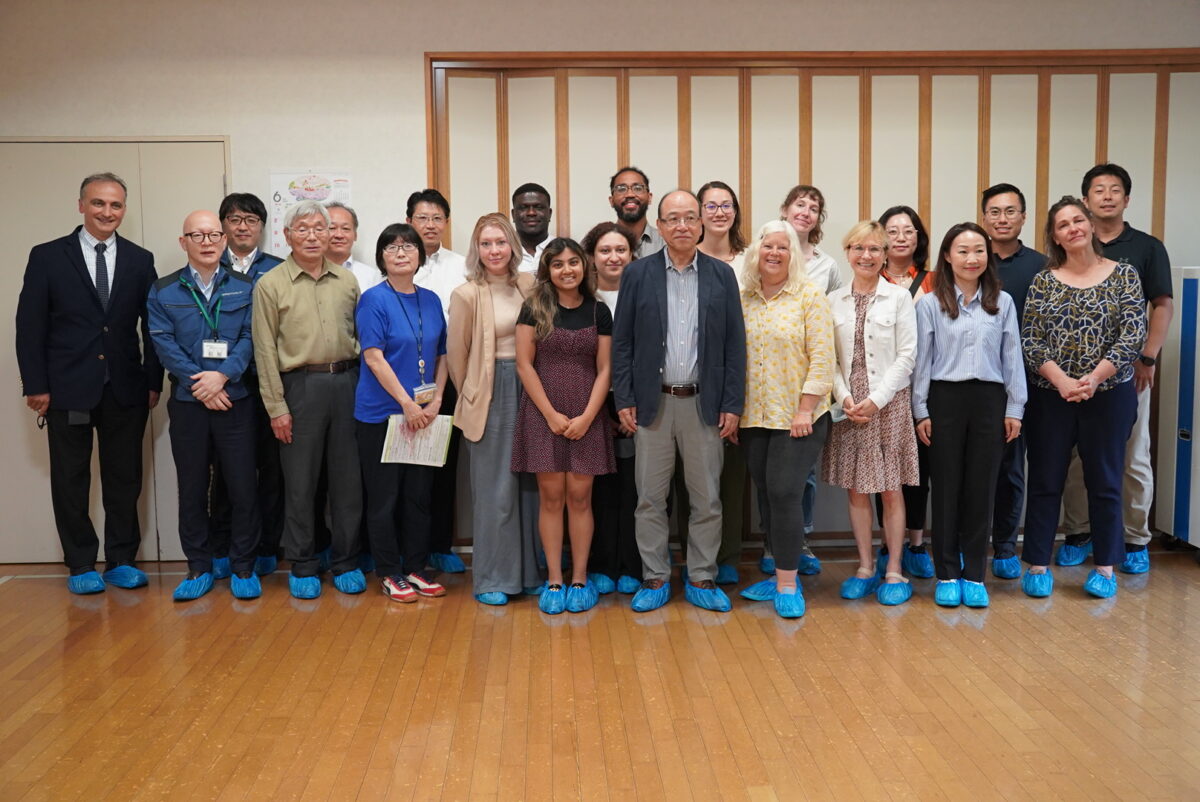 Boakye (second row, fifth from the left) at a senior center in Kanagawa Prefecture, Japan. (Image courtesy of TakaYamishita, professor of gerontology and sociology, second row, first on the right)
Boakye was not expecting that at a time when he was missing his grandmother the most, Kanagawa would make him feel like he was home in Tema. It wasn’t only that both Japan and Ghana operate on a similar collective familial care system focused on intergenerational living and inclusion, notes Boakye. It’s also the physical environment. “The buildings are close together, and people put chairs in front of their homes to talk,” says Boakye. “Older adults greet passersby, and people stop to have a conversation with them. They will tell you they are out for a little sun.”
A highlight of the trip for all the students was meeting a supercentenarian. The 110-year-old woman welcomed them and kissed each of them on the cheek. “All the students say that they were blessed to have this welcome and that she could still talk to us,” says Boakye. “It was really emotional for me. I just kept thinking of my grandmother.”
Boakye was also impressed by the Kanagawa ME-BYO approach to aging, which encourages monitoring vital signs using biomedical technologies. ME-BYO focuses on preventing and minimizing illness progression through programs that promote healthy behaviors such as a balanced diet, exercise, and social activities. “My experience in Japan has been one of the best things that has happened in my personal and academic life and in my career,” says Boakye, who wants to find a way to incorporate ME-BYO into his current and future caregiving research and practice. “This trip has equipped me with the cultural competence, literacy, sensitivity, communication, problem-solving, and critical thinking skills needed to have a real-world impact in the field of gerontology.”
Looking Ahead
With five years of longevity research, Boakye now understands that his grandmother’s experience is common for many older adults in Ghana. He discovered in the 2021 Population and Housing Census of Ghana that adults 65 years of age and older make up 4.3 percent of Ghana’s population. However, he explains, the need for person-centred and geriatric care services has not kept up with the demand.
“I feel like I am now clearly connecting the dots between my experiences in Ghana, what I saw in Japan, and what I have learned in class. I am passionate about encouraging more men to engage and support the people they love, but also seek help when they need it,” says Boakye. He plans to finish his doctoral program in fall 2027.
“It has been a pleasure to watch Alfred’s research grow during his time at UMBC,” says Nancy Kusmaul, professor at UMBC’s School of Social Work, his dissertation chair, who Boakye works with as a research assistant. “He is committed to raising the voices of paid and unpaid caregivers who provide vital services to older adults and people with disabilities in the US and abroad. I am confident that he will continue to make significant contributions to the field.”
He knows there is a long road ahead, but he is confident that he is on the right path. “I want to build culturally relevant and gender‑sensitive resources that support male caregivers, not only to improve their health and well‑being but also to amplify their voices when it matters most.” His grandmother, Margaret, continues to inspire Boakye’s work on how caregiving shapes the experiences of both the carer and the care recipient.
Learn more about UMBC’s gerontology doctoral program.
]]>
Alfred Boakye first began thinking deeply about the care and well-being of elders and their families while caring for his centenarian grandmother, Margaret Nyarko, in his home city of Tema, on the...
https://umbc.edu/stories/a-global-perspective-on-aging-alfred-boakyes-gerontology-journey/
https://my3.my.umbc.edu/api/v0/pixel/news/160830/guest@my.umbc.edu/92ff94cfedaf1cafa34c3bbd1e692406/api/pixel
cahss
gerontology
international
policy-and-society
research
saph
socialwork
stories
story
UMBC News & Magazine
https://my3.my.umbc.edu/groups/umbc-news-magazine
https://assets1-my.umbc.edu/system/shared/avatars/groups/000/001/943/24435aa6207c452e7bc15cc74b42c7bb/xsmall.png?1748556657
https://assets1-my.umbc.edu/system/shared/avatars/groups/000/001/943/24435aa6207c452e7bc15cc74b42c7bb/original.png?1748556657
https://assets2-my.umbc.edu/system/shared/avatars/groups/000/001/943/24435aa6207c452e7bc15cc74b42c7bb/xxlarge.png?1748556657
https://assets2-my.umbc.edu/system/shared/avatars/groups/000/001/943/24435aa6207c452e7bc15cc74b42c7bb/xlarge.png?1748556657
https://assets3-my.umbc.edu/system/shared/avatars/groups/000/001/943/24435aa6207c452e7bc15cc74b42c7bb/large.png?1748556657
https://assets1-my.umbc.edu/system/shared/avatars/groups/000/001/943/24435aa6207c452e7bc15cc74b42c7bb/medium.png?1748556657
https://assets2-my.umbc.edu/system/shared/avatars/groups/000/001/943/24435aa6207c452e7bc15cc74b42c7bb/small.png?1748556657
https://assets1-my.umbc.edu/system/shared/avatars/groups/000/001/943/24435aa6207c452e7bc15cc74b42c7bb/xsmall.png?1748556657
https://assets2-my.umbc.edu/system/shared/avatars/groups/000/001/943/24435aa6207c452e7bc15cc74b42c7bb/xxsmall.png?1748556657
UMBC News & Magazine
1
0
false
Wed, 24 Jun 2026 12:31:18 -0400
A global perspective on aging: Alfred Boakye’s gerontology journey from Ghana to Japan and the U.S.
Alfred Boakye first began thinking deeply about the care and well-being of elders and their families while caring for his centenarian grandmother, Margaret Nyarko, in his home city of Tema, on the Atlantic coast of South East Ghana. She was in charge of her essential self-care routine—bathing, dressing, eating, toileting, transferring from sitting to standing, and continence—and more complex daily tasks necessary for independent living: medication management, meal preparation, transportation, and shopping. But even with her mobility, his grandmother lacked a social network.
Acting as both a devoted grandchild and a caretaker, Boakye experienced firsthand the complexities of aging. He learned to respect his grandmother’s independence while finding ways to support her where she needed help. Boakye, now a UMBC gerontology Ph.D. student in the social, cultural, and behavioral track, notes that his grandmother’s children didn’t live with her, and her grandchildren didn’t understand her aging process. As her friends and siblings passed away, her social circle shrank. “I asked her what motivated her to stay at church for hours, and she says the church supports her, brings her communion, visits her, and brings her Christmas gifts.”
After earning a bachelor’s degree in English and a master’s degree in human resources at the University of Ghana, Boakye wanted to broaden his understanding of aging and caregiving. In 2021, he moved to the United States to pursue a master’s degree in gerontology at Georgia State University (GSU), where he met his mentor and master’s thesis chair, Jennifer Craft Morgan, professor and director of the GSU Gerontology Institute.
Boakye at his GSU master’s graduation. (l-r): Antonius Skipper, assistant professor of gerontology at GSU and Boakye’s master’s thesis committee member; Reverend Kwaku Owusu-Boachie, Boakye’s uncle; Boakye; and Craft Morgan. (Image courtesy of Boakye)
In 2023, the year his grandmother passed away and the year he completed his master’s at GSU, Boakye published his first aging-related article, “Does the Church Care? Assessment of Social Support Strategies on the Health and Wellbeing of Older Adults within the Tema Metropolitan Assembly-Ghana” in the African Journal of Ageing Studies.
Craft Morgan fostered Boakye’s interest in gerontology and encouraged him to continue his work at the doctoral level, leading him to UMBC’s gerontology doctoral program, which is an interdisciplinary program in collaboration with the University of Baltimore. “Professor Craft Morgan has held my hand from the day I started my master’s program and continues to do so today,” says Boakye. “I always feel privileged that I have her in my corner.”
Stigma of male caregivers
Boakye’s studies are also informed by his experience being the primary caregiver to his father. Before moving to the U.S., Boakye did the grocery shopping, cooking, and laundry for Stephen, his 76‑year‑old father. He became aware of the multiple obligations children have when caretaking for themselves, their families, and their parents, as well as the isolation that can happen, especially if you are a male caregiver.
At the time, Boakye saw himself as being a “helpful child,” a term associated with a Ghanaian proverb that states, “If they take care of you to grow your teeth, you take care of them to lose theirs.” The proverb is more than words—it is a way of life in Ghana, which reinforced Boakye’s caregiving role and emphasized what it takes to be a helpful child—one built on responsibility and reciprocity. But it’s easier said than done. “I had to juggle my ‘identity’ as a male caregiver in a historically patriarchal society with my caring masculinity,” says Boakye. “Caregiving is predominantly perceived as ‘women’s work’ in Ghana, and men who take on these roles are often stigmatized and labeled ‘Kojo besia,’ which translates to ‘man woman’. To avoid such labeling, I was hesitant to ask for help, despite the toll caregiving took on my physical and psychological well‑being.”
Boakye presents his research on male caregiving to GSA leadership during their visit to UMBC in spring 2026. (Bradley Ziegler/UMBC)
Boakye presented his research and personal experience to the leadership of the Gerontological Society of America (GSA) during their visit to UMBC this spring. Thanks to the UMB Provost’s Global Scholar Program, Boakye will be traveling to Ghana this summer to engage with male caregivers—to listen to their caregiving experiences, explore what these experiences mean to them, and co‑create resources to support them. He will use this research to finish his master’s thesis in applied sociology—Boakye’s third master’s degree.
Meeting Japan’s centenarians
In 2024, Boakye joined the Global Healthy Aging in Japan study abroad program, organized by Taka Yamashita, professor of sociology, anthropology, and public health and co-director of the gerontology doctoral program. The two-week program leads students through research, community centers, and historic sites in Kanagawa Prefecture, near Tokyo. Japan is known for its cutting-edge research and policy that supports the active lives of the world’s largest aging population and the highest number of centenarians. The students visited multigenerational living communities and centers that merge theoretical research with real-world practice and outcomes.
Boakye (second row, fifth from the left) at a senior center in Kanagawa Prefecture, Japan. (Image courtesy of TakaYamishita, professor of gerontology and sociology, second row, first on the right)
Boakye was not expecting that at a time when he was missing his grandmother the most, Kanagawa would make him feel like he was home in Tema. It wasn’t only that both Japan and Ghana operate on a similar collective familial care system focused on intergenerational living and inclusion, notes Boakye. It’s also the physical environment. “The buildings are close together, and people put chairs in front of their homes to talk,” says Boakye. “Older adults greet passersby, and people stop to have a conversation with them. They will tell you they are out for a little sun.”
A highlight of the trip for all the students was meeting a supercentenarian. The 110-year-old woman welcomed them and kissed each of them on the cheek. “All the students say that they were blessed to have this welcome and that she could still talk to us,” says Boakye. “It was really emotional for me. I just kept thinking of my grandmother.”
Boakye was also impressed by the Kanagawa ME-BYO approach to aging, which encourages monitoring vital signs using biomedical technologies. ME-BYO focuses on preventing and minimizing illness progression through programs that promote healthy behaviors such as a balanced diet, exercise, and social activities. “My experience in Japan has been one of the best things that has happened in my personal and academic life and in my career,” says Boakye, who wants to find a way to incorporate ME-BYO into his current and future caregiving research and practice. “This trip has equipped me with the cultural competence, literacy, sensitivity, communication, problem-solving, and critical thinking skills needed to have a real-world impact in the field of gerontology.”
Looking Ahead
With five years of longevity research, Boakye now understands that his grandmother’s experience is common for many older adults in Ghana. He discovered in the 2021 Population and Housing Census of Ghana that adults 65 years of age and older make up 4.3 percent of Ghana’s population. However, he explains, the need for person-centred and geriatric care services has not kept up with the demand.
“I feel like I am now clearly connecting the dots between my experiences in Ghana, what I saw in Japan, and what I have learned in class. I am passionate about encouraging more men to engage and support the people they love, but also seek help when they need it,” says Boakye. He plans to finish his doctoral program in fall 2027.
“It has been a pleasure to watch Alfred’s research grow during his time at UMBC,” says Nancy Kusmaul, professor at UMBC’s School of Social Work, his dissertation chair, who Boakye works with as a research assistant. “He is committed to raising the voices of paid and unpaid caregivers who provide vital services to older adults and people with disabilities in the US and abroad. I am confident that he will continue to make significant contributions to the field.”
He knows there is a long road ahead, but he is confident that he is on the right path. “I want to build culturally relevant and gender‑sensitive resources that support male caregivers, not only to improve their health and well‑being but also to amplify their voices when it matters most.” His grandmother, Margaret, continues to inspire Boakye’s work on how caregiving shapes the experiences of both the carer and the care recipient.
Learn more about UMBC’s gerontology doctoral program.
]]>
Alfred Boakye first began thinking deeply about the care and well-being of elders and their families while caring for his centenarian grandmother, Margaret Nyarko, in his home city of Tema, on the...
https://umbc.edu/stories/alfred-boakyes-gerontology-journey/
https://my3.my.umbc.edu/api/v0/pixel/news/160831/guest@my.umbc.edu/a44c085d6a24b6aba543a04a55557c3d/api/pixel
cahss
gerontology
international
policy-and-society
research
saph
socialwork
stories
story
UMBC News & Magazine
https://my3.my.umbc.edu/groups/umbc-news-magazine
https://assets1-my.umbc.edu/system/shared/avatars/groups/000/001/943/24435aa6207c452e7bc15cc74b42c7bb/xsmall.png?1748556657
https://assets1-my.umbc.edu/system/shared/avatars/groups/000/001/943/24435aa6207c452e7bc15cc74b42c7bb/original.png?1748556657
https://assets2-my.umbc.edu/system/shared/avatars/groups/000/001/943/24435aa6207c452e7bc15cc74b42c7bb/xxlarge.png?1748556657
https://assets2-my.umbc.edu/system/shared/avatars/groups/000/001/943/24435aa6207c452e7bc15cc74b42c7bb/xlarge.png?1748556657
https://assets3-my.umbc.edu/system/shared/avatars/groups/000/001/943/24435aa6207c452e7bc15cc74b42c7bb/large.png?1748556657
https://assets1-my.umbc.edu/system/shared/avatars/groups/000/001/943/24435aa6207c452e7bc15cc74b42c7bb/medium.png?1748556657
https://assets2-my.umbc.edu/system/shared/avatars/groups/000/001/943/24435aa6207c452e7bc15cc74b42c7bb/small.png?1748556657
https://assets1-my.umbc.edu/system/shared/avatars/groups/000/001/943/24435aa6207c452e7bc15cc74b42c7bb/xsmall.png?1748556657
https://assets2-my.umbc.edu/system/shared/avatars/groups/000/001/943/24435aa6207c452e7bc15cc74b42c7bb/xxsmall.png?1748556657
UMBC News & Magazine
0
0
false
Wed, 24 Jun 2026 12:31:18 -0400
Wed, 24 Jun 2026 12:31:18 -0400
Baltimore City hometown recruits shine bright
The Best of Baltimore Grant, a UMBC initiative started in fall 2025, is changing how students from Baltimore City imagine college: not as a distant possibility overshadowed by debt, but as a tangible, financially supported path forward, and right in their backyard.
For first-year student Essence Jones, who went to Baltimore City College, a high school in east Baltimore, “that financial freedom really pushed me towards UMBC,” she says, describing the moment she learned the grant would cover what other aid could not—including room and board. A double major in biological sciences and psychology, Jones is already thinking ahead to a future in forensics, drawn by what she calls “the puzzle problem-solving aspect” of analyzing crime scenes. But her present focus is simpler: adjusting, learning, and finding her place and people.
Embracing the ‘B’ in UMBC
The Best of Baltimore grant grew out of President Valerie Sheares Ashby’s desire to see a greater number of Baltimore City high school students become Retrievers. And the grant is just one part of a bigger initiative, says Yvette Mozie-Ross ’88, vice provost for enrollment management and planning: “This year, we have been more intentional with our outreach efforts—partnering with community based organizations such as CollegeBound and College Track to continue to help us get the word out about the many benefits of a UMBC education and specifically how the Best of Baltimore grant can make a UMBC education attainable for all Baltimore City residents.”
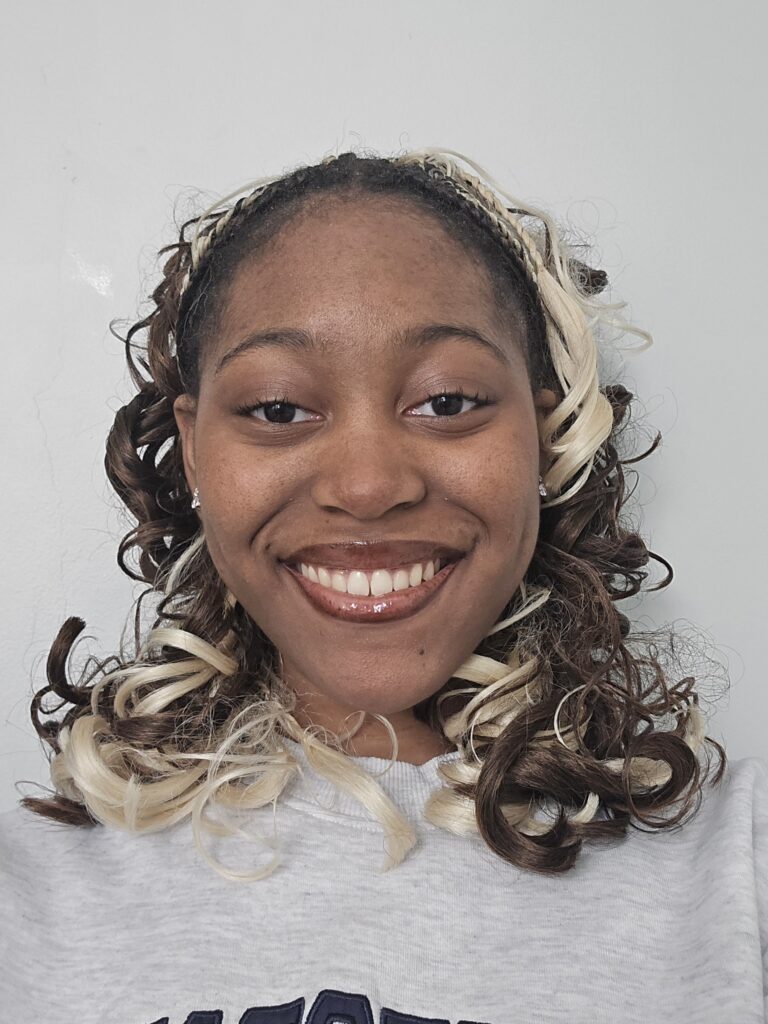 Essence Jones
The grant is designed to cover remaining billed costs after federal grants, subsidized loans, and other scholarships are applied—closing gaps that often prevent students with demonstrated financial need from enrolling.
Early results suggest momentum. In its first year, the program offered awards to nearly 140 students, with dozens ultimately enrolling and receiving grants ranging from $1,100 to $22,000. Just as importantly, Mozie-Ross notes, the early promise of financial support helped families make confident decisions about college. And the increased outreach methods are paying off—applications from city residents grew by 20 percent for fall 2026.
UMBC, Jones says, meets her at her pace and provides lots of student support. She points to spaces like the Learning Collaboratory, where students gather to work through complex chemistry problems together. “You’re both teaching and learning,” she explains. “That helps solidify the information.”
That sense of shared effort—of not struggling alone—has defined her early college experience. Whether studying with friends from her STEM courses or working quietly on the sixth floor of the library, Jones has found community. Her path to science was shaped before UMBC. At Baltimore City College, she was inspired by teachers who looked like her—women of color leading classrooms in biology and chemistry. “Being able to see them in that space… really helped me enjoy science,” she says. Now, she hopes to carry that sense of belonging forward.
Support fosters success
Deylon Moy Joseph, a mechanical engineering first-year student and another Best of Baltimore awardee, echoes Jones’ observations about support and community at UMBC. Originally from Trinidad and Tobago, he arrived in the United States in 2022 and enrolled at Mergenthaler Vocational-Technical High School—a mile north of Jones’ school. From the start, financial reality shaped his college search. “It was necessary for me to get some type of college funding,” he says. “I didn’t want to be stuck with really heavy student loans.”
At UMBC, he found a layered support system: the prestigious Meyerhoff Scholars Program, and unexpectedly, the Best of Baltimore grant. “We didn’t have to apply, but when we were accepted to UMBC, we received letters saying, ‘Congratulations,’” he recalls. “It was amazing.”
For Moy Joseph, that confidence extends into the classroom. He describes his technical coursework as demanding but manageable—especially with the right support. He credits faculty like Joseph Washington ’97, mechanical engineering, an assistant teaching professor whose open-door approach allows students to work through complex problems in real time. “Having the professor right there to give pointers… it really made retention much easier,” he says.
Outside class, in spaces like the Retriever Learning Center, students gather around whiteboards filled with equations, working through concepts together. “It’s so easy to study with someone,” Moy Joseph says. “And it’s satisfying to help people, too.”
That reciprocity—learning, then teaching—is central to many Retrievers’ experiences. It reflects a broader culture at UMBC, one that merges academic rigor with connection, starting in our very own neighborhood.
]]>
The Best of Baltimore Grant, a UMBC initiative started in fall 2025, is changing how students from Baltimore City imagine college: not as a distant possibility overshadowed by debt, but as a...
https://umbc.edu/stories/baltimore-city-recruits-shine-bright/
https://my3.my.umbc.edu/api/v0/pixel/news/160819/guest@my.umbc.edu/f96cc653dbc18a3b7081fca1134b9df1/api/pixel
baltimore-city
cahss
cnms
coeit
impact
spring-2026
stories
story
UMBC News & Magazine
https://my3.my.umbc.edu/groups/umbc-news-magazine
https://assets1-my.umbc.edu/system/shared/avatars/groups/000/001/943/24435aa6207c452e7bc15cc74b42c7bb/xsmall.png?1748556657
https://assets1-my.umbc.edu/system/shared/avatars/groups/000/001/943/24435aa6207c452e7bc15cc74b42c7bb/original.png?1748556657
https://assets2-my.umbc.edu/system/shared/avatars/groups/000/001/943/24435aa6207c452e7bc15cc74b42c7bb/xxlarge.png?1748556657
https://assets2-my.umbc.edu/system/shared/avatars/groups/000/001/943/24435aa6207c452e7bc15cc74b42c7bb/xlarge.png?1748556657
https://assets3-my.umbc.edu/system/shared/avatars/groups/000/001/943/24435aa6207c452e7bc15cc74b42c7bb/large.png?1748556657
https://assets1-my.umbc.edu/system/shared/avatars/groups/000/001/943/24435aa6207c452e7bc15cc74b42c7bb/medium.png?1748556657
https://assets2-my.umbc.edu/system/shared/avatars/groups/000/001/943/24435aa6207c452e7bc15cc74b42c7bb/small.png?1748556657
https://assets1-my.umbc.edu/system/shared/avatars/groups/000/001/943/24435aa6207c452e7bc15cc74b42c7bb/xsmall.png?1748556657
https://assets2-my.umbc.edu/system/shared/avatars/groups/000/001/943/24435aa6207c452e7bc15cc74b42c7bb/xxsmall.png?1748556657
UMBC News & Magazine
0
0
false
Tue, 23 Jun 2026 16:18:32 -0400
Tue, 23 Jun 2026 16:18:32 -0400
The Class of 2026 found communities to help tackle big challenges
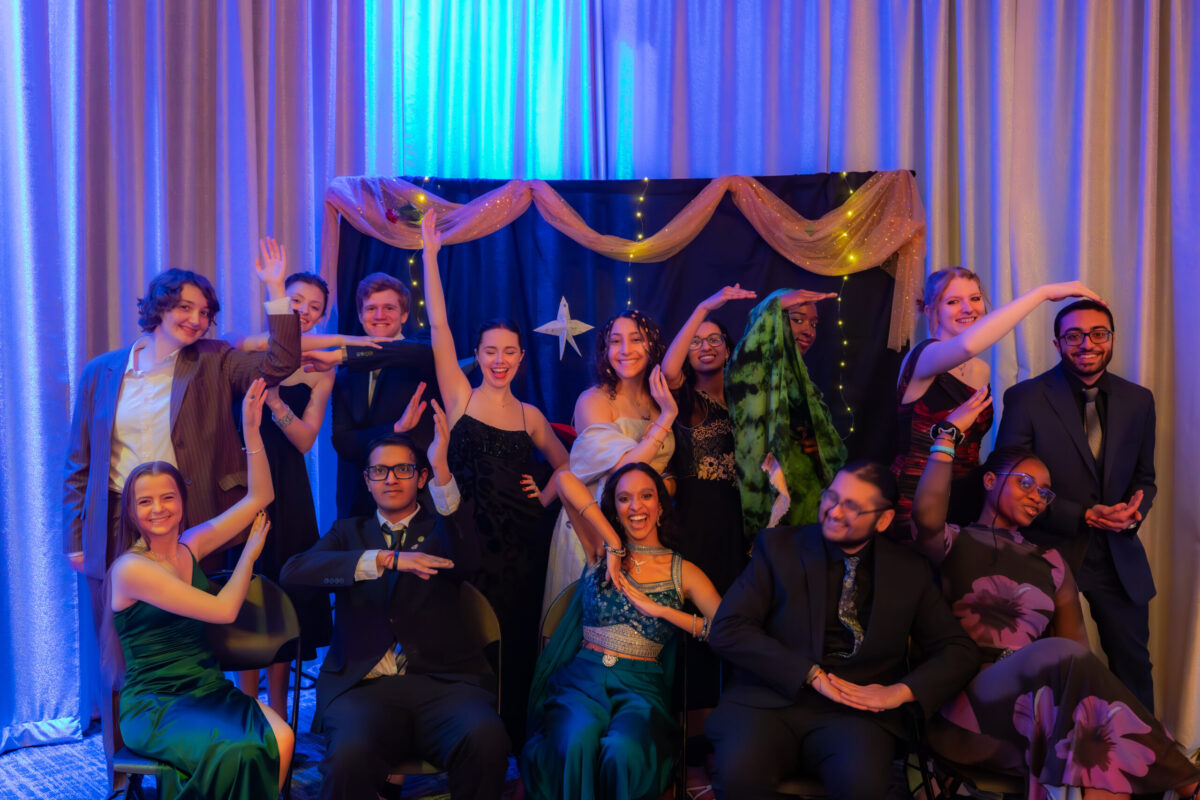
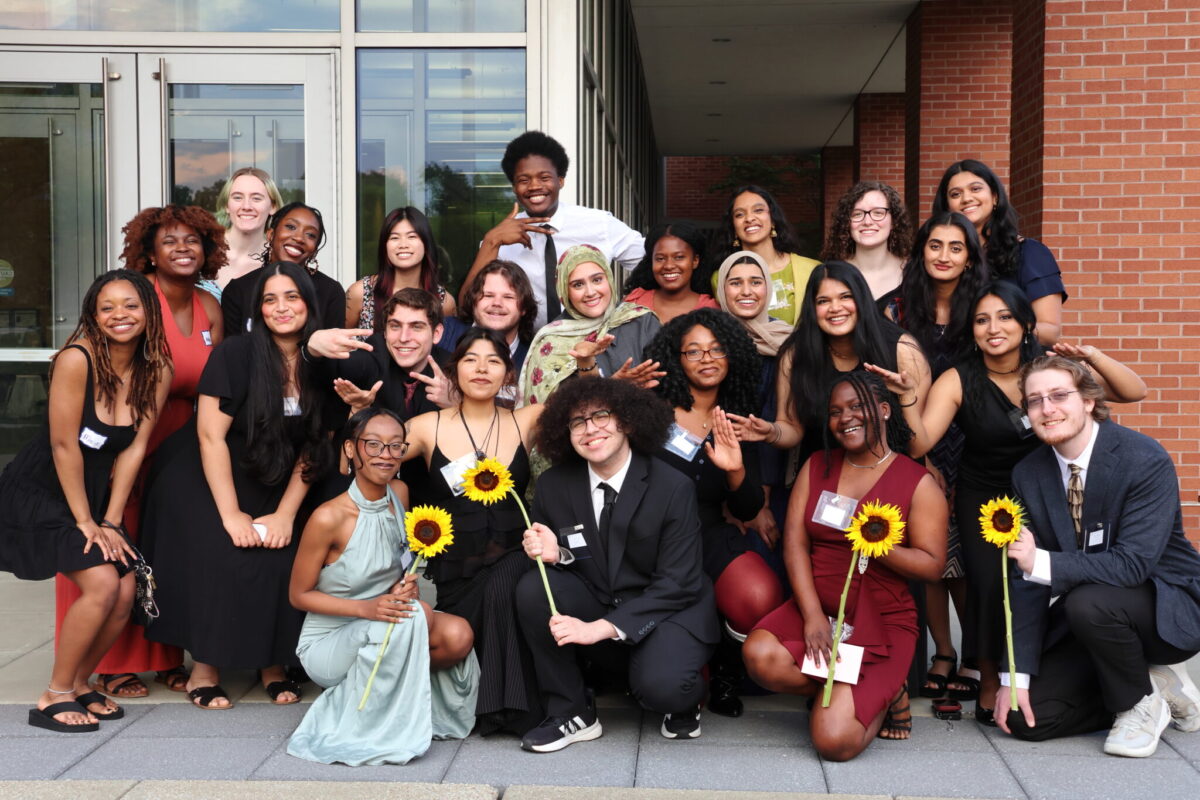
If you surveyed UMBC’s Class of 2026 and generated a word cloud, the word “community” would instantly dominate the screen. You might be tempted to dismiss it as a buzzword until you see how many graduating students highlight the communities they found and the communities they made as their defining experience of being a student at UMBC. “I can be myself here and I’m not going to be judged. Community is truly the word to describe UMBC,” says Shawn Bearam, Jr., computer science.
Who are the graduates of the Class of 2026?
It’s safe to say they contain multitudes: There’s an engineering management graduate student from India who devoted time to helping Marylanders complete their taxes; an English and political science student who volunteered as an educational and workforce advocate for Baltimore City youth; a mathematician—and Survivor hopeful—teaching game theory and disease modeling to students in Rwanda while also helping them understand the U.S. college admissions process.
What do they have in common? If you meet a Retriever from the Class of 2026, you will walk away from the encounter feeling hopeful for the future. These leaders and educators and entertainers and researchers are making room in the world for each person’s voice to be heard and heeded. We can’t wait to see where they take it from here!
“It’s the people”
If community is the key takeaway from the Class of 2026, where are students finding their niche groups? Vunnathi Ankem, psychology, saw a way to bridge multiple areas together. As a resident assistant, a researcher, and a multifaceted student leader, she has spent her four years both building community and studying its impact on the human experience. From hosting public-service retreats in Baltimore to interviewing members of the South Asian diaspora for her thesis, Ankem’s work bridges the gap between community- centered research and heartfelt advocacy.
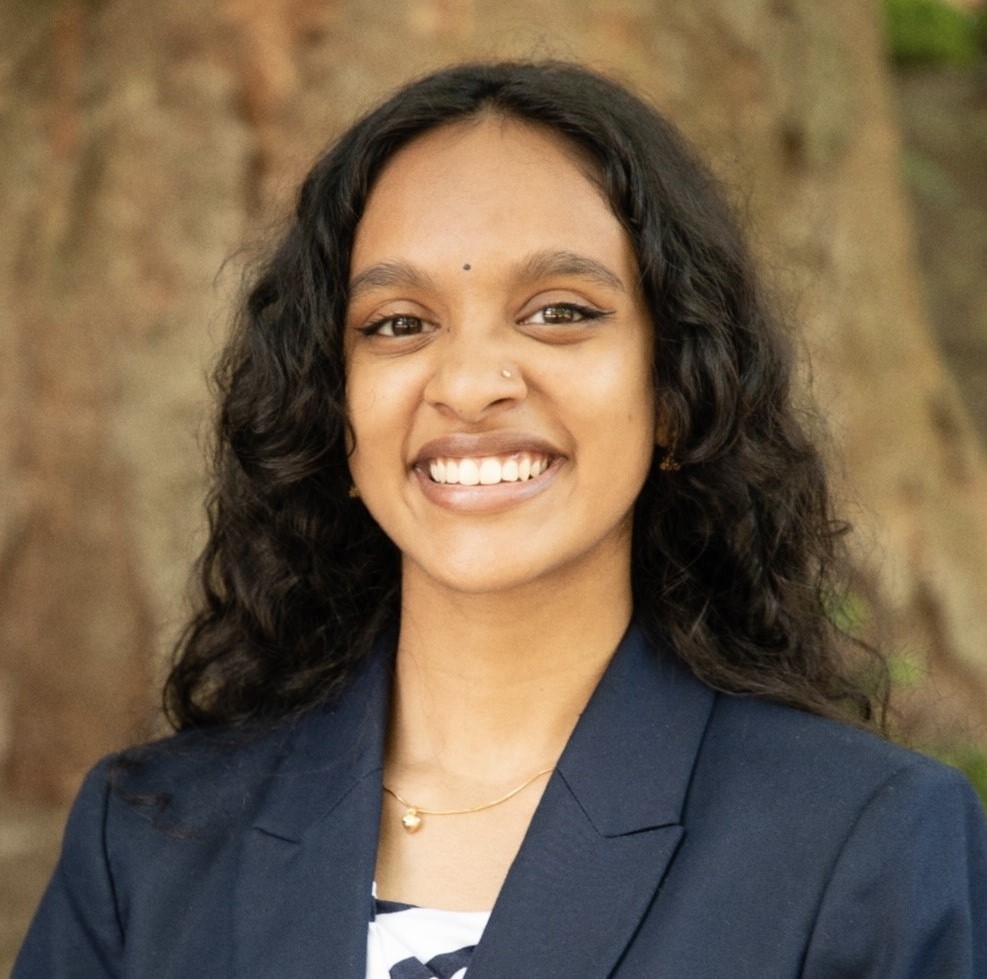
 Vunnathi Ankem, psychology, looks forward to returning to her classical dancing roots as she heads to India for a nine-month research project through a Fulbright Scholarship.
As a newly awarded Fulbright Scholar to India, Ankem leaves behind a campus made stronger by her leadership and a personal roadmap focused on healing, mentorship, and global research. “When I think about what I’m proud of, it’s not the awards, it’s the people,” says Ankem. “I remember all the people who were there when I needed support—those people meant more to me than any accomplishment. My advice would be to think about what you’ll look back on. It will most likely be community—the people who were there when you weren’t at your best.”
Bearam in computer science was not content to confine himself to one campus community. He puts it plainly: “I found communities where it seemed that everyone was having fun together, and I wanted to be a part of that,” he says. He had roles with the events staff in Athletics, at UMBC’s research and technology park, bwtech@UMBC, and working as a lead
office assistant for the vice president of student affairs. If that wasn’t enough, he also served as a lead resident assistant and a first-year ambassador for the Student Government Association.
“I started to see that I was able to learn so much here,” says Bearam. “I saw people who looked like me in different spaces, and I knew they would be able to understand me, so I wanted to get involved.”


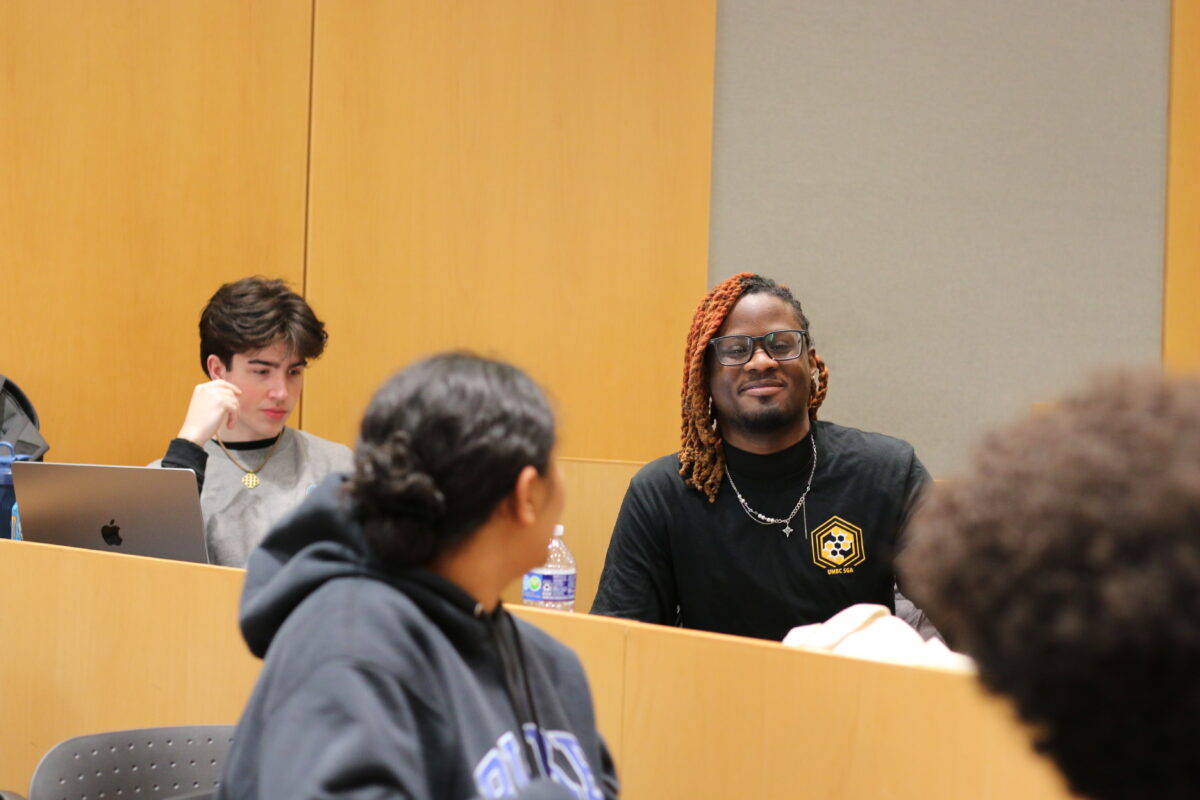 Using the skills he gained in his computer science major, Shawn Bearam, Jr., computer science, will be working as a project analyst for the State of Maryland within the Division of Information and Technology.
Rileigh Mansfield, mathematics, also made it her goal to build connections across a variety of UMBC communities. As a Meyerhoff Scholar, she served as a peer advisor and conducted research with multiple math professors, “but honestly,” she shares, “some of my most meaningful involvement has been more informal. Last spring, I was having a tough semester when I got invited to join a group from the math lounge to play the board game Catan on Tuesdays. It became a little community and something to look forward to every week—a much-needed step back from school and work. I actually play in competitive Catan tournaments now, and I’m even hosting an official tournament this spring through the math honors society.”
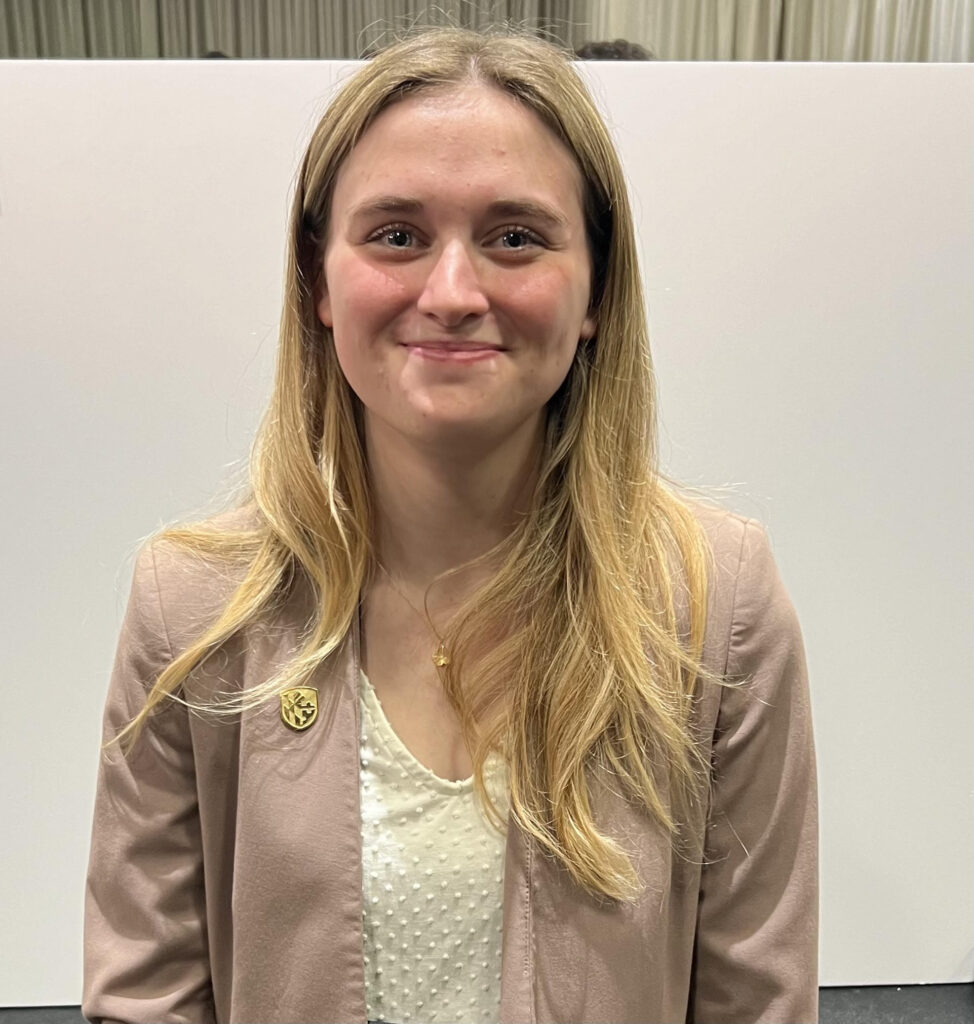
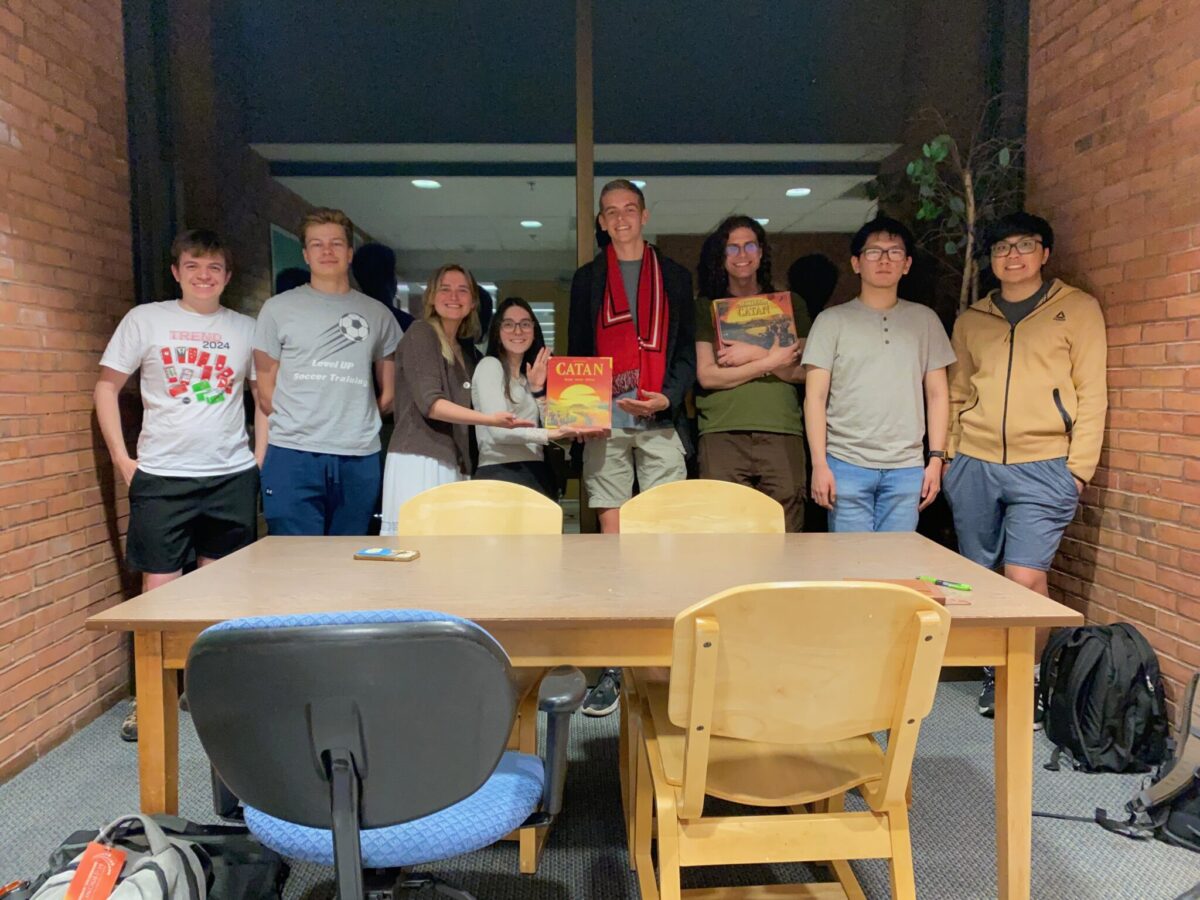
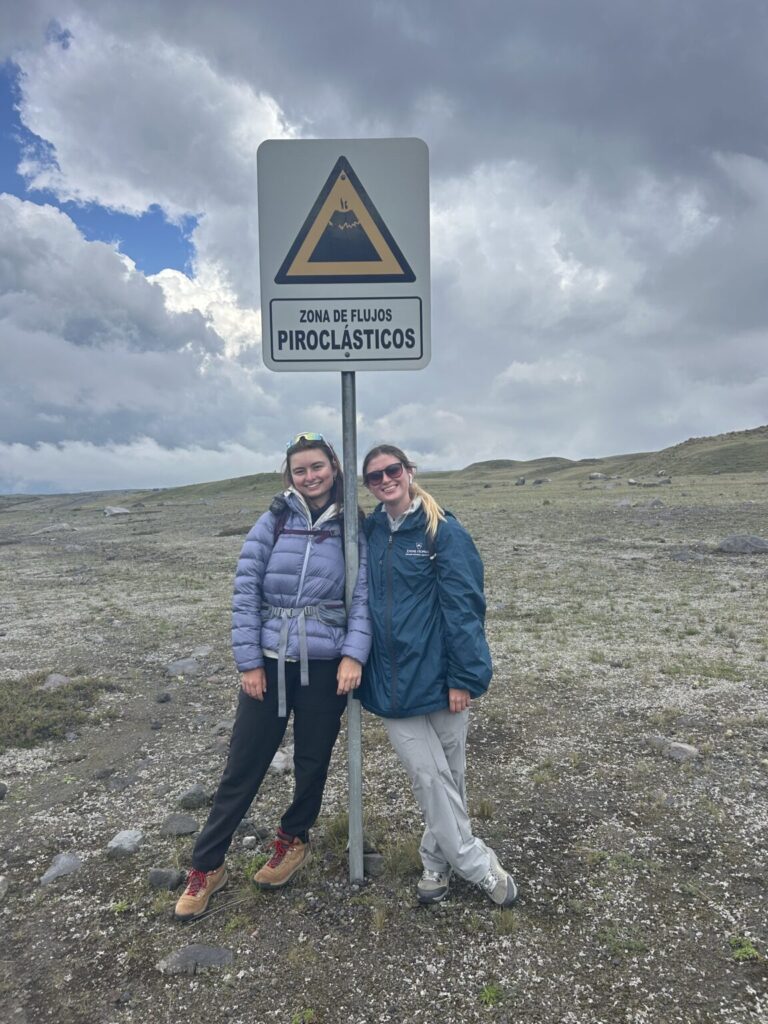 Looking toward sunny California skies, Rileigh Mansfield, mathematics, will start her Ph.D.at Stanford University in geophysics this fall.
“Just see it through”
Often, the defining moment in a student’s successful academic trajectory is a challenge that they can point back to. When Chinonso Ezeobi decided to pack up his life in Nigeria and come to the United States to pursue his Ph.D. in electrical engineering at UMBC, he was thrilled at the prospect of finding a program that would bring him fulfillment. However, financial struggles and the impact of the COVID-19 pandemic quickly threatened Ezeobi’s plans for the future.
“Once I navigated through one challenge, another one came in,” he says. “But at the end of the day, it was worth it. I was able to pull through all of those challenges. I was also able to transition from being an international student to having a green card through self-petition and self-advocacy, so I’m able to graduate without the additional pressure of thinking about my visa status while looking for jobs. My faith and the community at UMBC were essential in navigating through all challenges. The motivation was that I had a community of people who wanted my success, people who I felt would advocate for me even when I’m not in the room.”
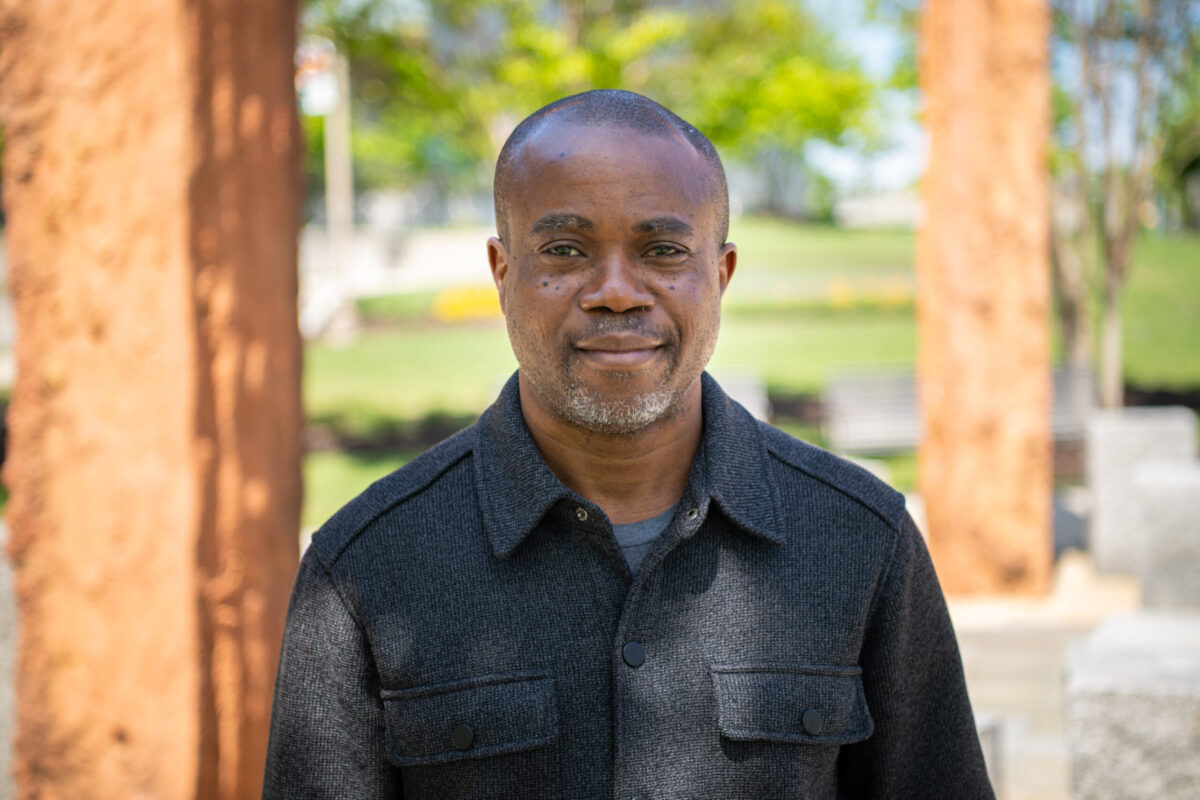 Whenever Chinonso Ezeobi, Ph.D., electrical engineering, helps students solve their problems, he says, “I feel that the struggles I have experienced throughout my UMBC journey have given me this capacity to help others.”
Never one to be derailed, Ezeobi found mentors across campus who made it their mission to keep him on the path to his Ph.D. Ezeobi recognized how invaluable their support was and found his own ways to give back to the place and people who gave him so much, including keeping his door open to any students who may need an advocate on their side.
At one point, Maia Turman Cooke, English and political science, was thinking about backing out of her scholar’s program opportunity. In the end, though, she was surprised by how the McNair Scholars Program changed her life. “At the beginning of the application process, it seemed like a lot, and I wanted to quit—I didn’t want to join. The director of the McNair Scholars Program, Dr. Michael Hunt [’06, Ph.D. ’25], called me and said, ‘Just see it through, see it out. If you don’t like it when you get more involved, then you can leave.’”


 Maia Turman Cooke, English and political science, will continue to pursue her passions this fall as she embarks on her journey toward a Ph.D. in English at the University of Maryland, College Park.
Turman Cooke processed the expectations of the programs—like pursuing graduate school—while recognizing she had so much to learn about how research worked. “I was so overwhelmed because I thought I had to solve every world problem. But my peers convinced me to stay. Soon, that work became a normal part of my schedule. I had no idea what research was, and now it’s something I’m super passionate about,” says Turman Cooke, who starts her Ph.D. in English at the University of Maryland, College Park this fall.
“A person who needs a path”
Sometimes the way forward is clearly marked, and other times Retrievers forge their own way. Kayla Nemirovsky, mathematics and financial economics, had a love for international travel and a scholarship with the Sondheim Public Affairs Scholars Program but wasn’t sure how those interests combined with her majors.
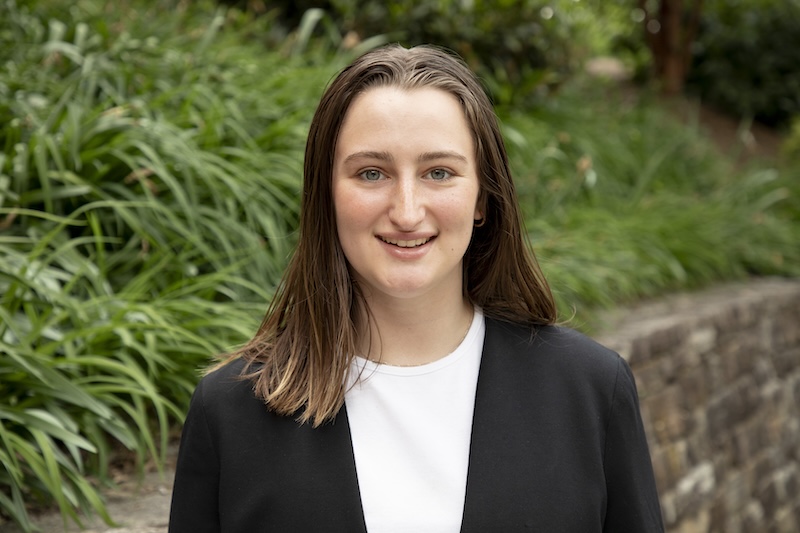

 For once, Kayla Nemirovsky, mathematics and financial economics, won’t be traveling far after graduation. She’ll be staying at UMBC to pursue her master’s in teaching.
Nemirovsky, who is staying at UMBC to pursue her master’s degree in teaching, charted her own route at UMBC as an Education Abroad ambassador, sharing widely with her peers the importance (and accessibility) of studying abroad for any major. Her Sondheim mentors connected her with an internship at the Maryland State Department of Education, and this experience helped her solidify her interest in math education curriculum and policy.
“I’m a person who needs a path,” says Nemirovsky, who has traveled to more than 30 countries and counting. “I realized once I got to college that there’s kind of no more path—I have to make my own. At was really scary to me, so having mentors who can help me make this path…give
me advice and offer suggestions, that was extremely helpful. I really believe you have to choose the people you look up to and kind of aspire to be them.”
Over his two years of graduate study at UMBC, Yash Bhatt, M.S., engineering management, saw his time at UMBC as much bigger than “just earning a degree.” He charted a path to contribute meaningfully to both the university and the greater Baltimore community. As a graduate student, Bhatt arrived at UMBC with an undergraduate degree and professional experience, but he says he was not yet the confident leader he is today.
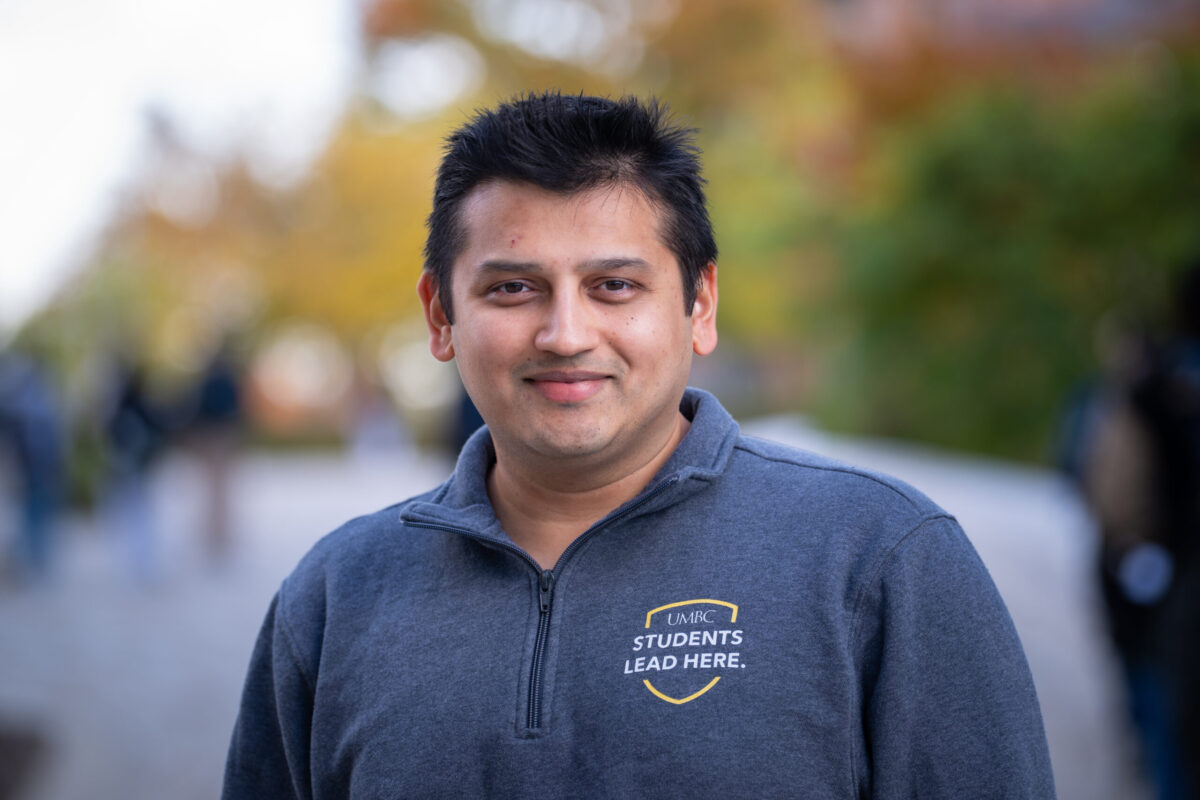

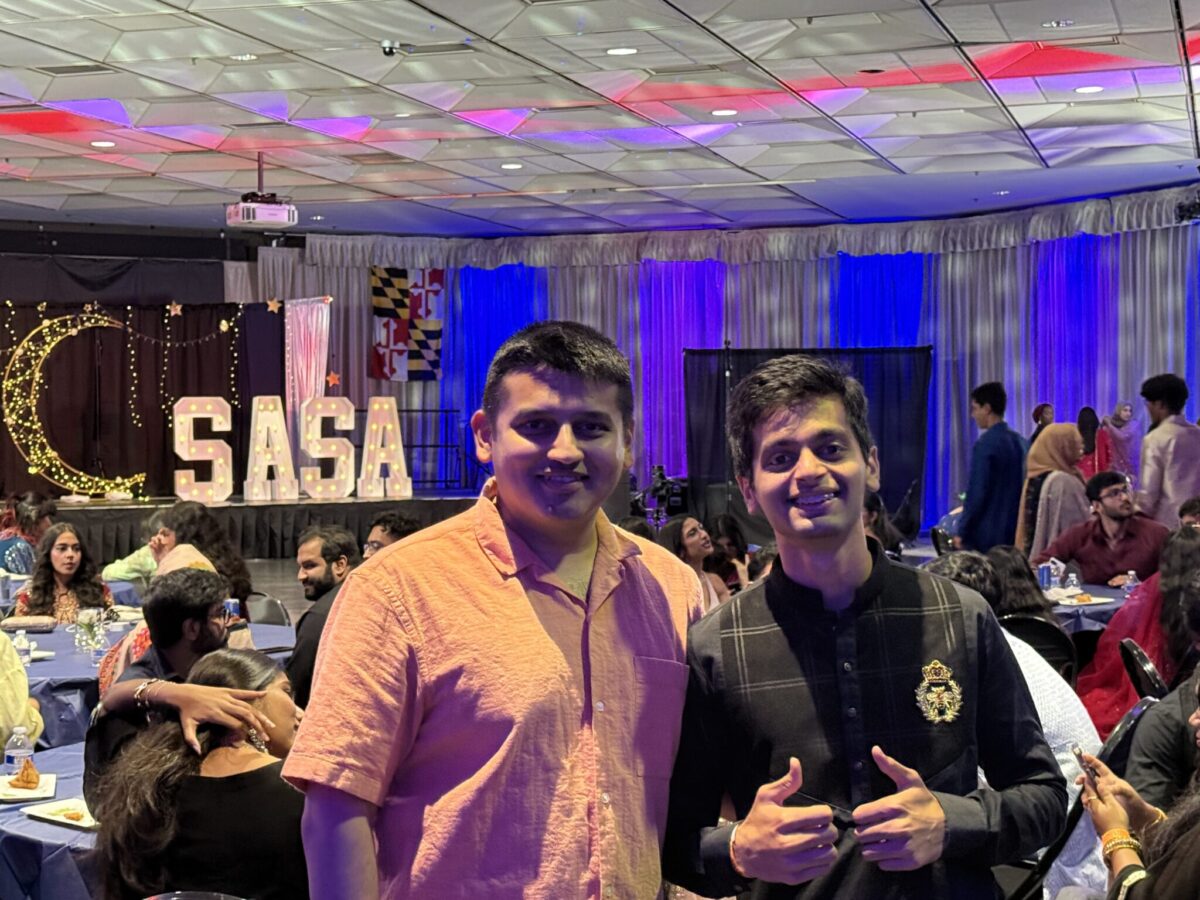 Building on the experience and relationships he has poured into at UMBC, Yash Bhatt, M.S., engineering management, is exploring career options that will allow him to find impactful work in the United States.
Outside of the classroom, Bhatt dedicated himself to enhancing student life for his classmates. As a member of the Indian Graduate Student Association and the Black and Gold Student Advisory Board, he advocated for international students and contributed to university decision-making. Bhatt also joined two Alternative Spring Break experiences. Starting as a participant and returning as a program leader, Bhatt immersed himself in what he considers a genuine “American student experience,” building local friendships and making connections within local government and community organizations, in addition to the service the participants provided to the community.
“The best part of my UMBC experience has been the people and the sense of community,” says Bhatt. “UMBC has this unique balance—it’s diverse and full of opportunity like a larger university yet still close-knit enough that you truly feel seen and supported.”
Read about more members of the Class of 2026.
]]>
If you surveyed UMBC’s Class of 2026 and generated a word cloud, the word “community” would instantly dominate the screen. You might be tempted to dismiss it as a buzzword until you see how many...
https://umbc.edu/stories/the-class-of-2026-found-communities/
https://my3.my.umbc.edu/api/v0/pixel/news/160816/guest@my.umbc.edu/cf04ba1651301975b30808841d7317ae/api/pixel
cahss
class-of-2026
cnms
coeit
community
feature
spring-2026
stories
story
UMBC News & Magazine
https://my3.my.umbc.edu/groups/umbc-news-magazine
https://assets1-my.umbc.edu/system/shared/avatars/groups/000/001/943/24435aa6207c452e7bc15cc74b42c7bb/xsmall.png?1748556657
https://assets1-my.umbc.edu/system/shared/avatars/groups/000/001/943/24435aa6207c452e7bc15cc74b42c7bb/original.png?1748556657
https://assets2-my.umbc.edu/system/shared/avatars/groups/000/001/943/24435aa6207c452e7bc15cc74b42c7bb/xxlarge.png?1748556657
https://assets2-my.umbc.edu/system/shared/avatars/groups/000/001/943/24435aa6207c452e7bc15cc74b42c7bb/xlarge.png?1748556657
https://assets3-my.umbc.edu/system/shared/avatars/groups/000/001/943/24435aa6207c452e7bc15cc74b42c7bb/large.png?1748556657
https://assets1-my.umbc.edu/system/shared/avatars/groups/000/001/943/24435aa6207c452e7bc15cc74b42c7bb/medium.png?1748556657
https://assets2-my.umbc.edu/system/shared/avatars/groups/000/001/943/24435aa6207c452e7bc15cc74b42c7bb/small.png?1748556657
https://assets1-my.umbc.edu/system/shared/avatars/groups/000/001/943/24435aa6207c452e7bc15cc74b42c7bb/xsmall.png?1748556657
https://assets2-my.umbc.edu/system/shared/avatars/groups/000/001/943/24435aa6207c452e7bc15cc74b42c7bb/xxsmall.png?1748556657
UMBC News & Magazine
0
0
false
Tue, 23 Jun 2026 14:41:14 -0400
Tue, 23 Jun 2026 14:41:14 -0400
Thyme to grow—UMBC’s Little Seed Library starts spreading its roots
Each plant, whether a small wild buttercup or a massive oak tree, starts out as seed—packed with potential to grow well beyond its original size. By this logic, The Garden’s new Little Seed Library—co-sponsored by Retriever Essentials and the Office of Sustainability and installed by Facilities Management—is seeded with infinite potential.
Based on the now-familiar concept of Little Free Libraries that spread access to the love of reading, the Little Seed Library, down the sidewalk from UMBC Police, is set up for people to donate seeds (perhaps harvested from the adjacent garden) and those who want to put their green thumb to the test can take what they need to get started.
 Laila Kaira takes a look at what’s available in the Little Seed Library.
The idea stemmed from conversations Michael Berardi, assistant director of Retriever Essentials, was having with folks on campus about tangible ways to grow interest in the community garden while wanting to grow awareness of where our food actually comes from. “We want to help campus engage with our food in a more deep and meaningful way,” says Berardi ’19, M.P.S. ’25, who was also a co-founder of the campus-adjacent coffee shop, OCA Mocha.
Andrew Eisenhardt ’21 was one of the people talking to Berardi. He remembers: “We were hiking in the woods of Patapsco State Park brainstorming some ideas for Retriever Essentials. I had recently seen a YouTube video where a community put up seed libraries and people could go to get new seeds and donate their excess. I figured it could be cool to have something like that at UMBC.” Eisenhardt, who already graduated with a double major in geography and environmental systems and media and communication studies and is currently pursuing another bachelor’s in computer engineering, started working in The Garden during his first time at UMBC when he needed a break from doing homework and wanted to see what opportunities were on-campus to get outside and work with nature. “The Little Seed Library serves as a great starting point for community members to participate in and learn about this work,” he says. “Just get a seed, throw it in some soil and see what happens! Worst case scenario, your seed never germinates. Either way you’ll learn something about plants and you might even make some friends along the way who are trying to grow a better future.”
Jessica Graziano, who has been tending a plot in The Garden for several years, only foresees fruitful outcomes for the Little Seed Library. Eventually, in addition to seeds and instructions for planting, Graziano would like to see folks donate gardening tools and horticultural resources. Graziano, the current president of The Garden club, says her favorite thing to grow is perennials. “My current favorite is False Indigo, which I’ve had growing in my plot at The Garden for about two and a half years,” she shares. Recently recognized with a UMBC Community Impact award at SGA’s 2025 – 2026 CelebratingOrgs event, The Garden is lush with promise.
Nicole Wolf, UMBC’s sustainability coordinator, says that the Office of Sustainability has some nutrient rich ideas coming up in connection with the other organizations that help support The Garden. But in the meantime, “access to free seeds and gardening space removes the barrier of not knowing where to start, or even having to leave campus if they choose to use the community plots,” says Wolf. “We will continue to foster this culture by hosting regular ‘seed save collection’ events on our campus to keep the library stocked while teaching attendees about native plants and how to harvest ethically as we go.”
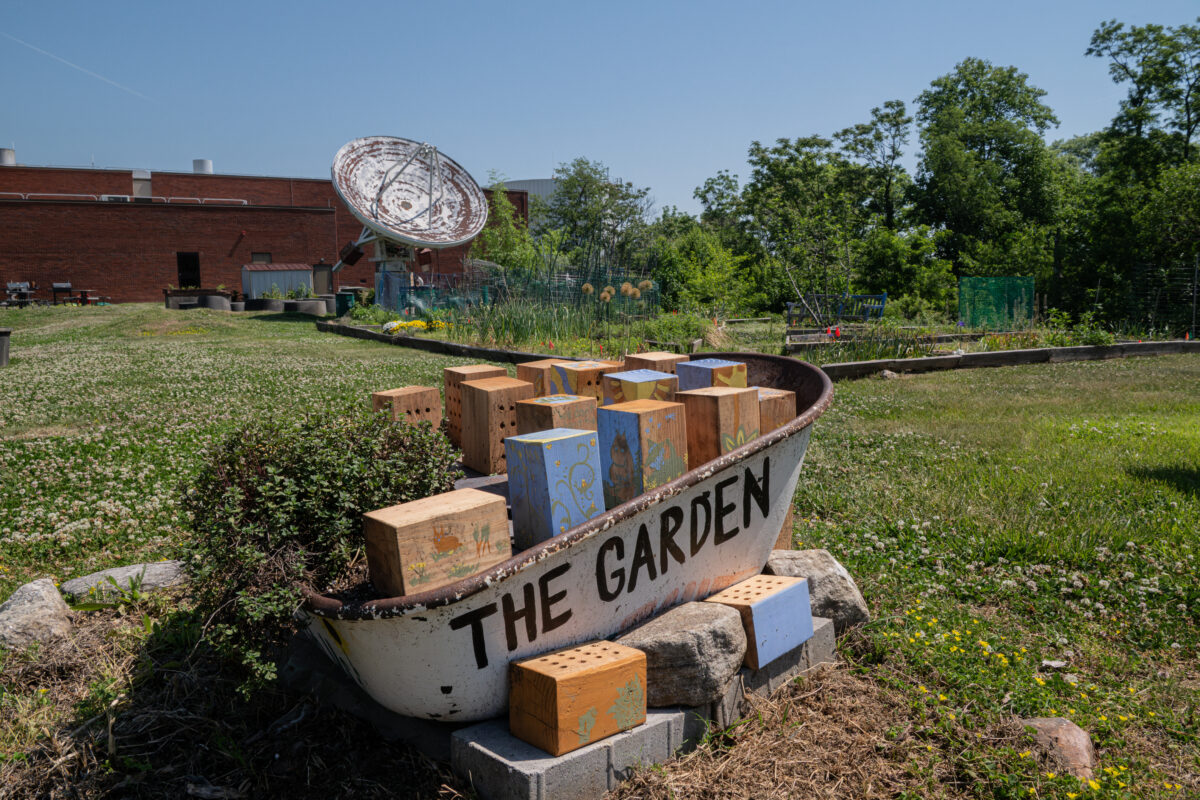 ]]>
Each plant, whether a small wild buttercup or a massive oak tree, starts out as seed—packed with potential to grow well beyond its original size. By this logic, The Garden’s new Little Seed...
https://umbc.edu/stories/thyme-to-grow-little-seed-library/
https://my3.my.umbc.edu/api/v0/pixel/news/160797/guest@my.umbc.edu/ae8cdb0b87d478cacf6d2a109fb4131d/api/pixel
campus-life
retriever-essentials
spring-2026
stories
story
sustainability
wild-card
UMBC News & Magazine
https://my3.my.umbc.edu/groups/umbc-news-magazine
https://assets1-my.umbc.edu/system/shared/avatars/groups/000/001/943/24435aa6207c452e7bc15cc74b42c7bb/xsmall.png?1748556657
https://assets1-my.umbc.edu/system/shared/avatars/groups/000/001/943/24435aa6207c452e7bc15cc74b42c7bb/original.png?1748556657
https://assets2-my.umbc.edu/system/shared/avatars/groups/000/001/943/24435aa6207c452e7bc15cc74b42c7bb/xxlarge.png?1748556657
https://assets2-my.umbc.edu/system/shared/avatars/groups/000/001/943/24435aa6207c452e7bc15cc74b42c7bb/xlarge.png?1748556657
https://assets3-my.umbc.edu/system/shared/avatars/groups/000/001/943/24435aa6207c452e7bc15cc74b42c7bb/large.png?1748556657
https://assets1-my.umbc.edu/system/shared/avatars/groups/000/001/943/24435aa6207c452e7bc15cc74b42c7bb/medium.png?1748556657
https://assets2-my.umbc.edu/system/shared/avatars/groups/000/001/943/24435aa6207c452e7bc15cc74b42c7bb/small.png?1748556657
https://assets1-my.umbc.edu/system/shared/avatars/groups/000/001/943/24435aa6207c452e7bc15cc74b42c7bb/xsmall.png?1748556657
https://assets2-my.umbc.edu/system/shared/avatars/groups/000/001/943/24435aa6207c452e7bc15cc74b42c7bb/xxsmall.png?1748556657
UMBC News & Magazine
5
0
false
Mon, 22 Jun 2026 11:41:37 -0400
Mon, 22 Jun 2026 11:41:37 -0400
]]>
Each plant, whether a small wild buttercup or a massive oak tree, starts out as seed—packed with potential to grow well beyond its original size. By this logic, The Garden’s new Little Seed...
https://umbc.edu/stories/thyme-to-grow-little-seed-library/
https://my3.my.umbc.edu/api/v0/pixel/news/160797/guest@my.umbc.edu/ae8cdb0b87d478cacf6d2a109fb4131d/api/pixel
campus-life
retriever-essentials
spring-2026
stories
story
sustainability
wild-card
UMBC News & Magazine
https://my3.my.umbc.edu/groups/umbc-news-magazine
https://assets1-my.umbc.edu/system/shared/avatars/groups/000/001/943/24435aa6207c452e7bc15cc74b42c7bb/xsmall.png?1748556657
https://assets1-my.umbc.edu/system/shared/avatars/groups/000/001/943/24435aa6207c452e7bc15cc74b42c7bb/original.png?1748556657
https://assets2-my.umbc.edu/system/shared/avatars/groups/000/001/943/24435aa6207c452e7bc15cc74b42c7bb/xxlarge.png?1748556657
https://assets2-my.umbc.edu/system/shared/avatars/groups/000/001/943/24435aa6207c452e7bc15cc74b42c7bb/xlarge.png?1748556657
https://assets3-my.umbc.edu/system/shared/avatars/groups/000/001/943/24435aa6207c452e7bc15cc74b42c7bb/large.png?1748556657
https://assets1-my.umbc.edu/system/shared/avatars/groups/000/001/943/24435aa6207c452e7bc15cc74b42c7bb/medium.png?1748556657
https://assets2-my.umbc.edu/system/shared/avatars/groups/000/001/943/24435aa6207c452e7bc15cc74b42c7bb/small.png?1748556657
https://assets1-my.umbc.edu/system/shared/avatars/groups/000/001/943/24435aa6207c452e7bc15cc74b42c7bb/xsmall.png?1748556657
https://assets2-my.umbc.edu/system/shared/avatars/groups/000/001/943/24435aa6207c452e7bc15cc74b42c7bb/xxsmall.png?1748556657
UMBC News & Magazine
5
0
false
Mon, 22 Jun 2026 11:41:37 -0400
Mon, 22 Jun 2026 11:41:37 -0400