Meet a Retriever—Natalie Blank ’08, special educator and author
Meet Natalie Blank ’08, acting, who started writing novels as a child and continued pursuing her passion for writing while studying dance and theatre at UMBC. To date, the author has published four novels, Rock Bottom Rise (2026), The Mass (2024), The Tangibles (2022), which received the In the Margins Book Award in 2023, and Walking Off Pluto (2014). Natalie primarily writes young adult and women’s fiction, exploring mental health and family relationships. She lives in Maryland with her husband and three children. Take it away, Natalie!
Q: What brought you to UMBC?
A: I came to UMBC as a Linehan Artist Scholar. I remember auditioning for the theatre program with a fairly serious monologue. During the audition, the professors (Xerxes Mehta was my favorite professor) worked with me in a way I had never experienced before. They were able to push me to a level of vulnerability and emotional depth I didn’t know I was capable of as an actress. In that moment, I knew these were professors who understood how to challenge students and help them grow.
Q: How did you grow during your time at UMBC?
A: The Theatre Department had a huge impact on me, both creatively and personally. Through acting, I learned a lot about myself, not just as a performer, but also as a writer. I had the opportunity to portray many incredible characters, and through that process, I realized that storytelling in all its forms (acting in stories, creating stories, and writing stories) was at the core of who I am.
During my time at UMBC, I wrote several plays that were produced and performed. One of those plays eventually became my first novel, Walking Off Pluto, which I self-published in 2014. Since then, I have worked hard to build my writing career and transition into traditional publishing. My current goal is to secure literary representation and publish with a major publishing house.
 Blank’s four novels: Walking Off Pluto (2014), The Tangibles (2022), The Mass (2024), and Rock Bottom Rise (2026)
While I only pursued theatre professionally for about two years after college, the lessons I learned have stayed with me and continue to shape my work as a writer. The program encouraged me to explore who I was, challenge my assumptions, and confront some of the fears and weaknesses that were holding me back from reaching my full potential. One of the biggest lessons was learning to take creative risks. In recent years, I’ve become much more willing to take chances and tell the stories I genuinely want to tell, and my readers love it!
Q: Can you tell us about your current job and your work as an author?
A: I’ve always been driven and largely self-taught, figuring out many aspects of my career on my own. After college, I pursued acting professionally, but the pay was inconsistent and often insufficient, so I also worked a day job to support myself. Eventually, I found my way into the school system, and after starting a family, I became a certified teacher. I work part-time as a special education teacher for Montgomery County Public Schools. I miss theatre and dance, but I can’t live without writing. It’s something I’ll pursue for the rest of my life.
Balancing work, writing, and family life is challenging, but I remain committed to my craft. I wake up before my children each morning to write and often return to my manuscript after they’ve gone to bed. I recently published my fourth novel, Rock Bottom Rise, in May 2026.
 Blank at the book release party for “Rock Bottom Rise.”
* * * * *
UMBC’s greatest strength is its people. When people meet Retrievers and hear about the passion they bring, the relationships they create, the ways they support each other, and the commitment they have to inclusive excellence, they truly get a sense of our community. That’s what “Meet a Retriever” is all about.
Learn more about how UMBC can help you achieve your goals.
]]>
Meet Natalie Blank ’08, acting, who started writing novels as a child and continued pursuing her passion for writing while studying dance and theatre at UMBC. To date, the author has published...
https://umbc.edu/stories/author-natalie-blank/
https://my3.my.umbc.edu/api/v0/pixel/news/160779/guest@my.umbc.edu/e70b383cefad73bca6247ab811c3919d/api/pixel
alumni
cahss
linehan
retriever-authors
story
UMBC News & Magazine
https://my3.my.umbc.edu/groups/umbc-news-magazine
https://assets1-my.umbc.edu/system/shared/avatars/groups/000/001/943/24435aa6207c452e7bc15cc74b42c7bb/xsmall.png?1748556657
https://assets1-my.umbc.edu/system/shared/avatars/groups/000/001/943/24435aa6207c452e7bc15cc74b42c7bb/original.png?1748556657
https://assets2-my.umbc.edu/system/shared/avatars/groups/000/001/943/24435aa6207c452e7bc15cc74b42c7bb/xxlarge.png?1748556657
https://assets2-my.umbc.edu/system/shared/avatars/groups/000/001/943/24435aa6207c452e7bc15cc74b42c7bb/xlarge.png?1748556657
https://assets3-my.umbc.edu/system/shared/avatars/groups/000/001/943/24435aa6207c452e7bc15cc74b42c7bb/large.png?1748556657
https://assets1-my.umbc.edu/system/shared/avatars/groups/000/001/943/24435aa6207c452e7bc15cc74b42c7bb/medium.png?1748556657
https://assets2-my.umbc.edu/system/shared/avatars/groups/000/001/943/24435aa6207c452e7bc15cc74b42c7bb/small.png?1748556657
https://assets1-my.umbc.edu/system/shared/avatars/groups/000/001/943/24435aa6207c452e7bc15cc74b42c7bb/xsmall.png?1748556657
https://assets2-my.umbc.edu/system/shared/avatars/groups/000/001/943/24435aa6207c452e7bc15cc74b42c7bb/xxsmall.png?1748556657
UMBC News & Magazine
1
0
false
Thu, 18 Jun 2026 14:40:52 -0400
Thu, 18 Jun 2026 14:40:52 -0400
Alan Byrd Named Vice Provost of Enrollment Management at UMBC
Alan Byrd has been appointed as the next vice provost for enrollment management for the University of Maryland, Baltimore County (UMBC), effective August 3. Byrd joins UMBC from George Mason University where he has served as the dean of admissions since 2020.
Byrd brings more than 25 years of experience in college admissions and enrollment management to UMBC. He has an extensive track record of implementing successful recruitment and retention initiatives, and he consistently increased enrollment, improved academic profiles, expanded diversity, and enhanced student success at the institutions where he has served.
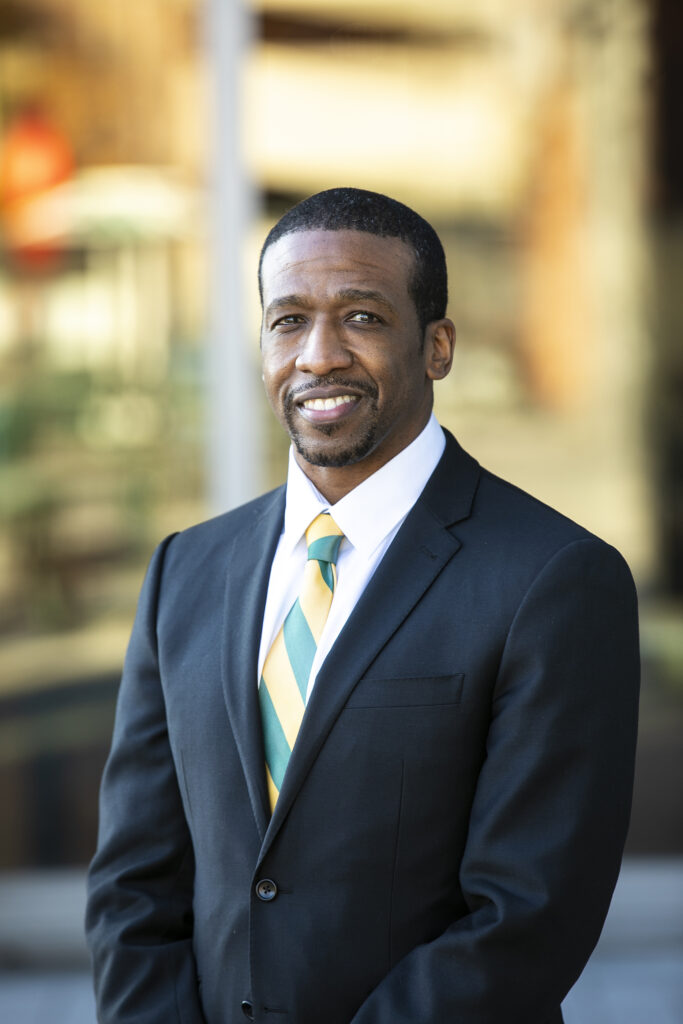
Byrd’s commitment to college access, affordability, and student success has defined his lifetime of work as an enrollment manager. Prior to arriving at George Mason, he was vice provost of enrollment management at the University of Missouri-St. Louis where he led the university to several milestones for total enrollment, the academic profile and diversity of the student body, and graduation rates. Removing financial barriers for students was central to his accomplishments in St. Louis, where he developed innovative financial aid programs such as the UMSL Grant, Triton Emergency Grant, and the Senior Degree Completion Program. These flexible need-based programs helped eliminate equity gaps in degree completion for Pell grant recipients and reduce their average debt at graduation.
Byrd earned a bachelor’s degree in communication from Southeast Missouri State University, a master’s degree in higher education administration from Southeast Missouri State University, and a doctorate in education leadership and policy studies at the University of Missouri-St. Louis. His dissertation research examined noneconomic persistence barriers for low-income students at large public universities.
]]>
Alan Byrd has been appointed as the next vice provost for enrollment management for the University of Maryland, Baltimore County (UMBC), effective August 3. Byrd joins UMBC from George Mason...
https://umbc.edu/stories/alan-byrd-to-lead-enrollment-management-at-umbc/
https://my3.my.umbc.edu/api/v0/pixel/news/160780/guest@my.umbc.edu/135dad52d50677e9da7a11d5d36c6b0f/api/pixel
story
uncategorized
UMBC News & Magazine
https://my3.my.umbc.edu/groups/umbc-news-magazine
https://assets1-my.umbc.edu/system/shared/avatars/groups/000/001/943/24435aa6207c452e7bc15cc74b42c7bb/xsmall.png?1748556657
https://assets1-my.umbc.edu/system/shared/avatars/groups/000/001/943/24435aa6207c452e7bc15cc74b42c7bb/original.png?1748556657
https://assets2-my.umbc.edu/system/shared/avatars/groups/000/001/943/24435aa6207c452e7bc15cc74b42c7bb/xxlarge.png?1748556657
https://assets2-my.umbc.edu/system/shared/avatars/groups/000/001/943/24435aa6207c452e7bc15cc74b42c7bb/xlarge.png?1748556657
https://assets3-my.umbc.edu/system/shared/avatars/groups/000/001/943/24435aa6207c452e7bc15cc74b42c7bb/large.png?1748556657
https://assets1-my.umbc.edu/system/shared/avatars/groups/000/001/943/24435aa6207c452e7bc15cc74b42c7bb/medium.png?1748556657
https://assets2-my.umbc.edu/system/shared/avatars/groups/000/001/943/24435aa6207c452e7bc15cc74b42c7bb/small.png?1748556657
https://assets1-my.umbc.edu/system/shared/avatars/groups/000/001/943/24435aa6207c452e7bc15cc74b42c7bb/xsmall.png?1748556657
https://assets2-my.umbc.edu/system/shared/avatars/groups/000/001/943/24435aa6207c452e7bc15cc74b42c7bb/xxsmall.png?1748556657
UMBC News & Magazine
0
0
false
Thu, 18 Jun 2026 14:25:00 -0400
Thu, 18 Jun 2026 14:25:00 -0400
Meet a Retriever—Carlos Carmona ’88, retired banker and author
Meet Carlos Carmona ’88, economics. After UMBC, Carlos built a long career in retail and commercial banking before retiring in 2020. Now, Carlos enjoys traveling the world with his wife, Maritza de Jesús, and exploring one of his early passions—storytelling. In 2025, Carlos realized a lifelong dream, becoming a published author with the launch of his debut novel, Unforgivable Sins: A Barrio Story. Take it away, Carlos!
Q: What initially brought you to UMBC?
A: Growing up in Baltimore City in the early ’80s was challenging. The closure of Bethlehem Steel had devastated the city and its economy, and for many young people, the path forward was unclear. The University System of Maryland offered something aspirational at a time when everything around us seemed uncertain.
At UMBC, I was exposed to people from different backgrounds, new ways of thinking, and possibilities beyond Baltimore City’s despair and anxiety. To this very day, I maintain close friendships from those years. In fact, I recently had dinner with Jim Zerr ’89 and his wife. My time at UMBC didn’t just educate me; it gave me lifelong relationships and a broader vision of what my life could eventually become.
Q: What’s the one thing you’d want someone who hasn’t joined the UMBC community to know about the support you find here?
Every journey is different, and I would never presume to define anyone else’s path. What I can share is that UMBC and its professors fostered an environment of openness and understanding. They recognized that academic success rarely follows a single route, and in that understanding, I found the confidence to keep moving forward. They reminded me that what matters most is not how you arrive, but that you keep going.
What has stayed with me most from my time at UMBC is the generosity of my fellow students. People shared their experiences, offered advice, exchanged resources, and opened doors for one another. Friendship and support seemed to appear wherever I turned. Looking back, I realize how fortunate I was to be part of a community that valued collaboration over competition. It is an experience for which I remain deeply grateful.
To those who welcomed me, encouraged me, and treated me as a friend, thank you.
Carlos Carmona ’88
economics
When I look back on my life, I do not see absence. I see family, friendship, opportunity, and countless people who helped shape the person I became. In the end, I was never without. If anything, I was blessed with more than I recognized at the time.
Q: Who in the UMBC community has inspired you or supported you?
A: As an undergraduate, Professor Sarah Voight was a guiding light. Though she taught in the Spanish Department and I majored in economics, our shared Puerto Rican heritage gave me something to hold on to, something familiar and relatable in a place that often wasn’t. Her advice and guidance were crucial in helping me continue my studies and ultimately graduate.
Q: Tell us about what you loved about your academic program or an organization you were involved in at UMBC.
A: I loved studying economics, finance, and accounting. I found the subjects as exciting as they were challenging. At the same time, I explored several liberal arts and language courses, which gave me a well-rounded foundation that has served me throughout my life. For many years, I was a financial advisor to Catholic parishes, a role I stepped back from due to serious health issues, though I aspire to return when I’m able.
Q: Can you tell us about your work as an author?
A: I never planned on becoming a writer. I was a banker, a man who lived by numbers, memos, and proposals, not by scenes or plotlines. Stories belonged to other people. At least that is what I believed until life forced me to reconsider what mattered. Cancer did that. Two rounds of chemo. A fight I barely survived. And somewhere in the middle of that darkness, when my world narrowed, something in me shifted. Ideas I had buried decades earlier began to surface. Words I never thought I could write spilled onto the page. It was as if the part of me I had ignored finally demanded to be heard.
That is how Unforgivable Sins was born, a book that split itself into two stories, A Barrio Story and The Rise of Charlie Green. I self‑published them because no one in the industry was waiting for stories like mine. I knew the audience would be small. I knew the road would be impossibly long. Editors have never shown interest in Latino urban crime fiction, not because the stories lack power, but because the gatekeepers have never known what to do with them. But I also knew these stories were missing from today’s literature. They were missing in 1986 when the idea first came to me at UMBC, and they are still missing in 2026. The absence never changed. I simply reached a point in my life where I refused to let that absence continue.
What I didn’t expect was what came next. The moment I finished those books; a third story consumed me. Legacy of Sins arrived like a storm, pulling both earlier stories forward. Instead of continued editing, marketing, polishing what I had just created, I found myself chasing the next chapter, the next revelation, the next plot twist. Some scenes took forever to finish in all three stories. Not because I lacked the words, but because the memories behind them were too painful. This is all fiction, yes, but parts of it were my life experience. Parts of it still are and will forever be.
Pictured right: The potential book cover for “Legacy of Sins: A Barrio Story” by author Carlos Carmona.

Now the story is almost complete. I’m editing, refining, shaping it the best someone with only their passion can. For no publishing company would. With the lessons learned from the first one, the never‑ending process of self‑publishing. I expect Legacy of Sins to be ready this summer or early fall.
I write because these stories once brought to life refused to let me go. I write because they were missing. I write because survival gave me a second chance, and I refuse to waste it.
* * * * *
UMBC’s greatest strength is its people. When people meet Retrievers and hear about the passion they bring, the relationships they create, the ways they support each other, and the commitment they have to inclusive excellence, they truly get a sense of our community. That’s what “Meet a Retriever” is all about.
Learn more about how UMBC can help you achieve your goals.
]]>
Meet Carlos Carmona ’88, economics. After UMBC, Carlos built a long career in retail and commercial banking before retiring in 2020. Now, Carlos enjoys traveling the world with his wife, Maritza...
https://umbc.edu/stories/author-carlos-carmona/
https://my3.my.umbc.edu/api/v0/pixel/news/160766/guest@my.umbc.edu/0aa3683b986f91837ce73fc52f248e0e/api/pixel
alumni
retriever-authors
story
UMBC News & Magazine
https://my3.my.umbc.edu/groups/umbc-news-magazine
https://assets1-my.umbc.edu/system/shared/avatars/groups/000/001/943/24435aa6207c452e7bc15cc74b42c7bb/xsmall.png?1748556657
https://assets1-my.umbc.edu/system/shared/avatars/groups/000/001/943/24435aa6207c452e7bc15cc74b42c7bb/original.png?1748556657
https://assets2-my.umbc.edu/system/shared/avatars/groups/000/001/943/24435aa6207c452e7bc15cc74b42c7bb/xxlarge.png?1748556657
https://assets2-my.umbc.edu/system/shared/avatars/groups/000/001/943/24435aa6207c452e7bc15cc74b42c7bb/xlarge.png?1748556657
https://assets3-my.umbc.edu/system/shared/avatars/groups/000/001/943/24435aa6207c452e7bc15cc74b42c7bb/large.png?1748556657
https://assets1-my.umbc.edu/system/shared/avatars/groups/000/001/943/24435aa6207c452e7bc15cc74b42c7bb/medium.png?1748556657
https://assets2-my.umbc.edu/system/shared/avatars/groups/000/001/943/24435aa6207c452e7bc15cc74b42c7bb/small.png?1748556657
https://assets1-my.umbc.edu/system/shared/avatars/groups/000/001/943/24435aa6207c452e7bc15cc74b42c7bb/xsmall.png?1748556657
https://assets2-my.umbc.edu/system/shared/avatars/groups/000/001/943/24435aa6207c452e7bc15cc74b42c7bb/xxsmall.png?1748556657
UMBC News & Magazine
0
0
false
Thu, 18 Jun 2026 07:40:53 -0400
Thu, 18 Jun 2026 07:40:53 -0400
Meet a Retriever—Beryl Fuamazeh ’26 is on her way to medical school with an eye on aging care
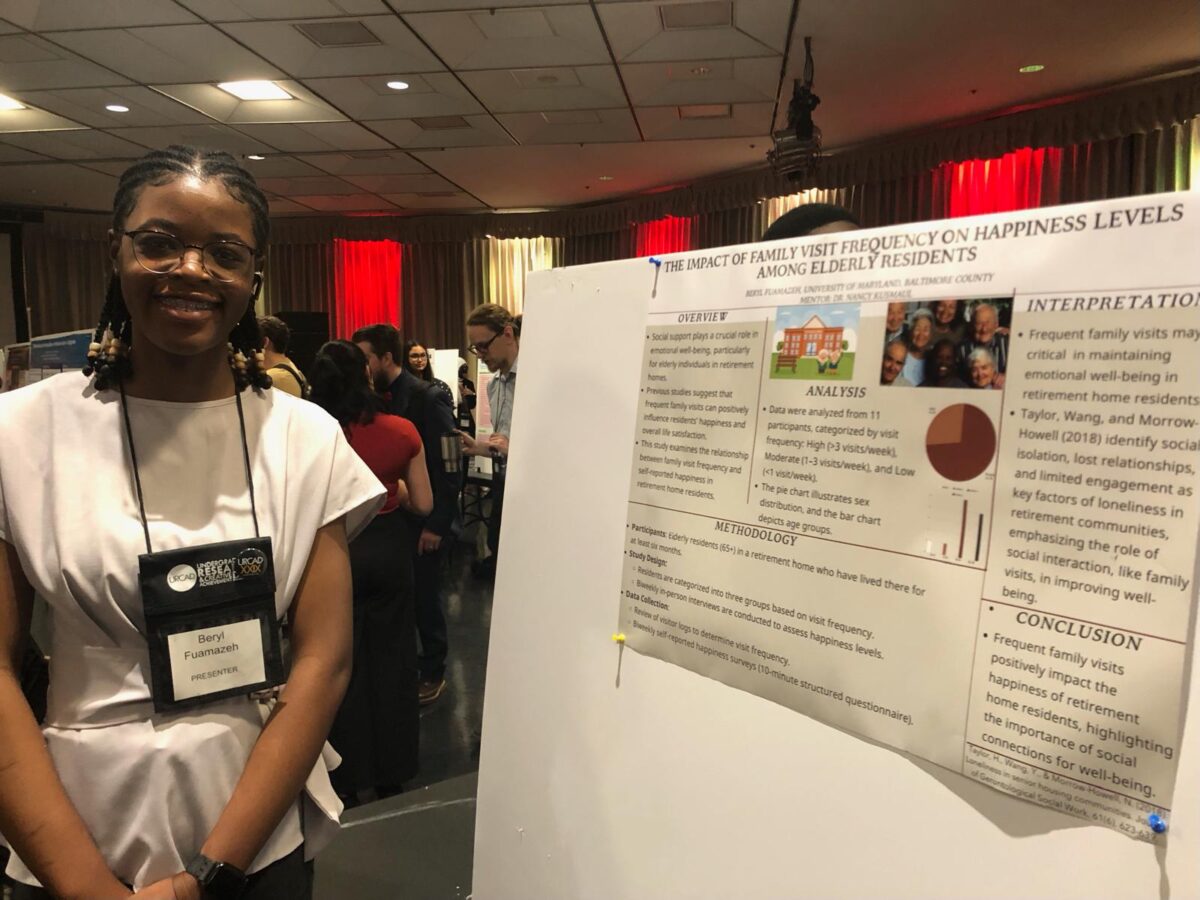
Beryl Fuamazeh ’26, biology, and a minor in health, wellness, and aging, is on her way to Howard University College of Medicine. After connecting with Nancy Kusmaul, professor of social work, Beryl found her research interests piqued by learning more about healthcare and aging care. While at UMBC, Beryl worked as a nursing assistant at a retirement community and volunteered for an organization that supports people with disabilities and older adults. After presenting her research at UMBC’s Undergraduate Research and Creative Achievement Day, she received the Erickson School of Aging Studies Award for Excellence in Undergraduate Research.
Beryl transferred to UMBC from the Community College of Baltimore County through the Degrees to Succeed program, and says that the support and funding she’s received from UMBC has made her education affordable and given her time to focus on her passion: healthcare and aging. Outside of school and work, she loves watching Korean dramas.
Q: Tell us about someone in the UMBC community who has inspired you.
A: Dr. Nancy Kusmaul is my research mentor, and she has been instrumental in my undergraduate research journey. The work she does to support the aging community has deeply inspired me. I have also been greatly influenced by Professor Mary Carter, an English professor here, who taught me how to better express myself through writing—a skill that was invaluable during my medical school application process. The support and guidance both faculty members have given me have truly shaped my experience at UMBC.
Q: Tell us about what you love about your academic program.
A: I’ve really enjoyed being part of the Erickson School of Aging Studies through my minor in health, wellness, and aging. Many of the classes I’ve taken have been meaningful because I can directly apply what I learn to my work as a nursing assistant in a retirement community. My biology major has also given me a strong foundation as I prepare to matriculate into medical school.
Q: What’s one thing you’d want someone to know about the support you find here?
A: Because it’s a smaller university, I’ve been able to build meaningful one-on-one relationships with professors, which has been incredibly valuable. I’ve also loved being surrounded by students who are passionate, driven, and genuinely supportive of one another, especially within the sciences. UMBC is a very supportive community.
Q: What brought you to UMBC in the first place?
A: I wanted to further my education while building meaningful relationships along the way. As someone pursuing the pre-med path, I knew it was important to be surrounded by supportive, like-minded people, and UMBC provided that for me, especially as a transfer student from the Community College of Baltimore County.
I was also drawn to the smaller campus environment, which made it easier to adapt and connect with professors and peers. Through my community college’s Degrees to Succeed partnership program, I was introduced to UMBC and the opportunities it offered, including research experiences, mentorship, and a strong academic community.
Right: Fuamazeh next to her poster at URCAD 2025.
Q: Tell us about the people who are helping you grow at UMBC.
A: Dr. Nancy Kusmaul has been incredibly instrumental in helping me grow at UMBC. She helped me kickstart my undergraduate research journey, which initially felt very daunting. All it took was reaching out to her by email, and she was immediately supportive and responsive. She took time out of her busy schedule to help me develop an individualized research study focused on aging, a topic that has become deeply meaningful to me and the communities it impacts.
Q: How have you connected with the community?
A: I have been involved in community programs, like volunteering with the Trusted Ride Program at Ascension Saint Agnes Hospital, which supports older adults and individuals with disabilities by helping them get to medical appointments safely. Experiences like this have allowed me to stay connected to the community while pursuing my interests in healthcare and aging.
Q: What would you tell others who are in your shoes about UMBC?
A: I transferred to UMBC from the Community College of Baltimore County, and through scholarships and financial support, including merit-based awards, UMBC helped ease the financial burden of pursuing higher education, which allowed me to focus more on my academics and future goals. I also felt well supported as a transfer student through the Degrees to Succeed program, even before officially transferring to UMBC. The transition felt smooth, and I always felt like there were people willing to help guide me along the way.
UMBC’s greatest strength is its people. When people meet Retrievers and hear about the passion they bring, the relationships they create, the ways they support each other, and the commitment they have to inclusive excellence, they truly get a sense of our community. That’s what “Meet a Retriever” is all about.
Learn more about how UMBC can help you achieve your goals.
]]>
Beryl Fuamazeh ’26, biology, and a minor in health, wellness, and aging, is on her way to Howard University College of Medicine. After connecting with Nancy Kusmaul, professor of social work,...
https://umbc.edu/stories/meet-a-retriever-beryl-fuamazeh-aging-care/
https://my3.my.umbc.edu/api/v0/pixel/news/160752/guest@my.umbc.edu/8b4bf215522e0179499e5c60c5bc173d/api/pixel
aging-studies
alumni
cnms
erickson-school
meet-a-retriever
perspectives
social-work
story
urcad
UMBC News & Magazine
https://my3.my.umbc.edu/groups/umbc-news-magazine
https://assets1-my.umbc.edu/system/shared/avatars/groups/000/001/943/24435aa6207c452e7bc15cc74b42c7bb/xsmall.png?1748556657
https://assets1-my.umbc.edu/system/shared/avatars/groups/000/001/943/24435aa6207c452e7bc15cc74b42c7bb/original.png?1748556657
https://assets2-my.umbc.edu/system/shared/avatars/groups/000/001/943/24435aa6207c452e7bc15cc74b42c7bb/xxlarge.png?1748556657
https://assets2-my.umbc.edu/system/shared/avatars/groups/000/001/943/24435aa6207c452e7bc15cc74b42c7bb/xlarge.png?1748556657
https://assets3-my.umbc.edu/system/shared/avatars/groups/000/001/943/24435aa6207c452e7bc15cc74b42c7bb/large.png?1748556657
https://assets1-my.umbc.edu/system/shared/avatars/groups/000/001/943/24435aa6207c452e7bc15cc74b42c7bb/medium.png?1748556657
https://assets2-my.umbc.edu/system/shared/avatars/groups/000/001/943/24435aa6207c452e7bc15cc74b42c7bb/small.png?1748556657
https://assets1-my.umbc.edu/system/shared/avatars/groups/000/001/943/24435aa6207c452e7bc15cc74b42c7bb/xsmall.png?1748556657
https://assets2-my.umbc.edu/system/shared/avatars/groups/000/001/943/24435aa6207c452e7bc15cc74b42c7bb/xxsmall.png?1748556657
UMBC News & Magazine
1
0
false
Wed, 17 Jun 2026 15:25:50 -0400
Wed, 17 Jun 2026 15:25:50 -0400
Office Hours—President Sheares Ashby talks with a graduating senior about rootedness and change
Manav Narendra’s story has been shaped by constant motion. A math and computer science double major, who graduated from UMBC this spring, Narendra grew up moving frequently between India and the United States, adapting to new schools, cultures, and environments every few years. Raised by a single mother who was always striving to create a better life for them, Narendra grew accustomed to change—but also to the challenges that come with it.
Coming to UMBC marked a turning point. Narendra sought out a smaller, close-knit academic environment where he could build community, form lasting friendships, and explore what it means to belong somewhere. In this Office Hour, President Valerie Sheares Ashby—who has also been at UMBC for four years—and Narendra reflect on growing rooted to a place and what effect those lasting connections can have.
UMBC Magazine: Manav, tell us about your background and what brought you to UMBC.
Manav Narendra: I’m originally from India, and I’ve spent about half my life there and half in the U.S. Growing up, I moved a lot because my mom would switch jobs for better opportunities. By my senior year of high school, we had just moved to Maryland. I applied to a vast array of colleges, but I ultimately chose UMBC because I wanted a smaller, more personal environment where I wouldn’t feel lost.
And here, I’ve met people in so many different ways—through classes, the Honors College, tutoring, tennis, even the Career Fair. It’s been really meaningful.
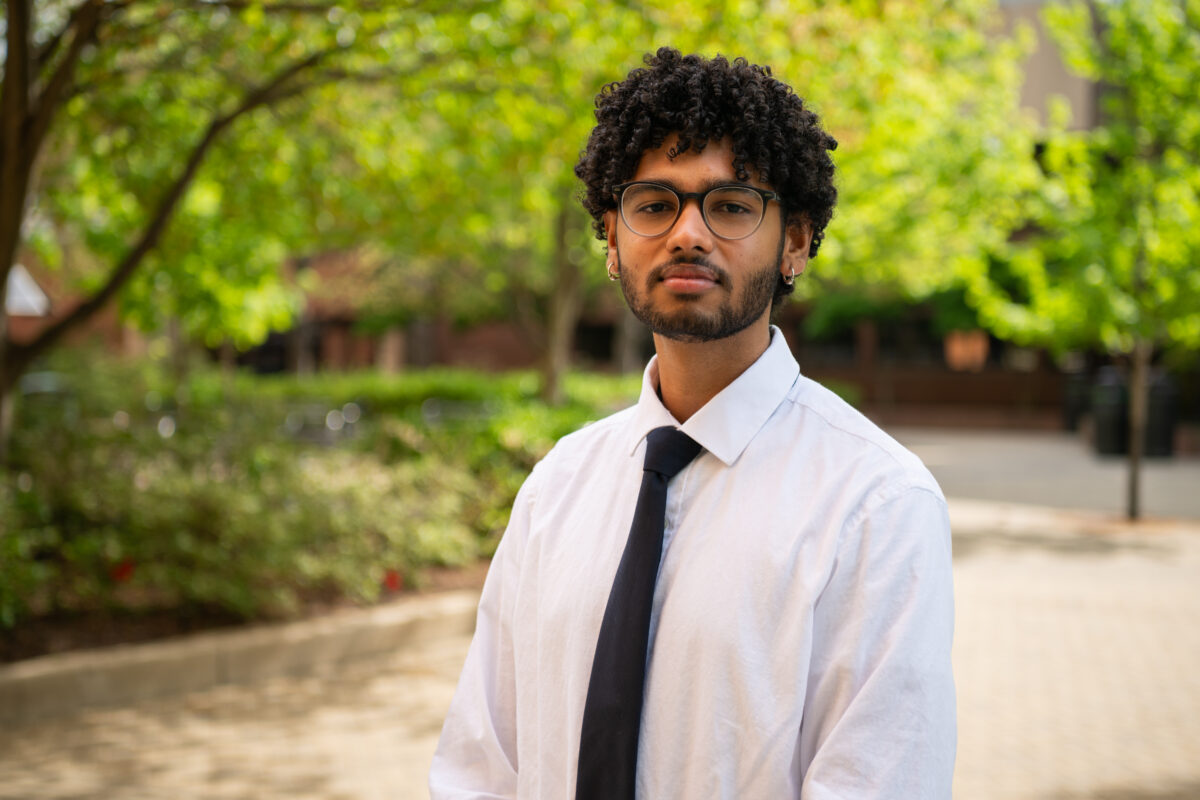 Narendra on campus in spring 2026.
President Valerie Sheares Ashby: You wanted a place where you could feel seen—that is powerful. And these smaller communities within UMBC can really shape your experience.
UMBC Magazine: How did moving so often affect your ability to build relationships?
Narendra: It was difficult. I became more introverted over time because you don’t really get the chance to build lasting friendships when you’re always leaving. I just didn’t realize how much I was missing in terms of long-term connections until I got here. Nevertheless, I’m forever grateful to have met so many incredible people from such beautifully different walks of life—they’ve all shaped who I am today.
President Sheares Ashby: I understand that. I am an introvert, too, and I think those kinds of experiences can really shape how you connect with people. It is not always easy to keep starting over. When I moved to Baltimore, I did not know anyone here, but from experience, I knew what I needed to put in place in order to feel like I am grounded and rooted in community. I learned how to do that when I was your age. In college and in graduate school, I started to ask myself: “What is it that I need to feel grounded?” And then I would go get it—I do not wait for it to happen.
UMBC Magazine: How has UMBC shaped your conception of community?
Narendra: I’ve made friendships that have lasted all four years, which still surprises me. I’ll see someone on campus and think, “Wow, I’ve known you for so long.”
President Sheares Ashby: That is such a special realization. I always tell students that those relationships are one of the most important parts of college. You learn so much in the classroom, but those connections—those are what stay with you.
UMBC Magazine: What does “home” mean to you now, after having moved so much?
Narendra: Growing up, home was my mom. Wherever she was, that’s where home was. She was the only constant in my life. I was diagnosed with cancer when I was 13, and my mom and I went through it together. I dealt with the physical pain, but she carried the brunt of the emotional and mental burden. She quit her job to take care of me. I couldn’t have done it without her. Now, I feel like I have another home here. I have a place where I belong, where I feel valued. It’s comforting to be in one place and not have everything constantly changing.
UMBC Magazine: How did that experience influence your future goals?
Narendra: It’s made me want to give back. I’m looking at various roles, ranging from data and actuarial science to software and astrophysics—seeing where I can best utilize my skills to make a difference: something that helps people and advances our collective understanding of the world. I feel like I’ve been given a second chance at life, and I want to use it well.
President Sheares Ashby: Often, our experiences guide us toward that sense of purpose. There is this idea of finding where your talents meet the greatest need—that is where meaningful work happens.
]]>
Manav Narendra’s story has been shaped by constant motion. A math and computer science double major, who graduated from UMBC this spring, Narendra grew up moving frequently between India and the...
https://umbc.edu/stories/office-hours-rootedness-and-change/
https://my3.my.umbc.edu/api/v0/pixel/news/160751/guest@my.umbc.edu/9430445fa9c6f071aa889ed9b10c3a72/api/pixel
alumni
campus-life
cnms
coeit
computer-science
mathematics
office-hours
spring-2026
story
UMBC News & Magazine
https://my3.my.umbc.edu/groups/umbc-news-magazine
https://assets1-my.umbc.edu/system/shared/avatars/groups/000/001/943/24435aa6207c452e7bc15cc74b42c7bb/xsmall.png?1748556657
https://assets1-my.umbc.edu/system/shared/avatars/groups/000/001/943/24435aa6207c452e7bc15cc74b42c7bb/original.png?1748556657
https://assets2-my.umbc.edu/system/shared/avatars/groups/000/001/943/24435aa6207c452e7bc15cc74b42c7bb/xxlarge.png?1748556657
https://assets2-my.umbc.edu/system/shared/avatars/groups/000/001/943/24435aa6207c452e7bc15cc74b42c7bb/xlarge.png?1748556657
https://assets3-my.umbc.edu/system/shared/avatars/groups/000/001/943/24435aa6207c452e7bc15cc74b42c7bb/large.png?1748556657
https://assets1-my.umbc.edu/system/shared/avatars/groups/000/001/943/24435aa6207c452e7bc15cc74b42c7bb/medium.png?1748556657
https://assets2-my.umbc.edu/system/shared/avatars/groups/000/001/943/24435aa6207c452e7bc15cc74b42c7bb/small.png?1748556657
https://assets1-my.umbc.edu/system/shared/avatars/groups/000/001/943/24435aa6207c452e7bc15cc74b42c7bb/xsmall.png?1748556657
https://assets2-my.umbc.edu/system/shared/avatars/groups/000/001/943/24435aa6207c452e7bc15cc74b42c7bb/xxsmall.png?1748556657
UMBC News & Magazine
0
0
false
Wed, 17 Jun 2026 14:49:56 -0400
Wed, 17 Jun 2026 14:49:56 -0400
Important Federal Updates for the UMBC Community
Dear UMBC Community,
We write to you today on behalf of the Federal Orders and Actions Core Team to update you on some recent federal government actions and how they will or may impact UMBC.
OMB Proposed Regulation for Federal Assistance
On May 29, 2026, the Office of Management and Budget (OMB) proposed the Regulation for Federal Financial Assistance to substantially revise the federal grants framework. OMB’s proposed “Regulation for Federal Financial Assistance” is the most significant update to the Uniform Guidance in decades, impacting over $60 billion in federal research and social assistance programs, such as Medicaid and FEMA. The proposed rule expands executive branch authority and incorporates several executive orders—including restrictions on DEI and gender-affirming care funding.
The 320-plus proposed revisions to the Uniform Guidance would fundamentally alter the awarding and monitoring of federal grants. For higher education and research institutions, these changes threaten to increase administrative and compliance burdens, shift more costs to recipients, and expand institutional liability. Ultimately, these revisions risk slowing the pace of U.S. scientific discovery and innovation.
The significant changes in this proposal were highlighted in a three-page joint statement recently issued by the Association of American Universities (AAU), the Association of Public and Land-grant Universities Council on Research (APLU-COR), and the Council on Government Relations (COGR).
The proposed rules are prompting coordinated responses nationwide. We are in regular contact with colleagues across the University System of Maryland (USM) regarding these proposed changes and are discussing options for an institutional response in coordination with other USM institutions to inform our federal congressional delegation of the potential impact should these proposed regulations become law.
The proposal is currently open for public comment through July 13, 2026, with a stated intent for the regulation to become effective October 1, 2026. We are also actively reviewing the proposed revisions, monitoring updates from AAU, and contributing to and benefitting from the national conversation through APLU-COR and COGR.
We will continue to update you as the situation with this proposed rule evolves.
Update on USCIS Adjudicative Hold on Applications and $100,000 H1-B Policy
There have been developments in two federal policy court cases as outlined below.
On January 1, 2026, USCIS issued an updated policy memorandum, expanding on its December 2, 2025, memorandum, directing USCIS personnel to place a hold on all pending immigration benefit applications submitted by nationals of countries and territories included in the Trump administration’s travel ban. It also called for a review of previously approved applications.
On June 5, 2026, the U.S. District Court for the District of Rhode Island issued a memorandum and order declaring the USCIS Global Asylum Hold Policy, the Comprehensive Re-Review Policy, and the Country-Specific Factors Policy unlawful.
On June 12, 2026, USCIS confirmed that it would follow the terms of the court’s order pending possible further judicial review.
The Trump administration has indicated that it intends to appeal the court’s decision, but unless and until that happens, UMBC students, faculty, and staff from travel ban countries and territories should no longer be subject to adjudicative holds or reviews of approvals previously made by USCIS.
Last September, President Trump issued a proclamation, “Restriction on Entry of Certain Nonimmigrant Workers,” requiring employers to make payment of a $100,000 government fee per each individual H-1B employee seeking to enter the United States, unless an exception is granted. In response, the State of Maryland joined a coalition of 19 other states in suing over this policy. UMBC filed a declaration supporting this multi-state suit.
On June 8, 2026, the U.S. District Court for the District of Massachusetts ruled that the $100,000 fee created a tax for which the president did not have the authority to impose. However, on June 12, 2026, the district court temporarily paused its order vacating that fee because the government is requesting an appeal. The district court has given the government until June 18, 2026, to file its appeal. If the government does not file their appeal by that deadline, the lower court’s vacate order will be reinstated.
While the vacate order is paused, USCIS is permitted to require the $100,000 fee for petitions that are filed for or require consular processing.
We recognize that the unpredictability of federal rulemaking and policy can be distressing for members of our UMBC community. Please be assured that we are doing everything we can to stay ahead of the shifting landscape and communicate to our community about what we are doing in response. We appreciate your partnership and understanding as our campus community navigates the current environment.
Regards,
Karl V. Steiner
Vice President for Research and Creative Achievement and Chief Research Officer
David L. Di Maria
Vice Provost for Global Engagement
]]>
Dear UMBC Community, We write to you today on behalf of the Federal Orders and Actions Core Team to update you on some recent federal government actions and how they will or may impact UMBC....
https://umbc.edu/stories/important-federal-updates-for-the-umbc-community/
https://my3.my.umbc.edu/api/v0/pixel/news/160726/guest@my.umbc.edu/a3d32df768bccd97ec4205e96b4c0229/api/pixel
federal-orders
rss
story
UMBC News & Magazine
https://my3.my.umbc.edu/groups/umbc-news-magazine
https://assets1-my.umbc.edu/system/shared/avatars/groups/000/001/943/24435aa6207c452e7bc15cc74b42c7bb/xsmall.png?1748556657
https://assets1-my.umbc.edu/system/shared/avatars/groups/000/001/943/24435aa6207c452e7bc15cc74b42c7bb/original.png?1748556657
https://assets2-my.umbc.edu/system/shared/avatars/groups/000/001/943/24435aa6207c452e7bc15cc74b42c7bb/xxlarge.png?1748556657
https://assets2-my.umbc.edu/system/shared/avatars/groups/000/001/943/24435aa6207c452e7bc15cc74b42c7bb/xlarge.png?1748556657
https://assets3-my.umbc.edu/system/shared/avatars/groups/000/001/943/24435aa6207c452e7bc15cc74b42c7bb/large.png?1748556657
https://assets1-my.umbc.edu/system/shared/avatars/groups/000/001/943/24435aa6207c452e7bc15cc74b42c7bb/medium.png?1748556657
https://assets2-my.umbc.edu/system/shared/avatars/groups/000/001/943/24435aa6207c452e7bc15cc74b42c7bb/small.png?1748556657
https://assets1-my.umbc.edu/system/shared/avatars/groups/000/001/943/24435aa6207c452e7bc15cc74b42c7bb/xsmall.png?1748556657
https://assets2-my.umbc.edu/system/shared/avatars/groups/000/001/943/24435aa6207c452e7bc15cc74b42c7bb/xxsmall.png?1748556657
UMBC News & Magazine
0
0
false
Tue, 16 Jun 2026 17:30:39 -0400
Meet a Retriever—Michael Cook ’20, senior business intelligence analyst and author
Meet Michael Cook ’20. While at UMBC, Michael majored in information systems with a minor in statistics. Outside of the classroom, he was a member of UMBC’s improv troupe, Dog-Collar Comedy, eventually serving as the group’s president. Today, Michael is a senior business intelligence analyst for Johns Hopkins University. But recently, Michael put his improv skills to good use once again when he turned a Dungeons & Dragons mistake into the idea behind his first book, He Who Speaks Out Of Turn, which the author published in May 2026. Take it away, Michael!
Q: What initially brought you to UMBC?
A: The big drivers for me were cost, convenience, and reputation. Of all the schools I applied to, UMBC gave me the best scholarship (in the sense that I had the least amount of tuition left over to pay myself), so it was the most affordable. In terms of convenience, UMBC was actually a shorter drive from my house than my high school was. This meant I could keep my part-time job and visit home whenever I wanted, which was most weekends, if nothing else than for the free laundry. Finally, I knew UMBC had a great reputation. I knew people, such as my own older brother, who had graduated from the school and gone on to successful jobs right out of college.
UMBC is full of opportunities. Take them and try something new!
Michael Cook ’20
information systems
Q: Who in the UMBC community has inspired you or supported you?
A: While at UMBC, I worked in the Admissions Office as a tour guide (now called Grit Guides). One of the most valuable lessons I learned there was to communicate through stories rather than facts. Prospective students typically don’t care about statistics; they’re more interested in hearing things like, “In my second semester, I met my best friend at Salsarita’s.”
So, without realizing it, the Admissions Office trained me to think narratively and to look for the story in everyday events and present it in a way that would engage an audience. While I was never inspired to author a fantasy story specifically, my time in that position helped storytelling become second nature. That mindset probably helped me turn my D&D accident into a story in the first place. Which reminds me, I should shout out the Dungeon Master (DM) for that session: Thanks, Skip!
Q: Tell us about what you love about your academic program or an organization you were involved in at UMBC.
A: Other than the Admissions Office, I was also involved in UMBC’s improv team, Dog-Collar Comedy. We practiced once or twice a week and put on a show each semester, but it never felt like work. It felt like I was just hanging out with friends, which is really what it became over the years. One of the things I love most about the group is how we’ve maintained a strong community, even after graduation. We still keep in touch and get together as we can. In fact, many improv alumni were among the first people to order copies of my book!
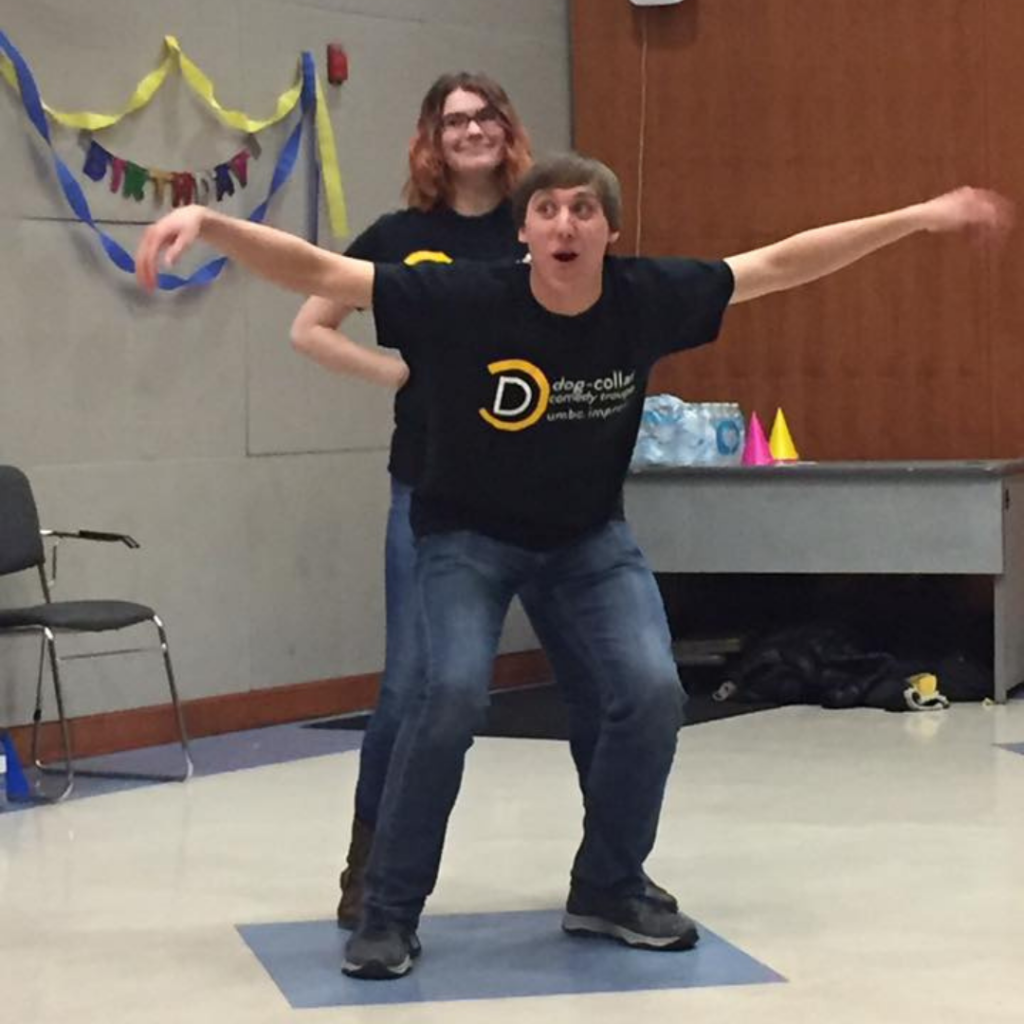
Pictured above: Cook during an improv show when he was a student (left). Cook at a recent Dog-Collar Comedy alumni Christmas party (right).
Q: How did UMBC help prepare you for your next steps after graduation?
A: My coursework directly prepared me for the kind of technical work I do for Johns Hopkins now. The information systems program places a strong emphasis on SQL, which I use daily in my work. Even subjects that don’t directly apply to my current role, such as networking, gave me a broader understanding of how technology systems fit together. Just as important were the professional skills or “soft skills.” UMBC taught me how to manage my time, communicate effectively, and take ownership of my work. In my current position, I’m expected to work independently, balance multiple projects, and speak directly with customers. Because of the habits and skills I honed at UMBC, the transition from student to professional felt natural from the start.
Q: Can you tell us about your journey as an author?
A: He Who Speaks Out Of Turn began with a mistake. During Covid, I had participated in a D&D campaign virtually, where I accidentally created a typical medieval-era wizard character for a futuristic campaign. That sparked the idea of a time-traveling wizard who accidentally strands himself far in the future. Of course, the story morphed to be much more than that, but that is where it began.
In the intervening five years, I worked on the story with no intention to publish; I wrote 500 words here and there as I got spare time. I’ve always enjoyed stories, and when I was younger, I wanted to be an author, so it was a natural hobby for me. I moved multiple times and got married, and the story followed me through these different phases of life and grew as I did. One day last summer (2025), I typed the final word and finished the story. It was one of those moments where I paused and felt like, “Well, now what?” I had an entire story written, so I decided to look into publishing it. I worked with an editor to clean up the story and some friends to design the cover and map. By this spring, five years of writing, revising, and collaboration had transformed that hobby into a published novel.
People have asked me if the characters are based on people I know. The truth is, the core characters are just different aspects of my own personality; some of them are the best of me, some the worst, some who I aspire to be, and some who I never want to be. While I’ve never traveled through time or slain a dragon, I’ve felt the same loss they have, given into the same impulses, and made the same mistakes. I learned a lot about myself while I wrote this story, and I had a lot of fun with it. I hope people enjoy reading it as well.
Pictured right: Author Michael Cook holding a copy of his debut novel, He Who Speaks Out of Turn.

* * * * *
UMBC’s greatest strength is its people. When people meet Retrievers and hear about the passion they bring, the relationships they create, the ways they support each other, and the commitment they have to inclusive excellence, they truly get a sense of our community. That’s what “Meet a Retriever” is all about.
Learn more about how UMBC can help you achieve your goals.
]]>
Meet Michael Cook ’20. While at UMBC, Michael majored in information systems with a minor in statistics. Outside of the classroom, he was a member of UMBC’s improv troupe, Dog-Collar Comedy,...
https://umbc.edu/stories/author-michael-cook/
https://my3.my.umbc.edu/api/v0/pixel/news/160716/guest@my.umbc.edu/22f9f039d1b347f9b032124a745dcd5a/api/pixel
alumni
coeit
is
meet-a-retriever
retriever-authors
story
UMBC News & Magazine
https://my3.my.umbc.edu/groups/umbc-news-magazine
https://assets1-my.umbc.edu/system/shared/avatars/groups/000/001/943/24435aa6207c452e7bc15cc74b42c7bb/xsmall.png?1748556657
https://assets1-my.umbc.edu/system/shared/avatars/groups/000/001/943/24435aa6207c452e7bc15cc74b42c7bb/original.png?1748556657
https://assets2-my.umbc.edu/system/shared/avatars/groups/000/001/943/24435aa6207c452e7bc15cc74b42c7bb/xxlarge.png?1748556657
https://assets2-my.umbc.edu/system/shared/avatars/groups/000/001/943/24435aa6207c452e7bc15cc74b42c7bb/xlarge.png?1748556657
https://assets3-my.umbc.edu/system/shared/avatars/groups/000/001/943/24435aa6207c452e7bc15cc74b42c7bb/large.png?1748556657
https://assets1-my.umbc.edu/system/shared/avatars/groups/000/001/943/24435aa6207c452e7bc15cc74b42c7bb/medium.png?1748556657
https://assets2-my.umbc.edu/system/shared/avatars/groups/000/001/943/24435aa6207c452e7bc15cc74b42c7bb/small.png?1748556657
https://assets1-my.umbc.edu/system/shared/avatars/groups/000/001/943/24435aa6207c452e7bc15cc74b42c7bb/xsmall.png?1748556657
https://assets2-my.umbc.edu/system/shared/avatars/groups/000/001/943/24435aa6207c452e7bc15cc74b42c7bb/xxsmall.png?1748556657
UMBC News & Magazine
0
0
false
Tue, 16 Jun 2026 12:09:03 -0400
Tue, 16 Jun 2026 12:09:03 -0400
How to make a (really) strong magnet
Magnets often attract curious minds. Einstein told of his profound sense of hidden order after witnessing the invisible forces of the Earth’s magnetic field guide the needle of a compass. For Ethan Bowers, it was the wonder of learning Maxwell’s laws—equations developed by 19th-century Scottish physicist James Clerk Maxwell that unite magnetism, electricity, and light—that really pulled him in.
Now a Ph.D. student in mechanical engineering, Bowers is building a massive, one-of-a-kind research magnet. It weighs more than 2,300 pounds and will be capable of generating a magnetic field of 7 tesla (roughly 140,000 times stronger than the Earth’s magnetic field and more than twice as strong as the field in most MRI machines).
Making the magnet has been the labor of multiple researchers over more than a decade, led by mechanical engineering associate professor Carlos Romero Talamás, who plans to use the magnet to conduct experiments on plasma, the superheated soup of particles found in stars, lighting, and the Aurora Borealis, and which makes up more than 99 percent of the visible universe.
An initial magnet design and analysis was completed by Evan Bates, M.S. ’15, Ph.D. ’18, mechanical engineering. In 2023, Bowers, who had returned as a student to UMBC following a stint in industry, joined the project. He redesigned key aspects of the magnet and began the meticulous work of assembling and testing it. In the coming months, Bowers plans to run the magnet up to full strength. Then the real fun begins: Unleashing the new tool to help answer the questions curious minds dream up.
Tools of the trade
- Mechanical and electrical know-how
- Perseverance
- Heavy-lifting equipment (custom designed)
- A serious power source and some chilled water (things are going to get hot)
Step 1: Brush up on your magnet basics
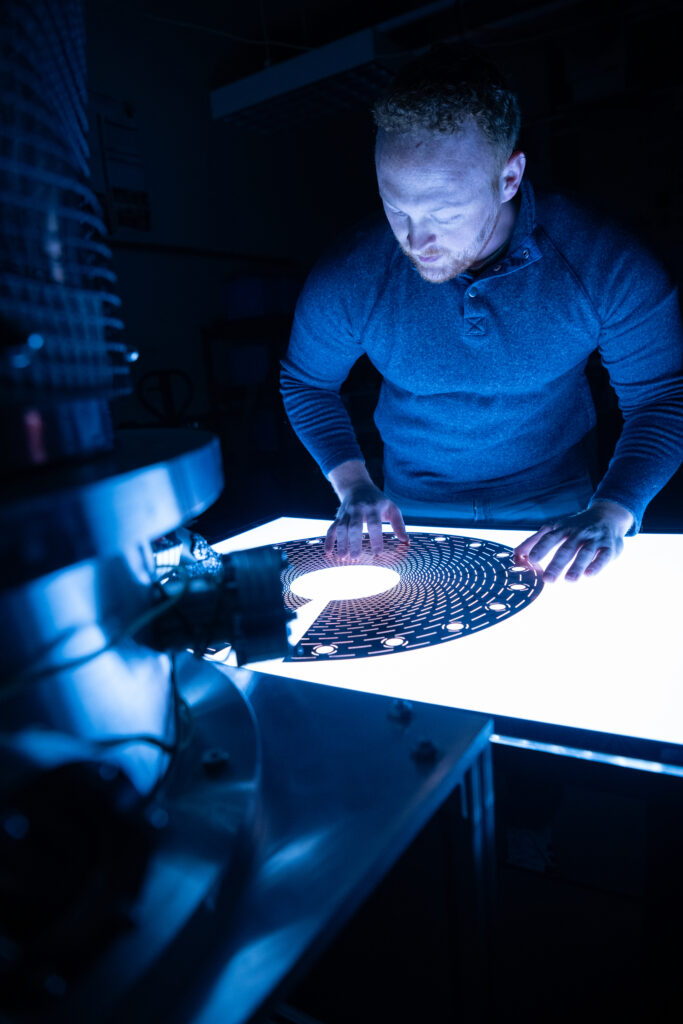 Bowers illuminates a Bitter disk with a backlight. (Brad Ziegler/UMBC)
Say “magnet,” and many people think first of the objects affixing their kids’ artwork to the fridge. Refrigerator magnets are an example of permanent magnets: materials in which the electrons permanently align in a way that generates a magnetic field. Permanent magnets can get quite strong—such as the rare earth neodymium magnets used in some maglev trains—but they top out at about 2 tesla.
To get an even stronger magnet, engineers can turn to a phenomenon that’s captured in the Maxwell equations that captivated Bowers: Electricity and magnetism are intrinsically linked.
Electrons flowing through a wire generate a magnetic field. Coil the wire and you can create a field similar in shape to a permanent bar magnet, with distinct north and south poles. This is the electromagnet. Higher current and more coils make a stronger magnet. However, high current also risks melting your magnet into a puddle and mangling it with the enormous pressure from the magnetic field pushing on the moving electrons (called Lorentz forces).
Superconducting electromagnets, which use material with the almost magical property of showing virtually zero electrical resistance when cooled with liquid helium, can eliminate the melting risk, but are expensive and finicky to operate, and have other limitations.
Another (more old-school) solution is called the Bitter electromagnet, invented in the 1930s by American physicist Francis Bitter. In place of coiled wires, circular metal disks separated with insulating spacers create a helical path that concentrates the current. The disks are shot through with holes for circulating water to whisk away heat and the structural design counteracts the mechanical stresses. “We chose a Bitter magnet because it offered the right combination of features for the tasks we wanted to perform,” Bowers says.
Step 2: Design, test, refine, repeat
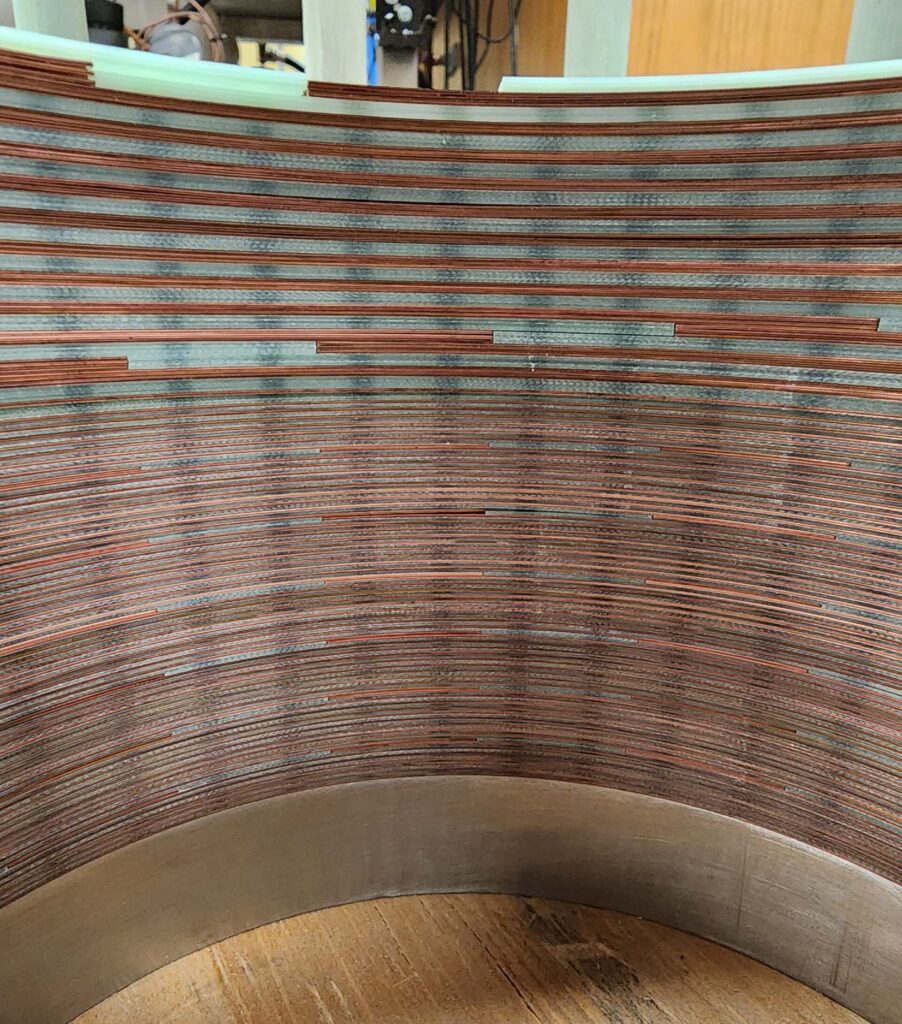 The turn density for the magnet is higher at the ends than at the middle. (Photo courtesy of Bowers)
The UMBC team’s initial vision was to create a 10-tesla Bitter magnet, with space in the center for a relatively large vacuum chamber to hold plasma. The magnet could generate either a steady or pulsed magnetic field, depending on the needs of the experiment. Bates analyzed the disk shape, stacking methods, cooling hole geometry, heat transfer, mechanical stress, and electrical properties of the magnet to optimize the design. He validated it by constructing and testing a 1-tesla prototype.
In 2023, the team decided to change the desired magnetic field profile, making it slightly higher on the ends of the magnet than in the middle, so that charged particles would be pushed toward the center. They didn’t want to redesign the Bitter disks, so they had to lower the maximum field strength to 7 tesla. They also had to vary the coil density, making tighter turns at the ends to get the stronger field.
Bowers analyzed the new field profile and worked out a clever trick of adding a tapered insulating disk to seamlessly transition between the areas of tighter and looser turns. He also performed a structural analysis of the whole assembly.
Step 3: Pallets, cranes, and painstaking planning
The final design called for 439 copper Bitter disks, four insulating transition disks, and 434 regular insulating disks housed inside a pressure vessel. Outside companies manufactured the disks, but Bowers personally inspected every single one, removing any with defects, and cleaning the copper ones with isopropyl alcohol. He built a custom pallet to hold the cylindrical assembly in place in the lab, and started stacking.
The process took about a month, and near the end “I was so sick of the monotony,” Bowers says. To push it across the finish line, he worked straight through the weekend, stacking the last disk on a Sunday afternoon in February. “It happened to be my friend’s birthday so I celebrated that completion and their birthday together,” he says.
Next up was moving the approximately 2-foot-high stack of disks to a movable swing set, created by a UMBC mechanical engineering capstone team to serve as a mobile and rotatable platform for the magnet. Bowers built a custom crane fixture to lift the assembly onto the platform and spent weeks planning every step of the move. “It was the last major place the structure could fail before we power the magnet,” he says. After one stressful day, Bowers says he was elated when it all went according to plan. “I felt genuinely grateful for all I had been given the chance to work on, and grateful that God had given me the ability to succeed.”
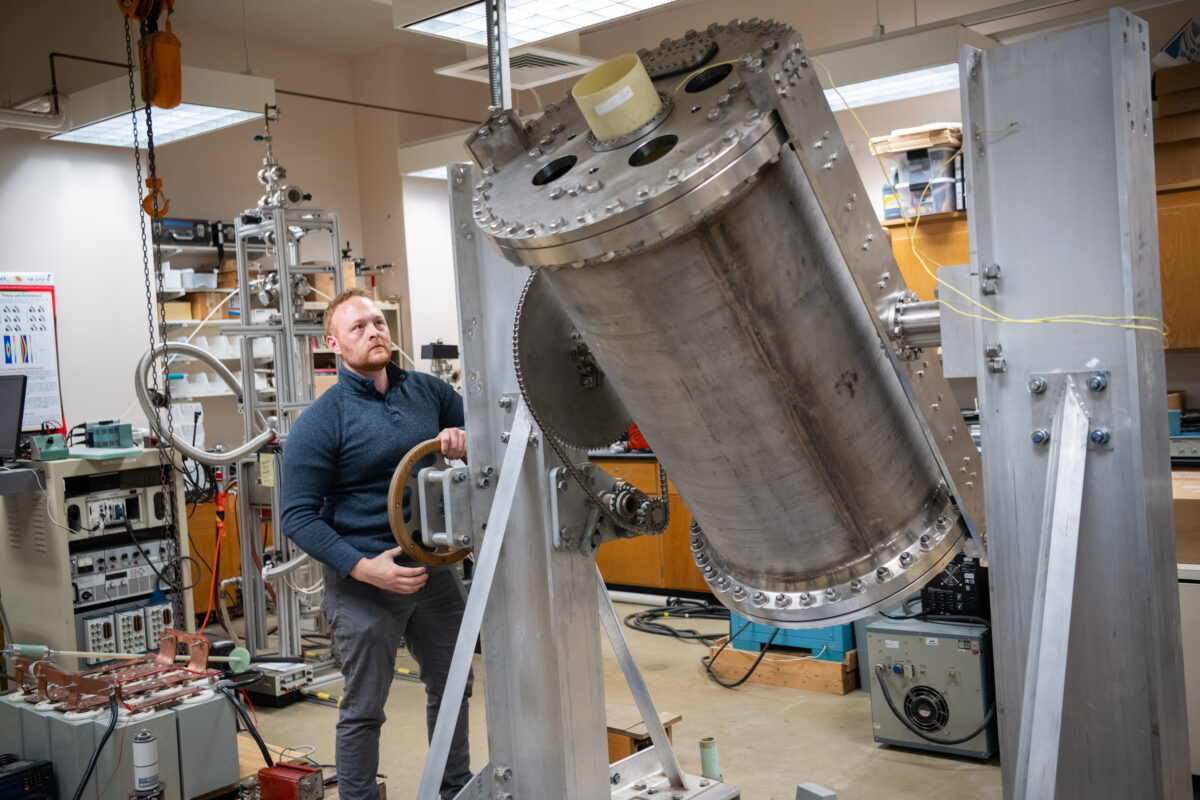 Bowers shows how the magnet core can be rotated. (Brad Ziegler/UMBC)
Step 4: Test some more
With the core of the magnet assembled, Bowers has also begun the detailed process of testing its electrical properties, using a host of measurement equipment.
At first, he is powering the magnet with lower currents, but eventually he will send 15,000 amps through the disks, about half the current that flows in an average lightning bolt. The voltage will be about five times the voltage in a wall socket.
Safety is of paramount concern to the team when working with such high power. When the magnet is operating at full strength, the energy in two cubic feet of the magnetic field alone will be more than the energy of a small SUV zooming by at 60 miles per hour.
Bowers is working on a set of detailed instructions to address all conceivable operating, maintenance, and failure scenarios. “We’re safe. We do all our due diligence,” he says.
Step 5: Serve up some science
Once the magnet is fully up and running, the science experiments can start. Bowers and Romero Talamás have a few ideas for initial experiments, including investigating how a high magnetic field affects when a gas will suddenly switch from being an insulator to a conductor, allowing current to arc through it. They are also interested in how the magnet might be used to separate different forms of hydrogen—particularly two forms that may form the fuel for future fusion reactors to supply clean and near limitless energy.
 Stars—nature’s original fusion reactors—show how plasma and magnetic fields can interact in spectacular fashion. In this image of our sun, taken in July 2012, million-degree plasma in the sun’s atmosphere began to cool and fall to the surface. Because the plasma is charged, it condensed along twisted magnetic field lines close to the surface and formed giant streaming arcs, some as tall as five Earths stacked high. (NASA Solar Dynamics Observatory)
Bowers grew up in rural Hagarstown, Maryland, a kid who enjoyed exploring everything from the rocks on the side of a path to the electrical motors his grandfather would wind. Research has offered him the chance to constantly challenge himself. After graduation, he’ll move on to new questions at the scientific frontiers, perhaps working at a fusion energy start-up or a national lab. But the 7T Bitter magnet will remain at UMBC, a gift to curious students who come after him.
]]>
Magnets often attract curious minds. Einstein told of his profound sense of hidden order after witnessing the invisible forces of the Earth’s magnetic field guide the needle of a compass. For...
https://umbc.edu/stories/how-to-make-a-really-strong-magnet/
https://my3.my.umbc.edu/api/v0/pixel/news/160699/guest@my.umbc.edu/daf60158f49bee7547aece6f2687d891/api/pixel
coeit
discovery
graduate-research
how-to
meche
research
science-and-tech
spring-2026
story
UMBC News & Magazine
https://my3.my.umbc.edu/groups/umbc-news-magazine
https://assets1-my.umbc.edu/system/shared/avatars/groups/000/001/943/24435aa6207c452e7bc15cc74b42c7bb/xsmall.png?1748556657
https://assets1-my.umbc.edu/system/shared/avatars/groups/000/001/943/24435aa6207c452e7bc15cc74b42c7bb/original.png?1748556657
https://assets2-my.umbc.edu/system/shared/avatars/groups/000/001/943/24435aa6207c452e7bc15cc74b42c7bb/xxlarge.png?1748556657
https://assets2-my.umbc.edu/system/shared/avatars/groups/000/001/943/24435aa6207c452e7bc15cc74b42c7bb/xlarge.png?1748556657
https://assets3-my.umbc.edu/system/shared/avatars/groups/000/001/943/24435aa6207c452e7bc15cc74b42c7bb/large.png?1748556657
https://assets1-my.umbc.edu/system/shared/avatars/groups/000/001/943/24435aa6207c452e7bc15cc74b42c7bb/medium.png?1748556657
https://assets2-my.umbc.edu/system/shared/avatars/groups/000/001/943/24435aa6207c452e7bc15cc74b42c7bb/small.png?1748556657
https://assets1-my.umbc.edu/system/shared/avatars/groups/000/001/943/24435aa6207c452e7bc15cc74b42c7bb/xsmall.png?1748556657
https://assets2-my.umbc.edu/system/shared/avatars/groups/000/001/943/24435aa6207c452e7bc15cc74b42c7bb/xxsmall.png?1748556657
UMBC News & Magazine
0
0
false
Mon, 15 Jun 2026 14:54:55 -0400
Mon, 15 Jun 2026 14:54:55 -0400
Meet a Retriever—Balmory Moran ’24 drew on his history major to coach his youth soccer team to league championships
Balmory Moran II ’24, history, used to describe himself as a soccer player above all else. The soccer field and his team were where he felt most at home. In high school, an injury ended his hopes of playing at the collegiate level, and doubts about his future settled in until he met Joe Thompson, a professor of history and political science at Montgomery College (MC), and Andrew Nolan, teaching professor of history at UMBC. They instilled in him a passion for history, and their support helped him transfer to UMBC as a history major, where he learned not only about the past but also interpersonal and mentorship skills that he now puts to practice every day as a coach for the Latino Youth Development Program in Rockville, Maryland.
As a coach, Balmory imparts performance strategies and techniques to middle school and high school students in the program while also emphasizing essential team skills such as collaboration, active listening, empathy, and accountability, both on and off the field. This strategy led the team to win the league championship in fall 2025.
After years of coaching and time away from the classroom, Balmory is ready to balance soccer and the classroom once again as he begins applying to a master’s in social work. He credits his sister, Alexandra Moran ’15, social work, a current social worker, for the inspiration to join the field. Take it away, Balmory!
Q: What was your journey to UMBC?
A: I began my undergraduate experience at MC. I was a bit lost, and I didn’t know what I wanted to do, but Professor Thompson changed all that. I had a 200-level U.S. history class with him. He made our class so entertaining, enticing, and interesting at both a personal and an academic level. It really showed me that history didn’t have to be boring or slow.
After seeing how attentive I was in his classes, he encouraged me to pursue a degree in history. Professor Thompson showed me multiple examples of students in different fields of work with a history degree. It prompted me to take more history classes at MC, which laid the foundation for studying history at UMBC.
I made my way to UMBC after Professor Nolan visited MC multiple times to talk to students about life as a history major at UMBC and the careers it could lead to after graduation. He also explained the many ways UMBC would further nurture my academic aspirations. I was so involved with the history program at MC that it felt like a natural next step to continue my undergrad degree in history at UMBC.
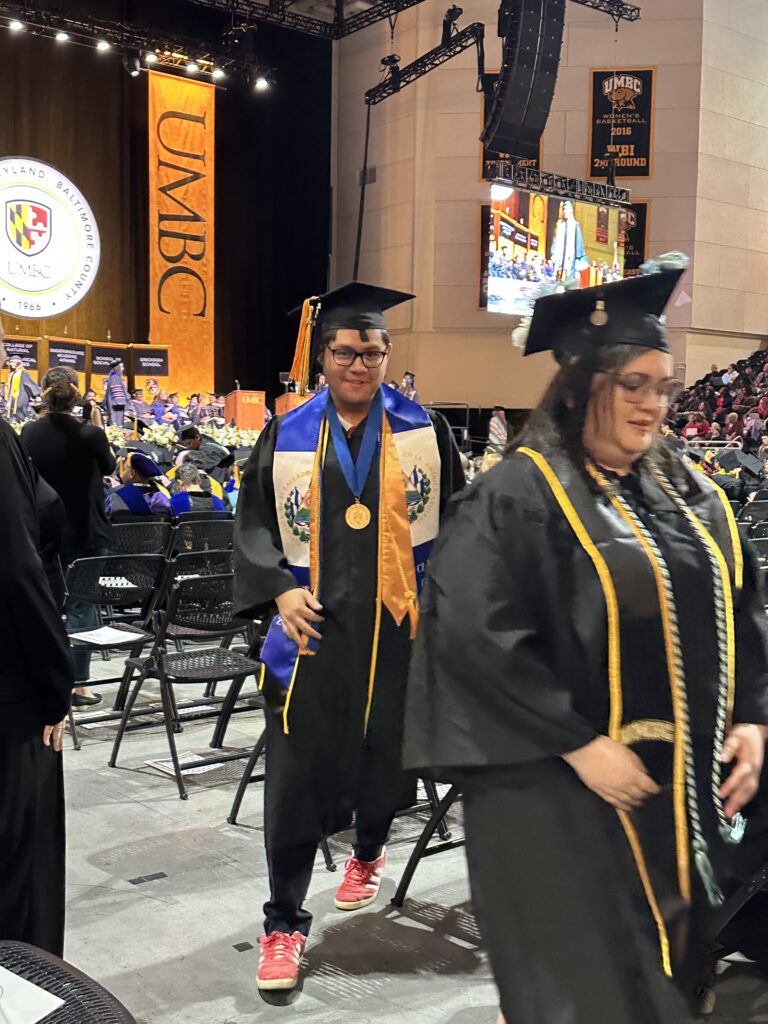
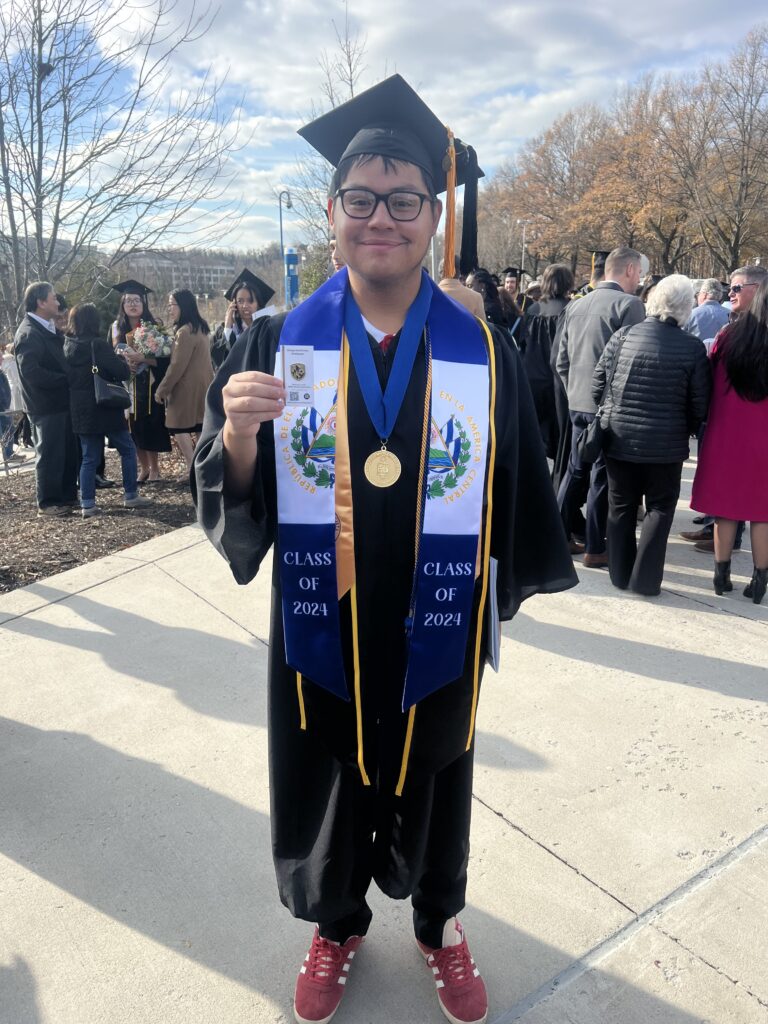 Moran at his 2024 graduation from UMBC.
Q: What was your experience studying history at UMBC?
A: Once at UMBC, I dove into the multitude of classes on aging, women’s studies, sociology, and, of course, history, which all helped me gain a better understanding and appreciation for the communities I grew up alongside. I learned that there was a history of pretty much everything, as long as there was some interest. So many people think history is just old people in wigs, but it’s everywhere, from political history to sports history. There is always a story to be told as long as someone is willing to listen and learn.
Q: Who in the UMBC community has inspired you or supported you?
A: The last two years have really pushed me to be the best version of myself in my work as well as my mentorship. I’ve learned from Melissa Blair, associate teaching professor of history, as well as other professors throughout the history department, how to approach different types of students. These lessons have helped me teach these young men right from wrong in ways that they can understand.
UMBC gave me the tools to be creative in how I tackle challenges and debates with my players. I guide players by equipping them with the tools to grow and improve, as Blair and other professors supported me in the classroom, rather than stepping in.
So many people think history is just old people in wigs, but it’s everywhere, from political history to sports history. There is always a story to be told as long as someone is willing to listen and learn. —Balmory Moran ’24
Q: Is there a concept you learned in your classes at UMBC that is applicable outside of the classroom?
A: The professors I had at UMBC showed me that there are many ways to get important information across that don’t feel like a lecture. They taught me how to be an effective problem-solver. These lessons were within a history class setup, but felt applicable to how I wanted to coach and mentor my players. So many people get the wrong idea when they hear the term “history degree.” It’s not just about curating museums and lecturing. It is also about what makes us who we are, helps us understand where we come from, and what values we hold onto.
* * * * *
UMBC’s greatest strength is its people. When people meet Retrievers and hear about the passion they bring, the relationships they create, the ways they support each other, and the commitment they have to inclusive excellence, they truly get a sense of our community. That’s what Meet a Retriever is all about.
Learn more about how UMBC can help you achieve your goals and the UMBC History Department’s programs and faculty.
]]>
Balmory Moran II ’24, history, used to describe himself as a soccer player above all else. The soccer field and his team were where he felt most at home. In high school, an injury ended his hopes...
https://umbc.edu/stories/balmory-moran-uses-history-major-to-coach-youth/
Video Preview
https://assets4-my.umbc.edu/system/shared/attachments/8e4ccaf3c74aa0993d3c1e010ba12153/6aa04515/news/000/160/698/77fd1d4f4e2edb4384e207a1ab551f9f/ENkc1G1ZZCw.jpg?1781549406
https://my3.my.umbc.edu/api/v0/pixel/news/160698/guest@my.umbc.edu/15a3d9b0ded499cefe0c1446285fb89c/api/pixel
alumni
cahss
history
impact
meet-a-retriever
perspectives
story
transfer-students
UMBC News & Magazine
https://my3.my.umbc.edu/groups/umbc-news-magazine
https://assets1-my.umbc.edu/system/shared/avatars/groups/000/001/943/24435aa6207c452e7bc15cc74b42c7bb/xsmall.png?1748556657
https://assets1-my.umbc.edu/system/shared/avatars/groups/000/001/943/24435aa6207c452e7bc15cc74b42c7bb/original.png?1748556657
https://assets2-my.umbc.edu/system/shared/avatars/groups/000/001/943/24435aa6207c452e7bc15cc74b42c7bb/xxlarge.png?1748556657
https://assets2-my.umbc.edu/system/shared/avatars/groups/000/001/943/24435aa6207c452e7bc15cc74b42c7bb/xlarge.png?1748556657
https://assets3-my.umbc.edu/system/shared/avatars/groups/000/001/943/24435aa6207c452e7bc15cc74b42c7bb/large.png?1748556657
https://assets1-my.umbc.edu/system/shared/avatars/groups/000/001/943/24435aa6207c452e7bc15cc74b42c7bb/medium.png?1748556657
https://assets2-my.umbc.edu/system/shared/avatars/groups/000/001/943/24435aa6207c452e7bc15cc74b42c7bb/small.png?1748556657
https://assets1-my.umbc.edu/system/shared/avatars/groups/000/001/943/24435aa6207c452e7bc15cc74b42c7bb/xsmall.png?1748556657
https://assets2-my.umbc.edu/system/shared/avatars/groups/000/001/943/24435aa6207c452e7bc15cc74b42c7bb/xxsmall.png?1748556657
UMBC News & Magazine
1
0
false
Mon, 15 Jun 2026 14:40:35 -0400
Mon, 15 Jun 2026 14:40:35 -0400
For the leaf peepers: How NASA’s PACE is improving fall color forecasts
Researchers have developed a new approach using data from NASA’s Plankton, Aerosol, Cloud, ocean Ecosystem (PACE) satellite to observe the timing and progression of fall colors across landscapes.
The study, published in Remote Sensing Letters and led by Karl F. Huemmrich, a research professor at UMBC’s Goddard Earth Sciences Technology and Research (GESTAR) II center, focuses on detecting changes in leaf pigments including chlorophylls (greens), anthocyanins (reds), and carotenoids (yellows and oranges).
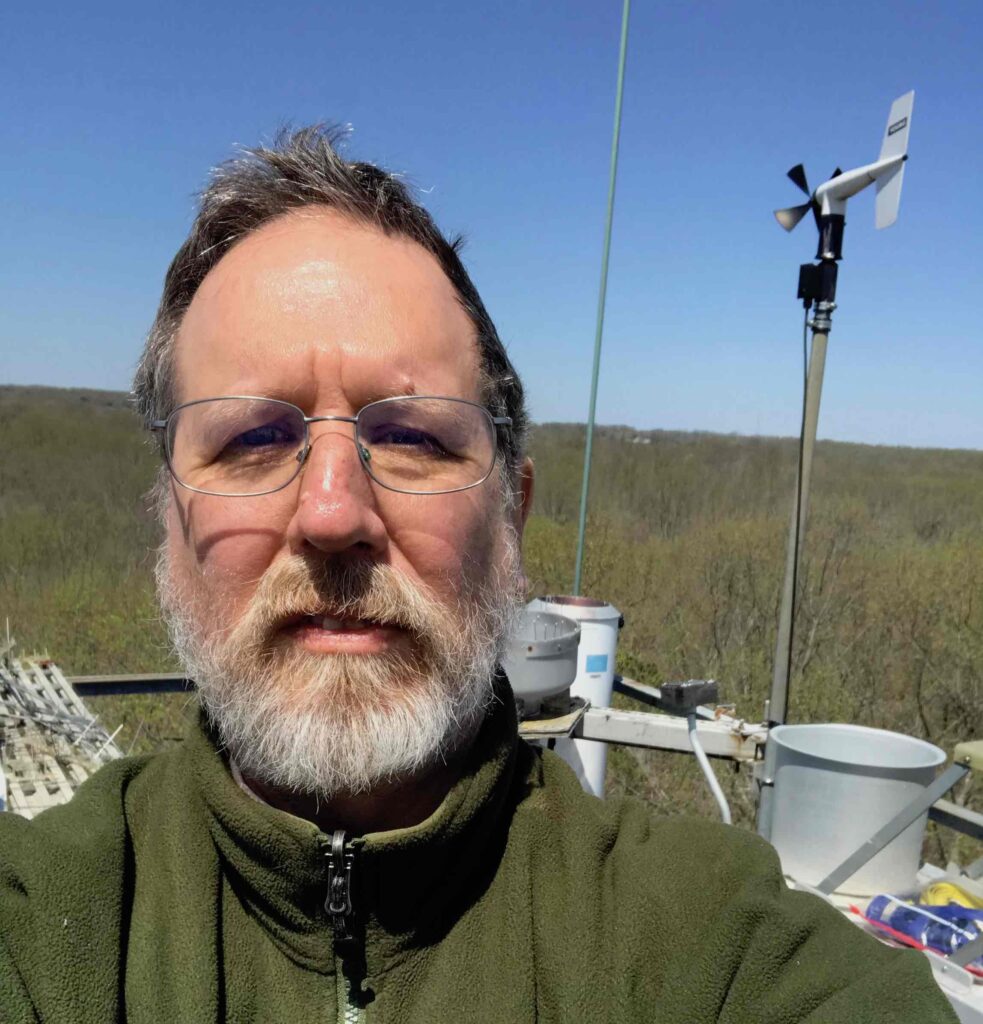 Fred Huemmrich stands 100 feet above the ground on a meteorology tower at the Smithsonian Environmental Research Center. (Courtesy of Huemmrich)
PACE’s advanced sensors capture fine details of light reflected from leaves, with near-daily global coverage. The research team used indices that associate the reflectance data with the presence of various pigments, allowing them to produce detailed leaf color maps and track color changes throughout the fall. These maps could help support the multi-billion-dollar leaf-peeping tourism economy by directing visitors to peak viewing areas in real time and helping communities manage visitor flows.
Traditional greenness indices, such as the Normalized Difference Vegetation Index (NDVI), primarily show a gradual decline in green leaves. The PACE-based indices improve on those methods by allowing scientists to identify more precise markers of the end of the growing season, including dates of peak fall color. Over time, the data could also yield insights into plant stress from drought or insect damage—with potential benefits for agriculture—and help improve models that predict fall color timing based on environmental conditions.
“PACE is the first mission that can measure these pigment indices over large areas, and repeatedly, so we can look at change through the fall,” Huemmrich says. The indices he and Caplan used were developed in the early 2000s, but the new paper applied them at a global scale for the first time. Huemmrich adds, “I anticipate that as we accumulate more years of PACE data, we will be able to observe changes in the timing of peak color, which may be related to climate change.”
PACE opens frontiers in ecosystem science
 Study co-author Skye Caplan visited the Ocean Color Instrument, the instrument on PACE whose data she and Huemmrich used in their new study, before it launched. It’s visible through the window. (Courtesy of Caplan)
Study co-author Skye Caplan, a NASA data scientist, expressed enthusiasm about the broader research potential unlocked by PACE. “I’m excited about observing fall colors with PACE, because I think it’s the beginning of a real exploratory period for global hyperspectral leaf pigment measurements,” she says. “I’m hoping we get to see folks read the paper, see how PACE observes these metrics like relative chlorophyll, anthocyanin, and carotenoid content, and apply those observations to their own work.”
“Working with PACE data is really fun, because you get to see the world in so many different ways,” Caplan adds. “It doesn’t just offer observations of the oceans, but also characterizations of the atmosphere and land—and all of these domains as a system, rather than as separate entities. I think that is critical and a real advantage of PACE.”
For example, Huemmrich previously published research that used PACE data to assess ecosystem productivity, and the UMBC-designed and -built HARP2 instrument flying on PACE is contributing to atmospheric chemistry studies.
Plus, PACE observations aren’t only for scientists: Caplan notes that the public can access NASA Worldview, an interactive site for browsing satellite images from many different NASA missions. “Sometimes I like to pull up PACE data on NASA Worldview and just scroll around to see what the world looked like on any given day,” she says. “I often find something interesting and worth exploring.”
Read more about UMBC’s NASA-related research and past news and magazine stories about UMBC researchers making discoveries in earth science.
]]>
Researchers have developed a new approach using data from NASA’s Plankton, Aerosol, Cloud, ocean Ecosystem (PACE) satellite to observe the timing and progression of fall colors across landscapes....
https://umbc.edu/stories/nasa-pace-tracks-fall-colors/
https://my3.my.umbc.edu/api/v0/pixel/news/160680/guest@my.umbc.edu/5709ef05dac12e723cdcca6a1cf1d631/api/pixel
goddard-earth-sciences-technology-and-research-gestar-ii
research
science-and-tech
story
UMBC News & Magazine
https://my3.my.umbc.edu/groups/umbc-news-magazine
https://assets1-my.umbc.edu/system/shared/avatars/groups/000/001/943/24435aa6207c452e7bc15cc74b42c7bb/xsmall.png?1748556657
https://assets1-my.umbc.edu/system/shared/avatars/groups/000/001/943/24435aa6207c452e7bc15cc74b42c7bb/original.png?1748556657
https://assets2-my.umbc.edu/system/shared/avatars/groups/000/001/943/24435aa6207c452e7bc15cc74b42c7bb/xxlarge.png?1748556657
https://assets2-my.umbc.edu/system/shared/avatars/groups/000/001/943/24435aa6207c452e7bc15cc74b42c7bb/xlarge.png?1748556657
https://assets3-my.umbc.edu/system/shared/avatars/groups/000/001/943/24435aa6207c452e7bc15cc74b42c7bb/large.png?1748556657
https://assets1-my.umbc.edu/system/shared/avatars/groups/000/001/943/24435aa6207c452e7bc15cc74b42c7bb/medium.png?1748556657
https://assets2-my.umbc.edu/system/shared/avatars/groups/000/001/943/24435aa6207c452e7bc15cc74b42c7bb/small.png?1748556657
https://assets1-my.umbc.edu/system/shared/avatars/groups/000/001/943/24435aa6207c452e7bc15cc74b42c7bb/xsmall.png?1748556657
https://assets2-my.umbc.edu/system/shared/avatars/groups/000/001/943/24435aa6207c452e7bc15cc74b42c7bb/xxsmall.png?1748556657
UMBC News & Magazine
3
0
false
Fri, 12 Jun 2026 14:13:20 -0400
Fri, 12 Jun 2026 14:13:20 -0400