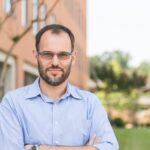
UMBC’s Eileen Meyer explains how big data is changing astronomy research
UMBC’s Eileen Meyer, assistant professor of physics, argues that recent technological advances in the big data era are changing how astronomers learn about the universe. In an article published in outlets from Popular Science to Smithsonian Magazine, Meyer describes recent research that discovered thousands of black holes near the center of the Milky Way. The research team found them not with a new telescope, but “by digging through old, long-archived data,” she writes. “Astronomers are gathering an exponentially greater amount of data every day—so much that it will take years to uncover all the hidden signals buried in the archives.”
Over the past several decades, advances in communications have allowed astronomy research to shift away from being conducted largely by individual scientists working with the instruments available at their own institutions. Today, large, international research teams collaborate on projects, often using instruments shared by several institutions across multiple countries.
The research instruments themselves are also vastly more powerful today than in the past. Older instruments could only detect visible light (with wavelengths from about 400 to 700 billionths of a meter). New instruments examine everything from gamma rays (extremely high-energy waves with wavelengths less than a trillionth of a meter) to radio waves (with wavelengths as big as a meter).
Newer equipment can also quickly process more data—a lot more. Meyer writes that the Hubble Space Telescope has made 1.3 million observations since its launch in 1990, and it transmits 20 GB of data per week, “which is impressive for a telescope first designed in the 1970s.” Compare that to the Square Kilometer Array, scheduled for completion in 2020. “In just one year of activity,” Meyer notes, “it will generate more data than the entire internet.”
“These ambitious projects will test scientists’ ability to handle data,” Meyer writes. Archives will need to have capacity to store, and then make accessible, a million times more data than can be stored on a typical 1 terabyte external hard drive.
Although it poses challenges, “the data deluge will make astronomy become a more collaborative and open science than ever before,” Meyer says. Whereas before you had to be “an academic or eccentric rich person with access to a good telescope” to do this kind of research, Meyer says, that’s no longer the case. “Thanks to internet archives, robust learning communities and new outreach initiatives, citizens can now participate in science.”
Meyer has taken advantage of huge, stored data sets in her own work studying the jets of high-speed plasma that spew from black holes. She collected 400 raw images taken over 13 years by Hubble to reveal the structure of these jets for the first time.
“This kind of work was only possible because other observers, for other purposes, just happened to capture images of the source I was interested in, back when I was in kindergarten,” she says. “As astronomical images become larger, higher resolution and ever more sensitive, this kind of research will become the norm.”
Image: An artist’s concept of a supermassive black hole. Credit: NASA/JPL-Caltech
]]>
UMBC’s Eileen Meyer, assistant professor of physics, argues that recent technological advances in the big data era are changing how astronomers learn about the universe. In an article published...https://umbc.edu/stories/umbcs-eileen-meyer-explains-how-big-data-is-changing-astronomy-research/https://my3.my.umbc.edu/api/v0/pixel/news/120407/guest@my.umbc.edu/9d84e410f5daea3aa4a6c6325d52b351/api/pixelcnmsphysicsresearchscience-and-technologyUMBC News & Magazinehttps://my3.my.umbc.edu/groups/umbc-news-magazinehttps://assets1-my.umbc.edu/system/shared/avatars/groups/000/001/943/24435aa6207c452e7bc15cc74b42c7bb/xsmall.png?1748556657https://assets1-my.umbc.edu/system/shared/avatars/groups/000/001/943/24435aa6207c452e7bc15cc74b42c7bb/original.png?1748556657https://assets2-my.umbc.edu/system/shared/avatars/groups/000/001/943/24435aa6207c452e7bc15cc74b42c7bb/xxlarge.png?1748556657https://assets2-my.umbc.edu/system/shared/avatars/groups/000/001/943/24435aa6207c452e7bc15cc74b42c7bb/xlarge.png?1748556657https://assets3-my.umbc.edu/system/shared/avatars/groups/000/001/943/24435aa6207c452e7bc15cc74b42c7bb/large.png?1748556657https://assets1-my.umbc.edu/system/shared/avatars/groups/000/001/943/24435aa6207c452e7bc15cc74b42c7bb/medium.png?1748556657https://assets2-my.umbc.edu/system/shared/avatars/groups/000/001/943/24435aa6207c452e7bc15cc74b42c7bb/small.png?1748556657https://assets1-my.umbc.edu/system/shared/avatars/groups/000/001/943/24435aa6207c452e7bc15cc74b42c7bb/xsmall.png?1748556657https://assets2-my.umbc.edu/system/shared/avatars/groups/000/001/943/24435aa6207c452e7bc15cc74b42c7bb/xxsmall.png?1748556657UMBC News & Magazine00falseMon, 04 Jun 2018 14:57:20 -0400Congrats, Class of 2018! UMBC celebrates students making history.
UMBC students have rewritten the record books in 2018. With graduation around the corner, and our soon-to-be new Retriever alumni preparing for graduate school, careers, and research around the world, we reflect on all they have achieved.
UMBC celebrates two valedictorians for the Class of 2018. Valedictorian Kara Seidel ‘18, psychology, a Sondheim Public Affairs Scholar, discovered a particular passion for supporting families dealing with trauma through several intensive research and internship experiences. These include work at the Johns Hopkins School of Medicine in an HIV and addiction lab, a research internship at the American Psychological Association, and work as lead research assistant in the Trauma Lab of Christopher Murphy, professor and chair of psychology.
Kara Seidel. Photo by Marlayna Demond ’11 for UMBC.
Seidel is particularly appreciative of the opportunities for hands-on learning that she accessed in her time at UMBC, as well as mentorship that paired high expectations with support. She says:
One of the best things about UMBC is how supportive professors and staff are. They tell you the truth, even when you don’t want to hear it. They see potential in you and encourage you to take each mistake as a learning experience. Their ongoing support helped me feel confident about pursuing a wide range of opportunities.
Seidel will work as a behavioral therapist and researcher for the next year, before beginning a Ph.D. program in psychology, with a focus on supporting families experiencing trauma.
Valedictorian Eudorah Vital ‘18, biochemistry and molecular biology, is a Meyerhoff Scholar, MARC U*STAR Scholar, and Howard Hughes Medical Institute Scholar. She pursued research from her earliest days as a freshman at UMBC, quickly advancing in Rachel Brewster’s developmental biology lab. She has already co-authored two papers in top-tier academic journals, and a third is coming soon.
Eudorah Vital. Photo by Marlayna Demond ’11 for UMBC.
Vital is also an advocate for community support, and shares that her professors and friends have been essential to her growth and success, saying, “I did not make it through alone.” In recognition of this support, she has become a mentor and tutor for undergraduates newer to her field. She shares:
UMBC prepares its students to be productive members of society, who strive to understand others and bring people together. I came to UMBC thinking I knew what I wanted to do, and I am leaving with a refined version of my goals, which reflect the values of inclusivity, support, and grit.
With a commitment to pursuing clinically relevant research, Vital will soon begin Emory University’s neurobiology M.D./Ph.D. program.
UMBC’s 2018 history-makers include the graduating Retrievers of the men’s basketball team.
K.J. Maura ‘18, sociology, took a few twists and turns in his college journey, as he found his path from Puerto Rico to UMBC. Once he put on the Retriever jersey, he got to work making a lasting impact, and by 2018 he was named the America East Conference Defensive Player of the Year. He helped lead the charge in UMBC’s NCAA round one victory of University of Virginia, 74-54. How does Maura think about his success? It’s all about reaching for greatness together, as a team, he says:
The chemistry and the friendships we have built helped us stay focused on our goals. I’m thankful for my teammates and coaching staff. Every single person on the team played a role to help us reach together and I’m proud to call them family.
Joe Sherburne, K.J. Maura, and Jourdan Grant (l-r). Photo by Marlayna Demond ’11 for UMBC.
When Joe Sherburne ‘18, financial economics, traveled from Wisconsin to Maryland to attend UMBC, he couldn’t have anticipated where that path would lead. He has skillfully balanced academics and athletics, becoming the first UMBC and first America East Conference men’s basketball player to ever be named to theAcademic All-America Division I Basketball First Team. Sherburne served as a captain for the history-making 2017-18 men’s basketball team and still maintained his place on the President’s List each semester. After graduating, he will continue to play for UMBC while pursuing his master’s degree in data science.
Jourdan Grant ‘18, media and communication studies, holds the record for playing the most men’s basketball games in UMBC history. NCAA showcased his exuberance after dethroning no. one seed University of Virginia in this year’s “One Shining Moment” tournament highlights video. Reflecting on his college experience, Grant shares:
UMBC has prepared me in the way that the university has a standard in how you carry yourself and really embrace success.
Also a member of the Class of 2018 is UMBC’s first Rhodes Scholar, Naomi Mburu ‘18, chemical engineering, who will next pursue a Ph.D. in nuclear engineering at Oxford. Mburu is a Meyerhoff Scholar, MARC U*STAR Scholar, and recipient of the highly prestigious Goldwater Scholarship, as well as president of UMBC’s chapter of the National Society of Black Engineers.
Naomi Mburu. Photo by Marlayna Demond ’11 for UMBC.
Mburu has conducted notable research at UMBC and around the world. In the lab of Gymama Slaughter, associate professor of computer science and electrical engineering, she worked to help develop a bioreactor to extend the viability of human organs awaiting transplant. She has also brought her passion for learning and creating new solutions to internships at Intel, the Johns Hopkins Applied Physics Laboratory, and the European Organization for Nuclear Research in Switzerland. She will soon travel to Europe to attend the Lindau Nobel Laureate Meeting, which invites the world’s top emerging scientists to meet with thirty Nobel laureates.
UMBC’s Class of 2018 includes thousands of phenomenal graduates.
In the arts, humanities, and social sciences, Shirley Basfield Dunlap, Ph.D. ‘18, language, literacy, and, culture, is finishing her doctorate at the age of 65 after steadfastly completing one course a semester for nearly a decade. She will apply her dissertation research on the history of African American stage directors to her work as coordinator of theatre arts at Morgan State University. Emmanuel Mones ‘18, visual arts, will launch a men’s streetwear brand and magazine designed to promote public dialog about gender, sexuality, and equality. Flora Kirk ‘18, ancient studies, has already traveled the world to study ancient coins, and will next research Roman coinage in Cluj-Napoca, Romania, as a Fulbright Scholar.
Emmanuel Mones. Photo by Marlayna Demond ’11 for UMBC.
Among UMBC’s impressive STEM scholars, men’s club lacrosse team captain Greg Huxtable ‘18, physics and mathematics, will build on his high-level research in quantum computing through a Ph.D. at UC Irvine. Arissa Falat ‘18, biochemistry and molecular biology, an award-winning professional figure skater, will pursue a Pharm.D./J.D. at the University of Maryland School of Pharmacy. After multiple internships with Google, CWIT Scholar Katherine Dillon ‘18, computer science, will soon work as a software engineer at the company’s San Francisco campus.
Gregory Huxtable. Photo by Marlayna Demond ’11 for UMBC.
Top image: Orientation Peer Advisors cheer for UMBC in the Commons, Spring 2018. Photo by Marlayna Demond ’11 for UMBC.
]]>
UMBC students have rewritten the record books in 2018. With graduation around the corner, and our soon-to-be new Retriever alumni preparing for graduate school, careers, and research around the...https://umbc.edu/stories/congrats-class-of-2018-meet-umbc-students-making-history-and-the-mentors-behind-them/https://my3.my.umbc.edu/api/v0/pixel/news/120437/guest@my.umbc.edu/9d5eeefb8b26517c815fb08700b5ebb5/api/pixelancientstudiesarts-and-culturebiologycahsscbeechembiochemclass-of-2018cnmscoeitcommunitycseeeconomicsllcmathstatmcsmlliphysicspolicy-and-societypsychologysaphscience-and-technologyundergradresearchvisualartsUMBC News & Magazinehttps://my3.my.umbc.edu/groups/umbc-news-magazinehttps://assets1-my.umbc.edu/system/shared/avatars/groups/000/001/943/24435aa6207c452e7bc15cc74b42c7bb/xsmall.png?1748556657https://assets1-my.umbc.edu/system/shared/avatars/groups/000/001/943/24435aa6207c452e7bc15cc74b42c7bb/original.png?1748556657https://assets2-my.umbc.edu/system/shared/avatars/groups/000/001/943/24435aa6207c452e7bc15cc74b42c7bb/xxlarge.png?1748556657https://assets2-my.umbc.edu/system/shared/avatars/groups/000/001/943/24435aa6207c452e7bc15cc74b42c7bb/xlarge.png?1748556657https://assets3-my.umbc.edu/system/shared/avatars/groups/000/001/943/24435aa6207c452e7bc15cc74b42c7bb/large.png?1748556657https://assets1-my.umbc.edu/system/shared/avatars/groups/000/001/943/24435aa6207c452e7bc15cc74b42c7bb/medium.png?1748556657https://assets2-my.umbc.edu/system/shared/avatars/groups/000/001/943/24435aa6207c452e7bc15cc74b42c7bb/small.png?1748556657https://assets1-my.umbc.edu/system/shared/avatars/groups/000/001/943/24435aa6207c452e7bc15cc74b42c7bb/xsmall.png?1748556657https://assets2-my.umbc.edu/system/shared/avatars/groups/000/001/943/24435aa6207c452e7bc15cc74b42c7bb/xxsmall.png?1748556657UMBC News & Magazine00falseMon, 14 May 2018 14:46:09 -0400Greg Huxtable to begin Ph.D. at UC Irvine, building on high-level research in quantum computing
Greg Huxtable B.S., Physics and Mathematics Hometown: Gambrills, Maryland Plans: Ph.D., University of California, Irvine
UMBC was a great environment for preparing me for graduate school, due to the large number of research opportunities available to undergraduates.
Greg Huxtableis heading to the University of California, Irvine to pursue a Ph.D. in physics after conducting theoretical physics research at UMBC on the optimization of quantum heat engines (engines consisting of single ions). How did he decide on this particular area of focus? Reflecting on the unique research and learning opportunities he accessed as a UMBC undergraduate, Huxtable says, “I’ve attended dozens of weekly colloquiums in the physics department, which has exposed me to current developments in many fields of physics and has helped shaped my interests.”
Huxtable’s mentor, Sebastian Deffner, assistant professor of physics, has also played a major role in his success. “Sebastian has been a terrific mentor to me,” Huxtable shares. “From explaining to me how to balance research and life, to our talks on what life is like at every stage of academia—from undergrad up to professorship—he exposed me to the academic world in a way that classes could not.”
Greg Huxtable ’18 (no. 11, center) with the UMBC club lacrosse team. Photo courtesy Greg Huxtable.
“Greg is one of the most mature and dedicated undergraduate students that I have met,” says Deffner. “Visiting scientists frequently mistake him for an advanced graduate student.”
With Deffner’s support, Huxtable applied for and received theDonald N. Langenberg Undergraduate Research Award in Physics in 2017. The award honors a prior chancellor of the University System of Maryland and supplies a monetary award to support an undergraduate student’s research in physics. Huxtable will also travel to Telluride, Colorado this summer for a week-long conference co-organized by Deffner on nanoscale statistical physics and thermodynamics.
In addition to his academic success, Huxtable has been a member of the UMBC men’s club lacrosse team for three years and served as the team’s captain and vice president his senior year. “I’ll forever cherish the bonds I’ve made with my teammates and coaches,” he says. “I looked up to my older teammates my first year, and I did my best to build on what they left behind for the next generation of UMBC men’s club lacrosse leaders.”
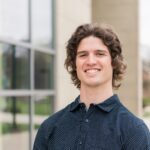
Portrait by Marlayna Demond ’11 for UMBC.
]]>
Greg Huxtable B.S., Physics and Mathematics Hometown: Gambrills, Maryland Plans: Ph.D., University of California, Irvine UMBC was a great environment for preparing me for graduate school,...https://umbc.edu/stories/greg-huxtable-to-begin-ph-d-at-uc-irvine-building-on-high-level-research-in-quantum-computing/https://my3.my.umbc.edu/api/v0/pixel/news/120469/guest@my.umbc.edu/88b20dbcad8313e22626968fa5ef3213/api/pixelathleticsclass-of-2018cnmsphysicsundergradresearchUMBC News & Magazinehttps://my3.my.umbc.edu/groups/umbc-news-magazinehttps://assets1-my.umbc.edu/system/shared/avatars/groups/000/001/943/24435aa6207c452e7bc15cc74b42c7bb/xsmall.png?1748556657https://assets1-my.umbc.edu/system/shared/avatars/groups/000/001/943/24435aa6207c452e7bc15cc74b42c7bb/original.png?1748556657https://assets2-my.umbc.edu/system/shared/avatars/groups/000/001/943/24435aa6207c452e7bc15cc74b42c7bb/xxlarge.png?1748556657https://assets2-my.umbc.edu/system/shared/avatars/groups/000/001/943/24435aa6207c452e7bc15cc74b42c7bb/xlarge.png?1748556657https://assets3-my.umbc.edu/system/shared/avatars/groups/000/001/943/24435aa6207c452e7bc15cc74b42c7bb/large.png?1748556657https://assets1-my.umbc.edu/system/shared/avatars/groups/000/001/943/24435aa6207c452e7bc15cc74b42c7bb/medium.png?1748556657https://assets2-my.umbc.edu/system/shared/avatars/groups/000/001/943/24435aa6207c452e7bc15cc74b42c7bb/small.png?1748556657https://assets1-my.umbc.edu/system/shared/avatars/groups/000/001/943/24435aa6207c452e7bc15cc74b42c7bb/xsmall.png?1748556657https://assets2-my.umbc.edu/system/shared/avatars/groups/000/001/943/24435aa6207c452e7bc15cc74b42c7bb/xxsmall.png?1748556657UMBC News & Magazine00falseSun, 15 Apr 2018 20:24:08 -0400IBM-UMBC Day focuses on research collaboration in advanced computing
UMBC welcomed 50 IBM executives and research leaders to campus on Friday, April 6, for a day-long event designed to broaden the robust research relationship between the two organizations and introduce students to emerging career opportunities at IBM. Nearly 250 faculty, staff, students, and partners participated in IBM-UMBC Day.
UMBC’s work with IBM began nearly 25 years ago and has branched across a wide range of topics. The university’s most recent research collaboration with IBM connects artificial intelligence with cybersecurity, explained Keith J. Bowman, dean of UMBC’s College of Engineering and Information Technology. Two new areas of likely future collaboration include quantum computing and blockchain.
Keith J. Bowman welcoming guests to IBM-UMBC Day.
Dave McQueeney, vice president of Corporate Technology and Community and Global University Programs at IBM (and UMBC’s executive champion), gave welcoming remarks for the company. Bowman introduced Anupam Joshi, chair and professor of computer science and electrical engineering (CSEE) at UMBC, who has completed two sabbaticals at IBM. He also welcomed Yelena Yesha, distinguished professor of CSEE, and Andy Rindos, head of IBM’s RTP Center for Advanced Studies, who were instrumental in organizing IBM-UMBC Day. The welcoming speakers set the tone for the event, highlighting a shared commitment to combining diverse perspectives to explore cutting edge research areas in new and exciting ways.
Michelle Browdy, IBM’s senior vice president for legal and regulatory affairs, and general counsel, delivered the keynote talk about the intersection of law, technology, and public policy. “It takes a village,” she said, noting that this phrase is especially important in the science and technology space, where collaboration is crucial.
Michelle Browdy delivering the keynote talk.
Browdy emphasized that her legal team regularly works with business teams and engineers, particularly when technologies are being moved from the lab to the public. She shared how she sees engineers as developing products for people to use and enjoy, and her legal team as an essential complement, managing everything from patents to ensuring compliance with regulations.
Following the keynote, technical experts from UMBC and IBM gave brief talks on areas such as quantum computing, cybersecurity, artificial intelligence, cloud computing, the internet of things, and blockchain. UMBC professors Todd Pittman, physics, and Sam Lomonaco, CSEE, joined Andrew Wack, Q platform architect at IBM, in the first technical talk of the day, discussing recent developments in quantum computing and how the field is impacting other industries.
A group of UMBC and IBM researchers.
Next, Jeff Crume, distinguished engineer at IBM, and Joshi explored how institutions are making strides in addressing the kinds of cybersecurity concerns that are now making headlines worldwide. Joshi discussed his lab’s work connecting artificial intelligence and cybersecurity, and he also described how combining the expertise of people from different fields is essential to creating effective and lasting solutions to cybersecurity challenges. Speaking in the realm of cyber attack prevention and response, he commented, “We have economists on our faculty who are looking at what the attack costs…and we have public policy colleagues who look at the barriers of adoption of cybersecurity.”
Also highlighted in Crume and Joshi’s talk was the Accelerated Cognitive Cybersecurity Lab, which opened in 2016 as a collaboration between UMBC and IBM. The lab is one of many ways in which UMBC and IBM are continuing to grow their partnership, breaking ground in new research areas by combining the creativity and expertise of UMBC faculty and students with the extraordinary technical capabilities of IBM, and together preparing the next generation of computing professionals.
After a lunch break featuring technical demos, networking opportunities, and student research presentations, participants regrouped for a discussion about the Watson computer system and cloud computing. Presenters included Mac Devine, vice president of IBM Watson and Cloud Platform; Tim Finin, professor of CSEE, an expert on cloud computing; and Yesha, who has worked with IBM on computing research since the 1990s. Yesha is director of the new Center for Accelerated Real Time Analytics, a $3 million NSF partnership. She described how the center will deploy next-generation computing hardware to solve significant infrastructure challenges, such as protecting massive data sets in the cloud.
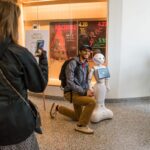
Students gathered around Pepper during a break between presentations.
Nilanjan Banerjee, associate professor of CSEE, next discussed the internet of things and cyber-physical systems, specifically his lab’s work on small sensors. His team’s sensors can be used to monitor whether people operating vehicles are drowsy, and can be used by people with mobility challenges to control devices in their environment. Tim Hahn, distinguished engineer and chief architect of internet of things security at IBM, shared how his team is addressing security issues associated with now-ubiquitous cyber-physical technologies.
Roman Vaculin, IBM research, concluded the technical talks with a discussion of how IBM is developing blockchain solutions that can be used across industries.
Throughout the day, speakers returned time and again to a core idea emphasized at the start of the day: that bringing together different perspectives is key to success in creating new technologies with the potential to change people’s lives. “We need lawyers and we need engineers,” said Browdy, in her keynote address. “We are shaped and we get opportunities to grow by being exposed to people in a lot of different areas.”
Featured image: A student poses with Pepper, a humanoid robot, at IBM-UMBC Day. All photos by Marlayna Demond ’11 for UMBC.
]]>
UMBC welcomed 50 IBM executives and research leaders to campus on Friday, April 6, for a day-long event designed to broaden the robust research relationship between the two organizations and...https://umbc.edu/stories/ibm-umbc-day-focuses-on-tech-advancement-through-collaboration/https://my3.my.umbc.edu/api/v0/pixel/news/120504/guest@my.umbc.edu/88ef1501d36dccf80f5cac388fff5c2a/api/pixelcfrcnmscoeitcseephysicsscience-and-technologyUMBC News & Magazinehttps://my3.my.umbc.edu/groups/umbc-news-magazinehttps://assets1-my.umbc.edu/system/shared/avatars/groups/000/001/943/24435aa6207c452e7bc15cc74b42c7bb/xsmall.png?1748556657https://assets1-my.umbc.edu/system/shared/avatars/groups/000/001/943/24435aa6207c452e7bc15cc74b42c7bb/original.png?1748556657https://assets2-my.umbc.edu/system/shared/avatars/groups/000/001/943/24435aa6207c452e7bc15cc74b42c7bb/xxlarge.png?1748556657https://assets2-my.umbc.edu/system/shared/avatars/groups/000/001/943/24435aa6207c452e7bc15cc74b42c7bb/xlarge.png?1748556657https://assets3-my.umbc.edu/system/shared/avatars/groups/000/001/943/24435aa6207c452e7bc15cc74b42c7bb/large.png?1748556657https://assets1-my.umbc.edu/system/shared/avatars/groups/000/001/943/24435aa6207c452e7bc15cc74b42c7bb/medium.png?1748556657https://assets2-my.umbc.edu/system/shared/avatars/groups/000/001/943/24435aa6207c452e7bc15cc74b42c7bb/small.png?1748556657https://assets1-my.umbc.edu/system/shared/avatars/groups/000/001/943/24435aa6207c452e7bc15cc74b42c7bb/xsmall.png?1748556657https://assets2-my.umbc.edu/system/shared/avatars/groups/000/001/943/24435aa6207c452e7bc15cc74b42c7bb/xxsmall.png?1748556657UMBC News & Magazine00falseThu, 12 Apr 2018 18:04:31 -0400UMBC celebrates 2018 Presidential Faculty and Staff Award winners
UMBC’s Presidential Faculty and Staff Awards offer a chance to reflect, each year, on the essential contributions of university employees to making UMBC a welcoming, supportive, and successful learning community. This year’s ceremony, on April 4, was particularly meaningful as it coincided with the 50th anniversary of the assassination of Dr. Martin Luther King, Jr.
UMBC President Freeman Hrabowski recalled hearing of Dr. King’s death when he was a 17-year-old college sophomore. Calling that time “one of the most devastating days in American history,” he led the room in a moment of silence. With those who came together to honor some of UMBC’s most dedicated educators, from all corners of the university, President Hrabowski shared, “UMBC represents Dr. King’s dream.”
Nicole King, associate professor and chair of American studies, received the Presidential Teaching Faculty Award in recognition of her community-engaged pedagogy. King focuses on helping students develop a deeper understanding of Baltimore and its residents, whether studying gentrification or local environmental concerns. “It is especially wonderful to be honored for my work teaching at UMBC because UMBC has exceptional students,” she said.
King shared two core lessons from doing public humanities work, lessons she works to share with students: “showing up matters” and “listening is essential to learning.” To fulfill UMBC’s mission, she argued, “We must bring more voices into conversations at our public university today and we must better listen to one another because that is truly what teaching and learning are about.”
Nicole King, associate professor and chair of American studies, and husband Baynard Woods
Amy Froide, associate professor of history, received a USM Board of Regents’ Faculty Award for Excellence in Teaching, saying, “It’s pretty humbling to win a teaching excellence award at this university that is full of faculty who inspire me every day.” Froide shared her journey as a first-generation college student who wanted to become a teacher since childhood. She didn’t imagine a career as a professor until an advisor encouraged her to pursue a Ph.D. Now she wants to pay forward the support she received.
“I want to dedicate this award to all teachers, especially at this time in our history” Froide said, referencing this spring’s K – 12 teacher protests for wages, pensions, and school budgets in the U.S. and abroad. Froide commented that teaching is “one of the toughest and most rewarding professions, but it’s not a profession that always gets rewarded.” She shared what an honor it was for her to receive this faculty award and reflected, “I hope for a day when all teachers will be honored.”
Amy Froide, professor of history
James Franson, professor of physics, received the Presidential Research Faculty Award. Franson joked, “Unfortunately, it’s not quite as exciting or prestigious as being on the basketball team and going to the NCAA tournament.” Still, he reflected thoughtfully, “Research itself is exciting in its own way, and UMBC is a great place to do research.”
James Franson, professor of physics (l) and guest
Several honorees revisited the long and fulfilling careers they have had at UMBC and the friendships they’ve made. “Like the Academy Awards, I’d like to take a moment to thank those who made this possible,” said Joe Kirby, assistant vice president in the Division of Information Technology (DoIT).
Kirby received the Presidential Distinguished Staff Award. He thanked family, friends, mentors, and colleagues, including DoIT Vice President Jack Suess ‘81, mathematics, M.S. ‘95, operations analysis, “For challenging me to be more than I would have thought possible, yet always promoting work-life balance and compassion over our 20+ years together.” Kirby shared, “My success is so tied to the collaboration and cooperation I receive from our faculty, staff, and students.”
Joe Kirby (r), AVP of DoIT, and wife Donna Kirby (l)
Tamara Brown, executive administrative assistant for the dean of the College of Arts, Humanities and Social Sciences, reflected on how “pleased, honored, and humbled” she felt to accept UMBC’s Presidential Distinguished Non-Exempt Staff Award. After thanking her colleagues, she added, with a smile, “I want to thank my family for putting up with my late hours at UMBC.”
Tamara Brown, executive administrative assistant, (center left) with her family
That level of commitment became a familiar thread. A few moments later, Victor Fulda, recipient of the Karen L. Wensch Endowment Award for Outstanding Non-Exempt Staff, thanked his wife for putting up with 3 a.m. phone calls about urgent lab issues at UMBC. Fulda, a lab technician in chemical, biochemical, and environmental engineering for 25 years, shared, “This job has been very rewarding and surprising.”
Victor Fulda, CBEE lab technician
Jess Myers, who received the Jakubik Family Endowment Award, called her position as Women’s Center director “a dream job.” “To wake up every day and go to work to support and advance gender equity, to hold space for LGBTQ folks, to cultivate healing space for survivors of sexual violence, to run a scholarship program for older women returning to college…that is an award in and of itself,” said Myers.
Still, she shared, “today feels extra special to be recognized by my UMBC colleagues.” She passed along her gratitude for people across the university who have believed in her approach to growing the Women’s Center “to truly support UMBC’s vision of inclusive excellence.”
L-R: April Householder, director of undergraduate research, and Jess Myers, director of the Women’s Center
Phyllis Robinson, professor of biological sciences, also commented on that UMBC vision in describing her work to support inclusion in STEM fields. Robinson received the Marilyn E. Demorest Award for Faculty Advancement for her commitment to the professional growth of women faculty in the sciences, particularly through mentoring programs. “For me, mentoring is very simple,” said Robinson. “It’s sharing information with people and bestowing guidance and encouragement.”
L-R: Pat McDermott, vice provost for faculty affairs, and Phyllis Robinson, professor of biological sciences
President Hrabowski concluded the event with his mid-year State of the University update, highlighting key achievements across the university. These included everything from major grants, awards, and partnerships to the opening of UMBC’s new Event Center.
Featured image: Tamara Brown, recipient of UMBC’s Presidential Distinguished Non-Exempt Staff Award. All photos by Marlayna Demond ’11 for UMBC.
]]>
UMBC’s Presidential Faculty and Staff Awards offer a chance to reflect, each year, on the essential contributions of university employees to making UMBC a welcoming, supportive, and successful...https://umbc.edu/stories/umbc-honors-faculty-and-staff-for-essential-contributions-to-the-university-community/https://my3.my.umbc.edu/api/v0/pixel/news/120505/guest@my.umbc.edu/b183cc92a2767ca390834dbacee9d3e7/api/pixelamericanstudiesarts-and-culturebiologycahsscbeecnmscoeitcommunityhistoryphysicspolicy-and-societyscience-and-technologystaffwomenscenterUMBC News & Magazinehttps://my3.my.umbc.edu/groups/umbc-news-magazinehttps://assets1-my.umbc.edu/system/shared/avatars/groups/000/001/943/24435aa6207c452e7bc15cc74b42c7bb/xsmall.png?1748556657https://assets1-my.umbc.edu/system/shared/avatars/groups/000/001/943/24435aa6207c452e7bc15cc74b42c7bb/original.png?1748556657https://assets2-my.umbc.edu/system/shared/avatars/groups/000/001/943/24435aa6207c452e7bc15cc74b42c7bb/xxlarge.png?1748556657https://assets2-my.umbc.edu/system/shared/avatars/groups/000/001/943/24435aa6207c452e7bc15cc74b42c7bb/xlarge.png?1748556657https://assets3-my.umbc.edu/system/shared/avatars/groups/000/001/943/24435aa6207c452e7bc15cc74b42c7bb/large.png?1748556657https://assets1-my.umbc.edu/system/shared/avatars/groups/000/001/943/24435aa6207c452e7bc15cc74b42c7bb/medium.png?1748556657https://assets2-my.umbc.edu/system/shared/avatars/groups/000/001/943/24435aa6207c452e7bc15cc74b42c7bb/small.png?1748556657https://assets1-my.umbc.edu/system/shared/avatars/groups/000/001/943/24435aa6207c452e7bc15cc74b42c7bb/xsmall.png?1748556657https://assets2-my.umbc.edu/system/shared/avatars/groups/000/001/943/24435aa6207c452e7bc15cc74b42c7bb/xxsmall.png?1748556657UMBC News & Magazine00falseTue, 10 Apr 2018 20:13:02 -0400UMBC physicist Sebastian Deffner lays groundwork to better understand birth of the universe
Scientists, across all areas of study, seek to help us better understand the world in microscopic and massive ways. How does it work? What rules does it follow? Theoretical physicists in particular have developed theories that explain how parts of the universe work: classical mechanics for objects at everyday sizes and speeds, quantum mechanics for very tiny objects at everyday speeds, special relativity for things that approach the speed of light. But what about very small objects that also have very high energy, like the universe at the start of the Big Bang?
“This final case—small objects with high energy—is very important if you want to understand where the universe comes from,” says Sebastian Deffner, assistant professor of physics at UMBC. But physics theories to date aren’t quite able to handle it. They assume that systems are at least locally stable, which doesn’t hold for some of the most interesting cases, from the Big Bang to black holes. Deffner adds, “If we want to understand all these cosmological models, and we want to understand the thermodynamics of the universe, we actually have no means to do that.” That may be about to change.
Deffner’s new paper in Physical Review X with co-author Anthony Bartolotta, a Ph.D. candidate at Caltech, builds on an explosion of research in the field of quantum stochastic thermodynamics in the last decade. This field describes the laws of thermodynamics—one of the fundamental pillars of physics—at a microscopic level for the first time. Importantly, it takes into account how their immediate surroundings affect small systems in a way that differs from how the environment affects larger systems. Deffner and Bartolotta’s work extends this field even further to examine tiny systems at very high energies that are changing quickly.
That extension “is really uncharted territory…a completely new idea,” says Deffner. “And the reason no one has done it before is because stochastic thermodynamics is only 20 years old. Quantum stochastic thermodynamics is only 10 years old. As a field, we’ve just learned how to stand. We don’t even know how to walk yet.”
The work is pioneering, but it fits into a larger ecosystem of existing physics theories. For example, in everyday systems, you intuitively expect that if you put one particle in, you will get the same one particle out. It might be going faster or slower, or in a different direction, but it’s still the same single particle. However, at high energies, like those generated at the Large Hadron Collider in Switzerland, it’s actually possible to end up with a different number of particles than you started with. The famous equation e = mc2 allows mass to be created from energy when the energy is extremely large. Deffner and Bartolotta found that in their model system with high energy and at small scale, the system was much more likely to return multiple particles upon sending in just one, than to come out with the initial particle and no more, which was a huge surprise.
The math to calculate it all was “incredibly hard,” Deffner reflects, but the end result, which involved finding a way to compute an infinite number of possibilities, “was actually quite beautiful,” says Bartolotta. He shares, “Our hope is that this paper will now open the doors for other people in other fields that previously couldn’t use these techniques to now use them.”
Deffner’s overall research goal is to broaden the uses of the framework of thermodynamics, “until we find neat things that no one has ever seen before,” and his latest paper fits that bill.
“I’m still totally blown away by the result,” Deffner says, but he’s also already contemplating possibilities for future research directions. When it comes to untangling the mysteries of the early universe, he notes, “there’s a lot that we have to do next.”
Image: Sebastian Deffner, photographed by Marlayna Demond ’11 for UMBC.
]]>
Scientists, across all areas of study, seek to help us better understand the world in microscopic and massive ways. How does it work? What rules does it follow? Theoretical physicists in...https://umbc.edu/stories/umbc-physicist-sebastian-deffner-lays-groundwork-to-better-understand-birth-of-the-universe/https://my3.my.umbc.edu/api/v0/pixel/news/120532/guest@my.umbc.edu/b9c6c261b9cf7887c5bce90414683988/api/pixelcnmsphysicsresearchscience-and-technologyUMBC News & Magazinehttps://my3.my.umbc.edu/groups/umbc-news-magazinehttps://assets1-my.umbc.edu/system/shared/avatars/groups/000/001/943/24435aa6207c452e7bc15cc74b42c7bb/xsmall.png?1748556657https://assets1-my.umbc.edu/system/shared/avatars/groups/000/001/943/24435aa6207c452e7bc15cc74b42c7bb/original.png?1748556657https://assets2-my.umbc.edu/system/shared/avatars/groups/000/001/943/24435aa6207c452e7bc15cc74b42c7bb/xxlarge.png?1748556657https://assets2-my.umbc.edu/system/shared/avatars/groups/000/001/943/24435aa6207c452e7bc15cc74b42c7bb/xlarge.png?1748556657https://assets3-my.umbc.edu/system/shared/avatars/groups/000/001/943/24435aa6207c452e7bc15cc74b42c7bb/large.png?1748556657https://assets1-my.umbc.edu/system/shared/avatars/groups/000/001/943/24435aa6207c452e7bc15cc74b42c7bb/medium.png?1748556657https://assets2-my.umbc.edu/system/shared/avatars/groups/000/001/943/24435aa6207c452e7bc15cc74b42c7bb/small.png?1748556657https://assets1-my.umbc.edu/system/shared/avatars/groups/000/001/943/24435aa6207c452e7bc15cc74b42c7bb/xsmall.png?1748556657https://assets2-my.umbc.edu/system/shared/avatars/groups/000/001/943/24435aa6207c452e7bc15cc74b42c7bb/xxsmall.png?1748556657UMBC News & Magazine00falseTue, 06 Mar 2018 16:15:15 -0500UMBC physicists discover unexpected effect of African wildfires on climate
Clouds play a prominent role in moderating Earth’s climate, but their role is still poorly understood. Generally, clouds cool the Earth by reflecting incoming sunlight back out into space. Reducing the clouds’ reflectivity—with a layer of pollution, for example—reduces the cooling effect. However, new research in Proceedings of the National Academy of Sciences by Zhibo Zhang, associate professor of atmospheric physics at UMBC, two of his students, and collaborators from University of Wyoming, University of Science and Technology of China, Universities Space Research Association, and University of Michigan adds another level of complexity to this model.
Every fall, fires race across central and southern Africa. Many are wildfires; others are intentionally set by humans to clear farmland. They create so much smoke that it’s clearly visible from space. Wind sweeps the smoke westward over the Atlantic Ocean, where it rises above the largest semi-permanent gathering of clouds in the world. For years, scientists believed that overall, the smoke diminishes the clouds’ cooling effect by absorbing light that the clouds beneath otherwise would reflect. The new study by Zhang and colleagues doesn’t dispute the existence of this effect, but introduces a new mechanism that counteracts it by making the clouds more reflective.
“The purpose of this paper is to look at these competing processes. Which one is more important?” asks Zhang. A previous paper by Chamara Rajapakshe, a Ph.D. candidate in Zhang’s group (the UMBC ACROS group) and co-author on the new paper, was crucial to answering that question. Using data from a LiDAR system on the International Space Station, Rajapakshe found that the smoke and cloud layers are much closer to each other than previously observed. That means the smoke, which is in the form of tiny particles known as aerosols, can physically interact with the clouds, affecting how they form at the microscopic level. Previous studies usually overlooked these microphysical changes caused by aerosols’ interactions with the clouds.
Clouds need “seeds” to grow. A seed can be any tiny particle around which cloud droplets condense. Aerosols are perfect for seeding clouds, and with more seeds, many small cloud droplets replace fewer large droplets, which then collectively reflect more light and increase the cooling effect.
The team found that in smoky conditions, there are almost twice as many “seeds” per cubic centimeter. By running computer simulations under different conditions, they determined that overall, “The seeding effect is winning,” Zhang says. So, contrary to long-held understanding, the overall effect of the hovering smoke on the clouds near Africa appears to be a cooling one.
Zhang is quick to point out that this result is not an argument in favor of fires. “Aerosols are a very local phenomenon, and they are also short-lived,” he says, so their cooling effects are short-lived, too. “The lifetime of carbon dioxide and other greenhouse gases,” which are released in abundance when plant material burns, “is hundreds of years.”
The team’s ultimate goal is to refine global climate models by improving how they account for clouds. Zhang’s other Ph.D. student and another co-author, Zhifeng Yang, has contributed to that effort by analyzing data collected by a satellite that stays put in the sky (rather than orbiting Earth) to get a more accurate sense of how cloud cover changes in daily cycles.
The next step is to evaluate existing climate models against the team’s new finding. “Now that we know there are two competing mechanisms, and the seeding effect is winning, we can see whether climate models consider these processes properly when they predict the weather and climate in this area,” explains Zhang.
Zhang, Rajapakshe, and Yang are excited to present their findings to the atmospheric physics community in their new paper, and to continue working in this area to further improve climate models—but the more they learn about the complexity of the processes involved, the harder it gets.
“First we had to simulate the clouds correctly. Then we had to simulate the aerosols correctly, and now we have to also simulate the interactions between them correctly,” says Zhang. “It’s becoming a much harder question to address.”
Still, they are up for the challenge. A new NASA mission called PACE is expected to launch in 2020. It will be able to detect polarized light, in addition to everything LiDAR can do.
“With the new satellite you can look at things from different perspectives,” says Zhang, and develop three-dimensional models of the interactions between aerosols and clouds. “Hopefully we can look at this phenomenon even better.”
Beyond the upcoming NASA mission, what really excites Zhang and his team is the opportunity to play a role in making sure communities around the world have the best information available as they prepare for the effects of climate change.
Image: View from a data-collecting aircraft over the Atlantic Ocean, where a layer of smoke is visible above the clouds. (NASA/Kirk Knobelspiesse)
]]>
Clouds play a prominent role in moderating Earth’s climate, but their role is still poorly understood. Generally, clouds cool the Earth by reflecting incoming sunlight back out into space....https://umbc.edu/stories/umbc-physicists-discover-unexpected-effect-of-african-wildfires-on-climate/https://my3.my.umbc.edu/api/v0/pixel/news/120535/guest@my.umbc.edu/97701ac1e56cf8f9f570ec1cdee8efed/api/pixelcnmsgradresearchphysicsresearchscience-and-technologyUMBC News & Magazinehttps://my3.my.umbc.edu/groups/umbc-news-magazinehttps://assets1-my.umbc.edu/system/shared/avatars/groups/000/001/943/24435aa6207c452e7bc15cc74b42c7bb/xsmall.png?1748556657https://assets1-my.umbc.edu/system/shared/avatars/groups/000/001/943/24435aa6207c452e7bc15cc74b42c7bb/original.png?1748556657https://assets2-my.umbc.edu/system/shared/avatars/groups/000/001/943/24435aa6207c452e7bc15cc74b42c7bb/xxlarge.png?1748556657https://assets2-my.umbc.edu/system/shared/avatars/groups/000/001/943/24435aa6207c452e7bc15cc74b42c7bb/xlarge.png?1748556657https://assets3-my.umbc.edu/system/shared/avatars/groups/000/001/943/24435aa6207c452e7bc15cc74b42c7bb/large.png?1748556657https://assets1-my.umbc.edu/system/shared/avatars/groups/000/001/943/24435aa6207c452e7bc15cc74b42c7bb/medium.png?1748556657https://assets2-my.umbc.edu/system/shared/avatars/groups/000/001/943/24435aa6207c452e7bc15cc74b42c7bb/small.png?1748556657https://assets1-my.umbc.edu/system/shared/avatars/groups/000/001/943/24435aa6207c452e7bc15cc74b42c7bb/xsmall.png?1748556657https://assets2-my.umbc.edu/system/shared/avatars/groups/000/001/943/24435aa6207c452e7bc15cc74b42c7bb/xxsmall.png?1748556657UMBC News & Magazine00falseMon, 05 Mar 2018 20:41:21 -0500UMBC physicists develop cost-saving tech for detecting gravitational waves and other applications
In 2016, Jane Sprigg, Ph.D. ’16, physics, submitted a research paper demonstrating a technique that would enable a camera to snap crystal clear images from an airplane or satellite, even over deserts with air turbulence caused by severe heat. Her paper was rejected. Despite strong evidence presented in the paper, one reviewer refused to accept the idea that quantum theory could apply to light other than lasers—and physicists agree that classical theory does not lead to turbulence-free imaging. Sprigg has since successfully pursued her invention in industry, but the academic world remains skeptical.
Yanhua Shih, professor of physics and Sprigg’s advisor, told his new Ph.D. student, Thomas Smith, that the physics community didn’t think it was possible to use ideas from quantum theory, specifically quantum interference, to create turbulence-free measurements. Smith replied simply, “Why don’t we demonstrate that it is?” In less than a year, the pair has done so in a context other than a camera (with the help of the lab’s toaster oven), and they have just published their results in Physics Review Letters, a premier physics journal.
The paper demonstrates Smith and Shih’s development of an interferometer, a device that uses the interference of light to make precise measurements, that is unaffected by turbulence in the air. “For now, large interferometers with high sensitivity have to be put in a vacuum to avoid atmospheric turbulence and vibrations,” says Shih. “Our research shows how you could just put them in the open air—no problem.”
Accommodating the limitations of today’s interferometers can be quite costly, especially for devices precise and large enough to detect elusive gravitational waves from outer space. “Detecting gravitational waves is the most expensive use of the vacuum, because it’s on such a large scale,” says Smith.
Their setup is a modification of a classic type of interferometer, called the “Young’s double-slit,” where light hits a plate with two slits and passes through to a detector beyond the slits. The detector counts the number of light particles (photons) that strike it per second. Analysis software uses that information to calculate the interference (how the light particles interact), which depends on the likelihood of a photon passing through one slit or the other. That’s where the quantum part comes in—at the single particle level, you can’t know for certain which path the photon took, so the analysis is based on probabilities of the potential paths. It’s as if the particle is “interfering with itself,” says Shih, quoting renowned theoretical physicist Paul Dirac.
In Smith and Shih’s interferometer, there is still a plate with two slits, but there are two detectors waiting to count photons on the other side. Much more complex software is interested in how many times one photon strikes the first detector and another photon strikes the second detector within each of many tiny time windows. In typical interferometers, any turbulence in the air will unequally affect the two possible paths of a single photon (either through the first or second slit) and disrupt the interference measurement. In this case, however, the photons are analyzed as pairs. It is possible for the two possible paths of the photon pair to be identically affected by turbulence, so that it does not alter the interference pattern—leading to a result that is “turbulence-free.” In this situation, Shih explains in a nod to Dirac, “the pair is interfering with itself.”
The physics is complex, but Smith says one of the hardest parts was generating enough turbulence in the lab to get strong results. First he tried candles; then they tried heat guns. In the end? At the recommendation of fellow Ph.D. student Brian Uthe, “I took the toaster oven and deconstructed it partially, and I’m using the toaster oven right now,” Smith explains. “Sometimes when you’re doing an experiment, it’s not the high-tech part, but the low-tech part that is the problem,” says Shih with a smile.
Both authors are hoping their new research will bring about a sea change in the physics community, and encourage even the most traditional physicists that quantum interference applies in optics experiments using non-laser light. “It should change the whole picture,” says Shih. There are already signs that they’re stirring the pot: Smith has given invited talks at three major conferences, including at Princeton University in front of physics giants from around the world. Next steps include trying to apply the same principles to other types of interferometer.
Smith, who is in his first year in Shih’s lab, is trying to absorb it all. “It’s a bit overwhelming,” he says. “I guess what’s most exciting for me is that we are working on fundamental physics, and I enjoy working at the basic fundamental level—discussing single photons and quantum interference,” and even so, it’s easy to imagine where the work could lead him. From cameras that can see through heat waves to confirming Einstein’s fundamental theory by detecting gravitational waves in open air, “what’s exciting is seeing the potential applications ahead of us.”
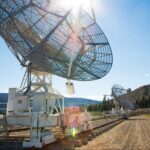
Image: Large interferometers that are part of the Dominion Radio Astrophysical Observatory in Penticton, British Columbia. Photo by Mark Klotz, used under CC BY-NC 2.0.
]]>
In 2016, Jane Sprigg, Ph.D. ’16, physics, submitted a research paper demonstrating a technique that would enable a camera to snap crystal clear images from an airplane or satellite, even over...https://umbc.edu/stories/umbc-physicists-develop-cost-saving-tech-for-detecting-gravitational-waves-and-other-applications/https://my3.my.umbc.edu/api/v0/pixel/news/120550/guest@my.umbc.edu/066902c256e9733877b78b9d83a4c6a2/api/pixelcnmsphysicsresearchscience-and-technologyUMBC News & Magazinehttps://my3.my.umbc.edu/groups/umbc-news-magazinehttps://assets1-my.umbc.edu/system/shared/avatars/groups/000/001/943/24435aa6207c452e7bc15cc74b42c7bb/xsmall.png?1748556657https://assets1-my.umbc.edu/system/shared/avatars/groups/000/001/943/24435aa6207c452e7bc15cc74b42c7bb/original.png?1748556657https://assets2-my.umbc.edu/system/shared/avatars/groups/000/001/943/24435aa6207c452e7bc15cc74b42c7bb/xxlarge.png?1748556657https://assets2-my.umbc.edu/system/shared/avatars/groups/000/001/943/24435aa6207c452e7bc15cc74b42c7bb/xlarge.png?1748556657https://assets3-my.umbc.edu/system/shared/avatars/groups/000/001/943/24435aa6207c452e7bc15cc74b42c7bb/large.png?1748556657https://assets1-my.umbc.edu/system/shared/avatars/groups/000/001/943/24435aa6207c452e7bc15cc74b42c7bb/medium.png?1748556657https://assets2-my.umbc.edu/system/shared/avatars/groups/000/001/943/24435aa6207c452e7bc15cc74b42c7bb/small.png?1748556657https://assets1-my.umbc.edu/system/shared/avatars/groups/000/001/943/24435aa6207c452e7bc15cc74b42c7bb/xsmall.png?1748556657https://assets2-my.umbc.edu/system/shared/avatars/groups/000/001/943/24435aa6207c452e7bc15cc74b42c7bb/xxsmall.png?1748556657UMBC News & Magazine00falseMon, 12 Feb 2018 21:02:25 -0500UMBC space scientist further confirms Einstein’s theory through new solar research
New research by Sander Goossens, associate research scientist at UMBC’s Center for Space Science and Technology, and colleagues offers a fresh perspective on a question of universal importance. The study, published in Nature Communications, employed a novel method to learn more about the Sun and further confirmed the constant G, the mainstay of Einstein’s theory of general relativity that predicts how extremely large masses warp space-time.
To address such big ideas, “You need the solar system as your laboratory,” says Goossens. The research team, led by Antonio Genova, research scientist in MIT’s Department of Earth, Atmospheric, and Planetary Sciences, used data collected by NASA’s MESSENGER satellite, which orbited Mercury from March 2011 to April 2015 and carried out “flyby” observations in 2008 and 2009. By tracking and analyzing the orbits of Mercury and MESSENGER over several years, the team was able to separate out the various causes of tiny changes in their orbits.
The Sun’s gravity is the biggest factor that keeps the planets in orbit. As the Sun slowly loses mass from interior processes and the solar wind—which constantly rips particles away from the upper atmosphere of the Sun—its gravity weakens, the planets’ orbits creep away from the Sun, and the solar system expands. The team found that the Sun is losing mass at a rate of 0.1 percent per 10 billion years, causing the planetary orbits to shift by 1.5 cm per year per astronomical unit (the distance between Earth and the Sun).
Other factors also affect the planets’ orbits, such as the Sun’s “oblateness” (how much it bulges in the middle, rather than being a perfect sphere) and how much it warps space-time by virtue of its goliath size, which is described by relativity theory. The team was able to estimate relativity-related parameters, confirming Einstein’s theory beyond what previous studies have found.
This study also further constrained the value of the constant G, which governs gravity’s effect on objects. Scientists continue working to demonstrate that G remains constant in as many contexts as possible. This adds evidence for the hypothesis that G is constant across the universe and hasn’t changed since the Big Bang.
“To some people it might sound like, ‘Well, there’s another confirmation of Einstein’s theory,’ but those are important because we have no idea at what level things might deviate,” says Goossens. He explains, “It’s a constant, so people expect it to be constant, but it’s always been a question whether or not G varies with time, and we’ve been able to put quite tight constraints on that.”
This work is an example of the wide range of questions that can be addressed with a NASA mission like MESSENGER. “This study demonstrates that charting the orbits of planets, such as Mercury, may provide simultaneous new findings in different disciplines,” says Genova, from heliophysics—the study of the sun and its effects on the solar system—to theoretical physics, which includes the study of gravity.
This study is the first to calculate the Sun’s mass loss and oblateness based on observation as opposed to theory alone. Also, previous studies had taken Mercury’s orbit as fixed, based on data from NASA’s Jet Propulsion Laboratory, and actively measured only the satellite’s orbit. Genova, Goossens, and colleagues used an innovative approach, yielding more accurate results.
“In this case, we modeled both the orbit of Mercury and the orbit of the satellite,” explains Goossens, “and in a similar way that we normally determine the satellite orbit, we now simultaneously determined Mercury’s and the satellite’s orbit.”
Eventually, Goossens would like to see this type of analysis expanded even further, to consider more than two celestial bodies at once—perhaps even the entire solar system. Even looking at other pairs of bodies, such as the Sun and a different planet, would be a boon for general relativity experts who have a range of ideas about Einstein’s theory, he says. “Perhaps this could show a way forward for testing those theories as well.”
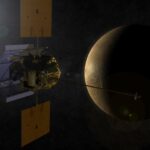
Image: An artist’s conception of the MESSENGER satellite as it orbits Mercury; photo provided by NASA.
]]>
New research by Sander Goossens, associate research scientist at UMBC’s Center for Space Science and Technology, and colleagues offers a fresh perspective on a question of universal importance....https://umbc.edu/stories/umbc-space-scientist-further-confirms-einsteins-theory-through-new-solar-research/https://my3.my.umbc.edu/api/v0/pixel/news/120566/guest@my.umbc.edu/ff9a5fea09da2294a360d9dfc33f029e/api/pixelcsstphysicsresearchscience-and-technologyUMBC News & Magazinehttps://my3.my.umbc.edu/groups/umbc-news-magazinehttps://assets1-my.umbc.edu/system/shared/avatars/groups/000/001/943/24435aa6207c452e7bc15cc74b42c7bb/xsmall.png?1748556657https://assets1-my.umbc.edu/system/shared/avatars/groups/000/001/943/24435aa6207c452e7bc15cc74b42c7bb/original.png?1748556657https://assets2-my.umbc.edu/system/shared/avatars/groups/000/001/943/24435aa6207c452e7bc15cc74b42c7bb/xxlarge.png?1748556657https://assets2-my.umbc.edu/system/shared/avatars/groups/000/001/943/24435aa6207c452e7bc15cc74b42c7bb/xlarge.png?1748556657https://assets3-my.umbc.edu/system/shared/avatars/groups/000/001/943/24435aa6207c452e7bc15cc74b42c7bb/large.png?1748556657https://assets1-my.umbc.edu/system/shared/avatars/groups/000/001/943/24435aa6207c452e7bc15cc74b42c7bb/medium.png?1748556657https://assets2-my.umbc.edu/system/shared/avatars/groups/000/001/943/24435aa6207c452e7bc15cc74b42c7bb/small.png?1748556657https://assets1-my.umbc.edu/system/shared/avatars/groups/000/001/943/24435aa6207c452e7bc15cc74b42c7bb/xsmall.png?1748556657https://assets2-my.umbc.edu/system/shared/avatars/groups/000/001/943/24435aa6207c452e7bc15cc74b42c7bb/xxsmall.png?1748556657UMBC News & Magazine00falseMon, 29 Jan 2018 22:14:59 -0500UMBC’s Sebastian Deffner explains how the “quantum speed limit” may put brakes on quantum computers
Classical computers have been getting faster, more powerful, and more compact for decades, but they may be reaching their limits, writes Sebastian Deffner, assistant professor of physics, in The Conversation. People have pinned their hopes on quantum computers for the next leap forward in computing technology, he explains, “but my recent research has revealed that quantum computers will have limits of their own, and has suggested ways to figure out what those limits are.”
The physical laws that govern quantum computers, known as quantum mechanics, are very different from the laws that govern classical computers—and everything else in the physical world with which we are familiar. For example, in the “quantum world,” where the largest objects are about the size of individual atoms, an observer can either know an object’s speed or its location—but never both at the same time.
“It is important to realize that this ‘quantum uncertainty’ is not a shortcoming of measurement equipment or engineering, but rather how our brains work,” says Deffner. “We have evolved to be so used to how the ‘classical world’ works that the actual physical mechanisms of the ‘quantum world’ are simply beyond our ability to fully grasp.”
Most people have a general, intuitive understanding of how a combustion engine burns fuel to release energy, for example. There are theoretical limits to gasoline engines that prevent cars from going at the speed of light, but other challenges to the efficiency of engines get in the way first, so in practice we don’t need to consider the ultimate limitations to combustion engines.
“Until recently, though, scholars only had a rather vague idea that quantum physics had limits too,” says Deffner, “but didn’t know how to figure out how they might apply in the real world.” Deffner has been on the cutting edge of finding those limits and defining their applications. “It’s not clear whether the quantum speed limit is so high it’s unattainable—like the car that will never even get close to the speed of light,” he writes, which means it may be important for the future of computing to figure out how the quantum speed limit affects computers that operate in the quantum world.
Fundamental physical limits impose a delay on detecting an object in the quantum world. Each delay is only a few quadrillionths of a second, but the delays accumulate across a computer’s millions of computations. That prevents a quantum computer from going arbitrarily fast and results in an overall quantum speed limit.
Deffner’s research group has found that the quantum speed limit can differ depending on a quantum computer’s design, and sometimes, “unexpected factors can help speed things up, at times, in counterintuitive ways.”
As an example of how the quantum world operates differently from the classical one, Deffner compares the speed of a quantum computer to a particle moving through water versus honey. You might expect the particle in honey to move more slowly, but in the quantum world, the displaced honey filling in the path where the particle has just traveled “can build up pressure that propels the quantum particle forward. This extra acceleration can make a quantum particle’s speed limit different from what an observer might otherwise expect.”
Growing researchers’ understanding of the quantum speed limit and how different factors may modify it will likely influence quantum processor design, Deffner says, noting, “There’s a lot for researchers like me to explore.” A pioneer in the field, Deffner has already published several papers related to the quantum speed limit, with more on the way.
“Just as engineers figured out how to shrink the size of transistors and pack them more closely together on a classical computer chip,” Deffner writes, “they’ll need some clever innovation to build the fastest possible quantum systems, operating as close as possible to the ultimate speed limit.”
Image: Sebastian Deffner, photo by Marlayna Demond ’11 for UMBC.
]]>
Classical computers have been getting faster, more powerful, and more compact for decades, but they may be reaching their limits, writes Sebastian Deffner, assistant professor of physics, in The...https://umbc.edu/stories/umbcs-sebastian-deffner-explains-how-the-quantum-speed-limit-may-put-brakes-on-quantum-computers/https://my3.my.umbc.edu/api/v0/pixel/news/120570/guest@my.umbc.edu/20ea25b00c9c8fd3d48fa116b9bcfc1e/api/pixelcnmsphysicsresearchscience-and-technologyUMBC News & Magazinehttps://my3.my.umbc.edu/groups/umbc-news-magazinehttps://assets1-my.umbc.edu/system/shared/avatars/groups/000/001/943/24435aa6207c452e7bc15cc74b42c7bb/xsmall.png?1748556657https://assets1-my.umbc.edu/system/shared/avatars/groups/000/001/943/24435aa6207c452e7bc15cc74b42c7bb/original.png?1748556657https://assets2-my.umbc.edu/system/shared/avatars/groups/000/001/943/24435aa6207c452e7bc15cc74b42c7bb/xxlarge.png?1748556657https://assets2-my.umbc.edu/system/shared/avatars/groups/000/001/943/24435aa6207c452e7bc15cc74b42c7bb/xlarge.png?1748556657https://assets3-my.umbc.edu/system/shared/avatars/groups/000/001/943/24435aa6207c452e7bc15cc74b42c7bb/large.png?1748556657https://assets1-my.umbc.edu/system/shared/avatars/groups/000/001/943/24435aa6207c452e7bc15cc74b42c7bb/medium.png?1748556657https://assets2-my.umbc.edu/system/shared/avatars/groups/000/001/943/24435aa6207c452e7bc15cc74b42c7bb/small.png?1748556657https://assets1-my.umbc.edu/system/shared/avatars/groups/000/001/943/24435aa6207c452e7bc15cc74b42c7bb/xsmall.png?1748556657https://assets2-my.umbc.edu/system/shared/avatars/groups/000/001/943/24435aa6207c452e7bc15cc74b42c7bb/xxsmall.png?1748556657UMBC News & Magazine00falseThu, 18 Jan 2018 21:55:50 -0500