Transforming the future of healthy aging: UMBC event highlights leading practices, research from Kanagawa and Maryland

UMBC recently partnered with the government of Japan’s Kanagawa prefecture to host the seminar “New Frontiers in Healthcare Management,” examining innovative approaches to an aging society. The UMBC organizers included the department of sociology, anthropology, and public health (SAPH), Erickson School of Aging Studies, and doctoral program in gerontology. The event brought together researchers, government leaders, and practitioners to discuss leading practices and new research on the management of healthy aging in Kanagawa and in Maryland.
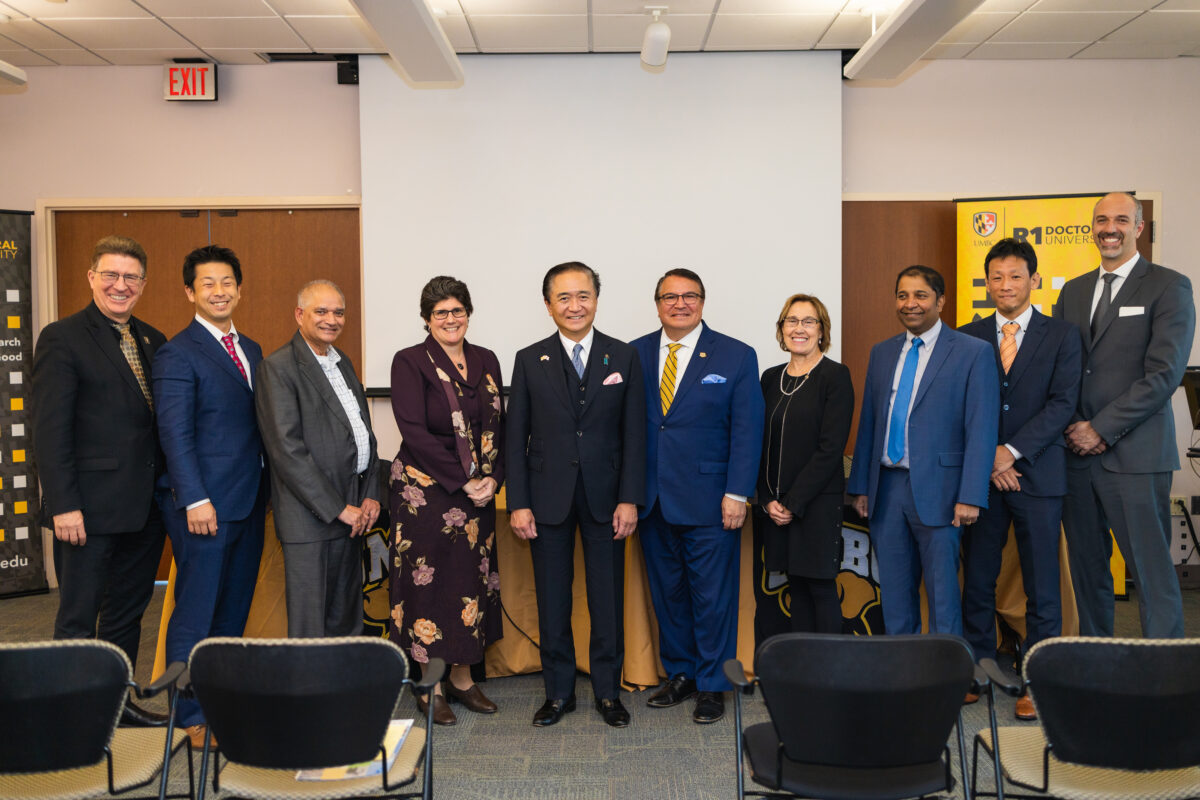 Speakers for the “New Frontiers in Healthcare Management” international seminar. (Photo by Kiirstn Pagan ’11)
Kanagawa has a population of over nine million people and is known as a “super-aging society,” with the largest aging population in the world and the highest number of centenarians. In 2017, Kanagawa Governor Yūji Kuroiwa developed and implemented the Kanagawa Prefecture’s Healthcare New Frontier health policy package to address the myriad needs of this population by embracing past and present methods of proactive healthcare management.
The seminar’s participants from Japan shared how these policies can inform the future management of aging societies and the development of impactful life science technologies across the world, with Maryland as a leading partner.
“This event has been a wonderful opportunity to celebrate the 40th anniversary of our partnership as a sister state with the Kanagawa Prefecture,” said Luis E. Borunda, the Maryland Deputy Secretary of State, at the event. “Yūji Kuroiwa, governor of Kanagawa Prefecture, has always been at the forefront of what it means to age well. He is transforming the world to be a better place to grow older with the concept ‘ME-BYO.’”
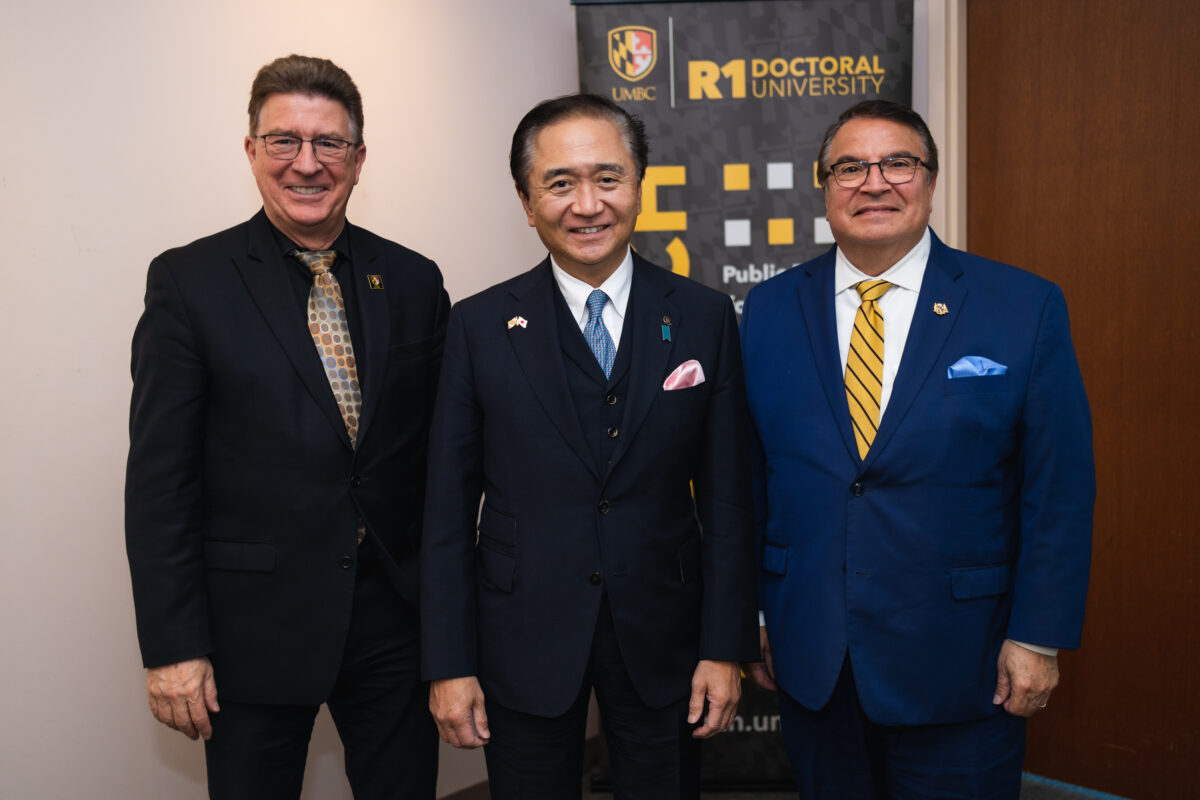 (l-r): Steiner, Kuroiwa, Borunda. (Photo by Kiirstn Pagan ’11)
ME-BYO meets medical technologies
ME-BYO is a state of being where a person is defined as neither sick nor healthy, but living in a continual state of maintaining good health wherever they are in the spectrum of personal wellbeing. Governor Kuroiwa’s Healthcare New Frontier health policy combines the traditional concept of ME-BYO with advanced technology, regenerative medicine, robotics, and information and communication technologies.
“When we think of our health, we think that we are either healthy or sick, but in reality, there is no cut line. Our state of health gradually changes between healthy and sick every day. This is the state of ME-BYO,” said Governor Kuroiwa. “To manage and improve our health is to manage ME-BYO.”
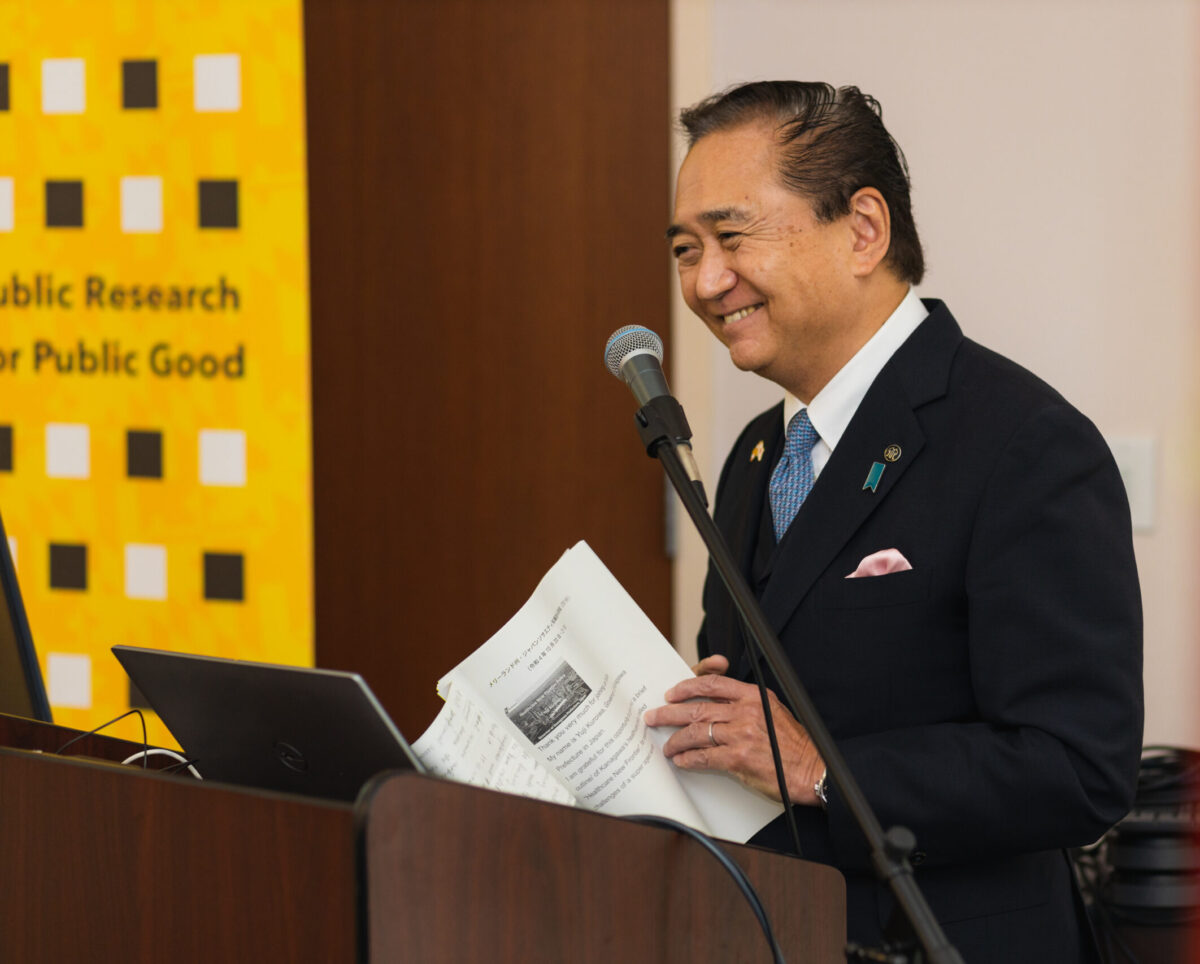 Yūji Kuroiwa, governor of Kanagawa Prefecture. (Photo by Kiirstn Pagan ’11)
The purpose of the prefecture’s new health policy is to prevent illness and minimize illness progression through programs that promote healthy behaviors such as a balanced diet, exercise, and social activities. This includes fostering age-friendly living communities that can improve physical and mental health. The ME-BYO approach also encourages monitoring vital signs using biomedical life science technologies.
“By integrating the ME-BYO concept with advanced medical technologies we aim for healthy longevity as well as create new industries and markets,” said Governor Kuroiwa. “We hope to strengthen partnerships between Maryland and Kanagawa Prefecture to further the development of the life science industry in both.”
Benefits of lifelong learning
At UMBC, aging research can be found across a broad range of disciplines, using different approaches. Some faculty focus on lifelong learning and education or trauma-centered care. Others take novel approaches to data collection, management, and analysis to develop insights on healthy aging and the life course and the social determinants of health, such as access to quality healthcare, living environments, social networks, and economic forces.
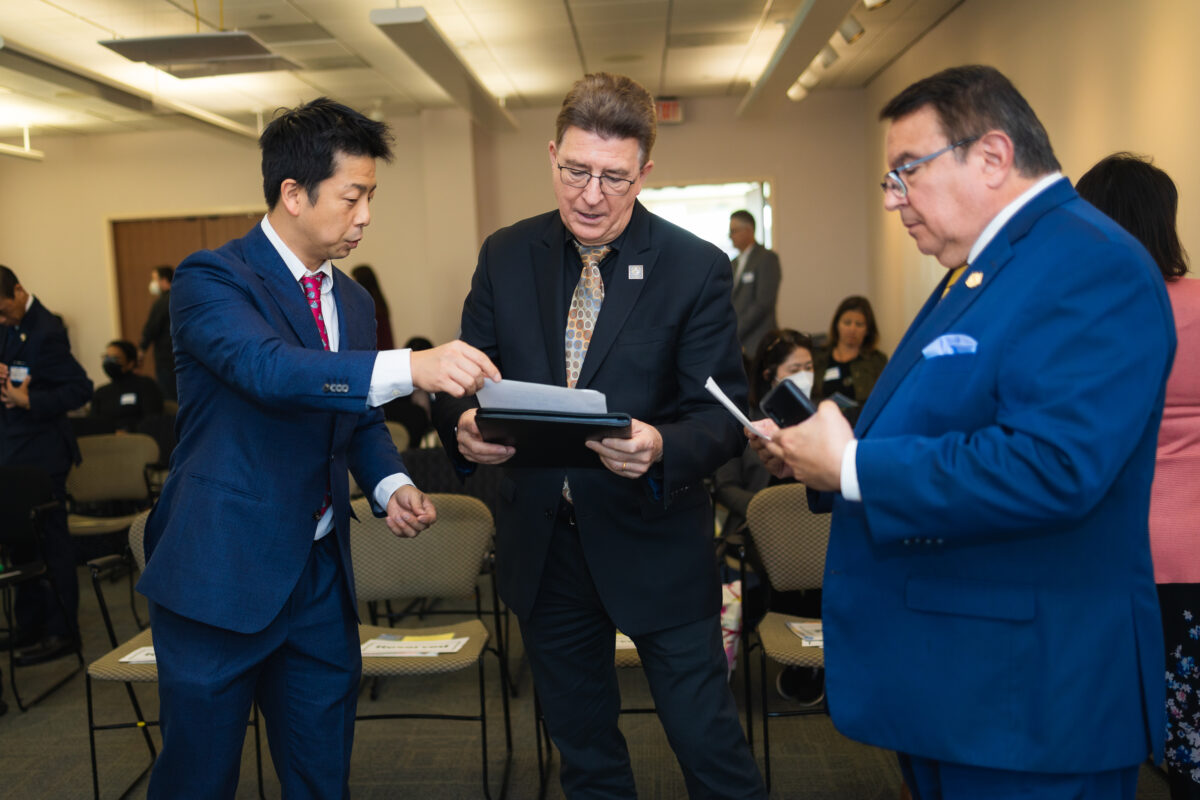 (l-r): Yamashita, Steiner, Borunda. (Photo by Kiirstn Pagan ’11)
Research by UMBC’s Taka Yamashita, a professor of SAPH, has revealed that individuals with high educational attainment are more likely to pursue education activities later in life. Preliminary findings have found that lifelong learning has a strong correlation to long-term health and wellbeing. However, further research is needed to understand why this link exists.
“The optimal goal of my research is to create a situation where we can actually prescribe lifelong learning just like we do physical activities today, to maintain and promote health and wellbeing later in life,” says Yamashita.
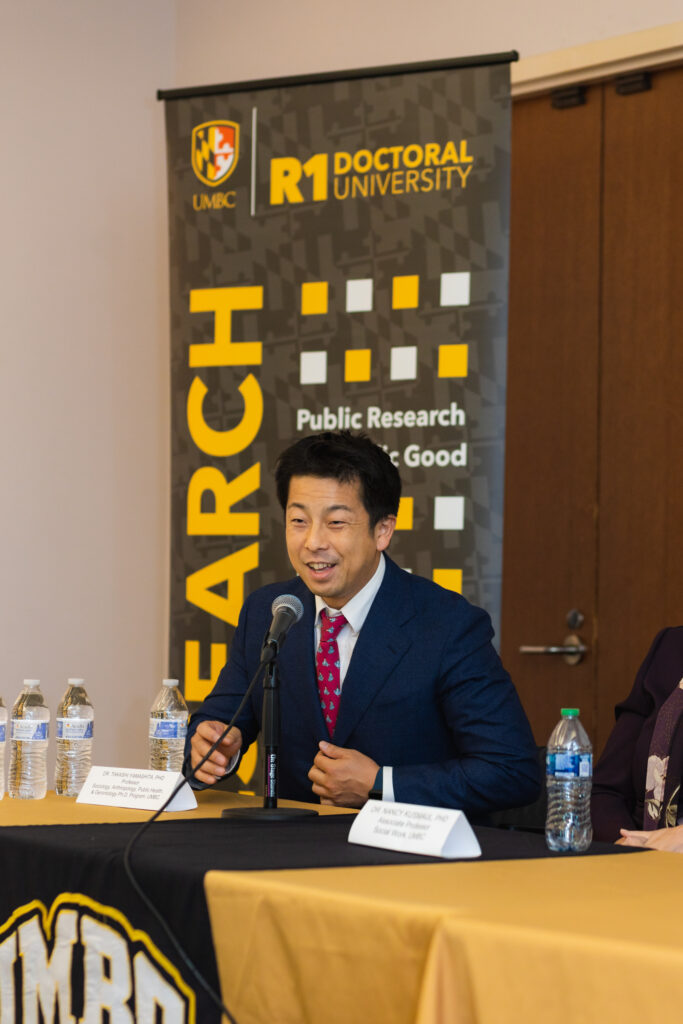 Taka Yamashita. (Photo by Kiirstn Pagan ’11)
Statistical models to improve health outcomes
In order to engage more people in lifelong learning and other activities that promote well-being, communities need help to prevent or minimize their risks of adverse health events, the speakers also noted. Ian Stockwell, an associate professor of information systems, spoke about the potential of statistical models to support healthy aging and the ongoing community engagement of older adults.
Stockwell is the associate director of healthcare research in UMBC’s College of Engineering and Information Technology and also a liaison to The Hilltop Institute at UMBC, which develops predictive analytics related to healthcare. Stockwell was previously chief data scientist at Hilltop and his current research focuses on the use of data to improve healthcare systems.
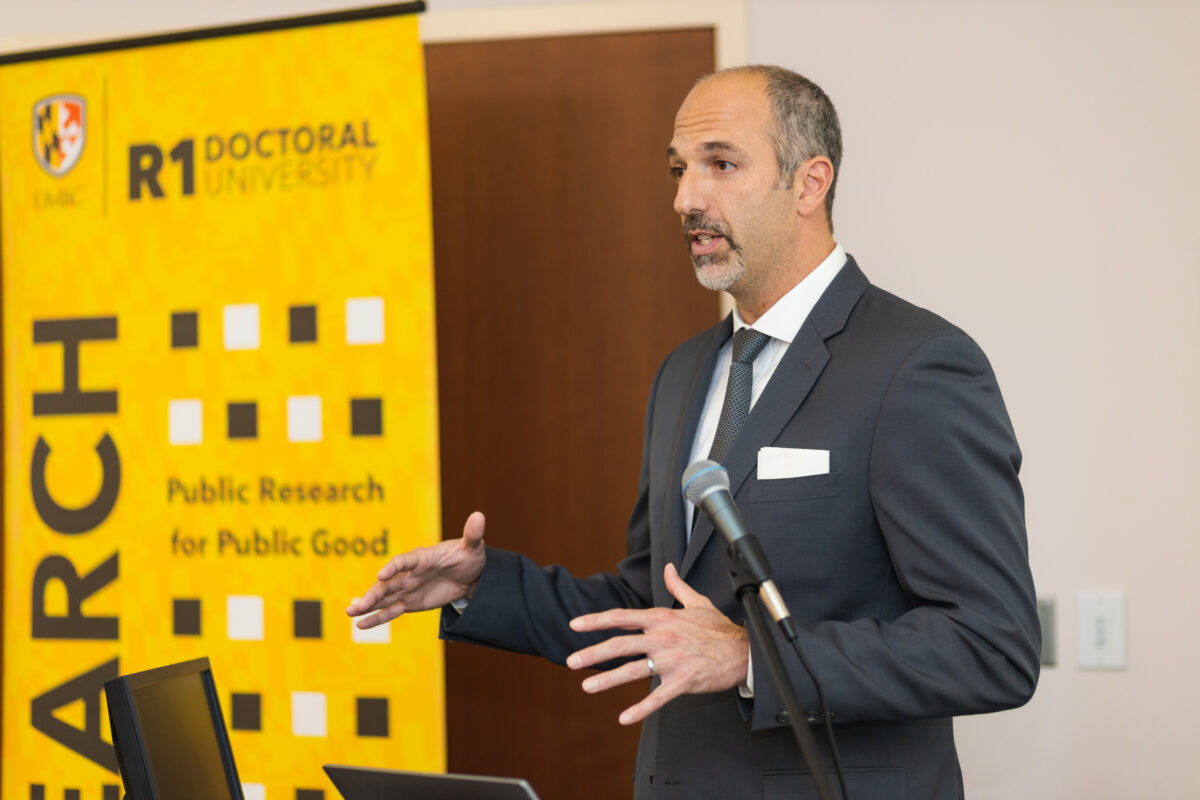 Ian Stockwell. (Photo by Kiirstn Pagan ’11)
For the last three years, Stockwell and a team of Hilltop researchers have been building statistical models incorporating the characteristics that influence the health and wellbeing of a person, like chronic conditions and access to food, transportation, and housing. Their models can measure not only the risk of a population for adverse health events—such as avoidable hospital visits, complications due to diabetes, or premature death—but also the role of factors and characteristics associated with their daily environment.
Often, people who are most at risk of negative health outcomes are not able to seek care. One goal of this research is to use the information from the models to inform the creation of an intervention outreach team that can identify those individuals with the highest risk and get them the services that they need.
“These models currently predict avoidable hospitalization, avoidable long-term admission to nursing homes, complications due to diabetes, and opioid overdoses,” says Stockwell. “I love helping people and these models have served two-million Marylanders who are covered by Medicare and Medicaid.”
Trauma-informed care
Trauma is an important event in the life course that can impact health and health outcomes for people in any population. For residents of long-term care and nursing homes, trauma-informed care is essential to psychosocial well-being, UMBC researchers shared. UMBC’s Nancy Kusmaul, an associate professor of social work, and Brandy Wallace, an associate professor of SAPH, are working to help nursing homes implement trauma-informed care practices.
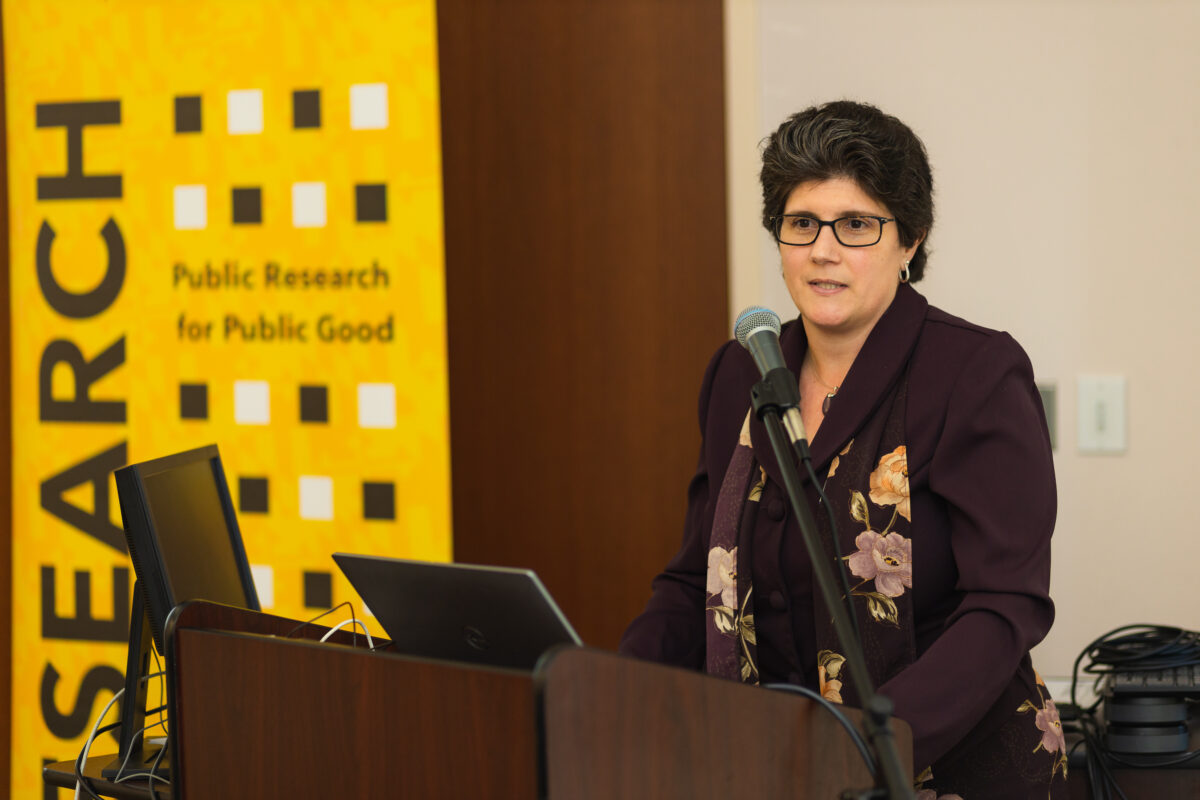 Nancy Kusmaul. (Photo by Kiirstn Pagan ’11)
“Trauma-informed care is a perspective and organizational model that presumes residents, staff, caregivers, family members, and anyone who might be at the nursing home, might have experienced some kind of trauma that we might not know,” said Kusmaul at the event.
Traumas that people experience because of gender, age, location, discrimination, and oppression can be perceived differently around the world, she explained. Trauma-informed care increases the compassion and empathy that caregivers can provide and helps them focus their care in a way that reduces retraumatization for everyone, supporting wellbeing.
Trauma-informed practices may look different across cultures, but they are important to explore deeply whether someone is in Maryland or Kanagawa, noted Kusmaul. “They are part of the human experience,” she said. “No matter who you are, where you are, or your nationality, trauma-informed care is essential to the wellbeing of all populations.”
A vision for healthy aging
Madhav Thambisetty, a senior clinical investigator at the National Institute of Aging, also spoke at the seminar, sharing research on pharmaceutical advances in aging care. Manabu Seo, chief executive officer at Elixirgen Scientific, and Rama Modali, chief executive officer of Reprocell USA, discussed advances in drug discovery and regenerative medicine.
 Madhav Thambisetty. (Photo by Kiirstn Pagan ’11)
The seminar concluded with a panel including Yamashita, Kusmaul, Stockwell, and Governor Kuroiwa, led by Dana Bradley, dean of the Erickson School, as well as a poster presentation featuring work by doctoral students from the UMB/UMBC Doctoral Program in Gerontology and the UMB School of Social Work .
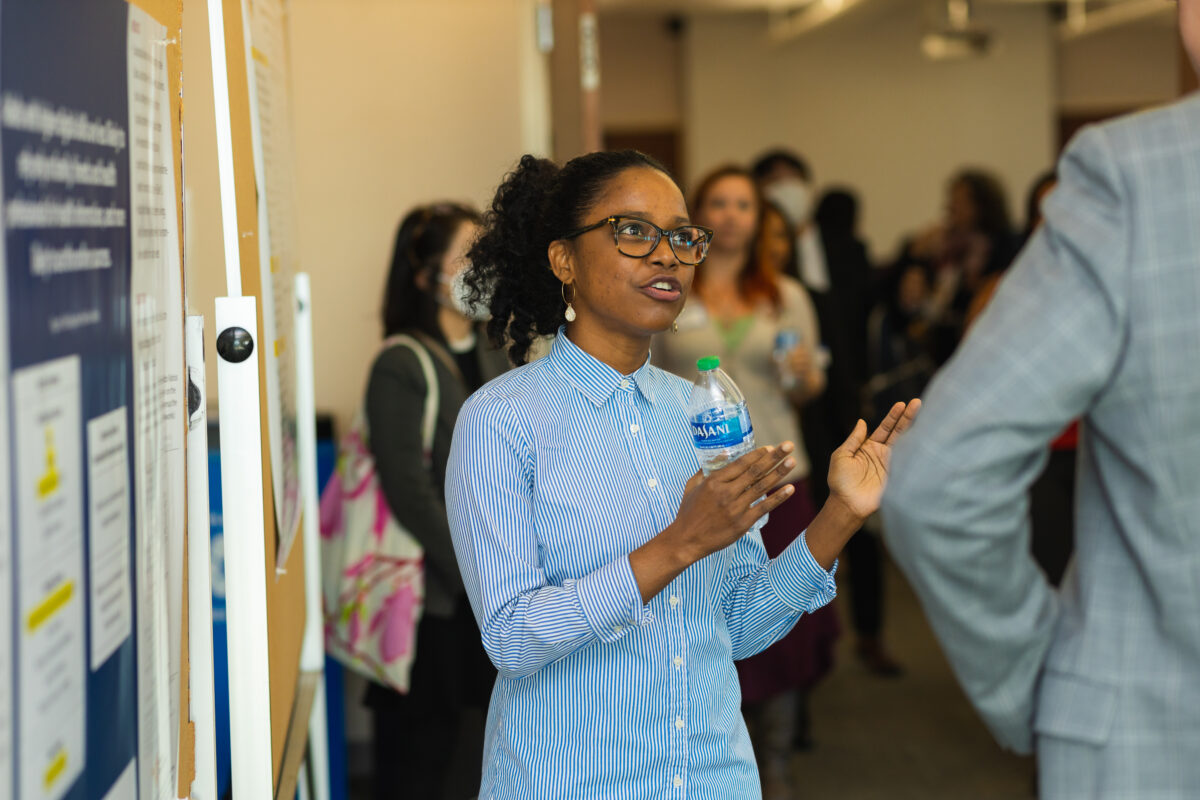 Donnette Narine, a gerontology doctoral student, discusses her poster with Stockwell.
(Photo by Kiirstn Pagan ’11)
The consensus for the future of healthy aging was that no single perspective or narrow approach will be successful. Supporting the health and wellbeing of the aging population depends on international innovation and collaboration in life science biotechnologies, novel clinical approaches, effective data management and analysis, and thoughtful approaches to care and wellbeing centered on human experiences.
“UMBC played an important role in connecting Kanagawa and Maryland, through education and research, to develop this unique international seminar,” said Yamashita. “I hope that this seminar inspired policymakers, researchers, and students to critically examine how the ME-BYO concept and policy may contribute to our current views on aging and healthcare.”
]]>
UMBC recently partnered with the government of Japan’s Kanagawa prefecture to host the seminar “New Frontiers in Healthcare Management,” examining innovative approaches to an aging society. The...
https://umbc.edu/stories/transforming-the-future-of-healthy-aging-umbc-event-highlights-leading-practices-research-from-kanagawa-and-maryland/
https://my3.my.umbc.edu/api/v0/pixel/news/129491/guest@my.umbc.edu/c1038a8e5726562cd2f7ff6575f2779a/api/pixel
cahss
cahssresearch
ericksonschool
information-systems
international
news
policy-and-society
research
saph
science-and-tech
socialwork
UMBC News & Magazine
https://my3.my.umbc.edu/groups/umbc-news-magazine
https://assets1-my.umbc.edu/system/shared/avatars/groups/000/001/943/24435aa6207c452e7bc15cc74b42c7bb/xsmall.png?1748556657
https://assets1-my.umbc.edu/system/shared/avatars/groups/000/001/943/24435aa6207c452e7bc15cc74b42c7bb/original.png?1748556657
https://assets2-my.umbc.edu/system/shared/avatars/groups/000/001/943/24435aa6207c452e7bc15cc74b42c7bb/xxlarge.png?1748556657
https://assets2-my.umbc.edu/system/shared/avatars/groups/000/001/943/24435aa6207c452e7bc15cc74b42c7bb/xlarge.png?1748556657
https://assets3-my.umbc.edu/system/shared/avatars/groups/000/001/943/24435aa6207c452e7bc15cc74b42c7bb/large.png?1748556657
https://assets1-my.umbc.edu/system/shared/avatars/groups/000/001/943/24435aa6207c452e7bc15cc74b42c7bb/medium.png?1748556657
https://assets2-my.umbc.edu/system/shared/avatars/groups/000/001/943/24435aa6207c452e7bc15cc74b42c7bb/small.png?1748556657
https://assets1-my.umbc.edu/system/shared/avatars/groups/000/001/943/24435aa6207c452e7bc15cc74b42c7bb/xsmall.png?1748556657
https://assets2-my.umbc.edu/system/shared/avatars/groups/000/001/943/24435aa6207c452e7bc15cc74b42c7bb/xxsmall.png?1748556657
UMBC News & Magazine
0
0
false
Wed, 30 Nov 2022 15:22:28 -0500
Wed, 30 Nov 2022 15:22:28 -0500
Connecting the Dots

Students come to UMBC for many reasons—to find community, to explore a passion, to make change in the world. Once they figure out the “why” that truly drives their interests, the Retriever community is ready to kick in with the “how” to help make those plans a reality. Part of that looks like the traditional classroom experience with a professor, of course—but just as important are the experiential-learning moments that help many students actively connect the knowledge to careers they hope to pursue after graduation.
UMBC students pursue applied learning in huge numbers. Despite the pandemic, nearly 80 percent of our recent graduates engaged in applied learning, including internships, research, co-ops, and service learning during their time at UMBC. An impressive 91 percent of new grads head directly to a job, advanced degree, or both within six months of graduating—and of those, more than half interned or worked for their employer as a student.
“When it comes to impact, there is nothing more valuable than engaging in applied-learning opportunities to help clarify one’s career direction, build professional skills, and increase one’s professional network,” shares Susan Hindle, the Career Center’s assistant director of internships and employment.
For students pursuing experiential learning through internships, campus jobs, research, and community engagement, it’s not just about learning how to do the thing they want to do. It’s about connecting the work to the passions that brought them to UMBC in the first place. These students and alumni working in their chosen fields tell the whole picture—what hands-on learning looks like when it comes full circle.
Essential Connections
The desire to help people comes from deep within. But knowing how to do it successfully on a large scale—and understanding the systems and politics that can make the job more or less challenging—takes more than just compassion.
On the morning of the monthly food delivery from the Maryland Food Bank, the brigade of students who keep the Retriever Essentials food pantry running see all sides of the work. Together, they unload and shelve staples like rice, pasta, and huge crates of broccoli for the more than 2,100 visits to the pantry so far this year. At the same time, they work with community members to understand what might make life better—halal meats, for one; more campus job opportunities, another biggie—and then put their heads together to try to make those changes happen.
 Nyla Howell (left) and Lydia Sannella and Ariel Barbosa (L-R) sort canned goods for Retriever Essentials. Photos by Marlayna Demond ’11/UMBC, design by Jim Lord ’99.
For Ariel Barbosa, a grad student in UMBC’s community leadership program, working in this space is part of a journey that started with her trying to understand her Brazilian father’s immigrant experience better. As she works with Retriever Essentials, she’s learning about the complexities of these experiences in a way that will help her as she carves out a career in service. “There are so many signs showing me that I’m supposed to be right here, right now. I feel like I’m preparing,” she says. “Right now, I feel like I’m in a confidence-building, skill-building phase where I’m just trying to pick up as many skills as I can to be able to create what I feel I need to create at the right time.”
As a student, Matthew Dolamore ’08, modern languages and linguistics, caught a first glimpse of what would later become a service-based career when he tutored Spanish-speaking clients for an immigration services office in Baltimore. After graduating, he went on to serve with AmeriCorps and the Peace Corps and earned a master’s degree in community planning before pulling all of those skills together into a full-circle career in Baltimore.
Today, Dolamore is program director for the Esperanza Center, a project of Catholic Charities that assists more than 3,000 individuals each year with walk-in immigration services, including healthcare, legal assistance, and education tools. Dolamore serves as a connector between people and solutions, helping people get what they need when they need it and looking for ways to help improve the system.
 Matthew Dolamore ’08 at the Esperanza Center. Photos by Marlayna Demond ’11/UMBC, design by Jim Lord ’99.
“Among our managers we have a nurse practitioner, a managing attorney, a licensed social worker, an individual who got their master’s in teaching English from UMBC, and a woman who oversees our one-touch client services desk who’s a former immigrant and just has a really dynamic background. And just those five people alone is symbolic of what I love about my job,” says Dolamore.
“I’m not a medical professional. I’m not a legal professional. I’m not a social worker. I’m something myself of a generalist nonprofit manager at this stage in my career, but I get the opportunity every day to come in and out of these really focused professional engagements and try to help all five of them think of each other as teammates, and that’s the part of my job I really enjoy.”
Lydia Sannella, a Peaceworker and grad student in applied sociology at UMBC, also enjoys the organizational aspect of her job with Retriever Essentials. As she looks ahead to her post-academic career, she’s already thinking about how she can continue to marry her values with her career—knowing that it won’t likely be quite the same as what she’s experiencing at UMBC.
“I find that, whenever we want to do something, there are supportive, knowledgeable experts who want to help,” she says. “There’s just hoards of students who want to be involved and engaged and do any variety of work, from physical lifting to technical projects. And it’s just this canvas for creativity and possibility. It’s very reciprocal. What I’m able to contribute ends up being more significant and then what I get ends up being more significant.”
— Jenny O’Grady
Becoming part of the solution
Students come to higher education for a variety of reasons, and among them, many have the goal of learning to create new things—from innovative water-quality solutions to entire companies. For many students, in fact, learning while doing is an integral part of going to college.
If you ask Premal S. Shah ’98, biochemistry and molecular biology, however, he’ll tell you that there’s a world of difference between learning while doing and learning from doing.
That’s not to say that Shah, who earned a Ph.D. from the California Institute of Technology on his way to founding and leading a string of successful healthcare-related companies, doesn’t believe in academics. But from his vantage point as CEO at MyOme, a genomics firm based in northern California, classroom-based learning is only a part of the puzzle.
 Premel S. Shah ’98 interned at National Institutes of Health before founding a genomics firm. Photos by Barack Shrama, design by Jim Lord ’99.
Shah said he’s always had a practical streak, but he found out how much experiential learning can boost classroom learning thanks to a hands-on internship and fellowship at the National Institutes of Health, beginning while he was a student at UMBC.
“When I got to grad school, there were a lot of people who hadn’t really worked in a lab or done stuff,” he said. “I had a huge head start, just because I was able to pick up a pipette and actually use it. I knew what a DNA extraction protocol was. I knew how to use certain machinery.”
It was a vivid object lesson—one Shah has carried forward into his career. “When you start building companies, there’s always that challenge…of analysis paralysis, right?” he said. “There’s a notion of, ‘We could do this or that. Let’s read and learn more or get additional inputs in search of the perfect answer.’ Or we can actually go build something that will benefit people and iterate even faster as we learn more to make it much better.”
That’s the big difference between studying science and, for example, running science-based companies, Shah says: “The hypotheticals are great. The theories are great. But you’ve got to get [things] done.”
Getting things done is Matt Stromberg’s perennial modus operandi. Being a Ph.D. student studying environmental engineering means he is very much both an environmental scientist—someone who studies environmental problems—and an engineer: someone who works to solve those problems. “I always knew I was a passionate environmentalist, but I also knew I liked to build things,” he said.
In fact, Stromberg, who graduated in 2019 from the University of Virginia with bachelor’s degrees in both environmental engineering and environmental science, is a literal embodiment of learning while doing. Working as both a graduate research assistant and a researcher in the jointly run University System of Maryland Institute for Marine and Environmental Technology (IMET), he sometimes finds himself simultaneously running experiments and keeping the experiments running.
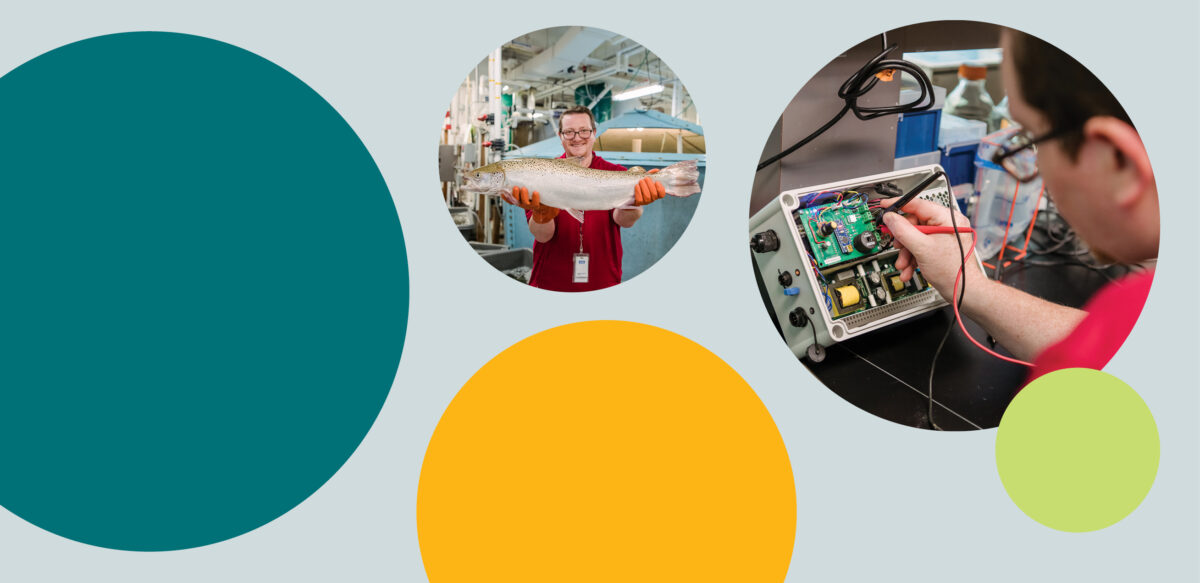 Matt Stromberg is studying aquaculture at the University System of Maryland Institute for Marine and Environmental Technology. Photos by Marlayna Demond ’11/UMBC, design by Jim Lord ’99.
A few months ago, Stromberg said, the night before an experiment was scheduled to start, a pump failed in IMET’s Aquaculture Research Center, a 1,800-square-meter facility with hundreds of fish tanks.
“It was a large pump, and it needed to be replaced—and it was eight o’clock at night,” Stromberg said. “I had already worked 12 hours that day, [but] I realized that there’s no way this experiment is going to run if I don’t have a pump tomorrow. So…I got the wrenches and I got all the fittings I needed,” and found a way to fix it.
Stromberg’s ability to save that experiment is part and parcel of his approach. One of his main research projects is unclogging a major bottleneck that prevents more farm-raised fish from getting to market: purging them of an unsavory flavor that’s sometimes characteristic of fish that aren’t caught in the wild. As Stromberg put it, “You’re not going to sell the fish if it tastes like dirt.”
That’s a problem not only for aquaculture companies—which have to use lots of water, time, money, and energy to purge the fish of this taste—but also for the planet. That’s because the only alternative to aquaculture is fishing in the wild, which can destroy ecosystems but is still cheaper than aquaculture, due to the expensive purging process.
He’s working with advanced oxidative processes and a technology of his own that would effectively create a shortcut, making it more cost-effective to farm fish and thus helping to protect wild habitat in the process. And Stromberg aims to eventually put his Ph.D. to work in a similarly practical way: His goal is to create a company that performs chemical analysis and remediation of water contaminants.
“I’ve learned a lot from my time here,” he says. “Especially not to over-engineer things!”
— Scott Cech
Community-centered art
Visual art is all around us—in flyers, television commercials, and even clothes. And while many of us may never know the artists creating work behind the scenes, their lives and experiences certainly do shape their work.
For instance, earlier this year, Jennifer White-Johnson ’08, visual arts, designed a collection for Target’s national Latino Heritage Month campaign, including a tumbler with stacked text reading sonando vivamente vividly dreaming and a T-shirt proudly proclaiming piel canela pelo rizado (brown/cinnamon skin curly hair). As a disabled, neurodiverse, Afro-Latina designer from Baltimore, White-Johnson sees her inclusion as an opportunity to highlight and provide a voice to communities that often aren’t heard or represented.
 Former Student Events Board member Jennifer White-Johnson ’08 now has designs at Target. Photos by Marlayna Demond ’11/UMBC, design by Jim Lord ’99.
“I am really honored to have been chosen and included in this year’s Target Latino Heritage Month collection and campaign,” says White-Johnson. “Using art and design to celebrate and elevate my cultural stories, the strength, and legacy of my ancestors, felt like something that was meant to be!”
Living with undiagnosed ADHD as a student, White-Johnson often felt like her intensity, excitement, and point of view were unwelcome or just too much. That changed when she transferred to UMBC, where she immediately felt at home. In particular, her time as director of promotions for the Student Events Board [(seb)] gave her her first taste of how graphic design could marry with communit-ycentric work.
Working closely with the Office of Student Life, White-Johnson and other members of (seb) volunteered during an alternative spring-break trip to post-Hurricane Katrina New Orleans. White-Johnson also designed the T-shirts.
“This was in 2007, so we could help offer some sort of relief from Hurricane Katrina,” says White-Johnson. “It was life-changing because I was able to surround myself with other like-minded scholars that were serious about academic life but who also understood that school is about self-discovery.”
Enter Patch Hatley, a sophomore visual arts major with a concentration in animation. Fresh from a session learning how to create stop-motion animation puppets from paper, she is excited to test out some of what she’s learned on the job at commonvision, the student-driven print and design center in The Commons. On any given day, one might find her working on anything from animating cute countdowns for student activities to designing stickers.
“I’m always constantly learning in an environment like commonvision,” she says. “Each new skill helps transition to the next project, and each project creates new and exciting opportunities. You’re always surrounded by a team who are all community-driven, so I always feel like I can ask for help or constructive criticism. commonvision supports, drives, and motivates me to keep reaching for the stars and will always be an important part of how I’ve grown—not just as an artist but as a team player.”
 Patch Hatley learns while working on animations at commonvision. Photos by Marlayna Demond ’11/UMBC, design by Jim Lord ’99.
Hatley finds work at commonvision particularly helpful because it stretches her creative muscles and opens up her craft to new programs, tools, and mediums, and also because other creators surround her. After spending a decade in animation and illustration before becoming a Retriever, Hatley loves the opportunity to expand her craft in a place that has fostered the foundation for budding designers for years—and getting to bring her personal perspective into work for clients.
“At the end of the day, you’re drawing for yourself and for the people around you whether you realize it implicitly or not,” says Hatley. At the core of both artists’ practices is community. Both White-Johnson and Hatley recognize that their art doesn’t live in a vacuum but exists as a letter of inspiration, solidarity, and encouragement to their respective communities. Both artists, years apart in their practice, found similar communities to nurture and invest in them.
“Being given the space to bring visibility to themes of cultural intersectionality, specifically the parts of our natural beauty that aren’t always celebrated, our caramel brown, cinnamon skin, and our natural curls,” says White-Johnson. “I hope my work can culturally inspire others to center what they want to see more of.”
— Sharéa Harris
Taking experiential learning to the next level
Developing high-level skills in a highly technical field like computer science is difficult enough. But the ability to both master and successfully teach those skills to others takes the challenge to a whole new level.
Fortunately, Amina Mahmood and Zach Margulies thrive at that level. With their dedication to passing along computer-science knowledge, these Retrievers amply demonstrate that doing while teaching and learning while doing are just different parts of the same equation.
As Mahmood ’21, computer science, tells it, she started learning while doing quite literally. Just weeks into her first year at UMBC, Mahmood found herself working 20 hours a week as a junior malware analyst at Huntress, a cybersecurity firm that was then still in the startup phase at the bwtech@UMBC Research and Technology Park.
“I didn’t really have any experience, but I was pretty ambitious, so I learned everything on the job,” she said.
Mahmood, part of UMBC’s Cyber Scholars Program, quickly learned how to run different types of malware on a virtual machine, dissect the particulars of each, and create mitigation reports. The nascent company’s culture also helped boost her confidence. If she ran into a problem, she said, the people she worked with were glad to bring her up to speed.
 Amina Mahmood ’21 at the Johns Hopkins University Applied Physics Lab. Photos courtesy of Johns Hopkins Applied Physics Laboratory, design by Jim Lord ’99.
“It was just like, ‘Oh, you don’t know this—let me teach it to you.’ And then I picked up on it and then I was like, ‘OK—I can do this,’” Mahmood said. Mahmood was quick to apply such on-the-job learning to her academics, even persuading an academic advisor to allow her to add her to his overenrolled, graduate-level software reverse-engineering course at the same time she was enrolled in an undergraduate prerequisite class.
Mahmood not only aced the graduate-level class, she also started using what she had learned to complete the experiential-learning cycle at her new part-time job at Parsons Corp., a technology-focused defense, intelligence, security, and infrastructure engineering firm.
“One of my mentors at Parsons—he really supported me, and he said, ‘You know a lot about reverse engineering. Why don’t you just make a course and teach coworkers?’” That’s exactly what Mahmood did— and now does for new summer interns as a full-time reverse engineer at the Johns Hopkins University Applied Physics Lab.
Recently she found herself completing the circle, coming back to UMBC for the same kind of career fair where she’d found her first job as a first-year student. “But [this time] I didn’t go as a student,” she noted. “I went as an employer.”
Margulies ’14, biological sciences, is completing his own trajectory: Nearly a decade after earning his first bachelor’s degree, he has returned to UMBC to earn a bachelor’s in computer science and a master’s in education, with the goal of teaching computer science to Baltimore high school students when he graduates in 2024.
Margulies started his career pivot before diving back into academics immersing himself in on-the-job data science and programming—including a Maryland Institute for Innovative Computing internship at the Maryland Department of Health after starting in the computer science program. Because of this, he’s able to pursue his studies with a greater sense of perspective.
“I feel like it inspires confidence and it builds your self-esteem, taking what you’ve learned in the class and not even a semester later applying it in a real-world setting,” he said.
Margulies noted that, as a teacher, he’ll also be able to fully address high schoolers’ perennial classroom question: ‘When am I ever going to use this in real life?’
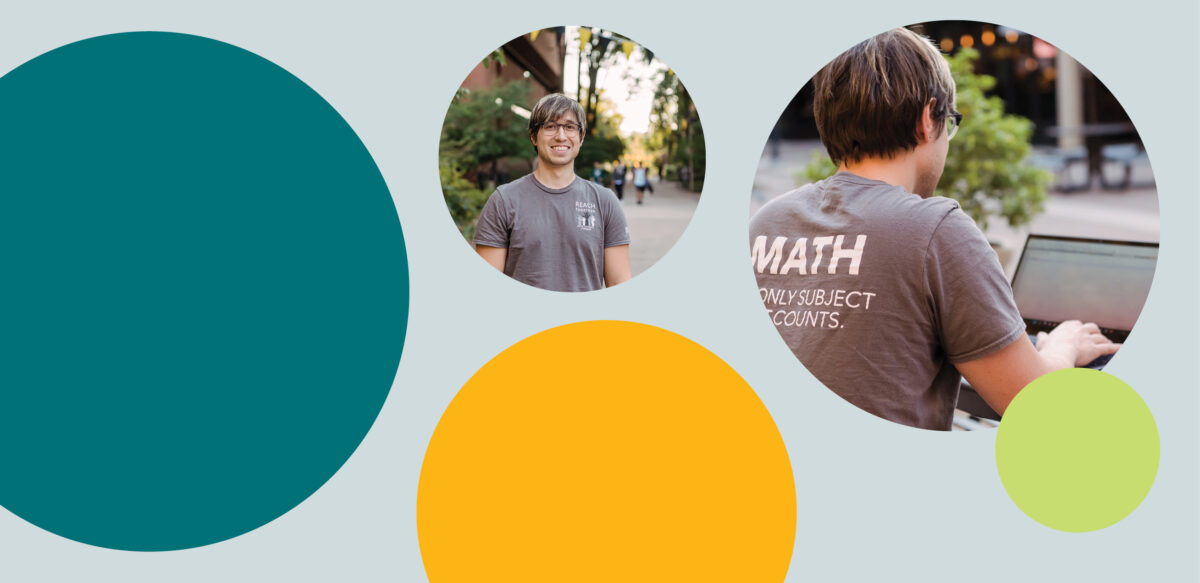 Zach Margulies took part in a Maryland Institute for Innovative Computing internship with the Maryland Department of Health. Photos by Marlayna Demond ’11/UMBC, design by Jim Lord ’99.
“It’s really important for teachers to know what the practical application of [schoolwork] is going to be and what working in a computer science job will look like,” he said.
A case in point, Margulies said, was the work he did as part of a Maryland Department of Health internship last summer, reviewing and finding improvements for data collection, including the creation of a data dashboard.
“Last semester, I took Computer Science 201, and we learned the programming language Python, and I really wanted to start applying that language at the internship,” he said. Because he’d had both practical experience and formal training, Margulies said, he was able to see that he’d have to adapt what he’d learned to suit the task at hand.
“[I had] to figure out a way that I could take Python and apply it to developing the database because that’s not something we necessarily learned in the class,” he said. “I had a lot of fun taking the thing that I learned academically and not just applying it, but also taking it to the next level.”
— Scott Cech
]]>
Students come to UMBC for many reasons—to find community, to explore a passion, to make change in the world. Once they figure out the “why” that truly drives their interests, the Retriever...
https://umbc.edu/stories/connecting-the-dots/
https://my3.my.umbc.edu/api/v0/pixel/news/129482/guest@my.umbc.edu/38f4c1bff401ad3aed0a5d74a732610b/api/pixel
applied-sociology
biochemistry-and-molecular-biology
biological-sciences
career-center
commonvision
community-leadership
computer-science
discovery
environmental-engineering
fall-2022
feature
magazine
mll
peaceworker
retriever-essentials
visual-arts
UMBC News & Magazine
https://my3.my.umbc.edu/groups/umbc-news-magazine
https://assets1-my.umbc.edu/system/shared/avatars/groups/000/001/943/24435aa6207c452e7bc15cc74b42c7bb/xsmall.png?1748556657
https://assets1-my.umbc.edu/system/shared/avatars/groups/000/001/943/24435aa6207c452e7bc15cc74b42c7bb/original.png?1748556657
https://assets2-my.umbc.edu/system/shared/avatars/groups/000/001/943/24435aa6207c452e7bc15cc74b42c7bb/xxlarge.png?1748556657
https://assets2-my.umbc.edu/system/shared/avatars/groups/000/001/943/24435aa6207c452e7bc15cc74b42c7bb/xlarge.png?1748556657
https://assets3-my.umbc.edu/system/shared/avatars/groups/000/001/943/24435aa6207c452e7bc15cc74b42c7bb/large.png?1748556657
https://assets1-my.umbc.edu/system/shared/avatars/groups/000/001/943/24435aa6207c452e7bc15cc74b42c7bb/medium.png?1748556657
https://assets2-my.umbc.edu/system/shared/avatars/groups/000/001/943/24435aa6207c452e7bc15cc74b42c7bb/small.png?1748556657
https://assets1-my.umbc.edu/system/shared/avatars/groups/000/001/943/24435aa6207c452e7bc15cc74b42c7bb/xsmall.png?1748556657
https://assets2-my.umbc.edu/system/shared/avatars/groups/000/001/943/24435aa6207c452e7bc15cc74b42c7bb/xxsmall.png?1748556657
UMBC News & Magazine
0
0
false
Wed, 30 Nov 2022 15:17:19 -0500
Connecting the Dots
Students come to UMBC for many reasons—to find community, to explore a passion, to make change in the world. Once they figure out the “why” that truly drives their interests, the Retriever community is ready to kick in with the “how” to help make those plans a reality. Part of that looks like the traditional classroom experience with a professor, of course—but just as important are the experiential-learning moments that help many students actively connect the knowledge to careers they hope to pursue after graduation.
UMBC students pursue applied learning in huge numbers. Despite the pandemic, nearly 80 percent of our recent graduates engaged in applied learning, including internships, research, co-ops, and service learning during their time at UMBC. An impressive 91 percent of new grads head directly to a job, advanced degree, or both within six months of graduating—and of those, more than half interned or worked for their employer as a student.
“When it comes to impact, there is nothing more valuable than engaging in applied-learning opportunities to help clarify one’s career direction, build professional skills, and increase one’s professional network,” shares Susan Hindle, the Career Center’s assistant director of internships and employment.
For students pursuing experiential learning through internships, campus jobs, research, and community engagement, it’s not just about learning how to do the thing they want to do. It’s about connecting the work to the passions that brought them to UMBC in the first place. These students and alumni working in their chosen fields tell the whole picture—what hands-on learning looks like when it comes full circle.
Essential connections
The desire to help people comes from deep within. But knowing how to do it successfully on a large scale—and understanding the systems and politics that can make the job more or less challenging—takes more than just compassion.
On the morning of the monthly food delivery from the Maryland Food Bank, the brigade of students who keep the Retriever Essentials food pantry running see all sides of the work. Together, they unload and shelve staples like rice, pasta, and huge crates of broccoli for the more than 2,100 visits to the pantry so far this year. At the same time, they connect with community members to understand what might make life better—halal meats, for one; more campus job opportunities, another biggie—and then put their heads together to try to make those changes happen.
Photos by Marlayna Demond ’11/UMBC, design by Jim Lord ’99.
For Ariel Barbosa, a grad student in UMBC’s community leadership program, working in this space is part of a journey that started with her trying to understand her Brazilian father’s immigrant experience better. As she works with Retriever Essentials, she’s learning about the complexities of these experiences in a way that will help her as she carves out a career in service.
“There are so many signs showing me that I’m supposed to be right here, right now. I feel like I’m preparing,” she says. “Right now, I feel like I’m in a confidence-building, skill-building phase where I’m just trying to pick up as many skills as I can to be able to create what I feel I need to create at the right time.”
As a student, Matthew Dolamore ’08, modern languages and linguistics, caught a first glimpse of what would later become a service-based career when he tutored Spanish-speaking clients for an immigration services office in Baltimore. After graduating, he went on to serve with AmeriCorps and the Peace Corps and earned a master’s degree in community planning before pulling all of those skills together into a full-circle career in Baltimore.
Today, Dolamore is program director for the Esperanza Center, a project of Catholic Charities that assists more than 3,000 individuals each year with walk-in immigration services, including healthcare, legal assistance, and education tools. Dolamore serves as a connector between people and solutions, helping people get what they need when they need it and looking for ways to help improve the system.
Matthew Dolamore ’08 at the Esperanza Center. Photos by Marlayna Demond ’11/UMBC, design by Jim Lord ’99.
“Among our managers we have a nurse practitioner, a managing attorney, a licensed social worker, an individual who got their master’s in teaching English from UMBC, and a woman who oversees our one-touch client services desk who’s a former immigrant and just has a really dynamic background. And just those five people alone is symbolic of what I love about my job,” says Dolamore.
“I’m not a medical professional. I’m not a legal professional. I’m not a social worker. I’m something myself of a generalist nonprofit manager at this stage in my career, but I get the opportunity every day to come in and out of these really focused professional engagements and try to help all five of them think of each other as teammates, and that’s the part of my job I really enjoy.”
Lydia Sannella, a Peaceworker and grad student in applied sociology at UMBC, also enjoys the organizational aspect of her job with Retriever Essentials. As she looks ahead to her post-academic career, she’s already thinking about how she can continue to marry her values with her career—knowing that it won’t likely be quite the same as what she’s experiencing at UMBC.
“I find that, whenever we want to do something, there are supportive, knowledgeable experts who want to help,” she says. “There’s just hoards of students who want to be involved and engaged and do any variety of work, from physical lifting to technical projects. And it’s just this canvas for creativity and possibility. It’s very reciprocal. What I’m able to contribute ends up being more significant and then what I get ends up being more significant.”
— Jenny O’Grady
Becoming part of the solution
Students come to higher education for a variety of reasons, and among them, many have the goal of learning to create new things—from innovative water-quality solutions to entire companies. For many students, in fact, learning while doing is an integral part of going to college.
If you ask Premal S. Shah ’98, biochemistry and molecular biology, however, he’ll tell you that there’s a world of difference between learning while doing and learning from doing.
That’s not to say that Shah, who earned a Ph.D. from the California Institute of Technology on his way to founding and leading a string of successful healthcare-related companies, doesn’t believe in academics. But from his vantage point as CEO at MyOme, a genomics firm based in northern California, classroom-based learning is only a part of the puzzle.
Premal S. Shah ’98 interned at National Institutes of Health before founding a genomics firm. Photos by Barak Shrama, design by Jim Lord ’99.
Shah said he’s always had a practical streak, but he found out how much experiential learning can boost classroom learning thanks to a hands-on internship and fellowship at the National Institutes of Health, beginning while he was a student at UMBC.
“When I got to grad school, there were a lot of people who hadn’t really worked in a lab or done stuff,” he said. “I had a huge head start, just because I was able to pick up a pipette and actually use it. I knew what a DNA extraction protocol was. I knew how to use certain machinery.”
It was a vivid object lesson—one Shah has carried forward into his career. “When you start building companies, there’s always that challenge…of analysis paralysis, right?” he said. “There’s a notion of, ‘We could do this or that. Let’s read and learn more or get additional inputs in search of the perfect answer.’ Or we can actually go build something that will benefit people and iterate even faster as we learn more to make it much better.”
That’s the big difference between studying science and, for example, running science-based companies, Shah says: “The hypotheticals are great. The theories are great. But you’ve got to get [things] done.”
Getting things done is Matt Stromberg’s perennial modus operandi. Being a Ph.D. student studying environmental engineering means he is very much both an environmental scientist—someone who studies environmental problems—and an engineer: someone who works to solve those problems. “I always knew I was a passionate environmentalist, but I also knew I liked to build things,” he said.
In fact, Stromberg, who graduated in 2019 from the University of Virginia with bachelor’s degrees in both environmental engineering and environmental science, is a literal embodiment of learning while doing. Working as both a graduate research assistant and a researcher in the jointly run University System of Maryland Institute for Marine and Environmental Technology (IMET), he sometimes finds himself simultaneously running experiments and keeping the experiments running.
Matt Stromberg is studying aquaculture at the University System of Maryland Institute for Marine and Environmental Technology. Photos by Marlayna Demond ’11/UMBC, design by Jim Lord ’99.
A few months ago, Stromberg said, the night before an experiment was scheduled to start, a pump failed in IMET’s Aquaculture Research Center, a 1,800-square-meter facility with hundreds of fish tanks.
“It was a large pump, and it needed to be replaced—and it was eight o’clock at night,” Stromberg said. “I had already worked 12 hours that day, [but] I realized that there’s no way this experiment is going to run if I don’t have a pump tomorrow. So…I got the wrenches and I got all the fittings I needed,” and found a way to fix it.
Stromberg’s ability to save that experiment is part and parcel of his approach. One of his main research projects is unclogging a major bottleneck that prevents more farm-raised fish from getting to market: purging them of an unsavory flavor that’s sometimes characteristic of fish that aren’t caught in the wild. As Stromberg put it, “You’re not going to sell the fish if it tastes like dirt.”
That’s a problem not only for aquaculture companies—which have to use lots of water, time, money, and energy to purge the fish of this taste—but also for the planet. That’s because the only alternative to aquaculture is fishing in the wild, which can destroy ecosystems but is still cheaper than aquaculture, due to the expensive purging process.
He’s working with advanced oxidative processes and a technology of his own that would effectively create a shortcut, making it more cost-effective to farm fish and thus helping to protect wild habitat in the process. And Stromberg aims to eventually put his Ph.D. to work in a similarly practical way: His goal is to create a company that performs chemical analysis and remediation of water contaminants.
“I’ve learned a lot from my time here,” he says. “Especially not to over-engineer things!”
— Scott Cech
Community-centered art
Visual art is all around us—in flyers, television commercials, and even clothes. And while many of us may never know the artists creating work behind the scenes, their lives and experiences certainly do shape their work.
For instance, earlier this year, Jennifer White-Johnson ’08, visual arts, designed a collection for Target’s national Latino Heritage Month campaign, including a tumbler with stacked text reading sonando vivamente vividly dreaming and a T-shirt proudly proclaiming piel canela pelo rizado (brown/cinnamon skin curly hair). As a disabled, neurodiverse, Afro-Latina designer from Baltimore, White-Johnson sees her inclusion as an opportunity to highlight and provide a voice to communities that often aren’t heard or represented.
Former Student Events Board member Jennifer White-Johnson ’08 now has designs at Target. Photos by Marlayna Demond ’11/UMBC, design by Jim Lord ’99.
“I am really honored to have been chosen and included in this year’s Target Latino Heritage Month collection and campaign,” says White-Johnson. “Using art and design to celebrate and elevate my cultural stories, the strength, and legacy of my ancestors, felt like something that was meant to be!”
Living with undiagnosed ADHD as a student, White-Johnson often felt like her intensity, excitement, and point of view were unwelcome or just too much. That changed when she transferred to UMBC, where she immediately felt at home. In particular, her time as director of promotions for the Student Events Board [(seb)] gave her her first taste of how graphic design could marry with communit-ycentric work.
Working closely with the Office of Student Life, White-Johnson and other members of (seb) volunteered during an alternative spring-break trip to post-Hurricane Katrina New Orleans. White-Johnson also designed the T-shirts.
“This was in 2007, so we could help offer some sort of relief from Hurricane Katrina,” says White-Johnson. “It was life-changing because I was able to surround myself with other like-minded scholars that were serious about academic life but who also understood that school is about self-discovery.”
Enter Patch Hatley, a sophomore visual arts major with a concentration in animation. Fresh from a session learning how to create stop-motion animation puppets from paper, she is excited to test out some of what she’s learned on the job at commonvision, the student-driven print and design center in The Commons. On any given day, one might find her working on anything from animating cute countdowns for student activities to designing stickers.
“I’m always constantly learning in an environment like commonvision,” she says. “Each new skill helps transition to the next project, and each project creates new and exciting opportunities. You’re always surrounded by a team who are all community-driven, so I always feel like I can ask for help or constructive criticism. commonvision supports, drives, and motivates me to keep reaching for the stars and will always be an important part of how I’ve grown—not just as an artist but as a team player.”
Patch Hatley learns while working on animations at commonvision. Photos by Marlayna Demond ’11/UMBC, design by Jim Lord ’99.
Hatley finds work at commonvision particularly helpful because it stretches her creative muscles and opens up her craft to new programs, tools, and mediums, and also because other creators surround her. After spending a decade in animation and illustration before becoming a Retriever, Hatley loves the opportunity to expand her craft in a place that has fostered the foundation for budding designers for years—and getting to bring her personal perspective into work for clients.
“At the end of the day, you’re drawing for yourself and for the people around you whether you realize it implicitly or not,” says Hatley. At the core of both artists’ practices is community. Both White-Johnson and Hatley recognize that their art doesn’t live in a vacuum but exists as a letter of inspiration, solidarity, and encouragement to their respective communities. Both artists, years apart in their practice, found similar communities to nurture and invest in them.
“Being given the space to bring visibility to themes of cultural intersectionality, specifically the parts of our natural beauty that aren’t always celebrated, our caramel brown, cinnamon skin, and our natural curls,” says White-Johnson. “I hope my work can culturally inspire others to center what they want to see more of.”
— Sharéa Harris
Taking experiential learning to the next level
Developing high-level skills in a highly technical field like computer science is difficult enough. But the ability to both master and successfully teach those skills to others takes the challenge to a whole new level.
Fortunately, Amina Mahmood and Zach Margulies thrive at that level. With their dedication to passing along computer-science knowledge, these Retrievers amply demonstrate that doing while teaching and learning while doing are just different parts of the same equation.
As Mahmood ’21, computer science, tells it, she started learning while doing quite literally. Just weeks into her first year at UMBC, Mahmood found herself working 20 hours a week as a junior malware analyst at Huntress, a cybersecurity firm that was then still in the startup phase at the bwtech@UMBC Research and Technology Park.
“I didn’t really have any experience, but I was pretty ambitious, so I learned everything on the job,” she said.
Mahmood, part of UMBC’s Cyber Scholars Program, quickly learned how to run different types of malware on a virtual machine, dissect the particulars of each, and create mitigation reports. The nascent company’s culture also helped boost her confidence. If she ran into a problem, she said, the people she worked with were glad to bring her up to speed.
Amina Mahmood ’21 at the Johns Hopkins University Applied Physics Lab. Photos courtesy of Johns Hopkins Applied Physics Laboratory, design by Jim Lord ’99.
“It was just like, ‘Oh, you don’t know this—let me teach it to you.’ And then I picked up on it and then I was like, ‘OK—I can do this,’” Mahmood said. Mahmood was quick to apply such on-the-job learning to her academics, even persuading an academic advisor to allow her to add her to his overenrolled, graduate-level software reverse-engineering course at the same time she was enrolled in an undergraduate prerequisite class.
Mahmood not only aced the graduate-level class, she also started using what she had learned to complete the experiential-learning cycle at her new part-time job at Parsons Corp., a technology-focused defense, intelligence, security, and infrastructure engineering firm.
“One of my mentors at Parsons—he really supported me, and he said, ‘You know a lot about reverse engineering. Why don’t you just make a course and teach coworkers?’” That’s exactly what Mahmood did— and now does for new summer interns as a full-time reverse engineer at the Johns Hopkins University Applied Physics Lab.
Recently she found herself completing the circle, coming back to UMBC for the same kind of career fair where she’d found her first job as a first-year student. “But [this time] I didn’t go as a student,” she noted. “I went as an employer.”
Margulies ’14, biological sciences, is completing his own trajectory: Nearly a decade after earning his first bachelor’s degree, he has returned to UMBC to earn a bachelor’s in computer science and a master’s in education, with the goal of teaching computer science to Baltimore high school students when he graduates in 2024.
Margulies started his career pivot before diving back into academics immersing himself in on-the-job data science and programming—including a Maryland Institute for Innovative Computing internship at the Maryland Department of Health after starting in the computer science program. Because of this, he’s able to pursue his studies with a greater sense of perspective.
“I feel like it inspires confidence and it builds your self-esteem, taking what you’ve learned in the class and not even a semester later applying it in a real-world setting,” he said.
Margulies noted that, as a teacher, he’ll also be able to fully address high schoolers’ perennial classroom question: ‘When am I ever going to use this in real life?’
Zach Margulies took part in a Maryland Institute for Innovative Computing internship with the Maryland Department of Health. Photos by Marlayna Demond ’11/UMBC, design by Jim Lord ’99.
“It’s really important for teachers to know what the practical application of [schoolwork] is going to be and what working in a computer science job will look like,” he said.
A case in point, Margulies said, was the work he did as part of a Maryland Department of Health internship last summer, reviewing and finding improvements for data collection, including the creation of a data dashboard.
“Last semester, I took Computer Science 201, and we learned the programming language Python, and I really wanted to start applying that language at the internship,” he said. Because he’d had both practical experience and formal training, Margulies said, he was able to see that he’d have to adapt what he’d learned to suit the task at hand.
“[I had] to figure out a way that I could take Python and apply it to developing the database because that’s not something we necessarily learned in the class,” he said. “I had a lot of fun taking the thing that I learned academically and not just applying it, but also taking it to the next level.”
— Scott Cech
]]>
Students come to UMBC for many reasons—to find community, to explore a passion, to make change in the world. Once they figure out the “why” that truly drives their interests, the Retriever...
https://umbc.edu/stories/connecting-the-dots-through-experiential-learning/
https://my3.my.umbc.edu/api/v0/pixel/news/129595/guest@my.umbc.edu/19c7c86c3aa950e73d30a2d31a2a7667/api/pixel
applied-sociology
biochemistry-and-molecular-biology
biological-sciences
career-center
commonvision
community-leadership
computer-science
discovery
environmental-engineering
fall-2022
magazine
mll
peaceworker
retriever-essentials
visual-arts
UMBC News & Magazine
https://my3.my.umbc.edu/groups/umbc-news-magazine
https://assets1-my.umbc.edu/system/shared/avatars/groups/000/001/943/24435aa6207c452e7bc15cc74b42c7bb/xsmall.png?1748556657
https://assets1-my.umbc.edu/system/shared/avatars/groups/000/001/943/24435aa6207c452e7bc15cc74b42c7bb/original.png?1748556657
https://assets2-my.umbc.edu/system/shared/avatars/groups/000/001/943/24435aa6207c452e7bc15cc74b42c7bb/xxlarge.png?1748556657
https://assets2-my.umbc.edu/system/shared/avatars/groups/000/001/943/24435aa6207c452e7bc15cc74b42c7bb/xlarge.png?1748556657
https://assets3-my.umbc.edu/system/shared/avatars/groups/000/001/943/24435aa6207c452e7bc15cc74b42c7bb/large.png?1748556657
https://assets1-my.umbc.edu/system/shared/avatars/groups/000/001/943/24435aa6207c452e7bc15cc74b42c7bb/medium.png?1748556657
https://assets2-my.umbc.edu/system/shared/avatars/groups/000/001/943/24435aa6207c452e7bc15cc74b42c7bb/small.png?1748556657
https://assets1-my.umbc.edu/system/shared/avatars/groups/000/001/943/24435aa6207c452e7bc15cc74b42c7bb/xsmall.png?1748556657
https://assets2-my.umbc.edu/system/shared/avatars/groups/000/001/943/24435aa6207c452e7bc15cc74b42c7bb/xxsmall.png?1748556657
UMBC News & Magazine
0
0
false
Wed, 30 Nov 2022 15:17:19 -0500
Wed, 30 Nov 2022 15:17:19 -0500
How to Bridge Your Two Homes
With Jess Presuel ’23, biological sciences, an international student from Mexico
Jess Presuel’s route to UMBC was not a direct flight from Mérida, Yucatán—her home state in Mexico—to UMBC. She originally arrived in Maryland in 2015 as an au pair to a family with five children. There, she immediately felt accepted and as she cared for the children, they helped her learn English. Over time, Presuel realized she was ready to pursue her dream of becoming a surgeon, starting in fall 2021 working toward a degree in biological science. At UMBC, Presuel knew that she wasn’t just on campus to take classes; she wanted to bring her Mexican and Mayan heritage to her time as a Retriever. Now, as a global ambassador through the Center for Global Engagement and through other connections on campus, Presuel has found platforms to bridge her two homes and she wants to share how she’s going about it.
Tools of the Trade
1. A sense of adventure
2. Backpack of study skills
3. Openness to joining clubs and volunteering
4. Grandma’s recipe book
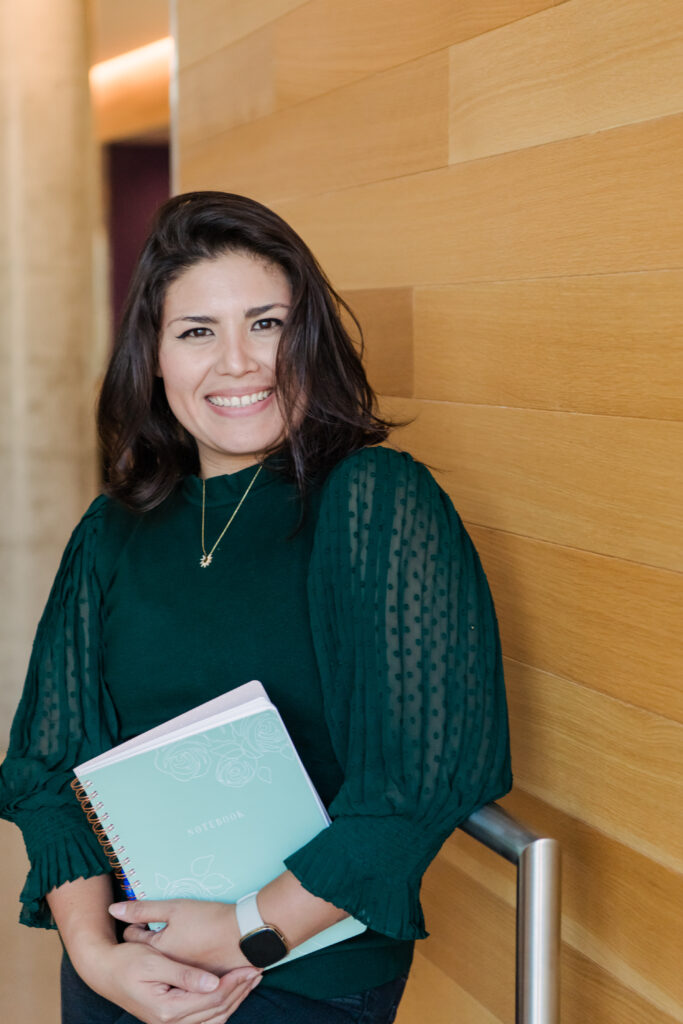
Jess Presuel (Marlayna Demond ’11/UMBC)
Step 1: Find your family
For Presuel, this was both easy and hard. When she arrived in the U.S., still using Google Translate to communicate with her au pair family, she found the parents and kids eager to help her learn English and navigate life in Maryland. Most importantly, she says, they supported her personally when she shared that she was gay. “Part of the rough patch of my life in Mexico,” Presuel shares, “was that at the time, my mom didn’t accept me as being gay. So when I first got here, the family was welcoming to me. Just for me, I began to experience how American culture, especially in Maryland, can be welcoming to the LGBTQ community. It made me feel safe.”
Presuel would later meet her fiancée, Lyana Cortes, in D.C. and over time, she says, her mother has grown to accept her daughter and love her future daughter-in-law. “My mom was a single mom, so she was always working. At the time, she sustained three jobs and I raised my siblings. So when I left, she felt my absence. Now, we’ve patched things up and she’s finally accepted me. She adores Lyana,” says Presuel. In fact, the couple got engaged on their most recent trip to Mexico, building stronger family ties internationally.
 Presuel, seated, second from right, with her fiancée, Lyana Cortes, in front, with other members of Presuel’s family in Mexico. Photo courtesy of Presuel.
Step 2: Share your favorite things from home
“For me, being a Latina means always taking the time to cook something from my hometown,” says Presuel. “In addition to being Mexican, I’m Mayan too. Not many people know that the Mayan community is still alive. So I’m spreading the word, we’re here.”
Presuel uses any opportunity to make food for her communities on campus, including her medical fraternity Phi Delta Epsilon. For her Mayan dishes, she incorporates pumpkin seeds into many different recipes, and on Mexican Independence Day, September 16, she made pozole, a rich stew.
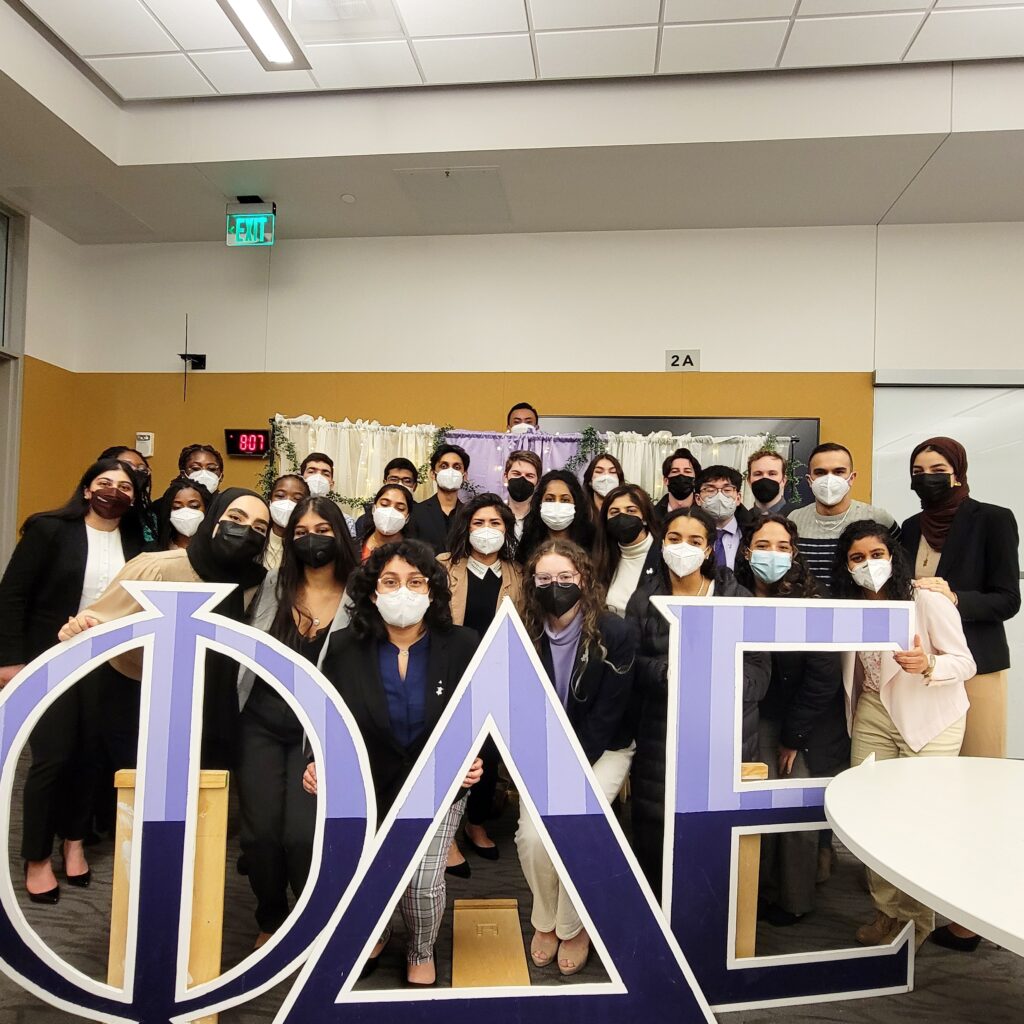 Presuel, center, in a black sweater with a white collar, with other members of her fraternity, Phi Delta Epsilon.
In addition to food, Presuel wants to share a sense of Latina empowerment. She’s currently in the process of replicating Harvard’s Latina Empowerment & Development (LEAD) conference at UMBC. “I am trying to get more Latinas involved in any type of workshops and educational settings,” says Presuel. “I want to showcase Latina leadership.”
Step 3: Get the lay of the land
Higher education in the States is a convoluted process for someone coming from outside of the system. For international students in particular, specific and important paperwork must be submitted to the right authorities. At UMBC, staff in International Student and Scholar Services (ISSS) help handle this bureaucratic burden. “I knew that when I finally picked UMBC as my university, ISSS was the first office I needed to connect with.”
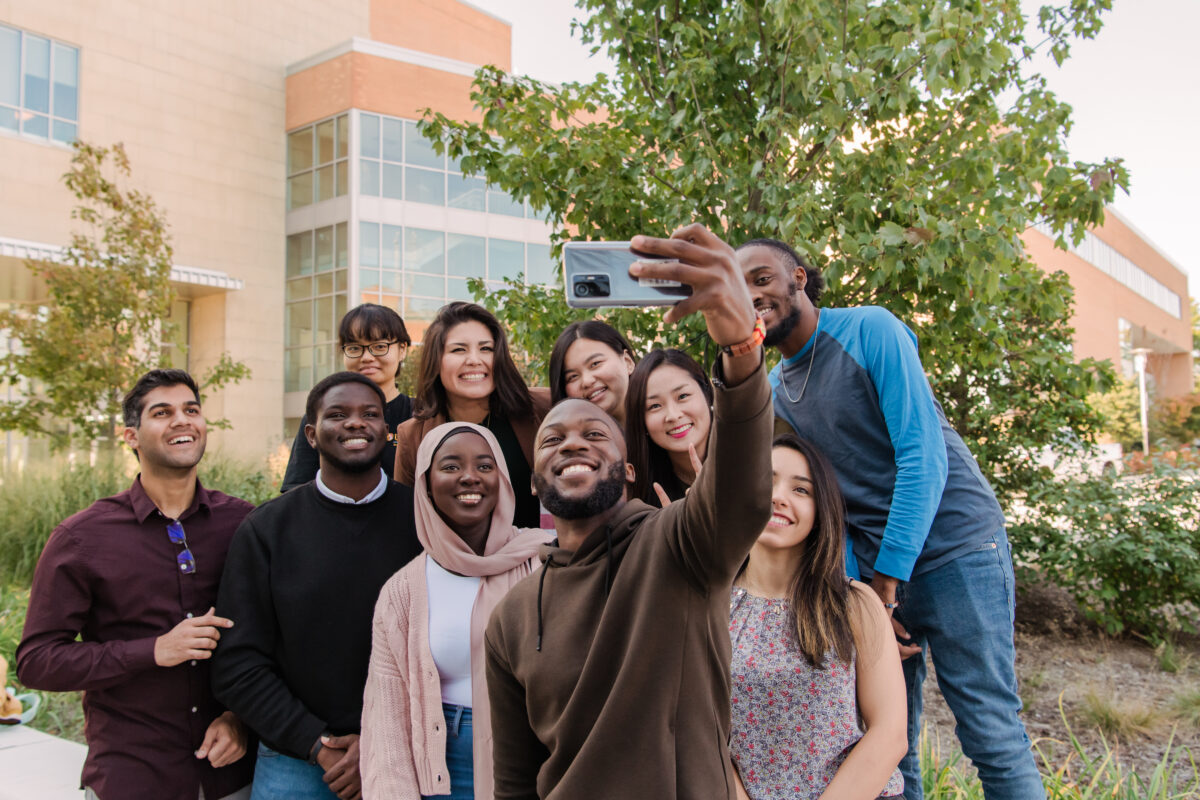 Presuel, second from left in the back, poses with other members of CGE’s global ambassador team. (Marlayna Demond ’11/UMBC)
In addition to ISSS, Presuel says, she doesn’t hesitate to ask her advisor Philip Farabaugh, professor in biological sciences, endless questions, even things she might be able to find online, because inevitably the conversation ends up being so useful to her. “He always gives me good advice. And he’s so funny, that makes me feel like, ‘Okay, I got this. I definitely can do this.’”
Step 4: Tell your story
After a year taking classes at UMBC, Presuel felt like she was ready to start offering advice to other international students. She’s now a global ambassador through the Center for Global Engagement.
“It’s such a rewarding role,” says Presuel, “because I finally get to share my experience. When you first get here from another country, you likely feel lost, so having someone who can help or speak your own language, it’s so relieving.”
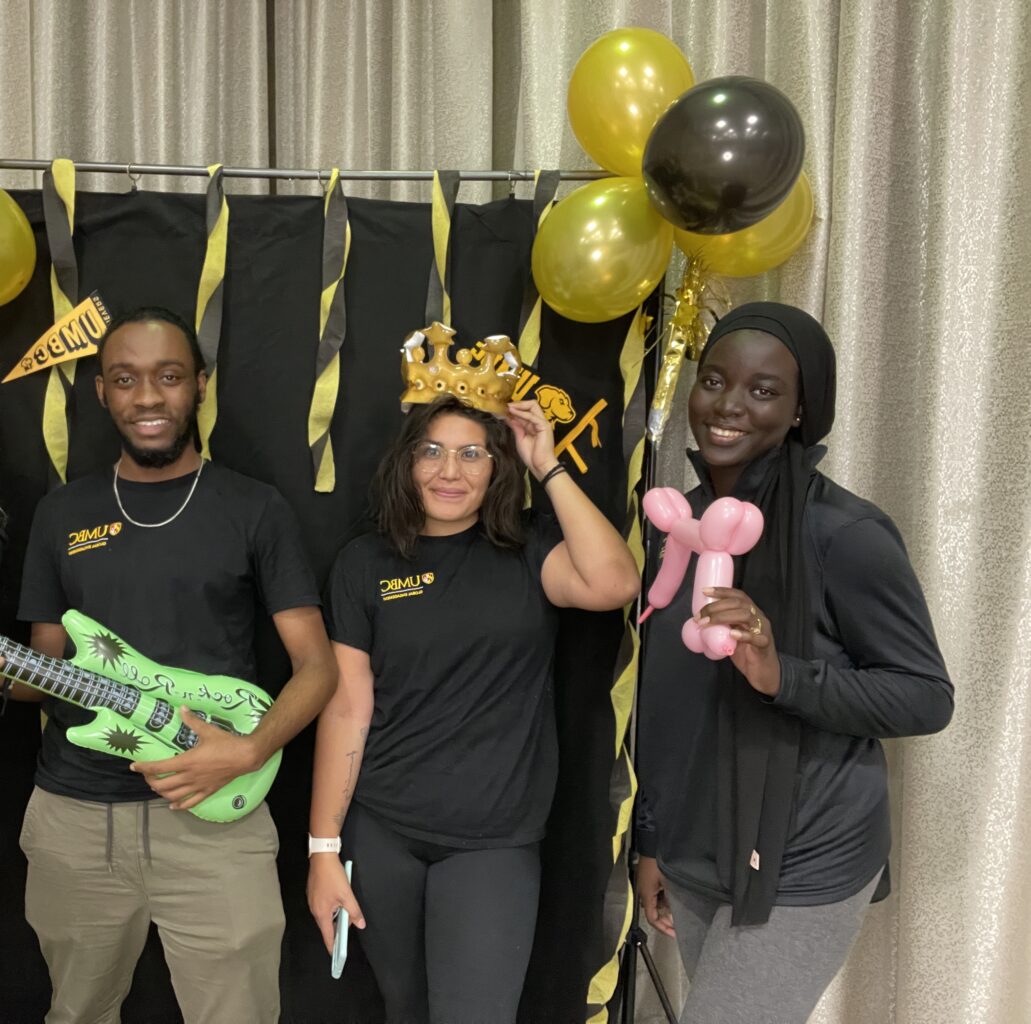
Presuel, center, has fun with other global ambassadors at a Welcome Week event. Photo courtesy of CGE.
Step 5: Find ways to give back to your community
“As an international student, it’s important to have a community even outside of campus,” says Presuel. She wanted to find a way to give back to other Mexicans and Spanish speakers in the area and found a home at the Esperanza Center in Baltimore City. This nonprofit is a comprehensive resource center for immigrant communities. “I do absolutely anything that’s possible for me to do,” says Presuel, who has been volunteering there for the past year.
“I help from the front desk. I’ve been assisting dentists. I translate for doctors. So being part of the immigrant community in Baltimore, it has filled my heart,” says Presuel. “I wouldn’t call it a hole, but something was missing from Mexico. I needed to have that link between my American culture, my Mexican culture here.”
]]>
With Jess Presuel ’23, biological sciences, an international student from Mexico Jess Presuel’s route to UMBC was not a direct flight from Mérida, Yucatán—her home state in Mexico—to UMBC....
https://umbc.edu/stories/how-to-bridge-your-two-homes/
https://my3.my.umbc.edu/api/v0/pixel/news/129381/guest@my.umbc.edu/99b66d5573cafaa0e5674257e47c5cc5/api/pixel
biological-sciences
campus-life
cge
cnms
fall-2022
how-to
international
magazine
UMBC News & Magazine
https://my3.my.umbc.edu/groups/umbc-news-magazine
https://assets1-my.umbc.edu/system/shared/avatars/groups/000/001/943/24435aa6207c452e7bc15cc74b42c7bb/xsmall.png?1748556657
https://assets1-my.umbc.edu/system/shared/avatars/groups/000/001/943/24435aa6207c452e7bc15cc74b42c7bb/original.png?1748556657
https://assets2-my.umbc.edu/system/shared/avatars/groups/000/001/943/24435aa6207c452e7bc15cc74b42c7bb/xxlarge.png?1748556657
https://assets2-my.umbc.edu/system/shared/avatars/groups/000/001/943/24435aa6207c452e7bc15cc74b42c7bb/xlarge.png?1748556657
https://assets3-my.umbc.edu/system/shared/avatars/groups/000/001/943/24435aa6207c452e7bc15cc74b42c7bb/large.png?1748556657
https://assets1-my.umbc.edu/system/shared/avatars/groups/000/001/943/24435aa6207c452e7bc15cc74b42c7bb/medium.png?1748556657
https://assets2-my.umbc.edu/system/shared/avatars/groups/000/001/943/24435aa6207c452e7bc15cc74b42c7bb/small.png?1748556657
https://assets1-my.umbc.edu/system/shared/avatars/groups/000/001/943/24435aa6207c452e7bc15cc74b42c7bb/xsmall.png?1748556657
https://assets2-my.umbc.edu/system/shared/avatars/groups/000/001/943/24435aa6207c452e7bc15cc74b42c7bb/xxsmall.png?1748556657
UMBC News & Magazine
3
0
false
Wed, 23 Nov 2022 13:23:36 -0500
Wed, 23 Nov 2022 13:23:36 -0500
Her Story of History
Ellicott City, founded 250 years ago this year, holds more than its share of history. The lore of the old mill town is dense with pioneers, millers, astronomers, abolitionists, fires, floods, and firsts, including the nation’s first national road and railroad.
Writer Ellen Nibali ’90, English, wanted to tell the history of the town. But how could she condense all those years into something that would both enlighten and entertain? Then she thought of the magic of the musical.
“The underlying thing is that I love stories,” Nibali said. “And I always enjoyed music. Then I realized that a musical was a great medium for storytelling.”
As a girl, Nibali played piano in her family’s chilly basement, finishing up practice when the timer dinged, then making up ditties. But she never imagined herself writing a musical, despite a life of putting pen to paper. After two years of college, Nibali took time off to get married and have children. But she continued writing—novels, children’s books, poems, even a bicentennial history of a Baltimore County community.
In her 30s, Nibali went back to college, attending UMBC. Nibali remembered writing a poem for class, and UMBC senior lecturer Michael Fallon telling her, “You’re on fire.” “That meant a huge amount to me,” Nibali said.
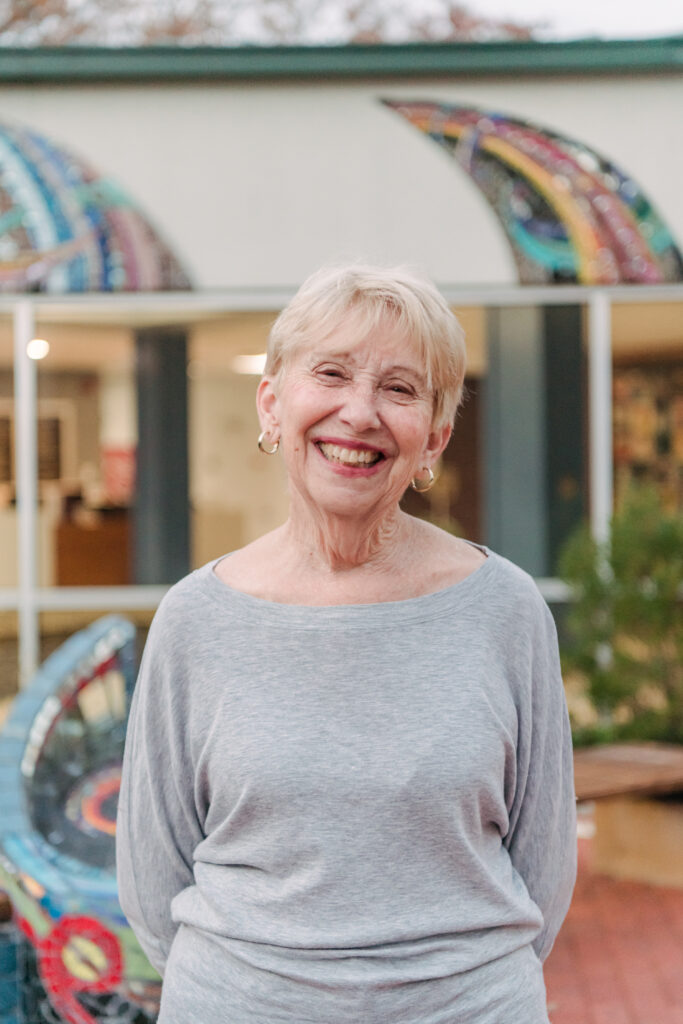
Ellen Nibali (Marlayna Demond ’11/UMBC)
“I loved every second of it, the intellectual stimulation,” she said. This year, she endowed a scholarship for students transferring from community college. “I’m impressed with how UMBC has built its reputation and excellence,” Nibali said. “I’m proud to be an alum and want to give that opportunity to others of modest backgrounds. What UMBC does is transforming on so many levels, and it keeps on giving for generations.”
Back to the town’s roots
After graduation, Nibali wrote the weekly horticulture column in the Baltimore Sun. The column was part of her job at the University of Maryland’s Extension Service, answering hometowner’s garden questions.
She began writing the musical more than 25 years ago, for her son’s school history project. She composed songs for him and his classmates to perform, about the National Road, about the revolutionary tea party in Annapolis, and about the Underground Railroad.
Over the years, she wrote more songs, about the B&O Railroad, then one about astronomer, mathematician, and surveyor Benjamin Banneker.
Over the years, Nibali ended up with 15 songs and took the idea for her musical “On National Road” to EC250, the nonprofit formed to spearhead celebration of Ellicott City’s sestercentennial.
“Being a lover of history and especially Ellicott City history, I was immediately taken with the concept and the songs,” said Ed Lilley, president of EC250 and fondly known as the city’s informal mayor. “The finale song, ‘Sing Me a Memory,’ immediately brought tears to my eyes, reminding me of what a special place Ellicott City is.”
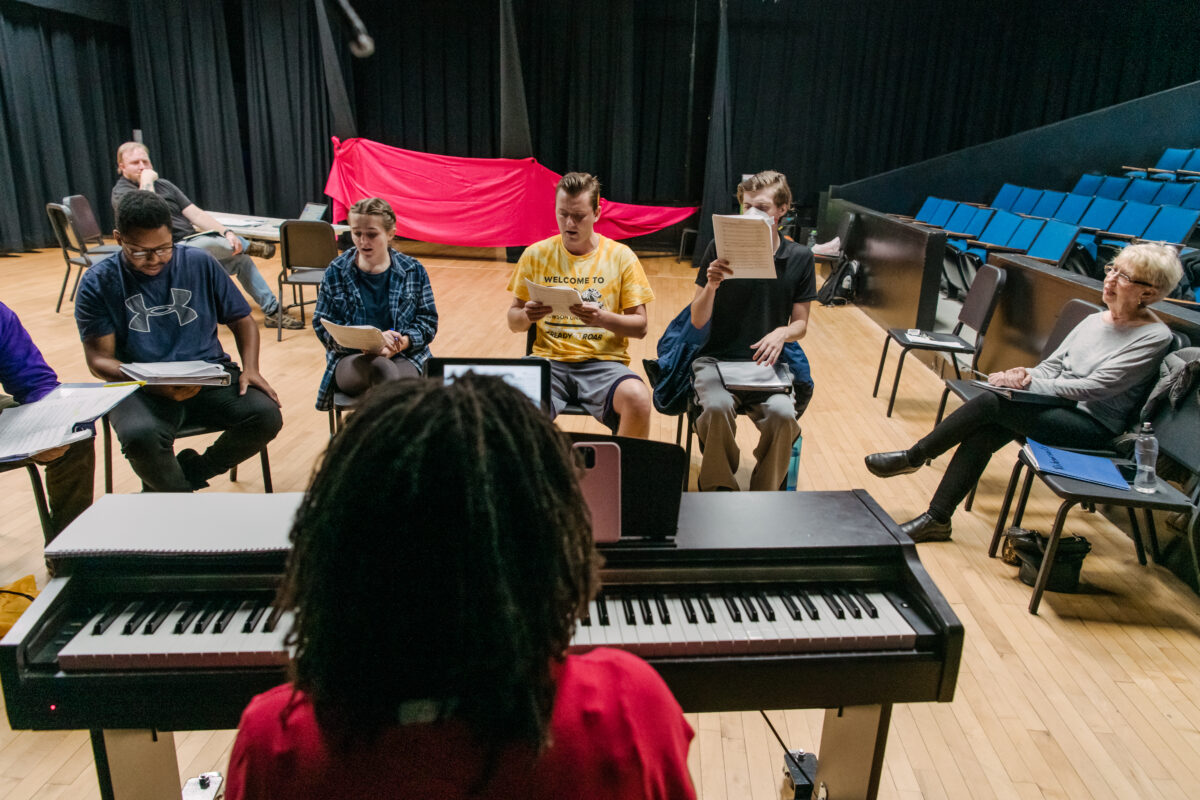 Nibali, right, observes a rehearsal. (Marlayna Demond ’11/UMBC)
The board agreed to put on the show. Nibali wrote a libretto and four new songs at their request, then worked with Wilde Lake High School choir teacher Kevin Crouch, who composed and recorded the songs, from marches, folk, and rock to classical and ragtime.
The thrill of songs come to life
Nibali attends every rehearsal of “On National Road,” which opens at Howard Community College December 8.
“This is my baby,” Nibali said. “I want to watch it be born. It’s just been a fun adventure. The first time I heard them do the songs, each one was thrilling.”
“On National Road” spans, of course, 250 years. It starts with the three Quaker Ellicott brothers who first saw the Patapsco River’s potential as a force to power their mills through the race of the horse and the Tom Thumb train, to more recent history, including when 19-year-old Babe Ruth was married in Ellicott City because it had lax laws about youngsters marrying.
“I wish I could convey even better how revolutionary and earth-shaking and exciting these things are,” Nibali said of the history. “The theme is freedom, about being free to be who you are in the time you are in.”
One Saturday this autumn, Nibali and 50 other audience members gathered at the Museum of Howard County History to watch a preview song, a ragtime tune about Babe Ruth’s marriage at St. Paul Catholic Church, less than a half a mile away.
An actor playing Babe, in a baseball uniform, sang out Nibali’s rhyme of “Ruth” and “uncouth,” and then warbled the song’s final line, “I’m gonna take a swing at, gotta take a swing at, get to take a swing at life,” and Nibali clapped enthusiastically as the last note faded into the rafters.
— Susan Thornton Hobby
]]>
Ellicott City, founded 250 years ago this year, holds more than its share of history. The lore of the old mill town is dense with pioneers, millers, astronomers, abolitionists, fires, floods, and...
https://umbc.edu/stories/her-story-of-history-ellicott-city/
https://my3.my.umbc.edu/api/v0/pixel/news/129380/guest@my.umbc.edu/c9926d8b59565127a4a6ec76159d6d4c/api/pixel
alumni
cahss
english
fall-2022
giving
magazine
UMBC News & Magazine
https://my3.my.umbc.edu/groups/umbc-news-magazine
https://assets1-my.umbc.edu/system/shared/avatars/groups/000/001/943/24435aa6207c452e7bc15cc74b42c7bb/xsmall.png?1748556657
https://assets1-my.umbc.edu/system/shared/avatars/groups/000/001/943/24435aa6207c452e7bc15cc74b42c7bb/original.png?1748556657
https://assets2-my.umbc.edu/system/shared/avatars/groups/000/001/943/24435aa6207c452e7bc15cc74b42c7bb/xxlarge.png?1748556657
https://assets2-my.umbc.edu/system/shared/avatars/groups/000/001/943/24435aa6207c452e7bc15cc74b42c7bb/xlarge.png?1748556657
https://assets3-my.umbc.edu/system/shared/avatars/groups/000/001/943/24435aa6207c452e7bc15cc74b42c7bb/large.png?1748556657
https://assets1-my.umbc.edu/system/shared/avatars/groups/000/001/943/24435aa6207c452e7bc15cc74b42c7bb/medium.png?1748556657
https://assets2-my.umbc.edu/system/shared/avatars/groups/000/001/943/24435aa6207c452e7bc15cc74b42c7bb/small.png?1748556657
https://assets1-my.umbc.edu/system/shared/avatars/groups/000/001/943/24435aa6207c452e7bc15cc74b42c7bb/xsmall.png?1748556657
https://assets2-my.umbc.edu/system/shared/avatars/groups/000/001/943/24435aa6207c452e7bc15cc74b42c7bb/xxsmall.png?1748556657
UMBC News & Magazine
6
0
false
Wed, 23 Nov 2022 13:02:54 -0500
Wed, 23 Nov 2022 13:02:54 -0500
UMBC volleyball wins third-consecutive America East championship

UMBC volleyball continued their hot streak, capturing their third-consecutive America East championship title over the weekend. The second-seeded Retrievers defeated Bryant in four sets before sweeping fourth-seeded University of New Hampshire in three sets on the road for the Championship, cementing UMBC’s fifth NCAA appearance in program history.
It’s Sweep-Victory for UMBC Earning their Third-Straight #AEVB Title! Learn more about today's #AEVB Championship Game below!
]]>
UMBC volleyball continued their hot streak, capturing their third-consecutive America East championship title over the weekend. The second-seeded Retrievers defeated Bryant in four sets before...
https://umbc.edu/stories/umbc-volleyball-wins-third-consecutive-america-east-championship/
https://my3.my.umbc.edu/api/v0/pixel/news/129378/guest@my.umbc.edu/040b563894c3c5d789c018c9d0c6d4c0/api/pixel
athletics
cahss
cnms
community
news
UMBC News & Magazine
https://my3.my.umbc.edu/groups/umbc-news-magazine
https://assets1-my.umbc.edu/system/shared/avatars/groups/000/001/943/24435aa6207c452e7bc15cc74b42c7bb/xsmall.png?1748556657
https://assets1-my.umbc.edu/system/shared/avatars/groups/000/001/943/24435aa6207c452e7bc15cc74b42c7bb/original.png?1748556657
https://assets2-my.umbc.edu/system/shared/avatars/groups/000/001/943/24435aa6207c452e7bc15cc74b42c7bb/xxlarge.png?1748556657
https://assets2-my.umbc.edu/system/shared/avatars/groups/000/001/943/24435aa6207c452e7bc15cc74b42c7bb/xlarge.png?1748556657
https://assets3-my.umbc.edu/system/shared/avatars/groups/000/001/943/24435aa6207c452e7bc15cc74b42c7bb/large.png?1748556657
https://assets1-my.umbc.edu/system/shared/avatars/groups/000/001/943/24435aa6207c452e7bc15cc74b42c7bb/medium.png?1748556657
https://assets2-my.umbc.edu/system/shared/avatars/groups/000/001/943/24435aa6207c452e7bc15cc74b42c7bb/small.png?1748556657
https://assets1-my.umbc.edu/system/shared/avatars/groups/000/001/943/24435aa6207c452e7bc15cc74b42c7bb/xsmall.png?1748556657
https://assets2-my.umbc.edu/system/shared/avatars/groups/000/001/943/24435aa6207c452e7bc15cc74b42c7bb/xxsmall.png?1748556657
UMBC News & Magazine
3
0
false
Wed, 23 Nov 2022 12:01:08 -0500
Wed, 23 Nov 2022 12:01:08 -0500
Meet a Retriever — Maria Bruno ’19, social work

Meet Maria Bruno ’19, social work, a first-generation college student who transferred to UMBC at The Universities at Shady Grove from Montgomery College. Currently working as a mental health specialist, Maria kept herself busy at UMBC as a peer navigator and the president of the Social Work Club. Thanks for sharing your story, Maria!
Q: What’s one thing you’d like people to know about studying at UMBC at the Universities at Shady Grove?
A: That UMBC truly cares about its students. And that UMBC professors and staff are always supportive.
Q: Why did you decide to study social work?
A: I decided to study social work for a variety of reasons. My passion to help others has been part of me for as long as I can remember. I had a desire to give back to the community. My experiences working with social workers in the past lead me to understand the importance of the social work role. There is much work to do in this field with a variety of areas that can benefit from the social work practice.
I graduated in May of 2022 from University of Maryland, Baltimore with my master’s in social work and plan to further my education next year. Currently, I work with Sheppard Pratt in the School and Community Youth Services Division at Winston Churchill High School as a Mental Health Specialist. I love this position working with adolescents. They are my favorite population to work with and I learn something new every day from them.
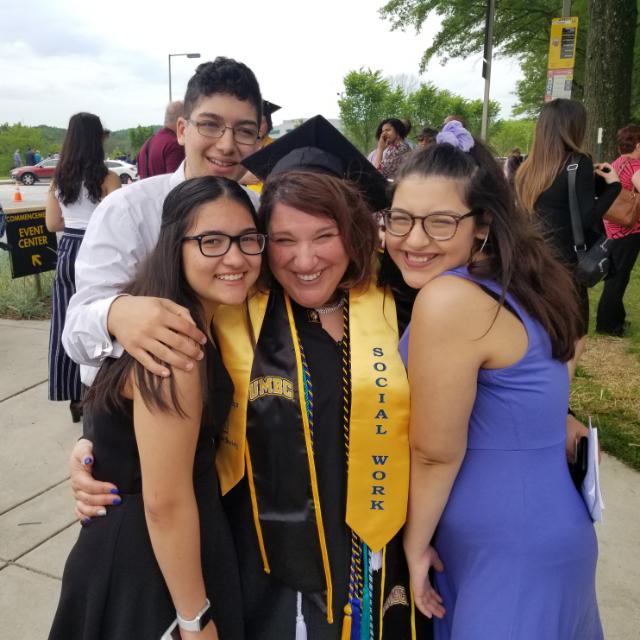 Maria Bruno ’19, social work, center, celebrates her graduation from UMBC with her children, Eugene Chirikov, Julia Chirikov, and Sofia Chirikov. Photo courtesy of Bruno.
UMBC professors and staff are always supportive.
Maria Bruno ’19, social work
Q: Tell us about someone who has supported you at UMBC.
A: Chelsea Moyer (director of UMBC at the Universities at Shady Grove) has been a mentor and supportive of my journey since day one. And all the professors, including Katie Morris (Ph.D. ’21, language, literacy, and culture) and Chelsea Moyer, have been supportive and helped direct me toward realizing my dreams.
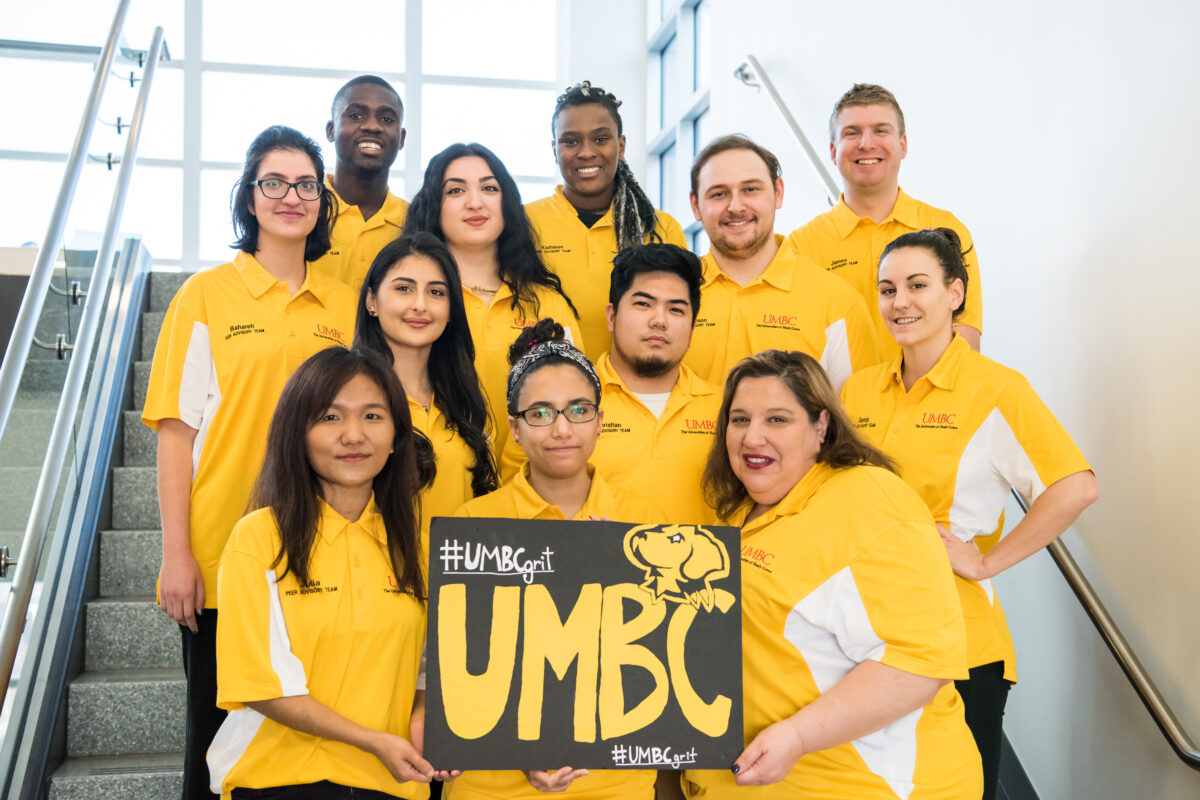 Maria Bruno, bottom right, with other students at Shady Grove. (Marlayna Demond ’11/UMBC)
Q: Can you talk about being a first-generation college student, and the support systems you’ve found at USG?
A: I never knew what the importance of being first-generation was until I was at UMBC. All my life I struggled with school. My first language was Sicilian and my parents were unable to help me with homework. Neither of my parents had higher than a sixth grade education. I wish I had as much support in my younger years of school as I did in higher ed. USG has a wealth of support systems that I utilized. The writing department was one of my biggest support systems. English grammar has been difficult for as long as I can remember and having someone to help support me when it came to writing papers was amazing! It would take hours and hours to explain how fortunate I have been to have attended UMBC at USG! I am so grateful for the best experience of my higher education.
* * * * *
UMBC’s greatest strength is its people. When people meet Retrievers and hear about the passion they bring, the relationships they create, the ways they support each other, and the commitment they have to inclusive excellence, they truly get a sense of our community. That’s what “Meet a Retriever” is all about.
Learn more about how UMBC can help you achieve your goals.
]]>
Meet Maria Bruno ’19, social work, a first-generation college student who transferred to UMBC at The Universities at Shady Grove from Montgomery College. Currently working as a mental health...
https://umbc.edu/stories/meet-a-retriever-maria-bruno-19-social-work/
https://my3.my.umbc.edu/api/v0/pixel/news/129399/guest@my.umbc.edu/b6f5f8ac0629e13ffa0a81dde196eb1e/api/pixel
alumni
impact
magazine
meet-a-retriever
perspectives
socialwork
universities-at-shady-grove
UMBC News & Magazine
https://my3.my.umbc.edu/groups/umbc-news-magazine
https://assets1-my.umbc.edu/system/shared/avatars/groups/000/001/943/24435aa6207c452e7bc15cc74b42c7bb/xsmall.png?1748556657
https://assets1-my.umbc.edu/system/shared/avatars/groups/000/001/943/24435aa6207c452e7bc15cc74b42c7bb/original.png?1748556657
https://assets2-my.umbc.edu/system/shared/avatars/groups/000/001/943/24435aa6207c452e7bc15cc74b42c7bb/xxlarge.png?1748556657
https://assets2-my.umbc.edu/system/shared/avatars/groups/000/001/943/24435aa6207c452e7bc15cc74b42c7bb/xlarge.png?1748556657
https://assets3-my.umbc.edu/system/shared/avatars/groups/000/001/943/24435aa6207c452e7bc15cc74b42c7bb/large.png?1748556657
https://assets1-my.umbc.edu/system/shared/avatars/groups/000/001/943/24435aa6207c452e7bc15cc74b42c7bb/medium.png?1748556657
https://assets2-my.umbc.edu/system/shared/avatars/groups/000/001/943/24435aa6207c452e7bc15cc74b42c7bb/small.png?1748556657
https://assets1-my.umbc.edu/system/shared/avatars/groups/000/001/943/24435aa6207c452e7bc15cc74b42c7bb/xsmall.png?1748556657
https://assets2-my.umbc.edu/system/shared/avatars/groups/000/001/943/24435aa6207c452e7bc15cc74b42c7bb/xxsmall.png?1748556657
UMBC News & Magazine
0
0
false
Wed, 23 Nov 2022 10:52:38 -0500
Wed, 23 Nov 2022 10:52:38 -0500
Meet a Retriever — Phil Shockley ’04, M.P.P. ’09
Meet UMBC Retriever Phil Shockley ’04, political science and information systems, M.P.P. ’09. As an undergraduate, he was Student Government Association president and took part in leadership roles on and off campus, as well as interesting internships, and as an alum and donor he continues to engage and give back to his alma mater. He’s made a UMBC education even more accessible to others by endowing a scholarship in honor of his parents. Thanks for sharing your story, Phil!
Q: What’s one thing you’d want people to know about you?
A: I was raised on a family farm and while I did not appreciate the advantage of that gift when I was growing up, I now fully embrace the lessons it taught and wish everyone could experience just one summer working on a farm. I believe their outlook would completely change.
Q: How did you wind up at UMBC?
A: I was unfamiliar with UMBC until my high school guidance counselor encouraged me to consider it. I looked into the university and found myself impressed with its many accomplishments. Since it was not too far from where I lived on the Lower Eastern Shore of Maryland, I signed up for admissions event for prospective students. I had planned to go further away to school. I vividly remember walking on campus for the first time and being welcomed by the Admissions folks. Lori Smith-Watson ’85 will always stand out to me (I believe she was either from the Eastern Shore or had a connection to the place where I grew up). Later as I toured around campus, there was discussion about the many new buildings popping up including The Commons, which at that point, was not yet complete. That first encounter was a life changing experience, and I knew then UMBC was meant for me.
UMBC is special to me for countless reasons, but if I had to single out one area, I would say I felt like I was able to come into my own for the first time in my life. People genuinely respected what I had to offer and encouraged me to take on leadership roles all while demonstrating moral character and ethical conduct. There were many experiences that I had, including: working as a student for a department on campus and learning about the importance of alumni and corporate engagement; being elected a senator and then president of the Student Government Association; serving as an ambassador for the Office of Admissions, giving tours and introducing students to the campus; and serving as the student regent for the University System of Maryland my senior year. Nothing happens in a vacuum and the genuine support I felt at every turn cannot be understated.
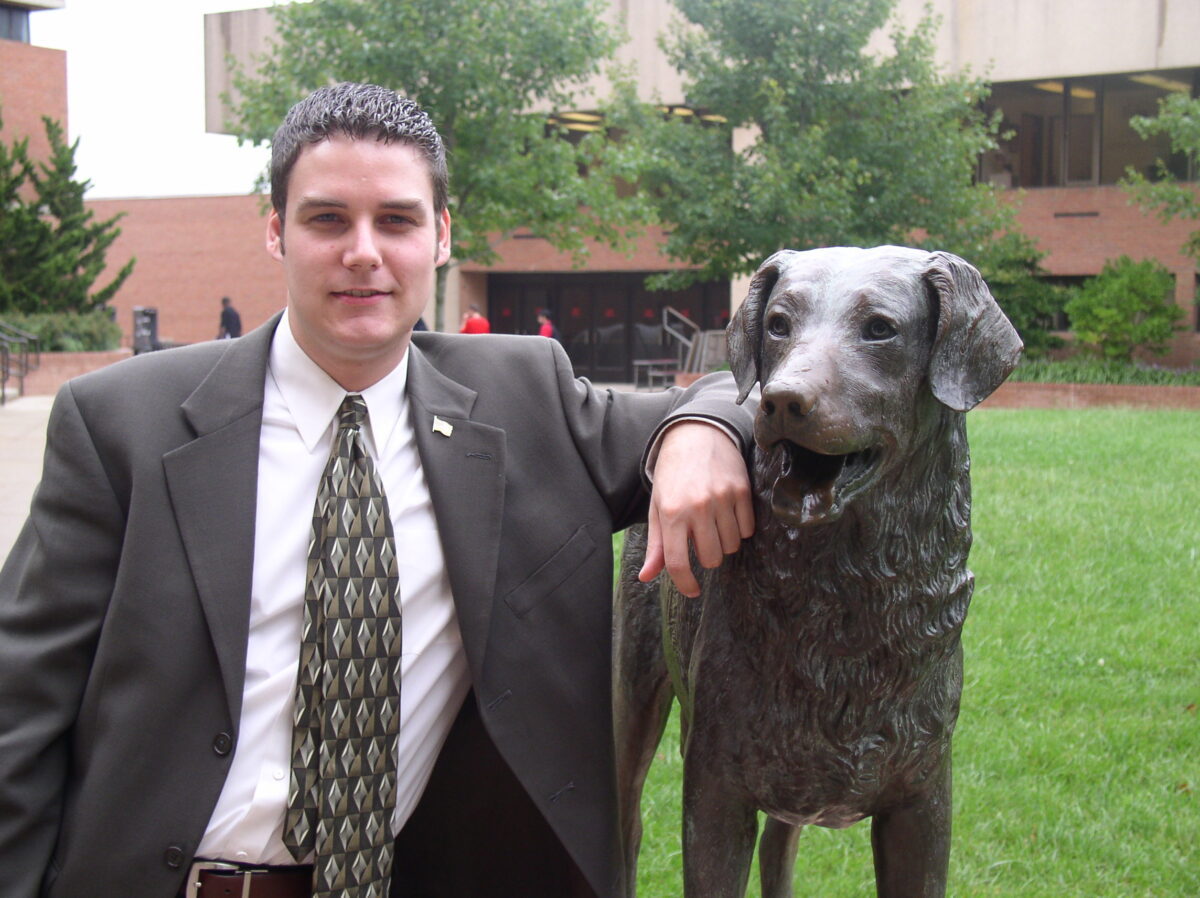 Shockley poses with True Grit in November 2003 after being name student regent. Photo courtesy of Shockley.
Q: What did you love most about your programs of study?
A: My academic programs were varied and each fulfilled me in very different ways. The information systems management program tapped into my love of technology while solidifying the importance of a plan and process—key traits that would serve me well in both my career and my life. The political science program nurtured my interest in politics and government. It showed me how government can truly be a force for good.
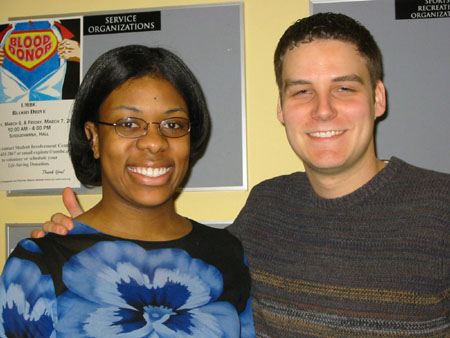 Shockley and fellow SGA officer Ada Orie in The Commons, 2003. Photo courtesy of Shockley.
Q: Were there any ways that UMBC particularly helped support you as a student?
A: I was incredibly fortunate that after enrolling at UMBC, I was offered the opportunity to compete against a small group of students for one of two full scholarships through a new gift to the school by the T. Rowe Price Foundation. I never imagined I’d get selected and with it came the opportunity for a summer internship. For a kid raised in rural Maryland on a farm, it was quite an experience. Growing up, I was most certainly not the popular kid. I had poofy hair, big glasses, and braces at a young age. Not to mention, I was laser-focused on my studies and was not blessed with any athletic ability. In high school, I ran each year for student government positions to no avail. UMBC was first place I truly felt like I was given the opportunity to try my leadership skills and mentored by others to grow and develop them.
This growth led to an introduction to John Erickson, founder of Erickson Retirement Communities (now Erickson Senior Living) by former UMBC President Dr. Freeman Hrabowski. Erickson was working on instituting information technology products throughout their healthcare business which was ahead of the time for the industry, and were looking for those majoring in these fields. I never though I’d work for a company whose focus was senior housing and healthcare, but John was charming and persuasive. Dr. Hrabowski spoke very highly of his commitment to UMBC through his many gifts to help build new residence halls on campus. This introduction turned into a career that gave me a deep sense of meaning knowing that I was able to help older adults continue to live a life of significance, as they aged, that was valued up until the very end. John was instrumental in providing support and guidance as I branched out within the company and relocated to several different locations around the country for new opportunities.
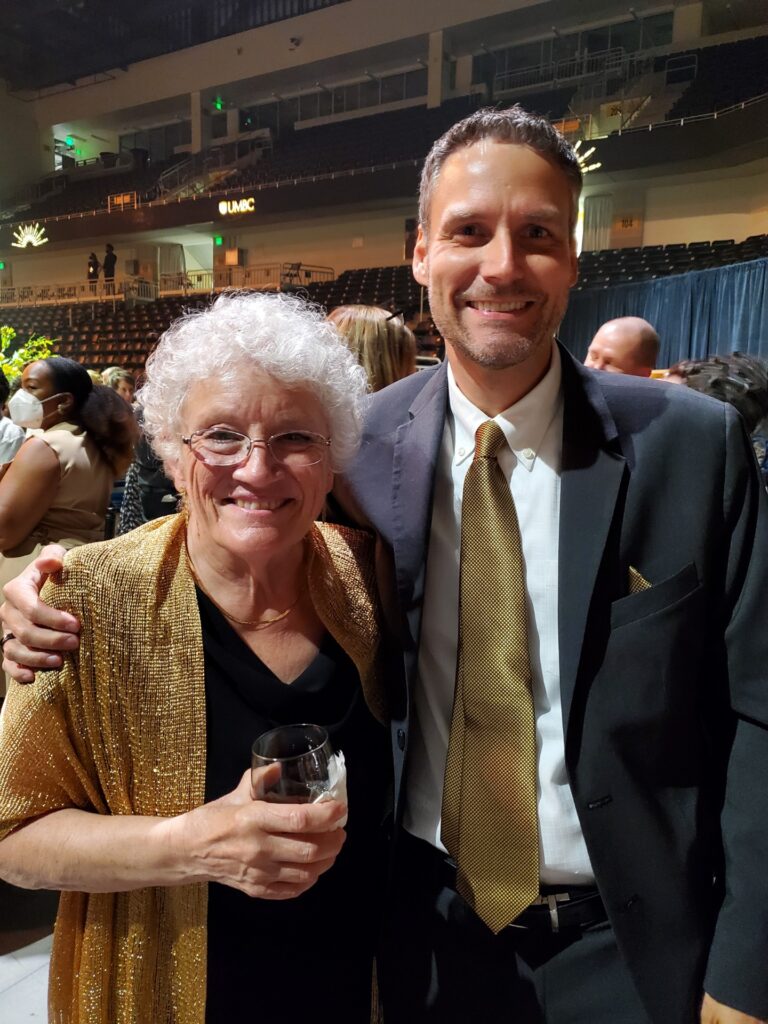
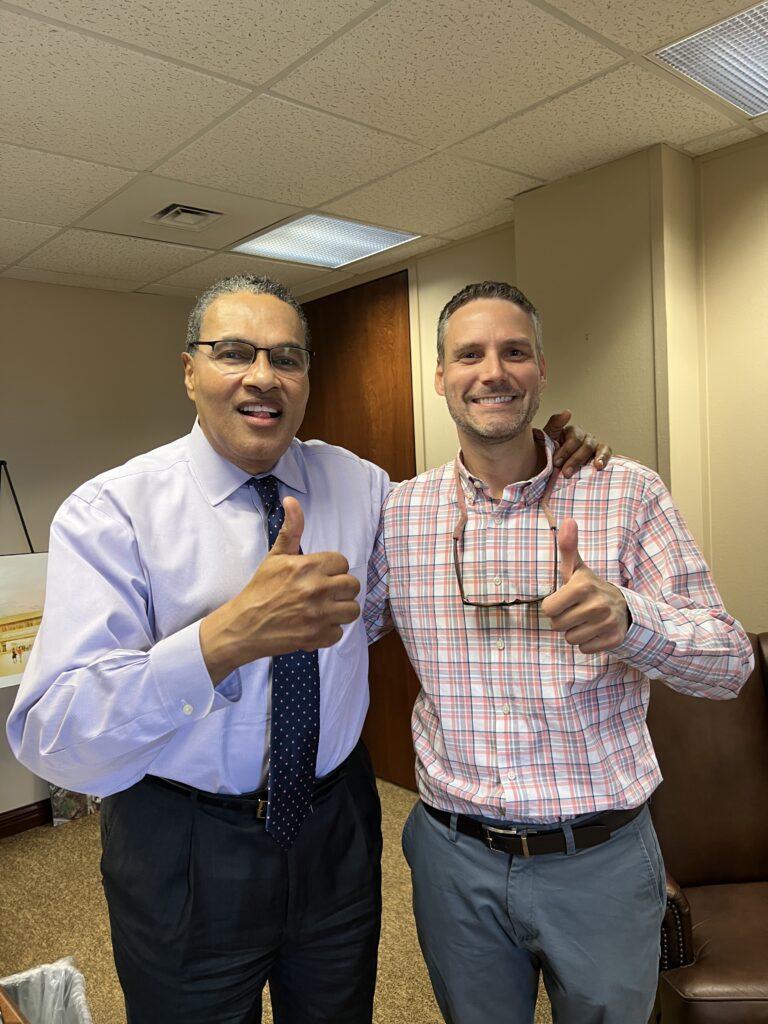 At left, Shockley with retired Vice Provost and Dean of Undergraduate Education Diane Lee. At right, Shockley with President Emeritus Freeman Hrabowski. Photos courtesy of Shockley.
Q: Why did you choose UMBC for your philanthropy?
A: My sister and I were the first to go to college and I wanted others to be able to have that experience, too. We were very fortunate in that the financial cost was not an obstacle to either of us being able to pursue our dreams. I never considered not going to college—that was just the plan from an early age and it was clear that’s what my family was going to make happen if it was what I wanted and I had the aptitude.
UMBC will always have a deeply special place in my heart. From the moment I first stepped onto campus, I remember the incredible feelings of being welcomed to UMBC. There was such excitement and energy and I wanted to be a part of it. As a freshman, I worked in the Office of Institutional Advancement (OIA) for some of the same folks that partner with me today in giving back. The varied experiences I had as a student worker in OIA opened my eyes to the importance of alumni engagement and giving. As my time at UMBC progressed, I found myself very involved in both on and off campus leadership activities that I could never have imaged. One of my proudest moments was being able to serve as the student regent on the University System of Maryland’s (USM) Board of Regents, a Gubernatorial appointment. Being able to make a difference on behalf of all the students that made up the USM was an honor. Through my gifts, I want to provide opportunities for students, particularly from the Lower Eastern Shore of Maryland, to be able to attend UMBC and explore the plethora of opportunities open to them.
I started and continue to support the Shockley Family Scholarship in honor of my parents, David and Sandra Shockley. I intend to start an additional scholarship for my maternal grandparents, Sam and Bertha Rothenstein, in the future.
Q: What’s one thing you’d want folks to know about UMBC?
A: Anyone and everyone is welcome. No matter your background or where you were raised, UMBC will support, nurture, and help you share your gifts with the community as a whole. It is this diversity of individuals, experiences, and talents that make the university such a remarkable place.
* * * * *
UMBC’s greatest strength is its people. When people meet Retrievers and hear about the passion they bring, the relationships they create, the ways they support each other, and the commitment they have to inclusive excellence, they truly get a sense of our community. That’s what “Meet a Retriever” is all about.
Learn more about how UMBC can help you achieve your goals.
]]>
Meet UMBC Retriever Phil Shockley ’04, political science and information systems, M.P.P. ’09. As an undergraduate, he was Student Government Association president and took part in leadership roles...
https://umbc.edu/stories/meet-a-retriever-phil-shockley-04-m-p-p-09/
https://my3.my.umbc.edu/api/v0/pixel/news/129349/guest@my.umbc.edu/a76d87ae7329daf8a5828cca15ae9aad/api/pixel
impact
information-systems
magazine
meet-a-retriever
perspectives
politicalscience
publicpolicy
sga
UMBC News & Magazine
https://my3.my.umbc.edu/groups/umbc-news-magazine
https://assets1-my.umbc.edu/system/shared/avatars/groups/000/001/943/24435aa6207c452e7bc15cc74b42c7bb/xsmall.png?1748556657
https://assets1-my.umbc.edu/system/shared/avatars/groups/000/001/943/24435aa6207c452e7bc15cc74b42c7bb/original.png?1748556657
https://assets2-my.umbc.edu/system/shared/avatars/groups/000/001/943/24435aa6207c452e7bc15cc74b42c7bb/xxlarge.png?1748556657
https://assets2-my.umbc.edu/system/shared/avatars/groups/000/001/943/24435aa6207c452e7bc15cc74b42c7bb/xlarge.png?1748556657
https://assets3-my.umbc.edu/system/shared/avatars/groups/000/001/943/24435aa6207c452e7bc15cc74b42c7bb/large.png?1748556657
https://assets1-my.umbc.edu/system/shared/avatars/groups/000/001/943/24435aa6207c452e7bc15cc74b42c7bb/medium.png?1748556657
https://assets2-my.umbc.edu/system/shared/avatars/groups/000/001/943/24435aa6207c452e7bc15cc74b42c7bb/small.png?1748556657
https://assets1-my.umbc.edu/system/shared/avatars/groups/000/001/943/24435aa6207c452e7bc15cc74b42c7bb/xsmall.png?1748556657
https://assets2-my.umbc.edu/system/shared/avatars/groups/000/001/943/24435aa6207c452e7bc15cc74b42c7bb/xxsmall.png?1748556657
UMBC News & Magazine
0
0
false
Thu, 17 Nov 2022 15:38:37 -0500
Thu, 17 Nov 2022 15:38:37 -0500
UMBC chemical engineering students win ChemE Jeopardy national championship
UMBC is again a national champion, now in ChemE Jeopardy. A UMBC student team of chemical engineering majors emerged victorious last weekend at the national competition in Phoenix, Arizona, hosted by the American Institute of Chemical Engineers (AIChE), besting fellow finalists University of Iowa and University of Southern California.
This was a long-sought victory for the team, which won second place in both 2020 and 2021, narrowly missing the title. This ascent is particularly remarkable considering that UMBC only began competing in 2019.
The ChemE Jeopardy competition experience
Members of the 2022 national champion team include Catherine Wraback ’23, president of the UMBC chapter of AIChE; Max Bobbin ’23, vice president of the group; Colin Jones ’25; and Pavan Umashankar ’24. Supporting the team are Jeopardy Chair Taylor DeSilva ‘23, chemical engineering, and AIChE chapter advisor Mariajosé Castellanos, undergraduate program director and principal lecturer in chemical biochemical, and environmental engineering (CBEE).
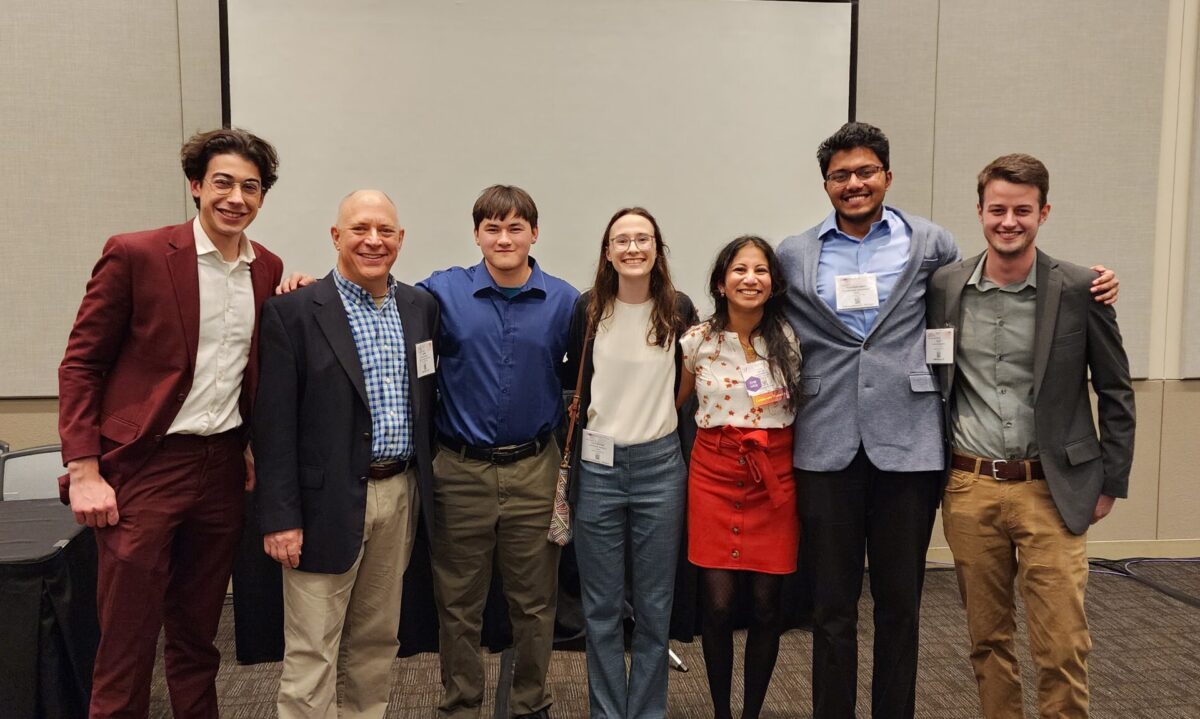 UMBC’s Chemical Engineering Jeopardy National Championship team and supporters (l-r): Max Bobbin, CBEE Professor and Chair Mark Marten, Colin Jones, Catherine Wraback, Lecturer Neha Raikar (team advisor), Pavan Umashankar, and Alex Von Gunten ’20, chemical engineering (prior team member). (Image courtesy of CBEE)
“This was my first time attending the national competition,” says Wraback. “Walking into the room and seeing three tables set-up (one for each team) with all the buzzers and scratch paper and pencil, was an unparalleled feeling.” Wraback explains that each competition board consists of six categories, drawing from core engineering courses (such as thermodynamics and heat and mass transfer), general science and math (such as organic chemistry and linear algebra), and general knowledge.
“You can feel the energy in the room with the other teams and it is contagious,” she says. In particular, she appreciated the support her team had in the packed competition room, from UMBC faculty to students she had met at the conference who came with their classmates to cheer for the team.
And UMBC students who couldn’t join them in Phoenix were supporting them through well wishes in their Discord server. “It made us feel supported and empowered,” says Wraback.
Road to the finals
“The students practiced extensively in preparation for the finals,” says team advisor Neha Raikar, lecturer in CBEE. This included not just studying technical content, but also building trust, bonding as a team, and prioritizing communication with each other.
“The team is well-balanced,” Raikar notes. “Members range from second-year students to seniors, representing all three CBEE tracks: traditional, biotechnology and bioengineering, and environmental engineering and sustainability. They play to each other’s strengths.”
Wraback agrees, sharing, “The most challenging part of being on the team has been understanding that it is okay not to know everything. I never want to let any of my team members down, but I also know that we all have our unique strengths, which overall makes us an incredibly strong team.”
That team’s sense of connection came through in the final round of competition. “As the answers were revealed, we found out we were the only team to get the question right so it really came down to the wagers we put,” Wraback recalls.
“I remember grabbing the hands of my teammates as we waited for the wagers to be revealed,” she says. “In an instant we saw the final scores and that we won by 200 points—such a close game. We all cheered and screamed and were just in absolute shock. It was so exciting, especially since we have been working so hard for this for so long.”
Making a name for themselves
On the path to victory, UMBC at one point bested Virginia Tech with a score of 7,100 to 63. “We compete against top schools at both regional and national levels, which shows the strength of UMBC’s chemical engineering program and our students’ fighting spirit,” says Raikar. “Even though we are a relatively small department, we pose a challenge to bigger schools.”
That’s in large part thanks to UMBC’s supportive community, says Wraback, who, after graduation, will help develop next-generation flight technology and aerospace systems at GE Aerospace, while also pursuing a master’s degree in materials science and engineering. She notes, “I truly believe that behind every successful person and team there is a community that is lifting them up and supporting them.”
In just a few years of national competition, the team has already made a name for itself. The competition’s organizing committee projected UMBC to be a finalist, and other universities are now reaching out to collaborate.
]]>
UMBC is again a national champion, now in ChemE Jeopardy. A UMBC student team of chemical engineering majors emerged victorious last weekend at the national competition in Phoenix, Arizona, hosted...
https://umbc.edu/stories/umbc-chemical-engineering-students-win-cheme-jeopardy-national-championship/
https://my3.my.umbc.edu/api/v0/pixel/news/129275/guest@my.umbc.edu/57814825f9301be8f2856a1608d66a32/api/pixel
cbee
coeit
news
science-and-tech
UMBC News & Magazine
https://my3.my.umbc.edu/groups/umbc-news-magazine
https://assets1-my.umbc.edu/system/shared/avatars/groups/000/001/943/24435aa6207c452e7bc15cc74b42c7bb/xsmall.png?1748556657
https://assets1-my.umbc.edu/system/shared/avatars/groups/000/001/943/24435aa6207c452e7bc15cc74b42c7bb/original.png?1748556657
https://assets2-my.umbc.edu/system/shared/avatars/groups/000/001/943/24435aa6207c452e7bc15cc74b42c7bb/xxlarge.png?1748556657
https://assets2-my.umbc.edu/system/shared/avatars/groups/000/001/943/24435aa6207c452e7bc15cc74b42c7bb/xlarge.png?1748556657
https://assets3-my.umbc.edu/system/shared/avatars/groups/000/001/943/24435aa6207c452e7bc15cc74b42c7bb/large.png?1748556657
https://assets1-my.umbc.edu/system/shared/avatars/groups/000/001/943/24435aa6207c452e7bc15cc74b42c7bb/medium.png?1748556657
https://assets2-my.umbc.edu/system/shared/avatars/groups/000/001/943/24435aa6207c452e7bc15cc74b42c7bb/small.png?1748556657
https://assets1-my.umbc.edu/system/shared/avatars/groups/000/001/943/24435aa6207c452e7bc15cc74b42c7bb/xsmall.png?1748556657
https://assets2-my.umbc.edu/system/shared/avatars/groups/000/001/943/24435aa6207c452e7bc15cc74b42c7bb/xxsmall.png?1748556657
UMBC News & Magazine
0
0
false
Thu, 17 Nov 2022 10:15:50 -0500
Thu, 17 Nov 2022 10:15:50 -0500
Influx of students from India drives US college enrollment up, but the number of students from China is down

David L. Di Maria, Associate Vice Provost for International Education, UMBC.
India is up. China is down. Very few U.S. students studied abroad during the first year of the pandemic.
Those three points, in a nutshell, represent key findings from recent data released jointly on Nov. 14, 2022, by the U.S. Department of State and the Institute of International Education.
The “Open Doors Report on International Educational Exchange” is published each year at the start of International Education Week. It provides detailed insights regarding study abroad and international students.
Rise in virtual study abroad
This year’s report shows a 91% decline in the total number of U.S. students who studied abroad during the 2020-2021 academic year. The pandemic also led colleges to develop more online global learning opportunities. In fact, 62% of colleges offered virtual internships with multinational companies, collaborative online coursework with students abroad and other experiences.
While virtual learning cannot replace the immersive experiences of study abroad, it can expand access to other cultures and international perspectives for greater numbers of students. For this reason, technology is likely to continue to serve as a key part of international education programming.
Number of international students grows in the US
While the COVID-19 pandemic contributed to a 45.6% decline in new international students in 2020, the latest data, covering the 2021-2022 academic year, indicates that the total number of international students in the U.S. – 948,519 – has started to recover. This can be seen in a 3.8% increase over the 914,095 international students in the U.S. in 2020. Still, the number is well below the nearly 1.1 million international students reported in 2018. Much of the recent growth is driven by an increase in the number of new international students – 261,961 – which is up 80% over the 145,528 from 2020 but still 2.14% below the 267,712 from 2019.
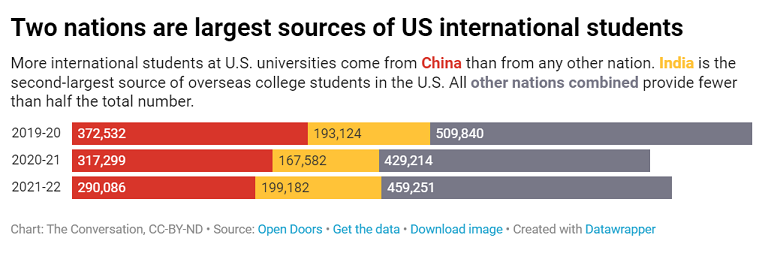
Students from China and India comprise more than half – 52% – of all international students. That isn’t anything new, but what is noteworthy is that during the 2021-2022 academic year, Chinese student enrollment fell 9% and the number of Indian students increased by 19% over the prior year. This has big implications for international diversity at U.S. colleges. This is because Chinese students tend to enroll in a range of majors, while most Indian students – 66.4% – study in just a handful of programs: engineering, math and computer science.
Souring relations with China
Over the past decade, U.S. colleges enrolled more students from China than from any other country. While the onset of the global pandemic effectively halted travel between China and the U.S. due to flight restrictions and widespread lockdowns, the decline in Chinese enrollment began years earlier.
Contributing factors include Chinese parents’ concerns for their children’s safety in the U.S., development of China’s own world-class universities and souring relations between the two countries, which has spilled over into the higher education sector. In fact, in 2019, China’s Ministry of Education warned students against studying in the U.S. due to the risk of encountering visa problems.
College and careers draw many out of India
China and India each have around 1.4 billion people, but by 2023 the United Nations predicts that India will overtake China as the world’s most populous country. This continued growth will further strain India’s higher education system, leading to more students pursuing advanced degrees abroad. At the same time, poor job prospects at home are driving many Indian students to pursue academic and career pathways that lead away from India. This is especially true in high-paying, high-growth fields like computers and information technology.
Other contributing factors to the increase from India include a change in tone on the part of the U.S. government. The Biden administration is working to reestablish the U.S. as a welcoming destination for international students by enacting reversals of Trump-era immigration policies. Those policies caused uncertainty and fear among international students. The Biden administration has also prioritized the processing of student visas in India.
Looking forward
The Institute of International Education also released data from a Fall 2022 Snapshot Survey, which includes responses from more than 600 U.S. colleges and universities. The findings point to a 7% increase in new international students enrolled.
While the U.S. Department of State continues to prioritize student visas in India by adding more staff and streamlining the process, Chinese visa approvals are trending lower than in years past, although it’s difficult to pinpoint a single factor as to why. A further decline in Chinese students presents major challenges for the U.S., its colleges and the communities in which they are based. This is because in addition to the US$32 billion that international students collectively contribute to the U.S. economy, the friendships and cultural insights that they develop while studying at local colleges serve to promote U.S. foreign policy in the form of positive relations between the U.S. and other countries.
As the number of U.S. college students is projected to decline across much of the country, college recruiters will increase outreach to international students in order to fill empty seats. However, whether international student recruitment alone can fill those empty seats is yet to be seen.
This article is republished from The Conversation under a Creative Commons license. Read the original article.
]]>
David L. Di Maria, Associate Vice Provost for International Education, UMBC. India is up. China is down. Very few U.S. students studied abroad during the first year of the pandemic....
https://umbc.edu/stories/influx-of-students-from-india-drives-us-college-enrollment-up-but-the-number-of-students-from-china-is-down/
https://my3.my.umbc.edu/api/v0/pixel/news/129206/guest@my.umbc.edu/e71631cacd89674c2154794547b75216/api/pixel
admissions
cge
discovery
international-education-services
magazine
study-abroad
UMBC News & Magazine
https://my3.my.umbc.edu/groups/umbc-news-magazine
https://assets1-my.umbc.edu/system/shared/avatars/groups/000/001/943/24435aa6207c452e7bc15cc74b42c7bb/xsmall.png?1748556657
https://assets1-my.umbc.edu/system/shared/avatars/groups/000/001/943/24435aa6207c452e7bc15cc74b42c7bb/original.png?1748556657
https://assets2-my.umbc.edu/system/shared/avatars/groups/000/001/943/24435aa6207c452e7bc15cc74b42c7bb/xxlarge.png?1748556657
https://assets2-my.umbc.edu/system/shared/avatars/groups/000/001/943/24435aa6207c452e7bc15cc74b42c7bb/xlarge.png?1748556657
https://assets3-my.umbc.edu/system/shared/avatars/groups/000/001/943/24435aa6207c452e7bc15cc74b42c7bb/large.png?1748556657
https://assets1-my.umbc.edu/system/shared/avatars/groups/000/001/943/24435aa6207c452e7bc15cc74b42c7bb/medium.png?1748556657
https://assets2-my.umbc.edu/system/shared/avatars/groups/000/001/943/24435aa6207c452e7bc15cc74b42c7bb/small.png?1748556657
https://assets1-my.umbc.edu/system/shared/avatars/groups/000/001/943/24435aa6207c452e7bc15cc74b42c7bb/xsmall.png?1748556657
https://assets2-my.umbc.edu/system/shared/avatars/groups/000/001/943/24435aa6207c452e7bc15cc74b42c7bb/xxsmall.png?1748556657
UMBC News & Magazine
0
0
false
Tue, 15 Nov 2022 12:10:08 -0500
Tue, 15 Nov 2022 12:10:08 -0500