Historical Lens: Preserving the photography of social documentarian Lewis Hine

The photographer Lewis Hine secured a place in history as a documentarian of early 20th century life, including a transformational investigation into the conditions for child laborers.
From 1908 through 1930, Hine worked closely with the National Child Labor Committee (NCLC), an organization devoted to preventing the exploitation of children in the workplace. Hine criss-crossed the U.S., creating portraits of a diverse array of children working in fields and factories.
Hine’s body of work was revelatory and immensely impactful in the efforts to implement child labor laws in U.S., and continues to be a relevant resource for researchers working in the intersections of art, history, politics, and more.
For nearly 50 years, UMBC Special Collections has been the caretaker of the Lewis Hine Collection, comprising some 5,400 photographs taken by Hine during his career. This year, the Special Collections team at UMBC’s Albin O. Kuhn Library received a Preservation Assistance Grant from the National Endowment for the Humanities to support conservation of this groundbreaking collection.
“Our set is particularly important because it’s an almost complete collection of the photographs Hine made for the NCLC. It is very rare to have this incredible collection as a whole body,” says Beth Saunders, head of special collections. “It’s one of our most important and most used collections, and it was in immediate danger.”

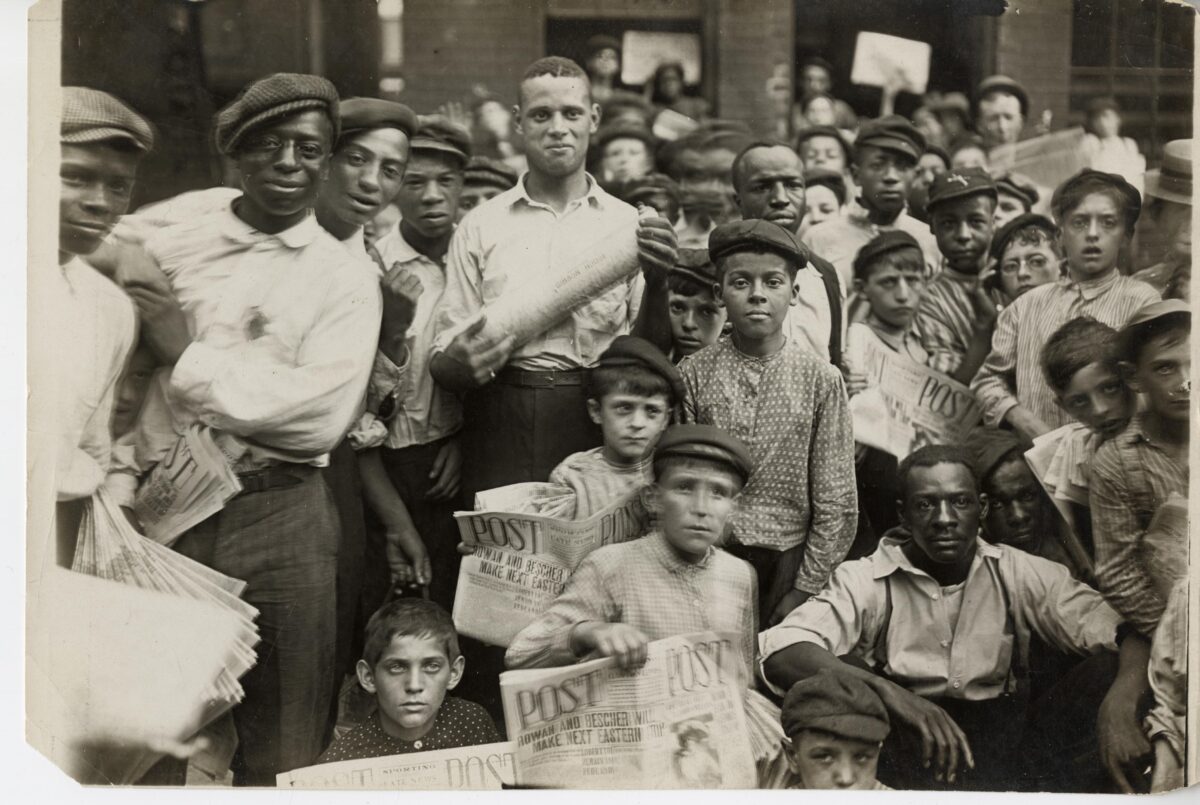 At left: Lewis Hine, Pupil in Pleasant Green School, Pocahontas Co., Pocahontas County, Marlinton, West Virginia, 1921. 5 x 7 in. The Photography Collections, University of Maryland, Baltimore County (P1050) At right: Lewis Hine, Newsboys and Supply Men Waiting At Newspaper Office For Base-Ball Edition, Cincinnati, Ohio, 1908. 5 x 7 in. The Photography Collections, University of Maryland, Baltimore County (P3)
Preserving the work of Lewis Hine
For many decades, the photographs in the collection were protected in envelopes, held in place with adhesive strips. With age, the adhesive has begun to deteriorate, putting the collection at risk.
“If the glue migrates and the photographs are stuck, you have the risk of tearing, discoloration, all the terrible things,” Saunders says. “They’re not mounted, so the versos—the backs—are visible. All of the original inscriptions, notations by Hine or other folks at NCLC, extended captions, those are all intact.”
Part of the current preservation effort will include photographing the detail written on the backs of the photographs, which have until now never been officially digitized.
“It was an opportunity to record the versos of the photographs. We needed to build a new overhead camera setup, and we’re very grateful that Melissa Cormier [M.F.A. ’17] with UMBC’s office of Research Graphics helped us to get that going,” says Saunders, who notes that while the behind-the-scenes work of preservation is unglamorous, the work requires a dedicated multidisciplinary team across the university community.
“My colleagues, Lindsey Loeper [’04] and Susan Graham [’98] have just written an essay about the teaching exercises that they’ve developed out of the Hine collections,” Saunders says. “Lindsey runs our instruction program, and Susan is the mastermind of this project. She’s been the one troubleshooting, setting the standards, and training everybody to do the work.”
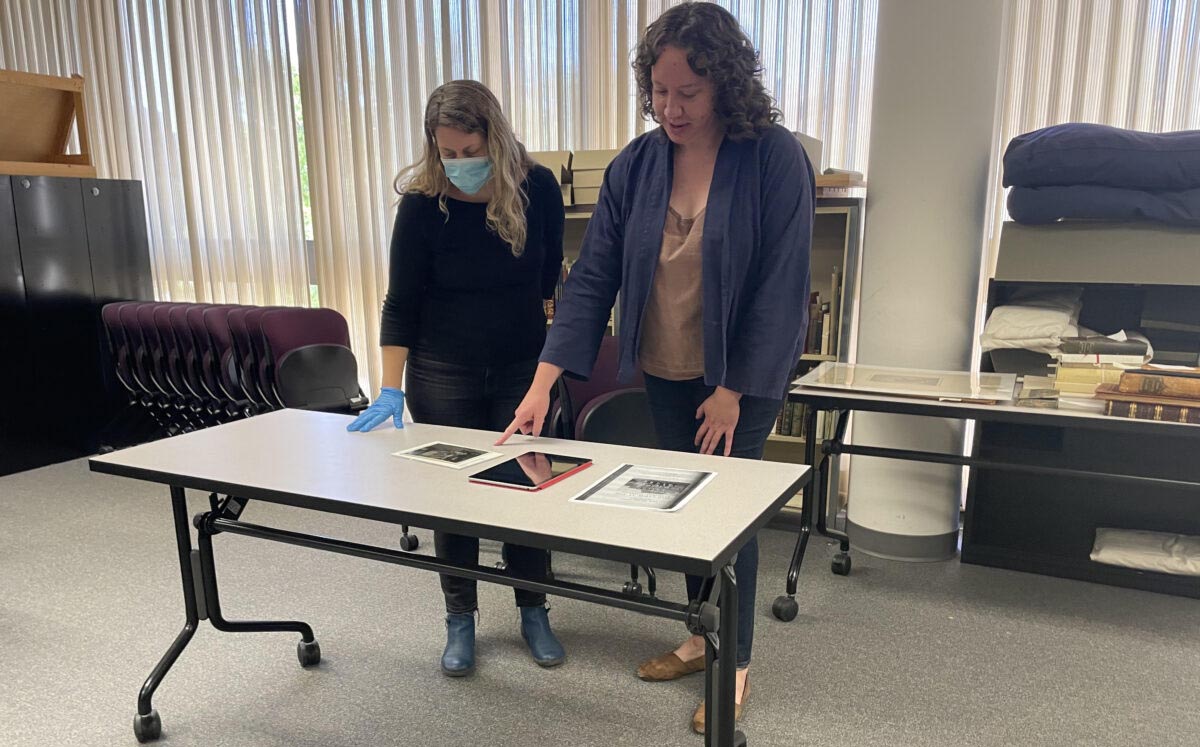 Special Collections staff Susan Graham ’98 and Lindsey Loeper ’04 share pieces of the Lewis Hine collection with students.
Learning from our past
Meredith Power, a graduate student in UMBC’s historical studies program who has been interning with the preservation project, notes the power Hine’s images still possess.
“Some are heartbreaking, some are thought-provoking, while others made me stop short and smile as I pulled them from their storage folder to photograph them,” Power says. “From the bright, sad eyes of the young boys who spent their days underground opening and closing gates inside coal mines, to the cheerful joy on the face of a girl who sold eggs as she hugs her beloved hen, the collection still manages to evoke an emotional response. It’s that emotional connection, the shared sense of experiencing something.”
Next year, the Special Collections department will celebrate its 50th anniversary. The Hine collection was among the inaugural collections for UMBC’s Special Collections, leading in turn to a specific focus on photography in the collection.
In 1974, the Hine collection was acquired by the then new Special Collections program from the NCLC, facilitated by former Library Director Antonio Raimo and Jerry Stephany, a photographer in the visual arts department who had once worked at the George Eastman Museum in Rochester.
“Jerry really saw the importance of a teaching collection of photography,” says Saunders. “The idea behind collecting this particular body of work was to show photography’s relationship to a variety of social issues and the way that photography can be used as a tool of visual communication across disciplines.”
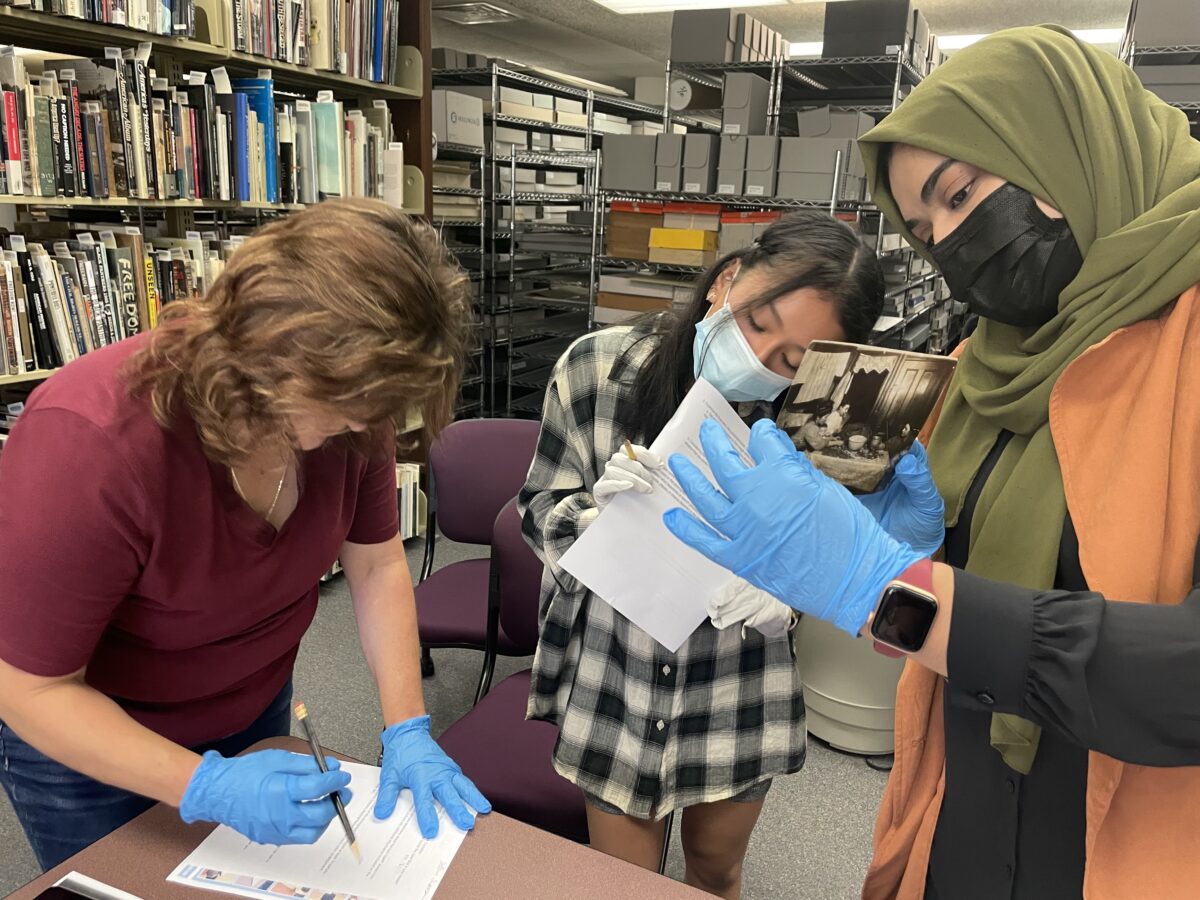
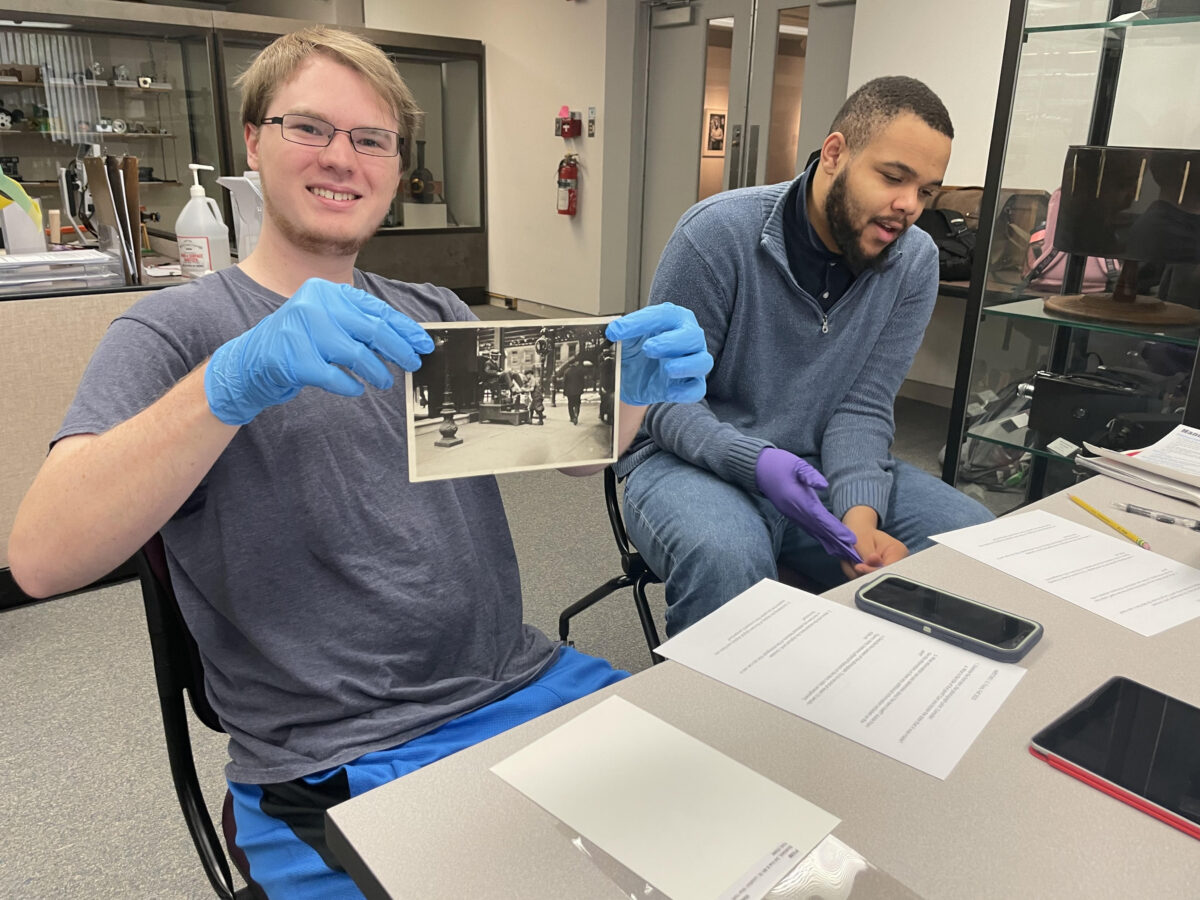 Students in Sarah Fouts’ Approaches to American Studies AMST300 class take part in an activity where student look at the same/similar photographs in a book, in the digital collections, and then the original photo print, and the features and contextual information available with each format. At left (L-R): Hellen Swanson, Sissi Castro, and Fairuaz Mukarama. At right (L-R): Kyle Warfield and Edward Robinson. Photos courtesy of Sarah Fouts.
Power, who is currently working towards an M.A. in UMBC’s historical studies program, researching solitary fourteenth-century religious Englishwomen, notes the interdisciplinary power of the Hine collection and the need to preserve it.
“On the surface, photographs of early twentieth century American child laborers have very little in common with my own academic research,” Power says. “However, as we’ve all learned since COVID-19’s arrival, physical access to research or archival material is sometimes impossible. In those cases, digitized resources and online information about them are invaluable. This is just as true for materials related to medieval religious history as it is for those who are looking into U.S. child labor reform.”
 Lewis Hine, Anaemic Little Spinner in North Pownal Cotton Mill, Vermont, 1910. Gelatin silver print, 5 x 7 in. The Photography Collections, University of Maryland, Baltimore County (P1050)
A shared history
Today, UMBC Special Collections holds an estimated three million photographs stretching back to 1840, including the Baltimore Sun archive.
“There is a strong emphasis on documentary photography, which kind of came out of the Hine collection,” says Saunders. “We’re also particularly strong in Maryland history, including the Maryland Traditions archive, the state folklore archive.”
Additionally, Special Collections holds the collection of radical literature from the Alternative Press Center, an extensive collection of historic science fiction, the UMBC archive, and the new Eileen J. Garret Parapsychology Foundation Collection.
]]>
The photographer Lewis Hine secured a place in history as a documentarian of early 20th century life, including a transformational investigation into the conditions for child laborers. From...
https://umbc.edu/stories/preserving-the-photography-of-lewis-hine/
https://my3.my.umbc.edu/api/v0/pixel/news/129185/guest@my.umbc.edu/a1f21e61816717034b9fcac1000f4415/api/pixel
albin-o-kuhn-library-and-gallery
arts-and-culture
cahss
discovery
graduateschool
historical-studies
lewis-hine
magazine
news
special-collections
UMBC News & Magazine
https://my3.my.umbc.edu/groups/umbc-news-magazine
https://assets1-my.umbc.edu/system/shared/avatars/groups/000/001/943/24435aa6207c452e7bc15cc74b42c7bb/xsmall.png?1748556657
https://assets1-my.umbc.edu/system/shared/avatars/groups/000/001/943/24435aa6207c452e7bc15cc74b42c7bb/original.png?1748556657
https://assets2-my.umbc.edu/system/shared/avatars/groups/000/001/943/24435aa6207c452e7bc15cc74b42c7bb/xxlarge.png?1748556657
https://assets2-my.umbc.edu/system/shared/avatars/groups/000/001/943/24435aa6207c452e7bc15cc74b42c7bb/xlarge.png?1748556657
https://assets3-my.umbc.edu/system/shared/avatars/groups/000/001/943/24435aa6207c452e7bc15cc74b42c7bb/large.png?1748556657
https://assets1-my.umbc.edu/system/shared/avatars/groups/000/001/943/24435aa6207c452e7bc15cc74b42c7bb/medium.png?1748556657
https://assets2-my.umbc.edu/system/shared/avatars/groups/000/001/943/24435aa6207c452e7bc15cc74b42c7bb/small.png?1748556657
https://assets1-my.umbc.edu/system/shared/avatars/groups/000/001/943/24435aa6207c452e7bc15cc74b42c7bb/xsmall.png?1748556657
https://assets2-my.umbc.edu/system/shared/avatars/groups/000/001/943/24435aa6207c452e7bc15cc74b42c7bb/xxsmall.png?1748556657
UMBC News & Magazine
2
0
false
Mon, 14 Nov 2022 15:22:11 -0500
Mon, 14 Nov 2022 15:22:11 -0500
Voting Is an Everyday Practice
Today, millions of college students across the country are voting. Other students are not voting—they might be discouraged that their voice can make a difference, uninformed about their voting rights, or just unengaged with the political process.
In a conversation facilitated by UMBC Magazine, Musa Jafri ’24, political science, SGA director of civic engagement, Sunil Dasgupta, professor of political science, and founder and host of the podcast “I Hate Politics,” and David Hoffman, Ph.D. ’13, language, literacy, and culture, the director of UMBC’s Center for Democracy and Civic Life, discuss the vital democratic process—on campus and off—and the daily practice of voting.
“Voting is about you taking a stand and stating, ‘I’m here, I matter, I exist, and I have a voice.’ It’s a form of resistance, a way to try to change the climate you find yourself in.” says Jafri,co-chair of the University System of Maryland Student Civic Leaders Committee.
“I don’t understand how democracy became compartmentalized to something that happens every four years. Voting is the culmination of the work that we have done for the past four years between the time we last voted and now,” says Dasgupta. “Voting is a moment of celebration. A moment where we find out whether the work we did in between votes really mattered. There is no other way to think about democracy. Voting is what we do every day.”
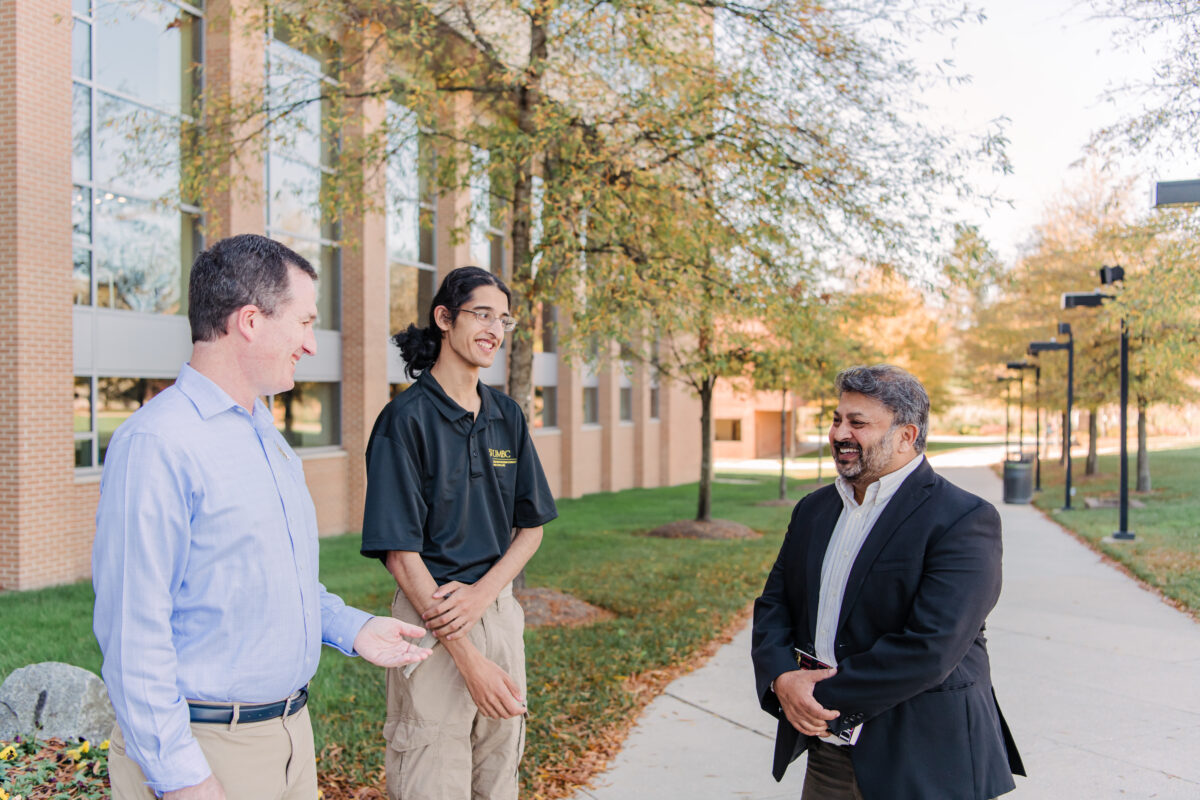 Hoffman, Jafri, and Dasgupta. (Marlayna Demond ’11/UMBC)
Dasgupta: From my way of thinking, a university campus can be very different than society at large. What is the difference and how does that manifest in civic life, on campus, and in communities? How do we navigate those differences?
Hoffman: In our broader culture, we speak too easily of universities as separate from the rest of society: as ivory towers where students are being prepared for the ‘real world.’ The reality is that universities are life. Students are alive right now and they are part of many communities within and beyond the university. What happens here matters to the lives of everyone at UMBC and the communities they are part of.
Jafri: I agree. There are many instances where the university and local community needs overlap. Recently, some UMBC students organized an event where we invited the Catonsville and Arbutus communities to meet the candidates in our district. By including these two communities we realized that we had similar concerns including education, clean water, and environmental protection.
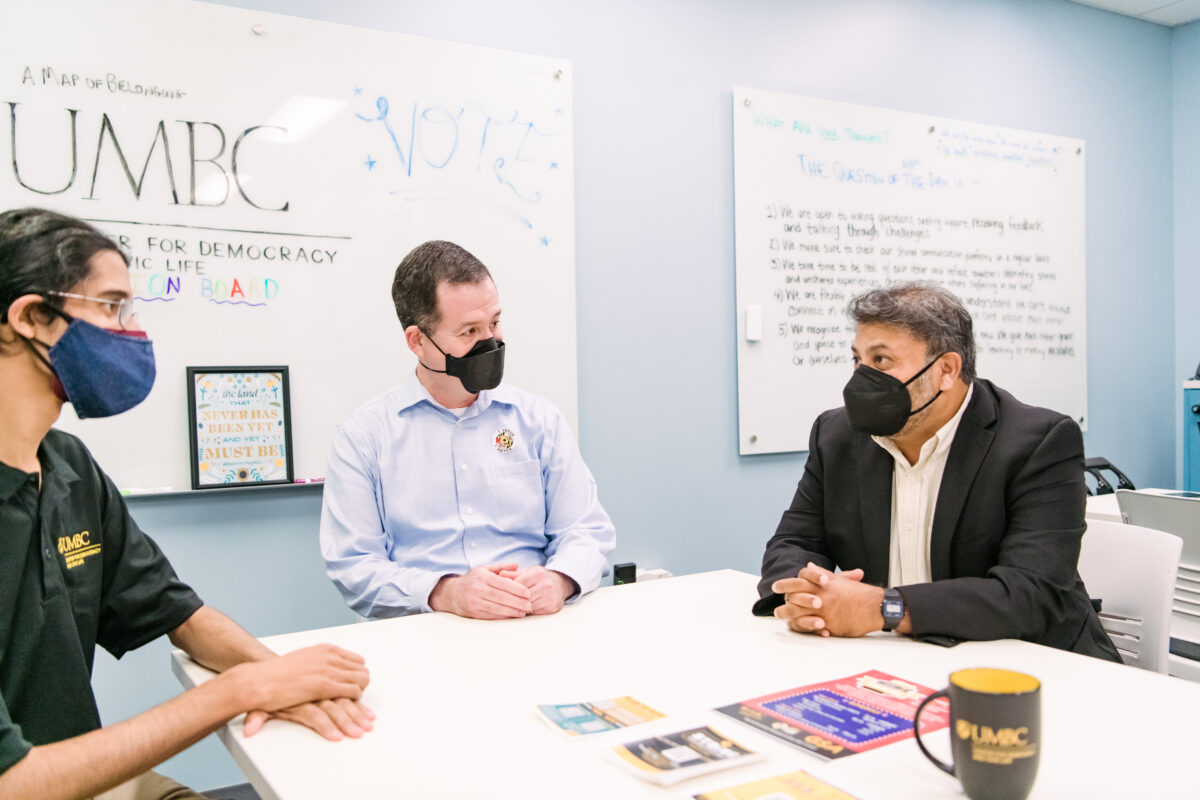 Jafri, Hoffman, and Dasgupta in the Center for Democracy and Civic Life. (Marlayna Demond ’11/UMBC)
Jafri: My generation is very politically active when it comes to voting and getting out to the polls. But with the plethora of social media platforms and news outlets how can students ensure they are getting valid and factual news?
Dasgupta: Let me be a professor and say there is more reading to be done. If your news derives from digital platforms, these platforms are algorithmic with a selection bias problem that is not your selection bias problem. You are essentially hostage to their selection bias. The way you have to overcome this is to move beyond one or two or even three sources of news. What all of us need to do is a triangulation between you and multiple sources. That takes work. Social media won’t replace in-person organizing or knocking on doors. On the other hand, organizing alone can be more effective with social media’s reach. The combination is necessary. At the risk of saying go do more work, I do think we have to understand that choosing one approach is not sufficient.
Hoffman: A part of what happens when you get involved in on-the-ground organizing is that you become better able to discern the plausibility of claims that you might encounter online. You become a better evaluator of the information you are receiving. One of the premises of Center for Democracy and Civic Life’s work is that democracy is not just a form of government, it’s not just politics and elections, it is a way of life that can be enacted in everyday settings. Ideally, people vote because they are so thoroughly engaged with the issues in their community and nation and understand them so well that voting is an obvious way to contribute. It’s one facet of how we shape our collective future, but far from the only one.
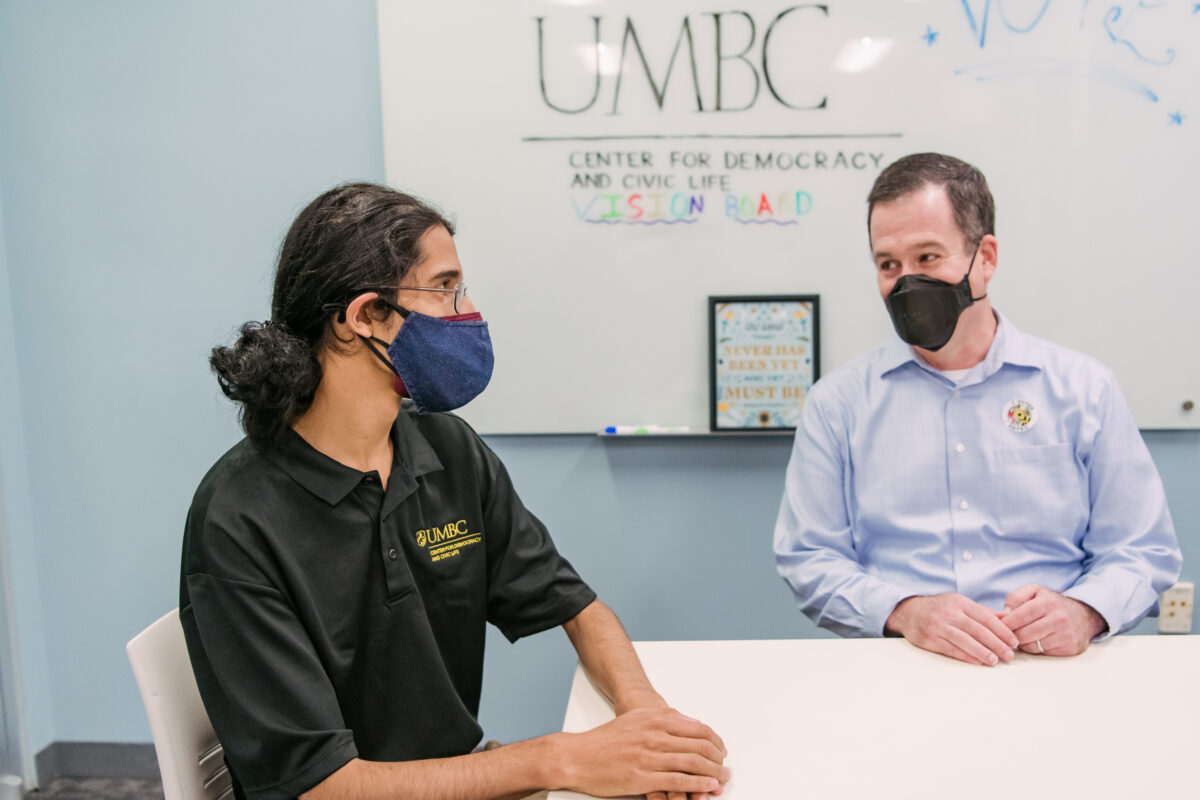 Jafri and Hoffman. (Marlayna Demond ’11/UMBC)
Jafri: One of the comments I often hear from students is that their one vote will not matter because it doesn’t determine the outcome. How can students and the broader community understand that voting is important even if their one vote may not be the deciding vote?
Hoffman: There are a lot of reasons to vote including enacting a symbolic and moral commitment to the well-being of your community. If your vote does not determine the outcome it will still be counted. Candidates and elected officials will review voting data to learn about who voted. In the elected official’s mind if a high percentage of young people voted then their concerns are important. This matters a lot.
Hoffman: What can communities do to help heal the deep divisions in our society that are evident all around us every day?
Jafri: I lean a lot on the power of storytelling—of meeting people where they are and hearing their stories. The divisions in the broader U.S. and in our communities come from a lack of understanding of someone else’s experience. Listening to another’s experience is very powerful and helps us see multiple realities. Maybe we can work together to address our concerns even if our approaches are different.
Dasgupta: I agree with Musa. Storytelling is very powerful and important especially when communities are in need of reliable news sources. I created my podcast to fill a gap in news coverage in Montgomery County. Providing a sound space where community leaders and elected officials can share their insights and plans for the future is one way I give back to the community, especially in areas where there isn’t a local newspaper.
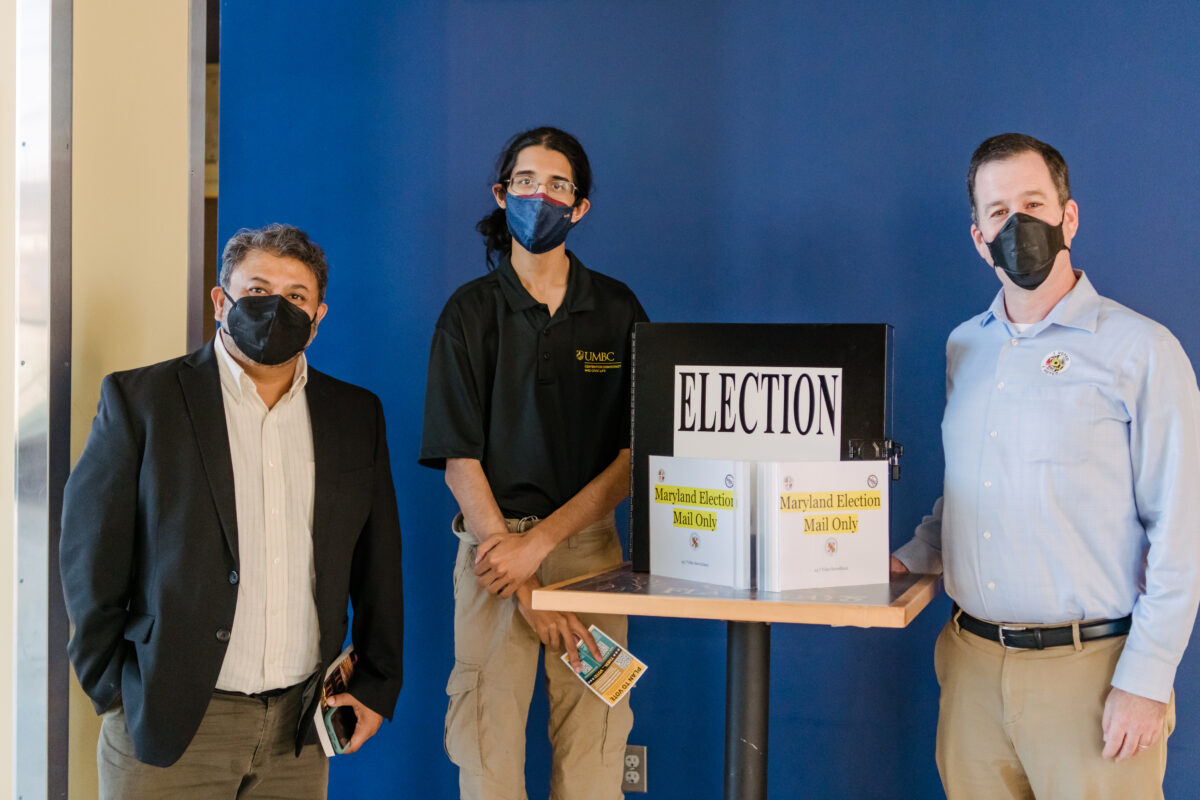 Dasgupta, Jafri, and Hoffman. (Marlayna Demond ’11/UMBC)
Hoffman: What are some practical examples of things students can do that may not be obvious to them as opportunities for civic engagement?
Jafri: Some define democracy and civic engagement as just voting. I don’t think that is a fair description of democracy and civic engagement. Simple things such as gathering with friends and inviting someone who has different views than your own is a very basic way to be civically engaged. I think that can do a lot of good in helping heal the divide.
UMBC Magazine: What wisdom can you impart to inspire students to not give up and to show up and vote?
Dasgupta: The challenges are always going to remain. Our lives’ work is to work through these challenges with hope. We don’t have to solve everything but we are duty-bound to try solve some of the issues we face.
Hoffman: I believe that the moral arc of the universe bends towards justice but that achieving it in our lifetime requires constant organizing. I also believe that democracy is a journey, not a destination. We will never fully achieve the just society that we aspire to but we can get closer and closer and work together to prevent backsliding. I have seen a lot of positive changes in my lifetime including the expansion of rights and the recognition of people based on their identities. The backsliding we have experienced lately has not fully erased this progress so I have hope that together we can build a more just society and that in fact, the seeds of that society have already been planted.
]]>
Today, millions of college students across the country are voting. Other students are not voting—they might be discouraged that their voice can make a difference, uninformed about their voting...
https://umbc.edu/stories/voting-is-an-everyday-practice/
https://my3.my.umbc.edu/api/v0/pixel/news/129026/guest@my.umbc.edu/f27ed75a0cdf002972d962dc5e5cbd62/api/pixel
cahss
campus-life
center-for-democracy-and-civic-life
language-literacy-and-culture
magazine
politicalscience
shadygrove
UMBC News & Magazine
https://my3.my.umbc.edu/groups/umbc-news-magazine
https://assets1-my.umbc.edu/system/shared/avatars/groups/000/001/943/24435aa6207c452e7bc15cc74b42c7bb/xsmall.png?1748556657
https://assets1-my.umbc.edu/system/shared/avatars/groups/000/001/943/24435aa6207c452e7bc15cc74b42c7bb/original.png?1748556657
https://assets2-my.umbc.edu/system/shared/avatars/groups/000/001/943/24435aa6207c452e7bc15cc74b42c7bb/xxlarge.png?1748556657
https://assets2-my.umbc.edu/system/shared/avatars/groups/000/001/943/24435aa6207c452e7bc15cc74b42c7bb/xlarge.png?1748556657
https://assets3-my.umbc.edu/system/shared/avatars/groups/000/001/943/24435aa6207c452e7bc15cc74b42c7bb/large.png?1748556657
https://assets1-my.umbc.edu/system/shared/avatars/groups/000/001/943/24435aa6207c452e7bc15cc74b42c7bb/medium.png?1748556657
https://assets2-my.umbc.edu/system/shared/avatars/groups/000/001/943/24435aa6207c452e7bc15cc74b42c7bb/small.png?1748556657
https://assets1-my.umbc.edu/system/shared/avatars/groups/000/001/943/24435aa6207c452e7bc15cc74b42c7bb/xsmall.png?1748556657
https://assets2-my.umbc.edu/system/shared/avatars/groups/000/001/943/24435aa6207c452e7bc15cc74b42c7bb/xxsmall.png?1748556657
UMBC News & Magazine
2
0
false
Tue, 08 Nov 2022 11:12:08 -0500
Tue, 08 Nov 2022 11:12:08 -0500
Voting Is an Everyday Practice
Today, millions of college students across the country are voting. Other students are not voting—they might be discouraged that their voice can make a difference, uninformed about their voting rights, or just unengaged with the political process.
In a conversation facilitated by UMBC Magazine, Musa Jafri ’24, political science, SGA director of civic engagement, Sunil Dasgupta, professor of political science, and founder and host of the podcast “I Hate Politics,” and David Hoffman, Ph.D. ’13, language, literacy, and culture, the director of UMBC’s Center for Democracy and Civic Life, discuss the vital democratic process—on campus and off—and the daily practice of voting.
“Voting is about you taking a stand and stating, ‘I’m here, I matter, I exist, and I have a voice.’ It’s a form of resistance, a way to try to change the climate you find yourself in.” says Jafri,co-chair of the University System of Maryland Student Civic Leaders Committee.
“I don’t understand how democracy became compartmentalized to something that happens every four years. Voting is the culmination of the work that we have done for the past four years between the time we last voted and now,” says Dasgupta. “Voting is a moment of celebration. A moment where we find out whether the work we did in between votes really mattered. There is no other way to think about democracy. Voting is what we do every day.”
Hoffman, Jafri, and Dasgupta. (Marlayna Demond ’11/UMBC)
Dasgupta: From my way of thinking, a university campus can be very different than society at large. What is the difference and how does that manifest in civic life, on campus, and in communities? How do we navigate those differences?
Hoffman: In our broader culture, we speak too easily of universities as separate from the rest of society: as ivory towers where students are being prepared for the ‘real world.’ The reality is that universities are life. Students are alive right now and they are part of many communities within and beyond the university. What happens here matters to the lives of everyone at UMBC and the communities they are part of.
Jafri: I agree. There are many instances where the university and local community needs overlap. Recently, some UMBC students organized an event where we invited the Catonsville and Arbutus communities to meet the candidates in our district. By including these two communities we realized that we had similar concerns including education, clean water, and environmental protection.
Jafri, Hoffman, and Dasgupta in the Center for Democracy and Civic Life. (Marlayna Demond ’11/UMBC)
Jafri: My generation is very politically active when it comes to voting and getting out to the polls. But with the plethora of social media platforms and news outlets how can students ensure they are getting valid and factual news?
Dasgupta: Let me be a professor and say there is more reading to be done. If your news derives from digital platforms, these platforms are algorithmic with a selection bias problem that is not your selection bias problem. You are essentially hostage to their selection bias. The way you have to overcome this is to move beyond one or two or even three sources of news. What all of us need to do is a triangulation between you and multiple sources. That takes work. Social media won’t replace in-person organizing or knocking on doors. On the other hand, organizing alone can be more effective with social media’s reach. The combination is necessary. At the risk of saying go do more work, I do think we have to understand that choosing one approach is not sufficient.
Hoffman: A part of what happens when you get involved in on-the-ground organizing is that you become better able to discern the plausibility of claims that you might encounter online. You become a better evaluator of the information you are receiving. One of the premises of Center for Democracy and Civic Life’s work is that democracy is not just a form of government, it’s not just politics and elections, it is a way of life that can be enacted in everyday settings. Ideally, people vote because they are so thoroughly engaged with the issues in their community and nation and understand them so well that voting is an obvious way to contribute. It’s one facet of how we shape our collective future, but far from the only one.
Jafri and Hoffman. (Marlayna Demond ’11/UMBC)
Jafri: One of the comments I often hear from students is that their one vote will not matter because it doesn’t determine the outcome. How can students and the broader community understand that voting is important even if their one vote may not be the deciding vote?
Hoffman: There are a lot of reasons to vote including enacting a symbolic and moral commitment to the well-being of your community. If your vote does not determine the outcome it will still be counted. Candidates and elected officials will review voting data to learn about who voted. In the elected official’s mind if a high percentage of young people voted then their concerns are important. This matters a lot.
Hoffman: What can communities do to help heal the deep divisions in our society that are evident all around us every day?
Jafri: I lean a lot on the power of storytelling—of meeting people where they are and hearing their stories. The divisions in the broader U.S. and in our communities come from a lack of understanding of someone else’s experience. Listening to another’s experience is very powerful and helps us see multiple realities. Maybe we can work together to address our concerns even if our approaches are different.
Dasgupta: I agree with Musa. Storytelling is very powerful and important especially when communities are in need of reliable news sources. I created my podcast to fill a gap in news coverage in Montgomery County. Providing a sound space where community leaders and elected officials can share their insights and plans for the future is one way I give back to the community, especially in areas where there isn’t a local newspaper.
Dasgupta, Jafri, and Hoffman. (Marlayna Demond ’11/UMBC)
Hoffman: What are some practical examples of things students can do that may not be obvious to them as opportunities for civic engagement?
Jafri: Some define democracy and civic engagement as just voting. I don’t think that is a fair description of democracy and civic engagement. Simple things such as gathering with friends and inviting someone who has different views than your own is a very basic way to be civically engaged. I think that can do a lot of good in helping heal the divide.
UMBC Magazine: What wisdom can you impart to inspire students to not give up and to show up and vote?
Dasgupta: The challenges are always going to remain. Our lives’ work is to work through these challenges with hope. We don’t have to solve everything but we are duty-bound to try solve some of the issues we face.
Hoffman: I believe that the moral arc of the universe bends towards justice but that achieving it in our lifetime requires constant organizing. I also believe that democracy is a journey, not a destination. We will never fully achieve the just society that we aspire to but we can get closer and closer and work together to prevent backsliding. I have seen a lot of positive changes in my lifetime including the expansion of rights and the recognition of people based on their identities. The backsliding we have experienced lately has not fully erased this progress so I have hope that together we can build a more just society and that in fact, the seeds of that society have already been planted.
Update: In late November 2022, the ALL IN Campus Democracy Challenge released the results of its national student voter pledge competition. UMBC finished at #4 in the nation in the number of students pledging to vote in Election 2022, moving our campus community up from #9 in 2020.
]]>
Today, millions of college students across the country are voting. Other students are not voting—they might be discouraged that their voice can make a difference, uninformed about their voting...
https://umbc.edu/stories/voting/
https://my3.my.umbc.edu/api/v0/pixel/news/129063/guest@my.umbc.edu/13659b49b350a23d36641f16fee49a54/api/pixel
cahss
campus-life
center-for-democracy-and-civic-life
language-literacy-and-culture
magazine
politicalscience
shadygrove
UMBC News & Magazine
https://my3.my.umbc.edu/groups/umbc-news-magazine
https://assets1-my.umbc.edu/system/shared/avatars/groups/000/001/943/24435aa6207c452e7bc15cc74b42c7bb/xsmall.png?1748556657
https://assets1-my.umbc.edu/system/shared/avatars/groups/000/001/943/24435aa6207c452e7bc15cc74b42c7bb/original.png?1748556657
https://assets2-my.umbc.edu/system/shared/avatars/groups/000/001/943/24435aa6207c452e7bc15cc74b42c7bb/xxlarge.png?1748556657
https://assets2-my.umbc.edu/system/shared/avatars/groups/000/001/943/24435aa6207c452e7bc15cc74b42c7bb/xlarge.png?1748556657
https://assets3-my.umbc.edu/system/shared/avatars/groups/000/001/943/24435aa6207c452e7bc15cc74b42c7bb/large.png?1748556657
https://assets1-my.umbc.edu/system/shared/avatars/groups/000/001/943/24435aa6207c452e7bc15cc74b42c7bb/medium.png?1748556657
https://assets2-my.umbc.edu/system/shared/avatars/groups/000/001/943/24435aa6207c452e7bc15cc74b42c7bb/small.png?1748556657
https://assets1-my.umbc.edu/system/shared/avatars/groups/000/001/943/24435aa6207c452e7bc15cc74b42c7bb/xsmall.png?1748556657
https://assets2-my.umbc.edu/system/shared/avatars/groups/000/001/943/24435aa6207c452e7bc15cc74b42c7bb/xxsmall.png?1748556657
UMBC News & Magazine
0
0
false
Tue, 08 Nov 2022 11:12:08 -0500
Tue, 08 Nov 2022 11:12:08 -0500
Political violence in America isn’t going away anytime soon
Richard Forno, principal lecturer in Computer science and Electrical Engineering, UMBC
A warning about the threat of political violence heading into the 2022 midterm elections was issued to state and local law enforcement officials by the U.S. Department of Homeland Security on Oct. 28, 2022.
The bulletin was released the same day that Speaker of the House of Representatives Nancy Pelosi’s husband was hospitalized after a home invasion by a lone right-wing extremist seeking to harm her.
This incident is the latest in an increasing stream of extremist confrontations taking place across the United States in recent years. These incidents have primarily targeted Democrats, including a plot to kidnap Michigan Gov. Gretchen Whitmer in 2020. But threats from both sides of the political spectrum are up significantly.
And, of course, there was the Jan. 6, 2021, insurrection at the U.S. Capitol, where supporters of a defeated Republican president, acting on a widespread lie he perpetuated, violently attempted to prevent the certification of electoral votes. According to well-documented public evidence, some rioters planned to find and execute both Speaker Pelosi and Vice President Mike Pence.
Such incidents reflect a disturbing trend that targets the very fabric, foundation and future of U.S. democracy. But what led to this point?
As a researcher taking a critical and apolitical eye toward security issues, I believe the rise in contemporary right-wing political extremism – and violence – began with an outdated focus in national communications policy.
 Police take measurements around House Speaker Nancy Pelosi’s San Francisco home after her husband, Paul Pelosi, was assaulted inside the home on Oct. 28, 2022. Tayfun Coskun/Anadolu Agency via Getty Images
Media-induced slow burn
Until the late 1980s, the Federal Communications Commission’s Fairness Doctrine required traditional licensed broadcasters to offer competing viewpoints on controversial public issues. But these rules did not apply to cable or satellite providers. As a result, the rise of cable news channels in the 1990s led to highly partisan programming that helped divide American society in the ensuing decades.
This programming fueled increasing polarization in the public and political arenas. Bipartisanship was abandoned in the 1990s, when the Republican Congress under Speaker Newt Gingrich embraced a “scorched-earth” policy of governing. That meant treating the minority party not as the loyal opposition and respected elected colleagues who had differences over policy, but as enemies.
In addition to emerging partisan cable television networks like MSNBC and Fox News, in the early 2000s, an increasingly polarized Congress and the public received a new source of division: social media.
Internet platforms such as Twitter, Facebook, and 4Chan allowed anyone, anywhere, to create, produce and distribute political commentary and extremist rhetoric that could be amplified by other users and drive the day’s news cycle.
Political pundits and influencers across the spectrum became less concerned about correctly informing the public. Instead, they stoked outrage in the search for money-generating clicks and advertising dollars. And political parties exploited this outrage to satisfy and energize their voting base or funders.
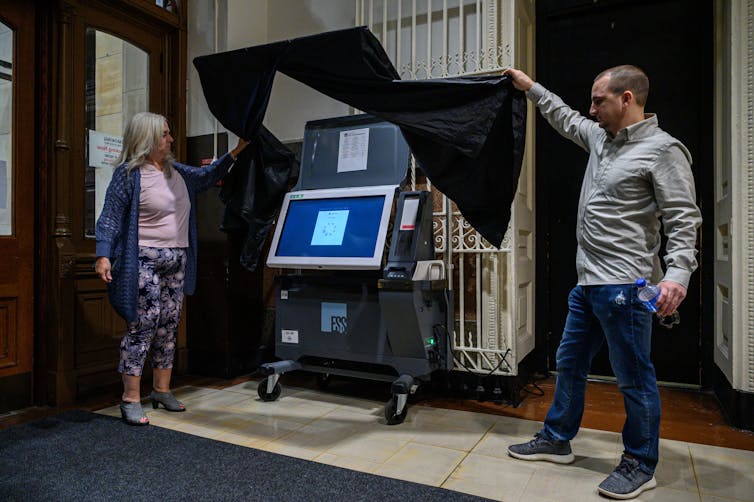 Philadelphia city commissioners display a voting machine in Philadelphia City Hall on Oct. 24, 2022. Ed Jones/AFP via Getty Images
Moderation or censorship?
To combat online extremism, social media companies reluctantly began moderating user posts and sometimes banned prominent users who violated their community standards or terms of service.
In response to what it dubbed “censorship” from Big Tech, the right-wing splintered into numerous niche platforms catering to their conspiracy theories and extremist or violent views such as Truth Social – run by former President Trump – Gab, Parler, Rumble and others.
Compared with Democrats, Republicans have mastered this form of gutter politics. One example: Right-wing political figures have mocked Paul Pelosi for being attacked, spread baseless conspiracy theories about his personal life and used the incident for applause lines at campaign rallies.
Accordingly, today’s voters and politicians end up confronting one another in the public sphere not on matters and substance affecting the future of the country, but on fundamental facts and conspiracy theories, or to address distractions often generated by their respective media ecosystems. This is only exacerbated by a prolonged nationwide decline in media literacy and civics education.
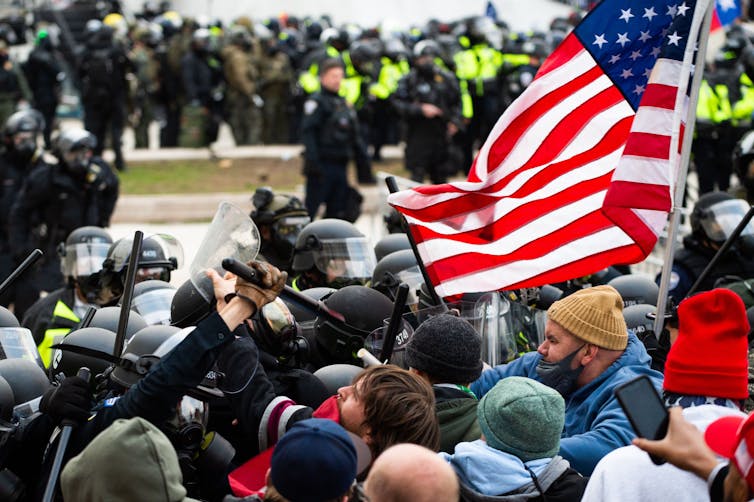 Rioters outside the U.S. Capitol Building on Jan. 6, 2021, clash with police. Roberto Schmidt/AFP via Getty Images
Law enforcement’s unique problem
Against this backdrop, federal law enforcement has become more vocal in warning about the dangers of domestic political extremism, including a bulletin issued in February 2022. The Oct. 28 DHS bulletin further underscores this concern.
But it’s hard for law enforcement to effectively address political extremism, because speech protected under the First Amendment is a major consideration. Phrases like “I’m fighting for you!” or “Saving our country!” might seem like typical political bluster to one person. But they could be seen by others as an implied call for intimidation or violent action against political opponents, election officials, volunteer poll workers and even ordinary voters.
How does speech turn into violent action? Security specialists and scholars use the term “stochastic terrorism” to capture how a single, hard-to-locate person might be inspired or influenced toward violence by broader extremist rhetoric, as appears to have been the case with the man who allegedly tried to kill Paul Pelosi with a hammer.
Law enforcement’s problem is made worse by right-wing lawmakers who normalize or actively praise the actions of violent extremists, calling them “patriots” and demanding their prison sentences be overturned or pardoned. This helps obscure the actual reasons for such incidents, often by deflecting them into broader conspiracy theories involving their opponents.
Certainly there are controversial left-leaning politicians, pundits, activists and talking points too.
But few – if any – openly disregard the fabric of American government, scheme to overturn democratic elections by force or plot to assassinate politicians.
By contrast, there are over 300 Republican election deniers running for office this year, including many incumbents – the vast majority of whom endorse political violence such as the Jan. 6 attack either by their actions or their silence.
Hope for the best; prepare for the worst
Tensions are high heading into the 2022 midterms. Politicians are making final arguments, and the online messaging machines are spreading campaign information, fundraising requests – and plenty of disinformation as well.
Americans expect a peaceful transfer of political power after elections, but recent history shows we must prepare for the worst. It’s clear that the modern Republican Party is openly and successfully embracing and exploiting misinformation, outrage and attacks on democracy and the rule of law.
Until Republicans actively disavow their extremist rhetoric and the misinformation contributing to it, I believe the likelihood for political violence in America increases with each passing day.
This article is republished from The Conversation under a Creative Commons license. Read the original article.
]]>
Richard Forno, principal lecturer in Computer science and Electrical Engineering, UMBC A warning about the threat of political violence heading into the 2022 midterm elections was issued to...
https://umbc.edu/stories/political-violence-in-america-isnt-going-away-anytime-soon/
https://my3.my.umbc.edu/api/v0/pixel/news/129011/guest@my.umbc.edu/217a019608d283460481692288b4e4b8/api/pixel
coeit
computer-engineering
computerscience
discovery
magazine
UMBC News & Magazine
https://my3.my.umbc.edu/groups/umbc-news-magazine
https://assets1-my.umbc.edu/system/shared/avatars/groups/000/001/943/24435aa6207c452e7bc15cc74b42c7bb/xsmall.png?1748556657
https://assets1-my.umbc.edu/system/shared/avatars/groups/000/001/943/24435aa6207c452e7bc15cc74b42c7bb/original.png?1748556657
https://assets2-my.umbc.edu/system/shared/avatars/groups/000/001/943/24435aa6207c452e7bc15cc74b42c7bb/xxlarge.png?1748556657
https://assets2-my.umbc.edu/system/shared/avatars/groups/000/001/943/24435aa6207c452e7bc15cc74b42c7bb/xlarge.png?1748556657
https://assets3-my.umbc.edu/system/shared/avatars/groups/000/001/943/24435aa6207c452e7bc15cc74b42c7bb/large.png?1748556657
https://assets1-my.umbc.edu/system/shared/avatars/groups/000/001/943/24435aa6207c452e7bc15cc74b42c7bb/medium.png?1748556657
https://assets2-my.umbc.edu/system/shared/avatars/groups/000/001/943/24435aa6207c452e7bc15cc74b42c7bb/small.png?1748556657
https://assets1-my.umbc.edu/system/shared/avatars/groups/000/001/943/24435aa6207c452e7bc15cc74b42c7bb/xsmall.png?1748556657
https://assets2-my.umbc.edu/system/shared/avatars/groups/000/001/943/24435aa6207c452e7bc15cc74b42c7bb/xxsmall.png?1748556657
UMBC News & Magazine
0
0
false
Mon, 07 Nov 2022 14:15:57 -0500
Mon, 07 Nov 2022 14:15:57 -0500
UMBC partners in NASA-funded TIGERISS mission to determine source of heavy elements on Earth
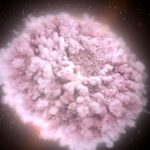
Nuclear fusion reactions inside certain stars can produce many of the most common elements on Earth, like carbon, nitrogen, and oxygen. But heavier elements that are also found on Earth are harder to generate, requiring reactions with even more energy than exists within a run-of-the-mill star like our own.
“So all of that heavier stuff we see here on Earth and throughout the cosmos, like gold, and platinum, and lead—where did it come from, and how did it get distributed?” asks Nicholas Cannady, a postdoctoral researcher at UMBC’s Center for Space Sciences and Technology, a partnership with NASA.
Cannady serves as operations lead on a new mission that aims to help answer this question. NASA recently selected that mission, the Trans-Iron Galactic Element Recorder for the International Space Station (TIGERISS), for up to $20 million in funding over five years. Seven million will go directly to the NASA Goddard Space Flight Center in Greenbelt, Maryland, where Cannady is based. The rest will go to the lead institution, Washington University in St. Louis, which will further disburse the funds to the collaborating institutions: UMBC, Pennsylvania State University, Howard University, and Northern Kentucky University. UMBC will receive $2 million. If all goes well, TIGERISS will launch to the International Space Station (ISS) in 2026.
From model to measurement
 Nicholas Cannady (image courtesy of Cannady)
TIGERISS will count how often certain elements, arriving at Earth as cosmic rays, collide with its detectors. Cosmic rays are extremely high-energy particles that travel at nearly the speed of light. Heavier elements are rarer than lighter elements, which means they will be seen less frequently by the instrument. How often the detector sees a particular element can be used as a proxy for how abundant it is in our Milky Way Galaxy.
Models exist predicting how common different elements are and how they might have been created, but they don’t all agree. In some cases, elements can only be made through a process that requires powerful explosions where the cores of atoms and neutrons repeatedly collide, Cannady explains. Scientists expect different kinds of events in the universe with the necessary power (such as exploding stars) to produce different amounts of these elements.
TIGERISS scientists will use measurements from the instrument showing how often different elements are detected “to support or go against those models,” Cannady explains. “It could help us see which models for production of heavy elements best represent what we see.”
Above the atmosphere
“TIGERISS is sort of the next step in a line of instruments that have been until now borne on balloons—high altitude, scientific balloons,” Cannady says. Unlike its predecessor, the balloon mission SuperTIGER, TIGERISS “will be on the ISS in space, which has some distinct advantages, and will let us really open up some interesting science that the other instruments weren’t able to do.”
The main benefit: On the ISS, there is no interference from Earth’s atmosphere. Although the SuperTIGER balloon flew as high as 130,000 feet, even the tiny amount of atmosphere at that height can affect precision when you are trying to detect extremely rare elements. “The atmosphere really throws a wrench into trying to wring out all the precision you can in things like SuperTIGER,” Cannady says.
TIGERISS will also be on the ISS for at least a year, whereas SuperTIGER made two flights, one for 32 days and one for 55 days. The 55-day flight set a record for a balloon, but TIGERISS’s longer exposure time will increase the chances of very rare elements happening to hit its detectors.
The cosmic ray mystery
TIGERISS may also help illuminate how cosmic rays form and transport elements around the cosmos. SuperTIGER results support one theory for how certain types of particles (including heavy ones) get “swept up and accelerated to the high energies that we see for cosmic rays,” Cannady says. “It gives us a picture of how this heavy stuff gets distributed through the galaxy.”
“So we have this neat picture of how this works,” he adds, “but then above a certain threshold, this picture seems to be breaking apart.”
Cannady and the rest of the team hope that TIGERISS will improve on SuperTIGER’s findings, and start to put the picture back together—or suggest a new one. Whatever it finds, TIGERISS will increase our understanding of where heavy elements formed and how they made their way to Earth.
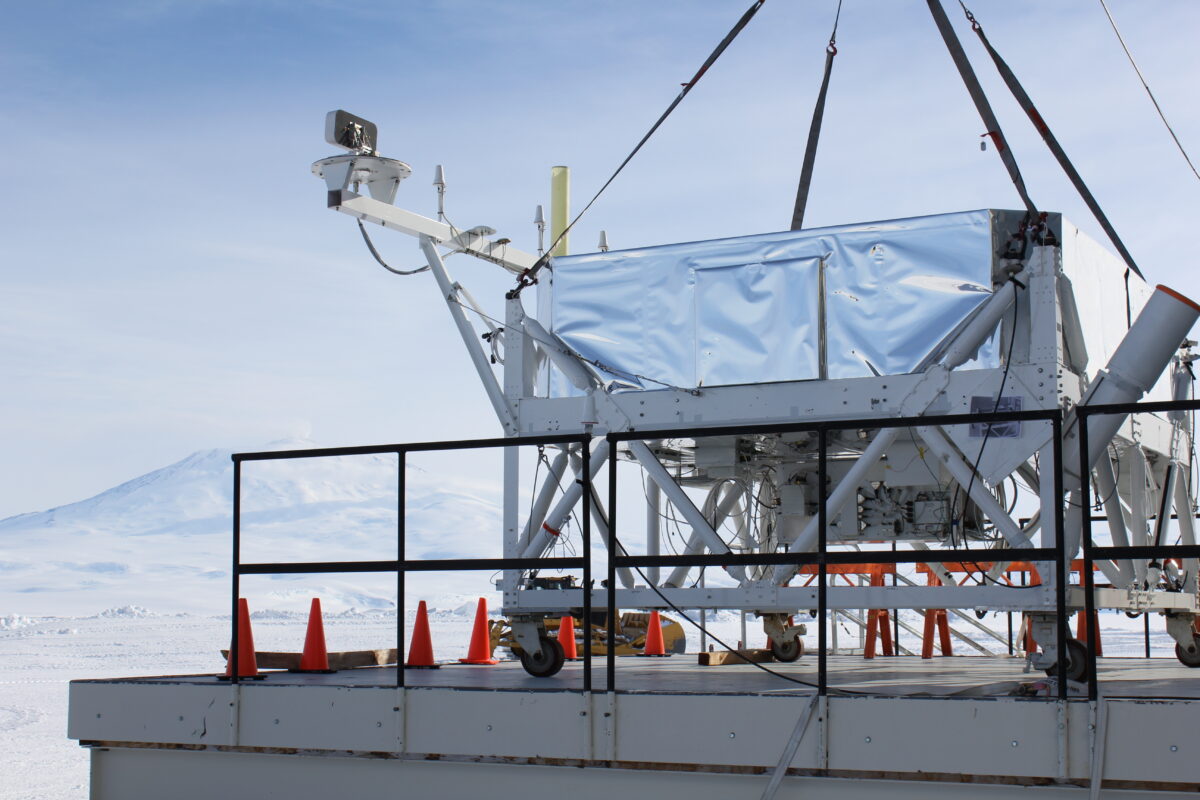 TIGERISS’s predecessor, SuperTIGER (inside the large metal box), prepares for a flight at McMurdo Station, Antarctica, in 2017. (Image courtesy of NASA/Jason Link)
Early career leadership
NASA selected TIGERISS through its Astrophysics Pioneers program, which launched in 2020. Its goal is to reduce costs by using smaller instruments that can still contribute to robust scientific advances. The program is also set up to encourage early career researchers, like Cannady, to take the reins.
“One of the big focuses of Pioneers is to incorporate early career leadership and roles into the full pipeline of mission development—conception, development, and implementation, and then the operations and analysis as well,” Cannady says. His roles as institutional lead and mission operations lead create plenty of opportunities to build a network with researchers at other institutions, hone his management skills, and conduct cutting-edge science at the same time.
“It’s really neat to me to get to see things from the beginning and potentially follow them on through to the end. There are several of us who are getting to do that,” he says. UMBC’s Kenichi Sakai, a CSST research scholar, is also on the project, and former CSST researcher John Krizmanic will serve as the overall lead for NASA Goddard.
Sakai is leading development for one of the detector subsystems, and he and Cannady are hoping to engage both undergraduate and graduate UMBC students in that work. For the next year, the team will undergo their concept study phase, figuring out what’s feasible and starting to nail down the details of the design.
“We’re really going to start hitting the ground running with this,” Cannady says. And then, once the team completes a concept study and makes important implementation decisions in the first year, he says, “we’re going to start building.”
]]>
Nuclear fusion reactions inside certain stars can produce many of the most common elements on Earth, like carbon, nitrogen, and oxygen. But heavier elements that are also found on Earth are harder...
https://umbc.edu/stories/tigeriss-to-determine-source-of-heavy-elements/
https://my3.my.umbc.edu/api/v0/pixel/news/128956/guest@my.umbc.edu/c5904fd9117405f7cda16a8321afd7c7/api/pixel
csst
news
research
science-and-tech
UMBC News & Magazine
https://my3.my.umbc.edu/groups/umbc-news-magazine
https://assets1-my.umbc.edu/system/shared/avatars/groups/000/001/943/24435aa6207c452e7bc15cc74b42c7bb/xsmall.png?1748556657
https://assets1-my.umbc.edu/system/shared/avatars/groups/000/001/943/24435aa6207c452e7bc15cc74b42c7bb/original.png?1748556657
https://assets2-my.umbc.edu/system/shared/avatars/groups/000/001/943/24435aa6207c452e7bc15cc74b42c7bb/xxlarge.png?1748556657
https://assets2-my.umbc.edu/system/shared/avatars/groups/000/001/943/24435aa6207c452e7bc15cc74b42c7bb/xlarge.png?1748556657
https://assets3-my.umbc.edu/system/shared/avatars/groups/000/001/943/24435aa6207c452e7bc15cc74b42c7bb/large.png?1748556657
https://assets1-my.umbc.edu/system/shared/avatars/groups/000/001/943/24435aa6207c452e7bc15cc74b42c7bb/medium.png?1748556657
https://assets2-my.umbc.edu/system/shared/avatars/groups/000/001/943/24435aa6207c452e7bc15cc74b42c7bb/small.png?1748556657
https://assets1-my.umbc.edu/system/shared/avatars/groups/000/001/943/24435aa6207c452e7bc15cc74b42c7bb/xsmall.png?1748556657
https://assets2-my.umbc.edu/system/shared/avatars/groups/000/001/943/24435aa6207c452e7bc15cc74b42c7bb/xxsmall.png?1748556657
UMBC News & Magazine
0
0
false
Thu, 03 Nov 2022 12:46:20 -0400
Thu, 03 Nov 2022 12:46:20 -0400
Vision beyond sight: UMBC’s Phyllis Robinson to advance study of critical eye protein with $2.5M NIH grant
Most people rely heavily on image-forming vision to navigate the world, but our eyes do much more than help us “see” in the traditional sense. In addition to rod and cone cells that help us perceive contrast and color there are a small number of other specialized cells in our eyes. These cells, called intrinsically photosensitive retinal ganglion cells, play a role in what’s called non-image-forming vision. This type of vision affects everything from our mood, to our sleeping and eating patterns, to our ability to adapt to time zone and seasonal changes.
Despite the importance of non-image-forming vision, our understanding of it is still in the early stages. An important path forward is examining melanopsin, a key protein regulating how non-image-forming vision works.
Phyllis Robinson, professor of biological sciences, has been studying melanopsin since its discovery. For the next four years, she’ll expand on her prior work with a new $2.5 million grant from the National Eye Institute (NEI), which is part of the National Institutes of Health. Colleagues on the grant include researchers at the NIH, Johns Hopkins University, Washington State University, and the Oregon Health Science University. The grant is a renewal of a previous five-year R01 award, traditionally the most sought-after and largest grant type from the NIH.
The new work will focus on how certain modifications to melanopsin affect its function. Robinson and colleagues will also examine the role of dopamine—a neurotransmitter involved in a huge range of mental and physical processes—in regulating this critical protein and its effects.
“We’re looking at this cool molecule that affects our light-dependent behaviors in ways we’re not conscious of,” Robinson says. “It’s really exciting stuff within our field.”
A cascade of changes
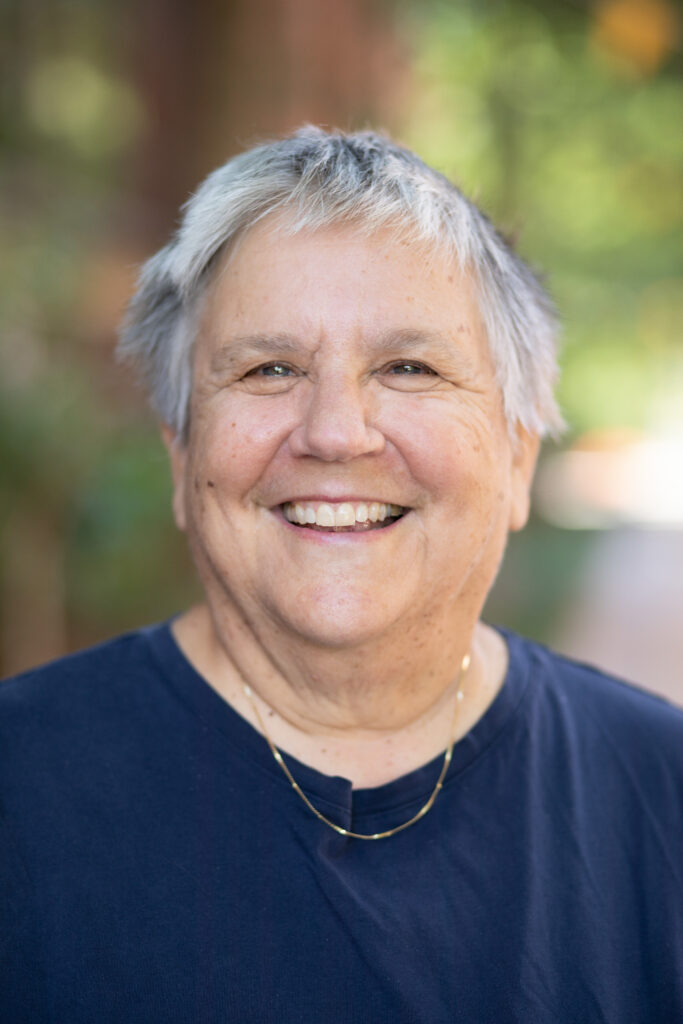 Phyllis Robinson (Melissa Cormier/UMBC)
Robinson’s previous work has contributed significantly to a better understanding of melanopsin’s functions and mechanism of action. For example, shortly after melanopsin’s discovery, Robinson and her team demonstrated that it is involved in how our pupils respond to light.
In a typical eye, light exposure causes the pupil to contract, and then, when the light dims, the pupil dilates again in about a minute. This system protects the eye from damage caused by overexposure to light. This process is familiar to anyone who has had their eyes dilated by an eye doctor and then stepped out into a sunny day.
In contrast to that typical reaction, in mice with chemical modifications to the structure of melanopsin, the pupils stay dilated for about 45 minutes after light exposure, indicating that functional melanopsin is involved in the pupil’s response to light. Ongoing and future studies under the new grant will look at how a different set of modifications to melanopsin affect mice’s ability to adapt to changes in their light exposure patterns, as if they were changing time zones—a process called “photoentrainment.”
Robinson’s group also recently showed that dopamine can regulate the function of melanopsin in a cell culture. The new funding will allow the team to further explore dopamine’s role in non-image-forming vision in mice. In addition to showing whether or not dopamine regulates melanopsin, they will work to figure out what sequence of chemical reactions drives the protein’s effects, and what other molecules are involved, called a “chemical cascade.”
Mystery molecule
Melanopsin and the cells that contain it are also interesting from an evolutionary perspective, Robinson explains. “These ganglion cells may be the ancient photoreceptors,” she says.
“If you think about the evolution of vision, an organism just detecting whether it’s light or dark would be the first step,” she notes. “All you need is a light-sensitive cell.” In fact, even nocturnal animals and animals that live in dark environments, like caves or tunnels, have the cells responsible for non-image-forming vision, Robinson says.
In humans, a better understanding of melanopsin and its regulation could offer insight into health conditions that afflict shift workers, since their schedules do not align with their bodies’ natural hormonal responses to light. It could even reveal new potential targets for treating conditions like seasonal affective disorder or jet lag. And it might add evidence to arguments for dimming lights in the evening and prioritizing exposure to sunlight in the morning.
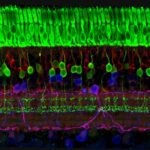
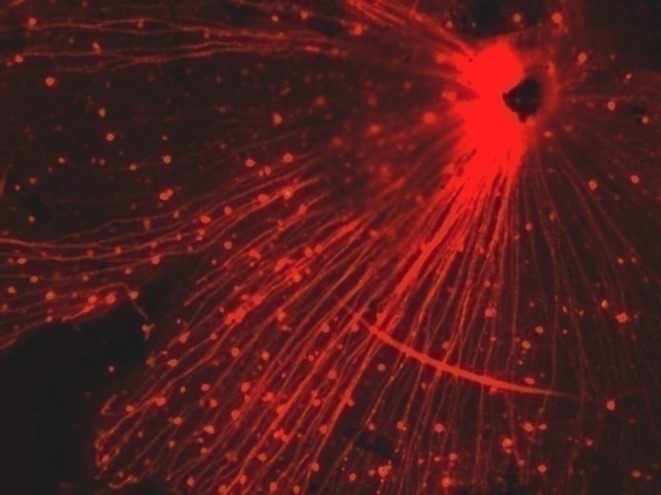 A microscope slide of the mouse retina, with the cells containing melanopsin stained red. (Image courtesy of Phyllis Robinson)
“Our research is going from molecules to behavior,” Robinson says. Her lab at UMBC focuses on physiology by doing studies with cells. Then, based on the findings, her NEI colleagues and graduate students, who are jointly advised by Robinson and NEI faculty, carry out behavioral studies with mice as a next step. Eventually, it could lead to work directly supporting human health.
“It’s always exciting to renew an R01 award and this new funding will make important new research possible,” Robinson says. “Melanopsin is a relatively unknown molecule that has huge impacts on our physiology and health,” she adds. “It’s like the mystery molecule in your eye.”
Over the next four years, Robinson and colleagues hope to make this molecule a little less mysterious.
]]>
Most people rely heavily on image-forming vision to navigate the world, but our eyes do much more than help us “see” in the traditional sense. In addition to rod and cone cells that help us...
https://umbc.edu/stories/vision-beyond-sight-an-eye-proteins-critical-role/
https://my3.my.umbc.edu/api/v0/pixel/news/128824/guest@my.umbc.edu/da2fd4d9a134804e40433bd62f9db718/api/pixel
biology
cnms
majoraward
news
research
science-and-tech
UMBC News & Magazine
https://my3.my.umbc.edu/groups/umbc-news-magazine
https://assets1-my.umbc.edu/system/shared/avatars/groups/000/001/943/24435aa6207c452e7bc15cc74b42c7bb/xsmall.png?1748556657
https://assets1-my.umbc.edu/system/shared/avatars/groups/000/001/943/24435aa6207c452e7bc15cc74b42c7bb/original.png?1748556657
https://assets2-my.umbc.edu/system/shared/avatars/groups/000/001/943/24435aa6207c452e7bc15cc74b42c7bb/xxlarge.png?1748556657
https://assets2-my.umbc.edu/system/shared/avatars/groups/000/001/943/24435aa6207c452e7bc15cc74b42c7bb/xlarge.png?1748556657
https://assets3-my.umbc.edu/system/shared/avatars/groups/000/001/943/24435aa6207c452e7bc15cc74b42c7bb/large.png?1748556657
https://assets1-my.umbc.edu/system/shared/avatars/groups/000/001/943/24435aa6207c452e7bc15cc74b42c7bb/medium.png?1748556657
https://assets2-my.umbc.edu/system/shared/avatars/groups/000/001/943/24435aa6207c452e7bc15cc74b42c7bb/small.png?1748556657
https://assets1-my.umbc.edu/system/shared/avatars/groups/000/001/943/24435aa6207c452e7bc15cc74b42c7bb/xsmall.png?1748556657
https://assets2-my.umbc.edu/system/shared/avatars/groups/000/001/943/24435aa6207c452e7bc15cc74b42c7bb/xxsmall.png?1748556657
UMBC News & Magazine
2
0
false
Fri, 28 Oct 2022 16:49:12 -0400
Fri, 28 Oct 2022 16:49:12 -0400
Meet a Retriever — Jok Thon, UMBC’s First Peaceworker Global Fellow
Meet Jok Abraham Thon, UMBC’s first Peaceworker Global Fellow and the first Retriever from South Sudan. Thon is pursuing his master’s in entrepreneurship, innovation, and leadership and plans to use these skills to continue to promote educational opportunities for other South Sudanese people.
Q: Tell us about yourself. What are the essential things you’d want another Retriever to know about you?
A: I am the father of four beautiful kids from the world’s youngest country, South Sudan. I left behind my young family in search of knowledge and skills so that when I return, I can play a part in transforming the lives of vulnerable children in my country.
When I was a refugee, it was not easy. We had our classes under trees; we didn’t have toys to play with, but I turned my bitter memories into positive energy to change the cycle of violence in my country by establishing Promised Land Primary and Secondary School with the motto of “Changing Minds from Bullets to Books.”
Let’s be great libraries for our children where they can find great stories of peace, love, and humanity. This message is for the parents and students who are our future leaders and policy makers. This principle will help them change policies that discriminate and instead create policies that embrace inclusion and equality.
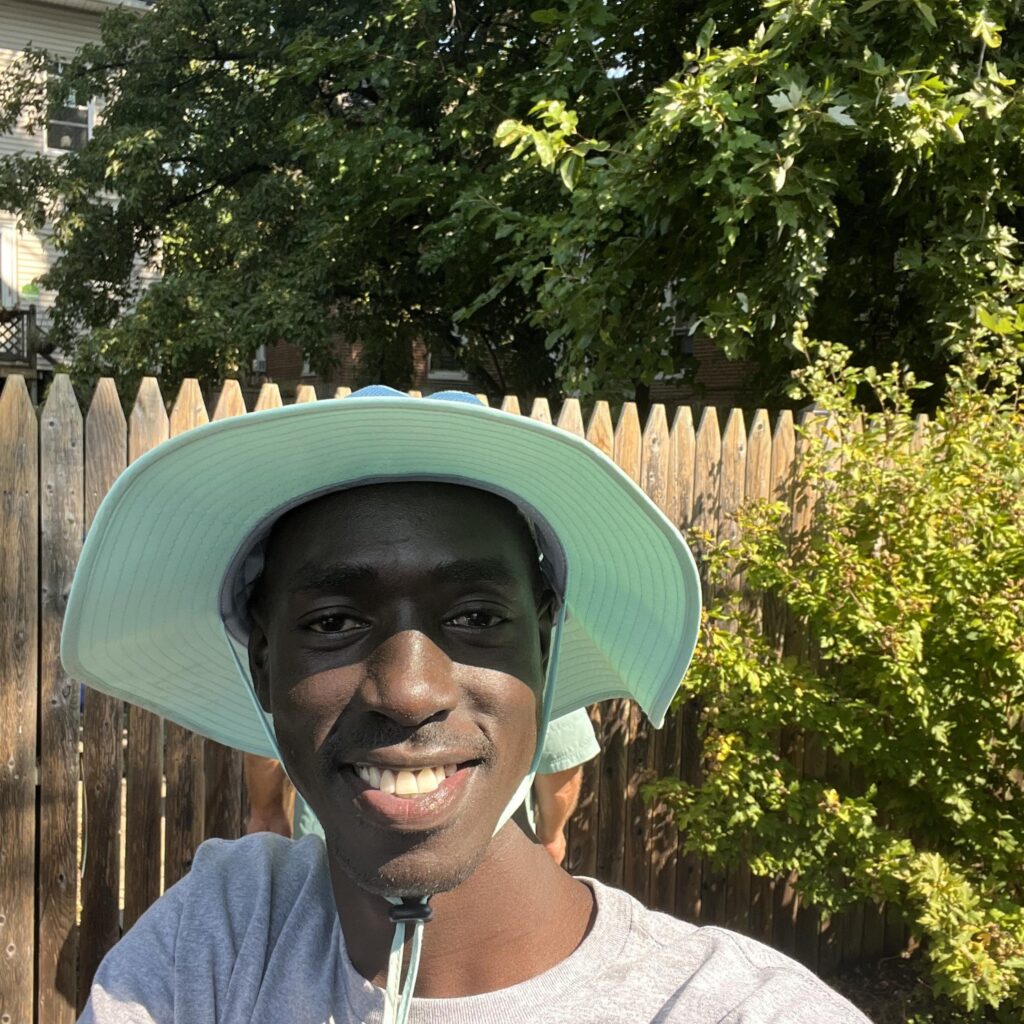 Jok Thon, UMBC’s first Peaceworker Global Fellow. Courtesy of Thon.
Q: Tell us about your primary WHY, and how it led you to UMBC.
A: I need to use the leadership and entrepreneurial skills I will get from UMBC to help transform South Sudan into a peaceful and democratic country.
Q: What do you love about your academic program?
A: My first course was Introduction to Community Leadership and my biggest takeaway was what I called a ‘”spiderweb” from placemaking—how public parks are great places to build more inclusive and peaceful communities; they’re great places for communities to come together for entertainment and family outings; they’re great places for communities to build back trust and take away fear and misinformation. In South Sudan there are some cultures that negatively affect women and girls—I want to see how we can use this placemaking idea to create parks that will bring all people together.
In my Developing the Entrepreneurial Mindset class, I am learning skills that will help me to establish a company to sustain my school and help in establishing more schools in the hard to reach villages in South Sudan. We want to provide education to the vulnerable 2.5 million children who are not in school in South Sudan and break the cycle that prohibits many girls from finishing their schooling—about 75 percent of girls don’t finish high school due to early forced marriage and poverty.
Let’s be great libraries for our children where they can find great stories of peace, love, and humanity.
Jok Thon
From my classes so far, I came up with two projects—one is Jonglei Multipurpose Memorial Park. It will not only be a park but also provide a great solution to the flooded villages along the River Nile as a way we can beautifully live with water as we fight climate change.
Second, is the Central Nile Paper Company that will produce paper sustainably from local sources of bamboo and papyrus for school workbooks and use the revenue from sales to support the Promised Land School while opening more schools across the country.
Q: Tell us about someone in the community who has inspired you or supported you, and how they did it.
A: My journey to UMBC came as an inspiration from the love I received from Joby Taylor (Ph.D. ’05, language, literacy, and culture) in the Shriver Center, Kenneth Baron in Academic Advising, David Di Maria in the Center for Global Engagement, Gib Mason (’95, economics) in the entrepreneurship, innovation, and leadership program, and Kimberly R. Moffitt, dean of the College of Arts, Humanities, and Social Sciences. This team and many more great faculty as well as staff from International Student and Scholar Services have changed my life.
I want to particularly thank Dr. Joby Taylor and his wife and children for being such a great host family. I am glad to call UMBC my sweet home far away from home.
* * * * *
UMBC’s greatest strength is its people. When people meet Retrievers and hear about the passion they bring, the relationships they create, the ways they support each other, and the commitment they have to inclusive excellence, they truly get a sense of our community. That’s what “Meet a Retriever” is all about.
Learn more about how UMBC can help you achieve your goals.
]]>
Meet Jok Abraham Thon, UMBC’s first Peaceworker Global Fellow and the first Retriever from South Sudan. Thon is pursuing his master’s in entrepreneurship, innovation, and leadership and plans to...
https://umbc.edu/stories/meet-jok-thon-first-peaceworker-global-fellow/
https://my3.my.umbc.edu/api/v0/pixel/news/128767/guest@my.umbc.edu/775fe605490c66d790bd3fa9d39818d9/api/pixel
cahss
division-of-professional-studies
dps
impact
magazine
meet-a-retriever
perspectives
shrivercenter
UMBC News & Magazine
https://my3.my.umbc.edu/groups/umbc-news-magazine
https://assets1-my.umbc.edu/system/shared/avatars/groups/000/001/943/24435aa6207c452e7bc15cc74b42c7bb/xsmall.png?1748556657
https://assets1-my.umbc.edu/system/shared/avatars/groups/000/001/943/24435aa6207c452e7bc15cc74b42c7bb/original.png?1748556657
https://assets2-my.umbc.edu/system/shared/avatars/groups/000/001/943/24435aa6207c452e7bc15cc74b42c7bb/xxlarge.png?1748556657
https://assets2-my.umbc.edu/system/shared/avatars/groups/000/001/943/24435aa6207c452e7bc15cc74b42c7bb/xlarge.png?1748556657
https://assets3-my.umbc.edu/system/shared/avatars/groups/000/001/943/24435aa6207c452e7bc15cc74b42c7bb/large.png?1748556657
https://assets1-my.umbc.edu/system/shared/avatars/groups/000/001/943/24435aa6207c452e7bc15cc74b42c7bb/medium.png?1748556657
https://assets2-my.umbc.edu/system/shared/avatars/groups/000/001/943/24435aa6207c452e7bc15cc74b42c7bb/small.png?1748556657
https://assets1-my.umbc.edu/system/shared/avatars/groups/000/001/943/24435aa6207c452e7bc15cc74b42c7bb/xsmall.png?1748556657
https://assets2-my.umbc.edu/system/shared/avatars/groups/000/001/943/24435aa6207c452e7bc15cc74b42c7bb/xxsmall.png?1748556657
UMBC News & Magazine
3
0
false
Wed, 26 Oct 2022 14:56:10 -0400
Wed, 26 Oct 2022 14:56:10 -0400
GRIT-X 2022 brings to life the “essence” of UMBC research and creative achievement
Amid a bustling day filled with Homecoming excitement, GRIT-X returned to UMBC this month for its sixth year, delivering a wide-ranging lineup of Retriever excellence in action. Held in the Fine Arts Recital Hall, this year’s GRIT-X was the first for new UMBC President Valerie Sheares Ashby. Enjoying one engaging talk after another, she deemed the event “the essence of UMBC.”
“What a beautiful day,” said President Sheares Ashby, in her remarks to the GRIT-X audience. “Not only were [the presenters] brilliant, they were people-centric. They were thinking about things that were real and important to each one of our lives being better, the universe being better, our bodies being better, and our communities being better. I cannot have experienced a better first GRIT-X.”
Watch the GRIT-X 2022 talks
Rethinking digital divides: Creating access, experiential learning, and empathy in the digital world
Delali Dzirasa ‘04, computer engineering, opened this year’s GRIT-X event with a presentation detailing how his company, Fearless, led the development of the Searchable Museum to complement the Smithsonian National Museum of African American History and Culture (NMAAHC) “Slavery and Freedom” exhibition. Dzirasa elaborated on how his team, including several UMBC alumni, was able to reimagine this exhibit specifically for online audiences amid the pandemic. The Fearless CEO was the third in his family to deliver a GRIT-X talk, following his wife, Baltimore City Health Commissioner Letitia Dzirasa ‘03, biological sciences (GRIT-X 2021), and his brother Kafui Dzirasa ‘01, M8, chemical engineering (GRIT-X 2017).
Can we reduce the deluge in sea levels with a data deluge?
Vandana Janeja, professor and chair of information systems, discussed the research she’s leading as the director of the NSF HDR Institute for Harnessing Data and Model Revolution in the Polar Regions, or iHARP. Janeja outlined how she and the iHARP team are utilizing data science, machine learning, artificial intelligence, and polar science to analyze enormous volumes of climate data as well as Arctic and Antarctic observations in ways that could help populations respond to the harmful impacts of climate change.
Sounds of the world through the violin
Airi Yoshioka, professor of music, delivered her presentation on how the cultural background of a composer manifests in the music they create. Yoshioka played excerpts of music from several composers around the world, explaining how they were able to express their cultural identities through their music. The violinist then captured the imagination of the audience with her striking performance of “Sentimental” from “Five Little Milonguitas” by composer Pablo Ortiz from her 2015 album Sueños Misticos.
Community building: How to build with materials that are stronger than brick and mortar
Alicia Lynn Wilson ‘04, political science, serves as vice president for economic development at Johns Hopkins University. She has taken part in some of the largest redevelopment efforts in the country, overseeing more than $10 billion in redevelopment projects in the last decade. Wilson shared her perspective on how every person is involved in construction, being actively engaged in the community-building enterprise. Her presentation outlined five principles that she relies on when forging and maintaining community connections.
Glucosome: 4D Visualization of the secret society of metabolic enzymes
Minjoung Kyoung, associate professor of chemistry and biochemistry, started her presentation on metabolic enzymes in an unexpected way: by showing the audience a picture of donuts. The image helped to entice the audience as they listened to her research on how the food we eat transforms into glucose and the metabolic process that happens as a result. The presentation explored the glucose metabolism and its 4-dimensional network with mitochondria in living cells, and how Kyoung’s team built the Lattice Light Sheet Microscope to better visualize small features inside of living cells.
Green walls or greenwashing? Tree planting dreams meet reality
Matthew Fagan, associate professor of geography and environmental systems, delved into his research related to forest restoration and reforestation showing that sometimes, planting trees can cause more harm than good. He educated the audience on the rise of tree planting initiatives around the world and the reality of what has happened as a result of reforestation efforts.
The many faces of immune cells: Building back tissues after trauma
Kaitlyn Sadtler, ‘11, biological sciences, who earned an honorary doctorate from UMBC in 2022, presented on immunology and how the body works to heal after injuries. Sadtler is an investigator and chief of the section on immunoengineering at the NIH’s National Institute for Biomedical Imaging and Bioengineering. She earned a Ph.D. at Johns Hopkins University School of Medicine and completed a postdoctoral fellowship at MIT. She described her lab’s research into different immune cells and how they respond during injuries. She also shared how her team is working to develop new methods to help modulate the immune response to injury and implantation of medical devices.
The quantum universe is weird, but our world is not: Schrödinger’s cat is dead, right?
Sebastian Deffner, associate professor of physics, focused his presentation on demystifying the world of quantum physics and the quantum universe. He offered the audience an introduction to the components of this growing field of study. He also explained different interpretations of quantum mechanics with his analysis of the “Schrödinger’s cat” thought experiment.
Sometimes systems fail us: Designing alternatives for domestic violence survivors
Nkiru Nnawulezi, associate professor of psychology, has been working with the D.C. Coalition Against Domestic Violence to collect data on the experiences of domestic violence survivors in Washington D.C., particularly related to housing services. She closed the afternoon’s program by detailing her experience of conducting research interviews with the survivors. She explored what can be done to create more inclusive community responses that support domestic violence survivors in more effective and sustainable ways.
Karl V. Steiner, vice president for research and creative achievement, was the master of ceremonies for GRIT-X 2022. Moderators included: Keith J Bowman, dean of the College of Engineering and Information Technology; Kimberly R. Moffitt, dean of the College of Arts, Humanities, and Social Sciences; and William R. LaCourse, dean of the College of Natural and Mathematical Sciences.
]]>
Amid a bustling day filled with Homecoming excitement, GRIT-X returned to UMBC this month for its sixth year, delivering a wide-ranging lineup of Retriever excellence in action. Held in the Fine...
https://umbc.edu/stories/grit-x-2022/
https://my3.my.umbc.edu/api/v0/pixel/news/128765/guest@my.umbc.edu/3a6b060d8327cd311dbd3f355324b5d7/api/pixel
biology
cahss
chembiochem
cnms
coeit
community
csee
ges
grit-x
is
music
physics
politicalscience
psychology
rca-1
research
UMBC News & Magazine
https://my3.my.umbc.edu/groups/umbc-news-magazine
https://assets1-my.umbc.edu/system/shared/avatars/groups/000/001/943/24435aa6207c452e7bc15cc74b42c7bb/xsmall.png?1748556657
https://assets1-my.umbc.edu/system/shared/avatars/groups/000/001/943/24435aa6207c452e7bc15cc74b42c7bb/original.png?1748556657
https://assets2-my.umbc.edu/system/shared/avatars/groups/000/001/943/24435aa6207c452e7bc15cc74b42c7bb/xxlarge.png?1748556657
https://assets2-my.umbc.edu/system/shared/avatars/groups/000/001/943/24435aa6207c452e7bc15cc74b42c7bb/xlarge.png?1748556657
https://assets3-my.umbc.edu/system/shared/avatars/groups/000/001/943/24435aa6207c452e7bc15cc74b42c7bb/large.png?1748556657
https://assets1-my.umbc.edu/system/shared/avatars/groups/000/001/943/24435aa6207c452e7bc15cc74b42c7bb/medium.png?1748556657
https://assets2-my.umbc.edu/system/shared/avatars/groups/000/001/943/24435aa6207c452e7bc15cc74b42c7bb/small.png?1748556657
https://assets1-my.umbc.edu/system/shared/avatars/groups/000/001/943/24435aa6207c452e7bc15cc74b42c7bb/xsmall.png?1748556657
https://assets2-my.umbc.edu/system/shared/avatars/groups/000/001/943/24435aa6207c452e7bc15cc74b42c7bb/xxsmall.png?1748556657
UMBC News & Magazine
0
0
false
Wed, 26 Oct 2022 14:14:14 -0400
Wed, 26 Oct 2022 14:14:14 -0400
Ozone and thunderstorms: Two UMBC Ph.D. students receive prestigious NASA grants, mentor undergraduates
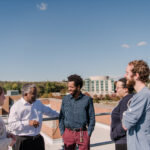
Two UMBC Ph.D. students in atmospheric physics, Maurice Roots and Kylie Hoffman, have received competitive Future Investigators in NASA Earth and Space Science and Technology (FINESST) awards that will support the remainder of their graduate studies. Roots’s research project will focus on air pollution and Hoffman will target thunderstorms, both using remote sensing techniques. Each will receive up to $150,000 over a maximum of three years for tuition, research, professional development, and other expenses.
Tracking ozone’s journey
Roots will further his study of ozone found near the Earth’s surface. Unlike ozone in the upper atmosphere, which is critical for protecting organisms on Earth from powerful solar radiation, ozone near the surface is a form of air pollution. It can lead to respiratory issues in animals (including humans) and reduce crop yields by damaging plants’ leaves.
Combustion engines are the main producers of surface-level ozone, because they release molecules that can convert to ozone when they interact with sunlight. Roots is particularly interested in ozone prevalence in the Chesapeake Bay region and other urban areas on bays, such as New York City and San Francisco, because “water is like a mirror,” he says, and with more light bouncing around, there are many more opportunities to generate harmful ozone.
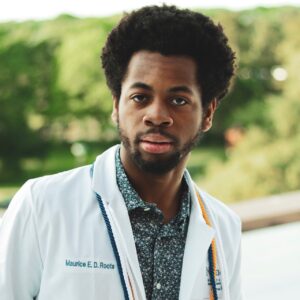 Maurice Roots (image courtesy of Roots)
Roots will use a network of ground-based remote sensing instruments to improve understanding of how ozone forms and moves around, with a focus on the Eastern United States.
It’s an exciting time to be in remote sensing and ozone studies, Roots says, in part because “we’re still finding out things about simply when and where high ozone is happening.” At the same time, the instrument network “is becoming a teenager. It’s grown up a lot, and a lot of changes are about to start happening.” One of Roots’s main goals with the new project is to generate a “synergy of NASA’s ground-based instruments,” where all of the data they produce can be easily gathered and interpreted together to form conclusions.
Understanding not just where ozone forms, but where it travels from there, is important, Roots says. For example, phenomena called “nocturnal low-level jets” can move air (and ozone and other pollutants with it) from Georgia to New York in one night, he explains, which “changes the whole regulatory perspective.” Right now, states or cities can be fined for having too many instances of high ozone—but if the ozone may have come from several states away, the picture gets more complicated.
While Roots isn’t directly involved in policy, his work to improve “process-level understanding” of where ozone is created, how it moves, and where it ends up could influence regulation in the future.
Predicting thunderstorms, protecting farmers
Hoffman’s work will explore how severe thunderstorms form in the southern United States, especially at night. The genesis of these storms is currently poorly understood, despite their important implications for community safety and agriculture.
Belay Demoz, professor of physics and director of the Goddard Earth Science Technology and Research (GESTAR) II Center, and also Hoffman’s and Root’s Ph.D. advisor, co-led the Plains Elevated Convection at Night (PECAN) mission in 2015. It used ground- and aircraft-based instruments to collect a huge amount of data about storms in the U.S. southern plains, much of which has the potential for more in-depth analysis, Hoffman says. She will develop a few in-depth case studies using PECAN data, seeking clues about which variables are most important for forming these storms, such as temperature, wind speed, and water vapor concentrations. After that, she’ll expand to determining the frequency of severe storms and what features differentiate them from milder events.
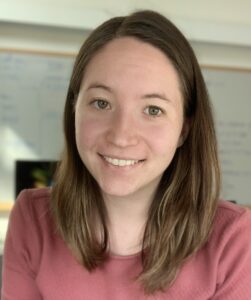 Kylie Hoffman (image courtesy of Hoffman)
“A lot of people research these storms with weather models and simulations, but there hasn’t been a ton of research done with remote sensing observations yet,” Hoffman says. “I plan to use the PECAN datasets to calculate atmospheric quantities that are typically only evaluated in model-based research, and determine what potential uses this approach has for improving our understanding of these storms.” Her eventual goal is to develop better forecasting for thunderstorms, especially to benefit the many farmers in the southern plains.
Hoffman’s research is interdisciplinary and brings together the work of NASA and the National Oceanic and Atmospheric Administration (NOAA), which previously awarded her a research fellowship. Better weather forecasting is “also one of NOAA’s main missions,” she explains, “to help us become a weather-ready nation, and improve our ability to inform people and small businesses” about the risks severe weather can pose to lives and livelihoods.
Making it official
Hoffman’s research as an undergraduate meteorology major also used remote sensing data, which she enjoyed. As a result, “I was looking specifically for a meteorology or atmospheric physics graduate program that worked with remote sensing data,” she says, “and that’s one of the strengths of the UMBC program.”
In preparing her FINESST application, “I felt very supported by Belay [Demoz] and the whole office. It was exciting. It felt really official,” she says. “Writing the application helped me clarify where I want to go with my research. And even if I hadn’t gotten the grant, it was helpful just to know the process.”
Demoz is thrilled to have two students receive the FINESST award—a rare event for any Ph.D. advisor. “I know firsthand how competitive this was, and I am very proud of their accomplishment,” Demoz says.
He’s also proud of the work they do outside the lab, supporting other students and choosing projects that could have real public impact. “This is what I would like all our grad students to do, since it prepares them well for entering the professoriate,” he shares. “I’m honored to say they are my graduate students.”
Paying it forward
Roots and Hoffman have already begun to pay forward the support they received from mentors at UMBC. This past summer, they and three more graduate students, including Emily Faber, M.S. ’21, atmospheric physics, a current Ph.D. student in the same field, served as mentors in the eight-week Student Airborne Science Activation (SaSa) program. The NASA-funded program offers high-achieving first- and second-year undergraduates at minority-serving institutions (MSIs) the opportunity to gain experience with airborne field research campaigns through a paid internship.
This year, SaSa welcomed 24 students, including four from UMBC, to UMBC’s main campus for four weeks. Participants spent the other four weeks at the NASA Wallops Flight Facility in Wallops Island, Virginia. The graduate students served as the participants’ primary mentors, Hoffman explains, from helping them develop research questions to guiding them through final presentations.
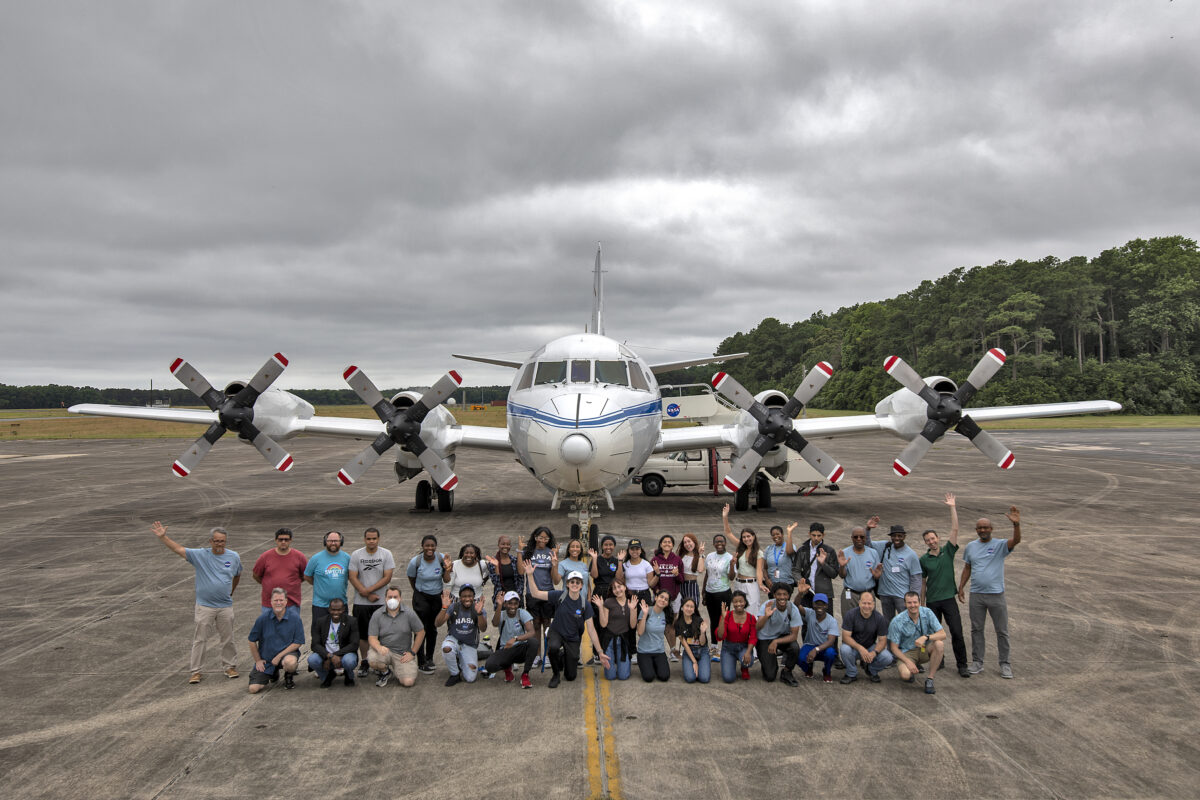 Participants in the 2022 SaSa program at NASA Wallops Flight Facility. (image courtesy of Belay Demoz)
Two of the UMBC participants decided to continue conducting research with Demoz’s group during the academic year. Trisha Joy Francisco ’25, mechanical engineering, is working with Hoffman on pollution measurements. Eric Ekey ’25, computer engineering, will start work soon with Roots.
Hoffman recalls a transformative summer internship that gave her the confidence to apply to graduate school. “That’s part of what I wanted to do for the students—replicate what my mentor did to help me during that experience,” she says.
SaSa was mutually beneficial for the students and their mentors; it helped Roots boost his confidence, too. After answering student questions for a month, “by the end,” he says with a smile, “I realized, I guess I actually know a lot.”
With their FINESST awards, Hoffman and Roots will continue to put their knowledge and mentoring skills to work as they conduct research to answer big questions about how atmospheric dynamics impact our daily lives.
]]>
Two UMBC Ph.D. students in atmospheric physics, Maurice Roots and Kylie Hoffman, have received competitive Future Investigators in NASA Earth and Space Science and Technology (FINESST) awards that...
https://umbc.edu/stories/ozone-and-thunderstorms-nasa-grants-to-ph-d-students/
https://my3.my.umbc.edu/api/v0/pixel/news/128761/guest@my.umbc.edu/ad4d4f8a25d0c84acca13b01cb3bee0b/api/pixel
cnms
coeit
csee
diversityandinclusion
meche
news
physics
research
science-and-tech
UMBC News & Magazine
https://my3.my.umbc.edu/groups/umbc-news-magazine
https://assets1-my.umbc.edu/system/shared/avatars/groups/000/001/943/24435aa6207c452e7bc15cc74b42c7bb/xsmall.png?1748556657
https://assets1-my.umbc.edu/system/shared/avatars/groups/000/001/943/24435aa6207c452e7bc15cc74b42c7bb/original.png?1748556657
https://assets2-my.umbc.edu/system/shared/avatars/groups/000/001/943/24435aa6207c452e7bc15cc74b42c7bb/xxlarge.png?1748556657
https://assets2-my.umbc.edu/system/shared/avatars/groups/000/001/943/24435aa6207c452e7bc15cc74b42c7bb/xlarge.png?1748556657
https://assets3-my.umbc.edu/system/shared/avatars/groups/000/001/943/24435aa6207c452e7bc15cc74b42c7bb/large.png?1748556657
https://assets1-my.umbc.edu/system/shared/avatars/groups/000/001/943/24435aa6207c452e7bc15cc74b42c7bb/medium.png?1748556657
https://assets2-my.umbc.edu/system/shared/avatars/groups/000/001/943/24435aa6207c452e7bc15cc74b42c7bb/small.png?1748556657
https://assets1-my.umbc.edu/system/shared/avatars/groups/000/001/943/24435aa6207c452e7bc15cc74b42c7bb/xsmall.png?1748556657
https://assets2-my.umbc.edu/system/shared/avatars/groups/000/001/943/24435aa6207c452e7bc15cc74b42c7bb/xxsmall.png?1748556657
UMBC News & Magazine
0
0
false
Wed, 26 Oct 2022 12:51:31 -0400
Wed, 26 Oct 2022 12:51:31 -0400
Tackling food insecurity in disasters: UMBC’s Lauren Clay develops a new model through $520K NSF CAREER award
When disasters happen, access to food can be interrupted, which can increase existing food insecurity issues and compound the impact of disasters. Currently, there isn’t a standard tool to measure disaster-specific food insecurity issues, making it harder to address them.
The National Science Foundation (NSF) has awarded UMBC’s Lauren Clay, associate professor and chair of emergency health services, a five-year, $520,000 Faculty Early Career Development (CAREER) award to develop a sociocultural model called Food Environment in Disasters (FED) and other tools to improve the understanding and monitoring of food availability, acceptability, and accessibility during disasters.
“Food is a basic need for human survival and the ability of social systems to meet this need in disaster situations is compromised when our homes, businesses, and other structures are damaged and lifelines disrupted,” says Clay. “While elements of the various social and built-in environmental systems that make up the broader food environment as well as food security issues have been studied by various disciplines, a comprehensive, systematic approach has yet to be applied and tested in disaster settings.”
 Lauren Clay’s graduate students volunteer at a food bank. (Image courtesy of Clay)
The CAREER award is one of NSF’s most prestigious awards for early career faculty. Recipients are chosen for their passion and dedication to the discovery process and commitment to teaching, learning, and sharing new knowledge.
This research builds on Clay’s prior body of work in disaster preparedness, recovery, and resilience. That work has focused on communities impacted by COVID-19; Hurricanes Harvey, Sandy, and Katrina; the Deepwater Horizon Oil Spill in the Gulf of Mexico; and the 2013 tornado in Moore, Oklahoma, among other disasters and public health emergencies.
The FED model
Over the next five years, Clay will use the current Nourish Food System Model as a guiding theory to develop her new FED model. “The Nourish Food System Model looks at the interconnectedness and interdependence of the biological, social, political, economic, health, and policy systems,” says Clay. “Some of these systems can be disrupted any day, but in a disaster, all of the systems are stressed.”
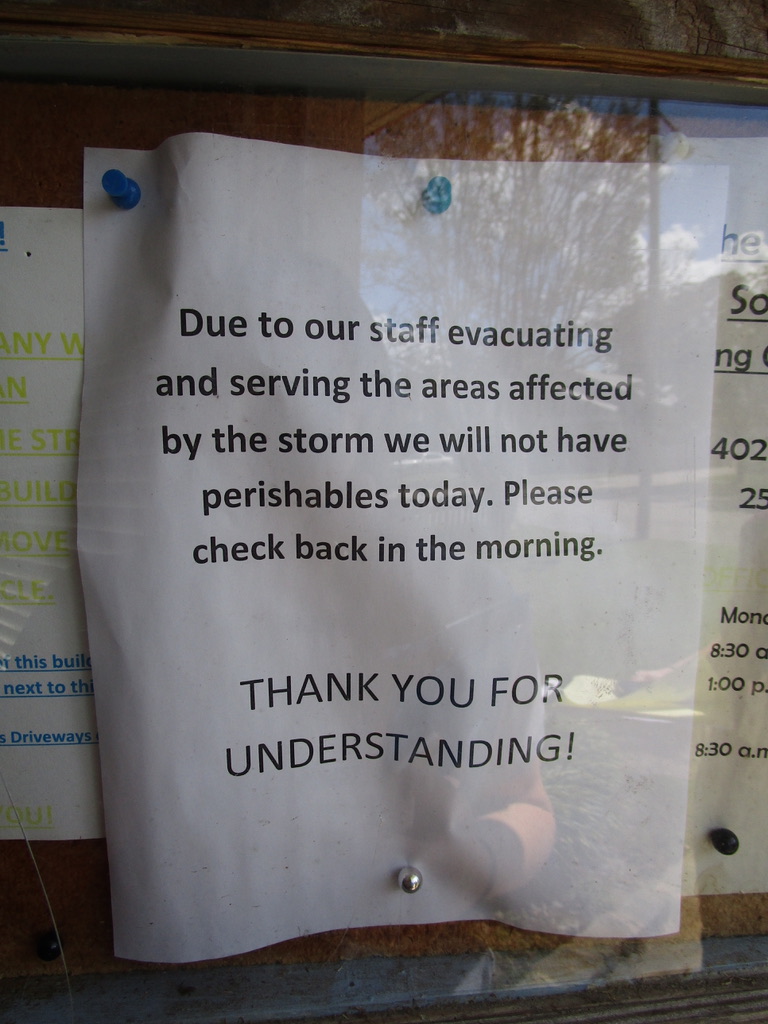 Community announcement for North Carolina residents after Hurricane Florence (2018).
(Image courtesy of Clay)
A key aspect of the FED model is that it is being developed with data from disasters. This is unlike current food system theory and metrics that base their emergency response on data from non-disaster times. The FED model will be tested against food insecurity data from COVID-19, Hurricane Florence, the 2018 Camp Fire in Paradise, California, and other case studies to determine how well the model fits with actual lived experiences in disasters.
“After I develop the FED model and validate it, the last part in the latter years of the grant will be to develop tools to support communities in building food system resilience for disasters,” says Clay. She will create the Environmental Audit Tool (EAT) to help local and state organizations better monitor and assess the processes and structures in place to address food insecurity in non-disaster times. This information will help improve both early response and long-term monitoring.
All of this work will help address the kinds of acute food insecurity issues that can double or triple chronic food security problems following disasters.
 Grocery store shelves after Hurricane Florence (2018). (Image courtesy of Clay)
Best practices in teaching
The NSF award also recognizes and furthers Clay’s work as an innovative educator. Through the CAREER award, she will develop best practices in teaching methods related to food insecurity in disaster situations.
Clay will create one of the first teaching labs to train undergraduate students with the knowledge, skills, and attitudes to address disaster-focused food insecurity. She will also integrate field and lab research into her classes more broadly, where students can engage with the work as disaster response is unfolding, giving them the opportunity to learn about disasters both from emergency response practices and a theoretical framework.
Foundational work
Clay’s latest research builds on prior foundational work. In 2021, she received a $100,000 collaborative research award from the U.S. Department of Agriculture (USDA) and Tufts University. Clay was one of six researchers across the U.S. to participate in the USDA’s “25 Years of Food Security Measurement: Answered Questions and Further Research” program. The program aims to foster research related to the past 25 years of U.S. household food security research and to explore feasible evidence-based improvements.
“I proposed that the USDA was missing important information about people’s lives by focusing entirely on financial barriers to food security. Having cash does not guarantee food security if there are community-level disruptions,” says Clay. “Roads can flood and access to kitchens and food storage facilities can be damaged.”
Clay and a team of researchers collected data from six states to explore nonfinancial barriers to food accessibility, availability, and acceptability, including physical barriers to food sources (such as damaged roads), barriers to food availability (such as store closures), and access to foods that can be consumed without extensive kitchen facilities.
“We are in the final phase of developing a better measure of food insecurity following disasters when there is a community-level disruption,” says Clay. She plans to use this measurement tool in the development of the FED model.
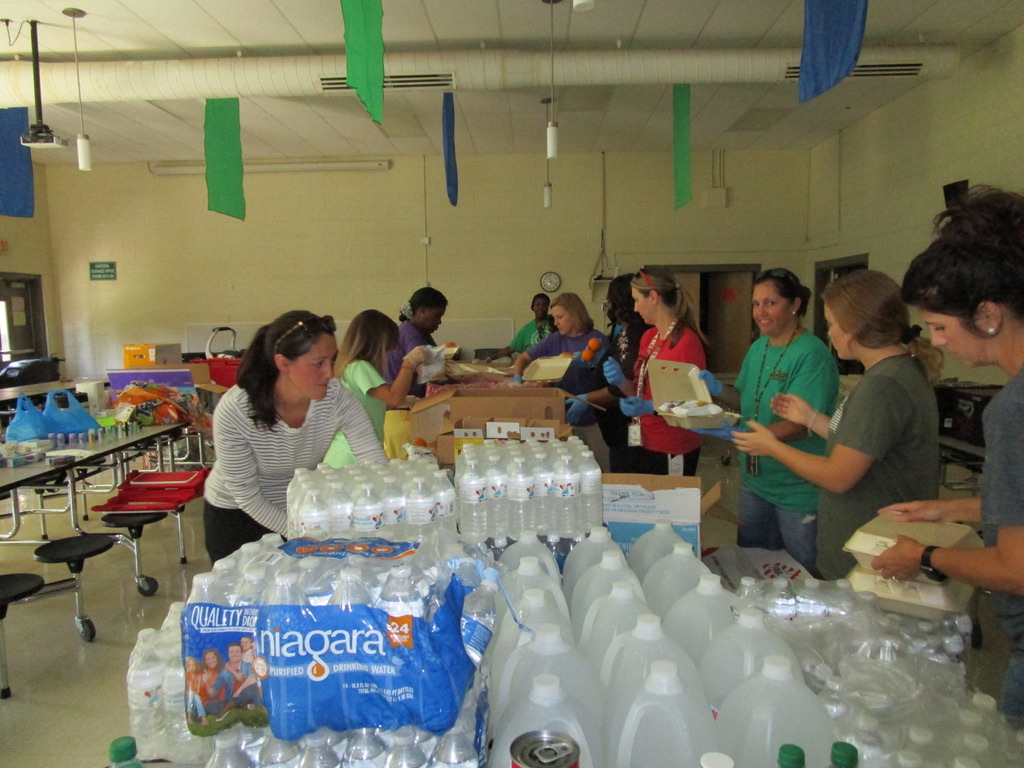 North Carolina teachers package food for victims of Hurricane Florence (2018). (Image courtesy of Clay)
National food access and COVID-19
Additionally, Clay has been working on two other food insecurity projects that have received Quick Response Research Awards, funded by the University of Colorado’s Natural Hazards Center with support from NSF.
In the first project, Clay leads the New York state team of the National Food Access and COVID research Team (NFACT). The team consists of researchers across 15 states exploring the impact of COVID-19 on food access, food security, and food systems across local, state, regional, and national levels. NFACT also integrates data to explore outcomes and impacts across scales.
NFACT has published several research briefs on COVID-19 and its primary and secondary health impacts, racial disparities in food insecurity, and racial disparities in healthcare insecurity among Native Americans and communities of color in New York City and New York State. NFACT has also published academic journal articles related to the health impacts of COVID-19, food access during the pandemic, and the need for enhanced outreach and support to those experiencing food insecurity for the first time during the pandemic.
The second project, in which Clay is the co-PI, is a study with the Food Distribution Program on American Reservations to pilot a culturally relevant metric of food insecurity. It will measure the impact of the COVID-19 pandemic on food insecurity among Native American and Alaskan Native communities in Western New York.
Clay was also awarded a research fellowship with the National Academies of Science, Engineering, and Medicine Gulf Research Program studying the Post-Disaster Food Environment project.
Helping communities to prepare and recover
In five years, Clay plans to have established the Disaster Health Research Lab, integrating the breadth of her research and teaching activities. This lab will offer a portfolio of tools to monitor food systems over the course of a disaster experience, from preparedness to assessing and responding to impact, to recovery. And she will offer tools to help communities improve the functioning of their food environments in disasters.
She particularly looks forward to developing a public engagement plan to share this work with researchers, disaster officials, and communities.
“Dr. Clay’s research demonstrates the importance of bringing a social science lens to the understanding of disaster science, management, and resilience,” says Christine Mallinson, director of UMBC’s Center for Social Science Scholarship. “Disasters exacerbate inequities, including food insecurity, which has a serious impact on the health of people and communities around the world. Dr. Clay’s research not only aims to understand these processes but also how to design interventions to mitigate the societal-level impacts and consequences of disasters.”
Clay is the first faculty member in UMBC’s College of Arts, Humanities, and Social Sciences to have received this award. UMBC faculty have received 42 NSF CAREER Awards since NSF launched the program in 1995, including eight faculty over the past five years. Their fields of research include computer science and electrical engineering (CSEE); information systems; chemistry and biochemistry; chemical, biochemical, and environmental engineering (CBEE); and biological sciences.
UMBC’s most recent recipients are Cynthia Matuszek, associate professor of CSEE; James Foulds, assistant professor of information systems; Naghmeh Karimi, assistant professor of CSEE, and Jianwu Wang, associate professor of information systems. UMBC President Valerie Sheares Ashby received an NSF CAREER award in 1998 while at Iowa State University.
]]>
When disasters happen, access to food can be interrupted, which can increase existing food insecurity issues and compound the impact of disasters. Currently, there isn’t a standard tool to measure...
https://umbc.edu/stories/tackling-food-insecurity-in-disasters-umbcs/
https://my3.my.umbc.edu/api/v0/pixel/news/128747/guest@my.umbc.edu/470bb3f3e0d5ff9ecfd2020b0f45ebe8/api/pixel
cahss
cahssresearch
career-award
cs3
diversityandinclusion
ehs
majoraward
news
policy-and-society
UMBC News & Magazine
https://my3.my.umbc.edu/groups/umbc-news-magazine
https://assets1-my.umbc.edu/system/shared/avatars/groups/000/001/943/24435aa6207c452e7bc15cc74b42c7bb/xsmall.png?1748556657
https://assets1-my.umbc.edu/system/shared/avatars/groups/000/001/943/24435aa6207c452e7bc15cc74b42c7bb/original.png?1748556657
https://assets2-my.umbc.edu/system/shared/avatars/groups/000/001/943/24435aa6207c452e7bc15cc74b42c7bb/xxlarge.png?1748556657
https://assets2-my.umbc.edu/system/shared/avatars/groups/000/001/943/24435aa6207c452e7bc15cc74b42c7bb/xlarge.png?1748556657
https://assets3-my.umbc.edu/system/shared/avatars/groups/000/001/943/24435aa6207c452e7bc15cc74b42c7bb/large.png?1748556657
https://assets1-my.umbc.edu/system/shared/avatars/groups/000/001/943/24435aa6207c452e7bc15cc74b42c7bb/medium.png?1748556657
https://assets2-my.umbc.edu/system/shared/avatars/groups/000/001/943/24435aa6207c452e7bc15cc74b42c7bb/small.png?1748556657
https://assets1-my.umbc.edu/system/shared/avatars/groups/000/001/943/24435aa6207c452e7bc15cc74b42c7bb/xsmall.png?1748556657
https://assets2-my.umbc.edu/system/shared/avatars/groups/000/001/943/24435aa6207c452e7bc15cc74b42c7bb/xxsmall.png?1748556657
UMBC News & Magazine
7
0
false
Wed, 26 Oct 2022 09:12:43 -0400
Wed, 26 Oct 2022 09:12:43 -0400