UMBC Pres. Valerie Sheares Ashby named 2022 Technologist of the Year

Women of Color Magazine has named UMBC President Valerie Sheares Ashby 2022 Technologist of the Year. Sheares Ashby celebrated the honor surrounded by joyful UMBC students at the Women of Color STEM DTX Conference in Detroit earlier this month. The annual event is designed to connect members of the STEM community at all career stages and to support the continued advancement of diversity in the STEM workforce.
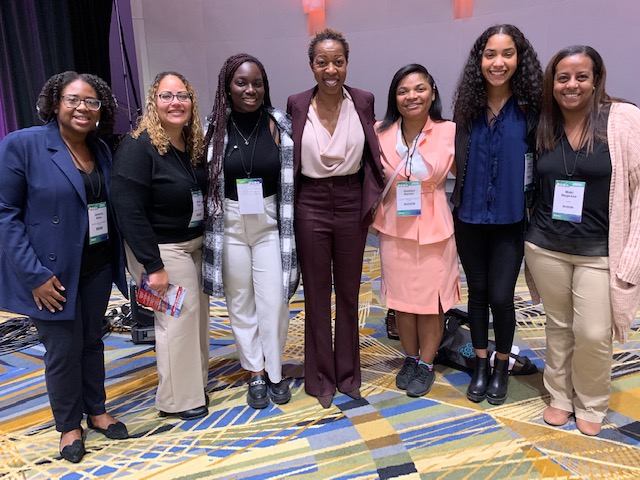
Several UMBC attendees at the Women of Color STEM DTX Conference (l-r): Janerra Allen, Meyerhoff Graduate Fellow; Mitsue Wiggs, assistant director of the Meyerhoff Scholars Program; Ngozi Emezienna ’25, M33, biological sciences; President Sheares Ashby; Natolya Barber ’23, M31, computer science; Samara Pyform ’24, M32, environmental science; Maki Negesse, Meyerhoff Graduate Fellow. (Image courtesy of Wiggs/UMBC)
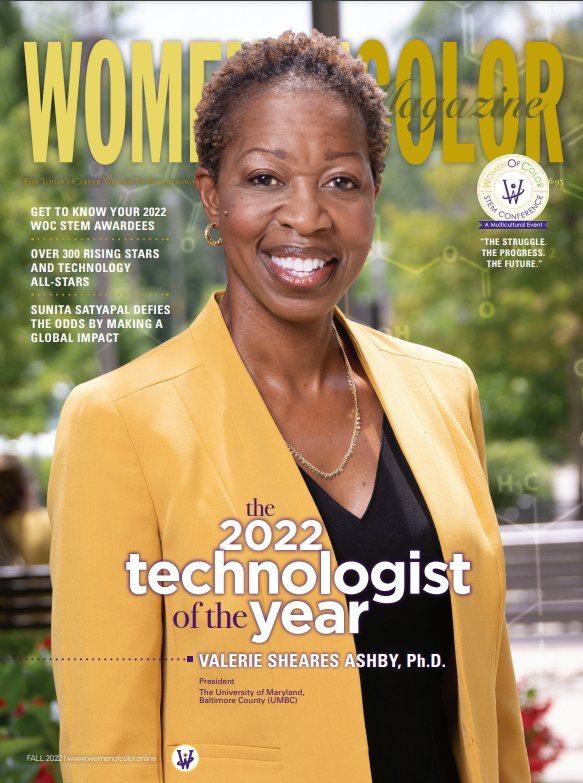
Sheares Ashby’s award is highlighted on the cover of Women of Color Magazine this month in a special feature that explores her life and career. The article begins with her love of math and science while growing up in a small town in North Carolina and details the twists and turns of her college experience at UNC Chapel Hill. She details the joy of her first real chemistry lab experience and the moment she realized, “I made a compound that nobody else had made before.”
 Women of Color Magazine
 cover featuring Pres. Valerie Sheares Ashby.
Mentorship is central to Sheares Ashby’s approach as an educator and leader, and the article recognizes several mentors who shaped her experience. She recalls Henry Frierson as the first mentor who encouraged her to get a Ph.D. and Joseph DeSimone, her Ph.D. supervisor, as “the person who told me I could be a faculty member. Not just a scientist, but a faculty member.”
She highlights Holden Thorp, who served as provost and chancellor at UNC Chapel Hill, as the person who helped her transition from faculty to administrator and Freeman Hrabowski, UMBC president emeritus, who predicted that someday she would be a university president.
Vision and values
The feature article also emphasizes the value that Sheares Ashby places on talking openly about the challenges of academia, and how that openness has helped her become an effective teacher, mentor, and scholar.
“I don’t know how many times I’ve given workshops on imposter syndrome, because I had it until I was 40,” she says in the magazine. “If you struggle and use it to help other people who are struggling…that’s your superpower because there’s nothing like authenticity.”
Sheares Ashby often speaks about the connection she feels with UMBC’s vision. Describing her thoughts on UMBC’s future, she shares, “There’s no change of vision needed. The question is, what does that look like in the next decade?”
This university has put a stake in the ground with one of the highest callings, I think, in higher education. It says in the vision that we will redefine excellence in higher education. And they’re going to do it through an inclusive culture, innovative teaching, research across the disciplines, civic engagement, and a focus on social justice and economic prosperity. Who says that and means it? To create a welcoming environment for inquisitive minds from all backgrounds. That is a showstopper to me and why I’m in higher education. For an institution to own that, live in that for 30 years, and achieve what [UMBC has] in this space of excellence through diversity, there is nothing like it in the country.
Valerie Sheares Ashby
UMBC President
Legacy of excellence
Joining Sheares Ashby as a featured participant at the Women of Color STEM Conference was UMBC alumna retired Rear Admiral Sylvia Trent-Adams, Ph.D. ’06, public policy.
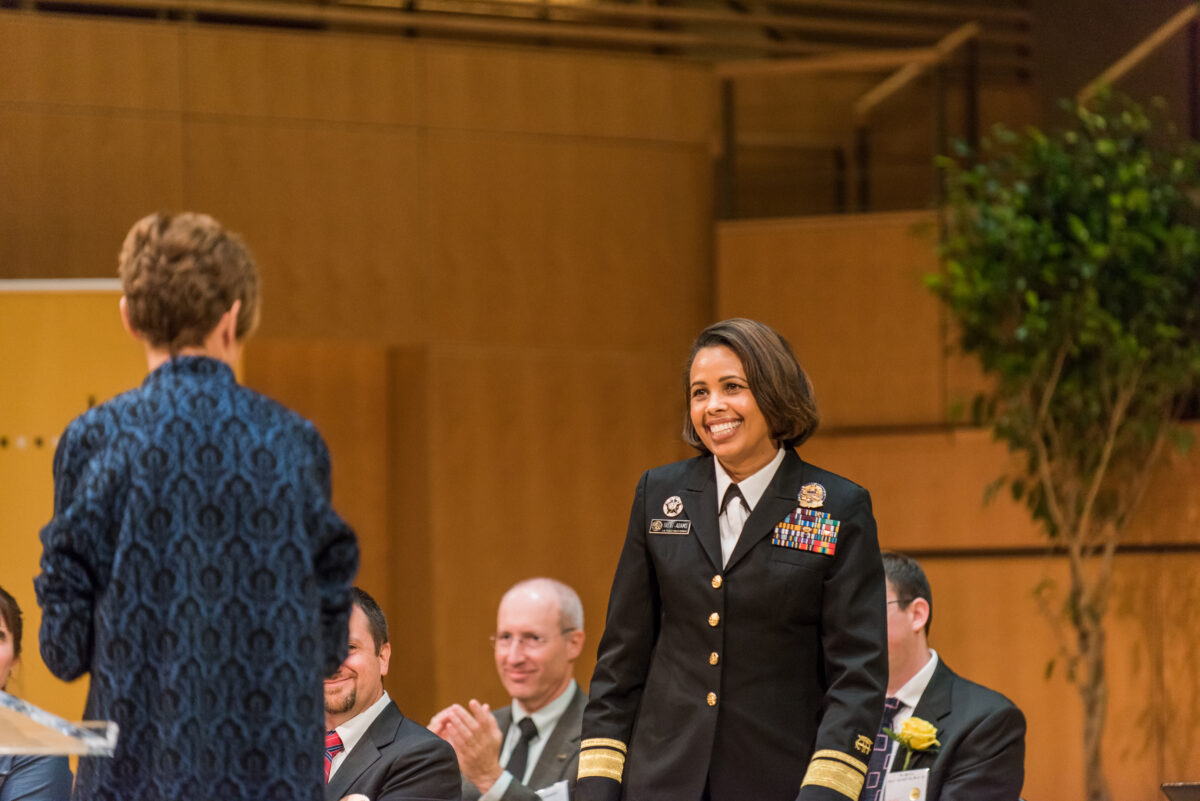
Sylvia Trent-Adams at UMBC’s 2017 Alumni Awards ceremony. (Marlayna Demond ’11/UMBC)
Trent-Adams previously served as principal deputy assistant secretary for health (2019 – 2020) and deputy surgeon general of the United States (2015 – 2019). She was named UMBC’s Outstanding Alumna in the Social and Behavioral Sciences in 2017 and received the Technologist of the Year Award in 2020. This September, Trent-Adams was named president of the University of North Texas Health Sciences Center at Fort Worth.
]]>
Women of Color Magazine has named UMBC President Valerie Sheares Ashby 2022 Technologist of the Year. Sheares Ashby celebrated the honor surrounded by joyful UMBC students at the Women of Color...
https://umbc.edu/stories/umbc-pres-valerie-sheares-ashby-named-2022-technologist-of-the-year/
https://my3.my.umbc.edu/api/v0/pixel/news/128693/guest@my.umbc.edu/68d8c1777f624b58cda8198b7414f0d1/api/pixel
alumni
community
majoraward
meyerhoffscholars
news
shearesashby
UMBC News & Magazine
https://my3.my.umbc.edu/groups/umbc-news-magazine
https://assets1-my.umbc.edu/system/shared/avatars/groups/000/001/943/24435aa6207c452e7bc15cc74b42c7bb/xsmall.png?1748556657
https://assets1-my.umbc.edu/system/shared/avatars/groups/000/001/943/24435aa6207c452e7bc15cc74b42c7bb/original.png?1748556657
https://assets2-my.umbc.edu/system/shared/avatars/groups/000/001/943/24435aa6207c452e7bc15cc74b42c7bb/xxlarge.png?1748556657
https://assets2-my.umbc.edu/system/shared/avatars/groups/000/001/943/24435aa6207c452e7bc15cc74b42c7bb/xlarge.png?1748556657
https://assets3-my.umbc.edu/system/shared/avatars/groups/000/001/943/24435aa6207c452e7bc15cc74b42c7bb/large.png?1748556657
https://assets1-my.umbc.edu/system/shared/avatars/groups/000/001/943/24435aa6207c452e7bc15cc74b42c7bb/medium.png?1748556657
https://assets2-my.umbc.edu/system/shared/avatars/groups/000/001/943/24435aa6207c452e7bc15cc74b42c7bb/small.png?1748556657
https://assets1-my.umbc.edu/system/shared/avatars/groups/000/001/943/24435aa6207c452e7bc15cc74b42c7bb/xsmall.png?1748556657
https://assets2-my.umbc.edu/system/shared/avatars/groups/000/001/943/24435aa6207c452e7bc15cc74b42c7bb/xxsmall.png?1748556657
UMBC News & Magazine
6
0
false
Mon, 24 Oct 2022 13:37:49 -0400
Mon, 24 Oct 2022 13:37:49 -0400
UMBC Special Collections receives more than 12,000 volumes from Parapsychology Foundation
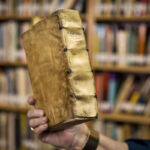
UMBC Special Collections has been given an extraordinary gift of one of the world’s largest collections devoted to parapsychology, from the Parapsychology Foundation, Inc. in Greenport, New York. The acquisition will be known as the Eileen J. Garrett Parapsychology Foundation Collection. It includes documents related to hauntings, poltergeists, out-of-body experiences, and séances, as well as spirit photographs and much more.
A renowned resource
The Eileen J. Garrett Parapsychology Foundation Collection contains more than 12,000 volumes and more than 100 periodicals, including rare books on and early journals devoted to psychical research. The collection emphasizes the literature of contemporary parapsychology and those publications that approach the subject from objective and analytical points of view.
The library also maintains strong sections on the history of psychical research and parapsychology, including early Spiritualism, mysticism and relevant philosophical works, as well as on mediumship, apparitions, hauntings, poltergeists, near-death and out-of-body experiences, experimental research on extrasensory perception, psychokinesis and precognition. A number of relevant encyclopedias, doctoral dissertations on parapsychological topics, introductory textbooks, and biographies of researchers, psychics and mediums are also on hand.
The archival collections comprise the history and proceedings of the Parapsychology Foundation and its annual conferences and publications, as well as field work, research notes, and manuscripts from prominent parapsychologists. Among the people and topics included in the collection are: the Bindelof séance phenomena, research files of psychic researcher Hereward Carrington, the poltergeist investigations and personal scrapbook of Nandor Fodor, scrapbooks compiled by Eileen J. Garrett, records pertaining to the R101 Airship crash, and spirit recordings captured by Hans Holzer.
The collection features original manuscripts by Harry Price and others pertaining to the infamous Borley Rectory case, popularly known as the most haunted house in England. It also contains Montague Ullman and Stanley Krippner’s dream telepathy research and many other subjects. Audio visual materials include over 600 audio and video recordings of conferences and lectures, spirit photographs, glass slides, target images, psychokinetic objects, and an ESP testing machine.
The Parapsychology Foundation’s rich history
The non-profit Parapsychology Foundation provides a worldwide forum supporting the scientific investigation of psychic phenomena. The Foundation gives grants; publishes pamphlets, monographs, conference proceedings, and the International Journal of Parapsychology; hosts the Perspectives Lecture Series; conducts an outreach program; and publishes books on the subject through its imprint, Helix Press.
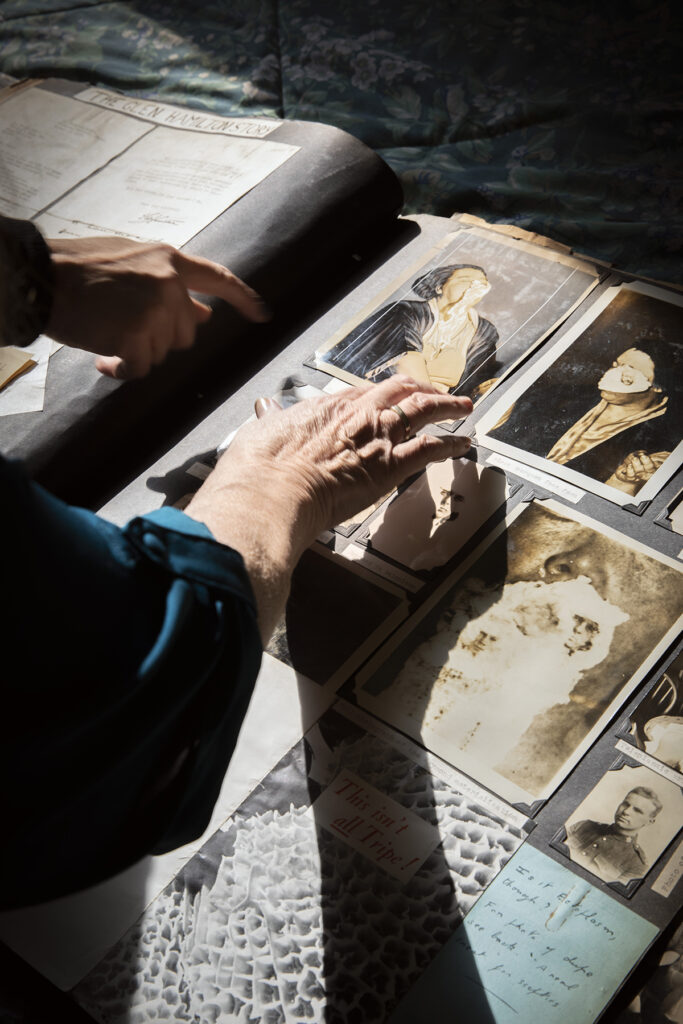 Materials from the Eileen J. Garrett Parapsychology Foundation Collection. (Image courtesy of Shannon Taggart)
The Parapsychology Foundation was founded by trance medium and research advocate Eileen J. Garrett and congresswoman Hon. Frances P. Bolton in 1951 to encourage and support impartial scientific inquiry into psychical aspects of human nature such as telepathy, clairvoyance, precognition, and psychokinesis.
A participant in some of the groundbreaking psychic experiments of the 1920s and 1930s, Garrett understood that psychical research was ignored by a large segment of the academic community. She knew that practical aid for scholars and scientists working in this area, now known as parapsychology, would not be available from most universities nor from other foundations. The Parapsychology Foundation, as envisioned by Garrett, fulfilled this need by providing a worldwide forum for the support of scientific exploration of psychic phenomena.
Establishing a new home for the collection
The Foundation recently decided to transfer its library to an American institution that would be willing to care for, interpret, and provide public access to the Foundation’s collection of scholarly materials. UMBC Special Collections was awarded this major gift thanks to its demonstrated commitment to preservation and accessibility.
Parapsychology Foundation president Lisette Coly states, “While bittersweet to relinquish the care of our library into the most capable hands of UMBC Special Collections, we are confident and excited that it has found a perfect harbor for its continuation and growth. Lovingly maintained throughout our 72 years of existence, we are assured of its preservation and growth as a valued resource disseminating quality information concerning a complex and often misunderstood subject. We eagerly look forward to future collaboration.”
“We are thrilled to bring this important collection to UMBC,” says curator and head of UMBC Special Collections Beth Saunders. “I believe that the Garrett Collection is exemplary of the spirit of free intellectual inquiry that our materials are intended to support.”
Saunders notes, “The collection includes materials relevant to a wide range of academic disciplines including anthropology, art history, sociology, philosophy, psychology, and physics, and addresses fundamental concerns of human experience.”
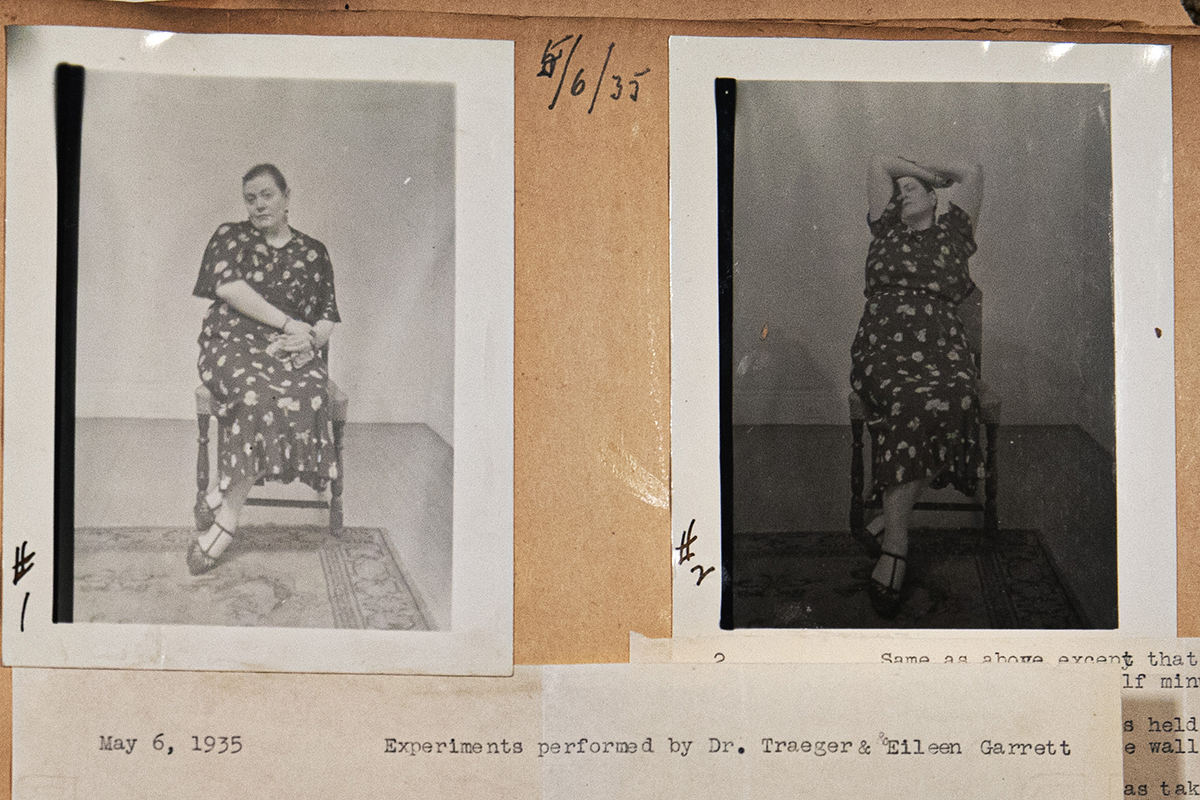 Materials from the Eileen J. Garrett Parapsychology Foundation Collection. (Image courtesy of Shannon Taggart)
Building on strengths
“The Garrett Library also builds upon an existing strength of Special Collections,” adds Saunders. “We are known internationally for our Jule Eisenbud Collection on Ted Serios and Thoughtographic Photography.”
Jule Eisenbud was heavily involved with psychoanalysis and psychology and was a clinical faculty member at the University of Colorado, and an honored member of the American Society for Psychical Research and Parapsychology Foundation. Eisenbud met his main subject, Ted Serios, in 1964 in Chicago. At the time, Serios was an unemployed bellhop who claimed that he had the ability to put images on film with his mind. Although initially skeptical of Serios, a significant number of successful experiments under tightly controlled conditions convinced Eisenbud that Serios’s talent was legitimate.
Ted Serios’s ability, which came to be known as “thoughtography,” gained national attention with his appearance on “The Tonight Show” with Johnny Carson. The Eisenbud Collection includes over 2,000 photographs and is the subject of a forthcoming exhibition organized by Emily Cullen, curator of exhibitions at UMBC’s Albin O. Kuhn Library Gallery, for The Image Centre at Toronto Metropolitan University, as well as a book to be published by Atelier Éditions, both in 2023.
Saunders envisions similar opportunities for the Eileen J. Garrett Parapsychology Foundation Collection. “We plan to focus first on making the collection accessible by cataloging the books and serials and creating a Finding Aid for the archival documents. We also plan to publish detailed research guides to aid scholars in discovery of relevant materials. In the future, there are a number of digitization projects that would make the highest research value materials more widely available, and I’d like to work with students to curate an exhibition from the collection in the Library Gallery.”
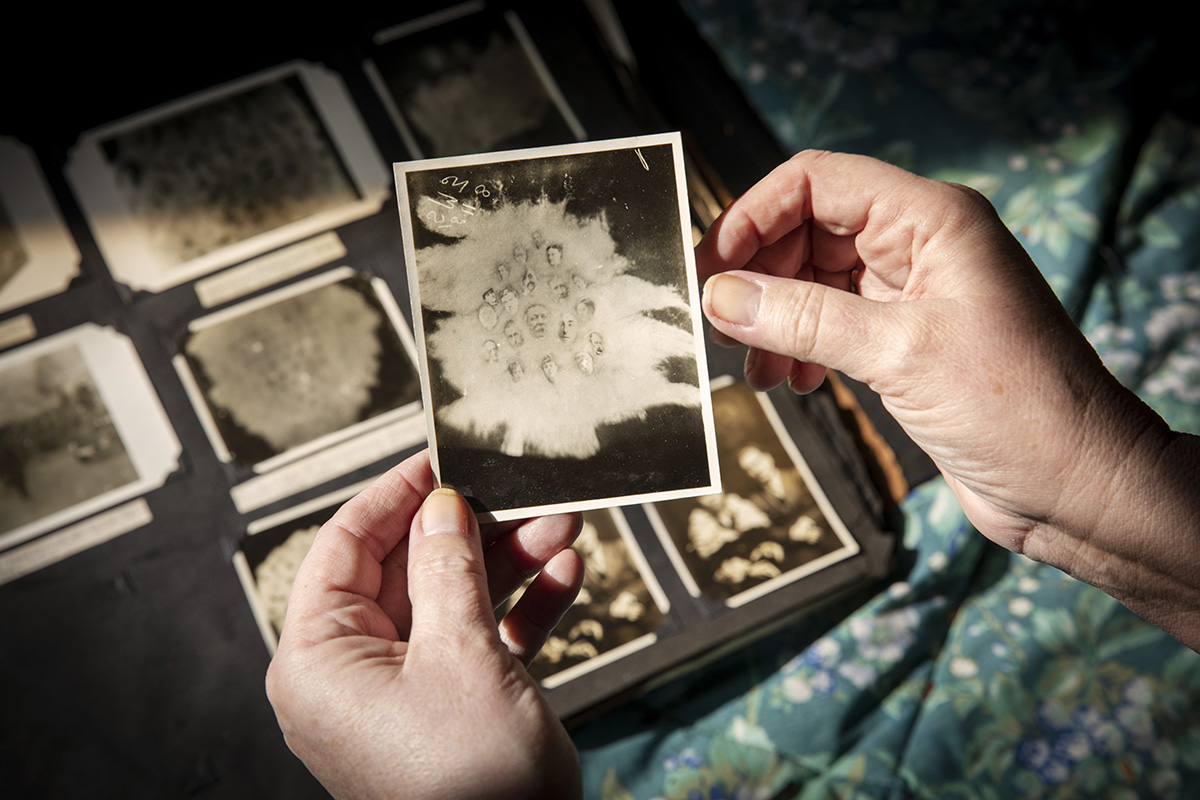 Materials from the Eileen J. Garrett Parapsychology Foundation Collection. (Image courtesy of Shannon Taggart)
UMBC’s Special Collections
The Special Collections department collects materials of enduring historical and cultural value—housing, preserving, and making accessible materials that are original, rare, unique, fragile, and archival. The collections and staff support UMBC’s research and educational mission and its dedication to cultural and ethnic diversity, social responsibility, and lifelong learning. Topical collecting areas are particularly emphasized within the fields of photography, the history of the biological sciences, the Baltimore Sun newspaper, science fiction literature and popular culture, parapsychology, alternative presses, UMBC history and records, and Maryland manuscript, photograph, and newspaper collections.
Saunders notes that Special Collections will continue to work with the Parapsychology Foundation to grow the collections and encourage its scholarly use. The Parapsychology Foundation hopes to administer library grants that will fund researchers visiting the Garrett Collection at UMBC. The organizations would also like to host joint public programs and academic symposia on topics related to the collection in the future.
]]>
UMBC Special Collections has been given an extraordinary gift of one of the world’s largest collections devoted to parapsychology, from the Parapsychology Foundation, Inc. in Greenport, New York....
https://umbc.edu/stories/umbc-special-collections-receives-more-than-12000-volumes-from-parapsychology-foundation/
https://my3.my.umbc.edu/api/v0/pixel/news/128694/guest@my.umbc.edu/5ee699982fb861005e9b679c9c561c11/api/pixel
arts-and-culture
library
news
special-collections
UMBC News & Magazine
https://my3.my.umbc.edu/groups/umbc-news-magazine
https://assets1-my.umbc.edu/system/shared/avatars/groups/000/001/943/24435aa6207c452e7bc15cc74b42c7bb/xsmall.png?1748556657
https://assets1-my.umbc.edu/system/shared/avatars/groups/000/001/943/24435aa6207c452e7bc15cc74b42c7bb/original.png?1748556657
https://assets2-my.umbc.edu/system/shared/avatars/groups/000/001/943/24435aa6207c452e7bc15cc74b42c7bb/xxlarge.png?1748556657
https://assets2-my.umbc.edu/system/shared/avatars/groups/000/001/943/24435aa6207c452e7bc15cc74b42c7bb/xlarge.png?1748556657
https://assets3-my.umbc.edu/system/shared/avatars/groups/000/001/943/24435aa6207c452e7bc15cc74b42c7bb/large.png?1748556657
https://assets1-my.umbc.edu/system/shared/avatars/groups/000/001/943/24435aa6207c452e7bc15cc74b42c7bb/medium.png?1748556657
https://assets2-my.umbc.edu/system/shared/avatars/groups/000/001/943/24435aa6207c452e7bc15cc74b42c7bb/small.png?1748556657
https://assets1-my.umbc.edu/system/shared/avatars/groups/000/001/943/24435aa6207c452e7bc15cc74b42c7bb/xsmall.png?1748556657
https://assets2-my.umbc.edu/system/shared/avatars/groups/000/001/943/24435aa6207c452e7bc15cc74b42c7bb/xxsmall.png?1748556657
UMBC News & Magazine
3
0
false
Mon, 24 Oct 2022 13:33:24 -0400
Mon, 24 Oct 2022 13:33:24 -0400
Reconnecting with Retriever Pride at Homecoming 2022

Every year, Retrievers of all ages (including some actual Retriever pups) and community members gather together for UMBC’s Homecoming—and as always, this year had something for everyone. For those who wanted to get an early start on the festivities, Retrievers enjoyed the morning’s 5k Dawg Chase and Fun Run. From there, alumni and friends could sit down for Family Breakfast, cheer on the Puppy Parade, gather for an ice cream social, and take in all the rides.
“For a lot of folks at UMBC, it’s coming back to a department, coming back to a social group, coming back to a physical space, coming back to an experience,” Jess Wyatt, associate director of Alumni Engagement and one of the event organizers.
Bringing the Homecoming spirit… competitively
Alexis Nobleman ’16, psychology and biological sciences and Alex Nobleman ’17, psychology, came for the Dawg Chase and stayed for the ice cream and the rides. “It’s always a blast to come back,” shared the married couple, “but we really wanted to race the 5k.”
 Runners set off on the Dawg Chase and Fun Run 5k. (Maximilian Franz/UMBC)

As usual, Erickson Field was transformed into a carnival ground—families and friends played games, took a spin on a ride, enjoyed the petting zoo, food trucks, and more. But most people paused their activities for the midday marquee event—the Puppy Parade. All good dogs were welcome to join, and some well-dressed pups participated in a special costume contest.
Roland Brooks, father to sophomore Olivia Brooks, a Meyerhoff Scholar, came to campus for the day. “We’re excited to support the university,” he said. “And with the change of guard with a new president, we wanted to be on campus, participate, and show our support. But we’re most excited about participating in the Puppy Parade.”
 (Maximilian Franz/UMBC)
 (Maximilian Franz/UMBC)
Welcoming back alumni
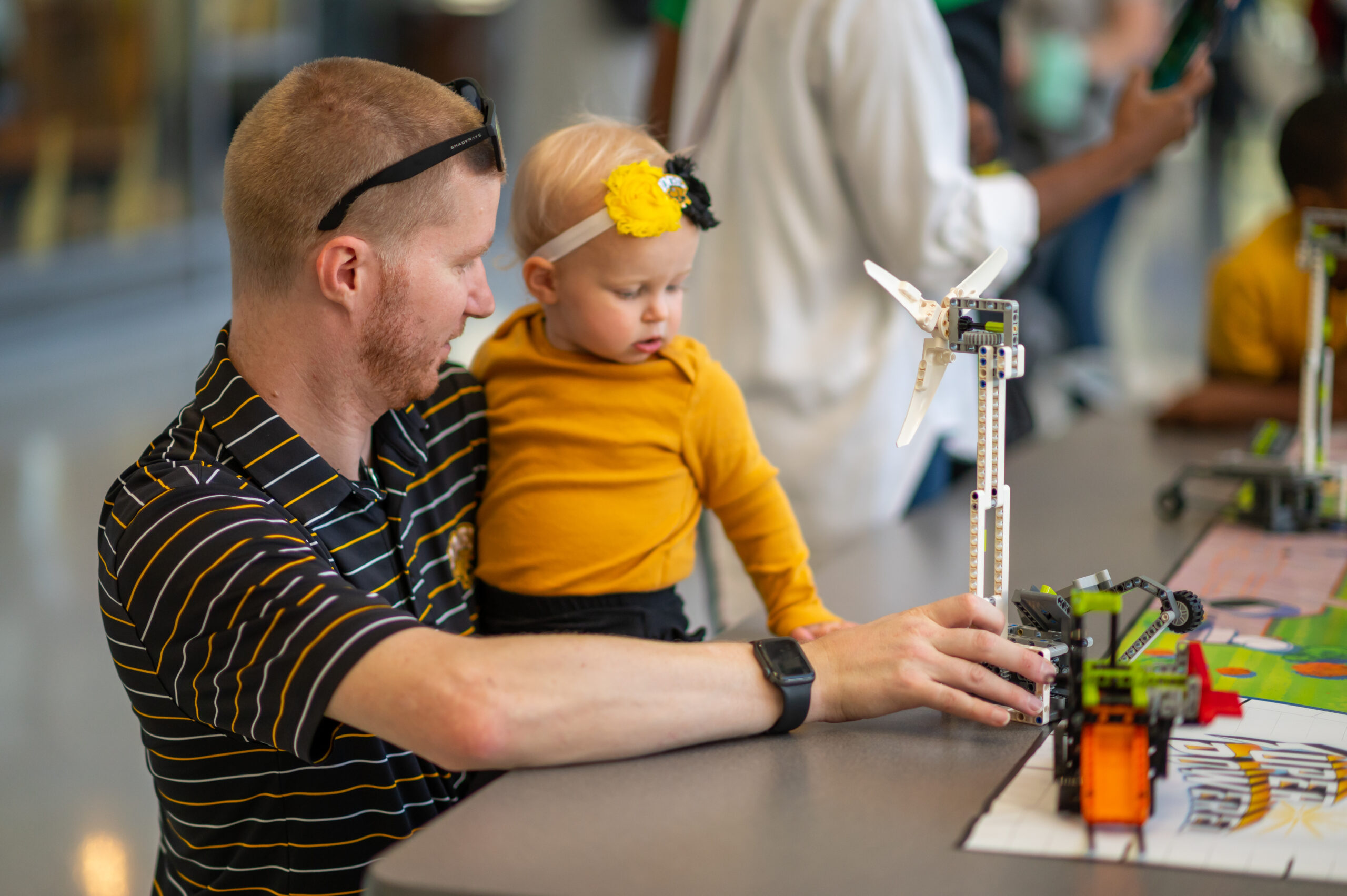
Alumni are always welcome back on UMBC’s campus, and Homecoming is a great opportunity to revisit your Retriever roots. If you ask Ron Pettie ’82, English, and his wife Christine, it’s all about reconnecting. “It’s a chance to come back and see what the school is doing now,” they’ll tell you. Through the years, Ron and Christine have made a point to return to UMBC each October and are enthusiastic to talk about the close soccer wins, sharing a corndog, and trying to keep up on the rides with their two little nieces.
 (Maximilian Franz/UMBC)
 (Kiirstn Pagan ’11/UMBC)
This year, Retrievers of all backgrounds could find a variety of events geared specifically toward them. Alumni enjoyed reunions, socials after sports games (catch the Athletics recap here), compelling talks at GRIT-X, relaxation at the beer garden, and so much more. A new addition this year was a Homecoming get-together at UMBC at the Universities at Shady Grove. Alumni Engagement is continually looking for ways to connect with more cohorts of Retrievers.
 Airi Yoshioka, professor of violin, performs “Sounds of the World Through the Violin” at GRIT-X. (Kiirstn Pagan ’11/UMBC)
Spending time with family
Homecoming at UMBC is an event for Retrievers to enjoy with their families, and the Family Breakfast gave folks a time to celebrate where they come from, the people they love, and how UMBC nurtures those connections.
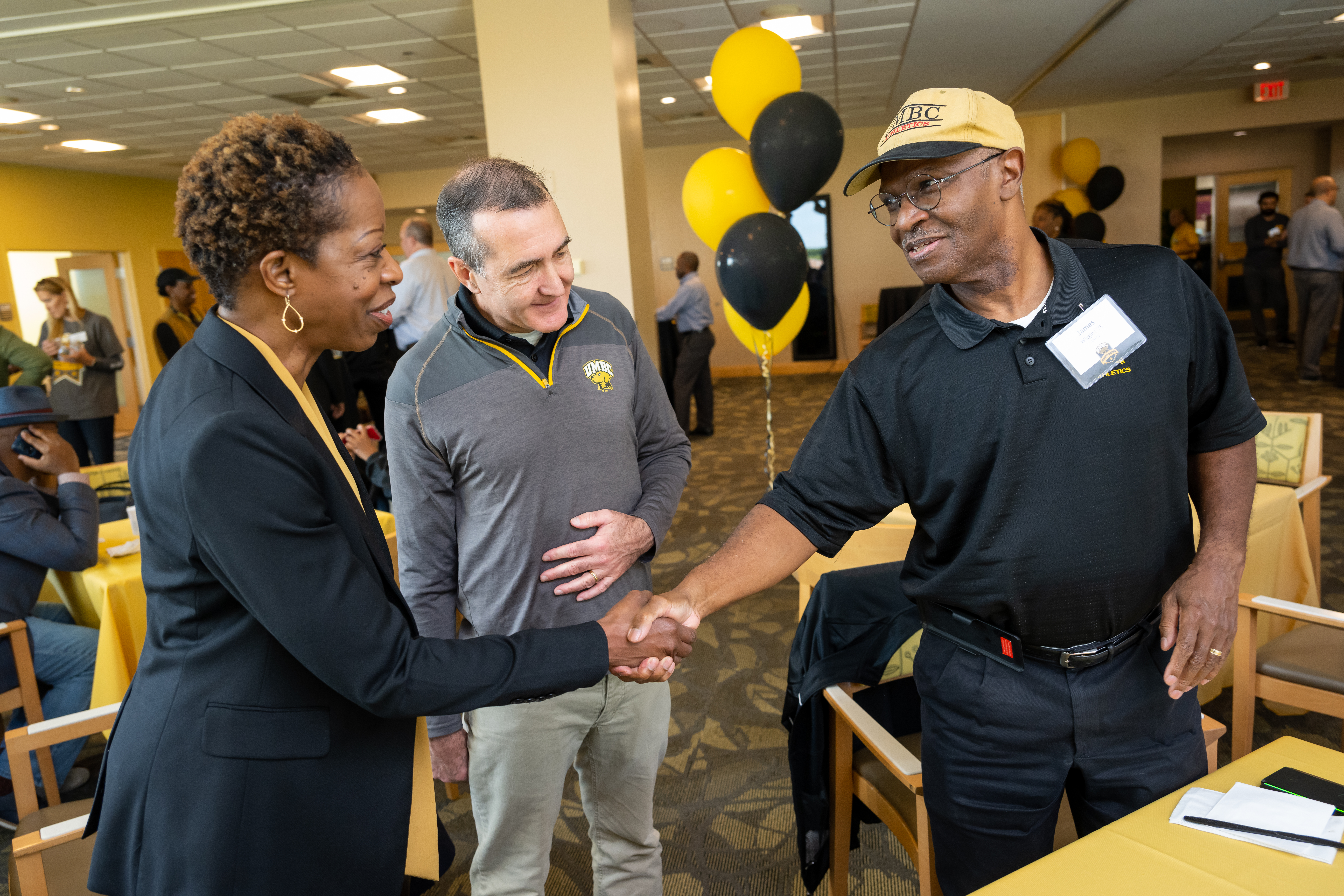 President Sheares Ashby shakes hand with an alumnus at a Homecoming event. (Maximilian Franz/UMBC)
“We have a lot of non-traditional age students, students who are parents, [and] students who live in a multi-generational household,” says Wyatt. As such, Homecoming was been planned with students, alumni, and families of all types in mind.
“Homecoming isn’t just a work project for a lot of us, it’s the thing that we bring our families to every year,” says Wyatt. “It’s really just seeing the best of everything that UMBC has to offer.”
By Levi Lewis ’23
]]>
Every year, Retrievers of all ages (including some actual Retriever pups) and community members gather together for UMBC’s Homecoming—and as always, this year had something for everyone. For those...
https://umbc.edu/stories/reconnecting-with-retriever-pride-at-homecoming-2022/
https://my3.my.umbc.edu/api/v0/pixel/news/128616/guest@my.umbc.edu/6c52be4cc29bf4f1f3ab0641a889d5b4/api/pixel
alumni
magazine
UMBC News & Magazine
https://my3.my.umbc.edu/groups/umbc-news-magazine
https://assets1-my.umbc.edu/system/shared/avatars/groups/000/001/943/24435aa6207c452e7bc15cc74b42c7bb/xsmall.png?1748556657
https://assets1-my.umbc.edu/system/shared/avatars/groups/000/001/943/24435aa6207c452e7bc15cc74b42c7bb/original.png?1748556657
https://assets2-my.umbc.edu/system/shared/avatars/groups/000/001/943/24435aa6207c452e7bc15cc74b42c7bb/xxlarge.png?1748556657
https://assets2-my.umbc.edu/system/shared/avatars/groups/000/001/943/24435aa6207c452e7bc15cc74b42c7bb/xlarge.png?1748556657
https://assets3-my.umbc.edu/system/shared/avatars/groups/000/001/943/24435aa6207c452e7bc15cc74b42c7bb/large.png?1748556657
https://assets1-my.umbc.edu/system/shared/avatars/groups/000/001/943/24435aa6207c452e7bc15cc74b42c7bb/medium.png?1748556657
https://assets2-my.umbc.edu/system/shared/avatars/groups/000/001/943/24435aa6207c452e7bc15cc74b42c7bb/small.png?1748556657
https://assets1-my.umbc.edu/system/shared/avatars/groups/000/001/943/24435aa6207c452e7bc15cc74b42c7bb/xsmall.png?1748556657
https://assets2-my.umbc.edu/system/shared/avatars/groups/000/001/943/24435aa6207c452e7bc15cc74b42c7bb/xxsmall.png?1748556657
UMBC News & Magazine
1
0
false
Thu, 20 Oct 2022 10:23:29 -0400
Thu, 20 Oct 2022 10:23:29 -0400
Community-building in Baltimore through public humanities
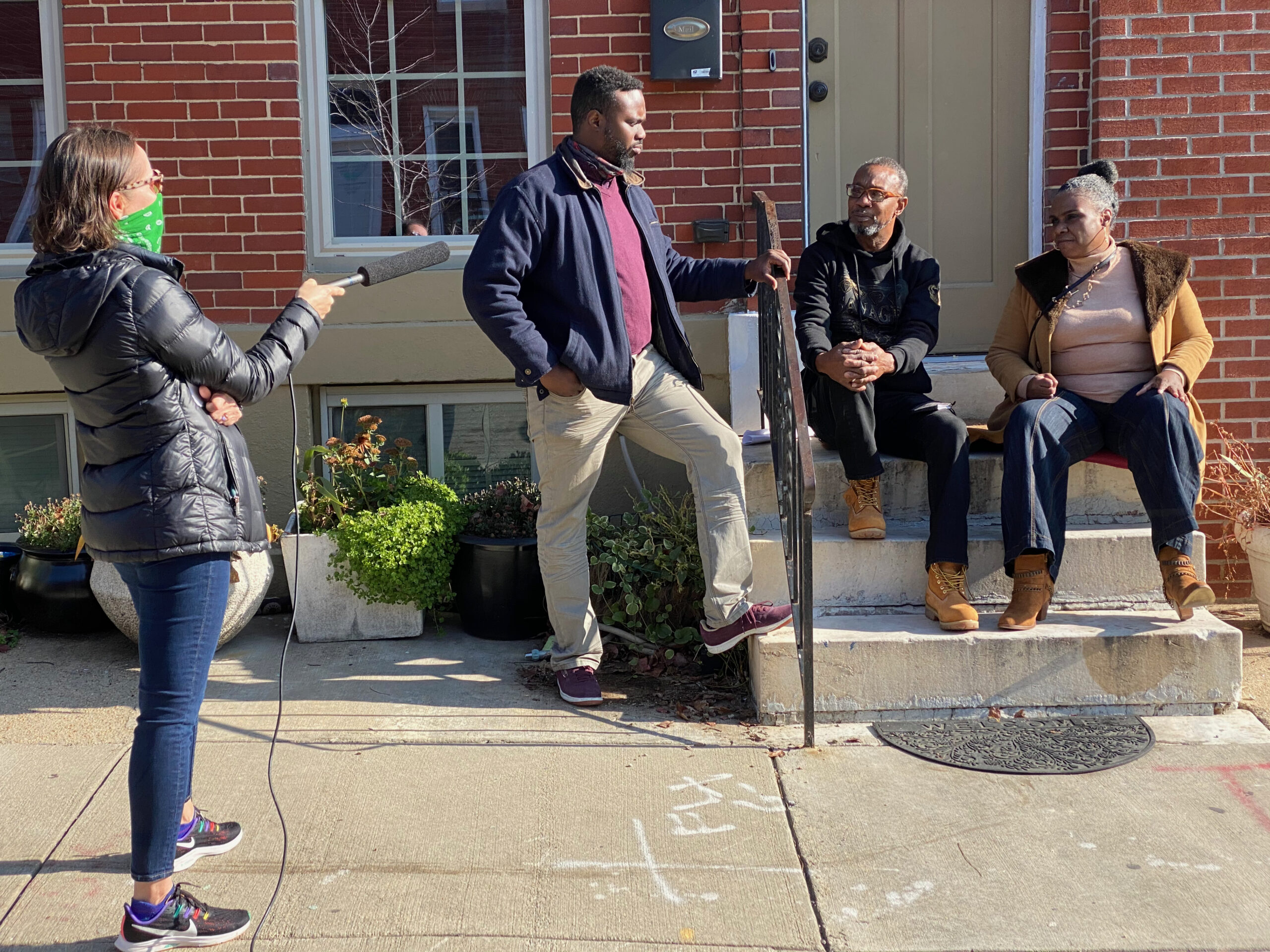
Over the last decade Nicole King, professor of American studies and director of the Orser Center for the Study of Place, Community, and Culture, has worked with colleagues to develop public humanities research methods that address disconnections, misrepresentation, and inequalities in Baltimore City and in the classroom. King helps students actively listen to and partner with Baltimore communities in research to create multimedia narratives as a vehicle of community-building and advocacy.
“Place-based public history projects demonstrate that students and scholars can engage and collaborate with communities to identify, analyze, and respond to pressing social problems,” says King. “Public history methods can create dynamic social spaces in which scholars and residents work together to frame questions, conduct research, and preserve urban places.”
King’s work has reached a broad range of academic and public audiences, from the recent co-authored article “Building Together” in Baltimore? Corporate Megadevelopment and Coalitions for Community Power in Urban Affairs Review to media coverage of A Place Called Poppleton, documenting a fight for community-led development as part of the Baltimore Traces project.
A Place Called Poppleton
In July 2022, Sonia and Curtis Eaddy celebrated as Baltimore’s mayor announced their home in the historic Poppleton neighborhood of West Baltimore, dating back to the late 1800s, would not be demolished for redevelopment as previously planned. Among those whom Sonia thanked for support were King and her students.
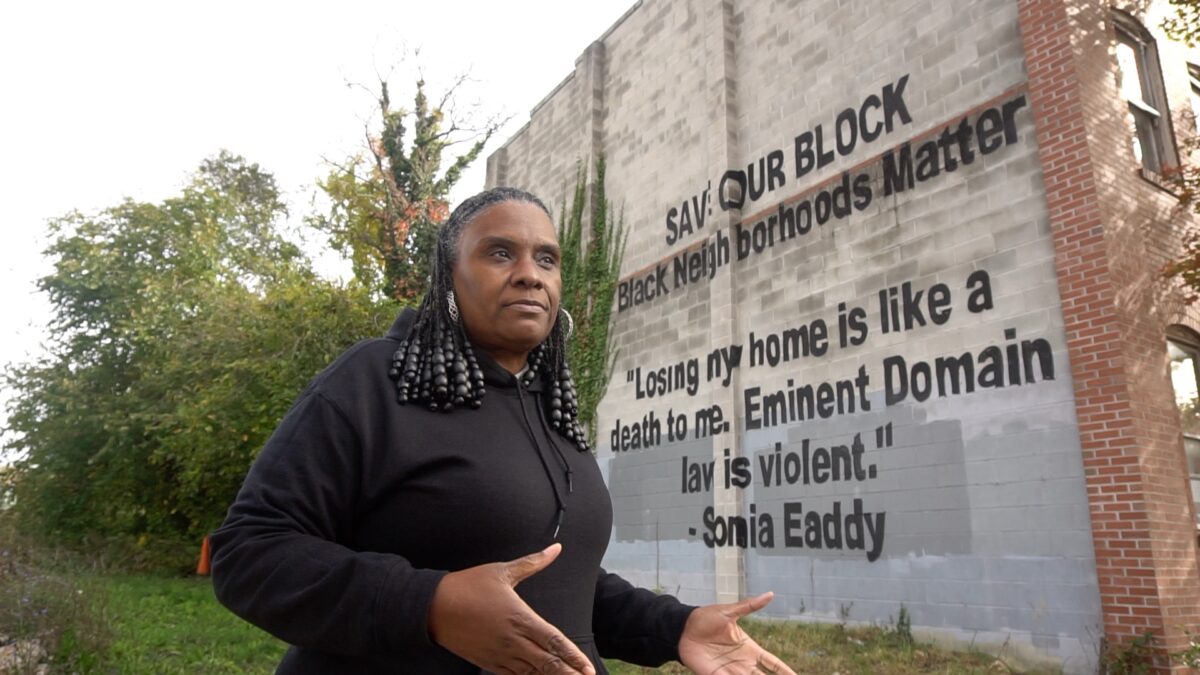 Sonia Eaddy. (Image courtesy of King)
King originally connected with the Eaddy family through their son, Curtis Eaddy II, who shared his story as a third-generation Poppleton resident in 2019 for the storytelling series Baltimore Traces: West Baltimore. He became a strong partner in leading walking tours of West Baltimore through UMBC’s Baltimore Field School before interviewing his parents for A Place Called Poppleton, which King co-created in 2020 with students, residents, and Bill Shewbridge, media and communication studies professor of the practice.
Curtis Eaddy II shares his story for Baltimore Traces: West Baltimore, produced by Shewbridge.
Through A Place Called Poppleton, UMBC students listened to residents who live, work, and are connected to Poppleton. They shared their voices through media like films, a digital walking tour and historical timeline, a zine, and a brochure. These materials have documented, analyzed, and raised awareness about Poppleton’s history and present community advocacy.
We Are You and You Are Us produced by María Morte, M.A. ’23, intercultural communication, Fulbright U.S. Student Scholar from Spain.
The project Baltimore Traces: Communities in Transition, which began in 2015, is a collaborative teaching initiative that brings together students from a variety of disciplines in the arts and humanities to create media focused on Baltimore neighborhoods. The project has produced the Telly Award-winning documentary Mill Stories: Remembering Sparrows Point Steel Mill as well as short films, digital maps, and podcasts such as the Baltimore Green Space and A Walk Down West Baltimore Street. This included the radio series Stories of Deindustrialization, produced in partnership with the Center for Emerging Media—a Baltimore non-profit, and aired on the Marc Steiner Show.
“Getting out, showing up, listening to people, and meeting people where they are is so important to building the Baltimore Traces project,” King explains. “It’s something that organically grows to educate students…to do work that matters on the ground.”
Baltimore Field School
It’s no accident that King first connected with Curtis Eaddy II through Baltimore Traces, and then the Baltimore Field School, a project specifically designed to support innovation in the public humanities through collaboration with Baltimore residents.
The Andrew W. Mellon Foundation awarded King and Dean Kimberly Moffitt $125,000 to establish the Baltimore Field School in 2020, to enhance the understanding and visibility of communities in South and Southwest Baltimore. The project accomplishes these objectives through methods centered in community partnership. In this way, it works to build a national model of effective, ethical humanities research, teaching, and learning about Baltimore and cities like it.
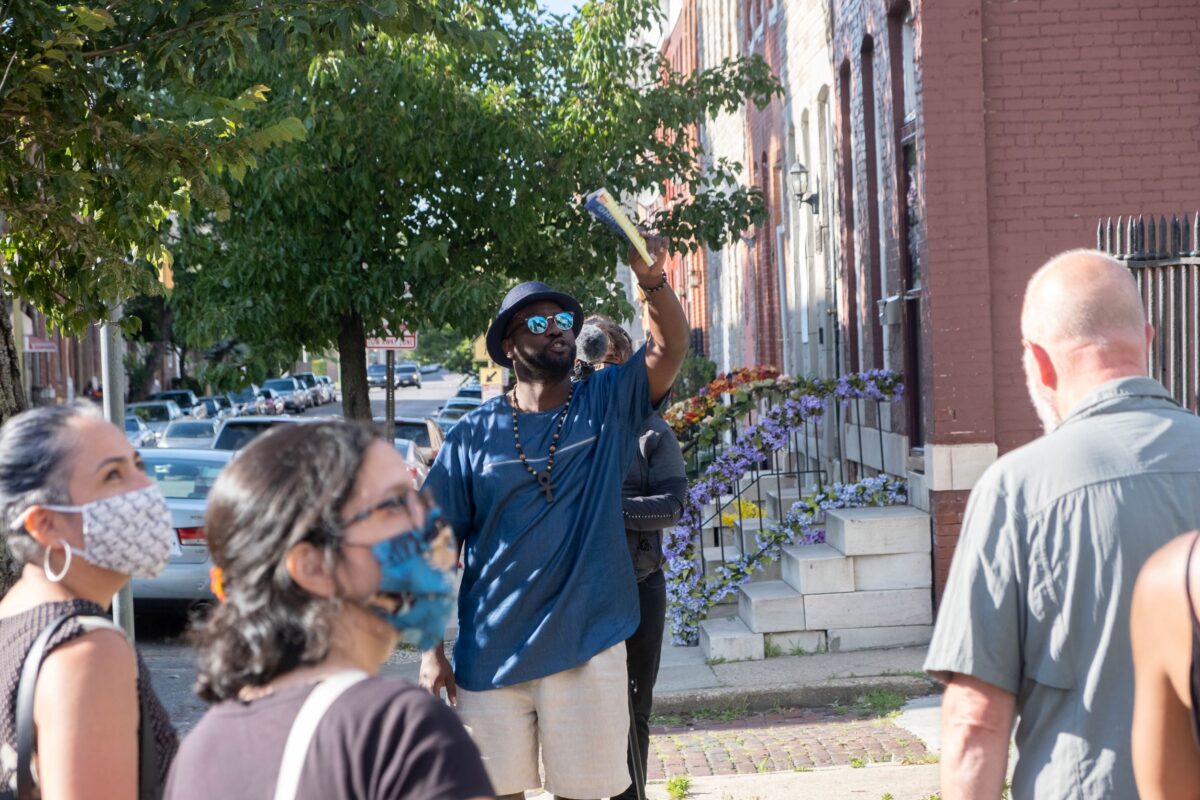 Curtis Eaddy II (center) leading a walking tour of West Baltimore for the Baltimore Field School.
The work continues to evolve. In 2022, the American Council of Learned Societies awarded King; Sarah Fouts, assistant professor of American studies; and Tahira Mahdi, adjunct professor of psychology, an NEH-supported public engagement grant totaling more than $150,000 for “Baltimore Field School 2.0: Undoing & Doing Anew in Public Humanities.”
Fouts, King, and Mahdi will work with community members, UMBC graduate students, and faculty to continue to develop frameworks for ethical and sustainable community-engaged research between local communities and academia, around topics such as public information, racial equity, and food and land justice.
The “public” in public humanities
These are some of the same core themes explored inBaltimore Revisited(Rutgers University Press, 2019), the leading contemporary anthology on the city’s complex history and efforts to address longstanding inequalities, written by experts both within and outside of academia. King co-edited the book with long-time collaborators Kate Drabinski, principal lecturer of gender, women’s, and sexuality studies, and the University of Baltimore’s Joshua Clark Davis.
“We hope the book raises questions about how history can inform the present to understand the roots of the city’s many inequalities,” said Drabinski, when it was published. “We wish readers to imagine new ways of being in and organizing for Baltimore now and in the future.”
Thinking of the anthology and all that has followed it, King reflects, “We can not forget the ‘public’ in public humanities.”
]]>
Over the last decade Nicole King, professor of American studies and director of the Orser Center for the Study of Place, Community, and Culture, has worked with colleagues to develop public...
https://umbc.edu/stories/community-building-in-baltimore-through-public-humanities/
https://my3.my.umbc.edu/api/v0/pixel/news/128592/guest@my.umbc.edu/75d853f2693ffa86fb3610b7278880c5/api/pixel
americanstudies
cahss
cahssresearch
gwst
intercultural-communications
mcs
news
policy-and-society
psychology
UMBC News & Magazine
https://my3.my.umbc.edu/groups/umbc-news-magazine
https://assets1-my.umbc.edu/system/shared/avatars/groups/000/001/943/24435aa6207c452e7bc15cc74b42c7bb/xsmall.png?1748556657
https://assets1-my.umbc.edu/system/shared/avatars/groups/000/001/943/24435aa6207c452e7bc15cc74b42c7bb/original.png?1748556657
https://assets2-my.umbc.edu/system/shared/avatars/groups/000/001/943/24435aa6207c452e7bc15cc74b42c7bb/xxlarge.png?1748556657
https://assets2-my.umbc.edu/system/shared/avatars/groups/000/001/943/24435aa6207c452e7bc15cc74b42c7bb/xlarge.png?1748556657
https://assets3-my.umbc.edu/system/shared/avatars/groups/000/001/943/24435aa6207c452e7bc15cc74b42c7bb/large.png?1748556657
https://assets1-my.umbc.edu/system/shared/avatars/groups/000/001/943/24435aa6207c452e7bc15cc74b42c7bb/medium.png?1748556657
https://assets2-my.umbc.edu/system/shared/avatars/groups/000/001/943/24435aa6207c452e7bc15cc74b42c7bb/small.png?1748556657
https://assets1-my.umbc.edu/system/shared/avatars/groups/000/001/943/24435aa6207c452e7bc15cc74b42c7bb/xsmall.png?1748556657
https://assets2-my.umbc.edu/system/shared/avatars/groups/000/001/943/24435aa6207c452e7bc15cc74b42c7bb/xxsmall.png?1748556657
UMBC News & Magazine
0
0
false
Wed, 19 Oct 2022 10:52:25 -0400
Wed, 19 Oct 2022 10:52:25 -0400
Celebrating Retriever Achievements

The weeks around Homecoming offer multiple ways for the UMBC community to reconnect with our Retriever pride and celebrate the accomplishments of our amazing alumni. Two marquee events during this time are the UMBC Athletic Hall of Fame Induction and Alumni Awards ceremonies.
Athletics’ legacy of excellence
The UMBC Athletics Hall of Fame first launched in the 1970s and was later made an annual ceremony in 1990. This celebratory event recognizes UMBC community members for their athletic excellence and contribution to the university. To date, 129 members have been enshrined. And this year, Brian Barrio, UMBC Director of Athletics, made a key change, moving the popular event to Homecoming weekend to capitalize on the #RetrieverNation excitement.
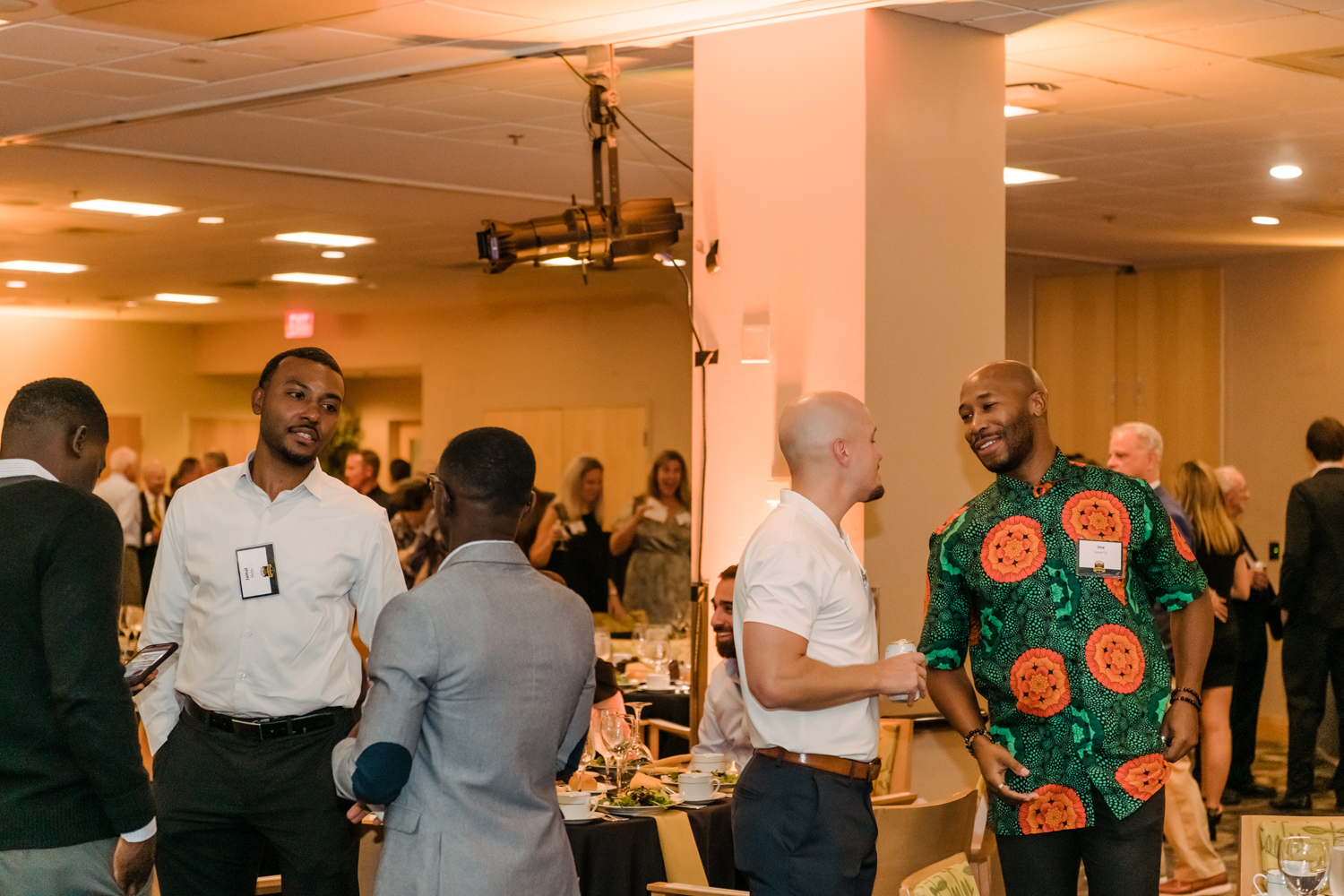
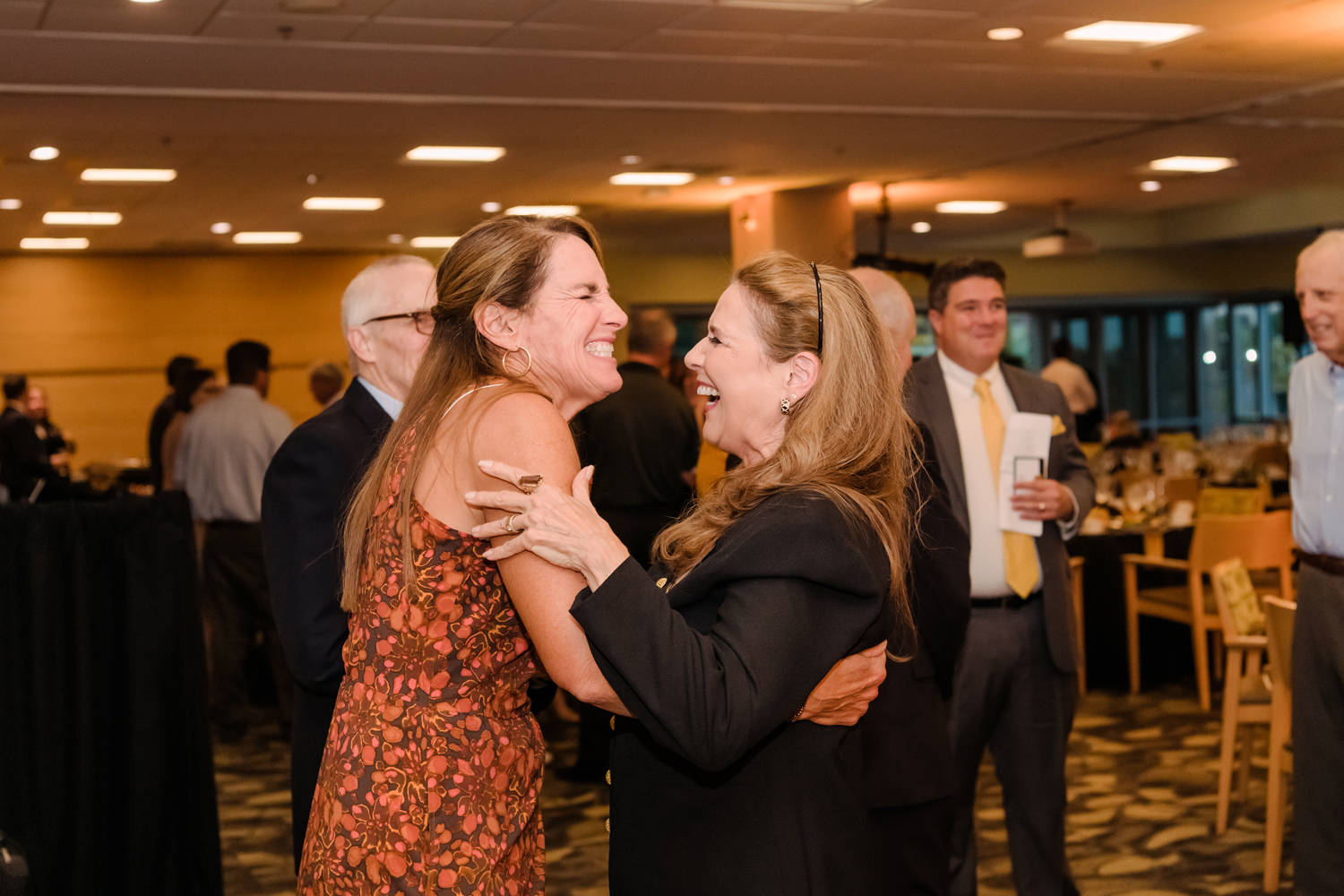
“We are thrilled that the Athletics Hall of Fame has been moved to the Homecoming weekend, and grateful to UMBC’s Office of Alumni Engagement who have been great partners in the re-launch of this event,” says Barrio. After postponing the event for two years due to COVID 19, says Barrio, Athletics is eager to celebrate their community. “This class is a diverse and talented group that set high standards of excellence for Retriever Nation.”
The 22nd edition of the Hall of Fame inductions took place on Friday, October 7, in UMBC’s Skylight Room honoring:
-
Steve Levy ’85, interdisciplinary studies—associate director of Athletics/director of athletic communications, 1986 – present
-
Dana Eberly Keiner ’97, biological sciences—volleyball, 1993 – 1996
-
Jean Salkeld Battista ’98, sociology—softball, 1997 – 1998
-
Mohamed Hussein ’14, mechanical engineering, M.S. ’17, systems engineering—swimming, 2011 – 2014
-
Levi Houapeu ’15, financial economics—men’s soccer, 2007 – 2010
-
Mercedes Jackson ’15, psychology—track and field, 2011 – 2015)
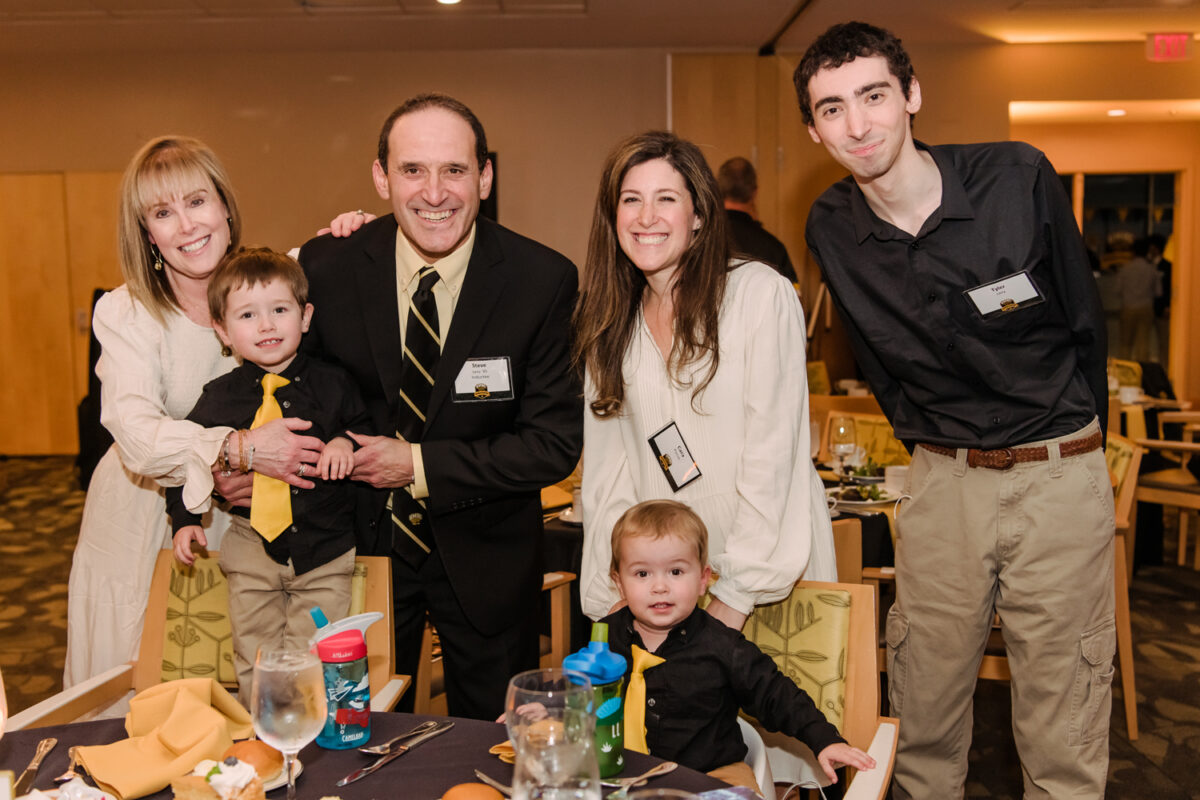 Steve Levy ’85 and his family at the Hall of Fame induction. (Marlayna Demond ’11/UMBC)
Recognizing alumni excellence
Later in October, UMBC will celebrate another cadre of Retrievers at the 2022 Alumni Awards, hosted by the UMBC Alumni Association Board of Directors. This year’s ceremony and reception takes place on Thursday, October 27, at 6:30 p.m. in UMBC’s Earl and Darielle Linehan Concert Hall.
“This is one of my favorite events because it brings the UMBC community together in such a beautiful way,” says Stanyell Odom, Director of Alumni Engagement. “We are proud to continue to support the Alumni Association and its board of directors in this annual celebration of excellence.”
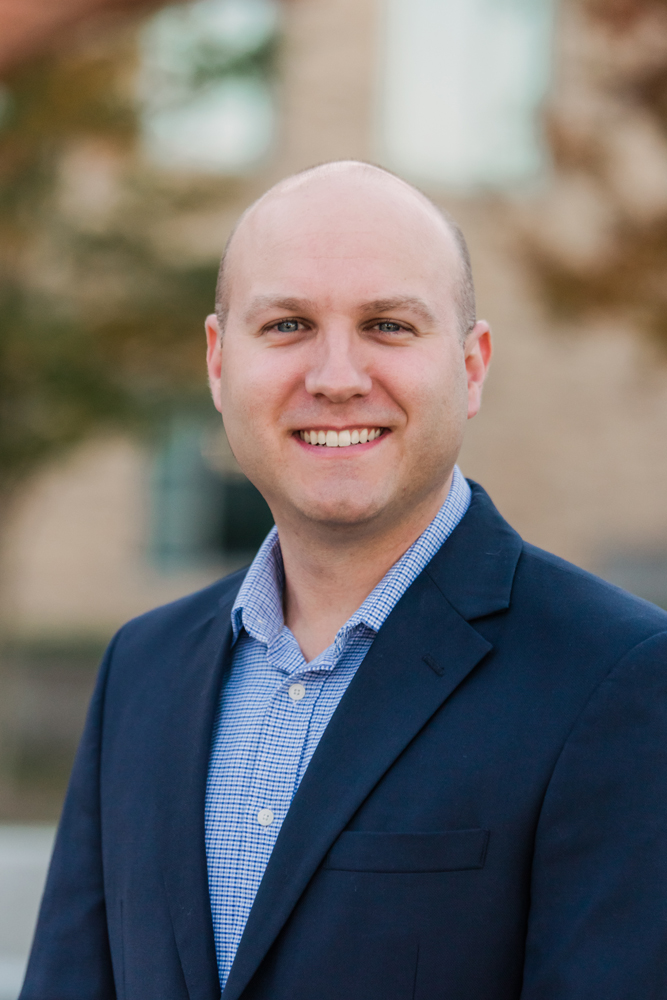
Brian Frazee (Marlayna Demond ’11/UMBC)
Three different types of awards are given to alumni during the ceremony: Outstanding Alumni of the Year awards (by major or field affiliation), Distinguished Service, and Rising Star (Young Alumni). The alumni board also recognizes one Outstanding Faculty member who has demonstrated commitment to student success beyond the classroom.
“The UMBC Alumni Association Board of Directors is excited to honor our 2022 Alumni Award winners,” says Brian Frazee ’11, political science, M.P.P. ’12. “This year’s honorees represent the very best of our alumni community, and their contributions are making a difference all over the world.”
This year’s awardees are:
-
Dr. Josiah Dykstra, Ph.D. ’13, computer science—Outstanding Alumnus in Engineering & Information Technology
-
Dr. Karsonya ‘Kaye’ Wise Whitehead, Ph.D. ’09, language, literacy and culture— Outstanding Alumna in the Humanities
-
Dr. Joy Haley, Ph.D. ’01, chemistry—Outstanding Alumna in Natural & Mathematical Sciences
-
Dr. Keith Elder, Ph.D. ’02, health policy, policy sciences—Outstanding Alumnus in Social & Behavioral Sciences
-
McKenzie Chinn ’06, theatre—Outstanding Alumna in Visual & Performing Arts
-
Benjamin Garmoe ’13, political science—Distinguished Service
-
Stefanie Mavronis ’12, media and communication studies, political science—Rising Star
-
Dr. Carolyn Forestiere, Professor of Political Science—Outstanding Faculty
Learn more about the 2022 Alumni Award winners and register for the event.
]]>
The weeks around Homecoming offer multiple ways for the UMBC community to reconnect with our Retriever pride and celebrate the accomplishments of our amazing alumni. Two marquee events during this...
https://umbc.edu/stories/celebrating-retriever-achievements/
https://my3.my.umbc.edu/api/v0/pixel/news/128556/guest@my.umbc.edu/ee152d91a32d4c360b51fa16c70a55bf/api/pixel
alumni
alumni-awards-2022
athletics
hall-of-fame
homecoming-2022
magazine
retrievernation
UMBC News & Magazine
https://my3.my.umbc.edu/groups/umbc-news-magazine
https://assets1-my.umbc.edu/system/shared/avatars/groups/000/001/943/24435aa6207c452e7bc15cc74b42c7bb/xsmall.png?1748556657
https://assets1-my.umbc.edu/system/shared/avatars/groups/000/001/943/24435aa6207c452e7bc15cc74b42c7bb/original.png?1748556657
https://assets2-my.umbc.edu/system/shared/avatars/groups/000/001/943/24435aa6207c452e7bc15cc74b42c7bb/xxlarge.png?1748556657
https://assets2-my.umbc.edu/system/shared/avatars/groups/000/001/943/24435aa6207c452e7bc15cc74b42c7bb/xlarge.png?1748556657
https://assets3-my.umbc.edu/system/shared/avatars/groups/000/001/943/24435aa6207c452e7bc15cc74b42c7bb/large.png?1748556657
https://assets1-my.umbc.edu/system/shared/avatars/groups/000/001/943/24435aa6207c452e7bc15cc74b42c7bb/medium.png?1748556657
https://assets2-my.umbc.edu/system/shared/avatars/groups/000/001/943/24435aa6207c452e7bc15cc74b42c7bb/small.png?1748556657
https://assets1-my.umbc.edu/system/shared/avatars/groups/000/001/943/24435aa6207c452e7bc15cc74b42c7bb/xsmall.png?1748556657
https://assets2-my.umbc.edu/system/shared/avatars/groups/000/001/943/24435aa6207c452e7bc15cc74b42c7bb/xxsmall.png?1748556657
UMBC News & Magazine
0
0
false
Tue, 18 Oct 2022 11:21:37 -0400
Tue, 18 Oct 2022 11:21:37 -0400
How Bob Dylan used the ancient practice of ‘imitatio’ to craft some of the most original songs of his time
Raphael Falco, Professor of English, UMBC
Over the course of six decades, Bob Dylan steadily brought together popular music and poetic excellence. Yet the guardians of literary culture have only rarely accepted Dylan’s legitimacy.
His 2016 Nobel Prize in Literature undermined his outsider status, challenging scholars, fans and critics to think of Dylan as an integral part of international literary heritage. My new book, “No One to Meet: Imitation and Originality in the Songs of Bob Dylan,” takes this challenge seriously and places Dylan within a literary tradition that extends all the way back to the ancients.
I am a professor of early modern literature, with a special interest in the Renaissance. But I am also a longtime Dylan enthusiast and the co-editor of the open-access Dylan Review, the only scholarly journal on Bob Dylan.
After teaching and writing about early modern poetry for 30 years, I couldn’t help but recognize a similarity between the way Dylan composes his songs and the ancient practice known as “imitatio.”
Poetic honey-making
Although the Latin word imitatio would translate to “imitation” in English, it doesn’t mean simply producing a mirror image of something. The term instead describes a practice or a methodology of composing poetry.
The classical author Seneca used bees as a metaphor for writing poetry using imitatio. Just as a bee samples and digests the nectar from a whole field of flowers to produce a new kind of honey – which is part flower and part bee – a poet produces a poem by sampling and digesting the best authors of the past.
 To Seneca, the poetry writing process was akin to a bee making honey. K_Thalhofer/iStock via Getty Images
Dylan’s imitations follow this pattern: His best work is always part flower, part Dylan.
Consider a song like “A Hard Rain’s A-Gonna Fall.” To write it, Dylan repurposed the familiar Old English ballad “Lord Randal,” retaining the call-and-response framework. In the original, a worried mother asks, “O where ha’ you been, Lord Randal, my son? / And where ha’ you been, my handsome young man?” and her son tells of being poisoned by his true love.
In Dylan’s version, the nominal son responds to the same questions with a brilliant mixture of public and private experiences, conjuring violent images such as a newborn baby surrounded by wolves, black branches dripping blood, the broken tongues of a thousand talkers and pellets poisoning the water. At the end, a young girl hands the speaker – a son in name only – a rainbow, and he promises to know his song well before he’ll stand on the mountain to sing it.
“A Hard Rain’s A-Gonna Fall” resounds with the original Old English ballad, which would have been very familiar to Dylan’s original audiences of Greenwich Village folk singers. He first sang the song in 1962 at the Gaslight Cafe on MacDougal Street, a hangout of folk revival stalwarts. To their ears, Dylan’s indictment of American culture – its racism, militarism and reckless destruction of the environment – would have echoed that poisoning in the earlier poem and added force to the repurposed lyrics.
Drawing from the source
Because Dylan “samples and digests” songs from the past, he has been accused of plagiarism.
This charge underestimates Dylan’s complex creative process, which closely resembles that of early modern poets who had a different concept of originality – a concept Dylan intuitively understands. For Renaissance authors, “originality” meant not creating something out of nothing, but going back to what had come before. They literally returned to the “origin.” Writers first searched outside themselves to find models to imitate, and then they transformed what they imitated – that is, what they found, sampled and digested – into something new. Achieving originality depended on the successful imitation and repurposing of an admired author from a much earlier era. They did not imitate each other, or contemporary authors from a different national tradition. Instead, they found their models among authors and works from earlier centuries.
In his book “The Light in Troy,” literary scholar Thomas Greene points to a 1513 letter written by poet Pietro Bembo to Giovanfrancesco Pico della Mirandola.
“Imitation,” Bembo writes, “since it is wholly concerned with a model, must be drawn from the model … the activity of imitating is nothing other than translating the likeness of some other’s style into one’s own writings.” The act of translation was largely stylistic and involved a transformation of the model.
Romantics devise a new definition of originality
However, the Romantics of the late 18th century wished to change, and supersede, that understanding of poetic originality. For them, and the writers who came after them, creative originality meant going inside oneself to find a connection to nature.
As scholar of Romantic literature M.H. Abrams explains in his renowned study “Natural Supernaturalism,” “the poet will proclaim how exquisitely an individual mind … is fitted to the external world, and the external world to the mind, and how the two in union are able to beget a new world.”
Instead of the world wrought by imitating the ancients, the new Romantic theories envisioned the union of nature and the mind as the ideal creative process. Abrams quotes the 18th-century German Romantic Novalis: “The higher philosophy is concerned with the marriage of Nature and Mind.”
The Romantics believed that through this connection of nature and mind, poets would discover something new and produce an original creation. To borrow from past “original” models, rather than producing a supposedly new work or “new world,” could seem like theft, despite the fact, obvious to anyone paging through an anthology, that poets have always responded to one another and to earlier works.
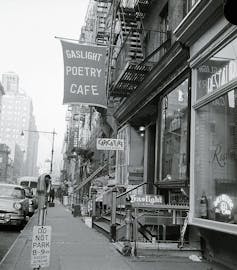 Dylan performed at New York City’s Gaslight Cafe, a popular folk music venue. Bettmann/Getty Images
Unfortunately – as Dylan’s critics too often demonstrate – this bias favoring supposedly “natural” originality over imitation continues to color views of the creative process today.
For six decades now, Dylan has turned that Romantic idea of originality on its head. With his own idiosyncratic method of composing songs and his creative reinvention of the Renaissance practice of imitatio, he has written and performed – yes, imitation functions in performance too – over 600 songs, many of which are the most significant and most significantly original songs of his time.
To me, there is a firm historical and theoretical rationale for what these audiences have long known – and the Nobel Prize committee made official in 2016 – that Bob Dylan is both a modern voice entirely unique and, at the same time, the product of ancient, time-honored ways of practicing and thinking about creativity.
This article is republished from The Conversation under a Creative Commons license. Read the original article.
]]>
Raphael Falco, Professor of English, UMBC Over the course of six decades, Bob Dylan steadily brought together popular music and poetic excellence. Yet the guardians of literary culture have...
https://umbc.edu/stories/how-bob-dylan-used-the-ancient-practice-of-imitatio-to-craft-some-of-the-most-original-songs-of-his-time/
https://my3.my.umbc.edu/api/v0/pixel/news/128534/guest@my.umbc.edu/83f9e1a2f7d64359348641f01de7e61e/api/pixel
cahss
cahssresearch
discovery
english
magazine
UMBC News & Magazine
https://my3.my.umbc.edu/groups/umbc-news-magazine
https://assets1-my.umbc.edu/system/shared/avatars/groups/000/001/943/24435aa6207c452e7bc15cc74b42c7bb/xsmall.png?1748556657
https://assets1-my.umbc.edu/system/shared/avatars/groups/000/001/943/24435aa6207c452e7bc15cc74b42c7bb/original.png?1748556657
https://assets2-my.umbc.edu/system/shared/avatars/groups/000/001/943/24435aa6207c452e7bc15cc74b42c7bb/xxlarge.png?1748556657
https://assets2-my.umbc.edu/system/shared/avatars/groups/000/001/943/24435aa6207c452e7bc15cc74b42c7bb/xlarge.png?1748556657
https://assets3-my.umbc.edu/system/shared/avatars/groups/000/001/943/24435aa6207c452e7bc15cc74b42c7bb/large.png?1748556657
https://assets1-my.umbc.edu/system/shared/avatars/groups/000/001/943/24435aa6207c452e7bc15cc74b42c7bb/medium.png?1748556657
https://assets2-my.umbc.edu/system/shared/avatars/groups/000/001/943/24435aa6207c452e7bc15cc74b42c7bb/small.png?1748556657
https://assets1-my.umbc.edu/system/shared/avatars/groups/000/001/943/24435aa6207c452e7bc15cc74b42c7bb/xsmall.png?1748556657
https://assets2-my.umbc.edu/system/shared/avatars/groups/000/001/943/24435aa6207c452e7bc15cc74b42c7bb/xxsmall.png?1748556657
UMBC News & Magazine
0
0
false
Mon, 17 Oct 2022 13:42:10 -0400
Mon, 17 Oct 2022 13:42:10 -0400
BBC at 100: a trusted international news source, but it’s important to remember whose values it reflects
Jessica Berman, Director of the Dresher Center for the Humanities, Professor of English; Gender Women’s & Sexuality Studies; and Language, Literacy and Culture, UMBC.
As the BBC turns 100 we should celebrate its extraordinary history as a public service broadcaster bringing news and other programming to audiences around the globe. In 2020-2021 the BBC announced that its World Service achieved its highest-ever audience, with an average of close to 500 million listeners globally each week. The BBC brings news to audiences in more than 40 languages, with newer additions like Igbo, Pidgin, and Yoruba growing in strength each year.
Older people among us still remember tuning into the BBC World Service radio as a prime source for allied news during the second world war. Its long history of offering reliable information to those in conflict zones or under censorship continues, as shown by its strengthening of programming in Russian and Arabic in recent years. Since its founding in 1932, the BBC’s international output has been crucial to those seeking fair, honest and comprehensive news and cultural broadcasts around the world.
At the same time, as scholar Simon Potter notes, the BBC’s World Service has always been a vehicle for British soft power. In 1932, when the BBC first embarked on its Empire service, founding director John Reith called it:
A unique opportunity to foster bonds of understanding and friendship between the peoples of Britain’s scattered dominions and the mother country, and to bring to Britons overseas the benefits already enjoyed by the British public at home.
Reith had advocated for such a service since the beginning of the BBC, making clear the political and social dimension of its founding mission. Although the BBC is a public-service corporation separate from the British government and has seen its fair share of conflicts with those in power, its mission has been and continues to be informed by British values and interconnected to Britain’s future.
Empire Radio
The rise of Empire Radio in the 1930s and 1940s shows how the BBC navigated the conflicting roles of bringing the benefits of broadcasting to listeners in the British colonies while forging stronger bonds across the empire. Given a mission to educate, inform and entertain, the Empire Service (later World Service) developed programs to reach those in the colonies and dominions and allow them to access British civilisation and its values. As Potter puts it, “the BBC voluntarily participated in the overseas projection of Britishness as part of its public-service remit”.
For example, the Eastern Service gathered many celebrated writers into its ranks, with George Orwell directing the India Section from 1941 to 1943. A photograph shows Orwell with famous writers T.S. Eliot and William Empson and emerging figures from across the empire, including Indian writer Mulk Raj Anand and Jamaican writer Una Marson at work on a literary magazine called “The Voice” for broadcast to India. Peter Kalliney argues that these gatherings at the BBC were crucial for building networks of colonial and metropolitan writers. Orwell certainly hoped that programs like “Through Eastern Eyes” or “We Speak to India” would bring east and west together.
And yet, the programming was often naïve and Anglocentric. For instance, The Voice highlighted T.S. Eliot reading his difficult poem Little Giddings which demanded advanced literacy in English, not attained by many Indians at the time. Many programs relied on listeners to be interested in life in London and the progress of the second world war from the British perspective.
By contrast, my research has shown that All India Radio (AIR), India’s developing public broadcasting network modelled on the BBC, offered a wider range of programming focused on Indian listeners, their concerns and their regional languages and cultures. AIR devoted airtime to Indian music and developed cadres of performers to produce radio plays in Indian languages.
The program listings of The Indian Listener, AIR’s official magazine, in the early 1940s show excerpts from the Mahabharata, Indian classical music, a Hindustani lecture on religion in public life, a feature on the changing role of women and programmes for villagers in Tamil, Telugu, or Bengali. There was news analysis in multiple languages. In other words, AIR was more varied, more in-tune with local languages and interests and resisted the primacy of the BBC’s civilising mission.
Caribbean Voices
BBC radio programming for the Caribbean was never as extensive as it was for India nor did a regional broadcaster emerge in the colonial West Indies. But during the 1940s and 1950s it broadcast the celebrated weekly Caribbean Voices programme, which was founded in 1943 by poet, journalist and editor, Una Marson.
This helped to develop the careers of many of the best writers from the region, including Sam Selvon and Dereck Walcott. Caribbean Voices would champion local writing and language, spoken on air by those from the islands, in a way no other entity had done before.
But, as in India, the BBC’s Caribbean programming was also meant to extend the British connection throughout the region, especially during wartime. It arose from Marson’s “morale-boosting” earlier program West Indies Calling for people from the islands serving the war effort and continued to be part of a constellation of broadcasts for the region meant to knit the islands to each other and to Britain.
While these programmes sometimes acknowledged differences across the islands, they also reflect the British government’s interest in treating the West Indies as a single region in response to unrest as well as the threat of growing US power in the Caribbean. The BBC’s regional approach and its limitations can help us see both the promise and failures of the West Indian Federation, the short-lived political union between various islands in the Caribbean between 1958 and 1962.
These examples point to the complex relationship between the BBC’s Empire Service and British political interests which have implications for today. Never a direct vehicle for government power, the broadcaster nevertheless has participated in advancing “Britishness” around the globe.
As we mark the BBC’s centenary and celebrate the continuing achievements of the World Service, we should remember how British soft power has often guided its history and insist that it is able to operate independently now and into the future.
This article is republished from The Conversation under a Creative Commons license. Read the original article.
]]>
Jessica Berman, Director of the Dresher Center for the Humanities, Professor of English; Gender Women’s & Sexuality Studies; and Language, Literacy and Culture, UMBC. As the BBC turns 100...
https://umbc.edu/stories/bbc-at-100-a-trusted-international-news-source-but-its-important-to-remember-whose-values-it-reflects/
https://my3.my.umbc.edu/api/v0/pixel/news/128529/guest@my.umbc.edu/5fadd674629551d1c10ec37ac91bdc6e/api/pixel
cahss
cahssresearch
discovery
dreshercenter
english
international
magazine
UMBC News & Magazine
https://my3.my.umbc.edu/groups/umbc-news-magazine
https://assets1-my.umbc.edu/system/shared/avatars/groups/000/001/943/24435aa6207c452e7bc15cc74b42c7bb/xsmall.png?1748556657
https://assets1-my.umbc.edu/system/shared/avatars/groups/000/001/943/24435aa6207c452e7bc15cc74b42c7bb/original.png?1748556657
https://assets2-my.umbc.edu/system/shared/avatars/groups/000/001/943/24435aa6207c452e7bc15cc74b42c7bb/xxlarge.png?1748556657
https://assets2-my.umbc.edu/system/shared/avatars/groups/000/001/943/24435aa6207c452e7bc15cc74b42c7bb/xlarge.png?1748556657
https://assets3-my.umbc.edu/system/shared/avatars/groups/000/001/943/24435aa6207c452e7bc15cc74b42c7bb/large.png?1748556657
https://assets1-my.umbc.edu/system/shared/avatars/groups/000/001/943/24435aa6207c452e7bc15cc74b42c7bb/medium.png?1748556657
https://assets2-my.umbc.edu/system/shared/avatars/groups/000/001/943/24435aa6207c452e7bc15cc74b42c7bb/small.png?1748556657
https://assets1-my.umbc.edu/system/shared/avatars/groups/000/001/943/24435aa6207c452e7bc15cc74b42c7bb/xsmall.png?1748556657
https://assets2-my.umbc.edu/system/shared/avatars/groups/000/001/943/24435aa6207c452e7bc15cc74b42c7bb/xxsmall.png?1748556657
UMBC News & Magazine
0
0
false
Mon, 17 Oct 2022 13:08:17 -0400
Mon, 17 Oct 2022 13:08:17 -0400
UMBC researchers build next-gen satellite tech to examine Earth’s atmosphere

The first Hyper-Angular Rainbow Polarimeter (HARP) was a nano-satellite about as big as a loaf of bread. Developed by Vanderlei Martins, professor of physics, and his team of scientists and engineers at UMBC’s Earth and Space Institute, the HARP cubesat launched to the International Space Station in November 2019 and was released into orbit in February 2020. HARP spent over two years collecting first-of-its-kind data on Earth’s atmosphere, and finally deorbited in April 2022.
But that was just the beginning. Soon, HARP2 will be part of NASA’s Plankton, Aerosol, Cloud, ocean Ecosystem (PACE) mission. And the HARP team is preparing now to compete for a spot on the future NASA Atmosphere Observing System (AOS) mission as MegaHARP.
From the HARP cubesat, “We have data now on clouds. We have data over the ocean. We have data over land surfaces in a way that we never had before,” Martins says. The instrument was so impressive that the American Institute of Aeronautics and Astronautics named it SmallSat Mission of the Year in August 2021. “Now,” Martins says, “we are using HARP data to develop algorithms and methodologies that we will use for these other missions.”
Proving it works
On its 27-month flight, HARP’s unique sensors collected new kinds of information about clouds and tiny particles in Earth’s atmosphere, such as wildfire smoke, desert dust, and human-generated pollutants. These particles, collectively known as aerosols, have many effects on the global climate and the health of organisms. The data may inform refined climate models or strategies to reduce the effects of air pollution.
HARP also broke ground in the way it collects data. HARP captures images, but “it’s not a camera that takes pictures. It’s something a lot more sophisticated,” Martins explains. “It’s taking thousands of these pictures and recombining them in a way that becomes a multi-dimensional scientific data set.”
A single composite image generated by HARP can contain the information from up to 1,000 original images. Each image and its information are extractable from the composite, which allows researchers to look at many different parameters depending on their goals.
“The HARP cubesat allowed us to prove that the idea we had of how to create the composite images worked,” Martins says.
 The stripes on this image HARP collected of the Mediterranean represent the many wavelengths of light, from near infrared to blue, that HARP’s sensors can detect. The HARP team combined hundreds of images like these to create smooth depictions of areas all around the world. (courtesy of Vanderlei Martins)
Opening the path
HARP’s physical design is also innovative. A single instrument with no moving parts houses the sensors and algorithms used to process all the different data types. That’s a big benefit for any instrument facing the harsh environment of space.
“For us, HARP was a pathfinder,” Martins says. “It was funded as a technology demonstration. So we launched HARP to demonstrate that this technology is possible, and to open the path for other missions that are coming after that.”
HARP2 is already taking advantage of lessons learned from HARP. It will fly on NASA’s PACE mission in 2024, but the team must deliver their instrument to the Goddard Space Flight Center this October.
“HARP2 is basically an advanced copy of the instrument payload in the HARP cubesat,” Martins says. Everything from calibration systems to the raw materials has undergone improvements.
Plus, due to greater availability of technical resources on the larger PACE mission compared to the original cubesat, Martins explains, “HARP2 in five hours will collect as much data as HARP cubesat collected in two years.”
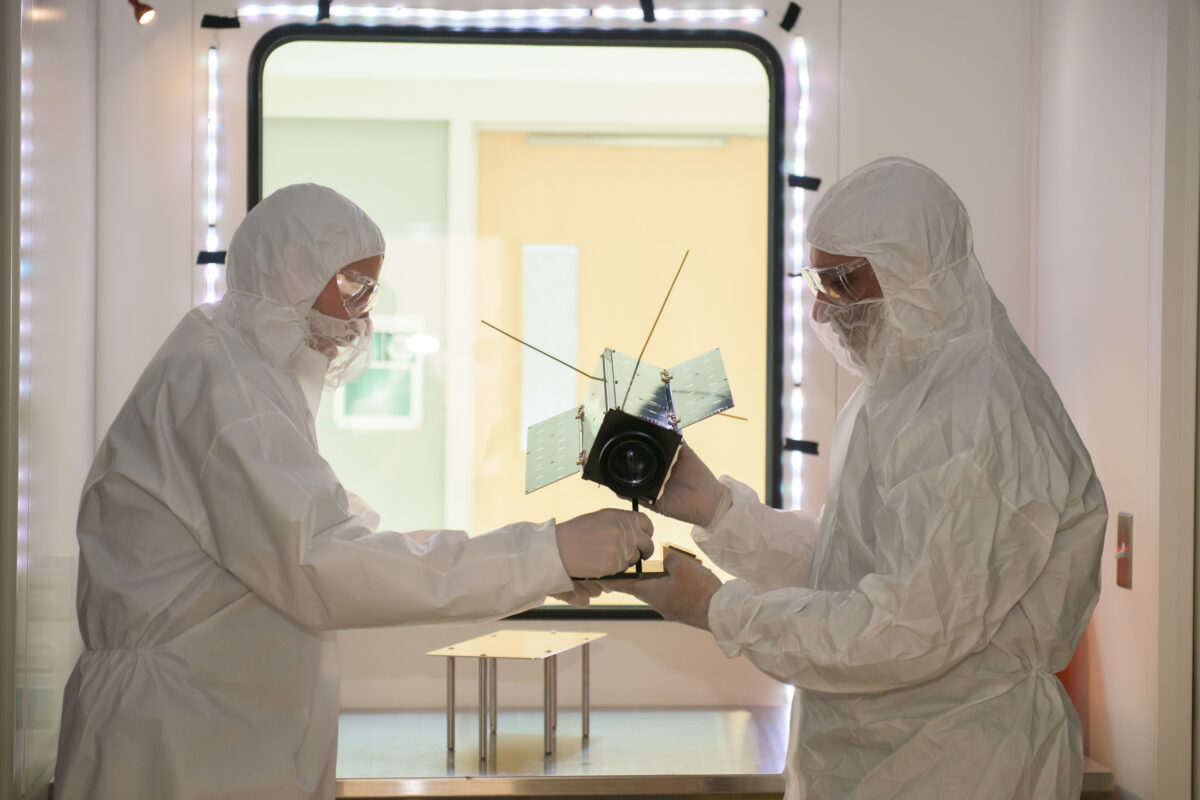 Researchers work on the HARP cubesat in a clean room. (Marlayna Demond/UMBC)
Launching satellites and careers
Since its inception, HARP has also lived up to UMBC’s mission to educate students and support the regional economy and workforce. Undergraduate and graduate students played key roles in the research, design, and construction phases for HARP and now HARP2.
“Relationships with federal agencies like NASA, all the work that we do with private companies around us, plus the training of students, who then go on to lead the same field they were working in, all fit very well the goals of our public research university,” Martins says.
Through HARP, HARP2, and early preparation for MegaHARP, every iteration of the project has prepared students for successful careers, proven new technologies, and generated new knowledge about the world. But, as an educator, perhaps the most rewarding part for Martins is seeing his students grow, find success, and then reach back to help others.
“We are seeing with HARP a full cycle. Students were involved in the inception of the idea for HARP from the beginning,” he says. “And today, students who were there working on HARP at the beginning are now in positions at NASA supporting the next generation.”
]]>
The first Hyper-Angular Rainbow Polarimeter (HARP) was a nano-satellite about as big as a loaf of bread. Developed by Vanderlei Martins, professor of physics, and his team of scientists and...
https://umbc.edu/stories/umbc-builds-next-gen-satellite-tech/
https://my3.my.umbc.edu/api/v0/pixel/news/128481/guest@my.umbc.edu/34ffd78318b57b5919988484353130bb/api/pixel
cnms
esi
news
physics
rca-2
research
science-and-tech
UMBC News & Magazine
https://my3.my.umbc.edu/groups/umbc-news-magazine
https://assets1-my.umbc.edu/system/shared/avatars/groups/000/001/943/24435aa6207c452e7bc15cc74b42c7bb/xsmall.png?1748556657
https://assets1-my.umbc.edu/system/shared/avatars/groups/000/001/943/24435aa6207c452e7bc15cc74b42c7bb/original.png?1748556657
https://assets2-my.umbc.edu/system/shared/avatars/groups/000/001/943/24435aa6207c452e7bc15cc74b42c7bb/xxlarge.png?1748556657
https://assets2-my.umbc.edu/system/shared/avatars/groups/000/001/943/24435aa6207c452e7bc15cc74b42c7bb/xlarge.png?1748556657
https://assets3-my.umbc.edu/system/shared/avatars/groups/000/001/943/24435aa6207c452e7bc15cc74b42c7bb/large.png?1748556657
https://assets1-my.umbc.edu/system/shared/avatars/groups/000/001/943/24435aa6207c452e7bc15cc74b42c7bb/medium.png?1748556657
https://assets2-my.umbc.edu/system/shared/avatars/groups/000/001/943/24435aa6207c452e7bc15cc74b42c7bb/small.png?1748556657
https://assets1-my.umbc.edu/system/shared/avatars/groups/000/001/943/24435aa6207c452e7bc15cc74b42c7bb/xsmall.png?1748556657
https://assets2-my.umbc.edu/system/shared/avatars/groups/000/001/943/24435aa6207c452e7bc15cc74b42c7bb/xxsmall.png?1748556657
UMBC News & Magazine
0
0
false
Fri, 14 Oct 2022 12:32:28 -0400
Fri, 14 Oct 2022 12:32:28 -0400
UMBC humanities faculty pursue groundbreaking archival research through over $135,000 in prestigious fellowships

Humanities faculty Elizabeth Patton, Mirjam Voerkelius, and Amy Froide have received prestigious research fellowships totaling over $135,000 to explore archives and reveal new findings about unique historical events in the United States, Soviet Union, and United Kingdom. Their research will help further book manuscripts that will share new perspectives on African American leisure travel during Jim Crow, Darwinism in the Soviet Union, and financial fraud in the early stock market involving women investors in 18th-century England.
As an art historian, Preminda Jacob, an associate professor and associate dean of the College of Arts, Humanities, and Social Sciences, compares scholarship in the humanities to detective work. “Humanities research requires painstaking, patient piecing together of clues to develop narratives that have the power to subvert, or challenge accepted knowledge about a historical period or contemporary phenomenon,” says Jacob.
“The work is vastly time-consuming,” she explains. “It might require proficiency in one or more foreign languages, and entail years spent on a research site. Furthermore, the ‘evidence’ housed in archives, related by informants, or gathered from research sites, is often incomplete or biased. It is the scholar’s task to imaginatively reconstruct what was undocumented or left unsaid and to shine a light on the parts that were hidden, ignored, or missing.”
Cutting-edge humanities research
Over the past five years alone, UMBC’s cutting-edge humanities research has garnered funding from major sponsors that include the American Council of Learned Societies, the Carnegie Corporation of New York, the Institute of Advanced Study, the Institute of Citizens & Scholars (Mellon Foundation), Harvard’s Loeb Classical Library Foundation, the National Endowment for the Humanities (NEH), and the Whiting Foundation.
UMBC’s Dresher Center for the Humanities provides key support to faculty engaging in major scholarly and public projects. Rachel Brubaker, director of program administration at the Dresher Center, works with faculty one on one to identify and successfully apply for research funding.
 (l-r:) Brubaker and Christopher K. Tong, an assistant professor of modern languages, linguistics, and intercultural communication, discuss the Henry Luce Foundation and the American Council of Learned Societies Early Career Fellowship in China Studies, which Tong received in 2021. Brubaker provided support and guidance during the application process. (Marlayna Demond ’11/UMBC)
“The Dresher Center directs faculty to funding sources that further important humanities research,” says Patton, an associate professor of media and communication studies. “They get to know you and your interests and provide essential feedback—that has been an indispensable source of support and encouragement to me.”
Segregated leisure
Patton’s current research started with a picture found among her grandmother’s family photos. In the stack was a picture of her uncle at the 1964 New York World’s Fair. Patton was surprised because he lived in Philadelphia—a long way to travel at that time and a risky journey. This image defied the dangers, risks, and humiliation that were not limited to Southern states for African Americans traveling during Jim Crow.
Patton’s mother shared details of their trip to the World’s Fair, opening a door into a world where African American families and individuals enjoyed travel, counter to the media’s portrayal of vacations and other leisure trips as experiences exclusively for white Americans.
She developed a new research project: “Representation as a Form of Resistance: Documenting African-American Spaces of Leisure during the Jim Crow Era.” This research examines the history of Black leisure and tourism in the U.S. through the perspective of marketing and advertising to put into context lingering forms of racism that still affect Black tourism on platforms like Airbnb.
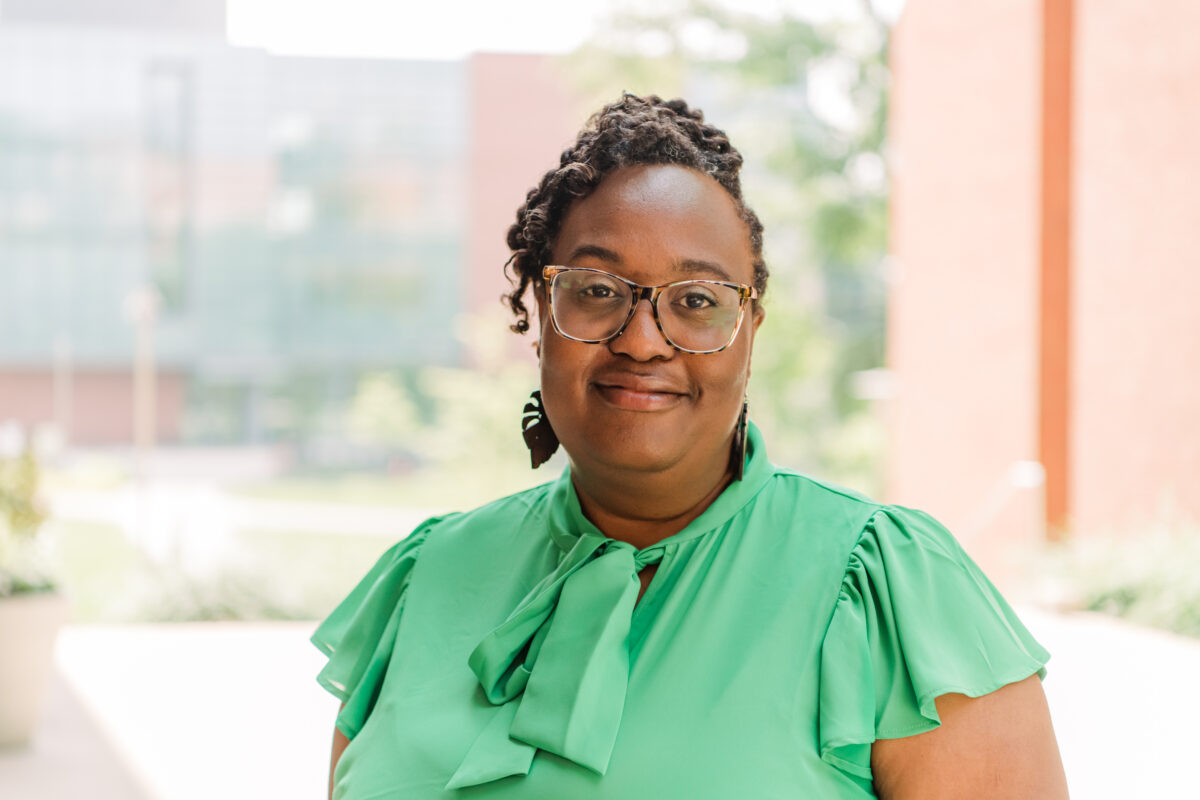 Elizabeth Patton. (Marlayna Demond ’11/UMBC)
“This research focuses on how media—such as advertisements, guidebooks, newspapers, magazines, film, photographs, home videos, and social media—have been used to document and promote leisure practices as a form of covert resistance,” says Patton. “It provides a counter-narrative to consumption-based and white-washed popular representations of tourism.”
Archival research
Patton has already begun traveling to archives with funding from the NEH, joint funding from Duke University’s John W. Hartman Center for Sales, Advertising & Marketing History and the John Hope Franklin Research Center for African American History and Culture, and UMBC’s CAHSS Research Fund. In collaboration with an archivist at the National Museum of American History Archives Center, Patton has reviewed the museum’s cold storage for photographic negatives from the 1920s and 1930s to view photographs of African Americans engaging in leisure activities and early advertising featuring African Americans. She has also reviewed Langston Hughes’s travel memoirs during Jim Crow and his time with Zora Neale Hurston at Yale University’s Beinecke Library.
The Smithsonian National Museum of African American History’s Great Migration Home Movie Project and African American Home Movie Archive have presented Patton with an opportunity to look through an extensive collection of home movies as well, offering another kind of personal perspective. Patton has also explored papers on city planning and major events like the World’s Fair, to understand how spaces were shaped by race and class and how leisure in New York became segregated, using the African American Studies collections at the Schomburg Center for Research in Black Culture and at the New York Public Library Rare Books Division, Manuscripts and Archives Division.
“I have found hundreds of examples of spaces where there is a history of people of color using those spaces, desegregating those spaces, or creating their own spaces for leisure and travel,” says Patton. “These rich data sources will help me tell the invisible history of African American leisure through historical methods, discourse analysis, semiotics, and oral history.”
The Soviet Union and Darwinism
Voerkelius’s book project, “Evolution in Times of Revolution: Darwinism, Nature and Society,” explores Soviet attitudes towards nature through the conflicted history of Darwinism in the Soviet Union. Voerkelius, assistant professor of history, explores this history through the lens of the State Darwin Museum in Russia.
Established in 1907, the museum has survived revolutions, political upheavals, world wars, polarizing schools of thought about Darwinism, and now a pandemic. Through it all, the museum has been a pillar of research, dissemination of science, and education pivotal to the Soviet Union’s theories, beliefs, discourse, and actions around evolution.
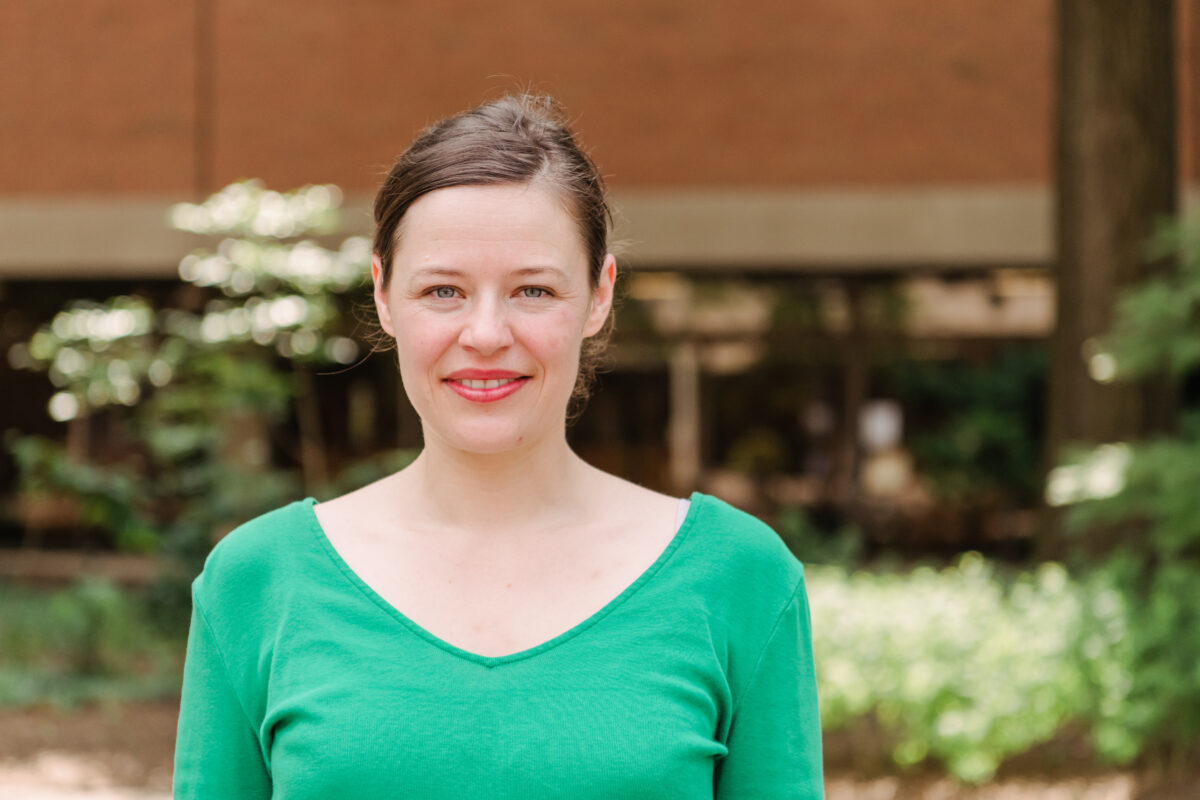 Mirjam Voerkelius. (Marlayna Demond ’11/UMBC)
“The Darwin Museum offers a comprehensive case study on attitudes towards the natural world in the Soviet Union and the underlying vision of the place of humankind within nature,” says Voerkelius.
This project builds on research completed in Russia at the State Archive of the Russian Federation, the archive of the State Darwin Museum, the Central Archive of the City of Moscow, and the Russian State Archive of the Economy, as well as the Jena University Archives in Germany.
Voerkelius was scheduled to return to Russia to further her archival research and complete her book. Due to the current war between Ukraine and Russia, Voerkelius cannot access these archives. To further her work, Voerkelius has received a $55,000 Kluge Fellowship from the John W. Kluge Center at the Library of Congress. As one of twelve fellows from around the world, she will have direct access to the Library’s extensive collection on the Soviet Union
“Working with the Library of Congress’s Russian Collection will allow me to consult published primary sources, which is essential for the completion of my manuscript,” says Voerkelius. With the help of these sources, she will place the Moscow State Darwin Museum’s research and narrative about Darwinism in a broader context.
“I hope to contribute to scholarly debate on the Soviet Union’s approach to science, evolutionary theory, and its broader impact on the environment,” she says.
Following the money
The idea for Froide’s new research project came from an unexpected find during eight years of research for her third book, Silent Partners: Women as Public Investors during Britain’s Financial Revolution, 1690-1750 (Oxford University Press, 2016).
Silent Partners focused on the role of women investors in England’s financial revolution and how women played a critical role in Britain’s rise to economic, military, and colonial dominance in the 18th century. Within the newspapers, government documents, and bookkeeping records she examined, Froide, professor and chair of history, found another story: a rare account of a stock market crash in 1732, wrought with fraud, embezzlement, forgery, and thievery.
Her new project, “The Charitable Corporation: A Cautionary Tale of Financial Fraud in Eighteenth-Century Britain,” will be a research-based narrative aimed at a wide audience about a group of investors, largely women, who invested in the microlending Charitable Corporation and the events around its collapse.
In her visit to England’s National Archives and Parliamentary Archives, Froide found lists of the Charitable Corporation shareholders petitioning the House of Lords and the House of Commons for a bailout. Some of the first petitioners were women, indicating they were active participants in seeking retribution politically and socially.
 Amy Froide. (Marlayna Demond ’11/UMBC)
“This bailout doesn’t look much different from what we see in the 20th and 21st centuries,” says Froide. “Investors felt capitalism had not worked and wanted the government to step in. The various records from the parliamentary investigation found that the directors were committing fraud and because corporations and individual stockholders were equally liable at the time they both had to pay.”
“This story is interesting economically and will provide a lot of historical background for economic historians and economists,” she notes. “Much of what we think is so modern was actually happening three centuries ago in the early days of the stock market.”
Secrets without borders
Froide’s search through the Royal Archives led to a surprising discovery. She found evidence of a long-held suspicion by historians that the Charitable Corporation was funneling money to the Jacobites, a religious and political group that wanted to restore King James III to the British throne after the Glorious Revolution of 1688-89 toppled the Roman Catholic Stuarts.
“I began searching through the Stuart Papers in the British Library, which holds the personal and official correspondence of British monarchs,” says Froide. “I uncovered proof that the Jacobite ‘Pretender,’ James III, knew of the company and that he made contacts with officers of the Charitable Corporation who seem to have promised monetary support to fund his return to the throne and other acts of rebellion.”
Now, the story has led her to the largest repository of British documents outside of England—the Huntington Library in San Marino, California—as a research fellow. The Huntington Library Fellowship program is one of the largest and most distinguished fellowship programs for the support of humanities scholarship in the United States. Every year approximately 200 fellows from all over the world conduct advanced humanities research using The Huntington’s collections.
As a Huntington Library Fletcher Jones Foundation Fellow, Froide has received $50,000 to support a year at the Huntington Library archives to research and analyze documents and begin writing her book about the Charitable Corporation. The Huntington Library documents will allow Froide to reconstruct contemporary views of the financial scandal. She hopes the papers will lend further insights into the politicians, revolutionaries, investors, royalty, smugglers, and everyday people whose lives, willingly or not, were a part of creating and dismantling the business.
“My challenge is to write a story that shows you the political and economic context of the late 18th century in a way that is appealing to everyone. You can only do that if you have really good stories,” says Froide. “This is very labor-intensive work. There isn’t a specific file with all the answers in one language or in one country. But if you are a library or archive rat like me, you pursue all the threads to that great story.”
]]>
Humanities faculty Elizabeth Patton, Mirjam Voerkelius, and Amy Froide have received prestigious research fellowships totaling over $135,000 to explore archives and reveal new findings about...
https://umbc.edu/stories/umbc-humanities-faculty-pursue-groundbreaking-research/
https://my3.my.umbc.edu/api/v0/pixel/news/128409/guest@my.umbc.edu/7d56864c9bbdffe3e42d4b86a51c7309/api/pixel
arts-and-culture
cahss
cahssresearch
dreshercenter
history
international
majoraward
mcs
news
policy-and-society
rca-2
UMBC News & Magazine
https://my3.my.umbc.edu/groups/umbc-news-magazine
https://assets1-my.umbc.edu/system/shared/avatars/groups/000/001/943/24435aa6207c452e7bc15cc74b42c7bb/xsmall.png?1748556657
https://assets1-my.umbc.edu/system/shared/avatars/groups/000/001/943/24435aa6207c452e7bc15cc74b42c7bb/original.png?1748556657
https://assets2-my.umbc.edu/system/shared/avatars/groups/000/001/943/24435aa6207c452e7bc15cc74b42c7bb/xxlarge.png?1748556657
https://assets2-my.umbc.edu/system/shared/avatars/groups/000/001/943/24435aa6207c452e7bc15cc74b42c7bb/xlarge.png?1748556657
https://assets3-my.umbc.edu/system/shared/avatars/groups/000/001/943/24435aa6207c452e7bc15cc74b42c7bb/large.png?1748556657
https://assets1-my.umbc.edu/system/shared/avatars/groups/000/001/943/24435aa6207c452e7bc15cc74b42c7bb/medium.png?1748556657
https://assets2-my.umbc.edu/system/shared/avatars/groups/000/001/943/24435aa6207c452e7bc15cc74b42c7bb/small.png?1748556657
https://assets1-my.umbc.edu/system/shared/avatars/groups/000/001/943/24435aa6207c452e7bc15cc74b42c7bb/xsmall.png?1748556657
https://assets2-my.umbc.edu/system/shared/avatars/groups/000/001/943/24435aa6207c452e7bc15cc74b42c7bb/xxsmall.png?1748556657
UMBC News & Magazine
0
0
false
Wed, 12 Oct 2022 08:33:07 -0400
Wed, 12 Oct 2022 08:33:07 -0400
Meet a Retriever – Sharon Johnson, retired Meyerhoff Scholars Program staff

Meet Sharon Johnson, a dedicated member of the Meyerhoff Scholars Program staff for more than 17 years. Now retired, Sharon has chosen to continue to support UMBC with a planned gift that will focus on the program and students she loves so dearly. Thanks for sharing your story, Sharon…take it away!
Q: What brought you to UMBC in the first place?
A: I was hired as the business manager for the Meyerhoff Scholars Program after previously working at NASA. Many of my colleagues at NASA thought this would be a good fit for me and my skillset, and encouraged me to apply. I was very interested in diversity and the STEM pipeline and wanted to work with gifted and talented students.
Q: What was it like working with the Meyerhoff Program for so long?
A: I loved working with the Meyerhoff students, alumni, parents, faculty, staff, and UMBC colleagues and administrators. Meyerhoff staff members were committed and dedicated as we carried out our duties, and guided and inspired scholars. We worked closely together and I enjoyed our cameraderie. It was wonderful to see the scholars grow and achieve their aspirations. The relationships continued after graduation from UMBC. I was a part of something truly special that was changing the world!I made many friends with whom I am still in contact.
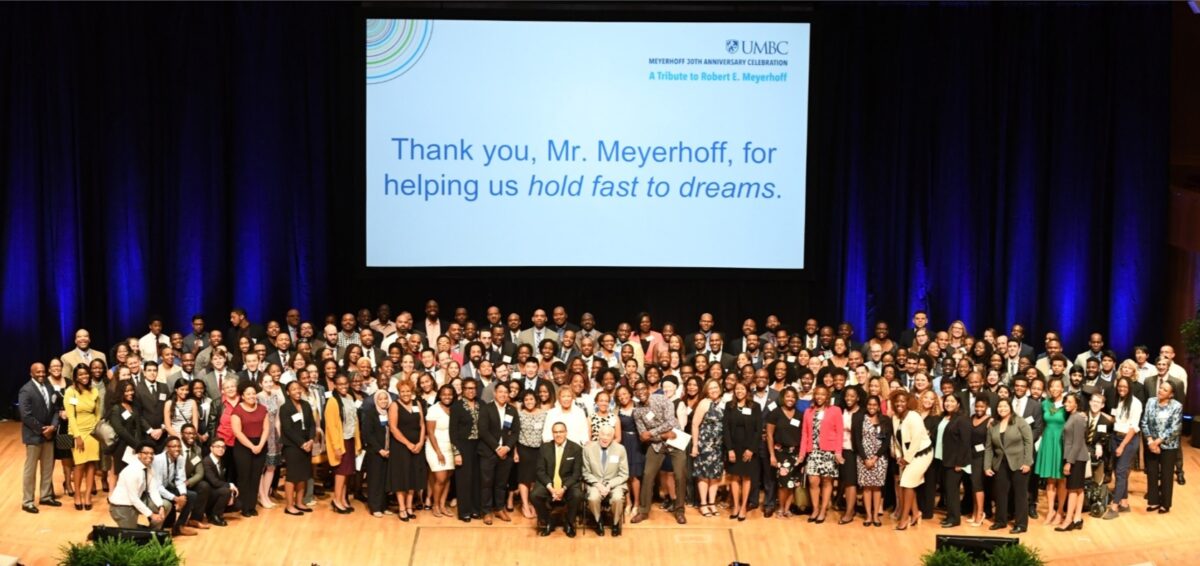 A moment from the Meyerhoff Scholars Program’s 30th anniversary celebration in 2019. Photo by Jim Burger.
Q: Tell us about someone who really made a difference in your life while you were at UMBC.
A: I’d like to mention two people. [President Emeritus] Dr. [Freeman] Hrabowski supported me and the Meyerhoff Scholars program. He co-founded an awesome program that has been replicated across the country, and he inspired me and other donors to financially support UMBC.
And LaMont Toliver, former Program Director and my supervisor, was dedicated to the program. His belief in the model, program, and students inspired me. Working for the program was a life-changing opportunity.
I thought back to my undergraduate years and I felt compelled to help provide funding to scholars experiencing financial hardships and to impact future generations of Meyerhoff scholars. My hope is that I will be able to help future scholars achieve their academic goals and dreams.
Sharon Johnson
Retired staff, Meyerhoff Scholars Program
Q: You recently decided to make a planned gift in support of the Meyerhoff Scholars Program. What motivated you to do that?
A: I experienced financial hardships and challenges firsthand during my childhood and in completing my bachelor’s degree. I believe in the Meyerhoff Scholars Program’s vision and mission and am proud of the program’s success. Many scholars had shortfalls between their expenses and aid/scholarships and were seeking other funding sources to close their gaps. Many also faced personal/family circumstances that kept them from graduating on schedule and achieving their academic dreams. I thought back to my undergraduate years and I felt compelled to help provide funding to scholars experiencing financial hardships and to impact future generations of Meyerhoff Scholars. My hope is that I will be able to help future scholars achieve their academic goals and dreams.
* * * * *
UMBC’s greatest strength is its people. When people meet Retrievers and hear about the passion they bring, the relationships they create, the ways they support each other, and the commitment they have to inclusive excellence, they truly get a sense of our community. That’s what “Meet a Retriever” is all about.
Learn more about how UMBC can help you achieve your goals.
Learn more about how to make a planned gift to UMBC.
]]>
Meet Sharon Johnson, a dedicated member of the Meyerhoff Scholars Program staff for more than 17 years. Now retired, Sharon has chosen to continue to support UMBC with a planned gift that will...
https://umbc.edu/stories/sharon-johnson-meyerhoff-scholars-donor/
https://my3.my.umbc.edu/api/v0/pixel/news/128397/guest@my.umbc.edu/fba1b4f80e10da7f75ec18a2af883d16/api/pixel
impact
magazine
meet-a-retriever
meyerhoffscholars
perspectives
UMBC News & Magazine
https://my3.my.umbc.edu/groups/umbc-news-magazine
https://assets1-my.umbc.edu/system/shared/avatars/groups/000/001/943/24435aa6207c452e7bc15cc74b42c7bb/xsmall.png?1748556657
https://assets1-my.umbc.edu/system/shared/avatars/groups/000/001/943/24435aa6207c452e7bc15cc74b42c7bb/original.png?1748556657
https://assets2-my.umbc.edu/system/shared/avatars/groups/000/001/943/24435aa6207c452e7bc15cc74b42c7bb/xxlarge.png?1748556657
https://assets2-my.umbc.edu/system/shared/avatars/groups/000/001/943/24435aa6207c452e7bc15cc74b42c7bb/xlarge.png?1748556657
https://assets3-my.umbc.edu/system/shared/avatars/groups/000/001/943/24435aa6207c452e7bc15cc74b42c7bb/large.png?1748556657
https://assets1-my.umbc.edu/system/shared/avatars/groups/000/001/943/24435aa6207c452e7bc15cc74b42c7bb/medium.png?1748556657
https://assets2-my.umbc.edu/system/shared/avatars/groups/000/001/943/24435aa6207c452e7bc15cc74b42c7bb/small.png?1748556657
https://assets1-my.umbc.edu/system/shared/avatars/groups/000/001/943/24435aa6207c452e7bc15cc74b42c7bb/xsmall.png?1748556657
https://assets2-my.umbc.edu/system/shared/avatars/groups/000/001/943/24435aa6207c452e7bc15cc74b42c7bb/xxsmall.png?1748556657
UMBC News & Magazine
0
0
false
Tue, 11 Oct 2022 15:50:10 -0400
Tue, 11 Oct 2022 15:50:10 -0400