What We Love About UMBC

The start of the school year means new beginnings. For most, this looks like new classes and friends—new experiences and opportunities. UMBC’s new president is even experiencing a whole chapter of firsts! But among the new beginnings, some things never change. This is what we love about UMBC:
We bond over new experiences
In the classroom and in student clubs, Retrievers take pride in finding ways to connect with each other. “People are more open to learning about different things than you would think, like different cultures,” says Sara Motamedi ’23, mathematics, who has found her classmates to be truly inquisitive and open minded. “I never expected it to be so diverse, which is awesome,” says Michael Washington ’23, media and communication studies, who enjoys playing basketball at the Retriever Activities Center (RAC) in his free time.
 Sara Motamedi and fellow Retriever Maggie Taylan
Some students bond over a game in the RAC, others might find a home in high level debate. UMBC’s intellectual sports teams include the top Mock Trial team in the nation. More than 250+ student organizations and clubs can connect you to the larger community: from Retriever Music Society to HackUMBC to Meditation at UMBC, students can engage with their interests, majors, and cultures alongside one another. Bolstered by a bevy of academic and social support systems, like the Academic Success Center and the new Center for Well-Being, each Retriever can find something they love here on campus.
We make it a point to explore campus and beyond
One of the keys to academic success is decompressing, and Retrievers know how to relax in style. One of UMBC’s major hubs is The Commons, where students meet between classes to socialize and grab a bite to eat. Students hang out in the Sports Zone—where they might catch a game on the projector or an open mic performance—and the gameroom, where they play pool, ping pong, and video games. On the 530-acre campus, many students find their own personal spots to take a breather. “I always found the tunnel between the Chesapeake Arena and The Commons parking garage to be a chill place where I can sit and draw quietly,” says Krista Mitchell ’23, English.
After classes and on weekends, students often use the free transit system to explore nearby Catonsville and Arbutus, where UMBC-affiliated and alumni-operated coffee shop OCA Mocha can be found. “OCA Mocha is UMBC’s local place to hang out,” says Shawn Abraham ’24, political science. “Their study hours for students are really helpful.” In addition to drinks and treats, OCA Mocha showcases local artists in its gallery and hosts live events that are open to all.
We find ways to succeed together
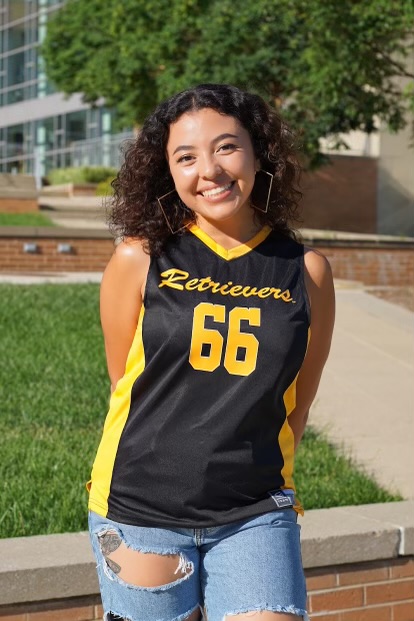 Camila Rudas
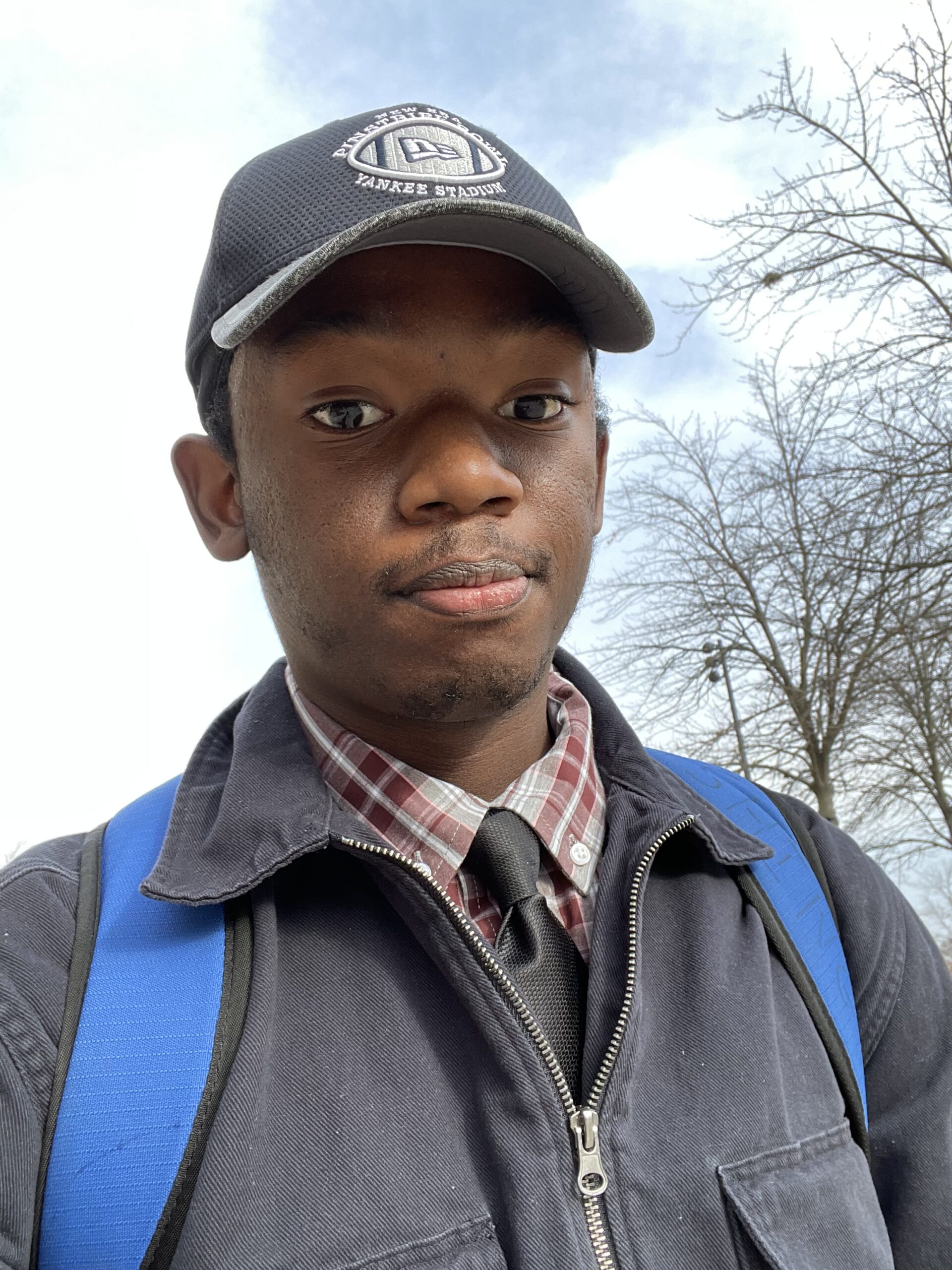 Michael Washington
For Camila Rudas ’22, biology and English, UMBC is defined by its community—people who embrace each other, look towards the future, and ask tough questions. In her eyes, this all starts with the professor. “They are always there to uplift students. Honestly, I feel like they are there to guide, instead of simply teach,” says Rudas, who has seen faculty go the extra mile—whether that’s collaborating with students through office hours, sharing internship opportunities, or providing research mentorship. UMBC’s students connect with faculty and staff in addition to their professors, though. “What surprised me most about UMBC was how personable my advisors have been,” says Maya Babu ’23, political science. “They honestly go above and beyond to help you succeed.”
As the school year gears up, UMBC’s students have a lot to return to—and plenty of new experiences waiting. Not least of which is welcoming and connecting with our new president, Dr. Valerie Sheares Ashby. “It’s cool,” says Motamedi. “She’s a woman of color in STEM—she’s just like me.”
]]>
The start of the school year means new beginnings. For most, this looks like new classes and friends—new experiences and opportunities. UMBC’s new president is even experiencing a whole chapter of...
https://umbc.edu/stories/what-we-love-about-umbc/
https://my3.my.umbc.edu/api/v0/pixel/news/127821/guest@my.umbc.edu/c083c3a992770ffa177fd5e177cc654d/api/pixel
campus-life
magazine
oca-mocha
rac
UMBC News & Magazine
https://my3.my.umbc.edu/groups/umbc-news-magazine
https://assets1-my.umbc.edu/system/shared/avatars/groups/000/001/943/24435aa6207c452e7bc15cc74b42c7bb/xsmall.png?1748556657
https://assets1-my.umbc.edu/system/shared/avatars/groups/000/001/943/24435aa6207c452e7bc15cc74b42c7bb/original.png?1748556657
https://assets2-my.umbc.edu/system/shared/avatars/groups/000/001/943/24435aa6207c452e7bc15cc74b42c7bb/xxlarge.png?1748556657
https://assets2-my.umbc.edu/system/shared/avatars/groups/000/001/943/24435aa6207c452e7bc15cc74b42c7bb/xlarge.png?1748556657
https://assets3-my.umbc.edu/system/shared/avatars/groups/000/001/943/24435aa6207c452e7bc15cc74b42c7bb/large.png?1748556657
https://assets1-my.umbc.edu/system/shared/avatars/groups/000/001/943/24435aa6207c452e7bc15cc74b42c7bb/medium.png?1748556657
https://assets2-my.umbc.edu/system/shared/avatars/groups/000/001/943/24435aa6207c452e7bc15cc74b42c7bb/small.png?1748556657
https://assets1-my.umbc.edu/system/shared/avatars/groups/000/001/943/24435aa6207c452e7bc15cc74b42c7bb/xsmall.png?1748556657
https://assets2-my.umbc.edu/system/shared/avatars/groups/000/001/943/24435aa6207c452e7bc15cc74b42c7bb/xxsmall.png?1748556657
UMBC News & Magazine
0
0
false
Wed, 21 Sep 2022 10:29:14 -0400
Wed, 21 Sep 2022 10:29:14 -0400
Biden again indicates that US will defend Taiwan ‘militarily’ – does this constitute a change in policy?

Meredith Oyen, Associate Professor of History and Asian Studies, UMBC.
President Joe Biden has – not for the first time – suggested that the U.S. would intervene “militarily” should China attempt an invasion of Taiwan.
In an interview with CBS’s “60 Minutes” on Sept. 18, 2022, Biden vowed to protect the island in the face of any attack. Pressed if that meant the U.S. getting “involved militarily,” the president replied: “Yes.”
The comments appear to deviate from the official U.S. line on Taiwan, in place for decades. But White House officials said the remarks did not represent any change in Taiwan policy.
Meredith Oyen, an expert on U.S.-China relations at the University of Maryland, Baltimore County, helps explain the background to Biden’s comments and untangles what should be read into his remarks – and what shouldn’t.
What did Biden say and why was it significant?
In an exchange on “60 Minutes,” Biden was asked directly if the U.S. would “come to Taiwan’s defense” if it were attacked by China. He replied: “Yes, we have a commitment to do that.” He also confirmed that U.S. intervention would be military.
By my count, this is the fourth time Biden as president has suggested that the U.S. will come to Taiwan’s aid militarily if the island is attacked. In 2021 he made similar remarks in an interview with ABC News and then again while taking part in a CNN town hall event. And earlier this year he said something similar while in Japan, marking the first time he has made the assertion while in Asia.
On each occasion he has made such a comment, it has been followed quite quickly by the White House’s walking back the remarks, by issuing statements along the lines of “what the president actually means is …” and stressing that this isn’t a shift away from the official U.S. policy on China or Taiwan.
But I think that with each incident it is harder to prevaricate about Biden’s comments being an accident, or suggest that he in some way misspoke. I think it is clear at this point that Biden’s interpretation of the Taiwan Relations Act – which since 1979 has set out the parameters of U.S. policy on the island – is that it allows for a U.S. military response should China invade. And despite White House claims to the contrary, I believe that does represent a departure from the long-standing policy of “strategic ambiguity” on Taiwan.
What does ‘strategic ambiguity’ mean?
Strategic ambiguity has long been the U.S. policy toward Taiwan – really since the 1950s, but certainly from 1979 onward. While it does not explicitly commit the U.S. to defending Taiwan in every circumstance, it does leave open the option of American defensive support to Taiwan in the event of an unprovoked attack by China.
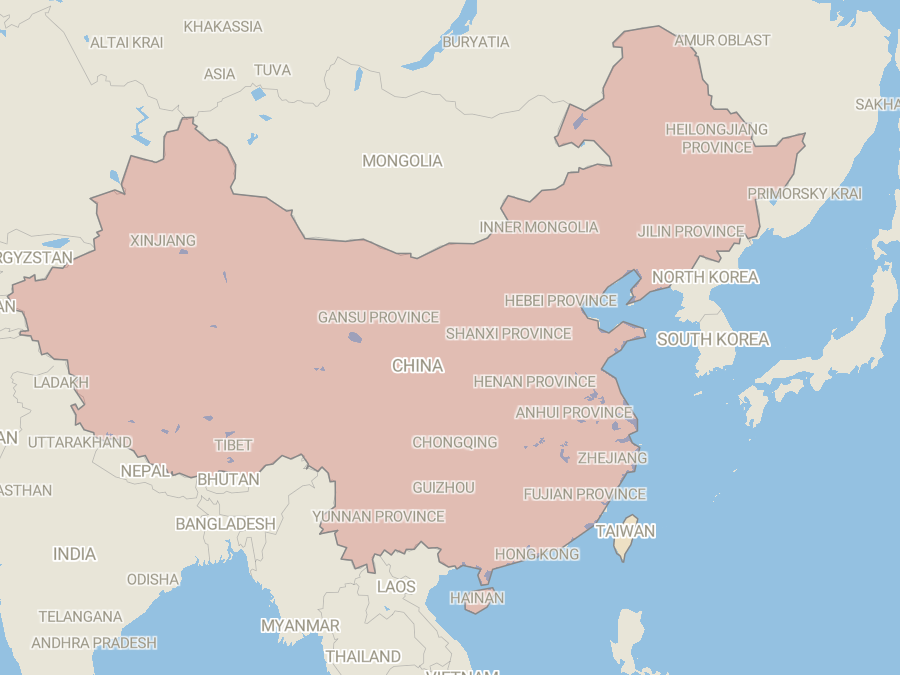 Map: The Conversation, CC-BY-ND @OpenStreetMap contributors.
Crucially, the U.S. hasn’t really said what it will do – so does this support mean economic aid, supply of weapons or U.S. boots on the ground? China and Taiwan are left guessing if – and to what extent – the U.S. will be involved in any China-Taiwan conflict.
By leaving the answer to that question ambiguous, the U.S. holds a threat over China: Invade Taiwan and find out if you face the U.S. as well.
Traditionally, this has been a useful policy for the U.S., but things have changed since it was first rolled out. It was certainly effective when the U.S. was in a much stronger position militarily compared with China. But it might be less effective as a threat now that China’s military is catching up with the U.S.
Leading voices from U.S. allies in Asia, such as Japan, believe that “strategic clarity” might be a better option now – with the U.S. stating outright that it would defend Taiwan if the island were attacked.
What is the history of US relations with Taiwan?
After the victory of the Chinese Communist Party in 1949, the defeated Republic of China government withdrew to the island of Taiwan, located just 100 miles off the shore of Fujian province. And until the 1970s, the U.S. recognized only this exiled Republic of China on Taiwan as the government of China.
 Nixon in China. Bettmann/Getty Images
But in 1971, the United Nations shifted recognition to the People’s Republic of China on the mainland. In 1972, President Richard Nixon made a now-famous trip to China to announce a rapprochement and sign the Shanghai Communique, a joint statement from Communist China and the U.S. signaling a commitment to pursue formal diplomatic relations. A critical section of that document stated: “The United States acknowledges that all Chinese on either side of the Taiwan Strait maintain there is but one China and that Taiwan is a part of China. The United States Government does not challenge that position.”
The wording was crucial: The U.S. was not formally committing to a position on whether Taiwan was part of the China nation. Instead, it was acknowledging what the governments of either territory asserted – that there is “one China.”
Where does US commitment of military support for Taiwan come from?
After establishing formal diplomatic relations with China in 1979, the U.S. built an informal relationship with the ROC on Taiwan. In part to push back against President Jimmy Carter’s decision to recognize Communist China, U.S. lawmakers passed the Taiwan Relations Act in 1979. That act outlined a plan to maintain close ties between the U.S. and Taiwan and included provisions for the U.S. to sell military items to help the island maintain its defense – setting the path for the policy of strategic ambiguity.
What has changed recently?
China has long maintained its desire for an eventual peaceful reunification of its country with the island it considers a rogue province. But the commitment to the principle of “one China” has become increasingly one-sided. It is an absolute for Beijing. In Taiwan, however, resistance to the idea of reunification has grown amid a surge of support for moving the island toward independence.
Beijing has become more aggressive of late in asserting that Taiwan must be “returned to China.” Domestic politics plays a role in this. At times of internal instability in China, Beijing has sounded a more belligerent tone on relations between the two entities separated by the Taiwan Strait. We have seen this over the past year with Beijing sending military aircraft into Taiwan’s Air Defense Zone.
Meanwhile, Chinese assertion of increased authority over Hong Kong has damaged the argument for “one country, two systems” as a means of peaceful reunification with Taiwan.
How has the US position shifted in the face of Beijing’s stance?
Biden has definitely been more openly supportive of Taiwan than previous presidents. He officially invited a representative from Taiwan to his inauguration – a first for an incoming president – and has repeatedly made it clear that he views Taiwan as an ally.
He also didn’t overturn the Taiwan Travel Act passed under the the previous administration of Donald Trump. This legislation allows U.S. officials to visit Taiwan in an official capacity.
In August 2022, U.S. House Speaker Nancy Pelosi visited Taiwan, making her the highest-profile U.S. politician to go to the island in decades.
Meanwhile, for the second time, Biden in his “60 Minutes” interview indicated a belief that it was up to Taiwan to decide its future, departing slightly from the usual line that the U.S. doesn’t support changes to the status quo. However, Biden has also said he does not support a unilateral declaration of independence from Taiwan.
So there has been a shift to a degree. But the White House is keen not to overstate any change. At heart, there is a desire by the U.S. to not stray from the Shanghai Communique.
So is an invasion of Taiwan likely?
The current rhetoric from the U.S. and response from China do raise the risk of conflict, but I don’t think we are at that point yet. Any invasion across the Taiwan Strait would be militarily complex. It also comes with risks of backlash from the international community. Taiwan would receive support from not only the U.S. – in an unclear capacity, given Biden’s remarks – but also Japan and likely other countries in the region.
Meanwhile, China maintains that it wants to see reintegration through peaceful means. As long as Taiwan doesn’t force the issue and declare independence unilaterally, I think there is tolerance in Beijing to wait it out. And despite some commentary to the contrary, I don’t think the invasion of Ukraine has raised the prospects of a similar move on Taiwan. In fact, given that Russia is now bogged down in a monthslong conflict that has hit its military credibility and economy, the Ukraine invasion may actually serve as a warning to Beijing.
This is an update to an article that was originally published on May 24, 2022.
This article is republished from The Conversation under a Creative Commons license. Read the original article.
]]>
Meredith Oyen, Associate Professor of History and Asian Studies, UMBC. President Joe Biden has – not for the first time – suggested that the U.S. would intervene “militarily” should China...
https://umbc.edu/stories/biden-again-indicates-that-us-will-defend-taiwan-militarily/
https://my3.my.umbc.edu/api/v0/pixel/news/127756/guest@my.umbc.edu/2e57e1ff30b15ff9ad42ebb620e16b7e/api/pixel
asianstudies
cahss
cahssresearch
cs3
discovery
history
international
magazine
UMBC News & Magazine
https://my3.my.umbc.edu/groups/umbc-news-magazine
https://assets1-my.umbc.edu/system/shared/avatars/groups/000/001/943/24435aa6207c452e7bc15cc74b42c7bb/xsmall.png?1748556657
https://assets1-my.umbc.edu/system/shared/avatars/groups/000/001/943/24435aa6207c452e7bc15cc74b42c7bb/original.png?1748556657
https://assets2-my.umbc.edu/system/shared/avatars/groups/000/001/943/24435aa6207c452e7bc15cc74b42c7bb/xxlarge.png?1748556657
https://assets2-my.umbc.edu/system/shared/avatars/groups/000/001/943/24435aa6207c452e7bc15cc74b42c7bb/xlarge.png?1748556657
https://assets3-my.umbc.edu/system/shared/avatars/groups/000/001/943/24435aa6207c452e7bc15cc74b42c7bb/large.png?1748556657
https://assets1-my.umbc.edu/system/shared/avatars/groups/000/001/943/24435aa6207c452e7bc15cc74b42c7bb/medium.png?1748556657
https://assets2-my.umbc.edu/system/shared/avatars/groups/000/001/943/24435aa6207c452e7bc15cc74b42c7bb/small.png?1748556657
https://assets1-my.umbc.edu/system/shared/avatars/groups/000/001/943/24435aa6207c452e7bc15cc74b42c7bb/xsmall.png?1748556657
https://assets2-my.umbc.edu/system/shared/avatars/groups/000/001/943/24435aa6207c452e7bc15cc74b42c7bb/xxsmall.png?1748556657
UMBC News & Magazine
0
0
false
Mon, 19 Sep 2022 16:07:15 -0400
Mon, 19 Sep 2022 16:07:15 -0400
Students in UMBC’s ICARE program connect scientific research with community

Bats as biomonitors, community connections to the zero-waste movement, and oyster aquaculture are just a few of the topics that students in UMBC’s Interdisciplinary Consortium for Applied Research in the Environment (ICARE) master’s program are exploring through Baltimore-centered community-engaged research. As the first cohort in the program heads into their second and final year, they are excited about their work and looking ahead to becoming the next generation of environmental science leaders.
“B” is for bat
Chris Blume, M.S. ’23, geography and environmental systems,has studied bobcats, bees, and birds. So when he came to ICARE, he jokes, “I had to choose another ‘b’ animal.” Jokes aside, in his undergraduate and working experience, Blume found that “the social aspect was missing” in conservation science, which often focused on wildlife. “And that’s what drew me to ICARE, because it seemed like there was a focus on the community.”
In his project, Blume is using bats as biomonitors to detect levels of heavy metals in different neighborhoods across Baltimore. “Because of their biology and their ecology, they make great biomonitors in rural environments,” he says, “but I wanted to see how that works in urban places.”
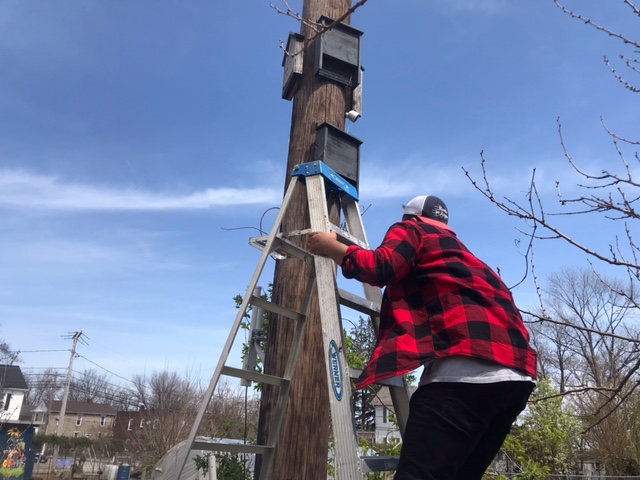 Bat boxes are most successful when they get ample direct sunlight and are about 15 – 20 feet off the ground.
 Chris Blume shows off one of his bat boxes before installing it.
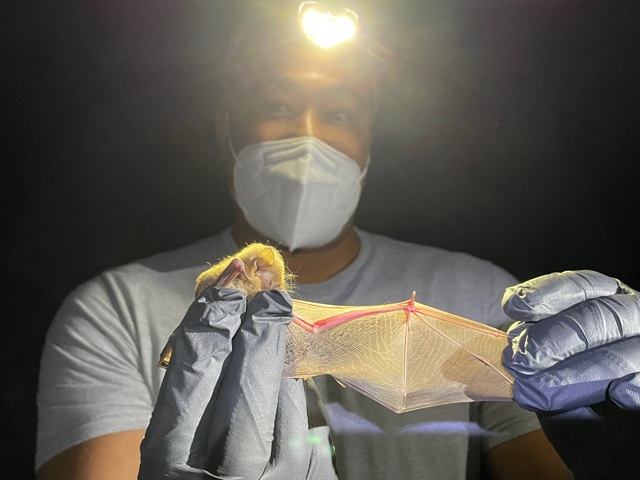 Chris Blume examines a bat from one of his bat boxes.
How can bats provide information about heavy metals? Through their guano (poop). “I have literally a fridge with a bunch of guano,” he says, waiting for analysis later this fall. In addition to the guano analysis, Blume is giving away bat boxes to local residents and offering evening “bat walks” to teach local Baltimoreans about these important native critters. He’s also created citizen science opportunities by posting acoustic recordings of bat calls on a public website, where anyone can listen and help identify which bat species show up where.
In the future, Blume wants to pursue a Ph.D. and continue his bat research, as well as continue to create citizen science and community engagement opportunities.
Building the bridge
Natalia Figueredo, M.S. ’23, geography and environmental systems, has always been community-oriented, influenced by her early childhood in Bolivia and her teenage years in Queens, New York. In New York, she noticed that “there were all these big projects going on in communities, and the community didn’t ask for them,” she says. She wanted to do something different.
After working with the Ironbound Community Corporation in Ironbound, New Jersey, she became passionate about doing inclusive research for mutual benefit, and ICARE was a perfect fit to advance her career. “What interested me about this program,” she says, “is that it was trying to build that bridge between scientific research and community engagement.”
Figueredo’s research project focuses on engaging South Baltimore residents in the zero-waste movement, in the context of recent battles over a nearby trash incinerator. She is also working closely with partners at the Global Alliance for Incinerator Alternatives (GAIA) and the South Baltimore Community Land Trust, in addition to her faculty mentor Maggie Holland, associate professor of geography and environmental systems.
 Natalia Figueredo (second from left) meets with members of the South Baltimore Community Land Trust. (Courtesy of Figueredo)
Figueredo is surveying residents from across the city about their waste management practices and access to the zero-waste movement. She’s also interviewing South Baltimore community leaders and conducting focus groups with neighborhood residents. Figueredo hopes to find out whether they feel supported in pursuing zero-waste goals and to learn what local knowledge and practices already exist related to the movement—whether or not the residents identify them as such.
Research always comes with bumps in the road, but overall Figueredo has had a rewarding experience so far. She wanted to choose a graduate program where people would champion and support her, she says—“and that’s definitely how I feel with the ICARE team.”
Putting research into practice
Darryl Acker-Carter, M.S. ’23, marine, estuarine, and environmental science, is studying a new method of oyster aquaculture with partners at the company Solar Oysters. Traditionally, oysters have been cultivated in wire baskets at the water’s surface. A new system, called the Solar Oyster Production System (SOPS), uses a solar-powered ladder structure to rotate the baskets through the entire water column. The goal is to produce healthier, more-uniform oysters in less space. At the end of the growing season this fall, Acker-Carter will compare oyster size, survival rate, and meat-to-shell ratio of oysters in the experimental rotating ladders, non-rotating ladders, and traditional surface-only baskets at a site in Curtis Bay, in south Baltimore.
Acker-Carter has been interested in oysters for several years. “I like social science, but I also like the biological side of things, and I saw that nexus through oysters,” he says. To some, how to best cultivate oysters may seem like a purely scientific question, but “when you actually get down to, ‘Let’s make some change,’ it’s all social science,” Acker-Carter says, “because it’s all managing people and their perspective about how to harvest oysters and their relationships to natural resources.”
The ICARE program has helped Acker-Carter see how research fits into community engagement. “I used to think research was very isolated,” he says, “but in ICARE, you’re putting that research into practice. You can create benefit in the community by doing the research, and giving people access to that data.”
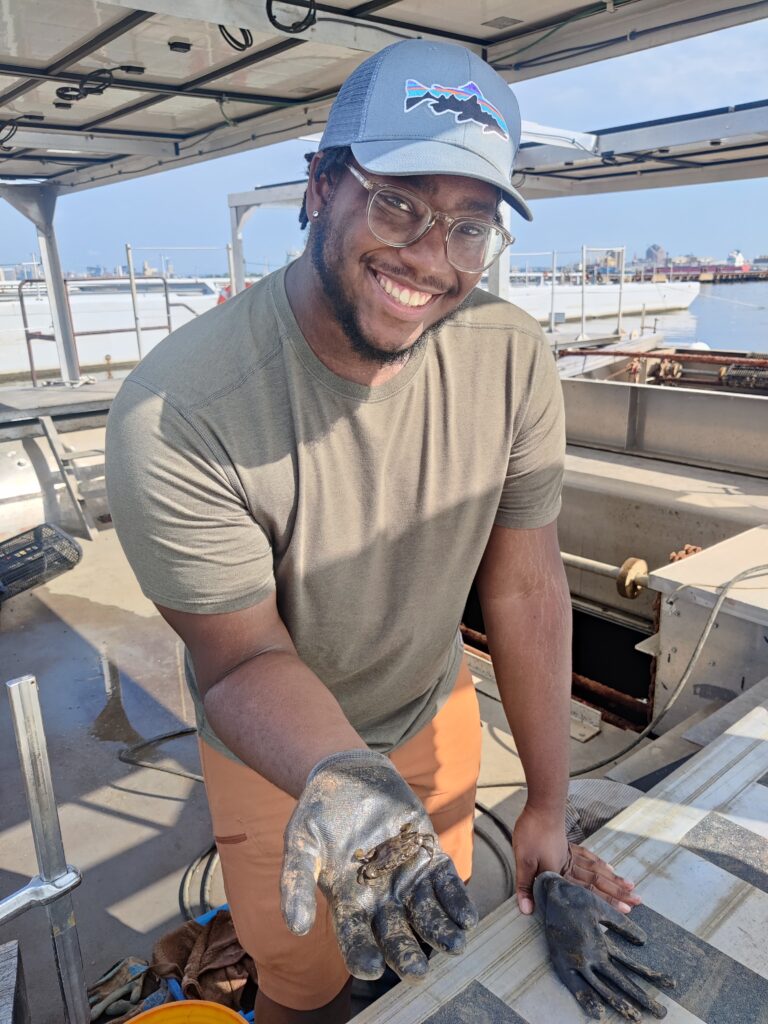 Darryl Acker-Carter holds a very small blue crab on a boat.
 Darryl Acker-Carter (holding orange bucket) helps harvest oysters.
 A surface view of the rotating solar-powered aquaculture system used in Darryl Acker-Carter’s research project.
Committed to community
For program leader Tamra Mendelson, professor of biological sciences, ICARE is exceeding expectations. “I am thrilled with how the program is going,” she says. “The students themselves are so strong. They are motivated. They are engaged. They are very sharp, and they’ve bonded as a cohort, which makes us really happy. I do think that’s a huge secret to success—having students feel like they are part of a network of peers supporting each other.”
The community partners have also been critical for the program’s success. One session led by Stephen Freeland, director of the individualized study program at UMBC, brought students and partners together for a brainstorming session across projects and topic areas, embodying the program’s commitment to bridging science and community. “Just bringing everyone to the table, literally, and helping everyone see that their voice is equally important in solving these environmental problems and doing the research was really powerful,” Mendelson says.
Mendelson shares that she and her fellow faculty have also been developing their community-engagement skills in working alongside their students. “I’m amazed at how important relationships are, and trust,” Mendelson says. “Building relationships with members of the community has been much more interesting and complicated than I expected. It’s work. But it’s good work.”
That community engagement piece makes ICARE different from other environmental science programs, explains Kevin Omland, professor of biological sciences. “We’re definitely tackling different issues in different places than lots of environmental science has, even 10 or 20 years ago,” he says, “so it’s really satisfying to see that coming into place.”
“ICARE fulfills so many of the stated missions and goals of UMBC—to connect with community, to address the climate crisis, to increase diversity and inclusion,” Mendelson says. She looks forward to working with the second cohort of ICARE students, who started this fall, preparing them for successful careers in environmental science and leading local change.
]]>
Bats as biomonitors, community connections to the zero-waste movement, and oyster aquaculture are just a few of the topics that students in UMBC’s Interdisciplinary Consortium for Applied Research...
https://umbc.edu/stories/icare-program-connects-science-with-community/
https://my3.my.umbc.edu/api/v0/pixel/news/127733/guest@my.umbc.edu/c00e1e50a2c77d7a36e63fdfcc52f2ae/api/pixel
biology
cahss
cnms
ges
gradresearch
news
policy-and-society
rca-2
science-and-tech
UMBC News & Magazine
https://my3.my.umbc.edu/groups/umbc-news-magazine
https://assets1-my.umbc.edu/system/shared/avatars/groups/000/001/943/24435aa6207c452e7bc15cc74b42c7bb/xsmall.png?1748556657
https://assets1-my.umbc.edu/system/shared/avatars/groups/000/001/943/24435aa6207c452e7bc15cc74b42c7bb/original.png?1748556657
https://assets2-my.umbc.edu/system/shared/avatars/groups/000/001/943/24435aa6207c452e7bc15cc74b42c7bb/xxlarge.png?1748556657
https://assets2-my.umbc.edu/system/shared/avatars/groups/000/001/943/24435aa6207c452e7bc15cc74b42c7bb/xlarge.png?1748556657
https://assets3-my.umbc.edu/system/shared/avatars/groups/000/001/943/24435aa6207c452e7bc15cc74b42c7bb/large.png?1748556657
https://assets1-my.umbc.edu/system/shared/avatars/groups/000/001/943/24435aa6207c452e7bc15cc74b42c7bb/medium.png?1748556657
https://assets2-my.umbc.edu/system/shared/avatars/groups/000/001/943/24435aa6207c452e7bc15cc74b42c7bb/small.png?1748556657
https://assets1-my.umbc.edu/system/shared/avatars/groups/000/001/943/24435aa6207c452e7bc15cc74b42c7bb/xsmall.png?1748556657
https://assets2-my.umbc.edu/system/shared/avatars/groups/000/001/943/24435aa6207c452e7bc15cc74b42c7bb/xxsmall.png?1748556657
UMBC News & Magazine
0
0
false
Mon, 19 Sep 2022 12:58:20 -0400
Mon, 19 Sep 2022 12:58:20 -0400
Founder’s Day Quiz – Take a Spin Through Retriever History

Founded in 1966, UMBC has changed immensely over the years, evolving from a small regional campus to a nationally distinguished research university in a relatively short time. One thing that hasn’t changed, however, is the many kinds of Retrievers who have made us what we are today – an innovative and inclusive community like no other.
As we celebrate Founder’s Day 2022 and our 56th fall semester, what could be more appropriate than a fun Retriever history quiz? (Don’t worry, we’re not grading you.)
And if you’re ready to take a really deep dive into UMBC history, take a look at our new timeline, rebuilt with lots of new photos and factoids to please any Retriever Believer.
Let’s see how you do!
How’d you do? We hope you enjoyed this spin through time at UMBC. Happy Founder’s Day!
]]>
Founded in 1966, UMBC has changed immensely over the years, evolving from a small regional campus to a nationally distinguished research university in a relatively short time. One thing that...
https://umbc.edu/stories/founders-day-quiz-take-a-spin-through-retriever-history/
https://my3.my.umbc.edu/api/v0/pixel/news/127723/guest@my.umbc.edu/a58cb508c09a1f15d8628dc3a5514f07/api/pixel
magazine
umbc-history
UMBC News & Magazine
https://my3.my.umbc.edu/groups/umbc-news-magazine
https://assets1-my.umbc.edu/system/shared/avatars/groups/000/001/943/24435aa6207c452e7bc15cc74b42c7bb/xsmall.png?1748556657
https://assets1-my.umbc.edu/system/shared/avatars/groups/000/001/943/24435aa6207c452e7bc15cc74b42c7bb/original.png?1748556657
https://assets2-my.umbc.edu/system/shared/avatars/groups/000/001/943/24435aa6207c452e7bc15cc74b42c7bb/xxlarge.png?1748556657
https://assets2-my.umbc.edu/system/shared/avatars/groups/000/001/943/24435aa6207c452e7bc15cc74b42c7bb/xlarge.png?1748556657
https://assets3-my.umbc.edu/system/shared/avatars/groups/000/001/943/24435aa6207c452e7bc15cc74b42c7bb/large.png?1748556657
https://assets1-my.umbc.edu/system/shared/avatars/groups/000/001/943/24435aa6207c452e7bc15cc74b42c7bb/medium.png?1748556657
https://assets2-my.umbc.edu/system/shared/avatars/groups/000/001/943/24435aa6207c452e7bc15cc74b42c7bb/small.png?1748556657
https://assets1-my.umbc.edu/system/shared/avatars/groups/000/001/943/24435aa6207c452e7bc15cc74b42c7bb/xsmall.png?1748556657
https://assets2-my.umbc.edu/system/shared/avatars/groups/000/001/943/24435aa6207c452e7bc15cc74b42c7bb/xxsmall.png?1748556657
UMBC News & Magazine
0
0
false
Mon, 19 Sep 2022 10:36:30 -0400
Mon, 19 Sep 2022 10:36:30 -0400
UMBC is a 2022 Great College to Work For—the nation’s only R1 university to excel in every category

This week, ModernThink’s Great Colleges to Work For program again recognized UMBC as a top institution nationwide in every measured category, from well-being and shared governance to mission and pride. UMBC is the only R1 university in the nation to achieve this honor, which is based on employee ratings.
“I believe we continue to receive this honor because of our commitment to the development and support of our employees,” says Valerie Thomas, UMBC’s chief human resources officer. “The past two years have been difficult for everyone, but we worked tirelessly together to determine how to best serve our students and how best to make changes in the way we work, focused on continuous improvement.”
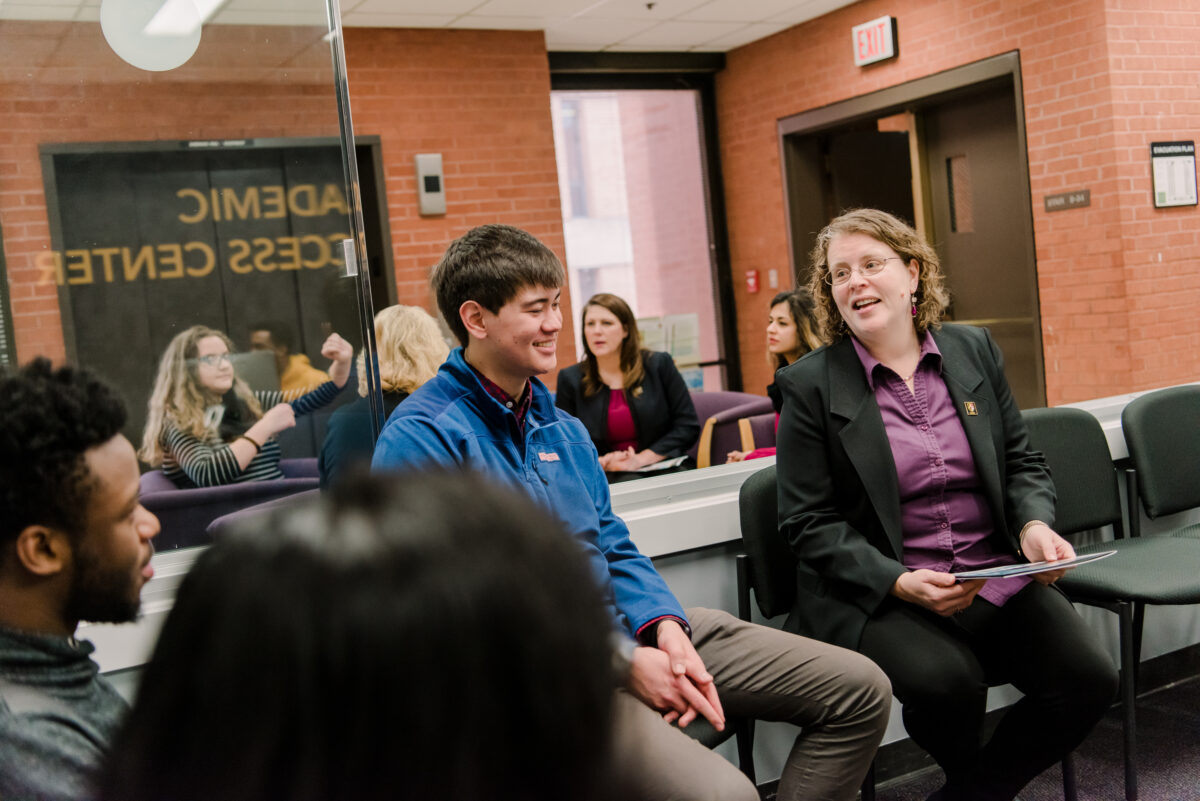 Staff and students in UMBC’s Academic Success Center, 2019. (Marlayna Demond ’11/UMBC)
Caring community
Published in The Chronicle of Higher Education, the Great Colleges to Work For ratings include 10 categories:
- Mission & Pride
- Job Satisfaction & Support
- Confidence in Senior Leadership
- Compensation & Benefits
- Diversity, Inclusion & Belonging
- Shared Governance
- Professional Development
- Faculty Experience
- Faculty & Staff Well-Being
- Supervisor/Department Chair Effectiveness
“I am reminded every day of what makes UMBC a great place to work,” says Faculty Senate President Susan McDonough, associate professor of history and vice-chair of the University Steering Committee.
“I have the privilege to work alongside university leaders and colleagues who care deeply about ideas and their impact on society. I have seen us grow and deepen our commitment to research and discovery as we transformed into an R1 university. And I have watched our students, faculty, and staff face innumerable challenges these past few years and meet them with the compassion, tenacity, and imagination that makes me excited and humbled to be part of this community,” says McDonough. “I look forward to working with Dr. Sheares Ashby, our faculty, and our entire community to keep building an even better UMBC.”
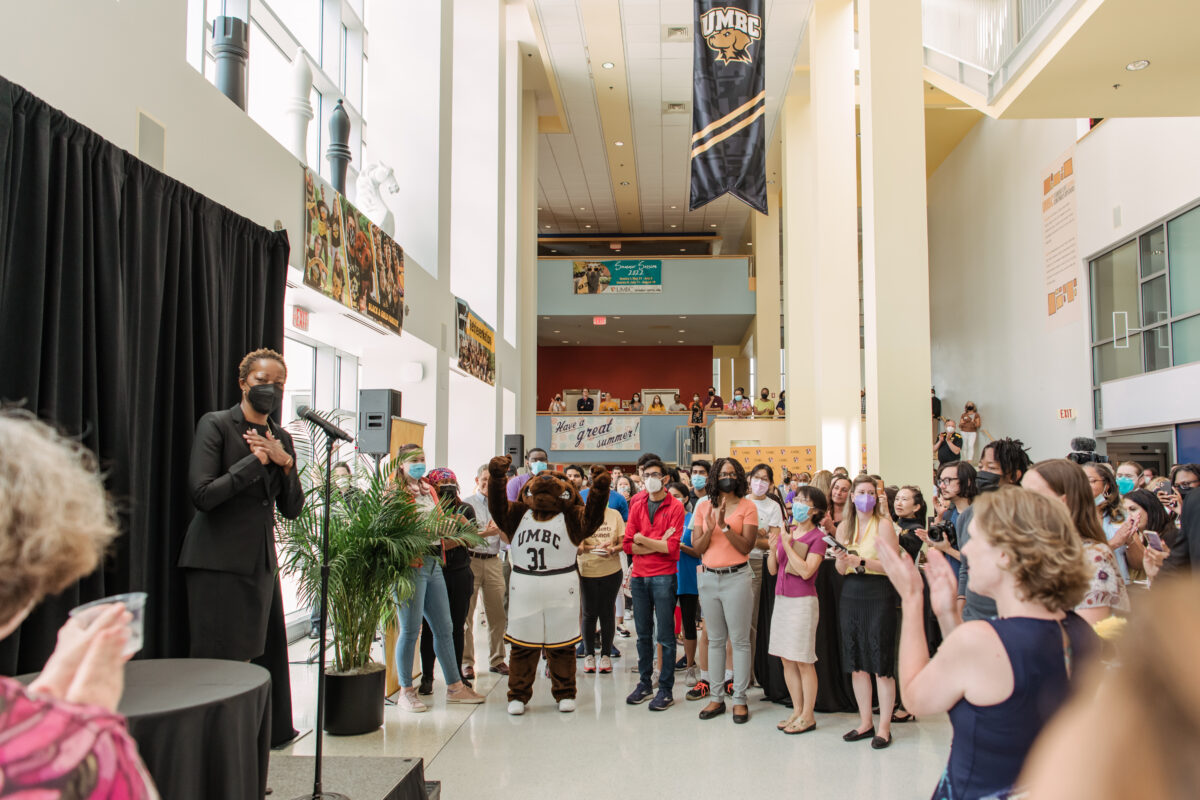 Valerie Sheares Ashby speaks with faculty, staff, and students on her first day as UMBC president, August 1, 2022. (Marlayna Demond ’11/UMBC)
Leadership and partnership
This theme of excitement for UMBC’s future with President Sheares Ashby, who began her tenure at UMBC in August, is a common thread among UMBC leadership.
“UMBC encourages staff growth and development, while ensuring equity through their focus on inclusion,” says Desiree Stonesifer, president of UMBC’s Non-exempt Staff Senate and executive administrative assistant in financial services, emphasizing a core value long-shared by UMBC and President Sheares Ashby. “As we welcome our new president, we look forward to the new opportunities for growth and experiences while maintaining our strong sense of UMBC family.”
 Laila Shishineh, director of academic engagement and transition programs and Council of University System Staff past-chair, celebrates earning her Ph.D. on UMBC’s Academic Row with beloved honorary staff member Chip, the campus comfort dog. (Photo by Poulomi Banerjee ’16, M.P.P. ’21)
Jess Wyatt, president of UMBC’s Professional Staff Senate (PSS), chair of the University Steering Committee, and associate director of alumni engagement, notes, “While it’s exciting to see UMBC as a perennial addition to this list, it is even more exciting to see where we will go as we move into a new era of UMBC in partnership with President Sheares Ashby.”
This is UMBC’s 13th year of recognition and 11th year on the Great Colleges Honor Roll.
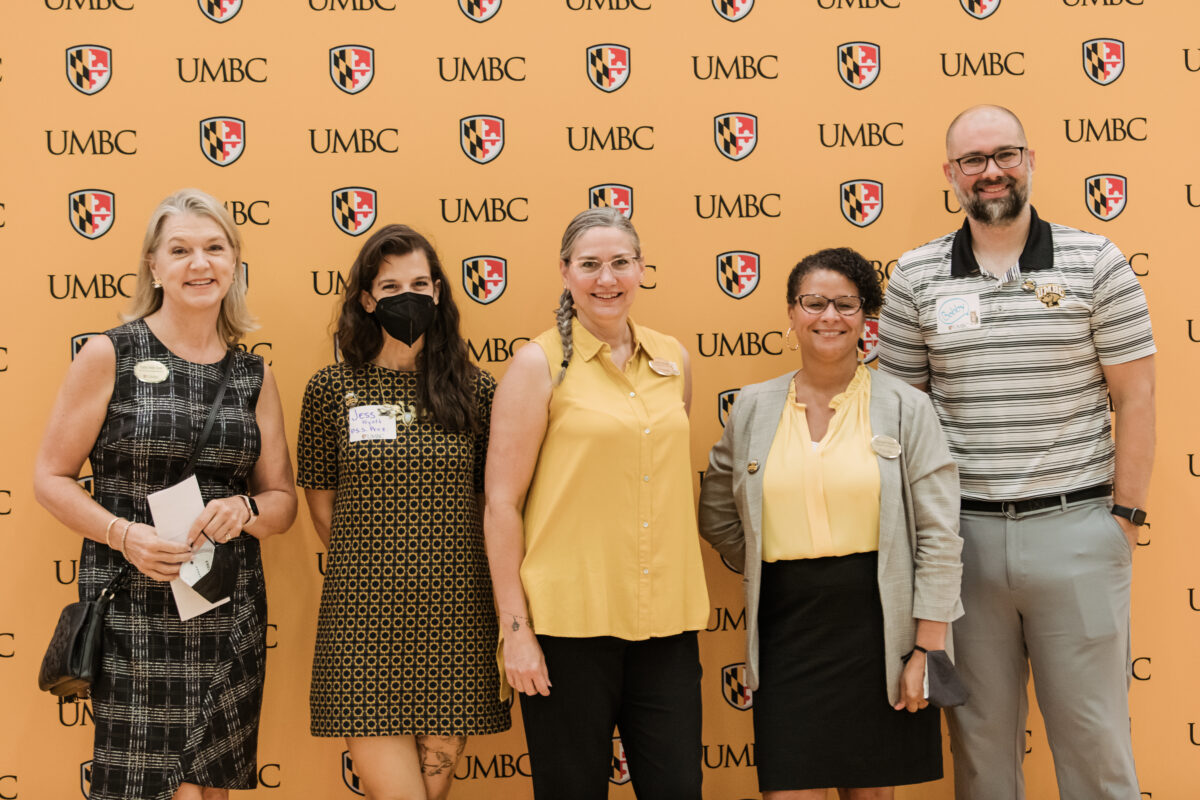 Staff from UMBC’s Office of Institutional Advancement at Fall Opening Meeting 2022, including PSS President Jess Wyatt, second from the left (Marlayna Demond ’11/UMBC)
]]>
This week, ModernThink’s Great Colleges to Work For program again recognized UMBC as a top institution nationwide in every measured category, from well-being and shared governance to mission and...
https://umbc.edu/stories/umbc-is-a-2022-great-college-to-work-for/
https://my3.my.umbc.edu/api/v0/pixel/news/127684/guest@my.umbc.edu/bd868576dcafebbf71c3b5818237ad51/api/pixel
community
faculty
news
rankings
staff
UMBC News & Magazine
https://my3.my.umbc.edu/groups/umbc-news-magazine
https://assets1-my.umbc.edu/system/shared/avatars/groups/000/001/943/24435aa6207c452e7bc15cc74b42c7bb/xsmall.png?1748556657
https://assets1-my.umbc.edu/system/shared/avatars/groups/000/001/943/24435aa6207c452e7bc15cc74b42c7bb/original.png?1748556657
https://assets2-my.umbc.edu/system/shared/avatars/groups/000/001/943/24435aa6207c452e7bc15cc74b42c7bb/xxlarge.png?1748556657
https://assets2-my.umbc.edu/system/shared/avatars/groups/000/001/943/24435aa6207c452e7bc15cc74b42c7bb/xlarge.png?1748556657
https://assets3-my.umbc.edu/system/shared/avatars/groups/000/001/943/24435aa6207c452e7bc15cc74b42c7bb/large.png?1748556657
https://assets1-my.umbc.edu/system/shared/avatars/groups/000/001/943/24435aa6207c452e7bc15cc74b42c7bb/medium.png?1748556657
https://assets2-my.umbc.edu/system/shared/avatars/groups/000/001/943/24435aa6207c452e7bc15cc74b42c7bb/small.png?1748556657
https://assets1-my.umbc.edu/system/shared/avatars/groups/000/001/943/24435aa6207c452e7bc15cc74b42c7bb/xsmall.png?1748556657
https://assets2-my.umbc.edu/system/shared/avatars/groups/000/001/943/24435aa6207c452e7bc15cc74b42c7bb/xxsmall.png?1748556657
UMBC News & Magazine
0
0
false
Fri, 16 Sep 2022 15:44:40 -0400
Fri, 16 Sep 2022 15:44:40 -0400
Viruses may be ‘watching’ you – some microbes lie in wait until their hosts unknowingly give them the signal to start multiplying and kill them
Staff from UMBC’s Office of Institutional Advancement at Fall Opening Meeting 2022, including PSS President Jess Wyatt, second from the left (Marlayna Demond ’11/UMBC)
]]>
This week, ModernThink’s Great Colleges to Work For program again recognized UMBC as a top institution nationwide in every measured category, from well-being and shared governance to mission and...
https://umbc.edu/stories/umbc-is-a-2022-great-college-to-work-for/
https://my3.my.umbc.edu/api/v0/pixel/news/127684/guest@my.umbc.edu/bd868576dcafebbf71c3b5818237ad51/api/pixel
community
faculty
news
rankings
staff
UMBC News & Magazine
https://my3.my.umbc.edu/groups/umbc-news-magazine
https://assets1-my.umbc.edu/system/shared/avatars/groups/000/001/943/24435aa6207c452e7bc15cc74b42c7bb/xsmall.png?1748556657
https://assets1-my.umbc.edu/system/shared/avatars/groups/000/001/943/24435aa6207c452e7bc15cc74b42c7bb/original.png?1748556657
https://assets2-my.umbc.edu/system/shared/avatars/groups/000/001/943/24435aa6207c452e7bc15cc74b42c7bb/xxlarge.png?1748556657
https://assets2-my.umbc.edu/system/shared/avatars/groups/000/001/943/24435aa6207c452e7bc15cc74b42c7bb/xlarge.png?1748556657
https://assets3-my.umbc.edu/system/shared/avatars/groups/000/001/943/24435aa6207c452e7bc15cc74b42c7bb/large.png?1748556657
https://assets1-my.umbc.edu/system/shared/avatars/groups/000/001/943/24435aa6207c452e7bc15cc74b42c7bb/medium.png?1748556657
https://assets2-my.umbc.edu/system/shared/avatars/groups/000/001/943/24435aa6207c452e7bc15cc74b42c7bb/small.png?1748556657
https://assets1-my.umbc.edu/system/shared/avatars/groups/000/001/943/24435aa6207c452e7bc15cc74b42c7bb/xsmall.png?1748556657
https://assets2-my.umbc.edu/system/shared/avatars/groups/000/001/943/24435aa6207c452e7bc15cc74b42c7bb/xxsmall.png?1748556657
UMBC News & Magazine
0
0
false
Fri, 16 Sep 2022 15:44:40 -0400
Fri, 16 Sep 2022 15:44:40 -0400
Viruses may be ‘watching’ you – some microbes lie in wait until their hosts unknowingly give them the signal to start multiplying and kill them

Ivan Erill, Professor of Biological Sciences, UMBC
After more than two years of the COVID-19 pandemic, you might picture a virus as a nasty spiked ball – a mindless killer that gets into a cell and hijacks its machinery to create a gazillion copies of itself before bursting out. For many viruses, including the coronavirus that causes COVID-19, the “mindless killer” epithet is essentially true.
But there’s more to virus biology than meets the eye.
Take HIV, the virus that causes AIDS. HIV is a retrovirus that does not go directly on a killing spree when it enters a cell. Instead, it integrates itself into your chromosomes and chills, waiting for the right moment to command the cell to make copies of it and burst out to infect other immune cells and eventually cause AIDS.
Exactly what moment HIV is waiting for is still an area of active study. But research on other viruses has long hinted that these pathogens can be quite “thoughtful” about killing. Of course, viruses cannot think the way you and I do. But, as it turns out, evolution has endowed them with some pretty elaborate decision-making mechanisms. Some viruses, for instance, will choose to leave the cell they have been residing in if they detect DNA damage. Not even viruses, it appears, like to stay in a sinking ship.
My laboratory has been studying the molecular biology of bacteriophages, or phages for short, the viruses that infect bacteria, for over two decades. Recently, my colleagues and I have shown that phages can listen for key cellular signals to help them in their decision-making. Even worse, they can use the cell’s own “ears” to do the listening for them.
Escaping DNA damage
If the enemy of your enemy is your friend, phages are certainly your friends. Phages control bacterial populations in nature, and clinicians are increasingly using them to treat bacterial infections that do not respond to antibiotics.
The best studied phage, lambda, works a bit like HIV. Upon entering the bacterial cell, lambda decides whether to replicate and kill the cell outright, like most viruses do, or to integrate itself into the cell’s chromosome, as HIV does. If the latter, lambda harmlessly replicates with its host each time the bacteria divides. This video shows a lambda phage infecting E. coli.
This video shows a lambda phage infecting E. coli.
But, like HIV, lambda is not just sitting idle. It uses a special protein called CI like a stethoscope to listen for signs of DNA damage within the bacterial cell. If the bacterium’s DNA gets compromised, that’s bad news for the lambda phage nested within it. Damaged DNA leads straight to evolution’s landfill because it’s useless for the phage that needs it to reproduce. So lambda turns on its replication genes, makes copies of itself and bursts out of the cell to look for more undamaged cells to infect.
Tapping the cell’s communication system
Some phages, instead of gathering intel with their own proteins, tap the infected cell’s very own DNA damage sensor: LexA.
Proteins like CI and LexA are transcription factors that turn genes on and off by binding to specific genetic patterns within the DNA instruction book that is the chromosome. Some phages like Coliphage 186 have figured out that they don’t need their own viral CI protein if they have a short DNA sequence in their chromosomes that bacterial LexA can bind to. Upon detecting DNA damage, LexA will activate the phage’s replicate-and-kill genes, essentially double-crossing the cell into committing suicide while allowing the phage to escape.
Scientists first reported CI’s role in phage decision-making in the 1980s and Coliphage 186’s counterintelligence trick in the late 1990s. Since then, there have been a few other reports of phages tapping bacterial communication systems. One example is phage phi29, which exploits its host’s transcription factor to detect when the bacterium is getting ready to generate a spore, or a kind of bacterial egg capable of surviving extreme environments. Phi29 instructs the cell to package its DNA into the spore, killing the budding bacteria once the spore germinates.
Transcription factors turn genes on and off.
In our recently published research, my colleagues and I show that several groups of phages have independently evolved the ability to tap into yet another bacterial communication system: the CtrA protein. CtrA integrates multiple internal and external signals to set in motion different developmental processes in bacteria. Key among these is the production of bacterial appendages called flagella and pili. Turns out, these phages attach themselves to the pili and flagella of bacteria in order to infect them.
Our leading hypothesis is that phages use CtrA to guesstimate when there will be enough bacteria nearby sporting pili and flagella that they can readily infect. A pretty smart trick for a “mindless killer.”
These are not the only phages that make elaborate decisions – all without the benefit of even having a brain. Some phages that infect Bacillus bacteria produce a small molecule each time they infect a cell. The phages can sense this molecule and use it to count the number of phage infections taking place around them. Like alien invaders, this count helps decide when they should switch on their replicate-and-kill genes, killing only when hosts are relatively abundant. This way, the phages make sure that they never run out of hosts to infect and guarantee their own long-term survival.
Countering viral counterintelligence
You may be wondering why you should care about the counterintelligence ops run by bacterial viruses. While bacteria are very different from people, the viruses that infect them are not that different from the viruses that infect humans. Pretty much every single trick played by phages has later been shown to be used by human viruses. If a phage can tap bacterial communication lines, why wouldn’t a human virus tap yours?
So far, researchers don’t know what human viruses could be listening for if they hijack these lines, but plenty of options come to mind. I believe that, like phages, human viruses could potentially be able to count their numbers to strategize, detect cell growth and tissue formation and even monitor immune responses. For now, these possibilities are only speculation, but scientific investigation is underway.
Having viruses listening to your cells’ private conversations is not the rosiest of pictures, but it’s not without a silver lining. As intelligence agencies all around the world know well, counterintelligence works only when it’s covert. Once detected, the system can very easily be exploited to feed misinformation to your enemy. Similarly, I believe that future antiviral therapies may be able to combine conventional artillery, like antivirals that prevent viral replication, with information warfare trickery, such as making the virus believe the cell it is in belongs to a different tissue.
But, hush, don’t tell anybody. Viruses could be listening!
* * * * * *
Ivan Erill, Professor of Biological Sciences, University of Maryland, Baltimore County
This article is republished from The Conversation under a Creative Commons license. Read the original article.
]]>
Ivan Erill, Professor of Biological Sciences, UMBC After more than two years of the COVID-19 pandemic, you might picture a virus as a nasty spiked ball – a mindless killer that gets into a...
https://umbc.edu/stories/viruses-may-be-watching-you/
https://my3.my.umbc.edu/api/v0/pixel/news/127624/guest@my.umbc.edu/1bdd00be3880ea59512906f814386552/api/pixel
biology
cnms
discovery
magazine
research
theconversation
UMBC News & Magazine
https://my3.my.umbc.edu/groups/umbc-news-magazine
https://assets1-my.umbc.edu/system/shared/avatars/groups/000/001/943/24435aa6207c452e7bc15cc74b42c7bb/xsmall.png?1748556657
https://assets1-my.umbc.edu/system/shared/avatars/groups/000/001/943/24435aa6207c452e7bc15cc74b42c7bb/original.png?1748556657
https://assets2-my.umbc.edu/system/shared/avatars/groups/000/001/943/24435aa6207c452e7bc15cc74b42c7bb/xxlarge.png?1748556657
https://assets2-my.umbc.edu/system/shared/avatars/groups/000/001/943/24435aa6207c452e7bc15cc74b42c7bb/xlarge.png?1748556657
https://assets3-my.umbc.edu/system/shared/avatars/groups/000/001/943/24435aa6207c452e7bc15cc74b42c7bb/large.png?1748556657
https://assets1-my.umbc.edu/system/shared/avatars/groups/000/001/943/24435aa6207c452e7bc15cc74b42c7bb/medium.png?1748556657
https://assets2-my.umbc.edu/system/shared/avatars/groups/000/001/943/24435aa6207c452e7bc15cc74b42c7bb/small.png?1748556657
https://assets1-my.umbc.edu/system/shared/avatars/groups/000/001/943/24435aa6207c452e7bc15cc74b42c7bb/xsmall.png?1748556657
https://assets2-my.umbc.edu/system/shared/avatars/groups/000/001/943/24435aa6207c452e7bc15cc74b42c7bb/xxsmall.png?1748556657
UMBC News & Magazine
0
0
false
Thu, 15 Sep 2022 11:49:19 -0400
Thu, 15 Sep 2022 11:49:19 -0400
U.S. News highlights UMBC’s national leadership in teaching, innovation, diversity

The 2022–23 U.S. News and World Report Best Colleges undergraduate rankings released this week illustrate why a record number of students chose to call UMBC home this fall. This year’s rankings show UMBC jumping an impressive 25 spots on the list of Best National Universities and appearing on several other prestigious lists, distinguishing the university’s achievements on a national stage.
“Notable increases in UMBC’s six-year graduation rate, at a time when UMBC was also recognized as an Research 1 university, likely supported this jump,” says Constance A. Pierson ’90, M.A. ’92, associate vice provost for Institutional Research, Analysis and Decision Support. “We are particularly proud that the graduation rate trend is consistent for students of different economic backgrounds.”
This year UMBC ranks at #9 nationally for undergraduate teaching, joined in the top ten by such institutions as Brown, Princeton, and Dartmouth, and tied with the University of Notre Dame. UMBC also maintains its longstanding position on the list of the nation’s most innovative universities, tied at #10 with Johns Hopkins University. UMBC ranks #64 on the Top Public Universities list, #137 on the overall Top National Universities list, and #46 for undergraduate research and creative projects.
Student-centered education
At the core of this year’s rankings are students who already distinguish themselves as budding entrepreneurs, global citizens, advocates, and leaders. Farah Helal ’24, global studies and political science, began her term as University System of Maryland (USM) student regent on July 1, 2022. UMBC’s U.S. News ranking as one of the country’s Best Value Schools and universities with the least student debt speaks directly to the work Helal will be doing as part of her tenure: weighing in on topics like setting tuition and fee rates, approving new degree programs, and approving capital and operating budgets.
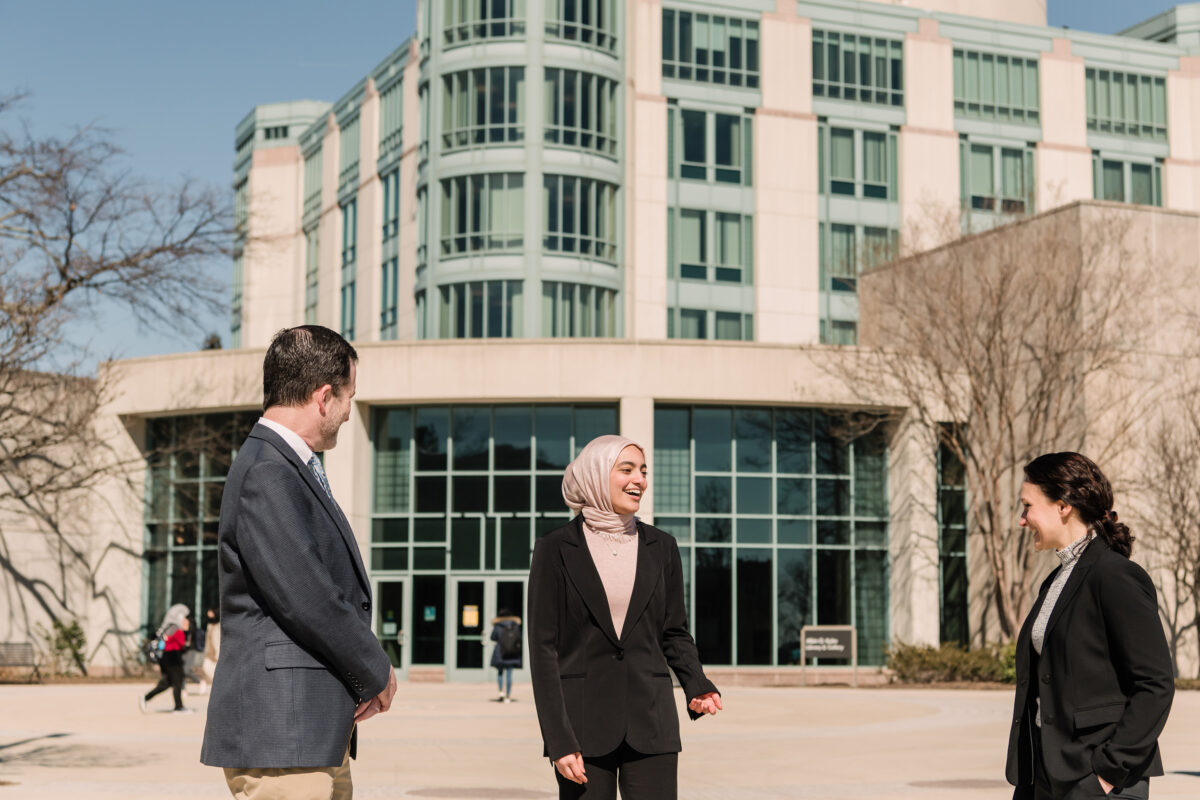 Helal (center) with Romy Hübler ‘09, modern languages and linguistics, M.A. ‘11, intercultural communication, Ph.D. ‘15, language, literacy, and culture (LLC), right, and David Hoffman, Ph.D. ’13, LLC, left. (Marlayna Demond ’11/UMBC)
“UMBC is a meeting ground for students, faculty, and staff who want to be engaged in our communities every day, doing deep and creative work to solve problems and promote justice and inclusion,” says David Hoffman, director of the Center for Democracy and Civic Life.
In addition to the latest U.S. News rankings, Hoffman highlights that the 2022 College Rankings issue of The Washington Monthly names UMBC one of America’s Best Colleges for Student Voting. “I love that we have been recognized by Washington Monthly for our efforts in connection with voting, and I love knowing that voting is just the tip of the iceberg for us when it comes to our students’ engagement and impact.”
Both teaching and research
The latest U.S. News rankings are primarily university-wide, but they also include recognition for a few specific undergraduate programs. UMBC is listed as a top-100 university this year for both computer science and engineering. Coming in at #86 for computer science, UMBC shares the rank with George Mason University, Texas Tech University, and Howard University. Ascending to #94 for engineering this year, UMBC is joined by Clemson University, George Washington University, and University of Delaware.
It’s essential to understand these rankings in the context of another important milestone, notes Keith J Bowman, dean of the College of Engineering and Information Technology (COEIT): UMBC’s recent Carnegie Classification as a doctoral university with very high research activity, popularly known as Research 1 (or R1). UMBC is now ranked as one of only 146 R1 institutions nationally, including 107 public and 39 private universities.
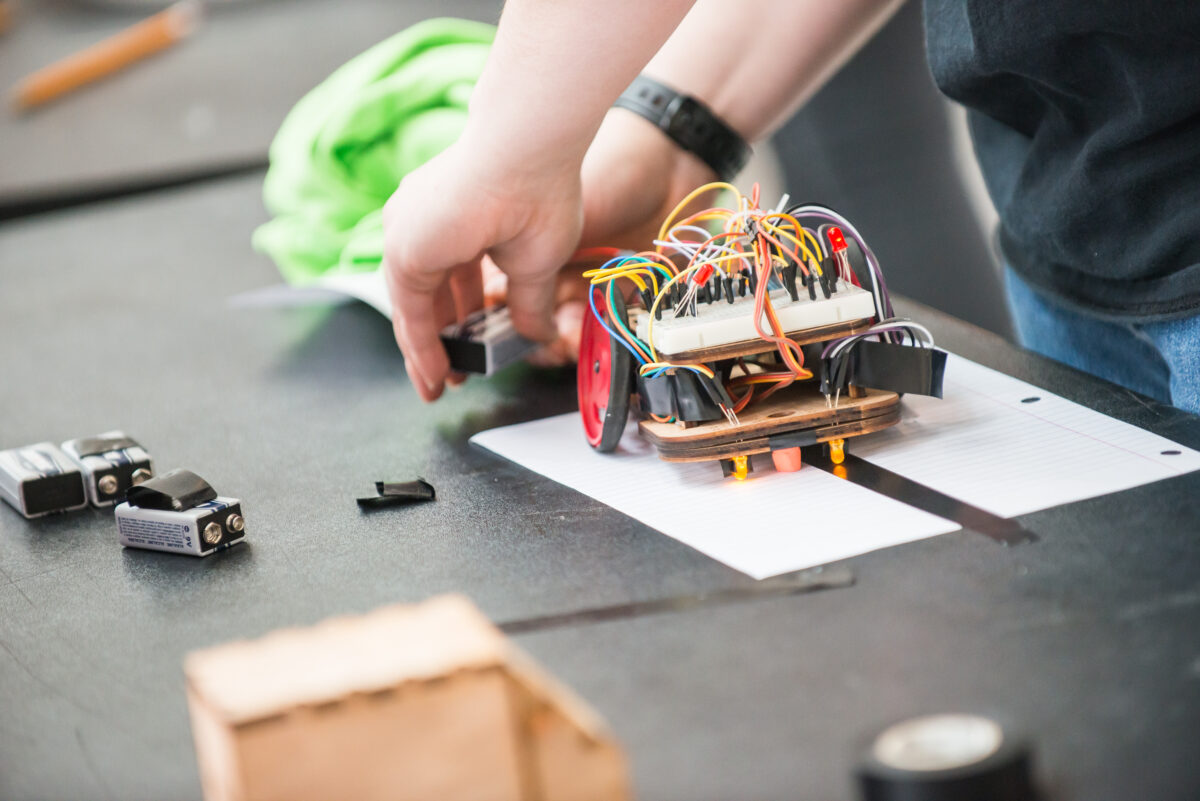 A student works on an engineering project. (Marlayna Demond ’11/UMBC)
“UMBC’s designation as an R1 institution combined with increasing recognition for our engineering, computing and information systems programs has enabled us to recruit incredible faculty talent,” says Bowman. “Those faculty are attracted to UMBC for our potential to both advance their success as researchers and educators and our emphasis on inclusion as essential to excellence.”
Promoting diversity and innovation
UMBC’s recognition as one of the nation’s most innovative universities, alongside Johns Hopkins, goes hand-in-hand with recognition as a top university for ethnic diversity. The National Institute of Health (NIH) and National Science Foundation (NSF) have recently awarded UMBC over $15 million for programs specifically to support underrepresented STEM students—an area where UMBC is known as an innovative national model.
The College of Natural and Mathematical Sciences (CNMS) will receive $5.6 million over five years from the NIH to fund the Graduate Research Training Initiative for Student Enhancement (G-RISE). This program will support graduate students from underrepresented groups in STEM with up to three years of funding and an array of training opportunities. The goal is to help participants select and prepare for a range of career paths in academia, industry, government, entrepreneurship, or beyond.
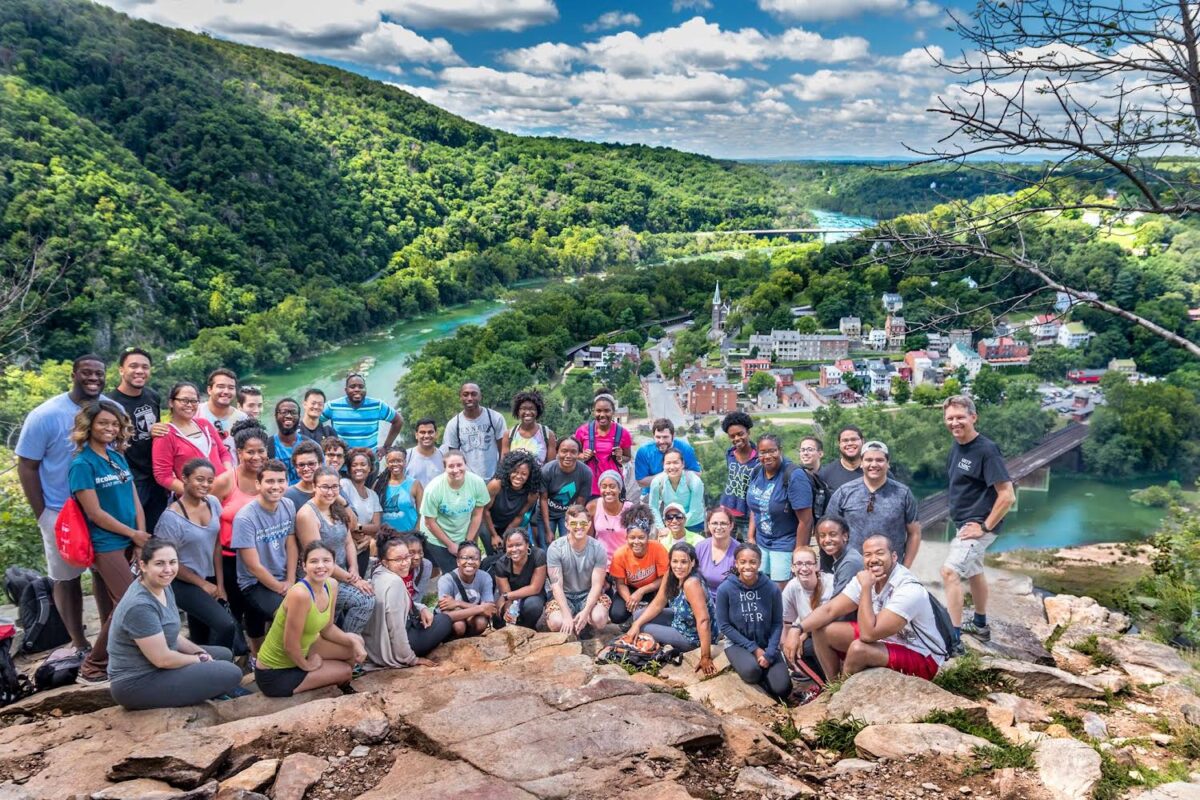 Students and faculty in the Initiative for Maximizing Student Development (IMSD) Meyerhoff Graduate Fellows program celebrate reaching the summit of their hike at Harper’s Ferry on one of the program’s annual summer retreats. IMSD launched in 1996 and transitions to G-RISE this year. Over 150 UMBC participants earned their Ph.D. in that time period. (Image courtesy of the Meyerhoff Graduate Fellows)
UMBC will expand its work boosting diversity in academia from Maryland to the national level through a new NSF INCLUDES Alliance: Re-Imagining STEM Equity Utilizing Postdoc Pathways (RISE UPP). The RISE UPP Alliance, anticipated to officially launch in fall 2022, is modeled after the AGEP PROMISE Academy, a high-impact initiative co-led by UMBC that supports faculty diversification in the biomedical sciences across USM institutions.
The university has also received support from a broad range of other groups and agencies to expand and replicate UMBC’s student success models. This includes $2.5 million from the Simons Foundation to create a Meyerhoff Scholars-like program within the public university system in New York, among other initiatives.
Vision of leadership
This commitment to diversity and inclusion can also be seen at the faculty and administrative leadership levels. Kimberly R. Moffitt, dean of UMBC’s College of Arts, Humanities, and Social Sciences (CAHSS) and professor of language, literacy, and culture, serves as the lead principal investigator for Breaking the M.O.L.D. UMBC, Morgan State University, and the University of Maryland, College Park are partnering in this $3 million initiative funded by the Andrew W. Mellon Foundation to develop a pipeline to higher ed leadership for diverse scholars in the arts and humanities.
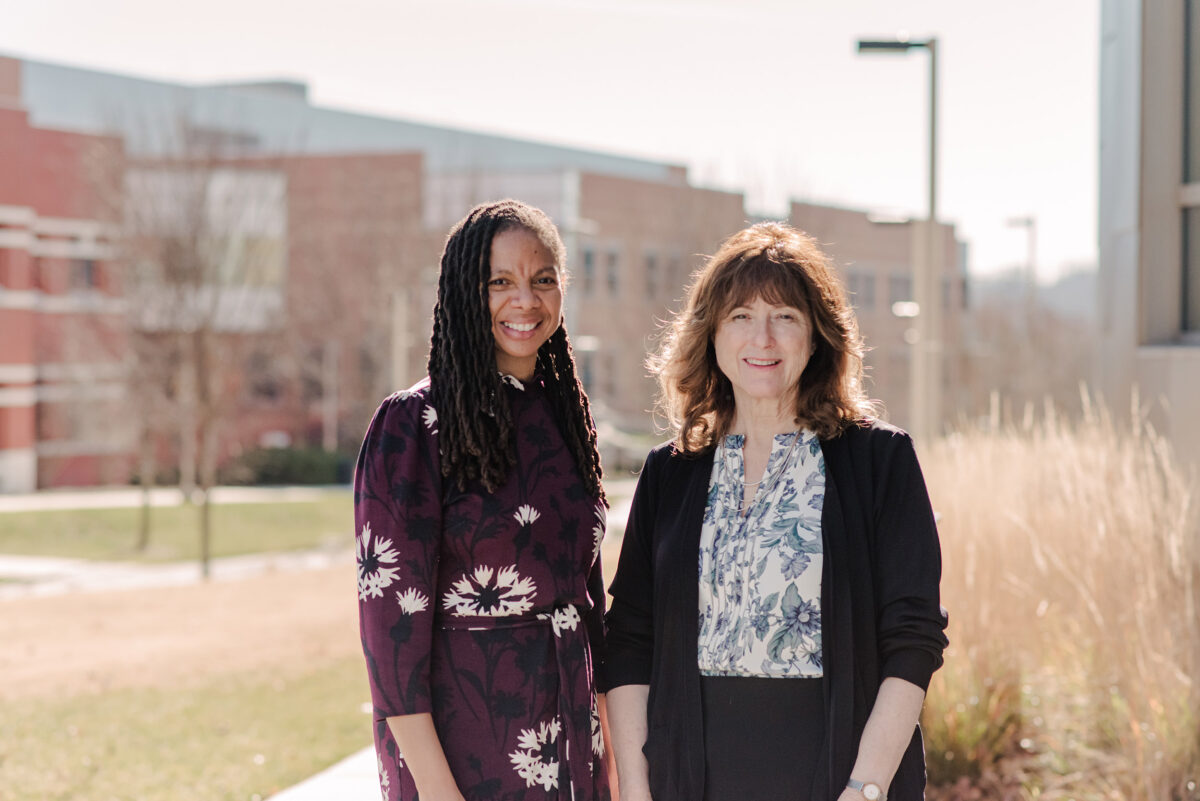 Kimberly Moffitt (l), dean of UMBC’s College of Arts, Humanities, and Social Sciences (CAHSS), serves as Breaking the M.O.L.D.’s lead PI. Joining her in leading UMBC’s implementation of Breaking the M.O.L.D. is Patrice McDermott, vice provost for faculty affairs. (Marlayna Demond ’11/UMBC)
Following through on “redefin[ing] excellence in higher education through an inclusive culture” is an essential part of what makes UMBC such a special and distinctive place, says UMBC President Valerie Sheares Ashby. “This is an extraordinary institution,” she recently told WYPR’s Tom Hall. She shares, “The university is true to the values and vision that it states.”
]]>
The 2022–23 U.S. News and World Report Best Colleges undergraduate rankings released this week illustrate why a record number of students chose to call UMBC home this fall. This year’s rankings...
https://umbc.edu/stories/us-news-2022-23/
https://my3.my.umbc.edu/api/v0/pixel/news/127542/guest@my.umbc.edu/eacccc71a5100eea5cb5511cf6654531/api/pixel
cahss
civic
cnms
coeit
community
diversityandinclusion
globalstudies
llc
mlli
news
politicalscience
rankings
UMBC News & Magazine
https://my3.my.umbc.edu/groups/umbc-news-magazine
https://assets1-my.umbc.edu/system/shared/avatars/groups/000/001/943/24435aa6207c452e7bc15cc74b42c7bb/xsmall.png?1748556657
https://assets1-my.umbc.edu/system/shared/avatars/groups/000/001/943/24435aa6207c452e7bc15cc74b42c7bb/original.png?1748556657
https://assets2-my.umbc.edu/system/shared/avatars/groups/000/001/943/24435aa6207c452e7bc15cc74b42c7bb/xxlarge.png?1748556657
https://assets2-my.umbc.edu/system/shared/avatars/groups/000/001/943/24435aa6207c452e7bc15cc74b42c7bb/xlarge.png?1748556657
https://assets3-my.umbc.edu/system/shared/avatars/groups/000/001/943/24435aa6207c452e7bc15cc74b42c7bb/large.png?1748556657
https://assets1-my.umbc.edu/system/shared/avatars/groups/000/001/943/24435aa6207c452e7bc15cc74b42c7bb/medium.png?1748556657
https://assets2-my.umbc.edu/system/shared/avatars/groups/000/001/943/24435aa6207c452e7bc15cc74b42c7bb/small.png?1748556657
https://assets1-my.umbc.edu/system/shared/avatars/groups/000/001/943/24435aa6207c452e7bc15cc74b42c7bb/xsmall.png?1748556657
https://assets2-my.umbc.edu/system/shared/avatars/groups/000/001/943/24435aa6207c452e7bc15cc74b42c7bb/xxsmall.png?1748556657
UMBC News & Magazine
0
0
false
Tue, 13 Sep 2022 16:34:18 -0400
Tue, 13 Sep 2022 16:34:18 -0400
UMBC’s new AAAS Science & Technology Policy Fellows focus on STEM workforce inclusion, youth justice
Erin Lavik, professor of chemical, biochemical, and environmental engineering at UMBC, is an innovator in developing nanoparticles to stop internal bleeding. She’s also hard at work on a very different challenge: building STEM workforce development programs that are more inclusive and equitable.
Lavik and Erika Fountain, assistant professor of psychology, will serve as 2022-23 Science & Technology Policy Fellows (STPF) with the American Association for the Advancement of Science (AAAS), in the prestigious program’s 50th class.
“AAAS policy fellows have been demonstrating excellence in science policy for the past half-century—defining what it means to be a scientist and engineer in the policymaking realm,” said STPF Director Rashada Alexander.
The 300 fellows chosen for the 2022-23 class will serve in a range of government offices, working to inform actionable, science-based policies. Lavik will be based in the Advanced Manufacturing Office of the National Institute of Standards and Technology, known as Manufacturing USA. Fountain will be hosted by the American Psychological Association (APA), serving as a Congressional Fellow.
The 2022-23 fellowship class is supported by variety of bodies including the U.S. Government, AAAS, partner societies, and the Gordon and Betty Moore Foundation, with an eye on both the value of this experience for participating fellows and the impact fellows will have throughout their careers.
Inclusive high-tech workforce
“With the CHIPS Act passing, I’ll be focusing on building workforce development programs that are equitable, inclusive, diverse, and accessible,” says Lavik.
“CHIPS” stands for Creating Helpful Incentives to Produce Semiconductors—legislation that will provide nearly $53 billion to support semiconductor production in the U.S., supporting both research and high-tech jobs. The goal of CHIPS, the White House notes, is “to sustain U.S. leadership in the sciences and engineering as the engine for American innovation.”
Lavik, who is also associate dean for research and faculty development in UMBC’s College of Engineering and Information Technology (COEIT), will play an important role at NIST in shaping the programs that will generate these high-tech jobs, maximizing their benefit. At the same time, she will learn about federal policymaking and implementation first-hand.
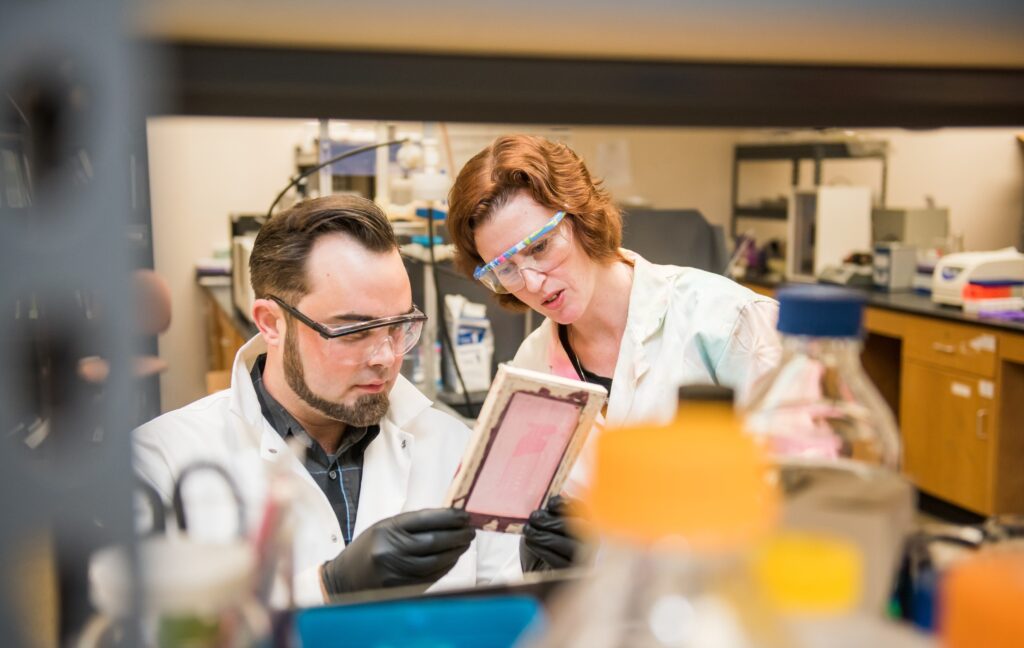 Erin Lavik (right) works in her lab with then-graduate student Adam Day (left) in 2018. Lavik’s lab works to develop new therapies through polymer synthesis and processing, drug delivery, and stem cell biology.
“Dr. Lavik has worked as both a researcher and as an associate dean elevating research and advancing faculty development. This combination has given her a broad insight into product development,” says COEIT Dean Keith J Bowman. “I am certain that expertise will serve her well in supporting advancement of our nation’s manufacturing enterprises. I know from direct experience that Manufacturing USA has changed how we think about and carry out manufacturing, and Dr. Lavik’s strategic and innovative mindset is a great match for this opportunity.”
Research-based youth justice policy
 Erika Fountain (Image courtesy of Fountain)
Fountain leads UMBC’s interdisciplinary Youth Justice Lab, which focuses on the intersection of adolescent development and the legal system, combining psychology, law, and policy. Her research focuses on how adolescents and their families navigate the justice system, with the goal of developing evidence-based youth justice policy. She and her team explore how youth experience legal decision making, court processes, and working with attorneys.
Fountain’s APA Congressional Fellowship is specifically designed for psychologists seeking unique public policy learning experiences to prepare them for careers connecting with and impacting the federal government. She has already provided scientific testimony to Maryland legislators considering changes to policies involving youth justice—from confidentiality of records to legal protections in youth interrogation—and looks forward to working at the federal level.
“This fellowship gives scientists an opportunity to learn about the policy process and ultimately inform work being done to create and implement policies,” says Fountain. “As someone who has been conducting research on youth justice and justice policy for years, I am thrilled to be able to step into this role and work directly with policy makers to inform policies that benefit youth and their families.”
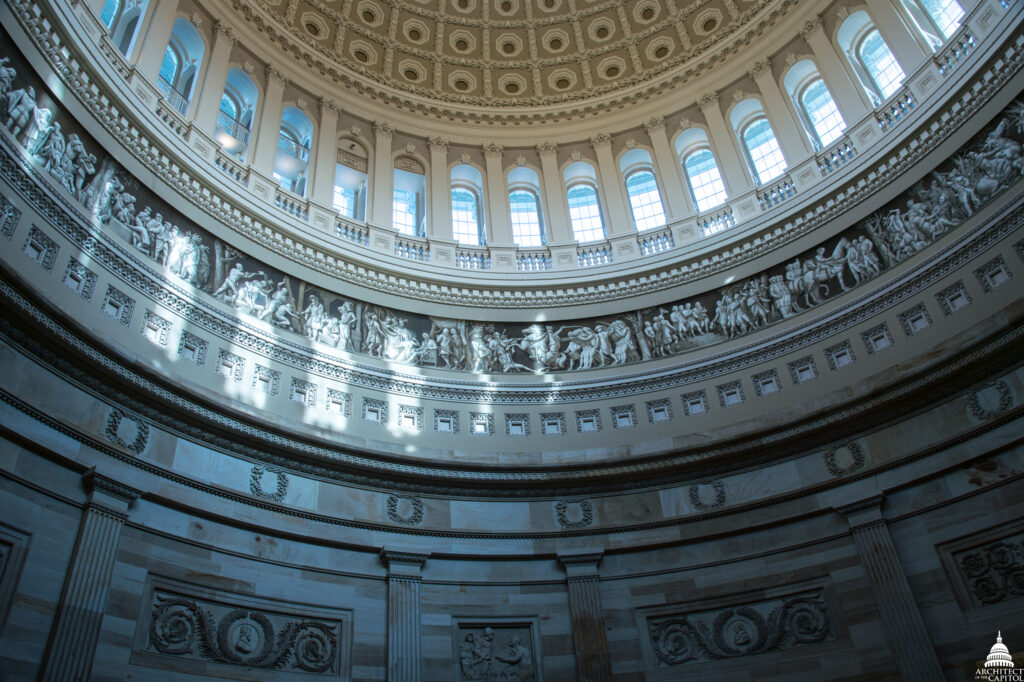 U.S. Capitol Rotunda interior. (Image courtesy of the Architect of the Capitol)
“In awarding Dr. Fountain this fellowship, APA and AAAS have recognized the high quality and impact of her scholarship and policy work to date,” says Anne E. Brodsky, professor and chair of psychology. “Through this high-level experience, she’ll gain valuable expertise that will further advance her contributions to our mission: elevating our students and surrounding communities through important and socially relevant applied scholarship.”
]]>
Erin Lavik, professor of chemical, biochemical, and environmental engineering at UMBC, is an innovator in developing nanoparticles to stop internal bleeding. She’s also hard at work on a very...
https://umbc.edu/stories/umbcs-new-aaas-science-and-technology-policy-fellows/
https://my3.my.umbc.edu/api/v0/pixel/news/127416/guest@my.umbc.edu/3a9ddf2057c4940f31382165613ffd69/api/pixel
cahss
cbee
coeit
majoraward
news
policy-and-society
psychology
research
science-and-tech
UMBC News & Magazine
https://my3.my.umbc.edu/groups/umbc-news-magazine
https://assets1-my.umbc.edu/system/shared/avatars/groups/000/001/943/24435aa6207c452e7bc15cc74b42c7bb/xsmall.png?1748556657
https://assets1-my.umbc.edu/system/shared/avatars/groups/000/001/943/24435aa6207c452e7bc15cc74b42c7bb/original.png?1748556657
https://assets2-my.umbc.edu/system/shared/avatars/groups/000/001/943/24435aa6207c452e7bc15cc74b42c7bb/xxlarge.png?1748556657
https://assets2-my.umbc.edu/system/shared/avatars/groups/000/001/943/24435aa6207c452e7bc15cc74b42c7bb/xlarge.png?1748556657
https://assets3-my.umbc.edu/system/shared/avatars/groups/000/001/943/24435aa6207c452e7bc15cc74b42c7bb/large.png?1748556657
https://assets1-my.umbc.edu/system/shared/avatars/groups/000/001/943/24435aa6207c452e7bc15cc74b42c7bb/medium.png?1748556657
https://assets2-my.umbc.edu/system/shared/avatars/groups/000/001/943/24435aa6207c452e7bc15cc74b42c7bb/small.png?1748556657
https://assets1-my.umbc.edu/system/shared/avatars/groups/000/001/943/24435aa6207c452e7bc15cc74b42c7bb/xsmall.png?1748556657
https://assets2-my.umbc.edu/system/shared/avatars/groups/000/001/943/24435aa6207c452e7bc15cc74b42c7bb/xxsmall.png?1748556657
UMBC News & Magazine
0
0
false
Thu, 08 Sep 2022 16:57:25 -0400
Thu, 08 Sep 2022 16:57:25 -0400
Americans think they know a lot about politics – and it’s bad for democracy that they’re so often wrong in their confidence

Ian Anson, Associate Professor of Political Science, UMBC
As statewide primaries continue through the summer, many Americans are beginning to think about which candidates they will support in the 2022 general election.
This decision-making process is fraught with difficulties, especially for inexperienced voters.
Voters must navigate angry, emotion-laden conversations about politics when trying to sort out whom to vote for. Americans are more likely than ever to view politics in moral terms, meaning their political conversations sometimes feel like epic battles between good and evil.
But political conversations are also shaped by, obviously, what Americans know – and, less obviously, what they think they know – about politics.
In recent research, I studied how Americans’ perceptions of their own political knowledge shape their political attitudes. My results show that many Americans think they know much more about politics than they really do.
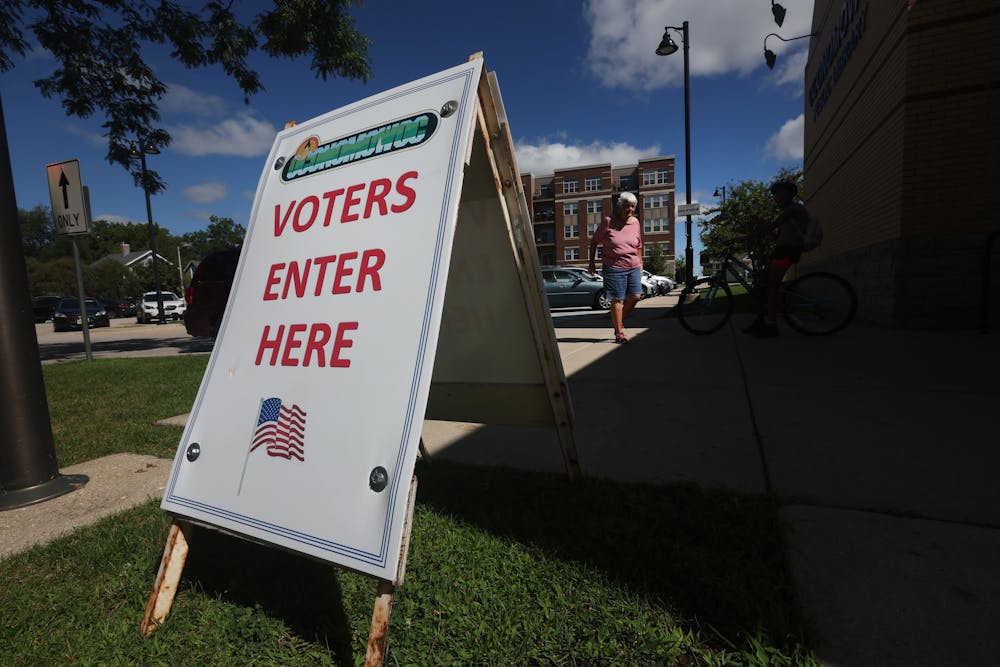
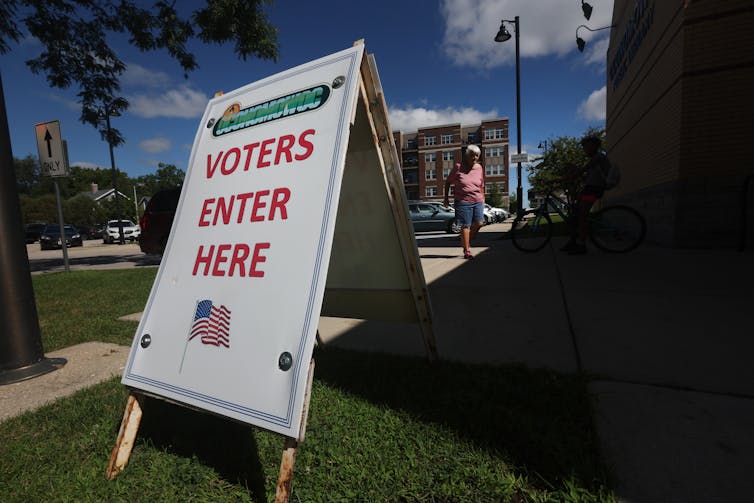 Voters arrive to cast their primary ballots at a polling place on Aug. 9, 2022, in Oconomowoc, Wisconsin.
Scott Olson/Getty Images
Knowledge deficit, confidence surplus
Over the past five years, I have studied the phenomenon of what I call “political overconfidence.” My work, in tandem with other researchers’ studies, reveals the ways it thwarts democratic politics.
Political overconfidence can make people more defensive of factually wrong beliefs about politics. It also causes Americans to underestimate the political skill of their peers. And those who believe themselves to be political experts often dismiss the guidance of real experts.
Political overconfidence also interacts with political partisanship, making partisans less willing to listen to peers across the aisle.
The result is a breakdown in the ability to learn from one another about political issues and events.
A ‘reality check’ experiment
In my most recent study on the subject, I tried to find out what would happen when politically overconfident people found out they were mistaken about political facts.
To do this, I recruited a sample of Americans to participate in a survey experiment via the Lucid recruitment platform. In the experiment, some respondents were shown a series of statements that taught them to avoid common political falsehoods. For instance, one statement explained that while many people believe that Social Security will soon run out of money, the reality is less dire than it seems.
My hypothesis was that most people would learn from the statements, and become more wary of repeating common political falsehoods. However, as I have found in my previous studies, a problem quickly emerged.
The problem
First, I asked respondents a series of basic questions about American politics. This quiz included topics like which party controls the House of Representatives – the Democrats – and who the current Secretary of Energy is – Jennifer Granholm. Then, I asked them how well they thought they did on the quiz.
Many respondents who believed they were top performers were actually among those who scored the worst. Much akin to the results of a famous study by Dunning and Kruger, the poorest performers did not generally realize that they lagged behind their peers.
Of the 1,209 people who participated, around 70% were overconfident about their knowledge of politics. But this basic pattern was not the most worrying part of the results.
The overconfident respondents failed to change their attitudes in response to my warnings about political falsehoods. My investigation showed that they did read the statements, and could report details about what they said. But their attitudes toward falsehoods remained inflexible, likely because they – wrongly – considered themselves political experts.
But if I could make overconfident respondents more humble, would they actually take my warnings about political falsehoods to heart?
Poor self-assessment
My experiment sought to examine what happens when overconfident people are told their political knowledge is lacking. To do this, I randomly assigned respondents to receive one of three experimental treatments after taking the political knowledge quiz. These were as follows:
- Respondents received statements teaching them to avoid political falsehoods.
- Respondents did not receive the statements.
- Respondents received both the statements and a “reality check” treatment. The reality check showed how respondents fared on the political quiz they took at the beginning of the survey. Along with their raw score, the report showed how respondents ranked among 1,000 of their peers.
For example, respondents who thought they had aced the quiz might have learned that they got one out of five questions right, and that they scored worse than 82% of their peers. For many overconfident respondents, this “reality check” treatment brought them down to earth. They reported much less overconfidence on average when I followed up with them.
Finally, I asked all the respondents in the study to report their levels of skepticism toward five statements. These statements are all common political falsehoods. One statement, for example, asserted that violent crime had risen over the prior decade – it hadn’t. Another claimed the U.S. spent 18% of the federal budget on foreign aid – the real number was less than 1%.
I expected most respondents who had received my cautionary statements to become more skeptical of these misinformed statements. On average, they did. But did overconfident respondents learn this lesson too?
 Those who believe themselves to be political experts often dismiss the guidance of real experts. IvelinRadkov/iStock/Getty Images
Reality check: Mission accomplished
The results of the study showed that overconfident respondents began to take political falsehoods seriously only if they had experienced my “reality check” treatment first.
While overconfident respondents in other conditions showed no reaction, the humbling nature of the “reality check,” when they realized how wrong they had been, led overconfident participants in that condition to revise their beliefs. They increased their skepticism of political falsehoods by a statistically significant margin.
Overall, this “reality check” experiment was a success. But it reveals that outside of the experiment, political overconfidence stands in the way of many Americans’ ability to accurately perceive political reality.
The problem of political overconfidence
What, if anything, can be done about the widespread phenomenon of political overconfidence?
While my research cannot determine whether political overconfidence is increasing over time, it makes intuitive sense that this problem would be growing in importance in an era of online political discourse. In the online realm, it is often difficult to appraise the credibility of anonymous users. This means that false claims are easily spread by uninformed people who merely sound confident.
To combat this problem, social media companies and opinion leaders could seek ways to promote discourse that emphasizes humility and self-correction. Because confident, mistaken self-expression can easily drown out more credible voices in the online realm, social media apps could consider promoting humility by reminding posters to reconsider the “stance,” or assertiveness, of their posts.
While this may seem far-fetched, recent developments show that small nudges can lead to powerful shifts in social media users’ online behavior.
For example, Twitter’s recent inclusion of a pop-up message that asks would-be posters of news articles to “read before tweeting” caused users to rethink their willingness to share potentially misleading content.
A gentle reminder to avoid posting bold claims without evidence is just one possible way that social media companies could encourage good online behavior. With another election season soon upon us, such a corrective is urgently needed.
Ian Anson, Associate Professor of Political Science, University of Maryland, Baltimore County
This article is republished from The Conversation under a Creative Commons license. Read the original article.
]]>
Ian Anson, Associate Professor of Political Science, UMBC As statewide primaries continue through the summer, many Americans are beginning to think about which candidates they will support in...
https://umbc.edu/stories/americans-think-they-know-a-lot-about-politics/
https://my3.my.umbc.edu/api/v0/pixel/news/127247/guest@my.umbc.edu/f045cfea3a6d6704df19f99aaac1835a/api/pixel
cs3
discovery
magazine
politicalscience
research
the-conversation
UMBC News & Magazine
https://my3.my.umbc.edu/groups/umbc-news-magazine
https://assets1-my.umbc.edu/system/shared/avatars/groups/000/001/943/24435aa6207c452e7bc15cc74b42c7bb/xsmall.png?1748556657
https://assets1-my.umbc.edu/system/shared/avatars/groups/000/001/943/24435aa6207c452e7bc15cc74b42c7bb/original.png?1748556657
https://assets2-my.umbc.edu/system/shared/avatars/groups/000/001/943/24435aa6207c452e7bc15cc74b42c7bb/xxlarge.png?1748556657
https://assets2-my.umbc.edu/system/shared/avatars/groups/000/001/943/24435aa6207c452e7bc15cc74b42c7bb/xlarge.png?1748556657
https://assets3-my.umbc.edu/system/shared/avatars/groups/000/001/943/24435aa6207c452e7bc15cc74b42c7bb/large.png?1748556657
https://assets1-my.umbc.edu/system/shared/avatars/groups/000/001/943/24435aa6207c452e7bc15cc74b42c7bb/medium.png?1748556657
https://assets2-my.umbc.edu/system/shared/avatars/groups/000/001/943/24435aa6207c452e7bc15cc74b42c7bb/small.png?1748556657
https://assets1-my.umbc.edu/system/shared/avatars/groups/000/001/943/24435aa6207c452e7bc15cc74b42c7bb/xsmall.png?1748556657
https://assets2-my.umbc.edu/system/shared/avatars/groups/000/001/943/24435aa6207c452e7bc15cc74b42c7bb/xxsmall.png?1748556657
UMBC News & Magazine
1
0
false
Fri, 02 Sep 2022 14:21:45 -0400
Fri, 02 Sep 2022 14:21:45 -0400
UMBC’s Anupam Joshi, cybersecurity innovator, to expand leadership impact as 2022–23 ACE Fellow

Anupam Joshi, a professor focused on both high-impact computing research and expanding access to computer science and cybersecurity education, has been named a 2022–23 American Council on Education (ACE) Fellow.
Joshi is the Oros Family Professor and chair of computer science and electrical engineering at UMBC and director of UMBC’s Center for Cybersecurity. He will spend the coming academic year with University System of Maryland (USM) leaders, shadowing both USM Chancellor Jay A. Perman and Bruce Jarrell, president of the University of Maryland, Baltimore (UMB).
UMBC has a strong history of leaders participating in the ACE Fellows program, an intensive mentorship program that has prepared faculty, staff, and administrators for senior positions in college and university leadership since it began in 1965. More than 80 percent of the program’s 2,500 past Fellows have gone on to serve as chief executive officers, chief academic officers, other cabinet-level positions, or deans following their fellowship.
“The ACE Fellows program embodies ACE’s goal of enriching the capacity of agile leaders to problem-solve and innovate, and it fuels the expansion of a talented and diverse higher education leadership pipeline,” said ACE President Ted Mitchell. “Fellows continue to excel in prominent leadership roles, and the potential of this new cohort to bring strong leadership to institutions across America greatly excites me.”
Focus on innovating institutions
Following a rigorous application process, ACE selected 46 Fellows this year from colleges and universities across the United States. Throughout the year, these Fellows will observe and work with senior leaders at their host institution, attend decision-making meetings, and focus on issues of interest. They will also conduct projects of pressing concern for their home institutions, with the goal of returning after their fellowship year prepared to guide positive change.
“I am thrilled and honored to be mentored by two stalwarts of higher education in Chancellor Perman and President Jarrell,” Joshi says. “I look forward to learning from these leaders and working together to make a difference for the students in USM universities. I thank President Emeritus Hrabowski, President Sheares Ashby, and Provost Rous at UMBC for nominating me for this opportunity and their support.”
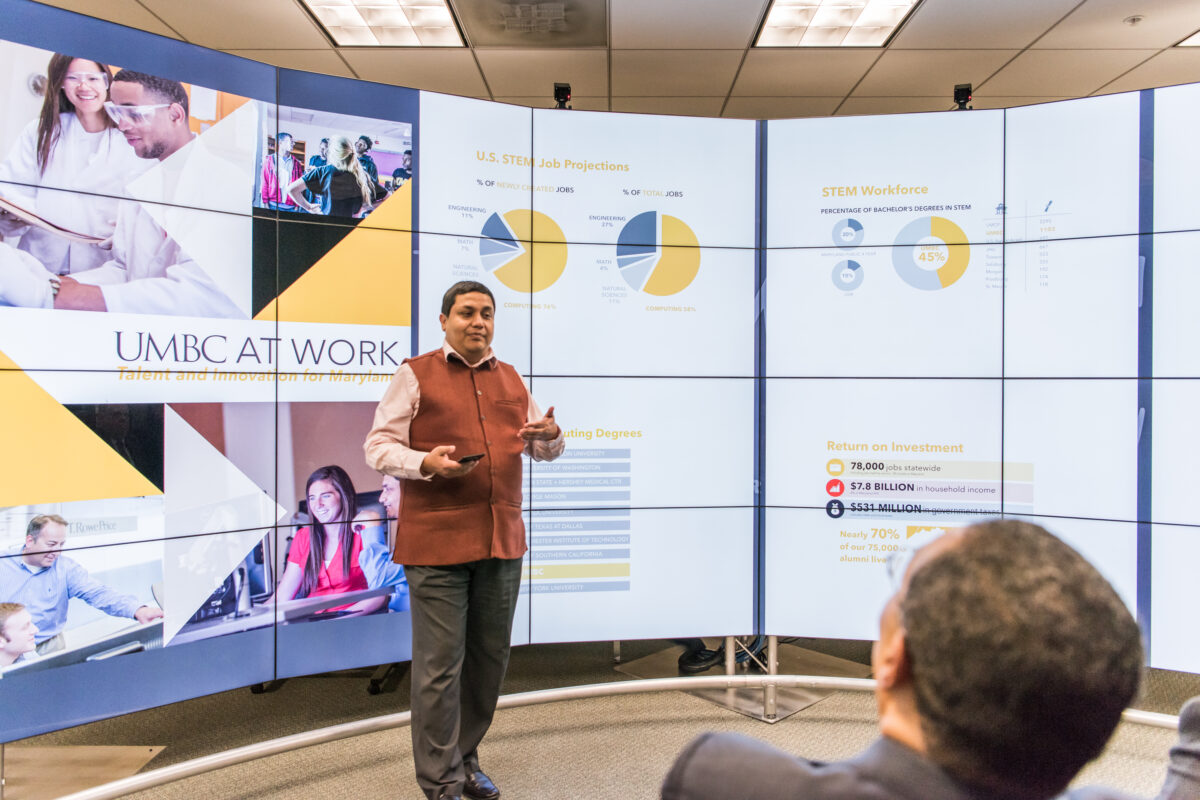 Anupam Joshi presents UMBC’s economic impact metrics and workforce data to Maryland state leaders. (Marlayna Demond ’11/UMBC)
Leadership trajectory
Joshi obtained a B.Tech degree from the Indian Institute of Technology (IIT) Delhi in 1989, and a master’s and Ph.D. from Purdue University in 1991 and 1993, respectively. He has published more than 275 technical papers, has been granted nine patents and obtained research support from a variety of federal and industrial sources. In 2014 he was named a Fellow of the Institute of Electrical and Electronics Engineers, or IEEE.
As chair, Joshi leads one of UMBC’s largest departments. There he has overseen a near doubling of student enrollment at the graduate level and a 50% growth rate at the undergraduate level, accompanied by an increase in student body diversity.
He has worked with partners in the UMBC Office of Institutional Advancement to raise funds supporting research from such industry partners as Northrop Grumman, GE, and Cisco. As a result of these efforts and collaboration with Jack Suess, UMBC’s chief information officer and vice president of information technology, the state recently announced the creation of a Maryland Institute for Innovative Computing at UMBC.
 Anupam Joshi celebrates with colleagues at an event for UMBC faculty named fellows of professional societies. (Marlayna Demond ’11/UMBC)
Joshi directs the Center for Cybersecurity, which brings together scholarship and research in cybersecurity from computer science, information systems, social sciences, humanities, public policy, and natural sciences. In this role, he serves on the Maryland Cybersecurity Council.
Additionally, Joshi directs UMBC’s Cyber Scholars Program, a joint effort between the Center for Cybersecurity and UMBC’s Center for Women in Technology. This program is focused on supporting a diverse next generation of leaders in cybersecurity and computing.
At the conclusion of the fellowship year, Joshi will return to these leadership roles with new knowledge and skills to expand UMBC’s work in innovative ways, supported by a network of emerging and longstanding university leaders across the nation.
This UMBC News story draws from an USM press release (8/31/2022). Learn more about ACE through stories on UMBC’s prior fellows, such as Tim Nohe, visual arts; Kate Tracy M.A. ‘01, Ph.D. ‘03, psychology; Sarah Shin, education; and Anne Brodsky, psychology, among others. UMBC President Emeritus Freeman Hrabowski currently serves as the inaugural ACE Centennial Fellow.
]]>
Anupam Joshi, a professor focused on both high-impact computing research and expanding access to computer science and cybersecurity education, has been named a 2022–23 American Council on...
https://umbc.edu/stories/umbcs-anupam-joshi-cybersecurity-innovator-to-expand-leadership-impact-as-2022-23-ace-fellow/
https://my3.my.umbc.edu/api/v0/pixel/news/127239/guest@my.umbc.edu/0fe2b1e6a43a36243f2b4734b5f49b70/api/pixel
coeit
csee
cyberscholars
cybersecurity
majoraward
news
science-and-tech
UMBC News & Magazine
https://my3.my.umbc.edu/groups/umbc-news-magazine
https://assets1-my.umbc.edu/system/shared/avatars/groups/000/001/943/24435aa6207c452e7bc15cc74b42c7bb/xsmall.png?1748556657
https://assets1-my.umbc.edu/system/shared/avatars/groups/000/001/943/24435aa6207c452e7bc15cc74b42c7bb/original.png?1748556657
https://assets2-my.umbc.edu/system/shared/avatars/groups/000/001/943/24435aa6207c452e7bc15cc74b42c7bb/xxlarge.png?1748556657
https://assets2-my.umbc.edu/system/shared/avatars/groups/000/001/943/24435aa6207c452e7bc15cc74b42c7bb/xlarge.png?1748556657
https://assets3-my.umbc.edu/system/shared/avatars/groups/000/001/943/24435aa6207c452e7bc15cc74b42c7bb/large.png?1748556657
https://assets1-my.umbc.edu/system/shared/avatars/groups/000/001/943/24435aa6207c452e7bc15cc74b42c7bb/medium.png?1748556657
https://assets2-my.umbc.edu/system/shared/avatars/groups/000/001/943/24435aa6207c452e7bc15cc74b42c7bb/small.png?1748556657
https://assets1-my.umbc.edu/system/shared/avatars/groups/000/001/943/24435aa6207c452e7bc15cc74b42c7bb/xsmall.png?1748556657
https://assets2-my.umbc.edu/system/shared/avatars/groups/000/001/943/24435aa6207c452e7bc15cc74b42c7bb/xxsmall.png?1748556657
UMBC News & Magazine
0
0
false
Fri, 02 Sep 2022 09:36:18 -0400
Fri, 02 Sep 2022 09:36:18 -0400