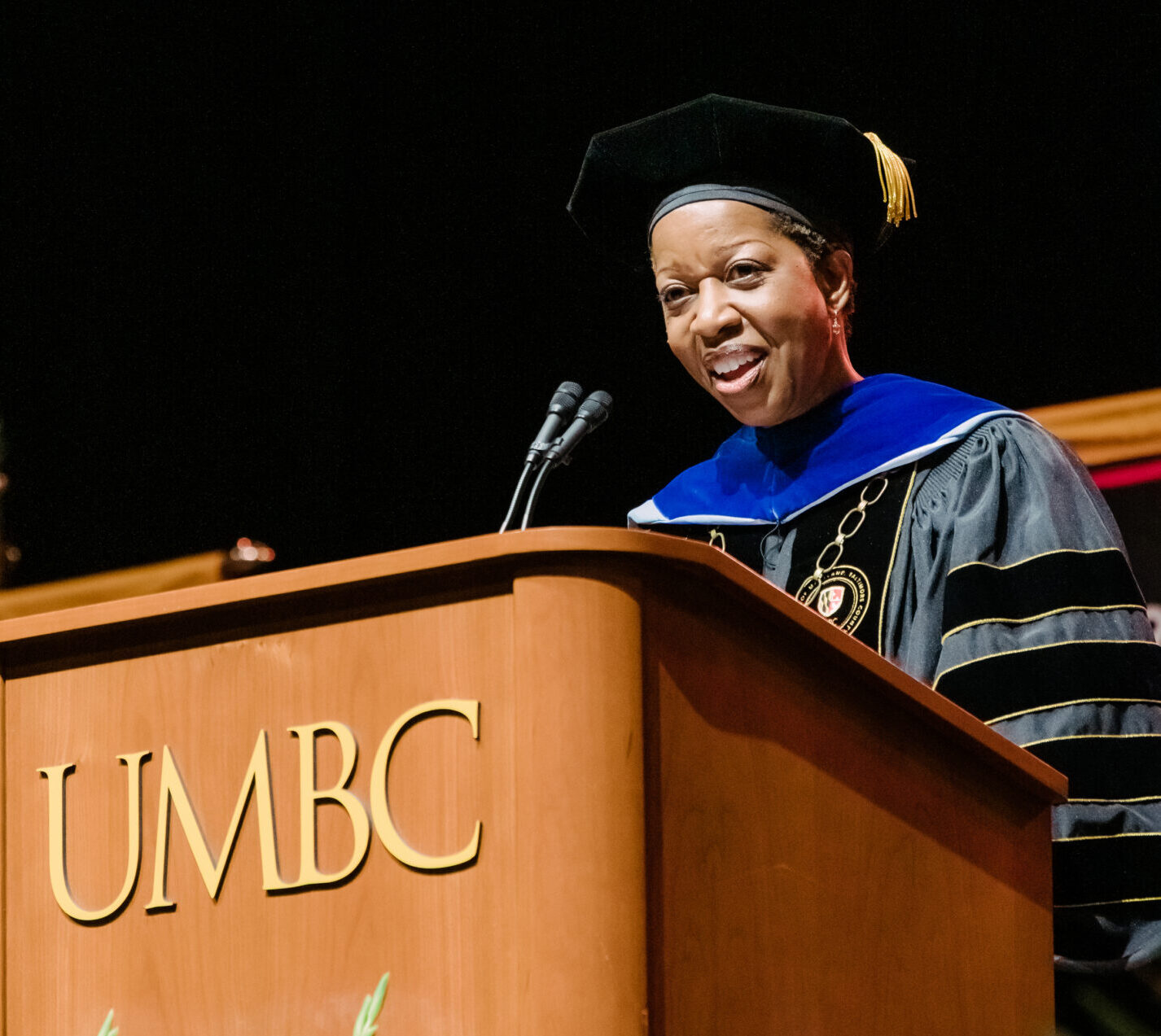
UMBC to lead climate-focused NSF data science institute through $13M award

Tens of millions of people live in areas that are at risk for flooding due to climate change, sea level rise, and melting of glaciers. UMBC’s Vandana Janeja is leading a team of researchers using data science, machine learning, artificial intelligence (AI), and polar science to analyze enormous volumes of climate data, and Arctic and Antarctic observations in ways that could help populations prepare for and respond to these risks.
Janeja, professor and chair of information systems, is the principal investigator on the five-year, $13 million grant from the National Science Foundation’s Harnessing the Data Revolution (HDR) Big Idea program. With support from the grant, Janeja is directing iHARP, the NSF HDR Institute for Harnessing Data and Model Revolution in the Polar Regions.
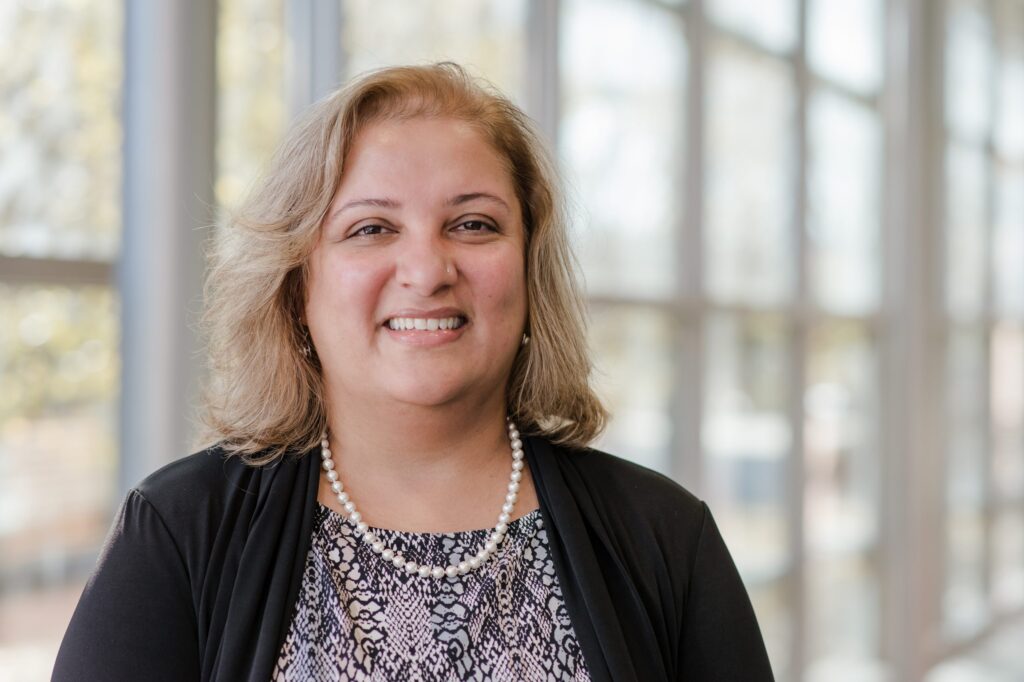 Vandana Janeja. (Marlayna Demond ’11/UMBC)
“The research we’re doing in iHARP will help us understand global drivers of sea level rise and its impacts. This work will look at complex dynamics in the polar regions, evaluating heterogeneous data and connections between climate processes. This will help us get to more certain assessments, to drive the science responding to climate change,” she explains.
Data science meets climate science
Climate scientists rely on data that are incredibly challenging to disentangle. AI offers solutions for analyzing these large datasets, providing sophisticated models that make the best use of the available data.
“Researchers in iHARP are already looking at ice sheets in the Arctic and the Antarctic, including labeling of ice layer images. They are examining anomalous trends in ice thickness and creating new algorithms for understanding which factors are causing which types of changes in such a dynamic environment,” explains Janeja.
The iHARP researchers will reduce uncertainties in projecting sea level rise by combining physics-driven modeling, machine learning techniques, and data analysis. The results of the work will inform policymaking to address national and global priorities related to the climate crisis.
The team will also investigate novel data science techniques that can be applied to other disciplines encountering challenges related to complex data.
Tackling challenges together
An interdisciplinary team has been assembled to move forward this important collaboration. Janeja is working with co-PIs Jianwu Wang, associate professor of information systems at UMBC; Mathieu Morlighem at Dartmouth College; Shashi Shekhar at the University of Minnesota; and researchers from the University of Colorado Boulder.
 Jianwu Wang. (Maryland Demond ’11/UMBC)
Project collaborators in education, government, and industry across the country include additional researchers and collaborators at the above universities as well as University of Alaska Fairbanks, University of Northern Texas, Amherst College, University of Texas at Austin, NASA Universities Space Research Association, NASA Jet Propulsion Laboratory, NVIDIA, IBM, and Amazon.
The grant also involves dozens of undergraduate and graduate students and postdoctoral researchers, and will support educational and outreach activities, with an eye toward workforce development. This includes programming for K-12 and college students, and lectures and training opportunities for data science and domain science professionals. Students will work alongside partners including NASA, Amazon, and IBM, and will have internship opportunities with federal and industry partners.
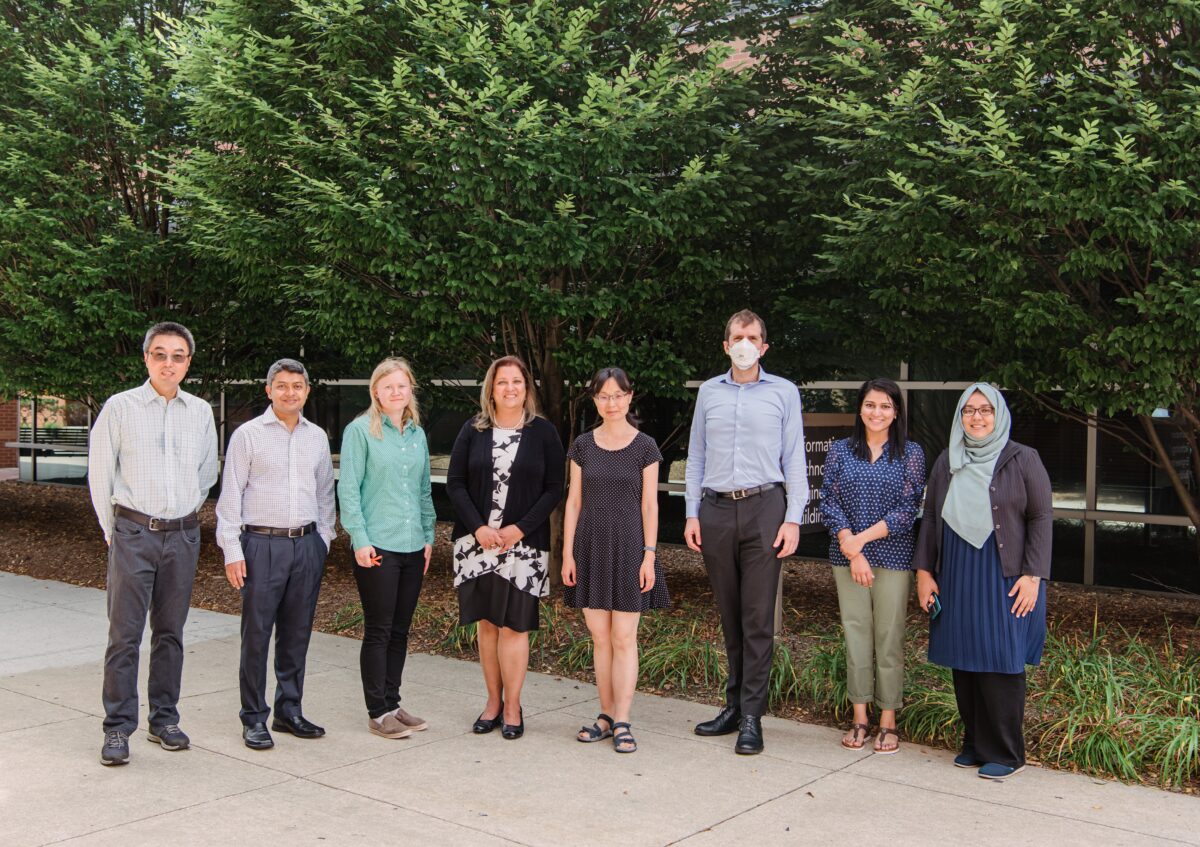 UMBC iHARP faculty and student researchers. (Maryland Demond ’11/UMBC)
“This major multi-institutional NSF award reflects so much hard work and ingenuity. National programs like iHARP, with its focus on some of the great challenges our society is facing, add to UMBC’s growing reputation for innovation and excellence in public impact research,” says Karl V. Steiner, vice president for research at UMBC.
Impact of multidisciplinary teams
The solutions that are developed through this work will have applications beyond environmental issues. The team’s research may impact the future of medicine, computer vision, responsible AI , and remote sensing. And students working on the project will become the next generation of experts addressing these global issues.
“The College is experiencing extraordinary research growth. This is made possible by both the development of multidisciplinary teams and our increased focus on leadership development,” says Keith J Bowman, dean of the College of Engineering and Information Technology. “This project team, and others recently funded or pending, benefit from the tremendous faculty talent we have recruited in the last several years.”
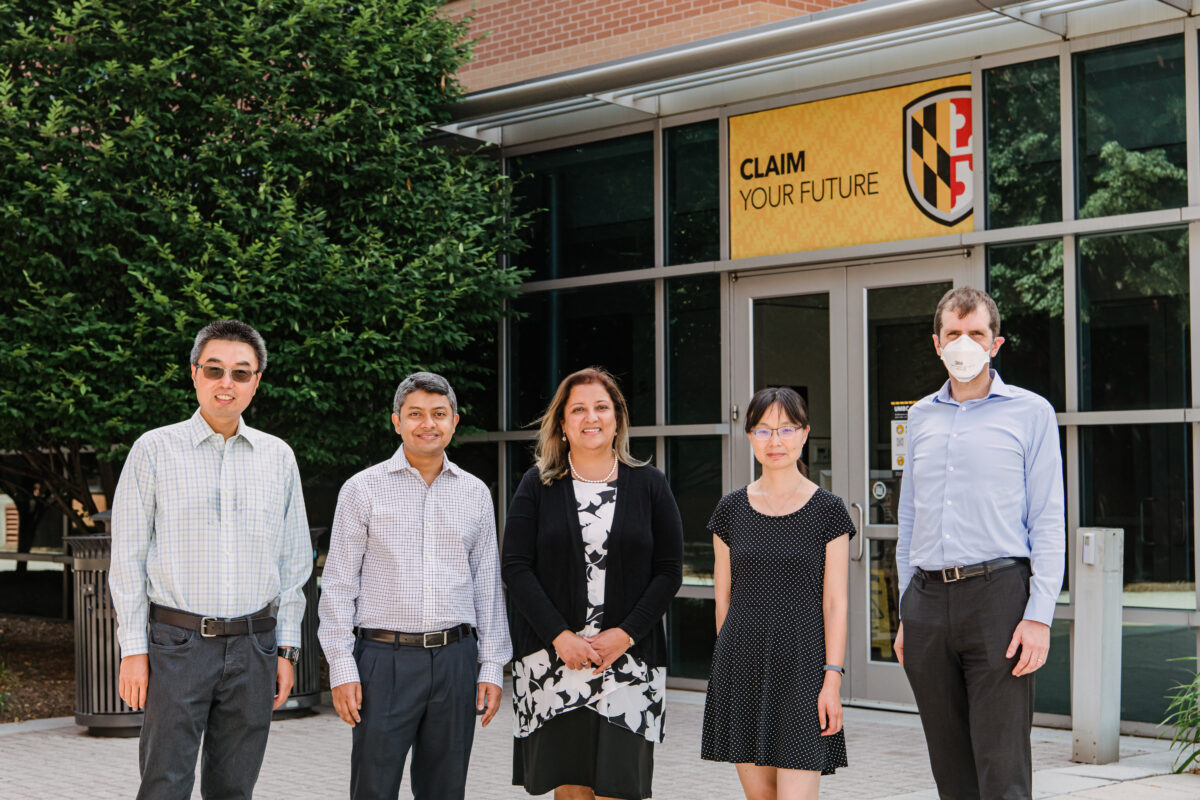 UMBC iHARP researchers (l-r): Jianwu Wang, Osman Gani, Vandana Janeja, Karen Chen, and Don Engel. (Marlayna Demond ’11/UMBC)
In addition to Janeja and Wang, the UMBC team also includes Aryya Gangopadhyay, professor; Karen Chen, assistant professor; and Osman Gani, assistant professor, all in information systems, as well as Don Engel, associate vice president for research development and assistant professor of computer science and electrical engineering.
Editor’s note: This story is an update of a prior version published on September 28, 2021.
]]>
Tens of millions of people live in areas that are at risk for flooding due to climate change, sea level rise, and melting of glaciers. UMBC’s Vandana Janeja is leading a team of researchers using...
https://umbc.edu/stories/umbc-to-lead-climate-focused-nsf-data-science-institute/
https://my3.my.umbc.edu/api/v0/pixel/news/127222/guest@my.umbc.edu/12ff679319760535ef21232440056005/api/pixel
coeit
is
majoraward
news
research
science-and-tech
UMBC News & Magazine
https://my3.my.umbc.edu/groups/umbc-news-magazine
https://assets1-my.umbc.edu/system/shared/avatars/groups/000/001/943/24435aa6207c452e7bc15cc74b42c7bb/xsmall.png?1748556657
https://assets1-my.umbc.edu/system/shared/avatars/groups/000/001/943/24435aa6207c452e7bc15cc74b42c7bb/original.png?1748556657
https://assets2-my.umbc.edu/system/shared/avatars/groups/000/001/943/24435aa6207c452e7bc15cc74b42c7bb/xxlarge.png?1748556657
https://assets2-my.umbc.edu/system/shared/avatars/groups/000/001/943/24435aa6207c452e7bc15cc74b42c7bb/xlarge.png?1748556657
https://assets3-my.umbc.edu/system/shared/avatars/groups/000/001/943/24435aa6207c452e7bc15cc74b42c7bb/large.png?1748556657
https://assets1-my.umbc.edu/system/shared/avatars/groups/000/001/943/24435aa6207c452e7bc15cc74b42c7bb/medium.png?1748556657
https://assets2-my.umbc.edu/system/shared/avatars/groups/000/001/943/24435aa6207c452e7bc15cc74b42c7bb/small.png?1748556657
https://assets1-my.umbc.edu/system/shared/avatars/groups/000/001/943/24435aa6207c452e7bc15cc74b42c7bb/xsmall.png?1748556657
https://assets2-my.umbc.edu/system/shared/avatars/groups/000/001/943/24435aa6207c452e7bc15cc74b42c7bb/xxsmall.png?1748556657
UMBC News & Magazine
0
0
false
Thu, 01 Sep 2022 15:25:00 -0400
Thu, 01 Sep 2022 15:25:00 -0400
UMBC opens new academic year with new president, largest-ever incoming class
“This is a time when you begin to define what you love, what really matters to you, who you want to be in this world, and what difference you want to make in the lives of others.”
Valerie Sheares Ashby
UMBC President
As UMBC President Valerie Sheares Ashby looked out at the crowd of eager first-year students during Tuesday’s Convocation ceremony to open the academic year, she reinforced the importance of marking this formative chapter. And with well over 2,100 new first-year students, and record numbers of graduate and international students, this is a new chapter for UMBC’s largest incoming class yet.
“In an increasingly competitive college admissions landscape characterized by a declining pool of high school graduates and increasing costs of attendance, UMBC’s ability to continue to attract a strong and talented first-year class speaks to, among many things, our reputation as an institution that offers an exceptional collegiate experience that is affordable,” says Yvette Mozie-Ross ’88, UMBC’s vice provost for enrollment management and planning. This includes in-demand programs at both UMBC’s main campus and the Universities at Shady Grove in Montgomery County.
In addition to a record number of new first-year students, UMBC enrolled over 3,300 graduate students for fall 2022, marking an impressive 500-plus increase over last year’s fall enrollment.
Welcoming the incoming class
Veronica Goonan, an incoming first-year student, knew once she visited campus that she had found her place. “I had an incredible opportunity to tour campus with the [mock trial] team in the fall of my senior year, and that’s when I began to know that my place was here,” she said. “I could feel the innovation and excellence that UMBC boasts.”
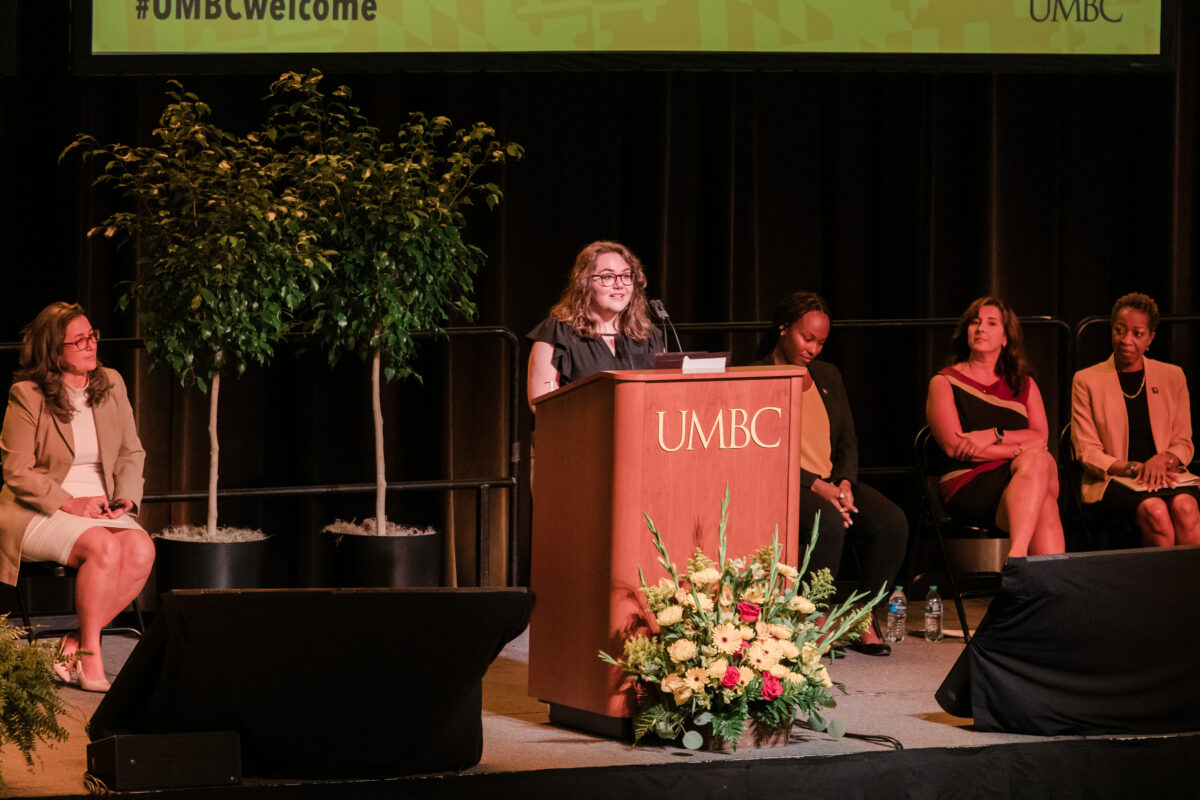 Goonan addresses the audience during Fall Opening Meeting. (Marlayna Demond ’11/UMBC)
One of the biggest goals in the first few weeks of the new academic year is to ensure students have opportunities to get to know the campus and begin learning about the possibilities available to them throughout their academic career.
“In the Division of Student Affairs, we take the role of welcoming and holding space for our students seriously. Those first few days and weeks are about making sure that we are doing all we can to help them carve out their own path while they are here,” says Jen Dress, associate director of campus life.
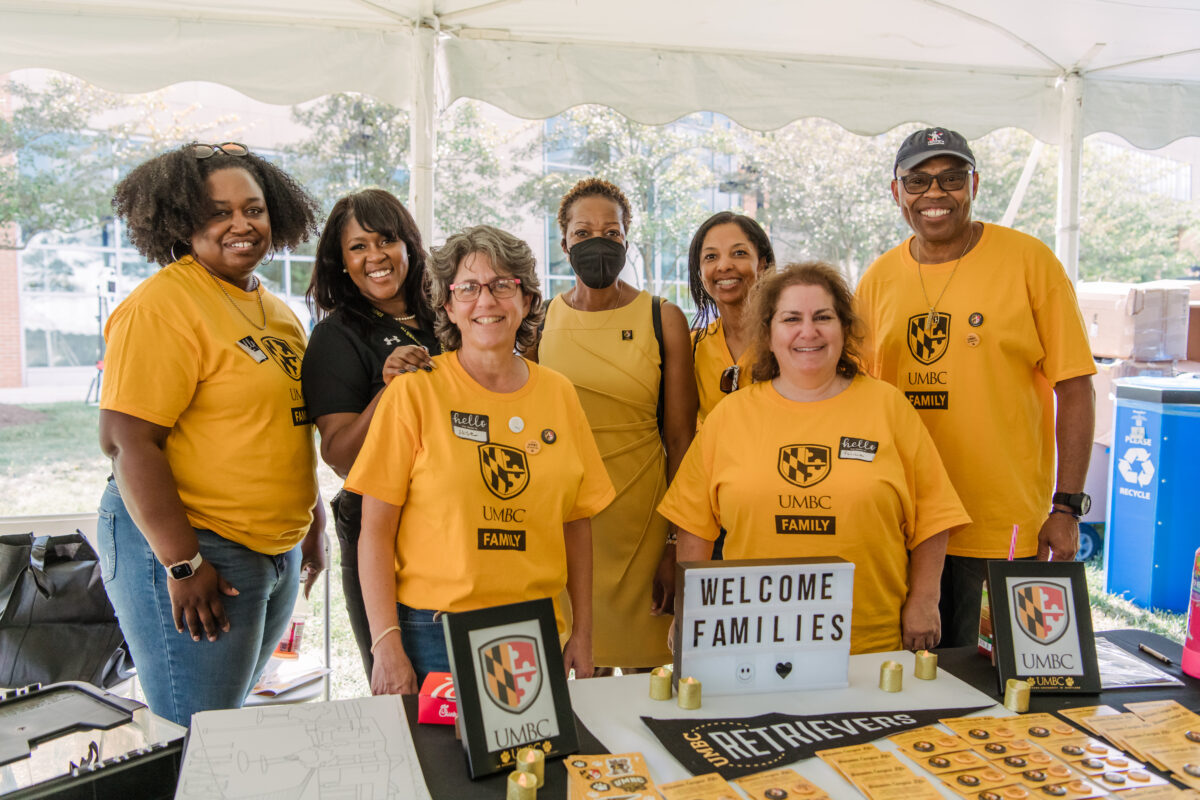 Parent volunteers welcome families to UMBC with President Sheares Ashby (c). (Marlayna Demond ’11/UMBC)
A robust Welcome Week full of fun and engaging events is an important part of this experience. When new students moved in last Saturday, they were treated to some of UMBC’s favorite traditions. Once the boxes were unpacked, the beds were made, and the posters of (insert cool band here) were hung, students and their families made their way to Erickson Field.
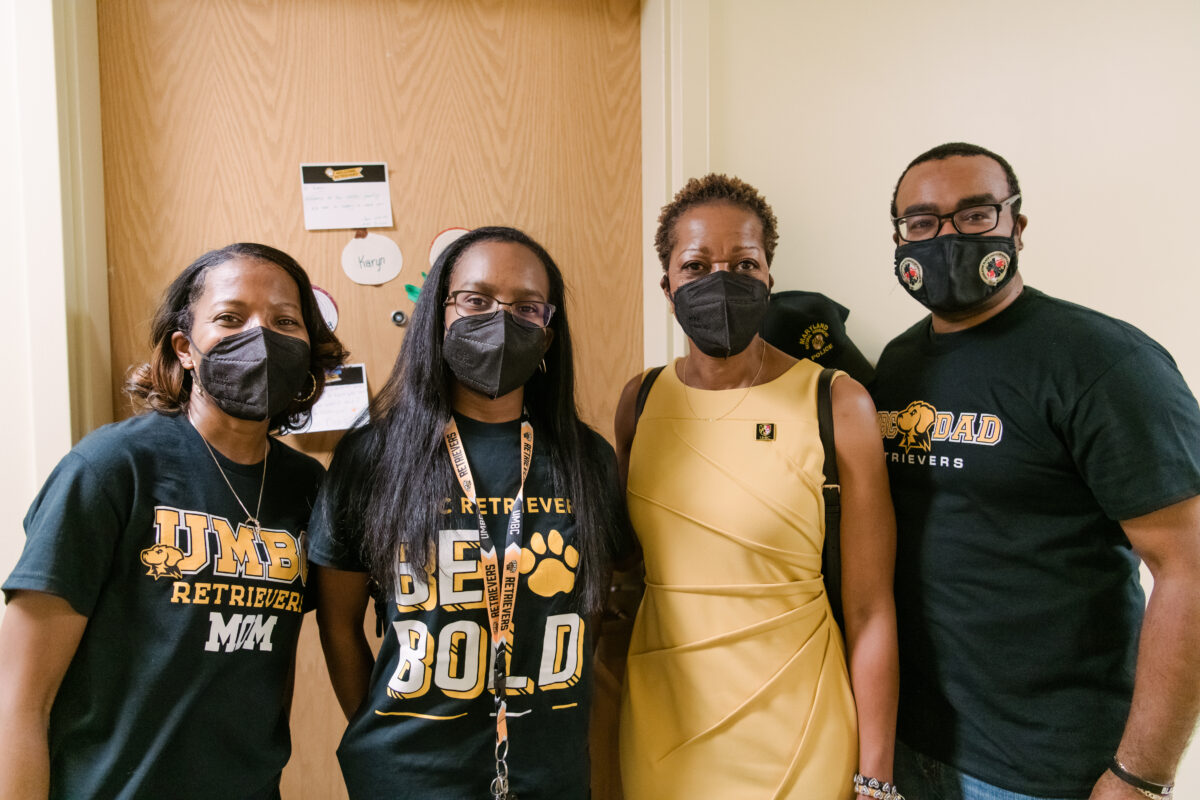 A Retriever family stops to pose with President Sheares Ashby (in gold). They include (l-r): Myra Sydnor, Camryn Sydnor, and Maryland State Senator Charles Sydnor. (Marlayna Demond ’11/UMBC)
If new Retrievers didn’t know the school colors before, they certainly did now. Swag tables, information tables, and goodie tables lined the field, all decked out in UMBC’s signature black and gold. Even the animals in the petting zoo got the memo.
 Just your normal campus petting zoo. (Marlayna Demond ’11/UMBC)
Once families said their goodbyes and maybe a few students and parents teared up got something in their eye, celebrations continued with Playfair and the annual fireworks display. New Retrievers played “getting to know you” games to break the ice and capped off the night with a spectacular fireworks show.
 Fireworks lighting up the UMBC night sky. (Marlayna Demond ’11/UMBC)
A place for everyone
Incoming transfer student Luther Daigle, mechanical engineering, summed up the feeling hearing about UMBC versus coming to UMBC by saying, “It wasn’t until I toured the campus and I felt an overwhelming sense of belonging that I knew I wanted to continue my academic career at UMBC.” And that feeling has carried through the start of his first semester.
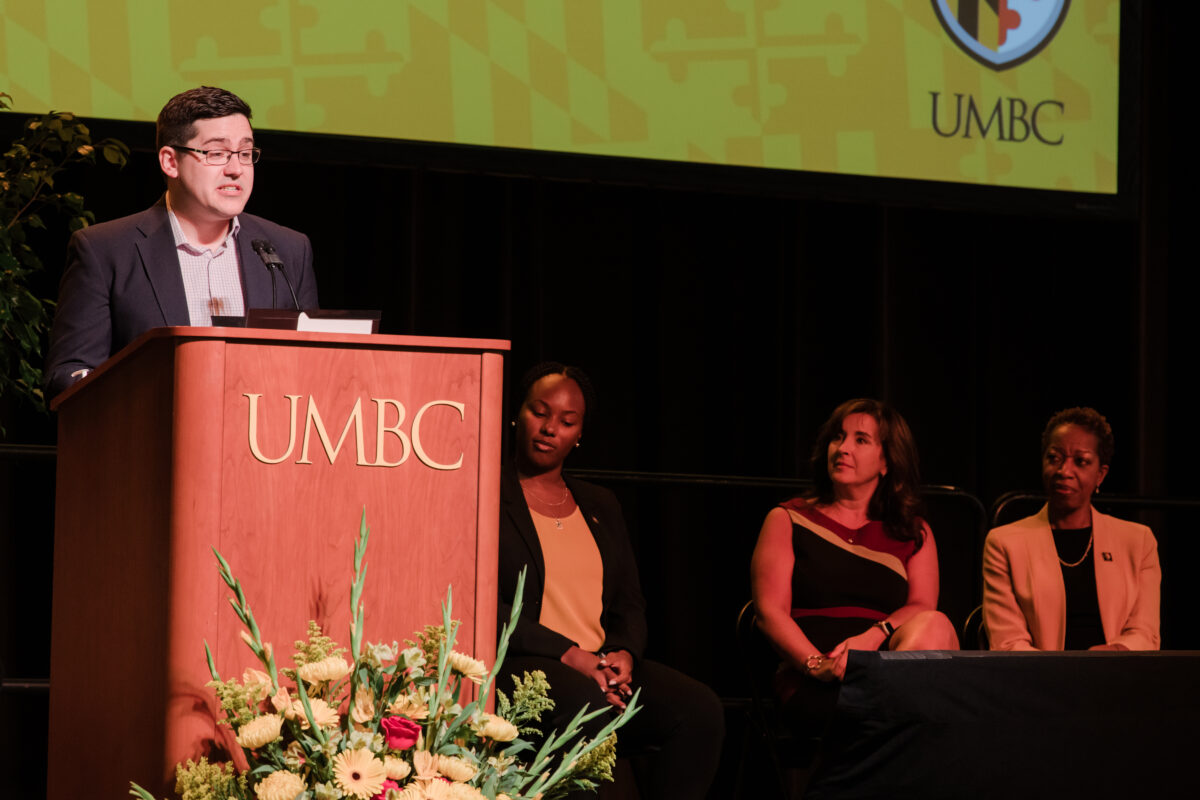 Daigle addresses the crowd at Fall Opening Meeting. (Marlayna Demond ’11/UMBC)
This sense of belonging extends to UMBC’s rapidly growing population of international students. As of the end of August, over 2,200 international students were enrolled for the 2022 – 2023 academic year.
“As UMBC’s international reputation continues to grow, more students from around the world choose to join our campus community,” says David Di Maria, associate vice provost for international education. “We are very pleased to welcome the largest number of international students in UMBC’s history.”
Jok Thon, an incoming graduate student studying entrepreneurship, innovation, and leadership, is the first student from South Sudan to enroll at UMBC and he was buoyed by the diversity represented in the community he’d be joining.
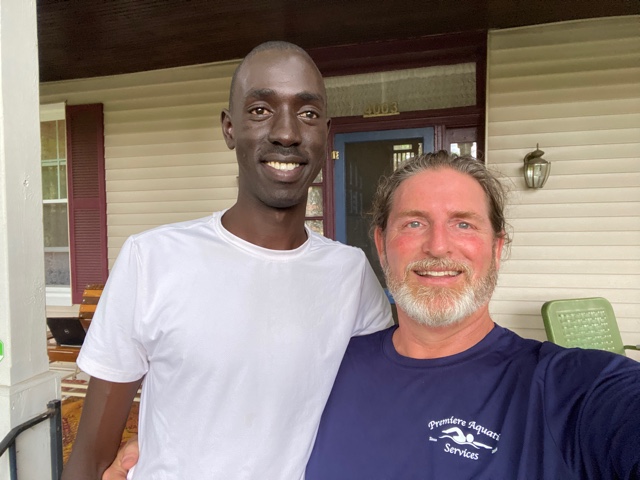 Thon and Joby Taylor, Ph.D. ’05, LLC, director of the Shriver Peaceworker Fellows Program. (Image courtesy of Taylor)
Addressing his peers at the annual Fall Opening Meeting, Thon said, “We have an incredibly diverse and creative campus community. We have such an opportunity to learn from this global village…maybe we should even think of it as our responsibility as global citizens to learn from each other during our time at UMBC.”
During Convocation, 2022 Presidential Teaching Award recipient Tamra Mendelson echoed the importance of this saying, “Inclusive to me means that we not only value, we require a diversity of backgrounds to make the world a better place. It’s the only way we will achieve a more accurately educated, environmentally conscious civil society.”
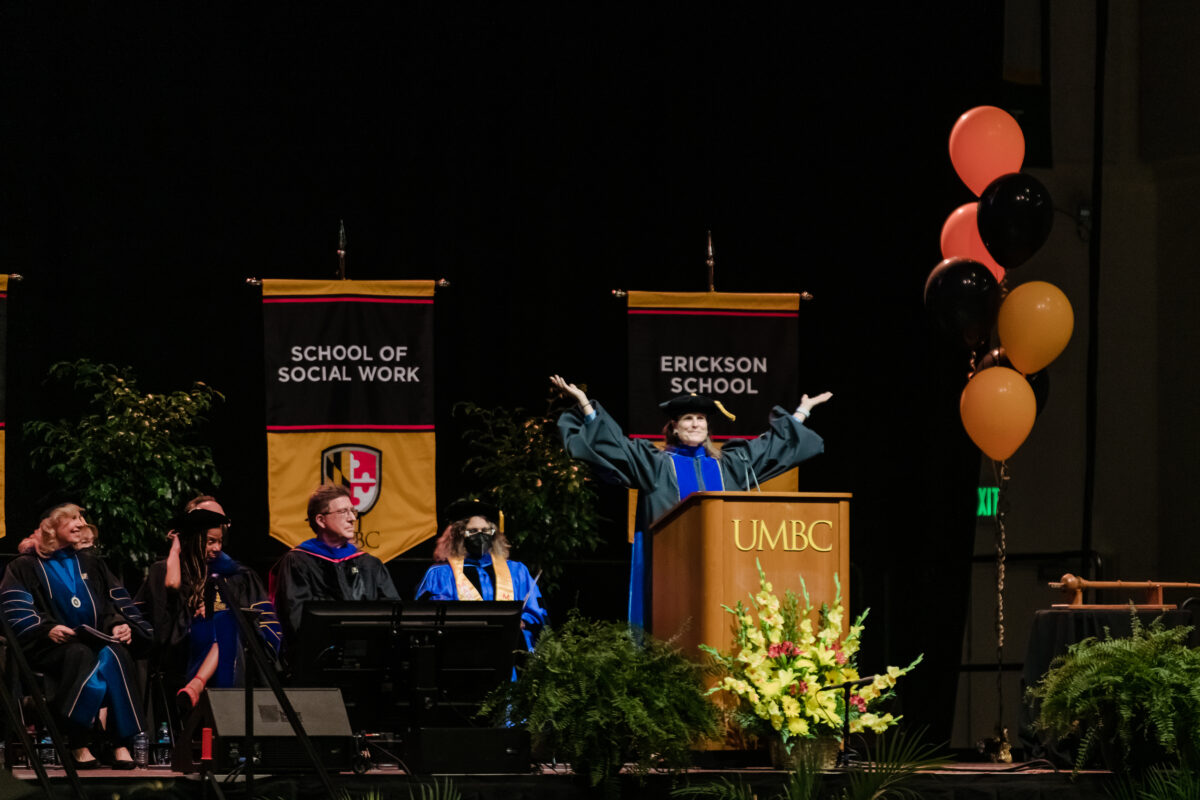 Mendelson expresses her excitement at opening another school year. (Marlayna Demond ’11/UMBC)
Students at the center
While students may think faculty and staff are the backbone of their educational career, their educators and advisors would argue it’s the opposite—students themselves are at the core of UMBC.
“If there was an equation to describe UMBC, our students would be the essential term. We are committed to providing each of our outstanding students with a first-class education and the support needed to achieve success, whether that means meeting with the CNMS success coach, participating in programs at The Learning Collaboratory, or working one-on-one with a faculty mentor,” said William R. LaCourse, dean of the College of Natural and Mathematical Sciences (CNMS). “Inclusive excellence is more than just words—it is our mission.”
LaCourse himself knows the importance of connecting with students on a foundational level. In the spring, you can find him co-teaching CHEM 100: The Chemical World to non-chemistry majors.
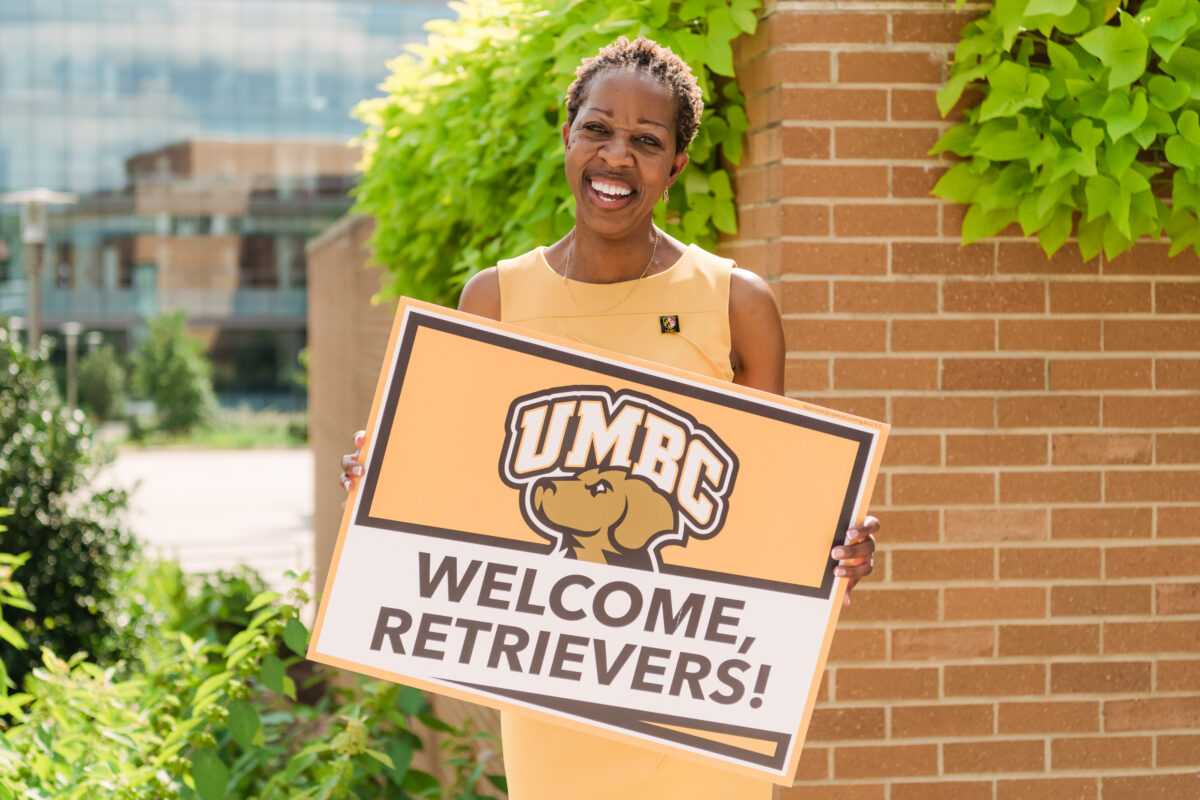 President Sheares Ashby eagerly welcomes UMBC’s new students. (Marlayna Demond ’11/UMBC)
Keith J Bowman, dean of the College of Engineering and Information Technology (COEIT), points to the essential role that student leaders play in reaching out to and connecting with new students, and helping them feel welcome and connected.
“All summer I have been hearing from student org leaders from our college,” says Bowman. “Their enthusiasm to engage with current and new members is very exciting.”
Among the new students Dean Kimberly Moffitt welcomed to UMBC’s College of Arts, Humanities, and Social Sciences (CAHSS) this year are several Shriver Peaceworker Fellows, who gathered on campus on August 1 to kick off their fellowship. These Returned Peace Corps Volunteers pursue graduate degrees in a range of fields (such as teaching and applied sociology) while also working with community partner organizations to address diverse social needs, and actively reflecting on their learning and engagement experiences.
This multifaceted approach exemplifies how work in the classroom, hands-on learning, community engagement, and service connect to form the unique UMBC student experience.
]]>
“ “This is a time when you begin to define what you love, what really matters to you, who you want to be in this world, and what difference you want to make in the lives of...
https://umbc.edu/stories/umbc-opens-new-academic-year-with-new-president-largest-ever-incoming-class/
https://my3.my.umbc.edu/api/v0/pixel/news/127230/guest@my.umbc.edu/a88f8efff8f07beedd8f08ca7c180207/api/pixel
cahss
civic
cnms
coeit
community
diversityandinclusion
news
shrivercenter
UMBC News & Magazine
https://my3.my.umbc.edu/groups/umbc-news-magazine
https://assets1-my.umbc.edu/system/shared/avatars/groups/000/001/943/24435aa6207c452e7bc15cc74b42c7bb/xsmall.png?1748556657
https://assets1-my.umbc.edu/system/shared/avatars/groups/000/001/943/24435aa6207c452e7bc15cc74b42c7bb/original.png?1748556657
https://assets2-my.umbc.edu/system/shared/avatars/groups/000/001/943/24435aa6207c452e7bc15cc74b42c7bb/xxlarge.png?1748556657
https://assets2-my.umbc.edu/system/shared/avatars/groups/000/001/943/24435aa6207c452e7bc15cc74b42c7bb/xlarge.png?1748556657
https://assets3-my.umbc.edu/system/shared/avatars/groups/000/001/943/24435aa6207c452e7bc15cc74b42c7bb/large.png?1748556657
https://assets1-my.umbc.edu/system/shared/avatars/groups/000/001/943/24435aa6207c452e7bc15cc74b42c7bb/medium.png?1748556657
https://assets2-my.umbc.edu/system/shared/avatars/groups/000/001/943/24435aa6207c452e7bc15cc74b42c7bb/small.png?1748556657
https://assets1-my.umbc.edu/system/shared/avatars/groups/000/001/943/24435aa6207c452e7bc15cc74b42c7bb/xsmall.png?1748556657
https://assets2-my.umbc.edu/system/shared/avatars/groups/000/001/943/24435aa6207c452e7bc15cc74b42c7bb/xxsmall.png?1748556657
UMBC News & Magazine
0
0
false
Thu, 01 Sep 2022 15:02:09 -0400
Thu, 01 Sep 2022 15:02:09 -0400
Did Twitter ignore basic security measures? A cybersecurity expert explains a whistleblower’s claims

By Richard Forno, Principal Lecturer,Computer Science and Electrical Engineering, UMBC
Twitter’s former security chief, Peiter “Mudge” Zatko, filed a whistleblower complaint with the Securities and Exchange Commission in July 2022, accusing the microblogging platform company of serious security failings. The accusations amplified the ongoing drama of Twitter’s potential sale to Elon Musk.
Zatko spent decades as an ethical hacker, private researcher, government adviser and executive at some of the most prominent internet companies and government offices. He is practically a legend in the cybersecurity industry. Because of his reputation, when he speaks, people and governments normally listen – which underscores the seriousness of his complaint against Twitter.
As a former cybersecurity industry practitioner and current cybersecurity researcher, I believe that Zatko’s most damning accusations center around Twitter’s alleged failure to have a solid cybersecurity plan to protect user data, deploy internal controls to guard against insider threats and ensure the company’s systems were current and properly updated.
Zatko also alleged that Twitter executives were less than forthcoming about cybersecurity incidents on the platform when briefing both regulators and the company’s board of directors. He claimed that Twitter prioritized user growth over reducing spam and other unwanted content that poisoned the platform and detracted from the user experience. His complaint also expressed concerns about the company’s business practices.
CNN interviewed Twitter whistleblower Peiter “Mudge” Zatko.
Alleged security failures
Zatko’s allegations paint a disturbing picture of not only the state of Twitter’s cybersecurity as a social media platform, but also the security consciousness of Twitter as a company. Both points are relevant given Twitter’s position in global communications and the ongoing struggle against online extremism and disinformation.
Perhaps the most significant of Zatko’s allegations is his claim that nearly half of Twitter’s employees have direct access to user data and Twitter’s source code. Time-tested cybersecurity practices don’t allow so many people with this level of “root” or “privileged” permission to access sensitive systems and data. If true, this means that Twitter could be ripe for exploitation either from within or by outside adversaries assisted by people on the inside who may not have been properly vetted.
Zatko also alleges that Twitter’s data centers may not be as secure, resilient or reliable as the company claims. He estimated that nearly half of Twitter’s 500,000 servers around the world lack basic security controls such as running up-to-date and vendor-supported software or encrypting the user data stored on them. He also noted that the company’s lack of a robust business continuity plan means that should several of its data centers fail due to a cyber incident or other disaster, it could lead to an “existential company ending event.”
These are just some of the claims made in Zatko’s complaint. If his allegations are true, Twitter has failed Cybersecurity 101.
Concerns over foreign government interference
Zatko’s allegations might also present a national security concern. Twitter has been used to spread disinformation and propaganda in recent years during global events like the pandemic and national elections.
For example, Zatko’s report stated that the Indian government forced Twitter to hire government agents, who would have access to vast amounts of Twitter’s sensitive data. In response, India’s at-times hostile neighbor Pakistan accused India of trying to infiltrate the security system of Twitter “in an effort to curb fundamental freedoms.”
Given Twitter’s global footprint as a communications platform, other nations such as Russia and China could require the company to hire its own government agents as a condition of allowing the company to operate in their country. Zatko’s allegations about Twitter’s internal security raise the possibility of criminals, activists, hostile governments or their supporters seeking to exploit Twitter’s systems and user data by recruiting or blackmailing its employees may well present a national security concern.
Worse, Twitter’s own information about its users, their interests and who they follow and interact with on the platform could facilitate targeting for disinformation campaigns, blackmail or other nefarious purposes. Such foreign targeting of prominent companies and their employees has been a major counterintelligence worry in the national security community for decades.
 Opposition party members in India protest Twitter’s temporary ban of their leader. The whistleblower’s allegations include Twitter acquiescing to Indian government demands that the company employ government agents. Anadolu Agency (Getty Images)
Fallout
Whatever the outcome of Zatko’s complaint in Congress, the SEC or other federal agencies, it already is part of Musk’s latest legal filings as he tries to back out of his purchase of Twitter.
Ideally, in light of these disclosures, Twitter will take corrective action to improve the company’s cybersecurity systems and practices. A good first step the company could take is reviewing and limiting who has root access to its systems, source code and user data to the minimum number necessary. The company should also ensure that its production systems are kept current and that it is effectively prepared to contend with any type of emergency situation without significantly disrupting its global operations.
From a broader perspective, Zatko’s complaint underscores the critical and sometimes uncomfortable role cybersecurity plays in modern organizations. Cybersecurity professionals like Zatko understand that no company or government agency likes publicity for cybersecurity problems. They tend to think long and hard about whether and how to raise cybersecurity concerns like these – and what the potential ramifications might be. In this case, Zatko says his disclosures reflect “the job he was hired to do” as head of security for a social media platform that he says “is critical to democracy.”
For companies like Twitter, bad cybersecurity news often results in a public relations nightmare that could affect share price and their standing in the marketplace, not to mention attract the interest of regulators and lawmakers. For governments, such revelations can lead to a lack of trust in the institutions created to serve society, in addition to potentially creating distracting political noise.
Unfortunately, how cybersecurity problems are discovered, disclosed and handled remains a difficult and sometimes controversial process, with no easy solution both for cybersecurity professionals and today’s organizations.
Richard Forno, Principal Lecturer in Computer Science and Electrical Engineering, University of Maryland, Baltimore County
This article is republished from The Conversation under a Creative Commons license. Read the original article.
]]>
By Richard Forno, Principal Lecturer,Computer Science and Electrical Engineering, UMBC Twitter’s former security chief, Peiter “Mudge” Zatko, filed a whistleblower complaint with the...
https://umbc.edu/stories/did-twitter-ignore-basic-security-measures-a-cybersecurity-expert-explains-a-whistleblowers-claims/
https://my3.my.umbc.edu/api/v0/pixel/news/127211/guest@my.umbc.edu/9cc4c5bdd3298f242ddda8e345aab860/api/pixel
coeit
csee
cybersecurity
discovery
magazine
the-conversation
UMBC News & Magazine
https://my3.my.umbc.edu/groups/umbc-news-magazine
https://assets1-my.umbc.edu/system/shared/avatars/groups/000/001/943/24435aa6207c452e7bc15cc74b42c7bb/xsmall.png?1748556657
https://assets1-my.umbc.edu/system/shared/avatars/groups/000/001/943/24435aa6207c452e7bc15cc74b42c7bb/original.png?1748556657
https://assets2-my.umbc.edu/system/shared/avatars/groups/000/001/943/24435aa6207c452e7bc15cc74b42c7bb/xxlarge.png?1748556657
https://assets2-my.umbc.edu/system/shared/avatars/groups/000/001/943/24435aa6207c452e7bc15cc74b42c7bb/xlarge.png?1748556657
https://assets3-my.umbc.edu/system/shared/avatars/groups/000/001/943/24435aa6207c452e7bc15cc74b42c7bb/large.png?1748556657
https://assets1-my.umbc.edu/system/shared/avatars/groups/000/001/943/24435aa6207c452e7bc15cc74b42c7bb/medium.png?1748556657
https://assets2-my.umbc.edu/system/shared/avatars/groups/000/001/943/24435aa6207c452e7bc15cc74b42c7bb/small.png?1748556657
https://assets1-my.umbc.edu/system/shared/avatars/groups/000/001/943/24435aa6207c452e7bc15cc74b42c7bb/xsmall.png?1748556657
https://assets2-my.umbc.edu/system/shared/avatars/groups/000/001/943/24435aa6207c452e7bc15cc74b42c7bb/xxsmall.png?1748556657
UMBC News & Magazine
0
0
false
Thu, 01 Sep 2022 13:03:04 -0400
Thu, 01 Sep 2022 13:03:04 -0400
The Hilltop Institute at UMBC revolutionizes data analytics to advance health and wellbeing

Two researchers from The Hilltop Institute at UMBC just received a National Science Foundation (NSF) grant to investigate hospital price transparency. With the nearly $300,000 award funded by the Build and Broaden initiative, Morgan Henderson, principal data scientist and affiliate professor of economics, and Morgane Mouslim, policy analyst, will collect and synthesize prices for common health services now being posted by hospitals in response to a 2021 federal mandate intended to help patients “shop” for lower-priced care. Henderson and Mouslim will use the data to study hospital pricing behavior, and they will also make the data available to other researchers.
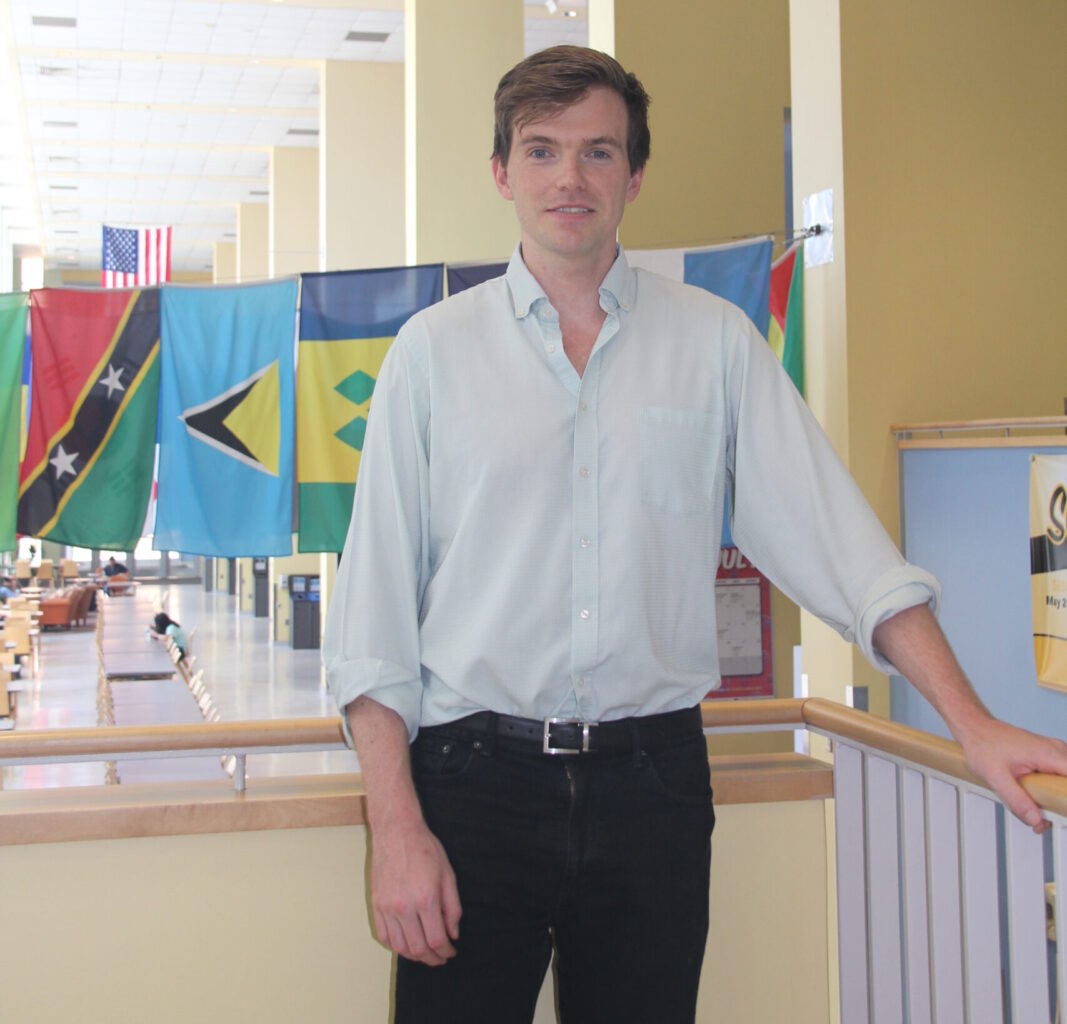 Morgan Henderson. (Image courtesy of Hilltop)
 Morgane Mouslim. (Image courtesy of Hilltop)
Hospital care is a major driver of spiraling health care costs and this work has the potential to refocus the conversation among policymakers, practitioners, and consumers. It’s also just one of Hilltop’s numerous high-impact research projects from a nearly 30-year history at UMBC. A hallmark of that research is partnership.
Collaboration from day one
Hilltop launched at UMBC in 1994, in partnership with the Maryland Department of Health. One of Hilltop’s first tasks was to design HealthChoice, the state’s Medicaid managed care program that now serves more than 1.7 million Marylanders.
More than a quarter of a century later, the partnership has grown to advance access to high-quality health care by providing Maryland policymakers and state agencies with the information they need to make well-informed, evidence-based decisions about health care delivery and financing.
This collaborative work has garnered Hilltop national recognition as a model public university-state agency partnership. State officials and university researchers from across the country turn to Hilltop for advice on forming productive partnerships. Hilltop is also a founding member of a national network of partnerships representing 27 states that are a leading force in advancing sophisticated analytics to inform state health policy.
Advancing Medicaid
Hilltop pairs novel problem-solving and big data to address pressing issues related to access to health care and the delivery and financing of services. A major piece of this involves working with the Maryland Department of Health to advance the health of Marylanders with low incomes and disabilities in the Medicaid program. Hilltop’s interagency agreement with the Department for policy analysis and analytical support for the Medicaid program—renewed annually since 1994—topped $10 million in 2022.
Hilltop maintains an extensive data repository to house Maryland Medicaid data. Using this data, Hilltop calculates the fixed monthly payments the state pays to health plans for each of its members participating in HealthChoice, totaling more than $7 billion in 2022. The repository also houses Maryland hospital discharge data, Medicare data, nursing home assessment data, data on commercially insured individuals, and more. Hilltop is building interactive data dashboards and visualizations that the Department can use daily to guide decision-making on programs and services.
 Cynthia Woodcock. (Image courtesy of Hilltop)
“Hilltop has expanded and solidified its role as a vital resource for high-quality data analytics for Maryland’s Medicaid program,” says Cynthia H. Woodcock, executive director of Hilltop and an adjunct professor at UMBC’s Erickson School of Aging Studies.
Tools for the health system
In addition to its Medicaid-related work, Hilltop has developed a series of innovative analytical tools that are supporting Maryland’s state-of-the-art health care system, called the Total Cost of Care Model.
Maryland hospitals use Hilltop’s web-based tool to report community benefit activities and expenditures. The tool streamlines data collection and enables statewide longitudinal analysis of community benefit data. The findings inform efforts to improve population health under the Total Cost of Care Model.
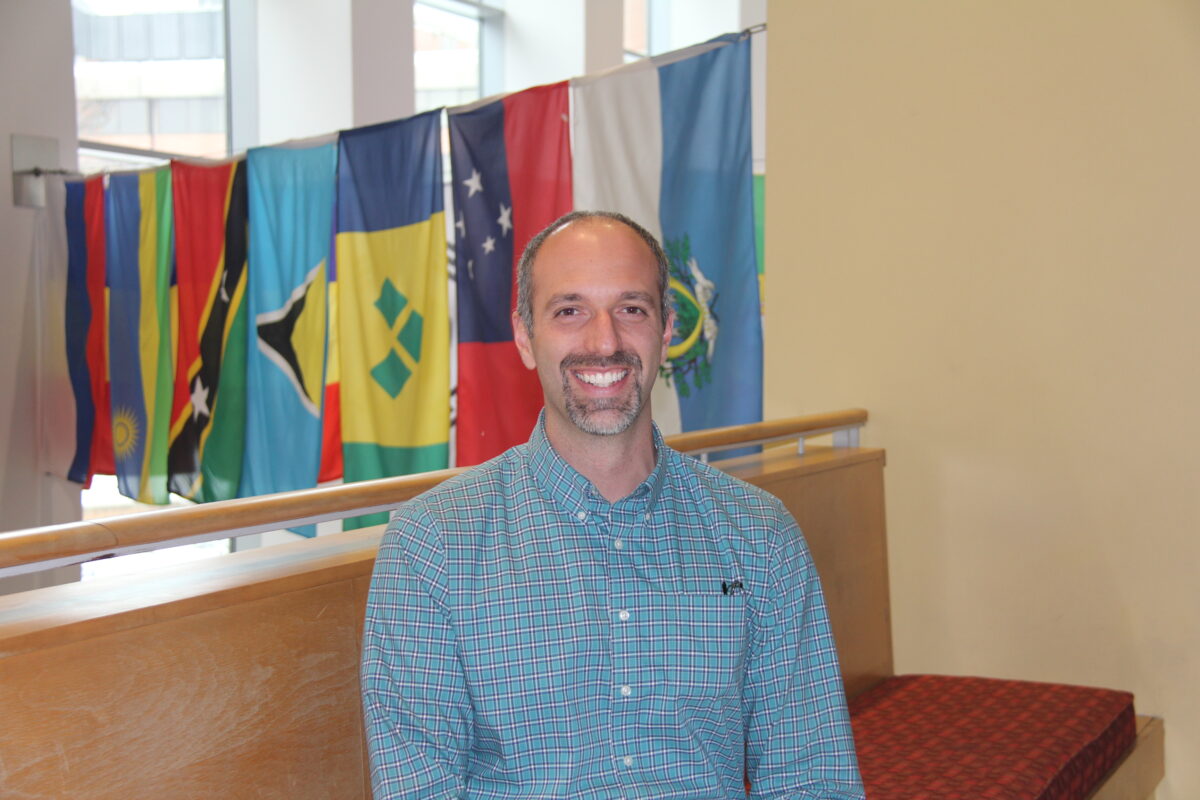 Ian Stockwell, an associate professor in information systems and former chief data scientist at Hilltop, worked with Hilltop senior data scientists Fei Han and Morgan Henderson for over a year. Then, in October 2019, they launched the Hilltop Pre-AH Model
 . (Image courtesy of Hilltop)
Hilltop launched the Hilltop Pre-AH Model to help identify patients in the Maryland Primary Care Program—part of Maryland’s Total Cost of Care Model—who would benefit most from intensive primary care coordination, which can help to prevent unnecessary hospitalizations. Innovations like these are designed to simultaneously improve the health care patients receive and decrease unnecessary costs to the health care system.
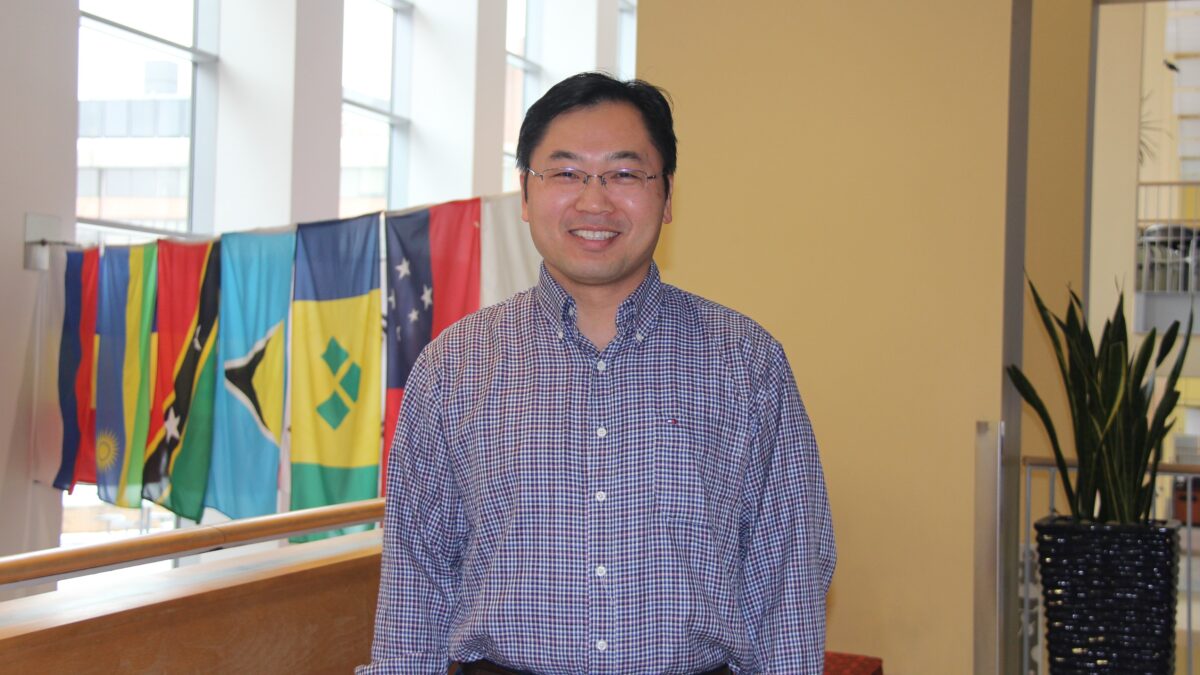 Fei Han, principal data scientist at Hilltop and affiliate assistant professor of computer science and electrical engineering, received a COVID-19 Accelerated Translational Incubator Pilot (ATIP) award to further develop the Hilltop Pre-AH Model, to help predict and reduce patients’ risk of being hospitalized due to COVID-19. (Image courtesy of Hilltop)
Rapid response to COVID-19
Thanks to its strong relationships with the Department of Health and other state agencies, when the coronavirus pandemic began, Hilltop was able to quickly respond to requests for data on COVID-19 testing, hospitalizations, and vaccinations. They also provided daily support to the Department on implementing data-informed emergency measures and guidance for health care providers.
Now in the third year of the pandemic, Hilltop continues to support the state with COVID-related analytics to inform a wide range of infrastructure and service needs. Hilltop researchers also expanded the groundbreaking Pre-AH Model to predict a patient’s risk of being hospitalized for COVID-19, funded by a COVID-19 Accelerated Translational Incubator Pilot (ATIP).
Public health impact
Hilltop continues to address long-standing critical public health concerns, from HIV to tobacco use to the opioid epidemic.
Hilltop is a member of the Maryland HIV Medicaid Affinity Group and the Greater Baltimore HIV Health Services Planning Committee and provides technical support and analytics for HIV services offered to Medicaid participants.
In collaboration with the Center for Mississippi Health Policy, Hilltop researchers quantified the financial impact of tobacco use on Mississippi’s Medicaid program and estimated the economic impact on the state budget and hospitals if the state were to expand Medicaid as the Affordable Care Act allows.
With funding from the National Institute on Drug Abuse, Hilltop and twelve other states’ university partners are assessing the quality of opioid use disorder treatment and its outcomes for Medicaid participants.
Another project includes researchers at Virginia Commonwealth University. This study examines the effect of new Medicaid programs in Maryland and Virginia that increase access to the full continuum of addiction treatment services, seeking to reduce overdose deaths.
Hilltop’s visionary work continues to set the bar for health care data analytics. It illustrates how the emerging field of data science can tangibly improve health care access and affordability and can reshape the understanding of the social determinants of health.
Woodcock reflects, “The Hilltop Institute epitomizes the spirit of UMBC’s mission to integrate teaching, research and engaged scholarship, and service to benefit communities in Maryland and beyond.”
]]>
Two researchers from The Hilltop Institute at UMBC just received a National Science Foundation (NSF) grant to investigate hospital price transparency. With the nearly $300,000 award funded by the...
https://umbc.edu/stories/the-hilltop-institute-at-umbc-revolutionizes-data-analytics/
https://my3.my.umbc.edu/api/v0/pixel/news/127155/guest@my.umbc.edu/d7fc2d1860b6d439d3f0c7bf2226c77e/api/pixel
computer-science
covidresearch
economics
electrical-engineering
ericksonschool
hilltopinstitute
information-systems
majoraward
news
policy-and-society
rca-2
research
science-and-tech
UMBC News & Magazine
https://my3.my.umbc.edu/groups/umbc-news-magazine
https://assets1-my.umbc.edu/system/shared/avatars/groups/000/001/943/24435aa6207c452e7bc15cc74b42c7bb/xsmall.png?1748556657
https://assets1-my.umbc.edu/system/shared/avatars/groups/000/001/943/24435aa6207c452e7bc15cc74b42c7bb/original.png?1748556657
https://assets2-my.umbc.edu/system/shared/avatars/groups/000/001/943/24435aa6207c452e7bc15cc74b42c7bb/xxlarge.png?1748556657
https://assets2-my.umbc.edu/system/shared/avatars/groups/000/001/943/24435aa6207c452e7bc15cc74b42c7bb/xlarge.png?1748556657
https://assets3-my.umbc.edu/system/shared/avatars/groups/000/001/943/24435aa6207c452e7bc15cc74b42c7bb/large.png?1748556657
https://assets1-my.umbc.edu/system/shared/avatars/groups/000/001/943/24435aa6207c452e7bc15cc74b42c7bb/medium.png?1748556657
https://assets2-my.umbc.edu/system/shared/avatars/groups/000/001/943/24435aa6207c452e7bc15cc74b42c7bb/small.png?1748556657
https://assets1-my.umbc.edu/system/shared/avatars/groups/000/001/943/24435aa6207c452e7bc15cc74b42c7bb/xsmall.png?1748556657
https://assets2-my.umbc.edu/system/shared/avatars/groups/000/001/943/24435aa6207c452e7bc15cc74b42c7bb/xxsmall.png?1748556657
UMBC News & Magazine
0
0
false
Wed, 31 Aug 2022 10:23:51 -0400
Wed, 31 Aug 2022 10:23:51 -0400
UMBC’s Chris Swan awarded NSF funding for U.S.-Brazil partnership on stream biodiversity

A new collaboration between scientists in the U.S. and Brazil hopes to increase our ability to predict how biological communities may change in a warming world. The researchers will investigate differences in biodiversity in tropical and temperate streams to better understand the differences between organisms in these ecosystems. The National Science Foundation has supported the project with a three-year, $500,000 seed award.
Biodiversity is under threat from shifts in temperature, weather patterns, and habitat availability worldwide, says Chris Swan, co-lead on the project and professor of geography and environmental systems at UMBC. “Scientists like myself study what regulates the number of species that you see and the combination of species that you see, and why they occur the way that they do,” Swan says. “Those patterns are changing due to global change.”
The new study will focus on functional diversity, a concept that looks at species’ traits and the roles they fill in the ecosystem, rather than just the number of different species present. For example, in a forest, there might be a large number of bird species, but if they all eat seeds, there’s low functional diversity. Functional diversity would be higher if, among the same number of species, some ate seeds, others ate insects, and others ate small rodents.
“What is the functional response in terms of biodiversity to this global change? That’s what we’re studying,” Swan says. The results could help scientists make predictions about how species in temperate climates might adapt to rising temperatures.
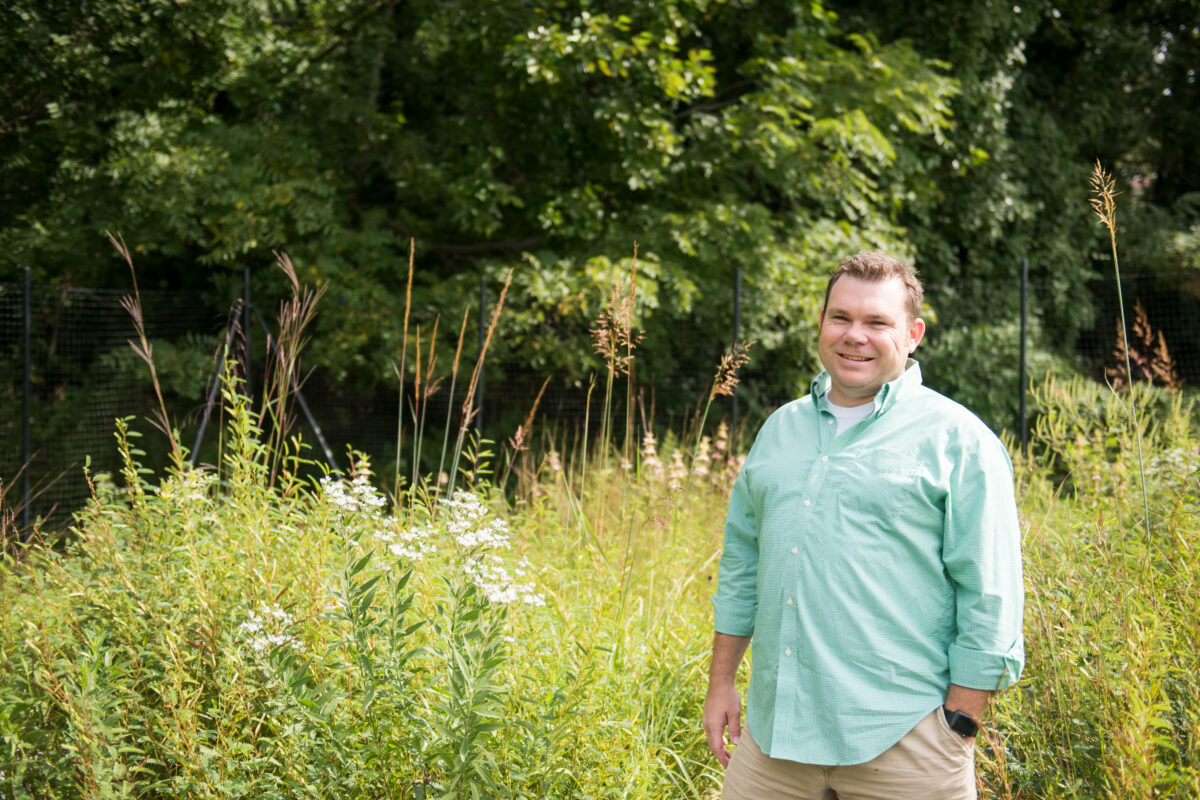 Chris Swan stands near native plantings. (Marlayna Demond ’11/UMBC)
Big questions, small organisms
The study will include researchers from UMBC, Virginia Tech, and University of California-Riverside in the U.S., and São Paulo State University and São Carlos State in Brazil. Streams near São Paulo, Brazil, and Blacksburg, Virginia, will represent tropical and temperate climates, respectively. The team will collect data from each stream monthly for a year.
They’ll manually measure the number of invertebrate species and how many of each species are present. Invertebrates they are likely to find include a wide variety of insects, worms, and crustaceans (such as crayfish). The team will also record traits of each individual, like its size and whether it was collected from the streambed, swimming in the water channel, or flying in the air above the stream.
On top of data on all the organisms, the researchers will also record information about the stream environment, like acidity, temperature, and the presence of nutrients like nitrogen, plus the streambed material (rock or sand, for example), the stream’s sun exposure, and more.
They will intentionally include large and small streams, too. The size of the stream “has practical implications,” Swan says, because in addition to small streams making up 60 percent of all river miles, “if you change a landscape, say by development, you are more likely to flatten a small stream than a large stream. So they are disproportionately under threat.”
 Small streams make up 60 percent of all river miles. (Tobias Wrzal/public domain)
Tropical trend
Some differences between species in tropical versus temperate streams are known. For example, tropical organisms tend to be smaller and have shorter life cycles. Their populations also tend to be smaller. This means local populations disappear through random effects more often in tropical ecosystems, creating space for other species to fill their functional roles.
The new study will produce a much larger data set than previously existed, to further clarify some of these differences between temperate and tropical stream ecosystems and possibly discover new ones.
One of the collaborators, Kurt Anderson at UC-Riverside, focuses on modeling ecological data. The team will “use the parameters that we estimate from the field data to tune his models,” Swan says, “so we can make predictions and test our hypotheses about what could happen in the future.” One hypothesis might be that as the world warms, organisms in temperate streams could start to take on traits more common in the tropics.
Biodiversity is the key to success
Beyond the research, the collaboration also presents unique opportunities for international education. The U.S. and Brazilian faculty leads will offer a joint online course for graduate and advanced undergraduate students, where they will read and analyze academic papers related to the study. “We realized that learning, teaching, and discussion styles are not the same in the two countries,” Swan says, so this class will give students and faculty alike the chance to navigate new ways of interacting along with discovering new science.
One core point Swan will emphasize with his students is the importance of biodiversity on a global scale. In ecology, the presence of a wide variety of organism types and the functions that they perform is called the “portfolio effect.” Just like a diverse financial portfolio, a diverse biological “portfolio” of species is less likely to suffer heavy losses across the board as conditions change—something is bound to adapt and survive. Also, “if you have more species, then you have more niches filled,” Swan says, “so resources are being used more efficiently.”
“Variety in life is the whole kit and caboodle,” Swan says. “If you didn’t have variety, nothing would be able to adapt. There would be no adaptation to change.”
With ample biodiversity, though, adaptation to change is much more likely. But what that looks like—which species will adapt successfully or will be most at risk—is still unknown. Starting with tiny organisms in streams, Swan and colleagues are working to help figure that out.
]]>
A new collaboration between scientists in the U.S. and Brazil hopes to increase our ability to predict how biological communities may change in a warming world. The researchers will investigate...
https://umbc.edu/stories/stream-biodiversity-us-brazil-partnership/
https://my3.my.umbc.edu/api/v0/pixel/news/127109/guest@my.umbc.edu/a77fbc7d806dc545e6c37b5998377c6d/api/pixel
cahss
ges
news
rca-2
research
science-and-tech
UMBC News & Magazine
https://my3.my.umbc.edu/groups/umbc-news-magazine
https://assets1-my.umbc.edu/system/shared/avatars/groups/000/001/943/24435aa6207c452e7bc15cc74b42c7bb/xsmall.png?1748556657
https://assets1-my.umbc.edu/system/shared/avatars/groups/000/001/943/24435aa6207c452e7bc15cc74b42c7bb/original.png?1748556657
https://assets2-my.umbc.edu/system/shared/avatars/groups/000/001/943/24435aa6207c452e7bc15cc74b42c7bb/xxlarge.png?1748556657
https://assets2-my.umbc.edu/system/shared/avatars/groups/000/001/943/24435aa6207c452e7bc15cc74b42c7bb/xlarge.png?1748556657
https://assets3-my.umbc.edu/system/shared/avatars/groups/000/001/943/24435aa6207c452e7bc15cc74b42c7bb/large.png?1748556657
https://assets1-my.umbc.edu/system/shared/avatars/groups/000/001/943/24435aa6207c452e7bc15cc74b42c7bb/medium.png?1748556657
https://assets2-my.umbc.edu/system/shared/avatars/groups/000/001/943/24435aa6207c452e7bc15cc74b42c7bb/small.png?1748556657
https://assets1-my.umbc.edu/system/shared/avatars/groups/000/001/943/24435aa6207c452e7bc15cc74b42c7bb/xsmall.png?1748556657
https://assets2-my.umbc.edu/system/shared/avatars/groups/000/001/943/24435aa6207c452e7bc15cc74b42c7bb/xxsmall.png?1748556657
UMBC News & Magazine
0
0
false
Mon, 29 Aug 2022 18:04:43 -0400
Mon, 29 Aug 2022 18:04:43 -0400
From the Soil to the Stars, Internships Take Students’ Futures to the Next Level
UMBC students are known for the strength of their diversity: not just in their personal backgrounds, but in the breadth of their academic interests and professional goals.
Accordingly, Retrievers’ summer 2022 internships spanned a vast array of subjects and disciplines, from history to mechanical engineering, and working in fields ranging from groundwater all the way up to outer space.
The four UMBC students profiled below vividly embody this wide spectrum, but they all have two things in common. Each completed their internship before starting their junior year, and each has the same advice to new students: Visit the Career Center sooner rather than later.
“It is never too early to start,” agreed Christine Routzahn, the Career Center’s director. “Internships offer students an opportunity to gain experience, build their career readiness skills, and develop professional connections that can help them succeed in competitive career paths and graduate programs.”
Up and Away
“I found the Career Center’s resources really helpful in crafting and perfecting my resume,” said Madelyn Pollack ’24, a history major with public history and Judaic studies minors in the Honors College and Humanities Scholars programs whose internship was at—of all places—NASA.
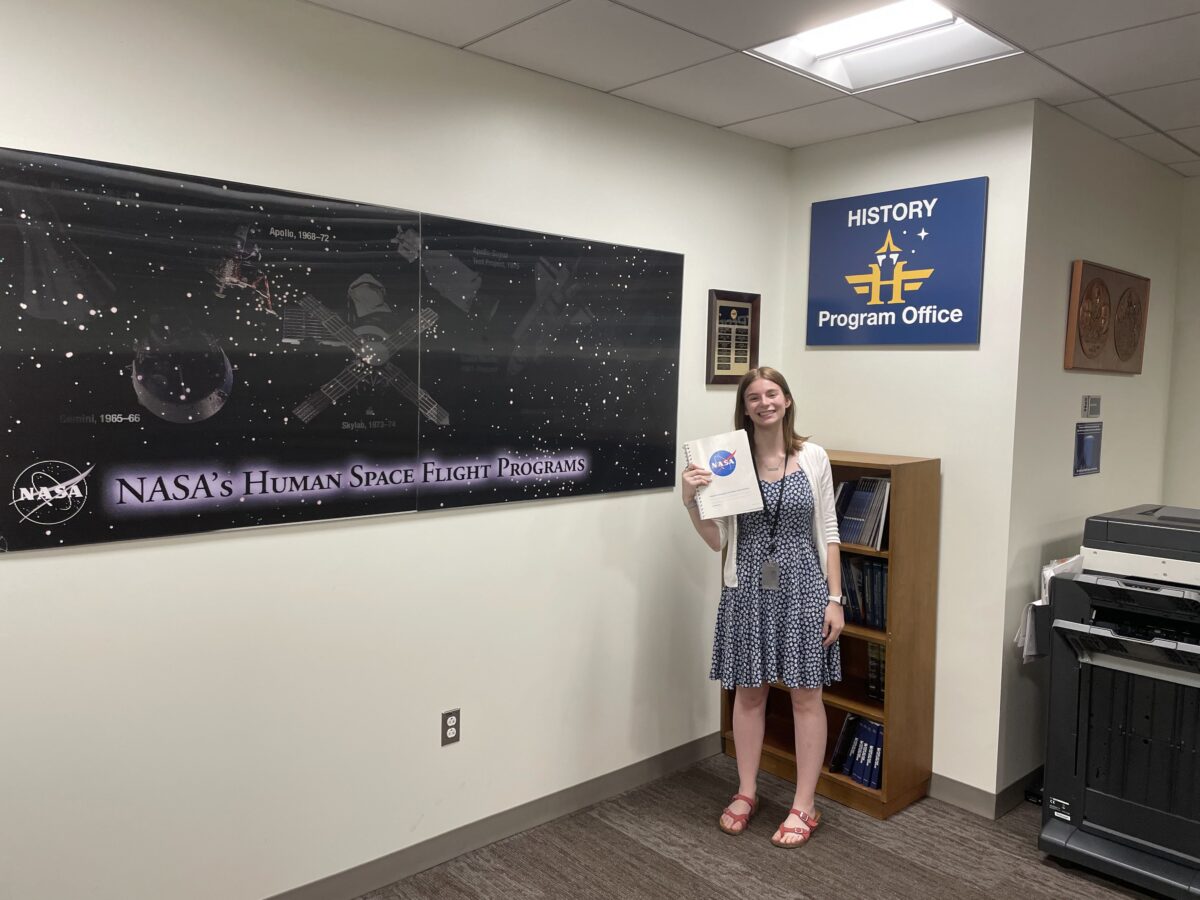 Madelyn Pollack. (Photo courtesy of Pollack)
“I had an interest in space,” Pollack explained, “But when I applied, I wasn’t expecting a call back—I wasn’t expecting to get to do this.”
It turned out that her internship’s responsibilities included a rich variety of opportunities to apply her passion for history: Pollack had a seat at the table in publishing meetings, she got to research and publish key moments of aerospace-related history on the space agency’s official social media outlets, and she was even able to create a research-based presentation on orbital debris and public opinion.
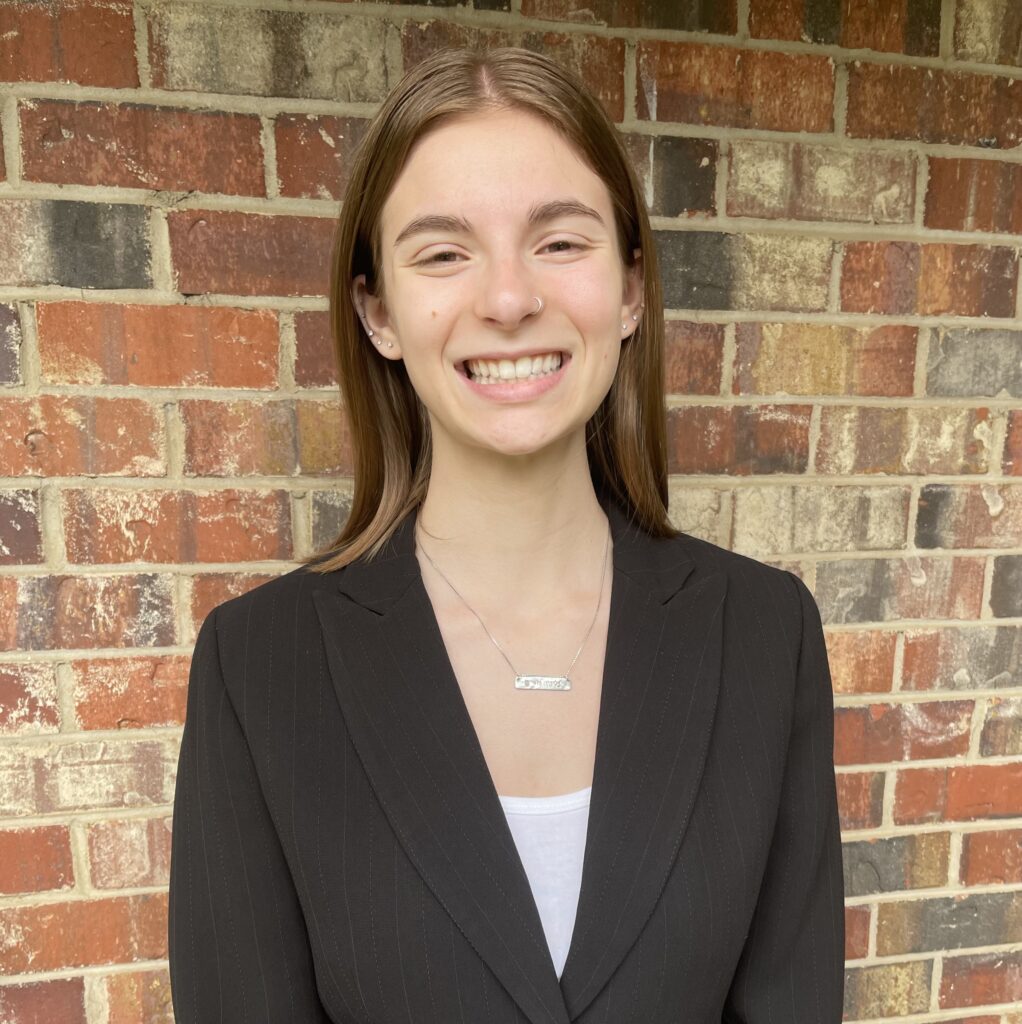 Madelyn Pollack. (Photo courtesy of Pollack)
Pollack said that taking an internship early in her college career helped her further focus her academic interests and refine her idea of what kind of historian she wants to be.
“As a history major, I didn’t have an idea of a specific focus I wanted to take” within the field, she said. But, “if you ask me now what my dream job is, I would say if a job opens up [at NASA] in the next three years or so, it would be really nice to be a historian over there.”
Pollack already has a start on that goal: Based on her success as a summer intern, NASA recently hired her as a continuing intern part-time starting this fall.
First Things First
Ian Nana ’24, mechanical engineering, said one of the biggest misconceptions his fellow students seem to have is that there’s no point in doing an internship until you know exactly what your academic and professional goals are.
“I definitely recommend to any new student: Even if you’re not sure exactly what you want to do, go to the Career Center your freshman year,” said Nana. “You might try one internship and be like, ‘Okay, I like this—I might do this.’ Or, ‘I don’t like this.’”
Even if it’s the latter, Nana said, just having that first experience on your resume makes you a much better candidate for the next internship or job opportunity.
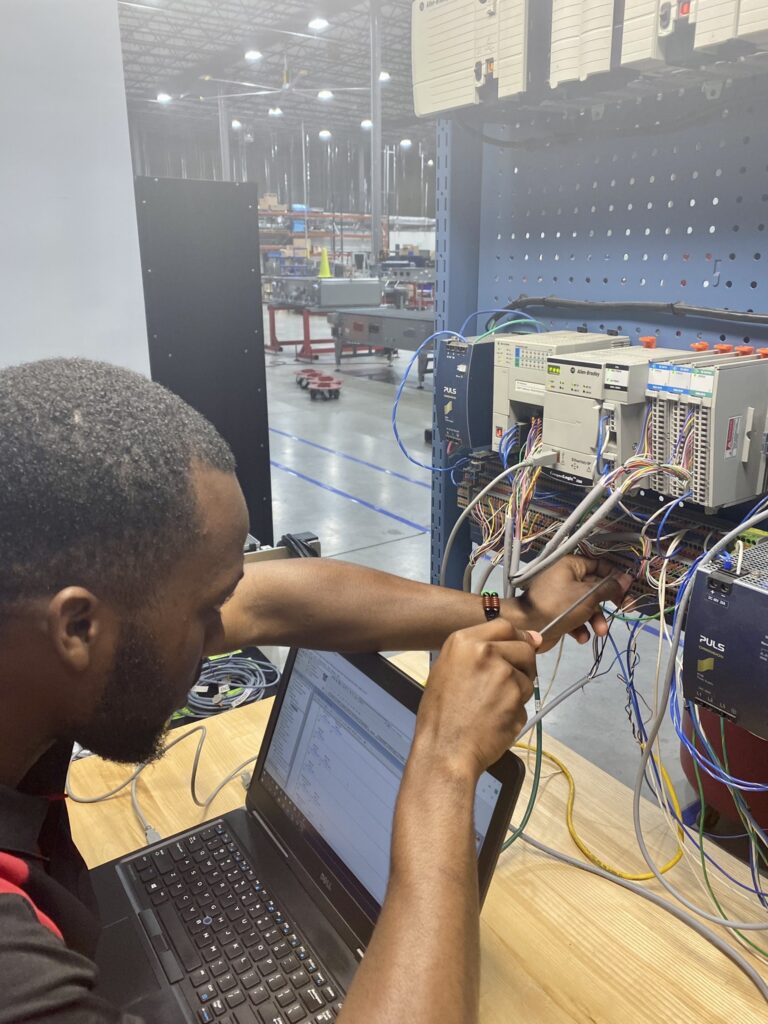 Ian Nana. (Photo courtesy of Nana)
“When I came [to UMBC] for my first semester, I went to the Career Center,” Nana said. And although he didn’t immediately see exactly what he was looking for, he reminded himself that an internship that strengthens general work skills can be just as valuable as field-specific experience, so he applied for a broad spectrum of internships.
“When I applied to other ones, even though they weren’t related to engineering, they showed teamwork. They showed collaboration—how I deal with people,” Nana said. “College is great, but what [employers also] want is experience, because that’s really what is going to make you valuable.”
Nana also encourages students to start looking for opportunities where he did: at UMBC’s Fall Career and Internship Fair. This year, the fair—held on Sept. 21—will host 140 organizations, many of whom are seeking a wide spectrum of summer 2023 interns, from first-year undergraduates to advanced graduate students.
Routzahn highly recommends that all students participate in upcoming Career Center events and activate and upload their resumes to Handshake,UMBC’s new job and internship platform. Top employers are posting incredible internships, part-time, and full-time jobs daily.
Nana, who worked this summer as an engineering intern at Intralox—a global firm that specializes in designing and creating computer-controlled conveyor-belt systems—should know: Though he had to overcome steep technical challenges, including learning a whole new programming language, his success speaks for itself.
 Ian Nana. (Photo courtesy of Nana)
“My manager told me to definitely come back,” he said. “When you see your skills actually being applied and you do something and it works, that’s the best feeling.”
All in the Details
Alexander Bauserman ’24, history, echoed his fellow 2022 interns’ recommendation to visit the Career Center early, often, and with an open mind.
 Alexander Bauserman. (Photo courtesy of Bauserman)
“I would say go as soon as you have the opportunity,” Bauserman said. Even if there’s not an obviously perfect alignment between a given internship opening and your major, he added, “The value of these internships is that sometimes they offer unexpected skills.”
Bauserman spoke from recent experience: He was able to tap into a longstanding personal interest, strengthen his core skills, and develop new ones in his virtual internship at the Maryland Pesticide Education Network, which gathers and disseminates information on the harmful effects of various pesticides and advocates for organic and other alternative agricultural land uses.
“I’m actually a history major, and even though this [internship was] environmental, I actually had an interest in environmental science in my high school years,” he said.
That passion served him well as he dove into the highly detail-intensive work of reformatting environmental science abstracts, checking links on the organization’s website, and learning how to leverage search engine optimization.
“They’ve all been new skills that I’ve gained, because I didn’t really work in any of these areas directly before, but they’re very useful, and I’ve been able to add them to my resume, so I’m very pleased with that,” Bauserman said.
Learning While Doing
Terra Miley ’25, chemical engineering, definitely didn’t waste any time looking for internships: She started as a first-year student. “I’d definitely heard from upperclassmen about how helpful the Career Center is,” she said. “Once you make your first appointment, you realize how helpful it is.”
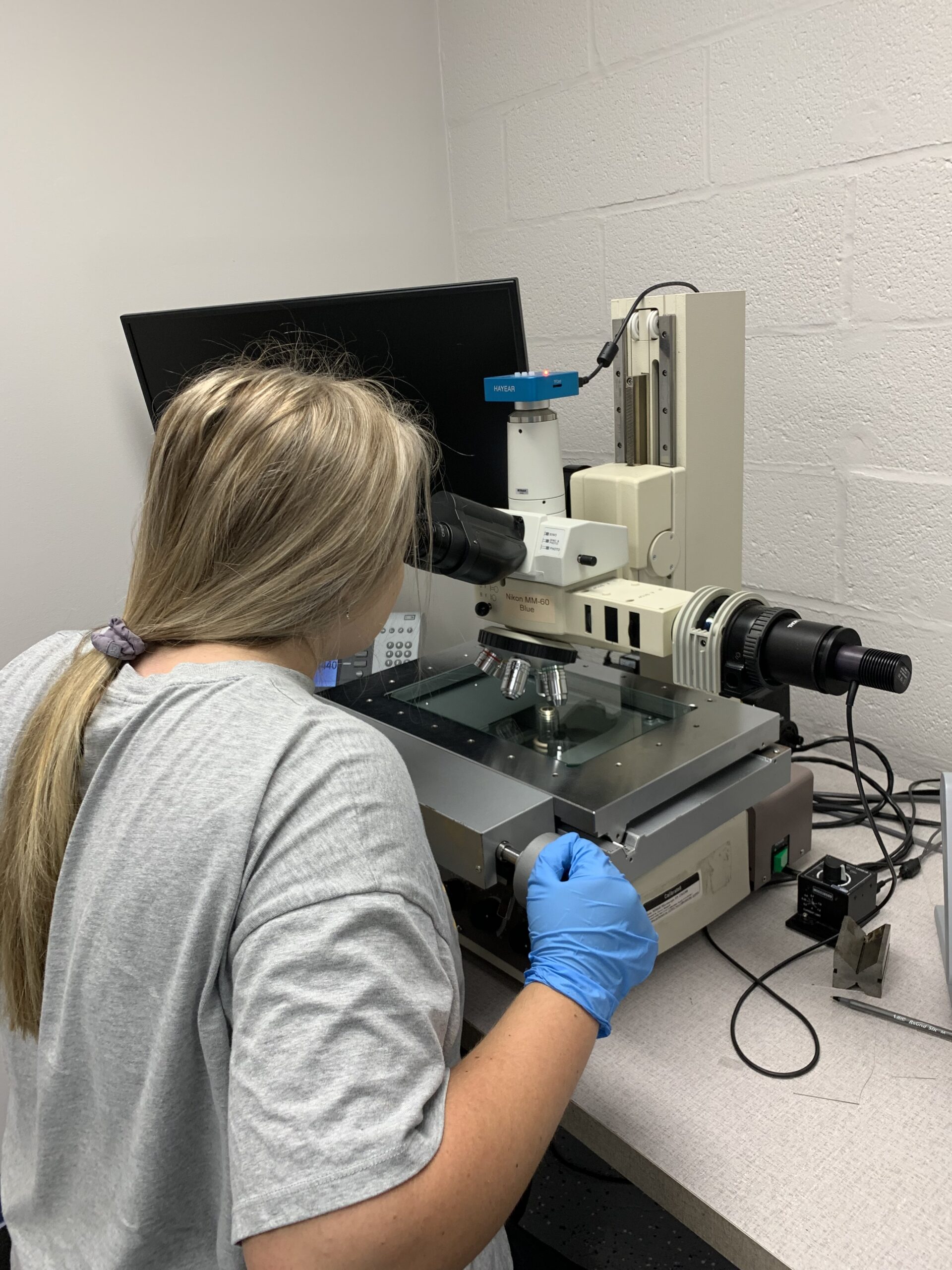
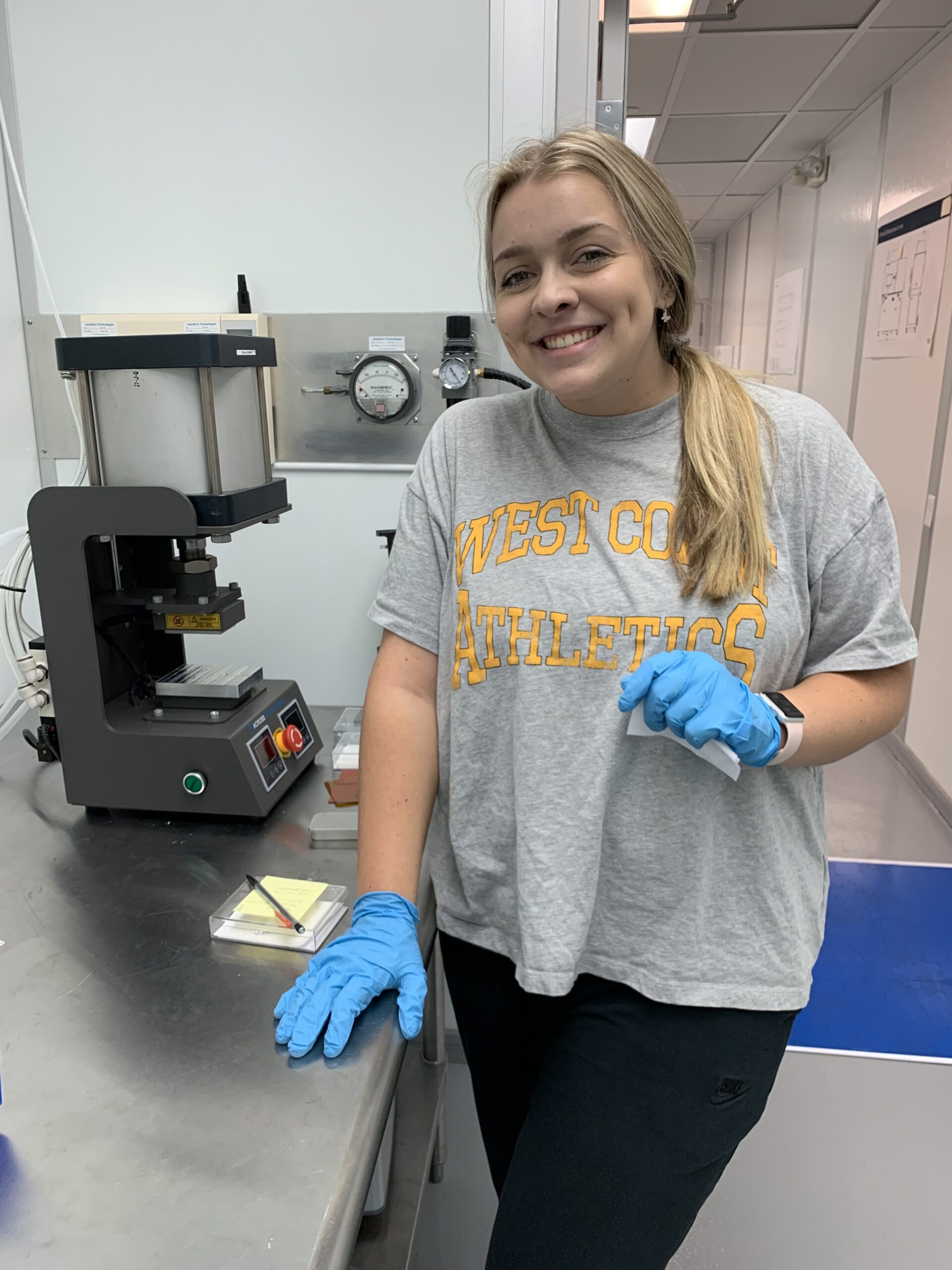
Miley interned at Potomac Photonics, Inc., a digital and micro-manufacturing firm based at the UMBC Technology Center, “basically learning how to do everything.”
“I was doing a digital workspace for the company, so I was able to get exposed to a lot of different projects and machines and pretty much all of the work they do,” she said.
 Terra Miley. (Photo courtesy of Miley)
Miley added that the internship also boosted her confidence that her academic journey—she’s on a bio-technology/bio-engineering track—is the right one for her.
“A lot of the parts that [Potomac Photonics] made were for medical companies, which is kind of what I want to get into. And it made me realize: I am definitely interested in that.”
So interested, in fact, that she’s already made an appointment with the Career Center to get set up with an internship for next summer. “I wanted to try to get an actual research opportunity for next summer and they gave me a giant list of opportunities … that I can look at,” Miley said.
Such resources, Miley said, make the Career Center ”super helpful.”
Routzahn said student success stories such as Miley’s, Bauserman’s, Nana’s, and Pollack’s are happily the norm at UMBC.
“Most employers use internships as a recruiting tool to find their future full-time employees,” she noted, adding that “55 percent of our recent graduates who were employed at graduation indicated that they accepted full-time offers with an organization that they interned or worked for while at UMBC.”
]]>
UMBC students are known for the strength of their diversity: not just in their personal backgrounds, but in the breadth of their academic interests and professional goals. Accordingly,...
https://umbc.edu/stories/from-the-soil-to-the-stars-internships-take-students-futures-to-the-next-level/
https://my3.my.umbc.edu/api/v0/pixel/news/127097/guest@my.umbc.edu/7700e8cdc74eca0622dd96938fa1a35e/api/pixel
campus-life
career-center
cbee
coeit
history
internships
magazine
meche
UMBC News & Magazine
https://my3.my.umbc.edu/groups/umbc-news-magazine
https://assets1-my.umbc.edu/system/shared/avatars/groups/000/001/943/24435aa6207c452e7bc15cc74b42c7bb/xsmall.png?1748556657
https://assets1-my.umbc.edu/system/shared/avatars/groups/000/001/943/24435aa6207c452e7bc15cc74b42c7bb/original.png?1748556657
https://assets2-my.umbc.edu/system/shared/avatars/groups/000/001/943/24435aa6207c452e7bc15cc74b42c7bb/xxlarge.png?1748556657
https://assets2-my.umbc.edu/system/shared/avatars/groups/000/001/943/24435aa6207c452e7bc15cc74b42c7bb/xlarge.png?1748556657
https://assets3-my.umbc.edu/system/shared/avatars/groups/000/001/943/24435aa6207c452e7bc15cc74b42c7bb/large.png?1748556657
https://assets1-my.umbc.edu/system/shared/avatars/groups/000/001/943/24435aa6207c452e7bc15cc74b42c7bb/medium.png?1748556657
https://assets2-my.umbc.edu/system/shared/avatars/groups/000/001/943/24435aa6207c452e7bc15cc74b42c7bb/small.png?1748556657
https://assets1-my.umbc.edu/system/shared/avatars/groups/000/001/943/24435aa6207c452e7bc15cc74b42c7bb/xsmall.png?1748556657
https://assets2-my.umbc.edu/system/shared/avatars/groups/000/001/943/24435aa6207c452e7bc15cc74b42c7bb/xxsmall.png?1748556657
UMBC News & Magazine
3
0
false
Mon, 29 Aug 2022 13:07:08 -0400
Mon, 29 Aug 2022 13:07:08 -0400
UMBC’s Chengpeng Chen receives $1.7M NIH grant to develop human liver model

It can take more than 10 years and a billion dollars to get one new drug approved, and less than 10 percent of drugs succeed in clinical trials. Part of the problem is that common techniques used to study drug candidates, such as simple cell cultures and mouse models, don’t accurately represent how a drug will behave in the human body, says Chengpeng Chen, assistant professor of chemistry and biochemistry.
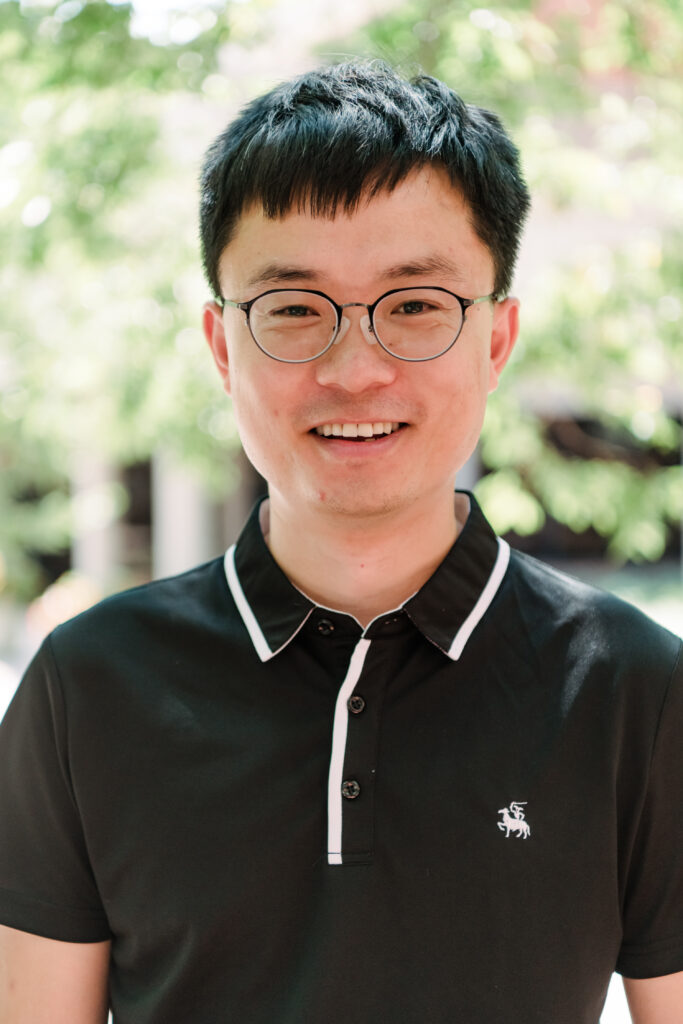 Chengpeng Chen (Marlayna Demond ’11/UMBC)
The low success rate motivated Chen to pursue development of more realistic models of human organs, starting with the liver. The hope is that researchers will one day use these models early in the drug development process to rule out drug candidates that are doomed to fail later on. That way, companies can quickly divert resources to projects with more promise. A new five-year, $1.7 million grant from the National Institute for General Medical Science will support Chen’s interdisciplinary work.
Chen learned about the concept of “organs-on-a-chip” during his postdoctoral research. These 2D, usually plastic devices use tiny amounts of liquid in tiny tubes to imitate organ function. He was hooked on the idea of creating miniature, realistic models of human systems. In addition to supporting drug development studies, such systems can increase understanding of many diseases, without the ethical issues that accompany using animal or human subjects.
Recreating the liver—in miniature
Chen’s first goal is to perfect his liver model, which goes a step beyond an organ-on-a-chip. Instead of a 2D mimic in plastic tubes, “We’re mimicking everything—the cell types, the architecture, and also the 3D microenvironment of the cells,” he says. Ultimately, he hopes to expand to other organs, but the liver is an important place to start, he says. The liver is involved in the metabolism of many drugs, and liver diseases are common.
Other models have recreated single cell types in the liver, but if successful, Chen’s will be the first to include all four major cell types interacting with each other the way they do inside the body.
“We can recreate the architecture of the real tissue, so when we put the cell types together, we think they will show total liver function,” Chen says. “But if we want to study them separately, we can separate them easily.”
While this might sound like the beginning of a quest to grow artificial organs for transplant, “We’re not there yet,” Chen says. He and his group will create “miniaturized liver functional units” that represent all the functionality of the liver on a tiny scale, mainly for biomedical research purposes. While a complete liver contains about 500 billion cells, each model will have approximately 2 million cells and be about the size of a typical thumbtack.
The goal is to create a model that researchers anywhere can replicate. “We want to make this technology standardized and modular,” Chen says, “so that anyone can build the model like Legos.”
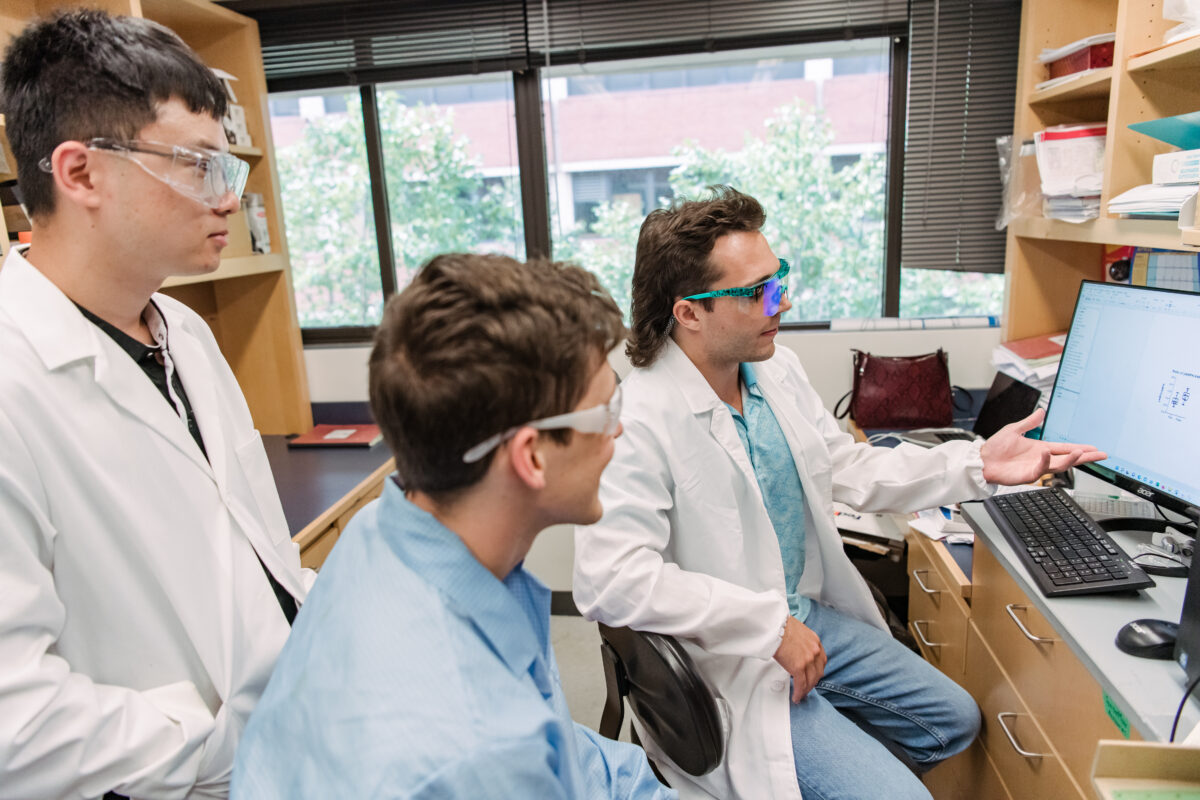 Curtis Jones (right), discusses experimental results with fellow chemistry Ph.D. student John Terrell (center) as Chengpeng Chen looks on. (Marlayna Demond ’11/UMBC)
Metabolism monitoring
Once Chen’s team optimizes the model, Chen is interested in looking at how the extracellular matrix—the material in between cells that binds them together and helps shuttle material from cell to cell—influences activity inside the cell, and how it changes during the course of disease.
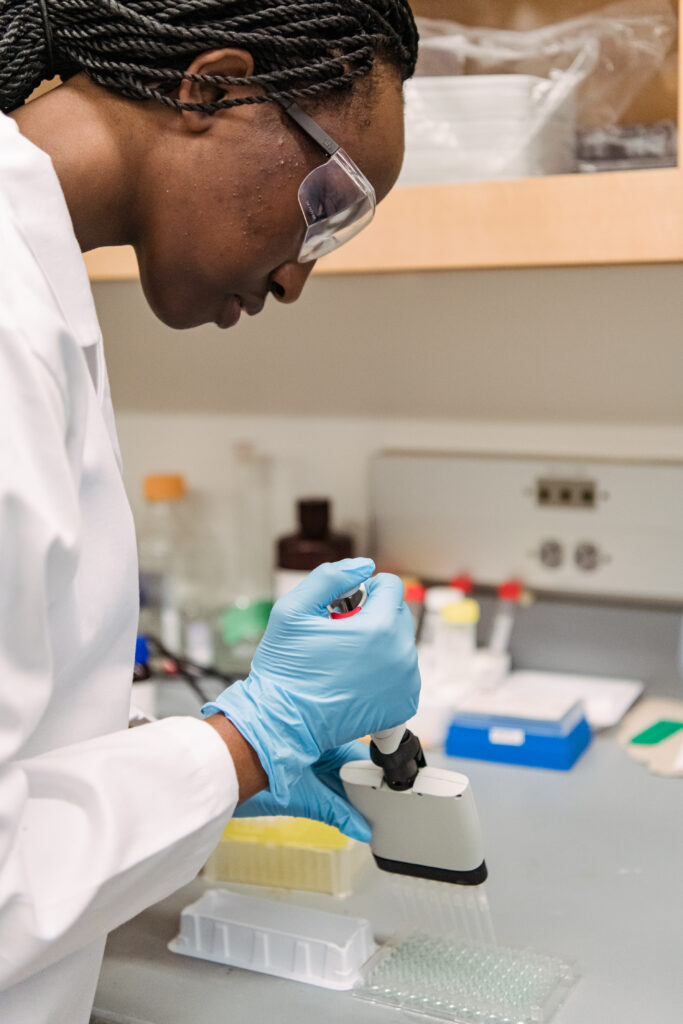 G.K. Monia Kabandana conducts research in the Chen laboratory. (Marlayna Demond ’11/UMBC)
A disease known as liver fibrosis induces changes in the extracellular matrix (ECM), stiffening and thickening the liver. Some researchers have looked at how the ECM affects various functions within liver cells, but not at how it may drive metabolic processes. That’s what Chen’s team will look at first with the new model, which should give more comprehensive results than looking at single cell types alone.
They’ll investigate how ECM changes affect essential metabolic pathways like energy production, construction of lipids and amino acids, and oxidative stress. Then they’ll conduct an untargeted sweep of all metabolites in the cell, measuring whether and how they are affected by ECM changes.
Shared facilities on campus administered by the College of Natural and Mathematical Sciences, such as the Keith Porter Imaging Facility and Molecular Characterization and Analysis Complex, will make the work possible.
Fighting fatal diseases
In the long term, “the ultimate biological goal is to find new therapies for fibrosis diseases,” Chen says. “New knowledge is needed. We’re starting with the liver in this project, because liver fibrosis is one of the most prevalent fibroses. And it’s fatal.”
Liver fibrosis is similar to cardiovascular diseases where tissue thickens, Chen explains. Earlier, “We initiated blood vessel studies, because in cardiovascular diseases, the blood vessels are stiffer. It’s called sclerosis, but it is very similar to fibrosis,” he says. “They both have extracellular matrix microstructure changes.”
There are other diseases that involve ECM changes, too. “If we can figure out how those changes cause disease,” Chen says, “it’s not just a fundamental science question, but also has biomedical applications.”
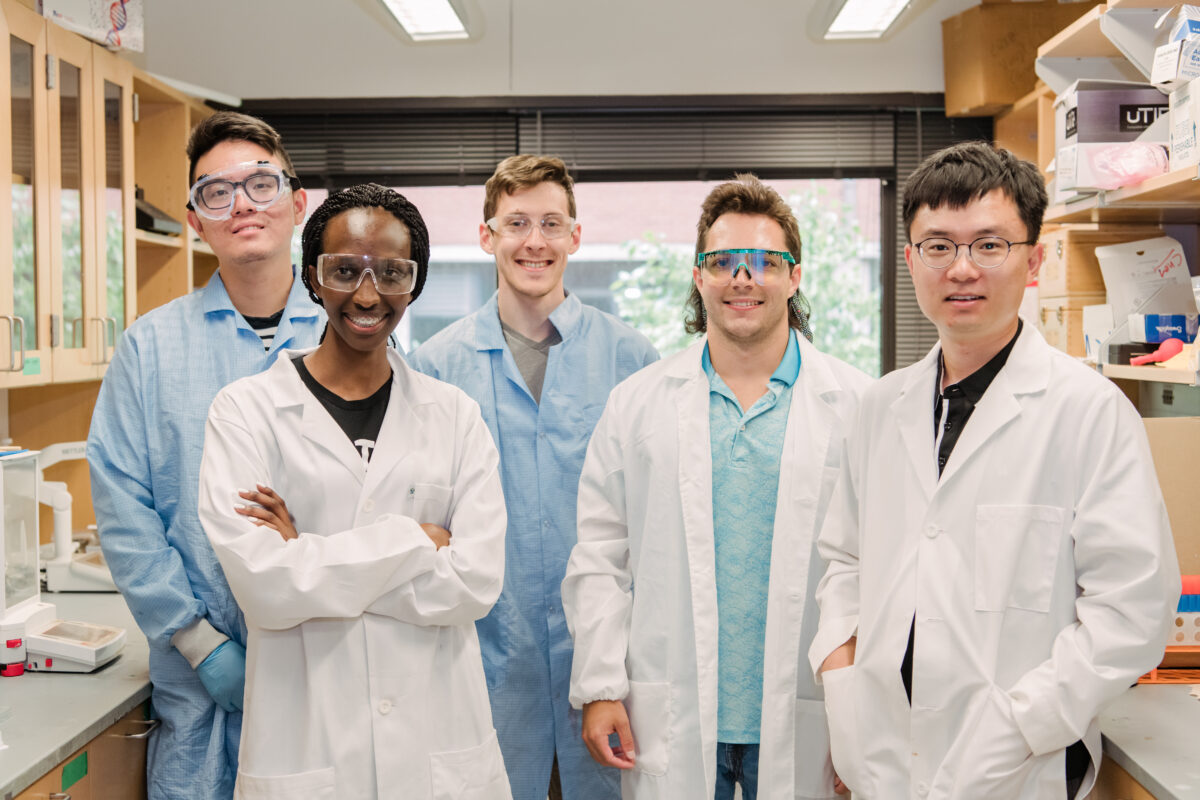 Chengpeng Chen (right) and his four graduate students: Tao Zhang, G.K. Monia Kabandana, John Terrell, and Curtis Jones.
Interdisciplinary effort
Some may be surprised that Chen is in the chemistry and biochemistry department, given the biological and even engineering nature of his work. Chen is part of a new generation of scientists that doesn’t hesitate to forge connections across disciplines.
“I really don’t see a boundary for chemistry work,” Chen says. With the new grant, he plans to add at least two new graduate students to the group, who will receive training in a wide range of techniques and disciplines.
Whether developing technologies to generate new models, measuring biological functions in tissues, or studying the roles of individual metabolites in chemical pathways, Chen’s work puts him at the frontier of scientific research and in position to have a significant public impact.
]]>
It can take more than 10 years and a billion dollars to get one new drug approved, and less than 10 percent of drugs succeed in clinical trials. Part of the problem is that common techniques used...
https://umbc.edu/stories/1-7m-nih-grant-to-develop-human-liver-model/
https://my3.my.umbc.edu/api/v0/pixel/news/127071/guest@my.umbc.edu/38e31370861199353f2ec6e90a31a0c9/api/pixel
chembiochem
chemistry
cnms
news
rca-1
research
science-and-tech
UMBC News & Magazine
https://my3.my.umbc.edu/groups/umbc-news-magazine
https://assets1-my.umbc.edu/system/shared/avatars/groups/000/001/943/24435aa6207c452e7bc15cc74b42c7bb/xsmall.png?1748556657
https://assets1-my.umbc.edu/system/shared/avatars/groups/000/001/943/24435aa6207c452e7bc15cc74b42c7bb/original.png?1748556657
https://assets2-my.umbc.edu/system/shared/avatars/groups/000/001/943/24435aa6207c452e7bc15cc74b42c7bb/xxlarge.png?1748556657
https://assets2-my.umbc.edu/system/shared/avatars/groups/000/001/943/24435aa6207c452e7bc15cc74b42c7bb/xlarge.png?1748556657
https://assets3-my.umbc.edu/system/shared/avatars/groups/000/001/943/24435aa6207c452e7bc15cc74b42c7bb/large.png?1748556657
https://assets1-my.umbc.edu/system/shared/avatars/groups/000/001/943/24435aa6207c452e7bc15cc74b42c7bb/medium.png?1748556657
https://assets2-my.umbc.edu/system/shared/avatars/groups/000/001/943/24435aa6207c452e7bc15cc74b42c7bb/small.png?1748556657
https://assets1-my.umbc.edu/system/shared/avatars/groups/000/001/943/24435aa6207c452e7bc15cc74b42c7bb/xsmall.png?1748556657
https://assets2-my.umbc.edu/system/shared/avatars/groups/000/001/943/24435aa6207c452e7bc15cc74b42c7bb/xxsmall.png?1748556657
UMBC News & Magazine
0
0
false
Fri, 26 Aug 2022 16:02:48 -0400
Fri, 26 Aug 2022 16:02:48 -0400
UMBC’s Nkiru Nnawulezi and D.C. community partners make the case for survivor-centered housing services

In fall 2016 the DC Coalition Against Domestic Violence (DCCADV) approached Nkiru Nnawulezi for her help collecting data on the experiences of domestic violence survivors in Washington D.C. She was eager to lend her expertise.
“As a community psychologist, it is a dream come true to be able to do a study that community partners initiated, said they wanted, asked for, and would meet a particular need in the community,” says Nnawulezi.
Nnawulezi is an associate professor of psychology at UMBC and affiliate faculty at the Yale School of Public Health. Her research examines the factors that enhance equity in housing for domestic violence survivors, including survivors of color; queer and trans survivors; and those who are low-income, unhoused, experiencing addiction, living with HIV, or experiencing severe mental health conditions.
She knew her first task for this major project would be to connect with community partners across D.C. to together identify the most pressing needs of local domestic violence survivors.
Identifying the right question
Nnawulezi was already well-connected with a network of experts in her field, as associate editor of the Journal of Family Violence and on the editorial board of Community Psychology in the Global Perspective. She also serves as a research and evaluation advisor to the National Resource Center on Domestic Violence and Ujima: The National Center on Violence Against Women in the Black Community.
To begin this project she convened four round table discussions with scholars, service providers, and legal experts. This included participants from American University’s Washington College of Law Domestic Violence Clinic; Catholic University’s Columbus Community Legal Services and Families and the Law Clinic; George Mason University; Georgetown Law’s Domestic Violence Clinic; GW Law’s Family Justice Litigation Clinic; and Howard University’s Interpersonal Violence Prevention Program.
The meetings revealed housing as the most pressing issue facing survivors of domestic violence in Washington, D.C. The Virginia Williams Family Resource Center (VWFRC) serves as the central point of intake for families experiencing housing instability in the District. But many survivors seeking housing assistance through the center were not being housed. Understanding why and how this was happening became the purpose of the study.
Designing a community-based study
With a research question in mind and a research community established, Nnawulezi and Liz Odongo, DCCADV director of grants and programs, co-founded the Domestic Violence Action Research Collective (DVARC). To support this work, the collective received funding from the Center for Victim Research, through the Office for Victims of Crime within the U.S. Department of Justice.
“DVARC gathers victimization researchers, advocates, and practitioners to design and conduct community-based research and evaluation studies to enhance survivors’ safety, build their power, and support policy and practice within multiple systems across the city,” says Nnawulezi.
The collective’s first task would be to better understand the VWFRC’s screening process, including the questions the center used to assess whether violence was the primary cause of current homelessness and survivors’ perceptions of the screening process. Next, they would determine how the screening process influenced survivors’ future decision making and experiences with housing support.
Over a period of a year, the research team connected with 779 clients seeking housing assistance and identified 291 of that group as having experienced domestic violence. Of that group, 101 agreed to participate in the research study. The final sample that participated in an in-depth confidential interview included 41 survivors. All were survivors between the ages of 24 and 52, and they were primarily Black, heterosexual, cisgender women.
Survivor experiences
The team’s data show that domestic violence survivors reported numerous systemic and cultural barriers to access safe, affordable, and equitable housing in Washington, D.C. Of the 41 women, only 4 received immediate crisis housing assistance from the VWFRC, despite significant need.
Survivors desired to be treated with more respect by staff, and get housing resource support that aligned with their individual needs. Instead, many women described treatment by staff as unfair or dismissive. A few reported bias incidents based on their race and class that made it increasingly challenging to ask for and receive services. Others reported not receiving services regardless of need, or having to return to the VWFRC an average of 2-5 times to attempt to become eligible for services.
Staff were also not consistent in asking about or responding to safety concerns that survivors disclosed, participants reported. Some shared that they had experienced economic, verbal, and mental abuse, but because they had not experienced physical abuse they were not considered survivors. And some respondents who received assistance reported not having access to the additional financial resources needed to move.
Making lasting change
The DVARC recommends that the District continue to fund sustainable community-based systems of support that are survivor-centered and trauma-informed, and that address the challenges already identified. To determine next steps, the DCCADV also convened an advisory group with survivors from the study to further review the preliminary data and provide recommendations for future advocacy and research studies.
“I believe that it is possible for us to have a city where survivors are treated justly and fairly,” says Nnawulezi. “I love being able to think at the systems level about what needs to shift to improve people’s lives. It’s an incredible opportunity to be a part of this group, in the city that I love, working with people that I love, and working to improve the lives of people that I am deeply committed to.”
]]>
In fall 2016 the DC Coalition Against Domestic Violence (DCCADV) approached Nkiru Nnawulezi for her help collecting data on the experiences of domestic violence survivors in Washington D.C. She...
https://umbc.edu/stories/umbc-nkiru-nnawulezi/
https://my3.my.umbc.edu/api/v0/pixel/news/127029/guest@my.umbc.edu/0a174c4bb8f88c1efb7dedbb947ae743/api/pixel
cahss
cahssresearch
cs3
news
policy-and-society
psychology
rca-1
research
UMBC News & Magazine
https://my3.my.umbc.edu/groups/umbc-news-magazine
https://assets1-my.umbc.edu/system/shared/avatars/groups/000/001/943/24435aa6207c452e7bc15cc74b42c7bb/xsmall.png?1748556657
https://assets1-my.umbc.edu/system/shared/avatars/groups/000/001/943/24435aa6207c452e7bc15cc74b42c7bb/original.png?1748556657
https://assets2-my.umbc.edu/system/shared/avatars/groups/000/001/943/24435aa6207c452e7bc15cc74b42c7bb/xxlarge.png?1748556657
https://assets2-my.umbc.edu/system/shared/avatars/groups/000/001/943/24435aa6207c452e7bc15cc74b42c7bb/xlarge.png?1748556657
https://assets3-my.umbc.edu/system/shared/avatars/groups/000/001/943/24435aa6207c452e7bc15cc74b42c7bb/large.png?1748556657
https://assets1-my.umbc.edu/system/shared/avatars/groups/000/001/943/24435aa6207c452e7bc15cc74b42c7bb/medium.png?1748556657
https://assets2-my.umbc.edu/system/shared/avatars/groups/000/001/943/24435aa6207c452e7bc15cc74b42c7bb/small.png?1748556657
https://assets1-my.umbc.edu/system/shared/avatars/groups/000/001/943/24435aa6207c452e7bc15cc74b42c7bb/xsmall.png?1748556657
https://assets2-my.umbc.edu/system/shared/avatars/groups/000/001/943/24435aa6207c452e7bc15cc74b42c7bb/xxsmall.png?1748556657
UMBC News & Magazine
0
0
false
Thu, 25 Aug 2022 11:50:02 -0400
Thu, 25 Aug 2022 11:50:02 -0400
UMBC Remembers Dr. Alan Sorkin
Dear Colleagues,
We are saddened to learn of the recent transition of Dr. Alan Sorkin who served as chair of the Department of Economics for 31 years. Dr. Sorkin passed away on Friday, August 19, 2022 at home surrounded by his family after a long battle with an illness. Our thoughts are with his family and loved ones and we know that many UMBC community members will mourn his loss.
Dr. Sorkin joined the UMBC Economics Department in 1974 upon completing his undergraduate and doctorate in Economics at Johns Hopkins University. Prior to UMBC, he also spent two years with the Brookings Institution and five years with the Bloomberg School of Public Health at Johns Hopkins. Under his leadership, the UMBC Economics Department more than doubled the number of faculty and student majors. The Department also introduced its Financial Economics B.S. and its M.A. in Economic Policy Analysis. He retired from UMBC and became Professor Emeritus in 2006.
His scholarly expertise focused on global public health but he also published innovative monographs in other areas of applied economics. He published twelve books and eight co-edited volumes. In addition to his books on health economics, the titles of his other books include Monetary and Fiscal Policy and Business Cycles in the Modern Era, Economic Aspects of Natural Hazards, Education, Unemployment and Economic Growth, and The Urban American Indian. His numerous contributions were recognized with the Heritage Award by the Bloomberg School of Public Health at Johns Hopkins University in 2019.
After his retirement in 2006, Alan still returned regularly to the UMBC campus to visit and lunch with faculty colleagues up until the 2020 pandemic. Economics Department Chair David Mitch recalls that during his visits Alan would frequently inquire about current department issues. Among his numerous non-academic interests, Alan was an avid coin collector. His presence will certainly be missed.
A visitation will be held at Schimunek Funeral Home, 9705 Belair Rd, Nottingham, MD on Friday, August 26, 2022 from 5:00 PM to 8:00 PM. Another brief visitation will be held Saturday, August 27, 2022 from 9 AM to 9:30 AM at St. Michael Lutheran Church Perry Hall, 9534 Belair Road, Nottingham, MD 21236. Funeral services will begin at 9:30 AM, followed by interment at Highview Memorial Gardens, 3433 Fallston Rd, Fallston, MD 21047. The website for the funeral home is Schimunek Funeral Home | Funeral & Cremation (dignitymemorial.com).
Contributions may be made in his memory to Harford County Public Library Harford County Public Library (hcplonline.org) or to Fallston Volunteer Fire and Ambulance Company Donations – Fallston Fire Company (fvfac.org).
Kimberly R. Moffitt, Dean
College of Arts, Humanities, and Social Sciences
]]>
Dear Colleagues, We are saddened to learn of the recent transition of Dr. Alan Sorkin who served as chair of the Department of Economics for 31 years. Dr. Sorkin passed away on Friday, August 19,...
https://umbc.edu/stories/umbc-remembers-dr-alan-sorkin/
https://my3.my.umbc.edu/api/v0/pixel/news/127006/guest@my.umbc.edu/6fe905b50fe1811a6d979aabfc66f1b1/api/pixel
in-memoriam
rss
UMBC News & Magazine
https://my3.my.umbc.edu/groups/umbc-news-magazine
https://assets1-my.umbc.edu/system/shared/avatars/groups/000/001/943/24435aa6207c452e7bc15cc74b42c7bb/xsmall.png?1748556657
https://assets1-my.umbc.edu/system/shared/avatars/groups/000/001/943/24435aa6207c452e7bc15cc74b42c7bb/original.png?1748556657
https://assets2-my.umbc.edu/system/shared/avatars/groups/000/001/943/24435aa6207c452e7bc15cc74b42c7bb/xxlarge.png?1748556657
https://assets2-my.umbc.edu/system/shared/avatars/groups/000/001/943/24435aa6207c452e7bc15cc74b42c7bb/xlarge.png?1748556657
https://assets3-my.umbc.edu/system/shared/avatars/groups/000/001/943/24435aa6207c452e7bc15cc74b42c7bb/large.png?1748556657
https://assets1-my.umbc.edu/system/shared/avatars/groups/000/001/943/24435aa6207c452e7bc15cc74b42c7bb/medium.png?1748556657
https://assets2-my.umbc.edu/system/shared/avatars/groups/000/001/943/24435aa6207c452e7bc15cc74b42c7bb/small.png?1748556657
https://assets1-my.umbc.edu/system/shared/avatars/groups/000/001/943/24435aa6207c452e7bc15cc74b42c7bb/xsmall.png?1748556657
https://assets2-my.umbc.edu/system/shared/avatars/groups/000/001/943/24435aa6207c452e7bc15cc74b42c7bb/xxsmall.png?1748556657
UMBC News & Magazine
1
0
false
Wed, 24 Aug 2022 12:47:35 -0400
UMBC’s Jeffrey Gardner receives $1.3M from NIH to discover new treatments for fungal disease
Like bacteria, fungi can cause disease inside your body and on your skin, or even grow on medical equipment like catheter tubing and wound dressings. Many fungal diseases are treatable with antifungal medications, but drug resistance is a growing problem. With a new four-year, $1.3 million grant from NIH, Jeffrey Gardner and his students will be looking for new ways to target disease-causing fungi.
Typically, drugs that treat fungal disease prevent the fungus from making its cell wall, which either kills the fungus outright or weakens it enough that the immune system can finish it off. But that method is highly susceptible to developing resistance.
“But what if you had an external attack on the fungus? What if there were enzymes that actively degraded the fungal cell wall, which is not going to generate resistance easily?” asks Gardner, associate professor of biological sciences. “Our goal is to find enzymes that effectively break down the fungal cell wall, that can be used as a treatment in parallel with cell wall synthesis blockers, or on their own.”
Homing in on the right enzyme
With the new support from NIH, Gardner’s lab will investigate hundreds of bacterial enzymes to figure out which best target Aspergillus fungus, a group of common disease-causing mold species. Previous work from other groups has found particular bacterial species that slow down fungal growth. Gardner’s team will start by looking at every gene and protein in these bacteria to figure out “which genes are turned on, and which proteins are made, while the bacteria are degrading and eating the fungus,” he explains.
Gardner expects that should whittle down the candidate list from about 4,000 genes to a few hundred. “How do we figure out which ones of those couple hundred actually matter? That’s where our genetic system comes in,” he says. The team will generate bacterial strains that lack a functional version of each of the candidate genes and see which strains are less efficient at eating the fungus.
That process should further narrow the list of genes to a few dozen, Gardner says. Then, they’ll produce strains that are missing different combinations of the candidate genes. When they find a combination that can’t survive at all on fungus alone, they’ll be confident the genes knocked out in that strain are the ones necessary to eat the fungus. Finally, they’ll run biochemistry experiments to determine the function and mechanism of each enzyme.
 Filaments of Aspergillus fungus (Giles Chapelain/CC BY-NC-ND)
From one to a billion
This kind of brute-force methodology, involving hundreds of unique strains of bacteria, highlights the advantages of working with species that multiply incredibly fast. “That’s the power of microbiology—you can go from a single cell to an overnight culture with a billion cells,” Gardner says. “You can do many, many experiments at a scale and at a speed that really isn’t possible with, say, a fly or a mouse system.”
The culmination of the project will be “identifying the enzymes, knowing what they’re doing, how they’re doing it, and how well they’re doing it,” Gardner says.
The power of microbes
As a microbial researcher who cares about “interesting bits of biology that have no medical relevance at all,” Gardner says he never imagined he would receive an NIH grant to pursue work with clear biomedical implications. But as his research at UMBC over the last decade has progressed, he’s realized his work can transcend typical disciplinary boundaries. “I think that’s the exciting part, and the power of microbial systems, that you have that latitude,” Gardner says.
His first major grant from the Department of Energy focused on bacteria’s role in biofuel production. A second project funded by the National Science Foundation looks at how bacteria contribute to the carbon cycle by breaking down dead matter on the forest floor. And now, with funding from NIH, his group will look at how bacteria can help fight fungal disease.
“If you can find an interesting bug, with some interesting physiology, the types of questions can really span major different areas,” Gardner says.
The techniques often remain the same, though. “Our wheelhouse is genetics, systems biology, and physiology,” Gardner says. In the new project, “We’re leveraging an established pipeline to work on a problem that is a step away from what we have traditionally done. We’ve got lots of tools and tricks for working with the bacteria.”
The wide range of methods used in Gardner’s lab means that his group offers great training opportunities for students. With the new grant, Gardner is looking forward to adding two new Ph.D. students and several undergraduate researchers to his team.
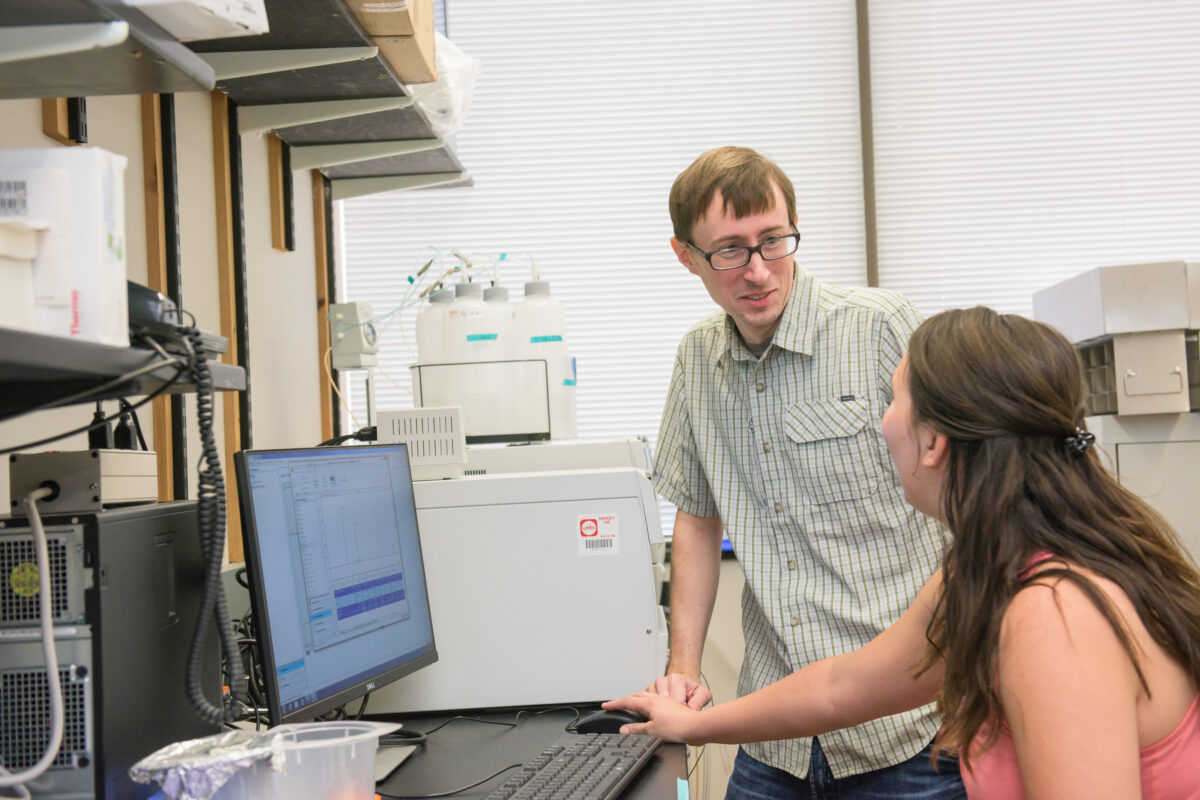 Jeffrey Gardner and Cassandra Nelson, Ph.D. ’17, biological sciences, in the Gardner laboratory. (Marlayna Demond ’11/UMBC)
Essential support
Gardner knows, from personal experience, the importance of research training and mentorship along a scientist’s full career path, including in his time at UMBC. Before applying for this current grant, he took advantage of a program offered by UMBC’s College of Natural and Mathematical Sciences specifically for people seeking major NIH grants. The program, orchestrated by Phyllis Robinson, professor of biological sciences, included workshops, critique partners, and mentoring. “That was absolutely essential for my success,” Gardner says.
Moving forward, if the project goes well and Gardner is able to secure a second round of funding in a few years, he says the next questions will be, “How do we engineer the enzymes to be more potent? How do we make them do their job of killing fungi better?” The lab could even ask which combination of enzymes would target a specific fungus most effectively, or provide the broadest protection against many fungal species.
But for now, they’ll focus on nailing down the basics, he says. “We need to find out who’s there and what they’re doing first.”
]]>
Like bacteria, fungi can cause disease inside your body and on your skin, or even grow on medical equipment like catheter tubing and wound dressings. Many fungal diseases are treatable with...
https://umbc.edu/stories/gardner-receives-1-3m-to-discover-new-fungal-treatments/
https://my3.my.umbc.edu/api/v0/pixel/news/126992/guest@my.umbc.edu/5067bdb79db8ac42f747552b8402e012/api/pixel
biology
cnms
news
research
science-and-tech
UMBC News & Magazine
https://my3.my.umbc.edu/groups/umbc-news-magazine
https://assets1-my.umbc.edu/system/shared/avatars/groups/000/001/943/24435aa6207c452e7bc15cc74b42c7bb/xsmall.png?1748556657
https://assets1-my.umbc.edu/system/shared/avatars/groups/000/001/943/24435aa6207c452e7bc15cc74b42c7bb/original.png?1748556657
https://assets2-my.umbc.edu/system/shared/avatars/groups/000/001/943/24435aa6207c452e7bc15cc74b42c7bb/xxlarge.png?1748556657
https://assets2-my.umbc.edu/system/shared/avatars/groups/000/001/943/24435aa6207c452e7bc15cc74b42c7bb/xlarge.png?1748556657
https://assets3-my.umbc.edu/system/shared/avatars/groups/000/001/943/24435aa6207c452e7bc15cc74b42c7bb/large.png?1748556657
https://assets1-my.umbc.edu/system/shared/avatars/groups/000/001/943/24435aa6207c452e7bc15cc74b42c7bb/medium.png?1748556657
https://assets2-my.umbc.edu/system/shared/avatars/groups/000/001/943/24435aa6207c452e7bc15cc74b42c7bb/small.png?1748556657
https://assets1-my.umbc.edu/system/shared/avatars/groups/000/001/943/24435aa6207c452e7bc15cc74b42c7bb/xsmall.png?1748556657
https://assets2-my.umbc.edu/system/shared/avatars/groups/000/001/943/24435aa6207c452e7bc15cc74b42c7bb/xxsmall.png?1748556657
UMBC News & Magazine
0
0
false
Tue, 23 Aug 2022 18:05:54 -0400
Tue, 23 Aug 2022 18:05:54 -0400
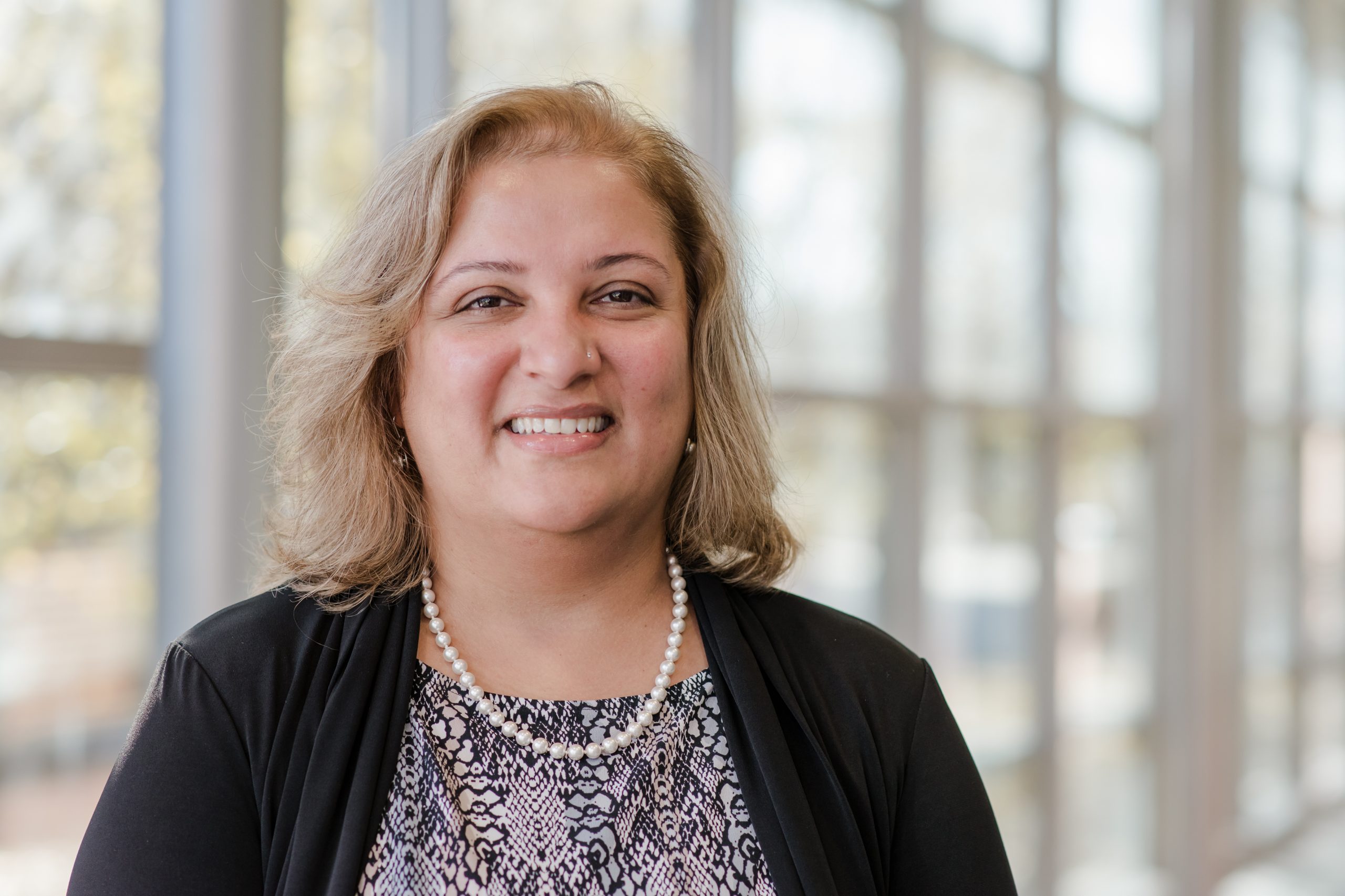 Vandana Janeja. (Marlayna Demond ’11/UMBC)
 Jianwu Wang. (Maryland Demond ’11/UMBC)