Adrian Davey to research renewable energy and photo-electrochemical synthesis in UC Berkeley Ph.D. program
Adrian Davey B.S., Chemical Engineering Magna Cum Laude Hometown: Frederick, Maryland Plans: Ph.D., University of California, Berkeley
This institution cultivated my scientific passion and inspired me to poise myself as a rising engineer committed to championing diversity in STEM and adding research-oriented novelty to chemical engineering.
As a Meyerhoff Scholar at UMBC, Adrian Davey has been committed to training as a researcher, and incorporating service into his studies, from day one. He pursued research at the University of Texas at Austin as a Howard Hughes Medical Institute Exceptional Research Opportunities Scholar, and at UC Berkeley as an Amgen Scholar, in addition to his research in the lab of Chris Hennigan, assistant professor of chemical, biochemical, and environmental engineering, at UMBC.
Recognizing his academic and research strengths, Davey was invited to be a part of the Phi Kappa Phi Honor Society, UMBC’s all-discipline honor society, and was named a scholar of the American Chemical Society. He also earned third place in the Technical Research Exhibition at the National Society of Black Engineers (NSBE) Fall Regional Conference in 2017 and is a member of Tau Beta Pi, UMBC’s engineering honors society.
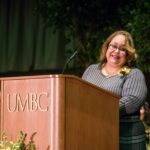
Adrian Davey presented his summer 2017 research at the UC Berkeley, during his time as an Amgen Scholar. His work explored how the use of graphene-based catalysts to synthesize hydrogen peroxide can impact water decontamination efforts. Photo courtesy of Adrian Davey.
Outside of the lab, Davey has pursued leadership opportunities and mentored high school students through student organizations both on campus and in the local community. He served as president of the UMBC chapter of the NSBE and worked with students at Mount Hebron High School through an SAT preparation and mentorship program.
After graduation, Davey will begin a Ph.D. program in chemical engineering as a Chancellor’s Fellow at UC Berkeley. He will continue to research how to improve oxygen-reduction reactions for more efficient and clean hydrogen peroxide formation. A possible application of this work could support more efficient water decontamination.
Portrait by Marlayna Demond ’11 for UMBC.
]]>
Adrian Davey B.S., Chemical Engineering Magna Cum Laude Hometown: Frederick, Maryland Plans: Ph.D., University of California, Berkeley This institution cultivated my scientific passion and...https://umbc.edu/stories/adrian-davey-to-research-renewable-energy-and-photo-electrochemical-synthesis-in-uc-berkeley-ph-d-program/https://my3.my.umbc.edu/api/v0/pixel/news/120472/guest@my.umbc.edu/1543da00c71fd1a4469d371540485c75/api/pixelcbeeclass-of-2018coeitmeyerhoffscholarsundergradresearchUMBC News & Magazinehttps://my3.my.umbc.edu/groups/umbc-news-magazinehttps://assets1-my.umbc.edu/system/shared/avatars/groups/000/001/943/24435aa6207c452e7bc15cc74b42c7bb/xsmall.png?1748556657https://assets1-my.umbc.edu/system/shared/avatars/groups/000/001/943/24435aa6207c452e7bc15cc74b42c7bb/original.png?1748556657https://assets2-my.umbc.edu/system/shared/avatars/groups/000/001/943/24435aa6207c452e7bc15cc74b42c7bb/xxlarge.png?1748556657https://assets2-my.umbc.edu/system/shared/avatars/groups/000/001/943/24435aa6207c452e7bc15cc74b42c7bb/xlarge.png?1748556657https://assets3-my.umbc.edu/system/shared/avatars/groups/000/001/943/24435aa6207c452e7bc15cc74b42c7bb/large.png?1748556657https://assets1-my.umbc.edu/system/shared/avatars/groups/000/001/943/24435aa6207c452e7bc15cc74b42c7bb/medium.png?1748556657https://assets2-my.umbc.edu/system/shared/avatars/groups/000/001/943/24435aa6207c452e7bc15cc74b42c7bb/small.png?1748556657https://assets1-my.umbc.edu/system/shared/avatars/groups/000/001/943/24435aa6207c452e7bc15cc74b42c7bb/xsmall.png?1748556657https://assets2-my.umbc.edu/system/shared/avatars/groups/000/001/943/24435aa6207c452e7bc15cc74b42c7bb/xxsmall.png?1748556657UMBC News & Magazine00falseSun, 15 Apr 2018 20:10:17 -0400UMBC celebrates 2018 Presidential Faculty and Staff Award winners
UMBC’s Presidential Faculty and Staff Awards offer a chance to reflect, each year, on the essential contributions of university employees to making UMBC a welcoming, supportive, and successful learning community. This year’s ceremony, on April 4, was particularly meaningful as it coincided with the 50th anniversary of the assassination of Dr. Martin Luther King, Jr.
UMBC President Freeman Hrabowski recalled hearing of Dr. King’s death when he was a 17-year-old college sophomore. Calling that time “one of the most devastating days in American history,” he led the room in a moment of silence. With those who came together to honor some of UMBC’s most dedicated educators, from all corners of the university, President Hrabowski shared, “UMBC represents Dr. King’s dream.”
Nicole King, associate professor and chair of American studies, received the Presidential Teaching Faculty Award in recognition of her community-engaged pedagogy. King focuses on helping students develop a deeper understanding of Baltimore and its residents, whether studying gentrification or local environmental concerns. “It is especially wonderful to be honored for my work teaching at UMBC because UMBC has exceptional students,” she said.
King shared two core lessons from doing public humanities work, lessons she works to share with students: “showing up matters” and “listening is essential to learning.” To fulfill UMBC’s mission, she argued, “We must bring more voices into conversations at our public university today and we must better listen to one another because that is truly what teaching and learning are about.”
Nicole King, associate professor and chair of American studies, and husband Baynard Woods
Amy Froide, associate professor of history, received a USM Board of Regents’ Faculty Award for Excellence in Teaching, saying, “It’s pretty humbling to win a teaching excellence award at this university that is full of faculty who inspire me every day.” Froide shared her journey as a first-generation college student who wanted to become a teacher since childhood. She didn’t imagine a career as a professor until an advisor encouraged her to pursue a Ph.D. Now she wants to pay forward the support she received.
“I want to dedicate this award to all teachers, especially at this time in our history” Froide said, referencing this spring’s K – 12 teacher protests for wages, pensions, and school budgets in the U.S. and abroad. Froide commented that teaching is “one of the toughest and most rewarding professions, but it’s not a profession that always gets rewarded.” She shared what an honor it was for her to receive this faculty award and reflected, “I hope for a day when all teachers will be honored.”
Amy Froide, professor of history
James Franson, professor of physics, received the Presidential Research Faculty Award. Franson joked, “Unfortunately, it’s not quite as exciting or prestigious as being on the basketball team and going to the NCAA tournament.” Still, he reflected thoughtfully, “Research itself is exciting in its own way, and UMBC is a great place to do research.”
James Franson, professor of physics (l) and guest
Several honorees revisited the long and fulfilling careers they have had at UMBC and the friendships they’ve made. “Like the Academy Awards, I’d like to take a moment to thank those who made this possible,” said Joe Kirby, assistant vice president in the Division of Information Technology (DoIT).
Kirby received the Presidential Distinguished Staff Award. He thanked family, friends, mentors, and colleagues, including DoIT Vice President Jack Suess ‘81, mathematics, M.S. ‘95, operations analysis, “For challenging me to be more than I would have thought possible, yet always promoting work-life balance and compassion over our 20+ years together.” Kirby shared, “My success is so tied to the collaboration and cooperation I receive from our faculty, staff, and students.”
Joe Kirby (r), AVP of DoIT, and wife Donna Kirby (l)
Tamara Brown, executive administrative assistant for the dean of the College of Arts, Humanities and Social Sciences, reflected on how “pleased, honored, and humbled” she felt to accept UMBC’s Presidential Distinguished Non-Exempt Staff Award. After thanking her colleagues, she added, with a smile, “I want to thank my family for putting up with my late hours at UMBC.”
Tamara Brown, executive administrative assistant, (center left) with her family
That level of commitment became a familiar thread. A few moments later, Victor Fulda, recipient of the Karen L. Wensch Endowment Award for Outstanding Non-Exempt Staff, thanked his wife for putting up with 3 a.m. phone calls about urgent lab issues at UMBC. Fulda, a lab technician in chemical, biochemical, and environmental engineering for 25 years, shared, “This job has been very rewarding and surprising.”
Victor Fulda, CBEE lab technician
Jess Myers, who received the Jakubik Family Endowment Award, called her position as Women’s Center director “a dream job.” “To wake up every day and go to work to support and advance gender equity, to hold space for LGBTQ folks, to cultivate healing space for survivors of sexual violence, to run a scholarship program for older women returning to college…that is an award in and of itself,” said Myers.
Still, she shared, “today feels extra special to be recognized by my UMBC colleagues.” She passed along her gratitude for people across the university who have believed in her approach to growing the Women’s Center “to truly support UMBC’s vision of inclusive excellence.”
L-R: April Householder, director of undergraduate research, and Jess Myers, director of the Women’s Center
Phyllis Robinson, professor of biological sciences, also commented on that UMBC vision in describing her work to support inclusion in STEM fields. Robinson received the Marilyn E. Demorest Award for Faculty Advancement for her commitment to the professional growth of women faculty in the sciences, particularly through mentoring programs. “For me, mentoring is very simple,” said Robinson. “It’s sharing information with people and bestowing guidance and encouragement.”
L-R: Pat McDermott, vice provost for faculty affairs, and Phyllis Robinson, professor of biological sciences
President Hrabowski concluded the event with his mid-year State of the University update, highlighting key achievements across the university. These included everything from major grants, awards, and partnerships to the opening of UMBC’s new Event Center.
Featured image: Tamara Brown, recipient of UMBC’s Presidential Distinguished Non-Exempt Staff Award. All photos by Marlayna Demond ’11 for UMBC.
]]>
UMBC’s Presidential Faculty and Staff Awards offer a chance to reflect, each year, on the essential contributions of university employees to making UMBC a welcoming, supportive, and successful...https://umbc.edu/stories/umbc-honors-faculty-and-staff-for-essential-contributions-to-the-university-community/https://my3.my.umbc.edu/api/v0/pixel/news/120505/guest@my.umbc.edu/b183cc92a2767ca390834dbacee9d3e7/api/pixelamericanstudiesarts-and-culturebiologycahsscbeecnmscoeitcommunityhistoryphysicspolicy-and-societyscience-and-technologystaffwomenscenterUMBC News & Magazinehttps://my3.my.umbc.edu/groups/umbc-news-magazinehttps://assets1-my.umbc.edu/system/shared/avatars/groups/000/001/943/24435aa6207c452e7bc15cc74b42c7bb/xsmall.png?1748556657https://assets1-my.umbc.edu/system/shared/avatars/groups/000/001/943/24435aa6207c452e7bc15cc74b42c7bb/original.png?1748556657https://assets2-my.umbc.edu/system/shared/avatars/groups/000/001/943/24435aa6207c452e7bc15cc74b42c7bb/xxlarge.png?1748556657https://assets2-my.umbc.edu/system/shared/avatars/groups/000/001/943/24435aa6207c452e7bc15cc74b42c7bb/xlarge.png?1748556657https://assets3-my.umbc.edu/system/shared/avatars/groups/000/001/943/24435aa6207c452e7bc15cc74b42c7bb/large.png?1748556657https://assets1-my.umbc.edu/system/shared/avatars/groups/000/001/943/24435aa6207c452e7bc15cc74b42c7bb/medium.png?1748556657https://assets2-my.umbc.edu/system/shared/avatars/groups/000/001/943/24435aa6207c452e7bc15cc74b42c7bb/small.png?1748556657https://assets1-my.umbc.edu/system/shared/avatars/groups/000/001/943/24435aa6207c452e7bc15cc74b42c7bb/xsmall.png?1748556657https://assets2-my.umbc.edu/system/shared/avatars/groups/000/001/943/24435aa6207c452e7bc15cc74b42c7bb/xxsmall.png?1748556657UMBC News & Magazine00falseTue, 10 Apr 2018 20:13:02 -0400UMBC faculty and alumnus honored by Maryland Science Center
A UMBC faculty member and a UMBC alumnus were recognized by the Maryland Science Center for their outstanding work in engineering and science. Lee Blaney, associate professor of chemical, biochemical and environmental engineering, was one of two people to receive the 2017 Outstanding Young Engineer Award, and Phillip Graff ’08, physics, was awarded one of two 2017 Outstanding Young Scientist Awards. The ceremony, hosted annually by the Maryland Science Center and the Maryland Academy of Sciences, highlights the work being done by young scientists and engineers in Maryland to advance the fields.
In his work, Blaney develops technology used to recover nutrients, such as phosphorus, from poultry litter. The phosphorus found in poultry litter often saturates the soil on the Eastern Shore of Maryland, making the water that runs off into the Chesapeake Bay a hazard for aquatic life. The technology he is testing in his lab could reduce the amount of phosphorus that ends up in the Chesapeake Bay from manure by about 90 percent.
“I was extremely delighted to receive the 2017 Maryland Outstanding Young Engineer Award. Of course, this award reflects a much larger team, and I would like to acknowledge my graduate and undergraduate research assistants for their hard work in the laboratory. This award is theirs as much as mine,” Blaney says. “Much of our research focuses on environmental issues in Maryland and the Chesapeake Bay watershed, and so it was a particular honor to be recognized by the Maryland Academy of Sciences. One of my mentors likes to say that every award comes with a great responsibility to live up to the associated expectations. So, we are looking forward to continuing our research to ensure environmental quality in the Chesapeake Bay watershed for the coming decades.”
Earlier this year, Blaney received a CAREER Award from the National Science Foundation to address contaminants of emerging concern, from personal care products and pharmaceuticals, found in the Gwynns Falls watershed.
“Dr. Blaney is a dedicated professor with unique and innovative research ideas. He is a great mentor who encourages his students to think about research problems from multiple angles and asks tough questions to push us to reach for the best solution,” says Mamatha Hopanna, Ph.D. ‘22, environmental engineering, who works in Blaney’s lab.
Blaney is the faculty advisor of the UMBC’s Engineers Without Borders student organization. He has led several trips to Kenya, where he and his students developed a clean-water supply for a village with a population of 500.
Graff currently works as a data scientist and astrophysicist at the Johns Hopkins University Applied Physics Laboratory in Baltimore. He has industry experience in many fields including cybersecurity. Previously, he worked at NASA Goddard Space Flight Center and helped develop an algorithm for the Laser Interferometry Gravitational Wave Observatory. He has also developed algorithms to protect the nation’s computer networks for the Department of Homeland Security National Cyber Protection System.
The Outstanding Young Scientist Award and Outstanding Young Engineer Award have been presented each year since 1959 and 1988, respectively. To be eligible for the award, nominees must be 35 or younger if working in academic settings, or younger than 40, if working in industry.
Banner image: Lee Blaney. Photo by Marlayna Demond ’11 for UMBC. Videos courtesy of the Maryland Science Center.
]]>
A UMBC faculty member and a UMBC alumnus were recognized by the Maryland Science Center for their outstanding work in engineering and science. Lee Blaney, associate professor of chemical,...https://umbc.edu/stories/umbc-faculty-and-alumnus-honored-by-maryland-science-center/https://my3.my.umbc.edu/api/v0/pixel/news/120597/guest@my.umbc.edu/dc16edc9aff32296f060f14497843186/api/pixelcbeecoeitphysicsscience-and-technologyUMBC News & Magazinehttps://my3.my.umbc.edu/groups/umbc-news-magazinehttps://assets1-my.umbc.edu/system/shared/avatars/groups/000/001/943/24435aa6207c452e7bc15cc74b42c7bb/xsmall.png?1748556657https://assets1-my.umbc.edu/system/shared/avatars/groups/000/001/943/24435aa6207c452e7bc15cc74b42c7bb/original.png?1748556657https://assets2-my.umbc.edu/system/shared/avatars/groups/000/001/943/24435aa6207c452e7bc15cc74b42c7bb/xxlarge.png?1748556657https://assets2-my.umbc.edu/system/shared/avatars/groups/000/001/943/24435aa6207c452e7bc15cc74b42c7bb/xlarge.png?1748556657https://assets3-my.umbc.edu/system/shared/avatars/groups/000/001/943/24435aa6207c452e7bc15cc74b42c7bb/large.png?1748556657https://assets1-my.umbc.edu/system/shared/avatars/groups/000/001/943/24435aa6207c452e7bc15cc74b42c7bb/medium.png?1748556657https://assets2-my.umbc.edu/system/shared/avatars/groups/000/001/943/24435aa6207c452e7bc15cc74b42c7bb/small.png?1748556657https://assets1-my.umbc.edu/system/shared/avatars/groups/000/001/943/24435aa6207c452e7bc15cc74b42c7bb/xsmall.png?1748556657https://assets2-my.umbc.edu/system/shared/avatars/groups/000/001/943/24435aa6207c452e7bc15cc74b42c7bb/xxsmall.png?1748556657UMBC News & Magazine00falseWed, 22 Nov 2017 14:54:53 -0500Naomi Mburu receives first Rhodes Scholarship in UMBC history
Naomi Mburu ’18, chemical engineering, is the first student in UMBC history to receive the prestigious Rhodes Scholarship. She is one of 32 students from across the United States to receive this prestigious honor for the 2018 year. Several UMBC students have been finalists for the Scholarship in the past.
Established in 1902, The Rhodes Scholarship is the world’s oldest international scholarship award. Rhodes Scholars are selected based on their academic and research accomplishments, their leadership and commitment to others.
“Being selected as a Rhodes Scholar will provide me with the network and resources to be an influential scientist and education advocate on the global level,” says Mburu.
“As a Rhodes Scholar, I will be completing a Ph.D. in engineering science and likely conducting my research under Dr. Peter Ireland to work on heat transfer applications for nuclear fusion reactors,” says Mburu. “I believe the Rhodes Scholarship will allow me to foster a stronger community amongst my fellow scholars because we will all be attending the same institution.”
As a UMBC student, Mburu is involved with research and scholars programs, and is a leader in many student organizations. As a Meyerhoff Scholar, she is a peer mentor for freshmen and sophomores pursuing chemical engineering. Mburu is also a MARC U*STAR Trainee. The Meyerhoff Scholars Program and the MARC U*STAR Scholars Programs aim to increase the number of underrepresented minorities who pursue Ph.D.s in STEM fields. She has a passion for supporting STEM education and increasing diversity in STEM fields, which led to her involvement with programs and organizations with similar missions.
“The UMBC community as a whole has been incredibly instrumental in preparing me to compete for these awards. As a Meyerhoff and MARC U*STAR Scholar, I have learned how to write compelling personal statements that express my desire to influence the world in terms of both nuclear fusion power generation and in the removal of barriers to quality education for all people,” says Mburu. “The staff and faculty in the Honors College and chemical engineering department have engaged in mock interviews with me to help me prepare for the broad varieties of questions I could be asked, and I actually found some of their questions to be more difficult than my actual interview questions.”
Mburu is currently working with Gymama Slaughter, associate professor of computer science and electrical engineering, to develop a bioreactor to extend the viability of human organs awaiting transplant. The sensors will track glucose levels, lactic acid, and nitric oxide to ensure that the organ remains healthy as it is transported to the recipient.
“Increasing the participation of underrepresented minorities in STEM fields reflects our changing world and is what we desperately need for working toward discoveries that will improve the human condition,” says Slaughter. “As a mentor, I’m fortunate to work with the best and brightest students at UMBC, including Naomi, who have a strong desire to change the world. Naomi’s aspiration is to become an advocate for scientific advancement in renewable energy sources and education equality. The Rhodes scholarship is a well-deserved recognition of the positive impact she will have in the field of nuclear engineering and on the human condition across the world. We are very proud of Naomi’s accomplishments.”
This past summer, Mburu interned at Intel and developed an interactive model to estimate the cost of coatings applied to equipment. Her work helped improve the pricing negotiations and paved the way for additional should-cost models to be established for other chemical processes.
Mburu’s success shows UMBC’s commitment to research and unique undergraduate academic opportunities is working, explains April Householder ‘95, visual and performing arts, director of undergraduate research and nationally competitive scholarships. “What is particularly striking about Naomi is that she is accomplished in doing high-level scientific research, has a sophisticated grasp of issues related to nuclear energy, and is thoroughly committed to becoming a leader and a role model for other young scientists in her field,” she adds. “It is truly rare to find this combination of intellectual virtuosity and attention to detail, along with the ability to bridge different disciplines and a true desire to give back to others.”
Outside of the classroom and lab, Mburu is involved with many local chapters of national organizations. She has served as the president and pre-college initiative chair of the UMBC’s chapter of the National Society of Black Engineers (NSBE), and currently is the vice chair for Region II of NSBE. Mburu is committed to mentoring youth and supporting them in their schoolwork. She spends time each week working with high school girls on STEM-related research projects, and worked with K-12 students on homework during her first semester at UMBC.
While Mburu was a student at Mount Hebron High School, she completed research with Lasse Lindahl, biological sciences. Her work focused on how the introduction of phosphate affected the ribosomal protein L4. She has also pursued research at The Johns Hopkins Applied Physics Laboratory and Vanderbilt University. In summer 2016, Mburu spent the summer in Geneva, Switzerland at the European Organization for Nuclear Research. She worked alongside physicists to measure the impurities found in the Large Hadron Collider particle accelerator.
“Rhodes Scholars come from all over the world, but they are unified by a joint passion to make great change in their communities,” says Mburu.
Banner image: Naomi Mburu. Photo by Marlayna Demond ‘11 for UMBC.
]]>
Naomi Mburu ’18, chemical engineering, is the first student in UMBC history to receive the prestigious Rhodes Scholarship. She is one of 32 students from across the United States to receive this...https://umbc.edu/stories/umbcs-naomi-mburu-receives-first-rhodes-scholarship-in-school-history/https://my3.my.umbc.edu/api/v0/pixel/news/120599/guest@my.umbc.edu/b9a70c8f68656a7a908ff1ff0e9b3450/api/pixelbiologycbeecoeitcommunitycseemajorawardscience-and-technologyUMBC News & Magazinehttps://my3.my.umbc.edu/groups/umbc-news-magazinehttps://assets1-my.umbc.edu/system/shared/avatars/groups/000/001/943/24435aa6207c452e7bc15cc74b42c7bb/xsmall.png?1748556657https://assets1-my.umbc.edu/system/shared/avatars/groups/000/001/943/24435aa6207c452e7bc15cc74b42c7bb/original.png?1748556657https://assets2-my.umbc.edu/system/shared/avatars/groups/000/001/943/24435aa6207c452e7bc15cc74b42c7bb/xxlarge.png?1748556657https://assets2-my.umbc.edu/system/shared/avatars/groups/000/001/943/24435aa6207c452e7bc15cc74b42c7bb/xlarge.png?1748556657https://assets3-my.umbc.edu/system/shared/avatars/groups/000/001/943/24435aa6207c452e7bc15cc74b42c7bb/large.png?1748556657https://assets1-my.umbc.edu/system/shared/avatars/groups/000/001/943/24435aa6207c452e7bc15cc74b42c7bb/medium.png?1748556657https://assets2-my.umbc.edu/system/shared/avatars/groups/000/001/943/24435aa6207c452e7bc15cc74b42c7bb/small.png?1748556657https://assets1-my.umbc.edu/system/shared/avatars/groups/000/001/943/24435aa6207c452e7bc15cc74b42c7bb/xsmall.png?1748556657https://assets2-my.umbc.edu/system/shared/avatars/groups/000/001/943/24435aa6207c452e7bc15cc74b42c7bb/xxsmall.png?1748556657UMBC News & Magazine00falseSun, 19 Nov 2017 14:25:01 -0500UMBC’s Erin Lavik receives National Eye Institute funding to create “living model of the human retina”
More than 200 million people around the world have visual impairments, making retinal research crucial to the development of more effective treatment plans. To that end, Erin Lavik, professor of chemical, biochemical and environmental engineering, and her collaborators have received funding from the National Eye Institute to develop a screen printing technique for human eye tissue.
Lavik and her team have proposed a method of layering adult stem cells in a way that is structurally similar to human retinas. Their idea was selected by the National Eye Institute’s 3-D Retina Organoid Challenge (3-D ROC) to receive one year of funding to create a model of the human retina, the part of the eye that is sensitive to light.
“Eye diseases have a tremendous impact on people’s quality of life and function,” says Lavik. “We do not have good models for studying these diseases, but it is our hope that we can use this prize to build new models of the eye that can be screened rapidly to allow researchers to not only understand eye diseases but to look for new therapies.”
Her work will allow researchers to address specific challenges to understand eye diseases or test eye therapies. Lavik is collaborating with Steve Bernstein, professor of ophthalmology and visual sciences at the University of Maryland School of Medicine, Adam Day ’16, chemical engineering, Ph.D. ’23, chemical engineering, and Bryan Ibarra, a student at the University of Miami, who worked in her lab over the summer. The team’s approach is simple and easy to reproduce, and uses inexpensive materials that can be found online, says Lavik.
After the funding ends, Lavik and her collaborators will be able to submit a proposal for the second phase of the 3-D ROC program. The NEI, a part of the National Institutes of Health, received 13 proposals for the first phase of the project.
Banner image: Erin Lavik and Adam Day in the lab. All photos by Marlayna Demond ’11 for UMBC.
]]>
More than 200 million people around the world have visual impairments, making retinal research crucial to the development of more effective treatment plans. To that end, Erin Lavik, professor of...https://umbc.edu/stories/umbcs-erin-lavik-receives-national-eye-institute-funding-to-create-living-model-of-the-human-retina/https://my3.my.umbc.edu/api/v0/pixel/news/120614/guest@my.umbc.edu/85bdbaeb8ce5f0c64f75e6ddd9556f81/api/pixelcbeecoeitscience-and-technologyUMBC News & Magazinehttps://my3.my.umbc.edu/groups/umbc-news-magazinehttps://assets1-my.umbc.edu/system/shared/avatars/groups/000/001/943/24435aa6207c452e7bc15cc74b42c7bb/xsmall.png?1748556657https://assets1-my.umbc.edu/system/shared/avatars/groups/000/001/943/24435aa6207c452e7bc15cc74b42c7bb/original.png?1748556657https://assets2-my.umbc.edu/system/shared/avatars/groups/000/001/943/24435aa6207c452e7bc15cc74b42c7bb/xxlarge.png?1748556657https://assets2-my.umbc.edu/system/shared/avatars/groups/000/001/943/24435aa6207c452e7bc15cc74b42c7bb/xlarge.png?1748556657https://assets3-my.umbc.edu/system/shared/avatars/groups/000/001/943/24435aa6207c452e7bc15cc74b42c7bb/large.png?1748556657https://assets1-my.umbc.edu/system/shared/avatars/groups/000/001/943/24435aa6207c452e7bc15cc74b42c7bb/medium.png?1748556657https://assets2-my.umbc.edu/system/shared/avatars/groups/000/001/943/24435aa6207c452e7bc15cc74b42c7bb/small.png?1748556657https://assets1-my.umbc.edu/system/shared/avatars/groups/000/001/943/24435aa6207c452e7bc15cc74b42c7bb/xsmall.png?1748556657https://assets2-my.umbc.edu/system/shared/avatars/groups/000/001/943/24435aa6207c452e7bc15cc74b42c7bb/xxsmall.png?1748556657UMBC News & Magazine00falseWed, 25 Oct 2017 14:06:12 -0400GRIT-X talks showcase experiences of outstanding faculty and alumni “from outer space to inner space”
Nine distinguished faculty and alumni shared their stories at GRIT-X, a TED talk-style event during UMBC’s Homecoming. Karl Steiner, UMBC vice president for research, introduced the event, which debuted at last year’s 50th anniversary celebration. “We’ll take you from outer space to inner space,” he said, “from black holes in the universe to a pacemaker for the brain.”
Kafui Dzirasa ’01, chemical engineering, kicked off the program by discussing the latter. Now associate professor of psychiatry and behavioral sciences at the Duke School of Medicine, Dzirasa has a personal connection to his groundbreaking work. “My family has struggled with mental illness for generations,” he shares. While much mental health research has focused on chemical imbalances in the brain, Dzirasa is using new tools and techniques to detect rhythmic waves of electric pulses in the active brain.
Kafui Dzirasa ’01 (left), Gymama Slaughter (center), and President Freeman Hrabowski at the GRIT-X event.
“These rhythms work together in the same way that a conductor can allow all the instruments in a symphony orchestra to work together to produce music,” he says. “These little rhythms allow brain cells to coordinate—to produce motions, and thoughts, and feelings.” He calls these rhythms the “metronomic system” of the brain, and is investigating whether psychiatric disorders, such as bipolar and schizophrenia, are a result of faulty metronomes. Dzirasa’s lab is learning about how these metronomes function through animal studies, and he hopes to one day apply the results to humans.
“In the future that I see, our family members would have lived out their life’s greatest dreams,” he says, “because we won’t simply treat psychiatric disorders by tuning electricity, we will cure them.”
Christine Mallinson, professor of language, literacy, and culture, discusses her research on linguistic diversity in schools.
Christine Mallinson, professor of language, literacy, and culture, is looking to cure a different ill: the negative biases teachers may harbor against students who speak differently than they do, even if they’re speaking English. Hearing “coffee” pronounced several different ways as a child sparked Mallinson’s lifelong interest in linguistic diversity, which she says “is a resource, not a deficit.”
Demonstrating the value of diverse linguistic patterns in the classroom shows students they are valued, which makes them likely to value school, Mallinson explains. Overall, educators must “give the students the tools they need to succeed on the tests that we require of them, while sustaining and empowering their diverse voices,” she says, “so that we can have all our students with all their diverse voices right here in the front row of our classes at UMBC.”
Nilanjan Banerjee, associate professor of computer science and electrical engineering, is working on wearable sensors—communication of a very different kind. After the iPhone revolutionized “smart” technology in 2007, he says, “Ten years later, we are at the brink of yet another revolution: the revolution of the next generation of wearables.”
Banerjee explained how these tiny computers can make people with spinal injuries more independent, by allowing them to control appliances or communicate via motions as minute as tongue movements. Ankle straps could track health-related statistics from sleep patterns to cardiac conditions, reducing the strain on clinics facing an ever-increasing demand for services as the population ages. Banerjee also sees applications in driving safety, with sensors able to detect whole-body movements that may indicate distracted, drunk, or drowsy driving.
Nilanjan Banerjee, associate professor of computer science and electrical engineering, says we are “on the brink of a revolution” in wearable devices.
Banerjee acknowledges that “all of these sensors are useless unless people use them,” so this work requires perspective from an array of disciplines, such as human-centered computing, design, software development, and materials science. And of course, privacy and ethics concerns loom large when devices are collecting this much data. To conclude, Banerjee encouraged audience members to “think about what you want these next-generation wearables to do, and more importantly, think about what you want them not to do.”
The second session began with Sean Pang ’09, English, and M.A. ’11, teaching, who recounted his “fortune of misfortunes,” including culture shock and a language barrier upon his immigration to the U.S. as a small child, and poverty and eviction during his undergraduate studies. When he started teaching in Baltimore City after graduating from UMBC, he was the only Asian person in the room, but his background of challenges helped him connect with students. “When they see me come into the classroom, with a smile on my face, with passion, and dedication, and kindness, they see hope,” he shares, “hope that they can make something better from their lives.”
Pang, who was The Washington Post’s 2017 Teacher of the Year, had three recommendations for audience members. First, he said, be kind. In kindergarten, a classmate gave him a plastic dinosaur that Pang keeps to this day—it was the first act of kindness he remembers from a peer in the U.S. Second, “Try everything, because that will lead you to find your passion.” And once you find it, “use it to give hope, because hope is the greatest gift you can give.”
Gymama Slaughter, associate professor of computer science and electrical engineering, discusses her research on powering implantable devices with biological energy.
Gymama Slaughter, associate professor of computer science and electrical engineering, is hoping for a future of implantable medical devices that are safe, environmentally friendly, and powered by the metabolism of our own bodies. Her lab has created thin membranes made of nanocellulose—a flexible, permeable, transparent, biocompatible material produced by genetically engineered bacteria—and tiny attachable circuits that harness the body’s energy. Because the byproduct of the energy production process is simply water, it’s completely safe.
So far, Slaughter’s bio-power devices, only a few millimeters on a side, can light up an LED light. “This gives us hope that eventually, with such a small device, we can develop a power system that harnesses the biochemical energy of glucose within our body,” she says, “to power implantable devices that can monitor disease, diagnose diseases, and one day deliver therapeutics into our body to enable our bodies to heal.”
Kate Brown, professor of history, describes how families living near the Chernobyl disaster pick and sell radioactive berries that will enter the European market labeled only as “wild and organic.”
Kate Brown, professor of history, closed the second session with a talk on radioactive blueberries. Brown traveled to the Chernobyl zone expecting to find sadness and isolation. Instead, she found a booming, revitalized economy based on foraging—blueberries in the summer, cranberries and mushrooms in the fall.
“These women and children pickers have made it happen with human-powered resourcefulness. So economically it’s a good idea,” Brown says. “What about biologically? That’s a trickier question.” Brown explains that berries are extremely efficient at absorbing radiation from the soil, and limits have been set on the radiation level allowed in the EU market. But the berries are simply marked as “wild and organic,” so consumers have no idea they are ingesting radiation. There is very little research on the effects of long-term, low-dose exposure to radiation, but in the area surrounding the berry picking region, birth defects are six times as high as the European average.
“I’m here to tell you that even though we think of Chernobyl as something that’s very far away, it’s being brought to us by the global market that’s been so successful,” Brown says. She recommends paying the pickers the same amount to pick the berries, except then disposing of them as waste in the effort to reduce radiation in the area.. Brown even speculates that tourists might be willing to pay to experience picking radioactive berries. “That might be a better way of solving this problem, than just pretending it’s not happening.”
Jane Turner, director of UMBC’s Center for Space Sciences and Technology, explains her research on the relationship between black holes and galaxy formation.
Next, Jane Turner, director of UMBC’s Center for Space Sciences and Technology and professor of physics, took listeners much, much farther away to black holes at the centers of galaxies. The Milky Way contains a black hole 2.6 million times as massive as our Sun, she explained, and “there’s evidence for supermassive black holes at the center of all galaxy nuclei. This is one of the big discoveries of the last decade or so in astronomy.” These black holes are proportional in mass to the mass of the galaxy they’re in, so “these things must grow together,” she says.
Most of the black holes at the centers of galaxies are dark and only detected by their gravitational influence, but a few percent emit an incredible amount of light—these are called “active nuclei.” Turner’s work involves investigating why those few are so bright, by looking at X-rays coming from very close to the black hole “event horizon,” beyond which we cannot make observations. These X-rays can tell scientists about what material is present close to the black hole and how that material is moving. Astrophysicists like Turner have found that black holes are pulling in about one star’s-worth of material per year, which is “enough to feed these active nuclei.” The black holes are also pushing some of that material back out —enough to affect star formation in the surrounding galaxy. It’s by analyzing results like these, Turner says, that “we’re going to be able to understand the connection between the growth of the black hole and the host galaxy, and from that the growth of structure in the universe on the whole.”
Corey Fleischer ’08, mechanical engineering, discusses The Foundery, a makerspace he co-founded in Baltimore City.
While black holes are helping build galaxies far away, Corey Fleischer ’08, mechanical engineering, is helping people build things in Maryland. As co-founder and general manager of The Foundery, a makerspace in Baltimore, Fleischer’s goal “is to have anybody walk in with a hand sketch on a napkin, for a product or an invention they want to build, and with our tools and classes be able to walk out with a polished, professional-looking prototype.”
Fleischer’s career path has been largely informed by his experience on UMBC’s mini-Baja team, which involved designing and constructing a one-person vehicle and then navigating it around an obstacle course at competitions. “We were learning textbook knowledge in classrooms, but at the same time we were learning firsthand how to build things,” he says. The Foundery provides a space for people with ideas to make them reality, and quickly, by speeding up the design feedback cycle—which involves a lot of failure. “Failure is an empowering way to learn,” Fleischer says. “And makerspaces allow people to fail faster.”
Doug Hamby, associate professor of dance, leads two UMBC students in creating a new dance on the spot.
Finally, Doug Hamby, associate professor of dance, and two UMBC dance students, Emily Godfrey ’20 and Samantha Siegel ’18, created an original dance right before the audience’s eyes. Hamby gave them instructions and they absorbed them on the spot, performing turns, rolls, and pliés to the audience’s delight. “When I make a dance,” Hamby shared as he moved fluidly across the stage, “I like to think of it as an investigation of the human body in motion, and in space, and in time.”
After the dancers performed the full sequence to close the program, Hamby tied all the GRIT-X talks together. “That’s one of the ways art is made,” he said, “through serendipity and experimentation.” Replace “art” with language, science, or technology, and the statement holds. UMBC faculty and alumni are creatively exploring the edge of knowledge, and the physical and mental world, from inner to outer space—from black holes to brain pacemakers, from language usage to radioactive fallout, from driver safety to dance—and sharing it with the world.
Banner image: Sean Pang ’09, English, and M.A. ’11, teaching, chats with his wife (right) and President Hrabowski (left) after his presentation. All photos by Marlayna Demond ’11 for UMBC.
]]>
Nine distinguished faculty and alumni shared their stories at GRIT-X, a TED talk-style event during UMBC’s Homecoming. Karl Steiner, UMBC vice president for research, introduced the event, which...https://umbc.edu/stories/grit-x-talks-showcase-experiences-of-outstanding-faculty-and-alumni-from-outer-space-to-inner-space/https://my3.my.umbc.edu/api/v0/pixel/news/120620/guest@my.umbc.edu/643d02d163df2f0ee2478c16151f486b/api/pixelalumniarts-and-culturecahsscbeecnmscoeitcommunitycseecsstdanceenglishhistoryllcmechephysicspolicy-and-societyscience-and-technologyUMBC News & Magazinehttps://my3.my.umbc.edu/groups/umbc-news-magazinehttps://assets1-my.umbc.edu/system/shared/avatars/groups/000/001/943/24435aa6207c452e7bc15cc74b42c7bb/xsmall.png?1748556657https://assets1-my.umbc.edu/system/shared/avatars/groups/000/001/943/24435aa6207c452e7bc15cc74b42c7bb/original.png?1748556657https://assets2-my.umbc.edu/system/shared/avatars/groups/000/001/943/24435aa6207c452e7bc15cc74b42c7bb/xxlarge.png?1748556657https://assets2-my.umbc.edu/system/shared/avatars/groups/000/001/943/24435aa6207c452e7bc15cc74b42c7bb/xlarge.png?1748556657https://assets3-my.umbc.edu/system/shared/avatars/groups/000/001/943/24435aa6207c452e7bc15cc74b42c7bb/large.png?1748556657https://assets1-my.umbc.edu/system/shared/avatars/groups/000/001/943/24435aa6207c452e7bc15cc74b42c7bb/medium.png?1748556657https://assets2-my.umbc.edu/system/shared/avatars/groups/000/001/943/24435aa6207c452e7bc15cc74b42c7bb/small.png?1748556657https://assets1-my.umbc.edu/system/shared/avatars/groups/000/001/943/24435aa6207c452e7bc15cc74b42c7bb/xsmall.png?1748556657https://assets2-my.umbc.edu/system/shared/avatars/groups/000/001/943/24435aa6207c452e7bc15cc74b42c7bb/xxsmall.png?1748556657UMBC News & Magazine00falseWed, 18 Oct 2017 15:36:06 -04002017 Alumni Awards celebrate impressive contributions across disciplines from UMBC alumni and faculty
The UMBC community gathered for the 2017 UMBC Alumni Awards on October 5 in the Linehan Concert Hall to celebrate individuals who have made impressive contributions to society through their work. The UMBC Alumni Awards are held annually as part of Homecoming week, which welcomes alumni and members of the community back to campus for a range of events. This year, eight awards were presented to alumni and members of the community across all Colleges and from a range of disciplines. “I’m thrilled that the legacy of excellence embodied by these amazing individuals can be shared this evening and for many years to come,” said John Becker ’01, information systems management, president of the Alumni Association board. “Tonight you will hear from people from a range of disciplines. You will get a sense of people who are already at the top of their fields and others who are rising stars,” shared President Freeman Hrabowski. “Across these disciplines you will see UMBC graduates, from undergraduates to Ph.D graduates, doing very well. Tonight we get a chance to celebrate a lot of grit, a lot of hard work, and wonderful moments of greatness.”
Kafui Dzirasa ’01, M8, chemical engineering, accepting the Outstanding Alumnus, Engineering and Information Technology award.
Mark Marten, professor and chair of chemical, biochemical and environmental engineering, introduced Kafui Dzirasa ’01, M8, chemical engineering, calling him a “powerhouse,” mentor, teacher, motivator and life coach. “Our honoree is recognized not only for his research and scientific expertise but also for his compassion for his patients, and his determination to pay it forward to the next generation of young scientists,” said Marten. Today, Dzirasa is an associate professor of psychiatry, behavioral science, neurobiology, and neurosurgery at Duke University School of Medicine. He explains how he grew up in a family that was always “competing with integrity,” which helped shape him into the leader and person he is today. K. Dzirasa, who received the Outstanding Alumnus, Engineering and Information Technology Award, inspired the audience to “see one, do one, teach many.” Dzirasa’s two brothers also graduated from UMBC, including Delali Dzirasa ‘04, computer engineering, who received the 2012 Rising Star Award from the UMBC Alumni Association.
Kate Laskowski ’06, biological sciences and chemistry, received the Outstanding Alumna, Natural and Mathematical Sciences award.
Kate Laskowski’06, biological sciences and chemistry, the recipient of the Outstanding Alumna, Natural and Mathematical Sciences award was introduced by Jeff Leips, professor of biological sciences. Laskowski is a scientist in the department of biology and ecology of fishes at the Leibniz-Institute of Freshwater Ecology and Inland Fisheries in Germany. She explained that her love of science began during the introductory biology course that focused on ecology and evolution that Leips taught, which she guest taught during her time on campus for the Alumni Awards. “Standing in the front of the classroom telling the students about the research that I now do, in the class that actually excited my interest in research was totally surreal,” she said. “It was one of these things that came full circle.” Laskowski stood out in a class of 350 students, recalled Leips. “She stood out as someone who was very engaged. Her curiosity, her need to know really stood out as an undergraduate,” Leips said. Because of this curiosity, Laskowski was one of the first undergraduate students to work in Leips’ lab, and she laid the groundwork for several Ph.D. and master’s students who came after her.
Dennis Williams II ’14, American studies, received the Outstanding Alumnus, Humanities award.
Kimberly Moffitt, associate professor of American studies, introduced Dennis Williams II’14, American studies, who received the Outstanding Alumnus, Humanities award. Williams is the head of content marketing for Skillshare, is an Oculus Content Fellow, and was named one of LinkedIn’s Top Voices in 2016. Moffitt said that Williams has “made a career out of storytelling.” Williams uses film to tell compelling stories about his life. “I found myself inspired by his determination, drive, and optimism,” Moffitt shared. Williams talked about the unknown in life, and how people can thrive during uncertain times by looking inward and building their own paths. “We rarely know what the next step is and we rarely have it all figured out,” he said. “That was the epitome of my time at UMBC. I didn’t have it figured out when I got here.”
Alejandro Cremaschi ’93, music, accepted the Outstanding Alumnus, Visual and Performing Arts award.
Linda Dusman, professor and chair of music, nominated Alejandro Cremaschi ’93, music, for the Outstanding Alumnus, Visual and Performing Arts award. She explained that while Cremaschi was not one of her students, she enjoyed his performance at UMBC earlier in the semester that highlighted Latin American composers, and is inspired by his teaching style. “It was wonderful to see the artistry and pedagogical brilliance of this alumnus,” Dusman said. He recalls coming to UMBC as an international student from Argentina, and says that he “was very fortunate to find a lot of loving people and friends” at UMBC.
Sylvia Trent-Adams Ph.D. ’06, public policy, accepted the Outstanding Alumna, Social and Behavioral Sciences.
Nancy Miller, professor of public policy, introduced Sylvia Trent-AdamsPh.D. ’06, public policy, saying she is “committed to public service, research, and improving the quality of healthcare for the most vulnerable populations.” Trent-Adams, who received this year’s award for Outstanding Alumna, Social and Behavioral Sciences, currently serves as the Deputy Surgeon General for the United States, and is a Rear Admiral in the U.S. Public Health Service Commissioned Corps. Earlier this year, she served as the acting U.S. Surgeon General. Trent-Adams said that her passion for helping people, particularly those who are underserved, was one of the reasons that she became a nurse. By working with researchers and individuals in the public health industry, she explained that she has grown and pushed herself past the limits she thought she had, and that UMBC provided a framework to think outside the box. “What UMBC prepared me to do was stretch my knowledge, to put on a different thinking cap about what was possible for a nurse and for a young woman who came from a family with low educational attainment,” she said.
Steven Storck ’08, mechanical engineering and mathematics, M.S. ’09, mechanical engineering, Ph.D. ’14, mechanical engineering, received the Distinguished Service award.
As a student, Steven Storck ’08, mechanical engineering and mathematics, M.S. ’09, mechanical engineering, Ph.D. ’14, mechanical engineering, was very involved with UMBC’s Baja SAE team, serving as team captain. Since graduating, he has led UMBC’s Baja SAE alumni association, said Neil Rothman, professor of practice of mechanical engineering and faculty advisor of the team. Storck, who received the Distinguished Service award, organized the 2015 Baja SAE Maryland event, which brought more than 1,500 students from around the world together in Mechanicsville, Maryland. “His work raised the profile of our university and of our mechanical engineering program, and has given students countless opportunities to develop and showcase their skills,” explained Rothman. Storck, an additive manufacturing application engineer at the Johns Hopkins University Applied Physics Lab, explained how UMBC enables innovation and how people at UMBC are willing to help make your vision a reality. “UMBC is an environment where each individual can leave their fingerprint on the culture, and really change it and shape it and make it their own,” he said.
Lauren Mazzoli ’15, computer science and mathematics, M.S. ’17, computer science, accepted the Rising Star award.
Lauren Mazzoli ’15, computer science and mathematics, M.S. ’17, computer science, was in the first cohort of UMBC’s Cyber Scholars program and received the 2017 Rising Star award. Cindy Greenwood, assistant director for the Center for Women in Technology, said that Mazzoli is “a role model for our current students in the Cyber Scholars program, and other women in the field.” As the liaison between CWIT programs and Northrop Grumman, Mazzoli has helped coordinate a range of events to strengthen the relationship between UMBC and Northrop Grumman, explained Greenwood. Mazzoli’s passion is educating women and children of all backgrounds about the field of cybersecurity. Her work at Northrop Grumman has allowed her to pursue her passion while giving back to UMBC. “UMBC is the house of grit, which means you’re going to work hard,” said Mazzoli. “These faculty members are going to give you a lot of work and they have high standards. It also means that when you find something that you are really passionate about you will have the courage, strive, and strength of character to pursue it.”
Marc Zupan received the Outstanding Faculty award.
The 2017 Outstanding Faculty award was presented to Marc Zupan, associate professor of mechanical engineering. Asynith Palmer ’06, English, who has worked with Zupan to secure funding and design curriculum for the Global Engineering Program, and to infuse elements of the humanities into engineering courses, said she has seen the lengths that Zupan will go to connect students with industry professionals. “It’s amazing to me how confidently UMBC alumni go around knowing that the world will be changed by their example,” Zupan said. “When you were admitted to UMBC it was because of one simple idiom. You showed promise. As I continue to interact and speak with UMBC alumni, I see that they have promise. You always have promise, you never lose that promise.” Six current undergraduate students received scholarships from the UMBC Alumni Association. The scholarships will support Melanie Biddinger ’17, psychology; Matthew Bleakney ’18, mechanical engineering; Jeffrey Carr ’19, interdisciplinary studies; Daniel Gallagher, III ’18, information systems and music technology; Hannah Kiesel ’18, computer science; and Iman Said ’18, psychology, as they pursue internships, research opportunities and a range of courses. Each award recipient shared how they use their passions to give back to the UMBC community. “You see this great cadre of people who represent the best of our university, the best of our country and the best of humankind. They are solving the problems of humankind,” said Hrabowski. “This is by far the best of UMBC.”
Banner image: The 2017 Alumni Award recipients. All photos by Marlayna Demond ’11 for UMBC.
]]>
The UMBC community gathered for the 2017 UMBC Alumni Awards on October 5 in the Linehan Concert Hall to celebrate individuals who have made impressive contributions to society through their work....https://umbc.edu/stories/2017-alumni-awards-celebrate-impressive-contributions-across-disciplines-from-umbc-alumni-and-faculty/https://my3.my.umbc.edu/api/v0/pixel/news/120623/guest@my.umbc.edu/d820670818194e107ecfa7759e0aa7d7/api/pixelalumniamericanstudiesarts-and-culturebiologycahsscbeechembiochemcnmscoeitcommunitycseecwitcyberscholarsmathstatmechemeyerhoffscholarsmusicpolicy-and-societypublicpolicyscience-and-technologyUMBC News & Magazinehttps://my3.my.umbc.edu/groups/umbc-news-magazinehttps://assets1-my.umbc.edu/system/shared/avatars/groups/000/001/943/24435aa6207c452e7bc15cc74b42c7bb/xsmall.png?1748556657https://assets1-my.umbc.edu/system/shared/avatars/groups/000/001/943/24435aa6207c452e7bc15cc74b42c7bb/original.png?1748556657https://assets2-my.umbc.edu/system/shared/avatars/groups/000/001/943/24435aa6207c452e7bc15cc74b42c7bb/xxlarge.png?1748556657https://assets2-my.umbc.edu/system/shared/avatars/groups/000/001/943/24435aa6207c452e7bc15cc74b42c7bb/xlarge.png?1748556657https://assets3-my.umbc.edu/system/shared/avatars/groups/000/001/943/24435aa6207c452e7bc15cc74b42c7bb/large.png?1748556657https://assets1-my.umbc.edu/system/shared/avatars/groups/000/001/943/24435aa6207c452e7bc15cc74b42c7bb/medium.png?1748556657https://assets2-my.umbc.edu/system/shared/avatars/groups/000/001/943/24435aa6207c452e7bc15cc74b42c7bb/small.png?1748556657https://assets1-my.umbc.edu/system/shared/avatars/groups/000/001/943/24435aa6207c452e7bc15cc74b42c7bb/xsmall.png?1748556657https://assets2-my.umbc.edu/system/shared/avatars/groups/000/001/943/24435aa6207c452e7bc15cc74b42c7bb/xxsmall.png?1748556657UMBC News & Magazine00falseThu, 12 Oct 2017 19:02:08 -0400UMBC alumni mentors give today’s students a glimpse of possible career paths
During the summer months, hundreds of UMBC students immersed themselves in high-value internships at companies, nonprofits, and government agencies. There, they learned about new fields, developed skills, and expanded their connections, taking advantage of UMBC’s strong network of emerging and established professionals who value both leadership and mentorship. Over the past 18 years, Wanda Keyes Heard ‘79, political science, an associate judge in the Baltimore City Circuit Court, has mentored 25 UMBC students as interns in her courtroom. Randall Ainsworth ‘20, philosophy, spent this summer working with Heard. Receiving permission to join her on the bench during court proceedings offered him a bird’s-eye view of the round courtroom in the Clarence M. Mitchell, Jr. Courthouse.
Randall Ainsworth, left, and Hon. Wanda Keyes Heard.
Through her experience supervising interns over the years, Heard says that UMBC students have consistently exceeded her expectations and have delivered high-quality work. “This is real life. I am not giving [interns] busy work, I am giving them meaningful work,” she says. One of Ainsworth’s primary assignments has been to make recommendations for non-hearing motions based on what defendants request, and Heard notes that she has proceeded with many of his suggested actions.
Ainsworth has particularly valued the chance to see the unique way Heard handles monthly “collateral days,” which have changed his perception of how the judicial system operates. Rather than only bringing people on probation into her courtroom after they have violated their probation, Heard began using collateral days to bring probationers in to check on their progress hitting the milestones required by their probation. Heard realized that some of the people who came into her courtroom were unable to read or lacked the education or skills needed to meet the job requirements of their probation. In response, she compiled a list of resources that people on probation can use to find jobs or advance their skills.
“It’s a very satisfying feeling to see someone turn their life around, and contribute to society,” she says. For his part, Ainsworth has tremendously valued the chance to see how such a firm commitment to supporting people’s growth, even in difficult circumstances, plays out in the courtroom.
Justyna Kurbiel ‘18, visual arts, spent the summer interning at Image Factory D.C. (IFDC), a full-service design and production agency in Silver Spring, Maryland. Kurbiel learned of IFDC through her work at UMBC’s Commonvision studio, and then connected with IFDC senior designer and animator Andy Hsu ‘06, visual arts, M.F.A. ‘10, imaging and visual arts, through a UMBC visual arts project class.
Justyna Kurbiel.
Kurbiel took advantage of the Career Center’s portfolio review services before reaching out to Hsu to submit her application materials. Her initiative and polished portfolio combined helped her land the IFDC’s first-ever student internship. She says that working alongside Hsu and two other UMBC alumni has helped her access valuable critiques of her work and has helped her learn about the design industry, workflow, and how to engage with clients.
“The project I’ve been working on has made an impact, which I think is the most important part of having a paid internship,” Kurbiel reflected. “I do feel like I am working here and that I’m part of the team because my contributions matter.”
For her mentors at IFDC, Kurbiel’s initiative, enthusiasm, and drive has made all the difference. “My advice to students is to try obtaining that internship and not be intimidated,” says Hsu. “You may get a few rejections but if you never try, you’ll never land one.”
At the Centers for Medicare and Medicaid Services (CMS), Norina McAuliffe ‘18, mathematics, worked with Christopher Truffer ‘00, mathematics, a deputy group director on a team that reviewed Medicare and Medicaid spending and budgets from individual states. Truffer works to project Medicaid spending, budget and enrollment, and predicts the impact that proposed legislation could have on the program. He also reviews rates that states and private insurance companies negotiate and establish to ensure that they are actuarially sound, and comply with CMS and federal policies.
Norina McAuliffe, left, and Christopher Truffer.
McAuliffe was able to contribute substantively to this work thanks to rigorous math coursework at UMBC. It was also math and statistics faculty who connected her with the CMS internship in the first place, identifying it as a valuable opportunity for students interested in actuarial science. At CMS, “everyone wants you to do interesting work…They want you to learn something,” she says. “Everyone is really helpful. They care about your opinion.”
That’s all part of the mindset of CMS, Truffer explains, noting that it’s important to keep learning and remain open to fresh perspectives and approaches. Even in a midst of highly complex, technical project, says Truffer, “Be open to trying something new and different.”
Like McAuliffe, Evan Avila ‘19, economics, also spent the summer interning at a federal agency, supervised by Angela Delano ‘95, mathematics, at the U.S. Census Bureau. He learned of the opportunity through the Hispanic Association of Colleges and Universities (HACU), a nonprofit organization that works with government agencies to increase diversity in the federal workforce, and, after applying, was selected for an internship by the head of the U.S. Census branch.
Evan Avila, left, and Angela Delano.
Avila worked with the Residential Construction office in the Economics Indicators division of the agency, which handles surveys and monthly reports about permits in cities across the country. Avila’s internship focused on big data—how to collect and process survey responses in the most efficient and precise way possible. Having more automated systems to collect, process, and display the data “would cut out the middleman,” he explains. Delano valued his novel perspective and fresh ideas and reflected, “He has taught me some shortcuts, so the knowledge flows both ways.”
Through HACU, Avila, a Sondheim Scholar, lived in Washington D.C. during his internship. He says that the experience of living in D.C. and working at the bureau—where he’s had the chance to connect with interns from across the country—emphasized for him the quality of his UMBC education. “I’ve met people who go to Ivy League schools, and I can say, unequivocally, that the education I have received at UMBC has been world-class, and been on par with the other people I have worked with at the Census Bureau,” he says.
Cyber Scholar Priyanka Ranade ‘18, information systems, spent the summer at Northrop Grumman as a cyber strategy intern, under the mentorship of Lauren Mazzoli ‘15, computer science, M.S. ‘17, computer science. Mazzoli herself was mentored by Chris Valentino ‘02, information systems management, M.S. ‘06, information systems management, as an intern during her undergraduate days, and is now on his team at Northrop Grumman.
Lauren Mazzoli, left, and Priyanka Ranade.
Ranade heard about the internship opportunity through a Cyber Practicum course offered at UMBC, and embraced the chance to learn more about the varied facets of the cybersecurity field. “When people think about cybersecurity, they usually think about tools and cyber warfare, but a lot of times people fail to think about the business,” she says. As an intern, Ranade had a chance to build, review, and update business briefings, examine corporate policy and goals, and review white papers.
“[Lauren] always encourages me to connect with different people and take up different opportunities, so I have kind of built my own rotation,” she explains. “I do strategy, but I also get to work in the Cyber Operations Center, and I also get to work on different business projects and engineering-related tasks.”
As her internship supervisor, Mazzoli values Ranade’s drive and curiosity. “Priyanka exemplifies a UMBC student—the fire in the belly, willing to work hard, never taking anything for granted,” says Mazzoli. “When she started on our team, I had no doubt in my mind that she wasn’t going to succeed. She went in there, she worked hard, she proved herself, and kept taking on more and more tasks…[Colleagues] recognized her as a natural leader. That is something that I keep seeing time and time again with UMBC students.”
Zach Dzielinski ‘19, information systems, interned with Dan Hood ‘01, computer science, at ClearEdge IT after learning about the company at a UMBC career fair. He focused on setting up software used by in-house developers to perform various analytical tasks, and he particularly valued the chance to gain experience with industry-specific tools. “The amount of resources available at ClearEdge IT gives me the opportunity to work with a lot of things that I might not be able to [work with] somewhere else,” he said.
Zach Dzielinski, left, and Dan Hood.
Hood has supervised several interns from UMBC during his time with the company. He focuses on getting a sense of “the particular skills they are coming in with, and where the gaps might be,” to make sure he provides an internship experience that will “leverage the strengths and close the weaknesses as much as possible.” Dzielinski is keen to continue using the new skills he has developed as he grows his expertise.
Geeta Shanbhag ‘18, media and communications, initially connected with the National Family Resiliency Center in Columbia, Maryland, as a volunteer, supporting their mission to provide programs and counseling services to children and adults who are working through divorce and other changes within their families. As an intern, she gained an opportunity to boost the organization’s visibility through marketing, outreach, and social media. “A lot of times people know about NFRC through smaller networks, but those networks don’t quite intersect in a way that would be beneficial to getting the word out about the Center,” Shanbhag explains.
Geeta Shanbhag, left, and Kathy Helt.
Kathy Helt ‘87, health science and policy,associate director at the NFRC, supervised Shanbhag and says that she aims to give interns comprehensive overview of the Center and have them “experience as much hands-on work as possible.” By getting a broader sense of the supports the NFRC offers, Shanbhag was able create more effective communications to reflect the experiences of families at the Center in a relatable way.
CWIT Scholar Theodora Martin ‘18, chemical engineering, interned in the hydroprocessing unit of the W.R. Grace chemical plant in Baltimore, where she frequently collaborated with processing engineer Mike Dzingeleski ‘91, chemical engineering. The company makes silica gels and catalysts that are incorporated into toothpastes, plastic gallon containers, paints, medicine, and spices. In toothpastes, the silicas are the abrasive agents that clean teeth, and in spices and herbs, silicas prevent caking.
Theodora Martin, left, and Mike Dzingeleski.
Martin first connect with W.R. Grace through a tour of their Columbia, Maryland, headquarters, coordinated through UMBC’s Career Center. She chose to pursue an internship to gain industry experience that would complement her previous work in the classroom and academic labs, sharing, “I just finished my third year of chemical engineering, and my past experiences were research, research, research. I wanted to see what it would be like to work in an industry.”
One of rewards an internship can offer a student, Dzingeleski reflects, is a chance to get a sense of what type of job is a good match for their interests and strengths. “It’s just as important to find out what’s not a good fit as what is a good fit,” he says. For her part, Martin tremendously enjoyed the chance to see what she learned in class be put into action at the W.R. Grace plant. The experience is helping her reimagine her possible career paths in new ways, and with fresh enthusiasm.
For more information on how to prepare and apply for internships, and to connect with employers, visit the UMBC Career Center. Find photos of more student summer internship experiences—from Apple, Microsoft, and Cisco to law offices, chemistry labs, and construction sites—on Twitter with #UMBCintern.
[nivoslider id=”37523″]
Banner image: Randall Ainsworth, and Hon. Wanda Keyes Heard. All photos by Marlayna Demond ’11 for UMBC.
]]>
During the summer months, hundreds of UMBC students immersed themselves in high-value internships at companies, nonprofits, and government agencies. There, they learned about new fields, developed...https://umbc.edu/stories/__umbc-alumni-mentors-give-todays-students-a-glimpse-of-possible-career-paths/https://my3.my.umbc.edu/api/v0/pixel/news/120683/guest@my.umbc.edu/c865e1efbc14e81b411ee60c2e461b2b/api/pixelalumniarts-and-culturecahsscareercentercbeecnmscoeitcseeeconomicsismathstatmcsphilosophypolicy-and-societypoliticalscienceroisaphscience-and-technologyvisualartsUMBC News & Magazinehttps://my3.my.umbc.edu/groups/umbc-news-magazinehttps://assets1-my.umbc.edu/system/shared/avatars/groups/000/001/943/24435aa6207c452e7bc15cc74b42c7bb/xsmall.png?1748556657https://assets1-my.umbc.edu/system/shared/avatars/groups/000/001/943/24435aa6207c452e7bc15cc74b42c7bb/original.png?1748556657https://assets2-my.umbc.edu/system/shared/avatars/groups/000/001/943/24435aa6207c452e7bc15cc74b42c7bb/xxlarge.png?1748556657https://assets2-my.umbc.edu/system/shared/avatars/groups/000/001/943/24435aa6207c452e7bc15cc74b42c7bb/xlarge.png?1748556657https://assets3-my.umbc.edu/system/shared/avatars/groups/000/001/943/24435aa6207c452e7bc15cc74b42c7bb/large.png?1748556657https://assets1-my.umbc.edu/system/shared/avatars/groups/000/001/943/24435aa6207c452e7bc15cc74b42c7bb/medium.png?1748556657https://assets2-my.umbc.edu/system/shared/avatars/groups/000/001/943/24435aa6207c452e7bc15cc74b42c7bb/small.png?1748556657https://assets1-my.umbc.edu/system/shared/avatars/groups/000/001/943/24435aa6207c452e7bc15cc74b42c7bb/xsmall.png?1748556657https://assets2-my.umbc.edu/system/shared/avatars/groups/000/001/943/24435aa6207c452e7bc15cc74b42c7bb/xxsmall.png?1748556657UMBC News & Magazine00falseFri, 08 Sep 2017 17:05:53 -0400UMBC’s 20th Summer Undergraduate Research Fest spotlights emerging science talent from across the nation
Marking the last weeks of the season, UMBC’s University Center Ballroom buzzed with a contagious energy last month as more than 150 undergraduate and high school students from across the U.S. shared the results of summer research they had conducted with UMBC faculty and graduate student mentors.
“It is a privilege to have so many students coming from far and near to participate in the authentic research experience UMBC provides,” shared Dean Bill LaCourse, of the College of Natural and Mathematical Sciences. As he told the crowd gathered for UMBC’s 20th Summer Undergraduate Research Fest (SURF), “It’s not cookbook—it’s real science we’re doing here.”
LaCourse acknowledged that spending a summer away from home can be challenging, but by immersing themselves in their summer research, students also gain “another community: a scholarly community.”
Kaaliyah McDowell, Morgan State University, and Carl Bannerman, Community College of Baltimore County, present their research at SURF.
To kick off the day’s program, five groups of students presented their research, beginning with Kaaliyah McDowell, of Morgan State University, and Carl Bannerman, Community College of Baltimore County, who explained their study exploring phages (viruses that infect bacterial cells) in nearby freshwater sources. The team also included Jonathan Poole, of Gallaudet University, and Jackson Narrett ‘17, biological sciences. Together, they worked with Tagide deCarvalho, manager of UMBC’s Keith Porter Imaging Facility, through the STEM BUIILD program.
Angelie Matar, a rising junior at Louisiana State University, shared her progress in improving a chemotherapy drug delivery mechanism. Working with Marie-Christine Daniel-Onuta, associate professor of chemistry and biochemistry, Matar succeeded in attaching a drug molecule and a fluorescent dye to gold nanoparticles, which creates “a more efficient, multi-functional nanoparticle for chemotherapy,” that also reduces chemotherapy’s toxicity to healthy cells, Matar explained.
Caroline Larkin ’17, bioinformatics, is researching cancer from a very different angle. Working with Daniel Lobo, assistant professor of biological sciences, she’s using artificial intelligence to create a computer program that will decode how different cell types within a tumor interact to influence its growth, metastasis, or collapse. The eventual goal is personalized medicine, by using a similar program to predict what course of treatment would be most effective at destroying a particular tumor in a particular patient.
Adam Ring, a rising senior at Emory University, participated in this summer’s SCIART fellowship, a collaboration between UMBC, Johns Hopkins, and the Walters Art Museum in Baltimore. Ring and fellow SCIART participants Chloe Cao, rising senior at Johns Hopkins University, and Hope La Farge, recent alumna of the University of British Columbia, worked with Daniel Rowlands, visiting lecturer in chemistry and biochemistry at UMBC, and Terry Drayman-Weisser, retired director of conservation and technical research at the Walters, to develop techniques for determining the origins of illegal ivory. By detecting trace metals in ivory samples, the team could locate the ivory’s origin based on which water sources the elephants consumed. The findings are critical to helping governments crack down on illegal poaching and ivory trade.
Students discuss their research during a SURF poster session.
Students also expressed how much the summer experience meant to them as they prepare to make choices about their futures. Mark Minnis ’18, information systems, spent his summer working in the UMBC lab of Amy Hurst, associate professor of human-centered computing, as well as a makerspace she developed in Baltimore for local high school students. There, Minnis helped to devise and implement a more effective workflow system for student staff members, which gave him a broader sense of the possibilities for a research career. He shared, “I had an amazing experience.”
Chelsea Mikal worked with Lee Blaney, associate professor of chemical and environmental engineering, to measure the absorbance characteristics of sunscreens. Sunscreens can end up in waterways, and the light they absorb can affect photosynthetic life. Mikal is a rising junior at Mt. Hebron High School in Howard County. Though not yet an undergraduate, she already knows where her research interests lie. The experience has “definitely pushed me in the research direction,” she shares, “and Dr. Blaney is an amazing mentor.”
Dean LaCourse encouraged these presenters, and the dozens of others who participated in SURF, to be proud of their work, not just for how it helped them grow as researchers, but also as tangible contributions to their scientific fields. “I assure you that your discoveries have added to scientific knowledge, which in the end benefits society through empowerment,” he shared.
As the students prepared to return to their homes and universities across the nation, LaCourse reflected that the UMBC student research experience would always be a part of them. “Hopefully,” he said, “this summer we’ve lit a flame of passion that will drive you to greater undertakings.”
Banner image: Students discuss their summer research during a SURF poster session. All photos by Marlayna Demond ’11 for UMBC.
]]>
Marking the last weeks of the season, UMBC’s University Center Ballroom buzzed with a contagious energy last month as more than 150 undergraduate and high school students from across the U.S....https://umbc.edu/stories/umbcs-20th-summer-undergraduate-research-fest-spotlights-emerging-science-talent-from-across-the-nation/https://my3.my.umbc.edu/api/v0/pixel/news/120686/guest@my.umbc.edu/308f763970c9f4a3dd153daa8d61b5f9/api/pixelbiologycbeechembiochemcnmscoeitisscience-and-technologystembuildundergradresearchUMBC News & Magazinehttps://my3.my.umbc.edu/groups/umbc-news-magazinehttps://assets1-my.umbc.edu/system/shared/avatars/groups/000/001/943/24435aa6207c452e7bc15cc74b42c7bb/xsmall.png?1748556657https://assets1-my.umbc.edu/system/shared/avatars/groups/000/001/943/24435aa6207c452e7bc15cc74b42c7bb/original.png?1748556657https://assets2-my.umbc.edu/system/shared/avatars/groups/000/001/943/24435aa6207c452e7bc15cc74b42c7bb/xxlarge.png?1748556657https://assets2-my.umbc.edu/system/shared/avatars/groups/000/001/943/24435aa6207c452e7bc15cc74b42c7bb/xlarge.png?1748556657https://assets3-my.umbc.edu/system/shared/avatars/groups/000/001/943/24435aa6207c452e7bc15cc74b42c7bb/large.png?1748556657https://assets1-my.umbc.edu/system/shared/avatars/groups/000/001/943/24435aa6207c452e7bc15cc74b42c7bb/medium.png?1748556657https://assets2-my.umbc.edu/system/shared/avatars/groups/000/001/943/24435aa6207c452e7bc15cc74b42c7bb/small.png?1748556657https://assets1-my.umbc.edu/system/shared/avatars/groups/000/001/943/24435aa6207c452e7bc15cc74b42c7bb/xsmall.png?1748556657https://assets2-my.umbc.edu/system/shared/avatars/groups/000/001/943/24435aa6207c452e7bc15cc74b42c7bb/xxsmall.png?1748556657UMBC News & Magazine00falseThu, 07 Sep 2017 16:28:42 -0400UMBC engineering and IT faculty honored for excellence in teaching
Two faculty in UMBC’s College of Engineering and Information Technology (COEIT) have received special honors, at the national level, in recognition of their contributions as teachers and mentors.
The Association of Environmental Engineering and Science Professors (AEESP) Foundation recognized Lee Blaney, associate professor of chemical, biochemical and environmental engineering, with the AEESP Award for Outstanding Teaching in Environmental Engineering and Science during the organization’s annual AEESP conference, held June 22. Each year, the award is presented to one professor of environmental engineering or environmental science to recognize their particularly meaningful contributions as an educator in the field.
“I was absolutely thrilled to receive the 2017 AEESP Award for Outstanding Teaching in Environmental Engineering and Science. As this is the premier teaching award for environmental engineering, I was immensely honored and humbled to be chosen,” Blaney says. “In putting together the documentation for the award package, I was able to reflect not only on teaching traditional courses, but also mentoring students in my laboratory and working with students to complete humanitarian service projects.”
In addition to his teaching, international infrastructure development work, research on water contaminants of emerging concern, and mentoring students in the field and in the lab, Blaney is now focusing on growing collaboration opportunities in Baltimore. As part of his recent NSF CAREER Award, he is developing and launching a citizen science program in Baltimore City. The program will help community members become more connected with their environment, and increase their scientific and environmental literacy, while valuing their contributions to the study of local water safety.
“The common thread in all of these activities is the hardworking, positive, and diverse UMBC student body. I am grateful to those students that have taken my classes, worked in my laboratory, and dedicated their time and effort to ensuring that others have clean water and safe sanitation,” he says. “They are my motivation, and I look forward to continuing to work with them in the coming years.”
Blaney also presented during the annual AEESP meeting. Using data from the American Society of Engineering Education, he discussed the demographics of students and faculty in the field, and and the importance of workplace diversity in engineering. Diversity in STEM fields is an area that both Blaney and UMBC are working to address in numerous ways. He says that supporting students from underrepresented groups as they pursue undergraduate degrees in environmental engineering plays a crucial role in encouraging their future success in graduate school, as researchers, and as educators.
Dr. Marie desJardins helps a Lakeland Elementary/Middle School student. Photo by Marlayna Demond ’11 for UMBC.
Marie desJardins, COEIT associate dean and professor of computer science and electrical engineering, has been named the recipient of the A. Richard Newton Education ABIE Award from the Anita Borg Institute. The award “recognizes educators for developing innovative teaching practices and approaches that attract girls and women to computing, engineering, and math in K-12 or undergraduate education.” The Anita Borg Institute will formally honor desJardins with the award during the upcoming Grace Hopper Celebration of Women in Computing, an annual conference that desJardins describes as “the heart of the movement to increase gender diversity in computing.”
Increasing gender diversity in computing has become both a professional focus and personal commitment for desJardins over the course of her career. “It’s part of a broader equity issue — for everyone to be able to envision themselves as creators of technology, and for the future of technology to be created by a diverse community of scientists and engineers,” she says.
This summer, desJardins shared her passion for encouraging girls and women to pursue careers in computing with nearly 150 elementary and middle school girls who attend the Mind, Body, Coding camp at UMBC. “Seeing these young girls whose lives could be transformed by greater access to computing is incredibly inspiring,” she says. “It’s a big part of what gets me energized every day to do the work that I do, from supporting diversity in K-12 computing education to mentoring junior female faculty who will train the next generation of computer scientists.”
Banner image: Lee Blaney, left, works with a student in his lab. Photo by Marlayna Demond ’11 for UMBC.
]]>
Two faculty in UMBC’s College of Engineering and Information Technology (COEIT) have received special honors, at the national level, in recognition of their contributions as teachers and mentors....https://umbc.edu/stories/umbcs-engineering-and-it-faculty-honored-for-excellence-in-teaching/https://my3.my.umbc.edu/api/v0/pixel/news/120702/guest@my.umbc.edu/98f09b7f1e18bd238979a91f4b3b2702/api/pixelcbeecoeitcseediversityandinclusionscience-and-technologyUMBC News & Magazinehttps://my3.my.umbc.edu/groups/umbc-news-magazinehttps://assets1-my.umbc.edu/system/shared/avatars/groups/000/001/943/24435aa6207c452e7bc15cc74b42c7bb/xsmall.png?1748556657https://assets1-my.umbc.edu/system/shared/avatars/groups/000/001/943/24435aa6207c452e7bc15cc74b42c7bb/original.png?1748556657https://assets2-my.umbc.edu/system/shared/avatars/groups/000/001/943/24435aa6207c452e7bc15cc74b42c7bb/xxlarge.png?1748556657https://assets2-my.umbc.edu/system/shared/avatars/groups/000/001/943/24435aa6207c452e7bc15cc74b42c7bb/xlarge.png?1748556657https://assets3-my.umbc.edu/system/shared/avatars/groups/000/001/943/24435aa6207c452e7bc15cc74b42c7bb/large.png?1748556657https://assets1-my.umbc.edu/system/shared/avatars/groups/000/001/943/24435aa6207c452e7bc15cc74b42c7bb/medium.png?1748556657https://assets2-my.umbc.edu/system/shared/avatars/groups/000/001/943/24435aa6207c452e7bc15cc74b42c7bb/small.png?1748556657https://assets1-my.umbc.edu/system/shared/avatars/groups/000/001/943/24435aa6207c452e7bc15cc74b42c7bb/xsmall.png?1748556657https://assets2-my.umbc.edu/system/shared/avatars/groups/000/001/943/24435aa6207c452e7bc15cc74b42c7bb/xxsmall.png?1748556657UMBC News & Magazine00falseMon, 31 Jul 2017 17:26:21 -0400
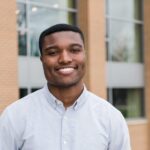
 Adrian Davey presented his summer 2017 research at the UC Berkeley, during his time as an Amgen Scholar. His work explored how the use of graphene-based catalysts to synthesize hydrogen peroxide can impact water decontamination efforts. Photo courtesy of Adrian Davey.