Research days foster collaboration and showcase research across the College of Engineering and Information Technology
A dynamic research ecosystem was on display in a series of events showcasing existing projects and encouraging new collaborations across the College of Engineering and Information Technology (COEIT) this spring.
On April 11, the second annual COEIT Research Day brought together more than 180 students and faculty from COEIT’s four academic departments, as well as outside speakers and visitors. Attendance increased by around 20 percent from last year’s inaugural Research Day.
More than 100 researchers presented either talks or posters at the meeting, and several students won awards for their posters and were recognized at the COEIT Awards and Celebration event on May 4.
“A major success of this year’s Research Day was the presence of visitors and speakers from industry, nonprofits, and government,” says Vandana Janeja, the associate dean for research in COEIT. “The event gave these guests an opportunity to visit UMBC and to engage in the vibrant research happening within COEIT, making connections with our research community that we hope to see grow into long-lasting partnerships.”
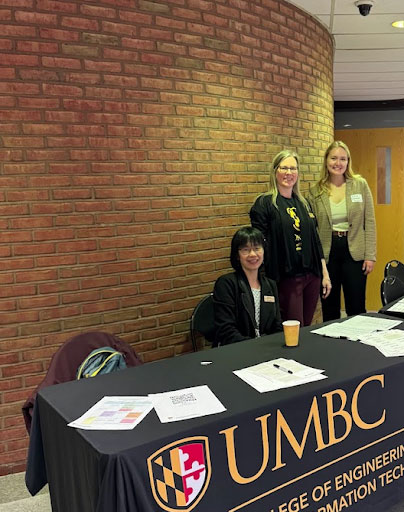 COEIT dean’s office staff Emily Tien, Amy Heckhaus, and Chloe Evered at COEIT Research Day. (Image courtesy of Vandana Janeja)
The college also launched a new call for COEIT Interdisciplinary Proposals. Last year, COEIT funded 11 projects from teams made up of researchers from two or more academic departments. The teams presented their results at this year’s event, on topics ranging from cybersecurity in manufacturing to thermally stable energy-harvesting materials.
On May 2, the Department of Computer Science and Electrical Engineering also hosted its annual research day, bringing together faculty, staff, and students to highlight the department’s latest advancements in research, from robotics to AI weather forecasting.
]]>
A dynamic research ecosystem was on display in a series of events showcasing existing projects and encouraging new collaborations across the College of Engineering and Information Technology...
https://umbc.edu/quick-posts/coeit-research-days/
https://my3.my.umbc.edu/api/v0/pixel/news/150553/guest@my.umbc.edu/2dabfa0e25e152f93f40d0b49805aa6b/api/pixel
cbee
coeit
csee
is
meche
news
quick-post
research
science-and-tech
UMBC News & Magazine
https://my3.my.umbc.edu/groups/umbc-news-magazine
https://assets1-my.umbc.edu/system/shared/avatars/groups/000/001/943/24435aa6207c452e7bc15cc74b42c7bb/xsmall.png?1748556657
https://assets1-my.umbc.edu/system/shared/avatars/groups/000/001/943/24435aa6207c452e7bc15cc74b42c7bb/original.png?1748556657
https://assets2-my.umbc.edu/system/shared/avatars/groups/000/001/943/24435aa6207c452e7bc15cc74b42c7bb/xxlarge.png?1748556657
https://assets2-my.umbc.edu/system/shared/avatars/groups/000/001/943/24435aa6207c452e7bc15cc74b42c7bb/xlarge.png?1748556657
https://assets3-my.umbc.edu/system/shared/avatars/groups/000/001/943/24435aa6207c452e7bc15cc74b42c7bb/large.png?1748556657
https://assets1-my.umbc.edu/system/shared/avatars/groups/000/001/943/24435aa6207c452e7bc15cc74b42c7bb/medium.png?1748556657
https://assets2-my.umbc.edu/system/shared/avatars/groups/000/001/943/24435aa6207c452e7bc15cc74b42c7bb/small.png?1748556657
https://assets1-my.umbc.edu/system/shared/avatars/groups/000/001/943/24435aa6207c452e7bc15cc74b42c7bb/xsmall.png?1748556657
https://assets2-my.umbc.edu/system/shared/avatars/groups/000/001/943/24435aa6207c452e7bc15cc74b42c7bb/xxsmall.png?1748556657
UMBC News & Magazine
0
0
false
Tue, 27 May 2025 07:37:00 -0400
Tue, 27 May 2025 07:37:00 -0400
UMBC researchers partner with UMB to advance healthcare technology
Dong Li, assistant professor in the Department of Computer Science and Electrical Engineering (CSEE), and Konstantinos Kalpakis, associate professor in CSEE, were recently awarded funding from the University of Maryland, Baltimore’s (UMB) Institute for Clinical and Translational Research to support the development of innovative healthcare technology. Both UMBC researchers are partnering with colleagues at UMB on their projects.
Li’s research aims to develop a reliable method to monitor blood pressure with a smartphone. High blood pressure, or hypertension, affects more than 1.3 billion people globally, and while conventional devices to monitor blood pressure are accurate, they are bulky and impractical in everyday life, Li says. As an affordable and accessible alternative, Li is testing if a smartphone, outfitted with ultrasound sensors to measure blood flow and using the built-in microphone to record heart sounds, could deliver reliable readings. Li’s partnership with UMB will allow the team to conduct clinical trials, with both healthy individuals and those with hypertension, to rigorously evaluate the system’s accuracy and effectiveness.
In a separate project, Kalpakis and his colleagues are developing a new approach to help trauma physicians make better-informed treatment decisions quickly. The team is working on a machine-learning framework that can help ER doctors predict medical outcomes, such as which patients will experience severe complications from trauma such as hemorrhaging, and what their blood transfusion needs may be. Unlike other machine learning models, the new approach can update over time and deliver measures of uncertainty, helping clinicians place more trust in the model’s guidance.
“These projects highlight how interdisciplinary collaboration between UMBC and the University of Maryland School of Medicine can drive innovations in medical care and improve public health,” Li says. “I’m excited and proud to take this work forward.”
]]>
Dong Li, assistant professor in the Department of Computer Science and Electrical Engineering (CSEE), and Konstantinos Kalpakis, associate professor in CSEE, were recently awarded funding from the...
https://umbc.edu/quick-posts/umbc-researchers-partner-with-umb-to-advance-healthcare-technology/
https://my3.my.umbc.edu/api/v0/pixel/news/150401/guest@my.umbc.edu/086acb89451841f10d32b33a2b73e85b/api/pixel
coeit
csee
news
quick-post
research
science-and-tech
UMBC News & Magazine
https://my3.my.umbc.edu/groups/umbc-news-magazine
https://assets1-my.umbc.edu/system/shared/avatars/groups/000/001/943/24435aa6207c452e7bc15cc74b42c7bb/xsmall.png?1748556657
https://assets1-my.umbc.edu/system/shared/avatars/groups/000/001/943/24435aa6207c452e7bc15cc74b42c7bb/original.png?1748556657
https://assets2-my.umbc.edu/system/shared/avatars/groups/000/001/943/24435aa6207c452e7bc15cc74b42c7bb/xxlarge.png?1748556657
https://assets2-my.umbc.edu/system/shared/avatars/groups/000/001/943/24435aa6207c452e7bc15cc74b42c7bb/xlarge.png?1748556657
https://assets3-my.umbc.edu/system/shared/avatars/groups/000/001/943/24435aa6207c452e7bc15cc74b42c7bb/large.png?1748556657
https://assets1-my.umbc.edu/system/shared/avatars/groups/000/001/943/24435aa6207c452e7bc15cc74b42c7bb/medium.png?1748556657
https://assets2-my.umbc.edu/system/shared/avatars/groups/000/001/943/24435aa6207c452e7bc15cc74b42c7bb/small.png?1748556657
https://assets1-my.umbc.edu/system/shared/avatars/groups/000/001/943/24435aa6207c452e7bc15cc74b42c7bb/xsmall.png?1748556657
https://assets2-my.umbc.edu/system/shared/avatars/groups/000/001/943/24435aa6207c452e7bc15cc74b42c7bb/xxsmall.png?1748556657
UMBC News & Magazine
1
0
false
Fri, 23 May 2025 15:23:01 -0400
A class reunion half a world away
With such a large population of Marylanders at UMBC, it’s not that unusual to run into someone you went to high school with. But when that someone is from your high school in Canberra, Australia, that’s a little more unexpected.
It was the love of the game that unexpectedly brought senior Annie Grove, biology,and junior Erin Behel, mechanical engineering,back together a few years after and a few thousand miles from where they first became friends. Behel is a softball player and daughter of a U.S. Marine, so moving was a regular family pastime. When she found herself in Australia (her mother’s home country) in grade seven, she met Grove, a soccer player, in high school. Once Behel’s father’s contract ended in 2018, she returned to Maryland. Unbeknownst to one another, they were both looking for athletic opportunities in the United States.
“I posted my announcement on social media saying I committed to UMBC, and I started getting all these messages from friends in Canberra saying ‘We’re pretty sure that’s where Grove is going!’” recalls Behel. “It was just insanity that out of all the colleges in the U.S., we’d both end up here.”
The friends can’t remember their first on-campus meeting (probably either the first student-athlete meeting or a visit to Behel’s dorm where Grove recalls “seeing all her pretty plants!”). But it’s certain they’ve enjoyed each other’s support since reconnecting and cheering from the stands at one another’s games.
There’s no “I” in team
Grove and Behel are just two of the many international student-athletes who have made UMBC their home away from home and support is at the forefront of those decisions.
Bruna De Padua, media and communications studies, originally traveled from Brazil to a small university in rural Missouri to pursue swimming. After a few months, she knew the fit wasn’t right and joined the NCAA transfer portal. Enter UMBC.
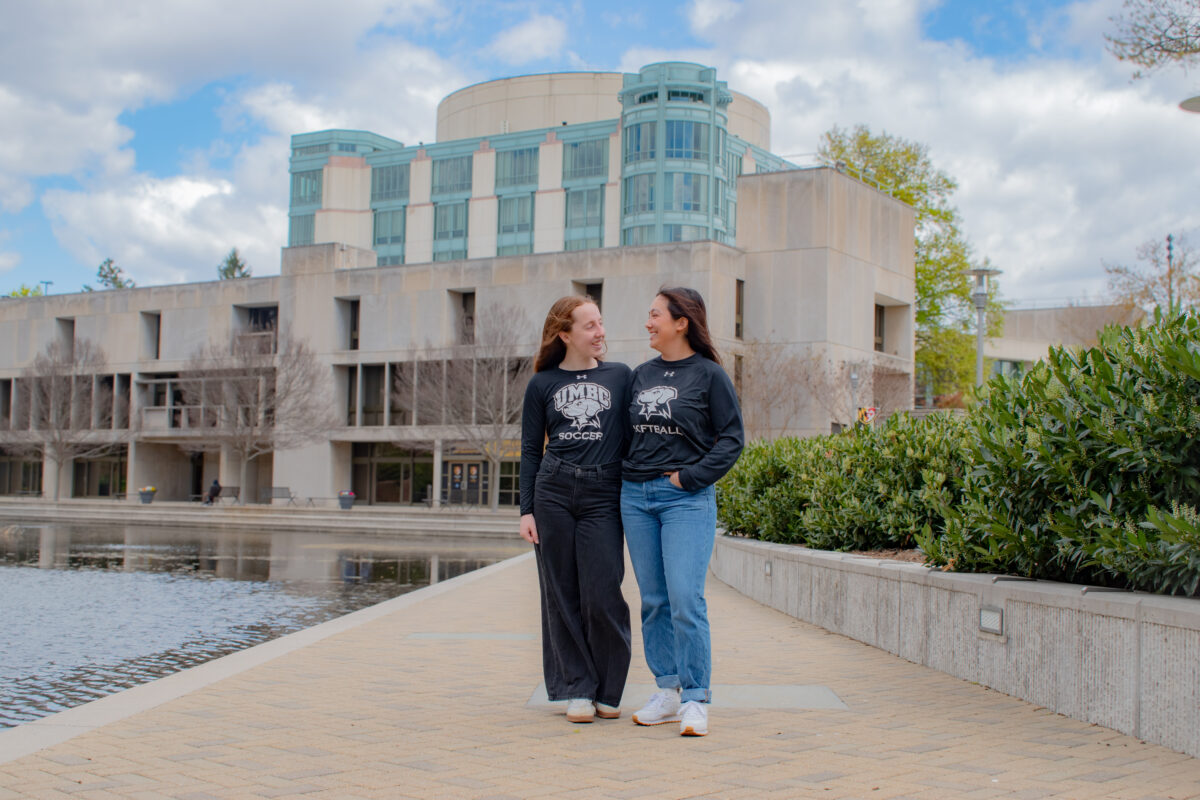 Grove, left, and Behel, right, are still on the same wavelength after all this time, unintentionally twinning in front of the library. (Mashaal Awan ’25/UMBC)
“As soon as I committed to UMBC, the process was so different from my other university,” De Padua says. For example, she appreciated how head swim coach Matt Donovan made sure she knew who to contact around campus for questions and help. Behel and Grove echo these sentiments, especially as it pertains to being able to focus on academics.
“I’ve heard from former teammates at other schools that they feel like they’re being punished if they choose to go to class and I’ve never, ever felt that,” says Behel.
Grove agreed, sharing, “Our coaches have always said that we need to go to class. And there’s so much emphasis on communication.”
Follow the leader
While they all agree the coaching staff has been invaluable in making their time at UMBC successful, they’re also grateful for fellow Retrievers who have helped throughout their journey.
De Padua is navigating her junior year now and knew she needed an internship to fulfill her academic requirements. After doing commercial modeling at an agency a fellow swim team alum Rola Hussein ’24 from Egypt worked for, De Padua was able to parlay that into her own spring/summer internship opportunity for the agency, doing social media and marketing.
 De Padua, right, congratulates teammate Makaela Hill. (Ian Feldmann ’21/UMBC Athletics)
She’s not the only one who was helped academically by her peers. Behel recalls a mechanical engineering softball player several years ahead of her who “paved the way for us to be able to show our coach and ourselves it’s possible to do both.”
In turn, Behel, De Padua, and Grove all seek to offer others support. “I’ve had so many conversations with people about how to get a bank account, how to get a phone number…really adult tasks that I had to figure out early on and now I’m passing it along,” says Grove.
They see UMBC as their home away from home and would encourage any international student-athlete to consider joining them. When asked what advice she would give to any new Retrievers from across the world, Grove simply summed up her experience by suggesting, “Just say yes to things and see what happens.”
]]>
With such a large population of Marylanders at UMBC, it’s not that unusual to run into someone you went to high school with. But when that someone is from your high school in Canberra, Australia,...
https://umbc.edu/stories/a-class-reunion-half-a-world-away/
https://my3.my.umbc.edu/api/v0/pixel/news/150330/guest@my.umbc.edu/10dcc2960210a68b1ecb561c2c57c95d/api/pixel
at-play
athletics
biology
campus-life
cnms
coeit
international
magazine
meche
spring-2025
story
UMBC News & Magazine
https://my3.my.umbc.edu/groups/umbc-news-magazine
https://assets1-my.umbc.edu/system/shared/avatars/groups/000/001/943/24435aa6207c452e7bc15cc74b42c7bb/xsmall.png?1748556657
https://assets1-my.umbc.edu/system/shared/avatars/groups/000/001/943/24435aa6207c452e7bc15cc74b42c7bb/original.png?1748556657
https://assets2-my.umbc.edu/system/shared/avatars/groups/000/001/943/24435aa6207c452e7bc15cc74b42c7bb/xxlarge.png?1748556657
https://assets2-my.umbc.edu/system/shared/avatars/groups/000/001/943/24435aa6207c452e7bc15cc74b42c7bb/xlarge.png?1748556657
https://assets3-my.umbc.edu/system/shared/avatars/groups/000/001/943/24435aa6207c452e7bc15cc74b42c7bb/large.png?1748556657
https://assets1-my.umbc.edu/system/shared/avatars/groups/000/001/943/24435aa6207c452e7bc15cc74b42c7bb/medium.png?1748556657
https://assets2-my.umbc.edu/system/shared/avatars/groups/000/001/943/24435aa6207c452e7bc15cc74b42c7bb/small.png?1748556657
https://assets1-my.umbc.edu/system/shared/avatars/groups/000/001/943/24435aa6207c452e7bc15cc74b42c7bb/xsmall.png?1748556657
https://assets2-my.umbc.edu/system/shared/avatars/groups/000/001/943/24435aa6207c452e7bc15cc74b42c7bb/xxsmall.png?1748556657
UMBC News & Magazine
2
0
false
Wed, 21 May 2025 11:34:52 -0400
Wed, 21 May 2025 11:34:52 -0400
Chhaya Kulkarni, Ph.D. ’25: Doing “the thing that scares you” leads information systems graduate across the stage
Toward the end of 2018, Chhaya Kulkarni, Ph.D. ’25, information sciences, was working as an IT analyst in India and contemplating pursuing higher education. Her mom, who had earned her own master’s degree in the ’80s, praised the mind-expanding potential of graduate work, and her cousin, who had already forged a path to UMBC, showcased the value of a Retriever education. In 2019, Kulkarni arrived on campus and began a fulfilling journey that will culminate as she dons her academic robes and is formally “hooded” at the graduate commencement ceremony on May 21. In the fall, she will be joining Towson University as an assistant professor in the Department of Computer and Information Sciences, where she will continue her research in Earth observation science and data analysis.
Q: What were your first impressions of UMBC?
A: When I came to UMBC, I was initially just going to get my master’s. I enjoyed learning and interacting with the professors—it was a completely new world for me. Here the emphasis is on: What have you understood? What’s your take on a subject? And I really felt that I belonged. So I started thinking, “What if I do a Ph.D.?” The thought had always scared me and I had read somewhere that the thing that scares you, that’s the thing that’s going to change your life.
Q: What were some of the biggest challenges you faced?
A: Throughout my life, I had instances where I would start something and then, once the thrill was gone, I just gave it up. So getting the Ph.D. was in a way a test of my ability to pursue something which is intellectually challenging, but you know, it can get tedious after a while. Also, I had a baby in 2023, and afterwards it was very challenging for me to understand how to prioritize and balance work and life tasks.
 Kulkarni talks about her research at the IEEE International Geoscience and Remote Sensing Symposium in 2023. (Image courtesy of Kulkarni)
Q: How did you meet those challenges?
A: My advisor, Dr. Vandana Janeja, has had a profound impact on my time at UMBC, and I’ve looked to her as a role model. What stood out to me from the very beginning was her ability to think several steps ahead—she has a visionary approach to research and leadership that always kept me inspired. And she inspires me to not get bogged down by hurdles in life. I remember I once spoke to her about a problem and she listened to me very patiently and then she asked me, “Okay, so what are you going to do about it?” And I realized what she was telling me was that I have the ability to fix problems.
Also, sometimes when I was overwhelmed by a task that seemed really complex and daunting, I’d talk to my mom. And she would tell me: “Why don’t you just start doing something? And you know, you’ll figure it out eventually.”
So those two things that Dr. Janeja and my mom told me—getting started and then determination to see it through—have left a profound impact on me.
Q: Are there qualities of your professors at UMBC that you’d like to emulate as you begin your own journey as a professor?
A: Yes, absolutely. When I was a teaching assistant, my supervisor was Dr. Jennifer Carter. I was struck by the care and thought she put into her teaching. She continuously refined her assignments and delivery to challenge students meaningfully. And she was so patient listening to students’ concerns. Her dedication and innovative teaching style made me reflect on how I want to teach—engaging, evolving, and impactful.
And then Dr. Janeja again. I learned so much from how she manages her time and balances multiple roles with grace, whether as a mentor, researcher, leader, or collaborator. She is incredibly strong technically and deeply organized, and yet she carries all of that with remarkable humility. Working with her shaped not just how I approached research but also how I strive to show up professionally—with clarity, purpose, and compassion.
 Kulkarni (second from left) at her Ph.D candidacy ceremony with her advisor Dr. Vandana Janeja (far left), fellow Ph.D. candidate Sahara Ali (third from left) and President Valerie Sheares Ashby.
Q: How would you describe your research to the public?
 Kalkarni (far right) with fellow students Emam Hossain (left) and Atefeh Jebeli at the Texas Advanced Computing Center at the University of Texas at Austin.
A: Well, first off, one of the best parts of my UMBC experience has been the chance to explore so many different topics across data science and computing—often outside my original comfort zone.
My dissertation focused on the glaciers in Greenland. We used a new type of data analysis technique to visualize vulnerable regions where the most amount of melt is happening. And the idea is that scientists can then concentrate on these regions, to better understand why they are melting faster than other regions, or to try to slow the melting. As the glaciers melts, it contributes significantly to sea level rise.
During my time at UMBC, I also received the NASA GESTAR II Fellowship, which gave me the opportunity to work with Dr. Nikki Privé, a scientist at NASA, on high-resolution digital twin simulations, which is where they make a virtual replica of the entire Earth’s atmosphere. In this case, we were using it to understand satellite data better. It was a valuable experience that connected my research to real-world applications.
I feel the most rewarding part of my research is seeing how it can be used by other people to advance science and our understanding of the world.
Q: What are some of your most memorable moments from your time at UMBC?
A: I was part of the National Science Foundation-funded research institute called iHARP, which works to integrate data science and polar science to better understand the polar regions of the Earth. There were a lot of other Ph.D. students there, and I met so many of my friends there. It was nice to meet in the hallways, ask about each others’ research, and joke around. We made many happy memories.
One of the most meaningful experiences was teaching Ethical Issues in Information Systems. While I built on existing course materials, facilitating the class helped me grow as an educator and engage students in important conversations about technology and responsibility.
Q: How do you feel about staying in Maryland after you graduate?
A: When I was applying for jobs, in the back of my mind I did always have the hope that I wouldn’t have to leave Maryland. So when I got the offer from Towson, I was thrilled. Maryland feels like home. I love the greenery around here, and I love going on hikes. In the summer I go a lot to Patapsco Valley State Park. And I love taking my son to the National Aquarium in Baltimore. That’s another place I proudly endorse.
]]>
Toward the end of 2018, Chhaya Kulkarni, Ph.D. ’25, information sciences, was working as an IT analyst in India and contemplating pursuing higher education. Her mom, who had earned her own...
https://umbc.edu/stories/chhaya-kulkarni-25/
https://my3.my.umbc.edu/api/v0/pixel/news/150312/guest@my.umbc.edu/8b0877780c3feac9e6ffc2d05f90f32f/api/pixel
class-of-2025
coeit
is
news
story
UMBC News & Magazine
https://my3.my.umbc.edu/groups/umbc-news-magazine
https://assets1-my.umbc.edu/system/shared/avatars/groups/000/001/943/24435aa6207c452e7bc15cc74b42c7bb/xsmall.png?1748556657
https://assets1-my.umbc.edu/system/shared/avatars/groups/000/001/943/24435aa6207c452e7bc15cc74b42c7bb/original.png?1748556657
https://assets2-my.umbc.edu/system/shared/avatars/groups/000/001/943/24435aa6207c452e7bc15cc74b42c7bb/xxlarge.png?1748556657
https://assets2-my.umbc.edu/system/shared/avatars/groups/000/001/943/24435aa6207c452e7bc15cc74b42c7bb/xlarge.png?1748556657
https://assets3-my.umbc.edu/system/shared/avatars/groups/000/001/943/24435aa6207c452e7bc15cc74b42c7bb/large.png?1748556657
https://assets1-my.umbc.edu/system/shared/avatars/groups/000/001/943/24435aa6207c452e7bc15cc74b42c7bb/medium.png?1748556657
https://assets2-my.umbc.edu/system/shared/avatars/groups/000/001/943/24435aa6207c452e7bc15cc74b42c7bb/small.png?1748556657
https://assets1-my.umbc.edu/system/shared/avatars/groups/000/001/943/24435aa6207c452e7bc15cc74b42c7bb/xsmall.png?1748556657
https://assets2-my.umbc.edu/system/shared/avatars/groups/000/001/943/24435aa6207c452e7bc15cc74b42c7bb/xxsmall.png?1748556657
UMBC News & Magazine
2
0
false
Tue, 20 May 2025 13:48:38 -0400
Tue, 20 May 2025 13:48:38 -0400
Community starts in the kitchen—Q&A with Ekiben’s Steve Chu ’12 and professor and author Mark Padoongpatt
The tantalizing aroma of food from everyone’s favorite UMBC alumni-founded restaurant, Ekiben, wafts through the air of the Albin O. Kuhn Library and Gallery. People are drawn in by the steamed buns and tofu nuggets and stay for the community, including a Q&A with Ekiben co-owner Steve Chu ’12, economics, and Mark Padoongpatt, associate professor and director of the Asian and Asian American Studies Program at the University of Nevada, Las Vegas. The discussion, part of the Reframing Global Asias Conversation Series and led by UMBC’s Global Asias Initiatives postdoctoral fellow Mika Thornburg, dives into Padoongpatt’s book, Flavors of Empire, with Chu providing support using his own experience creating community through food.
Mika Thornburg: Tell us a little about your personal history and how you came to work with food.
Steve Chu: When my family immigrated from Taiwan to the U.S., most decided to go into the restaurant business. All my aunts and uncles had restaurants at one point in time, so I grew up with it. I understood the work hours behind it, the work ethic. When I was 13, I read Anthony Bourdain’s Kitchen Confidential. I told my mom that this is what I wanted to do, and she was like, “No, you’re going to college.”
So I came to UMBC, studied economics, and every paper I did was about food. I did a paper on Taco Bell, did a paper on Chipotle, and around sophomore year I was like, alright, this is getting kind of silly. So I decided to get my first job in a restaurant and work and go to school full time. That’s when I started diving into this industry and I haven’t really looked back since.
Mark Padoongpatt: Growing up as a Thai American, you get associated with food even if you have no professional relationship to food at all. I didn’t want to perpetuate that stereotype, so I avoided even thinking about food until graduate school. And that’s when I realized Thai people are so visible through food. Thai food comes to stand in for Thai people and there’s really nothing else we know about Thai people.
So instead of talking about the community outside of food, I thought maybe I should just think about that. How did we come to this point where Thai food comes to stand in for Thai people? Since then, I’ve been thinking about food as a very dynamic way to study communities.

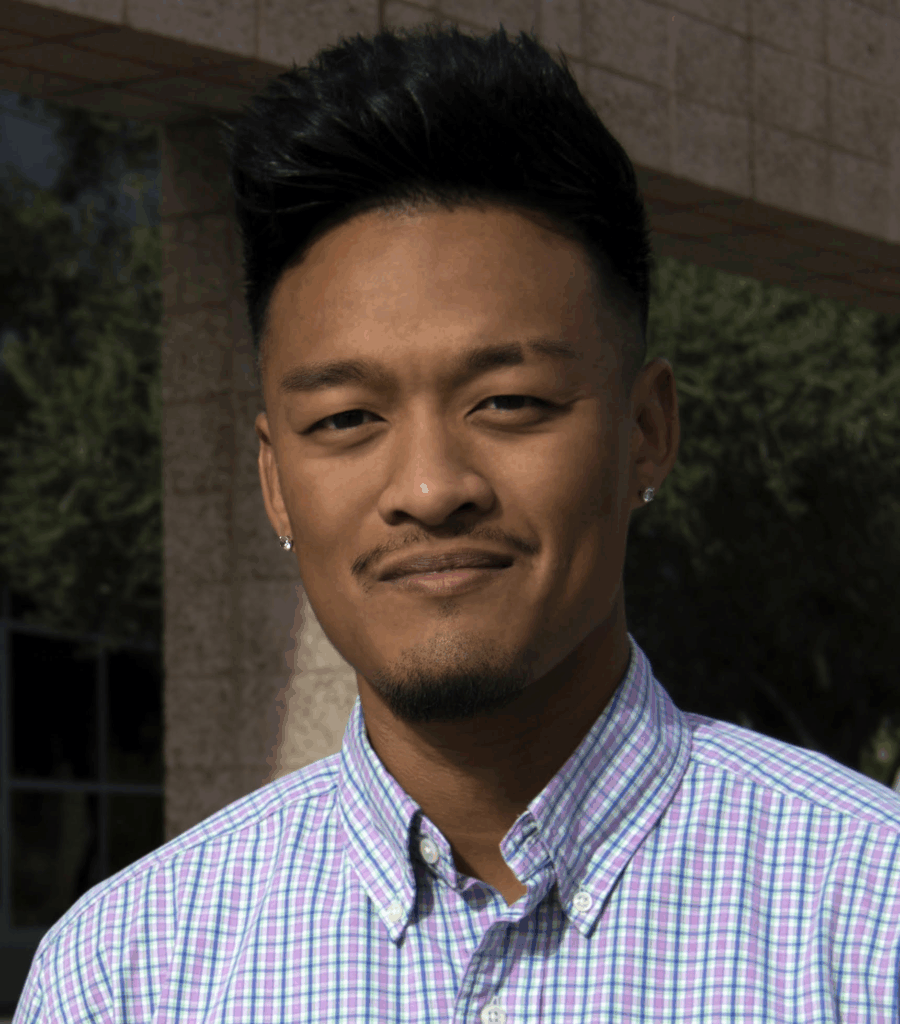
Steve Chu ’12, left, and Mark Padoongpatt, right.
Thornburg: Our event theme is about food and community. Can you speak a little bit about your perspective on the relationship between these two things from your respective position?
Chu: Food brings people together. You see that at this event, you see that at Costco with the free sample line. When we opened Ekiben in Baltimore City, we realized that it was a very polarized city, so we built a space where people from all walks of life could come, afford the food, and sit next to someone that they typically wouldn’t be sitting next to. On any Saturday, you’ll have a squeegee kid sitting next to a Jewish grandmother listening to Cardi B on the speakers, eating some fried chicken. It’s things that you normally wouldn’t put together. Food is a really, really powerful tool to build a community.
 Chu and Ekiben co-owner Ephrem Abebe ’13, information systems, chat with a customer in their original Fells Point location. Photo by Marlayna Demond ’11/UMBC.
Thornburg: What role can food play in changing culture and relationships between different groups of people, whether they be individuals, local communities or entire nations?
Padoongpatt: Food culture is incredibly transformative. Just look at European empires. How did they grow? Through food commodities. They created political and economic systems that were around food and food production. And so in terms of nation building, the evidence is all there in terms of the significance of food and the role that food can play.
The Thai government for the last 15 years has been pouring a lot of effort, time, and energy into this through a kind of gastro diplomacy so that more people will come to Thailand. I think it is a great way to stimulate curiosity and human connection, but just the eating of the food itself is not enough.
Chu: What I find really cool is if you grew up in a very diverse community, chances are you’ve had a very diverse group of friends and you’ve tried a very diverse group of foods. And that helps break down walls and allow for understanding and the building of community. One of the coolest things about coming to UMBC was how diverse a group of friends I was able to meet.
After UMBC, I went to New York and worked as a line cook, and I brought back a lot of creativity with me. I sat down with my two future business partners, [Ephrem Abebe ’13, information systems, and Nikhil Yesurpriya ’13, M.S. ’16, biological sciences]. I said, “Hey, bring me all these random ingredients that your moms aren’t using in the pantry.” And so they bring me all this stuff, and over time we just learned how to incorporate it into our core menu. Honestly, there wasn’t a lot of thought behind it—except, “that tastes good.”
Learn more about the Global Asias Initiative and follow along with their events.
]]>
The tantalizing aroma of food from everyone’s favorite UMBC alumni-founded restaurant, Ekiben, wafts through the air of the Albin O. Kuhn Library and Gallery. People are drawn in by the steamed...
https://umbc.edu/stories/community-starts-in-the-kitchen/
https://my3.my.umbc.edu/api/v0/pixel/news/150232/guest@my.umbc.edu/ffba7d4ce69f531b7e1004153f991fa3/api/pixel
alumni
at-play
baltimore-city
cahss
campus-life
coeit
economics
ekiben
global-asias
information-systems-management
magazine
story
UMBC News & Magazine
https://my3.my.umbc.edu/groups/umbc-news-magazine
https://assets1-my.umbc.edu/system/shared/avatars/groups/000/001/943/24435aa6207c452e7bc15cc74b42c7bb/xsmall.png?1748556657
https://assets1-my.umbc.edu/system/shared/avatars/groups/000/001/943/24435aa6207c452e7bc15cc74b42c7bb/original.png?1748556657
https://assets2-my.umbc.edu/system/shared/avatars/groups/000/001/943/24435aa6207c452e7bc15cc74b42c7bb/xxlarge.png?1748556657
https://assets2-my.umbc.edu/system/shared/avatars/groups/000/001/943/24435aa6207c452e7bc15cc74b42c7bb/xlarge.png?1748556657
https://assets3-my.umbc.edu/system/shared/avatars/groups/000/001/943/24435aa6207c452e7bc15cc74b42c7bb/large.png?1748556657
https://assets1-my.umbc.edu/system/shared/avatars/groups/000/001/943/24435aa6207c452e7bc15cc74b42c7bb/medium.png?1748556657
https://assets2-my.umbc.edu/system/shared/avatars/groups/000/001/943/24435aa6207c452e7bc15cc74b42c7bb/small.png?1748556657
https://assets1-my.umbc.edu/system/shared/avatars/groups/000/001/943/24435aa6207c452e7bc15cc74b42c7bb/xsmall.png?1748556657
https://assets2-my.umbc.edu/system/shared/avatars/groups/000/001/943/24435aa6207c452e7bc15cc74b42c7bb/xxsmall.png?1748556657
UMBC News & Magazine
0
0
false
Fri, 16 May 2025 10:51:47 -0400
Fri, 16 May 2025 10:51:47 -0400
Governments continue losing efforts to gain backdoor access to secure communications
Written by Richard Forno, principal lecturer in computer science and electrical engineering, UMBC
Reports that prominent American national security officials used a freely available encrypted messaging app, coupled with the rise of authoritarian policies around the world, have led to a surge in interest in encrypted apps like Signal and WhatsApp. These apps prevent anyone, including the government and the app companies themselves, from reading messages they intercept.
The spotlight on encrypted apps is also a reminder of the complex debate pitting government interests against individual liberties. Governments desire to monitor everyday communications for law enforcement, national security and sometimes darker purposes. On the other hand, citizens and businesses claim the right to enjoy private digital discussions in today’s online world.
The positions governments take often are framed as a “war on encryption” by technology policy experts and civil liberties advocates. As a cybersecurity researcher, I’ve followed the debate for nearly 30 years and remain convinced that this is not a fight that governments can easily win.
Understanding the ‘golden key’
Traditionally, strong encryption capabilities were considered military technologies crucial to national security and not available to the public. However, in 1991, computer scientist Phil Zimmermann released a new type of encryption software called Pretty Good Privacy (PGP). It was free, open-source software available on the internet that anyone could download. PGP allowed people to exchange email and files securely, accessible only to those with the shared decryption key, in ways similar to highly secured government systems.
Following an investigation into Zimmermann, the U.S. government came to realize that technology develops faster than law and began to explore remedies. It also began to understand that once something is placed on the internet, neither laws nor policy can control its global availability.
Fearing that terrorists or criminals might use such technology to plan attacks, arrange financing or recruit members, the Clinton administration advocated a system called the Clipper Chip, based on a concept of key escrow. The idea was to give a trusted third party access to the encryption system and the government could use that access when it demonstrated a law enforcement or national security need.
End-to-end encryption and backdoor access explained.
Clipper was based on the idea of a “golden key,” namely, a way for those with good intentions – intelligence services, police – to access encrypted data, while keeping people with bad intentions – criminals, terrorists – out.
Clipper Chip devices never gained traction outside the U.S. government, in part because its encryption algorithm was classified and couldn’t be publicly peer-reviewed. However, in the years since, governments around the world have continued to embrace the golden key concept as they grapple with the constant stream of technology developments reshaping how people access and share information.
Following Edward Snowden’s disclosures about global surveillance of digital communications in 2013, Google and Apple took steps to make it virtually impossible for anyone but an authorized user to access data on a smartphone. Even a court order was ineffective, much to the chagrin of law enforcement. In Apple’s case, the company’s approach to privacy and security was tested in 2016 when the company refused to build a mechanism to help the FBI break into an encrypted iPhone owned by a suspect in the San Bernardino terrorist attack.
At its core, encryption is, fundamentally, very complicated math. And while the golden key concept continues to hold allure for governments, it is mathematically difficult to achieve with an acceptable degree of trust. And even if it was viable, implementing it in practice makes the internet less safe. Security experts agree that any backdoor access, even if hidden or controlled by a trusted entity, is vulnerable to hacking.
Competing justifications and tech realities
Governments around the world continue to wrestle with the proliferation of strong encryption in messaging tools, social media and virtual private networks.
For example, rather than embrace a technical golden key, a recent proposal in France would have provided the government the ability to add a hidden “ghost” participant to any encrypted chat for surveillance purposes. However, legislators removed this from the final proposal after civil liberties and cybersecurity experts warned that such an approach would undermine basic cybersecurity practices and trust in secure systems.
In 2025, the U.K. government secretly ordered Apple to add a backdoor to its encryption services worldwide. Rather than comply, Apple removed the ability for its iPhone and iCloud customers in the U.K. to use its Advanced Data Protection encryption features. In this case, Apple chose to defend its users’ security in the face of government mandates, which ironically now means that users in the U.K. may be less secure.
Apple pulled its advanced encryption service from the U.K. market rather than grant the U.K. government backdoor access.
In the United States, provisions removed from the 2020 EARN IT bill would have forced companies to scan online messages and photos to guard against child exploitation by creating a golden-key-type hidden backdoor. Opponents viewed this as a stealth way of bypassing end-to-end encryption. The bill did not advance to a full vote when it was last reintroduced in the 2023-2024 legislative session.
Opposing scanning for child sexual abuse material is a controversial concern when encryption is involved: Although Apple received significant public backlash over its plans to scan user devices for such material in ways that users claimed violated Apple’s privacy stance, victims of child abuse have sued the company for not better protecting children.
Even privacy-centric Switzerland and the European Union are exploring ways of dealing with digital surveillance and privacy in an encrypted world.
The laws of math and physics, not politics
Governments usually claim that weakening encryption is necessary to fight crime and protect the nation – and there is a valid concern there. However, when that argument fails to win the day, they often turn to claiming to need backdoors to protect children from exploitation.
From a cybersecurity perspective, it is nearly impossible to create a backdoor to a communications product that is only accessible for certain purposes or under certain conditions. If a passageway exists, it’s only a matter of time before it is exploited for nefarious purposes. In other words, creating what is essentially a software vulnerability to help the good guys will inevitably end up helping the bad guys, too.
Often overlooked in this debate is that if encryption is weakened to improve surveillance for governmental purposes, it will drive criminals and terrorists further underground. Using different or homegrown technologies, they will still be able to exchange information in ways that governments can’t readily access. But everyone else’s digital security will be needlessly diminished.
This lack of online privacy and security is especially dangerous for journalists, activists, domestic violence survivors and other at-risk communities around the world.
Encryption obeys the laws of math and physics, not politics. Once invented, it can’t be un-invented, even if it frustrates governments. Along those lines, if governments are struggling with strong encryption now, how will they contend with a world when everyone is using significantly more complex techniques like quantum cryptography?
Governments remain in an unenviable position regarding strong encryption. Ironically, one of the countermeasures the government recommended in response to China’s hacking of global telephone systems in the Salt Typhoon attacks was to use strong encryption in messaging apps such as Signal or iMessage.
Reconciling that with their ongoing quest to weaken or restrict strong encryption for their own surveillance interests will be a difficult challenge to overcome.
This article is republished from The Conversation under a Creative Commons license. Read the original article and see more than 250 UMBC articles available in The Conversation.
]]>
Written by Richard Forno, principal lecturer in computer science and electrical engineering, UMBC Reports that prominent American national security officials used a freely available encrypted...
https://umbc.edu/stories/governments-continue-losing-efforts-to-gain-backdoor-access-to-secure-communications/
https://my3.my.umbc.edu/api/v0/pixel/news/150225/guest@my.umbc.edu/c3cb0ee58316922895469d3133b6942b/api/pixel
coeit
csee
discovery
magazine
story
the-conversation
UMBC News & Magazine
https://my3.my.umbc.edu/groups/umbc-news-magazine
https://assets1-my.umbc.edu/system/shared/avatars/groups/000/001/943/24435aa6207c452e7bc15cc74b42c7bb/xsmall.png?1748556657
https://assets1-my.umbc.edu/system/shared/avatars/groups/000/001/943/24435aa6207c452e7bc15cc74b42c7bb/original.png?1748556657
https://assets2-my.umbc.edu/system/shared/avatars/groups/000/001/943/24435aa6207c452e7bc15cc74b42c7bb/xxlarge.png?1748556657
https://assets2-my.umbc.edu/system/shared/avatars/groups/000/001/943/24435aa6207c452e7bc15cc74b42c7bb/xlarge.png?1748556657
https://assets3-my.umbc.edu/system/shared/avatars/groups/000/001/943/24435aa6207c452e7bc15cc74b42c7bb/large.png?1748556657
https://assets1-my.umbc.edu/system/shared/avatars/groups/000/001/943/24435aa6207c452e7bc15cc74b42c7bb/medium.png?1748556657
https://assets2-my.umbc.edu/system/shared/avatars/groups/000/001/943/24435aa6207c452e7bc15cc74b42c7bb/small.png?1748556657
https://assets1-my.umbc.edu/system/shared/avatars/groups/000/001/943/24435aa6207c452e7bc15cc74b42c7bb/xsmall.png?1748556657
https://assets2-my.umbc.edu/system/shared/avatars/groups/000/001/943/24435aa6207c452e7bc15cc74b42c7bb/xxsmall.png?1748556657
UMBC News & Magazine
2
0
false
Fri, 16 May 2025 10:09:58 -0400
Fri, 16 May 2025 10:09:58 -0400
Public law for public good
On a fall Saturday morning, Mohammad Arshad, an information systems senior, greeted clients arriving at the Erickson School of Aging Studies looking for a fresh start with the help of UMBC’s first Expungement Clinic. After completing the intake forms, Arshad passed the files to pro-bono lawyers and staff from Maryland Legal Aid and pro-bono lawyers from the Baltimore County Bar Association. They carefully reviewed each client’s criminal records to determine eligibility for clearing or sealing certain charges or offenses that can create barriers to jobs, housing, and education
When Jessica Cook, associate director of the Sondheim Public Affairs Scholar Program, noticed that Loyola University has this program, she connected with Molly Timko, UMBC’s pre-law academic advisor, and discussed bringing the program to UMBC. They established the clinic with funding from UMBC’s Center for Democracy and Civic Life. As soon as a call was made for 20 student volunteers, the response was overwhelming.
 Expungement clinic volunteers (l-r): Damilola Khadijat Yusuf, a philosophy sophomore; Oyinlola Oluka, a political science and philosophy senior; Desta’nae Nicole Wilson ’24, psychology; Jessica Cook, associate director of the Sondheim Public Affairs Scholar Program. (center); Jean Kim, a global studies junior; Thara Pillai, a political science sophomore; Samantha Kennedy ’25, a social work senior; Cooper; Garret Miller, a financial economics sophomore; and Arshad. (Image courtesy of Timko)
Sometimes it’s hard to get internships as an undergraduate student, notes Timko. “The exposure to public interest law—doing law for the greater good—and to network with lawyers in various fields broadens students’ understanding of what being a lawyer can look like beyond arguing in a courtroom,” says Timko, a licensed attorney in Maryland, Washington, D.C., and New York. In her role at UMBC, Timko provides career pathway counseling and law school application support for UMBC students of all majors, as well as alumni.
“It was the first time I saw a law-related volunteer opportunity on campus,” said Arshad. He serves as the senate president of the Maryland Student Legislation (MSL), a model Maryland General Assembly. Currently, there are 15 college delegations, governed by the Council of States, a group of six college students elected by MSL members. Arshad serves as the lieutenant governor.
 Mohammad Arshad (l) with Maryland State Delegate, Christopher Michael Griffith. (Image courtesy of Arshad)
This experiential learning experience teaches students how to draft original legislation and debate bills, navigate parliamentary procedures, and understand the legislative process. At the end of the year, all of the legislation adopted by the students is shared with members of the Maryland General Assembly for their review. “As someone interested in the legal field, I saw the Expungement Clinic as a meaningful way to deepen my understanding of the legal process.”
 Oyinlola Oluka assists with a client intake at the Expungement Clinic. (Image courtesy of Timko)
The expungement clinic was streamlined to assist as many clients as possible. No appointment was needed. Lawyers arrived equipped with laptops and printers, prepared to complete and file paperwork. Angus Derbyshire, director for Pro Bono at Maryland Legal Aid, who spearheads expungement clinics across Maryland, reported that 14 clients were served at the UMBC Expungement Clinic, and 10 of them had cases that were deemed potentially eligible for expungement. “This resulted in the preparation of 24 expungement petitions, which is a meaningful outcome for both the clients and the community,” said Derbyshire.
As a first-generation college student, Arshad had never seen the legal process in action firsthand, let alone been part of it. What surprised him most was the collaboration and community focus. “I had always assumed legal work was mostly done behind the scenes, but this clinic showed me how much personal interaction and empathy are involved,” said Arshad, who plans to practice intellectual property law defending the rights of inventors, entrepreneurs, and developers. “It also gave me a better understanding of expungement and how access to legal resources can significantly improve someone’s future opportunities.”
All majors to the legal field
Despite the overwhelming response from volunteers for the expungement clinic, Timko has noticed that many students still assume a political science major is required to pursue a career in law. Like Arshad, Timko is a first-generation law student with a major outside of political science. She majored in anthropology and art history, with a minor in Italian, but wasn’t sure if she wanted to pursue a Ph.D. in either field. “During my master’s program in higher education and student affairs administration, I studied abroad in South Africa and took a course on social reform in post-apartheid South Africa. It sparked my interest in education and advocacy law,” says Timko.
One of Timko’s bigger goals is to help students discover their spark. “It’s important for students to know you can major in anything. There are so many ways to be a lawyer. There’s the stereotypical trial lawyer, but there are also lawyers focused on research and writing that never set foot in a courtroom,” says Timko who is also the advisor for UMBC’s Pre-Law Society that helps student prepare for the Law School Admissions Test (LSAT) and network with area schools. “You don’t have to be super extroverted or argumentative to be a really good lawyer.” There is also no expiration date on when you can decide to pursue a legal career.

 Timko (right with gold jacket) and UMBC’s Pre-Law Society students visit nearby law schools. (Images courtesy of Timko)
This is why she was excited when Shannon Ziegler ’14, fine arts, and Alexander Langsam ’22, biology, reached out to her for guidance on applying to law school. Both had initially worked in their respective fields, which unexpectedly led them in new directions—Ziegler in the financial technology industry and Langsam in civil service, which then spurred in them an interest in law.
After completing the pre-med track at UMBC, Langsam dove into studying for the Medical College Admission Test and worked as a medical assistant. When he saw firsthand the challenges faced by providers and patients, he pivoted and decided to pursue a master’s in public health policy instead, while continuing to work in civil service. There, he spent time learning about the work of the general counsel, which confirmed for him the impact lawyers can have at the federal level.
“I had never considered law school before, so when I began to think of it as a possible career, I looked up UMBC pre-law advising and emailed Molly out of the blue. She guided me through the law school application process,” said Langsam. “If you can, expand your career options beyond your degree because there are so many things you can do in this world that may not be obvious in undergrad.” He will complete his masters in May and continue to the University of Baltimore Law School in the fall.
Ziegler is about to finish her first year of law school at the University of Maryland Francis King Carey School of Law. In the decade before law school, she balanced being a business manager for Baltimore’s Center Stage by day and acting by night. She then checked off living in Chicago from her bucket list, where she worked at Venmo, launching a career at the crossroads of financial regulation and technology, the topic of her law school admissions essay.
Timko is on the Law School Admission Council directory as an undergraduate pre-law school advisor and receives an alert when an alum takes the LSAT. As soon as she was sent Ziegler’s results, she touched base with her. “It had been so long since I left UMBC that I didn’t think of reaching out. Molly gave me great advice on how to focus my application better and what to prioritize in my search,” said Ziegler. “She helped me slow down to think about what my goals are. I found that reframing really helpful.”
Making the LSAT accessible
 Megumi Fukuzawa. (Image courtesy of Fukuzawa)
At the core of the pre-law advising programming is a mission to create a supportive community where UMBC’s law school hopefuls can develop the skills, strategies, and confidence to navigate the various steps between studying for the LSAT and the first year of law school. This spring, Megumi Fukuzawa ’23, political science, who is currently studying for the LSAT, understands the need for support. Like many undergraduate students, Fukuzawa’s schedule was jam-packed. Whenever she carved out time to study for the LSAT, she felt lost and discouraged. “I needed help understanding the materials and advice about how to study effectively,” said Fukuzawa, a research assistant at the Howard County Historical Society’s Archives and Historical Center. “The only flyer I saw on campus was during my junior year, advertising a $1,000 introductory LSAT course. At that point, the LSAT felt like a massive wall I couldn’t break through.”
Thanks to a professional development grant from the American Studies Department, she was able to access study materials during her senior year. This spring, Fukuzawa asked Timko if she could lead an LSAT preparation information session.“By hosting this LSAT prep information session, providing free tutoring, and forming an online study community for UMBC LSAT students, I hope to make LSAT prep, and by extension, a legal education, more accessible to UMBC students and alumni,” said Fukuzawa. Arshad is also championing the need to help fund LSAT preparation materials, for Fukuwaza, himself, and other pre-law students who can’t afford expensive study aids. Arshad is collaborating with peers and community members on a long-term solution to establish a UMBC partnership with an LSAT coaching provider to offset LSAT preparation costs.
Advocacy and fairness are Arshad’s core values. They have defined his student work as well as his career plans to practice intellectual property law. “My background in systems and data gives me a unique perspective on how legal services, like the Expungement Clinic, can be streamlined and made more accessible through innovation,” said Arshad. “Volunteering at the expungement clinic made me think about how I can apply my tech skills to create more efficient and equitable legal solutions.”
Learn more about UMBC’s Expungement Clinic and pre-law advising.
]]>
On a fall Saturday morning, Mohammad Arshad, an information systems senior, greeted clients arriving at the Erickson School of Aging Studies looking for a fresh start with the help of UMBC’s first...
https://umbc.edu/stories/public-law-for-public-good/
https://my3.my.umbc.edu/api/v0/pixel/news/150161/guest@my.umbc.edu/62c19cce5439e59fc3b514d5ea6a7daf/api/pixel
baltimore-city
cahss
class-of-2025
cnms
coeit
economics
erickson-school
fine-arts
global-studies
impact
magazine
mcs
philosophy
political-science
psychology
social-work
sondheim-public-affairs-scholars-program
story
UMBC News & Magazine
https://my3.my.umbc.edu/groups/umbc-news-magazine
https://assets1-my.umbc.edu/system/shared/avatars/groups/000/001/943/24435aa6207c452e7bc15cc74b42c7bb/xsmall.png?1748556657
https://assets1-my.umbc.edu/system/shared/avatars/groups/000/001/943/24435aa6207c452e7bc15cc74b42c7bb/original.png?1748556657
https://assets2-my.umbc.edu/system/shared/avatars/groups/000/001/943/24435aa6207c452e7bc15cc74b42c7bb/xxlarge.png?1748556657
https://assets2-my.umbc.edu/system/shared/avatars/groups/000/001/943/24435aa6207c452e7bc15cc74b42c7bb/xlarge.png?1748556657
https://assets3-my.umbc.edu/system/shared/avatars/groups/000/001/943/24435aa6207c452e7bc15cc74b42c7bb/large.png?1748556657
https://assets1-my.umbc.edu/system/shared/avatars/groups/000/001/943/24435aa6207c452e7bc15cc74b42c7bb/medium.png?1748556657
https://assets2-my.umbc.edu/system/shared/avatars/groups/000/001/943/24435aa6207c452e7bc15cc74b42c7bb/small.png?1748556657
https://assets1-my.umbc.edu/system/shared/avatars/groups/000/001/943/24435aa6207c452e7bc15cc74b42c7bb/xsmall.png?1748556657
https://assets2-my.umbc.edu/system/shared/avatars/groups/000/001/943/24435aa6207c452e7bc15cc74b42c7bb/xxsmall.png?1748556657
UMBC News & Magazine
4
0
false
Wed, 14 May 2025 14:48:23 -0400
Wed, 14 May 2025 14:48:23 -0400
Finding the harmony within art and science
At UMBC, undergraduate students are redefining the boundaries of scientific and artistic pursuits. From a chemical engineer who graces the stage with his cello to a bioinformatician who paints and a biochemist who ignites the dance floor with Latin rhythms, these scholars thrive in an environment that celebrates their diverse passions.
This spring, several U-RISE Scholars—the National Institutes of Heath’s Undergraduate Research Training Initiative for Student Enhancement—shared their multidisciplinary interests with Jacqueline King, associate director of the U-RISE program, and Mariano Sto. Domingo, associate director of research and evaluation within the Meyerhoff Scholars Program. As a result, King and Sto. Domingo started researching how the arts and science blend in these students’ lives, and presented their findings at an academic conference this spring. What they learned was that here, rigorous research and creative expression intertwine, fostering a vibrant community where students explore every dimension of their talents.
Ajeetha Aruchandran, a seniorbioinformatics and computational biology major, studies how the neural tube—a precursor to the spinal cord—forms in zebrafish embryos with Rachel Brewster, professor of biological sciences.
The development of the embryos, which are transparent, “is a very visual process,” Aruchandran says. Her artistic skills have allowed her to generate beautiful and accurate diagrams that communicate her research, she says. “When you’re not able to communicate science well, then the meaning is lost. So I think my art has really strengthened that aspect of my science. The connection has surprised and delighted me, because for a long time I thought my science and my art had to be separate.”
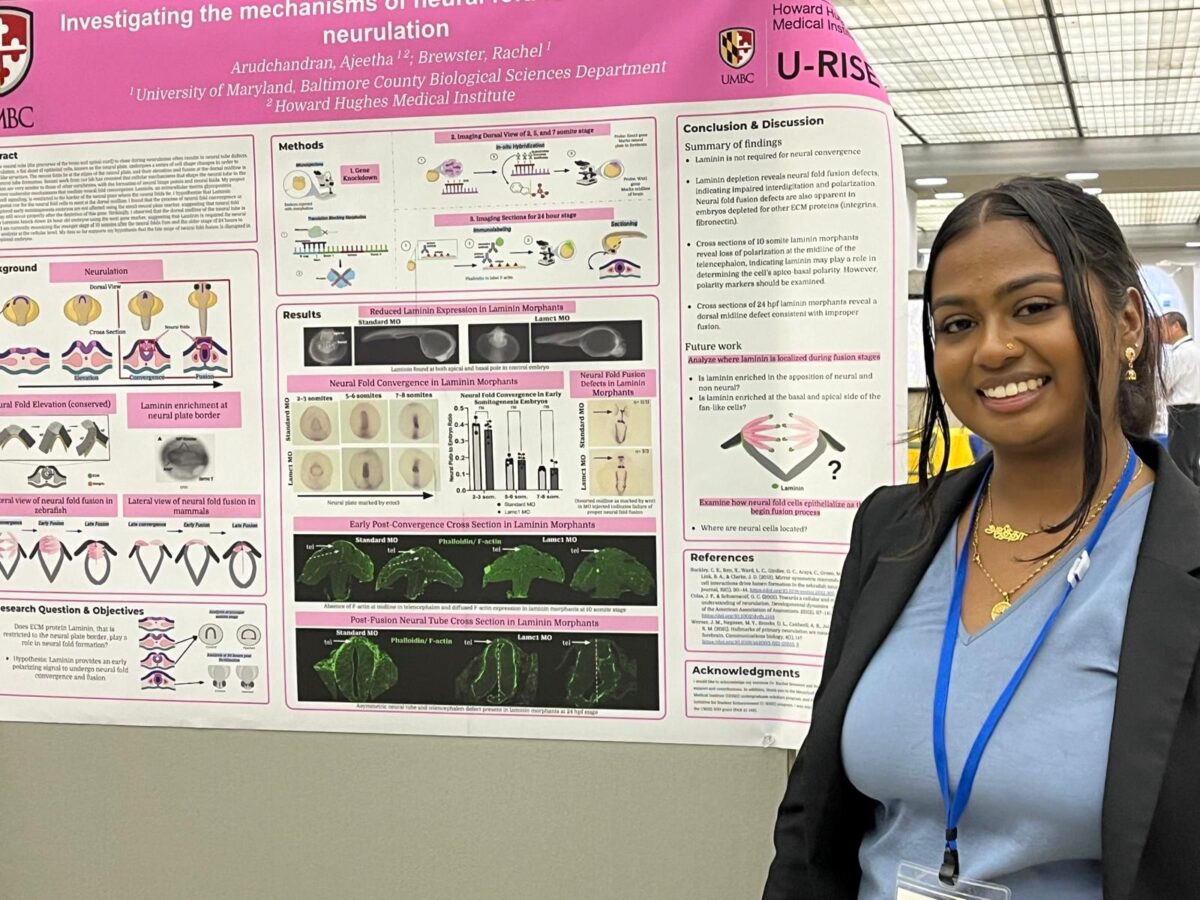
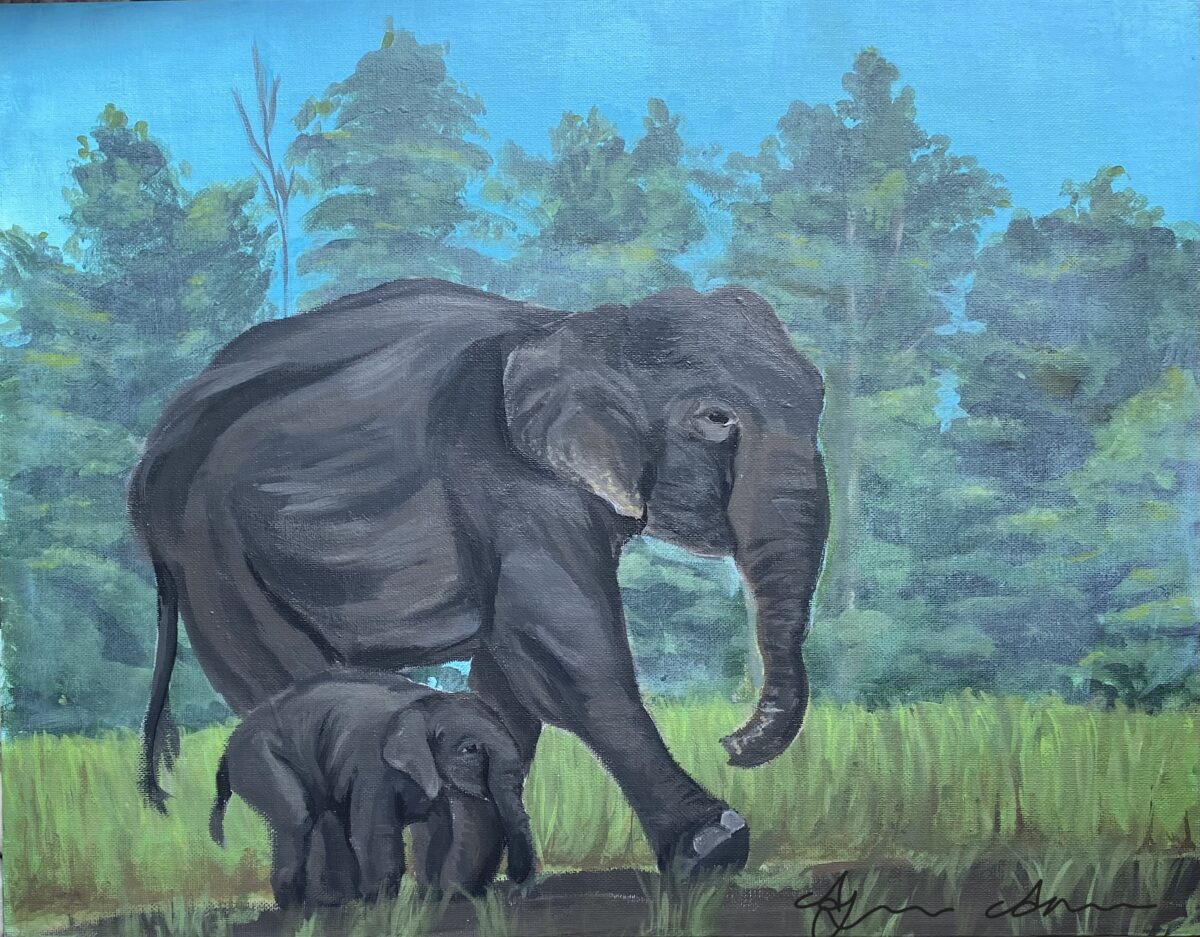 Biologist Ajeetha Aruchandran also loves to paint. (Courtesy of Aruchandran)
Aruchandran began with drawing, but has transitioned to painting. “There’s something so special about the freeness of a brushstroke,” she says. The two pursuits “create balance in my life, because when I need more structure, I have research and the scientific method, but when I need to feel more free, I have my art.”
Rhythm and harmony
Lesley Hernandez, a senior majoring in biochemistry and molecular biology, is hunting for factors that regulate how viruses like HIV multiply in cells with Michael Summers, University Distinguished Professor of Cchemistry and Bbiochemistry. The ultimate goal is to disrupt the viruses’ replication. She also loves to dance.
“My family is from the Dominican Republic, so I grew up surrounded by music and movement. I decided to embrace that part of my culture at UMBC by joining the Latin Dance Club, where I could perform and share my love for dance with others,” Hernandez says. “I love incorporating dance into the workspace by sharing a laugh with my peers and dancing between experiments. It fosters stronger connections and creates an enjoyable work environment.”
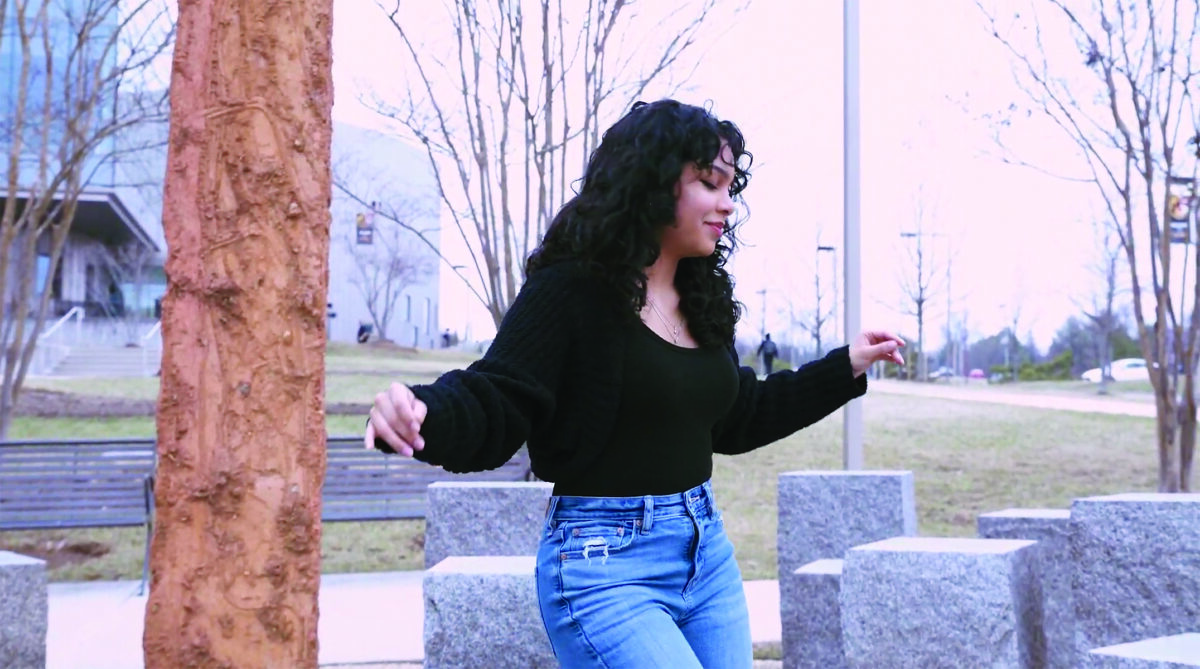
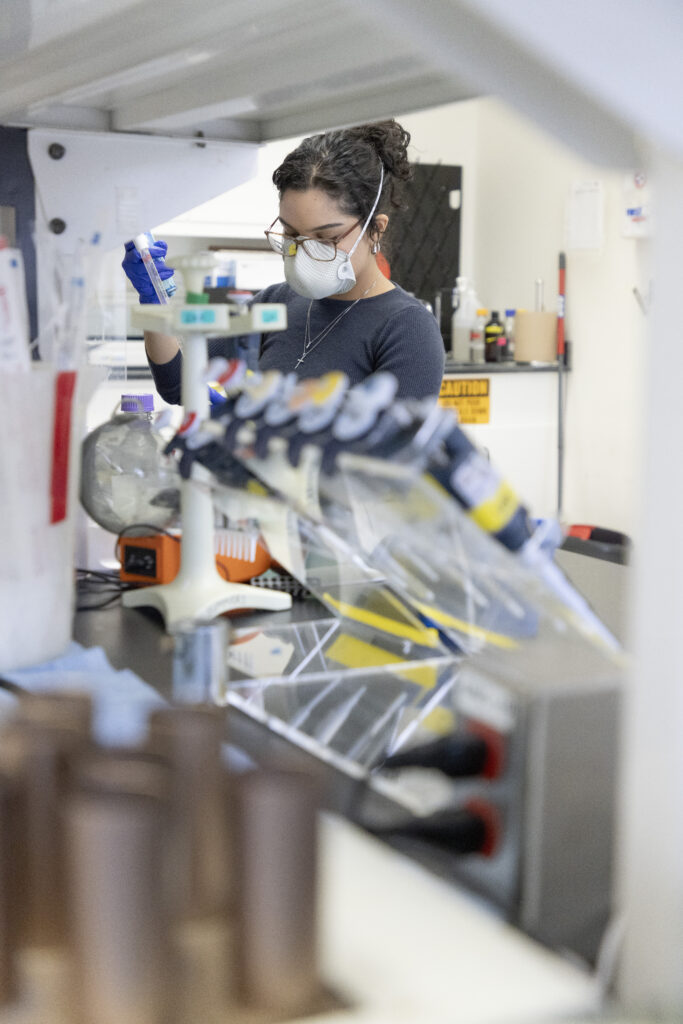 Lesley Hernandez loves being able to “go to my dance class and come back [to the lab] with a refreshed mind.” (Melissa Penley Cormier, M.F.A. ’17/UMBC)
And, when the science gets intense, “I can go to my dance class and come back with a refreshed mind,” Hernandez says. Her attention to detail benefits both her science and her dance. Being “a calculated person” helps her pick up rhythmically complex dance moves more quickly, for example. Both activities also require creativity, whether in trouble-shooting an experiment that’s not working or coming up with new dance routines.
In the Summers lab, “We are all really into science, but what is fun for you outside of that? Everyone in my lab has their own outlet, and that is encouraged,” Hernandez says.
For Daisy Parry, a senior majoring in biological sciences, that outlet is singing. “I’ve had a lot of interests that have come and gone, but singing has been a constant thread throughout my life. It’s very important and very centering to me,” Parry says. Her music minor has created dedicated times that provide a respite from the demands of science, she says.
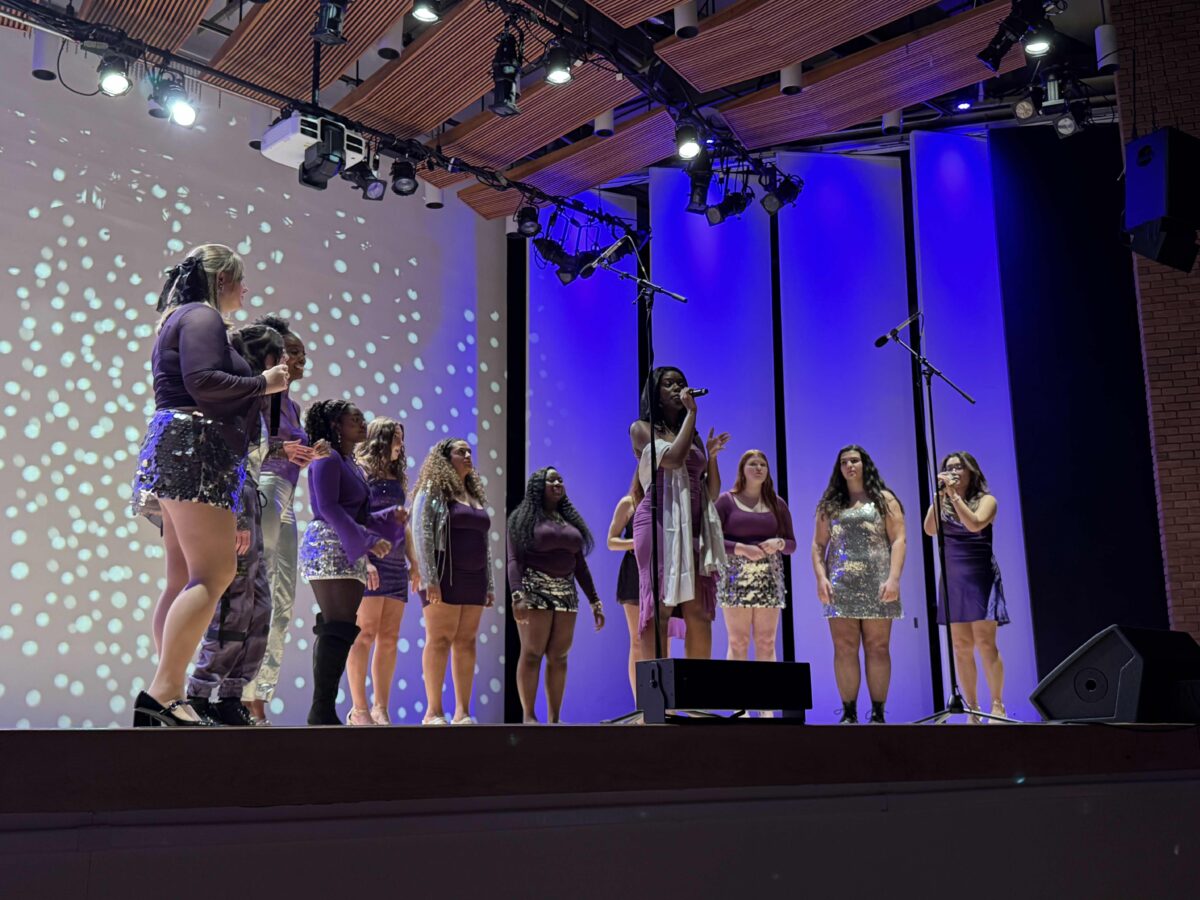 Daisy Parry (in front, with microphone) performs with the UMBC Stilettos, an all-female a cappella group. (Courtesy of Parry)
Parry is a member of The Stilettos, an all-woman a cappella group at UMBC, and her church choir. She arranges songs for The Stilettos to perform, which permits taking some creative license with the original work. “I like changing up the rhythms and dynamics to add depth to the music, and I think’s encouraged me to think a bit outside the box with my science, too, in terms of trying new experimental techniques.”
For now, her work on cell migration in fruit fly embryos with Michelle Starz-Gaiano, professor of biological sciences, her classes, and her music keep her busy, but Parry is looking forward to pursuing a master’s in public health after UMBC. She emphasizes how the concept of harmony—so central to music—carries over to the kind of work she wants to do. Factors such as research, clinical care, public policy, economics, the environment, and how they intersect are all relevant to public health outcomes, she explains.
‘It makes me whole’
Ella Reinders, a junior biological sciences major, also likes to tackle projects—scientific or artistic—from many angles. Watercolor and acrylic paints, sketching and drawing, handicrafts, sewing, and ballet have all captured her interest. “There are all different kinds of random things that I think are fun,” Reinders says.
In the lab, “I am able to come up with different ways of thinking about something because I’ve taken so many different approaches,” she says.
Reinders does behavioral research with Tara LeGates, assistant professor of biological sciences. The lab needed a new piece of equipment, but it was too expensive to buy off the shelf. “So I decided, why not create our own?” Reinders recalls.
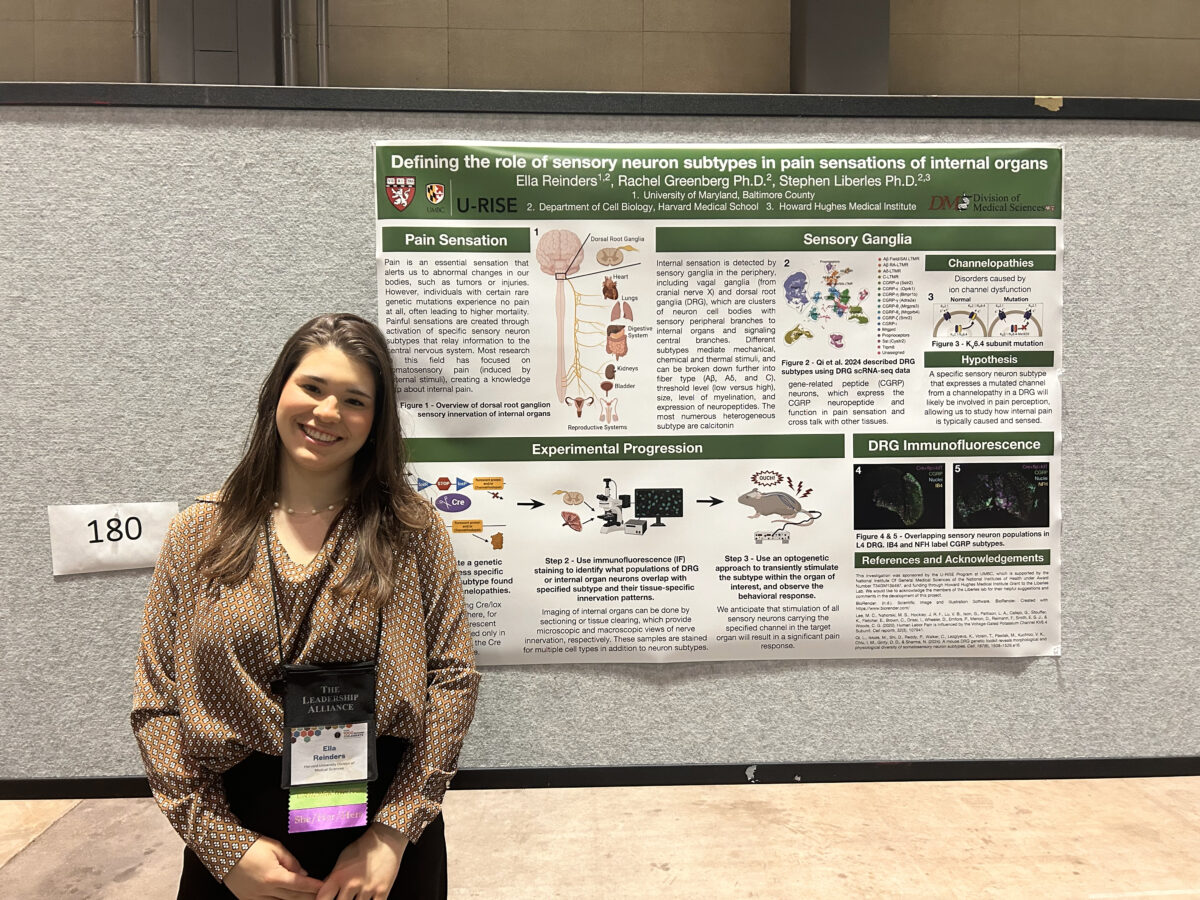
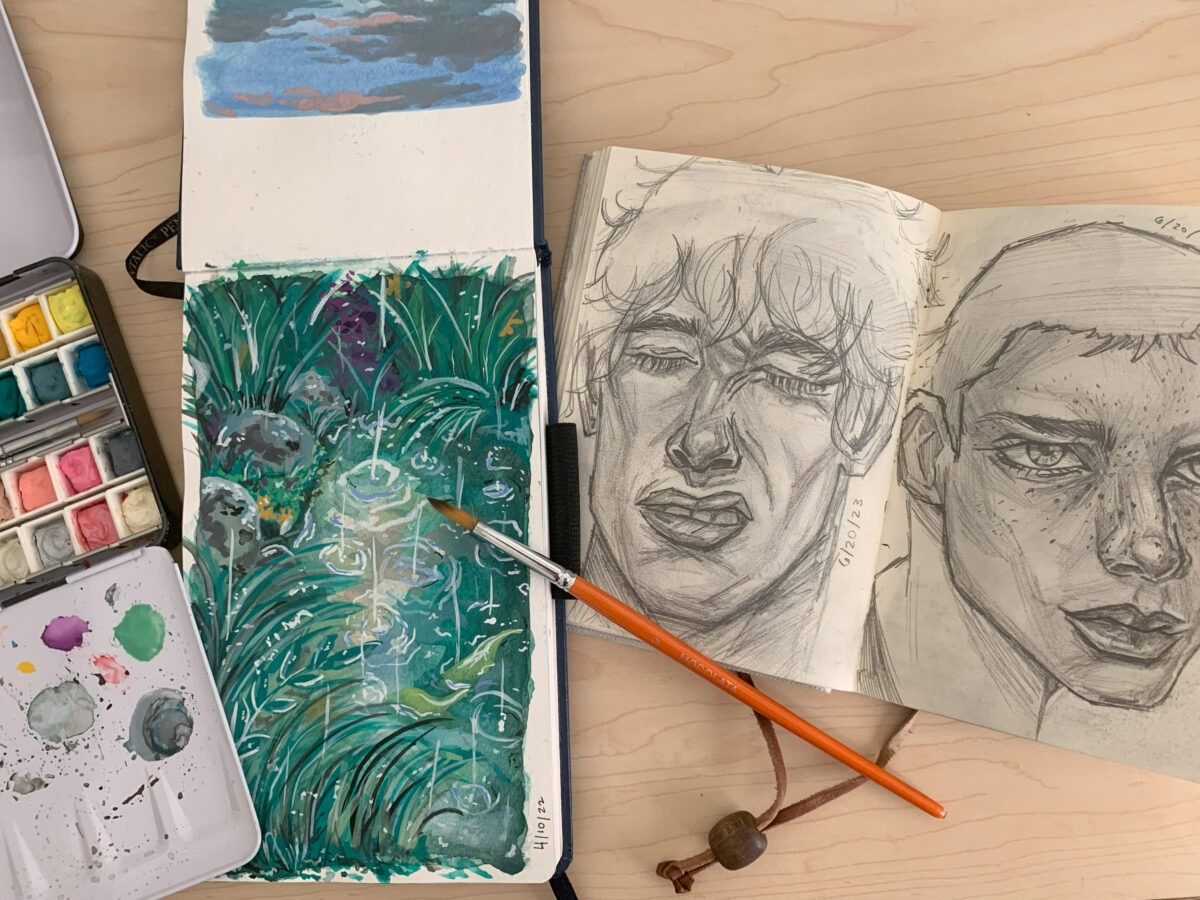 Ella Reinders says that “moving through life with both scientific and artistic interests just makes everything more interesting.” (Courtesy of Reinders)
She sketched it out, learned how to render it on the computer, how to 3D print it at the UMBC library, and then how to wire it. “And now I’ve actually been using it, and it works,” she says. “It was really exciting. I love turning something from my brain into something that I’m actually holding.”
There is also direct overlap between Reinders’ science and her art. “I’ve done imaging of neurons, and being able to turn them into this piece of artwork that you want to hang on your wall is really exciting. Moving through life with both scientific and artistic interests just makes everything more interesting and feels like a way to express all sides of myself.”
For Joshua Dayie, a senior chemical engineering major, both discipline and creativity are required for his research and his art—playing the cello. “You really have to strike a balance between them to make any meaningful progress,” he says. Practicing cello requires hours of repetition, until technical passages flow out of his fingers from muscle memory alone. In the lab, sometimes experiments must be repeated many times before they’re successful—that’s the discipline.
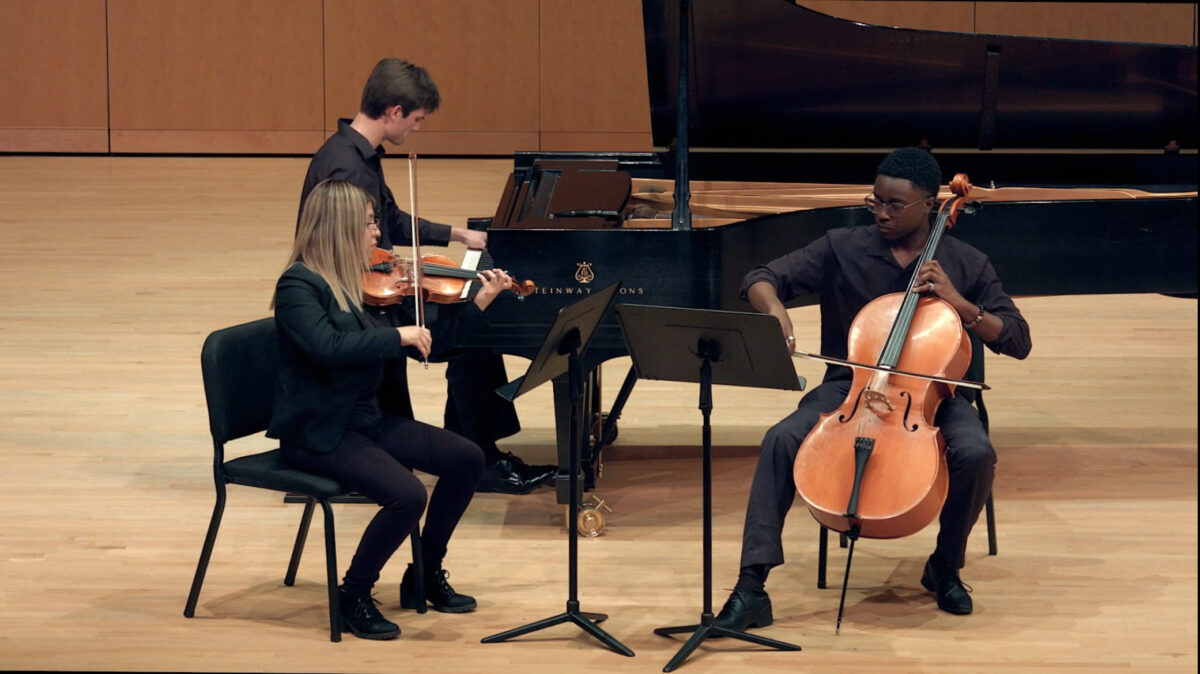
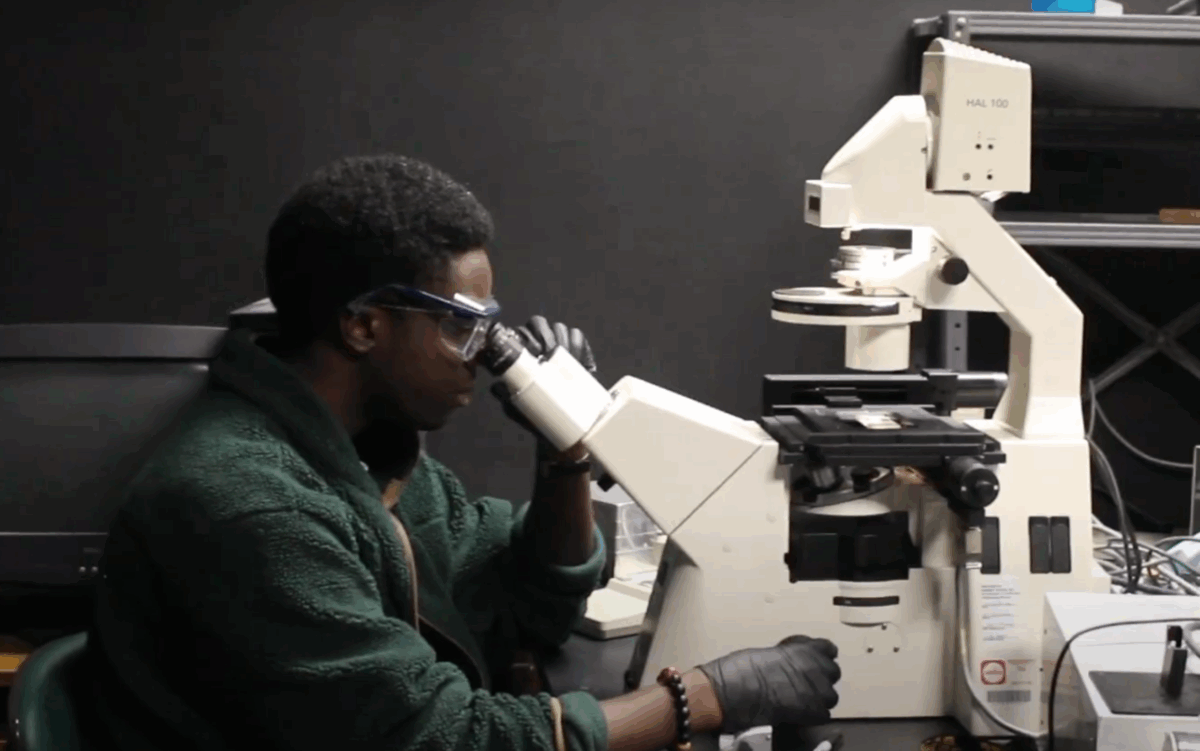 Playing the cello and conducting research makes Joshua Dayie feel “more whole.” (Melissa Penley Cormier, M.F.A. ’17/UMBC)
Dayie applies that discipline to his research with Mark Marten, professor of chemical, biochemical, and environmental engineering, on characterizing signaling pathways in fungi that activate in response to environmental stressors.
Then comes the creativity. Only after someone masters the fundamentals can they explore nuance in the tone or emotion conveyed on the cello, Dayie says. Similarly, in science “a lot of the innovation that you generate is really only meaningful after you’ve spent a lot of time understanding the core scientific concepts behind everything.”
“I think that’s been the most surprising thing: The creativity that comes from a very sound foundation of discipline is something that is translatable pretty much anywhere,” Dayie reflects.
As an added bonus, “Music has been a really nice outlet for me to use a different part of my brain, just to express myself in a different way,” he adds. “I feel like it makes me a little bit more whole.”
]]>
At UMBC, undergraduate students are redefining the boundaries of scientific and artistic pursuits. From a chemical engineer who graces the stage with his cello to a bioinformatician who paints and...
https://umbc.edu/stories/art-of-scientists/
https://my3.my.umbc.edu/api/v0/pixel/news/150074/guest@my.umbc.edu/8497eb97bed55a957858f91cb734d636/api/pixel
biochemistry-and-molecular-biology
bioinformatics
bioinformatics-and-computational-biology
biological-sciences
biology
cbee
chembiochem
cheme
chemeng
chemical-engineering
cnms
coeit
dance
discovery
magazine
music
story
UMBC News & Magazine
https://my3.my.umbc.edu/groups/umbc-news-magazine
https://assets1-my.umbc.edu/system/shared/avatars/groups/000/001/943/24435aa6207c452e7bc15cc74b42c7bb/xsmall.png?1748556657
https://assets1-my.umbc.edu/system/shared/avatars/groups/000/001/943/24435aa6207c452e7bc15cc74b42c7bb/original.png?1748556657
https://assets2-my.umbc.edu/system/shared/avatars/groups/000/001/943/24435aa6207c452e7bc15cc74b42c7bb/xxlarge.png?1748556657
https://assets2-my.umbc.edu/system/shared/avatars/groups/000/001/943/24435aa6207c452e7bc15cc74b42c7bb/xlarge.png?1748556657
https://assets3-my.umbc.edu/system/shared/avatars/groups/000/001/943/24435aa6207c452e7bc15cc74b42c7bb/large.png?1748556657
https://assets1-my.umbc.edu/system/shared/avatars/groups/000/001/943/24435aa6207c452e7bc15cc74b42c7bb/medium.png?1748556657
https://assets2-my.umbc.edu/system/shared/avatars/groups/000/001/943/24435aa6207c452e7bc15cc74b42c7bb/small.png?1748556657
https://assets1-my.umbc.edu/system/shared/avatars/groups/000/001/943/24435aa6207c452e7bc15cc74b42c7bb/xsmall.png?1748556657
https://assets2-my.umbc.edu/system/shared/avatars/groups/000/001/943/24435aa6207c452e7bc15cc74b42c7bb/xxsmall.png?1748556657
UMBC News & Magazine
3
0
false
Tue, 13 May 2025 09:16:55 -0400
Tue, 13 May 2025 09:16:55 -0400
Three UMBC juniors receive prestigious Goldwater Scholarships
Lea-Pearl Njei, biological sciences; Caly Ferguson, mechanical engineering; and Jariatu Kargbo, biological sciences, have each received the prestigious Goldwater Scholarship for the 2025 – 2026 academic year. The Barry Goldwater Scholarship and Excellence in Education Foundation strives to promote a strong STEM workforce in the U.S., and Njei, Ferguson, and Kargbo are among this year’s 441 awardees nationwide. Since 2005, 34 UMBC students have been awarded a Goldwater Scholarship.
“Caly, Lea-Pearl, and Jariatu emerged from a field of well-qualified students to represent UMBC in the Goldwater competition,” shares April Householder ’95, director of undergraduate research and prestigious scholarships. “They worked with me and the Goldwater faculty committee to strengthen their applications, and their dedication paid off. For several years in a row, UMBC has had multiple winners for this extremely competitive award.”
Njei is conducting colorectal cancer research with Jean-Pierre Raufman at the University of Maryland School of Medicine, after an internship at Yale sparked her interest in gastrointestinal organs. Njei has found support in the Meyerhoff Scholars program, especially from staff such as Jacqueline King.
“Sometimes I have that fear, where I know I can do something, but I need a little push, or someone to give me that confidence that I can do it,” Njei says. “And Dr. King’s support has been wonderful.”
Raufman, too, “has always been incredibly supportive of me as a young researcher and continually challenges me to grow and reach my full potential,” Njei says.
Njei also appreciates how much assistance she’s received as an international student and the diversity among biological sciences majors. “There are people who want to go to medical school, who want to go to graduate school, and others who want to go into the pharmaceutical industry or engineering,” she says. Njei serves as president of the UMBC chapter of Phi Delta Epsilon, the international medical fraternity. The fraternity offered “another community on campus that, besides seeing myself as a researcher, helped me see myself in the world of medicine.”

 Left: Lea-Pearl Njei presents her research at an NIH symposium. (Courtesy of Njei) Right: Jariatu Kargbo presents her research at a conference. (Courtesy of Kargbo)
The perfect place to grow
Ferguson is developing a prosthetic arm that runs on software driven by machine learning and is also affordable—a tricky combination. His work with Ramana Vinjamuri, associate professor of computer science and electrical engineering, has taken Vinjamuri’s lab in a new direction.
Vinjamuri is “open to ideas,” and tells his students that “the biggest thing you have to do is learn,” Ferguson says. “He’s been an incredible help to me over these past couple of years working on this project. UMBC has been the perfect place for me to grow.”
The project is making good progress, and right now Ferguson is working on a live simulation and moving toward a prototype that other lab members can use in experiments. He’s picked up substantial coding skills from his time in Vinjamuri’s group.
Ferguson is inspired to pursue the prosthetic arm in part because of a birth defect that caused portions of two fingers on each of his hands not to develop. It doesn’t affect his daily life much—Ferguson says he can still type, play basketball, and play video games, for example. “But it got me thinking about people with much bigger challenges,” he says. “Being able to impact that community with technology that I created would be pretty cool, so that’s how I got started with this idea.”

 Caly Ferguson (foreground, right) is developing an affordable robotic hand that runs on machine learning. Parthan Olikkal (background, right) works with Ferguson in Ramana Vinjamuri’s research group. (Melissa Penley Cormier, M.F.A. ’17/UMBC)
Right at your doorstep
Kargbo is studying melanopsin, a protein in the eye, with Phyllis Robinson, professor of biological sciences. “I singled out UMBC because of its emphasis on community and research—that’s what I wanted out of my university experience,” Kargbo says, and she found what she was looking for. She chose Robinson’s lab because of her interactions with other lab members. “It felt like a really safe lab environment for me to make mistakes, learn from them, and then grow as a researcher,” she says, “even though I didn’t understand that much when I first started out.”
Kargbo encourages aspiring researchers not to sell themselves short. “You don’t know what you’re capable of until you actually try to accomplish your goal,” she says. “And if you don’t have the confidence to show what you’re able to do, nobody’s ever going to know about it.”
All of the recipients agreed that receiving the Goldwater will open up a new support network among current and former recipients, and that the application process improved their communication skills and helped them sharpen their career goals.
“Goldwater is another opportunity for me to practice communicating my science,” Kargbo says. “I can now use the skills that I learned from applying for Goldwater, even if I hadn’t won the award, to apply for other grants, for example the NSF Graduate Research Fellowship for graduate school or Fulbright.”
The newest Goldwater scholars also felt that UMBC offered the environment and resources they needed to succeed. To go after big goals, “You need people who believe in you. You need mentors, you need support groups, and you can and will find them at UMBC,” Njei says. “You don’t even have to look too far, because they are all right there at your doorstep.”
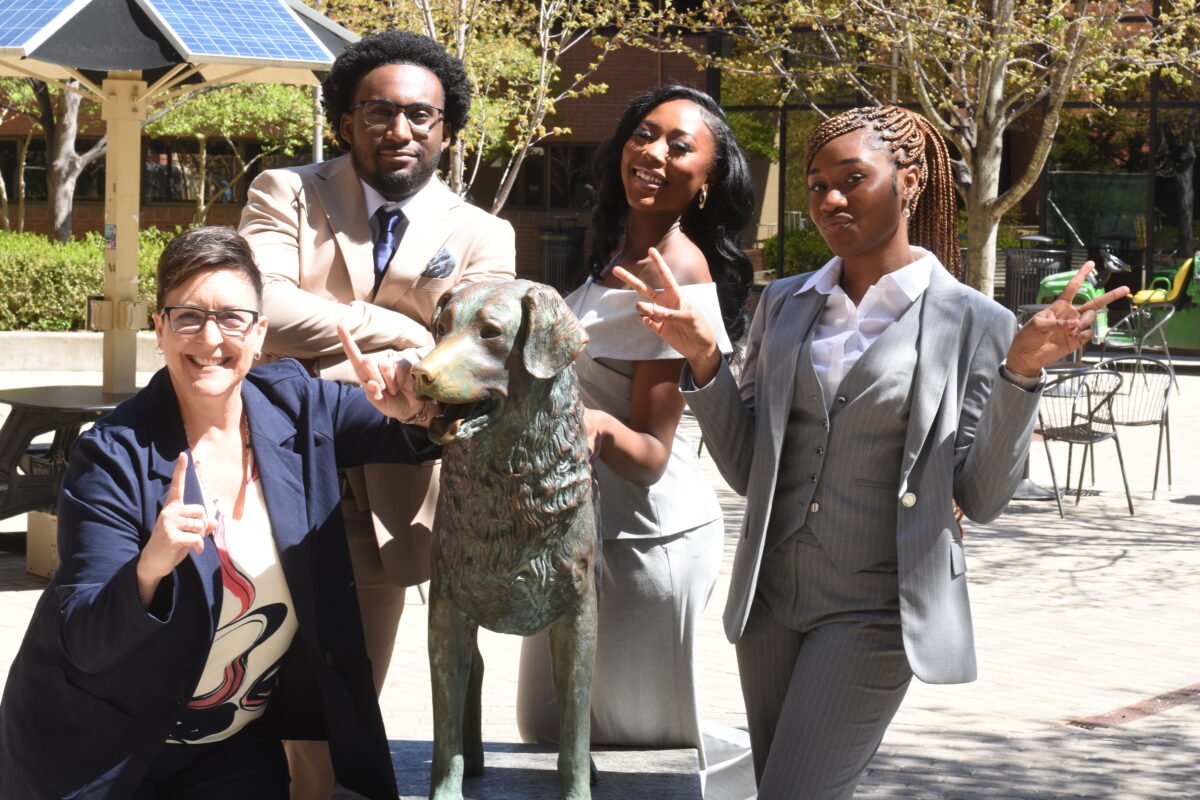 April Householder, left, supports UMBC students through the Goldwater application process. (Michael Mower/UMBC)
]]>
Lea-Pearl Njei, biological sciences; Caly Ferguson, mechanical engineering; and Jariatu Kargbo, biological sciences, have each received the prestigious Goldwater Scholarship for the 2025 – 2026...
https://umbc.edu/stories/goldwater-scholarships-2025/
https://my3.my.umbc.edu/api/v0/pixel/news/149973/guest@my.umbc.edu/aacb0612ba9d283960dfd1e5e25f0516/api/pixel
biology
cnms
coeit
community
meche
news
science-and-tech
story
undergradresearch
UMBC News & Magazine
https://my3.my.umbc.edu/groups/umbc-news-magazine
https://assets1-my.umbc.edu/system/shared/avatars/groups/000/001/943/24435aa6207c452e7bc15cc74b42c7bb/xsmall.png?1748556657
https://assets1-my.umbc.edu/system/shared/avatars/groups/000/001/943/24435aa6207c452e7bc15cc74b42c7bb/original.png?1748556657
https://assets2-my.umbc.edu/system/shared/avatars/groups/000/001/943/24435aa6207c452e7bc15cc74b42c7bb/xxlarge.png?1748556657
https://assets2-my.umbc.edu/system/shared/avatars/groups/000/001/943/24435aa6207c452e7bc15cc74b42c7bb/xlarge.png?1748556657
https://assets3-my.umbc.edu/system/shared/avatars/groups/000/001/943/24435aa6207c452e7bc15cc74b42c7bb/large.png?1748556657
https://assets1-my.umbc.edu/system/shared/avatars/groups/000/001/943/24435aa6207c452e7bc15cc74b42c7bb/medium.png?1748556657
https://assets2-my.umbc.edu/system/shared/avatars/groups/000/001/943/24435aa6207c452e7bc15cc74b42c7bb/small.png?1748556657
https://assets1-my.umbc.edu/system/shared/avatars/groups/000/001/943/24435aa6207c452e7bc15cc74b42c7bb/xsmall.png?1748556657
https://assets2-my.umbc.edu/system/shared/avatars/groups/000/001/943/24435aa6207c452e7bc15cc74b42c7bb/xxsmall.png?1748556657
UMBC News & Magazine
8
0
false
Fri, 09 May 2025 14:55:58 -0400
Fri, 09 May 2025 14:55:58 -0400
Evan McRae ’25 paired his computer science degree with a music focused-individualized studies major and followed his family’s Retriever legacy
April Householder, left, supports UMBC students through the Goldwater application process. (Michael Mower/UMBC)
]]>
Lea-Pearl Njei, biological sciences; Caly Ferguson, mechanical engineering; and Jariatu Kargbo, biological sciences, have each received the prestigious Goldwater Scholarship for the 2025 – 2026...
https://umbc.edu/stories/goldwater-scholarships-2025/
https://my3.my.umbc.edu/api/v0/pixel/news/149973/guest@my.umbc.edu/aacb0612ba9d283960dfd1e5e25f0516/api/pixel
biology
cnms
coeit
community
meche
news
science-and-tech
story
undergradresearch
UMBC News & Magazine
https://my3.my.umbc.edu/groups/umbc-news-magazine
https://assets1-my.umbc.edu/system/shared/avatars/groups/000/001/943/24435aa6207c452e7bc15cc74b42c7bb/xsmall.png?1748556657
https://assets1-my.umbc.edu/system/shared/avatars/groups/000/001/943/24435aa6207c452e7bc15cc74b42c7bb/original.png?1748556657
https://assets2-my.umbc.edu/system/shared/avatars/groups/000/001/943/24435aa6207c452e7bc15cc74b42c7bb/xxlarge.png?1748556657
https://assets2-my.umbc.edu/system/shared/avatars/groups/000/001/943/24435aa6207c452e7bc15cc74b42c7bb/xlarge.png?1748556657
https://assets3-my.umbc.edu/system/shared/avatars/groups/000/001/943/24435aa6207c452e7bc15cc74b42c7bb/large.png?1748556657
https://assets1-my.umbc.edu/system/shared/avatars/groups/000/001/943/24435aa6207c452e7bc15cc74b42c7bb/medium.png?1748556657
https://assets2-my.umbc.edu/system/shared/avatars/groups/000/001/943/24435aa6207c452e7bc15cc74b42c7bb/small.png?1748556657
https://assets1-my.umbc.edu/system/shared/avatars/groups/000/001/943/24435aa6207c452e7bc15cc74b42c7bb/xsmall.png?1748556657
https://assets2-my.umbc.edu/system/shared/avatars/groups/000/001/943/24435aa6207c452e7bc15cc74b42c7bb/xxsmall.png?1748556657
UMBC News & Magazine
8
0
false
Fri, 09 May 2025 14:55:58 -0400
Fri, 09 May 2025 14:55:58 -0400
Evan McRae ’25 paired his computer science degree with a music focused-individualized studies major and followed his family’s Retriever legacy
Before Evan McRae came to UMBC, Tess McRae—his sister—was a student here. So was Evan and Tess’s mother—Sharon McRae.You might say being a legacy Retriever was a family tradition. With Evan graduating this spring with majors in both computer science and individualized studies, we thought to ask Tess, now the assistant director for connective learning with the Center for Democracy and Civic Life, to take on this Q&A with her younger brother. Evan shares how an early exposure to UMBC’s Game Developers Club before attending UMBC eventually led to an executive board position and the creation of numerous games and great memories with other programmers and musicians.
Q: How did you decide to come to UMBC?
A: UMBC is where our mom went and also where you went, and I wanted to continue that family legacy. I also knew that it was a really great institution especially for computer science. I remember our family going to campus for Homecoming when I was in high school, and I saw a banner in The Commons for the UMBC Game Developers Club. I have always wanted to be a game developer; seeing that banner, I knew that there was a pretty good foundation for my passion at UMBC, and I wanted to join the club.
 McRae (second from left) and his fellow members of the Game Developers Club pose for a photo. Photo courtesy of McRae.
Q: In high school you discovered a passion for composing and producing music. How have you been able to expand on that passion at UMBC both technically and artistically?
A: While I was in high school I thought, “Music is something fun I do on the side, but not what I’m going to go to college for.” I was a computer science and math double major going into UMBC. When I decided to drop my math major by my second year, I told my Honors College advisor, Julie Oakes, that I was interested in music but didn’t have time to finish a music major within the next two years. She suggested I try individualized study (INDS) and see if there was a way to integrate my music passion with game development.
I ended up talking to professor Steven McAlpine from the INDS department and found a great bond with him; he shares a lot of my interests in game design and music. He has helped open a lot of doors for me, and I’m really grateful to the INDS program for that. I’ve been able to take music theory and composition courses, use UMBC’s studio facilities, and learn how to produce with industry standard software like Logic Pro. My music professors Greg Kalember, Linda Dusman, and Joseph Siu have mentored and fiercely advocated for me as an INDS major. It’s been incredible to not be a music major but still feel like I belong in those rooms.
Q: What are some of the most meaningful experiences you’ve had during your time at UMBC?
A: I’m taking a class this semester called Capstone Games Group Project taught by Marc Olano, the director of UMBC’s game development track and advisor for the Game Developers Club. The class combines artists and programmers who pitch game ideas at the start and work together on only a handful of those games for the rest of the semester. I pitched a puzzle platformer game called King Scribble that I’ve been wanting to make since first grade. My classmates and professor liked the idea, and to my surprise, it got picked as one of four games the class will develop in full. I still don’t think I’ve fully internalized how cool it is to actually be making this game.
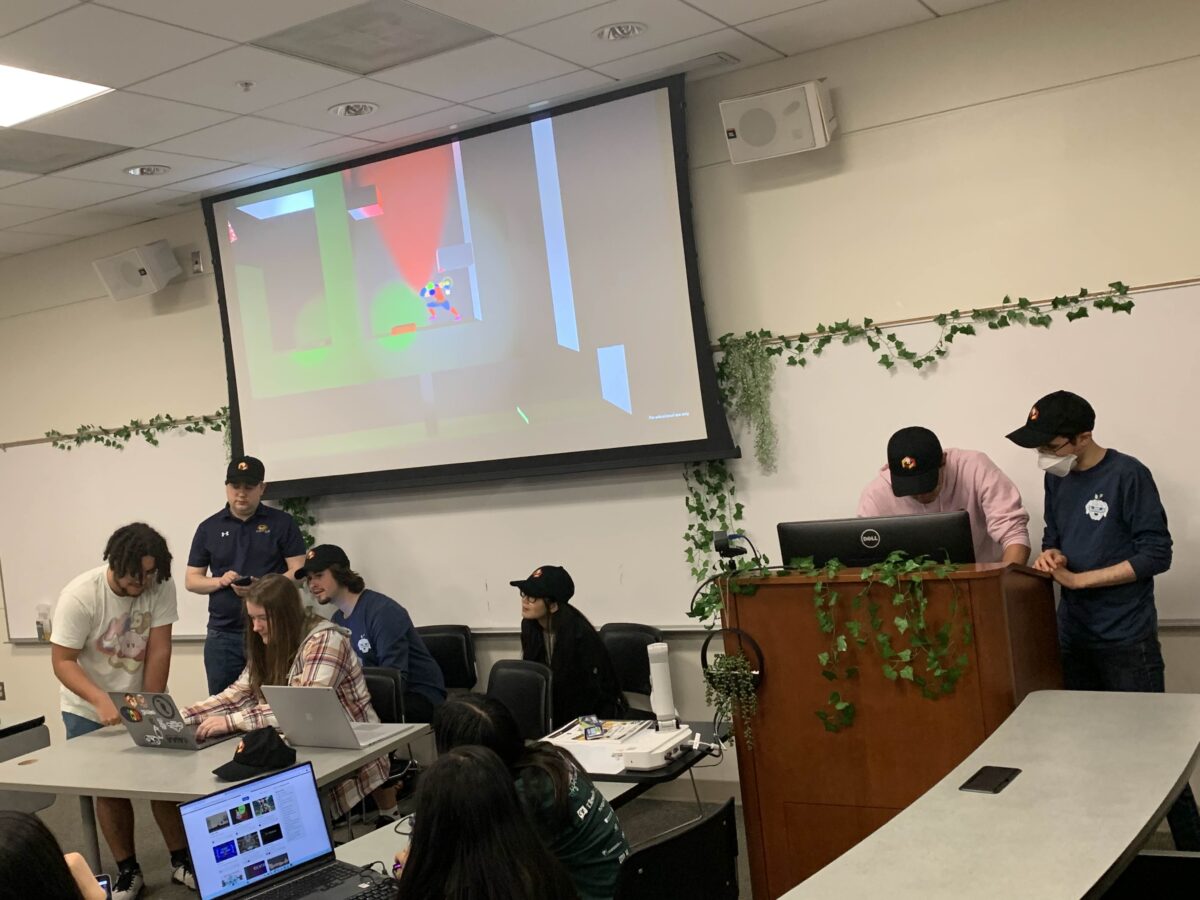 McRae (standing at podium) plays a submission to the Game Jamathon, hosted by hackUMBC and UMBC Game Developers Club. Photo courtesy of McRae.
I’ve also been working on a game called Daylight(available to play on Windows only, the password is: dog)since 2022 through the Game Developers Club. I feel like I’ve really grown as a developer and musician from it, and I’ve met some really cool and talented people through it. For my INDS capstone I’m improving and expanding upon Daylight’s soundtrack, which I’ve been working on for years now. It likely won’t be finished this semester or even next year, but I’m so privileged and grateful to have played such a big part in it.
I also have found a lot of meaning in my internship at UMBC’s Imaging Research Center (IRC). I got a position there thanks to Professor McAlpine, who had previously mentored Tristan King ’21,a former IRC technical specialist, when he was an INDS student. Tristan ended up being my supervisor for my first year there. I’m making virtual reality data visualization concept mapping software using Unreal Engine and solving complex, cutting-edge interface design problems. It’s really challenging my professional coding skills and helping me to grow exponentially as a game developer. I appreciate that I’ve had the opportunity on campus to enrich my learning like that. It’s been so cool to work with this transdisciplinary team and develop something that I think will have a good impact on the world.
Q: How have the ideas of inter/transdisciplinarity enhanced your UMBC experience?
A: What drew me to game development was working among disciplines. I love the idea of being a programmer and musician working with artists, writers, and playtesters to make a very human, cohesive experience: a love letter to players. Finding myself in INDS and at the IRC legitimized this way of thinking for me. I’ve really found myself at home in environments where I can collaborate with people from different backgrounds who are bringing all their skills and influences to the table. I value that process in everything I make and do at UMBC.
Being part of the Honors College also helped broaden my personal horizons as a student. I’ve been able to take a lot of cool courses outside of my disciplines like Mathematics of the Universe with Manil Suri and Sounds Like Social Justice with Earl Brooks, who have also been pretty big inspirations for me when it comes to the interdisciplinarity of technical fields and the ways I can actually make an impact toward issues I care about.
Q: What has being a student leader in the UMBC Game Developers Club been like for you?

A: It actually wasn’t something I knew I wanted to do in the first place until my friend encouraged me to run for vice president during a special election. I think it’s been the happiest accident in my life. I’ve been able to help make UMBC a proper home for students of all disciplines interested in game development, whether it’s for a hobby or a future career. Playing a pivotal role in creating and maintaining that space has been absolutely awesome. (Check out another Game Developers Club creation, Phantom Feline—I was a programmer and musician on this game that can be played in-browser as well as on Windows, Mac, and Linux.) The Game Developers Club has established alumni and mentors in the industry who give talks and network with our students. To be able to stand on that 20-year legacy and be lifted by it is a really special thing.
Written by Tess McRae ’22, Assistant Director for Connective Learning, Center for Democracy and Civic Life
Read more Commencement 2025 stories.
]]>
Before Evan McRae came to UMBC, Tess McRae—his sister—was a student here. So was Evan and Tess’s mother—Sharon McRae.You might say being a legacy Retriever was a family tradition. With Evan...
https://umbc.edu/stories/evan-mcrae-25-followed-familys-retriever-legacy/
https://my3.my.umbc.edu/api/v0/pixel/news/149903/guest@my.umbc.edu/5e648a26fda274bc5c1302e370d47cd1/api/pixel
center-for-democracy-and-civic-life
class-of-2025
coeit
computer-science
inds
news
story
UMBC News & Magazine
https://my3.my.umbc.edu/groups/umbc-news-magazine
https://assets1-my.umbc.edu/system/shared/avatars/groups/000/001/943/24435aa6207c452e7bc15cc74b42c7bb/xsmall.png?1748556657
https://assets1-my.umbc.edu/system/shared/avatars/groups/000/001/943/24435aa6207c452e7bc15cc74b42c7bb/original.png?1748556657
https://assets2-my.umbc.edu/system/shared/avatars/groups/000/001/943/24435aa6207c452e7bc15cc74b42c7bb/xxlarge.png?1748556657
https://assets2-my.umbc.edu/system/shared/avatars/groups/000/001/943/24435aa6207c452e7bc15cc74b42c7bb/xlarge.png?1748556657
https://assets3-my.umbc.edu/system/shared/avatars/groups/000/001/943/24435aa6207c452e7bc15cc74b42c7bb/large.png?1748556657
https://assets1-my.umbc.edu/system/shared/avatars/groups/000/001/943/24435aa6207c452e7bc15cc74b42c7bb/medium.png?1748556657
https://assets2-my.umbc.edu/system/shared/avatars/groups/000/001/943/24435aa6207c452e7bc15cc74b42c7bb/small.png?1748556657
https://assets1-my.umbc.edu/system/shared/avatars/groups/000/001/943/24435aa6207c452e7bc15cc74b42c7bb/xsmall.png?1748556657
https://assets2-my.umbc.edu/system/shared/avatars/groups/000/001/943/24435aa6207c452e7bc15cc74b42c7bb/xxsmall.png?1748556657
UMBC News & Magazine
4
0
false
Wed, 07 May 2025 15:37:48 -0400
Wed, 07 May 2025 15:37:48 -0400