Boosting resilience: UMBC secures $1M+ congressional funding to launch lab addressing flood risks in vulnerable Maryland communities
UMBC researchers have secured a $1,031,000 congressional earmark to launch a vital new initiative tackling the escalating threat of flooding in Maryland’s most vulnerable communities.
Led by Alan Yeakley, professor, and Dillon Mahmoudi, associate professor, both in geography and environmental systems, the project establishes the UMBC Laboratory for Flood Risk Impact Assessment and Adaptation in Impoverished Maryland Communities. This lab will serve as a hub for analyzing and tracking the impacts of rising flood risks on low-income populations in both urban and rural areas across the state. Yeakley and Mahmoudi will bring on two postdoctoral researchers and graduate and undergraduate research assistants, who will gain critical skills in community-engaged research and data analytics while supporting the work.
The project focuses on communities along the Chesapeake Bay and its major tributaries, including historically underserved neighborhoods in Baltimore such as Turner Station. Researchers will investigate how the legacies of blockbusting and redlining have heightened flood vulnerability in low-income areas and assess whether flood mitigation resources have been distributed equitably. The team will also evaluate the current state of adaptation strategies at every level—from individual households to the city, county, state, and federal governments.
 Alan Yeakley (left) and Dillon Mahmoudi discuss their project to help communities adapt to flood risks on the UMBC Library Pond, which itself serves as a stormwater management system for the UMBC campus.
 Dillon Mahmoudi studies urban geography and development.
 Alan Yeakley’s research centers on urban ecology.
Through hands-on workshops, interviews with residents, and discussions with government agency personnel, the lab will document communities’ existing adaptation methods and raise awareness of growing hazards. Advanced computer modeling completed in UMBC’s state-of-the-art geographic information systems (GIS) laboratory will help quantify predicted risks, which researchers will share with affected communities along with practical, low-cost strategies to enhance resilience. This approach will foster opportunities to co-create solutions, in alignment with UMBC’s commitment to bidirectional partnerships with our neighbors as we all seek to address environmental challenges.
“We’re thrilled to be able to help local communities experiencing flooding along the Chesapeake Bay,” Yeakley says. “We hope to learn what they are already doing to mitigate these hazards, and to suggest strategies that might improve their resilience to ongoing and future threats to their properties and their lives. We also hope that, eventually, communities will share successful strategies with each other directly, creating a grassroots network of neighborhood and environmental stewardship.”
]]>
UMBC researchers have secured a $1,031,000 congressional earmark to launch a vital new initiative tackling the escalating threat of flooding in Maryland’s most vulnerable communities. Led by...
https://umbc.edu/stories/flood-risks-in-vulnerable-maryland-communities/
https://my3.my.umbc.edu/api/v0/pixel/news/157493/guest@my.umbc.edu/accc117d36568d98ff85245aba7e02cc/api/pixel
cahss
ges
news
policy-and-society
research
science-and-tech
story
UMBC News & Magazine
https://my3.my.umbc.edu/groups/umbc-news-magazine
https://assets1-my.umbc.edu/system/shared/avatars/groups/000/001/943/24435aa6207c452e7bc15cc74b42c7bb/xsmall.png?1748556657
https://assets1-my.umbc.edu/system/shared/avatars/groups/000/001/943/24435aa6207c452e7bc15cc74b42c7bb/original.png?1748556657
https://assets2-my.umbc.edu/system/shared/avatars/groups/000/001/943/24435aa6207c452e7bc15cc74b42c7bb/xxlarge.png?1748556657
https://assets2-my.umbc.edu/system/shared/avatars/groups/000/001/943/24435aa6207c452e7bc15cc74b42c7bb/xlarge.png?1748556657
https://assets3-my.umbc.edu/system/shared/avatars/groups/000/001/943/24435aa6207c452e7bc15cc74b42c7bb/large.png?1748556657
https://assets1-my.umbc.edu/system/shared/avatars/groups/000/001/943/24435aa6207c452e7bc15cc74b42c7bb/medium.png?1748556657
https://assets2-my.umbc.edu/system/shared/avatars/groups/000/001/943/24435aa6207c452e7bc15cc74b42c7bb/small.png?1748556657
https://assets1-my.umbc.edu/system/shared/avatars/groups/000/001/943/24435aa6207c452e7bc15cc74b42c7bb/xsmall.png?1748556657
https://assets2-my.umbc.edu/system/shared/avatars/groups/000/001/943/24435aa6207c452e7bc15cc74b42c7bb/xxsmall.png?1748556657
UMBC News & Magazine
3
0
false
Fri, 13 Mar 2026 14:04:53 -0400
Fri, 13 Mar 2026 14:04:53 -0400
Author Kristina Gaddy ’09, collaborates with Rhiannon Giddens, Grammy Award-winning musician, on the history of Black American music
Kristina Gaddy came to UMBC as a Sondheim Public Affairs Scholar. Her passion for history and languages—Swedish, German, and Spanish—led her to graduate with a dual degree in history and modern languages and linguistics. Looking back on her time at UMBC, Gaddy is grateful for the opportunities the program provided, especially the chance to study abroad in Germany. There, she combined her proficiency in German with her historical training to research the foundations of her first book.
“The Sondheim Public Affairs Scholars Program was wonderful because of the funding I received to support my research and the cohort of students,” says Gaddy. “We were all really interested and excited about social issues, public policy, and how these ideas could be used to improve the world.”
These interests inspired a career in historical nonfiction writing and led to her to write meticulously researched books: Flowers in the Gutter: True Story of the Edelweiss Pirates, Teenagers Who Resisted the Nazis (Dutton Books, 2020), Well of Souls: Uncovering the Banjo’s Hidden History (W. W. Norton & Company, 2022), and A Most Perilous World: The True Story of the Young Abolitionists and their Crusade Against Slavery (Dutton Books, 2025).
Digitizing public history
Her collaboration with Giddens isn’t the first time Gaddy has written a book about banjos. “My start in music research and writing started 15 years ago when I was an AmeriCorps working with multi-instrumentalist Gerry Milnes at Augusta [Heritage Center in Elkins, West Virginia], and the friends I made while living in Elkins helped put me on the path to writing Well of Souls and Go Back and Fetch It.”
 Kristina Gaddy performing at the Augusta Heritage Center in Elkins, West Virginia. (Image courtesy of Gaddy)
It’s not just documents that Gaddy used in her first banjo book—which are accessible on her blog—but also sound clips, performances, and interviews. While many historical records can be found online, many more have yet to be digitized. Gaddy, who also digitized and archived the West Virginia Upshur County Historical Society‘s local history collection, has made digitization an integral part of her process.
“Having come from the public history side of UMBC’s history department, I strongly believe in people having access to information as it pertains to their own history. It was one of the reasons I wanted to write Well of Souls,” says Gaddy, about her second book. “I had gathered all this information, and I could have shared it with just a few people, but I wanted anybody who wants access to banjo history not to have to go to some expensive conference to hear about it.”
A revolutionary collaboration
Giddens, a MacArthur recipient and Pulitzer Prize winner, is grateful for Gaddy’s dedication to digitizing and broadening access to historical material culture. While working on pieces of music highlighting 18th-century North American, Scottish, and Irish traditions for Ken Burns’s 2025 PBS documentary The American Revolution, Giddens was looking for samples of Black music from the Revolutionary War. She wasn’t having much luck until she explored Gaddy’s website, where she not only found what she was looking for but also the inspiration for their co-authored book, Go Back and Fetch It.
“I just kept going back to Kristina’s website, where she had put up these JPEGs. I would download them, lose the JPEG, and I’d go back and, like, download it again. And then I was just like, ‘Kristina, why don’t we put all of these in a book?’ explained Giddens at the 2025 Michigan University Arts Initiative interview on Go Back and Fetch It with Gaddy.
The book is their third collaboration. In 2018, Giddens invited Gaddy and her husband, Pete Ross—banjo maker, researcher, and musician—to present at a banjo symposium during the inaugural North Carolina Folk Festival, which Giddens curated. Gaddy presented her research on the African American roots of the banjo, an experience she credits as the inspiration for Wells of Souls, for which Giddens wrote the foreword. They also collaborated in 2022 on one episode of the 10-part series The Banjo: Music, History, and Heritage for The Great Courses project.
Gaddy, Pete Ross, presenting at the 2022 American Musical Instrument Society Conference.
“The idea behind the book was that there were all these little pieces of music in archives, in published books, in manuscripts that were sprinkled throughout the historic record of Black music in the Americas,” explains Gaddy in the same interview. “They weren’t compiled in one place. Rhiannon, as an artist, was frustrated that she couldn’t access them.”
For their book collaboration, they selected 19 pieces of music from 1687 through the 1860s. Gaddy wrote a historical research essay for each song explaining the types of banjos used, how and when they were played, and their socio-cultural significance across communities in the Americas and the Caribbean. Giddens transcribed the songs into modern treble clef and banjo tablature, which shows finger placement, rather than the Western classical notation tradition, making early Black Atlantic banjo music accessible to banjo players today, in the future, globally, and across all genres.
Following the banjo around the world
Gaddy’s last five years have been busy. But once you dig a little deeper, ask more questions, and do a lot of listening—just as she does for all of her interviews—you learn that Gaddy really started her musical performance research in high school while playing traditional Swedish music with her mom and traditional American music with her uncle and aunt. After college, she fell in love with the banjo while living with other artists in West Virginia, developing a connection with a vast, diverse community passionate about banjo culture and history—including in Baltimore City, where Gaddy and her husband performed some of the songs from Go Back and Fetch It at the Enoch Pratt Free Library in September, right before she moved to Nottingham, England.
Gaddy and Ross perform at the Baltimore City Enoch Pratt Free Library.
Gaddy has also expanded her digital research presence to Substack, where she posted the news of her fully funded doctoral program at the University of Nottingham, where she will research Black fiddling in the 19th-century British Caribbean.
And even though she is a whole ocean away, Gaddy still feels the support of her UMBC history department.
“One of the most exciting things for me is to see other students and scholars diving deeper into these subjects. My former history professor, Dr. Michelle Scott, recently put me in touch with Amina Thiam, a UMBC graduate student who is writing her thesis on Black banjoists and string instrumentalists in Maryland during the colonial period. I can’t wait to see what she uncovers.”
Learn more about Kristina Gaddy’s work and UMBC’s History department.
]]>
Kristina Gaddy came to UMBC as a Sondheim Public Affairs Scholar. Her passion for history and languages—Swedish, German, and Spanish—led her to graduate with a dual degree in history and modern...
https://umbc.edu/stories/kristina-gaddy-and-rhiannon-giddens-banjo-go-back-and-fetch-it/
https://my3.my.umbc.edu/api/v0/pixel/news/157461/guest@my.umbc.edu/9020f8e9aa55d55c556ad5cc4ac0f114/api/pixel
alumni
arts-and-culture
cahss
history
humanitiesbooks
news
research
story
UMBC News & Magazine
https://my3.my.umbc.edu/groups/umbc-news-magazine
https://assets1-my.umbc.edu/system/shared/avatars/groups/000/001/943/24435aa6207c452e7bc15cc74b42c7bb/xsmall.png?1748556657
https://assets1-my.umbc.edu/system/shared/avatars/groups/000/001/943/24435aa6207c452e7bc15cc74b42c7bb/original.png?1748556657
https://assets2-my.umbc.edu/system/shared/avatars/groups/000/001/943/24435aa6207c452e7bc15cc74b42c7bb/xxlarge.png?1748556657
https://assets2-my.umbc.edu/system/shared/avatars/groups/000/001/943/24435aa6207c452e7bc15cc74b42c7bb/xlarge.png?1748556657
https://assets3-my.umbc.edu/system/shared/avatars/groups/000/001/943/24435aa6207c452e7bc15cc74b42c7bb/large.png?1748556657
https://assets1-my.umbc.edu/system/shared/avatars/groups/000/001/943/24435aa6207c452e7bc15cc74b42c7bb/medium.png?1748556657
https://assets2-my.umbc.edu/system/shared/avatars/groups/000/001/943/24435aa6207c452e7bc15cc74b42c7bb/small.png?1748556657
https://assets1-my.umbc.edu/system/shared/avatars/groups/000/001/943/24435aa6207c452e7bc15cc74b42c7bb/xsmall.png?1748556657
https://assets2-my.umbc.edu/system/shared/avatars/groups/000/001/943/24435aa6207c452e7bc15cc74b42c7bb/xxsmall.png?1748556657
UMBC News & Magazine
2
0
false
Thu, 12 Mar 2026 16:30:42 -0400
Thu, 12 Mar 2026 16:30:42 -0400
Author Kristina Gaddy ’09, collaborates with Rhiannon Giddens, Grammy Award-winning musician, on the history of Black American music
Kristina Gaddy ’09, saves and gathers manuscripts, sheet music, pictures, maps, drawings, and anecdotes, sharing them on her blog to make public what she finds hidden in archives, private collections, and museums. For her fourth book, Go Back and Fetch It: Recovering Early Black Music in the Americas for Fiddle and Banjo (University of North Carolina Press, 2025), Gaddy teamed up with Rhiannon Giddens, a Grammy Award-winning musician who is equally passionate about digitizing and broadening access to the historical material culture of the banjo.
Gaddy came to UMBC as a Sondheim Public Affairs Scholar. Her passion for history and languages—Swedish, German, and Spanish—led her to graduate with a dual degree in history and modern languages and linguistics. Looking back on her time at UMBC, Gaddy is grateful for the opportunities the program provided, especially the chance to study abroad in Germany. There, she combined her proficiency in German with her historical training to research the foundations of her first book.
“The Sondheim Public Affairs Scholars Program was wonderful because of the funding I received to support my research and the cohort of students,” says Gaddy. “We were all really interested and excited about social issues, public policy, and how these ideas could be used to improve the world.”
These interests inspired a career in historical nonfiction writing and led to her to write meticulously researched books: Flowers in the Gutter: True Story of the Edelweiss Pirates, Teenagers Who Resisted the Nazis (Dutton Books, 2020), Well of Souls: Uncovering the Banjo’s Hidden History (W. W. Norton & Company, 2022), and A Most Perilous World: The True Story of the Young Abolitionists and their Crusade Against Slavery (Dutton Books, 2025).
Digitizing public history
Her collaboration with Giddens isn’t the first time Gaddy has written a book about banjos. “My start in music research and writing started 15 years ago when I was an AmeriCorps working with multi-instrumentalist Gerry Milnes at Augusta [Heritage Center in Elkins, West Virginia], and the friends I made while living in Elkins helped put me on the path to writing Well of Souls and Go Back and Fetch It.”
It’s not just documents that Gaddy used in her first banjo book—which are accessible on her blog—but also sound clips, performances, and interviews. While many historical records can be found online, many more have yet to be digitized. Gaddy, who also digitized and archived the West Virginia Upshur County Historical Society‘s local history collection, has made digitization an integral part of her process.
Kristina Gaddy performing at the Augusta Heritage Center in Elkins, West Virginia. (Image courtesy of Gaddy)
“Having come from the public history side of UMBC’s history department, I strongly believe in people having access to information as it pertains to their own history. It was one of the reasons I wanted to write Well of Souls,” says Gaddy, about her second book. “I had gathered all this information, and I could have shared it with just a few people, but I wanted anybody who wants access to banjo history not to have to go to some expensive conference to hear about it.”
A revolutionary collaboration
Giddens, a MacArthur recipient and Pulitzer Prize winner, is grateful for Gaddy’s dedication to digitizing and broadening access to historical material culture. While working on pieces of music highlighting 18th-century North American, Scottish, and Irish traditions for Ken Burns’s 2025 PBS documentary The American Revolution, Giddens was looking for samples of Black music from the Revolutionary War. She wasn’t having much luck until she explored Gaddy’s website, where she not only found what she was looking for but also the inspiration for their co-authored book, Go Back and Fetch It.
“I just kept going back to Kristina’s website, where she had put up these JPEGs. I would download them, lose the JPEG, and I’d go back and, like, download it again. And then I was just like, ‘Kristina, why don’t we put all of these in a book?’” explained Giddens at the 2025 Michigan University Arts Initiative interview on Go Back and Fetch It with Gaddy.
The book is their third collaboration. In 2018, Giddens invited Gaddy and her husband, Pete Ross—banjo maker, researcher, and musician—to present at a banjo symposium during the inaugural North Carolina Folk Festival, which Giddens curated. Gaddy presented her research on the African American roots of the banjo, an experience she credits as the inspiration for Wells of Souls, for which Giddens wrote the foreword. They also collaborated in 2022 on one episode of the 10-part series The Banjo: Music, History, and Heritage for The Great Courses.
“The idea behind the book was that there were all these little pieces of music in archives, in published books, in manuscripts that were sprinkled throughout the historic record of Black music in the Americas,” explains Gaddy in the same interview. “They weren’t compiled in one place. Rhiannon, as an artist, was frustrated that she couldn’t access them.”
For their book collaboration, they selected 19 pieces of music from 1687 through the 1860s. Gaddy wrote a historical research essay for each song explaining the types of banjos used, how and when they were played, and their socio-cultural significance across communities in the Americas and the Caribbean. Giddens transcribed the songs into modern treble clef and banjo tablature, which shows finger placement, rather than the Western classical notation tradition, making early Black Atlantic banjo music accessible to banjo players today, in the future, globally, and across all genres.
Following the banjo around the world
Gaddy’s last five years have been busy. But dig a little deeper, ask more questions, and do a lot of listening—just as she does for all of her interviews—it turns out that Gaddy really started her musical performance research in high school while playing traditional Swedish music with her mom and traditional American music with her uncle and aunt. After college, she fell in love with the banjo while living with other artists in West Virginia, developing a connection with a vast, diverse community passionate about banjo culture and history—including in Baltimore City, where Gaddy and her husband performed some of the songs from Go Back and Fetch It at the Enoch Pratt Free Library in September, right before she moved to Nottingham, England.
Gaddy and Ross perform at the Baltimore City Enoch Pratt Free Library.
Gaddy has also expanded her digital research presence to Substack, where she posted the news of her fully funded doctoral program at the University of Nottingham, where she will research Black fiddling in the 19th-century British Caribbean.
And even though she is a whole ocean away, Gaddy still feels the support of her UMBC history department.
“One of the most exciting things for me is to see other students and scholars diving deeper into these subjects,” says Gaddy. “My former history professor, Dr. Michelle Scott, recently put me in touch with Amina Thiam, a UMBC graduate student who is writing her thesis on Black banjoists and string instrumentalists in Maryland during the colonial period. I can’t wait to see what she uncovers.”
Learn more about Kristina Gaddy’s work and UMBC’s History department.
]]>
Kristina Gaddy ’09, saves and gathers manuscripts, sheet music, pictures, maps, drawings, and anecdotes, sharing them on her blog to make public what she finds hidden in archives, private...
https://umbc.edu/stories/kristina-gaddy-and-rhiannon-giddens-banjos/
https://my3.my.umbc.edu/api/v0/pixel/news/157498/guest@my.umbc.edu/249209c87f638d5f94605cb83fd26c64/api/pixel
alumni
arts-and-culture
cahss
history
humanitiesbooks
news
research
retriever-authors
story
UMBC News & Magazine
https://my3.my.umbc.edu/groups/umbc-news-magazine
https://assets1-my.umbc.edu/system/shared/avatars/groups/000/001/943/24435aa6207c452e7bc15cc74b42c7bb/xsmall.png?1748556657
https://assets1-my.umbc.edu/system/shared/avatars/groups/000/001/943/24435aa6207c452e7bc15cc74b42c7bb/original.png?1748556657
https://assets2-my.umbc.edu/system/shared/avatars/groups/000/001/943/24435aa6207c452e7bc15cc74b42c7bb/xxlarge.png?1748556657
https://assets2-my.umbc.edu/system/shared/avatars/groups/000/001/943/24435aa6207c452e7bc15cc74b42c7bb/xlarge.png?1748556657
https://assets3-my.umbc.edu/system/shared/avatars/groups/000/001/943/24435aa6207c452e7bc15cc74b42c7bb/large.png?1748556657
https://assets1-my.umbc.edu/system/shared/avatars/groups/000/001/943/24435aa6207c452e7bc15cc74b42c7bb/medium.png?1748556657
https://assets2-my.umbc.edu/system/shared/avatars/groups/000/001/943/24435aa6207c452e7bc15cc74b42c7bb/small.png?1748556657
https://assets1-my.umbc.edu/system/shared/avatars/groups/000/001/943/24435aa6207c452e7bc15cc74b42c7bb/xsmall.png?1748556657
https://assets2-my.umbc.edu/system/shared/avatars/groups/000/001/943/24435aa6207c452e7bc15cc74b42c7bb/xxsmall.png?1748556657
UMBC News & Magazine
0
0
false
Thu, 12 Mar 2026 16:30:42 -0400
Thu, 12 Mar 2026 16:30:42 -0400
Can anything be read as poetry? Keegan Cook Finberg, English, is opening students’ eyes to the poetic world
Keegan Cook Finberg, an assistant professor of English, started graduate school at UC Santa Cruz during the financial crisis of 2008, in a moment of extreme recession. “Privatization and austerity politics were everywhere. It was becoming increasingly clear that this wealth was stratifying upward, and notions of what constituted the public good were diminishing,” says Finberg. Finberg’s response to the times was to study avant-garde experimental poetry.
She notes that some might not see the connection between austerity politics and poetry. But she was excited about how poetry was engaging the public sphere. “Avant-garde poetry was obsessed with this notion of what made the public. And the category itself was becoming more interdisciplinary and more capacious,” said Finberg. “I started noticing and studying different forms of poems that didn’t look like what you might consider poetry. Poets were taking various aspects of state-controlled capitalist regimes and bureaucracy and using those forms as fodder for their poems.”
She remembers, around this time, books of poetry that were winning the major prizes were “avant-garde” in the sense that they chose words from material that wasn’t considered poetic. One poet chose words from the Department of Defense Dictionary of Military Terms to make poems about love. Others used these untraditional literary materials to document their experience of going through TSA at the airport, or repeating stories about racism on the street where people live. Finberg became interested in how all of these forms that we might think of as public forms were suddenly poetic forms.
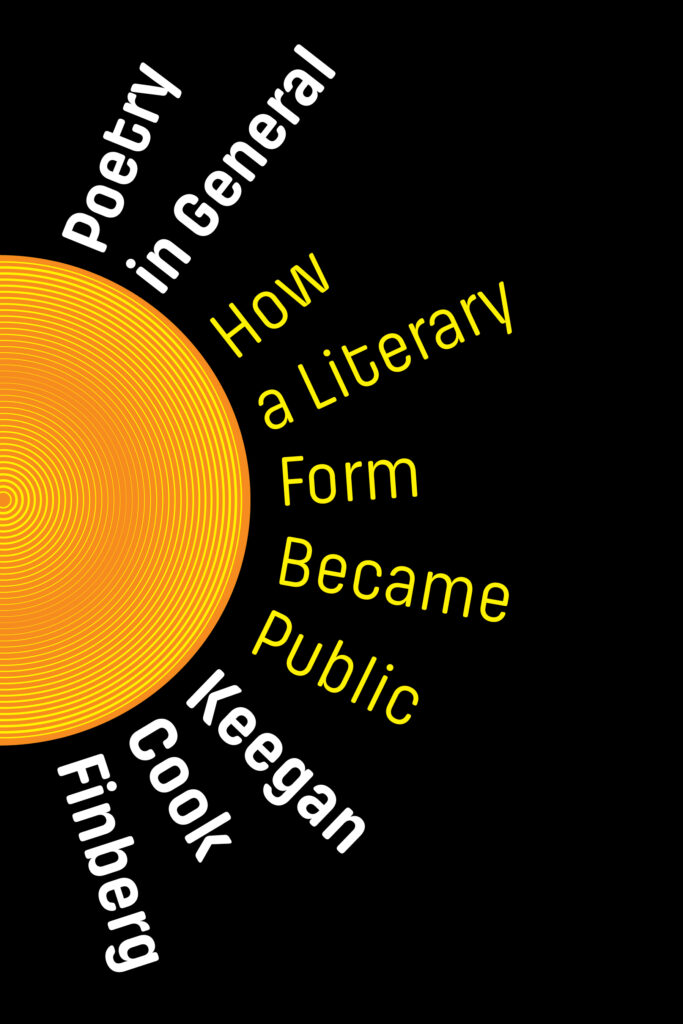
In her debut book, Poetry in General (Columbia University Press, 2025), Finberg explores the privatization of the welfare state and the way that poetry changed in relation to that notion of the public. “I located the beginning of this history around 1960, which many people consider the ballooning of the welfare state, the opposite of privatization,” says Finberg. “I started thinking about what poetic form looked like in that moment and how we might trace it to today.”
Q: What drew you to poetry?
A: I have loved poetry since I was an early reader. I was first drawn to it because it is a way of experiencing the world and understanding it. As I got deeper into my studies, I became really interested in the way that poetic form changes with history.
I’ve always been curious about how the category of poetry makes us think differently. What does it mean for us to read poetry versus the way we read other forms? Can anything be read as poetry? How do we think differently if we try to read things as poetry that aren’t poetry?
These questions excite me. It’s a way to slow down and model reading practices, a way of interacting with language that’s very intentional and precise. I think if you’re interested in play, the unknowable, or unmasterable, it can really change the way you see your everyday life. That’s how I got interested in poetry and what still excites me about poetry.
Q: Is there a piece of poetry that challenged you to accept being uncomfortable, not knowing exactly what it meant?
A: I remember when I was assigned Gertrude Stein‘s poetry as an undergraduate, it did not make any sense to me. Why would anyone assign this to me? I was irate about it at first, but once I started working with the text and playing with it, Stein’s poetry became richer and more interesting to me.
I began practicing different modes of orienting myself towards the text. Eventually, it helped govern the way that I think about the domestic sphere, feminism, and regular objects around the house. In her book Tender Buttons (1914), Stein makes objects and foods in her house come alive. Part of my attention to language and my love of language and detail comes from the practice of trying to do this type of work.
Q: Is there a particular poetic technique that you like best?
A: I love constraint-based processes where poets make a strict rule to limit the words they choose. Often, I find our brain is attuned to think in a certain way. These constraints help us outside of what we usually think of as creativity or imagination into this other world that we didn’t even know was possible.
 Keegan Cook Finberg. (Brad Ziegler/UMBC)
The book Zong! by M. NourbeSe Philip, a Canadian Caribbean poet, is a great example of a constraint-based process. The language for the book-length poem comes from the only historical record of an atrocious case that became important in the British abolitionist movement. Using only the text in the court case, Philip’s poem recounts the massacre of more than 130 enslaved Africans on the slave ship, Zong, headed to Jamaica from West Africa, who were thrown overboard to drown in 1781. The enslaved were dying of starvation and disease. Insurance would not cover this kind of loss. The captain decided that death by drowning could be claimed as a loss of property insurance claim. The insurance company approved the claim, but it was later overturned. No one was charged with murder.
Philip was trying to tell the story of the people on the ship and kept coming up against all of these gaps. The court case didn’t even contain the names of the people who were murdered. She decided to take the words of the court decision as a word bank for her book, to contort the case file to fill in these silences. The result is a testament to, and critique of, the horrors of the bureaucracy of slavery and its afterlife.
Most of the poems that I look at late in my book also use the language of archival documents about a major issue related to racial capitalism and the bureaucracy of the public sphere.
Q: What are other examples of constricted processes that you cover in the book?
A: I start the book with Yoko Ono. In the 1960s, she was doing wonderful experiments that were at the edge of what was performance and what was poetry. Ono was interested in speaking back to the category of racial capitalism through humor and expressions of everyday life as art. The poems in her book Grapefruit take this premise that instructions for everyday life can be fun, easy, or even impossible.
I’ve always been curious about how the category of poetry makes us think differently. What does it mean for us to read poetry versus the way we read other forms? Can anything be read as poetry? How do we think differently if we try to read things as poetry that aren’t poetry?
Keegan Cook Finberg
In my book, I also talk about three feminist artists from the 1970s, Eleanor Antin, Adrian Piper, and Bernadette Mayer. Their constraints are durational experiments where they go on some sort of diet, all of them for different reasons, for about the course of a month—the duration of a menstrual cycle—and document their journey. They’re writing about welfare and food assistance and their own reproductive rights on the precipice of Roe v. Wade. They’re interested in their own reproductive possibilities, and what it means to experiment with that as duration.
Q: This is your eighth year at UMBC. How do UMBC students respond to poetry in your classes?
A: For an upper-division class on feminist poetry, I recently taught Theresa Hak Kyung Cha’s Dictee, a famously complex avant-garde poem about Korean independence and about the experience of immigration and colonial violence. Cha writes in multiple languages to capture the disorientation of the acquisition of a new language, of a new culture, and the difficulty and violence of assimilation. It’s complex, and it can be off-putting to students.
In situations like these, I want students to be okay with not understanding everything that they’re reading while exploring the aspects that they do understand—to explore why this author might want it to be difficult in the beginning, why there might be something important in that feeling of discomfort that they’re experiencing with the text. Can they notice moments of beauty in the text, even if they don’t yet understand what they mean? A lot of our conversations start with that sort of work.
And once students realize that that is the goal—that they don’t need to be able to decode, they don’t have to be the person who knows it all in the room, there isn’t one right answer—it really unlocks a very different sort of space. I often watch that sort of journey with students. They realize that there’s something inherently important about this difficulty, important even to their understanding of themselves, their heritage, the way that language works in their households, even in their larger worlds.
And for my students who may take poetry to fulfill a lower division requirement, what I want more than anything is for them to see the ways that literature and poetry are alive in the world. Poetry is interesting, it’s happening, and they can read it. They don’t have to be afraid of it. Introductory level students are asked to attend literary events to see writers come and read and talk about their work. This is happening now. This is part of your world. If you’re a nurse, a scientist, or in whatever career path you follow, poetry and literature are alive and are going to continue to be part of the world that you live in. If you pay attention, this revelation may help you understand your experiences differently, connect to others in new ways, or even create new knowledge.
Learn more about Finberg’s work andUMBC’s English department.
]]>
Keegan Cook Finberg, an assistant professor of English, started graduate school at UC Santa Cruz during the financial crisis of 2008, in a moment of extreme recession. “Privatization and austerity...
https://umbc.edu/stories/poetry-keegan-cook-finberg-english/
https://my3.my.umbc.edu/api/v0/pixel/news/157459/guest@my.umbc.edu/d47745f8c35583522b397cede66227f0/api/pixel
arts-and-culture
cahss
english
humanitiesbooks
news
research
retriever-authors
story
UMBC News & Magazine
https://my3.my.umbc.edu/groups/umbc-news-magazine
https://assets1-my.umbc.edu/system/shared/avatars/groups/000/001/943/24435aa6207c452e7bc15cc74b42c7bb/xsmall.png?1748556657
https://assets1-my.umbc.edu/system/shared/avatars/groups/000/001/943/24435aa6207c452e7bc15cc74b42c7bb/original.png?1748556657
https://assets2-my.umbc.edu/system/shared/avatars/groups/000/001/943/24435aa6207c452e7bc15cc74b42c7bb/xxlarge.png?1748556657
https://assets2-my.umbc.edu/system/shared/avatars/groups/000/001/943/24435aa6207c452e7bc15cc74b42c7bb/xlarge.png?1748556657
https://assets3-my.umbc.edu/system/shared/avatars/groups/000/001/943/24435aa6207c452e7bc15cc74b42c7bb/large.png?1748556657
https://assets1-my.umbc.edu/system/shared/avatars/groups/000/001/943/24435aa6207c452e7bc15cc74b42c7bb/medium.png?1748556657
https://assets2-my.umbc.edu/system/shared/avatars/groups/000/001/943/24435aa6207c452e7bc15cc74b42c7bb/small.png?1748556657
https://assets1-my.umbc.edu/system/shared/avatars/groups/000/001/943/24435aa6207c452e7bc15cc74b42c7bb/xsmall.png?1748556657
https://assets2-my.umbc.edu/system/shared/avatars/groups/000/001/943/24435aa6207c452e7bc15cc74b42c7bb/xxsmall.png?1748556657
UMBC News & Magazine
1
0
false
Thu, 12 Mar 2026 16:26:41 -0400
Thu, 12 Mar 2026 16:26:41 -0400
UMBC’s Global Learning Lab receives Innovative Excellence in Internationalization Award
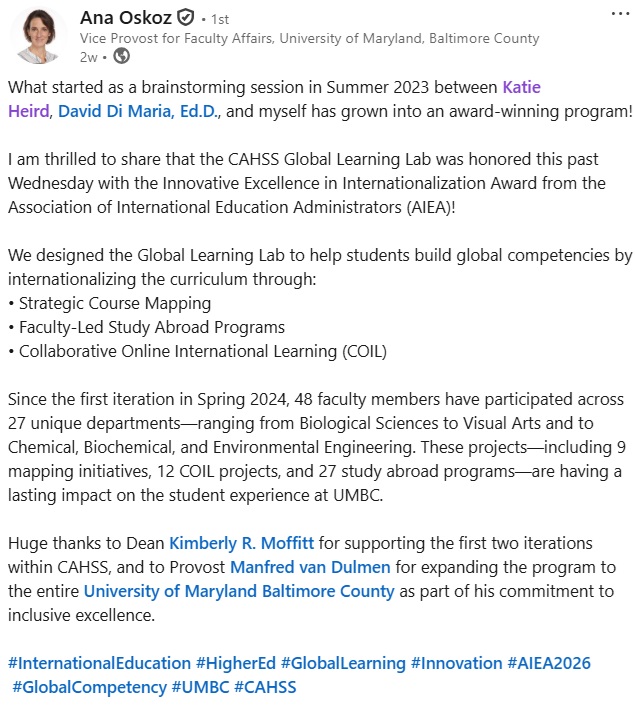
The Association of International Education Administrators (AIEA) has awarded UMBC’s Global Learning Lab one of two Innovative Excellence in Internationalization Awards. This award honors creative, replicable, and innovative initiatives that are critical to internationalization and require strong leadership to achieve. The AIEA commends the Global Learning Lab for reflecting UMBC’s commitment to justice, equity, diversity, and inclusion by fostering inclusive, cost-effective models that integrate global perspectives into the curriculum.
The lab’s primary mission is to support faculty development in increasing student access to global learning opportunities. Through a cohort-based model, the lab brings faculty together for a series of workshops to develop best practices for integrating applied global learning into the curriculum. The initiative was originally launched as a pilot program by the Center for Global Engagement (CGE) and the College of Arts, Humanities, and Social Sciences (CAHSS) Dean’s Office in support of CAHSS faculty. In fall 2025, the lab was opened to all faculty with support from the Office of the Provost. Faculty who participate in this initiative produce concrete deliverables, such as course maps, faculty-led study abroad programs, and Collaborative Online International Learning (COIL) projects.
“To date, 48 faculty members have participated across 27 unique departments ranging from biological sciences to visual arts to chemical, biochemical, and environmental engineering,” according to Provost Provost and Senior Vice President for Academic Affairs, Manfred van Dulmen‘s February campus newsletter. “Projects continue to positively impact the student experience and have included nine mapping initiatives, 12 COIL projects, and 27 study abroad programs.”
Developing an intercultural curriculum
To receive the Excellence in Internationalization Award, the Global Learning Lab had to be grounded in the principles of comprehensive internationalization—an inclusive process that impacts teaching, research, and service. It also had to align with at least two of UNESCO’s 17 Sustainable Development Goals, reflect the underlying principles of justice, equity, diversity, and inclusion in higher education, and serve as a replicable model for other institutions.
Cheryl North, clinical associate professor of education, and Takashi Yamashita, director and professor of sociology, anthropology, and public health (SAPH), are alumni of the inaugural cohort. They were both in the process of designing international university and community partnerships, in Germany and Japan, respectively, before the Global Learning Lab was launched. The lab provided technical and collegial support that bridged the gap between idea and implementation.
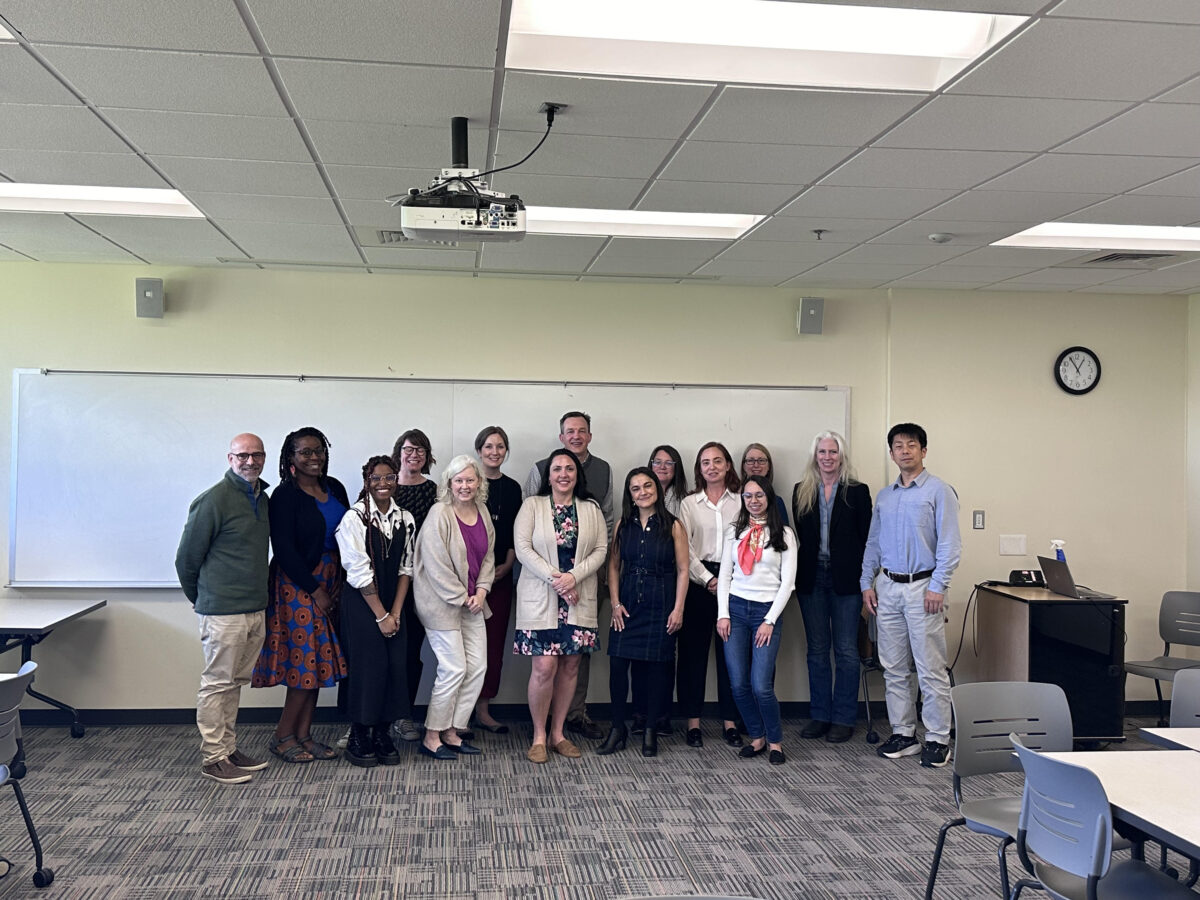 (l-r): Brian Souders (former CGE staff); Ogonna Owu Jones (former CGE staff); Alicyn Curtis (CGE staff); Rebecca Grenouilleau-Loescher (faculty fellow, modern languages, linguistics, and intercultrual communication); Katie Birger (faculty fellow, SAPH); Jessica Cook (faculty fellow, Sondheim Public Affairs Scholars Program); Katherine Heird (CGE staff); David Schultz (faculty fellow, pscyhology); Yolanda Valencia (faculty fellow, geography and environment sciences); Lauren Clay (faculty fellow, emergency and disaster health services); Racquel Matos (visiting dean of the faculty of education and psychology at Universidade Católica Portuguesa in Portugal); Jessica Pfeifer (faculty fellow, philosophy); Lina Mora (CGE intern/intercultural communication graduate student, North (second on the right); and Yamashita (first on the right). (Image courtesy of CGE)
North, along with faculty at the University of Kassel in Germany, had established the foundations for a virtual classroom exchange for their education students, but had experienced technical and scheduling conflicts. “After participating in the Global Learning Lab, we learned to structure the collaboration effectively,” said North. “When we implemented these insights, UMBC students were able to share completed lessons and reflections, while the German students shared their process in the early stages of planning and implementation. Despite the scheduling differences, the exchange was successful, meaningful, and professionally enriching for everyone involved.”
The lab’s funding, technical training, and networking opportunities provided essential support that helped Yamashita develop the Global Health and Aging in Japan faculty-led study abroad program, which will launch in summer 2026.
“Developing a study abroad program can often feel like an isolated effort for a single faculty member,” says Yamashita. “Having a dedicated technical support team from CGE, along with a community of UMBC colleagues to share unique ideas, made the process much more engaging. These interactions kept me inspired and motivated to bring this program to UMBC students.”
Campus-wide internationalization
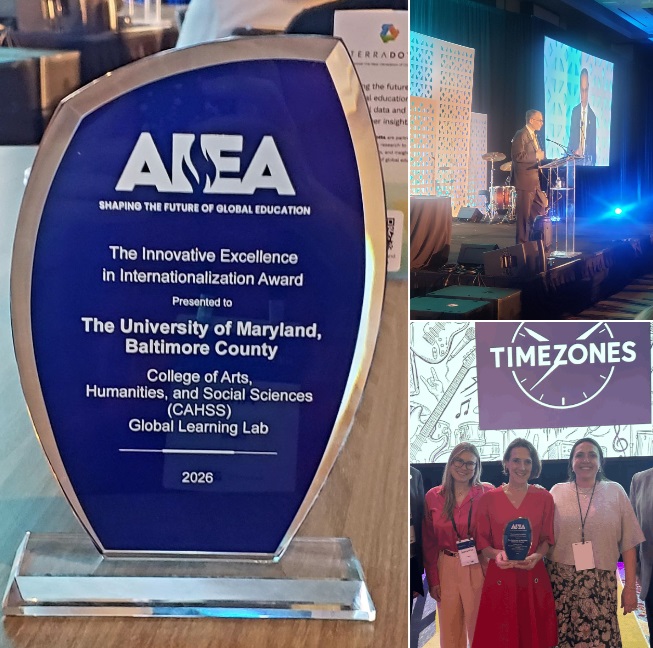
UMBC faculty and staff at the AIEA award. (Image courtesy of CGE)
“The impact of the Global Learning Lab has been profound,” wrote Ana Oskoz, vice provost for faculty affairs, in her recommendation letter. “It is a shining example of innovative internationalization that prioritizes inclusivity, equity, and academic excellence.”
Faculty interested in participating in the Global Learning Lab are encouraged to follow the Faculty Affairs page on MyUMBC for notifications regarding future offerings.
]]>
The Association of International Education Administrators (AIEA) has awarded UMBC’s Global Learning Lab one of two Innovative Excellence in Internationalization Awards. This award honors creative,...
https://umbc.edu/stories/umbcs-global-learning-lab-receives-internationalization-award/
https://my3.my.umbc.edu/api/v0/pixel/news/157429/guest@my.umbc.edu/139f4df23c515634323db492b84665cc/api/pixel
cahss
center-for-global-engagement
community
education
international
news
research
saph
story
UMBC News & Magazine
https://my3.my.umbc.edu/groups/umbc-news-magazine
https://assets1-my.umbc.edu/system/shared/avatars/groups/000/001/943/24435aa6207c452e7bc15cc74b42c7bb/xsmall.png?1748556657
https://assets1-my.umbc.edu/system/shared/avatars/groups/000/001/943/24435aa6207c452e7bc15cc74b42c7bb/original.png?1748556657
https://assets2-my.umbc.edu/system/shared/avatars/groups/000/001/943/24435aa6207c452e7bc15cc74b42c7bb/xxlarge.png?1748556657
https://assets2-my.umbc.edu/system/shared/avatars/groups/000/001/943/24435aa6207c452e7bc15cc74b42c7bb/xlarge.png?1748556657
https://assets3-my.umbc.edu/system/shared/avatars/groups/000/001/943/24435aa6207c452e7bc15cc74b42c7bb/large.png?1748556657
https://assets1-my.umbc.edu/system/shared/avatars/groups/000/001/943/24435aa6207c452e7bc15cc74b42c7bb/medium.png?1748556657
https://assets2-my.umbc.edu/system/shared/avatars/groups/000/001/943/24435aa6207c452e7bc15cc74b42c7bb/small.png?1748556657
https://assets1-my.umbc.edu/system/shared/avatars/groups/000/001/943/24435aa6207c452e7bc15cc74b42c7bb/xsmall.png?1748556657
https://assets2-my.umbc.edu/system/shared/avatars/groups/000/001/943/24435aa6207c452e7bc15cc74b42c7bb/xxsmall.png?1748556657
UMBC News & Magazine
8
0
false
Thu, 12 Mar 2026 10:10:48 -0400
Fri, 13 Mar 2026 15:49:18 -0400
From modern languages to modern dance—Xavier Mack ’16 performs around the world
Before Xavier Mack ’16 dove into the world of professional dance, he prioritized finishing his college education, earning his degree—not in dance—but in modern language and linguistics. Mack transferred to UMBC in his sophomore year, and after a rocky start, he sought out a social group through his programs and housing community and he found his feet firmly under him. Now, Mack is pursuing his other passion, “the power of body language in conversation,” by dancing at the largest modern dance company in the U.S, Alvin Ailey American Dance Theater.
Mack chats below with fellow dancer and UCM intern Kayla Logue ’27 about finding correlation between his linguistics and dance knowledge, his experience at Alvin Ailey Dance Theater, and how his time at UMBC has led to pursuing his passions.
Q: What was it like being an MLL student who also danced?
A: I loved studying two disciplines that had no seeming relation! I found so much enjoyment in the balance of moving my body and spending hours learning language in the lecture halls. Dancing served as a release for me, even though it came with its challenges. As my understanding of linguistics and dance deepened, I was able to discover more of a correlation between the two. Both of these fields are rooted in elements of communication. This discovery helped enhance my dance artistry as well as revealing the power of body language in conversation.
Q: Do you have a favorite performance memory while at UMBC?
A: My favorite performance memory at UMBC was dancing a duet called Floating Above by Carol Hess. This piece was acrobatic yet very slow and meditative.
Q: Is there someone from UMBC who inspired you and how?
A: I’ve always been able to find inspiration in my peers. Everyone had their own special gifting; things that came easy to them. Drawing from what I observed around me kept me reaching for my untapped potentials. However, my most influential person had to be Brandon P. Russell [assistant teaching professor of classical ballet and contemporary dance]. Brandon saw all of my capabilities and pushed me to be the professional dance artist I am today, even before I knew it was possible.
Photo right: Mack at his UMBC graduation.

Q: What was the process of getting into Alvin Ailey American Dance Theater?
A: My process for joining Ailey was a standard audition and callback in New York City. Since we were just coming out of COVID, they structured the preliminary audition to take place over several sessions within one day. Only 30 dancers could be in the room at one time and we had to wear masks. I had to return to NYC a few weeks later for the callback. Then, I waited about one week before I received the call offering me my job.
As my understanding of linguistics and dance deepened, I was able to discover more of a correlation between the two. Both of these fields are rooted in elements of communication. This discovery helped enhance my dance artistry as well as revealing the power of body language in conversation.
Xavier Mack '16
Q: What has been your favorite part about being in the company?
A: My favorite part of being in the company is the touring! I’ve always had a heart for travel; especially international travel. This job helps soothe my wanderlust. I’m afforded the opportunity to visit incredible parts of the world and meet the special people who inhabit these places.
Q: Did you do any traveling while at UMBC?
A: I actually constructed my own study abroad experience. With the approval of my advisor, I connected with a middle school, in a suburb of Paris, and asked their principal if I could assist with their English language classes. The principal was more than happy to have me during three weeks of my winter break.
 (Photo courtesy of Fredrik Gille)
Q: What’s a takeaway from UMBC that’s stayed with you?
A: Time management is the greatest skill I learned at UMBC and still use today. There are many things about my professional life that require timely/rapid responses. The discipline of managing my time gives me the ability to reply to alerts and submit important documents to my leadership teams, without falling behind or becoming stressed by long to-do lists.
Q: Why was it important that you finish your college education before performing professionally?
A: I had come way too close to graduation to turn away from obtaining my degree. In my opinion, my only option was walking across the stage. I poured an immense amount of time, hard work, and money into my education. I wanted to see that through to the end.
Learn more about extraordinary UMBC alumni, faculty, and staff who are chasing their dreams.
]]>
Before Xavier Mack ’16 dove into the world of professional dance, he prioritized finishing his college education, earning his degree—not in dance—but in modern language and linguistics. Mack...
https://umbc.edu/stories/xavier-mack-journey-from-linguistics-to-dancing/
https://my3.my.umbc.edu/api/v0/pixel/news/157356/guest@my.umbc.edu/bb1b5218cb8d4f41bef5f89c9c64f767/api/pixel
alumni
cahss
dance
magazine
mlli
story
UMBC News & Magazine
https://my3.my.umbc.edu/groups/umbc-news-magazine
https://assets1-my.umbc.edu/system/shared/avatars/groups/000/001/943/24435aa6207c452e7bc15cc74b42c7bb/xsmall.png?1748556657
https://assets1-my.umbc.edu/system/shared/avatars/groups/000/001/943/24435aa6207c452e7bc15cc74b42c7bb/original.png?1748556657
https://assets2-my.umbc.edu/system/shared/avatars/groups/000/001/943/24435aa6207c452e7bc15cc74b42c7bb/xxlarge.png?1748556657
https://assets2-my.umbc.edu/system/shared/avatars/groups/000/001/943/24435aa6207c452e7bc15cc74b42c7bb/xlarge.png?1748556657
https://assets3-my.umbc.edu/system/shared/avatars/groups/000/001/943/24435aa6207c452e7bc15cc74b42c7bb/large.png?1748556657
https://assets1-my.umbc.edu/system/shared/avatars/groups/000/001/943/24435aa6207c452e7bc15cc74b42c7bb/medium.png?1748556657
https://assets2-my.umbc.edu/system/shared/avatars/groups/000/001/943/24435aa6207c452e7bc15cc74b42c7bb/small.png?1748556657
https://assets1-my.umbc.edu/system/shared/avatars/groups/000/001/943/24435aa6207c452e7bc15cc74b42c7bb/xsmall.png?1748556657
https://assets2-my.umbc.edu/system/shared/avatars/groups/000/001/943/24435aa6207c452e7bc15cc74b42c7bb/xxsmall.png?1748556657
UMBC News & Magazine
0
0
false
Tue, 10 Mar 2026 13:58:46 -0400
Tue, 10 Mar 2026 13:58:46 -0400
Responding to International Incidents
Dear Campus Community,
I am writing to update you on UMBC’s approach to responding to international incidents, specifically in light of any ongoing international conflicts. I understand that these events may cause significant distress and uncertainty, particularly for members of our UMBC community with personal or academic connections to the regions impacted.
The safety and well-being of our students, faculty, and staff are our highest priorities. While incidents occur daily worldwide, we recognize some events can impact the ability of our community members more than others to travel freely, conduct research, complete their studies, or pose a direct threat to personal health, safety, and security. The following are the steps we take when such international incidents occur.
How UMBC Responds to International Incidents
When an international incident occurs, whether that is an armed conflict, a disease outbreak, or a natural disaster, UMBC follows this protocol:
1. Reach Out to Impacted Community Members
Per UMBC’s International Travel Policy, all university-affiliated international travel must be registered with the university. This ensures that staff in the Center for Global Engagement (CGE) receive automated notifications when UMBC travelers are impacted by incidents classified by our insurance provider, risk intelligence company, or the U.S. Department of State as high or extreme risk. Additionally, we manually consult the International Travel Registry to confirm students, faculty, and staff currently located in or scheduled to transit through the impacted region.
If UMBC has travelers in an impacted region, CGE staff will reach out to those travelers to confirm their safety, assess their immediate needs, and provide assistance as necessitated by the circumstances. Assistance ranges from simply sharing information to working with our insurance provider to coordinate an authorized medical or security evacuation.
- International Students and Scholars
CGE staff message international students, faculty, and staff from impacted countries and whose immigration records are managed by UMBC. In addition to reminding individuals of available campus resources, CGE shares notices regarding any special provisions (e.g.,
Special Student Relief and
Temporary Protected Status) made available to impacted individuals by the U.S. government.
2. Engage Campus Partners
CGE coordinates with campus partners to support UMBC community members impacted by international incidents. A small and agile International Rapid Response Team is available to assess immediate and long-term impacts and identify campus resources available to those impacted.
3. Monitor Developments
Regardless of whether or not UMBC has travelers in an impacted region on university-affiliated travel, we continue to monitor significant international incidents to look for potential escalations or expansion to other areas where university travelers are present. If warranted, we will require requests for university-affiliated travel to impacted regions to be reviewed and approved by UMBC’s International Travel Review Committee, which includes faculty and staff representatives. If it seems evident that risks will spread to neighboring regions, university travelers in those areas may be proactively advised to depart their location. Please note that we do not monitor personal travel.
How UMBC Monitors International Incidents
To ensure our decisions are based on the most accurate and current information, UMBC uses several resources that are not available to the general public:
-
AlertTraveler: AlertTraveler, which is a component of UMBC’s International Travel Registry, provides real-time alerts to CGE staff when high-threat incidents occur in locations where university travelers are present.
-
AXA Assistance / Crisis24 Horizon: As part of UMBC’s international travel insurance policy, UMBC is supported by AXA Assistance, which offers 24/7 medical, travel, and technical support, and Crisis24 Horizon, a comprehensive security and travel risk management platform that enables CGE staff to analyze international incidents and assess emerging threats.
-
Overseas Security Advisory Council (OSAC): This is a partnership between the U.S. Department of State’s Diplomatic Security Service and private sector organizations, including higher education institutions. OSAC provides UMBC with unclassified security analysis, country-specific risk advisories, and direct access to analysts and regional security officers who can help with security assessments and incident response. In addition to receiving a daily update on global health, safety, and security incidents, UMBC belongs to several communities within OSAC focused on specific concerns.
-
Additional Channels: We also leverage information provided by foreign governments, our network of peer institutions, and international partners to stay current as events unfold and to predict future developments.
Resources for University Travelers
If you are planning international travel, please ensure you utilize the following resources:
-
AlertTraveler App: All university travelers should download the AlertTraveler App, which integrates directly with UMBC’s International Travel Registry system. AlertTraveler provides real-time security alerts specific to your location. It also includes a “Check-in” button that allows you to instantly notify CGE staff that you are safe during an emergency.
-
Cultural Insurance Services International (CISI): All travelers going abroad on university-affiliated trips are required to enroll in the CISI international travel insurance policy. In addition to standard medical benefits, CISI provides critical non-insurance services ranging from assisting with replacement of lost medications to authorizing medical and security evacuations. Please download the CISI Traveler App to access your insurance materials and services on your phone. Travelers may also enroll any dependents accompanying them on university-affiliated trips in the CISI international travel insurance policy at their own expense.
-
Smart Traveler Enrollment Program (STEP): Prior to traveling internationally, all U.S. citizens should enroll in the U.S. Department of State’s free STEP Program. This free service registers your trip with the nearest U.S. embassy or consulate, enabling travelers to receive timely updates and alerts unique to their location. Enrollment in STEP also helps the U.S. Department of State to contact your family in the event of an emergency.
Resources and Support
Like the state of Maryland, UMBC is a diverse and globally-engaged community. Our faculty, staff, and students have family, friends, and academic collaborators worldwide. For many, the concept of home stretches across borders, cultures, and timezones. We recognize that national and world events beyond our campus can have a significant impact on the overall well-being of our community members.
As a community of inquiring minds, it is important that we all remain committed to maintaining a global perspective. Staying informed of world events, seeking to understand viewpoints different from our own, and offering support to classmates and colleagues impacted by incidents that may seem to be a world away are three key ways to assist our global community at UMBC.
Finally, you are encouraged to review the resources mentioned below and utilize these resources if you need assistance or support.
Sincerely,
David L. Di Maria, Vice Provost for Global Engagement
]]>
Dear Campus Community, I am writing to update you on UMBC’s approach to responding to international incidents, specifically in light of any ongoing international conflicts. I understand that...
https://umbc.edu/stories/responding-to-international-incidents/
https://my3.my.umbc.edu/api/v0/pixel/news/157620/guest@my.umbc.edu/a067de9fc6e30a31be18166a6cce4703/api/pixel
federal-orders
rss
story
UMBC News & Magazine
https://my3.my.umbc.edu/groups/umbc-news-magazine
https://assets1-my.umbc.edu/system/shared/avatars/groups/000/001/943/24435aa6207c452e7bc15cc74b42c7bb/xsmall.png?1748556657
https://assets1-my.umbc.edu/system/shared/avatars/groups/000/001/943/24435aa6207c452e7bc15cc74b42c7bb/original.png?1748556657
https://assets2-my.umbc.edu/system/shared/avatars/groups/000/001/943/24435aa6207c452e7bc15cc74b42c7bb/xxlarge.png?1748556657
https://assets2-my.umbc.edu/system/shared/avatars/groups/000/001/943/24435aa6207c452e7bc15cc74b42c7bb/xlarge.png?1748556657
https://assets3-my.umbc.edu/system/shared/avatars/groups/000/001/943/24435aa6207c452e7bc15cc74b42c7bb/large.png?1748556657
https://assets1-my.umbc.edu/system/shared/avatars/groups/000/001/943/24435aa6207c452e7bc15cc74b42c7bb/medium.png?1748556657
https://assets2-my.umbc.edu/system/shared/avatars/groups/000/001/943/24435aa6207c452e7bc15cc74b42c7bb/small.png?1748556657
https://assets1-my.umbc.edu/system/shared/avatars/groups/000/001/943/24435aa6207c452e7bc15cc74b42c7bb/xsmall.png?1748556657
https://assets2-my.umbc.edu/system/shared/avatars/groups/000/001/943/24435aa6207c452e7bc15cc74b42c7bb/xxsmall.png?1748556657
UMBC News & Magazine
0
0
false
Fri, 06 Mar 2026 21:39:15 -0500
Fri, 06 Mar 2026 21:39:15 -0500
Celebrating the misunderstood: Mercedes Burns featured in new book on North America’s overlooked critters
GRIZZLED: Love Letters to 50 of North America’s Least Understood Animals spotlights the quirky, often-misunderstood inhabitants of our backyards and beyond. It hits bookstores this week, and Mercedes Burns, associate professor of biological sciences, is featured in an essay that dives into the world of harvesters—better known as daddy longlegs.
The essay debunks the common myth that harvesters are the most venomous spiders in the world, but only harmless because their mouthparts are too small to bite a human. In fact, rather than being spiders at all, Burns shares that they are intriguing arachnid relatives. She unpacks their survival tactics, like shedding legs to escape predators, and other eccentric behaviors that make these gangly denizens more endearing than eerie.
“I’ve studied arachnids for over a decade, and learning about them has opened my eyes to the diversity of less-appreciated and absolutely fascinating species that occur in North America,” Burns shares. “I am excited to join the league of researchers who contributed to this book, and I hope that readers find a new local species to love.”
Burns’ passion for arachnids isn’t new—and it’s been weaving its way into public consciousness for years. In a 2020 New York Times piece, she demystified the fuzzy clusters of daddy longlegs that sometimes “grow” on buildings, turning a gross-out moment into a lesson on their harmless, communal nature. She’s also weighed in on arachnid feats, such as spiders devouring snakes up to 30 times their size, as featured in a 2021 Smithsonian article.
 Mercedes Burns handles one of her study organisms in the lab. (Marlayna Demond ’11/UMBC)
At UMBC, Burns’ impact extends beyond the page. Her 2023 NSF CAREER Award funds research on arachnid evolution in Japan, blending fieldwork with student mentorship to nurture the next generation of scientists and champion arachnid appreciation. There is even a trapdoor spider species named Ummidia mercedesburnsae in her honor.
Burns’ work reminds us that even tiny creatures deserve our attention and care. Dive into science journalist Jason Bittel’s GRIZZLED to discover your own “local species to love.”
]]>
GRIZZLED: Love Letters to 50 of North America’s Least Understood Animals spotlights the quirky, often-misunderstood inhabitants of our backyards and beyond. It hits bookstores this week, and...
https://umbc.edu/quick-posts/celebrating-misunderstood-critters/
https://my3.my.umbc.edu/api/v0/pixel/news/157157/guest@my.umbc.edu/d791c07bbc9e763ecff1fb84e8dc9937/api/pixel
biology
cnms
quick-post
science-and-tech
UMBC News & Magazine
https://my3.my.umbc.edu/groups/umbc-news-magazine
https://assets1-my.umbc.edu/system/shared/avatars/groups/000/001/943/24435aa6207c452e7bc15cc74b42c7bb/xsmall.png?1748556657
https://assets1-my.umbc.edu/system/shared/avatars/groups/000/001/943/24435aa6207c452e7bc15cc74b42c7bb/original.png?1748556657
https://assets2-my.umbc.edu/system/shared/avatars/groups/000/001/943/24435aa6207c452e7bc15cc74b42c7bb/xxlarge.png?1748556657
https://assets2-my.umbc.edu/system/shared/avatars/groups/000/001/943/24435aa6207c452e7bc15cc74b42c7bb/xlarge.png?1748556657
https://assets3-my.umbc.edu/system/shared/avatars/groups/000/001/943/24435aa6207c452e7bc15cc74b42c7bb/large.png?1748556657
https://assets1-my.umbc.edu/system/shared/avatars/groups/000/001/943/24435aa6207c452e7bc15cc74b42c7bb/medium.png?1748556657
https://assets2-my.umbc.edu/system/shared/avatars/groups/000/001/943/24435aa6207c452e7bc15cc74b42c7bb/small.png?1748556657
https://assets1-my.umbc.edu/system/shared/avatars/groups/000/001/943/24435aa6207c452e7bc15cc74b42c7bb/xsmall.png?1748556657
https://assets2-my.umbc.edu/system/shared/avatars/groups/000/001/943/24435aa6207c452e7bc15cc74b42c7bb/xxsmall.png?1748556657
UMBC News & Magazine
0
0
false
Wed, 04 Mar 2026 12:07:19 -0500
Wed, 04 Mar 2026 12:07:19 -0500
Connecting NASA to the classroom: UMBC physicist Zhibo Zhang to lead Goddard Planetary Heliophysics Institute
Zhibo Zhang, professor of physics, has been named director of the Goddard Planetary Heliophysics Institute (GPHI), UMBC’s arm of the Partnership for Heliophysics and Space Environment Research (PHaSER). PHaSER, a multi-institution consortium led by Catholic University of America, contributes to NASA’s Heliophysics Science Division at Goddard Space Flight Center (GSFC) through research on the Sun, its processes, and space weather, which can affect planet Earth and human technologies.
NASA allocated $10 million to UMBC in 2021 under its $64.1 million PHaSER award, underscoring the university’s contributions to heliophysics research and building on more than thirty years of successful collaboration between UMBC and GSFC, located in Greenbelt, Maryland.
 Jan Merka led GPHI from from its inception in 2011 and will hand the reins to Zhibo Zhang this month. (Marlayna Demond ’11/UMBC)
“My first priority is to support GPHI faculty and help enable the outstanding science and engineering they carry out at NASA Goddard Space Flight Center,” Zhang says. “At the same time, I hope GPHI can serve as a stronger bridge between NASA and UMBC by connecting GPHI faculty with UMBC research resources, collaboration and funding opportunities, and with students and faculty who can expand our collective capacity and open doors to bigger, cross-cutting ideas.”
Zhang follows Jan Merka, who has served as the inaugural GPHI director since 2011. As director, Zhang will continue in his faculty role at UMBC, advancing his team’s research on atmospheric dust’s influence on climate and remaining deeply committed to teaching and mentoring. His guidance of undergraduate and graduate students has helped multiple students secure the prestigious NASA Future Investigators in NASA Earth and Space Science and Technology (FINESST) Fellowship and other awards, including the 2025 Elsevier/JQSRT Richard M. Goody Award, fostering the next generation of scientists.
“We are very proud of the fact that UMBC is currently ranked as the #11 institution in the nation in NASA expenditures,” say Karl V. Steiner, vice president for research and creative achievement. “Zhibo Zhang is an outstanding colleague with a broad set of relevant expertise and experiences who will provide important leadership to GPHI and to our partnership with Catholic University under PHaSER. I know that he is the right leader to strengthen our relationship with NASA, building on over three decades of successful cooperative partnership between UMBC and NASA Goddard.”
 Zhibo Zhang (second from right) thoughtfully mentors undergraduate and graduate students, including Qianqian Song (right), Ph.D. ’22, who received the FINESST fellowship, and Jianyu Zheng (far left, rear), Ph.D. ’23, who received the 2025 Elsevier/JQSRT Goody Award. (Marlayna Demond ’11/UMBC)
]]>
Zhibo Zhang, professor of physics, has been named director of the Goddard Planetary Heliophysics Institute (GPHI), UMBC’s arm of the Partnership for Heliophysics and Space Environment Research...
https://umbc.edu/stories/zhang-to-lead-goddard-planetary-heliophysics-institute/
https://my3.my.umbc.edu/api/v0/pixel/news/157136/guest@my.umbc.edu/7aba311f3831e3c2c778aff9a9535436/api/pixel
cnms
gphi
nasa
news
phaser
physics
research
science-and-tech
story
UMBC News & Magazine
https://my3.my.umbc.edu/groups/umbc-news-magazine
https://assets1-my.umbc.edu/system/shared/avatars/groups/000/001/943/24435aa6207c452e7bc15cc74b42c7bb/xsmall.png?1748556657
https://assets1-my.umbc.edu/system/shared/avatars/groups/000/001/943/24435aa6207c452e7bc15cc74b42c7bb/original.png?1748556657
https://assets2-my.umbc.edu/system/shared/avatars/groups/000/001/943/24435aa6207c452e7bc15cc74b42c7bb/xxlarge.png?1748556657
https://assets2-my.umbc.edu/system/shared/avatars/groups/000/001/943/24435aa6207c452e7bc15cc74b42c7bb/xlarge.png?1748556657
https://assets3-my.umbc.edu/system/shared/avatars/groups/000/001/943/24435aa6207c452e7bc15cc74b42c7bb/large.png?1748556657
https://assets1-my.umbc.edu/system/shared/avatars/groups/000/001/943/24435aa6207c452e7bc15cc74b42c7bb/medium.png?1748556657
https://assets2-my.umbc.edu/system/shared/avatars/groups/000/001/943/24435aa6207c452e7bc15cc74b42c7bb/small.png?1748556657
https://assets1-my.umbc.edu/system/shared/avatars/groups/000/001/943/24435aa6207c452e7bc15cc74b42c7bb/xsmall.png?1748556657
https://assets2-my.umbc.edu/system/shared/avatars/groups/000/001/943/24435aa6207c452e7bc15cc74b42c7bb/xxsmall.png?1748556657
UMBC News & Magazine
1
0
false
Wed, 04 Mar 2026 09:28:26 -0500
Wed, 04 Mar 2026 09:28:26 -0500
Strategic Plan Update and Campus Communications and Engagement
Zhibo Zhang (second from right) thoughtfully mentors undergraduate and graduate students, including Qianqian Song (right), Ph.D. ’22, who received the FINESST fellowship, and Jianyu Zheng (far left, rear), Ph.D. ’23, who received the 2025 Elsevier/JQSRT Goody Award. (Marlayna Demond ’11/UMBC)
]]>
Zhibo Zhang, professor of physics, has been named director of the Goddard Planetary Heliophysics Institute (GPHI), UMBC’s arm of the Partnership for Heliophysics and Space Environment Research...
https://umbc.edu/stories/zhang-to-lead-goddard-planetary-heliophysics-institute/
https://my3.my.umbc.edu/api/v0/pixel/news/157136/guest@my.umbc.edu/7aba311f3831e3c2c778aff9a9535436/api/pixel
cnms
gphi
nasa
news
phaser
physics
research
science-and-tech
story
UMBC News & Magazine
https://my3.my.umbc.edu/groups/umbc-news-magazine
https://assets1-my.umbc.edu/system/shared/avatars/groups/000/001/943/24435aa6207c452e7bc15cc74b42c7bb/xsmall.png?1748556657
https://assets1-my.umbc.edu/system/shared/avatars/groups/000/001/943/24435aa6207c452e7bc15cc74b42c7bb/original.png?1748556657
https://assets2-my.umbc.edu/system/shared/avatars/groups/000/001/943/24435aa6207c452e7bc15cc74b42c7bb/xxlarge.png?1748556657
https://assets2-my.umbc.edu/system/shared/avatars/groups/000/001/943/24435aa6207c452e7bc15cc74b42c7bb/xlarge.png?1748556657
https://assets3-my.umbc.edu/system/shared/avatars/groups/000/001/943/24435aa6207c452e7bc15cc74b42c7bb/large.png?1748556657
https://assets1-my.umbc.edu/system/shared/avatars/groups/000/001/943/24435aa6207c452e7bc15cc74b42c7bb/medium.png?1748556657
https://assets2-my.umbc.edu/system/shared/avatars/groups/000/001/943/24435aa6207c452e7bc15cc74b42c7bb/small.png?1748556657
https://assets1-my.umbc.edu/system/shared/avatars/groups/000/001/943/24435aa6207c452e7bc15cc74b42c7bb/xsmall.png?1748556657
https://assets2-my.umbc.edu/system/shared/avatars/groups/000/001/943/24435aa6207c452e7bc15cc74b42c7bb/xxsmall.png?1748556657
UMBC News & Magazine
1
0
false
Wed, 04 Mar 2026 09:28:26 -0500
Wed, 04 Mar 2026 09:28:26 -0500
Strategic Plan Update and Campus Communications and Engagement
Dear UMBC Community,
On behalf of the UMBC Strategic Plan Steering Committee, I am writing with an update on our progress developing the strategic plan and to outline next steps for communications and community engagement.
The Five Strategic Plan Pillars and Subgroups
The steering committee and its five pillar subgroups have met this semester to advance our work. The work of each subgroup will be informed by the insights, expertise, ideas, and perspectives of our campus community members. As a reminder, the five strategic plan pillars are:
- Grow Student Opportunity and Success
- Transform Teaching and Learning
- Redefine Excellence in Research and Creative Achievement
- Cultivate Organizational Innovation and Vitality
- Strengthen Maryland and Its Communities
How to Stay Informed and Participate
Starting this month, the pillar subgroups will offer several engagement opportunities for the community. Here is how you can ensure you are updated and involved:
- Follow the myUMBC Strategic Planning group to receive immediate updates on planned community engagement activities as they are scheduled.
- Visit our updated strategic planning website. Starting this Friday, March 6, the site will feature a new feedback form to provide a direct way for you to share your voice with the committee.
- Look for brief, regular email reminders about strategic planning news beginning this Friday.
Thank you for your interest in this process. The Strategic Plan Steering Committee looks forward to engaging with you and receiving your valuable input as we continue this critical planning process.
Warmest regards,
Charissa Cheah
Professor of Psychology and Asian Studies Faculty Affiliate
Chair, UMBC Strategic Plan Steering Committee
]]>
Dear UMBC Community, On behalf of the UMBC Strategic Plan Steering Committee, I am writing with an update on our progress developing the strategic plan and to outline next steps for...
https://umbc.edu/stories/strategic-plan-update-and-campus-communications-and-engagement/
https://my3.my.umbc.edu/api/v0/pixel/news/157472/guest@my.umbc.edu/81511cee496561815165199d718483b6/api/pixel
rss
story
strategic-plan
UMBC News & Magazine
https://my3.my.umbc.edu/groups/umbc-news-magazine
https://assets1-my.umbc.edu/system/shared/avatars/groups/000/001/943/24435aa6207c452e7bc15cc74b42c7bb/xsmall.png?1748556657
https://assets1-my.umbc.edu/system/shared/avatars/groups/000/001/943/24435aa6207c452e7bc15cc74b42c7bb/original.png?1748556657
https://assets2-my.umbc.edu/system/shared/avatars/groups/000/001/943/24435aa6207c452e7bc15cc74b42c7bb/xxlarge.png?1748556657
https://assets2-my.umbc.edu/system/shared/avatars/groups/000/001/943/24435aa6207c452e7bc15cc74b42c7bb/xlarge.png?1748556657
https://assets3-my.umbc.edu/system/shared/avatars/groups/000/001/943/24435aa6207c452e7bc15cc74b42c7bb/large.png?1748556657
https://assets1-my.umbc.edu/system/shared/avatars/groups/000/001/943/24435aa6207c452e7bc15cc74b42c7bb/medium.png?1748556657
https://assets2-my.umbc.edu/system/shared/avatars/groups/000/001/943/24435aa6207c452e7bc15cc74b42c7bb/small.png?1748556657
https://assets1-my.umbc.edu/system/shared/avatars/groups/000/001/943/24435aa6207c452e7bc15cc74b42c7bb/xsmall.png?1748556657
https://assets2-my.umbc.edu/system/shared/avatars/groups/000/001/943/24435aa6207c452e7bc15cc74b42c7bb/xxsmall.png?1748556657
UMBC News & Magazine
0
0
false
Tue, 03 Mar 2026 21:49:56 -0500