UMBC’s Greg Szeto works to better predict patient responses to immunotherapy
As a Washington Post article highlighted, some doctors are now using immunotherapy—stimulating the body’s own immune response to tackle disease in targeted ways—to treat cancer patients who are not responding to traditional chemotherapies, and increasingly in place of chemotherapies or in combination with them. The Food and Drug Administration recently received unanimous recommendation from an advisory committee that a new class of immunotherapy, a “living drug,” be approved for use in children and young adults with leukemia. “The treatment takes cells from a patient’s body, modifies the genes, and then infuses those modified cells back into the person who has cancer,” explains NPR.
The Multiple Myeloma Research Foundation awarded UMBC’s Greg Szeto, assistant professor of chemical, biochemical and environmental engineering, a $75,000 research fellow grant to continue his work on immunotherapy. Specifically, Szeto is developing experimental tests and computational models that could help physicians more accurately predict how individual patients with multiple myeloma will respond to a similar type of immunotherapy. Szeto’s preliminary work with collaborator Ivan Borrello, associate professor of oncology at Johns Hopkins Sidney Kimmel Comprehensive Cancer Center, correctly predicted clinical outcome in more than 80% of multiple myeloma patients from a prior immunotherapy clinical trial using “living drugs.”
“A major hurdle for the field is determining who will benefit from which immunotherapies, and making that determination as early as possible,” explains Szeto. “Though a long way off, the rewards of pursuing such research are key insights for better understanding how existing and emerging therapies work, enhancing the connections between STEM disciplines, and in the long run increasing patient quality of life and the ability of doctors and patients to make informed care decisions.”
In previous research, Szeto found that combining multiple immunotherapy agents can improve responses in mice treated for melanoma, and computational models could help predict and dissect these responses. A paper he coauthored with collaborators including Michael Zhang Ph.D. ’23, chemical engineering, who worked with Szeto as a research tech at MIT, appeared in Nature Medicine last year and indicated that combinations of immunotherapy agents can enable immune cells to more effectively infiltrate and reduce the size of the tumor. This size reduction was predicted by fusing experimental tests with computational models. Currently, Szeto is working to define when and how to test different samples to get the best predictive models.
Because treatments are tailored to individual patients based on a broad range of factors, understanding and assessing their function can be incredibly complex, and it can be challenging to replicate successful treatments across patients. Szeto hopes to help researchers develop more predictable treatment regimens that can use knowledge about individual patients, but with a firmer sense of when particular schedules of medication and dosage levels should be used, and what impact they are likely to have.
“There really hasn’t been any approval for this ‘living drug’ approach before, so what recently happened is a major milestone,” he says, adding that “it paves the way for approval of other drugs within this class, similar to those we are studying with Dr. Borrello.”
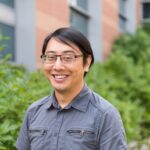
Image: Greg Szeto. Photo by Marlayna Demond ’11 for UMBC.
]]>
As a Washington Post article highlighted, some doctors are now using immunotherapy—stimulating the body’s own immune response to tackle disease in targeted ways—to treat cancer patients who are...
https://umbc.edu/stories/umbcs-greg-szeto-works-to-better-predict-patient-responses-to-immunotherapy/
https://my3.my.umbc.edu/api/v0/pixel/news/120715/guest@my.umbc.edu/dd3a0eea21acd56a70784c7045d71f61/api/pixel
cbee
coeit
science-and-technology
UMBC News & Magazine
https://my3.my.umbc.edu/groups/umbc-news-magazine
https://assets1-my.umbc.edu/system/shared/avatars/groups/000/001/943/24435aa6207c452e7bc15cc74b42c7bb/xsmall.png?1748556657
https://assets1-my.umbc.edu/system/shared/avatars/groups/000/001/943/24435aa6207c452e7bc15cc74b42c7bb/original.png?1748556657
https://assets2-my.umbc.edu/system/shared/avatars/groups/000/001/943/24435aa6207c452e7bc15cc74b42c7bb/xxlarge.png?1748556657
https://assets2-my.umbc.edu/system/shared/avatars/groups/000/001/943/24435aa6207c452e7bc15cc74b42c7bb/xlarge.png?1748556657
https://assets3-my.umbc.edu/system/shared/avatars/groups/000/001/943/24435aa6207c452e7bc15cc74b42c7bb/large.png?1748556657
https://assets1-my.umbc.edu/system/shared/avatars/groups/000/001/943/24435aa6207c452e7bc15cc74b42c7bb/medium.png?1748556657
https://assets2-my.umbc.edu/system/shared/avatars/groups/000/001/943/24435aa6207c452e7bc15cc74b42c7bb/small.png?1748556657
https://assets1-my.umbc.edu/system/shared/avatars/groups/000/001/943/24435aa6207c452e7bc15cc74b42c7bb/xsmall.png?1748556657
https://assets2-my.umbc.edu/system/shared/avatars/groups/000/001/943/24435aa6207c452e7bc15cc74b42c7bb/xxsmall.png?1748556657
UMBC News & Magazine
0
0
false
Fri, 14 Jul 2017 15:03:48 -0400
UMBC faculty research works to reduce pollution in waterways

Each day, consumers use a broad range of personal care products, including antibacterial soaps, shampoos and conditioners, perfumes, cosmetics, and deodorants. In a recent article in The Conversation, Lee Blaney, assistant professor of chemical, biochemical and environmental engineering, describes how personal care products can negatively affect the environment and the health of animals and humans, and how his research is working to limit those harmful impacts.
Blaney explains that personal care products, as well as medications, make it into sewer systems after being flushed down toilets, sinks, or shower drains, eventually reaching wastewater treatment plants. Unfortunately, “[t]hese plants are not designed to treat the thousands of specialty chemicals in pharmaceuticals and personal care products,” Blaney notes. “Many of the active and inactive ingredients present in these products pass through our wastewater treatment plants and ultimately end up in rivers, streams or oceans.”
How does this occur? “Typical wastewater treatment plants are designed to treat multiple pollutants, including organic carbon from human and food waste; nutrients like nitrogen and phosphorus; and pathogenic bacteria and viruses that cause disease,” he writes. “They are not equipped to handle the many ingredients of concern that are present in personal care products.”
To reduce the impact these products have, Blaney says that the improvement of wastewater treatment technologies is crucial, as the chemicals in personal care products may threaten the health of people and aquatic animals, even when found at low concentrations. One approach Blaney suggests is more carefully testing and regulating the ingredients in personal care products to minimize their toxicity, as well as developing safer options than products currently available.
UMBC researchers across a range of STEM and social science fields are also working to reduce pollution in waterways by improving mechanisms to prevent pollutants that are already in the ecosystem from spreading through a watershed. For example, Matt Baker, professor of geography and environmental systems (GES), conducts research to better understand how direct runoff from agriculture and urban areas affects waterways. His work has demonstrated that thickly vegetated zones along the banks of rivers and streams, called “riparian buffers,” can significantly reduce the amount of pollution that enters these waterways and ends up in the Bay.
Chris Swan, professor of GES, is leading work that would reduce urban stormwater runoff in Baltimore City, which often finds its way to Chesapeake Bay. His research seeks to green vacant lots with native plants, whose roots will absorb some city pollutants. The research asks complex ecological questions, too, about how urbanization and climate change may affect the concept of “native species,” and engages communities in maintaining revived green areas.
Blaney, Baker, and Swan are just a few of the many UMBC faculty focused on challenges related to the intricate relationships people have with their environments. True of other challenges as well, Blaney says a “multi-pronged approach” will help today’s scientists, policymakers, and innovators to “continue to improve our quality of life without harming the environment.”
Read “There’s a new generation of water pollutants in your medicine cabinet” in The Conversation.
Header image: The UMBC Library Pond. Photo by Marlayna Demond ’11 for UMBC.
]]>
Each day, consumers use a broad range of personal care products, including antibacterial soaps, shampoos and conditioners, perfumes, cosmetics, and deodorants. In a recent article in The...
https://umbc.edu/stories/umbc-faculty-research-works-to-reduce-pollution-in-waterways/
https://my3.my.umbc.edu/api/v0/pixel/news/120768/guest@my.umbc.edu/97feffe20ca858c6164c5e93349d3501/api/pixel
cahss
cbee
coeit
ges
policy-and-society
science-and-technology
UMBC News & Magazine
https://my3.my.umbc.edu/groups/umbc-news-magazine
https://assets1-my.umbc.edu/system/shared/avatars/groups/000/001/943/24435aa6207c452e7bc15cc74b42c7bb/xsmall.png?1748556657
https://assets1-my.umbc.edu/system/shared/avatars/groups/000/001/943/24435aa6207c452e7bc15cc74b42c7bb/original.png?1748556657
https://assets2-my.umbc.edu/system/shared/avatars/groups/000/001/943/24435aa6207c452e7bc15cc74b42c7bb/xxlarge.png?1748556657
https://assets2-my.umbc.edu/system/shared/avatars/groups/000/001/943/24435aa6207c452e7bc15cc74b42c7bb/xlarge.png?1748556657
https://assets3-my.umbc.edu/system/shared/avatars/groups/000/001/943/24435aa6207c452e7bc15cc74b42c7bb/large.png?1748556657
https://assets1-my.umbc.edu/system/shared/avatars/groups/000/001/943/24435aa6207c452e7bc15cc74b42c7bb/medium.png?1748556657
https://assets2-my.umbc.edu/system/shared/avatars/groups/000/001/943/24435aa6207c452e7bc15cc74b42c7bb/small.png?1748556657
https://assets1-my.umbc.edu/system/shared/avatars/groups/000/001/943/24435aa6207c452e7bc15cc74b42c7bb/xsmall.png?1748556657
https://assets2-my.umbc.edu/system/shared/avatars/groups/000/001/943/24435aa6207c452e7bc15cc74b42c7bb/xxsmall.png?1748556657
UMBC News & Magazine
0
0
false
Mon, 15 May 2017 17:11:09 -0400
Daniel Ocasio, UMBC’s 2017 valedictorian, to pursue environmental engineering Ph.D.
Daniel Ocasio
B.S., Chemical Engineering
Summa Cum Laude, Certificate: Honors College
Hometown: Severn, Maryland
Plans: Ph.D., University of California, Berkeley
UMBC fosters a diverse community where everyone has a chance to thrive in their own unique way. As a Meyerhoff Scholar, MARC U*STAR Scholar, HHMI Scholar, and Honors College member, I have built a fortified support system that is rare to find.
Daniel Ocasio, valedictorian for UMBC’s Class of 2017, is a first generation college student who hit the ground running at UMBC, as an inspiring leader in research, academic, and student professional organizations.
Ocasio is a Meyerhoff Scholar, MARC U*STAR Scholar, Howard Hughes Medical Institute Scholar, and member of the Honors College. In 2016, he was one of three UMBC students to receive the prestigious Barry M. Goldwater Scholarship. He has also received the National Science Foundation’s highly competitive Graduate Research Fellowship and a GEM Fellowship, which provides opportunities for highly qualified students from underrepresented communities in applied sciences and engineering.
Much of Ocasio’s research has focused on water quality and water treatment. He credits working in the lab of Lee Blaney, assistant professor of chemical, biochemical and environmental engineering, with helping to push him beyond his expectations for the undergraduate experience, and to actively pursue a career as a researcher.
Ocasio founded the UMBC chapter of the Society of Hispanic Professional Engineers (SHPE), and received a notable recognition for presenting his research at a national SHPE conference. He has also presented award-winning research at the Annual Biomedical Research Conference for Minority Students and UMBC’s own College of Natural and Mathematical Sciences Symposium. Ocasio has twice served as vice president of the Tau Beta Pi engineering honors society, and has received a national Tau Beta Pi scholarship.
 Daniel Ocasio (back row, second from right) with some of the mentors and mentees participating in the AIM program; photo courtesy of Ocasio.
Outside of the classroom and lab, Ocasio cofounded a mentoring program for middle school students in Baltimore City: Achievement and Inspiration through Mentorship (AIM). The program prepares college students to serve as effective, committed mentors through a semester-long training, and facilitates their work with middle school students.
Ocasio will attend the University of California, Berkeley in the fall, where he will pursue his Ph.D. in environmental engineering. His research will focus on developing improved water treatment techniques and technologies.
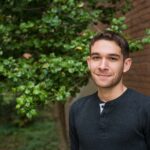
Portrait by Marlayna Demond ‘11 for UMBC.
]]>
Daniel Ocasio B.S., Chemical Engineering Summa Cum Laude, Certificate: Honors College Hometown: Severn, Maryland Plans: Ph.D., University of California, Berkeley UMBC fosters a diverse...
https://umbc.edu/stories/daniel-ocasio/
https://my3.my.umbc.edu/api/v0/pixel/news/120771/guest@my.umbc.edu/6ec5e5ea848339d1ffcbfd5a706f5a31/api/pixel
cbee
class-of-2017
coeit
honorscollege
majoraward
marcustar
meyerhoffscholars
science-and-technology
undergradresearch
UMBC News & Magazine
https://my3.my.umbc.edu/groups/umbc-news-magazine
https://assets1-my.umbc.edu/system/shared/avatars/groups/000/001/943/24435aa6207c452e7bc15cc74b42c7bb/xsmall.png?1748556657
https://assets1-my.umbc.edu/system/shared/avatars/groups/000/001/943/24435aa6207c452e7bc15cc74b42c7bb/original.png?1748556657
https://assets2-my.umbc.edu/system/shared/avatars/groups/000/001/943/24435aa6207c452e7bc15cc74b42c7bb/xxlarge.png?1748556657
https://assets2-my.umbc.edu/system/shared/avatars/groups/000/001/943/24435aa6207c452e7bc15cc74b42c7bb/xlarge.png?1748556657
https://assets3-my.umbc.edu/system/shared/avatars/groups/000/001/943/24435aa6207c452e7bc15cc74b42c7bb/large.png?1748556657
https://assets1-my.umbc.edu/system/shared/avatars/groups/000/001/943/24435aa6207c452e7bc15cc74b42c7bb/medium.png?1748556657
https://assets2-my.umbc.edu/system/shared/avatars/groups/000/001/943/24435aa6207c452e7bc15cc74b42c7bb/small.png?1748556657
https://assets1-my.umbc.edu/system/shared/avatars/groups/000/001/943/24435aa6207c452e7bc15cc74b42c7bb/xsmall.png?1748556657
https://assets2-my.umbc.edu/system/shared/avatars/groups/000/001/943/24435aa6207c452e7bc15cc74b42c7bb/xxsmall.png?1748556657
UMBC News & Magazine
0
0
false
Sun, 14 May 2017 01:02:16 -0400
Andreas Seas pursues biomedical engineering M.D./Ph.D. while supporting next generation of diverse STEM students
Andreas Seas
B.S., Chemical Engineering
Summa Cum Laude, Certificate: Honors College
Hometown: Ellicott City, Maryland
Plans: M.D./Ph.D., Duke University
UMBC has provided an environment of brilliant, supportive students who have helped keep me motivated and excited, as well as a team of teachers and advisors who cared about supporting and pushing me.
Andreas Seas’ research interests and passions span all three colleges at UMBC, and have taken him from labs at UMBC and other top research institutions to concert halls and Baltimore City high school classrooms.
 Andreas Seas.
Seas was one of three exceptional UMBC students to receive the prestigious Barry Goldwater Scholarship in 2016. He is a Meyerhoff Scholar, MARC U*STAR Scholar, and recipient of a NASA scholarship, and has also completed research with biomedical and surgical faculty at the University of Nebraska Medical Center. His research on the mechanics of the femoral artery and the pathology of peripheral arterial disease led him to publish five peer-reviewed articles and submit seven abstracts to notable professional conferences.
On campus, Seas has served on the UMBC Honors College Council, coordinating events and projects to complement the Honors College experience. His mentors include Mariajose Castellanos, lecturer of chemical, biochemical and environmental engineering; Jacqueline King, assistant director of the MARC U*STAR Program; Keith Harmon, director of the Meyerhoff Scholars Program; and Simon Stacey, interim vice provost and dean of undergraduate education. His academic achievements have earned his induction into three honors societies: Phi Beta Kappa, Phi Kappa Phi, and Tau Beta Pi.
When not in the classroom or the lab, Seas has served as a mentor in Baltimore’s Medical Education Resources Initiative for Teens (MERIT) Program, which works to support the next generation of diverse healthcare professionals. Connecting with peers, he has worked as a teaching assistant in biological sciences and a learning assistant in physics. Seas also enjoys the arts as a Greek folk dance instructor and as a viola player in the UMBC Community Symphony, where he is an assistant conductor.
In the fall, Seas will pursue joint M.D./Ph.D. degrees with a focus on biomedical engineering at Duke University.
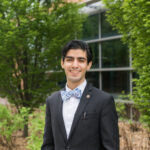
Image: Andreas Seas delivering a speech during URCAD 2016. Photos by Marlayna Demond ‘11 for UMBC.
]]>
Andreas Seas B.S., Chemical Engineering Summa Cum Laude, Certificate: Honors College Hometown: Ellicott City, Maryland Plans: M.D./Ph.D., Duke University UMBC has provided an environment...
https://umbc.edu/stories/andreas-seas/
https://my3.my.umbc.edu/api/v0/pixel/news/120803/guest@my.umbc.edu/7ed54300f1edd6248508774e2e058e66/api/pixel
cbee
class-of-2017
coeit
honorscollege
majoraward
marcustar
meyerhoffscholars
science-and-technology
undergradresearch
UMBC News & Magazine
https://my3.my.umbc.edu/groups/umbc-news-magazine
https://assets1-my.umbc.edu/system/shared/avatars/groups/000/001/943/24435aa6207c452e7bc15cc74b42c7bb/xsmall.png?1748556657
https://assets1-my.umbc.edu/system/shared/avatars/groups/000/001/943/24435aa6207c452e7bc15cc74b42c7bb/original.png?1748556657
https://assets2-my.umbc.edu/system/shared/avatars/groups/000/001/943/24435aa6207c452e7bc15cc74b42c7bb/xxlarge.png?1748556657
https://assets2-my.umbc.edu/system/shared/avatars/groups/000/001/943/24435aa6207c452e7bc15cc74b42c7bb/xlarge.png?1748556657
https://assets3-my.umbc.edu/system/shared/avatars/groups/000/001/943/24435aa6207c452e7bc15cc74b42c7bb/large.png?1748556657
https://assets1-my.umbc.edu/system/shared/avatars/groups/000/001/943/24435aa6207c452e7bc15cc74b42c7bb/medium.png?1748556657
https://assets2-my.umbc.edu/system/shared/avatars/groups/000/001/943/24435aa6207c452e7bc15cc74b42c7bb/small.png?1748556657
https://assets1-my.umbc.edu/system/shared/avatars/groups/000/001/943/24435aa6207c452e7bc15cc74b42c7bb/xsmall.png?1748556657
https://assets2-my.umbc.edu/system/shared/avatars/groups/000/001/943/24435aa6207c452e7bc15cc74b42c7bb/xxsmall.png?1748556657
UMBC News & Magazine
0
0
false
Fri, 12 May 2017 18:40:09 -0400
UMBC’s 2017 NSF Graduate Research Fellows prepare for groundbreaking careers, from environmental engineering to computer science
Three current undergraduate students and one recent alumna have received highly competitive National Science Foundation (NSF) Graduate Research Fellowship Awards for 2017.
Daniel Ocasio ‘17, chemical engineering; Matthew Landen ‘17, computer science; Brandon Enriquez ‘17, economics and mathematics; and Hollie Adejumo ‘16, chemical engineering, all received fellowships.
“UMBC is proud to have four of our undergraduate students and alumni chosen for this nationally competitive award — selected from over 13,000 applicants– to support their graduate study that will lead to research-based master’s or doctoral degrees in science and engineering,” said April Householder, director of undergraduate research and nationally competitive scholarships. “Daniel, Matthew, Brandon, and Hollie affirm UMBC’s commitment to the twin goals of undergraduate research and a distinctive undergraduate experience, and we look forward to what they will accomplish in graduate school and their careers.”
Ocasio will use the fellowship funding to support a Ph.D. in environmental engineering at the University of California, Berkeley. He will study chemical contaminants in different kinds of water sources, and will develop technologies to treat the chemicals in the water for reuse applications. His work will include research with graywater, which is water from bathroom sinks, tubs, showers and washing machines. Repurposing both wastewater and graywater for drinking and other uses can help areas affected by water shortages manage water resources effectively.
“Being selected for the NSF GRFP, to me, is reassurance that I am prepared to excel in my graduate studies,” Ocasio said. “This opportunity will afford me freedom in my graduate research to pursue topics that may not otherwise get attention.”
In addition to the NSF GRF, Ocasio received the Ford Foundation Fellowship from the National Academies of Science, Engineering and Medicine. Ford Foundation Fellowships aim to increase faculty diversity at institutions across the United States. Ocasio also received the National GEM Consortium Fellowship, which enables underrepresented minority students to pursue graduate education in science and engineering.
Landen will pursue his Ph.D. in computer science, with a focus on security and privacy issues, at Georgia Tech in the fall.
“By joining this community of scholars, I know I would have the ability to excel in a scientific environment by engaging in collaboration with fellows of diverse experiences to create novel discoveries,” Landen said.
Enriquez will pursue his Ph.D. in economics at Massachusetts Institute of Technology. During his time at UMBC, he particularly values “how I am pushed by mentors to be innovative and creative,” he explains.
Beginning in fall 2017, Adejumo will pursue her Ph.D. in chemical engineering at the University of Michigan. Her research will focus on environmental biotechnology and water quality.
“I am both very humbled and honored to receive the NSF Graduate Research Fellowship,” she said. “This award will provide me with the flexibility and support that I need to pursue my interests and develop my research skillset.”
Adejumo also thanked her research collaborators and mentors, particularly Lee Blaney assistant professor of chemical, biochemical, and environmental engineering. “I attribute my success to their support,” she says.
This year’s range of NSF Graduate Research Fellowship awards continues a strong trend for UMBC. In 2016, six UMBC students and alumni from a diverse set of majors received the fellowship to pursue graduate study at Harvard Medical School and Stanford University School of Medicine, among other leading institutions.
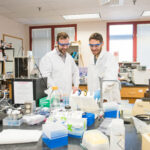
Image: Daniel Ocasio, right, working alongside Lee Blaney, assistant professor of chemical, biochemical and environmental engineering, in the lab. Photo by Marlayna Demond ’11 for UMBC.
]]>
Three current undergraduate students and one recent alumna have received highly competitive National Science Foundation (NSF) Graduate Research Fellowship Awards for 2017. Daniel Ocasio ‘17,...
https://umbc.edu/stories/umbcs-2017-nsf-graduate-research-fellows-prepare-for-groundbreaking-careers-from-environmental-engineering-to-computer-science/
https://my3.my.umbc.edu/api/v0/pixel/news/120807/guest@my.umbc.edu/1d02c883c277824c7a1c99ab5be3b431/api/pixel
cahss
cbee
coeit
csee
economics
policy-and-society
science-and-technology
undergradresearch
UMBC News & Magazine
https://my3.my.umbc.edu/groups/umbc-news-magazine
https://assets1-my.umbc.edu/system/shared/avatars/groups/000/001/943/24435aa6207c452e7bc15cc74b42c7bb/xsmall.png?1748556657
https://assets1-my.umbc.edu/system/shared/avatars/groups/000/001/943/24435aa6207c452e7bc15cc74b42c7bb/original.png?1748556657
https://assets2-my.umbc.edu/system/shared/avatars/groups/000/001/943/24435aa6207c452e7bc15cc74b42c7bb/xxlarge.png?1748556657
https://assets2-my.umbc.edu/system/shared/avatars/groups/000/001/943/24435aa6207c452e7bc15cc74b42c7bb/xlarge.png?1748556657
https://assets3-my.umbc.edu/system/shared/avatars/groups/000/001/943/24435aa6207c452e7bc15cc74b42c7bb/large.png?1748556657
https://assets1-my.umbc.edu/system/shared/avatars/groups/000/001/943/24435aa6207c452e7bc15cc74b42c7bb/medium.png?1748556657
https://assets2-my.umbc.edu/system/shared/avatars/groups/000/001/943/24435aa6207c452e7bc15cc74b42c7bb/small.png?1748556657
https://assets1-my.umbc.edu/system/shared/avatars/groups/000/001/943/24435aa6207c452e7bc15cc74b42c7bb/xsmall.png?1748556657
https://assets2-my.umbc.edu/system/shared/avatars/groups/000/001/943/24435aa6207c452e7bc15cc74b42c7bb/xxsmall.png?1748556657
UMBC News & Magazine
0
0
false
Fri, 12 May 2017 16:14:13 -0400
UMBC celebrates Interdisciplinary Life Sciences Building groundbreaking

UMBC’s new Interdisciplinary Life Sciences Building (ILSB) is an answer to two questions, says Dean Bill LaCourse, of the College of Natural and Mathematical Sciences (CNMS): “What is UMBC going to be in the future?” and “What are our students going to need in the 21st century?”
The ILSB, scheduled for completion in summer 2019 on the footprint of the old Academic Services Building, will provide 70,000 square feet of flexible research and education space to support interdisciplinary, collaborative efforts in the life sciences. The building will primarily house labs and classes associated with CNMS, but the university also anticipates departments in the College of Arts, Humanities, and Social Sciences (such as geography and environmental systems) and in the College of Engineering and IT (such as chemical, biochemical, and environmental engineering) will utilize the innovative research and teaching facility.
 Dean LaCourse addresses the crowd at the groundbreaking ceremony.
Speakers at the informal groundbreaking ceremony, held May 1 on the quad just before it closed for construction, focused on the flexibility of the building. The ILSB will create opportunities for “interdisciplinary research, active learning, and innovation,” said LaCourse. “It fits right in with the model of what UMBC is, with our reputation as an agent of change.”
Features of the new building include an observation and research lab to study pedagogy, eight active learning classrooms, and four teaching labs, which will all support innovative education for UMBC students. Twelve research labs will each accommodate three faculty members and their students, an environmental systems lab will allow field research on aquatic and other ecosystems, and specialized lab spaces will support activities such as cell culture.
Joe Rexing, director of UMBC design and construction, shared that UMBC has again partnered with the Maryland Public Art Initiative to include an art installation inside the building, as Thomas Sayre’s sculpture Forum appears alongside UMBC’s new Performing Arts and Humanities Building.
 UMBC faculty and administrators celebrate the groundbreaking. From left: Phil Farabaugh, professor and chair of biological sciences; Kathleen Hoffman, professor of mathematics; President Freeman Hrabowski; Julie Ross, dean of the College of Engineering and Information Technology; Bill LaCourse, dean of the College of Natural and Mathematical Sciences; Karl Steiner, vice president for research.
The ILSB seeks to create spaces that encourage the kind of interdisciplinary work that UMBC has increasingly become known for, regionally, nationally, and internationally. “I like to use the word ‘convergent.’ We’re going to take the skills and expertise of our faculty and students and converge on societal problems,” says LaCourse. “By bringing people together, we’ll be able to do more than if we stayed in our individual silos,” he adds. The ILSB “is a symbol of our strength in diversity.”
Remarks from LaCourse, Rexing, President Freeman Hrabowski, and Provost Philip Rous also stressed the collaborative nature of the building design process. Faculty, administrators, and facilities management staff all played important roles in determining what kinds of spaces the ILSB would include. “All their decisions were not about what would be best for them as individuals,” said LaCourse, “but what would be best for student success, what would be best for the future of UMBC.”
President Hrabowski emphasized how the construction of both the Performing Arts and Humanities Building, completed in 2014, and the ILSB “represent the best of collaboration and interdisciplinarity, and also of community.” He also spoke to the future impact of the building.
“As we break ground today, I want you to think about the thousands of students and faculty over the next century who’ll be coming through this building,” Hrabowski said, “but even more, the thousands of lives that will be touched by our graduates and our research. I can’t think of a notion more powerful than that.”
Learn more about how the ILSB construction process may impact members of the UMBC community and campus visitors.
Banner image: Faculty and administrators “break ground” to celebrate the beginning of construction of the Interdisciplinary Life Sciences Building, slated for completion in summer 2019. All photos by Marlayna Demond ’11 for UMBC.
]]>
UMBC’s new Interdisciplinary Life Sciences Building (ILSB) is an answer to two questions, says Dean Bill LaCourse, of the College of Natural and Mathematical Sciences (CNMS): “What is UMBC going...
https://umbc.edu/stories/umbc-celebrates-interdisciplinary-life-sciences-building-groundbreaking/
https://my3.my.umbc.edu/api/v0/pixel/news/120812/guest@my.umbc.edu/096130748a3f5a0569ab895b58456b12/api/pixel
cahss
cbee
cnms
community
ges
science-and-technology
UMBC News & Magazine
https://my3.my.umbc.edu/groups/umbc-news-magazine
https://assets1-my.umbc.edu/system/shared/avatars/groups/000/001/943/24435aa6207c452e7bc15cc74b42c7bb/xsmall.png?1748556657
https://assets1-my.umbc.edu/system/shared/avatars/groups/000/001/943/24435aa6207c452e7bc15cc74b42c7bb/original.png?1748556657
https://assets2-my.umbc.edu/system/shared/avatars/groups/000/001/943/24435aa6207c452e7bc15cc74b42c7bb/xxlarge.png?1748556657
https://assets2-my.umbc.edu/system/shared/avatars/groups/000/001/943/24435aa6207c452e7bc15cc74b42c7bb/xlarge.png?1748556657
https://assets3-my.umbc.edu/system/shared/avatars/groups/000/001/943/24435aa6207c452e7bc15cc74b42c7bb/large.png?1748556657
https://assets1-my.umbc.edu/system/shared/avatars/groups/000/001/943/24435aa6207c452e7bc15cc74b42c7bb/medium.png?1748556657
https://assets2-my.umbc.edu/system/shared/avatars/groups/000/001/943/24435aa6207c452e7bc15cc74b42c7bb/small.png?1748556657
https://assets1-my.umbc.edu/system/shared/avatars/groups/000/001/943/24435aa6207c452e7bc15cc74b42c7bb/xsmall.png?1748556657
https://assets2-my.umbc.edu/system/shared/avatars/groups/000/001/943/24435aa6207c452e7bc15cc74b42c7bb/xxsmall.png?1748556657
UMBC News & Magazine
0
0
false
Mon, 08 May 2017 16:53:57 -0400
START and SFF awards support UMBC faculty pursuing research in new directions

The Office of the Vice President for Research has awarded Strategic Awards for Research Transitions (START) and Summer Faculty Fellowship (SFF) awards to 24 UMBC faculty representing a broad range of departments across all UMBC colleges. START awards offer up to $25,000, beginning in July 2017, to faculty who wish to pursue new areas of research and compete more effectively for external funding and support. SFF awards offer up to $6,000 to non-tenured, tenure-track faculty pursuing research and projects during the summer.
Chris Swan, professor of geography and environmental systems, was awarded START funding to study the role of plant diversity in ecosystem services on urban vacant land. He is interested in understanding which native plants existed in Baltimore before modern seeding practices in the City began, and how plants native to Maryland can thrive in urban settings.
“Resources from the START award will go a long way in supporting our research into answering questions about how best to green vacant land in Baltimore City in order to meet sustainability action goals,” says Swan.
 Michael Lane.
Michael Lane, assistant professor of ancient studies, will use START funding to study Mycenaean Northeast Kopaïs stratigraphy, adding to a body of research on the chronology of mainland Greece, the Greek islands, and the west coast of Turkey during the Late Bronze Age in the Aegean period. Lane will collaborate with the Hellenic Ministry of Culture and Sports in Greece.
Aaron Smith, assistant professor of chemistry and biochemistry, received START and SFF funding to study how infectious bacteria gain iron, which is essential for the organisms to grow in the human body. His research may have impacts for people with gingivitis and cystic fibrosis.
“The UMBC START and SFF awards are invaluable to myself and my laboratory, as it provides us with funding for additional lab equipment necessary to decipher the atomic-level details of iron-transport proteins that are utilized by pathogenic bacteria to establish infection within human hosts,” Smith explains. He adds, “the return on investment to UMBC of this award should ultimately prove high, as the START funding mechanism will allow us to generate a critical mass of results necessary to bring in greater external funding to support our research program for the long term.”
Ed Larkey, professor of modern languages, linguistics and intercultural communication, was awarded START funding to study the transcultural orbit of Israeli television through the adaptation of a comedy series. Larkey will use a combination of quantitative and qualitative data to study that ways heterosexual couples’ private interactions are depicted in modern Israeli society.
Corrie Parks, assistant professor of visual arts, will use START funding to create Black Butterfly, a multi-media work of art that will help viewers visualize the impact violent crime can have on communities. She will use statistics from a Baltimore City homicide map from 2017, and develop an animated portrait of a single grain of sand to represent each point on the map.
 Sarah Shin
Sarah Shin, professor of education and special assistant to the provost for academic initiatives, was awarded START funding to study student and volunteer success through an intergenerational partnership. Volunteers from the Charlestown Retirement Community will tutor students at Lakeland Elementary/Middle School who are struggling with learning English. Shin will assess whether the students show gains in their literacy skills, and will examine what the tutors gain through the partnership.
Deepa Madan, assistant professor of mechanical engineering, will use START and SFF funding to design and produce “a flexible generator that runs on waste heat and generates enough power to replace batteries used in wireless sensor networks.” She explains that the funding will allow her to enhance the properties of the thermoelectric materials.
“An important objective of my current research is to generate necessary data to demonstrate my readiness for undertaking externally funded major projects,” says Madan. “With the support of START and SFF awards, it now appears realistic that I will start writing these grant applications as soon as this summer.”
Brian Kaufman, assistant professor of music, received START funding to conduct research on and release recordings of three pieces composed by newer artists in wind ensemble music. Kaufman will work with each composer, a recording team, and the UMBC Wind Ensemble to complete the project.
Tom Cronin, professor of biological sciences, will study the brains of mantis shrimp, known for their highly complex sense of vision and unique behaviors.
Peggy Re, associate professor of visual arts, will use START funding to support a portion of “A Designed Life,” an exhibition that re-creates and interprets three Cold War-era traveling displays of
contemporary American designed and manufactured goods that were commissioned by the U.S. Department of State in the early 1950s. The displays were presented in West German venues as part of a propaganda campaign to showcase the superior lifestyle choices, built environments and affluence of the United States.
associate professor of visual arts, will use START funding to create “A Designed Life,” an exhibit made out of containers and packaging materials. The exhibit, which will open at UMBC’s Center for Art Design and Visual Culture in October 2018, will show the possible political connections to people and their activities, experiences, needs, desires and attitudes.
Bedrich Sousedik, assistant professor of mathematics and statistics, will use SFF funding to develop algorithms to address problems in physical sciences and engineering that can be modeled by partial differential equations. Sousedik works to develop new methods that use computers to solve the equations using computers.
Christopher Tong, assistant professor of modern languages, linguistics and intercultural communication, received SFF funding for the project “Torrents of Revolution: The Writing of Environmental Disasters in Modern China, 1930-1949.” Tong will study highly complex environmental disasters in early 20th-century China through literature, environmental history, and disaster studies.
 Keisha Allen
Keisha Allen, assistant professor of education, received SFF funding to examine the racial literacy of teacher candidates and high school youth. She will design curricula and study how storytelling can support the racial literacy of teacher candidates.
Daniel Lobo, assistant professor of biological sciences, will use SFF funding to create computational framework to improve the production of biofuels and chemicals. The optimized design will be part of a comprehensive pipeline for biofuel production using bacterial and yeast species.
Greg Szeto, assistant professor of chemical, biochemical and environmental engineering, was awarded SFF funding to develop self-engineering drugs that can quickly break into the outer surface of immune cells to enhance the function of these cells in patients who are using immunotherapy to combat cancer.
Jane Arnold Lincove, associate professor of public policy, will use SFF funding to study how charter schools affect student achievement and teacher retention rates in Maryland. This will be the first study of charter schools in Maryland, where traditional public schools with unionized faculty and charter schools coexist by state law.
Jennifer Callaghan-Koru, assistant professor of health administration and policy, will study the validity of client exit interviews to assess programs. The SFF funding will allow Callaghan-Koru to develop methodologies for monitoring programs.
Jules Rosskam, assistant professor of visual arts, will use SFF funding to create “Paternal Rites,” an essay film that explores the unique challenges facing American families through personal narrative. The film will explore addiction, abuse, and mental illness through some of Rosskam’s historical family narratives and will incorporate the context of the interstate highway system as a factor impacting family and community structure and access to resources.
Maria Bernedo Del Carpio, assistant professor of economics, will use SFF funding to study the long-term effects of water conserving technologies.
 Mejdulene Shomali
Mejdulene Shomali, assistant professor of gender and women’s studies, was awarded SFF funding to study how femininity and sexuality is represented in Arab and Arab American literature and art. She is interested in how Arab and Arab American writers and artists are struggling against racism and Orientalism to represent Arab cultures in their work.
Naghmeh Karimi, assistant professor of computer science and electrical engineering, was awarded SFF funding to study the stability and aging resiliency of physical systems that can be evaluated but are challenging to predict.
Nianshen Song, assistant professor history, will use SFF funding to continue researching the histories of the Sino-Korean boundary and the Korean diaspora community in China for his book project, “Transforming Frontier in East Asia: the Tumen River Demarcation, 1880-1919.”
Nkiru Nnawulezi, assistant professor of psychology, was awarded SFF funding to research the health and resource needs of intimate partner violence survivors whose partners are in abuser intervention programs.
Shimei Pan, assistant professor of information systems, received SFF funding to study self control and impulsiveness of people by using social media analytics to monitor their behavior on social media, such as Facebook posts and likes.
For more information about UMBC’s START and SFF programs, visit the UMBC Research website.
Banner image: Daniel Lobo. All photos by Marlayna Demond ’11 for UMBC.
]]>
The Office of the Vice President for Research has awarded Strategic Awards for Research Transitions (START) and Summer Faculty Fellowship (SFF) awards to 24 UMBC faculty representing a broad range...
https://umbc.edu/stories/start-and-sff-awards-support-umbc-faculty-pursuing-research-in-new-directions/
https://my3.my.umbc.edu/api/v0/pixel/news/120818/guest@my.umbc.edu/121cf56ac98ed03b9ca865a3eff3be82/api/pixel
ancientstudies
arts-and-culture
biology
cahss
cbee
chembiochem
cnms
coeit
csee
economics
education
ges
gwst
is
mathstat
meche
mlli
music
policy-and-society
psychology
publicpolicy
research
saph
science-and-technology
visualarts
UMBC News & Magazine
https://my3.my.umbc.edu/groups/umbc-news-magazine
https://assets1-my.umbc.edu/system/shared/avatars/groups/000/001/943/24435aa6207c452e7bc15cc74b42c7bb/xsmall.png?1748556657
https://assets1-my.umbc.edu/system/shared/avatars/groups/000/001/943/24435aa6207c452e7bc15cc74b42c7bb/original.png?1748556657
https://assets2-my.umbc.edu/system/shared/avatars/groups/000/001/943/24435aa6207c452e7bc15cc74b42c7bb/xxlarge.png?1748556657
https://assets2-my.umbc.edu/system/shared/avatars/groups/000/001/943/24435aa6207c452e7bc15cc74b42c7bb/xlarge.png?1748556657
https://assets3-my.umbc.edu/system/shared/avatars/groups/000/001/943/24435aa6207c452e7bc15cc74b42c7bb/large.png?1748556657
https://assets1-my.umbc.edu/system/shared/avatars/groups/000/001/943/24435aa6207c452e7bc15cc74b42c7bb/medium.png?1748556657
https://assets2-my.umbc.edu/system/shared/avatars/groups/000/001/943/24435aa6207c452e7bc15cc74b42c7bb/small.png?1748556657
https://assets1-my.umbc.edu/system/shared/avatars/groups/000/001/943/24435aa6207c452e7bc15cc74b42c7bb/xsmall.png?1748556657
https://assets2-my.umbc.edu/system/shared/avatars/groups/000/001/943/24435aa6207c452e7bc15cc74b42c7bb/xxsmall.png?1748556657
UMBC News & Magazine
0
0
false
Fri, 28 Apr 2017 15:43:26 -0400
UMBC a case study for success supporting STEM students of all backgrounds
In a new article for Issues in Science and Technology, President Freeman Hrabowski and Peter Henderson, senior advisor to the president, describe the concerning continued underrepresentation of minorities in the STEM workforce, and what UMBC has done to tackle this problem head-on.
“If the nation’s policymakers and education leaders take the deliberate steps needed to expand the participation and success of underrepresented minorities in STEM based on what we know works,” they write, “success is possible.” But there’s a long way to go.
A 2011 report published by the National Academies, Expanding Underrepresented Minority Participation: America’s Science and Technology Talent at the Crossroads, noted that only 9.1 percent of the U.S. STEM workforce identified as African American, Hispanic, or Native American, compared to 28.5 percent of the nation’s overall population. Also, only about 20 percent of black, Latino, and Native American students who started in STEM majors graduated with a degree in a STEM field within five years. White and Asian American students did not fare well either, but their degree attainment rates were notably higher (33 and 42 percent, respectively).
“This is not a problem for minorities only; it’s a national problem,” write Hrabowski and Henderson. “To solve the problem, we in academia just need to look in the mirror.”
Since the 2011 report, there has been little overall movement in the national statistics. Some institutions, however, have made significant progress in supporting students from underrepresented groups to achieve success in advanced degree programs and careers in STEM. Hrabowski and Henderson cite several deliberate steps UMBC has taken to more effectively support underrepresented minority students in STEM.
At the highest levels, UMBC has rejected the concept of “weed-out” courses, which assume it is inevitable that only a small portion of students can succeed. Instead, the university has held firm that the institution is responsible for supporting student success across the board.
Faculty have redesigned introductory and other courses accordingly, and the article highlights UMBC’s Anne Spence in mechanical engineering, Taryn Bayles formerly of chemical engineering, and Jeff Leips in biological sciences for their work with pedagogical techniques like the “flipped classroom” approach and team-based learning. The authors also spotlight Dean Bill LaCourse, of the College of Natural and Mathematical Sciences, who spearheaded the creation of the Chemistry Discovery Center, an interactive learning space for introductory chemistry courses.
Federal agencies have also joined the effort to increase minority participation in STEM. UMBC is involved in the NIH’s Building Infrastructure Leading to Diversity program, as well as NSF programs including the Louis Stokes Alliances for Minority Participation, Alliances for Graduate Education and the Professoriate, and Maximizing Access to Research Careers Undergraduate Student Training in Academic Research.
UMBC is perhaps best known for its Meyerhoff Scholars Program, founded in 1989 and now over 1,000 alumni strong, which provides students with financial, academic, and social support as well as professional development and intensive mentorship. Graduates of the Meyerhoff program are five times more likely to earn doctoral degrees than students who were admitted to the program but chose to attend another university, and the Meyerhoff program’s success has led to an $8 million investment from the Howard Hughes Medical Institute to adapt the program at Pennsylvania State University and University of North Carolina at Chapel Hill.
“The strategy is to deliberately form a sense of belonging and community that nurtures the students,” write Hrabowski and Henderson.
As a result of all these efforts, UMBC has climbed the list of institutions that best support minority students in STEM. Today, UMBC graduates the most black students who go on to complete M.D.-Ph.D. degrees in the nation, and only follows MIT for the percentage of black undergraduate degree recipients who go on to earn Ph.D.s in STEM. UMBC is also the sixth top university in graduating black undergraduates who then earn doctoral degrees in any field, with the top five all being Historically Black College and Universities.
“We must identify and learn from institutions that have been successful in educating African American undergraduates in the natural sciences and engineering through a focused effort,” write Hrabowski and Henderson. Additionally, they note, “We have learned that a campus that helps underrepresented minority students is also one that helps students in general.”
Now, “the nation must decide whether or not it will take the path leading to a science and technology talent pool…that draws from people throughout our population,” Henderson and Hrabowski suggest. “It is only by tapping all of that talent pool that the country will succeed in realizing the economic, security, and health goals the American people prize.”
Read the full article, “Toward a more diverse research community: Models of success.”
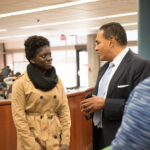
Image: President Hrabowski speaks with students in the UMBC Commons. Photo by Marlayna Demond ’11 for UMBC.
]]>
In a new article for Issues in Science and Technology, President Freeman Hrabowski and Peter Henderson, senior advisor to the president, describe the concerning continued underrepresentation of...
https://umbc.edu/stories/umbc-a-case-study-for-supporting-stem-students-of-all-backgrounds/
https://my3.my.umbc.edu/api/v0/pixel/news/120822/guest@my.umbc.edu/9ed94b12194562da667f483efbb79117/api/pixel
biology
cbee
cnms
community
hrabowski
marcustar
meche
meyerhoffscholars
science-and-technology
stembuild
UMBC News & Magazine
https://my3.my.umbc.edu/groups/umbc-news-magazine
https://assets1-my.umbc.edu/system/shared/avatars/groups/000/001/943/24435aa6207c452e7bc15cc74b42c7bb/xsmall.png?1748556657
https://assets1-my.umbc.edu/system/shared/avatars/groups/000/001/943/24435aa6207c452e7bc15cc74b42c7bb/original.png?1748556657
https://assets2-my.umbc.edu/system/shared/avatars/groups/000/001/943/24435aa6207c452e7bc15cc74b42c7bb/xxlarge.png?1748556657
https://assets2-my.umbc.edu/system/shared/avatars/groups/000/001/943/24435aa6207c452e7bc15cc74b42c7bb/xlarge.png?1748556657
https://assets3-my.umbc.edu/system/shared/avatars/groups/000/001/943/24435aa6207c452e7bc15cc74b42c7bb/large.png?1748556657
https://assets1-my.umbc.edu/system/shared/avatars/groups/000/001/943/24435aa6207c452e7bc15cc74b42c7bb/medium.png?1748556657
https://assets2-my.umbc.edu/system/shared/avatars/groups/000/001/943/24435aa6207c452e7bc15cc74b42c7bb/small.png?1748556657
https://assets1-my.umbc.edu/system/shared/avatars/groups/000/001/943/24435aa6207c452e7bc15cc74b42c7bb/xsmall.png?1748556657
https://assets2-my.umbc.edu/system/shared/avatars/groups/000/001/943/24435aa6207c452e7bc15cc74b42c7bb/xxsmall.png?1748556657
UMBC News & Magazine
0
0
false
Wed, 26 Apr 2017 14:11:33 -0400
Reimagined Graduate Research Conference focuses on clear communication across all fields

The 2017 Graduate Research Conference (GRC) at UMBC delivered on its theme, “diversity across disciplines,” with research talks, posters, and keynote speakers in areas from history to atmospheric physics. The event also celebrated and encouraged interdisciplinary research and creative achievement.
“The boundaries between traditional disciplines are dissolving as our human curiosity leads us to understand much more complex issues,” shared Provost Philip Rous. He pointed to UMBC’s emphasis on inclusion as a boon toward that end. “Advancing our research mission,” he said to the attendees, “is inextricably linked to our ability to bring together students, faculty, and staff of diverse backgrounds to work together on the most challenging social, scientific, and humanitarian problems we face today.”
 GRC attendees mingle during a poster session.
That’s exactly what happened at the GRC on March 29. In a panel highlighting work related to climate change, Marshall Washick, emergency health services, presented his proposed research on the relationship between tuberculosis and air pollution in South Africa, Alexandra St. Pé, geography and environmental systems, discussed her work on the under-performance of offshore wind farms, and Michael Battaglia, Jr., chemical, biochemical, and environmental engineering, addressed how urban heat islands affect the chemistry of tiny particles in the air.
In another panel, Shawntay Stocks, language, literacy, and culture, described research utilizing critical race theory just before Chrissie Reilly, media and communication studies, discussed how the film Jiro Dreams of Sushi demonstrates complex relationships with consumption, with both talks touching on the session’s “media manipulation” theme.
“Mechanical engineers and historians are here in the same room talking to one another,” said Dean Scott Casper, of the College of Arts, Humanities, and Social Sciences. “That is what is really exciting about today.” Casper encouraged students to use the opportunity to hone their communications skills, both by presenting their own work and observing techniques others use to share complex ideas in different fields.
In his featured talk, Casper discussed specific techniques to improve one’s presentation, such as knowing your audience and catering to what they want to get out of the experience. No matter how excited researchers are about their work, he said, it’s “translating that enthusiasm into a form that people who are not as immersed in the work as you will understand, appreciate, and enjoy that is really the key to great presentations.”
 Dean Scott Casper discusses the attributes of a great presentation during his featured talk.
In addition to the panels and microtalks, four students tested their communication skills by competing in the international Three Minute Thesis competition, where each presented a summary of her graduate thesis in three minutes. Janae Baptiste, chemistry and biochemistry, won second place from the judges and first place from the audience for her presentation on research in Michael Summers’ lab on Feline Immunodeficiency Virus, the cat version of HIV. Denise Williams, chemistry and biochemistry, took first place for her talk on the toxicity of quantum dots—luminescent nanomaterials with a wide range of potential applications—based on her research in Zeev Rosenzweig’s lab. She will represent UMBC at the Council of Southern Graduate Schools regional competition. Both Baptiste and Williams are Meyerhoff Graduate Fellows.
Onimi Jademi, vice president of the UMBC Graduate Student Association, chair of the GRC planning committee, and a Ph.D. student in information systems, shares, “The GRC provides a platform for all graduate students, across all disciplines and at all levels and stages of research, to discuss and exchange ideas.” Interactions with faculty, staff, and students from every corner of the university are a major advantage of the event, she explains, offering unique feedback to developing researchers, artists, and scholars.
“GRC is not just a melting pot,” Jademi says, it’s an opportunity for graduate students to try out, retest, and “mold ideas and communication styles” that will help them connect with fellow researchers and the public throughout their careers.
Banner image: Alexandra St. Pé answers a question about her research on wind turbines during a panel discussion. All photos by Marlayna Demond ’11 for UMBC.
]]>
The 2017 Graduate Research Conference (GRC) at UMBC delivered on its theme, “diversity across disciplines,” with research talks, posters, and keynote speakers in areas from history to atmospheric...
https://umbc.edu/stories/reimagined-graduate-research-conference-focuses-on-clear-communication-across-all-fields/
https://my3.my.umbc.edu/api/v0/pixel/news/120823/guest@my.umbc.edu/584b7c61be403a8afc85d69716855d19/api/pixel
cbee
chembiochem
coeit
community
ehs
ges
graduateschool
llc
mcs
research
UMBC News & Magazine
https://my3.my.umbc.edu/groups/umbc-news-magazine
https://assets1-my.umbc.edu/system/shared/avatars/groups/000/001/943/24435aa6207c452e7bc15cc74b42c7bb/xsmall.png?1748556657
https://assets1-my.umbc.edu/system/shared/avatars/groups/000/001/943/24435aa6207c452e7bc15cc74b42c7bb/original.png?1748556657
https://assets2-my.umbc.edu/system/shared/avatars/groups/000/001/943/24435aa6207c452e7bc15cc74b42c7bb/xxlarge.png?1748556657
https://assets2-my.umbc.edu/system/shared/avatars/groups/000/001/943/24435aa6207c452e7bc15cc74b42c7bb/xlarge.png?1748556657
https://assets3-my.umbc.edu/system/shared/avatars/groups/000/001/943/24435aa6207c452e7bc15cc74b42c7bb/large.png?1748556657
https://assets1-my.umbc.edu/system/shared/avatars/groups/000/001/943/24435aa6207c452e7bc15cc74b42c7bb/medium.png?1748556657
https://assets2-my.umbc.edu/system/shared/avatars/groups/000/001/943/24435aa6207c452e7bc15cc74b42c7bb/small.png?1748556657
https://assets1-my.umbc.edu/system/shared/avatars/groups/000/001/943/24435aa6207c452e7bc15cc74b42c7bb/xsmall.png?1748556657
https://assets2-my.umbc.edu/system/shared/avatars/groups/000/001/943/24435aa6207c452e7bc15cc74b42c7bb/xxsmall.png?1748556657
UMBC News & Magazine
0
0
false
Tue, 25 Apr 2017 13:54:28 -0400
First-ever Grand Challenge Symposium focuses on value of interdisciplinary collaboration

The Grand Challenge Scholars Program (GCSP) hosted its inaugural symposium in February, featuring lightning talks by faculty who described their research in relation to the program’s 14 global challenge topics in just two minutes. The program highlights the need to combine different perspectives and expertise to solve the world’s most intractable problems, and faculty from all three UMBC colleges reflected on the range of disciplines that play a role in their work.
Collaboration across disciplines is a core lesson for students in the GCSP, now closing in on the end of its first year. Scholars are increasingly appreciating, in a very tangible way, how essential it is to have diverse perspectives around the table to tackle a shared challenge, says Marie desJardins, COEIT associate dean and professor of computer science, and director of UMBC’s Grand Challenge Scholars Program.
“UMBC’s Grand Challenge Scholars Program is open to undergraduate students across all colleges and departments on campus, but sometimes knowing how various disciplines can contribute to the challenges can be difficult to imagine,” explains desJardins. The faculty presentations, combined with the students’ own teamwork throughout the semester, offered scholars a clearer understanding of how interdisciplinary project-based work actually functions.
Nilanjan Banerjee, associate professor of computer science and electrical engineering (CSEE), spoke about his research on developing sustainable homes powered by solar energy. He explained how he hopes to increase demand for solar energy by developing a simple, affordable sensor system for homes that changes human behavior related to energy use. Also relating to energy, Carlos Romero-Talamas, assistant professor of mechanical engineering, shared how his lab is working to create renewable energy from fusion in response to the high global consumption of electricity from sources that pollute the environment. His research, using rotating mirrors, requires collaboration with physicists and other scientists.
Lee Blaney, assistant professor of chemical, biochemical and environmental engineering (CBEE), discussed water quality issues around the world, and how the UMBC chapter of Engineers Without Borders has helped develop infrastructure to ensure clean water is accessible. He also discussed his own water safety research, which focuses on contaminants of emerging concern, including pharmaceuticals and other health and beauty products.
Two other faculty focused on environmental issues interconnected with public policy discussions. David Lansing, associate professor of geography and environmental systems (GES), shared his soil research, which encourages farmers to create buffer zones to prevent excess nitrogen from running off the land and into waterways. This work is made more complex by local variations in soil and water protection guidelines. Maggie Holland, assistant professor of GES, works to protect Latin American forests by asking how local and national policies and practices encourage or prevent deforestation. Advancing this work, Holland says requires policymakers, social scientists, engineers, and conservation biologists to closely collaborate.
 Attendees at the Grand Challenge Scholars Program Symposium.
Several faculty focused on medical research, including Erin Lavik, professor of CBEE, who shared her work developing targeted treatments for traumatic brain injuries. Helena Mentis, assistant professor of information systems, described how physicians and surgeons in the operating room can use wearable telemedicine devices to interact with remote colleagues while ensuring a safe, sterile operating environment. Tim Oates, professor of CSEE, explained how his work enables him to learn about the building blocks of the brain through reverse engineering. Gymama Slaughter, associate professor of computer science and electrical engineering, spoke about developing novel technologies to monitor blood glucose internally without using batteries that require replacement.
Seung-Jun Kim, assistant professor of CSEE explained how urban power grids could be improved through machine learning, and how new sensors and large-scale analysis of power grid data could help detect threats and prevent cyberattacks. Nagmeh Karimi, assistant professor of CSEE, discussed how circuits in computers age just as people do, and that using trusted hardware and protecting hardware as it ages are important ways to protect technology from malicious threats and attacks.
Simon Stacey, interim vice provost and dean of undergraduate education, discussed nuclear weapons and three core factors that protect against nuclear proliferation: controlling the weapons themselves, controlling the materials needed to create nuclear weapons, and controlling transport of the weapons. Work in this arena requires people with a broad range of expertise across science, engineering, public policy, and international relations fields.
From the arts and humanities, Lee Boot, research associate professor of visual arts and director of the Imaging Research Center, spoke about using virtual reality technologies as research tools, and Omar Ka, associate professor of modern languages, linguistics and intercultural communication, discussed the complexity of studying language, how the mind processes it, and its role in society, and how the mind process studies language as an element of society and as a complex structure. He said that collaboration in this area is important to understand how the mind works and processes language.
desJardins urged the students in the audience to encourage their friends, no matter what major they’re in, to get involved with the program. “We really want broad diversity, to bring in people with different backgrounds,” she said. “If you’re not sure if you belong in this program, trust me, you belong in this program, because it is created by the students who are in it.”
Photos by Marlayna Demond ’11 for UMBC. The Grand Challenge Scholars Program Symposium presentations are available on YouTube.
]]>
The Grand Challenge Scholars Program (GCSP) hosted its inaugural symposium in February, featuring lightning talks by faculty who described their research in relation to the program’s 14 global...
https://umbc.edu/stories/first-ever-grand-challenge-symposium-focuses-on-value-of-interdisciplinary-collaboration/
https://my3.my.umbc.edu/api/v0/pixel/news/120850/guest@my.umbc.edu/a3dbe107018cfca5c5f16ba6ae04e2c1/api/pixel
cahss
cbee
coeit
csee
ges
is
meche
mlli
policy-and-society
science-and-technology
visualarts
UMBC News & Magazine
https://my3.my.umbc.edu/groups/umbc-news-magazine
https://assets1-my.umbc.edu/system/shared/avatars/groups/000/001/943/24435aa6207c452e7bc15cc74b42c7bb/xsmall.png?1748556657
https://assets1-my.umbc.edu/system/shared/avatars/groups/000/001/943/24435aa6207c452e7bc15cc74b42c7bb/original.png?1748556657
https://assets2-my.umbc.edu/system/shared/avatars/groups/000/001/943/24435aa6207c452e7bc15cc74b42c7bb/xxlarge.png?1748556657
https://assets2-my.umbc.edu/system/shared/avatars/groups/000/001/943/24435aa6207c452e7bc15cc74b42c7bb/xlarge.png?1748556657
https://assets3-my.umbc.edu/system/shared/avatars/groups/000/001/943/24435aa6207c452e7bc15cc74b42c7bb/large.png?1748556657
https://assets1-my.umbc.edu/system/shared/avatars/groups/000/001/943/24435aa6207c452e7bc15cc74b42c7bb/medium.png?1748556657
https://assets2-my.umbc.edu/system/shared/avatars/groups/000/001/943/24435aa6207c452e7bc15cc74b42c7bb/small.png?1748556657
https://assets1-my.umbc.edu/system/shared/avatars/groups/000/001/943/24435aa6207c452e7bc15cc74b42c7bb/xsmall.png?1748556657
https://assets2-my.umbc.edu/system/shared/avatars/groups/000/001/943/24435aa6207c452e7bc15cc74b42c7bb/xxsmall.png?1748556657
UMBC News & Magazine
0
0
false
Tue, 04 Apr 2017 14:27:59 -0400


