UMBC’s CIDER program supports new Hilltop Institute-led Medicaid study, other cross-collaborative projects
UMBC researchers are collaborating on a study that takes a closer look at specific diagnosis coding patterns that focus on societal factors that potentially influence the health of Maryland’s Medicaid recipients.
Morgan Henderson, director of analytics and research at UMBC’s The Hilltop Institute, and Jun Chu, assistant professor of public health, are among the five cross-collaborative teams selected to receive funding from UMBC’s Center and Institute Departmentally-Engaged Research (CIDER) program. Henderson and Chu’s CIDER-supported project will investigate potential “z code” patterns of the state’s Medicaid recipients. Z codes are a set of diagnosis codes that refer to factors influencing a patient’s health status beyond diseases or injuries, called social determinants of health.
“These specific diagnosis codes indicate certain social determinants of health-related factors, not just traditionally medical things,” explains Henderson, principal investigator of the study. Z code data indicates if a patient has an issue that’s related to social risk factors, such as unstable housing, lack of food, hazardous living environments, and employment status.
“There hasn’t been much analysis of z code patterns and we aim to lay a good foundation for better understanding these diagnosis codes within Maryland’s Medicaid data,” says Henderson.
A deeper look into z code diagnosing could be a useful identification “to bring extra resources to Medicaid recipients who are in need,” says Chu.
Analyzing Medicaid data
The study coincides with recent news of potential billion-dollar federal budget cuts to Maryland’s Medicaid program, which currently supports about 1.7 million Maryland residents. The Hilltop Institute specializes in working with the state’s Medicaid data. According to the institute’s Maryland Medicaid DataPort, two in five of those in Medicaid are children and Medicaid pays for 60 percent of nursing home stays.
Chu’s research has largely focused on social determinants of health with a particular focus on immigrant communities and Medicaid recipients who are children. Henderson helped to develop and currently manages Hilltop’s predictive modeling portfolio. These predictive models, which also utilize z code data, use a variety of risk factors derived from Medicare and Medicaid claims data to estimate the probability that a given patient incurs certain outcomes in the near future.
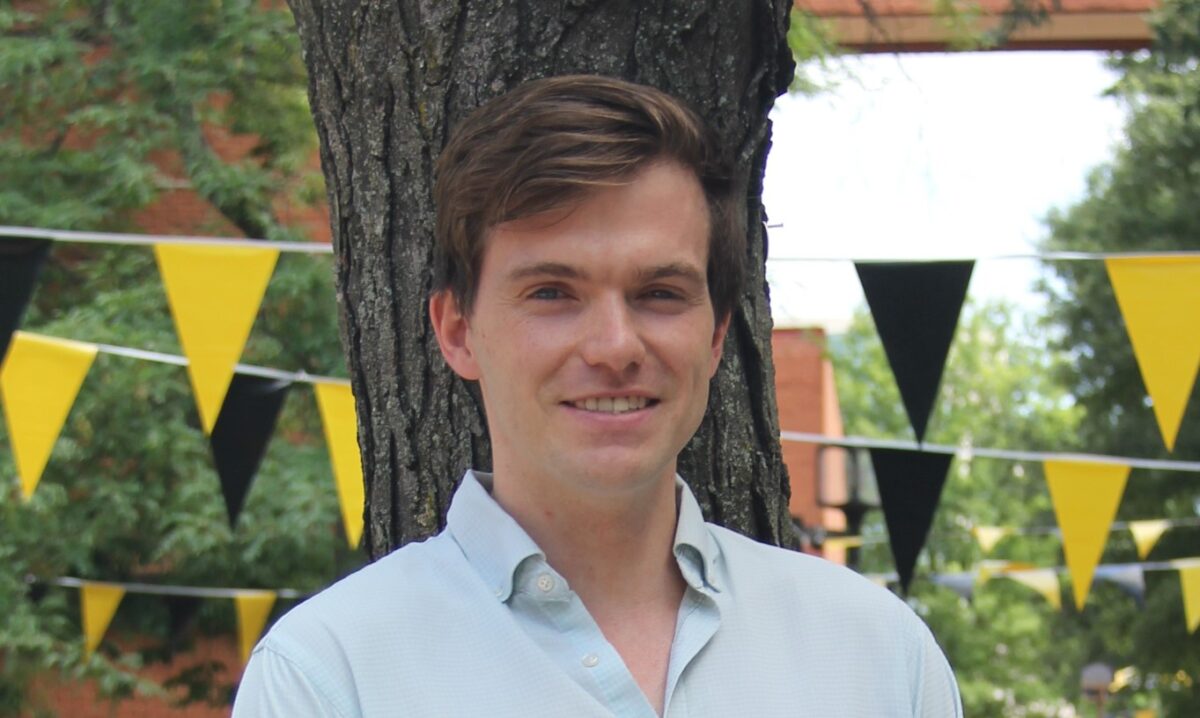
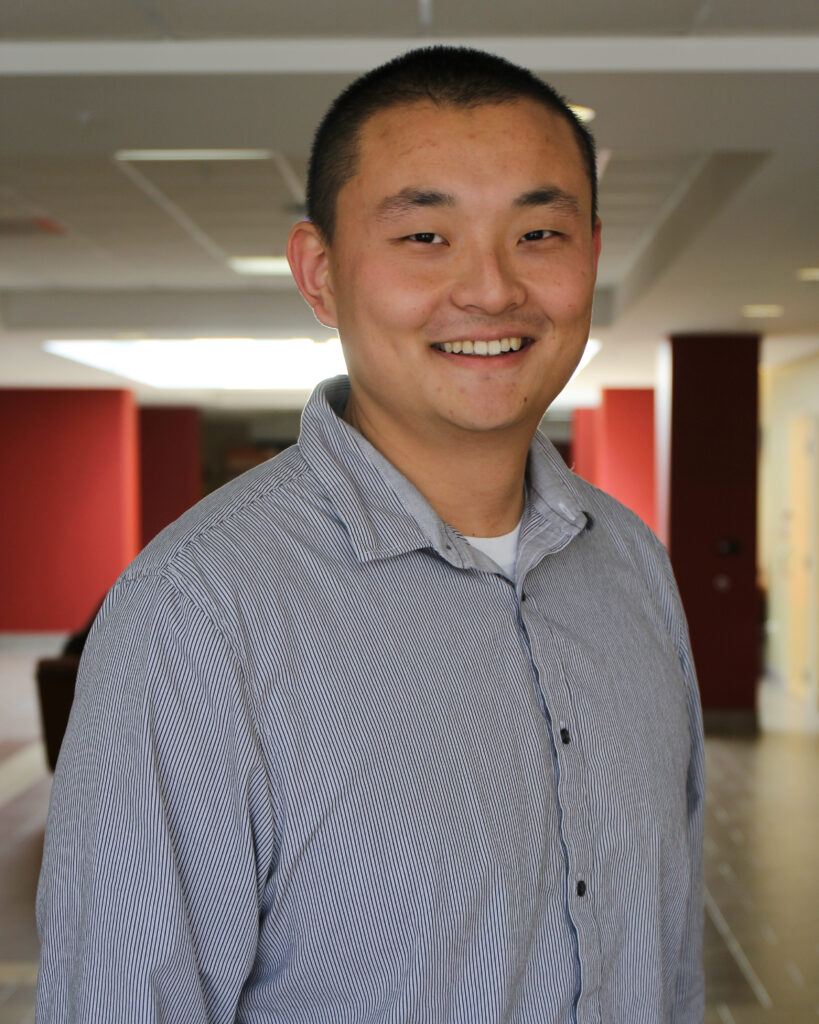 Principal investigator Morgan Henderson (left) and co-investigator Jun Chu of the CIDER Program study, “Analysis of Social Determinant of Health Diagnosis Coding Patterns Among Medicaid Recipients and Providers in Maryland.” (Photos courtesy of The Hilltop Institute and Jun Chu)
The pair’s project will include two studies: one study will focus specifically on the patients ascribed z codes to determine what patterns arise based on patient-specific factors such as demographics, health care utilization, or geography.
The second study will focus on analyzing the characteristics of the healthcare providers that indicate the z codes on Medicaid claims.
“Patient claims are the engine that so much of health analysis relies upon. It’s the decision of the provider on which coding diagnoses to include—it’s not a completely standardized process,” says Henderson.
CIDER 2025 recipients
The CIDER program’s goal includes supporting and promoting collaborative research between scholars based in one of UMBC’s affiliate centers and institutes and the university’s faculty researchers. Selected proposals are awarded up to $50,000 in seed funding for 18 months.
The 2025 CIDER program recipients include:
-
Anin Puthukkudy, Earth and Space Institute, and Vanderlei Martins, professor of physics
-
Jessica Sutton, Goddard Earth Sciences Technology and Research (GESTAR) II, Tejas Gokhale, assistant professor of computer science and electrical engineering, and Thomas Stanley, GESTAR II
-
Kaur Kullman, the Center for Space Sciences and Technology, Alan Sherman, Roberto Yus, and Enis Golaszewski, professors of computer science and electrical engineering
-
Morgan Henderson, The Hilltop Institute at UMBC, and Jun Chu, assistant professor of public health
-
Venkatesh Srinivasan, Center for Advanced Sensor Technology, Tyler Josephson, assistant professor of chemical, biochemical, and environmental engineering
Don Engel, associate vice president for research development, shares that the CIDER program was created to foster collaborations that draw on the full range of UMBC’s strengths in research and creative achievement.
“CIDER helps connect faculty in our research centers with colleagues in degree-granting departments to pursue work with real impact—work that informs policy, advances knowledge, and ultimately serves the public good,” says Engel.
Learn more about UMBC’s funding opportunities.
]]>
UMBC researchers are collaborating on a study that takes a closer look at specific diagnosis coding patterns that focus on societal factors that potentially influence the health of Maryland’s...
https://umbc.edu/stories/cider-program-hilltop-medicaid-study/
https://my3.my.umbc.edu/api/v0/pixel/news/149744/guest@my.umbc.edu/78db6f7fa7d09470bbd8c0df0856a68c/api/pixel
cahss
cbee
coeit
csee
gestar
hilltop-institute
news
policy-and-society
public-health
research
saph
story
UMBC News & Magazine
https://my3.my.umbc.edu/groups/umbc-news-magazine
https://assets1-my.umbc.edu/system/shared/avatars/groups/000/001/943/24435aa6207c452e7bc15cc74b42c7bb/xsmall.png?1748556657
https://assets1-my.umbc.edu/system/shared/avatars/groups/000/001/943/24435aa6207c452e7bc15cc74b42c7bb/original.png?1748556657
https://assets2-my.umbc.edu/system/shared/avatars/groups/000/001/943/24435aa6207c452e7bc15cc74b42c7bb/xxlarge.png?1748556657
https://assets2-my.umbc.edu/system/shared/avatars/groups/000/001/943/24435aa6207c452e7bc15cc74b42c7bb/xlarge.png?1748556657
https://assets3-my.umbc.edu/system/shared/avatars/groups/000/001/943/24435aa6207c452e7bc15cc74b42c7bb/large.png?1748556657
https://assets1-my.umbc.edu/system/shared/avatars/groups/000/001/943/24435aa6207c452e7bc15cc74b42c7bb/medium.png?1748556657
https://assets2-my.umbc.edu/system/shared/avatars/groups/000/001/943/24435aa6207c452e7bc15cc74b42c7bb/small.png?1748556657
https://assets1-my.umbc.edu/system/shared/avatars/groups/000/001/943/24435aa6207c452e7bc15cc74b42c7bb/xsmall.png?1748556657
https://assets2-my.umbc.edu/system/shared/avatars/groups/000/001/943/24435aa6207c452e7bc15cc74b42c7bb/xxsmall.png?1748556657
UMBC News & Magazine
0
0
false
Fri, 02 May 2025 15:04:11 -0400
Fri, 02 May 2025 15:04:11 -0400
Deporting international students risks making the US a less attractive destination, putting its economic engine at risk
Written by David L. Di Maria, vice provost for Global Engagement, UMBC
In early April 2025, the Trump administration terminated the immigration statuses of thousands of international students listed in a government database, meaning they no longer had legal permission to be in the country. Some students self-deported instead of facing deportation.
The U.S. Department of Homeland Security recently announced that it would reverse the terminations after courts across the country determined they did not have merit.
These moves come as the White House seeks to enhance vetting and screening of all foreign nationals.
The State Department in March announced plans to use artificial intelligence to review international students’ social media accounts.
As an administrator and scholar who specializes in international higher education, I know that international students in the United States have long been subjected to a high level of vetting, screening and monitoring.
Inserting additional bureaucracy into current processes could make the U.S. a less attractive study destination. I believe this would ultimately hamper the Trump administration’s ability to achieve its “America First” priorities related to the economy, science and technology, and national security.
International students in the US

The U.S. has long been the global leader in attracting international students. But competition for these students is increasing as other countries, such as Germany and South Korea, enact strategies for attracting international education.
The U.S. hosts 16% of all students studying outside of their home country, down from 22% in 2014 and 28% in 2001, according to the Institute of International Education. Of the more than 1 million international students who were present in the U.S. during the 2023-2024 academic year, 54% came from just two countries, China and India.
Most international students pursue graduate degrees in STEM fields – science, technology, engineering and mathematics. And, according to the National Science Foundation, international students make up a significant portion of enrollment at the master’s and doctoral levels.
How international students are screened
International students in the U.S. are already subjected to intense screening and continuous monitoring. These measures include:
• Vetting the student’s school. Before they can apply for a visa, international students must be admitted to a school authorized by the Department of Homeland Security to enroll people on student visas.
• Vetting at the embassy. As part of the visa application process, international students are subjected to national security reviews carried out by various intelligence and law enforcement agencies. In some cases, such as when a U.S. consular officer in their home country decides that more information is required from external sources to determine visa eligibility, additional screenings occur. That is done through a process known as administrative processing.
• Vetting upon arrival. When they arrive in the U.S., international students are again screened by a U.S. Customs and Border Protection officer. If the officer is unable to verify any information, the student is sent to secondary inspection, a secure interview area where the student waits while officers complete additional assessment. The student is then either admitted to the U.S. or forced to depart the country.
• Ongoing monitoring while in the U.S. If permitted to enter the country, students must enroll full time, earn good grades and notify their school within 10 days of substantive changes to their circumstances.
Examples include a change to their address, academic major or financial sponsor. And school officials are required to report this information to the Student and Exchange Visitor Program, part of U.S. Immigration and Customs Enforcement’s National Security Investigations Division.
Students participating in temporary, postgraduation training programs must continue to comply with reporting requirements. And certain STEM graduates, and their employers, are subject to additional requirements. They include certification of training plans, annual evaluations and site visits.
Most international students prefer to study in the U.S., recent research shows. But they are willing to change their preferences as other countries introduce friendlier visa policies, such as more flexible post-study work opportunities and lower visa costs.
Given the current level of screening and monitoring already imposed on international students in the U.S., it is unclear how additional measures would add value.
Critical to an America First agenda
President Donald Trump’s “America First” agenda aims to grow the U.S. economy.
It also intends to maintain U.S. leadership in science and technology and enhance national security.
Trump administration officials have underlined the importance of recruiting top global talent. And Trump has said that international students who graduate from U.S. colleges should be awarded a green card with their degree.
During the 2023-2024 academic year, international students contributed US$43.8 billion to the U.S. economy through tuition and living expenses, which supported an estimated 378,175 U.S. jobs.
Their contributions don’t end following graduation, according to the National Bureau of Economic Research. Many go on to launch successful startups at a rate that is eight to nine times higher than their domestic peers. In fact, 25% of billion-dollar companies in the U.S. were founded by a former international student.
Such companies include Eventbrite, Grammarly, Moderna, OpenAI, Robinhood and SpaceX.
International students also help the U.S. maintain global leadership in STEM.
Consider that 45% of STEM workers in the U.S. holding a doctoral degree were born outside the U.S.
A 2024 report cautions that the U.S. is failing to develop domestic STEM talent at all levels of the education system. Just 3.2% of U.S. high school graduates are estimated to enter the STEM workforce.
Moreover, the country’s ability to attract and retain international STEM talent is decreasing due to immigration restrictions and increased global competition.
Finally, international students are critical to establishing global networks and promoting soft power diplomacy. This is evidenced by the U.S. having graduated more world leaders than any other nation.
Further restricting the ability of international students to study in the U.S. will ultimately redirect talent to other countries, allies and adversaries alike.
This article is republished from The Conversation under a Creative Commons license. Read the original article and see more than 250 UMBC articles available in The Conversation.
]]>
Written by David L. Di Maria, vice provost for Global Engagement, UMBC In early April 2025, the Trump administration terminated the immigration statuses of thousands of international students...
https://umbc.edu/stories/deporting-international-students-risks-us-economy/
https://my3.my.umbc.edu/api/v0/pixel/news/149687/guest@my.umbc.edu/229020641e1d332a21a91b6f40886801/api/pixel
cahss
cge
cnms
coeit
discovery
internantional
magazine
research
story
UMBC News & Magazine
https://my3.my.umbc.edu/groups/umbc-news-magazine
https://assets1-my.umbc.edu/system/shared/avatars/groups/000/001/943/24435aa6207c452e7bc15cc74b42c7bb/xsmall.png?1748556657
https://assets1-my.umbc.edu/system/shared/avatars/groups/000/001/943/24435aa6207c452e7bc15cc74b42c7bb/original.png?1748556657
https://assets2-my.umbc.edu/system/shared/avatars/groups/000/001/943/24435aa6207c452e7bc15cc74b42c7bb/xxlarge.png?1748556657
https://assets2-my.umbc.edu/system/shared/avatars/groups/000/001/943/24435aa6207c452e7bc15cc74b42c7bb/xlarge.png?1748556657
https://assets3-my.umbc.edu/system/shared/avatars/groups/000/001/943/24435aa6207c452e7bc15cc74b42c7bb/large.png?1748556657
https://assets1-my.umbc.edu/system/shared/avatars/groups/000/001/943/24435aa6207c452e7bc15cc74b42c7bb/medium.png?1748556657
https://assets2-my.umbc.edu/system/shared/avatars/groups/000/001/943/24435aa6207c452e7bc15cc74b42c7bb/small.png?1748556657
https://assets1-my.umbc.edu/system/shared/avatars/groups/000/001/943/24435aa6207c452e7bc15cc74b42c7bb/xsmall.png?1748556657
https://assets2-my.umbc.edu/system/shared/avatars/groups/000/001/943/24435aa6207c452e7bc15cc74b42c7bb/xxsmall.png?1748556657
UMBC News & Magazine
6
0
false
Thu, 01 May 2025 12:53:31 -0400
Thu, 01 May 2025 12:53:31 -0400
Janerra Allen, Ph.D. ’25: A first-generation engineering college grad uplifts fellow students
Janerra Allen, Ph.D. ’25, electrical engineering, studies electrical signals in the brain, looking for patterns that might help doctors diagnose or treat mental disorders such as schizophrenia. As a first-generation college student she forged her own path, mastering complex subjects so that she could reach the pinnacle of higher education—producing new knowledge.
Although she encountered challenges along the way, she never gave up, and she always found time to support her fellow students facing their own challenges. During her time at UMBC, she served as a graduate senator for the College of Engineering and Information Technology, secretary of the Graduate Student Association, and president of the Black Graduate Student Organization. “Janerra works tirelessly to create inclusive, supportive spaces for students,” says Jennifer Artis, the senior director of student belonging at UMBC. “Her ability to balance these leadership roles with her demanding Ph.D. research speaks volumes about her dedication, time management, and unwavering passion for service.”
Q: How did you get interested in science and technology?
A: When I was a child, I was interested in putting things together—“engineer” wasn’t in my vocabulary yet, so I think the word I used then was inventor. I wanted to be an inventor. I remember once trying to make a telescope out of a magnifying glass and an old paper towel roll.
When I was in middle school, I read a magazine article about Denis Mukwege, a doctor from the Democractic Republic of Congo who helped treat victims of sexual violence. Reading about the impact of his work made me realize I wanted to do healthcare related work too.
Q: How did you find your way to UMBC?
 Allen poses on the Golden Gate Bridge in San Francisco, where she completed a 3-month internship at Genentech, Inc. in 2023. (Image courtesy of Allen)
A: I went to the Benjamin Banneker Academy for Community Development in Brooklyn, New York, for high school, and then to the University of Wisconsin Madison for undergrad. I got my degree in material science engineering. It was at Wisconsin that I decided to focus on studying the brain, and I worked in a neuroimaging lab, imaging the brains of people who had suffered a stroke. The idea was to improve rehabilitation by stimulating the correct parts of the brain.
After graduating, and working in a lab for a year, I moved back to the East Coast and worked for a telehealth company, troubleshooting medical devices. But I knew I wanted to pursue graduate school. Someone I knew from Wisconsin actually suggested UMBC as a place to apply. She said it was a small, supportive school. UMBC is the only graduate school I applied to. I thought, “If it’s meant to be, I’m gonna end up here.”
Q: Who at UMBC has had the biggest impact on your time here?
A: So many people have profoundly influenced my time at UMBC. If I had to pick just one, I’d have to say Ms. Justine Johnson, mainly because she’s known me from the very beginning. She’s the associate director of the Graduate Research Training Initiative for Student Enhancement, and before I even arrived, she worked tirelessly with me for months to resolve funding concerns. We had so many phone calls and emails back and forth before I even came. And she really advocated for me in ways that reassured me I was worthy of continuing my graduate pursuits.
Q: What motivates you to get involved with student organizations?
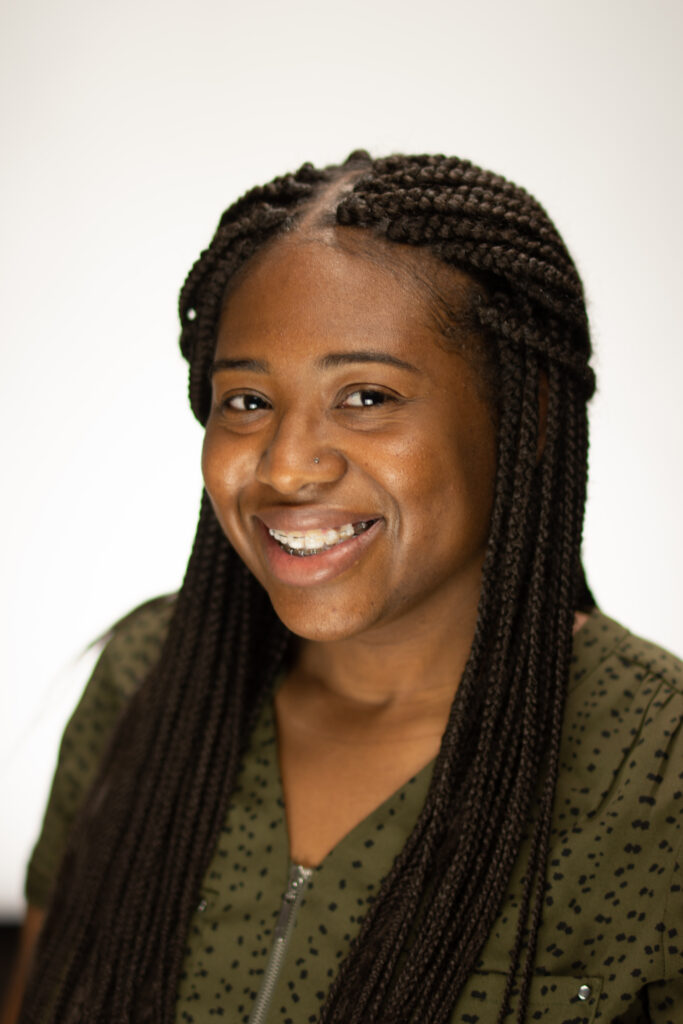
A: When I was in Wisconsin I joined the National Society of Black Engineers (NSBE) and the Society of Women Engineers. At NSBE, I went from being a member to eventually being the president for two years, which I was very, very proud of.
When I first arrived at UMBC, I focused first on my school work and research. But then I started to get more involved. In 2022, I went to the Ebony Ball, which is a yearly celebration held by the Black Graduate Student Organization (BGSO), and the president at the time encouraged me to become part of the executive board.
I know it’s sometimes hard to get grad students to be truly involved because we have so much going on, and we’re at more of an adult stage where we have our separate lives. But in the end, I decided to step up.
BGSO holds a special place in my journey because it fosters community, provides academic and professional resources, and creates a supportive space for Black graduate students. As president for the past two years, I have learned valuable lessons about leadership, resilience, and the importance of appreciating the process.
Q: What are your plans for after graduation?
A: I’ll be working as a post-doc at the Johns Hopkins Applied Physics Lab in their health and human machine systems group. I’ll have to propose my own project, and I’m thinking about how to analyze conditions that affect war veterans’ brains.
I love research, and I love that it can look very different depending on where you are. In the future, I can imagine working as a research director or as a professor. I love people and love mentoring them.
Q: How does your family feel about you graduating with a Ph.D?
A: Funny enough, some of them are just like “Wow, finally!” But they’re definitely proud. My grandma likes to brag, saying “My granddaughter is doing all these things; she’s going to be a doctor.” It’s been nice to have opportunities when my family visited and got to see what graduate student life is like, because that’s something they are not really familiar with.
Overall, they’re grateful that I got to see this process through. They had to live through my complaints and my worries and thinking that it was not meant to be. But with their support, they got to see me come through on the other side.
 Allen (far left) celebrates with UMBC colleagues as President Valerie Sheares Ashby accepts her 2022 Technologist of the Year award at the Women of Color STEM DTX Conference. (Image courtesy of Allen)
Q: How are you going to celebrate?
A: I’ll graduate this summer and my start date for my post-doc is July 14. My birthday is also coming up, so whatever I do, it’ll probably be a combination of relaxation and something else. I want to do something big to celebrate, maybe travel, but I don’t know yet. Right now I’m focused on crossing the finish line.
Read more Commencement 2025 stories.
]]>
Janerra Allen, Ph.D. ’25, electrical engineering, studies electrical signals in the brain, looking for patterns that might help doctors diagnose or treat mental disorders such as schizophrenia. As...
https://umbc.edu/stories/janerra-allen-ph-d-25-first-gen-engineering-grad-uplifts-students/
https://my3.my.umbc.edu/api/v0/pixel/news/149641/guest@my.umbc.edu/dc65d3d74e88b57d5c5a381295a8aaa4/api/pixel
class-of-2025
coeit
csee
news
research
story
UMBC News & Magazine
https://my3.my.umbc.edu/groups/umbc-news-magazine
https://assets1-my.umbc.edu/system/shared/avatars/groups/000/001/943/24435aa6207c452e7bc15cc74b42c7bb/xsmall.png?1748556657
https://assets1-my.umbc.edu/system/shared/avatars/groups/000/001/943/24435aa6207c452e7bc15cc74b42c7bb/original.png?1748556657
https://assets2-my.umbc.edu/system/shared/avatars/groups/000/001/943/24435aa6207c452e7bc15cc74b42c7bb/xxlarge.png?1748556657
https://assets2-my.umbc.edu/system/shared/avatars/groups/000/001/943/24435aa6207c452e7bc15cc74b42c7bb/xlarge.png?1748556657
https://assets3-my.umbc.edu/system/shared/avatars/groups/000/001/943/24435aa6207c452e7bc15cc74b42c7bb/large.png?1748556657
https://assets1-my.umbc.edu/system/shared/avatars/groups/000/001/943/24435aa6207c452e7bc15cc74b42c7bb/medium.png?1748556657
https://assets2-my.umbc.edu/system/shared/avatars/groups/000/001/943/24435aa6207c452e7bc15cc74b42c7bb/small.png?1748556657
https://assets1-my.umbc.edu/system/shared/avatars/groups/000/001/943/24435aa6207c452e7bc15cc74b42c7bb/xsmall.png?1748556657
https://assets2-my.umbc.edu/system/shared/avatars/groups/000/001/943/24435aa6207c452e7bc15cc74b42c7bb/xxsmall.png?1748556657
UMBC News & Magazine
4
0
false
Wed, 30 Apr 2025 11:13:27 -0400
Wed, 30 Apr 2025 11:13:27 -0400
Maryland Energy Administration awards UMBC $1.2 million for solar panels and more
UMBC has received a $1.2 million solar energy grant from the Maryland Energy Administration (MEA) to support solar power installations on campus and other sustainability initiatives.
The funding will enable construction of solar canopies over the north portion of the Stadium Lot. Rooftop solar arrays will be mounted on UMBC’s central receiving warehouse, located adjacent to the lot. The installations will be highly visible to the UMBC community and members of the public attending events at the Chesapeake Employers Insurance Arena.
Together, these solar installations will generate 1,000 kWAC of clean, carbon-free energy, or about 2.5 percent of UMBC’s current annual electricity. The solar panels’ output will reduce UMBC’s carbon footprint by roughly 500 tons per year and earn Solar Renewable Energy Credits from the state of Maryland, which can be sold to power companies. The combined savings from the electricity generation and accompanying SRECs may save UMBC $200,000 to $300,000 annually.
“This solar energy project is a significant step forward for UMBC to reach its sustainability goals, and will benefit our campus and local communities,” Taylor Smith, assistant director in the Office of Sustainability, says. “For the first time, the university will generate a significant amount of clean, renewable electricity right here on campus. We are lucky to have a community of partners that made this happen.”
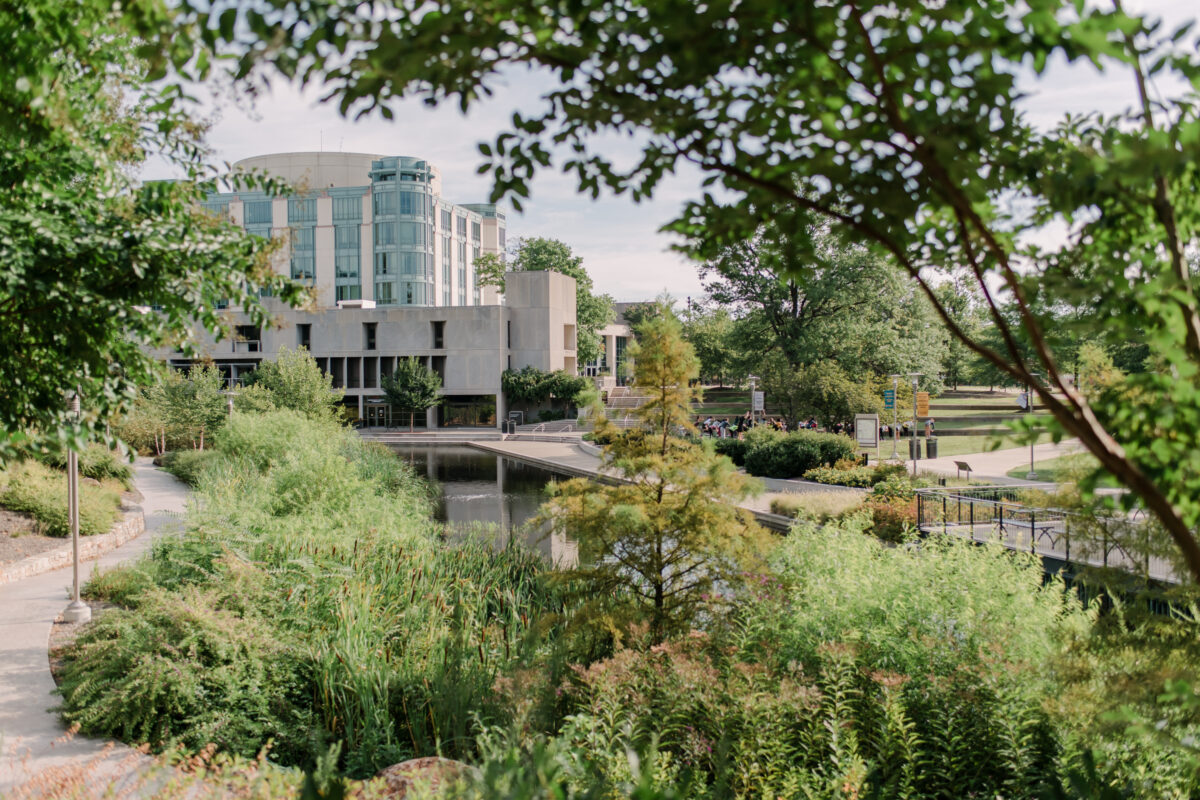 The UMBC Library Pond and surrounding vegetation are home to numerous wildlife species, such as yellow-crowned night herons and red-winged blackbirds. The pond also serves as an important stormwater management feature on campus. (Marlayna Demond ’11/UMBC)
Beyond solar
The grant will also support the development of UMBC’s Campus Clean Energy Master Plan (CCEMP). The CCEMP will rely on past studies and a forthcoming decarbonization engineering study to identify opportunities to save energy and decarbonize campus energy systems, including the central and satellite utility plants.
UMBC’s geography and environmental systems department and engineering faculty affiliated with the Grand Challenges Scholars Program are designing new learning opportunities that will use the solar project as an educational tool. Grant funds will partially fund academic experiences that provide students with hands-on learning opportunities in solar energy technology, renewable energy systems, and sustainability management, integrating real-world problem-solving into the academic curriculum. Five interns will also gain critical experience through supporting these projects, under the supervision of the Office of Sustainability and departmental faculty.
“The campus community can be proud of this commitment to bring solar energy to campus,” Smith says. “This project will not only accelerate UMBC’s shift to clean energy but will also create a visible, tangible symbol of the progress that’s been made. Plus, the new solar arrays will create learning opportunities for students to build the skills they need to thrive in the green economy.”
]]>
UMBC has received a $1.2 million solar energy grant from the Maryland Energy Administration (MEA) to support solar power installations on campus and other sustainability initiatives. The...
https://umbc.edu/stories/mea-funds-solar-panels-and-more/
https://my3.my.umbc.edu/api/v0/pixel/news/149491/guest@my.umbc.edu/7b6a267f5bb303b383508c83b3fe0688/api/pixel
cahss
coeit
community
engineering
gcsp
ges
news
science-and-tech
story
sustainability
UMBC News & Magazine
https://my3.my.umbc.edu/groups/umbc-news-magazine
https://assets1-my.umbc.edu/system/shared/avatars/groups/000/001/943/24435aa6207c452e7bc15cc74b42c7bb/xsmall.png?1748556657
https://assets1-my.umbc.edu/system/shared/avatars/groups/000/001/943/24435aa6207c452e7bc15cc74b42c7bb/original.png?1748556657
https://assets2-my.umbc.edu/system/shared/avatars/groups/000/001/943/24435aa6207c452e7bc15cc74b42c7bb/xxlarge.png?1748556657
https://assets2-my.umbc.edu/system/shared/avatars/groups/000/001/943/24435aa6207c452e7bc15cc74b42c7bb/xlarge.png?1748556657
https://assets3-my.umbc.edu/system/shared/avatars/groups/000/001/943/24435aa6207c452e7bc15cc74b42c7bb/large.png?1748556657
https://assets1-my.umbc.edu/system/shared/avatars/groups/000/001/943/24435aa6207c452e7bc15cc74b42c7bb/medium.png?1748556657
https://assets2-my.umbc.edu/system/shared/avatars/groups/000/001/943/24435aa6207c452e7bc15cc74b42c7bb/small.png?1748556657
https://assets1-my.umbc.edu/system/shared/avatars/groups/000/001/943/24435aa6207c452e7bc15cc74b42c7bb/xsmall.png?1748556657
https://assets2-my.umbc.edu/system/shared/avatars/groups/000/001/943/24435aa6207c452e7bc15cc74b42c7bb/xxsmall.png?1748556657
UMBC News & Magazine
13
0
false
Fri, 25 Apr 2025 16:33:40 -0400
Fri, 25 Apr 2025 16:33:40 -0400
Popular AIs head-to-head: OpenAI beats DeepSeek on sentence-level reasoning
Written by Manas Gaur, assistant professor in computer science and electrical engineering, UMBC
ChatGPT and other AI chatbots based on large language models are known to occasionally make things up, including scientific and legal citations. It turns out that measuring how accurate an AI model’s citations are is a good way of assessing the model’s reasoning abilities.
An AI model “reasons” by breaking down a query into steps and working through them in order. Think of how you learned to solve math word problems in school.
Ideally, to generate citations an AI model would understand the key concepts in a document, generate a ranked list of relevant papers to cite, and provide convincing reasoning for how each suggested paper supports the corresponding text. It would highlight specific connections between the text and the cited research, clarifying why each source matters.
The question is, can today’s models be trusted to make these connections and provide clear reasoning that justifies their source choices? The answer goes beyond citation accuracy to address how useful and accurate large language models are for any information retrieval purpose.
I’m a computer scientist. My colleagues − researchers from the AI Institute at the University of South Carolina, Ohio State University and University of Maryland Baltimore County − and I have developed the Reasons benchmark to test how well large language models can automatically generate research citations and provide understandable reasoning.
We used the benchmark to compare the performance of two popular AI reasoning models, DeepSeek’s R1 and OpenAI’s o1. Though DeepSeek made headlines with its stunning efficiency and cost-effectiveness, the Chinese upstart has a way to go to match OpenAI’s reasoning performance.
Sentence specific
The accuracy of citations has a lot to do with whether the AI model is reasoning about information at the sentence level rather than paragraph or document level. Paragraph-level and document-level citations can be thought of as throwing a large chunk of information into a large language model and asking it to provide many citations.
In this process, the large language model overgeneralizes and misinterprets individual sentences. The user ends up with citations that explain the whole paragraph or document, not the relatively fine-grained information in the sentence.
Further, reasoning suffers when you ask the large language model to read through an entire document. These models mostly rely on memorizing patterns that they typically are better at finding at the beginning and end of longer texts than in the middle. This makes it difficult for them to fully understand all the important information throughout a long document.
Large language models get confused because paragraphs and documents hold a lot of information, which affects citation generation and the reasoning process. Consequently, reasoning from large language models over paragraphs and documents becomes more like summarizing or paraphrasing.
The Reasons benchmark addresses this weakness by examining large language models’ citation generation and reasoning.
How DeepSeek R1 and OpenAI o1 compare generally on logic problems.
Testing citations and reasoning
Following the release of DeepSeek R1 in January 2025, we wanted to examine its accuracy in generating citations and its quality of reasoning and compare it with OpenAI’s o1 model. We created a paragraph that had sentences from different sources, gave the models individual sentences from this paragraph, and asked for citations and reasoning.
To start our test, we developed a small test bed of about 4,100 research articles around four key topics that are related to human brains and computer science: neurons and cognition, human-computer interaction, databases and artificial intelligence. We evaluated the models using two measures: F-1 score, which measures how accurate the provided citation is, and hallucination rate, which measures how sound the model’s reasoning is − that is, how often it produces an inaccurate or misleading response.
Our testing revealed significant performance differences between OpenAI o1 and DeepSeek R1 across different scientific domains. OpenAI’s o1 did well connecting information between different subjects, such as understanding how research on neurons and cognition connects to human-computer interaction and then to concepts in artificial intelligence, while remaining accurate. Its performance metrics consistently outpaced DeepSeek R1’s across all evaluation categories, especially in reducing hallucinations and successfully completing assigned tasks.
OpenAI o1 was better at combining ideas semantically, whereas R1 focused on making sure it generated a response for every attribution task, which in turn increased hallucination during reasoning. OpenAI o1 had a hallucination rate of approximately 35% compared with DeepSeek R1’s rate of nearly 85% in the attribution-based reasoning task.
In terms of accuracy and linguistic competence, OpenAI o1 scored about 0.65 on the F-1 test, which means it was right about 65% of the time when answering questions. It also scored about 0.70 on the BLEU test, which measures how well a language model writes in natural language. These are pretty good scores.
DeepSeek R1 scored lower, with about 0.35 on the F-1 test, meaning it was right about 35% of the time. However, its BLEU score was only about 0.2, which means its writing wasn’t as natural-sounding as OpenAI’s o1. This shows that o1 was better at presenting that information in clear, natural language.
OpenAI holds the advantage
On other benchmarks, DeepSeek R1 performs on par with OpenAI o1 on math, coding and scientific reasoning tasks. But the substantial difference on our benchmark suggests that o1 provides more reliable information, while R1 struggles with factual consistency.
Though we included other models in our comprehensive testing, the performance gap between o1 and R1 specifically highlights the current competitive landscape in AI development, with OpenAI’s offering maintaining a significant advantage in reasoning and knowledge integration capabilities.
These results suggest that OpenAI still has a leg up when it comes to source attribution and reasoning, possibly due to the nature and volume of the data it was trained on. The company recently announced its deep research tool, which can create reports with citations, ask follow-up questions and provide reasoning for the generated response.
The jury is still out on the tool’s value for researchers, but the caveat remains for everyone: Double-check all citations an AI gives you.
This article is republished from The Conversation under a Creative Commons license. Read the original article and see more than 250 UMBC articles available in The Conversation.
]]>
Written by Manas Gaur, assistant professor in computer science and electrical engineering, UMBC ChatGPT and other AI chatbots based on large language models are known to occasionally make...
https://umbc.edu/stories/openai-beats-deepseek-on-sentence-level-reasoning/
https://my3.my.umbc.edu/api/v0/pixel/news/149488/guest@my.umbc.edu/69dcefe3fe9f16a5fbdeffeebfd38916/api/pixel
coeit
discovery
magazine
research
story
the-conversation
UMBC News & Magazine
https://my3.my.umbc.edu/groups/umbc-news-magazine
https://assets1-my.umbc.edu/system/shared/avatars/groups/000/001/943/24435aa6207c452e7bc15cc74b42c7bb/xsmall.png?1748556657
https://assets1-my.umbc.edu/system/shared/avatars/groups/000/001/943/24435aa6207c452e7bc15cc74b42c7bb/original.png?1748556657
https://assets2-my.umbc.edu/system/shared/avatars/groups/000/001/943/24435aa6207c452e7bc15cc74b42c7bb/xxlarge.png?1748556657
https://assets2-my.umbc.edu/system/shared/avatars/groups/000/001/943/24435aa6207c452e7bc15cc74b42c7bb/xlarge.png?1748556657
https://assets3-my.umbc.edu/system/shared/avatars/groups/000/001/943/24435aa6207c452e7bc15cc74b42c7bb/large.png?1748556657
https://assets1-my.umbc.edu/system/shared/avatars/groups/000/001/943/24435aa6207c452e7bc15cc74b42c7bb/medium.png?1748556657
https://assets2-my.umbc.edu/system/shared/avatars/groups/000/001/943/24435aa6207c452e7bc15cc74b42c7bb/small.png?1748556657
https://assets1-my.umbc.edu/system/shared/avatars/groups/000/001/943/24435aa6207c452e7bc15cc74b42c7bb/xsmall.png?1748556657
https://assets2-my.umbc.edu/system/shared/avatars/groups/000/001/943/24435aa6207c452e7bc15cc74b42c7bb/xxsmall.png?1748556657
UMBC News & Magazine
0
0
false
Fri, 25 Apr 2025 14:56:38 -0400
Fri, 25 Apr 2025 14:56:38 -0400
VanBriesen named new dean for UMBC’s College of Engineering and Information Technology
The following message was shared with the UMBC community on April 21 to announce the naming of a new dean for the College of Engineering and Information Technology:
* * * * *
Dear UMBC community,
I am pleased to announce the appointment of Jeanne M. VanBriesen as the dean of the College of Engineering and Information Technology (COEIT) effective July 1. Jeanne is a distinguished academic leader with a bold vision for the future of engineering and information technology research and education and a commitment to inclusive excellence.
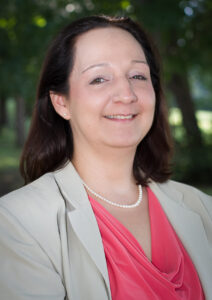
Jeanne joins UMBC from Carnegie Mellon University where she is the Duquesne Light Company Professor in the departments of Civil and Environmental Engineering and Engineering and Public Policy. She recently completed service as the division director in the Division of Chemical, Bioengineering, Environmental, and Transport Systems, in the Engineering Directorate, at the U.S. National Science Foundation. She previously served as the vice provost for faculty at Carnegie Mellon and as the chair of the faculty senate.
Jeanne holds a bachelor’s in education and a master’s and Ph.D. in civil engineering from Northwestern University. She is a licensed professional engineer, a board certified environmental engineer, and a diplomate of water resources engineering.
An accomplished scholar, Jeanne has published more than 75 scientific articles and given more than 200 professional presentations. Her research, which has been funded by the National Science Foundation, the Department of Defense, the Colcom Foundation, the Heinz Endowments, the Packard Foundation, and the Pennsylvania Infrastructure Technology Alliance, focuses on environmental systems, including biotransformation of recalcitrant organics, detection of biological agents in drinking water and natural water systems, speciation-driven biogeochemistry of chelating agents and disinfection by-products, and environmental impacts of energy extraction.
An award-winning educator, visionary leader, and active mentor, Jeanne has supervised 24 Ph.D. dissertations and numerous M.S. theses. She has served on several boards, including the U.S. EPA Science Advisory Board, and she is a fellow of the American Society of Civil Engineers, the Environmental Water Resources Institute, the Association of Environmental Engineering and Science Professors, and the American Association for the Advancement of Science.
I want to give a special thanks to Bill LaCourse and the dedicated members of the search committee for their efforts in conducting a comprehensive national search.
I am excited for Jeanne to join UMBC and build on the tradition of integrating undergraduate and graduate education, research, innovation, and service to address evolving global needs. Please join me in welcoming Jeanne to the UMBC community.
Anupam Joshi Named Special Assistant to the Provost for AI and Computing
I am also pleased to announce an exciting opportunity for Anupam Joshi, who selflessly served as the interim dean for the past two years. In addition to his current roles as the Oros Family Professor and director of UMBC Cybersecurity Institute, Anupam will be transitioning to a new role as the special assistant to the Provost for AI and Computing. In this role Anupam will lead UMBC’s strategy for AI and Computing including coordinating and leveraging current efforts in this space, lead the strategic planning for university goals in this area, and leverage new resources and university partnerships.
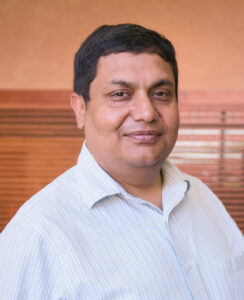
Anupam is a renowned expert in cybersecurity, AI, and data science. He brings decades of leadership, research excellence, and visionary thinking to this new role. His appointment marks an exciting chapter for UMBC as we expand our efforts to drive innovation, foster interdisciplinary collaboration, and shape the future of ethical and impactful AI on campus, across the USM, and around the globe.
Please join me in congratulating Anupam on this well-deserved recognition. I look forward to the continued growth and success of the AI and computing programs under his leadership.
Sincerely,
Manfred H.M. van Dulmen
Provost and Senior Vice President for Academic Affairs
]]>
The following message was shared with the UMBC community on April 21 to announce the naming of a new dean for the College of Engineering and Information Technology: * * * * * Dear UMBC...
https://umbc.edu/stories/vanbriesen-named-new-dean-for-umbcs-college-of-engineering-and-information-technology/
https://my3.my.umbc.edu/api/v0/pixel/news/149339/guest@my.umbc.edu/249b29e4afb23f9dd62b7c1b59d961eb/api/pixel
coeit
news
story
UMBC News & Magazine
https://my3.my.umbc.edu/groups/umbc-news-magazine
https://assets1-my.umbc.edu/system/shared/avatars/groups/000/001/943/24435aa6207c452e7bc15cc74b42c7bb/xsmall.png?1748556657
https://assets1-my.umbc.edu/system/shared/avatars/groups/000/001/943/24435aa6207c452e7bc15cc74b42c7bb/original.png?1748556657
https://assets2-my.umbc.edu/system/shared/avatars/groups/000/001/943/24435aa6207c452e7bc15cc74b42c7bb/xxlarge.png?1748556657
https://assets2-my.umbc.edu/system/shared/avatars/groups/000/001/943/24435aa6207c452e7bc15cc74b42c7bb/xlarge.png?1748556657
https://assets3-my.umbc.edu/system/shared/avatars/groups/000/001/943/24435aa6207c452e7bc15cc74b42c7bb/large.png?1748556657
https://assets1-my.umbc.edu/system/shared/avatars/groups/000/001/943/24435aa6207c452e7bc15cc74b42c7bb/medium.png?1748556657
https://assets2-my.umbc.edu/system/shared/avatars/groups/000/001/943/24435aa6207c452e7bc15cc74b42c7bb/small.png?1748556657
https://assets1-my.umbc.edu/system/shared/avatars/groups/000/001/943/24435aa6207c452e7bc15cc74b42c7bb/xsmall.png?1748556657
https://assets2-my.umbc.edu/system/shared/avatars/groups/000/001/943/24435aa6207c452e7bc15cc74b42c7bb/xxsmall.png?1748556657
UMBC News & Magazine
0
0
false
Tue, 22 Apr 2025 13:30:38 -0400
Tue, 22 Apr 2025 13:30:38 -0400
Randi Williams ’16: AI technologist and education advocate headlines 2025 URCAD
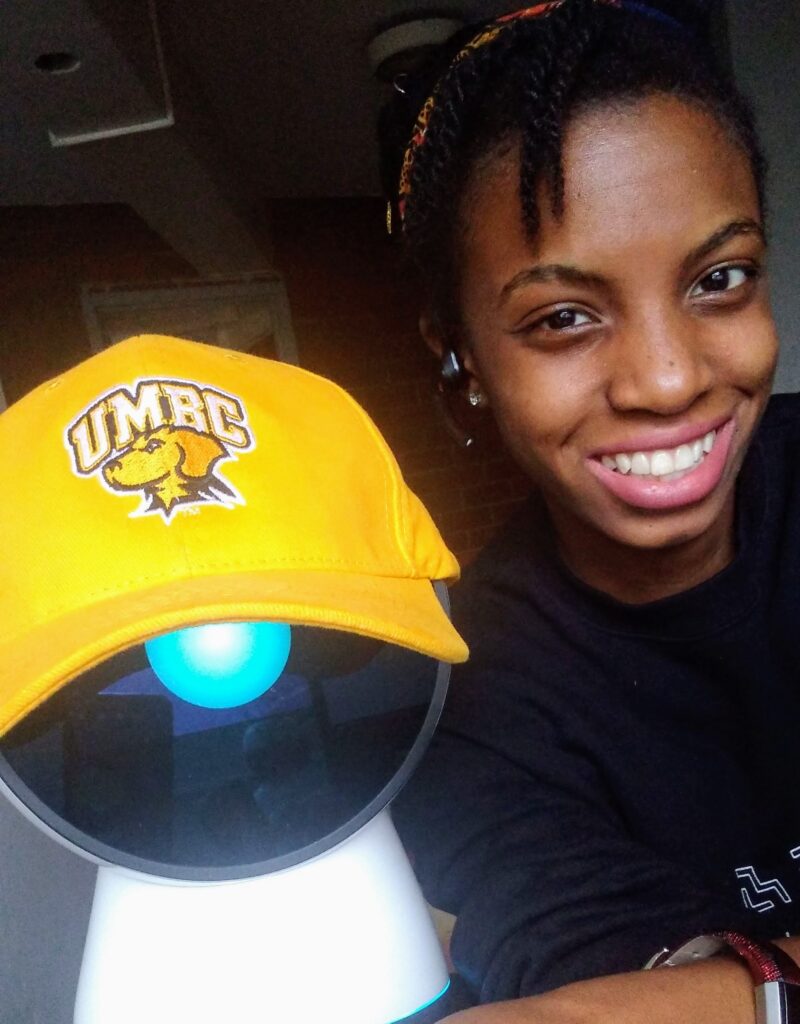 Williams and a Jibo robot show some UMBC pride. (Photo courtesy of Williams)
As a senior in high school in Prince George’s County, Maryland, Randi Williams ’16, computer engineering, was almost certain she was going to MIT for undergrad. Since middle school she’d had the understanding that MIT was the school “for people who want to build things,” and by spring of senior year she had already been admitted under early action. But fate had other plans.
Her mother had learned about UMBC’s Meyerhoff Scholars Program from a 60 Minutes segment that aired right around when Williams was applying to colleges. The nationally renowned Meyerhoff Scholars Program, founded in 1988, works to increase diversity among future leaders in science, technology, engineering, and mathematics by supporting students who intend to pursue a Ph.D. or combined M.D./Ph.D. in these fields.
Williams applied to the program and it was during an on-campus event for top Meyerhoff applicants that her mind began to change. She was impressed with the support and camaraderie the program offered. In the end, Williams opted to become a Retriever—and never looked back.
“If I hadn’t gone to UMBC, I don’t think I would have developed the leadership skills I did,” says Williams, who is returning to campus on April 16 as the keynote speaker for Undergraduate Research and Creative Achievement Day. “My mentors always encouraged me to speak up. I really benefited from that.”
Lifting others up along the way
At UMBC, Williams embraced myriad opportunities to learn and grow. She excelled in her classes, conducted research in the Mobile, Pervasive, and Sensor System Lab of Professor Nilanjan Banerjee, and was involved in the Meyerhoff Scholars, Honors College, and Center for Women in Technology communities.
“Randi’s work was noticeably excellent,” says Charles LaBerge, Ph.D. ’03, electrical engineering, a professor of the practice in the Department of Computer Science and Electrical Engineering who taught Williams in six different courses, from Intro to Engineering to her senior capstone, in which she and her team worked on underwater vision for a robotic sub. “Randi is always upbeat and friendly. Her capstone peers regarded her as a great teammate.”
In her sophomore year, Williams co-founded the hackUMBC student group with fellow Meyerhoff Scholar Perry Ogwuche ’14, computer science and mathematics, and organized the university’s first hackathon, a 24-hour competition where teams of students create innovative solutions to problems that matter to them. Using that experience, she also ran hackathons for youth in Baltimore, centered around issues of community safety and interactions with police.
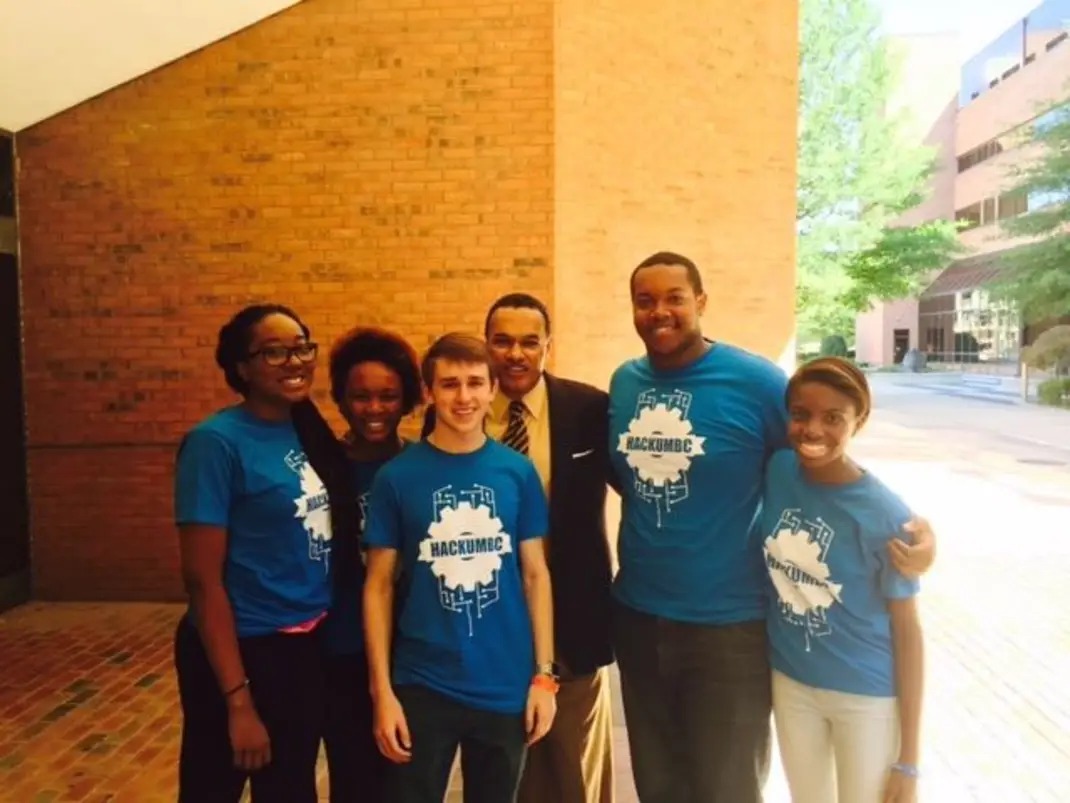 Randi Williams, far right, and other hackUMBC attendees pose for a photo with then UMBC President Freeman Hrabowski. (Photo courtesy of Williams)
Williams always wanted the people around her to succeed, and worked hard to lift everyone up, says her UMBC roommate of four years, Amreen Chadha ’16, financial economics: “I saw Randi pull all-nighters just to help her peers with studying and assignments that she had already completed.”
Throughout her time at UMBC, Williams stayed true to her passions and ideals, Chadha says. “Randi was always herself in the absolute best way: She was honest, thoughtful, caring, and all around great. If I had something on my mind, I was never afraid to be open with her. She balanced her school work and social life so well that it drove others around her to find the same balance.”
To MIT and beyond
After graduating summa cum laude, Williams did at last say “yes” to MIT, where she joined the Personal Robots Group at MIT’s Media Lab. She earned a master’s in media arts in sciences in 2018 and a Ph.D. in the same field in 2024. Williams studied how young children understand and interact with AI, and worked on tools and teaching methods to enable young learners to undertake their own AI-based projects. She developed robots, called PopBots, that can teach AI concepts to preschoolers through social interaction, and also developed a middle school AI and ethics curriculum used by thousands of teachers around the world called “How to Train Your Robot.”
Williams tells the story of one young student she met who wanted to become a doctor and was not, at first, particularly interested in AI. But through a project in Williams’ class the student developed an AI tool to translate when a doctor and patient don’t speak the same language. “This student was inspired by her own situation of translating for her mother in doctors’ offices, and she imagined an AI companion that could do the same,” Williams says.
Williams says the anecdote illustrates how she would like young people to see AI—as a tool to empower themselves and address the problems they see around them.
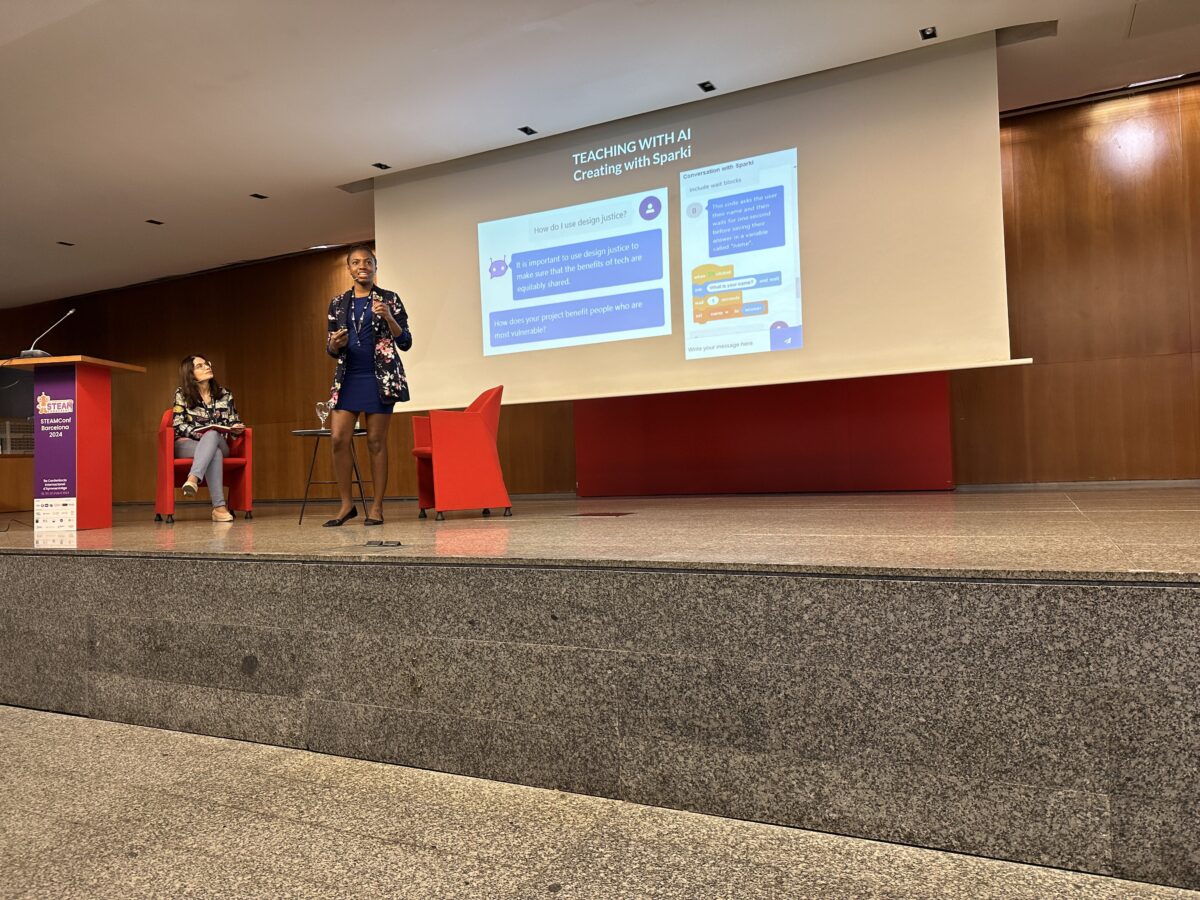 Williams speaks about teaching with AI during STEAMConf Barcelona 2024, a conference about technology education. (Image courtesy of Williams)
Making AI accessible for all
In the summer of 2026, Williams will head to Carnegie Mellon University in Pittsburgh to become an assistant professor in the Human-Computer Interaction Institute.
“Running my own research lab has been my dream for years,” Williams says.
Before beginning that next chapter, she is working as a research lead at Day of AI, a nonprofit organization spun out of MIT, with the mission of preparing K-12 students of all backgrounds and abilities to be successful, responsible, and engaged in an increasingly AI-powered society. The mission fits with Williams’ passion of making technology education accessible to everyone.
“AI is like a big wave approaching us. We can either put our heads in the sand and pretend it’s not coming, or we can ride the wave,” she says. “I want everyone riding the wave.”
Although pop culture often portrays AI as an adversary of humans, Williams prefers to focus on the collaborative potential.
“I tell my students, this is what AI can create—And I’ll make a small circle with my hands; this is what humans can create, and I’ll make a bigger circle; And, putting my arms out wide—this is what we can create together.”
]]>
Williams and a Jibo robot show some UMBC pride. (Photo courtesy of Williams) As a senior in high school in Prince George’s County, Maryland, Randi Williams ’16, computer engineering, was...
https://umbc.edu/stories/randi-williams-ai-technologist/
https://my3.my.umbc.edu/api/v0/pixel/news/148995/guest@my.umbc.edu/53c7daf7dda21ff8b6304cfb2206cd03/api/pixel
alumni
coeit
csee
magazine
story
urcad
UMBC News & Magazine
https://my3.my.umbc.edu/groups/umbc-news-magazine
https://assets1-my.umbc.edu/system/shared/avatars/groups/000/001/943/24435aa6207c452e7bc15cc74b42c7bb/xsmall.png?1748556657
https://assets1-my.umbc.edu/system/shared/avatars/groups/000/001/943/24435aa6207c452e7bc15cc74b42c7bb/original.png?1748556657
https://assets2-my.umbc.edu/system/shared/avatars/groups/000/001/943/24435aa6207c452e7bc15cc74b42c7bb/xxlarge.png?1748556657
https://assets2-my.umbc.edu/system/shared/avatars/groups/000/001/943/24435aa6207c452e7bc15cc74b42c7bb/xlarge.png?1748556657
https://assets3-my.umbc.edu/system/shared/avatars/groups/000/001/943/24435aa6207c452e7bc15cc74b42c7bb/large.png?1748556657
https://assets1-my.umbc.edu/system/shared/avatars/groups/000/001/943/24435aa6207c452e7bc15cc74b42c7bb/medium.png?1748556657
https://assets2-my.umbc.edu/system/shared/avatars/groups/000/001/943/24435aa6207c452e7bc15cc74b42c7bb/small.png?1748556657
https://assets1-my.umbc.edu/system/shared/avatars/groups/000/001/943/24435aa6207c452e7bc15cc74b42c7bb/xsmall.png?1748556657
https://assets2-my.umbc.edu/system/shared/avatars/groups/000/001/943/24435aa6207c452e7bc15cc74b42c7bb/xxsmall.png?1748556657
UMBC News & Magazine
1
0
false
Fri, 11 Apr 2025 14:34:36 -0400
Fri, 11 Apr 2025 14:34:36 -0400
Top 5 ways URCAD is a uniquely UMBC experience
UMBC’s Undergraduate Research and Creative Achievement Day (URCAD) is returning for its 29th year on April 16. For nearly three decades, the annual showcase highlights the research, scholarship, and creative work carried out by undergraduate students who are working alongside faculty mentors.
URCAD 2025 returns to the University Center for research on assessing campus vegetation using tethered weather balloons, a student-curated gallery exhibition that explores “the theme of identity,” an analysis of how social media plays a role in Mexican feminist movements, and much more. Throughout the years, URCAD has grown to be a hallmark experience for Retrievers that exemplifies the expansive breadth and collaborative nature of UMBC research. This work is evident by the university’s reconfirmed designation as an R1 institution by the Carnegie Classification of Institutions of Higher Education earlier this year.
As we gear up for the next edition of the highly-anticipated day of undergraduate research, here are five ways URCAD is a uniquely UMBC experience:
1. Retrievers seriously love research
At URCAD, research enthusiasts—including those initially hesitant—have the opportunity to come together and “geek out” about all things research. First-time participants and seasoned presenters alike are able to showcase what they’ve explored and learned in one of UMBC’s many research labs, out in the field, or within specific industries. On average, about 300 student presenters take part in URCAD each year, with last year’s event featuring more than 400 student participants. Even amid a global pandemic, students eagerly participated in the event from their homes, drawing in 8,000 virtual visits in 2020 and 11,000 virtual visitors in 2021.
A recap of the URCAD 2024 event . (Elijah Davis, M.F.A. ’21/UMBC)
2. Stage for multidisciplinary collaboration
True to UMBC’s intentional culture of inclusive excellence, URCAD spotlights the collaboration that happens across multiple colleges, disciplines, and departments. At URCAD 2023, a team of students from the College of Natural and Mathematics Sciences and the College of Engineering and Information Technology presented their research on the tradeoffs that exist between privacy and utility when using smart devices at home. This year’s event will include a presentation of a multidisciplinary capstone team that designed and constructed a fixed-wing unmanned aerial vehicle, among many other other cross-collaborative projects.
3. Community-focused research based in Baltimore
Nearly each URCAD iteration features presentations of research conducted throughout Baltimore City and Baltimore County. Past events have included a short film screening that chronicles the history and the decline of LGBTQ+ nightlife in Baltimore City; a presentation on findings from a 2021 UMBC-led study to better understand the experiences of low-income Baltimore families without broadband access; and a 2017 URCAD photography exhibit that captured the experiences of unhoused people living in Baltimore’s Station North area.
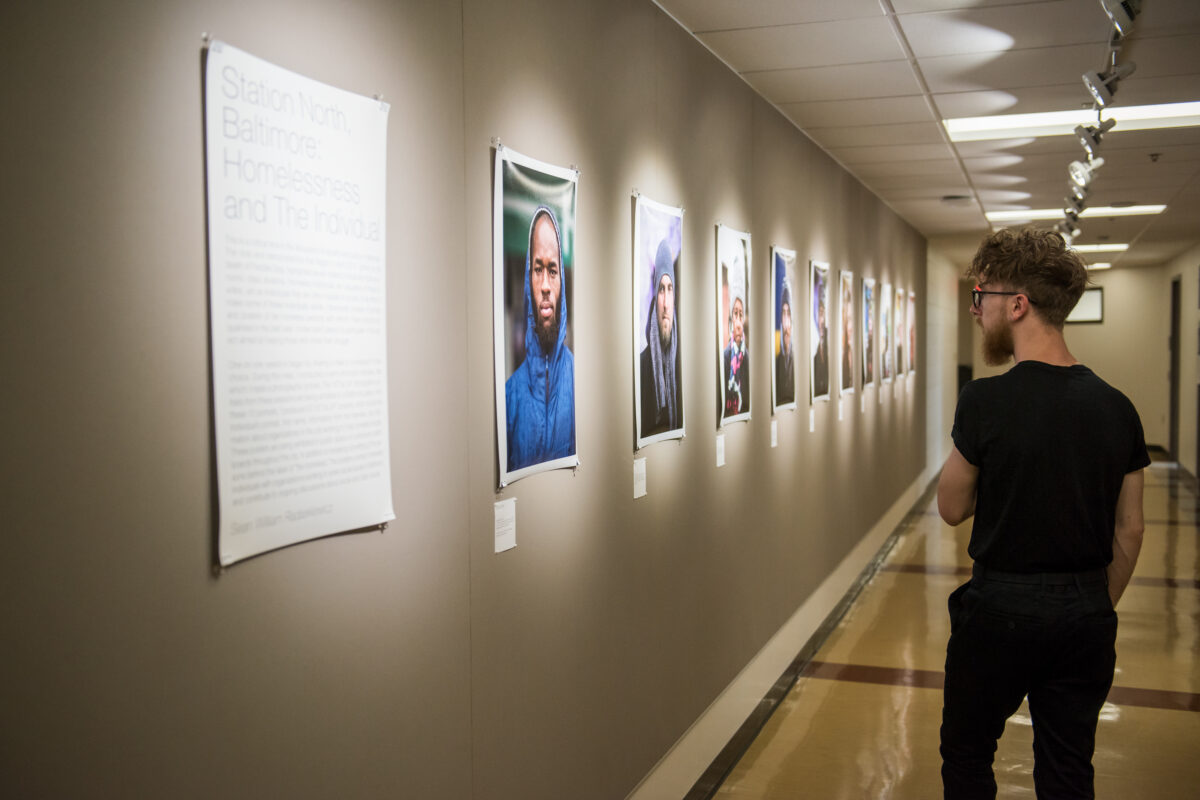 Sean William Radaskiewicz ‘18, visual arts, presented his photography series “Station North, Baltimore: Homelessness and the Individual,” at URCAD 2017. (Marlayna Demond ’11 for UMBC)
4. A return home for alumni researchers
Each year, the research event includes a keynote speech delivered by esteemed UMBC alumni— some of whom were once URCAD presenters themselves—such as the 2024 keynote speaker Stefanie Mavronis ’12, political science, media and communication studies. Mavronis shared her journey of being a student researcher and how her experiences led to her current position as the director of the Mayor’s Office of Safety and Engagement in Baltimore City. Randi Williams ’16, computer engineering, will deliver the URCAD 2025 keynote speech. Williams is the research director of Day of AI, a non-profit organization that provides educators with artificial intelligence literacy curriculums for K-12 students.
 The flyer for URCAD 2025 featuring alumni keynote speaker Randi Williams ’16, computer engineering.
5. Pathway for post-graduation success
Many past URCAD presenters have gone on to pursue advanced degrees and postdoctoral fellowships following their time at UMBC. And they say the early exposure to rigorous research opportunities help land those positions. After presenting at URCAD 2023, Ellie Bare ’23, biological sciences, shared that “having opportunities to improve my science communications abilities was invaluable and really great…it even helped me with my post-baccalaureate interviews.”
Before his current role as a research assistant with the Federal Reserve Board of Governors in Washington, D.C., Peter Wilschke ’24, economics and political science, presented research he worked on as an intern at The Hilltop Institute at UMBC during last year’s URCAD event. Beyond academia, URCAD participants have found industry success. Members of UMBC’s Game Developers Club, some of whom were past URCAD presenters, have gone on to find positions at Facebook, the Unity game engine platform, and Firaxis games, to name a few.
More information on URCAD 2025 presenters and additional sneak peeks of upcoming presentations can be found here.
]]>
UMBC’s Undergraduate Research and Creative Achievement Day (URCAD) is returning for its 29th year on April 16. For nearly three decades, the annual showcase highlights the research, scholarship,...
https://umbc.edu/stories/urcad-2025/
https://my3.my.umbc.edu/api/v0/pixel/news/148905/guest@my.umbc.edu/f7d40e1b3ddbc61b85d468b4ad3ae2f4/api/pixel
cahss
cnms
coeit
community
news
story
undergrad
undergradresearch
urcad
UMBC News & Magazine
https://my3.my.umbc.edu/groups/umbc-news-magazine
https://assets1-my.umbc.edu/system/shared/avatars/groups/000/001/943/24435aa6207c452e7bc15cc74b42c7bb/xsmall.png?1748556657
https://assets1-my.umbc.edu/system/shared/avatars/groups/000/001/943/24435aa6207c452e7bc15cc74b42c7bb/original.png?1748556657
https://assets2-my.umbc.edu/system/shared/avatars/groups/000/001/943/24435aa6207c452e7bc15cc74b42c7bb/xxlarge.png?1748556657
https://assets2-my.umbc.edu/system/shared/avatars/groups/000/001/943/24435aa6207c452e7bc15cc74b42c7bb/xlarge.png?1748556657
https://assets3-my.umbc.edu/system/shared/avatars/groups/000/001/943/24435aa6207c452e7bc15cc74b42c7bb/large.png?1748556657
https://assets1-my.umbc.edu/system/shared/avatars/groups/000/001/943/24435aa6207c452e7bc15cc74b42c7bb/medium.png?1748556657
https://assets2-my.umbc.edu/system/shared/avatars/groups/000/001/943/24435aa6207c452e7bc15cc74b42c7bb/small.png?1748556657
https://assets1-my.umbc.edu/system/shared/avatars/groups/000/001/943/24435aa6207c452e7bc15cc74b42c7bb/xsmall.png?1748556657
https://assets2-my.umbc.edu/system/shared/avatars/groups/000/001/943/24435aa6207c452e7bc15cc74b42c7bb/xxsmall.png?1748556657
UMBC News & Magazine
0
0
false
Wed, 09 Apr 2025 15:16:20 -0400
Wed, 09 Apr 2025 15:16:20 -0400
Students partner with Baltimore community members to measure ‘forever chemicals’ in local waters
On a sunny and unseasonably warm Halloween this past fall, a group of costumed UMBC students strolled the banks of the Inner Harbor in Baltimore. The costumes were in good fun, but the spirit driving them to the city that day was more scientific than spectral: They were there to check on samplers they had installed around the harbor to measure the concentrations of certain chemicals called per- and polyfluoroalkyl substances, or PFAS, in the water.
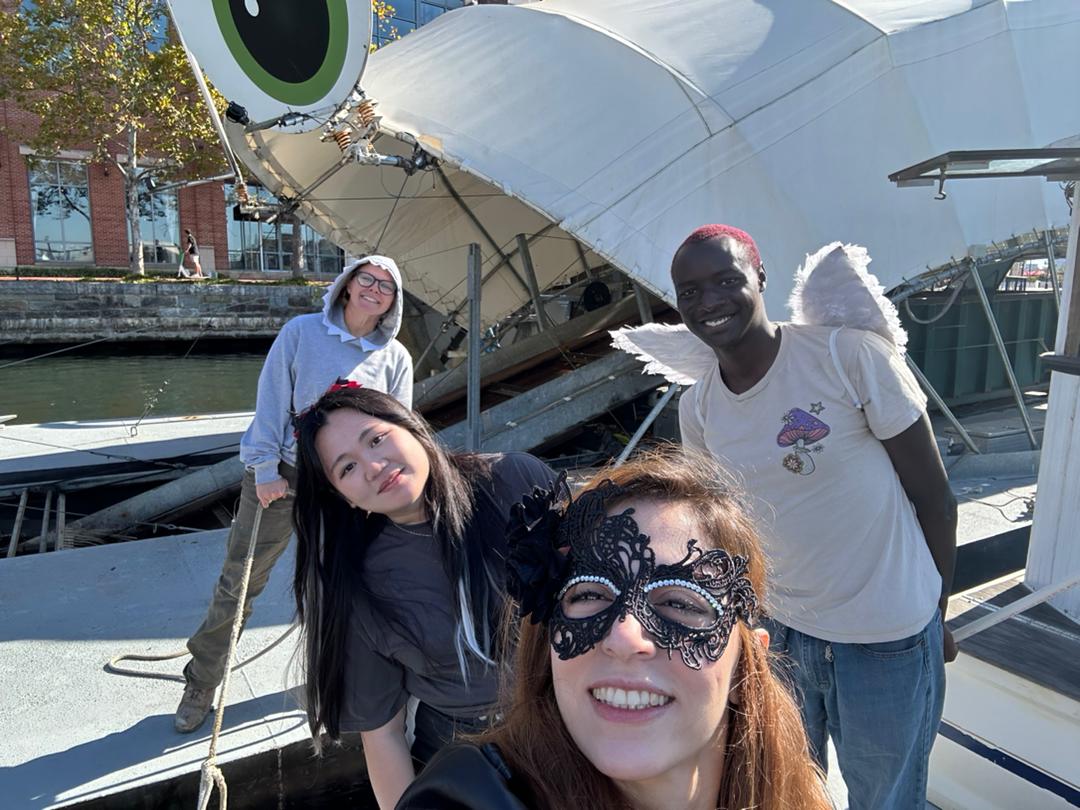 On Halloween, from right to left, Alvin Bett, an undergraduate student working in Blaney’s lab, Hamidi, Siao, and Leigh Auth, a boat captain with the Waterfront Partnership of Baltimore who helped the group access the trash wheels to install their PFAS sensors. (Image courtesy of Siao)
PFAS are used in a diverse range of products, including cleaning products, clothing, and fire-fighting foam, and have earned the nickname “forever chemicals” because of the way they persist in the environment. There are growing concerns about the health effects of the chemicals, and in recent years there have been efforts to eliminate PFAS from some consumer products and regulate their concentration in drinking water.
The UMBC students’ work to measure PFAS in Baltimore Harbor is one of the first projects aiming to get an understanding of how much of the chemicals are found in the waters around Baltimore and where they might be coming from. Margaret Siao, a master’s student in chemical engineering, took a lead role in the work as part of the ICARE program, which links researchers and Baltimore community members on environmental projects around the city.
Donya Hamidi, an environmental engineering Ph.D. student, also took part in the project, which served as a test case for a larger project she is working on, seeking to expand the utility of innovative passive samplers to measure PFAS in any water source.
“I’ve lived in Baltimore most of my life,” says Siao. “The harbor is a big part of the city, although many people don’t go out on the water. And that’s one of the reasons I wanted to look at the water quality.”
PFAS are everywhere
There are thousands of different PFAS chemicals. Because of their widespread use and resistance to degradation, they are found throughout the country in the water, soil, air, and food, and in the blood of humans and animals.
Exposure to some forms of PFAS has been linked to a range of health problems, including decreased fertility in women, developmental effects in children, reduced immune function, and increased risk of cancer and obesity.
“The PFAS issue just gets more and more complicated by the day,” says Lee Blaney, the environmental engineering professor who leads the lab where Siao and Hamidi work. He notes the EPA recently released an initial risk assessment for certain PFAS found in biosolids, which are a byproduct of wastewater treatment and are sometimes applied to agricultural land as fertilizer. “It’s a big, far-reaching issue.”
Partnering with the community
Blaney is an expert on PFAS, and as concerns about the prevalence and potential health effects of the chemicals have grown, his lab has been a leading partner with Baltimore community members who advocate for and are responsible for the quality of the water.
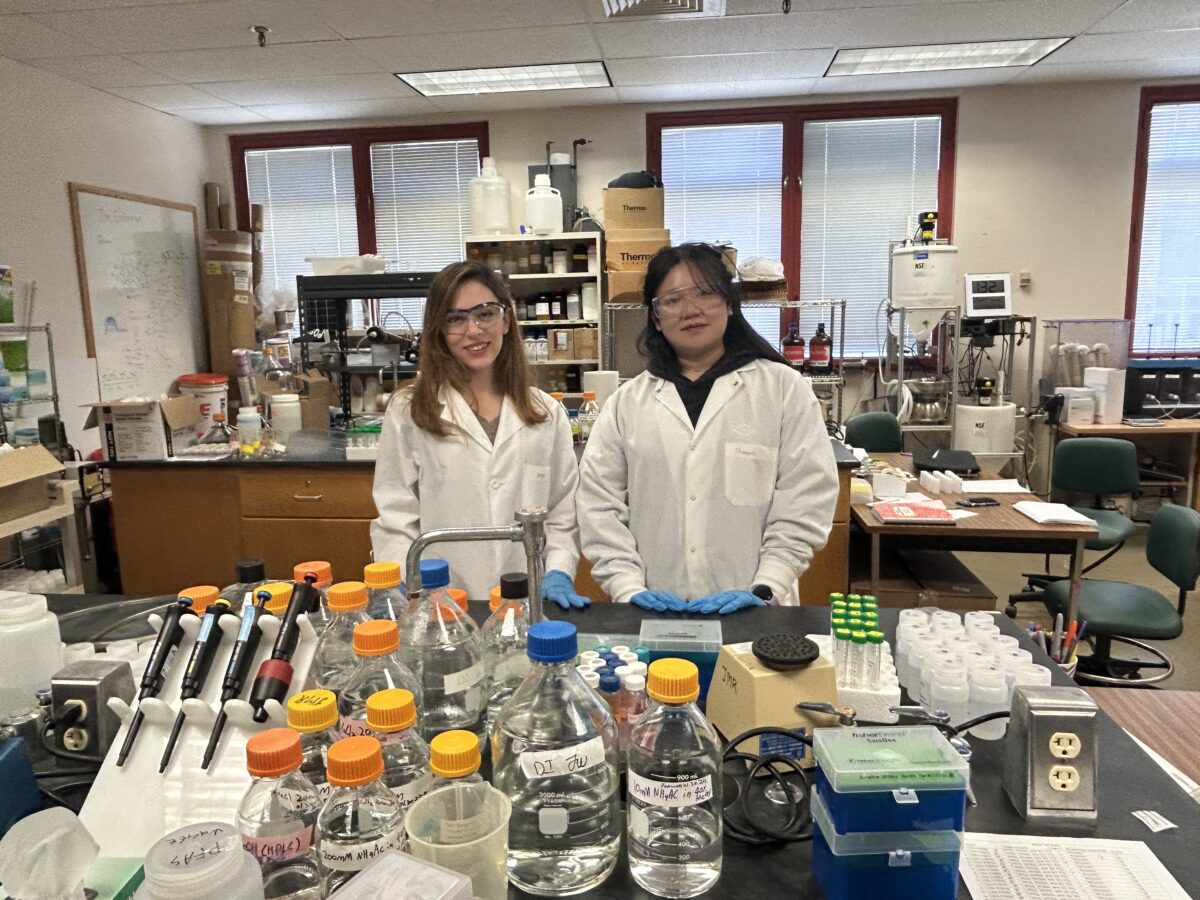 Hamidi (left) and Siao in the lab where they analyze samples for PFAS concentrations. (Image courtesy of Hamidi)
Siao’s ICARE project was a partnership with the United States Geological Survey Maryland-Delaware-D.C. Water Science Center and Blue Water Baltimore, a non-profit organization with the mission to restore the quality of Baltimore’s rivers, streams, and harbor. Blue Water Baltimore shared their knowledge of the harbor and area waterways and their connections with the community, while lab members shared their expertise and will share their PFAS data once it has been analyzed.
“PFAS is a hot topic, so Margaret’s project is really good timing,” says Barbara Johnson, who was Siao’s mentor at Blue Water Baltimore. “I think her data will be very useful for us in helping the public understand what PFAS are, for example just understanding how many different kinds there are. Margaret has taught me so much about PFAS.”
As part of the field work, Siao and Hamidi also sampled water at the outlet of the Patapsco Wastewater Treatment Plant in Baltimore. That partnership arose when Mohammed Almafrachi, who works as an engineer for the Baltimore City Department of Public Works, became interested in the PFAS issue and sought out a local expert.
“Last year, I found Dr. Blaney’s name on the internet. I drove to the campus, found his office, and he was there. I introduced myself as an engineer at the city of Baltimore, and we sat down and started talking,” Almafrachi says. From that conversation grew not only the collaboration to measure PFAS at the wastewater treatment plant, but also a tour of Baltimore’s largest drinking water treatment plant that Almafrachi gave students in Blaney’s class on environmental physicochemical processes last spring. Almafrachi said he was happy to provide students with a window on a real-world workplace where their skills might one day be applied.
“If you have not gone to the field, then you are not yet a full engineer,” says Almafrachi. “We can talk about theories and textbooks endlessly, but the field is where you really test your skills.”
The value of field work
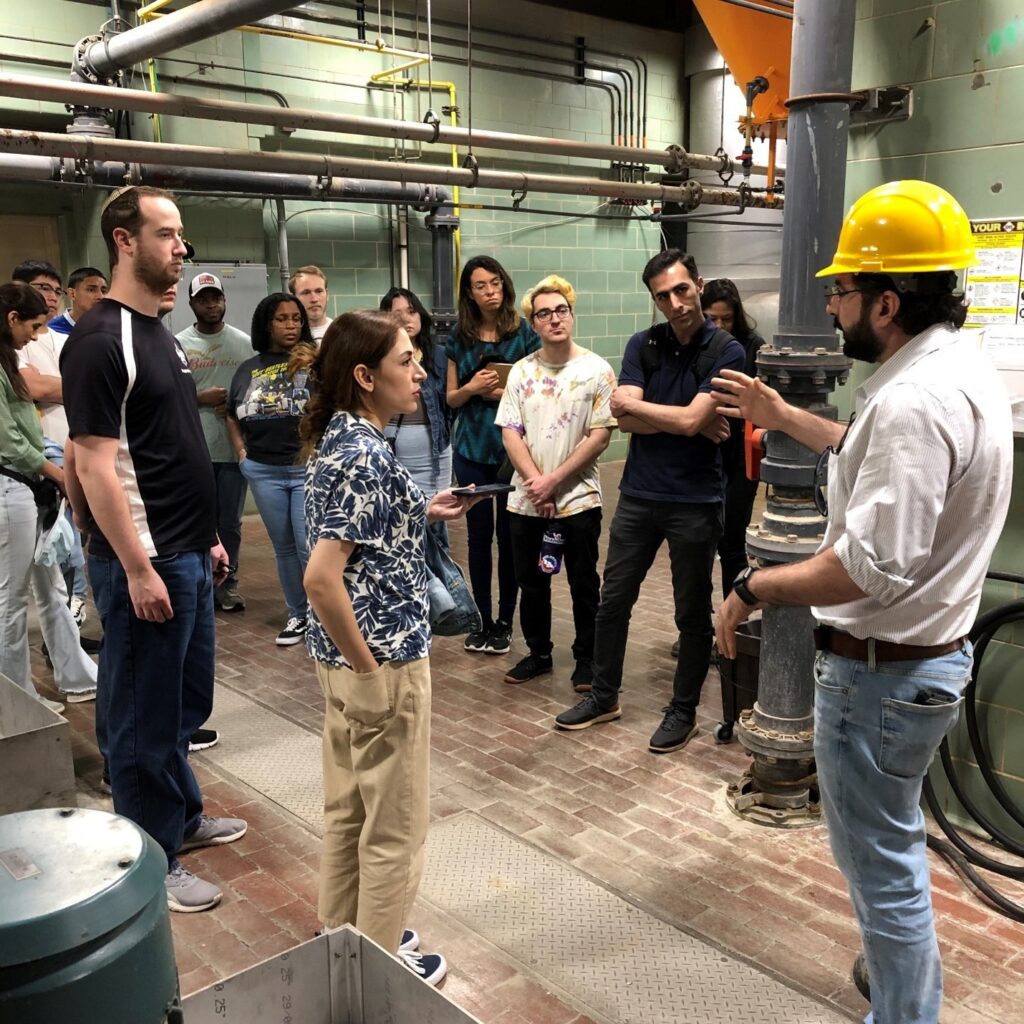 Almafrachi (right) led a tour of the Ashburton Filtration Plant, Baltimore’s largest drinking water treatment plant, for students in Blaney’s environmental physicochemical processes class. (Photo courtesy of Blaney)
Siao and Hamidi agree with Almafrachi about the value of field work. They installed their PFAS samplers at three of the four trash wheels around Baltimore Harbor—personified contraptions named Mr. Trash Wheel, Professor Trash Wheel, and Gwynnda the Good Wheel of the West that collect floating trash and keep it from dirtying the harbor. To get to the trash wheels, they took a flat-bottomed wooden boat, “more like a floating platform with a little cabin,” Siao says.
“Almost every time we collected a sampler, we saw something new or unexpected, for example algae growing on the sampler, and we had to figure out what was going on at that particular site,” says Hamidi. The team’s work and the measurements they collected and are currently analyzing will serve as a foundation for future studies about PFAS in the local environment.
Both Hamidi and Siao say they valued the teamwork of their trips, and the chance to meet people in the community impacted by their research.
“If you are stuck in a lab all day, it’s easy to forget why you’re doing research,” says Siao. “This project gave me a chance to interact with people outside of academia, to learn about what’s important to them, and to learn how to communicate about science with them, which is a really important skill.”
]]>
On a sunny and unseasonably warm Halloween this past fall, a group of costumed UMBC students strolled the banks of the Inner Harbor in Baltimore. The costumes were in good fun, but the spirit...
https://umbc.edu/stories/measuring-forever-chemicals-in-baltimore-waters/
https://my3.my.umbc.edu/api/v0/pixel/news/148658/guest@my.umbc.edu/cf805b0bded4f310ddcba5a01350caf4/api/pixel
cbee
coeit
impact
magazine
research
story
UMBC News & Magazine
https://my3.my.umbc.edu/groups/umbc-news-magazine
https://assets1-my.umbc.edu/system/shared/avatars/groups/000/001/943/24435aa6207c452e7bc15cc74b42c7bb/xsmall.png?1748556657
https://assets1-my.umbc.edu/system/shared/avatars/groups/000/001/943/24435aa6207c452e7bc15cc74b42c7bb/original.png?1748556657
https://assets2-my.umbc.edu/system/shared/avatars/groups/000/001/943/24435aa6207c452e7bc15cc74b42c7bb/xxlarge.png?1748556657
https://assets2-my.umbc.edu/system/shared/avatars/groups/000/001/943/24435aa6207c452e7bc15cc74b42c7bb/xlarge.png?1748556657
https://assets3-my.umbc.edu/system/shared/avatars/groups/000/001/943/24435aa6207c452e7bc15cc74b42c7bb/large.png?1748556657
https://assets1-my.umbc.edu/system/shared/avatars/groups/000/001/943/24435aa6207c452e7bc15cc74b42c7bb/medium.png?1748556657
https://assets2-my.umbc.edu/system/shared/avatars/groups/000/001/943/24435aa6207c452e7bc15cc74b42c7bb/small.png?1748556657
https://assets1-my.umbc.edu/system/shared/avatars/groups/000/001/943/24435aa6207c452e7bc15cc74b42c7bb/xsmall.png?1748556657
https://assets2-my.umbc.edu/system/shared/avatars/groups/000/001/943/24435aa6207c452e7bc15cc74b42c7bb/xxsmall.png?1748556657
UMBC News & Magazine
0
0
false
Wed, 02 Apr 2025 09:53:44 -0400
Wed, 02 Apr 2025 09:53:44 -0400
UMBC team leads research into AI tools that can assess the feasibility of scientific claims
A multidisciplinary team of UMBC researchers was recently awarded $3.8 million from the Defense Advanced Research Projects Agency (DARPA) to develop new computational methods for assessing the feasibility of scientific claims. The project is motivated by the speed and volume of new developments in science and the need for tools to help evaluate the soundness of new claims.
“Some scientific claims are peer reviewed by independent experts, but others, such as from company press releases, or papers posted to pre-prints sites, are not,” says Frank Ferraro, an associate professor of computer science and lead researcher on the award. And even when science is peer-reviewed, there can still be errors, Ferraro notes. For example, recent research highlighting the danger of flame retardant chemicals leaching from black plastic into food was widely reported on, before it was discovered that an error in the paper led to a significant overstating of the exposure risk.
An AI science assistant
The idea of an AI assistant specifically designed to tackle complex research questions has been catching on recently. OpenAI, the creators of ChatGPT, recently debuted their “DeepResearch” tool, which the company says can use reasoning to synthesize large amounts of online information and complete multi-step research tasks.
Ferraro says the tool he and his colleagues hope to develop should stand-out from other approaches by employing a strongly iterative process, necessary to really take apart and analyze claims. The tool will break down a scientific claim into constituent sub-claims, and apply a wide range of evidence and reasoning approaches to assess the feasibility of each one.
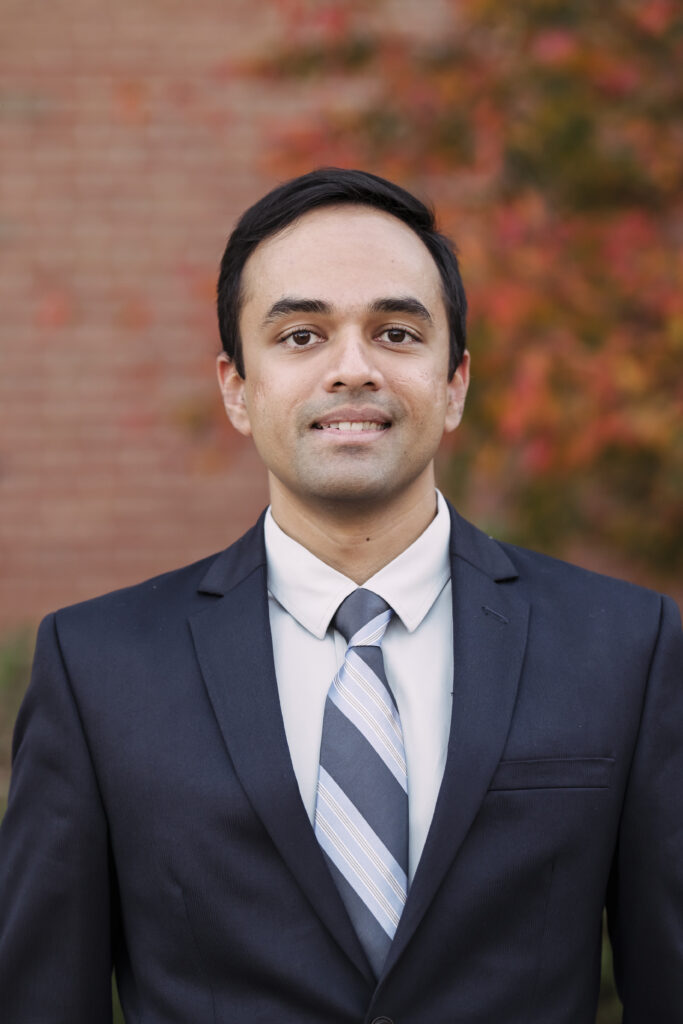 Tejas Gokhale (Marlayna Demond ’11/UMBC)
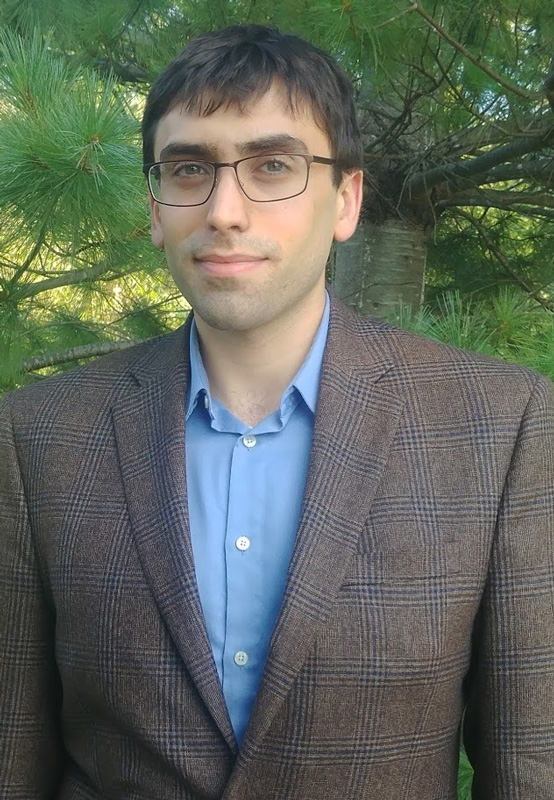 Frank Ferraro (Image courtesy of Ferraro)
 Tyler Josephson (Marlayna Demond ’11/UMBC)
The team, which includes UMBC faculty Tejas Gokhale, computer science and electrical engineering, and Tyler Josephson, chemical, biochemical, and environmental engineering, as well as colleagues from Stony Brook University, the University of Texas at Austin, and the University of Cambridge, will develop and test the tool on three leading areas of scientific research: materials science, AI, and quantum computing.
“It’s a little meta that the AI will be analyzing AI,” Ferraro says. More than 20 UMBC undergrads, grad students, and post-docs will take part in the project. “They’ll get opportunities to network with peers on a highly relevant topic,” Ferraro says. “They’ll be helping guide the national conversation on these issues.”
]]>
A multidisciplinary team of UMBC researchers was recently awarded $3.8 million from the Defense Advanced Research Projects Agency (DARPA) to develop new computational methods for assessing the...
https://umbc.edu/quick-posts/ai-to-assess-the-feasibility-of-scientific-claims/
https://my3.my.umbc.edu/api/v0/pixel/news/148655/guest@my.umbc.edu/2baa992d735ab03b9196ec57f50a9895/api/pixel
cbee
coeit
csee
news
quick-post
research
science-and-tech
UMBC News & Magazine
https://my3.my.umbc.edu/groups/umbc-news-magazine
https://assets1-my.umbc.edu/system/shared/avatars/groups/000/001/943/24435aa6207c452e7bc15cc74b42c7bb/xsmall.png?1748556657
https://assets1-my.umbc.edu/system/shared/avatars/groups/000/001/943/24435aa6207c452e7bc15cc74b42c7bb/original.png?1748556657
https://assets2-my.umbc.edu/system/shared/avatars/groups/000/001/943/24435aa6207c452e7bc15cc74b42c7bb/xxlarge.png?1748556657
https://assets2-my.umbc.edu/system/shared/avatars/groups/000/001/943/24435aa6207c452e7bc15cc74b42c7bb/xlarge.png?1748556657
https://assets3-my.umbc.edu/system/shared/avatars/groups/000/001/943/24435aa6207c452e7bc15cc74b42c7bb/large.png?1748556657
https://assets1-my.umbc.edu/system/shared/avatars/groups/000/001/943/24435aa6207c452e7bc15cc74b42c7bb/medium.png?1748556657
https://assets2-my.umbc.edu/system/shared/avatars/groups/000/001/943/24435aa6207c452e7bc15cc74b42c7bb/small.png?1748556657
https://assets1-my.umbc.edu/system/shared/avatars/groups/000/001/943/24435aa6207c452e7bc15cc74b42c7bb/xsmall.png?1748556657
https://assets2-my.umbc.edu/system/shared/avatars/groups/000/001/943/24435aa6207c452e7bc15cc74b42c7bb/xxsmall.png?1748556657
UMBC News & Magazine
0
0
false
Tue, 01 Apr 2025 12:31:29 -0400
Tue, 01 Apr 2025 12:31:29 -0400