TowerCares Foundation makes $300,000 commitment to support UMBC cybersecurity students
The TowerCares Foundation, the philanthropic arm of the Laurel, Maryland-based Tower Federal Credit Union, has partnered with UMBC’s Cybersecurity Institute to create a new scholarship fund for UMBC students studying cybersecurity. The scholarships will support students in the university’s Cyber Scholars Program, a program with a track record of more than 10 years nurturing the next generation of cybersecurity professionals. The program provides financial aid, a welcoming community, unique courses, mentoring, and the chance for students to take part in cybersecurity research and internships early in their academic careers.
“Our mission is to help our community thrive, and partnering with institutions like UMBC—recognized as a leader in information technology and cybersecurity—is a key part of that effort,” says Allen Brisentine, chairman of the TowerCares Foundation. “The entire Maryland region benefits from UMBC’s renowned and highly regarded cybersecurity program.”
As cyber threats, ransomware, and data breaches have become daily realities in our increasingly digital world, the demand for skilled cybersecurity professionals remains strong. The Cyber Scholars Program has launched the careers of over 100 graduates, many of whom have gone on to jobs safeguarding the digital data of government agencies, businesses, and everyday consumers.
“Last year we celebrated the 10th anniversary of the program, and it was such a great feeling to meet program alumni who have become cybersecurity leaders,” says Anupam Joshi, acting dean of the College of Engineering and Information Technology. “We’re deeply grateful to the TowerCares Foundation for supporting this important work that both helps grow the cybersecurity workforce and makes it more inclusive.”
]]>
The TowerCares Foundation, the philanthropic arm of the Laurel, Maryland-based Tower Federal Credit Union, has partnered with UMBC’s Cybersecurity Institute to create a new scholarship fund for...
https://umbc.edu/quick-posts/towercares-foundation-support/
https://my3.my.umbc.edu/api/v0/pixel/news/148656/guest@my.umbc.edu/800698bfaba135e8eae56ea78a44ff62/api/pixel
cfr
coeit
cwit
cybersecurity
news
quick-post
science-and-tech
UMBC News & Magazine
https://my3.my.umbc.edu/groups/umbc-news-magazine
https://assets1-my.umbc.edu/system/shared/avatars/groups/000/001/943/24435aa6207c452e7bc15cc74b42c7bb/xsmall.png?1748556657
https://assets1-my.umbc.edu/system/shared/avatars/groups/000/001/943/24435aa6207c452e7bc15cc74b42c7bb/original.png?1748556657
https://assets2-my.umbc.edu/system/shared/avatars/groups/000/001/943/24435aa6207c452e7bc15cc74b42c7bb/xxlarge.png?1748556657
https://assets2-my.umbc.edu/system/shared/avatars/groups/000/001/943/24435aa6207c452e7bc15cc74b42c7bb/xlarge.png?1748556657
https://assets3-my.umbc.edu/system/shared/avatars/groups/000/001/943/24435aa6207c452e7bc15cc74b42c7bb/large.png?1748556657
https://assets1-my.umbc.edu/system/shared/avatars/groups/000/001/943/24435aa6207c452e7bc15cc74b42c7bb/medium.png?1748556657
https://assets2-my.umbc.edu/system/shared/avatars/groups/000/001/943/24435aa6207c452e7bc15cc74b42c7bb/small.png?1748556657
https://assets1-my.umbc.edu/system/shared/avatars/groups/000/001/943/24435aa6207c452e7bc15cc74b42c7bb/xsmall.png?1748556657
https://assets2-my.umbc.edu/system/shared/avatars/groups/000/001/943/24435aa6207c452e7bc15cc74b42c7bb/xxsmall.png?1748556657
UMBC News & Magazine
1
0
false
Tue, 25 Mar 2025 11:10:40 -0400
Students celebrate Engineering and Computing Week with fun and networking
Where can UMBC engineering and computing students mingle with friends and mentors over sweet treats, test their knowledge and design skills in friendly competition, and network with potential employers? If it’s February, the answer is the annual Engineering and Computing Week, a traditional celebration of technology, held each year at UMBC to coincide with National Engineers Week.
The UMBC chapter of the engineering honors society Tau Beta Pi, in collaboration with various student engineering organizations on campus, organizes the week of activities each year. This year, the line-up of events featured a mix of social activities, such as painting and crafting, presentations from student organizations, and chances for teams to compete in games testing engineering knowledge and design skills.
UMBC chapters of the Information Systems Security Association, the American Institute of Chemical Engineers, the American Society of Mechanical Engineers, the Society of Women Engineers, Engineers without Borders, and the Institute of Electrical and Electronics Engineers all helped organize sessions. UMBC CyberDawgs, a group of UMBC students who share a common interest in cybersecurity, also participated.
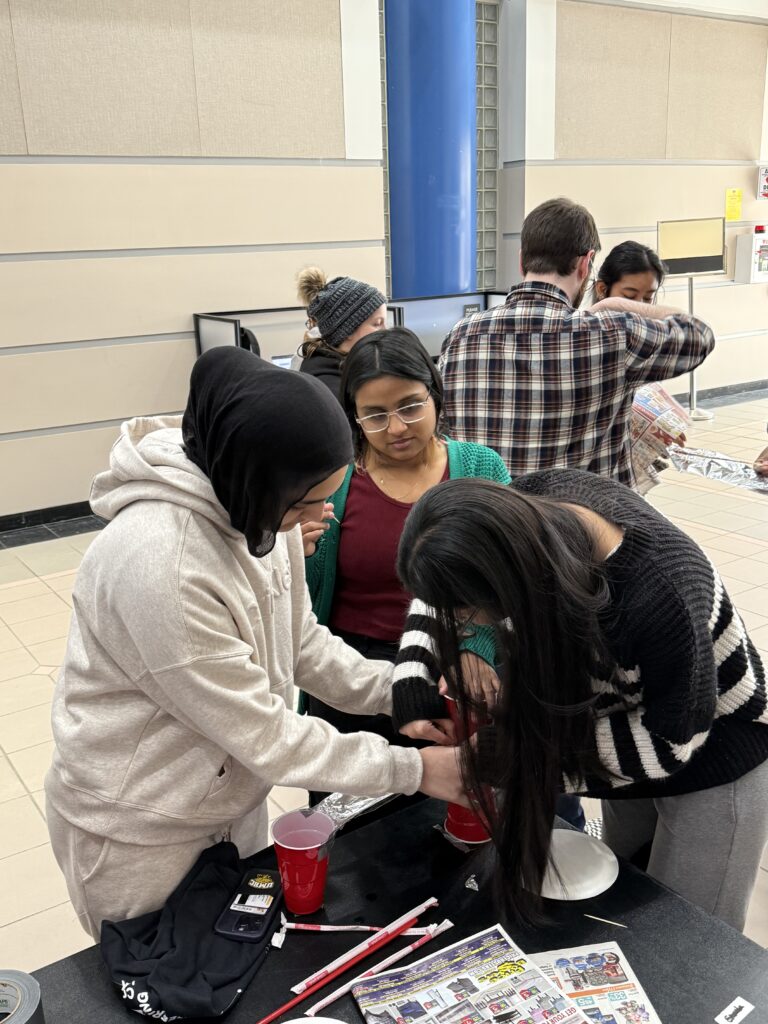 Students build devices to direct water flow, during the Engineers Without Borders “Where’s My Water” event. (Image courtesy of August Phelps)
Students could also join faculty, staff, and alumni from the College of Engineering and Information Technology at an evening reception at the Guinness Brewery near UMBC to socialize and network.
“I think the biggest success from the week was the great turnout and engagement we got from the students,” says August Phelps, a mechanical engineering senior and vice president of the UMBC chapter of Tau Beta Pi.
He says the event showcases the wide variety of engineering-focused student organizations at UMBC, which hold events throughout the year and offer great opportunities for students to develop leadership skills and form lasting connections with their peers.
“I hope attendees left feeling more connected as a community,” he says.
]]>
Where can UMBC engineering and computing students mingle with friends and mentors over sweet treats, test their knowledge and design skills in friendly competition, and network with potential...
https://umbc.edu/quick-posts/students-celebrate-engineering-and-computing-week-with-fun-and-networking/
https://my3.my.umbc.edu/api/v0/pixel/news/148657/guest@my.umbc.edu/763eaad2001e19f4587a5384d1725c09/api/pixel
cbee
coeit
csee
is
meche
news
quick-post
science-and-tech
UMBC News & Magazine
https://my3.my.umbc.edu/groups/umbc-news-magazine
https://assets1-my.umbc.edu/system/shared/avatars/groups/000/001/943/24435aa6207c452e7bc15cc74b42c7bb/xsmall.png?1748556657
https://assets1-my.umbc.edu/system/shared/avatars/groups/000/001/943/24435aa6207c452e7bc15cc74b42c7bb/original.png?1748556657
https://assets2-my.umbc.edu/system/shared/avatars/groups/000/001/943/24435aa6207c452e7bc15cc74b42c7bb/xxlarge.png?1748556657
https://assets2-my.umbc.edu/system/shared/avatars/groups/000/001/943/24435aa6207c452e7bc15cc74b42c7bb/xlarge.png?1748556657
https://assets3-my.umbc.edu/system/shared/avatars/groups/000/001/943/24435aa6207c452e7bc15cc74b42c7bb/large.png?1748556657
https://assets1-my.umbc.edu/system/shared/avatars/groups/000/001/943/24435aa6207c452e7bc15cc74b42c7bb/medium.png?1748556657
https://assets2-my.umbc.edu/system/shared/avatars/groups/000/001/943/24435aa6207c452e7bc15cc74b42c7bb/small.png?1748556657
https://assets1-my.umbc.edu/system/shared/avatars/groups/000/001/943/24435aa6207c452e7bc15cc74b42c7bb/xsmall.png?1748556657
https://assets2-my.umbc.edu/system/shared/avatars/groups/000/001/943/24435aa6207c452e7bc15cc74b42c7bb/xxsmall.png?1748556657
UMBC News & Magazine
0
0
false
Fri, 28 Feb 2025 14:24:34 -0500
Tree sap batteries: Student entrepreneur Samuel Bendek imagines a clean energy future less reliant on critical minerals
When Samuel Bendek, a current mechanical engineering sophomore at UMBC, was still in high school, he worked in a soccer ball factory in his native country of Colombia. At some point, he was given the job of figuring out how much energy the balls retained after bouncing off a wall.
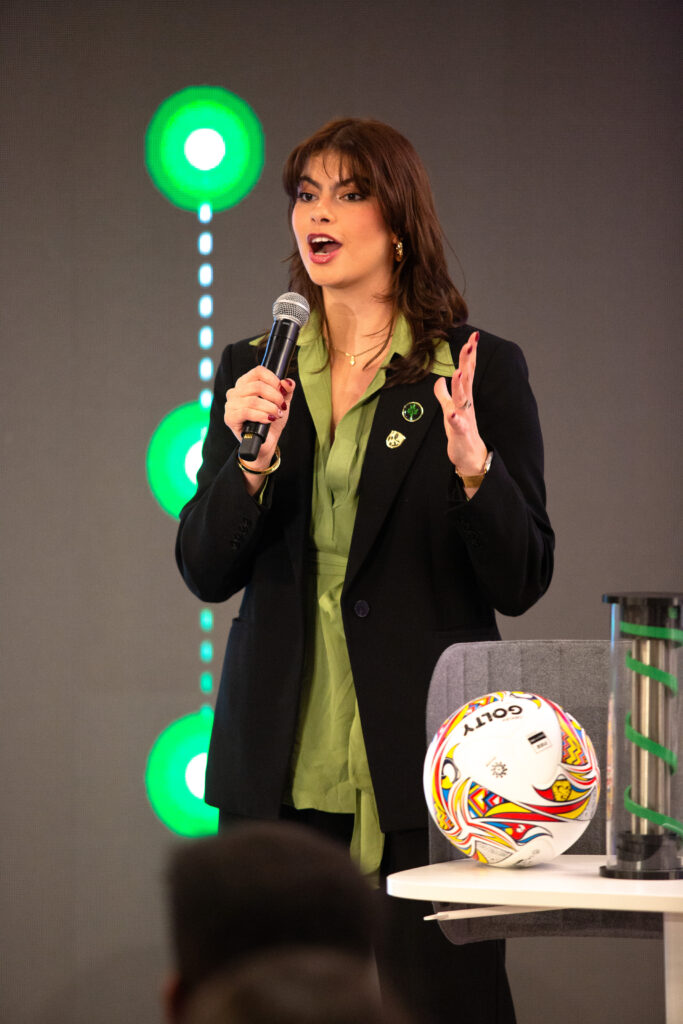 Juliana Bendek, co-founder of Elastic Energy. (Photo courtesy of UpSurge Baltimore)
He went to work, measuring and calculating. “And it turned out, it was greater than 90 percent,” Bendek says. “I was surprised that a soccer ball is so energy efficient!”
The balls were made from natural rubber, made from the sap of certain trees. When the balls hit a wall, the rubber compresses, storing the kinetic energy from their motion in elastic potential energy. Then, as the balls bounce back, the elastic potential energy turns back into kinetic energy, with very low energy loss.
The experience got Bendek thinking—what if rubber could store more than the energy of a soccer player’s kick? What if it could store energy from the sun and the wind?
About five years later, Bendek and his sister and fellow entrepreneur Juliana Bendek pitched that very idea on the stage at the inaugural Maryland Student Ventures Showcase, held February 18 in Baltimore to celebrate the nine local student ventures selected for the first-ever Pava LaPere Innovation Awards. As an award-winner, the Bendeks’ company Elastic Energy will receive $50,000 from the state of Maryland to further its development of a mechanical battery made from natural rubber.
The award and showcase marked the latest step in Bendek’s entrepreneurial journey. Along the way he has embraced the support and guidance of friends, family, and mentors, from UMBC and beyond.
“I have always wanted to create things, since I was a kid destroying my grandmother’s clock to build a new toy,” says Bendek. “This is an opportunity to create something that makes the world a better place.”
From garage tinkering to investor meetings
Shortly after his soccer-ball-inspired light-bulb moment, Bendek got to work in his proverbial garage, experimenting with different ways to stretch rubber and store energy. When he had a decent prototype, he recruited his sister to join his efforts.
“My sister is super smart and very good at connecting to people,” says Bendek. “When I had the prototype, I called her up at like 2 a.m. in the morning. I said, ‘It’ll work. Let’s do this thing together.’”
With some initial funding from family and friends the two started developing the next phase of the technology, while also pitching new investors and building out their team.
Along the way, Bendek, who is also a competitive swimmer, was recruited by UMBC and decided to become a Retriever. He took his dreams to Maryland, and it didn’t take him long to connect with UMBC’s resources for student entrepreneurs.
He reached out to Kevin Fulmer, the director of the Alex. Brown Center for Entrepreneurship and Innovation, which supports the entrepreneurial mindset at UMBC with courses, speaker series featuring business leaders, startup accelerator programs, and assistance with business ideas and networking with experts.
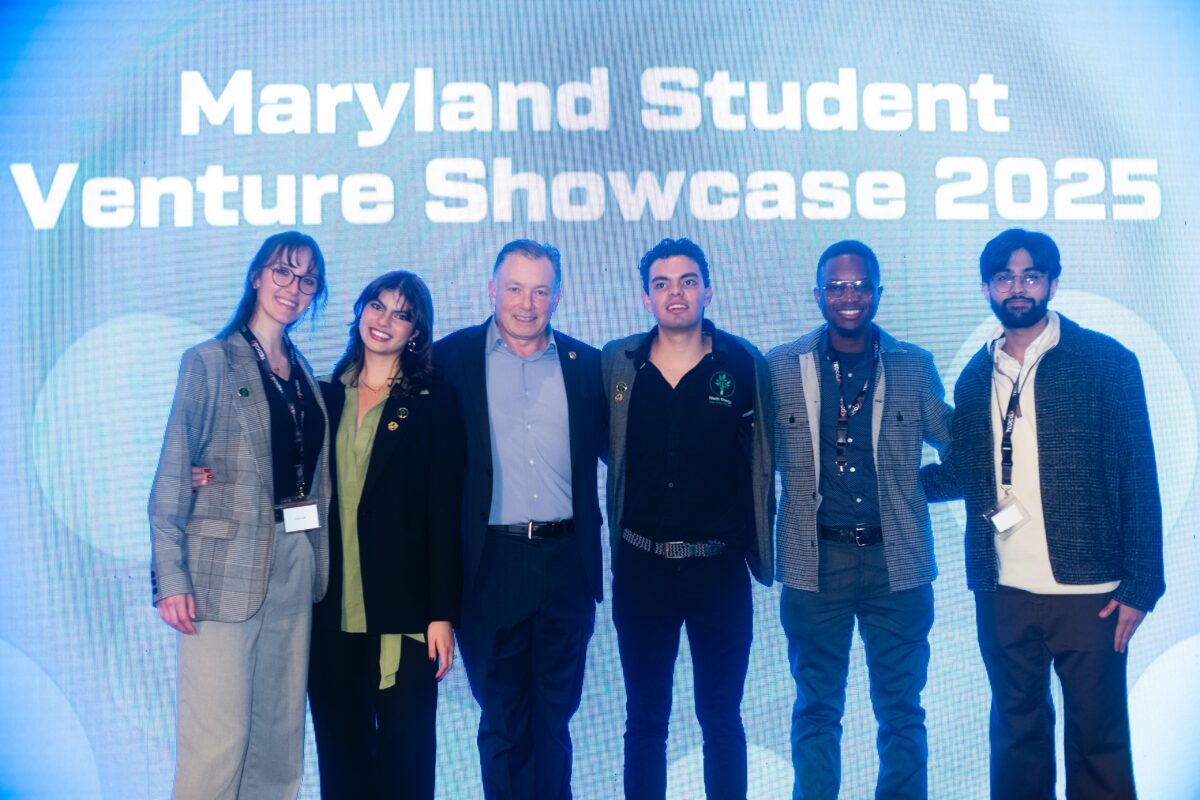 UMBC student Sophia Grillo, Juliana Bendek, Kevin Fulmer, Samuel Bendek, UMBC student Femi Adisa, and Hamza Umar ’21, M.S. ’24, mechanical engineering, gather at the Maryland Student Venture Showcase. (Photo courtesy of UpSurge Baltimore)
“I met Samuel when he was still a first-year student,” says Fulmer. “He came in with a slide deck that included pictures of a working prototype, and I was really impressed. We started meeting on a regular basis and it’s been really fun to see his progress and certainly exciting to see him win things like this $50,000 grant.”
“Kevin has helped me a lot,” says Bendek. “He helped me build a business plan, put me in touch with local experts, and helped find opportunities like the Pava LaPere Innovation Grant.”
Imagining a clean energy future
The batteries Bendek’s company plans to build are slim cylinders a little taller than an average person. Inside, a motor, ideally powered by solar cells or other renewable sources of energy, stretches a 100-meter elastic band to more than ten times its original length by winding it around an inner core. When the power to the motor is turned off, the system can go into reverse. The motor becomes an electric generator, powered by the unwinding elastic band.
Each battery can store about 1 kilowatt-hours of energy—For comparison, a typical American household uses about 30 kilowatt hours of electricity a day.
While Elastic Energy’s batteries cannot provide as much energy as chemical batteries of the same weight, Bendek says their main selling points are that they are long-lasting, relatively inexpensive, and don’t require the mining of minerals like lithium, which can damage the environment and also lead to geopolitical tensions due to the minerals’ uneven distribution around the world.
The company plans to first target the consumer market, offering the batteries as backup power for homes or RVs. Eventually, they hope they can become part of the solution for grid-scale energy storage.
Bendek plans to test the technology this summer in a remote, off-grid town in Colombia to demonstrate its viability.
“These batteries are a technology that really has the potential to grow, I’m confident of that,” says Fulmer. “And Samuel has a great mindset—the entrepreneurial mindset of making things happen.”
]]>
When Samuel Bendek, a current mechanical engineering sophomore at UMBC, was still in high school, he worked in a soccer ball factory in his native country of Colombia. At some point, he was given...
https://umbc.edu/stories/tree-sap-batteries-student-entrepreneur/
https://my3.my.umbc.edu/api/v0/pixel/news/147619/guest@my.umbc.edu/c7be942672570f27e39d81a30648fb49/api/pixel
alex-brown-center-for-entrepreneurship
coeit
meche
news
science-and-tech
story
UMBC News & Magazine
https://my3.my.umbc.edu/groups/umbc-news-magazine
https://assets1-my.umbc.edu/system/shared/avatars/groups/000/001/943/24435aa6207c452e7bc15cc74b42c7bb/xsmall.png?1748556657
https://assets1-my.umbc.edu/system/shared/avatars/groups/000/001/943/24435aa6207c452e7bc15cc74b42c7bb/original.png?1748556657
https://assets2-my.umbc.edu/system/shared/avatars/groups/000/001/943/24435aa6207c452e7bc15cc74b42c7bb/xxlarge.png?1748556657
https://assets2-my.umbc.edu/system/shared/avatars/groups/000/001/943/24435aa6207c452e7bc15cc74b42c7bb/xlarge.png?1748556657
https://assets3-my.umbc.edu/system/shared/avatars/groups/000/001/943/24435aa6207c452e7bc15cc74b42c7bb/large.png?1748556657
https://assets1-my.umbc.edu/system/shared/avatars/groups/000/001/943/24435aa6207c452e7bc15cc74b42c7bb/medium.png?1748556657
https://assets2-my.umbc.edu/system/shared/avatars/groups/000/001/943/24435aa6207c452e7bc15cc74b42c7bb/small.png?1748556657
https://assets1-my.umbc.edu/system/shared/avatars/groups/000/001/943/24435aa6207c452e7bc15cc74b42c7bb/xsmall.png?1748556657
https://assets2-my.umbc.edu/system/shared/avatars/groups/000/001/943/24435aa6207c452e7bc15cc74b42c7bb/xxsmall.png?1748556657
UMBC News & Magazine
1
0
false
Tue, 25 Feb 2025 13:45:44 -0500
Tue, 25 Feb 2025 13:45:44 -0500
UMBC delegates build international connections at prestigious science and technology conference in India
A six-person UMBC team built international connections at the “PIWOT – World of Technology” conference, held in late January in Mumbai, India. The conference is organized by the alumni association for graduates of the prestigious Indian Institutes of Technology (IITs), and attracts many of the leaders in science and technology in India and around the world. The CEO of Alphabet, Inc. (Google’s parent company), the co-founder of Sun Microsystems, and the CEO of IBM are all graduates of IITs.
UMBC was represented at the conference by Anupam Joshi, acting dean of the College of Engineering and Information Technology; Upal Ghosh, professor in the Department of Chemical, Biochemical and Environmental Engineering; Ramana Vinjamuri, associate professor in the Department of Computer Science and Electrical Engineering and director of the NSF IUCRC BRAIN Center; Govind Rao, director of the Center for Advanced Sensor Technology and professor in the Department of Chemical, Biochemical and Environmental Engineering; Karuna Pande Joshi, professor in the Department of Information Systems and director of the NSF IUCRC Center for Accelerated Real Time Analytics; and David Di Maria, senior international officer and associate vice provost for international education at UMBC.
 Dean Joshi spoke at the conference about the impact of technology on education. (Photo courtesy of Govind Rao)
The UMBC team staffed a well-trafficked booth in the Expo Hall. As an extension of the meeting, they also visited IITs at Mumbai, Hyderabad, and Tirupati, and met with the directors of these institutions to discuss institutional agreements and lay the groundwork for international faculty and student exchanges.
This year’s PIWOT conference focused on the impact of technology across multiple dimensions of life, from the professional to the personal. Dean Joshi took part as a speaker on a panel about the impact of technology on education. The UMBC booth also displayed the low-cost infant incubator developed by Professor Govind Rao.
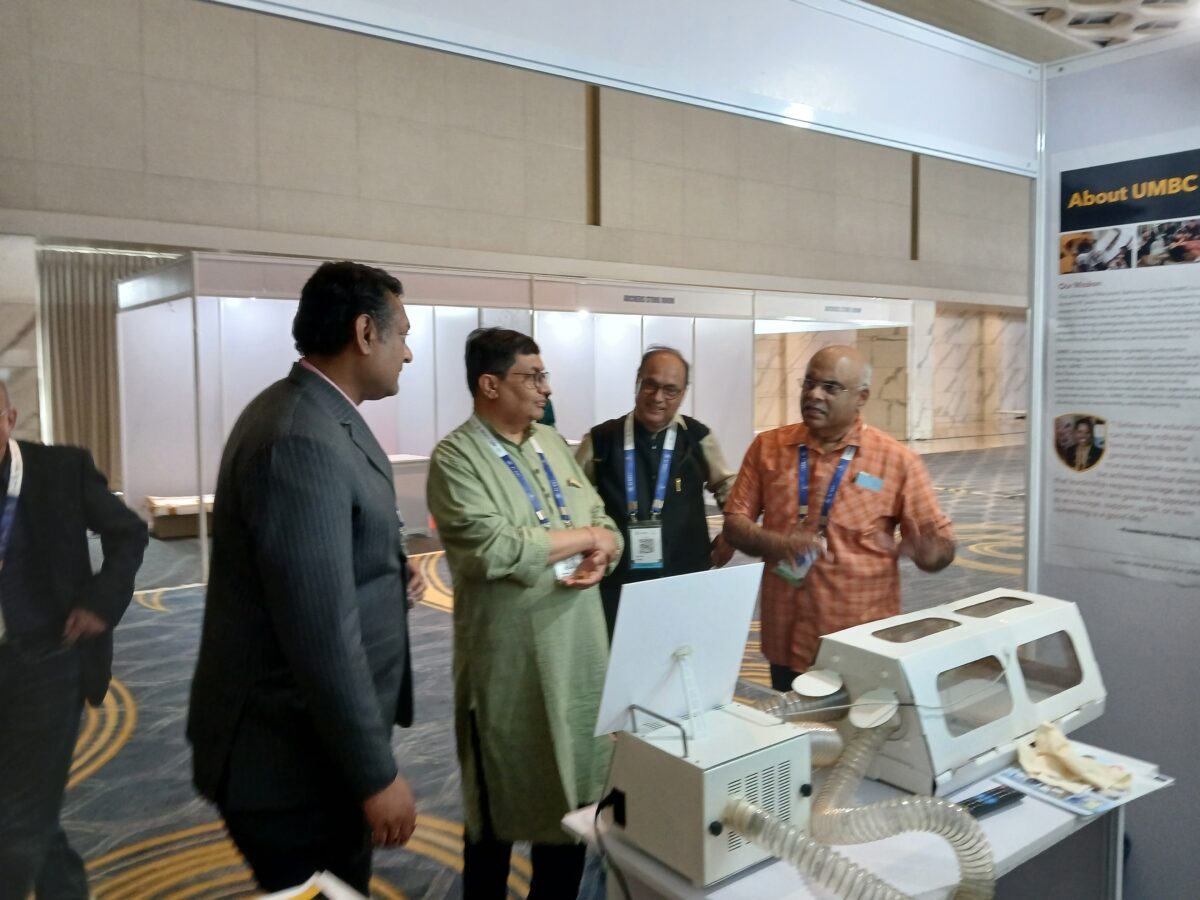 The UMBC booth displayed the low-cost infant incubator developed by Professor Govind Rao. (Photo courtesy of Karuna Joshi)
]]>
A six-person UMBC team built international connections at the “PIWOT – World of Technology” conference, held in late January in Mumbai, India. The conference is organized by the alumni association...
https://umbc.edu/quick-posts/umbc-delegates-conference-in-india/
https://my3.my.umbc.edu/api/v0/pixel/news/147504/guest@my.umbc.edu/2ca42895565c719a71f1ff4ad75d0dfb/api/pixel
cbee
coeit
csee
international
is
news
quick-post
science-and-tech
UMBC News & Magazine
https://my3.my.umbc.edu/groups/umbc-news-magazine
https://assets1-my.umbc.edu/system/shared/avatars/groups/000/001/943/24435aa6207c452e7bc15cc74b42c7bb/xsmall.png?1748556657
https://assets1-my.umbc.edu/system/shared/avatars/groups/000/001/943/24435aa6207c452e7bc15cc74b42c7bb/original.png?1748556657
https://assets2-my.umbc.edu/system/shared/avatars/groups/000/001/943/24435aa6207c452e7bc15cc74b42c7bb/xxlarge.png?1748556657
https://assets2-my.umbc.edu/system/shared/avatars/groups/000/001/943/24435aa6207c452e7bc15cc74b42c7bb/xlarge.png?1748556657
https://assets3-my.umbc.edu/system/shared/avatars/groups/000/001/943/24435aa6207c452e7bc15cc74b42c7bb/large.png?1748556657
https://assets1-my.umbc.edu/system/shared/avatars/groups/000/001/943/24435aa6207c452e7bc15cc74b42c7bb/medium.png?1748556657
https://assets2-my.umbc.edu/system/shared/avatars/groups/000/001/943/24435aa6207c452e7bc15cc74b42c7bb/small.png?1748556657
https://assets1-my.umbc.edu/system/shared/avatars/groups/000/001/943/24435aa6207c452e7bc15cc74b42c7bb/xsmall.png?1748556657
https://assets2-my.umbc.edu/system/shared/avatars/groups/000/001/943/24435aa6207c452e7bc15cc74b42c7bb/xxsmall.png?1748556657
UMBC News & Magazine
3
0
false
Thu, 20 Feb 2025 10:37:23 -0500
Thu, 20 Feb 2025 10:37:23 -0500
International exchange brings opportunities to question assumptions—in science and life
The UMBC booth displayed the low-cost infant incubator developed by Professor Govind Rao. (Photo courtesy of Karuna Joshi)
]]>
A six-person UMBC team built international connections at the “PIWOT – World of Technology” conference, held in late January in Mumbai, India. The conference is organized by the alumni association...
https://umbc.edu/quick-posts/umbc-delegates-conference-in-india/
https://my3.my.umbc.edu/api/v0/pixel/news/147504/guest@my.umbc.edu/2ca42895565c719a71f1ff4ad75d0dfb/api/pixel
cbee
coeit
csee
international
is
news
quick-post
science-and-tech
UMBC News & Magazine
https://my3.my.umbc.edu/groups/umbc-news-magazine
https://assets1-my.umbc.edu/system/shared/avatars/groups/000/001/943/24435aa6207c452e7bc15cc74b42c7bb/xsmall.png?1748556657
https://assets1-my.umbc.edu/system/shared/avatars/groups/000/001/943/24435aa6207c452e7bc15cc74b42c7bb/original.png?1748556657
https://assets2-my.umbc.edu/system/shared/avatars/groups/000/001/943/24435aa6207c452e7bc15cc74b42c7bb/xxlarge.png?1748556657
https://assets2-my.umbc.edu/system/shared/avatars/groups/000/001/943/24435aa6207c452e7bc15cc74b42c7bb/xlarge.png?1748556657
https://assets3-my.umbc.edu/system/shared/avatars/groups/000/001/943/24435aa6207c452e7bc15cc74b42c7bb/large.png?1748556657
https://assets1-my.umbc.edu/system/shared/avatars/groups/000/001/943/24435aa6207c452e7bc15cc74b42c7bb/medium.png?1748556657
https://assets2-my.umbc.edu/system/shared/avatars/groups/000/001/943/24435aa6207c452e7bc15cc74b42c7bb/small.png?1748556657
https://assets1-my.umbc.edu/system/shared/avatars/groups/000/001/943/24435aa6207c452e7bc15cc74b42c7bb/xsmall.png?1748556657
https://assets2-my.umbc.edu/system/shared/avatars/groups/000/001/943/24435aa6207c452e7bc15cc74b42c7bb/xxsmall.png?1748556657
UMBC News & Magazine
3
0
false
Thu, 20 Feb 2025 10:37:23 -0500
Thu, 20 Feb 2025 10:37:23 -0500
International exchange brings opportunities to question assumptions—in science and life
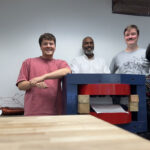
Making assumptions is a habit of life, a way to speed up decisions. Sometimes these mental short-cuts, however, lead us astray.
Such was the situation when Lorenz Kopp, an engineering master’s student at Germany’s Regensburg University of Applied Sciences who was visiting UMBC this fall for a 50-day exchange project, assumed the ovens in the U.S. lab he was working in would use the Fahrenheit temperature scale. He filled a mold with a plastic-like gel the group was using to make flexible accordion-shaped structures, put it in the oven to set, and sat back.
“And then I started to smell burning,” he says, with a smile. The ovens were in fact operating in Celsius, and he had set the temperature too high.
Kopp came to the U.S. with fellow Regensburg student Björn Michelmann to work with mechanical engineering professor Paris von Lockette. Their project was part of a bigger assumption-questioning enterprise—in particular probing the behavior of materials called soft magnets.
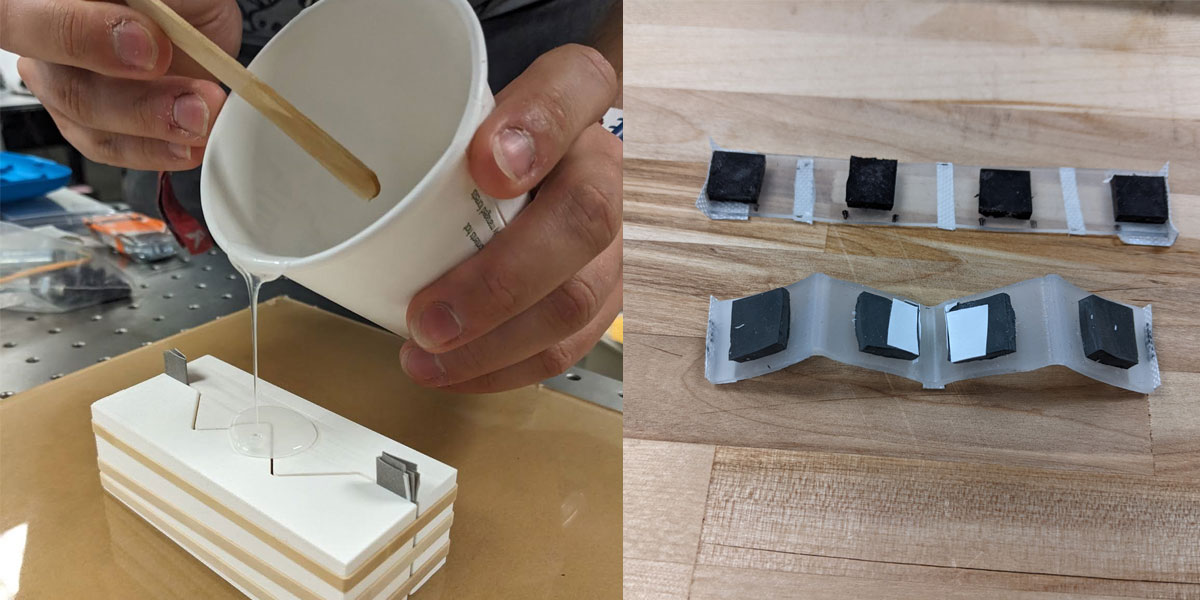 Kopp and Michelmann designed and made magnetically active accordion structures from a flexible, plastic-like material. (Images courtesy of Lorenz Kopp)
Soft magnetic materials tend to be metals that easily respond to (become magnetized in) the presence of a magnetic field, but go back to “normal” when the field is removed. This is in contrast to hard magnetic materials, which can be permanently magnetized. A typical fridge magnet is an example of a hard magnetic material, while a piece of iron is an example of a soft magnetic material.
Engineers are interested in magnets as a way to wirelessly control robots, but soft magnets are often assumed to offer a less versatile range of movements for these applications than hard magnets.
For about seven weeks during the fall semester, Kopp and Michelmann set up and ran a series of experiments putting some of these assumptions to the test. They designed accordion structures made from a flexible plastic-like material and embedded either soft or hard magnets in the accordions’ pleats. They then recorded how the structures folded or unfolded when exposed to magnetic fields. Early analysis of the results hints that the soft magnets may offer more versatility than initially assumed.
“It was great working with Lorenz and Björn. They were exceptionally productive,” von Lockette says. “We got interesting results and we’re working to write them up in a paper.”
Soft magnetic materials are appealing to engineers because they are cheaper and more biocompatible than hard magnetic materials, and also require less energy to be magnetized and demagnetized. If the group can demonstrate novel ways to get extra degrees of control over their movement, it could open a host of new applications, including in robots that assist in surgery or devices that are implanted in the human body to deliver drugs, monitor diseases, or substitute for the function of lost or damaged organs.
An international collaboration
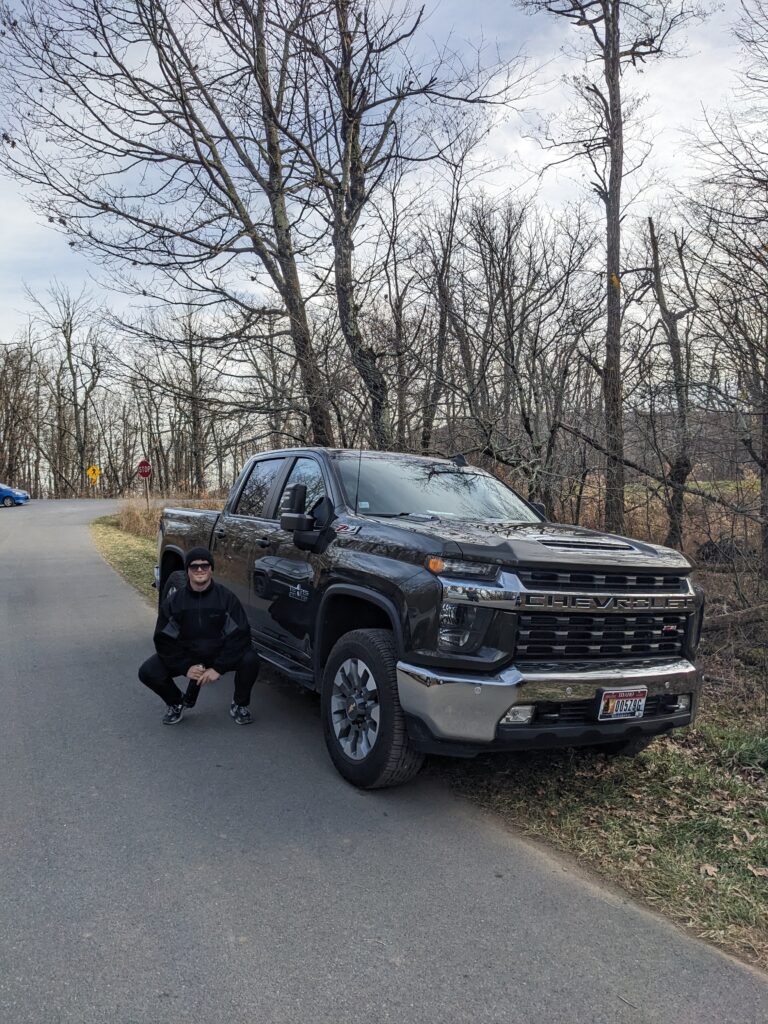 Kopp near the truck he and Michelmann drove to Shenandoah National Park. (Image courtesy of Lorenz Kopp)
Kopp and Michelmann got the opportunity to visit UMBC through funding by the German Academic Exchange Service. Their advisor at Regensburg University of Applied Sciences—Mikhail Chamonine—knew von Lockette through the American Society of Mechanical Engineers, and together they arranged the details of the visit with the help of the Office of International Students and Scholars at UMBC. Chamonine specializes in the physics of electromagnetic fields, and his lab in Germany performs many experiments with rubber-based soft magnetic materials. Von Lockette has developed his career around turning science insights about magnetically active soft materials into new applications and devices. The area of magnetic control of robots was a natural overlap.
While Kopp and Michelmann spent plenty of time in the lab during their visit, they also had chances to explore the areas surrounding UMBC on weekends. They visited the National Aquarium in Baltimore, took in a Raven’s football game, and drove to Shenandoah National Park in Virginia. They also enjoyed campus life, attending Homecoming weekend in October and regularly visiting the Retriever Activity Center to work out.
Michelmann says it was eye-opening to experience life on a U.S. university campus. “In a lot of U.S. films, there are fraternities and sororities with houses where they party every night. But I learned that stereotype doesn’t apply to UMBC.” He says he was pleasantly surprised by the variety of activities on campus, from sporting events, to tabletop games, to events such as bingo and craft nights organized by the Student Events Board.
Advancing science and technology
Von Lockette says he hopes to continue the collaboration with Regensburg University of Applied Sciences, and to arrange trips for UMBC students to visit Germany in the future.
Kopp, Michelmann, von Lockette, and Chamonine remain in touch as they write up the results of their experiments. When they noticed some unexpected behavior of the soft magnet accordions, von Lockette says he found himself thinking back to discussions he had with Chamonine about the importance of what are called demagnetizing terms in equations describing the magnetization of materials. The terms are affected by the geometry of the material and explain, for example, why when you put an iron nail in a magnetic field, it is easier for the nail to magnetize along its length, rather than perpendicular to it.
The researchers are testing whether they can explain the behavior of the soft magnets they tested—and the difference from the hard magnets—using demagnetizing field calculations. A better understanding of the behavior could guide future experiments trying to demonstrate greater versatility of movements and finer control.
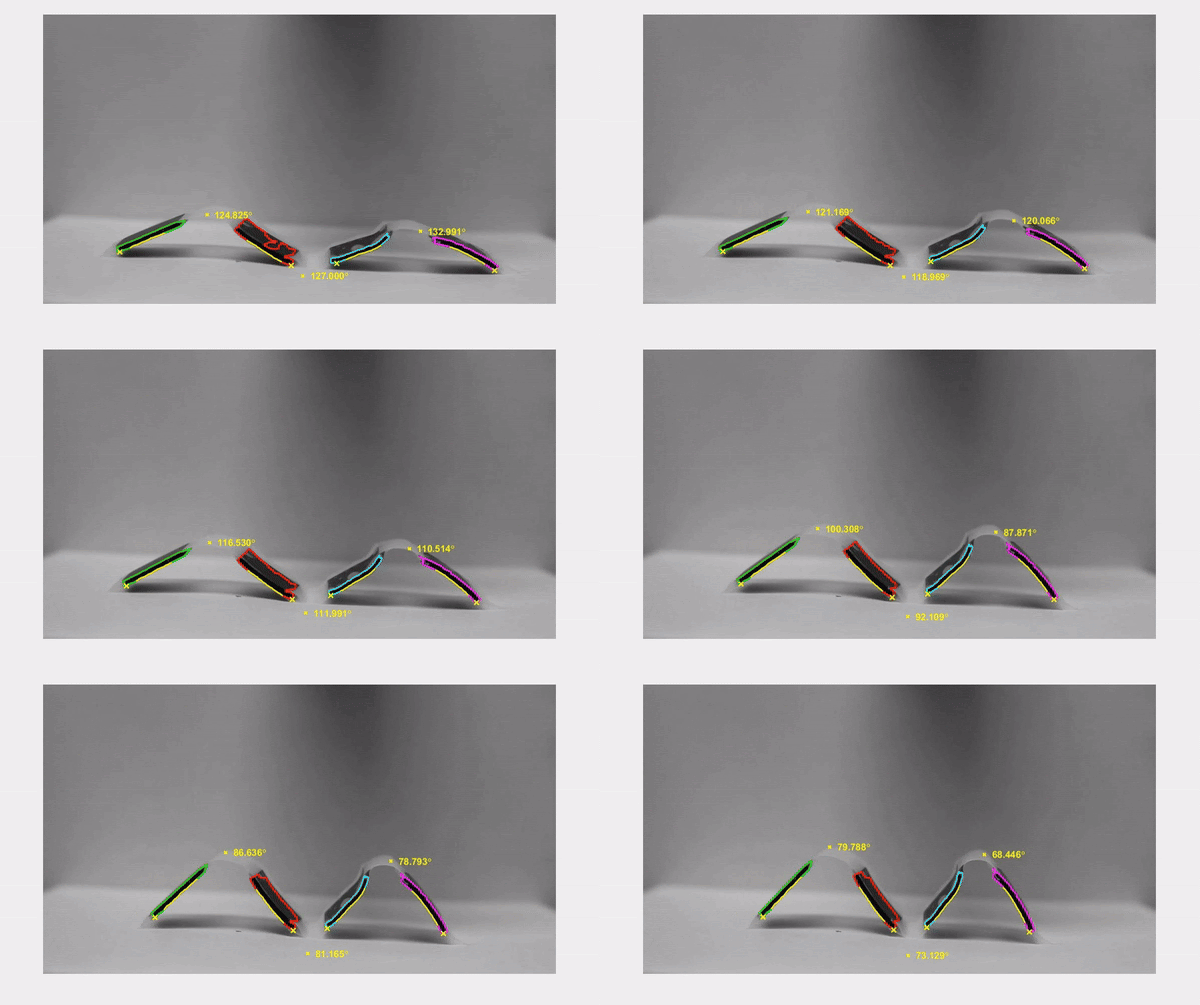 The researchers recorded and analyzed how the accordion structures folded or unfolded when exposed to magnetic fields. (Video courtesy of Lorenz Kopp)
“We’ll experiment with different materials and different geometries. We’re wondering: If we apply this field, what can we make it do that we didn’t think it could do?” von Lockette says.
Von Lockette has a history of getting fellow researchers to consider the usefulness of materials they may have overlooked. Earlier in his career, he published a paper demonstrating the potential of a new type of magnetically active material—in that case made with hard magnets.
“That was my first big splash,” he says. Now he’s happy to give soft magnets their due too, while also encouraging a new generation of researchers, including Kopp and Michelmann.
Chamonine is also pleased with the work of his students. “They are working to get the results published, which is not typical for a short project,” he says.
Beyond pushing the assumptions of what could get done in the lab in seven weeks, Kopp and Michelmann also enjoyed the typical world-expanding experience of international travel. “It was not only the science,” Chamonine says, “but they also had a chance to stay in the United States. I think for them it was absolutely an exciting moment in life.”
 Kopp and Michelmann visited New York at the end of their U.S. trip. (Image courtesy of Lorenz Kopp)
]]>
Making assumptions is a habit of life, a way to speed up decisions. Sometimes these mental short-cuts, however, lead us astray. Such was the situation when Lorenz Kopp, an engineering...
https://umbc.edu/stories/international-exchange-questioning-assumptions/
https://my3.my.umbc.edu/api/v0/pixel/news/147447/guest@my.umbc.edu/b3e4c78b14007557bb86daaa0944ad41/api/pixel
coeit
discovery
international
magazine
meche
story
UMBC News & Magazine
https://my3.my.umbc.edu/groups/umbc-news-magazine
https://assets1-my.umbc.edu/system/shared/avatars/groups/000/001/943/24435aa6207c452e7bc15cc74b42c7bb/xsmall.png?1748556657
https://assets1-my.umbc.edu/system/shared/avatars/groups/000/001/943/24435aa6207c452e7bc15cc74b42c7bb/original.png?1748556657
https://assets2-my.umbc.edu/system/shared/avatars/groups/000/001/943/24435aa6207c452e7bc15cc74b42c7bb/xxlarge.png?1748556657
https://assets2-my.umbc.edu/system/shared/avatars/groups/000/001/943/24435aa6207c452e7bc15cc74b42c7bb/xlarge.png?1748556657
https://assets3-my.umbc.edu/system/shared/avatars/groups/000/001/943/24435aa6207c452e7bc15cc74b42c7bb/large.png?1748556657
https://assets1-my.umbc.edu/system/shared/avatars/groups/000/001/943/24435aa6207c452e7bc15cc74b42c7bb/medium.png?1748556657
https://assets2-my.umbc.edu/system/shared/avatars/groups/000/001/943/24435aa6207c452e7bc15cc74b42c7bb/small.png?1748556657
https://assets1-my.umbc.edu/system/shared/avatars/groups/000/001/943/24435aa6207c452e7bc15cc74b42c7bb/xsmall.png?1748556657
https://assets2-my.umbc.edu/system/shared/avatars/groups/000/001/943/24435aa6207c452e7bc15cc74b42c7bb/xxsmall.png?1748556657
UMBC News & Magazine
11
0
false
Tue, 18 Feb 2025 16:07:11 -0500
Tue, 18 Feb 2025 16:07:11 -0500
UMBC leverages interdisciplinary expertise to launch Quantum Science Institute
Kopp and Michelmann visited New York at the end of their U.S. trip. (Image courtesy of Lorenz Kopp)
]]>
Making assumptions is a habit of life, a way to speed up decisions. Sometimes these mental short-cuts, however, lead us astray. Such was the situation when Lorenz Kopp, an engineering...
https://umbc.edu/stories/international-exchange-questioning-assumptions/
https://my3.my.umbc.edu/api/v0/pixel/news/147447/guest@my.umbc.edu/b3e4c78b14007557bb86daaa0944ad41/api/pixel
coeit
discovery
international
magazine
meche
story
UMBC News & Magazine
https://my3.my.umbc.edu/groups/umbc-news-magazine
https://assets1-my.umbc.edu/system/shared/avatars/groups/000/001/943/24435aa6207c452e7bc15cc74b42c7bb/xsmall.png?1748556657
https://assets1-my.umbc.edu/system/shared/avatars/groups/000/001/943/24435aa6207c452e7bc15cc74b42c7bb/original.png?1748556657
https://assets2-my.umbc.edu/system/shared/avatars/groups/000/001/943/24435aa6207c452e7bc15cc74b42c7bb/xxlarge.png?1748556657
https://assets2-my.umbc.edu/system/shared/avatars/groups/000/001/943/24435aa6207c452e7bc15cc74b42c7bb/xlarge.png?1748556657
https://assets3-my.umbc.edu/system/shared/avatars/groups/000/001/943/24435aa6207c452e7bc15cc74b42c7bb/large.png?1748556657
https://assets1-my.umbc.edu/system/shared/avatars/groups/000/001/943/24435aa6207c452e7bc15cc74b42c7bb/medium.png?1748556657
https://assets2-my.umbc.edu/system/shared/avatars/groups/000/001/943/24435aa6207c452e7bc15cc74b42c7bb/small.png?1748556657
https://assets1-my.umbc.edu/system/shared/avatars/groups/000/001/943/24435aa6207c452e7bc15cc74b42c7bb/xsmall.png?1748556657
https://assets2-my.umbc.edu/system/shared/avatars/groups/000/001/943/24435aa6207c452e7bc15cc74b42c7bb/xxsmall.png?1748556657
UMBC News & Magazine
11
0
false
Tue, 18 Feb 2025 16:07:11 -0500
Tue, 18 Feb 2025 16:07:11 -0500
UMBC leverages interdisciplinary expertise to launch Quantum Science Institute

UMBC has received $1.5 million from the National Institute of Standards and Technology to organize a new UMBC Quantum Science Institute. The funding will support graduate fellowships for students pursuing quantum technology research, the development of new courses and academic programs focused on quantum, and equipment to enhance existing quantum labs and start new ones.
“This institute is the crowning jewel of several decades of pioneering quantum research here at UMBC,” says QSI director and professor of physics Todd Pittman, Ph.D. ’96, physics. “We have some heavy hitters here who are founders in the field, and the QSI is building on that foundation with a new generation of outstanding quantum-focused faculty.”
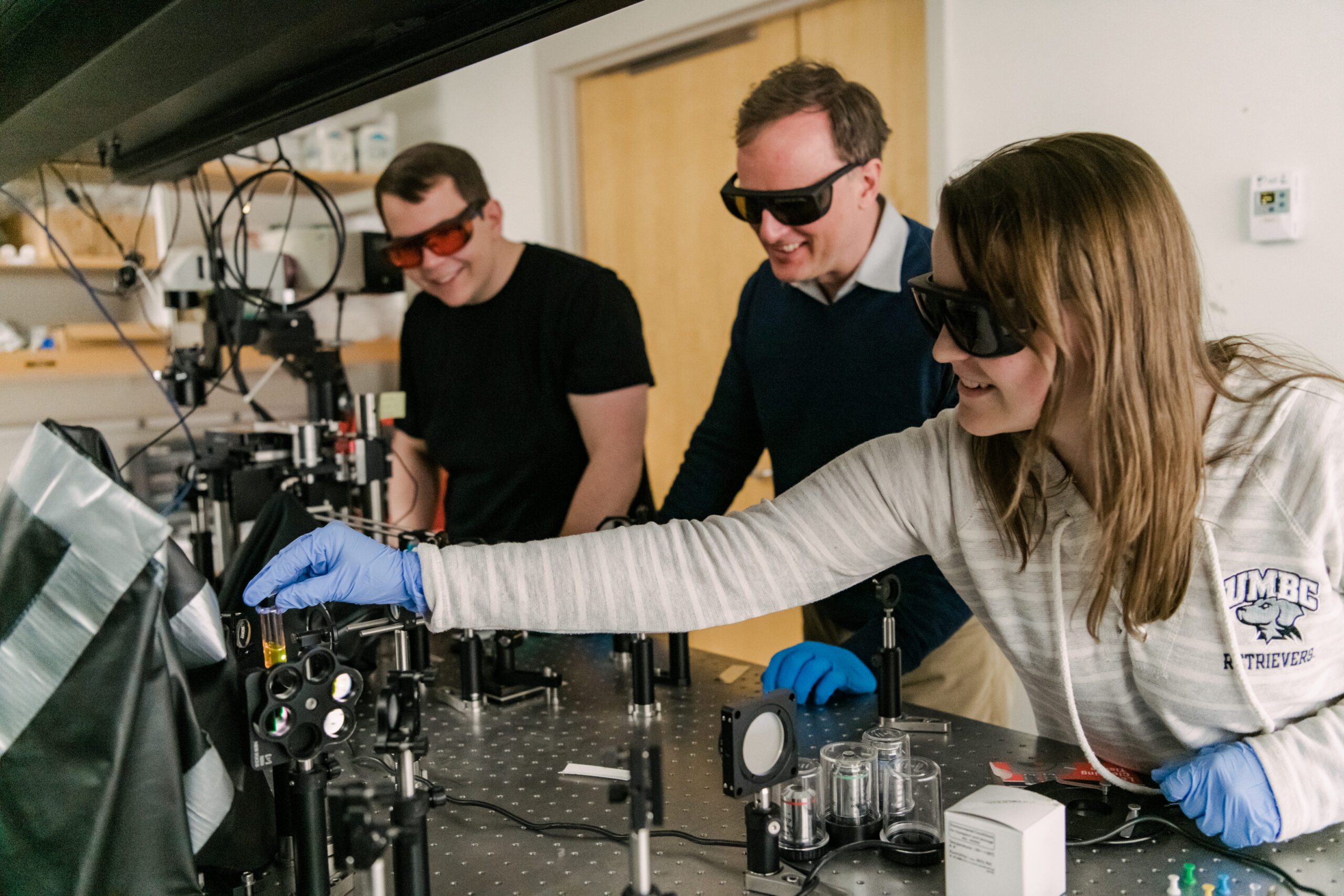 Matthew Pelton, center, leads a quantum optics laboratory at UMBC. (Marlayna Demond ’11/UMBC)
Quantum technologies harness the odd behaviors of particles at the atomic level to generate new functions, and are typically much more powerful than their conventional technology counterparts. To approach quantum research from every angle, the institute includes faculty across the College of Natural and Mathematical Sciences and the College of Engineering and IT in physics, mathematics and statistics, computer science, and information systems. They are pursuing quantum research in areas including computing, communications, sensing, information theory, algorithms, and more. “You just can’t do comprehensive quantum research without bringing together engineers, data analysts, computer scientists, mathematicians, and physicists,” Pittman says.
“I am thankful for the support provided by NIST to develop the UMBC Quantum Science Institute under the leadership of Dr. Pittman,” shares Karl V. Steiner, vice president for research and creative achievement. “QSI will catalyze a new quantum research effort, in support of Governor Moore’s ‘Capital of Quantum’ Initiative to position Maryland as a global leader in this rapidly growing field.”
Training quantum-ready workers
In addition to contributing to research innovation and discovery, the institute will train students from a range of backgrounds to take on skilled roles in the booming quantum industry.
“The quantum industry has exploded,” Pittman says. The quantum technology market was valued at $10 billion in 2021 and is projected to rise to $44 billion by 2028, with potential for much more growth beyond that. In addition to tech giants like Google and IBM, hundreds of start-ups are working in the quantum space. “The market is hungry for quantum-ready workers,” Pittman says, and UMBC is ready to train them.
UMBC marked World Quantum Day in 2022 with a short video highlighting the quantum technology research happening in the physics department.
Sandra Cheng, a fourth-year Ph.D. candidate in physics, is a member of the first cohort of quantum graduate fellows. “Quantum science research, particularly in computing and networking, is quite interdisciplinary by nature,” she says, “and I’m hopeful the QSI will bring together like minds from all the departments involved, so that we’ll be able to contribute towards a greater understanding of quantum science together.”
The QSI leadership team plans to offer social and professional development programming for the fellows. In addition to preparing them for the workforce, the connections they make will help generate a personal network of support, encouraging persistence in a demanding field. Organizing interdisciplinary offerings for the student cohort will also promote collaboration among faculty, Pittman says, adding, “Students are the glue that holds the center together.”
“This new institute is a celebration of our strength and history in quantum research,” Pittman says. “I’m looking forward to seeing QSI unify the quantum researchers on campus in a way that promotes and facilitates interdisciplinary collaboration.”
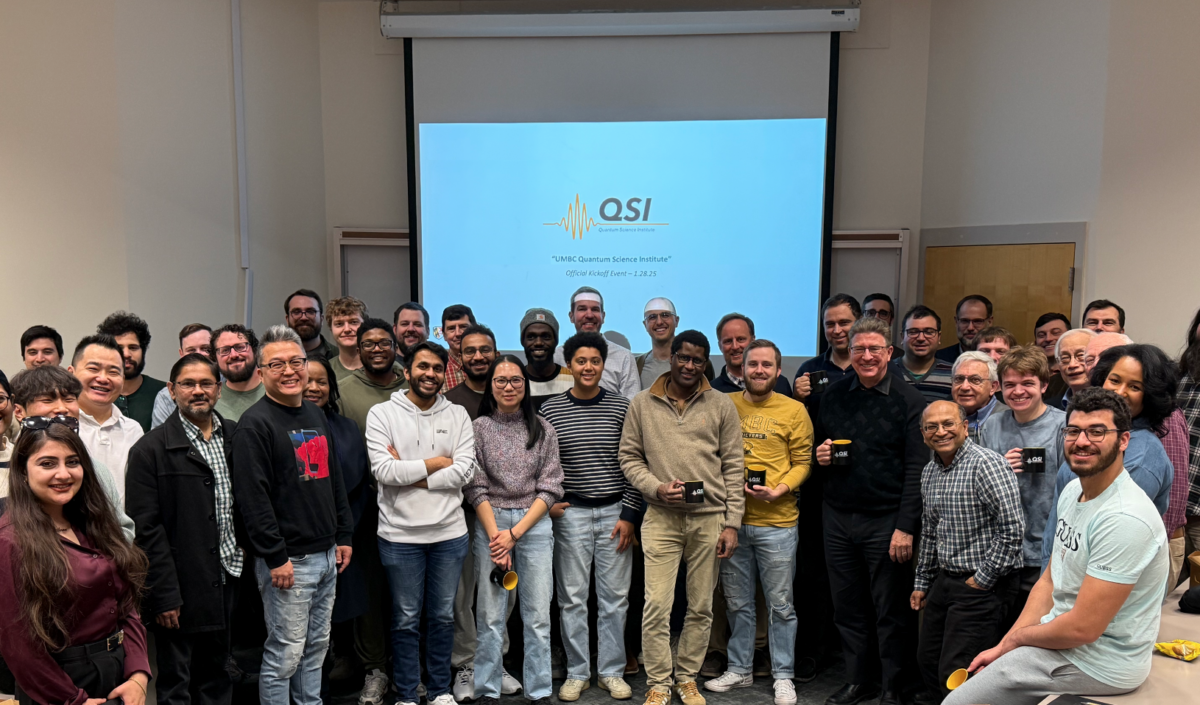 Representatives from all of the departments involved in the new QSI recently attended a launch event.
]]>
UMBC has received $1.5 million from the National Institute of Standards and Technology to organize a new UMBC Quantum Science Institute. The funding will support graduate fellowships for students...
https://umbc.edu/stories/quantum-science-institute-launch/
https://my3.my.umbc.edu/api/v0/pixel/news/147296/guest@my.umbc.edu/cb09589c98c92dd469d956539b185529/api/pixel
cnms
coeit
csee
information-systems
is
mathstat
news
physics
research
science-and-tech
story
UMBC News & Magazine
https://my3.my.umbc.edu/groups/umbc-news-magazine
https://assets1-my.umbc.edu/system/shared/avatars/groups/000/001/943/24435aa6207c452e7bc15cc74b42c7bb/xsmall.png?1748556657
https://assets1-my.umbc.edu/system/shared/avatars/groups/000/001/943/24435aa6207c452e7bc15cc74b42c7bb/original.png?1748556657
https://assets2-my.umbc.edu/system/shared/avatars/groups/000/001/943/24435aa6207c452e7bc15cc74b42c7bb/xxlarge.png?1748556657
https://assets2-my.umbc.edu/system/shared/avatars/groups/000/001/943/24435aa6207c452e7bc15cc74b42c7bb/xlarge.png?1748556657
https://assets3-my.umbc.edu/system/shared/avatars/groups/000/001/943/24435aa6207c452e7bc15cc74b42c7bb/large.png?1748556657
https://assets1-my.umbc.edu/system/shared/avatars/groups/000/001/943/24435aa6207c452e7bc15cc74b42c7bb/medium.png?1748556657
https://assets2-my.umbc.edu/system/shared/avatars/groups/000/001/943/24435aa6207c452e7bc15cc74b42c7bb/small.png?1748556657
https://assets1-my.umbc.edu/system/shared/avatars/groups/000/001/943/24435aa6207c452e7bc15cc74b42c7bb/xsmall.png?1748556657
https://assets2-my.umbc.edu/system/shared/avatars/groups/000/001/943/24435aa6207c452e7bc15cc74b42c7bb/xxsmall.png?1748556657
UMBC News & Magazine
0
0
false
Wed, 12 Feb 2025 15:54:40 -0500
Wed, 12 Feb 2025 15:54:40 -0500
Is DOGE a cybersecurity threat? A security expert explains the dangers of violating protocols and regulations that protect government computer systems
Representatives from all of the departments involved in the new QSI recently attended a launch event.
]]>
UMBC has received $1.5 million from the National Institute of Standards and Technology to organize a new UMBC Quantum Science Institute. The funding will support graduate fellowships for students...
https://umbc.edu/stories/quantum-science-institute-launch/
https://my3.my.umbc.edu/api/v0/pixel/news/147296/guest@my.umbc.edu/cb09589c98c92dd469d956539b185529/api/pixel
cnms
coeit
csee
information-systems
is
mathstat
news
physics
research
science-and-tech
story
UMBC News & Magazine
https://my3.my.umbc.edu/groups/umbc-news-magazine
https://assets1-my.umbc.edu/system/shared/avatars/groups/000/001/943/24435aa6207c452e7bc15cc74b42c7bb/xsmall.png?1748556657
https://assets1-my.umbc.edu/system/shared/avatars/groups/000/001/943/24435aa6207c452e7bc15cc74b42c7bb/original.png?1748556657
https://assets2-my.umbc.edu/system/shared/avatars/groups/000/001/943/24435aa6207c452e7bc15cc74b42c7bb/xxlarge.png?1748556657
https://assets2-my.umbc.edu/system/shared/avatars/groups/000/001/943/24435aa6207c452e7bc15cc74b42c7bb/xlarge.png?1748556657
https://assets3-my.umbc.edu/system/shared/avatars/groups/000/001/943/24435aa6207c452e7bc15cc74b42c7bb/large.png?1748556657
https://assets1-my.umbc.edu/system/shared/avatars/groups/000/001/943/24435aa6207c452e7bc15cc74b42c7bb/medium.png?1748556657
https://assets2-my.umbc.edu/system/shared/avatars/groups/000/001/943/24435aa6207c452e7bc15cc74b42c7bb/small.png?1748556657
https://assets1-my.umbc.edu/system/shared/avatars/groups/000/001/943/24435aa6207c452e7bc15cc74b42c7bb/xsmall.png?1748556657
https://assets2-my.umbc.edu/system/shared/avatars/groups/000/001/943/24435aa6207c452e7bc15cc74b42c7bb/xxsmall.png?1748556657
UMBC News & Magazine
0
0
false
Wed, 12 Feb 2025 15:54:40 -0500
Wed, 12 Feb 2025 15:54:40 -0500
Is DOGE a cybersecurity threat? A security expert explains the dangers of violating protocols and regulations that protect government computer systems

Written by Richard Forno, principal lecturer in computer science and electrical engineering, UMBC
The Department of Government Efficiency (DOGE), President Donald Trump’s special commission tasked with slashing federal spending, continues to disrupt Washington and the federal bureaucracy. According to published reports, its teams are dropping into federal agencies with a practically unlimited mandate to reform the federal government in accordance with recent executive orders.
As a 30-year cybersecurity veteran, I find the activities of DOGE thus far concerning. Its broad mandate across government, seemingly nonexistent oversight, and the apparent lack of operational competence of its employees have demonstrated that DOGE could create conditions that are ideal for cybersecurity or data privacy incidents that affect the entire nation.
Traditionally, the purpose of cybersecurity is to ensure the confidentiality and integrity of information and information systems while helping keep those systems available to those who need them. But in DOGE’s first few weeks of existence, reports indicate that its staff appears to be ignoring those principles and potentially making the federal government more vulnerable to cyber incidents.
Technical competence
Cybersecurity and information technology, like any other business function, depend on employees trained specifically for their jobs. Just as you wouldn’t let someone only qualified in first aid to perform open heart surgery, technology professionals require a baseline set of credentialed education, training and experience to ensure that the most qualified people are on the job.
Currently, the general public, federal agencies and Congress have little idea who is tinkering with the government’s critical systems. DOGE’s hiring process, including how it screens applicants for technical, operational or cybersecurity competency, as well as experience in government, is opaque. And journalists investigating the backgrounds of DOGE employees have been intimidated by the acting U.S. attorney in Washington.
DOGE has hired young people fresh out of – or still in – college or with little or no experience in government, but who reportedly have strong technical prowess. But some have questionable backgrounds for such sensitive work. And one leading DOGE staffer working at the Treasury Department has since resigned over a series of racist social media posts.
Wired’s Katie Drummond explains what the magazine’s reporters have uncovered about DOGE staffers and their activities.
According to reports, these DOGE staffers have been granted administrator-level technical access to a variety of federal systems. These include systems that process all federal payments, including Social Security, Medicare and the congressionally appropriated funds that run the government and its contracting operations.
DOGE operatives are quickly developing and deploying major software changes to very complex old systems and databases, according to reports. But given the speed of change, it’s likely that there is little formal planning or quality control involved to ensure such changes don’t break the system. Such actions run contrary to cybersecurity principles and best practices for technology management.
As a result, there’s probably no way of knowing if these changes make it easier for malware to be introduced into government systems, if sensitive data can be accessed without authorization, or if DOGE’s work is making government systems otherwise more unstable and more vulnerable.
If you don’t know what you’re doing in IT, really bad things can happen. A notable example is the failed launch of the healthcare.gov website in 2013. In the case of the Treasury Department’s systems, that’s fairly important to remember as the nation careens toward another debt-ceiling crisis and citizens look for their Social Security payments.
On Feb. 6, 2025, a federal judge ordered that DOGE staff be restricted to read-only access to the Treasury Department’s payment systems, but the legal proceedings challenging the legality of their access to government IT systems are ongoing.
DOGE email servers
DOGE’s apparent lack of cybersecurity competence is reflected in some of its first actions. DOGE installed its own email servers across the federal government to facilitate direct communication with rank-and-file employees outside official channels, disregarding time-tested best practices for cybersecurity and IT administration. A lawsuit by federal employees alleges that these systems did not undergo a security review as required by current federal cybersecurity standards.
There is an established process in the federal government to configure and deploy new systems to ensure they are stable, secure and unlikely to create cybersecurity problems. But DOGE ignored those practices, with predictable results.
For example, a journalist was able to send invitations to his newsletter to over 13,000 National Oceanic and Atmospheric Administration employees through one of these servers. In another case, the way in which employee responses to DOGE’s Fork in the Road buyout offer to federal employees are collected could easily be manipulated by someone with malicious intent – a simple social engineering attack could wrongly end a worker’s employment. And DOGE staff members reportedly are connecting their own untrusted devices to government networks, which potentially introduces new ways for cyberattackers to penetrate sensitive systems.
However, DOGE appears to be embracing creative cybersecurity practices in shielding itself. It’s reorganizing its internal communications in order to dodge Freedom of Information Act requests into its work, and it’s using cybersecurity techniques for tracking insider threats to prevent and investigate leaks of its activities.
Lacking management controls
But it’s not just technical security that DOGE is ignoring. On Feb. 2, two security officials for the U.S. Agency for International Development resisted granting a DOGE team access to sensitive financial and personnel systems until their identities and clearances were verified, in accordance with federal requirements. Instead, the officials were threatened with arrest and placed on administrative leave, and DOGE’s team gained access.
The Trump administration also has reclassified federal chief information officers, normally senior career employees with years of specialized knowledge, to be general employees subject to dismissal for political reasons. So there may well be a brain drain of IT talent in the federal government, or a constant turnover of both senior IT leadership and other technical experts. This change will almost certainly have ramifications for cybersecurity.
DOGE operatives now have direct access to the Office of Personnel Management’s database of millions of federal employees, including those with security clearances holding sensitive positions. Without oversight, this access opens up the possibilities of privacy violations, tampering with employment records, intimidation or political retribution.
Support from all levels of management is crucial to provide accountability for cybersecurity and technology management. This is especially important in the public sector, where oversight and accountability is a critical function of good democratic governance and national security. After all, if people don’t know what you’re doing, they don’t know what you’re doing wrong.
At the moment, DOGE appears to be operating with very little oversight by anyone in position willing or able to hold it responsible for its actions.
Mitigating the damage
Career federal employees trying to follow legal or cybersecurity practices for federal systems and data are now placed in a difficult position. They either capitulate to DOGE staffers’ instructions, thereby abandoning best practices and ignoring federal standards, or resist them and run the risk of being fired or disciplined.
The federal government’s vast collections of data touch every citizen and company. While government systems may not be as trustworthy as they once were, people can still take steps to protect themselves from adverse consequences of DOGE’s activities. Two good starting points are to lock your credit bureau records in case your government data is disclosed and using different logins and passwords on federal websites to conduct business.
It’s crucial for the administration, Congress and the public to recognize the cybersecurity dangers that DOGE’s activities pose and take meaningful steps to bring the organization under reasonable control and oversight.
This article is republished from The Conversation under a Creative Commons license. Read the original article and see more than 250 UMBC articles available in The Conversation.
]]>
Written by Richard Forno, principal lecturer in computer science and electrical engineering, UMBC The Department of Government Efficiency (DOGE), President Donald Trump’s special commission...
https://umbc.edu/stories/is-doge-a-cybersecurity-threat-a-security-expert-explains-the-dangers-of-violating-protocols-and-regulations-that-protect-government-computer-systems/
https://my3.my.umbc.edu/api/v0/pixel/news/147183/guest@my.umbc.edu/5b767c36739cb25e8c5fec2d28595c49/api/pixel
coeit
csee
cybersecurity
discovery
magazine
story
the-conversation
UMBC News & Magazine
https://my3.my.umbc.edu/groups/umbc-news-magazine
https://assets1-my.umbc.edu/system/shared/avatars/groups/000/001/943/24435aa6207c452e7bc15cc74b42c7bb/xsmall.png?1748556657
https://assets1-my.umbc.edu/system/shared/avatars/groups/000/001/943/24435aa6207c452e7bc15cc74b42c7bb/original.png?1748556657
https://assets2-my.umbc.edu/system/shared/avatars/groups/000/001/943/24435aa6207c452e7bc15cc74b42c7bb/xxlarge.png?1748556657
https://assets2-my.umbc.edu/system/shared/avatars/groups/000/001/943/24435aa6207c452e7bc15cc74b42c7bb/xlarge.png?1748556657
https://assets3-my.umbc.edu/system/shared/avatars/groups/000/001/943/24435aa6207c452e7bc15cc74b42c7bb/large.png?1748556657
https://assets1-my.umbc.edu/system/shared/avatars/groups/000/001/943/24435aa6207c452e7bc15cc74b42c7bb/medium.png?1748556657
https://assets2-my.umbc.edu/system/shared/avatars/groups/000/001/943/24435aa6207c452e7bc15cc74b42c7bb/small.png?1748556657
https://assets1-my.umbc.edu/system/shared/avatars/groups/000/001/943/24435aa6207c452e7bc15cc74b42c7bb/xsmall.png?1748556657
https://assets2-my.umbc.edu/system/shared/avatars/groups/000/001/943/24435aa6207c452e7bc15cc74b42c7bb/xxsmall.png?1748556657
UMBC News & Magazine
18
0
false
Mon, 10 Feb 2025 09:40:17 -0500
Mon, 10 Feb 2025 09:40:17 -0500
Mechanical engineering Ph.D. student Md Badrul Hasan recognized for research modeling hurricanes with machine learning
Mechanical engineering Ph.D. student Md Badrul Hasan has received the 2025 Professor Kirti “Karman” Ghia Memorial Award from the American Institute of Aeronautics and Astronautics (AIAA), for his research modeling the fluid flow inside hurricanes with physics-informed machine learning.
The award recognizes an international graduate student in the U.S. who has developed an innovative approach to computational fluid dynamics, in which computers are used to analyze and predict how fluids flow, with applications in aerospace engineering, weather forecasting, and more. Hasan, who is from Bangladesh, is the inaugural recipient of the award. His research explores new ways to improve the modeling of energy flow in hurricanes.
Machine learning for better weather forecasting
Hasan and his UMBC mentors—Meilin Yu, mechanical engineering, and Tim Oates, computer science and electrical engineering—looked at the layer of atmosphere in a hurricane that is directly above the ocean surface. Called the hurricane boundary layer, it is where turbulent flows bring heat and moisture from the water into the air, and it plays a crucial role in determining a hurricane’s intensity and track.
Traditional modeling of this layer fails to account for ways that energy within the smaller eddies in a flowing fluid can feed back into larger scale eddies. Hasan, Yu, and Oates explored how physics-informed machine learning models—which analyze large datasets to spot patterns—could better capture this phenomenon. Ultimately, they are looking to integrate their machine learning models into larger physics-based hurricane simulations to improve the simulations’ accuracy.
 Hurricane Humberto, as captured by a NOAA satellite Sept. 15, 2019. (Image credit: NOAA Satellites)
“This work sets up the cornerstone of our ongoing research towards more accurate numerical simulation of hurricane boundary layer flows at the scale of tens to hundreds of miles,” says Yu. “It is also a key step in our renewable energy research, where improving offshore wind farms’ resiliency to tropical storms is our ultimate goal as mechanical engineers. Badrul’s hard work pays off, and we are very proud of him.”
Hasan accepted the award for his work at the 2025 AIAA SciTech Forum, held in early January in Orlando, Florida, where he also presented his research. He says that while the community is filled with many researchers specializing in the traditional physics-based simulations, there is more and more interest in machine learning.
Hasan says he is grateful for the guidance of Tim Oates, from the computer science and electrical engineering department, in selecting and understanding the machine learning models.
“It was a great team effort between mechanical engineering and computer science—really productive and rewarding for both sides,” he says.
]]>
Mechanical engineering Ph.D. student Md Badrul Hasan has received the 2025 Professor Kirti “Karman” Ghia Memorial Award from the American Institute of Aeronautics and Astronautics (AIAA), for his...
https://umbc.edu/quick-posts/modeling-hurricanes-with-machine-learning/
https://my3.my.umbc.edu/api/v0/pixel/news/146813/guest@my.umbc.edu/0d9ce5f17baa386f96e293d1a6e3780c/api/pixel
coeit
csee
meche
news
quick-post
research
science-and-tech
UMBC News & Magazine
https://my3.my.umbc.edu/groups/umbc-news-magazine
https://assets1-my.umbc.edu/system/shared/avatars/groups/000/001/943/24435aa6207c452e7bc15cc74b42c7bb/xsmall.png?1748556657
https://assets1-my.umbc.edu/system/shared/avatars/groups/000/001/943/24435aa6207c452e7bc15cc74b42c7bb/original.png?1748556657
https://assets2-my.umbc.edu/system/shared/avatars/groups/000/001/943/24435aa6207c452e7bc15cc74b42c7bb/xxlarge.png?1748556657
https://assets2-my.umbc.edu/system/shared/avatars/groups/000/001/943/24435aa6207c452e7bc15cc74b42c7bb/xlarge.png?1748556657
https://assets3-my.umbc.edu/system/shared/avatars/groups/000/001/943/24435aa6207c452e7bc15cc74b42c7bb/large.png?1748556657
https://assets1-my.umbc.edu/system/shared/avatars/groups/000/001/943/24435aa6207c452e7bc15cc74b42c7bb/medium.png?1748556657
https://assets2-my.umbc.edu/system/shared/avatars/groups/000/001/943/24435aa6207c452e7bc15cc74b42c7bb/small.png?1748556657
https://assets1-my.umbc.edu/system/shared/avatars/groups/000/001/943/24435aa6207c452e7bc15cc74b42c7bb/xsmall.png?1748556657
https://assets2-my.umbc.edu/system/shared/avatars/groups/000/001/943/24435aa6207c452e7bc15cc74b42c7bb/xxsmall.png?1748556657
UMBC News & Magazine
2
0
false
Tue, 28 Jan 2025 14:44:32 -0500
Tue, 28 Jan 2025 14:44:32 -0500
U.S. News ranks UMBC’s online master’s in information systems among best in the nation
U.S. News and World Report has recognized UMBC’s online master’s degree in information systems as #32 on their national list of 2025 Best Online Master’s in Information Technology Programs. The program moved up two spots from last year’s ranking.
U.S. News evaluates programs based on qualities such as strong faculty credentials, a good reputation among peer institutions, and the opportunity for students to use diverse online learning tools and engage with their instructors and classmates.
The UMBC program prides itself on its flexibility, industry-relevant curriculum, and specialization options. Working professionals can choose to pursue a degree on a full-time or part-time basis, depending on their career and personal goals. Students looking to narrow their focus can choose a specialization track in data science, cybersecurity, artificial intelligence, or UX design.
 James Foulds directs the online information systems master’s program (Marlayna Demond ’11/UMBC)
New this semester, the program is expanding the student experience for online learners by offering tailored events and networking opportunities, such as virtual networking events, industry-specific webinars, and guest speaker sessions. “These initiatives will help foster a sense of community, even from a distance,” says James Foulds, the director for the online information systems master’s program. “Students can connect with peers, faculty, and alumni in meaningful ways to support their academic and professional growth.”
Foulds himself will participate in the first such event—the new “Midday Mingle” series offering students the chance for informal online chats with program faculty and alumni. In February, Foulds will discuss his research specialty: the ethical and responsible uses of AI.
]]>
U.S. News and World Report has recognized UMBC’s online master’s degree in information systems as #32 on their national list of 2025 Best Online Master’s in Information Technology Programs. The...
https://umbc.edu/quick-posts/u-s-news-ranks-umbcs-online-masters-in-information-systems-among-best-in-the-nation/
https://my3.my.umbc.edu/api/v0/pixel/news/146635/guest@my.umbc.edu/dbf33c6d213e96f7ebaa32481d850673/api/pixel
coeit
is
news
quick-post
rankings
science-and-tech
UMBC News & Magazine
https://my3.my.umbc.edu/groups/umbc-news-magazine
https://assets1-my.umbc.edu/system/shared/avatars/groups/000/001/943/24435aa6207c452e7bc15cc74b42c7bb/xsmall.png?1748556657
https://assets1-my.umbc.edu/system/shared/avatars/groups/000/001/943/24435aa6207c452e7bc15cc74b42c7bb/original.png?1748556657
https://assets2-my.umbc.edu/system/shared/avatars/groups/000/001/943/24435aa6207c452e7bc15cc74b42c7bb/xxlarge.png?1748556657
https://assets2-my.umbc.edu/system/shared/avatars/groups/000/001/943/24435aa6207c452e7bc15cc74b42c7bb/xlarge.png?1748556657
https://assets3-my.umbc.edu/system/shared/avatars/groups/000/001/943/24435aa6207c452e7bc15cc74b42c7bb/large.png?1748556657
https://assets1-my.umbc.edu/system/shared/avatars/groups/000/001/943/24435aa6207c452e7bc15cc74b42c7bb/medium.png?1748556657
https://assets2-my.umbc.edu/system/shared/avatars/groups/000/001/943/24435aa6207c452e7bc15cc74b42c7bb/small.png?1748556657
https://assets1-my.umbc.edu/system/shared/avatars/groups/000/001/943/24435aa6207c452e7bc15cc74b42c7bb/xsmall.png?1748556657
https://assets2-my.umbc.edu/system/shared/avatars/groups/000/001/943/24435aa6207c452e7bc15cc74b42c7bb/xxsmall.png?1748556657
UMBC News & Magazine
1
0
false
Tue, 21 Jan 2025 11:39:10 -0500
Tue, 21 Jan 2025 11:39:10 -0500
Naghmeh Karimi granted industry funding to study promising computing-in-memory based AI accelerators
Naghmeh Karimi, an associate professor in the Department of Computer Science and Electrical Engineering, was recently granted more than $300,000 in funding from the Semiconductor Research Corporation (SRC) to study the security of promising hardware components that speed up the computing process.
SRC brings together technology companies, academics, and government agencies to tackle large scientific and technical challenges, and Karimi’s research will be funded by three leading technology companies: IBM-Research, AMD, and Siemens.
Karimi and her team, including graduate students and a collaborator from Arizona State University, will study computer chips whose design and structure allows computing-in-memory (CiM), where data processing happens directly within the computer’s memory. CiM architectures are promising for speeding up the use of machine learning algorithms because they consume less energy.
Different types of CiM devices (such as RRAM, MRAM, and SRAM) each have their own strengths and weaknesses in terms of performance, power use, and size, and to get the best results, engineers need to combine different CiM devices into one system. Building these systems in 3D layers can further improve their efficiency and performance. However, the security of these 3D architectures has received little attention to date.
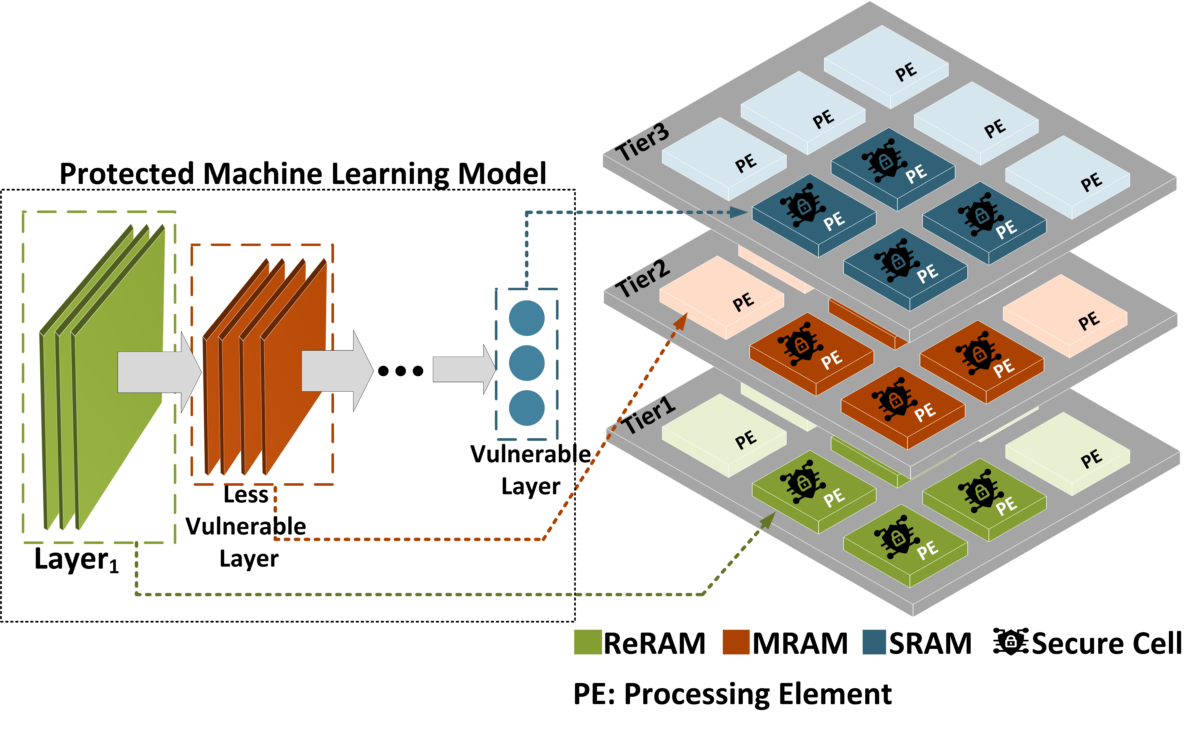 Karimi and her team will study the security of computing-in-memory architectures, as shown in this project overview. (Image courtesy of Karimi)
Karimi’s team will study the security of 3D CiM technologies used in AI applications. In particular, the research will focus on evaluating the security vulnerabilities of the technologies and developing mitigation strategies.
“I’m excited about this project because the topic is very timely,” says Karimi. “The support from three leading companies in the AI field shows the importance of the problem and the promise of the solutions we are working on.”
The team aims to enhance the security of CiM-based AI accelerators against physical attacks that adversaries might launch to leak sensitive data or induce malfunctions. The researchers will work closely with the funding companies over the next three years in this area.
]]>
Naghmeh Karimi, an associate professor in the Department of Computer Science and Electrical Engineering, was recently granted more than $300,000 in funding from the Semiconductor Research...
https://umbc.edu/quick-posts/naghmeh-karimi-ai-accelerators/
https://my3.my.umbc.edu/api/v0/pixel/news/146631/guest@my.umbc.edu/76d7fd9ddac87ece66ea42aa26936658/api/pixel
cfr
coeit
csee
news
quick-post
research
science-and-tech
UMBC News & Magazine
https://my3.my.umbc.edu/groups/umbc-news-magazine
https://assets1-my.umbc.edu/system/shared/avatars/groups/000/001/943/24435aa6207c452e7bc15cc74b42c7bb/xsmall.png?1748556657
https://assets1-my.umbc.edu/system/shared/avatars/groups/000/001/943/24435aa6207c452e7bc15cc74b42c7bb/original.png?1748556657
https://assets2-my.umbc.edu/system/shared/avatars/groups/000/001/943/24435aa6207c452e7bc15cc74b42c7bb/xxlarge.png?1748556657
https://assets2-my.umbc.edu/system/shared/avatars/groups/000/001/943/24435aa6207c452e7bc15cc74b42c7bb/xlarge.png?1748556657
https://assets3-my.umbc.edu/system/shared/avatars/groups/000/001/943/24435aa6207c452e7bc15cc74b42c7bb/large.png?1748556657
https://assets1-my.umbc.edu/system/shared/avatars/groups/000/001/943/24435aa6207c452e7bc15cc74b42c7bb/medium.png?1748556657
https://assets2-my.umbc.edu/system/shared/avatars/groups/000/001/943/24435aa6207c452e7bc15cc74b42c7bb/small.png?1748556657
https://assets1-my.umbc.edu/system/shared/avatars/groups/000/001/943/24435aa6207c452e7bc15cc74b42c7bb/xsmall.png?1748556657
https://assets2-my.umbc.edu/system/shared/avatars/groups/000/001/943/24435aa6207c452e7bc15cc74b42c7bb/xxsmall.png?1748556657
UMBC News & Magazine
1
0
false
Tue, 21 Jan 2025 10:13:45 -0500
Tue, 21 Jan 2025 10:13:45 -0500