UMBC’s Top 12 Highlights of 2016

UMBC celebrated a banner year in 2016. In thousands of ways, big and small, this golden anniversary has been full of moments to remember for the university community.
Here are twelve top highlights:
Retrievers in Rio — When an ESPN reporter asked Cleopatra Borel ‘02, interdisciplinary studies, what qualifying for the shot put finals at the 2016 Olympic Games meant to her, she responded simply, “Everything.” Borel represented Trinidad and Tobago at her fourth Olympic Games and finished seventh on the global stage. Mohamed Hussein ‘14, mechanical engineering, a current master’s student in engineering management, represented Egypt in the 200 meter individual medley, competing head to head with Ryan Lochte.
 Emily Escobedo at 2016 NCAA finals / Tim Binning, The Swim Pictures
Earlier in the year, UMBC swimming and diving standout Emily Escobedo ’17, psychology, finished in the top 10 in the 200m breaststroke at the U.S. Swimming Olympic Trials after winning bronze in the 200 meter breaststroke at the NCAA finals and becoming the first Retriever to earn All-American status in the pool.
Researchers of Distinction — Michael Summers, Robert E. Meyerhoff Chair for Excellence in Research and Mentoring and University Distinguished Professor of chemistry and biochemistry, became the first UMBC faculty member to be inducted into the National Academy of Sciences, one of the highest honors a scientist can receive. Summers was recognized both for his groundbreaking work on the HIV-1 retrovirus and his longstanding commitment to training the next generation of leading scientists, from high school through postdoctoral levels.
 Michael Summers with his students
Kate Brown, professor of history, was named a 2016 Carnegie Fellow for research on the long-term health consequences of nuclear disaster. “I’m hopeful that this fellowship will help bring greater visibility and support to the high-level scholarship that exists in the humanities and social sciences,” said Brown.
 Historian Kate Brown
Goldwater Scholars — Andreas Seas ‘17, Naomi Mburu ‘18, and Daniel Ocasio ‘17, all chemical engineering majors, received the highly selective and prestigious Barry Goldwater Scholarship. Ocasio shared, “As a first generation college student, I feel extremely fortunate to be pursuing higher education, let alone a career in scientific research. To me, earning the Goldwater Scholarship is recognition of all those who made it possible for me to further my academic development.”
 UMBC’s 2016 Goldwater Scholars (l-r): Andreas Seas, Naomi Mburu, and Daniel Ocasio
Leader in Education — UMBC partnered with Baltimore City Public Schools and the Northrop Grumman Foundation on a $1.6 million initiative to support Baltimore students, teachers, and communities. Meanwhile, Shalonda Holt ‘07, biological sciences, was named 2016 Washington Post Teacher of the Year and Howard County Teacher of the Year, and Corey Carter ’08, biological sciences, ’10 M.A.T., was named 2016 Baltimore County Teacher of the Year.
 Alumna Shalonda Holt / Nicholas Griner, Howard County Public School System
CAREER Awards — Matt Pelton, assistant professor of physics, and Helena Mentis, assistant professor of information systems, both received the prominent National Science Foundation CAREER Award. Pelton explores how nanoparticles act in liquids to understand how mechanical energy flows at the nanometer scale. Mentis focuses on surgical telemedicine, exploring how surgeons can use gesture-based tools to share expert knowledge in the operating room.
 Helena Mentis demonstrates gestural tools.
NASA Collaborations — NASA renewed its support for the Goddard Planetary Heliophysics Institute—a joint venture of UMBC; the University of Maryland, College Park; and American University—for up to $20 million over the next five years. This follows the 2015 renewal of UMBC’s Joint Center for Earth Systems Technology (JCET) partnership with the NASA Goddard Space Flight Center, for up to $46 million over five years.
 GPHI Director Jan Merka
Virtual Reality Lab — UMBC’s PI2 Immersive Hybrid Reality Lab opened, giving students and faculty the ability to interact with data in a more visual way, and reducing the distance between researchers and the information they work with, whether they are studying wind farms or blood flow in the human body.
 Guest explores PI2 during ribbon cutting ceremony.
Tech Boom — UMBC faculty won four new Maryland Innovation Initiative (MII) awards to develop their ideas into commercial applications. This brings the university’s total MII awards to $2.4 million, one of the highest levels in the state.
 Eric Smallwood, assistant professor of visual arts, and Linda Dusman, professor of music, received an MII award for the Octava app.
Faculty Diversity — A two-part Marketplace radio series highlighted UMBC’s initiatives to train, hire, support, and retain a diverse faculty, shining a spotlight on UMBC postdoctoral fellow Keisha Allen, education, and her experience transitioning from graduate student to faculty member, supported by faculty mentors.
 Recipients of UMBC Fellowships for Faculty Diversity (l-r): Keisha Allen, Nkiru Nnawulezi, and Mejdulene Shomali
Record Alumni Support — A record number of alumni donated to UMBC in this calendar year. Retriever alumni contributed more than 500 gifts to student scholarships and over 1,300 gifts to the University’s Greatest Need Fund alone.
Golden Anniversary — Thousands of Retrievers came together as a community—alumni, faculty, staff, and students from all five decades of UMBC history—to celebrate the remarkable story of UMBC at a 50th anniversary weekend festival.
 UMBC’s 50th anniversary fireworks display / Dan Bailey
High Honors — U.S. News again honored UMBC as a national leader in innovation and teaching and a top global university. Times Higher Education named UMBC one of the world’s best universities for teaching, research, knowledge transfer, and international outlook, and one of the top young universities worldwide for the fifth consecutive year. In its annual Best Colleges guide, Princeton Review wrote:
Arguably the “best public college in Maryland,” UMBC is an “extremely diverse school” that manages to maintain a “small community feel.” And from the moment you set foot on campus it’s evident that the university is focused on “providing exceptional education and research opportunities for students.”
To hear the latest UMBC news as it happens in 2017, follow UMBC on Facebook, Twitter, Instagram, Snapchat (@UMBClife), and UMBC News, and sign up to receive the UMBC News “Top Stories of the Week” email.
Images: All photos are by Marlayna Demond ’11 for UMBC unless otherwise noted.
]]>
UMBC celebrated a banner year in 2016. In thousands of ways, big and small, this golden anniversary has been full of moments to remember for the university community. Here are twelve top...
https://umbc.edu/stories/umbcs-top-12-highlights-of-2016/
https://my3.my.umbc.edu/api/v0/pixel/news/120908/guest@my.umbc.edu/d573cb199ff4c906616e728ad833b218/api/pixel
alumni
athletics
cahss
cbee
chembiochem
cnms
coeit
community
education
gphi
history
is
jcet
majoraward
music
physics
rankings
research
umbc50
undergradresearch
visualarts
UMBC News & Magazine
https://my3.my.umbc.edu/groups/umbc-news-magazine
https://assets1-my.umbc.edu/system/shared/avatars/groups/000/001/943/24435aa6207c452e7bc15cc74b42c7bb/xsmall.png?1748556657
https://assets1-my.umbc.edu/system/shared/avatars/groups/000/001/943/24435aa6207c452e7bc15cc74b42c7bb/original.png?1748556657
https://assets2-my.umbc.edu/system/shared/avatars/groups/000/001/943/24435aa6207c452e7bc15cc74b42c7bb/xxlarge.png?1748556657
https://assets2-my.umbc.edu/system/shared/avatars/groups/000/001/943/24435aa6207c452e7bc15cc74b42c7bb/xlarge.png?1748556657
https://assets3-my.umbc.edu/system/shared/avatars/groups/000/001/943/24435aa6207c452e7bc15cc74b42c7bb/large.png?1748556657
https://assets1-my.umbc.edu/system/shared/avatars/groups/000/001/943/24435aa6207c452e7bc15cc74b42c7bb/medium.png?1748556657
https://assets2-my.umbc.edu/system/shared/avatars/groups/000/001/943/24435aa6207c452e7bc15cc74b42c7bb/small.png?1748556657
https://assets1-my.umbc.edu/system/shared/avatars/groups/000/001/943/24435aa6207c452e7bc15cc74b42c7bb/xsmall.png?1748556657
https://assets2-my.umbc.edu/system/shared/avatars/groups/000/001/943/24435aa6207c452e7bc15cc74b42c7bb/xxsmall.png?1748556657
UMBC News & Magazine
0
0
false
Wed, 04 Jan 2017 18:30:35 -0500
UMBC physicist Sebastian Deffner reimagines the future of computing with biology in mind

“There is no free lunch,” in quantum computing, says Sebastian Deffner, a new assistant professor of physics at UMBC. Every uptick in a computer’s speed, accuracy, or memory comes at the cost of energy. Now, Deffner and a team of colleagues have set out to quantify the trade-offs between the costs and benefits of faster or more powerful computers.
Several studies suggest that quantum computing has the potential to be less energy intensive than classical computing, but no one has demonstrated that yet in a real system. Deffner and his colleagues hope to more clearly define the energy requirements of quantum computing in a new two-year project funded by a National Science Foundation INSPIRE grant.
“Quantum computing is cool because you can do infinitely more complex problems,” Deffner explains, but if the costs associated with that ability are too high compared to the benefits, quantum computers—at least as they are currently conceptualized—just might not be worth it. His team’s foundational research into the costs of quantum computing will inform the design of tomorrow’s computers, whether quantum or classical.
One aspect of their work will be investigating “biological computation,” the calculations completed by living cells. They’ll do so by creating computer simulations of information processing that occurs within cells.
Like human-engineered computers, these biological processes also incur costs with improvements in speed and accuracy. For example, the process of copying DNA rarely makes mistakes, because of complex error-correction methods within the cell. Just as added speed in a computer comes at a cost, “correction mechanisms do not come for free in cells,” says Deffner.
Even with those costs, Deffner explains, the biological system is very efficient. Given a few billion years to optimize DNA replication and other biological computation processes, “It seems likely that evolution would have gotten something right,” he says. In fact, estimates suggests that the biosphere taken as a whole operates significantly more efficiently than the best human-made computers.
“By understanding one side of the coin [biological computation], we will better understand the other [human-made computers],” Deffner says. His grant proposal states that this new research will be the “first to give a formal understanding of biological computation from a thermodynamic point of view.” Biologists should be interested in Deffner’s results, too, as they may inform ideas about how thermodynamic tradeoffs impose constraints on natural selection and evolution on Earth.
Only weeks after Deffner received official notification about this new grant, the New Journal of Physics presented him with the Early Career Award, which comes with a cash prize and a trip to London for an awards ceremony. The NJP described Deffner as “an extremely talented young researcher who in his early career has proven leadership qualities.” The honor came as a wonderful surprise. “This award means so much to me,” he shared. “I am simply overwhelmed.”
Recent advances in physics, the opportunity to shape the direction of his new lab at UMBC, the NSF grant, and the prestige that will come with his new award all make it possible for Deffner to forge his own unique path into a promising new research field. He’s driven by the sense that scientists “don’t understand the thermodynamic resources required in quantum computing yet,” and excited to do “a little bit of everything” on a quest that bridges quantum computing and biology to build a solid foundation for future research.
Image: Sebastian Deffner, courtesy Sebastian Deffner.
]]>
“There is no free lunch,” in quantum computing, says Sebastian Deffner, a new assistant professor of physics at UMBC. Every uptick in a computer’s speed, accuracy, or memory comes at the cost of...
https://umbc.edu/stories/umbc-physicist-sebastian-deffner-reimagines-the-future-of-computing-with-biology-in-mind/
https://my3.my.umbc.edu/api/v0/pixel/news/120984/guest@my.umbc.edu/a2a9d4e6df7325480a006ec5560f7297/api/pixel
cnms
physics
research
science-and-technology
UMBC News & Magazine
https://my3.my.umbc.edu/groups/umbc-news-magazine
https://assets1-my.umbc.edu/system/shared/avatars/groups/000/001/943/24435aa6207c452e7bc15cc74b42c7bb/xsmall.png?1748556657
https://assets1-my.umbc.edu/system/shared/avatars/groups/000/001/943/24435aa6207c452e7bc15cc74b42c7bb/original.png?1748556657
https://assets2-my.umbc.edu/system/shared/avatars/groups/000/001/943/24435aa6207c452e7bc15cc74b42c7bb/xxlarge.png?1748556657
https://assets2-my.umbc.edu/system/shared/avatars/groups/000/001/943/24435aa6207c452e7bc15cc74b42c7bb/xlarge.png?1748556657
https://assets3-my.umbc.edu/system/shared/avatars/groups/000/001/943/24435aa6207c452e7bc15cc74b42c7bb/large.png?1748556657
https://assets1-my.umbc.edu/system/shared/avatars/groups/000/001/943/24435aa6207c452e7bc15cc74b42c7bb/medium.png?1748556657
https://assets2-my.umbc.edu/system/shared/avatars/groups/000/001/943/24435aa6207c452e7bc15cc74b42c7bb/small.png?1748556657
https://assets1-my.umbc.edu/system/shared/avatars/groups/000/001/943/24435aa6207c452e7bc15cc74b42c7bb/xsmall.png?1748556657
https://assets2-my.umbc.edu/system/shared/avatars/groups/000/001/943/24435aa6207c452e7bc15cc74b42c7bb/xxsmall.png?1748556657
UMBC News & Magazine
0
0
false
Fri, 14 Oct 2016 17:35:41 -0400
NOAA funds UMBC to train minority students in remote sensing and atmospheric sciences

UMBC’s demonstrated strength in supporting students from underrepresented groups on their path to success in STEM fields has earned the university another round of funding for STEM education. The National Oceanic and Atmospheric Administration (NOAA) just renewed its support for UMBC through the Educational Partnership Program with Minority Serving Institutions (EPP/MSI) for the third time since the program’s inception in 2001.
The EPP/MSI funds four cooperative science centers, each consisting of several institutions and focusing on one of NOAA’s four core research areas. UMBC has been a member of the NOAA Center for Remote Sensing Science and Technologies, led by the City University of New York, since 2001. This year Howard University, which heads the NOAA Center for Atmospheric Sciences and Meteorology, recruited UMBC to join its team as well.
“Our main goal is to educate and train underrepresented minority students to become the next NOAA workforce,” says Ruben Delgado, the lead on UMBC’s remote sensing EPP/MSI grant since 2011 and research scientist at UMBC’s Joint Center for Earth Systems Technology (JCET).
Delgado is proud of the interdisciplinary nature of the program, which currently supports undergraduate and graduate students in physics, geography and environmental systems, computer science, mechanical engineering, biological sciences, and chemical engineering. The program, he says, bridges the gap between scientists and engineers and promotes a feeling of unity among diverse individuals, “because they’re all talking science and engineering.”
NOAA provides $11.9 million per year across all four cooperative centers, each of which includes several schools. UMBC receives approximately $330,000 per year through the NOAA grant. Almost 70 percent of it goes directly toward student stipends and costs associated with presenting research at conferences, like travel and registration.
NOAA-funded students at UMBC tackle research topics in areas such as weather forecasting, wind energy, and air quality. The cooperative center structure allows students and faculty to collaborate across institutions and share resources such as instrumentation, data, and expertise.
For example, with remote sensing equipment, “We can monitor the long-range transport of pollution,” says Delgado. That includes smoke from fires in Alaska and Canada or dust coming from China or the Sahara Desert. Students learn to interpret the remote sensing data, and those also involved in his group’s Smog Blog project learn how to explain their findings to non-scientists.
“The program allows our students to be at the forefront of what NOAA is doing,” says Delgado, so when they graduate, “they are on the right track for professional careers at places like NOAA.”
But the program goes deeper than that. Delgado works hard to provide his students “opportunities to strengthen their weaknesses and build on their strengths.” He empowers them to make a real difference as researchers, with the goal that they carry that attitude beyond UMBC.
“You don’t come here to do glasswork and clean the lab,” Delgado explains. “From day one you are conducting cutting edge science and engineering.”
Image: Ruben Delgado; photo by Marlayna Demond ’11 for UMBC.
]]>
UMBC’s demonstrated strength in supporting students from underrepresented groups on their path to success in STEM fields has earned the university another round of funding for STEM education. The...
https://umbc.edu/stories/noaa-funds-umbc-to-train-minority-students-in-remote-sensing-and-atmospheric-sciences/
https://my3.my.umbc.edu/api/v0/pixel/news/120986/guest@my.umbc.edu/16dcdebd49055859f765e4d38ef261d0/api/pixel
biology
cbee
cnms
coeit
community
csee
ges
jcet
meche
physics
science-and-technology
UMBC News & Magazine
https://my3.my.umbc.edu/groups/umbc-news-magazine
https://assets1-my.umbc.edu/system/shared/avatars/groups/000/001/943/24435aa6207c452e7bc15cc74b42c7bb/xsmall.png?1748556657
https://assets1-my.umbc.edu/system/shared/avatars/groups/000/001/943/24435aa6207c452e7bc15cc74b42c7bb/original.png?1748556657
https://assets2-my.umbc.edu/system/shared/avatars/groups/000/001/943/24435aa6207c452e7bc15cc74b42c7bb/xxlarge.png?1748556657
https://assets2-my.umbc.edu/system/shared/avatars/groups/000/001/943/24435aa6207c452e7bc15cc74b42c7bb/xlarge.png?1748556657
https://assets3-my.umbc.edu/system/shared/avatars/groups/000/001/943/24435aa6207c452e7bc15cc74b42c7bb/large.png?1748556657
https://assets1-my.umbc.edu/system/shared/avatars/groups/000/001/943/24435aa6207c452e7bc15cc74b42c7bb/medium.png?1748556657
https://assets2-my.umbc.edu/system/shared/avatars/groups/000/001/943/24435aa6207c452e7bc15cc74b42c7bb/small.png?1748556657
https://assets1-my.umbc.edu/system/shared/avatars/groups/000/001/943/24435aa6207c452e7bc15cc74b42c7bb/xsmall.png?1748556657
https://assets2-my.umbc.edu/system/shared/avatars/groups/000/001/943/24435aa6207c452e7bc15cc74b42c7bb/xxsmall.png?1748556657
UMBC News & Magazine
0
0
false
Wed, 12 Oct 2016 15:01:44 -0400
Astrophysicist Robin Corbet discovers rare, high-energy binary star system beyond the Milky Way
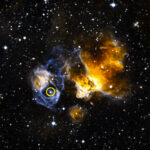
Until recently, humans had only detected five binary star systems—pairs of stars orbiting each other—that emit extremely high-energy gamma rays. Robin Corbet, an astrophysicist at UMBC’s Center for Space Sciences and Technology (CSST), just discovered the sixth, and most luminous, and this one is special. Instead of being in our Milky Way galaxy, it’s located in the Large Magellanic Cloud, our next-door neighbor galaxy, 163,000 light years away.
This marks Corbet’s second gamma ray binary discovery, following his initial detection of such a system through the Fermi gamma-ray space telescope five years ago. After that initial find in 2011, he thought more would follow quickly, but the systems proved elusive. The fact that he found the sixth known gamma ray binary outside of the Milky Way came as quite a surprise. At first, he shares, “I didn’t believe it.”
In order to emit gamma rays, which contain one million times the energy of visible light waves, one of the “stars” in the binary system must be a black hole or neutron star, a star that has collapsed in on itself. “These are more massive than our own Sun but squeezed down to something about the size of Washington, DC,” explains Corbet. Hundreds of these binary systems have been found that emit X-rays, but only a handful emit even higher-energy gamma rays.
Corbet detected the system by analyzing variations in gamma rays coming from about 3,000 known gamma ray sources. In a gamma ray binary system, the intensity of the gamma rays as they strike the telescope varies depending on the relative position of the stars as they orbit each other. Because the gamma ray sources are so far away, only a small percentage of the rays ever reach the telescope. That means it can take a long time to collect enough data to detect a pattern.
Once the Fermi satellite collected enough data, Corbet ran analyses on a 12-core computer for a few months. Looking at gamma rays from all 3,000 sources, the analyses identified two stars orbiting each other every 10.3 days—a new binary system. Then Corbet requested data sets from colleagues around the world that included X-ray, radio wave, and visible light wave data. He hoped the additional information would corroborate the gamma ray signal and confirm the orbital period, which it did. The visible light data also supported the idea that the system contains a neutron star, but there’s still a small chance it could be a black hole.
Binary systems can only generate the energy required to emit gamma rays when the neutron star is rotating very fast. The fact that only six of these systems have ever been discovered suggests that very few neutron stars rotate that quickly, and there may be more slowly-rotating neutron stars than scientists thought.
Calculations suggest the neutron star in the system Corbet just discovered rotates around its axis in less than 39 milliseconds, compared to Earth’s 24-hour rotation. As a star rotates, it flings particles away from its surface, creating a “stellar wind.” With one star in a binary rotating so fast, interactions between particles in the stellar wind from each star can be intense, which is what creates the gamma rays. “It’s like having a particle accelerator in space,” says Corbet.
Next steps for the research include confirming that one star in the system is indeed a neutron star by making observations to directly detect its rotation period, although this is very difficult. Corbet is also interested in tracking the two stars’ orbits, to see if they are truly circular or more elliptical. Because there are so few of these systems, and this is the only one outside the Milky Way, anything learned will inform future research goals and theories about extreme binary star systems.
Read the full paper in The Astrophysical Journal here: A luminous gamma-ray binary in the Large Magellanic Cloud
Image: Yellow circle indicates the gamma-ray binary discovered by Robin Corbet in the Large Magellanic Cloud; photo courtesy NASA Goddard.
]]>
Until recently, humans had only detected five binary star systems—pairs of stars orbiting each other—that emit extremely high-energy gamma rays. Robin Corbet, an astrophysicist at UMBC’s Center...
https://umbc.edu/stories/astrophysicist-robin-corbet-discovers-rare-high-energy-binary-star-system-beyond-the-milky-way/
https://my3.my.umbc.edu/api/v0/pixel/news/120998/guest@my.umbc.edu/eea18e327cafe398ea6ee37da3f3594e/api/pixel
cnms
csst
physics
research
science-and-technology
UMBC News & Magazine
https://my3.my.umbc.edu/groups/umbc-news-magazine
https://assets1-my.umbc.edu/system/shared/avatars/groups/000/001/943/24435aa6207c452e7bc15cc74b42c7bb/xsmall.png?1748556657
https://assets1-my.umbc.edu/system/shared/avatars/groups/000/001/943/24435aa6207c452e7bc15cc74b42c7bb/original.png?1748556657
https://assets2-my.umbc.edu/system/shared/avatars/groups/000/001/943/24435aa6207c452e7bc15cc74b42c7bb/xxlarge.png?1748556657
https://assets2-my.umbc.edu/system/shared/avatars/groups/000/001/943/24435aa6207c452e7bc15cc74b42c7bb/xlarge.png?1748556657
https://assets3-my.umbc.edu/system/shared/avatars/groups/000/001/943/24435aa6207c452e7bc15cc74b42c7bb/large.png?1748556657
https://assets1-my.umbc.edu/system/shared/avatars/groups/000/001/943/24435aa6207c452e7bc15cc74b42c7bb/medium.png?1748556657
https://assets2-my.umbc.edu/system/shared/avatars/groups/000/001/943/24435aa6207c452e7bc15cc74b42c7bb/small.png?1748556657
https://assets1-my.umbc.edu/system/shared/avatars/groups/000/001/943/24435aa6207c452e7bc15cc74b42c7bb/xsmall.png?1748556657
https://assets2-my.umbc.edu/system/shared/avatars/groups/000/001/943/24435aa6207c452e7bc15cc74b42c7bb/xxsmall.png?1748556657
UMBC News & Magazine
0
0
false
Thu, 29 Sep 2016 17:14:58 -0400
NSF funds Jason Kestner to tackle major obstacle to quantum computing

Predictions suggest that advances in quantum computing could lead to computers vastly faster than any that currently exist—computers that could efficiently crunch the more than 2.5 quintillion (that’s 2,500 million billion) bits of data created every day. But, despite this grand vision, the reality is that “nobody has a useful quantum computer right now,” says Jason Kestner, assistant professor of physics at UMBC. Kestner plans to help change that with a new three-year grant from the National Science Foundation.
Traditional computers use a binary system to store information in “bits.” At any given moment, a single bit can either be in a state that represents 1 or 0. Quantum bits, however, can be 1, 0 or exist in “a weird, spooky in-between state,” Kestner says.
To understand a quantum bit or “qubit,” Kestner suggests picturing it as a point on the surface of a sphere. The two poles represent 1 and 0, but the bit can be anywhere on the surface. This added complexity is what grants quantum computing its power to store huge amounts of information in small spaces, but complexity is also the source of one of its major challenges: noise. Kestner’s project will address the noise in quantum computers, which he describes as “the major obstacle to building a quantum computer.”
So what is noise? Say a qubit is at a point on the sphere halfway between the two poles, on the sphere’s equator. While the qubit is idle, it can slide along the equator. The distance it slides is the noise in the system—unwanted inaccuracy that slips in due to external influences. If enough noise builds up across all the computer’s bits, its output becomes unreliable.
Theorizing on ways to compensate for noise in quantum computers goes back to 1950, but no one has successfully achieved this in a many-bit system, which is Kestner’s goal. His research dives into a complex “spin echo” technique and asks, “How can we return the qubits to their rightful positions without disturbing anything else in the system?”
Kestner is a theoretical physicist, so the work that he and graduate student Fernando Calderon Vargas do is “a lot of math,” he explains. Calderon Vargas has published promising preliminary results. Now Kestner is starting to look into collaborations with experimental physicists who can test the new theories.
“It’s going to be a challenge to optimize this for particular experiments,” he says. Each experimental setup will be a little different and require tweaks to the equations.
As a quantum computing researcher, Kestner has long been fascinated by the fact “that something so counter-intuitive could be real,” but the incredible potential utility of advances in this field are what make it so exciting to him today. He shares, “The fact that we could use quantum weirdness to actually do something useful is pretty cool.”
]]>
Predictions suggest that advances in quantum computing could lead to computers vastly faster than any that currently exist—computers that could efficiently crunch the more than 2.5 quintillion...
https://umbc.edu/stories/nsf-funds-jason-kestner-to-tackle-major-obstacle-to-quantum-computing/
https://my3.my.umbc.edu/api/v0/pixel/news/121014/guest@my.umbc.edu/c2eb51fcf4b14b0957db6209003a2ebe/api/pixel
cnms
physics
research
science-and-technology
UMBC News & Magazine
https://my3.my.umbc.edu/groups/umbc-news-magazine
https://assets1-my.umbc.edu/system/shared/avatars/groups/000/001/943/24435aa6207c452e7bc15cc74b42c7bb/xsmall.png?1748556657
https://assets1-my.umbc.edu/system/shared/avatars/groups/000/001/943/24435aa6207c452e7bc15cc74b42c7bb/original.png?1748556657
https://assets2-my.umbc.edu/system/shared/avatars/groups/000/001/943/24435aa6207c452e7bc15cc74b42c7bb/xxlarge.png?1748556657
https://assets2-my.umbc.edu/system/shared/avatars/groups/000/001/943/24435aa6207c452e7bc15cc74b42c7bb/xlarge.png?1748556657
https://assets3-my.umbc.edu/system/shared/avatars/groups/000/001/943/24435aa6207c452e7bc15cc74b42c7bb/large.png?1748556657
https://assets1-my.umbc.edu/system/shared/avatars/groups/000/001/943/24435aa6207c452e7bc15cc74b42c7bb/medium.png?1748556657
https://assets2-my.umbc.edu/system/shared/avatars/groups/000/001/943/24435aa6207c452e7bc15cc74b42c7bb/small.png?1748556657
https://assets1-my.umbc.edu/system/shared/avatars/groups/000/001/943/24435aa6207c452e7bc15cc74b42c7bb/xsmall.png?1748556657
https://assets2-my.umbc.edu/system/shared/avatars/groups/000/001/943/24435aa6207c452e7bc15cc74b42c7bb/xxsmall.png?1748556657
UMBC News & Magazine
0
0
false
Wed, 14 Sep 2016 18:44:28 -0400
College students from across the U.S. gain summer research experience at UMBC
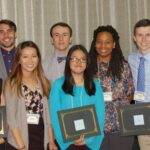
Each summer dozens of college students from around the nation travel to UMBC to take advantage of the university’s leading research facilities and faculty. This year, 28 students studied climate change, diabetes, and other topics as part of UMBC’s Interdisciplinary Program in High Performance Computing, a Research Experience for Undergraduates (REU) housed in the mathematics and statistics department. At the same time, 10 students tackled projects through the new Chemical Sensing and Imaging REU, hosted by the chemistry and biochemistry department. Students learned new scientific skills, refined career goals, and practiced teamwork.
Matthias Gobbert, professor of mathematics and director of the Interdisciplinary Program in High Performance Computing, explains that the program emerged from a collaboration between the Center for Interdisciplinary Research and Consulting (CIRC) and the High Performance Computing Facility. Gobbert and math department colleagues match each student team with a client from a local company who comes to the table with a problem they’d like the students to solve. It’s not about imagined scenarios, Gobbert says, “It’s real consulting.”
“It’s a good chance to get used to working with teams,” says Lois Miller, a rising senior at DePauw University. Abigail Kramer, a rising senior at Kent State University, agrees, adding, “It’s been great to talk to math majors from other schools.”
The interdisciplinary projects have exposed students to new options. “People don’t think about how math can overlap with other things,” says Danielle Sykes ‘19, mathematics and statistics and a Meyerhoff Scholar, whose team applied a data analytics model to huge amounts of climate data from across the Missouri River Basin. “It’s definitely expanded my thinking about what my career options are,” she shares.
The National Science Foundation, Department of Defense, and National Security Agency all contributed funding for the program this year, enabling a larger student cohort to participate. Fifty percent of students come from institutions with limited research opportunities, so the program gives them rare first-hand experience and helps them decide if they’d like to pursue research further. A graduate student and faculty member are assigned to each undergraduate team, “so teams can be really well supported,” says Gobbert.
UMBC’s new chemistry REU “embraces the UMBC mission to provide research and education opportunities to students from all backgrounds, including students from underrepresented minorities in STEM,” says Zeev Rosenzweig, professor and chair of chemistry and biochemistry. Supporting these students is a team effort. “I greatly appreciate the dedication of our UMBC faculty and graduate student mentors to the participating students,” he says.
 The 10 students in the program had eye-opening experiences in their research projects. “I’ve gained an appreciation for the principal science behind a lot of the things we use,” says Kalen Sullivan, a pre-med student at Iona College who worked with Marcin Ptaszek, associate professor of chemistry and biochemistry. Sullivan didn’t meet his project’s goal to produce a specific novel compound in the lab, although he worked long and hard, but he’s found an even greater respect for people who work “in the trenches” of science.
Kathy Barron, a 2016 chemistry graduate from Virginia Tech, worked with Jennie Leach, associate professor of chemical, biochemical, and environmental engineering (CBEE), and Erin Lavik, professor of CBEE. “I thought it would be a good opportunity to learn about a field of research I was unfamiliar with,” she says. It went so well that Lavik asked her to stay on after the REU ended. She’ll continue doing research in the lab and is considering graduate study in the same field.
Becca Pontius, a rising senior chemistry major at Clemson University, has been inspired to pursue a new field after working to develop quantum dots in Rosenzweig’s lab. Slightly uncertain about her project at first because it contained a significant biology component, “Now I know I can stretch out to new things and still be successful,” she shares. “The REU program at UMBC was a big step towards my dream job of becoming a research professor.”
All UMBC REU students presented their work at the 19th annual Summer Undergraduate Research Fest on August 10.
Rosenzweig hopes the students take away more than research knowledge from UMBC. “It is my hope that the REU students will become ambassadors of UMBC in their academic institutions, and help us to promote and expand the UMBC culture of inclusive excellence.”
Faculty Mentors for Chemical Sensing and Imaging REU:
Brad Arnold, associate professor of chemistry and biochemistry
Marie Christine Daniel-Onuta, associate professor of chemistry and biochemistry
Lisa Kelly, associate professor of chemistry and biochemistry
Minjoung Kyoung, assistant professor of chemistry and biochemistry
Erin Lavik, professor of chemical, biochemical, and environmental engineering
Jennie Leach, associate professor of chemical, biochemical, and environmental engineering
Matt Pelton, assistant professor of physics
Marcin Ptaszek, associate professor of chemistry and biochemistry
Zeev Rosenzweig, professor and chair of chemistry and biochemistry, REU director
Ryan White, associate professor of chemistry and biochemistry
Interdisciplinary Program in High-Performance Computing REU:
Nagaraj Neerchal, professor of mathematics and statistics, REU co-director
Brad Peercy, associate professor of mathematics and statistics, REU faculty mentor
Kofi Adragni, assistant professor of mathematics and statistics, REU faculty mentor
Banner image: 2016 Chemical Sensing and Imaging REU cohort at SURF.
In-text image: 2016 High-Performance Computing REU cohort at SURF.
Photos by Tim Ford for UMBC.
]]>
Each summer dozens of college students from around the nation travel to UMBC to take advantage of the university’s leading research facilities and faculty. This year, 28 students studied climate...
https://umbc.edu/stories/college-students-from-across-the-u-s-gain-summer-research-experience-at-umbc/
https://my3.my.umbc.edu/api/v0/pixel/news/121030/guest@my.umbc.edu/c78e2a09522fb01f6fb83b5569f706df/api/pixel
cbee
chembiochem
mathstat
physics
research
science-and-technology
undergradresearch
UMBC News & Magazine
https://my3.my.umbc.edu/groups/umbc-news-magazine
https://assets1-my.umbc.edu/system/shared/avatars/groups/000/001/943/24435aa6207c452e7bc15cc74b42c7bb/xsmall.png?1748556657
https://assets1-my.umbc.edu/system/shared/avatars/groups/000/001/943/24435aa6207c452e7bc15cc74b42c7bb/original.png?1748556657
https://assets2-my.umbc.edu/system/shared/avatars/groups/000/001/943/24435aa6207c452e7bc15cc74b42c7bb/xxlarge.png?1748556657
https://assets2-my.umbc.edu/system/shared/avatars/groups/000/001/943/24435aa6207c452e7bc15cc74b42c7bb/xlarge.png?1748556657
https://assets3-my.umbc.edu/system/shared/avatars/groups/000/001/943/24435aa6207c452e7bc15cc74b42c7bb/large.png?1748556657
https://assets1-my.umbc.edu/system/shared/avatars/groups/000/001/943/24435aa6207c452e7bc15cc74b42c7bb/medium.png?1748556657
https://assets2-my.umbc.edu/system/shared/avatars/groups/000/001/943/24435aa6207c452e7bc15cc74b42c7bb/small.png?1748556657
https://assets1-my.umbc.edu/system/shared/avatars/groups/000/001/943/24435aa6207c452e7bc15cc74b42c7bb/xsmall.png?1748556657
https://assets2-my.umbc.edu/system/shared/avatars/groups/000/001/943/24435aa6207c452e7bc15cc74b42c7bb/xxsmall.png?1748556657
UMBC News & Magazine
0
0
false
Thu, 01 Sep 2016 18:32:13 -0400
Two bwtech@UMBC companies win 2016 Maryland Incubator Company of the Year awards

AirPhoton and Phoenix Operations Group are the newest bwtech@UMBC companies to win Maryland Incubator Company of the Year (ICOY) awards. AirPhoton won best technology product company, and Phoenix Operations Group won best data analytics company at the awards event held June 21 at the American Visionary Arts Museum. Six other bwtech@UMBC companies were recognized as finalists.
AirPhoton produces customized scientific equipment for air quality data collection. The instruments they build are employed on the ground, in aircraft, and on satellites.
“AirPhoton is very excited to be recognized with this award, especially given the other very fine companies that were selected as finalists,” says Lorraine Remer, CEO and research professor of physics at UMBC. “We hope to continue growing and contributing to the incubator program and the Maryland economy.”

Phoenix Operations Group offers data analytics, cloud application design and administration, and platform optimization services to the intelligence community. Devin Edwards, director of strategic development, says the research park has served the company well.
“The cyber incubator at bwtech@UMBC was able to provide Phoenix Operations Group with access to industry professionals to help set up our infrastructure,” Edwards says, “thereby allowing us to compete and grow within our domain in a matter of months, surpassing companies that have been in the industry for years.”

The event’s keynote speech by Andy Jones, managing director of the Maryland Venture Fund, centered on advice for new entrepreneurs. Stay focused on a small range of products or services and embrace board meetings as opportunities to take stock, he said. Also, “growth is your friend,” because revenue gives a company leeway to try new things. Perhaps most important, “Surround yourself with good people,” he told emerging entrepreneurs. “It really is a marriage, so pick your partners carefully.”
Previous ICOY winners from bwtech@UMBC include:
2014
Light Point Security (Best Cyber Company)
2013
Plasmonix, Inc. (Best Technology Transfer Company)
2012
Noxilizer (Best Life Sciences Company)
StormCenter Communicaitons, Inc. (Best Cyber/Homeland Security Company)
SemaConnect, Inc. (Best Green Company)
2009
Oculis Labs, Inc. (Best Information Technology Company)
2007
Lentigen Corporation (Best Life Sciences Company)
BDMetrics, Inc. (Best Graduate Company)
2006
Profectus BioSciences, Inc. (Best Technology Transfer Company)
2005
AVIcode, Inc. (Best New Incubator Company)
TechGuard Security, LLC (Best Information Technology Company)
2004
BDMetrics, Inc. (Best New Incubator Company)
2003
Scientific Products & Systems, Inc. (Most Promising Technology Transfer)
2002
Columbia Technologies (Best Innovative Technology Company)
In Vitro Technologies, Inc. (Best Graduate Company)
Header image: Andy Jones gives the event’s key note.
Other images: AirPhoton team members accept their award (top) and Phoenix Operations Group team members accept theirs (bottom).
Photos sourced from www.mdincubatoraward.com
]]>
AirPhoton and Phoenix Operations Group are the newest bwtech@UMBC companies to win Maryland Incubator Company of the Year (ICOY) awards. AirPhoton won best technology product company, and Phoenix...
https://umbc.edu/stories/two-bwtechumbc-companies-win-2016-maryland-incubator-company-of-the-year-awards/
https://my3.my.umbc.edu/api/v0/pixel/news/121094/guest@my.umbc.edu/0d3b40507ce60b0b352d5c36acc996be/api/pixel
bwtech
physics
science-and-technology
UMBC News & Magazine
https://my3.my.umbc.edu/groups/umbc-news-magazine
https://assets1-my.umbc.edu/system/shared/avatars/groups/000/001/943/24435aa6207c452e7bc15cc74b42c7bb/xsmall.png?1748556657
https://assets1-my.umbc.edu/system/shared/avatars/groups/000/001/943/24435aa6207c452e7bc15cc74b42c7bb/original.png?1748556657
https://assets2-my.umbc.edu/system/shared/avatars/groups/000/001/943/24435aa6207c452e7bc15cc74b42c7bb/xxlarge.png?1748556657
https://assets2-my.umbc.edu/system/shared/avatars/groups/000/001/943/24435aa6207c452e7bc15cc74b42c7bb/xlarge.png?1748556657
https://assets3-my.umbc.edu/system/shared/avatars/groups/000/001/943/24435aa6207c452e7bc15cc74b42c7bb/large.png?1748556657
https://assets1-my.umbc.edu/system/shared/avatars/groups/000/001/943/24435aa6207c452e7bc15cc74b42c7bb/medium.png?1748556657
https://assets2-my.umbc.edu/system/shared/avatars/groups/000/001/943/24435aa6207c452e7bc15cc74b42c7bb/small.png?1748556657
https://assets1-my.umbc.edu/system/shared/avatars/groups/000/001/943/24435aa6207c452e7bc15cc74b42c7bb/xsmall.png?1748556657
https://assets2-my.umbc.edu/system/shared/avatars/groups/000/001/943/24435aa6207c452e7bc15cc74b42c7bb/xxsmall.png?1748556657
UMBC News & Magazine
0
0
false
Fri, 08 Jul 2016 14:14:08 -0400
“Smog Blog” run by UMBC students becomes go-to air quality reference for national audience
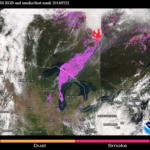
When Jill Engel-Cox Ph.D. ’04, marine-estuarine environmental sciences, started the Smog Blog in 2003, it served as “kind of an online lab notebook,” she says. In the early 2000s, there were plenty of sources of air quality data, “but no one was putting these disparate data sources all together on a daily basis.” Enter the Smog Blog.
As Engel-Cox developed the site, she and advisor Ray Hoff, now-emeritus professor of physics at UMBC, expanded it to include other students. “The Smog Blog turned into a great way for students to learn how to analyze satellite and other air quality data quickly, as well as how to write scientific information clearly for a wide audience,” Engel-Cox says.
But the Smog Blog was destined for bigger things. “It took on a life of its own,” says Ruben Delgado, assistant research scientist at the Joint Center for Earth Systems Technology. From comments on the site, “we discovered we had a wide variety of readers,” says Engel-Cox, “including atmospheric scientists, state environmental regulators, and even an amateur astronomer who used the Smog Blog to better predict clear skies.”
Four years ago, Delgado realized the Smog Blog had more than five million total hits per year. Now it gets 16,000 unique hits per month. Many visitors, such as weather agencies or citizens sensitive to air pollution, visit several times per day.
A team of students posts to the Smog Blog six days per week to keep readers updated. Now it’s a self-perpetuating venture: as students graduate, they train the next cohort of Smog Bloggers how to interpret data from satellites and explain it in layman’s terms on the blog.
Delgado has received external offers to buy the Smog Blog, but he’s not interested in commercializing it. He says it’s “by students, for students,” and should stay that way. Even as a university project, however, there are many possibilities for the Smog Blog’s future, including growth through collaborations. The blog even emerged in a discussion with Robert Marshall ‘88, founder and CEO of Earth Networks, on compelling uses for weather data following Marshall’s keynote at a UMBC research conference on climate issues.
Next on the horizon for the Smog Blog is a new home: a freshly designed website expected to launch by the end of the summer. Students will also be working over the summer to develop a Smog Blog mobile app.
In the meantime, as spring pollen, summer wildfires, winter inversions, and other air quality issues continue, the blog expects traffic to keep rising as it serves up critical information to a diverse audience, all while supporting the research and education of UMBC students.
Images: Sourced from the Smog Blog website. These highlight how different instruments observed smoke from the spring 2016 Fort McMurray wildfire in Alberta, Canada traveling across the Great Lakes region.
]]>
When Jill Engel-Cox Ph.D. ’04, marine-estuarine environmental sciences, started the Smog Blog in 2003, it served as “kind of an online lab notebook,” she says. In the early 2000s, there were...
https://umbc.edu/stories/smog-blog-run-by-umbc-students-becomes-go-to-air-quality-reference-for-national-audience/
https://my3.my.umbc.edu/api/v0/pixel/news/121103/guest@my.umbc.edu/1556c3f15769e9fa5db1b0e5631c99df/api/pixel
cnms
jcet
physics
research
science-and-technology
undergradresearch
UMBC News & Magazine
https://my3.my.umbc.edu/groups/umbc-news-magazine
https://assets1-my.umbc.edu/system/shared/avatars/groups/000/001/943/24435aa6207c452e7bc15cc74b42c7bb/xsmall.png?1748556657
https://assets1-my.umbc.edu/system/shared/avatars/groups/000/001/943/24435aa6207c452e7bc15cc74b42c7bb/original.png?1748556657
https://assets2-my.umbc.edu/system/shared/avatars/groups/000/001/943/24435aa6207c452e7bc15cc74b42c7bb/xxlarge.png?1748556657
https://assets2-my.umbc.edu/system/shared/avatars/groups/000/001/943/24435aa6207c452e7bc15cc74b42c7bb/xlarge.png?1748556657
https://assets3-my.umbc.edu/system/shared/avatars/groups/000/001/943/24435aa6207c452e7bc15cc74b42c7bb/large.png?1748556657
https://assets1-my.umbc.edu/system/shared/avatars/groups/000/001/943/24435aa6207c452e7bc15cc74b42c7bb/medium.png?1748556657
https://assets2-my.umbc.edu/system/shared/avatars/groups/000/001/943/24435aa6207c452e7bc15cc74b42c7bb/small.png?1748556657
https://assets1-my.umbc.edu/system/shared/avatars/groups/000/001/943/24435aa6207c452e7bc15cc74b42c7bb/xsmall.png?1748556657
https://assets2-my.umbc.edu/system/shared/avatars/groups/000/001/943/24435aa6207c452e7bc15cc74b42c7bb/xxsmall.png?1748556657
UMBC News & Magazine
0
0
false
Thu, 30 Jun 2016 18:37:45 -0400
Eight bwtech@UMBC companies named 2016 Maryland Incubator Company of the Year finalists

The bwtech@UMBC Research & Technology Park is home to more than a third of all finalists for the 2016 Maryland Incubator Company of the Year Awards (ICOY). These eight (of 22) ICOY finalists include: Airphoton LLC, Blue Wave Semiconductors, Inc., Bricata, Grip Boost Inc., Huntress Labs, Phoenix Operations Group, LLC, Plant Sensory Systems, and Sparks Dynamics.
Combined, bwtech North and bwtech South cover 71 acres and offer 525,000 square feet of office and lab space. Housing more than 120 companies in various stages of development, bwtech@UMBC’s estimated economic impact on the state is $500 million annually. The research park includes incubator programs for cybersecurity, life sciences, and clean energy technology companies. All incubator companies have access to entrepreneurs in residence, experienced business professionals who help with aspects of owning a company that are new to many researchers.
“It’s a financial benefit, but also an educational benefit,” to be part of the incubator, says Lorraine Remer, research professor of physics at UMBC and CEO and co-founder of AirPhoton, a company that designs and produces custom equipment for earth and climate scientists. In addition to the entrepreneurs in residence, Remer appreciates that the incubator connects companies with an excellent network of professionals, such as lawyers and accountants, whom they know they can trust.
“From the monthly E2E [executive to executive] roundtables to the always available hands-on mentorship, bwtech@UMBC has created a fantastic environment for local startups,” says Chanda Arya, COO and co-founder of Grip Boost, Inc., which sells a product to restore grip-ability to football gloves.
Kathy Turano, founder and president of Plant Sensory Systems, an incubator graduate company, agrees. “Plant Sensory Systems has benefited greatly from the entrepreneurial training and support services provided by bwtech@UMBC,” she says. “We are honored to be a finalist for the Incubator Company of the Year Award and to have our achievements recognized by the Maryland business community.”
One of Plant Sensory Systems’ projects produces plant seeds that contain nutrients typically absent in plants, but that are required for fish like salmon and tuna. The seeds can be used in plant-based fish feed, reducing demand for wild-caught small fish traditionally used in fish feed, which are currently harvested at unsustainable levels.
For Remer, being part of the incubator is about more than producing a product: it’s about giving back. She and the other AirPhoton leaders enjoy building “a structure that creates employment,” she explains. Incubator companies create jobs in Maryland and keep top talent, including UMBC alumni, in the state.
Jennifer Reynolds, bwtech@UMBC’s director of venture creation, shares, “The entire bwtech@UMBC community is extremely proud and excited to have eight finalists in this year’s Maryland Incubator Company of the Year award competition. The selected companies represent a wide array of industries, products and stages of maturity, and thus are excellent representatives of the diverse and dynamic entrepreneurial community we have built and support here at bwtech. It is so rewarding to see these innovative and promising companies achieve commercial success, and to see ICOY recognize their tremendous growth.”
Award winners will be announced at an event on June 21 at the American Visionary Art Museum in Baltimore.
Image: Lorraine Remer, research professor of physics. Photo by Marlayna Demond ’11 for UMBC.
]]>
The bwtech@UMBC Research & Technology Park is home to more than a third of all finalists for the 2016 Maryland Incubator Company of the Year Awards (ICOY). These eight (of 22) ICOY finalists...
https://umbc.edu/stories/eight-bwtechumbc-companies-named-2016-maryland-incubator-company-of-the-year-finalists/
https://my3.my.umbc.edu/api/v0/pixel/news/121119/guest@my.umbc.edu/6dc726c33154a0f3fff5d4695f75dcad/api/pixel
bwtech
cnms
physics
research
science-and-technology
UMBC News & Magazine
https://my3.my.umbc.edu/groups/umbc-news-magazine
https://assets1-my.umbc.edu/system/shared/avatars/groups/000/001/943/24435aa6207c452e7bc15cc74b42c7bb/xsmall.png?1748556657
https://assets1-my.umbc.edu/system/shared/avatars/groups/000/001/943/24435aa6207c452e7bc15cc74b42c7bb/original.png?1748556657
https://assets2-my.umbc.edu/system/shared/avatars/groups/000/001/943/24435aa6207c452e7bc15cc74b42c7bb/xxlarge.png?1748556657
https://assets2-my.umbc.edu/system/shared/avatars/groups/000/001/943/24435aa6207c452e7bc15cc74b42c7bb/xlarge.png?1748556657
https://assets3-my.umbc.edu/system/shared/avatars/groups/000/001/943/24435aa6207c452e7bc15cc74b42c7bb/large.png?1748556657
https://assets1-my.umbc.edu/system/shared/avatars/groups/000/001/943/24435aa6207c452e7bc15cc74b42c7bb/medium.png?1748556657
https://assets2-my.umbc.edu/system/shared/avatars/groups/000/001/943/24435aa6207c452e7bc15cc74b42c7bb/small.png?1748556657
https://assets1-my.umbc.edu/system/shared/avatars/groups/000/001/943/24435aa6207c452e7bc15cc74b42c7bb/xsmall.png?1748556657
https://assets2-my.umbc.edu/system/shared/avatars/groups/000/001/943/24435aa6207c452e7bc15cc74b42c7bb/xxsmall.png?1748556657
UMBC News & Magazine
0
0
false
Thu, 16 Jun 2016 13:43:24 -0400
Zhibo Zhang wins prestigious International Radiation Commission Young Scientist Award
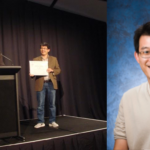
Zhibo Zhang, assistant professor of physics, has his mind in the clouds. Fortunately, Zhang is an atmospheric physicist focusing on the role clouds play in climate, so his eye on the sky has resulted in important research findings leading to his recognition as a rising star in his field.
The International Radiation Commission (IRC) presented Zhang with its Young Scientist Award at the quadrennial IRC symposium in Auckland, Australia, April 17–21. This prestigious recognition is given to only one scientist every four years who “has made recent noteworthy contributions to radiation studies and is regarded as having great potential to become a leading radiation scientist in the future.”
Zhang received his Ph.D. in atmospheric physics from Texas A&M University in 2008 and joined the Goddard Earth Sciences and Technology Center at UMBC in January 2009, before starting at UMBC’s Joint Center for Earth Systems Technology in 2011. After just a short time at UMBC, he took on the role of graduate program director for atmospheric physics and was promoted to associate professor. In 2013 he received a NASA New Investigator Program Award in Earth Science.
Zhang’s work focuses on determining how clouds contribute to climate change in the long term, which is a deceptively difficult question to answer. It requires understanding the “microphysics” of nanoscale cloud droplets as well as the movements of large blocks of clouds tens of thousands of kilometers across. Zhang and his team analyze data from several Earth-orbiting satellites to validate and tweak innovative numerical models they develop to predict the role of clouds in climate.
For example, clouds cover approximately 60 percent of Earth’s surface at any one time and shield the planet from the sun’s radiation, cooling the Earth. However, smoke from fires or other air pollutants can gather above clouds, absorb heat, and prevent it from escaping the atmosphere, contributing to warming. Zhang’s lab examines data from areas where this occurs and develops models for how this phenomenon affects climate. By using many kinds of data, “we begin to put the pieces of the puzzle together,” Zhang says.
“Zhibo is a very talented young faculty member whom the department is proud to have as a member,” says physics department chair Michael Hayden. Zhang introduced curriculum revisions for the atmospheric physics program that were adopted by the faculty, and “his new vision will guide us through the next decade and ensure that the program will continue to grow and prosper,” Hayden says.
Due to its international stature, the benefits of Zhang’s achievement will extend beyond the physics department. “The award will increase my visibility and the visibility of UMBC,” says Zhang, who shares that the environment at UMBC has been perfect for him to pursue his research. “People really support you and encourage you,” he says. He’s delighted to have “a young and energetic team” working in his lab, all of them with their heads in the clouds.
]]>
Zhibo Zhang, assistant professor of physics, has his mind in the clouds. Fortunately, Zhang is an atmospheric physicist focusing on the role clouds play in climate, so his eye on the sky has...
https://umbc.edu/stories/zhibo-zhang-wins-prestigious-international-radiation-commission-young-scientist-award/
https://my3.my.umbc.edu/api/v0/pixel/news/121174/guest@my.umbc.edu/3af550e0bb1b8e36883f5ef518b71e99/api/pixel
cnms
international
majoraward
physics
research
science-and-technology
UMBC News & Magazine
https://my3.my.umbc.edu/groups/umbc-news-magazine
https://assets1-my.umbc.edu/system/shared/avatars/groups/000/001/943/24435aa6207c452e7bc15cc74b42c7bb/xsmall.png?1748556657
https://assets1-my.umbc.edu/system/shared/avatars/groups/000/001/943/24435aa6207c452e7bc15cc74b42c7bb/original.png?1748556657
https://assets2-my.umbc.edu/system/shared/avatars/groups/000/001/943/24435aa6207c452e7bc15cc74b42c7bb/xxlarge.png?1748556657
https://assets2-my.umbc.edu/system/shared/avatars/groups/000/001/943/24435aa6207c452e7bc15cc74b42c7bb/xlarge.png?1748556657
https://assets3-my.umbc.edu/system/shared/avatars/groups/000/001/943/24435aa6207c452e7bc15cc74b42c7bb/large.png?1748556657
https://assets1-my.umbc.edu/system/shared/avatars/groups/000/001/943/24435aa6207c452e7bc15cc74b42c7bb/medium.png?1748556657
https://assets2-my.umbc.edu/system/shared/avatars/groups/000/001/943/24435aa6207c452e7bc15cc74b42c7bb/small.png?1748556657
https://assets1-my.umbc.edu/system/shared/avatars/groups/000/001/943/24435aa6207c452e7bc15cc74b42c7bb/xsmall.png?1748556657
https://assets2-my.umbc.edu/system/shared/avatars/groups/000/001/943/24435aa6207c452e7bc15cc74b42c7bb/xxsmall.png?1748556657
UMBC News & Magazine
0
0
false
Thu, 05 May 2016 15:58:07 -0400
 Emily Escobedo at 2016 NCAA finals / Tim Binning, The Swim Pictures
 Michael Summers with his students
 Historian Kate Brown
 UMBC’s 2016 Goldwater Scholars (l-r): Andreas Seas, Naomi Mburu, and Daniel Ocasio
 Alumna Shalonda Holt / Nicholas Griner, Howard County Public School System
 Helena Mentis demonstrates gestural tools.
 GPHI Director Jan Merka
 Guest explores PI2 during ribbon cutting ceremony.
 Eric Smallwood, assistant professor of visual arts, and Linda Dusman, professor of music, received an MII award for the Octava app.
 Recipients of UMBC Fellowships for Faculty Diversity (l-r): Keisha Allen, Nkiru Nnawulezi, and Mejdulene Shomali
 UMBC’s 50th anniversary fireworks display / Dan Bailey
