UMBC’s Jordan Troutman to continue algorithmic fairness research as Knight-Hennessy Scholar at Stanford
Jordan Troutman ’21, M29, computer science and mathematics, first discovered algorithmic fairness during a summer research program at Rutgers University after his first year at UMBC. The field focuses on how computer algorithms, such as those responsible for facial recognition or the content in our social media feeds, can foster fairness or unfairness. The effects include anything from attempting to identify someone who committed a crime to curating the content we see in ways that influence how we think about others.
“Because these algorithmic systems are being used to make a lot of life-changing decisions,” Troutman says, “now we have to make sure that the tools and technologies we’re developing have some type of guarantees or safeguards to make sure that they don’t have unintended consequences towards minority groups specifically, or just any unintended actions.”
When Troutman returned to UMBC from his summer at Rutgers, he sought out James Foulds, assistant professor of information systems. He’s researched these issues under Foulds’s mentorship for the past three years.
This fall, Troutman will take his research interests to Stanford University, where he’ll pursue a Ph.D. in computer science as UMBC’s first Knight-Hennessy Scholar. The international Knight-Hennessy Scholarship is open to students applying to graduate school at Stanford in any area of study. In addition to funding, it offers robust leadership and community-development training. Troutman was selected as exemplifying the scholarship’s core values: independence of thought, purposeful leadership, and civic mindedness.
Socially-minded scholarship
In the 2019 – 2020 academic year, Troutman represented the student perspective as a voting member of the Maryland Higher Education Commission (MHEC), which establishes policies for every college in the state. At UMBC, Troutman took on leadership roles in the Student Government Association (SGA), the National Society for Black Engineers (NSBE), and as a teaching assistant and tutor supporting fellow students. In 2020, he received another prestigious honor, the Barry Goldwater Scholarship.
 Jordan Troutman, left, and Dan Barnhart, former director of The Commons and student life at UMBC, who recommended Troutman apply for the MHEC position.
Troutman is a Meyerhoff Scholar and a member of the Honors College, and he’s one of two UMBC valedictorians for 2021. In addition to Rutgers, he’s conducted summer research at the University of California, Berkeley and in the Fairness, Accountability, Transparency, and Ethics (FATE) research group at Microsoft. Troutman has also been involved with UMBC’s Center for Democracy and Civic Life (CDCL), and he counts its director, David Hoffman, among his mentors.
“Jordan embodies the kind of creativity that transcends disciplinary boundaries, and has found dazzling ways to weave his social concerns into his scholarship,” Hoffman shares. “I’m confident he will thrive in the Knight-Hennessy program, and that we will have many more occasions to celebrate his civic contributions.”
Participating in leadership has also given Troutman the chance to get to know other leaders. His experience with MHEC demonstrated what true leadership looks like. “It’s really powerful to see how—when you are passionate about something, and you care about the people, and not the power or the position—you can do good work and effect good change.”
From intention to impact
With the Knight-Hennessy Scholarship, as well as a highly competitive Graduate Research Fellowship from the National Science Foundation, Troutman will have the freedom to pursue research of his choice at Stanford. He values the opportunity to be creative in his approach and thinks of his research as “computational social sciences”—interdisciplinary by definition. His computer science and math courses have prepared him for the work; so have courses in the liberal arts and his experiences with campus engagement.
Elective courses in philosophy “helped me understand broadly how to articulate these non-quantitative concepts,” such as fairness, Troutman says. A particular Honors College course about how the media uses faces and how we internalize what the faces represent stuck with him.
Social media algorithms “are everywhere. So if these algorithms are unfair in any way, then the way we’re consuming this media may not necessarily be representative of the world we live in,” Troutman says. “I think that’s a super important problem, and because I’ve taken these other classes, it’s given me a broader context of how important this problem is and has reaffirmed my interest in doing this kind of research.”
 Jordan Troutman, far left, attends a lab meeting in fall 2019 with James Foulds (right rear, green shirt) and his peers.
Troutman is looking forward to collaborating with the other Knight-Hennessy Scholars on some of these big ideas. He also appreciates the leadership training offered through the program, which he sees as being about “trying to figure out how to be a well-intentioned person, and then making really good work out of what your intentions are for the world.”
Supportive community
Troutman shares that several UMBC experiences were instrumental in helping him build his confidence and understand the powerful difference he can make.
Roles in SGA and participating in UMBC’s STRiVE student leadership retreat and Alternative Spring Break “helped me understand my own sense of agency and my ability to make an impact,” Troutman says. He realized that solving massive, intimidating problems often starts with a single person, and says, “Learning that has just made me believe that I literally could do anything.”
The Meyerhoff Scholars Program helped him internalize some of the same ideas. “Meyerhoff gave me this idea that you can really make a change in your life,” Troutman says. “You can be whoever you want to be. You just have to be active about it and to believe in yourself and use the support and community around you to get where you want to be.”
NSBE also played a role in Troutman’s growth. NSBE “helps students feel that they belong in science,” he says. “It’s helped to center me and to help me really understand what it means to build community. Now, I hope to go and help to foster more communities at these other places that I go in my life.”
And Foulds, his research mentor, “has given me really good insight, perspective, and guidance on how to do research, think about problems, and especially how to overcome a lot of different pitfalls that happen in research,” Troutman says.
 Jordan Troutman ’21
An ethical leader
All these programs, communities, and experiences are representative of the culture at UMBC, Troutman says. “You can really be yourself and be engaged and very intentional with people, and you can be as cool or kooky as you want—there’s a space for you at UMBC,” he says.
In the Knight-Hennessy application process, students submit a video addressed to their future Knight-Hennessy cohort. “Jordan’s video demonstrated how to do a gymnastics flip. Not the kind of thing you’d expect from a computer scientist—but it was a way to showcase his other interests and let his personality shine,” April Householder, director of undergraduate research and prestigious scholarships, observes. “Lately, UMBC has been winning very prestigious scholarships, and I think part of the success has to do with encouraging our students to be themselves throughout the process.”
“I think that’s the beauty of this school,” Troutman shares. “You can be whoever you want. And it’s not just something that you say to get people in here. It’s like, no, they’re actually backing it up with the things that they do. It’s really about the students.”
For Troutman, his research, civic engagement, and leadership are all about one thing: making positive social change.
“While Jordan was working in my lab, I was gratified to see his enthusiasm grow as he realized that his technical research could be a part of the efforts he was already making toward creating positive change in our society,” Foulds says. “Jordan is on a path toward becoming an ethical leader and a thought leader who can help steer the course of progress in AI technology in the right direction.”
Ultimately, Troutman says, “What I want to do is just help people see their ideas come true.”
Banner image: Jordan Troutman on UMBC’s Academic Row. All photos by Marlayna Demond ’11 for UMBC.
]]>
Jordan Troutman ’21, M29, computer science and mathematics, first discovered algorithmic fairness during a summer research program at Rutgers University after his first year at UMBC. The field...
https://umbc.edu/stories/umbcs-jordan-troutman-to-continue-algorithmic-fairness-research-as-knight-hennessy-scholar-at-stanford/
https://my3.my.umbc.edu/api/v0/pixel/news/119642/guest@my.umbc.edu/f102ef21857b9362360578f9db57e09b/api/pixel
civic
classof2021
cnms
coeit
community
csee
honorscollege
mathstat
meyerhoffscholars
page1
policy-and-society
science-and-technology
undergradresearch
UMBC News & Magazine
https://my3.my.umbc.edu/groups/umbc-news-magazine
https://assets1-my.umbc.edu/system/shared/avatars/groups/000/001/943/24435aa6207c452e7bc15cc74b42c7bb/xsmall.png?1748556657
https://assets1-my.umbc.edu/system/shared/avatars/groups/000/001/943/24435aa6207c452e7bc15cc74b42c7bb/original.png?1748556657
https://assets2-my.umbc.edu/system/shared/avatars/groups/000/001/943/24435aa6207c452e7bc15cc74b42c7bb/xxlarge.png?1748556657
https://assets2-my.umbc.edu/system/shared/avatars/groups/000/001/943/24435aa6207c452e7bc15cc74b42c7bb/xlarge.png?1748556657
https://assets3-my.umbc.edu/system/shared/avatars/groups/000/001/943/24435aa6207c452e7bc15cc74b42c7bb/large.png?1748556657
https://assets1-my.umbc.edu/system/shared/avatars/groups/000/001/943/24435aa6207c452e7bc15cc74b42c7bb/medium.png?1748556657
https://assets2-my.umbc.edu/system/shared/avatars/groups/000/001/943/24435aa6207c452e7bc15cc74b42c7bb/small.png?1748556657
https://assets1-my.umbc.edu/system/shared/avatars/groups/000/001/943/24435aa6207c452e7bc15cc74b42c7bb/xsmall.png?1748556657
https://assets2-my.umbc.edu/system/shared/avatars/groups/000/001/943/24435aa6207c452e7bc15cc74b42c7bb/xxsmall.png?1748556657
UMBC News & Magazine
0
0
false
Thu, 06 May 2021 15:29:49 -0400
SPARK IV: A New World?
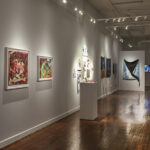
With galleries and exhibition spaces off limits because of the pandemic, it’s been a tough year for artists and art lovers alike. But now, UMBC artists are once again in the limelight at the annual SPARK pop-up gallery, a joint project with Towson University that can be enjoyed in person through June 26 at Maryland Art Place in downtown Baltimore. The exhibition, entitled SPARK IV: A New World?, is made possible through the sponsorship of PNC Bank, and expands on the light-based themes of past SPARK exhibitions to embrace the power of art to illuminate and inspire reflection and dialogue.
Information on visiting the gallery is available on UMBC’s Arts & Culture Calendar. A virtual opening reception for SPARK IV: A New World? will be held on Thursday, May 6 at 6 p.m., and will include a tour of the gallery. To attend this free event, please register in advance here.
-
 I’m Sorry by Monique Crabb, which the artist describes as “a soft and unstable monument to the unavoidable nature of loss and turmoil.”
-
 Occam’s Frame by Evan Tedlock.
SPARK IV presents the work of 24 UMBC and Towson University faculty and student artists or collaborative pairs. Through their artistic creations, the past year of the pandemic and longer timelines impacting our future are considered. After experiencing the chaos, upheaval, and uncertainty that dominated this past year, these artists help us see the world and consider how to cope, adapt, and persevere through whatever lies ahead.
“The act of discovery—delving into the idea, reflection, or space an artist creates with their work—is always the most inspiring aspect of curating,” remarks gallery curator Catherine Borg. ”That has been the case with the exhibition of SPARK, and the challenge as I considered more than 80 works from faculty and students from both UMBC and Towson.” As she selected the work to be displayed, five themes emerged that provided a structure to the exhibition: altered time, imagined places, future focus, climate horizon and equitable future.
Participating faculty and staff from UMBC include Evan Tedlock, Irene Chan, Kelley Bell, M.F.A. ’06, intermedia and digital arts (IMDA), and Melissa Penley Cormier, M.F.A. ’17, (IMDA), Lynn Cazabon, Samantha Sethi, Sarah G. Sharp, and Stephen Bradley. UMBC IMDA graduate students whose work is represented in the exhibition include Foster Reynolds-Santiago, Monique Crabb, Rahne Alexander, and Safiyah Cheatam. The art project of Kelley Bell and Melissa Penley Cormier, The Yonder Cabinet, in turn features artwork by UMBC’s Beth Yashnyk, Jim Doran, and Jenny O’Grady.
-
 I Am The End Of The Patriarchy And So Can You (center panel) by Rahne Alexander.
Of her work I Am The End Of The Patriarchy And So Can You, Rahne Alexander M.F.A. ’21, IMDA, remarks, “It’s a manifesto of sorts, comprised of catalyzing concepts and conclusions that have driven me as an artist, citizen, and woman. In most cases, a manifesto is written for the author first, and this is no exception. It’s an early 21st-century transfeminist statement of purpose, a letter of encouragement for my past self, and a travelogue of how I have arrived where I am today.”
-
 Women Looking/Camerawoman by Sarah G. Sharp.
Women Looking/Camerawoman by Sarah G. Sharp, assistant professor of visual arts, is part of a series of custom wallpaper designs based on images found in early underground feminist publications. “Among the discourse I expected to encounter when researching this material (abortion rights, the passage of the Equal Rights Amendment, etc.), I found many conversations about the revolutionary potential of the newly created component of cable television: public access television channels,” she shares. “Public access TV represents the first TV-based examples of what media theorists call ‘the many speaking to the many,’ and, in some ways, it was a precursor to today’s social media.”
-
 \I-Ching Cards/ by Irene Chan.
Irene Chan, associate professor of visual arts, created \I-Ching Cards/, an artist book—a set of interactive cards inspired by the I Ching or Book of Changes. As she describes her work, “The I-Ching, the Book of Changes is a 3000-year-old oracle Chinese divination tool that does not tell you what to do, but inspires you to answer your own questions—the activity is interactive. One is able to ‘read’ in infinite directions as it guides one through life.”
On May 14, May 28, and June 25 at 7 p.m., SPARK will present performances by Anna Kroll, M.F.A. ’23, IMDA, and Chloe Engel. Their work, entitled I Want To Be, takes place by telephone. In each performance, Kroll and Engel navigate a score in which they co-imagine events in a room. These are improvisational, spoken performances that have developed out of their collaborative practice of negotiating and refining scores to create imaginary realities. To attend the performance, audience members will call a phone number at a specific time, hear a welcome message, and then enter the “space.” A live captioned version will also be simultaneously available. Information on additional performances and events, including a video gallery, is forthcoming.
-
 Sueños de Iguana, by Foster Reynolds-Santiago, is a multimedia installation “where a family’s shared iguana dreams go to converse and create form. It is a place where I go to speak with my mother on the things that go unsaid about my transition, in a language I hope to create through texture and color.”
-
 The Yonder Cabinet by Kelley Bell and Melissa Penley Cormier, featuring artworks (L-R) by Beth Yashnyk, Bell, Penley Cormier, Jim Doran, and Jenny O’Grady.
Presenting an exhibition like SPARK IV: A New World? is an expensive undertaking, and for the fourth consecutive year PNC Bank has generously invested in the collaborative UMBC-TU project. “PNC has a legacy of investing in the arts, as we understand the economic, social, and civic impacts that a thriving arts and culture community have on our city,” says Laura Gamble, PNC regional president for Greater Maryland. “There are few better ways to support our community, at a time when it’s never been more necessary, than by supporting the arts, and specifically, Maryland Arts Place’s SPARK exhibition, which features the thought-provoking works of local students and faculty.”
The SPARK gallery at Maryland Art Place may be visited in person from 12 p.m. through 4 p.m., Tuesday through Saturday, through June 26. MAP is located at 218 West Saratoga Street between Park and Howard Streets in downtown Baltimore, with nearby on-street and garage parking. The exhibition can also be experienced virtually at sparkbaltimore.org.
Header image by Joseph Hyde.
]]>
With galleries and exhibition spaces off limits because of the pandemic, it’s been a tough year for artists and art lovers alike. But now, UMBC artists are once again in the limelight at the...
https://umbc.edu/stories/spark-iv-a-new-world/
https://my3.my.umbc.edu/api/v0/pixel/news/119643/guest@my.umbc.edu/06768ab94d6ce4a56c9b19efb0ecf77b/api/pixel
discovery
graduateschool
imda
visual-arts
UMBC News & Magazine
https://my3.my.umbc.edu/groups/umbc-news-magazine
https://assets1-my.umbc.edu/system/shared/avatars/groups/000/001/943/24435aa6207c452e7bc15cc74b42c7bb/xsmall.png?1748556657
https://assets1-my.umbc.edu/system/shared/avatars/groups/000/001/943/24435aa6207c452e7bc15cc74b42c7bb/original.png?1748556657
https://assets2-my.umbc.edu/system/shared/avatars/groups/000/001/943/24435aa6207c452e7bc15cc74b42c7bb/xxlarge.png?1748556657
https://assets2-my.umbc.edu/system/shared/avatars/groups/000/001/943/24435aa6207c452e7bc15cc74b42c7bb/xlarge.png?1748556657
https://assets3-my.umbc.edu/system/shared/avatars/groups/000/001/943/24435aa6207c452e7bc15cc74b42c7bb/large.png?1748556657
https://assets1-my.umbc.edu/system/shared/avatars/groups/000/001/943/24435aa6207c452e7bc15cc74b42c7bb/medium.png?1748556657
https://assets2-my.umbc.edu/system/shared/avatars/groups/000/001/943/24435aa6207c452e7bc15cc74b42c7bb/small.png?1748556657
https://assets1-my.umbc.edu/system/shared/avatars/groups/000/001/943/24435aa6207c452e7bc15cc74b42c7bb/xsmall.png?1748556657
https://assets2-my.umbc.edu/system/shared/avatars/groups/000/001/943/24435aa6207c452e7bc15cc74b42c7bb/xxsmall.png?1748556657
UMBC News & Magazine
0
0
false
Tue, 04 May 2021 23:37:35 -0400
UMBC education faculty and partners work to humanize K-12 distance learning

When schools had to shift to distance learning due to COVID-19, UMBC’s Keisha McIntosh Allen, assistant professor of language and literacy education, and Kindel Turner Nash, associate professor of education, witnessed their own children face an incredibly challenging new reality. Like many of their peers in Baltimore City Public Schools, they experienced an overwhelming sense of isolation and a disconnect with the learning process in this new virtual environment.
Everything had changed, the researchers note, yet schools were attempting to move forward without the time and space to address the technological, social-emotional, economic, and health challenges teachers and students were experiencing.
“It was hard to see our children who normally are excited and engaged become withdrawn and disengaged,” shares Allen. “It was frustrating to everyone on the research team to hear about how Kindel’s kids lost a sense of direction they had before because there was no plan for equitably translating face-to-face instruction to the virtual space during a global crisis.”
 Keisha McIntosh Allen. Photo courtesy of Allen.
Allen and Nash took action. They developed a 15-month research project, ”Teaching through Coronavirus: Toward Cultivating Urgent Humanizing Distance Learning (HDL) Pedagogies,” with collaborators Sakeena Everett, assistant professor of education at the University of Georgia; and Kyla Thomas, independent educational consultant. The project received over $150,000 from the U.S. Department of Education Governors Emergency Education Relief Fund.
Knowledge sharing
“We knew that there were other parents and educators having the same challenges,” explains Nash. “But we also knew that there were many teachers who were naturally doing this humanizing work. It was about gathering that knowledge, sharing it, and putting it to action.”
 Kindel Turner Nash. Photo by Marlayna Demond ’11 for UMBC.
The research project is designed as a professional development training for 100 Baltimore City Public School teachers. It seeks to help them create or extend humanizing practices in their current classrooms. The diverse group of teachers participating is interested in reclaiming their classrooms as centers of connectedness, emotional wellbeing, and learning based on a commitment to critical social justice-oriented teaching.
“Humanizing pedagogy is a daily practice of transformation,” explains Everett. “It creates the conditions for all students to achieve at their highest potential by learning about and using their myriad linguistic, cultural, and familiar resources.”
Rethinking a disconnected system
Similar to how Allen and Nash witnessed their own children’s isolation, the research team also found that the 100 teachers who signed up to participate were feeling disconnected and overwhelmingly alone. This was especially the case for teachers of color working in a system shaped by structural inequalities and racism. On top of this, the teachers’ own communities and their students’ communities were highly affected by COVID-19.
The pandemic exacerbated the existing health, economic, and educational inequalities caused by structural racism, the teachers found. Some students had to manage work, home responsibilities, or caring for family members. This was all in addition to participating in online class and completing schoolwork in a limited space. Often those responsibilities conflicted with strict school schedules, creating more learning and social opportunity gaps, especially for students of color.

Kyla Thomas.
Photo courtesy of Thomas.
Thomas shares that teachers may have been aware of these hardships but may not have known of how to best support their students and themselves. She believes this is the perfect time to create a different approach to distance learning, and to teaching more broadly.
At the center of humanizing pedagogy is freedom from oppression and agency, Thomas explains. “We need to ask ourselves, what are we learning from this, what can we build, what are we doing to help students connect more authentically in a learning environment?” she says. “The shift to distance learning may not be ideal, but it does offer an opportunity for change in how we teach and learn regardless of setting.”
Humanizing research
As teacher-educator-researchers, Allen, Nash, Everett, and Thomas were intentional in embodying humanizing pedagogies as they designed and implemented each phase of their virtual research project. The first phase of the project was anchored in creating collaborative spaces for teachers with the most experience in HDL pedagogies to share their knowledge so that other educators could learn from them.
“The team believes that by learning from teachers as they teach through COVID-19, they will move closer to ultimately disrupting educational inequities and reimagine a healthy, liberating, student-centered vision of teaching youth of color,” says Everett.

Sakeena Everett.
Photo courtesy of Everett.
The other project phases delved deep into a continuous cycle of learning, implementation, reflection, sharing, and listening.
The team wanted the professional training itself to mirror what a classroom would look like if HDL pedagogies were practiced. To do this they created small virtual pods of ten teachers. Each group included teachers from all grade levels and teaching experiences. Within each pod some teachers were new to humanizing pedagogy. Others had some familiarity or significant experience with HDL pedagogies. The advanced teachers, all but one of whom are teachers of color, co-facilitated the pods along with one of the researchers.
“We value the humanizing practices that are often embedded in the teaching practices of Black teachers,” explains Allen. “This is an opportunity for them to lead and share their knowledge, which is often overlooked by teacher evaluations that do not acknowledge these approaches to teaching.”
Opening space for agency
The researchers also wanted to value the teachers’ commitment to the project. The professional development met all requirements for Baltimore City Public School teachers to earn six Achievement Units. These units accrue over a teacher’s career and create opportunities for them to advance along career pathways.
From beginning to end, the researchers share, they’ve designed their project to value teachers’ knowledge. Their goal is to demonstrate how teachers working together can create research-based solutions informed by teaching experience to better serve their students. Every step was a joint effort.
“It starts with how we as educators and researchers interact with each other and open space for agency,” says Nash. Seeing how teachers then express their agency to make changes in their classrooms is powerful to watch, she shares. “One of the teachers I worked with asked her principal to change her schedule because the current schedule didn’t meet the needs of her students. The principal changed it.”
Maximizing learning
Another benefit of the HDL professional development program is creating a vast peer support network for teachers in Baltimore City. They exchange ideas, expertise, and listen to each other’s challenges. They know that they are not alone even if they could not be together physically.
Pat Michael ‘20,global studies and mathematics, and M.A.T. ’21, mathematics education, is a project participant whose perspective on distance learning and online teaching tools changed through engaging with other teachers. Michael is one of seven UMBC students in the Sherman STEM Teacher Scholars Program to receive the training. Before this training, Michael felt the virtual environment would limit their ability to have engaging lessons and connect with students. HDL has helped them to think creatively about how they can teach online in a culturally relevant way.
“At the end of the day, technology serves as a tool. We can use it to recognize students’ full humanity,” says Michael.
Ultimately, HDL “is not a scripted curriculum. It is a lifestyle where we assume the best of our students,” shares Everett. “We are trying to find opportunities to maximize their potential and learning. It is a daily practice of freedom.”
Banner image: Person working on a laptop. Stock image. Mobile technology Photo by WOCinTechChat, CC BY 2.0
]]>
When schools had to shift to distance learning due to COVID-19, UMBC’s Keisha McIntosh Allen, assistant professor of language and literacy education, and Kindel Turner Nash, associate professor of...
https://umbc.edu/stories/umbc-education-faculty-and-partners-work-to-humanize-k-12-distance-learning/
https://my3.my.umbc.edu/api/v0/pixel/news/119644/guest@my.umbc.edu/7868b20c8afb92b76c6191cf1dd37f34/api/pixel
cahss
cahssresearch
diversityandinclusion
education
policy-and-society
UMBC News & Magazine
https://my3.my.umbc.edu/groups/umbc-news-magazine
https://assets1-my.umbc.edu/system/shared/avatars/groups/000/001/943/24435aa6207c452e7bc15cc74b42c7bb/xsmall.png?1748556657
https://assets1-my.umbc.edu/system/shared/avatars/groups/000/001/943/24435aa6207c452e7bc15cc74b42c7bb/original.png?1748556657
https://assets2-my.umbc.edu/system/shared/avatars/groups/000/001/943/24435aa6207c452e7bc15cc74b42c7bb/xxlarge.png?1748556657
https://assets2-my.umbc.edu/system/shared/avatars/groups/000/001/943/24435aa6207c452e7bc15cc74b42c7bb/xlarge.png?1748556657
https://assets3-my.umbc.edu/system/shared/avatars/groups/000/001/943/24435aa6207c452e7bc15cc74b42c7bb/large.png?1748556657
https://assets1-my.umbc.edu/system/shared/avatars/groups/000/001/943/24435aa6207c452e7bc15cc74b42c7bb/medium.png?1748556657
https://assets2-my.umbc.edu/system/shared/avatars/groups/000/001/943/24435aa6207c452e7bc15cc74b42c7bb/small.png?1748556657
https://assets1-my.umbc.edu/system/shared/avatars/groups/000/001/943/24435aa6207c452e7bc15cc74b42c7bb/xsmall.png?1748556657
https://assets2-my.umbc.edu/system/shared/avatars/groups/000/001/943/24435aa6207c452e7bc15cc74b42c7bb/xxsmall.png?1748556657
UMBC News & Magazine
0
0
false
Fri, 30 Apr 2021 17:02:48 -0400
Times Higher Ed names UMBC top-10 U.S. leader and top-200 global leader in social and economic impact

UMBC has recently been named a global leader in two prominent international university rankings—one focused on economic and social impact and the other on research influence, academic distinction, and alumni leadership. Times Higher Education just named UMBC one of the world’s top 100 universities in efforts toward several sustainable development priorities. And today, the Center for World University Rankings (CWUR) included UMBC in the top 3.7% of its 2021-22 list.
“These impressive global rankings confirm something Marylanders have known all along, which is that UMBC is a world-class university,” says David Di Maria, associate vice provost for international education. “UMBC not only benefits the state of Maryland, but also benefits the world by working to address some of the most pressing challenges facing our planet.”
Advancing equity and sustainability
The Times Higher Ed Impact Rankings assess universities against the United Nations’ Sustainable Development Goals—17 global goals to move toward a better and more sustainable future. UMBC ranks among the top 200 universities overall and is one of the world’s top 100 universities in the areas of eliminating poverty (#63) and hunger (#91), improving gender equity (#46), improving clean water access and sanitation (#98), reducing inequalities in education (#55), supporting sustainable cities and communities (#83), responsible consumption and production (#23), and supporting land-based (#38) and aquatic (#15) ecosystems.
UMBC is participating in international conversations about how higher education can support sustainable development through education, research, and service. Prior to the COVID-19 pandemic, Provost Philip Rous attended a meeting with leaders of other public research universities and senior officials of the United Nations in New York City to discuss this topic. This is just one piece of UMBC’s international partnership work, which also includes collaborations in more than 50 countries.
 Prior to the COVID-19 pandemic, Provost Philip Rous, on left side of table at the back, attended a meeting with leaders of other public research universities and senior officials of the United Nations. Photo by Jonas Haertle at the United Nations Institute for Training and Research.
Looking specifically at U.S. institutions committed to this work, UMBC ranks 10th in the Times Higher Ed Impact Ranking. Nationally, UMBC ranks #4 in gender equity, #5 in supporting decent work and economic growth, and #5 in reducing inequalities in education. In environmental measures, UMBC ranks #2 among U.S. institutions for responsible consumption and production, #3 for supporting aquatic ecosystems, and #5 for supporting land-based ecosystems.
Faculty and alumni leadership
The Center for World University Rankings include nearly 20,000 universities around the world, listed based on their academic performance. UMBC landed at 727 in the world, in the top 3.7% of higher education institutions rankings worldwide. In the U.S., UMBC was ranked at 175.
The ranking is based on a combination of four factors: quality of education, alumni employment, quality of faculty, and research performance. CWUR looks at metrics like alumni who have earned major academic distinctions and held top executive positions, and faculty research appearing in top-tier and highly influential journals.
“I am extremely proud of our UMBC community for earning this global recognition,” says Di Maria.
Banner image: Kevin Omland, rear, and his students birdwatch on campus. The Omland Lab focuses on avian evolution, behavior, and conservation. They study the critically endangered Bahama Oriole in close collaboration with the Bahamas National Trust. Photo by Marlayna Demond ’11 for UMBC.
]]>
UMBC has recently been named a global leader in two prominent international university rankings—one focused on economic and social impact and the other on research influence, academic distinction,...
https://umbc.edu/stories/times-higher-ed-names-umbc-top-10-u-s-leader-and-top-200-global-leader-in-social-and-economic-impact/
https://my3.my.umbc.edu/api/v0/pixel/news/119645/guest@my.umbc.edu/56af8169be7f13fcb4962cea51a394ef/api/pixel
community
international
rankings
UMBC News & Magazine
https://my3.my.umbc.edu/groups/umbc-news-magazine
https://assets1-my.umbc.edu/system/shared/avatars/groups/000/001/943/24435aa6207c452e7bc15cc74b42c7bb/xsmall.png?1748556657
https://assets1-my.umbc.edu/system/shared/avatars/groups/000/001/943/24435aa6207c452e7bc15cc74b42c7bb/original.png?1748556657
https://assets2-my.umbc.edu/system/shared/avatars/groups/000/001/943/24435aa6207c452e7bc15cc74b42c7bb/xxlarge.png?1748556657
https://assets2-my.umbc.edu/system/shared/avatars/groups/000/001/943/24435aa6207c452e7bc15cc74b42c7bb/xlarge.png?1748556657
https://assets3-my.umbc.edu/system/shared/avatars/groups/000/001/943/24435aa6207c452e7bc15cc74b42c7bb/large.png?1748556657
https://assets1-my.umbc.edu/system/shared/avatars/groups/000/001/943/24435aa6207c452e7bc15cc74b42c7bb/medium.png?1748556657
https://assets2-my.umbc.edu/system/shared/avatars/groups/000/001/943/24435aa6207c452e7bc15cc74b42c7bb/small.png?1748556657
https://assets1-my.umbc.edu/system/shared/avatars/groups/000/001/943/24435aa6207c452e7bc15cc74b42c7bb/xsmall.png?1748556657
https://assets2-my.umbc.edu/system/shared/avatars/groups/000/001/943/24435aa6207c452e7bc15cc74b42c7bb/xxsmall.png?1748556657
UMBC News & Magazine
0
0
false
Mon, 26 Apr 2021 18:19:29 -0400
Remembering Dr. Thomas “Tom” Roth
We are deeply saddened to share that Dr. Thomas “Tom” Roth passed away on Sunday, April 18, at the age of 89. Tom devoted his career to UMBC students for over 25 years, first as a biological sciences professor, and later as Associate Vice President for Academic Affairs, before retiring in 1998 and transitioning to the role of emeritus professor.
Tom joined the UMBC community in 1972 and made significant contributions to building the university from the ground up. His creative approach to teaching cell biology and dedicated mentorship touched the lives of countless students and faculty members.
According to biological sciences chair, Phil Farabaugh, “He was a great colleague and a passionate teacher. He influenced generations of UMBC biology graduates and produced some terrific Ph.D. scientists as well.”
His most recognized research contribution was identifying coated pits as involved in receptor-mediated endocytosis during his doctoral work with Keith Porter, who later became chair of the biological sciences department and for whom the Keith Porter Imaging Facility is named. Tom’s pioneering doctoral work will ensure his name is known long into the future.
As one of the early biological sciences faculty members at UMBC, Tom helped build the department into a collegial community that persists today.
“Tom contributed significantly to the foundation of academic excellence at UMBC. He was brilliant, kind, and dignified,” President Hrabowski says. “Most important, he was always authentic in his interactions with both colleagues and students.” He will truly be missed.
Service arrangements will be made at a later time. His obituary can be read here. In lieu of flowers, please consider donating to the Candlelight Concert Society (where Tom was very active, serving as a past board member and sponsoring various events), or a charity of your choice.
]]>
We are deeply saddened to share that Dr. Thomas “Tom” Roth passed away on Sunday, April 18, at the age of 89. Tom devoted his career to UMBC students for over 25 years, first as a biological...
https://umbc.edu/stories/remembering-dr-thomas-tom-roth/
https://my3.my.umbc.edu/api/v0/pixel/news/119646/guest@my.umbc.edu/013f70d4b658d3eebd18e5951ce69686/api/pixel
in-memorium
rss
UMBC News & Magazine
https://my3.my.umbc.edu/groups/umbc-news-magazine
https://assets1-my.umbc.edu/system/shared/avatars/groups/000/001/943/24435aa6207c452e7bc15cc74b42c7bb/xsmall.png?1748556657
https://assets1-my.umbc.edu/system/shared/avatars/groups/000/001/943/24435aa6207c452e7bc15cc74b42c7bb/original.png?1748556657
https://assets2-my.umbc.edu/system/shared/avatars/groups/000/001/943/24435aa6207c452e7bc15cc74b42c7bb/xxlarge.png?1748556657
https://assets2-my.umbc.edu/system/shared/avatars/groups/000/001/943/24435aa6207c452e7bc15cc74b42c7bb/xlarge.png?1748556657
https://assets3-my.umbc.edu/system/shared/avatars/groups/000/001/943/24435aa6207c452e7bc15cc74b42c7bb/large.png?1748556657
https://assets1-my.umbc.edu/system/shared/avatars/groups/000/001/943/24435aa6207c452e7bc15cc74b42c7bb/medium.png?1748556657
https://assets2-my.umbc.edu/system/shared/avatars/groups/000/001/943/24435aa6207c452e7bc15cc74b42c7bb/small.png?1748556657
https://assets1-my.umbc.edu/system/shared/avatars/groups/000/001/943/24435aa6207c452e7bc15cc74b42c7bb/xsmall.png?1748556657
https://assets2-my.umbc.edu/system/shared/avatars/groups/000/001/943/24435aa6207c452e7bc15cc74b42c7bb/xxsmall.png?1748556657
UMBC News & Magazine
0
0
false
Fri, 23 Apr 2021 20:48:55 -0400
Movie Madness: Film’s Big Dance
March in the United States is reserved for college basketball. Fans don their team’s colors as they root for them in the NCAA Division I basketball tournaments. For those without a team close to heart, they cheered as fifteenth seed Oral Roberts University beat powerhouse Ohio State University in the men’s tournament.
However, Dustin Fisher, ’98, visual and performing arts, was not only preoccupied with underdog basketball wins. While cheering on Villanova, Fisher rooted for The Night Before Christmas to take down Hamilton and for Inside Out to lose to Stand by Me. While watching March Madness, he took to his Movie Madness Facebook page to debate with fellow group members about whether Hamilton should even be considered a movie. Fisher’s March Madness is not about finding this year’s best basketball team; it’s about finding the best movie of all-time.
The Origin Story
Movie Madness is rooted in the early days of the internet, says Fisher, who founded the group based on an email column from 1998 and a blog he kept in 2003. Fisher would write about two movies he would watch back-to-back, comparing them and determining the best one. This led to his idea of pitting them against one another in an NCAA-style bracket. As former UMBC intramural sports assistant director, Fisher was always involved in athletics and felt it was natural to combine his passions for sports and movies through Movie Madness.
In 2013, 19 of Fisher’s friends filled out his first Movie Madness bracket on Facebook. Today, the Movie Madness community is over 2,000 strong, bringing UMBC and non-Retrievers together over a common passion.
The NCAA of Movies
Like the NCAA’s different conferences (most college sports fanatics are familiar with the Big Ten, the Atlantic Coast Conference, the Big Twelve, and the Southeastern Conference), Movie Madness uses genres as its different conference tournaments. While genres like action, horror, and romance are staples of Movie Madness, Fisher and other committee members add genres as the film industry becomes more diverse.
“Eight years ago, there were no conferences for LGBTQ and Civil Rights movies. These are things that I’ve seen the need for and have added,” says Fisher. “As the world grows, the group grows with it.”
Movies competing for the conference title are nominated by Movie Madness group members. As with the selection of the 68 teams for the NCAA tournament, the Movie Madness bracket features the winners of the 32 conferences and the next 34 most competitive movies determined by the group’s committee. This year’s tournament features movies like Thor: Ragnarok, Get Out, and Spider-Man: Into the Spider-verse, as well as recurring competitors like Jaws and Alien.
 The 2021 Movie Madness VII bracket with
 The Lord of the Rings: The Fellowship of the Ring
named this year’s winner. Screenshot provided by Fisher.
To ensure that the bracket and conversation change from year to year, any movies that make it to the Final Four are retired. “Otherwise Empire Strikes Back will play Star Wars: A New Hope in every single tournament, and it would be very boring,” explains Fisher.
While all movies are taken into consideration, Fisher acknowledges the group’s slight bias towards superhero movies, recent movies, and movies from the 80s and 90s.
“Many people seem to vote for movies that they’ve seen in the last couple years. This is why I figure Spider-Man: Into the Spider-verse, Hamilton, Hidden Figures, and Mad Max: Fury Road were the number one seeds in the tournament this year,” says Fisher. “But there’s also the ‘Oh my God, I remember this from my childhood!’ feeling that gives The Goonies and Field of Dreams probably more popularity than they deserve.”
Building Friendships One Debate at a Time
Conversation is essential to Movie Madness. For Movie Madness committee member Corey Johns ’11, American studies, media and communications, English, talking about movies in the group is a way to destress from his workday.
“It’s a tremendous way to just have fun online and to talk about things we like. We like movies, and this is a great way to just enjoy another aspect of them,” says Johns.
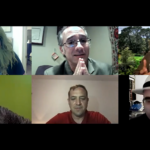
 The Movie Madness Board (from left to right and top to bottom) of Brett McKenzie, Fisher, Greg Stryker, Chris Mondichak, Justin West, and Johns wore costumes in one of their filmed meetings. Screenshot provided by Fisher.
Johns explains that Movie Madness, at least the active members of it, created such a tight-knit community that it has inside jokes. Johns stated that The Goonies is a running joke in the group as the most divisive movie. UMBC community and Movie Madness members could not help but use memes from UMBC’s win against the University of Virginia in 2018 after sixteenth seed Clue beat number one seed John Wick in one year’s tournament.
“We can immediately identify who the UMBC crowd is because we’re all tied together,” says Johns.
While the group is public to all and many active members are not affiliated with UMBC in any way, Johns and Fisher have met many UMBC alumni from different eras of UMBC through the group. The group is how Johns and Fisher met and how the pair met Movie Madness committee member Brett Mckenzie ’04, English.
“[Fisher and I] never knew each other at UMBC, but we throw out a lot of UMBC jokes that bring us together,” explains Johns. “We share the UMBC bond.”
“If I listed off my top 10 friends, Corey’s definitely on the list. We’ve spent so much time together. We’ve gotten to know each other so well,” says Fisher. “The group has definitely fostered some friendships that I would not have otherwise made.”
Beyond a Bracket
Fisher adds that, while the group started as a game, it has grown into a community of movie lovers spanning across generations of UMBC alumni and non-UMBC community members. As more people joined, Fisher, Johns, Mckenzie, and other committee members created ways to discuss movies on the page asides from the bracket to keep the community active.
“It’s very hard finding creative ways to spark a conversation,” said Fisher, but they still managed to create some buzz. Whether it be their spin on the game “You Don’t Know Jack” or videos debating who would win in a fight between characters like Thor from the Marvel series or Jack-Jack from The Incredibles, Fisher and Johns said that people engaged with the new content.
In one video debate, Johns did 15 costume changes in three minutes to argue that the Genie from Disney’s Aladdin would win. In another, Mckenzie wore a Captain Marvel costume to prove that she was the best superhero.
“[Those videos] really exploded our growth this year,” says Johns. “There was so much more activity. Instead of just the poll and voting, which is fun, but now you can have a conversation.”
As with most online groups, Movie Madness experienced growing pains as its membership increased. With more people outside his and his friends’ circles joining the group, Fisher had to assign admins to moderate conversations and prevent discussions from getting out of hand. Despite some struggles, Fisher and Johns said they are excited for the future of Movie Madness. While Fisher does not actively promote it on Facebook, he is happy to see new members.
“If people find this group, awesome,” said Fisher. “We’ll happily welcome you with open arms.” Just be prepared to have strong opinions about The Goonies.
]]>
March in the United States is reserved for college basketball. Fans don their team’s colors as they root for them in the NCAA Division I basketball tournaments. For those without a team close to...
https://umbc.edu/stories/movie-madness-films-big-dance/
https://my3.my.umbc.edu/api/v0/pixel/news/119647/guest@my.umbc.edu/67755f85a8d652c55eab52ffc591d668/api/pixel
alumni
american-studies
english
film
mcs
visual-and-performing-arts
UMBC News & Magazine
https://my3.my.umbc.edu/groups/umbc-news-magazine
https://assets1-my.umbc.edu/system/shared/avatars/groups/000/001/943/24435aa6207c452e7bc15cc74b42c7bb/xsmall.png?1748556657
https://assets1-my.umbc.edu/system/shared/avatars/groups/000/001/943/24435aa6207c452e7bc15cc74b42c7bb/original.png?1748556657
https://assets2-my.umbc.edu/system/shared/avatars/groups/000/001/943/24435aa6207c452e7bc15cc74b42c7bb/xxlarge.png?1748556657
https://assets2-my.umbc.edu/system/shared/avatars/groups/000/001/943/24435aa6207c452e7bc15cc74b42c7bb/xlarge.png?1748556657
https://assets3-my.umbc.edu/system/shared/avatars/groups/000/001/943/24435aa6207c452e7bc15cc74b42c7bb/large.png?1748556657
https://assets1-my.umbc.edu/system/shared/avatars/groups/000/001/943/24435aa6207c452e7bc15cc74b42c7bb/medium.png?1748556657
https://assets2-my.umbc.edu/system/shared/avatars/groups/000/001/943/24435aa6207c452e7bc15cc74b42c7bb/small.png?1748556657
https://assets1-my.umbc.edu/system/shared/avatars/groups/000/001/943/24435aa6207c452e7bc15cc74b42c7bb/xsmall.png?1748556657
https://assets2-my.umbc.edu/system/shared/avatars/groups/000/001/943/24435aa6207c452e7bc15cc74b42c7bb/xxsmall.png?1748556657
UMBC News & Magazine
0
0
false
Fri, 23 Apr 2021 19:23:12 -0400
Losing Winter

Losing Winter, a new exhibition opening in mid-July at the Maryland Center for History and Culture (MCHC) in Baltimore, examines changes in winter weather patterns through photographs, video, and personal memory.
The brainchild of Lynn Cazabon, professor of art and director of CIRCA, and co-curated for MCHC by UMBC history alumnus Joe Tropea ’06, history and M.A. ’08, historical studies, the exhibit includes images as varied as a news report by a young Oprah Winfrey, “Snowmageddon” in 2010, icy conditions during the Great Fire of Baltimore in 1904, and the 1899 blizzard.
Although the exhibition doesn’t directly address climate change, it’s certainly a subtext, said Cazabon, whose interdisciplinary work has often centered on the intersection of environmental and social issues.
“Things are changing,” she said. “What are we doing about it?”
 Untitled. Winter Survival Class, Ice Rescue. Tim Ford (?-?) 1986. Gelatin silver print, 10 x 8 inch. Tim Ford photographs, the Photography Collections, University of Maryland, Baltimore County. UARC2015-07-01-0091
Winter Memories
Losing Winter was sparked by Cazabon’s own memory of freezing as she ice skated at age 14 in Michigan where she grew up. “That lake, in fact, doesn’t reliably freeze anymore,” she added. The idea percolated further in 2014 while Cazabon was making a film about women who had moved to the Yukon.
Talking about the weather used to be the quintessential conversation starter, she noted. “Now it’s fraught with emotion and worry. The weather is not an innocent topic anymore.”
“It forces us to think about the possibility of climate change. Why is our climate changing?” said Tropea, curator of films and photographs at MCHC.
The MCHC show features Maryland memories while a concurrent mounting of the exhibition at VisArts in Rockville will pair recorded reminiscences by area senior citizens with children’s artwork inspired by those memories. The VisArts exhibition opens in May.
At MCHC, home movies and weather reports from the 1970s, ‘80s and ‘90s will be on display, including a report from Oprah Winfrey, then on the WJZ news staff, interviewing ice skaters at the old Memorial Stadium.
“It’s an experience that takes you through the decades,” Tropea said.
 Snow on Palm Sunday. Park Avenue. A. Aubrey Bodine (1906-1970). March 29, 1942. 5 x 4 inch acetate negative. A. Aubrey Bodine Photo Collection. Baltimore City Life Museum Collection. Maryland Center for History and Culture, B1548-2.
Cazabon said she discovered “little moments of joy” along the way, such as a woman in her 80s recalling street skating in her boots, Baltimore Sun photographer A. Aubrey Bodine’s historic photos of Groundhog Day ceremonies, and old weather forecasts.
One of Tropea’s favorite pieces is 1928 industrial footage taken at the Holtwood Dam over the Susquehanna River. Ice floes rushing toward the bay caused extensive damage near the shoreline before the dam was built, Tropea said. The film, which will be projected on a large wall, depicts ice floes going over the dam and breaking apart as they fall.
“Just watching it makes me feel cold,” Tropea said.
For the MCHC show, Cazabon and Tropea delved into the archives at MCHC as well as in the Special Collections Department of the Albin O. Kuhn Library with the help of Lindsey Loeper ’04, American studies, reference and instruction archivist.
Since Covid-19 restrictions have closed the library to researchers, Loeper collected 35 photos to show the professor and Tropea via video conferencing.
“There were things I’ve never seen before,” she said, noting that the collection has millions of pieces. Among the items she shared were glass negatives and works by well-known photographers such as Marion E. Warren. The oldest photo featured children throwing snowballs in 1914.
 Ice covered ruins of Anderson & Ireland Hardware. Unidentified photographer, February 8, 1904 or after. Photo print, 8.5 x 7 inches. Subject Vertical File. MCHC.
Evolving Exhibit
Cazabon mounted her original Losing Winter exhibition at the National Museum of Contemporary Art in Bucharest, Romania, in 2018. It featured audio memories of past Romanian winters, along with melting ice sculptures by a local artist.
As part of the Losing Winter experience, Cazabon is also working with UMBC’s Imaging Research Center on an augmented reality app to display and allow people to experience the winter memories of others. Cazabon received a 2020-21 Saul Zaentz Innovation Fund grant to produce the app. The exhibition at MCHC will include a display of the app playing memories collected from people in Maryland. Cazabon has been working with MCHC Community Engagement Manager Martha Oster-Beal to host virtual workshops during which memories are shared and recorded.
 Marty Bass WJZ, circa 1978
The yearlong exhibition will be housed on the second floor of MCHC, in gallery space across from the H. Furlong Baldwin Library. Visiting at the hottest time of year, when the exhibit launches, “you might be dreaming of winter,” Cazabon said.
Cazabon said the project keeps evolving. The modular format of her project also makes it adaptable. She invites members of the UMBC community to contact her to participate. She’s open to a variety of memories and opinions.
“The project is designed to evolve with each new site,” she said, adding, “I would like it to be a collection that includes people from around the world.”
— Mary K. Tilghman ’79
 “Baltimore Hucksters,” Roland Freeman (1936- ), 1970. Gelatin silver print, 14 x 11 inch. Roland Freeman photographs, Special Collections, University of Maryland, Baltimore County, P79-42-004.
* * * * * *
MCHC will host participatory virtual workshops for residents to record their memories on April 29 and May 27. Go towww.mdhistory.org/events for details and registration.
For more information on how to participate in the project, visit https://www.losingwinter.net.
* * * *
Header image: Blizzard of 1922, Saturday afternoon. Unidentified photographer, January 28, 1922. Photo print, 10.25 x 13.5 inches. Municipal Museum Collection. Maryland Center for History and Culture, MC1909.
]]>
Losing Winter, a new exhibition opening in mid-July at the Maryland Center for History and Culture (MCHC) in Baltimore, examines changes in winter weather patterns through photographs, video, and...
https://umbc.edu/stories/losing-winter/
https://my3.my.umbc.edu/api/v0/pixel/news/119648/guest@my.umbc.edu/d87048c862e8287538fd7d76a7b58d65/api/pixel
circa
discovery
graduateschool
history
professorsnottomiss
visual-arts
UMBC News & Magazine
https://my3.my.umbc.edu/groups/umbc-news-magazine
https://assets1-my.umbc.edu/system/shared/avatars/groups/000/001/943/24435aa6207c452e7bc15cc74b42c7bb/xsmall.png?1748556657
https://assets1-my.umbc.edu/system/shared/avatars/groups/000/001/943/24435aa6207c452e7bc15cc74b42c7bb/original.png?1748556657
https://assets2-my.umbc.edu/system/shared/avatars/groups/000/001/943/24435aa6207c452e7bc15cc74b42c7bb/xxlarge.png?1748556657
https://assets2-my.umbc.edu/system/shared/avatars/groups/000/001/943/24435aa6207c452e7bc15cc74b42c7bb/xlarge.png?1748556657
https://assets3-my.umbc.edu/system/shared/avatars/groups/000/001/943/24435aa6207c452e7bc15cc74b42c7bb/large.png?1748556657
https://assets1-my.umbc.edu/system/shared/avatars/groups/000/001/943/24435aa6207c452e7bc15cc74b42c7bb/medium.png?1748556657
https://assets2-my.umbc.edu/system/shared/avatars/groups/000/001/943/24435aa6207c452e7bc15cc74b42c7bb/small.png?1748556657
https://assets1-my.umbc.edu/system/shared/avatars/groups/000/001/943/24435aa6207c452e7bc15cc74b42c7bb/xsmall.png?1748556657
https://assets2-my.umbc.edu/system/shared/avatars/groups/000/001/943/24435aa6207c452e7bc15cc74b42c7bb/xxsmall.png?1748556657
UMBC News & Magazine
0
0
false
Fri, 23 Apr 2021 16:18:31 -0400
UMBC’s Anthony Johnson, pulse laser innovator, elected a member of the American Academy of Arts and Sciences

Anthony Johnson, professor of physics and computer science and electrical engineering, and director of UMBC’s Center for Advanced Studies in Photonics Research (CASPR), has received the prestigious honor of election to the American Academy of Arts and Sciences.
The Academy, founded during the American Revolution, “honors excellence and convenes leaders from every field of human endeavor to examine new ideas, address issues of importance to the nation and the world, and”—in the words of its original founders—“work together ‘to cultivate every art and science which may tend to advance the interest, honor, dignity, and happiness of a free, independent, and virtuous people.’”
Being elected as a member is one of the highest honors a scholar can receive. The Academy has elected approximately 13,500 members since its founding in 1780.
The Optical Society also recently recognized Johnson’s more than 40-year career in photonics and his commitment to mentorship with the Stephen D. Fantone Distinguished Service Award.

Anthony Johnson. Photo courtesy Anthony Johnson.
High-impact research
Johnson joined the UMBC faculty in 2003 after launching his career at Bell Labs and then spending eight years at the New Jersey Institute of Technology. In his research, he works on creative applications for ultrashort pulse lasers. These have included shrinking cancerous tumors, optimizing long-distance communications, preventing viruses in seafood from causing food-borne illness, and developing new nanoscale materials.
Mentoring emerging researchers has also been a key priority throughout Johnson’s life and career, and he is well known for his dedication to students and colleagues. “Anthony understands the role of nurturing students, helping them to find their inner spring and to fulfill their potential and their own personal dreams,” says long-time colleague and friend Stephen Fantone.
Commitment to the next generation
At the same time that Johnson received the Optical Society recognition, he was also named to the Committee on Diversity and Inclusion on the Technical Advisory Board of the Institute for Electrical and Electronics Engineers (IEEE). Having benefited as an undergraduate from an internship focused on opportunities for people from underrepresented groups in physics, Johnson has always prioritized diversifying his field.
“There’s still a lot to be done in our professional societies to build up and attract both women and minorities,” Johnson told UMBC News for a story on the Optical Society award. “We still have work to do to expand the opportunities to a broader set of people and bring in new ideas.”
President Freeman Hrabowski is the only other person at UMBC who has been elected to the American Academy of Arts and Sciences.
“Anthony Johnson is a true pioneer, and he has had a profound impact on the world through his research and teaching,” Hrabowski says. “What’s especially significant is his deep commitment to guiding, supporting, and inspiring the next generation of scientists. I can think of no one more deserving of this honor.”
Banner image: Anthony Johnson, right, with students in his laboratory. Photo by UMBC.
]]>
Anthony Johnson, professor of physics and computer science and electrical engineering, and director of UMBC’s Center for Advanced Studies in Photonics Research (CASPR), has received the...
https://umbc.edu/stories/umbcs-anthony-johnson-pulse-laser-innovator-elected-a-member-of-the-american-academy-of-arts-and-sciences/
https://my3.my.umbc.edu/api/v0/pixel/news/119649/guest@my.umbc.edu/c3b591c504a436e6fc306b6ac52e8260/api/pixel
cnms
coeit
community
csee
majoraward
page1
physics
science-and-technology
UMBC News & Magazine
https://my3.my.umbc.edu/groups/umbc-news-magazine
https://assets1-my.umbc.edu/system/shared/avatars/groups/000/001/943/24435aa6207c452e7bc15cc74b42c7bb/xsmall.png?1748556657
https://assets1-my.umbc.edu/system/shared/avatars/groups/000/001/943/24435aa6207c452e7bc15cc74b42c7bb/original.png?1748556657
https://assets2-my.umbc.edu/system/shared/avatars/groups/000/001/943/24435aa6207c452e7bc15cc74b42c7bb/xxlarge.png?1748556657
https://assets2-my.umbc.edu/system/shared/avatars/groups/000/001/943/24435aa6207c452e7bc15cc74b42c7bb/xlarge.png?1748556657
https://assets3-my.umbc.edu/system/shared/avatars/groups/000/001/943/24435aa6207c452e7bc15cc74b42c7bb/large.png?1748556657
https://assets1-my.umbc.edu/system/shared/avatars/groups/000/001/943/24435aa6207c452e7bc15cc74b42c7bb/medium.png?1748556657
https://assets2-my.umbc.edu/system/shared/avatars/groups/000/001/943/24435aa6207c452e7bc15cc74b42c7bb/small.png?1748556657
https://assets1-my.umbc.edu/system/shared/avatars/groups/000/001/943/24435aa6207c452e7bc15cc74b42c7bb/xsmall.png?1748556657
https://assets2-my.umbc.edu/system/shared/avatars/groups/000/001/943/24435aa6207c452e7bc15cc74b42c7bb/xxsmall.png?1748556657
UMBC News & Magazine
0
0
false
Thu, 22 Apr 2021 17:07:29 -0400
UMBC Mock Trial defeats Yale to win first national championship

Looking out her window at the blue sky on Sunday, UMBC Mock Trial President Sydney Gaskins ‘21, political science, remembers thinking, “What a beautiful day to win a national championship.” But she didn’t quite realize exactly what becoming a champion would feel like. Now, she knows.
On the evening of April 18, UMBC defeated Yale University to win the American Mock Trial Association National Championship for the first time in program history.
The final round was a nail-biter for Retriever fans tuning in online. Five of the eleven judges voted for UMBC, five went for Yale, and the final judge stated it was a tie. To determine the winner, the judges tallied the scores from all their final round ballots, which put UMBC ahead of Yale, 1,360 to 1,355. The five-point margin was the second-closest winning margin in AMTA National Championship history.
Confident and prepared
Gaskins has been widely recognized as one of the top mock trial competitors in the country. With her on Sunday (over Zoom) was UMBC’s well-rounded, practiced team, whose combined efforts made the victory possible. Team members included Thomas Azari ‘22, political science; Natalie Murray ‘22, biological sciences; Maria Kutishcheva ‘24, political science and Russian; Zinedine Partipilo Cornielles ‘23, political science and financial economics; Lauren Wotring ‘22, political science; and Thomas Kiley ‘21, political science.
They were assisted by three team members who provided technical support: Sunnah Brooks ‘23, political science; Brinda De Tchappi ‘23, political science; and Poushali Banerjee ’23, health administration and policy.
 Screenshot of the UMBC Mock Trial team from the Opening Round Championship Series. Courtesy of UMBC Mock Trial.
“I’m always confident in my team’s ability,” says Azari. “But I was on the edge of my seat.”
The last time UMBC faced Yale was in the fourth round of the National Championships in 2019. UMBC narrowly lost, with the teams splitting the round’s ballots 2-2. Since Yale had more ballots going into the round, they moved on to the National Championship final that year.
UMBC’s win comes after an undefeated regional season and 8.5 wins at the Opening Round Championship Series (ORCS).
“It was one-hundred percent the right time and our time,” says Gaskins, about their win.
Success requires sacrifice
Mock Trial coach Ben Garmoe ‘13, political science, says the team’s national championship title is a dream come true, reflecting hundreds of hours of hard work. UMBC Mock Trial has made it to the national championship competition in three out of the past four seasons. Even knowing they would be competing with 650 teams this year, and that they’d have to rework their approach for a Zoom environment, they had their eye set on the final from the very beginning.
“The team has given up so much to get to this level,” says Garmoe. “It is a testament to their individual character that they’ve decided that they want to be great at this activity and that they’re willing to commit so much time, dedication, and energy to it.”
 Maryland Governor Larry Hogan (center) congratulates UMBC Mock Trial on winning the 2021 national championship. Photo courtesy of the Office of the Governor.
Their sacrifices paid off by earning the team not just the national title, but also individual honors. Every team member earned all-American titles for competing in the final round of Nationals. Gaskins also earned a double-sided All-American Attorney award for both defense and plaintiff. Azari earned an All-American Attorney award and Murray won an All-American Witness award.
These awards come after Gaskins earned a double-sided All-National Attorney award and Kiley earned an All-National Witness award at ORCS, the semifinal level competition. The four total all-American titles set a UMBC Mock Trial record for the number of all-American awards earned.
UMBC Mock Trial also earned the Spirit of American Mock Trial Association Award, honoring their commitment to the principles of civility, justice, and fair play.
Community members who wish to support the UMBC Mock Trial team can do so directly through this webform.
Article by Morgan Casey ’22, media and communication studies, for UMBC News. Photo by Marlayna Demond ’11 for UMBC.
]]>
Looking out her window at the blue sky on Sunday, UMBC Mock Trial President Sydney Gaskins ‘21, political science, remembers thinking, “What a beautiful day to win a national championship.” But...
https://umbc.edu/stories/umbc-mock-trial-defeats-yale-to-win-first-national-championship/
https://my3.my.umbc.edu/api/v0/pixel/news/119650/guest@my.umbc.edu/7882d237af78006f1a96cdd4b74abff3/api/pixel
cahss
classof2021
community
majoraward
page1
UMBC News & Magazine
https://my3.my.umbc.edu/groups/umbc-news-magazine
https://assets1-my.umbc.edu/system/shared/avatars/groups/000/001/943/24435aa6207c452e7bc15cc74b42c7bb/xsmall.png?1748556657
https://assets1-my.umbc.edu/system/shared/avatars/groups/000/001/943/24435aa6207c452e7bc15cc74b42c7bb/original.png?1748556657
https://assets2-my.umbc.edu/system/shared/avatars/groups/000/001/943/24435aa6207c452e7bc15cc74b42c7bb/xxlarge.png?1748556657
https://assets2-my.umbc.edu/system/shared/avatars/groups/000/001/943/24435aa6207c452e7bc15cc74b42c7bb/xlarge.png?1748556657
https://assets3-my.umbc.edu/system/shared/avatars/groups/000/001/943/24435aa6207c452e7bc15cc74b42c7bb/large.png?1748556657
https://assets1-my.umbc.edu/system/shared/avatars/groups/000/001/943/24435aa6207c452e7bc15cc74b42c7bb/medium.png?1748556657
https://assets2-my.umbc.edu/system/shared/avatars/groups/000/001/943/24435aa6207c452e7bc15cc74b42c7bb/small.png?1748556657
https://assets1-my.umbc.edu/system/shared/avatars/groups/000/001/943/24435aa6207c452e7bc15cc74b42c7bb/xsmall.png?1748556657
https://assets2-my.umbc.edu/system/shared/avatars/groups/000/001/943/24435aa6207c452e7bc15cc74b42c7bb/xxsmall.png?1748556657
UMBC News & Magazine
0
0
false
Tue, 20 Apr 2021 15:50:11 -0400
Are America’s schools safe for Asian Americans?

By Charissa S. L. Cheah, professor, psychology, UMBC; Aggie Yellow Horse, Arizona State University, and Kevin A. Gee, University of California, Davis
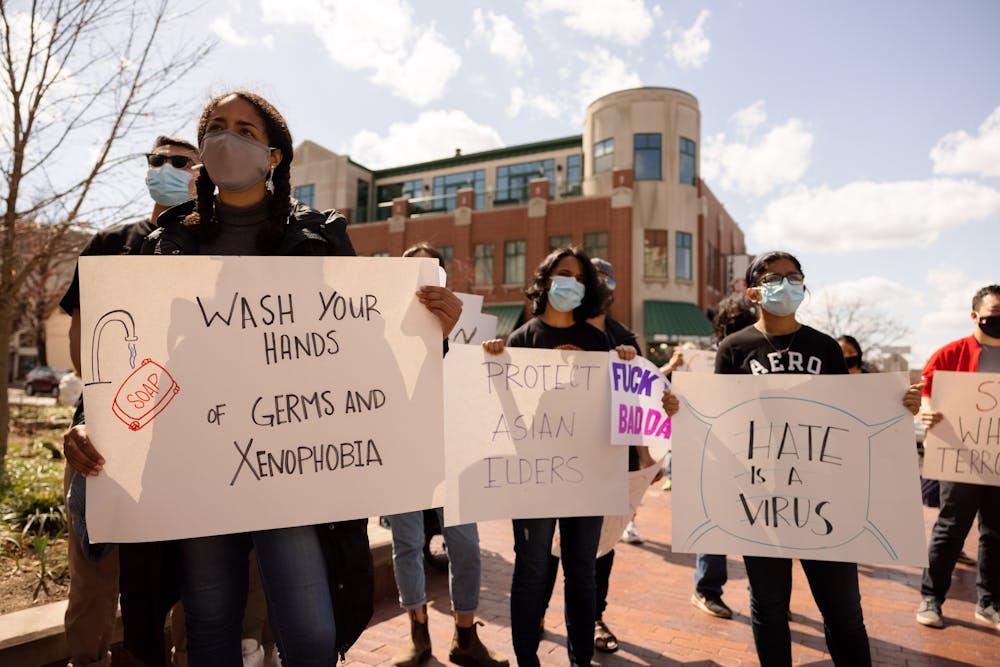
The rise in anti-Asian hate crimes during the pandemic has prompted many Asian American parents to enroll their children in remote learning out of concern for their child’s safety at school. Asian American youths are enrolled in remote learning at much higher rates than other racial groups. Federal data show that 78% of Asian American eighth graders attended school virtually in February 2021, whereas just 59% of Black, 59% of Latino and 29% of white students attended school virtually.
Here, three scholars address school safety for Asian American students.
Are American schools dangerous for Asian American students?
Aggie J. Yellow Horse, assistant professor of Asian Pacific American Studies at Arizona State University.
Data show that many Asian American youths have experienced anti-Asian violence in the past year.
Asian Americans have experienced a great deal of racial harassment amid the COVID-19 pandemic. A recent survey found that 1 in 8 Asian Americans reported experiencing anti-Asian hate incidents in 2020. The victims of that harassment aren’t just adults – they include students.
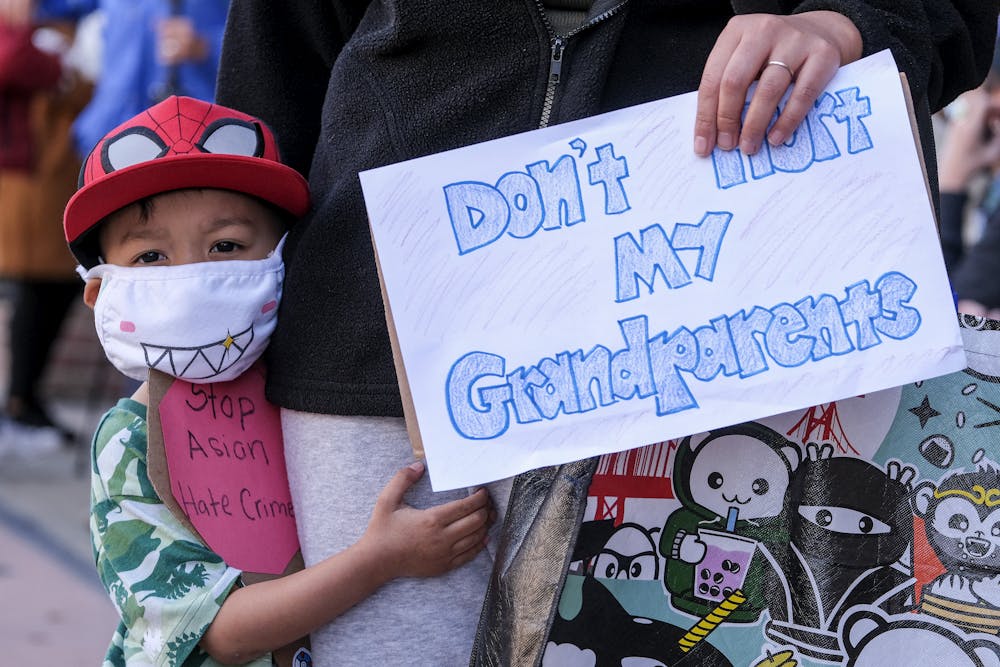
Since the beginning of the pandemic, more than 3,800 hate incidents targeting Asian Americans and Pacific Islanders have been reported to the Stop AAPI Hate National Reporting Center. Among the incidents early in the pandemic, 16% percent of the targets were Asian American youths ages 12-20.
The majority of the young victims, about 80%, reported being bullied or verbally harassed. In over half the incidents, the perpetrator used anti-Asian hate rhetoric. About 1 in 5 hate incidents happened at school.
National trends before the pandemic suggested that Asian American students were already more likely to experience racial discrimination, such as race-related name-calling, from their peers at school than other categories of students. About 11% of Asian American students reported being called hate-related words, compared with 6.3% of white students in 2015. A separate study found that bullying and physical violence were less of an issue for Asian American students. Only about 7.3% reported being bullied at school in 2017, compared with 23% of white students.
How common race-based harassment against Asian students is can vary based on different factors, such as where students live, their gender, grades or immigration status. For example, a study from California found that Asian American sixth graders in California reported being bullied and victimized at higher rates than other racial groups.
What are the biggest worries for Asian American youth and parents?
Charissa S. L. Cheah, professor of psychology at the University of Maryland, Baltimore County
Many Asian American parents are worried that their children will be the victims of discrimination once school reopens.
Asian American parents are worried about schools reopening. NPR3.38 MB (download)
In one survey, nearly 1 in 2 Chinese American parents and 1 in 2 Chinese American youth reported being directly targeted with COVID-19 racial discrimination in person or online. About 4 in 5 of these parents and their children also reported witnessing racism directed at someone else of their own race either online or in person.
Despite their concerns, some parents may avoid talking to their children about anti-Asian racism to avoid scaring them while they are at school. Even if parents want to have the “race talk” with their children, many struggle with how to talk to their children about the potential racism they might encounter. Some parents may not have been taught these lessons while growing up and are grappling with how to make sense of these experiences.
Anti-Asian racism is also associated with greater depressive symptoms and anxiety in Chinese American parents and their children. A majority of Americans blame China for its mishandling of the coronavirus outbreak. Researchers have found that even thinking that one’s racial or ethnic group is viewed by the general public as a threat to the health of Americans is linked to poorer mental health in both Chinese American parents and youths.
Asian Americans are less likely than non-Hispanic white Americans to seek mental health help. This is due in part to perceived stigma, language barriers and lack of mental health providers of the same ethnicity. These disparities are even greater for Asian American families with fewer financial resources.
Some Asian American parents have also expressed concerns about the ability of schools to maintain appropriate COVID-19-related health and safety measures. They are worried about the health risks that children exposed to others at school might bring home. Asians Americans are more likely to live in a multigenerational household, in which older adults might be at a higher health risk.
Even if parents choose to keep their children home because of one or several of these concerns, they are getting the message that in-person education is superior to virtual education. Being out of physical school could cause Asian Americans to miss out on these opportunities and resources even more. Also, due to the “model minority myth,” which characterizes Asian Americans as successful, the needs of this very diverse group, including a large number of immigrant and refugee Asian families in the U.S., are often overlooked. With 30% of Asian Americans reporting limited English proficiency, these families are more difficult to reach. The fears of being harassed also make some parents reluctant to access educational materials or free meals or even reach out to teachers or counselors for help.
What can schools do to reduce threats to Asian American students?
Kevin Gee, an associate professor in the school of education at the University of California Davis
Helping students build strong and supportive relationships with each other can reduce their physical victimization and buffer the negative effects of discrimination Asian Americans face.
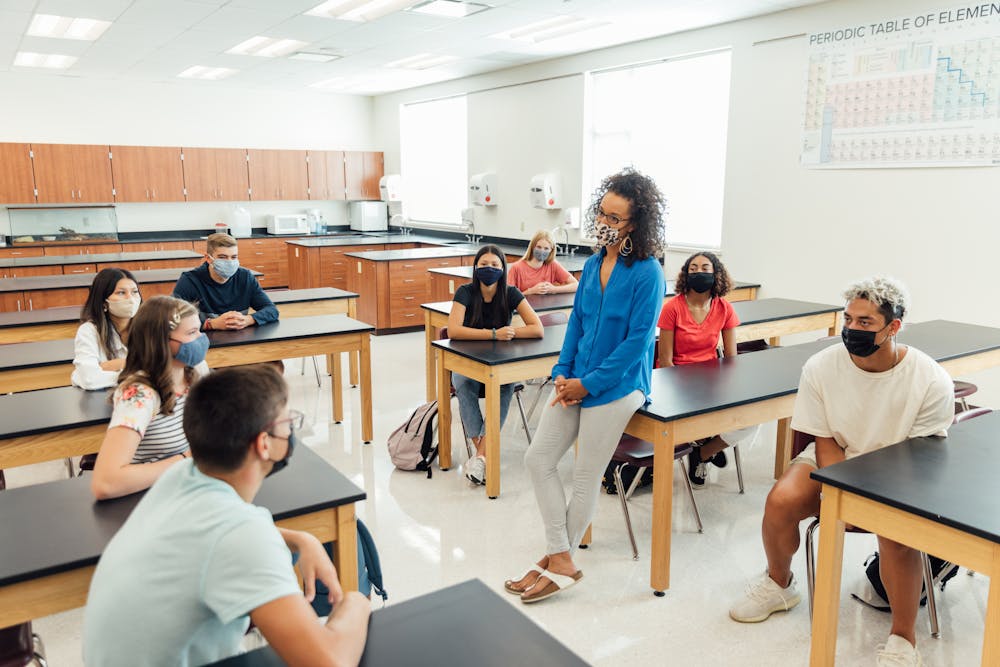
Schools can also create supportive environments by implementing a range of evidence-based approaches, such as building teachers’ cultural knowledge and strengthening teacher-student relationships. Activities like engaging students in class discussions about bullying have been shown to reduce bullying.
Alongside initiatives to build supportive environments, schools should also consider partnering with parents. Directly engaging Asian American parents in anti-bullying initiatives can help reduce victimization. For example, schools can collaborate with parents to craft disciplinary policies on bullying. Schools can also hold workshops to teach parents how to handle and prevent bullying.
In order to reduce threats and eradicate harm, I believe schools will need to consider whether they are doing enough to protect Asian American youth. One landmark case underscores this. In the aftermath of violent attacks on Asian American students at South Philadelphia High School in 2009, a Department of Justice investigation revealed that the school district was “deliberately indifferent” to harassment against Asian students that fueled the attacks.
A key takeaway: Harms against Asian American students can be systemic and require broader structural solutions. When South Philadelphia High School began to do more to promote multicultural awareness and improved systems to report and investigate harassment, the school saw fewer violent incidents.
To make Asian American youth feel safe and protected, schools need to track, report and respond to incidents of hate against Asian Americans, especially among Asian American ethnic subgroups. Subgroup data, often lacking on Asian Americans, can be a powerful tool in revealing potential disparities and highlighting groups that schools need to target for support.
I believe schools also need to invest in longer-term systemic changes such as including a more complete history of Asian Americans in U.S. social studies curricula.
*****
Header image: Eight out of 10 Asian American youths reported being bullied and harassed during the pandemic. RyanJLane/E+ via Getty Images
Charissa S. L. Cheah, Professor of Psychology, University of Maryland, Baltimore County; Aggie Yellow Horse, Assistant Professor of Asian Pacific American Studies, Arizona State University, and Kevin A. Gee, Associate Professor of Education, University of California, Davis
This article is republished from The Conversation under a Creative Commons license. Read the original article.
]]>
By Charissa S. L. Cheah, professor, psychology, UMBC; Aggie Yellow Horse, Arizona State University, and Kevin A. Gee, University of California, Davis The rise in anti-Asian hate crimes during...
https://umbc.edu/stories/are-americas-schools-safe-for-asian-americans/
https://my3.my.umbc.edu/api/v0/pixel/news/119651/guest@my.umbc.edu/78eb0c173831da66c59f0ba2ee6351a7/api/pixel
covid-19
discovery
psychology
the-conversation
UMBC News & Magazine
https://my3.my.umbc.edu/groups/umbc-news-magazine
https://assets1-my.umbc.edu/system/shared/avatars/groups/000/001/943/24435aa6207c452e7bc15cc74b42c7bb/xsmall.png?1748556657
https://assets1-my.umbc.edu/system/shared/avatars/groups/000/001/943/24435aa6207c452e7bc15cc74b42c7bb/original.png?1748556657
https://assets2-my.umbc.edu/system/shared/avatars/groups/000/001/943/24435aa6207c452e7bc15cc74b42c7bb/xxlarge.png?1748556657
https://assets2-my.umbc.edu/system/shared/avatars/groups/000/001/943/24435aa6207c452e7bc15cc74b42c7bb/xlarge.png?1748556657
https://assets3-my.umbc.edu/system/shared/avatars/groups/000/001/943/24435aa6207c452e7bc15cc74b42c7bb/large.png?1748556657
https://assets1-my.umbc.edu/system/shared/avatars/groups/000/001/943/24435aa6207c452e7bc15cc74b42c7bb/medium.png?1748556657
https://assets2-my.umbc.edu/system/shared/avatars/groups/000/001/943/24435aa6207c452e7bc15cc74b42c7bb/small.png?1748556657
https://assets1-my.umbc.edu/system/shared/avatars/groups/000/001/943/24435aa6207c452e7bc15cc74b42c7bb/xsmall.png?1748556657
https://assets2-my.umbc.edu/system/shared/avatars/groups/000/001/943/24435aa6207c452e7bc15cc74b42c7bb/xxsmall.png?1748556657
UMBC News & Magazine
0
0
false
Mon, 19 Apr 2021 15:49:34 -0400
 Jordan Troutman, left, and Dan Barnhart, former director of The Commons and student life at UMBC, who recommended Troutman apply for the MHEC position.
 Jordan Troutman, far left, attends a lab meeting in fall 2019 with James Foulds (right rear, green shirt) and his peers.
 Jordan Troutman ’21