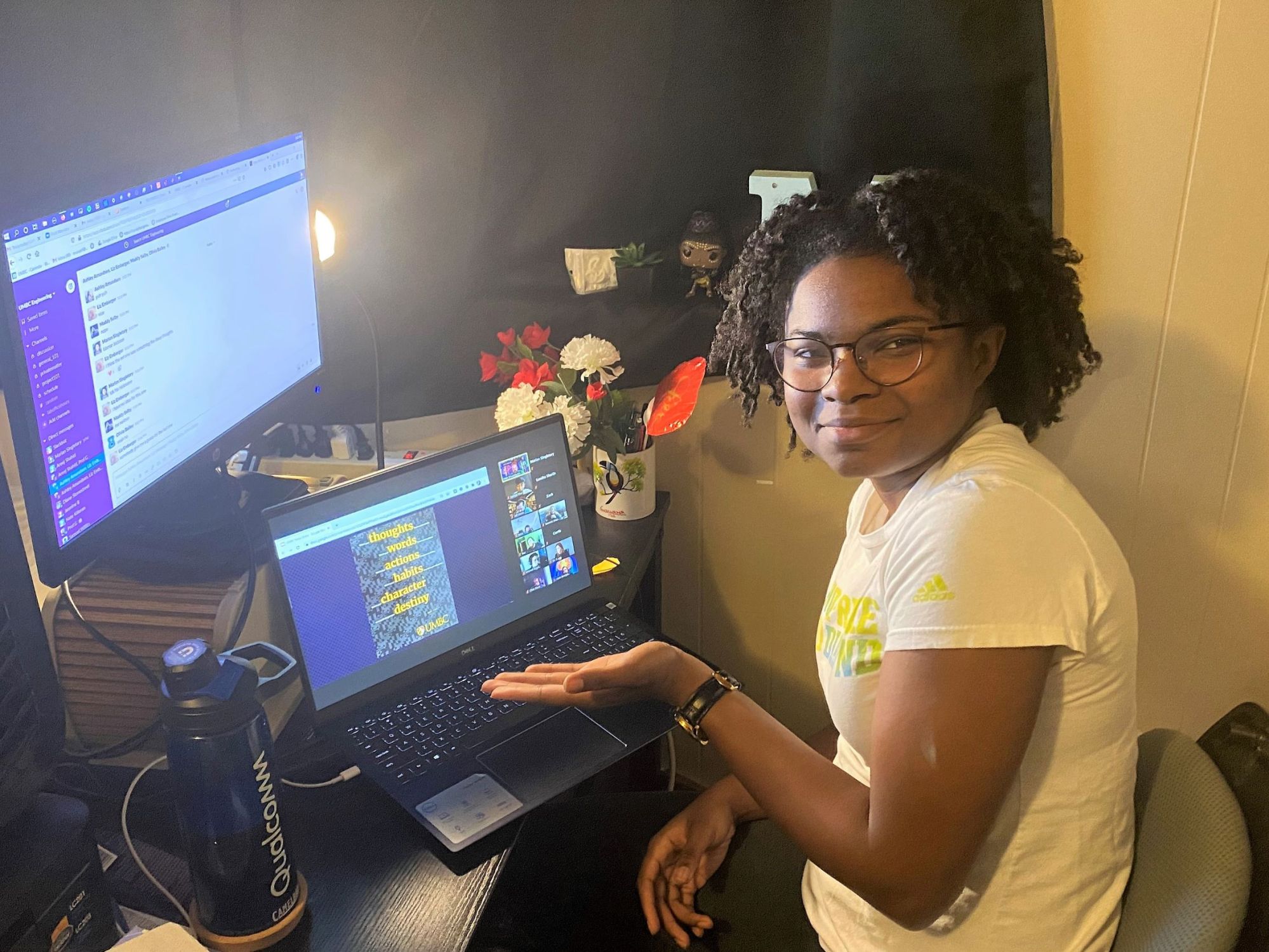
Balancing free speech and inclusion event creates robust campus conversation
At a time when many in our nation are struggling with how best to engage in discussion along ideological divides, members of UMBC’s community came together this week to think about ways of balancing their shared commitments to free speech and equity and inclusion.
The latest in UMBC’s virtual community gatherings series, The Empowered University: Balancing Inclusion & Free Speech, featured community experts in law, government, and education, including several alumni.
“As a university, we’re continually balancing our shared commitments to equity and inclusion with our commitment to individual’s right to free speech,” said Kathy Ibitoye ’15, financial economics, a civil rights investigator with UMBC’s Office of Equity and Inclusion. “We hope that as a community to get a better understanding of how to look at free speech, how to continue to create and maintain inclusive environments, and how to engage in dialogue when speech has a harmful impact on another individual.”
Student moderators Tirzah Kahn ’21, information systems, and Zachary Kay ’22, history, shared questions suggested by participants with the panelists, beginning with the deceptively simple question: What is free speech? Morgan Thomas ’13, political science, an attorney in UMBC’s Office of General Council, gave an overview of the laws protecting free speech and then zoomed in on how the UMBC community fits into the picture.
 Morgan Thomas at a UMBC Community Conversation event in 2019. All photos by Marlayna Demond ’11.
“Public institutions such as UMBC are required to protect the freedom of speech of its community members, which in many cases works well to advance academic inquiry, knowledge, and thoughtful discussion from inquisitive minds of all backgrounds,” she said. “All of which is important for the educational, professional, and personal enrichment of the campus community.”
Learning to listen
Allan Kittleman ’81, political science, former County Executive for Howard County, and a Maryland Workers’ Compensation Commissioner, spoke to the question of how best to create spaces that encourage learning, understanding, and productive respectful dialogue. After years in politics, he said the first and most important thing to do is to listen and try carefully to understand the other person’s perspective before responding.
 Allan Kittleman speaks at the 2018 Alumni Award ceremony.
“We need to make sure that we look at things and find out what’s true, what’s not true,” he said. “Not jumping the gun, and making sure we investigate things…I think listening is where it starts, but then we also have to have a dialogue and we have to have it respectfully even with people we don’t agree with.”
“It doesn’t help to listen if you’re not willing to hear,” he said, after sharing a real life example of having his mind changed by a member of the opposite political party. “That’s why we have two ears and one mouth – so, we get to hear more than we talk, listen more than we talk. And so that’s, I think, the best way we can create space.”
Inclusive learning spaces
Susan Sterett, professor of public policy, shared her perspectives on how to create engaging spaces for inclusive dialogue in the classroom, including setting expectations for civil behavior early on.
“Setting some ground rules, having some faith that we can listen to each other, and recognizing that we don’t learn things that we always want to learn, are all really important points,” she said.
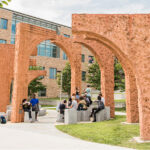
 UMBC is dedicated to creating and maintaining a community of inquiring minds. Photo taken in 2019.
Among the more than 170 event participants were many students, faculty, and staff who also shared their thoughts and questions in the chat. Some pondered ways of expressing themselves while also considering the feelings of their classmates, and how to be effective allies in general.
Event panelists also shared information about a number of campus organizations focused on free speech and inclusion issues, and urged folks to take advantage of the tools and forums they provide.
Practicing core values
Being able to keep the doors open for productive conversation is an important part of any university community—and a core value at UMBC, said President Freeman Hrabowski, quoting Phi Beta Kappa head Frederick Lawrence.
“He says that ‘The purpose of a liberal education is to teach people to be able to think critically and to communicate with clarity, and to be able to…present our arguments and base those arguments on facts and evidence,’” said Hrabowski.
“And secondly, to be able to listen carefully to other points of view that may differ wildly from my own. And to breathe deeply and to listen. And then to work on ways of having debate that can lead to a clearer understanding of the common ground and most important to seeking the truth.”
For more information about future UMBC Virtual Community Gatherings, visit umbc.edu/together.
*****
Header image of The Forum in front of the Performing Arts & Humanities Building by Marlayna Demond ’11, taken in 2018.
]]>
At a time when many in our nation are struggling with how best to engage in discussion along ideological divides, members of UMBC’s community came together this week to think about ways of...
https://umbc.edu/stories/balancing-free-speech-and-inclusion/
https://my3.my.umbc.edu/api/v0/pixel/news/119692/guest@my.umbc.edu/ad946e3cc9af83a8d783db00c5d2c4fc/api/pixel
campus-life
UMBC News & Magazine
https://my3.my.umbc.edu/groups/umbc-news-magazine
https://assets1-my.umbc.edu/system/shared/avatars/groups/000/001/943/24435aa6207c452e7bc15cc74b42c7bb/xsmall.png?1748556657
https://assets1-my.umbc.edu/system/shared/avatars/groups/000/001/943/24435aa6207c452e7bc15cc74b42c7bb/original.png?1748556657
https://assets2-my.umbc.edu/system/shared/avatars/groups/000/001/943/24435aa6207c452e7bc15cc74b42c7bb/xxlarge.png?1748556657
https://assets2-my.umbc.edu/system/shared/avatars/groups/000/001/943/24435aa6207c452e7bc15cc74b42c7bb/xlarge.png?1748556657
https://assets3-my.umbc.edu/system/shared/avatars/groups/000/001/943/24435aa6207c452e7bc15cc74b42c7bb/large.png?1748556657
https://assets1-my.umbc.edu/system/shared/avatars/groups/000/001/943/24435aa6207c452e7bc15cc74b42c7bb/medium.png?1748556657
https://assets2-my.umbc.edu/system/shared/avatars/groups/000/001/943/24435aa6207c452e7bc15cc74b42c7bb/small.png?1748556657
https://assets1-my.umbc.edu/system/shared/avatars/groups/000/001/943/24435aa6207c452e7bc15cc74b42c7bb/xsmall.png?1748556657
https://assets2-my.umbc.edu/system/shared/avatars/groups/000/001/943/24435aa6207c452e7bc15cc74b42c7bb/xxsmall.png?1748556657
UMBC News & Magazine
0
0
false
Fri, 29 Jan 2021 20:01:27 -0500
Building the Magic

If Peter Wood is doing his job well, you’ll never notice what he’s doing. It should look effortless and natural, smooth and, well, magical.
As a magician with 20 years of experience, Wood ’06, theatre, has learned that a successful way to fool a willing audience is to have the magical moment occur in a participant’s hands. Now he’s been given the chance to attempt to deceive the premier magical duo—Penn & Teller—on their hit show Fool Us.
The common aim of the magicians featured on the show, now on it’s seventh season, is simple: can you trick the kings of tricksters? Wood brings his act to the episode Teller Gets Smashed, airing Friday, January 29 at 9 p.m. on the CW.
The devil is in the details
For his performance, Wood needed a time period-appropriate table to showcase his illusion, steeped in the Vaudeville, turn-of-the-century universe Wood creates in all his shows. And he needed to easily check the table as luggage on his way to Las Vegas.
As his magician persona, “Collector of the Impossible,” Woodcreates storied backgrounds for all his tricks, fantastical fictions to reel the audience into his alternative, magical reality. What’s behind the scenes is a skilled craftsman with a well-stocked workshop who references century-old tomes to inform his magical practice. But this table was the first piece designed with Southwest Airlines guidelines as his primary parameter.
The final creation—a slender, cross-legged varnished table with brass fixtures and a drawer—fit the bill and succeeded in playing its role as the scene-setting prop holder. This level of attention to detail, in addition to his magic trick, earned Wood his favorite compliment to date—Penn told him that his trick could have fit into magic shows from a hundred years ago.
An infatuation with secrets
 Headshot of Peter Wood by Damon Meledones ’11, theatre.
Wood, who started performing at age 10—receiving a lot of attention for his age—became adept at magic skills before he even knew the meaning of stage fright. “I’m thankful I started young enough that by the time I started to have any doubts and fears, I had enough flight time to have the legitimate confidence that what I was sharing was worth people’s time.”
He built on those early skills by working in various magic shops, honing his abilities during downtime in the stores and later in informal sessions with fellow performers. In the past two decades, Wood has established a career entertaining and mystifying companies and families in the Delmarva region.
“The typical magician that you think of is either telling you that they’re doing trickery, or they are playing the part of a person who has magical powers,” says Wood. “In my career, I want to explore the second one, but I don’t have magical powers. I just have things that I’ve collected that can do amazing impossible feats.”
Unfortunately, Wood’s magic holds no sway over a global pandemic, so like many other entrepreneurs, he’s had to improvise a few new tricks to pivot to an online format. “Usually, at my shows, the magic happens in someone else’s hands and now that’s gone. Because if the trick happens in my hands and you’re watching it on a screen, then you’re going to assume that I’m just controlling it,” shares Wood.
Now, he utilizes the chat to ask when to stop shuffling a deck or he requests feedback on what page number to flip to in a book. This allows the audience to participate, but also partner with Wood in making the magic happen.
But even online, Wood faces the same conundrum as other performers—making intricate tricks appear effortless through practice and repetition. “Magicians are infatuated with secrets,” says Wood. “And unlike a juggler who you can see juggling five balls and appreciate the skill they put into learning that, I have to work so hard to hide that skill, to make it look like I’m not doing anything at all.”
Practical magic
Behind his standing desk he uses as a virtual stage are tall, dark wood paneled shelves, books etched in gold leaf, a Ruben vase, a wooden box, an old Coke bottle that can fit a half dollar in, but not out. Wood’s cabinet of curiosities develops the aura of his trade and gives his new online audiences a pleasant respite from their normal Zoom meeting rooms.
 Wood in his home office, performing for a virtual audience. Photo courtesy of Wood.
Wood’s online dinner shows have their upsides and downs, he says. He’s able to entertain guests well outside his usual Baltimore–D.C. circuit, but he loses out on their valuable reactions—not only gratifying to a performer, but necessary for knowing what tricks are successful and which ones need more work, or the ax.
Wood cites UMBC’s theatre’s production manager and technical director Gregg Schraven ’97, theatre, as his guide to knowing when and what to discard—not necessarily his tricks—but even more foundational but difficult professional knowledge. How much wood is useful to keep on hand? How many different light fixtures are actually necessary for taking apart and repurposing? This hands-on knowledge is invaluable, Woods says.
UMBC also led Wood to develop his AutoCAD skills to design and craft specific and unique items. In his theatre tech role as a student, he was tasked with creating parts and props for other students’ visions, allowing Wood to work outside his more steampunk aesthetic and widening his creative comfort zone.
“And unlike a juggler who you can see juggling five balls and appreciate the skill they put into learning that, I have to work so hard to hide that skill, to make it look like I’m not doing anything at all.”
—Wood
Another UMBC connection Wood owes quite a lot to? His brother, Matt Wood ’13, financial economics, M.P.P. ’15, and a maintenance manager in Residential Life. As the younger Wood, Matt has been the stagehand and assistant for many shows, being “grandfathered in” to other long-standing gigs, says Wood, like their past 20 years of performing at the Howard County Fair.
Sharing his collection of impossible things
In his act on Fool Us, Wood presents a portrait painting to Alyson Hannigan, the show’s host. The portrait’s subject is missing its eyes, but whoever is looking through the parchment is gifted X-ray vision, Wood shares, building the story arc like he built the table and the other props. Through Wood’s magic, Hannigan is able to make out the color of four pieces of cloth inside four different little coin envelopes.
The act is emblematic of Wood’s repertoire. “Here’s what I do,” he sets the scene. “I collect items like this, and they don’t just work for me. Let me demonstrate.”
Whether or not Wood fooled Penn & Teller is revealed on the show, but Wood says he walked away from the experience with so much joy and satisfaction. “Literally everyone on the production—all the way up to Penn & Teller—just wants you to put your best foot forward and have it be as good of a showcase as possible for you. That definitely took a lot of the nerves and butterflies away.”
Ultimately on Fool Us, Wood was complimented on what he hopes his everyday audiences never notice at all. “Penn & Teller could see the sort of process that I went through to create the method, to create the secret, and they appreciated the work.”
*****
Header photo courtesy of Peter Wood ’06.
]]>
If Peter Wood is doing his job well, you’ll never notice what he’s doing. It should look effortless and natural, smooth and, well, magical. As a magician with 20 years of experience, Wood...
https://umbc.edu/stories/building-the-magic/
https://my3.my.umbc.edu/api/v0/pixel/news/119693/guest@my.umbc.edu/571c7cd8a0b1e803d7b92435217a2656/api/pixel
alumni
cahss
theatre
UMBC News & Magazine
https://my3.my.umbc.edu/groups/umbc-news-magazine
https://assets1-my.umbc.edu/system/shared/avatars/groups/000/001/943/24435aa6207c452e7bc15cc74b42c7bb/xsmall.png?1748556657
https://assets1-my.umbc.edu/system/shared/avatars/groups/000/001/943/24435aa6207c452e7bc15cc74b42c7bb/original.png?1748556657
https://assets2-my.umbc.edu/system/shared/avatars/groups/000/001/943/24435aa6207c452e7bc15cc74b42c7bb/xxlarge.png?1748556657
https://assets2-my.umbc.edu/system/shared/avatars/groups/000/001/943/24435aa6207c452e7bc15cc74b42c7bb/xlarge.png?1748556657
https://assets3-my.umbc.edu/system/shared/avatars/groups/000/001/943/24435aa6207c452e7bc15cc74b42c7bb/large.png?1748556657
https://assets1-my.umbc.edu/system/shared/avatars/groups/000/001/943/24435aa6207c452e7bc15cc74b42c7bb/medium.png?1748556657
https://assets2-my.umbc.edu/system/shared/avatars/groups/000/001/943/24435aa6207c452e7bc15cc74b42c7bb/small.png?1748556657
https://assets1-my.umbc.edu/system/shared/avatars/groups/000/001/943/24435aa6207c452e7bc15cc74b42c7bb/xsmall.png?1748556657
https://assets2-my.umbc.edu/system/shared/avatars/groups/000/001/943/24435aa6207c452e7bc15cc74b42c7bb/xxsmall.png?1748556657
UMBC News & Magazine
0
0
false
Fri, 29 Jan 2021 14:20:07 -0500
U.S. News names UMBC’s online master’s in information systems one of the nation’s best

UMBC’s online master’s degree in information systems has once again been ranked one of the best programs in the nation by U.S. News. The rankings, announced this week, also highlight UMBC as offering one of the top 20 such degrees in this field for veterans.
U.S. News has now recognized this UMBC program for several years, making it a longtime leader. Joining UMBC on the list in 2021 are universities like Virginia Tech and Drexel.
Faculty committed to student success
Graduate program director Anita Komlodi, associate professor of information systems, shares, “We are very excited to again be ranked among the best. Our program is well established, with about twenty years of experience educating online technology students.”
 Anita Komlodi. Photo by Marlayna Demond ’11 for UMBC.
Keith J Bowman, dean of the College of Engineering and Information Technology, has described the program’s faculty as deeply committed to their mission of “enabling our online master’s students to gain the skills required to succeed with our extensive range of industry and government partners.”
“We put our students first. We designed our program both for working IT professionals and career changers wishing to transition into IT careers,” Komlodi says. “Most of our students work full-time. The flexibility and asynchronous nature of the program helps them progress in their careers while balancing other responsibilities.”
Flexibility and rigor
UMBC built the online master’s degree in information systems for students balancing many responsibilities. Many are managing work, family, military service, and other commitments, while still seeking to advance their education and careers. And students are able to pursue interests in an extremely broad array of focus area, from health information technology to human-centered computing.
Komlodi notes, “We have recently introduced tracks for in-demand industry areas in artificial intelligence, cybersecurity, data science, and user experience design.”
 Vandana Janeja. Photo by Marlayna Demond ’11 for UMBC.
Vandana Janeja, chair of information systems, knows the value that a rigorous, flexible online graduate program can bring to students. Upon UMBC earning U.S. News recognition last year, she commented that for the online program, “We are committed to a high level of excellence and engagement akin to our on-campus program.”
It’s all about pairing high expectations with strong support for students, she says—the trademark UMBC experience.
Banner image: Mobile technology. Photo by WOCinTechChat, CC BY 2.0.
]]>
UMBC’s online master’s degree in information systems has once again been ranked one of the best programs in the nation by U.S. News. The rankings, announced this week, also highlight UMBC as...
https://umbc.edu/stories/u-s-news-names-umbcs-online-masters-in-information-systems-one-of-the-nations-best/
https://my3.my.umbc.edu/api/v0/pixel/news/119694/guest@my.umbc.edu/0c722c959280f78083adb47426bf369e/api/pixel
coeit
graduateschool
is
rankings
science-and-technology
UMBC News & Magazine
https://my3.my.umbc.edu/groups/umbc-news-magazine
https://assets1-my.umbc.edu/system/shared/avatars/groups/000/001/943/24435aa6207c452e7bc15cc74b42c7bb/xsmall.png?1748556657
https://assets1-my.umbc.edu/system/shared/avatars/groups/000/001/943/24435aa6207c452e7bc15cc74b42c7bb/original.png?1748556657
https://assets2-my.umbc.edu/system/shared/avatars/groups/000/001/943/24435aa6207c452e7bc15cc74b42c7bb/xxlarge.png?1748556657
https://assets2-my.umbc.edu/system/shared/avatars/groups/000/001/943/24435aa6207c452e7bc15cc74b42c7bb/xlarge.png?1748556657
https://assets3-my.umbc.edu/system/shared/avatars/groups/000/001/943/24435aa6207c452e7bc15cc74b42c7bb/large.png?1748556657
https://assets1-my.umbc.edu/system/shared/avatars/groups/000/001/943/24435aa6207c452e7bc15cc74b42c7bb/medium.png?1748556657
https://assets2-my.umbc.edu/system/shared/avatars/groups/000/001/943/24435aa6207c452e7bc15cc74b42c7bb/small.png?1748556657
https://assets1-my.umbc.edu/system/shared/avatars/groups/000/001/943/24435aa6207c452e7bc15cc74b42c7bb/xsmall.png?1748556657
https://assets2-my.umbc.edu/system/shared/avatars/groups/000/001/943/24435aa6207c452e7bc15cc74b42c7bb/xxsmall.png?1748556657
UMBC News & Magazine
0
0
false
Thu, 28 Jan 2021 18:32:12 -0500
Why COVID-19 won’t kill cities

By John Rennie Short, professor, School of Public Policy, UMBC and Michael J. Orlando, lecturer, Finance and Politics, Global Energy Management Program, University of Colorado Denver
Editor’s note: For those of you who live in cities, ask yourself: What it is about your urban lifestyle that makes it worth it despite the pollution, the noise and the traffic? Perhaps it’s the hundreds of unique restaurants that you like to dine at. Or the density that fosters a vibrant night life and cosmopolitan cultural scene. Maybe it’s the parks, the museums, the tall buildings, the mass transit.
What if much of that went away? Would you still want to live there?
Despite these challenges, two scholars who study cities explain why they think urban areas will endure – even if they don’t get the aid from Congress that now seems more likely.
Why some cities will survive – and thrive
John Rennie Short, UMBC
The death of the city is regularly predicted. But, like Mark Twain’s premature obituary, it is greatly exaggerated.
The city was thought to be redundant when the telephone was introduced to the world in 1876 and then the first personal computer in 1971. What was the point of cities when people could communicate over the phone or through the internet? The future was imagined as a global village of electronic cottages.
In fact, the future was and continues to be giant metro areas and dense cities.
After 9/11, some thought that the threat of terrorism would lead to the suburbanization of financial services and a drift away from the city. In the two decades that followed, New York City continued to grow and prosper as a global financial center.
And today, many cities will survive the pandemic for the same reasons they survived the telephone, internet and terrorist attacks. That’s because there are powerful economic forces at work.
As early as 1922, British economist Alfred Marshall pointed out three key traits of cities:
- The pools of skilled labor allow the transfer of information, knowledge and skill.
- The presence of so many companies generates more business for peripheral industries – such as how a big banking sector creates work for accountants and lawyers.
- The proximity of people facilitates contact that leads to the maintenance of trust and the exchange of information.
These forces are even more powerful for the more dynamic sectors of the economy, particularly banking and financial services, advertising and a vast range of cultural and creative industries – all built around face-to-face contact.
I believe the cities that generate this type of “cognitive capitalism,” such as San Francisco, New York and San Jose, will bounce back. Those that have more routine industries that can be done anywhere, like Detroit, Baltimore and Buffalo, may not. This is a trend that is already occurring across the U.S. over the past 30 years as cities focused on the knowledge economy have grown faster than those that are not.
Despite the long tradition of anti-urbanism in the U.S. that always seems to see the demise of cities just around the corner, they will survive because they are one of humanity’s greatest inventions.
 Confetti lies on the street after the Times Square New Year’s Eve ball dropped in a nearly empty Times Square early Friday, Jan. 1, 2021, as the area normally packed with revelers w
as
closed because of the ongoing coronavirus pandemic. ( AP Photo/Craig Ruttle)
The power of cities: Sharing, matching and learning
Michael Orlando, University of Colorado Denver
Density is what makes a city special. A place can support a dizzying array of cultural delights only where significant numbers of people live in close proximity to one another.
But in a pandemic, density is the last thing you want, which is why many people have moved from the urban core and office buildings sit empty.
This won’t last forever. Soon, I believe, new vaccines and improved treatments will end this pandemic. And when density is no longer cursed by contagion, cities will reassert their magic, through their ability to enhance sharing, matching and learning.
Economists refer to these three mechanisms as types of agglomeration economies because they represent benefits of concentration. They are the incentives that lead people and production to exist side by side, enduring the high cost of dense urban areas. Economies of sharing, matching and learning explain why cities form and grow.
Economies of sharing refer to economies of scale. For example, businesses that specialize in high-quality instrument repair and intellectual property law provide important services, but they are consumed only infrequently and sporadically. These businesses prefer to locate in large cities where fixed cost of operations can be spread over many customers, making it more likely their services are always in demand.
Economies of matching refer to the cost and time savings in searching for goods, services and jobs in a large city compared with a less populous area. Workers such as piano tuners and patent attorneys, for example, possess a narrow set of skills that are of great value to particular employers that regularly need these unique services. So workers with these specialized skills will prefer to locate in larger cities, where they are more likely to be matched to a job – and quickly find another if they lose it.
Economies of learning refer to the value derived from serendipitous interactions. People learn from each other, through both intentional meetings and chance encounters. Learning through intentional meetings may occur wherever people seek each other out. But learning through chance encounters will happen more frequently in dense urban areas where there are simply better odds of encountering other people. As a result, companies and workers will prefer to locate in cities where they can command higher profits and wages associated with the learning that occurs through serendipitous interactions.
Companies for whom knowledge and ideas are particularly important may engineer such chance encounters by strategically locating co-workers from different departments so that they might interact, seemingly, at random. Similarly, by locating in cities, workers and businesses engineer chance encounters with those from other companies.
In research on the economic geography of innovation, my co-authors and I have found that knowledge-intensive workers do disproportionately locate in cities. The share of workers with a bachelor’s degree is highest in the most populous county areas. And patents per capita correlate to the share of workers with a bachelor’s degree across dense urban areas.
The risks and costs of contagion will fade. And then workers and companies will be unable to resist the benefits of sharing, matching and learning that arise in densely populated areas. These are the factors that explain the lure of cities.
*****
John Rennie Short, Professor, School of Public Policy, University of Maryland, Baltimore County and Michael J. Orlando, Lecturer, Finance and Politics, Global Energy Management Program, University of Colorado Denver
This article is republished from The Conversation under a Creative Commons license. Read the original article.
Header image: Cities are breeding grounds for creativity – and infectious diseases. Salvator Barki/Moment via Getty Images
]]>
By John Rennie Short, professor, School of Public Policy, UMBC and Michael J. Orlando, lecturer, Finance and Politics, Global Energy Management Program, University of Colorado Denver...
https://umbc.edu/stories/why-covid-19-wont-kill-cities/
https://my3.my.umbc.edu/api/v0/pixel/news/119695/guest@my.umbc.edu/5232abe7ce82bb29e8f99c89ed093b01/api/pixel
perspectives
public-policy
the-conversation
UMBC News & Magazine
https://my3.my.umbc.edu/groups/umbc-news-magazine
https://assets1-my.umbc.edu/system/shared/avatars/groups/000/001/943/24435aa6207c452e7bc15cc74b42c7bb/xsmall.png?1748556657
https://assets1-my.umbc.edu/system/shared/avatars/groups/000/001/943/24435aa6207c452e7bc15cc74b42c7bb/original.png?1748556657
https://assets2-my.umbc.edu/system/shared/avatars/groups/000/001/943/24435aa6207c452e7bc15cc74b42c7bb/xxlarge.png?1748556657
https://assets2-my.umbc.edu/system/shared/avatars/groups/000/001/943/24435aa6207c452e7bc15cc74b42c7bb/xlarge.png?1748556657
https://assets3-my.umbc.edu/system/shared/avatars/groups/000/001/943/24435aa6207c452e7bc15cc74b42c7bb/large.png?1748556657
https://assets1-my.umbc.edu/system/shared/avatars/groups/000/001/943/24435aa6207c452e7bc15cc74b42c7bb/medium.png?1748556657
https://assets2-my.umbc.edu/system/shared/avatars/groups/000/001/943/24435aa6207c452e7bc15cc74b42c7bb/small.png?1748556657
https://assets1-my.umbc.edu/system/shared/avatars/groups/000/001/943/24435aa6207c452e7bc15cc74b42c7bb/xsmall.png?1748556657
https://assets2-my.umbc.edu/system/shared/avatars/groups/000/001/943/24435aa6207c452e7bc15cc74b42c7bb/xxsmall.png?1748556657
UMBC News & Magazine
0
0
false
Mon, 25 Jan 2021 21:57:50 -0500
Retriever Educators Are Everywhere

This video series spotlights alumni who are using their careers to encourage and lift up young kids and college students—in the classroom, yes, but also in the gym, online, and through personal relationships.
Leading the charge for better education
At 4:30 a.m., Susan Keen found herself wide awake. After making some coffee, she set off on foot to Oakland International High School, where she teaches English and world history. But on this weekday, in her role as a labor representative, she was there to lead a strike, alongside her fellow teachers and students.
In what was ultimately a successful strike and negotiation for more equitable compensation and smaller class sizes, Keen ’10, anthropology and political science, felt most proud about the example she set for her students, all recent newcomers to the United States.
“My students joined me on the picket line,” says Keen, a former Sondheim Public Affairs Scholar. “I asked them to evaluate the risks and the goals of what we were doing, and they all chose to stand by me and next to me on the line. It was incredible to have their support. That’s such a highlight.”
Finding joy in the classroom
Keen is a classic Retriever Educator, she knows her actions in and out of the classroom matter to her students. Theresa Bruce, Baltimore City’s 2020 Teacher of the Year runner-up also takes an all-in approach to her students at KIPP Academy.
“People don’t care what you know, until they know you care,” says Bruce ’09, political science and social work, “and that goes for my students.” She makes it a point to get to know her student scholars—a daunting task even before the era of distant learning— encouraging them to find their own passions like she found hers at UMBC through the support of professors and staff.
“So now, as an educator myself, I ask how I can best push and champion my students,” says Bruce, also a former Sondheim Scholar. “The biggest step I can take—and this doesn’t matter if you’re in a brick-and-mortar building or if you’re online—is to make a relationship. Yes, they’re harder to build virtually, but when young people can relate to you as a person, they’re more apt to try.”
Strengthening the mind, body, and community
Some teaching roles look different than a traditional classroom. For Joshua Day ’16, health administration and policy, he finds his purpose at MissionFit, a Baltimore gym that offers free fitness classes to youth in the city. Day—MissionFit’s executive director—wants the young gym members to develop confidence and self-acceptance, as well as important life skills such as goal setting, time management, and accountability.
“It was during my junior or senior year at UMBC, that it became clear to me that it would be easier if I stopped trying to separate worlds and just integrated things together, and MissionFit is the way I get to do that,” Day says. It’s rare that so early in someone’s career they can have their ideal job, he shares.
“But at MissionFit, we’re addressing health. We’re addressing health with youth. We’re really committed to the community of Baltimore. It completes my whole checklist.”
Inclusivity at the Ivies
Jamie Joshua ’02, M10, biological sciences, is using her institutional connections to reach a broad range of students as the director of the Office of Diversity and Inclusion at Cornell University’s Johnson Graduate School of Management. Joshua’s role is to create welcoming spaces for students and provide trainings for faculty and staff. In partnership with student affinity groups and the student council, Joshua advises on programming for equity, inclusion, and belonging initiatives.
During the pandemic Joshua is working from her parents’ home in Ellicott City, but she is still connecting virtually with students to encourage their self care. Joshua models her advice by taking daily walks, often with her twin sister Aimee Joshua ’03, M10, computer science.
“Family is what I think of when I think of UMBC,“ says Joshua. “And as the child of immigrant parents, the Meyerhoff Scholars Program was able to give me the skillset to thrive in college.” The sense of family Joshua felt at UMBC was compounded by rooming with her twin and welcoming her younger sister, Gina Joshua ’05, M13, biological sciences, to UMBC as well. In her current role, Joshua says she’ll feel successful if she can recreate that familial sense of belonging for her student groups at Cornell.
“We’re so proud to see our Retrievers take on so many educator roles, in the classroom and out,” says Stanyell Odom, director of Alumni Engagement. “It’s quickly apparent that these alumni and others like them go into their teaching careers, not only with the skills to teach, but also to learn from their students and coworkers.”
*****
All images and videos by Corey Jennings ’10.
]]>
This video series spotlights alumni who are using their careers to encourage and lift up young kids and college students—in the classroom, yes, but also in the gym, online, and through personal...
https://umbc.edu/stories/retriever-educators-are-everywhere/
https://my3.my.umbc.edu/api/v0/pixel/news/119696/guest@my.umbc.edu/f22a0ba233ac171b90058263ef3be766/api/pixel
alumni
education
videos
web-feature
UMBC News & Magazine
https://my3.my.umbc.edu/groups/umbc-news-magazine
https://assets1-my.umbc.edu/system/shared/avatars/groups/000/001/943/24435aa6207c452e7bc15cc74b42c7bb/xsmall.png?1748556657
https://assets1-my.umbc.edu/system/shared/avatars/groups/000/001/943/24435aa6207c452e7bc15cc74b42c7bb/original.png?1748556657
https://assets2-my.umbc.edu/system/shared/avatars/groups/000/001/943/24435aa6207c452e7bc15cc74b42c7bb/xxlarge.png?1748556657
https://assets2-my.umbc.edu/system/shared/avatars/groups/000/001/943/24435aa6207c452e7bc15cc74b42c7bb/xlarge.png?1748556657
https://assets3-my.umbc.edu/system/shared/avatars/groups/000/001/943/24435aa6207c452e7bc15cc74b42c7bb/large.png?1748556657
https://assets1-my.umbc.edu/system/shared/avatars/groups/000/001/943/24435aa6207c452e7bc15cc74b42c7bb/medium.png?1748556657
https://assets2-my.umbc.edu/system/shared/avatars/groups/000/001/943/24435aa6207c452e7bc15cc74b42c7bb/small.png?1748556657
https://assets1-my.umbc.edu/system/shared/avatars/groups/000/001/943/24435aa6207c452e7bc15cc74b42c7bb/xsmall.png?1748556657
https://assets2-my.umbc.edu/system/shared/avatars/groups/000/001/943/24435aa6207c452e7bc15cc74b42c7bb/xxsmall.png?1748556657
UMBC News & Magazine
0
0
false
Mon, 25 Jan 2021 17:43:19 -0500
Quantum computing, but even faster? UMBC researchers explore the possibilities with new NSF grant
Quantum computers have the potential to revolutionize communications, cybersecurity, and more, by dramatically speeding computation, researchers say. But as Sebastian Deffner notes, “Even quantum computing has shortcomings.”
There may be ways to work around some of quantum computing’s limits, however, further enhancing its speed and other aspects of performance. Deffner, assistant professor of physics at UMBC, and Nathan Myers, a Ph.D. student in Deffner’s research group,will explore techniques to do that with a new three-year, $300,000 grant from the National Science Foundation. And in the process, they just might redefine the fundamental laws of physics.
From paper to the real world
Typically, the quantum systems Deffner’s group (and anyone else) have studied are linear, meaning they are defined by mathematical equations that appear as a line when graphed. However, Deffner says, based on the math, “non-linear systems have very unique capabilities that allow you to circumvent many of the standard problems of linear quantum computing.”
 Nathan Myers (left) and Sebastian Deffner at Myers’s master’s graduation in 2019. Photo courtesy Nathan Myers.
A two-line proof in the grant proposal shows that in theory, non-linear systems can operate much faster than linear quantum systems, and possibly perform better in other ways, too. “Now the question is,” Deffner says, “is that just something you can write on paper, or does it actually play a role in applications?”
Because it doesn’t matter how fast a system could be in theory, if, to go that fast, most of the energy input is released as heat instead of being used for computations. In that case, the total energy required to get anything useful accomplished makes operating such a device impractical in the real world.
That’s why Deffner’s research group focuses on a burgeoning new field known as quantum thermodynamics—the study of the relationships between heat and other forms of energy in quantum systems. Previously, they developed and refined the idea of the “quantum speed limit,” which quantifies the limits of linear quantum systems. Now they’ll expand that work to non-linear systems.
The beauty of math
So, why is it that most of the quantum systems researchers have studied are linear? And where do non-linear systems come in?
Well, quantum systems are composed of many particles that are constantly interacting with each other in a linear fashion. Unfortunately, it’s impossible to precisely define and measure all of those interactions using today’s technology. It is possible, however, to approximate the sum of all of those linear interactions. That approximation can be added to the linear equation describing the overall system as a single term. And here’s the catch: That term is non-linear.
 UMBC’s Physics Building stands on the left, fronted by a quad dusted with snow. Photo by Marlayna Demond ’11 for UMBC.
By accounting for these particle interactions, “we can potentially get a non-linear speed-up from an underlying linear system. That’s the goal,” Myers says. But—and here’s where the thermodynamics comes in—“Say we get this non-linear system,” Myers says. “What energy cost are we paying for it? Is it worth it?”
So a goal of the new project is to better understand the thermodynamics of these non-linear systems. The findings would help quantify how much faster they might be than linear quantum systems, and if it would be feasible to create and run them in the real world.
A monumental leap
The shift from linear to non-linear systems might seem incremental, but it’s actually monumental. Sadi Carnot, a French engineer, developed the field of thermodynamics in the early 19th century to describe steam engines. Then, in the late 20th century, researchers overhauled his foundational principles to apply them to linear quantum systems.
“We have all these statements of thermodynamics that we just recently formulated for quantum systems,” Deffner says. But non-linear systems are so different that another retrofit won’t be sufficient. “What we need to do is go back to the beginnings of quantum thermodynamics and just redo everything.”
They’ll start by developing three foundational mathematical statements describing the non-linear systems. “Those statements will build the foundation upon which we then can build the whole theory,” Deffner says. They’ll test their work on two major algorithms used in database searches and encryption technology.
“Hopefully our work will lead to a broader exploration of how non-linear systems in general can be used to speed up a whole range of quantum devices, or enhance their performance in other ways,” Myers says.
A global UMBC team
During the pandemic, the research group is on four continents and in “I don’t know how many time zones,” according to Deffner. “I told my students from the beginning that we would have to adapt,” he adds. The lab group stays in touch via Slack, WhatsApp, and weekly group meetings. But the work itself is surprisingly low-tech.
 Nathan Myers’s at-home work station. Photo by Nathan Myers.
“The majority of it is pen and paper,” Myers says, plus a lot of reading. “Doing good theory work requires having a really broad knowledge base of what’s being done in different disciplines of physics. Real progress happens when someone realizes that a technique or tool from another area is also applicable to their own problem.”
Myers loves the work, and says his entire thesis grew out of a single question he asked Deffner after class one day. Deffner’s response? “That’s a great question. Want to do a project?”
“It all started with one root question that’s then grown a lot of different branches,” he says. “That’s one of the things that makes it so exciting—you’re following this train of thoughts. You’re pulling at the thread in the sweater, it’s unraveling more and more, and you’re seeing how many different things can grow out of this single question. It’s exciting and it’s fun.”
Disruptive discoveries
In the process of having fun, Myers and Deffner will reformulate thermodynamics for non-linear quantum systems, figure out whether building them is feasible, and get an idea of what their perks might be. Deffner’s team just might also come up with something revolutionary.
Myers tells the story of Carnot, who, in an attempt to optimize the disruptive technology of his day, ended up conceiving the laws of thermodynamics. “By trying to determine the most efficient steam engine possible, he ended up deriving perhaps the most fundamental law in all of physics,” Myers says.
“Now we’re in a similar position to Carnot,” he suggests. “We have this new disruptive technology that’s emerging—it was steam engines for him, quantum devices for us—so let’s do the same thing, and hope something really incredible falls out of it.”
Banner image: Sebastian Deffner. Photo by Marlayna Demond ’11 for UMBC.
]]>
Quantum computers have the potential to revolutionize communications, cybersecurity, and more, by dramatically speeding computation, researchers say. But as Sebastian Deffner notes, “Even quantum...
https://umbc.edu/stories/quantum-computing-but-even-faster-umbc-researchers-explore-the-possibilities-with-new-nsf-grant/
https://my3.my.umbc.edu/api/v0/pixel/news/119697/guest@my.umbc.edu/8c4fc7c1ff19757ea60a931799d9fdac/api/pixel
cnms
gradresearch
physics
research
science-and-technology
UMBC News & Magazine
https://my3.my.umbc.edu/groups/umbc-news-magazine
https://assets1-my.umbc.edu/system/shared/avatars/groups/000/001/943/24435aa6207c452e7bc15cc74b42c7bb/xsmall.png?1748556657
https://assets1-my.umbc.edu/system/shared/avatars/groups/000/001/943/24435aa6207c452e7bc15cc74b42c7bb/original.png?1748556657
https://assets2-my.umbc.edu/system/shared/avatars/groups/000/001/943/24435aa6207c452e7bc15cc74b42c7bb/xxlarge.png?1748556657
https://assets2-my.umbc.edu/system/shared/avatars/groups/000/001/943/24435aa6207c452e7bc15cc74b42c7bb/xlarge.png?1748556657
https://assets3-my.umbc.edu/system/shared/avatars/groups/000/001/943/24435aa6207c452e7bc15cc74b42c7bb/large.png?1748556657
https://assets1-my.umbc.edu/system/shared/avatars/groups/000/001/943/24435aa6207c452e7bc15cc74b42c7bb/medium.png?1748556657
https://assets2-my.umbc.edu/system/shared/avatars/groups/000/001/943/24435aa6207c452e7bc15cc74b42c7bb/small.png?1748556657
https://assets1-my.umbc.edu/system/shared/avatars/groups/000/001/943/24435aa6207c452e7bc15cc74b42c7bb/xsmall.png?1748556657
https://assets2-my.umbc.edu/system/shared/avatars/groups/000/001/943/24435aa6207c452e7bc15cc74b42c7bb/xxsmall.png?1748556657
UMBC News & Magazine
0
0
false
Thu, 21 Jan 2021 23:05:09 -0500
Engineering can contribute to a reimagining of the US public health system

By Woodrow W. Winchester III, Graduate Program Director, Professional Engineering Programs, UMBC
Of the many things that COVID-19 has made abundantly clear to us, surely one of them is a newfound realization that public health has become increasingly complex. Understanding the challenges to public health – that is, the task of guarding the well-being of the U.S. population – is essential now more than ever.
As an engineer, design futurist and graduate program director, I have seen how COVID-19 has transformed how public health preparedness is viewed and understood. Some say the pandemic has delivered an urgency for a reimagining of public health.
From problems in producing PPE that demonstrate the vulnerabilities in critical supply chains to solutions in vaccine distribution challenges that leverage innovative public-private partnerships, new perspectives and approaches to public health are necessary.
A way to accomplish this: using health care engineering, or more specifically, the application of systems engineering in health care. Systems engineering is defined as an interdisciplinary approach and means to enable the realization of successful systems. These could include such complex systems as aircraft and spacecraft systems. Already, this concept is flourishing. Research centers throughout the U.S., including those at the Mayo Clinic and Northeastern University’s Healthcare Systems Engineering, suggest challenges such as patient safety could be made better by applying systems engineering principles and techniques through more holistic and human-centered approaches to systems design.
These efforts have proven helpful to health care delivery in response to COVID-19. But more is required, particularly in the use of systems engineering in informing public health responses and interventions. A field of public health systems engineering is needed.
Its intent: to develop and apply systemic and integrated approaches to understanding and solving public health problems. Formalizing a field of public health systems engineering – focused on health care at the population level – offers the needed research and educational pathways to advance this work.
The systems engineering imperative
Examples of this include designing and developing personal protective equipment, repairing the vulnerabilities in the food supply chain, and grappling with vaccine logistics. COVID-19 has made clear the growing interconnected, interdisciplinary and multifaceted nature of public health’s future. In partnering with public health, systems engineering can mature mindsets (systems thinking) and practices that can aid in meeting this future.
Illustrating this notion are efforts by Pinar Keskinocak, the co-founder and director of the Center for Health and Humanitarian Systems at Georgia Institute of Technology, and her colleagues. In a recent interview, Keskinocak said: “Whenever there is a complex problem, it needs serious analysis or technology and that’s where an engineer comes in. This is exactly the situation now, very complex, dynamic and uncertain. It’s difficult to understand what’s going on or make decisions just by sitting around a table and discussing. We need expertise in engineering.”
And it’s not just technical or technological concerns. Human systems integration or human factors considerations are equally central in systems engineering approaches. For example, building trust with Black Americans is vital to the success of contact tracing. Public health systems engineering could advance efforts to develop more equitable practices that could improve Black participation. An example is works that further the development of requirements elicitation techniques such as storytelling that provide a more comprehensive understanding of users and their context of use. These more inclusive practices would consider historical context and support more community-led public health design engagements.
A ‘test we cannot fail’
COVID-19 has often been called a stress test for public health. COVID-19 will not be our last or worst pandemic; our emerging understanding of the public health implications of climate change further spotlights this growing need. “What is true for COVID is true for climate change,” says a recent Scientific American opinion piece. “We’re not prepared. Part of the gap is a knowledge gap: We haven’t done the needed research, and we lack critical information.”
As the future of public health is likely to become increasingly digital, the technical understanding and holistic approach offered by systems engineering will begin to fill this critical public health knowledge gap. Fortunately, efforts are emerging in meeting these needs. Emory University’s Health DesignED, the Design Institute for Health at the Dell Medical School, Vanderbilt’s Medical Innovators Development Program and recent initiatives such as those at Johns Hopkins are examples. The time is ripe for evolving the field of public health systems engineering. It is something the U.S. public health system desperately needs.
*****
Woodrow W. Winchester III, Graduate Program Director, Professional Engineering Programs, University of Maryland, Baltimore County
This article is republished from The Conversation under a Creative Commons license. Read the original article.
Header image: A worker pours dry ice into boxes containing Pfizer’s COVID-19 vaccine. Morry Gash/Pool/AFP via Getty Images
]]>
By Woodrow W. Winchester III, Graduate Program Director, Professional Engineering Programs, UMBC Of the many things that COVID-19 has made abundantly clear to us, surely one of them is a...
https://umbc.edu/stories/engineering-can-contribute-to-a-reimagining-of-the-us-public-health-system/
https://my3.my.umbc.edu/api/v0/pixel/news/119698/guest@my.umbc.edu/3c1d2443905badfb34e8aa697542ae62/api/pixel
covidresearch
perspectives
public-health
systems-engineering
the-conversation
UMBC News & Magazine
https://my3.my.umbc.edu/groups/umbc-news-magazine
https://assets1-my.umbc.edu/system/shared/avatars/groups/000/001/943/24435aa6207c452e7bc15cc74b42c7bb/xsmall.png?1748556657
https://assets1-my.umbc.edu/system/shared/avatars/groups/000/001/943/24435aa6207c452e7bc15cc74b42c7bb/original.png?1748556657
https://assets2-my.umbc.edu/system/shared/avatars/groups/000/001/943/24435aa6207c452e7bc15cc74b42c7bb/xxlarge.png?1748556657
https://assets2-my.umbc.edu/system/shared/avatars/groups/000/001/943/24435aa6207c452e7bc15cc74b42c7bb/xlarge.png?1748556657
https://assets3-my.umbc.edu/system/shared/avatars/groups/000/001/943/24435aa6207c452e7bc15cc74b42c7bb/large.png?1748556657
https://assets1-my.umbc.edu/system/shared/avatars/groups/000/001/943/24435aa6207c452e7bc15cc74b42c7bb/medium.png?1748556657
https://assets2-my.umbc.edu/system/shared/avatars/groups/000/001/943/24435aa6207c452e7bc15cc74b42c7bb/small.png?1748556657
https://assets1-my.umbc.edu/system/shared/avatars/groups/000/001/943/24435aa6207c452e7bc15cc74b42c7bb/xsmall.png?1748556657
https://assets2-my.umbc.edu/system/shared/avatars/groups/000/001/943/24435aa6207c452e7bc15cc74b42c7bb/xxsmall.png?1748556657
UMBC News & Magazine
0
0
false
Thu, 21 Jan 2021 14:53:06 -0500
UMBC’s Danyelle Ireland is named a national Rising Star as champion for transfer students

The National Institute for the Study of Transfer Students has named UMBC’s Danyelle Tauryce Ireland a 2021 Transfer Champion Rising Star. The award honors her years mentoring and advocating for UMBC transfer students in information technology and engineering fields.
Ireland is associate director of the Center for Women in Technology (CWIT). She is also a research assistant professor in the Engineering and Computing Education Program within UMBC’s College of Engineering and Information Technology (COEIT).
“My professional background has been in K-12 education and some of my first experiences supporting students in higher education have been with the Transfer Scholars in IT and Engineering (T-SITE) program at UMBC,” says Ireland. “I identify as an educational scholar-practitioner, so to be recognized for my impact in service of students, and to have a former T-SITE Scholar contribute to the nomination process, was especially validating.”
 Danyelle Ireland
Partnership to support students
Ireland arrived at UMBC in 2016 with a Ph.D. in educational psychology from Howard University, having focused her research on the achievement motivation and retention of Black undergraduate women in computing fields. At UMBC, she began working on a new five-year National Science Foundation grant to examine pathways for computing and engineering students who transferred to UMBC from other institutions.
This was her first opportunity to work specifically on the needs and experiences of transfer students, grounded in her expertise on computing and engineering education, culturally responsive pedagogy, academic motivation, and social identity.
“The grant proposal was led by my predecessor, Susan Martin, but was awarded after she left UMBC and began the same day I started in the role, so I got to make this project my own,” Ireland says.
Ireland led the integration and implementation of two nationally validated survey instruments, examining pre- and post-transfer student success. She also worked with campus partners to establish transfer-focused interventions in COEIT.
 Danyelle Ireland (second from right) with CWIT students in February 2020.
“I quickly learned a tremendous amount about the institutional structures that facilitate successful student supports. I also learned the benefit of good relationships with colleagues to carry out this important work,” she says.
Ireland collaborated closely with six area community colleges and the team was granted an additional year to implement their findings at UMBC. Always focused on the student experience, she is particularly eager to institutionalize UMBC’s enhanced academic advising approach for COEIT transfer students. She has also explored how COVID-19 has impacted faculty and staff participants in the transfer learning community.
Visibility for the work
In a time full of challenges, Ireland says, “Receiving this award this year was a nice boost to my morale and motivation in my role.” In addition to honoring her work, the award brings greater visibility to UMBC’s transfer student population and to how the university can most effectively support their success.
“I’m really excited about how we can leverage all of the lessons and experiences gained through CWIT’s work around transfer success in computing and engineering,” says Ireland. “The response from colleagues and partners committed to supporting UMBC transfer students has been so encouraging.”
Featured image: Danyelle Ireland, associate director of CWIT and research assistant professor, with CWIT students. All photos by Marlayna Demond ’11 for UMBC, February 2020.
]]>
The National Institute for the Study of Transfer Students has named UMBC’s Danyelle Tauryce Ireland a 2021 Transfer Champion Rising Star. The award honors her years mentoring and advocating for...
https://umbc.edu/stories/umbcs-danyelle-ireland-is-named-a-national-rising-star-as-champion-for-transfer-students/
https://my3.my.umbc.edu/api/v0/pixel/news/119699/guest@my.umbc.edu/64f1e97bf8deba8089b2e36dbb58da6a/api/pixel
coeit
community
cwit
page1
research
science-and-technology
UMBC News & Magazine
https://my3.my.umbc.edu/groups/umbc-news-magazine
https://assets1-my.umbc.edu/system/shared/avatars/groups/000/001/943/24435aa6207c452e7bc15cc74b42c7bb/xsmall.png?1748556657
https://assets1-my.umbc.edu/system/shared/avatars/groups/000/001/943/24435aa6207c452e7bc15cc74b42c7bb/original.png?1748556657
https://assets2-my.umbc.edu/system/shared/avatars/groups/000/001/943/24435aa6207c452e7bc15cc74b42c7bb/xxlarge.png?1748556657
https://assets2-my.umbc.edu/system/shared/avatars/groups/000/001/943/24435aa6207c452e7bc15cc74b42c7bb/xlarge.png?1748556657
https://assets3-my.umbc.edu/system/shared/avatars/groups/000/001/943/24435aa6207c452e7bc15cc74b42c7bb/large.png?1748556657
https://assets1-my.umbc.edu/system/shared/avatars/groups/000/001/943/24435aa6207c452e7bc15cc74b42c7bb/medium.png?1748556657
https://assets2-my.umbc.edu/system/shared/avatars/groups/000/001/943/24435aa6207c452e7bc15cc74b42c7bb/small.png?1748556657
https://assets1-my.umbc.edu/system/shared/avatars/groups/000/001/943/24435aa6207c452e7bc15cc74b42c7bb/xsmall.png?1748556657
https://assets2-my.umbc.edu/system/shared/avatars/groups/000/001/943/24435aa6207c452e7bc15cc74b42c7bb/xxsmall.png?1748556657
UMBC News & Magazine
0
0
false
Wed, 20 Jan 2021 16:45:59 -0500
UMBC students help create richer online courses for peers in engineering and computing fields
As UMBC faculty prepare for spring, they are reflecting on lessons learned from a primarily online fall 2020 semester. In UMBC’s College of Engineering and Information Technology (COEIT), this means honoring teaching fellows and teaching assistants for their role in making sure courses met student needs.
Essential perspective
“I think anybody’s goal, in any sort of class, is to provide the highest quality, most optimal experience to our students,” said Jamie Gurganus, COEIT’s associate director of engineering education initiatives, in an interview last summer. Along with colleagues across the university, she worked through the summer and fall to help faculty provide students with “safe, thriving online environments” to learn.
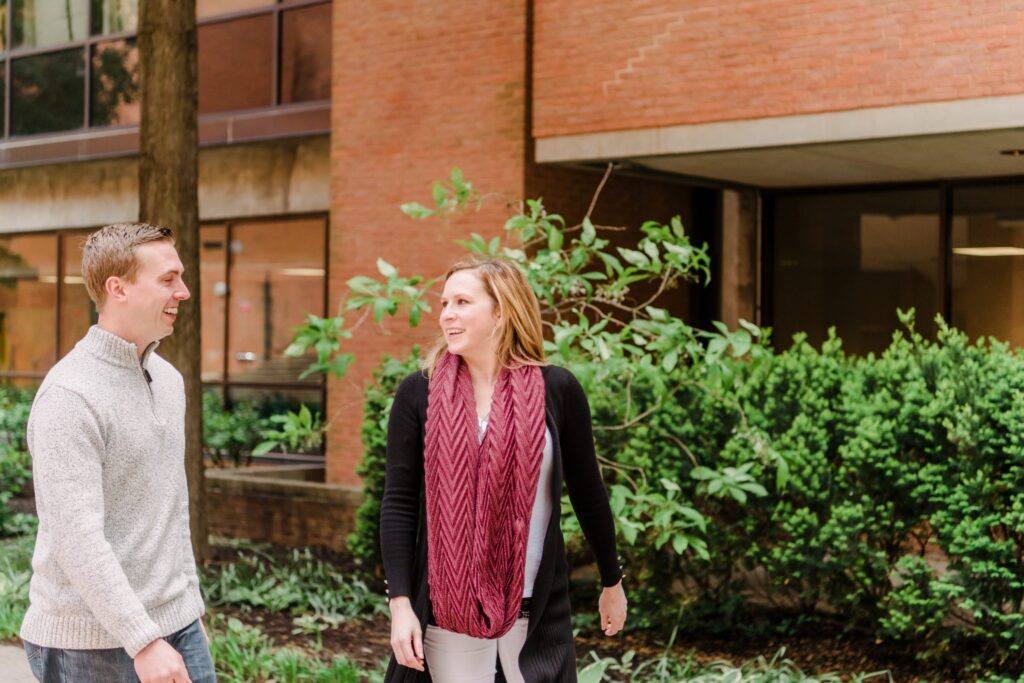 Jamie Gurganus (right) walks with Randy Deinlein ’19, mechanical engineering, on campus, May 2019. Photo by Marlayna Demond ’11 for UMBC.
The centerpiece of this work was the Planning Instructional Variety for Online Teaching (PIVOT) program. PIVOT, PIVOT+, and more specialized webinars helped faculty design truly engaging online courses. COEIT hired several rising UMBC juniors and seniors to participate in the workshops and offer feedback to faculty.
These undergraduate teaching fellows “brought an essential perspective,” Gurganus shares. They continued to provide feedback throughout the fall, and many are continuing the work in spring 2021.
Creativity and community
Hana Flores ’21, chemical engineering, served as a teaching fellow. She shares, “It was unlike anything we have done before, but it was special due to the creativity and strong community of COEIT.”
Flores sees her experience as emblematic of a culture of community support. “I’m grateful for continuing the legacy of support from upperclassmen to underclassmen as a teaching fellow,” she says. “It is what makes engineering classes exceptional.”
Celebrating together
COEIT invited Flores and dozens of other teaching fellows and teaching assistants to a celebration to honor their work in late December. After a busy and intense semester, they took time to enjoy each others’ company, with Flores’s team, the ChemiE Cuties, winning the celebration’s trivia contest.
 Hana Flores (center row, left, in red shirt) with her winning team, the ChemiE Cuties. Image courtesy of COEIT.
“Watching our students celebrate allowed my mind to forget for a moment the challenges that we face,” says Mariajose Castellanos, senior lecturer and undergraduate program director of chemical engineering. “It was important to me that we could come together and remind them of how much we appreciate them. They make our classes better and provide invaluable help.”
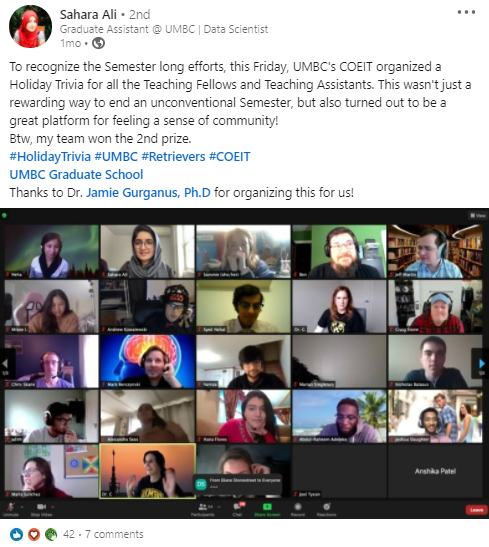
LinkedIn post by
Sahara Ali, PhD student in information systems.
A more meaningful experience
“When it comes to delivering a class, it’s a collaboration effort between the instructors, teaching fellows, and teaching assistants,” says Gurganus. “They go beyond the scope of grading papers and holding office hours. These students provide a unique perspective that gives our classes a richer and more meaningful experience.”
Often, these students have recently completed the class they are now supporting, so they are able to identify and relate to its challenges in a unique way.
“These students’ insights enhance our courses in so many ways,” Gurganus shares, “and they have such a positive impact on the learning experience we can provide.”
Although some COEIT teaching fellows and teaching assistants graduated in fall 2020, Gurganus says a majority will continue their work in spring 2021, as UMBC courses remain largely online.
Tiled gallery images above: Logan Hawker ’22, mechanical engineering, at left, and CWIT CyberScholar Marian Singletary ’21, computer engineering, at right, compete in the trivia game. Images courtesy of Hawker and Singletary.
Featured image: Hand clicking laptop mouse. Photo by Flickr user Marco Verch, CC BY 2.0.
]]>
As UMBC faculty prepare for spring, they are reflecting on lessons learned from a primarily online fall 2020 semester. In UMBC’s College of Engineering and Information Technology (COEIT), this...
https://umbc.edu/stories/umbc-students-help-create-richer-online-courses-for-peers-in-engineering-and-computing-fields/
https://my3.my.umbc.edu/api/v0/pixel/news/119700/guest@my.umbc.edu/94411753e91458ec08f7d6f6fbc4938f/api/pixel
cbee
coeit
community
csee
is
meche
page1
science-and-technology
UMBC News & Magazine
https://my3.my.umbc.edu/groups/umbc-news-magazine
https://assets1-my.umbc.edu/system/shared/avatars/groups/000/001/943/24435aa6207c452e7bc15cc74b42c7bb/xsmall.png?1748556657
https://assets1-my.umbc.edu/system/shared/avatars/groups/000/001/943/24435aa6207c452e7bc15cc74b42c7bb/original.png?1748556657
https://assets2-my.umbc.edu/system/shared/avatars/groups/000/001/943/24435aa6207c452e7bc15cc74b42c7bb/xxlarge.png?1748556657
https://assets2-my.umbc.edu/system/shared/avatars/groups/000/001/943/24435aa6207c452e7bc15cc74b42c7bb/xlarge.png?1748556657
https://assets3-my.umbc.edu/system/shared/avatars/groups/000/001/943/24435aa6207c452e7bc15cc74b42c7bb/large.png?1748556657
https://assets1-my.umbc.edu/system/shared/avatars/groups/000/001/943/24435aa6207c452e7bc15cc74b42c7bb/medium.png?1748556657
https://assets2-my.umbc.edu/system/shared/avatars/groups/000/001/943/24435aa6207c452e7bc15cc74b42c7bb/small.png?1748556657
https://assets1-my.umbc.edu/system/shared/avatars/groups/000/001/943/24435aa6207c452e7bc15cc74b42c7bb/xsmall.png?1748556657
https://assets2-my.umbc.edu/system/shared/avatars/groups/000/001/943/24435aa6207c452e7bc15cc74b42c7bb/xxsmall.png?1748556657
UMBC News & Magazine
0
0
false
Tue, 19 Jan 2021 15:56:33 -0500
UMBC leaders and community support congressional resolution for national racial healing work
The fourth annual National Day of Racial Healing is on Tuesday, January 19. The goal of the day is to promote racial healing and equity across the United States through collective action. UMBC will observe the day in spirit and action.
As a unified front, UMBC leadership—including President Freeman Hrabowski, Provost Philip Rous, and shared governance leaders—are signing a letter to Maryland’s Congressional delegation in support of a Congressional Resolution, which calls for the establishment of a United States Commission on Truth, Racial Healing, and Transformation (TRHT).
“Having university leadership sign on in support of this resolution is a big step,” says Eric Ford, director of The Choice Program at UMBC. “It sets the example for other institutions of higher education to do the same. For so long, higher ed has perpetuated inequities and now we have the responsibility to address it. By taking this step, UMBC is sending a message to the campus community that inclusive excellence is not just a slogan but a virtue we live by.”
 Ford (far right) and Choice staff visit the Administration Building’s rooftop after a successful presentation to the UMBC’s President’s Council in 2015. All photos courtesy of Eric Ford.
Melody Wright, president, Non-Exempt Staff Senate, is one of the campus leaders signing the joint letter. “The voices of those seeking justice have been muffled for far too long,” says Wright, “and those voices must be amplified and heard for true racial healing to begin. You cannot truly understand someone’s story unless you have lived it with them, but carefully listening to someone’s lived experiences is a great place to start.”
In addition to the letter signed by campus leaders, UMBC community members have an opportunity to write to their own senators and representatives about the TRHT resolution. An online event on January 19 will provide additional information about the goal of the TRHT resolution and the work of Truth, Racial Healing, and Transformation at UMBC.
Transformation is ongoing work
In 2017, UMBC partnered with the Association of American Colleges and Universities to become one of the first Truth, Racial Healing, and Transformation Campus Centers in the country. UMBC’s THRT Campus Center work involves breaking down racial hierarchies with a focus on the university’s service-learning and community engagement partnerships in Baltimore City. Ford shares that truth, racial healing, and transformation are all essential to effective and responsible service-learning and community engagement.
To begin the process of truth telling, The Choice Program underwent a yearlong antiracism audit of the organization. As a result, according to Ford and Frank Anderson, a doctoral student in language, literacy, and culture and the associate director of programs at Choice, the organization’s entire service model was rewritten. Their focus is to ensure that the voices and experiences of the young people being served are at the forefront of the work.
 Choice and UMBC staff host students from Baltimore high schools as a part of Choice’s Education program aimed at increasing college access.
The Choice Program—the Shriver’s Center’s oldest and largest service-learning initiative—has become an opportunity to envision the TRHT model at scale, identifying what it means to engage 36 AmeriCorps members as they serve more than 600 young people each year.
Accountability is crucial
Briscoe Turner ’21, psychology, was drawn to Choice after hearing about the program-wide audit. Now an intern at the TRHT Campus Center, Turner is helping to spearhead the letter-writing initiative.
“Members of Congress need to hear the thoughts and experiences of students and staff to make sure that the TRHT Commission actually serves its purpose by actively challenging the racist practices and policies embedded in this country’s major institutions that impact the surrounding community,” says Turner. “Accountability is crucial.”
By following the TRHT model, The Shriver Center has also been able to work with undergraduate researchers to reevaluate media narratives about Baltimore. The Center has also used lessons from TRHT to reflect on already successful programs like College Night.
With College Night, young people from the Baltimore area connect with UMBC every Monday night, through on-campus visits pre-COVID-19 and virtual events today. Through the THRT model, organizers revised College Night training materials and reflections to ensure volunteers understood the broader context within which they were working.
Supporting nationwide change
In September 2020, UMBC hosted the first Truth, Racial Healing, and Transformation Town Hall during which community members learned more about the THRT Campus Center and UMBC’s connection to a national framework addressing race equity. Community partners and alumni spoke about how structural racism has impacted youth development in Maryland and how campus members can become agents of change.
 Choice participant performs at the 2015 Imagining America event hosted by UMBC.
UMBC supports the Congressional resolution, proposed by Sen. Cory Booker and Rep. Barbara Lee, says Ford, because it amplifies the broader goals of the TRHT center and the important work being done by Retriever students and staff.
“It speaks truth to power by encouraging the acknowledgement of centuries of oppression of people of color,” says Ford. “It stresses the importance of telling the ‘story’ of people of color and their experiences in this country, which will restore our humanity that was stripped away by structural racism. And it is a step toward system change which is needed to achieve equity.”
A multiprong approach
UMBC’s TRHT Campus Center is only one facet of a larger institutional acknowledgement that the university, like others across the country, needs to confront racism within its own structures and community.
In 2019, UMBC founded the Office of Equity and Inclusion (OEI), which is responsible for promoting and coordinating the university’s core values of inclusive excellence and equity. The center has primary responsibility for managing UMBC’s work related to Title IX as well as other civil rights issues.
 Baltimore City’s first Poet Laureate Derick Ebert performs spoken word for Choice participants at its 2015 “Youth in Action” community arts showcase.
In June 2020, UMBC formed an Inclusion Council to bring together faculty, staff, students, and alumni to help address issues of equity and inclusion at UMBC. The council’s co-chair, Ariana Arnold, director of OEI, shares her hopes for the group and campus as a whole.
“What I’d like to be able to say a year from now,” Arnold shares, “is that we are doing the work and not just talking about the work. And that five years from now we’ve had a measurable impact on campus in terms of both engaging people from all political, racial, ethnic, religious, cultural backgrounds, abilities, and nationalities and improving the sense of inclusion and belonging on campus.”
The Inclusion Council, OEI, and TRHT Campus Center are working together to make that vision of UMBC come to fruition. UMBC’s letter to Maryland’s representatives supporting the effort to bring the TRHT model to a national scale is the next step in the university’s ongoing work for truth, racial healing, and transformation.
Featured photo: In a 2017 gathering, Choice staff and AmeriCorps members take part in reflecting on how service transformed their lives. Photo courtesy of Eric Ford.
]]>
The fourth annual National Day of Racial Healing is on Tuesday, January 19. The goal of the day is to promote racial healing and equity across the United States through collective action. UMBC...
https://umbc.edu/stories/umbc-leaders-and-community-support-congressional-resolution-for-national-racial-healing-work/
https://my3.my.umbc.edu/api/v0/pixel/news/119701/guest@my.umbc.edu/630d9d49bf5538c97a318c60e41aadc9/api/pixel
cahss
campus
choiceprogram
diversity
page1
policy-and-society
shrivercenter
UMBC News & Magazine
https://my3.my.umbc.edu/groups/umbc-news-magazine
https://assets1-my.umbc.edu/system/shared/avatars/groups/000/001/943/24435aa6207c452e7bc15cc74b42c7bb/xsmall.png?1748556657
https://assets1-my.umbc.edu/system/shared/avatars/groups/000/001/943/24435aa6207c452e7bc15cc74b42c7bb/original.png?1748556657
https://assets2-my.umbc.edu/system/shared/avatars/groups/000/001/943/24435aa6207c452e7bc15cc74b42c7bb/xxlarge.png?1748556657
https://assets2-my.umbc.edu/system/shared/avatars/groups/000/001/943/24435aa6207c452e7bc15cc74b42c7bb/xlarge.png?1748556657
https://assets3-my.umbc.edu/system/shared/avatars/groups/000/001/943/24435aa6207c452e7bc15cc74b42c7bb/large.png?1748556657
https://assets1-my.umbc.edu/system/shared/avatars/groups/000/001/943/24435aa6207c452e7bc15cc74b42c7bb/medium.png?1748556657
https://assets2-my.umbc.edu/system/shared/avatars/groups/000/001/943/24435aa6207c452e7bc15cc74b42c7bb/small.png?1748556657
https://assets1-my.umbc.edu/system/shared/avatars/groups/000/001/943/24435aa6207c452e7bc15cc74b42c7bb/xsmall.png?1748556657
https://assets2-my.umbc.edu/system/shared/avatars/groups/000/001/943/24435aa6207c452e7bc15cc74b42c7bb/xxsmall.png?1748556657
UMBC News & Magazine
0
0
false
Fri, 15 Jan 2021 19:09:40 -0500
 Morgan Thomas at a UMBC Community Conversation event in 2019. All photos by Marlayna Demond ’11.
 Allan Kittleman speaks at the 2018 Alumni Award ceremony.
 UMBC is dedicated to creating and maintaining a community of inquiring minds. Photo taken in 2019.


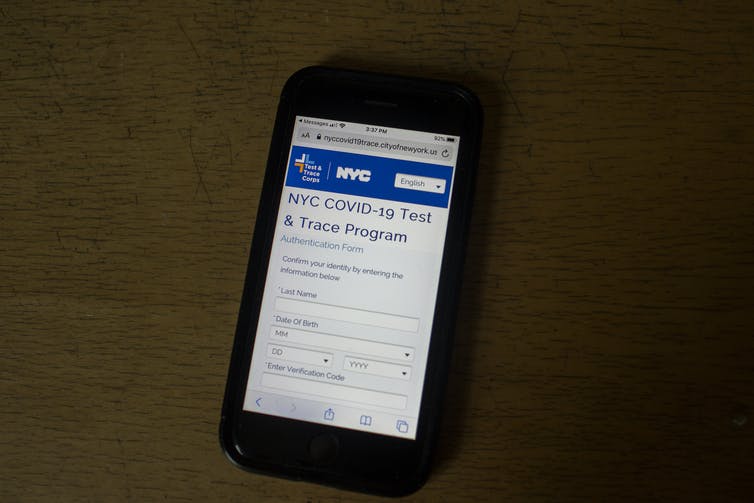 Effective contact tracing is critical to reducing the impact of the pandemic.
  COVID-19 has demonstrated the difficulties in the mass production and distribution of a vaccine.