Mechanical engineering professor Weidong Zhu honored for pioneering work analyzing sound and vibration
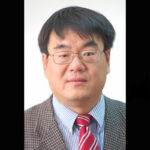
The elevator in the Shanghai Tower in China can reach speeds of more than 45 miles per hour, whisking passengers up more than 100 floors in under a minute. For elevators this fast and tall, understanding—and ultimately controlling—the vibrations in the cables is key to keeping the ride smooth. It’s a problem that mechanical engineering professor Weidong Zhu has studied, and his analysis of high-speed elevators is just one of the ways his research touches everyday life. His work analyzing sound and vibration also has applications to improving wind turbines, automotive timing belts, and more.
The American Society of Mechanical Engineers recently honored Zhu’s pioneering body of research by selecting him to deliver the Rayleigh Lecture at the society’s annual meeting this November. The lecture is named after British scientist Lord Rayleigh, who, in addition to correctly explaining why the sky is blue and discovering the noble gas argon, wrote a groundbreaking book on the theory of sound.
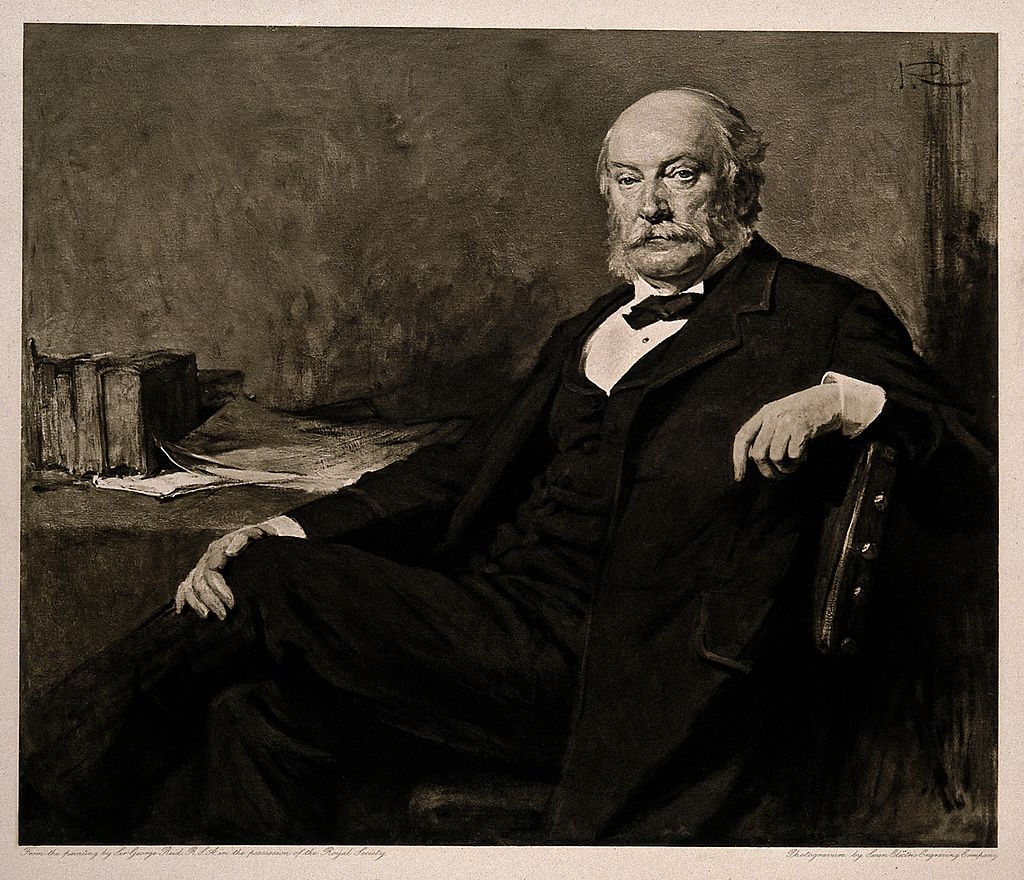 Photogravure of scientist John William Strutt, otherwise known as Lord Rayleigh. (Image credit: Wellcome Library, London, CC BY 4.0)
In his lecture delivered Nov. 20, Zhu presented new methodologies he has developed for analyzing difficult noise and vibration problems. “I’m very honored to give the Rayleigh Lecture,” says Zhu. “It’s a lifetime achievement award and one of the highest recognitions for people doing research in this area.”
Zhu’s impactful research has also been recognized with the 2020 University System of Maryland Board of Regents’ Faculty Award for Excellence in Scholarship, Research, or Creative Activity.
]]>
The elevator in the Shanghai Tower in China can reach speeds of more than 45 miles per hour, whisking passengers up more than 100 floors in under a minute. For elevators this fast and tall,...
https://umbc.edu/quick-posts/mechanical-engineering-professor-weidong-zhu-honored-for-pioneering-work-analyzing-sound-and-vibration/
https://my3.my.umbc.edu/api/v0/pixel/news/145853/guest@my.umbc.edu/d5c534390967aea9595f7019b32af078/api/pixel
coeit
meche
news
quick-post
research
science-and-tech
UMBC News & Magazine
https://my3.my.umbc.edu/groups/umbc-news-magazine
https://assets1-my.umbc.edu/system/shared/avatars/groups/000/001/943/24435aa6207c452e7bc15cc74b42c7bb/xsmall.png?1748556657
https://assets1-my.umbc.edu/system/shared/avatars/groups/000/001/943/24435aa6207c452e7bc15cc74b42c7bb/original.png?1748556657
https://assets2-my.umbc.edu/system/shared/avatars/groups/000/001/943/24435aa6207c452e7bc15cc74b42c7bb/xxlarge.png?1748556657
https://assets2-my.umbc.edu/system/shared/avatars/groups/000/001/943/24435aa6207c452e7bc15cc74b42c7bb/xlarge.png?1748556657
https://assets3-my.umbc.edu/system/shared/avatars/groups/000/001/943/24435aa6207c452e7bc15cc74b42c7bb/large.png?1748556657
https://assets1-my.umbc.edu/system/shared/avatars/groups/000/001/943/24435aa6207c452e7bc15cc74b42c7bb/medium.png?1748556657
https://assets2-my.umbc.edu/system/shared/avatars/groups/000/001/943/24435aa6207c452e7bc15cc74b42c7bb/small.png?1748556657
https://assets1-my.umbc.edu/system/shared/avatars/groups/000/001/943/24435aa6207c452e7bc15cc74b42c7bb/xsmall.png?1748556657
https://assets2-my.umbc.edu/system/shared/avatars/groups/000/001/943/24435aa6207c452e7bc15cc74b42c7bb/xxsmall.png?1748556657
UMBC News & Magazine
0
0
false
Fri, 22 Nov 2024 14:40:08 -0500
Fri, 22 Nov 2024 14:40:08 -0500
Striving for more efficient and equitable healthcare: Ian Stockwell wins major NIH grant

Ian Stockwell ’03, information systems and financial economics, M.A. ’06, economic policy analysis, and Ph.D. ’14, public policy, has spent his 20-plus-year career analyzing healthcare operations. One major inefficiency he sees in the U.S. healthcare system is an overreliance on clinical medicine when other interventions, such as support accessing healthy food and safe housing, are also needed.
“We have a health system that under-invests on social needs,” Stockwell says. “It is failing a lot of people.”
Now an associate professor in information systems at UMBC, Stockwell recently launched a new project, supported by a five-year, $3.4 million grant from the National Institutes of Health, to address this shortcoming. He is partnering with a major Medicaid health plan to build a machine-learning-powered system to help identify patients with social needs—factors, such as food insecurity or financial stress—that impact an individual’s ability to maintain their health. The system will also help determine how best to connect these patients with social support systems on a long-term basis.
The system will use multiple individual- and community-level data sources to predict which members use the emergency department to fulfill social or non-urgent needs. It will also identify the hurdles that frequently prevent individuals from engaging with a community-based social needs organization.
The dream outcome, Stockwell says, is that the system provides robust support to healthcare providers for effectively engaging with people with social needs. “We could then take the infrastructure that we build and work to propagate it through the healthcare system. Ultimately, we want to use what we create to help people by shrinking disparities in health outcomes in this country.”
The study team brings together researchers from multiple departments and colleges at UMBC, including Tera Reynolds, James Foulds, and Osman Gani from the Department of Information Systems; Sameera Nayak from the Department of Sociology, Anthropology, and Public Health; Lucy Wilson from the Department of Emergency and Disaster Health Systems, and Joby Taylor, Ph.D. ’05, language, literacy, and culture, from the Shriver Center.
“As a career-long UMBCer, I’m excited that this project helps broaden the footprint of NIH funding at the university. It also pushes the boundaries of what an interdisciplinary collaboration can mean,” Stockwell says.
]]>
Ian Stockwell ’03, information systems and financial economics, M.A. ’06, economic policy analysis, and Ph.D. ’14, public policy, has spent his 20-plus-year career analyzing healthcare operations....
https://umbc.edu/stories/ian-stockwell-wins-major-nih-healthcare-grant/
https://my3.my.umbc.edu/api/v0/pixel/news/145567/guest@my.umbc.edu/e1ee130b6250f9959e2fa4444526d812/api/pixel
cahss
coeit
is
news
policy-and-society
research
science-and-tech
shriver-center
story
UMBC News & Magazine
https://my3.my.umbc.edu/groups/umbc-news-magazine
https://assets1-my.umbc.edu/system/shared/avatars/groups/000/001/943/24435aa6207c452e7bc15cc74b42c7bb/xsmall.png?1748556657
https://assets1-my.umbc.edu/system/shared/avatars/groups/000/001/943/24435aa6207c452e7bc15cc74b42c7bb/original.png?1748556657
https://assets2-my.umbc.edu/system/shared/avatars/groups/000/001/943/24435aa6207c452e7bc15cc74b42c7bb/xxlarge.png?1748556657
https://assets2-my.umbc.edu/system/shared/avatars/groups/000/001/943/24435aa6207c452e7bc15cc74b42c7bb/xlarge.png?1748556657
https://assets3-my.umbc.edu/system/shared/avatars/groups/000/001/943/24435aa6207c452e7bc15cc74b42c7bb/large.png?1748556657
https://assets1-my.umbc.edu/system/shared/avatars/groups/000/001/943/24435aa6207c452e7bc15cc74b42c7bb/medium.png?1748556657
https://assets2-my.umbc.edu/system/shared/avatars/groups/000/001/943/24435aa6207c452e7bc15cc74b42c7bb/small.png?1748556657
https://assets1-my.umbc.edu/system/shared/avatars/groups/000/001/943/24435aa6207c452e7bc15cc74b42c7bb/xsmall.png?1748556657
https://assets2-my.umbc.edu/system/shared/avatars/groups/000/001/943/24435aa6207c452e7bc15cc74b42c7bb/xxsmall.png?1748556657
UMBC News & Magazine
1
0
false
Tue, 12 Nov 2024 13:03:10 -0500
Tue, 12 Nov 2024 13:03:10 -0500
Faisal Quader, Ph.D. ’20: Expanding access to the cyber ecosystem
There’s already a student waiting outside the office of Faisal Quader, Ph.D. ’20, when the adjunct professor arrives at the Information Technology and Engineering building on a Thursday afternoon.
 Headshot courtesy of Quader.
The recent graduate, Smriti Khilnani, M.S. ’24, information systems, patiently waits for the information systems instructor—a full-time president of Technuf LLC, philanthropist, and board member of several organizations—to open his office for his limited hours on campus. Quader breezes in, greeting his guest with a smile while asking her how she’s doing.
“I don’t know,” the graduate says, before the pair steps inside the office. After several minutes, the duo exit and Khilnani’s face looks more relaxed and at ease than moments before.
“She’s looking for a job, and she’s a little frustrated,” says Quader of the graduate, who is an international student. “She’s trying to get a cybersecurity job, but it needs security clearance, which she cannot get due to her non-U.S. citizen status. However, we talked about alternative solutions to her problem.”
Moments like these aren’t uncommon for Quader, a former international student himself. He spends a large portion of his time in service to those around him, whether it’s in the classroom, in a meeting room at the high-tech company he runs, or on stage when he’s singing classic Bengali songs.
“The fact that people are so open to come to me for help—that makes my day knowing that I’m able to make a difference,” says Quader.
Bringing industry perspectives into the classroom
Since graduating in 2020, Quader has spent the last four years as a part-time instructor teaching two graduate-level cybersecurity courses at UMBC and an additional course at the University of Maryland, College Park. On top of teaching, Quader works full-time as the president of the company he co-founded, Technuf, which specializes in cybersecurity, artificial intelligence (AI), machine learning (ML), robotic process automation, mobile application development, and software engineering. The Rockville-based company supports agencies, such as the Internal Revenue Service, the National Institutes of Health, and the Department of Homeland Security, and some state governments on high-profile cybersecurity initiatives.
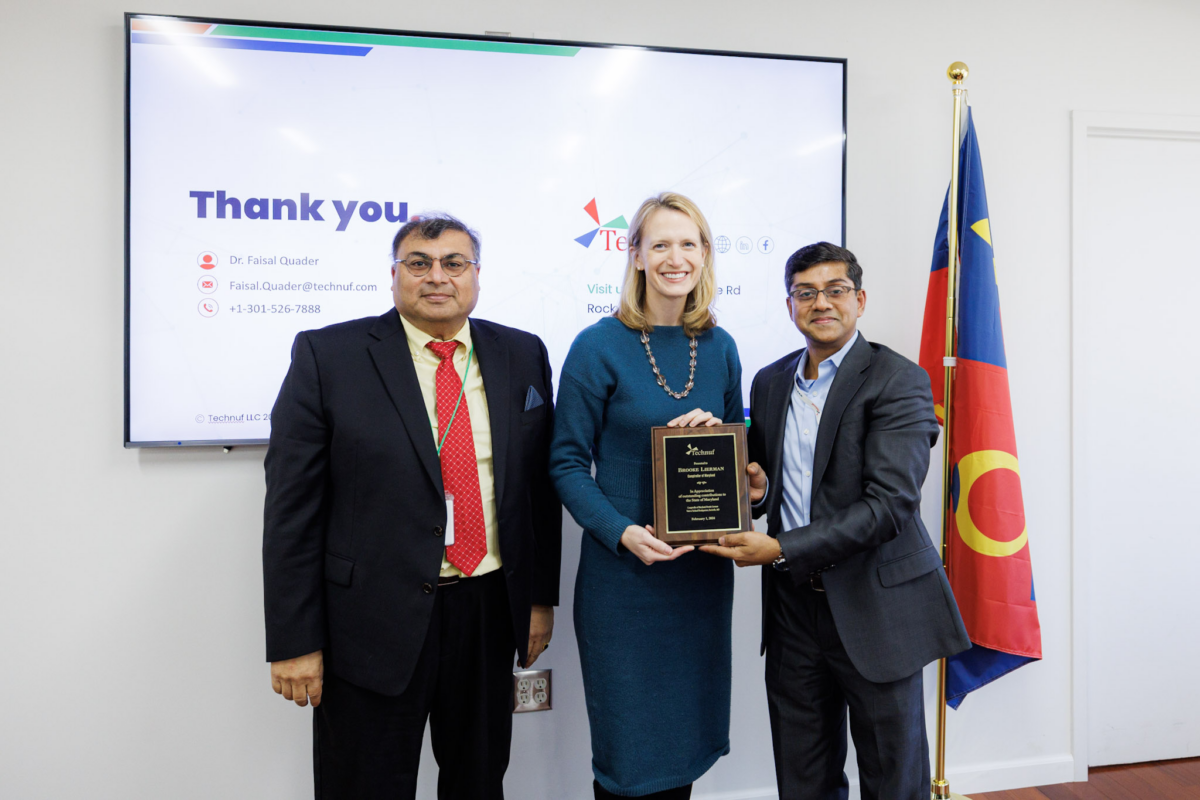 Faisal Quader (right) and Technuf co-founder and CEO Shah Ahmed (left) presenting an award to Maryland Comptroller Brooke E. Lierman in February 2024. (Photo courtesy of Technuf LLC’s X account)
Quader has a B.S. in computer science from the University of Wisconsin and an M.S. in computer science and engineering from Johns Hopkins University. Before going down the path to becoming a faculty member, Quader was initially a non-degree student at UMBC, but after enjoying his class so much, he decided to pursue a doctoral degree in information systems, specializing in cybersecurity.
“It was a difficult path working full-time and being a student, but I got so much from UMBC,” says Quader. “My mentors and professors supported me tremendously. I love this school, and now I feel like it’s time for me to give something back. Nothing is better than being able to share what I’ve learned with students.”
Quader brings his data science industry know-how to the classroom in more practical ways, educating students on how he and his team at Technuf work to address timely cybersecurity challenges, such as securing network infrastructures from cyber attacks and analyzing data to protect from cyber threats. His courses are capped to capacity every semester and has an ever-evolving waitlist of students hoping to learn from his tutelage.
“Cybersecurity is an extremely hot topic, and I like that I can bring in the industry perspective to my theoretical teachings,” explains Quader. “I love teaching—it’s my passion. Even though I work full time, I do this because I love to be able to share what I do everyday.”
A passion for performance
While Quader has spent the last three decades in engineering, computer science, and information science as an industry leader, he’s dedicated much of his life to something he got from his mother: a love of singing.
As a child growing up in Bangladesh, Quader frequently performed on tv shows as a vocalist and continues to feed his passion for performance today. He shares that music is his “weekend work” where he occasionally puts on family performances with his wife and two children. Every few weeks, Quader travels across the DMV singing with various groups. He’s a big fan of Lionel Richie and Bengali polymath Rabindranath Tagore. With his performances, Quader says that he is trying to create a bridge between Eastern and Western music.
 Faisal Quader singing traditional South Asian music during a performance at the Purbachal Resort in Bangladesh. (Photo courtesy of Quader)
The tech-heavy data scientist says that finding time to mesh his creative passions with his analytical and technical skills gives balance to his life—music and technology are more related than one may think, he adds.
“Technology has a lot of mathematical inductions, different kinds of modeling theories and patterns. Music is also something that is kind of like a pattern,” says Quader. “Music refreshes my brain. When the weekend comes, I focus on music and that gives me more energy to do my work. That keeps me sane.”
Supporting the next generation of data scientists and engineers
In 2023, Quader established the Technuf Endowed Fellowship at UMBC, a $100,000 fund that supports master’s or Ph.D. candidates in information systems with entrepreneurial aspirations who are conducting research and/or pursuing a career in AI/ML or cybersecurity. The fellowship, Quader shares, is particularly for students who are unable to receive financial support for their education.
“When I was a student here in the U.S. after emigrating from Bangladesh at age 18, I didn’t have a scholarship or funding because of the fact that I was an international student. I struggled so badly and had to work three jobs to make my tuition,” he says. “I don’t want my students to go through the same process of struggling. I’m not able to help every student, but this is a good start.”
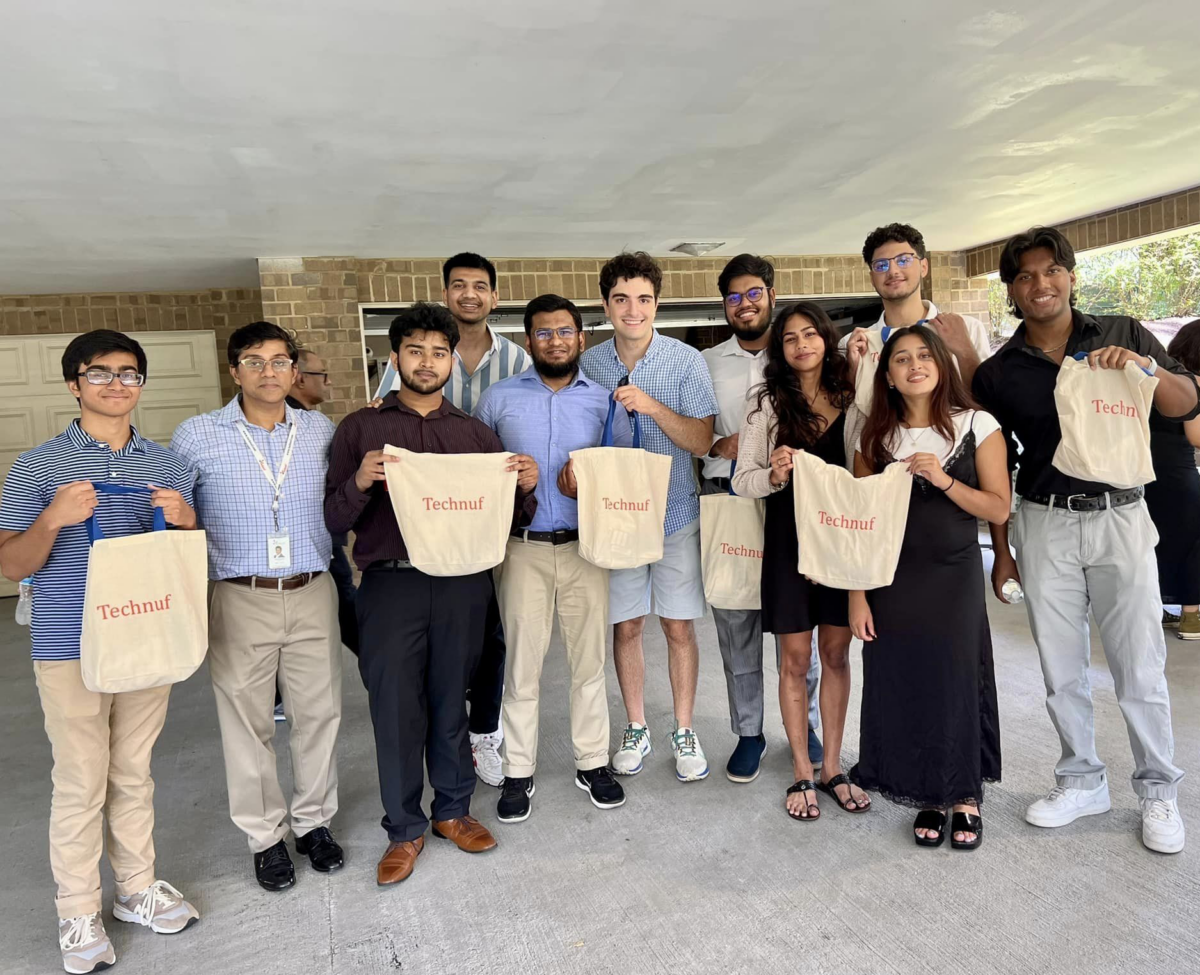 Faisal Quader (second from left) with former Technuf interns. (Photo courtesy of Technuf’s X account)
Quader also created a summer internship program at Technuf where students work hand-in-hand with data scientists and engineers on solving technical problems. Several UMBC students have gone on to work full time at Technuf following their internships, including Isha Shah, M.S. ’23, information systems. In summer 2022, Shah worked at Technuf as a software engineer and data science intern.
 Quader, alongside his wife Fahmida, holding his Distinguished Service Alumni Award. (Photo courtesy of Quader)
“I often found it challenging to secure job or internship opportunities. During one of our initial classes, Dr. Quader mentioned his company, which immediately caught my interest,” says Shah. “I reached out to him to inquire about internship opportunities and to my surprise, he responded with enthusiasm and asked me to send over my resume. That moment felt like a turning point in my career journey.”
After graduating from UMBC, Shah was offered a full-time position at Technuf and currently works at the company as a product development engineer.
“Dr. Quader has had a tremendous impact on both my studies and career. His approach to teaching went far beyond textbooks. He always emphasized the importance of real-world applications and critical thinking, which made a significant difference in my understanding of cybersecurity concepts,” Shah explains. “Dr. Quader believed in my potential and opened doors for me at Technuf, where I’ve been able to gain invaluable hands-on experience in the field.”
In October, Quader was honored for his service as a 2024 recipient of UMBC’s Distinguished Service Alumni Award.
“That was a big encouragement for me,” Quader beamed. “I can see the difference I’m able to make with my students by giving them job opportunities, internships, training, and industry focused-teaching. That’s what keeps me going.”
]]>
There’s already a student waiting outside the office of Faisal Quader, Ph.D. ’20, when the adjunct professor arrives at the Information Technology and Engineering building on a Thursday...
https://umbc.edu/stories/faisal-quader/
https://my3.my.umbc.edu/api/v0/pixel/news/145437/guest@my.umbc.edu/f67ae41ea549926f17a588967aebfbf7/api/pixel
alumni
alumni-awards
coeit
cybersecurity
datascience
fall-2024
impact
information-systems
magazine
story
UMBC News & Magazine
https://my3.my.umbc.edu/groups/umbc-news-magazine
https://assets1-my.umbc.edu/system/shared/avatars/groups/000/001/943/24435aa6207c452e7bc15cc74b42c7bb/xsmall.png?1748556657
https://assets1-my.umbc.edu/system/shared/avatars/groups/000/001/943/24435aa6207c452e7bc15cc74b42c7bb/original.png?1748556657
https://assets2-my.umbc.edu/system/shared/avatars/groups/000/001/943/24435aa6207c452e7bc15cc74b42c7bb/xxlarge.png?1748556657
https://assets2-my.umbc.edu/system/shared/avatars/groups/000/001/943/24435aa6207c452e7bc15cc74b42c7bb/xlarge.png?1748556657
https://assets3-my.umbc.edu/system/shared/avatars/groups/000/001/943/24435aa6207c452e7bc15cc74b42c7bb/large.png?1748556657
https://assets1-my.umbc.edu/system/shared/avatars/groups/000/001/943/24435aa6207c452e7bc15cc74b42c7bb/medium.png?1748556657
https://assets2-my.umbc.edu/system/shared/avatars/groups/000/001/943/24435aa6207c452e7bc15cc74b42c7bb/small.png?1748556657
https://assets1-my.umbc.edu/system/shared/avatars/groups/000/001/943/24435aa6207c452e7bc15cc74b42c7bb/xsmall.png?1748556657
https://assets2-my.umbc.edu/system/shared/avatars/groups/000/001/943/24435aa6207c452e7bc15cc74b42c7bb/xxsmall.png?1748556657
UMBC News & Magazine
0
0
false
Thu, 07 Nov 2024 10:05:35 -0500
Thu, 07 Nov 2024 10:05:35 -0500
UMBC researchers to study digital twinning technology, AI use in neurodegenerative diseases with NSF grant

A multidisciplinary team of UMBC researchers was recently awarded a National Science Foundation (NSF) grant to expand the use of digital twinning technology to diagnose, treat, and increase the understanding of neurodegenerative diseases.
The use of digital twinning—a virtual model of a physical object—was developed by scientists and engineers at NASA as early as the 1960s. Within the last decade, the technology has grown in popularity across a range of industries and has more recently been implemented to advance healthcare diagnostics and treatments, explains Snigdhansu (Ansu) Chatterjee, professor of mathematics and statistics.
Chatterjee, the principal investigator of the UMBC-led study, is taking a closer look into the use of digital twinning to examine neurodegenerative diseases, supported by a nearly $900,000 grant from the NSF’s Foundations for Digital Twins as Catalyzers of Biomedical Technological Innovation (FDT-BioTech) program. The program, in collaboration with the National Institutes of Health and the FDA, was created to foster advances in mathematics, statistics, computational sciences, and engineering required to develop responsive digital twin models that incorporate the abilities of artificial intelligence. UMBC was one of seven institutions awarded research funding to explore the development and use of digital twins in health care and biomedical research. The Washington Post mentioned the FDT-BioTech program in a recent article on the evolution of digital twin technology and its potential to transform healthcare.
The UMBC team will work to develop a prototype of their digital twin model for possible use for neuroscience researchers. The study will also address the ethical, legal, and social implications of using digital twin models in the context of healthcare and in studying neurodegenerative diseases using magnetic resonance-technology driven images (MRI) in particular.
“There are various issues relating to the ethics of AI models and how you use the data, which is especially important when it comes to biological sciences and healthcare,” says Chatterjee. “All good scientists stay within ethical guardrails, and we’re defining what those guardrails are when it comes to using this technology to study neurodegenerative diseases like Alzheimer’s, Parkinson’s disease, and multiple sclerosis.”
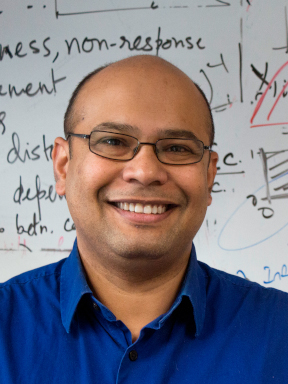

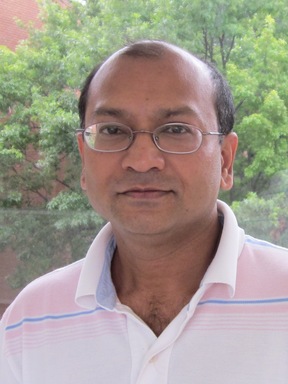 Principal investigator Snigdhansu (Ansu) Chatterjee (left) and co-investigators Karuna Joshi and Animikh Biswas are the leads of the“FDT-BioTech: Aspects of Digital Twin Studies for Neuroimages” study, funded by the National Science Foundation.
The study, which will run until 2027, includes co-investigators Karuna Joshi, professor of information systems, and Animikh Biswas, professor and chair of mathematics and statistics. Additional partners include researchers from the University of Minnesota and the University of Texas at El Paso. The project will also provide funding to support two graduate students and a postdoctoral researcher at UMBC who specialize in engineering, math, or statistics.
Joshi, who is the director of UMBC’s Center for Accelerated Real Time Analytics, explains that there has been an increase in the use of AI models in health prediction, diagnostics, and determining treatment options.
“The explainability and the replicability elements of digital twinning are very critical to why the technology is becoming popular,” says Joshi. “We are looking to develop a ‘meta model’ of all of the various models that’s going to run the neuroimages we’ll study so that it can be explained, archived, and audited.”
Joshi adds that the study will allow for “a cross-pollination of ideas,” where engineering meets science, math, statistics, and healthcare in a very unique way.
More on artificial intelligence research at UMBC.
]]>
A multidisciplinary team of UMBC researchers was recently awarded a National Science Foundation (NSF) grant to expand the use of digital twinning technology to diagnose, treat, and increase the...
https://umbc.edu/stories/digital-twinning-nsf-study/
https://my3.my.umbc.edu/api/v0/pixel/news/144906/guest@my.umbc.edu/70a855afdefe0651942e3e7739cf041e/api/pixel
artificial-intelligence
cnms
coeit
information-systems
mathematics-and-statistics
news
research
science-and-tech
story
UMBC News & Magazine
https://my3.my.umbc.edu/groups/umbc-news-magazine
https://assets1-my.umbc.edu/system/shared/avatars/groups/000/001/943/24435aa6207c452e7bc15cc74b42c7bb/xsmall.png?1748556657
https://assets1-my.umbc.edu/system/shared/avatars/groups/000/001/943/24435aa6207c452e7bc15cc74b42c7bb/original.png?1748556657
https://assets2-my.umbc.edu/system/shared/avatars/groups/000/001/943/24435aa6207c452e7bc15cc74b42c7bb/xxlarge.png?1748556657
https://assets2-my.umbc.edu/system/shared/avatars/groups/000/001/943/24435aa6207c452e7bc15cc74b42c7bb/xlarge.png?1748556657
https://assets3-my.umbc.edu/system/shared/avatars/groups/000/001/943/24435aa6207c452e7bc15cc74b42c7bb/large.png?1748556657
https://assets1-my.umbc.edu/system/shared/avatars/groups/000/001/943/24435aa6207c452e7bc15cc74b42c7bb/medium.png?1748556657
https://assets2-my.umbc.edu/system/shared/avatars/groups/000/001/943/24435aa6207c452e7bc15cc74b42c7bb/small.png?1748556657
https://assets1-my.umbc.edu/system/shared/avatars/groups/000/001/943/24435aa6207c452e7bc15cc74b42c7bb/xsmall.png?1748556657
https://assets2-my.umbc.edu/system/shared/avatars/groups/000/001/943/24435aa6207c452e7bc15cc74b42c7bb/xxsmall.png?1748556657
UMBC News & Magazine
0
0
false
Fri, 18 Oct 2024 15:25:12 -0400
Fri, 18 Oct 2024 15:25:12 -0400
GRIT-X talk series ushers in UMBC’s 2024 Homecoming activities

UMBC’s GRIT-X event is returning for its eighth year with a lineup of dynamic talks spanning a wide range of subjects, including insight into the university’s contributions to the next Moon landing mission, a look into Baltimore City’s new violence prevention plan, human-robot interaction, and much more.
GRIT-X, a TED-Talks styled showcase of presentations on compelling aspects of UMBC’s impact in the research and creative achievement space, is one of more than a dozen events happening during UMBC’s Homecoming 2024 celebration. This year’s GRIT-X will take place ahead of Homecoming weekend, returning to the Fine Arts Recital Hall on October 24 from 4 to 6 p.m.
The annual series spotlights developing research from UMBC faculty experts and alumni who are doing impactful work. This year’s lineup features alum-turned-physics professor Todd Pittman, M.S. ’92, Ph.D. ’96, physics, who’ll be discussing the foundations of classical and quantum physics.
In his GRIT-X presentation, Pittman will dive deep into quantum entanglement, the major disparity between classical and quantum physics. “Right now, we’re in the era of trying to use quantum physics to do new and more powerful things in information processing,” says Pittman.
UMBC research and creative achievement in action
Takashi Yamashita, professor of sociology, anthropology, and public health, will discuss his research in aging and lifelong learning with his talk, “When Does Our Education End? Aging and Life Course Perspectives.”
“I will explore a range of education benefits across life stages. I’m excited to introduce key ideas from gerontology and how they help us think about important topics in our lives, such as education, work, and leisure,” says Yamashita, who is the co-director of UMBC’s joint gerontology doctoral program with the University of Maryland, Baltimore.
GRIT-X 2024 will feature:
-
Guenet Abraham, Professor of visual arts
-
Mehdi Benna, Research scientist at the Center for Space Sciences and Technology (CSST)
-
Aryya Gangopadhyay, Professor of information systems; director of the Center for Real-time Distributed Sensing and Autonomy (CARDS)
-
Stefanie Mavronis ’12, political science, media and communication studies, Director of the Mayor’s Office of Neighborhood Safety and Engagement, City of Baltimore
-
Tamra Mendelson, Professor of biological sciences
-
G. Derek Musgrove ’97, history, Associate professor of history and affiliate professor of Africana studies
-
Patricia Ordóñez, M.S. ’10, Ph.D. ’12, computer science, Associate professor of information systems
-
Todd Pittman, M.S. ’92, Ph.D. ’96, physics, Professor of physics
-
Takashi Yamashita, Professor of sociology, anthropology, and public health
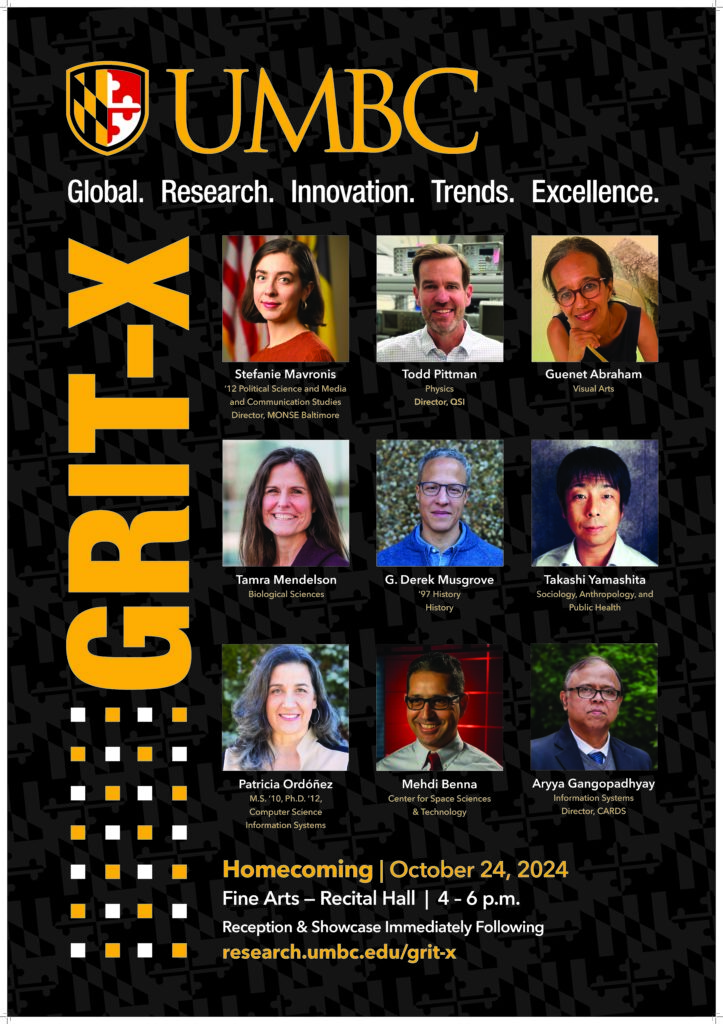 GRIT-X 2024 speakers.
Another alum-turned professor, Patricia Ordóñez, will discuss “Why moms should be the leaders in computing education” with her GRIT-X presentation.
“I noticed that some women my age who are mothers and grandmothers, their digital skills are not as advanced as they should be because they were taking care of children or working in fields that don’t require the technology to be so advanced,” says Ordóñez. “This becomes a digital determinant of health, education, getting employment, or applying for additional opportunities.”
Ordóñez is working to develop a community computing learning center that assists mothers and others from marginalized and underserved communities to strengthen what she calls their “digital identity.” Her talk will also break down how research can impact change within communities.
“If you can’t see people that look like you in computing, it gets very isolating, and it starts to make you think maybe I’m in the wrong field,” she adds. “I’m trying to model my own experience for my students in seeing teaching and research happening at the same time.”
For the first time, GRIT-X will be followed by a reception and special showcase event held in UMBC’s Engineering Building. The reception showcase will include remarks from several GRIT-X speakers from previous years on updates on their research and recent work. The event is in partnership with the Office of Institutional Advancement and bwtech@UMBC Research and Technology Park.
Learn more about this year’s line up and watch the GRIT-X 2024 presentations.
]]>
UMBC’s GRIT-X event is returning for its eighth year with a lineup of dynamic talks spanning a wide range of subjects, including insight into the university’s contributions to the next Moon...
https://umbc.edu/stories/grit-x-2024/
https://my3.my.umbc.edu/api/v0/pixel/news/144873/guest@my.umbc.edu/00c12ea51f91b085423aabaa9711bc1f/api/pixel
cahss
cnms
coeit
community
grit-x
homecoming
news
research
science-and-tech
story
UMBC News & Magazine
https://my3.my.umbc.edu/groups/umbc-news-magazine
https://assets1-my.umbc.edu/system/shared/avatars/groups/000/001/943/24435aa6207c452e7bc15cc74b42c7bb/xsmall.png?1748556657
https://assets1-my.umbc.edu/system/shared/avatars/groups/000/001/943/24435aa6207c452e7bc15cc74b42c7bb/original.png?1748556657
https://assets2-my.umbc.edu/system/shared/avatars/groups/000/001/943/24435aa6207c452e7bc15cc74b42c7bb/xxlarge.png?1748556657
https://assets2-my.umbc.edu/system/shared/avatars/groups/000/001/943/24435aa6207c452e7bc15cc74b42c7bb/xlarge.png?1748556657
https://assets3-my.umbc.edu/system/shared/avatars/groups/000/001/943/24435aa6207c452e7bc15cc74b42c7bb/large.png?1748556657
https://assets1-my.umbc.edu/system/shared/avatars/groups/000/001/943/24435aa6207c452e7bc15cc74b42c7bb/medium.png?1748556657
https://assets2-my.umbc.edu/system/shared/avatars/groups/000/001/943/24435aa6207c452e7bc15cc74b42c7bb/small.png?1748556657
https://assets1-my.umbc.edu/system/shared/avatars/groups/000/001/943/24435aa6207c452e7bc15cc74b42c7bb/xsmall.png?1748556657
https://assets2-my.umbc.edu/system/shared/avatars/groups/000/001/943/24435aa6207c452e7bc15cc74b42c7bb/xxsmall.png?1748556657
UMBC News & Magazine
0
0
false
Thu, 17 Oct 2024 17:15:10 -0400
Thu, 17 Oct 2024 17:15:10 -0400
For 15 consecutive years, UMBC‘s faculty and staff shine in the Great Colleges to Work For survey

In the early hours of the morning, as the windows of Albin O. Kuhn Library begin to reflect the sunrise, UMBC’s faculty and staff are making sure all the campus needs—technology, buildings, streets and sidewalks, lessons, and social media—are ready for students. A close-knit community of over 2,500 faculty and staff is at the heart of UMBC’s vibrant campus, and for the 15th consecutive year, UMBC has garnered the distinction of being on ModernThink’s Great Colleges to Work For list.
Retriever Nation spoke loud and clear, sharing what makes their work fulfilling on the 2024 Great Colleges to Work For survey. The survey covered 10 categories, including faculty and staff wellbeing, compensation and benefits, and confidence in senior leadership. The resounding feedback secured UMBC a spot on the Honor Roll among the top 10 four-year institutions with an enrollment exceeding 10,000 students out of 75 outstanding workplaces.
“Great workplaces don’t just happen,” says Lynne Adams, UMBC’s chief human resources officer. “They are built through a collaboration of the community, care, connection, and a shared vision. Our culture really does reflect a team working together continuously evolving into an inspiring workplace for everyone.”
Faculty and staff flourish and enjoy sharing their talents and personal journeys, adding to the campus life through events like yoga and other classes at the RAC taught by Joella Lubaszewski ’10, theatre. UMBC gives space for people to be brave and share their whole selves, as executive administrative assistant Melessia Jasper knows. Visit a McNair Scholars information session to see leadership in action with Michael Hunt ’06, computer engineering, and current Ph.D. student leading the pack. The dedication of our faculty and staff allows students to receive support and shine.
“As we nurture an inclusive and welcoming community and support the professional development of our staff and faculty, they see themselves fully in our mission and believe deeply in the transformative power of education,” says President Valerie Sheares Ashby. “Staff and faculty know their work serves both individual students and the public good. They know their work matters and that they are seen and valued.”
]]>
In the early hours of the morning, as the windows of Albin O. Kuhn Library begin to reflect the sunrise, UMBC’s faculty and staff are making sure all the campus needs—technology, buildings,...
https://umbc.edu/quick-posts/umbc-s-faculty-and-staff-2024-great-colleges-to-work-for-honor-roll/
https://my3.my.umbc.edu/api/v0/pixel/news/144874/guest@my.umbc.edu/edb4acfcf82eab4078946eb621f1b9d9/api/pixel
cahss
cnms
coeit
computer-and-electrical-engineering
mcnairscholars
quick-post
rac
theatre
UMBC News & Magazine
https://my3.my.umbc.edu/groups/umbc-news-magazine
https://assets1-my.umbc.edu/system/shared/avatars/groups/000/001/943/24435aa6207c452e7bc15cc74b42c7bb/xsmall.png?1748556657
https://assets1-my.umbc.edu/system/shared/avatars/groups/000/001/943/24435aa6207c452e7bc15cc74b42c7bb/original.png?1748556657
https://assets2-my.umbc.edu/system/shared/avatars/groups/000/001/943/24435aa6207c452e7bc15cc74b42c7bb/xxlarge.png?1748556657
https://assets2-my.umbc.edu/system/shared/avatars/groups/000/001/943/24435aa6207c452e7bc15cc74b42c7bb/xlarge.png?1748556657
https://assets3-my.umbc.edu/system/shared/avatars/groups/000/001/943/24435aa6207c452e7bc15cc74b42c7bb/large.png?1748556657
https://assets1-my.umbc.edu/system/shared/avatars/groups/000/001/943/24435aa6207c452e7bc15cc74b42c7bb/medium.png?1748556657
https://assets2-my.umbc.edu/system/shared/avatars/groups/000/001/943/24435aa6207c452e7bc15cc74b42c7bb/small.png?1748556657
https://assets1-my.umbc.edu/system/shared/avatars/groups/000/001/943/24435aa6207c452e7bc15cc74b42c7bb/xsmall.png?1748556657
https://assets2-my.umbc.edu/system/shared/avatars/groups/000/001/943/24435aa6207c452e7bc15cc74b42c7bb/xxsmall.png?1748556657
UMBC News & Magazine
0
0
false
Thu, 17 Oct 2024 16:55:53 -0400
Thu, 17 Oct 2024 16:55:53 -0400
UMBC’s 2024 Cybersecurity Leadership Exploratory Grant Program recipients announced
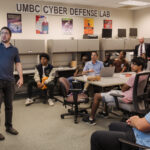
The UMBC Cybersecurity Institute and the Division of Research and Creative Achievement, in partnership with the College of Engineering and Information Technology, recently announced the recipients of the 2024 Cybersecurity Leadership Exploratory grant program.
The internal funding opportunity is designed to promote innovative, interdisciplinary research and education focused on enhancing UMBC’s leadership in cybersecurity research. Awardees received up to $45,000 in funding to develop their exploratory projects—an increase compared to its inaugural recipient cohort in 2023.
The 2024 recipients are:
-
Alan Sherman and Enis Golaszewski for “Modeling and Formal-Methods Analysis of the Secure DNA Protocol”
-
Manas Gaur for “Cybersecurity Research: MetamorphicLLM: Robust Understanding of Metamorphic Malware Through Attacks and Defenses Using Neurosymbolic Large Language Models”
-
Meilin Yu and Zhiyuan Chen for “Detecting Stealthy Long-Term Cyber Attacks on Wind Energy Assets with Physics-Informed Neural Network Technologies”
-
Naghmeh Karim for “Artificial Intelligence and Hardware Security: From Research to Classroom (Educational Proposal)”
-
Nilanjan Banerjee and Mohamed Younis for “Implementing Endpoint Security for Cyber-Physical Systems”
-
Tera Reynolds for “Swiss Cheese Please: Analyzing Cybersecurity Risks in the Digital Health Ecosystem with Patients with Complex Care Needs”
Learn more about UMBC’s internal funding opportunities.
]]>
The UMBC Cybersecurity Institute and the Division of Research and Creative Achievement, in partnership with the College of Engineering and Information Technology, recently announced the recipients...
https://umbc.edu/quick-posts/2024-exploratory-grant-recipients/
https://my3.my.umbc.edu/api/v0/pixel/news/144674/guest@my.umbc.edu/f49123192875a7393ea88ca4f921794b/api/pixel
coeit
csee
cybersecurity
information-systems
quick-post
research
UMBC News & Magazine
https://my3.my.umbc.edu/groups/umbc-news-magazine
https://assets1-my.umbc.edu/system/shared/avatars/groups/000/001/943/24435aa6207c452e7bc15cc74b42c7bb/xsmall.png?1748556657
https://assets1-my.umbc.edu/system/shared/avatars/groups/000/001/943/24435aa6207c452e7bc15cc74b42c7bb/original.png?1748556657
https://assets2-my.umbc.edu/system/shared/avatars/groups/000/001/943/24435aa6207c452e7bc15cc74b42c7bb/xxlarge.png?1748556657
https://assets2-my.umbc.edu/system/shared/avatars/groups/000/001/943/24435aa6207c452e7bc15cc74b42c7bb/xlarge.png?1748556657
https://assets3-my.umbc.edu/system/shared/avatars/groups/000/001/943/24435aa6207c452e7bc15cc74b42c7bb/large.png?1748556657
https://assets1-my.umbc.edu/system/shared/avatars/groups/000/001/943/24435aa6207c452e7bc15cc74b42c7bb/medium.png?1748556657
https://assets2-my.umbc.edu/system/shared/avatars/groups/000/001/943/24435aa6207c452e7bc15cc74b42c7bb/small.png?1748556657
https://assets1-my.umbc.edu/system/shared/avatars/groups/000/001/943/24435aa6207c452e7bc15cc74b42c7bb/xsmall.png?1748556657
https://assets2-my.umbc.edu/system/shared/avatars/groups/000/001/943/24435aa6207c452e7bc15cc74b42c7bb/xxsmall.png?1748556657
UMBC News & Magazine
1
0
false
Thu, 10 Oct 2024 13:07:29 -0400
Thu, 10 Oct 2024 13:07:29 -0400
Preparing students for a quantum tomorrow: Lei Zhang brings futuristic computing concepts into the classroom

In the early 20th century, as physicists explored the tiny world of atoms, they noticed some perplexing things: Energy transferred only in chunks; particles that also acted like waves; mysterious links between physically separate systems. Their observations and theories marked the start of the first quantum revolution, which rocked the philosophical world of scientists (Albert Einstein was famously disturbed by some of its implications), but ultimately helped birth the technology of today by enabling the development of physical devices such as computer chips and lasers.
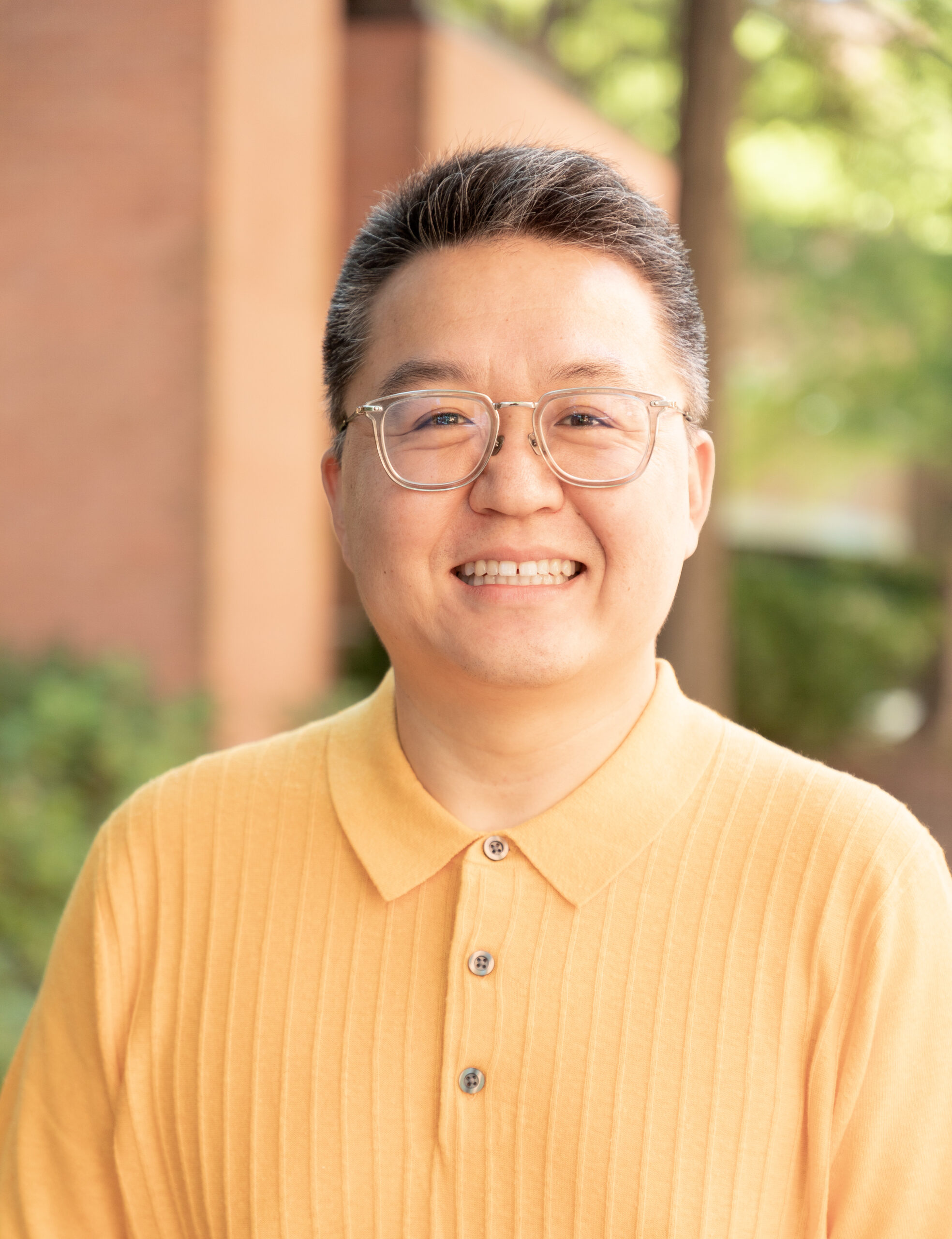 Headshot courtesy of Lei Zhang
Many scientists believe we are now on the cusp of a second quantum revolution, as quantum concepts are poised to transform the world of information science and technology too. The new revolution offers the promise, among other things, of a new type of computer called a quantum computer. Quantum computers could quickly solve some problems that are extremely difficult for traditional machines—they might also unleash some chaos we’ll have to find ways to prevent.
Lei Zhang, an assistant professor in the department of information systems, is working hard to prepare students for this quantum information future. In 2023 and 2024, with support from a Hrabowski Innovation Fund Grant, he developed new learning modules on quantum information concepts and integrated them into existing graduate and undergraduate courses in information systems.
Based partly on the success of that pilot project, Zhang recently received funding from the National Science Foundation to develop a 14-week summer program in quantum information science and technology. The program, which will launch in the summer of 2025, will be open to students from UMBC and nearby Montgomery College.
“Quantum computing is the next industrial revolution, and there will be an urgent need for skilled professionals in quantum information science and technology,” says Zhang. “This project aims to equip students with the skills and networks to meet that need and advance their careers.”
Quantum’s encryption-breaking challenge
The quantum information revolution is already smashing into our everyday world in the area of internet security. Most internet traffic is kept safe from prying eyes using a technique that works well against hackers using traditional computers but could be broken by a sophisticated enough quantum computer. No quantum computer has reached that point yet, but scientists are making steady progress in that direction, and experts are worried enough to start mandating security changes.
In 2022, the White House released a National Security Memorandum coordinating the actions of various federal agencies in a move toward quantum-resistant forms of encryption for their computer systems.
“The government will be one of the leaders in the change, but the whole private sector will need to follow,” Zhang says. “Everyone will need to update their systems.”
Zhang is focusing the summer program on this challenge. Students will learn about quantum computers and how they could break traditional encryption, and will also learn about new security algorithms, called post-quantum encryption algorithms, that are not as vulnerable to quantum attacks.
“Quantum computing is the next industrial revolution, and there will be an urgent need for skilled professionals in quantum information science and technology. This project aims to equip students with the skills and networks to meet that need and advance their careers.”
Lei Zhang
Assistant Professor, Information Systems
After six weeks of active and immersive learning activities, the students will engage in eight-week-long internships at local tech companies or in Zhang’s UMBC lab, where they will put their newfound knowledge and skills to use. At the completion of the summer program, the students will earn a MicroBachelors certificate from the online education company edX.
Partnerships advance outreach and teaching
Zhang is partnering with individuals and programs across UMBC to make his summer program successful. Zhang’s main collaborator on the project, assistant information systems professor Karen Chen, specializes in the study of how technology can improve learning. The team also includes information systems faculty Aryya Gangopadhyay, Michael Brown, and C. Augusto Casas.
Zhang is partnering with UMBC’s Center for Women in Technology, UMBC’s Cybersecurity Institute, and Montgomery College to recruit a diverse range of students for the summer program.
The project will be guided by the expertise of local leaders from government and private industry and its effectiveness will be evaluated by UMBC’s Chris Rakes, a professor of mathematics education.
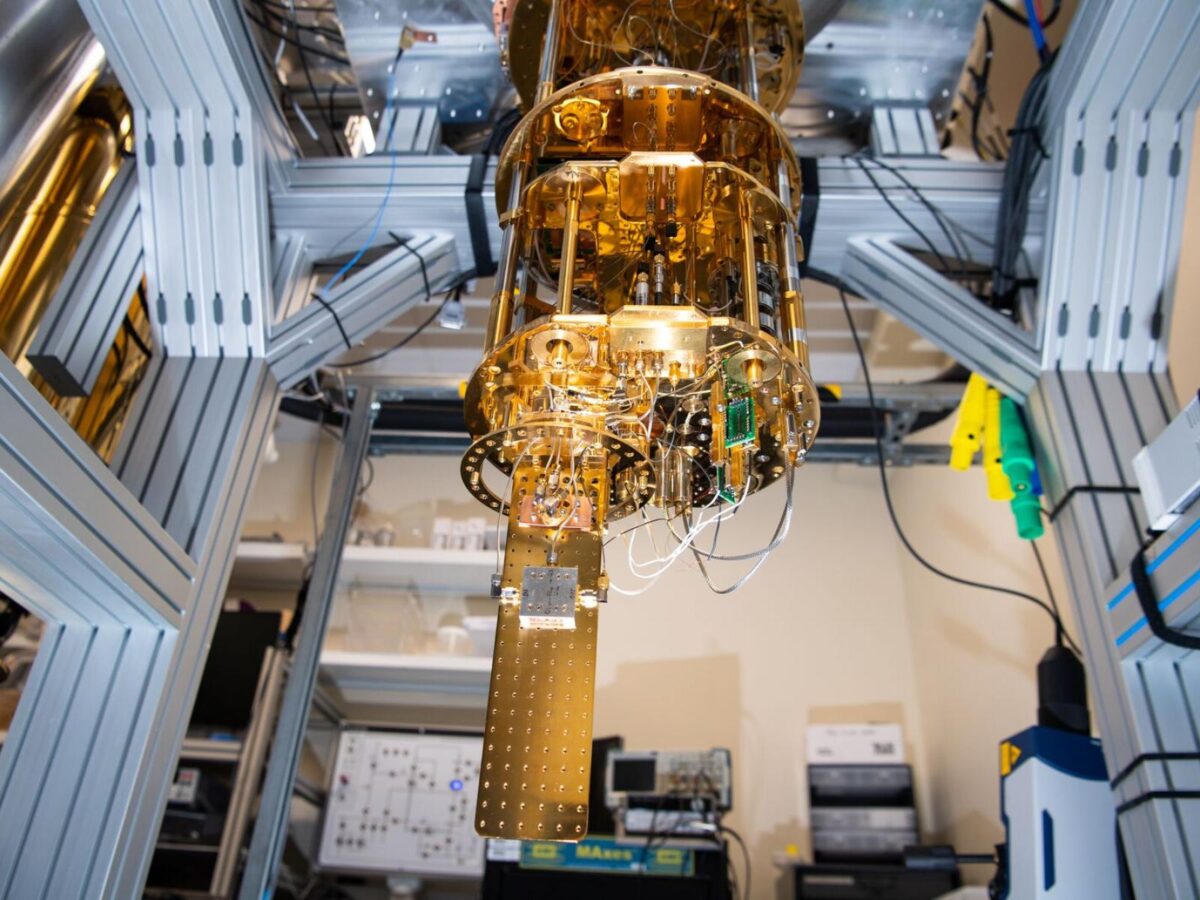 Quantum computers use qubits, the quantum version of the classic binary bit, such as this superconducting qubit, which sits in a dilution refrigerator in a Pacific Northwest National Laboratory physics lab. (Photo by Andrea Starr | Pacific Northwest National Laboratory)
Going forward, Zhang plans to continue scaling up his quantum education efforts. The coursework from the summer program will be made freely available for other educational institutions to use. It could also be incorporated into programs for adult learners.
In collaboration with the National Institute of Standards and Technology, headquartered in Gaithersburg, Maryland, Zhang also plans to use knowledge generated from the summer program to organize professional development workshops for instructors in four-year and community colleges.
The impact of Zhang’s efforts can already be seen on the individual level. Khushdeep Kaur, a master’s student in information systems, first heard about quantum computing from Zhang. “I felt amazed and eager to learn more about the technology,” she says. She is now part of Zhang’s research group, studying quantum computing topics.
Dongchan Kim, a senior majoring in information systems, also joined the lab after taking one of Zhang’s classes in spring 2024.
“I really enjoyed learning about technology that could become the ‘next big thing,’” he says. “Like AI, I think quantum computing has the power to transform industries. I look forward to contributing to its development in the future.”
]]>
In the early 20th century, as physicists explored the tiny world of atoms, they noticed some perplexing things: Energy transferred only in chunks; particles that also acted like waves; mysterious...
https://umbc.edu/stories/teaching-quantum-information-concepts/
https://my3.my.umbc.edu/api/v0/pixel/news/144436/guest@my.umbc.edu/ffad2f1364c881198ebb0b56382eb07d/api/pixel
coeit
cwit
cybersecurity
is
news
science-and-tech
story
UMBC News & Magazine
https://my3.my.umbc.edu/groups/umbc-news-magazine
https://assets1-my.umbc.edu/system/shared/avatars/groups/000/001/943/24435aa6207c452e7bc15cc74b42c7bb/xsmall.png?1748556657
https://assets1-my.umbc.edu/system/shared/avatars/groups/000/001/943/24435aa6207c452e7bc15cc74b42c7bb/original.png?1748556657
https://assets2-my.umbc.edu/system/shared/avatars/groups/000/001/943/24435aa6207c452e7bc15cc74b42c7bb/xxlarge.png?1748556657
https://assets2-my.umbc.edu/system/shared/avatars/groups/000/001/943/24435aa6207c452e7bc15cc74b42c7bb/xlarge.png?1748556657
https://assets3-my.umbc.edu/system/shared/avatars/groups/000/001/943/24435aa6207c452e7bc15cc74b42c7bb/large.png?1748556657
https://assets1-my.umbc.edu/system/shared/avatars/groups/000/001/943/24435aa6207c452e7bc15cc74b42c7bb/medium.png?1748556657
https://assets2-my.umbc.edu/system/shared/avatars/groups/000/001/943/24435aa6207c452e7bc15cc74b42c7bb/small.png?1748556657
https://assets1-my.umbc.edu/system/shared/avatars/groups/000/001/943/24435aa6207c452e7bc15cc74b42c7bb/xsmall.png?1748556657
https://assets2-my.umbc.edu/system/shared/avatars/groups/000/001/943/24435aa6207c452e7bc15cc74b42c7bb/xxsmall.png?1748556657
UMBC News & Magazine
2
0
false
Thu, 03 Oct 2024 09:24:53 -0400
Thu, 03 Oct 2024 09:24:53 -0400
Retrievers are upping their research game in the 2024-25 Fulbright U.S. Student Program cohort

At the height of COVID-19, Nicole Attram developed severe lower back pain which impeded her mobility and flexibility. While physical therapy helped mitigate the symptoms, the cause is still unknown. That experience determined the course of her career. After graduating from UMBC in 2023, Attram, mechanical engineering, received a 2024 – 2025 Fulbright U.S. Student award to study in Milan, Italy, in a master’s program in international healthcare management, economics, and policy specializing in pharmaceuticals and medical technology at the SDA Bocconi School of Management.
“This experience has inspired my interest in orthopedic biomechanics, particularly prosthetics, and exoskeletons, to help restore autonomy to individuals with lifelong mobility challenges,” shares Attram on her website. “I aim to conduct research at the intersection of systemic racism, healthcare policy, and orthopedic biomechanics to offer holistic care and assistive technology to underserved communities.”
Each year, more than 10,000 students apply to the Fulbright U.S. Student Program with just over 2,000 selected from hundreds of colleges and universities across the U.S. In the last decade, UMBC students and alumni have received more than 85 Fulbright U.S. Student Program awards for research and teaching placements in Africa, Asia and the Pacific, the Middle East, South America, and Europe. UMBC was named a Fulbright Top Producing Institution for the third time in five years for the 2023 – 2024 cycle.
Attram’s mentor Maria C. Sanchez, director of the Grand Challenge Scholars Program, professor of the practice, and director of the Engineering and Computing Education Program, says, “Nicole always displayed the motivation, perseverance, and inquisitiveness of a successful researcher. She also demonstrated a high level of global awareness that was refreshing to see in a non-international undergraduate student.”
Advancing global research
Attram is among eight recent graduates and alumni in UMBC’s 2024 – 2025 Fulbright U.S. Student Program class who are sharing their knowledge and building community around the world by earning a master’s degree, conducting research, or teaching English. This year is especially significant, as six of eight awards are research-focused, marking the highest number of research awards in UMBC’s Fulbright history. Students seeking research awards must develop a proposal in coordination with potential advisers in the universities and laboratories where they want to study as part of their application. Graduate degree awards require submitting both Fulbright and graduate school applications.
-
Arpita Tuladhar ’23 public health, Research Award to Germany
-
Jennifer Sorrells ’22, political science, Research Award to North Macedonia
-
Jolie Greer ’24, psychology, Research Award to Bulgaria
-
Lauren Mister ’24, teaching English to speakers of other languages, English Teaching Award to Bahrain
-
Sarah-Fatime Yoda ’24, chemical engineering, Research Award to France
-
Stuart Holton ’24, political science, English Teaching Award to Slovakia
-
Timothy Mallard, M.A. ’21, teaching English to speakers of other languages, Research Award to Uganda
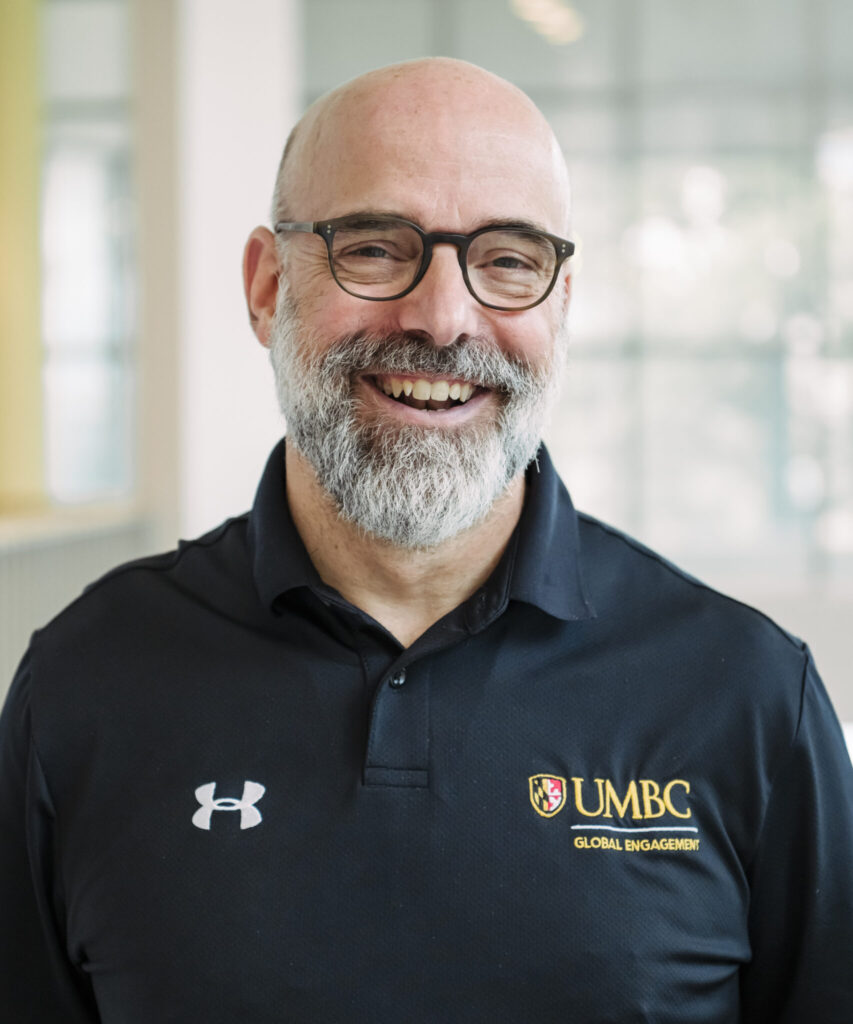
“This year’s cohort of Fulbright recipients and alternates shows the country and the globe what we at UMBC already know,” says Brian Souders, Ph.D. ’09, language, literacy, and culture, M.A.’19, TESOL, the associate director of global learning at UMBC’s Center for Global Engagement. In this role, Souders, who received a 2023 Fulbright International Education Administrator Award to Germany, has led hundreds of Retrievers through the Fulbright application process as UMBC’s Fulbright Program advisor. “We produce world-class graduates who will lead the future with their work in laboratories, in the field, and in the classrooms throughout the world.” (Image by Marlayna Demond ’11/UMBC)
Learn more about UMBC’s Fulbright Program.
]]>
At the height of COVID-19, Nicole Attram developed severe lower back pain which impeded her mobility and flexibility. While physical therapy helped mitigate the symptoms, the cause is still...
https://umbc.edu/stories/retrievers-are-upping-their-research-game-in-the-2024-2025-fulbright-u-s-student-program-cohort/
https://my3.my.umbc.edu/api/v0/pixel/news/144257/guest@my.umbc.edu/74dbeefa8c480d6930724fb40a369389/api/pixel
cahss
cbee
cge
chemical-engineering
coeit
community
feature
fulbright
international
mechanical
news
politicalscience
psychology
research
saph
story
tesol
UMBC News & Magazine
https://my3.my.umbc.edu/groups/umbc-news-magazine
https://assets1-my.umbc.edu/system/shared/avatars/groups/000/001/943/24435aa6207c452e7bc15cc74b42c7bb/xsmall.png?1748556657
https://assets1-my.umbc.edu/system/shared/avatars/groups/000/001/943/24435aa6207c452e7bc15cc74b42c7bb/original.png?1748556657
https://assets2-my.umbc.edu/system/shared/avatars/groups/000/001/943/24435aa6207c452e7bc15cc74b42c7bb/xxlarge.png?1748556657
https://assets2-my.umbc.edu/system/shared/avatars/groups/000/001/943/24435aa6207c452e7bc15cc74b42c7bb/xlarge.png?1748556657
https://assets3-my.umbc.edu/system/shared/avatars/groups/000/001/943/24435aa6207c452e7bc15cc74b42c7bb/large.png?1748556657
https://assets1-my.umbc.edu/system/shared/avatars/groups/000/001/943/24435aa6207c452e7bc15cc74b42c7bb/medium.png?1748556657
https://assets2-my.umbc.edu/system/shared/avatars/groups/000/001/943/24435aa6207c452e7bc15cc74b42c7bb/small.png?1748556657
https://assets1-my.umbc.edu/system/shared/avatars/groups/000/001/943/24435aa6207c452e7bc15cc74b42c7bb/xsmall.png?1748556657
https://assets2-my.umbc.edu/system/shared/avatars/groups/000/001/943/24435aa6207c452e7bc15cc74b42c7bb/xxsmall.png?1748556657
UMBC News & Magazine
0
0
false
Mon, 23 Sep 2024 14:32:36 -0400
Mon, 23 Sep 2024 14:32:36 -0400
Pagers and walkie-talkies over cellphones—a security expert explains why Hezbollah went low-tech for communications

Written by Richard Forno, principal lecturer in computer science and electrical engineering, UMBC
Electronic pagers across Lebanon exploded simultaneously on Sept. 17, 2024, killing 12 and wounding more than 2,700. The following day, another wave of explosions in the country came from detonating walkie-talkies. The attacks appeared to target members of the militant group Hezbollah.
The pagers attack involved explosives planted in the communications devices by Israeli operatives, according to U.S. officials cited by The New York Times. Hezbollah had recently ordered a shipment of pagers, according to the report.
Secretly attacking the supply chain is not a new technique in intelligence and military operations. For example, the U.S. National Security Agency intercepted computer hardware bound for overseas customers, inserted malware or other surveillance tools and then repackaged them for delivery to certain foreign buyers, a 2010 NSA internal document showed. This differs from accessing a specific person’s device, such as when Israel’s Shin Bet secretly inserted explosives into a cellphone to remotely kill a Hamas bombmaker in 1996.
Hezbollah, a longtime adversary of Israel, had increased its use of pagers in the wake of the Hamas attack on Israel on Oct. 7, 2023. By shifting to relatively low-tech communication devices, including pagers and walkie-talkies, Hezbollah apparently sought an advantage against Israel’s well-known sophistication in tracking targets through their phones.
 The second wave of explosions in Lebanon involved walkie-talkies. AP Photo
Cellphones: The ultimate tracker
As a former cybersecurity professional and current security researcher, I view cellular devices as the ultimate tracking tool for both government and commercial entities – in addition to users, criminals and the mobile phone provider itself. As a result, mobile phone tracking has contributed to the fight against terrorism, located missing people and helped solve crimes.
Conversely, mobile phone tracking makes it easy for anyone to record a person’s most intimate movements. This can be done for legitimate purposes such as parents tracking children’s movements, helping you find your car in a parking lot, and commercial advertising, or nefarious ends such as remotely spying on a lover suspected of cheating or tracking political activists and journalists. Even the U.S. military remains concerned with how its soldiers might be tracked by their phones.
Mobile device tracking is conducted in several ways. First, there is the network location data generated by the phone as it moves past local cell towers or Stingray devices, which law enforcement agencies use to mimic cell towers. Then there are the features built into the phone’s operating system or enabled by downloaded apps that may lead to highly detailed user tracking, which users unwittingly agree to by ignoring the software’s privacy policy or terms of service.
This collected data is sometimes sold to governments or other companies for additional data mining and user profiling. And modern smartphones also have built-in Bluetooth, Wi-Fi and GPS capabilities that can help with locating and tracking user movements around the world, both from the ground and via satellites.
Your phone contains many sensors that make it useful – and easy to track.
Mobile devices can be tracked in real time or close to it. Common technical methods include traditional radio direction-finding techniques, using intelligence satellites or drones, deploying “man in the middle” tools like Stingrays to impersonate cellular towers to intercept and isolate device traffic, or installing malware such as Pegasus, made by Israeli cyberarms company NSO to report a device’s location.
Nontechnical and slower techniques of user tracking include potentially identifying general user locations from their internet activity. This can be done from website logs or the metadata contained in content posted to social media, or contracting with data brokers to receive any collected location data from the apps that a user might install on their device.
Indeed, because of these vulnerabilities, the leader of Hezbollah earlier this year advised his members to avoid using cellular phones in their activities, noting that Israel’s “surveillance devices are in your pockets. If you are looking for the Israeli agent, look at the phone in your hands and those of your wives and children.”
Researchers have shown how these features, often intended for the user’s convenience, can be used by governments, companies and criminals to track people in their daily lives and even predict movements. Many people still aren’t aware of how much their mobile devices disclose about them.
Pagers, however, unlike mobile phones, can be harder to track depending on whether they support two-way communication.
Why go low-tech
A pager that only receives messages does not provide a signal that can facilitate tracking its owner. Therefore, Hezbollah’s use of pagers likely made it more challenging to track their operatives – thus motivating Israeli intelligence services’ purported attack on the supply chain of Hezbollah’s pagers.
Using low-tech tactics and personal couriers while avoiding the use of mobile phones and digital tools also made it difficult for the technologically superior Western intelligence agencies to locate Osama bin Laden for years after the 9/11 attacks.
In general, I believe the adversary in an asymmetric conflict using low-tech techniques, tactics and technology will almost always be able to operate successfully against a more powerful and well-funded opponent.
A well-documented demonstration of this asymmetry in action was the U.S. military’s Millennium Challenge war game in 2002. Among other things, the insurgent Red forces, led by Marine General Paul van Riper, used low-tech tactics including motorcycle couriers instead of cellphones to evade the Blue forces’ high-tech surveillance. In the initial run of the exercise, the Red team won the contest in 24 hours, forcing exercise planners to controversially reset and update the scenario to ensure a Blue team victory.
Lessons for everyone
The preference for terrorist organizations like Hezbollah and al-Qaida to avoid using smartphones is a reminder for everyone that you can be, and likely are being tracked in various ways and for various purposes.
Israel’s purported response to Hezbollah’s actions also holds a lesson for everyone. From a cybersecurity perspective, it shows that any device in your life can be tampered with by an adversary at points along the supply chain – long before you even receive it.
This article is republished from The Conversation under a Creative Commons license. Read the original article and see more than 300 UMBC articles available in The Conversation.
]]>
Written by Richard Forno, principal lecturer in computer science and electrical engineering, UMBC Electronic pagers across Lebanon exploded simultaneously on Sept. 17, 2024, killing 12 and...
https://umbc.edu/stories/pagers-and-walkie-talkies-over-cellphones-a-security-expert-explains-why-hezbollah-went-low-tech-for-communications/
https://my3.my.umbc.edu/api/v0/pixel/news/144057/guest@my.umbc.edu/632db99a5fa25784e86504f5f6bd2e0f/api/pixel
coeit
csee
discovery
magazine
story
the-conversation
UMBC News & Magazine
https://my3.my.umbc.edu/groups/umbc-news-magazine
https://assets1-my.umbc.edu/system/shared/avatars/groups/000/001/943/24435aa6207c452e7bc15cc74b42c7bb/xsmall.png?1748556657
https://assets1-my.umbc.edu/system/shared/avatars/groups/000/001/943/24435aa6207c452e7bc15cc74b42c7bb/original.png?1748556657
https://assets2-my.umbc.edu/system/shared/avatars/groups/000/001/943/24435aa6207c452e7bc15cc74b42c7bb/xxlarge.png?1748556657
https://assets2-my.umbc.edu/system/shared/avatars/groups/000/001/943/24435aa6207c452e7bc15cc74b42c7bb/xlarge.png?1748556657
https://assets3-my.umbc.edu/system/shared/avatars/groups/000/001/943/24435aa6207c452e7bc15cc74b42c7bb/large.png?1748556657
https://assets1-my.umbc.edu/system/shared/avatars/groups/000/001/943/24435aa6207c452e7bc15cc74b42c7bb/medium.png?1748556657
https://assets2-my.umbc.edu/system/shared/avatars/groups/000/001/943/24435aa6207c452e7bc15cc74b42c7bb/small.png?1748556657
https://assets1-my.umbc.edu/system/shared/avatars/groups/000/001/943/24435aa6207c452e7bc15cc74b42c7bb/xsmall.png?1748556657
https://assets2-my.umbc.edu/system/shared/avatars/groups/000/001/943/24435aa6207c452e7bc15cc74b42c7bb/xxsmall.png?1748556657
UMBC News & Magazine
0
0
false
Thu, 19 Sep 2024 11:58:44 -0400
Thu, 19 Sep 2024 11:58:44 -0400