New U.S. News rankings honor UMBC strengths in teaching, innovation, and inclusion
The 2021 U.S. News and World Report Best Colleges rankings affirm that UMBC remains one of the top universities in the nation, with a uniquely distinguished profile.
UMBC has advanced to #11 for undergraduate teaching and holds the #9 position on the list of most innovative schools in the nation, among other prominent rankings. UMBC is the only Maryland school represented in the top ten in innovation, standing alongside such universities as Stanford, Carnegie Mellon, MIT, and Caltech.
“We are delighted to again receive external recognition for creating a purposeful curriculum,” says Katharine H. Cole, vice provost and dean of Undergraduate Academic Affairs. “We are inclusive and innovative, and this drives our continuing ability to offer a distinctive educational experience to UMBC students.”
Student Government Association (SGA) President Mehrshad Devin ‘22, biology and physics, echoes Cole’s focus on inclusion and purpose. “The students of UMBC form a tightly-knit community,” he says. “We support each other and provide one another with the scaffolding needed to build something for the greater good, something greater than each of us individually.”
Members of the Race and Social Justice Interdisciplinary CoLab collaborate on a mapping project, summer 2018.
UMBC also placed within the top 80 public universities and ranked #160 on the overall list of top national universities.
A foundation of success
Karl Steiner, vice president for research, sees these rankings as reflecting UMBC’s commitment to inclusive excellence and collaboration. At some institutions, teaching and research are more separate endeavors. But at UMBC a foundational commitment to quality teaching drives collaborative research success, and research is a learning experience.
Minjoung Kyoung, assistant professor of chemistry and biochemistry, and students discuss a result.
“We are proud of our successful history of including undergraduate and graduate students in our diverse portfolio of research and creative achievement,” says Steiner. These students have unique opportunities to make a real impact through their UMBC research. Many alumni then advance to high-impact research careers serving the public good.
UMBC research across all disciplines has historically focused on addressing inequalities, and this continues during the time of COVID-19. “We are actively working on federally-funded projects to help in the fight against the COVID-19 pandemic and its broader impact on members of our communities,” says Steiner.
Students play an essential role in completing much of this research, from working in Seley-Radtke’s lab to interviewing families through Cheah’s study.
University growth
UMBC’s engineering programs performed strongly in the 2021 U.S. News rankings, tied with Villanova, Tulane, Howard, and University of Alabama. U.S. News just launched a new computer science program ranking this year as well, including UMBC in the nation’s top 100.
Karla Negrete, right, working in the lab along her mentor Deepa Madan, assistant professor of mechanical engineering, in 2019.
Keith J Bowman, dean of the College of Engineering and Information Technology (COEIT), attributes this recognition to a trend of healthy program growth across the college, such as the expansion of data science to UMBC at the Universities at Shady Grove. “UMBC’s unique set of engineering, computing, and business-related bachelor’s degree programs have undergone extraordinary student growth in recent years. That growth has enabled us to hire an outstanding cadre of new faculty,” says Bowman.
Nilanjan Banerjee (right), professor of computer science and electrical engineering, works with Christopher Boia ’19, mechanical engineering, in his lab.
A place for all students
UMBC jumped up seven places on the list of Best Colleges for Veterans, and is again one of the top schools in the nation for ethnic diversity. Yvette Mozie-Ross ’88, health science and policy, vice provost for enrollment management and planning, shares, “We take great pride in being a historically diverse institution that has welcomed and continues to welcome students of all backgrounds. And it is our unwavering commitment to inclusive excellence that makes UMBC such a unique and special place.”
Retrievers celebrate Convocation 2018.
Speaking to the work COEIT has done, Bowman shares, “Our student growth has been especially strong among African Americans and women,” both historically underrepresented groups in engineering and computing on a national level.
“The inclusive nature of UMBC is what makes the institution so exceptional,” says Devin. “From the moment a student commits to UMBC, the path towards success is laid out for them, with bold neon signs that push them to do more, even if they don’t yet know how.”
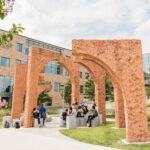
Banner image: Students gather at The Forum, a public artwork near UMBC’s Performing Arts and Humanities Building, 2016. All photos by Marlayna Demond ’11 unless otherwise noted.
Kait McCaffrey and Dinah Winnick contributed to this story.
]]>
The 2021 U.S. News and World Report Best Colleges rankings affirm that UMBC remains one of the top universities in the nation, with a uniquely distinguished profile. UMBC has advanced to #11...https://umbc.edu/stories/bestcolleges2021/https://my3.my.umbc.edu/api/v0/pixel/news/119792/guest@my.umbc.edu/070c97eb764b7a9443b635672c0de702/api/pixelcahsscnmscoeitcommunitypage1rankingsUMBC News & Magazinehttps://my3.my.umbc.edu/groups/umbc-news-magazinehttps://assets1-my.umbc.edu/system/shared/avatars/groups/000/001/943/24435aa6207c452e7bc15cc74b42c7bb/xsmall.png?1748556657https://assets1-my.umbc.edu/system/shared/avatars/groups/000/001/943/24435aa6207c452e7bc15cc74b42c7bb/original.png?1748556657https://assets2-my.umbc.edu/system/shared/avatars/groups/000/001/943/24435aa6207c452e7bc15cc74b42c7bb/xxlarge.png?1748556657https://assets2-my.umbc.edu/system/shared/avatars/groups/000/001/943/24435aa6207c452e7bc15cc74b42c7bb/xlarge.png?1748556657https://assets3-my.umbc.edu/system/shared/avatars/groups/000/001/943/24435aa6207c452e7bc15cc74b42c7bb/large.png?1748556657https://assets1-my.umbc.edu/system/shared/avatars/groups/000/001/943/24435aa6207c452e7bc15cc74b42c7bb/medium.png?1748556657https://assets2-my.umbc.edu/system/shared/avatars/groups/000/001/943/24435aa6207c452e7bc15cc74b42c7bb/small.png?1748556657https://assets1-my.umbc.edu/system/shared/avatars/groups/000/001/943/24435aa6207c452e7bc15cc74b42c7bb/xsmall.png?1748556657https://assets2-my.umbc.edu/system/shared/avatars/groups/000/001/943/24435aa6207c452e7bc15cc74b42c7bb/xxsmall.png?1748556657UMBC News & Magazine00falseMon, 14 Sep 2020 12:00:00 -0400UMBC engages Howard Community College students with environmental science—online and in their own backyards
It’s a mere hour after sunrise, and Wajhee Zaidi, a student at Howard Community College (HCC), is out in his neighborhood, looking for birds, insects, and whatever other critters he can spot. “Never would I have thought that I would go out at 7 a.m. just to look for different species of animals,” he says. “It got me out of my comfort zone.”
Zaidi’s early morning birding and bug-hunting was part of a three-week program collaboratively organized by HCC and UMBC. The practicum immersed HCC students in an authentic environmental science research experience and helped them connect with UMBC faculty.
Orioles and orb weavers
Each morning, Kevin Omland, professor of biological sciences, and Chris Hawn, assistant professor of geography and environmental systems, guided the students through activities like analyzing data on Caribbean orioles, collecting spider webs for air quality monitoring, and safely seeking out and documenting local creatures.
The students gained foundational research skills like observation, data collection, and collaboration. They also made real contributions to research and service projects. “They participated in three ongoing scientific research projects, all from their living rooms,” Hawn says.
The students collected spider webs as part of Chris Hawn’s Spidey Senser project. Photo courtesy Mary Lenahan.
As part of a service-learning project for Baltimore Green Space, the students created tutorials about how to use the iNaturalist platform. And Omland shared their analysis of the interactions between the endangered Bahama Oriole and the parasitic Shiny Cowbird, which lays its eggs in other birds’ nests, with his lab’s research partners at the Bahamas National Trust.
Hawn also asked the students to test protocols for a program designed to help communities take greater control of their air quality. Hawn has found that analyzing the chemistry of spider webs works well as a proxy to measure hyper-local air quality, and they’re launching the program in Baltimore and Portland, Oregon in partnership with a non-profit. This project also introduced the students to the importance of citizen science.
“My goal for the students was to capture what I think is the most important part of scientific research—curiosity through observation,” Hawn says. By training their eyes and learning to see in new ways, Hawn says, “People were making discoveries literally inside their houses, or on a walk, or in their yard. It was really wonderful to see that transformation.”
“It was great to have this real, authentic experience,” shares Mary Lenahan, an environmental science major at HCC and an aspiring reptile field researcher. “I didn’t realize I’d be able to learn this much in just three weeks,” she added, a feeling echoed by the other participants.
Chris Hawn (center) talks with graduate students inside UMBC’s Interdisciplinary Life Sciences Building in 2019. Photo by Marlayna Demond ’11 for UMBC.
A broader view
“This experience has broadened my view of research,” says Oluwasemilore Oluwagbenro,a general studies major at HCC who wants to be a doctor. “Researchers aren’t just either looking at the internet and books or confined within the four walls of a laboratory—research can also be walking in your backyard.”
Beyond expanding their perspective on what research can be, the summer experience offered new insight shaping how the students imagine their future careers.
Pilar Thomas, a life science and nutrition major at HCC, says, “This research experience helped me get to know this whole sector of biology that I hadn’t really looked at at all, because my biology classes focused on human biology and physiology.”
A juvenile Northern Mockingbird spotted by Oluwasemilore Oluwagbenro perches on a fence post. Photo courtesy Oluwasemilore Oluwagbenro.
Zaidi, who also plans to pursue medicine, agrees. “Understanding all life and species plays a big part in medicine, so I think this definitely helped me toward my career goal by offering some insight and background knowledge.”
Oluwagbenro put it simply: “In the end, who is a good medical doctor without understanding the environment?”
Digital fluency
In addition to learning quite a bit about birds, spiders, and the scientific process, the students gained digital skills. They became proficient in Blackboard, UMBC’s learning management system, and learned how to use various online tools for their culminating project, a digital story.
Thomas was excited and surprised to learn more than science. “Prior to this research collaboration I could barely take a video on my phone,” she says, “so it was so cool to go through the process of making a final digital story, using screenshot slideshows, screen recordings, and everything. I would never have thought I would gain those types of skills in three weeks, so it helped me learn more about myself as a student, too.”
Enthusiasm “right through the screen”
The students and their instructors were surprised by the strong connections they were able to forge online. Hawn and Omland set the tone for a collegial, challenging, and fun experience. “I like to say that I throw them in the deep end and then cheer really hard and give them good advice,” Omland says with a smile. With Omland and Hawn’s coaching, the students learned to swim quickly.
Kevin Omland (center) goes bird watching with students in 2019. Photo by Marlayna Demond ’11 for UMBC.
“They expected a lot from us, and they also answered any questions we had. We had a lot of fun moments,” Thomas shares, “and with Dr. Hawn and Dr. Omland, I definitely felt connected.” Lenahan agreed, saying that working with the faculty was “like talking to a colleague.”
As colleagues, the group worked on solving problems together. “Like real research, there were problems. We had to figure out different ways of doing things,” Omland says, from teaching the students how to identify birds, to collaboratively working to find the best way to display their data, all without being together in person. “I gave them plenty of responsibility, and they came up with great solutions,” Omland says.
Omland and Hawn’s excitement for their work also made a powerful impression on the students. “We got to know them as people, and to know why they were passionate about this and what drove that fascination,” Thomas says. “You could just feel their enthusiasm through the screen.”
For example, “I was telling Dr. Hawn about this spider that I found with this really awesome web, and they started telling me all about it,” Lenahan says, “and you could really see the joy that they had knowing that I experienced the same sense of awe that they had about these creatures.”
A basilica orb weaver, a common spider species that Mary Lenahan noticed for the first time during the summer program. Photo courtesy Mary Lenahan (HCC).
A VIP view
Even though the students weren’t physically on campus, the summer program gave them plenty of chances to get to know UMBC. Each afternoon, a panel discussion with staff and faculty from different departments introduced the group to a different aspect of the university.
Scholars programs, service learning, academic support opportunities like the Writing Center and advising, financial aid, and admissions all made an appearance. So did the Initiatives for Identity, Inclusion, and Belonging, which includes the Interfaith Center, Pride Center, and Mosaic Center; and resources for transfer and commuting students, like the Transfer Student Network and Off-Campus Student Services.
Learning about the transfer process “made everything smoother, because you’ve met all the right people already,” Oluwagbenro shares. Thomas adds, “The transfer department talked to us about everything, like financial aid, and applying, and how to get involved early with the Transfer Student Alliance. That really helped solidify everything.”
The panels were even tailored to the particular students participating this year, several of whom are interested in medical careers. By getting to ask questions about academic preparation for health professions and learn about research opportunities with faculty in different departments, “We got a VIP view of UMBC, which was really cool,” Oluwagbenro says.
Mary Lenahan is prepared for bird watching. Photo courtesy Mary Lenahan.
Collaborative creation
All the elements of the program worked together to help prepare students for transfer—to UMBC or another institution. “We want to give students lots of opportunities to think deeply about their educational goals and trajectories,” Sarah Jewett says, “but also to build the skills, knowledge, and connections that will really help them to transfer more successfully.”
Jewett, director of innovations in transfer research and practice, designed the summer program in collaboration with Hawn and Omland, as well as Charlotte Keniston, Kasey Venn, and Emily Passera at the UMBC Shriver Center. Jewett learned about birds and spiders alongside the students, and the students appreciated her engagement throughout the experience.
As with last year’s program in Baltimore’s urban forest patches, Patricia Turner, Dean of Science, Engineering and Technology at HCC was a critical partner in the summer program. She recruited the students and provided the field supplies for their investigations.
Expanding and evolving
The program, funded by the UMBC provost’s office, has so far focused on environmental science research themes. Now, Jewett is brainstorming ways for it to evolve. This year’s model, with multiple, one-week sessions on thematically connected topics, could translate well to other disciplines. “What might that look like in history, or in art, for example?” Jewett asks. She’s already been meeting with UMBC faculty in other departments to explore options.
The program’s format might also evolve to meet more students’ and instructors’ needs. “Last year, we were completely outside for eight weeks, and now we’ve been completely online for three weeks,” Jewett reflects, “So now, where do we mix those pieces together? What would a hybrid model look like for next year?”
For now, at least these four students have found new opportunities, new ways to think about science—and even new neighbors in their own local environments. Lenahan, for example, spotted a basilica orb weaver and its dome-shaped web near her house for the first time.
“I love nature and going out and exploring, so the fact that there was this common spider in my backyard that I had never noticed before was so weird to think about.” Lenehan’s orb weaver is much like UMBC to many students at the region’s community colleges—compelling and right in their backyard, yet sometimes not on their radar. Thanks to this summer’s UMBC-HCC partnership, these students are seeing the possibilities.
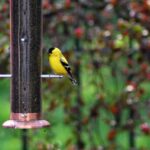
Banner image: An American Goldfinch perches at a bird feeder. Photo by Jim McGlone. Used under CC BY-NC 2.0
]]>
It’s a mere hour after sunrise, and Wajhee Zaidi, a student at Howard Community College (HCC), is out in his neighborhood, looking for birds, insects, and whatever other critters he can spot....https://umbc.edu/stories/umbc-engages-howard-community-college-students-with-environmental-science-online-and-in-their-own-backyards/https://my3.my.umbc.edu/api/v0/pixel/news/119793/guest@my.umbc.edu/fe49083bf3ff89006459c5b62a35adbb/api/pixelbiologycahsscnmscommunitygesscience-and-technologyundergradresearchUMBC News & Magazinehttps://my3.my.umbc.edu/groups/umbc-news-magazinehttps://assets1-my.umbc.edu/system/shared/avatars/groups/000/001/943/24435aa6207c452e7bc15cc74b42c7bb/xsmall.png?1748556657https://assets1-my.umbc.edu/system/shared/avatars/groups/000/001/943/24435aa6207c452e7bc15cc74b42c7bb/original.png?1748556657https://assets2-my.umbc.edu/system/shared/avatars/groups/000/001/943/24435aa6207c452e7bc15cc74b42c7bb/xxlarge.png?1748556657https://assets2-my.umbc.edu/system/shared/avatars/groups/000/001/943/24435aa6207c452e7bc15cc74b42c7bb/xlarge.png?1748556657https://assets3-my.umbc.edu/system/shared/avatars/groups/000/001/943/24435aa6207c452e7bc15cc74b42c7bb/large.png?1748556657https://assets1-my.umbc.edu/system/shared/avatars/groups/000/001/943/24435aa6207c452e7bc15cc74b42c7bb/medium.png?1748556657https://assets2-my.umbc.edu/system/shared/avatars/groups/000/001/943/24435aa6207c452e7bc15cc74b42c7bb/small.png?1748556657https://assets1-my.umbc.edu/system/shared/avatars/groups/000/001/943/24435aa6207c452e7bc15cc74b42c7bb/xsmall.png?1748556657https://assets2-my.umbc.edu/system/shared/avatars/groups/000/001/943/24435aa6207c452e7bc15cc74b42c7bb/xxsmall.png?1748556657UMBC News & Magazine00falseFri, 11 Sep 2020 18:17:27 -0400Women Have Disrupted Research on Bird Song, and Their Findings Show How Diversity Can Improve All Fields of Science
Americans often idealize scientists as unbiased, objective observers. But scientists are affected by conscious and unconscious biases, just as people in other fields are. Studies of birds’ vocal behavior clearly show how research approaches can be affected by the people who do the work.
Recent findings have shown that female song is widespread, and it is likely that the ancestor of all songbirds had female song. Now, rather than asking why males originally evolved song, the question has become why both sexes originally evolved song, and why females have lost song in some species.
In a recently published study, we reviewed 20 years of research on female bird song and found that the key people driving this recent paradigm shift were women. If fewer women had entered this field, we believe that it likely would have taken much longer to reach this new understanding of how bird song originally evolved. We see this example as a powerful demonstration of why it’s important to increase diversity in all fields of science.
Male and female troupials duetting in Puerto Rico. Karan Odom, CC BY-ND
New voices lead to new perspectives
Traditionally, white men working in countries of the Northern Hemisphere have conducted much of the research on bird song. Researchers in countries such as the U.S., Canada, England and Germany have focused much of their work on migratory birds that breed in the north temperate zone.
We noticed that women had written many of the key papers on female song published in recent years and wondered whether this was a general trend. To see whether women were significantly more likely to publish about female bird song than men, we identified all papers with “female song” in the title or abstract that had been published in the last 20 years. Next we assembled a set of papers generally published in the same journals in the same years, but focused on “bird song” more broadly.
Male and female troupials. Both sexes are elaborately colored, and both sexes sing. Karan Odom, CC BY-ND
For each of these papers we determined the genders of all authors, including the first author, middle authors and final author. Final authors frequently are the senior authors – for example, research group leaders.
Focusing on first authors, we found that 68% of female song papers were written by women, whereas only 44% of the bird song papers were written by women. Therefore, men were 24% less likely to study female song than bird song. Conversely, women were 24% more likely to study female song.
Middle authors on female song papers were also slightly skewed toward women. However, last authors were much more commonly men for both female song and bird song papers. In other words, the team leaders on these projects were still more likely to be men.
For female song studies, 58% of last authors were men. In our view, although ornithology is now a relatively gender-balanced field, more women need to be promoted into senior leadership positions, so that they can lead key decisions on research directions, funding and student projects.
Female northern cardinals sing along with males and have many different calls.
Diverse perspectives help drive scientific progress
A major goal of our study was to recognize and promote the diverse perspectives of researchers with different backgrounds and identities. However, we felt it was crucial for our study to look back at least 20 years, since that was the time frame over which this key paradigm shift occurred. Many authors from that far back would be difficult to contact directly for a variety of reasons.
In the future, allowing authors to self-identify for studies of gender and authorship in a range of fields would likely produce more correct gender data and allow researchers to identify as nonbinary or non-gender-conforming.
Our case study on bird song provides dramatic evidence that who researchers are, where they are from and what experiences they have had influence the science that they do. More diverse groups of researchers may ask a broader range of questions, utilize more varied methods and tackle problems from a wider range of perspectives.
Gender is just one aspect of identity that could influence topics, conceptual approaches and specific methodologies used in a wide range of scientific disciplines. Many other factors, such as race, ethnicity, geographic location and socioeconomic standing, could also have important impacts on scientific research.
Recent events have vividly illustrated the effects of racial biases in areas ranging from criminal justice to outdoor recreation. Our study shows why it is important to address racial, gender and other biases to improve the outcomes of research, teaching and outreach at colleges and universities around the world.
*****
Casey Haines’19, biological sciences, a recent undergraduate student at the UMBC, was lead author of the study on which this article is based. Michelle Moyer, a PhD student at UMBC, helped with this work.
]]>
By Kevin Omland, professor, Biological Sciences, UMBC; Evangeline Rose, Ph.D. ’20, biological sciences, UMBC, and Karan Odom, Ph.D. ’16, biological sciences, Cornell University Americans...https://umbc.edu/stories/women-have-disrupted-research-on-bird-song-and-their-findings-show-how-diversity-can-improve-all-fields-of-science/https://my3.my.umbc.edu/api/v0/pixel/news/119794/guest@my.umbc.edu/cebc259f363cbc3148fa8e81e5fe70c6/api/pixelbiological-sciencesdiscoveryomlandthe-conversationUMBC News & Magazinehttps://my3.my.umbc.edu/groups/umbc-news-magazinehttps://assets1-my.umbc.edu/system/shared/avatars/groups/000/001/943/24435aa6207c452e7bc15cc74b42c7bb/xsmall.png?1748556657https://assets1-my.umbc.edu/system/shared/avatars/groups/000/001/943/24435aa6207c452e7bc15cc74b42c7bb/original.png?1748556657https://assets2-my.umbc.edu/system/shared/avatars/groups/000/001/943/24435aa6207c452e7bc15cc74b42c7bb/xxlarge.png?1748556657https://assets2-my.umbc.edu/system/shared/avatars/groups/000/001/943/24435aa6207c452e7bc15cc74b42c7bb/xlarge.png?1748556657https://assets3-my.umbc.edu/system/shared/avatars/groups/000/001/943/24435aa6207c452e7bc15cc74b42c7bb/large.png?1748556657https://assets1-my.umbc.edu/system/shared/avatars/groups/000/001/943/24435aa6207c452e7bc15cc74b42c7bb/medium.png?1748556657https://assets2-my.umbc.edu/system/shared/avatars/groups/000/001/943/24435aa6207c452e7bc15cc74b42c7bb/small.png?1748556657https://assets1-my.umbc.edu/system/shared/avatars/groups/000/001/943/24435aa6207c452e7bc15cc74b42c7bb/xsmall.png?1748556657https://assets2-my.umbc.edu/system/shared/avatars/groups/000/001/943/24435aa6207c452e7bc15cc74b42c7bb/xxsmall.png?1748556657UMBC News & Magazine00falseFri, 11 Sep 2020 16:42:25 -0400Dipanjan Pan demonstrates new method to produce gold nanoparticles directly in cancer cells with possible applications in x-ray imaging, cancer treatment
Dipanjan Pan, professor of chemical, biochemical, and environmental engineering at UMBC, and collaborators have published a seminal study in Nature Communications that demonstrates for the first time a method of biosynthesizing plasmonic gold nanoparticles within cancer cells, without the need for conventional bench-top lab methods. It has the potential to notably expand biomedical applications.
Conventional laboratory-based synthesis of gold nanoparticles require ionic precursors and reducing agents subjected to varying reaction conditions such as temperature, pH, and time. This leads to variation in nanoparticle size, morphology and functionalities that are directly correlated to their internalization in cells, their residence time in vivo, and clearance. In order to avoid these uncertainties, this work demonstrates that biosynthesis of gold nanoparticles can be achieved efficiently and directly inside cancer cells without requiring conventional laboratory methods.
The researchers examined how various cancer cells responded to the introduction of chloroauric acid to their cellular microenvironment by forming gold nanoparticles. These nanoparticles generated within the cell can potentially be used for various biomedical applications, including in x-ray imaging and in therapy by destroying abnormal tissue or cells.
Expanding biomedical applications
In the paper, Pan and his team describe their new method of producing these plasmonic gold nanoparticles within cells in minutes, within a cell’s nucleus, using polyethylene glycol as a delivery vector for ionic gold. “We have developed a unique system where gold nanoparticles are reduced by cellular biomolecules and those are able to retain their functionality, including the capacity to guide the remaining cluster to the nucleus,” says Pan.
They also worked to further demonstrate the biomedical potential of this approach by inducing in-situ biosynthesis of gold nanoparticles within a mouse tumor, followed by photothermal remediation of the tumor. Pan explains that the mouse study exemplified how “the intracellular formation and nuclear migration of these gold nanoparticles presents a highly promising approach for drug delivery application.”
“Gold is the quintessential noble element that has been used in biomedical applications since its first colloidal synthesis more than three centuries ago,” Pan notes. “To appreciate its potential for clinical application, however, the most challenging research ahead of us will be to find new methods of producing these particles with uncompromised reproducibility with functionalities that can promote efficient cellular binding, clearance, and biocompatibility and to assess their long-term term effects on human health. This new study is a small but important step toward that overarching goal.”
In addition to his appointment at UMBC, Pan is a professor of diagnostic radiology and nuclear medicine and pediatrics at the University of Maryland School of Medicine (UMSOM) as part of his dual appointment with the University of Maryland, Baltimore. Coauthors on the paper are affiliated with the University of Illinois, Urbana-Champaign; UMSOM; and Cytoviva, Inc.
Banner image: UMBC’s Interdisciplinary Life Sciences Building. Photo by Marlayna Demond ’11 for UMBC.
]]>
Dipanjan Pan, professor of chemical, biochemical, and environmental engineering at UMBC, and collaborators have published a seminal study in Nature Communications that demonstrates for the first...https://umbc.edu/stories/dipanjan-pan-demonstrates-new-method-to-produce-gold-nanoparticles-directly-in-cancer-cells-with-possible-applications-in-x-ray-imaging-cancer-treatment/https://my3.my.umbc.edu/api/v0/pixel/news/119795/guest@my.umbc.edu/8f80409b547aa8d616e0ed6e909a6d69/api/pixelcbeecoeitscience-and-technologyUMBC News & Magazinehttps://my3.my.umbc.edu/groups/umbc-news-magazinehttps://assets1-my.umbc.edu/system/shared/avatars/groups/000/001/943/24435aa6207c452e7bc15cc74b42c7bb/xsmall.png?1748556657https://assets1-my.umbc.edu/system/shared/avatars/groups/000/001/943/24435aa6207c452e7bc15cc74b42c7bb/original.png?1748556657https://assets2-my.umbc.edu/system/shared/avatars/groups/000/001/943/24435aa6207c452e7bc15cc74b42c7bb/xxlarge.png?1748556657https://assets2-my.umbc.edu/system/shared/avatars/groups/000/001/943/24435aa6207c452e7bc15cc74b42c7bb/xlarge.png?1748556657https://assets3-my.umbc.edu/system/shared/avatars/groups/000/001/943/24435aa6207c452e7bc15cc74b42c7bb/large.png?1748556657https://assets1-my.umbc.edu/system/shared/avatars/groups/000/001/943/24435aa6207c452e7bc15cc74b42c7bb/medium.png?1748556657https://assets2-my.umbc.edu/system/shared/avatars/groups/000/001/943/24435aa6207c452e7bc15cc74b42c7bb/small.png?1748556657https://assets1-my.umbc.edu/system/shared/avatars/groups/000/001/943/24435aa6207c452e7bc15cc74b42c7bb/xsmall.png?1748556657https://assets2-my.umbc.edu/system/shared/avatars/groups/000/001/943/24435aa6207c452e7bc15cc74b42c7bb/xxsmall.png?1748556657UMBC News & Magazine00falseFri, 11 Sep 2020 16:18:12 -0400UMBC’s Daniel Lobo receives $1.9 million NIH grant to explore genetic control of development and regeneration
Salamanders regenerate their tails. Sea stars regenerate their arms. Most species of planaria, a type of flatworm, can regenerate everything from their heads (complete with brain) to their digestive organs. But if you lose part of a finger in a shop class accident, or while chopping vegetables for dinner, you’re out of luck—for now.
“Why can the worm do it, and we cannot?” asks Daniel Lobo, assistant professor of biological sciences. That’s not really the question, though, he explains.
“We were able to generate ourselves when we were embryos. So we have all the information of how to generate a new hand, for example,” Lobo points out. “The genes are there. You have the same information in your cells.” So why can’t humans generate body parts after that early stage of development?
“Actually, we could,” Lobo argues, if we could somehow reactivate the same genes that enabled us to develop in the womb. So, “Can we reactivate them?” he asks. That’s the real question, which he is working to answer with a five-year, $1.9 million grant from the National Institutes of Health.
Left to right: Joy Roy ’19, bioinformatics and mathematics; Daniel Lobo; Caroline Larkin ’18, M26, bioinformatics; and Eric Cheung ’19, biochemistry and molecular biology. They’re looking at computational models of planaria. Photo by Marlayna Demond ’11 for UMBC.
Restoring independence
Lobo is tackling this question through a unique combination of techniques: wet lab experiments with planaria, and machine learning approaches that use computers to help deduce genetic regulatory networks. Previous work successfully restored the regeneration capacity of a species of planaria that had lost that ability. While still a long way from growing a human finger back, it’s a sign that the promise of reclaiming regeneration is not so far-fetched.
This line of research could eventually make it possible for people with limb loss, such as injured veterans, to regrow lost body parts. By increasing understanding of genetic regulation, Lobo’s work might also enhance knowledge of development and developmental diseases, and how cancerous tumors work around regulatory networks to grow unchecked.
The right worm for the job
Lobo uses an approach known as systems biology to tackle these big ideas. “We mix the fields of math, computer science, and biology,” he says. “We use computational techniques to extract knowledge from biological data sets.” The result is mathematical models that can explain observations the team makes in the lab. The models can also make predictions, which researchers can test in the lab.
Planaria are the ideal model organism for lab work, because of their astonishing ability to regenerate. Even a worm in eight pieces will grow back into eight complete worms with proper proportions. Like mammals, the worms also grow when they have enough to eat. However, when hungry, rather than simply getting thinner, their whole bodies shrink to maintain proper proportions. So, beyond regeneration, “The general idea is to understand how gene regulation works to specify shapes and forms in biology,” Lobo says.
Planaria can grow and shrink their bodies and organs. Photo courtesy Daniel Lobo.
Teamwork and flexibility
“This program is too hard to do with just wet lab or just computational approaches,” Lobo says. “You need both.”
Because the work requires such a range of techniques, it also requires team members with a range of skills. Lobo’s lab includes undergraduate and graduate students in math, computer science, bioinformatics, and biology. The new grant will also allow him to bring on two new postdoctoral fellows, one on the wet lab side and one computational.
“We will be able to create that synergy and get people trained in both fields in the same lab,” says Lobo. He describes the interactions between lab members from different fields as essential to the success of the research.
Rather than fund a specific project, Lobo’s new Outstanding Investigator Grant will fund the lab as a whole. “It gives you a lot of freedom to adapt to whatever discoveries you make,” he says. “You have the flexibility to pursue the details that you need to.”
Teaching computers so they can teach us
The computers the team uses are powerful, but for now, they still benefit from some human guidance. To give the computers a head start on figuring out the genetic regulatory networks, the team inputs certain rules before they add loads of data from their own experiments and other labs’ work. That also ensures the computers don’t come up with a solution that is biologically impossible.
“We know that genes generally interact in certain fashions, and those interactions can be represented in different ways mathematically,” Lobo explains. “So we can tell the computer what kinds of interactions a gene can have. And then it is free to put those interactions together in ways that make sense.”
Lobo compares it to working with Lego blocks. “How many structures can you make with Legos? Unlimited, right?” he asks. “So the computer also has an unlimited space to search, but only with things that can be put together. You cannot make a perfectly round Lego ball, for example, if you only have square blocks.”
Daniel Lobo, right, takes a break with Joy Roy (center) and Eric Cheung in the lab. Photo by Marlayna Demond ’11 for UMBC.
Speeding up the science
Combining wet lab and computational approaches will drastically increase the pace of discovery. A high performance cluster of computers can come up with a probable solution by testing more than a billion possible models of a regulatory network in a few days—a task that would take infinitely long for a team of humans.
Using computers to come up with plausible models, testing the models’ predictions in the lab, and then feeding the new data back into the computers to refine the model will bring researchers ever closer to understanding how different biological systems work. Research teams can apply the same investigative process to any number of biological questions, from regeneration to metastasis.
Some biologists may shy away from programming, but as Lobo says, “Biology is more and more computational. We are reaching a point that without a computer to process the data you cannot do almost any experimental work in biology.”
He argues that interdisciplinary teams like his are the future—that diverse groups of researchers will increasingly combine multiple approaches to answer the big questions, to speed up scientific progress in ways that will have real, positive impact.
Banner image: Daniel Lobo in front of the Biological Sciences Building mural. Photo by Marlayna Demond ’11 for UMBC.
]]>
Salamanders regenerate their tails. Sea stars regenerate their arms. Most species of planaria, a type of flatworm, can regenerate everything from their heads (complete with brain) to their...https://umbc.edu/stories/umbcs-daniel-lobo-receives-1-9-million-nih-grant-to-explore-genetic-control-of-development-and-regeneration/https://my3.my.umbc.edu/api/v0/pixel/news/119796/guest@my.umbc.edu/d6964b3ece2f6f9ffb9eebf351fbb6de/api/pixelbiologycnmsmathstatresearchscience-and-technologyUMBC News & Magazinehttps://my3.my.umbc.edu/groups/umbc-news-magazinehttps://assets1-my.umbc.edu/system/shared/avatars/groups/000/001/943/24435aa6207c452e7bc15cc74b42c7bb/xsmall.png?1748556657https://assets1-my.umbc.edu/system/shared/avatars/groups/000/001/943/24435aa6207c452e7bc15cc74b42c7bb/original.png?1748556657https://assets2-my.umbc.edu/system/shared/avatars/groups/000/001/943/24435aa6207c452e7bc15cc74b42c7bb/xxlarge.png?1748556657https://assets2-my.umbc.edu/system/shared/avatars/groups/000/001/943/24435aa6207c452e7bc15cc74b42c7bb/xlarge.png?1748556657https://assets3-my.umbc.edu/system/shared/avatars/groups/000/001/943/24435aa6207c452e7bc15cc74b42c7bb/large.png?1748556657https://assets1-my.umbc.edu/system/shared/avatars/groups/000/001/943/24435aa6207c452e7bc15cc74b42c7bb/medium.png?1748556657https://assets2-my.umbc.edu/system/shared/avatars/groups/000/001/943/24435aa6207c452e7bc15cc74b42c7bb/small.png?1748556657https://assets1-my.umbc.edu/system/shared/avatars/groups/000/001/943/24435aa6207c452e7bc15cc74b42c7bb/xsmall.png?1748556657https://assets2-my.umbc.edu/system/shared/avatars/groups/000/001/943/24435aa6207c452e7bc15cc74b42c7bb/xxsmall.png?1748556657UMBC News & Magazine00falseWed, 09 Sep 2020 20:14:27 -0400UMBC celebrates 2020 – 2021 Fulbright recipients
Eleven recent UMBC alumni are recipients of 2020 – 2021 Fulbright U.S. Student Program awards, including seven from UMBC’s Class of 2020. Each year over 11,000 students apply and just over 2,000 are selected from hundreds of colleges and universities across the United States. The award secures funding for U.S. students to pursue international graduate study, research, internships, or teaching.
While COVID-19 has presented a range of challenges and uncertainties for Fulbright recipients, UMBC is proud to celebrate their hard work and achievements.
“This year’s recipients have demonstrated great flexibility and maturity as they navigate the changes that our current global situation requires,” explains Brian Souders, M.A.‘19, TESOL and Ph.D. ’09, language, literacy and culture. He serves as associate director of global engagement opportunities in UMBC’s office of International Education Services.
Souders, who is also UMBC’s Fulbright program advisor and scholar liaison, says that these hurdles have also not deterred UMBC faculty, students, and alumni from applying for the 2021 – 2022 Fulbright award.
UMBC’s 2020 – 2021 Fulbright U.S. Student Program award recipients
Middle East
Kiplyn Jones, M.P.P. ’20, public policy, Jordan, English Teaching
East Asia
Osia on campus. Photo courtesy of Osia.
Hannah Jang ’20, global studies, Korea, English Teaching Assistant
Phillip McKnight, M.A. ’19, instructional systems design, Laos, English Teaching Assistant
Samina Musa ’20, chemical engineering, Malaysia, English Teaching Assistant
Uchenna Osia ’19, computer science, Malaysia, English Teaching Assistant
Europe and Eurasia
Brandon Ables, M.F.A., ’20, intermedia and digital arts, Romania, English Teaching Assistant
Alida Hartwell ’20, bioinformatics/computational biology, Latvia, English Teaching Assistant
Matthew Linz ’20, modern languages, linguistics, and intercultural communication, Kazakhstan, English Teaching Assistant
Idania Ramos ’20, psychology, Spain, English Teaching Assistant
Jocelyn Wilkins ’20, mechanical engineering, University of Porto, Portugal, Master’s Program
Kashett in Costa Rica, where he previously studied abroad. Photo courtesy of Kashett.
Western Hemisphere
Daniel Kashkett ’19, global studies, Mexico, Bilateral Internship Program
Top Fulbright producer
The Fulbright U.S. Student program is highly competitive, and recipients are chosen based on academic or professional achievement and demonstrated leadership potential. UMBC’s ten 2020 – 2021 recipients include students from a broad range of majors. And they’ve been selected for a diverse range of experiences, as English teaching assistants, interns, and graduate students in Europe, East Asia, Western Hemisphere, and the Middle East.
This success comes after UMBC was named a Fulbright Top Producing Institution for receiving fourteen Fulbright U.S. Student awards in 2019 – 2020. Only a small portion of institutions participating in the Fulbright program are designated as top producers each year, an honor granted by the U.S. Department of State’s Bureau of Educational and Cultural Affairs.
Both the Fulbright U.S. Student Program and the Fulbright U.S. Scholar Program are designed to help build networks to support cross-cultural understanding. They connect people from the United States with people from around the world to dispel stereotypes and help each other reach common goals.
Faculty Fulbright for research in Southeast Asia
Beyond the student program, faculty are eligible to apply for the Fulbright U.S. Scholar Program to further research on critical world problems in all disciplines. This year, UMBC’s John Rennie Short, professor of public policy, has received a Fulbright award to conduct research in Southeast Asia on the geopolitics of the South China Sea.
Rennie Short with local university students and staff in Nanchang, China. Photo courtesy of Rennie Short.
The award will support Rennie Short’s research in Malaysia and the Philippines and allow him to visit Cambodia, Indonesia, and Vietnam. He will interview scholars and foreign policy analysts while at the Asian Center at the University of the Philippines Diliman and the Centre for ASEAN Regionalism at the University of Malaya, in Kuala Lumpur, Malaysia. Rennie Short also plans to give public lectures and seminars about U.S. public policy and other topics while in Southeast Asia.
Kuala Lampur, one of the places Rennie Short will visit for research. Photo courtesy of Rennie Short.
This research will inform Rennie Short’s second book on East Asian maritime issues. “The book will widen our understanding of the complex and troubled geopolitics of the South China Sea,” he explains. “It will provide an Association of Southeast Asian Nations perspective to counter the dominant Chinese and U.S. narratives.”
Rennie Short’s first book on East Asian geopolitical issues, Korea: A Cartographic History (2012, University of Chicago Press), tackled the East Sea versus Sea of Japan naming dispute between South Korea and Japan. He has also written “Troubled Waters: Conflict in the South China Sea Explained,” republished in U.S. News & World Report.
Other recent UMBC faculty recipients of Fulbright U.S. Scholar awards include Charissa Cheah, professor of psychology; Guenet Abraham, associate professor visual arts; Chuck Eggleton, professor and chair of mechanical engineering; and Marc Zupan, associate professor of mechanical engineering.
Abraham in Ethiopia as a Fulbright Scholar in 2018. Photo courtesy of Abraham.
Banner image: International hanging from the ceiling of UMBC’s Commons. Photo by Marlayna Demond ’11 unless otherwise noted.
]]>
Eleven recent UMBC alumni are recipients of 2020 – 2021 Fulbright U.S. Student Program awards, including seven from UMBC’s Class of 2020. Each year over 11,000 students apply and just over 2,000...https://umbc.edu/stories/umbc-celebrates-2020-2021-fulbright-recipients/https://my3.my.umbc.edu/api/v0/pixel/news/119797/guest@my.umbc.edu/c75d875efc6657d3f47d5a3a8f121960/api/pixelcahsscoeitcommunityglobalstudiesinternationalllcmechemllipolicy-and-societypsychologypublicpolicyscience-and-technologyvisualartsUMBC News & Magazinehttps://my3.my.umbc.edu/groups/umbc-news-magazinehttps://assets1-my.umbc.edu/system/shared/avatars/groups/000/001/943/24435aa6207c452e7bc15cc74b42c7bb/xsmall.png?1748556657https://assets1-my.umbc.edu/system/shared/avatars/groups/000/001/943/24435aa6207c452e7bc15cc74b42c7bb/original.png?1748556657https://assets2-my.umbc.edu/system/shared/avatars/groups/000/001/943/24435aa6207c452e7bc15cc74b42c7bb/xxlarge.png?1748556657https://assets2-my.umbc.edu/system/shared/avatars/groups/000/001/943/24435aa6207c452e7bc15cc74b42c7bb/xlarge.png?1748556657https://assets3-my.umbc.edu/system/shared/avatars/groups/000/001/943/24435aa6207c452e7bc15cc74b42c7bb/large.png?1748556657https://assets1-my.umbc.edu/system/shared/avatars/groups/000/001/943/24435aa6207c452e7bc15cc74b42c7bb/medium.png?1748556657https://assets2-my.umbc.edu/system/shared/avatars/groups/000/001/943/24435aa6207c452e7bc15cc74b42c7bb/small.png?1748556657https://assets1-my.umbc.edu/system/shared/avatars/groups/000/001/943/24435aa6207c452e7bc15cc74b42c7bb/xsmall.png?1748556657https://assets2-my.umbc.edu/system/shared/avatars/groups/000/001/943/24435aa6207c452e7bc15cc74b42c7bb/xxsmall.png?1748556657UMBC News & Magazine00falseWed, 09 Sep 2020 20:13:25 -0400UMBC’s Taka Yamashita receives $1.4 million grant for research supporting workers returning to community college
UMBC’s Taka Yamashita has been awarded a $1.4 million grant from the U.S. Department of Education’s Institute of Education Sciences for an innovative three-year research project on how adult literacy impacts success in community college STEM education and job training programs. Yamashita is an associate professor of sociology and faculty member in the UMBC/UMB gerontology Ph.D. program. He will explore how the literacy, numeracy, and problem-solving skills of adults (ages 18 and over), can be indicators of career and academic readiness in community college STEM programs.
Meeting workers’ and STEM industry needs
Many workers with limited academic credentials or skills face the need to expand their skill set to fit a rapidly changing STEM-focused labor market. The wide range of skills needed for STEM jobs creates both challenges and opportunities for workers to begin “middle-skill” positions, which do not require four-year undergraduate or graduate degrees. Career training programs can make a significant difference for these workers.
Yamashita notes that community colleges are uniquely positioned to meet the needs of adults who seek STEM skill training. However, in addition to knowledge and work skills, many workers also need to learn the basic skills to manage college level coursework, he explains.
“While community colleges can offer a path, students’ community college readiness may present a barrier to completing the training and entering the STEM workforce,” shares Yamashita. He explains, “Recent national data clearly showed that many of the adults seeking to aquire new new knowledge and skill sets do not have the sufficient basic reading and math skills needed for higher education coursework in the U.S.”
The power of three perspectives
This research project is led by Yamashita, principal investigator; Rita Karam, senior policy researcher at RAND Corporation; and Phyllis Cummins, assistant director of research at Scripps Gerontology Center at Miami University of Ohio. The team will gather quantitative and qualitative data from three community college STEM programs. These include programs at Clover Park Technical College in Washington state, Cuyahoga Community College in Ohio, and Ivy Tech Community College in Indiana.
The researchers will assess students’ basic math, reading, and technology skills to predict their academic success in STEM skills training programs. They will also analyze national data and create the first national profile of basic skills across different segments of the adult population for a variety of STEM industries.
“We’re seeking to explore relationships between basic skills, college readiness, and academic outcomes,” says Yamashita. “Our goal is to better understand the underlying themes and/or key factors that are linked to enhanced basic skills and academic success in the STEM-related sub-baccalaureate programs.” These findings, Yamashita notes, could have a long-lasting positive impact on current and future workers’ lives as well as the STEM labor market.
Banner image: Yamashita. Photo courtesy of Yamashita.
]]>
UMBC’s Taka Yamashita has been awarded a $1.4 million grant from the U.S. Department of Education’s Institute of Education Sciences for an innovative three-year research project on how adult...https://umbc.edu/stories/umbcs-taka-yamashita-receives-1-4-million-grant-for-research-supporting-workers-returning-to-community-college/https://my3.my.umbc.edu/api/v0/pixel/news/119798/guest@my.umbc.edu/c6e0739166e8a8955b30d6a483c4920c/api/pixelcahsscahssresearchgerontologypage1policy-and-societysaphUMBC News & Magazinehttps://my3.my.umbc.edu/groups/umbc-news-magazinehttps://assets1-my.umbc.edu/system/shared/avatars/groups/000/001/943/24435aa6207c452e7bc15cc74b42c7bb/xsmall.png?1748556657https://assets1-my.umbc.edu/system/shared/avatars/groups/000/001/943/24435aa6207c452e7bc15cc74b42c7bb/original.png?1748556657https://assets2-my.umbc.edu/system/shared/avatars/groups/000/001/943/24435aa6207c452e7bc15cc74b42c7bb/xxlarge.png?1748556657https://assets2-my.umbc.edu/system/shared/avatars/groups/000/001/943/24435aa6207c452e7bc15cc74b42c7bb/xlarge.png?1748556657https://assets3-my.umbc.edu/system/shared/avatars/groups/000/001/943/24435aa6207c452e7bc15cc74b42c7bb/large.png?1748556657https://assets1-my.umbc.edu/system/shared/avatars/groups/000/001/943/24435aa6207c452e7bc15cc74b42c7bb/medium.png?1748556657https://assets2-my.umbc.edu/system/shared/avatars/groups/000/001/943/24435aa6207c452e7bc15cc74b42c7bb/small.png?1748556657https://assets1-my.umbc.edu/system/shared/avatars/groups/000/001/943/24435aa6207c452e7bc15cc74b42c7bb/xsmall.png?1748556657https://assets2-my.umbc.edu/system/shared/avatars/groups/000/001/943/24435aa6207c452e7bc15cc74b42c7bb/xxsmall.png?1748556657UMBC News & Magazine00falseWed, 09 Sep 2020 19:04:57 -0400UMBC’s Elizabeth Patton dives into history of remote work with “Easy Living: The Rise of the Home Office”
Elizabeth Patton’s new book Easy Living: The Rise of the Home Office (2020, Rutgers University Press) explores how Americans think about the modern home office and why. Patton’s book is a historical view of how marketing and popular media have shaped how mostly white, heterosexual, upper-middle-class families in the United States have talked about working from home. Due to COVID-19, remote work has hit unprecedented highs, but Patton’s scholarship reveals that it’s far from a new idea.
“I was interested in learning about how people talked about working from home from the early 19th century to today,” says Patton, an assistant professor of media and communication studies at UMBC. “I wanted to understand how certain public figures, technology and real estate companies, film and TV contributed to these conversations and shaped today’s idea of working from home.”
Patton explains this phenomenon, as her family redefines work spaces during COVID-19, in her latest article: “In the work-from-home battle for space, women are the reluctant nomads.” Originally published by The Conversation, the article has been republished by CNN, Fast Company, and others, reaching nearly 140,000 reads so far.
The gendered home office
Patton’s research reveals how early-19th century advertising and media portrayed women in two traditionally private spaces: the kitchen and the bedroom. This shifted during WWII as ads encouraged women to work jobs men had to leave behind. However, by the 1950s many women were expected to leave careers and return to domesticity.
Patton found advertising campaigns from phone companies motivating women to work more efficiently by having a phone line installed in the kitchen and in the bedroom. “Typewriter ads also encouraged women to work as typists from their kitchen office,” shares Patton. “This work was not to advance a career but to support their household economy.”
Men, on the other hand, occupied the public space in the home—the living room or den—to work, relax, or entertain. Patton’s research also describes how advertising and media discussed the work men brought home from the office as a way for them to maintain a work-life balance, especially with the rise of long commutes. Real estate and furniture ads lured urban families to the suburbs with the promise of a garage or a home office to give men more family time and bigger kitchens to help women more efficiently run their household.
Hollywood’s influence
Patton made a particularly compelling, unexpected discovery during her research at the Library of Congress: evidence of the influence of Hugh Hefner, the founder and editor-in-chief of Playboy magazine. Hefner played a significant role in conceptualizing the modern work-from-home lifestyle, the bachelor pad, and the “man cave.”
“While he is an extremely problematic figure, there is no denying his influence in this area,” explains Patton. Research shows how Hefner used advances in phone, computer, television, and architecture to conceptualize private and public home spaces for a successful work-life balance, making commutes irrelevant.
Family life on TV
Bill Cosby, a disgraced public figure, helped transform the portrayal of men and women having successful careers and a thriving family life on television, says Patton.
“The Cosby Show was a primetime family show that created an aspirational lifestyle,” shares Patton. “It was a very purposeful portrayal of how men, working as doctors, lawyers, or writers, could have a successful and fulfilling work-life balance while at the same time supporting their wives in leaving the home to pursue similar careers.”
Patton also shares how it wasn’t until the 1980s and early 1990s, with second-wave feminism, that women were more frequently portrayed in advertising and popular media as having a career outside of the home or having a home office. Still, these portrayals were seen as controversial, especially when central female characters were single working mothers. And if women had to bring work home, their office was still the kitchen.
COVID-19 and the home office evolution
Patton’s book comes at an unprecedented time when many adults and children have had to shift their work and learning spaces from the public office and school to the private home. This change has reopened questions about private and public work spaces and work-life balance, as well as class, equity, and access.
“I’m always thinking about who is missing or left out in the conversation. I’m telling this history, but this history is not possible without depending on people of color and people working in service jobs,” explains Patton. “This is where class and race intersect. And it is necessary to keep this idea of working from home going, even more so now with a pandemic.”
Banner image: Patton on campus in academic row. Photo by Marlayna Demond ’11.
]]>
Elizabeth Patton’s new book Easy Living: The Rise of the Home Office (2020, Rutgers University Press) explores how Americans think about the modern home office and why. Patton’s book is a...https://umbc.edu/stories/umbcs-elizabeth-patton-dives-into-history-of-remote-work-with-easy-living-the-rise-of-the-home-office/https://my3.my.umbc.edu/api/v0/pixel/news/119799/guest@my.umbc.edu/25ba035472c5b4b2bddab492d808deb4/api/pixelcahssmcspage1policy-and-societyresearchUMBC News & Magazinehttps://my3.my.umbc.edu/groups/umbc-news-magazinehttps://assets1-my.umbc.edu/system/shared/avatars/groups/000/001/943/24435aa6207c452e7bc15cc74b42c7bb/xsmall.png?1748556657https://assets1-my.umbc.edu/system/shared/avatars/groups/000/001/943/24435aa6207c452e7bc15cc74b42c7bb/original.png?1748556657https://assets2-my.umbc.edu/system/shared/avatars/groups/000/001/943/24435aa6207c452e7bc15cc74b42c7bb/xxlarge.png?1748556657https://assets2-my.umbc.edu/system/shared/avatars/groups/000/001/943/24435aa6207c452e7bc15cc74b42c7bb/xlarge.png?1748556657https://assets3-my.umbc.edu/system/shared/avatars/groups/000/001/943/24435aa6207c452e7bc15cc74b42c7bb/large.png?1748556657https://assets1-my.umbc.edu/system/shared/avatars/groups/000/001/943/24435aa6207c452e7bc15cc74b42c7bb/medium.png?1748556657https://assets2-my.umbc.edu/system/shared/avatars/groups/000/001/943/24435aa6207c452e7bc15cc74b42c7bb/small.png?1748556657https://assets1-my.umbc.edu/system/shared/avatars/groups/000/001/943/24435aa6207c452e7bc15cc74b42c7bb/xsmall.png?1748556657https://assets2-my.umbc.edu/system/shared/avatars/groups/000/001/943/24435aa6207c452e7bc15cc74b42c7bb/xxsmall.png?1748556657UMBC News & Magazine00falseFri, 04 Sep 2020 21:33:24 -0400Research Under the Same Roof
Sitting together, side-by-side in a video call, it’s easy to see the familial resemblance between Susan Sonnenschein, professor, Applied Developmental Psychology, and Elyse Grossman, M.P.P. ’08, Ph.D. ’14, public policy. However, similar facial features, matching bold colors, and statement necklaces aside, it’s the back-and-forth interaction that gives the duo away as mother and daughter.
A playful sense of ease to gently correct, pause the conversation, or reassert herself comes naturally to each woman, who understands their own dynamic better than most research pairs.
During the COVID-19 pandemic, Grossman has been staying with her mother and sister Julie in their Rockville townhome, sheltering-in-place together. Grossman cooks gourmet meals; Sonnenshein insists they stay up-to-date on cultural events by attending performances and tours online. And one more thing—they combined their research interests to create a nation-wide survey that looks at the stresses on parents during the period of distance learning and what role this has played in their alcohol consumption. Sonnenschein and Grossman are sharing the task of writing several papers drawn from the data, and a brief version of their findings, “Parents with Children Forced to Do School at Home Are Drinking More,” was recently published in The Conversation.
All in the Family
Unlike her sister Julie Grossman, who teaches psychology alongside Sonnenschein at UMBC (and is assisting in coding the data from their joint survey), Elyse Grossman had no interest in studying her mother’s area of expertise. However, as her undergraduate years at Cornell passed, she found herself graduating with a degree in psychology.
“I ended up really enjoying it, but it was funny,” says Grossman. “I had always been very adamant that I was never going to go into psychology.” Sonnenschein chimes in, “and when I brought that up afterwards she said, ‘Well I always knew I would.’” They exchange looks.
In 2018, Grossman won the “Keeping It Safe” Community Service Award for her work at preventing and reducing alcohol use among those under age. And of course, her mother was there to support her. All photos courtesy of Grossman and Sonnenschein.
At Cornell, Grossman already knew she wanted to get a law degree afterward, assuming she’d work with patent law, based on her science-focused undergrad. But as she shifted toward a new degree plan, Grossman discovered her research interest in alcohol policy.
Rethinking Drinking Traditions
Traditionally, end-of-the-year classes at Cornell were celebrated by students and their families on Slope Day, Grossman shares. However, more recently, Slope Day had become a day marked by excess drinking where rules regarding minors were often ignored. Grossman recounts a Slope Day she attended. “The first person who went to the hospital [for alcohol poisoning] was a 13-year old girl who had a note in her pocket that said, ‘I allow my daughter to go to Slope Day.’”
According to Grossman, the local hospital canceled all of their elective procedures that day to address the influx of patients from the university. This sparked Grossman’s interest in alcohol policy and public health. Now a policy fellow at the Johns Hopkins Bloomberg School of Public Health and a senior legal policy advisor at a consulting firm, Grossman specializes in researching state alcohol policies. But, it began with Slope Day. “I really got involved with rethinking this event, and we worked to change it from a day about drinking to a day about music and fun and food with alcohol.”
A Survey of Overlapping Interests
Sonnenschein, whose degree is in developmental psychology, describes her scholarly interest in educational formation and the factors that facilitate or interfere with a child’s development in language, literacy, and mathematics. “And that’s what I’ve done research for for years,” says Sonnenschein. “Then there was COVID, and the whole nation basically turned to homeschooling or distance learning. And that intrigued me.”
Grossman gave two presentations in October 2019 at the National Alcohol Beverage Control Association 25th Annual Administrator’s Conference in Denver.
Sonnenschein gave a presentation at the Headstart Conference in Ocean City, Maryland, in 2018 on the importance of supporting and engaging children in math learning at home.
Meanwhile, Grossman—who is also an adjunct instructor at UMBC’s Honors College—noticed an uptick in memes on social media with variations on the theme “Well, when I get out of COVID I’ll either be an excellent cook, an alcoholic, or both.” Past research, says Grossman, shows that “when there’s traumatic, emotional, or stressful events, alcohol consumption generally increases two to three years after the event, for example, after 9/11, Hurricane Katrina, et cetera. So this is something that really interested me, seeing how COVID-19 was affecting stress and alcohol consumption now and whether we’ll see the same increase in two to three years.”
Here Sonnenschein and Grossman discovered the perfect overlap of their research—were parents who were suddenly responsible for their child’s educational growth turning to alcohol more often?
From their online survey, completed in May 2020 by 361 parents with children under 18 years old currently living with them, the research duo found that “parents who are stressed by having to help their children with distance learning during the COVID-19 pandemic drink seven more drinks per month than parents who do not report feeling stressed by distance learning.” Furthermore, they write inThe Conversation, “These stressed parents are also twice as likely to report binge drinking at least once over the prior month than parents who are not stressed, according to our results.”
Parents’ roles have not only shifted, say Sonnenschein and Grossman, but they’ve multiplied. “In addition to being parents, they’re teachers, they’re employees, they’re coaches, they’re motivators,” says Grossman. “And all of this happened relatively quickly,” Sonnenschein adds.
Making Sense of the Unexpected
Sonnenschein and Grossman are eager to see where their research leads them next while they continue to share homemade meals and online cultural events.
The family in Vilnius, Lithuania, in 2016, while waiting for a bus to Riga, Latvia. Sonnenschein likes to joke that the coldest winter she ever spent was a summer in Vilnius.
“It’s been neat to see how our research and perspectives overlap,” says Grossman. “We have different styles and different backgrounds, so it’s been interesting just to see how all that works together and to learn from each other.”
“This is a moment in time that I believe is going to change the world,” says Sonnenschein. “And I’ve always thought when some unexpected event occurs, we should contribute to try to make sense of it.”
Header image: From left to right: Julie Grossman, Susan Sonnenschein, and Elyse Grossman at the International Society for the Study of Behavioural Development (ISSBD) Conference in Vilnius, Lithuania, in 2016. All three presented.
]]>
Sitting together, side-by-side in a video call, it’s easy to see the familial resemblance between Susan Sonnenschein, professor, Applied Developmental Psychology, and Elyse Grossman, M.P.P. ’08,...https://umbc.edu/stories/researching-alcohol-consumption-and-distance-education-stresses-as-mother-and-daughter/https://my3.my.umbc.edu/api/v0/pixel/news/119800/guest@my.umbc.edu/aae30728fe29fdc8ab3730c0f8a1b74b/api/pixelcovidresearchdiscoverypsychologypublic-policythe-conversationumbctogetherUMBC News & Magazinehttps://my3.my.umbc.edu/groups/umbc-news-magazinehttps://assets1-my.umbc.edu/system/shared/avatars/groups/000/001/943/24435aa6207c452e7bc15cc74b42c7bb/xsmall.png?1748556657https://assets1-my.umbc.edu/system/shared/avatars/groups/000/001/943/24435aa6207c452e7bc15cc74b42c7bb/original.png?1748556657https://assets2-my.umbc.edu/system/shared/avatars/groups/000/001/943/24435aa6207c452e7bc15cc74b42c7bb/xxlarge.png?1748556657https://assets2-my.umbc.edu/system/shared/avatars/groups/000/001/943/24435aa6207c452e7bc15cc74b42c7bb/xlarge.png?1748556657https://assets3-my.umbc.edu/system/shared/avatars/groups/000/001/943/24435aa6207c452e7bc15cc74b42c7bb/large.png?1748556657https://assets1-my.umbc.edu/system/shared/avatars/groups/000/001/943/24435aa6207c452e7bc15cc74b42c7bb/medium.png?1748556657https://assets2-my.umbc.edu/system/shared/avatars/groups/000/001/943/24435aa6207c452e7bc15cc74b42c7bb/small.png?1748556657https://assets1-my.umbc.edu/system/shared/avatars/groups/000/001/943/24435aa6207c452e7bc15cc74b42c7bb/xsmall.png?1748556657https://assets2-my.umbc.edu/system/shared/avatars/groups/000/001/943/24435aa6207c452e7bc15cc74b42c7bb/xxsmall.png?1748556657UMBC News & Magazine00falseFri, 04 Sep 2020 16:23:39 -0400Bedrock to treetops: NSF awards $4.8M to urban environment study led by UMBC’s Claire Welty
There is an essential resource constantly flowing beneath our feet: groundwater. Urban denizens may not think about it often, or at all, because they don’t rely on wells, “but it’s still there,” says hydrologist Claire Welty, and it’s critical to understanding the health of urban ecosystems.
Welty is director of UMBC’s Center for Urban Environmental Research and Education (CUERE) and a professor of chemical, biochemical, and environmental engineering. Groundwater is just one piece of a complicated puzzle that she and her team will work to put together over the next five years. A $4.8 million Critical Zone Collaborative Network grant from the National Science Foundation will make the large-scale project possible. The grant will support researchers at UMBC and eight other institutions that are part of the UMBC-led Urban Critical Zone Cluster.
Welty’s team will explore Earth’s critical zone, which extends from the tops of trees to the base of weathered bedrock, in urban centers along the Eastern Seaboard. In particular, they’re interested in how natural, geological processes occurring below the Earth’s surface and human-driven processes interact. Human influences include road salt application, polluted stormwater runoff, and soil-disturbing construction. These factors can all significantly influence urban water quality, water chemistry, and weathering processes.
Most Critical Zone grants are for work in more pristine wilderness areas, because the added effects of urban processes make the research more complicated. But, Welty says, “that’s the most interesting part.”
The Earth’s critical zone extends from the treetops down to bedrock below ground. Image by the National Science Foundation.
Focus on the Fall Zone
The research will take place in four East Coast cities: Philadelphia, Baltimore, Washington, and Raleigh. The researchers strategically selected these urban centers because they align in a north-to-south corridor along what geologists call the “Fall Zone.” The Fall Zone exists at the transition from the Piedmont to the Coastal Plain, and is an area of intense interest for geologists.
“We think of this landscape as ancient, but recent research has led to a different understanding about how the Fall Zone in our region has evolved,” says geomorphologist Andrew Miller, UMBCprofessor of geography and environmental systems and a collaborator on the new grant. Glaciers to the region’s north played a role, and “human activity has also caused profound changes,” Miller says. “All of this forms the background for the work we are planning to do on this project.”
Miller (left) and Welty in Catonsville at one of their research field sites. Photo by Victor Fulda.
Philadelphia to Raleigh: An urban corridor
The Fall Zone’s unique topography made it a natural place for some of the first American cities to emerge. Dramatic elevation changes characterize the Fall Zone, “so that’s where waterfalls formed, providing hydropower, so mills were set up,” Welty explains. Population centers grew up around the mills. Elevation changes at the Fall Zone boundary also limited water transport further inland, making it the natural place to build port cities. Today’s I-95 corridor links these urban centers.
The north-south corridor also gives the researchers an opportunity to examine how climate affects the movement of substances, such as sediment and dissolved materials, through the natural and built environments. Natural and human-introduced substances can affect everything from water quality to how quickly the bedrock wears away over time.
Of the four cities, Raleigh is distinct in ways that offer unique opportunities. As a younger city, it’s laid out differently. It may also have newer water, sewer, and other systems that could affect its underground properties in ways that differ from older, industrial cities like Baltimore and Philadelphia.
The U.S. Northeast and mid-Atlantic at night, showing the urban corridor. Image courtesy NASA Earth Observatory, by Joshua Stevens.
Long-term legacy
Baltimore, in particular, is well-suited to host this research, because scientists have collected environmental data on the region for over twenty years through the Baltimore Ecosystem Study Long-Term Ecological Research Project (BES). The BES team has installed scientific instruments all over the region. Students, faculty, and sensors have been recording data consistently for decades, painting a picture of Baltimore’s watershed, ecology, and social issues related to the environment.
However, “the subsurface has for the most part been ignored,” Welty says. With funding from other sources, she and her field assistants have drilled 35 monitoring wells—but there’s more to be learned.
“We’ve got all this incredible science that’s been going on for 20 years of the BES,” Welty says. With the Critical Zone grant, “Now we want to look at the subsurface to complement all the data and information and instrumentation—you name it, we have it,” Welty says. “We think it’s really important to marry these two together.”
In addition to adding more and different data to an already huge archive, the Baltimore-based team also plans to leverage their existing data in new ways. “We’re going to use stream chemistry as a window into the subsurface,” Welty says. The researchers will also examine land use patterns and analyze bedrock and soil cores. Tools that act like an x-ray or MRI will enable them to visualize the structure and properties of the subsurface that are impossible to observe directly.
Baltimore skyline. Photo by Adam Lindquist, used under CC-BY-NC 2.0.
Putting science into practice
Urban groundwater processes fascinate Welty. She’s driven by a fundamental desire to better understand what’s going on underneath cities in the Fall Zone. And there are practical reasons why this work is important, too.
“At UMBC, we’re always interested in informing policy with the scientific projects we do,” she says. “We have strong relationships with partners in Baltimore, and folks in the other cities do as well. They pay attention to what we do.”
Those relationships work in both directions. Sometimes the research informs new policies around development, water treatment, or salt use. Other times, questions from regional leaders inspire additional research, including student projects.
Some public concerns have involved hazards to the urban drinking water supply and salinization of streams, which could be detrimental to wildlife. “We’re making connections and providing a foundation of knowledge,” Welty says, so policymakers can make decisions grounded in science.
In addition, Alan Berkowitz from the Cary Institute is on the team to help bring these important ideas to K-12 students. Berkowitz will work with the researchers to develop an Earth science module for local schools, which will eventually be available to educators nationwide. Berkowitz will also work with the team to develop a citizen science program focused on the urban critical zone theme.
“Alan has his ear to the ground on what the schools are interested in, and he knows how to make that translation from the scientific project to this kind of outreach,” Welty says. This work will bring the project full circle, inspiring another generation of minds to explore the world beneath their feet.
Banner image: Claire Welty (left) and Andrew Miller at a field research site in Catonsville. The site is a buried stream that doubles as a storm drain and is part of a restoration project. Photo by Victor Fulda, an engineering technician in UMBC’s chemical, biochemical, and environmental engineering department.
]]>
There is an essential resource constantly flowing beneath our feet: groundwater. Urban denizens may not think about it often, or at all, because they don’t rely on wells, “but it’s still there,”...https://umbc.edu/stories/bedrock-to-treetops-nsf-awards-4-8m-to-urban-environment-study-led-by-umbcs-claire-welty/https://my3.my.umbc.edu/api/v0/pixel/news/119801/guest@my.umbc.edu/178c230cb8be7e31515048d7b62f7845/api/pixelcahsscbeecoeitcueregesresearchscience-and-technologyUMBC News & Magazinehttps://my3.my.umbc.edu/groups/umbc-news-magazinehttps://assets1-my.umbc.edu/system/shared/avatars/groups/000/001/943/24435aa6207c452e7bc15cc74b42c7bb/xsmall.png?1748556657https://assets1-my.umbc.edu/system/shared/avatars/groups/000/001/943/24435aa6207c452e7bc15cc74b42c7bb/original.png?1748556657https://assets2-my.umbc.edu/system/shared/avatars/groups/000/001/943/24435aa6207c452e7bc15cc74b42c7bb/xxlarge.png?1748556657https://assets2-my.umbc.edu/system/shared/avatars/groups/000/001/943/24435aa6207c452e7bc15cc74b42c7bb/xlarge.png?1748556657https://assets3-my.umbc.edu/system/shared/avatars/groups/000/001/943/24435aa6207c452e7bc15cc74b42c7bb/large.png?1748556657https://assets1-my.umbc.edu/system/shared/avatars/groups/000/001/943/24435aa6207c452e7bc15cc74b42c7bb/medium.png?1748556657https://assets2-my.umbc.edu/system/shared/avatars/groups/000/001/943/24435aa6207c452e7bc15cc74b42c7bb/small.png?1748556657https://assets1-my.umbc.edu/system/shared/avatars/groups/000/001/943/24435aa6207c452e7bc15cc74b42c7bb/xsmall.png?1748556657https://assets2-my.umbc.edu/system/shared/avatars/groups/000/001/943/24435aa6207c452e7bc15cc74b42c7bb/xxsmall.png?1748556657UMBC News & Magazine00falseWed, 02 Sep 2020 16:23:32 -0400
 Members of the Race and Social Justice Interdisciplinary CoLab collaborate on a mapping project, summer 2018.
 Minjoung Kyoung, assistant professor of chemistry and biochemistry, and students discuss a result.
 Karla Negrete, right, working in the lab along her mentor Deepa Madan, assistant professor of mechanical engineering, in 2019.
 Nilanjan Banerjee (right), professor of computer science and electrical engineering, works with Christopher Boia ’19, mechanical engineering, in his lab.
 Retrievers celebrate Convocation 2018.
 The students collected spider webs as part of Chris Hawn’s Spidey Senser project. Photo courtesy Mary Lenahan.
 Chris Hawn (center) talks with graduate students inside UMBC’s Interdisciplinary Life Sciences Building in 2019. Photo by Marlayna Demond ’11 for UMBC.
 A juvenile Northern Mockingbird spotted by Oluwasemilore Oluwagbenro perches on a fence post. Photo courtesy Oluwasemilore Oluwagbenro.
 Kevin Omland (center) goes bird watching with students in 2019. Photo by Marlayna Demond ’11 for UMBC.
 A basilica orb weaver, a common spider species that Mary Lenahan noticed for the first time during the summer program. Photo courtesy Mary Lenahan (HCC).
 Mary Lenahan is prepared for bird watching. Photo courtesy Mary Lenahan.



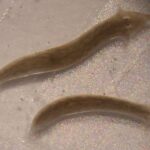
 Left to right: Joy Roy ’19, bioinformatics and mathematics; Daniel Lobo; Caroline Larkin ’18, M26, bioinformatics; and Eric Cheung ’19, biochemistry and molecular biology. They’re looking at computational models of planaria. Photo by Marlayna Demond ’11 for UMBC.
 Planaria can grow and shrink their bodies and organs. Photo courtesy Daniel Lobo.
 Daniel Lobo, right, takes a break with Joy Roy (center) and Eric Cheung in the lab. Photo by Marlayna Demond ’11 for UMBC.

 Souders with
 Osia on campus.
 Kashett in Costa Rica, where he previously studied abroad. Photo courtesy of Kashett.

 Rennie Short with local university students and staff in Nanchang, China.
  Kuala Lampur, one of the places Rennie Short will visit for research.
  Abraham in Ethiopia as a Fulbright Scholar in 2018. Photo courtesy of Abraham.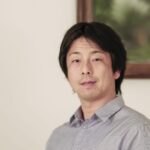
 In 2018, Grossman won the “Keeping It Safe” Community Service Award for her work at preventing and reducing alcohol use among those under age. And of course, her mother was there to support her. All photos courtesy of Grossman and Sonnenschein.
 Grossman gave two presentations in October 2019 at the National Alcohol Beverage Control Association 25th Annual Administrator’s Conference in Denver.
  Sonnenschein gave a presentation at the Headstart Conference in Ocean City, Maryland, in 2018 on the importance of supporting and engaging children in math learning at home.
 The family in Vilnius, Lithuania, in 2016, while waiting for a bus to Riga, Latvia. Sonnenschein likes to joke that the coldest winter she ever spent was a summer in Vilnius.
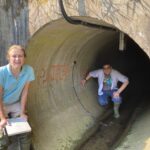
 The Earth’s critical zone extends from the treetops down to bedrock below ground. Image by the National Science Foundation.
 Miller (left) and Welty in Catonsville at one of their research field sites. Photo by Victor Fulda.
 The U.S. Northeast and mid-Atlantic at night, showing the urban corridor. Image courtesy NASA Earth Observatory, by Joshua Stevens.
 Baltimore skyline. Photo by Adam Lindquist, used under CC-BY-NC 2.0.