UMBC’s Meghan Grenier receives top NROTC teaching honor from the U.S. Navy

U.S. Navy Lieutenant Meghan Grenier joined the UMBC faculty as a clinical assistant professor in the Naval Reserve Officer Training Corps (NROTC) program in 2018. In two years, she has already left her mark on the program and its students. Now, she’s received national recognition for work with UMBC’s NROTC midshipmen.
“With her unlimited enthusiasm, upbeat attitude, expertise, and strong dedication to the Naval ROTC mission, she is an ideal role model for her students and peers alike,” says U.S. Navy Captain Troy Mong, professor of naval science and the commanding officer for UMBC NROTC. “Her superb mentorship and very involved academic advising of our midshipmen has enabled our students to excel in their leadership development and academic performance.”

U.S. Navy Lieutenant Meghan Grenier. Photo courtesy Meghan Grenier.
Mong isn’t the only one who noticed Grenier’s commitment to the Navy and her students. This spring, the Naval Education and Training Command selected Grenier as the NROTC Instructor of the Year out of all NROTC instructors across the U.S.
In further recognition of Grenier’s leadership skill and potential, she recently took on a competitive flag aide position for Rear Admiral Doug Vermissimo, the commander of Carrier Strike Group Nine, a group of naval vessels stationed out of San Diego, CA. Flag aides work directly with an admiral and help manage their affairs while becoming more familiar with the leadership structure and duties in the Navy. These challenging positions are designed for junior officers with outstanding performance records.
 Meghan Grenier teaches a class. Photo courtesy Meghan Grenier.
Training the Navy’s next leaders
The UMBC NROTC program was founded in 2015 as the first in the state of Maryland. It is part of the Maryland NROTC consortium, which also includes the University of Maryland, College Park. The program graduated its first students in May 2019, and they were commissioned as officers in the U.S. Navy the day after commencement.
“I am very appreciative of the opportunity to instruct the future Navy and Marine Corps officers here at the Maryland NROTC program. They are an impressive group of individuals who will go on to serve as excellent Navy and Marine Corps officers,” Grenier says. “I hope what they have learned from me and the NROTC program will enable them to find success out in the fleet and prepare them for the challenges of leadership in our Navy.”
Mong is certain she will accomplish just that. “Megan has had a significant impact in training and developing our midshipmen into the next generation of future naval officers who will lead well from their first days in the fleet.”
Banner image: UMBC NROTC inductees in 2016 with UMBC President Freeman Hrabowski (center), Rear Admiral Stephen Evans (center right), and UMBC NROTC faculty members Captain Troy Mong (center left), Lieutenant John O’Brien (third to left from center), Commander Stew Wennersten (front row, third from center on right), and Lieutenant Michael Tenaglia (front row, far left). Photo by Marlayna Demond ’11 for UMBC.
]]>
U.S. Navy Lieutenant Meghan Grenier joined the UMBC faculty as a clinical assistant professor in the Naval Reserve Officer Training Corps (NROTC) program in 2018. In two years, she has already...
https://umbc.edu/stories/umbcs-meghan-grenier-receives-top-nrotc-teaching-honor-from-the-u-s-navy/
https://my3.my.umbc.edu/api/v0/pixel/news/119822/guest@my.umbc.edu/944bc14a7a68688882c912077b0fc1ab/api/pixel
cnms
community
naval
UMBC News & Magazine
https://my3.my.umbc.edu/groups/umbc-news-magazine
https://assets1-my.umbc.edu/system/shared/avatars/groups/000/001/943/24435aa6207c452e7bc15cc74b42c7bb/xsmall.png?1748556657
https://assets1-my.umbc.edu/system/shared/avatars/groups/000/001/943/24435aa6207c452e7bc15cc74b42c7bb/original.png?1748556657
https://assets2-my.umbc.edu/system/shared/avatars/groups/000/001/943/24435aa6207c452e7bc15cc74b42c7bb/xxlarge.png?1748556657
https://assets2-my.umbc.edu/system/shared/avatars/groups/000/001/943/24435aa6207c452e7bc15cc74b42c7bb/xlarge.png?1748556657
https://assets3-my.umbc.edu/system/shared/avatars/groups/000/001/943/24435aa6207c452e7bc15cc74b42c7bb/large.png?1748556657
https://assets1-my.umbc.edu/system/shared/avatars/groups/000/001/943/24435aa6207c452e7bc15cc74b42c7bb/medium.png?1748556657
https://assets2-my.umbc.edu/system/shared/avatars/groups/000/001/943/24435aa6207c452e7bc15cc74b42c7bb/small.png?1748556657
https://assets1-my.umbc.edu/system/shared/avatars/groups/000/001/943/24435aa6207c452e7bc15cc74b42c7bb/xsmall.png?1748556657
https://assets2-my.umbc.edu/system/shared/avatars/groups/000/001/943/24435aa6207c452e7bc15cc74b42c7bb/xxsmall.png?1748556657
UMBC News & Magazine
0
0
false
Thu, 30 Jul 2020 13:23:17 -0400
Parents with Children Forced to Do School at Home Are Drinking More

By Susan Sonnenschein, professor, Applied Development Psychology, UMBC and Elyse R. Grossman, M.P.P. ’08, Ph.D. ’14, public policy, policy fellow, Department of Health, Behavior and Society, Johns Hopkins Bloomberg School of Public Health
The Research Brief is a short take about interesting academic work.
The big idea
We found that parents who are stressed by having to help their children with distance learning during the COVID-19 pandemic drink seven more drinks per month than parents who do not report feeling stressed by distance learning. These stressed parents are also twice as likely to report binge drinking at least once over the prior month than parents who are not stressed, according to our results. Binge drinking, which varies by gender, is when women consume at least four, or men have at least five alcoholic beverages (which includes beer, wine, or liquor) within a couple hours of each other.
We learned this from our online survey, which 361 parents with children under 18 years old currently living with them completed in May 2020. Seventy-eight percent of the parents had children who did distance learning in the Spring of 2020. Of those, 66% reported that the experience caused them stress because they were not sure how to help.
We sent the survey out through social media sites and listservs to people throughout the U.S. However, this is not a nationally representative sample. As is common with such surveys, most of the parents who responded were middle-income or higher. The results of the study have not yet been published.
Why it matters
While many people joke about how booze is getting them through the COVID-19 pandemic, drinking can be harmful. More people die each year from drinking alcohol than from motor vehicle crashes, guns or illegal drugs. Increased drinking is also related to many public health problems, such as violence, crime, poverty and sexually transmitted diseases.
Drinking alcohol is especially dangerous during COVID-19 because alcohol use weakens your immune system. Drinking increases your likelihood of getting COVID-19 and, if you do get it, of having worse outcomes.
People increase their alcohol consumption after stressful times, such as tsunamis and hurricanes. Research has shown that this pattern has held before during disease outbreaks, including SARS in 2003, and following the 9/11 terrorist attacks.
COVID-19 is another stressful situation. One study in Poland with over 1,000 participants found that people are currently drinking more wine, beer and liquor than before the pandemic.
Given that distance learning is going to continue for the near future, we believe it is warranted to decrease stressors that lead to parents’ drinking.
What other research is being done
Parents are drinking more during the COVID-19 pandemic than people without children. Our survey is the first one to look at the relationship between alcohol use and the stress caused by distance learning during the COVID-19 pandemic.
What still isn’t known
School systems throughout the U.S. currently are planning for the upcoming year. In many cases, that will require more distance learning. For distance learning to be successful for children and parents, more needs to be known about what makes it stressful.
Another study of ours, currently underway, suggests that one reason that parents are stressed is that they are not getting enough guidance from teachers or schools. This is a particular concern for low-income families whose children, in general, already fare worse in school than more affluent children.
It is important to realize that teachers and other school staff are also experiencing stress and not getting enough guidance on how to do distance learning.
Our results were collected in May 2020. As distance learning becomes the new normal, at least for now, it is important to see what, if anything, changes in how well schools provide distance learning and how it affects parents.
*****
Susan Sonnenschein, Professor, Applied Development Psychology, University of Maryland, Baltimore County and Elyse R. Grossman, Policy Fellow, Department of Health, Behavior and Society, Johns Hopkins Bloomberg School of Public Health
This article is republished from The Conversation under a Creative Commons license. Read the original article.
[Get facts about coronavirus and the latest research. Sign up for The Conversation’s newsletter.]
Header image: More people turn to alcohol in the wake of disasters, research has found. Kerkez/GettyImages
]]>
By Susan Sonnenschein, professor, Applied Development Psychology, UMBC and Elyse R. Grossman, M.P.P. ’08, Ph.D. ’14, public policy, policy fellow, Department of Health, Behavior and Society, Johns...
https://umbc.edu/stories/parents-with-children-forced-to-do-school-at-home-are-drinking-more/
https://my3.my.umbc.edu/api/v0/pixel/news/119823/guest@my.umbc.edu/dfc7eeda54c887d26b37c92969ab0c4f/api/pixel
covidresearch
discovery
psychology
the-conversation
UMBC News & Magazine
https://my3.my.umbc.edu/groups/umbc-news-magazine
https://assets1-my.umbc.edu/system/shared/avatars/groups/000/001/943/24435aa6207c452e7bc15cc74b42c7bb/xsmall.png?1748556657
https://assets1-my.umbc.edu/system/shared/avatars/groups/000/001/943/24435aa6207c452e7bc15cc74b42c7bb/original.png?1748556657
https://assets2-my.umbc.edu/system/shared/avatars/groups/000/001/943/24435aa6207c452e7bc15cc74b42c7bb/xxlarge.png?1748556657
https://assets2-my.umbc.edu/system/shared/avatars/groups/000/001/943/24435aa6207c452e7bc15cc74b42c7bb/xlarge.png?1748556657
https://assets3-my.umbc.edu/system/shared/avatars/groups/000/001/943/24435aa6207c452e7bc15cc74b42c7bb/large.png?1748556657
https://assets1-my.umbc.edu/system/shared/avatars/groups/000/001/943/24435aa6207c452e7bc15cc74b42c7bb/medium.png?1748556657
https://assets2-my.umbc.edu/system/shared/avatars/groups/000/001/943/24435aa6207c452e7bc15cc74b42c7bb/small.png?1748556657
https://assets1-my.umbc.edu/system/shared/avatars/groups/000/001/943/24435aa6207c452e7bc15cc74b42c7bb/xsmall.png?1748556657
https://assets2-my.umbc.edu/system/shared/avatars/groups/000/001/943/24435aa6207c452e7bc15cc74b42c7bb/xxsmall.png?1748556657
UMBC News & Magazine
0
0
false
Wed, 29 Jul 2020 19:48:25 -0400
Two UMBC student teams win USM COVID-19 app challenge
Earlier this summer, the University System of Maryland (USM) COVID-19 Task Force invited members of the USM community to develop mobile apps that would help Maryland residents respond to the COVID-19 pandemic. Among the six winning teams just announced are two groups from UMBC. One team developed an app to support the healthcare of people with COVID-19. The other focused on connecting residents with dining options and restaurant policies as they change during the pandemic.
Community participation
Each of the six winning teams received a $3,000 award, provided by UMBC’s Alex. Brown Center for Entrepreneurship. The apps submitted were reviewed by a panel of judges from large corporations, start-up companies, and academia.
Undergraduate and graduate students were invited to participate, as well as university staff, faculty, postdoctoral researchers, members of USM-affiliated startup companies and small businesses. Winners hailed from UMBC, University of Baltimore, Towson University, and University of Maryland, College Park.
Tracking health conditions of COVID-19 patients
-
 Kirubel Tolosa. Photo courtesy of Tolosa.
-
 Pradeep Prakash. Photo courtesy of Prakash.
-
 Raghav Deivachilai. Photo courtesy of Deivachilai.
In the community category, Kirubel Tolosa M.S. ‘23, information systems; Pradeep Margasahayam Prakash M.S. ‘21, information systems; and Raghav Deivachilai M.S. ‘23, computer science, created an app called Follow-up. The app enables healthcare providers to track the condition of people with COVID-19 who are isolating at home. By receiving regular symptom updates, physicians and nurses are able to more easily follow-up with their patients as needed.

The Follow-up app interface. Image courtesy of the Follow-up team.
The Follow-up team entered the app challenge with the goal of developing an app that would help address the spread of the virus and its impact on affected individuals. At the same time, they knew they had to design and prototype their app in a short time frame, so their scope and requirements had to be manageable.
“This challenge has taught us the value of teamwork and collaboration,” said Tolosa, on behalf of the group. “We are looking forward to working on this app further to put it to use in a real-world setting.”
Supporting restaurants during COVID-19
The app Snuggrub, developed by Emily Sullivan ‘21, computer science, and Dominic Crofoot ‘19, computer science, was a winner in the student category. Sullivan and Crofoot focused on the way that many formerly full-service restaurants shifted to pick-up only service or outdoor dining during the pandemic. At the same time, dining regulations, guidance, and options began changing frequently. They developed a way for users to stay up-to-date on information about nearby restaurants without needing to contact individual businesses to ask the same questions repeatedly.
-
 Emily Sullivan. Photo courtesy of Sullivan.
-
 Dominic Crofoot. Photo courtesy of Crofoot.
The app allows users to stay informed and receive real-time updates, while making decisions based on current information. It also supports restaurants in connecting with customers and providing them with the information they need to dine safely.
Sullivan shares that the idea for Snuggrub came from wanting to support small businesses that were facing challenges due to isolation during COVID-19. “During the time when restaurants were just opening back up for indoor or outdoor dining, it was messy trying to figure out if the hours and information posted online were accurate and updated. The only way to figure it out was to call them directly, which is time-consuming for both us and the restaurant,” she says. “So Snuggrub became a way to have all that information in one place and have it easy to understand.”

The Snuggrub app interface. Image courtesy of the Snuggrub team.
The opportunity to develop an app to help address a challenge facing people across the state was appealing to Sullivan and Crofoot because it allowed them to put their skills to the test. They met when they were both interns at the Anne Arundel County Office of Information Technology. While Sullivan is still a UMBC student (and interning with the federal government), Crofoot is currently a full stack developer for Anne Arundel County.
“Dominic and I both have experience creating applications from our jobs, but this process was totally different since we were creating something from the ground up and we were doing it with such a small team and short deadline as well,” says Sullivan. “This definitely was a learning experience in personal discipline and timeline management.”
Banner image: UMBC’s ITE building. Photo by Marlayna Demond ’11 for UMBC.
]]>
Earlier this summer, the University System of Maryland (USM) COVID-19 Task Force invited members of the USM community to develop mobile apps that would help Maryland residents respond to the...
https://umbc.edu/stories/two-umbc-student-teams-win-usm-covid-19-app-challenge/
https://my3.my.umbc.edu/api/v0/pixel/news/119824/guest@my.umbc.edu/cb64d0793410957f1c09f0fd48525a90/api/pixel
coeit
csee
is
resilience
science-and-technology
UMBC News & Magazine
https://my3.my.umbc.edu/groups/umbc-news-magazine
https://assets1-my.umbc.edu/system/shared/avatars/groups/000/001/943/24435aa6207c452e7bc15cc74b42c7bb/xsmall.png?1748556657
https://assets1-my.umbc.edu/system/shared/avatars/groups/000/001/943/24435aa6207c452e7bc15cc74b42c7bb/original.png?1748556657
https://assets2-my.umbc.edu/system/shared/avatars/groups/000/001/943/24435aa6207c452e7bc15cc74b42c7bb/xxlarge.png?1748556657
https://assets2-my.umbc.edu/system/shared/avatars/groups/000/001/943/24435aa6207c452e7bc15cc74b42c7bb/xlarge.png?1748556657
https://assets3-my.umbc.edu/system/shared/avatars/groups/000/001/943/24435aa6207c452e7bc15cc74b42c7bb/large.png?1748556657
https://assets1-my.umbc.edu/system/shared/avatars/groups/000/001/943/24435aa6207c452e7bc15cc74b42c7bb/medium.png?1748556657
https://assets2-my.umbc.edu/system/shared/avatars/groups/000/001/943/24435aa6207c452e7bc15cc74b42c7bb/small.png?1748556657
https://assets1-my.umbc.edu/system/shared/avatars/groups/000/001/943/24435aa6207c452e7bc15cc74b42c7bb/xsmall.png?1748556657
https://assets2-my.umbc.edu/system/shared/avatars/groups/000/001/943/24435aa6207c452e7bc15cc74b42c7bb/xxsmall.png?1748556657
UMBC News & Magazine
0
0
false
Wed, 29 Jul 2020 14:35:10 -0400
UMBC’s Foad Hamidi receives NSF RAPID grant to expand free, secure internet access in Baltimore during COVID-19 and beyond
During the COVID-19 pandemic, internet access has become more critical, with people relying on it to work, learn, and connect with family and friends. However, the internet is not equally accessible to all people. UMBC’s Foad Hamidi recently received a collaborative Rapid Response Research (RAPID) grant from the National Science Foundation (NSF) to increase high-speed wireless internet access to communities in Baltimore.
Not having access to the internet has heightened existing inequities during the pandemic, says Hamidi, assistant professor of information systems. “It impacts families in different ways, whether it’s related to education, employment, or social connections,” he explains.
Hamidi will collaborate with the Digital Harbor Foundation, Project Waves, and other community groups to increase the accessibility of wireless internet that is both free and secure.
Building and sustaining networks
The Digital Harbor Foundation (DHF) is a Baltimore-based tech center that enables youth to learn about technology through hands-on learning, including through a well-equipped makerspace. Project Waves is a non-profit organization that provides pay-what-you-can broadband internet to communities in need. Their work with Hamidi will focus on supporting residents who want to get internet access set up in their homes and to study the impact of having this access.
 The Digital Harbor Foundation in Baltimore. Photo by Maryland GovPics, used under CC 2.0.
Hamidi and his collaborators will work with other groups to amplify free and secure wireless internet in accessible spaces, such as libraries and community centers. For some groups, this work will be new. For others, the grant will allow them to speed up work they’ve already been doing.
Importantly, Hamidi notes, the community organizations will help sustain these networks over time. “The pandemic has amplified the need for internet access, but it will continue after the crisis,” he says.
“The COVID-19 crisis is a complex and multifaceted phenomenon that amplifies the inequities already present in our societies,” explains Hamidi. “In this project, we are taking into account both the social and technical aspects of providing free and secure internet access to low-income communities. More broadly, we look forward to better understanding how participatory approaches to internet access can address issues of inequity arising from the digital divide in our cities.”
Increasing access to computing skills
Hamidi’s project is also part of a larger effort, based at UMBC, to expand access to basic computing skills among students in Baltimore City as well as nearby Montgomery County. This is the goal of Megean Garvin, director of research and assessment for the Maryland Center for Computing Education (MCCE).
The COVID-19 pandemic has pushed the issue of computing education to the fore, as more and more students and educators recognize the value of computing skills in this time of physical distancing. However, Garvin says, the teaching workforce needs professional development to not only use technology, but be able to create their own computer science curricula and classroom resources.
The MCCE, initially funded by Maryland in 2018, has worked to provide professional development in computing for teachers across the state and has begun to transform teacher preparation as well. By the 2021 – 2022 school year, all public high schools in Maryland will be required to offer a high quality computer science course, and elementary and middle schools will be expected to integrate computer science into their curricula. The MCCE is working to help teachers and schools reach that target and have confidence in the quality of their computer science offerings.
 Foad Hamidi speaking with a colleague at the User Studies Lab event earlier this year. Photo by Britney Clause.
To ensure teachers can be successful in providing students with computing education, Garvin notes, it is essential to take into account the “digital divide,” particularly in Baltimore City. Even with the most advanced training and support, computing teachers can’t be effective if their students can’t access computing devices and, as Hamidi’s work highlights, the internet.
Computing education ecosystem
In response to this challenge, the MCCE and partners created the Baltimore City Computing Education Ecosystem Workgroup. This partnership includes the University System of Maryland, UMBC, University of Baltimore, Baltimore City Community College, Morgan State University, and Towson University, plus Baltimore City-based organizations such as the Digital Harbor Foundation and Code in the Schools. Their goal is to develop and deliver on strategies for a robust computing education for students from pre-kindergarten to high school, in the context of COVID-19 and remote learning.
In addition to the grant Hamidi has received to work in this area, Garvin has been awarded a two-year grant from the Spencer Foundation to study the Baltimore Urban Computing Education Ecosystem’s response to COVID-19.
The Engineering and Computing Education Program in UMBC’s College of Engineering and Information Technology has also developed a similar computing education partnership in Montgomery County. There, UMBC at the Universities at Shady Grove is working closely with Montgomery College and Montgomery County Public Schools to support a culture shift in computing education. As in Baltimore, they hope to provide technology access and learning opportunities in computing for all students.
“Access to reliable and affordable internet connectivity has become a new necessity in our dynamic and information-rich century,” says Hamidi. “We need to investigate conditions necessary for communities to have an active role in shaping, creating and taking ownership of the technologies they need.”
Banner image: Foad Hamidi. Photo by Britney Clause.
]]>
During the COVID-19 pandemic, internet access has become more critical, with people relying on it to work, learn, and connect with family and friends. However, the internet is not equally...
https://umbc.edu/stories/umbcs-foad-hamidi-receives-nsf-rapid-grant-to-expand-free-secure-internet-access-in-baltimore-during-covid-19-and-beyond/
https://my3.my.umbc.edu/api/v0/pixel/news/119825/guest@my.umbc.edu/253dc893d972a6af912b70090ba5440a/api/pixel
coeit
covidresearch
is
page1
science-and-technology
UMBC News & Magazine
https://my3.my.umbc.edu/groups/umbc-news-magazine
https://assets1-my.umbc.edu/system/shared/avatars/groups/000/001/943/24435aa6207c452e7bc15cc74b42c7bb/xsmall.png?1748556657
https://assets1-my.umbc.edu/system/shared/avatars/groups/000/001/943/24435aa6207c452e7bc15cc74b42c7bb/original.png?1748556657
https://assets2-my.umbc.edu/system/shared/avatars/groups/000/001/943/24435aa6207c452e7bc15cc74b42c7bb/xxlarge.png?1748556657
https://assets2-my.umbc.edu/system/shared/avatars/groups/000/001/943/24435aa6207c452e7bc15cc74b42c7bb/xlarge.png?1748556657
https://assets3-my.umbc.edu/system/shared/avatars/groups/000/001/943/24435aa6207c452e7bc15cc74b42c7bb/large.png?1748556657
https://assets1-my.umbc.edu/system/shared/avatars/groups/000/001/943/24435aa6207c452e7bc15cc74b42c7bb/medium.png?1748556657
https://assets2-my.umbc.edu/system/shared/avatars/groups/000/001/943/24435aa6207c452e7bc15cc74b42c7bb/small.png?1748556657
https://assets1-my.umbc.edu/system/shared/avatars/groups/000/001/943/24435aa6207c452e7bc15cc74b42c7bb/xsmall.png?1748556657
https://assets2-my.umbc.edu/system/shared/avatars/groups/000/001/943/24435aa6207c452e7bc15cc74b42c7bb/xxsmall.png?1748556657
UMBC News & Magazine
0
0
false
Mon, 27 Jul 2020 14:54:19 -0400
UMBC’s Sydney Gaskins competes in the final round of Trial by Combat, a national mock trial championship

UMBC Mock Trial continues to reach new heights at a national level, even with COVID-19 impacting the competition season. Sydney Gaskins ’22, political science, finished as a runner-up in the final round of the national Trial by Combat (TBC), a head-to-head individual mock trial championship hosted this summer by the UCLA School of Law and Drexel University Thomas R. Kline School of Law.
Gaskins competed virtually against fifteen graduating seniors from the most successful mock trial teams across the country, including Harvard, Stanford, and Yale. She was the only junior to participate this year and among the first underrepresented women to compete in the championship’s history.

Gaskins presenting her case at virtual Trial by Combat 2020.
The hosts of Trial by Combat selected the sixteen contenders out of hundreds of applicants. “Sydney continues to break barriers in Mock Trial and specifically in Trial by Combat,” shares Ben Garmoe ’13, political science, a litigation attorney in Baltimore. Nine years ago he co-founded the intellectual sports team with Travis Bell ’14, psychology and political science, now a public defender in Alabama.
Garmoe notes, “She defeated some of the best competitors in the country to get to the final round.”
A recording of the entire 2020 Trial by Combat competition.
A formidable opponent
“TBC 2020 was a special and unique experience,” shares Gaskins. She says she has struggled with not being able to interact with the people she cares about because of COVID-19. “The virtual tournament was not only a much needed opportunity to reconnect, but to also make my team proud.”
Gaskins, the UMBC Mock Trial president, has a long history as a formidable opponent in her three years with the team. This year, in addition to her TBC award, she has received two Outstanding Attorney Awards and three All-National Attorney Awards. In 2019 she earned ten awards, including two All-National Attorney Awards from the Opening Round Championship Series (ORCS). Then she helped the team place eighth at the American Mock Trial Association National Championship Tournament—the team’s second trip to nationals.

UMBC Mock Trial A-Team at AMTA 2019.
At the 2019 national competition, Gaskins received an All-American Attorney Award, the highest individual honor in collegiate mock trial. Her success earned her an invitation to compete at last year’s Trial by Combat, and solidified her status as one of the top college mock trial competitors in the U.S.

Sydney Gaskins wins two trophies at Georgetown Mock Trial.
Rigorous teamwork
TBC requires students to prepare quickly for a trial and under great pressure, giving them just 24 hours between receiving the case and arguing it. Ethan Hudson ’21, English, and Garmoe were Gaskins’s support team.
Hudson helped develop the case theory and served as the “second chair” in the competition. This role is a (silent) co-counsel who is in charge of displaying exhibits and demonstrative aids, and who is permitted to communicate with the counsel. He was also responsible for managing all of Gaskins’s technology during each trial.
Together, the trio created a rigorous trial strategy for all the roles Gaskins had to perform: defense, prosecutor, and as a witness for each side. Gaskins performed each role once during the four preliminary trials, with the attorney performance carrying the most weight in scoring. Four students continued to the semi-finals as attorneys, and only two advanced to the championship trial. Gaskins was one of those final two.
Gaskins’s setup for the 2020 Trial by Combat competition.
A meaningful opportunity
Gaskins and Hudson’s experience as teammates dates back to their high school years as members of the Franklin High School Mock Trial team. Both joined the UMBC team their first year. They were set to lead UMBC’s team this spring at the 2020 National Championship Tournament before the rest of the season was cancelled due to COVID-19. This year marked the third time UMBC has qualified for the nationals in the last four years.

UMBC Mock Trial 2019. Hudson is the third on the left and Gaskins is fourth on the left.
“This tournament was special for two reasons. It was my last opportunity to compete alongside Ethan, my friend and teammate,” explains Gaskins, who plans to apply to top J.D and MBA programs in the spring. “And it was also an opportunity to once again show everyone who Sydney Gaskins is.”
Banner image: Gaskins defending her case at a Mock Trial competition. All photos are courtesy of UMBC Mock Trial.
]]>
UMBC Mock Trial continues to reach new heights at a national level, even with COVID-19 impacting the competition season. Sydney Gaskins ’22, political science, finished as a runner-up in the final...
https://umbc.edu/stories/umbcs-sydney-gaskins-competes-in-the-final-round-of-trial-by-combat-a-national-mock-trial-championship/
https://my3.my.umbc.edu/api/v0/pixel/news/119826/guest@my.umbc.edu/5993b8a1938907aa3d7e11ddc22569cf/api/pixel
cahss
english
policy-and-society
political-science
politicalscience
psychology
UMBC News & Magazine
https://my3.my.umbc.edu/groups/umbc-news-magazine
https://assets1-my.umbc.edu/system/shared/avatars/groups/000/001/943/24435aa6207c452e7bc15cc74b42c7bb/xsmall.png?1748556657
https://assets1-my.umbc.edu/system/shared/avatars/groups/000/001/943/24435aa6207c452e7bc15cc74b42c7bb/original.png?1748556657
https://assets2-my.umbc.edu/system/shared/avatars/groups/000/001/943/24435aa6207c452e7bc15cc74b42c7bb/xxlarge.png?1748556657
https://assets2-my.umbc.edu/system/shared/avatars/groups/000/001/943/24435aa6207c452e7bc15cc74b42c7bb/xlarge.png?1748556657
https://assets3-my.umbc.edu/system/shared/avatars/groups/000/001/943/24435aa6207c452e7bc15cc74b42c7bb/large.png?1748556657
https://assets1-my.umbc.edu/system/shared/avatars/groups/000/001/943/24435aa6207c452e7bc15cc74b42c7bb/medium.png?1748556657
https://assets2-my.umbc.edu/system/shared/avatars/groups/000/001/943/24435aa6207c452e7bc15cc74b42c7bb/small.png?1748556657
https://assets1-my.umbc.edu/system/shared/avatars/groups/000/001/943/24435aa6207c452e7bc15cc74b42c7bb/xsmall.png?1748556657
https://assets2-my.umbc.edu/system/shared/avatars/groups/000/001/943/24435aa6207c452e7bc15cc74b42c7bb/xxsmall.png?1748556657
UMBC News & Magazine
0
0
false
Fri, 24 Jul 2020 20:00:09 -0400
UMBC and Baltimore’s Lakeland Elementary/Middle School launch innovative online summer math program

UMBC’s Sherman STEM Teacher Scholars Program has launched an intensive virtual math incubator for Lakeland Elementary/Middle School in Baltimore City this summer. The free, voluntary five-week program is a math intervention for 150 Lakeland students in third through eighth grade. The program seeks to prevent summer learning loss, which could increase this year, intensified by COVID-19’s impact on student learning during the school year.
“With the changes this spring to learning, the UMBC/Lakeland Summer Math Program has allowed us to make up ground and get a head start with students in a targeted approach to math instruction,” says Lakeland Principal Najib Jammal. “This partnership lets us plan for students’ needs this fall knowing that 150 of our students had access to high-quality math instruction the summer.”
Jammal recently spoke about the collaboration in an interview for the segment “Staving Off Summer Slide” on WYPR’s On The Record.
The summer program was designed to also have a lasting impact beyond improving specific STEM skills. Lakeland teachers and UMBC partners are helping Lakeland students develop a positive math identity that will carry them forward into higher level math courses.
Moving online
The summer STEM program was originally designed to be held in person. COVID-19 both increased the need for the program and required Lakeland to move instruction online, decreasing student–teacher and peer interactions. To counter this challenge, program organizers knew they’d need more teachers to decrease the student–teacher ratio and reach more students overall.
 A rug in Lydia Coley’s classroom during her student teaching internship.
The Goldseker Foundation and Baltimore Children’s Youth Fund (BCYF) provided the funding needed to implement the program online and to hire more teachers. Their financial support also expanded the program from the initial 60 rising fourth through sixth graders to 150 rising third through eighth-grade students.
This creative intervention has three priorities: whole child development, math identity development, and math growth. The program is implemented under the direction of Josh Michael ‘10, political science and education, assistant director of UMBC’s Sherman STEM Teachers Scholars Program, in collaboration with five Baltimore City school teachers and twelve interns from the Sherman Scholars program.
Whole child development
UMBC has fostered a strong partnership with Lakeland for more than five years. It has supported Lakeland’s wrap-around academic and community services through the Sherman STEM Teachers Scholars Program, the Sherman Center for Early Learning in Urban Communities, and the Shriver Center Literacy Fellows program. Through additional collaboration with area community groups and companies, such as Northrop Grumman, Lakeland has built a safe and supportive community where students can thrive socially and academically.
The summer program also relies on a firm foundation of strong teacher, student, family, and community relationships. The Sherman STEM Teacher Scholars serve as program leaders. In this role, they dedicate the majority of their day to fostering relationships with students and their families through video chats, phone calls, texts, and emails.
 Coley’s classroom during her student teaching internship.
These program leaders coach the three Lakeland teachers who serve as program facilitators, including one UMBC alumna. Former Sherman Scholar Molly Hart, M.A.T. ‘19, elementary education, is now a sixth grade math teacher at Lakeland and serves as a facilitator for the summer STEM program.
“The program’s support system is incredible,” shares Haleemat Adekoya ‘23, political science. She says this experience has made her aware of the importance of consistent communication in the classroom.
If a student is absent one day, her priority is to get in touch with their family as soon as possible. “Every time I let a student and their family know they were missed, as an intricate part of the classroom community, they’ve shown up the next day and actively engaged.”
This structure of robust support is cultivating strong student and family relationships and student participation. Out of 150 enrolled students, an average of 120 consistently engage in math instruction and STEM activities each day. Nearly 100 percent engage each week. Once students feel supported and are engaged, teachers can then move forward to focus on further developing students’ math identity and math skills.
Math identity
Historically many Black, Latinx, and first-generation students, as well as English Language Learners (ELL) and students experiencing economic hardship, have faced obstacles in math achievement. Limited public school resources, insufficient access to quality culturally relevant instruction, and high social/emotional stresses have created learning gaps at lower grades, which often deepen in upper grades.
For many students, negative experiences in trying to build fundamental math skills have impeded their development of a positive math identity. Math identity is a student’s perception of their ability to perform well in math. It has been shown to impact math performance.

Coley’s classroom during her student teaching internship.
These factors have also contributed to a lack of diversity in STEM fields, reinforcing the negative stereotype that underrepresented students can’t do math regardless of the resources available to them. As a result, underrepresented students are less likely to feel confident enough to pursue higher level math courses. This further limits their access to a variety of academic, career, and social opportunities.
“I am terrified of math even though I was given all the support and resources to excel in math,” explains Adekoya. “Josh Michael and Lydia Coley give me the support and confidence to lean into this opportunity and not give in to imposter syndrome. I have to lead by example.”
Lydia Coley ’20, American studies, valedictorian of UMBC’s most recent graduating class, is also a program leader and a Sherman Scholar alumna. She is a first-year, sixth grade math teacher at Maree G. Farring Elementary/Middle School in Baltimore City.
Me, myself, and math
Lakeland serves 1,000 Pre-K to eighth-grade students. The majority come from underrepresented populations in STEM fields. They are less likely to have a positive math identity. Black students make up 32 percent of the school, 62 percent are Latinx, 42 percent are English Language Learners, 11 percent receive special education services, and most students come from low-income families.
The summer program aims to help Lakeland students break the cycle of underrepresentation. Immersing students in a safe and nurturing space encourages them to engage in the math learning process. It also broadens and strengthens their math skills and fosters a positive math identity.
Through daily interactive synchronous video lessons, based on common core standards, program leaders teach, model, and provide individualized instruction. Students develop a toolkit of strategies that build the confidence needed to take risks and see mistakes as learning opportunities.
 Coley’s classroom during her student teaching internship.
Program facilitator Iliana Hernandez, a fifth-year, third grade math and dual-language teacher at Lakeland, provides program leaders with best practices to support ELL learners. She admits her own fears of math in elementary school. “I don’t want my students to fear math like I did,” shares Hernandez. “When students stay connected and feel valued and cared for their confidence grows and they feel ready to learn.”
Math growth
With this foundation in place, rigorous math instruction can move forward. Program Director Carly Harkins leads the team in curriculum development and instruction. Under her guidance, program facilitators coach program leaders in weekly lesson planning, lesson delivery, assessments, and student support. After daily class, students practice independently through proven online learning tools wherever they are on their math journey.
The program also provides hands-on experience to help students apply what they are learning. Josh Massey, the STEM facilitator, works with Michael and Harkins to create hands-on STEM activities for students.
Massey ‘18, computer engineering, and M.A.T. ‘19, technology education, is a first-year computer science teacher at the Baltimore Polytechnic Institute in Baltimore City. He creates 150 STEM kits weekly, and helps deliver them to students’ homes. Each kit includes the materials needed to complete a project. They tie into the week’s topic, like circuits or small machines.

Adekoya showing the circuit flashlight STEM Kit project.
Photo courtesy of Adekoya.
Students first work on the project independently and then share their process in class. Each student is then the proud owner of something they have built themselves. These projects help support both math growth and a positive math identity.
Access to a bright future
When Michael sees students participating in these activities, he sees them as accessing the building blocks they’ll use to excel in the years ahead.
UMBC and Lakeland partners hope this extra support will ensure more Lakeland students will be better prepared for Algebra I when they enter eighth grade. Why? “Algebra I is a key academic gateway,” says Michael. “There is strong evidence that successfully completing Algebra I in eighth grade is related to higher math achievement in high school and attainment in college.”
Michael notes that it’s long been the case that students of color have had less access to Algebra I in eighth grade. He shares, “Our goal is to provide that access by helping students believe success in math is for them.”
Banner image: A math chart in Coley’s classroom during her student teaching internship. All images by Marlayna Demond ’11 unless otherwise noted.
]]>
UMBC’s Sherman STEM Teacher Scholars Program has launched an intensive virtual math incubator for Lakeland Elementary/Middle School in Baltimore City this summer. The free, voluntary five-week...
https://umbc.edu/stories/umbc-and-baltimores-lakeland-elementary-middle-school-launch-innovative-online-summer-math-program/
https://my3.my.umbc.edu/api/v0/pixel/news/119827/guest@my.umbc.edu/3db479bb9c38fac56547ece54e817530/api/pixel
americanstudies
cahss
coeit
education
history
page1
policy-and-society
politicalscience
resilience
shermanscholars
UMBC News & Magazine
https://my3.my.umbc.edu/groups/umbc-news-magazine
https://assets1-my.umbc.edu/system/shared/avatars/groups/000/001/943/24435aa6207c452e7bc15cc74b42c7bb/xsmall.png?1748556657
https://assets1-my.umbc.edu/system/shared/avatars/groups/000/001/943/24435aa6207c452e7bc15cc74b42c7bb/original.png?1748556657
https://assets2-my.umbc.edu/system/shared/avatars/groups/000/001/943/24435aa6207c452e7bc15cc74b42c7bb/xxlarge.png?1748556657
https://assets2-my.umbc.edu/system/shared/avatars/groups/000/001/943/24435aa6207c452e7bc15cc74b42c7bb/xlarge.png?1748556657
https://assets3-my.umbc.edu/system/shared/avatars/groups/000/001/943/24435aa6207c452e7bc15cc74b42c7bb/large.png?1748556657
https://assets1-my.umbc.edu/system/shared/avatars/groups/000/001/943/24435aa6207c452e7bc15cc74b42c7bb/medium.png?1748556657
https://assets2-my.umbc.edu/system/shared/avatars/groups/000/001/943/24435aa6207c452e7bc15cc74b42c7bb/small.png?1748556657
https://assets1-my.umbc.edu/system/shared/avatars/groups/000/001/943/24435aa6207c452e7bc15cc74b42c7bb/xsmall.png?1748556657
https://assets2-my.umbc.edu/system/shared/avatars/groups/000/001/943/24435aa6207c452e7bc15cc74b42c7bb/xxsmall.png?1748556657
UMBC News & Magazine
0
0
false
Fri, 24 Jul 2020 18:55:04 -0400
Making coronavirus testing easy, accurate and fast is critical to ending the pandemic – the US response is falling far short
By Zoe McLaren, associate professor of public policy, UMBC
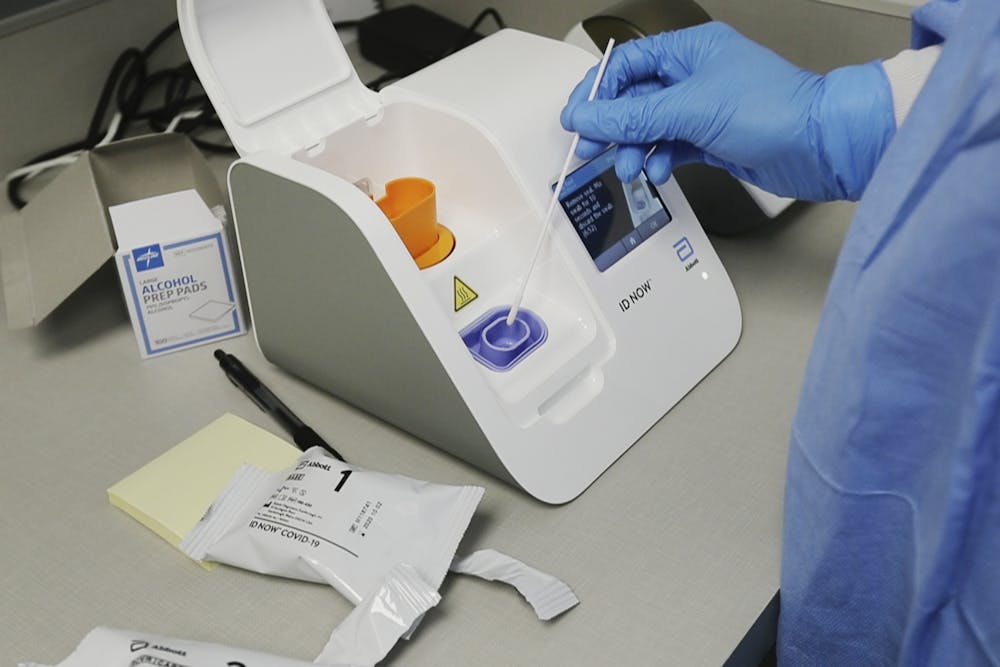
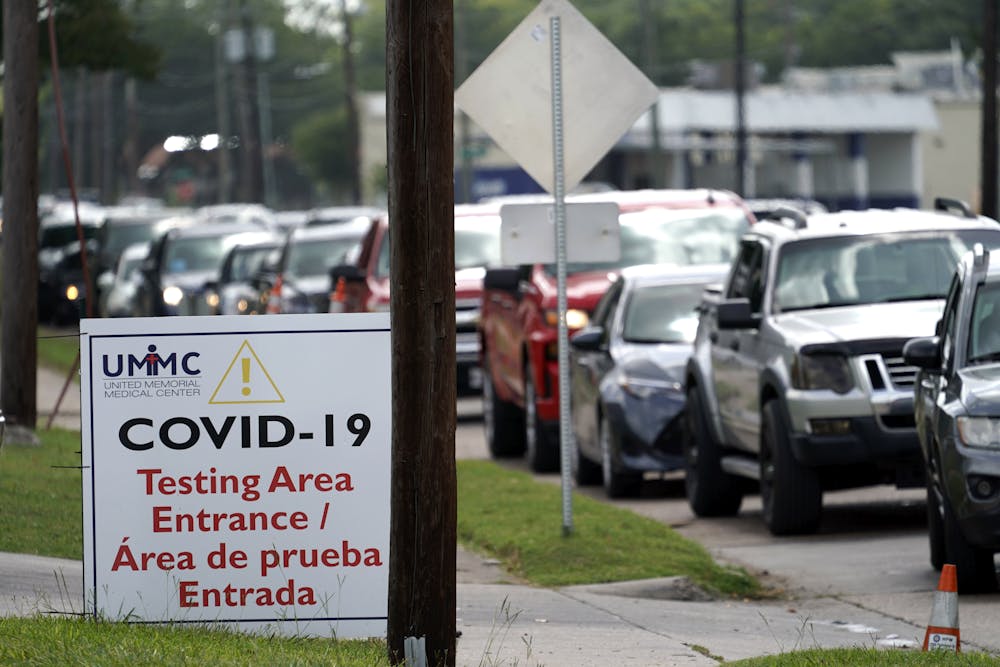
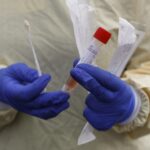
For many people in the U.S., getting tested for COVID-19 is a struggle. In Arizona, testing sites have seen lines of hundreds of cars stretching over a mile. In Texas and Florida, some people were waiting for five hours for free testing.
The inconvenience of these long waits alone discourages many people from getting tested. With the surge in cases, many public testing sites have been reaching maximum capacity within hours of opening, leaving many people unable to get tested for days. Those that do get tested often face a week-long wait to get their test results.
Every person who isn’t tested could be spreading COVID-19 unknowingly. These overstretched testing programs are a weak link in the U.S. pandemic response.
I study public health policy to combat infectious disease epidemics. The key to overcoming this pandemic is to slow transmission of the virus by preventing contagious people from infecting others. A widespread quarantine would accomplish this, but is economically and socially burdensome. Testing offers a way to identify contagious people so they can be isolated to prevent the spread of the disease. This is especially important for COVID-19 because an estimated 40% or more of all people infected with SARS-CoV-2 have few or no symptoms so testing is the only way to identify them.
Some states are doing much better than others. But as a whole, the U.S. is falling far short of the amount of testing needed to control the pandemic. What are the challenges the U.S. is facing? And what is the way forward?
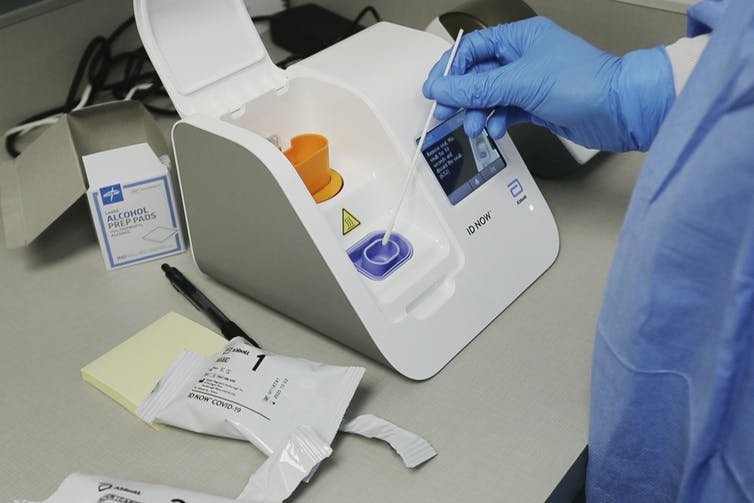 Currently, rapid tests that take about 15 minutes to process are a quick and easy way to diagnose COVID-19 infections, but there are concerns about accuracy. AP Photo/Carlos Osorio
Testing should be free, easy, fast and accurate
The ultimate goal of testing is for everyone, regardless of symptoms, to know at all times whether they are infected with the coronavirus. To achieve this level of testing, tests should be free, very easy to perform and provide accurate results quickly.
Ideally, free COVID-19 tests would be delivered to everyone directly. The tests would be simple to perform – like a saliva test – and would give a perfectly accurate result within minutes. Everyone could test themselves weekly or anytime they were going to be in close contact with other people.
In this ideal scenario, most, if not all, contagious people would be detected before they could spread the virus to others. And because of the rapid results, there would be no burden of quarantining between doing the test and getting the result.
Researchers are working on better-quality tests, but access is a problem of infrastructure, not science. Right now, nowhere in the U.S. comes close to meeting surging demand for testing.
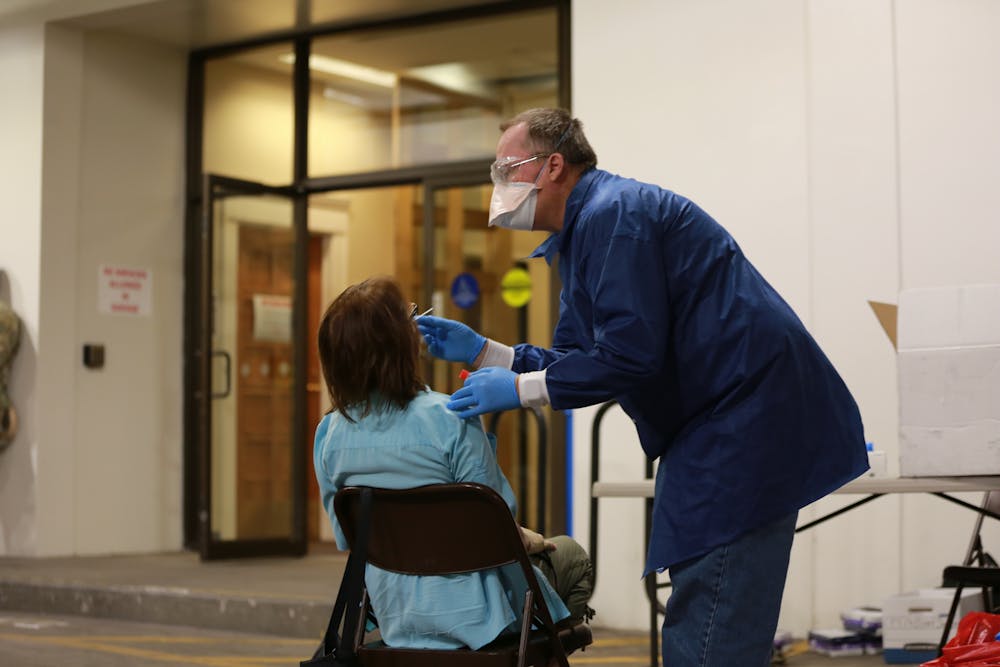
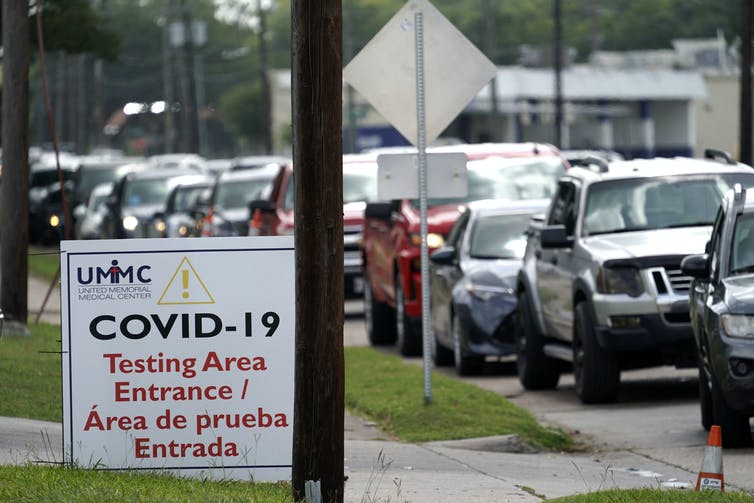 Long lines, slow turnaround times for results and shortages of testing capacity all make Texas one of the worst places to get a test in the U.S. AP Photo/David J. Phillip
One of the worst cases: Texas
The difficulty of getting a COVID-19 test varies by state, but currently, people in Texas face some of the biggest obstacles, which results in far fewer tests being done than is needed to control the pandemic.
First, Houston – which is experiencing a surge in cases – and many testing sites across the state recommend or offer testing only to people who have symptoms, were exposed to a COVID-19 case or are a member of a high-risk group.
Even people recommended for testing still face challenges. It is possible to request an appointment for a free COVID-19 test, but testing facilities can handle only so many patients a day and testing slots fill up quickly. Even if someone gets an appointment, they may face an hours-long wait at the testing site.
Finally, public health experts recommend that people who may have been exposed to COVID-19 should quarantine at home for 14 days or until they receive a negative test result. In Texas, patients are supposed to get results through an online portal in three to five days, but many labs have been taking seven to nine days to return results. These long delays mean people face a much higher burden of quarantining while waiting for results.
All of these challenges make it clear that Texas is simply not testing enough people to keep the spread of COVID-19 in check.
To gauge the success of COVID-19 testing programs, epidemiologists use a measure called test positivity. This is simply the percentage of tests that come back positive. The lower the test positivity, the better, because that means very few cases are going undetected. A high test-positivity rate is usually a sign that only the sickest people are getting tested and many cases are being missed.
The World Health Organization guidelines say that if more than 1 out of 20 COVID-19 tests comes back positive – a test positivity of more than 5% – this is an indication that a lot of cases are not diagnosed and the epidemic is not under control. Texas currently has a test-positivity of around 16%, which means that a lot of infected people are not getting tested and may be unknowingly spreading the disease.
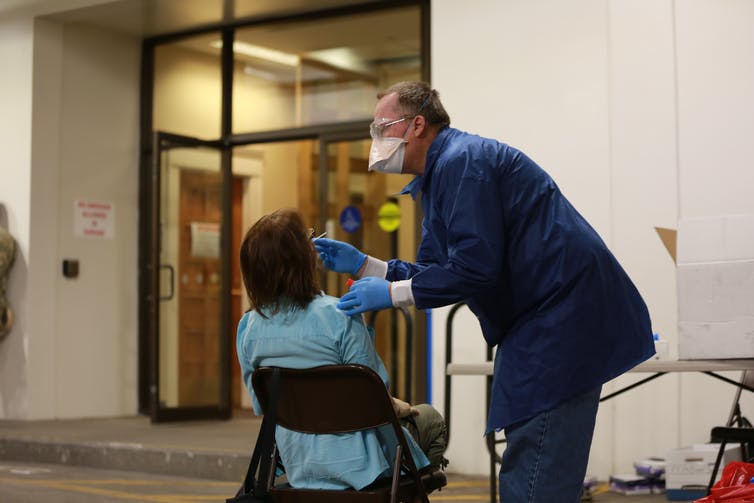 In New Mexico, it is relatively easy to get a test, so more people are getting tested. AP Photo/Cedar Attanasio
One of the best cases: New Mexico
In stark contrast to Texas is New Mexico, which has one of the strongest testing programs in the U.S.
First, public health officials there encourage everyone to get tested for COVID-19 regardless of symptoms or exposure. The state has also prohibited health providers from charging patients for tests. People seeking a test have the option to walk in or to make an appointment ahead of time, whichever is more convenient.
All of this relatively good access to testing has resulted in one of the highest per capita testing rates in the country, at over 20,000 tests per 100,000 people, and a test-positivity rate of around 4%. New Mexico’s testing program is diagnosing a relatively high proportion of cases despite the state experiencing a recent surge.
[Expertise in your inbox. Sign up for The Conversation’s newsletter and get expert takes on today’s news, every day.]
New Mexico still has room for improvement. Long lines, wait times and limited capacity are becoming more common as cases surge, but the foundation of a strong testing program has helped the state cope with the increase in cases.
The big-picture problems
The pre-pandemic infectious disease testing capabilities in the U.S. are clearly unable to meet the current demand. A nationwide response is needed, and there are three things that Congress, the federal government and local governments can do to help ensure COVID-19 tests will be easy to get, fast and accurate.
First, Congress can provide funding to stimulate the testing supply chain, scale up existing testing programs and promote innovation in test development. Second, governments can improve the management and coordination of testing programs to more efficiently use existing resources. And third, innovative testing methods that reduce the need for lab capacity – like paper-strip tests and pooled testing – need be approved and implemented more quickly.
Every little improvement in testing capabilities means more COVID-19 cases can be caught before the virus is transmitted. And slowing the spread of the virus is the key to overcoming the pandemic.
* * * * *
Zoe McLaren, Associate Professor of Public Policy, University of Maryland, Baltimore County
This article is republished from The Conversation under a Creative Commons license. Read the original article.
]]>
By Zoe McLaren, associate professor of public policy, UMBC For many people in the U.S., getting tested for COVID-19 is a struggle. In Arizona, testing sites have seen lines of hundreds of...
https://umbc.edu/stories/making-coronavirus-testing-easy-accurate-and-fast-is-critical-to-ending-the-pandemic-the-us-response-is-falling-far-short/
https://my3.my.umbc.edu/api/v0/pixel/news/119828/guest@my.umbc.edu/d2d99aef7f34b5049f039d912b2ab097/api/pixel
discovery
publicpolicy
the-conversation
UMBC News & Magazine
https://my3.my.umbc.edu/groups/umbc-news-magazine
https://assets1-my.umbc.edu/system/shared/avatars/groups/000/001/943/24435aa6207c452e7bc15cc74b42c7bb/xsmall.png?1748556657
https://assets1-my.umbc.edu/system/shared/avatars/groups/000/001/943/24435aa6207c452e7bc15cc74b42c7bb/original.png?1748556657
https://assets2-my.umbc.edu/system/shared/avatars/groups/000/001/943/24435aa6207c452e7bc15cc74b42c7bb/xxlarge.png?1748556657
https://assets2-my.umbc.edu/system/shared/avatars/groups/000/001/943/24435aa6207c452e7bc15cc74b42c7bb/xlarge.png?1748556657
https://assets3-my.umbc.edu/system/shared/avatars/groups/000/001/943/24435aa6207c452e7bc15cc74b42c7bb/large.png?1748556657
https://assets1-my.umbc.edu/system/shared/avatars/groups/000/001/943/24435aa6207c452e7bc15cc74b42c7bb/medium.png?1748556657
https://assets2-my.umbc.edu/system/shared/avatars/groups/000/001/943/24435aa6207c452e7bc15cc74b42c7bb/small.png?1748556657
https://assets1-my.umbc.edu/system/shared/avatars/groups/000/001/943/24435aa6207c452e7bc15cc74b42c7bb/xsmall.png?1748556657
https://assets2-my.umbc.edu/system/shared/avatars/groups/000/001/943/24435aa6207c452e7bc15cc74b42c7bb/xxsmall.png?1748556657
UMBC News & Magazine
0
0
false
Fri, 24 Jul 2020 13:26:53 -0400
UMBC completes pilot COVID-19 testing in preparation for fall semester

UMBC recently completed its first round of pilot COVID-19 testing, in preparation for the Retriever community’s gradual return to campus in the coming weeks and months. The pilot invited participation from faculty, staff, and students who are approved to be on campus this summer. Over the course of two days, July 13 and 14, University Health Services (UHS) completed 325 COVID-19 tests and shared educational material on how to prevent the spread of COVID-19 in our community.
Of the 321 results received so far, five employees and two students tested positive for COVID-19. This translates to a 2.18 percent positivity rate, compared to the current Maryland state positivity rate of 4.49 percent.
UMBC completed pilot COVID-19 testing on campus July 13 and 14, 2020.
Responding to positive results
In cases where positive results were found, University Health Services asked individuals to self-isolate for 10 days and consult with their primary care physician, even if asymptomatic. UHS also connected with Baltimore County public health officials to complete contact tracing for positive individuals.
Employees who are self-isolating have also been advised that they can access leave through the Families First Coronavirus Response Act (FFCRA) by contacting UMBC Human Resources.
 Face mask signage at UMBC.
Expanding public health measures
As UMBC approaches the fall, COVID-19 testing, daily symptom tracking, and online health and safety training will continue to expand. In the coming weeks, additional employees and students who are approved to work, teach, or live on campus will receive information about these next steps, including how to schedule a free COVID-19 test.
 President Freeman Hrabowski takes part in pilot COVID-19 testing at UMBC.
The University will not ask students, faculty, and staff who continue to work and study fully remotely to complete COVID-19 tests or to track symptoms. However, UMBC will continue to provide resources to help all UMBC community members stay informed about what the University is doing and what they can do to support everyone’s health, safety, and wellbeing.
 SGA President Mehrshad Fahim Devin participates in the COVID-19 testing pilot.
In a recent interview with the Baltimore Business Journal (BBJ), Nancy Young, vice president of student affairs, emphasized the importance of minimizing COVID-19 spread through an array of strategies. These include encouraging community members to practice physical distancing, hand washing, and mask wearing, and creating safety protocols and signage to support those who will be on campus.
 Nancy Young (left) with True Grit and Kate Tracy (right) at UMBC’s COVID-19 testing pilot, July 13, 2020. Young and True Grit hold thermometers distributed for free at the event.
“We hope testing and tracing will be our last measures of protection,” Young told the BBJ. “They are essential,” she says, “but ultimately part of a much larger community-based strategy.”
Featured image: True Grit in a UMBC face mask. All photos by Marlayna Demond ’11 for UMBC.
]]>
UMBC recently completed its first round of pilot COVID-19 testing, in preparation for the Retriever community’s gradual return to campus in the coming weeks and months. The pilot invited...
https://umbc.edu/stories/umbc-completes-pilot-covid-19-testing-in-preparation-for-fall-semester/
https://my3.my.umbc.edu/api/v0/pixel/news/119829/guest@my.umbc.edu/74b6e1d7b8c098efb1cdbe646e8d9446/api/pixel
campus
community
UMBC News & Magazine
https://my3.my.umbc.edu/groups/umbc-news-magazine
https://assets1-my.umbc.edu/system/shared/avatars/groups/000/001/943/24435aa6207c452e7bc15cc74b42c7bb/xsmall.png?1748556657
https://assets1-my.umbc.edu/system/shared/avatars/groups/000/001/943/24435aa6207c452e7bc15cc74b42c7bb/original.png?1748556657
https://assets2-my.umbc.edu/system/shared/avatars/groups/000/001/943/24435aa6207c452e7bc15cc74b42c7bb/xxlarge.png?1748556657
https://assets2-my.umbc.edu/system/shared/avatars/groups/000/001/943/24435aa6207c452e7bc15cc74b42c7bb/xlarge.png?1748556657
https://assets3-my.umbc.edu/system/shared/avatars/groups/000/001/943/24435aa6207c452e7bc15cc74b42c7bb/large.png?1748556657
https://assets1-my.umbc.edu/system/shared/avatars/groups/000/001/943/24435aa6207c452e7bc15cc74b42c7bb/medium.png?1748556657
https://assets2-my.umbc.edu/system/shared/avatars/groups/000/001/943/24435aa6207c452e7bc15cc74b42c7bb/small.png?1748556657
https://assets1-my.umbc.edu/system/shared/avatars/groups/000/001/943/24435aa6207c452e7bc15cc74b42c7bb/xsmall.png?1748556657
https://assets2-my.umbc.edu/system/shared/avatars/groups/000/001/943/24435aa6207c452e7bc15cc74b42c7bb/xxsmall.png?1748556657
UMBC News & Magazine
0
0
false
Fri, 24 Jul 2020 03:40:54 -0400
Why Hydroxychloroquine and Chloroquine Don’t Block SARS-CoV-2 Infection of Human Lung Cells

By Katherine Seley-Radtke, professor, Chemistry and Biochemistry, UMBC
The big idea
A paper came out in Nature on July 22 that further underscores earlier studies that show that neither the malaria drug hydroxychloroquine nor chloroquine prevents SARS-CoV-2 – the virus that causes COVID-19 – from replicating in lung cells.
Most Americans probably remember that hydroxychloroquine became the focus of numerous clinical trials following the president’s statement that it could be a “game changer.” At the time, he appeared to base this statement on anecdotal stories, as well as a few early and very limited studies that hydroxychloroquine seemed to help patients with COVID-19 recover.
Many in the antiviral field, including myself, questioned the validity of both, and in fact, one of the papers was later disparaged by the scientific society and the editor of the journal that published it.
Since then, HQC has had a bumpy ride. It was initially approved by the FDA for emergency use. The FDA then quickly reversed its decision when numerous reports of deaths caused by heart arrhythmias emerged. That news brought many clinical trials to a halt. Regardless, some scientists continued to study it in hopes of finding a cure for this deadly virus.
How the work was done
The new study was carried out by scientists in Germany who tested HCQ on a collection of different cell types to figure out why this drug doesn’t prevent the virus from infecting humans.
Their findings clearly show that that HQC can block the coronavirus from infecting kidney cells from the African green monkey. But it does not inhibit the virus in human lung cells – the primary site of infection for the SARS-CoV-2 virus.
In order for the virus to enter a cell, it can do so by two mechanisms – one, when the SARS-CoV-2 spike protein attaches to the ACE2 receptor and inserts its genetic material into the cell. In the second mechanism, the virus is absorbed into some special compartments in cells called endosomes.
Depending on the cell type, some, like kidney cells, need an enzyme called cathepsin L for the virus to successfully infect them. In lung cells, however, an enzyme called TMPRSS2 (on the cell surface) is necessary. Cathepsin L requires an acidic environment to function and allow the virus to infect the cell, while TMPRSS2 does not.
In the green monkey kidney cells, both hydroxychloroquine and chloroquine decrease the acidity, which then disables the cathepsin L enzyme, blocking the virus from infecting the monkey cells. In human lung cells, which have very low levels of cathepsin L enzyme, the virus uses the enzyme TMPRSS2 to enter the cell. But because that enzyme is not controlled by acidity, neither HCQ and CQ can block the SARS-CoV-2 from infecting the lungs or stop the virus from replicating.
Why it matters
This matters for several reasons. One, much time and money has been spent studying a drug that many scientists said from the very beginning was not going to be effective in killing the virus.
The second reason is that the studies that have reported antiviral activity for hydroxychloroquine were not in epithelial lung cells. Thus, their results are not relevant to properly studying SARS-CoV-2 infections in humans.
What’s next?
As scientists proceed with investigating new drugs as well as trying to repurpose old ones, like hydroxychloroquine, it is critical that researchers take the time to think about their study design.
In short, those of us involved in antiviral drug development should all take a lesson from this study. It is important not only to focus our efforts on pursuing drugs that will directly shut down viral replication, but also to study the virus in the primary site of infection.
*****
Katherine Seley-Radtke, Professor of Chemistry and Biochemistry and President-Elect of the International Society for Antiviral Research, University of Maryland, Baltimore County
This article is republished from The Conversation under a Creative Commons license. Read the original article.
[Deep knowledge, daily. Sign up for The Conversation’s newsletter.]
Header image: Chloroquine is an antimalarial drug originally developed in 1934; it doesn’t block coronavirus infection in humans. Brasil2 / Getty Images
]]>
By Katherine Seley-Radtke, professor, Chemistry and Biochemistry, UMBC The big idea A paper came out in Nature on July 22 that further underscores earlier studies that show that neither...
https://umbc.edu/stories/why-hydroxychloroquine-and-chloroquine-dont-block-sars-cov-2-infection-of-human-lung-cells/
https://my3.my.umbc.edu/api/v0/pixel/news/119830/guest@my.umbc.edu/aac42b16107b287baef610ce4b56c7f2/api/pixel
chemistry-and-biochemistry
cnms
covidresearch
discovery
the-conversation
UMBC News & Magazine
https://my3.my.umbc.edu/groups/umbc-news-magazine
https://assets1-my.umbc.edu/system/shared/avatars/groups/000/001/943/24435aa6207c452e7bc15cc74b42c7bb/xsmall.png?1748556657
https://assets1-my.umbc.edu/system/shared/avatars/groups/000/001/943/24435aa6207c452e7bc15cc74b42c7bb/original.png?1748556657
https://assets2-my.umbc.edu/system/shared/avatars/groups/000/001/943/24435aa6207c452e7bc15cc74b42c7bb/xxlarge.png?1748556657
https://assets2-my.umbc.edu/system/shared/avatars/groups/000/001/943/24435aa6207c452e7bc15cc74b42c7bb/xlarge.png?1748556657
https://assets3-my.umbc.edu/system/shared/avatars/groups/000/001/943/24435aa6207c452e7bc15cc74b42c7bb/large.png?1748556657
https://assets1-my.umbc.edu/system/shared/avatars/groups/000/001/943/24435aa6207c452e7bc15cc74b42c7bb/medium.png?1748556657
https://assets2-my.umbc.edu/system/shared/avatars/groups/000/001/943/24435aa6207c452e7bc15cc74b42c7bb/small.png?1748556657
https://assets1-my.umbc.edu/system/shared/avatars/groups/000/001/943/24435aa6207c452e7bc15cc74b42c7bb/xsmall.png?1748556657
https://assets2-my.umbc.edu/system/shared/avatars/groups/000/001/943/24435aa6207c452e7bc15cc74b42c7bb/xxsmall.png?1748556657
UMBC News & Magazine
0
0
false
Thu, 23 Jul 2020 19:07:18 -0400
UMBC historian Constantine Vaporis brings samurai scholarship to the public through TED-Ed animation

UMBC’s Constantine Vaporis, professor of history, has partnered with TED-Ed Animations to produce A Day In The Life of A Teenage Samurai. This original video draws from over thirty years of scholarship Vaporis has completed on Japanese history and culture. The video is part of TED’s award-winning youth education program whose mission is to “amplify and capture the work of the world’s greatest teachers.” It currently has over 550,000 views.
The life of a samurai
“The creative process for the video required about eight months and involved me as the writer and educator in collaboration with a large creative and technical team,” shares Vaporis, the first UMBC history professor to have his research animated. “It was crafted in a style that is meant to be engaging to young viewers, historically truthful, but not photorealistic.”
The video is set in Kôchi, Japan in 1800. It is a brief window into the fictional life of 16-year-old Mori Banshirô, a samurai in training who aspires to be an artist. Banshirô’s journey takes place during the Edo period (1603 – 1868), which is the focus of Vaporis’s research.
During this time, samurai also served as government officials, teachers, masters of the tea ceremony, and artists. In his latest book, Samurai. An Encyclopedia of Japan’s Cultured Warriors (ABC/CLIO, 2019), Vaporis explores the life, practice, and history of these warriors.
Vaporis continues to partner with TED-Ed. TED-Ed has invited him to be a regular collaborator on future videos about Japan. He has already critiqued two other animations.
Decades researching Japanese history
In addition to his appointment in history, Vaporis has also served as the founding director of UMBC’s Asian studies program and is an affiliate professor of gender, women’s, and sexuality studies. This year he is one of forty scholars selected from around the world as a 2020 – 2021 fellow in residence in the School of Historical Studies at the Institute for Advanced Study in Princeton, NJ. During his fellowship Vaporis will work on his sixth book, Sword and Brush: Portraits of Samurai in Early Modern Japan.
Funding for Vaporis’s early research in Japan was through a Fulbright Scholars Award and a National Endowment for the Humanities Fellowship for College Teachers. He lived in Japan for seven years, completing archival research through these and additional fellowships.
This led to the books Breaking Barriers: Travel and the State in Early Modern Japan (Harvard University Press, 1995); Tour of Duty: Samurai, Military Service in Edo and the Culture of Early Modern Japan (University of Hawai’i Press, 2009); Nihonjin to sankin kôtai [The Japanese and Alternate Attendance] (Kashiwa shobô, 2010); and Voices of Early Modern Japan: Contemporary Accounts of Daily Life During the Age of the Shoguns (ABC/CLIO, 2012; Routledge, 2014, 2020).
Banner image: Constantine Vaporis at UMBC. Photo by Marlayna Demond ’11 for UMBC.
]]>
UMBC’s Constantine Vaporis, professor of history, has partnered with TED-Ed Animations to produce A Day In The Life of A Teenage Samurai. This original video draws from over thirty years of...
https://umbc.edu/stories/umbc-historian-constantine-vaporis-brings-samurai-scholarship-to-the-public-through-ted-ed-animation/
https://my3.my.umbc.edu/api/v0/pixel/news/119831/guest@my.umbc.edu/c74245b2528025737e754c0c30947c01/api/pixel
arts-and-culture
asianstudies
cahss
cahssresearch
gwst
history
policy-and-society
UMBC News & Magazine
https://my3.my.umbc.edu/groups/umbc-news-magazine
https://assets1-my.umbc.edu/system/shared/avatars/groups/000/001/943/24435aa6207c452e7bc15cc74b42c7bb/xsmall.png?1748556657
https://assets1-my.umbc.edu/system/shared/avatars/groups/000/001/943/24435aa6207c452e7bc15cc74b42c7bb/original.png?1748556657
https://assets2-my.umbc.edu/system/shared/avatars/groups/000/001/943/24435aa6207c452e7bc15cc74b42c7bb/xxlarge.png?1748556657
https://assets2-my.umbc.edu/system/shared/avatars/groups/000/001/943/24435aa6207c452e7bc15cc74b42c7bb/xlarge.png?1748556657
https://assets3-my.umbc.edu/system/shared/avatars/groups/000/001/943/24435aa6207c452e7bc15cc74b42c7bb/large.png?1748556657
https://assets1-my.umbc.edu/system/shared/avatars/groups/000/001/943/24435aa6207c452e7bc15cc74b42c7bb/medium.png?1748556657
https://assets2-my.umbc.edu/system/shared/avatars/groups/000/001/943/24435aa6207c452e7bc15cc74b42c7bb/small.png?1748556657
https://assets1-my.umbc.edu/system/shared/avatars/groups/000/001/943/24435aa6207c452e7bc15cc74b42c7bb/xsmall.png?1748556657
https://assets2-my.umbc.edu/system/shared/avatars/groups/000/001/943/24435aa6207c452e7bc15cc74b42c7bb/xxsmall.png?1748556657
UMBC News & Magazine
0
0
false
Thu, 23 Jul 2020 18:46:41 -0400