UMBC’s Gloria Chuku is named the 2020 – 21 Lipitz Professor for her research on the Igbo people of Nigeria

Gloria Chuku, chair andprofessor of Africana studies, has been named UMBC’s Lipitz Professor of the College of Arts, Humanities, and Social Sciences (CAHSS) for 2020 – 21. This distinguished professorship, funded by Roger C. Lipitz and the Lipitz Family Foundation, recognizes and supports innovative teaching and research. During her professorship, Chuku will carry out research for her new book project, Becoming Igbo in Nigeria and the Diaspora: A History of Ethnic Identity Formation and Negotiation.
 UMBC faculty and staff retreat, summer 2017. Photo by Marlayna Demond ’11.
“I am humbled and grateful for my colleagues’ recognition of my contributions to the Africana studies department, CAHSS, and UMBC; to my profession; and to the fields of Igbo and Nigerian histories, African studies, and gender studies,” shares Chuku. “I feel validated.”
In the span of thirty years, Chuku’s internationally-renowned scholarship and teaching has explored the topics of ethno-nationalism, gender, economics, decolonization, conflict, and African-centered epistemological traditions of the Igbo people, the third largest ethnic group in Nigeria.
Scholarship on Igbo culture
Chuku will spend time studying the Commonwealth and African manuscripts at Oxford University’s Bodleian Libraries in the coming year. She will also do archival research at The National Archives in London. Chuku will then return to the United States to review the unpublished papers on the Igbo people at the Melville J. Herskovits Library of African Studies at Northwestern University.
This research will inform the writing of Chuku’s second book, about the processes of Igbo ethnic identity formation, negotiation, and integration across time. This includes Igbo identity within Nigeria and the global diaspora.
Chuku’s first book, Igbo Women and Economic Transformation in Southeastern Nigeria, 1900 – 1960 (Routledge, 2005), remains the most comprehensive study on Igbo women, covering all Igbo subculture zones. As a result of her work she was the first woman to receive the prestigious Ali Mazrui Award for Scholarship and Research Excellence in 2017.This international award recognizes a pre-eminent scholar of African studies for their research and scholarly achievement.

Chuku’s 2017 Ali Mazrui Award.
Photo courtesy of Chuku.
Enriching UMBC
In addition to her research, Chuku has been a vibrant part of the UMBC community. As affiliate professor in gender, women’s, and sexuality studies and language, literacy, and culture, she has served on their undergraduate and doctoral program advisory committees, respectively. She has also served on the Provost’s Advisory Committee on Interdisciplinary Activities.
In 2018 Chuku organized an international conference at UMBC on the history and legacy of women’s roles in the Nigeria-Biafra War. The conference brought renowned scholars and activists from Nigeria, South Africa, Germany, England, Canada, and the United States to UMBC.
UMBC students have also benefited from the intellectual and cultural opportunities Chuku has cultivated at the University. Chuku revived UMBC’s participation in the Model African Union and created the annual Taste of Africa, a celebration of Black History Month and African cultural heritage through unique cuisine and culinary traditions.

Model African Union (2020) in front of the Embassy of Liberia. Photo courtesy of Chuku.
More broadly within the University System of Maryland (USM), Chuku also serves on the executive council of the USM Women’s Forum.

USM Women’s Forum 2019 retreat.
Photo courtesy of Natasha Rodriguez.
Liptz Lecture
Similar to previous Lipitz Professorship recipients, Chuku will share her work with the campus community through the Lipitz Lecture. The lecture is the culminating event of the professorship, part of the Humanities Forum lecture series hosted by the Dresher Center for the Humanities.
Chuku follows Jessica Berman, professor of English and director of the Dresher Center for the Humanities, the 2019 – 2020 Lipitz Professor, and Dan Bailey, a professor of visual arts who focuses on animation and interactive media, the 2018 – 2019 recipient.
“Dr. Chuku is recognized worldwide as a leader in her field,” shares CAHSS Dean Scott Casper. “Her service to UMBC and the national and international research community is wide-ranging and deep. I am delighted that she is this year’s recipient of the Lipitz Professorship.”
Banner image: Chuku at UMBC. Photo courtesy of Marlayna Demond ’11 for UMBC.
]]>
Gloria Chuku, chair andprofessor of Africana studies, has been named UMBC’s Lipitz Professor of the College of Arts, Humanities, and Social Sciences (CAHSS) for 2020 – 21. This distinguished...
https://umbc.edu/stories/umbcs-gloria-chuku-is-named-the-2020-21-lipitz-professor-for-her-research-on-the-igbo-people-of-nigeria/
https://my3.my.umbc.edu/api/v0/pixel/news/119832/guest@my.umbc.edu/b5838e000968f9d14d37e1d040d07400/api/pixel
africanastudies
cahss
cahssresearch
dreshercenter
english
gwst
international
llc
policy-and-society
visualarts
UMBC News & Magazine
https://my3.my.umbc.edu/groups/umbc-news-magazine
https://assets1-my.umbc.edu/system/shared/avatars/groups/000/001/943/24435aa6207c452e7bc15cc74b42c7bb/xsmall.png?1748556657
https://assets1-my.umbc.edu/system/shared/avatars/groups/000/001/943/24435aa6207c452e7bc15cc74b42c7bb/original.png?1748556657
https://assets2-my.umbc.edu/system/shared/avatars/groups/000/001/943/24435aa6207c452e7bc15cc74b42c7bb/xxlarge.png?1748556657
https://assets2-my.umbc.edu/system/shared/avatars/groups/000/001/943/24435aa6207c452e7bc15cc74b42c7bb/xlarge.png?1748556657
https://assets3-my.umbc.edu/system/shared/avatars/groups/000/001/943/24435aa6207c452e7bc15cc74b42c7bb/large.png?1748556657
https://assets1-my.umbc.edu/system/shared/avatars/groups/000/001/943/24435aa6207c452e7bc15cc74b42c7bb/medium.png?1748556657
https://assets2-my.umbc.edu/system/shared/avatars/groups/000/001/943/24435aa6207c452e7bc15cc74b42c7bb/small.png?1748556657
https://assets1-my.umbc.edu/system/shared/avatars/groups/000/001/943/24435aa6207c452e7bc15cc74b42c7bb/xsmall.png?1748556657
https://assets2-my.umbc.edu/system/shared/avatars/groups/000/001/943/24435aa6207c452e7bc15cc74b42c7bb/xxsmall.png?1748556657
UMBC News & Magazine
0
0
false
Thu, 23 Jul 2020 18:32:49 -0400
UMBC’s Dipanjan Pan receives two NIH grants to continue rapid COVID-19 testing research

Dipanjan Pan, professor of chemical, biochemical, and environmental engineering, has received two new grants from the National Institutes of Health to support research poised to improve COVID-19 testing.
Pan and his team recently developed an experimental diagnostic test to rapidly detect the novel coronavirus causing COVID-19, potentially as early as the first day of infection. The test shows results visually, through a color change visible with the naked eye when the virus is present. Their preliminary results were published in the journal ACS Nano, and the biosensors behind this work have generated substantial academic and commercial interest.
Pan received funding from the National Institute of Biomedical Imaging and Bioengineering (NIBIB) to support the development of a mediated colorimetric biosensor. This technology greatly reduces the possibility of misinterpreting the results of COVID-19 sensing tests.
“These awards are very timely. Two back-to-back grants from NIBIB will help me to further develop and optimize the technology and help cover the cost for conducting a clinical study for validation purposes,” says Pan. “The key here is the fine balance between the accuracy of the results and the ability of the testing platform to provide a rapid response.”
The second grant will support Pan’s work to develop a COVID-19 diagnostic platform that will work like a home-based glucometer. Currently, with limitations in sample collection and transportation, it often takes several days for patients to receive their COVID-19 test results. The delay between when the test is taken and when the results are available can lead to the continued spread of the virus.
To reduce the time between when a person takes a COVID-19 test and receives their results, Pan will develop a test that includes an electrochemical biosensor that can detect the virus in about 3 minutes. If patients can receive their results within minutes of taking the test, Pan notes, they can quickly self-isolate and avoid exposing others to the virus.
Pan explains that the test will limit the possibility for inaccurate results. “We adopted a molecularly targeted approach to detect RNA from the virus. Since every living organism has unique RNA, targeting a distinctive genetic material of COVID-19 causative virus SARS-CoV-2 ensures remarkable accuracy and specificity,” he says.
In addition to his appointment at UMBC, Pan is a professor of diagnostic radiology and nuclear medicine and pediatrics at the University of Maryland School of Medicine as part of his dual appointment with the University of Maryland, Baltimore.
Banner image: UMBC’s Interdisciplinary Life Sciences Building. Photo by Marlayna Demond ’11 for UMBC.
]]>
Dipanjan Pan, professor of chemical, biochemical, and environmental engineering, has received two new grants from the National Institutes of Health to support research poised to improve COVID-19...
https://umbc.edu/stories/umbcs-dipanjan-pan-receives-two-nih-grants-to-continue-rapid-covid-19-testing-research/
https://my3.my.umbc.edu/api/v0/pixel/news/119833/guest@my.umbc.edu/7a9f6b5c2f8473c4c809c63ce05064a5/api/pixel
cbee
coeit
covidresearch
science-and-technology
UMBC News & Magazine
https://my3.my.umbc.edu/groups/umbc-news-magazine
https://assets1-my.umbc.edu/system/shared/avatars/groups/000/001/943/24435aa6207c452e7bc15cc74b42c7bb/xsmall.png?1748556657
https://assets1-my.umbc.edu/system/shared/avatars/groups/000/001/943/24435aa6207c452e7bc15cc74b42c7bb/original.png?1748556657
https://assets2-my.umbc.edu/system/shared/avatars/groups/000/001/943/24435aa6207c452e7bc15cc74b42c7bb/xxlarge.png?1748556657
https://assets2-my.umbc.edu/system/shared/avatars/groups/000/001/943/24435aa6207c452e7bc15cc74b42c7bb/xlarge.png?1748556657
https://assets3-my.umbc.edu/system/shared/avatars/groups/000/001/943/24435aa6207c452e7bc15cc74b42c7bb/large.png?1748556657
https://assets1-my.umbc.edu/system/shared/avatars/groups/000/001/943/24435aa6207c452e7bc15cc74b42c7bb/medium.png?1748556657
https://assets2-my.umbc.edu/system/shared/avatars/groups/000/001/943/24435aa6207c452e7bc15cc74b42c7bb/small.png?1748556657
https://assets1-my.umbc.edu/system/shared/avatars/groups/000/001/943/24435aa6207c452e7bc15cc74b42c7bb/xsmall.png?1748556657
https://assets2-my.umbc.edu/system/shared/avatars/groups/000/001/943/24435aa6207c452e7bc15cc74b42c7bb/xxsmall.png?1748556657
UMBC News & Magazine
0
0
false
Thu, 23 Jul 2020 15:42:12 -0400
Student cost to attend UMBC reduced for Fall 2020 semester

The cost to attend UMBC will decrease 22 percent compared to last fall for in-state undergraduate students registered for courses offered by the main campus. UMBC’s Student Business Services Office notes that student bills will reflect stable tuition rates for undergraduate and graduate, resident and non-resident students, and decreased fees.
Mandatory fees for each full-time undergraduate student enrolled at the main campus will decrease by $1,304 as a result of remote operations during the COVID-19 pandemic. Undergraduates will pay only the technology fee and 50 percent of the University Commons and student activity fees, which support ongoing services and programming for students learning both on campus and off.
“The value of a UMBC degree remains high because of the quality of teaching, research, and support for students,” says UMBC President Freeman Hrabowski. “We understand that many students and families face financial pressures as a result of the pandemic, and we have taken this into consideration in setting costs for the fall semester.”
Mandatory fees for each graduate student will decrease by $101 per credit. All graduate students will only be charged the technology fee and 50 percent of both the University Commons and graduate program fees. These support ongoing activities focused on student success in academics and research.
Mandatory fees for students at UMBC’s Shady Grove campus will include only the Shady Grove auxiliary fee and the technology fee. The facilities fee is not being charged this fall.
Need-based aid
Despite negative financial impacts on the University resulting from the pandemic, need-based aid for eligible students will continue to be a priority, notes Vice President for Administration and Finance Lynne Schaefer. “Need-based financial aid has increased 40 percent over the past five years, allowing an additional 1,000 students to receive support,” she says.
In addition, thanks to private contributions from alumni, faculty, staff, and friends of the University, the Stay Black and Gold Emergency Fund and The Fund for UMBC have generated $150,000 in emergency need-based aid for students. Students with financial concerns are encouraged to contact their financial aid counselor. Financial aid counselors are assigned by a student’s last name; a list is located on the Financial Aid webpage.
Featured image: UMBC’s new Interdisciplinary Life Sciences Building in summer 2020. Photo by Marlayna Demond ’11 for UMBC.
]]>
The cost to attend UMBC will decrease 22 percent compared to last fall for in-state undergraduate students registered for courses offered by the main campus. UMBC’s Student Business Services...
https://umbc.edu/stories/student-cost-to-attend-umbc-reduced-for-fall-2020-semester/
https://my3.my.umbc.edu/api/v0/pixel/news/119834/guest@my.umbc.edu/fffe1adea6abe99ffd8e2b83d1842c05/api/pixel
campus
community
page1
UMBC News & Magazine
https://my3.my.umbc.edu/groups/umbc-news-magazine
https://assets1-my.umbc.edu/system/shared/avatars/groups/000/001/943/24435aa6207c452e7bc15cc74b42c7bb/xsmall.png?1748556657
https://assets1-my.umbc.edu/system/shared/avatars/groups/000/001/943/24435aa6207c452e7bc15cc74b42c7bb/original.png?1748556657
https://assets2-my.umbc.edu/system/shared/avatars/groups/000/001/943/24435aa6207c452e7bc15cc74b42c7bb/xxlarge.png?1748556657
https://assets2-my.umbc.edu/system/shared/avatars/groups/000/001/943/24435aa6207c452e7bc15cc74b42c7bb/xlarge.png?1748556657
https://assets3-my.umbc.edu/system/shared/avatars/groups/000/001/943/24435aa6207c452e7bc15cc74b42c7bb/large.png?1748556657
https://assets1-my.umbc.edu/system/shared/avatars/groups/000/001/943/24435aa6207c452e7bc15cc74b42c7bb/medium.png?1748556657
https://assets2-my.umbc.edu/system/shared/avatars/groups/000/001/943/24435aa6207c452e7bc15cc74b42c7bb/small.png?1748556657
https://assets1-my.umbc.edu/system/shared/avatars/groups/000/001/943/24435aa6207c452e7bc15cc74b42c7bb/xsmall.png?1748556657
https://assets2-my.umbc.edu/system/shared/avatars/groups/000/001/943/24435aa6207c452e7bc15cc74b42c7bb/xxsmall.png?1748556657
UMBC News & Magazine
0
0
false
Wed, 22 Jul 2020 02:38:49 -0400
UMBC develops future STEM teachers, researchers through pilot program pairing high school and college students
This fall, Kimani Reed will enter UMBC as a new student in the pre-nursing program, but she’s already a member of the UMBC community. Through a partnership between UMBC and Cristo Rey Jesuit High School in Baltimore, Reed worked on campus one day a week throughout her high school career, gaining experience in several UMBC offices.
“From freshman year all the way through senior year, I met new people at UMBC who always supported me,” Reed says. When she worked in the UMBC Shriver Center, she shares, “The warm welcome I felt when I walked through the doors on the first day already made UMBC feel like home.”
Reed’s connection to The Shriver Center will continue this fall. She has chosen to participate in the Shriver Living Learning Community, a residential community for students committed to pursuing service-learning and community engagement.
Championing student success
Knowing she had her eye on a medical career, Reed’s UMBC mentors frequently pointed her toward programming that would help her reach her goal. So when her supervisor at the Shriver Center, Lori Hardesty, associate director of applied learning and engagement, found out about a special pilot program in the life sciences, she immediately recommended it to Reed.
Hua Lu, professor of biological sciences, led the pilot, and Reed jumped at the chance to work with her. She and Shaojie Chen ’21, chemistry, made up one of four student teams, each with one UMBC student and one local high school student.
Each team participated in a weeklong program in the summer of 2019 funded by the National Science Foundation and organized by Lu. The Research Training for Future Science Teachers and High School Students (RTTS) program has two goals: to create early research opportunities for high school students interested in STEM and to better prepare the next generation of STEM educators.
 Kimani Reed (left) and Shaojie Chen work together in Hua Lu’s lab during the summer program in 2019.
Transformative experiences
That’s how Reed found herself spending her 17th birthday, on a Friday in June last summer, in Hua Lu’s plant genetics lab at UMBC. She arrived by 8:30 a.m. to add the finishing touches to her presentation with Chen on CDF3, a protein found in arabidopsis plants.
Chen and the other UMBC participants were Sherman STEM Teacher Scholars. The Sherman program prepares undergraduates to be culturally responsive and compassionate educators, and many scholars work in Baltimore City. Their partners were all high school students, with the other three (beyond Reed) coming from Baltimore City College High School.
When Lu looks at Reed, Chen, and the other program participants, she sees the future of STEM teaching and learning. “I think we need to provide early, discipline-specific training for our future teachers,” she says. And for the high school participants, “It’s a lot of work, but when you see you can provide this many students with a hands-on experience, it’s definitely worth it.”
Lu is learning from these students’ experiences as she prepares for the program’s next iteration. The pandemic prevented her from running the program in person in 2020, but she is excited for it to relaunch in 2021.
Digging deeper
Based on Reed’s recent study of genetics in high school biology, sometimes she mentored Chen, rather than the other way around. The pair spent the week exploring the structure and function of CDF3 through hands-on laboratory work and research in scientific online databases.
 Ben Lockwood (right) and Youssef Maroud work together during the summer program in 2019. Photo by Hua Lu.
“I learned that molecules do so many different things. I knew they were complex, but looking at them up close through the different databases and digging deeper, I learned so much more,” Reed says. “This experience further confirmed my desire to pursue a medical-related career.” Reed has chosen nursing, after giving the biology major her full consideration thanks to her experience with “Mama Lu,” the students’ nickname for Lu based on her supportive attitude.
Whether a student ends up pursuing research or not, Lu says, an experience like this summer program can be a useful eye-opener about what a research career would be like.
Research for teachers
Ben Lockwood ’20, biological sciences, came at the experience from a different angle—he’s long known he wanted to pursue a teaching career. He was initially skeptical of a research experience, but thanks to the program’s team-based approach, he found it rewarding.
“I definitely feel like I gained from this research experience. And I think it was because I got to do it alongside a high school student,” Lockwood says. “It furthered my understanding of the science content, but it also helped grow my teaching skills, and pair them together, which I hadn’t experienced before.”
Working together with his partner, Youssef Maroud, got Lockwood thinking about “how I would approach labs and experimentation in the classroom,” he says. For example, he began to consider how he might partner with local labs and universities “to provide an upper-level lab environment that offers access to things the high school students wouldn’t normally do.”
Both the high school and UMBC students learned quite a bit about how important it is to use equipment correctly and carefully, and to record results thoroughly and accurately. A technique like pipetting is fairly simple, but also essential, they learned, especially when working with expensive or rare chemicals.
As a result, “Practicing professionalism in the lab is something that I hope to teach my students,” Lockwood says. “And I definitely know from this experience that I have to first provide students with a technical foundation. How can they come up with a procedure if they don’t know the capabilities of each piece of equipment? And how can they carry it out if they don’t know how to use the equipment?”
If Lockwood is any example, “This program is developing better teachers for society,” Lu says, “which will have a positive impact on future students and STEM professionals.”

Hua Lu. Photo by Marlayna Demond ’11 for UMBC.
Lasting bonds
The experience in Lu’s lab was a win for everyone in the pilot program. “The high school students brought so much energy to the lab,” Lu says. “They showed a passion for biology, and you’d see those lightbulb moments.”
The relationships the pairs formed were also a meaningful part of the experience. “I still text with my partner from time to time,” Lockwood says. Building their relationship was “easy, natural, and fun,” he adds. One of the reasons Lockwood wants to teach is to mentor students who may be struggling to find their way, so “being able to establish that relationship with Youssef was very affirming. And I look forward to being a mentor to many more students in the future.”
That’s exactly what Lu hopes students get out of the program: an understanding of not just how to do lab research, but also of how important relationships are to learning and discovery in science.
As Reed begins her UMBC career, she’s excited to extend the relationships she’s already formed at UMBC and to create new ones. “It meant a lot to me to be part of this, because I still got to stay where I felt at home—because I consider UMBC a home away from home—but I also got to make new family with the people I met,” Reed says. “Now I have a really large family and support system through UMBC, and I am so excited to see what I can do with all of them helping me grow.”
Banner image: Summer program participants and other members of Hua Lu’s lab enjoy lunch together on campus in summer 2019. From left to right: Ben Lockwood ’20; Malaysia McGinnis ’20; Min Gao, postdocotoral fellow; Hua Lu; Cora Bainum, Baltimore City College High School; Jessica Allison, Ph.D. student; Allen Stallings, Baltimore City College High School; Shaojie Chen ’21; Kimani Reed, Cristo Rey Jesuit High School; Riki Egoshi ’20 (front); Youssef Maroud, Baltimore City College High School. Photo courtesy Hua Lu.
]]>
This fall, Kimani Reed will enter UMBC as a new student in the pre-nursing program, but she’s already a member of the UMBC community. Through a partnership between UMBC and Cristo Rey Jesuit High...
https://umbc.edu/stories/umbc-develops-future-stem-teachers-researchers-through-pilot-program-pairing-high-school-and-college-students/
https://my3.my.umbc.edu/api/v0/pixel/news/119835/guest@my.umbc.edu/1f341bbd5eafc9fe9d5cedbcc69f9116/api/pixel
biology
cnms
community
science-and-technology
shermanscholars
shrivercenter
UMBC News & Magazine
https://my3.my.umbc.edu/groups/umbc-news-magazine
https://assets1-my.umbc.edu/system/shared/avatars/groups/000/001/943/24435aa6207c452e7bc15cc74b42c7bb/xsmall.png?1748556657
https://assets1-my.umbc.edu/system/shared/avatars/groups/000/001/943/24435aa6207c452e7bc15cc74b42c7bb/original.png?1748556657
https://assets2-my.umbc.edu/system/shared/avatars/groups/000/001/943/24435aa6207c452e7bc15cc74b42c7bb/xxlarge.png?1748556657
https://assets2-my.umbc.edu/system/shared/avatars/groups/000/001/943/24435aa6207c452e7bc15cc74b42c7bb/xlarge.png?1748556657
https://assets3-my.umbc.edu/system/shared/avatars/groups/000/001/943/24435aa6207c452e7bc15cc74b42c7bb/large.png?1748556657
https://assets1-my.umbc.edu/system/shared/avatars/groups/000/001/943/24435aa6207c452e7bc15cc74b42c7bb/medium.png?1748556657
https://assets2-my.umbc.edu/system/shared/avatars/groups/000/001/943/24435aa6207c452e7bc15cc74b42c7bb/small.png?1748556657
https://assets1-my.umbc.edu/system/shared/avatars/groups/000/001/943/24435aa6207c452e7bc15cc74b42c7bb/xsmall.png?1748556657
https://assets2-my.umbc.edu/system/shared/avatars/groups/000/001/943/24435aa6207c452e7bc15cc74b42c7bb/xxsmall.png?1748556657
UMBC News & Magazine
0
0
false
Mon, 20 Jul 2020 13:48:18 -0400
Electoral College Benefits Whiter States, Study Shows

By William Blake, assistant professor, Political Science, UMBC
States can force members of the Electoral College to vote for the winner of the popular vote in their state’s presidential primary, the Supreme Court recently ruled. The July 6 decision removed one of the two reasons why the framers of the U.S. Constitution created this election system: to empower political elites who may know more about the candidates than ordinary voters. Now, the founders’ only remaining justification for the Electoral College is structural racism.
Though the Electoral College has changed since it was first used to elect George Washington to the presidency in 1789, my research shows that the system continues to give more power to states whose populations are whiter and more racially resentful.
Electoral College myths and realities
The Founding Fathers created the Electoral College in large part because they feared voters would not know all the candidates who would be running for president. In that era, most people never left their home states, so they were not likely to know candidates from other states.
The founders did not foresee the development of political parties and campaigns, which help teach voters about their options. Instead, Alexander Hamilton argued that those serving in the Electoral College would be “most likely to possess the information and discernment” needed to choose a president.
With its recent decision, the Supreme Court has abandoned the possibility that electors might vote for people other than the candidate who wins the popular vote in their state.
The other reason for the Electoral College was to bridge a major divide among the states: slavery. As James Madison said at the Constitutional Convention: “[T]he great division of interests in the U. States did not lie between the large & small States; it lay between the Northern & Southern” because of “their having or not having slaves.”
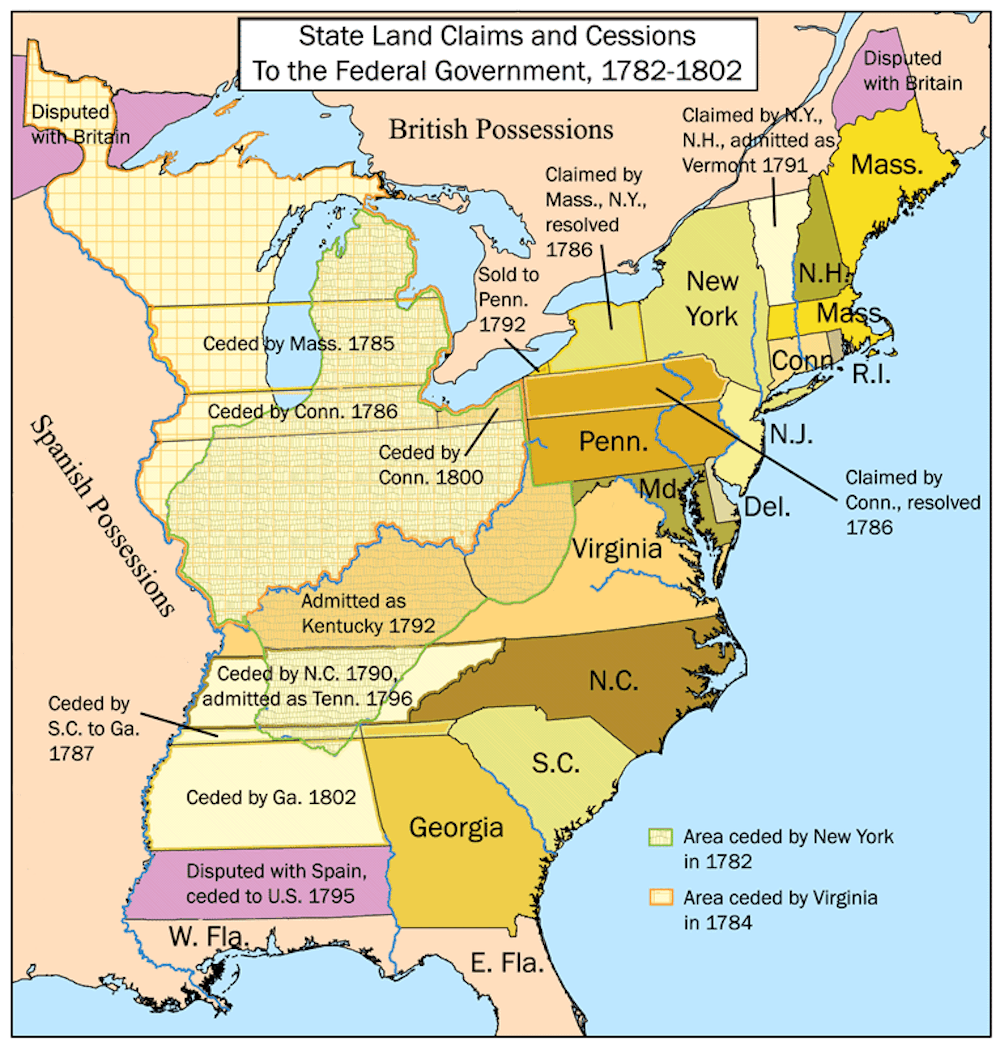
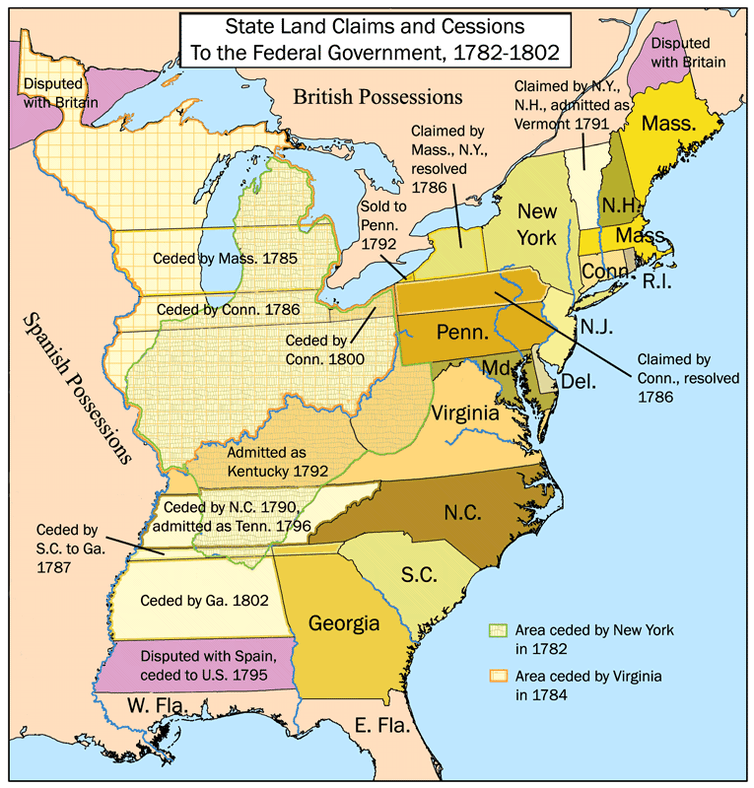 The 13 colonies had competing land claims in the early years of the United States. Kmusser, CC BY
Race in early America
By the time the founders discussed how to pick a president, they had already made the so-called “three-fifths compromise,” counting enslaved people as three-fifths of a person in the census and allotting seats in the House of Representatives accordingly. That gave Southern slave states an advantage over the Northern states in the House.
Slave states – with many people and with fewer – insisted on the Electoral College to preserve this advantage to give them a similar advantage in presidential selection. Ultimately, delegates to the Constitutional Convention decided that each state would receive votes in the Electoral College equal to their representation in both houses of Congress.
As a result, after the 1790 census, Virginia got 21 electoral votes and Pennsylvania got 15, though both were home to just over 110,000 free white male adults, who were then the only Americans allowed to vote. That’s because Virginia had 292,627 enslaved residents, to Pennsylvania’s 3,737, the country’s very first census shows.
Similarly, South Carolina and New Hampshire had nearly identical numbers of free white men – right around 36,000. But South Carolina got two more electoral votes, for a total of eight, because more than 100,000 enslaved people lived there, compared to New Hampshire’s 158 enslaved people.
In 1803, the 1800 census was about to shift the balance even more toward slave states. Representative Samuel Thatcher of Massachusetts complained that counting enslaved people added significant numbers to the slave states’ delegations.
The slavery bonus ensured that the nation’s first 18 presidential elections delivered a slave-owner as either president, vice president or both. Only in 1860, with the victory of Abraham Lincoln from Illinois and his running mate, Hannibal Hamlin of Maine, did a team of Northern politicians manage to beat the Electoral College’s skew toward white Southerners.
After the Civil War
Following the Civil War, the 14th Amendment removed the three-fifths clause, and the 15th Amendment should have protected African Americans’ legal right to vote. But that didn’t fix the Electoral College’s anti-Black bias. It actually made the problem worse, because Southern state governments were happy to get the representation from their large numbers of Black citizens – while keeping them from voting through discriminatory practices like literacy tests and poll taxes.
Judicial decisions at the time upheld Jim Crow restrictions on the right to vote, but those practices are illegal today.
This system benefited the Democratic Party, which was dominant in the South. Republicans tried to counter that power by strategically admitting new states from the Great Plains and Mountain West. In part because of racially disparate postwar settlement policies, these states – such as Nebraska, the Dakotas and Wyoming – were unusually thinly populated, heavily white and reliably Republican.
Race and the Electoral College now
Those statehood decisions made a century and a half ago still reverberate today. States with smaller populations have more electoral votes per resident because, no matter how few people they might have, they still get two senators and one House member.
I recently performed a quantitative analysis of race and the allocation of electoral votes. The data indicate that whiter states consistently wield more electoral power partly because of their population.
On average, as a state’s racial composition gets whiter, its electoral power increases. For instance, in 2016, North Dakota was the seventh whitest state and 47th on the list in terms of adult population. It had more than 5.2 electoral votes per million adult residents, when an average state had just 2.2 electoral votes per million adult residents. According to my analysis, a state that is 10% whiter than the average state tends to have one extra electoral vote per million adult residents than the average state.
I also found that states whose people exhibit more intense anti-Black attitudes, based on their answers to a series of survey questions, tend to have more electoral votes per person.
Statistically speaking, if two states’ population numbers indicate each would have 10 electoral votes, but one had substantially more racial resentment, the more intolerant state would likely have 11.
This is not an ironclad rule, and the inherent bias isn’t always decisive. For instance, Donald Trump owes his presidency to winning Wisconsin, a state that is whiter than the average state, but that has slightly less electoral votes per capita than average.
In addition, the centuries-old racial bias in the Electoral College could disappear with future population changes. Perhaps other states with relatively few people will follow the pattern of Nevada, whose population has recently become larger and more racially diverse. But the Electoral College remains a system born from white supremacy that will likely continue to operate in a racially discriminatory fashion.
*****
]]>
By William Blake, assistant professor, Political Science, UMBC States can force members of the Electoral College to vote for the winner of the popular vote in their state’s presidential...
https://umbc.edu/stories/electoral-college-benefits-whiter-states-study-shows/
https://my3.my.umbc.edu/api/v0/pixel/news/119836/guest@my.umbc.edu/65b9020c1baf3e5b20b4341fb8c1a27e/api/pixel
discovery
electoral-college
political-science
the-conversation
UMBC News & Magazine
https://my3.my.umbc.edu/groups/umbc-news-magazine
https://assets1-my.umbc.edu/system/shared/avatars/groups/000/001/943/24435aa6207c452e7bc15cc74b42c7bb/xsmall.png?1748556657
https://assets1-my.umbc.edu/system/shared/avatars/groups/000/001/943/24435aa6207c452e7bc15cc74b42c7bb/original.png?1748556657
https://assets2-my.umbc.edu/system/shared/avatars/groups/000/001/943/24435aa6207c452e7bc15cc74b42c7bb/xxlarge.png?1748556657
https://assets2-my.umbc.edu/system/shared/avatars/groups/000/001/943/24435aa6207c452e7bc15cc74b42c7bb/xlarge.png?1748556657
https://assets3-my.umbc.edu/system/shared/avatars/groups/000/001/943/24435aa6207c452e7bc15cc74b42c7bb/large.png?1748556657
https://assets1-my.umbc.edu/system/shared/avatars/groups/000/001/943/24435aa6207c452e7bc15cc74b42c7bb/medium.png?1748556657
https://assets2-my.umbc.edu/system/shared/avatars/groups/000/001/943/24435aa6207c452e7bc15cc74b42c7bb/small.png?1748556657
https://assets1-my.umbc.edu/system/shared/avatars/groups/000/001/943/24435aa6207c452e7bc15cc74b42c7bb/xsmall.png?1748556657
https://assets2-my.umbc.edu/system/shared/avatars/groups/000/001/943/24435aa6207c452e7bc15cc74b42c7bb/xxsmall.png?1748556657
UMBC News & Magazine
0
0
false
Mon, 20 Jul 2020 13:45:59 -0400
Mantis shrimp eyes get even wilder: UMBC team finds twice the expected number of light-detecting proteins

Mantis shrimps have earned wide acclaim in popular culture for their punching limbs, bright colors, and, perhaps most of all, their unusual eyes. “Everybody knows about them now,” says Tom Cronin, professor of biological sciences and a world leader in mantis shrimp vision research. “These things are memes.”
However, despite the increase in public awareness and a wealth of research on this diverse group of crustaceans, it turns out mantis shrimp still have a few tricks up their antennae.
It’s well understood that mantis shrimps’ eyes are extreme. For example, human eyes have three types of color receptors, which detect red, blue, and green light, respectively. Human eyes also have three different proteins called opsins, which are generally involved in light detection. One opsin is at work in each kind of color receptor. Mantis shrimp, on the other hand, have 16 receptor types (the most known in any animal species). The UMBC team, led by postdoctoral researcher Megan Porter, predicted that mantis shrimps would also have a one-to-one ratio of color receptors to opsins. Accordingly, they expected to find 16 opsins in their shrimp.
Instead, the shrimp offered up more surprises. After more than a decade of painstaking experiments, Porter, Cronin and colleagues have found that instead of the expected 16 opsins, mantis shrimp eyes have at least 33 types of opsins. The relationships between opsins and color receptors were completely different from what they expected, too. They published their findings in Proceedings of the National Academy of Sciences in June.
“One of the reasons I love science is that we took this animal with an exceptional visual system, and it’s become even more complex,” Porter says. “Every level that we look at adds another layer of complexity to how the visual system is working.”
 Neogonodactylus oerstedii, the mantis shrimp species that the team studied for the opsin research. Photo by Rickesh Patel.
New tech enables new science
The surprising finding in mantis shrimp is part of a trend in vision science. “We thought we understood how animal vision works,” Porter says. “Then people started looking at the molecules involved as techniques became more available, and it turns out we don’t understand as much as we thought we did.”
For example, other teams have reported upwards of 40 opsins in deep-sea fish, who seemingly have little reason to invest in elaborate vision systems. Still other groups have found large numbers of opsins in dragonflies and other insects.
Advances in genetic sequencing technology have enabled this boom in vision science. Partway through Porter’s project, cutting-edge methods for sequencing genetic material came on the market. While the newest techniques were still prohibitively expensive for most labs, the previous generation of sequencing—still much better than standard techniques—suddenly became affordable.
As a result, Porter and teammates Michael Bok, Ph.D. ’13, biological sciences, and former postdoctoral fellow Hiroko Awata were able to sequence essentially all of the RNA found in the mantis shrimp eye. This collection of RNA is called the “transcriptome,” because it represents the DNA that has been transcribed, or converted from DNA to RNA.
The cell uses these transcripts as instructions to build essentially all the proteins in the cell. From what the team already knew about opsin sequences, they were able to identify the transcripts that gave instructions specifically for opsin proteins.
 Tom Cronin (left) with lab members and collaborators at the airport on Lizard Island, Australia, one of the team’s field research sites, in 2014. Megan Porter in center (green shirt) and co-author Michael Bok at far right. Photo courtesy Tom Cronin.
“Historically, these kinds of studies wouldn’t have been possible,” Porter says. “These techniques have made it possible to investigate a much broader range of animals, and to find out so many amazing things.”
Sticking with it
The transcriptome results were so shocking that it took several more years for the team to gather enough data to confirm them with full confidence. “We just kept amassing data, and the story kept getting more complicated,” Cronin says. Porter adds, “First we had to convince ourselves, then we had to convince the rest of the scientific world.”
Cronin credits Porter for persevering, even when journals rebuffed initial attempts at publishing about the work because it departed so drastically from established knowledge. “Megan is very tough and very able to stick with a problem,” he says. “She kept sticking with it, and she filled in all the little holes in the data set one by one.”
For her part, Porter felt buoyed by Cronin’s guidance. “He pushes you to be a rigorous scientist, challenges you to think deeply about your work, and is really just a wonderful mentor and collaborator,” she says. “And if you look at the up-and-coming people in this field today, a large percentage of them came out of his lab. He’s had a really big influence.”
 Co-authors Michael Bok (left), Megan Porter (center) and Tom Cronin at a celebration in London in January, 2020, where Cronin received the international Rank Prize in Optoelectronics. Photo courtesy Megan Porter.
Enticing clues about what opsins do
Part of the UMBC team’s validation work involved figuring out where in the eye, and in which cell types, different opsins were present. Those experiments resulted in some enticing clues about the function of some of the opsins.
For example, the team found a few opsins toward the top of the eye that they believe are sensitive to blue light. That placement is reminiscent of blue-light-sensitive opsins found in insects. Insects use the opsins to detect patterns of polarized light in the sky, which could be important for navigation.
“No one has characterized that in a marine organism before,” Porter says. “And because of differences in the way that light behaves in air versus water, no one expected to see that in a marine organism.”
Rickesh Patel, Ph.D. ’21, biological sciences, was thrilled by the findings, but not completely surprised. He recently published research with Cronin that indicated mantis shrimp use polarization patterns for navigation. “I think it’s really cool that we can use molecular tools to give us insight into the function of the eye that we’ve missed,” Porter says.
 A female peacock mantis shrimp, one of the most colorful species, carrying her eggs. Photo by Christian Gloor, used under CC-BY-2.0.
The golden egg
Next up for this research is looking at the proteins themselves, rather than the transcripts that hold their instructions. “I expect that as we continue to look at every level that we will continue to find unexpected and fascinating complexities,” Porter says. “My joke hypothesis is that opsins are everywhere, doing everything. But I do think their functions are much more diverse than anyone had guessed.”
As Cronin puts it, mantis shrimp “are like the goose with the golden eggs. Just when you think they’ve run out, there’s another one that pops out.”
And on top of the surprises that keep turning up in mantis shrimp vision specifically, Porter wonders what established scientific paradigms might be the next to fall as our ability to examine the natural world continues to advance.
“What is the next thing that’s going to totally revolutionize our understanding of things we thought we had figured out?” she asks. Technology can’t do the research by itself, though. It will take creative and determined scientists like Porter, Bok, and Awata, and supportive mentors like Cronin, to change the way we understand the world.
Banner image: Co-authors Porter, Cronin, and Bok with other former and current Cronin lab members at the 2019 International Congress on Invertebrate Vision at Backaskog Castle, Kristianstad, Sweden. From left to right: Alice Chou, current Ph.D. student; Kate Feller, Ph.D. ’14; Alex Kingston, Ph.D. ’15; Tom Cronin; Megan Porter; Michael Bok, Ph.D. ’13; Rickesh Patel, current Ph.D. student; and Chan Lin, current postdoctoral fellow. Photo courtesy Tom Cronin.
]]>
Mantis shrimps have earned wide acclaim in popular culture for their punching limbs, bright colors, and, perhaps most of all, their unusual eyes. “Everybody knows about them now,” says Tom Cronin,...
https://umbc.edu/stories/mantis-shrimp-eyes-get-even-wilder-umbc-team-finds-twice-the-expected-number-of-light-detecting-proteins/
https://my3.my.umbc.edu/api/v0/pixel/news/119837/guest@my.umbc.edu/1425ce230dbf1f8326a7856b113e4298/api/pixel
biology
cnms
research
science-and-technology
UMBC News & Magazine
https://my3.my.umbc.edu/groups/umbc-news-magazine
https://assets1-my.umbc.edu/system/shared/avatars/groups/000/001/943/24435aa6207c452e7bc15cc74b42c7bb/xsmall.png?1748556657
https://assets1-my.umbc.edu/system/shared/avatars/groups/000/001/943/24435aa6207c452e7bc15cc74b42c7bb/original.png?1748556657
https://assets2-my.umbc.edu/system/shared/avatars/groups/000/001/943/24435aa6207c452e7bc15cc74b42c7bb/xxlarge.png?1748556657
https://assets2-my.umbc.edu/system/shared/avatars/groups/000/001/943/24435aa6207c452e7bc15cc74b42c7bb/xlarge.png?1748556657
https://assets3-my.umbc.edu/system/shared/avatars/groups/000/001/943/24435aa6207c452e7bc15cc74b42c7bb/large.png?1748556657
https://assets1-my.umbc.edu/system/shared/avatars/groups/000/001/943/24435aa6207c452e7bc15cc74b42c7bb/medium.png?1748556657
https://assets2-my.umbc.edu/system/shared/avatars/groups/000/001/943/24435aa6207c452e7bc15cc74b42c7bb/small.png?1748556657
https://assets1-my.umbc.edu/system/shared/avatars/groups/000/001/943/24435aa6207c452e7bc15cc74b42c7bb/xsmall.png?1748556657
https://assets2-my.umbc.edu/system/shared/avatars/groups/000/001/943/24435aa6207c452e7bc15cc74b42c7bb/xxsmall.png?1748556657
UMBC News & Magazine
0
0
false
Fri, 17 Jul 2020 18:05:51 -0400
President Hrabowski Awarded Medal for Career Advancing Diversity, Inclusion

President Freeman Hrabowski’s powerful personal story is well known in the UMBC community. At the age of 12, seeking equal access to a quality education, he marched with Dr. Martin Luther King, Jr. in his home state of Alabama. He and other Black children were then jailed for five days. He has held steadfast to commitment to educational equity in the years since.
Under President Hrabowski’s leadership for nearly three decades, UMBC has grown into a national and global leader in undergraduate and graduate education, innovation, and social impact. He has also fostered UMBC’s unique campus culture of shared, collaborative leadership and community support.
On July 10, President Hrabowski was awarded a 2020 UCSF Medal, the University of California San Francisco’s highest honor. He was one of three national leaders recognized for a career advancing diversity and inclusion, specifically through mentorship programs that support underrepresented people in the sciences. For example, UMBC now produces more Black students who go on to complete M.D.-Ph.D. degrees than any other institution in the country, and UMBC is one of the top institutions for producing Black students who go on to complete Ph.D. degrees in any STEM fields.
Video produced by UCSF, with content contributed by Corey Jennings ’10.
“What we’ve been doing for decades now,” Hrabowski shares, “is identifying students from a range of backgrounds, of every race and different income levels, and saying, ‘We want to work with you to help you reach your goals, and reaching your goals should not be about simply surviving.’”
Thank you for all you do for the UMBC community, President Hrabowski! Congratulations.
*****
Header image: President Hrabowski celebrates the Meyerhoff Scholars Program’s 30th anniversary with philanthropist Robert Meyerhoff in May 2019. Photo by Marlayna Demond ’11.
]]>
President Freeman Hrabowski’s powerful personal story is well known in the UMBC community. At the age of 12, seeking equal access to a quality education, he marched with Dr. Martin Luther King,...
https://umbc.edu/stories/president-hrabowski-awarded-medal-for-career-advancing-diversity-inclusion/
https://my3.my.umbc.edu/api/v0/pixel/news/119838/guest@my.umbc.edu/029bcf0060ae8c8d8af35897673ec08c/api/pixel
impact
meyerhoff
president-hrabowski
UMBC News & Magazine
https://my3.my.umbc.edu/groups/umbc-news-magazine
https://assets1-my.umbc.edu/system/shared/avatars/groups/000/001/943/24435aa6207c452e7bc15cc74b42c7bb/xsmall.png?1748556657
https://assets1-my.umbc.edu/system/shared/avatars/groups/000/001/943/24435aa6207c452e7bc15cc74b42c7bb/original.png?1748556657
https://assets2-my.umbc.edu/system/shared/avatars/groups/000/001/943/24435aa6207c452e7bc15cc74b42c7bb/xxlarge.png?1748556657
https://assets2-my.umbc.edu/system/shared/avatars/groups/000/001/943/24435aa6207c452e7bc15cc74b42c7bb/xlarge.png?1748556657
https://assets3-my.umbc.edu/system/shared/avatars/groups/000/001/943/24435aa6207c452e7bc15cc74b42c7bb/large.png?1748556657
https://assets1-my.umbc.edu/system/shared/avatars/groups/000/001/943/24435aa6207c452e7bc15cc74b42c7bb/medium.png?1748556657
https://assets2-my.umbc.edu/system/shared/avatars/groups/000/001/943/24435aa6207c452e7bc15cc74b42c7bb/small.png?1748556657
https://assets1-my.umbc.edu/system/shared/avatars/groups/000/001/943/24435aa6207c452e7bc15cc74b42c7bb/xsmall.png?1748556657
https://assets2-my.umbc.edu/system/shared/avatars/groups/000/001/943/24435aa6207c452e7bc15cc74b42c7bb/xxsmall.png?1748556657
UMBC News & Magazine
0
0
false
Wed, 15 Jul 2020 19:33:38 -0400
UMBC collaborates with MxD to develop cybersecurity curriculum for workers in manufacturing

UMBC researchers will collaborate with the Chicago-based MxD to develop a curriculum and online platform for manufacturing professionals to increase their cybersecurity skills and to protect manufacturing plants from cyber breaches. The work is funded by a $650,000 grant from the Office of Economic Adjustment, under the U.S. Department of Defense.
MxD is one of 14 federally-supported institutes known collectively as Manufacturing USA. It has awarded millions of dollars to research and development projects across 35 states to advance U.S. manufacturing practices and increase global competitiveness. This UMBC collaboration will be the first initiative focused on increasing manufacturing workers’ knowledge of cybersecurity.
The content of this program is completely new, as there are no existing platforms that focus on the intersection of cybersecurity and manufacturing, says Nilanjan Banerjee, principal investigator on the grant.
Banerjee, professor of computer science and electrical engineering (CSEE) at UMBC, shares, “The program will accelerate training of practitioners in the manufacturing industry in cybersecurity. It will also expand UMBC’s impact on cybersecurity education in the manufacturing sector.”
Intersection of cyber and manufacturing
Banerjee will collaborate with a number of colleagues at UMBC to develop a curriculum tailored for people who already work in the manufacturing industry. Project co-PIs include Donna Ruginski, executive director of cybersecurity initiatives at UMBC, and Keith J Bowman, dean of UMBC’s College of Engineering and Information Technology. Alan Sherman, professor of CSEE; Linda Olivia, assistant professor of education; and Megean Garvin, director of research and assessment for the Maryland Center for Computing Education, will assess the curriculum developed to ensure it meets program goals.
 Donna Ruginski. Photo by Marlayna Demond ’11 for UMBC.
Bowman helped establish the connections between UMBC and MxD, and is eager to watch the work develop. “This project fully leverages MxD, UMBC Training Centers, and UMBC assets in cybersecurity, manufacturing, and training,” says Bowman. “I have known MxD team members, including Federico Sciammarella, president and chief technology officer of MxD, ever since its origins, and I look forward to building on this collaboration.”
The first step of the multi-phased project will identify the skills most needed to protect manufacturing facilities from cyberattacks on their computer systems and machinery. UMBC and MxD will create a short-term training program for manufacturing professionals to develop these skills.
“People will come out of this program with a certification that shows they have the tools to be successful in a cybersecurity role in manufacturing,” said Lizabeth Stuck, senior director of MxD Learn, the institute’s workforce development arm. “This has the dual benefit of upskilling workers who may be sidelined during the COVID-19 crisis and increasing the security of U.S. manufacturers from cyber-attacks.”
Addressing current needs
Banerjee explains that the recent COVID-19 pandemic has led to increased unemployment and a need for more opportunities for workers to quickly expand their skill sets. With this in mind, the program will be designed for workers to complete in less than a year and through a web-based format.
For maximum flexibility, the platform will offer both synchronous and asynchronous material. It will be launched and led by UMBC Training Centers, a not-for-profit owned by UMBC that offers professional and technical training in areas such as cybersecurity, project management, and leadership and innovation. The platform will likely launch in late January 2021.
“This program will have a direct impact on the Defense Industrial Base Supply Chain,” says Ruginski. “It will create a robust workforce that has the cybersecurity skills required to assist companies in staying secure in the fast-paced cybersecurity manufacturing industry.”
Banner image: Nilanjan Banerjee. Photo by Marlayna Demond ’11 for UMBC.
]]>
UMBC researchers will collaborate with the Chicago-based MxD to develop a curriculum and online platform for manufacturing professionals to increase their cybersecurity skills and to protect...
https://umbc.edu/stories/umbc-collaborates-with-mxd-to-develop-cybersecurity-curriculum-for-workers-in-manufacturing/
https://my3.my.umbc.edu/api/v0/pixel/news/119839/guest@my.umbc.edu/441276ed052f97cdc4cd5c573b9bc2b2/api/pixel
coeit
csee
cybersecurity
page1
science-and-technology
UMBC News & Magazine
https://my3.my.umbc.edu/groups/umbc-news-magazine
https://assets1-my.umbc.edu/system/shared/avatars/groups/000/001/943/24435aa6207c452e7bc15cc74b42c7bb/xsmall.png?1748556657
https://assets1-my.umbc.edu/system/shared/avatars/groups/000/001/943/24435aa6207c452e7bc15cc74b42c7bb/original.png?1748556657
https://assets2-my.umbc.edu/system/shared/avatars/groups/000/001/943/24435aa6207c452e7bc15cc74b42c7bb/xxlarge.png?1748556657
https://assets2-my.umbc.edu/system/shared/avatars/groups/000/001/943/24435aa6207c452e7bc15cc74b42c7bb/xlarge.png?1748556657
https://assets3-my.umbc.edu/system/shared/avatars/groups/000/001/943/24435aa6207c452e7bc15cc74b42c7bb/large.png?1748556657
https://assets1-my.umbc.edu/system/shared/avatars/groups/000/001/943/24435aa6207c452e7bc15cc74b42c7bb/medium.png?1748556657
https://assets2-my.umbc.edu/system/shared/avatars/groups/000/001/943/24435aa6207c452e7bc15cc74b42c7bb/small.png?1748556657
https://assets1-my.umbc.edu/system/shared/avatars/groups/000/001/943/24435aa6207c452e7bc15cc74b42c7bb/xsmall.png?1748556657
https://assets2-my.umbc.edu/system/shared/avatars/groups/000/001/943/24435aa6207c452e7bc15cc74b42c7bb/xxsmall.png?1748556657
UMBC News & Magazine
0
0
false
Tue, 14 Jul 2020 18:26:26 -0400
UMBC mathematician Kathleen Hoffman receives new grants to improve HIV modeling

Kathleen Hoffman, professor of mathematics and statistics, thrives on solving puzzles. She has spent her career working to create and refine mathematical models of notoriously complex biological systems. For the last decade, she and colleague Katharine Gurski at Howard University have been working together to model the spread of HIV. Now, the pair has received two new grants to support their work.
Funding from the National Science Foundation (NSF) will support their efforts to improve the model of how HIV spreads between people. A grant from the Center for Undergraduate Research in Mathematics (CURM) will support work to model how HIV infects cells in the body and develops resistance to drug treatments.
Pieces of the puzzle
The CURM grant will support undergraduates in Hoffman and Gurski’s labs to model how HIV behaves inside the body. In particular, they want to know how it responds to a common treatment known as highly-active anti-retroviral treatment (HAART).
“Some strains of HIV are less likely to respond to treatment,” Hoffman says, “and when patients don’t follow the treatment regimen carefully, that can also lead to resistance.” If a person’s HIV becomes resistant to their current treatment, they can more easily pass the infection to others. So a better understanding of the presence of drug resistance in the population is critical to building accurate population-based models of HIV spread.
 Kathleen Hoffman. Photo by Jessica Hoffman and Lisa Comfort.
Hoffman enjoys working with undergraduates to give them exposure to research. Rebecca Laws ’21, mathematics, and Michael Klos ’21, mathematics, will work with her on this project.
“How can you expect people to enjoy research, if they don’t know what it is?” Hoffman asks. She says being accountable to students and their projects also helps keep her own research on track. “It accomplishes small but meaningful things toward my research that I might not do if I wasn’t working with a student,” she says. “They each contribute their own piece of the puzzle.”
Refining the model
Hoffman and Gurski’s previous collaboration on an HIV-transmission model included factors like demographic information and sexual behavior. Through their new NSF grant they will make the model more precise by incorporating two more major factors. They will account for the role of long-term relationships and usage of PrEP, a drug that reduces one’s risk of contracting HIV when taken every day. Hoffman’s Ph.D. student, Sylvia Gutowska, is taking the lead on the PrEP modeling.
Classical models of disease spread treat people “basically like molecules in a gas, where they’re moving all over the place, and there’s some probability that they will touch each other. And then, if they touch each other, there’s some probability that one will pass the infection to the other,” Hoffman says. “That’s the underlying assumption of all of these models.”
But the analogy between people and molecules breaks down when you start looking at complex human behaviors. For example, long-term partnerships dramatically reduce the likelihood of risky encounters between individuals.
Using PrEP adds more complexity. When taken regularly, PrEP reduces the likelihood of a person passing the disease to someone else. But research shows that if someone is taking PrEP, they are also more likely to behave in riskier ways. And if they forget to take their daily dose, they’re at higher risk again temporarily.
 HIV (yellow) attacks a human T-cell (blue). Image by ZEISS Microscopy, used under CC BY-NC-ND 2.0
These factors “make the modeling way more complicated from a mathematical perspective,” Hoffman says. Incorporating those two parameters will be the primary work of the NSF grant.
Hoffman and Gurski also want to validate the new model they develop. To do that, they’ll give the model real data from 2005 on disease rates, and then see how well it is able to predict disease rates a few years later (e.g. 2010 and 2015). Because these data already exist, they’ll be able to compare the real data to the model’s predictions.
Informing disease prevention
Once they have an upgraded model, the researchers can test individual parameters in the model to see which would have the biggest effects on the level of disease in a population. This can then inform public health decisions.
“By measuring the sensitivity of the parameters, it’s kind of like looking for the biggest bang for your buck in terms of resource allocation,” Hoffman explains. “For instance, if you have money to put toward an education campaign, should you put it toward making sure people take PrEP diligently? Or will it have more of an impact if you put it toward promoting condom use? Which will have a bigger impact on decreasing the amount of disease in society? That’s the kind of question this kind of work can usually answer, if the model is accurate.”
But even figuring out what the parameters are to begin with can be very difficult. The work goes way beyond math into HIV biology and even the sociology and psychology behind people’s behavior and relationships.
It’s hard, “but what I like about science and research is the fact that I’m not constrained by siloes. Sometimes I have to go read literature in the psychology and sociology fields, and I have to read biology papers that I struggle through,” Hoffman says. “That’s why I like it, because I never know what I’m going to need to learn next.”
Banner image: UMBC Biological Sciences Building. Photo by Marlayna Demond ’11 for UMBC.
]]>
Kathleen Hoffman, professor of mathematics and statistics, thrives on solving puzzles. She has spent her career working to create and refine mathematical models of notoriously complex biological...
https://umbc.edu/stories/umbc-mathematician-kathleen-hoffman-receives-new-grants-to-improve-hiv-modeling/
https://my3.my.umbc.edu/api/v0/pixel/news/119840/guest@my.umbc.edu/468b3d48252ba0be8786415302bc9835/api/pixel
cnms
mathstat
research
science-and-technology
UMBC News & Magazine
https://my3.my.umbc.edu/groups/umbc-news-magazine
https://assets1-my.umbc.edu/system/shared/avatars/groups/000/001/943/24435aa6207c452e7bc15cc74b42c7bb/xsmall.png?1748556657
https://assets1-my.umbc.edu/system/shared/avatars/groups/000/001/943/24435aa6207c452e7bc15cc74b42c7bb/original.png?1748556657
https://assets2-my.umbc.edu/system/shared/avatars/groups/000/001/943/24435aa6207c452e7bc15cc74b42c7bb/xxlarge.png?1748556657
https://assets2-my.umbc.edu/system/shared/avatars/groups/000/001/943/24435aa6207c452e7bc15cc74b42c7bb/xlarge.png?1748556657
https://assets3-my.umbc.edu/system/shared/avatars/groups/000/001/943/24435aa6207c452e7bc15cc74b42c7bb/large.png?1748556657
https://assets1-my.umbc.edu/system/shared/avatars/groups/000/001/943/24435aa6207c452e7bc15cc74b42c7bb/medium.png?1748556657
https://assets2-my.umbc.edu/system/shared/avatars/groups/000/001/943/24435aa6207c452e7bc15cc74b42c7bb/small.png?1748556657
https://assets1-my.umbc.edu/system/shared/avatars/groups/000/001/943/24435aa6207c452e7bc15cc74b42c7bb/xsmall.png?1748556657
https://assets2-my.umbc.edu/system/shared/avatars/groups/000/001/943/24435aa6207c452e7bc15cc74b42c7bb/xxsmall.png?1748556657
UMBC News & Magazine
0
0
false
Mon, 13 Jul 2020 17:31:51 -0400
Alumni Business Q&A: Precise Software Solutions

UMBC alumni businesses are doing what they can to stay strong and build community during these troubled times. UMBC Magazine will be publishing occasional interviews with alumni business owners to show their resilience in the face of this global pandemic.
Find more alumni businesses at the UMBC Alumni Business Directory.
* * * * * *
Founded by alumnus Zhensen Huang, M.S. ’00, Ph.D. ’04, information systems, Precise Software Solutions “helps their customers capitalize on the efficiencies offered by technological advancements and ensures the integrity of their IT systems and programs so they can perform their public mission more effectively.” Today, Huang reflects on the challenges of the last few months, and why he continues to be filled with gratitude and hope.
Can you tell us a little bit about what you do? What’s your favorite part of the work?
My background is in IT/technology, and this is my first time serving as the CEO of a company. So, the experience of starting up and leading a new company has involved a big learning curve for me. But I love learning and finding solutions to complex problems, and there have been endless opportunities for me to learn and grow along with the company. As for my favorite part, I love working with people. I have been blessed with an amazing team of extremely smart, dedicated, and innovative people. I also love working with our growing customer base, which has included developing productive, trusting relationships, serving as a problem solver in helping them achieve their mission, and driving organic growth for the company with the help of the successes and accolades of our customers.
 Image courtesy of Huang.
How do you connect your work back to your experience at UMBC?
I am eternally grateful for the excellent education, support, and mentorship I received as a UMBC student, and I attribute much of my success in my career and this Precise business venture to the solid launch I achieved with the help of the school. I went back to teach some courses at UMBC, and I remain in regular contact with the school through the Development Office. I continue to look for ways to reinforce the connection between myself, Precise, and UMBC, ensuring that the mutual benefits we’ve enjoyed are nurtured and expanded.
Precise also has several alumni on staff, including Kaustav Lahiri, M.S. ’14, computer science; Fan Ping, M.S. ’15, computer science; and Edison Trickett ’13, business technology administration.
In these tough times, how do you keep going? What inspires you?
It’s true, we’ve been experiencing some very tough times. The pandemic has been a real test to our resilience, as individuals, as a community, and as a company. It has been difficult to witness the terrible suffering that the virus has caused, not to mention the more recent unrest following the killing of George Floyd. In the midst of these crises, my overwhelming feeling has been one of gratitude—for the health and safety of my family and the ability of Precise to continue our work. These feelings of gratitude have inspired in me a great sense of responsibility. I am constantly looking for ways to give back, to offer support and assistance to those who have not been as fortunate as I have been.
Are there specific ways you’re giving back to the community right now?
In general, our company has actively engaged in community service events. We regularly organize company service events such as coordinating groups of Precise employee volunteers to support the work of the Manna Food Center, an wonderful organization that collects, purchases, and distributes food to the needy in our community. More recently, at the outset of the coronavirus epidemic, Precise organized a donation challenge in which we raised over $22,000 dollars for Manna. We also purchase company gift cards from some of our local food vendors as a way to infuse some cash flow into their businesses which were suffering huge losses due to the lockdown.
 Image courtesy of Precise website.
As part of our response to the protests following the killing of George Floyd, Precise organized internal discussions and listening sessions to ensure we are identifying and addressing any racial inequities that may exist within the company. In addition to donating $20,000 to the ACLU in support of social justice in our community and across the country, we also gave to UMBC’s Stay Black and Gold Emergency Fund. Supporting UMBC students during this time seemed to be a logical step, to help these students stay on track for their academic careers.
What advice would you give to others looking to start their own business?
I recommend following one’s passion, as that is the surest way to develop and sustain inspiration and resilience in what is a very difficult endeavor. Seek out mentors who have blazed the trail before you. I am constantly seeking out guides to help me navigate this business terrain. Again, this is my first experience building a business and being a CEO, so I am painfully aware of how much I still don’t know and need to learn. I have had many generous people who have more experience in this domain who have been willing to offer useful advice and guidance as I’ve worked to grow the company.
Another piece of advice I would offer is to practice humility and always work to keep your ego in check. You can’t learn and grow—and can’t succeed in business or any professional endeavor—if you don’t actively seek out your blind spots.
*****
Header image: Zhensen Huang and Julia Zhuhui Chen, M.S. ’02, information systems, at an SBA (Small Business Administration) event in 2019. Photo courtesy of Chen.
]]>
UMBC alumni businesses are doing what they can to stay strong and build community during these troubled times. UMBC Magazine will be publishing occasional interviews with alumni business owners to...
https://umbc.edu/stories/alumni-business-qa-precise-software-solutions/
https://my3.my.umbc.edu/api/v0/pixel/news/119841/guest@my.umbc.edu/0f0e6fa24d90165703ad38cf122426d2/api/pixel
alumni
computerscience
graduateschool
resilience
UMBC News & Magazine
https://my3.my.umbc.edu/groups/umbc-news-magazine
https://assets1-my.umbc.edu/system/shared/avatars/groups/000/001/943/24435aa6207c452e7bc15cc74b42c7bb/xsmall.png?1748556657
https://assets1-my.umbc.edu/system/shared/avatars/groups/000/001/943/24435aa6207c452e7bc15cc74b42c7bb/original.png?1748556657
https://assets2-my.umbc.edu/system/shared/avatars/groups/000/001/943/24435aa6207c452e7bc15cc74b42c7bb/xxlarge.png?1748556657
https://assets2-my.umbc.edu/system/shared/avatars/groups/000/001/943/24435aa6207c452e7bc15cc74b42c7bb/xlarge.png?1748556657
https://assets3-my.umbc.edu/system/shared/avatars/groups/000/001/943/24435aa6207c452e7bc15cc74b42c7bb/large.png?1748556657
https://assets1-my.umbc.edu/system/shared/avatars/groups/000/001/943/24435aa6207c452e7bc15cc74b42c7bb/medium.png?1748556657
https://assets2-my.umbc.edu/system/shared/avatars/groups/000/001/943/24435aa6207c452e7bc15cc74b42c7bb/small.png?1748556657
https://assets1-my.umbc.edu/system/shared/avatars/groups/000/001/943/24435aa6207c452e7bc15cc74b42c7bb/xsmall.png?1748556657
https://assets2-my.umbc.edu/system/shared/avatars/groups/000/001/943/24435aa6207c452e7bc15cc74b42c7bb/xxsmall.png?1748556657
UMBC News & Magazine
0
0
false
Fri, 10 Jul 2020 14:37:30 -0400