The Power of Music

When junior Linehan Artist Scholar Etai Fuchs heard about the economic devastation the COVID-19 pandemic was wreaking on the music industry, he knew he needed to respond. And as a music technology major, he realized he was in a unique position to help bands that had lost income because of canceled shows.
“I created an online record label called Gardenhead Records,” he explained, “and released a compilation recording that features and raises money for musicians whose performances have been canceled.”
In all, Fuchs was able to include twenty-six tracks by twenty-six different bands, and the resulting album — Pandemic Artist Relief: Music in the Time of Covid-19 — was released exclusively on Bandcamp on April 10. All proceeds from sales of the recording will benefit the artists.

“The best outcome would be to continue raising money for these musicians,” said Fuchs. “Some of them have lost their jobs and are struggling to pay rent, so my priority is to try and help these people out in any way that I can. Also, it’s great to be able to help promote music that I genuinely enjoy by lesser-known artists.”
One song was authored by Tom Waterworth (writing under the pen name Firesites), an undergraduate at Newcastle University in the UK who studied music technology at UMBC as an exchange student.
Putting Skills to Work
The project engaged many of Fuchs’s music technology and entrepreneurship skills—he contacted the artists, started the label, created the artwork, reached out to media, and mastered the compilation. He’s also working on plans to livestream a concert featuring some of the artists.
“We are so proud of Etai’s project and its potential for positive impact during a difficult time!” said Linda Dusman, chair of the music department. “Etai’s work exemplifies the extraordinary creativity fostered in all of our music majors. Our faculty and students embody that creative spirit as performing, teaching, and composing musicians who contribute to the community through their artistry.”
Fuchs also recently released his own solo album, Bloodletting, which he describes as a collection of “very introspective indie folk and dream pop” written about core memories and experiences. After graduating, he plans to record and perform his music, organize music releases, book shows, and freelance in production and graphic design.
Scott Casper, dean of the College of Arts, Humanities, and Social Sciences, applauded Fuchs’s efforts, as well.
“Etai Fuchs’s project, so perfect for this moment, also embodies UMBC’s long-standing values,” he said. “It exemplifies entrepreneurship in the arts, and it reaches beyond our university community to assist other artists challenged by COVID-19 and the loss of live performance opportunities.”
Header image by Tom Waterworth.
]]>
When junior Linehan Artist Scholar Etai Fuchs heard about the economic devastation the COVID-19 pandemic was wreaking on the music industry, he knew he needed to respond. And as a music technology...
https://umbc.edu/stories/the-power-of-music/
https://my3.my.umbc.edu/api/v0/pixel/news/119912/guest@my.umbc.edu/98cd74d98f7d0825530929830692049e/api/pixel
cahss
impact
linehan
music
resilience
undergraduate
UMBC News & Magazine
https://my3.my.umbc.edu/groups/umbc-news-magazine
https://assets1-my.umbc.edu/system/shared/avatars/groups/000/001/943/24435aa6207c452e7bc15cc74b42c7bb/xsmall.png?1748556657
https://assets1-my.umbc.edu/system/shared/avatars/groups/000/001/943/24435aa6207c452e7bc15cc74b42c7bb/original.png?1748556657
https://assets2-my.umbc.edu/system/shared/avatars/groups/000/001/943/24435aa6207c452e7bc15cc74b42c7bb/xxlarge.png?1748556657
https://assets2-my.umbc.edu/system/shared/avatars/groups/000/001/943/24435aa6207c452e7bc15cc74b42c7bb/xlarge.png?1748556657
https://assets3-my.umbc.edu/system/shared/avatars/groups/000/001/943/24435aa6207c452e7bc15cc74b42c7bb/large.png?1748556657
https://assets1-my.umbc.edu/system/shared/avatars/groups/000/001/943/24435aa6207c452e7bc15cc74b42c7bb/medium.png?1748556657
https://assets2-my.umbc.edu/system/shared/avatars/groups/000/001/943/24435aa6207c452e7bc15cc74b42c7bb/small.png?1748556657
https://assets1-my.umbc.edu/system/shared/avatars/groups/000/001/943/24435aa6207c452e7bc15cc74b42c7bb/xsmall.png?1748556657
https://assets2-my.umbc.edu/system/shared/avatars/groups/000/001/943/24435aa6207c452e7bc15cc74b42c7bb/xxsmall.png?1748556657
UMBC News & Magazine
0
0
false
Thu, 23 Apr 2020 21:18:30 -0400
UMBC team makes breakthrough discovery in HIV research, opening path to new, better therapies

New research on the structure of the human immunodeficiency virus (HIV) has revealed a promising novel drug target for treating HIV infection, which affects more than 1 million Americans and 40 million people worldwide. The findings, published today in Science, show that the virus’s genetic code can be read in two different ways by the cells the virus has infected. The result is that infected cells make two different forms of the virus’s RNA.
“This functional diversity is essential for the virus to replicate in the body. So the virus has to have a proper balance between the two forms of RNA,” says Joshua Brown, Ph.D. ’18, biochemistry, and lead author on the study. “For decades, the scientific community has known that two different structural forms of HIV RNA exist—they just didn’t know what controls that balance. So our discovery that a single nucleotide is having a huge effect is a paradigm shift in understanding how HIV works.”
Crucially, “You can imagine that if you could come up with a drug that would target the genetic code at that one specific spot, and shift it to one conformation only, then it could prevent further infection, theoretically,” Brown says.
A new trajectory
“One of the things we’re working on now is testing different molecules that could shift the equilibrium between the two forms, so that it could potentially be used as a treatment for HIV,” says Issac Chaudry ’21, biochemistry and molecular biology, another author on the paper.
This exciting work comes from a research group led by Michael Summers, Robert E. Meyerhoff Chair for Excellence in Research and Mentoring and Distinguished University Professor at UMBC. Summers has been conducting groundbreaking research on HIV for decades. Typically, the group’s focus is on basic science.
“Drug discovery isn’t the direction that the Summers lab usually goes, but this was such an impactful finding in a very attractive area, we took the initiative to start looking into it,” Brown says. “But we’re still in the very early stages.”
 Professor Michael Summers has been conducting groundbreaking research on HIV for decades. He is also well-known for his long-standing efforts to train researchers from all backgrounds, and to involve researchers at all stages in their careers in the highest-level science projects.
More effective treatments for more patients
Thanks to significant research on HIV over the last few decades, today AIDS is a manageable disease. Still, therapies can come with side effects, medication regimens can be complex, and treatment options can be limited for patients with other conditions, such as liver or kidney problems.
Many therapies, even if they come in the form of a single pill, contain several drugs targeting different parts of the virus’s replication cycle. That’s necessary because the HIV genetic code, which is made of RNA, mutates rapidly. This allows the virus to adapt and become resistant to current HIV therapies. If a drug targets an area that has mutated in a given patient, the drug may no longer work for them. By using several drugs at once, it’s more likely that the regimen will continue to work for longer.
But the area of the HIV RNA genome that this new research focuses on is “highly conserved.” This means the rate of mutation is less than other places in the genome, explains Ghazal Becker ’19, biological sciences and an author on the paper. The result is “there’s more chance of a drug that targets that region being effective for longer,” she says.
It might also mean that one drug would be enough, rather than patients needing several drugs to get the job done. “If you’re targeting a conserved region, you can potentially come up with a treatment plan that uses only one drug,” says Aishwarya Iyer ’18, M26, biochemistry and molecular biology, and an author on the paper. “It might have fewer side effects and could offer more treatment options to people with different health conditions.”
Expanding the research horizon
This new research opens up a range of opportunities for Brown’s research group and others. “We’re very interested to see how other labs will interpret our results, expand upon them, and possibly find other applications for this type of RNA function,” Brown says.
Those future results and any new therapies they enable could have a major impact. “Every time we get a new drug in HIV, we exponentially improve the chances of individuals finding a drug that works for them, where resistance is a little less likely,” says Hannah Carter ’17, biochemistry and molecular biology, and an author on the paper. “Every time a new drug can get on the scene, that’s a significant improvement for the lives of HIV patients.”
The research could have effects beyond HIV, too. “Some HIV research has laid the groundwork in how we understand coronaviruses,” Carter adds. “All basic science in HIV ends up having a ripple effect throughout all of virology.”
The ripple effect might go even farther. “The idea that a single nucleotide difference is changing the structure and function of RNA that is thousands of nucleotides long could open up a whole new aspect of cell biology,” Chaudry says. “It could be possible that there are mammalian genes that operate in a similar manner, and the entire mechanism might be something that’s applicable to other human genes as well. I think that whole paradigm could provide a new perspective for RNA biology.”
 Joshua Brown, Ph.D. ’18, biochemistry, mentors a student in the lab.
Carrying it forward
While these findings sound straightforward as described in the new Science paper, they represent a very large number of experiments completed by a dedicated team. “‘I’m very fortunate to have such a great group of students, because without them and their effort this definitely would not have been possible,” Brown says. The undergraduates on the team “were just as invested in this project as I was,” Brown says. “I really feel like they should get a Ph.D. out of this, too.”
Publishing in Science, arguably the most prestigious scientific journal in the world,is a big deal for any researcher. It’s very rare to have undergraduate authors on papers of this caliber; the new paper has 15 undergraduates and two Maryland high school student co-authors. All of them met the strict requirements for authorship: making a significant intellectual contribution to the research. Having such an accomplishment on their resumes will certainly help propel their research careers forward.
“Everyone in the group felt the project was ours, and I think that really came out in our work ethic and the time we were willing to put into it,” Chaudry says. “Josh is really good about asking us what we think and bringing us into the experimental design process, so the undergrads and high school students actively participated in a lot of the problem solving and critical thinking that went into this paper.”
“Josh had really high expectations for us, which gave us really high expectations for ourselves,” Iyer adds. “That’s something I think all of us continue to carry when it comes to other lab experiences.”
These students, and the additional 11 authors who were undergraduates at the time they contributed, are all still working in labs. Brown completed his Ph.D. at UMBC in 2018, and just finished his M.D. at the University of Maryland School of Medicine. He’s continuing to work in the Summers lab until he begins his residency this summer, unless he’s called up early to serve during the COVID-19 pandemic. Iyer is in the M.D./Ph.D. program at the University of Maryland School of Medicine. Becker is preparing to apply to medical school. Chaudry is beginning to apply for M.D./Ph.D. programs while finishing his bachelor’s degree at UMBC. Carter is in an M.D./Ph.D. program at the University of Michigan.
So, to Brown’s comment about earning a Ph.D. through this research, Carter says with a smile, “We’re working on it.”
Banner image: Joshua Brown, Ph.D. ’18, in the lab. All photos by Marlayna Demond ’11 for UMBC.
]]>
New research on the structure of the human immunodeficiency virus (HIV) has revealed a promising novel drug target for treating HIV infection, which affects more than 1 million Americans and 40...
https://umbc.edu/stories/umbc-team-makes-breakthrough-discovery-in-hiv-research-opening-path-to-new-better-therapies/
https://my3.my.umbc.edu/api/v0/pixel/news/119913/guest@my.umbc.edu/e959b3353ca9868bb6f2f6914d7bd69d/api/pixel
chembiochem
cnms
gradresearch
page1
research
science-and-technology
undergradresearch
UMBC News & Magazine
https://my3.my.umbc.edu/groups/umbc-news-magazine
https://assets1-my.umbc.edu/system/shared/avatars/groups/000/001/943/24435aa6207c452e7bc15cc74b42c7bb/xsmall.png?1748556657
https://assets1-my.umbc.edu/system/shared/avatars/groups/000/001/943/24435aa6207c452e7bc15cc74b42c7bb/original.png?1748556657
https://assets2-my.umbc.edu/system/shared/avatars/groups/000/001/943/24435aa6207c452e7bc15cc74b42c7bb/xxlarge.png?1748556657
https://assets2-my.umbc.edu/system/shared/avatars/groups/000/001/943/24435aa6207c452e7bc15cc74b42c7bb/xlarge.png?1748556657
https://assets3-my.umbc.edu/system/shared/avatars/groups/000/001/943/24435aa6207c452e7bc15cc74b42c7bb/large.png?1748556657
https://assets1-my.umbc.edu/system/shared/avatars/groups/000/001/943/24435aa6207c452e7bc15cc74b42c7bb/medium.png?1748556657
https://assets2-my.umbc.edu/system/shared/avatars/groups/000/001/943/24435aa6207c452e7bc15cc74b42c7bb/small.png?1748556657
https://assets1-my.umbc.edu/system/shared/avatars/groups/000/001/943/24435aa6207c452e7bc15cc74b42c7bb/xsmall.png?1748556657
https://assets2-my.umbc.edu/system/shared/avatars/groups/000/001/943/24435aa6207c452e7bc15cc74b42c7bb/xxsmall.png?1748556657
UMBC News & Magazine
0
0
false
Thu, 23 Apr 2020 18:03:21 -0400
UMBC Cyber Dawgs rank #1 among university teams at annual Capture the Flag event

The UMBC Cyber Dawgs ranked #1 among university teams in a challenging cybersecurity competition hosted virtually by the University of Maryland, College Park on April 18.
The Capture the Flag event was designed to test teams’ abilities to solve a variety of realistic cybersecurity problems. UMBC went head to head with both collegiate teams and teams of professionals from the industry, placing third overall and #1 among the universities.
Charles Nicholas, professor of computer science and electrical engineering and a Cyber Dawgs faculty advisor, says that the team’s win shows how well-prepared UMBC students are for careers in cybersecurity, and how committed they are to excelling in intercollegiate competition. “It speaks volumes about our students, their enthusiasm, and their character,” he says.
Reflecting on the Cyber Dawgs’ #3 overall finish, Nicholas shares, “The teams that beat us are made up of experienced cyber professionals, who do this sort of work for a living.” To end the competition as the leading university team and trailing just two professional teams was quite a feat, he notes, saying, “Our faculty and our university are very proud of these students.”
The Cyber Dawgs recently won the Mid-Atlantic Collegiate Cyber Defense Competition. They are preparing for the National Collegiate Cyber Defense Competition, which will be held virtually in May.
Banner image: A person typing on a computer. Photo by Marlayna Demond ’11 for UMBC.
]]>
The UMBC Cyber Dawgs ranked #1 among university teams in a challenging cybersecurity competition hosted virtually by the University of Maryland, College Park on April 18. The Capture the...
https://umbc.edu/stories/umbc-cyber-dawgs-rank-1-among-university-teams-at-annual-capture-the-flag-event/
https://my3.my.umbc.edu/api/v0/pixel/news/119914/guest@my.umbc.edu/aaed2bdfc9578b36b9c47ba7e167986f/api/pixel
coeit
csee
science-and-technology
UMBC News & Magazine
https://my3.my.umbc.edu/groups/umbc-news-magazine
https://assets1-my.umbc.edu/system/shared/avatars/groups/000/001/943/24435aa6207c452e7bc15cc74b42c7bb/xsmall.png?1748556657
https://assets1-my.umbc.edu/system/shared/avatars/groups/000/001/943/24435aa6207c452e7bc15cc74b42c7bb/original.png?1748556657
https://assets2-my.umbc.edu/system/shared/avatars/groups/000/001/943/24435aa6207c452e7bc15cc74b42c7bb/xxlarge.png?1748556657
https://assets2-my.umbc.edu/system/shared/avatars/groups/000/001/943/24435aa6207c452e7bc15cc74b42c7bb/xlarge.png?1748556657
https://assets3-my.umbc.edu/system/shared/avatars/groups/000/001/943/24435aa6207c452e7bc15cc74b42c7bb/large.png?1748556657
https://assets1-my.umbc.edu/system/shared/avatars/groups/000/001/943/24435aa6207c452e7bc15cc74b42c7bb/medium.png?1748556657
https://assets2-my.umbc.edu/system/shared/avatars/groups/000/001/943/24435aa6207c452e7bc15cc74b42c7bb/small.png?1748556657
https://assets1-my.umbc.edu/system/shared/avatars/groups/000/001/943/24435aa6207c452e7bc15cc74b42c7bb/xsmall.png?1748556657
https://assets2-my.umbc.edu/system/shared/avatars/groups/000/001/943/24435aa6207c452e7bc15cc74b42c7bb/xxsmall.png?1748556657
UMBC News & Magazine
0
0
false
Wed, 22 Apr 2020 12:30:36 -0400
How to avoid infection after a COVID-19 death – an Ebola response veteran explains

by Lucy Wilson, Professor of Emergency Health Services, UMBC
As the grim reality of COVID-19 unfolds, families and health care workers in the United States are faced with dealing with the horrifying magnitude of deaths from this novel disease. This tragic situation brings forth the question of whether the bodies of patients who have died from COVID-19 provide a risk of infection in others.
I have worked for many years as an infectious disease doctor and public health official, during emerging disease outbreaks, such as Ebola virus disease in 2015. I have witnessed the extra challenges families experience when faced with the death of their loved ones from a highly transmissible infectious disease. For this current pandemic, here are the safety guidelines for dealing with deceased loved ones and the reasons why, from a scientific perspective.
Contagion risk decreases after death
Public health authorities have set out guidance for the management of the deceased based on current knowledge of both susceptibility to and transmissibility of the coronavirus.
The recommendations for handling those deceased from COVID-19 are based on knowledge that this novel coronavirus (SARS-CoV-2) is most commonly transmitted by respiratory droplets that are projected by a living person through coughing and sneezing. Therefore, after death, the risk from this respiratory mechanism is no longer present. However, the novel coronavirus (SARS-CoV-2) can also be transmitted from indirect contact: that is, touching a surface contaminated with the virus and then self-contaminating by touching one’s eyes, nose or mouth.
Preventing transmission when handling the deceased is achieved by “contact precautions,” which includes wearing a gown and gloves and hand-washing after removing these barriers. The deceased is placed in a body bag and the bag is then wiped down with EPA-approved disinfecting wipes prior to transportation.
This guidance holds in the funeral home setting as well, except there are additional instructions for preventing airborne transmission of coronavirus when certain body processing procedures, such as embalming, are performed.
This type of guidance in the health care setting is fairly standard for handling the deceased who is potentially infectious, given the risk of indirect contact of the patient with surrounding medical equipment, bedding and furniture.
During the Ebola pandemic, much stricter guidance was enforced, but this was also related to the tremendous amount of infectious fluids that were produced by a symptomatic patient, including profuse diarrhea. These precautions also took into consideration the extremely high mortality rate from Ebola.
At that time in 2015, I was working as a public health professional, and was involved in the determination of the best procedures to prevent cross-contamination when transferring a deceased patient with Ebola to the hospital morgue or elsewhere. A team of doctors, nurses and public health practitioners developed a protocol in a biocontainment unit with a patient mannequin and special chemical markers that could reveal contamination of surfaces via ultraviolet light.
This team was able to determine that multiple body bags were needed to prevent external contamination of the body bags being used. A careful manipulation of the patient, the bedding, proper personal protective equipment for staff and two stretchers was needed to achieve this level of caution.
Post-mortem safety for families
For families, there are many sad realities that need to be considered in the event of a death from COVID-19. While currently families are not allowed in the hospital to visit their loved ones, deaths in the home of those suspected of COVID-19 infection have been reported.
Again, given that breathing has stopped, the risk of transmission from coughing, sneezing and other mouth secretions is no longer a concern, but contact with surfaces that the patient could have previously contaminated remains. It is known that the virus can stay viable on surfaces for days, so all nearby surfaces should be considered infectious. Family members should thoroughly clean surfaces and bedding, wearing gloves and a washable or disposable cover up, if available.
Regarding funerals, when it is deemed safe to have a small gathering, or if exposed family members have completed their 14 day quarantine period, there is guidance on safety in those situations. There is no known risk of being in the same room at a funeral or visitation service with the body of someone who has died from COVID-19.
The CDC recommends not touching, kissing or hugging the deceased, though acknowledges that touching a hand or clothing after the body has been prepared for viewing is lower risk if hand-washing can then immediately occur.
Those at higher risk of complications of COVID-19 should use extra precaution in this setting. If there are important religious or cultural practices, such as shrouding or washing of the body, funeral home staff and local cultural and religious leaders can be involved to optimize reducing the risk of exposure.
Processing of the deceased can be achieved by cremation or embalming, and burial is allowed. For people who have died outside of the United States or need transportation for funeral services, federal and state guidelines need to be followed. For international transport, bodies can be transported if cremated, if embalmed and placed in a hermetically sealed casket or if the remains are accompanied by a CDC permit. This permit must be issued by the CDC director and allows for the importation of a person known or suspected of death from a quarantinable communicable disease.
How families can prepare
- Know your risk of complications from COVID-19.
- Know how to care for yourself and someone sick in your home.
- Know the warning signs of COVID-19 complications needing emergency medical care.
- Understand your hospital policy on visitation of someone sick with COVID-19.
- Learn the infection control and visitation policy in your family member’s nursing home or assisted living facility.
- Discuss end-of-life decisions with loved ones: living will, advanced directives, funeral and life ceremony wishes.
- Know the CDC recommendations for handling the deceased in the home and in funeral homes.
-
Prepare personal wills and child care plans in the event of death or prolonged hospitalization.
* * * * *
[You need to understand the coronavirus pandemic, and we can help. Read The Conversation’s newsletter.]
Header image: Workers wearing protective gear remove bodies of people who have died from COVID-19 from a New Jersey nursing home morgue. Eduardo Munoz Alvarez/Getty Image
Lucy Wilson, Professor of Emergency Health Services, University of Maryland, Baltimore County
This article is republished from The Conversation under a Creative Commons license. Read the original article.
]]>
by Lucy Wilson, Professor of Emergency Health Services, UMBC As the grim reality of COVID-19 unfolds, families and health care workers in the United States are faced with dealing with the...
https://umbc.edu/stories/how-to-avoid-infection-after-a-covid-19-death-an-ebola-response-veteran-explains/
https://my3.my.umbc.edu/api/v0/pixel/news/119915/guest@my.umbc.edu/d35d545f87aed4f35d63ccd15bc234a0/api/pixel
cahss
covidresearch
discovery
ehs
the-conversation
UMBC News & Magazine
https://my3.my.umbc.edu/groups/umbc-news-magazine
https://assets1-my.umbc.edu/system/shared/avatars/groups/000/001/943/24435aa6207c452e7bc15cc74b42c7bb/xsmall.png?1748556657
https://assets1-my.umbc.edu/system/shared/avatars/groups/000/001/943/24435aa6207c452e7bc15cc74b42c7bb/original.png?1748556657
https://assets2-my.umbc.edu/system/shared/avatars/groups/000/001/943/24435aa6207c452e7bc15cc74b42c7bb/xxlarge.png?1748556657
https://assets2-my.umbc.edu/system/shared/avatars/groups/000/001/943/24435aa6207c452e7bc15cc74b42c7bb/xlarge.png?1748556657
https://assets3-my.umbc.edu/system/shared/avatars/groups/000/001/943/24435aa6207c452e7bc15cc74b42c7bb/large.png?1748556657
https://assets1-my.umbc.edu/system/shared/avatars/groups/000/001/943/24435aa6207c452e7bc15cc74b42c7bb/medium.png?1748556657
https://assets2-my.umbc.edu/system/shared/avatars/groups/000/001/943/24435aa6207c452e7bc15cc74b42c7bb/small.png?1748556657
https://assets1-my.umbc.edu/system/shared/avatars/groups/000/001/943/24435aa6207c452e7bc15cc74b42c7bb/xsmall.png?1748556657
https://assets2-my.umbc.edu/system/shared/avatars/groups/000/001/943/24435aa6207c452e7bc15cc74b42c7bb/xxsmall.png?1748556657
UMBC News & Magazine
0
0
false
Mon, 20 Apr 2020 12:53:30 -0400
How the rich reacted to the bubonic plague has eerie similarities to today’s pandemic

by Kathryn McKinley, Professor of English, UMBC
The coronavirus can infect anyone, but recent reporting has shown your socioeconomic status can play a big role, with a combination of job security, access to health care and mobility widening the gap in infection and mortality rates between rich and poor.
The wealthy work remotely and flee to resorts or pastoral second homes, while the urban poor are packed into small apartments and compelled to keep showing up to work.
As a medievalist, I’ve seen a version of this story before.
Following the 1348 Black Death in Italy, the Italian writer Giovanni Boccaccio wrote a collection of 100 novellas titled, “The Decameron.” These stories, though fictional, give us a window into medieval life during the Black Death – and how some of the same fissures opened up between the rich and the poor. Cultural historians today see “The Decameron” as an invaluable source of information on everyday life in 14th-century Italy.
 Giovanni Boccaccio.
Leemage via Getty Images
Boccaccio was born in 1313 as the illegitimate son of a Florentine banker. A product of the middle class, he wrote, in “The Decameron,” stories about merchants and servants. This was unusual for his time, as medieval literature tended to focus on the lives of the nobility.
“The Decameron” begins with a gripping, graphic description of the Black Death, which was so virulent that a person who contracted it would die within four to seven days. Between 1347 and 1351, it killed between 40% and 50% of Europe’s population. Some of Boccaccio’s own family members died.
In this opening section, Boccaccio describes the rich secluding themselves at home, where they enjoy quality wines and provisions, music and other entertainment. The very wealthiest – whom Boccaccio describes as “ruthless” – deserted their neighborhoods altogether, retreating to comfortable estates in the countryside, “as though the plague was meant to harry only those remaining within their city walls.”
Meanwhile, the middle class or poor, forced to stay at home, “caught the plague by the thousand right there in their own neighborhood, day after day” and swiftly passed away. Servants dutifully attended to the sick in wealthy households, often succumbing to the illness themselves. Many, unable to leave Florence and convinced of their imminent death, decided to simply drink and party away their final days in nihilistic reveries, while in rural areas, laborers died “like brute beasts rather than human beings; night and day, with never a doctor to attend them.”
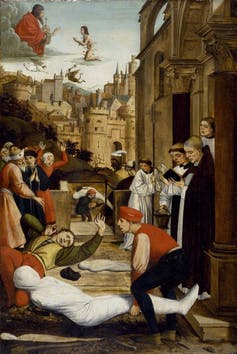 Josse Lieferinxe’s ‘Saint Sebastian Interceding for the Plague Stricken’ (c. 1498).
Wikimedia Commons
After the bleak description of the plague, Boccaccio shifts to the 100 stories. They’re narrated by 10 nobles who have fled the pallor of death hanging over Florence to luxuriate in amply stocked country mansions. From there, they tell their tales.
One key issue in “The Decameron” is how wealth and advantage can impair people’s abilities to empathize with the hardships of others. Boccaccio begins the forward with the proverb, “It is inherently human to show pity to those who are afflicted.” Yet in many of the tales he goes on to present characters who are sharply indifferent to the pain of others, blinded by their own drives and ambition.
In one story, a dead man returns from hell every Friday and ritually slaughters a different woman who had rejected him during his lifetime. In another, a widow fends off a leering priest by tricking him into sleeping with her maid. In a third, the narrator praises a character for his undying loyalty to his friend when, in fact, he has profoundly betrayed him over many years.
Humans, Boccaccio seems to be saying, can think of themselves as upstanding and moral – but unawares, they may show indifference to others. We see this in the 10 storytellers themselves: They make a pact to live virtuously in their well-appointed retreats. Yet while they pamper themselves, they indulge in some stories that illustrate brutality, betrayal and exploitation.
Boccaccio wanted to challenge his readers, and make them think about their responsibilities to others. “The Decameron” raises the questions: How should the rich treat the poor during a time of widespread suffering? What is the value of a life?
In our own pandemic – with some of the most well-off now clamoring for the economy to re-open, despite the ongoing spread of the disease – these issues are strikingly relevant.
* * * * *
[Deep knowledge, daily. Sign up for The Conversation’s newsletter.]
Kathryn McKinley, Professor of English, University of Maryland, Baltimore County
Header image: A tale from The Decameron, by John William Waterhouse, Public Domain.
This article is republished from The Conversation under a Creative Commons license. Read the original article.
]]>
by Kathryn McKinley, Professor of English, UMBC The coronavirus can infect anyone, but recent reporting has shown your socioeconomic status can play a big role, with a combination of job...
https://umbc.edu/stories/how-the-rich-reacted-to-the-bubonic-plague-has-eerie-similarities-to-todays-pandemic/
https://my3.my.umbc.edu/api/v0/pixel/news/119916/guest@my.umbc.edu/f8e3b585d708899cebd0655f1fd029ad/api/pixel
cahss
covidresearch
discovery
history
the-conversation
UMBC News & Magazine
https://my3.my.umbc.edu/groups/umbc-news-magazine
https://assets1-my.umbc.edu/system/shared/avatars/groups/000/001/943/24435aa6207c452e7bc15cc74b42c7bb/xsmall.png?1748556657
https://assets1-my.umbc.edu/system/shared/avatars/groups/000/001/943/24435aa6207c452e7bc15cc74b42c7bb/original.png?1748556657
https://assets2-my.umbc.edu/system/shared/avatars/groups/000/001/943/24435aa6207c452e7bc15cc74b42c7bb/xxlarge.png?1748556657
https://assets2-my.umbc.edu/system/shared/avatars/groups/000/001/943/24435aa6207c452e7bc15cc74b42c7bb/xlarge.png?1748556657
https://assets3-my.umbc.edu/system/shared/avatars/groups/000/001/943/24435aa6207c452e7bc15cc74b42c7bb/large.png?1748556657
https://assets1-my.umbc.edu/system/shared/avatars/groups/000/001/943/24435aa6207c452e7bc15cc74b42c7bb/medium.png?1748556657
https://assets2-my.umbc.edu/system/shared/avatars/groups/000/001/943/24435aa6207c452e7bc15cc74b42c7bb/small.png?1748556657
https://assets1-my.umbc.edu/system/shared/avatars/groups/000/001/943/24435aa6207c452e7bc15cc74b42c7bb/xsmall.png?1748556657
https://assets2-my.umbc.edu/system/shared/avatars/groups/000/001/943/24435aa6207c452e7bc15cc74b42c7bb/xxsmall.png?1748556657
UMBC News & Magazine
0
0
false
Thu, 16 Apr 2020 12:38:48 -0400
URCAD 2020 showcases UMBC student researchers and artists in a new, interactive online format
UMBC students are no strangers to ingenuity. When a fire alarm went off during last year’s Undergraduate Research and Creative Achievement Day (URCAD), presenters rolled up their posters and continued discussing their work outside without skipping a beat. This year, due to COVID-19, the 24th annual iteration of URCAD calls for creative dexterity at a whole new level.
Now spanning April 22 – 29, the event has transitioned to a week-long online symposium. (See project sneak peeks here!)
The virtual celebration of undergraduate achievement will allow presenters to showcase their research and interact with UMBC attendees through the VoiceThread (VT) platform. Students’ posters and slides—including art, performances, and video games—will be available all week long for any attendee to enjoy.
Visitors can simply visit the URCAD presenter listing and click on the VT icon by any student project to access it. Projects will also be viewable by department.
“The students have shown an amazing amount of resilience during the transition to moving their presentations online for URCAD,” says April Householder ’95,visual and performing arts, director of undergraduate research and prestigious scholarships.
“This, in itself, is a valuable research skill,” she shares. “One of the benefits of participating in URCAD is students learn that part of the research process is being able to adjust to ever-changing circumstances. Sometimes technologies fail. You lose data. Experiments don’t work. The ability to persevere and adapt is so important.”
New platform, same depth of research
At the virtual event—like every year—viewers can expect robust research spanning a wide range of subjects. VoiceThread will facilitate audience engagement to mirror the in-person presentation experience. Those with a UMBC login will be able to make comments on the projects. And student presenters can receive feedback and respond to questions throughout the week.
Projects rooted in the humanities and social sciences will cover topics from around the globe, in the present and the past. One project examines South Africa as a case study in supporting a wide array of languages within a society. Others focus on inclusive sexual health education in public high schools and how the New York Times has covered immigration policy over time. One student will discuss “de-cyborging” herself by consciously detaching from her phone for set periods of time.
 Screenshot from “De-Cyborging,” by Julia Palmer ’23, global studies. Image courtesy of Palmer.
Some of the research feels especially prescient as UMBC students take on issues in health and medicine. One project enhances and visualizes human disease networks to reduce healthcare costs. Another group of students is working on more effectively treating HIV, with research that could improve therapies targeting the HIV-1 replication cycle.
Other projects work to create technical solutions to real-world needs. Examples include voice-activated assistants for individuals who are blind as well as a design for an autonomous, low-cost, and accessible electric mobility vehicle.
Bypassing technical hurdles
While each discipline faces challenges in adapting to the new format, the visual and performing arts have additional barriers. Some of the showcases, originally meant to be staged as live performances, could not be filmed prior to social distancing.
Now, students are working around the limitations by submitting rehearsal footage or stills in lieu of performances. Others are reimagining their performances in an online environment, using new recording technologies, says Householder.
-
 “terminal,” choreographed by Emily Godfrey ’20, dance. Image courtesy of Godfrey.
Despite the change to a virtual venue, of the original 350 URCAD presenters, 330 still plan to participate in the event. This number nods to UMBC students’ resiliency in the face of this challenging moment.
Preserving the “spirit of URCAD”
Householder is heartened, but not surprised, by the ways UMBC students have risen to meet this challenge. After all, UMBC’s community of inquiring minds is not limited to a specific location.
With the students bringing their all to the event, she’s now working to encourage the UMBC community to join in as well, to appreciate and engage with students’ research and creative work.
“We invite faculty, staff, and students to ask questions, give feedback, and offer constructive criticism,” says Householder. “Our presenters will take those community reflections back to their labs, desks, and studios, to make their work even stronger.”
Featured image: From URCAD 2020 presenter Liam Garrett’s project “The Digital Art Movement: Its Role In Spreading Awareness About Endangered Animals.” Image courtesy of Liam Garrett ‘21, graphic design.
]]>
UMBC students are no strangers to ingenuity. When a fire alarm went off during last year’s Undergraduate Research and Creative Achievement Day (URCAD), presenters rolled up their posters and...
https://umbc.edu/stories/urcad-2020-showcases-umbc-student-researchers-and-artists-in-a-new-interactive-online-format/
https://my3.my.umbc.edu/api/v0/pixel/news/119917/guest@my.umbc.edu/0dafb1f784f7236355ab8d45968457ef/api/pixel
classof2020
community
page1
undergradresearch
urcad
UMBC News & Magazine
https://my3.my.umbc.edu/groups/umbc-news-magazine
https://assets1-my.umbc.edu/system/shared/avatars/groups/000/001/943/24435aa6207c452e7bc15cc74b42c7bb/xsmall.png?1748556657
https://assets1-my.umbc.edu/system/shared/avatars/groups/000/001/943/24435aa6207c452e7bc15cc74b42c7bb/original.png?1748556657
https://assets2-my.umbc.edu/system/shared/avatars/groups/000/001/943/24435aa6207c452e7bc15cc74b42c7bb/xxlarge.png?1748556657
https://assets2-my.umbc.edu/system/shared/avatars/groups/000/001/943/24435aa6207c452e7bc15cc74b42c7bb/xlarge.png?1748556657
https://assets3-my.umbc.edu/system/shared/avatars/groups/000/001/943/24435aa6207c452e7bc15cc74b42c7bb/large.png?1748556657
https://assets1-my.umbc.edu/system/shared/avatars/groups/000/001/943/24435aa6207c452e7bc15cc74b42c7bb/medium.png?1748556657
https://assets2-my.umbc.edu/system/shared/avatars/groups/000/001/943/24435aa6207c452e7bc15cc74b42c7bb/small.png?1748556657
https://assets1-my.umbc.edu/system/shared/avatars/groups/000/001/943/24435aa6207c452e7bc15cc74b42c7bb/xsmall.png?1748556657
https://assets2-my.umbc.edu/system/shared/avatars/groups/000/001/943/24435aa6207c452e7bc15cc74b42c7bb/xxsmall.png?1748556657
UMBC News & Magazine
0
0
false
Thu, 16 Apr 2020 02:17:19 -0400
CWIT Scholar Sammie Maygers ’20 finds, and builds, a community of support at UMBC

When her courses moved online in mid-March due to the coronavirus pandemic, Sammie Maygers ‘20, chemical engineering, knew staying connected with her UMBC community would need to be a top priority. In some ways, her experience changed substantially. But it was also a continuation of the same UMBC journey, powered by community support.
When Maygers was looking at colleges, she knew that UMBC was the place for her as soon as she heard about the Center for Women in Technology (CWIT) from a high school classmate. When she visited campus, she says that it instantly felt like a family. “UMBC feels like home,” she says. “It’s inclusive.”
 Sammie Maygers, fourth from left in front row, with her fellow CWIT scholars. Photo courtesy of CWIT.
CWIT appealed to Maygers because it meant having a network of peers to work with and rely on. Her connections with new friends and mentors started the summer before her freshman year and continue as she heads toward graduation.
“One thing that CWIT does that is really fantastic is they send you on a retreat before the school year starts, with all of the new scholars,” she explains. “So when you move in, you’ve pretty much met all of the people who live on your floor. Even once people got busy, we were always doing work together and I had people who I could really trust.”
Growing as a leader
Working to build and strengthen this community are dedicated CWIT staff. Maygers shares that Erica D’Eramo, assistant director for the CWIT Scholars Program, has been especially impactful on her UMBC experience, including helping her grow and develop as a leader.
“Sammie has an enthusiasm and passion that is contagious,” says D’Eramo. “She has been a mentor to many students—as a ‘Big Wit’ peer mentor in CWIT, and in her Frisbee family, too. So many times I have heard students tell me how amazing it has been to have Sammie as a guide and, more importantly, as a close friend they can rely on.”
 Sammie Maygers, fifth from right, with fellow CWIT Scholars, and Erica D’Eramo, left, at the Society of Women Engineers Conference in 2019. Photo courtesy of CWIT.
Each incoming CWIT scholar is paired with an older student who is also a part of the program. As students move through the program, they become mentors to incoming scholars. Now a graduating senior, Maygers now has a “family” of younger scholars as well as alumni, and they connect regularly.
To sustain and grow these relationships during the pandemic, Maygers says that it is more important than ever to connect with her CWIT community outside of online classes. She intentionally sets aside time to virtually hang out with her mentees, friends, Chem-E-Car teammates, and classmates, including game nights.
Community through student orgs
The format of her classes this semester is helping Maygers stay connected during this difficult time. Most of her current courses are presentation-based. She and her classmates had previously been meeting virtually to develop their presentations, so that work has held steady.
Other changes have been harder to adjust to. Maygers is a member of UMBC’s Chem-E-Car team, which builds and races vehicles powered by precise chemical reactions. The team was heading to a regional competition at Virginia Tech this month, but that’s no longer happening.
“I’ve put a year and a half of work into the Chem-E-Car team, and I’ll never see it through,” Maygers says. She finds herself “mourning the things I was expecting to come.”
 Sammie Maygers, left, playing ultimate frisbee. Photo courtesy of Maygers.
Another activity that has proven challenging for Maygers to carry on with is ultimate frisbee, but her close connections to teammates remain strong. In high school, she was a three-sport athlete, and it was important to her to find a way to stay active in college. Soon after arriving at UMBC, she learned about the ultimate frisbee club team from an older student in CWIT. Although practices are cancelled, UMBC’s ultimate frisbee team has held informal virtual meetups every week.
Virtual connections
Intentionally maintaining all these connections has helped Maygers stay centered and motivated. One day that could be an online coffee with a friend. Another day it could be an online board meeting of the American Institute of Chemical Engineers, UMBC chapter.
 Sammie Maygers, center, with members of the Chem-E-Car team. Maygers holds the team’s first prototype at the 2019 COEIT Celebration. Photo courtesy of Maygers.
Maygers is also continuing her work as a teaching fellow in Mark Marten’s chemical engineering kinetics course. “Being a teaching fellow has given me the opportunity to support students academically and personally. The course load of a student taking this level of chemical engineering courses can really be overwhelming, and I love helping students realize that making mistakes and failing helps them grow as an engineer.”
Maygers has conducted research alongside Marten, professor and chair of chemical, biochemical, and environmental engineering, since fall 2016. One of the most powerful lessons she’s learned from working with him is to be unafraid of learning new skills and making mistakes. This is one of the core messages she works to pass along to both students in the course and younger CWIT scholars.
Thoughtful engineering solutions
Maygers now has her eye on her steps after graduation, and who will be walking those steps with her. She will have a unique opportunity to continue working closely with friends from UMBC after she graduates this spring.
As she has moved through the chemical engineering program, Maygers has become passionate about developing thoughtful engineering solutions. For her, this means solutions that are environmentally conscious and energy efficient. She looks forward to pursuing this passion as an engineer at the Naval Surface Warfare Center (NSWC) near Bethesda, Maryland.
 Sammie Maygers, center, after a networking evening with her CWIT LittleWit Courtney Cavin ’21, chemical engineering, and Cavin’s LittleWit Catherine Wraback ’23, chemical engineering. Photo courtesy of Maygers.
She and classmates Laina Colony ‘20, chemical engineering, and Zach Voelkel ‘20, mechanical engineering, learned about opportunities at the NSWC through a trip organized by UMBC’s Career Center. Not only were they all offered positions at the NSWC, but Colony and Maygers will have a chance to work together on the same team and be roommates, along with Voelkel.
A community of support welcomed Maygers to UMBC before she started classes freshman year. She thoughtfully grew that community during her time as a Retriever. Now, she’ll carry it with her to the next stage of her life and career.
Banner image: Sammie Maygers, right, with her roommates on campus. Photo courtesy of Maygers.
]]>
When her courses moved online in mid-March due to the coronavirus pandemic, Sammie Maygers ‘20, chemical engineering, knew staying connected with her UMBC community would need to be a top...
https://umbc.edu/stories/cwit-scholar-sammie-maygers-20-finds-and-builds-a-community-of-support-at-umbc/
https://my3.my.umbc.edu/api/v0/pixel/news/119918/guest@my.umbc.edu/e18b3b84244822a02c525caa2a28b954/api/pixel
cbee
classof2020
coeit
community
cwit
science-and-technology
UMBC News & Magazine
https://my3.my.umbc.edu/groups/umbc-news-magazine
https://assets1-my.umbc.edu/system/shared/avatars/groups/000/001/943/24435aa6207c452e7bc15cc74b42c7bb/xsmall.png?1748556657
https://assets1-my.umbc.edu/system/shared/avatars/groups/000/001/943/24435aa6207c452e7bc15cc74b42c7bb/original.png?1748556657
https://assets2-my.umbc.edu/system/shared/avatars/groups/000/001/943/24435aa6207c452e7bc15cc74b42c7bb/xxlarge.png?1748556657
https://assets2-my.umbc.edu/system/shared/avatars/groups/000/001/943/24435aa6207c452e7bc15cc74b42c7bb/xlarge.png?1748556657
https://assets3-my.umbc.edu/system/shared/avatars/groups/000/001/943/24435aa6207c452e7bc15cc74b42c7bb/large.png?1748556657
https://assets1-my.umbc.edu/system/shared/avatars/groups/000/001/943/24435aa6207c452e7bc15cc74b42c7bb/medium.png?1748556657
https://assets2-my.umbc.edu/system/shared/avatars/groups/000/001/943/24435aa6207c452e7bc15cc74b42c7bb/small.png?1748556657
https://assets1-my.umbc.edu/system/shared/avatars/groups/000/001/943/24435aa6207c452e7bc15cc74b42c7bb/xsmall.png?1748556657
https://assets2-my.umbc.edu/system/shared/avatars/groups/000/001/943/24435aa6207c452e7bc15cc74b42c7bb/xxsmall.png?1748556657
UMBC News & Magazine
0
0
false
Wed, 15 Apr 2020 12:08:17 -0400
UMBC Makers Shift Gears to Pitch In
As the world battles COVID-19 and all of the levels of health and economic uncertainty that entails, it can be difficult to find ways of helping out on an individual basis (beyond staying home, that is).
But, as hospitals and other front-line operations find themselves in need of hard-to-find personal protective equipment (PPE), UMBC makers from all types of work backgrounds are pitching in the best way they know how. Whether sewing up a storm or finding creative uses for kitty litter boxes, these are just a few stories of how Retriever Nation is using special engineering and craft skills, tools, and grit to help in the fight against COVID-19.
(Share your own stories of Retriever Resilience by using #UMBCTogether on social media!)
Lending a Technical Hand
At Potomac Photonics, an alumni-owned fabrication operation located in the bwtech@UMBC business park, a typical day might involve anything from piercing 10,000 tiny holes in a single sheet of steel to the microfabrication of complex parts for equipment and biotech applications. When COVID-19 struck, and the nationwide dearth of PPE in hospitals became front page news, owner Mike Adelstein ’96, biochemistry and molecular biology, jumped into action.
His shop produced several thousand protective face shields in the first few weeks of the pandemic, shipping to hospitals in Maryland, New York, and Florida. And the microfluidic chips they’re working on with another client will be used for testing related to finding a vaccine or cure.
“The entire Potomac Photonics family feels a deep sense of obligation and pride when it comes to helping others. Whether we are working on products related to COVID-19 or early detection of cancer, one of the recurring themes that you will hear from our staff is how rewarding it is to be involved in the manufacturing of parts used to save lives,” says Adelstein.
“We have an extremely diverse company with people from many different backgrounds and education levels. However, we are all united in our desire to make a difference by working together and coming up with innovative manufacturing solutions that enable our customers [to get] their complex products to the market.”
Meanwhile, in Corey Fleischer’s own home workshop, he and his kids are producing low-cost protective face shields for healthcare workers in need. Using an elastic band, a clear binder sleeve, and a 3-D printed frame, they’re printing parts on three machines “around the clock,” he says.
You might recognize Fleischer ’05, ’08 M.S. mechanical engineering, from his win on the Discovery Channel’s Big Brain Theory a few years back. As a mechanical engineer by trade, he owns a lot of exciting tools for playing around with designs at home, as well.
“My father in-law, Joe, works at a retirement center and the healthcare workers weren’t allowed to help the residents without wearing a face shield. Every store and online vendor was sold out so he reached out to me,” Fleischer says. “[My son] Aidan and I sketched out some concepts that would provide a solution with items we could find at Walmart. We decided to make face shields out of 3-ring binder sleeves.”
 Corey Fleischer’s kids pose with some of their homemade masks.
Three designs and six hours after the phone call, they had 10 masks ready. Since then, Fleischer and his kids Aidan, Kaleb, and Camden have made around 100 more masks for two local retirement homes, and two hospitals.
“I would encourage anyone with fabrication resources to help out if they can,” says Fleischer, who has made his design available for other 3-D printer enthusiasts to use. “There’s a lot of how-to information on the internet for making face shields and face masks. And lots of workers on the front line need them.”
Sewing as Fast as They Can
As some folks are programming their 3-D printers, others are breaking out their trusty sewing machines to construct fabric masks for hospitals, nursing homes, friends, and family. And for senior political science major and Sondheim Scholar Marly Milic, the act of sewing masks is not only a way of giving back, but a way of connecting with a loved one.
“I can sew by hand and have a little experience on the machine from when my Ma taught me when I was younger,” said Milic. “Once we saw that hospitals were asking for fabric masks, we both decided that we needed to help. She got a jump start on me because she already had supplies and tools. I ordered my first sewing machine and some materials and got to work right away.”

She sewed her first few masks by hand, but has now taken her production up significantly with her machine. Both she and her mother are sending their masks to Domesticity fabric studio in Lauraville, and Milic also shared some with a neighbor who is a truck driver.
“There are people risking their lives every day to take care of the sick and keep our state running… This is what I can do to help, and as a Sondheim [Scholar] there is no way that I could sit this out,” says Milic, who also very much enjoys her mom’s company during her hours at the sewing machine.
“We actually Skype and sew together so yes, we are very much doing this together.”
Christine Obriecht ’85, biological sciences, a research assistant at UMBC’s Molecular Characterization and Analysis Complex, started sewing masks as soon as she heard there was a need. And then—because she adores sewing and experimenting—she didn’t stop there.
“My boss showed me a picture of a headband that medical personnel can wear to make mask-wearing more comfortable. The headband has buttons one can hook the mask elastic to, instead of hooking it around their poor chafed ears. I plan to make some of those to see how well they are received. I have had one request for a scrub cap. I will try that, too. And so the ideas flow in,” says Obriecht, who has donated her work to a local hospital, but also a number of her elderly neighbors.
“I don’t really care who gets the masks, as long as they go to people who need them and who are trying to help,” she says.
 Meredith Purvis, director of undergraduate recruitment marketing at UMBC, has made dozens of masks so far (even a few with Doctor Who TARDISes on them!) for local hospitals and others in need.
Help in Unexpected Forms
Bennett Moe ’88, graphic design, found his coronavirus volunteer calling from a Facebook post. After reading about a Boy Scout creating “ear savers”—plastic contraptions that wrap around the back of the head to make the wearing of the stretchy elastic of face masks a little less uncomfortable—a chat with a nurse friend confirmed the need.
Moe, who recently started a side business creating collectible die cast models, replacement gauge lenses for vintage trucks, and other vintage-inspired items, saw a sudden use for his new tabletop laser cutter. Within hours, he had tested a design out first in clear acrylic, and then— wait for it—the far sturdier plastic of a kitty litter box.
“Seriously. Necessity is the mother of invention!” says Moe, who found the plastic to be pliable but thick enough to be durable. With materials in stock, he estimates he can produce 500 to 1,000 ear savers a week in his off hours for area hospital workers.
“It feels good to be able to contribute, even in this small way, when so much around us seems out of our control,” says Moe, a former president of the UMBC Alumni Association Board.
“I’m not very good at sitting and watching the world go by, so when my friend tagged me in that post, it was almost like a challenge. I knew there had to be a way that I could make this thing—this little thing that hardly anyone even knew was even a thing, but could make someone’s job just a little bit more bearable. And the folks that are out there helping patients every single day deserve all the help they can get.”
 “A pic of my next victim. To be cut up to make more,” says Bennett Moe.
* * * * *
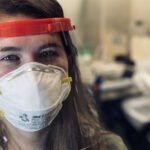
Header image: Potomac Photonics employee tests out one of the masks they manufactured. Courtesy of Potomac Photonics.
]]>
As the world battles COVID-19 and all of the levels of health and economic uncertainty that entails, it can be difficult to find ways of helping out on an individual basis (beyond staying home,...
https://umbc.edu/stories/umbc-makers-shift-gears-to-pitch-in/
https://my3.my.umbc.edu/api/v0/pixel/news/119919/guest@my.umbc.edu/68cea4aa5f2a4bcf4c1d0227ccd1bd77/api/pixel
impact
resilience
UMBC News & Magazine
https://my3.my.umbc.edu/groups/umbc-news-magazine
https://assets1-my.umbc.edu/system/shared/avatars/groups/000/001/943/24435aa6207c452e7bc15cc74b42c7bb/xsmall.png?1748556657
https://assets1-my.umbc.edu/system/shared/avatars/groups/000/001/943/24435aa6207c452e7bc15cc74b42c7bb/original.png?1748556657
https://assets2-my.umbc.edu/system/shared/avatars/groups/000/001/943/24435aa6207c452e7bc15cc74b42c7bb/xxlarge.png?1748556657
https://assets2-my.umbc.edu/system/shared/avatars/groups/000/001/943/24435aa6207c452e7bc15cc74b42c7bb/xlarge.png?1748556657
https://assets3-my.umbc.edu/system/shared/avatars/groups/000/001/943/24435aa6207c452e7bc15cc74b42c7bb/large.png?1748556657
https://assets1-my.umbc.edu/system/shared/avatars/groups/000/001/943/24435aa6207c452e7bc15cc74b42c7bb/medium.png?1748556657
https://assets2-my.umbc.edu/system/shared/avatars/groups/000/001/943/24435aa6207c452e7bc15cc74b42c7bb/small.png?1748556657
https://assets1-my.umbc.edu/system/shared/avatars/groups/000/001/943/24435aa6207c452e7bc15cc74b42c7bb/xsmall.png?1748556657
https://assets2-my.umbc.edu/system/shared/avatars/groups/000/001/943/24435aa6207c452e7bc15cc74b42c7bb/xxsmall.png?1748556657
UMBC News & Magazine
0
0
false
Tue, 14 Apr 2020 23:49:37 -0400
Alum Helps Budding Soccer Players “Get on the Bus”

When Tim Ryerson ’94, INDS, founded Ellicott City Soccer Club (ECSC) back in 2014, he noticed something: there were pockets of Howard County that weren’t signing up. He did a little digging, and realized that in spite of the fact that Howard County is chockfull of mid- and upper-middle class families, there are also Title 1 schools scattered throughout—13 of them to be exact.
Soccer tends to fall into the “pay to play” category. Travel programs run upwards of $3,000 a year, even more when you add in hotels, meals, and travel to and from far-flung games. Even recreation-level programs don’t come cheap, running at least a couple of hundred dollars.
Ryerson knew what an important factor soccer had been in his own life. He played under coach Pete Caringi, serving as captain his senior year and going on to a 15-3-1 season. “Coach Caringi is the number-one influencer on my life other than my family,” says Ryerson. “He allowed me to build the work ethic to create different verticals in soccer.”
 UMBC soccer teammates gather under the championship banner from the 1992 Big South season 25th reunion picture in 2017. Photo courtesy of Tim Ryerson.
Soccer for Everyone
As his wheels turned on the soccer equity issue in Howard County, Ryerson learned that even more than the cost to play, transportation to and from practices is a huge barrier for lower income families. He was inspired to make a change. “There was a local contest awarding grant money for ideas to help the community,” he says. “I submitted a concept, but didn’t win.”
The notion of a way to somehow make soccer affordable and doable for low-income families stuck with Ryerson, and he decided to turn it into reality. In 2018, he launched a pilot “Get on the Bus,” program with the financial support of families already in the ECSC club.
GOTB works like this: Kids in target schools apply and are selected based on needs and merit. If selected, they receive after-school homework help from certified educators and a healthy snack; bus transportation to and from soccer practice; and all soccer apparel, including cleats and a ball.
After its initial year, where it provided these benefits to 41 elementary school students, Ryerson applied for and received the Maryland State Youth Soccer Association’s “Grassroots Futures Award,” providing GOTB with funding to continue and expand. “U.S. Soccer then got wind, and they have awarded us another grant, so now we’re able to include states beyond Maryland,” Ryerson explains. “We’ve been able to move into four states and now we’ve got people calling from all over to get involved.”
Currently kids in California, Nevada and Connecticut, in addition to Maryland, are involved and benefitting from the program. Nancy Thompson, principal at Talbott Springs Elementary School in Columbia, has been involved since the start. “We offer it to fourth and fifth graders at our school,” she says. “We cap it at 12 students, and ask our recess monitors and para-educators to help us identify potential candidates.”
From there Thompson vets the students on financial need and then encourages them to apply. “We’ve got kids out on our playground who love the sport but can’t afford to play,” she says. “Tim has been very intentional in helping give them an opportunity.”
Pick-Up and Go
Twin 13-year olds Justin and Jordin Lopez have taken full advantage of the program. Originally selected in elementary school, the brothers have since developed enough skill to move onto one of the travel teams. “It makes me so happy to be able to play more,” says Justin. “In the past, I could only play pick-up games at the park or on the playground.”
Ryerson says that part of the U.S. Soccer grant money is for just this purpose—to identify talent and help foster it up the travel program pipeline. “These are kids who would never be identified otherwise,” he says. “From our original 41 kids, we’ve been able to move six onto the travel level.”
If all goes as Ryerson hopes, the GOTB goal is to graduate 10,000 kids by the 2026 World Cup.
Thompson says the kids in her school who participate beam with pride. “They used to see kids wearing their club shirts at school and know they couldn’t be part of that,” she says. “Now they come to school in theirs with big smiles on their faces.”
– Amanda Loudin
* * * * *
Header image: Ryerson and a former soccer teammate’s daughter pose during a rec program.
]]>
When Tim Ryerson ’94, INDS, founded Ellicott City Soccer Club (ECSC) back in 2014, he noticed something: there were pockets of Howard County that weren’t signing up. He did a little digging, and...
https://umbc.edu/stories/alum-helps-budding-soccer-players-get-on-the-bus/
https://my3.my.umbc.edu/api/v0/pixel/news/119920/guest@my.umbc.edu/cfc1b79a74e1394845b2d4dee275dd7c/api/pixel
alumni
athletics
inds
UMBC News & Magazine
https://my3.my.umbc.edu/groups/umbc-news-magazine
https://assets1-my.umbc.edu/system/shared/avatars/groups/000/001/943/24435aa6207c452e7bc15cc74b42c7bb/xsmall.png?1748556657
https://assets1-my.umbc.edu/system/shared/avatars/groups/000/001/943/24435aa6207c452e7bc15cc74b42c7bb/original.png?1748556657
https://assets2-my.umbc.edu/system/shared/avatars/groups/000/001/943/24435aa6207c452e7bc15cc74b42c7bb/xxlarge.png?1748556657
https://assets2-my.umbc.edu/system/shared/avatars/groups/000/001/943/24435aa6207c452e7bc15cc74b42c7bb/xlarge.png?1748556657
https://assets3-my.umbc.edu/system/shared/avatars/groups/000/001/943/24435aa6207c452e7bc15cc74b42c7bb/large.png?1748556657
https://assets1-my.umbc.edu/system/shared/avatars/groups/000/001/943/24435aa6207c452e7bc15cc74b42c7bb/medium.png?1748556657
https://assets2-my.umbc.edu/system/shared/avatars/groups/000/001/943/24435aa6207c452e7bc15cc74b42c7bb/small.png?1748556657
https://assets1-my.umbc.edu/system/shared/avatars/groups/000/001/943/24435aa6207c452e7bc15cc74b42c7bb/xsmall.png?1748556657
https://assets2-my.umbc.edu/system/shared/avatars/groups/000/001/943/24435aa6207c452e7bc15cc74b42c7bb/xxsmall.png?1748556657
UMBC News & Magazine
0
0
false
Mon, 13 Apr 2020 21:27:01 -0400
Alumni Business Q&A: Interrobang Theatre Company

UMBC alumni businesses are doing what they can to stay strong and build community during these troubled times. UMBC Magazine will be publishing occasional interviews with alumni business owners to show their resilience in the face of this global pandemic.
* * * * * *
Founded by a number of UMBC alumni, The Interrobang Theatre Company focuses on fostering theatre artists in Baltimore, and providing new, high-quality work at affordable prices. Co-founder Kiirstn Pagan ’11, theatre, talks about what it takes to manage a theatre company, and how maintaining their connections to UMBC has helped keep them strong.
Q: What’s your favorite part of the work?
A: My favorite part about creating theatre is sharing it with audiences. I suppose all art forms require an audience, but theatre is special in that it cannot exist without an audience. Audience reactions help mold a performance and directly affect the performers on stage. An audience’s presence completes a theatrical experience and is necessary for the art form to function. The importance of building and maintaining a strong audience base is imperative not only to maintaining a performing arts organization as a business, but to producing theatre. It is this belief that drew me to marketing for theatre initially—as early as high school—and continues to drive my passionate pursuit of this career. Discovering new ways to educate, entertain, and engage audiences keeps me excited to continue to create and implement campaigns that encourage patrons to experience theatre.

Q: How do you connect your work back to your experience at UMBC?
A: All Interrobang founding and current company members are very proud UMBC alumni. It is this shared experience that bonds us as friends. It is the education that we received that bonds us as a company and informs how we operate and produce shows. This is a huge benefit to us as a company because there is a shorthand to our communication. We all speak the same language, as it were, because we were all taught how to produce theatre in the same environment. We all have a similar idea of how we want the process to go, what the final product should look like, and what stories we believe are important to tell now.
We are also incredibly lucky to have a group of very supportive professors from UMBC who we have stayed in touch with and developed friendships with since our graduation who support our vision and work and generally champion and advocate for us in the community and with new and current theatre students. I have been back to UMBC’s campus multiple times since graduation alongside the other Interrobang founders to talk with students, staff, and faculty about Interrobang, how our education at UMBC helped us to get started, and how our relationship with the university continues to be a source of support.
Q: In these tough times, how do you keep going? What inspires you?
A: As a small company, we produce on a show-by-show basis and don’t have many overhead costs. Eventually we’d like to be large enough to support full-time staff on a full-time basis with our own theatre space to maintain, like flagship Baltimore theatres Baltimore Center Stage or Everyman Theatre. But, right now, we are grateful that we operate in this flexible way because during this unprecedented lockdown we have the ability to pause without fearing a complete shut down. We are also incredibly grateful that our last show and fundraiser opened and closed in early March, right before the quarantine got underway.
All that being said, we are very much inspired by the theatres who are thinking on their feet and working to determine the best way to tell stories in a digital space. We are working on ways to do this as well.
 Kiirstn Pagan ’11 and Katie Hileman ’12. Photo by Kiirstn Pagan ’11.
Q: Are other alumni working with you at your business or as partners somehow?
A: Yes! I founded Interrobang alongside UMBC alumni and I continue to work with them now. Current Interrobang company members include Katie Hileman ’12 (Artistic Director/Co-Founder), Sean McComas ’11 (Managing Director), David Brasington ’12 (Producer/Co-Founder), and Brady Whealton ’13 (Producer/Co-Founder).
Q: Are there specific ways you’re giving back to the community right now?
A: We are working to create some digital theatrical content to share while everyone is staying safe at home. We are staying home ourselves too, and washing our hands with vigor.
Q: What advice would you give to others looking to start their own business?
A: Make sure you know why you’re doing it. Make sure that reason is very important to you. You have to believe in it yourself. Producing theatre is hard and thankless, so this reason, this passion, is what you will need to come back to that when the work gets hard.
* * * * *
Learn more about The Interrobang Theatre Company at www.interrobangbaltimore.org.
Header image: The current Interrobang Theatre Company members, from left to right in each photo: David Brasington ’12 (Producer/Co-Founder), Katie Hileman ’12 (Artistic Director/Co-Founder), Brady Whealton ’13 (Producer/Co-Founder), Kiirstn Pagan ’11 (Producer/Co-Founder), and Sean McComas ’11 (Managing Director). Photos by Kiirstn Pagan ’11.
* * * * *
The Office of Alumni Engagement is collecting information about UMBC alumni who own a business or sole proprietorship to display on their website and across their social media channels. Tell them about your work here.
]]>
UMBC alumni businesses are doing what they can to stay strong and build community during these troubled times. UMBC Magazine will be publishing occasional interviews with alumni business owners to...
https://umbc.edu/stories/alumni-business-qa-interrobang-theatre-company/
https://my3.my.umbc.edu/api/v0/pixel/news/119921/guest@my.umbc.edu/4c38b8f25a7bc2856b34dc35fdaf87d2/api/pixel
alumni
alumnibusiness
cahss
impact
resilience
theatre
UMBC News & Magazine
https://my3.my.umbc.edu/groups/umbc-news-magazine
https://assets1-my.umbc.edu/system/shared/avatars/groups/000/001/943/24435aa6207c452e7bc15cc74b42c7bb/xsmall.png?1748556657
https://assets1-my.umbc.edu/system/shared/avatars/groups/000/001/943/24435aa6207c452e7bc15cc74b42c7bb/original.png?1748556657
https://assets2-my.umbc.edu/system/shared/avatars/groups/000/001/943/24435aa6207c452e7bc15cc74b42c7bb/xxlarge.png?1748556657
https://assets2-my.umbc.edu/system/shared/avatars/groups/000/001/943/24435aa6207c452e7bc15cc74b42c7bb/xlarge.png?1748556657
https://assets3-my.umbc.edu/system/shared/avatars/groups/000/001/943/24435aa6207c452e7bc15cc74b42c7bb/large.png?1748556657
https://assets1-my.umbc.edu/system/shared/avatars/groups/000/001/943/24435aa6207c452e7bc15cc74b42c7bb/medium.png?1748556657
https://assets2-my.umbc.edu/system/shared/avatars/groups/000/001/943/24435aa6207c452e7bc15cc74b42c7bb/small.png?1748556657
https://assets1-my.umbc.edu/system/shared/avatars/groups/000/001/943/24435aa6207c452e7bc15cc74b42c7bb/xsmall.png?1748556657
https://assets2-my.umbc.edu/system/shared/avatars/groups/000/001/943/24435aa6207c452e7bc15cc74b42c7bb/xxsmall.png?1748556657
UMBC News & Magazine
0
0
false
Thu, 09 Apr 2020 20:32:40 -0400