UMBC researchers offer knowledge, innovation during the time of COVID-19
At a time when information and misinformation are coming at us from all directions, and everyone is looking for answers, UMBC researchers are stepping up. They’re working hard to answer pressing questions about COVID-19 and sharing their expertise to help the public stay healthy and make informed decisions. By taking time to share their knowledge with local, national, and global communities, UMBC researchers are fulfilling our critical mission as a public university.
Lucy Wilson, professor of emergency health systems and an infectious disease expert, has been speaking regularly with leading national news outlets. She’s offered sobering analysis of what to expect in the days and weeks ahead, as well as practical advice to help people limit coronavirus exposure, like removing rings and switching to glasses from contacts.
As the number of cases in Washington, D.C., began to surge in mid-March, Wilson offered a reminder about the impact of social distancing. “Whatever numbers [of COVID-19 cases] we are seeing today reflect the transmission that was occurring one to two weeks ago,” Wilson told The Washington Post. “We shouldn’t be surprised by numbers continuing to increase, and we also shouldn’t discredit the effect of social distancing until we’ve given it time to take effect.”
Wilson has also talked about the importance of protecting the nation’s healthcare workers in The New York Times and the need to ramp up testing, also in the Post.
Dispelling rumors, sharing truths
Other faculty members are writing their own articles to help the public better understand issues in the news. Jeffrey Gardner, associate professor of biological sciences, explained “Why vodka won’t protect you from coronavirus, and four other things to know about hand sanitizer” in The Conversation. The article has been viewed more than 275,000 times across 44 different publishers. Almost overnight it has become the third most popular UMBC-authored article of all time in The Conversation.
Katherine Seley-Radtke, professor of chemistry and biochemistry, addressed whether the drug chloroquine is safe to use against COVID-19 in “5 questions answered about a promising, problematic and unproven use for an antimalarial drug.” The article, which calls on her seven years of research on coronaviruses and her career as a medicinal chemist, has been viewed more than 233,000 times across 49 publishers. It is UMBC’s all-time fifth-most-read Conversation article.

Katherine Seley-Radtke. Photo courtesy of Seley-Radtke.
Both Radtke’s and Gardner’s articles give readers useful and accessible information they can apply today.
Other UMBC experts are helping the public understand COVID-19’s effects on our communities, and how people can better support each other. John Fritz, associate vice president for instructional technology, has contributed to the conversation around the rapid transition from in-person to online learning. In the Baltimore Sun, he called the shift “a big step for a university like ours,” requiring flexibility and creativity. He also noted the importance of focusing on the needs of students who might not yet have access to the tools they need for distance learning.
Charissa Cheah, professor of psychology, is leading a new NSF-funded research project addressing how Chinese-American communities are experiencing discrimination related to COVID-19, and how they are coping. “The negative impact of infectious diseases on psychological health is understudied but highly significant,” Cheah says. Shimei Pan, assistant professor of information systems, will lead the study’s analysis of outbreak-related social media.
 Charissa Cheah. Photo by Marlayna Demond ’11 for UMBC.
Alumni focused on vaccine development, testing
UMBC alumni have taken lead roles in the record-paced development of a vaccine to prevent COVID-19. Kizzmekia Corbett ’08, M16, biological sciences, has led a team working on the vaccine at the National Institute of Allergy and Infectious Diseases. She and her teammates, including Olubukola Abiona ‘17, M25, biochemistry and molecular biology, received the genetic sequence of the virus early this year and developed a potential vaccine within two months.
They’ve since passed their findings to Darian Cash ’02, M10, chemistry, at the biotech company Moderna. Moderna is already administering phase I clinical trials with volunteers in Washington state.
On top of her research, Corbett has also been actively discussing her work with the media, including The New York Times, NPR, and Bloomberg News.
 Kizzmekia Corbett (center front) with her NIAID research team. Photo courtesy Kizzmekia Corbett.
Corbett, Abiona, and Cash thank the Meyerhoff Scholars program for helping them get to where they are as researchers, and to handle the intense pressures of the moment. “The Meyerhoff program not only showed me the Ph.D. pathway, but also provided mentorship and guidance to make it achievable,” Cash says. “Now, I use the skills the program taught me, such as public speaking and critical thinking, in my role as a scientist at Moderna.”
Corbett and Abiona draw on UMBC President Freeman Hrabowski’s consistent exhortation to “Focus, focus, focus,” Corbett says. “The UMBC connection and the training we received there, for both of us, has been instrumental in how we are operating right now,” she adds.
By bringing their expertise to bear in solving the COVID-19 crisis, these researchers are helping the United States and the world move through this uncharted territory.
Banner image: Chemical reactions sketched on a fume hood in Katherine Seley-Radtke’s laboratory. Photo by Marlayna Demond ’11 for UMBC.
]]>
At a time when information and misinformation are coming at us from all directions, and everyone is looking for answers, UMBC researchers are stepping up. They’re working hard to answer pressing...
https://umbc.edu/stories/umbc-researchers-offer-knowledge-innovation-during-the-time-of-covid-19/
https://my3.my.umbc.edu/api/v0/pixel/news/119932/guest@my.umbc.edu/8cd750278ba11940b5d5026517a78cdd/api/pixel
alumni
biology
cahss
chembiochem
cnms
coeit
community
covidresearch
cr
ehs
is
meyerhoffscholars
page1
policy-and-society
psychology
science-and-technology
UMBC News & Magazine
https://my3.my.umbc.edu/groups/umbc-news-magazine
https://assets1-my.umbc.edu/system/shared/avatars/groups/000/001/943/24435aa6207c452e7bc15cc74b42c7bb/xsmall.png?1748556657
https://assets1-my.umbc.edu/system/shared/avatars/groups/000/001/943/24435aa6207c452e7bc15cc74b42c7bb/original.png?1748556657
https://assets2-my.umbc.edu/system/shared/avatars/groups/000/001/943/24435aa6207c452e7bc15cc74b42c7bb/xxlarge.png?1748556657
https://assets2-my.umbc.edu/system/shared/avatars/groups/000/001/943/24435aa6207c452e7bc15cc74b42c7bb/xlarge.png?1748556657
https://assets3-my.umbc.edu/system/shared/avatars/groups/000/001/943/24435aa6207c452e7bc15cc74b42c7bb/large.png?1748556657
https://assets1-my.umbc.edu/system/shared/avatars/groups/000/001/943/24435aa6207c452e7bc15cc74b42c7bb/medium.png?1748556657
https://assets2-my.umbc.edu/system/shared/avatars/groups/000/001/943/24435aa6207c452e7bc15cc74b42c7bb/small.png?1748556657
https://assets1-my.umbc.edu/system/shared/avatars/groups/000/001/943/24435aa6207c452e7bc15cc74b42c7bb/xsmall.png?1748556657
https://assets2-my.umbc.edu/system/shared/avatars/groups/000/001/943/24435aa6207c452e7bc15cc74b42c7bb/xxsmall.png?1748556657
UMBC News & Magazine
0
0
false
Mon, 30 Mar 2020 16:23:42 -0400
Jovan James ’13 Breaks Through at Sundance
For an independent filmmaker, recognition from the Sundance Film Festival is a big deal. This past January, Jovan James ’13, visual arts, along with co-director Elegance Bratton, presented their short film Buck at Sundance to an appreciative crowd of industry insiders.
“It was incredible because you wonder when you make your work if someone is going to care about this, will it matter?” said James recently upon hearing the news that the film was selected for Sundance. “It feels great to be seen, to know that you are doing the right thing by telling stories that you want to tell, and not compromising.”
Getting to Sundance is an incredible accomplishment on its face, as well as an important opportunity to network within a key professional community. For James it could also mean an auspicious entrance to a career in film, considering the results of early support from the Sundance Institute – think Ryan Coogler’s Fruitvale Station, Paul Thomas Anderson’s Hard Eight, or Quentin Tarantino’s Reservoir Dogs.
 Jovan James. Photo by Michael Ori.
Motivated to Make a Difference
Completed in 2019, Buck is James’ MFA thesis film – the culmination of his graduate studies in the NYU Tisch School for the Arts Graduate Film program. It is a story about a young black man, Lynn, caught in the throes of a depressive fugue. Seeking escape, he resorts to debauchery with an older white lover Richard. But, rather than joy, he discovers that happiness is a more complicated proposition.
Aware of the mental health crisis facing the black gay community – noted by a rise in suicide rates and drug addiction as the rate of HIV infection hovers at 50% – James approached this project from a very personal perspective. He wanted Buck to tell a story that could speak to this community – his community – and suggest a way towards a different outcome.
Young black men like Gemmel Moore, who was in the news after overdosing in the home of wealthy white political donor Ed Buck, were on the minds of the directors as they selected a title for their film, they said, along with the commodification of black male bodies, as the term references black male slaves and black male sex workers.
The Through Line: Collaboration
As a transfer student to UMBC from CCBC Essex, James lived on campus and enjoyed the grit of the community. He often found himself among other dedicated students working at all hours in the Fine Arts Building, making short films for classes and with close friends throughout his time at UMBC.
“A lot of my path, of course, began at UMBC…I met a lot of interesting people on campus…and I left the country on the study abroad program (in Milan, Italy in 2012 at Università Cattolica del Sacro Cuore), that was a big moment in my life.” He goes on to recount the sense at UMBC that to be great you had to work really, really hard and want success. “I’m thankful for that – it really gave me my sense of determination, and allowed me to experiment.”
Once at NYU, there was pressure to follow the “auteur model” of filmmaking, but the egoism in the approach went against the way he wants to lead. Collaboration has been an important element of his filmmaking, ever since the early days at UMBC and throughout production of the three short films he has released – The Jump Off (2017) and Tadpole (2018) preceded Buck – since entering the program at NYU. Bratton and his husband, producer and costume designer Chester Algernal Gordon, have become key collaborators.
Assistant professor Susan McCully recalls James from her playwriting class: “He was always front and center in class – completely focused. He challenged me frequently; it was always the kind of defiance that I yearn for from my students. His questioning was always about his growth, not about him protecting his ego. I’ve been following his journey through NYU and now in the world. I’m not surprised by his success. I’m proud that his work is ‘out’ and defiant and about people growing in the world.”
 Jovan James on set. Photo by Dawn Hall.
Bringing the Work Home
James currently lives in L.A. while interning at Bad Robot Productions in a coveted year-long internship program that gives him direct access to people who can help his career. (He recently had an opportunity to screen Buck for his colleagues, including Bad Robot head J.J. Abrams!) But, James can’t wait to share Buck in Baltimore, where so much of his inspiration comes from. News of an upcoming screening in Baltimore is forthcoming.
All three of James’ films have been shot in Baltimore and he hopes to shoot his first feature in his hometown. Buck was recently named an official selection of the 22nd Annual Maryland Film Festival and will be screened during the festival’s revised virtual edition from June 12 to 21.
“There are so many environments in Maryland that I want to use,” said James.“I want to bring that love and attention to my city…and money, jobs, and mentorship programs to teach kids to gaff, do sound, costumes, AD and also to direct, write and produce their stories!”
* * * * *
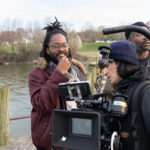
Header image: James (left) on set with his crew. Photo by Dawn Hall.
See more from Jovan James on Instagram and Twitter.
]]>
For an independent filmmaker, recognition from the Sundance Film Festival is a big deal. This past January, Jovan James ’13, visual arts, along with co-director Elegance Bratton, presented their...
https://umbc.edu/stories/jovan-james-13-breaks-through-at-sundance/
https://my3.my.umbc.edu/api/v0/pixel/news/119933/guest@my.umbc.edu/9aa2f18c21e5f5cde2a74908ac484680/api/pixel
alumni
cahss
visual-arts
UMBC News & Magazine
https://my3.my.umbc.edu/groups/umbc-news-magazine
https://assets1-my.umbc.edu/system/shared/avatars/groups/000/001/943/24435aa6207c452e7bc15cc74b42c7bb/xsmall.png?1748556657
https://assets1-my.umbc.edu/system/shared/avatars/groups/000/001/943/24435aa6207c452e7bc15cc74b42c7bb/original.png?1748556657
https://assets2-my.umbc.edu/system/shared/avatars/groups/000/001/943/24435aa6207c452e7bc15cc74b42c7bb/xxlarge.png?1748556657
https://assets2-my.umbc.edu/system/shared/avatars/groups/000/001/943/24435aa6207c452e7bc15cc74b42c7bb/xlarge.png?1748556657
https://assets3-my.umbc.edu/system/shared/avatars/groups/000/001/943/24435aa6207c452e7bc15cc74b42c7bb/large.png?1748556657
https://assets1-my.umbc.edu/system/shared/avatars/groups/000/001/943/24435aa6207c452e7bc15cc74b42c7bb/medium.png?1748556657
https://assets2-my.umbc.edu/system/shared/avatars/groups/000/001/943/24435aa6207c452e7bc15cc74b42c7bb/small.png?1748556657
https://assets1-my.umbc.edu/system/shared/avatars/groups/000/001/943/24435aa6207c452e7bc15cc74b42c7bb/xsmall.png?1748556657
https://assets2-my.umbc.edu/system/shared/avatars/groups/000/001/943/24435aa6207c452e7bc15cc74b42c7bb/xxsmall.png?1748556657
UMBC News & Magazine
0
0
false
Fri, 27 Mar 2020 15:39:27 -0400
Could chloroquine treat coronavirus? 5 questions answered about a promising, problematic and unproven use for an antimalarial drug

by Katherine Seley-Radtke, Professor of Chemistry and Biochemistry, UMBC, and President-Elect of the International Society for Antiviral Research
Read Seley-Radtke’s April 3rd update of this story here.
An Arizona man died, and his wife was hospitalized, after taking a form of chloroquine, which President Trump has touted as an effective treatment for COVID-19. The couple decided to self-medicate with chloroquine phosphate, which they had on hand to kill parasites in their fish, after hearing the president describe the drug as a “game changer.”
Dr. Anthony Fauci, head of NIH’s National Institute for Allergies and Infectious Diseases, quickly corrected the statement, explaining that Trump’s comments were based on anecdotes and not a controlled clinical trial.
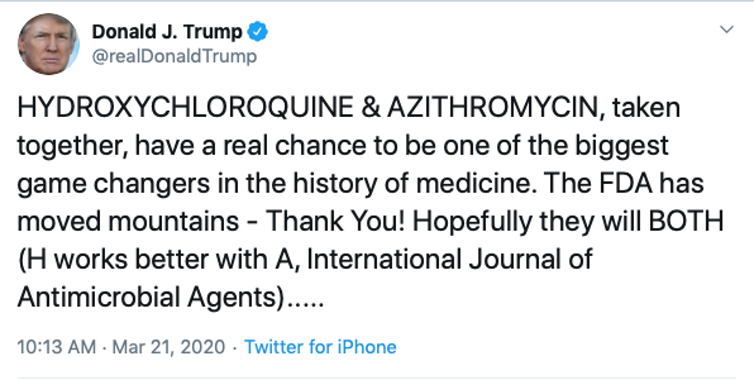 Donald Trump’s Twitter feed.
@realDonaldTrump
I am a medicinal chemist who specializes in discovery and development of antiviral drugs, and I have been actively working on coronaviruses for seven years.
However, because I am a scientist and I deal in facts and evidence-based medicine, I am concerned about the sweeping statements the president has been making regarding the use of chloroquine or the closely related hydroxychloroquine, both antimalarial drugs, as cures for COVID-19. So let’s examine the facts.
What are chloroquine and hydroxychloroquine?
These are both FDA-approved antimalarial drugs that have been in use for many years. Chloroquine was originally developed in 1934 at the pharmaceutical company Bayer and used in World War II to prevent malaria.
Although the FDA has not approved its use for these conditions, both chloroquine and hydroxychloroquine are also used to treat rheumatoid arthritis and lupus.
What triggered talk that this drug might work?
After the initial outbreak of MERS in 2012, scientists conducted random screens of thousands of approved drugs to identify one that might block MERS infection. Several drugs, including chloroquine, showed the ability to block coronaviruses from infecting cells in vitro. But these drugs were not extensively pursued because ultimately they did not show enough activity to be considered further.
When the new coronavirus appeared, many drugs that had shown some initial promise against the related coronaviruses MERS and SARS were at the top of the list as worthy of further evaluation as possible treatments.
So the science is real, and a number of labs around the world are now investigating these drugs and testing them in clinical trials in the U.S., France and China. But so far, there is no consensus about whether the drugs are safe and effective for treating COVID-19, as it is still very early in the testing process.
Why would antimalarial drugs work on a virus?
It is still unclear how the chloroquines (or any antimalarial drug) would work against COVID-19, which is a virus. Malaria is caused by Plasmodium parasites that are spread by mosquitoes, whereas COVID-19 is caused by the SARS-CoV-2 virus.
Viral infections and parasitic infections are very different, and so scientists wouldn’t expect what works for one to work for the other. It has been suggested that the chloroquines can change the acidity at the surface of the cell, thereby preventing the virus from infecting it.
It’s also possible chloroquines help activate the immune response. One study that was just published tested hydroxychloroquine in combination with an antibacterial drug (azithromycin), which worked better to stop the spread of the infection than hydroxychloroquine alone. However it’s only one preliminary study that was done on a limited test group.
Do other drugs show promise?
To my knowledge, no other antimalarial drugs have shown any meaningful activity against treating coronaviruses. However, another potential drug has risen to the forefront. Remdesivir, developed by Gilead Pharmaceuticals, seems to be highly effective at preventing viruses – including coronaviruses such as SARS and MERS, and filoviruses such as Ebola – from replicating.
In late February the National Institute for Allergy and Infectious Diseases launched a clinical trial for Remdesivir. And this month Gilead launched two phase III trials of the drug in medical centers in Asia.
Should I start taking them to ward off coronavirus?
Absolutely not. Chloroquine and hydroxychloroquine have not been appropriately evaluated in controlled studies, not to mention that they have numerous and, in some cases, very deadly side effects.
No one should take a drug that has not been proven to be safe and effective for a disease or condition for which it is not approved. There are just so many issues that can arise, from side effects to serious toxicity and death due to possible interactions with other medications and other underlying health conditions.
So until these or any drugs have been shown to be effective against SARS-CoV-2 in clinical trials and have been approved by the FDA, no one should be self-medicating.
* * * * *
[You need to understand the coronavirus pandemic, and we can help. Read our newsletter.]
Katherine Seley-Radtke, Professor of Chemistry and Biochemistry and President-Elect of the International Society for Antiviral Research, University of Maryland, Baltimore County
Header image: An employee in Nantong, China, checks the production of chloroquine phosphate, an old drug for the treatment of malaria. Feature China/Barcroft Media via Getty Images
This article is republished from The Conversation under a Creative Commons license. Read the original article.
]]>
by Katherine Seley-Radtke, Professor of Chemistry and Biochemistry, UMBC, and President-Elect of the International Society for Antiviral Research Read Seley-Radtke’s April 3rd update of this...
https://umbc.edu/stories/could-chloroquine-treat-coronavirus-5-questions-answered-about-a-promising-problematic-and-unproven-use-for-an-antimalarial-drug/
https://my3.my.umbc.edu/api/v0/pixel/news/119934/guest@my.umbc.edu/17d082b44e3c06233c4b581546903512/api/pixel
chemistry-and-biochemistry
covidresearch
discovery
the-conversation
UMBC News & Magazine
https://my3.my.umbc.edu/groups/umbc-news-magazine
https://assets1-my.umbc.edu/system/shared/avatars/groups/000/001/943/24435aa6207c452e7bc15cc74b42c7bb/xsmall.png?1748556657
https://assets1-my.umbc.edu/system/shared/avatars/groups/000/001/943/24435aa6207c452e7bc15cc74b42c7bb/original.png?1748556657
https://assets2-my.umbc.edu/system/shared/avatars/groups/000/001/943/24435aa6207c452e7bc15cc74b42c7bb/xxlarge.png?1748556657
https://assets2-my.umbc.edu/system/shared/avatars/groups/000/001/943/24435aa6207c452e7bc15cc74b42c7bb/xlarge.png?1748556657
https://assets3-my.umbc.edu/system/shared/avatars/groups/000/001/943/24435aa6207c452e7bc15cc74b42c7bb/large.png?1748556657
https://assets1-my.umbc.edu/system/shared/avatars/groups/000/001/943/24435aa6207c452e7bc15cc74b42c7bb/medium.png?1748556657
https://assets2-my.umbc.edu/system/shared/avatars/groups/000/001/943/24435aa6207c452e7bc15cc74b42c7bb/small.png?1748556657
https://assets1-my.umbc.edu/system/shared/avatars/groups/000/001/943/24435aa6207c452e7bc15cc74b42c7bb/xsmall.png?1748556657
https://assets2-my.umbc.edu/system/shared/avatars/groups/000/001/943/24435aa6207c452e7bc15cc74b42c7bb/xxsmall.png?1748556657
UMBC News & Magazine
0
0
false
Wed, 25 Mar 2020 17:11:16 -0400
Remembering Maurice Berger
Dear UMBC Community,
It is with great sadness that we share with you the passing of Dr. Maurice Berger, chief curator and research professor at UMBC’s Center for Art, Design and Visual Culture (CADVC), who died Sunday, March 22, in Craryville, New York from complications of COVID-19. A path-breaking art historian and curator, Maurice was a fierce advocate for social justice and an exceptionally caring human being. Through his exhibitions and writings, he compelled us to look honestly at issues of race, inequity, and their representations in visual culture.
Dr. Berger resided in New York City and was last on the UMBC campus on January 30.
“Maurice was a beloved member of the UMBC community, one of our most admired and productive scholars,” said UMBC President Freeman A. Hrabowski, III. “For many of us, he was even more than that. He was a special colleague and friend. We will always remember him as a brilliant voice for the arts and justice. The UMBC community so admired him because we shared the same values. He believed in the dignity of humankind and the power of art and history to open our eyes.”
Maurice began his career at UMBC in 1992, organizing a highly successful traveling exhibition entitled
Ciphers of Identity. Since that time, he organized major traveling exhibition projects for the CADVC, including the first traveling retrospectives of noted artists Adrian Piper and Fred Wilson, and the celebrated exhibition
For All the World to See: Visual Culture and the Struggle for Civil Rights, which was organized in partnership with the Smithsonian National Museum of African American History and Culture.
“Mr. Berger is uniquely qualified to lead people through this type of historical reexamination,” remarked The Baltimore Sun in reviewing For All the World to See. “He is critical of labels but identifies himself, among many other things, as Jewish and gay and counts the things he saw growing up among African-American children in a housing project on Manhattan’s Lower East Side as some of his most formative experiences. ‘Every time I do a show,’ says Mr. Berger, ‘I extend my hand to each and every [viewer] and say, I’ll take your hand and help you walk through this.’”
The full reach of Maurice’s creative and scholarly work was remarkable and difficult to quantify. To him, it was every bit as important for his message to touch people in Waconia, Minnesota, or Moscow, Idaho (where For All the World to See was exhibited) as urban centers like Baltimore or New York. He published books, wrote articles, engaged in online events, curated exhibitions, and would engage in conversation with any willing participant.
As chief curator for the CADVC, Maurice played a pivotal role in organizing important exhibition and publication partnerships for the CADVC with cultural institutions such as the Jewish Museum in New York, the International Center for Photography, Yale University Press, The Studio Museum of Harlem, and the Gordon Parks Foundation. His final project with the CADVC, The Museum of the Old Colony, an art installation by Pablo Delano, was exhibited on campus in spring 2020.
In 2018, he received the International Center of Photography’s Infinity Award for Critical Writing and Research for his column
Race Stories, which appeared monthly in
The New York Times. Race Stories explored the relationship of photography to concepts and social issues about race usually neglected by mainstream media. To facilitate the research and creation of Race Stories, Maurice received an Arts Writers Grant from the Andy Warhol Foundation in 2014.
In acknowledgment of his groundbreaking work, Maurice received major grants and awards from the National Endowment for the Humanities, National Endowment for the Arts, Association of Art Museum Curators, the International Association of Art Critics, and an Emmy Award nomination.
Maurice’s publications and exhibitions on race and gender in the United States won international recognition. His writings appeared in Artforum, Art in America, Aperture, National Geographic, Village Voice, Brooklyn Rail, Pen America, Wired, and the Los Angeles Times. His books included White Lies: Race and the Myths of Whiteness (Farrar, Straus and Giroux, 1999), a finalist for the Horace Mann Bond Book Award of the W.E.B. Du Bois Institute for Afro-American Research, Harvard University; and For All the World to See: Visual Culture and the Struggle for Civil Rights (Yale, 2010).
Countless colleagues of Maurice’s in UMBC’s CADVC, department of visual arts, College of Arts, Humanities, and Social Sciences, and elsewhere in the UMBC community have voiced their deep appreciation of his scholarly, as well as personal, contributions to the university. He will be sorely missed.
Maurice is survived by his husband, Marvin Heiferman, known to many in the UMBC community for his work as a senior visiting scholar and organizer of the “Seeing Science” project. Memorial plans will be announced.
Scott Casper, Dean, College of Arts, Humanities and Social Sciences
Symmes Gardner, Executive Director, Center for Art, Design and Visual Culture
]]>
Dear UMBC Community, It is with great sadness that we share with you the passing of Dr. Maurice Berger, chief curator and research professor at UMBC’s Center for Art, Design and Visual Culture...
https://umbc.edu/stories/remembering-maurice-berger/
https://my3.my.umbc.edu/api/v0/pixel/news/119935/guest@my.umbc.edu/938128595996add933829edf052e8d0e/api/pixel
in-memorium
rss
UMBC News & Magazine
https://my3.my.umbc.edu/groups/umbc-news-magazine
https://assets1-my.umbc.edu/system/shared/avatars/groups/000/001/943/24435aa6207c452e7bc15cc74b42c7bb/xsmall.png?1748556657
https://assets1-my.umbc.edu/system/shared/avatars/groups/000/001/943/24435aa6207c452e7bc15cc74b42c7bb/original.png?1748556657
https://assets2-my.umbc.edu/system/shared/avatars/groups/000/001/943/24435aa6207c452e7bc15cc74b42c7bb/xxlarge.png?1748556657
https://assets2-my.umbc.edu/system/shared/avatars/groups/000/001/943/24435aa6207c452e7bc15cc74b42c7bb/xlarge.png?1748556657
https://assets3-my.umbc.edu/system/shared/avatars/groups/000/001/943/24435aa6207c452e7bc15cc74b42c7bb/large.png?1748556657
https://assets1-my.umbc.edu/system/shared/avatars/groups/000/001/943/24435aa6207c452e7bc15cc74b42c7bb/medium.png?1748556657
https://assets2-my.umbc.edu/system/shared/avatars/groups/000/001/943/24435aa6207c452e7bc15cc74b42c7bb/small.png?1748556657
https://assets1-my.umbc.edu/system/shared/avatars/groups/000/001/943/24435aa6207c452e7bc15cc74b42c7bb/xsmall.png?1748556657
https://assets2-my.umbc.edu/system/shared/avatars/groups/000/001/943/24435aa6207c452e7bc15cc74b42c7bb/xxsmall.png?1748556657
UMBC News & Magazine
0
0
false
Wed, 25 Mar 2020 15:00:57 -0400
Extraordinary Times and Extraordinary Community
March 20, 2020
Dear Members of the UMBC Community,
Many are calling this period a defining moment for humankind, and history will judge us by how we respond. As the COVID-19 crisis continues to unfold, we want you to know how proud we are of the ways that our community of inquiring minds has already been adapting. Thank you for all that you are doing to support one another, your families, and fellow citizens during these challenging times.
Campus leaders are meeting daily to navigate this rapidly changing reality, and we are working closely with USM Chancellor Jay Perman, other System campuses, and shared governance groups to plan necessary transitions in teaching, learning, research, and the daily life of our campus community.
We have had difficult decisions to make, and we have made them with the understanding that the health and safety of our community must be our top priority. In partnership with the University System of Maryland, we have determined that this means extending distance learning for the remainder of the spring semester. During this time, UMBC will remain open for student support services and business operations. In accordance with guidance provided by the Governor, employees will continue to work remotely whenever possible.
To our undergraduate and graduate students: We know you have been concerned with what happens next, and we are all feeling for you and with you. There is so much you hoped to do this semester, and it is such a disappointment to have these plans interrupted. Online instruction begins on Monday, March 23, and will continue throughout the semester. Faculty have been working with the Division of Information Technology and each other to ensure the highest quality of instruction.
To the Class of 2020, in particular, please know we recognize how hard you have worked to achieve your goals. We are very sorry that we will not be holding in-person Commencement ceremonies this spring. We know how difficult this is for you, your families, and your friends. Just know this is not the end. We may not be having the in-person ceremony, but we will find ways of recognizing you and celebrating your achievements.
A special thank you to our faculty and staff who have been doing everything they can to provide emotional, academic, and other types of support to our students.Over the coming weeks, patience and understanding will be essential as all of us adjust to these changes. We know that many students, faculty, and staff have questions, and we are committed to providing information and support. Pressing concerns we have heard include the following.
- We know that the shift to distance learning may have financial implications for students and families. We are working closely with USM to establish a system for refunds. We will announce more details in the days to come. Students with immediate resource concerns are encouraged to contact covid19@umbc.edu.
- Students who normally live on campus will soon receive information about the process for safely retrieving their belongings. Until this is established, students who have left campus for spring break will continue to be unable to access their residence halls. Students with an urgent need to retrieve items from their residence halls prior to this announcement may contact Residential Life.
We appreciate your patience and partnership as we move forward together in this new reality. Most important, we hope all of you and your families remain safe and healthy.
We will continue to communicate regularly, and we encourage you to visit UMBC’s COVID-19 website at covid19.umbc.edu for prevention steps, updates, and resources. Urgent questions can be sent to covid19@umbc.edu.
We leave you with these words from Jeanne Rikkers:
May we who are merely inconvenienced,
Remember those whose lives are at stake.
May we who have no risk factors,
Remember the most vulnerable.
May we who have the luxury of working from home,
Remember those who must choose between preserving their health or making their rent.
May we who have flexibility to care for our children when their schools close,
Remember those who have no options.
May we who have to cancel our trips,
Remember those that have no safe place to go.
May we who are losing our margin money in the tumult of the economic market,
Remember those who have no margin at all.
May we who settle in for a quarantine at home,
Remember those who have no home.
As fear grips our country,
Let us choose LOVE.
She concludes by noting that this is a time when we cannot physically wrap our arms around each other, and yet we certainly can find ways of providing a ‘loving embrace’ to our neighbors.
President Freeman Hrabowski and Provost Philip Rous
]]>
March 20, 2020 Dear Members of the UMBC Community, Many are calling this period a defining moment for humankind, and history will judge us by how we respond. As the COVID-19 crisis...
https://umbc.edu/stories/extraordinary-times-and-extraordinary-community/
https://my3.my.umbc.edu/api/v0/pixel/news/119936/guest@my.umbc.edu/438b8691fc768350968b0348d29fb4aa/api/pixel
impact
resilience
UMBC News & Magazine
https://my3.my.umbc.edu/groups/umbc-news-magazine
https://assets1-my.umbc.edu/system/shared/avatars/groups/000/001/943/24435aa6207c452e7bc15cc74b42c7bb/xsmall.png?1748556657
https://assets1-my.umbc.edu/system/shared/avatars/groups/000/001/943/24435aa6207c452e7bc15cc74b42c7bb/original.png?1748556657
https://assets2-my.umbc.edu/system/shared/avatars/groups/000/001/943/24435aa6207c452e7bc15cc74b42c7bb/xxlarge.png?1748556657
https://assets2-my.umbc.edu/system/shared/avatars/groups/000/001/943/24435aa6207c452e7bc15cc74b42c7bb/xlarge.png?1748556657
https://assets3-my.umbc.edu/system/shared/avatars/groups/000/001/943/24435aa6207c452e7bc15cc74b42c7bb/large.png?1748556657
https://assets1-my.umbc.edu/system/shared/avatars/groups/000/001/943/24435aa6207c452e7bc15cc74b42c7bb/medium.png?1748556657
https://assets2-my.umbc.edu/system/shared/avatars/groups/000/001/943/24435aa6207c452e7bc15cc74b42c7bb/small.png?1748556657
https://assets1-my.umbc.edu/system/shared/avatars/groups/000/001/943/24435aa6207c452e7bc15cc74b42c7bb/xsmall.png?1748556657
https://assets2-my.umbc.edu/system/shared/avatars/groups/000/001/943/24435aa6207c452e7bc15cc74b42c7bb/xxsmall.png?1748556657
UMBC News & Magazine
0
0
false
Sat, 21 Mar 2020 17:40:00 -0400
Vodka won’t protect you from coronavirus, and 4 other things to know about hand sanitizer

by Jeffrey Gardner, Associate Professor of Biological Sciences, UMBC
Editor’s note: As concern about coronavirus grows, hand sanitizer is in high demand. Biologist Jeffrey Gardner explains why alcohol is a key ingredient in hand sanitizer, and why he doesn’t recommend making your own supply at home.
1. Why is alcohol the main ingredient in most hand sanitizers?
Alcohol is effective at killing different types of microbes, including both viruses and bacteria, because it unfolds and inactivates their proteins. This process, which is called denaturation, will cripple and often kill the microbe because its proteins will unfold and stick together. Heat can also denature some proteins – for example, when you cook an egg, the solidified egg whites are denatured proteins.
2. Alcohol doesn’t kill some microbes very well – why not?
There are different types of bacteria and viruses, and some types are more easily killed by alcohol. For example, E. coli bacteria, which can cause foodborne illness and other infections, are very effectively killed by alcohol at concentrations over 60%. Differences in the outside surface of various bacteria make alcohol sanitization more effective against some of them than others.
Similarly, some viruses have an outer wrapping, which is called an envelope, while others are non-enveloped. Alcohol is effective at killing enveloped viruses, including the coronavirus, but is less effective at killing non-enveloped viruses.
Whether you are trying to kill bacteria or viruses, many research studies have found that an alcohol concentration of 60% or greater is needed to be effective.
3. If 60% alcohol is good, is 100% better?
Surprisingly, no. Protein denaturation actually works faster when a small amount of water is mixed with the alcohol. And pure alcohol would evaporate too quickly to effectively kill bacteria or viruses on your skin, especially during winter when the air is less humid.
Using 100% alcohol also would dry your skin out very quickly and cause it to become irritated. That might cause you to not sanitize your hands as frequently as needed. This is why most hand sanitizers contain emollients, which are mixtures that help soften and moisturize your skin.
4. Are homemade hand sanitizers a good idea?
In my view, no. You may see do-it-yourself formulas online, including some that use vodka. However, vodka is typically 80 proof, which means it’s only 40% alcohol. That’s not high enough to effectively kill microbes.
The rubbing alcohol you have in your bathroom for cuts and scrapes might seem like a good alternative, but if you are already near a sink, the best choice is to wash your hands with soap and hot water.
5. Does hand sanitizer expire?
Most commercial hand sanitizers are effective for a couple of years when they are stored properly, and are marked with expiration dates. One thing to keep in mind is that alcohol is volatile, which means that over time the alcohol will slowly evaporate and the sanitizer will lose its ability to effectively kill viruses and bacteria. However, with hand sanitizer in such high demand now, you’re unlikely to buy one that is expired.
* * * * *
[You’re smart and curious about the world. So are The Conversation’s authors and editors. You can get our highlights each weekend.]
Jeffrey Gardner, Associate Professor of Biological Sciences, University of Maryland, Baltimore County
This article is republished from The Conversation under a Creative Commons license. Read the original article.
Header image: Soap and hot water is the best way to clean your hands, but sanitizer is a good second choice.
AP Photo/Ric Feld
]]>
by Jeffrey Gardner, Associate Professor of Biological Sciences, UMBC Editor’s note: As concern about coronavirus grows, hand sanitizer is in high demand. Biologist Jeffrey Gardner explains why...
https://umbc.edu/stories/vodka-wont-protect-you-from-coronavirus-and-4-other-things-to-know-about-hand-sanitizer/
https://my3.my.umbc.edu/api/v0/pixel/news/119937/guest@my.umbc.edu/71060ce23857f8cbeb70ab6dbcfb54ff/api/pixel
biology
cnms
covidresearch
discovery
the-conversation
UMBC News & Magazine
https://my3.my.umbc.edu/groups/umbc-news-magazine
https://assets1-my.umbc.edu/system/shared/avatars/groups/000/001/943/24435aa6207c452e7bc15cc74b42c7bb/xsmall.png?1748556657
https://assets1-my.umbc.edu/system/shared/avatars/groups/000/001/943/24435aa6207c452e7bc15cc74b42c7bb/original.png?1748556657
https://assets2-my.umbc.edu/system/shared/avatars/groups/000/001/943/24435aa6207c452e7bc15cc74b42c7bb/xxlarge.png?1748556657
https://assets2-my.umbc.edu/system/shared/avatars/groups/000/001/943/24435aa6207c452e7bc15cc74b42c7bb/xlarge.png?1748556657
https://assets3-my.umbc.edu/system/shared/avatars/groups/000/001/943/24435aa6207c452e7bc15cc74b42c7bb/large.png?1748556657
https://assets1-my.umbc.edu/system/shared/avatars/groups/000/001/943/24435aa6207c452e7bc15cc74b42c7bb/medium.png?1748556657
https://assets2-my.umbc.edu/system/shared/avatars/groups/000/001/943/24435aa6207c452e7bc15cc74b42c7bb/small.png?1748556657
https://assets1-my.umbc.edu/system/shared/avatars/groups/000/001/943/24435aa6207c452e7bc15cc74b42c7bb/xsmall.png?1748556657
https://assets2-my.umbc.edu/system/shared/avatars/groups/000/001/943/24435aa6207c452e7bc15cc74b42c7bb/xxsmall.png?1748556657
UMBC News & Magazine
0
0
false
Fri, 13 Mar 2020 18:14:50 -0400
UMBC historian Anne Rubin examines food scarcity in the Confederate South through NEH fellowship

“Historians know that the Confederacy ran out of food by the end of the Civil War, and it shouldn’t have because it was an agricultural society,” says Anne Rubin, professor of history at UMBC. “I want to understand the causes of this, and the lived experience of different social classes during this time.”
Rubin has just received a 2020 – 2021 National Endowment for the Humanities (NEH) fellowship to write a book examining how food shortages in the South affected wealthy and poor people, both white and black, during and after the Civil War, ultimately shaping Southern foodways.
 Anne Rubin. Photo by Marlayna Demond ’11 for UMBC.
Rubin’s award follows an NEH grant received last year by her colleague Susan McDonough, assistant professor of history, whose award supported more inclusive research on medieval women.
Everyday documents as research tools
A resurgence in the popularity of Southern foods inspired Rubin to take a closer look at Southerners’ experiences with food during the Civil War. “There is a real nostalgia when people talk about heritage pork and heritage grains,” she reflects. “I want to cut through that. This kind of reverence for the past does not include a conversation of who was preparing the food or any of the racialized aspects of Southern cooking.”
Rubin will research the differences between rural and urban food scarcity, and how that scarcity was felt by people at different places in society. There were white elites that for the first time had to manage with ingredients they deemed subpar. There were also enslaved people who had to continue cooking for elite whites and for themselves with less and less food.
Rubin will also explore the experiences of poor whites, who may have already had to adjust their diets drastically as resources waned, and the 500,000 African Americans who fled to the Union Army, where they were given inadequate rations and suffered from sickness and malnutrition. All of these changes influenced the strategies Southerners used to modify traditional recipes, replacing inaccessible ingredients with alternatives.

A page from Mrs. Prudence M. Sutherland’s handwritten cookbook. Virginia Museum of History and Culture. Photo courtesy of Rubin.
“A lot of the scarcity has to do with questions of supply,” explains Rubin. “Research shows that wealthy people in the South who were used to cooking with white flour and white sugar began to make substitutions with ingredients usually reserved for the poor, like molasses and cornmeal.” Recipe adaptations were recorded in homemade recipe books, letters, diaries, relief receipts, and ration logs from army camps.
Her research thus far also shows that the adaptations made by elite white Southerners became a way to show allegiance with the Confederacy. Southerners accepted not being able to have coffee and were willing to make other sacrifices as long as it meant the Confederacy could keep fighting.
“These responses create a narrative of patriotism and nationalism around food,” shares Rubin. “There is an intention of using food and the history of food as a way to express loyalty to the Confederacy. But the experience of African Americans, poor whites, and elites varied drastically.”
Surviving famine and starvation
Two key questions Rubin hopes to answer focus on the management of food: Why did an agricultural society struggle to feed its citizens? And how did people survive the compounding effects of the 1867 famine that followed the Civil War, caused by crop failure?
“Part of my research is looking at the response of the Freedmen’s Bureau to feed African Americans. I also explore the work of elite Northerners providing relief,” explains Rubin.
Next, she will travel to archives in North Carolina, Louisiana, and other states in the South to piece together a social network analysis. This will help her better understand those affected by food scarcity in the South, those who provided help, who was receiving help, and what kind of help they were receiving.

Rations issued by the Freedmen’s Bureau at Fort Smith Arkansas, June-July, 1867. National Archives. Photo courtesy of Rubin.
The historian’s toolbox
Rubin teaches a Civil War and Reconstruction class as well as two Southern history classes—one that goes through the Civil War and one that starts with emancipation. She wants to share with her students the research methods she is using to develop this book, to broaden their sense of how we can learn about the past by looking beyond military history.
“I research people who don’t always leave letters or diaries, but can be found through a receipt for the food they were given,” says Rubin. “I want students to think of food history as another tool in the historian’s toolbox—that you can look at a recipe and you can piece together a whole social network from it.”
This approach to history is also reflected in Rubin’s work as associate director of UMBC’s Imaging Research Center, known for providing visually immersive websites and exhibits that bring a greater understanding to historical events.
Continuing excellence in historical research
Rubin’s award is one of several that faculty in the history department have received this year, honoring and advancing their scholarship in a broad range of subject areas.
Constantine Vaporis will soon be a fellow in residence at the Institute for Advanced Study in Princeton, New Jersey. Vaporis is both a professor of history and director of Asian studies. He will research portraits of Samurai in early modern Japan.
Christy Chapin, associate professor of history, has won an American Council of Learned Societies fellowship for her research on flexible finance. She previously received a Kluge Fellowship to study the banking and finance collections at the U.S. Library of Congress.
Banner image: Rubin at The Humanities Teaching Lab: Frederick Douglass Day. Photo by Marlayna Demond ’11 for UMBC.
]]>
“Historians know that the Confederacy ran out of food by the end of the Civil War, and it shouldn’t have because it was an agricultural society,” says Anne Rubin, professor of history at UMBC. “I...
https://umbc.edu/stories/umbc-historian-anne-rubin-examines-food-scarcity-in-the-confederate-south-through-neh-fellowship/
https://my3.my.umbc.edu/api/v0/pixel/news/119938/guest@my.umbc.edu/3fcf089b66e2d05116b3ae9feda8118f/api/pixel
cahss
history
policy-and-society
research
UMBC News & Magazine
https://my3.my.umbc.edu/groups/umbc-news-magazine
https://assets1-my.umbc.edu/system/shared/avatars/groups/000/001/943/24435aa6207c452e7bc15cc74b42c7bb/xsmall.png?1748556657
https://assets1-my.umbc.edu/system/shared/avatars/groups/000/001/943/24435aa6207c452e7bc15cc74b42c7bb/original.png?1748556657
https://assets2-my.umbc.edu/system/shared/avatars/groups/000/001/943/24435aa6207c452e7bc15cc74b42c7bb/xxlarge.png?1748556657
https://assets2-my.umbc.edu/system/shared/avatars/groups/000/001/943/24435aa6207c452e7bc15cc74b42c7bb/xlarge.png?1748556657
https://assets3-my.umbc.edu/system/shared/avatars/groups/000/001/943/24435aa6207c452e7bc15cc74b42c7bb/large.png?1748556657
https://assets1-my.umbc.edu/system/shared/avatars/groups/000/001/943/24435aa6207c452e7bc15cc74b42c7bb/medium.png?1748556657
https://assets2-my.umbc.edu/system/shared/avatars/groups/000/001/943/24435aa6207c452e7bc15cc74b42c7bb/small.png?1748556657
https://assets1-my.umbc.edu/system/shared/avatars/groups/000/001/943/24435aa6207c452e7bc15cc74b42c7bb/xsmall.png?1748556657
https://assets2-my.umbc.edu/system/shared/avatars/groups/000/001/943/24435aa6207c452e7bc15cc74b42c7bb/xxsmall.png?1748556657
UMBC News & Magazine
0
0
false
Tue, 10 Mar 2020 21:20:26 -0400
UMBC leads research team to study COVID-19-related discrimination against Chinese Americans
As the COVID-19 outbreak originating in China has spread to populations across all continents except Antarctica, racism and discrimination against Chinese-American people have also increased. A team of researchers from UMBC and the University of Maryland, College Park (UMD) just received a Rapid Response Research (RAPID) grant from the National Science Foundation to examine this intensified discrimination. They are also researching Chinese-American families’ coping strategies.
This research is led by PI Charissa Cheah, professor of psychology at UMBC. Her co-investigators are Shimei Pan, assistant professor of information systems at UMBC, and Cixin Wang, assistant professor of school psychology at UMD. Their study, “RAPID: Influences of the Coronavirus (COVID-19) Outbreak on Racial Discrimination, Identity Development and Socialization,” is the one of first NSF research awards granted to examine the COVID-19 outbreak.

Charissa Cheah.
Cheah, Pan, and Wang will collect data on public opinion, the social climate, and the experiences of Chinese-American families. They seek to capture the current moment and make it possible for future researchers to study this phenomenon in the longer term.
“The negative impact of infectious diseases on psychological health is understudied but highly significant, especially for minority groups linked to the disease through social group categorization,” says Cheah. She explains, “The results from this study will significantly contribute to our understanding of risk and resilience processes among parents and children under conditions of an acute but prolonged health and social threat.”
Understanding the impact
As social scientists, Cheah and Wang will conduct focus groups and surveys to understand how various forms of racial discrimination connected to the COVID-19 outbreak are impacting families, particularly the identity development and adjustment of Chinese-American children. After the initial research phase, they will complete follow-up research six to nine months later to learn how parents have helped socialize their children and offered coping strategies around issues of race, identity, and psychosocial adjustment, in response to discrimination.
Pan, a computer scientist, will lead the analysis of outbreak-related Twitter posts to understand how public opinion, including anxiety and discriminatory attitudes, change as the outbreak intensifies or slows. Pan will apply large-scale social media analytics to study Twitter data from late 2019 onward, to ensure she captures posts from the moment the COVID-19 outbreak began.

Shimei Pan
The research is significant to Pan on a personal level, as a Chinese American and a parent. “I am aware of the related events and sentiments expressed in the news. As a parent to a Chinese American teenage son, I wonder how this experience will influence his identity formation now and as an adult,” she shares.
This project will also provide graduate and undergraduate students with an opportunity to conduct culturally-sensitive research with racial and ethnic minority families using multi-method and interdisciplinary approaches.

Cixin Wang. Photo courtesy of UMD.
“As a researcher focusing on bullying and mental health, I have seen and heard about discrimination towards Chinese-American and other Asian-American students, and increased anxiety related to COVID-19,” says Wang. “We aim to study the unfolding outbreak and related discrimination against Chinese Americans and other Asian populations to identify specific ways to promote resilience and support children and families during this challenging time.”
Cheah values the opportunity to do research that will immediately impact an urgent real-world issue, and also have a lasting impact on communities. She notes, “Knowledge from this RAPID grant will help educators, health care providers, and policymakers to proactively support targeted marginalized groups and the larger public during future emergency events.”
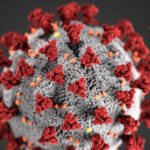
Banner image: The coronavirus. Image by Alachua County, used under Public Domain Mark 1.0.
]]>
As the COVID-19 outbreak originating in China has spread to populations across all continents except Antarctica, racism and discrimination against Chinese-American people have also increased. A...
https://umbc.edu/stories/umbc-umd-researchers-to-study-covid-19-related-discrimination-against-chinese-americans/
https://my3.my.umbc.edu/api/v0/pixel/news/119939/guest@my.umbc.edu/2b4f4e8c9f2aaa2d14f6ba35c37d0fb3/api/pixel
cahss
coeit
covidresearch
is
page1
policy-and-society
psychology
science-and-technology
UMBC News & Magazine
https://my3.my.umbc.edu/groups/umbc-news-magazine
https://assets1-my.umbc.edu/system/shared/avatars/groups/000/001/943/24435aa6207c452e7bc15cc74b42c7bb/xsmall.png?1748556657
https://assets1-my.umbc.edu/system/shared/avatars/groups/000/001/943/24435aa6207c452e7bc15cc74b42c7bb/original.png?1748556657
https://assets2-my.umbc.edu/system/shared/avatars/groups/000/001/943/24435aa6207c452e7bc15cc74b42c7bb/xxlarge.png?1748556657
https://assets2-my.umbc.edu/system/shared/avatars/groups/000/001/943/24435aa6207c452e7bc15cc74b42c7bb/xlarge.png?1748556657
https://assets3-my.umbc.edu/system/shared/avatars/groups/000/001/943/24435aa6207c452e7bc15cc74b42c7bb/large.png?1748556657
https://assets1-my.umbc.edu/system/shared/avatars/groups/000/001/943/24435aa6207c452e7bc15cc74b42c7bb/medium.png?1748556657
https://assets2-my.umbc.edu/system/shared/avatars/groups/000/001/943/24435aa6207c452e7bc15cc74b42c7bb/small.png?1748556657
https://assets1-my.umbc.edu/system/shared/avatars/groups/000/001/943/24435aa6207c452e7bc15cc74b42c7bb/xsmall.png?1748556657
https://assets2-my.umbc.edu/system/shared/avatars/groups/000/001/943/24435aa6207c452e7bc15cc74b42c7bb/xxsmall.png?1748556657
UMBC News & Magazine
0
0
false
Fri, 06 Mar 2020 19:50:58 -0500
International team led by UMBC identifies new bird species in the South Pacific

In the 1930s, famed biologist Ernst Mayr became the first to study Pacific Robins. Based on his observations of the robins and other birds on Australia and its outlying islands, he developed foundational concepts that continue to inform the study of evolution. He took copious notes on the birds’ physical characteristics, behaviors, and habitats. Always, he described the robin populations as a single species, albeit with significant variation from island to island.
Ernst Mayr made lasting contributions to evolutionary biology—but like most scientists, he wasn’t right about everything.
Bold new claims
Anna Kearns is a former UMBC postdoctoral fellow now at the Smithsonian Institution’s Conservation Biology Institute. With her UMBC postdoc advisor Kevin Omland and other colleagues, she has conducted new investigations into the relationships among Pacific Robins on various islands using many of the same bird specimens Mayr himself used. The difference is, “He would have mainly been just using his eyes” to compare specimens, Kearns says. She and her colleagues have had the advantage of major advances in technology since Mayr’s time.
 Anna Kearns in the collections of the American Museum of Natural History in New York. These robin specimens were collected almost 100 years ago by Ernst Mayr and others, and have proven invaluable to the modern study of the birds’ evolution. Photo courtesy Anna Kearns.
Kearns has built on Mayr’s work by using techniques like DNA sequencing and spectrophotometry, which quantitatively compares the hue, brightness, and saturation of feathers. She has come to a more nuanced understanding of the relationships between, say, a robin on Fiji and one on the Solomon Islands.
As a result of this research, Kearns and colleagues from UMBC, the Australian National Wildlife Collection, Australian Centre for Ancient DNA, and the Smithsonian National Museum of Natural History are making bold new claims about the relationships between these birds. In a 2015 paper in Conservation Genetics, Kearns demonstrated that robins living on Norfolk Island, directly east of mainland Australia, are a distinct species from the rest. A new paper in the Journal of Avian Biology published this month indicates two more unique species—one that inhabits the Solomon and Bougainville Islands, and another that lives on Fiji, Vanuatu, and Samoa.
Preserving biodiversity
The new work demonstrates just how much is still unknown about avian biodiversity. “Even in this well-studied group of birds, that’s been a textbook example since 1942, we did not really know what the units of biodiversity were,” says Omland, professor of biological sciences at UMBC, and senior author on the new paper.
 Kevin Omland, second from right, discusses research with a few of his students. Photo by Marlayna Demond ’11 for UMBC.
Understanding those “units of biodiversity” is critical for conservation. When all the Pacific Robins and mainland Australia’s Scarlet Robin were considered a single species (a single unit of biodiversity), the loss of the birds on one or two islands would be unfortunate, but not necessarily very impactful. If those birds were actually the only remaining members of a unique species, however, the same loss becomes catastrophic.
“What Anna’s work is showing is that the bird populations on these islands have very distinctive traits,” Omland adds, “so just knowing what the biodiversity is that we want to conserve is super important.”
Unpredictable patterns
The team’s work indicates that all the Pacific Robins are descended from an ancestral Australian population where males were brightly-colored and females were dull-colored. But as small groups of robins colonized the outlying islands, the population on each island took its own evolutionary path. Today, some island groups still maintain the bright male and dull female pattern, but on other islands both sexes have evolved bright coloration. On other islands, both sexes have evolved dull coloration.
 This figure from the new paper visually explains the location and coloration patterns of the different robins that Kearns, Omland, and their colleagues studied.
“When you look at the genetics, you find two distinct lineages” leading from the common ancestor to all the island populations that exist today, Kearns says. “So that means these patterns have evolved independently multiple times.”
Kearns and Omland think the changes have more to do with random forces than evolutionary adaptation. “If we flipped two coins, this is about what we’d expect,” Omland says.
For example, the pattern an island’s population ended up with could depend on the color of the individuals that happened to get blown onto that island initially. Also, in a very small population, the random way genes are redistributed from generation to generation can have a significant impact—as much of an effect or more than natural selection.
Detective work
Kearns and Omland are both excited to have the opportunity to suggest names for the new species they’ve identified. Kearns suggests “Mayr’s Robin” for the Fiji/Vanuatu/Samoa population, in honor of Ernst Mayr’s pioneering study of these birds.
 These robins are in the American Museum of Natural History in New York City, where Kearns conducted much of her research. Some of the handwritten notes are from Ernst Mayr himself in the 1930s. Photo courtesy Anna Kearns.
But their contribution to ornithology is more than a name. “Because these birds are all on very small isolated islands, and Pacific birds are often on many, many, many isolated islands, collecting is very difficult. So there haven’t actually been that many comprehensive studies,” Kearns says. Revealing the complexity of the relationships among these robins adds much-needed information to the field. It also raises the prospect that other birds—especially those on islands—might have undergone similar, as-yet-unstudied, evolutionary processes.
The work is a unique blend of past and present. “You really wouldn’t be able to do this study without using these old collections,” Kearns says. At the same time, discovering the new species also wouldn’t have been possible without modern techniques.
“It’s kind of like detective work in a way,” Kearns says. “I feel like there’s just so much more we need to know about it. But we feel like we have made a big step forward.”
Banner image: Kevin Omland (rear) goes birdwatching at UMBC’s Library Pond with a group of his students. Photo by Marlaynd Demond ’11 for UMBC.
]]>
In the 1930s, famed biologist Ernst Mayr became the first to study Pacific Robins. Based on his observations of the robins and other birds on Australia and its outlying islands, he developed...
https://umbc.edu/stories/international-team-led-by-umbc-identifies-new-bird-species-in-the-south-pacific/
https://my3.my.umbc.edu/api/v0/pixel/news/119940/guest@my.umbc.edu/7da42a28b3ebb3a1e1dee5a7e4da1dd7/api/pixel
biology
cnms
gradresearch
research
science-and-technology
UMBC News & Magazine
https://my3.my.umbc.edu/groups/umbc-news-magazine
https://assets1-my.umbc.edu/system/shared/avatars/groups/000/001/943/24435aa6207c452e7bc15cc74b42c7bb/xsmall.png?1748556657
https://assets1-my.umbc.edu/system/shared/avatars/groups/000/001/943/24435aa6207c452e7bc15cc74b42c7bb/original.png?1748556657
https://assets2-my.umbc.edu/system/shared/avatars/groups/000/001/943/24435aa6207c452e7bc15cc74b42c7bb/xxlarge.png?1748556657
https://assets2-my.umbc.edu/system/shared/avatars/groups/000/001/943/24435aa6207c452e7bc15cc74b42c7bb/xlarge.png?1748556657
https://assets3-my.umbc.edu/system/shared/avatars/groups/000/001/943/24435aa6207c452e7bc15cc74b42c7bb/large.png?1748556657
https://assets1-my.umbc.edu/system/shared/avatars/groups/000/001/943/24435aa6207c452e7bc15cc74b42c7bb/medium.png?1748556657
https://assets2-my.umbc.edu/system/shared/avatars/groups/000/001/943/24435aa6207c452e7bc15cc74b42c7bb/small.png?1748556657
https://assets1-my.umbc.edu/system/shared/avatars/groups/000/001/943/24435aa6207c452e7bc15cc74b42c7bb/xsmall.png?1748556657
https://assets2-my.umbc.edu/system/shared/avatars/groups/000/001/943/24435aa6207c452e7bc15cc74b42c7bb/xxsmall.png?1748556657
UMBC News & Magazine
0
0
false
Fri, 06 Mar 2020 18:36:22 -0500
Chronicling history’s unsung heroes – Kristina Gaddy ’09
Venturing into a Gestapo interrogation cell is not the way many people would choose to do research.
Nevertheless, Kristina R. Gaddy ’09, history and modern languages and linguistics, felt it was crucial to the process of writing her first book, Flowers in the Gutter. The book tells the true account of the Edelweiss Pirates, German teenagers who resisted the Nazi regime with acts from playing forbidden music to disseminating anti-Nazi flyers.
The kind of stories we need
 “There’s a lot of dystopian fiction out there of kids living in an awful world and trying to resist and I always imagine this is the real-life story of kids living in dystopia. What would you actually be doing?” says Gaddy.
Sadly, these stories often ended up in interrogation cells like the preserved one Gaddy visited in Cologne, Germany. “It was really important for me to go to those spaces and experience them as they would have experienced them,” says Gaddy. She also used the trip to dive deep into archives from the time, all in German. It was a chilling and often depressing experience, she says, but it was also part of understanding the pirates’ little-known movement.
While “there’s been so much written about World War II,” Gaddy says that “there are still things that are needed to be written.” Many people know about the White Rose resistance movement, she says, but much of Edelweiss Pirates’ story has remained untold. “We think it’s just natural that you do something heroic and people are going to just say that it’s wonderful [but] that’s not the reality,” she says.
In documenting the teens’ rebellious acts, Gaddy also highlights just how relatable they are. They wore strange clothes and played their own kind of music and had an irreverence that Gaddy says she found appealing.
“It just felt like alright, this is so compelling, this is the kind of stories that we need,” says Gaddy.
Honing her skills
 Figuring out how to tell those stories was a process that started at UMBC. Gaddy graduated in 2009 with degrees in history and modern languages and linguistics before going on to an MFA degree from Goucher College in creative nonfiction writing. Her work has been published in a variety of places including The Washington Post, The Baltimore Sun, Bitch Magazine, and for her first paid publication, UMBC Magazine.
“The type of writing I am interested in doing wouldn’t be possible without the background in history at UMBC,” says Gaddy. “All the research, that’s 100% something I learned to do at UMBC, in terms of writing research papers, getting primary sources, and going in the archives.” All her primary sources being in German called for language skills she honed during her undergraduate years both at UMBC and during a semester abroad in Berlin.
To look critically at history, Gaddy found she also needed to recall her lessons in historiography, or the study of why and how historical stories are told. She says that UMBC history professors Denise Meringolo and Kate Brown helped her ask the questions of “how do we remember this? What is it we are looking at and how is it that different people experience that differently or the same? If we’re then presenting what we know about it, how are we changing the perception as we’re doing that?”
Meringolo says Gaddy distinguished herself early on as a student through her talents in writing and her creative thinking.
“I fully expected that Kristina would pursue a career as a public historian after graduation,” says Meringolo. “Arguably, by becoming a writer of creative non-fiction, she is working as a public historian. Her book tells a true story, and she has worked to identify its most provocative and meaningful core. She has also thought carefully about her intended audience, seeking to understand what they care about and how this story might help transform the ‘foreign country’ of the past into a familiar and meaningful landscape. I am proud of her and I am enormously proud to have played a small role in her life.”
“This is real life”
Gaddy’s book is coming at a time when these questions are more relevant than ever. In fact, she started to work on it during the summer of 2016, when “it felt incredibly timely in terms of political climate and what’s going on. As I was working on it, it was almost like it can’t get any timelier, but it kept getting timelier.”
Her target audience of today’s young adults includes everyone from those protesting in the streets to those who are using racial epithets. She hopes that teachers might use her book in their classes.
“I really feel strongly about non-fiction that it’s a really compelling way to tell stories – this is not a fantasy, this is real life, this is what really happened,” she says. “I hope people feel a little bit inspired by what these kids did and what kind of lessons we can take from their actions and put it into our lives.”
by Karen Stysley
* * * * *
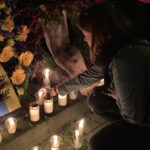
Header image: Gaddy places a candle at the memorial to the Edelweiss Pirates, November 2019.
]]>
Venturing into a Gestapo interrogation cell is not the way many people would choose to do research. Nevertheless, Kristina R. Gaddy ’09, history and modern languages and linguistics, felt it...
https://umbc.edu/stories/chronicling-historys-unsung-heroes-kristina-gaddy-09/
https://my3.my.umbc.edu/api/v0/pixel/news/119941/guest@my.umbc.edu/e59659de33ef265a77a787506a166f55/api/pixel
alumni
alumni-profile
cahss
history
mlli
spring-2020
UMBC News & Magazine
https://my3.my.umbc.edu/groups/umbc-news-magazine
https://assets1-my.umbc.edu/system/shared/avatars/groups/000/001/943/24435aa6207c452e7bc15cc74b42c7bb/xsmall.png?1748556657
https://assets1-my.umbc.edu/system/shared/avatars/groups/000/001/943/24435aa6207c452e7bc15cc74b42c7bb/original.png?1748556657
https://assets2-my.umbc.edu/system/shared/avatars/groups/000/001/943/24435aa6207c452e7bc15cc74b42c7bb/xxlarge.png?1748556657
https://assets2-my.umbc.edu/system/shared/avatars/groups/000/001/943/24435aa6207c452e7bc15cc74b42c7bb/xlarge.png?1748556657
https://assets3-my.umbc.edu/system/shared/avatars/groups/000/001/943/24435aa6207c452e7bc15cc74b42c7bb/large.png?1748556657
https://assets1-my.umbc.edu/system/shared/avatars/groups/000/001/943/24435aa6207c452e7bc15cc74b42c7bb/medium.png?1748556657
https://assets2-my.umbc.edu/system/shared/avatars/groups/000/001/943/24435aa6207c452e7bc15cc74b42c7bb/small.png?1748556657
https://assets1-my.umbc.edu/system/shared/avatars/groups/000/001/943/24435aa6207c452e7bc15cc74b42c7bb/xsmall.png?1748556657
https://assets2-my.umbc.edu/system/shared/avatars/groups/000/001/943/24435aa6207c452e7bc15cc74b42c7bb/xxsmall.png?1748556657
UMBC News & Magazine
0
0
false
Thu, 05 Mar 2020 14:00:32 -0500
 Photo by Carl Mikoy. Used under CC BY 2.0
 Photo by Kyler Kwock. Used under CC BY-ND 2.0