Massive IT outage spotlights major vulnerabilities in the global information ecosystem

Written by Richard Forno, principal lecturer in computer science and electrical engineering, UMBC
The global information technology outage on July 19, 2024, that paralyzed organizations ranging from airlines to hospitals and even the delivery of uniforms for the Olympic Games represents a growing concern for cybersecurity professionals, businesses and governments.
The outage is emblematic of the way organizational networks, cloud computing services and the internet are interdependent, and the vulnerabilities this creates. In this case, a faulty automatic update to the widely used Falcon cybersecurity software from CrowdStrike caused PCs running Microsoft’s Windows operating system to crash. Unfortunately, many servers and PCs need to be fixed manually, and many of the affected organizations have thousands of them spread around the world.
For Microsoft, the problem was made worse because the company released an update to its Azure cloud computing platform at roughly the same time as the CrowdStrike update. Microsoft, CrowdStrike and other companies like Amazon have issued technical work-arounds for customers willing to take matters into their own hands. But for the vast majority of global users, especially companies, this isn’t going to be a quick fix.
Modern technology incidents, whether cyberattacks or technical problems, continue to paralyze the world in new and interesting ways. Massive incidents like the CrowdStrike update fault not only create chaos in the business world but disrupt global society itself. The economic losses resulting from such incidents – lost productivity, recovery, disruption to business and individual activities – are likely to be extremely high.
As a former cybersecurity professional and current security researcher, I believe that the world may finally be realizing that modern information-based society is based on a very fragile foundation.
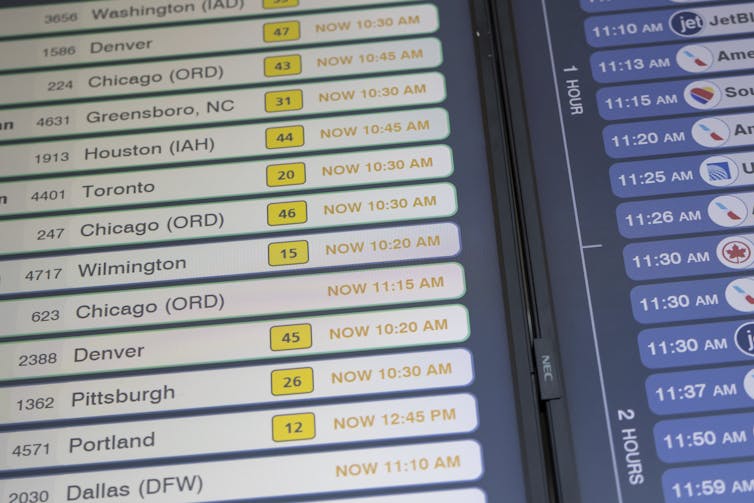 The outage led to thousands of flight delays on July 19, 2024. AP Photo/Yuki Iwamura
The bigger picture
Interestingly, on June 11, 2024, a post on CrowdStrike’s own blog seemed to predict this very situation – the global computing ecosystem compromised by one vendor’s faulty technology – though they probably didn’t expect that their product would be the cause.
Software supply chains have long been a serious cybersecurity concern and potential single point of failure. Companies like CrowdStrike, Microsoft, Apple and others have direct, trusted access into organizations’ and individuals’ computers. As a result, people have to trust that the companies are not only secure themselves, but that the products and updates they push out are well-tested and robust before they’re applied to customers’ systems. The SolarWinds incident of 2019, which involved hacking the software supply chain, may well be considered a preview of today’s CrowdStrike incident.
CrowdStrike CEO George Kurtz said “this is not a security incident or cyberattack” and that “the issue has been identified, isolated and a fix has been deployed.” While perhaps true from CrowdStrike’s perspective – they were not hacked – it doesn’t mean the effects of this incident won’t create security problems for customers. It’s quite possible that in the short term, organizations may disable some of their internet security devices to try and get ahead of the problem, but in doing so they may have opened themselves up to criminals penetrating their networks.
It’s also likely that people will be targeted by various scams preying on user panic or ignorance regarding the issue. Overwhelmed users might either take offers of faux assistance that lead to identity theft, or throw away money on bogus solutions to this problem.
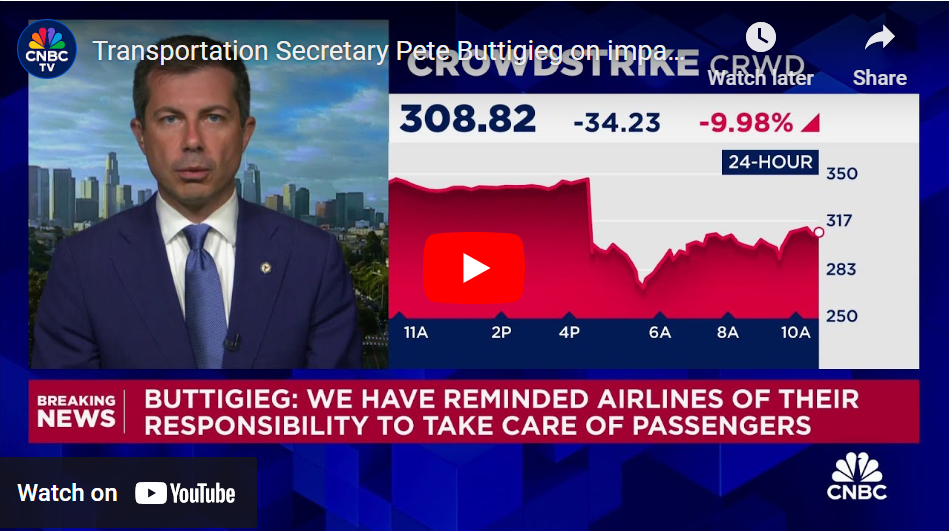 Transportation Secretary Pete Buttigieg explains the effects of the outage on airlines and other transportation systems.
What to do
Organizations and users will need to wait until a fix is available or try to recover on their own if they have the technical ability. After that, I believe there are several things to do and consider as the world recovers from this incident.
Companies will need to ensure that the products and services they use are trustworthy. This means doing due diligence on the vendors of such products for security and resilience. Large organizations typically test any product upgrades and updates before allowing them to be released to their internal users, but for some routine products like security tools, that may not happen.
Governments and companies alike will need to emphasize resilience in designing networks and systems. This means taking steps to avoid creating single points of failure in infrastructure, software and workflows that an adversary could target or a disaster could make worse. It also means knowing whether any of the products organizations depend on are themselves dependent on certain other products or infrastructures to function.
Organizations will need to renew their commitment to best practices in cybersecurity and general IT management. For example, having a robust backup system in place can make recovery from such incidents easier and minimize data loss. Ensuring appropriate policies, procedures, staffing and technical resources is essential.
Problems in the software supply chain like this make it difficult to follow the standard IT recommendation to always keep your systems patched and current. Unfortunately, the costs of not keeping systems regularly updated now have to be weighed against the risks of a situation like this happening again.
This article is republished from The Conversation under a Creative Commons license. Read the original article and see more than 250 UMBC articles available in The Conversation.
]]>
Written by Richard Forno, principal lecturer in computer science and electrical engineering, UMBC The global information technology outage on July 19, 2024, that paralyzed organizations...
https://umbc.edu/stories/massive-it-outage-spotlights-major-vulnerabilities-in-the-global-information-ecosystem/
https://my3.my.umbc.edu/api/v0/pixel/news/142876/guest@my.umbc.edu/6fa07b0e8478a717e68cfaad43f21ee5/api/pixel
coeit
discovery
magazine
story
the-conversation
UMBC News & Magazine
https://my3.my.umbc.edu/groups/umbc-news-magazine
https://assets1-my.umbc.edu/system/shared/avatars/groups/000/001/943/24435aa6207c452e7bc15cc74b42c7bb/xsmall.png?1748556657
https://assets1-my.umbc.edu/system/shared/avatars/groups/000/001/943/24435aa6207c452e7bc15cc74b42c7bb/original.png?1748556657
https://assets2-my.umbc.edu/system/shared/avatars/groups/000/001/943/24435aa6207c452e7bc15cc74b42c7bb/xxlarge.png?1748556657
https://assets2-my.umbc.edu/system/shared/avatars/groups/000/001/943/24435aa6207c452e7bc15cc74b42c7bb/xlarge.png?1748556657
https://assets3-my.umbc.edu/system/shared/avatars/groups/000/001/943/24435aa6207c452e7bc15cc74b42c7bb/large.png?1748556657
https://assets1-my.umbc.edu/system/shared/avatars/groups/000/001/943/24435aa6207c452e7bc15cc74b42c7bb/medium.png?1748556657
https://assets2-my.umbc.edu/system/shared/avatars/groups/000/001/943/24435aa6207c452e7bc15cc74b42c7bb/small.png?1748556657
https://assets1-my.umbc.edu/system/shared/avatars/groups/000/001/943/24435aa6207c452e7bc15cc74b42c7bb/xsmall.png?1748556657
https://assets2-my.umbc.edu/system/shared/avatars/groups/000/001/943/24435aa6207c452e7bc15cc74b42c7bb/xxsmall.png?1748556657
UMBC News & Magazine
1
0
false
Fri, 19 Jul 2024 15:46:13 -0400
Fri, 19 Jul 2024 15:46:13 -0400
Karen Chen wins NSF CAREER award to build tools to empower students with data
When Karen Chen’s now teenage son was in third grade, he would complain that math homework was “boring.” Chen wanted to change his perspective. She presented him with extracurricular math problems and coached him through the most challenging ones. Being a data scientist, she also recorded the sessions and rigorously analyzed the video and audio for insights about his learning experience. One of her key takeaways: Her son rode an emotional roller coaster as he worked through difficult problems. Her attentive tutoring helped him through the confusion and frustration to reach the joy at the end.
Since the project with her son eight years ago, Chen, an assistant professor in the Department of Information Systems at UMBC, has made learning analytics a pillar of her research. The field seeks to collect and analyze data about students and their environment with the goal of improving learning outcomes. Chen recently won a National Science Foundation (NSF) CAREER award to advance this research with a new project that puts students at the center of learning analytics—not just as subjects who supply data, but also as the designers of analytical tools and users of the insights they provide.
Chen’s CAREER award marks the 50th time a UMBC faculty member has received the prestigious grant, which the NSF established to support early-career faculty who have the potential to serve as leaders in integrating research and education.
“I’m really excited about this project,” Chen says. “I love teaching and interdisciplinary research and this is an excellent opportunity to combine them.”
Learning analytics, “for students, by students”
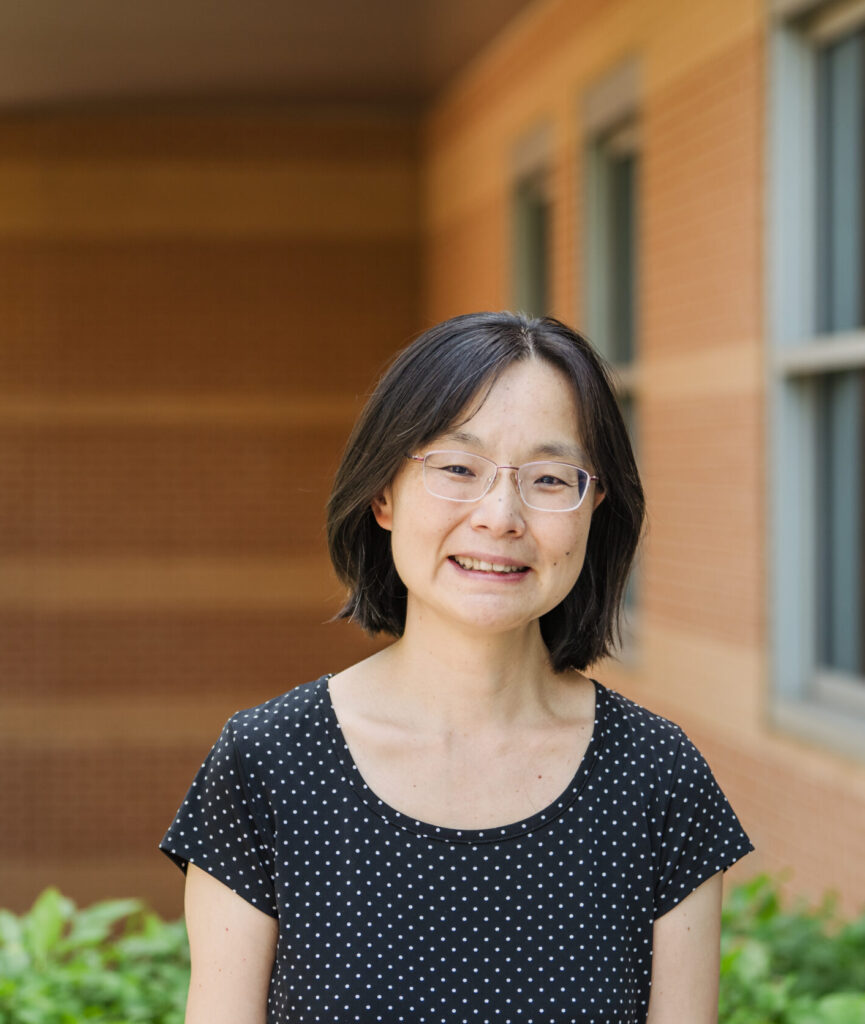 Karen Chen (Marlayna Demond ’11/UMBC)
Chen’s Lab for Informatics for Human Flourishing at UMBC is dedicated to using data to improve people’s lives. “I like to center all my research on promoting human flourishing, meaning people are not just surviving, but thriving. I use this concept as a North Star,” explains Chen.
Education is a key pathway to advance human flourishing, Chen says, and she looks forward to improving student learning experiences and outcomes through her CAREER award project.
The project will start by engaging students enrolled in Foundations of Data Science (IS 296), a relatively new undergraduate course at UMBC, introduced by Vandana Janeja, information systems. IS 296 recently became a general education program course at UMBC, open to all majors with no prerequisites.
Under Chen’s guidance, students in the class will collect data about their lives—how much sleep and exercise they get, how much time they spend talking to friends and family, how stressed they are feeling, and more. They’ll also gather information related to their classes, such as already available data about how often they log into and use the university’s learning management system, Blackboard, and track how much time they spend focusing on classwork (versus, say, becoming distracted by other open tabs on their computers.) The data will be available only to individual students and those they designate as trusted collaborators.
Students will then work through data science activities, analyzing the information they gathered and seeing if they can gain insights to improve their well-being and academic success. At the same time, they will build a critical competency called self-regulated learning, says Chen.
Based on feedback from the class, Chen will then work with students to design and develop an online platform, called “Live Data Lab,” where a broader student community can find tools to track and analyze their own well-being while learning basic data science concepts and techniques. This platform will also provide opportunities for students to explore creative expression of data through mediums such as digital data stories, data art, data comics, or data memes.
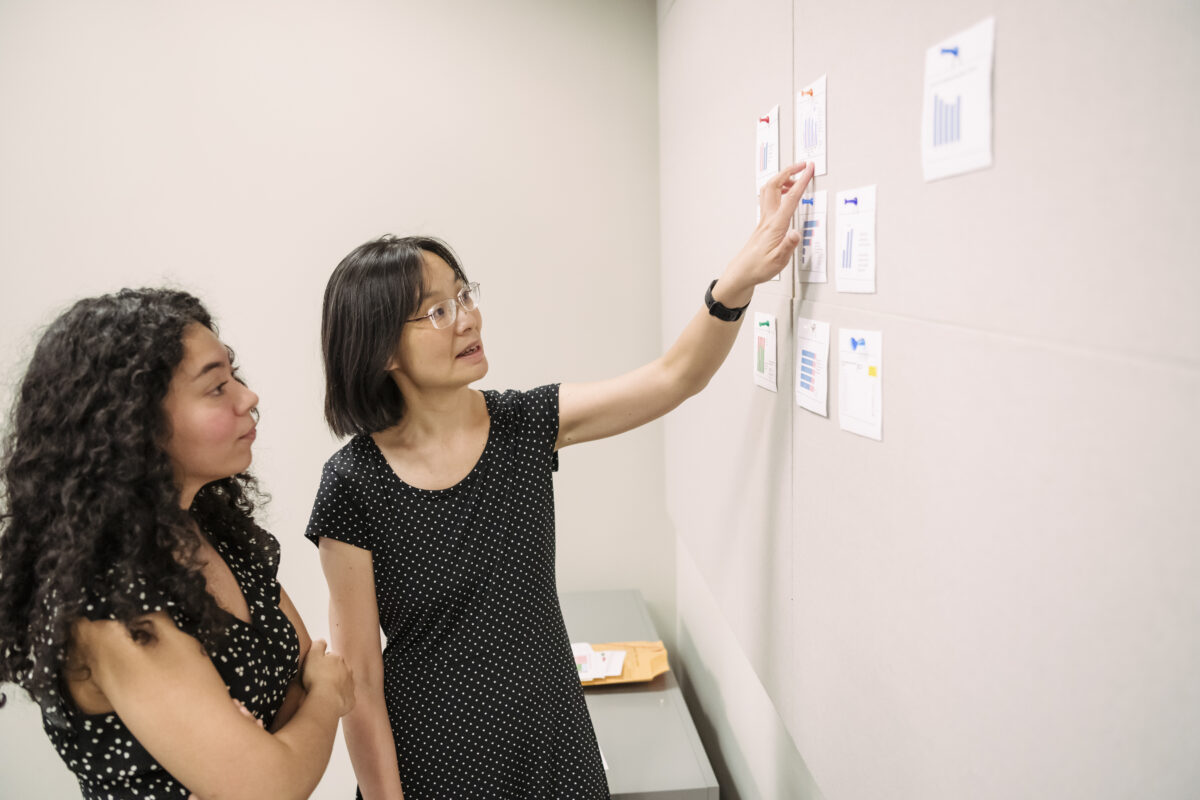
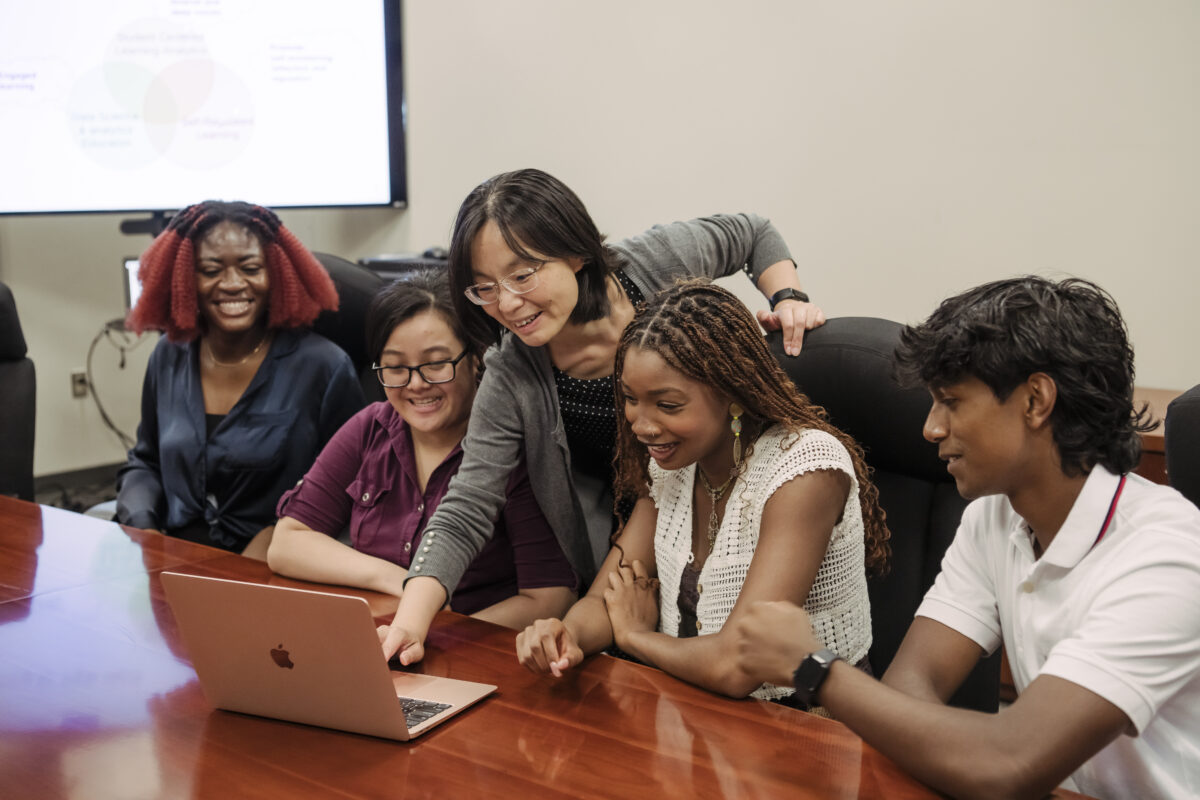
Left: Jennifer Posada Granados ’21, an incoming Ph.D. student in the human-centered computing program, and Karen Chen look at printed visualizations of data gathered from UMBC students. Right: Chen talks with students, from left to right, Yetunde Okueso, Kara Nguyen, Joy Ware, and Kavin Manivannan. (Marlayna Demond ’11/UMBC)
Chen will test-run the platform with around 500 students, including first-year UMBC students enrolled in a new seminar course offered by Academic Engagement and Transition Programs, as well as students enrolled in UMBC’s Department of Education pre-service teacher preparation programs. The project will also engage students from community college partners such as Montgomery College.
Empowering students for success
UMBC is an excellent place to conduct the project, Chen says, because it has a culture of promoting student success in its diverse community by empowering students with support and tools. UMBC has also been a leader in learning analytics, already gathering data about how students use its learning management systems to improve students’ learning outcomes, and protecting that data’s privacy, Chen adds.
“This project would not be possible without the support of the Division of Information Technology, in particular John Fritz and his team, who created the Check-My-Activity tool, a student-facing learning analytics tool that has been in operation in UMBC for more than a decade,” Chen says. The project will also be supported by information systems faculty Andrea Kleinsmith, an expert in human-centered design,and Zhiyuan Chen, an expert in data privacy, Chen adds.
“The question driving the work is: How can we best center students’ voices and empower them in the data-driven decision-making process?” Chen says. “This project will provide many opportunities for undergraduates and graduate students at UMBC to get involved. Not only will they contribute to the research, but I hope they will also become deeply engaged with their learning and empowered to become better versions of themselves through data, scientific evidence, and reasoning.”
]]>
When Karen Chen’s now teenage son was in third grade, he would complain that math homework was “boring.” Chen wanted to change his perspective. She presented him with extracurricular math problems...
https://umbc.edu/stories/karen-chen-nsf-career-award-student-data/
https://my3.my.umbc.edu/api/v0/pixel/news/142816/guest@my.umbc.edu/bb4449241f7f0dab1b921efdc9601d04/api/pixel
coeit
is
news
nsf-career-award
research
science-and-tech
story
UMBC News & Magazine
https://my3.my.umbc.edu/groups/umbc-news-magazine
https://assets1-my.umbc.edu/system/shared/avatars/groups/000/001/943/24435aa6207c452e7bc15cc74b42c7bb/xsmall.png?1748556657
https://assets1-my.umbc.edu/system/shared/avatars/groups/000/001/943/24435aa6207c452e7bc15cc74b42c7bb/original.png?1748556657
https://assets2-my.umbc.edu/system/shared/avatars/groups/000/001/943/24435aa6207c452e7bc15cc74b42c7bb/xxlarge.png?1748556657
https://assets2-my.umbc.edu/system/shared/avatars/groups/000/001/943/24435aa6207c452e7bc15cc74b42c7bb/xlarge.png?1748556657
https://assets3-my.umbc.edu/system/shared/avatars/groups/000/001/943/24435aa6207c452e7bc15cc74b42c7bb/large.png?1748556657
https://assets1-my.umbc.edu/system/shared/avatars/groups/000/001/943/24435aa6207c452e7bc15cc74b42c7bb/medium.png?1748556657
https://assets2-my.umbc.edu/system/shared/avatars/groups/000/001/943/24435aa6207c452e7bc15cc74b42c7bb/small.png?1748556657
https://assets1-my.umbc.edu/system/shared/avatars/groups/000/001/943/24435aa6207c452e7bc15cc74b42c7bb/xsmall.png?1748556657
https://assets2-my.umbc.edu/system/shared/avatars/groups/000/001/943/24435aa6207c452e7bc15cc74b42c7bb/xxsmall.png?1748556657
UMBC News & Magazine
3
0
false
Wed, 17 Jul 2024 14:43:28 -0400
Wed, 17 Jul 2024 14:43:28 -0400
Social media and political violence – how to break the cycle

Written by Richard Forno, principal lecturer in computer science and electrical engineering, UMBC
The attempted assassination of Donald Trump on July 13, 2024, added more fuel to an already fiery election season. In this case, political violence was carried out against the party that is most often found espousing it. The incident shows how uncontrollable political violence can be – and how dangerous the current times are for America.
Part of the complication is the contentious and adversarial nature of American politics, of course. But technology makes it more difficult for Americans to understand sudden news developments.
Gone are the days when only a handful of media outlets reported the news to broad swaths of society after rigorous fact-checking by professional journalists.
By contrast, anyone today can “report” news online, provide what they claim is “analysis” of events, and combine fact, fiction, speculation and opinion to fit a desired narrative or political perspective.
Then that perspective is potentially made to seem legitimate by virtue of the poster’s official office, net worth, number of social media followers, or attention from mainstream news organizations seeking to fill news cycles.
And that’s before any mention of convincing deepfake audio and video clips, whose lies and misrepresentations can further sow confusion and distrust online and in society.
Today’s internet-based narratives also often involve personal attacks either directly or through inference and suggestion – what experts call “stochastic terrorism” that can motivate people to violence. Political violence is the inevitable result – and has been for years, including attacks on U.S. Rep. Gabby Giffords, former House Speaker Nancy Pelosi’s husband, Paul, the 2017 congressional baseball practice shooting, the Jan. 6, 2021 insurrection, and now the attempted assassination of a former president running for the White House again.
 While being evacuated by the Secret Service, Donald Trump paused and held up a clenched fist to the crowd. Rebecca Droke/AFP via Getty Images
When bullets and conspiracies fly
As a security and internet researcher it was entirely predictable to me that within minutes of the attack, right-wing social media exploded with instant-reaction narratives that assigned blame to political rivals, the media, or implied that a sinister “inside job” by the federal government was behind the incident.
But it wasn’t just average internet users or prominent business magnates fanning these flames. Several Republicans issued such statements from their official social media accounts. For instance, less than an hour after the attack, Georgia Congressman Mike Collins accused President Joe Biden of “inciting an assassination” and said Biden “sent the orders.” Ohio Senator J.D. Vance, now Trump’s nominee for vice president, also implied that Biden was responsible for the attack.
The bloodied former president stood up and delayed his Secret Service evacuation for a fist-pumping photo before leaving the rally, and his campaign issued a defiant fundraising email later that evening. This led some Trump critics to suggest the incident was a “false flag” attack staged to earn a sympathetic national spotlight. Others claimed the incident fits into Trump’s ongoing messaging to supporters that he’s the victim of persecution.
From a historical perspective, it’s worth noting former Brazil right-wing President Jair Bolsonaro survived an assassination attempt in 2018 to become the country’s next president in 2019.
 Bad information can race around the world faster than the truth can catch up with it. Richard Drury/Digital Vision via Getty Images
It’s long been known that internet narratives, memes and content can spread around the world like wildfire well before the actual truth becomes known. Unfortunately, those narratives, whether factual or fictional, can get picked up – and thus given a degree of perceived legitimacy and further disseminated – by traditional news organizations.
Many who see such messages, amplified by both social media and traditional news services, often believe them – and some may respond with political violence or terrorism.
Can anything help?
Several threads of research show that there are some ways regular people can help break this dangerous cycle.
In the immediate aftermath of breaking news, it’s important to remember that first reports often are wrong, incomplete or inaccurate. Rather than rushing to repost things during rapidly developing news events, it’s best to avoid retweeting, reposting or otherwise amplifying online content right away. When information has been confirmed by multiple credible sources, ideally across the political spectrum, then it’s likely safe enough to believe and share.
 It can be hard to figure out what’s right amid so much competing information. mikkelwilliam/E+ via Getty Images
In the longer term, as a nation and a society, it will be useful to further understand how technology and human tendencies interact. Teaching schoolchildren more about media literacy and critical thinking can help prepare future citizens to separate fact from fiction in a complex world filled with competing information.
Another potential approach is to expand civics and history lessons in school classrooms, to give students the ability to learn from the past and – we can all hope – not repeat its mistakes.
Social media companies are part of the potential solution, too. In recent years, they have disbanded teams meant to monitor content and boost users’ trust in the information available on their platforms. Recent Supreme Court rulings make clear that these companies are free to actively police their platforms for disinformation, misinformation and conspiracy theories if they wish. But companies and purported “free speech absolutists” including X owner Elon Musk, who refuse to remove controversial, though technically legal, internet content from their platforms may well endanger public safety.
Traditional media organizations bear responsibility for objectively informing the public without giving voice to unverified conspiracy theories or misinformation. Ideally, qualified guests invited to news programs will add useful facts and informed opinion to the public discourse instead of speculation. And serious news hosts will avoid the rhetorical technique of “just asking questions” or engaging in “bothsiderism” as ways to move fringe theories – often from the internet – into the news cycle, where they gain traction and amplification.
The public has a role, too.
Responsible citizens could focus on electing officials and supporting political parties that refuse to embrace conspiracy theories and personal attacks as normal strategies. Voters could make clear that they will reward politicians who focus on policy accomplishments, not their media imagery and social media follower counts.
That could, over time, deliver the message that the spectacle of modern internet political narratives generally serve no useful purpose beyond sowing social discord and degrading the ability of government to function – and potentially leading to political violence and terrorism.
Understandably, these are not instant remedies. Many of these efforts will take time – potentially even years – and money and courage to accomplish.
Until then, maybe Americans can revisit the golden rule – doing onto others what we would have them do unto us. Emphasizing facts in the news cycle, integrity in the public square, and media literacy in our schools seem like good places to start as well.
This article is republished from The Conversation under a Creative Commons license. Read the original article and see more than 250 UMBC articles available in The Conversation.
]]>
Written by Richard Forno, principal lecturer in computer science and electrical engineering, UMBC The attempted assassination of Donald Trump on July 13, 2024, added more fuel to an already...
https://umbc.edu/stories/social-media-and-political-violence-how-to-break-the-cycle/
https://my3.my.umbc.edu/api/v0/pixel/news/142803/guest@my.umbc.edu/2a64e5fd5a03961d43aca9453e647c15/api/pixel
coeit
discovery
magazine
story
the-conversation
UMBC News & Magazine
https://my3.my.umbc.edu/groups/umbc-news-magazine
https://assets1-my.umbc.edu/system/shared/avatars/groups/000/001/943/24435aa6207c452e7bc15cc74b42c7bb/xsmall.png?1748556657
https://assets1-my.umbc.edu/system/shared/avatars/groups/000/001/943/24435aa6207c452e7bc15cc74b42c7bb/original.png?1748556657
https://assets2-my.umbc.edu/system/shared/avatars/groups/000/001/943/24435aa6207c452e7bc15cc74b42c7bb/xxlarge.png?1748556657
https://assets2-my.umbc.edu/system/shared/avatars/groups/000/001/943/24435aa6207c452e7bc15cc74b42c7bb/xlarge.png?1748556657
https://assets3-my.umbc.edu/system/shared/avatars/groups/000/001/943/24435aa6207c452e7bc15cc74b42c7bb/large.png?1748556657
https://assets1-my.umbc.edu/system/shared/avatars/groups/000/001/943/24435aa6207c452e7bc15cc74b42c7bb/medium.png?1748556657
https://assets2-my.umbc.edu/system/shared/avatars/groups/000/001/943/24435aa6207c452e7bc15cc74b42c7bb/small.png?1748556657
https://assets1-my.umbc.edu/system/shared/avatars/groups/000/001/943/24435aa6207c452e7bc15cc74b42c7bb/xsmall.png?1748556657
https://assets2-my.umbc.edu/system/shared/avatars/groups/000/001/943/24435aa6207c452e7bc15cc74b42c7bb/xxsmall.png?1748556657
UMBC News & Magazine
3
0
false
Tue, 16 Jul 2024 15:25:05 -0400
Tue, 16 Jul 2024 15:25:05 -0400
Infrastructure of support after Key Bridge collapse
In 1987, Paul Flinton, then a 23-year-old senior studying at UMBC, decided to make a short documentary focused on the tollbooth workers on the Francis Scott Key Bridge.
The six-minute documentary “One Dollar”—named after the toll’s cost for cars at the time—captures a vehicle’s journey across the bridge from the driver’s point of view in one continuous take. As Flinton ’87, visual arts, drives across the bridge, audio of the tollbooth workers interviewed for the project act as the film’s narrators in which they share some of their experiences as toll operators.
Flinton, who is now a location sound manager for NFL Films, went on to win an award for “One Dollar” from the Maryland State Arts Council following its release. Nearly four decades later, Flinton all but forgot about the film’s existence until learning of the bridge’s collapse following a collision with a malfunctioning cargo ship on March 26, sending eight construction workers into the water and taking the lives of six.
“It hit a nerve,” Flinton told local news after the disaster. “[The film is] sort of a treasure…This captures something that in a lot of ways can’t really happen again.”
Paul Flinton’s short documentary entitled “One Dollar” (1987).
Supporting the impacted families
The Key Bridge opened to traffic in 1977, and regularly 30,000 vehicles crossed the 1.6 mile span over the Patapsco River. An integral part of Baltimore’s beltway, commuters, community members, and experts are now struggling to make sense of the literal change of transportation landscape. Now that the wreckage is completely cleared away and as the eventual construction commences, UMBC experts offer up their expertise and resources to confront the tragedy.
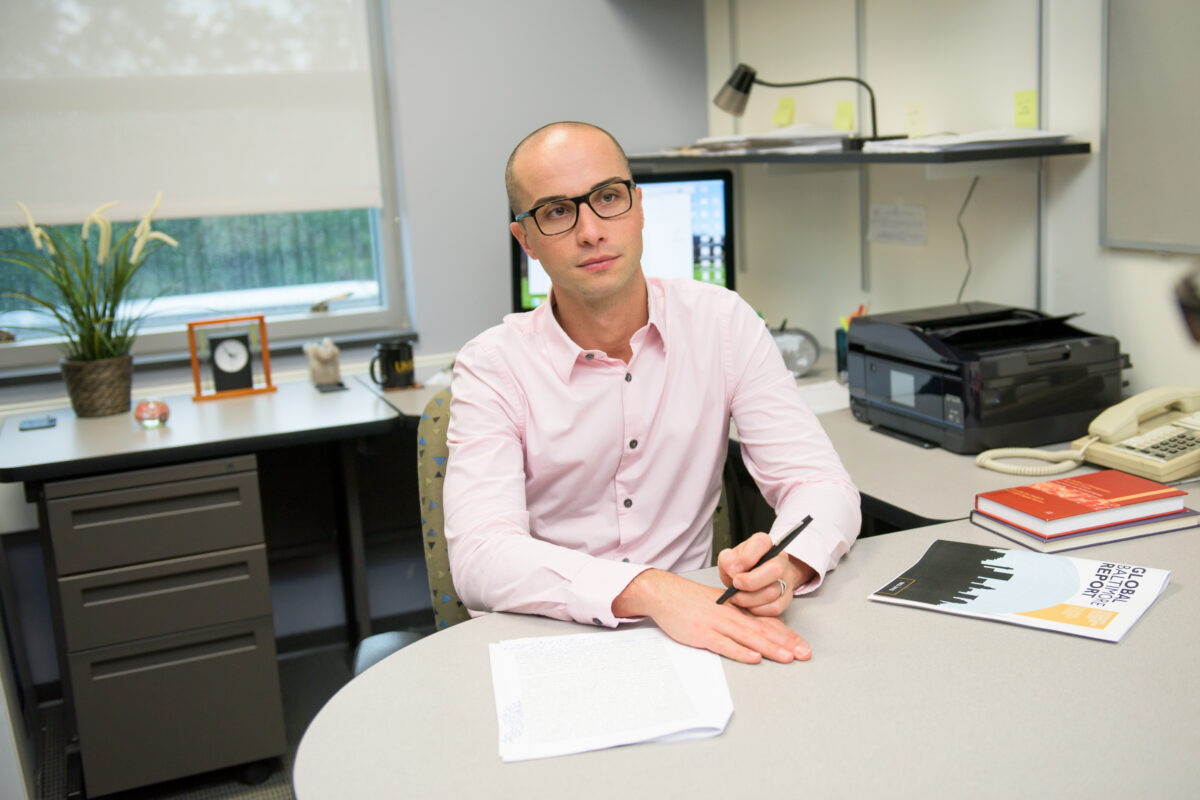 Felipe Filomeno. (Marlayna Demond ’11/UMBC)
After learning that all of the direct victims of the collapse were immigrants from countries throughout Latin America, Felipe Filomeno, associate professor of political science and global studies, immediately sprang into action with fellow members of the grassroots organization Latino Racial Justice Circle (LRJC). Filomeno, who is president of the LRJC, worked with the organization’s leadership team to establish a fundraiser in support of the families of the victims of the bridge collapse.
The crowdfunded campaign initially had a goal of raising about $5,000 for each of the families impacted, Filomeno said. Within hours of going live with the GoFundMe campaign, the organization raised $100,000 from donors located all around the world.
“The fundraiser caught a lot of traction. I have been overwhelmed by the outpouring of solidarity that we got from across the world in that week when the tragedy happened,” says Filomeno.
Following the fundraising success, the group has since directed prospective supporters to the Mayor’s Office of Immigrant Affairs’ Key Bridge Emergency Response Fund. The Mayor’s Office is working with the LRJC and case managers to distribute the funding to the six impacted families.
The tragedy has underlined key issues impacting the Latino immigrant community, challenges that Filomeno amplifies through his community-centered research at UMBC. “[The collapse] has highlighted and publicized to the world issues that we already know exist—the fact that Latino immigrants are over-represented in dangerous occupations,” says Filomeno. “There are higher incidents of work-related accidents among the Latino populations.”
Filomeno’s forthcoming book, Christian Cosmopolitanism: Faith Communities Talk Immigration (Temple University Press, 2024), explores the Honest Conversations on Immigration program he co-developed in 2017 in partnership with the LRJC. The program, Filomeno explains, was designed to build mutual understanding and collaboration between people who are diverse, but share the same religion.
“One of the goals is to build solidarity across differences,” says Filomeno. “The solidarity across differences is a principle that we also see in the Key Bridge fundraiser.”
Through his advocacy and academic scholarship, Filomeno is working to amplify the need for more long lasting efforts to stand in solidarity with Latino immigrant communities beyond moments of tragedy. “Those problems that became evident with the fall of the bridge, those challenges that the Latino immigrant population faces, they are still there,” he says. “To move the needle on those issues, it has to be more than helping those six families at this point in time.”
Examining the environmental impacts of the collapse
The ship that collided into the bridge was carrying 56 containers of hazardous materials, including corrosives, flammables, and lithium-ion batteries. The cargo ship was also carrying more than one million gallons of fuel at the time of the impact. City officials began their investigations into the incident, which included determining the environmental impacts to the Patapsco River and surrounding communities.
Upal Ghosh, professor of chemical, biochemical, and environmental engineering, whose research includes examining the effects of toxic pollutants in soils, sediments, and aquatic environments, was among the experts who weighed in on assessing the potentially hazardous effects of the containers that were resting at the bottom of the river.
 Maryland Comptroller Brooke Lierman and representatives of the Office of the Governor take a tour of the Francis Scott Key Bridge collapse site on a Maryland Department of Natural Resources police boat. (Photo source: Corey Jennings ’10, Maryland Comptroller/Flickr)
Ghosh told the Baltimore Sun days after the collapse that environmental officials’ first priority would likely be making sure none of the intact containers were breached.
“If you have containers that contain oily material, those things will, if they are breached, be releasing over time,” Ghosh said. “I would think if there is a release that goes down into the sediments under the water, it would be a local impact right there.”
Farah Nibbs, assistant professor of emergency and disaster health systems, is also thinking about future ways to contain the effects of similar disasters. Contributing factors to the bridge’s collapse, she says, can be tied to the 2012 expansion and modernization of the Port of Baltimore. Those changes did not happen hand in hand with improvements in safety management needed to accommodate ships of such huge sizes that now were able to port in the city. Risks from collisions, fuel spills, and contamination still lack proper oversight and regulation.
“A novel approach for decision-makers may be to view Maryland’s emergency management and transportation experts and service providers—as well as the physical bridge infrastructure itself—as part of the community’s lifeline systems,” said Nibbs.
More than a disaster
As plans for the bridge’s rebuilding process begins to take shape, Brian Grodsky, professor of political science, shed light on why Maryland Governor Wes Moore likely did not request a presidential disaster declaration in response to the collapse. Presidential disaster declarations, Grodsky said in a local tv news segment, are usually limited to tragedies that involve fires, floods, or explosives.
“Man-made disasters are more likely to be declined [for a presidential disaster declaration] because there is that question of public versus private ownership of the disaster,” he added. “If this ship caught on fire or exploded under the bridge, this would easily be qualified as a major disaster.”
Deborah Rudacille, professor of the practice in English, is well aware of the lives connected to the construction and opening of the Key Bridge. In 2010, she published Roots of Steel: Boom and Bust in an American Mill Town, a book exploring Baltimore’s industrial history of the Sparrows Point steel mill, but also capturing her family’s connection to the mill and Baltimore staples like the Key Bridge.
Rudacille’s mother was one of the original employees—collecting the toll that Flinton documented in his film— when the bridge first opened in 1977, and her brother worked as one of the bridge’s painters.
“They were kind of reminiscing about the fact that everything down there is now gone,” Rudacille told local media about her family. “First the steelworks, now the Key Bridge is gone. It’s like this world that they lived and worked in has vanished completely.”
]]>
In 1987, Paul Flinton, then a 23-year-old senior studying at UMBC, decided to make a short documentary focused on the tollbooth workers on the Francis Scott Key Bridge. The six-minute...
https://umbc.edu/stories/support-after-key-bridge-collapse/
https://my3.my.umbc.edu/api/v0/pixel/news/142431/guest@my.umbc.edu/85f4487fb5eddd76a8baa59270f45a52/api/pixel
cahss
cbee
coeit
discovery
edhs
english
magazine
political-science
spring-2024
story
visual-arts
UMBC News & Magazine
https://my3.my.umbc.edu/groups/umbc-news-magazine
https://assets1-my.umbc.edu/system/shared/avatars/groups/000/001/943/24435aa6207c452e7bc15cc74b42c7bb/xsmall.png?1748556657
https://assets1-my.umbc.edu/system/shared/avatars/groups/000/001/943/24435aa6207c452e7bc15cc74b42c7bb/original.png?1748556657
https://assets2-my.umbc.edu/system/shared/avatars/groups/000/001/943/24435aa6207c452e7bc15cc74b42c7bb/xxlarge.png?1748556657
https://assets2-my.umbc.edu/system/shared/avatars/groups/000/001/943/24435aa6207c452e7bc15cc74b42c7bb/xlarge.png?1748556657
https://assets3-my.umbc.edu/system/shared/avatars/groups/000/001/943/24435aa6207c452e7bc15cc74b42c7bb/large.png?1748556657
https://assets1-my.umbc.edu/system/shared/avatars/groups/000/001/943/24435aa6207c452e7bc15cc74b42c7bb/medium.png?1748556657
https://assets2-my.umbc.edu/system/shared/avatars/groups/000/001/943/24435aa6207c452e7bc15cc74b42c7bb/small.png?1748556657
https://assets1-my.umbc.edu/system/shared/avatars/groups/000/001/943/24435aa6207c452e7bc15cc74b42c7bb/xsmall.png?1748556657
https://assets2-my.umbc.edu/system/shared/avatars/groups/000/001/943/24435aa6207c452e7bc15cc74b42c7bb/xxsmall.png?1748556657
UMBC News & Magazine
2
0
false
Thu, 13 Jun 2024 13:40:41 -0400
Thu, 13 Jun 2024 13:40:41 -0400
How to count time: Professor Curtis Menyuk brings his expertise in optics to an age-old problem

Time—We buy it and spend it, save it and waste it; it seems to race by as we watch our children grow or drag on in the last hour of a Friday work day. Shakespeare marked “time’s thievish progress” in wrinkles like “mouthed graves.” But for a more objective accounting, humans have turned to physics, measuring days, hours, minutes, and seconds using rhythmic natural phenomena such as the Earth’s rotation, the swing of a pendulum, the vibration of quartz crystals, and, most recently, the oscillation of light waves.
“I have been fascinated by time and how we tell it for as long as I can remember,” says Curtis Menyuk, a professor in the Department of Computer Science and Electrical Engineering, who for the past 20 years has applied his expertise in optics to a host of questions at the frontiers of time-keeping science.
Defining time
We measure time in chunks—the international standard unit for a chunk being the second. For centuries, the second was understood as a fraction of an Earth day, but because the Earth’s rotational speed varies slightly, a second defined in this way is not constant. The invention of atomic clocks in the middle of the 20th century allowed scientists to redefine the second based on the (as far as we know) unchanging properties of atoms. Today, one second is the time it takes the electric field of microwaves that are absorbed and emitted by cesium atoms at a specific frequency to cycle up and down 9,192,631,770 times.
But it’s likely the second will soon be redefined again. Newer versions of atomic clocks, called optical clocks, measure time’s passage with visible light instead of microwaves. Visible light waves oscillate much faster than microwaves—and faster oscillations in principle mean better time-keeping. Many optical clocks keep time so well that if they could have started running when the universe began and kept going until today, they still would not have lost or gained a single second.
 A artistic rendering of a microresonator frequency comb. (Image credit: NIST)
Shortly after the first all-optical atomic clocks were developed in the early 2000s, Menyuk began collaborating with scientists at the National Institute of Standards and Technology (NIST) to study a key component of the clocks called a frequency comb. Frequency combs provide the bridge between high-frequency light, which forms the heart of optical clocks, and modern electronics, which can only process lower-frequency signals. The combs are made from extremely short light pulses, called solitons, that travel without dispersing, similar to how tsunami waves traverse the ocean. And it just so happens that Menyuk is an expert on solitons, having become captivated by the “almost magical balance” of forces that keep the waves from being torn apart ever since he first learned about the phenomenon at the age of 27.
Shrinking the world’s most precise clocks
In 2013, Menyuk collaborated with a colleague to derive the basic equations describing how solitons are created when light travels in a circle around a small crystalline disk called a microresonator. Microresonators offer a compact alternative to the bulky lasers originally required to make frequency combs, and Menyuk and some of his NIST colleagues recently published a paper in the prestigious scientific journal Nature that reports a new approach to simplifying the use and improving the performance of microresonator-based combs.
Shrinking the components of optical clocks is a key step toward taking full advantage of their powers. Their potential extends beyond the possibility of one day setting the time for your computer. Atomic clocks are a critical component of today’s GPS system, which helps billions of people find their way around each day. Compact optical clocks might improve GPS accuracy to within a few centimeters. Optical time-keeping can also serve as a back-up to GPS, which is vulnerable to disruptions and attacks. Menyuk is tackling this very issue with the recent launch of the Center for Navigation, Timing, and Frequency Research at UMBC, which he directs in collaboration with the Army Research Laboratory and other partners.
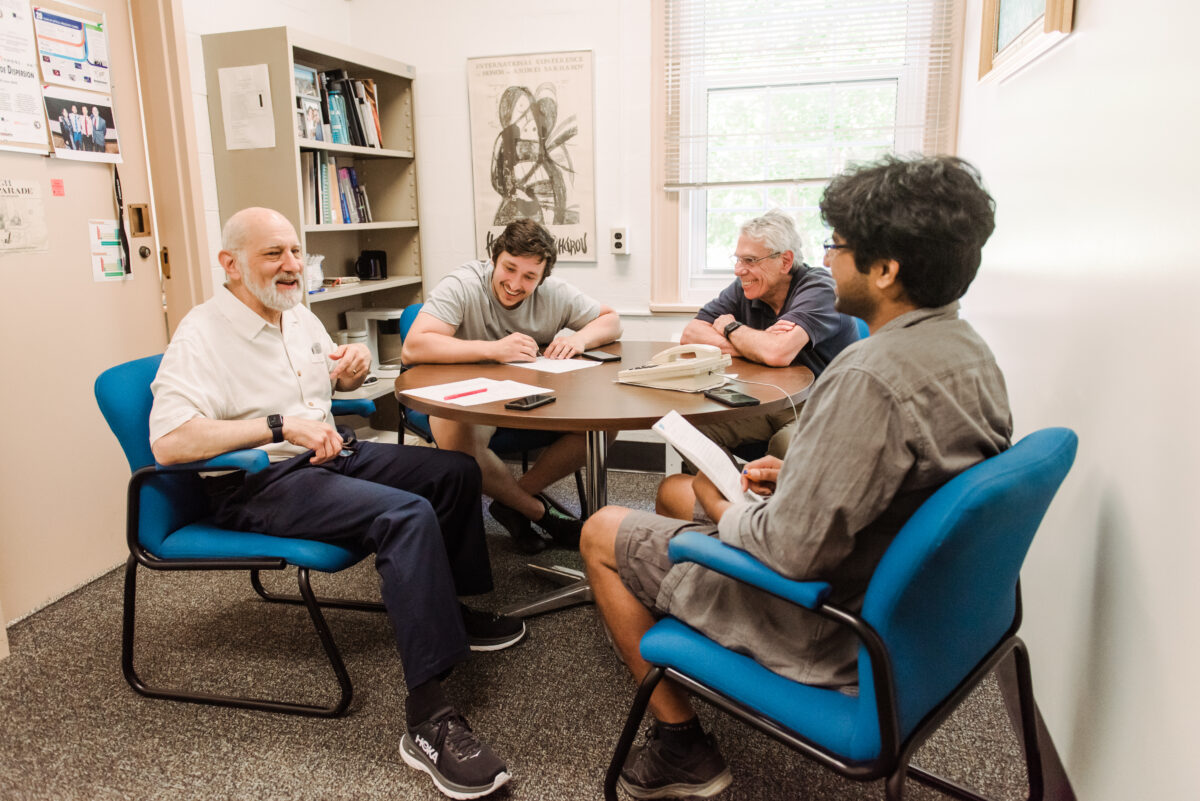 Menyuk (left) discusses research with (from left to right) graduate student Logan Courtright, Professor Gary Carter, and graduate student Pradyoth Shandilya. (Marlayna Demond ’11/UMBC)
New clocks may even make possible groundbreaking discoveries about the fabric of the universe, helping scientists search for dark matter and test whether the laws of physics change over time.
For Menyuk, passing time has not noticeably dimmed his prolific research output (of which clocks are just a portion). And while the years add age, they also add perspective. “Curtis is a leading theorist with decades of experience,” says Kartik Srinivasan, one of the NIST scientists who collaborated with Menyuk on the recent Nature paper. Srinivasan noted that some of the equations he learned in grad school for predicting light’s behavior in optical fibers were developed by Menyuk in the 1980s. “Curtis’ reservoir of historical knowledge is not something you can easily find.” Even with the use of an atomic clock.
]]>
Time—We buy it and spend it, save it and waste it; it seems to race by as we watch our children grow or drag on in the last hour of a Friday work day. Shakespeare marked “time’s thievish progress”...
https://umbc.edu/stories/time-and-optics-research-curtis-menyuk/
https://my3.my.umbc.edu/api/v0/pixel/news/142292/guest@my.umbc.edu/5950f499f9fc3cb524d9d24b03ecec55/api/pixel
coeit
csee
discovery
magazine
research
spring-2024
story
UMBC News & Magazine
https://my3.my.umbc.edu/groups/umbc-news-magazine
https://assets1-my.umbc.edu/system/shared/avatars/groups/000/001/943/24435aa6207c452e7bc15cc74b42c7bb/xsmall.png?1748556657
https://assets1-my.umbc.edu/system/shared/avatars/groups/000/001/943/24435aa6207c452e7bc15cc74b42c7bb/original.png?1748556657
https://assets2-my.umbc.edu/system/shared/avatars/groups/000/001/943/24435aa6207c452e7bc15cc74b42c7bb/xxlarge.png?1748556657
https://assets2-my.umbc.edu/system/shared/avatars/groups/000/001/943/24435aa6207c452e7bc15cc74b42c7bb/xlarge.png?1748556657
https://assets3-my.umbc.edu/system/shared/avatars/groups/000/001/943/24435aa6207c452e7bc15cc74b42c7bb/large.png?1748556657
https://assets1-my.umbc.edu/system/shared/avatars/groups/000/001/943/24435aa6207c452e7bc15cc74b42c7bb/medium.png?1748556657
https://assets2-my.umbc.edu/system/shared/avatars/groups/000/001/943/24435aa6207c452e7bc15cc74b42c7bb/small.png?1748556657
https://assets1-my.umbc.edu/system/shared/avatars/groups/000/001/943/24435aa6207c452e7bc15cc74b42c7bb/xsmall.png?1748556657
https://assets2-my.umbc.edu/system/shared/avatars/groups/000/001/943/24435aa6207c452e7bc15cc74b42c7bb/xxsmall.png?1748556657
UMBC News & Magazine
0
0
false
Mon, 03 Jun 2024 13:26:28 -0400
Mon, 03 Jun 2024 13:26:28 -0400
Molly Mollica wins American Heart Association Career Development Award
Molly Mollica, an assistant professor in mechanical engineering who joined UMBC in August 2023, has been selected for an American Heart Association (AHA) Career Development Award, which will provide more than $200,000 to fund her research for the next three years.
Mollica studies the biomechanics of blood platelets, which play an essential role in healthy blood clotting, but can also contribute to the formation of blood clots that cause heart attacks and strokes. Bleeding and clotting have been shown to vary between males and females, but the reasons are not well understood. In her AHA-funded research, Mollica will investigate how platelets from males versus females, and from donors with varying hormone levels, respond to and generate mechanical forces. She hopes the information she uncovers will help doctors better understand healthy platelet function, design more inclusive health research, and develop better treatments.
“I’m honored to receive this award,” said Mollica. “We look forward to better understanding sex and hormone differences in platelet function. This research is important in providing tools to develop new preventative and curative therapeutics.”
]]>
Molly Mollica, an assistant professor in mechanical engineering who joined UMBC in August 2023, has been selected for an American Heart Association (AHA) Career Development Award, which will...
https://umbc.edu/quick-posts/molly-mollica-wins-american-heart-association-career-development-award/
https://my3.my.umbc.edu/api/v0/pixel/news/142289/guest@my.umbc.edu/9b1b1b2f758064f4c07495e0736cd205/api/pixel
coeit
meche
news
quick-post
research
science-and-tech
UMBC News & Magazine
https://my3.my.umbc.edu/groups/umbc-news-magazine
https://assets1-my.umbc.edu/system/shared/avatars/groups/000/001/943/24435aa6207c452e7bc15cc74b42c7bb/xsmall.png?1748556657
https://assets1-my.umbc.edu/system/shared/avatars/groups/000/001/943/24435aa6207c452e7bc15cc74b42c7bb/original.png?1748556657
https://assets2-my.umbc.edu/system/shared/avatars/groups/000/001/943/24435aa6207c452e7bc15cc74b42c7bb/xxlarge.png?1748556657
https://assets2-my.umbc.edu/system/shared/avatars/groups/000/001/943/24435aa6207c452e7bc15cc74b42c7bb/xlarge.png?1748556657
https://assets3-my.umbc.edu/system/shared/avatars/groups/000/001/943/24435aa6207c452e7bc15cc74b42c7bb/large.png?1748556657
https://assets1-my.umbc.edu/system/shared/avatars/groups/000/001/943/24435aa6207c452e7bc15cc74b42c7bb/medium.png?1748556657
https://assets2-my.umbc.edu/system/shared/avatars/groups/000/001/943/24435aa6207c452e7bc15cc74b42c7bb/small.png?1748556657
https://assets1-my.umbc.edu/system/shared/avatars/groups/000/001/943/24435aa6207c452e7bc15cc74b42c7bb/xsmall.png?1748556657
https://assets2-my.umbc.edu/system/shared/avatars/groups/000/001/943/24435aa6207c452e7bc15cc74b42c7bb/xxsmall.png?1748556657
UMBC News & Magazine
1
0
false
Mon, 03 Jun 2024 12:57:12 -0400
Mon, 03 Jun 2024 12:57:12 -0400
Capping years of rising success, UMBC chemical engineering club shines as student conference hosts
On the first weekend of April, hundreds of chemical engineering students from across the Mid-Atlantic converged on the UMBC campus for two days of learning, networking, and friendly competition. They heard talks from academic and industry leaders, attended workshops and a career fair, competed in rounds of ChemE Jeopardy, mixed chemicals to power small cars along a track in the ChemE Car competition, and mingled over catered lunches, dinners, and cups of evening hot cocoa.
The activities were all part of the 2024 Mid-Atlantic Student Regional Conference of the American Institute of Chemical Engineers (AIChE)—hosted by the UMBC student chapter of the national group. Around 400 people attended the event, an increase from last year’s conference at Virginia Tech. Organizing the logistics, recruiting speakers and sponsors, securing rooms, and ordering thousands of plates worth of food presented a formidable challenge—one that the UMBC students tackled with aplomb.
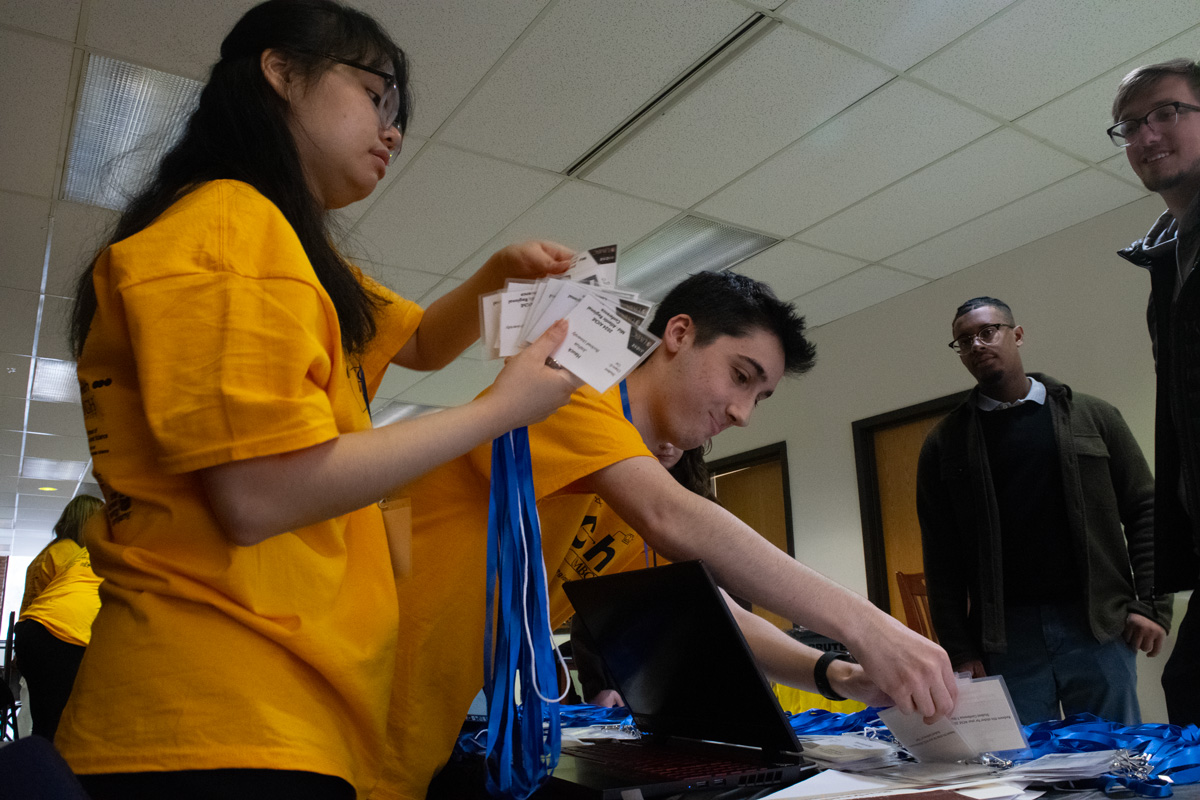 Managing check-in. (Photo by Danielle Clark)
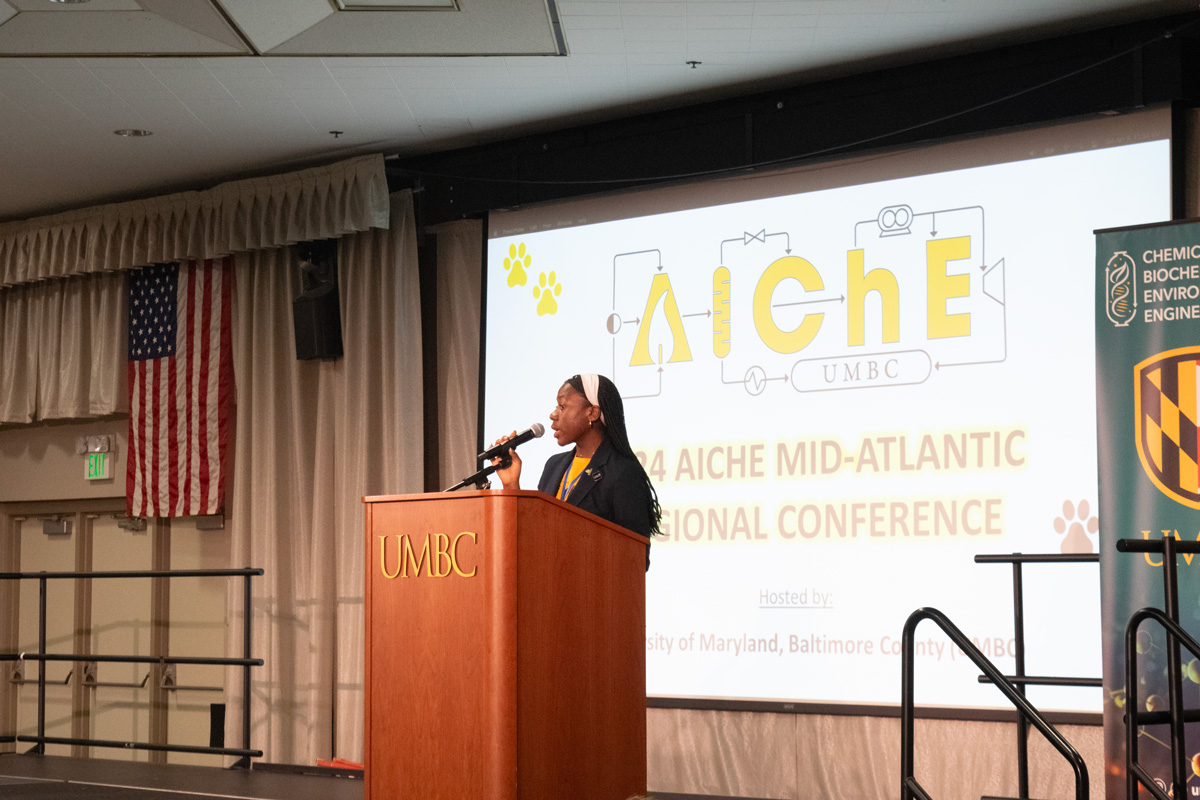 Welcoming attendees. (Photo by Danielle Clark)
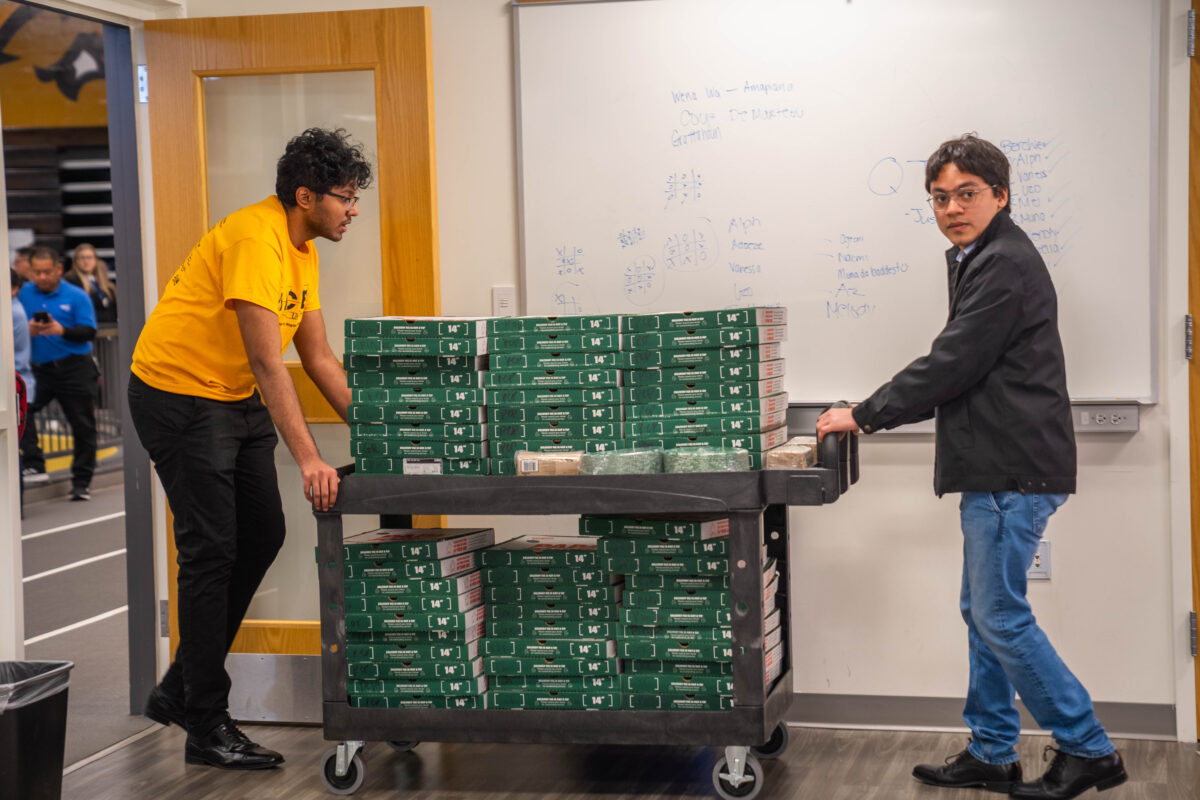 Delivering pizza. (Photo by Julianna Falconer)
“I am feeling fantastic after the conference,” says Pavan Umashankar ’25, chemical engineering and biochemistry and molecular biology, who served as the chair of the conference organizing committee. “I am super proud of everyone’s commitment and dedication to make it a resounding success.”
“Truly, I could gush about the UMBC conference planning team all day,” says Alyssa Block, the membership associate of ChemE student programs for AIChE. “These students really are the future leaders of their profession and of AIChE: engaged, excited, collaborative, supportive of each other, and willing to lend a hand.”
A club on the upswing
Hosting an AIChE regional conference for the first time at UMBC marked a milestone for a student club that has seen increasing levels of engagement and success in recent years. While many college clubs across the country are in decline post-Covid, UMBC’s AIChE student chapter is on a clear upward trajectory. The club sent its first team to compete in ChemE Jeopardy at the spring 2019 AIChE regional meeting. Just three years later, the UMBC team won the national ChemE Jeopardy competition.
Neha Raikar, a senior lecturer in the Department of Chemical, Biochemical, and Environmental Engineering (CBEE) and one of the advisors to the student AIChE chapter, remembers attending the 2019 meeting: “Back then, we wondered if we would ever be able to host a regional conference at UMBC,” she says. “We’ve achieved that goal.”
It was especially remarkable, she adds, to see some members of UMBC’s first ChemE Jeopardy and ChemE car teams return to this year’s conference as industry representatives.
Strong attendance and smooth conference logistics weren’t the only successes of the weekend—UMBC also triumphed in the ChemE Jeopardy and ChemE car competitions.
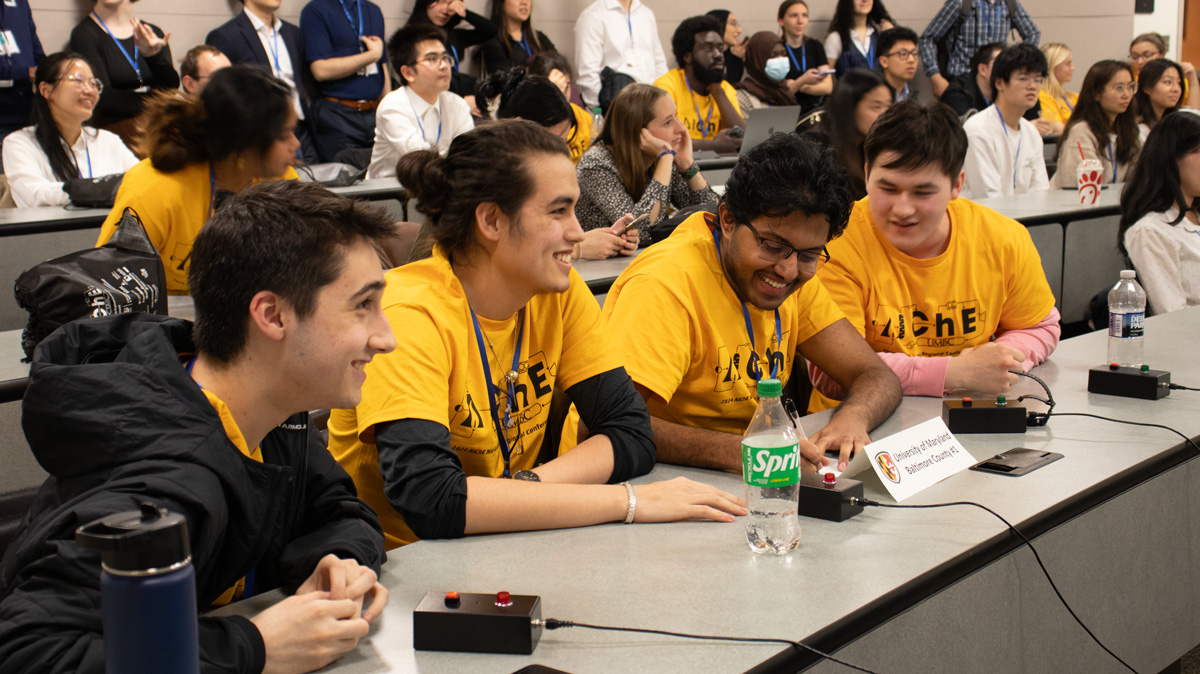 The UMBC #1 Jeopardy team during a preliminary round. (Photo by Patch Hatley)
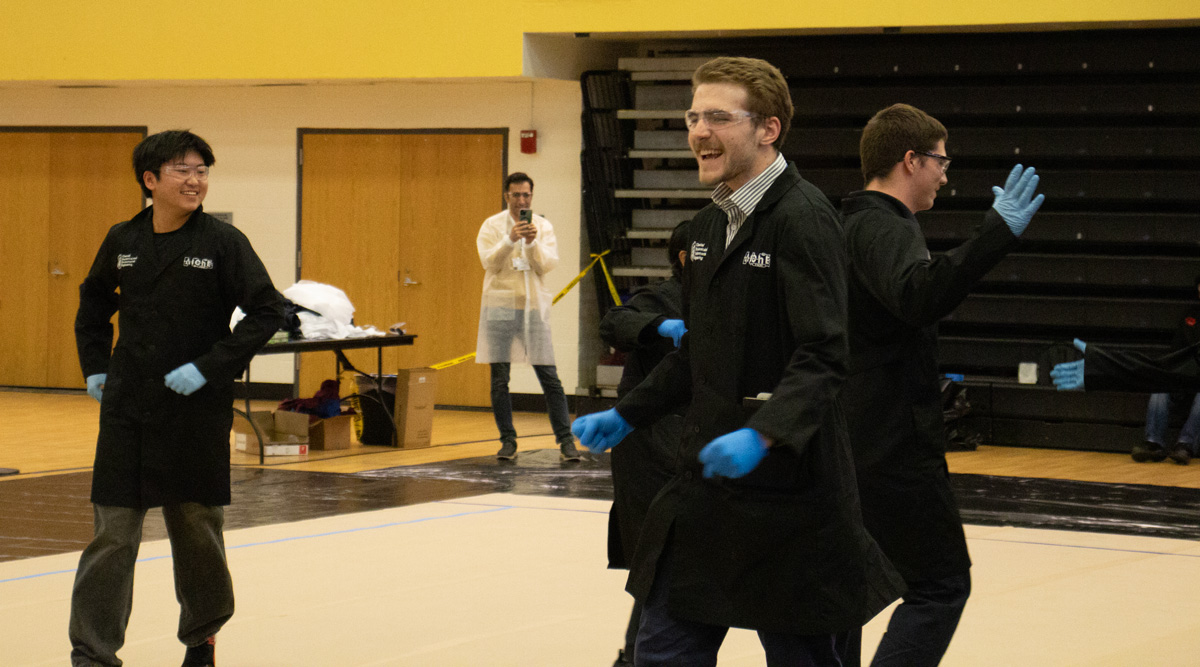 The UMBC ChemE Car team celebrates a good run. (Photo by Patch Hatley)
“Planning for the conference was already a significant undertaking, and on top of that, many of our students participated, and excelled, in the competitions,” says Raikar. “Their achievements not only showcased their individual capabilities but also the strength of our club as a whole, which is growing and thriving.”
A winning formula
AIChE chapter members and their advisors ascribe the club’s success to the hard work and dedication of the students coupled with the support of the CBEE department, college, and university. Thirteen CBEE students formed the conference planning committee, which met regularly to ensure all conference planning efforts were on track. An additional 37 students and 14 faculty and staff also volunteered their time—as check-in staff, poster and presentation judges, and more. About 10 UMBC alumni actively participated in the conference, and others contributed to fundraising efforts, helping the organizing committee secure sponsorships from notable companies such as AstraZeneca, ExxonMobil, Advanced Thermal Batteries, and Astek Diagnostics and from the chemical engineering department of Columbia University.
An Dang ’24, chemical engineering, led the fundraising efforts. She gamely approached industry representatives at the UMBC career fair and made the pitch. “I’m not an extrovert, and being in these roles forced me to go out of my comfort zone,” she says.
“Securing sponsorships was vital for making the conference possible, and An did a remarkable job” says Mariajosé Castellanos, another CBEE faculty who advises the AIChE chapter. Castellanos also praised the management skills of conference planning committee chair Umashankar. “Despite his modesty, Pavan is a true mastermind in everything he does,” she says.
For their part, the students applauded the support of the CBEE department, especially the work of their two advisors, Raikar and Castellanos, and the event planning support of Andrea Miller, the CBEE graduate program coordinator.
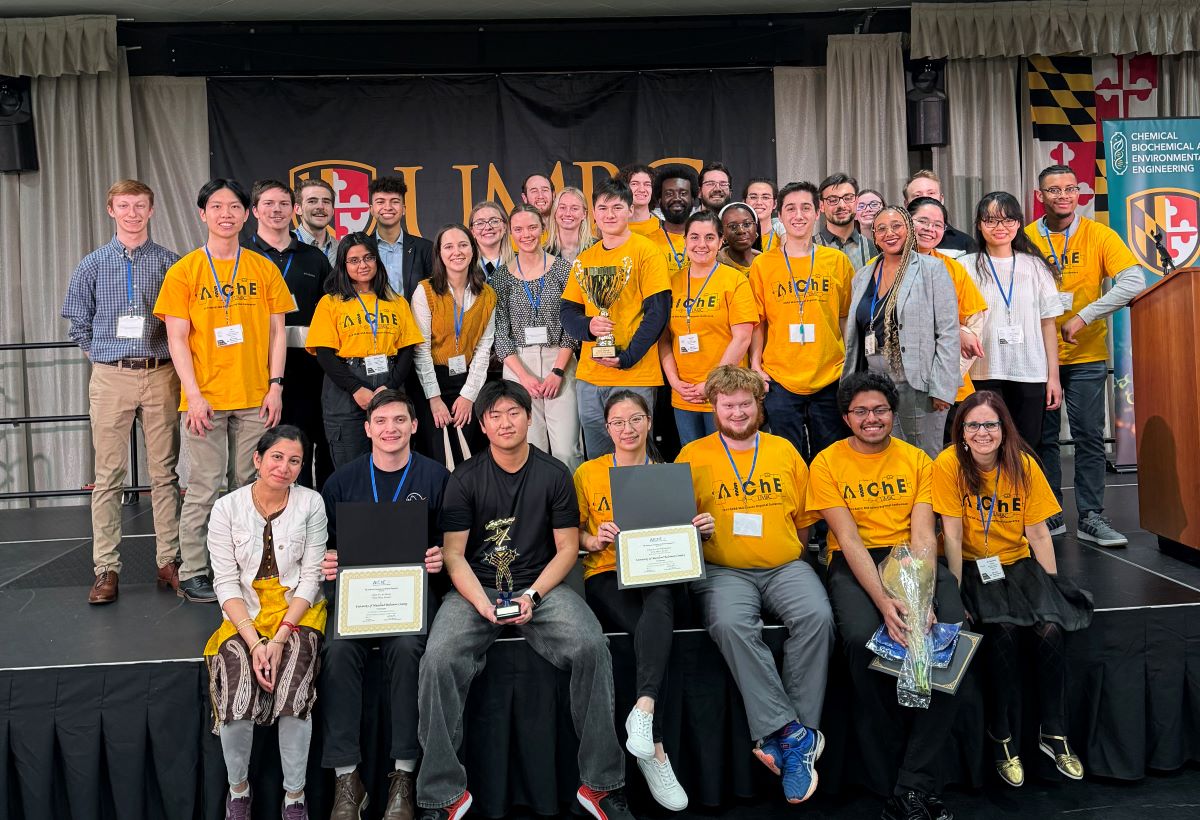 UMBC AIChE chapter students and faculty advisors pose for a group photo after a successful conference. (Photo courtesy of Mariajosé Castellanos.)
The conference was both a marker of the club’s success and an opportunity for individual students to grow their skill sets.
“I have developed leadership and project management skills, which will be incredibly useful throughout my professional career,” says Umashankar.
Ben Welling ’25, chemical engineering, the leader of the UMBC ChemE car team, believes his experience with the competition helped him land internships. “I talked about it extensively with employers. They like leadership experience and it shows you are willing to do more than is required.”
Raikar sees a bright future for the student stars of this year’s conference and for the club as a whole. “I hope the conference will boost the club membership and participation of students in other AIChE activities,” she says. And, she adds, the conference shows that with support, “UMBC students can accomplish any task.”
]]>
On the first weekend of April, hundreds of chemical engineering students from across the Mid-Atlantic converged on the UMBC campus for two days of learning, networking, and friendly competition....
https://umbc.edu/stories/umbc-chemical-engineering-club-shines-as-student-conference-hosts/
https://my3.my.umbc.edu/api/v0/pixel/news/142266/guest@my.umbc.edu/73e17cd25ad64e55b2130e8bf14c39f0/api/pixel
cbee
coeit
community
news
story
UMBC News & Magazine
https://my3.my.umbc.edu/groups/umbc-news-magazine
https://assets1-my.umbc.edu/system/shared/avatars/groups/000/001/943/24435aa6207c452e7bc15cc74b42c7bb/xsmall.png?1748556657
https://assets1-my.umbc.edu/system/shared/avatars/groups/000/001/943/24435aa6207c452e7bc15cc74b42c7bb/original.png?1748556657
https://assets2-my.umbc.edu/system/shared/avatars/groups/000/001/943/24435aa6207c452e7bc15cc74b42c7bb/xxlarge.png?1748556657
https://assets2-my.umbc.edu/system/shared/avatars/groups/000/001/943/24435aa6207c452e7bc15cc74b42c7bb/xlarge.png?1748556657
https://assets3-my.umbc.edu/system/shared/avatars/groups/000/001/943/24435aa6207c452e7bc15cc74b42c7bb/large.png?1748556657
https://assets1-my.umbc.edu/system/shared/avatars/groups/000/001/943/24435aa6207c452e7bc15cc74b42c7bb/medium.png?1748556657
https://assets2-my.umbc.edu/system/shared/avatars/groups/000/001/943/24435aa6207c452e7bc15cc74b42c7bb/small.png?1748556657
https://assets1-my.umbc.edu/system/shared/avatars/groups/000/001/943/24435aa6207c452e7bc15cc74b42c7bb/xsmall.png?1748556657
https://assets2-my.umbc.edu/system/shared/avatars/groups/000/001/943/24435aa6207c452e7bc15cc74b42c7bb/xxsmall.png?1748556657
UMBC News & Magazine
0
0
false
Thu, 30 May 2024 12:51:16 -0400
Thu, 30 May 2024 12:51:16 -0400
Putting UMBC Research on the Map
Spring on UMBC’s main campus brings a host of familiar sights and sounds: blooms on the magnolia trees, the chatter of red-winged blackbirds calling from the reeds around Library Pond, greening grass on the campus Quad, and black-and-gold-bedecked Grit Guides leading groups of prospective Retrievers around what may soon become a home away from home.
The guides cover the usual highlights—Academic Row, the Retriever Activity Center, the AOK Library, eating establishments, and residential halls. UMBC is a place to live, to learn, and to find community. And while some of the functions of campus spaces are obvious, others are often hidden.
Look more closely, and you’ll see faculty and students turning the everyday infrastructure and green oases of UMBC into out-of-the-ordinary laboratories. Beeswax sculptures, tactile maps, robots helping other robots—read on to discover some of the amazing ways Retrievers are using the campus itself for experiential learning and diverse research.
Written by: Catherine Meyers & Sarah L. Hansen, M.S. ’15

Two students wearing knee-high waders stand several meters apart in the middle of a rapidly flowing stream at the north end of UMBC’s campus. One releases a Ping-Pong ball, which bobs along with the current, as the second starts a timer, stopping it when the ball reaches his feet to determine the stream’s flow rate.
Nearby, another student measures the size of rocks in the streambed using a device called a gravelometer—a rectangular piece of metal with square holes of various sizes. The smallest hole a given rock will fit through becomes its measurement.
Farther along, other students capture photos that include reference posts on the stream bank. Each small group of students also takes measurements of the water depth at one-foot intervals along strings hung from one bank to the other. The students (with the help of specialized software) will use these measurements and photos to generate 3D models of the streambed.
“It’s a little DIY, but we get some amazing pictures,” says Charles Kaylor, the instructor and director of GIS and cartography labs in the Department of Geography and Environmental Systems (GES).
This is the “stream lab” in Exploring the Environment: A Geospatial Perspective, a course best known in the UMBC community for its semesterly launch of a dozen or so brightly-colored balloons that dot the campus skyline. Throughout the semester, students train their brains in the ways geographic data can help answer a wide range of research questions.
For the students, there are a range of perks to the course. “It’s cool to see different applications of computer science, which can sometimes feel pretty theoretical,” says George Rush ’24, computer science. Luke Thomas ’27, GES, who was partnered with Rush, is grateful for the senior’s support with the programming aspects of the coursework.
Rhonda Plofkin, Ph.D. student in GES and the graduate assistant for the class, concurs that having students with different strengths facilitates peer learning. “This is real-life stuff that geomorphologists do in the field,” she adds.
For some, the benefits are just as real, but simpler: “The cold water wakes me up,” Anthony Roytenberg ’24, computer science, says with a smile.
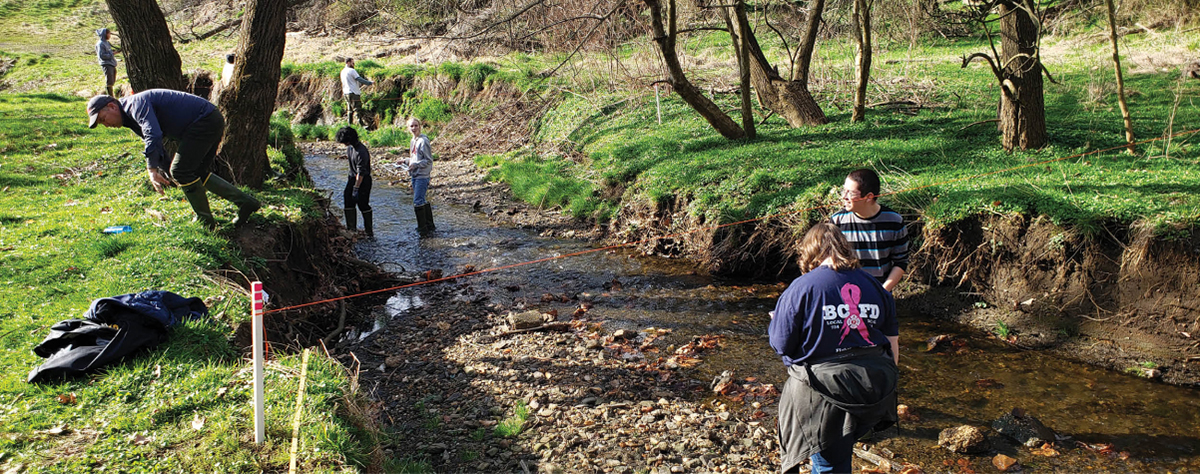 Students collect data that measure flow rate, depth, pebble size, and more as part of the “stream lab” in a popular, interdisciplinary GES course. Photo by Sarah Hansen, M.S. ’15.

When Alieh Rezaei arrived at UMBC from Iran, she couldn’t take her eyes off the ground. Almost immediately she was mesmerized by the flora and fauna of her new residence, and as an master of fine
arts student in the intermedia and digital arts (IMDA) program, she decided to incorporate pieces of UMBC into her artwork. She walked around campus, picking up windfalls of seeds and exploring hidden nooks of nature. A place that would come to be her sanctuary,
Rezaei, M.F.A. ’22, says, was Joseph Beuys Sculpture Park.
“The solidity of the stones alongside the growth of the oaksand the evolving shape of the garden reflect concepts of erosion and growth,” says Rezaei. “As an immigrant, I found solace in my attachment to the settled and solid stones, representing a sense of
grounding to me.”
Rezaei was drawn to UMBC’s M.F.A. program because of its multidisciplinary approach and the freedom she felt to choose an unconventional path. She praised Kathy O’Dell, IMDA professor emerita, who was her advisor. “Kathy was someone who—it was like I was floating in the air and Kathy held my hand and grounded me. She was very supportive for the whole journey.”
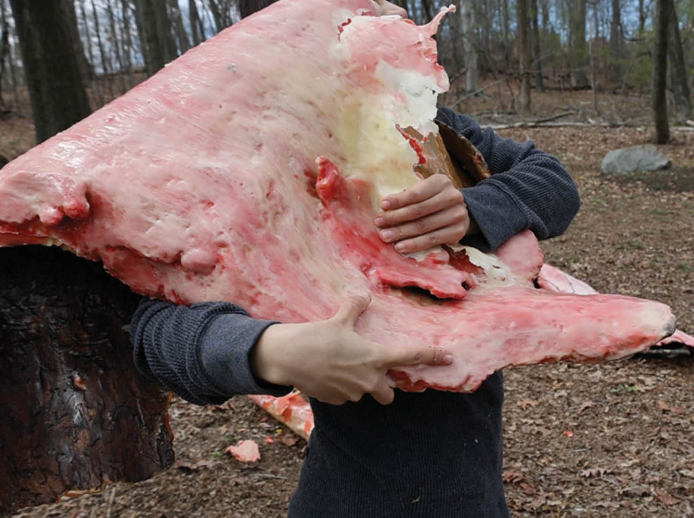
A photograph from Rezaei’s three-hour performance “The Tongue in the Landscape” at the Joseph Beuys Sculpture Park featuring the artist laboriously peeling the wax layer off the pieces of bark. Photo courtesy of Rezaei.
To create the art for her thesis project, Rezaei used almost exclusively materials collected on or near campus, including fallen tree bark, shattered wood, and seeds. She bought her main material—beeswax— from Baltimore beekeepers. One piece, “The Collective Womb,” featured hundreds of native seeds, called Devil’s Darning Needles, held together by beeswax around orange peels.
When the pieces were finished, Rezaei immediately knew the stage she wanted to showcase them on—Joseph Beuys Sculpture Park. “I installed my pieces there and had a performance as a way to extend the concept of public sculpture, aiming to reactivate the space and revive the concept of ecological engagement central to Beuys’ 7000 Oaks project.”


A composite of several microscope images of phages discovered by UMBC students in the Phage Hunters program demonstrates the variety of shapes phages can take. Photo by Tagide deCarvalho.
IchabodCrane. MindFlayer. Annihilus. TonyStarch. These are viruses previously completely unknown to science discovered by UMBC students in the Phage Hunters program, a two-course undergraduate genetics and bioinformatics sequence.
Since its launch in 2008, UMBC students have discovered 661 viruses that infect bacteria, called phages. Ninety-seven of them originated in samples collected on campus, with the most popular location being the Library Pond. Seventy-seven phages have been sequenced and 60 have been fully characterized and submitted to GenBank, an international digital repository of genetic and protein sequences.
Steven Caruso ’94, Ph.D. ’02, biological sciences, principal lecturer of biological sciences, runs the genetics course where the students collect samples, isolate their phages, image them with help from Tagide deCarvalho, “and growth,” says Rezaei. “As an immigrant, I found present their findings. They learn foundational laboratory techniques and get a taste for research.
Phage Hunters gives students “a first glimpse of what research is, with all that goes with it: determination, grit, inspiration, frustration, and more,” says Ivan Erill, professor of biological sciences and co-instructor for the bioinformatics course with Caruso. “Students get to see all the possible outcomes of a research project, from total success culminating in a DNA extraction for sequencing to failure to isolate a phage in the first place.”

In the basement of the Meyerhoff Chemistry Building, in a tiled expanse called the Molecular Characterization and Analysis Complex, sits a sleek, roughly human-sized instrument with the power to measure extremely tiny amounts of chemicals. Amanda Belunis, a chemistry Ph.D. student now in her final year, knows the instrument like an old friend, having turned to it to analyze a smorgasbord of UMBC water samples.
Belunis studies a group of chemicals called per- and polyfluoroalkyl substances, or PFAS. The chemicals are used in products as varied as makeup, clothing, and fire-fighting foam and are found in trace amounts in many water sources as well as in human blood. Dubbed “forever chemicals” because of the way they persist in the environment, they present a growing concern to human health.
Belunis’s research is part of a growing effort by scientists to understand how PFAS enter and travel through the environment and, ultimately, figure out ways to remove them.
To validate her procedures for measuring PFAS concentrations, Belunis tested water from drinking fountains, the sink in her chemistry lab, the pool, and the pond and streams around UMBC, all of which contained trace amounts of PFAS, as would be expected. Confident her methods worked on real-life samples, she then turned her attention to analyzing water in aquaculture fish tanks.
“My lab mates and I sometimes discuss how all of us have these chemicals in our bodies,” says Belunis. “It’s concerning, which is why we need to do more studies.”
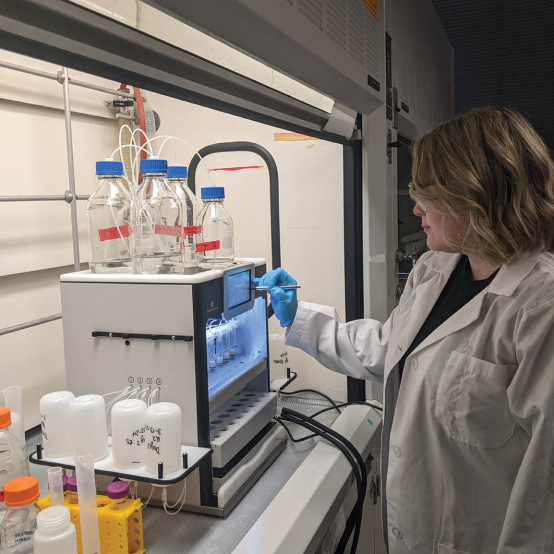
Amanda Belunis prepares samples for later analysis in the Molecular Characterization and Analysis Complex. Photo by Catherine Meyers.

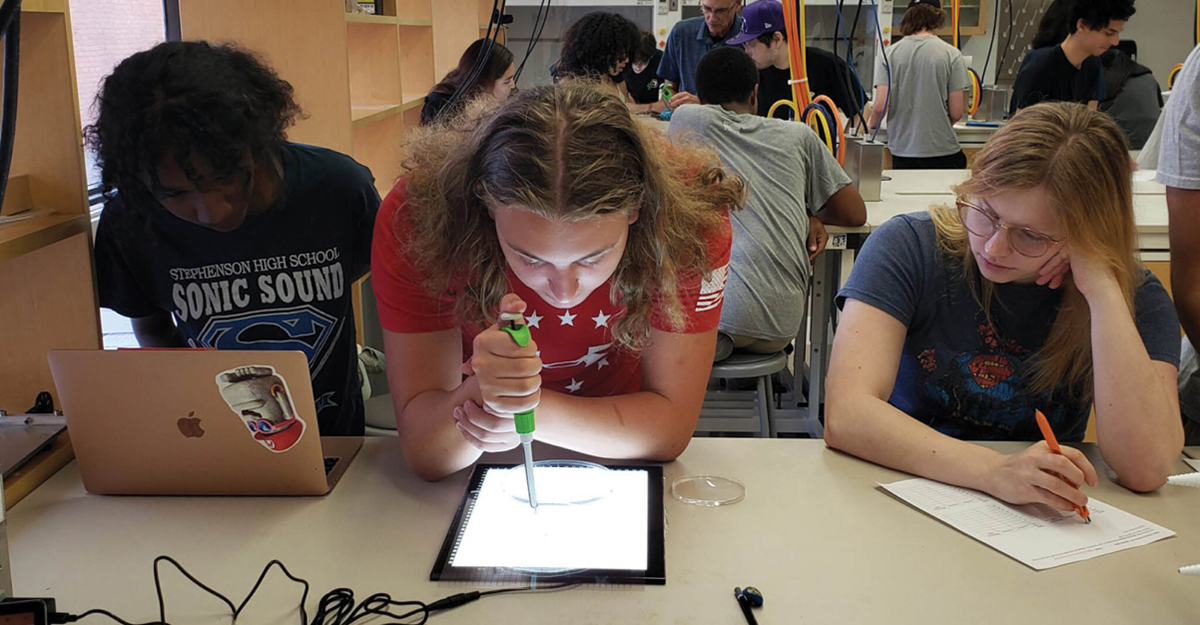 In addition to measuring buildings, students in Math in Action discovered other ways that math naturally interacts with their lives and studies. Here they are recording the movements of brine shrimp. Photo by Sarah Hansen, M.S. ’15.
When asked how to measure the height of a building, most students in Math in Action, a new laboratory course for non-STEM majors, “came up with various ways to measure the height directly—for example, by dropping down a string and then measuring the string or stacking up various objects,” says Alexis O’Malley ’18, mathematics and psychology, who teaches the lab.
But today, students are peering along the edges of homemade clinometers—plastic protractors with drinking straws attached—taking measurements from safely on the ground with a meter stick, and running simple calculations based on the properties of triangles to measure the height of UMBC’s Administration Building (123 feet, 2 inches).
Throughout the course, “I want students to see how math can be used to solve problems creatively,” O’Malley says.
Math in Action covers different math concepts each week through hands-on activities. The purpose of the clinometer activity is to remind students that “science is based on measurement, and you can build a tool to measure almost anything,” shares William R. LaCourse, dean of the College of Natural and Mathematical Sciences, who originally generated the idea for the course to help a wider range of students develop math skills relevant to their everyday lives. The course, he adds, “is a doorway to a lot of different math concepts.”

Shawn Abraham ’24, political science, has gotten lost on the UMBC campus more times than he can remember. As a blind student, he finds his way using a white cane, auditory cues, mental maps, and by asking people for directions. “People are surprised when I tell them, but big cities are much easier to navigate,” Abraham says. “College campuses are hard to get around.”
Tactile maps are one tool that could help. Erin Higgins and Kirk Crawford, Ph.D. students in human-centered computing, have recently been working with blind students at UMBC to create and test 3D-printed maps of campus.
The researchers launched the project after being approached by Michael Canale, assistant director of the Office of Student Disability Services. He says UMBC currently has four completely blind students enrolled and his office wants to provide personalized maps that each student can carry with them as they navigate campus. He’d also like to see a large 3D-printed map mounted somewhere on campus.
“A beautiful tactile map could be used by visitors of all kinds,” Canale said. “It’s the principle of universal design.”
Meanwhile, Md Osman Gani, an assistant professor of information systems, is spearheading a new project, named MyPath, to develop a Google Maps–style app to help wheelchair users navigate campus.
“Uneven surfaces, discontinuous sidewalks, and steep slopes can make wheelchair travel challenging, and even impossible” Gani says. The MyPath app would help by providing users with personalized turn-by-turn navigation with real-time updates. The app will rely on a machine learning model that recognizes path accessibility conditions based on crowd-sourced data, and Gani is currently recruiting wheelchair users to contribute data using their smartphones.
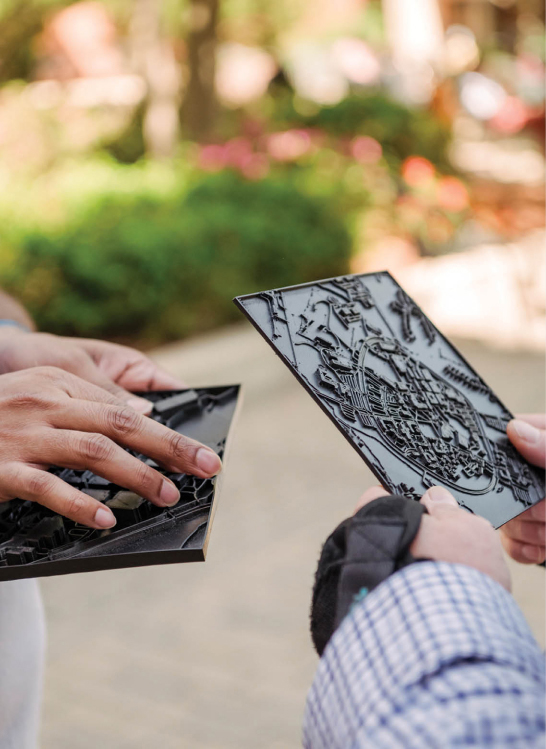
Shawn Abraham (left) tests prototype tactile maps made with 3-D printers with Michael Canale (right).

It’s 7 a.m. in July, and Megan Curtiss ’23, GES, is standing next to a tree just outside The Loop on UMBC’s southeast corner. It’s wrapped in a thin metal band at about chest height. Curtiss carefully measures the small gap between the two ends of the band with digital calipers three times, takes the average, and then moves on to the next tree. Only 98 to go.
This scene played out weekly from March to October 2023 as Curtiss collected data for a study led by Matthew Baker, GES professor, and Nancy Sonti, a research ecologist with the U.S. Forest Service. “It became like a morning meditation,” Curtiss shares.
The metal bands, call dendrobands, “are a cheap and easy way to get pretty detailed information,” Curtiss says. By measuring the trees’ growth over time, the goal is to look at how trees of different species and in different immediate environments (such as a parking lot versus a forest) handle conditions like fluctuating temperatures and water availability.
After attending Anne Arundel Community College in her 30s, Curtiss then found a home at UMBC. She began working with Baker in fall 2022 and will enter the GES master’s program at UMBC this fall. A graduate degree was not something Curtiss originally planned on, but now she’s excited about the further experiences it will bring. “I’m looking forward to the unexpected,” Curtiss says.

Take a left off Hilltop Circle, just past the greenhouse on the right and toward the Walker Avenue apartments, and you’ll find yourself outside a traditional brick building that used to house trial rooms and detention cells. In 2021, UMBC turned this former courthouse into the main hub for the Center for Real-time Distributed Sensing and Autonomy (CARDS). Researchers here develop artificial intelligence-enabled smart robots for military and search-and-rescue operations.
On a sunny day in spring, you will likely see students gathered in the courthouse’s “backyard,” huddled around dog-like Spot robots and wheeled vehicles called Jackals and Huskies.
The researchers outfit the robots with a host of custom devices, such as cameras and radar to sense their surroundings and microprocessors to run on-board algorithms. While the robots can be commanded via voice and gesture, the ultimate goal is for them to operate mostly autonomously.
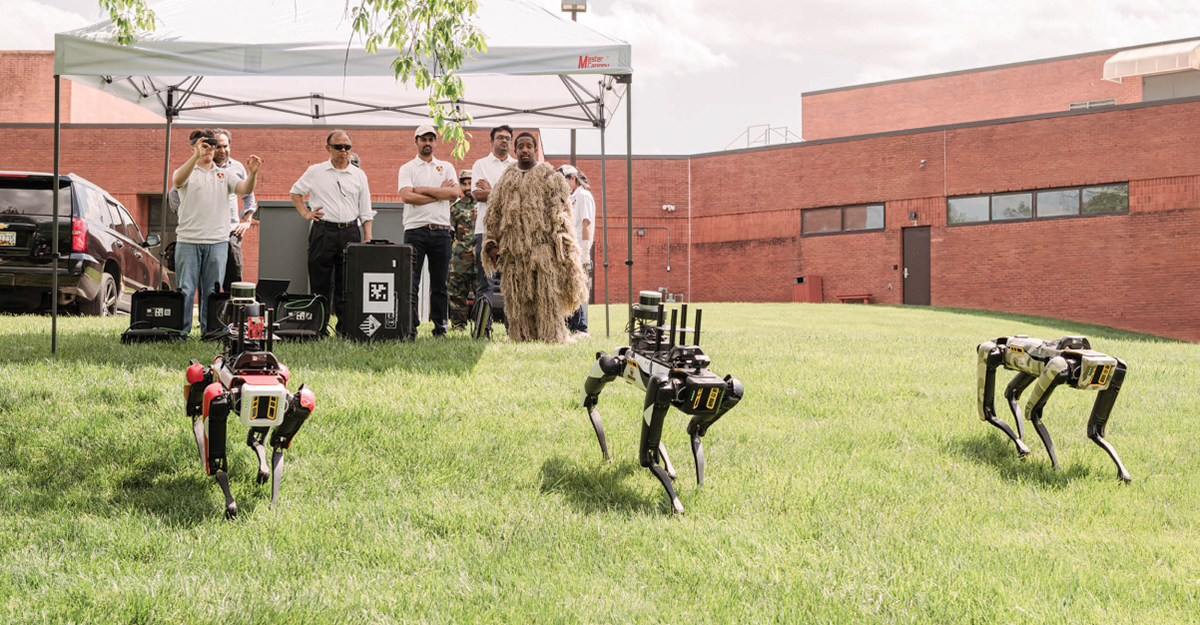 On the back lawn of the courthouse building, student researcher Kevin Rippy, left, controls three Spot robots with gestures. Another student stands by in a ghillie suit, a type of camouflage clothing.
Recently, the team has demonstrated this capability by verbally assigning the robots the task of jointly surveying a given area. The robots must translate the instructions from plain English into machine-level commands, divide up duties, detect and avoid obstacles, come to a fellow robot’s aid in the case of unexpected problems, and identify and keep track of the objects and people within their assigned perimeter.
“People from around campus will see us testing and will stop to watch,” says Aryya Gangopadhyay, a professor in information systems who directs CARDS. “The robots are an attention getter.”

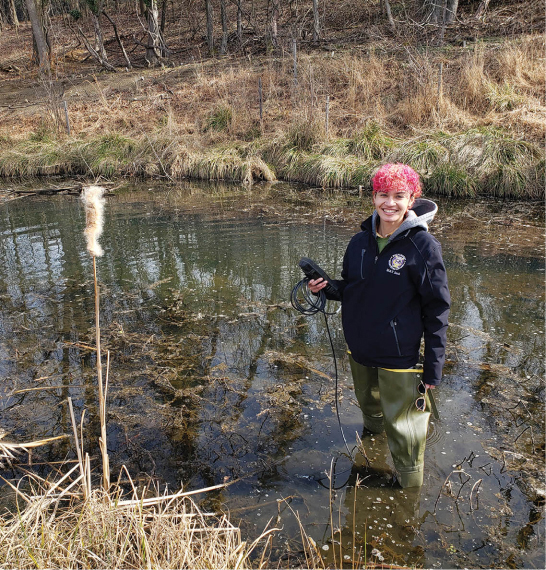
Erin Hamner collected weekly water quality data from this stream for six months, using the battery-powered digital probe she’s holding. (Image by Sarah L. Hansen, M.S. ’15)
After traipsing across a swampy field between research sites, Erin Hamner ’22, GES, and a current master’s student in the Interdisciplinary Consortium for Applied Research in the Environment program, scampers down a streambank in thigh-high waders and plunges a battery-powered probe into the water. It reports concentrations of ammonia and nitrates—key water quality measures. The probe also measures the water’s conductivity, which indicates the level of ions, such as salts used to melt snow.
It’s beautiful out today, but Hamner completed the trek to a dozen campus sites weekly from September 2023 to February 2024, sometimes dealing with mud, snow, or rain. The goal of her master’s thesis is to confirm that stormwater management features UMBC has installed to reduce flooding, filter storm runoff, and otherwise improve water quality are working as intended—or if they aren’t, to suggest improvements.
Hamner and her collaborators in Facilities Management and the Office of Sustainability want to see the data collection effort continue after she graduates. So she is working with faculty in GES to incorporate crowd-sourced stormwater monitoring into the undergraduate curriculum, including generating a public dashboard.
“Erin has done incredible groundwork collecting water quality data across our campus, generating useful data that can tell us about the health of UMBC’s waterways,” says Taylor Smith, assistant director of sustainability.
Long-term data will help the university “see how our development affects our watershed so we can continue to be good stewards,” Smith adds, noting that, “data like Erin’s can help us advocate for more greenspace and stream buffers around campus.”
]]>
Spring on UMBC’s main campus brings a host of familiar sights and sounds: blooms on the magnolia trees, the chatter of red-winged blackbirds calling from the reeds around Library Pond, greening...
https://umbc.edu/stories/putting-umbc-research-on-the-map/
https://my3.my.umbc.edu/api/v0/pixel/news/142303/guest@my.umbc.edu/93196282138c9d99f3c2930689edf3cd/api/pixel
biological-sciences
cahss
campus-life
cards
chemistry
cnms
coeit
computer-science
feature
ges
humancentered-computing
icare
imda
information-systems
joseph-beuys
magazine
mathematics
political-science
psychology
science-and-tech
sds
spring-2024
story
UMBC News & Magazine
https://my3.my.umbc.edu/groups/umbc-news-magazine
https://assets1-my.umbc.edu/system/shared/avatars/groups/000/001/943/24435aa6207c452e7bc15cc74b42c7bb/xsmall.png?1748556657
https://assets1-my.umbc.edu/system/shared/avatars/groups/000/001/943/24435aa6207c452e7bc15cc74b42c7bb/original.png?1748556657
https://assets2-my.umbc.edu/system/shared/avatars/groups/000/001/943/24435aa6207c452e7bc15cc74b42c7bb/xxlarge.png?1748556657
https://assets2-my.umbc.edu/system/shared/avatars/groups/000/001/943/24435aa6207c452e7bc15cc74b42c7bb/xlarge.png?1748556657
https://assets3-my.umbc.edu/system/shared/avatars/groups/000/001/943/24435aa6207c452e7bc15cc74b42c7bb/large.png?1748556657
https://assets1-my.umbc.edu/system/shared/avatars/groups/000/001/943/24435aa6207c452e7bc15cc74b42c7bb/medium.png?1748556657
https://assets2-my.umbc.edu/system/shared/avatars/groups/000/001/943/24435aa6207c452e7bc15cc74b42c7bb/small.png?1748556657
https://assets1-my.umbc.edu/system/shared/avatars/groups/000/001/943/24435aa6207c452e7bc15cc74b42c7bb/xsmall.png?1748556657
https://assets2-my.umbc.edu/system/shared/avatars/groups/000/001/943/24435aa6207c452e7bc15cc74b42c7bb/xxsmall.png?1748556657
UMBC News & Magazine
1
0
false
Thu, 30 May 2024 10:42:29 -0400
Thu, 30 May 2024 10:42:29 -0400
UMBC’s College of Engineering and Information Technology aligns with UBalt’s Merrick School of Business to deliver enhanced degrees
An agreement between the College of Engineering and Information Technology at UMBC and The University of Baltimore’s Merrick School of Business will offer students from both institutions enhanced opportunities for their graduate-level degrees and future careers.
UMBC students may apply credits from UMBC’s M.S. in Engineering Management, Post-Baccalaureate Graduate Certificate in Project Management, or the Post-Baccalaureate Graduate Certificate in Engineering Management to UBalt’s MBA. UBalt students may apply credits from the MBA program or the Post-Baccalaureate Graduate Certificate in Business Fundamentals to UMBC’s M.S. in Engineering Management. This collaborative effort to satisfy certain requirements for these programs is intended to increase the marketability of students at both institutions, as they build out their career paths in a growing number of fields that require multiple areas of focus.
A candidate for an engineering job, for example, may benefit from having educational experience in business. The MBA degree, a stalwart of business professionals across a wide range of fields, is made even more attractive when combined with graduate-level learning in a vital area such as project management.
Both UMBC and UBalt are members of the University System of Maryland, the state’s longtime organization of 12 colleges and universities, three regional centers for higher education, and the system office, all working together to improve the quality of life in Maryland. The partnership maximizes the strengths at each of the USM sister institutions so those seeking managerial education at UMBC will have access to programs offered by an AACSB-accredited School of Business and those in the UBalt MBA may continue to evolve their professional goals with technical skill sets offered by the UMBC School of Engineering.
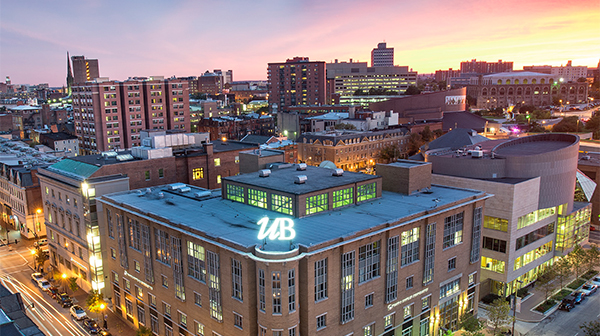 The Thumel Business Center, home of the Merrick School of Business, at The University of Baltimore. (Photo courtesy of UBalt.)
“This agreement leverages the strengths of UMBC’s engineering program and UBalt’s business program to provide students with accelerated pathways to earn graduate degrees or certificates from both institutions,” says Dr. Raju Balakrishnan, dean of the Merrick School of Business. “This is another excellent example of how USM institutions collaborate to provide students with even more enhanced educational opportunities.”
UMBCs acting dean of the College of Engineering and Information Technology Anupam Joshi adds, “We are excited to provide students from both institutions additional options to grow and acquire valuable knowledge and skills. We also look forward to exploring new ways to expand this partnership.”
Admission into these collaborative courses is straightforward:
- UMBC students must be enrolled in or have completed an M.S. in Engineering Management or Post-Baccalaureate Certificate in Engineering Management or Project Management at UMBC. These UMBC students may apply to either or both of the UBalt programs in the final semester of their respective programs and will be subject to standard application procedures.
- Similarly, UBalt students will have to be enrolled in the MBA or the Graduate Certificate in Business Fundamentals and may apply to any of the UMBC programs in the final semester of their respective programs and will be subject to standard application procedures.
- Both UBalt and UMBC will accept up to 12 transfer credits of the other institution’s courses.
The introduction of the new collaboration is expected to be available to applicants in Fall 2024.
For further details, visit UBalt’s page.
Learn more about the Merrick School of Business at The University of Baltimore.
Learn more about the College of Engineering and Information Technology at UMBC.
]]>
An agreement between the College of Engineering and Information Technology at UMBC and The University of Baltimore’s Merrick School of Business will offer students from both institutions enhanced...
https://umbc.edu/quick-posts/umbc-ubalt-enhanced-degree-options/
https://my3.my.umbc.edu/api/v0/pixel/news/142250/guest@my.umbc.edu/a15c6427e429e269f682df3dbcec6081/api/pixel
coeit
news
quick-post
UMBC News & Magazine
https://my3.my.umbc.edu/groups/umbc-news-magazine
https://assets1-my.umbc.edu/system/shared/avatars/groups/000/001/943/24435aa6207c452e7bc15cc74b42c7bb/xsmall.png?1748556657
https://assets1-my.umbc.edu/system/shared/avatars/groups/000/001/943/24435aa6207c452e7bc15cc74b42c7bb/original.png?1748556657
https://assets2-my.umbc.edu/system/shared/avatars/groups/000/001/943/24435aa6207c452e7bc15cc74b42c7bb/xxlarge.png?1748556657
https://assets2-my.umbc.edu/system/shared/avatars/groups/000/001/943/24435aa6207c452e7bc15cc74b42c7bb/xlarge.png?1748556657
https://assets3-my.umbc.edu/system/shared/avatars/groups/000/001/943/24435aa6207c452e7bc15cc74b42c7bb/large.png?1748556657
https://assets1-my.umbc.edu/system/shared/avatars/groups/000/001/943/24435aa6207c452e7bc15cc74b42c7bb/medium.png?1748556657
https://assets2-my.umbc.edu/system/shared/avatars/groups/000/001/943/24435aa6207c452e7bc15cc74b42c7bb/small.png?1748556657
https://assets1-my.umbc.edu/system/shared/avatars/groups/000/001/943/24435aa6207c452e7bc15cc74b42c7bb/xsmall.png?1748556657
https://assets2-my.umbc.edu/system/shared/avatars/groups/000/001/943/24435aa6207c452e7bc15cc74b42c7bb/xxsmall.png?1748556657
UMBC News & Magazine
0
0
false
Thu, 30 May 2024 09:56:26 -0400
Thu, 30 May 2024 09:56:26 -0400
A resilient Class of 2024 celebrates its successes
UMBC’s graduating Class of 2024 knows a thing or two about resilience. Many of this year’s 1,900-plus graduates began their collegiate journey at the onset of a global pandemic.
This week, as they walked across the Commencement stage adorned in black and gold regalia and mortarboards elaborately decorated with sayings such as “The tassel was worth the hassle,” “I did it,” and “The end is here,” the Class of 2024 reveled in the celebratory moment of reaching this milestone in the face of much adversity.
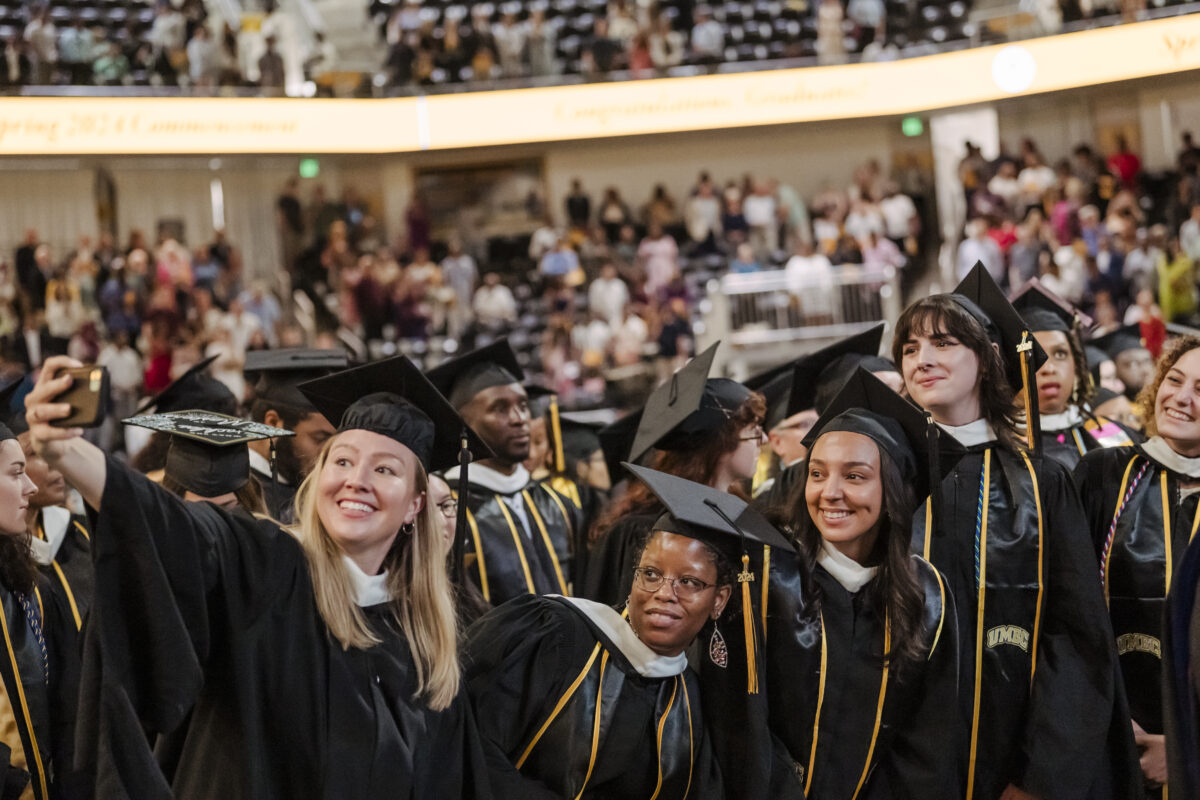 Class of 2024 graduates capturing Commencement day excitement.
“Resilience is a dynamic process. It’s a journey that we embark on in the face of challenges. Resilience is not just bouncing back or being able to recover—It’s the ability to bounce forward,” said graduate student speaker Grace De Oro, M.P.P. ’19, a Ph.D. candidate in public policy and president of the Graduate Student Association.
“We’ve all bounced forward to get here, right now, in this moment. This journey of resilience has not only brought us here, but it’s transformed us into stronger and more capable individuals.”
UMBC’s Spring 2024 Commencement video. (Elijah Davis, M.F.A. ’21/UMBC)
Service as a Retriever
During Thursday morning’s undergraduate ceremony for students in the College of Arts, Humanities, and Social Sciences; School of Social Work; and Erickson School of Aging Studies, co-valedictorian Nyla Howell ’24, geography and environmental systems and sociology, spoke to the value of service and how the graduating class will “serve with more than our degrees.”
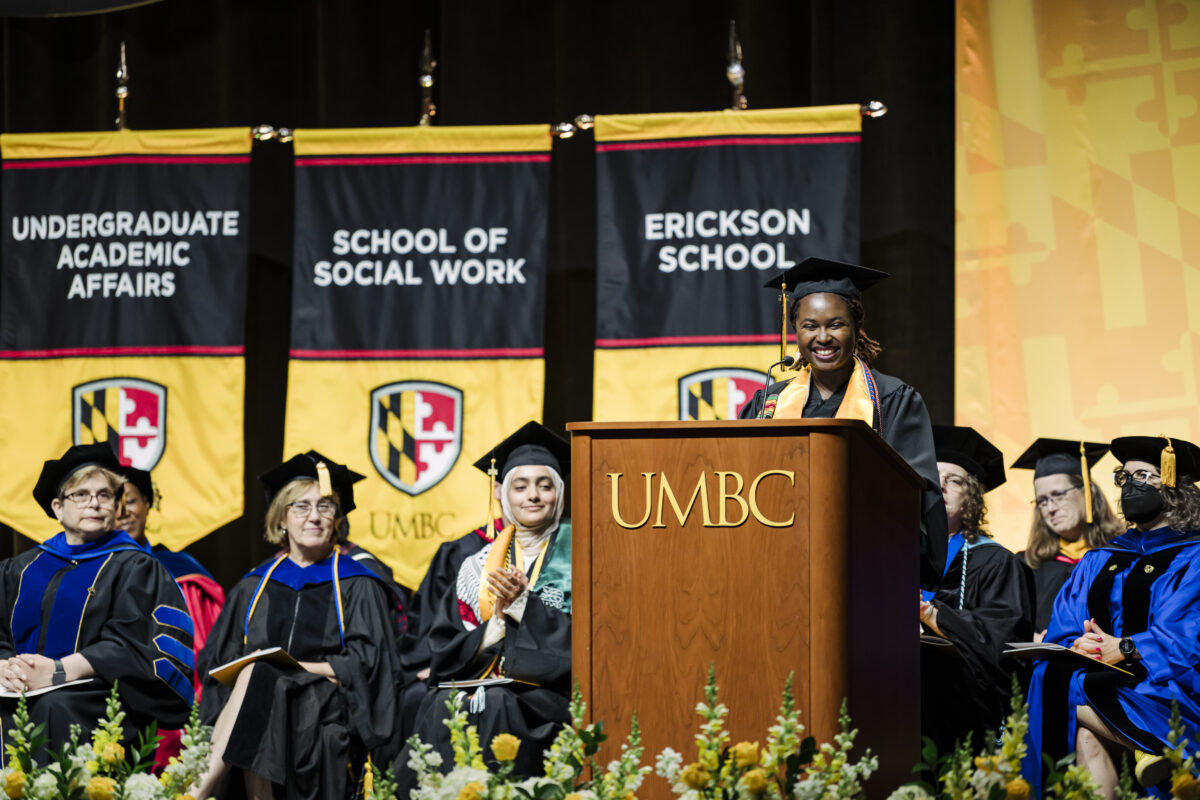 Valedictorian for the College of Arts, Humanities, and Social Sciences; School of Social Work; and Erickson School of Aging Studies morning ceremony, Nyla Howell ’24, speaks at Commencement.
“We all serve those around us daily by using our time and talent to encourage each other, give advice to each other, and take care of one another,” Howell said. “I believe that if we approach this next phase of life, despite all its uncertainty, with the intention of genuinely caring for others and living out our personal understandings of service, we will have the launch pads we need to do more than we ever believed we could.”
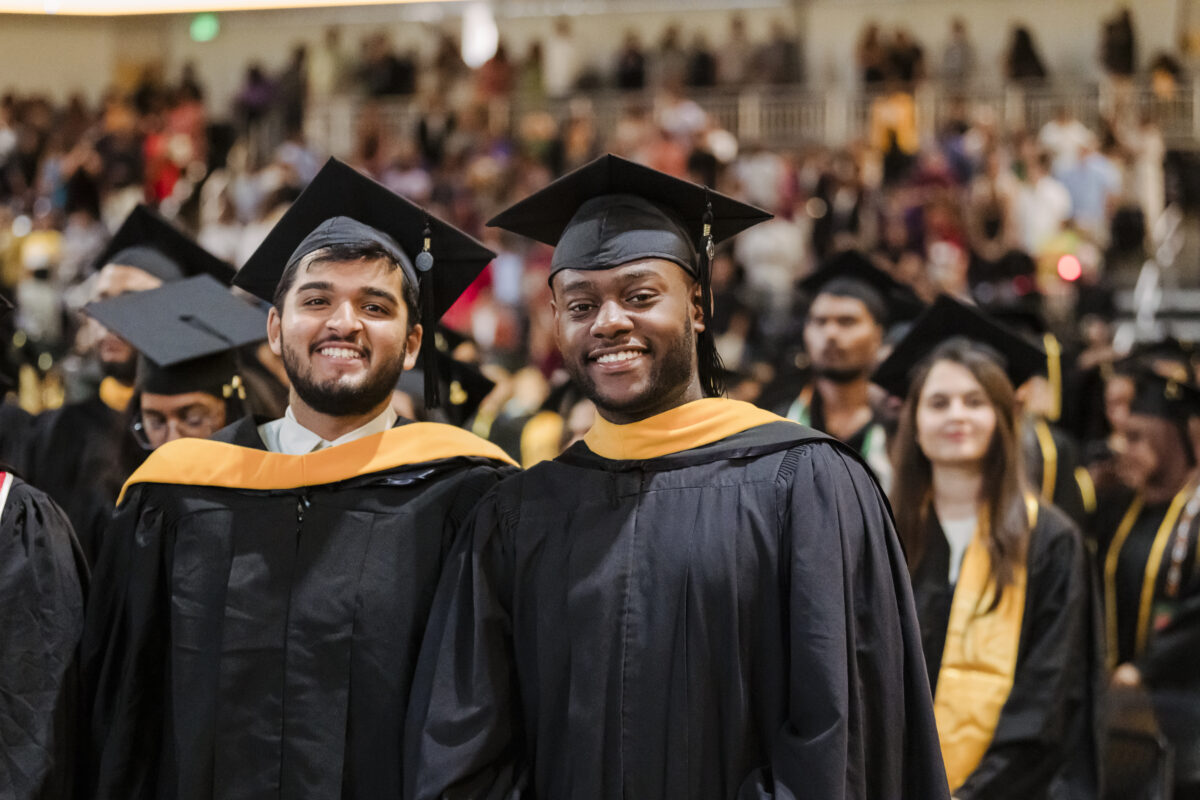
Howell, who is the first McNair Scholar to be a valedictorian at UMBC, has dedicated much of her time as an undergraduate in service to local communities and engaged in research examining how vulnerable and underrepresented communities can be better protected when disasters strike. Since 2021, Howell has worked as the food pantry manager of Retriever Essentials helping to combat food insecurity at UMBC. Howell’s leadership and public service efforts earned her scholarships from the France and Merrick Scholars Endowment and the Jacqueline C. Hrabowski Endowment.
She will continue her studies in geography as a Ph.D. student at Rutgers University as a fellow of the National Science Foundation’s Graduate Research Fellowship Program.
A dedication to STEM and the arts
During the afternoon ceremony for the College of Natural and Mathematical Sciences; College of Engineering and Information Technology; and Division of Undergraduate Academic Affairs, co-valedictorian D’Juan Moreland ’24, biological sciences and music, shared with his fellow graduates the lessons he has learned, particularly ones imparted to him by his mother.
Congratulations to our Engineering and Computing students #UMBCgrad @UMBC #UMBCengineering #UMBCComputing pic.twitter.com/M3gk0HkFLu
— Jamie Gurganus, PhD (@JamieRGurganus) May 23, 2024
“The first [lesson] is to celebrate yourself even in the little victories. The secondis to recognize who supported you. The lastis to set a good example because other people are watching your every move,” said Moreland. “Part of our achievement today is to set a strong example for those who are watching us right now. They don’t just see our success, but also our perseverance, as encouragement and inspiration for themselves.”
 UMBC Class of 2024 graduates all smiles during Commencement.
During his time at UMBC, Moreland, a Meyherhoff Scholar, balanced and even found a way to intertwine his interests in biological sciences and music. He was a 2022 – 2023 recipient of a prestigious Goldwater Scholarship, for which he used his research on the song syllable use differences in female and male songbirds as the basis of his application. Moreland’s original composition “Ascension” won the inaugural UMBC Symphony Orchestra Composer Competition last year.
 Valedictorian of the College of Natural and Mathematical Sciences; College of Engineering and Information Technology; and Division of Undergraduate Academic Affairs afternoon ceremony co-valedictorian, D’Juan Moreland ’24, addressing the audience during Commencement.
Additionally, he is a recipient of the Thomas V. Marsho and Martin Schwartz Memorial Fund scholarship and a recipient of the Ronald and Kathryn Shapiro Meyerhoff Mentoring scholarship. Moreland has dedicated much of his time to mentoring younger students, a passion that inspired him to create a mentoring program at his church for young Black men in middle and high school. Following graduation, Moreland will pursue a Ph.D. in neuroscience at the University of Pennsylvania.
“The DNA of UMBC”
The lineup of this year’s Commencement speakers included Mina Cheon, M.F.A. ’02, imaging and digital arts, the dean of undergraduate studies at the Maryland Institute College of Art and a 2018 UMBC Alumni Award winner. Farah Helal ’24, political science and global studies, also delivered remarks as the University System of Maryland student regent representative.
Sethuraman Panchanathan, director of the National Science Foundation, received an honorary doctor of science degree during the afternoon ceremony. He dazzled the crowd with an energetic speech advising new graduates to follow “the 10 C’s”—words like “commitment,” “courage,” “collaboration,” and “curiosity”—as they go on to the next chapter of their lives.
After grad, Chiad Onyeje, chem eng, will go to Johns Hopkins via the new Vivien Thomas Scholars Initiative program. His research will concentrate on the development of drug delivery biomaterials to open up new opportunities for disease & trauma treatment & prevention. #UMBCgrad pic.twitter.com/pVZ10ieEVs
— UMBC (@UMBC) May 17, 2024
“Retrievers, you have the DNA of UMBC,” Panchanathan said to the graduates. “That DNA is about lifting people up…and making sure people are given chances, making things accessible, and inspiring people.”
Congratulations to the Class of 2024! Please continue to share your messages of congratulations on social media using #UMBCgrad. Read more about Class of 2024 graduates on the UMBC News Site.
]]>
UMBC’s graduating Class of 2024 knows a thing or two about resilience. Many of this year’s 1,900-plus graduates began their collegiate journey at the onset of a global pandemic. This week,...
https://umbc.edu/stories/class-of-2024-commencement/
https://my3.my.umbc.edu/api/v0/pixel/news/142185/guest@my.umbc.edu/ba783fd9283fc597f7356a4051373b34/api/pixel
cahss
campus-life
class-of-2024
cnms
coeit
commencement
erickson-school
feature
magazine
public-policy
social-work
story
UMBC News & Magazine
https://my3.my.umbc.edu/groups/umbc-news-magazine
https://assets1-my.umbc.edu/system/shared/avatars/groups/000/001/943/24435aa6207c452e7bc15cc74b42c7bb/xsmall.png?1748556657
https://assets1-my.umbc.edu/system/shared/avatars/groups/000/001/943/24435aa6207c452e7bc15cc74b42c7bb/original.png?1748556657
https://assets2-my.umbc.edu/system/shared/avatars/groups/000/001/943/24435aa6207c452e7bc15cc74b42c7bb/xxlarge.png?1748556657
https://assets2-my.umbc.edu/system/shared/avatars/groups/000/001/943/24435aa6207c452e7bc15cc74b42c7bb/xlarge.png?1748556657
https://assets3-my.umbc.edu/system/shared/avatars/groups/000/001/943/24435aa6207c452e7bc15cc74b42c7bb/large.png?1748556657
https://assets1-my.umbc.edu/system/shared/avatars/groups/000/001/943/24435aa6207c452e7bc15cc74b42c7bb/medium.png?1748556657
https://assets2-my.umbc.edu/system/shared/avatars/groups/000/001/943/24435aa6207c452e7bc15cc74b42c7bb/small.png?1748556657
https://assets1-my.umbc.edu/system/shared/avatars/groups/000/001/943/24435aa6207c452e7bc15cc74b42c7bb/xsmall.png?1748556657
https://assets2-my.umbc.edu/system/shared/avatars/groups/000/001/943/24435aa6207c452e7bc15cc74b42c7bb/xxsmall.png?1748556657
UMBC News & Magazine
3
0
false
Fri, 24 May 2024 16:03:51 -0400
Fri, 24 May 2024 16:03:51 -0400
 The outage led to thousands of flight delays on July 19, 2024. AP Photo/Yuki Iwamura

