UMBC students confront ethical challenges through new computing curriculum
When UMBC’s Helena Mentis is teaching, her students often bring up ethical challenges in computing, and they are hungry to learn about how to address them. “We want to capitalize on this curiosity and diversity of perspectives,” says Mentis, associate dean for academic programs and learning and associate professor of information systems. “Alongside technical skill development, every week we want to introduce challenges around ethics, equality, human behavior, and societal impact, reiterating that a fundamental component of development is thinking through implications.”
Incorporating ethics into computing curriculum is crucial to ensure that today’s graduates are well prepared to address the complex challenges of the future, Mentis explains. Recently, she and colleagues in UMBC’s College of Engineering and Information Technology received funding from the Mozilla Foundation to support implementing ethics components in their courses.
Research to improve teaching
UMBC was one of 17 universities from across the country that received funding as part of Mozilla’s Responsible Computer Science Challenge. Through this project, UMBC faculty have restructured an introductory computing course, building into it regular opportunities for students to discuss ethical issues in depth. The course framework is team-based and peer-led. The faculty are also examining the efficacy of these course updates to assess student learning and continue to improve their approach.
 Helena Mentis. Photo by Marlayna Demond ’11 for UMBC.
Mentis is the principal investigator of this research. Colleagues leading other aspects of the research and implementation include Anupam Joshi, professor and chair of computer science and electrical engineering; Carolyn Seaman, associate professor of information systems, and interim director of the Center for Women in Technology; and Maria Sanchez, director of education and outreach, and professor of practice in mechanical engineering.
Facilitating conversations in the classroom
Mentis explains that discussions about ethics related to computing often occur organically between students as they work to understand their peers’ perspectives. This initiative takes those discussions to the next level, making them an integral part of the course. More broadly, it is also part of a new course structure for first-year engineering and computing students that emphasizes how technology will impact society. The goal, she explains, is “to develop the next generation of technologists who have the framework and vocabulary to address the relationships between STEM and society.”
Lecturer Mark Berczynski taught the introductory computing course this semester. Through facilitated discussions, he helped his first-year students learn to more effectively explore and evaluate the potential negative impacts of technologies.
Team-based learning focused on peer-to-peer connections also played a major role in the pilot course. “Our concept of peer-led team learning has shown that peer-to-peer engagement with material leads to better understanding, better encoding, and longer retention,” Mentis shares.
Mentis and her collaborators will assess whether their approach for teaching ethics in introductory computing is effective both in the short and longer term. They’ll compare the ethics awareness of students in the original computing course with students in the updated course. One year later, students will be asked to complete a survey about how they have applied their knowledge of ethics in other computing classes that they have taken.
Mentis also hopes this new approach will interest a broader range of students in computing fields. She suggests, “Grounding the introduction to computing within ethics and societal implications of technology design has the potential to excite and engage a more diverse student population.”
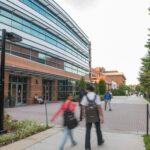
Banner image: ITE building. Photo by Marlayna Demond ’11 for UMBC.
]]>
When UMBC’s Helena Mentis is teaching, her students often bring up ethical challenges in computing, and they are hungry to learn about how to address them. “We want to capitalize on this curiosity...
https://umbc.edu/stories/umbc-students-confront-ethical-challenges-through-new-computing-curriculum/
https://my3.my.umbc.edu/api/v0/pixel/news/119988/guest@my.umbc.edu/98a1edd774cef18a25c90e9f52213b69/api/pixel
coeit
csee
cwit
is
science-and-technology
UMBC News & Magazine
https://my3.my.umbc.edu/groups/umbc-news-magazine
https://assets1-my.umbc.edu/system/shared/avatars/groups/000/001/943/24435aa6207c452e7bc15cc74b42c7bb/xsmall.png?1748556657
https://assets1-my.umbc.edu/system/shared/avatars/groups/000/001/943/24435aa6207c452e7bc15cc74b42c7bb/original.png?1748556657
https://assets2-my.umbc.edu/system/shared/avatars/groups/000/001/943/24435aa6207c452e7bc15cc74b42c7bb/xxlarge.png?1748556657
https://assets2-my.umbc.edu/system/shared/avatars/groups/000/001/943/24435aa6207c452e7bc15cc74b42c7bb/xlarge.png?1748556657
https://assets3-my.umbc.edu/system/shared/avatars/groups/000/001/943/24435aa6207c452e7bc15cc74b42c7bb/large.png?1748556657
https://assets1-my.umbc.edu/system/shared/avatars/groups/000/001/943/24435aa6207c452e7bc15cc74b42c7bb/medium.png?1748556657
https://assets2-my.umbc.edu/system/shared/avatars/groups/000/001/943/24435aa6207c452e7bc15cc74b42c7bb/small.png?1748556657
https://assets1-my.umbc.edu/system/shared/avatars/groups/000/001/943/24435aa6207c452e7bc15cc74b42c7bb/xsmall.png?1748556657
https://assets2-my.umbc.edu/system/shared/avatars/groups/000/001/943/24435aa6207c452e7bc15cc74b42c7bb/xxsmall.png?1748556657
UMBC News & Magazine
0
0
false
Tue, 17 Dec 2019 17:08:45 -0500
50-Foot Woman Tells All

If art is life, then Rahne Alexander is living hers as a collage of towering technicolor.
On stage with her bands Santa Librada and 50’  ; she conjures her musical muses—think Stevie Nicks or the Wilson sisters from Heart—leaning into the lyrics while shredding her guitar. Her hair glows purple in the spotlight.
In quieter moments, in her studio at UMBC’s Lion Brothers Building downtown, she carefully de-archives her collection of hundreds of decades-old cassette tapes. (Among them is a copy of Billy Idol’s 1981 Don’t Stop she stole from a Woolworths, she says, smiling.)
She works on short films like the Marcel Duchamp/Brett Kavanaugh/Atomic Blonde–inspired “Dude Descending a Staircase” that earned her “best creative award” at an international conference of computer-human interaction in China last year. And she never seems to rest.
 Portrait of Rahne Alexander in her Baltimore studio by Marlayna Demond ’11.
“I maintain a pretty high performance and art schedule, and have for a long time,” says Alexander, who is pursuing an MFA in UMBC’s intermedia and digital arts program as much for the community and the push to produce as anything else. “But I love making work, I love being on stage. It’s exhausting, but this is what I’m here for.”
All along the way—as she has for the last 16 years, at least—Alexander also writes. And nowhere is she quite more herself than in Heretic to Housewife, a collection of essays now in its second run from publisher Neon Hemlock Press. Described as “the trans* Marcel Proust,” by one critic, the 10 collected essays delve into what drives Alexander as an artist.
In the first essay, “A Meditation,” which she originally performed as a sort of love letter to herself at the D.C. Women in Comedy show, and later as the opener when author/actress Amber Tamblyn spoke in Baltimore, Alexander dives deeply into her personal story. In others, she un-buries the echos of traumas experienced throughout her life up to age 50. The doors haven’t always been as open to her, and life has not always been as safe. But, “fear is never revolutionary,” she writes, so she does not give in.
 Still from “Dude Descending a Staircase” courtesy of Rahhe Alexander.
But even with the most serious topics, Alexander’s wit and warmth shine through. “It was easier for me to come out as a transsexual lesbian than it was for me to come out as a witch,” she jokes in a monologue about the artist Paulina Peavy.
“[She] brings a multi-faceted body of work that often touches on artists of the past in ways that mine their works for tips on how to move into the future in more critical and equitable ways,” says Kathy O’Dell, associate professor of visual arts, art history, and museum studies. “And she does so with motivational humor—meaning, humor with edges of seriousness that prod us as viewers/participants to make decisions about where we stand on a variety of topics, from humor itself to domesticity, self-care, politics, LGBTQ issues, and many more.”
 (L-R): Jack Pinder, Skizz Cyzyk, Rahne Alexander, Mickey Dehn, Sarah Michaels, and Joseph Mulhollen
If her social media following—and the fact that the first run of her book sold out in two weeks—is any indication, Alexander has amassed a dedicated fan base who can’t wait to see what she does next. So, instead of resting, she presses on.
“It’s a lot, but this is why I moved to Baltimore in the first place—to have an art career and to put it all out there,” she says. “So these are all great problems to have.”
*****
Header image by Marlayna Demond ’11.
]]>
If art is life, then Rahne Alexander is living hers as a collage of towering technicolor. On stage with her bands Santa Librada and 50’ ; she conjures her musical muses—think Stevie Nicks or the...
https://umbc.edu/stories/50-foot-woman-tells-all/
https://my3.my.umbc.edu/api/v0/pixel/news/119989/guest@my.umbc.edu/3fa1e228ea40d4d2fad695dd1cfe0fc1/api/pixel
cahss
digital-arts
discovery
fall-2019
graduateschool
imda-mfa
lion-building
UMBC News & Magazine
https://my3.my.umbc.edu/groups/umbc-news-magazine
https://assets1-my.umbc.edu/system/shared/avatars/groups/000/001/943/24435aa6207c452e7bc15cc74b42c7bb/xsmall.png?1748556657
https://assets1-my.umbc.edu/system/shared/avatars/groups/000/001/943/24435aa6207c452e7bc15cc74b42c7bb/original.png?1748556657
https://assets2-my.umbc.edu/system/shared/avatars/groups/000/001/943/24435aa6207c452e7bc15cc74b42c7bb/xxlarge.png?1748556657
https://assets2-my.umbc.edu/system/shared/avatars/groups/000/001/943/24435aa6207c452e7bc15cc74b42c7bb/xlarge.png?1748556657
https://assets3-my.umbc.edu/system/shared/avatars/groups/000/001/943/24435aa6207c452e7bc15cc74b42c7bb/large.png?1748556657
https://assets1-my.umbc.edu/system/shared/avatars/groups/000/001/943/24435aa6207c452e7bc15cc74b42c7bb/medium.png?1748556657
https://assets2-my.umbc.edu/system/shared/avatars/groups/000/001/943/24435aa6207c452e7bc15cc74b42c7bb/small.png?1748556657
https://assets1-my.umbc.edu/system/shared/avatars/groups/000/001/943/24435aa6207c452e7bc15cc74b42c7bb/xsmall.png?1748556657
https://assets2-my.umbc.edu/system/shared/avatars/groups/000/001/943/24435aa6207c452e7bc15cc74b42c7bb/xxsmall.png?1748556657
UMBC News & Magazine
0
0
false
Tue, 17 Dec 2019 16:44:14 -0500
Swimmer, engineer, composer: Three Retrievers share their unique paths to graduation day

Imagine packing your bags and traveling 6,000 miles from home to spend four years in a country you’ve never visited. That’s exactly what Hania Moro ‘19, financial economics, did when she made the decision to travel from Egypt to UMBC in 2015 to start her collegiate career, and she hasn’t regretted it for a second. Ahead of graduation, Moro and fellow Retrievers Randy Deinlein and Collin David have shared their UMBC stories—unique paths and exceptional achievements thanks to a combination of personal grit and supportive community.
Jumping in feet first
Moro knew that swimming was going to be a major factor in her college decision process. At the suggestion of an a Egyptian friend at UMBC, she reached out to Chad Cradock ’97, psychology, head coach of UMBC swimming and diving. Cradock immediately followed up and Moro instantly knew “that’s the coach I’m gonna be with.”
 Hania Moro poses with coach and mentor Chad Cradock.
UMBC News: What has been most memorable about your time at UMBC?
Moro: Swimming took up most of my time. I was the team captain last year. I went to the World Championships twice. I was an African Game Gold Medalist in four different events. I broke my national records two times. I love the team, I love swimming with the team. When I graduate, I’m going to continue training [for the Olympics] here at UMBC with Chad. I can’t train with anyone else in the world. I wake up every day knowing that I need to work so hard to get to where I want to be.
 Moro shares her medals with friends.
UMBC News: What was your experience like arriving on campus and meeting your teammates?
Moro: I’d never been on a recruiting trip. I didn’t know what the campus was like, what the team was like. I was leaving my family and everything I knew. I figured I would just do it and hope for the best. I traveled for 18 hours—18 hours of tears. Chad picked me up from the airport and he’s just the nicest guy. He welcomed me and made me feel like I belong here. When I first arrived on move-in day, 70 of my teammates were waiting for me. They moved me in and made me feel like I was home. And I just felt like I have a family. Two days in America and I’m already very comfortable and I have 70 friends, not just one. This is my place now.
 UMBC’s swimming and diving team celebrates an America East win. Photo courtesy of Greg M. Cooper, America East.
UMBC News: How did your UMBC experience change you?
Moro: It definitely changed me as a person. I learned a lot of leadership skills. I look at things differently. I also learned to listen a lot—to listen instead of just talking. Chad taught me that it’s not about you, it’s about the team and about the community and what you can give everyone around you. I would swim my races and think, “I want to win this race not for me, but for my team.”
 Moro shows off her hardware.
What’s next for Moro? She’s pursuing her Olympic dreams, and she’s already well on her way to making them come true. At the recent United States Open Swimming Championships, Moro set a pair of Egyptian national records.
She also has her sights set on someday starting her own business. Inspired by an entrepreneurship class with Gib Mason, Moro has started to develop a plan to open a coffee and bagel shop in Egypt.
“The benefit comes from helping others”
Randy Deinlein is used to taking risks. He served in the United States Air Force for over four years, and has explored a range of paths in the time since then. So it may come as a surprise that Deinlein had some uncertainty about starting his UMBC journey.
While he had worries about adjusting to college as a returning student, he quickly channeled his energy and sense of mission into building connections and making a difference on campus. In his time at UMBC, he has been an S-STEM Scholar, Grand Challenge Scholar, member of Engineers Without Borders and the Honors College, and service coordinator for the Tau Beta Pi Engineering Honors Society. He also completed three internships to prepare for the next steps in his career.
 Randy Deinlein ‘19 (center) with Michael LaScola ‘20, chemical engineering, and Maria Sanchez, director of education and outreach for the College of Engineering and Information Technology. Photo courtesy of Rob Lacey.
UMBC News: What was the adjustment like when you arrived on campus—connecting with the UMBC community?
Deinlein: As a veteran, I don’t think the transition was difficult. We’re instilled with this value of having a mission, kind of like a goal. When we have a mission, it’s very easy to just do those steps to get towards it. But as an adult learner, I think that was hard for me…just feeling older and out of place and like I wouldn’t be able to relate to a lot of these young people. And I found I actually relate to a lot of them. I’m so impressed by all of their attitudes and their views of life because it’s nowhere near where I was when I was their age.
UMBC News: What activities have you been involved with at UMBC?
Deinlein: I helped to start the RetrieVets and served as the president. Veterans come here and see it as a kind of mission, but we’re not taught the benefits of being involved in the community. When you’re involved with group organizations and the community, you’re able to grow and challenge yourself in new experiences. The benefit comes from helping others. That’s what I wanted for a veteran organization.
 Deinlein poses with classmates Noelle Ray ‘19, M.S. ‘21, mechanical engineering, and Chelsie Marsh ‘19, mechanical engineering, with a bathroom seat adapter they created for a senior engineering capstone project.
UMBC News: How did your UMBC experience impact you?
Deinlein: It helped me move into the unknown and helped me be okay with challenging myself and doing things I don’t know how to do. I learned how to fail and fail fast…fail forward, as they say. I learned how to reflect on myself and what I have and haven’t done and every experience that I find important to myself, and how to grow from that. The UMBC community and the students, they are very supportive and open-minded. They’re diverse and interdisciplinary and outgoing.
Deinlein will graduate with a mechanical engineering degree and an entrepreneurship minor and has applied for a Fulbright Scholarship at the Lappeenranta University of Technology in Finland for a master’s in Global Management of Innovation and Technology.
Orchestrating his future
Collin David does not believe in downtime. The Carroll County native plays cello, French horn, guitar, piano, and clarinet. And also teaches private lessons. And takes lessons himself. And teaches gymnastics. And composes musical pieces. And maybe sleeps at some point, though that has not yet been confirmed.
After transferring from Carroll Community College, David enrolled in UMBC’s music composition track, a small, close-knit program that afforded him numerous opportunities to pursue his passions.
UMBC News: Why did you choose UMBC?
David: One of the reasons I chose UMBC was that I didn’t have to specialize. I applied to College Park and Shenandoah to do cello performance, but then I wouldn’t be able to take horn lessons or do the other stuff I wanted to do. Being a well-rounded musician is, I think, more important than being a specialist in one area.
 Collin David plays cello during a campus performance.
UMBC News: Is there a faculty member who has served as a mentor on your UMBC path?
David: Dr. [Linda] Dusman. She’ll always help when needed, and it’s basically like her connections are my connections. She sends emails to students when she sees opportunities that would be a good fit. She sent me one in particular about the São Paulo Contemporary Composers Festival. I got in and had a great experience. I was able to go to Brazil for a week and was lucky enough to have my orchestra piece played. Only myself and one other musician were undergraduate students.
The [music] department in general is very close-knit. Speaking about professors, they’ve definitely gone far and above what I would’ve expected. They’re personable and there’s not so much of a gap between the students and professors. I think that’s important.
 David with members of UMBC’s music department.
UMBC News: What is something you had an opportunity to explore at UMBC that you didn’t expect to?
David: I’ve been looking into astronomy. It has always been a hobby of mine, so for the first time, I took a 100-level astronomy class because I needed a science. I figured, “Hey, this will be fun.” But the pieces I’m writing now are influenced by that. I was also able to do frisbee and mountain biking, in addition to all of my musical things.
 David with family and friends following a performance.
UMBC News: What three words or phrases would you use to describe UMBC?
David: It’s definitely welcoming. I think there are many opportunities here for people, regardless of what you’re doing. And is there a word for rigorous but fun at the same time? Third word…I would say exploratory. I think especially in the music department, you’re encouraged to explore areas that are outside of your comfort zone. And that definitely happened for me. I think when I came here I was writing music, but not that forward-thinking. In my two years here I’ve drastically been able to shift styles.
After David graduates, he will interview for master’s and doctoral programs, with the goal of composing for movies, video games and other contemporary formats. Like Moro and Deinlein, he feels driven to create his own unique path forward.
December commencement ceremonies will be livestreamed through both the UMBC Commencement website and UMBC Facebook page. Share well wishes for our grads using #UMBCgrad and #UMBCproud.
Banner image: Hania Moro ’19 (right) holds the America East trophy with teammates Britt Driscoll ’19, biochemistry and molecular biology (left), and Natlie Davis ’19, biological sciences. Photo courtesy of Greg Cooper, America East. All other photos provided by students featured in piece unless otherwise noted.
]]>
Imagine packing your bags and traveling 6,000 miles from home to spend four years in a country you’ve never visited. That’s exactly what Hania Moro ‘19, financial economics, did when she made the...
https://umbc.edu/stories/swimmer-engineer-composer-three-retrievers-share-their-unique-paths-to-graduation-day/
https://my3.my.umbc.edu/api/v0/pixel/news/119990/guest@my.umbc.edu/8de0e73d79da63b4993a864eba1bf37f/api/pixel
athletics
cahss
class-of-2019
coeit
community
economics
honorscollege
international
meche
music
UMBC News & Magazine
https://my3.my.umbc.edu/groups/umbc-news-magazine
https://assets1-my.umbc.edu/system/shared/avatars/groups/000/001/943/24435aa6207c452e7bc15cc74b42c7bb/xsmall.png?1748556657
https://assets1-my.umbc.edu/system/shared/avatars/groups/000/001/943/24435aa6207c452e7bc15cc74b42c7bb/original.png?1748556657
https://assets2-my.umbc.edu/system/shared/avatars/groups/000/001/943/24435aa6207c452e7bc15cc74b42c7bb/xxlarge.png?1748556657
https://assets2-my.umbc.edu/system/shared/avatars/groups/000/001/943/24435aa6207c452e7bc15cc74b42c7bb/xlarge.png?1748556657
https://assets3-my.umbc.edu/system/shared/avatars/groups/000/001/943/24435aa6207c452e7bc15cc74b42c7bb/large.png?1748556657
https://assets1-my.umbc.edu/system/shared/avatars/groups/000/001/943/24435aa6207c452e7bc15cc74b42c7bb/medium.png?1748556657
https://assets2-my.umbc.edu/system/shared/avatars/groups/000/001/943/24435aa6207c452e7bc15cc74b42c7bb/small.png?1748556657
https://assets1-my.umbc.edu/system/shared/avatars/groups/000/001/943/24435aa6207c452e7bc15cc74b42c7bb/xsmall.png?1748556657
https://assets2-my.umbc.edu/system/shared/avatars/groups/000/001/943/24435aa6207c452e7bc15cc74b42c7bb/xxsmall.png?1748556657
UMBC News & Magazine
0
0
false
Tue, 17 Dec 2019 03:28:20 -0500
“We need people just like you”: Transfer students find, and build, supportive communities at UMBC

Students come to UMBC with a variety of experiences and in different stages of life. The unique perspectives of transfer students enrich the University, particularly as students connect with and support each other. Here, three students earning their degrees this week share how they found community, and built community, at UMBC.
Supporting each other
When CJ Jude ‘19, history, met Andrew Nolan, he knew that UMBC at the Universities at Shady Grove was a place where he would succeed. Jude transferred from Montgomery College to UMBC-Shady Grove seeking a challenging and supportive learning community near his home and work. Meeting Nolan, a senior lecturer and director of UMBC’s history program at Shady Grove, gave Jude a sense of the team of faculty and staff dedicated to his learning and growth.
 CJ Jude. Photo by Marlayna Demond ’11 for UMBC.
“I just realized that you’re not going it alone, and that you can share your successes with people but you can also commiserate with them, too,” Jude shares. “When you realize that you’re part of a group like that, it makes your successes [even better].”
 The Universities at Shady Grove. Photo by Marlayna Demond ’11 for UMBC.
Reflecting on how much community support meant to him, Jude quickly developed a passion for helping other students have positive experiences transferring from community college. He connected with Chelsea Moyer, a director at Shady Grove, and became a part of the UMBC-Shady Grove Peer Advisory Team.
“We do a multitude of things, including a lot of open houses and orientations, and we give tours. We walk new students around campus, and help them through registration and verification and transferability forms,” Jude explains. “We try to put students at ease. If there’s a way we can make their transition less jarring, that’s what we do.”
 CJ Jude, left, with some friends at Shady Grove. Photo courtesy of CJ Jude.
Jude particularly recalls the moments when students he has led through orientation have thanked him for making their experience so positive. “I’ve actually had some of the students whom I took the lead for come up to me and say, ‘Hey, you were really helpful to me, and I’m doing okay this semester because you gave me a good heads up,’” he says. “It was one of those moments where I kind of realized how much power my voice had.”
Building a network
Like Jude, Bianca Monge ‘19, information systems, transferred to UMBC from Montgomery College. Monge knew that she was interested in pursuing a career in cybersecurity, specifically focused on computer networking. She was drawn to UMBC’s Cyber Scholars program, run through the Center for Women in Technology (CWIT) and the Center for Cybersecurity. The program has provided her with meaningful and transformative opportunities, and Cindy Greenwood, assistant director of CWIT, has served as a mentor for Monge during her time at UMBC.
Transitioning to life as a UMBC student “was a lot easier and smoother than I thought,” she shares, thanks to her newfound support network. A weekend orientation specifically for Cyber Scholars helped her to become familiar with the campus and make connections with other students. “It was an introduction to how my semester would be as a Cyber Scholar,” she explains. “By the time I came back in the fall to take classes, I already had a network of classmates, friends, and contacts.”
 Bianca Monge, second from the left, and student leaders from the UMBC chapter of the Information System Security Association. Photo courtesy of Bianca Monge.
CWIT networking opportunities and special events have proved beneficial to Monge’s academic and professional growth as she advanced in the Cyber Scholars program, Monge was paired with an incoming Cyber Scholar, whom she has mentored throughout the year. “I didn’t think that I had much to offer,” she shared, but that changed when she found she was able to answer her mentee’s questions based on her own UMBC experience. “I am more than happy to tell her all that I knew, and all that I have learned over the years.”
Outside of CWIT, Monge has been an active member of the UMBC chapter of the Information System Security Association (ISSA), a student organization that helps students pursuing degrees in information systems with career networking and connecting with industry experts. She says that having facetime and interactions with professionals helped her become more confident as a student, and prepare her for her career.
 Bianca Monge, second from right in back row, with her Cyber Scholars cohort. Photo courtesy of Cindy Greenwood.
Monge had an opportunity to intern for Leidos over the summer, and plans to begin working full-time with the company as a cyber intelligence analyst after graduation.
Creating a community
Josie Aquino ‘19, mechanical engineering, came to UMBC after transferring from Harford Community College. When she arrived on campus for a tour, she says, “I immediately felt so at home and not just the physical environment, but the people around me. I knew I could make this my home, and that I could learn a lot here.”
Aquino was eager to get connected on campus, exploring new interests and building new relationships. “I’m a returning student, a first-generation student, and also a transfer student, and I really felt like now is my time to dig in and try all these different things.”
Aquino has been able to challenge herself while also accessing community support as a Returning Women’s Scholar through the UMBC Women’s Center, and a member of the S-STEM program through the mechanical engineering department. These groups, she says, helped her feel part of something larger. As a commuting student, Aquino found that the Women’s Center in particular provided a peaceful and welcoming space for her to use between classes.

Aquino also began conducting research alongside Jamie Gurganus, associate director of engineering education initiatives, on transfer students in STEM. She has focused on transfer students’ beliefs about engineering, and their sense of identity as engineers, which can impact degree attainment and career trajectory.
As she settled in to life at UMBC, Aquino became passionate about helping incoming students have the kind of positive experience that she has enjoyed. Recalling how helpful she found a transfer student seminar in her first semester on campus, Aquino was connected with Laila Shishineh, director of academic engagement and transition programs, by Gurganus to learn how she could get involved on the teaching side. Aquino became a peer facilitator and has now supported transfer students in seminar classes over multiple semesters.
 Josie Aquino, and two peers adjusting a bike to make it accessible for people with disabilities through the Volunteers for Medical Engineering organization. Photo courtesy of Josie Aqunio.
Combined, these experiences have helped Aquino feel confident and prepared for her future career, and energized to support new transfer students in reaching for their goals. “We need people just like you, with your experiences and your perspectives, represented here,” she shares with incoming students. “The community is just really incredible to be a part of.”
Banner image: Josie Aquino, right, in the Women’s Center at UMBC. Photo courtesy of Josie Aquino.
]]>
Students come to UMBC with a variety of experiences and in different stages of life. The unique perspectives of transfer students enrich the University, particularly as students connect with and...
https://umbc.edu/stories/we-need-people-just-like-you-transfer-students-find-and-build-supportive-communities-at-umbc/
https://my3.my.umbc.edu/api/v0/pixel/news/119991/guest@my.umbc.edu/32770160ca35a8087a42fddb9879ff8d/api/pixel
cahss
class-of-2019
coeit
community
cyberscholars
history
is
meche
page1
shadygrove
womenscenter
UMBC News & Magazine
https://my3.my.umbc.edu/groups/umbc-news-magazine
https://assets1-my.umbc.edu/system/shared/avatars/groups/000/001/943/24435aa6207c452e7bc15cc74b42c7bb/xsmall.png?1748556657
https://assets1-my.umbc.edu/system/shared/avatars/groups/000/001/943/24435aa6207c452e7bc15cc74b42c7bb/original.png?1748556657
https://assets2-my.umbc.edu/system/shared/avatars/groups/000/001/943/24435aa6207c452e7bc15cc74b42c7bb/xxlarge.png?1748556657
https://assets2-my.umbc.edu/system/shared/avatars/groups/000/001/943/24435aa6207c452e7bc15cc74b42c7bb/xlarge.png?1748556657
https://assets3-my.umbc.edu/system/shared/avatars/groups/000/001/943/24435aa6207c452e7bc15cc74b42c7bb/large.png?1748556657
https://assets1-my.umbc.edu/system/shared/avatars/groups/000/001/943/24435aa6207c452e7bc15cc74b42c7bb/medium.png?1748556657
https://assets2-my.umbc.edu/system/shared/avatars/groups/000/001/943/24435aa6207c452e7bc15cc74b42c7bb/small.png?1748556657
https://assets1-my.umbc.edu/system/shared/avatars/groups/000/001/943/24435aa6207c452e7bc15cc74b42c7bb/xsmall.png?1748556657
https://assets2-my.umbc.edu/system/shared/avatars/groups/000/001/943/24435aa6207c452e7bc15cc74b42c7bb/xxsmall.png?1748556657
UMBC News & Magazine
0
0
false
Mon, 16 Dec 2019 18:30:49 -0500
UMBC’s Mustafa Al-Adhami wins national Three-Minute Thesis competition
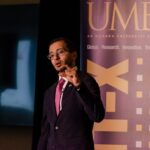
Mustafa Al-Adhami M.S. ‘15, Ph.D. ‘20, mechanical engineering, won the national Three-Minute Thesis competition last week, during the annual conference of the Council of Graduate Schools. His winning topic: rapid detection of bacteria in blood.
Al-Adhami developed a rapid bacterial-detection test that can assess, within an hour, if a patient has an infection. It can also help physicians determine which specific antibiotics should be administered to help fight the infection. Al-Adhami’s device, ASTEK, costs a fraction of the price of the current antibiotic susceptibility test. He hopes that it will reduce the duration of hospital stays and can reduce antibiotic resistance by avoiding unnecessary antibiotic use.
Al-Adhami earned first place in two qualifying rounds of the competition, on his path to claiming the national title. The first round was held at UMBC. The second round included 150 competitors from universities across the southern United States. The top two students from that round qualified for the national competition in Nashville.
In Nashville, Al-Adhami and nine other finalists presented their three-minute talks in front of a live audience that selected the ultimate winner. He explains that as he moved through the competition rounds he felt more at ease.
“I was very nervous doing the UMBC Three-Minute Thesis competition, but things got easier as the competition progressed,” Al-Adhami says. “Last weekend was more fun than anything else, maybe because I had my wife and a UMBC team with me this time.”
In addition to presenting in the Three-Minute Thesis competition, Al-Adhami has shared his work at UMBC’s GRIT-X talks, Idea Competition, and Cangialosi Business Innovation Competition. He was also on a team of three UMBC graduate students who won the BMEidea competition hosted by VentureWell (a national alliance of collegiate inventors and innovators) in August. He conducted his research in UMBC’s Center for Advanced Sensor Technology, and was advised by mechanical engineering faculty Marc Zupan, associate professor, and Chuck Eggleton, professor.
Learn more about Al-Adhami’s research in UMBC Magazine
Banner image: Mustafa Al-Adhami, Ph.D. ’20, speaks at GRIT-X 2019. Photo by Arionna Gonsalves.
]]>
Mustafa Al-Adhami M.S. ‘15, Ph.D. ‘20, mechanical engineering, won the national Three-Minute Thesis competition last week, during the annual conference of the Council of Graduate Schools. His...
https://umbc.edu/stories/umbcs-mustafa-al-adhami-wins-national-three-minute-thesis-competition/
https://my3.my.umbc.edu/api/v0/pixel/news/119992/guest@my.umbc.edu/10e75ba39eb48d34057364fd4b99ddfa/api/pixel
alexbrowncenter
cast
coeit
gradresearch
meche
science-and-technology
UMBC News & Magazine
https://my3.my.umbc.edu/groups/umbc-news-magazine
https://assets1-my.umbc.edu/system/shared/avatars/groups/000/001/943/24435aa6207c452e7bc15cc74b42c7bb/xsmall.png?1748556657
https://assets1-my.umbc.edu/system/shared/avatars/groups/000/001/943/24435aa6207c452e7bc15cc74b42c7bb/original.png?1748556657
https://assets2-my.umbc.edu/system/shared/avatars/groups/000/001/943/24435aa6207c452e7bc15cc74b42c7bb/xxlarge.png?1748556657
https://assets2-my.umbc.edu/system/shared/avatars/groups/000/001/943/24435aa6207c452e7bc15cc74b42c7bb/xlarge.png?1748556657
https://assets3-my.umbc.edu/system/shared/avatars/groups/000/001/943/24435aa6207c452e7bc15cc74b42c7bb/large.png?1748556657
https://assets1-my.umbc.edu/system/shared/avatars/groups/000/001/943/24435aa6207c452e7bc15cc74b42c7bb/medium.png?1748556657
https://assets2-my.umbc.edu/system/shared/avatars/groups/000/001/943/24435aa6207c452e7bc15cc74b42c7bb/small.png?1748556657
https://assets1-my.umbc.edu/system/shared/avatars/groups/000/001/943/24435aa6207c452e7bc15cc74b42c7bb/xsmall.png?1748556657
https://assets2-my.umbc.edu/system/shared/avatars/groups/000/001/943/24435aa6207c452e7bc15cc74b42c7bb/xxsmall.png?1748556657
UMBC News & Magazine
0
0
false
Fri, 13 Dec 2019 18:52:14 -0500
UMBC welcomes European Union ambassadors to the U.S.
Ambassadors from the European countries of Slovenia, Estonia, and the Czech Republic convened at UMBC this month as part of the first joint European Union (E.U.) State outreach trip outside of Washington, D.C. Delegations from over twenty E.U. member states participated in the day of engagement with Maryland state and local officials, students, educators, and environmental and trade organizations.
The visit’s aim was to showcase and further strengthen the close cultural and commercial ties between Maryland and European Union member states. The E.U. is Maryland’s biggest source of foreign direct investment. Over 100,000 jobs in Maryland have been created due to trade with and investment from European Union member states.
The three leaders who visited UMBC participated in a panel at the Albin O. Kuhn Library, moderated by Brian Grodsky, professor and associate chair of political science. They included Stanislav Vidovič, ambassador of Slovenia to the United States; Jonatan Vseviov, ambassador of Estonia to the United States; and Hynek Kmoníček, ambassador of the Czech Republic to the United States. In addition to discussing economic and policy matters, the leaders answered questions from students, staff, and faculty.
“We find it very practical out of Washington D.C., out of the diplomatic bubble, to meet the real people living in the States because you can get a refreshing perspective on the issues, where Washington D.C. is in the trenches of the party discussion. This allows us to get closer to the real voice of the real United States,” shared Kmoníček.
 UMBC students, faculty, and staff listen to the ambassadors as they discuss current affairs of their nations.
During the discussion session, Ukrainian student Danylo Leschchyshyn ‘22, history and political science, a Humanities Scholar and member of the Honors College, asked the visiting ambassadors about the hope of eliminating corruption in his homeland. The panel responded by discussing the importance of combating corruption as a means of upholding democracy through diplomacy and the rule of law.
“If you cannot handle corruption effectively, you will not only be unable to build a free society, but you will lose your freedom. The aim of corruption is to undermine the feasibility, the success of our societies. Our system of governance cannot coexist with corruption that is out of control,” explained Vseviov.
He continued, “Ukraine’s challenge is not only about how it handles the war in the east. Ukraine’s challenge is also the battle that is taking place in the hearts and minds of every Ukrainian. That battle is a battle of corruption and whether Ukrainians believe they have managed to take their country back not only from foreign interventions but also from their own corrupt businessmen.”
 Ambassadors fielding questions from audience.
Romy Hübler, assistant director of UMBC’s Center for Democracy and Civic Life, shared her experience growing up in East Germany before the fall of the Berlin Wall. She asked the guests about how older adults in post-Soviet regions are experiencing democracy today in ways different from the theoretical democracy they imagined during the Cold War. Hübler found the ambassadors’ descriptions of life during the Cold War—without democracy, and with human rights abuses and limited freedom—to be familiar.
“I have never had the opportunity to hear firsthand from representatives of Eastern European countries about their experiences and their thinking about their country’s path toward democracy as well as challenges that still persist,” explains Hübler. “I believe that we have much to learn from one another about those pathways, not only in Eastern Europe but also in the United States, including how people who live in these countries feel empowered or disempowered to participate fully and shape their futures.”
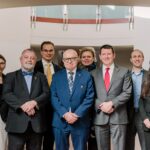
Banner image: (Front row, L to R) Ambassador Hynek Kmoníček; Ambassador Stanislav Vidovič; Ambassador Jonatan Vseviov; Carolyn Forestiere, associate professor and chair of political science. (Back row, L to R) Member of the E.U. delegation; David Di Maria, associate vice provost for international education; Irina Golubeva, associate professor of intercultural communication; and Brian Grodsky, professor of political science. All images by Marlayna Demond ’11.
]]>
Ambassadors from the European countries of Slovenia, Estonia, and the Czech Republic convened at UMBC this month as part of the first joint European Union (E.U.) State outreach trip outside of...
https://umbc.edu/stories/umbc-welcomes-european-union-ambassadors-to-the-u-s/
https://my3.my.umbc.edu/api/v0/pixel/news/119993/guest@my.umbc.edu/a2f5849aa2108e6751219e506c51b892/api/pixel
cahss
cs3
policy-and-society
political-science
public-policy
UMBC News & Magazine
https://my3.my.umbc.edu/groups/umbc-news-magazine
https://assets1-my.umbc.edu/system/shared/avatars/groups/000/001/943/24435aa6207c452e7bc15cc74b42c7bb/xsmall.png?1748556657
https://assets1-my.umbc.edu/system/shared/avatars/groups/000/001/943/24435aa6207c452e7bc15cc74b42c7bb/original.png?1748556657
https://assets2-my.umbc.edu/system/shared/avatars/groups/000/001/943/24435aa6207c452e7bc15cc74b42c7bb/xxlarge.png?1748556657
https://assets2-my.umbc.edu/system/shared/avatars/groups/000/001/943/24435aa6207c452e7bc15cc74b42c7bb/xlarge.png?1748556657
https://assets3-my.umbc.edu/system/shared/avatars/groups/000/001/943/24435aa6207c452e7bc15cc74b42c7bb/large.png?1748556657
https://assets1-my.umbc.edu/system/shared/avatars/groups/000/001/943/24435aa6207c452e7bc15cc74b42c7bb/medium.png?1748556657
https://assets2-my.umbc.edu/system/shared/avatars/groups/000/001/943/24435aa6207c452e7bc15cc74b42c7bb/small.png?1748556657
https://assets1-my.umbc.edu/system/shared/avatars/groups/000/001/943/24435aa6207c452e7bc15cc74b42c7bb/xsmall.png?1748556657
https://assets2-my.umbc.edu/system/shared/avatars/groups/000/001/943/24435aa6207c452e7bc15cc74b42c7bb/xxsmall.png?1748556657
UMBC News & Magazine
0
0
false
Thu, 12 Dec 2019 21:34:38 -0500
Team led by UMBC’s Mehdi Benna is the first to map a planet’s global wind patterns, and they weren’t Earth’s
Today, a paper published in Science documents for the first time the global wind circulation patterns in the upper atmosphere of a planet, 120 to 300 kilometers above the surface. The findings are based on local observations, rather than indirect measurements, unlike many prior measurements taken on Earth’s upper atmosphere. But it didn’t happen on Earth: it happened on Mars. On top of that, all the data came from an instrument and a spacecraft that weren’t originally designed to collect wind measurements.
In 2016, Mehdi Benna and his colleagues proposed to the Mars Atmosphere and Volatile EvolutioN (MAVEN) project team that they remotely reprogram the MAVEN spacecraft and its Natural Gas and Ion Mass Spectrometer (NGIMS) instrument to do a unique experiment. They wanted to see if parts of the instrument that were normally stationary could “swing back and forth like a windshield wiper fast enough,” to enable the tool to gather a new kind of data.
Initially, the MAVEN project team was reluctant to implement the modifications Benna and his colleagues requested. After all, MAVEN and NGIMS had been orbiting Mars since 2013, and they were working quite well collecting information about the composition of the Mars atmosphere. Why put all that at risk? Benna and his colleagues argued that this project would collect new kinds of data that could shape our understanding of the upper atmosphere on Mars, inform similar studies on Earth, and help us better understand planetary climate.
 Mehdi Benna. Photo courtesy of Mehdi Benna.
Benna, a planetary scientist operating out of the NASA Goddard Space Flight Center with the UMBC Center for Space Sciences Technology (CSST), came up with the windshield-wiper idea while brainstorming how to create an instrument that could collect information about global circulation patterns in Earth’s upper atmosphere. It occurred to him that, together, MAVEN and NGIMS could do the same thing on Mars—and they were already in space.
With some persistence and a lot of preliminary analyses, Benna and his colleagues convinced the MAVEN mission leadership to give their idea a try, after Lockheed Martin, the spacecraft manufacturer, determined the modifications might be possible without damaging the satellite. “It’s a clever reengineering in flight of how to operate the spacecraft and the instrument,” Benna says. “And by doing both—the spacecraft doing something it was not designed to and the instrument doing something it was not designed to do—we made the wind measurements possible.”
Ripple effect
The new paper was completed in collaboration with Yuni Lee, also of UMBC’s CSST, and colleagues from the University of Michigan, George Mason University, and NASA. It is based on data collected two days per month for two years from 2016 to 2018. Some results were expected, and others were big surprises. “The refreshing thing is that the patterns that we observed in the upper atmosphere match globally what one would predict from models,” says Benna. “The physics works.”
Overall, the average circulation patterns from season to season were very stable on Mars. This is like saying that on the East Coast of the United States, throughout the year, weather systems generally flow from the West to the East in a predictable way.
One surprise came when the team analyzed the shorter-term variability of winds in the upper atmosphere, which was greater than anticipated. “On Mars, the average circulation is steady, but if you take a snapshot at any given time, the winds are highly variable,” Benna says. More work is needed to determine why these contrasting patterns exist.
 The NGIMS instrument undergoes final preparations before heading to Mars on MAVEN. Photo courtesy of NASA.
A second surprise was that the wind hundreds of kilometers above the planet’s surface still contained information about landforms below, like mountains, canyons, and basins. As the air mass flows over those features, “it creates waves—ripple effects—that flow up to the upper atmosphere” and can be detected by MAVEN and NGIMS, Benna explains. “On Earth, we see the same kind of waves, but not at such high altitudes. That was the big surprise, that these can go up to 280 kilometers high.”
Benna and colleagues have two hypotheses for why the waves, called “orthographic waves,” last so long unchanged. For one, the atmosphere on Mars is much thinner than it is on Earth, so the waves can travel farther unimpeded, like ripples traveling farther in water than in molasses. Also, the average difference between geographic peaks and valleys is much greater on Mars than it is on Earth. It’s not uncommon for mountains to be 20 kilometers tall on Mars, whereas Mt. Everest is not quite nine kilometers tall, and most terrestrial mountains are much shorter.
“The topography of Mars is driving this in a more pronounced way than it is on Earth,” Benna says.
Forging ahead
Continuing to analyze the data from this study may help scientists figure out whether the same basic processes are in action on Earth’s upper atmosphere. Ironically, “We had to go take these measurements on Mars to eventually understand the same phenomenon on Earth,” Benna says. “Ultimately the results will help us understand the climate of Mars. What is its state and how is it evolving?”
But the team isn’t satisfied with the current data set. “We want to keep measuring. We have two years of data, but we’re not stopping there,” Benna says. Even with the data set they already have, “We have many years of modeling and analysis ahead of us.” It’s a trove of information that can be examined in ways not yet imagined, to learn even more about how planets work.
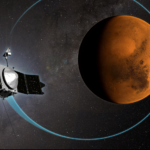
Banner image: The MAVEN spacecraft orbits Mars (artist’s concept), courtesy of NASA.
]]>
Today, a paper published in Science documents for the first time the global wind circulation patterns in the upper atmosphere of a planet, 120 to 300 kilometers above the surface. The findings are...
https://umbc.edu/stories/team-led-by-umbcs-mehdi-benna-is-the-first-to-map-a-planets-global-wind-patterns-and-they-werent-earths/
https://my3.my.umbc.edu/api/v0/pixel/news/119994/guest@my.umbc.edu/4d6a4a3ed08372b3520478de27d764d1/api/pixel
campus
csst
research
science-and-technology
UMBC News & Magazine
https://my3.my.umbc.edu/groups/umbc-news-magazine
https://assets1-my.umbc.edu/system/shared/avatars/groups/000/001/943/24435aa6207c452e7bc15cc74b42c7bb/xsmall.png?1748556657
https://assets1-my.umbc.edu/system/shared/avatars/groups/000/001/943/24435aa6207c452e7bc15cc74b42c7bb/original.png?1748556657
https://assets2-my.umbc.edu/system/shared/avatars/groups/000/001/943/24435aa6207c452e7bc15cc74b42c7bb/xxlarge.png?1748556657
https://assets2-my.umbc.edu/system/shared/avatars/groups/000/001/943/24435aa6207c452e7bc15cc74b42c7bb/xlarge.png?1748556657
https://assets3-my.umbc.edu/system/shared/avatars/groups/000/001/943/24435aa6207c452e7bc15cc74b42c7bb/large.png?1748556657
https://assets1-my.umbc.edu/system/shared/avatars/groups/000/001/943/24435aa6207c452e7bc15cc74b42c7bb/medium.png?1748556657
https://assets2-my.umbc.edu/system/shared/avatars/groups/000/001/943/24435aa6207c452e7bc15cc74b42c7bb/small.png?1748556657
https://assets1-my.umbc.edu/system/shared/avatars/groups/000/001/943/24435aa6207c452e7bc15cc74b42c7bb/xsmall.png?1748556657
https://assets2-my.umbc.edu/system/shared/avatars/groups/000/001/943/24435aa6207c452e7bc15cc74b42c7bb/xxsmall.png?1748556657
UMBC News & Magazine
0
0
false
Thu, 12 Dec 2019 19:07:51 -0500
UMBC welcomes Brian Barrio as director of athletics

UMBC has named Brian Barrio the director of athletics, physical education, and recreation, effective January 2020. He will direct UMBC’s 17-sport NCAA Division I intercollegiate athletics program, all campus recreational programs (including intramurals, club sports, and recreational activities), and the physical education program.
Commitment to student success
 Brian Barrio. Photo courtesy of Central Connecticut State University.
Barrio comes to UMBC after serving as director of athletics at Central Connecticut State University (CCSU) and in leadership positions at the University of Nevada, Pepperdine University, University of Southern California, and the America East Conference.
In each role, Barrio has developed programs and implemented policies supporting student-athlete success. During his tenure at CCSU, the Blue Devils won seven Northeast Conference titles and the CCSU baseball program won the university’s first-ever NCAA Tournament contest. In just one year, he increased athletics fundraising by 44 percent.
“UMBC has a bold and clear vision for how athletics can move the needle on the university’s strategic goals,” Barrio says. “I am thrilled to be trusted to help execute that vision over the coming years. The tremendous coaches and student-athletes already in place at UMBC will make this an exciting transition for me.”
Barrio also shares, “UMBC has made a strong commitment to intercollegiate and recreational athletics—a commitment that will benefit all UMBC students and will foster a vibrant student life. A university that makes that commitment while remaining steadfast in its support for student-athlete academic success and personal development—that’s the total package for an athletics director.”
 Retriever fans take in a double overtime win for UMBC men’s basketball over Hartford, which propelled the team to the America East final in March 2019. Photo by Marlayna Demond ’11 for UMBC.
Continuing UMBC’s momentum
Barrio comes to UMBC at a time of sustained athletic and academic success over several years. This includes highlights like the men’s basketball team’s “16-over-1” NCAA victory, swimming and diving programs dominating conference competition, men’s soccer’s numerous America East titles and women’s soccer’s first trip to an NCAA Tournament. Most recently, UMBC’s men’s lacrosse and softball teams overcame challenges to win 2019 America East Championships.
 UMBC men’s and women’s swimming and diving teams celebrate an America East victory. Photo courtesy of Colleen Hummel.
UMBC student-athletes also continue to excel academically. In fall 2018, they achieved a record grade-point average for the third consecutive semester, posting a mark of 3.14. Over two-thirds of student-athletes posted GPAs of 3.00 or higher.
Welcoming Barrio to Retriever Nation
Barrio earned a bachelor’s degree in communications from Boston College in 1999, where he got his start as a team manager for the men’s basketball team and an intern in the sports information office. He went on to earn his Juris Doctorate from the University of California-Hastings College of the Law.
“I am delighted to welcome Brian Barrio to UMBC,” says UMBC President Freeman Hrabowski. “His values and experience are impressive. He will be an outstanding ambassador for UMBC Athletics and a leader who will make an immediate contribution to the campus.”
 Brian Barrio during his time as director of athletics at Central Connecticut State University. Photo by Steve McLaughlin.
“Brian really understands the role athletics and recreation can play in building vibrant campus life, driving enrollment, and helping connect people to the university,” says Greg Simmons, M.P.P. ’04, public policy, vice president for Institutional Advancement, who co-chaired the search committee.
UMBC will hold a welcome event and press conference next week to formally introduce Brian Barrio to the Retriever community. It will be on December 17, 11:30 a.m., in the Retriever Room of the UMBC Event Center.
See UMBC Athletics for more information about Brian Barrio.
]]>
UMBC has named Brian Barrio the director of athletics, physical education, and recreation, effective January 2020. He will direct UMBC’s 17-sport NCAA Division I intercollegiate athletics program,...
https://umbc.edu/stories/umbc-welcomes-brian-barrio-as-director-of-athletics/
https://my3.my.umbc.edu/api/v0/pixel/news/119995/guest@my.umbc.edu/f3c6831719212bb1d7aa01cd55bd908f/api/pixel
athletics
campus
community
page1
UMBC News & Magazine
https://my3.my.umbc.edu/groups/umbc-news-magazine
https://assets1-my.umbc.edu/system/shared/avatars/groups/000/001/943/24435aa6207c452e7bc15cc74b42c7bb/xsmall.png?1748556657
https://assets1-my.umbc.edu/system/shared/avatars/groups/000/001/943/24435aa6207c452e7bc15cc74b42c7bb/original.png?1748556657
https://assets2-my.umbc.edu/system/shared/avatars/groups/000/001/943/24435aa6207c452e7bc15cc74b42c7bb/xxlarge.png?1748556657
https://assets2-my.umbc.edu/system/shared/avatars/groups/000/001/943/24435aa6207c452e7bc15cc74b42c7bb/xlarge.png?1748556657
https://assets3-my.umbc.edu/system/shared/avatars/groups/000/001/943/24435aa6207c452e7bc15cc74b42c7bb/large.png?1748556657
https://assets1-my.umbc.edu/system/shared/avatars/groups/000/001/943/24435aa6207c452e7bc15cc74b42c7bb/medium.png?1748556657
https://assets2-my.umbc.edu/system/shared/avatars/groups/000/001/943/24435aa6207c452e7bc15cc74b42c7bb/small.png?1748556657
https://assets1-my.umbc.edu/system/shared/avatars/groups/000/001/943/24435aa6207c452e7bc15cc74b42c7bb/xsmall.png?1748556657
https://assets2-my.umbc.edu/system/shared/avatars/groups/000/001/943/24435aa6207c452e7bc15cc74b42c7bb/xxsmall.png?1748556657
UMBC News & Magazine
0
0
false
Tue, 10 Dec 2019 20:34:32 -0500
Climate Shift
From Eritrea to UMBC, this physicist is cultivating a diverse generation of climate scientists.
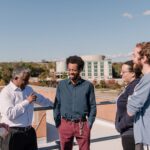
It’s a nearly cloudless afternoon at UMBC in early October. A group of physics students and their two faculty advisors, Belay Demoz and Ruben Delgado, make their way to the roof of the physics building to continue their conversation about atmospheric research. Earlier, gathered in a small, dimmed lecture hall, the students engaged their advisors and each other in robust discussions about their research while practicing their presentation skills.
In that session, Amanze Ejiogu ’22, physics, had the chance to explain his findings on the Bay Breeze. Rather than an adult beverage, it refers to breezes coming in off the Chesapeake Bay that redirect back to land air masses (and the pollutants they contain) that would otherwise blow offshore.
The Bay Breeze effect is a complicated phenomenon. Many factors contribute to it, from precipitation to wind speed to the overall quality of the air. Understanding it is a multidisciplinary effort, requiring chemistry, fluid dynamics, statistics, and meteorology skills. That’s exactly the kind of challenge that Demoz, physics professor and director of UMBC’s Joint Center for Earth Systems Technology (JCET), likes to help his students tackle.
After Ejiogu’s presentation, Demoz asks questions. His elbow leaning casually against a railing, he breaks into a grin—he is in his element. Of a certain result, he asks, “Is that expected?” And a minute later, “That’s for you to figure out,” his Eritrean accent inflecting his speech.
 Demoz regularly engages his students in robust discussions about their research. Photo by Marlayna Demond ’11.
Climate change and other environmental issues like air and water quality disproportionately affect people of color. Today, Demoz sees his role at UMBC as empowering students, especially students from underrepresented backgrounds, to take ownership of their research and contribute to their communities. Eventually, he hopes his graduates will also become mentors and advocates for their own students and colleagues—behaviors he models for them every day.
This wasn’t always Demoz’s idea of what his life’s work would be. After a challenging childhood in what is now the East African country of Eritrea, Demoz came to the United States for graduate school in the 1980s. His original goal was to learn how to seed clouds—to bring rain to his drought-stricken homeland. He’s still doing climate research, but his focus has shifted. His experiences as a youth in Eritrea and his years as an African in the United States have shaped who he has become and what he seeks to achieve.
Graduates from all backgrounds have left Demoz’s lab and taken roles at places like NASA, the National Oceanic and Atmospheric Administration (NOAA), the Environmental Protection Agency (EPA), and other research institutions. These alumni create a ripple effect that will continue to enhance diversity in atmospheric research and answer questions that have the potential to change the lives of people around the globe, in part because of Belay Demoz.
Maurice Roots, a graduate student in atmospheric physics, has already felt the effects of Demoz’s efforts. Roots, who graduated from Hampton University, only applied to UMBC for graduate school because Demoz approached him at a conference. “Belay has a great set of stories to tell,” Roots says. “His journey shows that perseverance is possible.”
A changing homeland
“It’s where the desert and the green are always fighting.”
That’s how Demoz describes the location of Eritrea. It’s a small African country on the Red Sea, sandwiched between Sudan and Ethiopia, right where the Sahara Desert and the jungles of central Africa meet. Many people there are subsistence farmers, including generations of the physicist’s family.
It used to be that when drought or floods hit, Eritrean farmers moved to where the grass was literally greener. But that changed after their land was colonized by the Italians and later the British. Strict political borders limited movement. “Once you put a wall, that valve of mitigating drought disappears,” Demoz says.
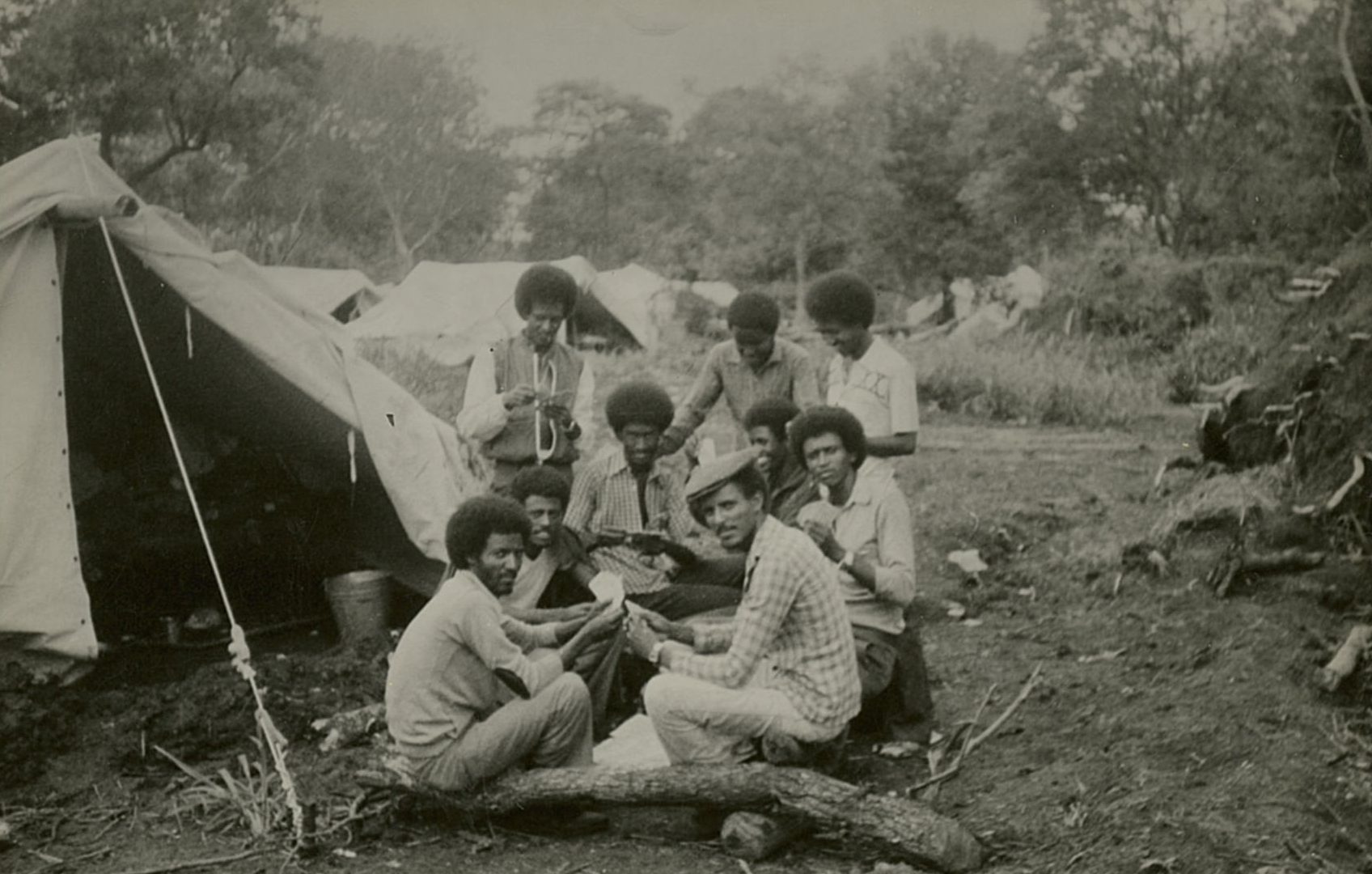
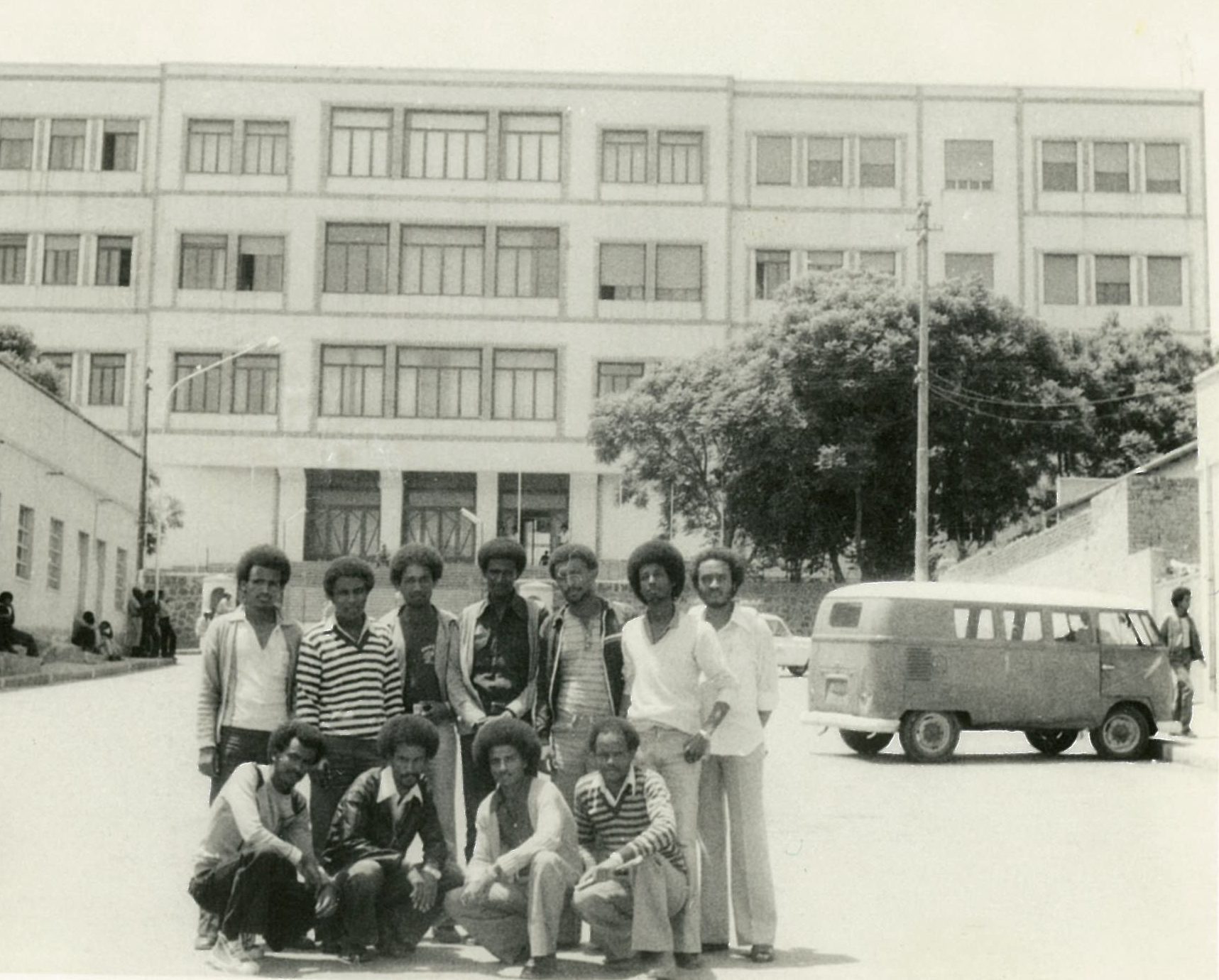
His childhood and youth in Eritrea, in the 1960s and ’70s, was one of the most volatile times for the region, when an internal resistance movement was fighting Ethiopia to gain independence. “My time was a time of coups, a time of drought, a time of war,” Demoz says. “Those are the times when a lot of heartache happened.”
Many people died because they weren’t allowed to migrate. Their crops failed in the drought, and some starved. Some died when they attempted to migrate and met violence along the way. Demoz’s older brother and many of his friends perished fighting in the resistance.
An unlikely advocate
Belay Demoz knew the challenges his people were facing. So in 1980, when he finished high school and was assigned to study physics as an undergraduate at the University of Asmara in what was to become Eritrea, he knew he wanted to find a way to use his education to make things better for his family.
At first, he struggled. He failed his first three exams. And then the first of several major turning points in his life happened, the first time help came from where he least expected it.
Demoz and his roommate frequently played soccer together. Both were highly talented but knew there was no career for them in the sport. So, after Demoz failed his third physics exam, his roommate decided it was time for an intervention.
“You can play soccer so well, but you’re going to let physics twist you?” he asked Demoz. “No, you study with me.” So he did. And by the next semester, Demoz was at the top of his class. “Part of me was afraid,” Demoz admits. Why? His roommate had recently been released from prison on a murder conviction. But “if I didn’t find him, I don’t think I would have made it.”
As his undergraduate career was coming to a close in 1984, another severe drought hit Eritrea. Demoz wanted to do something, but he didn’t know how his nuclear physics degree could help the situation. Then, he learned about cloud seeding in a Physics Today article.
In the 1980s, cloud seeding seemed like the next big revolution in weather modification. In order for clouds to produce rain, the water molecules they contain need to condense into liquid form. That happens around tiny solid particles inside the cloud. Cloud seeding adds these particles, creating more opportunities for raindrops to form.
“That’s when I switched from nuclear to atmospheric physics,” Demoz says. “I wanted to help make it rain.”
He applied and was accepted to the atmospheric physics program at the University of Nevada, Reno, but to leave Eritrea, he had to promise that he would come back. Without the required funds to guarantee that promise, his parents had to put their family home on the line so that he could study in the U.S.
“I was given $50 and a plane ticket,” Demoz remembers. “My dad didn’t blink. He just said, ‘Go. We will find a way.’”
Peaks and valleys
In Nevada, everything was new and different. “At 22, it was my first time to see snow,” Demoz says. And not just through his dorm room window—his courses and research involved spending ample time in the Sierra Nevada Mountains. After replacing his dress shoes with snow boots and skis, Demoz began to learn his way around the mountains.
In addition to the new climate, there were other steep learning curves for Demoz in graduate school. One of the core courses required computer programming skills. One day, Professor Jim Telford—Demoz refers to him as a “cloud giant”—called Demoz into his office.
Telford devised the stochastic rain theory when he was a master’s student in the 1960s, which describes why and predicts when clouds will produce rain. Today there is still no better theory. Demoz describes him as an arrogant, brilliant Australian scientist, who also went to great lengths to ensure his students’ success. Demoz remembers their first conversation going something like this:
“You must be pretty good in programming,” Telford says.
“No, I’m not.” Demoz replies.
“Well, have you used a computer?” Telford asks.
“No.”
“Have you touched a computer?”
“No.”
As Demoz recalls, Telford roared with laughter and rushed to another room to share with a colleague the ridiculousness of a Ph.D. student in physics who had never touched a computer.
“At this point, I’m thinking, I’m doomed!” Demoz remembers. “But there’s something inside me saying, I am an Eritrean, and others are fighting for independence. There’s something instilled in me. And so I stood there.” And instead of throwing him out, Telford agreed to give Demoz a crash course in computing.
 Demoz in grad school, after mastering the necessary computing skills. Photo courtesy of Demoz.
For two weeks, Demoz sat with a clunky 1985 desktop and a pile of Fortran books in Telford’s office, learning how to program. Today, Demoz tells his students, “If you cannot compute, you cannot compete. Everyone who has achieved something in our field is good in programming.” But his experience with Telford was about more than programming. It was about a mentor making a special effort to help a student succeed. Belay carries that memory with him today and strives to pay it forward to his own students.
In addition to learning all about clouds and weather modification, and completing a dissertation titled, “Sierra Nevada Winter Storms Using Microwave Radiometry, Ice Crystal, and Isotopic Techniques,” Demoz learned something else important in Reno—what it felt like to be black in the United States, especially in higher education and especially in physics.
 In front of the Desert Research Institute circa 1991 with a fellow graduate student. Photo courtesy of Demoz.
He noticed it right away in his courses (he was the only black person) and in the city. “It takes a toll,” he says. “Reno had a very tough police force.” He was stopped on many occasions as he drove home late from doing research in the mountains, seemingly for nothing. “I tend to be an outlier,” he reflects. “You don’t see a lot of black people doing cloud seeding and working with snow.”
Only later would he find out that the graduate program had accepted him as a “test case”—he was the first African accepted to the program and the first to graduate with a Ph.D. He remembers John Hallett (another “cloud giant” and another of Demoz’s important mentors) telling him, years later, “We wanted to see if those schools [in East Africa] were any good. That’s why we admitted you.” That, of course, didn’t sit well with Demoz and stayed with him as his future in physics unfolded.
Shifting the landscape
Once he finished his Ph.D., Demoz pursued postdoctoral studies at the University of Illinois in cloud chemistry. In 1997, UMBC finally entered his experience. He completed a second postdoc with UMBC at the NASA Goddard Space Flight Center in Greenbelt, Maryland.
Demoz continued his work at NASA after his postdoc ended. Then, another life-changing moment: He got a call from Howard University to help create a new atmospheric research center there in 2006. “The whole reason I studied this field was to go back and seed clouds,” Demoz reflects. “That wasn’t happening, but I realized, there is plenty to be done here.” So Demoz jumped at the chance to contribute to the historically black university while continuing his research program at NASA.
“It was around that time that I started to be conscious of my status as a minority in the field,” Demoz remembers. “It bothered me, being one of the only ones.”
At a conference around then, Demoz and a handful of other atmospheric researchers of color met in the lobby. “And we asked, OK, what is our part?” Their first step was to join efforts in developing the Howard research center together.
In 2005, Demoz was awarded a NASA Administrators Fellowship—a two-year sabbatical during which recipients are expected to build up a program at a minority-serving institution. The fellowship allowed Demoz to focus full time on building up the research center in Beltsville, which is administered by NOAA. When the two years were up, Demoz didn’t go back to his research program at NASA, choosing instead to commit himself permanently to the work of increasing the success of minorities in atmospheric science.
“Most people thought I was crazy because NASA is a stable job for life,” Demoz says. “But thinking about all the support that I had growing up, I decided my place was there.”
Building the pipeline
Over the next several years, Demoz and colleagues built up the NOAA Center for Atmospheric Science (NCAS) at Howard University’s campus in Beltsville, Maryland. The NCAS is a “super-site” among the Global Climate Observing System (GCOS) Reference Upper Air Network (GRUAN), a set of sites worldwide that looks at air and cloud chemistry. People around the world rely on the data it collects and the analyses the Beltsville researchers (including many students) conduct for their own work. The Beltsville GRUAN site contributes powerfully to science and also to increasing the diversity of scientists. It is the only GRUAN site in the world operated by a university, which is a source of pride for Demoz.
Students who’ve studied at the GRUAN site from Howard, UMBC, and elsewhere—many of them from underrepresented backgrounds—have gone on to careers at preeminent government and private research organizations. “You can involve students no matter how specialized and difficult your science is,” Demoz says. “The Beltsville site has made quite a number of important scientific advances and also brought diversity to the federal agencies.”
At the same time, the small group of African and African-American climate researchers who had met at the conference in the early 1990s started to formalize their lobby conversations into an official event at other meetings. “It paid off. We used to meet in a bar in the hotel lobby at the American Meteorological Society conferences. Right now, Colour of Weather is perhaps the biggest minority-focused group in atmospheric sciences, and it is what we started,” Demoz says with pride. “It’s held in a ballroom. I look at that and I think, I didn’t go back to Eritrea and seed clouds, but I’m making a difference here.”
Bringing a meaningful vision to life
With his experience at NASA and as a professor of physics at Howard, and his commitment to mentoring students from all backgrounds, Demoz was a perfect fit to serve as the next director of UMBC’s JCET, a partnership with NASA formed in 1995, when the position opened up in 2014.
As JCET director, Demoz has clear ideas about what he wants to accomplish. “If I can get a really strong, diverse graduate program here, that would be great. And I think that’s possible here.” In addition to recruiting and mentoring students from diverse backgrounds, Demoz says continuing to diversify the faculty is also a worthy goal. The UMBC physics department is already off to a strong start, with faculty members from Brazil, Eritrea, China, Hungary, Greece, and Puerto Rico.
Students are noticing the changes Demoz has modeled. “He really cares about his students and wants them to succeed,” adds Kylie Hoffman, a third-year graduate student. “He wants to help you do what you want to do.”
 Demoz and Ruben Delgado with a group of their students on top of the physics building. Photo by Marlayna Demond ’11.
He supports graduate and undergraduate students alike. After giving his presentation at the lab meeting, sophomore Amanze Ejiogu expected that “a seasoned atmospheric science veteran would pull it apart like cotton candy,” he says. But Demoz didn’t. “He was very respectful and asked genuine, thoughtful questions that will help me take my research forward.”
“Belay has been a great mentor for teaching lessons that are never covered in a classroom,” says Brian Carroll, a fifth-year Ph.D. candidate. “I’m proud to be part of such a diverse research group,” Carroll adds. “Thanks to my experiences with the group, I will pursue and highlight diversity in my own workplaces and the community at large as I progress in my own career.”
When asked about Demoz’s mentoring, Maurice Roots is more straightforward: “He’s good at it,” Roots replied. “So I’m taking notes.”
Demoz himself benefited from support and mentoring—sometimes from unlikely places. “Help will come from the place you least expect it, so be open,” Demoz says, maybe remembering the time a convicted murderer got him through his nuclear physics degree or an arrogant scientist made sure he was ready for programming class. Or maybe even the time he got the green light from Howard University to start the Beltsville Climate program or the call from UMBC to apply for the JCET directorship.
It’s all part of Demoz’s story. Now he’s taken it as his mission to help students create their own stories, with a strong start at UMBC.
“By seeing us,” he says, “I hope that students say, ‘I belong here.’”
*****
Header image: Demoz meets with students on top of the physics building. Photo by Marlayna Demond ’11.
]]>
From Eritrea to UMBC, this physicist is cultivating a diverse generation of climate scientists. It’s a nearly cloudless afternoon at UMBC in early October. A group of physics students and their...
https://umbc.edu/stories/climate-shift/
https://my3.my.umbc.edu/api/v0/pixel/news/119996/guest@my.umbc.edu/82f73445ca4996ccbf0f34cd279495b8/api/pixel
climate-change
cnms
discovery
fall-2019
feature
graduateschool
jcet
nasa
physics
UMBC News & Magazine
https://my3.my.umbc.edu/groups/umbc-news-magazine
https://assets1-my.umbc.edu/system/shared/avatars/groups/000/001/943/24435aa6207c452e7bc15cc74b42c7bb/xsmall.png?1748556657
https://assets1-my.umbc.edu/system/shared/avatars/groups/000/001/943/24435aa6207c452e7bc15cc74b42c7bb/original.png?1748556657
https://assets2-my.umbc.edu/system/shared/avatars/groups/000/001/943/24435aa6207c452e7bc15cc74b42c7bb/xxlarge.png?1748556657
https://assets2-my.umbc.edu/system/shared/avatars/groups/000/001/943/24435aa6207c452e7bc15cc74b42c7bb/xlarge.png?1748556657
https://assets3-my.umbc.edu/system/shared/avatars/groups/000/001/943/24435aa6207c452e7bc15cc74b42c7bb/large.png?1748556657
https://assets1-my.umbc.edu/system/shared/avatars/groups/000/001/943/24435aa6207c452e7bc15cc74b42c7bb/medium.png?1748556657
https://assets2-my.umbc.edu/system/shared/avatars/groups/000/001/943/24435aa6207c452e7bc15cc74b42c7bb/small.png?1748556657
https://assets1-my.umbc.edu/system/shared/avatars/groups/000/001/943/24435aa6207c452e7bc15cc74b42c7bb/xsmall.png?1748556657
https://assets2-my.umbc.edu/system/shared/avatars/groups/000/001/943/24435aa6207c452e7bc15cc74b42c7bb/xxsmall.png?1748556657
UMBC News & Magazine
0
0
false
Tue, 10 Dec 2019 16:47:44 -0500
UMBC’s Evan Avila, advocate for equal access to financial services, is a finalist for the Marshall Scholarship

Evan Avila’s goal is to work on Capitol Hill, advocating for immigrant communities’ access to financial security and economic equality. He has now been recognized as a finalist for the prestigious Marshall Scholarship, affirming his path to a career of leadership in public service.
 Avila in front of the U.S. Capitol in Washington, D.C. Photo courtesy of Avila.
The Marshall Scholarship is awarded annually to up to 50 students from the United States to pursue graduate study at a university in the United Kingdom, following an intensive application and interview process. Avila, a Sondheim Public Affairs Scholar majoring in economics and political science at UMBC, was selected as a finalist for his long record of public service as well as his experience developing economic policy proposals. At the final stage, Avila was not among the students chosen to receive the scholarship. However, he still plans to pursue graduate study in Washington D.C. next fall as a Harry S. Truman Scholar.
How does UMBC identify students to nominate for this prestigious scholarship? “We prioritize a student’s ability to demonstrate strong potential as a change agent in their chosen field, based on their leadership and intellectual skills,” explains April Householder, director of undergraduate research and prestigious scholarships. “Evan emerged because of his exemplary commitment to public service, and his ability to work with diverse groups of individuals. We felt that he has great potential as a policymaker and social change agent.”
 Avila at the National Academy of Social Insurance. Photo courtesy of Avila.
Avila is the fourth UMBC recipient of the Harry S. Truman Scholarship. He was chosen in the spring of 2019 for one of just sixty scholar positions out of 840 candidates nationwide.
The award grants Avila $30,000 toward a competitive graduate school of his choice. In addition, scholars gain access to continuous leadership development programs, such as the Truman Scholars Leadership Week and the Summer Institute. Scholars also benefit from mentorship by top leaders in government agencies, nonprofit organizations, public and private educational institutions, and advocacy organizations. Following a master’s degree, Avila plans to pursue a J.D., to specialize in taxation and employee benefits law.
Building a public service career
Avila has dedicated his time at UMBC to developing his knowledge of financial systems and applying his studies to work with people in need of financial services and expertise. This includes years of service with UMBC’s Volunteer Income Tax Assistance (VITA) program. Avila recently shared, “My driving ambition is to combine the intersections of financial services, taxation, and employee benefits” to address the significant challenge of wealth inequality faced by workers, families, and students.
 Avila with fellow Sondheim Public Affairs Scholars.
Laura Hussey, associate professor of political science and director of the Sondheim Public Affairs Scholar program, has witnessed Avila’s longstanding commitment to serving communities. Hussey is quick to point out that it is not just Evan’s résumé, but also his character, that exemplifies Sondheim Scholar ideals. His time spent at the Esperanza Center, which provides educational, legal, medical, and other services to immigrants in Baltimore, is a meaningful example of his work.
“In choosing the Esperanza Center for his Sondheim Scholar service-learning, Evan sought to leave his comfort zone and address his complicated relationship with his family’s immigrant heritage,” explains Hussey. “Though intimidated by the one evening per week he would spend there, given his limited Spanish proficiency and tutor training, Evan described his service at Esperanza Center as ‘truly joyous’ and a ‘deeply personal and spiritual experience.’”
Avila has also been recognized for his work on retirement planning for today’s young adults. In June 2018 he won the iOME challenge with the policy proposal Rethinking Millennial Retirement: Policy Recommendations for a Gig Economy. Cindy Hounsell is president of the Women’s Institute for a Secure Retirement (WISER), which sponsored the competition. She shared, “We are impressed by Mr. Avila’s response to the more complicated challenges and deterrents millennials face in preparing for their future retirement.”
 Evan Avila speaking at iOME Challenge by WISER Institute. Photo courtesy of Avila.
UMBC has a strong tradition of supporting applicants for the Marshall Scholarship, as well as other prestigious awards. Loren Siebert ‘93, computer science, earned his master’s degree in computer science at the University of Manchester as a Marshall Scholar. He then invented LinguaStep, a language learning software, and is now a technical advisor to entrepreneurs in San Francisco.
 Naomi Mburu in a lab during her time at UMBC.
Naomi Mburu ‘18, chemical engineering, was UMBC’s second student selected for a Marshall Scholarship, in 2017, but she declined the award to become UMBC’s first Rhodes Scholar. Mburu is currently pursuing a doctorate in nuclear fusion at Oxford. She offered Avila advice in preparation for his Marshall interview.
Avila looks forward to continuing that tradition after his graduation in the spring, offering support to future UMBC students who are reaching for their dreams.
Banner image: Avila at his internship at the United States Census Bureau. Photos by Marlayna Demond ’11 unless otherwise noted.
]]>
Evan Avila’s goal is to work on Capitol Hill, advocating for immigrant communities’ access to financial security and economic equality. He has now been recognized as a finalist for the prestigious...
https://umbc.edu/stories/umbcs-evan-avila-advocate-for-equal-access-to-financial-services-is-a-finalist-for-the-highly-selective-marshall-scholarship/
https://my3.my.umbc.edu/api/v0/pixel/news/119997/guest@my.umbc.edu/a5ea32cab176c3d5e8ec8c2e66121f9b/api/pixel
cahss
policy-and-society
UMBC News & Magazine
https://my3.my.umbc.edu/groups/umbc-news-magazine
https://assets1-my.umbc.edu/system/shared/avatars/groups/000/001/943/24435aa6207c452e7bc15cc74b42c7bb/xsmall.png?1748556657
https://assets1-my.umbc.edu/system/shared/avatars/groups/000/001/943/24435aa6207c452e7bc15cc74b42c7bb/original.png?1748556657
https://assets2-my.umbc.edu/system/shared/avatars/groups/000/001/943/24435aa6207c452e7bc15cc74b42c7bb/xxlarge.png?1748556657
https://assets2-my.umbc.edu/system/shared/avatars/groups/000/001/943/24435aa6207c452e7bc15cc74b42c7bb/xlarge.png?1748556657
https://assets3-my.umbc.edu/system/shared/avatars/groups/000/001/943/24435aa6207c452e7bc15cc74b42c7bb/large.png?1748556657
https://assets1-my.umbc.edu/system/shared/avatars/groups/000/001/943/24435aa6207c452e7bc15cc74b42c7bb/medium.png?1748556657
https://assets2-my.umbc.edu/system/shared/avatars/groups/000/001/943/24435aa6207c452e7bc15cc74b42c7bb/small.png?1748556657
https://assets1-my.umbc.edu/system/shared/avatars/groups/000/001/943/24435aa6207c452e7bc15cc74b42c7bb/xsmall.png?1748556657
https://assets2-my.umbc.edu/system/shared/avatars/groups/000/001/943/24435aa6207c452e7bc15cc74b42c7bb/xxsmall.png?1748556657
UMBC News & Magazine
0
0
false
Fri, 06 Dec 2019 20:47:18 -0500
 Helena Mentis. Photo by Marlayna Demond ’11 for UMBC.


