UMBC partners with Latino Racial Justice Circle and Maryland Humanities in community-engaged research in Baltimore
In their work with communities in Baltimore, the Latino Racial Justice Circle (LRJC) observed a recurring issue: immigrant, white American, and African American communities share faith-based spaces but rarely engage in community dialogue. As a result, members of these communities may never get to know each other – or may even live in fear of each other.
Through a partnership with LRJC, UMBC’s Felipe Filomeno, professor of political science and global studies, a member of LRJC, and Tania Lizarazo, assistant professor of modern languages, linguistics, and intercultural communication and global studies, worked to develop, design, execute, evaluate, and disseminate the Honest Conversations on Immigration project. Through a course of dialogue, interviews, and digital storytelling, the program aims to foster dialogue between U.S.-born citizens and immigrants.
 (L to R) Lizarazo and Filomeno preparing for the first Honest Conversations public forum.
“Our goal as researchers was to use dialogue and digital stories as two ways to bring different communities together around religion, race, and immigration,” explains Filomeno, “and through that process create the potential to change the relationships within individuals, and between communities and society for the better.”
Community intersections
The Latino Racial Justice Circle (LJRC) is a volunteer, faith-based, immigrant support group based in Baltimore. It funds legal services, scholarships, and advocacy for federal immigration reform on behalf of Latino communities. This new project – similar to one addressing racism that has been implemented in more than 18 Catholic parishes in Baltimore – aims to bring faith-based groups from different backgrounds together to reveal their commonalities and build on shared strengths.
“We fear what we don’t know. And what we need to learn is vast,” shares Ryan Settler, president of the Maryland Chapter of Call To Action (CTA), a progressive social justice organization that created the Racial Justice Circle (RJC ) five years ago. “Immigrant and refugee stories in the media leave us confused, concerned, and even fearful. Honest Conversations begins to address those concerns.”
Through the Honest Conversations projects, volunteers from the LRJC, immigrants, and U.S.-born citizens in faith communities agree to engage in dialogue about perceptions of immigration and race. These initial steps towards understanding highly politicized issues can lead to collective action for racial justice and immigrant rights.
“Our project crosses boundaries between the humanities and the social sciences, academia and community, between immigrants and U.S.-born citizens, inner-city and suburbs,” explains Filomeno.
https://youtu.be/YFAKEE-X3EQ
Defining dialogue
The goal of the Maryland Humanities-funded project is for communities to move from confusion and anger to collaboration. For that to happen, participants first took part in two group dialogues consisting of 12-14 members from three faith-based communities. The dialogues were followed by the collection and sharing of personal experiences of religion, race, and immigration in Baltimore through digital storytelling. Both processes centered around the power of community dialogue to create respectful places in which difficult conversations might be had.
“Dialogue is a process of listening to others with the purpose of understanding. It does not aim to pass judgment, ‘just talk,’ mediate, debate, or negotiate,” explains Filomeno. He led the scientific implementation of structured dialogue and provided a framework for active listening. He also served as the facilitator at four churches in and around Baltimore: St. Ann’s Catholic Church; St. Michael the Archangel Catholic Church; Church of the Annunciation; and St. Clement Mary Hofbauer Church.
 Filomeno facilitating a session.
“Because the dialogues happened in a familiar shared faith space the participants began with prayer, which was an entry point into a shared experience,” explains Filomeno. “I was then able to support where the participants wanted to take the conversation and guide them through clarifications,” he reflects.
Giuliana Valencia, co-chair for the LRJC, found the structured talks powerful and hopes other faith-based organizations will begin the program in their communities. “We recognize dialogue is the best way to change the human heart,” Valencia shares. “No matter how controversial the topic, you can always find common ground.”
Dialogue through digital storytelling
Digital storytelling is another key aspect of community-engaged research because it shifts the focus from the researcher creating information towards information being created by the community.
“Collaborative audiovisual pieces can share personal perspectives. These not only complement academic writing but help disrupt mainstream narratives as the only sources of knowledge,” explains Lizarazo. They can also create new ways for academics to think about primary sources. “Digital stories can serve as primary sources in different fields because they engage audiences and give access in ways writing doesn’t.”
This type of community-based digital storytelling also addresses the issue of access. Lizarazo explains how academic journals, while useful in academic circles, also limit who shares in the knowledge. The power of digital storytelling is in its accessibility – often opening spaces for nonacademic conversations through social media networks. “These stories where the narrative and the message is controlled by the community member can be used for pedagogical and research purposes,” notes Lizarazo.
https://www.youtube.com/watch?v=3PNZi3PyZyE
The digital stories Lizarazo helped create for Honest Conversations on Immigration present personal experiences of faith, race, and immigration in Baltimore. Some delve into the first reactions of relocation to Baltimore. Others focus on employment experiences as well as how faith-based organizations supported their transition into Baltimore.
The research also shows lived experience is linked to scholarship and the context in which it’s produced, explains Lizarazo, who brings a personal component to her work. “As a Colombian immigrant, I understand first-hand global hierarchies of passports that affects mobility. I also know how stereotypes affect people’s daily life and recognize the privilege a tourist, student, and work visa brings.”
https://www.youtube.com/watch?v=Z5AzE_wQszA&authuser=1
Romi Pal ‘20, assisted Lizarazo in recording, transcribing, and producing the video testimonials along with a multimedia story for the overall project. Pal appreciated the opportunity to see the theories about race and immigration, learned through her global studies and political science majors, play out first-hand in a unique and relevant project.
Similar to Lizarazo, Pal was drawn to the project because of her immigrant background. “The dialogue emphasized how immigrant communities are not a monolith,” notes Pal. “As the daughter of immigrants myself, it made me feel thankful for the sacrifices my parents made when they came to the U.S. Baltimore still has a long way to improve race relations within religious communities.”
Lessons from Baltimore communities help others
After the talks, Filomeno and Lizarazo presented the research results to the general public at the Enoch Pratt Southeast Anchor Library in Highlandtown. The data revealed that private structured group dialogues had great advantages.
With the support of faith leaders and in collaboration with familiar community organizations, Honest Conversations on Immigration helped facilitate critical dialogue about controversial topics in a respectful manner. Participants also developed empathy toward each other and organized a multi-parish potluck as an initial step to collaborate across differences.
This initial project serves as a foundation for organizations across the United States who are working with similar issues and need support. Filomeno has created a digital guide for communities outside of Baltimore to implement their own Honest Conversations on Immigration project.
“As xenophobic discourses become mainstream,” notes Lizarazo, “I’m committed to learning and collaborating with members of immigrant communities. I want to help produce knowledge and show the nuances of our experiences.”
Learn more about Honest Conversations on September 10, 4 – 5:30 p.m., in the Theatre Rehearsal Space of the Performance Arts and Humanities Building (PAHB 127) at UMBC.
Banner image: (L-R) Pal getting ready to record and Lizarazo storyboarding with participant. All images and digital stories courtesy of the Honest Conversations project.
]]>
In their work with communities in Baltimore, the Latino Racial Justice Circle (LRJC) observed a recurring issue: immigrant, white American, and African American communities share faith-based...
https://umbc.edu/stories/umbc-partners-with-latino-racial-justice-circle-and-maryland-humanities-in-community-engaged-research-in-southeast-baltimore/
https://my3.my.umbc.edu/api/v0/pixel/news/120054/guest@my.umbc.edu/7976b43d96c34a505e7767c4e3ead4f6/api/pixel
cahss
globalstudies
mlli
policy-and-society
politicalscience
research
UMBC News & Magazine
https://my3.my.umbc.edu/groups/umbc-news-magazine
https://assets1-my.umbc.edu/system/shared/avatars/groups/000/001/943/24435aa6207c452e7bc15cc74b42c7bb/xsmall.png?1748556657
https://assets1-my.umbc.edu/system/shared/avatars/groups/000/001/943/24435aa6207c452e7bc15cc74b42c7bb/original.png?1748556657
https://assets2-my.umbc.edu/system/shared/avatars/groups/000/001/943/24435aa6207c452e7bc15cc74b42c7bb/xxlarge.png?1748556657
https://assets2-my.umbc.edu/system/shared/avatars/groups/000/001/943/24435aa6207c452e7bc15cc74b42c7bb/xlarge.png?1748556657
https://assets3-my.umbc.edu/system/shared/avatars/groups/000/001/943/24435aa6207c452e7bc15cc74b42c7bb/large.png?1748556657
https://assets1-my.umbc.edu/system/shared/avatars/groups/000/001/943/24435aa6207c452e7bc15cc74b42c7bb/medium.png?1748556657
https://assets2-my.umbc.edu/system/shared/avatars/groups/000/001/943/24435aa6207c452e7bc15cc74b42c7bb/small.png?1748556657
https://assets1-my.umbc.edu/system/shared/avatars/groups/000/001/943/24435aa6207c452e7bc15cc74b42c7bb/xsmall.png?1748556657
https://assets2-my.umbc.edu/system/shared/avatars/groups/000/001/943/24435aa6207c452e7bc15cc74b42c7bb/xxsmall.png?1748556657
UMBC News & Magazine
0
0
false
Thu, 05 Sep 2019 18:29:06 -0400
Dawg Days Abroad: The scoop on UMBC’s newest summer program
Most new students can’t wait to get their college careers started. This group of dedicated Retrievers really couldn’t wait. Through UMBC’s new Dawg Days Abroad program, nearly 30 incoming students had the chance to travel to Bristol, England as part of a two-week international excursion. Students were able to gain college credits and start making lasting memories before classes even began.
Developing the pilot program, navigating piles of paperwork, coordinating travel logistics, and wrangling a few dozen college students in a foreign country…seems easy, right? Caylie Middleton ‘08, associate director of international education, told us just how this exciting new adventure unfolded.
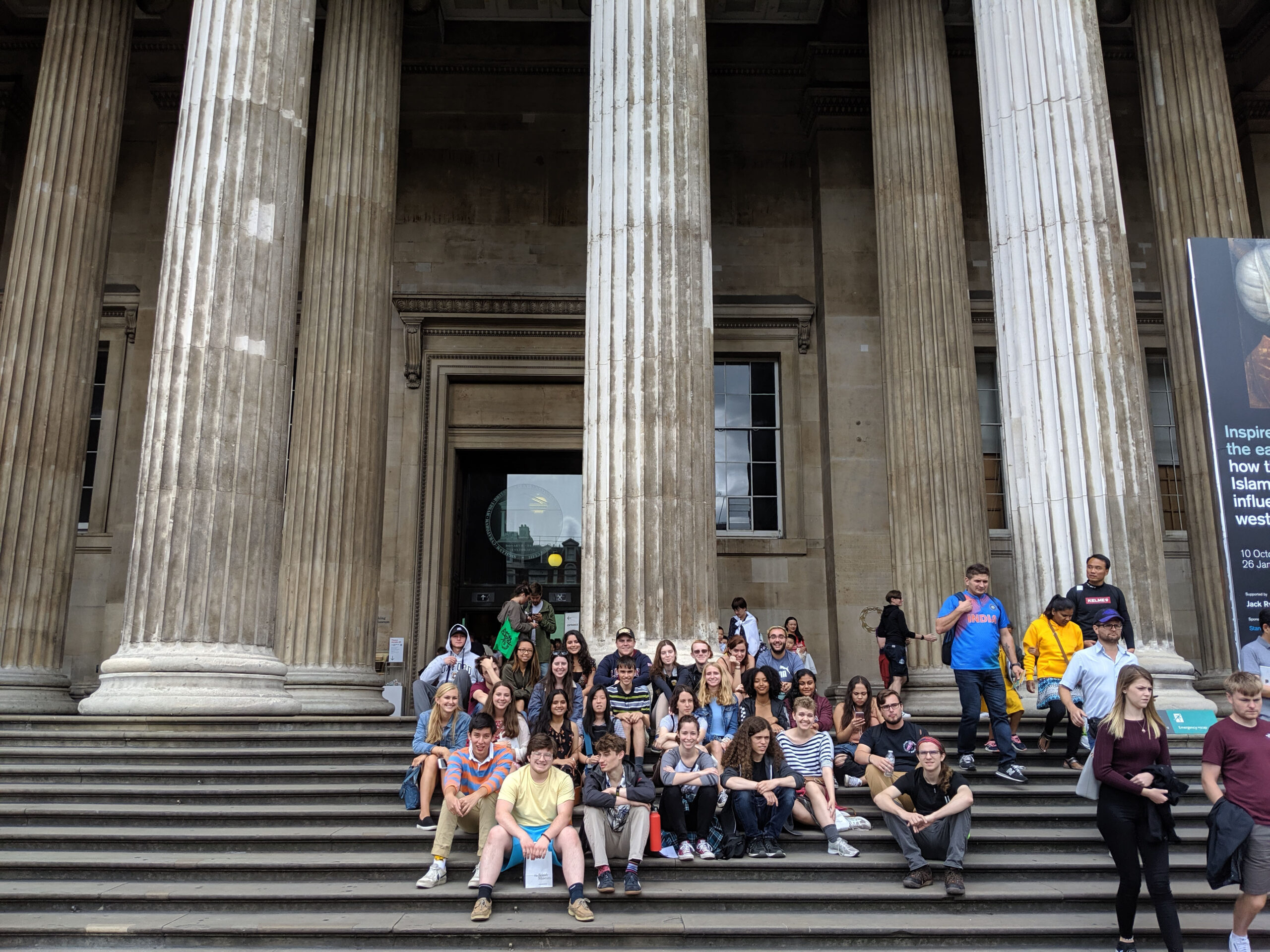
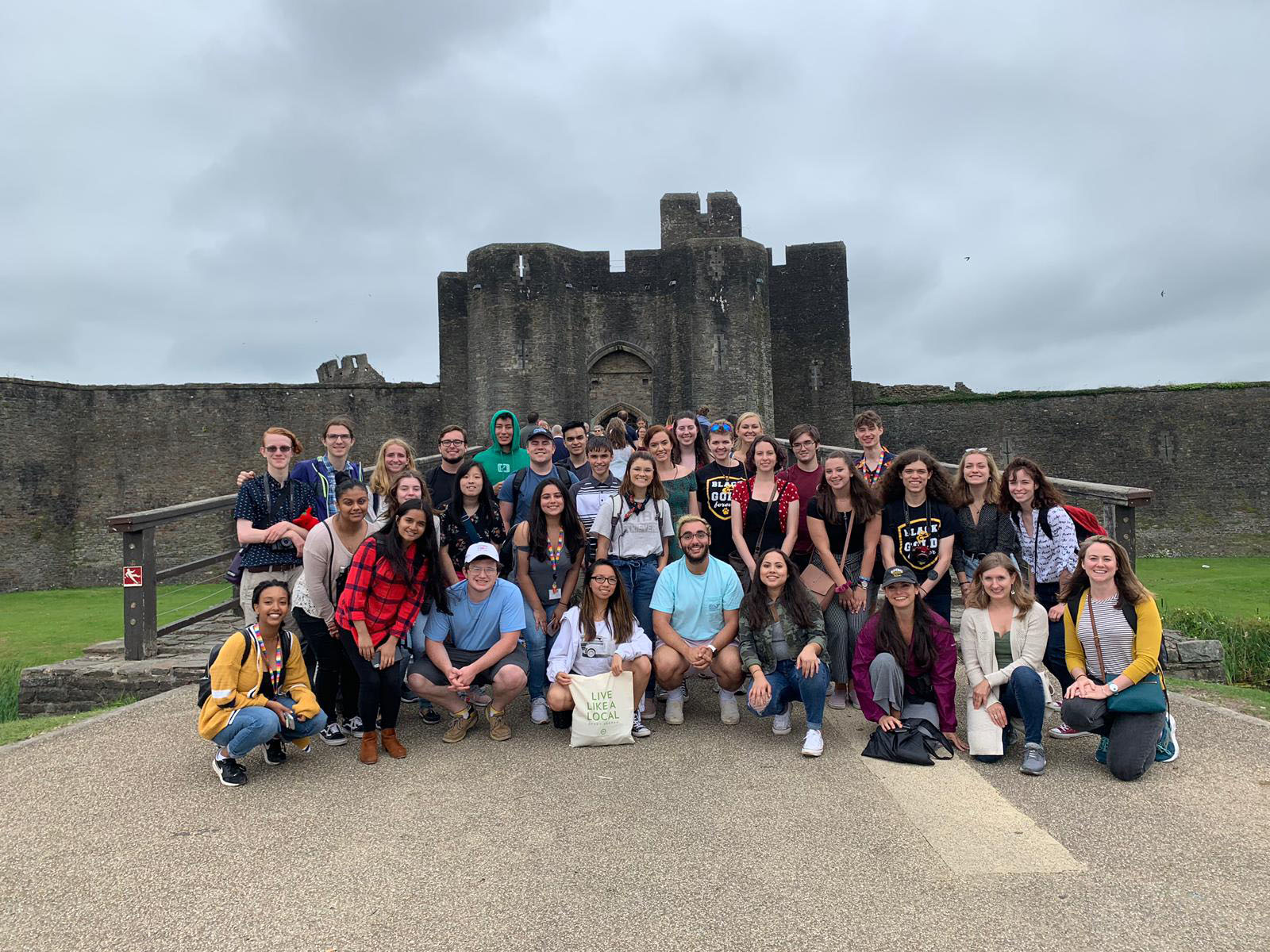
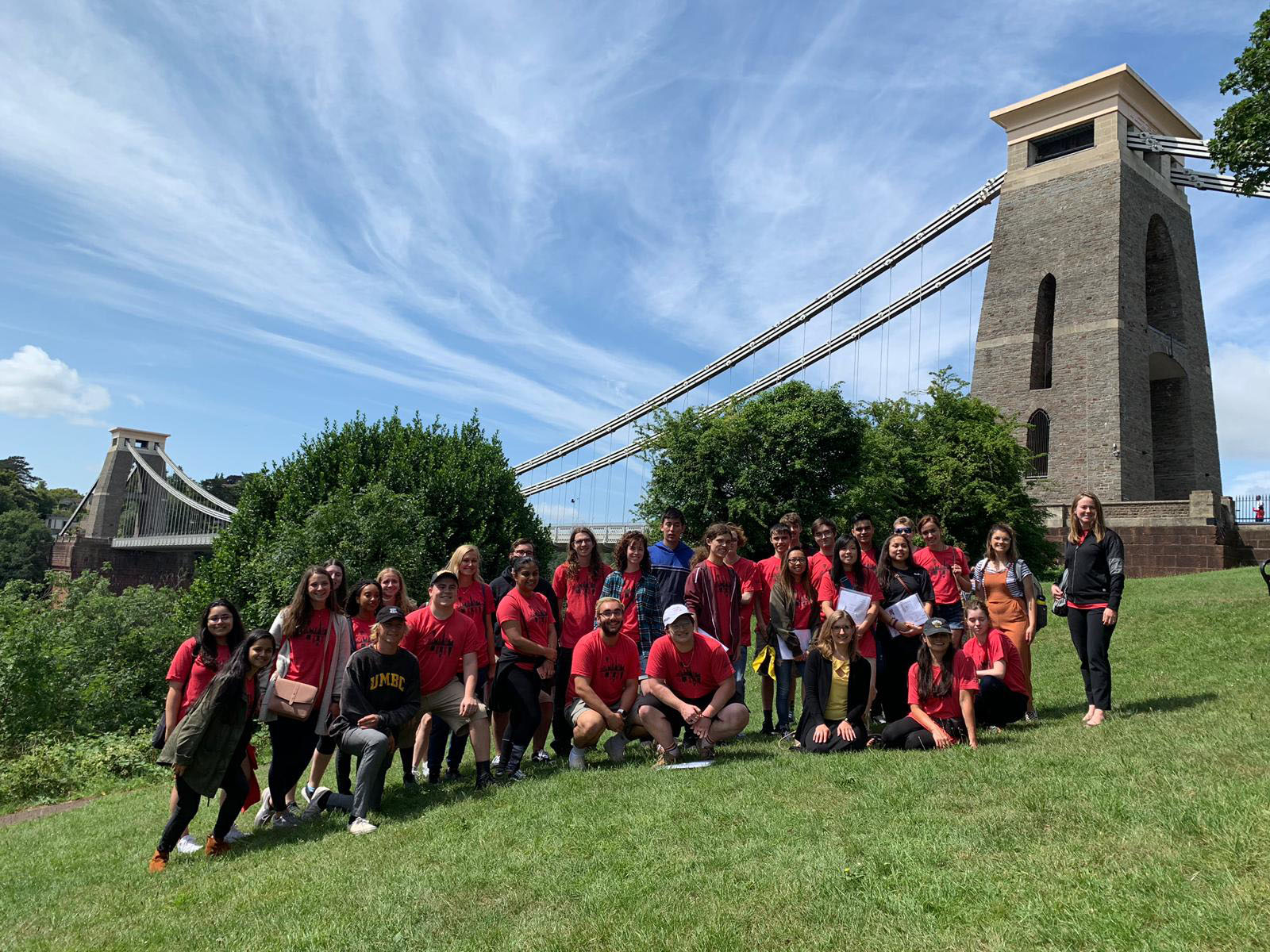
This is the first time UMBC has offered a program like this. What was the process for getting Dawg Days Abroad off the ground?
This program has been in the works for about three years and has been a personal dream of mine. I’ve always wanted to reach newly-admitted students because oftentimes once students come to our office, they don’t have as much time to think about studying abroad amidst their other responsibilities and priorities.
Dawg Days Abroad is a really rare type of study abroad program that few universities in the United States offer. To start, I met with campus partners such as Admissions, the Office Academic Engagement and Transition Programs, and potential faculty leaders. I also had to start to identify external providers to map our logistic support and explore possible locations for the program.
Once everyone was on board with the program, we identified the faculty whose courses would be the best fit for potential students. Then we had to narrow down the location options to one that fit within our anticipated budget.
That’s all the easy part. The hard part comes when you start to promote the program. We had to get enough students to make our minimum enrollment. We were aiming for at least 20 students and we ended up with 29.
This program had many moving pieces and so many different parties involved. I couldn’t have done it without the collaborative effort of everyone who was a part of it.
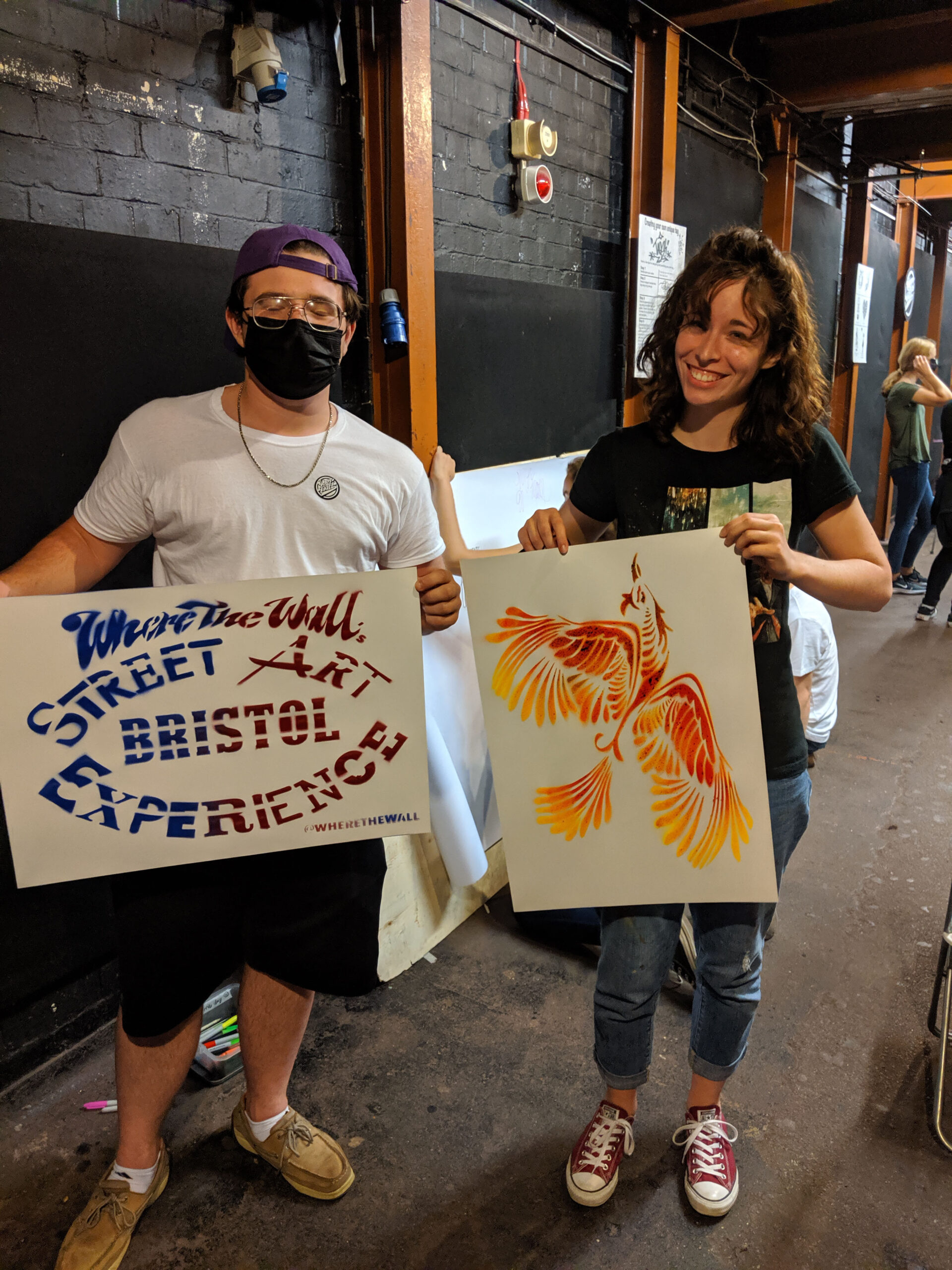
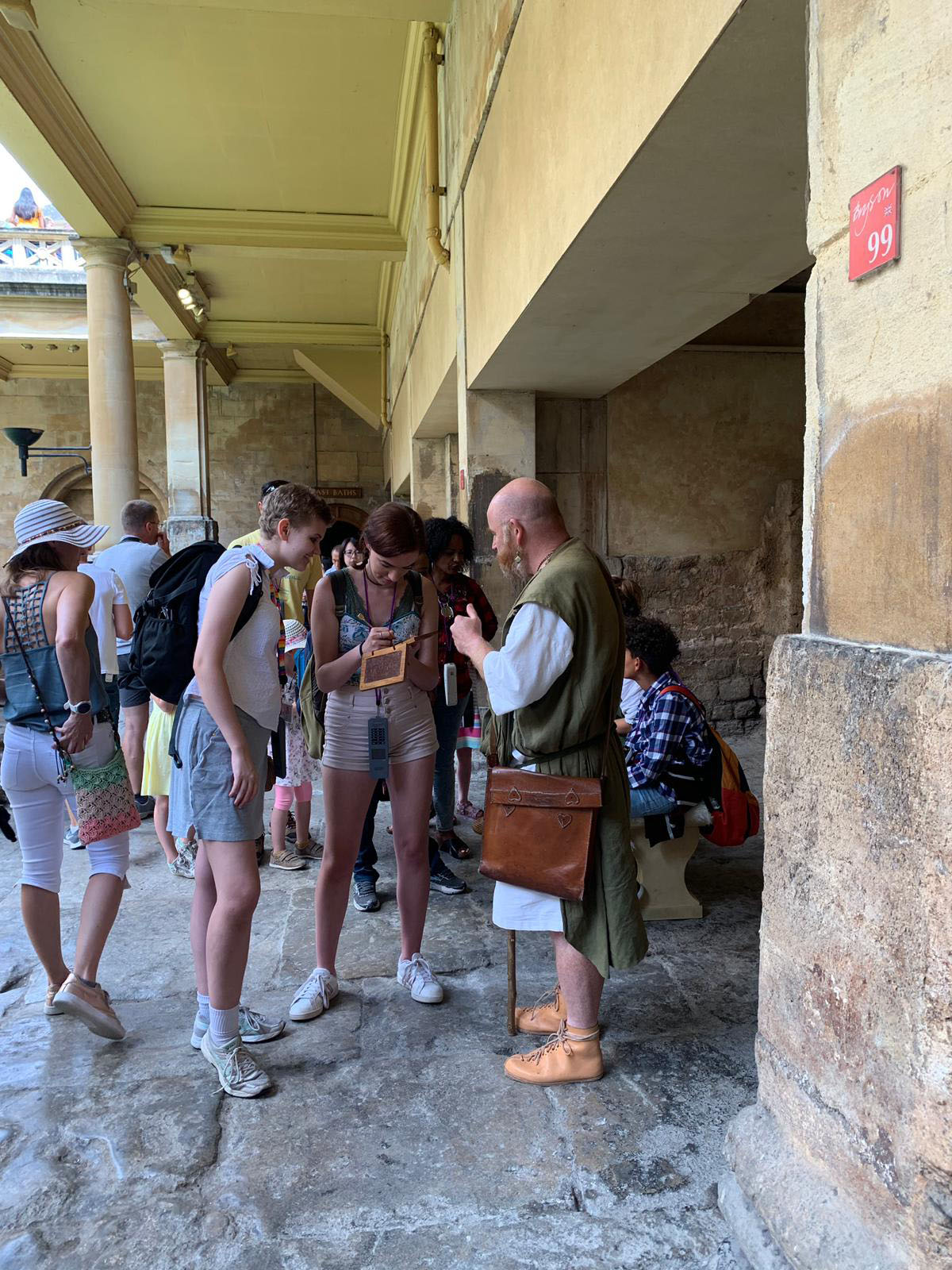
You mentioned that not many universities are doing this type of program. What makes it so unique?
This is a study abroad program that UMBC students complete before they start their first semester on campus. Most students don’t study abroad until their junior year, so Dawg Days students got international experience well before most others.
During their two weeks abroad, students earn four credits and get a chance to complete research, which makes this program particularly unique and valuable. Students have guided instruction on selecting a research topic and mentor, creating a poster presentation, and presenting a poster in a professional setting. Those four credits also include a one-credit “Introduction to an Honors University” component, which I taught to help students develop the skills to become successful Retrievers.
Our goals for this program are to give the students a snapshot and head start into university life and the potential they can reach. We want students to get an international and intercultural experience, form a group of friends before they start their time on campus, develop relationships with mentor on UMBC staff, and learn about the resources available to them.
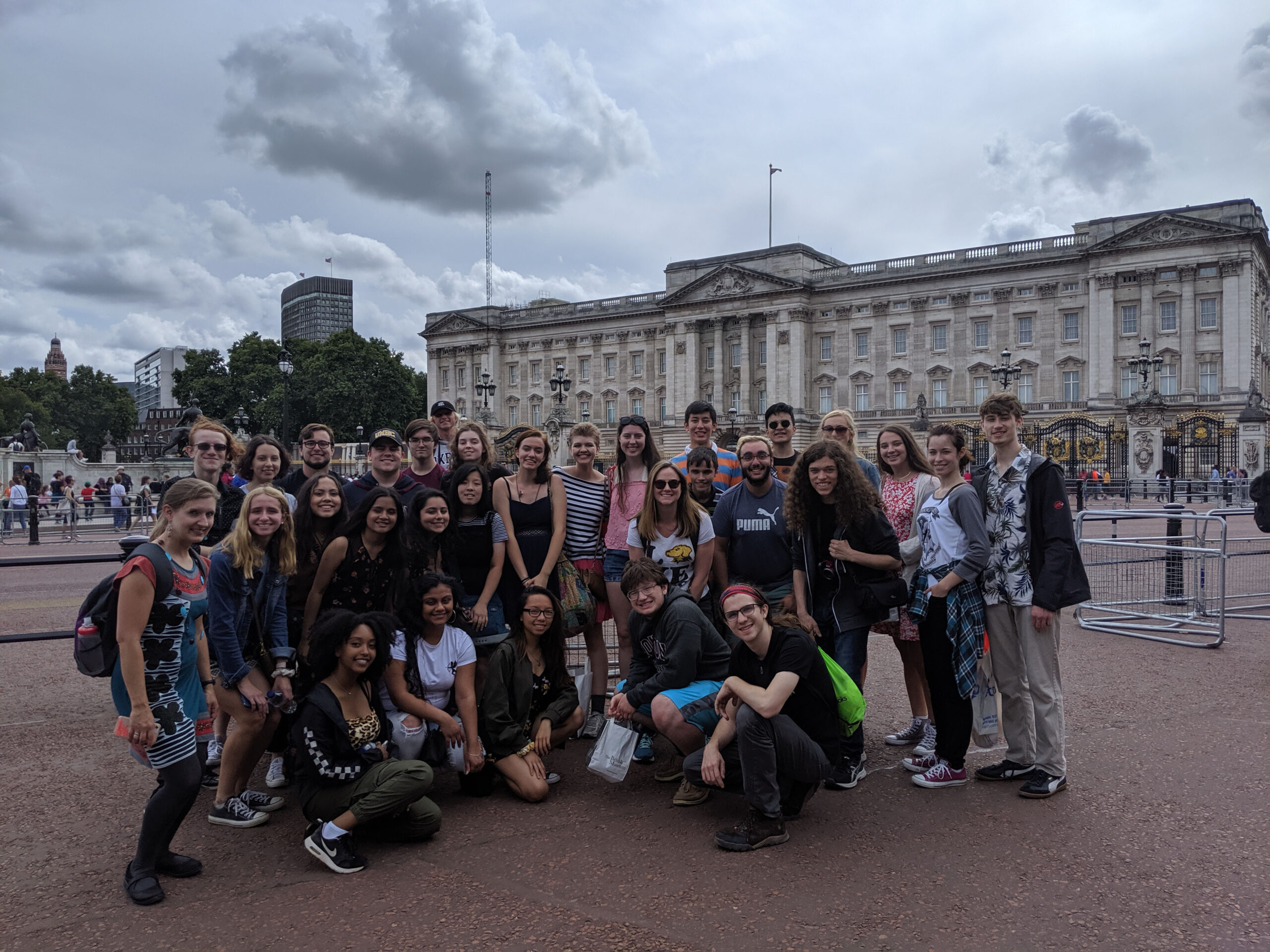
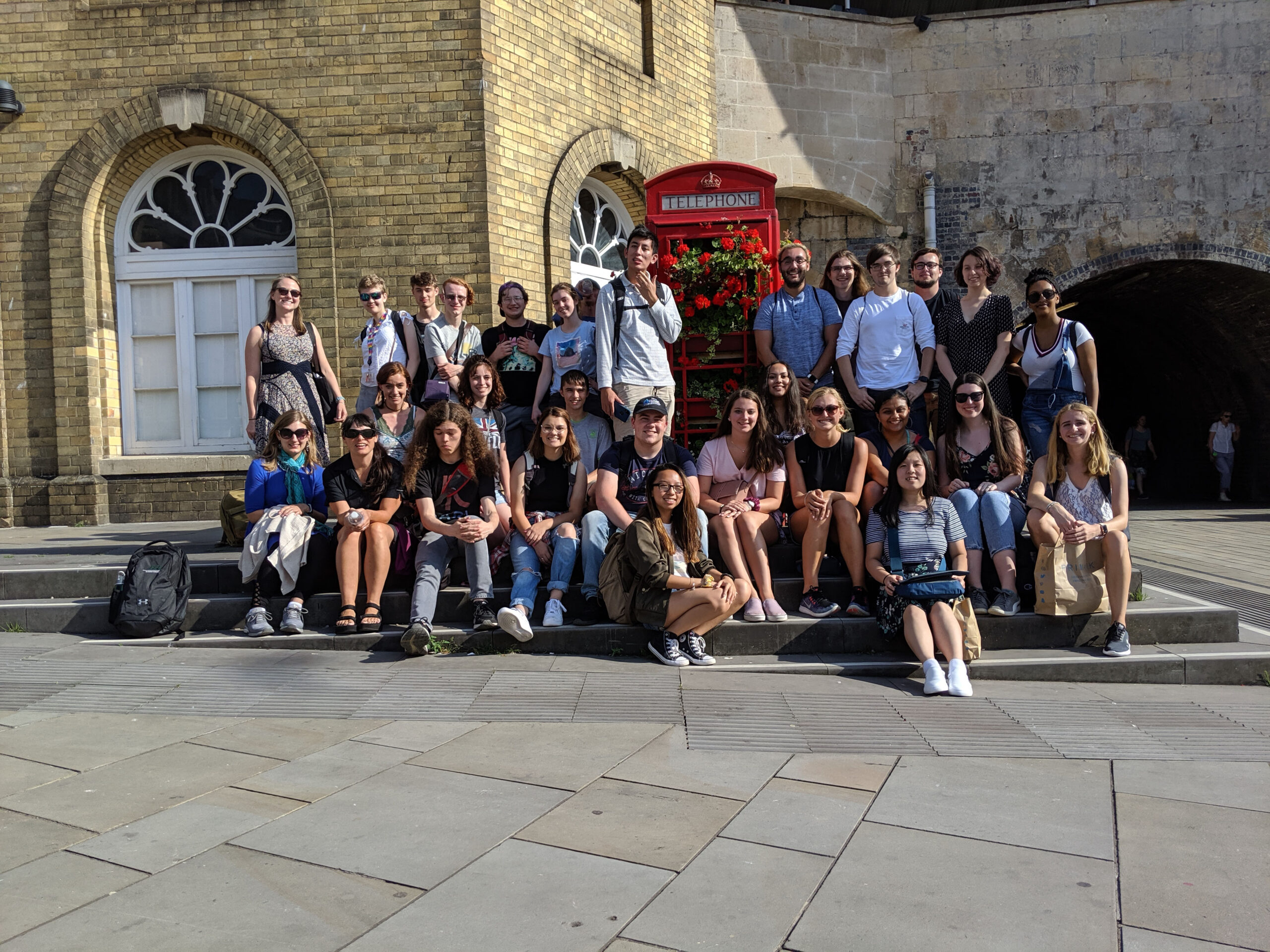
The big question: What did students actually do while they were abroad?
The program started with a day and a half on campus so students could develop some rapport with each other, get the pre-departure safety information, and do introductory coursework. We all left together to go to the airport and then flew together to London.
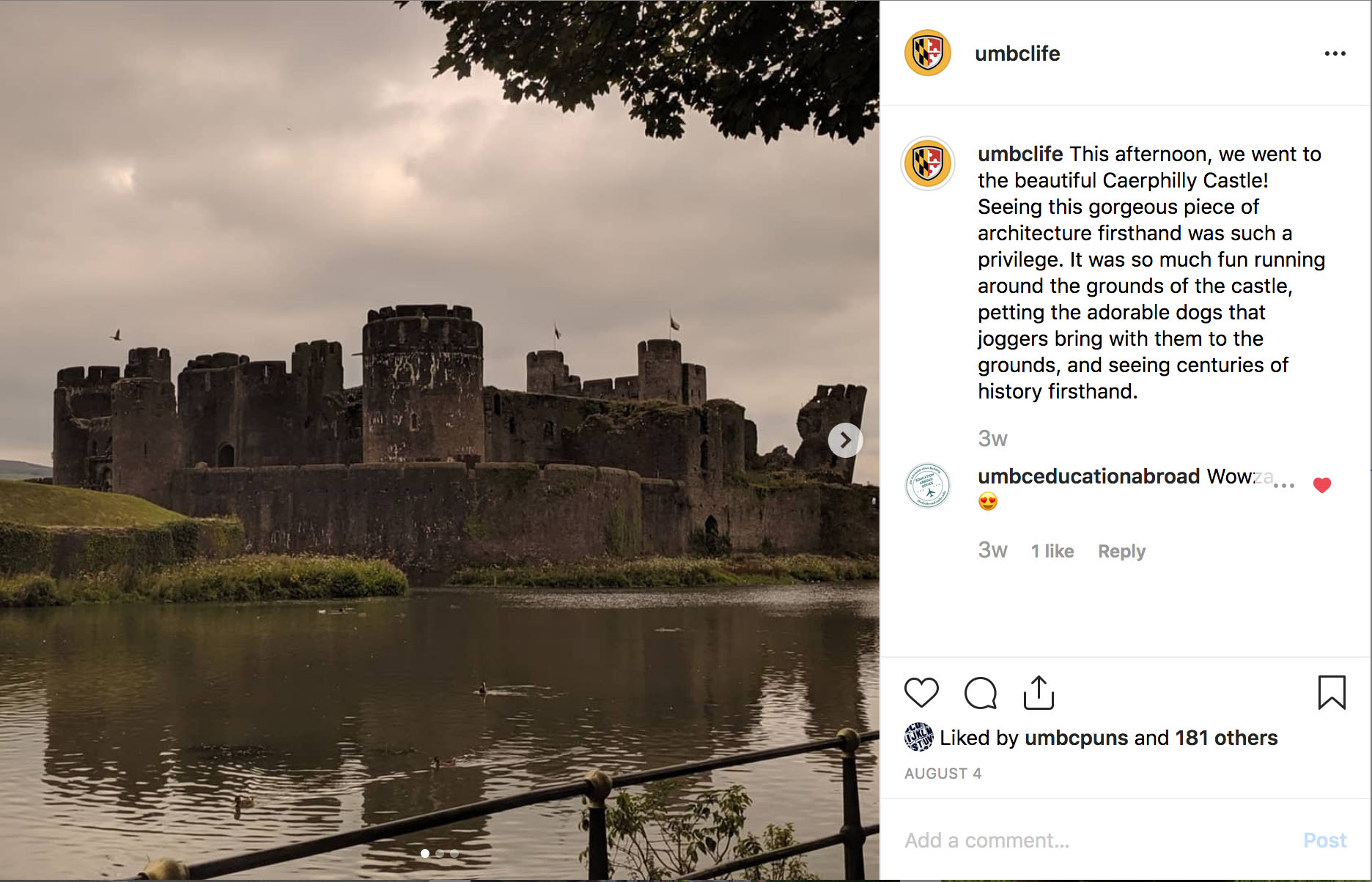
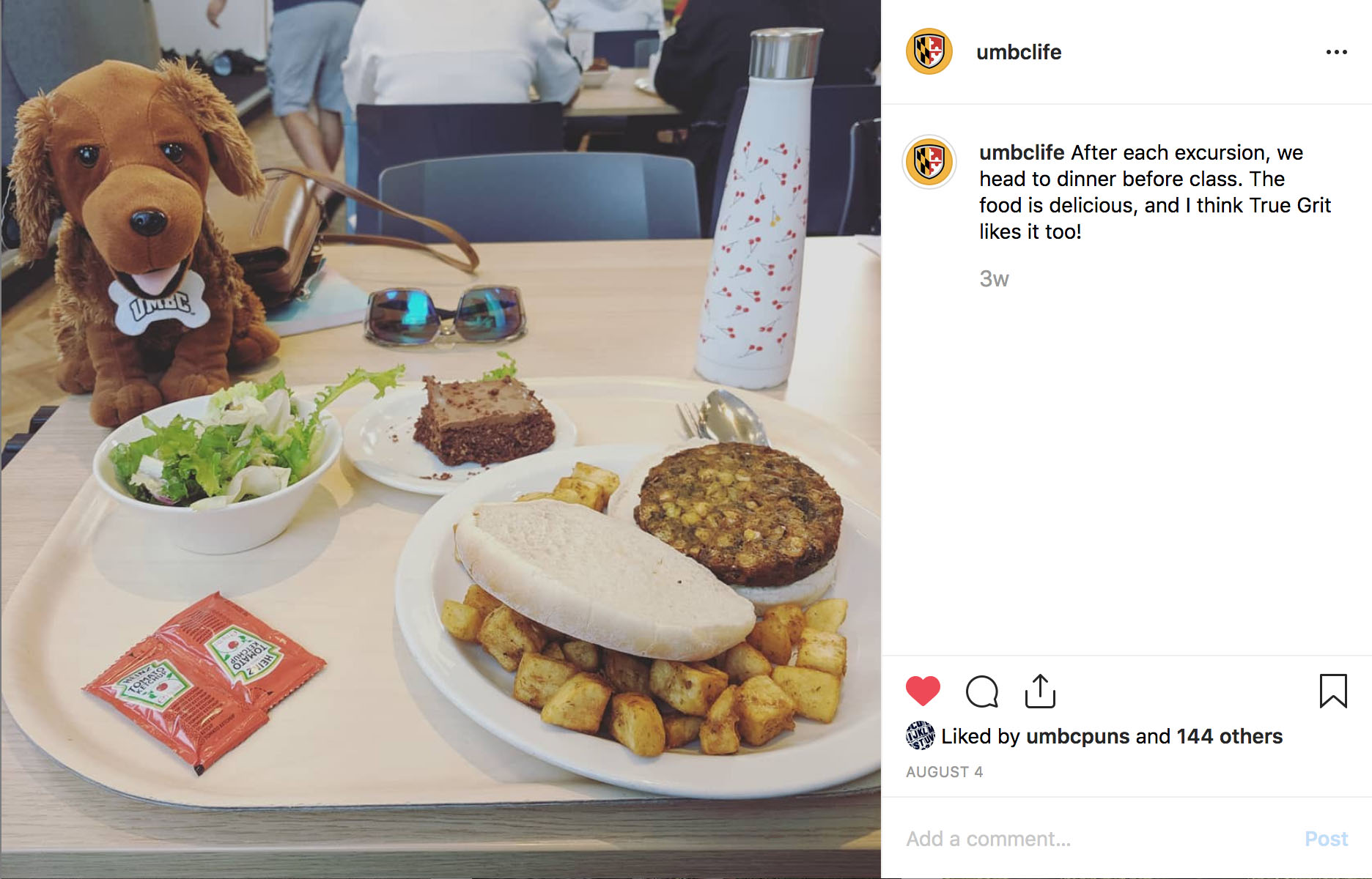
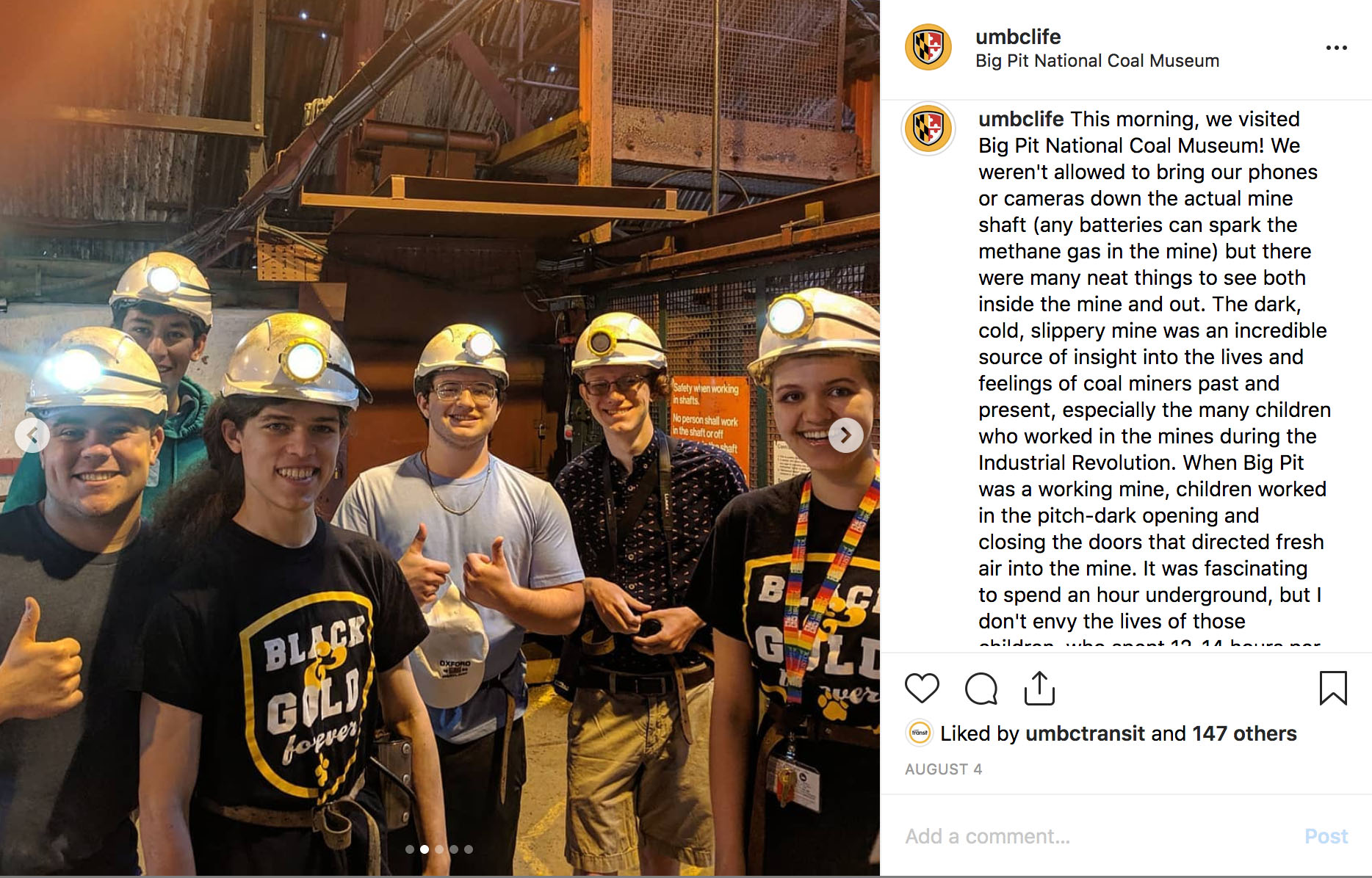
Once we arrived, we spent the majority of the time in Bristol, a city about two hours west of London. From there, students attended class daily and we enjoyed excursions every few days. We visited Bath to see the Roman Baths, went into the Welsh countryside, saw the Big Pit National Coal Museum, and explored social and political history on a tour of a coal mine. We did get to see a few traditional English castles while we were in the neighborhood, but most of our activities tied directly to the course content.
Other excursions included The National Gallery in London, the British Museum (to see the Rosetta Stone and explore representations of Orientalism), the National Assembly for Wales, and the Palestine Museum and Cultural Centre in Bristol. The students’ days were packed with activities and classes.
After such a successful first venture, what are your hopes for the future of the program?
Seeing this program come to fruition was so exciting. My next steps are to continue to improve and run it for the next few years. In the long term, I hope we can offer a few different pre-freshman/transfer study abroad programs in different locations for students to choose from. I believe this experience is so beneficial for both the students and our university. At least two students who participated who said they chose UMBC because we offered this study abroad program. It’s a great way to introduce future Retrievers to the fun and fascinating experiences they can access as a UMBC student.
All photos courtesy of Caylie Middleton ’08.
]]>
Most new students can’t wait to get their college careers started. This group of dedicated Retrievers really couldn’t wait. Through UMBC’s new Dawg Days Abroad program, nearly 30 incoming students...
https://umbc.edu/stories/dawg-days-abroad-the-scoop-on-umbcs-newest-summer-program/
https://my3.my.umbc.edu/api/v0/pixel/news/120055/guest@my.umbc.edu/17cbf7b21fe82f0173e38791a098e158/api/pixel
baltimore
campus-life
colleges-and-universities
UMBC News & Magazine
https://my3.my.umbc.edu/groups/umbc-news-magazine
https://assets1-my.umbc.edu/system/shared/avatars/groups/000/001/943/24435aa6207c452e7bc15cc74b42c7bb/xsmall.png?1748556657
https://assets1-my.umbc.edu/system/shared/avatars/groups/000/001/943/24435aa6207c452e7bc15cc74b42c7bb/original.png?1748556657
https://assets2-my.umbc.edu/system/shared/avatars/groups/000/001/943/24435aa6207c452e7bc15cc74b42c7bb/xxlarge.png?1748556657
https://assets2-my.umbc.edu/system/shared/avatars/groups/000/001/943/24435aa6207c452e7bc15cc74b42c7bb/xlarge.png?1748556657
https://assets3-my.umbc.edu/system/shared/avatars/groups/000/001/943/24435aa6207c452e7bc15cc74b42c7bb/large.png?1748556657
https://assets1-my.umbc.edu/system/shared/avatars/groups/000/001/943/24435aa6207c452e7bc15cc74b42c7bb/medium.png?1748556657
https://assets2-my.umbc.edu/system/shared/avatars/groups/000/001/943/24435aa6207c452e7bc15cc74b42c7bb/small.png?1748556657
https://assets1-my.umbc.edu/system/shared/avatars/groups/000/001/943/24435aa6207c452e7bc15cc74b42c7bb/xsmall.png?1748556657
https://assets2-my.umbc.edu/system/shared/avatars/groups/000/001/943/24435aa6207c452e7bc15cc74b42c7bb/xxsmall.png?1748556657
UMBC News & Magazine
0
0
false
Thu, 05 Sep 2019 16:04:53 -0400
Parents can help kids catch up in reading with a 10-minute daily routine

By Kindel Turner Nash, associate professor, early childhood education, UMBC
Because I conduct research about reading, parents often ask me the same question: “What can I do to help my child become a better reader?”
I always give them the same advice: “Read with your children. Enjoy books together, and whatever you do, don’t worry about teaching them to read. Leave the teaching to the teachers.”
This reply draws on my research regarding the literacy practices of high-performing teachers, as well as my experiences as a parent, teacher and literacy specialist. Ample evidence indicates that a solid foundation of reading, writing, talking and playing with words fosters a love for books at an early age and leads to later success as a reader.
But what happens when children do not learn to read, or when they struggle with reading? That problem is all too prevalent. Only about a third of all eighth-graders can read at or above grade level.
Successful teachers
I have studied how successful teachers at multiple high-performing urban schools in New York, Ohio, Missouri and Maryland that are helping struggling readers dramatically improve their reading fluency. Many are getting children to read passages multiple times.
Teachers and researchers have found that doing this almost always leads to improvements for struggling readers between second grade and the end of high school.
For kids, this strategy is a lot like learning a new song by reading lyrics while singing along with a music video. When children practice reading this way, they listen to and echo a more experienced reader while tracking the print with their eyes and touching the phrases of the book as they read and reread the book together.
By activating the senses of hearing, seeing and touch, this approach makes recognizing familiar words easier and faster, increasing fluency. The strategy works best when it’s repeated regularly – ideally 10-15 minutes per day. Considering the millions of children who don’t read at grade level, it’s very important.
Digging deeper
Psychologist Robert G. Heckelman first identified this method of repeated reading in the 1960s. He encountered an adolescent whose reading level increased by three grades after being tutored using this system. Heckelman repeated the method with 24 middle and high school students who were struggling with reading.
After just 7.5 hours of instruction in what he called Neurological Impress Method, students advanced by an average of two grade levels.
Those findings were later replicated with greater numbers of children, leading to a study published in 2016. In that study, the literacy researchers Chase Young, Timothy Rasinski, and Kathleen Mohr called the method “Read Two Impress.”
This new name reflected a change in the method: Kids had to read each page aloud after their tutors finished reading it to them. In addition to making kids better readers, Read Two Impress also helps them become more confident and spend more time reading.
Empowering families
Yet the Read Two Impress method, until now, has never formally involved a child’s family. Additionally, no studies of this strategy have investigated the impact of using books that reflect student culture and language.
To see if his strategy would be effective as a tool for families to use to improve their children’s reading, I partnered with co-researchers, Joshua Michael and Kris’tina Ackerman. Together, we conducted a study over 10 weeks at a school in a large Northeastern city.
There were some hurdles. For example, the grandmother of a thoughtful and inquisitive child expressed anxiety about her lack of confidence and perceived ability to read. “I’m not much of a reader myself,” she told us during the first training. “I don’t know if I can help my grandchild with reading.”
She, along with 25 second-graders and some of their relatives, participated in five training sessions.
In the final one, the adult participants described how they were teaching this strategy to others. They told us they believed similar opportunities should be broadly available. This in turn prompted us to host an open training for the whole school and a group of teachers-in-training.
This time, the grandmother, once apprehensive, helped facilitate the training. She had gained confidence in her ability to teach this learning strategy to others.
We also found that when families read books that reflected their culture and language, they enjoyed reading together more. In particular, we learned through surveys and focus groups that parents and other guardians took pride in playing a role in helping their kids become better readers.
We will publish the results of the more expansive approach to the strategy, which we call “Read Two Impress Plus,” in an academic journal.
*****
Header image: Photo by Andy Kuzma from Pexels.
UMBC doctoral students Joshua Michael and Kris’tina Ackerman contributed to the study of Read Two Impress and this article.
Kindel Turner Nash, Associate Professor of Early Childhood Education, University of Maryland, Baltimore County
This article is republished from The Conversation under a Creative Commons license. Read the original article.
]]>
By Kindel Turner Nash, associate professor, early childhood education, UMBC Because I conduct research about reading, parents often ask me the same question: “What can I do to help my child...
https://umbc.edu/stories/parents-can-help-kids-catch-up-in-reading-with-a-10-minute-daily-routine/
https://my3.my.umbc.edu/api/v0/pixel/news/120056/guest@my.umbc.edu/5592558b12119031268c833b76ff5e66/api/pixel
discovery
early-childhood-education
the-conversation
UMBC News & Magazine
https://my3.my.umbc.edu/groups/umbc-news-magazine
https://assets1-my.umbc.edu/system/shared/avatars/groups/000/001/943/24435aa6207c452e7bc15cc74b42c7bb/xsmall.png?1748556657
https://assets1-my.umbc.edu/system/shared/avatars/groups/000/001/943/24435aa6207c452e7bc15cc74b42c7bb/original.png?1748556657
https://assets2-my.umbc.edu/system/shared/avatars/groups/000/001/943/24435aa6207c452e7bc15cc74b42c7bb/xxlarge.png?1748556657
https://assets2-my.umbc.edu/system/shared/avatars/groups/000/001/943/24435aa6207c452e7bc15cc74b42c7bb/xlarge.png?1748556657
https://assets3-my.umbc.edu/system/shared/avatars/groups/000/001/943/24435aa6207c452e7bc15cc74b42c7bb/large.png?1748556657
https://assets1-my.umbc.edu/system/shared/avatars/groups/000/001/943/24435aa6207c452e7bc15cc74b42c7bb/medium.png?1748556657
https://assets2-my.umbc.edu/system/shared/avatars/groups/000/001/943/24435aa6207c452e7bc15cc74b42c7bb/small.png?1748556657
https://assets1-my.umbc.edu/system/shared/avatars/groups/000/001/943/24435aa6207c452e7bc15cc74b42c7bb/xsmall.png?1748556657
https://assets2-my.umbc.edu/system/shared/avatars/groups/000/001/943/24435aa6207c452e7bc15cc74b42c7bb/xxsmall.png?1748556657
UMBC News & Magazine
0
0
false
Tue, 03 Sep 2019 18:49:20 -0400
Six Baltimore City Schools in UMBC Math Project partnership see math test score gains

Newly released Maryland PARCC test results reveal that Baltimore City schools partnering with UMBC have seen dramatic growth in student math performance. The Baltimore Sun has called this trend one of the “bright spots” at a challenging moment, when many schools across the state are struggling to move the needle on student learning in math.
Math test scores for the six city schools involved with the UMBC Math Project grew by an average of five percentage points this year. Included are Liberty Elementary School, Mary Rodman Elementary School, James McHenry Elementary/Middle School, Federal Hill Preparatory Elementary School, Lakeland Elementary/Middle School, and Maree G. Farring Elementary/Middle School.
In comparison with this proficiency increase, Baltimore’s overall PARCC math scores remained flat and the state of Maryland experienced a drop of 1.1 percent. This year’s growth also builds on last year’s average increase of 6.9 percentage points at UMBC Math Project partner schools.
 Liberty Elementary School Teachers analyze student data as part of the UMBC Math Project.
UMBC Math Project
To achieve this growth, the UMBC Math Project supports teachers and school leaders in elementary and middle grades through ongoing coaching and professional development. The project has involved 60 educators and supported over 2,000 city school students.
 Kevin Older, an eighth grade teacher, and Christina Krasias ’18, mathematics, ’19 M.A.T, a UMBC Sherman Scholar and teacher intern, discuss a lesson during a collaborative planning meeting at Maree G. Farring EMS.
Professional development sessions build teachers’ math content knowledge. They also provide teachers with data analysis techniques to understand where students face challenges, and instructional practices to improve student learning outcomes.
UMBC’s current approach builds on an early partnership with Lakeland Elementary/Middle School supported by the Sherman Family Foundation, with professional development provided by Christopher Rakes of UMBC’s education department.
Today, UMBC facilitators connect with each school in the project in slightly different ways, based on school structures and needs. For some, support is very hands on. For others, consultation focuses on work with school leaders, who then implement professional development strategies with their teachers.
Intentional focus on early grades
Joshua Michael ‘10, political science, and a doctoral student studying education policy, serves as assistant director of the Sherman STEM Teacher Scholars Program at UMBC. He meets with educators in each school every two weeks for collaborative planning and professional development sessions.
“Our focus on elementary and middle grades mathematics is intentional,” Michael says. “Over 50 percent of students are performing notably below grade-level by third grade. We must adapt what and how we teach to meet students where they are and set a plan to meet rigorous standards. We know that algebra readiness is a key link to success in high school and beyond.”
Michael, a graduate of the UMBC Sondheim Public Service Scholars Program, taught in city schools earlier in his career, and he enjoys helping educators develop a renewed sense that they can have a measurable impact on student learning.
“Teachers want to do this work, and will go above and beyond when they are empowered as professionals,” Michael says. “Classroom teachers have great insight into what works for students, and when we honor that knowledge and support teachers in developing more tools to do their work, we see students grow.”
 Rehana Shafi, director of the Sherman STEM Teacher Scholars Program, at left, and Josh Michael, assistant director of the program, at right, stand with UMBC alumni who are now teachers in Maryland, at a May 2018 Celebration of Teaching event. Photo by Marlayna Demond ’11 for UMBC.
Data-informed approach sees results
Michael has found that schools particularly value learning how to use data analysis as a tool to determine what’s working in class, and what they should adjust. As UMBC President Freeman Hrabowski has explained, “We’re bringing more specificity to the work.” And it’s paying off.
From 2016 to 2019, Liberty Elementary School saw an increase from 21.7 to 26 percent in math proficiency. Sara Krauss, assistant principal and math lead at Liberty shares, “Working with the UMBC Math Project has broadened our view on how to attack data. Each teacher now has the tools to make predictions about student growth based on their current math levels using several sources.”
“We use this information to monitor students’ growth, have conversations with students about where they are, and set learning goals,” Krauss explains. “Including students in conversations about their learning is essential.”
 Sara Krauss, assistant principal; Takira Fields, fifth grade teacher; and Joe Manko, principal, start the year by analyzing and recording data for each student at Liberty Elementary School.
Over the same four years, Lakeland Elementary/Middle School saw an increase in math proficiency from 16.7 to 31.8 percent.
From 2017 to 2019, Mary E. Rodman Elementary School has grown from 2.2 to 22.8 proficient in math. “The partnership that our math team formed with UMBC has been transformational,” says third grade teacher Emily Campbell. “The triangulation of data from multiple sources has allowed us to group students in ways which meet their individual needs. It’s taken differentiation to a new level.”
 Sara Bielat, a third grade teacher at Federal Hill Prep, updates and analyzes student achievement data.
Within that same time frame, Federal Hill Preparatory Academy has also seen incredibly strong results, growing from 17.9 to 43.3 percent. Sara Long, principal of Federal Hill Prep, says, “The partnership provided me with an opportunity to grow as an instructional leader. The planning, collaboration, data analysis, and instructional strategies that we developed allowed our staff to implement differentiated high quality instruction that was individually tailored to meet the needs of all of our students.”
James McHenry Elementary/Middle School has also seen steady growth. Of the partner schools, James McHenry started with the most challenging test results, with just 1.7 percent of students reaching proficiency in math in 2017. Just two years later, that has increased nearly three-fold, to 4.9 percent.
Maree G. Farring Elementary/Middle School is the newest UMBC Math Project partner. Over the past year, the school grew its math test scores from 9.2 to 13.1 percent proficient.
Access for all students
Although the current trends are significant, UMBC Math Project leaders and participants also recognize the importance of expanding partnerships like this to more schools across the city and the state. And the partners are beginning to explore the possibility of summer programs to accelerate student learning.
UMBC’s Susan Sonnenschein, professor of psychology, and a team of graduate students are currently evaluating the UMBC Math Project. This is an essential step to ensure future investments are driven by detailed knowledge about how the program works and how it can have the most impact.
“We approach this work with the mindset that these are our students,” says Michael, “and we design learning experiences that we would expect for our own children.”
“Student engagement has sky-rocketed as more and more students are gaining confidence through accessible instruction and high expectations,” he notes. “This is the education our children deserve—an experience where they can build on their strengths and grow to their fullest potential.”
Featured photo: Sherman STEM Teacher Scholar Vanessa Gonzalez ’19, American studies, works with Lakeland Elementary/Middle School students. Photo by Marlayna Demond ’11 for UMBC. Photos not by Demond are by Josh Michael for UMBC.
]]>
Newly released Maryland PARCC test results reveal that Baltimore City schools partnering with UMBC have seen dramatic growth in student math performance. The Baltimore Sun has called this trend...
https://umbc.edu/stories/six-baltimore-city-schools-in-umbc-math-project-partnership-see-math-test-score-gains/
https://my3.my.umbc.edu/api/v0/pixel/news/120057/guest@my.umbc.edu/f6a8d7d2dd75da9d8be0c33c5f4bf043/api/pixel
alumni
cahss
community
education
page1
policy-and-society
psychology
publicpolicy
shermanscholars
sondheimscholars
UMBC News & Magazine
https://my3.my.umbc.edu/groups/umbc-news-magazine
https://assets1-my.umbc.edu/system/shared/avatars/groups/000/001/943/24435aa6207c452e7bc15cc74b42c7bb/xsmall.png?1748556657
https://assets1-my.umbc.edu/system/shared/avatars/groups/000/001/943/24435aa6207c452e7bc15cc74b42c7bb/original.png?1748556657
https://assets2-my.umbc.edu/system/shared/avatars/groups/000/001/943/24435aa6207c452e7bc15cc74b42c7bb/xxlarge.png?1748556657
https://assets2-my.umbc.edu/system/shared/avatars/groups/000/001/943/24435aa6207c452e7bc15cc74b42c7bb/xlarge.png?1748556657
https://assets3-my.umbc.edu/system/shared/avatars/groups/000/001/943/24435aa6207c452e7bc15cc74b42c7bb/large.png?1748556657
https://assets1-my.umbc.edu/system/shared/avatars/groups/000/001/943/24435aa6207c452e7bc15cc74b42c7bb/medium.png?1748556657
https://assets2-my.umbc.edu/system/shared/avatars/groups/000/001/943/24435aa6207c452e7bc15cc74b42c7bb/small.png?1748556657
https://assets1-my.umbc.edu/system/shared/avatars/groups/000/001/943/24435aa6207c452e7bc15cc74b42c7bb/xsmall.png?1748556657
https://assets2-my.umbc.edu/system/shared/avatars/groups/000/001/943/24435aa6207c452e7bc15cc74b42c7bb/xxsmall.png?1748556657
UMBC News & Magazine
0
0
false
Tue, 03 Sep 2019 16:14:42 -0400
Retriever Nation welcomes another class to its ranks
The start of the school year is invigorating for the whole university community, whether you’re starting your first year in college, transferring from a different institution, or gearing up to teach for the tenth year. And UMBC is channeling all that energy in classic Retriever ways.
Inflatable games in The Commons, a petting zoo on Erickson Field, food trucks everywhere—nothing says Welcome Week like a campus filled with activity. New students also have opportunities to reflect on what they hope to experience and achieve as college students, as well as learn about the foundational principles that are essential for our campus community to thrive.
Each student has a story
“We received a record number of applications this year, and the class of 2023 has all the strong academic credentials we’ve grown to expect at UMBC,” says Dale Bittinger ’16, M.P.P., assistant vice provost of undergraduate admissions, orientation, and school partnerships. “But even though you might start with the class’s numbers, it goes far beyond that. The students’ stories make the foundation of the class’s greatness.”
Hailing from 28 states and 31 countries, the incoming class of 2023 is eager to join in the unique community UMBC fosters among students. “UMBC has always been on my mind,” says Samiksha Paudel, biology. “I think it’s the best fit for me because of the size and the sense of community.”
 Paudel hugs a newfound friend, Erica Doerrter, pre-nursing. Photo by Kennedy Lamb ’20.
“I chose UMBC because I heard that it’s cool to be a nerd here,” adds Natalie Davenport, psychology, “and so far, I haven’t been disappointed.”
 Before gathering to take the annual class photo, Davenport stands in front of The Commons. Photo by Kennedy Lamb ’20.
Warm welcome from leaders
At Convocation (“a calling together” from Latin, as President Freeman Hrabowski pointed out), leaders of the campus community welcomed new students as fellow Retrievers. He encouraged them to take risks while also reminding them that they are in control of their destiny.
He also emphasized the principles that make Retriever Nation such a special place to grow and learn. He noted, “We value treating others with respect, standing against any kind of prejudice, and speaking out with courage about what is right and wrong.”
In case you missed it, that was President Hrabowski giving all of our new Retrievers their first A! #UMBCwelcome pic.twitter.com/0t5W10SDbE
— UMBC (@UMBC) August 27, 2019
SGA President Vrinda Deshpande affirmed that failure happens—it’s trying new things that is so important.
“When things don’t go according to your plans- take a step back, breathe, forgive yourself, and make a new plan.” – Vrinda Deshpande, @umbcsga president (we heard an audible sigh of relief when she shared that no one expects your first year to be perfect) #UMBCwelcome pic.twitter.com/b7RwtJgyq5
— UMBC (@UMBC) August 27, 2019
At the annual Fall Opening Meeting for faculty and staff, students reminded them of their mission at UMBC. Incoming student and Honors College member Zinedine Partipilo Cornielles fled Venezuela with his family and settled in Howard County in pursuit of stability and access to education. He shared that during his time in high school, all he heard about was UMBC.
“When I first stepped on campus, I felt overwhelmed. Not just because of what college represents in everyone’s lives, but also because of how incredible the school was,” said Partipilo Cornielles. “I was able to see how there were so many opportunities for everyone.”
 Zinedine Partipilo Cornielles at UMBC’s 2019 Fall Opening Program. Photo by Arionna Gonsalves ’19.
President Hrabowski ended the event with a brief version of his State of the University report and the familiar words attributed to Aristotle: “Choice, not chance, determines your destiny.” He then added an addendum, saying that recently a colleague had pressed him, asking, what if someone doesn’t have the chance to have a choice? “The nobility of what we do,” answered President Hrabowski, “is that we are creating opportunities for so many people to have that chance to make a choice.”
Campus is growing for students
Soon came the first day of classes. New and returning students walked through the doors of the Interdisciplinary Life Sciences Building (ILSB) for the first time, glimpsing bold colors and high tech classroom and lab spaces. With anticipation, they patiently stood in line to try the new line up of halal meals in The Commons and relaxed in True Grit’s updated dining hall, reconnecting with friends. Others enjoyed walking across the fresh green grass of the quad and spotting new pocket gardens with native plants.
https://www.instagram.com/p/B1vyJHEhpkx/?utm_source=ig_web_copy_link
UMBC’s Shady Grove campus is also expanding this year as construction continues on a building that will house the new translational life science technology major. Students in this major are eager to apply their skills and interest in the life sciences to creating innovative biotechnology solutions that will transform the health, agriculture, and environment sectors. They will find a welcoming home in the Biomedical Sciences and Engineering (BSE) Education Facility at Shady Grove this fall.
Discovering your place at UMBC
While not all of the first week of the fall semester is fun and games, there are also literal games, as the soccer teams kick off their new season. In an opening game against St. Francis, the women’s team kept the score tied 2-2 into overtime. The men’s soccer team is matched with Incarnate Word at 7 p.m. on August 30, giving new and returning Retrievers a chance to join their voices in a big WOOF WOOF as they cheer on the team.
 Junior Kathryn Moormann deflects the ball from the goal. Photo by Ian Feldmann ’20.
Though it’s a fast-paced introduction to campus, Welcome Week allows incoming students to bond with each other, and get an introduction to the UMBC experience from returning Retrievers. Whether they’re attending a pool party, morning yoga by the UMBC Library pond, or a “unity web” community activity, UMBC students use this week as a chance to start building relationships that will serve as the foundation for their years at UMBC.
 Students collaborate on the unity web project. Photo by Marlayna Demond ’11.
“I’m excited to see what these students can do,” says Bittinger. “I don’t even know if they know what they’re capable of, but I hope they discover their place in the world here at UMBC. I’m as excited as they are to see them succeed.”
Happy first day of classes! Whether you're new to #RetrieverNation or you've called UMBC home for a while, start the year with our favorite mantra in mind: thoughts  words actions habits character destiny. #UMBCwelcome pic.twitter.com/f1dOJi48tg
— UMBC (@UMBC) August 28, 2019
This article was written by Randianne Leyshon ’09, assistant editor of UMBC Magazine, with contributions from Kait McCaffrey.
Banner image: New Retrievers gather to spell out “UMBC” on Erickson Field. Photo by Marlayna Demond ’11.
]]>
The start of the school year is invigorating for the whole university community, whether you’re starting your first year in college, transferring from a different institution, or gearing up to...
https://umbc.edu/stories/retriever-nation-welcomes-another-class-to-its-ranks/
https://my3.my.umbc.edu/api/v0/pixel/news/120058/guest@my.umbc.edu/39f2acddf813704dc2edae02b07e1190/api/pixel
cahss
cnms
coeit
community
honorscollege
UMBC News & Magazine
https://my3.my.umbc.edu/groups/umbc-news-magazine
https://assets1-my.umbc.edu/system/shared/avatars/groups/000/001/943/24435aa6207c452e7bc15cc74b42c7bb/xsmall.png?1748556657
https://assets1-my.umbc.edu/system/shared/avatars/groups/000/001/943/24435aa6207c452e7bc15cc74b42c7bb/original.png?1748556657
https://assets2-my.umbc.edu/system/shared/avatars/groups/000/001/943/24435aa6207c452e7bc15cc74b42c7bb/xxlarge.png?1748556657
https://assets2-my.umbc.edu/system/shared/avatars/groups/000/001/943/24435aa6207c452e7bc15cc74b42c7bb/xlarge.png?1748556657
https://assets3-my.umbc.edu/system/shared/avatars/groups/000/001/943/24435aa6207c452e7bc15cc74b42c7bb/large.png?1748556657
https://assets1-my.umbc.edu/system/shared/avatars/groups/000/001/943/24435aa6207c452e7bc15cc74b42c7bb/medium.png?1748556657
https://assets2-my.umbc.edu/system/shared/avatars/groups/000/001/943/24435aa6207c452e7bc15cc74b42c7bb/small.png?1748556657
https://assets1-my.umbc.edu/system/shared/avatars/groups/000/001/943/24435aa6207c452e7bc15cc74b42c7bb/xsmall.png?1748556657
https://assets2-my.umbc.edu/system/shared/avatars/groups/000/001/943/24435aa6207c452e7bc15cc74b42c7bb/xxsmall.png?1748556657
UMBC News & Magazine
0
0
false
Fri, 30 Aug 2019 21:51:45 -0400
UMBC’s Minjoung Kyoung to help develop first 4D map of a cell’s metabolic pathways
Scientists understand many of the body’s processes, like breaking down sugars and generating energy for the cell, pretty well. They know what chemical reactions are involved, what molecules they produce, and in what order everything happens. Complex maps even exist of how the different processes interact with one another. There’s a problem, though: the maps are two-dimensional, and cells are three-dimensional. Add the element of time, and you’re up to four dimensions.
Minjoung Kyoung, assistant professor of chemistry and biochemistry, has never been satisfied with 2D maps of 4D processes. “I’ve always been interested in how proteins are working in the real system, in real time, in real action,” she says.
To address the limits of current understanding, Kyoung and her graduate student, Erin Kennedy, ordered parts to build an innovative type of microscope, found in just a few labs around the world. This new tool gave them the rare ability to look at entire living cells at exquisite resolution, as they change in real time. Finally, they could move forward with constructing a 4D map of cellular metabolic pathways.
Kyoung’s preliminary results with the new instrument are promising. Now, with a five-year, $1.6 million grant from the National Institutes of Health, she’s poised to make serious breakthroughs in how we understand the functional relationship between metabolic pathways. Her first targets will include essential basic processes like glucose metabolism (sugar breakdown) and cellular respiration (energy production for the cell, which relies on glucose). Both are fundamental to diseases like diabetes, cancer, and obesity.
Anticipating disease
One thing Kyoung’s early results suggested is that the enzymes important for breaking down glucose and for generating energy are physically close together in the cell—but only when both pathways are functioning normally. “So when they are functionally linked, they are spatially related,” Kyoung says. Her continuing research will try to determine how and why that happens, by looking very carefully at what’s going on in whole cells at various time points and under different cellular conditions.
 Minjoung Kyoung and Erin Kennedy work on the lab’s unique microscope. Photo by Marlayna Demond ’11 for UMBC.
Kyoung also finds the glucose pathway itself to be fascinating. It takes place in the cytoplasm, the watery fluid that fills cells. But somehow, the enzymes required to break down glucose form dense clusters, which Kyoung has dubbed “condensates,” even though the clusters don’t have a formal boundary. “The fundamental mechanism for how these condensates are reversibly assembled and disassembled is one of the specific aims that we’re going to study,” Kyoung says.
The enzymes for the cellular energy pathway also cluster, but they are enclosed inside mitochondria, a structure surrounded by a membrane. A single cell can contain from zero to thousands of mitochondria, depending on the cell’s job. Kyoung explains, “Mitochondria are very important for various metabolic diseases—cancer, diabetes, obesity, and so on. How these mitochondria relate to glucose metabolism is the most important part. So, by understanding them, I truly believe that we can get much, much closer to understanding how these diseases are caused, thus promoting therapeutic intervention.”
“My dream is to be able to predict disease before symptoms occur,” she shares. “That would be the best.”
Ready for a challenge
Getting to the point of recognizing disease before symptoms are apparent won’t be easy. The imaging techniques Kyoung, Kennedy, new graduate student Tao Zhang, and UMBC collaborator Songon An, associate professor of chemistry and biochemistry, are employing are so new, and so difficult, Kyoung anticipates many challenges.
“There is no previous data whatsoever. There is no technical approach whatsoever. There is no approach to data analysis whatsoever,” says Kyoung. She describes being at this cutting edge as both exciting and intimidating. To even successfully collect useful data, “many things have to go right,” Kyoung says.
 Minjoung Kyoung explains a result to her students. Photo by Marlayna Demond ’11 for UMBC.
To see what they want to see inside the cells, such as a particular enzyme, Kyoung’s team will need to tag it with a fluorescent protein, a process that is successful in 50 to 60 percent of cells. That’s not a problem when you use a conventional microscope, because you can see lots of cells at once. But the microscope that enables observing living cells with the resolution Kyoung needs can only see a few cells at a time. So finding the tagged cells has been the first challenge.
After the images are collected, a complex mathematical process called “deconvolution” removes the distortion that the microscope’s light beam itself generates in the images. That takes several hours for a single cell. And then they can actually analyze the images to see which enzymes are where, when. This process takes several days for one cell. Only at that point do they know if the experiment worked.
And, “Because no one has done this type of research before, we have to figure out how we are going to validate our results, too,” Kyoung says. “There is no precedent.” Despite all these challenges, Kyoung is excited to get to work. She believes the kinds of relationships they’ve started to see between glucose metabolism and mitochondria are only the tip of the iceberg as far as spatial relationships between metabolic pathways in the cell.
“Just a start”
“This is just a start. So far we have focused on these two metabolic pathways, but I believe this phenomenon is not limited to just these two,” Kyoung says. “So I envision that this will be the beginning for a big 4D map of all the metabolic networks.”
Kyoung and her team have significant funding from NIH to support their work, the microscope they need to do it, a healthy sense of optimism, and a commitment to helping answer some of the fundamental questions surrounding emerging epidemics like cancers, diabetes and obesity. With the key elements in place, they are bound to make breakthroughs that move the needle on tackling some of today’s most challenging diseases.
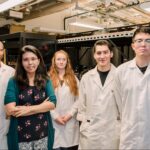
Banner image: Minjoung Kyoung and her UMBC lab group. From left to right: Keynon Bell, Minjoung Kyoung, Erin Kennedy, Manuel Huerta-Alvarado, and Tao Zhang. Photo by Marlayna Demond ’11 for UMBC.
]]>
Scientists understand many of the body’s processes, like breaking down sugars and generating energy for the cell, pretty well. They know what chemical reactions are involved, what molecules they...
https://umbc.edu/stories/umbcs-minjoung-kyoung-to-help-develop-first-4d-map-of-a-cells-metabolic-pathways/
https://my3.my.umbc.edu/api/v0/pixel/news/120059/guest@my.umbc.edu/e2e25fb813c40e63118cfcf20cd5faea/api/pixel
chembiochem
cnms
research
science-and-technology
UMBC News & Magazine
https://my3.my.umbc.edu/groups/umbc-news-magazine
https://assets1-my.umbc.edu/system/shared/avatars/groups/000/001/943/24435aa6207c452e7bc15cc74b42c7bb/xsmall.png?1748556657
https://assets1-my.umbc.edu/system/shared/avatars/groups/000/001/943/24435aa6207c452e7bc15cc74b42c7bb/original.png?1748556657
https://assets2-my.umbc.edu/system/shared/avatars/groups/000/001/943/24435aa6207c452e7bc15cc74b42c7bb/xxlarge.png?1748556657
https://assets2-my.umbc.edu/system/shared/avatars/groups/000/001/943/24435aa6207c452e7bc15cc74b42c7bb/xlarge.png?1748556657
https://assets3-my.umbc.edu/system/shared/avatars/groups/000/001/943/24435aa6207c452e7bc15cc74b42c7bb/large.png?1748556657
https://assets1-my.umbc.edu/system/shared/avatars/groups/000/001/943/24435aa6207c452e7bc15cc74b42c7bb/medium.png?1748556657
https://assets2-my.umbc.edu/system/shared/avatars/groups/000/001/943/24435aa6207c452e7bc15cc74b42c7bb/small.png?1748556657
https://assets1-my.umbc.edu/system/shared/avatars/groups/000/001/943/24435aa6207c452e7bc15cc74b42c7bb/xsmall.png?1748556657
https://assets2-my.umbc.edu/system/shared/avatars/groups/000/001/943/24435aa6207c452e7bc15cc74b42c7bb/xxsmall.png?1748556657
UMBC News & Magazine
0
0
false
Fri, 30 Aug 2019 19:40:01 -0400
Surveying archaeologists across the globe reveals deeper and more widespread roots of the human age, the Anthropocene

By Erle C. Ellis, professor of geography and environmental systems, UMBC; Ben Marwick, associate professor of archaeology, University of Washington; Lucas Stephens, research affiliate in archaeology, Max Planck Institute for the Science of Human History; and Nicole Boivin, director of the department of archaeology, Max Planck Institute for the Science of Human History
Examples of how human societies are changing the planet abound – from building roads and houses, clearing forests for agriculture and digging train tunnels, to shrinking the ozone layer, driving species extinct, changing the climate and acidifying the oceans. Human impacts are everywhere. Our societies have changed Earth so much that it’s impossible to reverse many of these effects.
 Nuclear bomb testing left its mark in the geologic record. National Nuclear Security Administration/Wikimedia Commons, CC BY
Some researchers believe these changes are so big that they mark the beginning of a new “human age” of Earth history, the Anthropocene epoch. A committee of geologists has now proposed to mark the start of the Anthropocene in the mid-20th century, based on a striking indicator: the widely scattered radioactive dust from nuclear bomb tests in the early 1950s.
But this is not the final word.
Not everyone is sure that today’s industrialized, globalized societies will be around long enough to define a new geological epoch. Perhaps we are just a flash in the pan – an event – rather than a long, enduring epoch.
Others debate the utility of picking a single thin line in Earth’s geological record to mark the start of human impacts in the geological record. Maybe the Anthropocene began at different times in different parts of the world. For example, the first instances of agriculture emerged at different places at different times, and resulted in huge impacts on the environment, through land clearing, habitat losses, extinctions, erosion and carbon emissions, forever changing the global climate.
If there are multiple beginnings, scientists need to answer more complicated questions – like when did agriculture begin to transform landscapes in different parts of the world? This is a tough question because archaeologists tend to focus their research on a limited number of sites and regions and to prioritize locations where agriculture is believed to have appeared earliest. To date, it has proved nearly impossible for archaeologists to put together a global picture of land use changes throughout time.
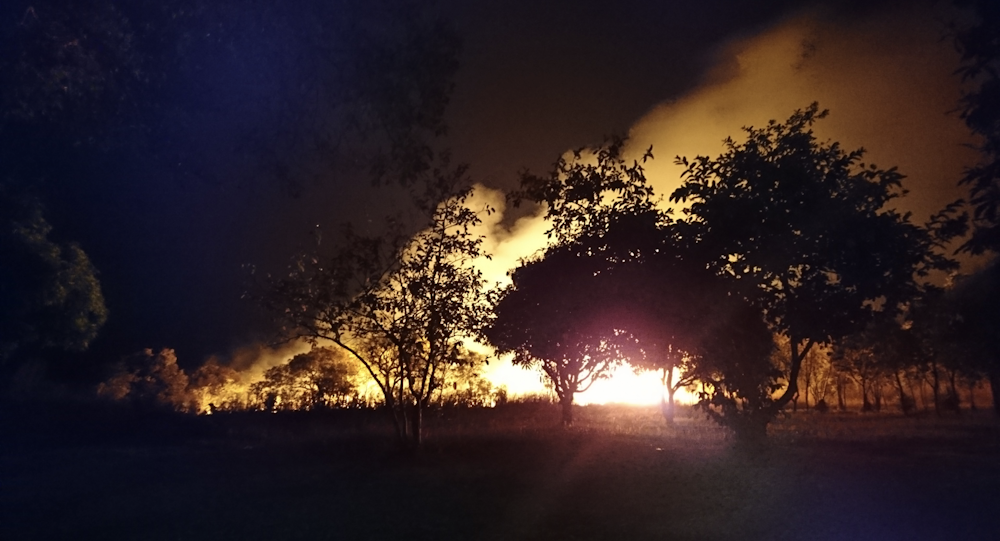
 Human practices like burning the landscape – as in this night bush fire outside Kabwe, Zambia – have been affecting the Earth since long before the nuclear era.Andrea Kay, CC BY-SA
Global answers from local experts
To tackle these questions, we pulled together a research collaboration among archaeologists, anthropologists and geographers to survey archaeological knowledge on land use across the planet.
We asked over 1,300 archaeologists from around the world to contribute their knowledge on how ancient people used the land in 146 regions spanning all continents except Antarctica from 10,000 years ago right up to 1850. More than 250 responded, representing the largest expert archaeology crowdsourcing project ever undertaken, though some prior projects have worked with amateur contributions.
Our work has now mapped the current state of archaeological knowledge on land use across the planet, including parts of the world that have rarely been considered in previous studies.
We used a crowdsourcing approach because scholarly publications don’t always include the original data needed to allow global comparisons. Even when these data are shared by archaeologists, they use many different formats from one project to another, making it difficult to combine for large-scale analysis. Our goal from the beginning was to make it easy for anyone to check our work and reuse our data – we’ve put all our research materials online where they can be freely accessed by anyone.
Earlier and more widespread human impacts
Though our study acquired expert archaeological information from across the planet, data were more available in some regions – including Southwest Asia, Europe, northern China, Australia and North America – than in others. This is probably because more archaeologists have worked in these regions than elsewhere, such as parts of Africa, Southeast Asia and South America.
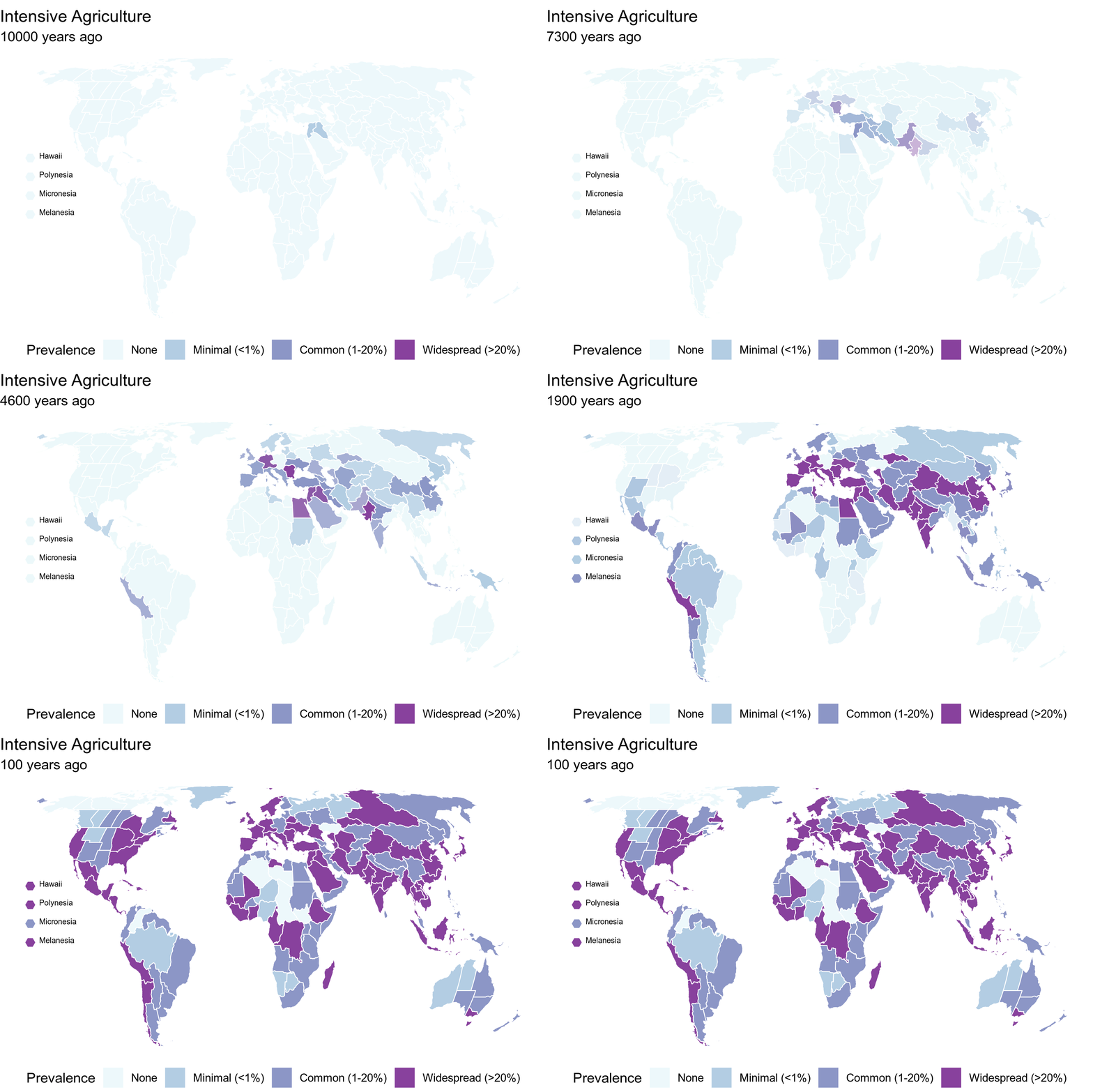 Animation showing the spread of intensive agriculture across the globe over the past 10,000 years, based on ArchaeoGLOBE Project results. (Nicolas Gauthier, 2019, CC-BY-SA)
Our archaeologists reported that nearly half (42%) of our regions had some form of agriculture by 6,000 years ago, highlighting the prevalence of agricultural economies across the globe. Moreover, these results indicate that the onset of agriculture was earlier and more widespread than suggested in the most common global reconstruction of land-use history, the History Database of the Global Environment. This is important because climate scientists often use this database of past conditions to estimate future climate change; according to our research it may be underestimating land-use-associated climate effects.
Our survey also revealed that hunting and foraging was generally replaced by pastoralism (raising animals such as cows and sheep for food and other resources) and agriculture in most places, though there were exceptions. In a few areas, reversals occurred and agriculture did not simply replace foraging but merged with it and coexisted side by side for some time.
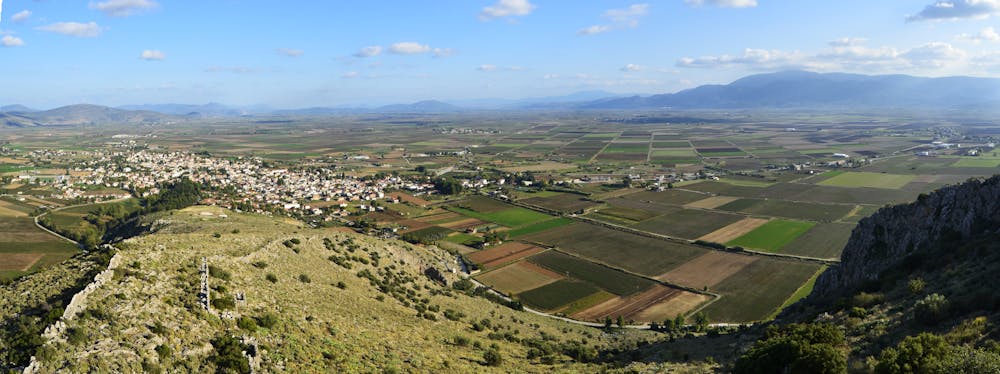
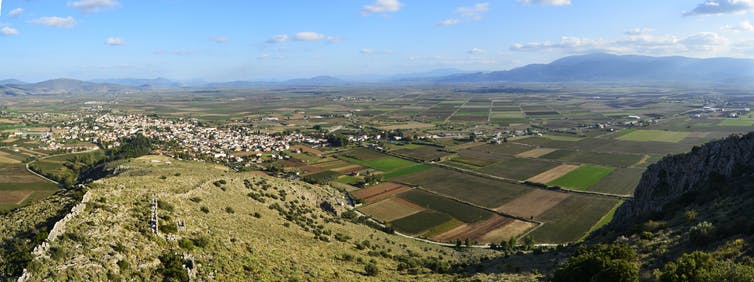 View of the Kopaic Plain in Boeotia, Greece. People first partially drained the area 3,300 years ago to claim land for agriculture and it’s still farmed today.Lucas Stephens, CC BY-SA
The deep roots of the Anthropocene
Global archaeological data show that human transformation of environments began at different times in different regions and accelerated with the emergence of agriculture. Nevertheless, by 3,000 years ago, most of the planet was already transformed by hunter-gatherers, farmers and pastoralists.
To guide this planet toward a better future, we need to understand how we got here. The message from archaeology is clear. It took thousands of years for the pristine planet of long ago to become the human planet of today.
And there is no way to fully understand this human planet without building on the expertise of archaeologists, anthropologists, sociologists and other human scientists. To build a more robust Earth science in the Anthropocene, the human sciences must play as central a role as the natural sciences do today.
*****
Header photo: People have been modifying Earth – as in these rice terraces near Pokhara, Nepal – for millennia. Erle C. Ellis, CC BY-ND
Erle C. Ellis is a member of the American Association of Geographers.The association is a funding partner of The Conversation US.
Ben Marwick, Associate Professor of Archaeology, University of Washington; Erle C. Ellis, Professor of Geography and Environmental Systems, University of Maryland, Baltimore County; Lucas Stephens, Research Affiliate in Archaeology, Max Planck Institute for the Science of Human History, and Nicole Boivin, Director of the Department of Archaeology, Max Planck Institute for the Science of Human History
Disclosure statement
Ben Marwick receives funding from the Australian Research Council, the Wenner-Gren Foundation, and the National Geographic Society
Erle C. Ellis received funding from the National Science Foundation for this project under grant CNS 1125210. He is a fellow of the Global Land Program, a member of the Anthropocene Working Group of the International Commission on Stratigraphy, and a senior fellow of the Breakthrough Institute. He is a member of the American Association of Geographers.
Lucas Stephens receives funding from the American Council of Learned Societies. He is a Mellon/ACLS Public Fellow and Senior Research Analyst at the Environmental Law and Policy Center and a Research Affiliate at the Max Planck Institute for the Science of Human History.
Nicole Boivin receives funding from the Max Planck Society. She is Director at the Max Planck Institute for the Science of Human History, an Honorary Professor at the University of Queensland, and a Research Affiliate at the Smithsonian Institution and University of Calgary.
This article is republished from The Conversation under a Creative Commons license. Read the original article.
]]>
By Erle C. Ellis, professor of geography and environmental systems, UMBC; Ben Marwick, associate professor of archaeology, University of Washington; Lucas Stephens, research affiliate in...
https://umbc.edu/stories/surveying-archaeologists-across-the-globe-reveals-deeper-and-more-widespread-roots-of-the-human-age-the-anthropocene/
https://my3.my.umbc.edu/api/v0/pixel/news/120060/guest@my.umbc.edu/ca46829a8c4b1dfc0a591345ca8299a8/api/pixel
discovery
ges
the-conversation
UMBC News & Magazine
https://my3.my.umbc.edu/groups/umbc-news-magazine
https://assets1-my.umbc.edu/system/shared/avatars/groups/000/001/943/24435aa6207c452e7bc15cc74b42c7bb/xsmall.png?1748556657
https://assets1-my.umbc.edu/system/shared/avatars/groups/000/001/943/24435aa6207c452e7bc15cc74b42c7bb/original.png?1748556657
https://assets2-my.umbc.edu/system/shared/avatars/groups/000/001/943/24435aa6207c452e7bc15cc74b42c7bb/xxlarge.png?1748556657
https://assets2-my.umbc.edu/system/shared/avatars/groups/000/001/943/24435aa6207c452e7bc15cc74b42c7bb/xlarge.png?1748556657
https://assets3-my.umbc.edu/system/shared/avatars/groups/000/001/943/24435aa6207c452e7bc15cc74b42c7bb/large.png?1748556657
https://assets1-my.umbc.edu/system/shared/avatars/groups/000/001/943/24435aa6207c452e7bc15cc74b42c7bb/medium.png?1748556657
https://assets2-my.umbc.edu/system/shared/avatars/groups/000/001/943/24435aa6207c452e7bc15cc74b42c7bb/small.png?1748556657
https://assets1-my.umbc.edu/system/shared/avatars/groups/000/001/943/24435aa6207c452e7bc15cc74b42c7bb/xsmall.png?1748556657
https://assets2-my.umbc.edu/system/shared/avatars/groups/000/001/943/24435aa6207c452e7bc15cc74b42c7bb/xxsmall.png?1748556657
UMBC News & Magazine
0
0
false
Fri, 30 Aug 2019 15:47:41 -0400
Preminda Jacob focuses on building connections as new associate dean of research and community engagement
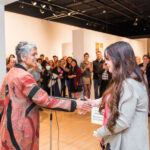
Preminda Jacob, visual arts, has been named the new associate dean of research and community engagement for UMBC’s College of Humanities, Arts, and Social Sciences (CAHSS). She will join the current team of associate deans in providing support for the College’s many departments, programs, and research centers. Together they will continue to implement CAHSS’ strategic goals and objectives, focusing on projects around recruitment and retention of diverse faculty, promoting interdisciplinary collaboration, and further developing community engagement work.
Scott Casper, dean of CAHSS, is excited about the level of expertise Jacob brings to the team. “Preminda Jacob brings a wealth of experience as a scholar, teacher, and UMBC citizen, and leader to the Dean’s Office,” says Casper. “I am delighted that she has joined our leadership team and look forward to her continued contributions to the College and the University in this new role.”
 Jacob at graduate commencement.
Engaging faculty
Jacob will begin by joining the team of associate deans in working to further foster the current research community within CAHSS and build broader awareness of CAHSS research. One way Jacob hopes to share faculty research is by collaborating with campus partners on updating the university’s current faculty research database capabilities. This digital tool will help academics, researchers, educators, and students from around the world more easily access information about UMBC researchers and their areas of study.
“I see part of community engagement as an accessibility issue,” explains Jacob. “UMBC faculty conduct top-level research. A searchable database elevates our commitment to provide research-based answers to the world’s most pressing questions by placing the research within everyone’s reach.”
Jacob will also help faculty better connect with each other across departments, including for research that involves community partnerships. She looks forward to working with faculty who have research expertise on community engagement by exploring topics through existing brown bag lunch series and working groups in the five CAHSS research centers as well as across UMBC’s colleges.
Engaging the community
Prior to joining the Dean’s Office, Jacob served as chair of visual arts from 2015 to 2018. As a professor of visual arts specializing in art history and visual culture, she worked to connect her passions for research and community engagement.
Jacob recalls a four-year partnership between the Benjamin Banneker Historical Park and Museum in Catonsville and her Space, Place, and Public Art class as a particularly significant collaboration. Jacob partnered students with the museum’s staff to create public art pieces from start to finish in one semester. “Students were excited to work directly with a local organization and leaders within the organizations were equally excited to serve as guides and mentors in the process,” she says.
Over the years, Jacob’s students have created object and wall labels, interactive and interpretive recordings, and works of art for the museum. They produced a video featuring interviews with local leaders and archaeologists talking about the archaeological dig conducted by the Maryland Historical Trust in the 1980s on Benjamin Banneker’s property.
 Museum exhibit three teams of students helped design.
Victor Pineda ‘15, visual arts, who went on to serve as a museum intern after participating in Jacob’s class, helped record an actor’s interpretation of the voice of Benjamin Banneker. The recording became part of an interactive device in the Banneker Gallery. Today, visitors can listen to Benjamin Banneker discuss his letter to Thomas Jefferson.
 Pineda recording audio for interactive exhibit at the museum.
“Through the museum’s partnership with the visual arts department at UMBC,” says Willa Banks, the museum’s former director of education and curatorial affairs, “Dr. Jacob’s public art class provided a phenomenal service that not only benefited UMBC faculty and students but also the museum and the general public as well.”
Jacob plans to work with faculty already engaged with community partners in the Baltimore region to amplify relationships like this one. She is also dedicated to opening pathways for new community engagement opportunities, in the greater Baltimore region and beyond.
Banner Image: Preminda at MFA celebration. All images by Marlayna Demond ’11 for UMBC with the exception of the images of student work at the Benjamin Banneker Historical Park and Museum which were courtesy of Willa Banks.
]]>
Preminda Jacob, visual arts, has been named the new associate dean of research and community engagement for UMBC’s College of Humanities, Arts, and Social Sciences (CAHSS). She will join the...
https://umbc.edu/stories/preminda-jacob-focuses-on-building-connections-as-new-associate-dean-of-research-and-community-engagement/
https://my3.my.umbc.edu/api/v0/pixel/news/120061/guest@my.umbc.edu/63c6265a107de175d42ad8362f039d72/api/pixel
arts-and-culture
cahss
page1
research
visualarts
UMBC News & Magazine
https://my3.my.umbc.edu/groups/umbc-news-magazine
https://assets1-my.umbc.edu/system/shared/avatars/groups/000/001/943/24435aa6207c452e7bc15cc74b42c7bb/xsmall.png?1748556657
https://assets1-my.umbc.edu/system/shared/avatars/groups/000/001/943/24435aa6207c452e7bc15cc74b42c7bb/original.png?1748556657
https://assets2-my.umbc.edu/system/shared/avatars/groups/000/001/943/24435aa6207c452e7bc15cc74b42c7bb/xxlarge.png?1748556657
https://assets2-my.umbc.edu/system/shared/avatars/groups/000/001/943/24435aa6207c452e7bc15cc74b42c7bb/xlarge.png?1748556657
https://assets3-my.umbc.edu/system/shared/avatars/groups/000/001/943/24435aa6207c452e7bc15cc74b42c7bb/large.png?1748556657
https://assets1-my.umbc.edu/system/shared/avatars/groups/000/001/943/24435aa6207c452e7bc15cc74b42c7bb/medium.png?1748556657
https://assets2-my.umbc.edu/system/shared/avatars/groups/000/001/943/24435aa6207c452e7bc15cc74b42c7bb/small.png?1748556657
https://assets1-my.umbc.edu/system/shared/avatars/groups/000/001/943/24435aa6207c452e7bc15cc74b42c7bb/xsmall.png?1748556657
https://assets2-my.umbc.edu/system/shared/avatars/groups/000/001/943/24435aa6207c452e7bc15cc74b42c7bb/xxsmall.png?1748556657
UMBC News & Magazine
0
0
false
Fri, 30 Aug 2019 15:18:49 -0400
Top 9 Features of the New ILSB Not to Miss

Since its groundbreaking two years ago, the UMBC community has watched the new Interdisciplinary Life Sciences Building rise next to The Commons. Students and faculty wondered what it would look like on the inside, and what it would be like to study, take classes, do research, or just hang out in the new space.
Well, the time has come! As the ILSB opens its doors for the fall semester, Retrievers are eagerly trying to figure out how the ILSB will fit into their routines. Grabbing a seat in the atrium for a quick break with friends before class? Conducting experiments in an open lab with floor-to-ceiling windows? Learning about any number of topics in classrooms designed from the ground up for active learning? Taking your lunch to a patio adjacent to the green roof? However you use the ILSB, here are nine features you shouldn’t miss:
1) Stunning staircases
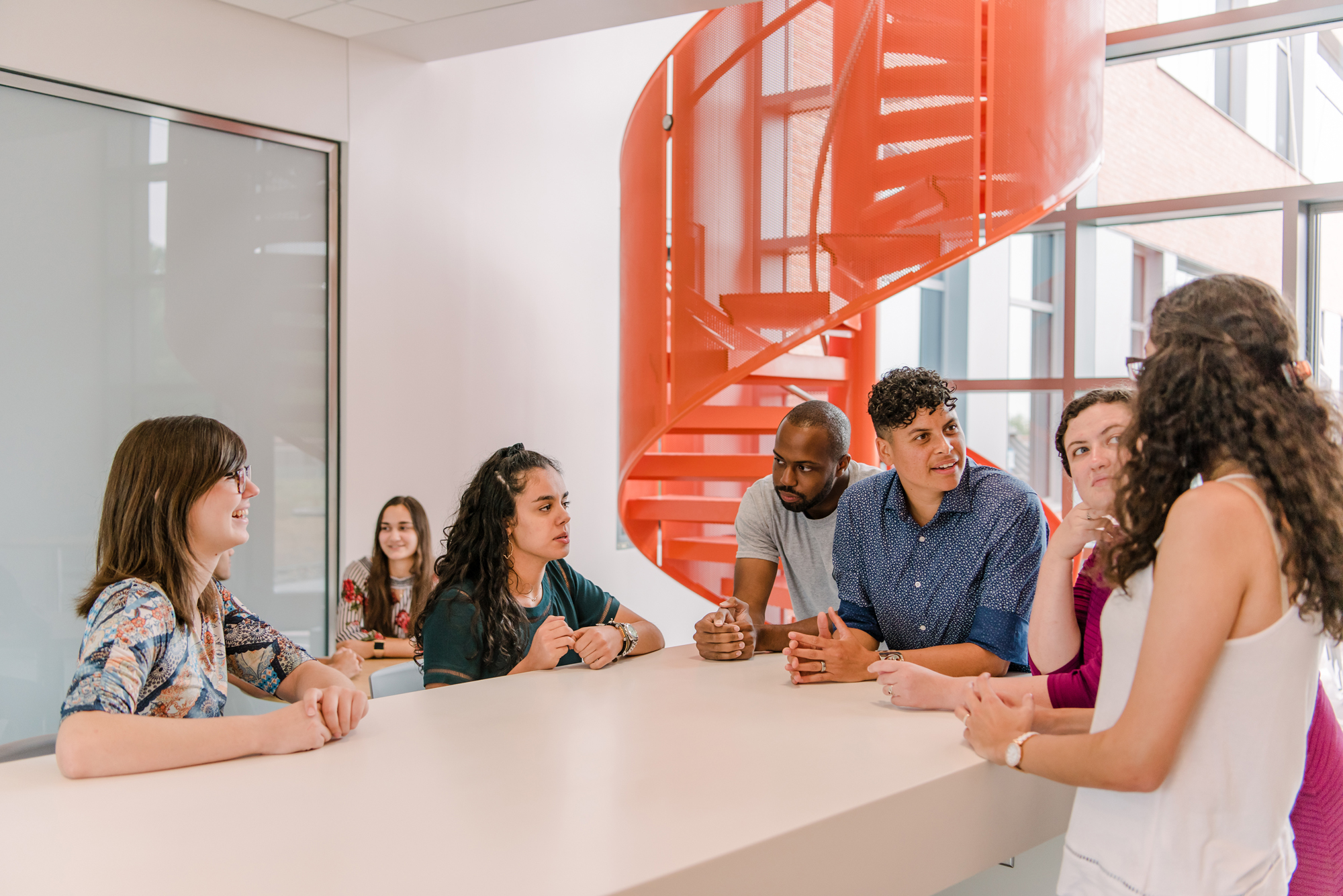
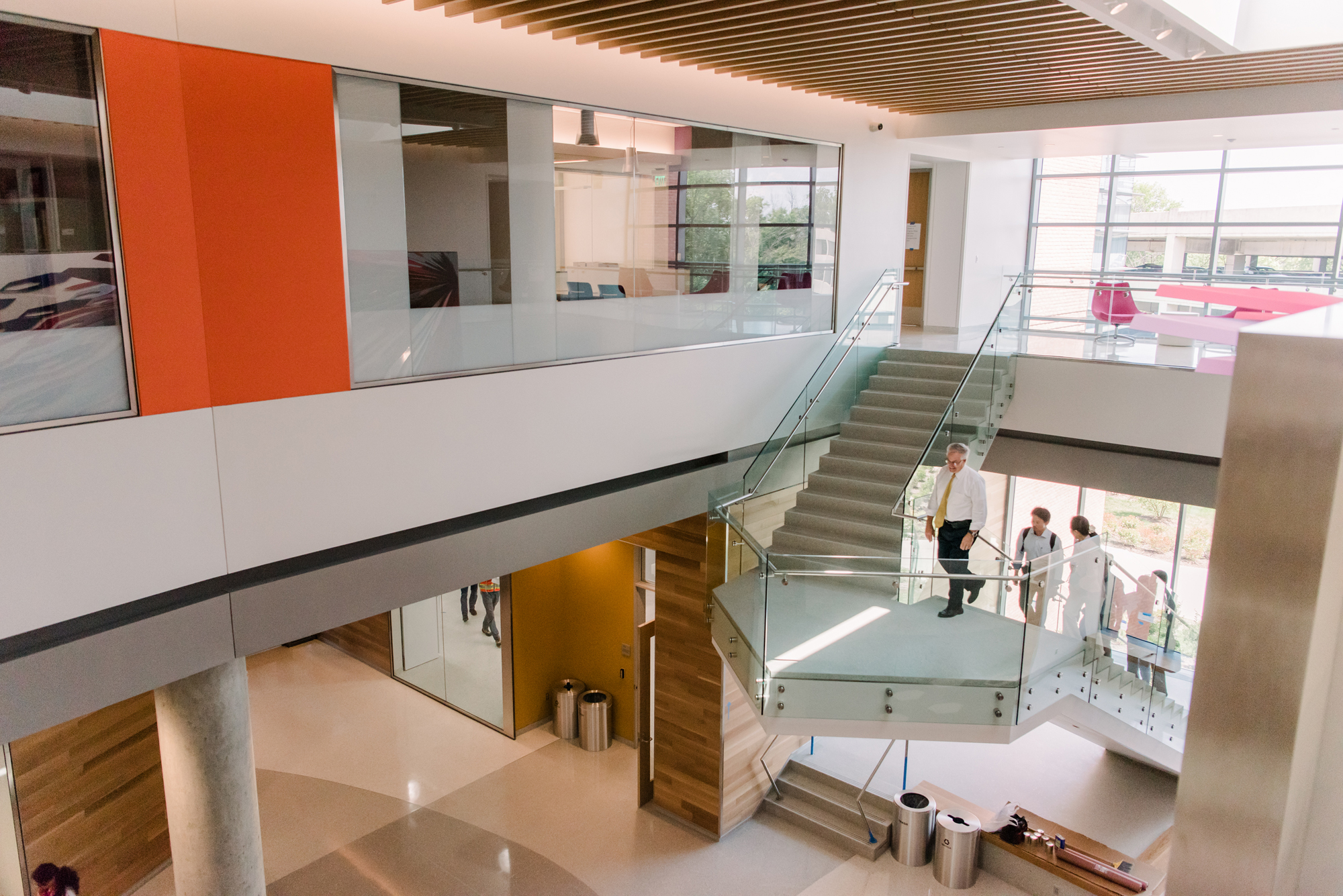
Science isn’t just what happens inside the ILSB, it’s built into the building itself. Two staircases in the building exemplify the designers’ dedication to detail: this bright orange spiral staircase has an uncanny resemblance to a DNA helix, don’t you think? And the stairs in the building’s atrium are cantilevered to appear to float in thin air—reminding us all that anything is possible.
2) Sundial
As you ascend the stairs or peer over the building’s inner balconies, don’t be nervous about the spot of red light slowly migrating across the floor. It’s not a laser experiment gone rogue—it’s a sundial. On the solstice, it traces a special line on the floor. Old and new technologies come together in the ILSB, reminding us all that we’re standing on the shoulders of giants.
3) Green roof
There’s life bursting from every corner of this building, including UMBC’s fifth green roof. Green roofs provide insulation that reduces heating and cooling energy requirements, plus they help purify the air and water. Unfortunately, the roof is off limits to games of ultimate frisbee or other activities, but the adjacent patio is a great spot to enjoy lunch or just take a breather between classes.
4) Environmental systems lab
This lab allows researchers to get their hands dirty conducting environmental experiments in a way never before possible at UMBC. A controlled trial looking at how insects respond to different water chemistry? Sure. An experiment to determine how plants respond to different temperatures? Go for it. Risk of contaminating molecular experiments that could be ruined by a stray speck of dirt? Nada. Have fun, ecologists!
5) Innovative classrooms
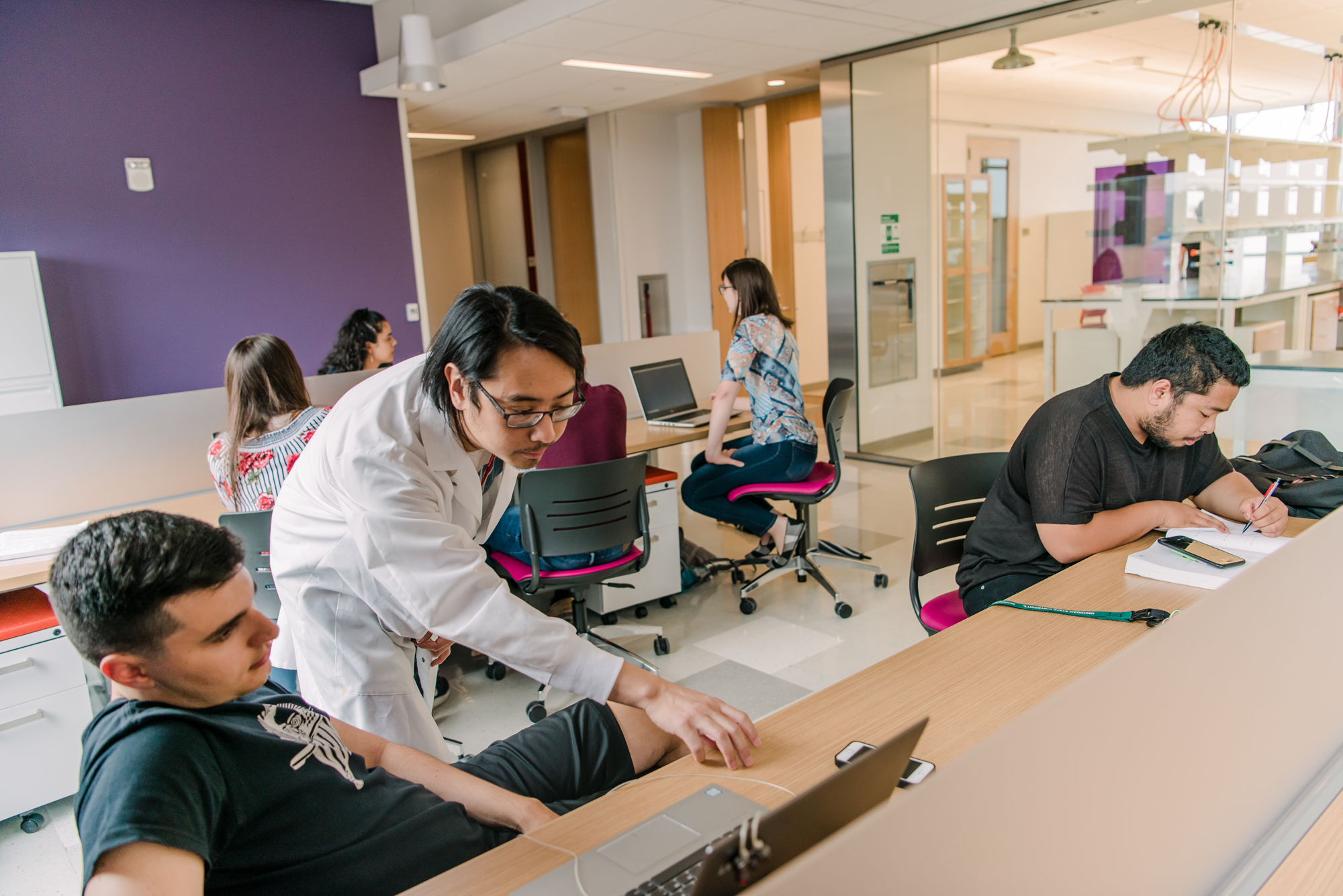

UMBC is consistently ranked in the top 10 nationally for undergraduate teaching for many reasons. One of them is our commitment to teaching in an active-learning and flipped-classroom format. This is when students first encounter material traditionally presented in lectures at home via readings or short instructor-produced videos. That way, class time is saved for team-based problem solving. Implementing this practice has often meant completely revamping core classes such as introductory biology and chemistry. The ILSB adds to UMBC’s capacity to offer this kind of educational experience.
6) Art installation
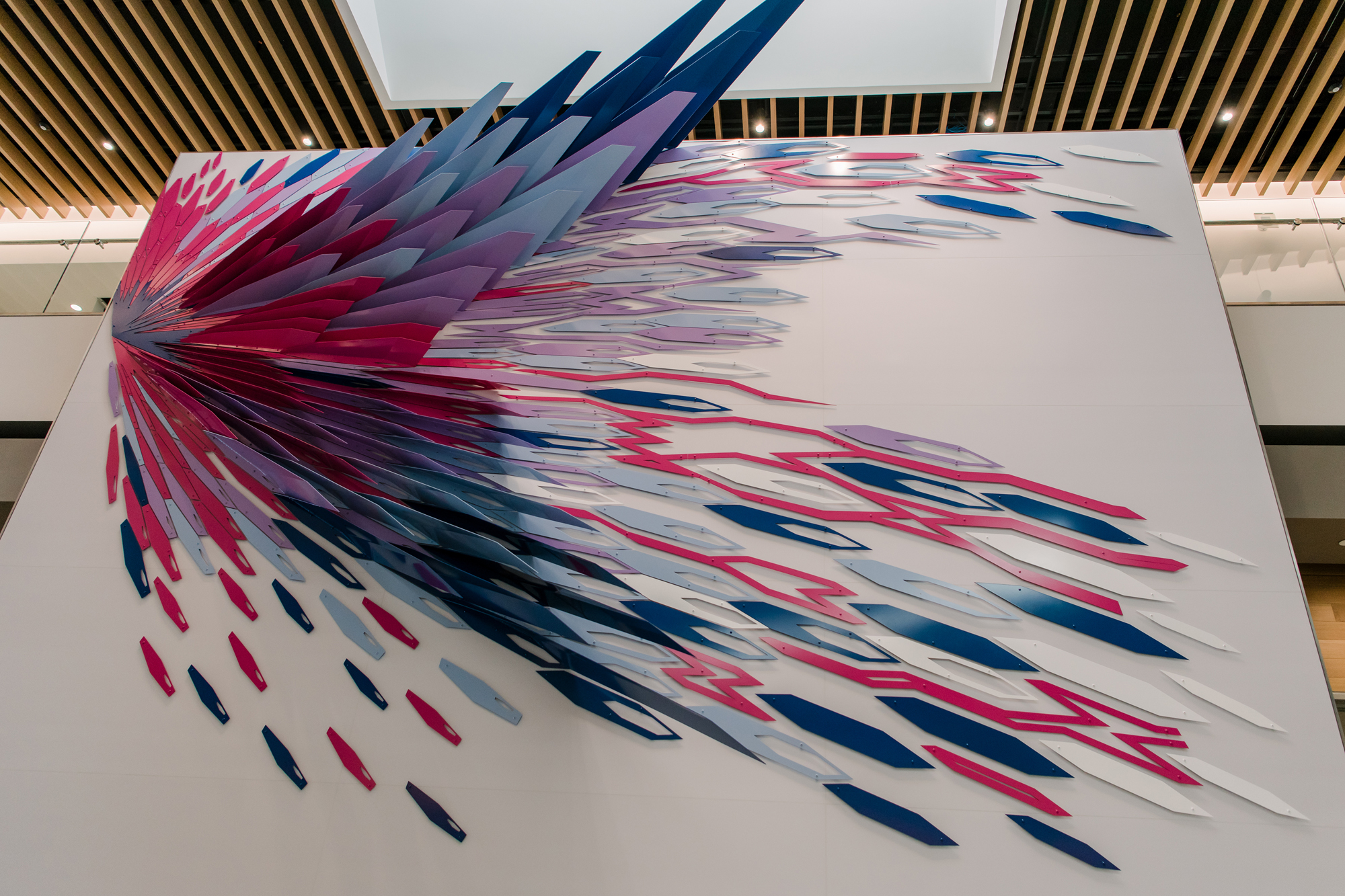
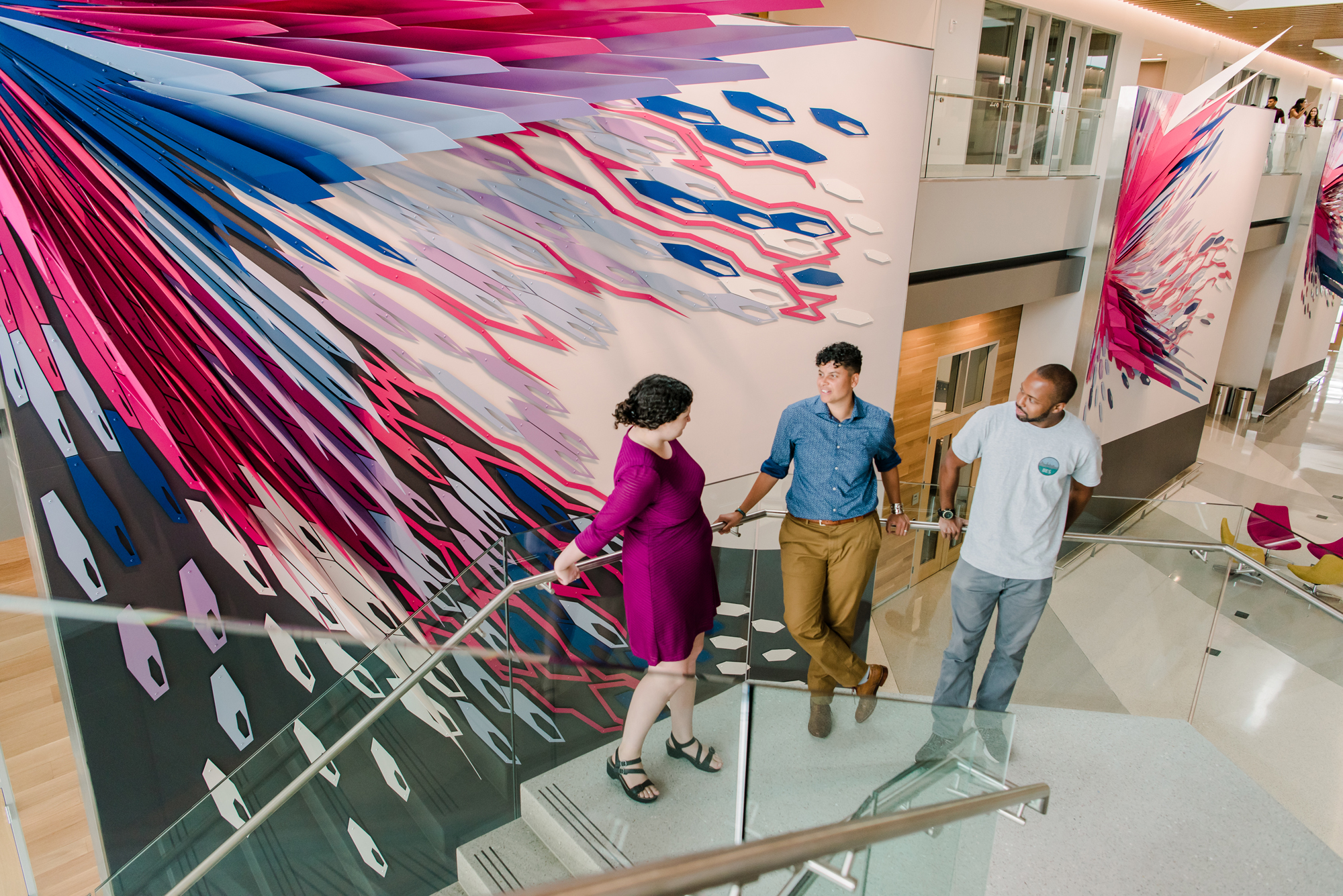
It’s a bird! It’s a neuron! It’s…whatever you want it to be. Volkan Alkanoglu’s brightly-colored artwork INFLIGHT, which seemingly floats from three large walls in the ILSB’s atrium, is striking no matter how you look at it. But did you know the artist carefully incorporated elements from UMBC research into the design, from brain cells to flying orioles? Now that’s interdisciplinary. What do you see?
7) Multi-user all-gender restrooms
Although UMBC is currently in the middle of remodeling many of the restrooms on campus for all-gender use, the ILSB is the first building at UMBC designed with all-gender multi-use in mind from the beginning. These restrooms pave the way for a more inclusive and convenient bathroom experience for our students, faculty, and staff of all gender identities. Learn more about the university’s plan for the addition of all-gender restrooms on campus.
8) Etched windows

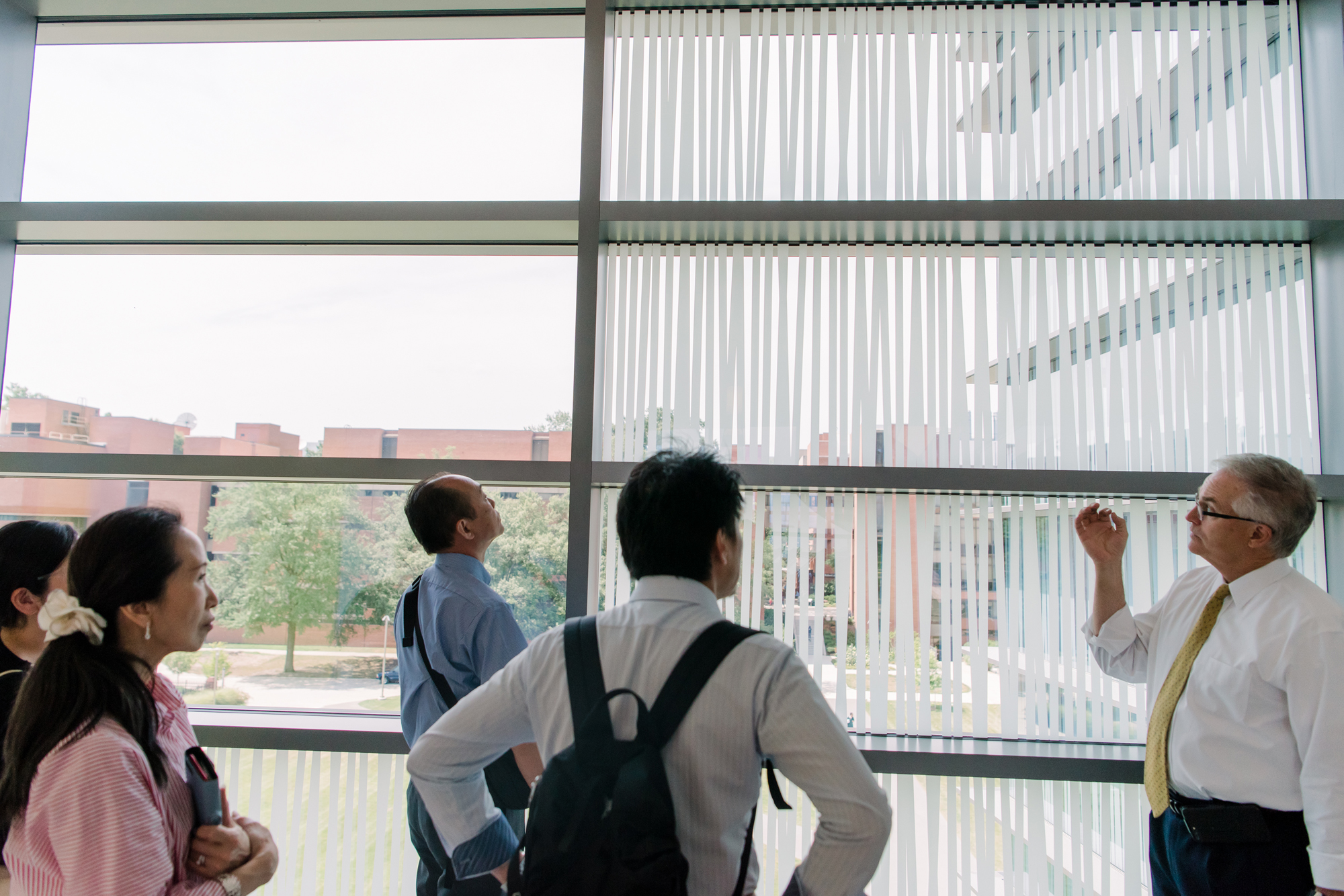
Look closely at the windows—what do you see? The pattern etched on the glass, created especially for UMBC, was designed to symbolize reeds and grasses on the shores of the Chesapeake Bay. The “fritting,” as it’s called, serves to deter bird strikes and reduces the energy required for heating and cooling. It’s a subtle way to honor our unique location and continue to protect it.
9) Brick pathway
As further homage to UMBC’s geography, the curving brick pathway around the ILSB imitates a stream that once flowed across campus (it now runs underground), and all the plants you see are native to the region. So take a stroll, or simply sit on a bench and take it all in, from buzzing pollinators to bright flowers.
*****
All photos, including header, by Marlayna Demond ’11.
]]>
Since its groundbreaking two years ago, the UMBC community has watched the new Interdisciplinary Life Sciences Building rise next to The Commons. Students and faculty wondered what it would look...
https://umbc.edu/stories/9-features-of-the-new-ilsb-not-to-miss/
https://my3.my.umbc.edu/api/v0/pixel/news/120062/guest@my.umbc.edu/5639372b15b67387166f5d9c4dbe12ab/api/pixel
campus-life
ilsb
UMBC News & Magazine
https://my3.my.umbc.edu/groups/umbc-news-magazine
https://assets1-my.umbc.edu/system/shared/avatars/groups/000/001/943/24435aa6207c452e7bc15cc74b42c7bb/xsmall.png?1748556657
https://assets1-my.umbc.edu/system/shared/avatars/groups/000/001/943/24435aa6207c452e7bc15cc74b42c7bb/original.png?1748556657
https://assets2-my.umbc.edu/system/shared/avatars/groups/000/001/943/24435aa6207c452e7bc15cc74b42c7bb/xxlarge.png?1748556657
https://assets2-my.umbc.edu/system/shared/avatars/groups/000/001/943/24435aa6207c452e7bc15cc74b42c7bb/xlarge.png?1748556657
https://assets3-my.umbc.edu/system/shared/avatars/groups/000/001/943/24435aa6207c452e7bc15cc74b42c7bb/large.png?1748556657
https://assets1-my.umbc.edu/system/shared/avatars/groups/000/001/943/24435aa6207c452e7bc15cc74b42c7bb/medium.png?1748556657
https://assets2-my.umbc.edu/system/shared/avatars/groups/000/001/943/24435aa6207c452e7bc15cc74b42c7bb/small.png?1748556657
https://assets1-my.umbc.edu/system/shared/avatars/groups/000/001/943/24435aa6207c452e7bc15cc74b42c7bb/xsmall.png?1748556657
https://assets2-my.umbc.edu/system/shared/avatars/groups/000/001/943/24435aa6207c452e7bc15cc74b42c7bb/xxsmall.png?1748556657
UMBC News & Magazine
0
0
false
Tue, 27 Aug 2019 14:02:52 -0400
UMBC’s Lee Blaney and federal, state partners publish landmark study on contaminants in the Chesapeake Bay
UMBC’s Lee Blaney and research partners have published a landmark study on contaminants of emerging concern in the Chesapeake Bay. Their article in Science of the Total Environment is the first research study that quantifies concentrations of antibiotics, estrogenic hormones, and UV-filters in multiple locations of the Bay.
Blaney, an associate professor of chemical, biochemical, and environmental engineering, conducted the research with Ke He, Ph.D ‘17, chemical engineering, and Ethan Hain ‘21, chemical engineering. They also partnered with collaborators at the U.S. Forest Service and the Maryland Department of Natural Resources.
Underway since 2016, their work highlights the importance of understanding how previously unexamined chemicals impact the environment. The project has been primarily funded by Maryland Sea Grant through a Program Development Fund to Blaney, and a Graduate Research Fellowship to Hain.
The researchers studied the prevalence of contaminants of emerging concern in water, sediment, and oyster tissue collected from the Eastern Shore of the Chesapeake Bay. Their study of how accumulated UV-filters negatively impact the environment is the first of its kind. UV-filters are one of the primary ingredients in personal care products, such as sunscreen and cosmetics. The accumulation of these UV-filters can impact organisms and animals.
Maintaining a healthy Chesapeake Bay
While the Chesapeake Bay is one of the most well-studied ecosystems in the United States, Blaney says that little is known about the sources, occurrence, and impacts of contaminants of emerging concern in this important estuary.
“As the health of the Chesapeake Bay continues to improve due to recent nutrient and sediment regulations, it is important to consider new threats from specialty chemicals like antibiotics, hormones, and UV-filters,” he explains. “The first step to ensuring the safety of the Chesapeake Bay is to measure the concentrations of these contaminants in water, sediment, and tissue.”
 Lee Blaney. Photo by Marlayna Demond ’11 for UMBC.
The discharge of antibiotics into the Chesapeake Bay may speed up the spread and development of antibiotic resistance, a global public health challenge, explains Blaney. He adds that estrogenic hormones and UV-filters are considered priority chemicals of concern due to reported toxicity and other effects on reproductive systems in aquatic and marine organisms.
Over the past two years, Blaney and his team have continued to collect data throughout the Chesapeake Bay to better understand differences in contaminant levels. They have found relatively high levels of antibiotics in the Chesapeake Bay, and the reported concentrations are in the range that can select for antibiotic resistant bacteria. In addition, most samples have contained UV-filters, including two common in sunscreens that were recently banned from being sold in Hawaii due to concerns that they are toxic to corals.
The researchers argue that their findings suggest a need to improve municipal wastewater treatment and agricultural waste management to remove contaminants of emerging concern and prevent their introduction to the environment. In this regard, Blaney and his collaborators are actively working on a number of technologies to improve the transformation of contaminants into benign molecules that do not have antibiotic or estrogenic properties or other toxicity concerns.
Continuing to expand the research
In 2017, Blaney received a CAREER Award from the National Science Foundation to study contaminants of emerging concern and their effects on the urban environment. That research focused on the Gwynns Falls watershed in Baltimore, and the Chesapeake Bay research is an extension of that work. In addition to the public and ecological health concerns highlighted in the current article, Blaney also continues to examine issues like antimicrobial resistance and the impact of agricultural runoff.
Blaney was recently named associate director for sustainability engineering and liaison to the University System of Maryland (USM) vice chancellor for environmental sustainability. In this capacity, he will work closely with collaborators at the University of Maryland Center for Environmental Science and will lead additional sustainability-focused research projects within the USM.
Banner image: Lee Blaney, left, working with a student in the lab. Photo by Marlayna Demond ’11 for UMBC.
]]>
UMBC’s Lee Blaney and research partners have published a landmark study on contaminants of emerging concern in the Chesapeake Bay. Their article in Science of the Total Environment is the first...
https://umbc.edu/stories/umbcs-lee-blaney-and-federal-state-partners-publish-landmark-study-on-contaminants-in-the-chesapeake-bay/
https://my3.my.umbc.edu/api/v0/pixel/news/120063/guest@my.umbc.edu/ec334ea98166276b05e3fb784a8fce1e/api/pixel
cbee
coeit
science-and-technology
UMBC News & Magazine
https://my3.my.umbc.edu/groups/umbc-news-magazine
https://assets1-my.umbc.edu/system/shared/avatars/groups/000/001/943/24435aa6207c452e7bc15cc74b42c7bb/xsmall.png?1748556657
https://assets1-my.umbc.edu/system/shared/avatars/groups/000/001/943/24435aa6207c452e7bc15cc74b42c7bb/original.png?1748556657
https://assets2-my.umbc.edu/system/shared/avatars/groups/000/001/943/24435aa6207c452e7bc15cc74b42c7bb/xxlarge.png?1748556657
https://assets2-my.umbc.edu/system/shared/avatars/groups/000/001/943/24435aa6207c452e7bc15cc74b42c7bb/xlarge.png?1748556657
https://assets3-my.umbc.edu/system/shared/avatars/groups/000/001/943/24435aa6207c452e7bc15cc74b42c7bb/large.png?1748556657
https://assets1-my.umbc.edu/system/shared/avatars/groups/000/001/943/24435aa6207c452e7bc15cc74b42c7bb/medium.png?1748556657
https://assets2-my.umbc.edu/system/shared/avatars/groups/000/001/943/24435aa6207c452e7bc15cc74b42c7bb/small.png?1748556657
https://assets1-my.umbc.edu/system/shared/avatars/groups/000/001/943/24435aa6207c452e7bc15cc74b42c7bb/xsmall.png?1748556657
https://assets2-my.umbc.edu/system/shared/avatars/groups/000/001/943/24435aa6207c452e7bc15cc74b42c7bb/xxsmall.png?1748556657
UMBC News & Magazine
0
0
false
Mon, 26 Aug 2019 20:21:25 -0400
 (L to R) Lizarazo and Filomeno preparing for the first Honest Conversations public forum.
 Filomeno facilitating a session.