Wind, solar, and…flutter? UMBC’s Justin Webster is using math to move this emerging tech forward

When Justin Webster sees a flag rippling in the breeze, he thinks about equations. Webster, assistant professor of mathematics, studies “flutter”—a physical phenomenon caused by interactions between a fluid, such as air or water, and a flexible structure, such as a flag, a sail, or even an airplane wing. A small group of engineers and mathematicians has been working for years on how to extract usable energy from fluttering objects as an alternative means of energy production. Now, they have a chance to take flutter technology to the next level.
“There’s no such thing as free energy, but there are lots of situations where there’s ambient energy available,” like a flapping flag, Webster says. “You just have to find an efficient mechanism for turning it into meaningful, useful energy.”
Currently, prototypes exist for doing just that. You start with a narrow flap of material 50 to 100 cm long and coated with piezoelastic material, which can convert mechanical energy (like flapping) into electrical energy. Next, you attach the flap to a pole in a field that tends to get a lot of wind, and voilá, you can generate electric current. If you can efficiently store that energy, you could potentially help power homes and businesses in remote locales, such as the desert or mountains, which also tend to be windy, Webster says.
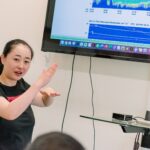
 Justin Webster teaches a class at UMBC.
Moving the needle
In their current form, these devices are far from optimal. Part of the challenge is that “the mathematical models that we currently have don’t make predictions that are consistent with what engineers see during experiments,” Webster explains.
Without accurate predictions, it can take many experimental attempts to make progress—and the experiments are often difficult and costly to carry out. With a more accurate model, not only would progress be faster, but more research groups might take up this work.
A new grant from the National Science Foundation will help Webster, Jason Howell at Carnegie Mellon University, and Earl Dowell at Duke University move their field closer to making efficient, fluttering energy-harvesters a reality.
Webster is an applied mathematician, Howell is a computational mathematician, and Dowell is an engineer and one of the world’s leading experts on flutter. Over the next three years, they will work together to refine existing mathematical models of “flag” flutter and produce new models that more accurately reflect what engineers like Dowell actually see in their experiments.
Their new model will need to include elements such as wind speed, how many times an object flaps per second, and how much energy is stored in an hour. Each element must be represented in the model by its own equation, and all those individual equations must somehow be connected to each other mathematically. To succeed, it will take analytical acuity plus a degree of finesse.
Webster’s goal is a more accurate model that will help engineers ask and answer questions about the materials used to collect energy from flutter. What is the best size and shape for the flaps? What should they be made of? How should the piezoelastic material be arranged on the flap to optimally capture the energy? “All of these are open—and very difficult—questions,” he says.
 Justin Webster meets with a student in his office.
Problem-solving from every angle
It’s actually fairly unusual for applied mathematicians and engineers to work directly together in this way. Webster explains, “We’re often working on the same problems, but typically from different angles.”
The opportunity to move the renewable energy field forward through collaboration is what drew him to this project. By learning each others’ languages and debating approaches to tackling such a complex problem, he’s confident their research will achieve more than would be possible for a math or engineering team alone. “There’s a myriad of interesting and challenging problems here, as we’re learning from each other every day,” says Webster of his collaboration.
The team will also benefit from the fresh perspectives of student researchers. “I’m excited that the students in my project, as well as other projects in the department recently funded by NSF, can get involved in some really interesting and difficult mathematics,” Webster shares.
So, while charging your cell phone with the streamers on your bicycle may be a ways off, Webster, his colleagues, and his students are hoping to get us one step closer.
Banner Image: Justin Webster. All photos by Marlayna Demond ’11 for UMBC.
]]>
When Justin Webster sees a flag rippling in the breeze, he thinks about equations. Webster, assistant professor of mathematics, studies “flutter”—a physical phenomenon caused by interactions...
https://umbc.edu/stories/wind-solar-andflutter-umbcs-justin-webster-is-using-math-to-move-this-emerging-tech-forward/
https://my3.my.umbc.edu/api/v0/pixel/news/120065/guest@my.umbc.edu/6f52f6eec6ee81b2d39e9e8bca8638ec/api/pixel
cnms
mathstat
page1
research
science-and-technology
UMBC News & Magazine
https://my3.my.umbc.edu/groups/umbc-news-magazine
https://assets1-my.umbc.edu/system/shared/avatars/groups/000/001/943/24435aa6207c452e7bc15cc74b42c7bb/xsmall.png?1748556657
https://assets1-my.umbc.edu/system/shared/avatars/groups/000/001/943/24435aa6207c452e7bc15cc74b42c7bb/original.png?1748556657
https://assets2-my.umbc.edu/system/shared/avatars/groups/000/001/943/24435aa6207c452e7bc15cc74b42c7bb/xxlarge.png?1748556657
https://assets2-my.umbc.edu/system/shared/avatars/groups/000/001/943/24435aa6207c452e7bc15cc74b42c7bb/xlarge.png?1748556657
https://assets3-my.umbc.edu/system/shared/avatars/groups/000/001/943/24435aa6207c452e7bc15cc74b42c7bb/large.png?1748556657
https://assets1-my.umbc.edu/system/shared/avatars/groups/000/001/943/24435aa6207c452e7bc15cc74b42c7bb/medium.png?1748556657
https://assets2-my.umbc.edu/system/shared/avatars/groups/000/001/943/24435aa6207c452e7bc15cc74b42c7bb/small.png?1748556657
https://assets1-my.umbc.edu/system/shared/avatars/groups/000/001/943/24435aa6207c452e7bc15cc74b42c7bb/xsmall.png?1748556657
https://assets2-my.umbc.edu/system/shared/avatars/groups/000/001/943/24435aa6207c452e7bc15cc74b42c7bb/xxsmall.png?1748556657
UMBC News & Magazine
0
0
false
Wed, 14 Aug 2019 20:19:01 -0400
Princeton Review lauds UMBC as one of the best colleges in the nation

UMBC is once again featured in the Princeton Review guide, The Best 385 Colleges, for 2020. This is widely considered one of the leading guides for prospective undergraduate students in North America.
The University profile specifically recognizes the dedication of UMBC’s professors. Students commented that the University’s faculty “have a knack for inspiring the students” and “UMBC is a place where professors aren’t just talking heads.”
This reflects UMBC’s culture of fostering mentoring relationships between faculty and students. “Being a mentor is the most impactful thing we can do with our time,” says Greg Szeto, assistant professor of chemical, biochemical, and environmental engineering. “We help provide a safe environment where students can explore their interests…and determine what the right path is for their future.”
“The inclusion of UMBC in the most recent Princeton Review best colleges guide affirms our faculty and staff’s dedication and commitment to providing the highest quality of education for our students,” says Katharine Cole, vice provost and dean of undergraduate academic affairs. “We are extremely proud to receive recognition for the outstanding holistic educational experience we provide.”
Students also commend UMBC on a continued commitment to an inclusive and supportive campus community. Retrievers note that the emphasis on diversity “enriches our school and everyone gets to know everyone despite culture or ethnicity.”
UMBC has also just been named to the Best College Values list for 2019 by Kiplinger’s Personal Finance, ranking among the nation’s top 100 public universities for best value.
]]>
UMBC is once again featured in the Princeton Review guide, The Best 385 Colleges, for 2020. This is widely considered one of the leading guides for prospective undergraduate students in North...
https://umbc.edu/stories/princeton-review-lauds-umbc-as-one-of-the-best-colleges-in-the-nation/
https://my3.my.umbc.edu/api/v0/pixel/news/120066/guest@my.umbc.edu/856808a395fbe49d132ff26dd88e907e/api/pixel
community
page1
rankings
UMBC News & Magazine
https://my3.my.umbc.edu/groups/umbc-news-magazine
https://assets1-my.umbc.edu/system/shared/avatars/groups/000/001/943/24435aa6207c452e7bc15cc74b42c7bb/xsmall.png?1748556657
https://assets1-my.umbc.edu/system/shared/avatars/groups/000/001/943/24435aa6207c452e7bc15cc74b42c7bb/original.png?1748556657
https://assets2-my.umbc.edu/system/shared/avatars/groups/000/001/943/24435aa6207c452e7bc15cc74b42c7bb/xxlarge.png?1748556657
https://assets2-my.umbc.edu/system/shared/avatars/groups/000/001/943/24435aa6207c452e7bc15cc74b42c7bb/xlarge.png?1748556657
https://assets3-my.umbc.edu/system/shared/avatars/groups/000/001/943/24435aa6207c452e7bc15cc74b42c7bb/large.png?1748556657
https://assets1-my.umbc.edu/system/shared/avatars/groups/000/001/943/24435aa6207c452e7bc15cc74b42c7bb/medium.png?1748556657
https://assets2-my.umbc.edu/system/shared/avatars/groups/000/001/943/24435aa6207c452e7bc15cc74b42c7bb/small.png?1748556657
https://assets1-my.umbc.edu/system/shared/avatars/groups/000/001/943/24435aa6207c452e7bc15cc74b42c7bb/xsmall.png?1748556657
https://assets2-my.umbc.edu/system/shared/avatars/groups/000/001/943/24435aa6207c452e7bc15cc74b42c7bb/xxsmall.png?1748556657
UMBC News & Magazine
0
0
false
Tue, 13 Aug 2019 15:41:45 -0400
Team of UMBC grad students takes first place at 2019 BMEidea competition

A team of three UMBC graduate students earned first place in an innovation competition for their pioneering work in the rapid detection of bacteria in blood. The students joined teams from the University of Pennsylvania and the University of Michigan, which earned second and third place, respectively, at the BMEidea competition hosted by VentureWell, a national alliance of collegiate inventors and innovators.
UMBC’s team competed in the biomedical and bioengineering innovation student category of the competition, and presented a device called ASTEK, which allows physicians to more effectively treat bacterial infections. The interdisciplinary team included Mustafa Al-Adhami M.S. ‘15, mechanical engineering, Ph.D. ‘19, mechanical engineering; David Burgenson ‘17, chemical engineering, PhD ‘21, chemical engineering, and Benjamin Punshon-Smith M.S. ‘17, electrical engineering, and Ph.D. ‘22, electrical engineering.
 Benjamin Punshon-Smith (left), Mustafa Al-Adhami, and David Burgenson with their award at the BMEidea competition. Photo courtesy of Mustafa Al-Adhami.
“It can be difficult to translate science into relatable terms and a feasible business plan,” says Al-Adhami. “Participating in the BMEidea competition proved not only that they are interested in our research, but there is the potential to create a business around it. The BMEidea competition gave us the opportunity to get validation that we are onto something.”
Al-Adhami, Burgenson, and Punshon-Smith share office and lab space in UMBC’s Center for Advanced Sensor Technology, which is directed by Govind Rao, professor of chemical, biochemical, and environmental engineering. The group is also advised by Yordan Kostov, research professor in chemical, biochemical, and environmental engineering at UMBC, and Alan Cross, professor of medicine at the University of Maryland School of Medicine.
The team will use their $10,000 prize from VentureWell to continue to develop the technology and advance the ASTEK.
In 2016, Al-Adhami earned third place in UMBC’s Cangialosi Business Innovation Competition, and he explains that the feedback from the judges was valuable and helped him refine the design of the device. “I have used feedback and networking connections gained from these competitions to develop my business plan and expand my outreach on a national scale,” he says.
The technology was initially developed to detect bacteria in water, but after Al-Adhami learned about sepsis and the serious complications that it can cause, he changed focus to meet a known need in healthcare. The ASTEK displays results of the blood test in a user-friendly interface, he says.
“The project is at the intersection of mechanical engineering, electrical engineering, chemical engineering, and biology,” Al-Adhami explains. “The best thing about working on a multidisciplinary team is there are always four solutions to every problem we face.”
Banner image: Mustafa Al-Adhami gives his three-minute thesis talk at the 2018 Graduate Research Conference. Photo by Marlayna Demond ’11 for UMBC.
]]>
A team of three UMBC graduate students earned first place in an innovation competition for their pioneering work in the rapid detection of bacteria in blood. The students joined teams from the...
https://umbc.edu/stories/team-of-umbc-grad-students-takes-first-place-at-2019-bmeidea-competition/
https://my3.my.umbc.edu/api/v0/pixel/news/120067/guest@my.umbc.edu/6882de03fdcda614ecaae47e6d9f271d/api/pixel
cbee
coeit
csee
gradresearch
interdisciplinary
meche
science-and-technology
UMBC News & Magazine
https://my3.my.umbc.edu/groups/umbc-news-magazine
https://assets1-my.umbc.edu/system/shared/avatars/groups/000/001/943/24435aa6207c452e7bc15cc74b42c7bb/xsmall.png?1748556657
https://assets1-my.umbc.edu/system/shared/avatars/groups/000/001/943/24435aa6207c452e7bc15cc74b42c7bb/original.png?1748556657
https://assets2-my.umbc.edu/system/shared/avatars/groups/000/001/943/24435aa6207c452e7bc15cc74b42c7bb/xxlarge.png?1748556657
https://assets2-my.umbc.edu/system/shared/avatars/groups/000/001/943/24435aa6207c452e7bc15cc74b42c7bb/xlarge.png?1748556657
https://assets3-my.umbc.edu/system/shared/avatars/groups/000/001/943/24435aa6207c452e7bc15cc74b42c7bb/large.png?1748556657
https://assets1-my.umbc.edu/system/shared/avatars/groups/000/001/943/24435aa6207c452e7bc15cc74b42c7bb/medium.png?1748556657
https://assets2-my.umbc.edu/system/shared/avatars/groups/000/001/943/24435aa6207c452e7bc15cc74b42c7bb/small.png?1748556657
https://assets1-my.umbc.edu/system/shared/avatars/groups/000/001/943/24435aa6207c452e7bc15cc74b42c7bb/xsmall.png?1748556657
https://assets2-my.umbc.edu/system/shared/avatars/groups/000/001/943/24435aa6207c452e7bc15cc74b42c7bb/xxsmall.png?1748556657
UMBC News & Magazine
0
0
false
Mon, 12 Aug 2019 16:09:38 -0400
2019 Alumni Awards Announced

Now in its 31st year of celebration, UMBC’s annual Alumni Awards honor graduates who have accomplished significant milestones throughout a long career as well as those who inspire us with admirable achievements early on in their fields.
“This outstanding group of award winners are leading the way for others and making an impact on all facets of our society and on the local, national, and global stages,” says Stanyell Odom, director of Alumni Engagement. “They exemplify the best qualities of a UMBC education—they are intellectually curious, creative, entrepreneurial, innovative, committed to making a difference, and passionate and proud of their UMBC.”
On Wednesday, October 2, the UMBC Alumni Association will present awards to honor these alumni for their professional and personal achievements and service to the university. The Association board will also honor a faculty member for extraordinary teaching and overall impact on students and alumni.
“Each year, the selection seems to be a more competitive process,” says Sara Lerma Jones, associate director of Alumni Engagement, “especially as we have more alumni and they grow into their careers. The nominators have done a wonderful job highlighting alumni from various backgrounds.”
Leading up the award ceremony, UMBC Magazine will continue publishing stories about the 2019 cohort.
Outstanding Alumni of the Year Award:
Visual & Performing Arts:
Kimberly Patrick ’08 Music Technology —Sound Editor, Skywalker Sound, Lucasfilm, Ltd.
Natural & Mathematical Sciences:
Jerome Adams ’97, M4, Biochemistry & Molecular Biology and Psychology —Surgeon General, US Department of Health & Human Services
Social Sciences:
Kim Shelsby ’85 Geography —Director, Supply Chain Solutions, Chemonics International
Engineering & Information Technology:
Paul Mangus ’86 Information Systems Management —Co-Founder and Chairman of the Board, Bart and Associates, Inc.
Humanities:
La Jerne Cornish ’05 Ph.D. Language, Literacy & Culture —Provost and Senior Vice President, Ithaca College
The Young Alumni Rising Star Award:
Kelsey Krach ’14 Anthropology —Product Manager & Designer, Fearless
The Outstanding Faculty Award:
Beverly Bickel ’94 M.A. Instructional Development Systems, ’05 Ph.D. Language, Literacy, & Culture —Clinical Associate Professor, UMBC, Language, Literacy, & Culture; Affiliate Associate Professor, Gender and Women’s Studies
Register here alumni.umbc.edu/alumniawards2019 to join the Alumni Association Board of Directors for our alumni awards ceremony to recognize and celebrate the professional personal achievements of this year’s recipients.
* * * * *
For more information about the Alumni Awards, please contact Sara Lerma Jones, Associate Director of Alumni Relations, at 410-455-2276 or via email at slj@umbc.edu.
Read more about past Alumni Award winners here.
]]>
Now in its 31st year of celebration, UMBC’s annual Alumni Awards honor graduates who have accomplished significant milestones throughout a long career as well as those who inspire us with...
https://umbc.edu/stories/2019-alumni-awards-announced/
https://my3.my.umbc.edu/api/v0/pixel/news/120068/guest@my.umbc.edu/d993591e4f78e769fd3fcd4a6c0cf140/api/pixel
alumni
alumni-awards-2019
UMBC News & Magazine
https://my3.my.umbc.edu/groups/umbc-news-magazine
https://assets1-my.umbc.edu/system/shared/avatars/groups/000/001/943/24435aa6207c452e7bc15cc74b42c7bb/xsmall.png?1748556657
https://assets1-my.umbc.edu/system/shared/avatars/groups/000/001/943/24435aa6207c452e7bc15cc74b42c7bb/original.png?1748556657
https://assets2-my.umbc.edu/system/shared/avatars/groups/000/001/943/24435aa6207c452e7bc15cc74b42c7bb/xxlarge.png?1748556657
https://assets2-my.umbc.edu/system/shared/avatars/groups/000/001/943/24435aa6207c452e7bc15cc74b42c7bb/xlarge.png?1748556657
https://assets3-my.umbc.edu/system/shared/avatars/groups/000/001/943/24435aa6207c452e7bc15cc74b42c7bb/large.png?1748556657
https://assets1-my.umbc.edu/system/shared/avatars/groups/000/001/943/24435aa6207c452e7bc15cc74b42c7bb/medium.png?1748556657
https://assets2-my.umbc.edu/system/shared/avatars/groups/000/001/943/24435aa6207c452e7bc15cc74b42c7bb/small.png?1748556657
https://assets1-my.umbc.edu/system/shared/avatars/groups/000/001/943/24435aa6207c452e7bc15cc74b42c7bb/xsmall.png?1748556657
https://assets2-my.umbc.edu/system/shared/avatars/groups/000/001/943/24435aa6207c452e7bc15cc74b42c7bb/xxsmall.png?1748556657
UMBC News & Magazine
0
0
false
Mon, 12 Aug 2019 12:58:16 -0400
The Man Behind the MCAC
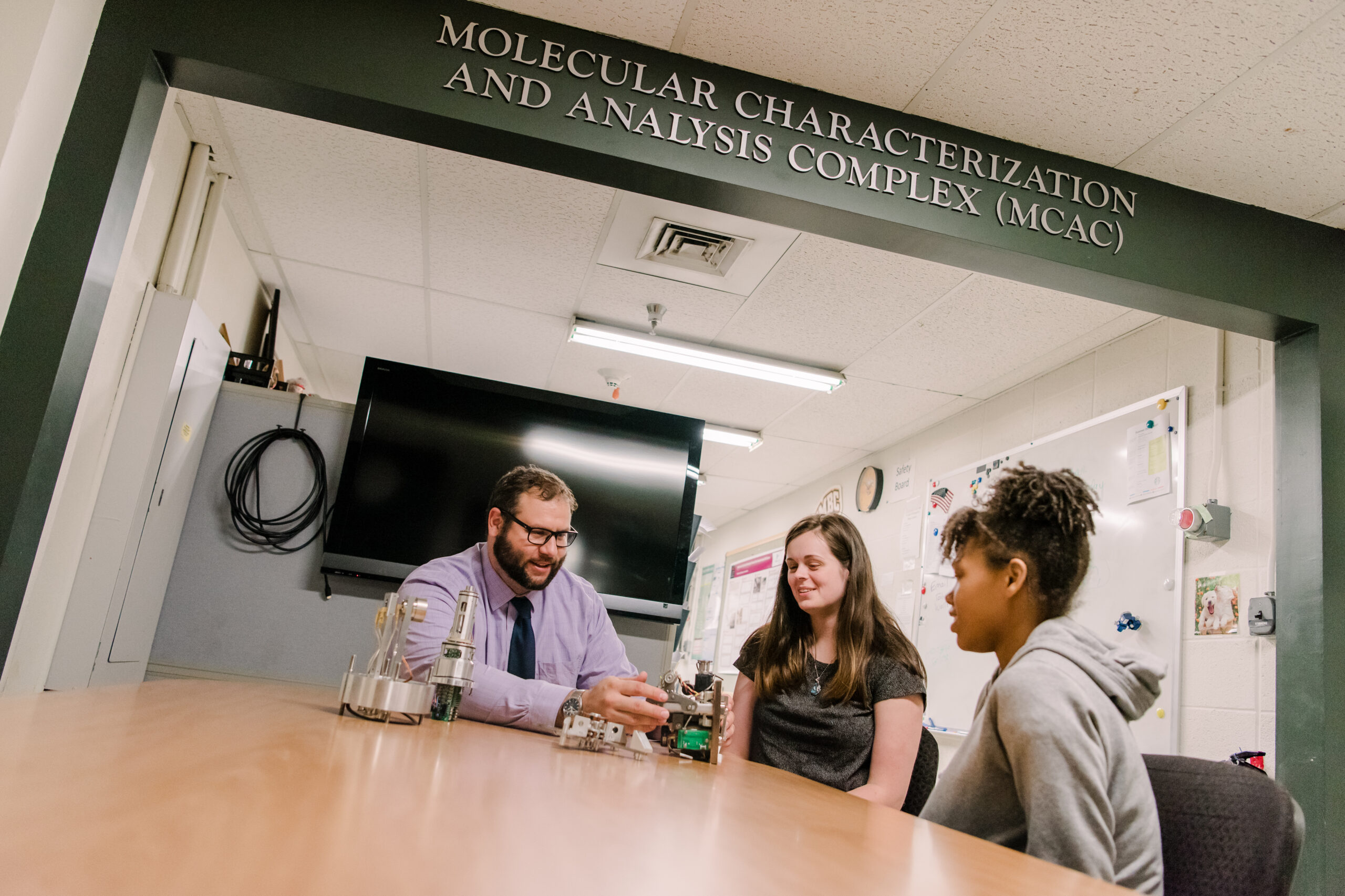
Tucked away in the basement of the Meyerhoff Chemistry Building lies a hidden gem. The Molecular Characterization and Analysis Complex (MCAC) houses a group of self-proclaimed nerds analyzing chemical compounds on instruments that cost upward of a million dollars. Their manager, mentor, and friend, UMBC alumnus Joshua Wilhide M.S. ’10, chemistry, watches over the students—nudging them in the right direction when they need guidance and cracking a joke when they need a mental break.
By the time lunch rolls around, the group grabs a deck of cards and gathers at a table in the front of the lab to play a round of rummy. Before returning to the humming machines that are separating and sorting complicated chemical mixtures, the students swap stories of any ghost sightings in recent days.
“There’s a running joke that our lab is haunted by a very friendly ghost,” Wilhide chuckles. “Whenever we get new people in the lab we always ask if they believe in ghosts. Whether or not you believe, it’s a fascinating subject that we can always go back to, and we are able to bond over it.”
The profoundly welcoming work atmosphere is a feeling that Wilhide has been working to create for nearly a decade. When he started there full-time, in 2010, the MCAC was just a basement with gritty tile floors, worn down infrastructure, and three mass spectrometers. In 2019, it’s an inspirational learning environment with over 20 pieces of analytical instrumentation, and Wilhide’s home away from home.
Maryland Born and Bred
Wilhide was first introduced to what would become the MCAC in 2006, when he was an undergraduate at Stevenson University. Knowing that he wanted to become an analytical chemist, he sought out an instrumental lab for his senior capstone project and found one at UMBC. The lab allowed nearly anyone to come in and be trained on any piece of equipment, something that still holds true today at the MCAC.
“I came to UMBC and fell in love with the aspect of figuring out the unknown. It was fascinating to me that you can take a mixture of chemicals and inject it into an instrument and it will give you a unique profile of all the compounds in the chemical,” Wilhide says.
His first few years of research at UMBC included working with DNA and RNA samples and discovering how each interacted with the HIV virus. Those crucial early years gave Wilhide an in depth understanding of how to operate each instrument in the lab and taught him how to modify different instruments so that they interacted properly with the unique chemical makeup of RNA.
“I came to UMBC and fell in love with the aspect of figuring out the unknown.”
– Joshua Wilhide M.S. ’10, chemistry
After Stevenson, Wilhide was working toward his Ph.D. at UMBC when his mentor, Dan Fabris, decided to move his research to the University at Albany. Wilhide initially followed Fabris to upstate New York, but after two months, decided to return home and graduate with his master’s in chemistry at UMBC.
“The decision was difficult, but I was born and raised in Maryland, and I love my Old Bay and my crabs,” he admits. “I’m truly a Maryland boy at heart.”
Shortly after Wilhide’s graduation in 2010, the dean of UMBC’s College of Natural and Mathematical Sciences, William LaCourse, offered Wilhide a managerial position at the MCAC. Having worked intimately with the equipment for several years, LaCourse believed that Wilhide was the perfect candidate for the job.
Unique Approach to Learning
Wilhide describes the MCAC as a unique “jack of all trades” facility that works on general analytics. Other universities have core facilities that specialize in a certain subsection of analytical chemistry, which he says limits their ability to solve certain problems. On the other hand, the MCAC has more than 20 pieces of instrumentation that allow samples to be run through an instrument specially formulated for their specific molecular make-up.
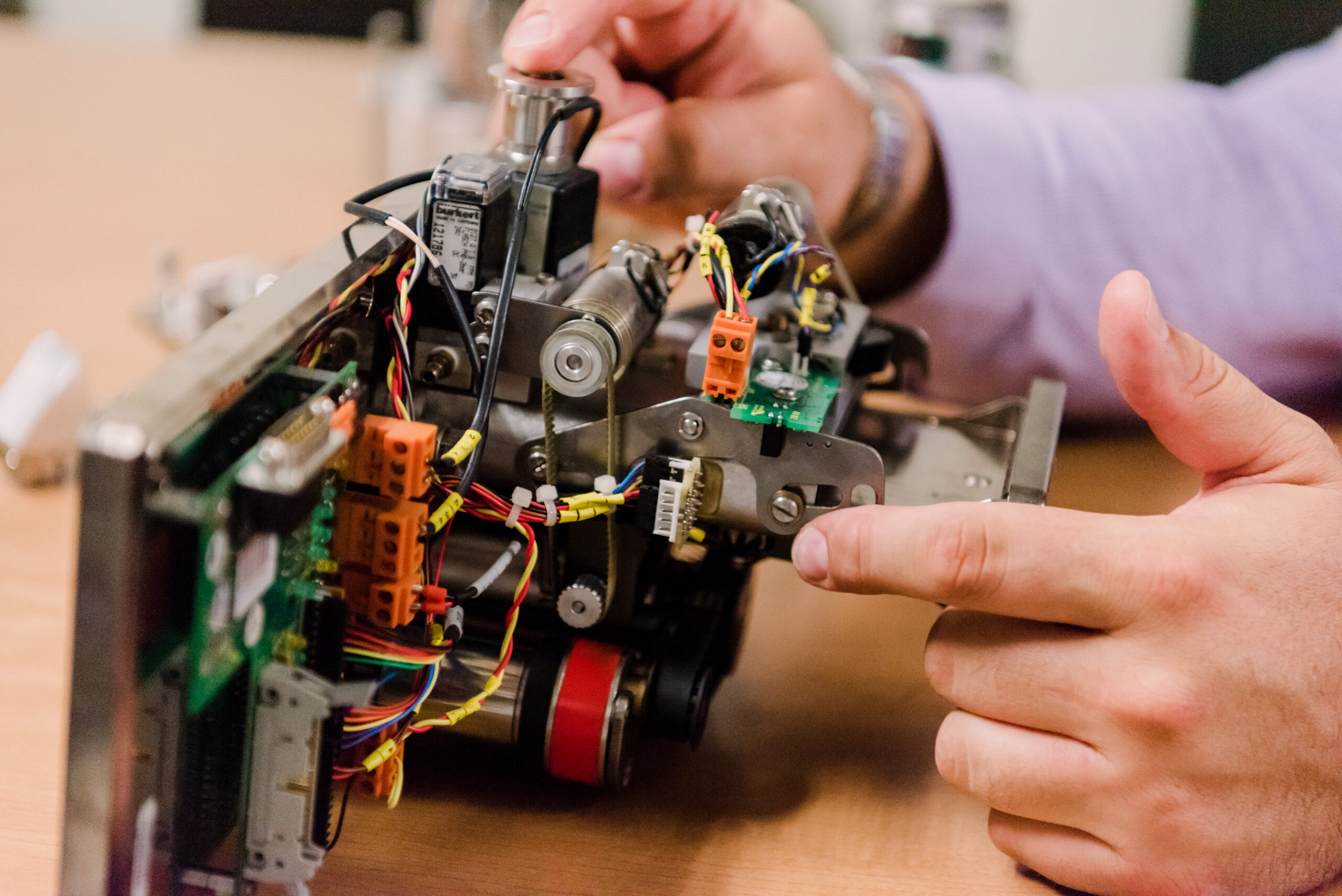
One area of expertise that the lab has developed over the last several years is ambient ionization mass spectrometry. In layman’s terms, this involves Wilhide and other MCAC members building and designing a platform to test a range of unique samples (some examples of what they have tested include ink on paper, a piece of fruit, art from various museums) and determining their molecular make-up in a matter of seconds. Wilhide explains that the technology can be used to determine pesticides on foods, discover groups of chemicals in plastics, and was once even used to uncover the chemical differences between Coca-Cola and Pepsi.
 Wilhide training a student on the inner-workings of a mass spectrometer.
“We are processing analytical problems that other core facilities can’t analyze because they don’t have the instrumentation nor the proper analytical techniques. Because the MCAC is so diversified in personal backgrounds as well as instruments,” Wilhide explains, “we can usually find a way to solve these issues, and that’s what makes us so unique.”
And students directly benefit from the MCAC’s diverse instrumentation. Wilhide personally trains all of his undergraduates on all of the instruments, even the $2 million mass spectrometer. If a trainee breaks any instrument, Wilhide sees this as an opportunity to show them how to fix it.
Open Access Advantage
Most analytic chemistry facilities have equipment behind closed doors where samples are put in a dropbox, tested by the lab’s staff, and results are emailed to the recipient weeks later. But Wilhide takes pride in the open access aspect of the MCAC, noting that anyone can come into the lab and be trained on any instrument. Another unique feature of the lab is the opportunity for undergraduates to run samples. Not only are the students learning how to analyze the data, but they are learning to run the instrumentation, thereby increasing their skill sets and marketability in the workforce.
“That’s how we feed back into that loop of a university education,” Wilhide says. “The students have access to equipment that many people don’t have and because of that will be able to get a job almost anywhere. It’s a unique opportunity to train students from the ground up.”
 Students are trained on every piece of instrumentation in the MCAC.
Chemistry major, Maddie Schuch ’21, currently works in the MCAC studying water quality analysis. She uses the lab’s instrumentation to detect and determine how much of a certain ion or compound is in a specific water sample, thus revealing the water quality. Her time working at the MCAC solidified her plans to pursue a Ph.D. in analytical chemistry when she graduates. Schuch notes that the fun work environment Wilhide creates has led to her ongoing success as an undergrad.
“It’s almost like having a little family here at the lab,” she says. “Josh truly cares for everyone and is very supportive—he never puts you down for not understanding something. Not only do I love the science that I get to do here, but I love the people.”
Keeping Alumni Close to Home
Wilhide is grateful that his professional odyssey brought him back to where he started: UMBC. Dean of the College of Natural and Mathematical Sciences, William LaCourse, understands the importance of keeping alumni like Wilhide on campus.
“There’s no better feeling than the joy of making room for one more member of the UMBC family,” LaCourse says. “In doing so, we are better equipped to meet our challenges and celebrate success as we deepen the inclusive excellence and community of our UMBC.”
LaCourse is impressed by how Wilhide has breathed life into the MCAC over the years. Wilhide’s commitment to growth and discovery on both a scientific and a personal level leaves a lasting impact on his students and is something that LaCourse wants to keep at UMBC.
“Alums on campus bring with them an insight into the culture of UMBC and a devotion to its mission and ethos—all of which enriches the student experience and working environment. Their loyalty and love for UMBC and all we do shines through as a beacon of inspiration for others to follow,” he says.
 Comradery and collaboration are two vital components of the lab.
UMBC as a Cornerstone
The Maryland boy continues to stay loyal to UMBC and acknowledges how much he has grown throughout his many years working in the MCAC.
“UMBC has been an anchoring point for me. Every stage of my life, from being a rookie grad student at 21, all the way to now being married with a stable career, the university has been there for me. I see it as a home and a place to grow, all while standing on the shoulders of giants and utilizing the connections I’ve made,” Wilhide says.
Wilhide emphasized that he has grown alongside his students, too. He recalls when he was dating his future wife, students would offer him advice on proposals and engagement rings around the lunch table. Now, conversations revolve around raising his toddler.
“UMBC is a place to grow, and the MCAC is always growing… I’m always growing,” he says. “If you would’ve told me nine years ago that we were going to set up this facility, I would’ve laughed. But we took it one day at a time and look where we are now.”
The MCAC will continue expanding when the new Interdisciplinary Life Sciences Building (ILSB) opens in fall 2019. The university recently purchased a $1.3 million multiple instrument package for the ILSB, designed to expand the university’s ability to study the function of proteins and peptides. Wilhide says that these new instruments will help bring back UMBC faculty who had to use other facilities to complete their lab work. He notes that this new equipment is a big step out of their comfort zone and will bring many new challenges, but will certainly be worth it.
“That’s the thing about Josh, he loves a good challenge,” LaCourse says. “He is a brilliant scientist and an overachiever. He cares about the students and is always ready to help build the university as a whole.”
*****
Header image: Wilhide showing students a piece of a mass spectrometer
Students pictured: Shirley Wolz ’20, biochemistry, and Sanaa Jones, an incoming first year student getting a jump start on research.
All photos by Marlayna Demond ’11.
]]>
Tucked away in the basement of the Meyerhoff Chemistry Building lies a hidden gem. The Molecular Characterization and Analysis Complex (MCAC) houses a group of self-proclaimed nerds analyzing...
https://umbc.edu/stories/the-man-behind-the-mcac/
https://my3.my.umbc.edu/api/v0/pixel/news/120069/guest@my.umbc.edu/1781c98a453f3ac1c1c41e6f201e8444/api/pixel
alumni
cnms
graduateschool
ilsb
mcac
UMBC News & Magazine
https://my3.my.umbc.edu/groups/umbc-news-magazine
https://assets1-my.umbc.edu/system/shared/avatars/groups/000/001/943/24435aa6207c452e7bc15cc74b42c7bb/xsmall.png?1748556657
https://assets1-my.umbc.edu/system/shared/avatars/groups/000/001/943/24435aa6207c452e7bc15cc74b42c7bb/original.png?1748556657
https://assets2-my.umbc.edu/system/shared/avatars/groups/000/001/943/24435aa6207c452e7bc15cc74b42c7bb/xxlarge.png?1748556657
https://assets2-my.umbc.edu/system/shared/avatars/groups/000/001/943/24435aa6207c452e7bc15cc74b42c7bb/xlarge.png?1748556657
https://assets3-my.umbc.edu/system/shared/avatars/groups/000/001/943/24435aa6207c452e7bc15cc74b42c7bb/large.png?1748556657
https://assets1-my.umbc.edu/system/shared/avatars/groups/000/001/943/24435aa6207c452e7bc15cc74b42c7bb/medium.png?1748556657
https://assets2-my.umbc.edu/system/shared/avatars/groups/000/001/943/24435aa6207c452e7bc15cc74b42c7bb/small.png?1748556657
https://assets1-my.umbc.edu/system/shared/avatars/groups/000/001/943/24435aa6207c452e7bc15cc74b42c7bb/xsmall.png?1748556657
https://assets2-my.umbc.edu/system/shared/avatars/groups/000/001/943/24435aa6207c452e7bc15cc74b42c7bb/xxsmall.png?1748556657
UMBC News & Magazine
0
0
false
Thu, 08 Aug 2019 19:26:01 -0400
NASA and DoE fund UMBC’s Zhibo Zhang to pursue ambitious atmospheric research
Recently, both the Department of Energy (DoE) and NASA awarded Zhibo Zhang, associate professor of physics, significant grants to pursue projects in atmospheric science.
Zhang’s lab has established itself as a powerhouse at UMBC since his arrival in 2011. The lab published groundbreaking findings such as the discovery that dust from the Sahara Desert provides critical nutrients to the Amazon Rainforest in Geophysical Research Letters, and the surprising result that smoke from African wildfires may have a cooling effect on climate by reflecting sunlight back into space in Proceedings of the National Academy of Sciences.
Zhang’s Aerosol, Cloud, Radiation, Observation, and Simulation (ACROS) research group focuses on how small particles in the atmosphere—such as dust, smoke, and other pollutants—interact with clouds and sunlight. His team’s end goal is to better understand how the particles affect global climate and use that information to improve climate models, so we have the best information possible to plan ahead for climate resilience.
 Zhibo Zhang discusses an image collected via satellite with his lab group. Photo by Marlayna Demond ’11 for UMBC.
Clouds up close
The DoE has awarded Zhang’s group $600,000 over three years to improve how climate models incorporate the effect of clouds. “DoE is very interested in how climate change will influence U.S. and global energy consumption,” Zhang says, and having accurate climate models is critical to that effort. The UMBC project is one of 27 atmospheric research projects the DoE funded with a total of $13 million.
Scientists model the global climate as a grid, with each grid square being 100 to 200 kilometers on a side. “We have all the equations to model the whole system based on these discrete grid boxes and how they interact with each other, but what happens on a more granular level, below that grid size, our models can’t say,” Zhang explains. “That’s 200 km—from here almost to New York—and what happens inside this grid box can be very important.”
“Our whole study is to investigate the sub-grid scale—how clouds change from about 5 to 100 kilometers,” Zhang says. The team plans to analyze data collected by ground-based instruments and research aircraft at the DoE’s site on the Azores islands, about 1500 km west of Portugal, to help “check the model’s assumptions and improve them using observational data.”
The team will investigate, for the first time at high resolution, how the total water content of clouds varies. They’ll also look at the number of individual droplets within grid squares that are measurable from airborne sensors flying near the ground-based instruments. The researchers will also track environmental factors within the grid squares, such as wind, humidity, and the overall density of airborne particles.
 Qianqian Song leads a lab group discussion. Photo by Marlayna Demond ’11 for UMBC.
Several members of Zhang’s team are involved in the project, including Olivia Norman ‘21, physics. “We’re depending on her to solve some really tough equations,” Zhang says, “and she’s doing very well.”
Externally, Zhang is collaborating with David Mechem, professor of geography and atmospheric science at the University of Kansas, for this project. “We have a very strong team. We complement each other,” Zhang says. “Also, we’ve been thinking about this problem independently—they from the modeling side and us from the observation side—for a long time.”
Dusting off climate models
The NASA-funded project will analyze data collected from instruments on aircraft and NASA’s orbiting CALIPSO and MODIS satellites to better understand whether dust in the atmosphere warms or cools the planet overall. Combining information from the different data sources “is like putting a puzzle together,” Zhang says. “Each one provides one piece of the puzzle, so when you put them together you get the larger picture.”
Considerable research has looked at how dust interacts with light in the visible spectrum—light waves that humans can see. Those findings suggest that dust has a slight cooling effect. “What hasn’t been studied in detail is the warming effect of the dust,” Zhang says. It can absorb some of the radiation reflecting off the Earth’s surface—specifically, the infrared radiation with longer wavelengths. “It’s basically a greenhouse effect of the dust.”
Qianqian Song, a Ph.D. student in Zhang’s research group, has led some of the first work looking at the warming effect of dust when it interacts with long-wave infrared radiation. “In our study we found the long-wave warming effect could cancel 30 percent of the cooling effect in the Atlantic region during summer,” she says.
 An artist’s rendering of NASA’s CALIPSO satellite. Credit: NASA
Climate models are valuable, but only as good as the assumptions they make. “You can look at the data and you see discrepancies between the climate models and the observations,” says graduate student Kylie Hoffman. “Some of it we can explain, and some of it we can’t. Identifying the discrepancies and being able to modify the climate models to be more accurate down the road is very important.”
Currently, the effect of infrared radiation is completely absent from models, because so little is known. But, “If our research shows the infrared radiation effects of dust are important, then we can add this effect into climate models,” Zhang says. “Actually, dust is going to change a lot in the future as the climate changes, so it’s important to consider the more comprehensive effects of dust in climate models.”
Moving forward, graduate student Kevin Zheng will take the lead on this work. He’ll develop computer code that can process the years and years of data collected by CALIPSO and MODIS and determine the altitude, thickness, and other properties of dust in the atmosphere, which can be used to determine how much radiation it blocks or lets pass through. In the end, he says, “We’ll have a global map of the dust’s infrared radiation properties in different locations at different times.”
Chamara Rajapakshe, another Ph.D. student in the lab, emphasizes that the team plans to share its data to support work in other labs around the world. “Everything is archived and available to any scientist,” Rajapakshe says—including not only the raw data, but also the tools for processing it. “That will benefit a lot of other research groups.” The Zhang lab is making it possible for researchers everywhere to help communities tackle the uncertainties of climate change—starting with better climate models.
Banner image: Clockwise from lower left: Qianqian Song, Chamara Rajapakshe, Kevin Zheng, Zhibo Zhang, Olivia Norman. Photo by Marlayna Demond ’11 for UMBC.
]]>
Recently, both the Department of Energy (DoE) and NASA awarded Zhibo Zhang, associate professor of physics, significant grants to pursue projects in atmospheric science. Zhang’s lab has...
https://umbc.edu/stories/nasa-and-doe-fund-umbcs-zhibo-zhang-to-pursue-ambitious-atmospheric-research/
https://my3.my.umbc.edu/api/v0/pixel/news/120070/guest@my.umbc.edu/adb540fa598616da6f9e0da1ef1fe5fd/api/pixel
cnms
gradresearch
physics
research
science-and-technology
UMBC News & Magazine
https://my3.my.umbc.edu/groups/umbc-news-magazine
https://assets1-my.umbc.edu/system/shared/avatars/groups/000/001/943/24435aa6207c452e7bc15cc74b42c7bb/xsmall.png?1748556657
https://assets1-my.umbc.edu/system/shared/avatars/groups/000/001/943/24435aa6207c452e7bc15cc74b42c7bb/original.png?1748556657
https://assets2-my.umbc.edu/system/shared/avatars/groups/000/001/943/24435aa6207c452e7bc15cc74b42c7bb/xxlarge.png?1748556657
https://assets2-my.umbc.edu/system/shared/avatars/groups/000/001/943/24435aa6207c452e7bc15cc74b42c7bb/xlarge.png?1748556657
https://assets3-my.umbc.edu/system/shared/avatars/groups/000/001/943/24435aa6207c452e7bc15cc74b42c7bb/large.png?1748556657
https://assets1-my.umbc.edu/system/shared/avatars/groups/000/001/943/24435aa6207c452e7bc15cc74b42c7bb/medium.png?1748556657
https://assets2-my.umbc.edu/system/shared/avatars/groups/000/001/943/24435aa6207c452e7bc15cc74b42c7bb/small.png?1748556657
https://assets1-my.umbc.edu/system/shared/avatars/groups/000/001/943/24435aa6207c452e7bc15cc74b42c7bb/xsmall.png?1748556657
https://assets2-my.umbc.edu/system/shared/avatars/groups/000/001/943/24435aa6207c452e7bc15cc74b42c7bb/xxsmall.png?1748556657
UMBC News & Magazine
0
0
false
Tue, 06 Aug 2019 21:32:16 -0400
UMBC’s Stephen Freeland receives Trotter Prize for pioneering origins-of-life research

This spring, Stephen Freeland, director of individualized studies and associate professor of biological sciences, received the Texas A&M Trotter Prize in Information, Complexity, and Inference, an endowed lecture series seeking to reveal connections between science and religion. He traveled to Texas A&M University in April to deliver two talks about his research on the origins of life.
From Freeland’s perspective, the prize creates a space to “honor and debate about where evolution intersects with deeper, multi-dimensional concepts about the purpose of us being here, or what science is telling us about our place in the universe.” While not structured as a formal debate, the prize is given to two winners each year with contrasting views, and they present their talks at the same event.
Freeland’s research has always centered on how and why living things evolved a system of genetic coding, which has taken him from biology to astrobiology and has inevitably led him to grapple with one of the big questions many people ask themselves: “Where do we come from?”
Freeland said he was proud to add UMBC to the list of winners’ institutions, which in the prize’s 17 years has included many renowned bastions of scholarship in the United States and the United Kingdom, including Oxford, Cambridge, MIT, Harvard, Stanford, University of Chicago, UC Berkeley, Princeton, and Cornell.
Specifically, Freeland said he was thrilled to follow in the footsteps of previous winners and scientific giants, such as Francis Collins, former director of the National Institutes of Health and leader in the Human Genome Project, and Francis Crick, co-discoverer of the structure of DNA. “These are people whose names have influenced profoundly my career and thinking,” Freeland says, “and I respect them highly.”
 Steve Freeland presents one of two Trotter Prize Lectures at Texas A&M University in April 2019. Photo credit: Texas A&M University College of Science.
Asking the right question
In his talk, Freeland called on his own research and standard evolutionary theory to argue that information flows from the environment into organisms, resulting in an organism storing information about its environment in its DNA. That makes sense in the context of natural selection: organisms that are more suited to their surroundings (in other words, whose genetic material stores more information about the environment) will be more likely to survive and reproduce, creating more organisms with the same helpful traits.
“That was a very useful point to counter the fundamental claim from intelligent design that evolution requires a degree of complexity that is different from anything science knows how to explain,” Freeland says. “No it doesn’t—organisms absorb information from the environment. That’s what we’ve been saying for 150 years.”
Intelligent design (ID) is a theory outside mainstream science claiming organisms that are strikingly well-tuned to their environment or lifestyle could not have arisen by natural processes alone. Thinking deeply about ID over the last several years has led Freeland to appreciate its usefulness as a foil for evolution.
“Thinking about why my own education and research cause me to disagree with ID’s claims has given me clarity about how that applies to the origin of life,” he says, “and this same deeper thinking has helped advance my own research, and examine how it does or, in some cases, does not, align with current scientific paradigms.”
One of the most popular paradigms in the origin-of-life field, the “RNA World Hypothesis,” posits that RNA, a slightly different form of genetic material that is present alongside DNA in all organisms, arose before the first living things and eventually made life possible. Based on this hypothesis, many researchers are currently struggling to determine how RNA could have come to exist before life.
However, after a great deal of study, including contemplating the claims of ID, Freeland thinks, “We should be looking for what chemicals information from the environment is flowing into, pre-RNA. What is this curious molecule that preceded RNA, that may look nothing like it? Are we asking the wrong question if we’re trying to make RNA’s existence before the first living things plausible?”
 Steve Freeland presents one of two Trotter Prize Lectures at Texas A&M University in April 2019. Photo credit: Texas A&M University College of Science.
Seeing the truth
Freeland took the stage this year as the orthodox scientist of the winning pair, because he espouses the traditional scientific view of evolution and natural selection. So, the fact that he is also a committed Christian may have taken some listeners by surprise. In fact, efforts at the intersection of science and religion have been a core part of Freeland’s work for decades.
In March, he helped organize UMBC’s events sponsored by the American Association for the Advancement of Science focused on the intersection of science and religion. He also serves on the advisory board for Biologos, an organization seeking to show Christians that science, and specifically evolution, need not conflict with their worldview. In addition, he has spoken internationally and taught courses on the topic at UMBC for many years, and is excited this summer for the first time to work directly with a Muslim youth organization on an environmental stewardship project, in collaboration with individualized studies instructor Tabassum Majid ’10, interdisciplinary studies, M.A. ’18, management of aging studies.
As a scientist and a Christian, Freeland explains that in his worldview, truth extends beyond science, to frameworks such as spirituality and religion. Science and religion influence each other over time, and they are not mutually exclusive, he says.
“There are worldviews that shape what we believe, and it’s not clear to me that it’s science that drives those worldviews. Science sometimes catches up to that worldview by saying yes, when we measure by science we do find that truth.” And sometimes, “changing worldviews will revolutionize what truths science is capable of seeing.”
Banner image: Steve Freeland accepts the Trotter Prize. Photo credit: Texas A&M University College of Science.
]]>
This spring, Stephen Freeland, director of individualized studies and associate professor of biological sciences, received the Texas A&M Trotter Prize in Information, Complexity, and...
https://umbc.edu/stories/umbcs-stephen-freeland-receives-trotter-prize-for-pioneering-origins-of-life-research/
https://my3.my.umbc.edu/api/v0/pixel/news/120071/guest@my.umbc.edu/3b1da98d539b6ce7a082a0bb76b40138/api/pixel
biology
inds
science-and-technology
UMBC News & Magazine
https://my3.my.umbc.edu/groups/umbc-news-magazine
https://assets1-my.umbc.edu/system/shared/avatars/groups/000/001/943/24435aa6207c452e7bc15cc74b42c7bb/xsmall.png?1748556657
https://assets1-my.umbc.edu/system/shared/avatars/groups/000/001/943/24435aa6207c452e7bc15cc74b42c7bb/original.png?1748556657
https://assets2-my.umbc.edu/system/shared/avatars/groups/000/001/943/24435aa6207c452e7bc15cc74b42c7bb/xxlarge.png?1748556657
https://assets2-my.umbc.edu/system/shared/avatars/groups/000/001/943/24435aa6207c452e7bc15cc74b42c7bb/xlarge.png?1748556657
https://assets3-my.umbc.edu/system/shared/avatars/groups/000/001/943/24435aa6207c452e7bc15cc74b42c7bb/large.png?1748556657
https://assets1-my.umbc.edu/system/shared/avatars/groups/000/001/943/24435aa6207c452e7bc15cc74b42c7bb/medium.png?1748556657
https://assets2-my.umbc.edu/system/shared/avatars/groups/000/001/943/24435aa6207c452e7bc15cc74b42c7bb/small.png?1748556657
https://assets1-my.umbc.edu/system/shared/avatars/groups/000/001/943/24435aa6207c452e7bc15cc74b42c7bb/xsmall.png?1748556657
https://assets2-my.umbc.edu/system/shared/avatars/groups/000/001/943/24435aa6207c452e7bc15cc74b42c7bb/xxsmall.png?1748556657
UMBC News & Magazine
0
0
false
Tue, 06 Aug 2019 19:59:22 -0400
UMBC ranks in top 3.3% of universities worldwide

UMBC has again been named one of the top universities in the world for 2019-2020. Rankings released this week by the Center for World University Rankings (CWUR) place UMBC in the top 3.3% of universities worldwide, as well as among the top 170 U.S. universities.
“As this ranking shows, UMBC is truly a world-class university. Our researchers not only make a positive impact within our state and nation, but around the globe as well,” says David Di Maria, associate vice provost for international education.
The CWUR evaluated twenty thousand universities based on four distinct areas. These include: quality of education (number of alumni who have won major international awards), alumni employment (number of alumni who have held CEO positions at top companies), quality of faculty (number of faculty who have won major international awards), and research performance (research output, high-quality publications, influence, and citations). In a change from previous years, the measures of learning environment and research are now given equal weight.
“I am pleased that the impact of our faculty research continues to be recognized on the national and global scale. As one of the top 170 U.S. institutions in this CWUR review, we find ourselves in good company with many other well-known institutions,” says Karl Steiner, vice president of research.
Steiner notes, “With the opening of our new Interdisciplinary Life Sciences Building, we will be able to significantly enhance our footprint and impact in interdisciplinary life sciences, while continuing to expand our other programs in cybersecurity, artificial intelligence, and environmental sciences. This is complemented by impactful UMBC scholarship in the public humanities and public policy.”
 UMBC’s 2018 Alumni Award winners.
UMBC’s ranking also speaks to the achievements of alumni, and the strong foundation they developed and opportunities they accessed during their time at UMBC.
“UMBC continues to produce alumni who are leaders in all facets of society, including civic leaders and CEOs of some of the world’s top companies,” says Stanyell Odom, director of alumni engagement. “We are proud of our alumni. The grit—hard work, courage, and commitment—they exude in their work across different fields has such a powerful impact on our nation and the world.”
All photos by Marlayna Demond ’11 for UMBC.
]]>
UMBC has again been named one of the top universities in the world for 2019-2020. Rankings released this week by the Center for World University Rankings (CWUR) place UMBC in the top 3.3% of...
https://umbc.edu/stories/umbc-ranks-in-top-3-3-of-universities-worldwide/
https://my3.my.umbc.edu/api/v0/pixel/news/120072/guest@my.umbc.edu/7a0c710aefe648da92649b5ba6f92f28/api/pixel
alumni
community
rankings
UMBC News & Magazine
https://my3.my.umbc.edu/groups/umbc-news-magazine
https://assets1-my.umbc.edu/system/shared/avatars/groups/000/001/943/24435aa6207c452e7bc15cc74b42c7bb/xsmall.png?1748556657
https://assets1-my.umbc.edu/system/shared/avatars/groups/000/001/943/24435aa6207c452e7bc15cc74b42c7bb/original.png?1748556657
https://assets2-my.umbc.edu/system/shared/avatars/groups/000/001/943/24435aa6207c452e7bc15cc74b42c7bb/xxlarge.png?1748556657
https://assets2-my.umbc.edu/system/shared/avatars/groups/000/001/943/24435aa6207c452e7bc15cc74b42c7bb/xlarge.png?1748556657
https://assets3-my.umbc.edu/system/shared/avatars/groups/000/001/943/24435aa6207c452e7bc15cc74b42c7bb/large.png?1748556657
https://assets1-my.umbc.edu/system/shared/avatars/groups/000/001/943/24435aa6207c452e7bc15cc74b42c7bb/medium.png?1748556657
https://assets2-my.umbc.edu/system/shared/avatars/groups/000/001/943/24435aa6207c452e7bc15cc74b42c7bb/small.png?1748556657
https://assets1-my.umbc.edu/system/shared/avatars/groups/000/001/943/24435aa6207c452e7bc15cc74b42c7bb/xsmall.png?1748556657
https://assets2-my.umbc.edu/system/shared/avatars/groups/000/001/943/24435aa6207c452e7bc15cc74b42c7bb/xxsmall.png?1748556657
UMBC News & Magazine
0
0
false
Tue, 06 Aug 2019 18:23:58 -0400
UMBC’s Qianqian Song receives FINESST Fellowship from NASA for research on dust clouds and climate
UMBC’s Qianqian Song has just received the Future Investigators in NASA Earth and Space Science and Technology (FINESST) Fellowship—one of just 59 such fellowships granted nationwide this year. The award provides $45,000 per year for three years for her to continue her studies at UMBC with Zhibo Zhang, associate professor of physics.
Song, a fourth-year Ph.D. candidate in atmospheric physics, is studying how dust above clouds affects the global climate. Large amounts of dust enter the atmosphere when strong winds blow across dry areas, such as the Sahara Desert. Previous research from the Zhang lab showed that this dust travels thousands of miles and provides critical nutrients to the Amazon rainforest. Other studies have suggested that the dust has an overall cooling effect on climate, by blocking short-wave radiation coming from the sun. “But they were neglecting the long-wave effect,” says Song. This is where her innovative work comes in.
As long-wave radiation rises into the atmosphere from Earth’s surface, dust can block it from exiting the atmosphere, producing a warming effect. “In our research we found that the dust’s long-wave warming effect cancels about 30 percent of the short-wave cooling effect,” Song explains. Incorporating this new understanding into climate models could have a significant impact on the models’ predictions.
Now Song wants to learn more about how the dust interacts with nearby clouds: How does it affect the size of water droplets in the clouds, or how densely the droplets are packed together? Massive amounts of data obtained by NASA satellites and aircraft and powerful computational tools will assist Song as she works on answering these challenging questions.
Embracing change at UMBC
Qianqian has come a long way since her 2014 arrival in the U.S. from China with her husband, who had obtained a student visa to pursue a Ph.D. in electrical engineering at Johns Hopkins University. Coming to the U.S. “was a big change,” she says. For one, “When we came, our English wasn’t good. It was hard. But now it’s much better.”
After a year, Song decided to pursue her own Ph.D. “When I visited UMBC, I felt like everyone knows each other and supports each other in the physics department,” she remembers. “That’s why I chose here.”
 Some of Zhibo Zhang’s lab members, clockwise from lower left: Qianqian Song, Chamara Raja, Kevin Zheng, Zhibo Zhang, and Olivia Norman. Photo by Marlayna Demond ’11 for UMBC.
However, the visa process proved challenging, and she thought she would have to postpone her enrollment another year. But physics graduate program director Todd Pittman stepped in. “He talked to the whole department,” Song says, and got department chair Michael Hayden’s support for a special, temporary scholarship for Song to initially join the UMBC community as a part-time student. She dived into her courses and research rotations, and the next semester Song was able to finalize her visa and begin her full-time studies.
A rotation in Zhang’s lab sparked Song’s interest in atmospheric research. “Before I came here, I did my master’s degree in Beijing. The pollution there is very severe,” Song shares. “So since living there, I am interested in atmospheric science. When I did a rotation with Dr. Zhang, I did research on dust aerosols, and I got very interested in learning about their role in climate change.”
Pursuing her dream
Now, Song is excelling. “I think she is rising to become a future leader in our field,” says Zhang.
Song shares that UMBC’s supportive network has had a major impact on her experience. “Dr. Zhang is an excellent adviser. He teaches us communication skills and helps us a lot in our research,” she says. “In this research group everyone helps each other, not only on our research but also in our personal life.”
That’s been important for Song, who recently welcomed her first child. The flexibility to work and participate in meetings from home, when needed, allowed her to continue her research at full speed while she was pregnant and now, as she raises her baby with her husband. “I was in my third trimester when I was writing the fellowship proposal,” she shares.
Song plans to pursue a career in academia after her Ph.D. “That’s my dream,” she says. With the support of the fellowship, her lab group, and her family, Song will pursue it with confidence.
Banner image: Qianqian Song discusses her research findings with her lab team. Photo by Marlayna Demond ’11 for UMBC.
]]>
UMBC’s Qianqian Song has just received the Future Investigators in NASA Earth and Space Science and Technology (FINESST) Fellowship—one of just 59 such fellowships granted nationwide this year....
https://umbc.edu/stories/umbcs-qianqian-song-receives-finesst-fellowship-from-nasa-for-research-on-dust-clouds-and-climate/
https://my3.my.umbc.edu/api/v0/pixel/news/120073/guest@my.umbc.edu/abfbbf3d0ab83ece7f426d812eb7c004/api/pixel
cnms
community
gradresearch
graduateschool
page1
physics
research
science-and-technology
UMBC News & Magazine
https://my3.my.umbc.edu/groups/umbc-news-magazine
https://assets1-my.umbc.edu/system/shared/avatars/groups/000/001/943/24435aa6207c452e7bc15cc74b42c7bb/xsmall.png?1748556657
https://assets1-my.umbc.edu/system/shared/avatars/groups/000/001/943/24435aa6207c452e7bc15cc74b42c7bb/original.png?1748556657
https://assets2-my.umbc.edu/system/shared/avatars/groups/000/001/943/24435aa6207c452e7bc15cc74b42c7bb/xxlarge.png?1748556657
https://assets2-my.umbc.edu/system/shared/avatars/groups/000/001/943/24435aa6207c452e7bc15cc74b42c7bb/xlarge.png?1748556657
https://assets3-my.umbc.edu/system/shared/avatars/groups/000/001/943/24435aa6207c452e7bc15cc74b42c7bb/large.png?1748556657
https://assets1-my.umbc.edu/system/shared/avatars/groups/000/001/943/24435aa6207c452e7bc15cc74b42c7bb/medium.png?1748556657
https://assets2-my.umbc.edu/system/shared/avatars/groups/000/001/943/24435aa6207c452e7bc15cc74b42c7bb/small.png?1748556657
https://assets1-my.umbc.edu/system/shared/avatars/groups/000/001/943/24435aa6207c452e7bc15cc74b42c7bb/xsmall.png?1748556657
https://assets2-my.umbc.edu/system/shared/avatars/groups/000/001/943/24435aa6207c452e7bc15cc74b42c7bb/xxsmall.png?1748556657
UMBC News & Magazine
0
0
false
Fri, 02 Aug 2019 20:47:09 -0400
The Impact of Orange is the New Black

Over the course of seven seasons, the Netflix series Orange Is The New Black (OITNB) has taken viewers—and its characters—on a roller coaster ride within the confines of a fictional minimum security women’s prison. The series has become a favorite of fans and critics alike, garnering numerous award wins while pushing the boundaries of television storytelling, casting, and directing. As the series wraps up its final season, April Householder ‘95, Director of Undergraduate Research and Prestigious Scholarships, and co-editor of Feminist Perspectives on Orange is the New Black, shares some thoughts on the lasting impact of this groundbreaking show.
What was it about OITNB that made you want to pursue a book about it?
In 2013 when the show premiered, I was teaching courses in the UMBC’s Gender and Women’s Studies department such as Gender, Race, and Media, and Queer Representations in Film and Television, and students were excited to discuss the show, so it started showing up on my syllabus. The problem was that there were no academic texts to assign for students to read, so I decided to write a book myself! I had just published a chapter about the HBO show, Girls, in a book on feminist theory and popular culture, so I reached out to my colleague, Adrienne Trier-Bieniek, who was the editor of that book, and we sent out a call for papers for a feminist collection on OITNB. We got an overwhelming response, with writers addressing everything from the prison industrial complex to the meaning of the character Pennsatucky’s teeth as they relate to race and class issues. It was exciting to see that the show struck a nerve with so many pertinent cultural issues, and that it continues to do so today.
What questions and themes does the series bring up that most excite you as a researcher?
 I am very interested in the ways in which media and popular culture both reflect and construct ideas, identities, and politics. As a feminist researcher, this show touches on so many important intersectional issues—race, class, gender, sexuality, power and privilege, abuses of the criminal justice system, disability and ableism, queer and transgender representations, immigration/ICE, mental illness, motherhood, rape, drug addiction… The show was nominated for twelve Emmy awards in its first season because it pushed the boundaries of how women have traditionally been represented on television. It develops complex characters, with emotional backstories and narrative arcs that show them as full human beings whose lives intersect with patriarchal institutions in unjust ways. They aren’t just one-dimensional characters who serve as a backdrop for male protagonists, and they don’t fit neatly into stereotypes. The show isn’t without its compromises (the problematic women-in-prison genre has been around for a long time), but in general it challenges mainstream depictions of gender and humanizes female prisoners in a way that is very subversive when it comes to the televisual format. And that’s just in front of the camera! There is another story to be told about the showrunner, Jenji Kohan, and the mostly female writers (including Piper Kerman, who wrote the memoir on which the show is based, and serves as an executive consultant on the show) and female crew behind the scenes. The show has given a voice (and jobs) to women and proven that there are both critical and popular audiences for these stories.
How do you feel OITNB has changed the landscape of television most? And the media landscape in general? Why is this sort of storytelling possible now?
It may seem very natural now, but OITNB was one of the first shows to usher in the phenomenon of “binge-watching.” The show has a long list of TV “firsts” but this new way of watching was very ground-breaking. The show is arguably made by, about, and for women—and the binge format shares an addictive quality that ties back to the women’s soap opera and the Victorian novel (cliffhangers, sprawling cast of characters, multiple overlapping serial plots, and high melodrama). So it centralizes women even in its reception practices. Netflix is one of the online formats that has challenged network television and has been able to experiment with their content because they are not beholden to advertisers who could pull their funding if they feel that the show doesn’t align with their company’s image. Pay services like Netflix have opened up the narrative possibilities of televisual programming, and now we see that trickling back into mainstream TV, with shows like Black-ish, Will and Grace, Modern Family, Empire, and the TV domination of Shonda Rhimes. Lots of shows are following in its footsteps, such as Killing Eve, The Handmaid’s Tale, and the reboot of The L Word.
Every sentence has led to this. The final season of Orange is the New Black is now streaming. #OrangeForever pic.twitter.com/mSP0jFUz6Z
— Orange Is the New Black (@OITNB) July 26, 2019
For someone who hasn’t seen OITNB, is there a particular episode you’d recommend as particularly groundbreaking?
Watch the first episode and you will be hooked! The characters are infectious and real. You have to kind of go on the journey with them to fully appreciate the show. The season 3 finale is particularly moving. The inmates spot a hole in a fence and escape to a nearby lake for a symbolic baptism. It’s one of the few moments we see them breaking free and existing outside, in nature. The season 1 episode 9 story is also one of my favorites because it features lesbian sexuality in the prison as a way for characters to feel alive and to buck the system that is essentially trying to slowly kill their humanity. And the series finale will have you in tears!
Your book covers seasons 1-3. Are there topics that have emerged in more recent seasons that you would like to explore?
It amazes me how forward-thinking the writing on this show has been. Season 7 concludes with storylines around the treatment of immigrants at detention facilities, something that was written and filmed before we were having a national conversation about the Trump administration’s border crisis. Episode 3 of the final season is entitled “Brown is the New Orange,” and it highlights the similarities between U.S. immigration facilities and the injustices of the corporate-owned prison industrial complex (“PolyCon Detention Center” in the show.) We see the character Maritza picked up at a nightclub during a raid for not having her ID, and sent back, this time to Litchfield’s ICE facility. Blanca is also there as an undocumented immigrant, and her boyfriend gets deported when he visits her for not having his green card. This is a new definition of “recidivism”—one where incarceration for people of color has nothing to do with their criminality, but rather the policies that target them. We see the struggles of Latinx characters to find legal representation, connect to the outside world, and to live in humane conditions. At one point, they remark that the detention facility is worse than the prison. This is one narrative arc that shows Kohan’s commitment to making the show more than just about entertainment. She is changing public consciousness in her work.
Any thoughts on the final season?
Look for some cameos from beloved characters, expect some heartbreak, but also know that the show ends with a lot of hope and love. After seven years, the show is still as relevant as ever.
Check out Householder’s book, Feminist Perspectives on Orange Is The New Black: 13 Critical Essays (McFarland, 2016), here.
]]>
Over the course of seven seasons, the Netflix series Orange Is The New Black (OITNB) has taken viewers—and its characters—on a roller coaster ride within the confines of a fictional minimum...
https://umbc.edu/stories/the-impact-of-orange-is-the-new-black/
https://my3.my.umbc.edu/api/v0/pixel/news/120074/guest@my.umbc.edu/12293fb8a6e9a3d2b92c86a5564ae0d1/api/pixel
discovery
UMBC News & Magazine
https://my3.my.umbc.edu/groups/umbc-news-magazine
https://assets1-my.umbc.edu/system/shared/avatars/groups/000/001/943/24435aa6207c452e7bc15cc74b42c7bb/xsmall.png?1748556657
https://assets1-my.umbc.edu/system/shared/avatars/groups/000/001/943/24435aa6207c452e7bc15cc74b42c7bb/original.png?1748556657
https://assets2-my.umbc.edu/system/shared/avatars/groups/000/001/943/24435aa6207c452e7bc15cc74b42c7bb/xxlarge.png?1748556657
https://assets2-my.umbc.edu/system/shared/avatars/groups/000/001/943/24435aa6207c452e7bc15cc74b42c7bb/xlarge.png?1748556657
https://assets3-my.umbc.edu/system/shared/avatars/groups/000/001/943/24435aa6207c452e7bc15cc74b42c7bb/large.png?1748556657
https://assets1-my.umbc.edu/system/shared/avatars/groups/000/001/943/24435aa6207c452e7bc15cc74b42c7bb/medium.png?1748556657
https://assets2-my.umbc.edu/system/shared/avatars/groups/000/001/943/24435aa6207c452e7bc15cc74b42c7bb/small.png?1748556657
https://assets1-my.umbc.edu/system/shared/avatars/groups/000/001/943/24435aa6207c452e7bc15cc74b42c7bb/xsmall.png?1748556657
https://assets2-my.umbc.edu/system/shared/avatars/groups/000/001/943/24435aa6207c452e7bc15cc74b42c7bb/xxsmall.png?1748556657
UMBC News & Magazine
0
0
false
Fri, 02 Aug 2019 20:33:11 -0400
 Justin Webster teaches a class at UMBC.
 Justin Webster meets with a student in his office.


