UMBC ranks #3 among U.S. universities in global social and economic impact
Times Higher Education has just named UMBC #3 in the nation in achieving social and economic impact. This 2019 University Impact Ranking measures how well universities deliver on UN Sustainable Development Goals, which were adopted in 2015 by all United Nations Member States as a blueprint for global peace and prosperity.
Core values
“The new Times Higher Education impact rankings are distinct from other university rankings in that they are a measure of the difference UMBC is making in the world,” says Katharine H. Cole, vice provost and dean of Undergraduate Academic Affairs. “It is not surprising that UMBC is ranked so highly as it is this type of societal and economic impact that is at the very core of UMBC’s mission and values. This is a place where people are committed to taking on global challenges to make the world a better place.”
UMBC students participate in a Critical Social Justice workshop organized by the Women’s Center at UMBC.
The new ranking from the London-based international publication examines university performance in 11 of the 17 Sustainable Development Goals. UMBC led among U.S. universities in several categories, and ranked just after UNC Chapel Hill and Arizona State University overall. In the full global ranking, which includes hundreds of universities from 76 countries, UMBC was recognized as #62 overall.
“UMBC’s highly-recognized emphasis on inclusive excellence is well-aligned with the United Nations’ Sustainable Development Goals recognized by this impact ranking,” says Karl Steiner, vice president of research. “Our position among the top institutions recognizes our focus on social and economic impact across the nation and the world.”
Highlights
UMBC was highlighted as a top university in promoting sustainable cities and communities (#5 in the U.S., #36 in the world). This area extends across a broad range of fields. UMBC’s highlighted strengths range from atmospheric physics research to scholarship that rethinks the relationship between art institutions and the public, to the university’s work to decrease its carbon footprint, even at a time of significant growth.
UMBC’s particularly strong ranking in the area of gender equity (#5 in the U.S., #56 in the world) recognizes the university’s work to support women in STEM at all levels — undergraduate, graduate and postgraduate, and faculty. Highlights include the Center for Women in Technology and its CWIT Scholars Program, as well as UMBC ADVANCE, which supports the development, hiring, and advancement of women faculty in STEM.
Naomi Mburu ’18, UMBC’s first Rhodes Scholar, works in the lab with faculty mentor.
UMBC was also #2 in the U.S. in both work to reduce inequalities (#23 globally) and the development of partnerships for the goals (#47 globally). The University was #3 in the U.S. for climate action (#23 globally) and #5 in the U.S. for promoting decent work and economic growth (#101 globally), and #55 globally for promoting responsible consumption and production.
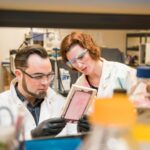
Featured photo: Chemical and biochemical engineering Ph.D. student Adam Day (left) works with Prof. Erin Lavik (right) in her lab, which focuses on polymer synthesis and processing, drug delivery, and stem cell biology to create new therapies. All photos by Marlayna Demond ’11 for UMBC.
]]>
Times Higher Education has just named UMBC #3 in the nation in achieving social and economic impact. This 2019 University Impact Ranking measures how well universities deliver on UN Sustainable...https://umbc.edu/stories/umbc-ranks-3-among-u-s-universities-in-global-social-and-economic-impact/https://my3.my.umbc.edu/api/v0/pixel/news/120175/guest@my.umbc.edu/25f4518e4e308a4f6d6196bbf59a1270/api/pixelcommunitypage1rankingsresearchUMBC News & Magazinehttps://my3.my.umbc.edu/groups/umbc-news-magazinehttps://assets1-my.umbc.edu/system/shared/avatars/groups/000/001/943/24435aa6207c452e7bc15cc74b42c7bb/xsmall.png?1748556657https://assets1-my.umbc.edu/system/shared/avatars/groups/000/001/943/24435aa6207c452e7bc15cc74b42c7bb/original.png?1748556657https://assets2-my.umbc.edu/system/shared/avatars/groups/000/001/943/24435aa6207c452e7bc15cc74b42c7bb/xxlarge.png?1748556657https://assets2-my.umbc.edu/system/shared/avatars/groups/000/001/943/24435aa6207c452e7bc15cc74b42c7bb/xlarge.png?1748556657https://assets3-my.umbc.edu/system/shared/avatars/groups/000/001/943/24435aa6207c452e7bc15cc74b42c7bb/large.png?1748556657https://assets1-my.umbc.edu/system/shared/avatars/groups/000/001/943/24435aa6207c452e7bc15cc74b42c7bb/medium.png?1748556657https://assets2-my.umbc.edu/system/shared/avatars/groups/000/001/943/24435aa6207c452e7bc15cc74b42c7bb/small.png?1748556657https://assets1-my.umbc.edu/system/shared/avatars/groups/000/001/943/24435aa6207c452e7bc15cc74b42c7bb/xsmall.png?1748556657https://assets2-my.umbc.edu/system/shared/avatars/groups/000/001/943/24435aa6207c452e7bc15cc74b42c7bb/xxsmall.png?1748556657UMBC News & Magazine00falseFri, 05 Apr 2019 16:57:36 -0400New York Gets Serious about Traffic with the First Citywide US Congestion Pricing Plan
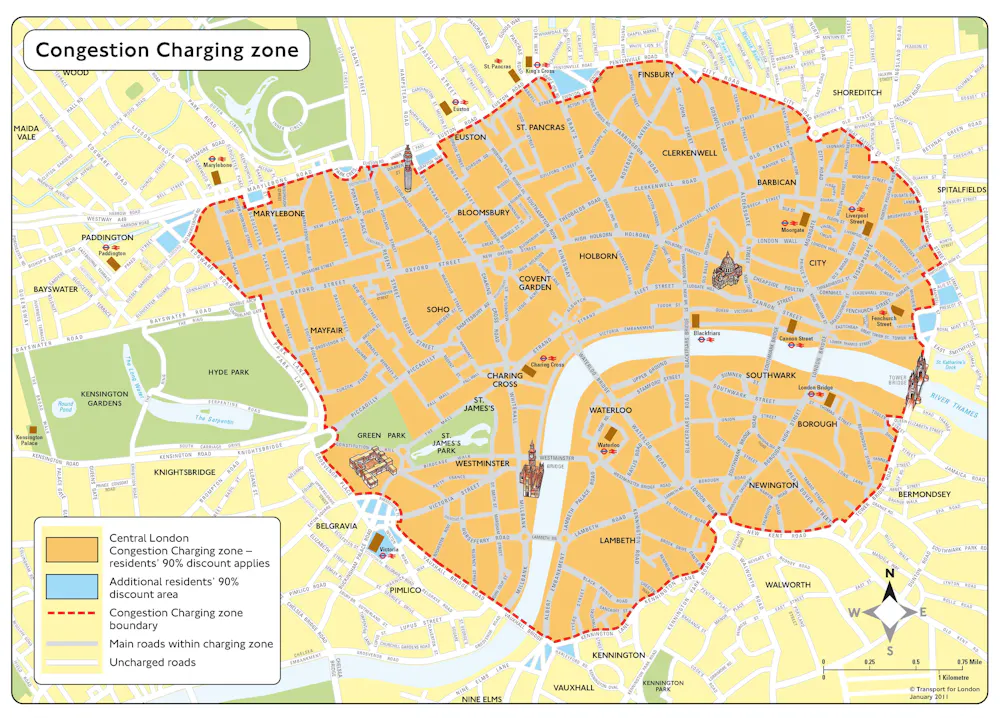
After years of debate, New York state has adopted congestion pricing to deal with traffic problems in New York City. Starting in 2021, fees will be imposed on all vehicles entering a pricing zone that covers lower Manhattan, from 60th Street at the southern edge of Central Park to the southernmost tip of the island.
This approach has succeeded in cities including London, Singapore and Stockholm. For scholars like me who focus on urban issues, New York’s decision is welcome news. Properly used, congestion pricing can make crowded cities safer, cleaner and easier for drivers, cyclists and pedestrians to navigate.
The details matter, including the size and timing of charges and the area that they cover. Congestion charges also raises equity issues, since rich people are best able to move closer to work or change their schedules to avoid the steepest costs.
But growing concentration also imposes costs, and one of the largest is traffic congestion. Drivers spend valuable time sitting idly in traffic jams, while noise, accidents and pollution impose heavy burdens on city residents.Cities concentrate people close together for good economic reasons. Clustering activities allows transfers of information, knowledge and skills. At their best, cities create deep pools of labor and large markets of consumers, and make it possible to provide public goods such as mass transit and trash collection efficiently. Planners should be encouraging cities to become bigger and more dense if we want to improve economic performance.
But growing concentration also imposes costs, and one of the largest is traffic congestion. Drivers spend valuable time sitting idly in traffic jams, while noise, accidents and pollution impose heavy burdens on city residents.
Should road use be free?
The idea of charging for use of public roads is not new. Economist Arthur Pigou discussed the issue as early as 1920 as part of his attempt to remedy the suboptimal workings of the market system. In 1963 Canadian-born economist William Vickrey argued that roads were scarce resources that should be valued by imposing costs on users.
Consumers intuitively understand differential pricing. We expect to pay more for airline tickets at peak travel times and for hotel rooms at popular times of the year. Congestion pricing also forces users to think about the cost of making a trip, and thus to evaluate their travel patterns.
A cyclist’s perspective on traffic in lower Manhattan, filmed in 2018.
And it can be effective. A 2008 study gave drivers in Seattle a hypothetical cash sum to spend on trips, charged them tolls linked to traffic congestion levels, and let them keep money they did not spend. Their cars were fitted with equipment to monitor driving patterns.
The results: Travelers altered their schedules, took different routes or collapsed multiple trips into single journeys. Collectively, these changes reduced congestion at peak time, lessened wait times and increased average travel speeds in the study’s regional traffic model.
Success in Europe and Asia
Evidence from cities around the world shows that charging motorists fees for driving into city centers during busy periods is a rarity in urban public policy: a measure that works and is cost-effective. Congestion pricing has succeeded in cities including London, Singapore and Stockholm, where it has eased traffic, sped up travel times, reduced pollution and provided funds for public transport and infrastructure investments.
It also can produce some unintended consequences. In London, house prices within the congestion charge zone increased – bid upward by consumers who were willing to pay to avoid traffic and enjoy improved environmental conditions. Over the long term, the congestion tax lubricated the gentrification of central London.
But this process is common to many other big cities, with or without congestion pricing: The rich preempt central city locations and displace the less wealthy to the suburbs.
Although the United States has over 5,000 miles of toll roads, congestion pricing is uncommon. One exception is Interstate Route 66 in the Washington, D.C. metro region, where fluctuating tolls were introduced in late 2017. Pricing for express lanes changes every six minutes during rush hour eastbound in the morning and westbound in the afternoon. The toll hit US$40 for a 10-mile stretch the day after it was introduced.
So far, local officials say the policy appears to be working. Carpooling has increased, while backups and crashes have declined. The average toll is currently $8.02 during morning hours and $4.47 during afternoon hours.
But this is just one well-used road, and there are many other routes into central Washington. The I-66 tolls are more about generating revenue on one road than reducing congestion citywide.
New York City is the best U.S. candidate for congestion pricing because it is densely developed and has an extensive public transportation system. Congestion pricing is unlikely to be as feasible in lower-density cities with limited public transportation.
Some observers, such as environmental advocates, are celebrating New York’s decision. But there is pushback from others who claim that it will be regressive. Congestion charges do raise equity issues, but only 4 percent of people who commute into New York City travel by car, and of those, only 5,000 could be classified as working poor. Funding from congestion fees will increase investment in mass transit, which New York Governor Andrew Cuomo says will benefit the vast majority of New Yorkers who commute by bus or subway.
Details remain to be decided, but under a previous proposal, cars would have been charged $11.52 to enter the zone on weekdays during business hours, while trucks would have paid $25.34. Taxis and app-based rides such as Uber and Lyft would have been charged $2 to $5. Fees will be assessed by a committee of experts and collected by the Triborough Bridge and Tunnel Authority through an electronic tolling system that is already widely used for bridges, tunnels and tolled motorways across the country.
Unlike other taxes that can be easily dismissed as imposing costs and killing jobs, congestion pricing improves market efficiencies because it forces people to think about their travel and leads to a more rational use of our public roads. It is a powerful policy whose time has definitely come.
* * * * *
This is an updated version of an article originally published on Feb. 7, 2018.
]]>
By John Rennie Short, Professor, School of Public Policy, UMBC After years of debate, New York state has adopted congestion pricing to deal with traffic problems in New York City. Starting in...https://umbc.edu/stories/new-york-gets-serious-about-traffic-with-the-first-citywide-us-congestion-pricing-plan/https://my3.my.umbc.edu/api/v0/pixel/news/120176/guest@my.umbc.edu/24a855bb0d1d5cd068061cbe3c33df48/api/pixeldiscoverypublicpolicytrafficurban-issuesUMBC News & Magazinehttps://my3.my.umbc.edu/groups/umbc-news-magazinehttps://assets1-my.umbc.edu/system/shared/avatars/groups/000/001/943/24435aa6207c452e7bc15cc74b42c7bb/xsmall.png?1748556657https://assets1-my.umbc.edu/system/shared/avatars/groups/000/001/943/24435aa6207c452e7bc15cc74b42c7bb/original.png?1748556657https://assets2-my.umbc.edu/system/shared/avatars/groups/000/001/943/24435aa6207c452e7bc15cc74b42c7bb/xxlarge.png?1748556657https://assets2-my.umbc.edu/system/shared/avatars/groups/000/001/943/24435aa6207c452e7bc15cc74b42c7bb/xlarge.png?1748556657https://assets3-my.umbc.edu/system/shared/avatars/groups/000/001/943/24435aa6207c452e7bc15cc74b42c7bb/large.png?1748556657https://assets1-my.umbc.edu/system/shared/avatars/groups/000/001/943/24435aa6207c452e7bc15cc74b42c7bb/medium.png?1748556657https://assets2-my.umbc.edu/system/shared/avatars/groups/000/001/943/24435aa6207c452e7bc15cc74b42c7bb/small.png?1748556657https://assets1-my.umbc.edu/system/shared/avatars/groups/000/001/943/24435aa6207c452e7bc15cc74b42c7bb/xsmall.png?1748556657https://assets2-my.umbc.edu/system/shared/avatars/groups/000/001/943/24435aa6207c452e7bc15cc74b42c7bb/xxsmall.png?1748556657UMBC News & Magazine00falseWed, 03 Apr 2019 13:29:32 -0400Want to Fix Gerrymandering? Then the Supreme Court Needs to Listen to Mathematicians
“Are we in Maryland’s third congressional district?” Karen asked on a recent visit to the UMBC campus. Despite zooming into the district’s map on Wikipedia, neither of us could tell. With good reason – “the praying mantis,” as the third has been called, has one of the most flagrantly gerrymandered boundaries in the country. (The university sits just outside, as we later found.)
Welcome to Democrat-controlled Maryland. The state, along with Republican-controlled North Carolina, defended its congressional districting against the charge of unlawful partisan gerrymandering in hearings at the U.S. Supreme Court on March 26.
One might think that a map that confounds two mathematicians must be in clear violation of the law. Indeed, political scientists and mathematicians have worked together to propose several geometrical criteria for drawing voting districts of logical contiguous shapes, which are now in use in various U.S. states.
But here’s the rub: Gerrymandering in itself is not unconstitutional. For the Supreme Court to rule against a particular map, plaintiffs need to establish that the map infringes on some constitutional right, such as their right to equal protection or free expression. This creates a problem. Geometrical criteria don’t detect partisanship. Other traditional criteria, like ensuring each district has the same population, can also be easily satisfied in an otherwise unfairly designed state map.
How then to define a standard to identify partisan gerrymandering that is egregious enough to be illegal? Mathematical scientists have already come up with promising solutions, but we are concerned that the Supreme Court may not take their advice when it issues its decision in June.
Searching for answers
The Supreme Court has grappled with the question of manageable standards at least since 1986 – long enough for Justice Antonin Scalia to declare in a 2004 ruling that since one hadn’t emerged yet, the issue of partisan gerrymandering was not legally decidable, and therefore, no further appeals should be considered.
It was only Justice Anthony Kennedy’s separate concurrence that kept the door open. He cautioned against abandoning the search for a standard too soon, saying that “technology is both a threat and a promise.” In other words, technological advances would probably exacerbate the gerrymandering problem, but they could also provide a solution.
The problem has worsened, just as Kennedy predicted. Computer programs can now generate a profusion of redistricted maps, all of which satisfy traditional constraints such as contiguity and equal population across districts. Then, the majority party can just pick the map most favorable to it.
This was demonstrated in Wisconsin’s 2018 elections. Computer-boosted gerrymandered maps supersized the Republicans’ 13-seat edge to a 25-seat majority, even though Democrats won 53 percent of the total statewide vote.
We expect new congressional districts drawn countrywide after the 2020 census will be subject to even more ferocious computer-driven gerrymandering.
Math to the rescue
But the second part of Kennedy’s prediction has also come true. The same tools that produce drastically gerrymandered maps can be used to draw fair maps.
The first step is to generate – without partisan intent – a vast number of maps that adhere to traditional redistricting criteria. This creates a database against which any proposed map can be compared, by using a suitable mathematical formula that measures partisanship. Through this process, maps with extreme bias will appear as clear outliers, much like data points near the outer ends of a bell curve.
The “efficiency gap” is one such mathematical formula. It measures how efficiently one party’s votes get used and how much the other party’s votes get wasted. For example, a map might pack voters together to minimize their influence in other districts, or spread them out so they don’t form an effective bloc.
Alternative formulas exist as well. In fact, we recommend using a collection of formulas, rather than just one, to compensate for the limitations of each.
Recent conferences on redistricting have seen the mathematics and statistics communities coalesce around this “outlier approach.”
Overcoming skepticism
Getting the Supreme Court to accept this approach, however, will require overcoming the skepticism some conservative justices have expressed toward the use of mathematics and statistics in setting legal standards.
During October 2017 oral arguments for a challenge to the Wisconsin maps, for instance, Chief Justice John Roberts characterized the efficiency gap as “sociological gobbledygook,” while Justice Neil Gorsuch said that the idea of using multiple formulas for measuring gerrymandering was like adding “a pinch of this, a pinch of that” to his steak rub. Roberts also fretted that the country would dismiss statistical formulas as “a bunch of baloney” and suspect the court of political favoritism in adopting them.
At the March 26 hearings for the North Carolina challenge, conservative justices were more measured and mathematically savvy in expressing their reservations. This time, the “outlier approach” took center stage. Affirmed in the lower court decision and explained in an amicus brief, it was also endorsed in oral arguments by Justices Elena Kagan and Sonia Sotomayor. The key doubts came from Justices Samuel Alito, Gorsuch and Brett Kavanaugh, who questioned the feasibility of defining an “outlier” in practice – in particular, setting a range of numerical parameters that would demarcate permissible maps from nonpermissible ones.
The answer to such objections, adeptly addressed in an amicus brief by MIT’s Eric Lander, is twofold. First, the maps being challenged are so biased that they are extreme outliers. They would show up as anomalies under any test for partisanship. So there is no need for the Supreme Court to set a numerical cutoff level at this stage – though a threshold may, indeed, evolve in the future. Secondly, such an extreme outlier approach is already an indispensable tool in several areas of national importance. For example, it is used to test nuclear safety, predict hurricanes and assess the health of financial institutions.
Moreover, this approach has already been shown to work smoothly in gerrymandering cases as well, such as in one from Pennsylvania. Moon Duchin, a Tufts University math professor, used it to analyze – in a report requested by Governor Tom Wolf – newly proposed maps for fairness. A map drawn by the GOP state legislature clearly stood out as an extreme outlier among over a billion maps generated, both when evaluated using the efficiency gap and under another measure of partisanship called the mean-median score. Based on Duchin’s report, the governor rejected the map proposed by the GOP.
We expect that, pushed by citizen groups, an increasing number of states will incorporate math into redistricting procedures. Last year, for instance, Missouri approved Amendment 1, prescribing detailed mathematical rules that must be followed to ensure the fairness of redrawn districts. Although the rules rely heavily on just the efficiency gap – and lawmakers may try to altogether annul them – the fact that ordinary citizens voted overwhelmingly (62 percent to 38 percent) in favor of such a math-incorporating measure is truly precedent-setting.
Such developments were noted in the March 26 oral arguments, when some justices wondered whether, in light of state initiatives, the Supreme Court really had to step in. As the citizens’ attorneys pointed out, however, there are very few states east of the Mississippi where such citizen initiatives are allowed. (North Carolina is not one of them.) It behooves the court to take the lead nationally.
Enhanced by computer power, partisan gerrymandering poses a burgeoning threat to the American way of democracy. Workable standards based on sound mathematical principles may be the only tools to counter this threat. We urge the Supreme Court to be receptive to such standards, thereby enabling citizens to protect their right to fair representation.
]]>
By Manil Suri, Professor of Mathematics and Statistics, UMBC, and Karen Saxe, Macalester College “Are we in Maryland’s third congressional district?” Karen asked on a recent visit to the UMBC...https://umbc.edu/stories/want-to-fix-gerrymandering-then-the-supreme-court-needs-to-listen-to-mathematicians/https://my3.my.umbc.edu/api/v0/pixel/news/120177/guest@my.umbc.edu/b6aa46a78019b518a2489987e3c2b4f3/api/pixeldiscoverymathstatthe-conversationUMBC News & Magazinehttps://my3.my.umbc.edu/groups/umbc-news-magazinehttps://assets1-my.umbc.edu/system/shared/avatars/groups/000/001/943/24435aa6207c452e7bc15cc74b42c7bb/xsmall.png?1748556657https://assets1-my.umbc.edu/system/shared/avatars/groups/000/001/943/24435aa6207c452e7bc15cc74b42c7bb/original.png?1748556657https://assets2-my.umbc.edu/system/shared/avatars/groups/000/001/943/24435aa6207c452e7bc15cc74b42c7bb/xxlarge.png?1748556657https://assets2-my.umbc.edu/system/shared/avatars/groups/000/001/943/24435aa6207c452e7bc15cc74b42c7bb/xlarge.png?1748556657https://assets3-my.umbc.edu/system/shared/avatars/groups/000/001/943/24435aa6207c452e7bc15cc74b42c7bb/large.png?1748556657https://assets1-my.umbc.edu/system/shared/avatars/groups/000/001/943/24435aa6207c452e7bc15cc74b42c7bb/medium.png?1748556657https://assets2-my.umbc.edu/system/shared/avatars/groups/000/001/943/24435aa6207c452e7bc15cc74b42c7bb/small.png?1748556657https://assets1-my.umbc.edu/system/shared/avatars/groups/000/001/943/24435aa6207c452e7bc15cc74b42c7bb/xsmall.png?1748556657https://assets2-my.umbc.edu/system/shared/avatars/groups/000/001/943/24435aa6207c452e7bc15cc74b42c7bb/xxsmall.png?1748556657UMBC News & Magazine00falseWed, 03 Apr 2019 12:53:16 -0400UMBC’s Bradley Arnold develops laser-based technology to safely and quickly detect IEDs and other hazards in combat zones
You’re a U.S. soldier, motoring across the desert at 60 miles an hour in an Army truck, heading back to base. Suddenly, a red light flashes on your dashboard—an instrument has detected traces of explosive material on the road surface ahead. You divert around the hazard and continue safely toward your destination.
“There is currently nothing available to do this at this speed,” says Bradley Arnold, professor of chemistry and biochemistry. But that could soon change.
Today, in order to detect hazards, service members must pause and send a robot to check an area of concern. This procedure slows progress, which can increase risk for military personnel trying to move through an area quickly. However, technology to make high-speed, near-comprehensive detection possible is close to coming to the U.S. Armed Forces, thanks to Arnold’s work.
Arnold’s research group recently received $480,000 for two years from the U.S. Army to develop a prototype of their detection device, which has been in development for three years. The Army will test it on military vehicles early next year, and if it passes field tests, it may be deployed soon after.
Molecular fingerprinting
Bradley Arnold, professor of chemistry at UMBC.
So how does it work? The device sends out 10 laser pulses per second as the truck drives along, and each laser pulse contacts about one square inch of the ground. At 60 miles per hour, one pulse hits the ground every eight feet. Arnold’s team is working to develop lasers that can pulse more rapidly. Then, the beams could overlap—even at high speeds—providing complete coverage.
The system collects the light that scatters off molecules on the ground in a specialized detector. Depending on the structure of their chemical bonds, different compounds generate unique scattering patterns. By analyzing those patterns, the detector “can identify a molecule’s characteristic fingerprint,” Arnold says.
The new system can identify “just about anything,” Arnold says, from compounds used in military or improvised explosives, to nerve agents, to biological threats. “Being able to detect these things on the fly is of critical importance,” he adds. The new device would make this possible for the first time.
The detector also stores all the data it collects, which provides additional benefits. “You could search the data for specific things afterward, and you could compare day to day what you see in specific areas,” Arnold says. “And both of these things would be a tremendous advantage.”
Outside the box
The basic technique the device employs is related to standard Raman spectroscopy, used in chemistry labs all over the world, but with one very notable difference.
In standard systems, a lens focuses the laser beam on a single point. But too much power focused at one point can destroy the thing you want to detect. To make the traditional method work in this case, Arnold’s team would need to reduce the power of the laser so much that they’d lose the benefit of having a high-powered laser to begin with. Their solution: remove the focusing lens, even though “99.9 percent of the universe insists the lens is required,” Arnold says.
Without the focusing lens, the laser beam is about three-fourths of an inch across when it strikes the ground. “We can turn the power up on the laser several orders of magnitude, and we don’t have to focus it on a single spot—that entire area is imaged onto our detector,” Arnold explains. In this setup, the detector is less efficient at collecting the scattered light, but the high power of the laser compensates for the inefficiency.
The technique is so novel that Arnold has met skepticism in the scientific community, despite publishing details of the technology in the Canadian Journal of Chemistry. “Nobody believes that it works,” he says, “but it’s actually much easier than the traditional method.” Coming up with the idea, he says, “was just a matter of recognizing the problem and thinking a bit outside the box.”
Brad Arnold (center) examines the laser setup with Sara Tahir ’21, biochemistry, and Eric Bowman (right), Ph.D. student in chemistry.
Always thinking ahead
As a future step, Arnold would like to work toward a lighter version of the device that could fly on a drone ahead of military convoys. He has submitted a Small Business Innovation Research grant to support efforts to that end.
In addition to military uses, Arnold is also thinking ahead to potential civilian applications. For example, a similar system at airport security could remove the need to swab suspect bags to detect trace materials on their surface. Instead, every bag’s surface would be automatically analyzed using this new system. It could even be used for security at stadiums or other large venues.
In the event that the military adopts the technology, and especially if civilian applications come into play, a way to produce the systems at scale will become necessary. With that in mind, Arnold has founded NuMoon Spectroscopy with support from a TEDCO Maryland Innovation Initiative grant.
Arnold loves the idea of seeing the technology do good in the world, which is why he has shepherded this project to the startup company stage. “This could be not just cool, but important,” he says.
His dream is to connect NuMoon with a more-established company to pursue larger-scale production. At that point, the potentially life-saving technology would be able to truly make a significant, positive difference, Arnold explains, and “that’s the goal that I’ve had more than anything else.”
Banner image: Brad Arnold (center) works in the lab with Sara Tahir ’21, biochemistry, and Eric Bowman (right), Ph.D. student in chemistry. All photos by Marlayna Demond ’11 for UMBC.
]]>
You’re a U.S. soldier, motoring across the desert at 60 miles an hour in an Army truck, heading back to base. Suddenly, a red light flashes on your dashboard—an instrument has detected traces of...https://umbc.edu/stories/umbcs-bradley-arnold-develops-laser-based-technology-to-safely-and-quickly-detect-ieds-and-other-hazards-in-combat-zones/https://my3.my.umbc.edu/api/v0/pixel/news/120178/guest@my.umbc.edu/c987593c2ce42f43c2bc57aeee3b0b8d/api/pixelchembiochemcnmspage1researchscience-and-technologyUMBC News & Magazinehttps://my3.my.umbc.edu/groups/umbc-news-magazinehttps://assets1-my.umbc.edu/system/shared/avatars/groups/000/001/943/24435aa6207c452e7bc15cc74b42c7bb/xsmall.png?1748556657https://assets1-my.umbc.edu/system/shared/avatars/groups/000/001/943/24435aa6207c452e7bc15cc74b42c7bb/original.png?1748556657https://assets2-my.umbc.edu/system/shared/avatars/groups/000/001/943/24435aa6207c452e7bc15cc74b42c7bb/xxlarge.png?1748556657https://assets2-my.umbc.edu/system/shared/avatars/groups/000/001/943/24435aa6207c452e7bc15cc74b42c7bb/xlarge.png?1748556657https://assets3-my.umbc.edu/system/shared/avatars/groups/000/001/943/24435aa6207c452e7bc15cc74b42c7bb/large.png?1748556657https://assets1-my.umbc.edu/system/shared/avatars/groups/000/001/943/24435aa6207c452e7bc15cc74b42c7bb/medium.png?1748556657https://assets2-my.umbc.edu/system/shared/avatars/groups/000/001/943/24435aa6207c452e7bc15cc74b42c7bb/small.png?1748556657https://assets1-my.umbc.edu/system/shared/avatars/groups/000/001/943/24435aa6207c452e7bc15cc74b42c7bb/xsmall.png?1748556657https://assets2-my.umbc.edu/system/shared/avatars/groups/000/001/943/24435aa6207c452e7bc15cc74b42c7bb/xxsmall.png?1748556657UMBC News & Magazine00falseTue, 02 Apr 2019 15:23:45 -0400UMBC’s Tyson King-Meadows becomes an ACE Fellow, as an emerging national higher ed leader
The American Council on Education (ACE) announced this week that UMBC’s Tyson King-Meadows, associate dean for research and college affairs in the College of Arts Humanities and Social Sciences (CAHSS), has been selected as a 2019-2020 ACE Fellow. King-Meadows will join a cohort of thirty-nine fellows from institutions across the United States in the distinguished education leadership program.
Established in 1965, the ACE Fellows Program is designed to strengthen institutions and leadership in American higher education. The program identifies and prepares faculty and staff for senior positions in college and university administration through its distinctive and intensive nominator-driven, cohort-based mentorship model.
“I am excited and grateful for this opportunity to further deepen my leadership skills and goals,” says King-Meadows, thanking his nominator, President Freeman Hrabowski, whom he has worked with on leadership and diversity initiatives that support UMBC’s vision and values.
Inspired leadership
The fellowship affords King-Meadows the opportunity to shadow a president or provost to prepare him for the complexities of leading an institution of higher education. Over the course of a year, each cohort member will be able to observe and learn from top leaders in higher education as they manage crises, connect with donors, understand curriculum in different fields, and engage with stakeholders across their university communities.
The fellowship will also provide King-Meadows insight into areas of personal interest, like faculty development, strategic planning, external partnerships, and research infrastructure.
“There is a direct correlation between how people think about their scholarship and how people think about their teaching,” explains King-Meadows. “It is an interactive, reciprocal relationship. If you have the best research infrastructure you will have the best teachers and the best students.”
King-Meadows feels UMBC strengthens the relationship between research and teaching through engaged scholarship and applied learning opportunities through the Shriver Center and Career Center. He also wants to further bolster that connection by learning from the approaches of other institutions.
Immersed in UMBC
During his sixteen years at UMBC, King-Meadows has served in several key leadership roles within CAHSS and across the university. He has led as co-chair of the Provost’s Executive Committee for the Recruitment, Retention, and Advancement of Underrepresented Minority Faculty and chair of the department of Africana studies. He is also an affiliate faculty member in the School of Public Policy, the department of Africana studies, and the language, literacy, and culture doctoral program.
“Tyson King-Meadows has long been a visionary leader at UMBC at every level, from department to College to University,” shares Scott Casper, dean of CAHSS. “I’m delighted that ACE has recognized his record of accomplishments, and I look forward to the exciting ideas and approaches he will bring back to us from institutions across the country.”
Tyson King-Meadows speaks at a welcome reception for the 2015-2017 cohort of Postdoctoral Fellows for Faculty Diversity.
In addition to being recognized for his support of faculty and students in the social sciences and the humanities, King-Meadows is also an esteemed scholar. His scholarship has been supported by the National Science Foundation, Congressional Fellowship Program of the American Political Science Association, Ford Foundation Postdoctoral Fellowship Program, and U.S. Fulbright Scholar Program.
Higher education leaders of tomorrow
Over the last fifty years, more than 2,000 higher education leaders have participated in the ACE Fellows Program. Eighty percent of ACE Fellows have gone on to serve as senior leaders of colleges and universities.
Along with highly acclaimed faculty from other institutions, King-Meadows joins a respected group of UMBC scholars who have participated in the ACE Fellows Program. UMBC’s ACE alumni include Sarah J. Shin, associate provost for academic affairs; Marie desJardins, former professor of computer science and associate dean for academic affairs, who is now a dean at Simmons College; Julie Ross, former dean of the College of Engineering and Information Technology, who is now a dean at Virginia Tech; and Anne Brodsky, associate dean of CAHSS, and chair and professor of psychology.
Like faculty before him, King-Meadows plans to use the strategies and techniques he learns as an ACE Fellow to further support the implementation of UMBC’s strategic plan and advance UMBC’s vision to connect innovative teaching and learning, research across disciplines, and civic engagement.
Banner image: Tyson King-Meadows. All images by Marlayna Demond ’11 for UMBC.
]]>
The American Council on Education (ACE) announced this week that UMBC’s Tyson King-Meadows, associate dean for research and college affairs in the College of Arts Humanities and Social Sciences...https://umbc.edu/stories/umbcs-tyson-king-meadows-becomes-an-ace-fellow-as-an-emerging-national-higher-ed-leader/https://my3.my.umbc.edu/api/v0/pixel/news/120179/guest@my.umbc.edu/d5f85d74ca41845d0f075382809c77f0/api/pixelcahssmajorawardpolicy-and-societypoliticalscienceUMBC News & Magazinehttps://my3.my.umbc.edu/groups/umbc-news-magazinehttps://assets1-my.umbc.edu/system/shared/avatars/groups/000/001/943/24435aa6207c452e7bc15cc74b42c7bb/xsmall.png?1748556657https://assets1-my.umbc.edu/system/shared/avatars/groups/000/001/943/24435aa6207c452e7bc15cc74b42c7bb/original.png?1748556657https://assets2-my.umbc.edu/system/shared/avatars/groups/000/001/943/24435aa6207c452e7bc15cc74b42c7bb/xxlarge.png?1748556657https://assets2-my.umbc.edu/system/shared/avatars/groups/000/001/943/24435aa6207c452e7bc15cc74b42c7bb/xlarge.png?1748556657https://assets3-my.umbc.edu/system/shared/avatars/groups/000/001/943/24435aa6207c452e7bc15cc74b42c7bb/large.png?1748556657https://assets1-my.umbc.edu/system/shared/avatars/groups/000/001/943/24435aa6207c452e7bc15cc74b42c7bb/medium.png?1748556657https://assets2-my.umbc.edu/system/shared/avatars/groups/000/001/943/24435aa6207c452e7bc15cc74b42c7bb/small.png?1748556657https://assets1-my.umbc.edu/system/shared/avatars/groups/000/001/943/24435aa6207c452e7bc15cc74b42c7bb/xsmall.png?1748556657https://assets2-my.umbc.edu/system/shared/avatars/groups/000/001/943/24435aa6207c452e7bc15cc74b42c7bb/xxsmall.png?1748556657UMBC News & Magazine00falseFri, 29 Mar 2019 18:59:52 -0400Together We Rise — Annual Scholarship Luncheon
In an average gathering on campus, members of a crowd will generally have some connections, like shared Facebook friends or a favorite professor. At UMBC’s 8th annual Endowed Scholarship Luncheon this month, however, the ties went much deeper.
Here, student recipients of endowed scholarships were able to meet and mingle with the backers of the financial support that’s helping them succeed. For many students, it’s the first time meeting their donors — and a special opportunity to say thank you.
Meeting Your Match
Jonathan Acuna-Lopez ’19, English, recipient of the Sandy King Geest Endowed Scholarship met the eponymous donor at the luncheon, as well. “It makes me feel really happy [to meet Geest]. After today, I know what this person is like: you’re the same as I am, you worked hard the same way I’m working hard.”
Standing next to Acuna-Lopez, Sandy Geest ’72, English, listens to him recite their similarities. She adds, “Like Jonathan, I was the very first in my family to go to college. He and I both grew up in Montgomery County. He’s a literature major, and I was also a literature major.”
Jonathan Acuna-Lopez, Sandy Geest, Linda Wiratan, Jay Geest, and CAHSS dean Scott Casper gather at the luncheon.
Discovering these ties gives depth to what could be a simple financial transaction, but both Geest and Acuna-Lopez know that it’s so much more.
“It’s good to give back and help someone else,” Geest says, smiling up at the much taller student. “When you’ve had enough struggle yourself… I worked several jobs to pay for school, so I felt like it was really something I wanted to do.”
Early on, Geest gave the modest amount she could afford. “I gave $10 — $5 to the Alumni Association and $5 went to the English department.” But after deciding to create the endowment, Geest and her husband Jay redirected their giving to support the English department.
Acuna-Lopez has his eyes set on graduation in December 2019 and is considering pursuing a master’s degree in secondary education at UMBC. “I know personally I wouldn’t be here without the help that my teachers gave me and the support that they gave me, so I feel like it would be nice to change someone’s life in that way.”
Ties that Bind
Alison Mayas, mother of twin UMBC graduates with twin degrees — Jhilya Mayas and Rabiah Mayas M8, ’00, biochemistry and molecular biology — likes to say that Freeman Hrabowski made a liar out of her.
“When my girls were growing up, I told them they could go anywhere they wanted for college,” says the recently retired executive vice president of MayaTech Corporation, a company she started with her husband Jean-Marie Mayas. But then she heard Dr. Hrabowski spreading the word about UMBC, “and he was speaking my language.”
So when Jhilya and Rabiah finished high school, Mayas drove them straight from their home in Silver Spring to start their summer classes in the Meyerhoff Scholars Program.
Jean-Marie and Alison Mayas with student Evan Carlyle.
Now, the Mayas family endows a scholarship for the next generation of Meyerhoff Scholars.
Evan Carlyle ’22, M30, biochemistry, is the recipient of their Fredricka Pemberton Harris award. “I chose UMBC because of the people,” says Carlyle. “And I received the offer to be a part of the Meyerhoff Scholars Program, which was a dream come true…at UMBC I feel like I am actually learning and having my knowledge and understanding tested.”
Sitting next to the Mayas at the luncheon, Carlyle was able to fill them in on his goal to use his future Ph.D. to provide education to inner city communities on HIV, STD, and STI transmissions. He quickly found overlap between his career goals and the path laid by his donors through their company MayaTech, which among other projects provides technical support to various agencies that work in the HIV+ community.
“The fund has allowed me to focus on my studies by alleviating the strain many students today feel from financial insecurities,” comments Carlyle. The extra help “motivates me since I realize that my career aspirations are being supported.”
Scholars’ Success
Key speakers for the event included donor Helen Phillips ’98, ’01 M.S., mechanical engineering, who started giving to honor her mother — a medical technician who set an educational example by stepping outside of the traditional career boundaries for women in her day. Phillips herself returned to school as an adult to study mechanical engineering. “It was the hardest thing I’ve ever done,” says Phillips, who recently started giving to an endowed STEM scholarship.
Rhodes Scholar finalist Linda Wiratan ’19,biochemistry and molecular biology, also took the stage, emphasizing the relief that comes from pursuing rigorous academics without worrying about debt or food and housing insecurity. As a recipient of two scholarships, “these awards not only showed me how hard work can open doors to countless opportunities, but also gave me the financial freedom to focus my efforts and pursue them.”
President Freeman Hrabowskiended the event with his characteristic mantra that “success is never final.” Right now, UMBC has 180 endowed scholarships, but his goal would be to see 200 or more permanent funds established to further the success of students like Wiratan, Carlyle, Acuna-Lopez, and the dozens of other recipients who enjoyed the luncheon.
Alison Mayas left feeling inspired. “This space, this staff, that man, and the students here collaborate and support each other — that’s the kind of stuff that appeals to me, and UMBC does it well,” she said.
Helen Phillips, Freeman Hrabowski, and Linda Wiratan.
All photos by Marlayna Demond ’11 for UMBC Magazine.
]]>
In an average gathering on campus, members of a crowd will generally have some connections, like shared Facebook friends or a favorite professor. At UMBC’s 8th annual Endowed Scholarship Luncheon...https://umbc.edu/stories/together-we-rise-annual-scholarship-luncheon/https://my3.my.umbc.edu/api/v0/pixel/news/120180/guest@my.umbc.edu/41f7982393e1c8058b6ece521c8e4049/api/pixelalumnidonationsendowmentimpactscholarshipsUMBC News & Magazinehttps://my3.my.umbc.edu/groups/umbc-news-magazinehttps://assets1-my.umbc.edu/system/shared/avatars/groups/000/001/943/24435aa6207c452e7bc15cc74b42c7bb/xsmall.png?1748556657https://assets1-my.umbc.edu/system/shared/avatars/groups/000/001/943/24435aa6207c452e7bc15cc74b42c7bb/original.png?1748556657https://assets2-my.umbc.edu/system/shared/avatars/groups/000/001/943/24435aa6207c452e7bc15cc74b42c7bb/xxlarge.png?1748556657https://assets2-my.umbc.edu/system/shared/avatars/groups/000/001/943/24435aa6207c452e7bc15cc74b42c7bb/xlarge.png?1748556657https://assets3-my.umbc.edu/system/shared/avatars/groups/000/001/943/24435aa6207c452e7bc15cc74b42c7bb/large.png?1748556657https://assets1-my.umbc.edu/system/shared/avatars/groups/000/001/943/24435aa6207c452e7bc15cc74b42c7bb/medium.png?1748556657https://assets2-my.umbc.edu/system/shared/avatars/groups/000/001/943/24435aa6207c452e7bc15cc74b42c7bb/small.png?1748556657https://assets1-my.umbc.edu/system/shared/avatars/groups/000/001/943/24435aa6207c452e7bc15cc74b42c7bb/xsmall.png?1748556657https://assets2-my.umbc.edu/system/shared/avatars/groups/000/001/943/24435aa6207c452e7bc15cc74b42c7bb/xxsmall.png?1748556657UMBC News & Magazine00falseFri, 29 Mar 2019 08:20:28 -0400New GEARS symposium offers professional development opportunities to grad students across disciplines
On March 27, 2019, UMBC graduate students will gather in the University Center Ballroom to improve their communication skills, share their work, and get to know their UMBC colleagues. The new Graduate Experiences, Achievement, and Research Symposium (GEARS) aims to provide rich professional development opportunities—from showcasing art pieces to mingling with alumni—for students in all fields, right here on campus.
“We want to provide an avenue for people to learn skills that they’re not going to get in the classroom or the lab,” says Alex Rittle, Ph.D. student in geography and environmental systems and chair of the GEARS planning committee.
The opportunities at GEARS include an interviewing workshop led by Susan Hindle, assistant director for internships and employment; an art showcase by students in UMBC’s Intermedia and Digital Art program; an exhibition by emergency health services graduate students; short “Gritty Talks,” modeled after the annual GRIT-X talks at UMBC Homecoming, and traditional poster presentations.
GSA vice president Adam Harvey discusses science communication with a colleague.
“Preparing a good poster can be more difficult than preparing a talk, but it can provide more bang for your buck,” says Roy Prouty ’16, M.S., atmospheric physics, current M.S. student in computer science, and Graduate Student Association president. Choosing what data to include and laying it out in a way that is easy to follow can be challenging. To help, the GSA organized a workshop prior to GEARS run by Tim Ford, manager of Research Graphics in the College of Natural and Mathematical Sciences, and Joe School, director of the Cartographic Services Laboratory in geography and environmental systems. Both have decades of experience printing posters, and know what makes a good one.
GEARS will also feature a Three Minute Thesis (3MT) competition, the winner of which will compete at the Southern States Regional 3MT contest. The Graduate School supported training from renowned communications coach Scott Morgan for all students who signed up in advance to participate in 3MT.
“Regardless of whether you’re going into industry, the public sector, or academia, you need the skills to be able to tell people what you’re working on,” says Rittle.
Denise Williams, Ph.D. student in chemistry, presents at a GSA event in 2018.
Prouty acknowledges that a three minute explanation of one’s dissertation is not the typical talk a researcher would give at a department seminar or academic conference. However, he says, it’s also important to learn “to communicate what you’re doing and what you care about in more informal ways that will make sense to the broader community.”
Mustafa Al-Adhami, Ph.D. ’19, mechanical engineering, and a researcher at UMBC’s Center for Advanced Sensor Technology, won last year’s 3MT and found the experience transformative. After winning at UMBC, he came in second place the Southern States Regional, earning him the right to compete at the national 3MT competition this coming December.
“In real life, I feel like you don’t get more than three minutes,” Al-Adhami says. “So practicing how to do it is valuable.” Al-Adhami is also an entrepreneur, and less than a week after the 3MT regional, he won the elevator pitch contest at the Baylor New Venture Competition in Waco, Texas. “What I learned from 3MT transferred into a totally different enterprise,” he says. Al-Adhami will present his talk after the competitors at this year’s 3MT contest.
Mustafa Al-Adhami, Ph.D. ’19, mechanical engineering, gives his three-minute thesis talk at the 2018 UMBC Graduate Research Conference.
GEARS isn’t all serious professional development, though. A social hour where current graduate students can mingle with Graduate School alumni will close out the day. One of the highlights? An activity known as Powerpoint roulette, where participants are given a random Powerpoint slide from an academic presentation and must try to explain it on the spot. There will be prizes in different categories, like most realistic and most creative.
The GSA executive board and GEARS planning committee members are hoping for a strong start for this new offering, and also that it will grow into a popular event for graduate students from all disciplines. “This is something we’re creating that’s new,” says Adam Harvey, Ph.D. student in physics and GSA vice president, “and we’re trying to build on it.”
Banner image: Alex Sestok, Ph.D. student in chemistry, explains her research to a guest. All photos by Marlayna Demond ’11 for UMBC.
]]>
On March 27, 2019, UMBC graduate students will gather in the University Center Ballroom to improve their communication skills, share their work, and get to know their UMBC colleagues. The new...https://umbc.edu/stories/new-gears-symposium-offers-professional-development-opportunities-to-grad-students-across-disciplines/https://my3.my.umbc.edu/api/v0/pixel/news/120181/guest@my.umbc.edu/bb6647ea9dfe97c86ef557321541d696/api/pixelarts-and-culturecahsscnmscoeitcommunitygradresearchgraduateschoolpolicy-and-societyscience-and-technologyUMBC News & Magazinehttps://my3.my.umbc.edu/groups/umbc-news-magazinehttps://assets1-my.umbc.edu/system/shared/avatars/groups/000/001/943/24435aa6207c452e7bc15cc74b42c7bb/xsmall.png?1748556657https://assets1-my.umbc.edu/system/shared/avatars/groups/000/001/943/24435aa6207c452e7bc15cc74b42c7bb/original.png?1748556657https://assets2-my.umbc.edu/system/shared/avatars/groups/000/001/943/24435aa6207c452e7bc15cc74b42c7bb/xxlarge.png?1748556657https://assets2-my.umbc.edu/system/shared/avatars/groups/000/001/943/24435aa6207c452e7bc15cc74b42c7bb/xlarge.png?1748556657https://assets3-my.umbc.edu/system/shared/avatars/groups/000/001/943/24435aa6207c452e7bc15cc74b42c7bb/large.png?1748556657https://assets1-my.umbc.edu/system/shared/avatars/groups/000/001/943/24435aa6207c452e7bc15cc74b42c7bb/medium.png?1748556657https://assets2-my.umbc.edu/system/shared/avatars/groups/000/001/943/24435aa6207c452e7bc15cc74b42c7bb/small.png?1748556657https://assets1-my.umbc.edu/system/shared/avatars/groups/000/001/943/24435aa6207c452e7bc15cc74b42c7bb/xsmall.png?1748556657https://assets2-my.umbc.edu/system/shared/avatars/groups/000/001/943/24435aa6207c452e7bc15cc74b42c7bb/xxsmall.png?1748556657UMBC News & Magazine00falseWed, 27 Mar 2019 14:55:24 -0400UMBC recognizes Renetta Tull for transformative leadership advancing diversity in STEM
Renetta Tull, UMBC’s associate vice provost for strategic initiatives, and professor of practice in College of Engineering and Information Technology, is known worldwide for her leadership in increasing diversity in STEM disciplines. She does this through a powerful combination of advocacy work at state, national, and international levels, and providing intensive support to students pursuing doctoral degrees. After 16 transformative years at UMBC, Tull will soon begin a new role in the University of California, Davis, as vice chancellor for diversity, equity and inclusion.
“I thank all of my colleagues for working with me to advance our shared vision for inclusive excellence, at every level,” says Tull. “I also thank the students for their trust in our advice and our brand of professional development, and for their commitment to their training, so that they can be noble, global citizens who will passionately and compassionately contribute skills to making the world better for all.”
In addition to her work at UMBC, Tull has more broadly served as director for graduate and professional pipeline development at the University System of Maryland (USM). Under the theme “Think Big Diversity,” Tull has led several successful initiatives to boost diversity in STEM fields by supporting the professional development of undergraduate and graduate students, postdoctoral scholars, and faculty at institutions across the System.
Renetta Tull joins UMBC students and President Freeman Hrabowski during an on-campus meeting with Congressman Elijah Cummings. Photo by Marlayna Demond ’11 for UMBC.
“Renetta’s leadership has transformed professional development and success programs for UMBC’s graduate students and postdocs,” says Janet Rutledge, dean of UMBC’s Graduate School. “She has created synergies across our diversity pipeline programs. Her social media hashtag #ThinkBigDiversity captures the essence of Renetta, since she ‘thinks big’ in everything she does.”
Tull’s “Think Big Diversity” work includes major initiatives like the PROMISE Alliances for Graduate Education and Professoriate (AGEP), PROMISE Academy, Dissertation House, Louis Stokes Alliance for Minority Participation (LSAMP), and the PROMISE Engineering Institute.
Tull served as the founding director of USM’s PROMISE AGEP program. Supported by the National Science Foundation, this program focuses on increasing enrollment, retention, and graduation rates of underrepresented minority students in STEM fields, to support them on the path to academic careers. The system-wide effort also supports research related to the experiences of students, to better understand how those experiences impact graduate degree attainment. In particular, Tull focuses on the important role of providing mentoring and a community of mutual support for graduate students.
TheDissertation House is one component of PROMISE AGEP that has been shown to effectively increase Ph.D. degree completion among candidates from underrepresented groups. This approach combines one-on-one dissertation coaching and intensive advising with multi-day retreats where students set goals and participate in conversation on topics like time management, avoiding burnout, and honing public speaking skills.
“We’ve learned that providing time, space, support, and community is a winning combination for working on a milestone such as the doctoral dissertation,” Tull has shared.
Renetta Tull, center, with Frances Carter-Johnson, M.S. ’07, physics, Ph.D. ’11, public policy, and Patricia Ordóñez, M.S. ’10, computer science, Ph.D. ’12, computer science. Photo courtesy of Tull.
Hector Medina, M.S. ‘13, mechanical engineering, and Ph.D. ‘19, mechanical engineering, is one of the dozens of students whom Tull has mentored at UMBC. “I believe her greatest impact at UMBC has been the creation of PROMISE, the way she grew this program, and the legacy that she leaves with PROMISE,” he says. “She constantly stresses the need of having a network of support and how big it is to grow that network. We are all in a similar path even though our stories are not the same.”
PROMISE AGEP has also continued to grow over time, to benefit greater numbers of students in new ways. In 2018, UMBC and other USM institutions received funding from NSF to develop the PROMISE Academy to support faculty diversity in the biomedical sciences specifically.
At the PROMISE Academy Inaugural Leadership Meeting last year, Tull shared, “With so many top programs supporting the success of diverse students and faculty, UMBC has a strong foundation on which to build.” Always looking for ways to expand the impact of her work, she valued the opportunity “to develop, implement, study, evaluate, and disseminate models for faculty diversity that can be replicated and scaled by other institutions nationwide.”
Keith J Bowman, dean of UMBC’s College of Engineering and Information Technology, says of Tull, “There is no one I have known on any university campus who is more relentless in their advocacy for advancing STEM education at the graduate level. It has been a pleasure collaborating with Dr. Tull. I am really looking forward to seeing the next steps in her career along with our friends and colleagues at UC Davis.”
Bill LaCourse, dean of the College of Natural and Mathematical Sciences, shares, “Renetta is a tireless advocate for graduate student success overall and STEM students in particular. UMBC’s reputation has been elevated by her writings, influence, and contributions to graduate and postdoctoral education. Most importantly, I and others will miss her positive, can-do attitude, which elevated us all.”
In addition to her work with graduate students, postdocs, and faculty, Tull also helped secure NSF grant funding for LSAMP, which helps prepare undergraduate students for graduate programs in STEM fields. The program focuses on four key areas: engaging students as they transition to the university, reinforcing their math knowledge to improve their math performance, helping them prepare for valuable research experiences, and providing opportunities for them to present their research publicly.
Renetta Tull, right, participating on a panel at UMBC. Photo courtesy of Renetta Tull.
UMBC’s Meyerhoff Scholars Program receives funding from NSF LSAMP grants. NSF also provided $5 million in additional funds in 2016 to expand LSAMP support to strengthen the alliance between universities and develop new programming targeting math performance.
“Renetta embodies the UMBC value of ‘inclusive excellence,’” explains Shawn Bediako, associate professor of psychology, who has often worked with Tull throughout the years. “She has truly put into practice what the principles of inclusion and equity are all about [in her work] to support and encourage students from all walks of life to enter the professoriate.”
“The initiatives she helped to build at UMBC and throughout the University of Maryland System set a high standard for others,” says Anne Brodsky, professor and chair of psychology. “Her efforts will continue to challenge all of us in striving towards these important goals.”
Banner image: Renetta Tull. Photo by Marlayna Demond ’11 for UMBC.
]]>
Renetta Tull, UMBC’s associate vice provost for strategic initiatives, and professor of practice in College of Engineering and Information Technology, is known worldwide for her leadership in...https://umbc.edu/stories/umbc-recognizes-renetta-tull-for-transformative-leadership-advancing-diversity-in-stem/https://my3.my.umbc.edu/api/v0/pixel/news/120182/guest@my.umbc.edu/c65565dd18f9556bfdee3e8ac2c55243/api/pixelcahsscnmscoeitcommunitygraduateschoolpolicy-and-societyscience-and-technologyUMBC News & Magazinehttps://my3.my.umbc.edu/groups/umbc-news-magazinehttps://assets1-my.umbc.edu/system/shared/avatars/groups/000/001/943/24435aa6207c452e7bc15cc74b42c7bb/xsmall.png?1748556657https://assets1-my.umbc.edu/system/shared/avatars/groups/000/001/943/24435aa6207c452e7bc15cc74b42c7bb/original.png?1748556657https://assets2-my.umbc.edu/system/shared/avatars/groups/000/001/943/24435aa6207c452e7bc15cc74b42c7bb/xxlarge.png?1748556657https://assets2-my.umbc.edu/system/shared/avatars/groups/000/001/943/24435aa6207c452e7bc15cc74b42c7bb/xlarge.png?1748556657https://assets3-my.umbc.edu/system/shared/avatars/groups/000/001/943/24435aa6207c452e7bc15cc74b42c7bb/large.png?1748556657https://assets1-my.umbc.edu/system/shared/avatars/groups/000/001/943/24435aa6207c452e7bc15cc74b42c7bb/medium.png?1748556657https://assets2-my.umbc.edu/system/shared/avatars/groups/000/001/943/24435aa6207c452e7bc15cc74b42c7bb/small.png?1748556657https://assets1-my.umbc.edu/system/shared/avatars/groups/000/001/943/24435aa6207c452e7bc15cc74b42c7bb/xsmall.png?1748556657https://assets2-my.umbc.edu/system/shared/avatars/groups/000/001/943/24435aa6207c452e7bc15cc74b42c7bb/xxsmall.png?1748556657UMBC News & Magazine00falseTue, 26 Mar 2019 14:17:56 -0400Alumni Award Winner Crafts Sounds for the Stars
A degree from UMBC can take you anywhere — even a galaxy far, far away. Kimberly Patrick ’08, recipient of UMBC’s 2019 Outstanding Alumni of the Year award for Visual and Performing Arts, has a geek’s dream job, working as a sound editor and foley artist for Lucasfilm’s Skywalker Sound.
Just reading the experience section of this alumna’s resume will make you crave popcorn. In it are Star Wars: The Force Awakens, Star Wars: The Last Jedi, and Rogue One: A Star Wars Story as well as the Marvel movies Captain Marvel and Thor: Ragnarok, all indelible parts of modern pop culture. She was nominated for a Primetime Emmy award for her sound editing for the animated series Star Wars Rebels.
Studying music technology at UMBC kick started Patrick’s interest in film sound.
“I realized how much I enjoy recording and adding sounds to moving images,” she says, and after graduation she went to film school at the University of Southern California to get her MFA in film and television production. She started as an intern at Lucasfilm in 2012 and advanced from there.
Patrick creates sounds on one of the foley stages at Skywalker with two of her coworkers.
“I was able to make some fart sounds!”
For Patrick, a typical day as a foley artist might include shaking together rollerblades and running around to make the sounds of stormtroopers on the move. As a sound editor, she might be helping to decide the exact amount of fire sound in Captain Marvel’s superpowers.
In a documentary on YouTube about the making of Star Wars: The Force Awakens, Patrick can be seen making those sounds and talking about her experience with such a seminal franchise. “It’s really exciting to be a part of that and to know that you’re part of this future generation of Star Wars movies,” which are iconic for sound and filmmaking in general, she says.
And then there is her work that slightly less auspicious — like the fart noises she made for Despicable Me 2. “There’s an end credit sequence with three of the minions and you know how… they’re always doing crazy things, one of them pulled out a trumpet and they wanted the trumpet to sound like a fart.” Patrick put her musical background to work and made it happen. “It definitely makes my parents super proud,” she says, “all those trumpet lessons. I was able to make some fart sounds!”
A day in the life of a foley artist can include almost anything.
“Is it going to be lasery?”
Most of what she does, however, is edit previously-recorded sounds together to achieve the right effect. For the recent Captain Marvel, Patrick was given about a third of the movie to work with and tasked with deciding what sounds needed to go where.
“With these movies, you do get direction from the directors of what they have in mind, how they imagine it to sound, and then you have to sort of translate back.” Sometimes they might ask, “Can you do a woosh kind of thing? Or it should go like vroom pow!” Other times they use emotional direction, like “This needs to be powerful but have weight to it,” and then she might use a low-end sound.
For the superpower effects used in Captain Marvel, “You have to decide is it going to be like electrical, it is going to be fiery, is it going to be lasery? You generally give a bunch of options to the directors like, here’s this version where it’s very fiery and here’s this version where it’s a lot of electricity,” she says.
Star Wars fans will recognize her work from an eerie scene in The Last Jedi in which the main character Rey snaps her fingers in a hall of mirrors. For that effect Patrick had to use cloth and snapping sounds to create an echo. “I couldn’t just copy-paste the same sound over and over again; it would sound mechanical. There had to be a distinct rhythm, as well as a sense that her reflection repeated indefinitely away from her into the cave, so the quality of the sound would need to change as it got further and further away. It was a bit of a painstaking process to cut each individual repeated sound and sculpt it all into a believable performance that had some nuance, but it ultimately became a pretty cool sound moment in the film,” she says.
“You have to be an experimenter.”
UMBC may seem like it’s pretty far from that world of Jedi and superheroes, but Patrick says she uses her time as a Retriever to inform her work. “Having a degree in music from UMBC has been beneficial in so many ways. The music tech program emphasizes both the creative and technical sides of music-making which prepared me for the work I now do every day,” she says.
Patrick credits Professor Alan Wonneberger with encouraging her to pursue a career in film sound and the Linehan Scholars program with giving her much needed financial help and an introduction to artistic collaboration. “It exposed me to a large group of artists that I got to work with, which ultimately is what I do every day now — I get to work with a bunch of different artists from different departments and… we can just make beautiful things together.”
To give back to the school, Patrick coaches current students on how to get into the business. She has gone back to UMBC to speak to music classes and did a foley recording exercise with Professor Wonneberger’s class. She also spoke with Dr. Lisa Cella’s professional development classes about her career path. Recently, current student Jenna Polignone’19, information systems and music technologygot to pick her brain via Skype about applying for a summer internship at Skywalker.
To succeed, Patrick says, “I think you have to be an experimenter. And you have to have an ear for what things work and what things don’t and be able to describe why things work and why they don’t.” It can be rewarding artistically when it all comes together, she says, particularly when she works on a documentary with social impact like the 2016 film Looking at the Stars. But being part of blockbusters brings Patrick’s work to the hearts of geeks the world over.
“It’s really awesome that I get to work on these movies that are well known — I think that’s part of what makes my job very exciting… you get to be a part of this thing that’s bigger than you and say, yeah, I contributed to that.”
Kimberly Patrick in her office.
— Karen Stysley
All photos courtesy of Kimberly Patrick.
]]>
A degree from UMBC can take you anywhere — even a galaxy far, far away. Kimberly Patrick ’08, recipient of UMBC’s 2019 Outstanding Alumni of the Year award for Visual and Performing Arts, has a...https://umbc.edu/stories/crafting-sounds-for-the-stars/https://my3.my.umbc.edu/api/v0/pixel/news/120183/guest@my.umbc.edu/f4e6fc24803cc38124288b539b4b2555/api/pixelalumnimentorspring-2019UMBC News & Magazinehttps://my3.my.umbc.edu/groups/umbc-news-magazinehttps://assets1-my.umbc.edu/system/shared/avatars/groups/000/001/943/24435aa6207c452e7bc15cc74b42c7bb/xsmall.png?1748556657https://assets1-my.umbc.edu/system/shared/avatars/groups/000/001/943/24435aa6207c452e7bc15cc74b42c7bb/original.png?1748556657https://assets2-my.umbc.edu/system/shared/avatars/groups/000/001/943/24435aa6207c452e7bc15cc74b42c7bb/xxlarge.png?1748556657https://assets2-my.umbc.edu/system/shared/avatars/groups/000/001/943/24435aa6207c452e7bc15cc74b42c7bb/xlarge.png?1748556657https://assets3-my.umbc.edu/system/shared/avatars/groups/000/001/943/24435aa6207c452e7bc15cc74b42c7bb/large.png?1748556657https://assets1-my.umbc.edu/system/shared/avatars/groups/000/001/943/24435aa6207c452e7bc15cc74b42c7bb/medium.png?1748556657https://assets2-my.umbc.edu/system/shared/avatars/groups/000/001/943/24435aa6207c452e7bc15cc74b42c7bb/small.png?1748556657https://assets1-my.umbc.edu/system/shared/avatars/groups/000/001/943/24435aa6207c452e7bc15cc74b42c7bb/xsmall.png?1748556657https://assets2-my.umbc.edu/system/shared/avatars/groups/000/001/943/24435aa6207c452e7bc15cc74b42c7bb/xxsmall.png?1748556657UMBC News & Magazine00falseWed, 20 Mar 2019 20:24:11 -0400UMBC’s Maheen Haq receives 2019 Newman Civic Fellowship, affirming the importance of supporting local and global communities facing discrimination
Whether she’s in Jordan or Baltimore, UMBC’s Maheen Haq brings a deep sense of duty to her work with communities facing discrimination. Now, Haq ‘20, global studies and economics, a Sondheim Public Affairs Scholar, has been named a Newman Civic Fellow in recognition of her work.
Haq follows in the footsteps of public service-minded Retrievers who have earned the Newman Civic Fellowship across the nine-year history of the Campus Compact program. They include Stephanie Milani ‘19, computer science and psychology; Sophia Lopresti ‘17, global studies; Maxwell Poole ‘18, computer science; economics; and Kelly Cyr ‘12, biological sciences, and M.S. ’13, applied molecular biology.
With support from the Shriver Center, Haq has engaged with local organizations that work to help communities negatively impacted by social and political issues. As a volunteer at the Esperanza Center, she helped teach English to recent immigrants. She has organized clothing and food drives and distributions for people facing homelessness in Baltimore City. Haq has also been able to work with youth managing social and economic challenges and helped organize protests around issues she cares deeply about, combating hate speech, racism, Islamophobia, and fighting for the rights of immigrants.
Internationally, she’s participated in relief efforts for Syrian refugees in Jordan, working closely with UMBC’s study abroad office to connect with local service organizations. She’s also supported women who are survivors of violence in Pakistan.
Maheen playing soccer with Syrian children in a Jordanian refugee camp.
Discrimination and privilege
“Because I experienced discrimination growing up, it has opened my eyes to the experiences of other communities who face discrimination,” says Haq.
Haq was born in Maryland after her parents immigrated to the United States from Pakistan. As a Muslim American, she grew up experiencing both subtle and direct Islamophobia, but was also in a position to help others. “In high school, a Syrian refugee visited my mosque asking for support,” says Haq. “I became aware of my own privilege within the United States. I still have access to education, food, and general safety, even while I face discrimination.”
As a student at Smithsburg High School in Hagerstown, this awareness flourished. Haq served as president of the International Awareness Club, Spread the Love Club and the CoExist Club to support students facing any type of discrimination. She also traveled to Pakistan to help with Depilex Smileagain Foundation, a Pakistani organization that helps women who are survivors of acid attacks and ostracization with medical support and workforce development skills.
Maheen posing with boys from a Syrian refugee camp.
Recently, Haq advocated against exclusion and prejudice through op-eds in the Baltimore Sun. Her first piece focused on her experience living as a Muslim in the United States, and her faith that the Declaration of Independence’s promise of freedom for all will be fulfilled. Her second piece, written as a letter to the Hagerstown’s mayor, reflects on Islamophobia she experienced growing up in the town. Haq followed her op-eds by helping to organize a community town hall and a rally against hate speech.
Maheen playing with a girl from a Syrian refugee camp.
Amanah is a word in Arabic that means trust. For me this means that if I have knowledge of oppression, I have been trusted with the task of standing up against it,” explains Haq. “I study very hard so that I can develop the best skills to serve communities dealing with grave injustices because they deserve the best.”
Research for the greater good
Haq has used her time at UMBC to develop research skills and a greater understanding of global issues. Through a course on globalization with Felipe Filomeno, assistant professor of political science and global studies, she developed a research study to better understand the role of faith in helping refugees cope with the challenges of daily life. Haq traveled to Jordan to conduct her study, working with Helping Hand for Relief and Development, an organization that provides services to Syrian refugees.
Maheen getting hugged by a group of girls from a Syrian refugee camp after she handed out soccer shirts to each of them.
Through qualitative interviews, I found that the majority of refugees did not leave their faith, but drew strength from it to manage daily survival,” shares Haq. She hopes to use her findings to develop literature to enhance the way aid is provided to the refugee community.
UMBC President Freeman Hrabowski has recognized Haq’s leadership and commitment to social justice as emblematic of UMBC values and the goals of the fellowship program. “Maheen is a charismatic and dedicated leader with a sustained commitment to promoting intersectional activism locally and globally,” he shares. “She is an ideal recipient of the Newman Civic Fellowship.”
Banner image: Maheen giving out toys to children in a Syrian refugee camp.
All photos courtesy of Maheen Haq with permission from Helping Hand for Relief and Development.
]]>
Whether she’s in Jordan or Baltimore, UMBC’s Maheen Haq brings a deep sense of duty to her work with communities facing discrimination. Now, Haq ‘20, global studies and economics, a Sondheim...https://umbc.edu/stories/umbcs-maheen-haq-receives-2019-newman-civic-fellowship-affirming-the-importance-of-supporting-local-and-global-communities-facing-discrimination/https://my3.my.umbc.edu/api/v0/pixel/news/120184/guest@my.umbc.edu/d3f9684039e6762960bd2991ecec5272/api/pixelceccommunityeconomicsglobalstudiesinternationalpage1policy-and-societyshrivercentersondheimscholarsUMBC News & Magazinehttps://my3.my.umbc.edu/groups/umbc-news-magazinehttps://assets1-my.umbc.edu/system/shared/avatars/groups/000/001/943/24435aa6207c452e7bc15cc74b42c7bb/xsmall.png?1748556657https://assets1-my.umbc.edu/system/shared/avatars/groups/000/001/943/24435aa6207c452e7bc15cc74b42c7bb/original.png?1748556657https://assets2-my.umbc.edu/system/shared/avatars/groups/000/001/943/24435aa6207c452e7bc15cc74b42c7bb/xxlarge.png?1748556657https://assets2-my.umbc.edu/system/shared/avatars/groups/000/001/943/24435aa6207c452e7bc15cc74b42c7bb/xlarge.png?1748556657https://assets3-my.umbc.edu/system/shared/avatars/groups/000/001/943/24435aa6207c452e7bc15cc74b42c7bb/large.png?1748556657https://assets1-my.umbc.edu/system/shared/avatars/groups/000/001/943/24435aa6207c452e7bc15cc74b42c7bb/medium.png?1748556657https://assets2-my.umbc.edu/system/shared/avatars/groups/000/001/943/24435aa6207c452e7bc15cc74b42c7bb/small.png?1748556657https://assets1-my.umbc.edu/system/shared/avatars/groups/000/001/943/24435aa6207c452e7bc15cc74b42c7bb/xsmall.png?1748556657https://assets2-my.umbc.edu/system/shared/avatars/groups/000/001/943/24435aa6207c452e7bc15cc74b42c7bb/xxsmall.png?1748556657UMBC News & Magazine00falseWed, 20 Mar 2019 13:00:55 -0400
 UMBC students participate in a Critical Social Justice workshop organized by the Women’s Center at UMBC.
 Naomi Mburu ’18, UMBC’s first Rhodes Scholar, works in the lab with faculty mentor.