Class project to clinical trials: UMBC’s affordable infant incubator wins Global Health Research Award

When Kevin Tran ‘12, chemical engineering, was a student at UMBC, he took a course on sensors that made him realize the best high tech solution is sometimes a low tech solution.
Govind Rao, professor of chemical, biochemical, and environmental engineering, and director of the Center for Advanced Sensor Technology (CAST) asked Tran and his classmates to explore a problem that could be solved by sensors, but to not lose sight of factors beyond the technology. The team began work on a low-cost infant incubator. After years of refinement in the lab, the invention has now earned the 2019 Global Health Research Award from the Academic Pediatric Association. Rao and co-authors will be recognized at the Pediatric Academic Societies Meeting in Baltimore, April 27–30.
Rao and his students sought to develop an incubator to support premature babies in communities with limited resources, and in remote areas that do not have access to medical facilities. The incubators they developed are made from cardboard, and can be easily disposed of after each use. The materials used to construct them are fairly easy to find, making them inexpensive and accessible to people in low- and middle-income countries.
 Govind Rao, center, explaining the cardboard incubator that he and his collaborators have developed to Maryland Secretary of Commerce Mike Gill. Photo by Marlayna Demond ’11 for UMBC.
Seeing the challenge firsthand
Tran recalls that, from the very beginning, the project stretched his mind and allowed him to think of creative solutions to a significant real-world challenge. “The scope of the project was much broader than just the sensor itself,” and Rao emphasized the need to look at social and economic factors, recalls Tran. “Rather than just trying to make an efficient and low-cost sensor, our design would also be heavily influenced by which target population we were trying to reach.”
After completing the course, Tran joined CAST for the summer to continue working on the project alongside the professor. Tran and several other student researchers joined Rao on a trip to India to see, firsthand, how local medical facilities used incubators for premature infants.
 Govind Rao, third from left, with UMBC students and research partners, during a trip to India. Photo courtesy of Kevin Tran.
The facilities they visited had some access to incubators, but the situation was far from ideal. “We learned that incubators that broke were not able to be serviced at hospitals or primary health care facilities,” explains Tran. “Since many [incubators] were donated…no one know how to go about repairing them.”
Eventually, the collaboration included funding from the Food and Drug Administration to support collaborations with the Sri Ramachandra Institute of Higher Education and Research and Phoenix Medical Systems to conduct clinical trials, which resulted in the award winning work.
 Some incubator development team members during a trip to India. Photo courtesy of Kevin Tran.
Thinking outside the box
The research project has evolved over time to better account for the particular needs of communities that would use this incubator technology. Heating systems are common for incubators in air conditioned facilities, and a heating system for the incubator is currently in a clinical trial in India. But what about incubators used in warm environments without air conditioning?
In these contexts, a cooling system can be just as important to help infants maintain a steady body temperature. Plus, both the heating and cooling systems must be highly reliable and cost-effective.
Elizabeth Tan ‘19, chemical engineering, has worked in CAST for about two years, and is conducting research to develop a cooling system. She is collaborating with Deepika Sagar ’18, mechanical engineering, to develop the system, and she says that working a student in another major has allowed her to learn new skills, from computer-aided design to soldering.
“It’s great to put what you learned into play,” Tan says. She adds, “It’s nothing like what I expected.”
Tan has enjoyed learning about the broader process of how a product is designed, tested, and launched, and all of the factors that go into making it successful. It’s also opened her eyes to the opportunities she has to make an impact on how medical care is delivered in communities with limited resources. “You realize the need” for these kinds of solutions, says Tan. That’s affected how she understands the project and how she envisions her career.
In the future, the team envisions the device being modified at a local level to fit the needs of people in different areas. After all, says Tran, providing care for premature babies is a problem faced by all communities, “not just one country or certain population.”
“The dream is to be able to shift paradigms” throughout the world, he explains, so all communities can access this life-saving technology.
Banner image: An infant’s hand. Photo by Limor Zellermayer on Unsplash.com.
]]>
When Kevin Tran ‘12, chemical engineering, was a student at UMBC, he took a course on sensors that made him realize the best high tech solution is sometimes a low tech solution. Govind Rao,...
https://umbc.edu/stories/class-project-to-clinical-trials-umbcs-affordable-infant-incubator-wins-global-health-research-award/
https://my3.my.umbc.edu/api/v0/pixel/news/120195/guest@my.umbc.edu/063b8ef4ce62ccfada517a4ea5303e74/api/pixel
cast
cbee
cirsca
coeit
science-and-technology
strategic-planning
UMBC News & Magazine
https://my3.my.umbc.edu/groups/umbc-news-magazine
https://assets1-my.umbc.edu/system/shared/avatars/groups/000/001/943/24435aa6207c452e7bc15cc74b42c7bb/xsmall.png?1748556657
https://assets1-my.umbc.edu/system/shared/avatars/groups/000/001/943/24435aa6207c452e7bc15cc74b42c7bb/original.png?1748556657
https://assets2-my.umbc.edu/system/shared/avatars/groups/000/001/943/24435aa6207c452e7bc15cc74b42c7bb/xxlarge.png?1748556657
https://assets2-my.umbc.edu/system/shared/avatars/groups/000/001/943/24435aa6207c452e7bc15cc74b42c7bb/xlarge.png?1748556657
https://assets3-my.umbc.edu/system/shared/avatars/groups/000/001/943/24435aa6207c452e7bc15cc74b42c7bb/large.png?1748556657
https://assets1-my.umbc.edu/system/shared/avatars/groups/000/001/943/24435aa6207c452e7bc15cc74b42c7bb/medium.png?1748556657
https://assets2-my.umbc.edu/system/shared/avatars/groups/000/001/943/24435aa6207c452e7bc15cc74b42c7bb/small.png?1748556657
https://assets1-my.umbc.edu/system/shared/avatars/groups/000/001/943/24435aa6207c452e7bc15cc74b42c7bb/xsmall.png?1748556657
https://assets2-my.umbc.edu/system/shared/avatars/groups/000/001/943/24435aa6207c452e7bc15cc74b42c7bb/xxsmall.png?1748556657
UMBC News & Magazine
0
0
false
Fri, 08 Mar 2019 20:37:06 -0500
UMBC’s Jonathan Singer supports South Korean science teachers through Howard County partnership

UMBC’s education department has built strong, lasting partnerships across Maryland’s public school districts, from Baltimore County and Baltimore City to Howard County and Anne Arundel County. This winter an exciting new partnership has developed to support even more teachers through professional development, and it’s having an international impact.
The Howard County Public School System (HCPSS), in partnership with the South Korean Iksan District Office of Education, recently invited Jonathan Singer, associate professor and chair of education, to provide professional development to visiting secondary science teachers from South Korea.
Singer’s training utilized a curriculum designed by UMBC researchers, called INSPIRES, for Increasing Student Participation, Interest, and Recruitment in Engineering and Science. INSPIRES was previously developed and tested, with National Science Foundation support, by Julie Ross, former dean of the college of engineering and information technology, principal investigator; and co-principal investigators John Singer and Christopher Rakes, assistant professor of education. Jacqueline Krikorian, project coordinator for INSPIRES, joined Singer in presenting the material to the South Korean teachers during their time in Howard County.
 L-R: Douglas Handy, BCPS; Jonathan Singer; Christopher Rakes; Julie Ross; and Christine Schumacker, BCPS, in 2016. Photo by Marlayna Demond ‘11 for UMBC.
The Howard County professional development began by showing the teachers how to integrate three key ideas into instruction: content, context, and the design process,” explains Singer. “It was important to provide a conceptual understanding and strategies to show how this practice is a shift from traditional teaching.”
Building partnerships, sharing ideas
HCPSS has played a unique role in connecting South Korean teachers with educational resources in Maryland. Over the last seven years, several K-12 teachers have traveled to Howard County to shadow public school teachers, with support from their district and state government. During each visit, teachers pair with a Howard County educator in a similar grade level and subject area to share ideas, professional learning opportunities, and best practices.
 Singer (front row, middle) with visiting teachers from Korea.
“The goal and purpose of this program is for teachers from Korea to gain a U.S. perspective on teaching science in innovative and creative ways,” says Min Woo, international student and family services specialist for Howard County Public Schools.
This is where UMBC comes in. Historically, the group has traveled to New York for additional professional development at Teachers College, Columbia University, following their time in Howard County. But HCPSS leaders who had experienced the positive results of the INSPIRES curriculum for local teachers thought it could be a great fit for the South Korean teachers as well. Mamie Perkins, former deputy superintendent, and Carl Perkins, former principal of Centennial High School, encouraged partnership coordinator Sunghwa Jung to reach out to Jonathan Singer to explore the possibilities.
Planning ahead
“Working with Dr. Singer was a great start. His research and the tasks he prepared benefited the Korean science teachers greatly, helping them to reflect on their own teaching practices,” said Jung. “I hope to improve our professional development through our partnership with Dr. Singer and his team.”
The partners have found the INSPIRES pilot to be successful, and they expect it will be part of future visits. UMBC’s work with teachers of the Iksan District represents the university’s second partnership with a South Korean academic institution. UMBC also has a student exchange program with Seoul National University.
Banner image: President Freeman Hrabowski with Jonathan Singer at the 2018 Celebration of Teaching event. Photo by Marlayna Demond ’11 for UMBC.
]]>
UMBC’s education department has built strong, lasting partnerships across Maryland’s public school districts, from Baltimore County and Baltimore City to Howard County and Anne Arundel County....
https://umbc.edu/stories/umbcs-jonathan-singer-supports-south-korean-k-12-science-teachers-through-howard-county-partnership/
https://my3.my.umbc.edu/api/v0/pixel/news/120196/guest@my.umbc.edu/7d3928bcd131bc63ab6cccde8b4c330b/api/pixel
cahss
coeit
education
international
policy-and-society
UMBC News & Magazine
https://my3.my.umbc.edu/groups/umbc-news-magazine
https://assets1-my.umbc.edu/system/shared/avatars/groups/000/001/943/24435aa6207c452e7bc15cc74b42c7bb/xsmall.png?1748556657
https://assets1-my.umbc.edu/system/shared/avatars/groups/000/001/943/24435aa6207c452e7bc15cc74b42c7bb/original.png?1748556657
https://assets2-my.umbc.edu/system/shared/avatars/groups/000/001/943/24435aa6207c452e7bc15cc74b42c7bb/xxlarge.png?1748556657
https://assets2-my.umbc.edu/system/shared/avatars/groups/000/001/943/24435aa6207c452e7bc15cc74b42c7bb/xlarge.png?1748556657
https://assets3-my.umbc.edu/system/shared/avatars/groups/000/001/943/24435aa6207c452e7bc15cc74b42c7bb/large.png?1748556657
https://assets1-my.umbc.edu/system/shared/avatars/groups/000/001/943/24435aa6207c452e7bc15cc74b42c7bb/medium.png?1748556657
https://assets2-my.umbc.edu/system/shared/avatars/groups/000/001/943/24435aa6207c452e7bc15cc74b42c7bb/small.png?1748556657
https://assets1-my.umbc.edu/system/shared/avatars/groups/000/001/943/24435aa6207c452e7bc15cc74b42c7bb/xsmall.png?1748556657
https://assets2-my.umbc.edu/system/shared/avatars/groups/000/001/943/24435aa6207c452e7bc15cc74b42c7bb/xxsmall.png?1748556657
UMBC News & Magazine
0
0
false
Thu, 07 Mar 2019 21:31:48 -0500
UMBC’s Susan McDonough receives NEH fellowship for more inclusive research on medieval women

“The term ‘medieval’ is used to mean something bad and backward—a period where travel was mostly viewed through the exploits of male merchants, pirates, sailors, soldiers, and clergy, not a period to help us gain insight into restrictive laws and gender roles,” explains UMBC’s Susan McDonough, associate professor of history. She’s just earned a 2019-20 National Endowment for the Humanities fellowship to further research that is more inclusive of women’s experiences in the medieval Mediterranean.
“I want to look into the lives of medieval prostitutes to help us understand the gendered and political influences that fostered their roles as businesswomen and community members,” says McDonough.
 Susan McDonough. Photo by Marlayna Demond ’11 for UMBC.
McDonough initially learned about the important role of female prostitution, a legal practice in the medieval Mediterranean, while researching her first book about witness testimony and civil court records in late medieval Marseille, France. “There aren’t many criminal court records that are still left from that period,” she notes. “I have one court record from 1380 and almost twenty percent of the cases deal with prostitution.”
McDonough explains, “Prostitutes are not twenty percent of the criminals or of the population, yet they’re overrepresented.” This fact piqued her curiosity about the benefits prostitutes might have gained by using the court system.
Defying municipal statutes
As she continued to investigate, McDonough found that prostitutes were going to court not because men had accused them of stealing or “respectable” women charged them with wrongdoing, but because of accusations and slander by other prostitutes. Beyond protecting their reputation, it seems they were using the court system as a way to access barred spaces.
 Mediterranean view, from Marseille. Photo by Susan McDonough.
“In Marseille, the criminal courts are outside and are next to an important church,” describes McDonough. “The statues for the city of Marseille say that prostitutes aren’t allowed to be in the spaces near churches. By going to criminal courts they are defying municipal statutes.”
Understanding migration
Beyond the deliberate choice of using the court system to maneuver around restrictive laws, there is also a question of migration. McDonough noted that despite the fact that most prostitutes were working in port cities around the Mediterranean Sea, they were not locals but had migrated from other places.
“The notion of migration inspired more questions about the reasons these women move. Is it out of choice or because they don’t have strong family ties? Are they going to port cities because they feel there is an economic benefit to being in a port city?,” asks McDonough. “I want to know more about what it means to travel in a body that is gendered female in the middle Mediterranean.”
Connecting the medieval Mediterranean to the classroom
The fellowship will give McDonough an opportunity to complete a year of archival research in Barcelona, Marseille, and other Mediterranean port cities, which will be the foundation for a book.
McDonough is also equally excited about bringing the research back to the classroom. “It is hard for me to leave for a year because I love teaching,” she says. “But this story will resonate with students because of how it informs us about how reputation and stereotypes affect the way people move through society and bear challenges and burdens because of them.”
Banner Image: Archive Latin manuscript about a case of a prostitute named Moneta de Nicia, from Archives Départementales du Bouches-du-Rhône 3B96 fol. 32r. Photo by Susan McDonough.
]]>
“The term ‘medieval’ is used to mean something bad and backward—a period where travel was mostly viewed through the exploits of male merchants, pirates, sailors, soldiers, and clergy, not a period...
https://umbc.edu/stories/umbcs-susan-mcdonough-receives-neh-fellowship-for-more-inclusive-research-on-medieval-women/
https://my3.my.umbc.edu/api/v0/pixel/news/120197/guest@my.umbc.edu/39d110e81bad00153ff4b3191d06c4bf/api/pixel
cahss
history
international
policy-and-society
UMBC News & Magazine
https://my3.my.umbc.edu/groups/umbc-news-magazine
https://assets1-my.umbc.edu/system/shared/avatars/groups/000/001/943/24435aa6207c452e7bc15cc74b42c7bb/xsmall.png?1748556657
https://assets1-my.umbc.edu/system/shared/avatars/groups/000/001/943/24435aa6207c452e7bc15cc74b42c7bb/original.png?1748556657
https://assets2-my.umbc.edu/system/shared/avatars/groups/000/001/943/24435aa6207c452e7bc15cc74b42c7bb/xxlarge.png?1748556657
https://assets2-my.umbc.edu/system/shared/avatars/groups/000/001/943/24435aa6207c452e7bc15cc74b42c7bb/xlarge.png?1748556657
https://assets3-my.umbc.edu/system/shared/avatars/groups/000/001/943/24435aa6207c452e7bc15cc74b42c7bb/large.png?1748556657
https://assets1-my.umbc.edu/system/shared/avatars/groups/000/001/943/24435aa6207c452e7bc15cc74b42c7bb/medium.png?1748556657
https://assets2-my.umbc.edu/system/shared/avatars/groups/000/001/943/24435aa6207c452e7bc15cc74b42c7bb/small.png?1748556657
https://assets1-my.umbc.edu/system/shared/avatars/groups/000/001/943/24435aa6207c452e7bc15cc74b42c7bb/xsmall.png?1748556657
https://assets2-my.umbc.edu/system/shared/avatars/groups/000/001/943/24435aa6207c452e7bc15cc74b42c7bb/xxsmall.png?1748556657
UMBC News & Magazine
0
0
false
Thu, 07 Mar 2019 19:43:55 -0500
UMBC students Anna Gifty Opoku-Agyeman and Olusayo Adeleye co-create 1st U.S. conference for Black women economists
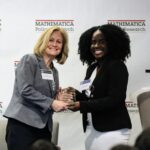
“I am privileged to receive strong support in my pursuit of a career in math and economics,” says Anna Gifty Opoku-Agyeman, M26, ‘19, mathematics, co-founder of the Sadie Tanner Mossell Alexander Conference for Economics and Related Fields. “I am an anomaly. There has never existed a formal space for Black women in economics to convene and benefit from the resources of a supportive network. I co-created one.”
On February 23, the Sadie Collective launched the first Sadie T.M. Alexander Conference for Economics and Related Fields. The event was held at the Washington D.C. office of Mathematica, a policy research organization.
The Sadie Collective is made up of undergraduate, graduate, and post-baccalaureate students from across the country, including student leaders from UMBC. Along with Opoku-Agyeman, the group includes conference co-organizer and head of logistics Olusayo Adeleye ’20, M28, economics and mathematics. Yasmin Graham ’19, mechanical engineering, served as event photographer. Bethany Woosen ’19, economics and mathematics, participated in the conference, along with other Black women in math, economics, and related fields from across the country.
“There weren’t many people like me in math and economics, which was frustrating. Through the Sadie Collective, I have the community and support I was seeking,” explains Adeleye. “Now, I am part of a network and platform that promotes Black women economists and provides access to high-level opportunities for future Black women economists.”
The conference received support from donors worldwide, including prominent economists. The UMBC delegation also received funding for accommodations from the UMBC economics department through an Alfred P. Sloan Foundation grant. This $1.3 million dollar grant program, announced in November 2017, works to increase the number of students from underrepresented racial and ethnic groups who complete highly competitive doctoral programs in economics.
Did I mention that we have a private Q&A session with the former chair of the @federalreserve, Janet Yellen? Thank you @BrookingsInst and @davidmwessel for this amazing opportunity. #SACE2019 pic.twitter.com/nqCfgPgAoc
— Anna (@itsafronomics) February 22, 2019
Finding a circle of support
Opoku-Agyeman came to UMBC with an interest in understanding health inequalities in Black and African diaspora communities. She found unwavering support for her questions and research in three women on campus: Jacqueline King, Nandita Dasgupta, and Gloria Chuku.
Jacqueline King, Ph.D. ‘09, psychology, met Opoku-Agyeman when she applied to the MARC U*Star program. King is assistant director of the program, which supports students from historically underrepresented groups in the biomedical sciences, with the goal that they go on to complete advanced degrees.
“I’ve witnessed Anna’s metamorphosis from a student who was unsure of her academic capabilities to a young woman who is positioning herself to impact the economic and public policy field,” King remembers. “Her superpower is her ability to foster connections and collaborations to make a difference.”

 Panelists Sandile Hlatshwayo (first on left), International Monetary Fund, and Kehinde F. Ajayi (second from right back row), World Bank, pose with participants from University of California, Berkeley.
Opoku-Agyeman explains that Dasgupta, adjunct professor of economics, and Chuku, chair, and professor of Africana studies, have also been intrinsic to her success. “Dr. Dasgupta gave me an economic framework to understand a developing Africa,” she says, “and Dr. Chuku has provided the historical context for the structural inequalities in the African Diaspora.”
With their support, Opoku-Agyeman realized math and economics were priceless tools in understanding health inequalities which helped to eventually chose to major in mathematics and minor in economics.
Inspiration from Sadie T. M. Alexander
As Opoku-Agyeman began to look for other Black women economists to connect with, she was stunned to find so few. Seeking inspiration, she found the story of Sadie T. M. Alexander, the first African American woman to earn a Ph.D. in economics.
 Participants celebrate Alexander’s legacy.
Between 1919 and 1923 Alexander served as the first national president of Delta Sigma Theta sorority, which focused on service to the African American community. She earned her Ph.D. in 1921 from the Wharton School of the University of Pennsylvania, at a time when the economics field did not allow Black women to practice. Undeterred, Alexander completed a dissertation that called for a change in economic models to include the economic lives of the Black community. She continued to be a pioneer and in 1929 become the first African American woman to earn a law degree from University of Pennsylvania Law School and the first African American woman to practice law in Pennsylvania.
The Indicator Podcast today on Sadie Alexander!
Very fitting on the day of the inaugural Sadie Alexander Conference #SACE2019https://t.co/IqmGqdBw4O pic.twitter.com/OFOpG8suGR
— Dina D. Pomeranz (@DinaPomeranz) February 23, 2019
When Opoku-Agyeman learned that there was no global or U.S. professional organization for Black women economists, she drew inspiration from Alexander’s pioneering spirit and decided to take action.
Legacy of Black women economists
The inaugural Sadie Tanner Mossell Alexander Conference for Economics and Related Fields drew over eighty Black women undergraduate and graduate students, and PhDs in economics, from across the United States and Canada. Notable economists Julianne Malveaux and Willene A. Johnson discussed the implications of Alexander’s dissertation research and speeches for current economic theory and future research. Malveaux, former president of Bennett College, and Johnson, president of Komaza, Inc., a development finance and peacebuilding firm, have both written extensively on the role of economics in Alexander’s life. Alexander’s daughter, Rae Alexander-Minter, and her grandchildren attended as guests of honor.
 Panel on navigating the professional space as a Black woman (L to R): Linda Loubert, interim chair of economics at Morgan State University; Valerie Wilson, Economic Policy Institute; Sandile Hlatshwayo, International Monetary Fund; and Kehinde F. Ajayi, The World Bank.
Three expert panels during the event provided participants insight on how to help Black women succeed in economics, opportunities for Black women in economics beyond the undergraduate years, and navigating professional spaces as a Black woman. These panels included Black women economists from the International Monetary Fund; Women’s Institute for Science, Equity, and Race; American Economic Association; Harvard Research Scholar Initiative; Joint Center for Political and Economic Studies; Federal Reserve Board; Africa Gender Innovation Lab at The World Bank; Economic Policy Institute; and multiple universities.
Recruiters from doctoral programs as well as prestigious financial and government institutions also attended to take advantage of this unique opportunity to reach out to top talent from across the United States.
Future of Black women economists
Opoku-Agyeman and her co-organizers see an ongoing need for a thriving network of Black women economists beyond the annual conference. They have founded the Sadie Collective to not just organize the conference, but also to connect, empower, equip, and educate Black women in economics and public policy more broadly, for years to come.
 Participants celebrate the future of Black women economists.
The group has already drawn wide public interest. Recently, Congresswoman Maxine Waters mentioned the Sadie Collective in her testimony in a financial and monetary policy hearing with the Federal Reserve. NPR’s Planet Money and Forbes Magazine have also noted the importance of the conference for increasing diversity in economics.
“Similar to Dr. Alexander, people have projected their limitations onto me, often focusing on what I could not do because of my race/ethnicity, gender, socioeconomic background, age, or all of the above,” says Opoku-Agyeman. “She taught me that there is absolutely nothing that I cannot do. If want to reach a goal, all I have to do is run towards it.”
Banner image: Opoku-Agyeman presenting Diane Herz, vice president, director of human services, and chief diversity officer of Mathematica Policy Research, with a plaque of appreciation for hosting the first Sadie T.M. Alexander Conference.
All photos courtesy of the Sadie Collective.
]]>
“I am privileged to receive strong support in my pursuit of a career in math and economics,” says Anna Gifty Opoku-Agyeman, M26, ‘19, mathematics, co-founder of the Sadie Tanner Mossell Alexander...
https://umbc.edu/stories/1st-sadie-alexander-conference/
https://my3.my.umbc.edu/api/v0/pixel/news/120198/guest@my.umbc.edu/2d87b81abddafed3f7d53c1dbb3caec3/api/pixel
cahss
class-of-2019
economics
marcustar
mathstat
meyerhoffscholars
page1
policy-and-society
UMBC News & Magazine
https://my3.my.umbc.edu/groups/umbc-news-magazine
https://assets1-my.umbc.edu/system/shared/avatars/groups/000/001/943/24435aa6207c452e7bc15cc74b42c7bb/xsmall.png?1748556657
https://assets1-my.umbc.edu/system/shared/avatars/groups/000/001/943/24435aa6207c452e7bc15cc74b42c7bb/original.png?1748556657
https://assets2-my.umbc.edu/system/shared/avatars/groups/000/001/943/24435aa6207c452e7bc15cc74b42c7bb/xxlarge.png?1748556657
https://assets2-my.umbc.edu/system/shared/avatars/groups/000/001/943/24435aa6207c452e7bc15cc74b42c7bb/xlarge.png?1748556657
https://assets3-my.umbc.edu/system/shared/avatars/groups/000/001/943/24435aa6207c452e7bc15cc74b42c7bb/large.png?1748556657
https://assets1-my.umbc.edu/system/shared/avatars/groups/000/001/943/24435aa6207c452e7bc15cc74b42c7bb/medium.png?1748556657
https://assets2-my.umbc.edu/system/shared/avatars/groups/000/001/943/24435aa6207c452e7bc15cc74b42c7bb/small.png?1748556657
https://assets1-my.umbc.edu/system/shared/avatars/groups/000/001/943/24435aa6207c452e7bc15cc74b42c7bb/xsmall.png?1748556657
https://assets2-my.umbc.edu/system/shared/avatars/groups/000/001/943/24435aa6207c452e7bc15cc74b42c7bb/xxsmall.png?1748556657
UMBC News & Magazine
0
0
false
Wed, 06 Mar 2019 19:58:37 -0500
The Joy of Giving

On UMBC’s second annual Giving Day last week, campus and social media buzzed with creative call-outs and challenges for 1,000 donors to participate in the 24-hour window. Mama’s Boys, True Grit, and other student-led entertainment drew a crowd to Main Street where the festivities celebrated the ongoing gifts rolling in, while different departments and athletic teams took to Twitter to playfully compete with each other, using car karaoke and other incentives to spur on supporters.
In typical UMBC fashion, students, staff, and alumni rallied to go well beyond the goal and by midnight, 1,554 donors had raised $106,906 to support an array of campus programs and scholarships.
So what did this Black and Gold Rush of philanthropy look like on campus and beyond?
 Students participate in Main Street Giving Day activities.
Grateful Dawgs
The day underscored UMBC’s culture of gratitude and generosity. By 9 a.m. the University reached 25% of the donor goal, and while most of the giving was online, the IRL experience was just gearing up. Main Street in The Commons came to life as employees and student volunteers set up for a massive thank you card writing effort awash in black and gold. Students also participated in philanthropy trivia, earning prizes and snacks.
Soon hundreds of grateful notes filled the space. “I can achieve because you gave. I will achieve because you supplied opportunities,” wrote student Sam, ’21.
Chalese Cathran ’20, psychology and education, took part in the events and paused to consider the impact of donations as she wrote a thank you note to donors. “I learned that 54% of new freshmen receive scholarships. I’m one of those students. I didn’t realize how many of us there were.”
The Alumni Endowed Scholarship Fund and the Scholars Programs were two of the top three recipients of donations, underscoring UMBC’s emphasis on providing resources for students to break through financial barriers. The Women’s Center was another program rewarded by their ongoing social media outreach, earning support from 78 individual donors.
 Members of the Women’s Center thank their donors.
Rising to the Challenge
“At one point, it felt like there was a gift coming it at every second,” said Joanne Meredith, director of annual giving, who credits the success of the day to involvement at every level. New to 2019 was the Quest, a game created to engage current students in the day’s activities. “This is going to be our next generation,” said Meredith. “Some of them now may be receiving scholarships or financial aid and this helps them understand why we do this Giving Day.”
The campus-wide game gave students clues to locations that featured a life-sized cut-out of mascot True Grit. After finding the correct spot and posing with philanthropy-related factoids, students from 26 different teams walked away with a better idea of the effect giving has on their student experiences.
One group of four was organized by Marygrace Reyes ’20, environmental science, who roped her friends into participating. “This gets me out there, having fun and being involved. And a free t-shirt,” said Nick Le ’21, information systems, joking that Reyes also rescued him from doing homework.
Navigating the Quest clues landed them at Lecture Hall 1, the entrance to The Commons, the Resource Learning Center, and the Residential Life office.
“This sounds really cliché, but I might actually go donate something,” said Lauren Chua ’21, mathematics and statistics, reflecting on what she learned during the Quest. “It doesn’t take that much time or money to help.”
In the 25 minutes it took Reyes and her friends to accomplish their task, the donor tally grew from 449 to 539, meaning the marathon surpassed half its goal right as the time hit the halfway mark at noon.
 Tiffany Dang ’20, Lauren Chua ’21, Marygrace Reyes ’20, and Nick Le ’21, pose with True Grit.
Raising the Bar
By 2:30 p.m., 75% of the goal had been reached but the day was far from over. The UMBC Swimming and Diving Team led the charge on social media and their supporters made a huge splash, earning the team the highest spot of the list of University ambassadors – as well as donors and dollars raised – for Giving Day.
While the whole UMBC community benefits from the philanthropic endeavor, an ongoing leaderboard tracked the top offices designated by donors to receive funds. Athletics encouraged donations with lively social media feeds that included car karaoke and other entertaining livestreams.
Other standout feeds worth following included the UMBC Bookstore, who highlighted staff and students in an impressive roundup of UMBC impact stories over the course of the day. The College of Engineering and Information Technology also stepped up to the plate, with Dean Keith J Bowman leading the charge, shamelessly using his pup Odo to elevate his college to fourth place in donors and donations.

As the clocked ticked down to midnight, support continued to pour in beyond the original goal. “UMBC is such a great community so this doesn’t surprise me, but when you raise the bar, they always jump to reach it,” said Meredith. “There is this grit here that leads to greatness.”

Unless from social media, all photos courtesy of Marlayna Demond ’11 for UMBC Magazine.
]]>
On UMBC’s second annual Giving Day last week, campus and social media buzzed with creative call-outs and challenges for 1,000 donors to participate in the 24-hour window. Mama’s Boys, True Grit,...
https://umbc.edu/stories/the-joy-of-giving/
https://my3.my.umbc.edu/api/v0/pixel/news/120199/guest@my.umbc.edu/f6b1eda6a6c3a7a619ba903fde9b4b92/api/pixel
alumni
athletics
impact
spring-19
UMBC News & Magazine
https://my3.my.umbc.edu/groups/umbc-news-magazine
https://assets1-my.umbc.edu/system/shared/avatars/groups/000/001/943/24435aa6207c452e7bc15cc74b42c7bb/xsmall.png?1748556657
https://assets1-my.umbc.edu/system/shared/avatars/groups/000/001/943/24435aa6207c452e7bc15cc74b42c7bb/original.png?1748556657
https://assets2-my.umbc.edu/system/shared/avatars/groups/000/001/943/24435aa6207c452e7bc15cc74b42c7bb/xxlarge.png?1748556657
https://assets2-my.umbc.edu/system/shared/avatars/groups/000/001/943/24435aa6207c452e7bc15cc74b42c7bb/xlarge.png?1748556657
https://assets3-my.umbc.edu/system/shared/avatars/groups/000/001/943/24435aa6207c452e7bc15cc74b42c7bb/large.png?1748556657
https://assets1-my.umbc.edu/system/shared/avatars/groups/000/001/943/24435aa6207c452e7bc15cc74b42c7bb/medium.png?1748556657
https://assets2-my.umbc.edu/system/shared/avatars/groups/000/001/943/24435aa6207c452e7bc15cc74b42c7bb/small.png?1748556657
https://assets1-my.umbc.edu/system/shared/avatars/groups/000/001/943/24435aa6207c452e7bc15cc74b42c7bb/xsmall.png?1748556657
https://assets2-my.umbc.edu/system/shared/avatars/groups/000/001/943/24435aa6207c452e7bc15cc74b42c7bb/xxsmall.png?1748556657
UMBC News & Magazine
0
0
false
Tue, 05 Mar 2019 21:28:41 -0500
Retriever basketball heads to America East playoffs

The month of March is a favorite for Retriever Nation, with America East playoffs on the horizon and memories of UMBC’s 2018 March Madness victory on everyone’s mind.
This year, both UMBC’s men’s and women’s basketball teams will compete in America East postseason play. The winners will then go on to compete in the 2019 NCAA Championships at the end of March.
Tyler Moore ‘20, psychology,and graduate student Joe Sherburne ‘18, financial economics, are leading their teams on and off the court. These team captains have both been standouts in 3-point field goals, and have each earned 2019 Academic All-District 2 First Team (CoSIDA) honors.
Women’s basketball ready for America East quarterfinals
Janee’a Summers ‘21, psychology, joins Moore as co-captain of the women’s team. Even as one of the youngest teams in the nation—with no seniors this year—the team has finished the regular season strong to earn the No. 7 seed in the America East tournament.
Among this season’s most exciting contests, the Retrievers upset UAlbany in a late season game. Later on, with their playoff fate on the line, they won at New Hampshire, 55-47, to earn a spot in the quarterfinals.
The Retrievers will take on second-seeded Hartford in West Hartford, Conn., on Wednesday, March 6 at 7 p.m. The game will be broadcast on ESPN+ (see game info). Students can enjoy the game with friends and popcorn at a watch party in the Sports Zone, also starting at 7 p.m.
Men’s basketball heads into postseason at No. 3
The 2018-19 season figured to be a challenging endeavor for the men’s team, led by head coach Ryan Odom. Standout guards Jairus Lyles ‘17, sociology; K. J. Maura ‘18, sociology; and Jourdan Grant ‘18, media and communication studies, completed their UMBC careers in 2018. The Retrievers’ phenomenal NCAA success in 2018 also assured they’d be considered a team to beat by this year’s opponents.
The Retrievers’ record stood at 9-9 and 1-2 in America East play in mid-January. Moreover, starting forwards Max Curran ’20, sociology, and Daniel Akin ’21 suffered season-ending injuries in December and January respectively. But the tide soon turned.
With a strong defense, the team earned ten wins in the final 13 games. UMBC defeated eventual regular season champion Vermont twice in that span, including a 65-56 win before a national television audience (ESPNU) at the UMBC Event Center on February 21.
To cap the regular season, UMBC rallied from an 18-point second half deficit to defeat New Hampshire, 56-53, on March 2. Freshman guard José Placer’s 3-point field goal with 2.4 seconds left on the clock punctuated the comeback.
As a result, UMBC earned the No. 3 seed in the America East Tournament and will host No. 6 UAlbany at the UMBC Event Center on Saturday, March 9. Students are invited to a pre-game social in the Sports Zone, starting 11:30 a.m. Tip-off time is scheduled for 1 p.m. Tickets are now available online for both students and the general public.
Featured image: UMBC team captain Joe Sherburne during a game against Vermont. Photo by Gail Burton.
This article was written by Steve Levy, UMBC Athletics.
]]>
The month of March is a favorite for Retriever Nation, with America East playoffs on the horizon and memories of UMBC’s 2018 March Madness victory on everyone’s mind. This year, both UMBC’s...
https://umbc.edu/stories/retriever-basketball-heads-to-america-east-playoffs/
https://my3.my.umbc.edu/api/v0/pixel/news/120200/guest@my.umbc.edu/67278d75cb943a762fdd1ae8edf4a4a2/api/pixel
athletics
community
UMBC News & Magazine
https://my3.my.umbc.edu/groups/umbc-news-magazine
https://assets1-my.umbc.edu/system/shared/avatars/groups/000/001/943/24435aa6207c452e7bc15cc74b42c7bb/xsmall.png?1748556657
https://assets1-my.umbc.edu/system/shared/avatars/groups/000/001/943/24435aa6207c452e7bc15cc74b42c7bb/original.png?1748556657
https://assets2-my.umbc.edu/system/shared/avatars/groups/000/001/943/24435aa6207c452e7bc15cc74b42c7bb/xxlarge.png?1748556657
https://assets2-my.umbc.edu/system/shared/avatars/groups/000/001/943/24435aa6207c452e7bc15cc74b42c7bb/xlarge.png?1748556657
https://assets3-my.umbc.edu/system/shared/avatars/groups/000/001/943/24435aa6207c452e7bc15cc74b42c7bb/large.png?1748556657
https://assets1-my.umbc.edu/system/shared/avatars/groups/000/001/943/24435aa6207c452e7bc15cc74b42c7bb/medium.png?1748556657
https://assets2-my.umbc.edu/system/shared/avatars/groups/000/001/943/24435aa6207c452e7bc15cc74b42c7bb/small.png?1748556657
https://assets1-my.umbc.edu/system/shared/avatars/groups/000/001/943/24435aa6207c452e7bc15cc74b42c7bb/xsmall.png?1748556657
https://assets2-my.umbc.edu/system/shared/avatars/groups/000/001/943/24435aa6207c452e7bc15cc74b42c7bb/xxsmall.png?1748556657
UMBC News & Magazine
0
0
false
Tue, 05 Mar 2019 19:04:00 -0500
UMBC mentors support a record number of Fulbright student award semifinalists

The Fulbright U.S. Student Program, funded by the U.S. Department of State, is now more than 70 years old. In that time, the distinguished program has selected nearly 400,000 college seniors and recent graduates to represent the United States in study, research, and teaching abroad, including over 50 recipients from UMBC in just the past decade. This year UMBC has produced thirty applicants and twenty-two semifinalists—a record number for the university.
These semifinalists have been selected for their vision to create solutions and serve as leaders around the world. They and the mentors who have supported their journeys—faculty, staff, peers, and family—await with anticipation the final decisions that will launch the next class of Fulbright visionaries.
Finding a niche in field biology
Matthew Kane ‘19, biological sciences, and member of the Honors College, came to UMBC with a laser focus on biology and track. Kevin Omland, professor of biological sciences, and Matt Gitterman, head cross country coach, offered him guidance throughout the years, as he grew his skills and explored his next steps, including applying for a Fulbright U.S. Student Award.
Omland met Kane in Biology 142, Ecology and Evolution. “Matthew was one of the most engaged students. He was a super hard and positive worker,” remembers Omland. Gitterman also recognized Kane’s high level of focus. He coached him on identifying what was important and finding the next logical step. Gitterman explains, “We worked on transferring these skills and habits to more meaningful experiences beyond college.”
 Matthew Kane running cross country for UMBC. Photo courtesy of UMBC athletics.
Kane eventually combined both passions through international fieldwork as part of Omland’s Bahama Oriole research group—an experience that gave him his first plane ride. “Mathew’s natural interest and extraordinary background knowledge of field biology and wildlife, along with his physical and mental strength made him ideal for fieldwork,” says Omland.
Omland also connected Kane to a researcher at the National Taiwan Normal University (NTNU). He hopes to soon join NTNU researchers studying native bird species in Taiwan’s mountains.
Being capable of big things
Creating opportunities to discover new paths is a key way mentors support students and defines how Jamie Trevitt, assistant professor of health administration and policy, has supported Jessica Linus ‘19, health administration and policy.
“I would not be here if it wasn’t for Jamie Trevitt,” shares Linus. “At first I wanted to be pre-med and pursue a career in obstetrics and gynecology to help with African women’s health,” remembers Linus. But that changed during a trip to Nigeria, where she shadowed doctors in a hospital. There she saw structural, staffing, and management needs that kept the hospital from being a greater benefit to the community.
 Jessica Linus at an orphanage during a service trip to Port Harcourt, Nigeria. Photo courtesy of Linus.
Following that experience, Trevitt helped Linus secure an internship in reproductive health in Rwanda through a National Science Foundation program. “The best part of my job as a professor and educator is helping students find their passion within the public health field,” says Trevitt.
The internship gave Linus first-hand experience conducting interviews, doing qualitative research, using data analysis software, working with Rwandan professors, and shadowing doctors in a hospital. She was amazed to find a thriving health system only twenty-five years after the Rwandan genocide. But she was also perplexed by the contrast she saw to Nigeria’s many economic and health care struggles.
“I had big questions,” explains Linus. “I needed to understand what made this Rwandan hospital thrive and find ways I could help the hospital in Nigeria do the same.”
Trevitt sees in Linus an emerging leader in international public health, and she knows that asking big questions and taking advantage of opportunities like a possible Fulbright research award in Rwanda will help her get there. “As a professor,” Trevitt explains, “there is no better reward than helping a student realize they are capable of big things and then watching them grow into a confident and knowledgeable expert that’s ready to make a difference in our global society.”
A new framework for understanding gender
When Sarah Chard met Robert Barrett ‘15—majoring in cultural anthropology as well as biochemistry and molecular biology—she was struck by the clarity of his interests. “Robert knew very early on that he wanted to find a research experience in biomedicine and anthropology, and study abroad in India,” remembers Chard, associate professor of sociology, anthropology, and health administration and policy. “The challenge was to determine how the pieces could fit together over several years.”
 Robert Barrett receives a shiro vasti treatment during an Ayurvedic medicine class in India. Photo courtesy of Barrett.
Together Chard and Barrett explored what his unique path could look like. “There are many pathways. Validating them affirms the importance of ideas and recognizes students as scholars who bring new and exciting work to the discipline,” says Chard. “It’s important during conversations with students to help them foresee roadblocks and alternatives, and develop a flexible mindset.”
These conversations prepared Barrett to make the most of his study abroad experience in South India at Manipal University. “My research in India required me to learn a completely new framework for understanding gender, sexuality, and associated stigma,” he explains. “It tested my ability to use research methods across a language barrier, and provided concrete examples of the social determinants of health.”
 Mural in India. Photo courtesy of Barrett.
The experience in India, as well as his work as a medical scribe in the U.S., have shaped his understanding of homophobia and anti-queer views as largely based on negative views of femininity. In his position as a scribe, he notes, “I observed derogatory comments and misgendering of transgender patients, revealing the lack of LGBT-specific training within healthcare.”
Next, Barrett wants to ground himself in feminist and queer theory in another cross-cultural context to better prepare himself to serve the health needs of LGBT people. The Fulbright U.S. Student Award would allow him to earn a master’s degree in gender studies at Tampere University in Finland before enrolling in an M.D./Ph.D. program.
Jodi Kelber-Kaye, associate director of the Honors College, has enjoyed exciting and fascinating conversations with Barrett, a member of the Honors College, as a mentor. “Robert is willing to ask the ‘what if’ questions that become real possibilities for social change work,” shares Kelber-Kaye. “It is a creative process. He throws out ideas, listens to my thoughts about those ideas, and refines them. He is not afraid to take intellectual risks.”
Kelber-Kaye also reflects, “Mentoring is a combination of practical and personal. This is an academic pursuit for Robert that is also founded in his own identity.” She shares, “He has often remarked that living my life as openly lesbian has helped him see what it looks like to have a rich life that is open and honest.”
Engineering possibilities
“If you are not comfortable being out of your comfort zone then you are closing the door to amazing opportunities,” is a saying that Marc Zupan, associate professor of mechanical engineering, avidly shares with his Global Engineering students. It’s an idea Jacob Schubbe ‘18, mechanical engineering, has taken to heart.
STEM students are sometimes unsure about whether they have time to study abroad while working to complete required courses, but Schubbe knew early on that he wanted an international experience. Schubbe chose to study engineering in Ireland, and used the opportunity to travel more across Europe, from Moscow to London. Gaining experience living outside of his comfort zone proved an asset upon graduation when he was hired as an engineer by a multinational engineering company.
 Jacob Schubbe in Ireland at the Cliffs of Moher. Photo courtesy of Schubbe.
“I want to design green energy and help solve world problems through mechatronic engineering,” a combination of mechanical and electrical engineering, explains Schubbe. “I have a plan A, a plan B, and a plan C and they all end with me earning a Mechatronic System Design master’s program degree at Lappeenranta-Lahti University of Technology in Finland.”
But determination is only half of the formula. Schubbe didn’t know anyone in Finland or how to present all of his experiences in a compelling way in the Fulbright application. Zupan helped point him in the right direction.
“A lot of what I do in terms of mentoring is simply being available. I answer questions, connect students with other faculty, set guidelines, and provide examples,” explains Zupan.
Zupan is particularly proud that this year’s UMBC Fulbright semifinalists include three students from mechanical engineering—Scubbe, as well as Rebekah Kempske ‘19, mechanical engineering, and Lucas McCullum ‘19, mechanical engineering and mathematics. Zupan shares, “I love being there for students as they see the world open up because they were willing to step out of their comfort zone.”
For the love of teaching
“When I transferred to UMBC from Howard Community College I was surrounded with people who supported me in pursuing unfamiliar opportunities,” remembers Liam Connor ‘18, information systems, an audio-visual technician at Good Samaritan Hospital.
At UMBC, Connor learned that the Vietnam Medical Assistance Program, a student organization, needed help with managing information and data. He didn’t speak Vietnamese and didn’t have experience in the healthcare field, but he had a passion for data management and for service. Connor has now taken two service trips to Vietnam with the group, and currently serves as operations volunteer.
 Liam Connor with colleagues in Vietnam. Photo courtesy of Connor and the Vietnam Medical Assistance Program.
In between trips, Connor worked at UMBC’s English Language Institute (ELI), where he first began to consider teaching as a possible career. “We watched Liam go from being a reserved student to an engaged purposeful teacher,” recalls Ryan Sheldon, academic director of ELI. Connor sought Sheldon’s expertise to understand ESOL theory and worked with Cara Aaron, an ELI instructor, to learn how theory is applied in the classroom. Connor hopes to return to Vietnam as an English Teaching Assistant via the Fulbright U.S. Student Award.
Beyond the lab
Cynthia Wagner, senior lecturer in biological sciences, advises 50 students each semester. With some of them, she focuses on selecting the right courses, but for “very organized students” like Manneha Qazi ‘18, biological sciences, and member of the Honors College, she says, “we have time to discuss life plans.”
Wagner discussed with Qazi her desire to pursue an M.D./Ph.D., to combine her interests in medicine and teaching. She also connected her with valuable research experience in the lab of developmental biologist Rachel Brewster. “MD/Ph.D. programs are very competitive and it is important to be aware of the range of experiences you bring,” says Wagner. “Manneha was diligent in broadening her skills beyond the lab.”
Qazi sought opportunities to expand her skills as a biology tutor, an undergraduate teaching assistant, a volunteer at the Esperanza Center teaching English to immigrant children, and as a teaching fellow for the McNair Scholars Program. The biology faculty recognized her commitment and impact through a Sandoz Undergraduate Teaching Award in 2017.
Next, Qazi wants to apply her teaching skills internationally in a predominantly Muslim setting. “In high school, my family moved to Pakistan for two years,” she shares. “The education system was very different from the U.S. system. It sparked a curiosity of how students learn in other educational systems.” Qazi is now a semifinalist for an English Teaching Assistant in Uzbekistan.
 Manneha Qazi (front row, fourth from left) with students from her discussion section of Biology 141. Photo courtesy of Qazi.
Thinking about her conversations with Qazi, Wagner focuses on the importance of “small moments to stop and listen.” Mentors can truly make a difference, she says, by being mindful of “how each moment can impact another person”—by listening closely to students and responding to their needs.
The peer mentor
Sometimes mentors are classmates. For Leah Ginty ‘14, modern languages, linguistics and intercultural communication, and ‘19 M.A., TESOL, a classmate in her TESOL master’s program was the catalyst to pursuing a Fulbright U.S. Student Award. That classmate was Brian Souders, Ph.D. ’09, language, literacy and culture, UMBC’s Fulbright U.S. Student Award advisor.
“Even when I am in the role of student and not working, I am always happy to share and promote the Fulbright experience wherever I go,” says Souders. “I have seen first-hand how it catapults students’ success in a way they never thought possible.”
 Brian Souders with UMBC’s 2018 Fulbright class. Photo by Marlayna Demond ‘11 for UMBC.
Ginty knew she wanted to work in Benin since she visited her brother during his Peace Corps experience there. She fell in love with the people and the culture of the French-speaking West African nation and decided to pursue a master’s degree in French at Boston College after graduating from UMBC. She then became a teaching assistant on the Caribbean French-speaking island of Guadeloupe, where she found she also loved teaching English to speakers of other languages and decided to pursue teaching languages as a career.
“I wanted to return to UMBC and enroll in the TESOL master’s program in hopes of returning to Benin with all the formal qualifications to succeed,” says Ginty. The opportunity arrived quicker than she expected. Souders, upon hearing her desire to return to Benin, shared with her that Fulbright U.S. Student Award program had just opened an English Teaching Assistant program in Benin.
“I am dedicated to promoting this amazing opportunity for UMBC students, as well as mentoring them throughout the process,” shares Souders. He offers every student encouragement and skills-based support to guide them through the challenges of completing a highly competitive Fulbright application. And students share that he is integral to their success in the long but worthwhile Fulbright journey.
“Every call, every meeting, has one purpose,” Souders says, “to help students believe they have the personal and academic skills to be selected for this prestigious award.”
Two of last year’s Fulbright recipients are sharing updates on their work through social media. Morgan Chadderton ’18, modern languages, linguistics, and intercultural communication, did an Instagram takeover from Kyrgyzstan where she’s teaching English. Flora Kirk ’18, ancient studies, will share the work she’s accomplished studying ancient coins in Romania on Instagram on March 7.
This year’s semi-finalists hope to research, teach, and study in 13 countries across Asia, Europe, Africa, and South America:
Research Assistant Semifinalist
-
Mathew Kane ’19, biological sciences, Taiwan
-
Jessica Linus ’19, health administration and policy, Rwanda
-
Lucan McCullum ’19, mechanical engineering, mathematics, Switzerland
-
Gabriela Salas ’10, global studies, gender, women’s and sexuality studies, Mexico
English Teaching Assistant Semifinalists
-
Jennifer Bohlman ’19, M.A., ESOL, Germany
-
Dymond Elliot ’19, psychology, modern languages, linguistics, and intercultural
studies
-
Chanler Harris ’19, anthropology, Taiwan
-
Bryce Moore ’19, modern languages, linguistics and intercultural communication,
Kazakhastan
-
Michael Schapiro ’19, M.A., TESOL, Colombia
-
Savannah Steinley ’19, computer engineering and English, Uzbekistan
-
Liam Connor ’19, information systems, Vietnam
-
Kelly Wan ’18, global studies, financial economics, Korea
-
Michael Tomitz ’17, business technology administration, Germany,
-
Leah Ginty ’14, modern languages, linguistics and intercultural communication, and
’19, M.A., TESOL, Benin
-
Manneha Qazi ’18, biological sciences, Uzbekistan
M.A./M.S. Study Semifinalists
-
Stefan Gehrman ’19, anthropology, Iceland
-
Rebekah Kempske ’19, mechanical engineering, Netherlands
-
Julian Tash ’19, Asian studies, history, Taiwan
Banner image: (L to R) Matthew Kane, Kevin Omland, and Briana Yancy ’19, environmental science and geography. Photo by Marlayna Demond ’11 for UMBC.
]]>
The Fulbright U.S. Student Program, funded by the U.S. Department of State, is now more than 70 years old. In that time, the distinguished program has selected nearly 400,000 college seniors and...
https://umbc.edu/stories/umbc-mentors-support-a-record-number-of-fulbright-student-award-semifinalists/
https://my3.my.umbc.edu/api/v0/pixel/news/120201/guest@my.umbc.edu/e0e19e5776d758280c8d971f1375a4d9/api/pixel
arts-and-culture
biology
cahss
cnms
coeit
education
international
policy-and-society
UMBC News & Magazine
https://my3.my.umbc.edu/groups/umbc-news-magazine
https://assets1-my.umbc.edu/system/shared/avatars/groups/000/001/943/24435aa6207c452e7bc15cc74b42c7bb/xsmall.png?1748556657
https://assets1-my.umbc.edu/system/shared/avatars/groups/000/001/943/24435aa6207c452e7bc15cc74b42c7bb/original.png?1748556657
https://assets2-my.umbc.edu/system/shared/avatars/groups/000/001/943/24435aa6207c452e7bc15cc74b42c7bb/xxlarge.png?1748556657
https://assets2-my.umbc.edu/system/shared/avatars/groups/000/001/943/24435aa6207c452e7bc15cc74b42c7bb/xlarge.png?1748556657
https://assets3-my.umbc.edu/system/shared/avatars/groups/000/001/943/24435aa6207c452e7bc15cc74b42c7bb/large.png?1748556657
https://assets1-my.umbc.edu/system/shared/avatars/groups/000/001/943/24435aa6207c452e7bc15cc74b42c7bb/medium.png?1748556657
https://assets2-my.umbc.edu/system/shared/avatars/groups/000/001/943/24435aa6207c452e7bc15cc74b42c7bb/small.png?1748556657
https://assets1-my.umbc.edu/system/shared/avatars/groups/000/001/943/24435aa6207c452e7bc15cc74b42c7bb/xsmall.png?1748556657
https://assets2-my.umbc.edu/system/shared/avatars/groups/000/001/943/24435aa6207c452e7bc15cc74b42c7bb/xxsmall.png?1748556657
UMBC News & Magazine
0
0
false
Fri, 01 Mar 2019 23:36:58 -0500
UMBC’s Chris Swan contributes to landmark global stream ecology study

A single leaf dropping into a stream has just a tiny impact, but, together, the billions of leaves that drop into waterways every year help keep global ecosystems going. How this works and why it’s so important are two questions addressed in a massive, new study in Science Advances co-authored by UMBC’s Chris Swan and over 150 researchers across all seven continents.
Leaves are mostly made of carbon, a primary building block for all living things. As leaves fall, organisms that live in or near rivers and streams are “supported by this pulse of carbon,” either directly or indirectly, says Swan, professor of geography and environmental systems.
“At any one point in time there’s not a lot of carbon there,” Swan explains, “but rivers serve as the plumbing system of the planet when it comes to how much carbon flows through.” So what factors drive how all that carbon is processed?
The new landmark study reveals how environmental factors drive the flow of carbon through the world’s waterways. “The study looked across the globe to learn what drives the rate of carbon decay in rivers and streams,” Swan says. “How is it transformed into energy as it travels up through the food web or transported downstream?”
Shifting patterns
The researchers first determined the overall carbon flow in waterways “across all continents and across a serious range of latitudes,” Swan says. They found that temperature was the biggest driver of carbon flow.
“That’s important because of climate change,” Swan says. “This study suggests that if temperature goes up, the rate at which carbon degrades will also go up.” This means that temperature change could reshape how carbon flows “either up the food chain or downstream.”
For example, bacteria, fungi, and aquatic invertebrates (like crayfish) are all responsible for breaking down some of the carbon in rivers. With climate change, “Bacteria and fungi that consume carbon are probably going to be more responsible for degrading it than invertebrates, because invertebrates aren’t able to evolve as fast” to adapt to the changing temperature, Swan explains. As some species succeed and others struggle, that could eventually lead to shifts in the makeup of aquatic ecosystems.
 Chris Swan checks on plants at the UMBC greenhouses for use in restoration projects. Photo by Marlayna Demond ’11 for UMBC.
Development and dead zones
Increasing human development near waterways may also play an important role in carbon flow. Development “snips off” the smallest streams, but it’s at those abundant small streams where there’s an “intimate connection between streams and the forest,” Swan says. Those small streams are “part of the water purification process,” he explains.
Without as many small streams to break down the carbon, it ends up on pavement and runs off into larger streams and rivers. That creates higher than normal carbon concentrations, which can lead to low-oxygen “dead zones” in those larger waterways that are dangerous, even lethal, to aquatic life.
The value of partnership
The results of this study provide an important baseline for research on carbon flow in waterways moving forward. The experimental design at each site was simple, “but to manage and deploy it across the globe to all seven continents was a Herculean task that could only be done with a network of colleagues,” says Swan. “The key here is true partnerships and global coverage.”
To come to their conclusions, the scientists all used the same protocol: They each placed identical cotton squares provided by the lead author, Scott Tiegs at Oakland University, in a nearby stream. Then they carefully measured variables like the temperature, chemical makeup, flow rate, and width of the stream, plus the percentage canopy cover (how shaded the stream is). Everyone sent their cotton squares back to Tiegs, and he measured the cotton’s integrity at the end of the experiment.
Leaf chemistry can play a significant role in how quickly leaves decay—oak leaves are very slow, and ash leaves are fast, for example. But by using the cotton squares instead of real leaves, “we held all of that leaf chemistry constant and just looked at the environmental drivers,” Swan says.
“What I’m most proud about is being part of a group that was able to document the patterns on such a large scale using a consistent approach,” Swan says. Because of its extensive scope and scale, Swan expects the paper to be used in classrooms for a long time to come. As a benchmark study, it could teach generations of ecology students the fundamentals of carbon processing in waterways.
“The study is a lesson in stream ecology,” Swan says, “but the bigger lesson is that if you have partnerships you can do big things, and come up with big patterns.”
Image: Chris Swan. Photos by Marlayna Demond ’11 for UMBC.
]]>
A single leaf dropping into a stream has just a tiny impact, but, together, the billions of leaves that drop into waterways every year help keep global ecosystems going. How this works and why...
https://umbc.edu/stories/umbcs-chris-swan-contributes-to-landmark-global-stream-ecology-study/
https://my3.my.umbc.edu/api/v0/pixel/news/120202/guest@my.umbc.edu/a6df6252adc84cd63ac4a22a1d0bdb64/api/pixel
cahss
ges
page1
research
science-and-technology
UMBC News & Magazine
https://my3.my.umbc.edu/groups/umbc-news-magazine
https://assets1-my.umbc.edu/system/shared/avatars/groups/000/001/943/24435aa6207c452e7bc15cc74b42c7bb/xsmall.png?1748556657
https://assets1-my.umbc.edu/system/shared/avatars/groups/000/001/943/24435aa6207c452e7bc15cc74b42c7bb/original.png?1748556657
https://assets2-my.umbc.edu/system/shared/avatars/groups/000/001/943/24435aa6207c452e7bc15cc74b42c7bb/xxlarge.png?1748556657
https://assets2-my.umbc.edu/system/shared/avatars/groups/000/001/943/24435aa6207c452e7bc15cc74b42c7bb/xlarge.png?1748556657
https://assets3-my.umbc.edu/system/shared/avatars/groups/000/001/943/24435aa6207c452e7bc15cc74b42c7bb/large.png?1748556657
https://assets1-my.umbc.edu/system/shared/avatars/groups/000/001/943/24435aa6207c452e7bc15cc74b42c7bb/medium.png?1748556657
https://assets2-my.umbc.edu/system/shared/avatars/groups/000/001/943/24435aa6207c452e7bc15cc74b42c7bb/small.png?1748556657
https://assets1-my.umbc.edu/system/shared/avatars/groups/000/001/943/24435aa6207c452e7bc15cc74b42c7bb/xsmall.png?1748556657
https://assets2-my.umbc.edu/system/shared/avatars/groups/000/001/943/24435aa6207c452e7bc15cc74b42c7bb/xxsmall.png?1748556657
UMBC News & Magazine
0
0
false
Wed, 27 Feb 2019 15:19:49 -0500
Letitia Dzirasa to serve as Baltimore City health commissioner

Letitia Dzirasa ’03, M11, biological sciences, has been appointed by Mayor Catherine Pugh to serve as Baltimore’s next health commissioner. She will be the city’s first African American woman in the role, and preside over the health department’s annual budget of $150 million and about 800 employees.
Dzirasa always knew she wanted to have a career serving others. Her new position, which she will assume March 11, will enable her to support the health and well-being of city residents on a large scale.
“We are so proud of Letitia’s new appointment,” shares Keith Harmon, director of the Meyerhoff Scholars Program. As an undergraduate Meyerhoff Scholar at UMBC, Dzirasa conducted public health research at Johns Hopkins University. “Even then, she was interested in work that shed light on and positively impacted the health outcomes of certain populations,” Harmon says.
Commitment to populations in need
Dzirasa’s past roles speak to her commitment to improving health through innovative solutions. She most recently served as health innovation officer at Fearless Solutions, a software company she co-founded with her husband, Delali Dzirasa ’04, computer engineering. Fearless develops software solutions in the healthcare and government sectors that have a positive social impact. In 2016, the company created tools for Baltimore City to track health trends, discover risk factors, and overall help the health department more effectively allocate resources to work toward better health for all Baltimoreans.
 Dr. Dzirasa at work at Fearless Solutions. Photo courtesy Fearless Solutions.
Previously, Dzirasa worked as a pediatrician in Odenton, Maryland at a practice that primarily serves military families. She also served as the medical director of school-based health for the Baltimore Medical System, a non-profit that serves uninsured and underinsured patients.
Support leads to strength
Although it has been a lifetime calling, “UMBC was where I began to understand just how important it was to serve others,” Dzirasa shares. She says the late LaMont Toliver, former director of the Meyerhoff Scholars Program, played a significant role in strengthening her passion for this work and supported her on her journey through UMBC and beyond.
Dzirasa reflects, “To have someone who believed in me so much…was huge in pushing me to excel.”
“As I’ve grown in my career, I’ve begun to understand just how blessed I was to be afforded the opportunity to attend college and pursue my dreams,” Dzirasa says. “As I was fortunate, it is my responsibility to reach back and help others, especially those most under-resourced.”
Taking on tough challenges
As health commissioner, Dzirasa plans to focus her efforts on preventing violence (especially among youth), addressing obesity and food deserts, and tackling the opioid epidemic. She also understands that social factors play a large role in one’s health, and addressing the root causes of health challenges is critical to reducing health disparities in Baltimore.
“Her experiences have given her keen insights into the needs of individuals—including those with the least resources and the greatest needs,” says President Freeman Hrabowski. “I have known Dr. Dzirasa for almost 20 years. She is an individual of strong character, and she is deeply motivated to ensure all Baltimore residents have equitable access to care. I am delighted that she will be the city’s next health commissioner.”
Banner image: Letitia Dzirasa; photo courtesy Letitia Dzirasa.
]]>
Letitia Dzirasa ’03, M11, biological sciences, has been appointed by Mayor Catherine Pugh to serve as Baltimore’s next health commissioner. She will be the city’s first African American woman in...
https://umbc.edu/stories/letitia-dzirasa-to-serve-as-baltimore-city-health-commissioner/
https://my3.my.umbc.edu/api/v0/pixel/news/120203/guest@my.umbc.edu/577f80a5d4dc3d00ddf9e1fce53d80fd/api/pixel
biology
cnms
community
meyerhoffscholars
science-and-technology
UMBC News & Magazine
https://my3.my.umbc.edu/groups/umbc-news-magazine
https://assets1-my.umbc.edu/system/shared/avatars/groups/000/001/943/24435aa6207c452e7bc15cc74b42c7bb/xsmall.png?1748556657
https://assets1-my.umbc.edu/system/shared/avatars/groups/000/001/943/24435aa6207c452e7bc15cc74b42c7bb/original.png?1748556657
https://assets2-my.umbc.edu/system/shared/avatars/groups/000/001/943/24435aa6207c452e7bc15cc74b42c7bb/xxlarge.png?1748556657
https://assets2-my.umbc.edu/system/shared/avatars/groups/000/001/943/24435aa6207c452e7bc15cc74b42c7bb/xlarge.png?1748556657
https://assets3-my.umbc.edu/system/shared/avatars/groups/000/001/943/24435aa6207c452e7bc15cc74b42c7bb/large.png?1748556657
https://assets1-my.umbc.edu/system/shared/avatars/groups/000/001/943/24435aa6207c452e7bc15cc74b42c7bb/medium.png?1748556657
https://assets2-my.umbc.edu/system/shared/avatars/groups/000/001/943/24435aa6207c452e7bc15cc74b42c7bb/small.png?1748556657
https://assets1-my.umbc.edu/system/shared/avatars/groups/000/001/943/24435aa6207c452e7bc15cc74b42c7bb/xsmall.png?1748556657
https://assets2-my.umbc.edu/system/shared/avatars/groups/000/001/943/24435aa6207c452e7bc15cc74b42c7bb/xxsmall.png?1748556657
UMBC News & Magazine
0
0
false
Mon, 25 Feb 2019 14:03:53 -0500
The real women of ‘The Favourite’ included an 18th-century Warren Buffett

Amy Froide, Professor of History, UMBC
One of the challengers at this year’s Oscars is “The Favourite,” a film set in the early 18th-century court of British monarch Queen Anne.
Focusing on the political and sexual intrigues of a female-led state, the film has, at its center, not only the queen but also her two “favorites” – Sarah, Duchess of Marlborough, and Abigail, Baroness Masham. Much of the film focuses on how these two female courtiers vie for influence over Anne.
These early 18th-century women are hardly household names, so a movie that introduces them to a wider audience is welcome. And it doesn’t hurt that some of today’s biggest Hollywood stars inhabit the main roles: Olivia Coleman stars as Queen Anne, Rachel Weisz plays Sarah Churchill, and Emma Stone appears as Abigail Masham.
The film, as well as all three actresses, were nominated for Oscars.
But how does the portrayal of these women stack up against the historical reality? Might the fancy frocks, extravagant palaces and sexual triangles distract viewers from their true historical significance?
As a historian of women in early modern Britain, I’ve built my career analyzing the roles that women played in the past despite living in male-dominated societies. In fact, Sarah Churchill is featured in my recent book, “Silent Partners: Women as Public Investors during England’s Financial Revolution, 1680-1750.”
While “The Favourite” introduces viewers to the women who were important political figures in early 18th-century Britain, it doesn’t quite capture just how much power these women – especially Sarah – actually wielded.
Queen Anne and the birth of an empire
The Queen Anne portrayed in “The Favourite” is physically and mentally a mess, which isn’t entirely inaccurate.
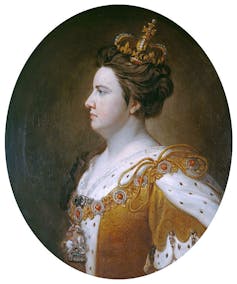 Queen Anne wasn’t without flaws, but she left a bold stamp on history.
Royal Collection
While it is true that she had bad eyesight, was overweight, suffered from gout and endured the loss of 17 children, this was only one side of her.
By watching the film, you wouldn’t learn that Queen Anne presided over the union of Scotland and England into Great Britain in 1707, kept the Jacobite supporters of her Catholic half-brother at bay, successfully maintained a Protestant monarchy that has lasted into the present day, and furthered Britain’s rise to dominance on sea and land, ushering in the first century of Britain’s global empire.
Sarah pulls the (purse) strings
The figure around whom the action pivots in “The Favourite,” however, is not Queen Anne but Sarah Churchill. The power behind Anne’s throne, Sarah possesses the political, economic and military vision for the country.
As Keeper of the Privy Purse, one of Sarah’s jobs was to manage the royal household’s financial accounts. And with her husband, General John Churchill, away much of the time leading the queen’s troops, Sarah also handled the finances and investments for her own family.
Her political adversaries accused both Churchills of benefiting financially from their ties to Queen Anne. Sarah’s control over access to the queen and John’s role leading the army created opportunities for patronage, bribes and, in John’s case, some shady involvement in army supply contracts.
In my book, I argue that while the Churchills may have been venal and dishonest, much of their money came from Sarah’s astute and underappreciated investing in the stock market. As an early adopter of stock investing, Sarah put her family’s funds into the national debt, the Bank of England and shares in private companies. In 1704, she had over 19,000 pounds of her own money in stocks, or US$3.5 million today.
Sarah became famous for avoiding the losses so many of her contemporaries incurred in the South Sea Bubble of 1720, when investors poured money into the South Sea Company. She had wisely taken her family’s money out a few months before the crash because she realized the company’s stock was overvalued. In the process she made a cool 100,000 pounds.
Unlike the male courtiers in “The Favourite” who foolishly wager on duck races, Sarah didn’t make unnecessary gambles. She was such a savvy and significant investor; like Warren Buffett today, her actions and decisions could single-handedly influence the market. When British Prime Minister Robert Walpole needed money to fund the government, it was Sarah Churchill whom he approached for a loan of 200,000 pounds.
Abigail Masham is a more shadowy historical figure. As Emma Stone so ably shows in the movie, Abigail was quite intelligent.
But she seemed to be more interested in political maneuvering for personal gain, or for the benefit of her party, the Tories, who competed with the Whigs for power. Tellingly, Abigail left politics when Anne died, while Sarah, a Whig, didn’t end her political involvement even when dismissed from Anne’s service.
A reflexive response to powerful female figures
As a queen, Anne had female, rather than, male attendants, meaning that those closest to power were also women. In “The Favourite,” Sarah Churchill tells the government ministers that if they want to see the queen, they need to an appointment with her. This inverted power dynamic made contemporaries uncomfortable and resulted in rumors and insinuations about the nature of the relationships between the queen and her female attendants.
Not surprisingly, “The Favourite” makes much of these lesbian rumors, and some scenes depict sexual activity between women. But the 18th-century suggestions of homosexuality had more to do with the discomfort contemporaries had about women wielding power than actual same-sex relationships, although those happened too.
While the movie primarily focuses on the politics of the personal – the cat fights, jealousy and love triangles – the reality is that these women ran Britain.
The movie is on firmer ground in the way it depicts the men in their orbit. They are either absent (the Duke of Marlborough is away at the front), foolish (Minister Harley struts around in make up and a foppish get-up) or subservient (the young Colonel Masham follows Abigail around like a puppy).
Yes, women like Sarah enjoyed a lot of power due to her role as the queen’s favorite, and yes, she used that power to benefit her family. No, she probably wasn’t nice.
But how was this any different from the male courtiers who had been close to English kings for centuries? Sarah Churchill wasn’t doing anything new or particularly wrong.
She was just doing it as a woman.
* * * * *
Amy Froide, Professor of History, University of Maryland, Baltimore County, is the author of Silent Partners: Women as Public Investors during Britain’s Financial Revolution, 1690-1750 (Oxford University Press, 2016).
This article is republished from The Conversation under a Creative Commons license. Read the original article.
Header image: Sarah Churchill was an adroit investor and savvy political operative. Government Art Collection
]]>
Amy Froide, Professor of History, UMBC One of the challengers at this year’s Oscars is “The Favourite,” a film set in the early 18th-century court of British monarch Queen Anne. Focusing on...
https://umbc.edu/stories/the-real-women-of-the-favourite-included-an-18th-century-warren-buffett/
https://my3.my.umbc.edu/api/v0/pixel/news/120204/guest@my.umbc.edu/688c87c2a07bee8ec9d92bcadf82f9ea/api/pixel
amy-froide
discovery
history
UMBC News & Magazine
https://my3.my.umbc.edu/groups/umbc-news-magazine
https://assets1-my.umbc.edu/system/shared/avatars/groups/000/001/943/24435aa6207c452e7bc15cc74b42c7bb/xsmall.png?1748556657
https://assets1-my.umbc.edu/system/shared/avatars/groups/000/001/943/24435aa6207c452e7bc15cc74b42c7bb/original.png?1748556657
https://assets2-my.umbc.edu/system/shared/avatars/groups/000/001/943/24435aa6207c452e7bc15cc74b42c7bb/xxlarge.png?1748556657
https://assets2-my.umbc.edu/system/shared/avatars/groups/000/001/943/24435aa6207c452e7bc15cc74b42c7bb/xlarge.png?1748556657
https://assets3-my.umbc.edu/system/shared/avatars/groups/000/001/943/24435aa6207c452e7bc15cc74b42c7bb/large.png?1748556657
https://assets1-my.umbc.edu/system/shared/avatars/groups/000/001/943/24435aa6207c452e7bc15cc74b42c7bb/medium.png?1748556657
https://assets2-my.umbc.edu/system/shared/avatars/groups/000/001/943/24435aa6207c452e7bc15cc74b42c7bb/small.png?1748556657
https://assets1-my.umbc.edu/system/shared/avatars/groups/000/001/943/24435aa6207c452e7bc15cc74b42c7bb/xsmall.png?1748556657
https://assets2-my.umbc.edu/system/shared/avatars/groups/000/001/943/24435aa6207c452e7bc15cc74b42c7bb/xxsmall.png?1748556657
UMBC News & Magazine
0
0
false
Fri, 22 Feb 2019 14:16:30 -0500
 Govind Rao, third from left, with UMBC students and research partners, during a trip to India. Photo courtesy of Kevin Tran.