Restorative practices may not be the solution, but neither are suspensions

by F. Chris Curran, assistant professor of public policy, UMBC
Proponents of restorative justice suffered a blow recently with the late 2018 release of a much anticipated RAND study of restorative practices in Pittsburgh schools. The study’s results showed restorative practices were not as effective as many hoped – or as they are sometimes portrayed by proponents and in the media .
Unlike traditional disciplinary approaches, such as suspension, which remove students from school, restorative practices focus on repairing harm done by getting victims and perpetrators together to talk.
The idea is to rebuild and restore a sense of dignity and community.
As an educational researcher who studies school discipline, I think it would be misguided to use the study as a reason to go back to the old way of doing things, as is currently under debate in some locales.
First, let’s look at what the study found.
Mixed results
On the positive side, the study found evidence that teachers in schools using restorative practices reported better classroom management and school climate. Restorative practices led to an almost 15 percent decline in days lost to suspension overall. The intervention decreased the days lost to suspension for both black students and students from lower income households. However, it had no significant impact on white students or students from more affluent households. Furthermore, impacts were particularly large in elementary schools – there, the intervention led to an over 50 percent decline in days lost to suspension.
At the same time, however, there were a number of negative outcomes. Restorative practices did not lead to lower rates of suspension in middle schools. Nor did it result in declines in suspensions for violence or arrests. Furthermore, there were negative, statistically significant impacts on standardized achievement test scores in middle schools and for black students.
And, contrary to how teachers saw restorative practices, students reported worse classroom management and relationships.
In my opinion, it’s fair to say the findings were mixed at best.
Strong design, different takes on results
While the new study is not the first to examine restorative practices, it is notable for the strength of its research design. Schools were randomly assigned to use the Institute for Restorative Practices’ SaferSanerSchools Whole-School Change program or not. Since randomized controlled trials are considered the “gold-standard” of evaluating the effectiveness of an intervention, the RAND study theoretically provides more credible estimates of the true effect of the program separate from other school policies and practices.
Perhaps unsurprisingly, the mixed findings have resulted in differing interpretations of the results.
For instance, Max Eden, of the Manhattan Institute, criticized the study’s original authors and popular media for focusing on the positive findings and downplaying the negative results. Ironically, Eden played up the negative findings claiming that “restorative justice isn’t working”.
In addition to the RAND study of restorative practices, other recent studies of discipline reforms, including bans on the use of suspension for minor offenses and shortening the length of suspensions, have also resulted in mixed findings.
A return to suspensions is not the solution
So what should educators and policymakers do with these results?
Even though the RAND study presents a speed bump on the road to discipline reform, turning back to what research has shown to be ineffective and inequitable exclusionary discipline practices would also be a mistake. Numerous studies have found that being suspended from school is predictive of a host of negative outcomes. Those outcomes include decreased academic achievement, a higher likelihood of involvement with the justice system, and decreased civic engagement as adults.
Zero tolerance policies have also been shown to result in greater uses of suspensions and little benefit in terms of improved school climate.
Exclusionary practices are also disproportionately used against students of color. Federal data and other studies have repeatedly shown that black students are three to four times as likely to be suspended as white students, with a large number of these suspensions being for lower level misconduct like “disrespect.”
Such disparities can’t be explained by differences in behavior across racial groups. The disparities may be the result of differences in the use of exclusionary discipline policies across schools.
Reducing suspensions and improving equity in school discipline is still a valid policy goal. The fact that initial reforms have not produced immediate positive results is disappointing, but hardly surprising. After all, changing practice and finding effective interventions in the field of education is hard work. Instead of settling for suspensions, I believe this is the time when states and local school districts should double down on trying innovative alternative approaches to discipline.2
* * * * *
F. Chris Curran, Assistant Professor of Public Policy, University of Maryland, Baltimore County
This article is republished from The Conversation under a Creative Commons license. Read the original article.
Header image of Chris Curran by Marlayna Demond ’11 for UMBC Magazine.
 ]]>
by F. Chris Curran, assistant professor of public policy, UMBC Proponents of restorative justice suffered a blow recently with the late 2018 release of a much anticipated RAND study of...
https://umbc.edu/stories/restorative-practices-may-not-be-the-solution-but-neither-are-suspensions/
https://my3.my.umbc.edu/api/v0/pixel/news/120214/guest@my.umbc.edu/c6e054909c4bb46ef2499b538f2fe9ea/api/pixel
perspectives
UMBC News & Magazine
https://my3.my.umbc.edu/groups/umbc-news-magazine
https://assets1-my.umbc.edu/system/shared/avatars/groups/000/001/943/24435aa6207c452e7bc15cc74b42c7bb/xsmall.png?1748556657
https://assets1-my.umbc.edu/system/shared/avatars/groups/000/001/943/24435aa6207c452e7bc15cc74b42c7bb/original.png?1748556657
https://assets2-my.umbc.edu/system/shared/avatars/groups/000/001/943/24435aa6207c452e7bc15cc74b42c7bb/xxlarge.png?1748556657
https://assets2-my.umbc.edu/system/shared/avatars/groups/000/001/943/24435aa6207c452e7bc15cc74b42c7bb/xlarge.png?1748556657
https://assets3-my.umbc.edu/system/shared/avatars/groups/000/001/943/24435aa6207c452e7bc15cc74b42c7bb/large.png?1748556657
https://assets1-my.umbc.edu/system/shared/avatars/groups/000/001/943/24435aa6207c452e7bc15cc74b42c7bb/medium.png?1748556657
https://assets2-my.umbc.edu/system/shared/avatars/groups/000/001/943/24435aa6207c452e7bc15cc74b42c7bb/small.png?1748556657
https://assets1-my.umbc.edu/system/shared/avatars/groups/000/001/943/24435aa6207c452e7bc15cc74b42c7bb/xsmall.png?1748556657
https://assets2-my.umbc.edu/system/shared/avatars/groups/000/001/943/24435aa6207c452e7bc15cc74b42c7bb/xxsmall.png?1748556657
UMBC News & Magazine
0
0
false
Tue, 05 Feb 2019 14:50:37 -0500
UMBC Mock Trial takes top prize at Georgetown’s Hilltop Invitational as competition season kicks into high gear
]]>
by F. Chris Curran, assistant professor of public policy, UMBC Proponents of restorative justice suffered a blow recently with the late 2018 release of a much anticipated RAND study of...
https://umbc.edu/stories/restorative-practices-may-not-be-the-solution-but-neither-are-suspensions/
https://my3.my.umbc.edu/api/v0/pixel/news/120214/guest@my.umbc.edu/c6e054909c4bb46ef2499b538f2fe9ea/api/pixel
perspectives
UMBC News & Magazine
https://my3.my.umbc.edu/groups/umbc-news-magazine
https://assets1-my.umbc.edu/system/shared/avatars/groups/000/001/943/24435aa6207c452e7bc15cc74b42c7bb/xsmall.png?1748556657
https://assets1-my.umbc.edu/system/shared/avatars/groups/000/001/943/24435aa6207c452e7bc15cc74b42c7bb/original.png?1748556657
https://assets2-my.umbc.edu/system/shared/avatars/groups/000/001/943/24435aa6207c452e7bc15cc74b42c7bb/xxlarge.png?1748556657
https://assets2-my.umbc.edu/system/shared/avatars/groups/000/001/943/24435aa6207c452e7bc15cc74b42c7bb/xlarge.png?1748556657
https://assets3-my.umbc.edu/system/shared/avatars/groups/000/001/943/24435aa6207c452e7bc15cc74b42c7bb/large.png?1748556657
https://assets1-my.umbc.edu/system/shared/avatars/groups/000/001/943/24435aa6207c452e7bc15cc74b42c7bb/medium.png?1748556657
https://assets2-my.umbc.edu/system/shared/avatars/groups/000/001/943/24435aa6207c452e7bc15cc74b42c7bb/small.png?1748556657
https://assets1-my.umbc.edu/system/shared/avatars/groups/000/001/943/24435aa6207c452e7bc15cc74b42c7bb/xsmall.png?1748556657
https://assets2-my.umbc.edu/system/shared/avatars/groups/000/001/943/24435aa6207c452e7bc15cc74b42c7bb/xxsmall.png?1748556657
UMBC News & Magazine
0
0
false
Tue, 05 Feb 2019 14:50:37 -0500
UMBC Mock Trial takes top prize at Georgetown’s Hilltop Invitational as competition season kicks into high gear

UMBC Mock Trial took first in late January at Georgetown University’s 8th annual Hilltop Invitational Tournament, with UMBC’s A team finishing undefeated at 8-0. On the path to tournament victory, UMBC bested teams from George Washington University, Fordham University, and Hamilton College. The team scored over 100 points above competitors, including former national champions Yale and UVA, who scored second and fourth place respectively.
 UMBC Mock Trial A team win at Georgetown.
The winning team is made up of students from a broad range of majors and levels of competitive experience. They include Linnea Collins ’21, global studies; Kaitlyn Kauffman ’20, political science, Sydney Gaskins ’21, political science; Thomas Kiley ’19, chemistry; Ethan Hudson ’21, English; Natalie Murray ’21, biological sciences; and Nihir Nanavaty ’19, political science.
In addition to taking the number one spot, UMBC Mock Trial’s A-Team received two high-level individual awards. Sydney Gaskins earned Outstanding Attorney awards for both sides of the case, representing both plaintiff and defendant. Gaskins is still in her sophomore year, but has already earned several Mock Trial awards, and she is a finalist for Trial by Combat, an elite one-on-one Mock Trial national championship competition co-hosted by UCLA and Drexel University. Nihir Nanavaty received an Outstanding Witness award. (Above: first on the right.)
 Gaskins with awards from Georgetown University Tournament.
“The Georgetown University Tournament became the first time that UMBC Mock Trial ever maintained an undefeated record at a tournament. It was also the first time that an attorney from this program received two Outstanding Attorney Awards in one tournament,” explains Gaskins. “I am honored and grateful to have the opportunity to be a part of history in the making for UMBC Mock Trial. I hope it inspires my team to continue to dream big and believe in ourselves. Anything is possible if you work hard.”
While UMBC Team A was in Washington, D.C., UMBC Teams B and C competed at the Blue Jay Invitational at Johns Hopkins University. These teams are composed primarily of students in their first year of college mock trial, and they performed well against tough competitors. Thomas Azari ’22, individualized study, won Outstanding Attorney. Zachary Linkins ’20, computer science, competing in his first tournament, won Outstanding Witness (pictured below).

In addition to Azari and Linkins, UMBC Team B also includes Lauren Wotring ’22, political science; Fernando Silva ’21, political science; Wendy Zhang ’22, economics and psychology; Amrita Sarma ’22, psychology; and Hannah Thomas ’22, computer science. UMBC Team C includes Amanda Hampton ’22, biological sciences; Alexis Stevenson ’21, history and political science; Tyler Pollock ’21, English; Flora Jeon ’21, biological sciences; Tumee Agogbuo ’22, media and communication studies; Brandon Henry ’20, computer science and interdisciplinary studies; Matthew Brown; Rocio Marquez ’22, mechanical engineering and social work; and Joselle Royer ’21, sociology.
 UMBC Mock Trial Teams B and C at Johns Hopkins University.
Head coach Ben Garmoe ’13, political science, a litigation attorney in Baltimore, is extremely proud of UMBC’s three mock trial teams. For him, UMBC’s first-place finish at the Hilltop Invitational has special meaning. “I came as a transfer student to UMBC and co-founded the mock trial team with Travis Bell in 2011,” remembers Garmoe. “We competed at the tournament in 2013 and also won an award, so now we have come full circle.” Bell ’14, psychology and political science, is now a public defender in Alabama. Garmoe credits the success of UMBC Mock Trial to UMBC’s leadership in creating a rigorous and diverse academic environment where students from all backgrounds and all fields value critical thinking, rigor, and teamwork.
Along with a strong student commitment, UMBC Mock Trial’s success is also a result of dedicated coaches from the legal field, including several alumni. They include Summer Akhtar ’18, financial economics and political science; Travis Bell; Dylan Elliott ’17, history; Zachary Garmoe ’17, environmental studies; Cheyenne Smith ’16, biological sciences and psychology; and Kayla Smith ’17, interdisciplinary studies.
Finally, it wasn't just our students out there winning ballots and awards; assistant coach and former Vice-President Kayla Smith competed at the @H_T_A_A Medical-Legal Trial Competition. Kayla's @brooklynlaw team took second place, and Kayla won Best Closing Argument! pic.twitter.com/ao1S57kkIo
— UMBC Mock Trial (@UMBCMockTrial) December 15, 2018
“Our culture is outstanding. We even draw coaches not directly connected to UMBC,” says Garmoe. “Whitney Wilder, a former competitor at the College of Charleston and now an attorney at Bodie, Dolina, Hobbs, Friddell & Grenzer, P.C., brings important expertise and guidance to the team.”
“As someone who was a four-year competitor for the program and was the program’s president as a senior, I find weekends like this past one to be both rewarding and exciting,” says Dylan Rogers Elliott ’17, history. “I came through the program and have been able to come back and coach while in law school, and nothing makes me happier than seeing both the success and potential of the UMBC Mock Trial Program continue to grow.”
Elliott shares, “We have so much young talent now, throughout the program, and it really feels like we’re getting the foundation set for a really terrific run over the next few years. This past weekend really shows us the potential of our program and underscores just how bright the future is.”
Up next for the focused team is the Owings Mills Regional Tournament, which UMBC is co-hosting with Stevenson University. This will help the teams refine their approach and prepare for the Opening Round Championship Series (ORCS), a national semifinal event hosted by the American Mock Trial Association where the nations 700 teams will compete. From there, they hope to advance to the national championship tournament in Philadelphia.
Fans can follow the team on their path to nationals through @UMBCmocktrial on Twitter, Instagram, and Facebook.
Banner Image: UMBC Mock Trial trophies by Marlayna Demond ’11 for UMBC. All other images are courtesy of UMBC Mock Trial.
]]>
UMBC Mock Trial took first in late January at Georgetown University’s 8th annual Hilltop Invitational Tournament, with UMBC’s A team finishing undefeated at 8-0. On the path to tournament victory,...
https://umbc.edu/stories/umbc-mock-trial-takes-top-prize-at-georgetowns-hilltop-invitational-as-competition-season-kicks-into-high-gear/
https://my3.my.umbc.edu/api/v0/pixel/news/120215/guest@my.umbc.edu/9939b888cb0e467a4615ab0b21aca2d0/api/pixel
cahss
cnms
coeit
inds
policy-and-society
socialwork
UMBC News & Magazine
https://my3.my.umbc.edu/groups/umbc-news-magazine
https://assets1-my.umbc.edu/system/shared/avatars/groups/000/001/943/24435aa6207c452e7bc15cc74b42c7bb/xsmall.png?1748556657
https://assets1-my.umbc.edu/system/shared/avatars/groups/000/001/943/24435aa6207c452e7bc15cc74b42c7bb/original.png?1748556657
https://assets2-my.umbc.edu/system/shared/avatars/groups/000/001/943/24435aa6207c452e7bc15cc74b42c7bb/xxlarge.png?1748556657
https://assets2-my.umbc.edu/system/shared/avatars/groups/000/001/943/24435aa6207c452e7bc15cc74b42c7bb/xlarge.png?1748556657
https://assets3-my.umbc.edu/system/shared/avatars/groups/000/001/943/24435aa6207c452e7bc15cc74b42c7bb/large.png?1748556657
https://assets1-my.umbc.edu/system/shared/avatars/groups/000/001/943/24435aa6207c452e7bc15cc74b42c7bb/medium.png?1748556657
https://assets2-my.umbc.edu/system/shared/avatars/groups/000/001/943/24435aa6207c452e7bc15cc74b42c7bb/small.png?1748556657
https://assets1-my.umbc.edu/system/shared/avatars/groups/000/001/943/24435aa6207c452e7bc15cc74b42c7bb/xsmall.png?1748556657
https://assets2-my.umbc.edu/system/shared/avatars/groups/000/001/943/24435aa6207c452e7bc15cc74b42c7bb/xxsmall.png?1748556657
UMBC News & Magazine
0
0
false
Mon, 04 Feb 2019 16:35:42 -0500
UMBC chosen to host AAAS science and faith dialogue project

UMBC is one of six universities nationwide selected to host the “Engaging Scientists in the Science and Religion Dialogue” project, administered by the American Association for the Advancement of Science (AAAS). UMBC’s “Engaging Scientists” events will be held March 25 – 26, 2019, and will be open to the entire UMBC community.
The centerpiece will be a science engagement and communication workshop, run by staff of the AAAS Dialogue on Science, Ethics, and Religion (DoSER) program. The interactive, three-hour workshop will focus on how STEM graduate students, established scientists, and science educators can engage with diverse (and especially with religious) communities about science in both formal and informal settings.
“An individual’s cultural background and worldview (which, for most Americans, includes faith) informs their perceptions of the role of science in society, and their opinions about a range of science and technology issues,” says Robert O’Malley, project director at DoSER. The DoSER program “offers scientists, educators, and communicators a range of evidence-based strategies, toolkits, and resources for engagement” with people of diverse religious backgrounds, he explains.
Springboard for conversation
Talking about faith and science is not always easy, nor does it come naturally to all scientists, even if they are people of faith themselves. “Some people see science and faith in harmony, but for others the two are discordant,” says Bill LaCourse, dean of the College of Natural and Mathematical Sciences, the program’s on-campus sponsor. He notes that this can set the stage for conflict, silence, and misunderstanding, which can only be resolved through dialogue.
To promote this dialogue, the organizers are developing a range of events for the UMBC community. On March 25, in addition to the workshop there will be a public panel featuring scientists and science communicators from a range of faith traditions, and an open-house style event where anyone can leave a written or video message recording their thoughts on the topic.
Partners from all three UMBC colleges are joining in the project. They will organize companion events for people to explore their thoughts on this topic more deeply within their on-campus communities.
A final component of the event is a Public Engagement Contest. Graduate students, postdocs, faculty, and staff who attend the workshop are eligible to enter the contest with a community partner outside of UMBC. DoSER will award $1,000 to up to four ongoing or proposed projects that demonstrate commitment to engaging with religious publics about science and technology. Entries are due April 15, giving participants time to be inspired by and reflect on the Engaging Scientists events. In addition to UMBC, other participating universities include Stanford University, Vanderbilt University, Texas State University, Indiana University, and Howard University.
More than one way to truth
Dean LaCourse and the UMBC co-organizers hope the March events will serve as a springboard to launch further discussion around science and faith and make the topic a more explicit part of UMBC’s mission to foster inclusive excellence.
Some scientists of faith may be reluctant to discuss their religious lives in an academic setting, LaCourse says. Yet some of the world’s greatest scientists have practiced some manner of religious faith without finding it in conflict with their work.
“20th century scholarship converged on the idea that no one approach to finding truth is sufficient or superior,” says Steve Freeland, director of UMBC’s Individualized Study Program and a Christian astrobiologist who has spoken internationally on the topic of science and faith.
“This gives all of us reasons for humility as we seek truth in our different ways,” Freeland says. “UMBC is blessed with such diversity in every imaginable dimension that it is an exciting place to experience a scholarly exploration of the interface between science and faith.”
That rich diversity creates many opportunities for UMBC community members to interact with people whose views differ from their own. “The path to acceptance of differing views starts with dialogue, which may be difficult without the proper words,” LaCourse says. “This program is a unique opportunity to help our campus begin the conversation.”
See more details about all UMBC Engaging Scientists events and register for the workshop and panel here.
Image: Faculty attending an interdisciplinary UMBC research forum on aging in May 2017. Photo by Marlayna Demond ’11 for UMBC.
]]>
UMBC is one of six universities nationwide selected to host the “Engaging Scientists in the Science and Religion Dialogue” project, administered by the American Association for the Advancement of...
https://umbc.edu/stories/umbc-chosen-to-host-aaas-science-and-faith-dialogue-project/
https://my3.my.umbc.edu/api/v0/pixel/news/120216/guest@my.umbc.edu/854698abef7d283bf118758e1d3a18f2/api/pixel
cnms
community
diversityandinclusion
inds
policy-and-society
science-and-technology
UMBC News & Magazine
https://my3.my.umbc.edu/groups/umbc-news-magazine
https://assets1-my.umbc.edu/system/shared/avatars/groups/000/001/943/24435aa6207c452e7bc15cc74b42c7bb/xsmall.png?1748556657
https://assets1-my.umbc.edu/system/shared/avatars/groups/000/001/943/24435aa6207c452e7bc15cc74b42c7bb/original.png?1748556657
https://assets2-my.umbc.edu/system/shared/avatars/groups/000/001/943/24435aa6207c452e7bc15cc74b42c7bb/xxlarge.png?1748556657
https://assets2-my.umbc.edu/system/shared/avatars/groups/000/001/943/24435aa6207c452e7bc15cc74b42c7bb/xlarge.png?1748556657
https://assets3-my.umbc.edu/system/shared/avatars/groups/000/001/943/24435aa6207c452e7bc15cc74b42c7bb/large.png?1748556657
https://assets1-my.umbc.edu/system/shared/avatars/groups/000/001/943/24435aa6207c452e7bc15cc74b42c7bb/medium.png?1748556657
https://assets2-my.umbc.edu/system/shared/avatars/groups/000/001/943/24435aa6207c452e7bc15cc74b42c7bb/small.png?1748556657
https://assets1-my.umbc.edu/system/shared/avatars/groups/000/001/943/24435aa6207c452e7bc15cc74b42c7bb/xsmall.png?1748556657
https://assets2-my.umbc.edu/system/shared/avatars/groups/000/001/943/24435aa6207c452e7bc15cc74b42c7bb/xxsmall.png?1748556657
UMBC News & Magazine
0
0
false
Fri, 01 Feb 2019 21:57:03 -0500
UMBC scientists tackle persistent hurdles in the aquaculture industry with new NOAA grant

As consumer demand for fish continues to grow worldwide, scientists are working to address some of aquaculture’s most persistent challenges. “There are a few bottlenecks and hurdles that the industry needs to address,” says Yonathan Zohar, professor and chair of marine biotechnology at UMBC. He and Ten-Tsao Wong, assistant professor of marine biotechnology, are working to address two of those hurdles: fish escaping from net pens and dying of disease.
Wong and Zohar recently received $670,000 of a $740,000, three-year grant from the National Oceanic and Atmospheric Administration to support their research. The remaining $70,000 will support the Maryland Sea Grant’s outreach and education efforts related to improving aquaculture.
Identifying the hurdles
UMBC faculty at the Institute of Marine and Environmental Technology, a multi-institution facility on Baltimore’s Inner Harbor, are perhaps best known for their groundbreaking work raising marine fish on land. Their current NOAA-supported research has a different focus—tackling challenges in offshore aquaculture, where fish are grown in net pens in the open ocean.
Farmed fish are bred for traits that benefit farmers and consumers, so they end up having a different and much less diverse genetic makeup than their wild cousins. If farmed fish escape from the pens and mate with wild fish, “It changes the gene pool and the nature of the wild stocks,” Zohar explains, “and it can lead to the displacement or disappearance of the wild stocks.”
 The Institute of Marine and Environmental Technology. Photo by Marlayna Demond ’11 for UMBC.
In addition, some of the most popular commercial fish, such as salmon, reach reproductive maturity before they reach market size. Once reproductively mature, a fish’s growth rate slows because some of its energy is diverted toward developing reproductive organs, and therefore away from growing muscle. On top of that, reproductively mature fish tend to produce lower-quality meat, making them less valuable on the market. They also have weakened immune systems, so they’re more susceptible to disease. This is a major issue when fish are raised at high-density in pens exposed to potential pathogens in the ocean.
In response to these problems, Zohar and Wong have invented a technique to grow fish that cannot reproduce. This would solve the escape problem, because if sterile fish escape a net pen, they won’t be able to mate with wild fish, so they can’t alter the wild population’s gene pool. And sterile fish address the reduced performance of reproductively mature fish, too, because without their energy going toward developing reproductive organs, they don’t suffer from a slower growth rate, muscle deterioration and disease the way fertile fish do.
Solutions, a step at a time
Some methods do currently exist to produce sterile fish, but they aren’t very practical for the rapidly expanding aquaculture industry. For example, scientists can produce triploid fish—fish with three, instead of two, copies of every chromosome. These fish only grow well in absolutely perfect conditions. Also, modifying the number of fish chromosomes may present regulatory hurdles and can repel potential consumers.
“Everybody has been looking for another way to develop reproductively sterile fish,” Zohar says.
Rather than altering a fish’s genetic code, Wong and Zohar created a new method that prevents a fish embryo from producing a particular protein necessary to develop reproductive organs. The process temporarily silences the gene that codes for this protein, called deadend, during a critical one-to-two week window of development. The gene’s sequence remains unaltered, however, so the fish isn’t a GMO.
 Wong (right) and Zohar observe rockfish in a tank at the Aquaculture Research Center at IMET. Photo by Gary Jones.
Previously, this new method was found to be effective, but required every fish to be injected individually with the silencing compound. “If you consider the industrial scale, injection is way too much work to do,” Wong says. With this in mind, Wong and Zohar set off to improve their approach.
The future of aquaculture
In Wong and Zohar’s new method, fish embryos are bathed in a solution containing the silencing compound at the critical time during development. They have found the solution to be much faster, cheaper, and simpler than the injection method. Because the solution is applied well before producers place fish in net pens, it also doesn’t risk exposing wild populations to the silencing compound.
Previous testing showed that the technique works in zebrafish, a small freshwater fish commonly used in research. Now it has also been implemented in the commercially important Atlantic salmon and rainbow trout. The main goal of the current work is to optimize the process. In previous experiments, 84 percent of rainbow trout that received the treatment grew up to be sterile. Wong and Zohar would like to see that number climb.
They are also partnering with the USDA to conduct a performance study of sterile fish, testing whether or not they grow faster than fertile ones. “It will help us to prove the case that these fish are going to be more cost-effective,” Wong explains.
“We have done so much already,” Wong says, “and in three years’ time, we hope it’s going to be an optimized commercial protocol.” That would be a win for the aquaculture industry, oceans, and fish consumers worldwide.
Image: Ten-Tsao Wong (left) and Yonathan Zohar at the Aquaculture Research Center. Trays for incubating salmon eggs are on the left. Photo by Gary Jones.
]]>
As consumer demand for fish continues to grow worldwide, scientists are working to address some of aquaculture’s most persistent challenges. “There are a few bottlenecks and hurdles that the...
https://umbc.edu/stories/umbc-scientists-tackle-persistent-hurdles-in-the-aquaculture-industry-with-new-noaa-grant/
https://my3.my.umbc.edu/api/v0/pixel/news/120217/guest@my.umbc.edu/414fe89f63e8b88f142d15e9a5984ed9/api/pixel
cnms
marinebiotech
research
science-and-technology
UMBC News & Magazine
https://my3.my.umbc.edu/groups/umbc-news-magazine
https://assets1-my.umbc.edu/system/shared/avatars/groups/000/001/943/24435aa6207c452e7bc15cc74b42c7bb/xsmall.png?1748556657
https://assets1-my.umbc.edu/system/shared/avatars/groups/000/001/943/24435aa6207c452e7bc15cc74b42c7bb/original.png?1748556657
https://assets2-my.umbc.edu/system/shared/avatars/groups/000/001/943/24435aa6207c452e7bc15cc74b42c7bb/xxlarge.png?1748556657
https://assets2-my.umbc.edu/system/shared/avatars/groups/000/001/943/24435aa6207c452e7bc15cc74b42c7bb/xlarge.png?1748556657
https://assets3-my.umbc.edu/system/shared/avatars/groups/000/001/943/24435aa6207c452e7bc15cc74b42c7bb/large.png?1748556657
https://assets1-my.umbc.edu/system/shared/avatars/groups/000/001/943/24435aa6207c452e7bc15cc74b42c7bb/medium.png?1748556657
https://assets2-my.umbc.edu/system/shared/avatars/groups/000/001/943/24435aa6207c452e7bc15cc74b42c7bb/small.png?1748556657
https://assets1-my.umbc.edu/system/shared/avatars/groups/000/001/943/24435aa6207c452e7bc15cc74b42c7bb/xsmall.png?1748556657
https://assets2-my.umbc.edu/system/shared/avatars/groups/000/001/943/24435aa6207c452e7bc15cc74b42c7bb/xxsmall.png?1748556657
UMBC News & Magazine
0
0
false
Thu, 31 Jan 2019 20:43:18 -0500
Dean Scott Casper continues UMBC’s strong partnership with Maryland Humanities and the Greater Baltimore Cultural Alliance as a new board member

Two leading advocates for the arts and humanities in Maryland have elected Scott Casper, dean of UMBC’s College of Arts, Humanities, and Social Sciences, to their boards of directors. Casper is now beginning three-year terms with Maryland Humanities and the Greater Baltimore Cultural Alliance (GBCA), continuing UMBC’s strong tradition of partnership with the two organizations.
Strong collaboration in the humanities
Maryland Humanities has long been a champion for UMBC’s humanities scholarship. Numerous UMBC faculty have received Maryland Humanities grants over the years. Most recently Felipe Filomeno, assistant professor of political science, and Tania Lizarazo, assistant professor of modern languages, linguistics, and intercultural communication, received support for their project “Honest Conversation: Faith Community Dialogues on Immigration and Race.” Additionally, Maryland Humanities has worked closely with the Dresher Center for the Humanities at UMBC to highlight humanities scholarship through the regular audio segment Humanities Connection, aired on WYPR.
 (L to R) Scott Casper with Angelica Frude, Lydia Yeh, and Paris Ye from Eastern Middle School, who won first place in a Junior Group Website in the Maryland History Day competition 2018, and Mishelle Johnson, from the office of Senator Van Hollen. Courtesy of Mitro Hood ’89, photography.
Both institutions have also partnered for the annual Maryland History Day, which is sponsored by Maryland Humanities and hosted at UMBC (this year on May 11). This program engages 27,000 middle and high school students across the state in historical research projects each year, to help them develop skills in research, critical thinking, writing, and public speaking.
In the spring of 2018, when Maryland Humanities celebrated its 45th anniversary, the organization also honored UMBC President Freeman Hrabowski for his dedication to the organization and his service as a former board member.
“We’re delighted to welcome Dr. Casper to our Board of Directors,” says Phoebe Stein, executive director of Maryland Humanities. “His belief in the value and power of the humanities in our everyday lives, his extensive knowledge of the humanities in Maryland, and his work as a scholar and vast experience as a nonprofit administrator will be immensely valuable.”
 Casper with students at an exhibit by Peggy Re, associate professor of graphic design, in UMBC’s CADVC.
A unique arts partnership
The GBCA has partnered with and supported UMBC’s arts community throughout its seventeen years as a vital arts organization for Baltimore artists. Several UMBC arts faculty have received GBCA awards to support their work, including Tim Nohe, professor of visual arts and director of the Center for Innovation, Research, and Creativity in the Arts (CIRCA); Lee Boot, director of the Imaging Research Center; and Kathy O’Dell, associate professor visual arts and special assistant to the dean for education and arts partnerships.
Numerous UMBC faculty, staff, and alumni have received GBCA Baker Artist Awards. Most recently, celebrated jazz pianist and composer Lafayette Gilchrist ‘92, Africana studies, received a Baker Artist Award to help him continue to compose, perform, and record as a soloist and leader of two genre-defying bands.
UMBC faculty have also supported the GBCA through service and professional development work, honoring the institutions’ shared commitment to innovation and leadership in the arts. O’Dell served for many years on the GBCA Board of Directors, and continues to serve as co-chair of its Equity and Inclusion committee. Additionally, UMBC’s CIRCA partnered with GBCA in professional development intensives for faculty and students.
“It is tremendously meaningful to have Scott on our board with his expertise in the Walters, Civil War monuments, and his humanities perspective,” says Jeannie L. Howe, Executive Director of the GBCA. “We are extremely excited to have his enthusiasm and balance to make great contributions and strengthen [our work] with Maryland Humanities and UMBC as cultural partners in the region, state, and country.”
“Both Maryland Humanities and the Greater Baltimore Cultural Alliance immeasurably enrich our communities, region, and state,” says Scott Casper. “They nurture our collective humanity, our creativity, and our understanding of contemporary and historical contexts for our challenges and endeavors.”
He shares, “I am honored to continue UMBC’s long partnerships with them and excited to participate in their essential work.”
Banner image: Scott Casper with colleagues. By Marlayna Demond ’11 for UMBC.
]]>
Two leading advocates for the arts and humanities in Maryland have elected Scott Casper, dean of UMBC’s College of Arts, Humanities, and Social Sciences, to their boards of directors. Casper is...
https://umbc.edu/stories/dean-scott-casper-continues-umbcs-strong-partnership-with-maryland-humanities-and-the-greater-baltimore-alliance-as-a-new-board-member/
https://my3.my.umbc.edu/api/v0/pixel/news/120218/guest@my.umbc.edu/fff02f97fb5644f78c299adb3d30aa56/api/pixel
cahss
dreshercenter
policy-and-society
visualarts
UMBC News & Magazine
https://my3.my.umbc.edu/groups/umbc-news-magazine
https://assets1-my.umbc.edu/system/shared/avatars/groups/000/001/943/24435aa6207c452e7bc15cc74b42c7bb/xsmall.png?1748556657
https://assets1-my.umbc.edu/system/shared/avatars/groups/000/001/943/24435aa6207c452e7bc15cc74b42c7bb/original.png?1748556657
https://assets2-my.umbc.edu/system/shared/avatars/groups/000/001/943/24435aa6207c452e7bc15cc74b42c7bb/xxlarge.png?1748556657
https://assets2-my.umbc.edu/system/shared/avatars/groups/000/001/943/24435aa6207c452e7bc15cc74b42c7bb/xlarge.png?1748556657
https://assets3-my.umbc.edu/system/shared/avatars/groups/000/001/943/24435aa6207c452e7bc15cc74b42c7bb/large.png?1748556657
https://assets1-my.umbc.edu/system/shared/avatars/groups/000/001/943/24435aa6207c452e7bc15cc74b42c7bb/medium.png?1748556657
https://assets2-my.umbc.edu/system/shared/avatars/groups/000/001/943/24435aa6207c452e7bc15cc74b42c7bb/small.png?1748556657
https://assets1-my.umbc.edu/system/shared/avatars/groups/000/001/943/24435aa6207c452e7bc15cc74b42c7bb/xsmall.png?1748556657
https://assets2-my.umbc.edu/system/shared/avatars/groups/000/001/943/24435aa6207c452e7bc15cc74b42c7bb/xxsmall.png?1748556657
UMBC News & Magazine
0
0
false
Wed, 30 Jan 2019 21:36:49 -0500
UMBC’s Ivan Erill finds resistance to modern drug in ancient bacteria
“The drug you design ten years from now may already be obsolete,” Ivan Erill says. In a new study in Frontiers in Microbiology, Erill and colleagues describe how bacteria that existed hundreds of millions of years ago were already resistant to an antibacterial drug not invented until the 1930s. Once farmers began using the new class of drugs in agriculture, resistance spread quickly. As the bacteria were exposed to the drugs on a large scale in soils and waterways, antibiotic-resistant strains began appearing in hospitals within a decade.
How is this all possible? Antibiotic resistance has much deeper roots than most people realize, Erill explains. Many antibiotics used to treat bacterial infections today are based on molecules bacteria naturally produce to out-compete their neighbors. “Your competitors are not just going to stand by,” says Erill, professor of biological sciences, “so over millions of years they are going to develop resistance. That’s a given.”
But the drugs featured in this research are not natural antibiotics. They are synthetic compounds produced by humans. “With synthetic drugs, that’s a different picture altogether,” Erill says. “It’s not a given that you would find resistance.” That’s why the research team was surprised when they did—hundreds of millions of years before the drugs were invented.
Tracking down the source
The synthetic antibacterial drugs in question, called sulfonamides, target an enzyme involved in a pathway necessary for DNA synthesis. If an organism can’t replicate its DNA, it can’t reproduce, so its population quickly dwindles to nothing. The bacteria that are resistant to sulfonamides have modified genes for the target enzyme, called sul genes (for sulfonamide resistance). These genes allow the bacteria to continue reproducing in the presence of the drug, which means the antibiotic won’t work on them.
Most sulfonamide-resistant bacteria have sul genes in what are called mobile elements—small segments of DNA that can easily jump from one individual or species to another. Erill and colleagues used computational tools to figure out which bacteria species had sulfonamide-resistance genes in their chromosomes instead of in mobile elements, indicating that they were the original sources of the resistance. They showed that two groups of bacteria harbor chromosomal sul-like genes.
 Ivan Erill. Photo by Marlayna Demond ‘11 for UMBC.
“You can use algorithms to reconstruct the most likely evolutionary history that explains the development of sulfonamide resistance,” Erill says. Those algorithms allowed the researchers to confirm that the resistance existed 500 to 600 million years ago. To further verify their results, the researchers inserted copies of the chromosomal sul-like genes into bacterial cells in the lab. When exposed to sulfonamides, the cells grew just fine, confirming that the genes confer resistance.
Pure chance
The question remains, though: “How can you explain that bacteria 500 million years ago were resistant to a substance that didn’t yet exist?” asks Erill. While there is an small chance some organism was producing a sulfonamide-like compound hundreds of millions of years ago and resistance evolved in response to that pressure, Erill and his team put forth a different argument.
“There is an enormous amount of bacterial genetic diversity,” Erill says. Miquel Sanchez, a Ph.D. student at the Universitat Autònoma de Barcelona and the first author on the paper, adds, “Resistant variants of the antibacterial target could be present in the global genetic pool even before microbes are exposed to them.”
So, the reason these two bacterial groups were resistant to a compound that had never existed? Erill says, “We argue that this is just pure chance.”
Rogue bacteria
This research has big implications for the development and use of future antibiotics. If scientists develop a new antibiotic, “it is well possible that there might be one bacterium in the world that is already resistant,” Erill says. With conservative use of the antibiotic in human patients, though, it’s unlikely that particular bacterium would ever be exposed to the antibiotic and spread its resistance.
But, “if you overuse the drug, especially in an agricultural setting, where the drug slowly permeates into the soil, waterways, and underground water reservoirs,” you’re exposing “this huge population of bacteria that otherwise would never be bothered by antibiotics or synthetic drugs,” Erill says. And, based on the team’s analysis, if the one bacterium that is already resistant is exposed to the drug, “this variant that is resistant will jump to other species in a matter of years.”
“For me, it’s especially a warning against using antibiotics in farm settings,” Erill says. New drugs are typically tested using disease-causing bacterial species, “but maybe that’s not enough,” he says. “Maybe you should do broader testing, especially on the non-usual suspects, like soil bacteria.”
Erill also says the new finding points toward using combination therapies more often. A bacterium in nature might harbor a chance resistance to one compound it’s never encountered, but it’s unlikely to be resistant to two. If doctors use two drugs at once, it is likely that one of the drugs will kill the bacteria, preventing it from spreading its resistance to the other drug.
These new research findings could affect how well superbugs are kept at bay and the effectiveness of new antibiotic treatments. Whether the agricultural industry and drug developers heed the team’s advice remains to be seen.
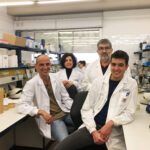
Image: From left to right, the authors of the paper: Ivan Erill, Pilar Cortés, Jordi Barbé, and Miquel Sánchez-Osuna. Photo by Ángela Martínez Mateos.
]]>
“The drug you design ten years from now may already be obsolete,” Ivan Erill says. In a new study in Frontiers in Microbiology, Erill and colleagues describe how bacteria that existed hundreds of...
https://umbc.edu/stories/umbcs-ivan-erill-finds-resistance-to-modern-drug-in-ancient-bacteria/
https://my3.my.umbc.edu/api/v0/pixel/news/120219/guest@my.umbc.edu/2c0cab6151ff54246af167ebacc1b2ab/api/pixel
biology
cirsca
cnms
research
science-and-technology
strategic-planning
UMBC News & Magazine
https://my3.my.umbc.edu/groups/umbc-news-magazine
https://assets1-my.umbc.edu/system/shared/avatars/groups/000/001/943/24435aa6207c452e7bc15cc74b42c7bb/xsmall.png?1748556657
https://assets1-my.umbc.edu/system/shared/avatars/groups/000/001/943/24435aa6207c452e7bc15cc74b42c7bb/original.png?1748556657
https://assets2-my.umbc.edu/system/shared/avatars/groups/000/001/943/24435aa6207c452e7bc15cc74b42c7bb/xxlarge.png?1748556657
https://assets2-my.umbc.edu/system/shared/avatars/groups/000/001/943/24435aa6207c452e7bc15cc74b42c7bb/xlarge.png?1748556657
https://assets3-my.umbc.edu/system/shared/avatars/groups/000/001/943/24435aa6207c452e7bc15cc74b42c7bb/large.png?1748556657
https://assets1-my.umbc.edu/system/shared/avatars/groups/000/001/943/24435aa6207c452e7bc15cc74b42c7bb/medium.png?1748556657
https://assets2-my.umbc.edu/system/shared/avatars/groups/000/001/943/24435aa6207c452e7bc15cc74b42c7bb/small.png?1748556657
https://assets1-my.umbc.edu/system/shared/avatars/groups/000/001/943/24435aa6207c452e7bc15cc74b42c7bb/xsmall.png?1748556657
https://assets2-my.umbc.edu/system/shared/avatars/groups/000/001/943/24435aa6207c452e7bc15cc74b42c7bb/xxsmall.png?1748556657
UMBC News & Magazine
0
0
false
Wed, 30 Jan 2019 20:47:42 -0500
Roda to Resistance

For Maceo Thomas ‘93 (above, center), the martial art of capoeira is more than just a fun way of staying fit. It’s also a socially conscious art with a fascinating history, fortified by a dedicated community of practitioners, he says. That’s why this weekend, while millions watch the biggest football event of the year, Thomas will combine his love of capoeira into an event that celebrates community and resistance.
At CapoeiraDC’s “Super Roda II” there will be music and demonstrations – as well as a talk by fellow alumnus and UMBC professor George Derek Musgrove ‘97, author of Chocolate City: A History of Race and Democracy in the Nation’s Capital. We took some time to talk with Thomas about his love of capoeira, and why he decided to organize this alternative to the Super Bowl.
* * * * *
Q: What do you love most about capoeira, and what is the goal of the group?
A: So, capoeira is so many components: musical instruments, singing, acrobatic movements, dance, fighting. It’s a martial art that was created by enslaved Africans in Brazil. There are songs that go back hundreds of years. The lyrics and names of movements are all in Portuguese. What I love, today, the most about capoeira is the community element that exists inside and outside of the roda (a circle formed by capoieristas). Capoiera is an art practice that requires social interaction. You can’t learn and get better at capoeira by training on your own in the gym. You need other people with whom to train. The more the better. And it really helps if you have mutual respect and care, because if you knock her out or she knocks you out you are down a training partner. So, we like to take care with our community when we train. And then… we like to socialize together and support each other.
Q: Tell us about how the “alternative Super Bowl” idea came about. What does the title, “Super Roda II,” mean?
A: There are a couple words I’ll explain first. In capoiera, we say that we are “playing” capoeira. Capoeira is considered a game when you have two players playing inside of a “roda” (it’s pronounced hoda in Portuguese). The roda in capoeira is a circle formed by capoeiristas. There is a group of more advanced capoeiristas who lead the roda with musical instruments and singing. They are the “referees,” for lack of a better equivalent. The music they play determines whether the games we play are fast or slow or low to the ground or standing up with more kicking. The capoeiristas who are not playing maintain the roda with clapping and singing to help energize the games being played.
As I mentioned earlier, capoeira was created by enslaved African people in Brazil. It was a form of resistance against the oppression that created slavery. When (former San Francisco quarterback) Colin Kaepernick took his knee in the NFL a couple years ago, many classmates in my group agreed not to watch the NFL. So… now you have Super Bowl Sunday roll around, and we needed an alternative to all those events we get invited to. We created Super Roda Sunday. This year will be the second time. We’re sticking with the Roman numerals.
Q: Can you describe last year’s event and what made it special for you? What does the opposite of a SuperBowl party look like?
A: Last year’s event was attended mostly by capoeiristas. We made it a potluck event. Along with a basic capoeira class, we had a class led by a capoeirista who is a phenomenal Bollywood dancer. That may have been the highlight, and we’re glad that he is doing the class for us again. We also had a samba class led by one of the students who participates in the Brazilian drumming class that we host in our space. The event was a mix of adults and children and included guests who were interested in what we offer. It was fun, family friendly event that wasn’t focused on football.
Q: How do you see fellow alumnus Derek Musgrove’s topics tying in with the “alternative Super Bowl” idea?
A: I had a chance to hear Derek give a talk on his new book a few months ago and it was amazing. The book explores the racialized history of Washington from pre-colonial times to recent times. I bought a copy…and then five more for family and friends who I know are interested in history and race as it pertains to D.C.
Part of the story of CapoeiraDC is a movement story. We have had multiple locations throughout our nearly 20 year history across the city. As rent increased, as an artist community, we had to relocate to find affordable space. Derek’s (and co-author Chris Asch) research touches on the movements of people in and out of the city through white flight and gentrification. That part of D.C. history/current events is relevant to the challenges we face as a group and being able to fulfill our mission within the city limits.
 George Derek Musgrove ’97 and co-author Chris Myers Asch with moderator at the 2017 launch of their book at the the National Museum of African American History and Culture. Photo by Marlayna Demond ’11 for UMBC.
Q: People might not connect capoeira, football (or the lack thereof), and race and history in Washington, D.C. How would you explain it to someone you just met?
A: That’s a great question. Capoeira is an art form that purely grew out of resistance; resistance to what was at the time a European hegemony that is really now known as white supremacy. Just like America, Brazil was economically fueled by slave labor. These enslaved people resisted.
The NFL, as a league, has strongly taken a stance that many, me included, see as opposition to supporting Black healthy lives. They have actively attempted to silence players who have communicated, through silent protests, that Black bodies being killed and maimed should not continue to be the legacy of our country. Yet, white supremacy is being protected by the league as it profits greatly by fighting the resistance of these players and many (former) fans.
D.C. has historically been a political pawn of the U.S.. I know more about it recently, but Derek’s book explores it more in depth. It’s probably not a coincidence that this city of over a half million people hasn’t had voting representation in Congress and it’s been historically a majority Black population.
Race, resistance, anti-racism are all important themes of capoeira, NFL protests, and the history of Washington.
Q: How can people find out more about Super Roda II?
A: The event will be held on February 3 starting at 4:30 p.m. at 2008 Rhode Island Ave., NE Washington, DC. Please follow our Facebook page, Capoeira Malês DC, for more information and updates.
* * * * *
Header photo by Koko Lanham.
]]>
For Maceo Thomas ‘93 (above, center), the martial art of capoeira is more than just a fun way of staying fit. It’s also a socially conscious art with a fascinating history, fortified by a...
https://umbc.edu/stories/roda-to-resistance/
https://my3.my.umbc.edu/api/v0/pixel/news/120220/guest@my.umbc.edu/f50d32472f0ba94ece3dfd4381be8404/api/pixel
perspectives
UMBC News & Magazine
https://my3.my.umbc.edu/groups/umbc-news-magazine
https://assets1-my.umbc.edu/system/shared/avatars/groups/000/001/943/24435aa6207c452e7bc15cc74b42c7bb/xsmall.png?1748556657
https://assets1-my.umbc.edu/system/shared/avatars/groups/000/001/943/24435aa6207c452e7bc15cc74b42c7bb/original.png?1748556657
https://assets2-my.umbc.edu/system/shared/avatars/groups/000/001/943/24435aa6207c452e7bc15cc74b42c7bb/xxlarge.png?1748556657
https://assets2-my.umbc.edu/system/shared/avatars/groups/000/001/943/24435aa6207c452e7bc15cc74b42c7bb/xlarge.png?1748556657
https://assets3-my.umbc.edu/system/shared/avatars/groups/000/001/943/24435aa6207c452e7bc15cc74b42c7bb/large.png?1748556657
https://assets1-my.umbc.edu/system/shared/avatars/groups/000/001/943/24435aa6207c452e7bc15cc74b42c7bb/medium.png?1748556657
https://assets2-my.umbc.edu/system/shared/avatars/groups/000/001/943/24435aa6207c452e7bc15cc74b42c7bb/small.png?1748556657
https://assets1-my.umbc.edu/system/shared/avatars/groups/000/001/943/24435aa6207c452e7bc15cc74b42c7bb/xsmall.png?1748556657
https://assets2-my.umbc.edu/system/shared/avatars/groups/000/001/943/24435aa6207c452e7bc15cc74b42c7bb/xxsmall.png?1748556657
UMBC News & Magazine
0
0
false
Tue, 29 Jan 2019 21:49:53 -0500
Celebrating Public Service

More than 130 members of the Retriever community gathered in Annapolis on January 23 to celebrate the many ways UMBC alumni make an impact through careers that serve the State of Maryland, including elected officials, policy analysts, and other advocates working for the public good. In addition to networking, talking with current students, and celebrating UMBC’s recent successes, guests also took part in a “UMBC 101” active learning demonstration, a highlight of the evening.
See more images from the evening at UMBC Alumni Flickr.
Photos by Marlayna Demond ’11 for UMBC Magazine.
]]>
More than 130 members of the Retriever community gathered in Annapolis on January 23 to celebrate the many ways UMBC alumni make an impact through careers that serve the State of Maryland,...
https://umbc.edu/stories/celebrating-public-service/
https://my3.my.umbc.edu/api/v0/pixel/news/120221/guest@my.umbc.edu/ece756f2895ba8a4a0700f9c81affd24/api/pixel
alumni
annapolis
impact
UMBC News & Magazine
https://my3.my.umbc.edu/groups/umbc-news-magazine
https://assets1-my.umbc.edu/system/shared/avatars/groups/000/001/943/24435aa6207c452e7bc15cc74b42c7bb/xsmall.png?1748556657
https://assets1-my.umbc.edu/system/shared/avatars/groups/000/001/943/24435aa6207c452e7bc15cc74b42c7bb/original.png?1748556657
https://assets2-my.umbc.edu/system/shared/avatars/groups/000/001/943/24435aa6207c452e7bc15cc74b42c7bb/xxlarge.png?1748556657
https://assets2-my.umbc.edu/system/shared/avatars/groups/000/001/943/24435aa6207c452e7bc15cc74b42c7bb/xlarge.png?1748556657
https://assets3-my.umbc.edu/system/shared/avatars/groups/000/001/943/24435aa6207c452e7bc15cc74b42c7bb/large.png?1748556657
https://assets1-my.umbc.edu/system/shared/avatars/groups/000/001/943/24435aa6207c452e7bc15cc74b42c7bb/medium.png?1748556657
https://assets2-my.umbc.edu/system/shared/avatars/groups/000/001/943/24435aa6207c452e7bc15cc74b42c7bb/small.png?1748556657
https://assets1-my.umbc.edu/system/shared/avatars/groups/000/001/943/24435aa6207c452e7bc15cc74b42c7bb/xsmall.png?1748556657
https://assets2-my.umbc.edu/system/shared/avatars/groups/000/001/943/24435aa6207c452e7bc15cc74b42c7bb/xxsmall.png?1748556657
UMBC News & Magazine
0
0
false
Mon, 28 Jan 2019 21:21:30 -0500
UMBC biologist Phyllis Robinson recognized for research, advocacy, and mentorship

UMBC has named Phyllis Robinson, professor of biological sciences, the Robert and Jane Meyerhoff Chair of Biological Sciences. The three-year appointment honors Robinson for her exceptional contributions to her research field, commitment to addressing gender equity issues in STEM fields, and dedication to mentoring students and faculty at all levels.
 Robinson is an international leader in the field of vision science. She sees the visual system as “a wonderful way to look at signaling in biological systems and an entrée into the nervous system and neurobiology.”
Robinson examines the visual system from “molecules to behavior,” and her lab incorporates techniques from biochemistry, molecular biology, and physiology. She has published dozens of peer-reviewed papers, presented her work all over the world, and garnered millions of dollars of research support from the NIH and other sources.
Tireless advocate
Robinson is also a tireless advocate for women and other underrepresented people in STEM. In 2000, in response to an MIT report on resource discrepancies between men and women in STEM, she co-founded UMBC’s Women in Science and Engineering (WISE) group. What started as a monthly gathering for women faculty to connect has grown into a rich mentoring network. WISE now offers workshops to faculty members and graduate students on topics from leadership development to eating healthfully on a hectic schedule.
The WISE group tapped into a need on campus and spurred further efforts to support women in STEM. Robinson served as co-PI on the UMBC NSF ADVANCE Grant, which is nationally recognized as a model for institutional transformation programs. Between its inception in 2003 and 2018, the number of tenured and tenure-track women faculty members in STEM disciplines at UMBC increased 60 percent, from 30 to 48, and the number of women who are full professors more than doubled.
 Patrice McDermott (left), Vice Provost for Faculty Affairs, served on the committee Robinson initiated in 1999 to investigate equity issues for women faculty at UMBC. Photo by Marlayna Demond ’11 for UMBC.
Because of Robinson’s efforts, “I am now the proud colleague of five highly-qualified junior women faculty,” says Rachel Brewster, professor of biological sciences. “Their presence in the department is a source of inspiration for our large female undergraduate and graduate population.”
Marie desJardins is now dean of the College of Organizational, Computational, and Information Sciences at Simmons College and was previously a professor of computer science at UMBC. She comments that Robinson’s invitation to join an ADVANCE leadership cohort “helped me to cement my goals as an academic leader.”
“As a university, we’re committed to supporting everybody,” Robinson says. “We’re not perfect, but there is a commitment to underrepresented minorities and women in STEM.”
Robinson was honored by the UMBC President’s Commission on Women in 2012 and recently received the 2018 Marilyn E. Demorest Faculty Advancement Award for her advocacy work at UMBC.
Science and social justice
Robinson is a dedicated mentor to dozens of graduate and undergraduate students from all backgrounds. In 2017, she succeeded Lasse Lindahl, professor of biological sciences, as program director of MARC*USTAR at UMBC—an NIH-funded undergraduate scholars program that connects students from groups underrepresented in the biomedical sciences with valuable research opportunities. UMBC’s program has already supported over 100 UMBC alumni who have earned Ph.D. or M.D./Ph.D. degrees.
Like her advocacy for diverse STEM faculty, Robinson’s work as a mentor for students goes back decades. She was previously honored for excellence in mentoring by the University System of Maryland Board of Regents in 2002 and by the Leadership Alliance in 2006.
 Phyllis Robinson and the members of her lab. Photo by Tim Ford.
At UMBC, “I’ve been able to do my science and also put energy into the social justice aspects of the world that are important to me,” Robinson says. “One doesn’t exclude the other.”
Dean of the College of Natural and Mathematical Sciences William LaCourse is grateful for Robinson’s efforts over the course of her career at UMBC. “Professor Robinson’s professionalism is equally matched by her passion for research, her gift for mentoring, and her compassion for others,” he says. “Over the past 26 years, she has provided exceptional service to the university through her tireless leadership and advocacy for others.”
Robinson reflects that the UMBC environment helped make it all possible. “I’ve enjoyed working at UMBC,” she says, “because as a fairly young university, if you put energy into something you can really have an effect here.” Robinson certainly has.
Banner image: Phyllis Robinson speaks at the 2018 Presidential Faculty Staff Awards, where she received the Marilyn E. Demorest Faculty Advancement Award. Photo by Marlayna Demond ’11 for UMBC.
]]>
UMBC has named Phyllis Robinson, professor of biological sciences, the Robert and Jane Meyerhoff Chair of Biological Sciences. The three-year appointment honors Robinson for her exceptional...
https://umbc.edu/stories/umbc-biologist-phyllis-robinson-recognized-for-research-advocacy-and-mentorship/
https://my3.my.umbc.edu/api/v0/pixel/news/120222/guest@my.umbc.edu/74050e4d2959e79e30c83c11af9a859c/api/pixel
biology
cnms
community
diversityandinclusion
science-and-technology
UMBC News & Magazine
https://my3.my.umbc.edu/groups/umbc-news-magazine
https://assets1-my.umbc.edu/system/shared/avatars/groups/000/001/943/24435aa6207c452e7bc15cc74b42c7bb/xsmall.png?1748556657
https://assets1-my.umbc.edu/system/shared/avatars/groups/000/001/943/24435aa6207c452e7bc15cc74b42c7bb/original.png?1748556657
https://assets2-my.umbc.edu/system/shared/avatars/groups/000/001/943/24435aa6207c452e7bc15cc74b42c7bb/xxlarge.png?1748556657
https://assets2-my.umbc.edu/system/shared/avatars/groups/000/001/943/24435aa6207c452e7bc15cc74b42c7bb/xlarge.png?1748556657
https://assets3-my.umbc.edu/system/shared/avatars/groups/000/001/943/24435aa6207c452e7bc15cc74b42c7bb/large.png?1748556657
https://assets1-my.umbc.edu/system/shared/avatars/groups/000/001/943/24435aa6207c452e7bc15cc74b42c7bb/medium.png?1748556657
https://assets2-my.umbc.edu/system/shared/avatars/groups/000/001/943/24435aa6207c452e7bc15cc74b42c7bb/small.png?1748556657
https://assets1-my.umbc.edu/system/shared/avatars/groups/000/001/943/24435aa6207c452e7bc15cc74b42c7bb/xsmall.png?1748556657
https://assets2-my.umbc.edu/system/shared/avatars/groups/000/001/943/24435aa6207c452e7bc15cc74b42c7bb/xxsmall.png?1748556657
UMBC News & Magazine
0
0
false
Mon, 28 Jan 2019 20:43:50 -0500
Home Crowd Advantage

Riding high on a string of recent wins, UMBC’s men’s and women’s basketball teams will greet the spring semester with hotly anticipated games against major rivals at the Retrievers’ home court, the UMBC Event Center. The first is this Wednesday, as the men take on second-place Stony Brook at their annual “Blackout Night.” On Saturday, February 9, the women will take the court against Maine.
Both teams drew victories against the University of New Hampshire over the weekend, and the men are enjoying a four-game conference streak, putting them in third place overall. With this kind of momentum – building since last year’s historic NCAA run – it’s a great time to be a Retriever fan, says Academic All-American graduate student Joe Sherburne, a forward on the men’s team.
“Students and fans in the crowd can be direct participants in the game,” said Sherburne, who has started more games than any other player in school history. “Their presence can shift momentum and help us play better.”
The Event Center opened on February 3 of last year, with 4,700 fans streaming into the arena to celebrate the big day. The sea of supporters, wearing black and gold, and waving signs and pom poms, joined together to sing the alma mater with unbridled joy.
Fast forward one year and that same enthusiasm is bubbling once again.
 Junior guard Te’yJah Oliver celebrates the win over UNH. Photo by Gail Burton.
During Alumni Day on their home court this past Saturday, the women’s basketball team won a thrilling 64-62 decision over visiting New Hampshire. Junior guard Te’yJah Oliver, business management, hit the game-winning layup with 4.5 seconds left after the Wildcats rallied to tie the score in the final minute. Teammate junior Tyler Moore, psychology, netted a career high 27 points, including 16 in the first ten minutes of play.
“For me, it is extremely exciting to have a large crowd at our games,” Moore said. “Basketball is something that I love doing and it is so much more fun being able to showcase what we work so hard on in front of our fellow students. I would love to see more people at our games because the energy a solid home crowd brings can make a difference in winning and losing a close game.”
The men visited New Hampshire that same afternoon and also emerged victorious. Just three days after defeating league favorite and unbeaten Vermont, 74-61, in Burlington, the Retrievers shook off fatigue and injuries to defeat UNH, 59-51. Junior guard K.J. Jackson scored 21 points and Sherburne, data science, tallied 14 points and added nine rebounds to pace the Dawgs.
UMBC recorded its fourth consecutive win and took over third place in the conference with a 5-2 record.
 Celebrating their overtime, game-winning shot at the men’s last home game vs. Albany. Photo by Gail Burton.
The men host second-place Stony Brook at the UEC on Wednesday evening at 7 p.m. It’s the annual “Blackout Night”, so all of #RetrieverNation is encouraged to wear black. The first 300 students in attendance will receive a black “Sharpie” t-shirt, referencing a now infamous comment made by college hoops reporter Seth Davis heading into the men’s historic 16 over 1 win against top-ranked University of Virginia during NCAA play last March.
One week later, on Wednesday, February 6, the men will look to avenge a two-point overtime loss when Hartford visits UMBC. The women compete in their first home game of the spring semester on Saturday, February 9 when defending champion Maine ventures south for a 1 p.m. contest.
Tickets for all games are available at tickets.umbc.edu.
* * * * *
Header image by Josh Sinn ’13.
]]>
Riding high on a string of recent wins, UMBC’s men’s and women’s basketball teams will greet the spring semester with hotly anticipated games against major rivals at the Retrievers’ home court,...
https://umbc.edu/stories/home-crowd-advantage/
https://my3.my.umbc.edu/api/v0/pixel/news/120223/guest@my.umbc.edu/ebaf39d34af89d388088328b116a2196/api/pixel
campus-life
UMBC News & Magazine
https://my3.my.umbc.edu/groups/umbc-news-magazine
https://assets1-my.umbc.edu/system/shared/avatars/groups/000/001/943/24435aa6207c452e7bc15cc74b42c7bb/xsmall.png?1748556657
https://assets1-my.umbc.edu/system/shared/avatars/groups/000/001/943/24435aa6207c452e7bc15cc74b42c7bb/original.png?1748556657
https://assets2-my.umbc.edu/system/shared/avatars/groups/000/001/943/24435aa6207c452e7bc15cc74b42c7bb/xxlarge.png?1748556657
https://assets2-my.umbc.edu/system/shared/avatars/groups/000/001/943/24435aa6207c452e7bc15cc74b42c7bb/xlarge.png?1748556657
https://assets3-my.umbc.edu/system/shared/avatars/groups/000/001/943/24435aa6207c452e7bc15cc74b42c7bb/large.png?1748556657
https://assets1-my.umbc.edu/system/shared/avatars/groups/000/001/943/24435aa6207c452e7bc15cc74b42c7bb/medium.png?1748556657
https://assets2-my.umbc.edu/system/shared/avatars/groups/000/001/943/24435aa6207c452e7bc15cc74b42c7bb/small.png?1748556657
https://assets1-my.umbc.edu/system/shared/avatars/groups/000/001/943/24435aa6207c452e7bc15cc74b42c7bb/xsmall.png?1748556657
https://assets2-my.umbc.edu/system/shared/avatars/groups/000/001/943/24435aa6207c452e7bc15cc74b42c7bb/xxsmall.png?1748556657
UMBC News & Magazine
0
0
false
Mon, 28 Jan 2019 19:26:52 -0500


