Meet a Retriever—Rishav Gupta, COEIT Computing for Social Good Award recipient
Meet Rishav Gupta. After spending five years as a mobile engineer, he decided to pursue his Ph.D. in computer science at UMBC to deepen his expertise and choose projects with the clear objective of improving people’s lives. Rishav is working in the Future Sensing and Interaction Lab of professor Dong Li on a project to use everyday smartphones as affordable and accessible blood pressure monitors.
This May, the work was recognized when Rishav was selected as one of two recipients for the inaugural COEIT Computing for Social Good Award, made possible by a generous donation from alumnus Akshay Java, M.S. ’03, Ph.D. ’08, computer science. Awardees were selected in a competitive review process by COEIT faculty reviewers and departmental leadership. Rishav was choosen for his project “Enabling Affordable and Accessible Blood Pressure Monitoring Using Only a Commodity Smartphone.” Take it away, Rishav!
Q: What brought you to UMBC?
A: As an international student from India, I left a comfortable career to come here. After five years as a mobile engineer in industry, I was a generalist who could build things, but I wanted to understand them, to master a domain and create research that genuinely gives back to the community and helps people. UMBC’s work in health sensing was exactly that chance.
UMBC’s welcoming and inclusive environment made the transition less daunting. From peers who’d walked the same path to a community that genuinely wants your feedback to others considering it: you won’t be figuring things out alone here.
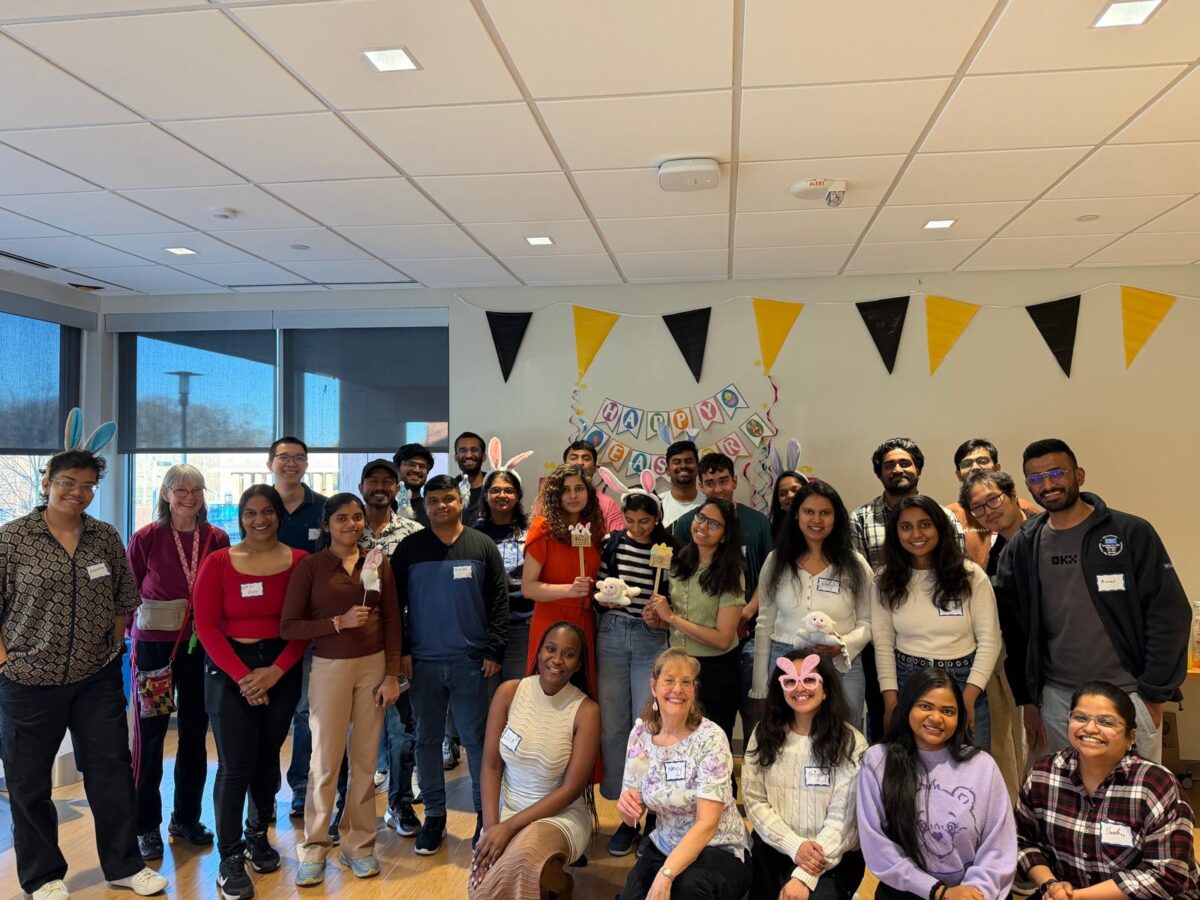 Gupta attending an Easter festival organized by Nancy Parlette and the International Students Connect club. (Photo courtesy of Gupta)
Q: What do you love about UMBC?
A: Beyond my research, I serve on the Graduate Assistant Advisory Committee, helping improve the experience for graduate assistants across campus. From clarifying appointment expectations to shaping GA orientation, it’s shown me a side of UMBC that genuinely listens to students and works to actually affect people’s day-to-day lives. What I enjoy most is being a bridge: carrying real student concerns to people who can actually act on them.
Q: Who in the community inspired you or supported you?
A: My advisor, Dong Li, pushes me to aim high and take ownership of my research, trusting me to drive my own ideas. That independence has stretched me. I’ve also leaned on senior students in the department, whose willingness to share what they’ve learned has made navigating the early Ph.D. years far less daunting.
Q: What’s the one thing you’d want someone who hasn’t joined the UMBC community to know about the support you find here?
A: What surprised me most is how many people quietly have your back. A student who walked me through a rough patch, a staff member who actually wanted my feedback and acted on it, and peers who share hard lessons so I don’t struggle alone are just a few examples. The support is every day and practical.
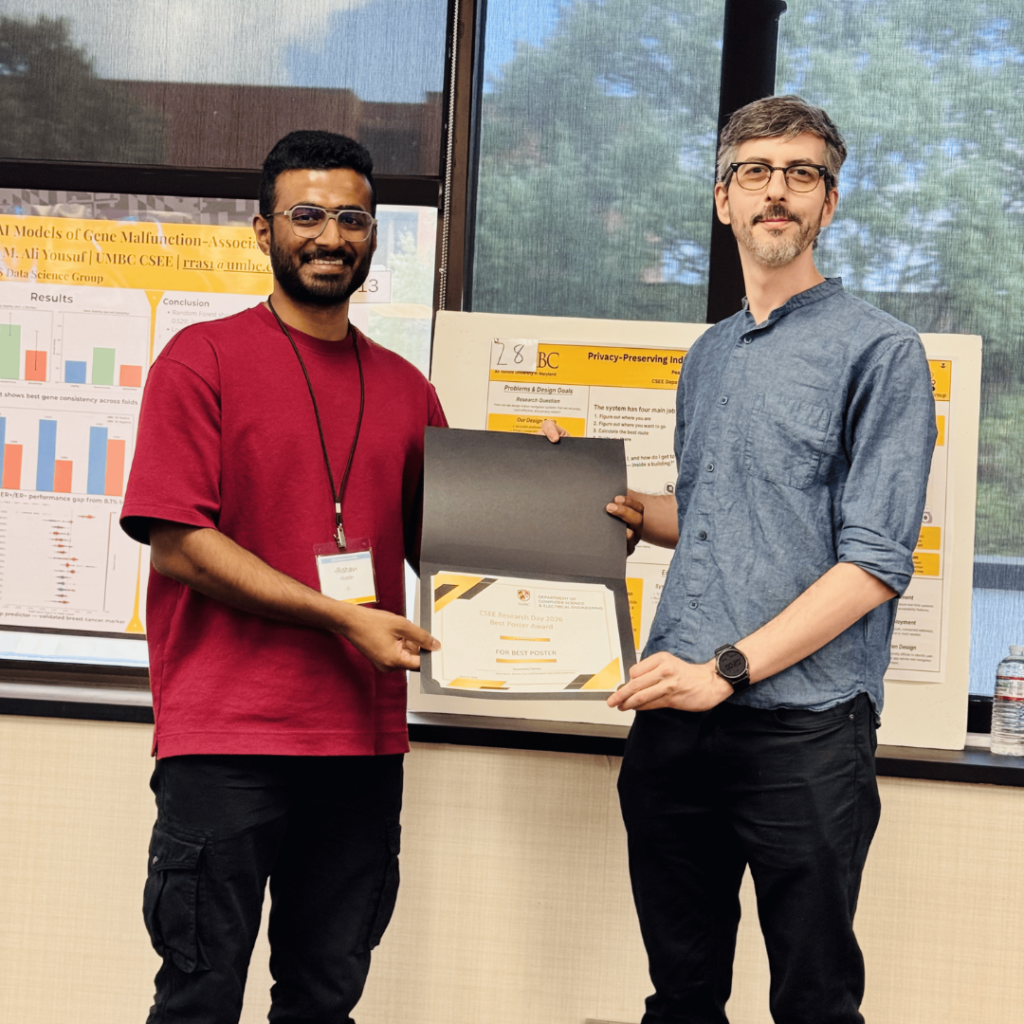
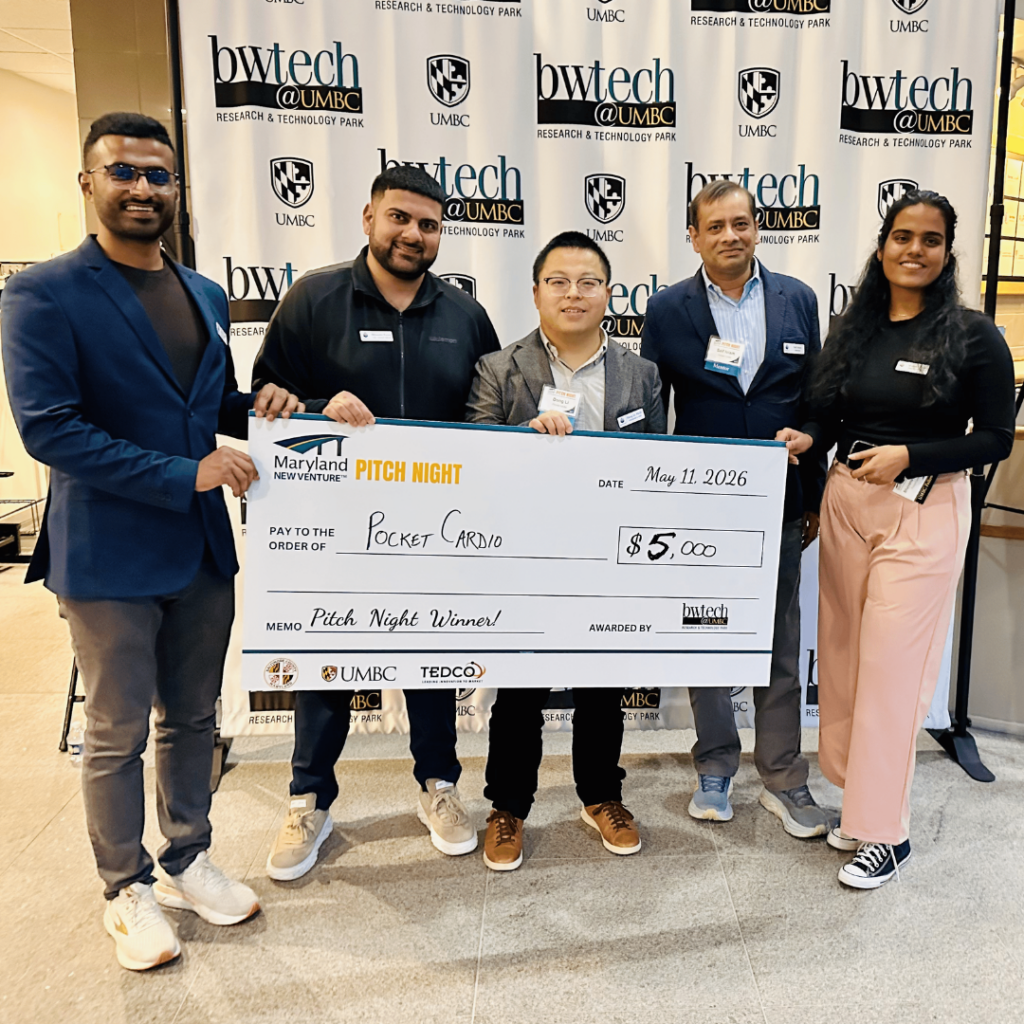
On left, Gupta receives an award for best poster from computer science and electrical engineering assistant professor Roberto Yus on CSEE Research Day in April 2026. On right, Gupta and his team receive a first place award from The Maryland NEW VENTURE program in May 2026. (Photos courtesy of Gupta)
Q: What are your goals after graduation and how is UMBC helping you?
A: My goal is a research career with significant meaningful work, ideally a faculty position at a strong university, where I can keep pushing on affordable health-sensing technology and train the next generation of researchers. I’m early in the journey, but that’s the direction I’m building toward.
UMBC has pushed me toward independence by owning my research direction, presenting my work at top venues, and building the depth I came here for. Serving on a graduate committee has also grown skills I didn’t expect to develop: representing others, navigating institutions, and turning feedback into real change.
Q: How has the Computing for Social Good Award impacted your education?
A: The COEIT Computing for Social Good Award directly supports my research to make blood pressure monitoring affordable and accessible using only a commodity smartphone, with no specialized hardware and no clinic visit required. Beyond the tangible support, being recognized specifically for the social good of the work, rather than only its technical side, has shaped how I choose research problems: it pushes me to keep asking who my work actually helps, and to keep people who can’t easily access conventional care at the center of what I build.
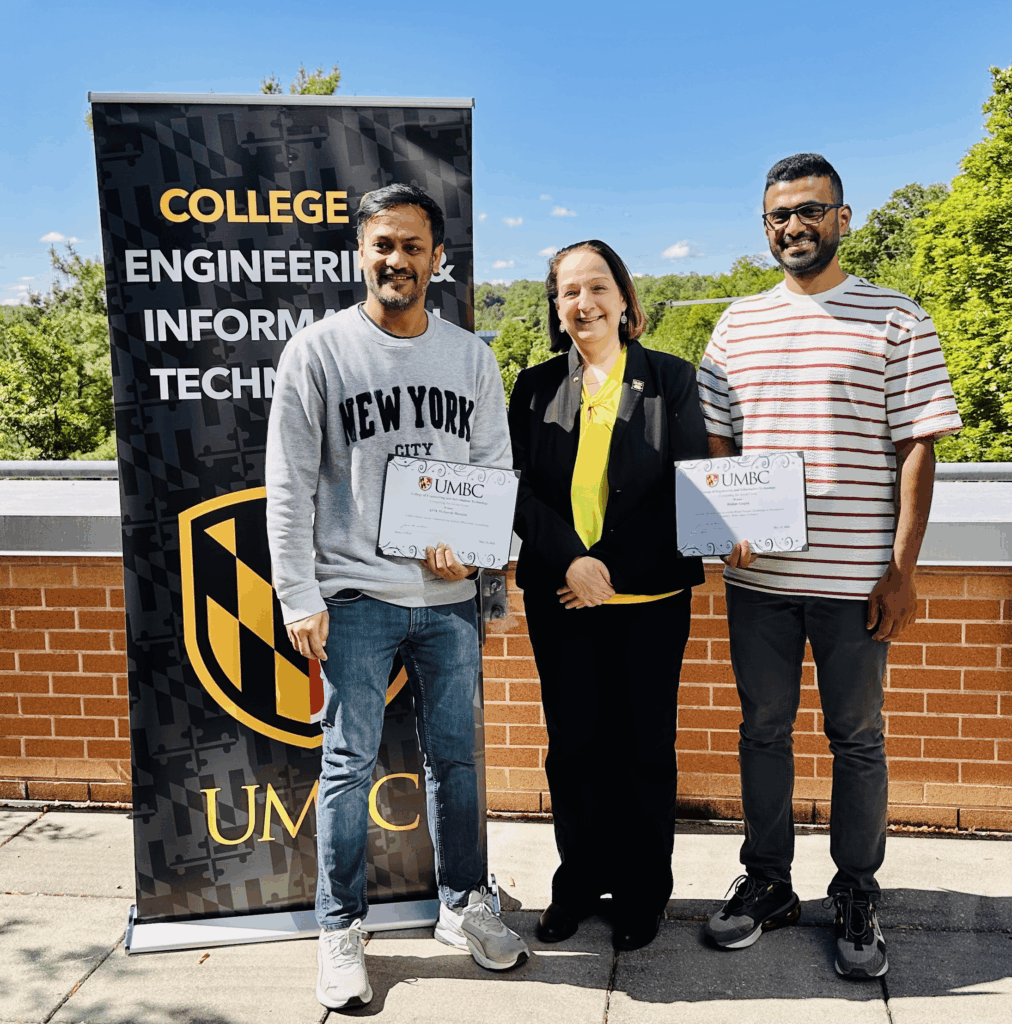 Rishav Gupta and ASM Mobarak Hossain receiving the COEIT Computing Social for Good Award from Jeanne van Briesen, dean of the College of Engineering and Information Technology. (Photo courtesy of Vandana Janeja)
Q: How did it feel to win this award?
A: Receiving the COEIT Computing for Social Good Award felt meaningful in a way I didn’t expect. I came to UMBC from a career in industry because I wanted my work to matter beyond a product. Being recognized for the research’s social impact felt like confirmation that I’d chosen the right path. It was also humbling as a reminder that affordable health technology isn’t an abstract goal but something real people are rooting for, and it left me more motivated to deliver on the promise the award recognizes.
* * * * *
UMBC’s greatest strength is its people. When people meet Retrievers and hear about the passion they bring, the relationships they create, the ways they support each other, and the commitment they have to inclusive excellence, they truly get a sense of our community. That’s what “Meet a Retriever” is all about.
Learn more about how UMBC can help you achieve your goals.
]]>
Meet Rishav Gupta. After spending five years as a mobile engineer, he decided to pursue his Ph.D. in computer science at UMBC to deepen his expertise and choose projects with the clear objective...
https://umbc.edu/stories/rishav-gupta-coeit-computing-for-social-good/
https://my3.my.umbc.edu/api/v0/pixel/news/161834/guest@my.umbc.edu/561a4ae78bb45a1aa63e92cf0f0faf27/api/pixel
coeit
csee
impact
meet-a-retriever
perspectives
science-and-tech
stories
story
UMBC News & Magazine
https://my3.my.umbc.edu/groups/umbc-news-magazine
https://assets1-my.umbc.edu/system/shared/avatars/groups/000/001/943/24435aa6207c452e7bc15cc74b42c7bb/xsmall.png?1748556657
https://assets1-my.umbc.edu/system/shared/avatars/groups/000/001/943/24435aa6207c452e7bc15cc74b42c7bb/original.png?1748556657
https://assets2-my.umbc.edu/system/shared/avatars/groups/000/001/943/24435aa6207c452e7bc15cc74b42c7bb/xxlarge.png?1748556657
https://assets2-my.umbc.edu/system/shared/avatars/groups/000/001/943/24435aa6207c452e7bc15cc74b42c7bb/xlarge.png?1748556657
https://assets3-my.umbc.edu/system/shared/avatars/groups/000/001/943/24435aa6207c452e7bc15cc74b42c7bb/large.png?1748556657
https://assets1-my.umbc.edu/system/shared/avatars/groups/000/001/943/24435aa6207c452e7bc15cc74b42c7bb/medium.png?1748556657
https://assets2-my.umbc.edu/system/shared/avatars/groups/000/001/943/24435aa6207c452e7bc15cc74b42c7bb/small.png?1748556657
https://assets1-my.umbc.edu/system/shared/avatars/groups/000/001/943/24435aa6207c452e7bc15cc74b42c7bb/xsmall.png?1748556657
https://assets2-my.umbc.edu/system/shared/avatars/groups/000/001/943/24435aa6207c452e7bc15cc74b42c7bb/xxsmall.png?1748556657
UMBC News & Magazine
1
0
false
Tue, 11 Aug 2026 15:01:08 -0400
Tue, 11 Aug 2026 15:01:08 -0400
Meet a Retriever—Rishav Gupta, COEIT Computing for Social Good Award recipient
Meet Rishav Gupta. After spending five years as a mobile engineer, he decided to pursue his Ph.D. in computer science at UMBC to deepen his expertise and choose projects with the clear objective of improving people’s lives. Rishav is working in the Future Sensing and Interaction Lab of professor Dong Li on a project to use everyday smartphones as affordable and accessible blood pressure monitors.
This May, the work was recognized when Rishav was selected as one of two recipients for the inaugural COEIT Computing for Social Good Award, made possible by a generous donation from alumnus Akshay Java, M.S. ’03, computer science, Ph.D. ’08, computer science. Awardees were selected in a competitive review process by COEIT faculty reviewers and departmental leadership. Rishav was choosen for his project “Enabling Affordable and Accessible Blood Pressure Monitoring Using Only a Commodity Smartphone.” Take it away, Rishav!
Q: What brought you to UMBC?
A: As an international student from India, I left a comfortable career to come here. After five years as a mobile engineer in industry, I was a generalist who could build things, but I wanted to understand them, to master a domain and create research that genuinely gives back to the community and helps people. UMBC’s work in health sensing was exactly that chance.
UMBC’s welcoming and inclusive environment made the transition less daunting. From peers who’d walked the same path to a community that genuinely wants your feedback to others considering it: you won’t be figuring things out alone here.
Gupta attending an Easter festival organized by Nancy Parlette and the International Students Connect club. (Photo courtesy of Gupta)
Q: What do you love about UMBC?
A: Beyond my research, I serve on the Graduate Assistant Advisory Committee, helping improve the experience for graduate assistants across campus. From clarifying appointment expectations to shaping GA orientation, it’s shown me a side of UMBC that genuinely listens to students and works to actually affect people’s day-to-day lives. What I enjoy most is being a bridge: carrying real student concerns to people who can actually act on them.
Q: Who in the community inspired you or supported you?
A: My advisor, Dong Li, pushes me to aim high and take ownership of my research, trusting me to drive my own ideas. That independence has stretched me. I’ve also leaned on senior students in the department, whose willingness to share what they’ve learned has made navigating the early Ph.D. years far less daunting.
Q: What’s the one thing you’d want someone who hasn’t joined the UMBC community to know about the support you find here?
A: What surprised me most is how many people quietly have your back. A student who walked me through a rough patch, a staff member who actually wanted my feedback and acted on it, and peers who share hard lessons so I don’t struggle alone are just a few examples. The support is every day and practical.
On left, Gupta receives an award for best poster from computer science and electrical engineering assistant professor Roberto Yus on CSEE Research Day in April 2026. On right, Gupta and his team receive a first place award from The Maryland NEW VENTURE program in May 2026. (Photos courtesy of Gupta)
Q: What are your goals after graduation and how is UMBC helping you?
A: My goal is a research career with significant meaningful work, ideally a faculty position at a strong university, where I can keep pushing on affordable health-sensing technology and train the next generation of researchers. I’m early in the journey, but that’s the direction I’m building toward.
UMBC has pushed me toward independence by owning my research direction, presenting my work at top venues, and building the depth I came here for. Serving on a graduate committee has also grown skills I didn’t expect to develop: representing others, navigating institutions, and turning feedback into real change.
Q: How has the Computing for Social Good Award impacted your education?
A: The COEIT Computing for Social Good Award directly supports my research to make blood pressure monitoring affordable and accessible using only a commodity smartphone, with no specialized hardware and no clinic visit required. Beyond the tangible support, being recognized specifically for the social good of the work, rather than only its technical side, has shaped how I choose research problems: it pushes me to keep asking who my work actually helps, and to keep people who can’t easily access conventional care at the center of what I build.
Rishav Gupta and ASM Mobarak Hossain receiving the COEIT Computing Social for Good Award from Jeanne van Briesen, dean of the College of Engineering and Information Technology. (Photo courtesy of Vandana Janeja)
Q: How did it feel to win this award?
A: Receiving the COEIT Computing for Social Good Award felt meaningful in a way I didn’t expect. I came to UMBC from a career in industry because I wanted my work to matter beyond a product. Being recognized for the research’s social impact felt like confirmation that I’d chosen the right path. It was also humbling as a reminder that affordable health technology isn’t an abstract goal but something real people are rooting for, and it left me more motivated to deliver on the promise the award recognizes.
* * * * *
UMBC’s greatest strength is its people. When people meet Retrievers and hear about the passion they bring, the relationships they create, the ways they support each other, and the commitment they have to inclusive excellence, they truly get a sense of our community. That’s what “Meet a Retriever” is all about.
Learn more about how UMBC can help you achieve your goals.
]]>
Meet Rishav Gupta. After spending five years as a mobile engineer, he decided to pursue his Ph.D. in computer science at UMBC to deepen his expertise and choose projects with the clear objective...
https://umbc.edu/stories/riishav-guptaa-coeit-computing-for-social-good/
https://my3.my.umbc.edu/api/v0/pixel/news/161829/guest@my.umbc.edu/0647a74cddf8f7fd7e12be7e2a8a1948/api/pixel
coeit
csee
impact
meet-a-retriever
perspectives
science-and-tech
stories
story
UMBC News & Magazine
https://my3.my.umbc.edu/groups/umbc-news-magazine
https://assets1-my.umbc.edu/system/shared/avatars/groups/000/001/943/24435aa6207c452e7bc15cc74b42c7bb/xsmall.png?1748556657
https://assets1-my.umbc.edu/system/shared/avatars/groups/000/001/943/24435aa6207c452e7bc15cc74b42c7bb/original.png?1748556657
https://assets2-my.umbc.edu/system/shared/avatars/groups/000/001/943/24435aa6207c452e7bc15cc74b42c7bb/xxlarge.png?1748556657
https://assets2-my.umbc.edu/system/shared/avatars/groups/000/001/943/24435aa6207c452e7bc15cc74b42c7bb/xlarge.png?1748556657
https://assets3-my.umbc.edu/system/shared/avatars/groups/000/001/943/24435aa6207c452e7bc15cc74b42c7bb/large.png?1748556657
https://assets1-my.umbc.edu/system/shared/avatars/groups/000/001/943/24435aa6207c452e7bc15cc74b42c7bb/medium.png?1748556657
https://assets2-my.umbc.edu/system/shared/avatars/groups/000/001/943/24435aa6207c452e7bc15cc74b42c7bb/small.png?1748556657
https://assets1-my.umbc.edu/system/shared/avatars/groups/000/001/943/24435aa6207c452e7bc15cc74b42c7bb/xsmall.png?1748556657
https://assets2-my.umbc.edu/system/shared/avatars/groups/000/001/943/24435aa6207c452e7bc15cc74b42c7bb/xxsmall.png?1748556657
UMBC News & Magazine
0
0
false
Tue, 11 Aug 2026 15:01:08 -0400
From single cells to the systems shaping science: Mayank Chugh pursues dual passions at UMBC
What does it take for a single cell to become a functioning organism—and what does it take for a scientist to thrive amid the systems that govern the research enterprise? Mayank Chugh is exploring both questions at once. As an assistant teaching professor in biological sciences and director of UMBC’s Applied Molecular Biology (AMB) accelerated master’s program, he is entering his second year in a role that blends hands-on teaching, program leadership, and research that extends beyond the lab.
In developmental biology, Chugh investigates how organs take shape, focusing on the inner ear in zebrafish and the role physical forces play in its development. Through his ReForm Lab, launched during his postdoc at Harvard Medical School, he turns the same careful eye toward the institutional policies and hidden costs that influence who gets to do science. A new paper published in Nature Biotechnology led by Chugh examines the real-world burdens international postdocs face to maintain their visas and continue their work.
In the conversation below, Chugh talks about the unusual mix of responsibilities that defines his position, the students and skills at the heart of the AMB program, what drew him to science policy, the collaborations and community he has found at UMBC, and how others might begin expanding their own work beyond traditional research.
Q: What are the components of your role at UMBC, and how is it unique?
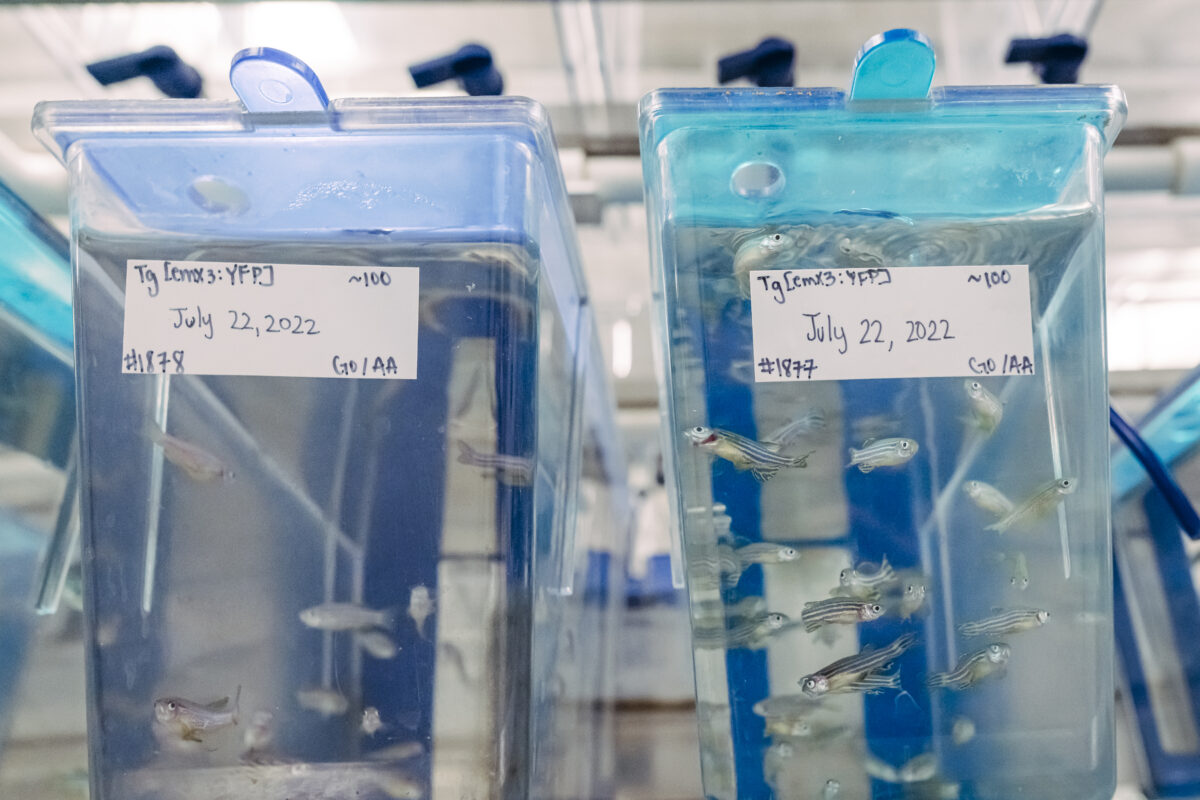 Mayank Chugh studies developmental biology using zebrafish like these as a model organism. (Marlayna Demond ’11/UMBC)
A: My primary role is director of the Applied Molecular Biology program, our department’s accelerated one-year master’s. I lead everything from recruitment through teaching and collaborations with other faculty, taking the students from when they apply all the way to graduation. It’s primarily a teaching position, but it’s unusual because I also have access to the teaching lab for my own developmental biology research. So in addition to teaching, I can recruit students to pursue research with me. Right now I have two high school students, one undergraduate, and one recent graduate working in the lab with me. We’re studying how the inner ear forms in zebrafish and how mechanical forces shape organ development and influence cell decisions. I collaborate with UMBC developmental biologist Rachel Brewster on the fish work. We share microscopy resources and she’s generously offered me space in the fish facility.
Q: Can you explain the purpose of the AMB program and who could benefit from it?
A: I believe the program is underrated. It’s an intensive one-year master’s that combines coursework with rigorous research and builds skills that can transfer anywhere. The students practice communication through weekly presentations, develop their writing skills through reports, and improve their time and project management out of necessity as they design and run experiments—all skills useful within and beyond science.
The program is great for undergrads with strong grades who lack substantial lab experience to gain a sense of what graduate-level science is like, so they can decide from an informed place whether a Ph.D. is right for them. A part-time option also serves working professionals who want to advance their skills. UMBC undergraduates can transfer up to 12 credits from their bachelor’s program if they plan ahead, which saves them time and money. AMB graduates head onto a range of next steps including jobs in industry, medical school, academic positions, and more.
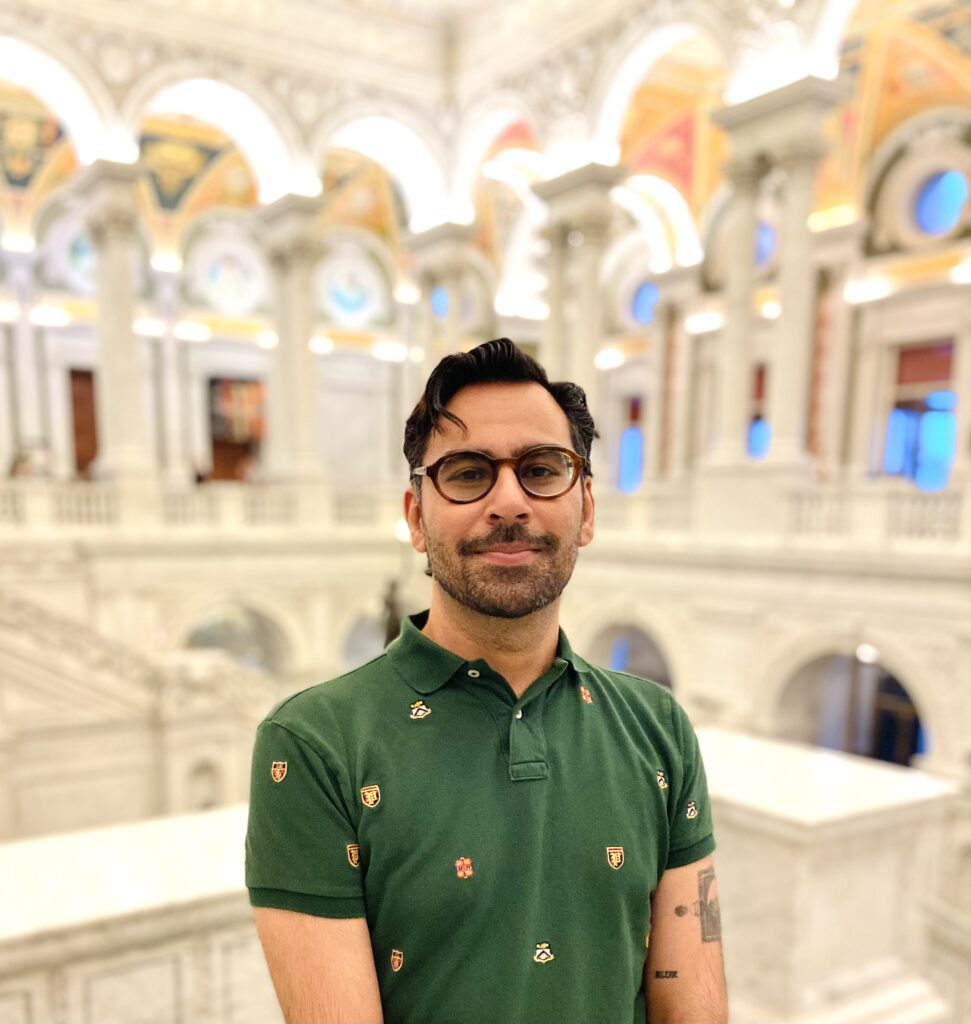 Mayank Chugh directs UMBC’s Applied Molecular Biology program and also conducts research in developmental biology and science policy. (Courtesy of Chugh)
Q: Why did you branch into science policy alongside developmental biology? What do you find most meaningful about that work?
A: I love basic research, but I’ve always cared about how science integrates into society. During my postdoc at Harvard I realized I did not want a traditional tenure-track path. I launched the ReForm Lab to examine the institutional structures and policies that govern who gets to do science, how we do it, and how it is evaluated. It’s highly interdisciplinary—today I collaborate with social scientists and others I never expected to work with.
My first ReForm Lab paper looked at postdoctoral compensation in the Boston area and showed how NIH salary guidelines ignore cost-of-living disparities across the country. Within two months of it being published, several institutions changed their policies. I got so many emails saying “thank you.” That tangible impact felt different from anything I’d experienced in basic research.
My new paper expands on that work. We surveyed hundreds of postdocs and quantified the often-invisible time, money, and psychological costs international scholars face, like having to travel back to their home country to renew their visas. We frame it as an administrative burden with real consequences for well-being and opportunity. The paper focuses solely on the data, but my personal opinion is that institutions could simply start with greater sensitivity toward scholars facing these challenges and offer practical support, like greater flexibility.
I’m also formally affiliated with the Human Context of Science and Technology program at UMBC. I love being part of that program; it gives me the chance to teach topics like the future of science and talk about race and gender in STEM. I recently organized a movie screening and discussion about Henrietta Lacks, whose local story is ongoing. Johns Hopkins is now constructing a Henrietta Lacks building in collaboration with her family.
Q: What do you appreciate about the UMBC community?
A: UMBC hits a Goldilocks size—neither too small nor too large. People are approachable and kind, and the department has been welcoming from day one. I’ve already begun collaborations and feel supported in doing interdisciplinary work. And the students are exceptional. Even those who arrive with limited lab experience repeatedly surprise me with how quickly they grow. The small size of the AMB program gives me the chance to connect with each student on a deeper level and continue to mentor them after they graduate, if they choose. I’ve helped students with their CVs, run mock interviews, and helped them make connections for opportunities. I’d say that has been one of the most rewarding parts of the role.
Q: What advice would you give others interested in expanding into science-policy work?
A: Use existing professional appointments as platforms. Join groups like the Scholars Strategy Network that connect scholars with policymakers and community builders. And for anyone at UMBC, feel free to just email me—maybe we could get a science and policy interest group started. The expertise is already here to engage in that way and benefit society with our work; we should put it to good use.
]]>
What does it take for a single cell to become a functioning organism—and what does it take for a scientist to thrive amid the systems that govern the research enterprise? Mayank Chugh is exploring...
https://umbc.edu/stories/mayank-chugh-qa/
https://my3.my.umbc.edu/api/v0/pixel/news/161545/guest@my.umbc.edu/5beb24b8f9f95b5a70f4944762bccb77/api/pixel
biology
cnms
community
research
science-and-tech
stories
story
UMBC News & Magazine
https://my3.my.umbc.edu/groups/umbc-news-magazine
https://assets1-my.umbc.edu/system/shared/avatars/groups/000/001/943/24435aa6207c452e7bc15cc74b42c7bb/xsmall.png?1748556657
https://assets1-my.umbc.edu/system/shared/avatars/groups/000/001/943/24435aa6207c452e7bc15cc74b42c7bb/original.png?1748556657
https://assets2-my.umbc.edu/system/shared/avatars/groups/000/001/943/24435aa6207c452e7bc15cc74b42c7bb/xxlarge.png?1748556657
https://assets2-my.umbc.edu/system/shared/avatars/groups/000/001/943/24435aa6207c452e7bc15cc74b42c7bb/xlarge.png?1748556657
https://assets3-my.umbc.edu/system/shared/avatars/groups/000/001/943/24435aa6207c452e7bc15cc74b42c7bb/large.png?1748556657
https://assets1-my.umbc.edu/system/shared/avatars/groups/000/001/943/24435aa6207c452e7bc15cc74b42c7bb/medium.png?1748556657
https://assets2-my.umbc.edu/system/shared/avatars/groups/000/001/943/24435aa6207c452e7bc15cc74b42c7bb/small.png?1748556657
https://assets1-my.umbc.edu/system/shared/avatars/groups/000/001/943/24435aa6207c452e7bc15cc74b42c7bb/xsmall.png?1748556657
https://assets2-my.umbc.edu/system/shared/avatars/groups/000/001/943/24435aa6207c452e7bc15cc74b42c7bb/xxsmall.png?1748556657
UMBC News & Magazine
0
0
false
Tue, 11 Aug 2026 11:57:43 -0400
Tue, 11 Aug 2026 11:57:43 -0400
Meet a Retriever—Kyle Clelan ’08, M.A. ’09, private investments manager and Retriever Loyal donor
Meet Kyle Clelan, a double alumnus who earned his B.S. in financial economics in 2008 and his M.A. in economic policy analysis in 2009. Today, he serves as a private investments manager with The Johnson Group, building on a successful career with stints at the U.S. Commodity Futures Trading Commission and T. Rowe Price. Kyle is also a Retriever Loyal donor, having given back to UMBC for the past eight years. Take it away, Kyle!
Q: What brought you to UMBC?
A: I was primarily drawn to UMBC because of its academically-centered reputation coming out of high school. I wanted to go to school, study, and work hard so that I could get to my career as soon as possible. Then I found myself surrounded by similarly-minded people and started making some lifelong friendships—many of whom were in my wedding. Meeting so many great people with a vast array of life experiences and backgrounds enhanced my time at UMBC immensely and helped me to slow down and enjoy the journey.

 Left: Clelan when he first started at UMBC and lived in Chesapeake Hall. Right: Clelan and his first-year roommate, Matt Basch ’08, M.S. ’09, who became a lifelong friend.
Q: What did you love about the economics programs at UMBC?
A: The economic policy analysis program in particular introduced me to econometric and data science concepts and how they can apply to investment management and policy decision-making. I have used foundational knowledge I learned in that coursework over and over throughout my career. From how to build a model using Stata or SAS, for example, to learning how to organize data and look for anomalies that can help inform better risk management, the courses taught me how to think better analytically and holistically.
Q: Who in the community inspired you or supported you?
A: Doug Lamdin in the Department of Economics was my M.A. advisor, and I also did work with him during my time as an undergraduate. He helped me connect the dots between academia and practice by pushing me to do research with real-world market data. He also introduced me to several professional mentors and helped me find my initial internship at T. Rowe Price, where I spent the first 12 years of my professional career. That experience has been instrumental to where I am today.
Without Dr. Lamdin’s guidance and support, I likely would have never found that pivotal opportunity. And the knowledge I acquired and various investment and technical courses continue to come in handy in roles I have had and have now.
Q: What’s one thing you’d want someone to know about the support you find at UMBC?
A: I came to UMBC expecting a healthy balance of academic rigor and the opportunity to develop lasting relationships and connections. I was not disappointed. UMBC offers a myriad of opportunities to perform meaningful research. Undergraduate Research and Creative Achievement Day, also known as URCAD, is one example that was very rewarding for me to publish my first paper. There are real pipelines that I personally benefitted from to get my career going, which showed me opportunities that wouldn’t have been possible without UMBC. It’s all about being proactive and seeking them out because the resources are there.
The UMBC community really engages with alumni and cares how they are doing after graduation.
Kyle Clelan ’08, M.A. ’09
financial economics
Q: Tell us about your current job. What do you like most about it?
A: For the past five years, I was a risk analyst within the Risk Surveillance Branch at the U.S. Commodity Futures Trading Commission (CFTC). I enjoyed performing broad derivatives market oversight work where we published reports on a regular basis to help better inform the public and help markets better manage systemic risks.
For the last year, I have relocated to being nearer to family in South Carolina and am working as a private investments manager for a family office and set of operating companies. In this role, I am applying the investment and risk management knowledge acquired from UMBC and my career, and I am enjoying being part of investment and capital allocation decisions that directly affect investment outcomes that benefit the company and also the local community.
Q: What drives you to support UMBC?
A: Without financial support from aid and scholarships, I likely would not have been able to attend college at all. So, giving back in whatever way I can now is important to me and my family because it could be just the little bit extra that makes all of the difference for someone to make something really special happen.
* * * * *
UMBC’s greatest strength is its people. When people meet Retrievers and hear about the passion they bring, the relationships they create, the ways they support each other, and the commitment they have to inclusive excellence, they truly get a sense of our community. That’s what “Meet a Retriever” is all about.
Learn more about how UMBC can help you achieve your goals.
]]>
Meet Kyle Clelan, a double alumnus who earned his B.S. in financial economics in 2008 and his M.A. in economic policy analysis in 2009. Today, he serves as a private investments manager with The...
https://umbc.edu/stories/meet-kyle-clelan-financial-economics/
https://my3.my.umbc.edu/api/v0/pixel/news/161541/guest@my.umbc.edu/f3bf184af8cd0e930c021c9d0b7bff32/api/pixel
alumni
cahss
financial-economics
impact
stories
story
UMBC News & Magazine
https://my3.my.umbc.edu/groups/umbc-news-magazine
https://assets1-my.umbc.edu/system/shared/avatars/groups/000/001/943/24435aa6207c452e7bc15cc74b42c7bb/xsmall.png?1748556657
https://assets1-my.umbc.edu/system/shared/avatars/groups/000/001/943/24435aa6207c452e7bc15cc74b42c7bb/original.png?1748556657
https://assets2-my.umbc.edu/system/shared/avatars/groups/000/001/943/24435aa6207c452e7bc15cc74b42c7bb/xxlarge.png?1748556657
https://assets2-my.umbc.edu/system/shared/avatars/groups/000/001/943/24435aa6207c452e7bc15cc74b42c7bb/xlarge.png?1748556657
https://assets3-my.umbc.edu/system/shared/avatars/groups/000/001/943/24435aa6207c452e7bc15cc74b42c7bb/large.png?1748556657
https://assets1-my.umbc.edu/system/shared/avatars/groups/000/001/943/24435aa6207c452e7bc15cc74b42c7bb/medium.png?1748556657
https://assets2-my.umbc.edu/system/shared/avatars/groups/000/001/943/24435aa6207c452e7bc15cc74b42c7bb/small.png?1748556657
https://assets1-my.umbc.edu/system/shared/avatars/groups/000/001/943/24435aa6207c452e7bc15cc74b42c7bb/xsmall.png?1748556657
https://assets2-my.umbc.edu/system/shared/avatars/groups/000/001/943/24435aa6207c452e7bc15cc74b42c7bb/xxsmall.png?1748556657
UMBC News & Magazine
0
0
false
Tue, 11 Aug 2026 08:44:06 -0400
Tue, 11 Aug 2026 08:44:06 -0400
Mentorship and momentum: How UMBC support propelled six students into HHMI’s first Cech Fellows cohort
This summer, six rising juniors from UMBC are among the 176 undergraduates nationwide selected for the inaugural cohort of the Howard Hughes Medical Institute’s (HHMI) Cech Fellows program. Named for Nobel laureate Thomas R. Cech, the nine-week research experience pairs promising students with HHMI scientists at top institutions across the country. For these Retrievers, the fellowship is more than a prestigious opportunity: It’s a culmination of support, community, and hands-on experiences at UMBC that have opened doors.
Amir Walton-Irvin, a computer engineering major and an Undergraduate Research Training Initiative for Student Enhancement (U-RISE), HHMI, Meyerhoff, and Goldwater Scholar, is spending his summer at MIT as a Cech Fellow and an MIT Summer Research Program in Biology intern. As a member of Steven Flavell’s research group, he’s developing deep learning methods to analyze brain imaging data from C. elegans—a microscopic roundworm with just 302 neurons used as a model organism in research. The work builds directly on Walton-Irvin’s research at UMBC with Tulay Adali, professor of computer science and electrical engineering, where he uses fMRI to investigate how environmental factors affect the brains of neurologically healthy adults. “This jump allows me to explore how contextual and physiological factors reshape the functional organization of the nervous system,” he explains.
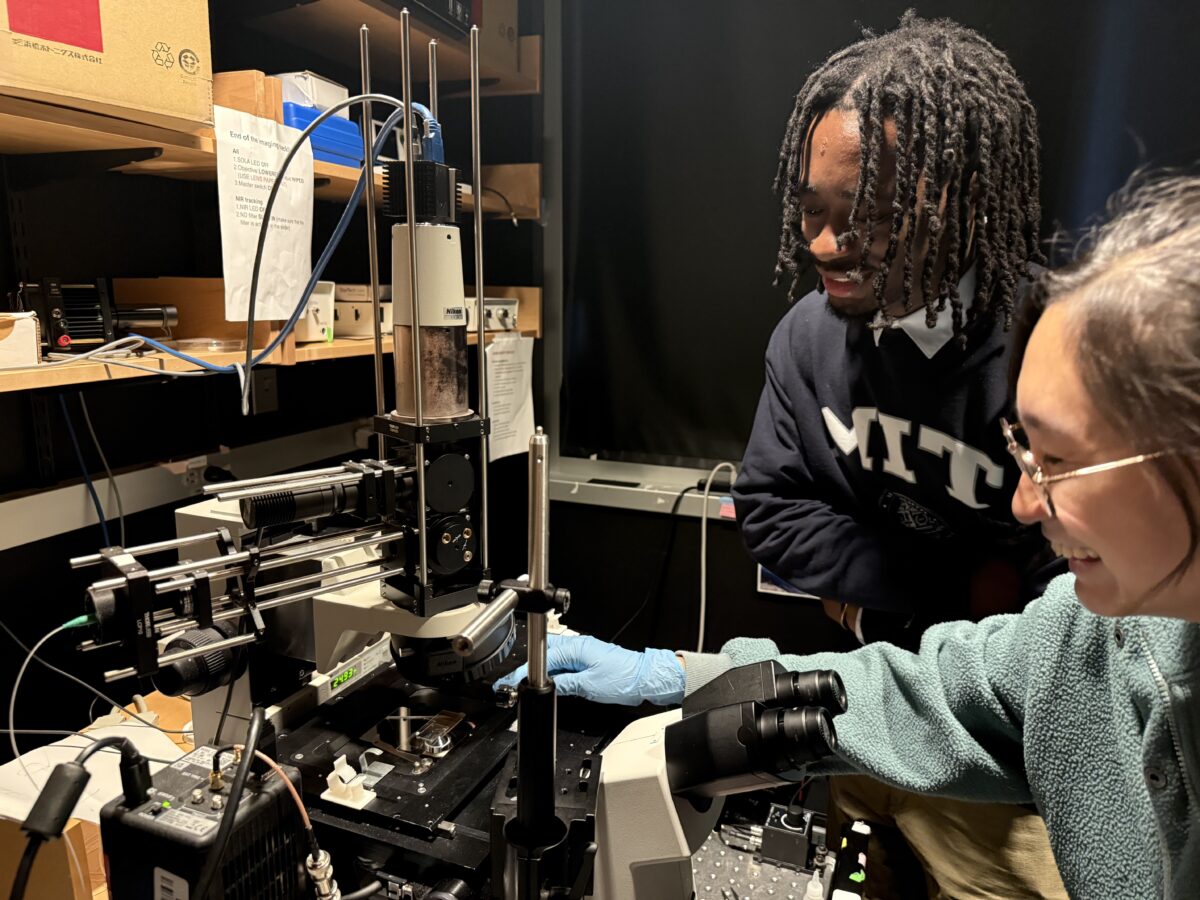 Amir Walton-Irvin (left), and a Ph.D. student in the Flavell Laboratory perform confocal microscopy. (Courtesy of Walton-Irvin)
Walton-Irvin’s path to Flavell’s lab started with the Quantitative Methods Workshop (QMW) at MIT, a seven-day professional development program that the Meyerhoff Scholars Program nominated him for. There, group lunches with faculty and sessions on machine learning in neuroscience, protein folding, and genomic sequencing sparked lasting connections. In particular, a lunch with Flavell led to ongoing conversations that aligned with the Cech opportunity, which is now creating fresh networking opportunities. Walton-Irvin’s leadership roles in the National Society of Black Engineers and UMBC’s chapter of the Institute of Electrical and Electronics Engineers have created further opportunities for networking with peers and mentors.
Shared ambition supports success
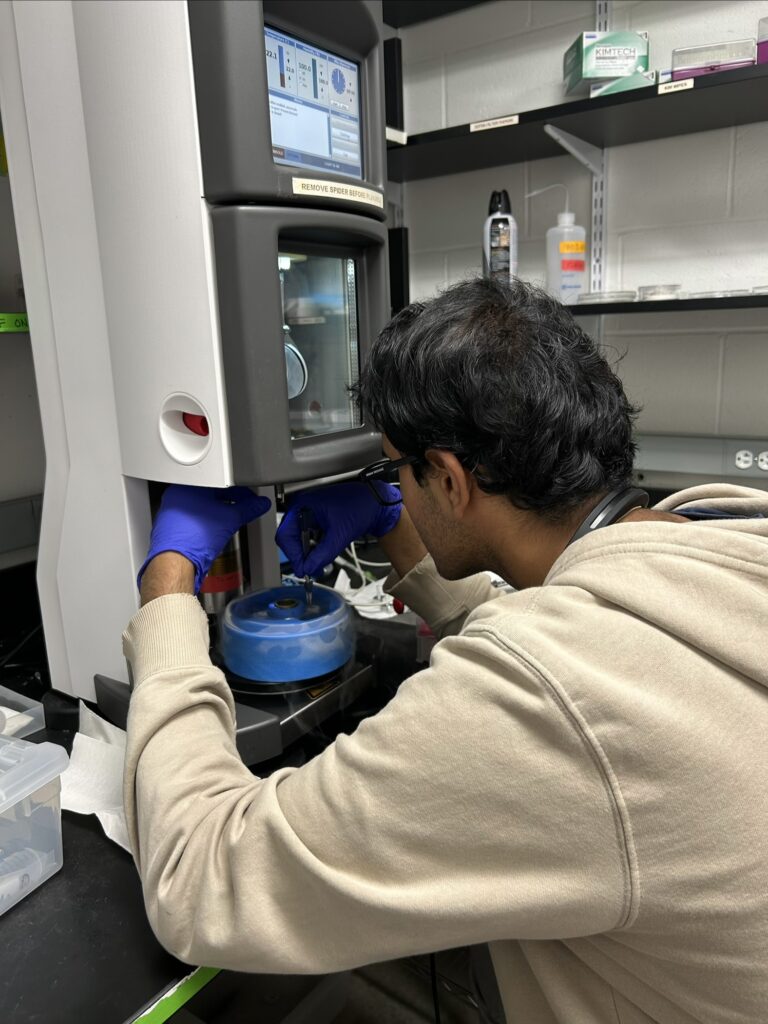 Aryan Srivastava is pursuing virology research
in the Harrison Lab at Harvard.
(Courtesy of Srivastava)
Aryan Srivastava, a dual degree student in biochemistry and molecular biology and bioinformatics and computational biology, is diving into structural virology in Stephen C. Harrison’s lab at Harvard. As president of both the Honors College Council and the Bioinformatics and Computational Biology Association, and a Meyerhoff, HHMI, and U-RISE scholar, Srivastava has built a strong scientific identity at UMBC: In his first year, he began conducting research with Michael Summers, HHMI Investigator and professor of chemistry and biochemistry.
A talk Harrison gave at an HHMI Science Meeting inspired Srivastava; financial support from his scholars programs had made his attendance possible. That encounter combined with his ongoing structural HIV research in the Summers Lab positioned him to pursue the Cech Fellowship. With Harrison, he will further explore the complex ways viruses enter cells that Harrison discussed at the meeting.
“Meeting peers who share your ambitions is one of the most important things an undergraduate can do,” Srivastava says. He also participated in the QMW at MIT, and roles in student organizations have connected him with program directors at federal grantmaking agencies, graduate students, and even Nobel laureates. Those relationships continue to pay dividends in Boston, where he’s reconnected with UMBC alumni like Arjun Kanjarpane ’24, biochemistry and molecular biology, a Ph.D. student at Harvard.
From participation to leadership
Silvi Shah, a Meyerhoff Scholar studying biochemistry and molecular biology, is in Elizabeth Engle’s lab at Boston Children’s Hospital, affiliated with Harvard Medical School and the Broad Institute. Shah’s neuroscience research with Weihong Lin at UMBC, where she is examining the effects of e-cigarette vapor on the olfactory system and behavior in mice, sparked her interest in deepening her mechanistic understanding of the brain by focusing on biomarkers for neurodevelopmental disorders.
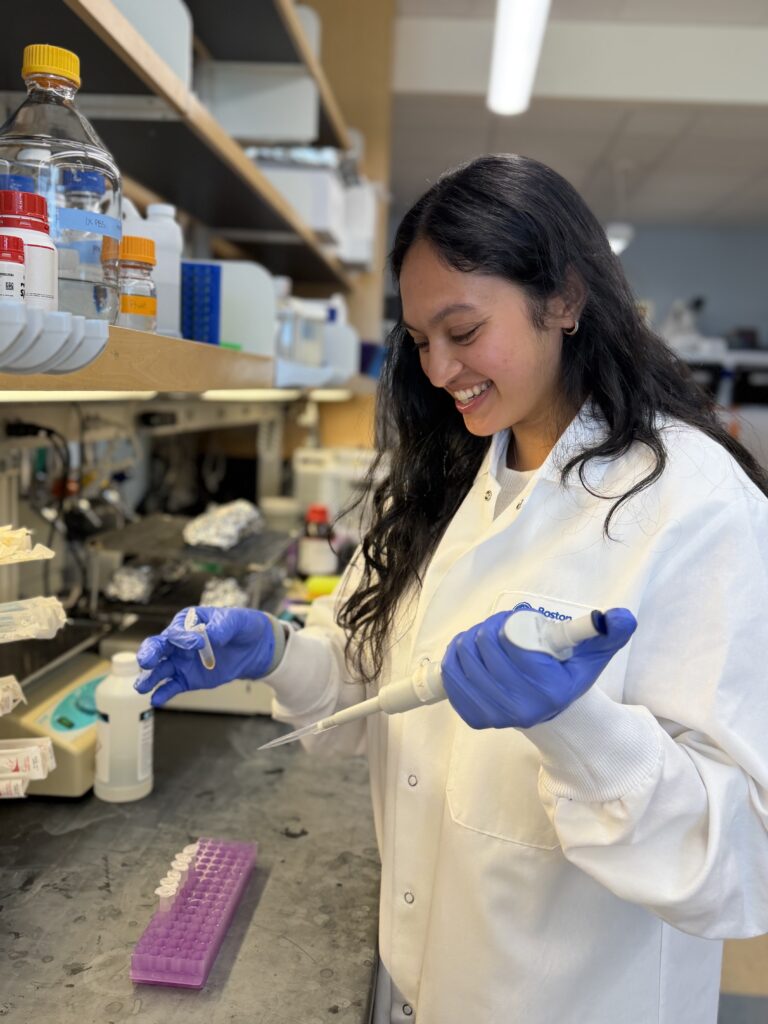 Silvi Shah is conducting neuroscience research with Elizabeth Engle at the Harvard Medical School. (Courtesy of Shah)
Being a member of the Meyerhoff, HHMI, and U-RISE scholars programs, and taking on leadership roles in Meyerhoff and the Phi Delta Epsilon Medical Fraternity, built Shah’s confidence and supplied community and mentorship. She connected with Harvard neuroscientist Beth Stevens at an HHMI Science Meeting, who introduced her to the Engle Lab. Award-winning presentations at the Annual Biomedical Research Conference for Minoritized Students (ABRCMS) and interactions with Nobel laureates, renowned faculty, graduate program directors, and alumni have broadened her perspective, she says.
In Boston, she’s reconnecting with scientists from the HHMI meeting and tapping into the Meyerhoff alumni network. “I am developing advanced research techniques and approaches that I would not have otherwise had the opportunity to learn at this stage of my education. These experiences have strengthened my commitment to an M.D./Ph.D. and a career in pediatric neuroscience research,” she shares.
Meanwhile, Nina-Simone Hunter, a biological sciences major, Meyerhoff, HHMI, and U-RISE Scholar, is at Cornell University in Liz Johnson’s lab. The group’s integration of microbiology, biochemistry, genomics, and molecular biology perfectly matches her interests and future Ph.D. plans, she says.
Preparation for the national stage
Nahom Getachew, a biochemistry and molecular biology major, Meyerhoff and HHMI Scholar, and Ethiopian immigrant, initially doubted research was for him, but opportunities at UMBC changed that, he says. Getachew attended an HHMI Science Meeting and ABRCMS with support from the Meyerhoff program. Squire Booker, a University of Pennsylvania biochemist and HHMI Investigator, spoke at both events, and Getachew asked follow-up questions about his work and the opportunity to contribute—which is now being realized through the Cech Fellows program.
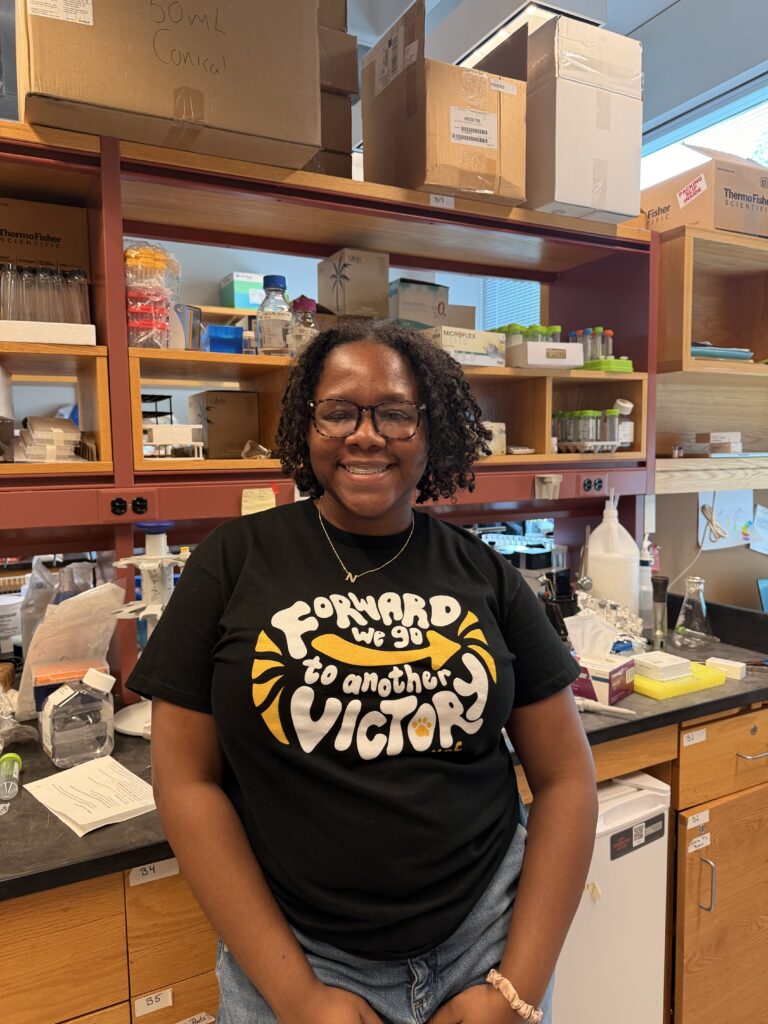 Nina-Simone Hunter is integrating microbiology, biochemistry, genomics, and molecular biology in Liz Johnson’s lab at Cornell. (Courtesy of Hunter)
“Networking is one of the most important skills for finding summer research opportunities,” Getachew notes. In addition to Booker, he connected with a Cech program coordinator at ABRCMS. Getachew prepared for national conferences by practicing communicating his work under Marcin Ptsazek, associate professor of chemistry and biochemistry, at UMBC’s Summer Undergraduate Research Fest and Undergraduate Research and Creative Achievement Day.
Now in the Booker Lab, he’s mastering new techniques in a drug discovery project, presenting results at the Cech Fellows Research Symposium at HHMI’s Janelia Research Campus, and connecting with peers who share similar goals, including fellow UMBC Cech Fellow Djina Awungnjia, a biological sciences major and McNair Scholar. All six UMBC fellows will present at the culminating symposium at HHMI Janelia, further expanding their national network.
As these Cech Fellows advance ambitious projects—from neural imaging analysis and virus structures to drug discovery and neurodevelopment—they carry forward skills, relationships, and confidence cultivated at UMBC through scholars programs, faculty mentorship, student organizations, and more.
Getachew says that the experience has reinforced his pursuit of an M.D./Ph.D. in translational clinical research: “This program has shown me what I am capable of.”
Learn more about UMBC’s premier scholars programs.
]]>
This summer, six rising juniors from UMBC are among the 176 undergraduates nationwide selected for the inaugural cohort of the Howard Hughes Medical Institute’s (HHMI) Cech Fellows program. Named...
https://umbc.edu/stories/six-umbc-students-hhmis-first-cech-fellows-cohort/
https://my3.my.umbc.edu/api/v0/pixel/news/161437/guest@my.umbc.edu/855db29b67be4bceb38339e83e52dbd3/api/pixel
biochemistry-and-molecular-biology
bioinformatics-and-computational-biology
biology
cnms
coeit
community
computer-engineering
csee
feature
honors-college
mcnair-scholars
meyerhoff-scholars
science-and-tech
stories
story
UMBC News & Magazine
https://my3.my.umbc.edu/groups/umbc-news-magazine
https://assets1-my.umbc.edu/system/shared/avatars/groups/000/001/943/24435aa6207c452e7bc15cc74b42c7bb/xsmall.png?1748556657
https://assets1-my.umbc.edu/system/shared/avatars/groups/000/001/943/24435aa6207c452e7bc15cc74b42c7bb/original.png?1748556657
https://assets2-my.umbc.edu/system/shared/avatars/groups/000/001/943/24435aa6207c452e7bc15cc74b42c7bb/xxlarge.png?1748556657
https://assets2-my.umbc.edu/system/shared/avatars/groups/000/001/943/24435aa6207c452e7bc15cc74b42c7bb/xlarge.png?1748556657
https://assets3-my.umbc.edu/system/shared/avatars/groups/000/001/943/24435aa6207c452e7bc15cc74b42c7bb/large.png?1748556657
https://assets1-my.umbc.edu/system/shared/avatars/groups/000/001/943/24435aa6207c452e7bc15cc74b42c7bb/medium.png?1748556657
https://assets2-my.umbc.edu/system/shared/avatars/groups/000/001/943/24435aa6207c452e7bc15cc74b42c7bb/small.png?1748556657
https://assets1-my.umbc.edu/system/shared/avatars/groups/000/001/943/24435aa6207c452e7bc15cc74b42c7bb/xsmall.png?1748556657
https://assets2-my.umbc.edu/system/shared/avatars/groups/000/001/943/24435aa6207c452e7bc15cc74b42c7bb/xxsmall.png?1748556657
UMBC News & Magazine
0
0
false
Tue, 04 Aug 2026 16:06:03 -0400
Tue, 04 Aug 2026 16:06:03 -0400
Nothing but beauty: Noor Zaidi leads an international interfaith team digitizing the history of one of the few shrines to a woman in Islam
The Sayyida Zainab shrine, near Damascus, Syria, is capped by a gold leaf dome atop a building wrapped in interlocking glazed tiles. The aquamarine, gold, amethyst, and brown tiles create geographic tapestries of swirls and intricate flower patterns. It’s a beautiful place of splendor inside and out, where thousands of Shi‘i Muslim pilgrims and visitors worldwide gather, pray, and honor the resting place of Zainab bint ‘Ali, Prophet Muhammad’s granddaughter. The shrine’s roofline is decorated with cobalt blue tiles that repeat the phrase, “Peace be upon you, oh mother of sorrows and hardships” in white Arabic calligraphy—a testament to the trials Zainab endured throughout her life.
When Noor Zaidi, assistant professor of history, visited the shrine on pilgrimage with her family more than 20 years ago, she was mesmerized. The shrine then inspired her graduate research, and now Zaidi is a scholar of the Middle East and South Asia specializing in the history of gender and sectarianism.
Her new book, Traces of Zainab: Ritual, Memory, and Place in Shi’a Islam, is a study of the woman who became a symbol of resistance for Shi‘i Muslims worldwide. Now Zaidi is leading an international interfaith team to preserve, restore, and digitize the shrine’s archives. With the support of Father Columba Stewart of the Hill Museum & Manuscript Library (HMML) in Minnesota, the Holy Spirit University of Kaslik in Lebanon, and the Mourtada family from Damascus, who have been the custodians of the shrine for over 800 years, the world will learn about one of the very few shrines to a woman in Islam and the community that has preserved it with love.
“We are delighted to return to Syria in support of this historic project,” says Stewart, executive director and CEO of HMML, at Saint John’s University—one of the world’s leading organizations funding the preservation and digitization of endangered archives to create open access collections. “Partnering with this historic shrine lies at the very heart of HMML’s mission to preserve and share the world’s handwritten past to inspire a deeper understanding of our present and future.”
Zaidi notes that this is not just about preserving. It’s about teaching students what it takes to be historians, stewards of a past with many missing parts, and to be aware that their work cannot happen in isolation. “There is a story to tell in the construction of this work that also tells us about the discipline of history, at this moment in time,” says Zaidi. “It’s a story of how to teach students to be conscientious scholars: to not just look at newspapers and documents but take into account what’s not being told, what history is being erased, and ask whose voices are not being heard.”
Q: Who is Zainab bint ‘Ali?
A: Zainab bint ‘Ali has meant many things to many people: woman, emblem, whisper in the past, shout in the street. Her presence, body, and words have been central to the construction of a distinct Shi‘i Islamic identity, yet large parts of her life were absent from view.
At six, she witnessed her grandfather Muhammad’s death, the singular political and religious leader of the Muslim community. Her father, ‘Ali, became the fourth successor to the Prophet Muhammad in 656 AD. His followers considered him the first Imam, God’s spiritual representative on earth. Before he was killed five years later, he passed on the leadership to his sons.
In Karbala, present-day Iraq, in 680 AD, Husayn ibn ‘Ali, Zainab’s brother, refused allegiance to Caliph Yazīd ibn Mu‘awiyah, viewing his rule as illegitimate. A battle ensued, and Husayn’s 72 male companions were killed along with his eight sons, nephews, and cousins. Husayn was beheaded. Zainab and the other women witnessed the massacre. After she was taken into captivity and paraded unveiled to Damascus, it is said that she delivered sermons recounting the events at Karbala. Zainab became a symbol of resistance—the few against the many.
For Shi‘i Muslims, the battle at Karbala became central to constructing their distinct identity, collective memory, theological frameworks, devotional practice, and traditions of mourning.
Q: In what ways have local and international communities contributed to keeping the shrine alive?
A: The shrine is a transnational space with people, materials, and ideas moving in and out of it. In the 19th and 20th centuries, many Shi‘i shrines in Iran and Iraq began to take on a similar appearance, usually attributed to Iranian patronage. A lot of money was invested in maintaining these shrines. The mausoleum is surrounded by silver and gold grilles with Zainab’s grave beneath. They were replaced over the centuries through donations. One came from Pakistan in the 1950s, while others came from Iraq and Iran. The gold leaf, some of the tile colors, and the carpets have all come from different countries. However, the Mourtada family was very deliberate in the renovations, using local craftsmen and an Arab Damascene style of tilework to keep the local cultural heritage embedded in the shrine.


Top row: Inside Sayyida Zainab shrine. (Images courtesy of Zaidi) Bottom row: Local craftsmen renovating the shrine. Constructing the golden dome. (Images courtesy of Makam Sayyida Zainab)
Long before the politics of the present, the shrine was part of the shared sacred geography of Damascus. Its history is entwined with the devotion of countless people who have passed through it over centuries. Syrians of many different backgrounds—including Muslims, Christians, and Jews—have visited the shrine over the centuries. Queen Soraya Esfandiary-Bakhtiary of Iran gave funding to build an electrical system, and Sunni Muslim Muhammad Ali, the American professional boxer and activist, also visited the shrine and paid tribute. Their visits helped raise awareness and respect and brought support from outside the Shi’i community.


(l) Former Prime Minister of Pakistan, Benazir Bhutto, at the Sayyida Zainab shrine. (r) Boxer Muhammad Ali at the Shrine of Sayyida Zainab (Images courtesy Makam Sayyida Zainab)
While the shrine’s story can be told through violence, conflict, and upheaval, we chose to tell the story that often gets buried. When Zainab was asked what she thought of her dead brother, she said, “I see nothing but beauty.” We see nothing but beauty. This is the story the project chooses to tell.
Q: How did you gain access to the shrine’s archives?
A: When I first visited for research in 2012, there was almost nobody there. The shrine was under constant threat, and the atmosphere was one of uncertainty. During that visit, I met Hani Mohsen Mourtada, the head custodian, former Syrian Minister of Higher Education, and former president of the University of Damascus. I think he was genuinely surprised that someone was willing to come under those conditions. He gave me access to photographs, legal documents, and virtually everything the shrine held in its archives. We built a close relationship. I interviewed him several times as the project developed. I returned to Syria in 2019 and again in 2021, but he was in Beirut. Sadly, he passed away during the COVID-19 pandemic, and I never had the chance to see him again.
As I neared completion of my manuscript, I needed to revisit the archival materials and get legal permission to use them. After Hani Mohsen’s death, custodianship passed to his son, Sayed Mazen Al-Mourtada. I connected with him, and Mazen agreed to give me access. He explained that he had moved the oldest records to Beirut because he feared they might not survive the war. Although there was widespread looting and destruction when he moved the records, Mazen recovered much of what I needed. There are many major Shi‘i shrines around the world, but not all of them make their archives available in this way or welcome the same level of transparency. That made this project especially meaningful because Mozen was willing to do exactly that.


Manuscripts from the Sayyida Zainab shrine. (Images courtesy of Makam Sayyida Zainab)
For historians, the history we write is so often incomplete and shaped by these absences and losses. Rather than presenting itself as complete, the digital archive will clearly identify documents destroyed through conflict and explain how historical archives are often incomplete collections of surviving materials. Understanding this is crucial for students as they embark on research.
Q: How does your personal journey help students understand the academic and personal skills required to be a historian?
A: History as a discipline is changing. We’re reading documents, translating them, and making meaning from them. Our research process is part of that history. While I was writing the book, my colleagues at UMBC told me that I should be in the story. I wasn’t used to that. The book is divided into three parts: Zainab’s shrine, the Bibi Pak Daman shrine in Lahore, Pakistan; and the al-Rashād prison for women in Iraq. In each section, I invite the reader to take a journey with me. I was so much a part of the process that while I was writing the book, I became part of the story. I learned that if I’m interviewing these women, they are not speaking to a wall—they were speaking to me.
Being a historian is a labor of love. You don’t do things this long unless you care and find them interesting. I have been studying the Shrine of Sayyida Zainab for about 15 years. For much of that time, Syria was caught in civil war and proxy war. The shrine was regularly targeted by jihadist groups such as ISIS and al-Qaeda, and for more than a decade it was extraordinarily difficult to travel in and out of the country, and then the pandemic happened. Many times, I was told to reframe the book or to change the topic. I didn’t give up.
This archive is my way of contributing something meaningful to the people and place that shaped my research. Although I continue to worry about the shrine’s future, preserving these materials offers hope that, should anything happen to it, its history will not disappear. In that sense, preserving the shrine and its documents is about preserving a piece of our common humanity.
Learn more about UMBC’s history department.
]]>
The Sayyida Zainab shrine, near Damascus, Syria, is capped by a gold leaf dome atop a building wrapped in interlocking glazed tiles. The aquamarine, gold, amethyst, and brown tiles create...
https://umbc.edu/stories/noor-zaidi-leads-team-digitizing-history-of-sayyida-zainab-shrine/
https://my3.my.umbc.edu/api/v0/pixel/news/161375/guest@my.umbc.edu/b26c99277cb65970c0caa20dd3e07b2e/api/pixel
cahss
history
international
policy-and-society
research
stories
story
UMBC News & Magazine
https://my3.my.umbc.edu/groups/umbc-news-magazine
https://assets1-my.umbc.edu/system/shared/avatars/groups/000/001/943/24435aa6207c452e7bc15cc74b42c7bb/xsmall.png?1748556657
https://assets1-my.umbc.edu/system/shared/avatars/groups/000/001/943/24435aa6207c452e7bc15cc74b42c7bb/original.png?1748556657
https://assets2-my.umbc.edu/system/shared/avatars/groups/000/001/943/24435aa6207c452e7bc15cc74b42c7bb/xxlarge.png?1748556657
https://assets2-my.umbc.edu/system/shared/avatars/groups/000/001/943/24435aa6207c452e7bc15cc74b42c7bb/xlarge.png?1748556657
https://assets3-my.umbc.edu/system/shared/avatars/groups/000/001/943/24435aa6207c452e7bc15cc74b42c7bb/large.png?1748556657
https://assets1-my.umbc.edu/system/shared/avatars/groups/000/001/943/24435aa6207c452e7bc15cc74b42c7bb/medium.png?1748556657
https://assets2-my.umbc.edu/system/shared/avatars/groups/000/001/943/24435aa6207c452e7bc15cc74b42c7bb/small.png?1748556657
https://assets1-my.umbc.edu/system/shared/avatars/groups/000/001/943/24435aa6207c452e7bc15cc74b42c7bb/xsmall.png?1748556657
https://assets2-my.umbc.edu/system/shared/avatars/groups/000/001/943/24435aa6207c452e7bc15cc74b42c7bb/xxsmall.png?1748556657
UMBC News & Magazine
1
0
false
Wed, 29 Jul 2026 09:43:09 -0400
Wed, 29 Jul 2026 09:43:09 -0400
Meet a Retriever—Annie Byrd ’04, M.P.S. ’23, birth worker advocate who creates employment connections for UMBC students
Annie Byrd ’04, emergency health services, M.P.S. ’23, community leadership, began her staff career at UMBC as an executive administrative assistant and she is now the Career Center’s assistant director for employer relations. She attributes her growth as a leader to UMBC’s supportive environment that encouraged members to make an impact in their communities. Annie says that the community leadership program helped her connect the dots between her undergraduate degree in emergency health services, her experience as a doula—a trained professional who provides emotional, physical, and informational support during pregnancy, birth, and the postpartum period—and her passion for maternal health equity and social justice. She then integrated these values into systems-level change, co-founding the Doula Alliance of Maryland.
Q: What’s one essential thing you’d want another Retriever to know about you?
A: I’ve been part of the UMBC community for over 20 years—as an undergraduate, graduate student, and a staff member. I love building connections, supporting students, and finding creative solutions that help people succeed.
Q: Tell us about someone in the UMBC community who has inspired you.
 Byrd, second from left, in May 2026 with the student staff she supervises. “This is why I do what I do—students!”
A: Yvette Mozie-Ross [’88, currently vice provost for enrollment management and planning] saw potential in me before I saw it in myself. As my first supervisor at UMBC, she encouraged me to continue my education and pursue new opportunities. Her mentorship helped shape my journey from executive administrative assistant to assistant director.
Q: Tell us about what you love about your academic program or an organization you’re involved in at UMBC.
A: What I loved most about the M.P.S. in Community Leadership was learning alongside people committed to creating change. The program challenged me to think strategically, and it directly inspired my work co-founding the Doula Alliance of Maryland to advance equitable maternal health.
Q: What’s the one thing you’d want someone who hasn’t joined the UMBC community to know about the support you find here?
A: What makes UMBC special is that everyone belongs here. It’s an inclusive community that values curiosity, encourages ambitious ideas, and provides the support to help you grow personally, academically, and professionally.
Q: What part of your job do you enjoy the most and why?
A: Student interactions are what I enjoy most. I love helping students discover opportunities, build confidence, and recognize the skills they already have. It’s rewarding to know that even one conversation can have a lasting impact on their career journey.
Q: What brought you to UMBC?
 Byrd at the May 2023 graduation ceremony for her M.P.S. in Community Leadership.
A: I came to UMBC as an undergraduate and a student-athlete, and I’ve come back as a staff member because I experienced firsthand how transformative this community can be. UMBC has shaped my life. I met my husband, built lifelong friendships, and found a career where I can help students create their own UMBC stories.
Q: At UMBC, how have you found support for birth work advocacy?
A: The community leadership program faculty and staff helped me turn my passion for birth work into systems-level change. Research shows that doula support is associated with better maternal health outcomes, yet many families—particularly those who have been historically marginalized—face significant barriers to accessing this care. Seeing both the impact of doulas and the inequities in access inspired me to co-found the Doula Alliance of Maryland to expand access and advance maternal health equity. Also, my Career Center colleagues have continued to support that mission, reminding me that UMBC values both professional growth and community impact.
Q: What would you tell someone who is considering a career at UMBC?
A: UMBC is a place where your ideas and potential are valued. It provides opportunities to grow your career while connecting your work to a larger purpose. My own journey from student to staff member shows how UMBC supports people who want to make a difference.
]]>
Annie Byrd ’04, emergency health services, M.P.S. ’23, community leadership, began her staff career at UMBC as an executive administrative assistant and she is now the Career Center’s assistant...
https://umbc.edu/stories/meet-a-retriever-annie-byrd-birth-worker-advocate/
https://my3.my.umbc.edu/api/v0/pixel/news/161335/guest@my.umbc.edu/411920c2945bc1cc733100111b1660e1/api/pixel
alumni
cahss
campus-life
career-center
community-leadership
dps
ehs
mps
stories
story
UMBC News & Magazine
https://my3.my.umbc.edu/groups/umbc-news-magazine
https://assets1-my.umbc.edu/system/shared/avatars/groups/000/001/943/24435aa6207c452e7bc15cc74b42c7bb/xsmall.png?1748556657
https://assets1-my.umbc.edu/system/shared/avatars/groups/000/001/943/24435aa6207c452e7bc15cc74b42c7bb/original.png?1748556657
https://assets2-my.umbc.edu/system/shared/avatars/groups/000/001/943/24435aa6207c452e7bc15cc74b42c7bb/xxlarge.png?1748556657
https://assets2-my.umbc.edu/system/shared/avatars/groups/000/001/943/24435aa6207c452e7bc15cc74b42c7bb/xlarge.png?1748556657
https://assets3-my.umbc.edu/system/shared/avatars/groups/000/001/943/24435aa6207c452e7bc15cc74b42c7bb/large.png?1748556657
https://assets1-my.umbc.edu/system/shared/avatars/groups/000/001/943/24435aa6207c452e7bc15cc74b42c7bb/medium.png?1748556657
https://assets2-my.umbc.edu/system/shared/avatars/groups/000/001/943/24435aa6207c452e7bc15cc74b42c7bb/small.png?1748556657
https://assets1-my.umbc.edu/system/shared/avatars/groups/000/001/943/24435aa6207c452e7bc15cc74b42c7bb/xsmall.png?1748556657
https://assets2-my.umbc.edu/system/shared/avatars/groups/000/001/943/24435aa6207c452e7bc15cc74b42c7bb/xxsmall.png?1748556657
UMBC News & Magazine
7
0
false
Tue, 28 Jul 2026 14:53:00 -0400
Tue, 28 Jul 2026 14:53:00 -0400
UMBC’s student Fulbright recipients pursue community-driven research on a global stage
UMBC’s 2026 – 2027 recipients of the prestigious Fulbright U.S. Student Program are joining the ranks of UMBC’s distinguished Fulbright alumni, who have made UMBC a three-time Fulbright Top Producing Institution, a recognition from the U.S. Department of State’s Bureau of Educational and Cultural Affairs.
More than 2,000 Fulbright U.S. Students—recent college graduates, graduate students, and early career professionals—pursue graduate study, conduct research, or teach English in schools abroad each year, earning placements in Africa, Asia and the Pacific, the Middle East, Latin America, and Europe. This year’s Fulbright Retrievers are launching the international phase of their research. From Baltimore to the Dominican Republic, India, and Mexico, these students are working with and for local communities to support local approaches to ongoing challenges.
The art of collaboration
During her senior year, Marelen Acevedo Soto ’26, visual arts, wowed Retrievers at UMBC’s 2025 Undergraduate Research and Creative Achievement Day with an experiential painting that combined projection, animation, and live performance. Now, she is packing up these skills and taking them to Santo Domingo, Dominican Republic, where she was born. Acevedo Soto earned her associate’s degree from Chavón School of Design. She is returning to work with the students to create a large-scale mural titled “Multidimensional Mural: Augmented Reality for Environmental Change” in Santo Domingo’s Zona Colonial (Colonial Zone), a UNESCO World Heritage site. Using QR codes, passersby will access animations and hear community voices describing how pollution affects daily life. The project will close with a Spanish and English multimedia performance combining projected animations, environmental data, and Dominican music.


Acevedo Soto (on the right) with artists from The Music and Me Foundation and at URCAD 2025. (Images courtesy of Acevedo)
“Many of my strongest ideas came from learning across different fields at UMBC,” says Acevedo Soto. “Music theory helped me think about rhythm and emotion. Storytelling taught me how to create meaningful experiences. Psychology helped me better understand how people think and engage with art. Environmental science deepened my understanding of water and the importance of its conservation, and data analysis gave me the tools to measure the impact of my project.”
Researchers’ responsibility
Vunnathi Ankem ’26, psychology, has had a passion for India for years, specifically how cultural exchange in India was shaped by hundreds of years of discourse, colonization, and history. While researching intimate partner violence (IPV) for her honors thesis, Vunnathi Ankem ’26, psychology, became interested in how South Asian students developed their understandings of IPV. Unexpectedly, most of the students she interviewed were from Telugu-speaking regions, such as Hyderabad in southern India. Intrigued, Ankem is now headed to the Psychology Center at the University of Hyderabad to continue her research. “Psychology, as we know it in the Western world, is only one approach to understanding the mind and the body,” says Ankem. “As psychology students, it is our responsibility to explore worlds and lenses beyond the Eurocentric ones.”
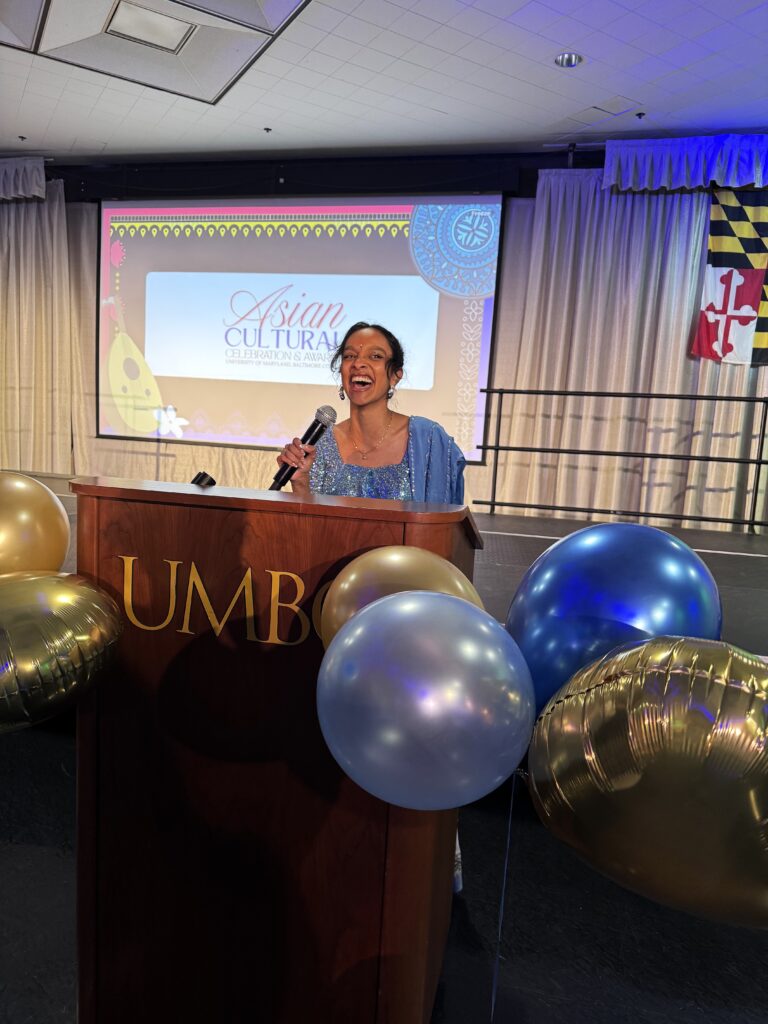
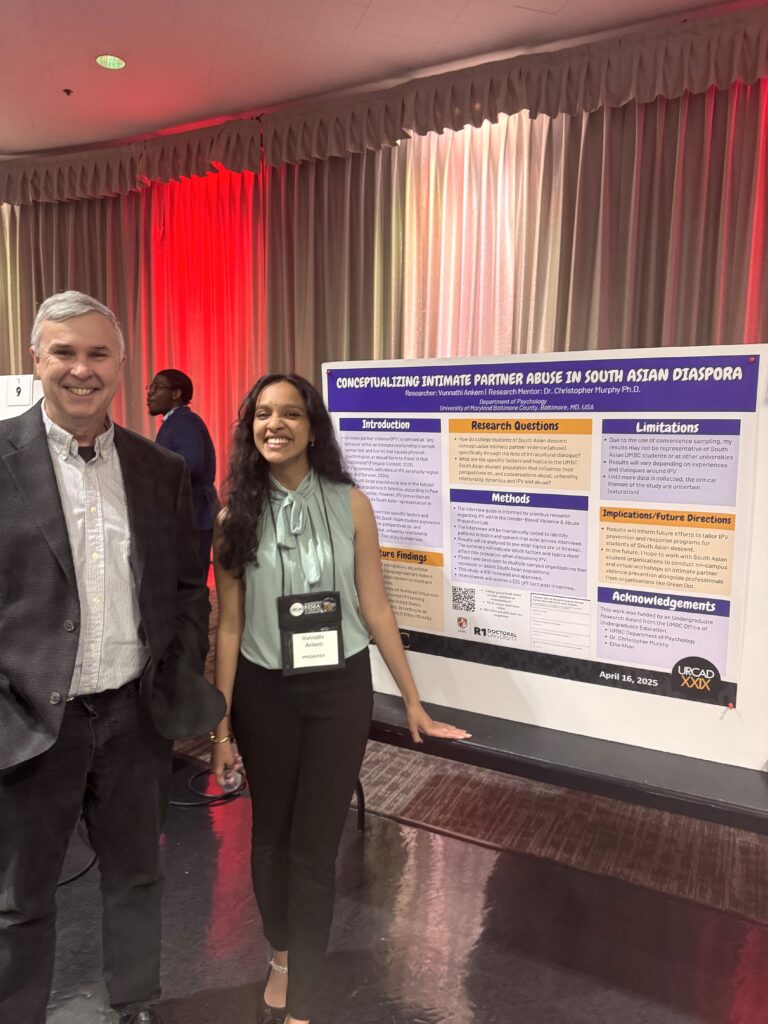
(l-r) Ankem at the 2026 Asian Cultural Celebration and Awards ceremony. Ankem with mentor Christopher Murphy, professor of psychology. (Images courtesy of Ankem)
She will study how systems, class, community, and culture shape experiences of IPV in India and inform more culturally responsive prevention strategies. Ankem will then develop community-based and community-led IPV prevention workshops. “The Fulbright program is giving me the opportunity I have always dreamed about,” says Ankem. “I can’t wait to learn from professionals and clinicians, alongside ancient culture practitioners and experts in India. It will be the experience of a lifetime!”
Humanistic climate futures
After studying climate change and migration on a study abroad trip to Oaxaca, Mexico, Bryan Castro-Velez ’26, geography and environmental studies, knew he was on the right research path—studying humanistic approaches to equitable agroecological systems and land in Indigenous Latin American communities. He says learning directly from indigenous leaders about their farming practices and response to climate change inspired him to apply for the Fulbright García-Robles award for graduate and doctoral research in Mexico. Castro-Velez’s graduate work will focus on agroecology, natural resource management, and rural development in Chiapas, Mexico.
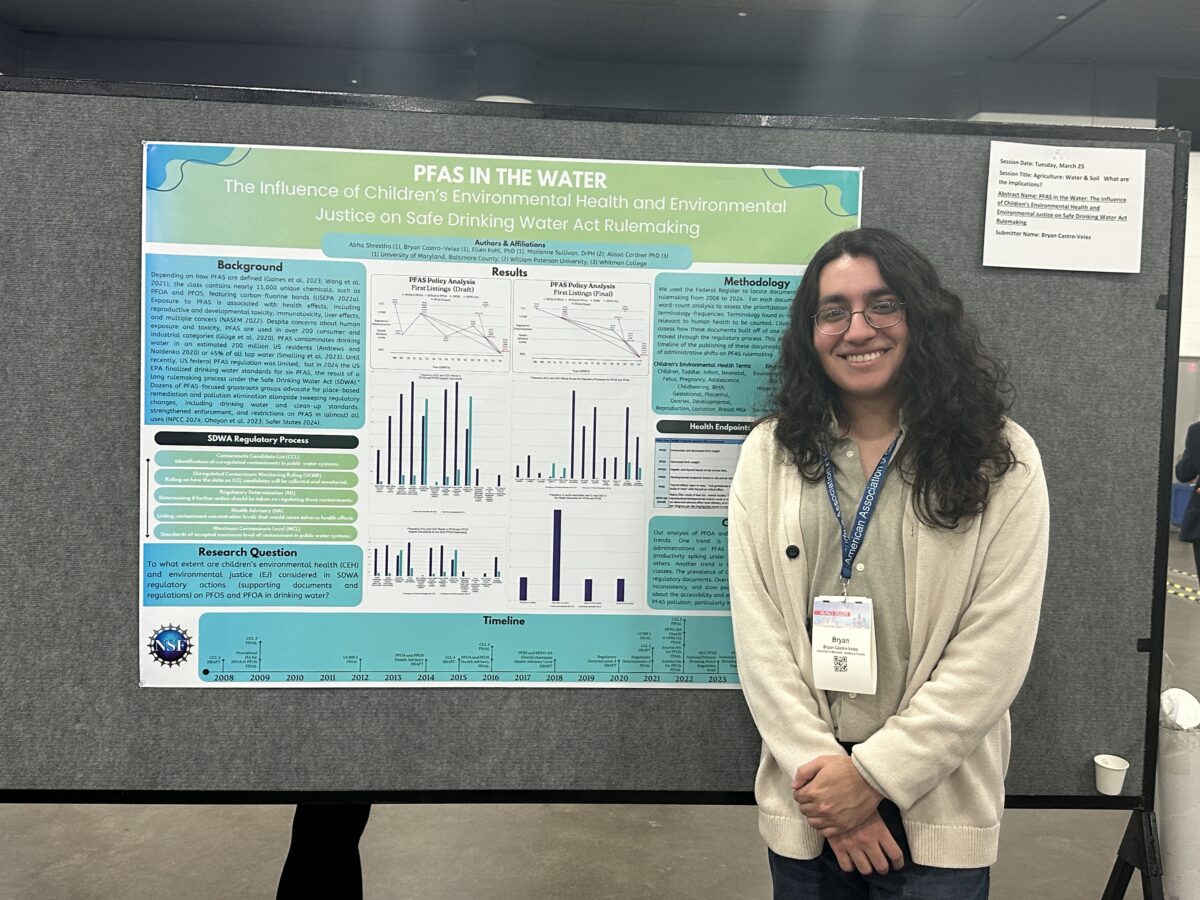 Bryan Castro-Velez at the 2025 Association of American Geographers annual conference in Detroit. (Image courtesy of Castro-Velez)
“I look forward to continuing down this path, encouraging others to do the same, and furthering my education outside the walls of academia,” says Castro-Velez. “My experiences during and outside of UMBC have proven to me that community-based learning systems are fundamental to just climate solutions and humanistic futures.”
As the U.S. Fulbright Program celebrates its 80th anniversary this year, UMBC’s Fulbright program is celebrating by expanding support through the Office of Prestigious Scholarships (OPS) under the leadership of April Householder ’95, director of OPS: “I am looking forward to building on UMBC’s strong legacy as a top producer of Fulbright students,” says Householder, “and expanding student support throughout the processes of exploring, applying, and transitioning abroad.”
Learn more about UMBC’s international opportunities.
]]>
UMBC’s 2026 – 2027 recipients of the prestigious Fulbright U.S. Student Program are joining the ranks of UMBC’s distinguished Fulbright alumni, who have made UMBC a three-time Fulbright Top...
https://umbc.edu/stories/umbcs-2026-student-fulbright-recipients/
https://my3.my.umbc.edu/api/v0/pixel/news/161318/guest@my.umbc.edu/3c2bd6a8225156f81db68222ed9fdd71/api/pixel
alumni
cahss
class-of-2026
community
fulbright
geographic-information-systems
international
policy-and-society
psychology
stories
story
urcad
visual-arts
UMBC News & Magazine
https://my3.my.umbc.edu/groups/umbc-news-magazine
https://assets1-my.umbc.edu/system/shared/avatars/groups/000/001/943/24435aa6207c452e7bc15cc74b42c7bb/xsmall.png?1748556657
https://assets1-my.umbc.edu/system/shared/avatars/groups/000/001/943/24435aa6207c452e7bc15cc74b42c7bb/original.png?1748556657
https://assets2-my.umbc.edu/system/shared/avatars/groups/000/001/943/24435aa6207c452e7bc15cc74b42c7bb/xxlarge.png?1748556657
https://assets2-my.umbc.edu/system/shared/avatars/groups/000/001/943/24435aa6207c452e7bc15cc74b42c7bb/xlarge.png?1748556657
https://assets3-my.umbc.edu/system/shared/avatars/groups/000/001/943/24435aa6207c452e7bc15cc74b42c7bb/large.png?1748556657
https://assets1-my.umbc.edu/system/shared/avatars/groups/000/001/943/24435aa6207c452e7bc15cc74b42c7bb/medium.png?1748556657
https://assets2-my.umbc.edu/system/shared/avatars/groups/000/001/943/24435aa6207c452e7bc15cc74b42c7bb/small.png?1748556657
https://assets1-my.umbc.edu/system/shared/avatars/groups/000/001/943/24435aa6207c452e7bc15cc74b42c7bb/xsmall.png?1748556657
https://assets2-my.umbc.edu/system/shared/avatars/groups/000/001/943/24435aa6207c452e7bc15cc74b42c7bb/xxsmall.png?1748556657
UMBC News & Magazine
0
0
false
Mon, 27 Jul 2026 17:10:21 -0400
Mon, 27 Jul 2026 17:10:21 -0400
Four Retrievers selected for this summer’s Key Bridge rebuilding internship
This summer, four UMBC students are getting hands-on experience contributing to efforts to rebuild the Francis Scott Key Bridge over the Patapsco River, which collapsed in March 2024 after a cargo ship collided with one of its supports. This is the second year in a row that the Maryland Transportation Authority has partnered with the Maryland Higher Education Commission to run the program.
Last year, three out of nine students in the program hailed from UMBC. This year, four out of the 10 interns are Retrievers. Mechanical engineering students Bilal Faizullah and Katelyn Prasad and geography and environmental systems students James Keller and Megan (Em) Schumacher ’26 will get the opportunity to learn about topics such as project management, environmental analysis, construction oversight, and community outreach. They will also get the chance to be a part of an iconic infrastructure project for Maryland, an experience that last year’s student interns found particularly meaningful.
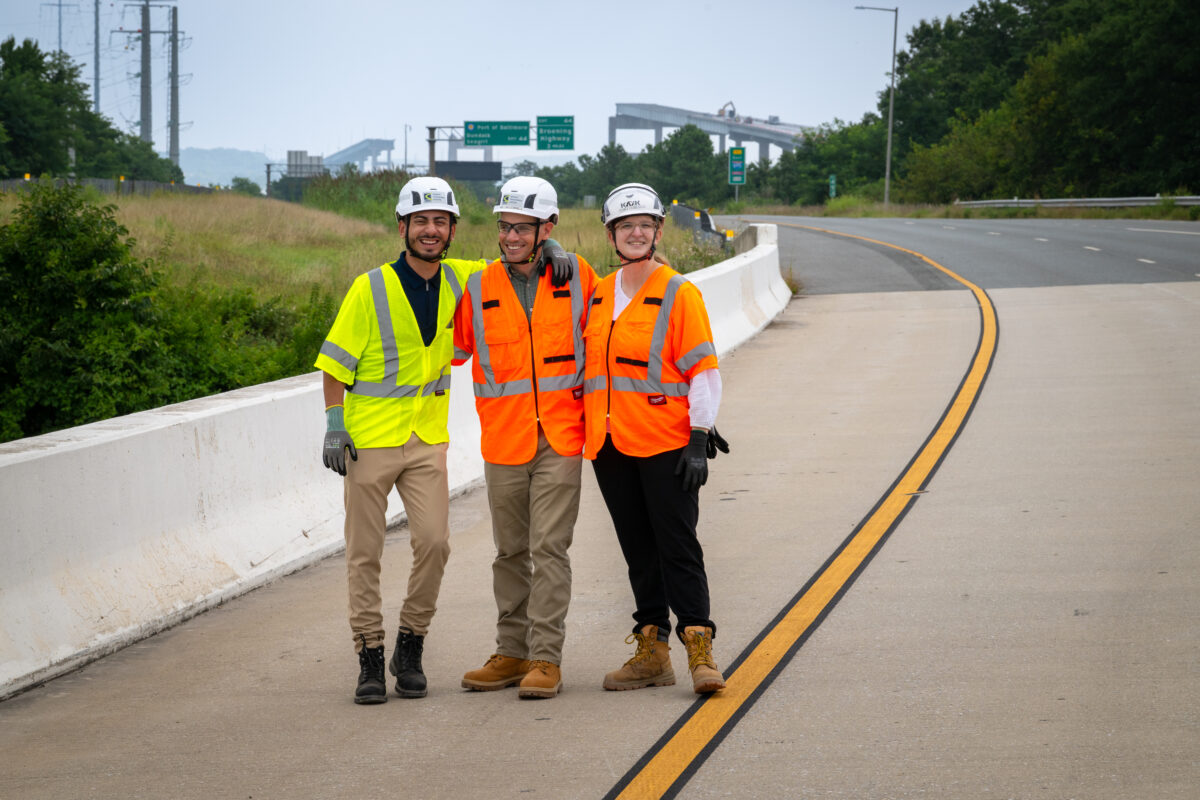 From left to right, Cristian Mena, William McConnell, and Emily DiMarzio pose for a photo near the site of the collapsed Key Bridge. The three worked on the bridge rebuilding project as interns with the Maryland Transportation Authority in summer 2025. (Brad Ziegler/UMBC)
“The Key Bridge Internship Program represents the very best of career-connected learning by giving students the opportunity to contribute to a project that will have a lasting impact on Maryland,” says Christine Routzahn, director of UMBC’s Career Center. “We’re incredibly proud that four UMBC students were selected for this prestigious program. Their selection reflects not only their talent and dedication, but also the strength of the partnerships that make opportunities like this possible. We are grateful to the Maryland Transportation Authority, Maryland Higher Education Commission, and its partners for investing in our students and in the state’s future workforce.”
]]>
This summer, four UMBC students are getting hands-on experience contributing to efforts to rebuild the Francis Scott Key Bridge over the Patapsco River, which collapsed in March 2024 after a cargo...
https://umbc.edu/stories/key-bridge-rebuilding-internship-summer-2026/
https://my3.my.umbc.edu/api/v0/pixel/news/161314/guest@my.umbc.edu/56fca8c62f428a6e6cff12abb2ccee1e/api/pixel
cahss
coeit
ges
impact
internship
meche
science-and-tech
stories
story
UMBC News & Magazine
https://my3.my.umbc.edu/groups/umbc-news-magazine
https://assets1-my.umbc.edu/system/shared/avatars/groups/000/001/943/24435aa6207c452e7bc15cc74b42c7bb/xsmall.png?1748556657
https://assets1-my.umbc.edu/system/shared/avatars/groups/000/001/943/24435aa6207c452e7bc15cc74b42c7bb/original.png?1748556657
https://assets2-my.umbc.edu/system/shared/avatars/groups/000/001/943/24435aa6207c452e7bc15cc74b42c7bb/xxlarge.png?1748556657
https://assets2-my.umbc.edu/system/shared/avatars/groups/000/001/943/24435aa6207c452e7bc15cc74b42c7bb/xlarge.png?1748556657
https://assets3-my.umbc.edu/system/shared/avatars/groups/000/001/943/24435aa6207c452e7bc15cc74b42c7bb/large.png?1748556657
https://assets1-my.umbc.edu/system/shared/avatars/groups/000/001/943/24435aa6207c452e7bc15cc74b42c7bb/medium.png?1748556657
https://assets2-my.umbc.edu/system/shared/avatars/groups/000/001/943/24435aa6207c452e7bc15cc74b42c7bb/small.png?1748556657
https://assets1-my.umbc.edu/system/shared/avatars/groups/000/001/943/24435aa6207c452e7bc15cc74b42c7bb/xsmall.png?1748556657
https://assets2-my.umbc.edu/system/shared/avatars/groups/000/001/943/24435aa6207c452e7bc15cc74b42c7bb/xxsmall.png?1748556657
UMBC News & Magazine
6
0
false
Mon, 27 Jul 2026 13:01:27 -0400
Mon, 27 Jul 2026 13:01:27 -0400
UMBC researcher awarded high-risk, high-reward NIAID grant to improve HIV prevention drugs
HIV continues to pose a major global health challenge, with about 1.3 million new infections reported annually worldwide in recent years. One of the most important HIV prevention strategies is pre-exposure prophylaxis, or PrEP. Healthy individuals at risk of HIV take a daily pill containing two antiretroviral drugs—tenofovir (TFV) and emtricitabine (FTC)—to block the virus before it can take hold.
These drugs only become protective after they are modified inside cells, specifically by adding a phosphate group in a step called “phosphorylation.” This activation turns them into their working forms. However, people’s responses to the drugs vary widely, sometimes leading to reduced protection.
Herana Kamal Seneviratne, assistant professor of chemistry and biochemistry, has received a two-year grant from the National Institute of Allergy and Infectious Diseases (NIAID) to explore how two key HIV prevention drugs work inside the body—specifically in colon tissue, where HIV transmission risk is especially high. The project seeks to explain why these drugs protect some people better than others and could help make prevention tools more reliable.
“One of the reasons for PrEP failure is the huge variability observed among individuals,” Seneviratne explains. This variability is concerning, because someone might partake in riskier behavior based on a belief that they are safer than they actually are.
Seneviratne’s work focuses on the colon, because unprotected anal sex carries an 18-fold higher risk of HIV transmission than vaginal sex. Oral PrEP spreads through the bloodstream, but the amount of active drug that reaches colon tissue is not well studied, and could be one of the reasons for variable drug responses. Understanding what happens in these tissues is therefore crucial for improving PrEP, Seneviratne says, particularly for men who have sex with men.
Mapping cellular machinery
Previous work, including from Seneviratne’s group, has shown that certain enzymes are involved in activating and deactivating PrEP drugs in the blood by adding and removing phosphate groups. Certain kinases add a phosphate group, and certain nucleotidases remove it. However, the activity of these enzymes in colon tissue is unknown.
“What matters is the drug metabolite concentrations in specific sites like in colon. That’s the point that we’re trying to make,” Seneviratne says.
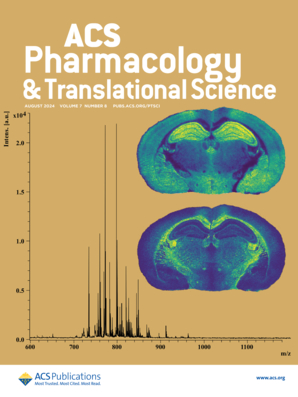 Pharmacology & Translational Science featured a study by Seneviratne’s group about the effect of HIV drugs on the brain on its cover in 2024.
To address that knowledge gap, Seneviratne’s team will grow human colon cells in the lab and use genetic tools to modify the expression of these kinases and nucleotidases one at a time. Then they will measure how those changes affect the drugs’ phosphorylation status. The project will take an innovative approach using mass spectrometry imaging, a technique that lets researchers see where molecules are located and active inside tissues.
“Our group is trying to contribute to overall improved HIV prevention,” Seneviratnes says. To that end, “understanding the metabolism of these two drugs in colon tissue is important.”
In conjunction with the lab’s work with human cells, Seneviratne’s team will examine mouse colon tissue to map these enzymes’ presence and activity across different cell types and tissue regions. The project will combine traditional techniques—specifically enzyme histochemistry and mass spectrometry—in novel ways. The dual approach will allow the team to observe enzymatic activity directly in its natural tissue environment rather than in a test tube, Seneviratne explains.
The NIAID grant type supporting the work, an R21, supports innovative high-risk, high-reward ideas that push scientific boundaries. Work is already underway on this approximately $440,000, two-year award. Graduate students Korin Murray and Nimalee Jayasekera and research fellow Christian Oh will take leading roles. Jayasekera will focus on the cell and molecular biology aspects, Murray will work on advanced imaging and tissue analysis, and Oh will support both students. There will be opportunities for undergraduates as well. Overall, the project expands the group’s focus on the negative side effects of drugs that treat HIV (including a study led by chemistry Ph.D. student Nav Raj Phulara on the brain) into the effectiveness of HIV prevention drugs.
From the bench to better PrEP
By revealing how these enzymes control drug activation and deactivation in specific parts of the colon, the project aims to provide knowledge that could lead to better dosing strategies, improved formulations, or other ways to make PrEP more effective. “The data that we generate from this work, we can leverage to optimize the therapeutic efficacy of the HIV PrEP drugs,” Seneviratne said. “These two drugs set the foundation for HIV prevention.”
Seneviratne’s interest in this area grew from his postdoctoral training at Johns Hopkins University, where he worked closely with clinicians to identify pressing real-world problems, leading him to ask, “How can I use my bioanalytical chemistry expertise to address those questions?” His chemistry expertise, combined with early publications on these enzymes, provided the foundation for the proposal.
This kind of fundamental research strengthens public health tools like PrEP, helping more people stay protected against HIV. The findings could eventually support more personalized or reliable prevention approaches across diverse populations.
]]>
HIV continues to pose a major global health challenge, with about 1.3 million new infections reported annually worldwide in recent years. One of the most important HIV prevention strategies is...
https://umbc.edu/stories/niaid-funds-hiv-prevention-research/
https://my3.my.umbc.edu/api/v0/pixel/news/161305/guest@my.umbc.edu/a458e8c69e80e02885e0668ab640a882/api/pixel
chemistry-and-biochemistry
cnms
research
science-and-tech
stories
story
UMBC News & Magazine
https://my3.my.umbc.edu/groups/umbc-news-magazine
https://assets1-my.umbc.edu/system/shared/avatars/groups/000/001/943/24435aa6207c452e7bc15cc74b42c7bb/xsmall.png?1748556657
https://assets1-my.umbc.edu/system/shared/avatars/groups/000/001/943/24435aa6207c452e7bc15cc74b42c7bb/original.png?1748556657
https://assets2-my.umbc.edu/system/shared/avatars/groups/000/001/943/24435aa6207c452e7bc15cc74b42c7bb/xxlarge.png?1748556657
https://assets2-my.umbc.edu/system/shared/avatars/groups/000/001/943/24435aa6207c452e7bc15cc74b42c7bb/xlarge.png?1748556657
https://assets3-my.umbc.edu/system/shared/avatars/groups/000/001/943/24435aa6207c452e7bc15cc74b42c7bb/large.png?1748556657
https://assets1-my.umbc.edu/system/shared/avatars/groups/000/001/943/24435aa6207c452e7bc15cc74b42c7bb/medium.png?1748556657
https://assets2-my.umbc.edu/system/shared/avatars/groups/000/001/943/24435aa6207c452e7bc15cc74b42c7bb/small.png?1748556657
https://assets1-my.umbc.edu/system/shared/avatars/groups/000/001/943/24435aa6207c452e7bc15cc74b42c7bb/xsmall.png?1748556657
https://assets2-my.umbc.edu/system/shared/avatars/groups/000/001/943/24435aa6207c452e7bc15cc74b42c7bb/xxsmall.png?1748556657
UMBC News & Magazine
0
0
false
Mon, 27 Jul 2026 11:14:31 -0400
Mon, 27 Jul 2026 11:14:31 -0400