Inspired by evolutionary biology ‘aha’ moment, Nhi Nguyen ’25 takes action to help children grasp their own worth
On a warm and humid day in January, about 40 children, five teachers, and 10 volunteers spill out of a school bus at the Saigon Zoo and Botanical Garden in Ho Chi Minh City, Vietnam—one big bundle of anticipation, full of chatter and bounce. The children, who live at a home for orphans and rarely get opportunities like this, are especially excited.
The busload fans out across the zoo in small groups led by enthusiastic college student guides, searching for answers to “challenge questions” that encourage them to learn about the animals. The trip, envisioned and organized by rising senior Nhi Nguyen—an international Vietnamese student at UMBC—is one of her many endeavors to use her talents to serve others. When the groups reconnect over lunch, they share what they learned. Most groups managed to complete the vast majority of the challenges, and the children’s curiosity and imagination inspired even more questions. Finally, exhausted but happy, the group piles back into the bus and heads home.
Our “presence matters”
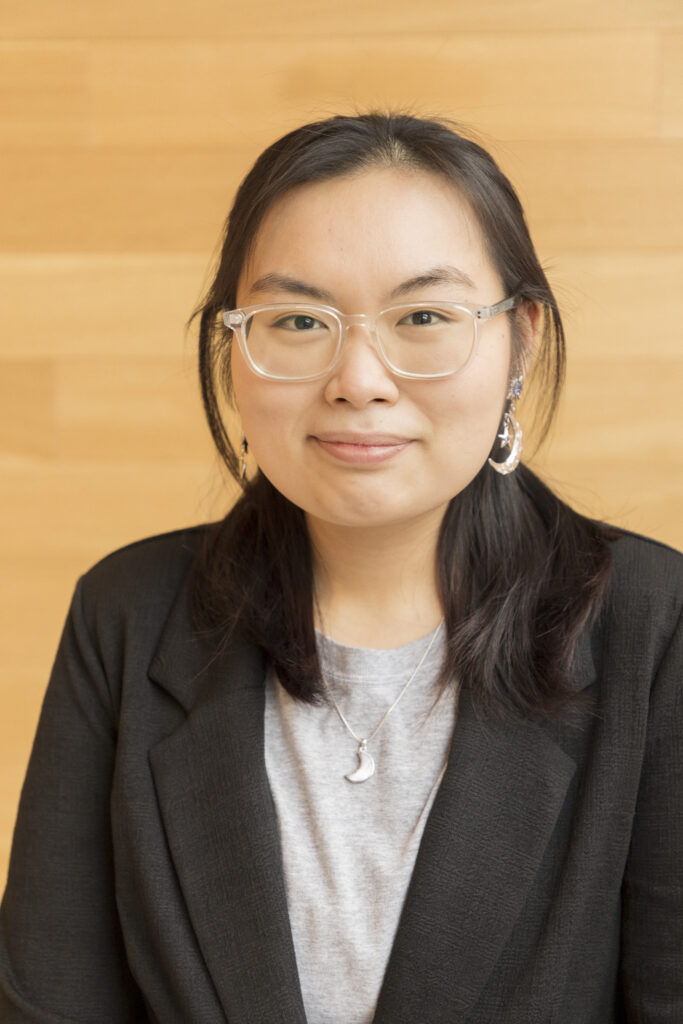 Nhi Nguyen ’25 dedicates much of her time to service activities. (Photo by Melissa Penley Cormier, M.F.A. ’17)
Nguyenhas made it her mission to find ways to improve others’ lives, whether through conducting cancer research in Chuck Bieberich’s lab at UMBC or at the MD Anderson Cancer Center, proposing a winning project to increase the availability of freshwater for agriculture, or supporting Retriever Essentials at UMBC. She also tutors in the Academic Success Center and Chemistry Tutorial Center and serves as the vice president for the Biology Council of Majors. The zoo outing, organized under the auspice of ToTheZoo, a non-profit Nguyen founded, was one of her most ambitious endeavors to date. She hopes to repeat it in the future.
Nguyen’s personal journey has inspired her efforts to serve others: An evolutionary biology class at UMBC helped her overcome depression by opening her eyes to the miracle of every human being. After the class, “I was more thankful to be born as a human with unique value and identity,” she shares, noting the lengthy evolutionary process required to arrive at Homo sapiens and the originality of every human. “I hope people around me will feel the same way I did,” she says, “that their presence matters, and their existence is invaluable.”
Taking children to a zoo—where they could explore the variety of living things found on Earth—was a natural fit. The project satisfied both of Nguyen’s goals: “to make people aware of their wonderful existence through biology knowledge and to inspire people to pursue education.”
A driving force for good
There were plenty of challenges in organizing the event—everything from building trust with the children’s shelters in Vietnam, to recruiting volunteers and fundraising—but Nguyen persevered with the support of mentors at UMBC. Ariel Barbosa, program coordinator for Retriever Essentials, provided guidance for starting up a new organization, grounded in Barbosa’s own experience growing Retriever Essentials at UMBC. Maria Cambraia, assistant director for research and international affairs in the College of Natural and Mathematical Sciences (CNMS), also offered support as Nguyen’s mentor through the CNMS Scholars program.
“As an international student—she moved by herself to the U.S. when she was only in high school!—Nhi’s journey has given her a unique perspective on life,” Cambraia shares. “This experience has instilled in her a strong sense of compassion and a genuine desire to make a positive impact on the lives of others. Her ability to empathize with people from all walks of life is truly remarkable and serves as a driving force behind her endless dedication to helping others.”
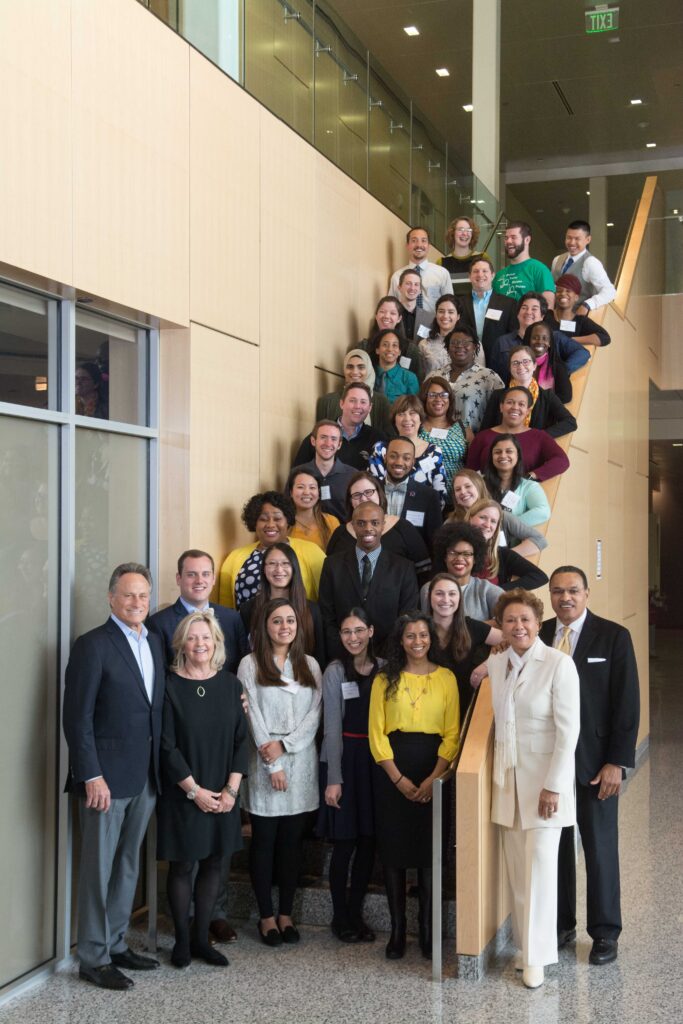
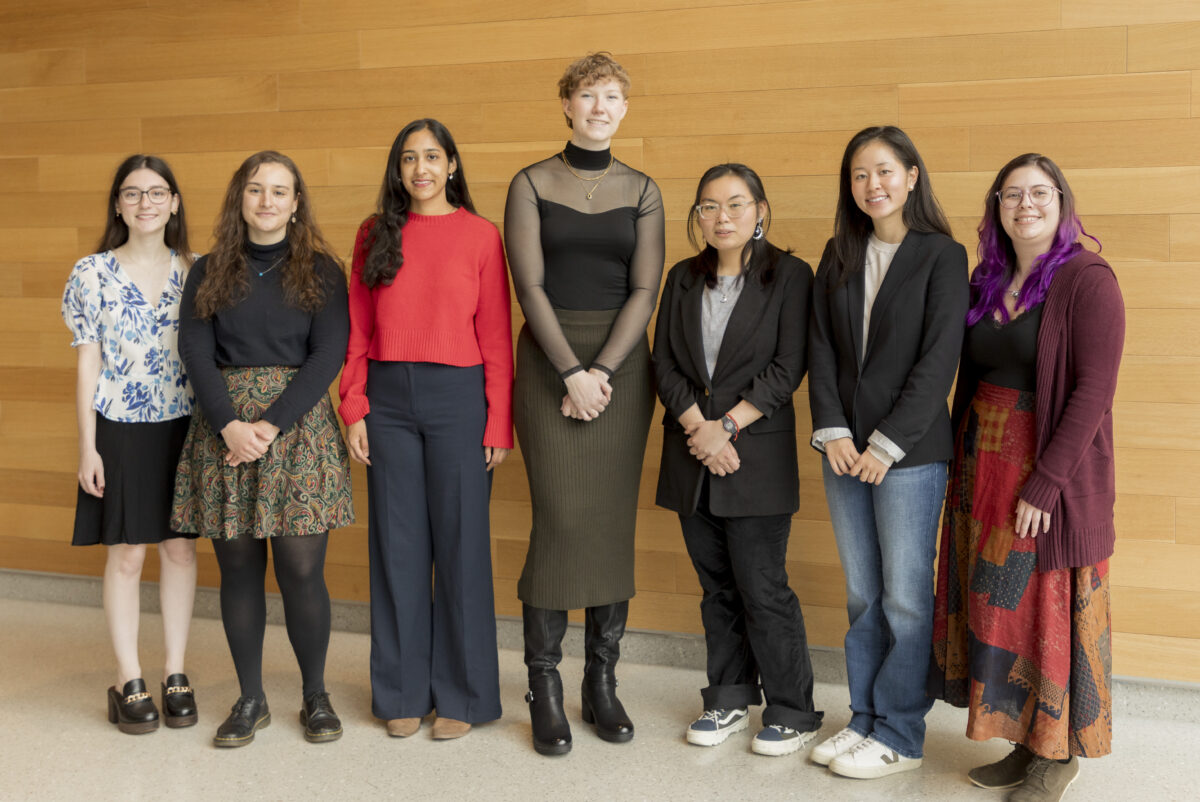 Nhi Nguyen, third from right, is a CNMS Scholar, and her cohort is pictured here. Maria Cambraia coordinates the program. (Photo by Melissa Penley Cormier, M.F.A. ’17)
Making the world brighter
In the future, Nguyen says she would like to organize a similar trip or an in-house science fair for children at The Children’s Home, which is less than two miles from UMBC. As a biochemistry and bioinformatics double major, she is also hoping to pursue an M.D./Ph.D. so that she can continue to contribute to biomedical research and education and inspire the next generation of young people in the sciences.
As a believer in the butterfly effect, Nguyen says, “I think even my small actions can help light up a person’s day, or I can inspire others to bring positivity into the world.” In the end, her philosophy is simple, and she strives to live it every day: “This world would be brighter if people helped other people a little and appreciated what they have.”
]]>
On a warm and humid day in January, about 40 children, five teachers, and 10 volunteers spill out of a school bus at the Saigon Zoo and Botanical Garden in Ho Chi Minh City, Vietnam—one big bundle...
https://umbc.edu/stories/nhi-nguyen-takes-action-for-children/
https://my3.my.umbc.edu/api/v0/pixel/news/143238/guest@my.umbc.edu/98ea911f3eeac2c454693d5daff3f455/api/pixel
biological-sciences
campus-life
cnms
cnms-scholars
international
magazine
stories
story
UMBC News & Magazine
https://my3.my.umbc.edu/groups/umbc-news-magazine
https://assets1-my.umbc.edu/system/shared/avatars/groups/000/001/943/24435aa6207c452e7bc15cc74b42c7bb/xsmall.png?1748556657
https://assets1-my.umbc.edu/system/shared/avatars/groups/000/001/943/24435aa6207c452e7bc15cc74b42c7bb/original.png?1748556657
https://assets2-my.umbc.edu/system/shared/avatars/groups/000/001/943/24435aa6207c452e7bc15cc74b42c7bb/xxlarge.png?1748556657
https://assets2-my.umbc.edu/system/shared/avatars/groups/000/001/943/24435aa6207c452e7bc15cc74b42c7bb/xlarge.png?1748556657
https://assets3-my.umbc.edu/system/shared/avatars/groups/000/001/943/24435aa6207c452e7bc15cc74b42c7bb/large.png?1748556657
https://assets1-my.umbc.edu/system/shared/avatars/groups/000/001/943/24435aa6207c452e7bc15cc74b42c7bb/medium.png?1748556657
https://assets2-my.umbc.edu/system/shared/avatars/groups/000/001/943/24435aa6207c452e7bc15cc74b42c7bb/small.png?1748556657
https://assets1-my.umbc.edu/system/shared/avatars/groups/000/001/943/24435aa6207c452e7bc15cc74b42c7bb/xsmall.png?1748556657
https://assets2-my.umbc.edu/system/shared/avatars/groups/000/001/943/24435aa6207c452e7bc15cc74b42c7bb/xxsmall.png?1748556657
UMBC News & Magazine
1
0
false
Mon, 19 Aug 2024 12:05:47 -0400
Mon, 19 Aug 2024 12:05:47 -0400
Liz Willman ’25 uses internships to make childhood vet dreams a reality
“What did you say?” is the phrase most likely to be heard when you’re walking the halls at Baltimore Animal Rescue and Care Shelter (BARCS) and the answer is most likely drowned out by a cacophony of barks, meows, and even some bird chirps. But Liz Willman wouldn’t have it any other way.
As most animal lovers do at some point in childhood, Willman decided she wanted to be a veterinarian when she grew up. But unlike most kids, it wasn’t just a phase for this rising senior. That passion for pets brought her to UMBC—where she’s pursuing a major in biological sciences on the pre-vet track—and she’s honed her animal care skills as far as Scotland and as close as BARCS, just a few miles down the road from UMBC.
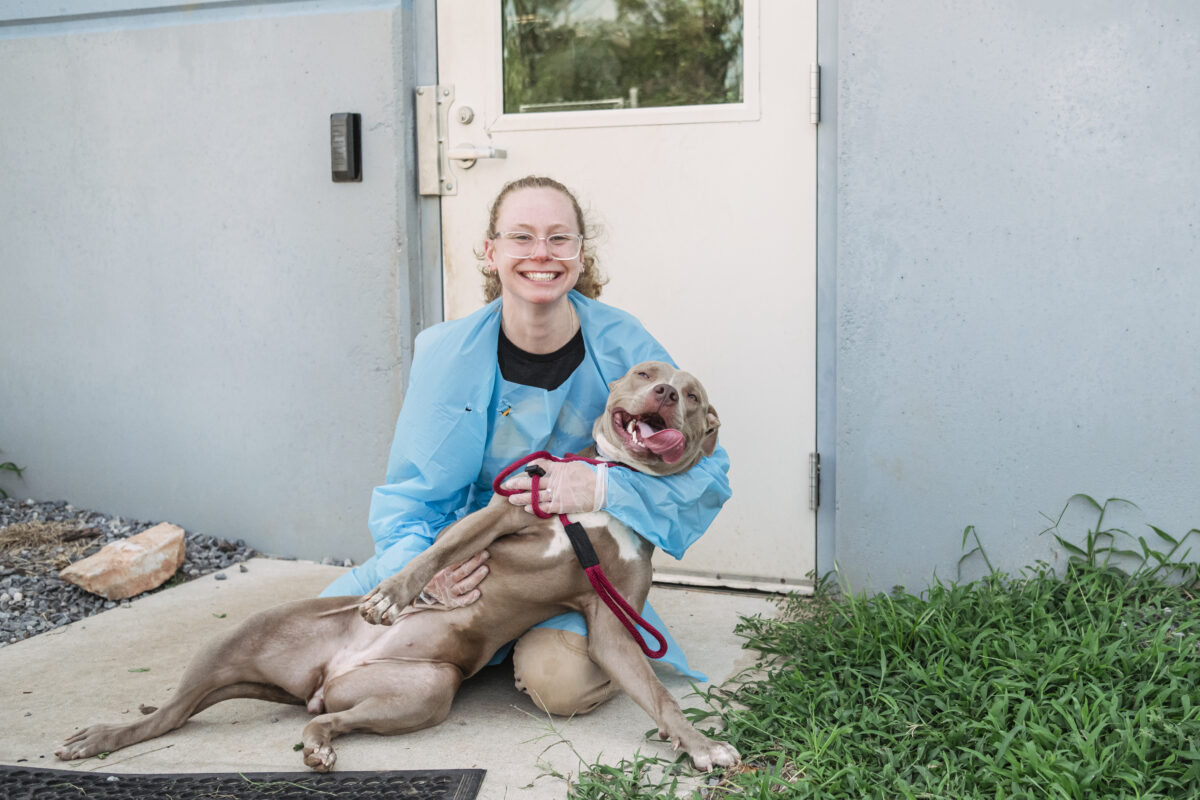 Willman, in protective gear as to not spread contact germs to the animals, smiles along with one of BARCS’ adoptable dogs. (Marlayna Demond’ 11/UMBC)
Dog days of summer
After starting as a volunteer dog walker at BARCS in fall of 2022, Willman accrued experience and staff there asked her to consider moving to the next level of volunteering. But she countered with the request to find an internship opportunity working with their medical professionals. They accepted, and in January 2023, Willman was able to start getting hands-on experience in her field. For the last several months, Willman has been continuing her work with BARCS medical staff with one short break to to work with animals across the pond as well.
“The best part for me is getting to see an animal come for intake on their first day, and then seeing the progress they make,” she says.
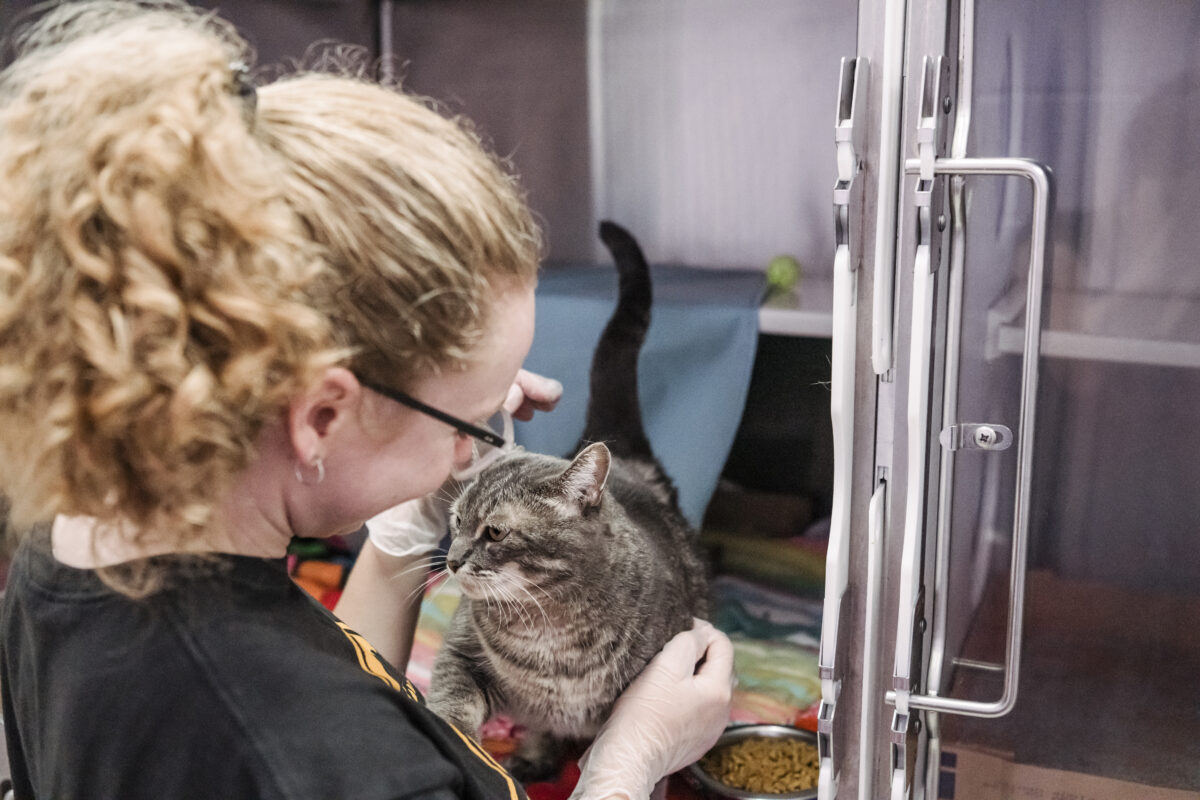
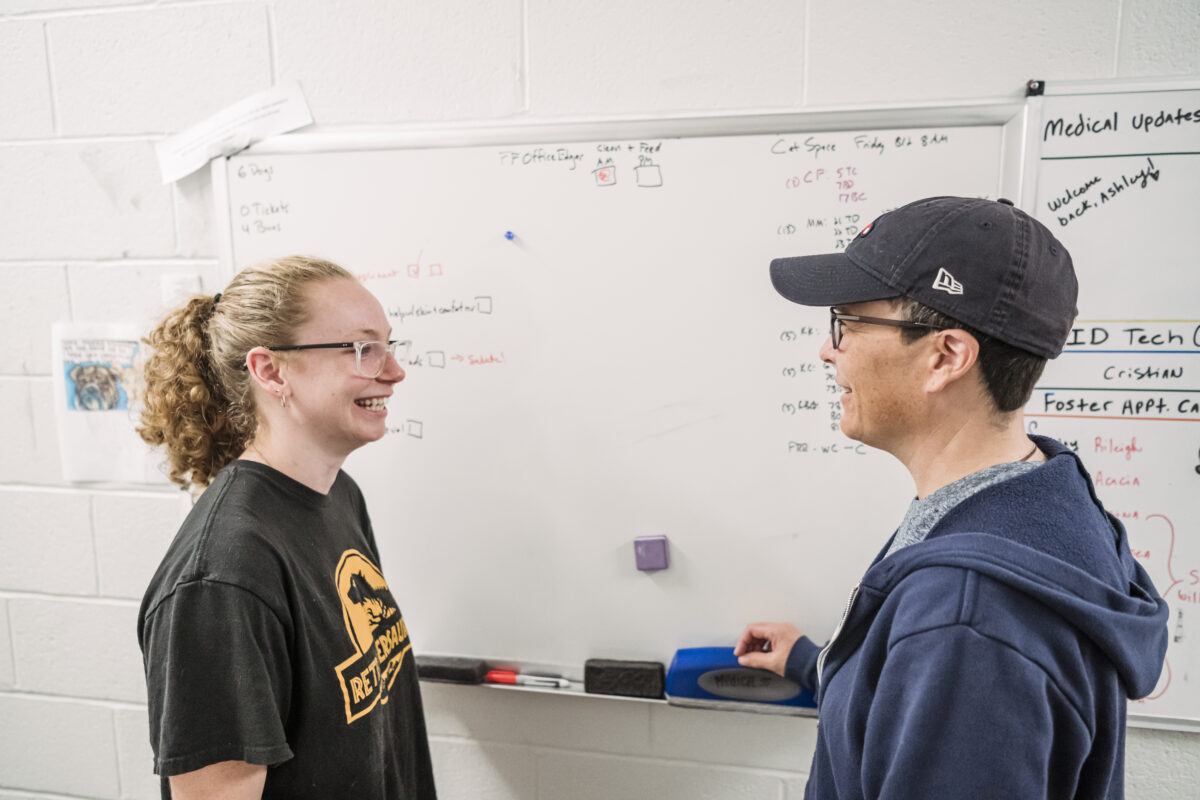
Left: Willman takes a minute to give Ovenmitts (with her extra thumbs!) some love. Right: Willman reviews daily medication and the animal schedules with a BARCS staff member. (Marlayna Demond ’11/UMBC)
Each day, Willman performs a variety of tasks, including distributing medication, checking weights, collecting samples, and more. The staff at BARCS have been especially supportive, taking care to seek out Willman and offer opportunities for hands-on learning.
“Any time they see something that might interest me, they come find me,” she says. “They know I plan to go on to veterinary school, so they’ve been taking the time to teach me how to do a lot of things vet techs struggle with.”
Taking to the sky
In addition to her classroom education and work at BARCS, Willman spent six weeks this summer interning with the Scottish National Wildlife Rescue Center. When Willman originally approached UMBC’s education abroad office, trying to find summer trips with a pre-vet focus there wasn’t an existing program, but the office worked with her to find one that would fulfill her requirements.
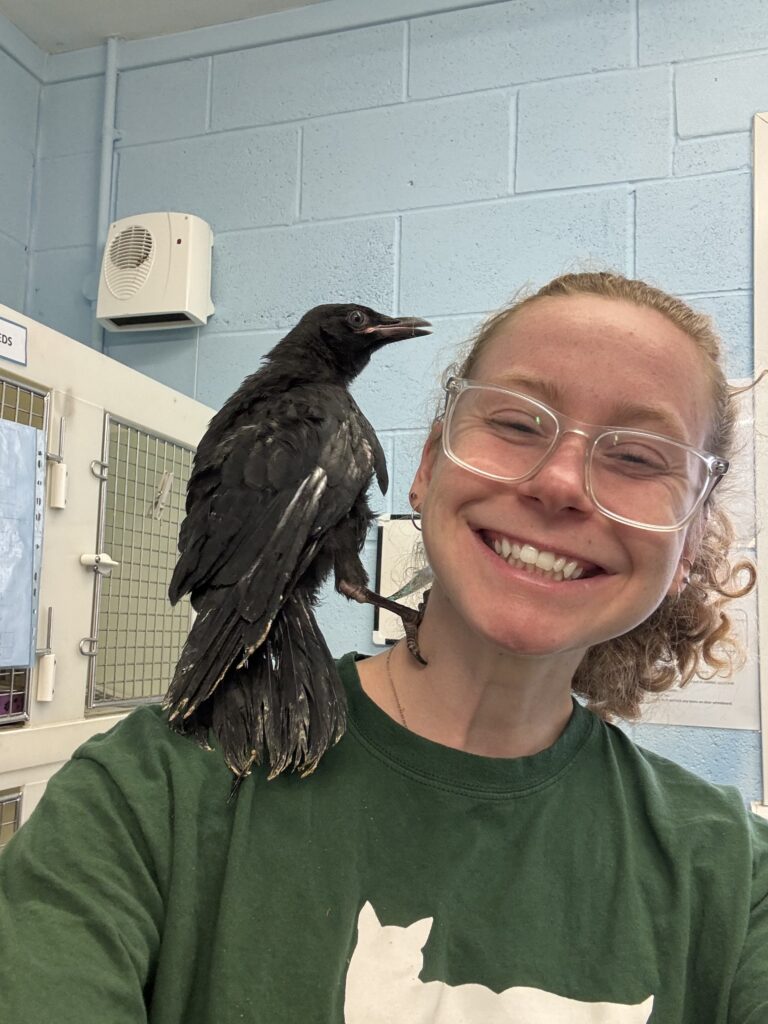
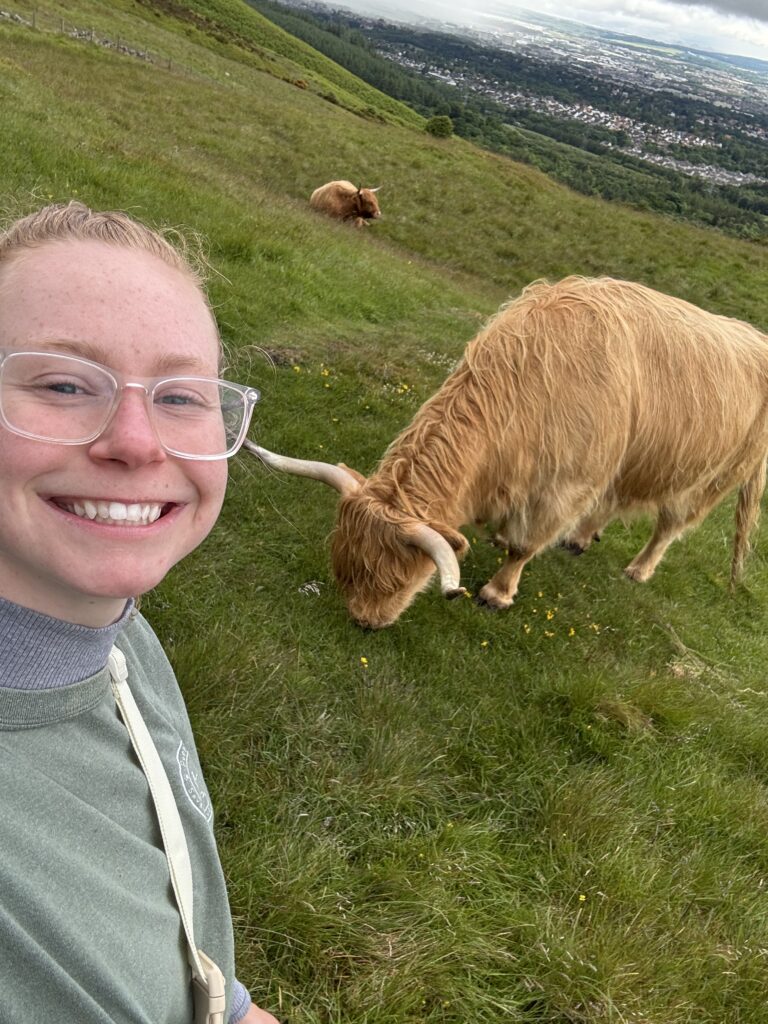
Photos of Willman with the animals she worked with in Scotland, courtesy of Willman.
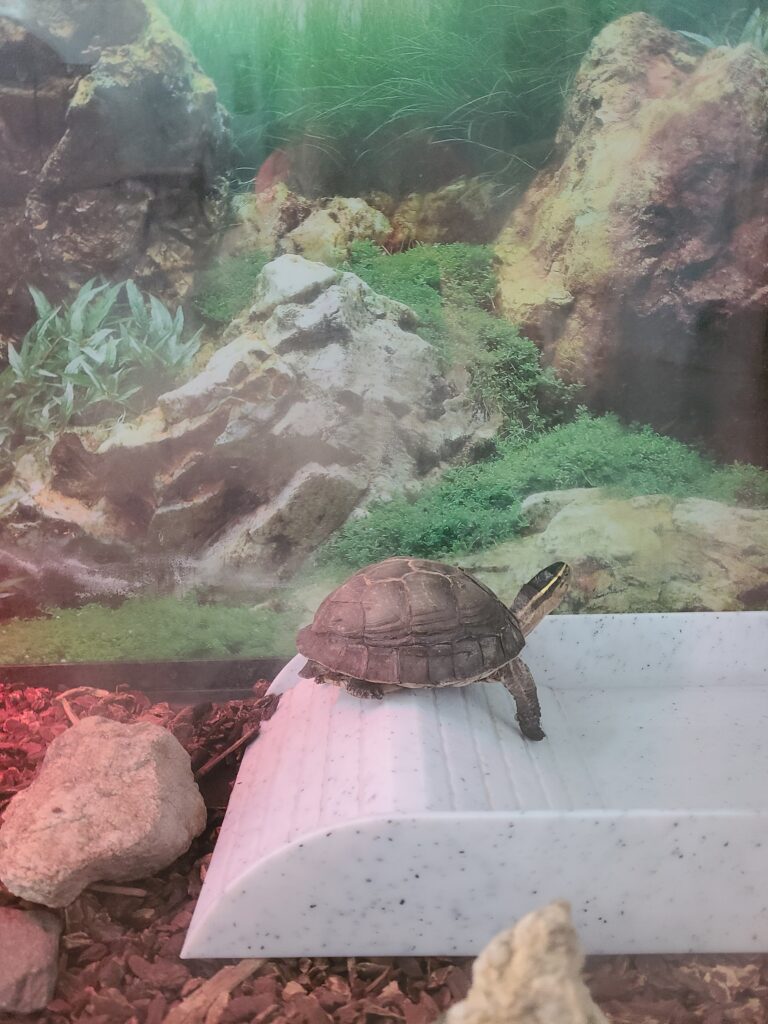 Rumpelstiltskin the turtle hangs out in his natural habitat. (Photo courtesy of Willman)
During this time abroad, Willman worked to rehabilitate birds that were injured or abandoned by their parents when they were still too young to care for themselves, performing daily exams and helping to build their strength to prepare them to return to the wild. This experience abroad was one with several firsts for Willman, including her first time leaving the country and her first foray into working with wildlife.
“It wasn’t only a new experience for me to be working with wildlife, but it was also wildlife that you don’t see in the U.S., like finches native to the United Kingdom,” she says.
Returning to Maryland this summer, Willman had both her work at BARCS and her own family zoo waiting for her. It’s no surprise an interest in caring for animals hits close to home for her—especially considering her family home in the outskirts of Frederick County has goats, sheeps, dogs, pigs, chickens, and even a registered emotional support turtle named Rumpelstiltskin who accompanies Willman to campus. But her internship experiences added an extra boost in confidence.
“It has just really reaffirmed that I’m not just trying to live out my childhood dream,” says Willman. “I’m meant to do this.”
]]>
“What did you say?” is the phrase most likely to be heard when you’re walking the halls at Baltimore Animal Rescue and Care Shelter (BARCS) and the answer is most likely drowned out by a cacophony...
https://umbc.edu/stories/willman-uses-internship-to-make-vet-dream-reality/
https://my3.my.umbc.edu/api/v0/pixel/news/143188/guest@my.umbc.edu/6fe23e2e0c0636b84ca4d6a410cdf04f/api/pixel
biological-sciences
career-center
cnms
news
pre-professional
science-and-tech
story
UMBC News & Magazine
https://my3.my.umbc.edu/groups/umbc-news-magazine
https://assets1-my.umbc.edu/system/shared/avatars/groups/000/001/943/24435aa6207c452e7bc15cc74b42c7bb/xsmall.png?1748556657
https://assets1-my.umbc.edu/system/shared/avatars/groups/000/001/943/24435aa6207c452e7bc15cc74b42c7bb/original.png?1748556657
https://assets2-my.umbc.edu/system/shared/avatars/groups/000/001/943/24435aa6207c452e7bc15cc74b42c7bb/xxlarge.png?1748556657
https://assets2-my.umbc.edu/system/shared/avatars/groups/000/001/943/24435aa6207c452e7bc15cc74b42c7bb/xlarge.png?1748556657
https://assets3-my.umbc.edu/system/shared/avatars/groups/000/001/943/24435aa6207c452e7bc15cc74b42c7bb/large.png?1748556657
https://assets1-my.umbc.edu/system/shared/avatars/groups/000/001/943/24435aa6207c452e7bc15cc74b42c7bb/medium.png?1748556657
https://assets2-my.umbc.edu/system/shared/avatars/groups/000/001/943/24435aa6207c452e7bc15cc74b42c7bb/small.png?1748556657
https://assets1-my.umbc.edu/system/shared/avatars/groups/000/001/943/24435aa6207c452e7bc15cc74b42c7bb/xsmall.png?1748556657
https://assets2-my.umbc.edu/system/shared/avatars/groups/000/001/943/24435aa6207c452e7bc15cc74b42c7bb/xxsmall.png?1748556657
UMBC News & Magazine
1
0
false
Wed, 14 Aug 2024 15:14:40 -0400
Wed, 14 Aug 2024 15:14:40 -0400
Josh Michael ’10, Ph.D. ’22, elected Maryland State Board of Education president
The Maryland State Board of Education has unanimously elected Josh Michael ’10, political science, Ph.D. ’22, public policy, as its new president following his completion of a one-year term as vice president last year. Michael, whose career in education advocacy has been greatly intertwined with UMBC for years, began his interaction with the Maryland State Department of Education (MSDE) as a student representative on the board in 2005.
Now, as president, Michael will continue to oversee the administration of MSDE with the 11-member board, which includes public school educators, parents, community leaders, and a student. UMBC alumna Chuen-Chin Bianca Chang ’91, nursing, is also a board member, representing Howard County since 2021.
Michael will work with the state superintendent to provide oversight of Maryland’s 24 school districts and lead the board’s work in guiding the implementation of MSDE’s Blueprint for Maryland’s Future, an initiative to increase state funding for education over the next 10 years with a focus on historically underserved students.
“Over the last 10 to 15 years, Maryland public schools have slowly declined in achievement, in literacy, and math. Our rankings have dropped in many ways. Taking this head-on has been a focus of our work,” Michael explains. “We seem to have lost sight of what is most important—ensuring our students are learning. Our schools must serve children from all backgrounds at all performance levels and provide opportunities to excel. The board is focused on restoring stability, vision, and direction for the state to support public schools.”
Direct service in the classroom and communities has humanized the policy process for me.
Josh Michael ’10, Ph.D. ’22
Education policy at work
Michael’s work with public education began as a UMBC Sondheim Public Affairs Scholar, where he learned about education policy. After graduating, he worked as a math teacher at Baltimore City’s Booker T. Washington Middle School and The Commodore John Rodgers School. After six years in the classroom, Michael returned to UMBC in 2016 to work on growing what was then called UMBC’s Sherman STEM Teachers Scholars Program with Rehana Shafi, the inaugural director, and with the support of The Sherman Family Foundation. The program prepared STEM majors to become high-quality K-12 teachers in urban settings through academic and professional coaching. The program has since broadened its scope and is now called the Sherman Teacher Scholars Program.
 George and Betsy Sherman (first from left) in front of Josh Michael. Freeman Hrabowski, then-president of UMBC, and Jacqueline Hrabowski (first from right) next to Rehana Shafi (in yellow) at the Sherman STEM Teacher Scholars Program’s 10th anniversary.
Shafi and Michael fostered existing partnerships and helped establish the Lakeland Community and STEAM Center, where many Sherman Teacher Scholars continue to hold student-teacher placements and serve as math volunteers. During this six-year period, Michael also earned a doctorate degree at UMBC focused on mathematics achievement and improving outcomes for struggling students.
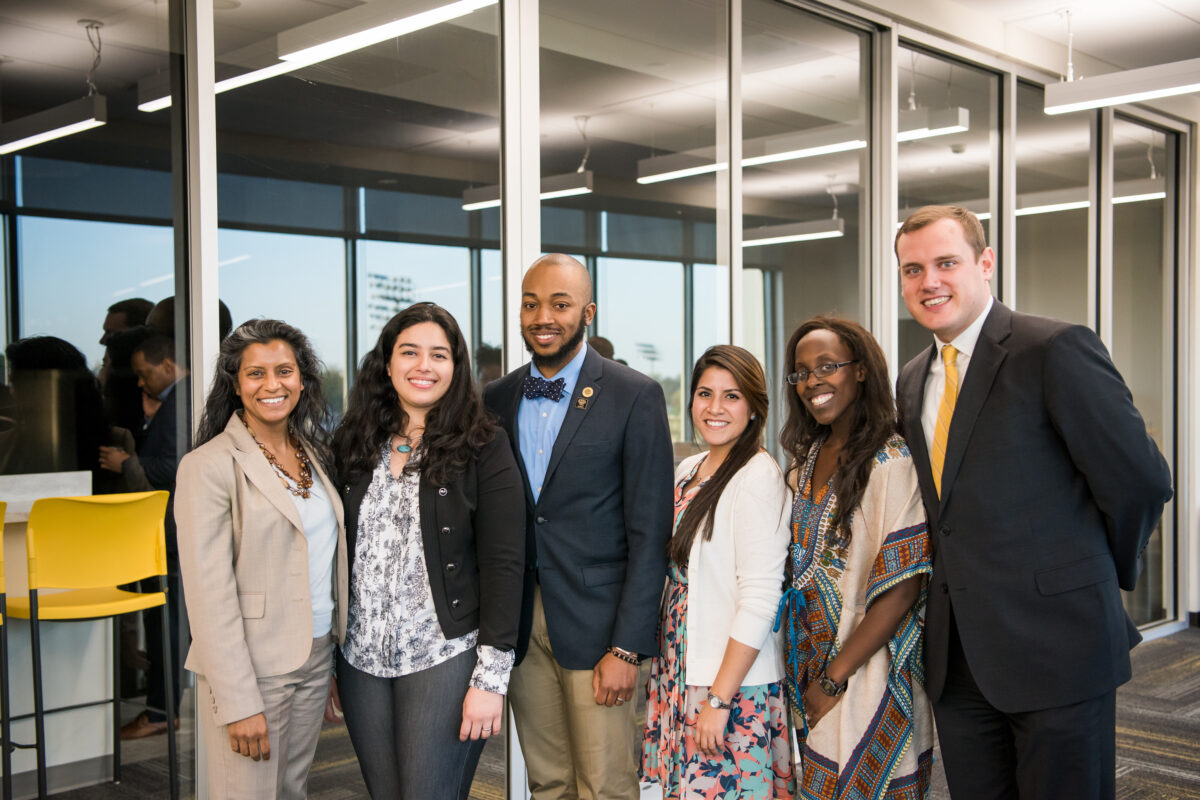 (l-r): Shafi, Monique Rivera-Velez, M.A.T ’17, education; Corey Carter ’08, biological sciences, M.A.T. ’10, education, current director of the Sherman scholars program; Emily Diaz ’16, biochemistry and molecular biology, and M.A.T ’17, education; Josephine Kalema-Kasozi ’13, dance, teaching certificate in secondary math education; and Michael at the 2018 Celebration of Teaching event. (Marlayna Demond ’11/UMBC)
Humanizing policy
“Josh’s work at the Sherman Teacher Scholars Program laid the groundwork for lasting partnerships between the university and City Schools. One example of this legacy is the Reach Together Tutoring Project (RTTP), which provides over 400 City Schools students each year with targeted math tutoring by UMBC students,” says Jane Lincove, professor of public policy and Michael’s dissertation chair. “The program is both reducing math achievement gaps and inspiring UMBC students to become math teachers. Josh’s work is a glowing example of how academic research by doctoral students in UMBC’s public policy program can be put to work to improve the lives of Marylanders.”
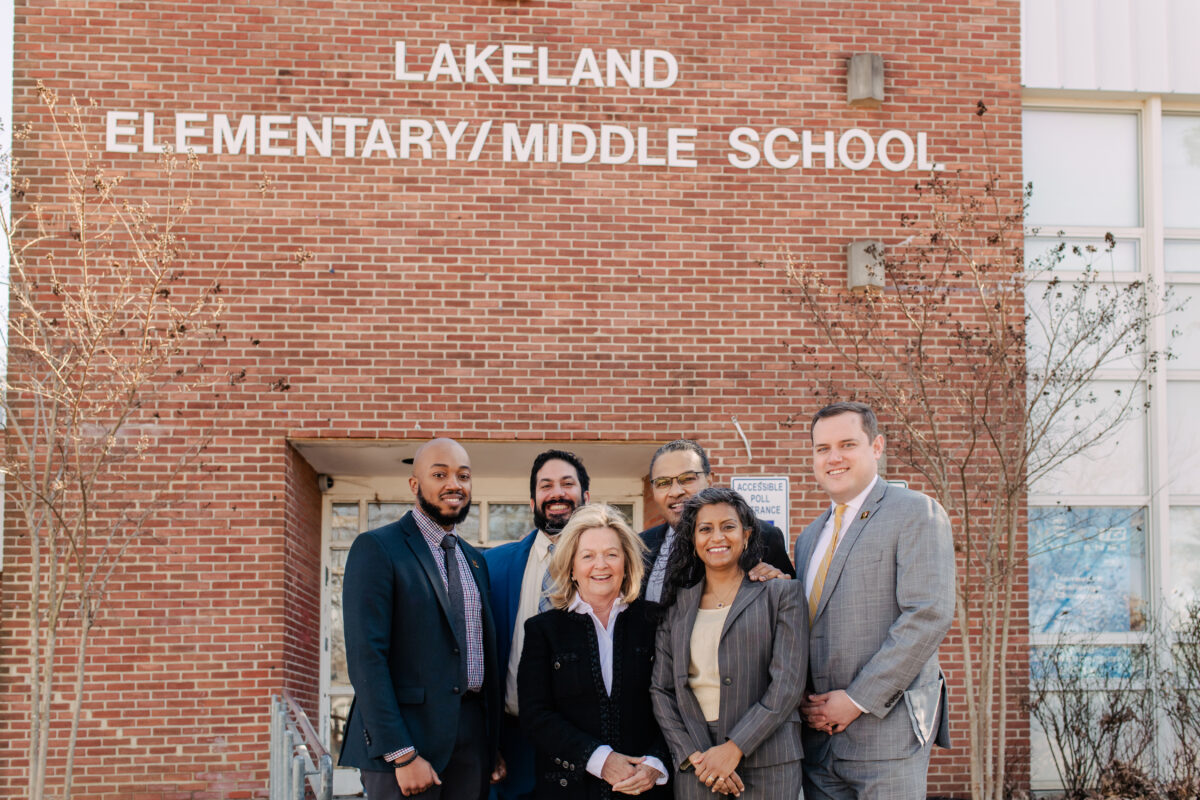 (l-r back row): Carter, Najib Jammal, then-principal of Lakeland Elementary/Middle School, Hrabowski, and Michael. (l-r front row): Betsy Sherman and Shafi. (Marlayna Demond ’11/UMBC)
“My advice to students interested in public policy is to serve in the communities you want to work with,” says Michael, currently the executive director at The Sherman Family Foundation and a board member of the Maryland Family Network, Cherry Hill Strong, and the Teach For America Baltimore Advisory Board. “Direct service in the classroom and communities have humanized the policy process for me.”
]]>
The Maryland State Board of Education has unanimously elected Josh Michael ’10, political science, Ph.D. ’22, public policy, as its new president following his completion of a one-year term as...
https://umbc.edu/stories/josh-michael-elected-msde-president/
https://my3.my.umbc.edu/api/v0/pixel/news/143029/guest@my.umbc.edu/fcaf3a9833b29e3c72c81413cedd1425/api/pixel
biochemistry
biological-sciences
cahss
dance
education
molecular-biology
news
policy-and-society
political-science
publicpolicy
sherman-stem-teacher-scholars-program
sondheim-public-affairs-scholars-program
story
UMBC News & Magazine
https://my3.my.umbc.edu/groups/umbc-news-magazine
https://assets1-my.umbc.edu/system/shared/avatars/groups/000/001/943/24435aa6207c452e7bc15cc74b42c7bb/xsmall.png?1748556657
https://assets1-my.umbc.edu/system/shared/avatars/groups/000/001/943/24435aa6207c452e7bc15cc74b42c7bb/original.png?1748556657
https://assets2-my.umbc.edu/system/shared/avatars/groups/000/001/943/24435aa6207c452e7bc15cc74b42c7bb/xxlarge.png?1748556657
https://assets2-my.umbc.edu/system/shared/avatars/groups/000/001/943/24435aa6207c452e7bc15cc74b42c7bb/xlarge.png?1748556657
https://assets3-my.umbc.edu/system/shared/avatars/groups/000/001/943/24435aa6207c452e7bc15cc74b42c7bb/large.png?1748556657
https://assets1-my.umbc.edu/system/shared/avatars/groups/000/001/943/24435aa6207c452e7bc15cc74b42c7bb/medium.png?1748556657
https://assets2-my.umbc.edu/system/shared/avatars/groups/000/001/943/24435aa6207c452e7bc15cc74b42c7bb/small.png?1748556657
https://assets1-my.umbc.edu/system/shared/avatars/groups/000/001/943/24435aa6207c452e7bc15cc74b42c7bb/xsmall.png?1748556657
https://assets2-my.umbc.edu/system/shared/avatars/groups/000/001/943/24435aa6207c452e7bc15cc74b42c7bb/xxsmall.png?1748556657
UMBC News & Magazine
1
0
false
Fri, 02 Aug 2024 12:18:57 -0400
Fri, 02 Aug 2024 12:18:57 -0400
UMBC-designed STEM study abroad program in Spain launches in 2025

In January 2025, UMBC will facilitate its STEM-focused research study abroad program in Barcelona, Spain.
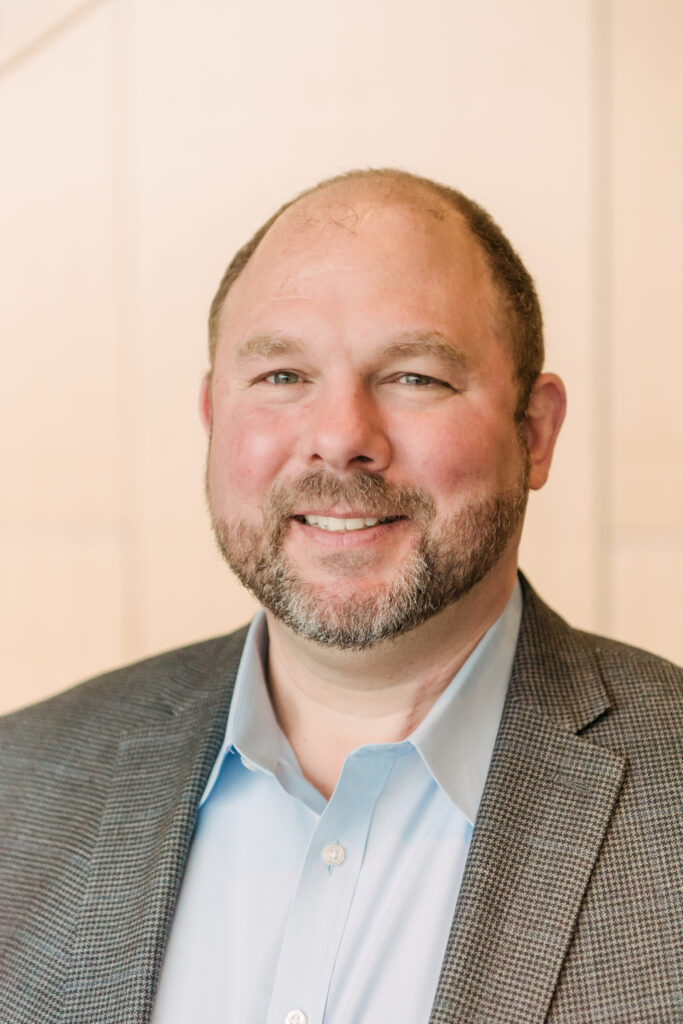 Steven Caruso. (Marlayna Demond ’11/UMBC)
The program, developed by UMBC’s Center for Global Engagement’s Education Abroad Office and the College of Natural and Mathematical Sciences, was created to provide students with an affordable study abroad experience while expanding study abroad access for students in technology, engineering and mathematics fields.
Steven Caruso, principal lecturer of biological sciences, will lead up to 18 undergraduate students on a three-week program to Barcelona to investigate bacteriophage biology research. Caruso ’94, Ph.D. ’02, biological sciences, is the co-leader of UMBC’s SEA-PHAGES program, called Phage Hunters, a two-course undergraduate genetics and bioinformatics sequence.
In 2023, UMBC received the institution’s first capacity-building grant for study abroad from the U.S. Department of State’s Increase and Diversify Education Abroad for U.S. Students (IDEAS) initiative to develop the “Phage Hunters in Barcelona” program. The study abroad program combines asynchronous online learning and hands-on training opportunities at research institutes in Barcelona.
“The IDEAS grant helps to make education abroad more accessible for UMBC students,” said Katherine Heird, UMBC’s director of education abroad and global learning. “This innovative program offers students an unparalleled opportunity to delve into biomedical research, hone their intercultural communication skills, and build connections across the globe.”
Find out more about the UMBC faculty-led Phage Hunters in Barcelona, Spain, study abroad program.
]]>
In January 2025, UMBC will facilitate its STEM-focused research study abroad program in Barcelona, Spain. Steven Caruso. (Marlayna Demond ’11/UMBC) The program, developed by UMBC’s Center...
https://umbc.edu/quick-posts/stem-research-study-abroad-program/
https://my3.my.umbc.edu/api/v0/pixel/news/142736/guest@my.umbc.edu/ca125f391bd0c7cfd7e9533047e3d2cc/api/pixel
biological-sciences
cge
cnms
quick-post
study-abroad
UMBC News & Magazine
https://my3.my.umbc.edu/groups/umbc-news-magazine
https://assets1-my.umbc.edu/system/shared/avatars/groups/000/001/943/24435aa6207c452e7bc15cc74b42c7bb/xsmall.png?1748556657
https://assets1-my.umbc.edu/system/shared/avatars/groups/000/001/943/24435aa6207c452e7bc15cc74b42c7bb/original.png?1748556657
https://assets2-my.umbc.edu/system/shared/avatars/groups/000/001/943/24435aa6207c452e7bc15cc74b42c7bb/xxlarge.png?1748556657
https://assets2-my.umbc.edu/system/shared/avatars/groups/000/001/943/24435aa6207c452e7bc15cc74b42c7bb/xlarge.png?1748556657
https://assets3-my.umbc.edu/system/shared/avatars/groups/000/001/943/24435aa6207c452e7bc15cc74b42c7bb/large.png?1748556657
https://assets1-my.umbc.edu/system/shared/avatars/groups/000/001/943/24435aa6207c452e7bc15cc74b42c7bb/medium.png?1748556657
https://assets2-my.umbc.edu/system/shared/avatars/groups/000/001/943/24435aa6207c452e7bc15cc74b42c7bb/small.png?1748556657
https://assets1-my.umbc.edu/system/shared/avatars/groups/000/001/943/24435aa6207c452e7bc15cc74b42c7bb/xsmall.png?1748556657
https://assets2-my.umbc.edu/system/shared/avatars/groups/000/001/943/24435aa6207c452e7bc15cc74b42c7bb/xxsmall.png?1748556657
UMBC News & Magazine
2
0
false
Thu, 11 Jul 2024 10:43:34 -0400
Thu, 11 Jul 2024 10:43:34 -0400
Putting UMBC Research on the Map
Spring on UMBC’s main campus brings a host of familiar sights and sounds: blooms on the magnolia trees, the chatter of red-winged blackbirds calling from the reeds around Library Pond, greening grass on the campus Quad, and black-and-gold-bedecked Grit Guides leading groups of prospective Retrievers around what may soon become a home away from home.
The guides cover the usual highlights—Academic Row, the Retriever Activity Center, the AOK Library, eating establishments, and residential halls. UMBC is a place to live, to learn, and to find community. And while some of the functions of campus spaces are obvious, others are often hidden.
Look more closely, and you’ll see faculty and students turning the everyday infrastructure and green oases of UMBC into out-of-the-ordinary laboratories. Beeswax sculptures, tactile maps, robots helping other robots—read on to discover some of the amazing ways Retrievers are using the campus itself for experiential learning and diverse research.
Written by: Catherine Meyers & Sarah L. Hansen, M.S. ’15

Two students wearing knee-high waders stand several meters apart in the middle of a rapidly flowing stream at the north end of UMBC’s campus. One releases a Ping-Pong ball, which bobs along with the current, as the second starts a timer, stopping it when the ball reaches his feet to determine the stream’s flow rate.
Nearby, another student measures the size of rocks in the streambed using a device called a gravelometer—a rectangular piece of metal with square holes of various sizes. The smallest hole a given rock will fit through becomes its measurement.
Farther along, other students capture photos that include reference posts on the stream bank. Each small group of students also takes measurements of the water depth at one-foot intervals along strings hung from one bank to the other. The students (with the help of specialized software) will use these measurements and photos to generate 3D models of the streambed.
“It’s a little DIY, but we get some amazing pictures,” says Charles Kaylor, the instructor and director of GIS and cartography labs in the Department of Geography and Environmental Systems (GES).
This is the “stream lab” in Exploring the Environment: A Geospatial Perspective, a course best known in the UMBC community for its semesterly launch of a dozen or so brightly-colored balloons that dot the campus skyline. Throughout the semester, students train their brains in the ways geographic data can help answer a wide range of research questions.
For the students, there are a range of perks to the course. “It’s cool to see different applications of computer science, which can sometimes feel pretty theoretical,” says George Rush ’24, computer science. Luke Thomas ’27, GES, who was partnered with Rush, is grateful for the senior’s support with the programming aspects of the coursework.
Rhonda Plofkin, Ph.D. student in GES and the graduate assistant for the class, concurs that having students with different strengths facilitates peer learning. “This is real-life stuff that geomorphologists do in the field,” she adds.
For some, the benefits are just as real, but simpler: “The cold water wakes me up,” Anthony Roytenberg ’24, computer science, says with a smile.
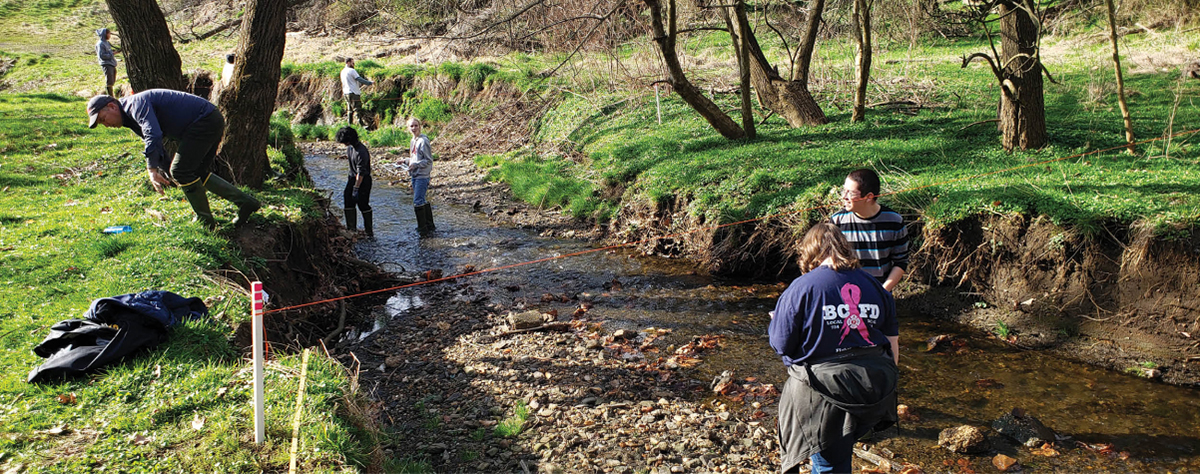 Students collect data that measure flow rate, depth, pebble size, and more as part of the “stream lab” in a popular, interdisciplinary GES course. Photo by Sarah Hansen, M.S. ’15.

When Alieh Rezaei arrived at UMBC from Iran, she couldn’t take her eyes off the ground. Almost immediately she was mesmerized by the flora and fauna of her new residence, and as an master of fine
arts student in the intermedia and digital arts (IMDA) program, she decided to incorporate pieces of UMBC into her artwork. She walked around campus, picking up windfalls of seeds and exploring hidden nooks of nature. A place that would come to be her sanctuary,
Rezaei, M.F.A. ’22, says, was Joseph Beuys Sculpture Park.
“The solidity of the stones alongside the growth of the oaksand the evolving shape of the garden reflect concepts of erosion and growth,” says Rezaei. “As an immigrant, I found solace in my attachment to the settled and solid stones, representing a sense of
grounding to me.”
Rezaei was drawn to UMBC’s M.F.A. program because of its multidisciplinary approach and the freedom she felt to choose an unconventional path. She praised Kathy O’Dell, IMDA professor emerita, who was her advisor. “Kathy was someone who—it was like I was floating in the air and Kathy held my hand and grounded me. She was very supportive for the whole journey.”
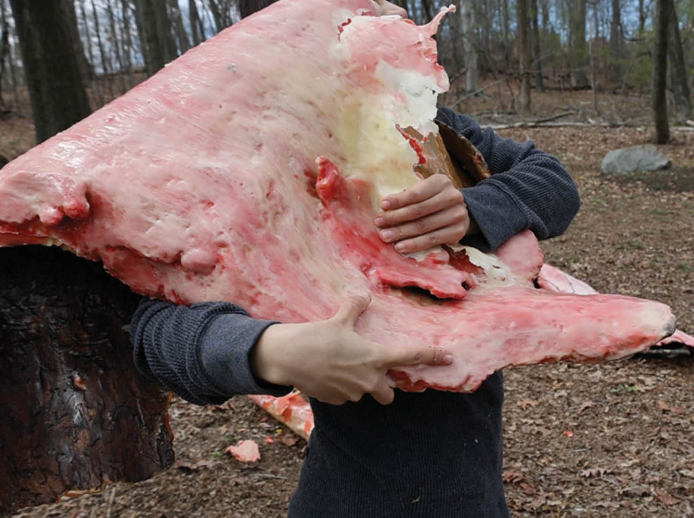
A photograph from Rezaei’s three-hour performance “The Tongue in the Landscape” at the Joseph Beuys Sculpture Park featuring the artist laboriously peeling the wax layer off the pieces of bark. Photo courtesy of Rezaei.
To create the art for her thesis project, Rezaei used almost exclusively materials collected on or near campus, including fallen tree bark, shattered wood, and seeds. She bought her main material—beeswax— from Baltimore beekeepers. One piece, “The Collective Womb,” featured hundreds of native seeds, called Devil’s Darning Needles, held together by beeswax around orange peels.
When the pieces were finished, Rezaei immediately knew the stage she wanted to showcase them on—Joseph Beuys Sculpture Park. “I installed my pieces there and had a performance as a way to extend the concept of public sculpture, aiming to reactivate the space and revive the concept of ecological engagement central to Beuys’ 7000 Oaks project.”

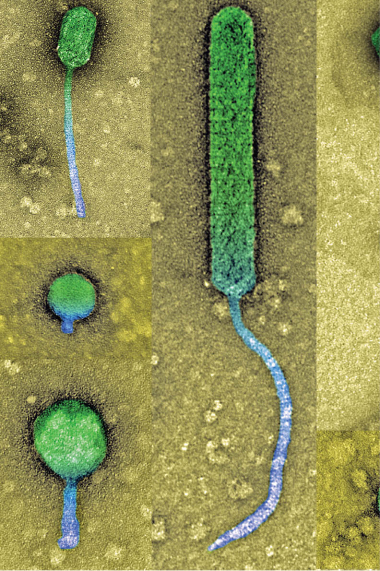
A composite of several microscope images of phages discovered by UMBC students in the Phage Hunters program demonstrates the variety of shapes phages can take. Photo by Tagide deCarvalho.
IchabodCrane. MindFlayer. Annihilus. TonyStarch. These are viruses previously completely unknown to science discovered by UMBC students in the Phage Hunters program, a two-course undergraduate genetics and bioinformatics sequence.
Since its launch in 2008, UMBC students have discovered 661 viruses that infect bacteria, called phages. Ninety-seven of them originated in samples collected on campus, with the most popular location being the Library Pond. Seventy-seven phages have been sequenced and 60 have been fully characterized and submitted to GenBank, an international digital repository of genetic and protein sequences.
Steven Caruso ’94, Ph.D. ’02, biological sciences, principal lecturer of biological sciences, runs the genetics course where the students collect samples, isolate their phages, image them with help from Tagide deCarvalho, “and growth,” says Rezaei. “As an immigrant, I found present their findings. They learn foundational laboratory techniques and get a taste for research.
Phage Hunters gives students “a first glimpse of what research is, with all that goes with it: determination, grit, inspiration, frustration, and more,” says Ivan Erill, professor of biological sciences and co-instructor for the bioinformatics course with Caruso. “Students get to see all the possible outcomes of a research project, from total success culminating in a DNA extraction for sequencing to failure to isolate a phage in the first place.”

In the basement of the Meyerhoff Chemistry Building, in a tiled expanse called the Molecular Characterization and Analysis Complex, sits a sleek, roughly human-sized instrument with the power to measure extremely tiny amounts of chemicals. Amanda Belunis, a chemistry Ph.D. student now in her final year, knows the instrument like an old friend, having turned to it to analyze a smorgasbord of UMBC water samples.
Belunis studies a group of chemicals called per- and polyfluoroalkyl substances, or PFAS. The chemicals are used in products as varied as makeup, clothing, and fire-fighting foam and are found in trace amounts in many water sources as well as in human blood. Dubbed “forever chemicals” because of the way they persist in the environment, they present a growing concern to human health.
Belunis’s research is part of a growing effort by scientists to understand how PFAS enter and travel through the environment and, ultimately, figure out ways to remove them.
To validate her procedures for measuring PFAS concentrations, Belunis tested water from drinking fountains, the sink in her chemistry lab, the pool, and the pond and streams around UMBC, all of which contained trace amounts of PFAS, as would be expected. Confident her methods worked on real-life samples, she then turned her attention to analyzing water in aquaculture fish tanks.
“My lab mates and I sometimes discuss how all of us have these chemicals in our bodies,” says Belunis. “It’s concerning, which is why we need to do more studies.”
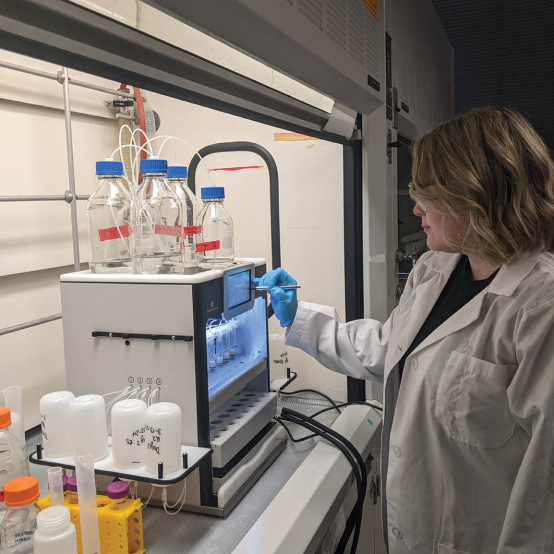
Amanda Belunis prepares samples for later analysis in the Molecular Characterization and Analysis Complex. Photo by Catherine Meyers.

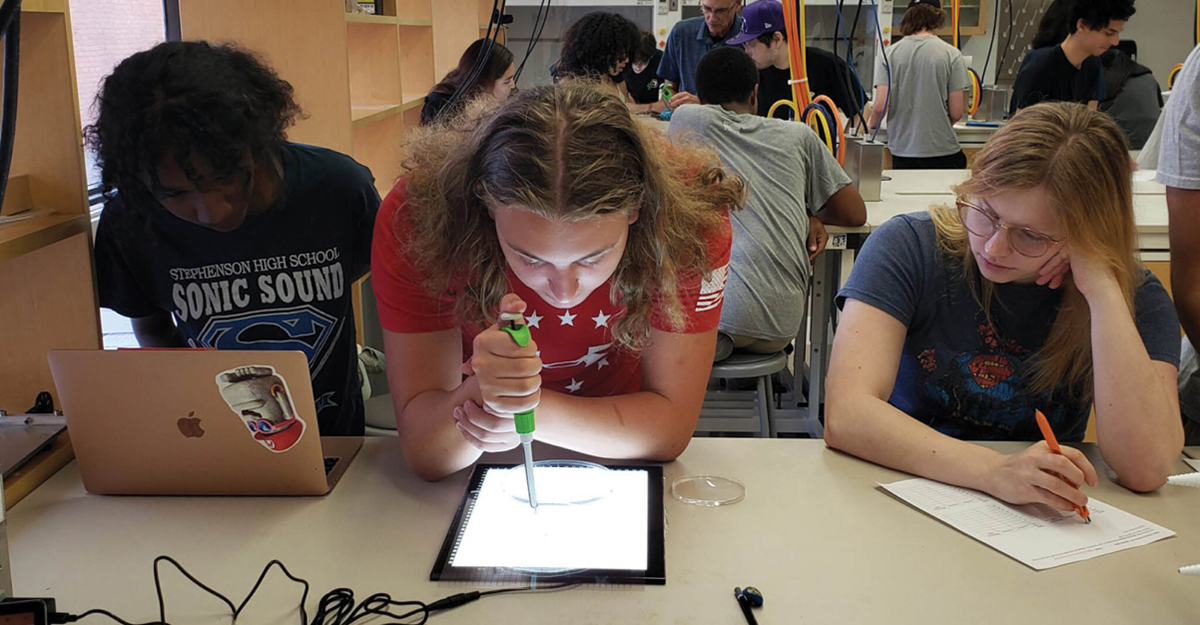 In addition to measuring buildings, students in Math in Action discovered other ways that math naturally interacts with their lives and studies. Here they are recording the movements of brine shrimp. Photo by Sarah Hansen, M.S. ’15.
When asked how to measure the height of a building, most students in Math in Action, a new laboratory course for non-STEM majors, “came up with various ways to measure the height directly—for example, by dropping down a string and then measuring the string or stacking up various objects,” says Alexis O’Malley ’18, mathematics and psychology, who teaches the lab.
But today, students are peering along the edges of homemade clinometers—plastic protractors with drinking straws attached—taking measurements from safely on the ground with a meter stick, and running simple calculations based on the properties of triangles to measure the height of UMBC’s Administration Building (123 feet, 2 inches).
Throughout the course, “I want students to see how math can be used to solve problems creatively,” O’Malley says.
Math in Action covers different math concepts each week through hands-on activities. The purpose of the clinometer activity is to remind students that “science is based on measurement, and you can build a tool to measure almost anything,” shares William R. LaCourse, dean of the College of Natural and Mathematical Sciences, who originally generated the idea for the course to help a wider range of students develop math skills relevant to their everyday lives. The course, he adds, “is a doorway to a lot of different math concepts.”

Shawn Abraham ’24, political science, has gotten lost on the UMBC campus more times than he can remember. As a blind student, he finds his way using a white cane, auditory cues, mental maps, and by asking people for directions. “People are surprised when I tell them, but big cities are much easier to navigate,” Abraham says. “College campuses are hard to get around.”
Tactile maps are one tool that could help. Erin Higgins and Kirk Crawford, Ph.D. students in human-centered computing, have recently been working with blind students at UMBC to create and test 3D-printed maps of campus.
The researchers launched the project after being approached by Michael Canale, assistant director of the Office of Student Disability Services. He says UMBC currently has four completely blind students enrolled and his office wants to provide personalized maps that each student can carry with them as they navigate campus. He’d also like to see a large 3D-printed map mounted somewhere on campus.
“A beautiful tactile map could be used by visitors of all kinds,” Canale said. “It’s the principle of universal design.”
Meanwhile, Md Osman Gani, an assistant professor of information systems, is spearheading a new project, named MyPath, to develop a Google Maps–style app to help wheelchair users navigate campus.
“Uneven surfaces, discontinuous sidewalks, and steep slopes can make wheelchair travel challenging, and even impossible” Gani says. The MyPath app would help by providing users with personalized turn-by-turn navigation with real-time updates. The app will rely on a machine learning model that recognizes path accessibility conditions based on crowd-sourced data, and Gani is currently recruiting wheelchair users to contribute data using their smartphones.
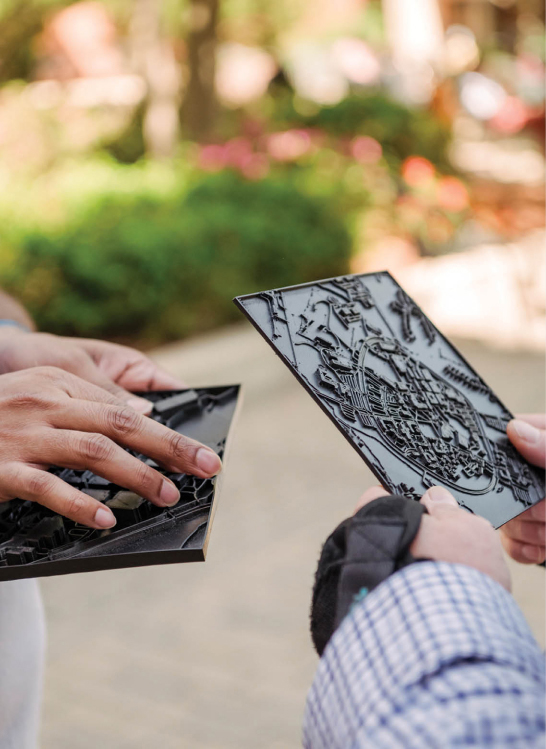
Shawn Abraham (left) tests prototype tactile maps made with 3-D printers with Michael Canale (right).

It’s 7 a.m. in July, and Megan Curtiss ’23, GES, is standing next to a tree just outside The Loop on UMBC’s southeast corner. It’s wrapped in a thin metal band at about chest height. Curtiss carefully measures the small gap between the two ends of the band with digital calipers three times, takes the average, and then moves on to the next tree. Only 98 to go.
This scene played out weekly from March to October 2023 as Curtiss collected data for a study led by Matthew Baker, GES professor, and Nancy Sonti, a research ecologist with the U.S. Forest Service. “It became like a morning meditation,” Curtiss shares.
The metal bands, call dendrobands, “are a cheap and easy way to get pretty detailed information,” Curtiss says. By measuring the trees’ growth over time, the goal is to look at how trees of different species and in different immediate environments (such as a parking lot versus a forest) handle conditions like fluctuating temperatures and water availability.
After attending Anne Arundel Community College in her 30s, Curtiss then found a home at UMBC. She began working with Baker in fall 2022 and will enter the GES master’s program at UMBC this fall. A graduate degree was not something Curtiss originally planned on, but now she’s excited about the further experiences it will bring. “I’m looking forward to the unexpected,” Curtiss says.

Take a left off Hilltop Circle, just past the greenhouse on the right and toward the Walker Avenue apartments, and you’ll find yourself outside a traditional brick building that used to house trial rooms and detention cells. In 2021, UMBC turned this former courthouse into the main hub for the Center for Real-time Distributed Sensing and Autonomy (CARDS). Researchers here develop artificial intelligence-enabled smart robots for military and search-and-rescue operations.
On a sunny day in spring, you will likely see students gathered in the courthouse’s “backyard,” huddled around dog-like Spot robots and wheeled vehicles called Jackals and Huskies.
The researchers outfit the robots with a host of custom devices, such as cameras and radar to sense their surroundings and microprocessors to run on-board algorithms. While the robots can be commanded via voice and gesture, the ultimate goal is for them to operate mostly autonomously.
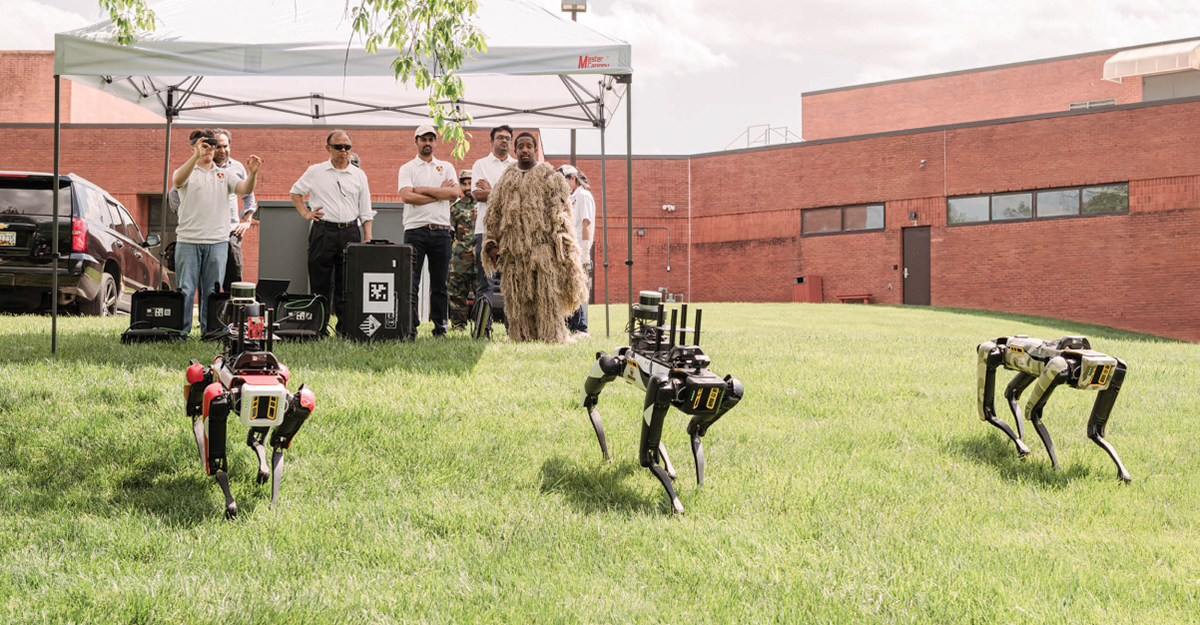 On the back lawn of the courthouse building, student researcher Kevin Rippy, left, controls three Spot robots with gestures. Another student stands by in a ghillie suit, a type of camouflage clothing.
Recently, the team has demonstrated this capability by verbally assigning the robots the task of jointly surveying a given area. The robots must translate the instructions from plain English into machine-level commands, divide up duties, detect and avoid obstacles, come to a fellow robot’s aid in the case of unexpected problems, and identify and keep track of the objects and people within their assigned perimeter.
“People from around campus will see us testing and will stop to watch,” says Aryya Gangopadhyay, a professor in information systems who directs CARDS. “The robots are an attention getter.”

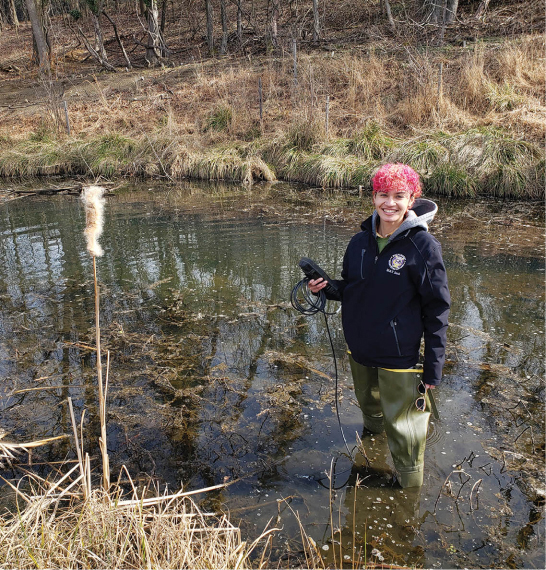
Erin Hamner collected weekly water quality data from this stream for six months, using the battery-powered digital probe she’s holding. (Image by Sarah L. Hansen, M.S. ’15)
After traipsing across a swampy field between research sites, Erin Hamner ’22, GES, and a current master’s student in the Interdisciplinary Consortium for Applied Research in the Environment program, scampers down a streambank in thigh-high waders and plunges a battery-powered probe into the water. It reports concentrations of ammonia and nitrates—key water quality measures. The probe also measures the water’s conductivity, which indicates the level of ions, such as salts used to melt snow.
It’s beautiful out today, but Hamner completed the trek to a dozen campus sites weekly from September 2023 to February 2024, sometimes dealing with mud, snow, or rain. The goal of her master’s thesis is to confirm that stormwater management features UMBC has installed to reduce flooding, filter storm runoff, and otherwise improve water quality are working as intended—or if they aren’t, to suggest improvements.
Hamner and her collaborators in Facilities Management and the Office of Sustainability want to see the data collection effort continue after she graduates. So she is working with faculty in GES to incorporate crowd-sourced stormwater monitoring into the undergraduate curriculum, including generating a public dashboard.
“Erin has done incredible groundwork collecting water quality data across our campus, generating useful data that can tell us about the health of UMBC’s waterways,” says Taylor Smith, assistant director of sustainability.
Long-term data will help the university “see how our development affects our watershed so we can continue to be good stewards,” Smith adds, noting that, “data like Erin’s can help us advocate for more greenspace and stream buffers around campus.”
]]>
Spring on UMBC’s main campus brings a host of familiar sights and sounds: blooms on the magnolia trees, the chatter of red-winged blackbirds calling from the reeds around Library Pond, greening...
https://umbc.edu/stories/putting-umbc-research-on-the-map/
https://my3.my.umbc.edu/api/v0/pixel/news/142303/guest@my.umbc.edu/93196282138c9d99f3c2930689edf3cd/api/pixel
biological-sciences
cahss
campus-life
cards
chemistry
cnms
coeit
computer-science
feature
ges
humancentered-computing
icare
imda
information-systems
joseph-beuys
magazine
mathematics
political-science
psychology
science-and-tech
sds
spring-2024
story
UMBC News & Magazine
https://my3.my.umbc.edu/groups/umbc-news-magazine
https://assets1-my.umbc.edu/system/shared/avatars/groups/000/001/943/24435aa6207c452e7bc15cc74b42c7bb/xsmall.png?1748556657
https://assets1-my.umbc.edu/system/shared/avatars/groups/000/001/943/24435aa6207c452e7bc15cc74b42c7bb/original.png?1748556657
https://assets2-my.umbc.edu/system/shared/avatars/groups/000/001/943/24435aa6207c452e7bc15cc74b42c7bb/xxlarge.png?1748556657
https://assets2-my.umbc.edu/system/shared/avatars/groups/000/001/943/24435aa6207c452e7bc15cc74b42c7bb/xlarge.png?1748556657
https://assets3-my.umbc.edu/system/shared/avatars/groups/000/001/943/24435aa6207c452e7bc15cc74b42c7bb/large.png?1748556657
https://assets1-my.umbc.edu/system/shared/avatars/groups/000/001/943/24435aa6207c452e7bc15cc74b42c7bb/medium.png?1748556657
https://assets2-my.umbc.edu/system/shared/avatars/groups/000/001/943/24435aa6207c452e7bc15cc74b42c7bb/small.png?1748556657
https://assets1-my.umbc.edu/system/shared/avatars/groups/000/001/943/24435aa6207c452e7bc15cc74b42c7bb/xsmall.png?1748556657
https://assets2-my.umbc.edu/system/shared/avatars/groups/000/001/943/24435aa6207c452e7bc15cc74b42c7bb/xxsmall.png?1748556657
UMBC News & Magazine
1
0
false
Thu, 30 May 2024 10:42:29 -0400
Thu, 30 May 2024 10:42:29 -0400
For the third time in five years, UMBC is named a Fulbright Top Producing Institution
Within just a few months of living in Piątek, a small town in central Poland, Leah Michaels, M.F.A ’19, intermedia and digital arts, has already traveled to Romania, where many recipients of the Fulbright U.S. Student award placed throughout Europe gathered at a media literacy conference. She has also had an opportunity to research Polish film at Poland’s Film Archive and connect with a local genealogist who helped her find details about her Polish roots for a short documentary she is producing about her ancestry.
Michaels and nine other UMBC Fulbright student recipients researching and teaching English abroad this year helped propel UMBC, once again, to the elite ranks of a Fulbright Top Producing Institution, as reported today in The Chronicle of Higher Education. The designation recognizes colleges and universities with the highest number of students selected for the Fulbright U.S. Student Program, the U.S. government’s flagship international academic exchange program. UMBC first received this designation from the U.S. Department of State’s Bureau of Educational and Cultural Affairs in 2019 – 2020 and again in 2020 – 2021.
UMBC is one of 57 doctoral universities nationwide and three in Maryland to receive a Fulbright Top Producing Institution designation for Fulbright U.S. Students in 2023 – 2024.
More than 2,200 U.S. students from hundreds of colleges and universities are awarded Fulbright grants annually. However, only a few of these institutions are designated top producers yearly. In the last decade, UMBC students and recent graduates have received over 60 Fulbright U.S. Student Program awards in Africa, Asia and the Pacific, the Middle East, South America, and Europe.
“This achievement is a testament to your institution’s deep commitment to international exchange,” wrote Secretary of State Antony Blinken in a letter to President Valerie Sheares Ashby, congratulating her on UMBC’s Fulbright Top Producer designation, “and to building lasting connections between the people of the United States and the people of other countries.”
Mutual understanding
In partnership with more than 140 countries worldwide, the Fulbright U.S. Student Program offers unparalleled opportunities in all academic disciplines to graduating college seniors, graduate students, and young professionals from all backgrounds. Fulbright recipients play a critical role in U.S. public diplomacy, establishing long-term relationships between people and nations through graduate study, research, or teaching as English Teaching Assistants (ETAs). ETAs develop their own language skills and knowledge of the host country while teaching English to elementary, middle school, or college students.
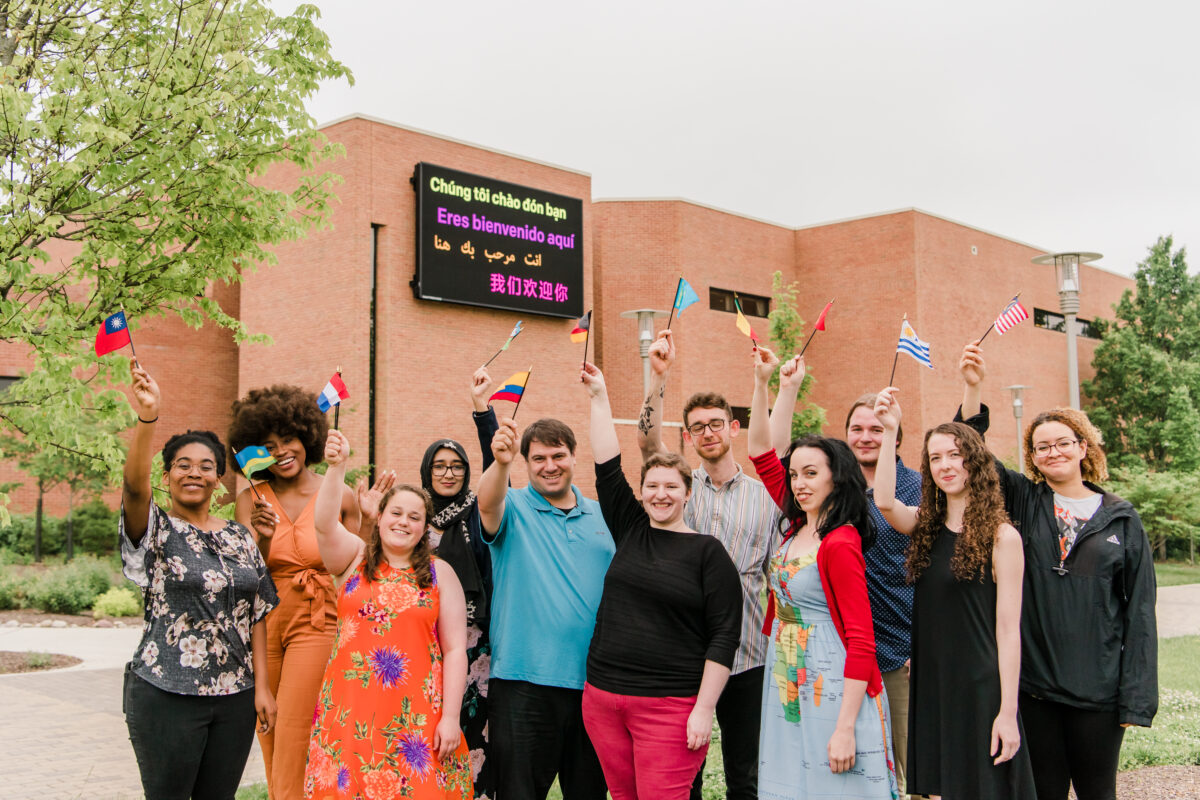 2019 – 2020 UMBC Fulbright U.S. Student recipients. (Marlayna Demond ’11/UMBC)
“As a public research university, it is imperative that we provide students with opportunities for global engagement,” says David Di Maria, associate vice provost for international education. “Fulbright is among the most prestigious of these opportunities.”
While Michaels has flourished in Poland, her 2023 – 2024 Fulbright class peers have also settled into their placements, which generally start in September with the new school year. Paul Ocone ’22, individualized study, is conducting research at the Meiji University School of Global Japanese Studies in Japan, and eight ETAs are teaching English across Europe and Asia:
- North Macedonia: David Bullman ’22, ancient studies
- Romania: Tiffany Powell, M.A.’23, teaching English to speakers of other languages (TESOL)
- Slovak Republic: Sianna Serio ’23, computer science
- South Korea: Tasneem Mansour ’20, modern languages, linguistics, and intercultural communication
- Taiwan: Nailah-Benā Chambers ’23, global studies; Kara Gavin ’20, English; and Milan Richardson ’23, bioinformatics
- Turkey: Grant Clifton, M.A. ’23, TESOL
“Being named a Top Producing Fulbright Institution is a tremendous honor—it not only shows the world what we already know about our amazing students, but it also lets our current students know that the Fulbright is a realistic opportunity for them,” says Brian Souders, Ph.D. ’09, language, literacy, and culture, M.A.’19, TESOL, and associate director of global learning at the Center for Global Engagement (CGE). Souders has led students through the Fulbright application process as UMBC’s Fulbright Program advisor for the last decade.
For Michaels, the experience has been life-changing. “My home city has been incredibly welcoming. I learned Polish folk dances, made Old Bay pierogi from scratch with some of my students, and joined a school trip to an art gallery,” says Michaels.
The Fulbright family
The Fulbright experience also includes college and university faculty and staff, as well as artists and professionals from a wide range of fields, who can join over 400,000 Fulbright alumni.
In October 2023,Renique Kersh, vice president of student affairs, and Souders traveled to Germany after receiving Fulbright International Education Administrator awards. Katherine Heird, director of education abroad and global learning, received the same award to travel to Taiwan in spring 2024. The award is geared to provide staff who support Fulbright applicants with a greater understanding of higher education worldwide.
Brian Souders is our assoc. director for global learning in the Center for Global Engagement and after years of helping faculty and students achieve their overseas learning and research goals, Brian recently took part in his own Fulbright exchange program. https://t.co/LvrOoabMou
— UMBC (@UMBC) November 15, 2023
Many UMBC faculty members and staff have received a Fulbright U.S. Scholar award over the years. This year, Lynn Cazabon, professor of visual arts and director of the Center for Innovation, Research, and Creativity in the Arts, received a Fulbright U.S. Scholar award to work at Queensland University, Australia, to create a public artwork based on local communities’ responses to climate change. Cazabon received her first Fulbright award in 2015 to the University of Liepāja, Latvia.
Fulbright Scholars globally are also drawn to UMBC’s welcoming community. Shannon Sauro, associate professor of education, hosted Jules Buendgens-Kosten, a research assistant at the Institute of English and American Studies at Goethe-Universität Frankfurt, Germany. Buendgens-Kosten joined UMBC as the institution’s first Fulbright Scholar-in-Residence to teach and share their research on inclusive education in teaching English as a foreign language to students in UMBC’s TESOL master’s program.
My uni (@UMBC) just got so much geekier and cooler.
]]>
Within just a few months of living in Piątek, a small town in central Poland, Leah Michaels, M.F.A ’19, intermedia and digital arts, has already traveled to Romania, where many recipients of the...
https://umbc.edu/stories/umbc-a-fulbright-top-producing-institution-2/
https://my3.my.umbc.edu/api/v0/pixel/news/138957/guest@my.umbc.edu/05838e8345b6084d69684b1796077d12/api/pixel
ancient-studies
biological-sciences
cahss
cnms
coeit
community
computer-science
education
english
fulbright-scholarship
global-studies
international
mlli
news
story
UMBC News & Magazine
https://my3.my.umbc.edu/groups/umbc-news-magazine
https://assets1-my.umbc.edu/system/shared/avatars/groups/000/001/943/24435aa6207c452e7bc15cc74b42c7bb/xsmall.png?1748556657
https://assets1-my.umbc.edu/system/shared/avatars/groups/000/001/943/24435aa6207c452e7bc15cc74b42c7bb/original.png?1748556657
https://assets2-my.umbc.edu/system/shared/avatars/groups/000/001/943/24435aa6207c452e7bc15cc74b42c7bb/xxlarge.png?1748556657
https://assets2-my.umbc.edu/system/shared/avatars/groups/000/001/943/24435aa6207c452e7bc15cc74b42c7bb/xlarge.png?1748556657
https://assets3-my.umbc.edu/system/shared/avatars/groups/000/001/943/24435aa6207c452e7bc15cc74b42c7bb/large.png?1748556657
https://assets1-my.umbc.edu/system/shared/avatars/groups/000/001/943/24435aa6207c452e7bc15cc74b42c7bb/medium.png?1748556657
https://assets2-my.umbc.edu/system/shared/avatars/groups/000/001/943/24435aa6207c452e7bc15cc74b42c7bb/small.png?1748556657
https://assets1-my.umbc.edu/system/shared/avatars/groups/000/001/943/24435aa6207c452e7bc15cc74b42c7bb/xsmall.png?1748556657
https://assets2-my.umbc.edu/system/shared/avatars/groups/000/001/943/24435aa6207c452e7bc15cc74b42c7bb/xxsmall.png?1748556657
UMBC News & Magazine
2
0
false
Tue, 13 Feb 2024 11:32:48 -0500
Tue, 13 Feb 2024 11:32:48 -0500
Three sisters—all alums—share their family’s recipes for food and comfort

Aimee, Jamie, and Gina Joshua have a lot in common. All three went to UMBC as members of the Meyerhoff Scholars Program. And the sisters all have great memories of growing up in a house filled with delicious food and love. So, when their mother’s YouTube channel focusing on Indian cooking techniques started to take off, the trio made it their mission to create a cookbook of family recipes that would honor their beloved parents.
Our parents, Sara and Abraham Joshua, known to us as Mummy and Chacha, immigrated from India in their twenties separately to begin their careers and continued education to help provide for their families back home. Coming to America in the ’70s, they were learning how to navigate a new country and a new culture. After getting married and starting a family, they began raising three daughters in Baltimore, Maryland. The challenge was to figure out how to teach and preserve our Indian culture and traditions when it was over 8,000 miles away.
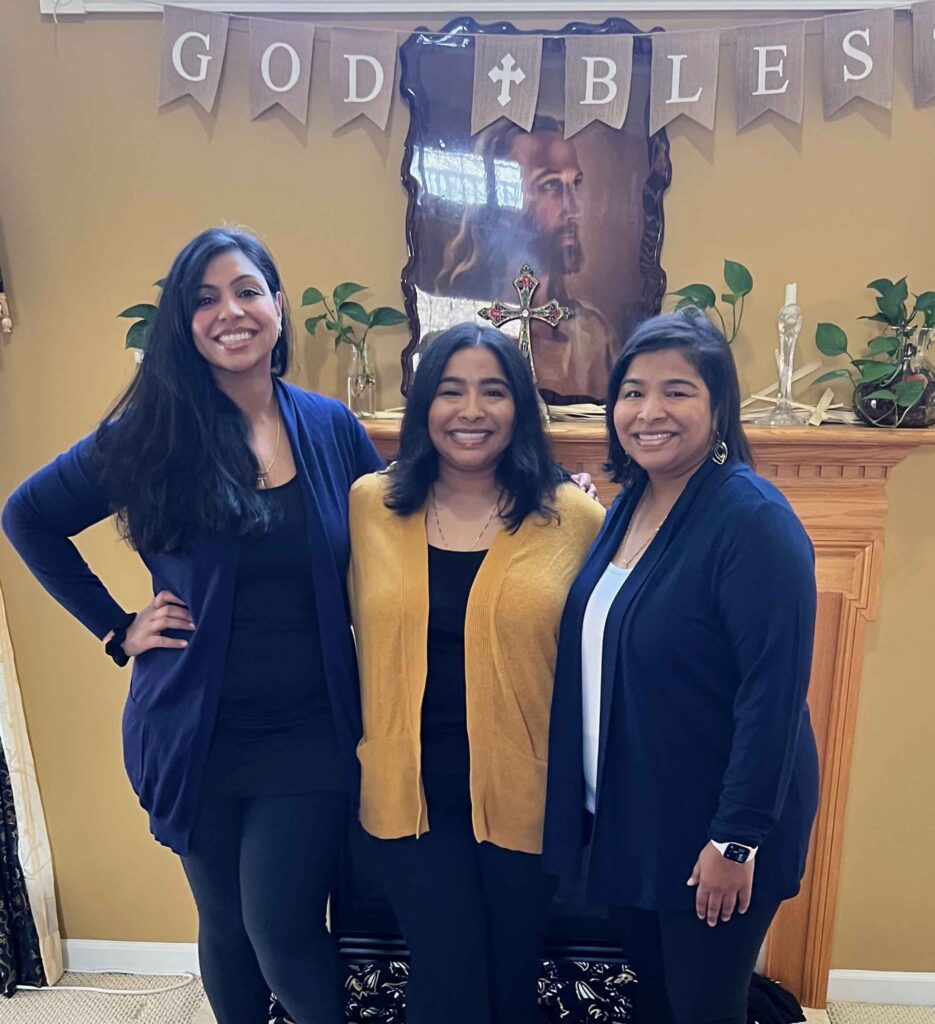 The Joshua Sisters: Gina, Jamie, and Aimee.
Growing up as “the Joshua sisters,” we did many things together—singing songs in church at talent shows, Girl Scouts, karate, and even attending UMBC! They wanted the best for us and every day showed us the value and importance of hard work and being and staying humble. Since we were young girls, Mummy and Chacha taught us that everything is possible if you put your mind to it and work hard. Our parents encouraged us to chase our dreams, but as with many parents, they didn’t think about pursuing their own, only providing for their family.
Mummy, affectionately known as “Ammini Aunty,” was a nurse at the University of Maryland Medical System and Chacha, affectionately known as “Bejoy Uncle,” was a realtor. They both kept busy outside of work hours with community and church activities.
If you wanted to find our parents in the house, it was usually in the kitchen—and the garden was a close second. Mummy loved to cook our traditional South Indian dishes and prepare food for others and Chacha enjoyed being her sous chef. Food was their love language and we had so many conversations around the kitchen table.
During our years at UMBC, we often brought Mummy’s home-cooked food when we returned to campus, always willing to share some chicken biriyani or beans mezhukkupuratti with our friends. Mummy didn’t often have time to do more than cooking for her family or special events because of her nursing career and her focus on our education. This meant she didn’t get to cook and experiment as much as she would have liked. It was only once we were in college that we began to understand the joy being in the kitchen would bring her.
Once we were older, some of our favorite memories were when we gathered in the kitchen to catch up on how everyone’s day had been. When we came home with our friends, Mummy would recruit them to help prepare whatever was on the menu, even if they had never cooked before. We did our best and Mummy would walk us through the recipe and cooking techniques with a lot of patience. Mummy always said “If you put your mind to it, you can do it. It’s a passion, and it takes hard work. But at the end of it all, you get something great.”
Food is meant to be shared, and while Mummy was teaching us to cook, she was also teaching us to curate and nurture relationships and be proud of our culture.
The Joshua Sisters
Whether we were peeling ginger, grating coconut, or chopping vegetables, we knew we were not just creating a meal, we were also building and creating something better: loving memories and an appreciation for our Kerala food. Because that’s what it’s about.
Food is meant to be shared, and while Mummy was teaching us to cook, she was also teaching us to curate and nurture relationships and be proud of our culture. Cooking together is creating together, which involves trust and building a connection between each person helping create the meal. In addition, we are Indian American and are so proud of what it means to be both Indian and American.
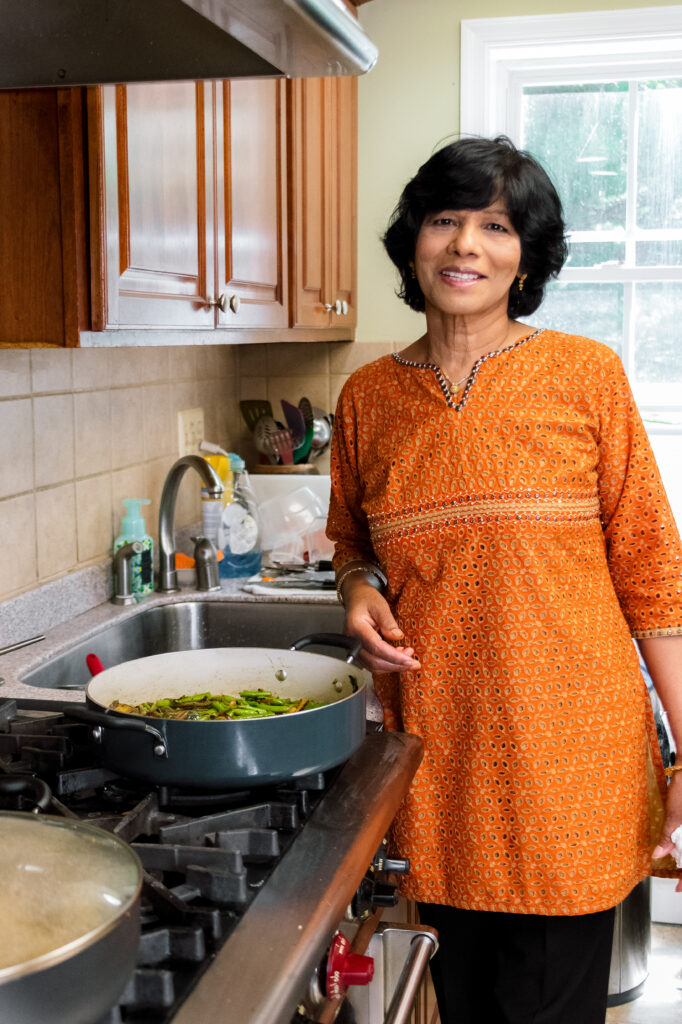 Known as Mummy to her three girls, Sara Joshua poses in her kitchen.
We learned an important lesson during our time at UMBC, taught to us by the late great Lamont Toliver, “Mr. T,” former director of the Meyerhoff Scholarship Program. In a moment of vulnerability, Aimee shared with Mr. T that she had been rejected by all of the Ph.D. programs she had applied to but had gotten into a master’s program.
In all his wisdom, Mr. T comforted Aimee with these wise words: “Not all paths from point A to point B are a straight line. Sometimes you have to take the long way to get where you want to go.” That’s a lesson that has stayed with us for some time and that, we soon realized during the pandemic, applied to Mummy.
By this time, Gina had started a family and we welcomed our next generation of children. The pandemic taught us how precious life is and that making every moment count is important. As sisters, we decided that we would work together to make Mummy’s dream of teaching our generation and future generations how to cook Kerala food come true.
After the pandemic began, Mummy retired from an over 40-year nursing career to help care for Chacha and avoid any risk due to COVID-19. With more time as a retiree, Mummy began experimenting with recipes and sharing them with close by family, who would pick up the care packages she would leave on the porch. They would then text or call her with feedback, helping perfect the recipes.
In April 2020, Mummy came into our room and asked if we wanted to take a picture of what she was cooking in the kitchen. So Jamie and Aimee, armed only with their iPhones and short notice to their friends online, began to livestream Mummy making Mango curry. Then the unexpected happened.
Thousands of people watched it within the first three days, and a flame was lit. Instead of waiting for perfection, we continued to dive into video after video, each an improvement on the one before. What started as a fun project became a thriving YouTube channel, Ammini Aunty’s A Pinch of Kerala, and a full-blown community of “Pinchers.” People were excited to learn from Mummy, and we were all thrilled to share her love for cooking with everyone.
Fast forward to today, our first cookbook, Ammini Aunty’s A Pinch of Kerala: A South Indian Inspired Cookbook, is being published. Thanks to the power of Kickstarter and Pinchers worldwide, what was just once a dream is now becoming a reality. As Mummy reminds her Pinchers, “If you put your mind to it, you can do it.” Don’t let your dreams stay a dream. Work toward making it a reality.
Jamie Joshua ’02, biological sciences, is the diversity, equity, and inclusion manager for Giant Food. Aimee Joshua ’03, M.S. ’05, computer science, is the senior manager, IT contracts, at PBS Distribution. Gina Wright ’05, biological sciences, is a dentist at a Veterans Affairs Medical Center.
]]>
Aimee, Jamie, and Gina Joshua have a lot in common. All three went to UMBC as members of the Meyerhoff Scholars Program. And the sisters all have great memories of growing up in a house filled...
https://umbc.edu/stories/three-sisters-keep-family-recipes-alive-in-book/
https://my3.my.umbc.edu/api/v0/pixel/news/137616/guest@my.umbc.edu/8b9de66ee2fe755d391c1d9411f14bcb/api/pixel
alumni
alumni-essay
biological-sciences
coeit
computer-science
fall-2023
magazine
meyerhoff-scholar
UMBC News & Magazine
https://my3.my.umbc.edu/groups/umbc-news-magazine
https://assets1-my.umbc.edu/system/shared/avatars/groups/000/001/943/24435aa6207c452e7bc15cc74b42c7bb/xsmall.png?1748556657
https://assets1-my.umbc.edu/system/shared/avatars/groups/000/001/943/24435aa6207c452e7bc15cc74b42c7bb/original.png?1748556657
https://assets2-my.umbc.edu/system/shared/avatars/groups/000/001/943/24435aa6207c452e7bc15cc74b42c7bb/xxlarge.png?1748556657
https://assets2-my.umbc.edu/system/shared/avatars/groups/000/001/943/24435aa6207c452e7bc15cc74b42c7bb/xlarge.png?1748556657
https://assets3-my.umbc.edu/system/shared/avatars/groups/000/001/943/24435aa6207c452e7bc15cc74b42c7bb/large.png?1748556657
https://assets1-my.umbc.edu/system/shared/avatars/groups/000/001/943/24435aa6207c452e7bc15cc74b42c7bb/medium.png?1748556657
https://assets2-my.umbc.edu/system/shared/avatars/groups/000/001/943/24435aa6207c452e7bc15cc74b42c7bb/small.png?1748556657
https://assets1-my.umbc.edu/system/shared/avatars/groups/000/001/943/24435aa6207c452e7bc15cc74b42c7bb/xsmall.png?1748556657
https://assets2-my.umbc.edu/system/shared/avatars/groups/000/001/943/24435aa6207c452e7bc15cc74b42c7bb/xxsmall.png?1748556657
UMBC News & Magazine
2
0
false
Thu, 07 Dec 2023 16:32:28 -0500
Thu, 07 Dec 2023 16:32:28 -0500
Meet a Retriever—Noah Cruz ’24, first-generation scholar and mentor
Meet Noah Cruz, a senior pursuing B.S. degrees in both psychology and biological sciences on the pre-med/Ph.D. track. As a first generation student and a member of multiple scholars programs, Noah takes part in student organizations and undergraduate research while also following his passions of advocating for underrepresented students in STEM (science, technology, engineering, and mathematics) fields. We can’t wait to see where Noah goes from here, and we’re excited to share his story.
Q: Tell us about yourself. What would you want another Retriever to know about you?
A: I am a senior concurrently pursuing dual bachelor of science degrees in psychology and biological sciences, complemented by minors in chemistry and photography on the Pre-M.D./Ph.D. track. I take pride in being a first-generation Salvadoran American student, and I am a strong advocate for underrepresented students in STEM. I am from Rockville, Maryland, and went to Northwood High School where I earned my associates degree and high school diploma concurrently.
I am also one out of 200,000 patients with a rare blood disorder called idiopathic thrombocytopenic purpura. Idiopathic means “of unknown cause.” This highlights the importance of bridging the gap within the immunological field of research, and drives me toward pursuing a career in the biomedical sciences!
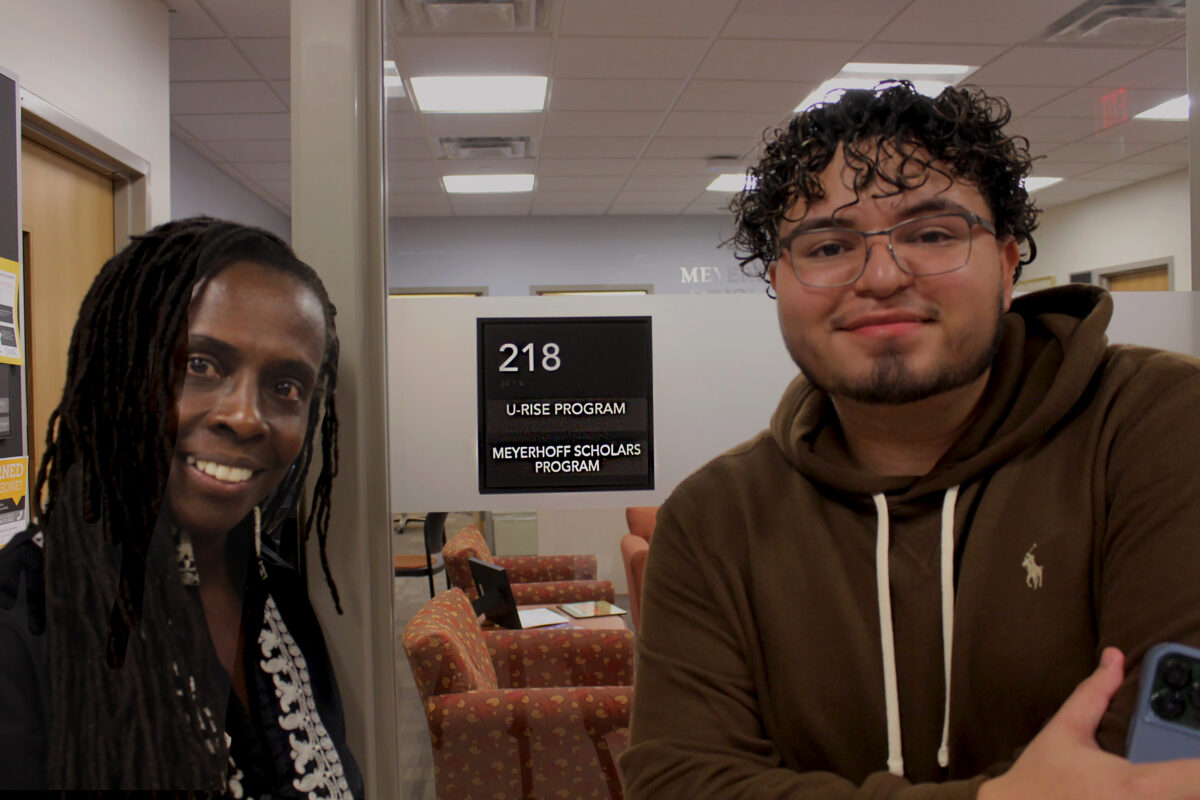 Noah Cruz (right) with Jacqueline King, associate director of the U-RISE Program (left), in front of the Meyerhoff and U-RISE Scholars Program Office. Photo courtesy of Cruz.
Q: Tell us about someone in the community who has inspired you or supported you, and how they did it.
A: There are numerous individuals who come to mind, and I am truly grateful for their unwavering support throughout my academic journey. Among them, Dr. Jacqueline King stands out as a cornerstone of support in my experience at UMBC. She has not only served as my advisor but has also been my steadfast advocate and personal cheerleader for all my accomplishments. Her inspiration has propelled me forward on the challenging path of higher education.
Another significant supporter of my aspirations is Dr. Charles Bieberich. His unwavering support, mentorship, and profound knowledge of the scientific field have been instrumental in motivating me to pursue my M.D./Ph.D. journey. I also extend my heartfelt thanks to Dr. Diana Hamilton. She not only supervises my principles of chemistry teaching assistantship but also provides unwavering support for all my academic pursuits.
Additionally, I must express my gratitude to Dr. Sarah Leupen for her invaluable support in my academic endeavors. Each of these individuals saw potential in me that I often failed to recognize within myself. As a first-generation student navigating the complexities of higher education, their investment in my education—offering support, mentorship, and words of encouragement—has made an indelible impact on my journey. I cannot express my appreciation enough for their contributions to my academic success.
Q: What do you love most about your academic program or an organization you’re involved in?
A: UMBC’s psychology and biology departments have played a pivotal role in shaping my academic journey, and I couldn’t be more appreciative of the invaluable resources and experiences they have provided me. One of the aspects I truly love about this academic program is the seamless integration of interdisciplinary approaches within the psychology and biology departments. One of the standout features of this program is how it effectively connects the dots between neuroscience, behavioral pathology, genetics, and biology.
As a first-generation student navigating the complexities of higher education, their investment in my education—offering support, mentorship, and words of encouragement—has made an indelible impact on my journey.
Noah Cruz ’24
This holistic approach has not only broadened my horizons but has also allowed me to harness the power of knowledge across these fields to enhance my own research. Whether it’s understanding the intricacies of brain function or delving into the biological underpinnings of behavior, UMBC’s program has provided me with a well-rounded education that I can leverage in my academic pursuits.
Currently, I am fortunate to be involved in neuroscience clinical research at the University of Maryland School of Medicine. The foundation laid by UMBC’s program has been instrumental in my ability to contribute effectively to this research. The skills, knowledge, and interdisciplinary perspective I gained from my time in UMBC’s psychology and biology departments have proven to be a significant advantage in my work at the School of Medicine.
Q: Since you’ve been a part of the UMBC community, how have you found support of your WHY?
A: During my time at UMBC, Peter DeCrescenzo played an indispensable role in jumpstarting my academic and career journey. As a newcomer to the university and a Louis Stokes Alliance for Minority Participation (LSAMP) Scholar, I was initially unaware of the vast opportunities and resources available to me in the field of biomedical research and academia. Peter’s guidance and support proved to be transformative in several ways. Firstly, he provided me with invaluable guidance on crafting a compelling resume—a crucial tool in presenting myself as a competitive candidate for various academic and research endeavors.
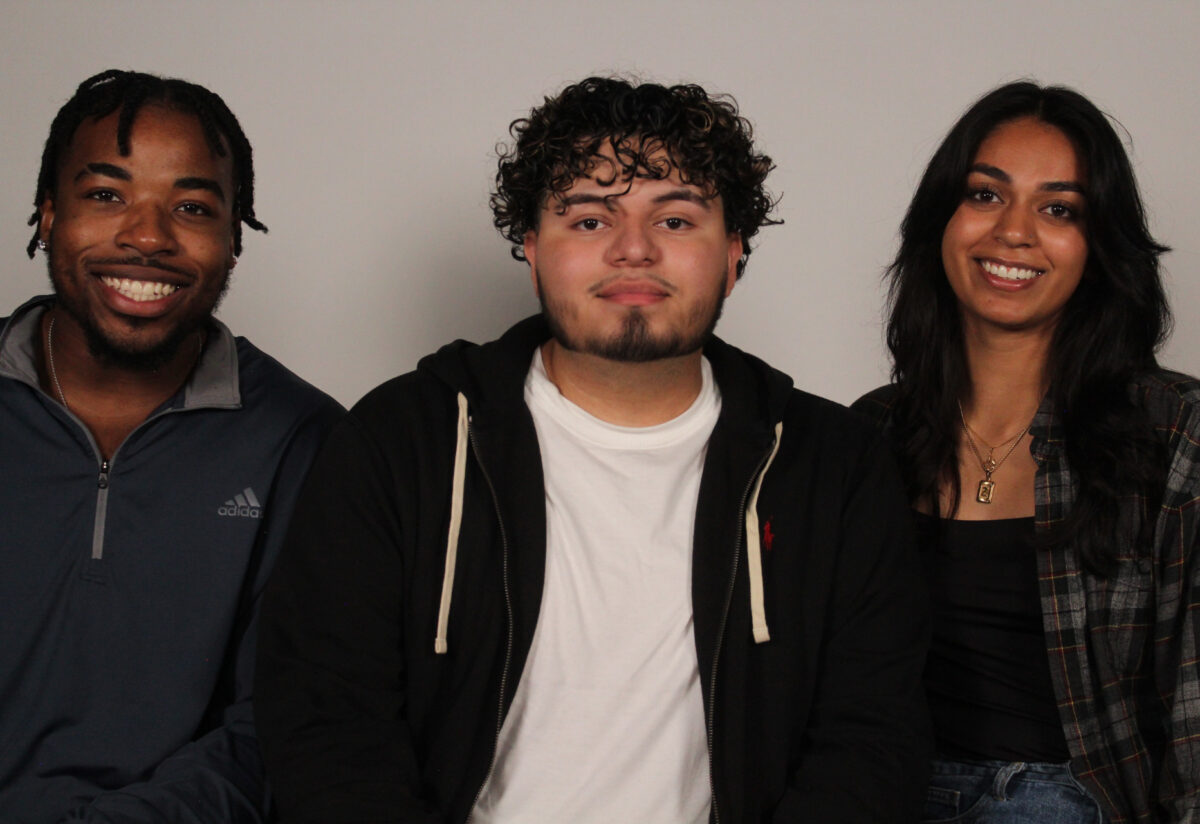
Cruz states that much of his success could be attributed to his strong support system among his close friends, including (L-R): Arian Nyandjo’24, Noah Cruz’24, Zainab Bharmal’24, and Chioma Iheacho’24 (not pictured). Photo courtesy of Cruz.
Additionally, Peter equipped me with the skills necessary to create engaging and informative poster presentations, an asset that would prove indispensable in showcasing my research projects. He also encouraged me to explore and apply to other scholars’ programs, ultimately leading to my acceptance into the U-RISE Program, a significant milestone in my academic journey.
Overall, Peter’s unwavering support and mentorship initiated a pathway to academic excellence that I had never imagined. His guidance not only imparted practical skills but also instilled in me the confidence to pursue my academic goals. Peter DeCrescenzo’s dedication to my growth at UMBC made a profound difference in my academic journey and played a pivotal role in shaping my career in biomedical research and academia.
Q: What clubs, teams, or organizations are you a part of? What do you love about them and why?
A: I am an active member of two significant organizations at UMBC, and each role holds special meaning for me. Firstly, as the Meyerhoff Scholars lead peer advisor, I have the incredible opportunity to serve as a mentor and guide to incoming first-year and sophomore students, assisting them as they embark on their college journey. What I truly cherish about this role is the chance to share my own experiences and knowledge with these students, offering them valuable insights and personal support to succeed academically and personally.
One of the most rewarding aspects of being a lead peer advisor is assisting students with their applications for scholarships, internships, and research positions. I am deeply passionate about helping students navigate the intricate and competitive application procedures, ensuring that underrepresented minority students are consistently represented in science-related settings.
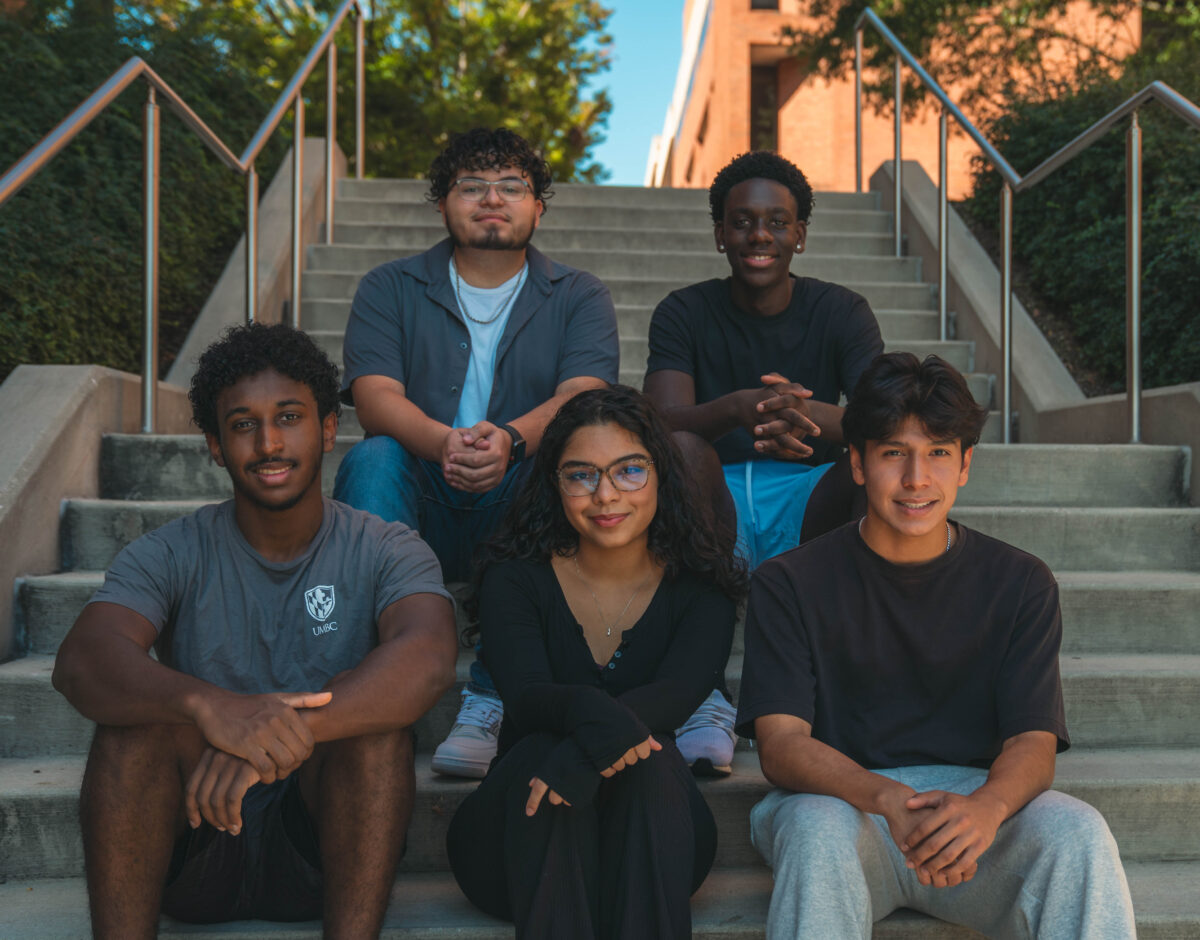 Cruz with his advisees, including students from the Meyerhoff, U-RISE, LSAMP, and McNair Scholars programs. Bottom (L-R): Emmanuel Mekasha ’25, Lesley Hernandez ’25, Christian Verastegui ’25. Top (L-R): Noah Cruz ’24, Maxwell Amoh-Mayes ’26. (Photo courtesy of Julianna Falconer’24)
Secondly, my role as vice president of the Society of Advancing Chicanos/Hispanics & Native Americans in Science (SACNAS) holds a special place in my heart. SACNAS is dedicated to promoting diversity and inclusion in STEM fields, and as VP, I play a pivotal role in building a supportive community for underrepresented students. Organizing events, creating networking opportunities, and collaborating with like-minded individuals to advance our mission is both fulfilling and impactful. It’s inspiring to see students from diverse backgrounds come together to pursue their passions in science while breaking down barriers and stereotypes.
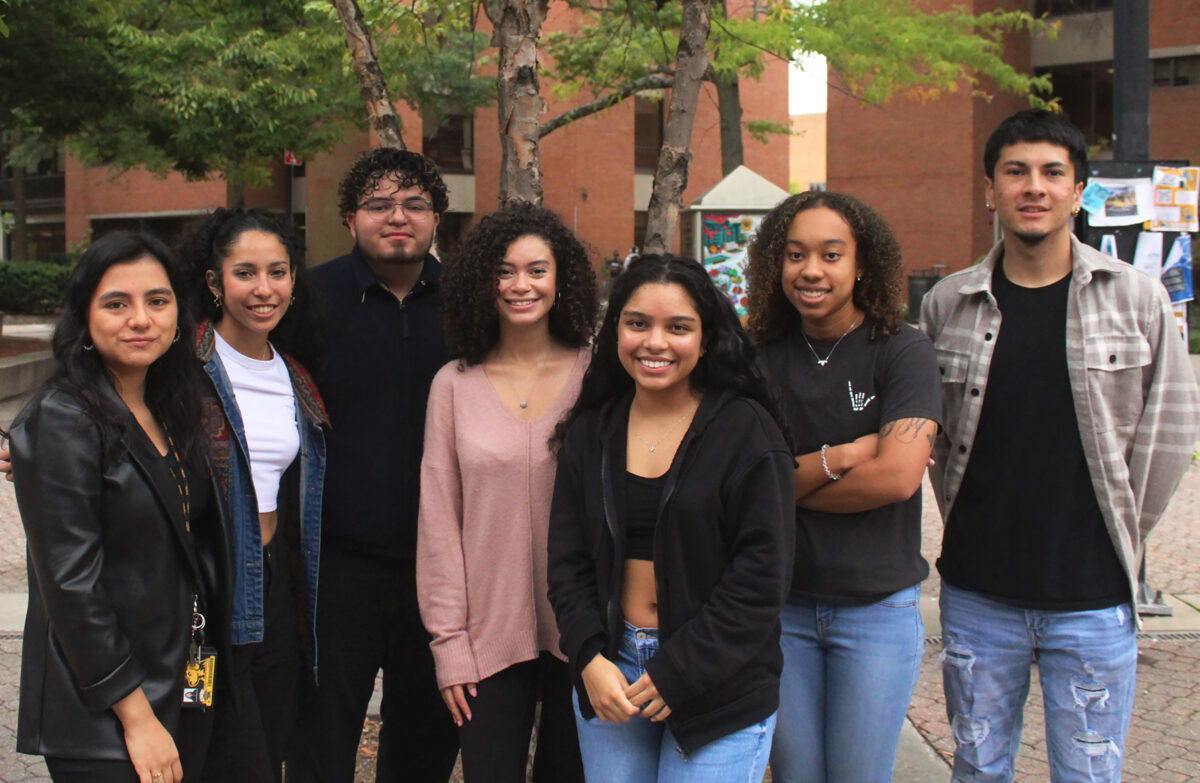 UMBC’s Society of Advancing Chicanos/Hispanics and Native Americans in Science (SACNAS) E-board, from left to right: Isabella Salguero Cespedes (Hispanic/Latino Student Council Representative), Isabella Lopez (Event Coordinator), Noah Cruz (Vice-President), Tatiana Perez (President), Lesley Hernandez (Treasurer), Viviana Smart (Secretary), Eduardo Ramirez (Social Media & Promotion Chair). Photo courtesy of Cruz.
Q: As a first-generation college student, what would you tell others who are in your shoes about UMBC?
A: Navigating the world of secondary education, especially as the first in my family to graduate high school and attend college, was undoubtedly an intimidating and overwhelming experience. One piece of advice I would offer to others in my shoes about UMBC is the critical importance of building a solid support system. Throughout my college journey, I found that my advisors and supporters played a pivotal role in my success.
These mentors believed in me from day one, providing guidance, encouragement, and a sense of belonging on campus. Having a support system is like having a lifeline when facing the myriad challenges that college life can present. They can offer valuable insights into academic decisions, personal development, and even career choices. Advisors and mentors can help you navigate the complexities of course selection, major choices, and extracurricular activities, ensuring that you make informed decisions that align with your goals.
* * * * *
UMBC’s greatest strength is its people. When people meet Retrievers and hear about the passion they bring, the relationships they create, the ways they support each other, and the commitment they have to inclusive excellence, they truly get a sense of our community. That’s what “Meet a Retriever” is all about.
Learn more about how UMBC can help you achieve your goals.
]]>
Meet Noah Cruz, a senior pursuing B.S. degrees in both psychology and biological sciences on the pre-med/Ph.D. track. As a first generation student and a member of multiple scholars programs, Noah...
https://umbc.edu/stories/meet-a-retriever-noah-cruz-24-pre-med/
https://my3.my.umbc.edu/api/v0/pixel/news/136045/guest@my.umbc.edu/673759723ca75ac6122d46b7cbb3ef81/api/pixel
biological-sciences
chemistry
magazine
meet-a-retriever
psychology
visualarts
UMBC News & Magazine
https://my3.my.umbc.edu/groups/umbc-news-magazine
https://assets1-my.umbc.edu/system/shared/avatars/groups/000/001/943/24435aa6207c452e7bc15cc74b42c7bb/xsmall.png?1748556657
https://assets1-my.umbc.edu/system/shared/avatars/groups/000/001/943/24435aa6207c452e7bc15cc74b42c7bb/original.png?1748556657
https://assets2-my.umbc.edu/system/shared/avatars/groups/000/001/943/24435aa6207c452e7bc15cc74b42c7bb/xxlarge.png?1748556657
https://assets2-my.umbc.edu/system/shared/avatars/groups/000/001/943/24435aa6207c452e7bc15cc74b42c7bb/xlarge.png?1748556657
https://assets3-my.umbc.edu/system/shared/avatars/groups/000/001/943/24435aa6207c452e7bc15cc74b42c7bb/large.png?1748556657
https://assets1-my.umbc.edu/system/shared/avatars/groups/000/001/943/24435aa6207c452e7bc15cc74b42c7bb/medium.png?1748556657
https://assets2-my.umbc.edu/system/shared/avatars/groups/000/001/943/24435aa6207c452e7bc15cc74b42c7bb/small.png?1748556657
https://assets1-my.umbc.edu/system/shared/avatars/groups/000/001/943/24435aa6207c452e7bc15cc74b42c7bb/xsmall.png?1748556657
https://assets2-my.umbc.edu/system/shared/avatars/groups/000/001/943/24435aa6207c452e7bc15cc74b42c7bb/xxsmall.png?1748556657
UMBC News & Magazine
3
0
false
Thu, 05 Oct 2023 11:27:59 -0400
Thu, 05 Oct 2023 11:27:59 -0400
UMBC Belongs to All of Us
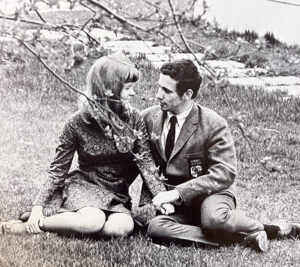
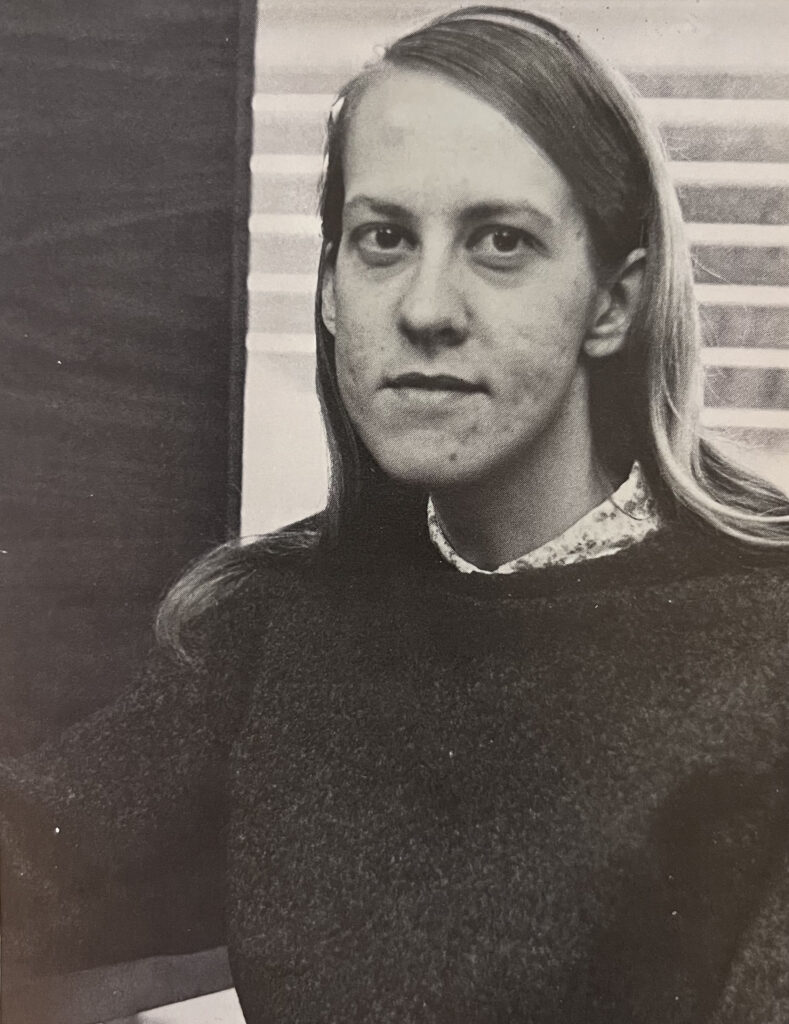 Diane Tichnell from the 1970 Skipjack, UMBC’s yearbook.
UMBC is a young institution—and not only do we have active alumni from the first four graduating classes still working to make an impact on campus and beyond, we are still discovering new stories about the establishment of the university and the ways the campus community was invited to co- create UMBC at its inception.
In fact, Diane Tichnell ’70, political science, describes the impetus for the Founding Four’s book, This Belongs to Us (2023), as its own sort of inception. Several years ago, she had a dream—literal dream while she was asleep. In it, she was attending a lecture given by then-President Freeman Hrabowski. He was talking about the books he had written, and afterward, Tichnell went up to speak to him. In her dream, she said, “We need to get the first four years of UMBC documented because soon we’re all going to be gone. Maybe in a hundred years, somebody will write it down, but why not do it now?” Dream Freeman replied, “Write that book.”
Mimi Dietrich ’70, American studies, remembers an event at the Wisdom Institute—UMBC’s association for retired faculty and staff—where a UMBC professor expressed surprise by Dietrich’s story about the plywood sidewalks that connected campus during the construction in the early years. “What do you mean you’ve never heard that story?” Dietrich responded—she figured everyone remembered what it was like in the beginning. “So Diane and I, and later Dale [Gough ’70, American studies] and Bob [Dietrich ’70, biological sciences, Mimi’s husband] came together on this; and we just started saying, ‘We have to do this. We have to do this right now.’”
Left: Co-authors Mimi and Bob Dietrich in UMBC’s 1970 yearbook Skipjack. Right: Dale Gough (pictured with Betty Huesman ’70) in the 1969 Skipjack.
Those four brainstormed the idea and knew that this labor of love would need to be as inclusive as possible. “We needed to engage the collective memory of everybody that we could possibly ask to write a story from the first four classes who were on campus,” says Tichnell. They sent newsletters, emails, mail, and even knocked on doors to capture the voices of as many graduates as possible.
In the end, 84 authors contributed more than 100 stories to This Belongs to Us, a kaleidoscopic retelling of the colorful and authentic story of UMBC. Proceeds from the book (at the clever price of $19.66) go to several scholarships supported by the founding four classes.
The Founding Four marvel at what their young institution has grown into. “All those flags in The Commons are so incredible to me,” says Joan Costello ’73, social work, a contributing author. “Because they’re from different countries. But when we came here, we were just from different neighborhoods.”
]]>
Diane Tichnell from the 1970 Skipjack, UMBC’s yearbook. UMBC is a young institution—and not only do we have active alumni from the first four graduating classes still working to make an impact...
https://umbc.edu/stories/umbc-belongs-to-all-of-us-founding-four/
https://my3.my.umbc.edu/api/v0/pixel/news/133982/guest@my.umbc.edu/49059143f75149be9cf1041938729431/api/pixel
alumni
american-studies
biological-sciences
erickson-school
founding-four
impact
magazine
spring-2023
UMBC News & Magazine
https://my3.my.umbc.edu/groups/umbc-news-magazine
https://assets1-my.umbc.edu/system/shared/avatars/groups/000/001/943/24435aa6207c452e7bc15cc74b42c7bb/xsmall.png?1748556657
https://assets1-my.umbc.edu/system/shared/avatars/groups/000/001/943/24435aa6207c452e7bc15cc74b42c7bb/original.png?1748556657
https://assets2-my.umbc.edu/system/shared/avatars/groups/000/001/943/24435aa6207c452e7bc15cc74b42c7bb/xxlarge.png?1748556657
https://assets2-my.umbc.edu/system/shared/avatars/groups/000/001/943/24435aa6207c452e7bc15cc74b42c7bb/xlarge.png?1748556657
https://assets3-my.umbc.edu/system/shared/avatars/groups/000/001/943/24435aa6207c452e7bc15cc74b42c7bb/large.png?1748556657
https://assets1-my.umbc.edu/system/shared/avatars/groups/000/001/943/24435aa6207c452e7bc15cc74b42c7bb/medium.png?1748556657
https://assets2-my.umbc.edu/system/shared/avatars/groups/000/001/943/24435aa6207c452e7bc15cc74b42c7bb/small.png?1748556657
https://assets1-my.umbc.edu/system/shared/avatars/groups/000/001/943/24435aa6207c452e7bc15cc74b42c7bb/xsmall.png?1748556657
https://assets2-my.umbc.edu/system/shared/avatars/groups/000/001/943/24435aa6207c452e7bc15cc74b42c7bb/xxsmall.png?1748556657
UMBC News & Magazine
4
0
false
Tue, 13 Jun 2023 13:31:26 -0400
Tue, 13 Jun 2023 13:31:26 -0400
All Rise for Alumni Mock Trial Coaches
When Natalie Murray ’22, biological sciences, Thomas Azari ’22, political science, and Lauren Wotring ’22, political science, graduated last spring, they didn’t expect to be returning to UMBC so soon. These recent alums—all members of the 2021 National Mock Trial Championship team—were making inroads in the next stages of their careers, but didn’t hesitate to pick up the phone when the UMBC Mock Trial team called.
Together they took on the leadership of UMBC’s B team, guiding the group—composed mostly of first-year students—to the Opening Round Championship Series (ORCS) in March 2023 and saw B team co-captain Fadil Adeite ’26, media and communication studies, and Anna Kim ’26, biochemistry and psychology, win all-National attorney awards.
Coming back to pay it forward
Natalie Murray was the first to rejoin the UMBC Mock Trial team as a coach. She was hesitant initially. A full-time veterinary assistant position at the Elkridge Animal Hospital meant long days, so long she sometimes showed up to practice in her scrubs after a 12-hour shift.
When Murray agreed to coach, she envisioned having a minor position, yet she ended the season as the B team’s head coach. “Once I started working with them, and I saw how driven and incredible they were, I could not help but throw myself way more into it than I had planned,” said Murray.
The students were aware of the coaches’ investment. “To see the three coaches come back after leaving and dedicate so much time and effort—and gas money—to the team was inspiring, and it really motivated us as competitors to give even more,” said co-captain Adeite.
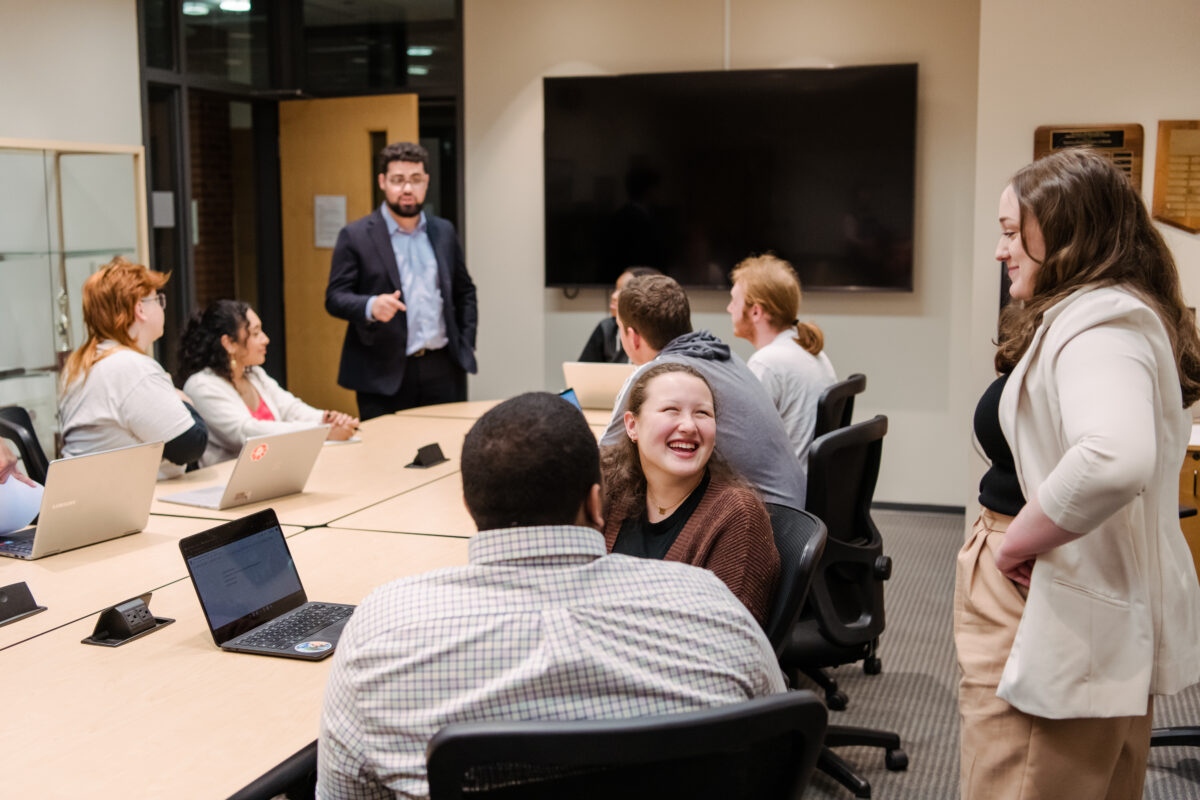 Standing, Azari, left, and Wotring, right, speak with members of the UMBC Mock Trial team. (Marlayna Demond ’11/UMBC)
The team became a source of joy for Murray, brightening her stressful days and making the logistics of coordinating coaching worth it. It helped that she could rely on former teammates to share the load.
Thomas Azari navigated his job in the U.S. Department of State’s Department of Human Rights and Labor, studying for the LSAT, and applying to law school while coaching. Lauren Wotring also made time to coach the B team while working at a D.C. law firm as an intellectual property legal assistant and prepping for law school.
Wotring said the students made the whole experience so special. “I realized how much the students meant to me and how amazing they are and how willing they were to learn,” said Wotring, who realized she wants to keep coaching next year.
Alumni coaching legacy
The Mock Trial team has always had dedicated coaches. The B team trio cites current head coach Ben Garmoe ’13, political science,and assistant coach Whitney Wilder as some coaches who made their mock trial experience.
Azari knew he had to return as a coach after the impact his coaches had on him and his Nationals-winning team.“If not for Ben, we wouldn’t have had any of the success we have now,” he said. “I kind of learned from that and was like, ‘Ben is doing all this work. I have to too.’”
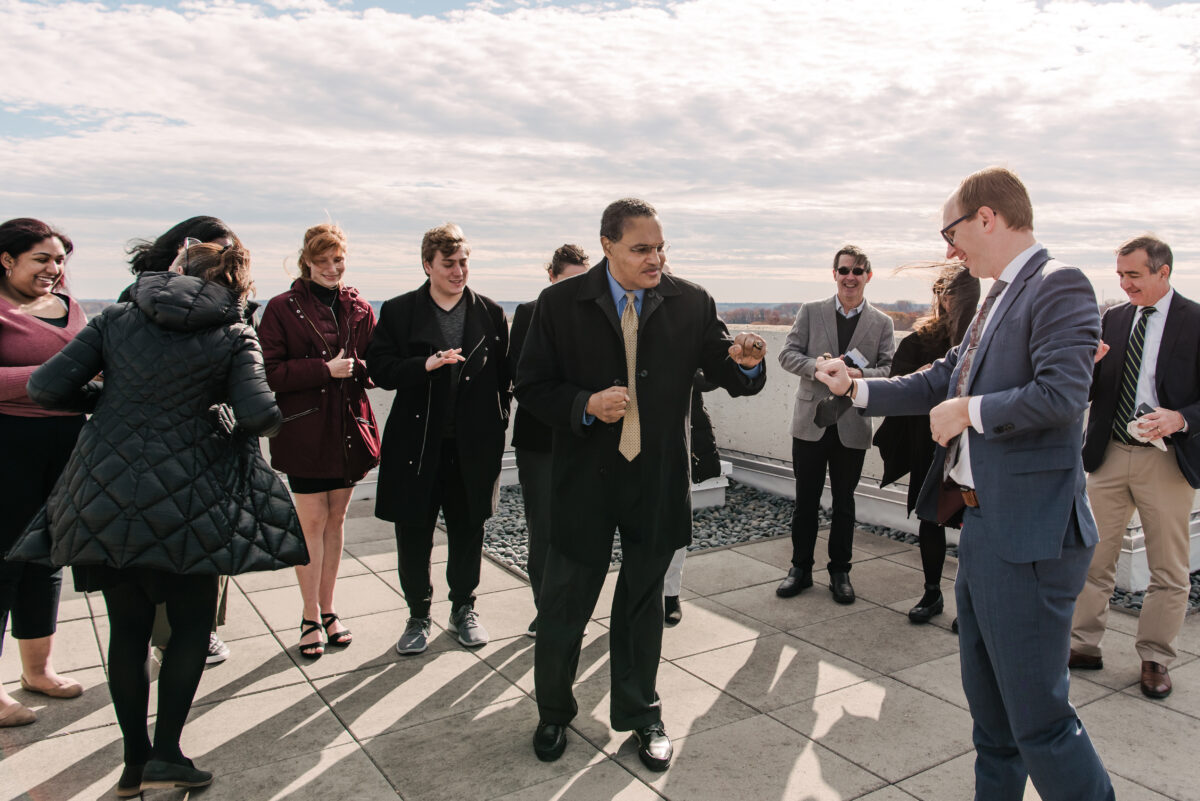 Garmoe, right, and then-President Freeman Hrabowski show each other their 2021 National Mock Trial Championship rings with members of the UMBC Mock Trial team. (Marlayna Demond ’11/UMBC)
Murray, Azari, and Wotring’s investment in the students took many forms. Wotring spoke to many about the dangers of perfectionism. Murray ensured they were having fun while being competitive. Azari lent out ties and showed them how to stay positive even after a loss. All three drove students to competitions, helped pay for food, and were always a text away.
The students couldn’t have been more thankful. At the end of the season, the alumni coaches received cards from the team with notes from each student. Kim emailed each of them, telling them how they impacted her.
“They taught us how to be better competitors, how to work better as a team, how to get places on time, but mostly how to be confident and proud of ourselves,” said Kim.
“Whenever anyone felt down about themselves, their performance, or not understanding, they were right there to lift us up, guide us, and make us all feel heard,” said B team co-captain Alysha Carter ’26, political science.
Champion volunteers
The trio’s willingness to turn around so quickly after graduation and invest their time in the next generation of UMBC Mock Trial competitors means a lot to Garmoe. “Thomas, Natalie, and Lauren are all national champions and highly decorated competitors,” said Garmoe. “But even more importantly, they are wonderful people and stellar role models for our young students.”
Murray sees a direct correlation between her coaching experience now and the support she received as a Mock Trial participant. Her fond memories of the organization, said Murray, are rooted in the genuine care she felt from her coaches and teammates. “To be part of that equation, and thinking that maybe one day down the line some of these students will do the same thing, they’ll graduate and they’ll want to coach, has been a really fun thought to have.”
By Morgan Casey ’22
]]>
When Natalie Murray ’22, biological sciences, Thomas Azari ’22, political science, and Lauren Wotring ’22, political science, graduated last spring, they didn’t expect to be returning to UMBC so...
https://umbc.edu/stories/all-rise-for-alumni-mock-trial-coaches/
https://my3.my.umbc.edu/api/v0/pixel/news/133925/guest@my.umbc.edu/fc680eab97419f9be2ec22e8a0109bcd/api/pixel
alumni
biological-sciences
impact
magazine
mcs
mock-trial
political-science
spring-2023
UMBC News & Magazine
https://my3.my.umbc.edu/groups/umbc-news-magazine
https://assets1-my.umbc.edu/system/shared/avatars/groups/000/001/943/24435aa6207c452e7bc15cc74b42c7bb/xsmall.png?1748556657
https://assets1-my.umbc.edu/system/shared/avatars/groups/000/001/943/24435aa6207c452e7bc15cc74b42c7bb/original.png?1748556657
https://assets2-my.umbc.edu/system/shared/avatars/groups/000/001/943/24435aa6207c452e7bc15cc74b42c7bb/xxlarge.png?1748556657
https://assets2-my.umbc.edu/system/shared/avatars/groups/000/001/943/24435aa6207c452e7bc15cc74b42c7bb/xlarge.png?1748556657
https://assets3-my.umbc.edu/system/shared/avatars/groups/000/001/943/24435aa6207c452e7bc15cc74b42c7bb/large.png?1748556657
https://assets1-my.umbc.edu/system/shared/avatars/groups/000/001/943/24435aa6207c452e7bc15cc74b42c7bb/medium.png?1748556657
https://assets2-my.umbc.edu/system/shared/avatars/groups/000/001/943/24435aa6207c452e7bc15cc74b42c7bb/small.png?1748556657
https://assets1-my.umbc.edu/system/shared/avatars/groups/000/001/943/24435aa6207c452e7bc15cc74b42c7bb/xsmall.png?1748556657
https://assets2-my.umbc.edu/system/shared/avatars/groups/000/001/943/24435aa6207c452e7bc15cc74b42c7bb/xxsmall.png?1748556657
UMBC News & Magazine
0
0
false
Thu, 08 Jun 2023 11:28:04 -0400
Thu, 08 Jun 2023 11:28:04 -0400