UMBC’s Koirala Lab celebrates students’ award-winning RNA research and peer mentorship
A talented trio of students has earned accolades for their innovative work with Deepak Koirala, assistant professor of chemistry and biochemistry. Their awards are replicating like the RNA they study, as they unravel the complexities of viral RNA and reveal potential therapeutic targets.
Manju Ojha, Ph.D. candidate in biochemistry, Megan Nguyen, rising senior biochemistry and molecular biology major, and Jason Daniels ’25, biochemistry and psychology, all members of Koirala’s lab, recently received awards for their joint research on RNA.
Ojha received the Robert F. Steiner Award in recognition of her significant research contributions and dedicated mentorship of undergraduate students. The award was established in 1999 by Robert Cotter and Catherine Fenselau, former chair of the Department of Chemistry and Biochemistry at UMBC, in tribute to Steiner, a former UMBC faculty member and pioneer in biophysical chemistry.
“This award highlights the growing impact of our work on understanding RNA structure, RNA-protein interactions, and viral replication mechanisms—an area that remains central to advancing structural virology and therapeutic development,” Ojha says. “The recognition underscores the importance of tackling complex questions in RNA structure and function using integrative biochemical and structural approaches.”
 Jason Daniels (right) discusses a research poster with his mentor, Deepak Koirala (center), and lab mate Megan Nguyen, outside the Koirala Lab.
Students at the center of the lab
Koirala’s group focuses on viruses whose genomes are made of RNA, which include those that cause diseases like polio, the common cold, and more. The group is developing novel techniques to determine the 3D structures of RNA, plus running experiments to figure out how RNA structures in the viruses interact with their host cell’s machinery. Students are deeply involved in all of it.
Nguyen has been studying the structure and function of plant RNAs under Ojha’s mentorship since 2023. Plant viruses are a major challenge for some crops. This spring, Nguyen received the Satterfield-Bell Scholarship, established in 2001, which recognizes an outstanding junior in chemistry who has conducted research.
“I have learned so many techniques and so much scientific theory from Manju and other lab members,” Nguyen says. “I’m thankful for this amazing experience and to be recognized for it. However, with the mentorship I’ve received over the past three years, I know this award is not only my own, but everyone’s in the Koirala lab.”
Daniels has leveraged his experience in the Koirala lab into a competitive summer research program, the Children’s Hospital of Philadelphia Research Institute Summer Scholars Program. His long-term goal is to pursue an M.D. Daniels received the Faculty Award for Excellence in Biochemistry, given to a graduating biochemistry major who displays excellence in the classroom and the laboratory.
“I can confidently say that the Koirala lab has been transformative in my academic career and future in science,” Daniels says. “This would not have been possible without mentorship from Manju and Dr. Koirala.”
 Koirala’s lab group includes many undergraduate and graduate students who support and encourage each other. (Marlayna Demond ’11/UMBC)
]]>
A talented trio of students has earned accolades for their innovative work with Deepak Koirala, assistant professor of chemistry and biochemistry. Their awards are replicating like the RNA they...
https://umbc.edu/stories/student-awards-rna-research/
https://my3.my.umbc.edu/api/v0/pixel/news/150930/guest@my.umbc.edu/40a6d0f2568c08a9077487402f6fec48/api/pixel
chembiochem
cnms
news
research
science-and-tech
story
undergradresearch
UMBC News & Magazine
https://my3.my.umbc.edu/groups/umbc-news-magazine
https://assets1-my.umbc.edu/system/shared/avatars/groups/000/001/943/24435aa6207c452e7bc15cc74b42c7bb/xsmall.png?1748556657
https://assets1-my.umbc.edu/system/shared/avatars/groups/000/001/943/24435aa6207c452e7bc15cc74b42c7bb/original.png?1748556657
https://assets2-my.umbc.edu/system/shared/avatars/groups/000/001/943/24435aa6207c452e7bc15cc74b42c7bb/xxlarge.png?1748556657
https://assets2-my.umbc.edu/system/shared/avatars/groups/000/001/943/24435aa6207c452e7bc15cc74b42c7bb/xlarge.png?1748556657
https://assets3-my.umbc.edu/system/shared/avatars/groups/000/001/943/24435aa6207c452e7bc15cc74b42c7bb/large.png?1748556657
https://assets1-my.umbc.edu/system/shared/avatars/groups/000/001/943/24435aa6207c452e7bc15cc74b42c7bb/medium.png?1748556657
https://assets2-my.umbc.edu/system/shared/avatars/groups/000/001/943/24435aa6207c452e7bc15cc74b42c7bb/small.png?1748556657
https://assets1-my.umbc.edu/system/shared/avatars/groups/000/001/943/24435aa6207c452e7bc15cc74b42c7bb/xsmall.png?1748556657
https://assets2-my.umbc.edu/system/shared/avatars/groups/000/001/943/24435aa6207c452e7bc15cc74b42c7bb/xxsmall.png?1748556657
UMBC News & Magazine
0
0
false
Mon, 07 Jul 2025 10:53:54 -0400
Mon, 07 Jul 2025 10:53:54 -0400
New Art of Science award recognizes UMBC students who communicate research visually
Koirala’s lab group includes many undergraduate and graduate students who support and encourage each other. (Marlayna Demond ’11/UMBC)
]]>
A talented trio of students has earned accolades for their innovative work with Deepak Koirala, assistant professor of chemistry and biochemistry. Their awards are replicating like the RNA they...
https://umbc.edu/stories/student-awards-rna-research/
https://my3.my.umbc.edu/api/v0/pixel/news/150930/guest@my.umbc.edu/40a6d0f2568c08a9077487402f6fec48/api/pixel
chembiochem
cnms
news
research
science-and-tech
story
undergradresearch
UMBC News & Magazine
https://my3.my.umbc.edu/groups/umbc-news-magazine
https://assets1-my.umbc.edu/system/shared/avatars/groups/000/001/943/24435aa6207c452e7bc15cc74b42c7bb/xsmall.png?1748556657
https://assets1-my.umbc.edu/system/shared/avatars/groups/000/001/943/24435aa6207c452e7bc15cc74b42c7bb/original.png?1748556657
https://assets2-my.umbc.edu/system/shared/avatars/groups/000/001/943/24435aa6207c452e7bc15cc74b42c7bb/xxlarge.png?1748556657
https://assets2-my.umbc.edu/system/shared/avatars/groups/000/001/943/24435aa6207c452e7bc15cc74b42c7bb/xlarge.png?1748556657
https://assets3-my.umbc.edu/system/shared/avatars/groups/000/001/943/24435aa6207c452e7bc15cc74b42c7bb/large.png?1748556657
https://assets1-my.umbc.edu/system/shared/avatars/groups/000/001/943/24435aa6207c452e7bc15cc74b42c7bb/medium.png?1748556657
https://assets2-my.umbc.edu/system/shared/avatars/groups/000/001/943/24435aa6207c452e7bc15cc74b42c7bb/small.png?1748556657
https://assets1-my.umbc.edu/system/shared/avatars/groups/000/001/943/24435aa6207c452e7bc15cc74b42c7bb/xsmall.png?1748556657
https://assets2-my.umbc.edu/system/shared/avatars/groups/000/001/943/24435aa6207c452e7bc15cc74b42c7bb/xxsmall.png?1748556657
UMBC News & Magazine
0
0
false
Mon, 07 Jul 2025 10:53:54 -0400
Mon, 07 Jul 2025 10:53:54 -0400
New Art of Science award recognizes UMBC students who communicate research visually
For Rachel Brewster, professor of biological sciences, “science has always been visual,” she says. Her laboratory focuses on developmental biology, using zebrafish as a model organism. Zebrafish have transparent embryos, and imaging them as they grow and change is a core element of her group’s data collection.
“There is endless complexity and beauty captured in the images we generate using increasingly advanced imaging technologies,” Brewster says. “To me, this is not unlike the experience of viewing great works of art, such as impressionist paintings that bring the natural world to life through color, texture, and contrast.”
To that end, Brewster endowed the new Havelock and Jennifer Brewster Art of Science award in the College of Natural and Mathematical Sciences (CNMS). The award recognizes one CNMS student per year who produces original, visually stunning photographs, illustrations, or data visualizations that effectively communicate an important aspect of research.
“Scientific imaging that captures both beauty and meaning takes time, skill, and perseverance,” Brewster says. The new award acknowledges that “this kind of work deserves recognition not just within the scientific community, but beyond, because it has the power to spark curiosity, inspire others, and make science more accessible and engaging to the wider public.”
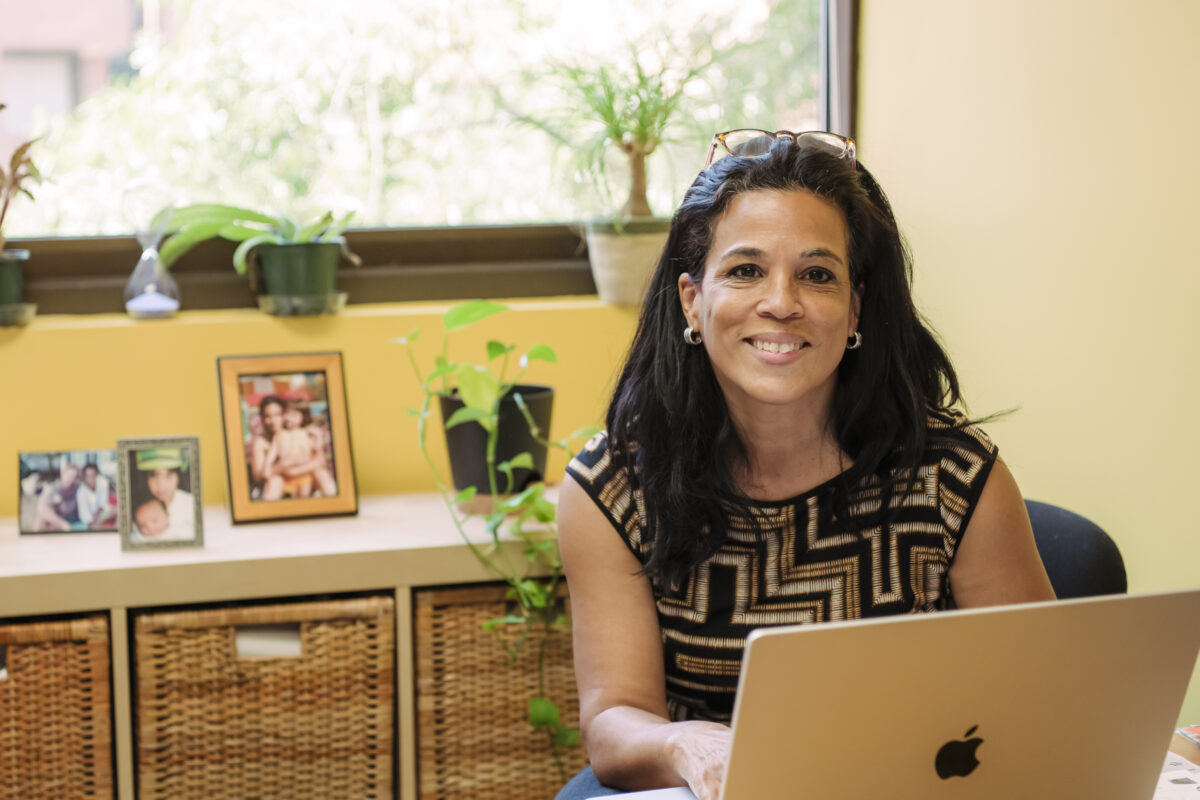 Rachel Brewster’s office is a welcoming space for students to come and ask questions. (Marlayna Demond ’11/UMBC)
Opening people’s minds to the art of science
Maggie Wang, a junior biochemistry and molecular biology major with a minor in art history and museum studies, is the first recipient of the new award. Participating in UMBC’s SCIART program, a collaboration with the Walters Art Museum in Baltimore, initially “opened my mind to the intersection of science and art,” Wang says.
As an undergraduate researcher in UMBC’s Molecular Characterization and Analysis Complex (MCAC), Wang’s desire to better understand the research equipment in the MCAC led her to produce detailed illustrations explaining the purpose of various instruments and the techniques they employ. With the encouragement of Cynthia Tope Niedermaier,MCAC facility manager, Wang polished her illustrations to help others learn about the equipment.
 Maggie Wang created detailed drawings of instruments in the MCAC accompanied by helpful explanations of their features, such as this Bruker 12T solariX Fourier Transform Ion Cyclotron Resonance Mass Spectrometer (FT-ICR-MS). (Courtesy of Wang)
This summer, Wang will develop educational diagrams of more MCAC instruments. In addition to her scientific art, she works with graphite, ink, and yarn to create pieces that frequently focus on themes of Chinese culture and women’s fashion. Wang plans to pursue additional study in medical illustration after she graduates from UMBC.
“Making art is a cathartic experience that allows me to express my creativity and emotions,” Wang says. “It also helps me connect with people from different backgrounds, opening the door to new perspectives and meaningful connections.”
Giving back in gratitude
Brewster strongly believes in UMBC’s mission to bring together and support students from a wide range of backgrounds, a goal she lives out daily within her own research group. Recently she also became co-lead of UMBC’s Meyerhoff Graduate Fellows Program, which offers financial support and a close community feel to promising STEM students from all backgrounds.
“I have seen firsthand the powerful role the program plays in building the next generation of scientists,” Brewster says. “The Meyerhoff Program offers a proven framework, showing that by engaging all those who have something to contribute, we can continue to thrive as a nation.”
Brewster’s gift to fund this award is also “a small expression of my deep and lasting gratitude to my late parents, whom I love and miss every day,” she says. UMBC has also had a major role in shaping her identity. “UMBC has been my home since 2004. It is here that I have grown, not just as a scientist, but as a person. A big part of who I am is inextricably linked to this university.”
]]>
For Rachel Brewster, professor of biological sciences, “science has always been visual,” she says. Her laboratory focuses on developmental biology, using zebrafish as a model organism. Zebrafish...
https://umbc.edu/stories/art-of-science-award/
https://my3.my.umbc.edu/api/v0/pixel/news/150421/guest@my.umbc.edu/e2e7f6d2f5d14cac243879fc6a00cd41/api/pixel
arts-and-culture
biology
chembiochem
cnms
mcac
news
science-and-tech
story
UMBC News & Magazine
https://my3.my.umbc.edu/groups/umbc-news-magazine
https://assets1-my.umbc.edu/system/shared/avatars/groups/000/001/943/24435aa6207c452e7bc15cc74b42c7bb/xsmall.png?1748556657
https://assets1-my.umbc.edu/system/shared/avatars/groups/000/001/943/24435aa6207c452e7bc15cc74b42c7bb/original.png?1748556657
https://assets2-my.umbc.edu/system/shared/avatars/groups/000/001/943/24435aa6207c452e7bc15cc74b42c7bb/xxlarge.png?1748556657
https://assets2-my.umbc.edu/system/shared/avatars/groups/000/001/943/24435aa6207c452e7bc15cc74b42c7bb/xlarge.png?1748556657
https://assets3-my.umbc.edu/system/shared/avatars/groups/000/001/943/24435aa6207c452e7bc15cc74b42c7bb/large.png?1748556657
https://assets1-my.umbc.edu/system/shared/avatars/groups/000/001/943/24435aa6207c452e7bc15cc74b42c7bb/medium.png?1748556657
https://assets2-my.umbc.edu/system/shared/avatars/groups/000/001/943/24435aa6207c452e7bc15cc74b42c7bb/small.png?1748556657
https://assets1-my.umbc.edu/system/shared/avatars/groups/000/001/943/24435aa6207c452e7bc15cc74b42c7bb/xsmall.png?1748556657
https://assets2-my.umbc.edu/system/shared/avatars/groups/000/001/943/24435aa6207c452e7bc15cc74b42c7bb/xxsmall.png?1748556657
UMBC News & Magazine
0
0
false
Tue, 27 May 2025 13:05:54 -0400
Tue, 27 May 2025 13:05:54 -0400
Finding the harmony within art and science
At UMBC, undergraduate students are redefining the boundaries of scientific and artistic pursuits. From a chemical engineer who graces the stage with his cello to a bioinformatician who paints and a biochemist who ignites the dance floor with Latin rhythms, these scholars thrive in an environment that celebrates their diverse passions.
This spring, several U-RISE Scholars—the National Institutes of Heath’s Undergraduate Research Training Initiative for Student Enhancement—shared their multidisciplinary interests with Jacqueline King, associate director of the U-RISE program, and Mariano Sto. Domingo, associate director of research and evaluation within the Meyerhoff Scholars Program. As a result, King and Sto. Domingo started researching how the arts and science blend in these students’ lives, and presented their findings at an academic conference this spring. What they learned was that here, rigorous research and creative expression intertwine, fostering a vibrant community where students explore every dimension of their talents.
Ajeetha Aruchandran, a seniorbioinformatics and computational biology major, studies how the neural tube—a precursor to the spinal cord—forms in zebrafish embryos with Rachel Brewster, professor of biological sciences.
The development of the embryos, which are transparent, “is a very visual process,” Aruchandran says. Her artistic skills have allowed her to generate beautiful and accurate diagrams that communicate her research, she says. “When you’re not able to communicate science well, then the meaning is lost. So I think my art has really strengthened that aspect of my science. The connection has surprised and delighted me, because for a long time I thought my science and my art had to be separate.”
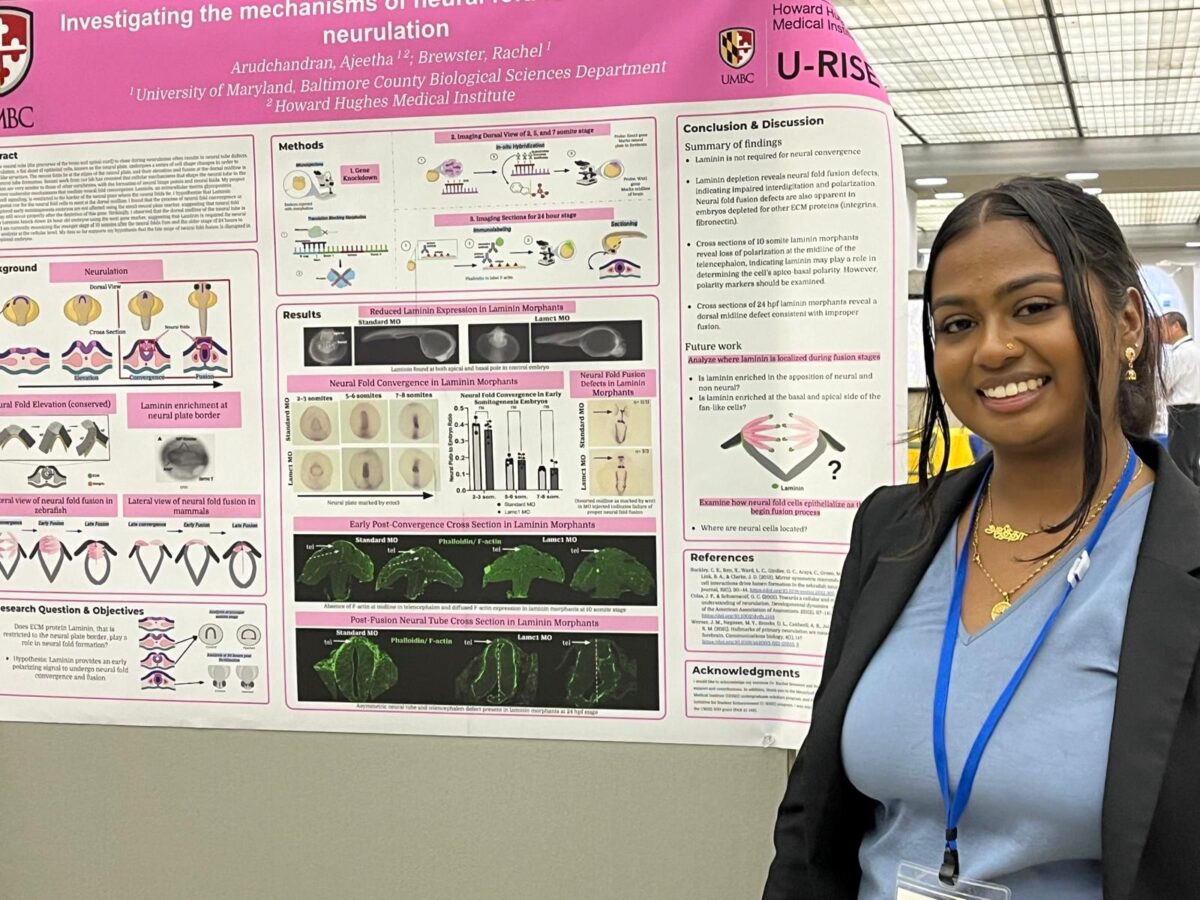
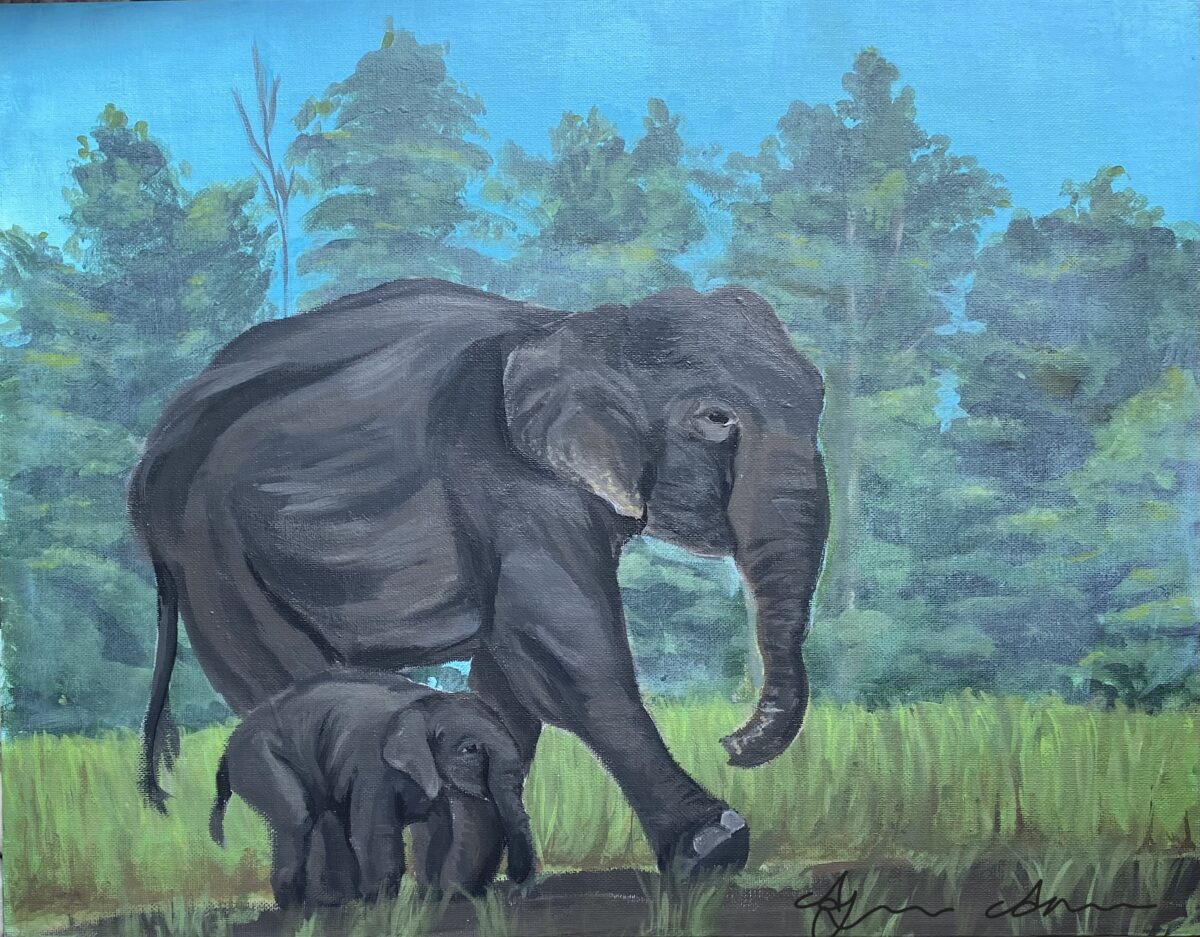 Biologist Ajeetha Aruchandran also loves to paint. (Courtesy of Aruchandran)
Aruchandran began with drawing, but has transitioned to painting. “There’s something so special about the freeness of a brushstroke,” she says. The two pursuits “create balance in my life, because when I need more structure, I have research and the scientific method, but when I need to feel more free, I have my art.”
Rhythm and harmony
Lesley Hernandez, a senior majoring in biochemistry and molecular biology, is hunting for factors that regulate how viruses like HIV multiply in cells with Michael Summers, University Distinguished Professor of Cchemistry and Bbiochemistry. The ultimate goal is to disrupt the viruses’ replication. She also loves to dance.
“My family is from the Dominican Republic, so I grew up surrounded by music and movement. I decided to embrace that part of my culture at UMBC by joining the Latin Dance Club, where I could perform and share my love for dance with others,” Hernandez says. “I love incorporating dance into the workspace by sharing a laugh with my peers and dancing between experiments. It fosters stronger connections and creates an enjoyable work environment.”
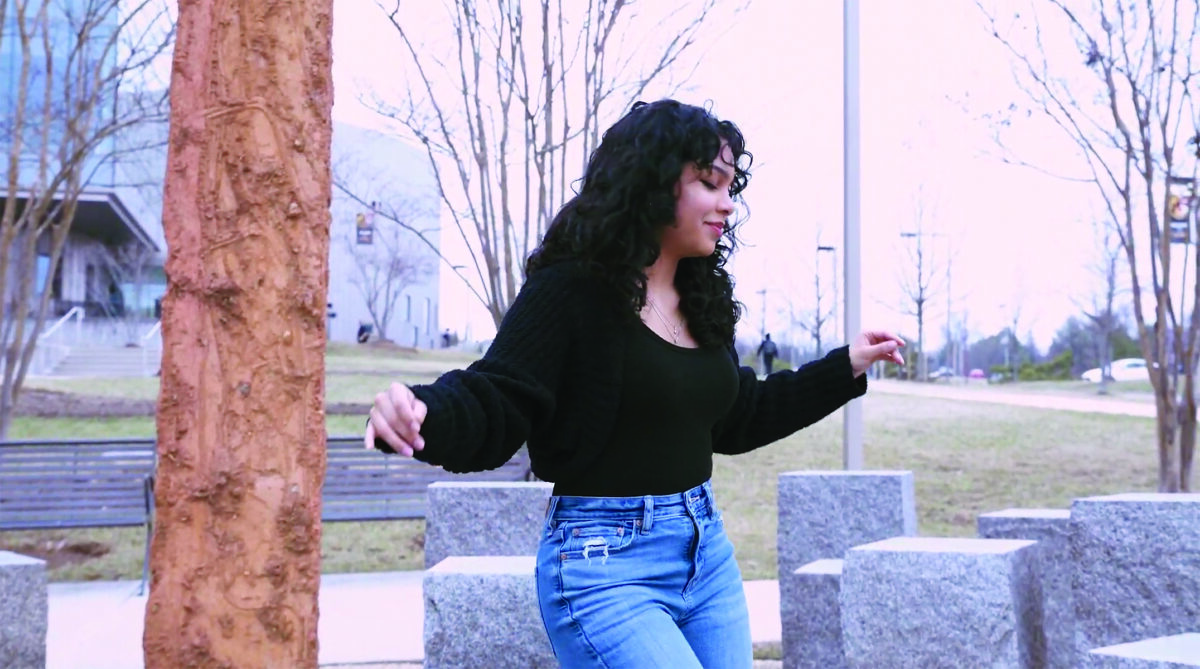
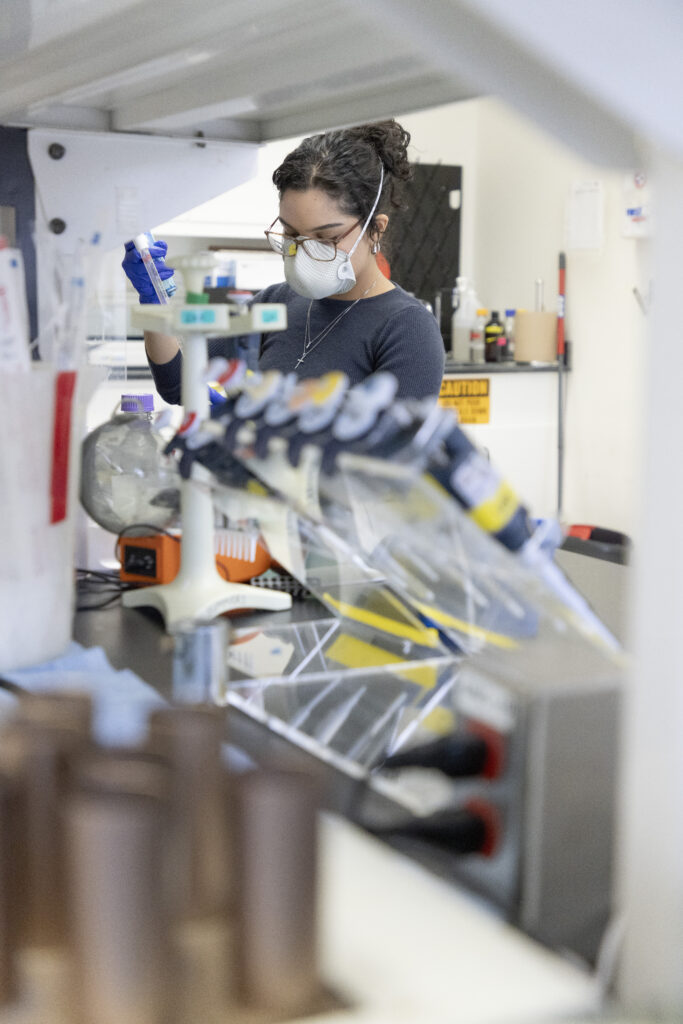 Lesley Hernandez loves being able to “go to my dance class and come back [to the lab] with a refreshed mind.” (Melissa Penley Cormier, M.F.A. ’17/UMBC)
And, when the science gets intense, “I can go to my dance class and come back with a refreshed mind,” Hernandez says. Her attention to detail benefits both her science and her dance. Being “a calculated person” helps her pick up rhythmically complex dance moves more quickly, for example. Both activities also require creativity, whether in trouble-shooting an experiment that’s not working or coming up with new dance routines.
In the Summers lab, “We are all really into science, but what is fun for you outside of that? Everyone in my lab has their own outlet, and that is encouraged,” Hernandez says.
For Daisy Parry, a senior majoring in biological sciences, that outlet is singing. “I’ve had a lot of interests that have come and gone, but singing has been a constant thread throughout my life. It’s very important and very centering to me,” Parry says. Her music minor has created dedicated times that provide a respite from the demands of science, she says.
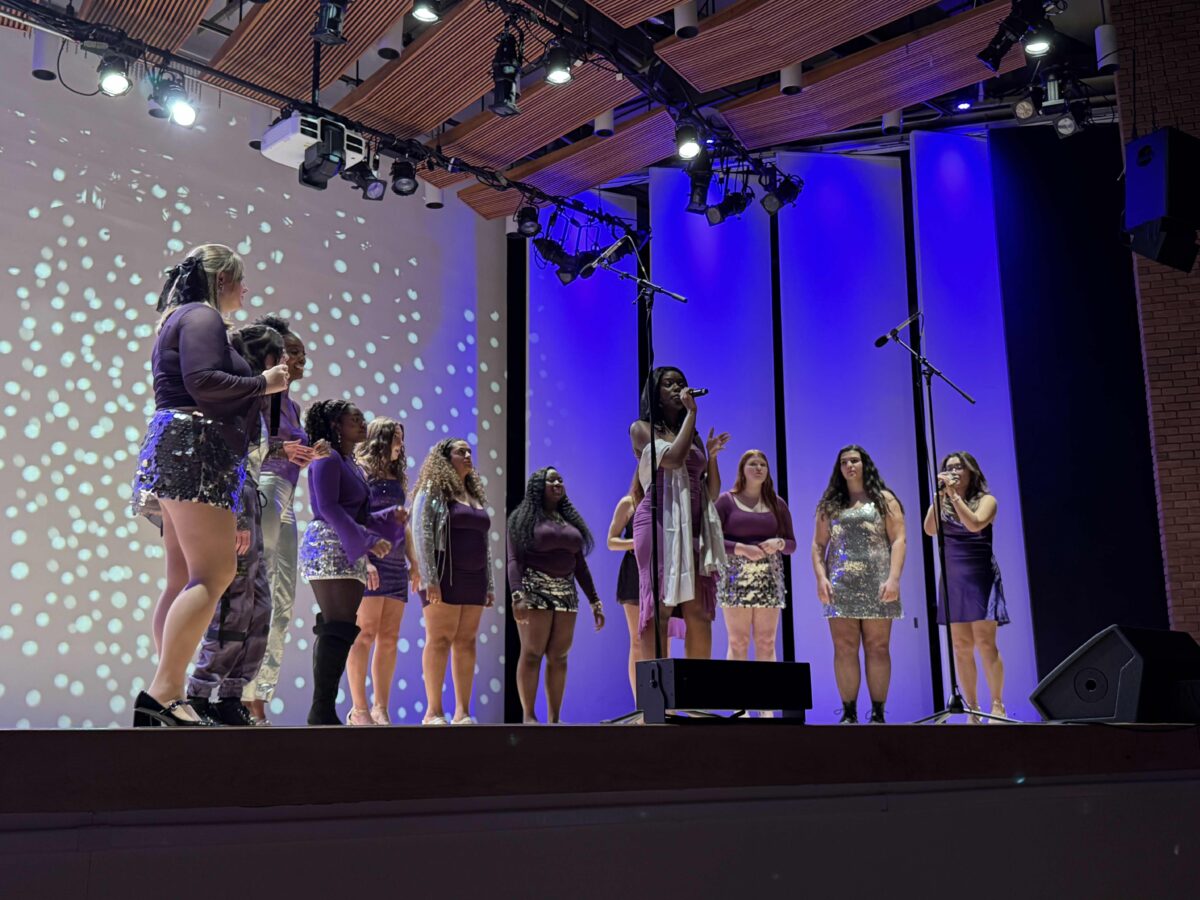 Daisy Parry (in front, with microphone) performs with the UMBC Stilettos, an all-female a cappella group. (Courtesy of Parry)
Parry is a member of The Stilettos, an all-woman a cappella group at UMBC, and her church choir. She arranges songs for The Stilettos to perform, which permits taking some creative license with the original work. “I like changing up the rhythms and dynamics to add depth to the music, and I think’s encouraged me to think a bit outside the box with my science, too, in terms of trying new experimental techniques.”
For now, her work on cell migration in fruit fly embryos with Michelle Starz-Gaiano, professor of biological sciences, her classes, and her music keep her busy, but Parry is looking forward to pursuing a master’s in public health after UMBC. She emphasizes how the concept of harmony—so central to music—carries over to the kind of work she wants to do. Factors such as research, clinical care, public policy, economics, the environment, and how they intersect are all relevant to public health outcomes, she explains.
‘It makes me whole’
Ella Reinders, a junior biological sciences major, also likes to tackle projects—scientific or artistic—from many angles. Watercolor and acrylic paints, sketching and drawing, handicrafts, sewing, and ballet have all captured her interest. “There are all different kinds of random things that I think are fun,” Reinders says.
In the lab, “I am able to come up with different ways of thinking about something because I’ve taken so many different approaches,” she says.
Reinders does behavioral research with Tara LeGates, assistant professor of biological sciences. The lab needed a new piece of equipment, but it was too expensive to buy off the shelf. “So I decided, why not create our own?” Reinders recalls.
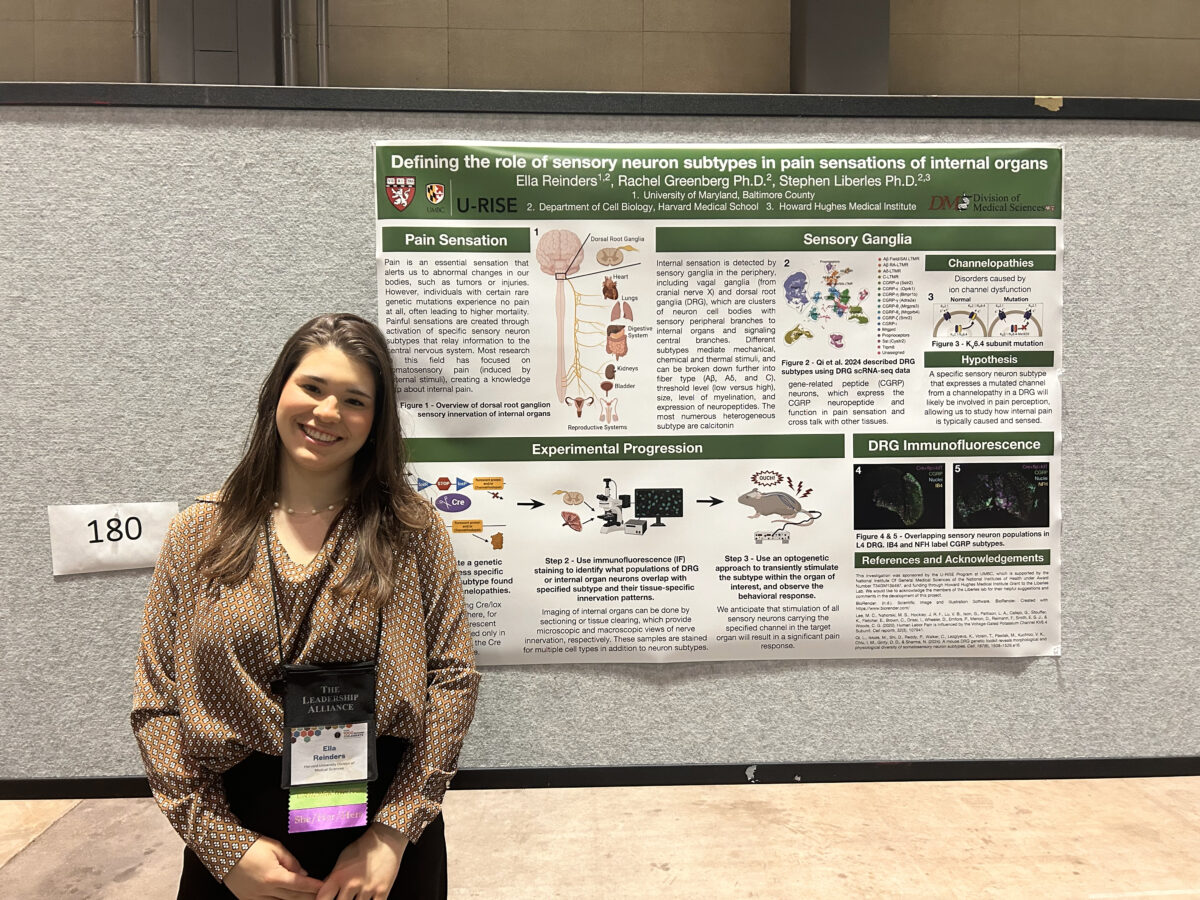
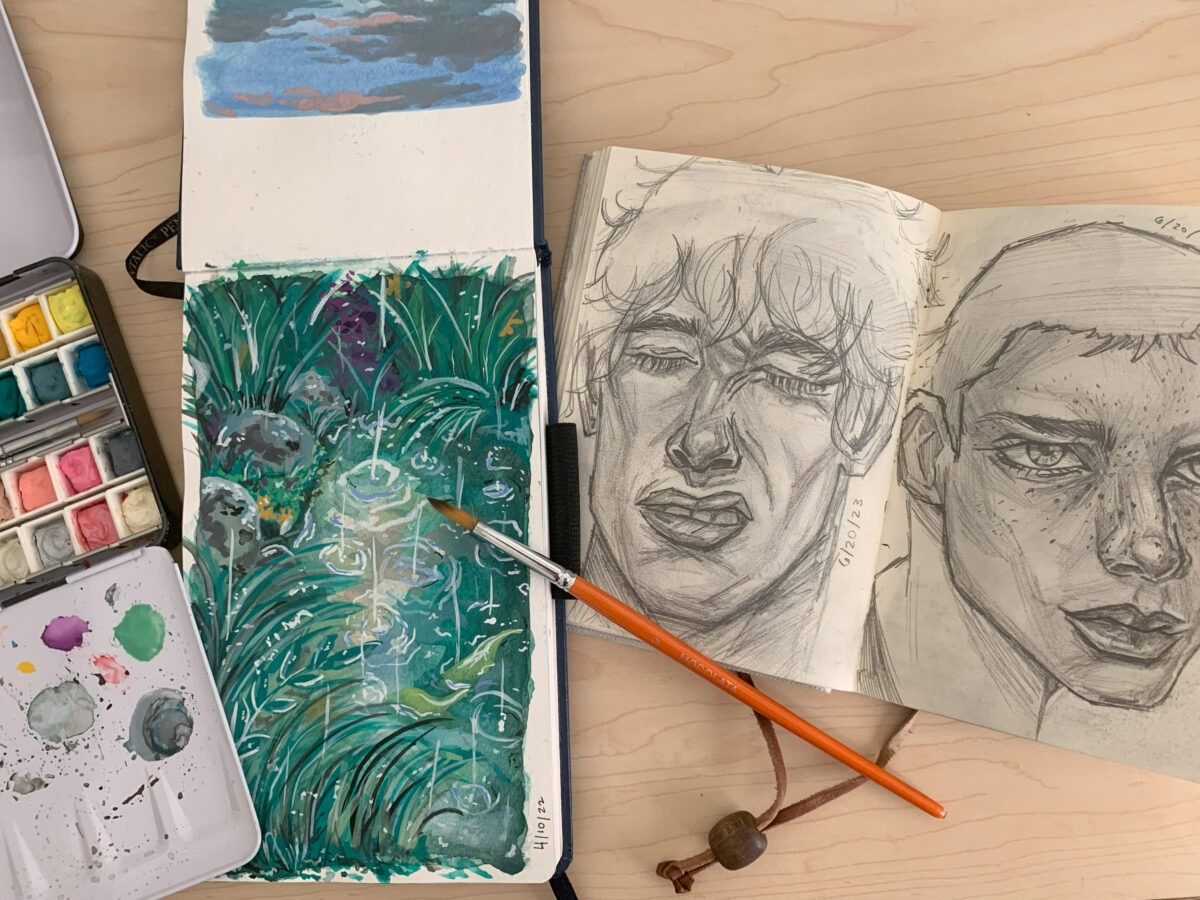 Ella Reinders says that “moving through life with both scientific and artistic interests just makes everything more interesting.” (Courtesy of Reinders)
She sketched it out, learned how to render it on the computer, how to 3D print it at the UMBC library, and then how to wire it. “And now I’ve actually been using it, and it works,” she says. “It was really exciting. I love turning something from my brain into something that I’m actually holding.”
There is also direct overlap between Reinders’ science and her art. “I’ve done imaging of neurons, and being able to turn them into this piece of artwork that you want to hang on your wall is really exciting. Moving through life with both scientific and artistic interests just makes everything more interesting and feels like a way to express all sides of myself.”
For Joshua Dayie, a senior chemical engineering major, both discipline and creativity are required for his research and his art—playing the cello. “You really have to strike a balance between them to make any meaningful progress,” he says. Practicing cello requires hours of repetition, until technical passages flow out of his fingers from muscle memory alone. In the lab, sometimes experiments must be repeated many times before they’re successful—that’s the discipline.
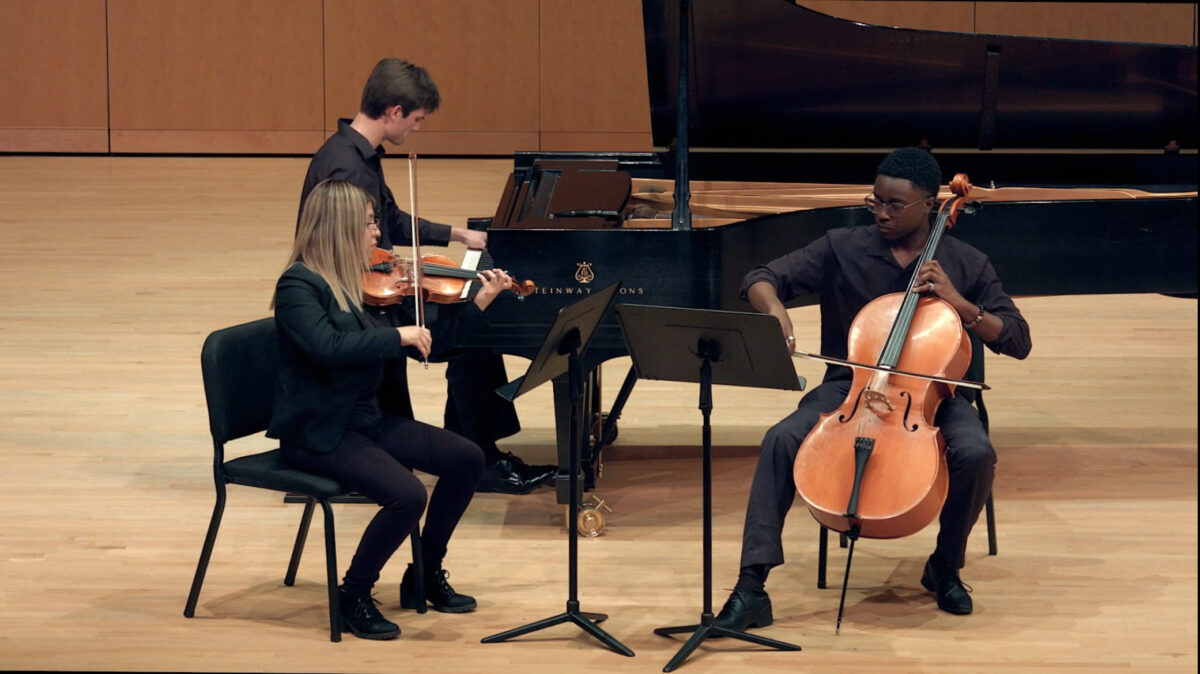
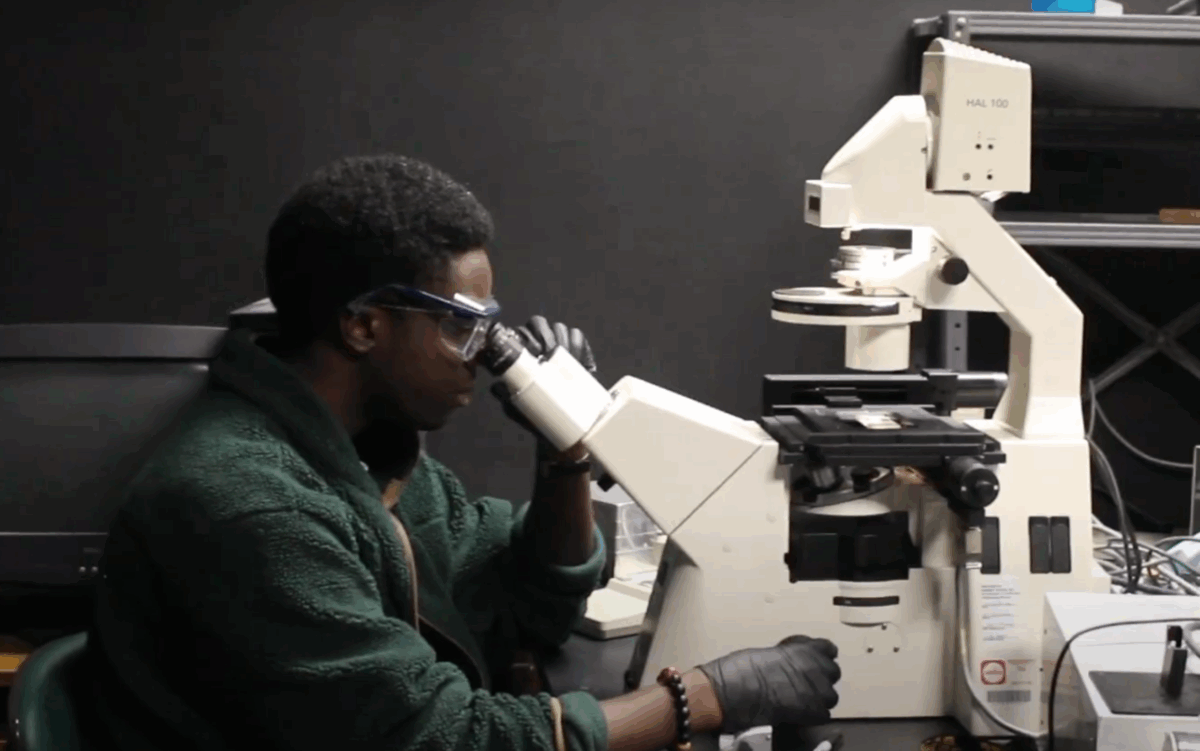 Playing the cello and conducting research makes Joshua Dayie feel “more whole.” (Melissa Penley Cormier, M.F.A. ’17/UMBC)
Dayie applies that discipline to his research with Mark Marten, professor of chemical, biochemical, and environmental engineering, on characterizing signaling pathways in fungi that activate in response to environmental stressors.
Then comes the creativity. Only after someone masters the fundamentals can they explore nuance in the tone or emotion conveyed on the cello, Dayie says. Similarly, in science “a lot of the innovation that you generate is really only meaningful after you’ve spent a lot of time understanding the core scientific concepts behind everything.”
“I think that’s been the most surprising thing: The creativity that comes from a very sound foundation of discipline is something that is translatable pretty much anywhere,” Dayie reflects.
As an added bonus, “Music has been a really nice outlet for me to use a different part of my brain, just to express myself in a different way,” he adds. “I feel like it makes me a little bit more whole.”
]]>
At UMBC, undergraduate students are redefining the boundaries of scientific and artistic pursuits. From a chemical engineer who graces the stage with his cello to a bioinformatician who paints and...
https://umbc.edu/stories/art-of-scientists/
https://my3.my.umbc.edu/api/v0/pixel/news/150074/guest@my.umbc.edu/8497eb97bed55a957858f91cb734d636/api/pixel
biochemistry-and-molecular-biology
bioinformatics
bioinformatics-and-computational-biology
biological-sciences
biology
cbee
chembiochem
cheme
chemeng
chemical-engineering
cnms
coeit
dance
discovery
magazine
music
story
UMBC News & Magazine
https://my3.my.umbc.edu/groups/umbc-news-magazine
https://assets1-my.umbc.edu/system/shared/avatars/groups/000/001/943/24435aa6207c452e7bc15cc74b42c7bb/xsmall.png?1748556657
https://assets1-my.umbc.edu/system/shared/avatars/groups/000/001/943/24435aa6207c452e7bc15cc74b42c7bb/original.png?1748556657
https://assets2-my.umbc.edu/system/shared/avatars/groups/000/001/943/24435aa6207c452e7bc15cc74b42c7bb/xxlarge.png?1748556657
https://assets2-my.umbc.edu/system/shared/avatars/groups/000/001/943/24435aa6207c452e7bc15cc74b42c7bb/xlarge.png?1748556657
https://assets3-my.umbc.edu/system/shared/avatars/groups/000/001/943/24435aa6207c452e7bc15cc74b42c7bb/large.png?1748556657
https://assets1-my.umbc.edu/system/shared/avatars/groups/000/001/943/24435aa6207c452e7bc15cc74b42c7bb/medium.png?1748556657
https://assets2-my.umbc.edu/system/shared/avatars/groups/000/001/943/24435aa6207c452e7bc15cc74b42c7bb/small.png?1748556657
https://assets1-my.umbc.edu/system/shared/avatars/groups/000/001/943/24435aa6207c452e7bc15cc74b42c7bb/xsmall.png?1748556657
https://assets2-my.umbc.edu/system/shared/avatars/groups/000/001/943/24435aa6207c452e7bc15cc74b42c7bb/xxsmall.png?1748556657
UMBC News & Magazine
3
0
false
Tue, 13 May 2025 09:16:55 -0400
Tue, 13 May 2025 09:16:55 -0400
Samuel Barnett ’25: Biochemistry researcher with a commitment to giving back
Samuel Barnett ’25, biochemistry, is on his way to the Ph.D. program in cellular and molecular biology at the University of Pennsylvania this fall, after seizing opportunities to conduct research at Howard Community College and then at UMBC. Always mindful of how others have supported him and wanting to pay it forward, Barnett has served in leadership roles in UMBC student organizations and created resources to help his classmates land their own opportunities.
Q: How did you choose your major?
A: My high school biology teacher was adamant about getting high school students involved in STEM. Even though the course was online because of the pandemic, she was still able to enrapture people in the wonders of biological sciences. I added the chemistry aspect because I wanted to dive a little bit deeper into how everything works from a basic science perspective. The interdisciplinary nature of biochemistry can sometimes make things a little more challenging, but also fun. Actually, if what I’m doing isn’t challenging, it’s not going to be as fun, I don’t think.
Q: How did you choose UMBC?
My research mentor at Howard Community College, Joseph Sparenberg, nominated me for the BUILD a BRIDGE to STEM (BBS) Internship at UMBC, part of the STEM BUILD program, after my sophomore year. I can confidently say that BBS was the most crucial turning point of my undergraduate career, making the shift from HCC to the “bigger pond” of UMBC much smoother. The mission of the BBS internship was to give transfer students a sense of belonging while immersing them in biological research. While I had research experience from Howard Community College, BBS made me feel like a researcher at UMBC.
The BBS mentors gave us a lot of autonomy and intellectual freedom to create our own projects, and I acquired experience that was relevant for my lab at UMBC and a later internship at the University of Pennsylvania. I also connected with a diverse network of mentors, familiarized myself with unique scholarship and scientific presentation opportunities, and met fellow community college transfers who helped inspire me to become the scientist I am today.
 Sam Barnett with the research poster he presented to conclude his internship at the University of Pennsylvania. (Courtesy of Barnett)
Q: How did you get connected with your research mentor at UMBC, Fernando Vonhoff, and what are you studying?
A: It’s a funny story, actually—Dr. Vonhoff grew up in Mexico and is fluent in Spanish, and one day he stepped in for my UMBC Spanish teacher. I talked to him after the Spanish class about his work and later visited him in his office to learn more. Even though his lab is mostly focused on behavioral neuroscience, I was up front about the fact that I’m interested in molecular biology. Dr. Vonhoff could have said I wasn’t a good fit, but he gave me a chance and connected me with one of his Ph.D. students, Zach Smith, who does a lot of the molecular work in the lab. Gaining those molecular skills has opened up doors for me when it comes to getting research experience.
I started in the lab in January 2024. Initially, I worked with Zach to master skills like qPCR and later Western blotting—foundational research techniques for identifying and quantifying genetic material and proteins in a sample. This semester I’ve been trusted to do Western blotting completely on my own.
Dr. Vonhoff’s lab works with fruit flies, a common model system for lots of kinds of studies. I’m trying to figure out a better way to identify the presence of a specific very tiny protein in the flies. Because it’s so small, it’s hard to visualize using traditional Western blotting. We tried a procedure that added a larger, fluorescent protein to the small protein to make it easier to see on the blots. It didn’t pan out, but that happens! So now we’re trying to go back to the basics and find new ways to observe the really small protein, but it’s really difficult.
That was definitely disappointing, but I think at the end of the day that’s just how the scientific process works. Progress ebbs and flows. We’re always asking, what can we do beyond this?
Samuel Barnett
That was definitely disappointing, but I think at the end of the day that’s just how the scientific process works. Progress ebbs and flows. We’re always asking, what can we do beyond this? Maybe another type of test or approach will work. I think the best way to approach those challenges is just optimism and to engage your curiosity and expose yourself to alternative solutions.
Q: Along with Vonhoff, who else has supported you along the way?
A: I first met Dr. Maria Cambraia, assistant director for research and international affairs in CNMS, through the BUILD a BRIDGE to STEM internship, and she has since been one of the most influential people on my undergraduate journey. She advised me on what pathways to take when I transferred to UMBC, gave me opportunities to present at national conferences, wrote letters of recommendation for anything and everything under the sun, and has been an overwhelming source of support throughout my undergraduate career. It is genuinely difficult to quantify the impact she has had on me and my fellow undergraduates.
Dr. April Householder, director of undergraduate research and prestigious scholarships, has also been essential in making sure that my place at UMBC was seen and heard. She helped me apply for the prestigious Goldwater and Knight-Hennessy Scholarships, and was always there to lend an ear. She worked overtime with the Goldwater representative at HCC, Cheryl Campo, to help me get my application submitted.
 Sam Barnett, right, with April Householder, director of undergraduate research and prestigious scholarships.
Q: What are you most proud of from your time at UMBC?
A: I am most proud of winning the Barry Goldwater Scholarship. According to the Barry Goldwater Scholarship website it is “the most prestigious undergraduate scholarship in the natural sciences, mathematics, and engineering in America.” An academic institution can select up to five students to apply for the scholarship, including one slot for transfer students. Originally, I competed for the transfer slot at UMBC, but wasn’t selected. However, at a national conference I attended, I met the president of the Goldwater foundation, who told me about a policy change that allowed transfer students to reapply at their previous institution. That led to Dr. Householder and Dr. Campo rushing to help me get my application submitted as a nominee from HCC. In April 2024, I got the email that I had won the scholarship. At the moment I won, I could hardly believe it; I was quite literally shaking and overjoyed.
Q: What else are you involved in at UMBC, and how have those activities benefited, challenged, or surprised you?
A: In addition to research, I’ve served in leadership roles as the vice president of the American Chemical Society’s (ACS) UMBC chapter and secretary of the UMBC chapter of the Tau Sigma National Honor Society, an honor society specifically for transfer students. I’ve also been a tutor for analytical chemistry on campus and volunteered regularly at Grassroots Crisis Intervention.
 Sam Barnett presents at a general body meeting of the UMBC chapter of the American Chemical Society in 2024. (Courtesy of Barnett)
The biggest surprise was my position within the ACS chapter here. It turned out to be a bigger job than I expected. I compiled a list of 200+ active internships to help out other students. Recently, I leveraged one of my connections at the Institute of Marine and Environmental Technology to invite a guest speaker to campus. A lot of my work for the ACS chapter was self-driven, but I’m grateful to the group’s advisor, Dr. Maria van Staveren, who really supported my ambitions to make the position into more than the minimum required.
Q: What’s next for you, and what are you looking forward to?
A: This fall, I’ll begin a Ph.D. in cellular and molecular biology with a concentration in cancer biology at the University of Pennsylvania. I was an intern at Penn’s Center for Cellular Immunotherapies in summer 2024, and I had a really good time there. The rigorous research environment was just enthralling to me. I was able to focus completely on being a researcher for the first time. I had my own independent project, under guidance from a postdoc. It was really intimidating at first. At Penn, you’re able to work through the entire research process and bring new things to the table.
 Sam Barnett, far right, with STEM BUILD Trainees at UMBC’s Summer Undergraduate Research Fest in 2023.
Q: What has been the best part of your UMBC experience?
A: The best part of my UMBC experience has been the opportunity to meet mentors that have defined my career. I’ve been given a lot of opportunities, and sure, I’ve taken initiative and put in effort, but at every step of my undergraduate journey, I’ve had a mentor in my corner who’s been willing to lend me a hand and give me a chance.
UMBC offers many opportunities for undergraduates to get connected to administrators and research faculty. In my experience, faculty have always been friendly and open to connecting with undergraduates. I am extremely grateful to both UMBC and my mentors for the continued support throughout my career, and all that support has inspired me to try to give back, through efforts like the ACS internship database.
Q: What advice do you have for transfer students and aspiring undergraduate researchers?
A: Don’t feel afraid to reach out to everyone—faculty members, classmates, staff. They can all help you. And if they don’t respond via email, you can go to their office to introduce yourself. Even in a period of uncertainty, move forward anyway—research is still necessary and important. Stay ambitious, and stay involved in science.
Read more Commencement 2025 stories.
]]>
Samuel Barnett ’25, biochemistry, is on his way to the Ph.D. program in cellular and molecular biology at the University of Pennsylvania this fall, after seizing opportunities to conduct research...
https://umbc.edu/stories/sam-barnett-biochemistry-researcher/
https://my3.my.umbc.edu/api/v0/pixel/news/149589/guest@my.umbc.edu/95fdbe9b44e03b6629bb1df443d39f4a/api/pixel
biochemistry
chembiochem
class-of-2025
cnms
news
science-and-tech
story
undergradresearch
UMBC News & Magazine
https://my3.my.umbc.edu/groups/umbc-news-magazine
https://assets1-my.umbc.edu/system/shared/avatars/groups/000/001/943/24435aa6207c452e7bc15cc74b42c7bb/xsmall.png?1748556657
https://assets1-my.umbc.edu/system/shared/avatars/groups/000/001/943/24435aa6207c452e7bc15cc74b42c7bb/original.png?1748556657
https://assets2-my.umbc.edu/system/shared/avatars/groups/000/001/943/24435aa6207c452e7bc15cc74b42c7bb/xxlarge.png?1748556657
https://assets2-my.umbc.edu/system/shared/avatars/groups/000/001/943/24435aa6207c452e7bc15cc74b42c7bb/xlarge.png?1748556657
https://assets3-my.umbc.edu/system/shared/avatars/groups/000/001/943/24435aa6207c452e7bc15cc74b42c7bb/large.png?1748556657
https://assets1-my.umbc.edu/system/shared/avatars/groups/000/001/943/24435aa6207c452e7bc15cc74b42c7bb/medium.png?1748556657
https://assets2-my.umbc.edu/system/shared/avatars/groups/000/001/943/24435aa6207c452e7bc15cc74b42c7bb/small.png?1748556657
https://assets1-my.umbc.edu/system/shared/avatars/groups/000/001/943/24435aa6207c452e7bc15cc74b42c7bb/xsmall.png?1748556657
https://assets2-my.umbc.edu/system/shared/avatars/groups/000/001/943/24435aa6207c452e7bc15cc74b42c7bb/xxsmall.png?1748556657
UMBC News & Magazine
3
0
false
Tue, 29 Apr 2025 11:37:11 -0400
Tue, 29 Apr 2025 11:37:11 -0400
Three decades of student mentoring earns UMBC chemist Paul Smith the Braude Award
For nearly three decades, Paul Smith has put undergraduate mentorship and the motivation of bettering human health at the forefront of his work. He’s been recognized for his efforts as the most recent recipient of the Braude Award from the Maryland Section of the American Chemical Society (ACS). The annual award recognizes one chemist from Maryland who has demonstrated a long-term commitment to mentoring undergraduate researchers in the chemical and biochemical sciences. Smith will give a scientific talk at the chapter’s October meeting, and the award includes a $4,000 prize to further support undergraduate research.
Smith has trained more than 70 undergraduates in his laboratory over his 29-year career at UMBC. Many of them have been recognized for their outstanding work at the department and the university level, as well as by outside organizations such as the ACS and Pfizer. His research group does not always include graduate students or postdoctoral fellows, so “the undergrads learn from me directly, which is fun,” he says.
Despite his many years of experience, Smith continues to approach his work with contagious childlike curiosity and enthusiasm. “I tell the students, I love doing this because I’m going to make a molecule no one has ever made before, and that’s a pretty cool feeling,” he says. “And also, it’s a long shot, but you could discover something that’s really going to be beneficial to human health. It’s motivating.”
Paying mentoring forward
Smith is a synthetic chemist, which he describes as the “bricklayer” of the chemistry world. He and his students coax various molecular structures into existence by carefully facilitating intricate chemical reactions. Throughout his career, Smith has worked on synthesizing molecules with activity against cancer cells, hepatitis C, and influenza. Some of these molecules have also shown a promising ability to reverse antibiotic resistance in some bacteria. Right now, he and his students are working on improving compounds that may help fight influenza and reduce antibiotic resistance.
Smith conducted research as an undergraduate at SUNY-Brockport and in a summer Research Experience for Undergraduates at the Roswell Park Cancer Center in Buffalo, New York.
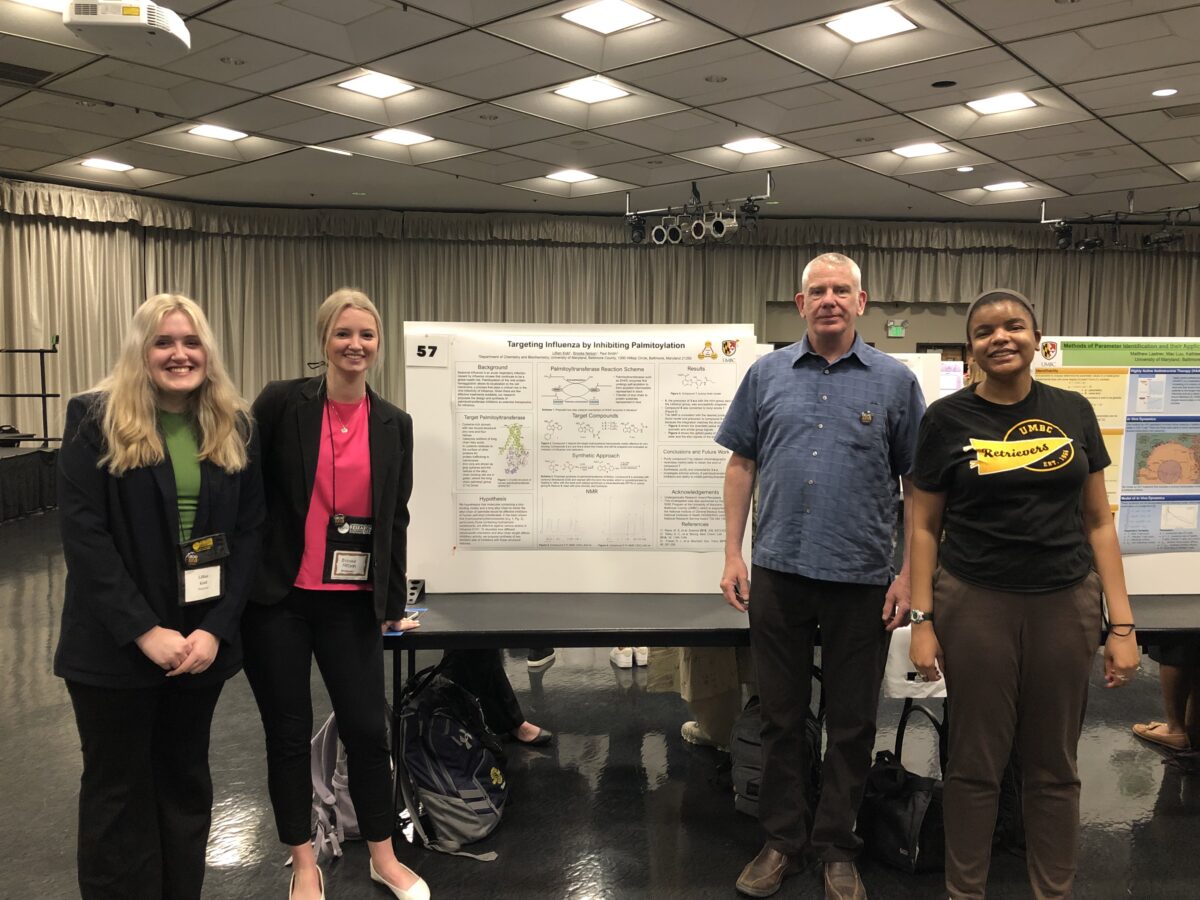 Paul Smith enjoys helping prepare his students to present at research conferences, such as UMBC’s Undergraduate Research and Creative Achievement Day, seen here in 2023. (Photo courtesy of Smith)
“Both of those experiences allowed me to immerse myself in research as an undergraduate,” Smith says, “so I think because of that, it’s always been important to me to include undergrads in the research that we do in my lab.”
Brian Cullum, professor and chair of chemistry and biochemistry, nominated Smith for the Braude Award. “Even with the significant potential health and environmental benefits that his ongoing research efforts can address, Dr. Smith continues to be dedicated first and foremost in his career to training undergraduate researchers in preparation for their future roles as independent scientists,” Cullum shares.
A focus on connections
Many advances in Smith’s career have come from interpersonal connections, both in his department at UMBC and with external researchers. When Duke chemist Kathy Franz discussed compounds to address antibiotic resistance in a seminar at UMBC, Smith recognized that her compounds included a similar structure to the molecules he was investigating for activity against influenza. He spoke to her after the talk, which eventually led to a collaboration and a promising new line of research in his lab.
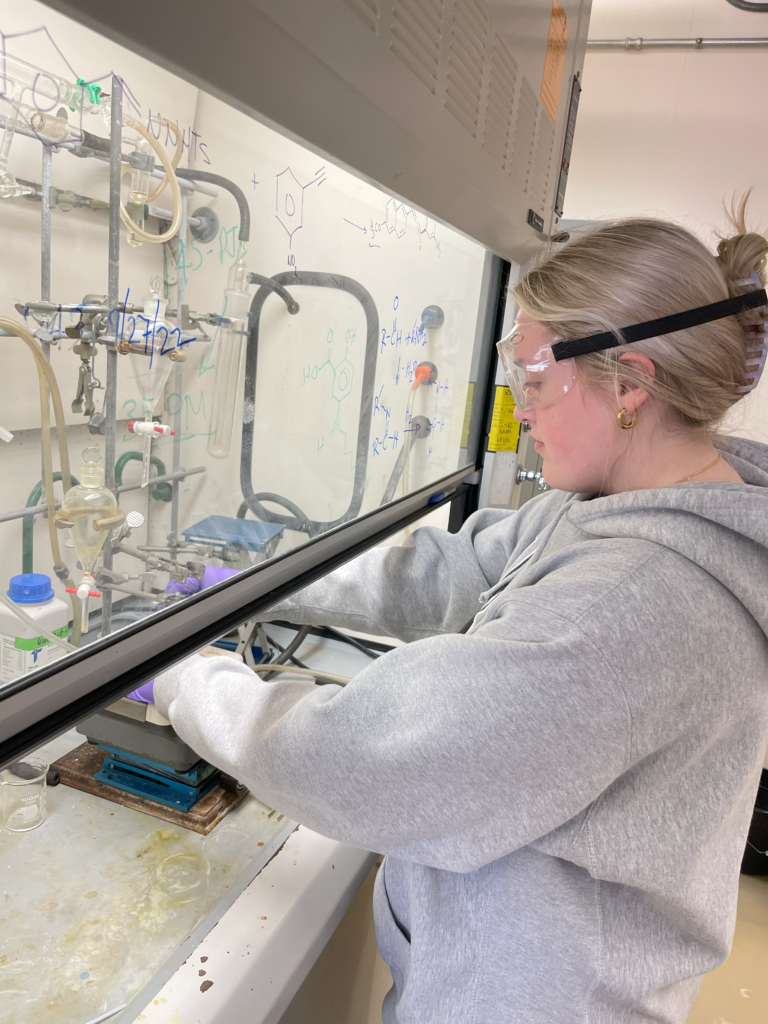 Lillian Kidd, who has received mentoring from Paul Smith, conducts an experiment in his lab. (Photo courtesy of Smith)
“Serendipity is the word of my career,” Smith jokes, although it’s not just luck. He encourages his students to attend as many seminars as possible, and he leads by example. “You’ll learn something at every talk, even if it’s far outside your field,” Smith says.
Lillian Kidd ’24, biochemistry and molecular biology, spent two years in Smith’s lab as an undergraduate, and as a result, she says she is dedicated to pursuing a career in designing and synthesizing therapeutic compounds. She will begin graduate school at Brown University this fall.
“Beyond learning fundamental research techniques in organic chemistry, Dr. Smith pushed me to think critically about every decision I made in the lab. He taught me how to transform core principles from coursework into reality, which has impacted my analysis skills and encouraged my curiosity,” Kidd says. “Dr. Smith’s mentorship emphasizes that success comes with integrity, deep understanding, and the ability to pivot when research does not work the way you thought it would.”
Shauna Kearney ’25, chemistry, has also benefited from Smith’s mentorship. She plans to pursue graduate school in organic chemistry based on her experiences in his lab.
“Being a member of Dr. Smith’s lab has allowed me to take ownership of my own research project as an undergraduate,” Kearney says. “While he helps me solve problems in the lab, he pushes me to think through them first and come up with my own solutions.”
Shared commitment
Smith’s personal commitment to supporting undergraduate research fits right into the fabric of UMBC. “I love our department, and I love UMBC,” he says. “I think one of our strengths, and what I tell students, is that they have a really good chance of getting into a lab—and my understanding is that’s fairly unique. But here, it’s unusual to find a lab that doesn’t have at least two or three undergrads.”
Smith’s equal dedication to his research and his students is exactly what the Braude Award selection committee looks for in nominees.
“I cannot imagine another individual more fitting for this prestigious award celebrating a faculty member’s tireless dedication to undergraduate research and training,” Cullum says. “Paul’s lifelong dedication to guiding undergraduate research and teaching his students to apply classroom concepts to solve challenges in their research projects embodies the ideal research mentor.”
]]>
For nearly three decades, Paul Smith has put undergraduate mentorship and the motivation of bettering human health at the forefront of his work. He’s been recognized for his efforts as the most...
https://umbc.edu/stories/paul-smith-braude-mentoring-award/
https://my3.my.umbc.edu/api/v0/pixel/news/142776/guest@my.umbc.edu/069ba839cb6a395bdcc492386c48c1b8/api/pixel
chembiochem
chemistry
chemistry-and-biochemistry
cnms
news
research
science-and-tech
story
undergraduate-research
UMBC News & Magazine
https://my3.my.umbc.edu/groups/umbc-news-magazine
https://assets1-my.umbc.edu/system/shared/avatars/groups/000/001/943/24435aa6207c452e7bc15cc74b42c7bb/xsmall.png?1748556657
https://assets1-my.umbc.edu/system/shared/avatars/groups/000/001/943/24435aa6207c452e7bc15cc74b42c7bb/original.png?1748556657
https://assets2-my.umbc.edu/system/shared/avatars/groups/000/001/943/24435aa6207c452e7bc15cc74b42c7bb/xxlarge.png?1748556657
https://assets2-my.umbc.edu/system/shared/avatars/groups/000/001/943/24435aa6207c452e7bc15cc74b42c7bb/xlarge.png?1748556657
https://assets3-my.umbc.edu/system/shared/avatars/groups/000/001/943/24435aa6207c452e7bc15cc74b42c7bb/large.png?1748556657
https://assets1-my.umbc.edu/system/shared/avatars/groups/000/001/943/24435aa6207c452e7bc15cc74b42c7bb/medium.png?1748556657
https://assets2-my.umbc.edu/system/shared/avatars/groups/000/001/943/24435aa6207c452e7bc15cc74b42c7bb/small.png?1748556657
https://assets1-my.umbc.edu/system/shared/avatars/groups/000/001/943/24435aa6207c452e7bc15cc74b42c7bb/xsmall.png?1748556657
https://assets2-my.umbc.edu/system/shared/avatars/groups/000/001/943/24435aa6207c452e7bc15cc74b42c7bb/xxsmall.png?1748556657
UMBC News & Magazine
2
0
false
Mon, 15 Jul 2024 13:12:05 -0400
Mon, 15 Jul 2024 13:12:05 -0400
CNMS Awards and Recognition Day honors students, faculty, and staff
The College of Natural and Mathematical Sciences (CNMS) held its annual CNMS Awards and Recognition Day on May 10. Nearly 270 UMBC community members and friends attended the event in the University Center Ballroom. The department chairs presented 45 awards established by donors in support of students, faculty, and staff, such as the Carl S. Weber Award for Excellence in Teaching, awarded this year to Tamra Mendelson, professor of biological sciences.
“I would like to thank the members of the UMBC community—alumni, parents, faculty, staff, and friends—who have made possible many of the awards we are presenting here today. These are not just names on a page—they are stories of gratitude and giving, honoring loved ones and families,” shared William R. LaCourse, CNMS dean. “You are fueling the academic success of our students, helping us recruit and retain top-notch faculty, ensuring support for programs and people across the university, and inspiring others to give. On behalf of UMBC, thank you!”
The recognition day also honored eight CNMS faculty at all levels with Faculty Excellence Awards for research and teaching designated by the college, awarded college-level Staff Excellence Awards for outstanding service, and distributed departmental awards for undergraduate and graduate students recognizing academic excellence, research, and teaching.
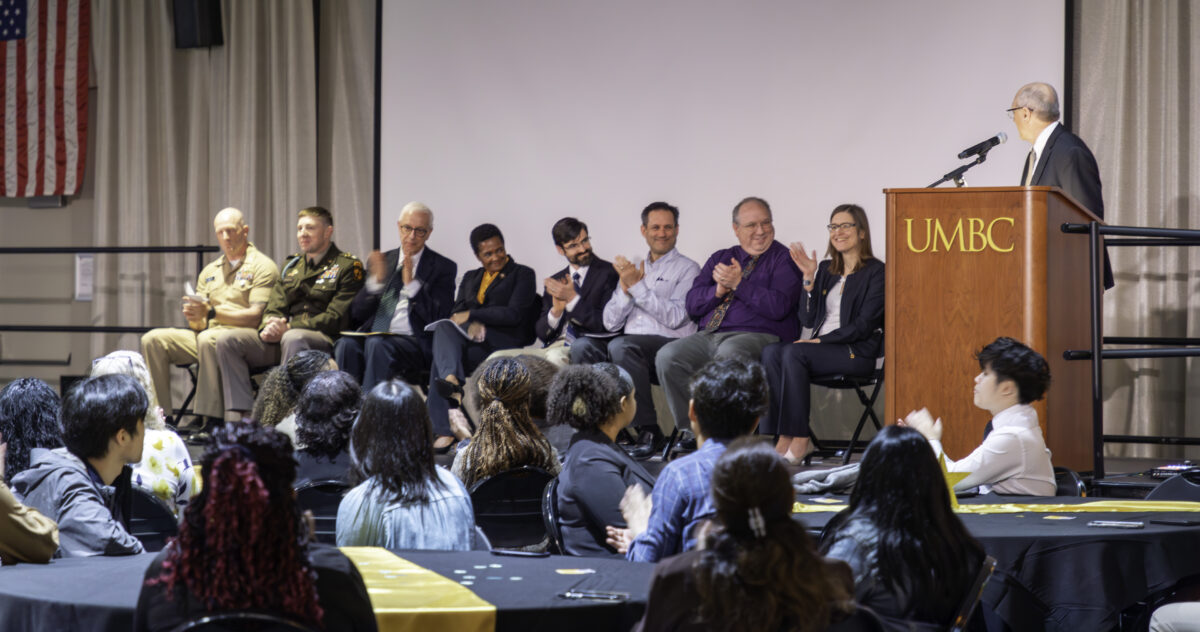 Dean LaCourse, at the podium, introduced the awards ceremony, and individual chairs or their designees presented the awards to members of their departments. From left to right: Commander Christopher Boehm, naval science; Captain John Howrey, naval science; Yonathan Zohar, professor and chair, marine biotechnology; Annica Wayman ’99, mechanical engineering, associate dean for Shady Grove affairs; Jason Kestner, associate professor and associate chair, physics; Bradford Peercy, professor, mathematics; Brian Cullum, professor and chair, chemistry and biochemistry; Michelle Starz-Gaiano, professor and chair, biological sciences. (Melissa Penley Cormier, M.F.A. ’17/UMBC)
CNMS also celebrated students who had been inducted into national honor societies, including Sigma Pi Sigma, the physics and astronomy honor society; Pi Mu Epsilon, the national mathematics honor society; Mu Sigma Rho, the national statistics honorary society; and the Phi Beta Kappa Society, which recognizes overall academic excellence.
LaCourse closed the ceremony by recognizing students in scholars programs within the college. The CNMS Scholars program supports students interested in the advancement of women in STEM fields where they are still underrepresented, and the Beckman Scholars program, funded by the Arnold and Mabel Beckman Foundation, supports students desiring to pursue doctoral study in the biological and chemical sciences.
“Students who have been recognized at this ceremony have met UMBC’s academic requirements and have excelled at high levels in their academics and/or service to their departments, college, and university,” LaCourse shared. “These honorees are poised to become scientists, physicians, mathematicians, teachers, and leaders in their chosen fields. These students are our leaders of the future, and we are fortunate to have the opportunity to help provide the critical foundations for their promising futures.”
The full event program, including additional remarks from Dean LaCourse and a complete list of awardees and award descriptions, is available here.
]]>
The College of Natural and Mathematical Sciences (CNMS) held its annual CNMS Awards and Recognition Day on May 10. Nearly 270 UMBC community members and friends attended the event in the...
https://umbc.edu/quick-posts/cnms-awards-and-recognition-day/
https://my3.my.umbc.edu/api/v0/pixel/news/142067/guest@my.umbc.edu/d470f1cd3c570305367c88562363b92a/api/pixel
biology
chembiochem
cnms
community
marinebiotech
mathstat
naval-science
news
physics
quick-post
science-and-tech
UMBC News & Magazine
https://my3.my.umbc.edu/groups/umbc-news-magazine
https://assets1-my.umbc.edu/system/shared/avatars/groups/000/001/943/24435aa6207c452e7bc15cc74b42c7bb/xsmall.png?1748556657
https://assets1-my.umbc.edu/system/shared/avatars/groups/000/001/943/24435aa6207c452e7bc15cc74b42c7bb/original.png?1748556657
https://assets2-my.umbc.edu/system/shared/avatars/groups/000/001/943/24435aa6207c452e7bc15cc74b42c7bb/xxlarge.png?1748556657
https://assets2-my.umbc.edu/system/shared/avatars/groups/000/001/943/24435aa6207c452e7bc15cc74b42c7bb/xlarge.png?1748556657
https://assets3-my.umbc.edu/system/shared/avatars/groups/000/001/943/24435aa6207c452e7bc15cc74b42c7bb/large.png?1748556657
https://assets1-my.umbc.edu/system/shared/avatars/groups/000/001/943/24435aa6207c452e7bc15cc74b42c7bb/medium.png?1748556657
https://assets2-my.umbc.edu/system/shared/avatars/groups/000/001/943/24435aa6207c452e7bc15cc74b42c7bb/small.png?1748556657
https://assets1-my.umbc.edu/system/shared/avatars/groups/000/001/943/24435aa6207c452e7bc15cc74b42c7bb/xsmall.png?1748556657
https://assets2-my.umbc.edu/system/shared/avatars/groups/000/001/943/24435aa6207c452e7bc15cc74b42c7bb/xxsmall.png?1748556657
UMBC News & Magazine
0
0
false
Fri, 17 May 2024 15:55:57 -0400
Fri, 17 May 2024 15:55:57 -0400
First CNMS GradFest fosters interdepartmental interaction among grads, postdocs
On April 12, more than 150 students, staff, and faculty attended the first College of Natural and Mathematical Sciences (CNMS) GradFest in the University Center Ballroom. The event was the result of listening sessions held with CNMS graduate students last summer, and it addressed their desire for more opportunities to forge interdepartmental connections and present their research.
“Every day, I hear about the great work being done by graduate students and postdocs in CNMS departments,” William R. LaCourse, CNMS dean, shared in his opening remarks. “Today is my chance to meet all of the graduate students the faculty are always bragging about.”
The event began with six “lightning talks,” where Ph.D. students were challenged to present the big idea of their thesis projects in only five minutes. Naghmeh Akhavan, mathematics, led off, presenting her project on cell migration in fruit fly development. She is co-mentored by Brad Peercy in mathematics and Michelle Starz-Gaiano in biological sciences. Misti Cartwright, chemistry and biochemistry, discussed her work with Aaron Smith on a post-translation protein modification called arginylation.
Sandra Cheng, physics, talked about her work with Todd Pittman in quantum computing, and Manju Ojha, chemistry and biochemistry, explained her work on RNA-based plant viruses with Deepak Koirala. Ji Li, statistics, described a protocol he developed under the mentorship of Yi Huang to improve data sets for randomized controlled trials. And Prableen Chowdhary, biological sciences, explained her work with Rachel Brewster on zebrafish development.
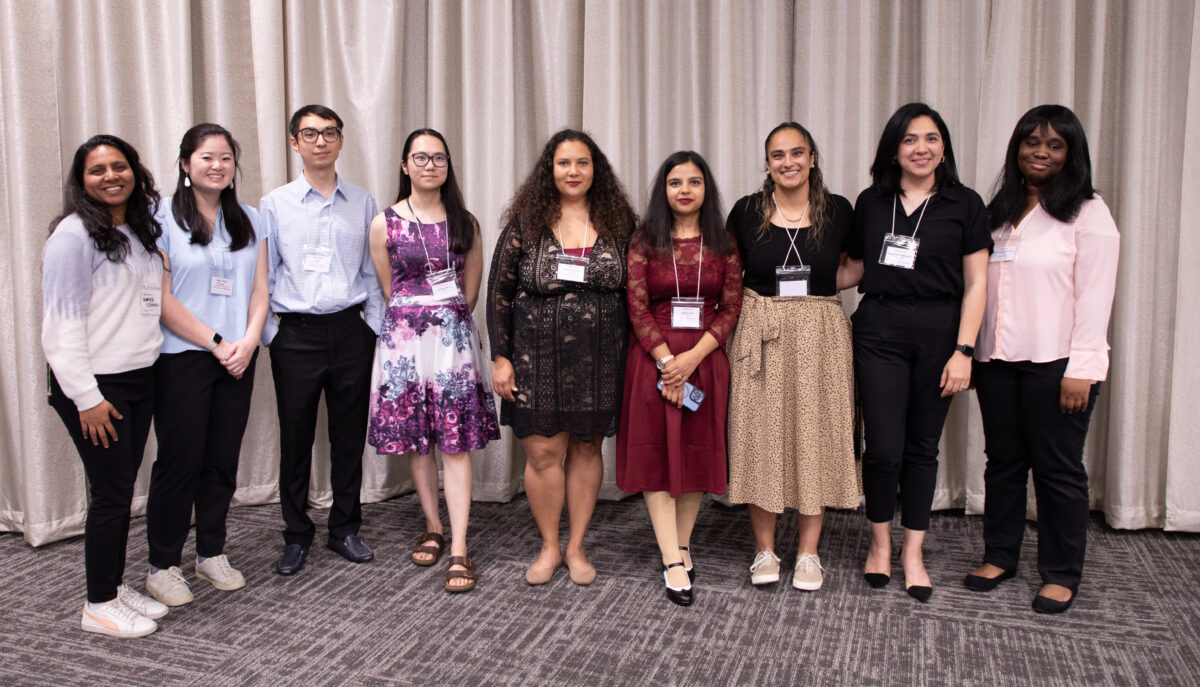 GradFest lightning talk presenters and the planning committee, from left to right: Ronita Sequeira, Ally Kido, Ji Li, Sandra Cheng, Misti Cartwright, Manju Ojha, Prableen Chowdhary, Naghmeh Akhavan, and Ayokunnumi Ogunsanya. (Image by Melissa Penley Cormier, M.F.A. ’17)
After the talks, two sessions featuring 46 posters allowed attendees to learn about the presenters’ research, ask questions, and make suggestions. A novel arrangement of posters in the ballroom facilitated interaction: Placing four posters each on round tables allowed guests to meander among the posters in many directions, unimpeded by long, linear poster displays.
Tasty mocktails, hors d’oeuvres, and desserts rounded out a successful event that brought graduate students and postdocs—collectively, the research engine of UMBC—together to socialize, practice presenting, and learn about each other’s work.
]]>
On April 12, more than 150 students, staff, and faculty attended the first College of Natural and Mathematical Sciences (CNMS) GradFest in the University Center Ballroom. The event was the result...
https://umbc.edu/quick-posts/inaugural-cnms-gradfest/
https://my3.my.umbc.edu/api/v0/pixel/news/141234/guest@my.umbc.edu/03a86a4db175b2e09f7b4c367757a010/api/pixel
biology
chembiochem
cnms
gradresearch
mathstat
physics
quick-post
research
UMBC News & Magazine
https://my3.my.umbc.edu/groups/umbc-news-magazine
https://assets1-my.umbc.edu/system/shared/avatars/groups/000/001/943/24435aa6207c452e7bc15cc74b42c7bb/xsmall.png?1748556657
https://assets1-my.umbc.edu/system/shared/avatars/groups/000/001/943/24435aa6207c452e7bc15cc74b42c7bb/original.png?1748556657
https://assets2-my.umbc.edu/system/shared/avatars/groups/000/001/943/24435aa6207c452e7bc15cc74b42c7bb/xxlarge.png?1748556657
https://assets2-my.umbc.edu/system/shared/avatars/groups/000/001/943/24435aa6207c452e7bc15cc74b42c7bb/xlarge.png?1748556657
https://assets3-my.umbc.edu/system/shared/avatars/groups/000/001/943/24435aa6207c452e7bc15cc74b42c7bb/large.png?1748556657
https://assets1-my.umbc.edu/system/shared/avatars/groups/000/001/943/24435aa6207c452e7bc15cc74b42c7bb/medium.png?1748556657
https://assets2-my.umbc.edu/system/shared/avatars/groups/000/001/943/24435aa6207c452e7bc15cc74b42c7bb/small.png?1748556657
https://assets1-my.umbc.edu/system/shared/avatars/groups/000/001/943/24435aa6207c452e7bc15cc74b42c7bb/xsmall.png?1748556657
https://assets2-my.umbc.edu/system/shared/avatars/groups/000/001/943/24435aa6207c452e7bc15cc74b42c7bb/xxsmall.png?1748556657
UMBC News & Magazine
1
0
false
Tue, 23 Apr 2024 10:09:29 -0400
Tue, 23 Apr 2024 10:09:29 -0400
Deepak Koirala to explore how RNA viruses hijack cellular machinery, with eye to future drug treatments
Viruses must hijack their hosts’ cellular machinery to make more viruses, so preventing this hijacking could lead to a host of new treatments for viral diseases. However, much is unknown about how the viruses actually accomplish their takeover. Scientific understanding is especially murky for RNA viruses, which use RNA as their genetic material, rather than DNA like animals. These viruses’ RNA serves as their genome and also codes directly for viral proteins.
With support from an NSF CAREER Award, Deepak Koirala, assistant professor of chemistry and biochemistry, has been working on figuring out how enteroviruses, a large group of RNA viruses, replicate their RNA genomes. Enteroviruses include viruses that cause polio, the common cold, and many more diseases that affect humans and other animals. Now Koirala has received a five-year, $1.8 million grant from the National Institutes of Health to solve another part of this puzzle: How do these viruses commandeer proteins in the host cell to produce viral proteins? The cell must build these viral proteins before the virus can replicate.
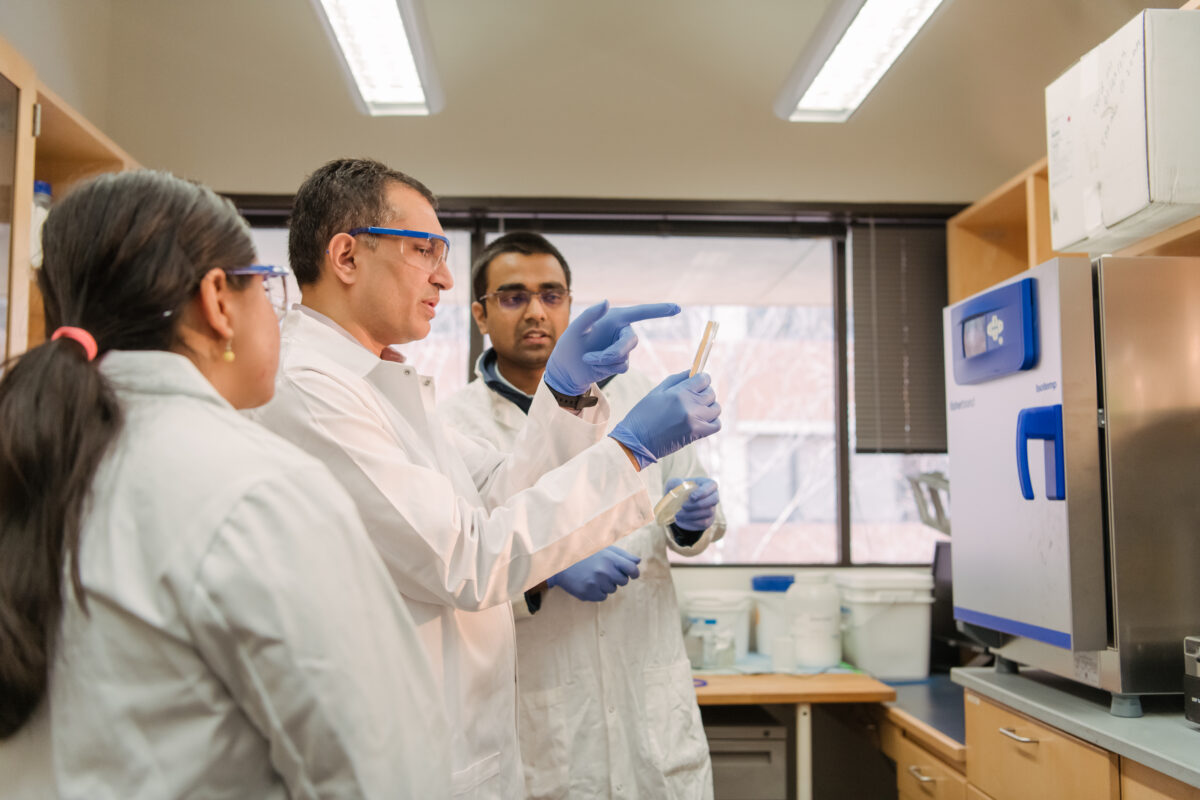 Deepak Koirala (pointing at petri dish) uses a wide range of techniques to answer scientific questions about RNA viruses. Naba Krishna Das (right), a Ph.D. student in Koirala’s lab, is a key contributor to the group’s viral replication research. (Marlayna Demond ’11/UMBC)
A new biological mechanism?
When a cell makes its own proteins, the cellular mRNA, a type of RNA that carries the instructions for building proteins, interacts with the protein-building machinery via a special structure at one end called a “cap,” Koirala explains. Enteroviral mRNAs lack this cap—and yet they are still perfectly capable of forcing the cell to do their bidding. Koirala is trying to figure out how.
Koirala has been studying unique structures at the ends of viral RNAs for their role in replication, but they may be doing double duty by initiating protein production as well, he believes. Koirala and his team, which includes undergraduate and graduate students, will use a technique called X-ray crystallography to deduce the precise molecular makeup of these special RNA structures.
At the same time, they will run experiments to learn how the structures interact with the cellular machinery. These two lines of investigation complement one another. “If we have the structure, that would allow us to pinpoint the critical nucleotide or amino acid that is important for the interaction,” Koirala says. “And then we can mutate that one, to see how that changes the interaction.”
By using a range of techniques, the team seeks to determine what the structures look like and how they work in the cell. “It could be a new biological mechanism we’ve never seen before,” Koirala says.
The team already has some early data supporting their goals, Koirala says. A related publication is under review at a top-tier academic journal. Several lab members are authors on the paper—including three undergraduates. “We are really excited about that,” Koirala says.
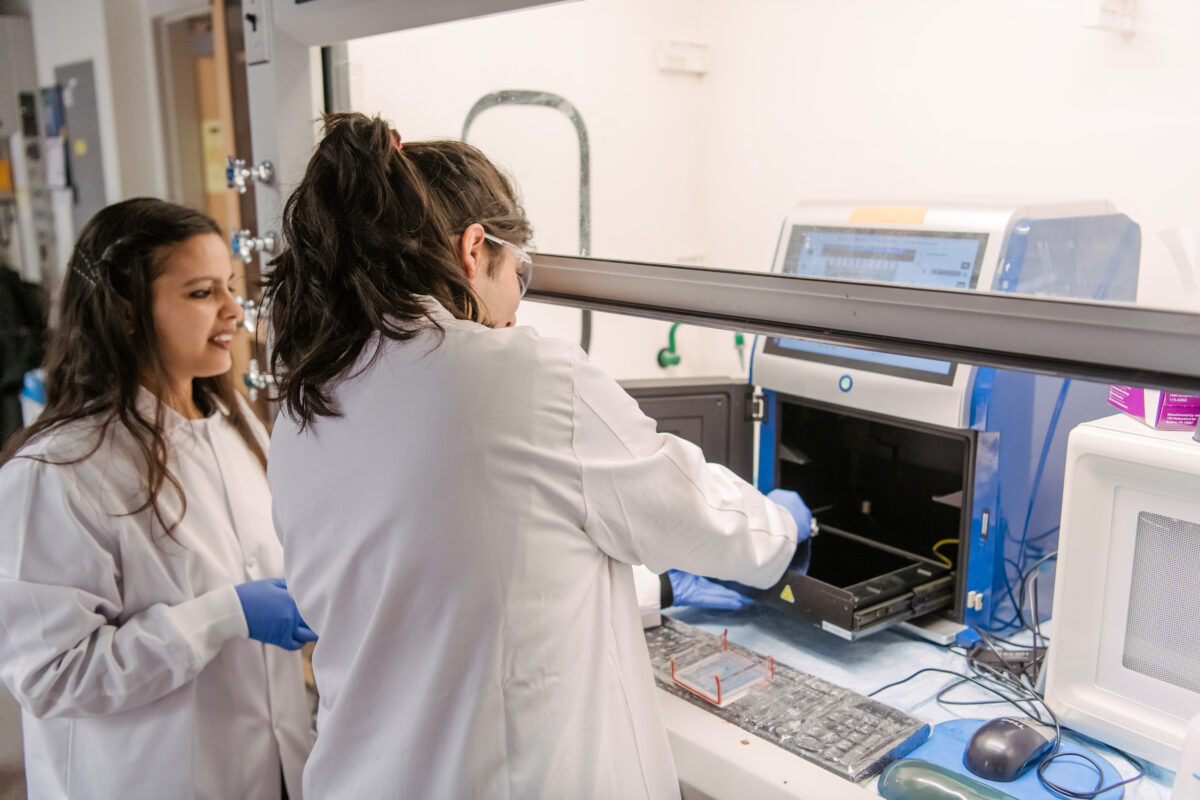 Manju Ojha, a Ph.D. student in Koirala’s lab, mentors undergraduate Zohra Mian. Ojha will have a leading role in the work related to viral protein production for the new grant. (Image by Marlayna Demond ’11/UMBC)
One drug, many targets
The project is likely to end up supporting other researchers, as well. In the course of the team’s work, “We are developing tools that facilitate our understanding of these RNA structures,” Koirala says. “The tools we develop may be useful not only for the particular system we are working on, but they could be useful in general for many other RNA structures in other fields of research.”
In addition, RNA structures found in one species of enterovirus are very similar to those found in other enteroviruses that cause different diseases—even some that infect very different kinds of organisms, Koirala discovered. That opens the door to developing antiviral treatments that are able to target many different viruses.
With the RNA structures in hand, the next step might be to use artificial intelligence to screen for other molecules that bind to the structures, preventing the viruses from taking over the cell and causing illness. Scientists could then take steps to develop new drugs using these molecules.
“Once we understand the structure, and we have a better understanding of the mechanism, we can better design drugs,” Koirala says. “But right now we are at the fundamental level of how these things even work.”
]]>
Viruses must hijack their hosts’ cellular machinery to make more viruses, so preventing this hijacking could lead to a host of new treatments for viral diseases. However, much is unknown about how...
https://umbc.edu/stories/research-on-rna-viruses-may-lead-to-future-drugs/
https://my3.my.umbc.edu/api/v0/pixel/news/134966/guest@my.umbc.edu/112a48703f85194c24ad1fc2c7225fe5/api/pixel
chembiochem
cnms
news
rca-2
research
science-and-tech
UMBC News & Magazine
https://my3.my.umbc.edu/groups/umbc-news-magazine
https://assets1-my.umbc.edu/system/shared/avatars/groups/000/001/943/24435aa6207c452e7bc15cc74b42c7bb/xsmall.png?1748556657
https://assets1-my.umbc.edu/system/shared/avatars/groups/000/001/943/24435aa6207c452e7bc15cc74b42c7bb/original.png?1748556657
https://assets2-my.umbc.edu/system/shared/avatars/groups/000/001/943/24435aa6207c452e7bc15cc74b42c7bb/xxlarge.png?1748556657
https://assets2-my.umbc.edu/system/shared/avatars/groups/000/001/943/24435aa6207c452e7bc15cc74b42c7bb/xlarge.png?1748556657
https://assets3-my.umbc.edu/system/shared/avatars/groups/000/001/943/24435aa6207c452e7bc15cc74b42c7bb/large.png?1748556657
https://assets1-my.umbc.edu/system/shared/avatars/groups/000/001/943/24435aa6207c452e7bc15cc74b42c7bb/medium.png?1748556657
https://assets2-my.umbc.edu/system/shared/avatars/groups/000/001/943/24435aa6207c452e7bc15cc74b42c7bb/small.png?1748556657
https://assets1-my.umbc.edu/system/shared/avatars/groups/000/001/943/24435aa6207c452e7bc15cc74b42c7bb/xsmall.png?1748556657
https://assets2-my.umbc.edu/system/shared/avatars/groups/000/001/943/24435aa6207c452e7bc15cc74b42c7bb/xxsmall.png?1748556657
UMBC News & Magazine
0
0
false
Wed, 30 Aug 2023 12:03:15 -0400
Wed, 30 Aug 2023 12:03:15 -0400
UMBC’s Arjun Kanjarpane and Anya Viswanathan receive prestigious Goldwater Scholarships
Arjun Kanjarpane ’24, M32, biochemistry and molecular biology, and Soujanya “Anya” Viswanathan ’24, M32, biological sciences, are the latest UMBC students to be named Goldwater Scholars. By pursuing their research interests—virology for Kanjarpane and neuroscience for Viswanathan—with rigor and dedication, both have the potential to make a major impact in their fields and in people’s lives.
The Barry Goldwater Scholarship and Excellence in Education Program is designed to provide the United States with “a continuing source of highly qualified scientists, mathematicians, and engineers.” More than 1,200 students applied from over 425 institutions across the country this year, and the program ultimately selected 413 scholars to receive Goldwater Scholarships for 2023 – 2024.
As Scholars, Kanjarpane and Viswanathan will receive substantial funding that advances their undergraduate work and supports their educational paths. They will also gain access to a network of current and former Goldwater Scholars, many of whom are conducting research at the leading edge of their fields.
“We are delighted that UMBC has continued its impressive string of Goldwater awards for this year,” says April Householder ’95, visual arts, director of undergraduate research and prestigious scholarships. “This indicates just how strong STEM education at UMBC is—indeed, it’s among the best in the country.”
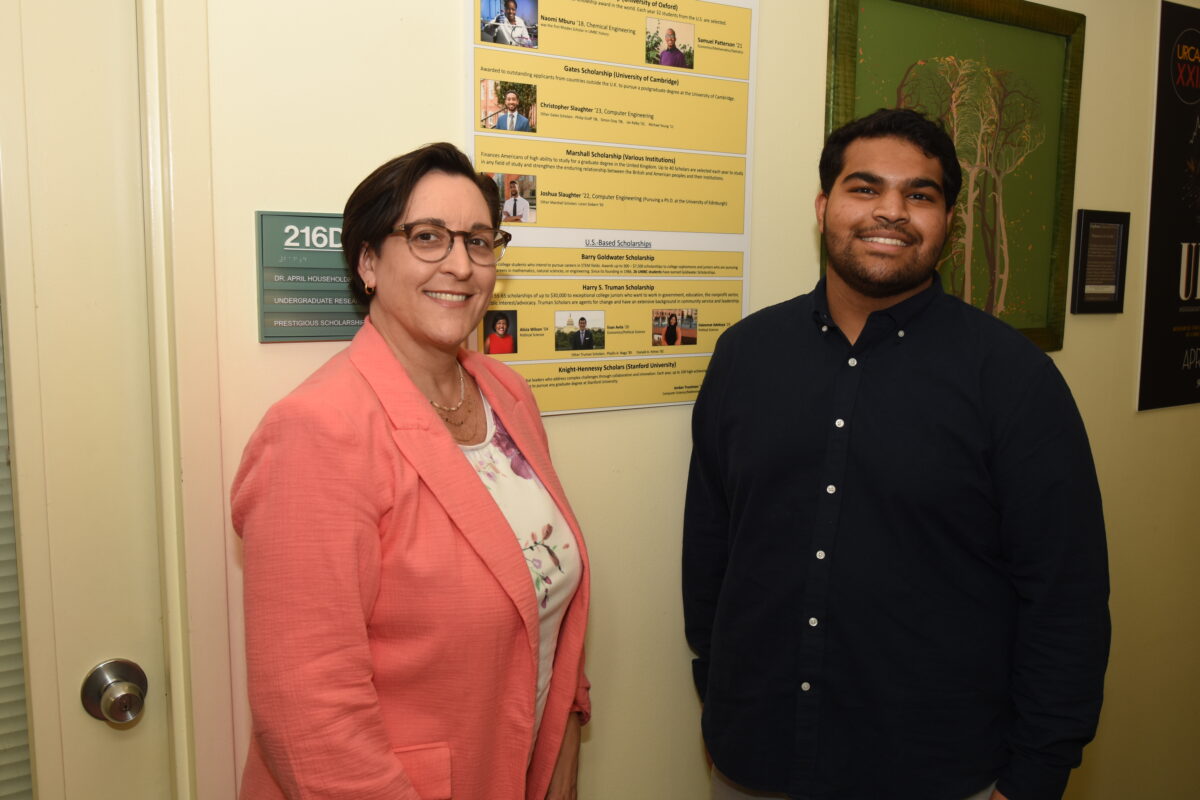 April Householder (left) and Arjun Kanjarpane stand by a poster recognizing some of UMBC’s prestigious scholars. (Mike Mower/UMBC)
Making the connection
Kanjarpane and Viswanathan are both conducting their own research—Kanjarpane in the laboratory of Michael Summers, Howard Hughes Medical Institute Investigator & Distinguished University Professor of chemistry and biochemistry, and Viswanathan with Rachel Brewster, professor of biological sciences.
One of the projects in Brewster’s lab seeks to tease out how the embryos of zebrafish (small, hardy, freshwater fish) can survive for up to 50 hours without any oxygen at all and then return to normal functioning once oxygen becomes available. “We are looking at the genes and molecular mechanisms involved in allowing zebrafish to survive and recover from such extreme conditions,” Viswanathan says.
Viswanathan started in Brewster’s lab in summer 2021. She immediately saw connections between Brewster’s research on hypoxia (or lack of oxygen) in zebrafish and the same condition in some COVID-19 patients. “It was interesting to me,” she says, “to look at what genes and molecular mechanisms could potentially help humans withstand hypoxia just like zebrafish.”
Her Goldwater research proposal extends the work she’s done over the last two years, but Viswanathan hopes to shift her focus to neurological disorders like Alzheimer’s Disease in an M.D./Ph.D. program after UMBC. She worked on a cutting-edge Alzheimer’s project last summer at MIT with postdoctoral fellow Matheus Victor. A neurobiology Ph.D. combined with a medical education will enable her to investigate the underlying mechanisms of disease, treat patients, and then take any new research questions that arise back to the lab, Viswanathan explains.
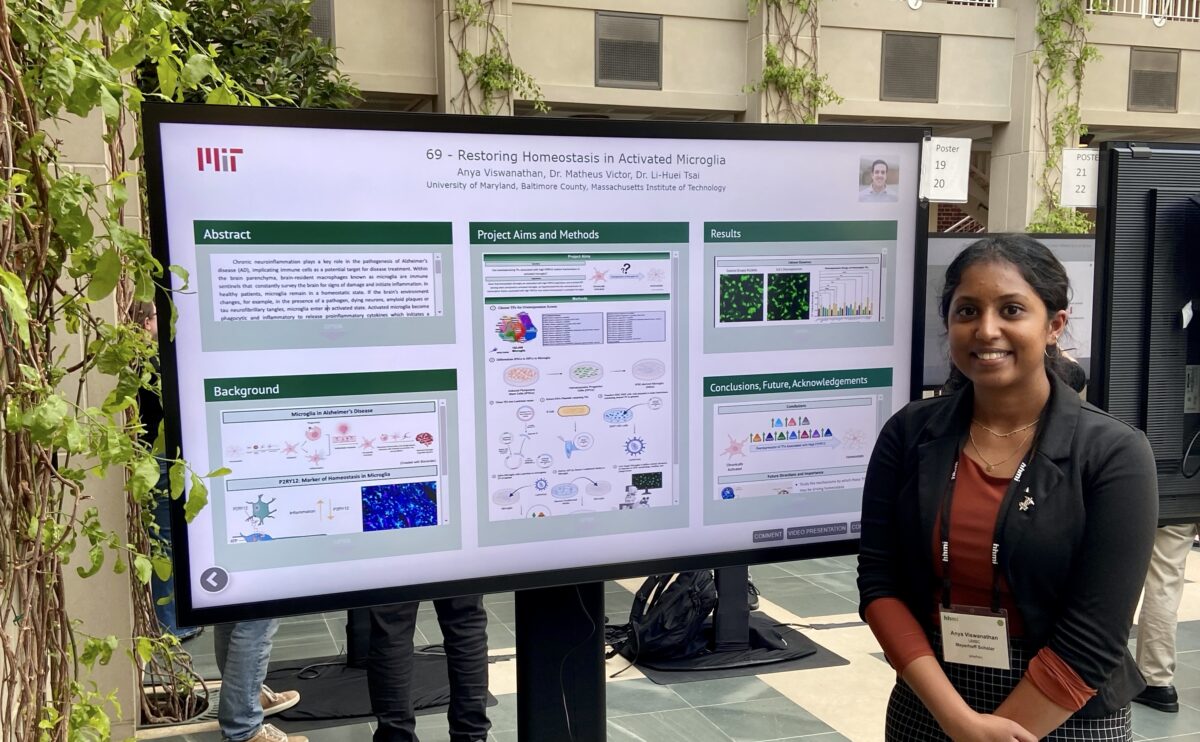 Anya Viswanathan presents research from her summer internship at MIT. (Image courtesy of Viswanathan)
Targeting HIV
Kanjarpane’s research focuses on improving understanding of the molecular mechanisms behind HIV replication. A complex sequence of steps governs exporting the viral genome out of the host cell’s nucleus and then packaging it into new infectious particles. Interactions between proteins and the virus’s genetic material regulate this process, and those interactions aren’t fully understood.
The end goal of Kanjarpane’s work is to build “a more complete understanding of these viral processes,” so that down the line, researchers can “develop drugs or therapeutics that might be able to target one or several of their components,” Kanjarpane says. His Goldwater proposal builds on this work.
This summer, Kanjarpane will conduct virology research under Paul Bieniasz at Rockefeller University. After graduation, he’s planning to pursue a Ph.D. in virology or structural biology. “I would be interested in exploring viruses in a multi-dimensional approach,” he says.
Lifting up others
Beyond their research and academic studies, both Viswanathan and Kanjarpane are committed to supporting their peers and neighbors. “What impresses me most about Arjun and Anya is that they use their talents to help lift up others,” Householder says. “This dedication to others beyond the classroom is what makes them special.”
Both serve as tutors in the Chemistry Tutorial Center at UMBC and enjoy supporting students in introductory chemistry courses. Viswanathan also volunteers weekly at the Y in Catonsville with MS Aquatics, where she works with multiple sclerosis patients on their mobility and flexibility. After each session, the volunteers and participants share a meal.
Viwanathan and Kanjarpane also serve as role models for younger children and help get them excited about STEM. Viswanathan volunteers with the UMB CURE Scholars Program, which exposes students in West Baltimore to research and STEM careers in middle and high school. Opportunities with MS Aquatics and UMB CURE Scholars are both organized through the UMBC Shriver Center.
Kanjarpane founded a non-profit, Scientific Minds of America (SMOA), as a middle school student. The non-profit’s goal is “to reduce social and youth educational inequity through a youth-to-youth system,” he says. During remote instruction at the start of the COVID-19 pandemic, he spearheaded the development of an online tutoring program for Baltimore City youth through SMOA. Over 300 tutors and students have been involved.
He was inspired to form the non-profit after teaching robotics skills to enthusiastic students at a Baltimore elementary school with his FIRST Lego League team. “From that moment we decided we should work to change things, because students should have every opportunity to succeed and achieve their dreams,” regardless of their zip code, Kanjarpane says.
The business skills he’s gained as CEO and now a board member at Scientific Minds also come in handy for his role as treasurer of the Hindu Student Association at UMBC.
Turning points
Kanjarpane and Viswanathan’s desire to reach back to students coming up behind them is driven in part by the network of support that has helped each of them create their own successful paths. Both credit Meyerhoff Selection Weekend as a turning point in their STEM careers.
“Initially, I didn’t even know what a Ph.D. or an M.D./Ph.D. was. I didn’t know that research was a career path that I could take,” Viswanathan says. But at selection weekend, “I realized that my career goals aligned with the M.D./Ph.D. and the Meyerhoff Scholars Program. So that’s why I chose UMBC.”
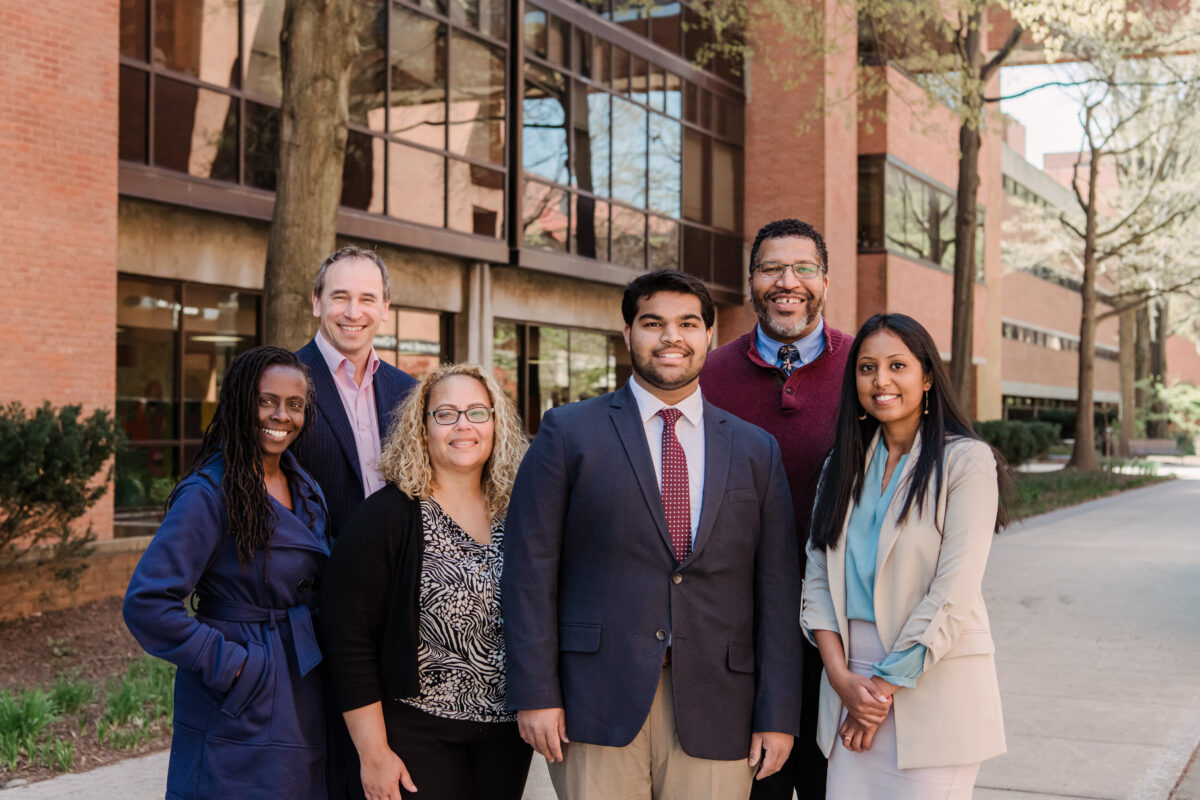 Kanjarpane and Viswanathan with some of their mentors. From left to right: Jacqueline King, associate director of the U-RISE Scholars Program; Simon Stacey, director of the UMBC Honors College; Mitsue Wiggs, assistant director of the Meyerhoff Scholars Program; Arjun Kanjarpane; Keith Harmon, director of the Meyerhoff Scholars Program; Anya Viswanathan. (Marlayna Demond ’11/UMBC)
Kanjarpane took his first UMBC class as a high school student and later applied to be a Meyerhoff Scholar. He came out of selection weekend thinking, “‘Wow.’ It’s UMBC all the way,” he says. The Meyerhoff and U-RISE programs “have really helped me to feel supported in college, and that has helped me to achieve my goals and learn with confidence.”
On top of their scholars programs, both students’ research mentors have played a significant role in their growth. “I treasure my lab,” Kanjarpane says, reflecting on how having such a large research team, from high school students to Professor Summers, provides a range of perspectives that pushes the research forward.
For Viswanathan, support from Brewster and Jong Park, Ph.D. ’21, biological sciences, have been key. “Dr. Brewster helped me a lot through the process of applying to Goldwater,” Viswanathan says. “Even with non-research things, she’s always there to talk to me.”
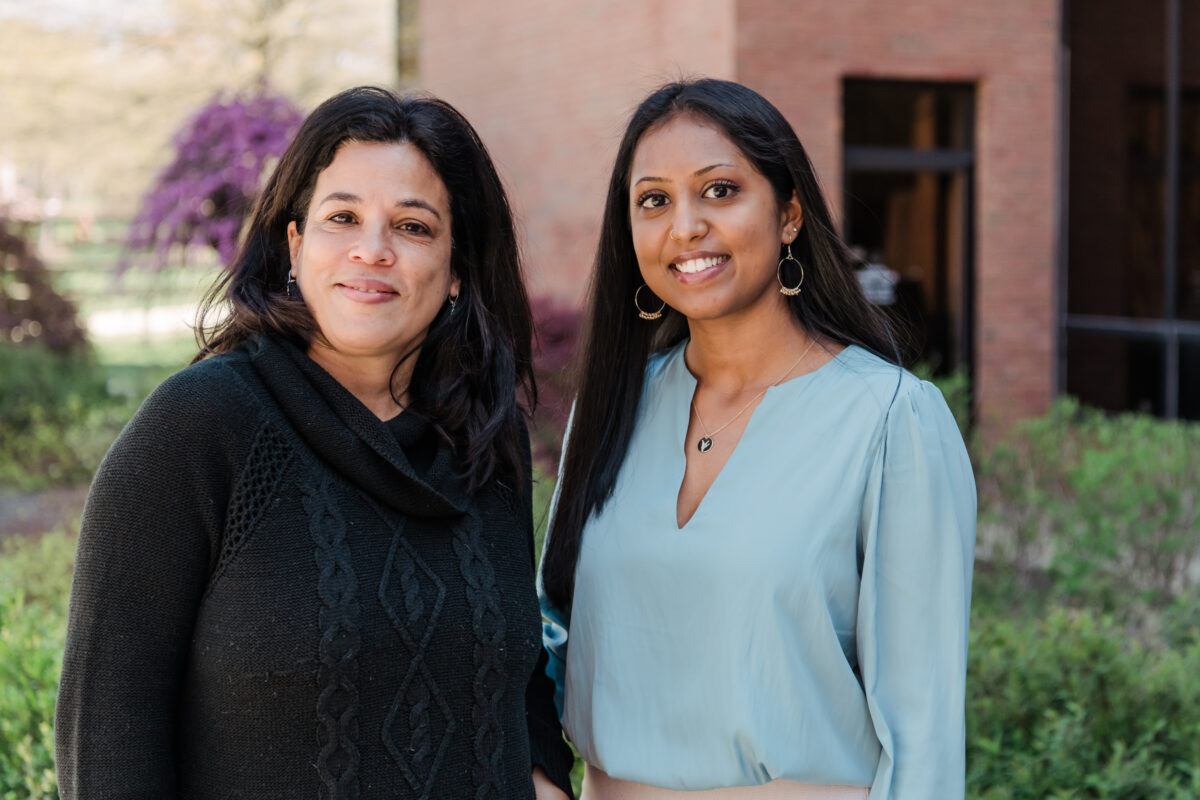 Anya Viswanathan with her research mentor, Rachel Brewster. (Marlayna Demond ’11/UMBC)
Confidence boost
As freshly minted Goldwater Scholars, Viswanathan and Kanjarpane are excited to connect with others in the program. “What I’ve learned from scientific conferences is that science is all about sharing knowledge and creating new ideas, so I hope to do that with this community as well,” Kanjarpane says.
In addition to the financial support and large network they’ll gain, being named a Goldwater Scholar can also offer scholars a confidence boost. Through this experience, they are welcomed into another community rich in encouragement, talent, and optimism that they can use as a springboard for further success.
“Finding out about this just made me more invested and committed to my goals for my future,” Viswanathan says. “Getting that recognition makes me believe that a research career is a real possibility for me in the future.”
]]>
Arjun Kanjarpane ’24, M32, biochemistry and molecular biology, and Soujanya “Anya” Viswanathan ’24, M32, biological sciences, are the latest UMBC students to be named Goldwater Scholars. By...
https://umbc.edu/stories/goldwater-scholars-kanjarpane-and-viswanathan/
https://my3.my.umbc.edu/api/v0/pixel/news/132539/guest@my.umbc.edu/df71d9b7892460b0b5ad040c4b5e9c00/api/pixel
biology
chembiochem
cnms
majoraward
news
rca-1
research
science-and-tech
undergraduate-research
UMBC News & Magazine
https://my3.my.umbc.edu/groups/umbc-news-magazine
https://assets1-my.umbc.edu/system/shared/avatars/groups/000/001/943/24435aa6207c452e7bc15cc74b42c7bb/xsmall.png?1748556657
https://assets1-my.umbc.edu/system/shared/avatars/groups/000/001/943/24435aa6207c452e7bc15cc74b42c7bb/original.png?1748556657
https://assets2-my.umbc.edu/system/shared/avatars/groups/000/001/943/24435aa6207c452e7bc15cc74b42c7bb/xxlarge.png?1748556657
https://assets2-my.umbc.edu/system/shared/avatars/groups/000/001/943/24435aa6207c452e7bc15cc74b42c7bb/xlarge.png?1748556657
https://assets3-my.umbc.edu/system/shared/avatars/groups/000/001/943/24435aa6207c452e7bc15cc74b42c7bb/large.png?1748556657
https://assets1-my.umbc.edu/system/shared/avatars/groups/000/001/943/24435aa6207c452e7bc15cc74b42c7bb/medium.png?1748556657
https://assets2-my.umbc.edu/system/shared/avatars/groups/000/001/943/24435aa6207c452e7bc15cc74b42c7bb/small.png?1748556657
https://assets1-my.umbc.edu/system/shared/avatars/groups/000/001/943/24435aa6207c452e7bc15cc74b42c7bb/xsmall.png?1748556657
https://assets2-my.umbc.edu/system/shared/avatars/groups/000/001/943/24435aa6207c452e7bc15cc74b42c7bb/xxsmall.png?1748556657
UMBC News & Magazine
0
0
false
Tue, 11 Apr 2023 15:05:01 -0400
Tue, 11 Apr 2023 15:05:01 -0400
Deepak Koirala to grow understanding of how enteroviruses replicate with $786K NSF CAREER Award
Diseases such as polio, the common cold, and meningitis are all caused by closely related viruses and the way these viruses multiply in the body is poorly understood. Deepak Koirala, assistant professor of chemistry and biochemistry at UMBC, has already begun to unravel the mystery. Now, with a $786,000 NSF CAREER Award, his research group will be able to answer even more questions. In particular, they will investigate the RNA structures within the genetic material in these viruses and how those structures enable the viruses to multiply inside cells. The answers could eventually lead to drugs that attack specific mechanisms critical for viral replication, stopping these diseases in their tracks.
Koirala’s lab works on enteroviruses, a group of viruses that have a genome made of a single strand of RNA, rather than double-stranded DNA (like in humans). “RNA is a really versatile and dynamic molecule that functions in pretty much every aspect of cellular processes,” Koirala says.
In viruses with RNA genomes, the genome must control both the process that copies (replicates) the genome and the process that converts the genetic code into proteins. Both processes involve coordination of numerous viral and host cell proteins. The RNA must also somehow continually “decide” between the two processes. In DNA genomes, the DNA is only responsible for replication.
With the new grant, Koirala’s group seeks to better understand how enteroviruses make the decision between copying their genome and building proteins. But before they can do that, they need to nail down the three-dimensional RNA structures within the enterovirus genome that are involved in those processes.
Defining the target
Based on the way enterovirus genomes behave in biochemical studies, previous research has predicted that the beginning of an enterovirus’s genomic RNA strand folds up on itself, forming a shape resembling a cloverleaf. That structure builds a platform to assemble the viral and host proteins required for replication. This idea is widely accepted, but the precise three-dimensional structure of this region, the so-called “cloverleaf RNA domain,” and how it regulates viral replication is unknown. Figuring that out is the Koirala lab’s main task.
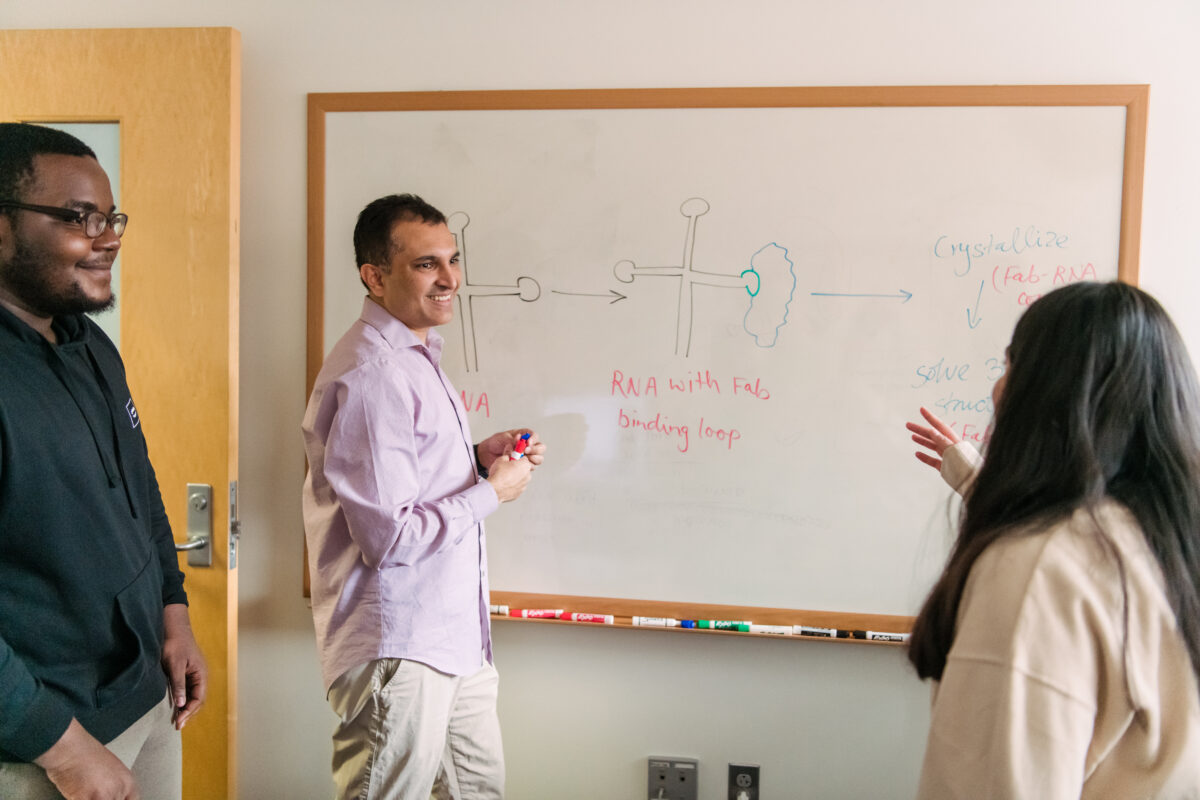 Deepak Koirala draws a basic cloverleaf RNA on the whiteboard and discusses with students Senali Dansou (left) and Alisha Patel. (Marlayna Demond ’11/UMBC)
They are well on their way. Koirala’s group recently determined the cloverleaf structure from a coxsackievirus, which causes hand-foot-and-mouth disease, and is an important model system for studying many other human viruses. It will be published in a forthcoming paper in Nature Communications. “I think the field will be really excited to see this,” Koirala says. “It would be the first three-dimensional structure of the full-length cloverleaf domain for the entire enterovirus genus.”
Because the cloverleaf domain is so important for viral replication, the expectation is that its structure will be similar, if not identical, across all enteroviruses. With the new grant, Koirala hopes to determine the 3D structures of this region in several more enteroviruses. The structures the sequences form that are the same or similar across species are most likely to play similar key roles in the viral life cycle.
“That will create the opportunity to get a generic target that might be able to treat more than one of these viruses,” Koirala says. “If you really hit a structure in coxsackievirus, for example, that’s shared across many other enteroviruses, then that could be equally useful for, say, rhinovirus. In the long term, that could be really powerful.”
Crystals and X-rays
Determining the 3D structure of RNA is notoriously difficult. Koirala’s group uses a technique called X-ray crystallography, where one must first turn the RNA into a crystal through a laborious process. Then a machine directs X-rays through the crystal and then a detector records the reflections that come out. By examining those reflections, called diffraction patterns, the researchers can deduce the molecule’s shape in the crystal. Then, they map the known sequence of RNA bases onto the shape for a final 3D structure.
To make this a little easier, Koirala’s group uses a cutting-edge technique that results in successful crystallization more often than traditional methods. Koirala came to UMBC in 2020 after completing a postdoctoral fellowship in the research group at the University of Chicago that pioneered the technique.
The technique involves attaching a fragment of a synthetic antibody to the RNA, which serves as a “chaperone” to help the RNA crystallize. RNA is coated with negative charges, which repel each other and make it harder to pack the molecules tightly together—a necessary part of crystal formation. When the RNA binds to the protein, those negative charges are neutralized. And, because the protein’s structure is known, that makes it easier to detect the unknown RNA structure in the crystal.
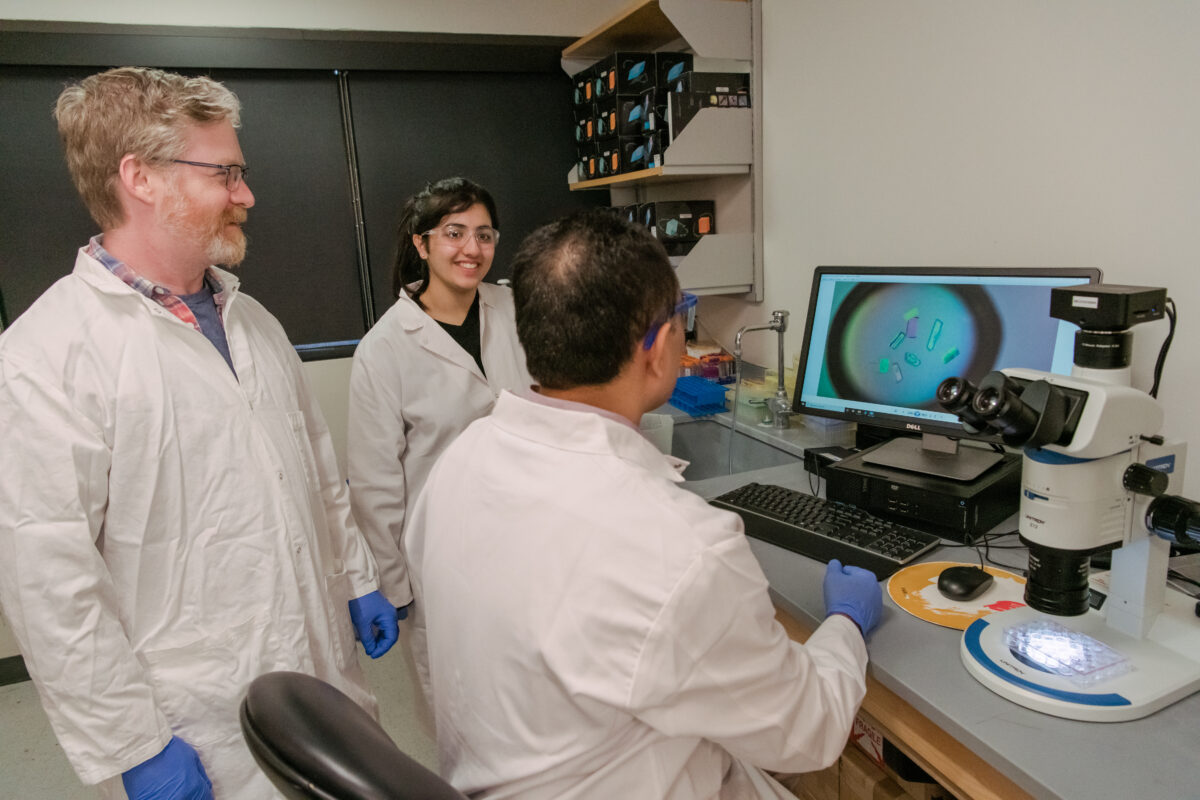 Deepak Koirala, seated, looks at a microscope image of RNA crystals with students Jeffrey Vogt (left) and Zohra Mian. (Marlayna Demond ’11/UMBC)
“Just the beginning”
But even after all that, “The structure is just the beginning,” Koirala says.
RNA does not normally exist as crystals. Therefore, for one, it is important to know if the 3D structure of the protein-bound, crystallized RNA accurately represents what the RNA looks like in a biological context. But with the crystal structure in hand, “Now we have more idea about what to do next,” Koirala says, “to show what the important features of that particular structure are that dictate or define the function.” Follow-up biochemical experiments with deliberately modified versions of the RNA can help tease out which parts of the structure are critical for different functions.
And finally, Koirala says, “Now, with a well-characterized RNA structure, one has an opportunity to design a drug molecule, for example, that precisely targets that RNA structure and stops the genome replication.”
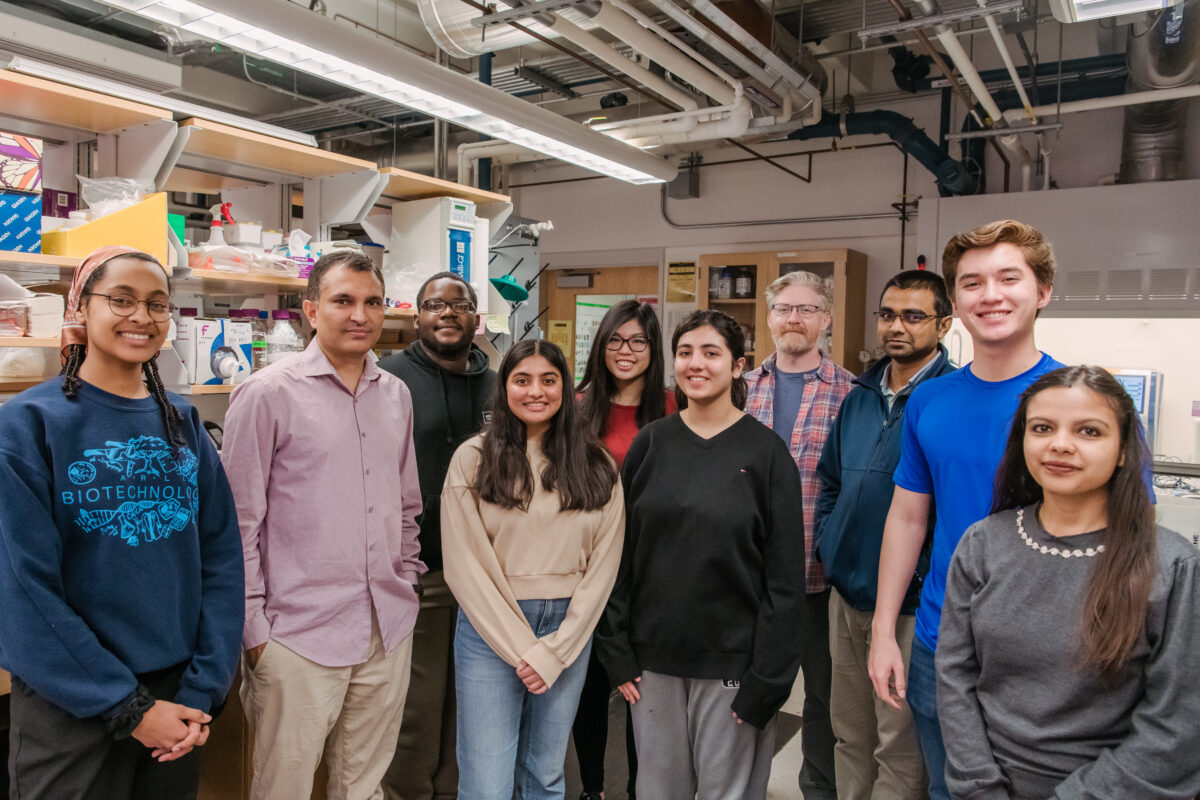 Deepak Koirala’s current lab group. From left to right: Huda Abdelghani, Deepak Koirala, Senali Dansou, Alisha Patel, Megan Nguyen, Zohra Mian, Jeffrey Vogt, Naba Krishna Das, Jason Daniels, and Manju Ojha. (Marlayna Demond ’11/UMBC)
A strong team
With the new funding, Koirala will be able to grow his already sizable team. That way he can accomplish more in the lab—and also expose more students to research. Koirala is happy to bring on UMBC freshmen and sophomores as well as students with more research experience. Even local high school students have gotten involved.
“If you expose students to research early on, that gives them the opportunity to decide which career will work for them,” Koirala says. And by getting students involved right away, they are apt to stay in the lab for a few years—enough time to significantly grow their skills and even become authors on a scientific paper, he explains.
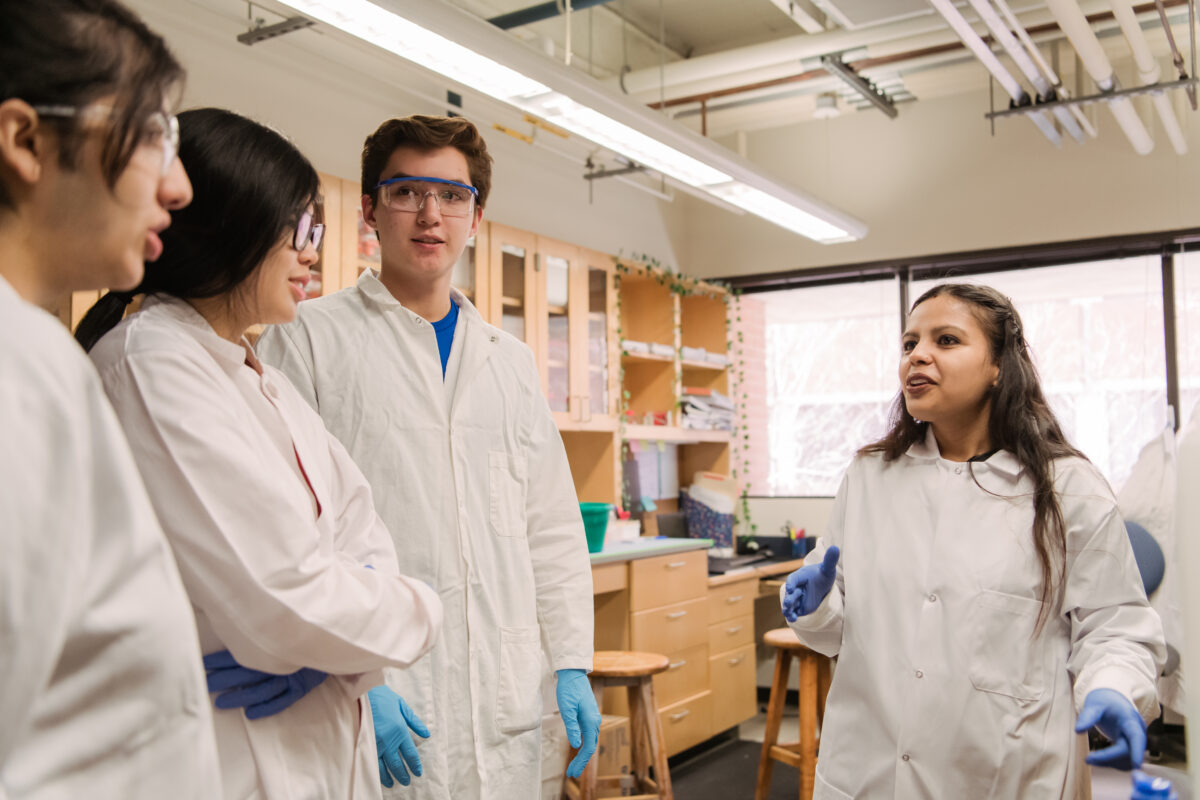 Ph.D. student Manju Ojha (right) explains an experiment to undergraduates in the lab. (Marlayna Demond ’11/UMBC)
In addition to conducting their own research, the students “also get great experiences with mentoring,” Koirala says. With a group of 11 students (“Or 12, including me,” Koirala adds), a mentorship structure forms naturally among the lab members, with more experienced team members guiding and supporting newer team members. “And wherever they go, academia or industry, they will be the future scientists—they will mentor the younger ones.”
Koirala’s method seems to be working. Two high school students in the lab are headed to college next year, one to M.I.T. and one to Bowdoin College in Maine. Tasnia Sadat ’23, biochemistry and molecular biology, is headed to medical school at Georgetown. Jeff Vogt ’23, biochemistry and molecular biology, is on his way to Johns Hopkins for a Ph.D., and Senali Dansou ’23, biochemistry and molecular biology, will matriculate at University of Minnesota for an M.D.-Ph.D.
With such an engaged group of researchers, thoughtful research questions, and effective techniques, Koirala’s team is well prepared to reach its goals and further the understanding of enteroviruses, leading the way for life-changing treatments.
]]>
Diseases such as polio, the common cold, and meningitis are all caused by closely related viruses and the way these viruses multiply in the body is poorly understood. Deepak Koirala, assistant...
https://umbc.edu/stories/nsf-career-award-enteroviruses-replication/
https://my3.my.umbc.edu/api/v0/pixel/news/131671/guest@my.umbc.edu/37802fe95afc6fa6ad8cbcccc6fd006d/api/pixel
career-award
chembiochem
cnms
majoraward
news
research
science-and-tech
UMBC News & Magazine
https://my3.my.umbc.edu/groups/umbc-news-magazine
https://assets1-my.umbc.edu/system/shared/avatars/groups/000/001/943/24435aa6207c452e7bc15cc74b42c7bb/xsmall.png?1748556657
https://assets1-my.umbc.edu/system/shared/avatars/groups/000/001/943/24435aa6207c452e7bc15cc74b42c7bb/original.png?1748556657
https://assets2-my.umbc.edu/system/shared/avatars/groups/000/001/943/24435aa6207c452e7bc15cc74b42c7bb/xxlarge.png?1748556657
https://assets2-my.umbc.edu/system/shared/avatars/groups/000/001/943/24435aa6207c452e7bc15cc74b42c7bb/xlarge.png?1748556657
https://assets3-my.umbc.edu/system/shared/avatars/groups/000/001/943/24435aa6207c452e7bc15cc74b42c7bb/large.png?1748556657
https://assets1-my.umbc.edu/system/shared/avatars/groups/000/001/943/24435aa6207c452e7bc15cc74b42c7bb/medium.png?1748556657
https://assets2-my.umbc.edu/system/shared/avatars/groups/000/001/943/24435aa6207c452e7bc15cc74b42c7bb/small.png?1748556657
https://assets1-my.umbc.edu/system/shared/avatars/groups/000/001/943/24435aa6207c452e7bc15cc74b42c7bb/xsmall.png?1748556657
https://assets2-my.umbc.edu/system/shared/avatars/groups/000/001/943/24435aa6207c452e7bc15cc74b42c7bb/xxsmall.png?1748556657
UMBC News & Magazine
0
0
false
Mon, 13 Mar 2023 15:17:10 -0400
Mon, 13 Mar 2023 15:17:10 -0400