A Journey of Growth
International travel offers ample opportunities to stretch yourself—one minute you may be the expert and the next, completely clueless about how something works. Retrievers currently in the Fulbright U.S. Student Program—teaching English or researching around the globe—find themselves oscillating between their teaching and student roles on a daily or hourly basis. By engaging their host communities through openness and cultural humility (and many shared cups of tea or coffee), these Fulbrighters are finding their balance along the way.
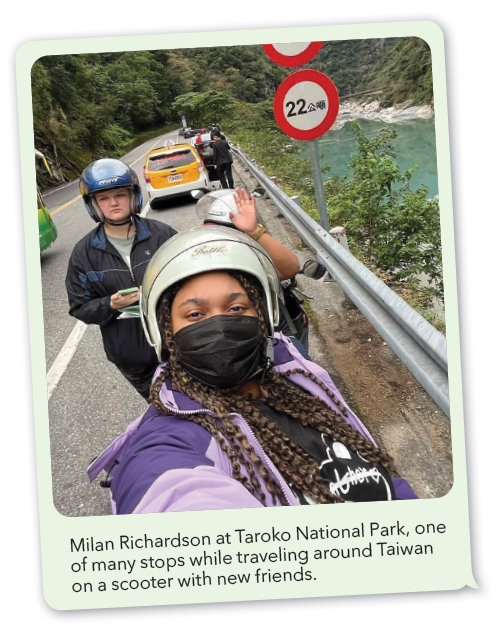
All eyes are on Milan Richardson ’23 as she helps her co-teacher keep score in a Jeopardy-like game her students are playing. Richardson teaches English to several classes of first through sixth-grade students at Jinsha Elementary School in Kinmen County, Taiwan. As she completes the Mandarin character for the numeral 5, a wave of giggles and chatter flows through the room.
Similar to a U.S. tally—four strokes and a strike though, the Mandarin character has 5 strokes total and needs to be written a certain way to represent 1, 2, 3, 4, or 5. “The students were so confused because I wrote the character strokes in the wrong order,” says Richardson, who is used to solving complex math as a Meyerhoff Scholar having earned a bachelor’s degree in bioinformatics and computational biology and minors in computer science and modern, languages, linguistics, and intercultural communication.
“I wanted to write the character correctly. I asked, and they showed me the proper order to write the strokes,” says Richardson, a Fulbright English Teaching Assistant (ETA). “They started clapping once I got it right. This was one of the many cool moments where my students were able to teach me.”
While she may be new to teaching in Taiwan, Richardson brings with her four years as an English and math tutor and a minor in Mandarin. “Taiwan was so different from any place I’ve ever been to. I was overwhelmed at first,” says Richardson. “I like it a lot, now. In my second month, I applied for a scooter license. Now I ride around the island and have taken my scooter other places on trips.”
Diplomas earned. Visas in hand. Vaccines completed. Luggage packed. Destination confirmed. Last summer, UMBC’s eight participants in the 2023 – 2024 Fulbright U.S. Student Program checked off all the important items on their to-do lists. The only thing left was to get to their placements on islands and in landlocked countries, cities, and countrysides across East Asia and Eastern Europe. It’s easier written than done. To adapt well to a new community, job, language, and culture, they must practice the art of humility and flexibility as their roles shift regularly from teacher to student.
Leading the Fulbright charge
All technicalities aside, the Fulbright experience is the beginning of building an international network of teachers and researchers who share the diversity and possibility of the U.S. with the world. In return, across the globe, communities welcome the next generation of leaders into their cities, neighborhoods, schools, and homes to share their country’s history, innovations, and culture. Since Fulbright’s inception in 1946, these reciprocal acts of kindness have created multiple paths forward to lifelong worldwide collaboration and understanding based on the simple act of giving someone different than yourself a chance.
“The Fulbright Program truly demonstrates public diplomacy in action,” says Brian Souders, M.A.’19, TESOL, and Ph.D. ’09, language, literacy, and culture, the associate director of global learning at UMBC’s Center for Global Engagement. In this role, Souders, who received a 2023 Fulbright International Education Administrator award to Germany, has led hundreds of Retrievers through the Fulbright application process as UMBC’s Fulbright Program advisor. “Whether in the classroom as teachers, students, or researchers, recipients learn about the world as much as they share what it means to be from the U.S. and UMBC alumni,” says Souders.
Thanks to Souders’ guidance, UMBC is one of 57 doctoral universities nationwide and three in Maryland to receive a Fulbright Top Producing Institution designation for 2023 – 2024, for the third time in the last five years. In the last decade, more than 80 UMBC alumni have received Fulbright awards. Out of the 10 Retrievers who received a 2023 – 2024 Fulbright, eight are currently placed internationally, seven are ETAs and one is on a research grant.
The hard work of play
There are U.S. Fulbright student scholars in more than 100 countries worldwide. Three Retrievers were placed in Taiwan—they keep in touch regularly, see each other at ETA trainings, and are planning to travel together during their Fulbright year. But they all arrived in Taiwan separately and faced different challenges settling in.
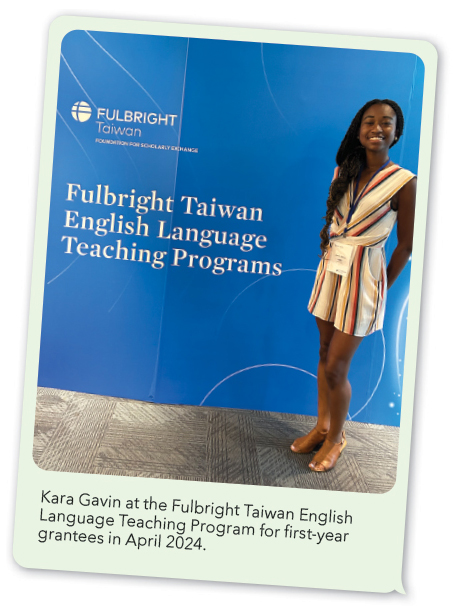
“I arrived in Taiwan and immediately changed my plans because the airline lost my luggage,” says Humanities Scholar Kara Gavin ’20, English. She was grateful to have a carry-on. “It was chaotic. I was taking it all in,” says Gavin. A day and a 50-minute plane ride later, she arrived in Penghu County, Taiwan, an archipelago of about 90 islands between China and the main island of Taiwan. “The little beach town is in its own little world,” says Gavin. “The smell of the sand gave me comfort.”
Gavin teaches beginner English at two local junior high schools. New to Asia and Mandarin, Gavin’s thinking cap is on 24 – 7, including learning Mandarin in between teaching classes. “Living independently for the first time is hard on its own, but doing it in a foreign country is a whole other ball game,” says Gavin. “I’m acquiring many new life skills that will last me a lifetime.”
One of those is sympathizing with her students and anyone learning a new language and culture. “I teach the English pronunciation and spelling of a word,” says Gavin. “Then, they like to share the Mandarin equivalent with me. It’s all about patience, balance, and trust.” She also models intercultural teamwork by developing and teaching lessons with her bilingual (Mandarin/English) Taiwanese co-teacher to foster student engagement and enrichment.
For Fulbright Scholars, it is equally important to engage with communities beyond the classroom. When they apply for the grant, the Fulbright Program asks them to develop ideas to share their passions and skills in a community project. For Gavin, this meant adding a little drama to have a lot of fun. As a performing artist, Gavin knows the theatre can be a powerful community-building outlet. “I wanted to encourage students and other community members to express themselves and share their culture with me and others,” says Gavin.
She found a kindred spirit in a professor at a local university. They formed a drama club at the university for English language learners at all levels to explore American play formats with Taiwanese traditions and histories.“Writing original bilingual plays, in English and Mandarin, based on folktales about island traditions is creating an artistic and fun cultural exchange and understanding outside of my ETA duties,” says Gavin.
Finding the right pace
For fellow Humanities Scholar Nailah-Benā Chambers ’23, global studies, a Fulbright award to Taiwan was a natural next step. Chambers began learning Mandarin and all things Taiwanese in sixth grade at a Taiwanese Mandarin language immersion school in her hometown of Richmond, Virginia. As her Mandarin improved, she tutored other English speakers. This oscillating pattern of being a student and a teacher makes Chambers adaptable and persistent, she says.
But it hasn’t always been easy. When she first visited Taipei, Taiwan, in the spring of 2023 on a Mandarin language-intensive study abroad program, “I was so confident. I walked into a 7-Eleven to shop. No one could understand me,” says Chambers. “It was a bit embarrassing. Even with my language and cultural skills, I had a long way to go to mastering Mandarin.”
Now on her Fulbright ETA grant, Chambers arrived on solid ground, both culturally and linguistically. “I felt such a sense of calm and familiarity. Taiwan is so welcoming,” says Chambers. “It calms you down. Things are much slower here than in the U.S.” Soon enough, Chambers was balancing classrooms at Huludun Elementary and Fu Chun Elementary in Taichung City, on the main island of Taiwan, with students at both schools on the extreme spectrum of English proficiency.
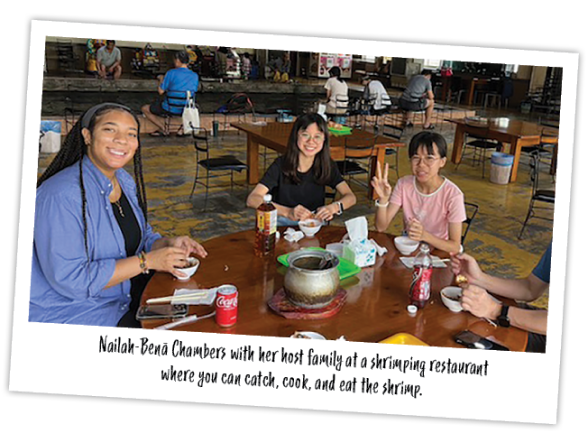
The upside of working with proficient English language learners is connecting on more advanced topics and sticking to Fulbright’s English-only immersion model. At one of her schools, the students are beginning English language learners, and the administrators only speak Mandarin. “My experience as a bilingual teacher and learner with a high level of understanding of the local language and culture has helped with classroom management and fostering powerful connections with students and administrators,” says Chambers. “It also helps to advance their grasp of the nuances of American English, especially when there are gray areas or misunderstandings.”
Keeping your ears open
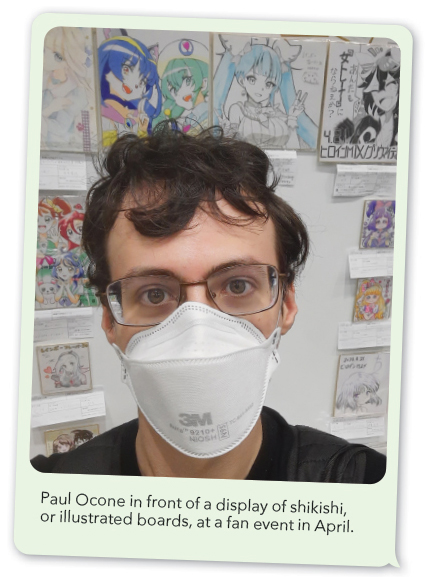
Watching anime, reading manga, (Japanese graphic novels), and participating in their fandom inspired Paul Ocone ’22, individualized study, a Linehan Artist Scholar, to research these subjects and learn Japanese. “I have deeply engaged in fan social life and communities—from leading an anime club to participating in and running conventions to moderating online communities—my affinity for and interest in anime fan spaces runs deep,” says Ocone. Part of Ocone’s observations include witnessing how some fan subcultures limit their membership in fear that a broader fanbase would weaken their subculture identity. In contrast, he says, other fan subcultures are more flexible while maintaining their identity.
Interested in adding to his initial research in U.S. fan spaces, Ocone is now at the epicenter of anime and manga culture as a Fulbright Student Researcher doing anthropological research with Morikawa Kaichirō, a leading scholar in this field at Meiji University’s School of Global Japanese Studies in Tokyo, also home to the Yoshihiro Yonezawa Memorial Library of Manga and Subcultures.
“I have had some amazing experiences participating in anime pilgrimage or anime tourism, including learning much from other fans and benefitting from their generosity,” says Ocone. “My Japanese is conversational—sometimes it’s challenging to understand specialized topics, but this has not deterred me from adding anime and manga tourism as a second research project.” In January, Ocone presented his work at the Popular Culture Tourism Stakeholders Summit in Japan.
Ocone is a sort of tourist himself, enjoying various aspects of Japanese pop culture. The daily musicality of Tokyo teaches him about enjoying the rhythm of the day. “Each train station plays a unique melody when the train departs,” says Ocone. These melodies or “hassha merodii,” are catchy and echo around in his brain like the convenience store jingles that also greet customers. “I was happily surprised when I heard a loudspeaker playing a symphony in my neighborhood,” says Ocone. “Another one played the following day and the next. I learned this was a daily sunset ritual.” He knows these sound experiences will play in his head long after returning to the U.S.
Learning new languages
This is not the first time David Bullman ’22, ancient studies, visited North Macedonia. He first went in 1995 as a performing musician and public affairs representative for the U.S. Army.
“North Macedonia was very different coming out of the Cold War,” says Bullman. “The infrastructure and general state of repair of public spaces and businesses is much better than I recall from that time.”
Now, as an ETA, Bullman teaches British civilization and American civilization in addition to three different levels of English at the University of Totovo in the Republic of North Macedonia, a landlocked country north of Greece. In Totovo, students begin learning English in elementary school and are fluent by the time they reach college. “I thought I would be teaching English basics,” says Bullman, “but it’s been great to teach a complex subject in the context of where my students live.”
His students are equally glad to help him with the local language. Macedonian and Albanian are the country’s two official languages. Bullman began learning some key Macedonian phrases in preparation for his trip. However, Albanian is the preferred language in Tetovo. After traveling with the Army to more than 15 countries on three continents, Bullman is used to rapidly switching gears and accepting help.
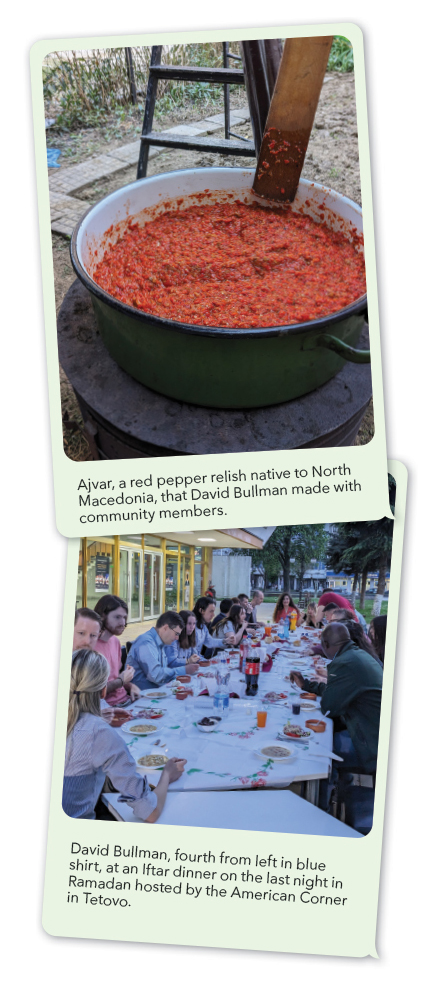
He eagerly takes on the student role when it comes to learning about new foods. Bullman’s apartment faces the Hapësira Socio-Kulturore Tetovë, a community center where locals and the nearby Peace Corps Volunteers sometimes organize activities, like an ajvar-making gathering. Ajvar is a delicacy across the Balkans made every fall. It’s a tradition passed down through centuries with many recipe variations. “Ajvar is made by charring red bell peppers that are then peeled, minced, seasoned, and cooked for hours,” says Bullman. It boils down to a relish that can be preserved for months, but locals tell Bullman that’s rare because it’s too good to keep for even one week. After participating in the preparation and getting to take home a few jars, Bullman agrees with the locals. Ajvar is now his go-to condiment on eggs, pasta, toast—anything goes.
Albanian and cooking are not the only languages Bullman tapped into while in Tetovo. As a lifelong clarinet player, Bullman hoped to create a musical exchange with local musicians. The opportunity presented itself when the dean of the Faculty of Art wanted to celebrate Thanksgiving. Bullman collaborated with the music faculty, the orchestra director, and students to create a concert of six songs. “I’m glad I returned to North Macedonia. The people are as warm and friendly as I remembered them to be,” says Bullman. “I wanted to come back and experience it myself again.”
Tapping into curiosity
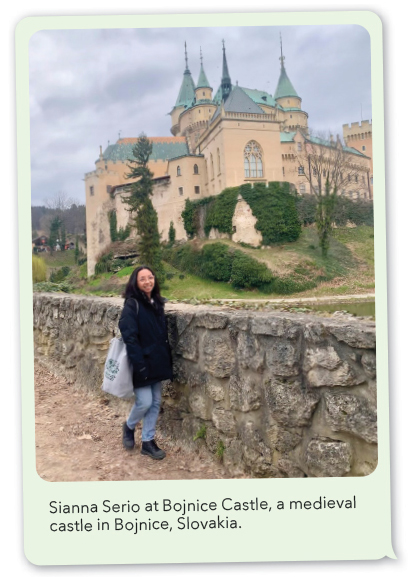
On her way to her Fulbright placement, Sianna Serio ’23, computer science, went city hopping. “I was headed to Žilina, Slovakia, east of Austria and south of Poland,” says Serio. “I flew into Vienna, Austria, then I took a one-hour bus ride crossing Austria’s eastern border into Slovakia to get to Bratislava, the capital.“ There she met other ETAs for orientation. “A week later, I hopped on a two-hour train ride to my teaching placement in Žilina and I met my wonderful mentor, Maria Veršova, who became my second mom.”
Serio teaches at the Hotel Academy, Žilina. The academy focuses on hotel management, gastronomy, and tourism. “My students are beginning English language learners,” says Serio. “I teach what the class is interested in, like American pop culture, because they rarely meet a native English speaker.” During outings with her students, they ask about a wide range of topics. “There are many topics that I would not have thought to cover if it were not for time spent outside of the classroom,” says Serio, “Some of those conversations became formal lessons, like the lesson on the three branches of the U. S. government.”
Serio appreciates her students’ curiosity. She tapped into her love of website development and design to improve her students’ confidence in writing and speaking English and prepare for their Maturita exam, a national high school exit exam. “Some of my students are helping me design a class webpage for them where I will showcase their class and post some of their practice writing in English,” says Serio. “These posts will include topics covered in the Maturita exam, information about their school, and answers to questions about Slovakia.”
Serio’s mentor Maria Veršova, head of the English department, is her motivation. She guides her through lesson planning, class schedules, and the challenges of relocating to a new country. “When my original housing plans fell through, Maria found housing for me five minutes from her house,” says Serio. “She helped me find health insurance and open a bank account. Her husband set up my internet.” They have welcomed Serio almost daily into their home for dinner, tea, coffee, or wine. Serio is a gracious guest and lent her graphic design expertise to help Veršova design invitation cards for her 50th birthday party. Veršova tells Serio she will always have a place to stay in Žilina.
Fulbright: The next generation
Teaching has defined the last decade for Tiffany Powell, a master’s student in UMBC’s TESOL program, a passion she invested in as an English language learner teacher in Seoul and in Miryang City, South Korea, for five years, and in Florida this past year. Now, she is in Iași, Romania, southwest of Ukraine, at the Alexandru Ioan Cuza University teaching American studies. Powell is committed to bridging culture, community, and belonging by bringing technology into the classroom.
Powell also decided to bring the research and cultural understanding closer to home by partnering with Romanian teachers to develop a five-part series on African American women’s history. “We talked about Black women in science in the context of the movie Hidden Figures and discussed Hollywood’s portrayal of Black life,” says Powell. The class is now creating a series on Romanian women. Helping students better understand the similarities and differences between U.S. and Romanian cultures has been an eye-opening experience for Powell.
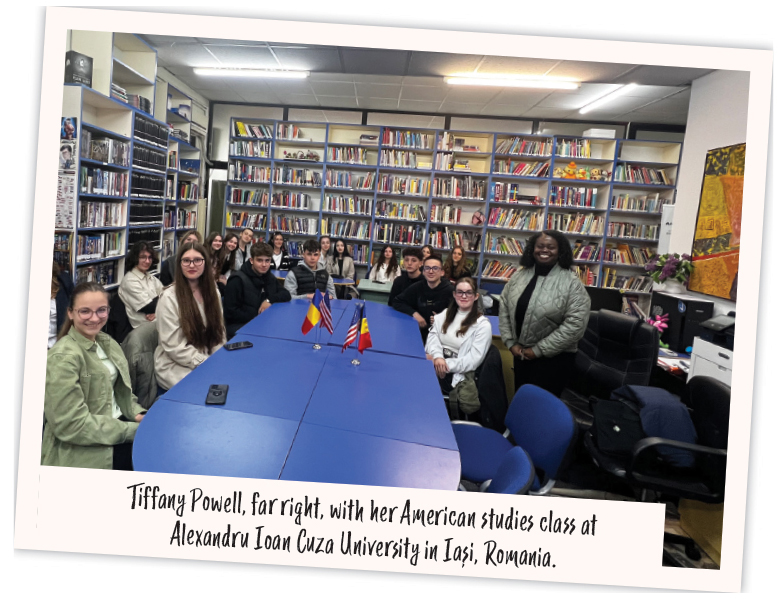
She sees the impact of a country formerly under communism. In Iași, sometimes the internet doesn’t work and, in her school, there are no clubs or student organizations to gain the skills needed to earn a Fulbright award. “My students have given me a new perspective. You may want to come in and make changes, but you must understand where they’re coming from. There is a saying in Iași, ‘It’s not impossible. It’s just difficult,’” says Powell. She is trying to help with the difficult part by leading Fulbright application and leadership workshops.
Powell, like the other Fulbrighters, will bring her experiences home with her and wherever she ends up teaching English next. When their Fulbright year ends, these Retriever ambassadors will find themselves as emissaries yet again, returning to their hometowns, sharing the good news of ajvar made in community, the freedom of a scooter ride along a Taiwanese beach, or the correct stroke order for writing the Mandarin number five. The lessons their students and host families passed along—including pausing to take a breath and appreciate their international successes small and large—will continue to form and shape the way they see the world.
“Having a flexible mindset and under-standing the historical context of your placement is key,” says Powell. “I carry myself as a U.S. representative. Living abroad teaches humility, adaptability, and open-mindedness to press on through challenging times.”
]]>
International travel offers ample opportunities to stretch yourself—one minute you may be the expert and the next, completely clueless about how something works. Retrievers currently in the...
https://umbc.edu/stories/a-journey-of-growth/
https://my3.my.umbc.edu/api/v0/pixel/news/142391/guest@my.umbc.edu/429a43e449ef9d4187b1ae1d4e63ca4e/api/pixel
alumni
ancient-studies
bioinformatics-and-computational-biology
cahss
cge
computer-science
education-abroad
english
feature
fulbright
global-studies
humanities
inds
linehan
llc
magazine
meyerhoff
spring-2024
story
UMBC News & Magazine
https://my3.my.umbc.edu/groups/umbc-news-magazine
https://assets1-my.umbc.edu/system/shared/avatars/groups/000/001/943/24435aa6207c452e7bc15cc74b42c7bb/xsmall.png?1748556657
https://assets1-my.umbc.edu/system/shared/avatars/groups/000/001/943/24435aa6207c452e7bc15cc74b42c7bb/original.png?1748556657
https://assets2-my.umbc.edu/system/shared/avatars/groups/000/001/943/24435aa6207c452e7bc15cc74b42c7bb/xxlarge.png?1748556657
https://assets2-my.umbc.edu/system/shared/avatars/groups/000/001/943/24435aa6207c452e7bc15cc74b42c7bb/xlarge.png?1748556657
https://assets3-my.umbc.edu/system/shared/avatars/groups/000/001/943/24435aa6207c452e7bc15cc74b42c7bb/large.png?1748556657
https://assets1-my.umbc.edu/system/shared/avatars/groups/000/001/943/24435aa6207c452e7bc15cc74b42c7bb/medium.png?1748556657
https://assets2-my.umbc.edu/system/shared/avatars/groups/000/001/943/24435aa6207c452e7bc15cc74b42c7bb/small.png?1748556657
https://assets1-my.umbc.edu/system/shared/avatars/groups/000/001/943/24435aa6207c452e7bc15cc74b42c7bb/xsmall.png?1748556657
https://assets2-my.umbc.edu/system/shared/avatars/groups/000/001/943/24435aa6207c452e7bc15cc74b42c7bb/xxsmall.png?1748556657
UMBC News & Magazine
5
0
false
Wed, 29 May 2024 14:32:52 -0400
Résumés in hand, 2,000+ hopeful and prepared Retrievers attend the 2024 Career Fair
On a perfect 55-degree sunny February day, hundreds of undergraduate and graduate students across all colleges stood in a line that began at the RAC and wrapped its way to Sherman Hall. Instead of exercise gear, Retrievers were dressed to impress with résumés in hand, ready to land a summer internship or a job with one of the 180-plus employers across multiple industry sectors at UMBC’s Spring 2024 Career and Internship Fair.
“We are excited to help employers develop a strong talent pipeline and diverse future workforce, shaping the leaders and innovators of tomorrow,” said Paige Bauder, associate director of employer relations and recruitment programs at UMBC.
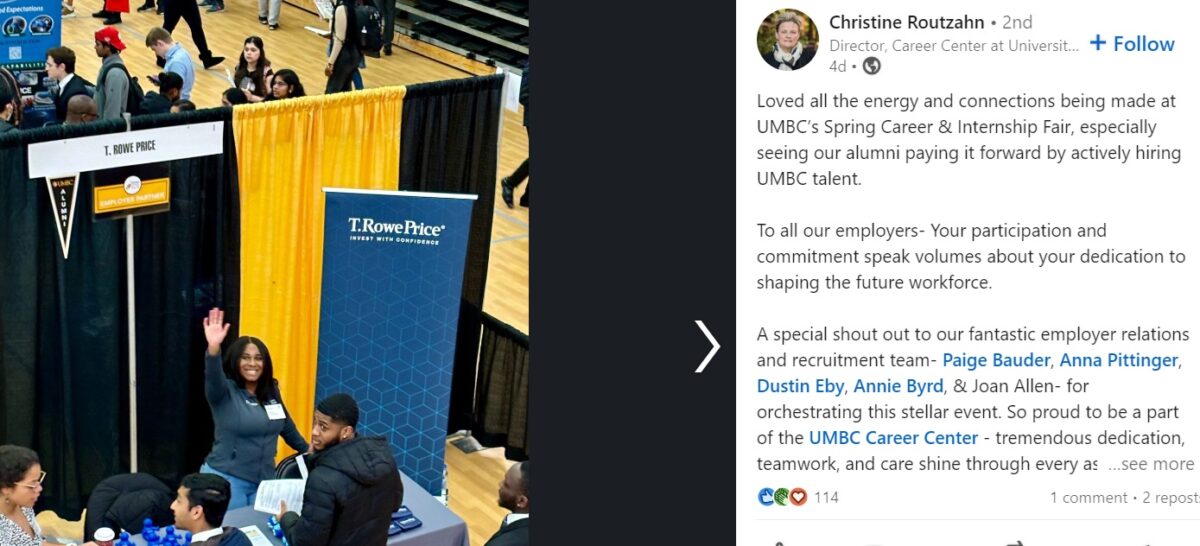 Image courtesy of Christine Routzahn, director of UMBC’s Career Center.
The leading edge
“Give strong handshakes. Maintain eye contact,” said Leon Tang ’26, information systems, in a booming voice, as he scanned IDs as a volunteer at the event.
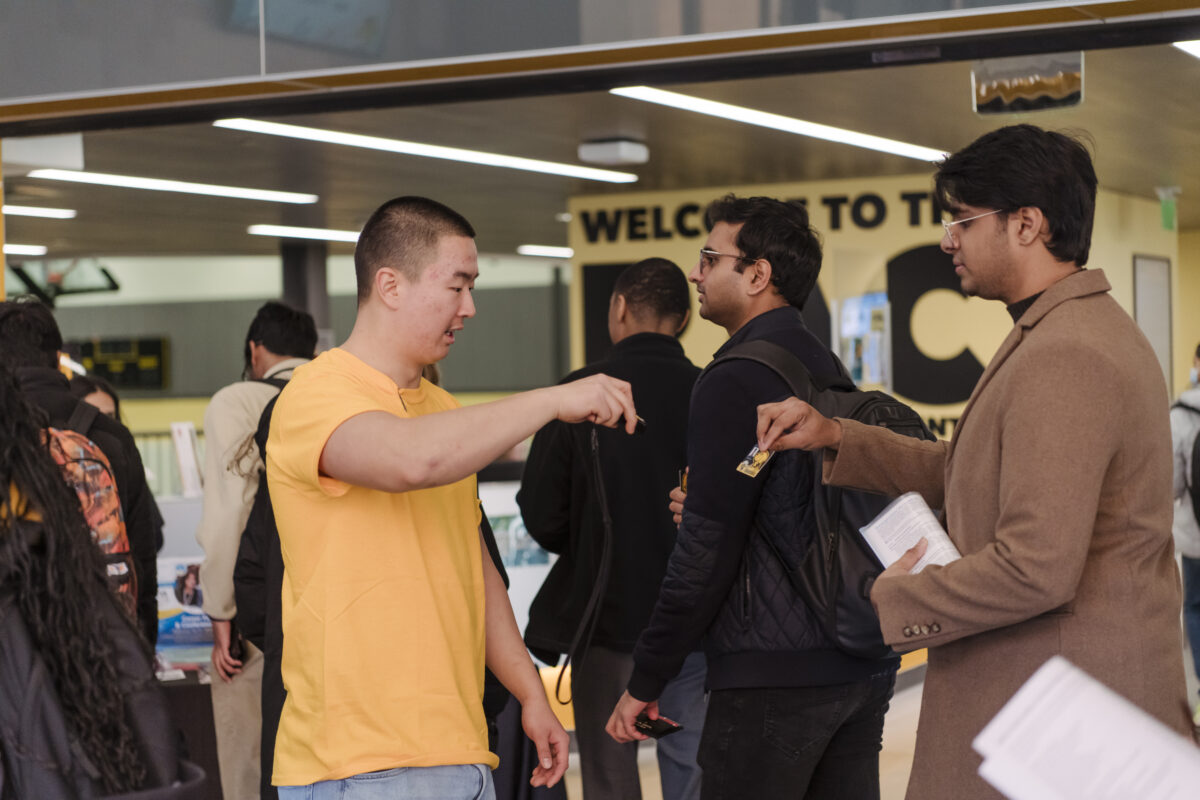 Leon Tang welcoming Career Fair attendees. (Marlayna Demond ’11/UMBC)
“Some people might come in nervous. It’s over 180 companies, so it can be pretty hard,” said Tang. He currently has two internships, one as a business technology intern at Agile Care Enterprises, based at bwtech@UMBC, and another as a research assistant in the information systems department. “It’s a good way to tell everyone to be calm and be confident. It’s the little things that can go pretty far in obtaining something.” For the nearly 2,200 Retrievers that made it through the door that day, this was sage advice.
A professional headshot is one of those little things. After making it past Tang, Bhargavi Gudapati, a current master’s student in information systems, headed straight back to grab the 10th spot in a line that, over the next four hours, would consistently have dozens of excited and grateful students waiting for their free headshot. Gudapati, an international student from India, has attended every career fair since she arrived in 2022. She wants to get ahead of the steep competition of international students looking to launch the next phase of their career in the U.S.
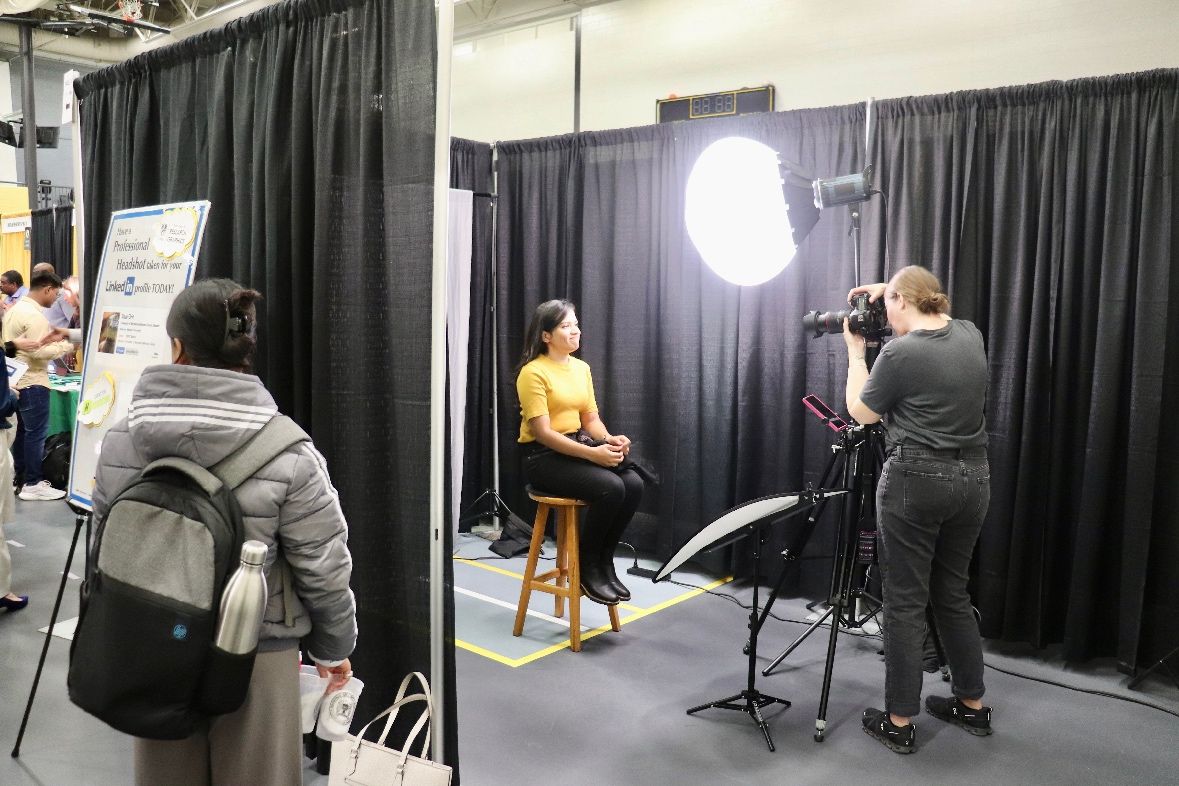 Spring 2024 Career and Internship Fair headshot station. (Image courtesy of Christine Routzahn)
“It’s incredibly important to get to know employers in person instead of only on their online portal,” says Gudapati.“You want to know what they require and the current technology they are using.”
One of those employers, Ed Belsinger ’90, M.S. ’93, mechanical engineering, is a newbie to UMBC’s career fairs. He proudly wore his UMBC sweatshirt and a smile that became a beacon of friendliness in a sea of students seeking opportunities. Belsinger is the director of product development at RPM Tech, a company that turns an idea into a prototype and a prototype into a fully manufacturable product. Because RPM does all the engineering and design in-house with a full shop and lab, it can offer students a wide range of expertise.
Belsinger notes that RPM is currently in a growth mode and has three internships available as well as full-time positions. “As an alum, I said, ‘This is a great school—we have to go there.’ Whether it’s an internship or someone right out of college, we’re looking for students with curiosity, who want to learn, are willing to do new things, to be challenged, and be part of a team.”
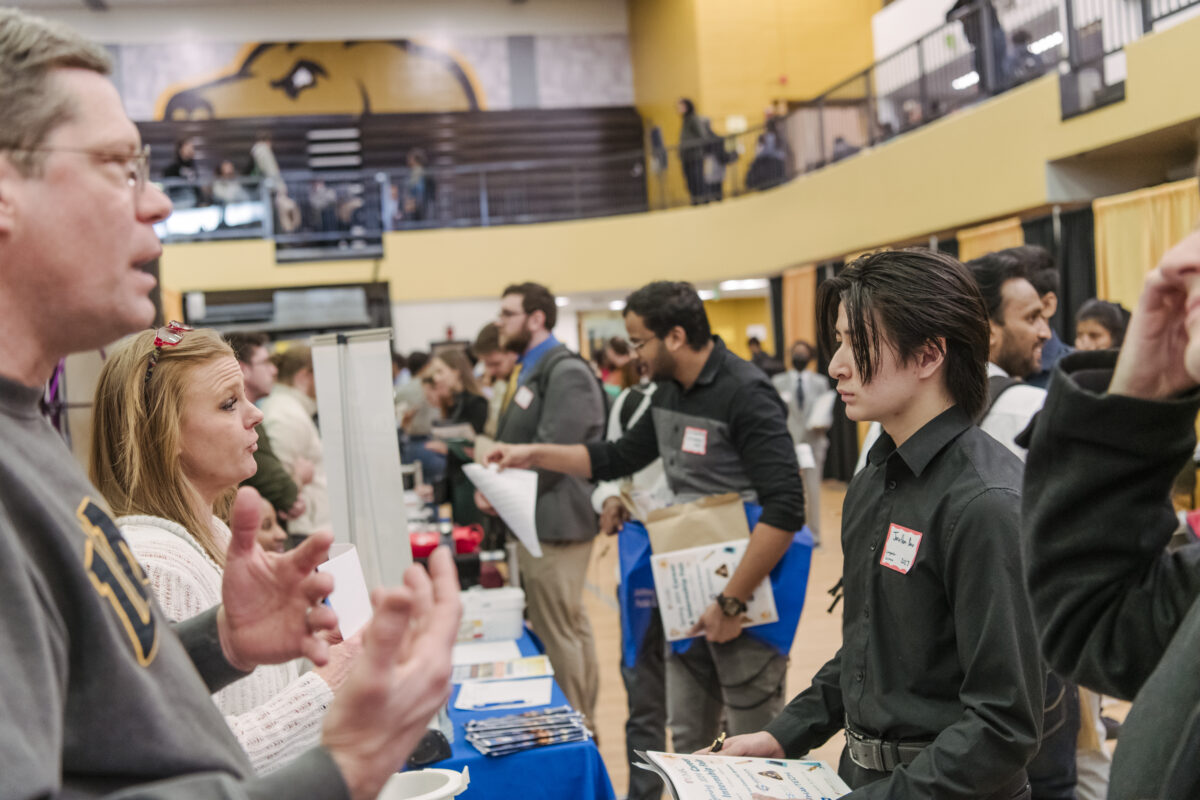 (l – r): Ed Belsinger (in grey) and Jonathan Dao (in black). (Marlayna Demond ’11/UMBC)
Hoping to grab one of the RPM internships is Jonathan Dao, computer science, a first-year student waiting in line to speak with Belsinger. “I saw tech in the name and wanted to learn more. I want to see if I can start early to have a competitive advantage,” said Dao. “I think first-year students should definitely give the career fair a shot. Come in with confidence, try rehearsing how to present yourself, and dress well.”
Part of the team
Sekinat Dosunmu ’24 agrees with Dao’s approach. After spending her first year of college remote, she has made it a point to attend every career fair in person. Toward the end of the day, she lined up at the FBI table, ready to discuss what the FBI had to offer someone like her with a global studies major, an Africana studies minor, and certificates in tech and intercultural communication. As she stepped forward, a recruiter immediately welcomed her.
While waiting to continue talking with Dosunmu, other recruiters shared that the FBI welcomes all majors, including the arts and humanities. They noted that the most important skill the FBI is looking for is how someone approaches and solves a problem in a team environment.
The artists approach
Solving problems creatively is the bread (or blood) and butter of C.C. Smith ’24, theatre, formerly known as Dracula in UMBC’s fall 2023 production of Dracula: a Feminist Revenge Fantasy, Really. That role earned him an audition for a film later on in the day, so Smith is hurrying through the fair.
Later in the spring, UMBC’s Career Center hosts boutique career fairs, one of which is focused on creative careers, and on March 7, it will host the CAHSS Career Connection Social for arts, humanities, and social science majors, but that doesn’t stop Smith from checking things out. As an actor, Smith explains, you never know when someone is looking to do a commercial. “This is my first time here. I would like to see more performing arts employers in this larger career fair, especially with how good the arts programs are here,” says Smith. “As a senior, it’s still important to be poking around this fair.”
Luna Siesko ’25, visual arts, and Alexander Schobitz ’22, visual arts, agree with Smith that UMBC students excel in the arts, and would like local employers to know about that. Siesko, a photographer and videographer at commonvision, UMBC’s design shop, used her skillset to bring personally designed business cards and résumés to the fair. Siesko is unsure what she is looking for but hopes that by speaking with some of the employers, like the folks at the Baltimore County Arts Guild, she can get a sense of how to best move forward.
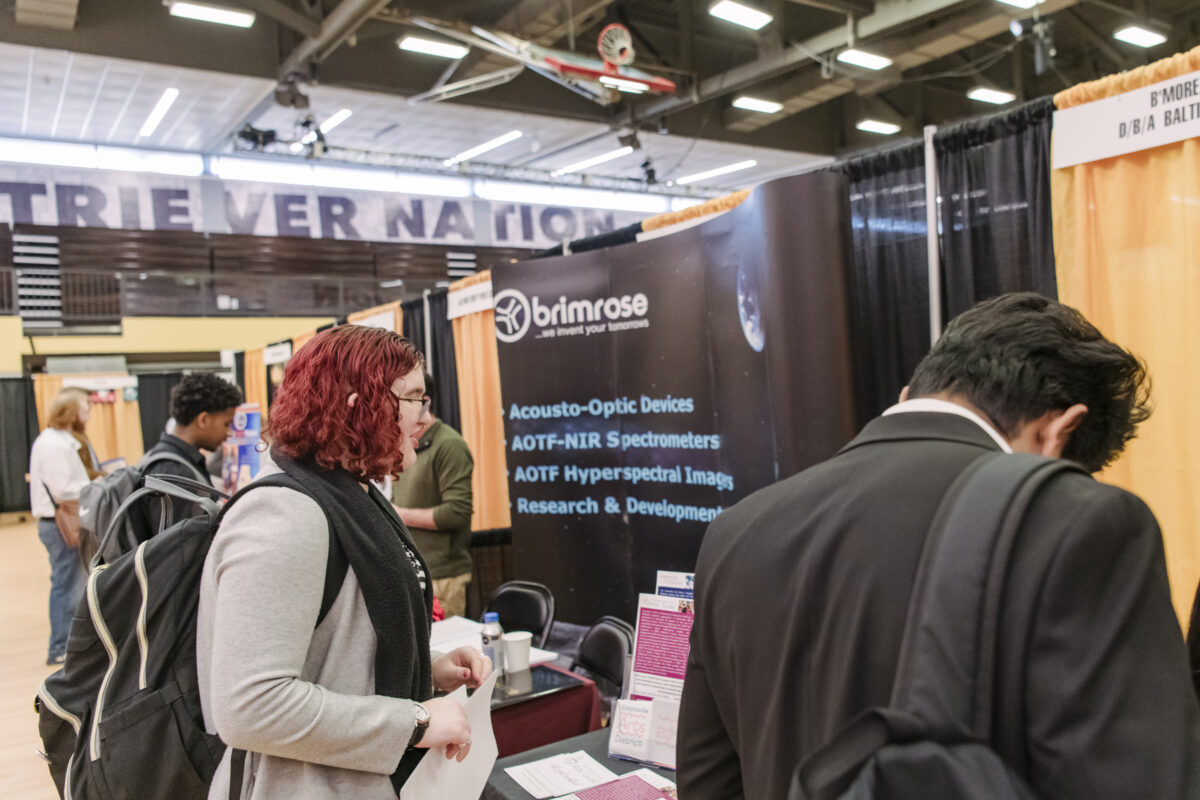 Luna Siesko at the Baltimore County Arts Guild table. (Marlayna Demond ’11/UMBC)
“We’re a small non-profit five minutes from UMBC. We want to make sure that artists feel seen and heard and know there is a place for them to work,” said Gloria Fajimolu, program and events manager at the Baltimore County Arts Guild, a new employer at the Career Fair. “We’re very welcoming. If a student doesn’t get the internship or the job, they can still be a paid instructor. If they are in animation, we will pay them to teach animation classes to the community.”
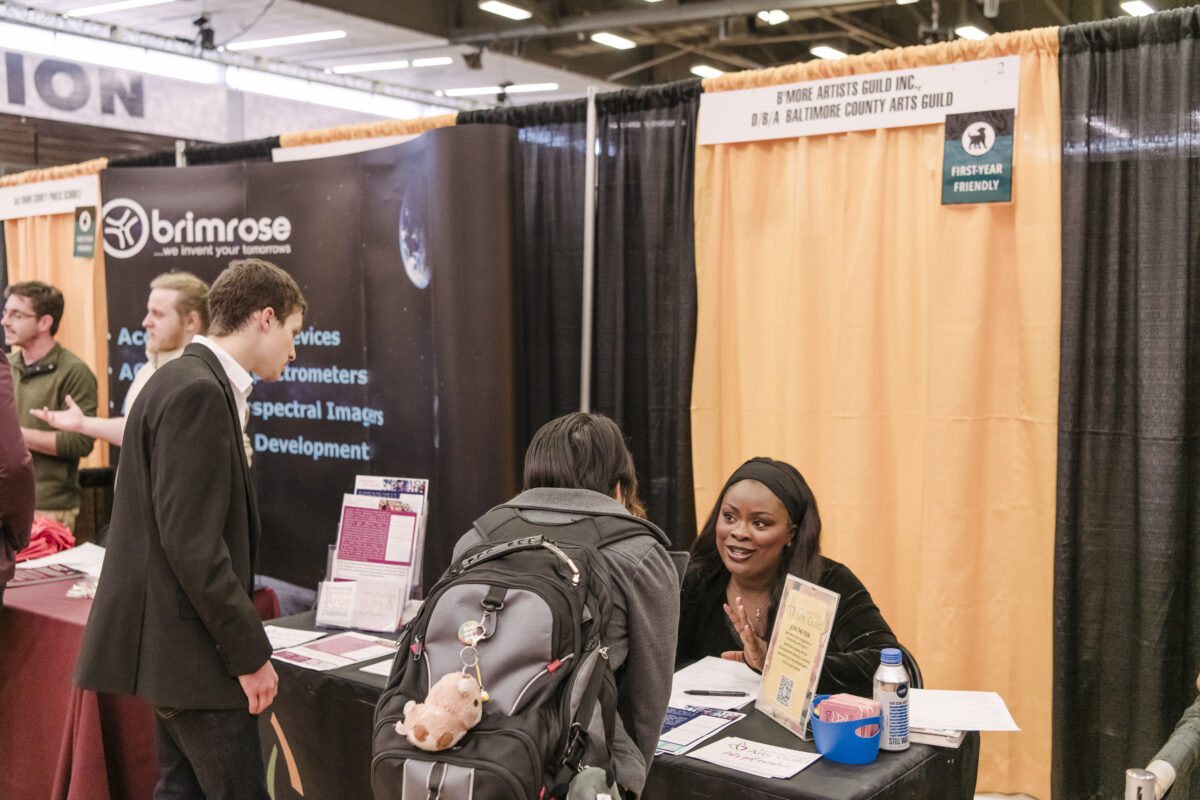 Gloria Fajimolu, program and events manager at the Baltimore County Arts Guild. (Marlayna Demond ’11/UMBC)
As a recent alum, Schobitz has one goal—to get a job in animation. He is grateful UMBC gives alumni access to the career fairs and Handshake, a job listing app. “I apply to about 10 jobs per day. I use sites like Indeed and Handshake to find jobs and apply,” says Schobitz. “While I was a student, I used UMBC’s résumé services and made a lot of appointments. I’m still trying. I won’t give up.”
The end and beginning
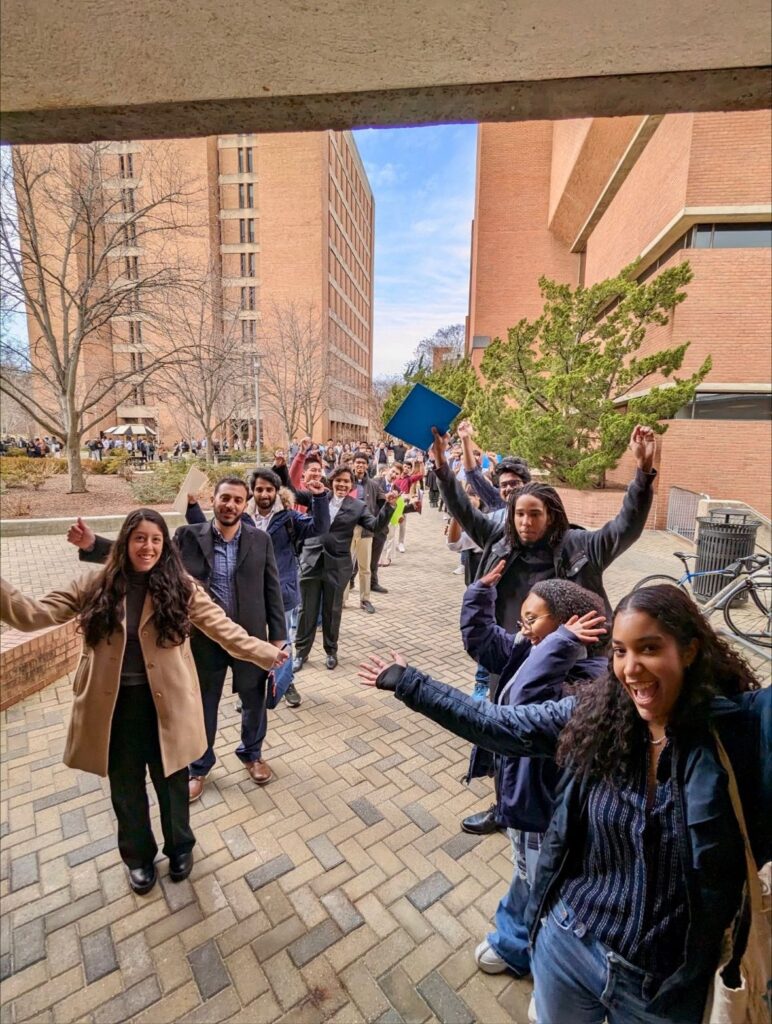 UMBC students lineup for the Spring 2024 Career and Internship Fair.
(Image courtesy of Routzhan)
Back at the headshot line, Cristian Castro, M.S. ’24, cybersecurity, joined the still-growing line as the last wave of students filed in. Castro is from Colombia and is looking to find a company to sponsor him to work in the U.S. “The Career Fair is a very good opportunity to see what’s out there. A professional photo is important in a LinkedIn profile,” says Castro. He also found some job leads earlier this year while representing UMBC as part of the Society of Advancing Chicanos/Hispanics and Native Americans in Science. “When it comes to what happens after graduation, every detail helps.”
Follow the Career Center on myUMBC and RSVP to the CAHSS Career Connection Social on Thursday, March 7, to network with alumni and employers in the arts, humanities, and social sciences.
]]>
On a perfect 55-degree sunny February day, hundreds of undergraduate and graduate students across all colleges stood in a line that began at the RAC and wrapped its way to Sherman Hall. Instead of...
https://umbc.edu/stories/the-2024-career-fair/
https://my3.my.umbc.edu/api/v0/pixel/news/139041/guest@my.umbc.edu/21c9b154d9df23acc2fa66d5d7b9f73e/api/pixel
africana-studies
cahss
career-center
coeit
community
computer-science
cybersecurity
global-studies
is
meche
news
story
theatre
visual-arts
UMBC News & Magazine
https://my3.my.umbc.edu/groups/umbc-news-magazine
https://assets1-my.umbc.edu/system/shared/avatars/groups/000/001/943/24435aa6207c452e7bc15cc74b42c7bb/xsmall.png?1748556657
https://assets1-my.umbc.edu/system/shared/avatars/groups/000/001/943/24435aa6207c452e7bc15cc74b42c7bb/original.png?1748556657
https://assets2-my.umbc.edu/system/shared/avatars/groups/000/001/943/24435aa6207c452e7bc15cc74b42c7bb/xxlarge.png?1748556657
https://assets2-my.umbc.edu/system/shared/avatars/groups/000/001/943/24435aa6207c452e7bc15cc74b42c7bb/xlarge.png?1748556657
https://assets3-my.umbc.edu/system/shared/avatars/groups/000/001/943/24435aa6207c452e7bc15cc74b42c7bb/large.png?1748556657
https://assets1-my.umbc.edu/system/shared/avatars/groups/000/001/943/24435aa6207c452e7bc15cc74b42c7bb/medium.png?1748556657
https://assets2-my.umbc.edu/system/shared/avatars/groups/000/001/943/24435aa6207c452e7bc15cc74b42c7bb/small.png?1748556657
https://assets1-my.umbc.edu/system/shared/avatars/groups/000/001/943/24435aa6207c452e7bc15cc74b42c7bb/xsmall.png?1748556657
https://assets2-my.umbc.edu/system/shared/avatars/groups/000/001/943/24435aa6207c452e7bc15cc74b42c7bb/xxsmall.png?1748556657
UMBC News & Magazine
1
0
false
Thu, 15 Feb 2024 16:23:39 -0500
Thu, 15 Feb 2024 16:23:39 -0500
For the third time in five years, UMBC is named a Fulbright Top Producing Institution
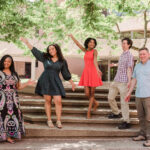
Within just a few months of living in Piątek, a small town in central Poland, Leah Michaels, M.F.A ’19, intermedia and digital arts, has already traveled to Romania, where many recipients of the Fulbright U.S. Student award placed throughout Europe gathered at a media literacy conference. She has also had an opportunity to research Polish film at Poland’s Film Archive and connect with a local genealogist who helped her find details about her Polish roots for a short documentary she is producing about her ancestry.
Michaels and nine other UMBC Fulbright student recipients researching and teaching English abroad this year helped propel UMBC, once again, to the elite ranks of a Fulbright Top Producing Institution, as reported today in The Chronicle of Higher Education. The designation recognizes colleges and universities with the highest number of students selected for the Fulbright U.S. Student Program, the U.S. government’s flagship international academic exchange program. UMBC first received this designation from the U.S. Department of State’s Bureau of Educational and Cultural Affairs in 2019 – 2020 and again in 2020 – 2021.
UMBC is one of 57 doctoral universities nationwide and three in Maryland to receive a Fulbright Top Producing Institution designation for Fulbright U.S. Students in 2023 – 2024.
More than 2,200 U.S. students from hundreds of colleges and universities are awarded Fulbright grants annually. However, only a few of these institutions are designated top producers yearly. In the last decade, UMBC students and recent graduates have received over 60 Fulbright U.S. Student Program awards in Africa, Asia and the Pacific, the Middle East, South America, and Europe.
“This achievement is a testament to your institution’s deep commitment to international exchange,” wrote Secretary of State Antony Blinken in a letter to President Valerie Sheares Ashby, congratulating her on UMBC’s Fulbright Top Producer designation, “and to building lasting connections between the people of the United States and the people of other countries.”
Mutual understanding
In partnership with more than 140 countries worldwide, the Fulbright U.S. Student Program offers unparalleled opportunities in all academic disciplines to graduating college seniors, graduate students, and young professionals from all backgrounds. Fulbright recipients play a critical role in U.S. public diplomacy, establishing long-term relationships between people and nations through graduate study, research, or teaching as English Teaching Assistants (ETAs). ETAs develop their own language skills and knowledge of the host country while teaching English to elementary, middle school, or college students.
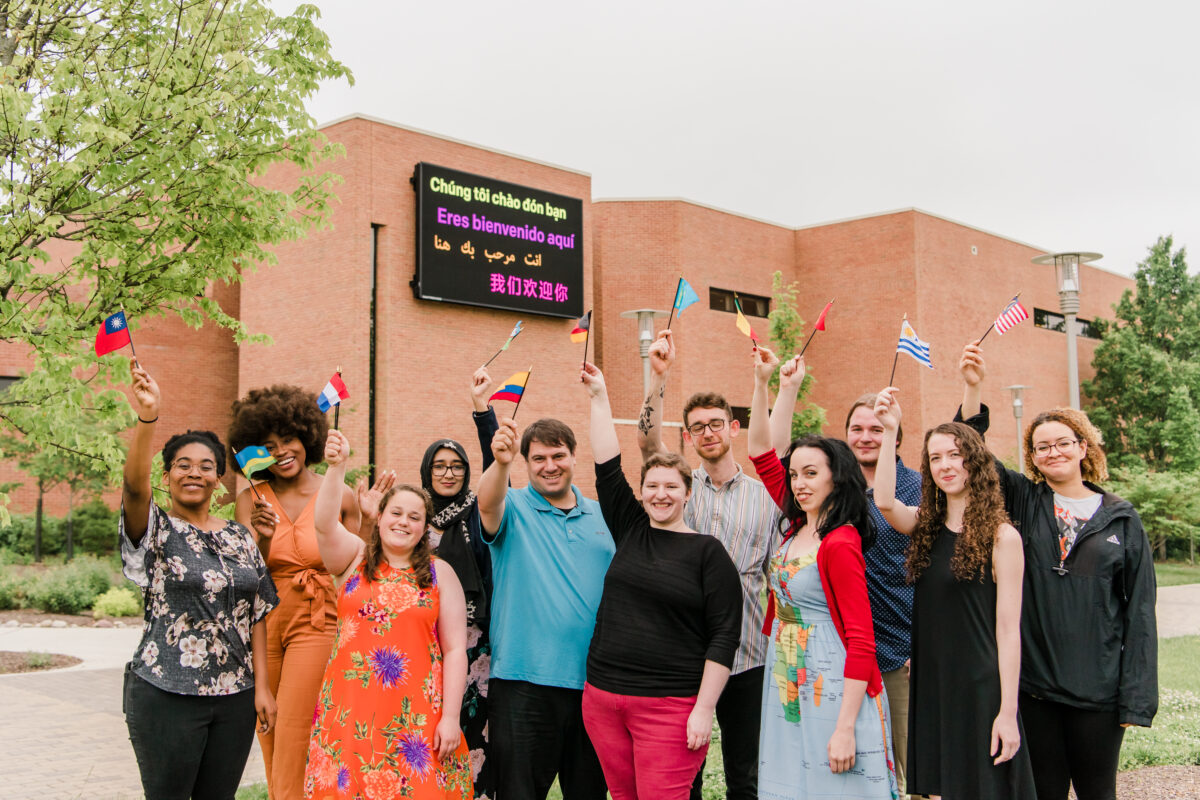 2019 – 2020 UMBC Fulbright U.S. Student recipients. (Marlayna Demond ’11/UMBC)
“As a public research university, it is imperative that we provide students with opportunities for global engagement,” says David Di Maria, associate vice provost for international education. “Fulbright is among the most prestigious of these opportunities.”
While Michaels has flourished in Poland, her 2023 – 2024 Fulbright class peers have also settled into their placements, which generally start in September with the new school year. Paul Ocone ’22, individualized study, is conducting research at the Meiji University School of Global Japanese Studies in Japan, and eight ETAs are teaching English across Europe and Asia:
- North Macedonia: David Bullman ’22, ancient studies
- Romania: Tiffany Powell, M.A.’23, teaching English to speakers of other languages (TESOL)
- Slovak Republic: Sianna Serio ’23, computer science
- South Korea: Tasneem Mansour ’20, modern languages, linguistics, and intercultural communication
- Taiwan: Nailah-Benā Chambers ’23, global studies; Kara Gavin ’20, English; and Milan Richardson ’23, bioinformatics
- Turkey: Grant Clifton, M.A. ’23, TESOL
“Being named a Top Producing Fulbright Institution is a tremendous honor—it not only shows the world what we already know about our amazing students, but it also lets our current students know that the Fulbright is a realistic opportunity for them,” says Brian Souders, Ph.D. ’09, language, literacy, and culture, M.A.’19, TESOL, and associate director of global learning at the Center for Global Engagement (CGE). Souders has led students through the Fulbright application process as UMBC’s Fulbright Program advisor for the last decade.
For Michaels, the experience has been life-changing. “My home city has been incredibly welcoming. I learned Polish folk dances, made Old Bay pierogi from scratch with some of my students, and joined a school trip to an art gallery,” says Michaels.
The Fulbright family
The Fulbright experience also includes college and university faculty and staff, as well as artists and professionals from a wide range of fields, who can join over 400,000 Fulbright alumni.
In October 2023,Renique Kersh, vice president of student affairs, and Souders traveled to Germany after receiving Fulbright International Education Administrator awards. Katherine Heird, director of education abroad and global learning, received the same award to travel to Taiwan in spring 2024. The award is geared to provide staff who support Fulbright applicants with a greater understanding of higher education worldwide.
Brian Souders is our assoc. director for global learning in the Center for Global Engagement and after years of helping faculty and students achieve their overseas learning and research goals, Brian recently took part in his own Fulbright exchange program. https://t.co/LvrOoabMou
— UMBC (@UMBC) November 15, 2023
Many UMBC faculty members and staff have received a Fulbright U.S. Scholar award over the years. This year, Lynn Cazabon, professor of visual arts and director of the Center for Innovation, Research, and Creativity in the Arts, received a Fulbright U.S. Scholar award to work at Queensland University, Australia, to create a public artwork based on local communities’ responses to climate change. Cazabon received her first Fulbright award in 2015 to the University of Liepāja, Latvia.
Fulbright Scholars globally are also drawn to UMBC’s welcoming community. Shannon Sauro, associate professor of education, hosted Jules Buendgens-Kosten, a research assistant at the Institute of English and American Studies at Goethe-Universität Frankfurt, Germany. Buendgens-Kosten joined UMBC as the institution’s first Fulbright Scholar-in-Residence to teach and share their research on inclusive education in teaching English as a foreign language to students in UMBC’s TESOL master’s program.
My uni (@UMBC) just got so much geekier and cooler.
]]>
Within just a few months of living in Piątek, a small town in central Poland, Leah Michaels, M.F.A ’19, intermedia and digital arts, has already traveled to Romania, where many recipients of the...
https://umbc.edu/stories/umbc-a-fulbright-top-producing-institution-2/
https://my3.my.umbc.edu/api/v0/pixel/news/138957/guest@my.umbc.edu/05838e8345b6084d69684b1796077d12/api/pixel
ancient-studies
biological-sciences
cahss
cnms
coeit
community
computer-science
education
english
fulbright-scholarship
global-studies
international
mlli
news
story
UMBC News & Magazine
https://my3.my.umbc.edu/groups/umbc-news-magazine
https://assets1-my.umbc.edu/system/shared/avatars/groups/000/001/943/24435aa6207c452e7bc15cc74b42c7bb/xsmall.png?1748556657
https://assets1-my.umbc.edu/system/shared/avatars/groups/000/001/943/24435aa6207c452e7bc15cc74b42c7bb/original.png?1748556657
https://assets2-my.umbc.edu/system/shared/avatars/groups/000/001/943/24435aa6207c452e7bc15cc74b42c7bb/xxlarge.png?1748556657
https://assets2-my.umbc.edu/system/shared/avatars/groups/000/001/943/24435aa6207c452e7bc15cc74b42c7bb/xlarge.png?1748556657
https://assets3-my.umbc.edu/system/shared/avatars/groups/000/001/943/24435aa6207c452e7bc15cc74b42c7bb/large.png?1748556657
https://assets1-my.umbc.edu/system/shared/avatars/groups/000/001/943/24435aa6207c452e7bc15cc74b42c7bb/medium.png?1748556657
https://assets2-my.umbc.edu/system/shared/avatars/groups/000/001/943/24435aa6207c452e7bc15cc74b42c7bb/small.png?1748556657
https://assets1-my.umbc.edu/system/shared/avatars/groups/000/001/943/24435aa6207c452e7bc15cc74b42c7bb/xsmall.png?1748556657
https://assets2-my.umbc.edu/system/shared/avatars/groups/000/001/943/24435aa6207c452e7bc15cc74b42c7bb/xxsmall.png?1748556657
UMBC News & Magazine
2
0
false
Tue, 13 Feb 2024 11:32:48 -0500
Tue, 13 Feb 2024 11:32:48 -0500
Three sisters—all alums—share their family’s recipes for food and comfort

Aimee, Jamie, and Gina Joshua have a lot in common. All three went to UMBC as members of the Meyerhoff Scholars Program. And the sisters all have great memories of growing up in a house filled with delicious food and love. So, when their mother’s YouTube channel focusing on Indian cooking techniques started to take off, the trio made it their mission to create a cookbook of family recipes that would honor their beloved parents.
Our parents, Sara and Abraham Joshua, known to us as Mummy and Chacha, immigrated from India in their twenties separately to begin their careers and continued education to help provide for their families back home. Coming to America in the ’70s, they were learning how to navigate a new country and a new culture. After getting married and starting a family, they began raising three daughters in Baltimore, Maryland. The challenge was to figure out how to teach and preserve our Indian culture and traditions when it was over 8,000 miles away.
 The Joshua Sisters: Gina, Jamie, and Aimee.
Growing up as “the Joshua sisters,” we did many things together—singing songs in church at talent shows, Girl Scouts, karate, and even attending UMBC! They wanted the best for us and every day showed us the value and importance of hard work and being and staying humble. Since we were young girls, Mummy and Chacha taught us that everything is possible if you put your mind to it and work hard. Our parents encouraged us to chase our dreams, but as with many parents, they didn’t think about pursuing their own, only providing for their family.
Mummy, affectionately known as “Ammini Aunty,” was a nurse at the University of Maryland Medical System and Chacha, affectionately known as “Bejoy Uncle,” was a realtor. They both kept busy outside of work hours with community and church activities.
If you wanted to find our parents in the house, it was usually in the kitchen—and the garden was a close second. Mummy loved to cook our traditional South Indian dishes and prepare food for others and Chacha enjoyed being her sous chef. Food was their love language and we had so many conversations around the kitchen table.
During our years at UMBC, we often brought Mummy’s home-cooked food when we returned to campus, always willing to share some chicken biriyani or beans mezhukkupuratti with our friends. Mummy didn’t often have time to do more than cooking for her family or special events because of her nursing career and her focus on our education. This meant she didn’t get to cook and experiment as much as she would have liked. It was only once we were in college that we began to understand the joy being in the kitchen would bring her.
Once we were older, some of our favorite memories were when we gathered in the kitchen to catch up on how everyone’s day had been. When we came home with our friends, Mummy would recruit them to help prepare whatever was on the menu, even if they had never cooked before. We did our best and Mummy would walk us through the recipe and cooking techniques with a lot of patience. Mummy always said “If you put your mind to it, you can do it. It’s a passion, and it takes hard work. But at the end of it all, you get something great.”
Food is meant to be shared, and while Mummy was teaching us to cook, she was also teaching us to curate and nurture relationships and be proud of our culture.
The Joshua Sisters
Whether we were peeling ginger, grating coconut, or chopping vegetables, we knew we were not just creating a meal, we were also building and creating something better: loving memories and an appreciation for our Kerala food. Because that’s what it’s about.
Food is meant to be shared, and while Mummy was teaching us to cook, she was also teaching us to curate and nurture relationships and be proud of our culture. Cooking together is creating together, which involves trust and building a connection between each person helping create the meal. In addition, we are Indian American and are so proud of what it means to be both Indian and American.
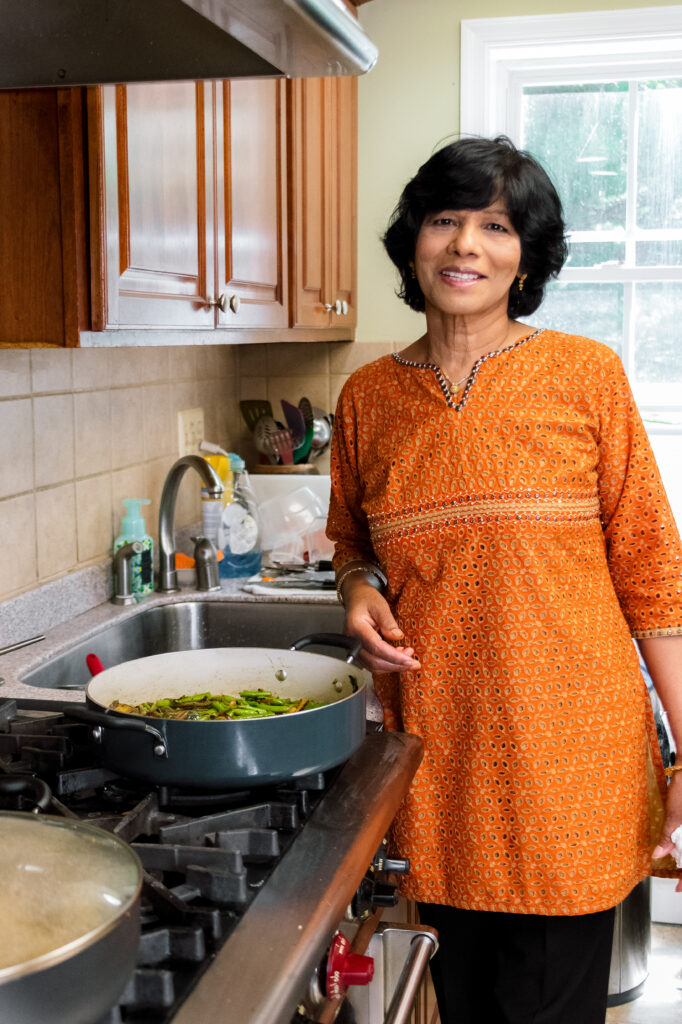 Known as Mummy to her three girls, Sara Joshua poses in her kitchen.
We learned an important lesson during our time at UMBC, taught to us by the late great Lamont Toliver, “Mr. T,” former director of the Meyerhoff Scholarship Program. In a moment of vulnerability, Aimee shared with Mr. T that she had been rejected by all of the Ph.D. programs she had applied to but had gotten into a master’s program.
In all his wisdom, Mr. T comforted Aimee with these wise words: “Not all paths from point A to point B are a straight line. Sometimes you have to take the long way to get where you want to go.” That’s a lesson that has stayed with us for some time and that, we soon realized during the pandemic, applied to Mummy.
By this time, Gina had started a family and we welcomed our next generation of children. The pandemic taught us how precious life is and that making every moment count is important. As sisters, we decided that we would work together to make Mummy’s dream of teaching our generation and future generations how to cook Kerala food come true.
After the pandemic began, Mummy retired from an over 40-year nursing career to help care for Chacha and avoid any risk due to COVID-19. With more time as a retiree, Mummy began experimenting with recipes and sharing them with close by family, who would pick up the care packages she would leave on the porch. They would then text or call her with feedback, helping perfect the recipes.
In April 2020, Mummy came into our room and asked if we wanted to take a picture of what she was cooking in the kitchen. So Jamie and Aimee, armed only with their iPhones and short notice to their friends online, began to livestream Mummy making Mango curry. Then the unexpected happened.
Thousands of people watched it within the first three days, and a flame was lit. Instead of waiting for perfection, we continued to dive into video after video, each an improvement on the one before. What started as a fun project became a thriving YouTube channel, Ammini Aunty’s A Pinch of Kerala, and a full-blown community of “Pinchers.” People were excited to learn from Mummy, and we were all thrilled to share her love for cooking with everyone.
Fast forward to today, our first cookbook, Ammini Aunty’s A Pinch of Kerala: A South Indian Inspired Cookbook, is being published. Thanks to the power of Kickstarter and Pinchers worldwide, what was just once a dream is now becoming a reality. As Mummy reminds her Pinchers, “If you put your mind to it, you can do it.” Don’t let your dreams stay a dream. Work toward making it a reality.
Jamie Joshua ’02, biological sciences, is the diversity, equity, and inclusion manager for Giant Food. Aimee Joshua ’03, M.S. ’05, computer science, is the senior manager, IT contracts, at PBS Distribution. Gina Wright ’05, biological sciences, is a dentist at a Veterans Affairs Medical Center.
]]>
Aimee, Jamie, and Gina Joshua have a lot in common. All three went to UMBC as members of the Meyerhoff Scholars Program. And the sisters all have great memories of growing up in a house filled...
https://umbc.edu/stories/three-sisters-keep-family-recipes-alive-in-book/
https://my3.my.umbc.edu/api/v0/pixel/news/137616/guest@my.umbc.edu/8b9de66ee2fe755d391c1d9411f14bcb/api/pixel
alumni
alumni-essay
biological-sciences
coeit
computer-science
fall-2023
magazine
meyerhoff-scholar
UMBC News & Magazine
https://my3.my.umbc.edu/groups/umbc-news-magazine
https://assets1-my.umbc.edu/system/shared/avatars/groups/000/001/943/24435aa6207c452e7bc15cc74b42c7bb/xsmall.png?1748556657
https://assets1-my.umbc.edu/system/shared/avatars/groups/000/001/943/24435aa6207c452e7bc15cc74b42c7bb/original.png?1748556657
https://assets2-my.umbc.edu/system/shared/avatars/groups/000/001/943/24435aa6207c452e7bc15cc74b42c7bb/xxlarge.png?1748556657
https://assets2-my.umbc.edu/system/shared/avatars/groups/000/001/943/24435aa6207c452e7bc15cc74b42c7bb/xlarge.png?1748556657
https://assets3-my.umbc.edu/system/shared/avatars/groups/000/001/943/24435aa6207c452e7bc15cc74b42c7bb/large.png?1748556657
https://assets1-my.umbc.edu/system/shared/avatars/groups/000/001/943/24435aa6207c452e7bc15cc74b42c7bb/medium.png?1748556657
https://assets2-my.umbc.edu/system/shared/avatars/groups/000/001/943/24435aa6207c452e7bc15cc74b42c7bb/small.png?1748556657
https://assets1-my.umbc.edu/system/shared/avatars/groups/000/001/943/24435aa6207c452e7bc15cc74b42c7bb/xsmall.png?1748556657
https://assets2-my.umbc.edu/system/shared/avatars/groups/000/001/943/24435aa6207c452e7bc15cc74b42c7bb/xxsmall.png?1748556657
UMBC News & Magazine
2
0
false
Thu, 07 Dec 2023 16:32:28 -0500
Thu, 07 Dec 2023 16:32:28 -0500
Grab a Seat at the Table

These days, it’s tempting to grow numb to the polarization of society and the breakdown in public discourse and to retreat into our silos of solidarity. But a liberal arts education has the potential to offer an antidote to these seemingly inevitable fates—through modeling and practicing empathy. At UMBC, students are invited to the table to share their stories and listen to their peers. These acts of educational hospitality help Retrievers find their why and pursue the public good.
Want weekly Top Stories sent to your inbox?

It’s the first day of class. You’re looking around, bright-eyed and a little nervous, and then your instructor smiles at the class and says, “One day you are all going to die.” Are you offended? Shocked? Titillated? Horrified? Collectively, the class titters. Already social bonds are forming as Christine Armstrong Mair, associate professor of sociology who specializes in gerontology, continues her spiel. “And if we’re all lucky, that won’t be for a long time.”
As sociologists, says Mair, or more broadly as leaders in an educational setting, “it’s not our task to make somebody think a certain way. Our task is to show them what exists in society and help them feel empathy for the human experience.”
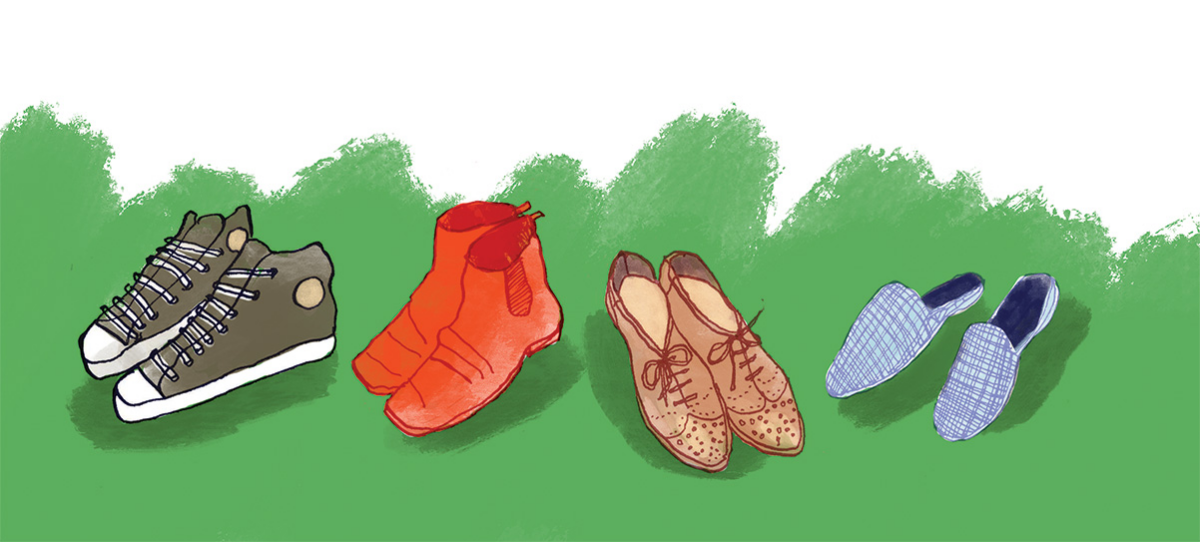
At its most pedestrian roots, empathy is putting yourself in someone else’s shoes. How can someone else’s emotional experience inform your own personal perspective?
In the best-case scenario, a college campus is a microcosm of its society: a crosshatch of races, ages, and socio-economic backgrounds. And UMBC holds true to those measures. But something different happens when you step into the Loop—you sit next to someone who didn’t go to your high school. You eat at the same table with someone outside of your cultural background. You take a test side by side with someone who voted differently than you. And even more than sharing space, you start sharing notes and books and stories—even your own story—with these strangers and then suddenly they’re no longer strangers.
When empathy is on the table, students and colleagues expand their capacity for hard work. You might change your thesis to address human trafficking or leave your home island to work toward healthy aging for all populations. So pull up a chair, step into someone else’s shoes, and partake in this grand educational potluck.
“With my background—what I’ve seen with human trafficking and migrant smuggling—what can I do as a person with my knowledge and responsibility?”
– Saydeh Karabatis, Ph.D. candidate
Building bridges across campus
You’re sitting at a beach-side cafe in Greece with your husband. It’s 2015 and Greece’s financial troubles are in the news, but the waves of migrants washing ashore are not yet as publicized. As you enjoy your coffee, you see a group of 40 to 50 people sitting seemingly aimless and distraught nearby. Based on their clothing, you make a guess that they are Muslims and Arabic speakers. What do you do?
If you’re Saydeh Karabatis, originally from Lebanon—and a survivor of the 17-year Lebanon civil war—and fluent in Arabic, you let that immediate moment of empathy guide you and approach the group.
Karabatis and her husband George, a professor of information systems at UMBC and from Greece, changed the plans for their summer in the Mediterranean to volunteer as translators, food finders, and listeners for the refugees, primarily fleeing the war in Syria and arriving in Greece in dire straits. They did so again in 2017.
As Karabatis interacted with these desperate groups and read more about their plight, she realized familiar patterns were emerging in their stories. They were not just migrants fleeing a war, they were trafficked people, paying dearly for not-safe passage, and many others headed toward labor and a life they did not sign up for. Struck by the limits of her actions—and even her emotional capacity for empathy—when Karabatis returned home to Maryland, she found her next step.
Karabatis, who has a master’s in computer science from UMBC and works for the university’s Division of Information Technology, knew she would need to fill her time when her two sons left for college. Karabatis asked herself, “With my background—what I’ve seen with human trafficking and migrant smuggling—what can I do as a person with my knowledge and responsibility?”

She contacted Vandana Janeja, then chair of information systems, and explained the project she wanted to complete for her Ph.D. During her master’s, Karabatis had tried to conduct a research project on human trafficking for a class with Janeja but couldn’t find a robust data set to use for her project and ended up having to leave the work incomplete. This time, she pitched using the stories of trafficked people. “Instead of dealing with numbers, numbers as data, I am now dealing with stories as data—the stories of people being trafficked,” says Karabatis.
It’s not been easy going. Many trafficked people are not open about their stories, for fear of retribution or simply because of how horrific the experience was. Additionally, it’s hard for Karabatis to take in their trauma. “I’m reading about all these abuses,” says Karabatis. “I’m reading about sex trafficking, labor trafficking, organ trafficking, human smuggling. I can’t imagine—how can a human being do something like that to another human?”
Eventually though, with the end goal of combating the network of smuggling routes, Karabatis says, you need to reach a level where you can try to put your emotions aside: “You need to detach yourself from these emotions if you want to do something to help these people. If your emotions are the only thing driving you, you wouldn’t be able to produce the research. Use these emotions as a spark and then put them on the side.”
Caring starts with listening
You’re a teenager riding the bus for fun in Puerto Rico, killing time by people watching. You’re struck by the number of older adults on the bus, noticing their many bags stuffed with x-rays and other apparent medical paperwork. Unthinkingly, you just assume they’re enjoying the ride like yourself, but this older generation seems eager to talk.
If you’re Jaminette Nazario, a curious if bored high schooler, you strike up a conversation.
What she heard from her fellow travelers shook her: “‘We don’t have people to help….’ ‘My wife just died of cancer….’ ‘I need to use this bus to get to my medical appointments.’” It wasn’t until she was pursuing her bachelor’s degree in social sciences that Nazario was hit by the realization that those conversations might have been the only time those older bus riders had talked to someone that day. “So I started thinking about the many barriers older adults have in order to achieve healthy aging,” she says. “When older adults don’t have resources or people, they miss out on social networks that are vital to healthy aging.”
This aha moment would propel Nazario to a master’s degree in public health with a focus on gerontology, but in order to study further, she’d have to leave her island for the next academic step.
Now in her second year of UMBC’s Ph.D. program in gerontology—a joint program with the University of Maryland, Baltimore—Nazario is beginning to research aging Hispanic immigrants and their increasing challenges accessing medical care.
And unlike her fellow bus riders, she’s not doing this alone. “Even though it’s really hard to be far from family, I feel like I’m home here. And I love how Dr. Mair teaches.” Like most classes, says Nazario, there are readings and discussion, but Mair brings a “specific dynamic” to the setting. Each class starts with questions prepared by the students, which is really empowering, says Nazario. It might end up that the class all resonates with one question and they stay on that topic, guiding the trajectory of the discussion.
In summer 2022, Nazario joined Mair and others from the gerontology program at a conference in Japan. She presented a poster on her research and walked away from her talk with a new level of confidence. “There were professionals from Japan and China and they’re asking me about something in the United States…it was kind of cool. People came up and treated me with so much respect.”
Students in Mair’s gerontology classes are finding their drive to solve crises in aging care not only because they might have loved ones suffering, but because aging (if we’re lucky) and death are unifying elements. “It’s something that really applies to all of us,” says Mair, “to make sure that we’re taking care and setting up a good system so that when we all arrive there, that us and all of our people that we care about are okay.”
Inclusive classrooms by design
You walk to the front of the media and communications class you’re teaching. Students are sitting in traditional desks in rows, facing the whiteboard where you’ll teach. They’re silent, spaced out or on their phones. They seem to breathe a sigh of relief when you walk in, grateful to know where to put their attention. Later, in a different section of that class, you meet in a newly designed lecture hall filled with round tables and no clear lectern space. In this format, the students are already grouped together and chatting.
If you’re Donald Snyder, principal lecturer in media and communication studies, you know there is science behind what forms good class cohesion and participation. He learned it from the experts in UMBC’s Faculty Development Center (FDC).
In addition to learning about and playing around with classroom set-up to facilitate more natural conversations (and to rid the learning experience from a “perceived hierarchy” as FDC Director Linda Hodges calls it), Snyder and others who use the FDC are supported in using inclusive and culturally responsive teaching.
While culturally responsive pedagogy isn’t a new concept—it centers and nurtures students’ unique cultural strengths—Hodges says that recent world events have brought the teaching style more into focus. Citing the death of George Floyd and the nation’s response—especially young people—and the COVID-19 pandemic as two significant flashpoints, Hodges says inclusive pedagogy and empathetic practices have become more imperative than ever. Room design is just one tool in the FDC toolbelt that can work to democratize students’ experience. It can erase the divide between the front row handraiser and the back row hider, giving equal footing to all types of students and their stories.
“Instructors are recognizing that they need to try to connect with and hear their students’ voices,” says Hodges. “This will create a sense of belonging. It’s become quite clear in the research that one of the key factors in whether students succeed and persist in education is the feeling of belonging.”
Snyder has made the most of the FDC’s offerings, including inviting Hodges’ team to observe his teaching and offer feedback. He starts many of his classes with some tools for students to learn about self-regulation, basically how to use available resources to make the most of education. He introduces them to Bloom’s Taxonomy, which places rote memorization at the bottom of the pyramid and evaluating and creating a unique argument at top. “I want the students to know, I’m not asking to memorize anything,” says Snyder, “but we need to learn to be critical when we’re thinking about media and communication texts and how these things operate.”
Giving students tools to succeed in college—go to office hours, block out time for studying, get enough sleep—may seem basic and far afield from teaching and practicing empathy, but in the taxonomy of educational success, says Snyder, this foundation leads to the heavy-lifting tools at the top of the pyramid.
Snyder helps them harness existing interests, in tech or media, and then run with it, academically. He wants them to ask, “‘How can I turn that switch? What is the thing that I can grab onto? What do I really want to know about?’”
He also listens to them, and attempts to model vulnerability in the classroom. “Yes, these are students and they need to understand content, but they’re also humans who are struggling and we’re all struggling and there’s a human condition aspect we can’t ignore as instructors.”

Swapping stories strengthens neighborly bonds
You’re driving your car on tour in Texas when you’re hit by a criminally intoxicated drunk driver. You survive, but a host of physical and psychological repercussions are still taking their toll 10 years later. As a musician, you fuel your art with your resiliency and work through the healing process by creating music. But when the pandemic hits, and live, in-person music disappears, you look for a pivot point—and the community you’re missing.
If you’re Kristin Putchinski, a student in UMBC’s M.F.A. program for intermedia and digital arts, you lean into the concept of “platonic intimacy.”
Putchinski coined the term to sum up her goal of “trying to strengthen neighborly bonds. What I’m looking for is an intimate experience between two people. And when people hear intimacy, they tend to think that it’s about a romantic or sexual component. But how do I frame that intimacy—and how important intimacy is—in terms of friendship and neighborliness?”
Through a graduate assistantship jointly funded by jointly funded by UMBC and the University of Maryland, Baltimore’s Community Engagement Center (CEC), Putchinski was given the opportunity to shadow CEC’s then-director Tyrone Roper and learn about the center’s mission, which includes strengthening neighborly bonds. Roper told Putchinski they were looking for ways to engage the 18- to 24-year-old demographic. When Putchinski was tasked with creating an art project for CEC the following semester, she kept this age goal in mind.
As a student in UMBC’s intermedia program, Putchinski “explores the textures between mediums,” she says. As a musical artist who performed under the stage name ellen cherry, “I have 25 years of experience as a performing songwriter and storyteller, creating my own and interpreting other people’s stories.” So she began to imagine a strange game of telephone that would give participants the opportunity to swap stories, with the end result of creating instances of platonic intimacy.
This multifaceted project connected post-high-school-aged individuals with older generations through curated, facilitated sessions. The participant-pairs met four different times and talked about a song, a photograph, and a memory—and at the last session, the neighbors “swapped” their stories. A recording of the swap was sent to local artists who interpreted the stories into their own mediums—painting, poetry, and a video soundscape. Then, at an event open to the public in the CEC, the storytellers took the stage, retelling their neighbor’s story. For example, a Latinx college graduate took to the stage to reshare her stranger-turned-partner’s tale of being raised in foster care in 1970s Baltimore.
Putchinski was eager to find out “when you talk to somebody that’s 40 years different from you…did your perceptions change about yourself, about them, and what were those changes and the answers?”
It makes sense she’s asking these questions based on her ongoing empathy toward the man who altered her life in an accident 10 years ago. “It was very conflicting for me to be the victim of a crime that I really feel like was committed not by a criminal but by a person who abuses alcohol. At the base level, he’s a human being. How can we think about his human potential after this experience and mine?”
“Imagine intensely” a better way forward
One of the greatest assertions of the liberal arts comes from Percy Bysshe Shelley’s essay “A Defence of Poetry.” The short-lived husband of Frankenstein’s creator writes, “A man, to be greatly good, must imagine intensely and comprehensively; he must put himself in the place of another and of many others; the pains and pleasures of his species must become his own.”
On college campuses, and at UMBC in particular, through thoughtful classroom instruction and intentional commitment to community, students trade their stories—pains and pleasures alike. Less of a transaction and more of a gift, these stories are invitations to grow in understanding, change your opinion, or shape your research.
But walking in someone else’s shoes doesn’t mean you misplace your own shoes along the way—in fact professors hope it helps you find your footing at UMBC. “That open-mindedness and appreciation and empathy does not necessarily mean that you lose other parts of yourself,” says Anne Brodsky, professor and chair of the psychology department. “It shouldn’t be a zero-sum game.”
You’re walking down Academic Row. You’re a first-generation college student with a lot of questions. You’re a returning student giving college a second (or third) chance. You’re a first-year who misses the familiar halls of high school. You see other Retrievers walking in groups, heading into classrooms, rubbing True Grit’s bronze nose, making conversation with their peers. What do you do?
]]>
These days, it’s tempting to grow numb to the polarization of society and the breakdown in public discourse and to retreat into our silos of solidarity. But a liberal arts education has the...
https://umbc.edu/stories/grab-a-seat-at-the-table-empathy/
https://my3.my.umbc.edu/api/v0/pixel/news/137271/guest@my.umbc.edu/777eb34ff02b7fc72d1664adf771099a/api/pixel
campus-life
coeit
computer-science
fall-2023
feature
imda
information-systems
magazine
mcs
UMBC News & Magazine
https://my3.my.umbc.edu/groups/umbc-news-magazine
https://assets1-my.umbc.edu/system/shared/avatars/groups/000/001/943/24435aa6207c452e7bc15cc74b42c7bb/xsmall.png?1748556657
https://assets1-my.umbc.edu/system/shared/avatars/groups/000/001/943/24435aa6207c452e7bc15cc74b42c7bb/original.png?1748556657
https://assets2-my.umbc.edu/system/shared/avatars/groups/000/001/943/24435aa6207c452e7bc15cc74b42c7bb/xxlarge.png?1748556657
https://assets2-my.umbc.edu/system/shared/avatars/groups/000/001/943/24435aa6207c452e7bc15cc74b42c7bb/xlarge.png?1748556657
https://assets3-my.umbc.edu/system/shared/avatars/groups/000/001/943/24435aa6207c452e7bc15cc74b42c7bb/large.png?1748556657
https://assets1-my.umbc.edu/system/shared/avatars/groups/000/001/943/24435aa6207c452e7bc15cc74b42c7bb/medium.png?1748556657
https://assets2-my.umbc.edu/system/shared/avatars/groups/000/001/943/24435aa6207c452e7bc15cc74b42c7bb/small.png?1748556657
https://assets1-my.umbc.edu/system/shared/avatars/groups/000/001/943/24435aa6207c452e7bc15cc74b42c7bb/xsmall.png?1748556657
https://assets2-my.umbc.edu/system/shared/avatars/groups/000/001/943/24435aa6207c452e7bc15cc74b42c7bb/xxsmall.png?1748556657
UMBC News & Magazine
1
0
false
Wed, 15 Nov 2023 14:07:28 -0500
Cracking the code: International collaboration fosters cybersecurity
UMBC’s work in strengthening students’ preparedness in cybersecurity defense is proving effective not only on campus, but well beyond. This summer, three UMBC students competed in an international “capture the flag”-style cybersecurity competition in Japan, with one Retriever taking home a victory—and all three bringing back a greater range of expertise. This opportunity helped UMBC students build global relationships and attain more practical experience in cyber defense.
In August, Kevin Chen ’23, computer science, Zachary Amoss ’24, computer science, and Leela SaiNadh Gade, M.P.S. ’24, cybersecurity, competed in the 2023 Country-to-Country Capture the Flag (C2C-CTF) event at the Hiyoshi Campus of Keio University in Yokohama, Japan. The competition—which convened in person for the first time this summer since it began in 2020—brought together 80 students from around the world to team up and complete 25 cybersecurity challenges within 10 hours. Teams were tasked with solving challenges such as identifying hackers in various cyber scenarios or using open-source investigative methods to pinpoint geographic locations of different photographs.
Among the awardees were Chen and his team, which included students from the U.K, China, Japan, and Israel. The team placed fourth overall in C2C-CTF’s main challenge and received the Hitachi award, named after one of the event’s sponsors. Claiming a victory wasn’t the only thing Chen wanted to accomplish at the competition.
“My [goal] was to learn extensively, tackle novel technical obstacles, and engage in international collaboration. I embarked on this journey with the determination for achieving victory, fully aware of the formidable nature of that challenge,” he says.
Code cracking in real time
Chen is a member of UMBC’s CyberDawgs team and has been participating in cyber competitions throughout the year in preparation for C2C-CTF. His prep paid off as he helped his team solve the final problem of the competition, a cryptography challenge in which competitors had to correctly guess an image’s location without being provided any identifying information.
“Inside the images were a set of true images and false images [which] were meant to lead you down a rabbit hole,” Chen explains. “When selecting the true images, we had to piece them together in a certain order to get the code for that challenge.”
The team used open-source intelligence methods to solve the problem, such as paying attention to the direction of the sun in an image to narrow down the range of countries, identifying specific landmark clues, and analyzing the images’ metadata. Minutes before the competition’s conclusion, Chen’s team cracked the code, earning them 300 points to secure the win.
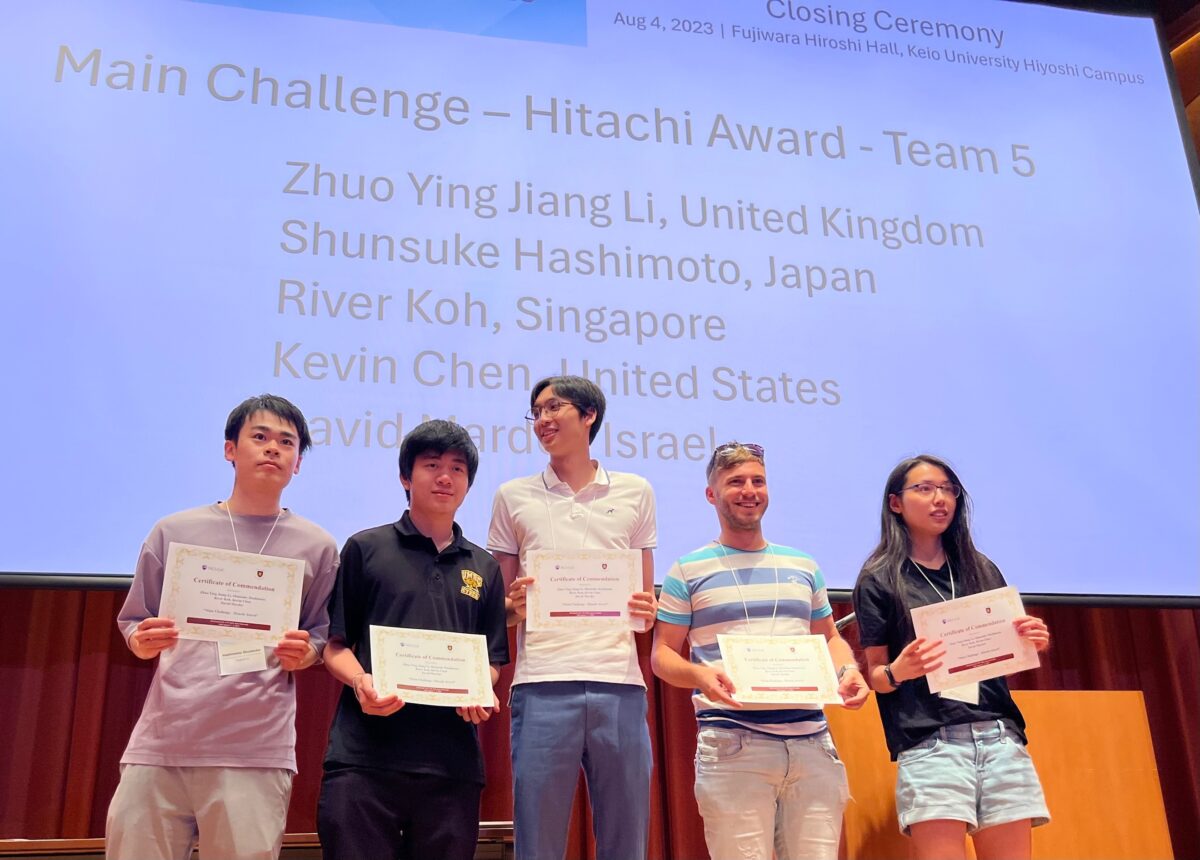 Kevin Chen (second from left) and teammates accepting the Hitachi award at the 2023 Country-to-Country Capture the Flag closing ceremony at Keio University. (Image courtesy of Karl V. Steiner)
“My entry into the world of cybersecurity began just a year ago. Despite my relative newness to the cyber realm and my position as one of the younger members on the team, I played a pivotal role in addressing key challenges that propelled us into the top four [ranking],” said Chen. “My involvement in the [C2C-CTF] event marked a significant milestone. This allowed me to achieve success on an international stage and served as a gratifying culmination of my trip.”
An international partnership
The annual C2C-CTF competition is organized by the International Cyber Security Center of Excellence (INCS-CoE), a global university network dedicated to securing critical systems against cyber threats through research, policy, education, and training. UMBC is one of the founding charter members of the INCS-CoE, which currently includes 12 academic institutions across six countries and recently expanded into Australia, France, and Israel.
Karl V. Steiner, UMBC’s vice president for research and creative achievement, has worked with the group since its creation in 2019, and serves as the INCS-CoE’s 2023 board chair. Steiner joined the UMBC team at Keio University during this year’s C2C-CTF event and shared his pride in seeing UMBC students competing at such a high level on an international stage.
“I was extremely proud to see our students compete at the international level. Competing in this competition provided them with a valuable set of new experiences and a set of new friends from across the globe. Each one of our students was fully dedicated to the spirit of competition,” shares Steiner.
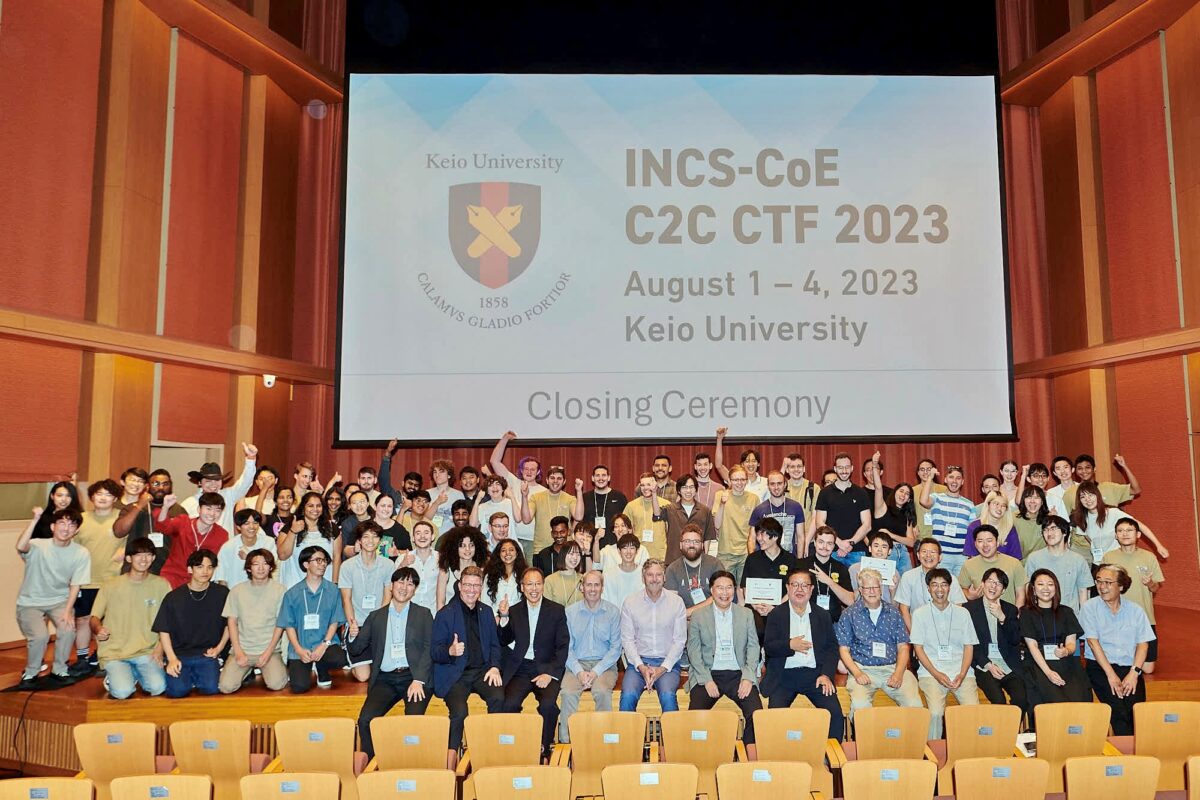 Karl V. Steiner (front row, second from left) with members of the INCS-CoE and the student competitors at the 2023 Country-to-Country Capture the Flag competition. (Image courtesy of Karl V. Steiner)
Chen made note of the significance of collaborating with students from around the world, sharing that the experience helped him to “absorb valuable insights into the cyber capabilities and experiences of students globally. The contrasting nature of our experiences…was both enlightening and enriching.”
Kazuo Noguchi, executive director of the INCS-CoE added: “ The vision for this event is to provide inclusive and international education and training which can enhance not only new skills, but also, and more importantly, promote international friendship, collaboration, ethics, and teamwork.”
A “real world” approach to cybersecurity
Rick Forno, principal lecturer in computer science and electrical engineering and assistant director of UMBC’s Center for Cybersecurity, explains that competitions like the C2C-CTF provide students with a look into the “real world” of cyber defense.
“The competition provides the next generation of cyber defenders an opportunity to tackle technical cybersecurity challenges and gain insight into the global nature of cybersecurity, [along with] the need for effective intercultural collaboration in working toward a common goal,” says Forno.
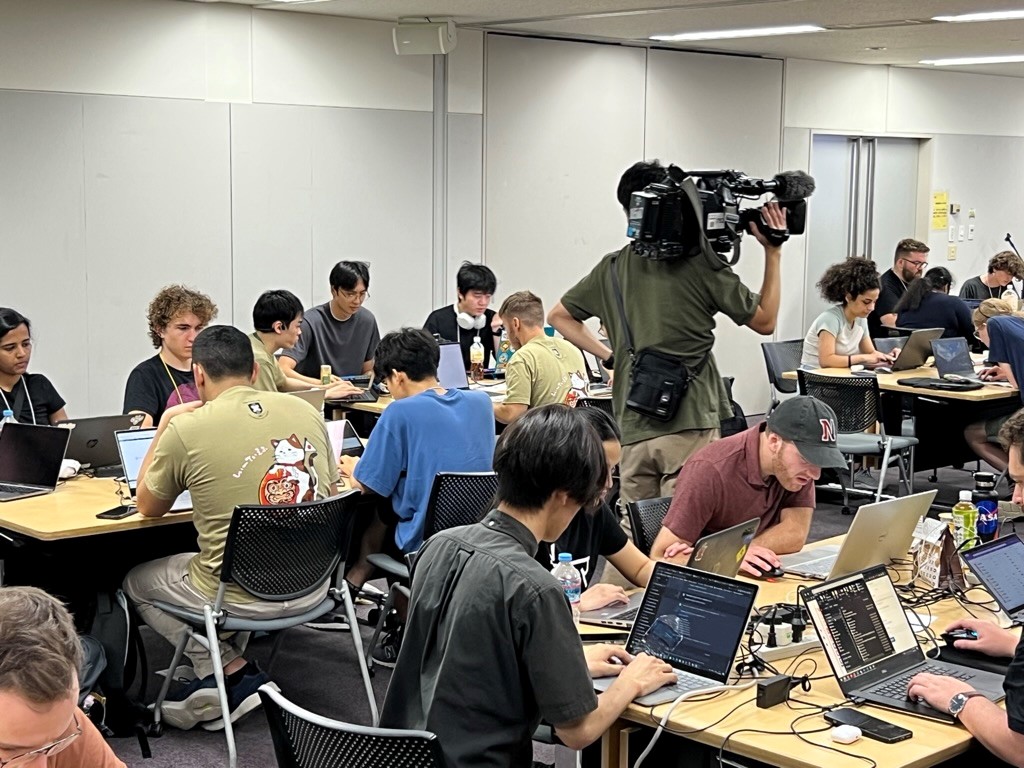 Students competing during the 2023 Country-to-Country Capture the Flag competition at Keio University. (Image courtesy of Karl V. Steiner)
Forno also serves as a coach for the UMBC CyberDawgs and adds that “structuring the C2C-CTF event with teams composed of members from different countries is an innovative idea that adds additional real-world ‘flavor’ to what participants will encounter later as cybersecurity professionals around the world.”
CyberDawgs member Zachary Amoss shared that while he has gotten the opportunity to compete with the team at national events, “the opportunity to represent UMBC on the global stage [at C2C-CTF] was a once-in-a-lifetime opportunity. I highly recommend all current UMBC students, especially those who are already in cybersecurity spaces such as the CyberDawgs, to compete in next year’s event.”
Leela SaiNadh Gade added that the competition has been “an enriching experience that expanded my understanding immensely. The learning I acquired from this event will serve as an invaluable asset in my future endeavors.”
]]>
UMBC’s work in strengthening students’ preparedness in cybersecurity defense is proving effective not only on campus, but well beyond. This summer, three UMBC students competed in an international...
https://umbc.edu/stories/umbc-capture-the-flag-cybersecurity-competition-japan/
https://my3.my.umbc.edu/api/v0/pixel/news/136423/guest@my.umbc.edu/aaaf6362c9bbd38d03ebe32aeccf2cbd/api/pixel
coeit
community
computer-science
csee
cybersecurity
news
science-and-tech
UMBC News & Magazine
https://my3.my.umbc.edu/groups/umbc-news-magazine
https://assets1-my.umbc.edu/system/shared/avatars/groups/000/001/943/24435aa6207c452e7bc15cc74b42c7bb/xsmall.png?1748556657
https://assets1-my.umbc.edu/system/shared/avatars/groups/000/001/943/24435aa6207c452e7bc15cc74b42c7bb/original.png?1748556657
https://assets2-my.umbc.edu/system/shared/avatars/groups/000/001/943/24435aa6207c452e7bc15cc74b42c7bb/xxlarge.png?1748556657
https://assets2-my.umbc.edu/system/shared/avatars/groups/000/001/943/24435aa6207c452e7bc15cc74b42c7bb/xlarge.png?1748556657
https://assets3-my.umbc.edu/system/shared/avatars/groups/000/001/943/24435aa6207c452e7bc15cc74b42c7bb/large.png?1748556657
https://assets1-my.umbc.edu/system/shared/avatars/groups/000/001/943/24435aa6207c452e7bc15cc74b42c7bb/medium.png?1748556657
https://assets2-my.umbc.edu/system/shared/avatars/groups/000/001/943/24435aa6207c452e7bc15cc74b42c7bb/small.png?1748556657
https://assets1-my.umbc.edu/system/shared/avatars/groups/000/001/943/24435aa6207c452e7bc15cc74b42c7bb/xsmall.png?1748556657
https://assets2-my.umbc.edu/system/shared/avatars/groups/000/001/943/24435aa6207c452e7bc15cc74b42c7bb/xxsmall.png?1748556657
UMBC News & Magazine
1
0
false
Thu, 19 Oct 2023 18:06:47 -0400
Thu, 19 Oct 2023 18:06:47 -0400
UMBC’s 2023-2024 Fulbright Student Program recipients announced
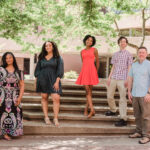
This year, the U.S. Fulbright Student Program, the U.S. government’s flagship international exchange program, has awarded nine UMBC students and alumni top research and teaching placements in countries such as Japan, Taiwan, and North Macedonia.
Each year, more than 10,000 students apply with just over 2,000 selected from hundreds of colleges and universities across the U.S. In the last decade, UMBC students and alumni have received more than 85 Fulbright U.S. Student Program awards for research and teaching placements in Africa, Asia and the Pacific, the Middle East, South America, and Europe. UMBC was named a Fulbright Top Producing Institution in 2019 – 2020.
This year’s class includes research award recipient Paul Ocone ’22, individualized study, who will be conducting research at Meiji University School of Global Japanese Studies in Japan. Fulbright research awards provide funding for research and training efforts overseas with a focus on non-Western foreign languages and area studies. Additionally, there are eight UMBC recipients of the English Teaching Assistant (ETA) award. ETA’s develop their own language skills and knowledge of their host country while working with student in elementary through college to strengthen their English-language abilities and knowledge of the U.S.
Three alumni will be headed to Taiwan to further their passion for global languages and communities: Nailah-Benā Chambers ’23, global studies, Kara Gavin ’20, English, and Milan Richardson ’23, bioinformatics.
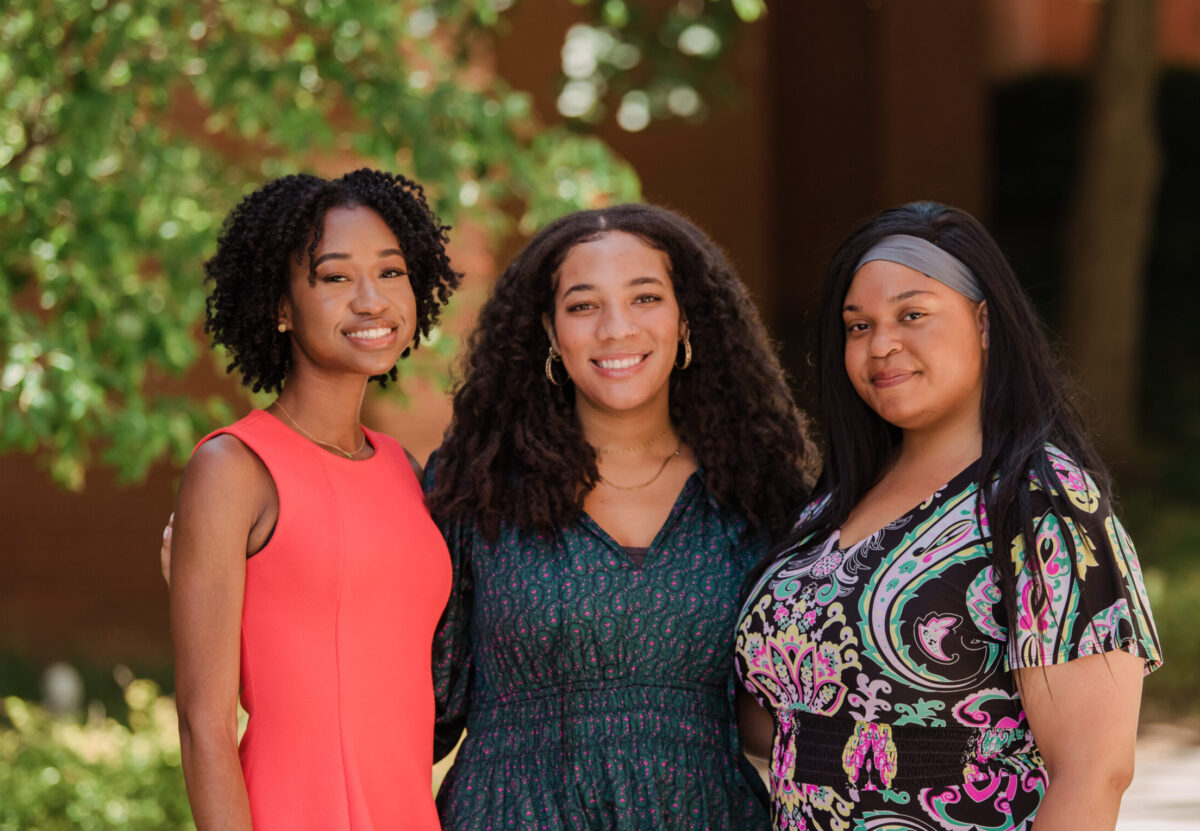 Kara Gavin, Nailah-Benā Chambers, and Milan Richardson. (Marlayna Demond ’11/UMBC)
Gavin brings experience as a Teaching of English as a Second Language (TESOL) volunteer which she completed during her study abroad program at the University of Brighton in the U.K. Chambers began learning how to move between different languages early in life as a student in a Chinese-language skills course. She later became a tutor, a skill she continued at UMBC’s English Language Institute (ELI). Teaching Baltimore Public City School’s diverse student population inspired Richardson to apply to the Fulbright program where she will continue working with students from all backgrounds.
David Bullman ’22, ancient studies, served in the U.S. Army as a musician and public diplomat. He will be returning to North Macedonia, one of the countries he previously served in.
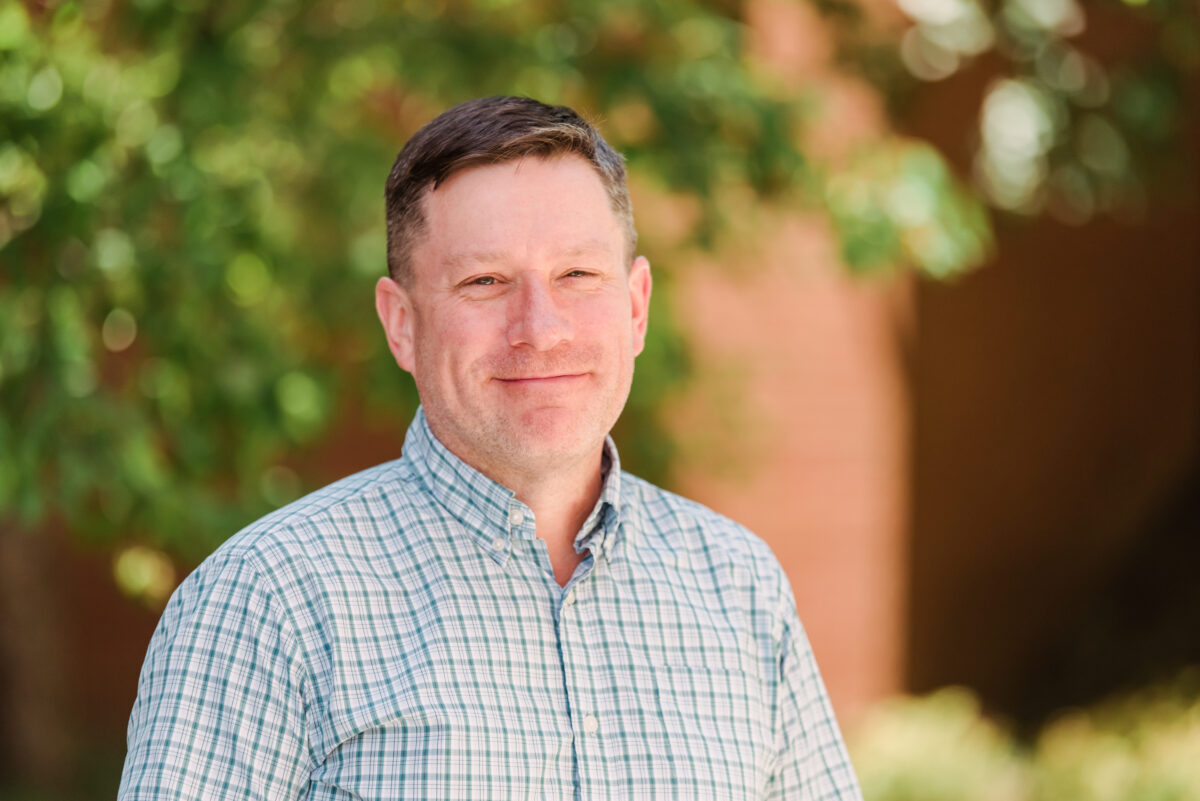 David Bullman. (Marlayna Demond ’11/UMBC)
In addition to teaching English, Leah Michaels, M.F.A ’21, intermedia and digital arts, will be conducting research for two films and teaching film workshops for the community in Piła, Poland.
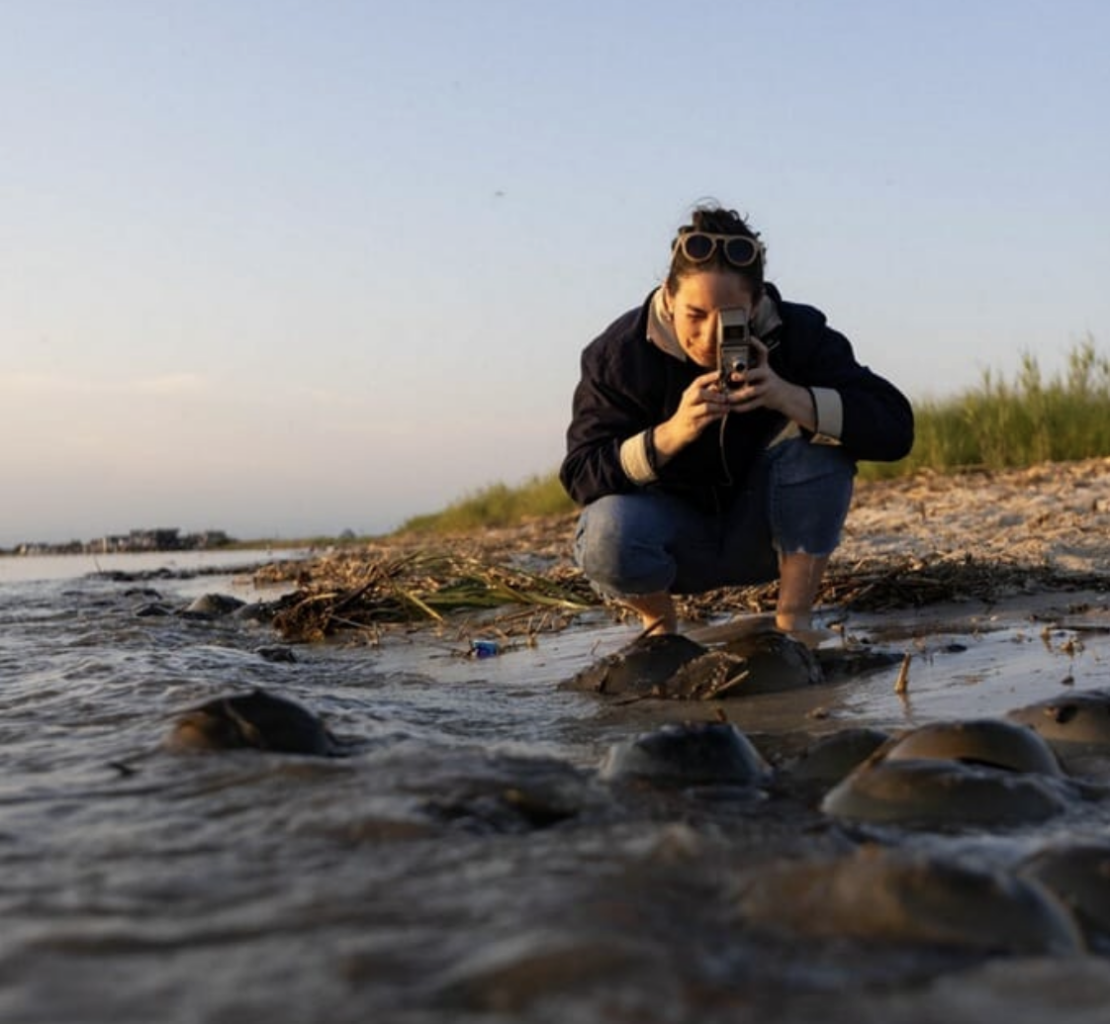 Leah Michaels in Cape May shooting the horseshoe crab mating period for a film she’s working on. (Image courtesy of Leah Michaels)
Tiffany Powell ’23, TESOL, spent three years teaching English in Seoul, Korea and will continue teaching in Romania after she graduates in December.
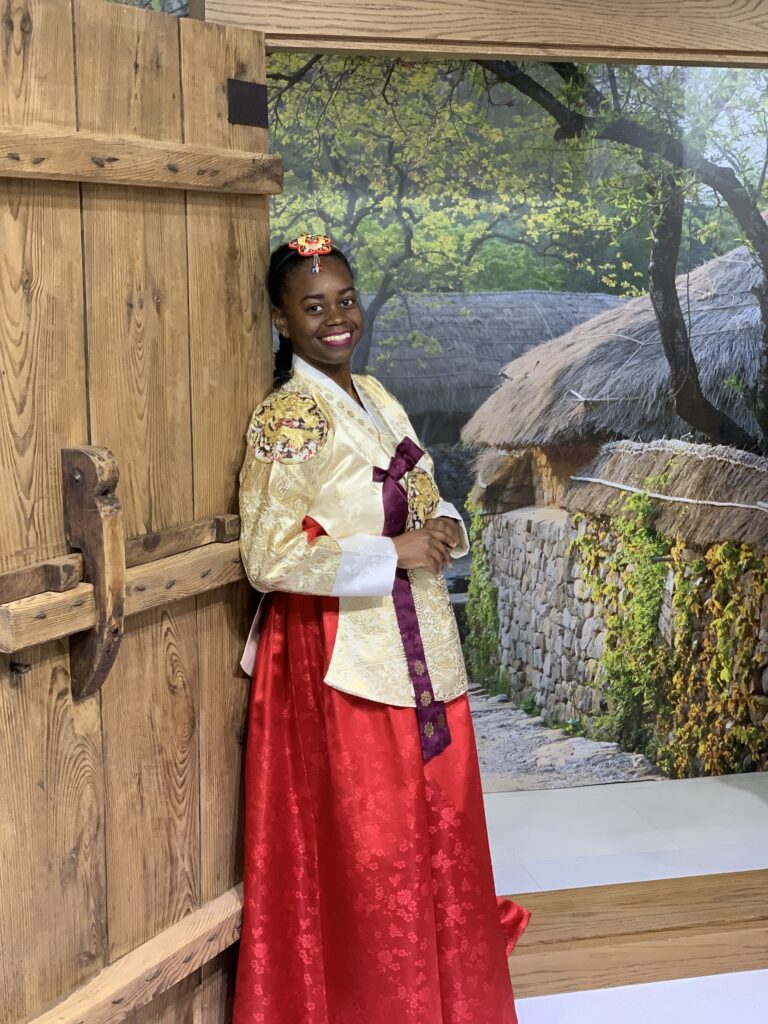 Tiffany Powell in Seoul wearing a hanbok, South Korean traditional clothing. (Image courtesy of Tiffany Powell)
Sianna Serio ’23, computer science, who studied abroad in France, Spain, and the U.K., will head to the Slovak Republic to teach high school students.
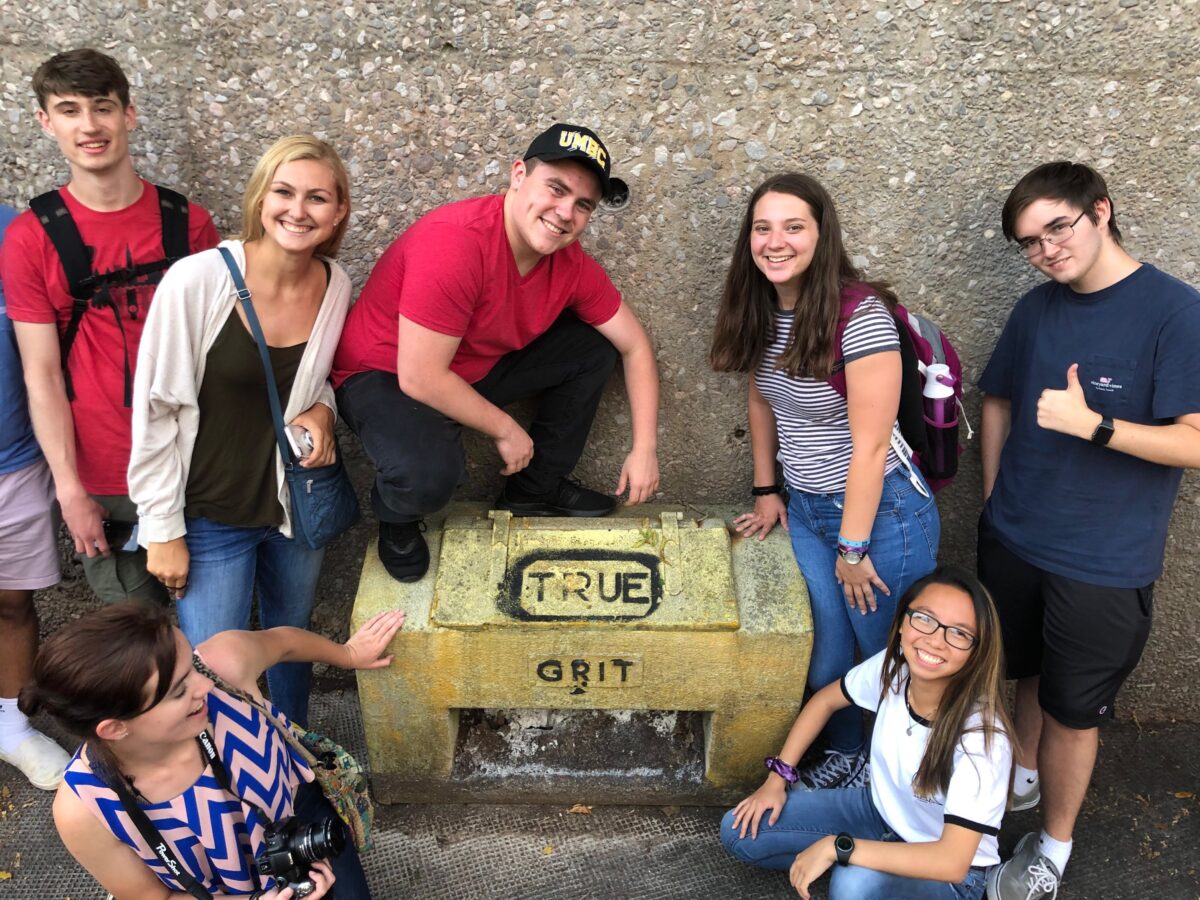 Sianna Serio, kneeling on right, in Bristol, U.K. (Image courtesy of Sianna Serios)
As a former marketing assistant at the ELI, Tasneem Mansour ’20, modern languages, linguistics and intercultural communication, supported visiting students from Peru, Nagoya and Tokyo, Japan. Mansour will head to South Korea.
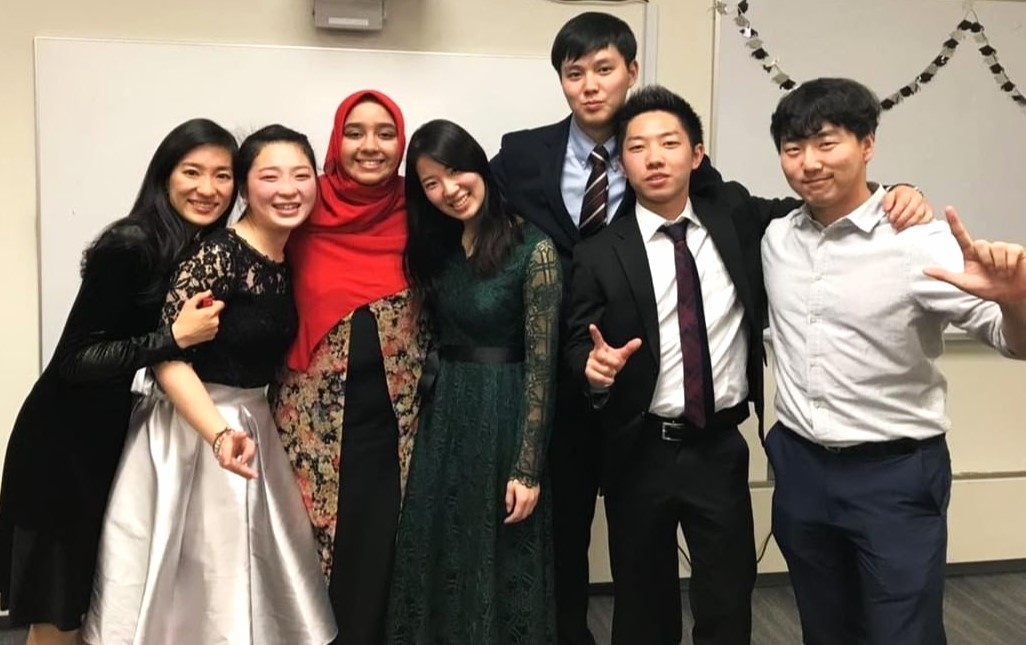
Tasneem Mansour, third from the left, with students from Nippon Sport-Science University in Tokyo, Japan. (Image courtesy of Tasneem Mansour)
UMBC’s global outlook
UMBC’s commitment to international collaboration and research begins at the Center for Global Engagement, which connects students and faculty from the U.S. with students and distinguished faculty from more than 100 countries with unique international academic opportunities. Together, they further the research and skills needed to address long-standing and new global challenges.
Brian Souders, M.A.’19, TESOL and Ph.D. ’09, language, literacy and culture, the associate director of global learning of the Center for Global Engagement, has led students through the Fulbright application process, as UMBC’s Fulbright Program advisor, for the last decade. “Our students are high achievers, the application process is a place for them to share their story,” says Souders. “Faculty and staff are there to ensure each student’s application reflects their years of hard work and the skills they have developed to collaborate with partners across the world.”
Research at home and abroad
With the vast network of Fulbright alumni at UMBC and across the U.S., it’s always helpful to get tips on how to conduct research in a new country and in a new language. Fulbright recipient Ocone, a long time fan of all things anime, began developing his ethnographic research skills with the support of Bambi Chapin, associate professor of anthropology. Chapin, a 1999 – 2000 Fulbright recipient, taught Ocone the theoretical and practical aspects of ethnographic research which he will now use to research the politics of inclusion and exclusion in otaku (anime/manga fan) spaces.
Chapin, along with Julie Christ Oakes, the assistant director of curriculum and retention of the Honors College and a 2001 – 2002 Fulbright research award recipient to Japan, also workshopped Ocone’s research proposal and Fulbright application. Oakes also shared her insights on the Fulbright experience.
“I went to Japan to do research for my dissertation research,” says Oakes. “I have a good idea of what [Ocone] will face as a relative “newbie” abroad and a non-native Japanese speaker and reader.”
The Fulbright experience is also about nurturing relationships with faculty abroad. Ocone said he feels honored for the opportunity to further his research with Kaichiro Morikawa, an associate professor at Meiji University and author of one of the foundational books on otaku spaces. Morikawa will help Ocone navigate the various resources on otaku culture. He wrote in Ocone’s recommendation letter that his “research is highly original as well as effectively focused,” and says he looks forward to supporting Ocone during his time at the university and in Japan.
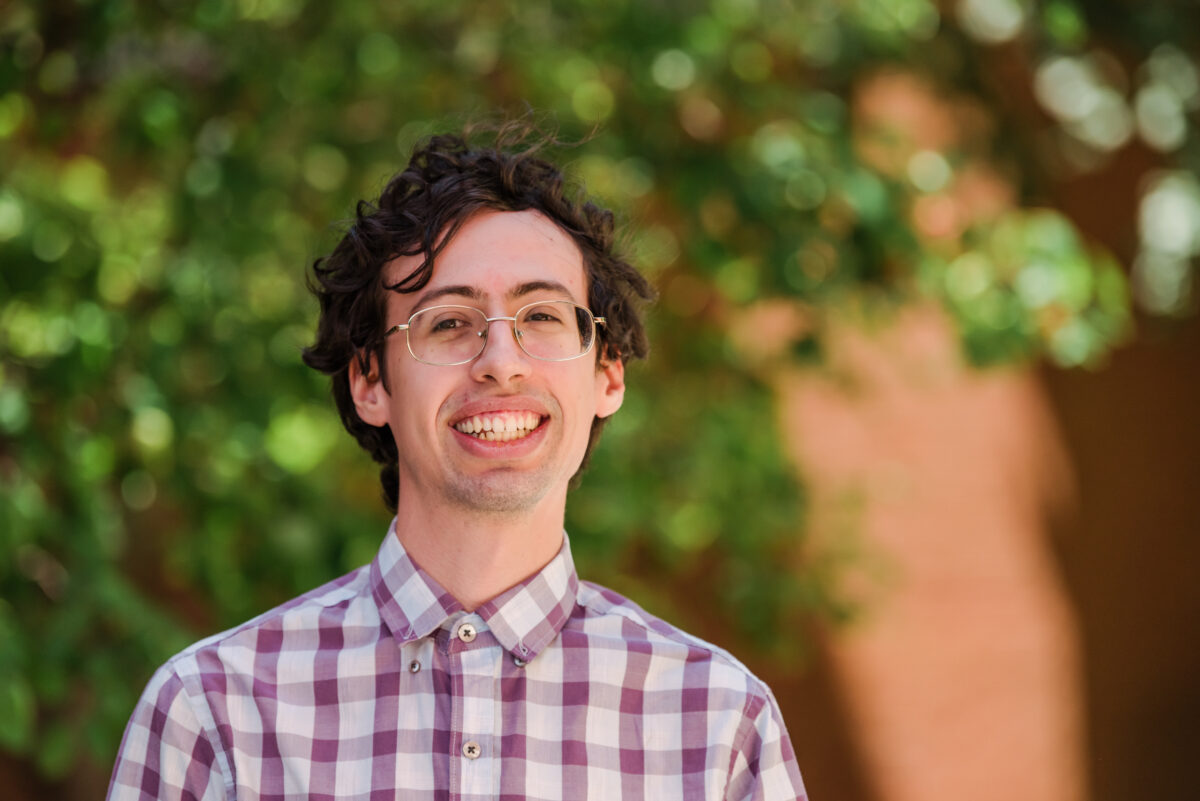 Paul Ocone. (Marlayna Demond ’11/UMBC)
“I am immensely grateful to all of my mentors for guiding me on my journey through my undergraduate degree—from my earliest fuzzy and broad ideas of what I wanted to do, to the more specific research plans, and to the rewarding thesis that eventually emerged,” says Ocone. “I’ll be continuing research on topics that I care deeply about, research that I will likely build upon in graduate school and beyond.”
Fulbright support network
The road to being a Fulbright recipient begins day one students’ UMBC experience as they explore majors, create a network of mentors, and hone their research skills. At the end of their junior year, students develop their initial application at the Fulbright Base Camp led by Souders, who is a 2023 – 2024 Fulbright International Education Administrator award recipient. “The camp helps elevate and support students to reach their Fulbright goals,” says Souders. “Students share drafts of their essays with me for feedback prior to the campus deadline, the first day of the fall semester. They participate in a campus evaluation process with UMBC faculty and staff to receive feedback on their applications.”
Souders, Chapin, and Maryam Elhabashy ’21, anthropology, a research assistant at Rutgers University and a 2022 Fulbright recipient to Kuwait City, discuss this process on the Retrieving the Social Science podcast, produced by UMBC’s Center for Social Science Scholarship.
“The panel gives students advice about how to craft a project, like how to take it apart and re-put it back together, what we see as strengths,” says Chapin. “We support them and encourage them as they go through that really difficult intellectual work, emotional work of figuring out how to make their strong projects even stronger.”
Learn more about the UMBC’s international education opportunities.
]]>
This year, the U.S. Fulbright Student Program, the U.S. government’s flagship international exchange program, has awarded nine UMBC students and alumni top research and teaching placements in...
https://umbc.edu/stories/2023-fulbright-recipients/
https://my3.my.umbc.edu/api/v0/pixel/news/134370/guest@my.umbc.edu/516ede6d25c349e81ae689cbf97868dc/api/pixel
ancientstudies
anthropology
cahss
coeit
computer-science
english
globalstudies
honorscollege
inds
intermedia-and-digital-arts
international-stories
llc
mlli
news
policy-and-society
rca-2
tesol
UMBC News & Magazine
https://my3.my.umbc.edu/groups/umbc-news-magazine
https://assets1-my.umbc.edu/system/shared/avatars/groups/000/001/943/24435aa6207c452e7bc15cc74b42c7bb/xsmall.png?1748556657
https://assets1-my.umbc.edu/system/shared/avatars/groups/000/001/943/24435aa6207c452e7bc15cc74b42c7bb/original.png?1748556657
https://assets2-my.umbc.edu/system/shared/avatars/groups/000/001/943/24435aa6207c452e7bc15cc74b42c7bb/xxlarge.png?1748556657
https://assets2-my.umbc.edu/system/shared/avatars/groups/000/001/943/24435aa6207c452e7bc15cc74b42c7bb/xlarge.png?1748556657
https://assets3-my.umbc.edu/system/shared/avatars/groups/000/001/943/24435aa6207c452e7bc15cc74b42c7bb/large.png?1748556657
https://assets1-my.umbc.edu/system/shared/avatars/groups/000/001/943/24435aa6207c452e7bc15cc74b42c7bb/medium.png?1748556657
https://assets2-my.umbc.edu/system/shared/avatars/groups/000/001/943/24435aa6207c452e7bc15cc74b42c7bb/small.png?1748556657
https://assets1-my.umbc.edu/system/shared/avatars/groups/000/001/943/24435aa6207c452e7bc15cc74b42c7bb/xsmall.png?1748556657
https://assets2-my.umbc.edu/system/shared/avatars/groups/000/001/943/24435aa6207c452e7bc15cc74b42c7bb/xxsmall.png?1748556657
UMBC News & Magazine
3
0
false
Sat, 22 Jul 2023 01:43:12 -0400
Sat, 22 Jul 2023 01:43:12 -0400
Out of office—Developing underwater technologies to best support ocean life

Three weeks exploring the beautiful, pristine waters of Indonesia to study seagrasses—that was the plan. But before Terry Smith ’00, computer science, could get to work, he had another problem to solve. What do you do when half of your research equipment gets stuck in customs? For Smith, that just means it’s time to get creative. “I love finding the fun problems,” he says. So, he created a camera float using any materials he could get his hands on—PVC pipe, a life ring, and a bit of rope.
Smith is a solutions engineer on the Tidal project in Alphabet’s X division, a semi-secret research and development organization founded by Google in 2010. The Tidal project’s initial focus is on developing technologies that bring greater clarity to what’s going on below the ocean surface, with the goal of preserving ocean life and sustainably providing food for humanity. Recently, Smith worked with the governments of Indonesia and Australia to come up with technology to visualize, analyze, and track the growth of seagrasses, which are particularly effective at absorbing carbon dioxide from shallow waters.
 Smith working on a handmade prototype for ocean mapping technology made from PVC pipes. His well-used book of knots is nearby.
“Traditionally, if you wanted to make a map of all of the seagrasses, it would probably take 10 years and 1,000 grad students,” explains Smith. “We’re trying to come up with technology that’ll make that happen a lot faster. So, I go out into the water with some prototype technologies that my team built and run robots over seagrass and then do 3D visualization of the data we capture.”
Tidal is just the latest in a long line of exciting projects Smith has gotten to be part of throughout his career, which has seen him travel all over the world. And throughout it all, Smith follows a simple philosophy: “Go see what’s happening in your field and make early contact with the real world.”
 A bird’s-eye view of Smith and his team studying seagrass in the islands near Labuan Bajo, Indonesia. Smith is standing, guiding the umbilical cable between the cameras and the computers.
This core belief has guided Smith from UMBC all the way to X—the so-called moonshot factory in California. But this journey from coast to coast was not a linear adventure. Like many UMBC alumni, Smith’s story doesn’t even begin at UMBC. His story starts a little further south.
Hands-on industry experience
 Smith inspecting an autonomous wave glider for Liquid Robotics around 2018.
For three years, Smith studied electrical engineering at the Florida Institute of Technology, but then he pressed pause. Eventually, he transferred to UMBC in 1997 to be closer to his parents. He decided to lean into the tech boom and major in computer science.
“I found a really amazing department,” said Smith. “There are so many opportunities at UMBC to work with outside companies. Being able to interact with industry gives you such an advantage.”
Smith parlayed all of this experience and his natural charisma into a part-time job while still in school, but not in the way you may think. As a bartender on Main Street, Ellicott City. Smith says one of his regulars asked about his summer plans. “Serving you drinks,” said Smith. The regular, a hiring manager at TRW Inc., a defense contractor since acquired by Northrop Grumman, ended up helping Smith find a summer job in the signals processing lab near Fort Meade.
That summer job eventually turned into a part-time job and then, “I left UMBC with a full-time job in hand and a lot of experience,” says Smith.
After working at TRW for a few years, Smith moved up to Boston, working at Draper Laboratory and eventually M.I.T. Lincoln Laboratory. But, like any good engineer, Smith continued to wonder what was next. So, he headed out west, eventually landing a job at NASA’s Ames Research Center, working on the next generation of air traffic control.
At that point, Smith says, “I had done a lot of work in simulation and I wanted to get back to the real world.” He moved on to Liquid Robotics, a Boeing company that works on wave-powered ocean robots to track whale migration using hydrophones or look for oil leaks around oil rigs using hydrocarbon sensors. After seven years there, X and the Tidal project came calling.
X marks the spot
Smith has been at X just shy of two years, working on Tidal to find ways to use Google technology to benefit ocean life.
“We’re using the experience we got doing salmon aquaculture to branch out into different areas, like the seagrass experiments in Indonesia” said Smith. “We’re looking for ways that AI, ocean robotics, and the other technologies we developed can be used to make human work on the ocean more efficient, sustainable, and better for both people and the ocean.”
Staying anchored to UMBC
No matter what he’s doing, or what far-flung location he finds himself, Smith has continued to find ways to stay connected with the UMBC community. He jumps at the opportunity to attend events whenever UMBC makes it out to the West Coast—most recently during the San Francisco stop on the 2022 RetriEVER Grateful Tour—and he remains close with his college roommate, Tim Craig ’02, computer science, who also relocated to California. “We see each other quite a lot,” says Smith. “His kids play with my kids.”
 Smith and Tim Craig met as college roommates and still keep in touch. Pictured here circa 2002.
Smith is also working with the UMBC Alumni Engagement team to host an event at X for UMBC alumni working in Google-affiliated companies. “We all try to find each other,” says Smith of his fellow California-based Retrievers.
“Terry Smith’s example provides a road map for other alumni in how to stay engaged with UMBC,” says Stacey Sickels, UMBC Associate Vice President for Alumni Engagement and Development. “Terry has shared about job opportunities with the UMBC Career Services Office, his work could have potential research synergies with UMBC faculty, he wants to create a UMBC community within his company, he attends Bay Area alumni events, and Terry gives back with his time and giving.”
Up next for Smith, he will be investigating new areas to apply X’s machine learning and artificial intelligence technology, prototyping novel solutions, and helping commercialize Tidal’s aquaculture platform across the world. “It’s going to be a busy couple of years,” jokes Smith.
]]>
Three weeks exploring the beautiful, pristine waters of Indonesia to study seagrasses—that was the plan. But before Terry Smith ’00, computer science, could get to work, he had another problem to...
https://umbc.edu/stories/protecting-ocean-life-sustainable-aquaculture/
https://my3.my.umbc.edu/api/v0/pixel/news/133946/guest@my.umbc.edu/0f352ebd3353a077163e825b370b38a3/api/pixel
alumni
coeit
computer-science
impact
magazine
spring-2023
UMBC News & Magazine
https://my3.my.umbc.edu/groups/umbc-news-magazine
https://assets1-my.umbc.edu/system/shared/avatars/groups/000/001/943/24435aa6207c452e7bc15cc74b42c7bb/xsmall.png?1748556657
https://assets1-my.umbc.edu/system/shared/avatars/groups/000/001/943/24435aa6207c452e7bc15cc74b42c7bb/original.png?1748556657
https://assets2-my.umbc.edu/system/shared/avatars/groups/000/001/943/24435aa6207c452e7bc15cc74b42c7bb/xxlarge.png?1748556657
https://assets2-my.umbc.edu/system/shared/avatars/groups/000/001/943/24435aa6207c452e7bc15cc74b42c7bb/xlarge.png?1748556657
https://assets3-my.umbc.edu/system/shared/avatars/groups/000/001/943/24435aa6207c452e7bc15cc74b42c7bb/large.png?1748556657
https://assets1-my.umbc.edu/system/shared/avatars/groups/000/001/943/24435aa6207c452e7bc15cc74b42c7bb/medium.png?1748556657
https://assets2-my.umbc.edu/system/shared/avatars/groups/000/001/943/24435aa6207c452e7bc15cc74b42c7bb/small.png?1748556657
https://assets1-my.umbc.edu/system/shared/avatars/groups/000/001/943/24435aa6207c452e7bc15cc74b42c7bb/xsmall.png?1748556657
https://assets2-my.umbc.edu/system/shared/avatars/groups/000/001/943/24435aa6207c452e7bc15cc74b42c7bb/xxsmall.png?1748556657
UMBC News & Magazine
0
0
false
Fri, 09 Jun 2023 14:47:10 -0400
Fri, 09 Jun 2023 14:47:10 -0400
Building AI We Can Trust
The AI apocalypse is coming. Or it isn’t. Depending on what you read, you might get confused.
One thing is certain: Humans are fired up about smart machines. Much of the attention has focused on ChatGPT, an “artificial intelligence language model designed to generate human-like responses to natural language prompts” (in its own words).
ChatGPT gets coy if you ask whether its existence should be cause for human concern. “It’s important to recognize that I am a tool and not inherently good or bad. It’s how people choose to use me that can have positive or negative consequences,” it says.
Many researchers, however, are not so noncommittal. They see inherent flaws in the machine learning technology that forms the foundation of tools such as ChatGPT, and they would like to make it better.
While ChatGPT advises that “it’s always a good idea to double-check any important information I provide,” some UMBC researchers are working to build better safeguards into the AI systems themselves—AI the public can trust.
On March 22 of this year, a group including prominent artificial intelligence researchers and tech entrepreneurs released an open letter calling for a six-month pause on the training of powerful AI systems.
“AI systems with human-competitive intelligence can pose profound risks to society and humanity,” the letter argued. “Powerful AI systems should be developed only once we are confident that their effects will be positive and their risks will be manageable.”
The letter signers, including two UMBC faculty, expressed alarm at an AI arms race unleashed with the November 2022 public debut of ChatGPT, a celebrity chatbot that answers almost any question or prompt with humanlike ease. In a mere two months, the bot attracted 100 million users, and big tech companies began sprinting to deploy similar technology in their products.
Yet a general unease is accompanying this latest rush for AI gold.
ChatGPT can dazzle users with its eloquent prose (and poetry!), but it sometimes delivers complete falsehoods. People fret that such technology will eliminate jobs and empower scammers and dictators. And beneath it all, many researchers worry that we do not fully understand—nor can we reliably control—how creations such as ChatGPT work.
“At the core of many powerful AI systems today are what are called ‘blackbox’ models,” says Manas Gaur, an assistant professor in the Department of Computer Science and Electrical Engineering (CSEE) at UMBC. The models percolate data through layers of calculations so dense and complex that researchers struggle to track what’s happening inside. The models may excel at certain tasks—like writing sentences in ChatGPT’s case—but they cannot explain why they make the decisions they do. Sometimes they do perplexing, and erratic, things.
“Some people see ChatGPT and similar technology as a progressive tool while others fear it is dangerous,” says Nancy Tyagi, a master’s student in computer science at UMBC who is also working as a researcher in Gaur’s lab. “In my opinion, such tools are inherently risky and need further analysis. If these models are to be used in sensitive areas such as mental health or defense systems, then more work is required to make them safe, controllable, and trustworthy.”
Tyagi is working on a project to build an AI mental health assistant capable of initiating safe and appropriate conversations based on clinical guidelines in mental health. Her project is one of many that Gaur and other AI researchers at UMBC are launching with the aim of ensuring AI tools are accurate, transparent, and safe.
To better understand these researchers’ quest for trustworthy AI, it helps to take a step back and consider how the latest AI trend fits into the big picture.

A Brief History of
Thinking Machines
When the field of artificial intelligence launched in the 1950s, computers were feeble compared to the muscular monsters that power systems such as ChatGPT today. Yet researchers were intrigued by the possibility of teaching them to think like humans. What followed was a roller coaster of booms and busts.
“The history of AI has been marked by periods of hype, followed by some level of disillusionment,” says Tim Finin, CSEE professor and a researcher at UMBC who has been studying AI problems for more than 50 years.
Driving the ups and downs were three interrelated factors: the power (and limits) of the hardware that formed computers’ brains, the data available to train those brains, and the “thinking strategies” AI researchers devised.
In the beginning, researchers taught machines to play games, learn language, and solve mathematical puzzles using a variety of “thinking” approaches. Yet the field hit a wall in the 1970s: Computers couldn’t store enough information or process it fast enough to tackle real-world problems. This was the first “AI winter,” when funding dried up and the topic faded from public view.
The birth of the microprocessor at the end of the decade revitalized AI research. Riding the shoots of this new life, a certain approach to machine thinking rose to prominence—that of the expert system. These AI programs were based on pre-programmed knowledge and logic meant to mirror the reasoning of human experts. Perhaps the most famous expert system was IBM’s Deep Blue, which beat the Russian chess champion Garry Kasparov in a chess match in 1997.
Expert systems could shine when solving narrowly defined problems (such as winning a game of chess), but they were brittle, says Finin. The systems struggled to adapt to fuzzy and fluid real-world situations, and it was cumbersome to program all the rules that an expert might use to evaluate a problem.
As the limits of expert systems became clear in the 1990s, AI felt the chill of a second winter.
It was another advance in computing hardware that thawed the field again after the turn of the 21st century. The graphic processing units developed to enhance video games supercharged computers’ speed and power at low cost. This, coupled with a flood of free data from the internet, propelled a new type of AI to the forefront: machine learning.
With loads of computing power and heaps of examples to learn from, researchers found surprising success getting computers to teach themselves how to think. The computers start with a question, perform some calculations, and guess the answer. They then compare it to the actual answer. If they are wrong, (which they usually are at first), they fiddle with the calculations and try again. After running billions of calculations, such systems can become quite proficient at tasks such as identifying images of cats and predicting the next word in a sentence.
THE SEASONS OF AI
The growth of the modern field of AI has been marked by a series of rapid spurts, followed by more dormant periods. People often liken these ups and downs to the seasons. During AI summers, public attention shines hot on the field. Yet the bountiful fruit of the season has often grown from seeds of ideas planted during quiet AI winters.
Summer 1: Expert systems
AI programs based on knowledge and logic flourished in the 1980s. Examples include systems that can identify unknown chemicals, diagnose diseases, and play chess. The systems are safe and explainable, but fail to adapt to fluid and complex situations.
Summer 2: Machine learning
Starting in the early 2010s, the potent combination of supercharged computing and heaps of free internet data powered AI’s second summer: the golden era of machine learning—an era that we are arguably still in.
AI systems started to recognize images, transcribe and translate language, and create text and art almost like humans do. These systems have surprised even their own creators with their range of abilities, but they are hard to understand, reason with, and control.
Into the future: Hybrid AI
It’s not yet clear when or if the second AI summer will turn to fall. But researchers are already planting the seeds for future advances. Combining the fruits of past summers, researchers hope to make future AI systems that are adaptable and safe, self-taught and able to explain their decisions.

FUN FACT:
UMBC’s first Ph.D. graduate in computer science, Sanjeev Bhushan Ahuja, earned his degree when expert systems dominated AI. His dissertation, published in 1985 and titled “An Artificial Intelligence Environment for the Analysis and Classification of Errors in Discrete Sequential Processes,” advances techniques popular during this time.
This approach to machine learning is called a neural network, so named because it was originally inspired by the way neurons in the brain work. Neural networks lie at the heart of most famous AI applications today, including image classification tools, voice recognition, and text and image generators.

The power (and limits) of
machine learning
When many of the new machine learning systems debuted, their powers seemed almost miraculous. But soon enough, drawbacks emerged. The machines require enormous data sets (and enormous amounts of energy) to learn. They will adopt biases from their training data and sometimes from their interactions with humans. A chatbot named Tay was quickly scuppered after its 2016 release, when users pushed it into spewing racist and sexist ideas.
Machine learning systems can also fail spectacularly in individual instances (even if they get answers correct most of the time). For example, a driver was killed in 2016 when the autopilot in a Tesla car failed to recognize the side of a white trailer truck against a bright sky.
The blackbox nature of state-of-the-art machine learning means the systems are unable to explain or justify their conclusions, giving users—and even their own creators—little insight into their thinking. For the most part, the systems struggle to build consistent worldviews or reason logically.
The weaknesses of learning models also leave them susceptible to malicious manipulation. Adversaries might “poison” the data used to train the models or exploit the model’s opaqueness to hide an attack.
“It is time we fall back from trusting these models,” says Gaur, whose personal push to make AI systems more explainable, robust, and safe is part of a growing international movement.
Another UMBC researcher joining the push is Houbing Song, a professor in the Department of Information Systems at UMBC. Song says that transportation, defense, medicine, and the law are some areas where explainable and safe AI systems are needed the most.
As researchers tackle the challenge of making current AI systems better, they are often returning to ideas from an earlier era of AI.

Hybrid systems to merge logic and learning
If the AI systems of the 1980s married the AI systems of the 2010s, their baby might be the type of system Gaur, Song, and others are working to develop.
These systems look to deliver the learning capabilities of neural networks alongside the safeguards of knowledge and rule-based systems.
In the field of mental health, Gaur points out that current chatbot systems are not well suited to answering patients’ questions since they can give unsafe or off-the-wall responses.
“Guaranteeing these systems’ safety calls for more than just improving their overall performance” he says. “We must also make sure the systems are prevented from giving risky answers.”
Working with Karen Chen, an assistant professor from the Department of Information Systems, Gaur has written a paper highlighting the properties that AI-powered virtual mental health assistants should exhibit to be considered safe and effective.
Creating “AI Scientists” at UMBC
New scientific discoveries often lay the groundwork for significant advances in human well being. Think of medical treatments that spring from a better understanding of the human body or labor-saving devices we fashion using our knowledge of material properties.
Tyler Josephson, an assistant professor in the Department of Chemical, Biochemical, and Environmental Engineering, hopes to turbocharge science’s discovery engine, with a little help from AI.
Josephson has started a new project to translate chemical theories into a machine-readable mathematical language. Once the computers have access to the foundations of science, Josephson believes they could be tasked with logically manipulating that information to reveal new discoveries.
You might wonder if Josephson has any worries about creating his own AI-powered replacement. But he doesn’t think AI scientists will displace the human kind.
“I think scientists have so many different problems to solve. And if we solve them faster with AI, they just open up brand new questions for us to go after next,” Josephson said in an interview about his work with the Canadian radio program Quirks & Quarks.
Together with his students, he is also working to create such systems. Using an approach called knowledge-infused learning, the researchers are looking to anchor their AI systems in clinically approved guidelines. They are also pushing their systems to reveal their thinking so that the approaches can be checked by mental health experts. Sometimes the results reveal that even when a system arrives at a correct conclusion, the information it used to reach that conclusion may be irrelevant to a human doctor’s thinking.
Song has also been coaxing AI learning models to open up. In a recent paper, he and his co-authors developed a tool to identify attacks on an image-recognition program by figuring out which parts of its neural network are most susceptible to manipulation.
In the fall of 2023, he will be teaching a new graduate-level course on a broad category of hybrid AI called neurosymbolic AI. UMBC will be only the second university in the world to offer such a course, he says.
Song arrived at UMBC in January on the heels of winning major honors for his research in computing and engineering and is looking forward to turning more of his attention to this emerging frontier in AI research. He says he eventually hopes to build a world-class AI research institute at his new academic home, focused on delivering learning machines that can be confidently used when safety is a top priority.
“I recognize the need for trustworthy AI,” Song says. “I believe that this field of research is where I can make unique contributions and take on responsibilities for my professional communities and my home institution.”

Technology to benefit society
The initial goal of AI, as defined by a group of researchers credited with launching the field at a 1956 workshop, was to “make machines use language, form abstractions and concepts, solve [the] kinds of problems now reserved for humans, and improve themselves.” But if the aim is human-like thinking, it naturally raises the question: How do humans think?
In a bestselling book titled “Thinking, Fast and Slow,” world-renowned psychologist Daniel Kahneman posits that humans have two thinking systems: a fast one and a slow one. The fast one is the thinking that comes to mind almost without effort, and we use this thinking most of the time. Yet it is prone to errors. The deliberative slow thinking system catches mistakes and enables breakthroughs in understanding.
Finin compares machine learning models to the fast-thinking system while knowledge and logic-based systems are more like the slow-thinking system. To make today’s faddish, fast-thinking models more competent, researchers such as Gaur, Song, and their students are extending them with slow-thinking capabilities.
We may still be decades away from AI systems approaching the full range of human intelligence. There are many ethical questions to grapple with before we reach a Hollywood-esque future of self-flying cars and android coworkers. Yet the decades of AI research up to this point have already transformed the world. AI concepts underpin the ways we search the web, shop online, and otherwise interact with the digital world.
AI has enormous potential to improve human lives, but we must proceed wisely. UMBC researchers are at the frontiers of AI research, pushing the limits of knowledge and theory, and striving to make the technology better for the benefit of society.

Training Your Robot Assistants
If you hope the AI revolution will bestow humanity with machine “Jeeves” capable of meeting your every need, Cynthia Matuszek has some bad news. “I’m always being asked: ‘When will we have robot butlers?’ I have to say—not any time soon,” says Matuszek, an associate professor in the Department of Computer Science and Electrical Engineering.
Matuszek researches how to build robots that understand human commands in complex and chaotic natural environments. She has successfully trained a robot hand that can respond to written prompts such as “Grab the apple.” She is also exploring how to teach robots to understand spoken language and to learn new concepts, such as how to dice a vegetable, if a human shows them how.
Part of what motivates Matuszek’s work is the huge unmet demand for caregivers to assist people as they age. Robots might fill the gap. Matuszek says we likely won’t have “Jack of all trades” helpers, but robots could specialize in certain tasks, such as preparing food or folding laundry.
Another part of what motivates Matuszek is the thrill of being the first person to discover how to do something new. “It’s really just so much fun,” she says.
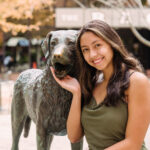
Kayla Tomas ‘23, information systems, maintained a challenging schedule during her undergraduate years. There were days she rose early, studied, and attended classes in the morning and afternoon, headed to volleyball practice in the late afternoon, paused a half hour for dinner, and then dashed off to lead a dance class in the evening. “It was the support of my friends, my family, and the mentors here at UMBC that made it easier,” she says.
Despite the challenges of a hectic schedule, she wouldn’t have it any other way, given what she gained from each opportunity. As a student athlete, Tomas says that one of her best undergraduate experiences was being on the Division I women’s volleyball team that won the America East Title three years in a row.
“The friendships I made, the breakthroughs I experienced, and the challenges I faced, made me a stronger individual, and this couldn’t have happened without an amazing group of girls I had the privilege in sharing the court with,” Tomas says.
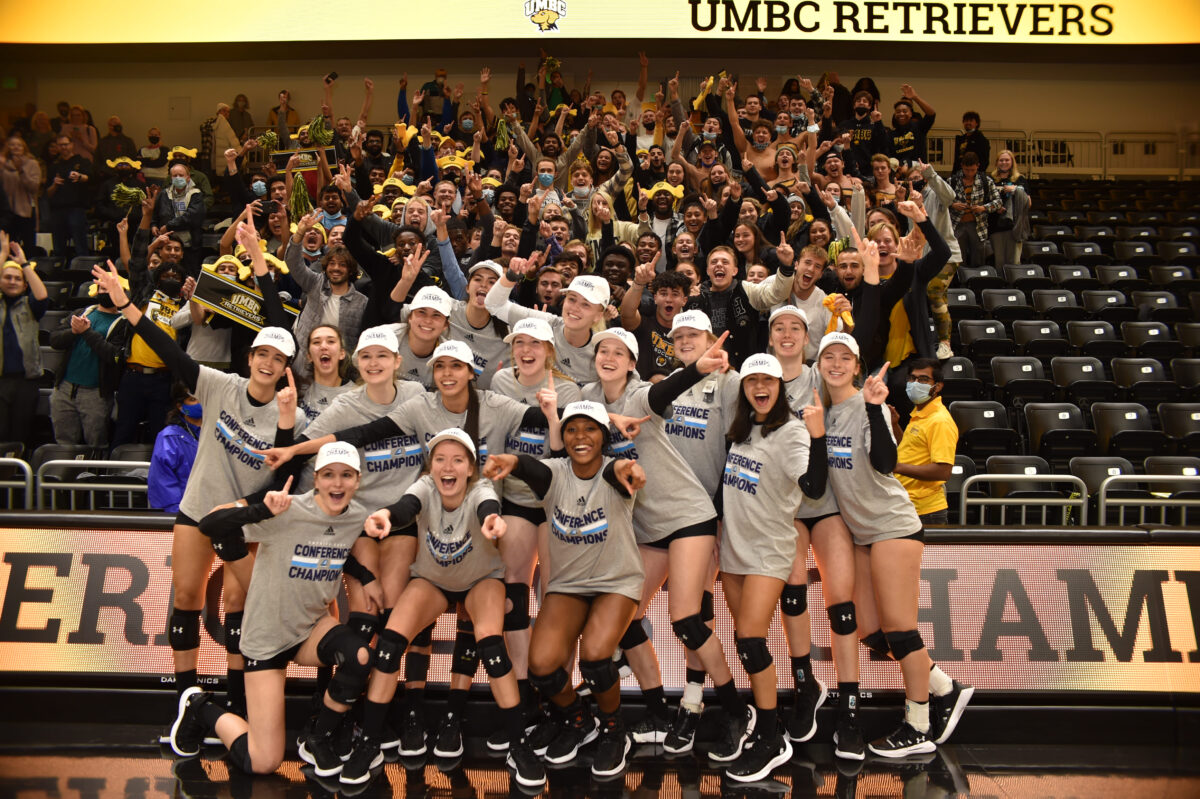 Kayla Tomas and her teammates celebrate a Division I women’s volleyball championship. (Image courtesy of Kayla Tomas)
Valuing the whole person
Tomas was a member of the Center for Women in Information Technology (CWIT) Scholars Program, which anchored her not only financially but also psychologically.
“One person I really have to give credit and thanks to, and someone I will continue to maintain a connection with, is Erica D’Eramo, assistant director at CWIT,” Tomas shares. “She has helped me a lot. We have one-on-one meetings, and if I have a question that I can’t figure out, she always knows who to direct me to. But it doesn’t even have to be about school—it can be about just how I’m doing emotionally, mentally, or physically.”
Tomas has also received support from UMBC alumni through the Alumni Endowed Scholarship. “Receiving that award was such a proud moment, because I knew these scholarships are very competitive.” she shares. “They saw a young woman’s drive to make a difference, to support her community.”
Creating a new student group
Beyond her academic work and competition on the volleyball court, dance has played a major role in Tomas’s UMBC experience. She had enjoyed dancing from a young age, and while at UMBC began to attend dance classes and workshops in the Baltimore-Washington area. She noticed the lack of Latin dancing on campus and she knew of other students who shared the same passion, “and so I did something about it,” she says.
Tomas started to offer evening Latin dance classes in the Public Policy Building. “That was a lot of fun, seeing my friends support me,” she says, “and also support dance genres of different cultures.”
 Kayla Tomas (fourth from right) poses with future colleagues at KPMG, where she will work as a cybersecurity consultant after graduation. (Image courtesy of Kayla Tomas)
“So many students here at UMBC are self-motivated” to try new things, observes Tomas. “They’re go-getters—that’s their mentality. And I love it because it rubs off on me, and I’m sure on other people.”
Emerging as a leader
The experiences of other graduating students mirror those of Tomas. When she began her undergraduate studies at UMBC in 2019, Sianna Serio ’23, computer science, had only one thought in mind: to focus on her academic studies. But within a short period of time, she became involved with the Resident Students Association, began to work for Residential Life, and gave President Valerie Sheares Ashby her first tour of campus.
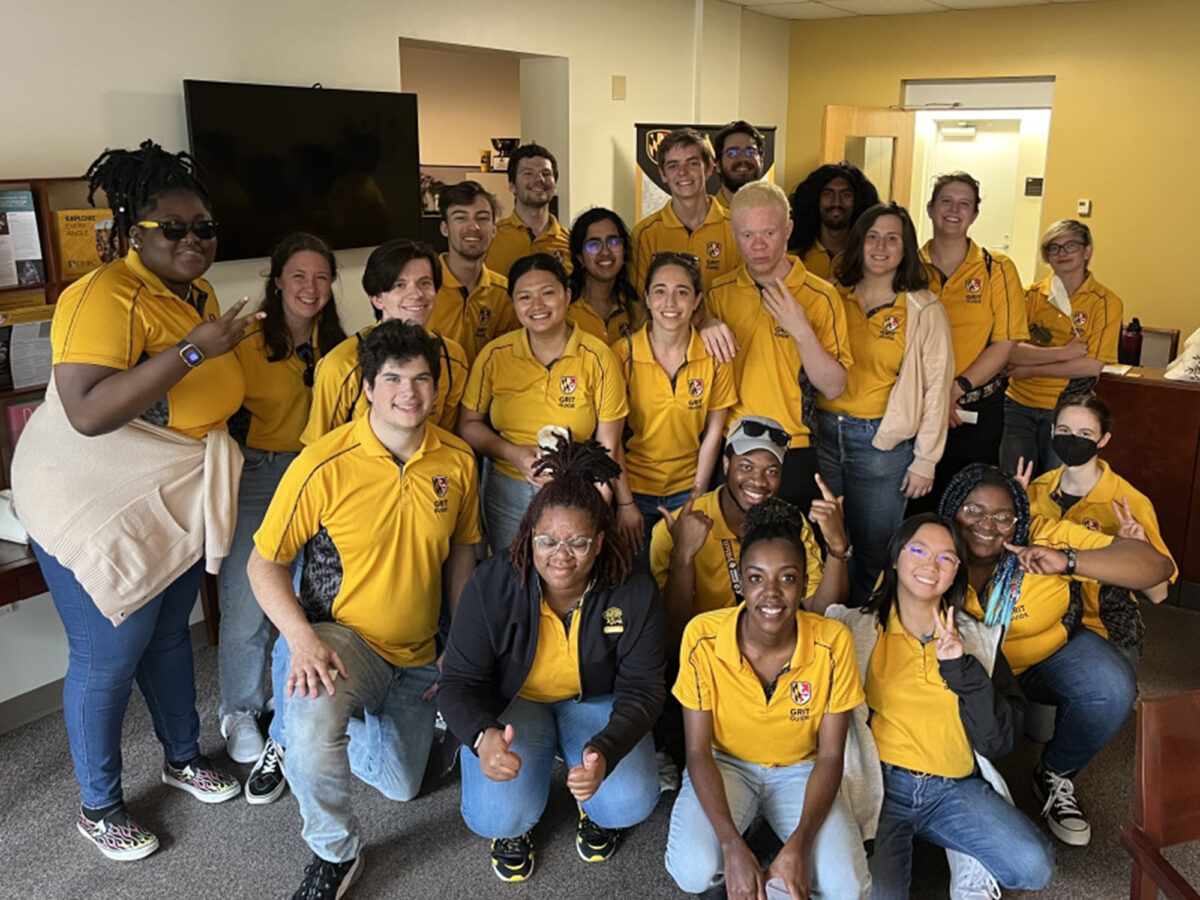 Sianna Serio (lower right corner, in black jacket) celebrates with Grit Guides for UMBC’s Just for Juniors event. (Image courtesy of Sianna Serio)
In her four years on campus, Serio participated in the Society of Women Engineers, Sign of Life, First Generation Network and the UMBC Crafters club. She credits faculty, staff and students alike for keeping her going, saying, “When you’re super focused on doing everything at once, sometimes you don’t get a chance to reflect on how that’s impacting you. My mentors did a really great job of providing support and checking in on me.”
Coaches support a student researcher
Emily Ferketic ’23, physics, enjoyed the remarkable distinction of having a paper published in a peer-reviewed journal under the mentorship of Sebastian Deffner, associate professor of physics. “He saw potential in me that I didn’t see in myself,” she shares.
 Emily Ferketic on the volleyball court. (Image courtesy of Emily Ferketic)
Despite her rigorous academic schedule, she also excelled on the volleyball court, becoming captain of UMBC’s Division 1 team. In 2021, she won the coveted America East Elite 18 award. Her coaches, too, have been especially engaged. “A few weeks ago, I was presenting my research at Undergraduate Research and Achievement Day. All of my coaches showed up, not only to support me, but also to learn about the work I’ve been doing when I’m not in the gym,” she shares.
A diverse, supportive community
Students who complete double majors face especially challenging demands. Avni Patel ’23, biological sciences and gender, women’s and sexuality studies, achieved academic excellence in both fields of study and also became a community leader at UMBC, revitalizing the Hindu Students Council. “The best part of my UMBC experience was finding a diverse community of peers and mentors where I was appreciated and encouraged to reach my full potential,” she says.
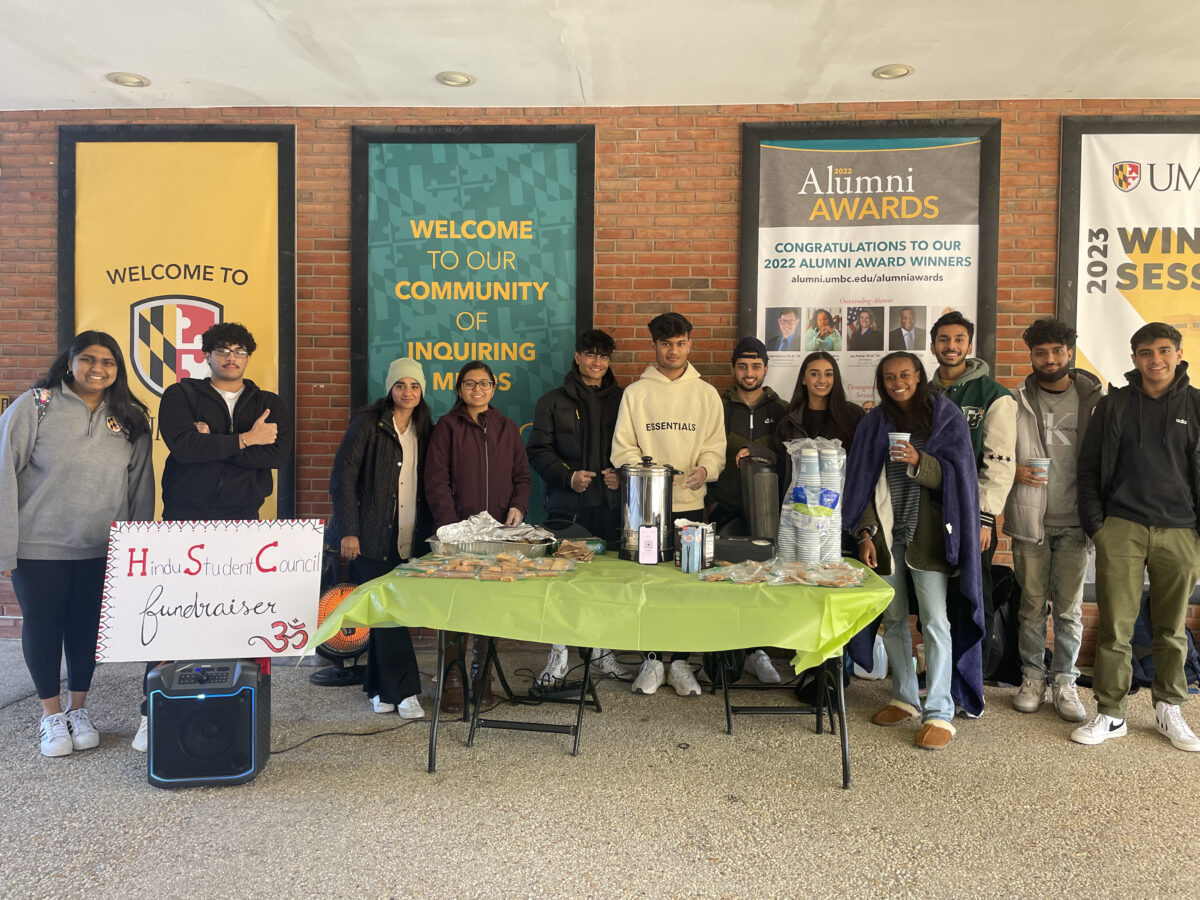 Avni Patel (fifth from right) with members of the Hindu Student Association at a fundraiser. (Image courtesy of Avni Patel)
One theme strongly resonates through the experiences of all these students: the UMBC community values the whole person. Whether a student is focusing on academic work, participating in student organizations, competing as an athlete, or engaging with any number of other activities, the university’s culture of mentoring and support is there to help them succeed.
]]>
Kayla Tomas ‘23, information systems, maintained a challenging schedule during her undergraduate years. There were days she rose early, studied, and attended classes in the morning and afternoon,...
https://umbc.edu/stories/class-of-2023-on-supporting-the-whole-person/
https://my3.my.umbc.edu/api/v0/pixel/news/133673/guest@my.umbc.edu/492e2b0fa6f4beab6c475683a77b9093/api/pixel
athletics
biology
campus-life
class-of-2023
cnms
coeit
computer-science
cwit
information-systems
news
physics
volleyball
UMBC News & Magazine
https://my3.my.umbc.edu/groups/umbc-news-magazine
https://assets1-my.umbc.edu/system/shared/avatars/groups/000/001/943/24435aa6207c452e7bc15cc74b42c7bb/xsmall.png?1748556657
https://assets1-my.umbc.edu/system/shared/avatars/groups/000/001/943/24435aa6207c452e7bc15cc74b42c7bb/original.png?1748556657
https://assets2-my.umbc.edu/system/shared/avatars/groups/000/001/943/24435aa6207c452e7bc15cc74b42c7bb/xxlarge.png?1748556657
https://assets2-my.umbc.edu/system/shared/avatars/groups/000/001/943/24435aa6207c452e7bc15cc74b42c7bb/xlarge.png?1748556657
https://assets3-my.umbc.edu/system/shared/avatars/groups/000/001/943/24435aa6207c452e7bc15cc74b42c7bb/large.png?1748556657
https://assets1-my.umbc.edu/system/shared/avatars/groups/000/001/943/24435aa6207c452e7bc15cc74b42c7bb/medium.png?1748556657
https://assets2-my.umbc.edu/system/shared/avatars/groups/000/001/943/24435aa6207c452e7bc15cc74b42c7bb/small.png?1748556657
https://assets1-my.umbc.edu/system/shared/avatars/groups/000/001/943/24435aa6207c452e7bc15cc74b42c7bb/xsmall.png?1748556657
https://assets2-my.umbc.edu/system/shared/avatars/groups/000/001/943/24435aa6207c452e7bc15cc74b42c7bb/xxsmall.png?1748556657
UMBC News & Magazine
3
0
false
Mon, 22 May 2023 15:30:19 -0400

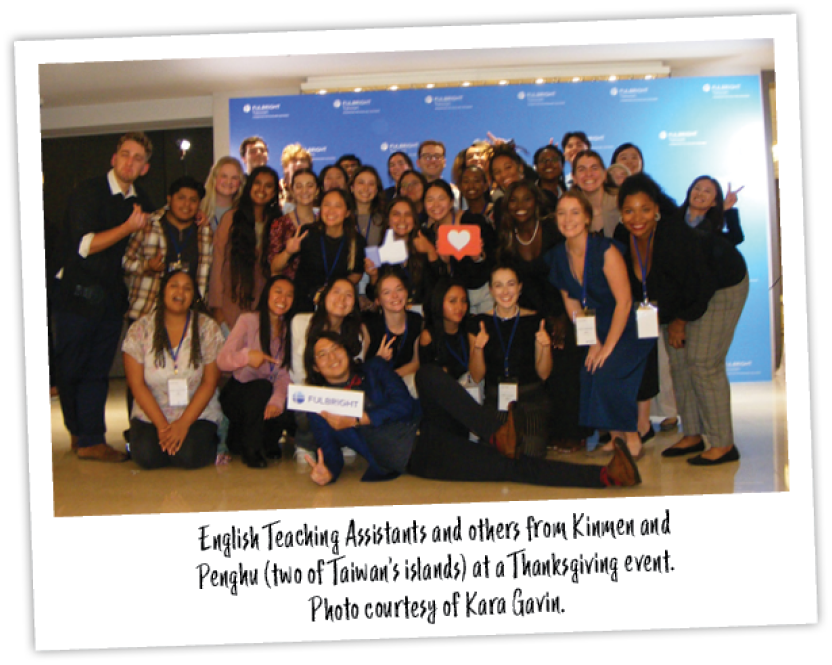
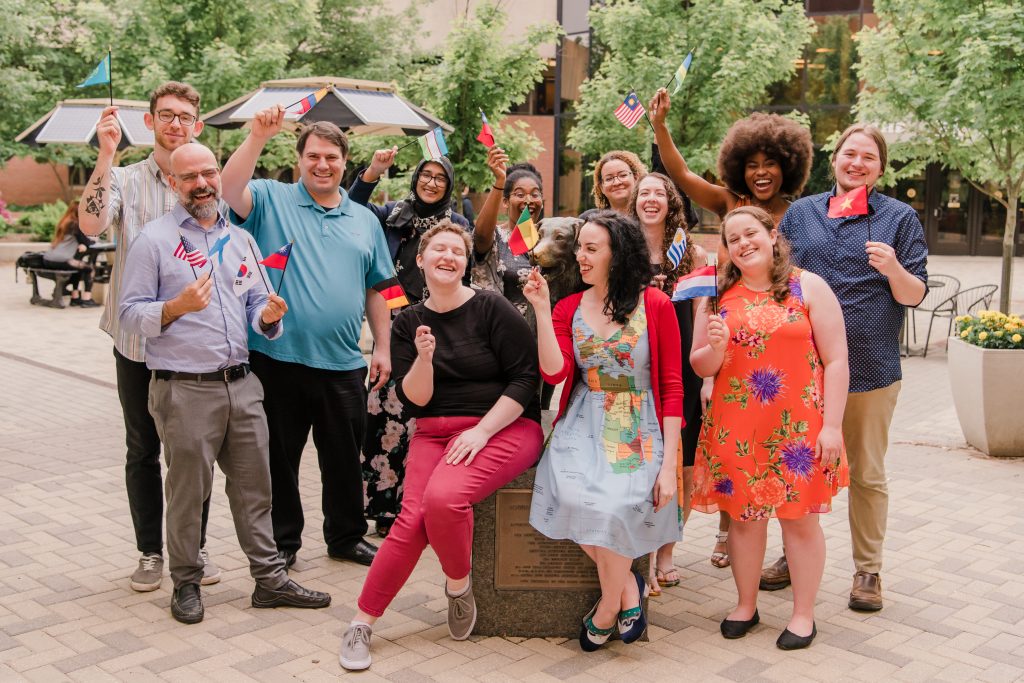 Souders (front left)with UMBC’s