UMBC partners in NASA-funded TIGERISS mission to determine source of heavy elements on Earth
Nuclear fusion reactions inside certain stars can produce many of the most common elements on Earth, like carbon, nitrogen, and oxygen. But heavier elements that are also found on Earth are harder to generate, requiring reactions with even more energy than exists within a run-of-the-mill star like our own.
“So all of that heavier stuff we see here on Earth and throughout the cosmos, like gold, and platinum, and lead—where did it come from, and how did it get distributed?” asks Nicholas Cannady, a postdoctoral researcher at UMBC’s Center for Space Sciences and Technology, a partnership with NASA.
Cannady serves as operations lead on a new mission that aims to help answer this question. NASA recently selected that mission, the Trans-Iron Galactic Element Recorder for the International Space Station (TIGERISS), for up to $20 million in funding over five years. Seven million will go directly to the NASA Goddard Space Flight Center in Greenbelt, Maryland, where Cannady is based. The rest will go to the lead institution, Washington University in St. Louis, which will further disburse the funds to the collaborating institutions: UMBC, Pennsylvania State University, Howard University, and Northern Kentucky University. UMBC will receive $2 million. If all goes well, TIGERISS will launch to the International Space Station (ISS) in 2026.
From model to measurement
Nicholas Cannady (image courtesy of Cannady)
TIGERISS will count how often certain elements, arriving at Earth as cosmic rays, collide with its detectors. Cosmic rays are extremely high-energy particles that travel at nearly the speed of light. Heavier elements are rarer than lighter elements, which means they will be seen less frequently by the instrument. How often the detector sees a particular element can be used as a proxy for how abundant it is in our Milky Way Galaxy.
Models exist predicting how common different elements are and how they might have been created, but they don’t all agree. In some cases, elements can only be made through a process that requires powerful explosions where the cores of atoms and neutrons repeatedly collide, Cannady explains. Scientists expect different kinds of events in the universe with the necessary power (such as exploding stars) to produce different amounts of these elements.
TIGERISS scientists will use measurements from the instrument showing how often different elements are detected “to support or go against those models,” Cannady explains. “It could help us see which models for production of heavy elements best represent what we see.”
Above the atmosphere
“TIGERISS is sort of the next step in a line of instruments that have been until now borne on balloons—high altitude, scientific balloons,” Cannady says. Unlike its predecessor, the balloon mission SuperTIGER, TIGERISS “will be on the ISS in space, which has some distinct advantages, and will let us really open up some interesting science that the other instruments weren’t able to do.”
The main benefit: On the ISS, there is no interference from Earth’s atmosphere. Although the SuperTIGER balloon flew as high as 130,000 feet, even the tiny amount of atmosphere at that height can affect precision when you are trying to detect extremely rare elements. “The atmosphere really throws a wrench into trying to wring out all the precision you can in things like SuperTIGER,” Cannady says.
TIGERISS will also be on the ISS for at least a year, whereas SuperTIGER made two flights, one for 32 days and one for 55 days. The 55-day flight set a record for a balloon, but TIGERISS’s longer exposure time will increase the chances of very rare elements happening to hit its detectors.
The cosmic ray mystery
TIGERISS may also help illuminate how cosmic rays form and transport elements around the cosmos. SuperTIGER results support one theory for how certain types of particles (including heavy ones) get “swept up and accelerated to the high energies that we see for cosmic rays,” Cannady says. “It gives us a picture of how this heavy stuff gets distributed through the galaxy.”
“So we have this neat picture of how this works,” he adds, “but then above a certain threshold, this picture seems to be breaking apart.”
Cannady and the rest of the team hope that TIGERISS will improve on SuperTIGER’s findings, and start to put the picture back together—or suggest a new one. Whatever it finds, TIGERISS will increase our understanding of where heavy elements formed and how they made their way to Earth.
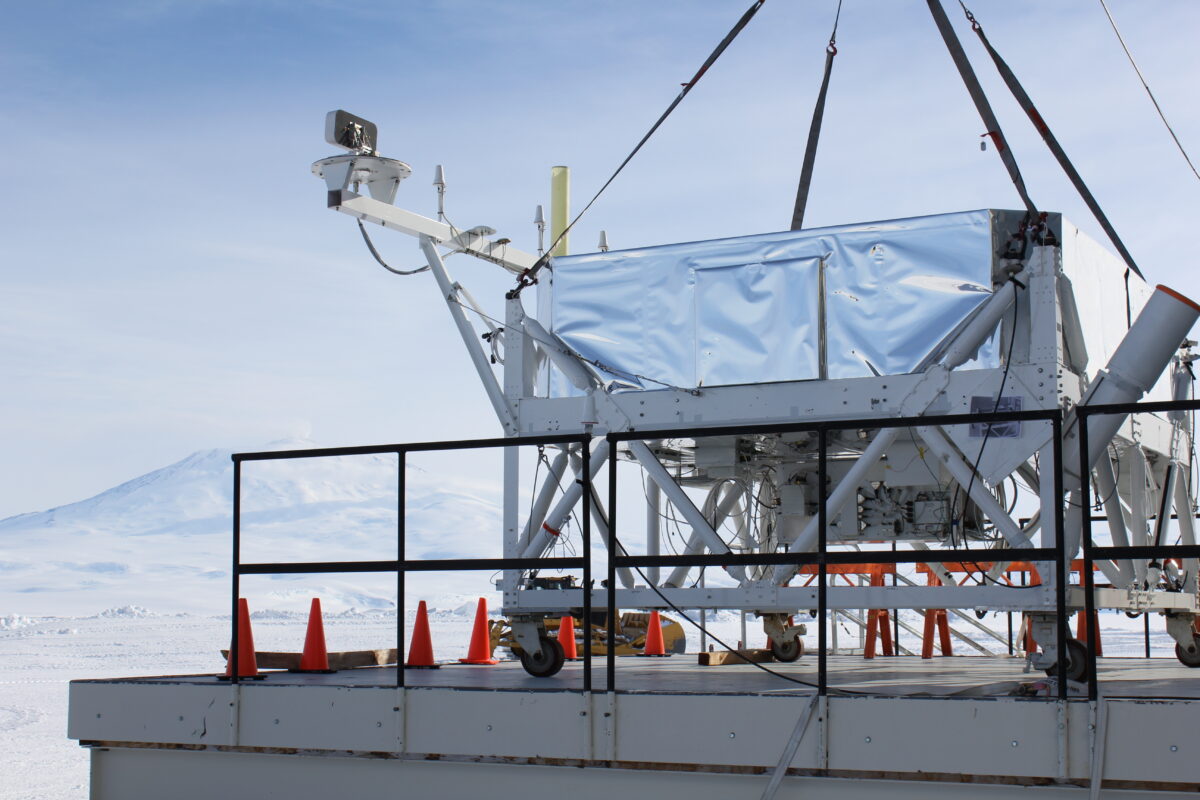
TIGERISS’s predecessor, SuperTIGER (inside the large metal box), prepares for a flight at McMurdo Station, Antarctica, in 2017. (Image courtesy of NASA/Jason Link)
Early career leadership
NASA selected TIGERISS through its Astrophysics Pioneers program, which launched in 2020. Its goal is to reduce costs by using smaller instruments that can still contribute to robust scientific advances. The program is also set up to encourage early career researchers, like Cannady, to take the reins.
“One of the big focuses of Pioneers is to incorporate early career leadership and roles into the full pipeline of mission development—conception, development, and implementation, and then the operations and analysis as well,” Cannady says. His roles as institutional lead and mission operations lead create plenty of opportunities to build a network with researchers at other institutions, hone his management skills, and conduct cutting-edge science at the same time.
“It’s really neat to me to get to see things from the beginning and potentially follow them on through to the end. There are several of us who are getting to do that,” he says. UMBC’s Kenichi Sakai, a CSST research scholar, is also on the project, and former CSST researcher John Krizmanic will serve as the overall lead for NASA Goddard.
Sakai is leading development for one of the detector subsystems, and he and Cannady are hoping to engage both undergraduate and graduate UMBC students in that work. For the next year, the team will undergo their concept study phase, figuring out what’s feasible and starting to nail down the details of the design.
“We’re really going to start hitting the ground running with this,” Cannady says. And then, once the team completes a concept study and makes important implementation decisions in the first year, he says, “we’re going to start building.”
]]>
Nuclear fusion reactions inside certain stars can produce many of the most common elements on Earth, like carbon, nitrogen, and oxygen. But heavier elements that are also found on Earth are harder...https://umbc.edu/stories/tigeriss-to-determine-source-of-heavy-elements/https://my3.my.umbc.edu/api/v0/pixel/news/128956/guest@my.umbc.edu/c5904fd9117405f7cda16a8321afd7c7/api/pixelcsstnewsresearchscience-and-techUMBC News & Magazinehttps://my3.my.umbc.edu/groups/umbc-news-magazinehttps://assets1-my.umbc.edu/system/shared/avatars/groups/000/001/943/24435aa6207c452e7bc15cc74b42c7bb/xsmall.png?1748556657https://assets1-my.umbc.edu/system/shared/avatars/groups/000/001/943/24435aa6207c452e7bc15cc74b42c7bb/original.png?1748556657https://assets2-my.umbc.edu/system/shared/avatars/groups/000/001/943/24435aa6207c452e7bc15cc74b42c7bb/xxlarge.png?1748556657https://assets2-my.umbc.edu/system/shared/avatars/groups/000/001/943/24435aa6207c452e7bc15cc74b42c7bb/xlarge.png?1748556657https://assets3-my.umbc.edu/system/shared/avatars/groups/000/001/943/24435aa6207c452e7bc15cc74b42c7bb/large.png?1748556657https://assets1-my.umbc.edu/system/shared/avatars/groups/000/001/943/24435aa6207c452e7bc15cc74b42c7bb/medium.png?1748556657https://assets2-my.umbc.edu/system/shared/avatars/groups/000/001/943/24435aa6207c452e7bc15cc74b42c7bb/small.png?1748556657https://assets1-my.umbc.edu/system/shared/avatars/groups/000/001/943/24435aa6207c452e7bc15cc74b42c7bb/xsmall.png?1748556657https://assets2-my.umbc.edu/system/shared/avatars/groups/000/001/943/24435aa6207c452e7bc15cc74b42c7bb/xxsmall.png?1748556657UMBC News & Magazine00falseThu, 03 Nov 2022 12:46:20 -0400Thu, 03 Nov 2022 12:46:20 -0400UMBC’s Viswanathan uses the Moon’s craters to track its shifting poles over 4.25 billion years
A new study published inPlanetary Science Journalhas determined how the Moon’s poles have shifted over more than 4 billion years, a phenomenon known as “true polar wander.” To trace the poles over time, the research team examined the combined effects of more than 5,000 craters on the Moon’s surface.
Each impact, and the subsequent crater, changed the distribution of mass on the Moon slightly. To rebalance, the Moon would have rotated just a little, without its axis moving in space. As a result, the axis would pass through the Moon at slightly different locations—the new poles.
“All this cratering is like a record” of the Moon’s history, says Vishnu Viswanathan, assistant research scientist with UMBC’s Center for Space Sciences and Technology (CSST), a university partnership with NASA’s Goddard Space Flight Center. Viswanathan co-led the study with David Smith, a research scientist at the Massachusetts Institute of Technology.
Water on the Moon?
Vishnu Viswanathan (Image courtesy of Viswanathan)
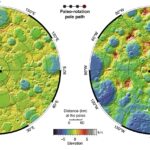
The study found that over approximately 4.25 billion years, the Moon’s poles wandered 10 degrees in latitude, or 186 miles, from the influence of cratering. Over the past 3.8 billion years, the poles have not wandered more than 2 degrees, or 37 miles. Such a moderate amount of polar wander would have created relatively stable conditions in the Moon’s polar regions over an extended period. That stability likely contributed to favorable conditions for resources such as frozen water.
Scientists have detected ice in colder, shadowed regions near the Moon’s poles. However, its amount and age is unknown. If the poles had moved substantially and frequently over time, any ice would repeatedly be exposed to sunlight and likely lost to sublimation—the process of a solid converting directly to a gas, like dry ice on Earth. With greater stability of the poles over billions of years, there would be more time for water to accumulate near the Moon’s present-day poles.
Stepping back in time
To calculate each crater’s effect on the location of the Moon’s poles, the research team relied heavily on a map of the Moon’s gravitational field, which defines the force of gravity at each point on the Moon’s surface. Sander Goossens, a former UMBC CSST scientist and a co-author on the new paper, developed the map previously using data from NASA’s GRAIL mission, which flew over the surface of the Moon in 2012.
The two GRAIL satellites measured anomalies in the distribution of mass on the Moon (such as craters), to a resolution of a few kilometers. The satellites’ detection is comparable to the way that a driver can feel the rise and fall as they pass over speed humps or potholes, Viswanathan explains.
Using Goossens’s map, Viswanathan and his team figured out a way to mathematically remove each crater’s individual effect, or signature, on the Moon’s gravitational field. The team started by sequentially removing 185 large craters whose ages are known, partly based on samples collected from NASA’s Apollo Moon missions. At each step going backward in time, they recalculated the presumed location of the Moon’s poles, creating a history of the poles’ location as they moved through time—the polar wander.
For the rest of the craters, most of them small, the research team removed their signatures from the gravity field and randomly distributed them through time. The team’s model is designed so more impacts occur in the early history of the Moon, because it’s understood that impacts were more frequent during that period. By running this simulation again and again, they were able to estimate the path of the Moon’s poles based on its cratering history.
This animation traces the “polar wander” of the Moon’s poles from about 4.25 billion years ago to the present day. (NASA Scientific Visualization Studio)
The Moon’s origin story
Moving forward, the new research may increase understanding of the formation of the Moon and the solar system in general. Information from the study about the shape of the Moon at different time points could help refine understanding of the Moon’s orbital path at those times. Also, shortly after the Moon formed, it was much closer to Earth and spinning faster. The contribution of small craters to the Moon’s shape could help add more detail to our understanding of how it reached its current location.
Viswanathan is excited about NASA’s Artemis mission, which will likely collect more samples from previously unvisited craters near the Moon’s south pole. “More samples from more craters would tell us quite a lot about the Moon’s cratering history,” he says. Knowing accurate ages of the large craters, including the largest, the South Pole-Aitken basin, would help refine the polar wander model. Information about the craters’ composition could increase understanding of resources—such as water—present on the Moon.
The project has also been an opportunity for Viswanathan and his team to grow and gain new expertise. An astronomer and a planetary geodesist who has researched other aspects of the Moon, Viswanathan came to the project with the beginnings of the math needed to track the poles based on the gravitational field. “But I had very little idea of these craters’ names before,” he says. “So it was a nice way to familiarize with them.”
The project, and especially the close collaboration with colleagues, has also served as an anchor for him throughout the pandemic. He shares, “I was so invested in the project for the last nearly three years. This kept me sane.”
]]>
A new study published in Planetary Science Journalhas determined how the Moon’s poles have shifted over more than 4 billion years, a phenomenon known as “true polar wander.” To trace the poles...https://umbc.edu/stories/moons-poles-tracked-over-4-25-billion-years/https://my3.my.umbc.edu/api/v0/pixel/news/128202/guest@my.umbc.edu/8be98c829136af6bc9bb64215bb58233/api/pixelcsstnewsresearchscience-and-techUMBC News & Magazinehttps://my3.my.umbc.edu/groups/umbc-news-magazinehttps://assets1-my.umbc.edu/system/shared/avatars/groups/000/001/943/24435aa6207c452e7bc15cc74b42c7bb/xsmall.png?1748556657https://assets1-my.umbc.edu/system/shared/avatars/groups/000/001/943/24435aa6207c452e7bc15cc74b42c7bb/original.png?1748556657https://assets2-my.umbc.edu/system/shared/avatars/groups/000/001/943/24435aa6207c452e7bc15cc74b42c7bb/xxlarge.png?1748556657https://assets2-my.umbc.edu/system/shared/avatars/groups/000/001/943/24435aa6207c452e7bc15cc74b42c7bb/xlarge.png?1748556657https://assets3-my.umbc.edu/system/shared/avatars/groups/000/001/943/24435aa6207c452e7bc15cc74b42c7bb/large.png?1748556657https://assets1-my.umbc.edu/system/shared/avatars/groups/000/001/943/24435aa6207c452e7bc15cc74b42c7bb/medium.png?1748556657https://assets2-my.umbc.edu/system/shared/avatars/groups/000/001/943/24435aa6207c452e7bc15cc74b42c7bb/small.png?1748556657https://assets1-my.umbc.edu/system/shared/avatars/groups/000/001/943/24435aa6207c452e7bc15cc74b42c7bb/xsmall.png?1748556657https://assets2-my.umbc.edu/system/shared/avatars/groups/000/001/943/24435aa6207c452e7bc15cc74b42c7bb/xxsmall.png?1748556657UMBC News & Magazine00falseWed, 05 Oct 2022 08:28:05 -0400Wed, 05 Oct 2022 08:28:05 -0400UMBC’s Krizmanic, Cannady contribute to research that adds new wrinkle to understanding the origins of matter in the Milky Way
New findings published this week in Physical Review Letters suggest that carbon, oxygen, and hydrogen cosmic rays travel through the galaxy toward Earth in a similar way, but, surprisingly, that iron arrives at Earth differently. Learning more about how cosmic rays move through the galaxy helps address a fundamental, lingering question in astrophysics: How is matter generated and distributed across the universe?
“So what does this finding mean?” asks John Krizmanic, a senior scientist with UMBC’s Center for Space Science and Technology (CSST). “These are indicators of something interesting happening. And what that something interesting is we’re going to have to see.”
Cosmic rays are atomic nuclei—atoms stripped of their electrons—that are constantly whizzing through space at nearly the speed of light. They enter Earth’s atmosphere at extremely high energies. Information about these cosmic rays can give scientists clues about where they came from in the galaxy and what kind of event generated them.
An instrument on the International Space Station (ISS) called the Calorimetric Electron Telescope (CALET) has been collecting data about cosmic rays since 2015. The data include details such as how many and what kinds of atoms are arriving, and how much energy they’re arriving with. The American, Italian, and Japanese teams that manage CALET, including UMBC’s Krizmanic and postdoc Nick Cannady, collaborated on the new research.
Iron on the move
Cosmic rays arrive at Earth from elsewhere in the galaxy at a huge range of energies—anywhere from 1 billion volts to 100 billion billion volts. The CALET instrument is one of extremely few in space that is able to deliver fine detail about the cosmic rays it detects. A graph called a cosmic ray spectrum shows how many cosmic rays are arriving at the detector at each energy level. The spectra for carbon, oxygen, and hydrogen cosmic rays are very similar, but the key finding from the new paper is that the spectrum for iron is significantly different.
This image combines data from four space telescopes to reconstruct all that remains of the oldest documented example of a supernova, which was witnessed in 185 A.D. by Chinese astronomers. Supernovae are understood to be important sources of cosmic rays arriving at Earth. Image credit: NASA
There are several possibilities to explain the differences between iron and the three lighter elements. The cosmic rays could accelerate or travel through the galaxy differently, although scientists generally believe they understand the latter, Krizmanic says.
“Something that needs to be emphasized is that the way the elements get from the sources to us is different, but it may be that the sources are different as well,” adds Michael Cherry, physics professor emeritus at Louisiana State University (LSU) and a co-author on the new paper. Scientists generally believe that cosmic rays originate from exploding stars (supernovae), but neutron stars or very massive stars could be other potential sources.
Next-level precision
An instrument like CALET is important for answering questions about how cosmic rays accelerate and travel, and where they come from. Instruments on the ground or balloons flown high in Earth’s atmosphere were the main source of cosmic ray data in the past. But by the time cosmic rays reach those instruments, they have already interacted with Earth’s atmosphere and broken down into secondary particles. With Earth-based instruments, it is nearly impossible to identify precisely how many primary cosmic rays and which elements are arriving, plus their energies. But CALET, being on the ISS above the atmosphere, can measure the particles directly and distinguish individual elements precisely.
The Pierre Auger Observatory is a ground-based cosmic ray detector in Argentina. Photo: Pierre Auger Observatory, shared under CC BY-SA 2.0
Iron is a particularly useful element to analyze, explains Cannady, a postdoc with CSST and a former Ph.D. student with Cherry at LSU. On their way to Earth, cosmic rays can break down into secondary particles, and it can be hard to distinguish between original particles ejected from a source (like a supernova) and secondary particles. That complicates deductions about where the particles originally came from.
“As things interact on their way to us, then you’ll get essentially conversions from one element to another,” Cannady says. “Iron is unique, in that being one of the heaviest things that can be synthesized in regular stellar evolution, we’re pretty certain that it is pretty much all primary cosmic rays. It’s the only pure primary cosmic ray, where with others you’ll have some secondary components feeding into that as well.”
“Made of stardust”
Measuring cosmic rays gives scientists a unique view into high-energy processes happening far, far away. The cosmic rays arriving at CALET represent “the stuff we’re made of. We are made of stardust,” Cherry says. “And energetic sources, things like supernovas, eject that material from their interiors, out into the galaxy, where it’s distributed, forms new planets, solar systems, and… us.”
All of the rocky and metallic material we stand on, the iron in our blood, the calcium in our teeth, the carbon in our genes were produced billions of years ago in the interior of a red giant star. We are made of star-stuff.
Carl Sagan, “The Cosmic Connection: An Extraterrestrial Perspective,” 1973
“The study of cosmic rays is the study of how the universe generates and distributes matter, and how that affects the evolution of the galaxy,” Krizmanic adds. “So really it’s studying the astrophysics of this engine we call the Milky Way that’s throwing all these elements around.”
A global effort
The Japanese space agency launched CALET and today leads the mission in collaboration with the U.S. and Italian teams. In the U.S., the CALET team includes researchers from LSU; NASA Goddard Space Flight Center; UMBC; University of Maryland, College Park; University of Denver; and Washington University.The new paper is the fifth from this highly successful international collaboration published in PRL, one of the most prestigious physics journals.
CALET was optimized to detect cosmic ray electrons, because their spectrum can contain information about their sources. That’s especially true for sources that are relatively close to Earth in galactic terms: within less than one-thirtieth the distance across the Milky Way. But CALET also detects the atomic nuclei of cosmic rays very precisely. Now those nuclei are offering important insights about the sources of cosmic rays and how they got to Earth.
“We didn’t expect that the nuclei – the carbon, oxygen, protons, iron – would really start showing some of these detailed differences that are clearly pointing at things we don’t know,” Cherry says.
The latest finding creates more questions than it answers, emphasizing that there is still more to learn about how matter is generated and moves around the galaxy. “That’s a fundamental question: How do you make matter?” Krizmanic says. But, he adds, “That’s the whole point of why we went in this business, to try to understand more about how the universe works.”
Banner image: A Japanese transfer vehicle (labeled HTV-5) is docked at the International Space Station. The CALET experiment is being extracted by the station’s robotic arm (labeled with “Canada”). Credit: NASA
]]>
New findings published this week in Physical Review Letters suggest that carbon, oxygen, and hydrogen cosmic rays travel through the galaxy toward Earth in a similar way, but, surprisingly, that...https://umbc.edu/stories/umbcs-krizmanic-cannady-contribute-to-research-that-adds-new-wrinkle-to-understanding-the-origins-of-matter-in-the-milky-way/https://my3.my.umbc.edu/api/v0/pixel/news/119592/guest@my.umbc.edu/dea589af5412bb3396f0ae8e0cd14562/api/pixelcsstresearchscience-and-technologyUMBC News & Magazinehttps://my3.my.umbc.edu/groups/umbc-news-magazinehttps://assets1-my.umbc.edu/system/shared/avatars/groups/000/001/943/24435aa6207c452e7bc15cc74b42c7bb/xsmall.png?1748556657https://assets1-my.umbc.edu/system/shared/avatars/groups/000/001/943/24435aa6207c452e7bc15cc74b42c7bb/original.png?1748556657https://assets2-my.umbc.edu/system/shared/avatars/groups/000/001/943/24435aa6207c452e7bc15cc74b42c7bb/xxlarge.png?1748556657https://assets2-my.umbc.edu/system/shared/avatars/groups/000/001/943/24435aa6207c452e7bc15cc74b42c7bb/xlarge.png?1748556657https://assets3-my.umbc.edu/system/shared/avatars/groups/000/001/943/24435aa6207c452e7bc15cc74b42c7bb/large.png?1748556657https://assets1-my.umbc.edu/system/shared/avatars/groups/000/001/943/24435aa6207c452e7bc15cc74b42c7bb/medium.png?1748556657https://assets2-my.umbc.edu/system/shared/avatars/groups/000/001/943/24435aa6207c452e7bc15cc74b42c7bb/small.png?1748556657https://assets1-my.umbc.edu/system/shared/avatars/groups/000/001/943/24435aa6207c452e7bc15cc74b42c7bb/xsmall.png?1748556657https://assets2-my.umbc.edu/system/shared/avatars/groups/000/001/943/24435aa6207c452e7bc15cc74b42c7bb/xxsmall.png?1748556657UMBC News & Magazine00falseTue, 22 Jun 2021 03:53:20 -0400UMBC to receive over $63 million in NASA renewal of CRESST II space science consortium
NASA has committed $178 million to extend support for the Center for Research and Exploration in Space Science & Technology II (CRESST II) through 2027. Founded in 2006 and renewed in 2016, CRESST II is a partnership between NASA’s Goddard Space Flight Center and four universities. UMBC and the University of Maryland, College Park (UMD) are the two primary funding recipients, with UMD leading the consortium. CRESST II also supports researchers at Catholic University of America, Howard University, and the Southeastern Universities Research Association.
Developing talent in space sciences
Talent development is a key component of the partnership, which creates opportunities for undergraduate and graduate students, postdoctoral fellows, and faculty to engage in NASA research on topics ranging from the composition of neutron stars to the atmosphere on Mars. New UMBC funding to support these projects will be more than $63 million over five years under the CRESST II renewal.
Since the last renewal in 2016, the UMBC arm of the partnership, the Center for Space Sciences and Technology (CSST), has focused on offering additional training for budding space scientists. Graduate students with NASA fellowships are co-advised by UMBC faculty and NASA scientists, undergraduates have internship opportunities on site at Goddard, and post-baccalaureate programs offer recent grads a chance to get more experience before applying to jobs or graduate school. Career workshops are available to all.
“We’re trying to do more to support their growth, and also prepare them to move on to other things afterwards,” says Don Engel, director of CSST and assistant professor of computer science and electrical engineering. “We’re building more infrastructure around career support for our scientists, especially those at earlier levels.”
Don Engel, director of the Center for Space Sciences and Technology, UMBC’s arm of the CRESST II partnership, in the Imaging Research Center at UMBC. Photo by Marlayna Demond ’11 for UMBC.
Collaboration at all levels
Engel has also been leading an effort to engage more departments at UMBC in the partnership. Physics is the most involved so far, but researchers in computer science and electrical engineering, mechanical engineering, information systems, and even geography and environmental systems have connected with CSST, meaning the Center spans all three UMBC colleges.
“We have more affiliations with more departments than we’ve ever had before,” Engel says, “and I’m excited about that being just the tip of the iceberg.” Karl Steiner, vice president for research at UMBC, adds, “The scope of work conducted by our UMBC faculty and research scientists under the Center for Space Sciences and Technology makes this one of the largest research centers on the UMBC campus.”
The consortium structure is also an asset. “The partnerships have been phenomenal,” Engel says. “Through having multiple institutions, we’re able to learn from each other’s ideas and strengths. We can tap into the broader resources at each of our institutions for things like trainings.”
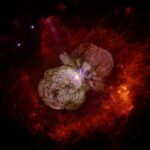
A 2018 paper in Nature Astronomy by CSST scientist Kenji Hamaguchi concluded for the first time that the largest star system, within 10,000 lightyears of Earth is emitting cosmic rays, some of which may reach Earth. In this visualization, the supermassive star at the center of that system, Eta Carinae, is at the center of two huge and expanding clouds of dust and other material, the result of an eruption about 150 years ago. Nathan Smith/NASA.
“The CRESST partnership provides an amazing opportunity for government and university researchers to jointly advance NASA research and space science,” adds Laurie Locascio, vice president for research at UMD. “The collaboration has demonstrated the value of our partnership and our capability to do great work together.”
“NASA’s decision to renew and enhance the CRESST II Partnership, led by the University of Maryland, College Park and including the University of Maryland, Baltimore County (UMBC), builds on a successful collaboration and will continue to develop top-notch scientific talent,” U.S. Senator Ben Cardin says.“Team Maryland is proud of the close relationship between the University of Maryland and federal agencies like NASA that keeps our nation and our state on the cutting edge of research and technology.”
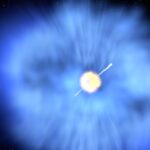
A 2020 paper by CSST scientist Tom Barclay published in Nature reported the discovery of a Neptune-sized planet orbiting a young, nearby star. This visualization shows an interpretation of the planet, AU Mic b (green), and its star, Microscopii. Image courtesy NASA’s Goddard Space Flight Center/Chris Smith (Universities Space Research Association).
New understanding, new technologies
Reflecting on the impact this research will have, Engel says, “looking at things on the scale of galaxies or other solar systems lets us know more about our own solar system and the physical laws that govern the universe, including our day-to-day lives.”
“Some of the greatest mysteries that remain in physics can really only be further probed by looking at things that are massively large or very dense—extremes that we can only find by looking far away,” he notes. “And yet, these mysteries always end up unlocking fascinating new technologies that change people’s lives.”
To do this research effectively, he says, bringing together talented students and faculty at all levels, from all backgrounds, is essential. CSST and CRESST II will develop the next generation of space science leaders, who will push the boundaries of human understanding and help answer the universe’s remaining big questions.
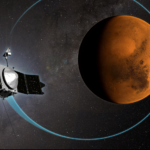
Banner image: NASA’s MAVEN spacecraft orbits Mars in this visualization. A 2019 research paper in Science led by CSST’s Mehdi Benna mapped Mars’s global wind patterns, the first time that had been done on any planet (including Earth). Visualization courtesy of NASA.
]]>
NASA has committed $178 million to extend support for the Center for Research and Exploration in Space Science & Technology II (CRESST II) through 2027. Founded in 2006 and renewed in 2016,...https://umbc.edu/stories/umbc-to-receive-over-63-million-in-nasa-renewal-of-cresst-ii-space-science-consortium/https://my3.my.umbc.edu/api/v0/pixel/news/119620/guest@my.umbc.edu/08c219b017e42ae9a750022c95d1957f/api/pixelcsstmajorawardresearchscience-and-technologyUMBC News & Magazinehttps://my3.my.umbc.edu/groups/umbc-news-magazinehttps://assets1-my.umbc.edu/system/shared/avatars/groups/000/001/943/24435aa6207c452e7bc15cc74b42c7bb/xsmall.png?1748556657https://assets1-my.umbc.edu/system/shared/avatars/groups/000/001/943/24435aa6207c452e7bc15cc74b42c7bb/original.png?1748556657https://assets2-my.umbc.edu/system/shared/avatars/groups/000/001/943/24435aa6207c452e7bc15cc74b42c7bb/xxlarge.png?1748556657https://assets2-my.umbc.edu/system/shared/avatars/groups/000/001/943/24435aa6207c452e7bc15cc74b42c7bb/xlarge.png?1748556657https://assets3-my.umbc.edu/system/shared/avatars/groups/000/001/943/24435aa6207c452e7bc15cc74b42c7bb/large.png?1748556657https://assets1-my.umbc.edu/system/shared/avatars/groups/000/001/943/24435aa6207c452e7bc15cc74b42c7bb/medium.png?1748556657https://assets2-my.umbc.edu/system/shared/avatars/groups/000/001/943/24435aa6207c452e7bc15cc74b42c7bb/small.png?1748556657https://assets1-my.umbc.edu/system/shared/avatars/groups/000/001/943/24435aa6207c452e7bc15cc74b42c7bb/xsmall.png?1748556657https://assets2-my.umbc.edu/system/shared/avatars/groups/000/001/943/24435aa6207c452e7bc15cc74b42c7bb/xxsmall.png?1748556657UMBC News & Magazine00falseFri, 21 May 2021 16:08:51 -0400UMBC’s Tom Barclay and NASA team discover Neptune-sized planet orbiting young, nearby star
New research published today in Nature reports the discovery of a planet about the size of Neptune orbiting an especially young, nearby star. The planet, named AU Mic b, is orbiting AU Microscopii, which is relatively close to the Milky Way at 31.9 light years away. AU Microscopii is also “only” 20 or 30 million years old—at least 150 times younger than our Sun.
There are only two or three known stars that are both nearby and young, and scientists have been searching for planets orbiting them for at least a decade. This means the new finding creates a major opportunity for breakthrough research into solar system formation dynamics.
“One of the things we want to understand is, ‘When do planets form, and what do they do in their early days?’” says Tom Barclay. He’s an associate research scientist with UMBC’s Center for Space Sciences and Technology, a partnership with the NASA Goddard Space Flight Center in Greenbelt, Maryland.
Because AU Mic b is so young, Barclay adds, “studying this planet, and hopefully others like it, can give us insight into how our own solar system formed.”
Shining light on a new planet
Barclay primarily works on NASA’s Transiting Exoplanet Survey Satellite (TESS) mission. TESS observes the same section of sky for weeks at a time, collecting data about the brightness of stars in its field of view every two minutes. Thanks to this constant watchfulness, TESS can help detect planets by recording when a star’s brightness temporarily dims. That can sometimes signal a planet crossing in front of the star, or “transiting.”
“My role is to take the brightness data for the star and use that to understand what the size and other properties of the planet are,” says Barclay, who is second author on the new paper. Peter Plavchan of George Mason University leads the project. “Dips in brightness tell you about the size of the planet, and measuring how regularly spaced the transits are tells us how long it takes the planet to go around the star,” Barclay explains.
TESS detected two transits of AU Mic b, but the research team needed a third to “be confident that what we’d seen wasn’t something else in the data trying to fool us,” Barclay says. So they called on additional data collected by NASA’s Spitzer satellite and ground-based instruments in Hawaii and Chile.
Barclay analyzed the combined information and was able to confirm that AU Mic b has a mass of no more than 58 Earths and completes an orbit of AU Microscopii every 8.5 days. An orbit that short indicates that the planet is extremely close to the star.
A rendering of the system where researchers found the new planet, AU Mic b. The star AU Microscopii, which AU Mic b orbits at very close range, is at the center. A disk of dust and debris surrounds the star. Image courtesy NASA’s Goddard Space Flight Center/Chris Smith (Universities Space Research Association)
Discovery dominoes
Next, Barclay and his colleagues want to learn more about the atmosphere of the new planet. Because it only recently formed, “it may well be losing its atmosphere at a rate that we can see,” Barclay says. “It might even appear somewhat teardrop-shaped, as the planet is moving and leaving some of its atmosphere behind. So we’re going to go and look for that.”
In addition to the rate of atmosphere loss, careful observations can also help determine what the planet’s atmosphere is made of. Determining the atmosphere’s components could help the team figure out where the planet formed, because certain substances can only exist at a known distance from the star.
Knowing where the planet formed would provide clues about how it had moved since it first came into being. And knowing that would get scientists closer to understanding more generally how planets form and migrate in a new solar system.
Planet migration puzzle
AU Mic b is likely primarily comprised of gases. “This star probably hasn’t had time to form small, rocky planets yet,” Barclay says. “It gives us a chance to get a picture of what might have happened before our own terrestrial planets like Earth and Venus formed.”
But the work is not easy. “Understanding the migration of planets is a really difficult problem. One of the fun things and one of the most frustrating things about studying stars is that we can never go to them,” Barclay says. “So this discovery is just one more puzzle piece in trying to understand what’s going on.”
Banner image: An interpretation of the appearance of AU Mic b (green) and its star, Microscopii. Image courtesy NASA’s Goddard Space Flight Center/Chris Smith (Universities Space Research Association)
]]>
New research published today in Nature reports the discovery of a planet about the size of Neptune orbiting an especially young, nearby star. The planet, named AU Mic b, is orbiting AU...https://umbc.edu/stories/umbcs-tom-barclay-and-nasa-team-discover-neptune-sized-planet-orbiting-young-nearby-star/https://my3.my.umbc.edu/api/v0/pixel/news/119854/guest@my.umbc.edu/9062bebf9b96818c059e27f10bbe9998/api/pixelcsstresearchscience-and-technologyUMBC News & Magazinehttps://my3.my.umbc.edu/groups/umbc-news-magazinehttps://assets1-my.umbc.edu/system/shared/avatars/groups/000/001/943/24435aa6207c452e7bc15cc74b42c7bb/xsmall.png?1748556657https://assets1-my.umbc.edu/system/shared/avatars/groups/000/001/943/24435aa6207c452e7bc15cc74b42c7bb/original.png?1748556657https://assets2-my.umbc.edu/system/shared/avatars/groups/000/001/943/24435aa6207c452e7bc15cc74b42c7bb/xxlarge.png?1748556657https://assets2-my.umbc.edu/system/shared/avatars/groups/000/001/943/24435aa6207c452e7bc15cc74b42c7bb/xlarge.png?1748556657https://assets3-my.umbc.edu/system/shared/avatars/groups/000/001/943/24435aa6207c452e7bc15cc74b42c7bb/large.png?1748556657https://assets1-my.umbc.edu/system/shared/avatars/groups/000/001/943/24435aa6207c452e7bc15cc74b42c7bb/medium.png?1748556657https://assets2-my.umbc.edu/system/shared/avatars/groups/000/001/943/24435aa6207c452e7bc15cc74b42c7bb/small.png?1748556657https://assets1-my.umbc.edu/system/shared/avatars/groups/000/001/943/24435aa6207c452e7bc15cc74b42c7bb/xsmall.png?1748556657https://assets2-my.umbc.edu/system/shared/avatars/groups/000/001/943/24435aa6207c452e7bc15cc74b42c7bb/xxsmall.png?1748556657UMBC News & Magazine00falseWed, 24 Jun 2020 15:32:47 -0400Team led by UMBC’s Mehdi Benna is the first to map a planet’s global wind patterns, and they weren’t Earth’s
Today, a paper published in Science documents for the first time the global wind circulation patterns in the upper atmosphere of a planet, 120 to 300 kilometers above the surface. The findings are based on local observations, rather than indirect measurements, unlike many prior measurements taken on Earth’s upper atmosphere. But it didn’t happen on Earth: it happened on Mars. On top of that, all the data came from an instrument and a spacecraft that weren’t originally designed to collect wind measurements.
In 2016, Mehdi Benna and his colleagues proposed to the Mars Atmosphere and Volatile EvolutioN (MAVEN) project team that they remotely reprogram the MAVEN spacecraft and its Natural Gas and Ion Mass Spectrometer (NGIMS) instrument to do a unique experiment. They wanted to see if parts of the instrument that were normally stationary could “swing back and forth like a windshield wiper fast enough,” to enable the tool to gather a new kind of data.
Initially, the MAVEN project team was reluctant to implement the modifications Benna and his colleagues requested. After all, MAVEN and NGIMS had been orbiting Mars since 2013, and they were working quite well collecting information about the composition of the Mars atmosphere. Why put all that at risk? Benna and his colleagues argued that this project would collect new kinds of data that could shape our understanding of the upper atmosphere on Mars, inform similar studies on Earth, and help us better understand planetary climate.
Mehdi Benna. Photo courtesy of Mehdi Benna.
Benna, a planetary scientist operating out of the NASA Goddard Space Flight Center with the UMBC Center for Space Sciences Technology (CSST), came up with the windshield-wiper idea while brainstorming how to create an instrument that could collect information about global circulation patterns in Earth’s upper atmosphere. It occurred to him that, together, MAVEN and NGIMS could do the same thing on Mars—and they were already in space.
With some persistence and a lot of preliminary analyses, Benna and his colleagues convinced the MAVEN mission leadership to give their idea a try, after Lockheed Martin, the spacecraft manufacturer, determined the modifications might be possible without damaging the satellite. “It’s a clever reengineering in flight of how to operate the spacecraft and the instrument,” Benna says. “And by doing both—the spacecraft doing something it was not designed to and the instrument doing something it was not designed to do—we made the wind measurements possible.”
Ripple effect
The new paper was completed in collaboration with Yuni Lee, also of UMBC’s CSST, and colleagues from the University of Michigan, George Mason University, and NASA. It is based on data collected two days per month for two years from 2016 to 2018. Some results were expected, and others were big surprises. “The refreshing thing is that the patterns that we observed in the upper atmosphere match globally what one would predict from models,” says Benna. “The physics works.”
Overall, the average circulation patterns from season to season were very stable on Mars. This is like saying that on the East Coast of the United States, throughout the year, weather systems generally flow from the West to the East in a predictable way.
One surprise came when the team analyzed the shorter-term variability of winds in the upper atmosphere, which was greater than anticipated. “On Mars, the average circulation is steady, but if you take a snapshot at any given time, the winds are highly variable,” Benna says. More work is needed to determine why these contrasting patterns exist.
The NGIMS instrument undergoes final preparations before heading to Mars on MAVEN. Photo courtesy of NASA.
A second surprise was that the wind hundreds of kilometers above the planet’s surface still contained information about landforms below, like mountains, canyons, and basins. As the air mass flows over those features, “it creates waves—ripple effects—that flow up to the upper atmosphere” and can be detected by MAVEN and NGIMS, Benna explains. “On Earth, we see the same kind of waves, but not at such high altitudes. That was the big surprise, that these can go up to 280 kilometers high.”
Benna and colleagues have two hypotheses for why the waves, called “orthographic waves,” last so long unchanged. For one, the atmosphere on Mars is much thinner than it is on Earth, so the waves can travel farther unimpeded, like ripples traveling farther in water than in molasses. Also, the average difference between geographic peaks and valleys is much greater on Mars than it is on Earth. It’s not uncommon for mountains to be 20 kilometers tall on Mars, whereas Mt. Everest is not quite nine kilometers tall, and most terrestrial mountains are much shorter.
“The topography of Mars is driving this in a more pronounced way than it is on Earth,” Benna says.
Forging ahead
Continuing to analyze the data from this study may help scientists figure out whether the same basic processes are in action on Earth’s upper atmosphere. Ironically, “We had to go take these measurements on Mars to eventually understand the same phenomenon on Earth,” Benna says. “Ultimately the results will help us understand the climate of Mars. What is its state and how is it evolving?”
But the team isn’t satisfied with the current data set. “We want to keep measuring. We have two years of data, but we’re not stopping there,” Benna says. Even with the data set they already have, “We have many years of modeling and analysis ahead of us.” It’s a trove of information that can be examined in ways not yet imagined, to learn even more about how planets work.
Banner image: The MAVEN spacecraft orbits Mars (artist’s concept), courtesy of NASA.
]]>
Today, a paper published in Science documents for the first time the global wind circulation patterns in the upper atmosphere of a planet, 120 to 300 kilometers above the surface. The findings are...https://umbc.edu/stories/team-led-by-umbcs-mehdi-benna-is-the-first-to-map-a-planets-global-wind-patterns-and-they-werent-earths/https://my3.my.umbc.edu/api/v0/pixel/news/119994/guest@my.umbc.edu/4d6a4a3ed08372b3520478de27d764d1/api/pixelcampuscsstresearchscience-and-technologyUMBC News & Magazinehttps://my3.my.umbc.edu/groups/umbc-news-magazinehttps://assets1-my.umbc.edu/system/shared/avatars/groups/000/001/943/24435aa6207c452e7bc15cc74b42c7bb/xsmall.png?1748556657https://assets1-my.umbc.edu/system/shared/avatars/groups/000/001/943/24435aa6207c452e7bc15cc74b42c7bb/original.png?1748556657https://assets2-my.umbc.edu/system/shared/avatars/groups/000/001/943/24435aa6207c452e7bc15cc74b42c7bb/xxlarge.png?1748556657https://assets2-my.umbc.edu/system/shared/avatars/groups/000/001/943/24435aa6207c452e7bc15cc74b42c7bb/xlarge.png?1748556657https://assets3-my.umbc.edu/system/shared/avatars/groups/000/001/943/24435aa6207c452e7bc15cc74b42c7bb/large.png?1748556657https://assets1-my.umbc.edu/system/shared/avatars/groups/000/001/943/24435aa6207c452e7bc15cc74b42c7bb/medium.png?1748556657https://assets2-my.umbc.edu/system/shared/avatars/groups/000/001/943/24435aa6207c452e7bc15cc74b42c7bb/small.png?1748556657https://assets1-my.umbc.edu/system/shared/avatars/groups/000/001/943/24435aa6207c452e7bc15cc74b42c7bb/xsmall.png?1748556657https://assets2-my.umbc.edu/system/shared/avatars/groups/000/001/943/24435aa6207c452e7bc15cc74b42c7bb/xxsmall.png?1748556657UMBC News & Magazine00falseThu, 12 Dec 2019 19:07:51 -0500UMBC’s Sander Goossens determines structure of Mercury’s core as part of NASA team
UMBC’s Sander Goossens designed and implemented code that’s helping NASA scientists better understand the evolution of planets, starting with Mercury.
He’s part of a research team applying sophisticated new computer programs to data collected by NASA’s MESSENGER mission, which orbited Mercury between 2011 and 2015. They’ve “put together a self-consistent model of the interior of Mercury,” including its inner core, outer core, mantle, and other layers, explains Goossens, associate research scientist at UMBC’s Center for Space Science and Technology.
The study initially sought to confirm scientists’ understanding of Mercury’s gravity and spin. Instruments on the MESSENGER satellite detected variations in the planet’s density as they passed over its surface, to better understand its gravity. By tracking MESSENGER’s location compared to the planet’s surface, the scientists were also able to precisely locate its poles, which determine the axis along which the planet rotates.
Instruments on Earth had suggested measurements for Mercury’s spin state—the combination of how long it takes the planet to rotate on its axis (how long each day is on the planet), and the orientation of that axis. The Earth-based measurements confirmed that the relationship between Mercury’s angles of rotation and orbit were very close to an equilibrium state, but couldn’t say for sure if the planet’s spin was exactly in equilbrium. So when Goossens and his team’s new analysis of the MESSENGER data showed that the planet is exactly in the equilibrium state, “We thought, ‘Wow, this is really good!'”, Goossens says. “To be able to confirm it really is in that state was pretty exciting.”
Taking it further
Confirming Mercury’s spin and gravity opened up an opportunity to take the study to the next level. Goossens says that the team decided to “interpret the data to see if there was anything we could say about the planet’s deep interior that people hadn’t been able to say before, because the measurements weren’t good enough.”
To do that, Goossens had to design new code to analyze the data in a fresh way and get at the underlying core structure of Mercury. The team was particularly curious to know how much molten metal was in the planet’s core, which contributes to its magnetic field and influences how it spins.
“We had to use information from different disciplines to do this, then put that all together into a computer program,” Goossens explains.
Before this study, scientists already knew that Mercury’s core occupied 85 percent of the planet’s total volume, and that the core was at least partly molten metal, as opposed to solid. The new analysis determined that the core was about 52 percent solid. Earth’s core is only about one-third solid.
A representation of Mercury’s layers. Credit: NASA Goddard Space Flight Center
Data makes the difference
Learning more about Mercury “gives you a clue about the evolution of the planet,” Goossens says. Much of the study of outer space is limited by the data we are able to collect on planets, other bodies, and events that happen extraordinarily far from Earth. So adding just one more set of observations can powerfully inform future work.
This project is also special to Goossens because of his connection to MESSENGER. He joined the NASA team in 2011, just as the MESSENGER mission was embarking on its journey to Mercury. “We have a long history of working with the MESSENGER data,” he says.
Goossens is now excited for future work that builds on previous research and takes advantage of the new findings and the new code. For example, the method has been applied to Mars before, and in fact some of the efforts of Goossens’ team were based on that work. Now, Goossens would love to see the method applied to new, more accurate Mars data coming in from the InSight lander, a mission currently on the surface of Mars.
“Getting clues to Mercury’s structure will help people modeling the evolution of planets,” Goossens says. “It will give them better constraints to test their models and see what kind of predictions they can now make.”
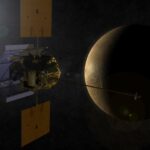
Banner image: An artist’s depiction of the MESSENGER spacecraft approaching Mercury. Credit: NASA.
]]>
UMBC’s Sander Goossens designed and implemented code that’s helping NASA scientists better understand the evolution of planets, starting with Mercury. He’s part of a research team applying...https://umbc.edu/stories/umbcs-sander-goossens-determines-structure-of-mercurys-core-as-part-of-nasa-team/https://my3.my.umbc.edu/api/v0/pixel/news/120047/guest@my.umbc.edu/15cf30d7c247fde17653a8f0689e781f/api/pixelcsstresearchscience-and-technologyUMBC News & Magazinehttps://my3.my.umbc.edu/groups/umbc-news-magazinehttps://assets1-my.umbc.edu/system/shared/avatars/groups/000/001/943/24435aa6207c452e7bc15cc74b42c7bb/xsmall.png?1748556657https://assets1-my.umbc.edu/system/shared/avatars/groups/000/001/943/24435aa6207c452e7bc15cc74b42c7bb/original.png?1748556657https://assets2-my.umbc.edu/system/shared/avatars/groups/000/001/943/24435aa6207c452e7bc15cc74b42c7bb/xxlarge.png?1748556657https://assets2-my.umbc.edu/system/shared/avatars/groups/000/001/943/24435aa6207c452e7bc15cc74b42c7bb/xlarge.png?1748556657https://assets3-my.umbc.edu/system/shared/avatars/groups/000/001/943/24435aa6207c452e7bc15cc74b42c7bb/large.png?1748556657https://assets1-my.umbc.edu/system/shared/avatars/groups/000/001/943/24435aa6207c452e7bc15cc74b42c7bb/medium.png?1748556657https://assets2-my.umbc.edu/system/shared/avatars/groups/000/001/943/24435aa6207c452e7bc15cc74b42c7bb/small.png?1748556657https://assets1-my.umbc.edu/system/shared/avatars/groups/000/001/943/24435aa6207c452e7bc15cc74b42c7bb/xsmall.png?1748556657https://assets2-my.umbc.edu/system/shared/avatars/groups/000/001/943/24435aa6207c452e7bc15cc74b42c7bb/xxsmall.png?1748556657UMBC News & Magazine00falseThu, 12 Sep 2019 19:15:10 -0400UMBC’s Amy Lien helps NASA unravel the mystery of an unusual blast from across the universe
A brief and unusual flash spotted on June 16, 2018 has puzzled astronomers and astrophysicists across the globe. The event, called AT2018cow and nicknamed “the Cow,” defies many of the models scientists use to explain similar outbursts, prompting multiple hypotheses about its source.
Amy Lien, an assistant research scientist in UMBC’s Center for Space Sciences Technology, is on a team of researchers working with NASA’s Neil Gehrels Swift Observatory to develop one theory about the blast’s source. Their model describes a monster black hole shredding a passing star.
“We’ve never seen anything exactly like the Cow,” Lien says, “which is very exciting.”
Spotting the Cow
The Cow occurred in the vicinity of a star-forming galaxy known as CGCG 137-068, located in the constellation Hercules, about 200 million light-years away. That’s 2,000 times the distance from one edge of the Milky Way galaxy to the other.
The Cow was first observed by a ground-based telescope in Hawaii, and the initial observations interpreted it as a potential supernova. Astronomers are quite interested in supernovae, so other telescopes around the world were quickly pointed in its direction to learn more. All three instruments on the Swift Observatory observed the patch of sky where the Cow was spotted for at least 60 days after the initial sighting.
Lien and four other research teams shared their groups’ different interpretations during a panel discussion on January 10 at the American Astronomical Society (AAS) meeting in Seattle.
The mysterious “cow” explosion appears in the center, as viewed from the NASA Swift Observatory. Image provided by the Sloan Digital Sky Survey.
Explosions in the sky
“Explosions in the sky happen all the time,” explains Lien, “so at the beginning people didn’t think this was anything different.” But after more observations came in from Swift and elsewhere, the scientists started to think, “This one looks very weird,” Lien remembers. “It doesn’t match well with anything we know.”
The explanation Lien’s team settled on is an event called a tidal disruption. “When a star gets too close to a black hole, it will get stretched and torn apart by the tidal force in a similar way that causes tides on Earth,” explains Lien. However, because the black hole has an extremely strong gravitational force, instead of just an ebbing tide, “you see the whole star get stretched and shredded,” she says.
Lien and her colleagues think the shredded star was a white dwarf: a hot, roughly Earth-sized object that represents the final state of stars like our Sun. They also calculated that the black hole’s mass ranges from 100,000 to a million times the Sun’s. It’s unusual to see black holes of this scale outside the center of a galaxy, but it’s possible the Cow occurred in a nearby satellite galaxy or aglobular star cluster, which tend to contain a higher proportion of white dwarfs than average galaxies.
When the star was torn apart, the Swift team theorizes, its debris formed a hot, opaque sphere as it was sucked into the black hole. Because the sphere is so dense, it expands very quickly (at nearly 10 percent the speed of light) and creates a “cocoon” layer around itself, which then flies away at extremely high speed.
The whole process of tearing, compacting, and flying away “generates a lot of energy,” says Lien, “and some of it is released as light, almost like a huge light bulb.” That could explain the light coming from the Cow.
Exciting unknowns
Swift, which orbits Earth about 340 miles above the surface, observed the Cow with all three of its instruments, which detect UV rays, x-rays, and gamma rays. Data from these instruments helped the scientists determine the temperature of the Cow, which is approximately four times the temperature of the Sun and consistent with a tidal disruption.
The rate at which the Cow’s brightness decreased during the observation period and its extremely high temperature added to the team’s convictions. But there are still elements that are less likely based on their hypothesis.
“You’re always asking, ‘What about this feature that doesn’t fit well with our model?’” Lien says. While that can be frustrating at times, she says, “That’s actually part of why I became an astronomer. It’s the unknowns that excite me.”
It would be helpful to observe another similar event, which would give researchers more information as they try to reach agreement on the Cow’s cause. With the number of telescopes rising worldwide and the increasingly collaborative nature of space research, “We are definitely more ready than even ten years ago to spot this kind of phenomenon,” Lien says. “Now we’re just waiting for the next one.”
A paper on the Swift findings, which Lien co-authored and presented at the AAS discussion, has been accepted by the Monthly Notices of the Royal Astronomical Society.
]]>
A brief and unusual flash spotted on June 16, 2018 has puzzled astronomers and astrophysicists across the globe. The event, called AT2018cow and nicknamed “the Cow,” defies many of the models...https://umbc.edu/stories/umbcs-amy-lien-helps-nasa-unravel-the-mystery-of-an-unusual-blast-from-across-the-universe/https://my3.my.umbc.edu/api/v0/pixel/news/120225/guest@my.umbc.edu/b7131a914912999f8e4c36bd7bd0850c/api/pixelcsstresearchscience-and-technologyUMBC News & Magazinehttps://my3.my.umbc.edu/groups/umbc-news-magazinehttps://assets1-my.umbc.edu/system/shared/avatars/groups/000/001/943/24435aa6207c452e7bc15cc74b42c7bb/xsmall.png?1748556657https://assets1-my.umbc.edu/system/shared/avatars/groups/000/001/943/24435aa6207c452e7bc15cc74b42c7bb/original.png?1748556657https://assets2-my.umbc.edu/system/shared/avatars/groups/000/001/943/24435aa6207c452e7bc15cc74b42c7bb/xxlarge.png?1748556657https://assets2-my.umbc.edu/system/shared/avatars/groups/000/001/943/24435aa6207c452e7bc15cc74b42c7bb/xlarge.png?1748556657https://assets3-my.umbc.edu/system/shared/avatars/groups/000/001/943/24435aa6207c452e7bc15cc74b42c7bb/large.png?1748556657https://assets1-my.umbc.edu/system/shared/avatars/groups/000/001/943/24435aa6207c452e7bc15cc74b42c7bb/medium.png?1748556657https://assets2-my.umbc.edu/system/shared/avatars/groups/000/001/943/24435aa6207c452e7bc15cc74b42c7bb/small.png?1748556657https://assets1-my.umbc.edu/system/shared/avatars/groups/000/001/943/24435aa6207c452e7bc15cc74b42c7bb/xsmall.png?1748556657https://assets2-my.umbc.edu/system/shared/avatars/groups/000/001/943/24435aa6207c452e7bc15cc74b42c7bb/xxsmall.png?1748556657UMBC News & Magazine00falseTue, 22 Jan 2019 16:42:06 -0500UMBC astronomer Kenji Hamaguchi confirms binary star system produces cosmic rays
Eta Carinae is the most massive and luminous star system within 10,000 light years of Earth. New UMBC research published in Nature Astronomy concludes for the first time that the system is emitting cosmic rays, some of which may reach Earth.
Producing cosmic rays, which also happens following a supernova, requires that particles be accelerated nearly to the speed of light. “We found that the accelerated particles are really energetic, which is much more than we expected from this star,” says Kenji Hamaguchi, the lead author on the study. Hamaguchi is a researcher at UMBC’s Center for Space Sciences and Technology, a partnership with NASA. The fourth author is Neetika Sharma, Ph.D. ’16, physics, who worked on the project as a postdoctoral fellow.
The new research takes advantage of NASA’s powerful NuSTAR satellite, which can detect and locate high-energy x-rays with remarkable accuracy. Different instruments have been tracking relatively low-energy x-rays from Eta Carinae for decades, and another instrument suggested Eta Carinae might be the source of the high-energy x-rays and even higher-energy gamma rays. However, those instruments haven’t been powerful enough to conclusively determine the source of the rays that they detect.
“That’s why we proposed the observations with NuSTAR,” says Hamaguchi. “NuSTAR can image x-rays in the high-energy range for the first time. So we can pinpoint the location of high-energy emissions.”
Eta Carinae is a binary star system, meaning two stars are orbiting each other. As they orbit, the stars come within 140 million miles of each other every five and half years. This is about the distance from Mars to the Sun, and very, very close for two stars.
Stars are constantly throwing off particles, creating what is known as the “stellar wind.” Based on their findings, the researchers explain that Eta Carinae generates high-energy x-rays and gamma rays when the two stars’ stellar winds collide. The rays’ intensity depends on the relative position of the two stars. Those cosmic rays then travel through the universe, and some of them may end up near Earth—but until now scientists haven’t been able to clearly identify their source.
Beyond confirming Eta Carinae as a source of cosmic rays, this new research also shows for the first time that a binary system like Eta Carinae is capable of accelerating particles to extreme speeds. Previously, that kind of acceleration had only been proven in the debris resulting from supernovae. This helps expand knowledge of how particles can accelerate in space, which is relevant for studies of the birth of the universe and a variety of other extreme situations in the cosmos.
Hamaguchi is already looking forward to the next new instrument beyond NuSTAR, as he works to increase understanding of how stellar winds interact, accelerate particles, and generate cosmic rays. He is drawn to analyzing complex data about the universe “because we can find something nobody knows,” he says. “Every time you get something new.”
Image: The supermassive star Eta Carinae is at the center of two huge and expanding clouds of dust and other material, the result of an eruption about 150 years ago. Nathan Smith/NASA.
]]>
Eta Carinae is the most massive and luminous star system within 10,000 light years of Earth. New UMBC research published in Nature Astronomy concludes for the first time that the system is...https://umbc.edu/stories/umbc-astronomer-kenji-hamaguchi-confirms-binary-star-system-produces-cosmic-rays/https://my3.my.umbc.edu/api/v0/pixel/news/120374/guest@my.umbc.edu/0cdf8e6f73f2a082cd7df90f2c571735/api/pixelcnmscsstresearchscience-and-technologyUMBC News & Magazinehttps://my3.my.umbc.edu/groups/umbc-news-magazinehttps://assets1-my.umbc.edu/system/shared/avatars/groups/000/001/943/24435aa6207c452e7bc15cc74b42c7bb/xsmall.png?1748556657https://assets1-my.umbc.edu/system/shared/avatars/groups/000/001/943/24435aa6207c452e7bc15cc74b42c7bb/original.png?1748556657https://assets2-my.umbc.edu/system/shared/avatars/groups/000/001/943/24435aa6207c452e7bc15cc74b42c7bb/xxlarge.png?1748556657https://assets2-my.umbc.edu/system/shared/avatars/groups/000/001/943/24435aa6207c452e7bc15cc74b42c7bb/xlarge.png?1748556657https://assets3-my.umbc.edu/system/shared/avatars/groups/000/001/943/24435aa6207c452e7bc15cc74b42c7bb/large.png?1748556657https://assets1-my.umbc.edu/system/shared/avatars/groups/000/001/943/24435aa6207c452e7bc15cc74b42c7bb/medium.png?1748556657https://assets2-my.umbc.edu/system/shared/avatars/groups/000/001/943/24435aa6207c452e7bc15cc74b42c7bb/small.png?1748556657https://assets1-my.umbc.edu/system/shared/avatars/groups/000/001/943/24435aa6207c452e7bc15cc74b42c7bb/xsmall.png?1748556657https://assets2-my.umbc.edu/system/shared/avatars/groups/000/001/943/24435aa6207c452e7bc15cc74b42c7bb/xxsmall.png?1748556657UMBC News & Magazine00falseMon, 16 Jul 2018 20:16:59 -0400UMBC space scientist further confirms Einstein’s theory through new solar research
New research by Sander Goossens, associate research scientist at UMBC’s Center for Space Science and Technology, and colleagues offers a fresh perspective on a question of universal importance. The study, published in Nature Communications, employed a novel method to learn more about the Sun and further confirmed the constant G, the mainstay of Einstein’s theory of general relativity that predicts how extremely large masses warp space-time.
To address such big ideas, “You need the solar system as your laboratory,” says Goossens. The research team, led by Antonio Genova, research scientist in MIT’s Department of Earth, Atmospheric, and Planetary Sciences, used data collected by NASA’s MESSENGER satellite, which orbited Mercury from March 2011 to April 2015 and carried out “flyby” observations in 2008 and 2009. By tracking and analyzing the orbits of Mercury and MESSENGER over several years, the team was able to separate out the various causes of tiny changes in their orbits.
The Sun’s gravity is the biggest factor that keeps the planets in orbit. As the Sun slowly loses mass from interior processes and the solar wind—which constantly rips particles away from the upper atmosphere of the Sun—its gravity weakens, the planets’ orbits creep away from the Sun, and the solar system expands. The team found that the Sun is losing mass at a rate of 0.1 percent per 10 billion years, causing the planetary orbits to shift by 1.5 cm per year per astronomical unit (the distance between Earth and the Sun).
Other factors also affect the planets’ orbits, such as the Sun’s “oblateness” (how much it bulges in the middle, rather than being a perfect sphere) and how much it warps space-time by virtue of its goliath size, which is described by relativity theory. The team was able to estimate relativity-related parameters, confirming Einstein’s theory beyond what previous studies have found.
This study also further constrained the value of the constant G, which governs gravity’s effect on objects. Scientists continue working to demonstrate that G remains constant in as many contexts as possible. This adds evidence for the hypothesis that G is constant across the universe and hasn’t changed since the Big Bang.
“To some people it might sound like, ‘Well, there’s another confirmation of Einstein’s theory,’ but those are important because we have no idea at what level things might deviate,” says Goossens. He explains, “It’s a constant, so people expect it to be constant, but it’s always been a question whether or not G varies with time, and we’ve been able to put quite tight constraints on that.”
This work is an example of the wide range of questions that can be addressed with a NASA mission like MESSENGER. “This study demonstrates that charting the orbits of planets, such as Mercury, may provide simultaneous new findings in different disciplines,” says Genova, from heliophysics—the study of the sun and its effects on the solar system—to theoretical physics, which includes the study of gravity.
This study is the first to calculate the Sun’s mass loss and oblateness based on observation as opposed to theory alone. Also, previous studies had taken Mercury’s orbit as fixed, based on data from NASA’s Jet Propulsion Laboratory, and actively measured only the satellite’s orbit. Genova, Goossens, and colleagues used an innovative approach, yielding more accurate results.
“In this case, we modeled both the orbit of Mercury and the orbit of the satellite,” explains Goossens, “and in a similar way that we normally determine the satellite orbit, we now simultaneously determined Mercury’s and the satellite’s orbit.”
Eventually, Goossens would like to see this type of analysis expanded even further, to consider more than two celestial bodies at once—perhaps even the entire solar system. Even looking at other pairs of bodies, such as the Sun and a different planet, would be a boon for general relativity experts who have a range of ideas about Einstein’s theory, he says. “Perhaps this could show a way forward for testing those theories as well.”
Image: An artist’s conception of the MESSENGER satellite as it orbits Mercury; photo provided by NASA.
]]>
New research by Sander Goossens, associate research scientist at UMBC’s Center for Space Science and Technology, and colleagues offers a fresh perspective on a question of universal importance....https://umbc.edu/stories/umbc-space-scientist-further-confirms-einsteins-theory-through-new-solar-research/https://my3.my.umbc.edu/api/v0/pixel/news/120566/guest@my.umbc.edu/ff9a5fea09da2294a360d9dfc33f029e/api/pixelcsstphysicsresearchscience-and-technologyUMBC News & Magazinehttps://my3.my.umbc.edu/groups/umbc-news-magazinehttps://assets1-my.umbc.edu/system/shared/avatars/groups/000/001/943/24435aa6207c452e7bc15cc74b42c7bb/xsmall.png?1748556657https://assets1-my.umbc.edu/system/shared/avatars/groups/000/001/943/24435aa6207c452e7bc15cc74b42c7bb/original.png?1748556657https://assets2-my.umbc.edu/system/shared/avatars/groups/000/001/943/24435aa6207c452e7bc15cc74b42c7bb/xxlarge.png?1748556657https://assets2-my.umbc.edu/system/shared/avatars/groups/000/001/943/24435aa6207c452e7bc15cc74b42c7bb/xlarge.png?1748556657https://assets3-my.umbc.edu/system/shared/avatars/groups/000/001/943/24435aa6207c452e7bc15cc74b42c7bb/large.png?1748556657https://assets1-my.umbc.edu/system/shared/avatars/groups/000/001/943/24435aa6207c452e7bc15cc74b42c7bb/medium.png?1748556657https://assets2-my.umbc.edu/system/shared/avatars/groups/000/001/943/24435aa6207c452e7bc15cc74b42c7bb/small.png?1748556657https://assets1-my.umbc.edu/system/shared/avatars/groups/000/001/943/24435aa6207c452e7bc15cc74b42c7bb/xsmall.png?1748556657https://assets2-my.umbc.edu/system/shared/avatars/groups/000/001/943/24435aa6207c452e7bc15cc74b42c7bb/xxsmall.png?1748556657UMBC News & Magazine00falseMon, 29 Jan 2018 22:14:59 -0500
 Nicholas Cannady (image courtesy of Cannady)
 TIGERISS’s predecessor, SuperTIGER (inside the large metal box), prepares for a flight at McMurdo Station, Antarctica, in 2017. (Image courtesy of NASA/Jason Link)
 Vishnu Viswanathan (Image courtesy of Viswanathan)




 A rendering of the system where researchers found the new planet, AU Mic b. The star AU Microscopii, which AU Mic b orbits at very close range, is at the center. A disk of dust and debris surrounds the star. Image courtesy NASA’s Goddard Space Flight Center/Chris Smith (Universities Space Research Association)