Josh Michael ’10, Ph.D. ’22, elected Maryland State Board of Education president

The Maryland State Board of Education has unanimously elected Josh Michael ’10, political science, Ph.D. ’22, public policy, as its new president following his completion of a one-year term as vice president last year. Michael, whose career in education advocacy has been greatly intertwined with UMBC for years, began his interaction with the Maryland State Department of Education (MSDE) as a student representative on the board in 2005.
Now, as president, Michael will continue to oversee the administration of MSDE with the 11-member board, which includes public school educators, parents, community leaders, and a student. UMBC alumna Chuen-Chin Bianca Chang ’91, nursing, is also a board member, representing Howard County since 2021.
Michael will work with the state superintendent to provide oversight of Maryland’s 24 school districts and lead the board’s work in guiding the implementation of MSDE’s Blueprint for Maryland’s Future, an initiative to increase state funding for education over the next 10 years with a focus on historically underserved students.
“Over the last 10 to 15 years, Maryland public schools have slowly declined in achievement, in literacy, and math. Our rankings have dropped in many ways. Taking this head-on has been a focus of our work,” Michael explains. “We seem to have lost sight of what is most important—ensuring our students are learning. Our schools must serve children from all backgrounds at all performance levels and provide opportunities to excel. The board is focused on restoring stability, vision, and direction for the state to support public schools.”
Direct service in the classroom and communities has humanized the policy process for me.
Josh Michael ’10, Ph.D. ’22
Education policy at work
Michael’s work with public education began as a UMBC Sondheim Public Affairs Scholar, where he learned about education policy. After graduating, he worked as a math teacher at Baltimore City’s Booker T. Washington Middle School and The Commodore John Rodgers School. After six years in the classroom, Michael returned to UMBC in 2016 to work on growing what was then called UMBC’s Sherman STEM Teachers Scholars Program with Rehana Shafi, the inaugural director, and with the support of The Sherman Family Foundation. The program prepared STEM majors to become high-quality K-12 teachers in urban settings through academic and professional coaching. The program has since broadened its scope and is now called the Sherman Teacher Scholars Program.
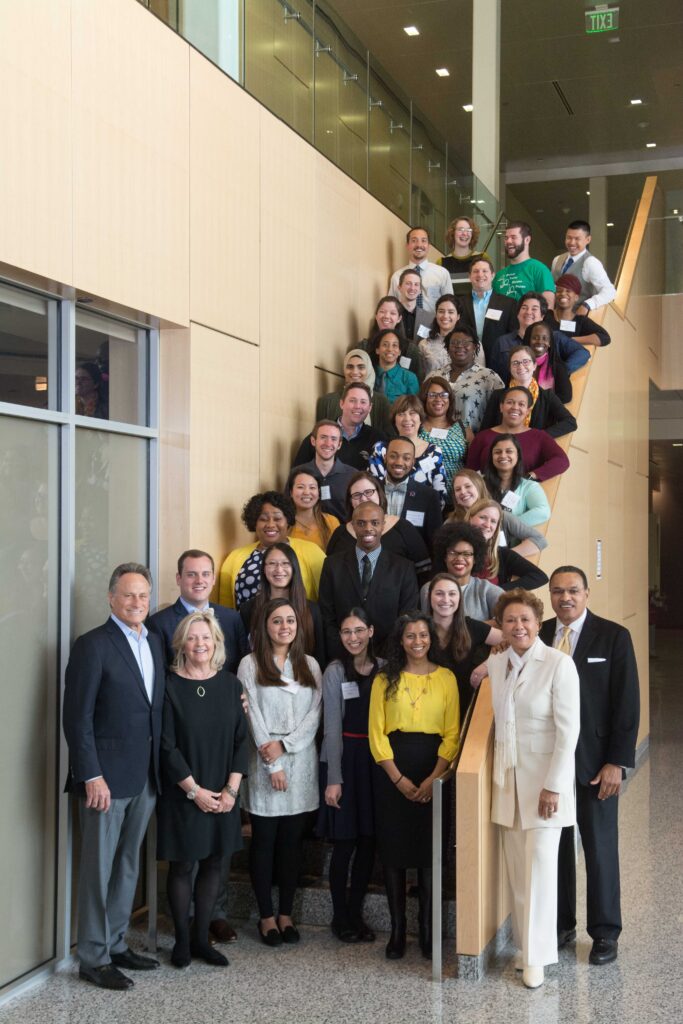 George and Betsy Sherman (first from left) in front of Josh Michael. Freeman Hrabowski, then-president of UMBC, and Jacqueline Hrabowski (first from right) next to Rehana Shafi (in yellow) at the Sherman STEM Teacher Scholars Program’s 10th anniversary.
Shafi and Michael fostered existing partnerships and helped establish the Lakeland Community and STEAM Center, where many Sherman Teacher Scholars continue to hold student-teacher placements and serve as math volunteers. During this six-year period, Michael also earned a doctorate degree at UMBC focused on mathematics achievement and improving outcomes for struggling students.
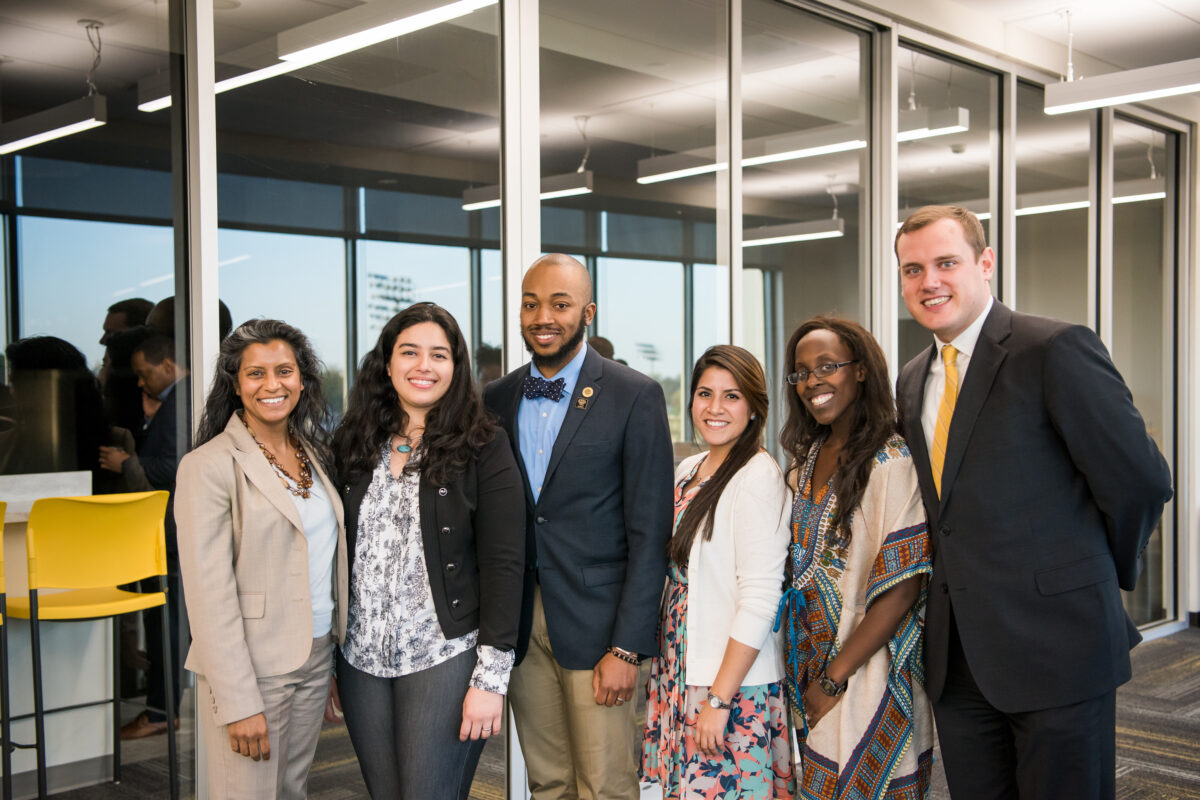 (l-r): Shafi, Monique Rivera-Velez, M.A.T ’17, education; Corey Carter ’08, biological sciences, M.A.T. ’10, education, current director of the Sherman scholars program; Emily Diaz ’16, biochemistry and molecular biology, and M.A.T ’17, education; Josephine Kalema-Kasozi ’13, dance, teaching certificate in secondary math education; and Michael at the 2018 Celebration of Teaching event. (Marlayna Demond ’11/UMBC)
Humanizing policy
“Josh’s work at the Sherman Teacher Scholars Program laid the groundwork for lasting partnerships between the university and City Schools. One example of this legacy is the Reach Together Tutoring Project (RTTP), which provides over 400 City Schools students each year with targeted math tutoring by UMBC students,” says Jane Lincove, professor of public policy and Michael’s dissertation chair. “The program is both reducing math achievement gaps and inspiring UMBC students to become math teachers. Josh’s work is a glowing example of how academic research by doctoral students in UMBC’s public policy program can be put to work to improve the lives of Marylanders.”
 (l-r back row): Carter, Najib Jammal, then-principal of Lakeland Elementary/Middle School, Hrabowski, and Michael. (l-r front row): Betsy Sherman and Shafi. (Marlayna Demond ’11/UMBC)
“My advice to students interested in public policy is to serve in the communities you want to work with,” says Michael, currently the executive director at The Sherman Family Foundation and a board member of the Maryland Family Network, Cherry Hill Strong, and the Teach For America Baltimore Advisory Board. “Direct service in the classroom and communities have humanized the policy process for me.”
]]>
The Maryland State Board of Education has unanimously elected Josh Michael ’10, political science, Ph.D. ’22, public policy, as its new president following his completion of a one-year term as...
https://umbc.edu/stories/josh-michael-elected-msde-president/
https://my3.my.umbc.edu/api/v0/pixel/news/143029/guest@my.umbc.edu/fcaf3a9833b29e3c72c81413cedd1425/api/pixel
biochemistry
biological-sciences
cahss
dance
education
molecular-biology
news
policy-and-society
political-science
publicpolicy
sherman-stem-teacher-scholars-program
sondheim-public-affairs-scholars-program
story
UMBC News & Magazine
https://my3.my.umbc.edu/groups/umbc-news-magazine
https://assets1-my.umbc.edu/system/shared/avatars/groups/000/001/943/24435aa6207c452e7bc15cc74b42c7bb/xsmall.png?1748556657
https://assets1-my.umbc.edu/system/shared/avatars/groups/000/001/943/24435aa6207c452e7bc15cc74b42c7bb/original.png?1748556657
https://assets2-my.umbc.edu/system/shared/avatars/groups/000/001/943/24435aa6207c452e7bc15cc74b42c7bb/xxlarge.png?1748556657
https://assets2-my.umbc.edu/system/shared/avatars/groups/000/001/943/24435aa6207c452e7bc15cc74b42c7bb/xlarge.png?1748556657
https://assets3-my.umbc.edu/system/shared/avatars/groups/000/001/943/24435aa6207c452e7bc15cc74b42c7bb/large.png?1748556657
https://assets1-my.umbc.edu/system/shared/avatars/groups/000/001/943/24435aa6207c452e7bc15cc74b42c7bb/medium.png?1748556657
https://assets2-my.umbc.edu/system/shared/avatars/groups/000/001/943/24435aa6207c452e7bc15cc74b42c7bb/small.png?1748556657
https://assets1-my.umbc.edu/system/shared/avatars/groups/000/001/943/24435aa6207c452e7bc15cc74b42c7bb/xsmall.png?1748556657
https://assets2-my.umbc.edu/system/shared/avatars/groups/000/001/943/24435aa6207c452e7bc15cc74b42c7bb/xxsmall.png?1748556657
UMBC News & Magazine
1
0
false
Fri, 02 Aug 2024 12:18:57 -0400
Fri, 02 Aug 2024 12:18:57 -0400
Ballet dancer Misty Copeland shares personal mission in visit with students at UMBC

By Lisa Traiger
Misty Copeland is a ballerina on a mission—and last week she brought that mission to UMBC. Renowned for both her ethereality and powerful muscularity, as well as her activism in diversifying a white-dominant field, in 2015 Copeland became the first Black woman promoted to principal dancer at American Ballet Theatre, a top U.S. ballet company. And she continues to break down barriers to democratize this art form born of European privilege and monarchy.
On March 6, Copeland spent a day on campus—meeting with dance majors in the Dance Cube, speaking one-on-one with alumni and young dancers at a reception, watching student dancers perform, and participating in UMBC’s first annual Artful Conversations, a public Q&A in Linehan Concert Hall.
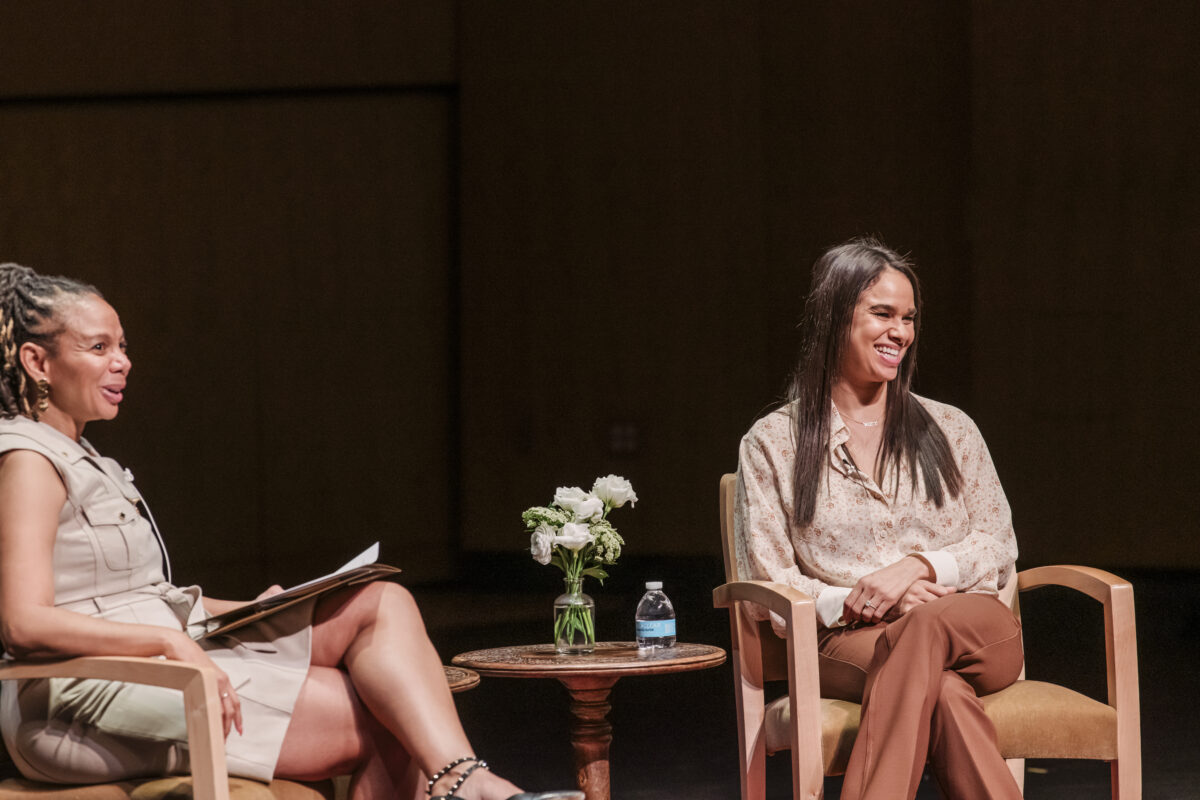 Dean Kimberly Moffitt and Misty Copeland during the Artful Conversations event in front of a sold-out crowd at the Linehan Concert Hall. (Marlayna Demond ’11/UMBC)
“You are my people,” the lithe dancer in smart slacks and stilettos told about 35 UMBC dance students and prospective students in an afternoon session. “I came into the ballet world at a late age—13,” she said, recalling her first ballet classes sponsored by a YMCA Boys and Girls Club in a gymnasium. She wore socks and shorts and had never heard classical music before. What she initially described as a “weird” experience, soon became an epiphany. “I felt so free… I was very shy. I didn’t have the tools or the confidence to say everything I wanted to say at 13, but I realized this might be the last time I had this chance,” said Copeland. “So I always took advantage of every opportunity I’ve been given.” And through ballet, she found her voice—and purpose.
Breaking ballet’s glass ceiling
Raised by a single mother, she and her five siblings were sometimes “house-less,” as Copeland described it. The ballet studio “was the first time I felt physically protected in a space and I could be naked and vulnerable,” Copeland said. “That’s the feeling we should all have: what it’s like to be in a space of freedom and creativity and no judgment.” These days through her eponymous charitable foundation, Copeland supports programs that provide funding and classes that break ballet’s glass ceiling through diversity, equity, and inclusion activities.
Victoria Davies, a junior dance major and Linehan Artist Scholar, performed in “Boundless” by faculty member Shaness D. Kemp, one of three modern works dance students shared with Copeland and attendees during the early evening public event in the sold-out Linehan Concert Hall. “For me,” Davies said, “to see another person of color who has been very successful in her dance career and hear about all the things she went through, hopefully I can get to that point in my own career.”
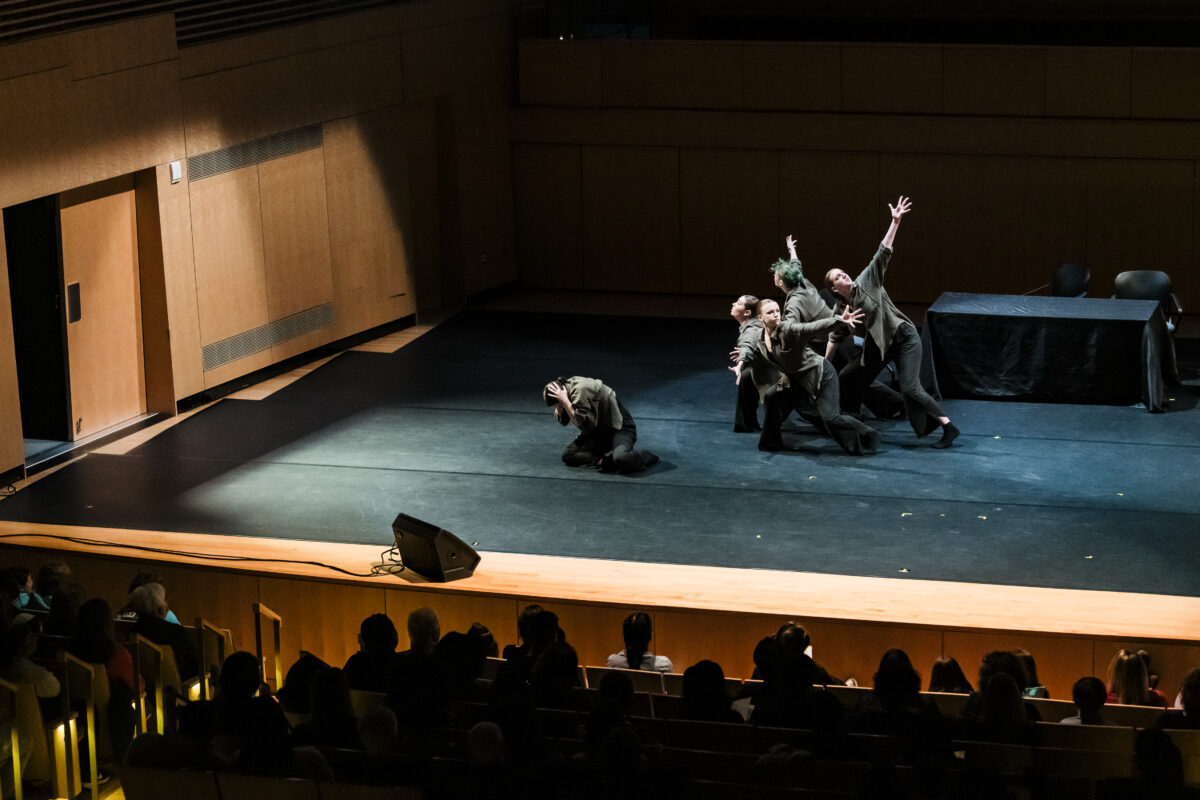
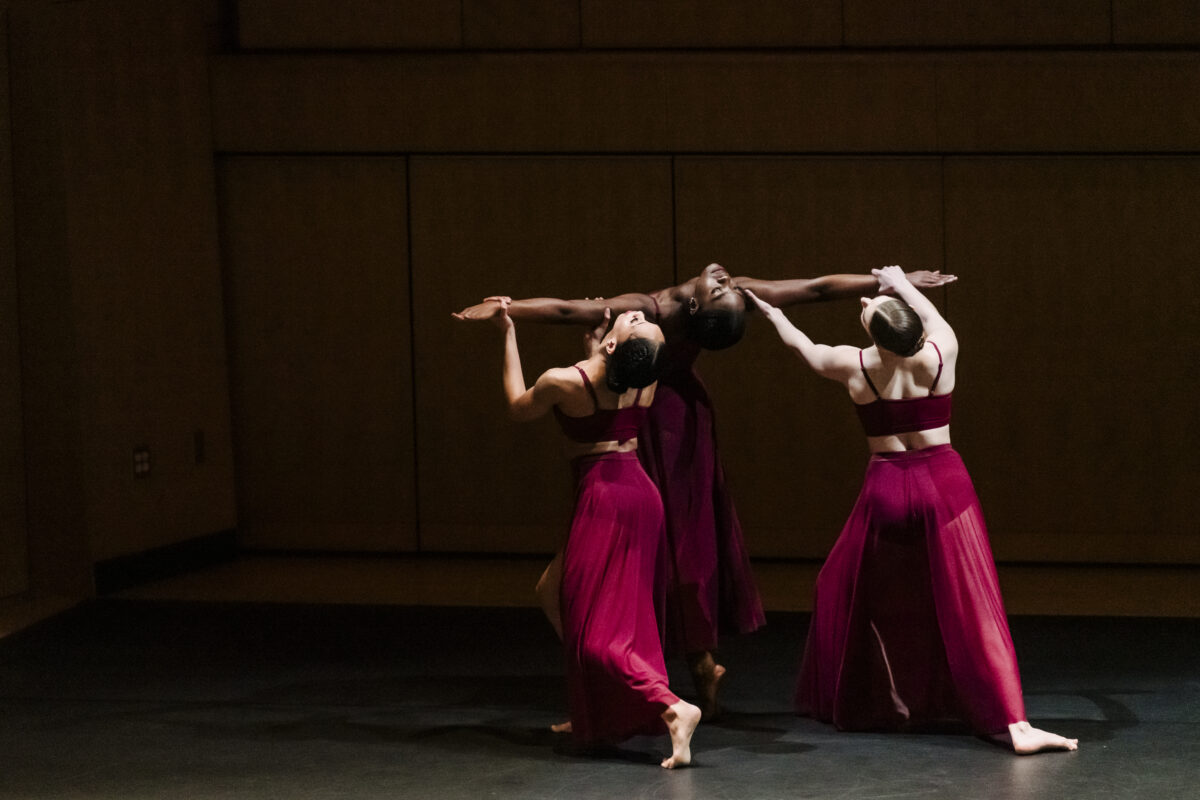
Left: Capstone work by dance major Eva Mclaughlin, “Episodic Abrasion” (dancers: Sarah McHale, Cassidy Cipolla-Milchak, Ria Murphy, Katelyn O’Connor, Gwyneth Watson). Right: “Boundless” (2022) repertory work by Assistant Professor Shaness D. Kemp (dancers: India Blake, Victoria Davies, Sophia Papparotto.) (Marlayna Demond ’11/UMBC)
First-year dance major Ashley Baer said that learning more about Copeland “makes everything so much more real. She has been so influential to so many. As dancers, it’s so amazing to be able to hear her perspectives on performing and life.” Baer shared a quote she jotted down from Copeland’s talk: “’Continue to explore life and live your life…. As dancers we get so caught up in our training and we need to continue to live life.’”
Ask for the roles you want
 Misty Copeland. (Marlayna Demond ’11/UMBC)
Students asked Copeland about her challenges, transitioning from student to professional, taking care of her body, work-life balance, and dealing with microaggressions as one of the few Black women at the top of the ballet company hierarchy. She was frank, yet gracious, in her responses, noting she moved to New York the day after graduating from high school and it took her about five years to understand the complexity of rehearsal and casting schedules. “Having a support system has always been key,” she advised. “You need people you can turn to. This [career] takes a lot out of you, physically, mentally, emotionally.”
One lesson she learned from her close friend and mentor, the late African American ballet dancer Raven Wilkinson: Do not be afraid to ask for roles you want. Copeland desired a specific role, but had never been cast. With Wilkinson’s encouragement, she approached American Ballet Theatre artistic director Kevin McKenzie and asked. His response: “Oh, I thought you had danced that role.” Then she was cast. She noted: “As a woman, as a dancer with a Black body…it felt like [my success] was this collective effort of all my ancestors. It never felt like my accomplishment singularly.”
While Copeland hasn’t been back in the studio since the birth of her son two years ago, she remains active on other fronts: as an author of now six books for children, teens, and adults, and as designer of her own line of athleisure wear, Greatness Wins, in collaboration with athlete Derek Jeter. As well, she acknowledges the ongoing importance of being a ballet dancer.
Stars aren’t made overnight
According to College of Arts, Humanities, and Social Sciences Dean Kimberly Moffitt, who moderated the public Q&A, Copeland proved the perfect choice to inaugurate Artful Conversations, which will invite a high-profile creative to campus annually. “First and foremost, I want my dance students 10 years from now to say, ‘I had the chance to interact with Misty directly,’” Moffitt said. “That’s a special moment from their academic experience here at UMBC.” She continued, “And other students who are drawn to attend will learn something really interesting about Misty’s trajectory to becoming not just another ballerina. She has a really interesting story to tell. Often, we believe that these [stars] are overnight successes. We forget how much work, effort, and energy individuals put into making it.”
Introducing Copeland, Dawn Moore, first lady of Maryland and an advocate for the arts across the state, said, “We have gathered to celebrate the power of dance to inspire and unite…[because] dance nurtures compassion, contemplation, and healing.”
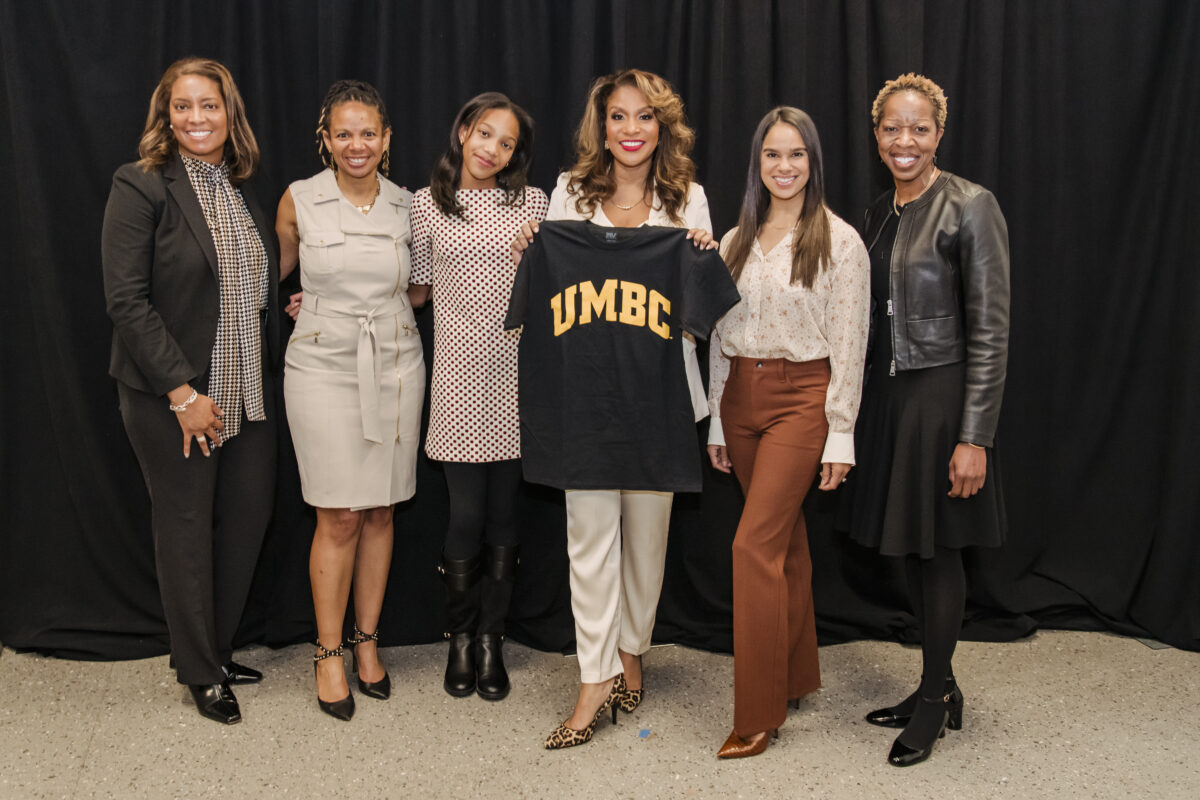 Left to right: Candace Dodson-Reed ’96, Dean Kimberly Moffitt, Mia Moore, First Lady Dawn Moore, Misty Copeland, and President Valerie Sheares Ashby. (Marlayna Demond ’11/UMBC)
And Copeland left the dance students of all ages with this message: “As a dancer, it’s so easy to get caught up in the minutiae of daily battles, and a lot of those are within ourselves. Every day, it’s important to remind yourself why you’re doing this. I love being on stage—it’s where I feel the most free. It’s liberating. You need to remind yourself of the things that matter to you.”
Learn more about UMBC’s dance and Linehan Artist Scholars programs.
]]>
By Lisa Traiger Misty Copeland is a ballerina on a mission—and last week she brought that mission to UMBC. Renowned for both her ethereality and powerful muscularity, as well as her activism...
https://umbc.edu/stories/misty-copeland-shares-personal-mission-at-umbc/
https://my3.my.umbc.edu/api/v0/pixel/news/139970/guest@my.umbc.edu/49e2c9d52f8e142278da776ce1d41040/api/pixel
cahss
campus-life
dance
linehan-artist-scholar
magazine
story
UMBC News & Magazine
https://my3.my.umbc.edu/groups/umbc-news-magazine
https://assets1-my.umbc.edu/system/shared/avatars/groups/000/001/943/24435aa6207c452e7bc15cc74b42c7bb/xsmall.png?1748556657
https://assets1-my.umbc.edu/system/shared/avatars/groups/000/001/943/24435aa6207c452e7bc15cc74b42c7bb/original.png?1748556657
https://assets2-my.umbc.edu/system/shared/avatars/groups/000/001/943/24435aa6207c452e7bc15cc74b42c7bb/xxlarge.png?1748556657
https://assets2-my.umbc.edu/system/shared/avatars/groups/000/001/943/24435aa6207c452e7bc15cc74b42c7bb/xlarge.png?1748556657
https://assets3-my.umbc.edu/system/shared/avatars/groups/000/001/943/24435aa6207c452e7bc15cc74b42c7bb/large.png?1748556657
https://assets1-my.umbc.edu/system/shared/avatars/groups/000/001/943/24435aa6207c452e7bc15cc74b42c7bb/medium.png?1748556657
https://assets2-my.umbc.edu/system/shared/avatars/groups/000/001/943/24435aa6207c452e7bc15cc74b42c7bb/small.png?1748556657
https://assets1-my.umbc.edu/system/shared/avatars/groups/000/001/943/24435aa6207c452e7bc15cc74b42c7bb/xsmall.png?1748556657
https://assets2-my.umbc.edu/system/shared/avatars/groups/000/001/943/24435aa6207c452e7bc15cc74b42c7bb/xxsmall.png?1748556657
UMBC News & Magazine
2
0
false
Thu, 14 Mar 2024 13:16:27 -0400
Thu, 14 Mar 2024 13:16:27 -0400
7 ways to spring into the arts at UMBC
As flowers start popping up on campus and we get some warmer (if rainy) days, it’s the perfect time to go out and catch some of the arts events happening at UMBC. Whether you need a break from studying, work, or are just looking for some fun, you can be sure to find many entertaining and thought provoking arts and culture events happening on campus!
1. Enjoy an Artful Conversation All About Dance
No dance skills are required to enjoy an evening all about dance with Artful Conversations: An Evening with Misty Copeland. On the night of March 6, from 6 to 7:30 p.m., Misty Copeland, the first African American female principal dancer with the American Ballet Theatre, and a New York Times best selling author, will be discussing topics all about dance and her historical performances. The night will begin with dance works performed by UMBC students and faculty. Later, in conversation with College of Art, Humanities, and Social Sciences Dean Kimberly Moffitt, Copeland will talk about her ground-breaking career.
In case the event is sold out or if you just want to watch on a later date, a livestream and recording will be available via the UMBC Youtube Channel. (Photo by Drew Gurian/MasterClass)


2. Bask in the Glow at a Poetry Reading
If you’re unable to make the Misty Copeland event, the English Department’s spring reading series event on March 6 features Taylor Johnson, poet laureate of Takoma Park, Maryland. Johnson is the author of Inheritance, and winner of the 2021 Norma Farber First Book Award from the Poetry Society of America. Inheritance was influenced by living in Washington, D.C., and it explores the complexities of language. The event, which includes a reading, Q&A, and book signing, is free, and runs from 4 to 5 p.m. in the Albin O. Kuhn Library. (Photo by Sean D. Henry-Smith)
3. Listen to an Enchanting Evening of Music from the Baltimore Symphony Orchestra
On March 8, the Baltimore Symphony Orchestra will perform at UMBC. The ensemble will be led by conductor Ken-David Masur. The program includes Tchaikovsky’s Fourth Symphony, Toshio Hosokawa’s Meditation to the victims of Tsunami 3.11, and the orchestra will be joined by cellist, Zlatomir Fung, for a performance of Camille Saint-Saëns’s Cello Concerto. The performance is being held at the Linehan Concert Hall from 8 to 10 p.m., and tickets are only $5 for students. (Ken-David Masur conducting. Photo taken by Stu Rosner.)

4. Join WMBC for its Entertaining Spring Music Festival
WMBC Radio, UMBC’s independent, student-run radio station, will be hosting their second annual music festival on March 29 in the UC Ballroom, from 6 to 11 p.m. The festival will be featuring some student artists, bands, and other creatives! The bill includes Fly by The Seat, Regan Lewis, Eat the Cake, and more. Don’t forget to check out the art vendors who will be there as well!
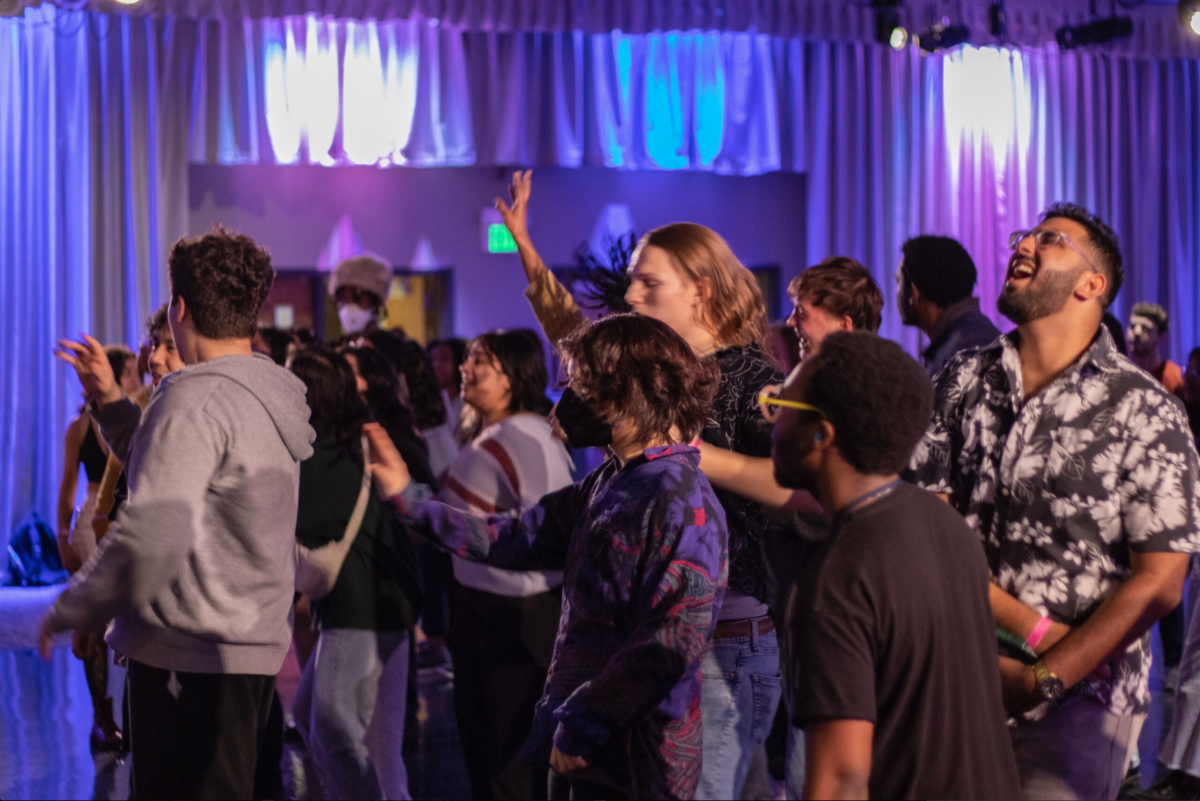 Students enjoying live music at WMBC’s Lonely Heart’s Club Music Festival on February 9, 2023. Event photos by Emily Bryant, Maya Classon, and Mason Doan.
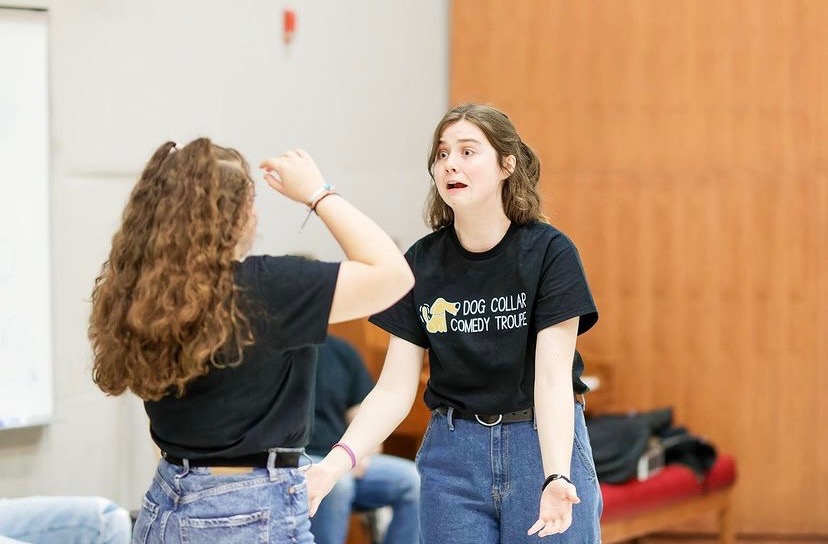
5. Chuckle with Dog Collar at “Saturday Bite Live”
Either before or after WMBC’s music festival, stop by Saturday Bite Live, a free improv show put on by UMBC’s comedy troupe, Dog Collar. Contrary to its name, the show will be on a Friday, March 29, and will take place in the ITE building in room 104. Doors open at 7:30, and the show begins at 8 p.m. Come out and support these students while having a laugh! (Members of the Dog Collar troupe performing at the UMBC Gritty Kitties charity show. Photo by Anthony Rivera.)
6. Check out Plays for Our Planet
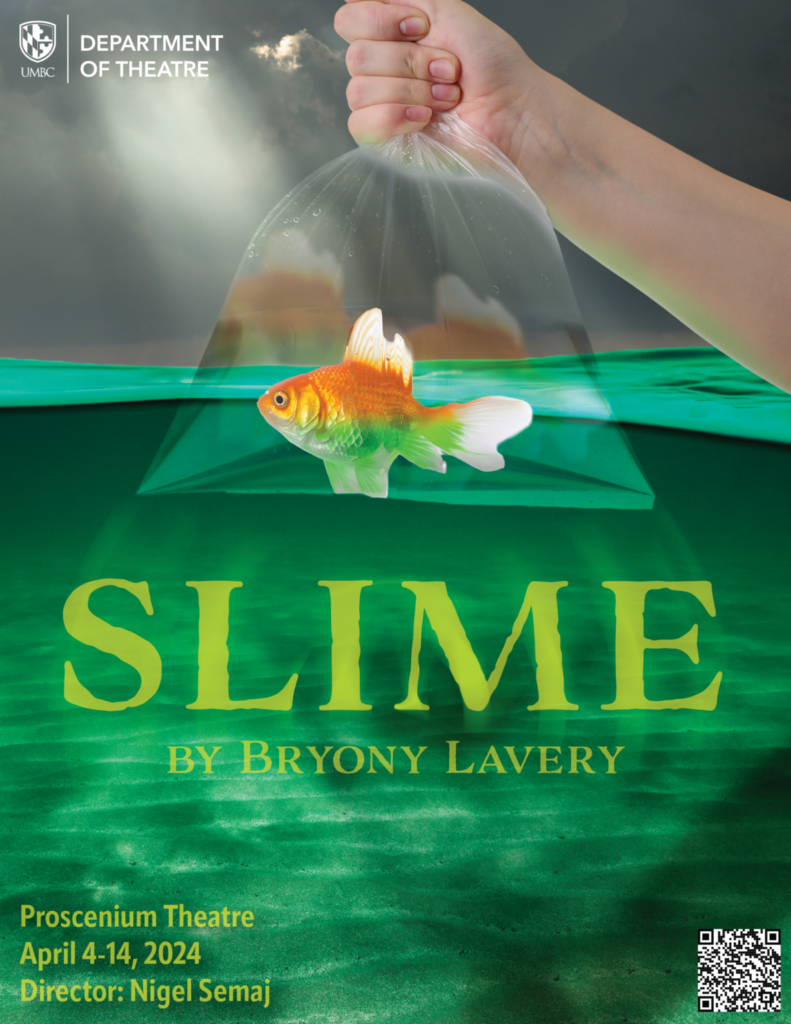
Get an early start on Earth Day this year at one of the UMBC Department of Theatre’s multiple plays centered around the theme of climate science and activism. The play Slime, by Bryony Lavery, directed by Nigel Semaj, will run from April 4 to the 14 in the Performing Arts and Humanities Building’s Proscenium Theatre. Slime is a dystopian comedy about seven grad students who are translators of different animal species, who must work to save all life on earth from a toxic slime. On April 14, there will be a free matinee for UMBC students and post-show actor talk-back.
For more theatre events, you can check out the entire production season here!
The eerie and alluring photographs of Anastasia Samoylova’s FloodZone, depict the painstaking reality of what it’s like to live in the southern U.S. at a time when the climate crisis has greatly affected the environment. The exhibition was first featured at the George Eastman Museum in 2022, and has been on display in a few other locations throughout the U.S. as well as internationally, but the alligators and flamingos and other coastal life forms have now arrived at UMBC for a limited time. The exhibition will be on display at the AOK Library Gallery until May 29.
 Image: Anastasia Samoylova, Gator, 2017. From FloodZone. Photo mural, printed by UMBC © Anastasia Samoylova
On Monday, April 22, in the Library Gallery, the artist will participate in an Earth Day panel on Climate Change, Science Communication, and the Arts. How do climate scientists share their research and data with the wider public in a way that non-specialists can understand? How might art contribute to this urgent work? Samoylova will discuss her photography while in conversation with scientists and media historians specializing in science communication.
]]>
As flowers start popping up on campus and we get some warmer (if rainy) days, it’s the perfect time to go out and catch some of the arts events happening at UMBC. Whether you need a break from...
https://umbc.edu/stories/spring-into-the-arts-at-umbc-spring-2024-events/
https://my3.my.umbc.edu/api/v0/pixel/news/139611/guest@my.umbc.edu/589299d1a6cbc63bdbfbe3aeeb5ff25d/api/pixel
albin-o-kuhn-library-gallery
arts
cahss
campus-life
dance
english
humanities
magazine
music
proscenium-theatre
story
theatre-department
visualarts
wmbc
UMBC News & Magazine
https://my3.my.umbc.edu/groups/umbc-news-magazine
https://assets1-my.umbc.edu/system/shared/avatars/groups/000/001/943/24435aa6207c452e7bc15cc74b42c7bb/xsmall.png?1748556657
https://assets1-my.umbc.edu/system/shared/avatars/groups/000/001/943/24435aa6207c452e7bc15cc74b42c7bb/original.png?1748556657
https://assets2-my.umbc.edu/system/shared/avatars/groups/000/001/943/24435aa6207c452e7bc15cc74b42c7bb/xxlarge.png?1748556657
https://assets2-my.umbc.edu/system/shared/avatars/groups/000/001/943/24435aa6207c452e7bc15cc74b42c7bb/xlarge.png?1748556657
https://assets3-my.umbc.edu/system/shared/avatars/groups/000/001/943/24435aa6207c452e7bc15cc74b42c7bb/large.png?1748556657
https://assets1-my.umbc.edu/system/shared/avatars/groups/000/001/943/24435aa6207c452e7bc15cc74b42c7bb/medium.png?1748556657
https://assets2-my.umbc.edu/system/shared/avatars/groups/000/001/943/24435aa6207c452e7bc15cc74b42c7bb/small.png?1748556657
https://assets1-my.umbc.edu/system/shared/avatars/groups/000/001/943/24435aa6207c452e7bc15cc74b42c7bb/xsmall.png?1748556657
https://assets2-my.umbc.edu/system/shared/avatars/groups/000/001/943/24435aa6207c452e7bc15cc74b42c7bb/xxsmall.png?1748556657
UMBC News & Magazine
0
0
false
Tue, 05 Mar 2024 11:59:34 -0500
Tue, 05 Mar 2024 11:59:34 -0500
Step into a dancer’s shoes

University Communications and Marketing social media intern Allison John ’24, psychology, isn’t only interested in Instagram engagement and sharing campus treasures—she’s also passionate about the creative process that brings a dancer’s performance to life. After watching this year’s Fall Dance Showcase, John sat down with one of the senior choreographers to learn more about her art.
When you listen to a song, what immediately comes to your mind? Eva McLaughlin ’24, dance, said this is exactly the story of how her choreography comes to life.
Every senior dance major at UMBC is required to create or perform a final piece to graduate. Two to five student dancers will work with a choreographer to pick a variety of songs to tell a story of their choosing. For McLaughlin, when she hears a song, she immediately begins to imagine a story or sometimes a phrase, and from there, her process starts.
This year was different from others as her piece was centered around research she conducted as part of an Undergraduate Research Award (URA). McLaughlin’s research centered on misophonia, a neurological condition characterized by an intense aversion to certain auditory stimuli. The dance piece was created in order to pull the audience into the reality of people who have misophonia. The dance depicted scenes of panic attacks and the image of a “fight or flight” response.
Transforming on the stage
When a choreographer first hears their music, their mind begins to shift through different visions of how their piece could be interpreted. McLaughlin described her choreography as being about the connections between dancers, and less about the counts or the logistics of a dance.
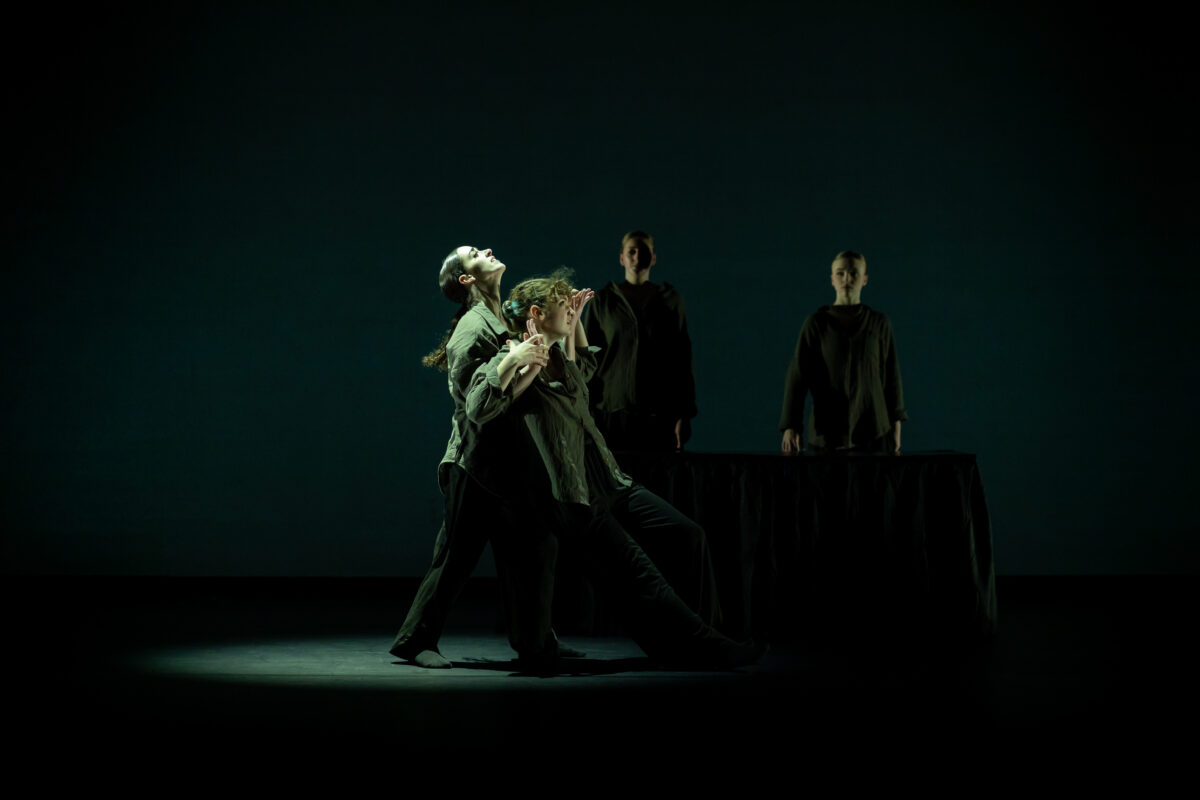 Dancers perform McLaughlin’s “Episodic Abrasion.” Photo by Kiirstn Pagan ’11.
“When I choreograph relationships, I create them based on touch and feelings. It makes their relationship feel more genuine on stage,” she says. Each dance has a story to tell and the responsibility of a choreographer is to guide their dancers in how they want this story to be delivered.
McLaughlin is not only a choreographer, she is also a dancer. Dance is an incredibly intense sport because it requires a dancer to focus on each precise movement. This is not only about their performance on stage, but about what they imagine as they stretch before a performance, the way their facial expressions depict their emotions, and how sharp their movements are. When these dancers walk on stage, they transform—in that moment they are not simply themselves—they are part of this elaborate story. Each audience member understands the story differently, depending on the dancers and how they chose to deliver a piece. McLaughlin describes this feeling as something unlike any other.
Showcasing a different side
When dancing, McLaughlin is telling someone else’s story, and it’s important to remember that story as you dance. As she described her own piece, she said that, “it wasn’t a dance that was meant to be pretty” but instead, she wanted the audience to be brought into the reality of those who live with misophonia.
“When I’m performing, it feels like I’m in a different reality. In that moment, I’m a part of someone else’s story, and I’m able to showcase another side of myself that most people don’t get to see.”
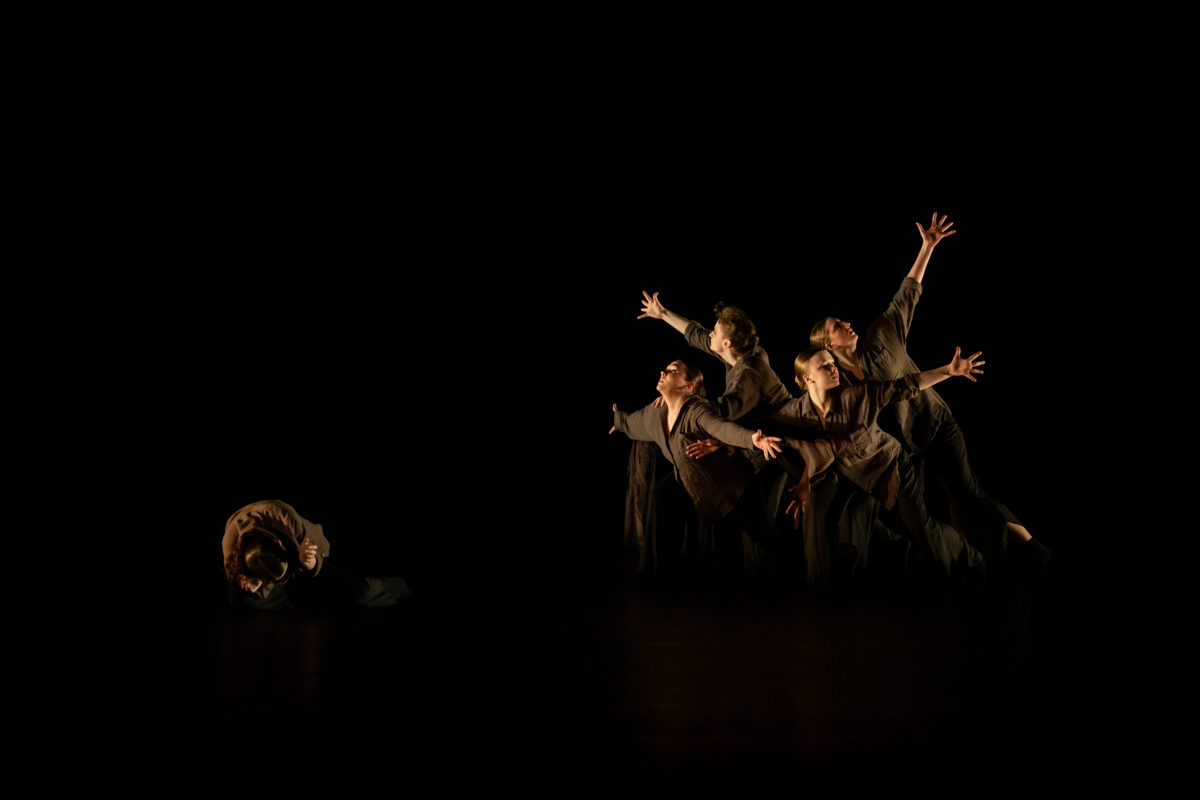 Photo by Kiirstn Pagan ’11.
The passion behind every choreographer and dancer is what makes each piece so unique. In the months leading up to the performance, each dancer is in some way intertwined with this story. They carry the responsibility to deliver it to the audience and hope that each person who comes in contact with this piece leaves feeling impacted by it in some way.
]]>
University Communications and Marketing social media intern Allison John ’24, psychology, isn’t only interested in Instagram engagement and sharing campus treasures—she’s also passionate about the...
https://umbc.edu/stories/step-into-a-dancers-shoes/
https://my3.my.umbc.edu/api/v0/pixel/news/137802/guest@my.umbc.edu/f35f4bd516e32b46f35ccad3f0444bba/api/pixel
cahss
campus-life
dance
magazine
UMBC News & Magazine
https://my3.my.umbc.edu/groups/umbc-news-magazine
https://assets1-my.umbc.edu/system/shared/avatars/groups/000/001/943/24435aa6207c452e7bc15cc74b42c7bb/xsmall.png?1748556657
https://assets1-my.umbc.edu/system/shared/avatars/groups/000/001/943/24435aa6207c452e7bc15cc74b42c7bb/original.png?1748556657
https://assets2-my.umbc.edu/system/shared/avatars/groups/000/001/943/24435aa6207c452e7bc15cc74b42c7bb/xxlarge.png?1748556657
https://assets2-my.umbc.edu/system/shared/avatars/groups/000/001/943/24435aa6207c452e7bc15cc74b42c7bb/xlarge.png?1748556657
https://assets3-my.umbc.edu/system/shared/avatars/groups/000/001/943/24435aa6207c452e7bc15cc74b42c7bb/large.png?1748556657
https://assets1-my.umbc.edu/system/shared/avatars/groups/000/001/943/24435aa6207c452e7bc15cc74b42c7bb/medium.png?1748556657
https://assets2-my.umbc.edu/system/shared/avatars/groups/000/001/943/24435aa6207c452e7bc15cc74b42c7bb/small.png?1748556657
https://assets1-my.umbc.edu/system/shared/avatars/groups/000/001/943/24435aa6207c452e7bc15cc74b42c7bb/xsmall.png?1748556657
https://assets2-my.umbc.edu/system/shared/avatars/groups/000/001/943/24435aa6207c452e7bc15cc74b42c7bb/xxsmall.png?1748556657
UMBC News & Magazine
0
0
false
Fri, 15 Dec 2023 13:18:18 -0500
Fri, 15 Dec 2023 13:18:18 -0500
Open to Interpretation
What if you could ask yourself a big question and then use your intuition to follow it wherever it led for as long as it took? It would take a certain kind of guts, right? But, with a willingness to get lost on a tangent, to joyfully put themselves in positions of not knowing, truly creative thinkers can find new ways of translating the world around them.
Enter the following: A dancer who makes beautiful movement from fish research. An information systems professor who turns poetry into wine. A data visualizer who draws connections while splattering paint. A mapper and sculptor of hip hop facts. A harnesser of color and language and culture.
This is the sort of magic that can happen when you’re open to interpretation.

On a molecular level, the push and pull of an ecosystem may feel too infinitesimal for humans to experience visually. A researcher can track the data in a spreadsheet as a series of characters and marks or explain it with the structure of a scientific article. Microscopes may capture stills or video of tiny worlds, but what about the emotional landscape of life in motion?
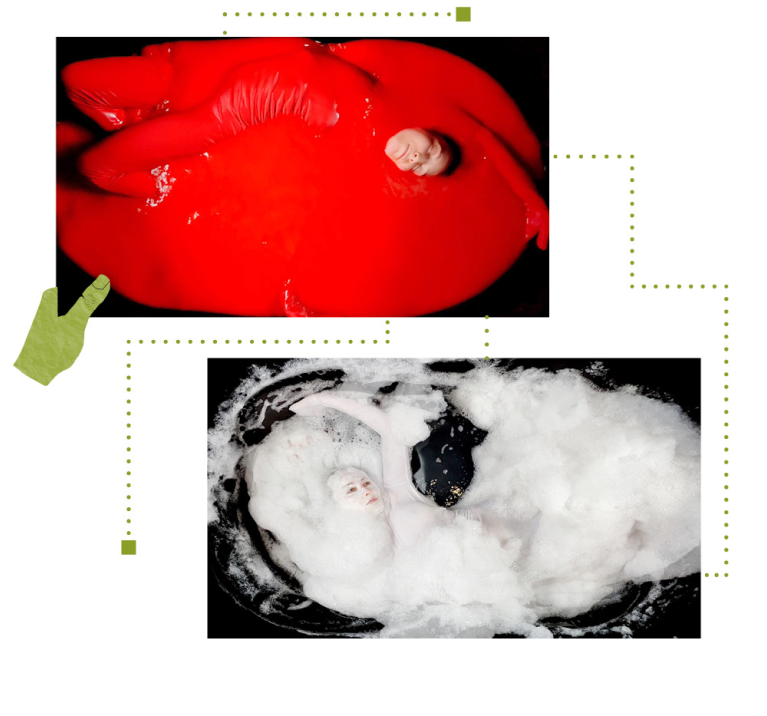
“I really am fascinated with the small things we cannot see that are so important,” says Ann Sofie Clemmensen, assistant professor of dance, who spent a year in residence at the Institute of Marine & Environmental Technology (IMET) next to Baltimore’s Inner Harbor working with scientists who study a variety of topics adjacent to aquaculture, environment, and sustainability.
Clemmensen began her residency by diving deeply into the research of the IMET scientists around her—learning about everything from rainbow trout viruses to the ecological wear and tear of red tides. As she built relationships with researchers, she found herself drawn into the details of their studies—and wondering how she might translate what she learned into something that might encourage viewers to learn more about their world.
“There’s a sort of unpacking of the language of that field. Because movement, while it’s not a spoken language, it is language,” she explains, ever the eager translator. “We have to understand the concept we are trying to embody in order for the physical embodiment to carry the meaning.”
Working with student dancers, Clemmensen choreographed and filmed a series of movements and scenes meant to depict biological processes she learned about from her IMET counterparts. In one, students in masks represent the generic differences of virulent and avirulent strains of the VHSV rainbow trout virus. In another, dancer Michaela Emmerich ’24 (covered in clay powder) rolls in the dirt to show the effect of argonite in reducing levels of phosphorus in farming run-off.
While Clemmensen’s scenes of red tides, green biomass, and white, milky foams are objectively beautiful, don’t be fooled. Nature isn’t pretty, Clemmensen says. But taking a good close look can help us all understand our environment a bit better.
“For many doing art, dance, and data-driven research, it’s like looking at an abstract painting. If you don’t have a little key that can unveil or reveal some of those secrets, then it’s just chaos.”
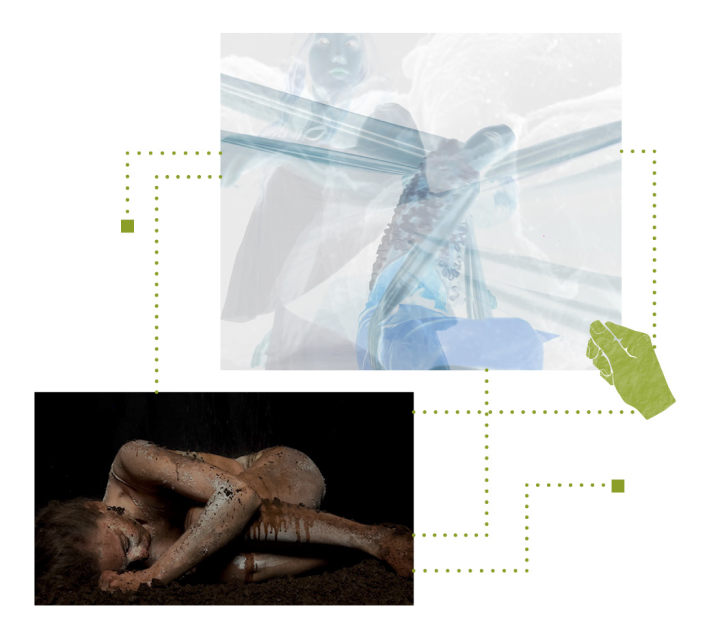
Assistant professor Ann Sofie Clemmensen worked with
researchers at IMET to create a series of videos depicting
microscopic processes like red tides and battling
dinoflaggelates. Photos courtesy of Clemmensen.

A poem crosses time and space, building in meaning as it travels from person to person, from generation to generation. With each new reader, it becomes something new and specific—but also potentially loses something of itself along the way.
As a trained computer scientist, Foad Hamidi, assistant professor of information systems, is fascinated by the practical challenge of being able to retrieve information lost when data is duplicated—an inevitable fact of digital life. As a lifelong lover of Sufi poetry from his home country of Iran, he also can’t help but wonder how to preserve the heart of these precious words, even as circumstances—generations, distance, cultural leanings—might dilute or change them.
“There’s always some information loss” in data duplication, he explains. “However, a very interesting theorem in information theory also says that if you have a lot of replicas of the same code…you can recover the original message in the presence of errors that was in all these codes.”

Information systems Professor Foad Hamidi has
translated a favorite childhood poem into DNA code,
wine, and more. Top image (magnified photo of yeast
cells with the modified DNA Hamidi made)
courtesy of Tagide deCarvalho.
Years ago, Hamidi learned about a song that was encoded by Japanese musician Etsuko Yakushimaru using living bacteria as a sort of language, “and it really made me think of the possibilities of information and culture and data and encoding.” And so, at the start of the pandemic, he began exploring ways of translating the poetry of Hafiz, a 14th-century Persian poet, into new, living forms and of sharing the experience with others.
Hamidi’s bio-art-inspired creative inquiry led him first to interpret the poetry as code—DNA, to be precise—culled from the words themselves. He then created a “poetry-infused transgenic wine” using yeast modified with the DNA encoding of the poem. Craving community, he took the idea to other researchers in music, biology, imaging, and beyond to joyfully build further iterations of the chain. These efforts led to an Imaging Research Center (IRC) Faculty Research Fellowship (with Linda Dusman, professor of music), and today, he continues to explore new translations of the coded poem through music, cellular imagery, and even a cluster of mushrooms growing in Hamidi’s office.
With each new link in Hamidi’s poetic chain, the information is replicated and the “data” is one step closer to being saved through this fascinating theorem. In doing so, Hamidi also is able to bring together curious new friends who might not have had reason to collaborate otherwise.
Although Hamidi’s “translations” may seem outside the box, the practice of making a poem one’s own “has a long history,” he explains. “These poems are the DNA of my culture…so our architecture, our music, our visual arts, our cultural traditions, are very much impacted by poetry.”

In a far corner hangs an enormous painting of a brain, with bright blue lines, red arrows, and clips of phrases suggesting ideas in motion. In every direction above it, threads of red and blue crisscross the room anchoring one artwork to the next—a system of knit synapses representing not only 25 years of research but the artistic process that fuels it.
“What I try to do, above and beyond anything else, is show as transparently as possible what that process looks like,” says Lee Boot, director of UMBC’s Imaging Research Center (IRC), whose retrospective exhibit “Abstracts & Artifacts” showed at Baltimore’s Peale Museum earlier this spring.
For Boot, that means a room filled with numbers, images—some animated, many bursting with color—and the connective tissue of the personal paintings he created to process information and experiences related to the various subjects of his research.
“The work is immersive. I paint my brain out as a meditative, reflective process. And then that gets honed, and reshaped, and…out of that automatically comes new perspectives and new ways of framing problems.”
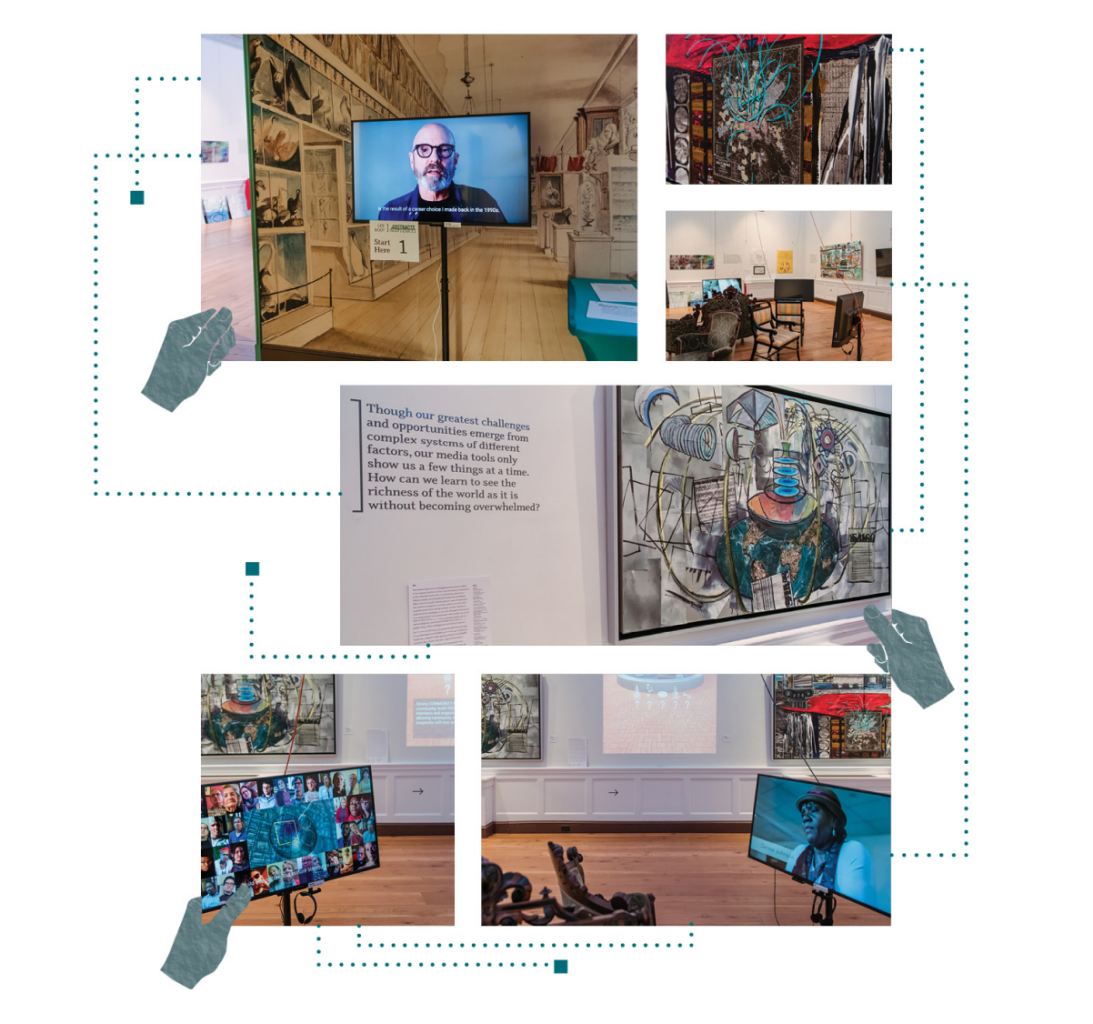 In his exhibit “Abstracts & Artifacts,” Lee Boot asks
viewers to consider new ways of solving problems.
“Almost like dreaming, making art with a question
in mind reveals meaning through metaphor. How
is it that metaphors seem to be both specific and
ambiguous—both personal and universal—at once?”
In his exhibit “Abstracts & Artifacts,” Lee Boot asks
viewers to consider new ways of solving problems.
“Almost like dreaming, making art with a question
in mind reveals meaning through metaphor. How
is it that metaphors seem to be both specific and
ambiguous—both personal and universal—at once?”
Boot lives to solve problems, and believes deeply in the power of combining artists’ ways of thinking with other disciplines to ask questions and find solutions in new ways. Over the years, the IRC has brought together multidisciplinary teams of artists, scientists, and social scientists from state and local agencies, foundations, and other organizations who are open to tackling everything from substance misuse to educational achievement gaps to the epidemiology of pandemics.
And while technology runs much of what the IRC builds, nothing is quite so essential to the heart of the work as one’s own intuition, says Boot. As a classically-trained painter, that means returning to the canvas and allowing his brush to take him in new directions—not to create something beautiful, per se, but to open himself to ideas accessible only through such a personal process.
With each stroke of the brush, and each new color, he pulls from the deepest reaches of experience, community, and understanding, creating a road map for what’s next.
“I’m not trying to make something pretty,” he says. “I am trying to understand how a set of issues sits in being, in my psyche, on the landscape of the world as I understand it. I’m trying to see what I cannot see.”

On the table sit three football-sized forms of light plastic. Each has been sculpted in a 3D printer using zigzag motions specifically programmed to mimic the map lit up behind them showing an orange globe splashed with green arcs. Dots on the screen represent locations mentioned in thousands of hip-hop and rap lyrics, as big as the oft-mentioned city of Atlanta and as hyperlocal as the intersection in front of a neighborhood convenience store.
A student gingerly picks up a gold-colored sculpture, and asks, “Is this Kendrick Lamar?” Tahir Hemphill, a faculty fellow, music aficionado, and self-described “creative technologist who works with art,” nods as a collective “oooh” makes its way around the room.
“It’s data sculpture, literally. It’s making things as real as possible,” says Hemphill, whose ever-evolving body of work, The Rap Research Lab, made its home at UMBC’s Center for Art, Design, and Visual Culture this spring. “This is what it feels like to touch a rapper’s rhymes.”
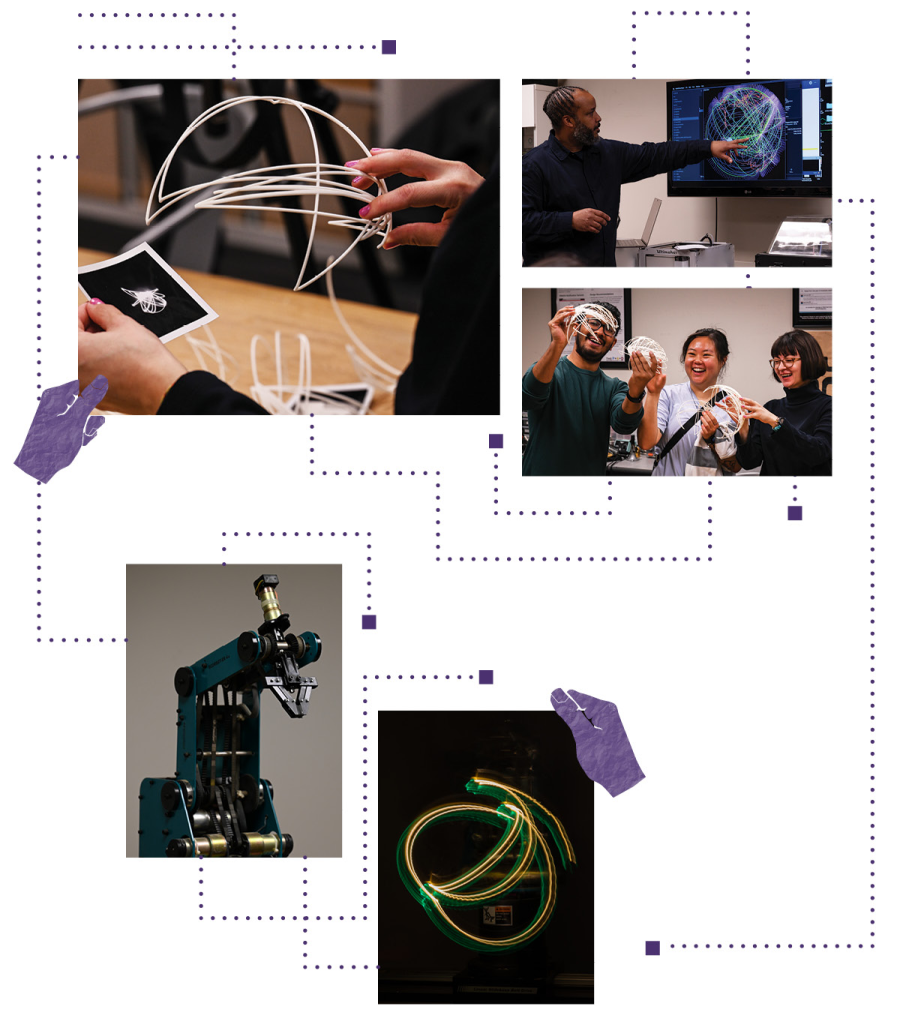
Located at the intersection of hip-hop and data visualization, and built as an interactive teaching space, the lab features the “Mapper’s Delight” tool that, using augmented and virtual reality, cross-references locations from thousands of rap song lyrics along with a variety of other art pieces that speak to Hemphill’s goal of finding “relationships and shapes in the data.”
Over the course of the semester, UMBC students helped Hemphill delve further into the data while middle schoolers from around the state visited the teaching lab with their classes to try their own hands at research using Hemphill’s lyrics database.
On this particular day, Hemphill demonstrates yet another incorporation of the geographic lyric data. In collaboration, Foad Hamidi helped Hemphill program a robotic arm, and by inserting a LED pen into the robot hand and filming movements at a long exposure, he’s able to make “light pen drawings” of the data, à la Pablo Picasso.
With the lights dimmed and the robot arm making ethereal data shapes before their eyes, Hemphill tinkers with his projected spreadsheet in real time. There are just so many threads to follow and infinite stories hidden within.
“My job is to draw them out—pun intended,” he laughs.
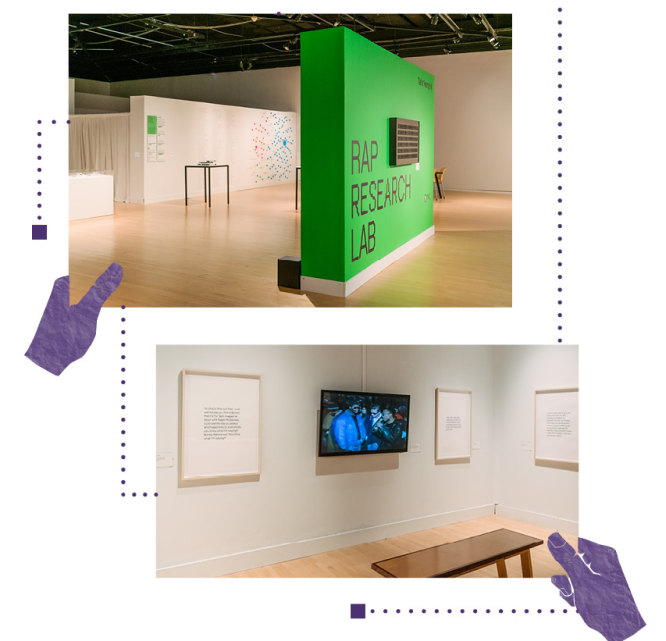
Tahir Hemphill, a faculty fellow, music aficionado, and
self-described “creative technologist who works with
art,” uses data visualization tools to reveal new levels
within hip-hop.
Read how artist Hadieh Shafie, M.F.A. ’04, channels the power of language and her childhood experiences in Iran into intricate and colorful pieces of art.
]]>
What if you could ask yourself a big question and then use your intuition to follow it wherever it led for as long as it took? It would take a certain kind of guts, right? But, with a willingness...
https://umbc.edu/stories/researchers-artists-open-to-interpretation/
https://my3.my.umbc.edu/api/v0/pixel/news/133965/guest@my.umbc.edu/7d78d7c39a954622fea6ad99411873aa/api/pixel
cadvc
dance
discovery
information-systems
irc
magazine
research
spring-2023
UMBC News & Magazine
https://my3.my.umbc.edu/groups/umbc-news-magazine
https://assets1-my.umbc.edu/system/shared/avatars/groups/000/001/943/24435aa6207c452e7bc15cc74b42c7bb/xsmall.png?1748556657
https://assets1-my.umbc.edu/system/shared/avatars/groups/000/001/943/24435aa6207c452e7bc15cc74b42c7bb/original.png?1748556657
https://assets2-my.umbc.edu/system/shared/avatars/groups/000/001/943/24435aa6207c452e7bc15cc74b42c7bb/xxlarge.png?1748556657
https://assets2-my.umbc.edu/system/shared/avatars/groups/000/001/943/24435aa6207c452e7bc15cc74b42c7bb/xlarge.png?1748556657
https://assets3-my.umbc.edu/system/shared/avatars/groups/000/001/943/24435aa6207c452e7bc15cc74b42c7bb/large.png?1748556657
https://assets1-my.umbc.edu/system/shared/avatars/groups/000/001/943/24435aa6207c452e7bc15cc74b42c7bb/medium.png?1748556657
https://assets2-my.umbc.edu/system/shared/avatars/groups/000/001/943/24435aa6207c452e7bc15cc74b42c7bb/small.png?1748556657
https://assets1-my.umbc.edu/system/shared/avatars/groups/000/001/943/24435aa6207c452e7bc15cc74b42c7bb/xsmall.png?1748556657
https://assets2-my.umbc.edu/system/shared/avatars/groups/000/001/943/24435aa6207c452e7bc15cc74b42c7bb/xxsmall.png?1748556657
UMBC News & Magazine
1
0
false
Thu, 08 Jun 2023 19:21:59 -0400
Thu, 08 Jun 2023 19:21:59 -0400
Inclusion Imperative spotlights six years of innovation in community-engaged humanities research and teaching
UMBC’s Dresher Center for the Humanities recently partnered with the National Humanities Alliance to host Inclusion and Public Humanities: A Convening, one of the culminating events in the final year of the Inclusion Imperative.
Over the past six years, the Inclusion Imperative’s work has focused on three core projects: the Visiting Faculty Fellows Program, the Diversity Teaching Network, and the Humanities Teaching Labs (HTLabs).
The Inclusion Imperative is a six-year initiative funded with a $750,000 grant from the Mellon Foundation. Run by the Dresher Center, the Inclusion Imperative promotes diversity and inclusion in the humanities in partnership with Bowie State University, Coppin State University, and Howard University. The initiative has supported cutting-edge humanities-centered inclusive practices and community collaborations in the Mid-Atlantic, with the goal of creating a national ripple effect.
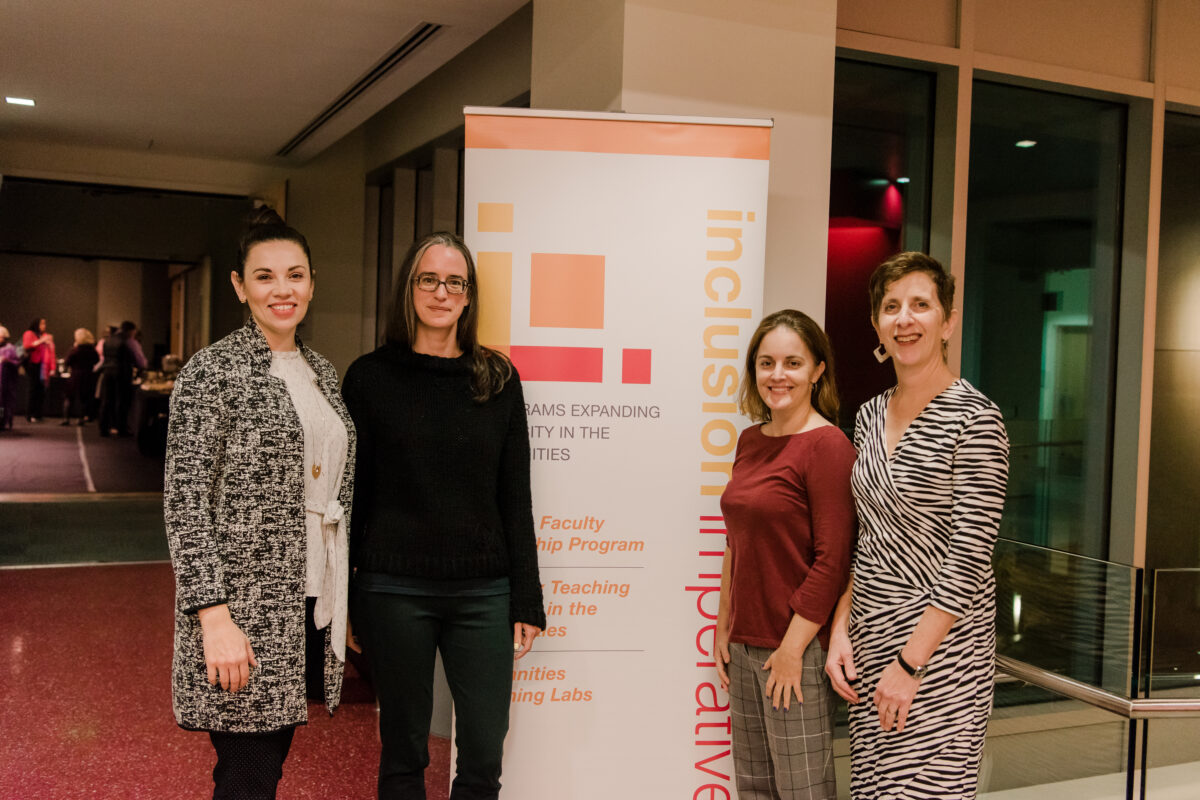 From left to right: Lindsay DiCuirci, associate professor of English, director of the English Honors program at UMBC, and the director of the HT Labs; former Faculty Visiting Fellow Elizabeth Groeneveld, associate professor and chair of women’s and gender studies at Old Dominion University; former Faculty Visiting Fellow Tracy Perkins, assistant professor in the School of Social Transformation at Arizona State University; and Jessica Berman, director of the Dresher Center and professor of English; gender, women’s, and sexuality studies; and language, literacy, and culture. Both Groeneveld and Perkins have since completed and published the projects they worked on during their fellowships.
(Marlayna Demond ’11/UMBC)
The Visiting Faculty Fellows Program has welcomed 14 full-time faculty from area universities to join UMBC for a semester or year as residential research fellows. The Diversity Teaching Network has brought together visiting fellows, UMBC faculty, and other interested scholars to work on curricular and civic-engagement projects. Through HTLabs, faculty, staff, and students have practiced innovative humanities-centered approaches to teaching and learning, from decolonizing assessments to teaching with the Smithsonian Learning Lab.
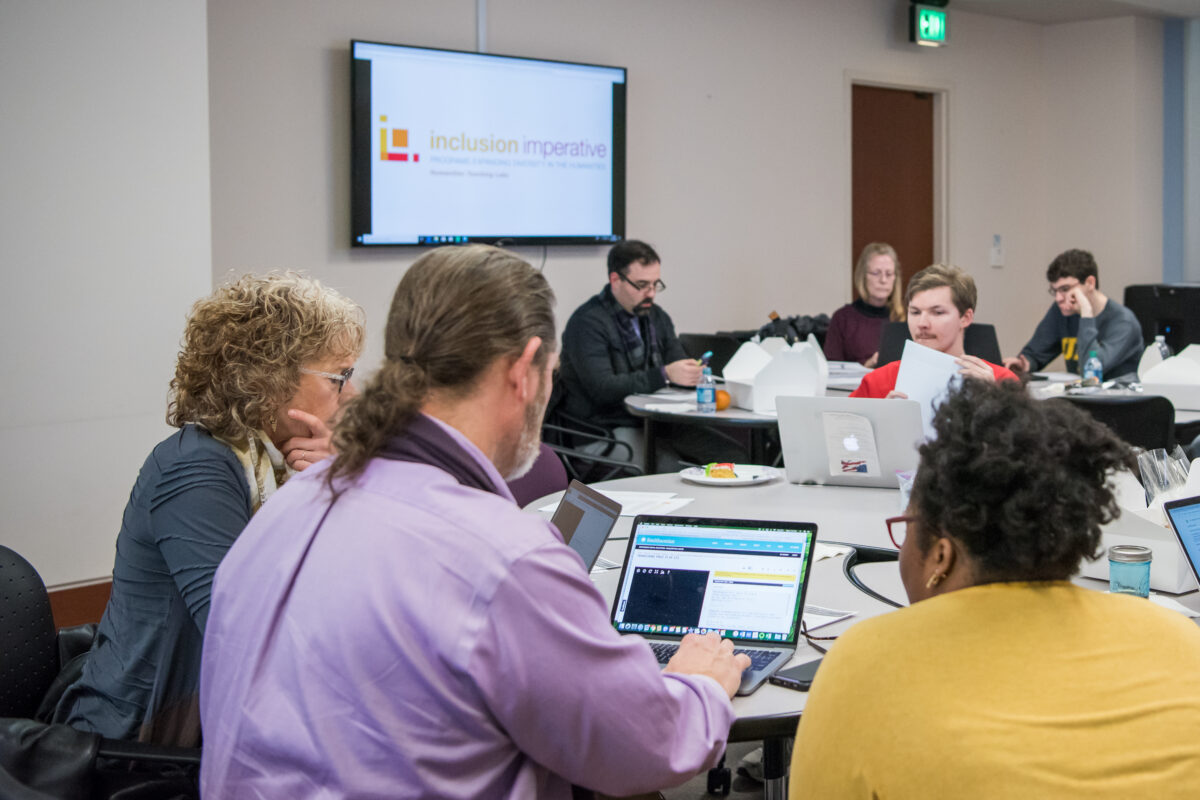 UMBC faculty, staff, and students at the 2018 Frederick Douglass Day Transcribe-a-thon HT Lab. (Marlayna Demond ’11/UMBC)
At the convening this spring, faculty and staff from institutions across the Mid-Atlantic gathered to share their approaches to community-engaged humanities research, teaching, and learning focused on race, equity, inclusion, and social justice issues.
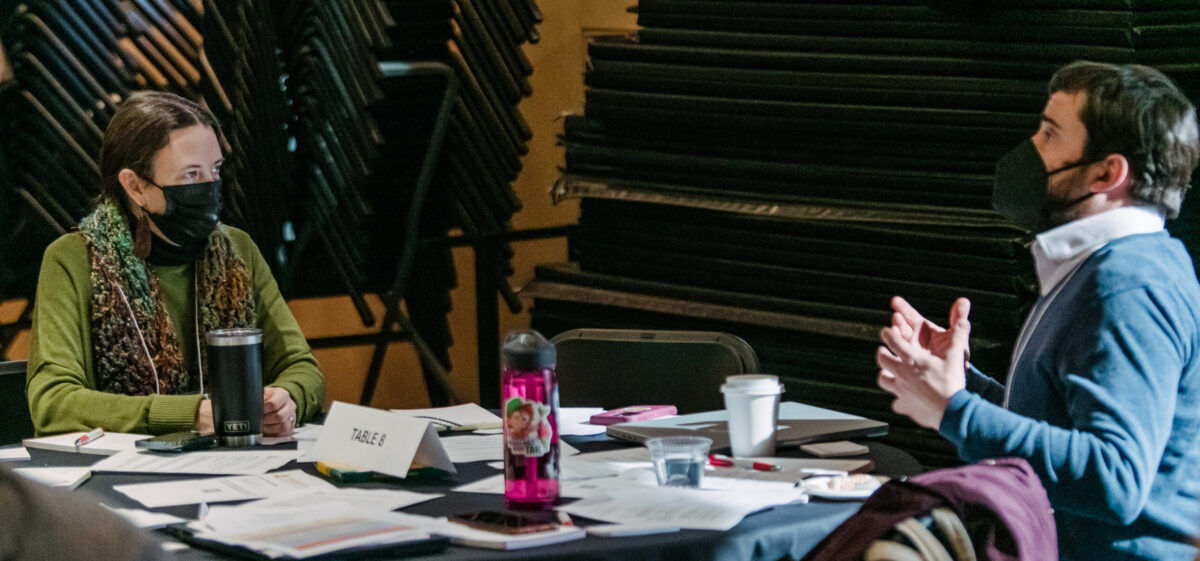 Jill Vasbinder, adjunct instructor of dance at UMBC, at left, discusses humanities music and dance topics with Scott Muir, director of undergraduate initiatives at the National Humanities Alliance.
(Marlayna Demond ’11/UMBC)
Building teaching and learning communities
Colleagues from University of Lynchburg, Community College of Baltimore County, Lehigh University, DewMore Baltimore, and Bard High School Early College-Baltimore presented on topics such as public humanities curriculum development, LGBTQ+ histories and resources, and poetry by local students.
UMBC faculty also shared several high-impact projects. Sarah Fouts, assistant professor of American studies and assistant director of the public humanities minor, spoke about her ongoing work with the Baltimore Field School 2.0. Earl Brooks, assistant professor of English, reported on his course Sounds Like Social Justice, redesigned through support from an Inclusion Imperative/HT Labs Course Transformation Grant.
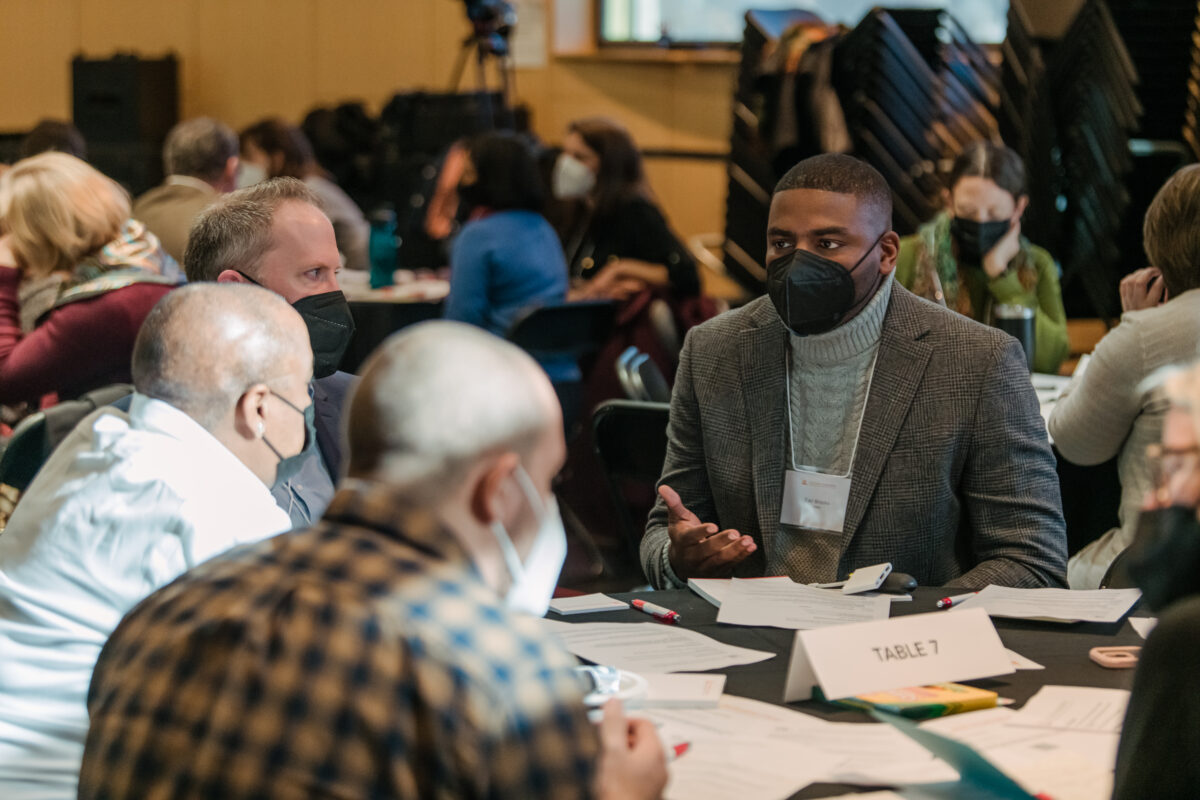 Earl Brooks speaking with Steven Park, faculty director of Community-Engaged Learning and Scholarship and assistant professor of English at Loyola University Maryland (on Brooks’s right); Tanya Saunders, associate professor of language, literacy, and culture at UMBC (middle); and Michael Casiano, assistant professor of American studies at UMBC (directly across from Brooks). (Marlayna Demond ’11/UMBC)
The funds provided recording equipment for students to work in collaboration with the Meadow Community Fellowship Church in Catonsville’s Beechfield and Irvington communities to document their experiences during and after the 2016 and 2018 floods in the “Underwater/Underserved” podcast (as shared in The Baltimore Banner). “What most people don’t know is that all that water flows downhill into the Irvington and Beechfield community, which is a little more than a mile from UMBC,” explains Brooks. The class created “Underwater/Underserved” podcast about flooding in the Irvington and Beechfield neighborhoods in Baltimore, MD.
The grant included funding for students to work on interview skills with Rona Kobell, science editor and writer with Maryland Sea Grant. Brooks explains, “I wanted my students to tell a story about the ways that the church community was underserved as a way of thinking about the role of sound in storytelling.”
Disability justice
Also at the event, faculty from La Salle University, University of Delaware, and Bowie State University shared insights into how diversity, equity, inclusion, and accommodation (DEIA) have become central to their humanities practice. To emphasize the role of accessibility and accommodation, leaders of two UMBC faculty working groups presented their ongoing work related to disability justice.
Dresher Center Disability Studies faculty working group leaders Drew Holladay, assistant professor of English, and Sharon Tran, assistant professor of English, discussed the disability justice movement and the pitfalls of ableist institutional policies that limit student and faculty engagement and success.
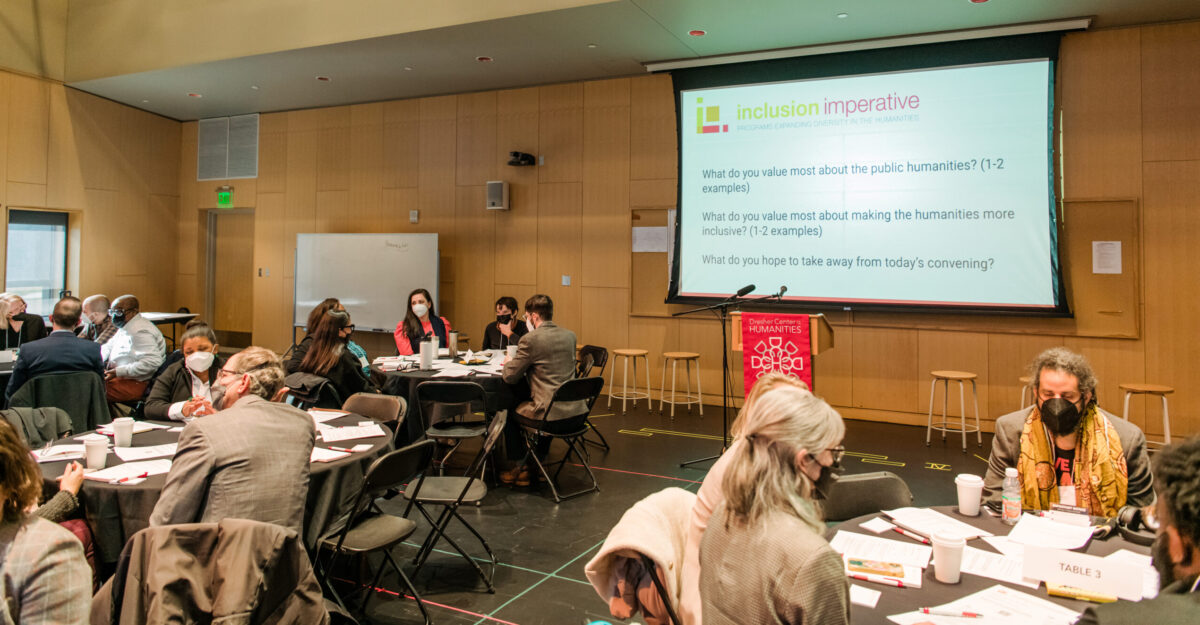 UMBC faculty Sharon Tran, Elizabeth Patton, Lindsay DiCuirci, Sarah Fouts, and Drew Holladay gather at at the Inclusion and Public Humanities convening, at the table closest to the podium.
(Marlayna Demond ’11 /UMBC)
Disability justice does not equal accessibility, especially in the way that it is institutionally defined, and it does not equal DEIA, Holladay suggested. The way he prefers to approach disability justice is to center his research and classroom practice as examples of disability justice, not as a topic that is part of the curriculum.
Tran explained strategies to implement disability justice in the classroom. “We need to think of how we can [adjust] the normative clock in the classroom to better accommodate disabled students rather than forcing those students to meet those temporal pressures,” she said.
Members of the Anti-Racism and Our Actions faculty and staff working group, Michael Hunt, director of UMBC’s McNair Scholars Program, and Amy Tondreau, assistant professor of education, talked about their work to demystify, destigmatize, and magnify anti-racist practices in the academy and in K-12 education.
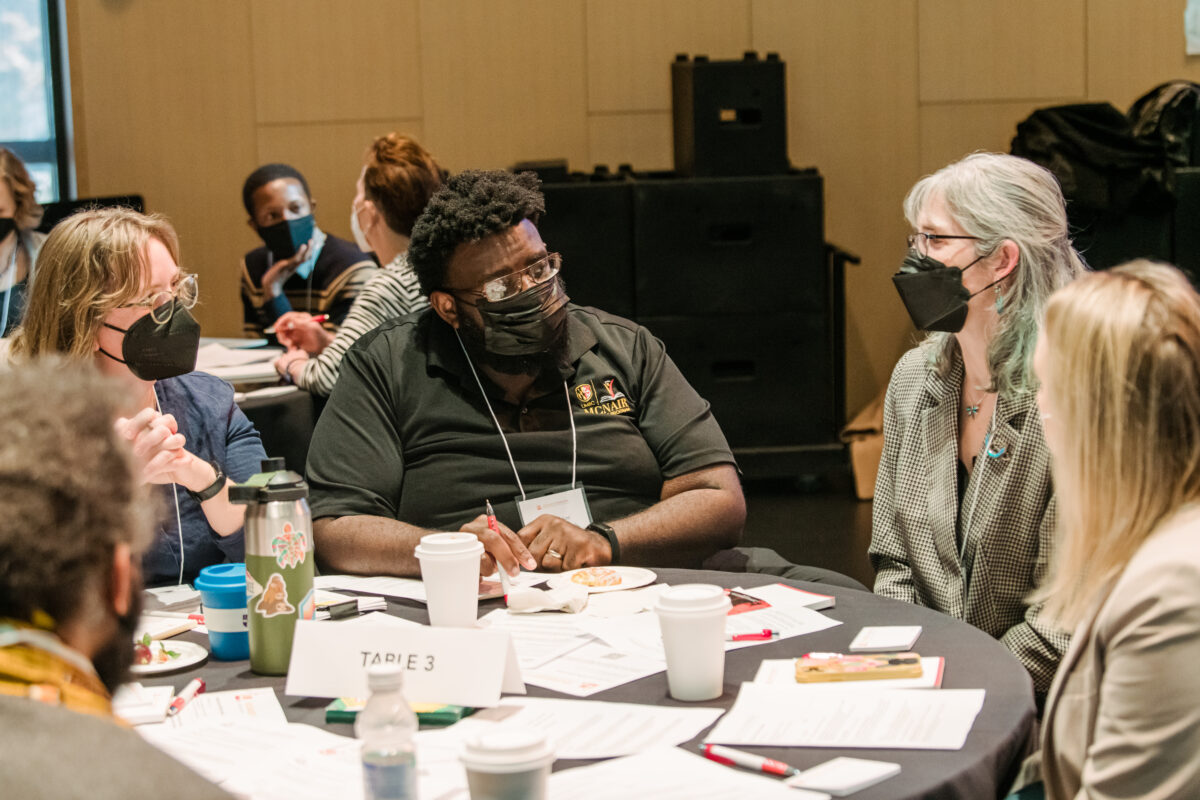 Michael Hunt (center) with colleagues from UMBC and partnering institutions. (Marlayna Demond ’11/UMBC)
Leading a national conversation
Although the Inclusion Imperative’s formal programming will come to a close this summer, the work itself will continue in several ways. Many of the program’s participants will gather again in June for the 11th International Digital Storytelling Conference, hosted by UMBC in partnership with Montgomery College and the Smithsonian Institution.
“I firmly believe that the humanities offer us crucial tools for addressing pressing issues of civic life,” says Berman who presented this work in partnership with the NHA at the 2023 NHA annual meeting. “Now more than ever, we need the tools of the humanities to advance local and national conversations about our history, our identities, and our common future.”
]]>
UMBC’s Dresher Center for the Humanities recently partnered with the National Humanities Alliance to host Inclusion and Public Humanities: A Convening, one of the culminating events in the final...
https://umbc.edu/stories/inclusion-imperative-convening/
https://my3.my.umbc.edu/api/v0/pixel/news/133242/guest@my.umbc.edu/c8d649536cdd080aaebc65b07fc28695/api/pixel
american-studies
arts-and-culture
cahss
cahssresearch
dance
dreshercenter
education
english
llc
mcnairscholars
news
policy-and-society
UMBC News & Magazine
https://my3.my.umbc.edu/groups/umbc-news-magazine
https://assets1-my.umbc.edu/system/shared/avatars/groups/000/001/943/24435aa6207c452e7bc15cc74b42c7bb/xsmall.png?1748556657
https://assets1-my.umbc.edu/system/shared/avatars/groups/000/001/943/24435aa6207c452e7bc15cc74b42c7bb/original.png?1748556657
https://assets2-my.umbc.edu/system/shared/avatars/groups/000/001/943/24435aa6207c452e7bc15cc74b42c7bb/xxlarge.png?1748556657
https://assets2-my.umbc.edu/system/shared/avatars/groups/000/001/943/24435aa6207c452e7bc15cc74b42c7bb/xlarge.png?1748556657
https://assets3-my.umbc.edu/system/shared/avatars/groups/000/001/943/24435aa6207c452e7bc15cc74b42c7bb/large.png?1748556657
https://assets1-my.umbc.edu/system/shared/avatars/groups/000/001/943/24435aa6207c452e7bc15cc74b42c7bb/medium.png?1748556657
https://assets2-my.umbc.edu/system/shared/avatars/groups/000/001/943/24435aa6207c452e7bc15cc74b42c7bb/small.png?1748556657
https://assets1-my.umbc.edu/system/shared/avatars/groups/000/001/943/24435aa6207c452e7bc15cc74b42c7bb/xsmall.png?1748556657
https://assets2-my.umbc.edu/system/shared/avatars/groups/000/001/943/24435aa6207c452e7bc15cc74b42c7bb/xxsmall.png?1748556657
UMBC News & Magazine
0
0
false
Thu, 04 May 2023 14:30:12 -0400
Thu, 04 May 2023 14:30:12 -0400
When We Work Together

It’s no secret that at UMBC we do things a little differently. As a university, we’re young, agile, and (buzzword that it may be) truly innovative. We can see the success of these traits in our rankings or research-lab results or employee-satisfaction surveys, but those numbers don’t tell the full story of how, when the Retriever community joins efforts to achieve greatness, we arrive there together.
So on the eve of UMBC’s 50th anniversary in 2016, when the institution put forth a goal to raise $150 million— money that goes directly to student scholarships, graduate fellowships, professorial awards, and so much more— we didn’t question if we would succeed, we just wondered how we’d be able to capture the magnitude of the collective campaign when it came to a close.
Now, wrapping up the endeavor with over $189 million, we get to celebrate the stories that made this all possible. This campaign called upon our community’s Grit & Greatness, and Retrievers responded in kind by making big breakthroughs, forging true partnerships, and transforming lives.
Making Big Breakthroughs

The Talent Goes Both Ways
“One of my top priorities is recruiting the best talent who aspire to be great leaders for our company and the nation,” says Jennifer Walsmith, vice president of the Cyber and Information Solutions business unit at Northrop Grumman and executive lead for university relations with UMBC. “Our deep connection with UMBC enables us to recruit and hire the very best. Many of our UMBC graduates have remained at Northrop for decades and play an invaluable leadership role in cybersecurity.”
Walsmith knows something about connection as a Retriever herself, graduating in 1990 with a degree in computer science—something she said was only possible due to 2 a.m. study sessions with classmates and encouraging lunch meet-ups with friends on campus. In her current role, she oversees 2,000 plus employees and is often seen on campus speaking to alumni, faculty, and board members.
“As a nation, we have been enabled by enjoying a technically superior way of life. However, the number of students in the technical fields is getting smaller, especially among women in these majors.” So how do Northrop Grumman and UMBC plan on breaking through that limitation? “I believe it’s vitally important that we all give back,” says Walsmith.
That looks like dozens of UMBC interns each semester who get the chance to work on the toughest problems in space, aeronautics, defense, and cyberspace; an alumni chapter at Northrop Grumman over 600 employees strong who volunteer considerable time at local schools; and millions of dollars spent to benefit students, programs, and research over the last campaign.
Northrop Grumman has a unique relationship with UMBC, but they are not alone in their support of UMBC students and faculty and graduate research. Throughout the Grit & Greatness campaign, 69 percent of commitments came from foundations and companies like T. Rowe Price, Morgan Stanley, Lockheed Martin, and Baltimore Gas and Electric Company.
“We are technical leaders, and I love to see our UMBC students thrive to become future leaders of our company and give back to other students,” says Walsmith. “So when you create the engine where people on each side fuel this relationship, it strengthens everyone.”
— Randianne Leyshon ’09
Breaking Through Education Barriers
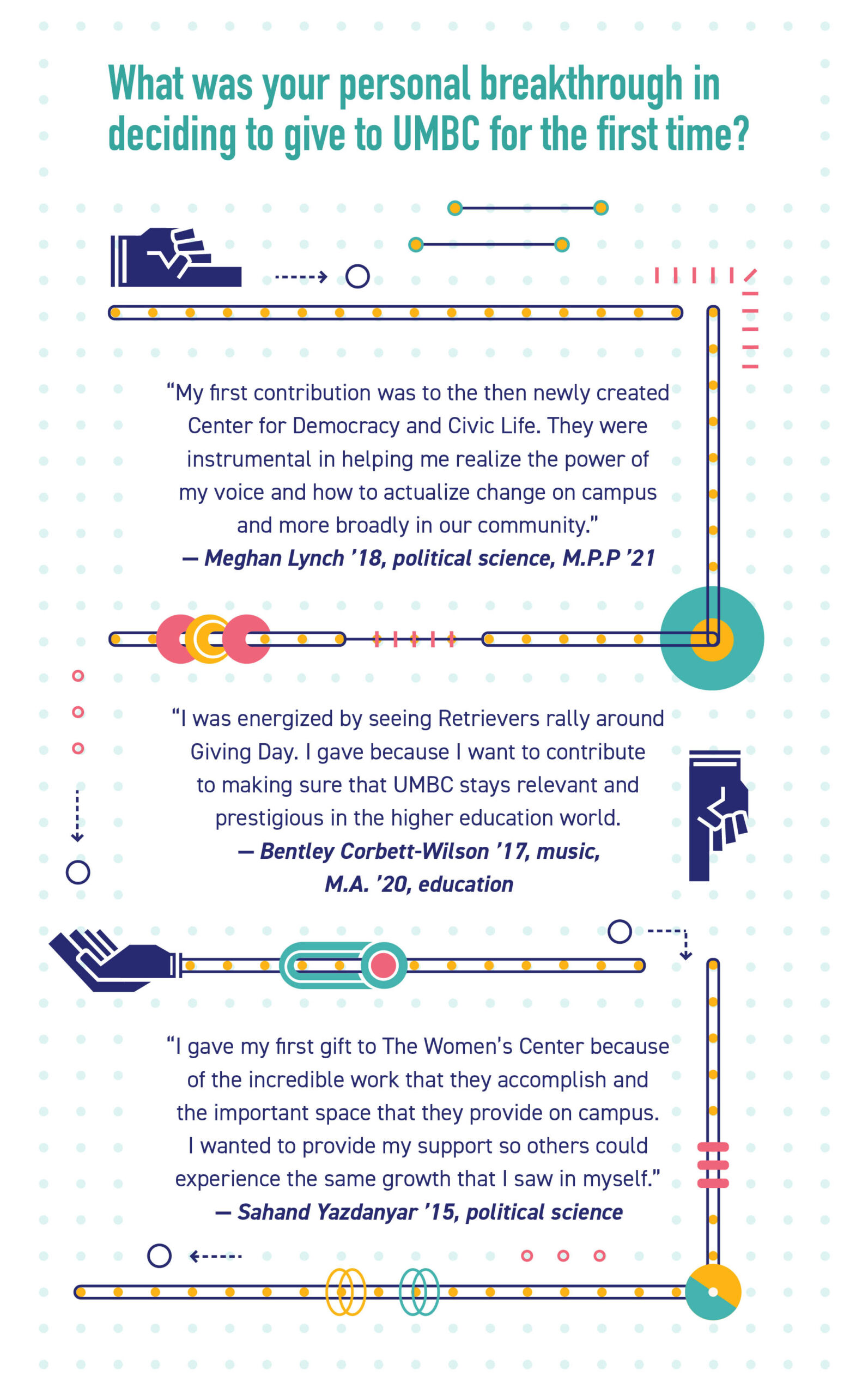
In Baltimore City, middle schoolers are making roller coasters out of insulation tubing and tape. High schoolers are dunking basketballs to learn math equations. And not too far away at UMBC, the Sherman STEM Teacher Scholars are prepping to spread even more innovative, inclusive lessons throughout city schools.
The Sherman STEM Teacher Scholars Program, founded in 2006, and other initiatives supporting Retrievers to become culturally responsive and compassionate educators in historically underserved, urban schools, are thanks to the vision of philanthropists Betsy Sherman and her late husband George.
In early 2022, the Sherman Family Foundation donated $21 million to create the Betsy & George Sherman Center, which expands and integrates UMBC’s work in teacher preparation, school partnerships, and applied research focused on early childhood education and improving learning outcomes for Baltimore students. This gift allows educators to implement new teaching methods and find ways to break through learning barriers for their students.
The gift—the largest in UMBC’s history—will transform both UMBC and generations of local students. It also serves as a rallying point for others to join in giving and volunteering at participating schools. To date, says Greg Simmons, M.P.P. ’04, and vice president of Institutional Advancement, “our school partnership work is our most robust community-based philanthropic effort given the scope and range of donors involved.” In addition to the Shermans’ foundational gift, other organizations—like the Richmond Family Foundation and Northop Grumman, just to name two—and many individual donors have supported this endeavor with their own time and resources.
“I see the legacy of the Sherman program as a seed,” says Haleemat Adekoya ’22, political science, a Sherman STEM Teacher Scholar. “It’s been planted and people will continue to water that seed…it will be one of those trees in a folk tale that does not die out because the community and the people who have benefited from its impact see the importance of that tree living beyond generations.”
— Randianne Leyshon ’09
Forging True Partnerships
The Snowball Effect
Sandy Geest ’72, English, knows the power of how a little can go a long way. When she graduated, she immediately started giving to the department that shaped her UMBC experience, “even if it was just 10 or 15 dollars a year,” she says.
Now, 50 years later, Geest and her husband Jay have an endowed scholarship for English majors that has supported 10 students since 2017.
Geest spent most of her career as conference and event planner for James Rouse’s Enterprise Foundation, using her organizational skills to plan ribbon cuttings at the White House and pull together the 1992 U.S. Olympic Gymnastics Trials held in Baltimore. She says it was through the company’s matching shares program that she began to realize the power investments could have—if they could help her savings accrue over time, she wondered how her donations might increase as well.

Geest recounts how her office was located across from the then new Columbia Mall. On lunch breaks, her other coworkers would frequently go shopping. “And I told them, ‘No, you need to be putting your money into this fund because it will grow. When you’re old and gray, you’ll be glad you did that. These shoes will be all worn out by then.’”
Over time, Geest realized the same logic applied to her giving to UMBC. As she got raises and advanced through her career, she upped her giving. “I didn’t do it all at one time, [but] as it grew over the years I gave more and more,” she says, knowing the power for sizable change hinged on an endowment that would be invested by the university and able to sustain its monetary output.
Her scholarship eventually snowballed to support up to four Retrievers a year. Her scholars’ success is the biggest reward, says Geest. At on-campus events, they tell her what a difference her giving made to their UMBC experience—it allowed them to explore career options through internships or it provided a lifeline when they thought they might have to drop out.
“It’s a very good feeling,” says Geest, “to know that you have put a hand back to help somebody behind you.”
— Randianne Leyshon ’09
The Competition Is Strong
Vanessa Mann, head coach for women’s soccer in her fifth season, has the mindset of leaving things better than you found them and uses the competitive spirit inherent in athletics to teach the power of giving back. This philosophy has led to 100 percent participation in UMBC’s annual Black & Gold Rush Giving Day among her student-athletes.
The itch to compete motivates the other teams as well. Women’s lacrosse goalkeeper Isabella Fontana ’24, economics, sees it as the perfect way to get student-athletes engaged. “Not only do I want to support the women’s lacrosse team because everyone loves to support our team,” she says, “but as athletes, we always want to win. So if there’s something on the line, we’re like, ‘Oh, let’s do it.’”
Fontana’s competitive spirit earned her a year-long prime parking spot in front of the Chesapeake Employers Insurance Arena after she won UMBC’s 2022 Giving Day student ambassador challenge. By calling on her enthusiastic network of friends and family, Fontana generated the most donors (104) out of all the ambassadors and brought the lacrosse team’s total to 335, almost double the amount from the previous year. Curious what that looks like by the numbers? It’s the difference between $5,045 in 2020 and a whopping $40,040 in 2022.
The lacrosse team isn’t alone in getting people hyped for giving—in fact, Athletics is responsible for bringing in the most donors and dollars for UMBC’s annual Black & Gold Rush. Even so, they’re always striving to top themselves: in 2020, women’s soccer more than tripled their goal for donors.
Both Fontana and Mann would be the first to remind you that good competition is nothing without cooperation. “So it wasn’t that we were really competing with anyone, like any outside entity,” Mann sums up. “We define competition as competere, which means to strive together. That’s actually the Latin translation. So it’s not me versus you, it’s actually me with you.”
— Levi Lewis ’23
Bridge-Building Alumni
Anwesha Dey came to UMBC from Singapore for a summer research internship. She ended up staying much longer, completing her Ph.D. in biochemistry in 2004. “In many ways, I think of the entire experience being one of the turning points in my life,” says Dey. “The sense of community and belonging and the focus on excellence at UMBC would go on to define my career.”
Now, as director and senior principal scientist of Discovery Oncology at Genentech, a groundbreaking biotechnology company, Dey is dedicated to bringing in UMBC students to her own lab and research community. Early in 2022, that meant inviting her former mentor, Mike Summers, professor of chemistry and biochemistry and the Robert E. Meyerhoff Chair for Excellence in Research and Mentoring, along with then president Freeman Hrabowski to Genentech to discuss the company’s ongoing support of UMBC. “We’re all mutually invested in the same thing,” says Dey. “When we first started this fellowship about five years ago, it was really one step at a time. And so it’s great to see where it is now. The trajectory is really strong.”
Dey is far from alone in bringing her enthusiasm for her alma mater to the workplace, and as more Retrievers go on to work in the upper echelons of the scientific community, they are finding ways to connect their industries to the campus that shaped them.
Bobby Allen ’99, M7, computer science is clear that he has a lot to be thankful for because of UMBC. He met his future wife Frances Allen ’99, M7, computer science, and many of his closest friends as teenagers in the Meyerhoff Program’s Summer Bridge. But aside from his personal connections, as a product manager at Google, it’s Allen’s personal mission to connect UMBC’s proven pipeline of talented Retrievers to his workplace. “At Google, we know we need to have underrepresented populations as managers, champions, executive support, and mentors so that as we hire graduates and interns, they see people who look like them and know what is possible.”
— Randianne Leyshon ’09
Transforming Lives
Rising to the Top
It’s no accident that when visitors arrive on campus from the west entrance, they’re greeted by the radiant reflection on the silver slope of the Performing Arts and Humanities Building (PAHB). This LEED Gold-certified building, which opened in 2014, is a symbol of UMBC’s investment in the performing arts and humanities. But, it’s the students and activities inside the facility that really shine.
Deven Fuller ’23 is a case in point. Double-majoring in dance and math, Fuller is a Linehan Artist Scholar—part of a selective program endowed by Earl and Darielle Linehan that has launched the careers of more than 300 Linehan Artist Scholar alumni in dance, music, theatre, and other creative disciplines.
Fuller is focused on commercial dance—a highly competitive field that’s principally centered in New York and Los Angeles— which would put a career in his chosen field effectively out of reach were it not for the Linehans.
Thanks to the scholarship, Fuller said, he was able to join a New York–based dance training company in his sophomore year, take classes at local studios with accomplished touring commercial dancers, and enjoy other unique opportunities. The fact that the Linehans are “recognizing dance as a serious career…is just such an amazing thing,” Fuller said.

Most recently, with a Linehan Summer Research Award, “I was able to travel and do a certificate program at one of the most prestigious studios in the world for commercial dance. … I was very lucky to have the grant to be able to branch out in that direction.”
Fuller is far from the only student to benefit from philanthropists’ investment in UMBC’s arts-focused students. Todd Carton ’77, interdisciplinary studies, has created the Carton Family Endowed Scholarship to support talented students in the performing arts who come from disadvantaged backgrounds. Along with a gift that helped to fund the PAHB, Carton has included UMBC in his estate plan so that the endowed scholarship can grow and benefit even more arts students far into UMBC’s future.
Fuller hasn’t had the opportunity to meet the Linehans, but if he could, he said, “I would thank them for the opportunities that I’ve been able to have because of them …and let them know how much they are positively affecting the community of artists.”
— Scott Cech
A Family That Gives Together
Professor Bimal Sinha and his family weren’t content to let his 30-plus years of pioneering academic contributions to UMBC be his only professional legacy. Even though neither he nor his sons Jit and Shomo Sinha attended the university, they decided to collectively donate $750,000 to create the Dr. Bimal Sinha Professorship in Statistics at UMBC.
The professorship permanently funds a new statistics faculty position at the university, which seems especially fitting, considering that Sinha founded the statistics department in 1985 and helped transform UMBC into a national leader in statistics education.
But Sinha’s sons remember that beyond his academic accolades, the way their father has always interacted with his mentees is what made the deepest impression— whether meeting international students at the airport or inviting groups of students to their family home for dinner.

Creating community has been a hallmark of Sinha’s career: The professor successfully spearheaded the African International Conference on Statistics, held in a different African country each year since 2014. In 2018, UMBC signed a memorandum of understanding with the University of Limpopo in South Africa to foster collaboration and exchange. A number of graduate students from African countries have also flourished with Sinha’s mentorship.
“Bimal has not only engaged in groundbreaking research for decades but has also produced and championed an impressive number of influential Black statisticians throughout Africa,” noted Freeman Hrabowski, UMBC president emeritus.
In fact, the family’s dedication to continuing Sinha’s legacy has already inspired others: Forty alumni and friends of the university pitched in a combined $150,000, and the Maryland E-Nnovation Initiative Fund committed to a matching grant, bringing the professorship’s total endowment to $1.8 million.
“I feel honored and fortunate to have played a small role in the evolution of this beloved institution,” Sinha said. “Through this gift, I want to ensure that future generations of leading scholars will view UMBC as an attractive home to advance their contributions to the field of statistics.”
— Sarah Hansen, M.S. ’15
Gesture of Gratitude
When Felicia Sanders moved into Susquehanna Hall in the early ’90s as part of the fourth cohort of Meyerhoff Program Scholars, she found herself experiencing a series of firsts. It was her first time living in a mixed-gender dorm; the first time she understood the power of study groups; and she was a member of a scholarship program so new it hadn’t yet graduated its first class of scholars. “I thought I was just making friends, but this setup was really part of an ecosystem, a very effective one that set us up for success.”
The Meyerhoff Scholars Program fosters a collective spirit from day one—when students tackle Summer Bridge together. So when it came time to celebrate the program’s 30th anniversary and thank Robert Meyerhoff, the philanthropist who founded the program with President Emeritus Freeman Hrabowski, the graduates decided to give together, with an initial half-a-million dollar gift.

“When we give collectively, we keep the continuity of the culture that was built by the program,” says Sanders ’96, M4, chemical engineering, and a leadership level giver. “We keep the family bond that was built by the program. It doesn’t become something that is piecemeal or start-stop or becomes intermittent because it is something that was fun for someone one year and then wasn’t supported the following year.”
The word Meyerhoff Scholars most often use to describe themselves is family. Not just a family of 1,300+ alumni who have gone on to use their gifts as industry leaders and academic powerhouses, but including the students who have yet to join their ranks as scholars, the future generation of Meyerhoffs.
Jason Dixon ’02, M10, computer science, and Rhea Brooking-Dixon ’02, M10, biological sciences, whose origin story began in Summer Bridge, give together because “we know that our successes are never truly our own,” they share. “We are confident that our gifts to UMBC and the Meyerhoff Scholars Program will help other young scholars the same way the program has helped us and more.”
“It’s important for the family to be engaged in the program’s continuity,” says Sanders. “Now that Doc [Hrabowski] has moved on to the next chapter of his life, it’s important that the Meyerhoff Program is something we’re still talking about in another 30 years. And that can’t happen if the family doesn’t continue to reinvest.”
— Randianne Leyshon ’09
]]>
It’s no secret that at UMBC we do things a little differently. As a university, we’re young, agile, and (buzzword that it may be) truly innovative. We can see the success of these traits in our...
https://umbc.edu/stories/when-we-work-together/
https://my3.my.umbc.edu/api/v0/pixel/news/129507/guest@my.umbc.edu/c083b670e4d7274bdd2cab45bce969e3/api/pixel
athletics
biochemistry
chemical-engineering
computer-science
dance
english
fall-2022
impact
inds
magazine
meyerhoffscholars
pahb
sherman-stem-teacher-scholars-program
statistics
UMBC News & Magazine
https://my3.my.umbc.edu/groups/umbc-news-magazine
https://assets1-my.umbc.edu/system/shared/avatars/groups/000/001/943/24435aa6207c452e7bc15cc74b42c7bb/xsmall.png?1748556657
https://assets1-my.umbc.edu/system/shared/avatars/groups/000/001/943/24435aa6207c452e7bc15cc74b42c7bb/original.png?1748556657
https://assets2-my.umbc.edu/system/shared/avatars/groups/000/001/943/24435aa6207c452e7bc15cc74b42c7bb/xxlarge.png?1748556657
https://assets2-my.umbc.edu/system/shared/avatars/groups/000/001/943/24435aa6207c452e7bc15cc74b42c7bb/xlarge.png?1748556657
https://assets3-my.umbc.edu/system/shared/avatars/groups/000/001/943/24435aa6207c452e7bc15cc74b42c7bb/large.png?1748556657
https://assets1-my.umbc.edu/system/shared/avatars/groups/000/001/943/24435aa6207c452e7bc15cc74b42c7bb/medium.png?1748556657
https://assets2-my.umbc.edu/system/shared/avatars/groups/000/001/943/24435aa6207c452e7bc15cc74b42c7bb/small.png?1748556657
https://assets1-my.umbc.edu/system/shared/avatars/groups/000/001/943/24435aa6207c452e7bc15cc74b42c7bb/xsmall.png?1748556657
https://assets2-my.umbc.edu/system/shared/avatars/groups/000/001/943/24435aa6207c452e7bc15cc74b42c7bb/xxsmall.png?1748556657
UMBC News & Magazine
2
0
false
Thu, 01 Dec 2022 13:24:48 -0500
Thu, 01 Dec 2022 13:24:48 -0500
UMBC’s student innovation competition winners share tips for aspiring entrepreneurs
Student teams recently gathered at Betamore, a Baltimore-based entrepreneurship and coworking space, to battle in the final round of UMBC’s annual Cangialosi Business Innovation Competition. Greg Cangialosi ‘96, English, founded the competition in 2014 to provide UMBC student entrepreneurs with a chance to pitch innovative ideas to a panel of judges, and to get advice and support in developing their concepts.
This year’s competition included two distinct tracks: technology and innovation, and social impact. The top three ideas in each track received funding to help move their ventures forward.
The live event included competitors from all three UMBC colleges who pitched a diverse range of ideas. Here, some of the participants share advice for other students who are interested in entrepreneurship but may not be sure where to begin.
Tip 1: Pursue what you love
Mahmoud Shalby ‘23, computer science, says that in order to be a successful entrepreneur you have to be passionate about your concept to stay motivated through challenging times. Shalby and his collaborator Faheel Kamran ‘22, computer engineering, took first place in the technology and innovation track for their idea Haven, which is an encrypted, privacy-focused cloud storage service.
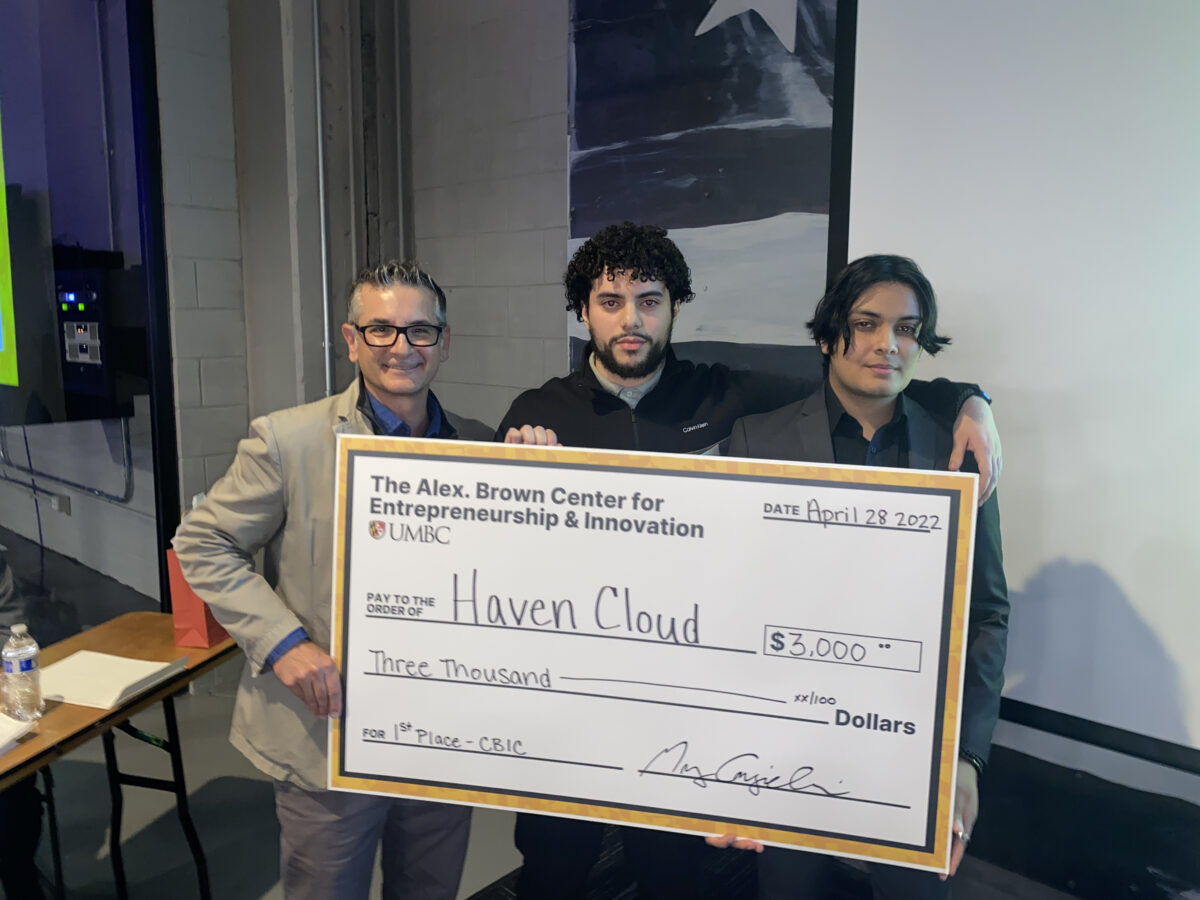
Mahmoud Shalby and Faheel Kamran at the event. (Alex. Brown Center for Entrepreneurship.)
“The best tip I’d share about entrepreneurship is to love what you do. It might seem simple and intuitive, but it’s a necessary component of the entrepreneurial journey that you have to consciously take into account,” Shalby says. “There’ll be countless sleepless nights, functions you have to miss, friends that you won’t see. The only way you can endure all of that is to fully love what you do.”
Tip 2: Don’t fear failure
Basil Udo ‘22, biochemistry and molecular biology, placed third in the technology and innovation track for his idea Xeddy, a marketplace for digital assets, coupons, and collectables. Udo explains that entrepreneurship provides learning opportunities, often when things don’t work out as expected.
“Learning from experience means you need to experience. Let go of the fear of failure because growth requires failure,” he says. “The earlier you start”—even if you aren’t initially successful—“the sooner you win.”
Tip 3: Match a problem with a solution
Michael Chapman ‘23, mechanical engineering, took first place in the social impact track for his idea Seeker. It’s a toy that provides individuals with dyspraxia—a common neurological disorder affecting movement—the ability to participate in activities that their peers enjoy.
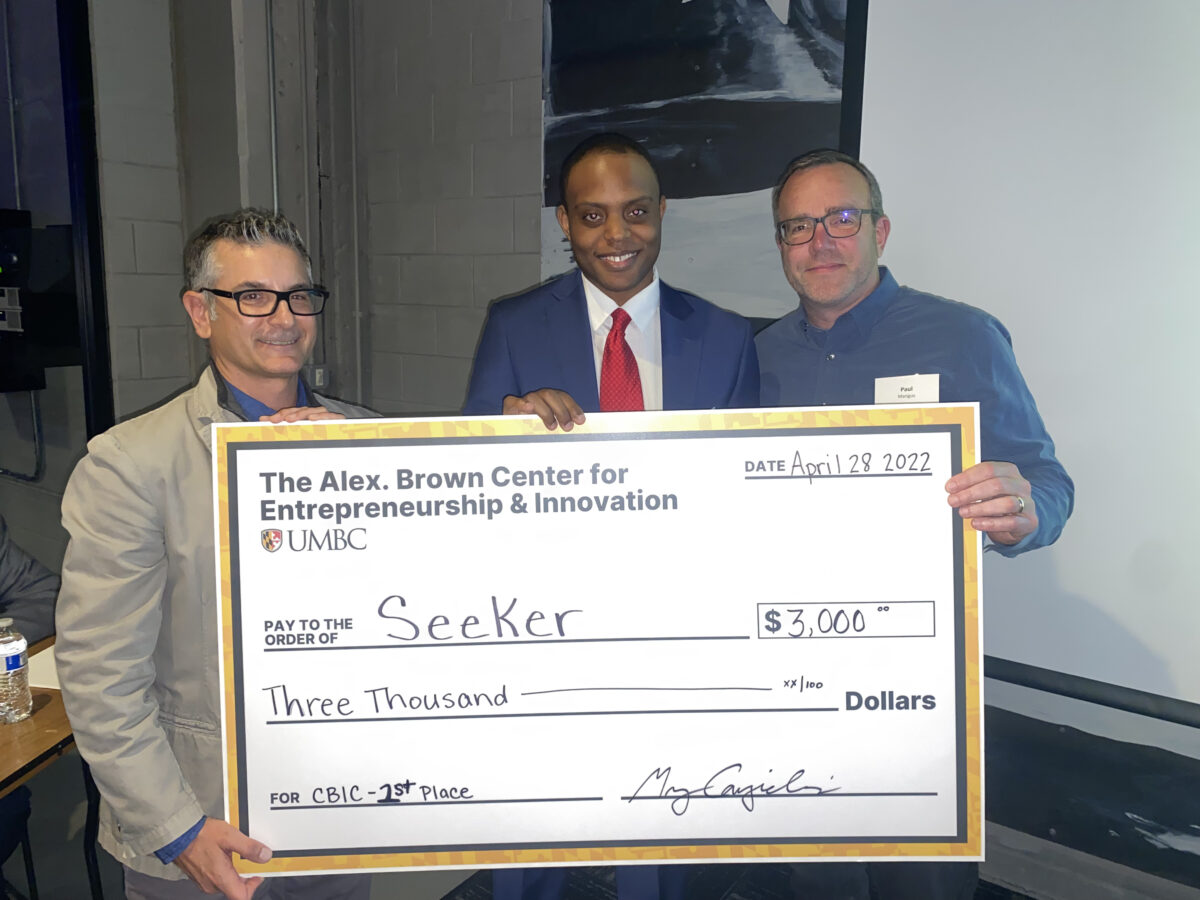
Michael Chapman, center, at the Cangialosi Business Innovation Competition. (Alex. Brown Center for Entrepreneurship.)
Chapman says that the world is full of problems to be addressed. “Entrepreneurship is simply the discovery of the one problem that resonates with you and its accompanying solution,” he says. “If you are able to find a way to market your solution for a problem people experience, then you are well on your way to becoming an entrepreneur.”
Tip 4: Know your value
Kayla Massey ‘22, dance and information systems, placed second in the social impact track for her idea Pennies for Pointe, which works to increase the participation of underrepresented populations in dance. She says that in order to be a successful entrepreneur, you have to believe in your idea fully, and see it as valuable.
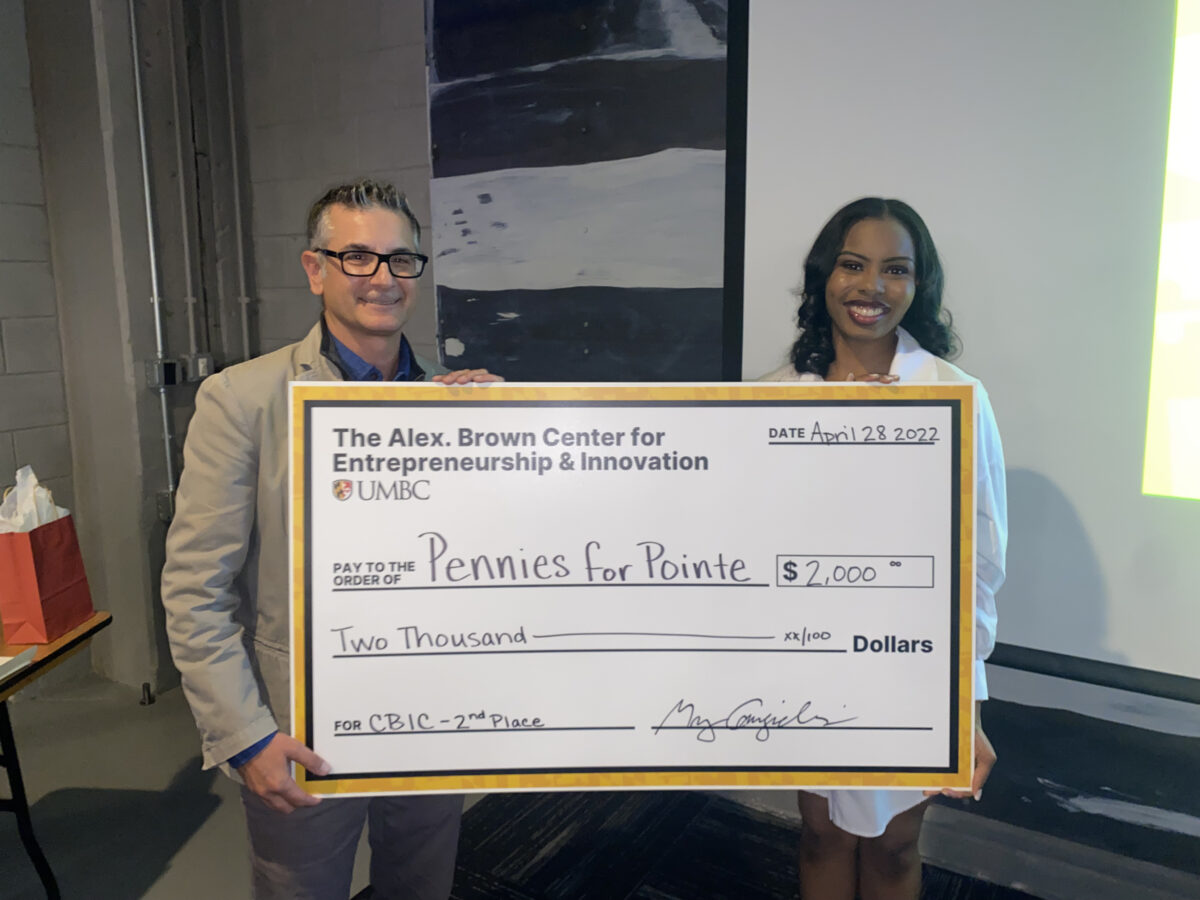
Kayla Massey, right, with Greg Cangialosi after the event. (Alex. Brown Center for Entrepreneurship.)
“How you see yourself and your organization is how other people see you,” Massey explains. “Always believe that your idea is valuable, and be certain that no matter how many people are doing something similar to what you want to do, there is nobody who can do it quite like you.”
Massey has experience expressing that confidence in sharing her work, beyond the entrepreneurship competition. Her dance piece Between You and Me was selected to be performed at the American College Dance Association’s virtual gala event held in early May. The American College Dance Association is an organization that promotes the talent and creativity of prominent college and university dance departments. A panel of judges selected Massey’s piece for performance out of more than 50 submissions.
Tip 5: Take action
Tamara Buchanan M.S. ‘22, health information technology, earned third place in the social impact track for PlusOne Technology, which allows individuals to search for transportation for medical appointments. She explains that a solid idea matters, but taking action on that idea is essential.
“It’s great when an idea comes to your mind and you believe in it. But the worst thing you can do is to sit on it and never bring it into fruition,” she says. “Someone is waiting on your business to help change or elevate their life. So take action. Seek help and utilize all the entrepreneurship resources available to you at UMBC. Start today. You can do it.”
Other award winners at the event included Talon Schroeder ‘25, and Noah Masri ‘25, both studying computer science. They took second place in the technology and innovation track for their idea Crypto Briefcase, an all in one place to do anything web3.
Students interested in exploring entrepreneurship opportunities can explore the Alex. Brown Center for Entrepreneurship and Innovation to learn about upcoming events and competitions.
]]>
Student teams recently gathered at Betamore, a Baltimore-based entrepreneurship and coworking space, to battle in the final round of UMBC’s annual Cangialosi Business Innovation Competition. Greg...
https://umbc.edu/stories/umbcs-student-innovation-competition-winners-share-tips-for-aspiring-entrepreneurs/
https://my3.my.umbc.edu/api/v0/pixel/news/125607/guest@my.umbc.edu/9f8d7feed52fe70082beeb46fa42734d/api/pixel
alexbrowncenter
biochemistry
biology
cahss
cnms
coeit
community
csee
dance
english
entrepreneurship
is
meche
policy-and-society
science-and-tech
UMBC News & Magazine
https://my3.my.umbc.edu/groups/umbc-news-magazine
https://assets1-my.umbc.edu/system/shared/avatars/groups/000/001/943/24435aa6207c452e7bc15cc74b42c7bb/xsmall.png?1748556657
https://assets1-my.umbc.edu/system/shared/avatars/groups/000/001/943/24435aa6207c452e7bc15cc74b42c7bb/original.png?1748556657
https://assets2-my.umbc.edu/system/shared/avatars/groups/000/001/943/24435aa6207c452e7bc15cc74b42c7bb/xxlarge.png?1748556657
https://assets2-my.umbc.edu/system/shared/avatars/groups/000/001/943/24435aa6207c452e7bc15cc74b42c7bb/xlarge.png?1748556657
https://assets3-my.umbc.edu/system/shared/avatars/groups/000/001/943/24435aa6207c452e7bc15cc74b42c7bb/large.png?1748556657
https://assets1-my.umbc.edu/system/shared/avatars/groups/000/001/943/24435aa6207c452e7bc15cc74b42c7bb/medium.png?1748556657
https://assets2-my.umbc.edu/system/shared/avatars/groups/000/001/943/24435aa6207c452e7bc15cc74b42c7bb/small.png?1748556657
https://assets1-my.umbc.edu/system/shared/avatars/groups/000/001/943/24435aa6207c452e7bc15cc74b42c7bb/xsmall.png?1748556657
https://assets2-my.umbc.edu/system/shared/avatars/groups/000/001/943/24435aa6207c452e7bc15cc74b42c7bb/xxsmall.png?1748556657
UMBC News & Magazine
0
0
false
Wed, 25 May 2022 16:02:15 -0400
Wed, 25 May 2022 16:02:15 -0400
A dancer’s discipline and dedication

Joshua Gray
Degree: B.A., Dance and Media and Communication Studies
Minor: Political Science
Hometown: Hyattsville, MD
Plans: Public affairs mass communications specialist in the U.S. Army
“I am driven by knowing that I can help future generations of my family explore what the world has to offer. My work can open up opportunities for them and help them look at the world and their experiences in a different way.”
Joshua Gray dancing for the Association of Black Artists, (Image courtesy of Gray)
Dance is at the core of Joshua Gray’s life. Trained in different techniques of tap, ballet, modern, African diaspora styles, and jazz, Gray ’22, a Linehan Artist Scholar, finds that the discipline and dedication a dancer’s life demands have given him energy and purpose.
Gray is currently president of UMBC’s Student Government Association (SGA) and has served as a leader in other SGA roles including as vice president for student organizations, chief of staff, and executive vice president.
He has also led UMBC’s Dance Council of Majors and created a new student organization, UMBC’s Association of Black Artists.
Gray is interested in expanding access to the arts and high-quality communications to marginalized communities. He will graduate with majors in both dance and media and communication studies, and a minor in political science. While this is an uncommon combination, he thrives on pushing the boundaries of his passions.
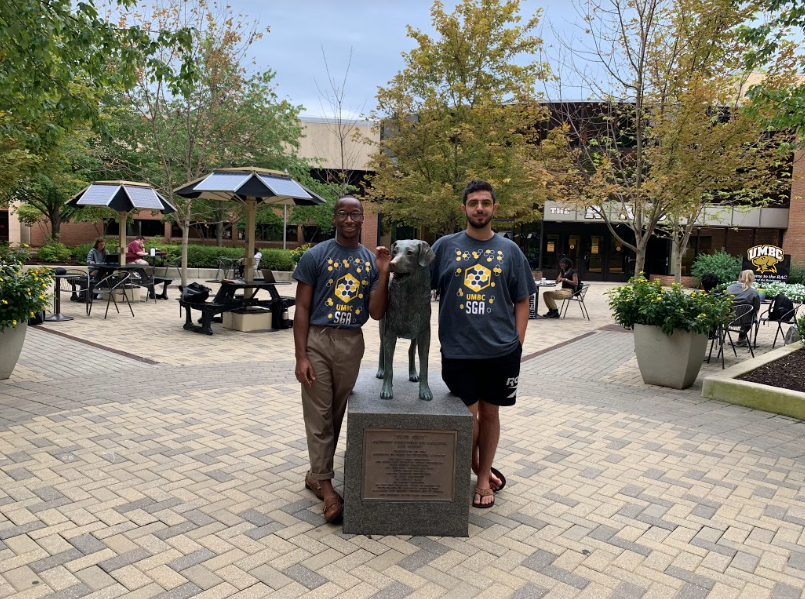
Gray (l) with prior SGA President,
Mehrshad Devin ’21, biology, and M.P.S ’22, entrepreneurship, innovation, and leadership. (Image courtesy of Gray)
This is one of the reasons he enlisted in the U.S. Army as a crisis communications specialist. He wants to travel to places and do work that connects him to the world stage through service.
]]>
Joshua Gray Degree: B.A., Dance and Media and Communication Studies Minor: Political Science Hometown: Hyattsville, MD Plans: Public affairs mass communications specialist in the U.S. Army...
https://umbc.edu/stories/a-dancers-discipline-and-dedication/
https://my3.my.umbc.edu/api/v0/pixel/news/119421/guest@my.umbc.edu/01f40a293f2295c7027259e63ae9b6c7/api/pixel
baltimorecommunities
cahss
class-of-2022
dance
linehanscholars
mcs
news
politicalscience
sga
UMBC News & Magazine
https://my3.my.umbc.edu/groups/umbc-news-magazine
https://assets1-my.umbc.edu/system/shared/avatars/groups/000/001/943/24435aa6207c452e7bc15cc74b42c7bb/xsmall.png?1748556657
https://assets1-my.umbc.edu/system/shared/avatars/groups/000/001/943/24435aa6207c452e7bc15cc74b42c7bb/original.png?1748556657
https://assets2-my.umbc.edu/system/shared/avatars/groups/000/001/943/24435aa6207c452e7bc15cc74b42c7bb/xxlarge.png?1748556657
https://assets2-my.umbc.edu/system/shared/avatars/groups/000/001/943/24435aa6207c452e7bc15cc74b42c7bb/xlarge.png?1748556657
https://assets3-my.umbc.edu/system/shared/avatars/groups/000/001/943/24435aa6207c452e7bc15cc74b42c7bb/large.png?1748556657
https://assets1-my.umbc.edu/system/shared/avatars/groups/000/001/943/24435aa6207c452e7bc15cc74b42c7bb/medium.png?1748556657
https://assets2-my.umbc.edu/system/shared/avatars/groups/000/001/943/24435aa6207c452e7bc15cc74b42c7bb/small.png?1748556657
https://assets1-my.umbc.edu/system/shared/avatars/groups/000/001/943/24435aa6207c452e7bc15cc74b42c7bb/xsmall.png?1748556657
https://assets2-my.umbc.edu/system/shared/avatars/groups/000/001/943/24435aa6207c452e7bc15cc74b42c7bb/xxsmall.png?1748556657
UMBC News & Magazine
0
0
false
Thu, 12 May 2022 11:09:08 -0400
Thu, 12 May 2022 11:09:08 -0400
URCAD 2021 showcases creativity, resilience of UMBC student researchers

UMBC’s Undergraduate Research and Creative Achievement Day (URCAD) has burst out of the ballroom and onto computer screens around the world. For the second year in a row, the popular undergraduate research forum will be entirely online due to the pandemic, using a video presentation and online discussion tool called VoiceThread. But unlike 2020, no rapid shift is needed. After over a year of largely online learning and research, everyone involved is ready to take full advantage of the virtual medium.
“This event has gone global,” says April Householder ’95, director of undergraduate research and prestigious scholarships. Being online means URCAD leapt from about 2,500 people attending in person in 2019 to 8,000 virtual visits in 2020. “Viewers were coming in from as far away as the U.K., Korea, and South America,” says Householder. She expects that trend will continue this year.
 April Householder, 2018. Photo by Michael Mower.
Having a full week to explore URCAD this year also means viewers will have ample time to browse the available sessions, rather than “rushing from one thing to another,” says Householder, as they used to do at the in-person event. They’ll be able to explore, at their own pace, research on a vast array of topics, from the effects of anti-Asian discrimination during the COVID-19 pandemic to the Black Lives Matter movement, to cancer treatment, skateboarding culture, and online sneaker sales.
Connecting beyond boundaries
In lieu of face-to-face chats, visitors will be able to participate in online discussions with student presenters. Last year a research group in UMBC’s Asian studies department received feedback from researchers in Korea, says Householder. She hopes that this year, opportunities for these kinds of connections will increase with a new feature that enables users who aren’t from UMBC to comment through URCAD’s VoiceThread interface.
Within the UMBC community itself, Householder hopes students, faculty, and staff will take advantage of the opportunity to explore “things outside their disciplinary box.” Artists, scientists, humanists, social scientists, and engineers can all benefit from each others’ feedback, she explains.
Constraints generate creativity
Last year, when students had to quickly pivot from in-person presentations to using VoiceThread, “they had to learn an additional skill on the fly,” says Householder. This year, students are more prepared to take full advantage of all that the online format offers.
Further, due to the constraints of COVID, student researchers have become even more creative in using technology not just to display their research, but to pursue their research at a time when in-person interviews, fieldwork, and traditional performances aren’t possible. Students learned to do interviews online, adjusted their sample sizes, and navigated lab research within physical distancing guidelines. They also responded to the pandemic by examining the changes in society and in themselves.
One advantage of the online format is that the presentations are available to view in perpetuity. “We now have an archive of the event so we can use it as a teaching tool for future generations of URCAD presenters and mentors,” Householder says.
She finds this addition of an expanded archive and URCAD’s global reach to be fitting developments as the event marks its 25th anniversary. To celebrate the milestone, URCAD will feature a special video “fireside chat” with founders Diane Lee, Kathy Sutphin, Elizabeth Pennington, and Janet McGlynn.

Klaudine Wakasa. Image courtesy of Wakasa.
Viewers will also hear a keynote by Klaudine Wakasa ‘08, financial economics, who serves as a strategy advisor for clean technology ecosystems, consulting with international governments.
UMBC students, faculty, staff, and alumni, and the general public, are invited to view these special sessions, and hundreds of available students presentations at urcad.umbc.edu, April 19-25, 2021. Featured below are a few student presentations that give a glimpse into the range of what will be available. Each has been shaped in some way by the COVID-19 pandemic—in topic, approach, or format.
“COVID-19 telehealth and telerehabilation reflections: Understanding the stroke survivor and caregiver perspectives”
Frances Watson ‘21, computer science, conducted research on telehealth and telerehabilitation services during COVID-19 through UMBC’s Bodies in Motion Lab. “I am investigating the stroke survivor and caregiver perspectives to understand how socioeconomic disparities affect this population,” Watson explains.

Frances Watson. Photo courtesy of Watson.
Watson has so far conducted 20 interviews with rehabilitation specialists about their experience with telehealth appointments, alongside her graduate mentor, human-centered computing Ph.D. student Adegboyega Akinsiku. She is also currently interviewing stroke survivors and caregivers.
“The COVID-19 pandemic not only changed how we conduct these interviews, but also the analysis of them,” says Watson. “We conducted and continue to conduct these interviews on teleconferencing platforms such as Cisco Webex and Zoom, allowing us to video-record them. In comparison, when we were in person we would have an audio recording device present. Now we can rewatch the video recordings for our data analysis.”
The fact that her research technique adjusted to match the format of the telehealth appointments themselves “has proven very useful” in surfacing insights, she says.
Watson was previously able to gain research experience through the Stanford SURF program. As a Center for Women in Technology Scholar and Undergraduate Research Award (URA) Scholar, she also knows the power of research opportunities in developing an identity and career pathway as a STEM researcher, as well as the value of peer support. This has motivated her leadership on campus, including as Student Government Association president in spring 2020.
“this is it: A poetic response to the anti-Asian racism during the COVID-19 pandemic”
Just after the pandemic started last March, Calista Ogburn ’21, health administration and policy, felt hurt and angry as she heard about rising anti-Asian hate crimes and racism. Then she herself had an upsetting encounter at a Home Depot. “In that moment, standing in the Home Depot aisle next to the grills, I knew I had to write a poetry collection,” she says.
It was a process that involved many nights of tears, processing heavy emotions. “Reliving past experiences of racism and microaggressions in addition to writing responses to news headlines of anti-Asian racism was utterly exhausting,” she says. She wrote around the clock, and after publication she was gratified to learn “how my poetry has supported others during this turbulent time.”
 Poetry collection “this is it.” Image courtesy of Ogburn.
Ogburn does not intend to pursue a career in poetry, but she says, “I hope it remains my best friend.” Ogburn will present poetry from her collection “this is it” at URCAD. “My hope,” she previously shared with UMBC Magazine, “is that these poems can touch those who are feeling loss, loneliness, or the combined grief and rage of experiencing racism.”
 Calista Ogburn poses with her books of poetry. Photo from calista-ogburn.com.
“Modeling radio emission from tidal disruption events”
Omar French ’21, physics and mathematics, came to UMBC to become a theoretical physicist and he will be leaving soon to do just that. He found COVID-19 increased demands on his faculty mentors’ time, requiring him to move forward with his work more independently than before.
“I’m sure most people can agree that controlling one’s work is much more gratifying than the contrary, but of course, it’s a bit like being in the wilderness,” says French. “It forces you to think for yourself and to be confident in what you’re doing.”
 Omar French. Photo courtesy of French
French’s research on supermassive black holes has yielded insights. “Perhaps the most remarkable technical thing I’ve learned is that the mass of supermassive black holes central to inactive galaxies can be estimated reasonably from measuring only a few factors,” he explains.
After graduating, French will begin a physics Ph.D. program at University of Colorado Boulder. He describes the past year challenging, but also as a period that helped him grow as a scientist more than any other time of his life. As a result, he is heading off to graduate skill with new skills and a critical eye.
“The obedient body: Researching trained and culturally informed movement biases”
It was during a gender and women’s studies course that URA Scholar Gretta Zinski ’22, dance, read something that rocked her world. She says it was fascinating to learn about how the different social conditioning that men and women experience is reflected in how each gender moves. “The excerpt inspired me to assess my own habits, interests, and biases in an attempt to figure out what were my own thoughts and what I had been taught about my own femininity and beliefs,” she says.
Unfortunately, COVID kept the scope of Zinski’s project smaller than she would have liked, but she was still able to access fascinating findings. “Biases do affect our behavior, which translates into movement,” she says. “The physiological connections between the body and the mind were so interesting to me.”
 Still image from Zinski’s dance film project, courtesy of Zinski.
Zinski plans to continue her research and use it to plan bias deconstruction workshops. Of her pandemic research experience, she says, “I learned so much about myself and how to work on my own. This is going to be a very important skill for me and my future career as a self-employed artist.”
“Performing traditional Chinese folk songs”
International travel may have been largely shut down this year, but that didn’t stop URA Scholar Mark Beachy ’21, Asian studies, from exploring China. “When I sing traditional Chinese folk songs I am transported to China and I am experiencing the stories from long ago that are told through the lyrics and music. And it brings me great joy to do that and to share it with others,” he says.
 Mark Beachy. Photo courtesy of Beachy.
Beachy’s URCAD presentation features a video performance of the folk song “Jasmine.” He painstakingly edited together his vocal performance with accompaniment from a pianist in Illinois and a guzheng player in China. Beachy found both musicians online. “When singing traditional Chinese folk songs or any song it is important to connect with the other musicians in order to give the audiences an authentic performance of music that deserves respect,” he says.
Beachy returned to college in his 40s after a career as a professional actor and a writer of musicals, wanting to learn something new. Though not of Chinese descent, he has a passion for Chinese culture, language, and history.
His eventual goal is to teach English to Chinese speakers, and he hopes music can be a helpful teaching tool. “Music is a great way to learn a language,” he says. After graduating, he plans to earn a master’s degree at UMBC in Teaching English as a Second Language.
“Interpretation of models of care in residential communities for older adults”
“I am passionate about working with an underserved population and providing elders with quality care,” says Sydney Siegel ‘20, management of aging services. Siegel graduated in Fall 2020 from UMBC’s Erickson School and now works in an assisted living community. Her URCAD project is an analysis of models of care that older adults can experience. “The models of care I studied are about enhancing quality of life and quality of care, something I hope all aging services strive for,” she says.
Interviewing older people proved to be a challenge during the COVID-19 pandemic. In addition to many care facilities being inaccessible, staff members caring for older adults were incredibly busy. However, Siegel found ways to complete interviews online. “I made great connections and heard wonderful stories from participants,” she shares.
Siegel, a URA scholar, credits Erickson School faculty mentor Louise M. Murray with helping her grow in the field. “I definitely felt imposter syndrome when I started the research, but I learned to see my inexperience as a good thing, Siegel says. “Learning is so powerful and I feel grateful to have learned so much.” She looks forward to continuing to use research to inform care she provides for older adults.
“Optimizing in-situ longevity of silver nanoplates”
As a first-year student who started college in the midst of a pandemic, Dariush Aligholizadeh ‘24, biochemistry and computer science, did not have a typical introduction to UMBC. He didn’t want that to affect his ability to get started with research right away, but it was a lot to manage. “I was trying to adjust to college life while also trying to conduct research safely and securely within COVID-19 restrictions,” he says.

Dariush Aligholizadeh. Image courtesy of Aligholizadeh.
Aligholizadeh was able to find a compelling in-person research opportunity in a lab that employed strict physical distancing. His project involved synthesizing silver nanoplates “for their ability to reflect radiation and light to very high degrees.” He explains, “Basically, I make tiny triangles that kill cancer.” And his research experience proved highly gratifying.
“Every aspect of chemistry is in its own way beautiful, and watching these textbook principles come to life in my project is like watching magic happen. I take simple grains of silver salts and they come together in these beautiful sharp triangular structures, almost as if they were put together by hand,” he explains.
 Electron microscope image of nanoplates. Courtesy of the Devadas Lab.
Aligholizadeh believes his research experience has already improved his skills in calculus, biology, and organic chemistry, and helped solidify his plans to eventually become a medical doctor. He has also found that the challenges of COVID have required him to improve his time-management and online communication skills. Still, he looks forward to learning in-person again when it’s safe to do so.
The UMBC community and general public can see these presentations and many more at urcad.umbc.edu, April 19-25, 2021.
Featured image: Calista Ogburn, 2018. Photo by Marlayna Demond ’11 for UMBC.
Article written by Karen Stysley for UMBC News.
]]>
UMBC’s Undergraduate Research and Creative Achievement Day (URCAD) has burst out of the ballroom and onto computer screens around the world. For the second year in a row, the popular undergraduate...
https://umbc.edu/stories/urcad-2021-showcases-creativity-resilience-of-umbc-student-researchers/
https://my3.my.umbc.edu/api/v0/pixel/news/119658/guest@my.umbc.edu/b0fdbef5295bf80807456fdcff41891f/api/pixel
arts-and-culture
asianstudies
cahss
chembiochem
cnms
coeit
community
csee
dance
ericksonschool
mathstat
page1
physics
policy-and-society
saph
science-and-technology
undergradresearch
UMBC News & Magazine
https://my3.my.umbc.edu/groups/umbc-news-magazine
https://assets1-my.umbc.edu/system/shared/avatars/groups/000/001/943/24435aa6207c452e7bc15cc74b42c7bb/xsmall.png?1748556657
https://assets1-my.umbc.edu/system/shared/avatars/groups/000/001/943/24435aa6207c452e7bc15cc74b42c7bb/original.png?1748556657
https://assets2-my.umbc.edu/system/shared/avatars/groups/000/001/943/24435aa6207c452e7bc15cc74b42c7bb/xxlarge.png?1748556657
https://assets2-my.umbc.edu/system/shared/avatars/groups/000/001/943/24435aa6207c452e7bc15cc74b42c7bb/xlarge.png?1748556657
https://assets3-my.umbc.edu/system/shared/avatars/groups/000/001/943/24435aa6207c452e7bc15cc74b42c7bb/large.png?1748556657
https://assets1-my.umbc.edu/system/shared/avatars/groups/000/001/943/24435aa6207c452e7bc15cc74b42c7bb/medium.png?1748556657
https://assets2-my.umbc.edu/system/shared/avatars/groups/000/001/943/24435aa6207c452e7bc15cc74b42c7bb/small.png?1748556657
https://assets1-my.umbc.edu/system/shared/avatars/groups/000/001/943/24435aa6207c452e7bc15cc74b42c7bb/xsmall.png?1748556657
https://assets2-my.umbc.edu/system/shared/avatars/groups/000/001/943/24435aa6207c452e7bc15cc74b42c7bb/xxsmall.png?1748556657
UMBC News & Magazine
0
0
false
Mon, 12 Apr 2021 03:46:42 -0400


