Discovery – Fall 2012
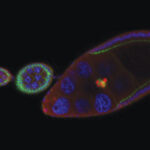
EXPLORING THE BORDER
When human beings have to be at a certain place at a certain time, they have lots of handy aids to do so: alarm clocks and watches, maps and GPS systems.
Michelle Starz-Gaiano, an assistant professor of biology at UMBC, is fascinated by the question of how cells do the same thing.
“Cells leave on time and get to a destination on time during development,” she says. “They get to the right places almost all the time and they don’t get lost.”
What guides cells? One aspect of this question that researchers in Starz-Gaiano’s lab want to understand is how cells decide which particular ones in an organism will move and which will stay.
For instance, many cells must divide as a person develops from an egg to an embryo, to a human being. And as they divide, those cells must also reorganize themselves – and many of those cells migrate to different locations within an organism to fulfill their missions.
Starz-Gaiano and her colleagues are studying cell migration in fruit flies, concentrating specifically on a population of cells called “border cells.”
“Genes and proteins are similar between humans and flies,” Starz-Gaiano observes. “So if we can understand how they work in a simple system like flies, it really predicts how they’re going to act in humans.”
The relative simplicity of fruit flies also helps aid researchers. “In flies you can see how molecular changes translate to the whole organism,” she says.
How do Starz-Gaiano and her colleagues unlock the secrets of cell migration in flies? Biologists call it “loss of function” – but what it comes down to is simple subtraction and observation.
“We take away one gene at a time and see if the cells migrate or not,” she relates. “Then we can infer that those genes are required for cell migration.”
Studying cell migration is not just about exploring genetics. The observation of the border cells requires a great deal of live imaging with a microscope – which offers an enhanced look inside the process that is not available with a simpler two-dimensional observation.
“One surprise that came out of the live imaging is that [the migrating border cells] rotate,” says Starz-Gaiano. “People have done a tremendous amount of work looking at cell migration in tissue culture dishes where the cells are moving across two dimensions.” Live imaging offers the “huge advantage to look at the whole tissue at once.”
Interdisciplinary collaborations with the mathematics and chemistry departments, funded with help from the National Science Foundation (NSF) and the National Institutes of Health (NIH), have been a key to advancing the work being done in Starz-Gaiano’s research lab. (She is also the recipient of an NSF Early Career Award.)
The NSF’s Undergraduate Biology Mathematics Program has allowed Starz-Gaiano to team up with assistant professor of mathematics Bradford Peercy. “We’re doing some mathematical modeling to answer some of the harder questions about how the cells are moving and which cells are specified to move,” she observes.
Another grant from the NIH’s Chemistry Biology Interface Program (aimed to encourage interdisciplinary work by graduate students) is facilitating collaboration between Starz-Gaiano and UMBC professor of chemistry Katherine Seley-Radtke to explore applications that the cell migration research might have on drug design. Because cell movement is controlled in part by a cascade of molecules, this partnership is allowing researchers to work toward assembling drugs, molecule by molecule, that may inhibit some of the biological processes that promote cell migration.
— Nicole Ruediger
WIRELESS IS MORE

Most professors urge students to write concisely. But the students in Denise Meringolo’s public history class recently faced an extreme challenge to be succinct: Turn in a final project just 150 words long.
The work submitted by Meringolo’s students helped create a new smartphone app for Baltimore Heritage, a nonprofit preservation organization. The app leads users on a walking tour of Baltimore – and the 150 words is about as much text as can be read easily on an iPhone screen.
As an assistant professor of history and the coordinator of the public history track in the historical studies M.A. program, Meringolo often uses her Introduction to Public History class to collaborate with external partners on ways to enhance public understanding of history. Yet some of these classroom collaborations were never implemented by partner organizations, an outcome that was frustrating to a professor who likes to call her class: “Committing History in Public.”
Meringolo’s luck changed when she met Eli Pousson through UMBC’s Orser Center for Place, Community and Culture – where they are both board members. Pousson is the field officer for Baltimore Heritage, which needed content for their new “Explore Baltimore Heritage” app.
“It seemed like a very natural partnership,” says Pousson.
The collaboration on the app allowed UMBC students like Shae Adams ’13, M.A., historical studies, to wrestle with the issues faced each day by public historians. “I’ve had years of practice writing traditional research papers,” says Adams. “But to tease out a single story from that research and tell it in about 150 words? Much more challenging. Throughout the semester, I found myself loving the inherent challenge of interpretative public history.”
Meringolo’s partnership with Baltimore Heritage will continue this fall, when the graduate students in a class she’s called “West Side Stories” will create digital narratives – including oral histories – for the organization’s app.
Ironically, Meringolo doesn’t even own a smartphone yet. But she teaches her students that the principles of good storytelling stay the same no matter how the tale is conveyed.
“The mode of delivery is changing, not the impulse behind it,” says Meringolo, who has just published a new study of her discipline’s trends from the nineteenth century until today titled Museums, Monuments and National Parks: Toward a New Genealogy of Public History (University of Massachusetts Press).
It’s no surprise that Meringolo sees her own work as part of that continuum, and she values the fact that UMBC is also becoming ever more engaged in the work of public history. “Public history is an intellectual discipline in the service of the community, and public universities are supposed to be in service to the world around them,” she says. “The more we can recognize that humanities scholarship is also a problem-solving toolbox, the more we can be relevant to the world around us.”
Meringolo has her sights set on 2016, when the National Council on Public History will hold its annual conference in Baltimore. UMBC’s partnership with Baltimore Heritage is one concrete example of what’s in the problem-solving toolbox of the humanities at the university. But the professor who likes “committing history in public” also hopes that it’s another step toward making UMBC a model of community collaboration by the time public historians arrive in Baltimore.
— Chelsea Haddaway
]]>
EXPLORING THE BORDER When human beings have to be at a certain place at a certain time, they have lots of handy aids to do so: alarm clocks and watches, maps and GPS systems. Michelle...
https://umbc.edu/stories/discovery-fall-2012/
https://my3.my.umbc.edu/api/v0/pixel/news/123728/guest@my.umbc.edu/1e7799715f9cd358a71f3d4f5e7e4f50/api/pixel
discovery
fall-2012
UMBC News & Magazine
https://my3.my.umbc.edu/groups/umbc-news-magazine
https://assets1-my.umbc.edu/system/shared/avatars/groups/000/001/943/24435aa6207c452e7bc15cc74b42c7bb/xsmall.png?1748556657
https://assets1-my.umbc.edu/system/shared/avatars/groups/000/001/943/24435aa6207c452e7bc15cc74b42c7bb/original.png?1748556657
https://assets2-my.umbc.edu/system/shared/avatars/groups/000/001/943/24435aa6207c452e7bc15cc74b42c7bb/xxlarge.png?1748556657
https://assets2-my.umbc.edu/system/shared/avatars/groups/000/001/943/24435aa6207c452e7bc15cc74b42c7bb/xlarge.png?1748556657
https://assets3-my.umbc.edu/system/shared/avatars/groups/000/001/943/24435aa6207c452e7bc15cc74b42c7bb/large.png?1748556657
https://assets1-my.umbc.edu/system/shared/avatars/groups/000/001/943/24435aa6207c452e7bc15cc74b42c7bb/medium.png?1748556657
https://assets2-my.umbc.edu/system/shared/avatars/groups/000/001/943/24435aa6207c452e7bc15cc74b42c7bb/small.png?1748556657
https://assets1-my.umbc.edu/system/shared/avatars/groups/000/001/943/24435aa6207c452e7bc15cc74b42c7bb/xsmall.png?1748556657
https://assets2-my.umbc.edu/system/shared/avatars/groups/000/001/943/24435aa6207c452e7bc15cc74b42c7bb/xxsmall.png?1748556657
UMBC News & Magazine
0
0
false
Sat, 06 Oct 2012 21:17:34 -0400
Conserve and Protect – Lekelia “Kiki” Jenkins '97, BioSci

As a child, Lekelia “Kiki” Jenkins ’97, biological sciences, could often be found on a fishing pier on the Chesapeake Bay, dangling a line for fish or chicken-necking for blue crabs with her family.
Today, you’re more apt to find her on a commercial fishing boat in Ecuador as she researches how fishermen can keep from catching protected species such as sea turtles.
It’s a race against time as Jenkins works with fishermen and government regulators to adopt new technologies out on the water. It can take 15 years or longer to come up with a new device to keep sea turtles from being snared by hooks or to prevent dolphins from getting tangled in nets.
“When you’re looking at some of the forecasts of when animals are going to go extinct – like leatherback turtles, which could be a decade before they’re extinct in the Pacific Ocean – then 15 years is too long of a time frame,” said Jenkins, who is now an assistant professor at the University of Washington in Seattle.
Jenkins focuses not only on the mechanics of the devices she’s helping to streamline – called bycatch reduction devices – but also the factors that lead commercial fishermen to adopt them or reject them. In particular, she’s been evaluating barriers that might prevent fishermen in other countries from using the devices that American regulators are pushing.
She blends a touch of the social sciences into biology, understanding not just how the animals behave with the devices, but how the people who use them behave, too.
“It’s really about the people, and the people are having an impact on the environment,” Jenkins said. “What’s going to effect change really starts with humans and why they do what they do, and where there are opportunities to improve that.”
Jenkins also studies how commercial fishermen might switch their fishing gear to different types that are less lethal to protected species – from nets, say, to baited fishing lines. She is also working on recounting historic fishing harvests to better understand how humans have influenced marine life.
Jenkins’ research often takes her out on the water, working alongside commercial fishermen.
“Fishermen are wonderful. They like me, so I’m lucky,” Jenkins says with a laugh. “They are really sweet, very open. They take their time to share.”
Jenkins’ career path was shaped by her mentors at UMBC. A former junior zookeeper at what is now the Maryland Zoo in Baltimore, Jenkins initially considered studying veterinary medicine and endocrinology, so she could work in captive breeding.
But it was in the late UMBC professor of biological sciences Carl Weber’s ecology class that she found her calling.
“I was reading through the textbook, a chapter we weren’t assigned on conservation ecology, and I thought, ‘This is it! This is what I want to do,’” Jenkins recalls.
In addition to Weber, Jenkins credits other UMBC faculty, including associate professor of geography and environmental systems Sandy Parker, senior lecturer in chemistry Mark Perks, and former associate vice provost Teresa Viancour (who let Jenkins into the lab at night to observe electric fish) with helping her understand where her biology training at UMBC could take her.
Jenkins also found a “wonderful oasis” in UMBC’s dance department, where she earned a minor and found a creative outlet in an interest she continues today. In fact, after Jenkins earned her Ph.D. in marine conservation at Duke University in 2006, she choreographed a dance about her dissertation on sea turtles. It won second place in a dance competition sponsored by the American Association for the Advancement of Science.
Jenkins says the arts and science can mesh better than many might think. In fact, art can be used to communicate science to non-scientists.
“What I tell people all the time is that, especially when it comes to the environment, people’s interest in environmental issues are triggered by all sorts of things,” she said. That could be experiences in nature, photography, poetry or literature. It makes sense, she said, to communicate science through those same channels.
“If we as scientists want to deliver information back to stakeholders and people who care about the environment, doing scientific papers is insufficient,” she said.
Jenkins practices what she preaches, writing general-interest articles alongside each of her academic papers. In 2011, for example, she blogged about a research trip to Ecuador for the New York Times.
Jenkins hopes her work – whether with regulators, fishermen or regular folks – can help save vulnerable species.
“I want to make a difference. I want to have a lasting conservation impact,” Jenkins said. “When I did my dissertation, I said to my advisor: ‘I want to do work that someone’s going to use. It’s not going to sit on a shelf.’”
— Pamela Wood
]]>
As a child, Lekelia “Kiki” Jenkins ’97, biological sciences, could often be found on a fishing pier on the Chesapeake Bay, dangling a line for fish or chicken-necking for blue crabs with her...
https://umbc.edu/stories/conserve-and-protect-lekelia-kiki-jenkins-97-biosci-2/
https://my3.my.umbc.edu/api/v0/pixel/news/123729/guest@my.umbc.edu/4439599b4d6e4cde464e7128a970073c/api/pixel
alumni
fall-2012
UMBC News & Magazine
https://my3.my.umbc.edu/groups/umbc-news-magazine
https://assets1-my.umbc.edu/system/shared/avatars/groups/000/001/943/24435aa6207c452e7bc15cc74b42c7bb/xsmall.png?1748556657
https://assets1-my.umbc.edu/system/shared/avatars/groups/000/001/943/24435aa6207c452e7bc15cc74b42c7bb/original.png?1748556657
https://assets2-my.umbc.edu/system/shared/avatars/groups/000/001/943/24435aa6207c452e7bc15cc74b42c7bb/xxlarge.png?1748556657
https://assets2-my.umbc.edu/system/shared/avatars/groups/000/001/943/24435aa6207c452e7bc15cc74b42c7bb/xlarge.png?1748556657
https://assets3-my.umbc.edu/system/shared/avatars/groups/000/001/943/24435aa6207c452e7bc15cc74b42c7bb/large.png?1748556657
https://assets1-my.umbc.edu/system/shared/avatars/groups/000/001/943/24435aa6207c452e7bc15cc74b42c7bb/medium.png?1748556657
https://assets2-my.umbc.edu/system/shared/avatars/groups/000/001/943/24435aa6207c452e7bc15cc74b42c7bb/small.png?1748556657
https://assets1-my.umbc.edu/system/shared/avatars/groups/000/001/943/24435aa6207c452e7bc15cc74b42c7bb/xsmall.png?1748556657
https://assets2-my.umbc.edu/system/shared/avatars/groups/000/001/943/24435aa6207c452e7bc15cc74b42c7bb/xxsmall.png?1748556657
UMBC News & Magazine
0
0
false
Sat, 06 Oct 2012 21:16:15 -0400
Conserve and Protect – Lekelia “Kiki” Jenkins ’97, BioSci
As a child, Lekelia “Kiki” Jenkins ’97, biological sciences, could often be found on a fishing pier on the Chesapeake Bay, dangling a line for fish or chicken-necking for blue crabs with her family.
Today, you’re more apt to find her on a commercial fishing boat in Ecuador as she researches how fishermen can keep from catching protected species such as sea turtles.
It’s a race against time as Jenkins works with fishermen and government regulators to adopt new technologies out on the water. It can take 15 years or longer to come up with a new device to keep sea turtles from being snared by hooks or to prevent dolphins from getting tangled in nets.
“When you’re looking at some of the forecasts of when animals are going to go extinct – like leatherback turtles, which could be a decade before they’re extinct in the Pacific Ocean – then 15 years is too long of a time frame,” said Jenkins, who is now an assistant professor at the University of Washington in Seattle.
Jenkins focuses not only on the mechanics of the devices she’s helping to streamline – called bycatch reduction devices – but also the factors that lead commercial fishermen to adopt them or reject them. In particular, she’s been evaluating barriers that might prevent fishermen in other countries from using the devices that American regulators are pushing.
She blends a touch of the social sciences into biology, understanding not just how the animals behave with the devices, but how the people who use them behave, too.
“It’s really about the people, and the people are having an impact on the environment,” Jenkins said. “What’s going to effect change really starts with humans and why they do what they do, and where there are opportunities to improve that.”
Jenkins also studies how commercial fishermen might switch their fishing gear to different types that are less lethal to protected species – from nets, say, to baited fishing lines. She is also working on recounting historic fishing harvests to better understand how humans have influenced marine life.
Jenkins’ research often takes her out on the water, working alongside commercial fishermen.
“Fishermen are wonderful. They like me, so I’m lucky,” Jenkins says with a laugh. “They are really sweet, very open. They take their time to share.”
Jenkins’ career path was shaped by her mentors at UMBC. A former junior zookeeper at what is now the Maryland Zoo in Baltimore, Jenkins initially considered studying veterinary medicine and endocrinology, so she could work in captive breeding.
But it was in the late UMBC professor of biological sciences Carl Weber’s ecology class that she found her calling.
“I was reading through the textbook, a chapter we weren’t assigned on conservation ecology, and I thought, ‘This is it! This is what I want to do,’” Jenkins recalls.
In addition to Weber, Jenkins credits other UMBC faculty, including associate professor of geography and environmental systems Sandy Parker, senior lecturer in chemistry Mark Perks, and former associate vice provost Teresa Viancour (who let Jenkins into the lab at night to observe electric fish) with helping her understand where her biology training at UMBC could take her.
Jenkins also found a “wonderful oasis” in UMBC’s dance department, where she earned a minor and found a creative outlet in an interest she continues today. In fact, after Jenkins earned her Ph.D. in marine conservation at Duke University in 2006, she choreographed a dance about her dissertation on sea turtles. It won second place in a dance competition sponsored by the American Association for the Advancement of Science.
Jenkins says the arts and science can mesh better than many might think. In fact, art can be used to communicate science to non-scientists.
“What I tell people all the time is that, especially when it comes to the environment, people’s interest in environmental issues are triggered by all sorts of things,” she said. That could be experiences in nature, photography, poetry or literature. It makes sense, she said, to communicate science through those same channels.
“If we as scientists want to deliver information back to stakeholders and people who care about the environment, doing scientific papers is insufficient,” she said.
Jenkins practices what she preaches, writing general-interest articles alongside each of her academic papers. In 2011, for example, she blogged about a research trip to Ecuador for the New York Times.
Jenkins hopes her work – whether with regulators, fishermen or regular folks – can help save vulnerable species.
“I want to make a difference. I want to have a lasting conservation impact,” Jenkins said. “When I did my dissertation, I said to my advisor: ‘I want to do work that someone’s going to use. It’s not going to sit on a shelf.’”
— Pamela Wood
]]>
As a child, Lekelia “Kiki” Jenkins ’97, biological sciences, could often be found on a fishing pier on the Chesapeake Bay, dangling a line for fish or chicken-necking for blue crabs with her...
https://umbc.edu/stories/conserve-and-protect-lekelia-kiki-jenkins-97-biosci/
https://my3.my.umbc.edu/api/v0/pixel/news/123730/guest@my.umbc.edu/cc0c993dad75aee302576feb80de62dd/api/pixel
alumni
fall-2012
UMBC News & Magazine
https://my3.my.umbc.edu/groups/umbc-news-magazine
https://assets1-my.umbc.edu/system/shared/avatars/groups/000/001/943/24435aa6207c452e7bc15cc74b42c7bb/xsmall.png?1748556657
https://assets1-my.umbc.edu/system/shared/avatars/groups/000/001/943/24435aa6207c452e7bc15cc74b42c7bb/original.png?1748556657
https://assets2-my.umbc.edu/system/shared/avatars/groups/000/001/943/24435aa6207c452e7bc15cc74b42c7bb/xxlarge.png?1748556657
https://assets2-my.umbc.edu/system/shared/avatars/groups/000/001/943/24435aa6207c452e7bc15cc74b42c7bb/xlarge.png?1748556657
https://assets3-my.umbc.edu/system/shared/avatars/groups/000/001/943/24435aa6207c452e7bc15cc74b42c7bb/large.png?1748556657
https://assets1-my.umbc.edu/system/shared/avatars/groups/000/001/943/24435aa6207c452e7bc15cc74b42c7bb/medium.png?1748556657
https://assets2-my.umbc.edu/system/shared/avatars/groups/000/001/943/24435aa6207c452e7bc15cc74b42c7bb/small.png?1748556657
https://assets1-my.umbc.edu/system/shared/avatars/groups/000/001/943/24435aa6207c452e7bc15cc74b42c7bb/xsmall.png?1748556657
https://assets2-my.umbc.edu/system/shared/avatars/groups/000/001/943/24435aa6207c452e7bc15cc74b42c7bb/xxsmall.png?1748556657
UMBC News & Magazine
0
0
false
Sat, 06 Oct 2012 21:16:15 -0400
At Play – Fall 2012

PUZZLE POWER
Marie desJardins, a professor of computer science at UMBC, specializes in research on artificial intelligence. But at the 2012 American Crossword Puzzle Tournament in March, her research became downright competitive when desJardins crossed pencils with a crossword-solving computer program.
The progam, dubbed “Dr. Fill,” was going up against one of the best crossword puzzle solvers in the country. DesJardins is the top-ranked female solver in the Mid-Atlantic region and she is the 44th best solver in the country. (Dr. Fill finished the same tournament in 141st place.)
“I didn’t realize I could be this good at crossword puzzles,” says desJardins. She adds that her development as a crossword competitor also highlights the hurdles to bringing more women into the sciences.
“A lot of girls think that they must not be intrinsically good at ‘that stuff,’” argues desJardins, who adds that the biggest impediments are “the psychological blocks we put up for ourselves.”
DesJardins has been closely involved in programs at UMBC to remove those blocks, including the Center for Women and Information Technology (CWIT). She also works with the Multi-Agent Planning and Learning Lab (MAPLE), which she founded in 2003 to facilitate student research in artificial intelligence.
DesJardins has her eye on next year’s tournament – if she can reconcile it with an academic conference scheduled for the same weekend. “I might go to that conference,” she says. “But I’ll have to leave early to go to the tournament.”
— Andrew Holter ’12
NOT CAMERA SHY

Even on a campus as welcoming as UMBC, some incoming freshmen and transfer students find that orientation makes them nervous. There’s the stress of course selection and presentations on campus life, but also the question that comes with joining any new community: Will I make new friends?
This year’s contingent of UMBC Orientation Peer Advisors (OPA) decided to break the ice with a bit of video comedy, powered with the Mika song “Love Today” as a soundtrack. This year’s advisors are caught in a range of fun and goofy activities: playing video games, dancing, tossing a football, chasing ducks, bumping into things, and that perennial undergraduate favorite: sleeping.
Christina Animashaun ’13, who studies media communications and photography, teamed up with Jason Palumbo ’13, a graphic design major, to make the video in a single day. Palumbo was behind the camera, and Animashaun coordinated the sequences. Spontaneity was a key to the feel of the video: “It was very much talking out the storyboards,” says Animashaun, “as opposed to having it all set and ready to go.”
An introductory video made by the Orientation Peer Advisors has become a staple through the years, but the 2012 video duo wanted to get this year’s orientation started with a jolt of humor and movement.
“On the morning [of orientation], people are rolling up at 8 or 8:30 a.m,” says Animashaun. “They’re hyped up on coffee, and then you [show the video]. It’s like, ‘Hey, we’re real people. We’re real students…” Palumbo finishes the thought: “…and we also like to dance.”
Watch the video here.
— Nathan Glover ’12
SPURS OF THE MOMENT

North London’s Tottenham Hotspur Football Club (often called “Spurs” for short) is one of the world’s great soccer teams, having recently played in the UEFA Champions League and finishing fourth in the English Premier League last season. Clad in iconic white and dark blue uniforms adorned with a cockerel, Spurs are known for playing an attractive, free-flowing and attacking football.
For one sweltering day in late July, however, Spurs found a home on UMBC’s campus, which they used as a training facility before a July 28 friendly match at Baltimore’s M&T Stadium against Liverpool Football Club –another one of England’s biggest and most iconic teams.
Tottenham stars including Gareth Bale, Aaron Lennon, and longtime U.S. men’s national team goalkeeper Brad Friedel got in a morning training session on UMBC’s soccer field under the watchful eye of new Spurs coach Andres Villas Boas. Spurs players then adjourned for lunch at the True Grits dining hall.
Later that day, young Maryland soccer players sampled how Tottenham coaches players in its own football academy at an afternoon clinic led by Spurs’ head of football development Mark Jones.
“We plan for everyone to get 2,000 or so touches of the ball this afternoon,” Jones told the players and their parents before putting them through an afternoon of coaching and drills.
It is the second time in four years that world soccer powers have used UMBC’s state-of-the-art facilities on visits to the region. In 2009, English and Italian soccer powers Chelsea and AC Milan trained at UMBC before a friendly match.
— Richard Byrne ’86
THE RINGS THING

Every four years, the Olympic Games give athletes a chance to chase their dreams and compete at the highest level.
For UMBC swimmers Mohamed Hussein ’13 (Egypt), Patrick Husson ’14 (USA) and Pierre De Waal ’13 (South Africa), those dreams almost became reality. Husson and De Waal competed in the Olympic Trials of their respective home countries but fell short of earning a trip to London.
Hussein did his teammates one better – qualifying for Egypt’s team in the 100-meter freestyle and the 200-meter individual medley. But his trip to London was cut short by FINA, the international governing body of swimming, which abruptly changed the qualifying times required to make the Olympics. Hussein’s times fell just short.
“[In] all the past Olympic games, FINA allowed more than 1,200 swimmers to participate in the competition,” Hussein observes.
Despite the disappointment, Hussein remains one of the best swimmers in his native Egypt as well as at UMBC, and calls 2012 “the best year in my swimming career.”
De Waal had to return to South Africa to compete in the Olympic Trials during the spring semester. After a day and a half of travel from Baltimore to Durban, De Waal took to the pool for his best event, the 200-meter butterfly, where he fell to fellow countryman Chad le Clos, who went on to win gold in the Olympics over U.S. Olympic swimming star Michael Phelps.
Former walk-on Patrick Husson also swam in the Olympic Trials in his best event, the 200-meter breaststroke, finishing 99th out of 132 competitors.
“The three of them have all raised the level of our competition and our team,” UMBC swim coach Chad Cradock ’97 says.
— Dan Levin ’13
]]>
PUZZLE POWER Marie desJardins, a professor of computer science at UMBC, specializes in research on artificial intelligence. But at the 2012 American Crossword Puzzle Tournament in March, her...
https://umbc.edu/stories/at-play-fall-2012/
https://my3.my.umbc.edu/api/v0/pixel/news/123731/guest@my.umbc.edu/ccbf2223861605ba4fae3cadcccad43c/api/pixel
campus-life
fall-2012
UMBC News & Magazine
https://my3.my.umbc.edu/groups/umbc-news-magazine
https://assets1-my.umbc.edu/system/shared/avatars/groups/000/001/943/24435aa6207c452e7bc15cc74b42c7bb/xsmall.png?1748556657
https://assets1-my.umbc.edu/system/shared/avatars/groups/000/001/943/24435aa6207c452e7bc15cc74b42c7bb/original.png?1748556657
https://assets2-my.umbc.edu/system/shared/avatars/groups/000/001/943/24435aa6207c452e7bc15cc74b42c7bb/xxlarge.png?1748556657
https://assets2-my.umbc.edu/system/shared/avatars/groups/000/001/943/24435aa6207c452e7bc15cc74b42c7bb/xlarge.png?1748556657
https://assets3-my.umbc.edu/system/shared/avatars/groups/000/001/943/24435aa6207c452e7bc15cc74b42c7bb/large.png?1748556657
https://assets1-my.umbc.edu/system/shared/avatars/groups/000/001/943/24435aa6207c452e7bc15cc74b42c7bb/medium.png?1748556657
https://assets2-my.umbc.edu/system/shared/avatars/groups/000/001/943/24435aa6207c452e7bc15cc74b42c7bb/small.png?1748556657
https://assets1-my.umbc.edu/system/shared/avatars/groups/000/001/943/24435aa6207c452e7bc15cc74b42c7bb/xsmall.png?1748556657
https://assets2-my.umbc.edu/system/shared/avatars/groups/000/001/943/24435aa6207c452e7bc15cc74b42c7bb/xxsmall.png?1748556657
UMBC News & Magazine
0
0
false
Sat, 06 Oct 2012 21:14:11 -0400
Alumni Essay – Battles Can Build Bridges
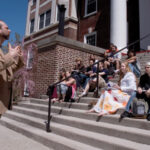
Proposition: The natural sciences will forever be at odds with the humanities and social sciences. Steven Gimbel ’90, philosophy and physics, argues in the negative. As chair of the philosophy department at Gettysburg College and the author of works such as Einstein’s Jewish Science: Physics at the Intersection of Politics and Religion, Gimbel has made his career finding useful and provocative intersections between the sciences and the humanities and social sciences.
* * * * *
There are days in college that leave an indelible trace on your mind. I will never forget sitting in professor (and now professor emeritus of physics) Robert L. Rasera’s solid state physics class about two weeks from the end of the semester, when Jon Lau ’90, physics (who busted every curve), asked for clarification about the topic being discussed.
I recall that Rasera paused, and then said three little words: “We don’t know.” Not “I don’t know,” but “We don’t know.” And as he sketched out competing views, everything changed for me.
As a double major in physics and philosophy, I was used to discussing disagreements between philosophers – that’s just what philosophers do. But science had always been beautifully clean. Every problem had an elegant solution. All equations had seamless derivations. Problems were solved exactly.
That moment in Rasera’s class showed me that science was also a process involving people arguing with each other. It was the real physics, the messy physics, the human physics. I had found the philosophy in the science – and I have stayed there ever since.
As a philosopher of science, students often tell me: “This philosophy stuff is interesting, but I believe in science.” Their mistaken view is something one could easily infer from the way we do things. We create departments of physics, chemistry, and biology, and then locate them in buildings away from history, sociology, and political science. Much of what we do at universities can entrench the idea that these divisions are absolute. Natural sciences go in one box, pack the humanities in a different one, and leave the arts and social sciences to their own.
But it just isn’t so. There’s no competition here, and no need to choose sides. Indeed, these seemingly disparate disciplines are complementary, working together to create multifaceted minds that appreciate the full breadth of the world and derive insight and wisdom from it.
Sociologists like Robert K. Merton, historians like I.B. Cohen, and philosophers like Thomas Kuhn looked at scientific communities and the reasoning of individual scientists in order to embed discoveries in historical and cultural contexts. If we want to understand not only how the science works, but where it came from and why it appeared when it did, then we need to blend our disciplines across borders.
This is what I do in my latest book Einstein’s Jewish Science. The title comes from a phrase used by the Nazis to denigrate the theory of relativity. Like so much that came from Hitler and his minions, we now dismiss it as absurd propaganda. But look closely at the history of our sciences, and you’ll realize how inextricably intertwined they are with the politics, ideas, and religious beliefs of their day.
But interdisciplinarity isn’t merely a retrospective exercise. It is essential to developing the minds of scientists who will move us forward. During the last week of my first semester of quantum mechanics at UMBC, I remember professor of physics Ivan Kramer discussing the interpretation of the equations we had been studying. The theory itself, Kramer argued, was “a bunch of squiggles.” But then he asked what those squiggles meant.
Again, I found philosophy in my physics class. Because looking for meaning, after all, is what a philosopher does. Some of the squiggles represented mass or length – things that can be measured. Others were mathematical symbols, like an equal sign, that form the grammar of mathematical language. And there were more squiggles standing for potential field values, curvature tensors, and other weird things that we can’t see. If the theory is true, how do we make sense of these? What does the theory mean? What does the universe really look like if this theory describes how it works? The equation doesn’t answer these questions. Philosophy does.
This meditation leads us to two important elements of interdisciplinarity. First, what theory tells us about the world may compel us to completely change how we understand ourselves and our universe. Moving from a geocentric to a heliocentric view of the solar system did not change an inconsequential technical parameter. The earth was removed from the center of Creation. There were other planets just like ours, and other suns just like ours. This required a full reworking of our relation to the universe.
Scientific advancement and new technologies lead to yet another place where the sciences and humanities collide and collaborate. New discoveries force increasingly complex ethical issues onto the cultural stage. Technology gives us new tools and science gives us the know-how to use them in unforeseen ways. But the questions of meaning are urgent: Should we use them in those ways, or indeed at all?
Again, consider Einstein, who saw the horrors of the two world wars in which science and technology helped create mass death. Knowing that the great German physicist Werner Heisenberg had been enlisted by the Nazis to create an atomic weapon, Einstein and fellow physicist Leo Szillard wrote to warn President Franklin Delano Roosevelt. That letter helped create the Manhattan Project, which also led to the nuclear arsenals that shaped the Cold War and now stoke our greatest fears concerning terrorist organizations. Einstein later said: “I could burn my fingers that I wrote that letter.” Science yields knowledge, but that knowledge also forces weighty and complex moral decisions upon us.
We are faced with new and daunting ethical challenges each day because of the progress of science and the technology derived from it. That will not – and should not – change. But it does require us to shed the old way of thinking of knowledge in boxes. We must cross boundaries, weaving together the natural sciences, the social sciences and the humanities. This is what education for a new age needs. It is what I received – and what students still receive – at UMBC.
]]>
Proposition: The natural sciences will forever be at odds with the humanities and social sciences. Steven Gimbel ’90, philosophy and physics, argues in the negative. As chair of the philosophy...
https://umbc.edu/stories/alumni-essay-battles-can-build-bridges/
https://my3.my.umbc.edu/api/v0/pixel/news/123733/guest@my.umbc.edu/6347261d62db3a2beb29991ce47fe96b/api/pixel
fall-2012
perspectives
UMBC News & Magazine
https://my3.my.umbc.edu/groups/umbc-news-magazine
https://assets1-my.umbc.edu/system/shared/avatars/groups/000/001/943/24435aa6207c452e7bc15cc74b42c7bb/xsmall.png?1748556657
https://assets1-my.umbc.edu/system/shared/avatars/groups/000/001/943/24435aa6207c452e7bc15cc74b42c7bb/original.png?1748556657
https://assets2-my.umbc.edu/system/shared/avatars/groups/000/001/943/24435aa6207c452e7bc15cc74b42c7bb/xxlarge.png?1748556657
https://assets2-my.umbc.edu/system/shared/avatars/groups/000/001/943/24435aa6207c452e7bc15cc74b42c7bb/xlarge.png?1748556657
https://assets3-my.umbc.edu/system/shared/avatars/groups/000/001/943/24435aa6207c452e7bc15cc74b42c7bb/large.png?1748556657
https://assets1-my.umbc.edu/system/shared/avatars/groups/000/001/943/24435aa6207c452e7bc15cc74b42c7bb/medium.png?1748556657
https://assets2-my.umbc.edu/system/shared/avatars/groups/000/001/943/24435aa6207c452e7bc15cc74b42c7bb/small.png?1748556657
https://assets1-my.umbc.edu/system/shared/avatars/groups/000/001/943/24435aa6207c452e7bc15cc74b42c7bb/xsmall.png?1748556657
https://assets2-my.umbc.edu/system/shared/avatars/groups/000/001/943/24435aa6207c452e7bc15cc74b42c7bb/xxsmall.png?1748556657
UMBC News & Magazine
0
0
false
Fri, 05 Oct 2012 19:38:36 -0400
Gray New World

Students in the Erickson School’s Project 2061 class have high expectations for technology and its power to meet human needs. Working across disciplines, they’ve created new possibilities for the future of senior care.
By Dinah Winnick
Photos: Marlayna Demond ’11. CAD images: Michael Mower ’12

Ashley Johnson ’12, MAgS (left), helped her team imagine the needs of “Ashley,” a 111-year-old former psychologist who loves to garden but struggles with dementia, diabetes and hearing loss. Abdulla Aljneibi ’12, mechanical engineering (right), inspired his classmates to design for “Abdulla,” an imagined 90-year-old man determined to live independently despite impairments from a stroke.
It’s hard to imagine ourselves five years into the future, let alone 50. But one group of UMBC students has confronted this challenge head-on in search of inspiration for new designs to improve the lives of older adults.
Their course, “Project 2061” was spearheaded by the Erickson School, UMBC’s newest college. Founded in 2004, the school offers undergraduate and graduate curricula that combine the studies of aging, public policy and management.
The Erickson School created Project 2061 after being invited to showcase UMBC student research at a conference on the future of aging. The project quickly attracted faculty and students from engineering, information systems, design, management of aging services (MAgS) and interdisciplinary studies (INDS) to collaboratively develop new technologies for older adults living in the year 2061.
As it turns out, the endeavor’s success hinged on something simple and personal: students’ reflections on their own imagined future needs and desires. The class created three avatars based on students’ life experiences – “Abdulla,” “Ashley,” and “Spencer” – to help them explore both the problems aging can bring and how design can meet those challenges.
“Abdulla,” for instance, was based on Project 2061 participant Abdulla Aljneibi ’12, mechanical engineering. His avatar is 90 years old and recovering from a stroke that has left him struggling with memory, speech and motor impairments. Yet he is determined to live independently and enjoy activities such as cooking, daily prayer and going to the theater.
For Judah Ronch, dean of the Erickson School, creating personas like “Abdulla” proved the key to making Project 2061 click.
“This is always the challenge in teaching about aging,” says Ronch, “Until you make it about us it’s very removed. If it’s always about them, it’s highly abstract, it’s not very real, and there is not a sense of urgency about it because [typical students] are 25 or 20 and we’re talking about 60 years down the road.”
Everything changes, Ronch observes, “once you start talking about yourself and [asking], ‘How will this affect me?’”
BUILDING A TEAM

Assistant professors Amy Hurst and Catherine Neylan explore data visualization with Meyerhoff Scholar Jasmine Jones ’12, computer science and interdisciplinary studies (left to right).
In May 2011, LeadingAge — a research and advocacy group focused on the lives of older adults — asked the Erickson School to create an exhibit on the future of aging.
LeadingAge planned a celebration of its 50th anniversary in October 2011 with a conference that would bring 8,000 participants to Washington, D.C. The group wanted to highlight dramatic changes in senior living from 1961 to the present, and also articulate a bold vision for the next 50 years.
Ronch says the exhibit “was an opportunity we couldn’t pass up.” So he recruited faculty and students from across UMBC to create the school’s presentation as part of a new, boundary-breaking course in the Erickson School.
To teach the class, Ronch enlisted Tim Topoleski, a professor of mechanical engineering who studies mobility and the mechanics of joint replacements. Catherine Neylan, assistant professor of design, and Amy Hurst, assistant professor of information systems, followed, attracted to the course by their shared interest in design for people with disabilities.
These faculty recruited students from a range of majors. Neylan observes that technology and social problems are now so complex that “we need collective intelligence to build the things that we build.”
Eventually, 19 UMBC students joined the effort. Early in the process, MAgS major Joe Yoon proposed that the class should create specific design personas based on students in the course and then craft flexible technologies to meet those avatars’ specific needs. His idea was a game-changer.
“In all of our scenarios of how this would be used,” recalls Hurst, “we never said, ‘How would grandma use this?’ We said, ‘How would I use it in 50 years.’ I think that fundamentally changed a lot of the designs [and] helped the students be more creative and engaged.”
Yoon’s proposal also forced students to ponder uncomfortable possibilities. As Steven Hall, a junior majoring in graphic design, observes: “I don’t think anybody’s going to want to think, ‘What’s my life going to be like in 50 years? I’m going to have cataracts and be overweight. I’m going to have my foot amputated from diabetes.’”
The students had to deal with uncertainties about their lives and the world in 50 years. “You can’t take the current older adult population and simply throw them 50 years into the future,” argues Colleen Bennett, a gerontology Ph.D. student and Project 2061 teaching assistant. The project depended on young people confronting their own fears and desires for later life.
“Every generation is different, and then they age,” says Hurst. “Traditionally, people are very bad at abstracting and predicting what they would want in the future, but they can tell you what they want now and how they feel about things.”
REALIZING A VISION
The three personas gave Project 2061 students a concrete foundation to build on.
“Once we had a starting point,” says Aljneibi, “the ideas started flowing.”
The class worked quickly to conceptualize, research, and render designs for technologies to meet functional needs: eating, sleeping, hygiene, and entertainment/social engagement. Living environments in the future might be quite different, they reasoned, but basic human needs will remain the same.
Occasionally, there were hiccups. The blurred lines of interdisciplinary work and the indefinite nature of the problems that the project aimed to address frustrated some of the students, especially early in the process.
“You would think design and engineering would be closer, but they both want to have a product and their process is so different,” observes Meyerhoff Scholar Jasmine Jones ’12, computer science and INDS. At times, she adds, students misinterpreted their failure to communicate across a disciplinary “language barrier” as actual disagreement over ideas.
“They are beginning to learn that the real world is not as clear-cut as their well-designed classes,” says Hurst.
In four weeks, however, a dozen designs took shape, all of them informed by contemporary technologies and targeted to meet users’ specific needs.
One group devised a “Smart Closet” that reminds users with memory and other cognitive impairments when and how garments need to be cleaned. It also lets users know when they last wore a favorite dress or tie, and even what clothing is appropriate for particular activities or occasions.
Another design team emerged with a “Lavish Lavatory”—which auto-adjusts toilet and rail height to account for changes in strength and balance over time. The design’s flexibility means it can help communal facilities better meet the needs of diverse individuals. It also discreetly and unobtrusively monitors waste and automatically sends relevant health data to each user’s physician.
Eating properly is important at any age, so another group designed a “FoodPro,” that monitors the refrigerator and pantry, keeping track of grocery inventory, expiration dates and nutritional content. It also helps users prepare meals that meet their particular dietary needs, taking into account health conditions, lifestyle choices and food preferences.
These projects formed the core of the Erickson School’s LeadingAge exhibit— “My Surroundings, My Well-Being”— which centered on personal experiences with technology.
The student designers took the exhibit opportunity as a chance to demonstrate how individuals would use their products in home environments. They acted as docents to the conference exhibit, explaining to visitors how each invention would serve “Ashley,” “Abdulla” and “Spencer” in their future lives.
Helping people connect with the exhibit in a personal way was a priority for Aljneibi—and not simply because he lent his identity to the design process. He also belongs to a close-knit multigenerational family with a grandmother facing mobility problems.
“When she goes into the shower,” he says, “it’s always in our heads: ‘What if she slips? What if she falls?’” For his family, respecting her boundaries means resisting the impulse to help her in the shower. In what ways could his team’s designs enable her, and people like her, to more safely bathe by themselves?
Though he approached the course from a neuroscience background, Talmo Pereira, an INDS major and Meyerhoff Scholar, took the tenets of user-centered design to heart.
“Considering that the environment should adapt to the user,” he suggests, “the mutability of the environment is one of the things that will most compensate for differences in culture and preferences, and certainly limitations.”
The exhibit received an enthusiastic response from vendors, senior care professionals, and LeadingAge organizers, who immediately invited the students back for 2012.
FULL SPEED AHEAD
Creating an exhibit with an October deadline left everyone involved in Project 2061 with the question of how to best make use of the rest of the semester. Focus on prototyping the exhibit designs or generate new concepts? Continue team projects or pursue independent research? The answer was different for each participant.
Aljneibi chose to continue his team project on bath designs. “When I came to the States I wasn’t fine with communal bathing, especially in the gym,” he reflects. “I used the handicapped one because I needed my privacy.” For him, this experience— uncomfortable though it felt—was an inspiration. After all, if the United States continues to grow increasingly diverse, certainly consumers would appreciate flexible bathing technologies.
Steven Hall ’11 and Pavlo Yankovetz ’11, both in graphic design, explored how visualizing health data in particular ways may offer older adults a sense of self-awareness and empowerment. They argue that information can motivate or stifle health-seeking behaviors, depending on how it is conveyed. “If you’re just giving someone numbers, that’s not helpful or useful. We want those numbers to mean something,” says Hall.
Meyerhoff Scholar Deanna Easley ’12, mechanical engineering, worked to develop safer flooring for older adults, who are often injured in falls. Having broken her own wrist in a fall, Easley understood the mental and physical traumas of injury and lengthy recovery.
“People told me, ‘At least you didn’t break the hand you write with,’” recalls Easley. “But I’m a pianist. I need both hands.” With a deep understanding of how injury can wreak havoc on one’s sense of self, plus input from MAgS students, Easley designed flooring that would not only enhance safety, but also offer aesthetic appeal and emotional comfort to potential consumers.
INNOVATION STARTS AT HOME
Academic leaders at UMBC applaud the new class, arguing that it breaks new ground at a university already known for its commitment to promoting undergraduate success through active learning.
“Project 2061 represents a striking example of UMBC’s ability to create innovative and multi-disciplinary approaches to teaching and learning that address significant future challenges,” says Provost Philip Rous.
“In the process of researching real problems, our students not only gain knowledge, they also co-create knowledge and contribute to the field,” says Diane Lee, Vice Provost and Dean of Undergraduate Education.
Connecting research to reality and realizing its potential for lasting impact isn’t simply a hypothetical draw to students. For Meyerhoff Scholar Jasmine Jones, Project 2061 is about “actually making a difference right now” rather than just “writing up a piece of code and turning it in.”
Ashley Johnson ’12, MAgS, who helped her classmates understand the needs of “Ashley,” a 111-year-old former psychologist who loves to garden and meditate in the year 2061 but struggles with dementia, diabetes and hearing loss, agrees: “I’m never asking, ‘Will I use this in the future?’ I know I will.”
Students aren’t the only beneficiaries of this work. As Don Engel, Assistant Vice President for Research, articulates: “Universities support research both to expand human knowledge and to engage students in the forefront of their disciplines. Project 2061 demonstrates how interdisciplinarity and a focus on real-world challenges produce compelling results and provide a valuable education to students and faculty alike.”
Part of Project 2061’s success, it turns out, was also rooted in participants’ refusal to play it safe. Not only did they take risks with ideas, but students and the faculty broke out of their intellectual comfort zones when they crossed disciplinary boundaries.
When you predict the future, says Ronch, “you have to be prepared to be wrong.” This kind of risk-taking requires what he calls “a special kind of iconoclasm: looking at a blank space and seeing what could fill it.”
]]>
Students in the Erickson School’s Project 2061 class have high expectations for technology and its power to meet human needs. Working across disciplines, they’ve created new possibilities for the...
https://umbc.edu/stories/gray-new-world-2/
https://my3.my.umbc.edu/api/v0/pixel/news/123734/guest@my.umbc.edu/58b5d9c7a1c8b6ecbebb69d9d56dd1d5/api/pixel
discovery
fall-2012
UMBC News & Magazine
https://my3.my.umbc.edu/groups/umbc-news-magazine
https://assets1-my.umbc.edu/system/shared/avatars/groups/000/001/943/24435aa6207c452e7bc15cc74b42c7bb/xsmall.png?1748556657
https://assets1-my.umbc.edu/system/shared/avatars/groups/000/001/943/24435aa6207c452e7bc15cc74b42c7bb/original.png?1748556657
https://assets2-my.umbc.edu/system/shared/avatars/groups/000/001/943/24435aa6207c452e7bc15cc74b42c7bb/xxlarge.png?1748556657
https://assets2-my.umbc.edu/system/shared/avatars/groups/000/001/943/24435aa6207c452e7bc15cc74b42c7bb/xlarge.png?1748556657
https://assets3-my.umbc.edu/system/shared/avatars/groups/000/001/943/24435aa6207c452e7bc15cc74b42c7bb/large.png?1748556657
https://assets1-my.umbc.edu/system/shared/avatars/groups/000/001/943/24435aa6207c452e7bc15cc74b42c7bb/medium.png?1748556657
https://assets2-my.umbc.edu/system/shared/avatars/groups/000/001/943/24435aa6207c452e7bc15cc74b42c7bb/small.png?1748556657
https://assets1-my.umbc.edu/system/shared/avatars/groups/000/001/943/24435aa6207c452e7bc15cc74b42c7bb/xsmall.png?1748556657
https://assets2-my.umbc.edu/system/shared/avatars/groups/000/001/943/24435aa6207c452e7bc15cc74b42c7bb/xxsmall.png?1748556657
UMBC News & Magazine
0
0
false
Fri, 05 Oct 2012 19:29:02 -0400
From Aspiration to Achievement
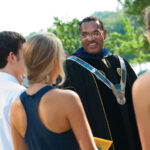
Twenty years ago, UMBC sought a greater academic reputation and a deeper sense of community. It advanced both goals under the leadership of President Freeman A. Hrabowski, III.
By Richard Byrne ’86
Giving name to your aspirations is often the first step to achieving them. And back in 1995, the words that campus leaders summoned to encompass their hopes for UMBC were “An Honors University in Maryland.”
The university was just shy of its 30th anniversary and only three years into the tenure of its fifth president, Freeman A. Hrabowski, III. UMBC already possessed institutional strengths, including its stellar faculty, the pioneering spirit that comes with being a young university, and an increased dynamism and connection with its closest cities – Baltimore and Washington, D.C. – bequeathed to it by Hrabowski’s predecessor, Michael Hooker. (See “Up on the Roof”)
What UMBC needed at that moment was an audacious imaginative leap: an identity that would help the campus seize upon the university’s strengths, elevate them, and create a more deeply knit community.
“I think the campus agreed,” Hrabowski recalls, “that we needed to attract more students who could take advantage of what we had to offer – even as we worked to think about the learning process and engage students in research.”
Twenty years into Hrabowski’s presidency, UMBC has undergone a profound transformation. The university is now renowned for nurturing young minds in an environment that values excellence, innovation, and diversity. Its investments to retain and attract top-notch faculty have paid off not only in rising prestige and research funding, but also in a reputation for providing undergraduates with a superlative environment for learning. UMBC’s physical campus has been transformed in ways that have improved the university’s teaching and research infrastructure – as well as its aesthetic appeal and overall quality of life.
This metamorphosis at UMBC has been lauded by a national media that loves an unexpected success story. The university’s achievements have been praised in outlets including CBS’ 60 Minutes, Time magazine, The New York Times and The Washington Post. And while Hrabowski’s leadership is often spotlighted in these stories, Hrabowski likes to point out that UMBC’s successes often have been proposed, nurtured and pushed forward by UMBC’s faculty, students and staff in an atmosphere of shared governance.
John Jeffries, Dean of UMBC’s College of Arts, Humanities and Social Sciences and a former president of the Faculty Senate, observes that “shared governance has always been vital and important at UMBC. It’s been a fundamental part of the health and progress of UMBC in the past two decades.” Jeffries adds that Hrabowski “meets regularly with the Faculty Senate president, brought the Faculty Senate president and Academic Planning and Budget Committee chair onto the Budget Committee and President’s Council, and works with the Faculty Senate. Shared governance has played a fundamental role in the progress of the academic programs.”
Looking back, the principles undergirding UMBC’s rise to prominence seem clear. Elevate academic excellence. Create spaces and opportunity to forge community. Bring the entire university into the processes of academic research and creative endeavor.
But how, exactly, did it all happen? As the campus celebrates two decades of Hrabowski’s leadership, it is now possible to trace more fully the arc of that evolution.
TAKING THE HONORS
UMBC’s efforts to attract the best students from Maryland and elsewhere had gathered steam by the end of the 1980s. Average SAT scores for freshmen entering UMBC in 1989 climbed above the national average – and subsequently those scores have skyrocketed to almost 200 points over the average.
Yet it took a certain degree of audacity to proclaim UMBC “An Honors University in Maryland” only six years after reaching that important milestone. But stating the university’s aspirations publicly was a key step in UMBC’s transformation.
“It was the marketing initiative that taught us that we had become known as a place for serious academic study,” recalls Hrabowski. “A university attracting more students from high school honor societies. A university that was sending a disproportionate number of students to graduate and professional schools. And, most important, that we were a public university that openly valued the life of the mind. All these things were part of the honors university concept.”
The concept of an honors university might have been new, but its foundations had been laid in previous years.
One essential element in UMBC’s reimagination of itself was the creation of the Meyerhoff Scholars Program by Hrabowski (who had been recruited to UMBC in 1987 as vice provost by Michael Hooker) and philanthropist Robert Meyerhoff. The program aimed to increase the number of minority students pursuing graduate degrees in science, technology, engineering, and math (STEM) disciplines – and its success in doing so has made the program an international model for fostering excellence and diversity. The program’s more than 700 graduates have subsequently earned 81 Ph.D.s, 25 M.D./Ph.D.s and 92 M.D.s. – and many more of its graduates are still pursuing advanced degrees.
The Meyerhoff Program also created wider ripples at UMBC. Its formula of recruiting talented students and forging shared and structured intellectual communities was adopted (and adapted) elsewhere at the university. New programs including the Linehan Artist Scholars Program, the Sondheim Public Affairs Scholars Program, the Humanities Scholars Program, and the Center for Women In Technology (CWIT) were created to extend the values of academic excellence and shared enterprise across disciplines.
Such programs would not exist without a significant investment in UMBC’s innovation from a myriad of donors – including an increasing number of UMBC alumni who give back to their alma mater. UMBC’s first two capital campaigns for the university, which concluded in 2002 and 2011, each exceeded their goals by at least $15 million.
Baltimore businessman and philanthropist Earl Linehan was a co-chair of that first capital campaign – and also a longtime chair of UMBC’s Board of Visitors. When he was first invited to visit the university by Hrabowski, Linehan says that he was immediately impressed by the UMBC president’s “unbelievable energy and personal connection with the students.”
Yet Linehan says that he and the other donors who helped fuel UMBC’s transformation in that era also saw an institution that was ripe to make a big leap. “A lot of us initially were attracted by Freeman,” he continues. “But then we got to know the institution. Even then, the reality of the place already outshone the perception of it. We became inspired by the whole ethos of the place.”
And as UMBC found resources to advance its ambitions, its progress toward becoming an honors university was extended into every corner of the school by faculty and staff members who served on an Honors University Task Force that issued its final report in May 2000.
The task force aimed to extend “the rigorous ways of learning that are options for students in select programs at UMBC to a wider student body,” and identified changes to significantly strengthen and broaden both the curriculum and student support services. The task force offered crucial advice on implementing those changes, and its work has given talented students attracted by the honors university concept more pathways and support to achieve academic excellence at UMBC.
GIVE US TREES

Improving UMBC’s aesthetic appeal and creating new spaces to foster deeper community were on Hrabowski’s agenda from his earliest days as president. He fondly recalls his first meeting with the late William Donald Schaefer, who was Maryland’s governor when Hrabowski was named to the job.
“[Governor Schaefer] said to me, ‘What can I do to show people how proud I am of you and of the university?’ And I said, ‘Give us trees,’” Hrabowski recalls. “Because people said that this place would look better and better as the trees grew. And he was absolutely delighted to give us support.”
A year before Schaefer’s passing in 2011, Hrabowski invited Maryland’s former governor back to campus. “I reminded him of those trees,” he says. “He was amazed by how much we had developed, and moved that we were giving him credit for helping us to develop.”
Green campus spaces such as the Beuys Sculpture Park (just southeast of the Retriever Activities Center) are a tangible sign of UMBC’s aesthetic upgrade. And with a strong push from UMBC’s faculty, green spaces became part of the university’s research infrastructure when its Conservation and Environmental Research Areas (CERA) – contiguous to the long-planned bwtech@UMBC Research and Technology Park – were created in 1997.
In the midst of those green spaces, other sorts of growth took place. The addition to UMBC’s Albin O. Kuhn Library that opened in 1995 was underway when Hooker left the university.
And under Hrabowski’s leadership, 13 new buildings and 12 major additions and renovations to UMBC’s campus have been completed in the past two decades.
Much of this flurry of new construction – and the state funding that supported it – advanced both the research and teaching missions at UMBC.
“When I think about this growth,” says Hrabowski, “I think about the confidence that the state has in us as a major institution of learning. And I think about the areas that have been strengthened academically as a result. The physical transformation reflects a trend of growth in the academic program.”
The new buildings on campus created new opportunities for innovation across disciplines: a new Physics building, a new Public Policy building, two new Information Technology/Engineering buildings, and, just this autumn, a new Performing Arts and Humanities Building (See “The News”). UMBC also undertook major renovations of key structures in the natural sciences, overhauling the Biological Sciences and the Meyerhoff Chemistry buildings. And the opening of bwtech@UMBC in 2002 – a research park that is now home to nearly 100 companies that generate over $200 million annually in total business – created even closer collaborations with industry and commerce in the region.
UMBC’s building boom also focused squarely on creating deeper community on campus and encouraging students to call the school their home during the academic year.
The centerpiece of this effort was the 2002 opening of The Commons, a new university center that swung the center of campus closer to the residential heart of the school. And that heart has seen a boom of its own: two new apartment complexes, two new dormitories, and the refurbishment and expansion of other existing student residences.
“The development has emphasized the importance of community,” Hrabowski says. “Spaces like The Commons, and even the benches that we have on campus, are spaces that invite conversation, reflection and community – and the feeling that the university is becoming more residential.”
The creation of new community spaces and the growth campus housing have supported UMBC’s gradual shift from a predominately commuter school into a substantially residential university. When Hrabowski assumed UMBC’s presidency in 1993, the percentage of students who lived on campus had finally risen to 30 percent. Today, the number has moved closer to 50 percent in total. Even larger strides have been made with incoming freshmen: Fully 75 percent of those enrolled at UMBC as freshmen now live on campus.
Yvette Mozie-Ross ’88, health science and policy, has seen the changes at UMBC over the last 20 years as an undergraduate and as a staff member who now serves as associate provost for enrollment management. She says the biggest change she has seen is “the recognition that the institution has attained. I remember as a student, and then as an admissions counselor, you’d say UMBC and people would say ‘UM-what?’ Now you say UMBC and they can name all sorts of accolades we have received, and tell you about people they know who have gone to UMBC and done great things.”
In addition, Mozie-Ross believes that the physical transformation of the campus – and the construction of communal spaces where students, faculty, and staff can gather – have helped spur the rise of students living on campus. “They have played a critical role,” she says. “There are now places where the process of gathering as a community happens more naturally.”
DELIGHT IN DISCOVERY
One of UMBC’s strengths from its founding was its faculty. Key faculty members across disciplines arrived in the university’s early years, and stayed on at UMBC through the 1970s and beyond.
These professors and researchers – and those who have joined them in subsequent decades – have propelled UMBC’s transformation through their research and innovations in the classroom.
The numbers tell part of the story. When Hrabowski became interim president of UMBC in 1992, the university’s total research and development expenditures stood at $7.6 million, with nearly $5 million of that amount coming from the federal government. Only ten years later, in 2002, that total had grown to $36 million, with $29 million in federal research dollars. And that astonishing growth has continued over the second decade of Hrabowski’s presidency, as total expenditures have almost tripled to $91 million and federal funding has doubled to $61 million.
Beyond the numbers however, are two decades of developing dynamic and high-powered research partnerships, including deep and continuing research relationships with NASA, IBM, Princeton University, and the Howard Hughes Medical Institute.
The university has also excelled in disciplines where research isn’t measured in dollars but in cultural and societal reach. A 1997 study by Hugh Davis Graham and Nancy Diamond, published as The Rise of American Research Universities: Elites and Challengers in the Postwar Era, ranked UMBC scholars in the arts, humanities, and related social sciences as 13th among all U.S. public university faculties in the attainment of prestigious awards. And UMBC faculty members in those disciplines continue to receive prominent grants from the National Endowment for the Arts, the National Endowment for the Humanities, and numerous other institutions.
As UMBC’s Provost Philip Rous pointed out in a recent interview: “External funding is a measure of excellence in many disciplines. But we have to be careful not to generalize that observation as far as defining the excellence piece of it, because there are many disciplines where large amounts of external funding are not available or not really appropriate. Yet a person working in those fields can be a world-class scholar in exactly the same way as a scientist or engineer who is bringing in millions of dollars…. The difference is in the disciplines, not in the excellence. And excellence is our common goal.”
Yet another key value in the university’s rapidly expanding research footprint has been the way in which UMBC’s undergraduates have been brought into the process of discovery. Faculty members have found numerous ways to encourage students to participate meaningfully in research labs and field work and the artistic process. Innovations to improve the undergraduate learning experience have also been a key element in the past twenty years at UMBC, including the creation of new classroom environments such as the College of Natural and Mathematical Sciences (CNMS)’s Active Science Teaching and Learning Environment – better known as CASTLE – and the Chemistry Discovery Center, as well as the imminent revamping of the English composition curriculum.
The fruits of this effort can be seen not only in UMBC’s lofty U.S. News and World Report ranking in undergraduate education (4th in the nation in 2011), but also in the university’s annual celebration of an Undergraduate Research and Creative Achievement Day (URCAD) that recognizes the shared journey of exploration for new knowledge by faculty, students, and staff.
UMBC’s journey of discovery began almost 50 years ago, and has only accelerated in pace and intensity over the two decades of transformation under Hrabowski’s leadership. The scope of the university’s progress has inspired alumni who have returned to see what’s changed.
Gene Trainor ’86, economics and health science and policy, the chief operating officer at Foundation Capital, recalls being profoundly moved by the changes at the university when he reconnected with UMBC on a visit more than a decade after graduating.
“It was exciting to have a conversation with [President Hrabowski] and hear the vision,” recalls Trainor. “And then to see how that vision was executed across the board – in the humanities and the sciences. So many exciting things were happening, and they were happening with limited resources.”
Trainor was so inspired that he became chair of the Alumni Campaign Committee for UMBC’s second capital campaign. “I wanted to be involved with something where I could make the biggest impact and the biggest difference,” he continues. “I look back on it with great pride and know that I was part of something great. As an alumnus, it makes you happy to stick your chest out.”
Twenty years into his presidency, Hrabowski agrees that the biggest change he has witnessed at UMBC is that growing sense of the university’s belief in itself and where it’s headed.
“There is much greater pride and emphasis on the unique strengths of this campus,” Hrabowski observes, “and a much greater recognition that we are admired nationally for our undergraduate experience and our growing strength as a research institution.”
– Read more about The Hrabowski Fund for Innovation
This article appeared in the Fall 2012 issue of UMBC Magazine.
]]>
Twenty years ago, UMBC sought a greater academic reputation and a deeper sense of community. It advanced both goals under the leadership of President Freeman A. Hrabowski, III. By Richard Byrne...
https://umbc.edu/stories/from-aspiration-to-achievement/
https://my3.my.umbc.edu/api/v0/pixel/news/123786/guest@my.umbc.edu/854392795164343409344b06aad072c7/api/pixel
campus-life
fall-2012
freeman-hrabowski
UMBC News & Magazine
https://my3.my.umbc.edu/groups/umbc-news-magazine
https://assets1-my.umbc.edu/system/shared/avatars/groups/000/001/943/24435aa6207c452e7bc15cc74b42c7bb/xsmall.png?1748556657
https://assets1-my.umbc.edu/system/shared/avatars/groups/000/001/943/24435aa6207c452e7bc15cc74b42c7bb/original.png?1748556657
https://assets2-my.umbc.edu/system/shared/avatars/groups/000/001/943/24435aa6207c452e7bc15cc74b42c7bb/xxlarge.png?1748556657
https://assets2-my.umbc.edu/system/shared/avatars/groups/000/001/943/24435aa6207c452e7bc15cc74b42c7bb/xlarge.png?1748556657
https://assets3-my.umbc.edu/system/shared/avatars/groups/000/001/943/24435aa6207c452e7bc15cc74b42c7bb/large.png?1748556657
https://assets1-my.umbc.edu/system/shared/avatars/groups/000/001/943/24435aa6207c452e7bc15cc74b42c7bb/medium.png?1748556657
https://assets2-my.umbc.edu/system/shared/avatars/groups/000/001/943/24435aa6207c452e7bc15cc74b42c7bb/small.png?1748556657
https://assets1-my.umbc.edu/system/shared/avatars/groups/000/001/943/24435aa6207c452e7bc15cc74b42c7bb/xsmall.png?1748556657
https://assets2-my.umbc.edu/system/shared/avatars/groups/000/001/943/24435aa6207c452e7bc15cc74b42c7bb/xxsmall.png?1748556657
UMBC News & Magazine
0
0
false
Thu, 13 Sep 2012 18:50:43 -0400
141 Characters in Search of an Audience
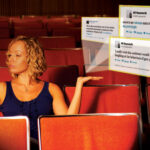

Can Alli Houseworth ’03 save American Theatre? She’s Trying: One Tweet at a Time
by Richard Byrne ’86
photos by Marlayna Demond ’11
The annual Theatre Communications Group (TCG) conference is one of the far-flung U.S. theatre community’s biggest stages for talking about the industry. And at the 2011 TCG Conference in Los Angeles, Alli Houseworth ’03, acting, grabbed the spotlight without using a microphone.
She did it on Twitter.
At the time, Houseworth was the director of marketing and communications at Washington D.C.’s Woolly Mammoth Theatre Company – one of America’s best regional theatres. And the laughter that she heard during a session on the social media habits of millennials irritated her enough to weigh in on Twitter in real time.
“I really wish this audience would stop laughing at the behaviors of gen y,” Houseworth tweeted. Her intervention caused an instantaneous online sensation, kicking up enough fuss that her tweet was read out during the panel itself.
Houseworth struck again when she heard artists at another TCG session belittle marketing, tweeting: “I’m so over this conversation surrounding #newplays that implies all marketing directors are stupid and evil.” The clamor created by that tweet carried on far past the panel itself into a few days’ worth of intense discussion – on and offline – among theatre professionals.
Washington Post arts writer Maura Judkis also attended the conference. She noted on the Engine 28 arts blog that Houseworth “achieved an odd distinction…. She was able to redirect the conversation in two sessions by voicing her objections to panel discussions on Twitter.”
Reflecting on her insurrectionary behavior a year later, Houseworth says acknowledgement of how technology has changed theatre – and discussion about it – is long overdue. “All these shifts have happened since the early 2000s,” she says. “I don’t think theatre recognizes that – or the complexity of that.”
Houseworth’s voluble tweets are backed up by her string of successes in pioneering new approaches to customer service and use of social media in theatre. She has formed her own company – Method 121 – to push her ideas forward, and teaching jobs at Columbia University and American University allow Houseworth to evangelize to a new generation of theatre professionals.
Among Houseworth’s converts is influential Washington Post theater critic Peter Marks, who credits the UMBC alumna with convincing him to join Twitter.
“Social media – and for me, Twitter in particular – have invigorated discussion of the theater to a point I’d call revolutionary,” says Marks. “For me, Twitter has provided deeper access to what’s on the minds of theater artists, and as a result, I think, it’s enriched my understanding and writing about the theater.”
TRYING ON ROLES
Houseworth came to UMBC in 1999 as a Linehan Artist Scholar to study acting. She commanded attention even in her initial interviews and auditions for the program and the scholarship, recalls Alan Kreizenbeck, a professor of theatre at UMBC.
“I was taken with her abilities,” says Kreizenbeck. “She was a strong, durable kind of person.”
Houseworth says that “it only took about a semester for me to realize that [UMBC] was an environment where the more I made out of it myself, the more I would get out of it in the end.”
For Houseworth, making a lot out of UMBC included stage managing a production in her freshman year, playing Lady Macbeth in a 2001 production of Macbeth and writing a popular column for The Retriever. But she says that her most important UMBC experience came not in a classroom but in Germany, when she accompanied a number of theatre faculty members affiliated with Maryland Stage Company on a trip to Berlin to put on plays by Samuel Beckett.
“I got to hang out with the faculty,” she recalls. “Wendy [Salkind] was in the show. Sam McCready was in the show. Xerxes Mehta directed the show. Greggory Schraven ’97 was there. I have these great memories of drinking beer with them in Germany when I was really young.”
Mehta’s memories are even more exact. “When the Maryland Stage Company took ‘Beckett’s Play’ to an international festival in Berlin in 2000,” he says, “I put what is Beckett’s most technically difficult and nerve-wrackingly demanding work in her tender hands. Allison was the key to its success. At the age of 19, she more than held her own in very fast company, controlling and cuing three fine professional actors, never faltering, never dropping a cue, pulling it all off with astonishing bravery and skill. Her technical control of that production was widely remarked upon in Berlin and in the Beckett press.
That experience confirmed for us all in the department that we had someone quite extraordinary on our hands.”
Houseworth took an acting degree from UMBC, but her career path eventually led her backstage, working in theatre administration at CENTERSTAGE, the Williamstown Theatre Festival, and as an assistant to the directors of New York City’s largest theatrical publicity agency Boneau/Bryan-Brown.
“[Publicity] is a really interesting job, because in order to excel at it, you have to understand the big picture,” Houseworth says. The clients at Boneau/Bryan-Brown, she adds, “were every big show on Broadway…. I was in the room and saw everything and watched everything.”
One of the firm’s directors, Chris Boneau, taught at Columbia University. He wrote Houseworth’s letter of recommendation to enter the university’s prestigious theatre management and production program.
“By the time I was halfway through my time at Boneau/Bryan-Brown,” she recalls, “I knew that I only wanted to go to Columbia and only go to the producing program. I think he sold them on the fact that I was always questioning why things were the way they were, and that I’d be going to graduate school to find out why things were the way they were.”
A DIFFERENT CLASS
Steven Chaikelson, an associate professor of theatre arts at Columbia University, says that Houseworth immediately stood out at Columbia, excelling in classes in marketing and audience development.
“She was inspired by what we were doing in the classroom,” says Chaikelson. “We could see her blossoming in the very first year, and finding a niche in social media and the Internet.”
Indeed, one of Houseworth’s Columbia projects turned her passion for asking questions about audiences into one of her most notable professional successes.
Houseworth’s project touched on a ritual that is part of the theatre going experience for thousands of people each year: the Theatre Development Fund’s TKTS discount ticket booth in Times Square, where patrons (many of them tourists) line up for cheap tickets to pricy Broadway and Off-Broadway shows.
Theatre Development Fund executive director Victoria Bailey teaches a class in audience development at Columbia, and Houseworth saw surveying TKTS patrons as a way of finding out what the audience wanted and needed.
“I think I was in a class and blurted something out,” Houseworth says. “Thousands of people line up outside [the TKTS booth] every day in Times Square. Has anyone ever asked them what they were thinking about their experience?”
Houseworth surveyed the masses and reported back to Bailey. She found that those waiting to buy bargain tickets had little information about what was on offer, and were easy prey for touts and scalpers. “The research was initially so provocative to her,” Houseworth says, “that she kept me on for the summer.”
Though Houseworth had a knack for using online tools to build audiences, Bailey was impressed with her student’s willingness to press the flesh to find answers.
“[The survey] was just the opposite of a virtual experience,” she observes.
Houseworth then helped Bailey and others develop a new way to help TKTS customers: The Theatre Development Fund’s pioneering Patron Services Program. The fund hired representatives in snazzy red jackets to work the line and offer impartial information for consumers. They also policed the scalpers and hucksters. The TKTS booth’s ticket sales (and customer satisfaction) shot up – and stayed up.
Bailey says that Houseworth was a driving force behind “building what has developed into a good, strong, and extensive program. She has a real understanding of the importance of new audiences and how to open up theatre to other people.”
Chaikelson agrees: “She is one of the amazing success stories of the program.”
He also pressed Houseworth to finish up her thesis so that he could hire her. “I’d been trying to find someone to teach a course on social media before social media was a big thing,” he says. “But I couldn’t find anyone who was a real teacher. I saw that in Alli when she was still a student. She was already grappling with big ideas and could communicate them.”
PREACHING THE POTENTIAL
On a sultry spring day in a classroom at Columbia University, Houseworth leads students through the case study of a fundraising campaign she created at Woolly Mammoth. The effort leveraged Twitter and Facebook exclusively to raise cash for the company – and she emphasizes that the idea for the “social-media only” fundraiser began not in a cubicle, but over a supercharged lunch debate.
“You probably won’t get your best ideas at your desk,” she quips.
Social media is an integral part of Houseworth’s curriculum. Students even tweet in class, using the hashtag “#alliclass” as they tap away on laptops.
Houseworth’s passion about social media isn’t restricted to classrooms at Columbia and American University. She has brought it to high-profile jobs at Woolly Mammoth and in an effort to rebrand Washington D.C.’s Helen Hayes Awards as a larger and more proactive group called theatre Washington.
“I love teaching,” she says. “But you have to work in the industry to teach well.”
Houseworth’s work at Method 121 – keeps her engaged in a broad range of projects. And her increasing profile as a leading voice in using social media to win and retain new theatre audiences continues to impress the Washington Post’s Peter Marks.
“One of the reasons she’s good at her job is that she’s a magnetic saleswoman,” says Marks. “When she talks about the glories of social media, she’s the digital world’s Professor Harold Hill. Except that what she’s selling is not a mirage. And so, at her urging, I took the leap, and I will always remember that she was the one standing up there behind me, on the ledge.”
But salesmanship is not Houseworth’s only strength. As she showed at the 2011 TCG conference, she is not afraid to take provocative public stands on hot-button issues in theatre.
Even when she’s not looking for controversy, it somehow finds her – as it did this past spring when circumstances thrust Houseworth directly into the middle of the biggest U.S. theater controversy in recent memory: the dustup over monologist Mike Daisey’s The Agony and the Ecstasy of Steve Jobs.
Daisey’s pungent monologue about the chasm between the genius of Apple’s design and the often lamentable conditions in which its dazzling gadgets are manufactured in China was political theatre par excellence – engaging audiences deeply, selling tickets, and making a strong case for theatre’s power to inform current events.
After a long string of successes, the truth of Daisey’s account of what he’s found in China was called into question by the public radio show This American Life – which worked with Daisey on a broadcast based on his monologue. The radio program was retracted and a major media controversy over the relation between theatre and journalism ensued.
Houseworth was Woolly Mammoth’s marketing director when the show debuted on that company’s stage, and she was stung by what she saw as Daisey’s betrayal of the audience in marketing the show as “nonfiction.” So she committed an act of extreme anti-marketing: while en route from New York to Washington, D.C., she stretched out on the floor at Penn Station and typing out a blog post calling for a boycott of The Agony and Ecstasy of Steve Jobs until Daisey offered an apology. (He later did.)
“Boycott Mike’s gorgeous, amazing piece of theatre that is based on a true story,” Houseworth wrote. “Boycott it until you get the apology that you deserve and do not ever, ever remount it or produce a work of his again until you know for sure what is true and what is not so your audiences are never ever mislead again.”
Chaikelson says that such stands are part and parcel of what makes Houseworth so influential. “She’s extremely smart and very gutsy,” he says. “She’s willing to put herself on the line for what she believes.”
Houseworth says that making the change she wants to see in American theatre requires self-interrogation and a willingness to speak out.
“It’s healthy to always be questioning yourself,” she says. “And the people around you. Why do you do things the way you do. Quite frankly, I don’t see anyone else doing it. So someone has to speak up. And I hope I don’t come across as always being right. I just want to present an intelligent opposing view.”
– Subscribe to Alli’s tweets here
This article originally appeared in the Fall 2012 issue of UMBC Magazine.
]]>
Can Alli Houseworth ’03 save American Theatre? She’s Trying: One Tweet at a Time by Richard Byrne ’86 photos by Marlayna Demond ’11 The annual Theatre Communications Group (TCG) conference is...
https://umbc.edu/stories/141-characters-in-search-of-an-audience/
https://my3.my.umbc.edu/api/v0/pixel/news/123788/guest@my.umbc.edu/d4cef5debabdfa77d25ccff21ea3cdae/api/pixel
alumni
fall-2012
UMBC News & Magazine
https://my3.my.umbc.edu/groups/umbc-news-magazine
https://assets1-my.umbc.edu/system/shared/avatars/groups/000/001/943/24435aa6207c452e7bc15cc74b42c7bb/xsmall.png?1748556657
https://assets1-my.umbc.edu/system/shared/avatars/groups/000/001/943/24435aa6207c452e7bc15cc74b42c7bb/original.png?1748556657
https://assets2-my.umbc.edu/system/shared/avatars/groups/000/001/943/24435aa6207c452e7bc15cc74b42c7bb/xxlarge.png?1748556657
https://assets2-my.umbc.edu/system/shared/avatars/groups/000/001/943/24435aa6207c452e7bc15cc74b42c7bb/xlarge.png?1748556657
https://assets3-my.umbc.edu/system/shared/avatars/groups/000/001/943/24435aa6207c452e7bc15cc74b42c7bb/large.png?1748556657
https://assets1-my.umbc.edu/system/shared/avatars/groups/000/001/943/24435aa6207c452e7bc15cc74b42c7bb/medium.png?1748556657
https://assets2-my.umbc.edu/system/shared/avatars/groups/000/001/943/24435aa6207c452e7bc15cc74b42c7bb/small.png?1748556657
https://assets1-my.umbc.edu/system/shared/avatars/groups/000/001/943/24435aa6207c452e7bc15cc74b42c7bb/xsmall.png?1748556657
https://assets2-my.umbc.edu/system/shared/avatars/groups/000/001/943/24435aa6207c452e7bc15cc74b42c7bb/xxsmall.png?1748556657
UMBC News & Magazine
0
0
false
Thu, 13 Sep 2012 18:49:07 -0400
Gray New World
Students in the Erickson School’s Project 2061 class have high expectations for technology and its power to meet human needs. Working across disciplines, they’ve created new possibilities for the future of senior care.
By Dinah Winnick
 Ashley Johnson ’12, MAgS (left), helped her team imagine the needs of “Ashley,” a 111-year-old former psychologist who loves to garden but struggles with dementia, diabetes and hearing loss. Abdulla Aljneibi ’12, mechanical engineering (right), inspired his classmates to design for “Abdulla,” an imagined 90-year-old man determined to live independently despite impairments from a stroke.
It’s hard to imagine ourselves five years into the future, let alone 50. But one group of UMBC students has confronted this challenge head-on in search of inspiration for new designs to improve the lives of older adults.
Their course, “Project 2061” was spearheaded by the Erickson School, UMBC’s newest college. Founded in 2004, the school offers undergraduate and graduate curricula that combine the studies of aging, public policy and management.
The Erickson School created Project 2061 after being invited to showcase UMBC student research at a conference on the future of aging. The project quickly attracted faculty and students from engineering, information systems, design, management of aging services (MAgS) and interdisciplinary studies (INDS) to collaboratively develop new technologies for older adults living in the year 2061.
As it turns out, the endeavor’s success hinged on something simple and personal: students’ reflections on their own imagined future needs and desires. The class created three avatars based on students’ life experiences – “Abdulla,” “Ashley,” and “Spencer” – to help them explore both the problems aging can bring and how design can meet those challenges.
“Abdulla,” for instance, was based on Project 2061 participant Abdulla Aljneibi ’12, mechanical engineering. His avatar is 90 years old and recovering from a stroke that has left him struggling with memory, speech and motor impairments. Yet he is determined to live independently and enjoy activities such as cooking, daily prayer and going to the theater.
For Judah Ronch, dean of the Erickson School, creating personas like “Abdulla” proved the key to making Project 2061 click.
“This is always the challenge in teaching about aging,” says Ronch, “Until you make it about us it’s very removed. If it’s always about them, it’s highly abstract, it’s not very real, and there is not a sense of urgency about it because [typical students] are 25 or 20 and we’re talking about 60 years down the road.”
Everything changes, Ronch observes, “once you start talking about yourself and [asking], ‘How will this affect me?’”
BUILDING A TEAM
 Assistant professors Amy Hurst and Catherine Neylan explore data visualization with Meyerhoff Scholar Jasmine Jones ’12, computer science and interdisciplinary studies (left to right).
In May 2011, LeadingAge — a research and advocacy group focused on the lives of older adults — asked the Erickson School to create an exhibit on the future of aging.
LeadingAge planned a celebration of its 50th anniversary in October 2011 with a conference that would bring 8,000 participants to Washington, D.C. The group wanted to highlight dramatic changes in senior living from 1961 to the present, and also articulate a bold vision for the next 50 years.
Ronch says the exhibit “was an opportunity we couldn’t pass up.” So he recruited faculty and students from across UMBC to create the school’s presentation as part of a new, boundary-breaking course in the Erickson School.
To teach the class, Ronch enlisted Tim Topoleski, a professor of mechanical engineering who studies mobility and the mechanics of joint replacements. Catherine Neylan, assistant professor of design, and Amy Hurst, assistant professor of information systems, followed, attracted to the course by their shared interest in design for people with disabilities.
These faculty recruited students from a range of majors. Neylan observes that technology and social problems are now so complex that “we need collective intelligence to build the things that we build.”
Eventually, 19 UMBC students joined the effort. Early in the process, MAgS major Joe Yoon proposed that the class should create specific design personas based on students in the course and then craft flexible technologies to meet those avatars’ specific needs. His idea was a game-changer.
“In all of our scenarios of how this would be used,” recalls Hurst, “we never said, ‘How would grandma use this?’ We said, ‘How would I use it in 50 years.’ I think that fundamentally changed a lot of the designs [and] helped the students be more creative and engaged.”
Yoon’s proposal also forced students to ponder uncomfortable possibilities. As Steven Hall, a junior majoring in graphic design, observes: “I don’t think anybody’s going to want to think, ‘What’s my life going to be like in 50 years? I’m going to have cataracts and be overweight. I’m going to have my foot amputated from diabetes.’”
The students had to deal with uncertainties about their lives and the world in 50 years. “You can’t take the current older adult population and simply throw them 50 years into the future,” argues Colleen Bennett, a gerontology Ph.D. student and Project 2061 teaching assistant. The project depended on young people confronting their own fears and desires for later life.
“Every generation is different, and then they age,” says Hurst. “Traditionally, people are very bad at abstracting and predicting what they would want in the future, but they can tell you what they want now and how they feel about things.”
REALIZING A VISION
The three personas gave Project 2061 students a concrete foundation to build on.
“Once we had a starting point,” says Aljneibi, “the ideas started flowing.”
The class worked quickly to conceptualize, research, and render designs for technologies to meet functional needs: eating, sleeping, hygiene, and entertainment/social engagement. Living environments in the future might be quite different, they reasoned, but basic human needs will remain the same.
Occasionally, there were hiccups. The blurred lines of interdisciplinary work and the indefinite nature of the problems that the project aimed to address frustrated some of the students, especially early in the process.
“You would think design and engineering would be closer, but they both want to have a product and their process is so different,” observes Meyerhoff Scholar Jasmine Jones ’12, computer science and INDS. At times, she adds, students misinterpreted their failure to communicate across a disciplinary “language barrier” as actual disagreement over ideas.
“They are beginning to learn that the real world is not as clear-cut as their well-designed classes,” says Hurst.
In four weeks, however, a dozen designs took shape, all of them informed by contemporary technologies and targeted to meet users’ specific needs.
One group devised a “Smart Closet” that reminds users with memory and other cognitive impairments when and how garments need to be cleaned. It also lets users know when they last wore a favorite dress or tie, and even what clothing is appropriate for particular activities or occasions.
Another design team emerged with a “Lavish Lavatory”—which auto-adjusts toilet and rail height to account for changes in strength and balance over time. The design’s flexibility means it can help communal facilities better meet the needs of diverse individuals. It also discreetly and unobtrusively monitors waste and automatically sends relevant health data to each user’s physician.
Eating properly is important at any age, so another group designed a “FoodPro,” that monitors the refrigerator and pantry, keeping track of grocery inventory, expiration dates and nutritional content. It also helps users prepare meals that meet their particular dietary needs, taking into account health conditions, lifestyle choices and food preferences.
These projects formed the core of the Erickson School’s LeadingAge exhibit— “My Surroundings, My Well-Being”— which centered on personal experiences with technology.
The student designers took the exhibit opportunity as a chance to demonstrate how individuals would use their products in home environments. They acted as docents to the conference exhibit, explaining to visitors how each invention would serve “Ashley,” “Abdulla” and “Spencer” in their future lives.
Helping people connect with the exhibit in a personal way was a priority for Aljneibi—and not simply because he lent his identity to the design process. He also belongs to a close-knit multigenerational family with a grandmother facing mobility problems.
“When she goes into the shower,” he says, “it’s always in our heads: ‘What if she slips? What if she falls?’” For his family, respecting her boundaries means resisting the impulse to help her in the shower. In what ways could his team’s designs enable her, and people like her, to more safely bathe by themselves?
Though he approached the course from a neuroscience background, Talmo Pereira, an INDS major and Meyerhoff Scholar, took the tenets of user-centered design to heart.
“Considering that the environment should adapt to the user,” he suggests, “the mutability of the environment is one of the things that will most compensate for differences in culture and preferences, and certainly limitations.”
The exhibit received an enthusiastic response from vendors, senior care professionals, and LeadingAge organizers, who immediately invited the students back for 2012.
FULL SPEED AHEAD
Creating an exhibit with an October deadline left everyone involved in Project 2061 with the question of how to best make use of the rest of the semester. Focus on prototyping the exhibit designs or generate new concepts? Continue team projects or pursue independent research? The answer was different for each participant.
Aljneibi chose to continue his team project on bath designs. “When I came to the States I wasn’t fine with communal bathing, especially in the gym,” he reflects. “I used the handicapped one because I needed my privacy.” For him, this experience— uncomfortable though it felt—was an inspiration. After all, if the United States continues to grow increasingly diverse, certainly consumers would appreciate flexible bathing technologies.
Steven Hall ’11 and Pavlo Yankovetz ’11, both in graphic design, explored how visualizing health data in particular ways may offer older adults a sense of self-awareness and empowerment. They argue that information can motivate or stifle health-seeking behaviors, depending on how it is conveyed. “If you’re just giving someone numbers, that’s not helpful or useful. We want those numbers to mean something,” says Hall.
Meyerhoff Scholar Deanna Easley ’12, mechanical engineering, worked to develop safer flooring for older adults, who are often injured in falls. Having broken her own wrist in a fall, Easley understood the mental and physical traumas of injury and lengthy recovery.
“People told me, ‘At least you didn’t break the hand you write with,’” recalls Easley. “But I’m a pianist. I need both hands.” With a deep understanding of how injury can wreak havoc on one’s sense of self, plus input from MAgS students, Easley designed flooring that would not only enhance safety, but also offer aesthetic appeal and emotional comfort to potential consumers.
INNOVATION STARTS AT HOME
Academic leaders at UMBC applaud the new class, arguing that it breaks new ground at a university already known for its commitment to promoting undergraduate success through active learning.
“Project 2061 represents a striking example of UMBC’s ability to create innovative and multi-disciplinary approaches to teaching and learning that address significant future challenges,” says Provost Philip Rous.
“In the process of researching real problems, our students not only gain knowledge, they also co-create knowledge and contribute to the field,” says Diane Lee, Vice Provost and Dean of Undergraduate Education.
Connecting research to reality and realizing its potential for lasting impact isn’t simply a hypothetical draw to students. For Meyerhoff Scholar Jasmine Jones, Project 2061 is about “actually making a difference right now” rather than just “writing up a piece of code and turning it in.”
Ashley Johnson ’12, MAgS, who helped her classmates understand the needs of “Ashley,” a 111-year-old former psychologist who loves to garden and meditate in the year 2061 but struggles with dementia, diabetes and hearing loss, agrees: “I’m never asking, ‘Will I use this in the future?’ I know I will.”
Students aren’t the only beneficiaries of this work. As Don Engel, Assistant Vice President for Research, articulates: “Universities support research both to expand human knowledge and to engage students in the forefront of their disciplines. Project 2061 demonstrates how interdisciplinarity and a focus on real-world challenges produce compelling results and provide a valuable education to students and faculty alike.”
Part of Project 2061’s success, it turns out, was also rooted in participants’ refusal to play it safe. Not only did they take risks with ideas, but students and the faculty broke out of their intellectual comfort zones when they crossed disciplinary boundaries.
When you predict the future, says Ronch, “you have to be prepared to be wrong.” This kind of risk-taking requires what he calls “a special kind of iconoclasm: looking at a blank space and seeing what could fill it.”
]]>
Students in the Erickson School’s Project 2061 class have high expectations for technology and its power to meet human needs. Working across disciplines, they’ve created new possibilities for the...
https://umbc.edu/stories/gray-new-world/
https://my3.my.umbc.edu/api/v0/pixel/news/123987/guest@my.umbc.edu/0e06047d220ce81f5b36c337e2e752c5/api/pixel
discovery
fall-2012
UMBC News & Magazine
https://my3.my.umbc.edu/groups/umbc-news-magazine
https://assets1-my.umbc.edu/system/shared/avatars/groups/000/001/943/24435aa6207c452e7bc15cc74b42c7bb/xsmall.png?1748556657
https://assets1-my.umbc.edu/system/shared/avatars/groups/000/001/943/24435aa6207c452e7bc15cc74b42c7bb/original.png?1748556657
https://assets2-my.umbc.edu/system/shared/avatars/groups/000/001/943/24435aa6207c452e7bc15cc74b42c7bb/xxlarge.png?1748556657
https://assets2-my.umbc.edu/system/shared/avatars/groups/000/001/943/24435aa6207c452e7bc15cc74b42c7bb/xlarge.png?1748556657
https://assets3-my.umbc.edu/system/shared/avatars/groups/000/001/943/24435aa6207c452e7bc15cc74b42c7bb/large.png?1748556657
https://assets1-my.umbc.edu/system/shared/avatars/groups/000/001/943/24435aa6207c452e7bc15cc74b42c7bb/medium.png?1748556657
https://assets2-my.umbc.edu/system/shared/avatars/groups/000/001/943/24435aa6207c452e7bc15cc74b42c7bb/small.png?1748556657
https://assets1-my.umbc.edu/system/shared/avatars/groups/000/001/943/24435aa6207c452e7bc15cc74b42c7bb/xsmall.png?1748556657
https://assets2-my.umbc.edu/system/shared/avatars/groups/000/001/943/24435aa6207c452e7bc15cc74b42c7bb/xxsmall.png?1748556657
UMBC News & Magazine
0
0
false
Thu, 07 Jun 2012 20:27:46 -0400