Call & Response
In a recent essay, UMBC President Freeman Hrabowski notes, “In difficult times, we come to know who we are.” Never has that been more true than this year or at this point in our nation’s history.
With the killing of George Floyd and other instances of police violence and the wave of protests that followed this spring and summer, many in our Retriever community are hearing the call to question what got us to this point and do everything they can to dismantle structural racism in our country.
In so many powerful ways, their voices echo those of some of our earliest Retriever alumni, who staged sit-ins on campus to protest the Vietnam war and civil rights injustices. In the spirit of this moment, many in our community are still protesting—but also taking to social media and finding new ways to make change from within their workplaces.
It’s difficult, but necessary, work. The moment is calling for an answer, and our Retrievers are responding. Because this is who we are.
THE LONG GAME
For several decades, Diane Bell-McKoy ’73, sociology and social work, has worked to make African American individuals and families in need become economically self-sufficient and to infuse philanthropic organizations with policies that create positive outcomes for people of color. UMBC Magazine talked with Bell-McKoy, CEO of Associated Black Charities and the Greater Baltimore Committee’s 2020 Regional Visionary awardee, about why making long-term change takes both patience and perseverance but is always worth it.
 Diane Bell-McKoy ‘73, sociology and social work. Image courtesy of Associated Black Charities.
UMBC Magazine: What are you trying to achieve through your work with philanthropic organizations, public policy makers, employers, trainers, and educators?
Bell-McKoy: Our goal is to shift the lens to provide the facts, the history, and the current policies to let people begin to really see how we ended up where we are today. Because it was very intentional—and going forward we can make different decisions to change the outcomes and the workforce ecosystem as it relates to systemic racism as a root barrier. When Black and brown people have the opportunity to move up, the greater economic opportunity means that they can also buy a house, they can start a business, and they can contribute a great deal more to their families and to the economy.
So my days are always around educating, around influencing, around advocating, around sharing our policy….It’s about meeting with our fellow philanthropists, helping them see the world differently and then giving them the desire to go deeper into those policies, their practice, and their culture.
UMBC Magazine: Your organization’s “10 Essential Questions” guide really forces folks to look at their operations through an equity lens. Is this as eye-opening as it sounds?
Bell-McKoy: I keep thinking, is that rocket science? Doesn’t this benefit all of us? But it feels like rocket science some days in having the conversation because you’re really asking people to rethink, to relearn how they were taught in terms of that history that wasn’t given to citizens. A lot of the positive history hasn’t been available about Black and brown people. I find myself on a reading journey right now learning as much as I can more about the history of black and brown people in this country.
And it’s important…for us to do the hard work now because we’re now awake much more across the country. That’s why I’m passionate about it. It’s been my journey all of my life. It was my journey at UMBC. It’s been my journey around what can I do, how can I make a difference for Black and white people?
UMBC Magazine: You’ve been doing this work for so long. What do you tell young people who are looking to make change?
Bell-McKoy: There are many ways that you can help in the now, including doing your own reading, your own research about why this exists. There are lots of opportunities locally—particularly now that we’re in a virtual world—to join lots of webinars and conversations across the country so that you can more deeply educate yourself. And because we have the ability to touch people all across the globe through the virtual environment, there are opportunities for students to be a mentor, for them to add some value to someone’s life.
Continue to use creativity, continue to use all your genius to make a difference in people’s lives. But understand that also—as you get to the next stage in your career coming out of UMBC and you’re becoming a millionaire—you need to invest back in all those organizations trying to change the system knowing that you can become a part of the patient capital needed to achieve system changes that then benefit a greater number of persons. You do have to steel yourself for the incremental. This may mean when the big change comes, many of us may not be here to benefit from it, but…that’s a part of it. It has to be an intentional journey.
RIPPLE EFFECT
For Jason Grant ’10, M17, a defining moment happened on a bus ride to a Meyerhoff Scholars event at UMBC President Freeman Hrabowski’s house his freshman year.
A senior asked Grant about his major (computer engineering) and then proceeded to pepper him with specific questions about his classes and his plans for graduate studies. That brotherly interest, says Grant, turned out to be the norm, not the exception.
“People kept telling me,” remembers Grant, now an assistant professor of computer science at Middlebury College, “if you go to UMBC and join the Meyerhoff program, you’re going to have a community of people. I didn’t actually realize how important that was, but it turned out to be extremely critical.”
In their careers, Grant and many other Meyerhoff alumni are replicating that family atmosphere—valuing the unique contributions of each member and raising up others alongside them around the country.
Immanuel Williams ’11, M18, mathematics, grew up doing math worksheet after math worksheet, his father handing him new problems to solve and instilling a desire to understand complicated equations. So later in life, when his colleagues made assumptions about how as a Black man, his father must have been missing from his life—he stopped them short.
He and his wife Kelley Williams ’13, environmental studies, wrote a book called The Adventure of Jamear: Shapes All Around, which celebrates the relationship of a father helping his son discover math. For Williams, a lecturer at California Polytechnic State University, the book launched his work at six Boys & Girls clubs around Los Angeles and San Francisco, providing math boot camps for hundreds of elementary school students for the past three summers.
Williams taps his own college students as volunteers to help personalize all the feedback students receive. “We’re reaching marginalized communities in terms of race and economic status,” says Williams, “so that feels really good.”
Grant has carried the Meyerhoff vision to Vermont, where he’s taken on leadership roles for the small population of students of color at Middlebury to see a face that looks like them. As advisor for the Black Student Union, “it allows me to network and to get a feel for the climate of all students of color here in this predominantly white institution, and how they’re trying to navigate that space,” says Grant, current president of the Meyerhoff Alumni Advisory Board.
This year at the ACM Richard Tapia Celebration of Diversity in Computing Conference, Grant served as deputy chair for research competition and poster competition. “This made me put my money where my mouth is,” says Grant. “Telling students to go to the conference was one thing, but them seeing me on the conference program allowed me to be a vocal leader in that space as a professor.”
Nicole Parker ’11, M19, biochemistry and molecular biology, now works as a lobbyist, connecting research institutions with federal dollars. She sees her role to advance policies that broaden minority participation in STEM and increase diversity in science and engineering careers. She puts it plainly: “I’m passionate about making changes so that the entire biomedical research enterprise operates like the Meyerhoff program.”
The ripple effect of the Meyerhoff program is clear—whether in K–5 after-school programing, at rural universities where representation is crucial, or lobbying Congress to fund research programs for scientists from diverse backgrounds.
“In four years at UMBC, those Meyerhoff values are so ingrained in us every day,” says Parker. “You can’t forget it when you go on to the next place.”
— Randianne Leyshon ’09
SUPPORT SYSTEM
As protests sprung up in cities across the country this spring, alumni like public historian Allison Seyler ’10, M.A. ’12, history, and computer programmer Carlos Lalimarmo ’11, computer science, found themselves compelled to participate. Today, as the nation continues to contemplate ways of making change, they, like so many others, are thinking deeply about how to be good allies to people of color.
 People march in Baltimore protesting police violence. Photo by Lalimarmo.
UMBC Magazine: What ultimately drives you to participate?
Seyler: As someone who deeply loves Baltimore City, I try to stay informed about the issues our community faces; one of those issues is police brutality. The longer I have lived here, the more I learned the necessity of making time to listen to Black leaders—women and men—who wholeheartedly devote themselves to this city; they have been calling for police reform for years. So for me, the choices I’ve made to protest this year were linked to that. I felt in order for me to show up for the Black community in Minneapolis who are mourning George Floyd, the Black community in Louisville who are mourning Breonna Taylor, and really, to show up for Black folk across the nation, I needed to show up for Baltimore.
-
 Photo courtesy of Lalimarmo.
-
 Photo courtesy of Seyler.
I had these eerie flashbacks to marching for Freddie Gray and felt an all too familiar sadness that families have lost their sons, daughters, fathers, sisters so unnecessarily. As I felt a sensation of “this is happening again,” my heart just dropped. How could we be at the same point we were in 2015? I think I’m driven to participate as a human being who cares intensely for others, but also because I believe that collectively, protestors can use their voices and actions in sustainable ways to force real change to happen.
UMBC Magazine: What do you see as your role as an ally and how do you hope it will be seen by others?
Lalimarmo: I think being informed is the baseline for participation, whether you agree with demonstrators’ message or not. You can’t participate responsibly without being informed. The protests themselves have become an issue, and the best way to understand them is to experience them firsthand. So I go when I can. When I think I understand and agree with the message of a particular protest, I’ll stand or march with the group to show support.
UMBC Magazine: What would you say to someone who isn’t sure of how to get involved but would like to?
Lalimarmo: I think a lot of people who would like to be more involved but aren’t sure how are probably more involved than they realize. Supporting the people close to them is important work that I’m sure they’re already doing. If not, strengthening personal relationships is a solid place to start.
Seyler: Honestly, I would remind them that there’s no better time. And I would channel two mantras that are said often, but get to the core of this work: This is a marathon, not a sprint. This is a movement, not a moment. If someone wants to get involved and is looking for a starting point, I would suggest starting with something small and human: read memoirs by Black authors like D. Watkins, Kondwani Fidel, and Chris Wilson. Pick up a copy of A Beautiful Ghetto by photographer Devin Allen and fill your mind with images that show the beauty of other peoples’ humanity. Sign up for a workshop by activist Britney Oliver to learn about being anti-racist in your actions and words. Your actions and involvement makes a difference.
ADVOCATES FOR CHANGE
Recently, there have been calls across the United States to defund the police and correctional facilities in response to the continued violence from police toward the Black community. But what exactly does defunding the police mean for youth currently in the juvenile justice system and for those most at risk of entering?
For 30 years, UMBC’s Choice Program has engaged, mentored, trained, and advocated for more than 25,000 youth in Maryland. It provides a series of programs to disentangle young people from the juvenile justice system and to strengthen youth and family ties to the community through increased educational and vocational opportunities.
 Eric Ford, first on the right, and Choice Program members unveil a mural created at Lane Manor Recreation center in partnership with Artivate Inc. Image courtesy of Ford.
UMBC’s Eric Ford, director of The Choice Program, and Frank Anderson, a doctoral student in language, literacy, and culture and the associate director of programs, talk about how the Choice model can provide a complex answer to a complex problem.
Anderson: What is defunding the police and what does that mean for Choice?
Ford: Defunding the police means reallocating funds to diversion programs so that youth will not get involved in the criminal justice system. It means investing in providing training to first responders in communities across America around restorative practices or providing additional mental health and substance abuse support for young people. Reallocating funds to these programs means communities will be able to provide the interventions and supports needed to individuals who are now being criminalized.
What do you think, Frank? What is our moral responsibility in this work?
Anderson: It’s important for me to reflect about what my moral and ethical responsibility is and whether my moral checkbook balances out at the end of each day. Am I creating more opportunities than what I’m taking? Am I working to share and distribute more resources than what I am taking? If not, then maybe it’s time for me to move to the side. I’m grateful you and peers are there to hold me accountable to keep pushing myself everyday to understand my role within the greater community.
What personal value of yours makes this work so important?
Ford: Truth. Being able to build on our Truth, Racial Healing, and Transformation (TRHT) framework has been such a rewarding experience for me. It has validated a lot of my personal beliefs, personal goals, and what I learned at Hampton University. For so long discussing the truth about what has happened in the past to marginalized people has been taboo in certain spaces. Being able to share the truth about my ancestors and people who have come before me and have it embraced has been transformational for me. This is exactly what our TRHT work aims to do. We support communities and a process to foster important difficult conversations around race equity and transformation. I am thankful for it every day.
Anderson: You are the longest-standing person of color to lead Choice. What about that makes the job difficult? What about that excites you?
Ford: My first position at Choice was as a caseworker. That experience led me to other opportunities. I returned to Choice to be assistant director and worked my way through the ranks. Ascending to the director of Choice is something I am very proud of. As a man of color, you always carry the weight of your racial or ethnic group and the weight and pressure to be successful. Coming into this position, I experienced some imposter syndrome sitting in spaces that I had not been before and wondering whether I belonged in those spaces. Over time I have gained confidence through feedback I have received from my peers, my mentors, and my family.
It has been a wonderful experience to not only represent Black men and represent all the participants of color and young men of color. I represent a possibility for them. One of my proudest moments at Choice was when an AmeriCorps member was introduced to me in my office. He was a young Black man. He looked around my office and was in awe. He said, ‘Wow, this could be me one day.’ It hit me that it’s not just about reports, proposals, and grant writing but it is also what I represent for Black men throughout the country.
INCLUSION MATTERS
Created in June, the UMBC Inclusion Council brings together faculty, staff, students, and alumni from all across campus to help address issues of equity and inclusion at UMBC. UMBC Magazine talked with the council co-chairs, Keith J. Bowman, dean of the College of Engineering and Information Technology, and Ariana Arnold, director of the Office of Equity and Inclusion about what’s ahead for this group.
UMBC Magazine: What have the first meetings of this group been like? How would you describe the energy in the (virtual) room?
Bowman: We began with several weeks wherein everyone could talk about their experiences, visible and non-visible elements of their backgrounds, and their commitment to the work. It was an incredible set of meetings where folks expressed their passion for the work of the Inclusion Council. It made me feel truly proud of our UMBC community and its commitment to social justice.
Arnold: It was extremely meaningful…because we never met until we were already virtual. So we felt like it was really important to make those personal connections. I think that really started us on a good path for people being able to be honest when having discussions about sometimes difficult topics, as well as being compassionate towards each other, which is really what we’re trying to build here.
UMBC Magazine: The Council no doubt has a lot to think about and plan (everything from curriculum, faculty and staff diversity, to intersectionality and restorative practices, etc.). What issue or project are you personally most excited to work on, and why?
Arnold: I would love to be on all of the committees…but I’m really excited about the work of the faculty and student retention and belonging groups. We had 146 people interested in being part of those working groups, which was amazing. And these are both places where we can have a significant impact on the campus.
Bowman: I am most excited about being able to provide a platform and mechanisms to elevate the work that many have been doing more towards substantive actions.
UMBC Magazine: What do you hope people will be saying about this work a year from now? Or five years down the road?
Arnold: What I’d like to be able to say a year from now is that we are doing the work and not just, you know, talking about the work. And that five years from now we’ve had a measurable impact on campus in terms of both inclusivity…meaning that people from all political, racial, ethnic, religious, cultural backgrounds, abilities, and nationalities have become engaged and that we’ve improved the sense of inclusion and belonging on campus.
Bowman: I hope they can see visible and defined changes, but I also hope they continue to have expectations since we know success is never final at UMBC.
CALL TO ACTION
In 2017, Christine Osazuwa ’11, interdisciplinary studies, left the country. She eventually settled in London—a place where she says she’s never seen quite so much natural integration of people of all races, cultures, and walks of life. Even so, when the news of the death of George Floyd reached her this spring, Osazuwa, director of data and insights for Warner Music Group, never felt quite comfortable expressing her feelings in the form of public protest.
“There’s nothing like a pandemic to remind you that you’re an immigrant…. I’m a guest in someone else’s country,” she says, noting she can’t vote, either.

C
hristine Osazuwa ’11, interdisciplinary studies. Photo of Christine Osazuwa by Out Since Tuesday.
So, instead, she did what she does best—she wrote about it. What started as a short series of Facebook posts fueled by her own life and experiences eventually became a longform essay titled “How To Be a Better Ally.” In five steps—consume content and goods made by Black people, question your employers and your privilege, for instance—Osazuwa implores her white friends, ultimately, to take the time to familiarize themselves with the Black experience.
Osazuwa grew up within a first-generation Nigerian American family in a predominantly white suburb of Baltimore.
“I know all about Hanukkah, I can pronounce the last names of my Polish friends, I know basically every word to Mean Girls, I can dance to “Cotton Eyed Joe,” I can sing along to “Sweet Home Alabama,” I can name all of the Kardashians, and I’ve had my fair share of meatloaf and coleslaw…. Obviously, these are mostly trivial, stereotypical examples but the point is, I have grown up surrounded by white culture,” she writes. In creating this piece, she hopes to give readers a push to learn about Black culture without adding to the weight [Black people are] already carrying.
“As a white person, you can get through life completely fine without ever understanding another person’s culture,” she explains. “There was no expectation the other way around. I had to know your shows and mine. I had to read your books and mine. I had to know your history and my own. And now, we say it is not our job to educate you because we’ve spent our entire lives learning and doing everything twice.”
Read Osazuwa’s full piece on LinkedIn.
*****
Stories and interviews by UMBC staff. Illustrations, including story header, by Elise Peterson.
]]>
In a recent essay, UMBC President Freeman Hrabowski notes, “In difficult times, we come to know who we are.” Never has that been more true than this year or at this point in our nation’s history....
https://umbc.edu/stories/call-and-response/
https://my3.my.umbc.edu/api/v0/pixel/news/119731/guest@my.umbc.edu/1c5d7e184734e2c54be0b6b54992a4f7/api/pixel
alumni
fall-2020
feature
umbctogether
UMBC News & Magazine
https://my3.my.umbc.edu/groups/umbc-news-magazine
https://assets1-my.umbc.edu/system/shared/avatars/groups/000/001/943/24435aa6207c452e7bc15cc74b42c7bb/xsmall.png?1748556657
https://assets1-my.umbc.edu/system/shared/avatars/groups/000/001/943/24435aa6207c452e7bc15cc74b42c7bb/original.png?1748556657
https://assets2-my.umbc.edu/system/shared/avatars/groups/000/001/943/24435aa6207c452e7bc15cc74b42c7bb/xxlarge.png?1748556657
https://assets2-my.umbc.edu/system/shared/avatars/groups/000/001/943/24435aa6207c452e7bc15cc74b42c7bb/xlarge.png?1748556657
https://assets3-my.umbc.edu/system/shared/avatars/groups/000/001/943/24435aa6207c452e7bc15cc74b42c7bb/large.png?1748556657
https://assets1-my.umbc.edu/system/shared/avatars/groups/000/001/943/24435aa6207c452e7bc15cc74b42c7bb/medium.png?1748556657
https://assets2-my.umbc.edu/system/shared/avatars/groups/000/001/943/24435aa6207c452e7bc15cc74b42c7bb/small.png?1748556657
https://assets1-my.umbc.edu/system/shared/avatars/groups/000/001/943/24435aa6207c452e7bc15cc74b42c7bb/xsmall.png?1748556657
https://assets2-my.umbc.edu/system/shared/avatars/groups/000/001/943/24435aa6207c452e7bc15cc74b42c7bb/xxsmall.png?1748556657
UMBC News & Magazine
0
0
false
Tue, 08 Dec 2020 13:56:45 -0500
Finding Joy in the Classroom

“Why are chemists so great at solving problems?” Theresa Bruce ’09, asks her eighth grade social studies class at KIPP Harmony. Her corny joke elicits no verbal responses but doesn’t go unanswered as students engage with the icebreaker online. “Because they have all the solutions!” Bruce guffaws.
In a year where teaching looks like nothing before, Bruce and other educators are grappling with how to best reach their students, academically and relationally. But the cheesy jokes are nothing new, admits Bruce. “That’s just who I am.” A Sondheim Scholar who majored in political science and social work, Bruce was runner up for the 2020 Baltimore City Teacher of the Year. It’s easy to see why, as her energetic and enthusiastic demeanor comes through clearly, even mediated through the multiple computer windows she uses to instruct her scholars from afar.
But Bruce didn’t set out to be a teacher—she had her sights set on being a hot-shot lawyer. So how to explain her past decade working as a Baltimore City school teacher? She shares this in her own words.
Putting the common good first
When I left high school, I had my mind made up that I was going to be a lawyer. I was going to be the next Johnnie Cochran. Forget if the glove didn’t fit, I was going to have my own catchphrase and it was going to blow up. I was going to be riding in limos with all of the entertainers. Then UMBC got in the way of that fantasy.
Being a part of the Sondheim Public Affairs Scholars program made me realize that I wanted to work toward something greater than myself. My celebrity ideals weren’t putting the common good first—they certainly didn’t push for society in a way that is helpful, meaningful, and beneficial for all. When that switch happened inside me, my mentors at UMBC were instrumental in helping me pursue a new goal, nurturing me, and pushing me along a path that led to public policy.
 Bruce teaching virtually from her empty classroom in October 2020. Photo by Corey Jennings ’10.
So how did I end starting my 10th year teaching as a Baltimore City school teacher? After I got my master’s in public policy at the University of Chicago with a focus in K through 12 urban education reform, I realized that I needed to actually be in a teaching role before I could make policy that affected education. Additionally, I believe that every child deserves the opportunity to make choices in their lives. I feel like I got the best public education possible in Baltimore City, and I got it for free. A motivating factor for me is the belief that every child should get what I got.
Lifting up others’ dreams
I’ve always loved school, so UMBC was the perfect fit for me. It was undeniably cool to be smart. So that’s the atmosphere I try to create in my classroom. We all have favorite subjects, and I understand that for some of my students, social studies may not be their favorite. But I want these young people to find some joy when they come into my room—to feel like they can talk with me and connect. I want them to know that I support them in their goals. UMBC taught me the importance of lifting up other people’s dreams.
 Bruce, right, with Adrienne Hawkins ’09, at a 2008 UMBC basketball game.
Looking back on my time as a student, I have so many people I’m grateful to for putting up with me, quite honestly, because I was a headache. I always had an idea. I always wanted to do something. And I wasn’t always listening. Despite that, Dr. Roy Meyers, professor of political science and affiliate professor of public policy, was my biggest champion. Dr. Cheryl Miller, associate professor emerita, public policy and political science, challenged me to think bigger than myself. Dr. Tyson King Meadows, associate professor of political science, taught my very first poli-sci class and never stopped pushing me forward. Delana Gregg, Ph.D. ’19, language, literacy, and culture, a powerhouse in the Academic Success Center, was a constant force in helping me shape my career path while being a sounding board for all of my ideals.
So now, as an educator myself, I ask how I can best push and champion my students. The biggest step I can take—and this doesn’t matter if you’re in a brick-and-mortar building or if you’re online—is to make a relationship. Yes, they’re harder to build virtually, but when young people can relate to you as a person, they’re more apt to try. When you acknowledge them and their efforts, they’re going to try even harder. There’s an old saying I think about often: People don’t care what you know, until they know you care.
Creating community in a virtual classroom
My biggest reward right now is sparking the minds of the next generation. Our young people come to us with so many gifts. They’re talented in ways that might just take a little nudging for them to realize. But I know how many people took time for me, and I want to make my students feel the same. I want them to know I care about their success, beyond their grades. How can I help them discover who they truly are, pursue what matters to them, and be an agent for change?
 Bruce, working from her home office.
Part of the way I help them along this path is by putting books in front of them—all the time. There are over 700 books in my classroom that I’ve amassed, partly through donations via the Donors Choose platform and partly by spending my own money. Quarterly, I host a Starbooks session for my students within my classroom, usually around a theme, like non-fiction texts or graphic novels. It gives young people a chance to sample books and see what they might enjoy. Slowly but surely, I’ve been seeing an increase in my scholars’ excitement about reading books and checking them out of my classroom.
Now that we’re meeting virtually, it’s been hard to not gather in the classroom I’ve lovingly decorated and filled with books and materials. My scholars and I have created our own community in the classroom, and it’s been interesting in this pandemic to rethink the way community needs to develop. All things considered, I am thankful because even though we’re in the midst of a global virus, I’ve been pushed to rethink the way I engage the students, not only in the work, but how to grow relationships with them as well. So we’re creating a new classroom, a new virtual one. It may not be as big or as colorful, but it’s got great potential.
*****
Header image, by Corey Jennings ’10. All other photos courtesy of Theresa Bruce, unless noted.
]]>
“Why are chemists so great at solving problems?” Theresa Bruce ’09, asks her eighth grade social studies class at KIPP Harmony. Her corny joke elicits no verbal responses but doesn’t go unanswered...
https://umbc.edu/stories/theresa-bruce/
https://my3.my.umbc.edu/api/v0/pixel/news/119732/guest@my.umbc.edu/efad73ff51cf45edaf50ee94a67fa4ae/api/pixel
alumni
alumni-essay
baltimore-city-schools
cahss
fall-2020
political-science
social-work
videos
web-extra
UMBC News & Magazine
https://my3.my.umbc.edu/groups/umbc-news-magazine
https://assets1-my.umbc.edu/system/shared/avatars/groups/000/001/943/24435aa6207c452e7bc15cc74b42c7bb/xsmall.png?1748556657
https://assets1-my.umbc.edu/system/shared/avatars/groups/000/001/943/24435aa6207c452e7bc15cc74b42c7bb/original.png?1748556657
https://assets2-my.umbc.edu/system/shared/avatars/groups/000/001/943/24435aa6207c452e7bc15cc74b42c7bb/xxlarge.png?1748556657
https://assets2-my.umbc.edu/system/shared/avatars/groups/000/001/943/24435aa6207c452e7bc15cc74b42c7bb/xlarge.png?1748556657
https://assets3-my.umbc.edu/system/shared/avatars/groups/000/001/943/24435aa6207c452e7bc15cc74b42c7bb/large.png?1748556657
https://assets1-my.umbc.edu/system/shared/avatars/groups/000/001/943/24435aa6207c452e7bc15cc74b42c7bb/medium.png?1748556657
https://assets2-my.umbc.edu/system/shared/avatars/groups/000/001/943/24435aa6207c452e7bc15cc74b42c7bb/small.png?1748556657
https://assets1-my.umbc.edu/system/shared/avatars/groups/000/001/943/24435aa6207c452e7bc15cc74b42c7bb/xsmall.png?1748556657
https://assets2-my.umbc.edu/system/shared/avatars/groups/000/001/943/24435aa6207c452e7bc15cc74b42c7bb/xxsmall.png?1748556657
UMBC News & Magazine
0
0
false
Mon, 07 Dec 2020 14:14:39 -0500
How to Throw a Hammer
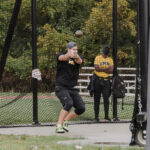
with Andrew Haberman ’21, computer science, and Davina Orieukwu, assistant Track & Field coach
It’s widely accepted that you need to practice a skill for 10,000 hours before becoming an expert. Andrew Haberman ’21, computer science, has a different number in mind—20,000 throws. Twenty-five throws a practice, five days of practice a week, 10 months out of the year for four years. And even after that, he knows that success is never final. So he makes another throw.
Along with shot put, weight, and discus throws, Haberman specializes in the hammer throw. This is not a tool from your dad’s shed. For men’s regulation competition, it’s a 16lb metal ball attached by a steel wire to a grip. While the object of this competition is—like all throwing competitions—to launch your object the farthest, with hammer throw speed is also a big factor.
-
 Andrew Haberman
-
 Davina Orieukwu
As part of track and field, throwing is more obscure than some events, but UMBC has a storied history in this discipline. Cleopatra Borel ’02, interdisciplinary studies, is a four-time Olympian shot putter representing Trinidad and Tobago, placing 7th in Brazil in 2016.
On the practice field, again and again, the rhythmic sound of Haberman’s shoes scuffing the throwing circle are followed by a thunk as the hammer lands in the grass, a rooster tail of dirt following each toss. Haberman and his throwing coach, Davina Orieukwu, talk through foot placement, chest height, release angle, and many other minute readjustments to his technique. Over and over, Orieukwu reminds him, “push the hammer all the way around,” to get the most efficient throw. So how does anyone get to 20,000 throws? Start with the first one.
Tools of the Trade
-
A hammer—This implement is a 8.8lb (for women) or 16lb (for men) metal ball on a wire with a handhold. But in a pinch, other heavy implements attached to a chain and grip will work.
-
Wide open space—this is not a sport to practice near a lot of windows.
-
Upper body strength—this would be helpful to start, but you can always build it up while you practice.
-
A coach or mentor—no YouTube video can substitute for hands-on guidance.
Haberman’s career record toss is 55.06m (180.6 ft). That is approximately as long as the Leaning Tower of Pisa is tall. Illustration by Jim Lord ’99.
Step 1 — Hammer time
First acquire a hammer or throwing implement. These aren’t the most accessible pieces of equipment like a pair of running shoes or a soccer ball. Hammer throw isn’t a part of most high school track and field teams, but Haberman’s coach at Century in Carroll County had access to some of the heavy equipment and allowed the throwing athlete to practice on his own. Haberman saw the hammer throw as a way to extend his athletic career, gaining experience in a more uncommon discipline to make him a more attractive athlete to colleges.
But you don’t need a regulation hammer to start off. During practice, Orieukwu has Haberman and another throwing athlete, sophomore Thomas Hamby, use a variety of weighted objects. First, Haberman warms up with a literal ball and chain. This implement weighs twice as much as the hammer he’ll use in competition, so he’s gaining strength and developing better technique by handing the heavier object. Hamby throws a hefty chain looped around a handle to start.
Step 2 — When, not if, you fall, get back up again
Hone your technique. Maybe at first this is watching YoutTube tutorials by world class athletes or binging compilations of “fails,” to see all the ways that things could go wrong. As Orieukwu repeats during practice, “losing connection with the ground is losing connection with the ball.” For the uninitiated, stumbling or falling down is to be expected in the beginning. Imagine this: you are trying to balance your body while swinging a weighted ball over your head twice and then spinning anywhere from three to five times (called “the wind”), building up momentum to the moment of release. The faster the speed of your spins, the more velocity your hammer has.
 Orieukwu gives Haberman pointers for his foot placement and when to release the hammer.
Everyone, says Haberman—even with four years of experience—loses control of the ball. The key, he notes: “Be as relaxed as possible, but strong and intentional at the same time.”
Step 3 — Arm & hammer
Learn better form. Haberman says his STEM background certainly helps, as he thinks through the physics of the pull of the hammer as his body rotates to gain speed. Orieukwu tells him to watch his “flat 2.” Haberman knows that means during his second rotation, “my hammer rises really high in my orbit, so that keeps me from throwing farther,” he says.
As the ball increases velocity with each turn, it’s important to retain a triangular shape with your arms—your chest forming the base, your arms the two legs of the isosceles triangle, and the hammer at the vertex. If the hammer gets ahead or behind your triangle, you’re in trouble, says Haberman.
Step 4 — Pass it forward
Start mentoring others. So much of hammer throwing is a mind game, shares Haberman, who credits older team members with helping him learn good habits early on: relax, make jokes during practice, and stay neutral to avoid emotional highs and lows which can derail an athlete. Hamby, who just picked up the hammer throw in fall 2020, says that Haberman, now a senior, is his go-to source for advice.
 Haberman, a senior, and Hamby, a sophomore, discuss throwing techniques.
The older athlete sees his responsibility and tries not to pass long throwing neuroses. “I consistently think I can do better, but sometimes that works against me,” says Haberman. “Thomas picks up on my attitude and I don’t want it to negatively affect him.”
With that, he lifts the hammer, executes the wind, and completes another throw—number 20,001 and counting.
*****
Header image: Haberman practices with Orieukwu looking on. All photos by Marlayna Demond ’11.
]]>
with Andrew Haberman ’21, computer science, and Davina Orieukwu, assistant Track & Field coach It’s widely accepted that you need to practice a skill for 10,000 hours before becoming an...
https://umbc.edu/stories/how-to-throw-a-hammer/
https://my3.my.umbc.edu/api/v0/pixel/news/119733/guest@my.umbc.edu/28caea069fd0fddc26f7664d1653224a/api/pixel
athletics
campus-life
fall-2020
how-to
UMBC News & Magazine
https://my3.my.umbc.edu/groups/umbc-news-magazine
https://assets1-my.umbc.edu/system/shared/avatars/groups/000/001/943/24435aa6207c452e7bc15cc74b42c7bb/xsmall.png?1748556657
https://assets1-my.umbc.edu/system/shared/avatars/groups/000/001/943/24435aa6207c452e7bc15cc74b42c7bb/original.png?1748556657
https://assets2-my.umbc.edu/system/shared/avatars/groups/000/001/943/24435aa6207c452e7bc15cc74b42c7bb/xxlarge.png?1748556657
https://assets2-my.umbc.edu/system/shared/avatars/groups/000/001/943/24435aa6207c452e7bc15cc74b42c7bb/xlarge.png?1748556657
https://assets3-my.umbc.edu/system/shared/avatars/groups/000/001/943/24435aa6207c452e7bc15cc74b42c7bb/large.png?1748556657
https://assets1-my.umbc.edu/system/shared/avatars/groups/000/001/943/24435aa6207c452e7bc15cc74b42c7bb/medium.png?1748556657
https://assets2-my.umbc.edu/system/shared/avatars/groups/000/001/943/24435aa6207c452e7bc15cc74b42c7bb/small.png?1748556657
https://assets1-my.umbc.edu/system/shared/avatars/groups/000/001/943/24435aa6207c452e7bc15cc74b42c7bb/xsmall.png?1748556657
https://assets2-my.umbc.edu/system/shared/avatars/groups/000/001/943/24435aa6207c452e7bc15cc74b42c7bb/xxsmall.png?1748556657
UMBC News & Magazine
0
0
false
Wed, 02 Dec 2020 21:48:13 -0500
Exploring Every Angle: Climate Research at UMBC
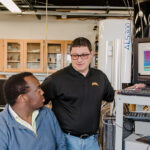
Researchers across UMBC are using unique, interdisciplinary approaches to explore global environmental challenges. Here are just three examples.
Lipi Mukherjee, Ph.D. ’20, atmospheric physics, developed an algorithm to identify the abundance and type of particles present just under the surface of the ocean. Her algorithm is 6,000 times faster than previous methods.
 (left to right:) Anthony Bratt, Lipi Mukherjee, Dr. Pengwang Zhai, and Dr. Meng Gao, courtesy of the UMBC Atmospheric and Oceanic Optics Group.
“That’s the difference between impossible and doable,” says Mukherjee’s advisor, Pengwang Zhai, assistant professor of physics. Mukherjee trained her model to identify different particle types using neural network technology, rather than relying on existing observational data. This method “has the reliability as well as the speed” today’s scientists need, Mukherjee explains.
The model, which analyzes data collected by orbiting satellites, mostly detects colored dissolved organic matter (CDOMs). Some of these particles can be poisonous to sea life. They can also serve as a proxy for carbon stored in the ocean, which is important to understand in the context of climate change.
Zhai is excited to continue to validate Mukherjee’s model. He’ll also use her model to analyze data coming from three instruments that will launch with NASA’s PACE mission in 2024, including UMBC’s own HARP2.
Mukherjee has moved on to a position at the National Center for Atmospheric Research. She’s applying her knowledge of neural networks to interpret magnetic and thermodynamic properties of the sun’s atmosphere, which can lead to solar flares that interrupt GPS tracking and telecommunication systems. “That’s the beauty of the physics Ph.D.,” Zhai says. “You may not work on the exact same topic after you graduate, but your skill set is highly relevant.”
Answers in the air
Ruben Delgado, assistant research professor at the Joint Center for Earth Systems Technology (JCET), a UMBC partnership with NASA, studies a different resource: our air. Since a major air quality study over Chesapeake Bay in 2011, UMBC has gained national prominence for air quality research. Delgado’s group uses data collected by aircraft, satellites, and ground-based systems to understand where, when, and how much of certain pollutants appear near ground level.
The research led to new regulation that has decreased air pollution in the region. Impressed, the federal Environmental Protection Agency asked UMBC in 2016 to serve as the central hub for a fast-growing network of instruments. Delgado and his students analyze air quality data coming in from sites across the U.S. and Canada.
 Delgado, third from left, with a group of physics students in 2019 next to the observatory on the roof of the physics building. Photo by Marlayna Demond ’11.
The instruments at different sites produce raw data that look slightly different. It’s up to the computer science majors on the team to find ways to analyze it all efficiently and then visualize the results in a way that makes sense to the end user.
Some of the students regularly post their findings on a website affectionately known as the “Smog Blog.” During the worst of this fall’s fires in the West, officials from Pennsylvania called to check on the status of blog posts. The governor expected daily updates on how the smoke was affecting local air quality—and their team was relying on the Smog Blog.
“That’s when we give the wake up call to the students: ‘By the way, your work is being used by government officials,’” Delgado says. “Some of them might not have previously thought at all that their coding skills would be useful for environmental research. It’s a point of pride for the students that their work is being used and highlighted.”
Phytoplankton to polar bears
Rather than collecting data at a distance via satellites, Nicole Trenholm spends much of her time on small boats in the Arctic Ocean, exploring everything from ocean currents to algal blooms to microplastics in ice cores. After earning a bachelor’s in geology, research missions to the Arctic with NASA made her want to pursue an advanced degree.
“I was seeing things and making connections, but I was just a data delivery girl at the time,” Trenholm says. “I wanted to go back to school and learn how to lead the science myself.”
 Trenholm on a research site. Photo courtesy of the Department of Geography and Environmental Systems.
Trenholm has a passion for messy questions about the relationships between melting Arctic glaciers and changes in the surrounding biological communities, from phytoplankton to polar bears. Those interests brought her to UMBC, where she is a Ph.D. student co-advised by geography and environmental systems professor Jeff Halverson and JCET scientist Kevin Turpie.
Trenholm is taking advantage of her fieldwork experience to bridge the gap between climate data collected from afar and ecological data collected on the ground. “I’m doing my best to not go one direction or the other, but really try to stay in between and help solve these crossover questions,” she says.
“Glacier melt isn’t just influencing sea level rise—it’s also influencing the future health of marine ecosystems, fisheries, water quality—all this kind of stuff,” Trenholm adds. “And that’s a story that hasn’t been fully investigated at this point.”
On her next research cruise, she’ll be the only graduate student aboard with a group of senior researchers exploring currents in the Beaufort Sea north of Alaska. The trip will be exciting and educational, but it doesn’t come without risk.
“This is going to be one of the nastier times of year to be up in the oceans,” Trenholm says. “We’ll be out there fighting the seas, collecting data. I’ll be wearing a hard hat and be soaking wet most of the time.”
But she’ll be doing important work, gathering information to help scientists better understand our changing world. And, in the true spirit of a committed scientist, she continues, “It’ll be fun. I brought some audio books and my ukulele.”
*****
Learn more about Retrievers’ roles in researching climate change in the Arctic in this fall 2020 feature On Thin Ice.
Header imager: Delgado, standing, works with students in his lab in 2019. Photo by Marlayna Demond ’11.
]]>
Researchers across UMBC are using unique, interdisciplinary approaches to explore global environmental challenges. Here are just three examples. Lipi Mukherjee, Ph.D. ’20, atmospheric...
https://umbc.edu/stories/exploring-every-angle-climate-research-at-umbc/
https://my3.my.umbc.edu/api/v0/pixel/news/119734/guest@my.umbc.edu/b53a6dade15361cf3a2dbcbf23d29187/api/pixel
cnms
discovery
fall-2020
ges
physics
professorsnottomiss
sidebar
UMBC News & Magazine
https://my3.my.umbc.edu/groups/umbc-news-magazine
https://assets1-my.umbc.edu/system/shared/avatars/groups/000/001/943/24435aa6207c452e7bc15cc74b42c7bb/xsmall.png?1748556657
https://assets1-my.umbc.edu/system/shared/avatars/groups/000/001/943/24435aa6207c452e7bc15cc74b42c7bb/original.png?1748556657
https://assets2-my.umbc.edu/system/shared/avatars/groups/000/001/943/24435aa6207c452e7bc15cc74b42c7bb/xxlarge.png?1748556657
https://assets2-my.umbc.edu/system/shared/avatars/groups/000/001/943/24435aa6207c452e7bc15cc74b42c7bb/xlarge.png?1748556657
https://assets3-my.umbc.edu/system/shared/avatars/groups/000/001/943/24435aa6207c452e7bc15cc74b42c7bb/large.png?1748556657
https://assets1-my.umbc.edu/system/shared/avatars/groups/000/001/943/24435aa6207c452e7bc15cc74b42c7bb/medium.png?1748556657
https://assets2-my.umbc.edu/system/shared/avatars/groups/000/001/943/24435aa6207c452e7bc15cc74b42c7bb/small.png?1748556657
https://assets1-my.umbc.edu/system/shared/avatars/groups/000/001/943/24435aa6207c452e7bc15cc74b42c7bb/xsmall.png?1748556657
https://assets2-my.umbc.edu/system/shared/avatars/groups/000/001/943/24435aa6207c452e7bc15cc74b42c7bb/xxsmall.png?1748556657
UMBC News & Magazine
0
0
false
Wed, 02 Dec 2020 19:31:34 -0500
On Thin Ice

For UMBC alum Nathan Kurtz, the only thing scarier than a surprise visit from a polar bear is a melting ice cap.
When the Polarstern set sail from northern Norway in September 2019, it was looking to get stuck in the ice. But this goal—a death knell for so many historic exploration ships—would be much harder for this modern research vessel to accomplish due to a shrinking ice pack.
The Polarstern was embarking on history’s largest scientific expedition to the Arctic to date. But before the first wave of scientists could start their research, they had to find a suitably robust ice pack, known as a floe, to make their home. This is harder than it sounds in the rapidly warming Arctic. An increasing amount of ice doesn’t survive the summer, which means boats have to travel further north in search of suitably thick ice. But after a nearly two-week journey from Norway, the Polarstern had found its mark.
And this is how Nathan Kurtz, M.S. ’07, Ph.D. ’09, atmospheric physics, ended up standing guard on some floating ice 300 miles from the North Pole armed with a rifle and a mandate to keep an eye out for polar bears.
 Kurtz, pictured on the ice next to research apparatus, courtesy of Kurtz.
Kurtz was part of the first wave of more than 600 scientists from 20 different countries who over the course of the year cycled through the ship as it drifted more than 1500 miles locked in a massive sheet of ice. The goal of the Multidisciplinary drifting Observatory for the Study of Arctic Climate (MOSAiC) expedition was to better understand the link between the Arctic environment and climate change.
Polar bear lookout was “not something I saw myself doing when I was in grad school,” says Kurtz, who didn’t see any bears that day, but by the time he returned to civilization a month later he’d had his fill. “However, UMBC really did prepare me to face challenges,” says Kurtz. “For me, grad school was hard, but it helped me with self-confidence—that this can be done and I can do this.”
Neither Kurtz nor his shipmates had traveled all the way to the Arctic to be polar bear sentinels. It was just a necessary part of the journey that allowed them to do their real job: collecting massive amounts of data on the woefully understudied polar environment. Over the course of its Arctic sojourn, the Polarstern hosted scientists studying everything from zooplankton beneath the ice to the clouds floating above it.
But for Kurtz, the ice itself was the main attraction.
From Icy Moons to Polar Ice Caps
Kurtz’s arrival in the Arctic was the culmination of over a decade of research studying Arctic floes from afar. But his original focus was ice even farther away—the icy moons of Jupiter. A shift in funding from NASA had Kurtz pivot his focus from astrophysics to earth sciences. “But physics applies to the moons of Jupiter and to the Earth,” Kurtz puts it dryly, “so it wasn’t so difficult to switch my focus.”
One of Kurtz’s advisors at UMBC, Raymond Hoff, professor emeritus, says UMBC students are uniquely positioned to lead in atmospheric physics, considered a unique subset in a field that often prioritizes astronomy or astrophysics. UMBC’s relationship with the Earth Science Division of NASA Goddard Space Flight Center to form the Joint Center for Earth Systems Technology allows students to play an active role in ongoing research.
 Scientific teams conduct research at a coring site on MOSAiC ice floe. Alfred-Wegener-Institute / Esther Horvath (CC-BY 4.0)
Hoff himself brought valuable Arctic experience to his classroom, and Kurtz remembers being struck by his advisor’s journeys to the Arctic in the early 1980s. “What amazed me about the Arctic was the stark and pristine beauty of the landscape,” says Hoff. “Even at -45ºF, you would find yourself outside marvelling at the ice crystals which fell out of clear blue skies as any water vapor there would freeze and fall out on your parka.” For about 20 years, Hoff measured pollution at Alert, Northwest Territories, Canada, about as far north as he could get on land. There, researchers discovered that sulfur pollution from Europe and Russia was getting into the high Arctic.
“As a result of our work,” shares Hoff, “the Arctic nations brought in scientific agreements to reduce the inputs of mid-latitudinal pollution going to the Arctic. Some of those pollutants were really surprising since they were pesticides which were used in the tropics. It brought home how small our planet is.”
Kurtz’s work four decades later would continue to rely on the cooperation of numerous stakeholders, as scientists collaborated to study—and perhaps stymie—global warming.
Bridging the Ice Knowledge Gap
As a graduate student, Kurtz worked on methods for determining sea ice thickness based on data from NASA’s ICESat, a polar observation satellite launched in 2003. After earning his Ph.D., Kurtz has continued his work on the properties of polar ice as a scientist at NASA Goddard’s Cryospheric Sciences Branch.
To understand how ice around the poles is changing and what this can tell us about the climate, Kurtz and his colleagues relied heavily on laser data from ICESat, a satellite that passed over the poles bouncing laser light off the ice 40 times per second to get a high resolution map of the sea ice thickness. But when ICESat’s last laser failed in 2009, NASA was left without a dedicated satellite to study the ice caps.
 Three scientists and a bear guard land on a new floe in a transportation device called a “mummy chair” to scout its potential for setting up research stations. Alfred-Wegener Institute / Lianna Nixon (CC-BY 4.0)
NASA’s solution was slightly more hands-on than a satellite—following the laser failure, NASA launched Operation IceBridge. Like ICESat, IceBridge used laser altimeters and radar to observe the Arctic ice sheet, except now they’d use a manned turboprop plane to accomplish the same thing.
Kurtz took over Operation IceBridge in 2015 and helmed the mission until 2018. Hoff shares a story of tuning in to NASA TV to see a story labeled incorrectly on the TV Guide channel as “Ice Bride.” It was really about IceBridge. “You have to laugh,” says Hoff. “I was happy to watch that story and see Nate standing on the ice in the Arctic talking about how important ice thickness is to our understanding of the progression of global warming.”
Each season, Kurtz would travel to the poles for weeks at a time to survey the ice from the air. In the Arctic, Kurtz and his team would depart from an airbase in Greenland and spend upward of eight hours per day in the fuselage of a plane as it zig-zagged back and forth across the Arctic Circle. They would pass the time monitoring the instruments, watching movies, or simply taking in the alien landscape below.
“The scenery outside was really amazing,” Kurtz says. “I never got tired of looking out the window.”
Even if Kurtz wanted to spend more time in the IceBridge plane, the extreme polar weather limited operations to about three months out of the year, which made it difficult to comprehensively survey the polar regions. The upshot was the plane could carry far more instruments than ICESat, including ice penetrating radars that could only work at low altitudes. In this sense IceBridge drastically improved NASA’s understanding of the dynamics of polar ice—but Kurtz wanted to get closer still.
Since 2018, Kurtz has been studying polar ice data sent back by NASA’s shiny new orbiter, ICESat-2, at Goddard Space Flight Center in Maryland. But when he heard about the MOSAiC mission, Kurtz saw a once-in-a-lifetime opportunity. “I had done the airborne work, but on the ground field work is so different,” he says. “Being there would give me a totally different view of how the ice forms and help inspire me to use airborne and satellite data in a different way.”
A New Era of Polar Exploration
One does not simply book a ticket on a month-long trip to the Arctic, of course. After securing the funding to participate in MOSAiC’s research program, Kurtz was required to participate in extensive training in New Hampshire and northern Alaska before departure. Over the course of several weeks in summer 2019, Kurtz along with fellow scientists learned how to shoot a rifle and a flare gun, escape from a sinking helicopter, orchestrate a sea rescue, and protect themselves from polar bears. They were also trained in the art of doing science in the Arctic, learning how to use a giant drill to extract an ice core and drive a snowmobile.
The extensive training was necessary to prepare the scientists for the brutal environment. During the Arctic winter, temperatures can dip dozens of degrees below zero and starting in mid-October the Polarstern would witness five months of total darkness.
 Arctic sea ice in September 2019. Alfred-Wegener-Institute / Sebastian Grote (CC-BY 4.0)
Kurtz recalls reading novels like Endurance, which chronicles explorer Ernest Shackleton’s harrowing efforts to reach the South Pole in 1914. “This book kept sticking in my head even though I felt safe on the ship. There were all kinds of modern communication in case we needed help or ran out of something or if there was some kind of emergency—we could at least talk to someone,” says Kurtz. “Shackleton and his group had none of that. I can’t even imagine.”
In this modern journey, participants would face some of the same challenges as past expeditions—unstable ice sheets, the threat of frostbite, the prospect of hungry bears, diminishing stores of fresh produce—along with new ones: they were limited to just 50 kilobytes of email data per day—barely enough to send a photo. But aside from a brief bout of seasickness during the passage from Norway, Kurtz quickly adapted to the life of a polar seafarer.
A Fresh Perspective on the Ice
To be sure, the days were both literally and figuratively long. When Kurtz and his crewmates arrived in the Arctic at the tail end of summer, the sun was hanging just below the horizon, casting the already alien landscape in a perpetual twilight glow. But given how much work there was to do, the extended daylight was a blessing. As the first of six expedition teams that cycled through the Polarstern that year, Kurtz and his colleagues were responsible for setting up dozens of experiments and research infrastructure that would be used by other scientists over the course of the year.
The nature of the field experiments that surrounded the ship speaks to the diverse expertise of the crew. Some of MOSAiC’s more far flung field sites were up to 30 miles away, accessible only by helicopter. Others took place thousands of feet above and below the ship, where dirigibles or underwater robots collected data and relayed it back to the surface.
 Polar bear mother and cub on starboard side of
 Polarstern
curiously looks at the ship. Alfred-Wegener-Institute / Lianna Nixon (CC-BY 4.0)
Kurtz’s experiments were just a few minutes’ walk from the Polarstern. They were designed to measure changes in the ice’s thickness, density, thermal conductivity, and other properties, which will serve as a ground truth for polar measurements taken from space. The dynamics of the Arctic floe have a lot to tell us about our planet; Kurtz’s experiments are helping us decipher its language.
Being on the ice gave Kurtz a refreshed perspective of an area he could previously only appreciate from satellite data or the window of a plane, both in terms of the immense scale and barren beauty of the Arctic landscape, and what it means to study the ice.
“Science by its nature is very dry and technical, so you’re not necessarily thinking about why something is important when you’re solving an equation, you just do it,” Kurtz says. “But going to take these measurements to make sure we understand what’s happening and what it means for the future put a very different context on the work I do.”
Kurtz says he was struck by the realization that his two elementary school-aged children—who loved to hear stories about his polar bear interactions again and again—will likely never see what he saw during his trip. The Arctic is warming much faster than the rest of the world and its ice sheet is receding at an alarming rate. Over the past few decades it has lost enough winter ice to cover Alaska, Texas, and Montana combined, and many of the regions that used to stay frozen during the summer are now ice-free. Scientists are only just beginning to understand how the Arctic affects and is affected by climate change, but the work of Kurtz and other MOSAiC scientists will fill in a crucial gap in that knowledge.
Kurtz’s retired advisor Hoff adds, “One thing UMBC can be very proud of is the number of its graduates and alumni who are contributing to decision making and making important decisions about the most critical issues which will affect the planet.”
—By Daniel Oberhaus
*****
Learn more about other ways UMBC staff and students are using their research to study and combat the effects of climate change.
Header Image: RV Polarstern in the Arctic. During the MOSAiC expedition the German research icebreaker Polarstern, which is operated by the Alfred Weggener Institute, drifts with the sea ice for a whole year, experiencing several months of polar night. Alfred-Wegener-Institute / Markus Rex (CC-BY 4.0)
]]>
For UMBC alum Nathan Kurtz, the only thing scarier than a surprise visit from a polar bear is a melting ice cap. When the Polarstern set sail from northern Norway in September 2019, it was...
https://umbc.edu/stories/on-thin-ice/
https://my3.my.umbc.edu/api/v0/pixel/news/119735/guest@my.umbc.edu/eff62b5e41130c5dad3ad08c913d1f0a/api/pixel
alumni
alumni-profile
cnms
fall-2020
feature
jcet
nasa-goddard-space-flight-center
physics
UMBC News & Magazine
https://my3.my.umbc.edu/groups/umbc-news-magazine
https://assets1-my.umbc.edu/system/shared/avatars/groups/000/001/943/24435aa6207c452e7bc15cc74b42c7bb/xsmall.png?1748556657
https://assets1-my.umbc.edu/system/shared/avatars/groups/000/001/943/24435aa6207c452e7bc15cc74b42c7bb/original.png?1748556657
https://assets2-my.umbc.edu/system/shared/avatars/groups/000/001/943/24435aa6207c452e7bc15cc74b42c7bb/xxlarge.png?1748556657
https://assets2-my.umbc.edu/system/shared/avatars/groups/000/001/943/24435aa6207c452e7bc15cc74b42c7bb/xlarge.png?1748556657
https://assets3-my.umbc.edu/system/shared/avatars/groups/000/001/943/24435aa6207c452e7bc15cc74b42c7bb/large.png?1748556657
https://assets1-my.umbc.edu/system/shared/avatars/groups/000/001/943/24435aa6207c452e7bc15cc74b42c7bb/medium.png?1748556657
https://assets2-my.umbc.edu/system/shared/avatars/groups/000/001/943/24435aa6207c452e7bc15cc74b42c7bb/small.png?1748556657
https://assets1-my.umbc.edu/system/shared/avatars/groups/000/001/943/24435aa6207c452e7bc15cc74b42c7bb/xsmall.png?1748556657
https://assets2-my.umbc.edu/system/shared/avatars/groups/000/001/943/24435aa6207c452e7bc15cc74b42c7bb/xxsmall.png?1748556657
UMBC News & Magazine
0
0
false
Wed, 02 Dec 2020 19:30:19 -0500
Meaningful Representation
Assigned an oral history project in 2007 for her master’s degree in community arts at Maryland Institute College of Art, Ashley Minner—now professor of the practice and folklorist in the Department of American Studies at UMBC—knew exactly who she would ask to interview. She walked across the street from her parents’ house and knocked on Uncle John’s door.
“There will never be a person like Uncle John,” says Minner, an enrolled member of the Lumbee Tribe of North Carolina. “I don’t know, he was just like that, always telling stories. He was a character. When he was younger, he had pork chop sideburns. He had a really thick Robeson County accent. He was a good man. I believe he was touched by God, he was—he is—a Lumbee Legend.”
Sharing their heritage with Baltimore
 Photo by Jill Fannon, M.F.A. ’11, for
 BmoreArt.
John Walker, if not a direct relative of Minner’s, played that role, telling her about their shared heritage and regaling her with stories of his youth in North Carolina, where many Lumbees moved from in the 1950s and ’60s to Baltimore in search of work. Minner’s subsequent research has helped tell the wider story of Lumbee migration to Baltimore, specifically to the neighborhoods of Upper Fells Point and Washington Hill, affectionately called “The Reservation.”
The original oral history project turned into a thesis of five artist books—which include transcriptions of five elders’ stories along with compiled photographs. This project grew into an exhibit at the Baltimore Museum of Industry in 2011 that featured five additional oral histories and cultural artifacts. It felt like the project could keep snowballing, says Minner. It was around this time, she noticed that more often the oral histories were being used at elders’ funerals.
“They became more precious after that,” she says, as the growing awareness of losing a generation began to sink in.
In fall 2019, Minner met with staff in UMBC Special Collections to discuss the creation of a home for her work and other Baltimore Lumbee related research and ephemera. To be housed in the Maryland Folklife Archives, Minner’s recordings will become part of “The Ashley Minner Collection,” along with other documents and photographs shared by tribal members.
Preserving people’s stories
“This collection really demonstrates how the University connects with the surrounding community in Baltimore,” says Beth Saunders, curator and head of UMBC’s Special Collections and Gallery. “In other words, we benefit from stronger ties to the community we serve. Ashley really dug into local archives and did the legwork and other researchers will be able to benefit from that.”
 Jeanette W. Jones holds a 1957 issue of
 Ebony
magazine, which features the article ‘Mystery People of Baltimore: Neither red, nor black, nor white. Strange ‘Indian’ tribe lives in world of its own.’ She is pictured at center, with her hand on her hip. Photo by Sean Scheidt ’05, visual arts.
Minner sees the archive as a necessary repository for stories and photographs, that otherwise might be lost as the Lumbees who previously lived and worked close together spread out into the counties surrounding Baltimore. “Ashley has a real, practical sense of the value of archives for preserving history and people’s stories,” says Saunders. “This new collection is an opportunity to preserve a part of that history that has been neglected and that she is bringing to broader awareness.”
Minner hopes the creation of the archive will encourage more Lumbees to dig into their past, while also finding pride in their present. ”We are made to feel as if we don’t belong on this landscape,” says Minner. “Many of our young people don’t know their history because frankly…their parents don’t know the history.”
“I think being able to point and explain and show pictures and ground them in the fact that our people have been here for close to a 100 years now and have really made contributions, that does something. That helps with security, self-esteem, and feeling empowered—like you do belong, like nobody lied to you. You are who you are.”
Ethics of community research
Minner bridges multiple spheres with her work—she’s an artist, a scholar, and also a granddaughter, a friend, a fellow tribal member. The only hat she can take off, as she puts it, is her UMBC hat. Otherwise, “what I’m doing and what I’m about is bigger than a job,” says Minner, “bigger than a job title or discipline.”
Part of having her feet in two worlds is training students how to develop holistic approaches to public scholarship and community collaboration. In Fall 2019, Minner was hired as the director of UMBC’s new public humanities minor. “We’re lifting up stories that get pushed to the margins,” says Minner. “And we spend a lot of time on ethics. The last thing I want to do is turn a bunch of college students loose on communities that might be harmed through the interaction.”
 The Baltimore American Indian Center, 113 S. Broadway, is the hub of cultural activities for area Indians. Photo by John Davis, The News American, October 24, 1985. Baltimore News American Photo Archive, Special Collections and University Archives, University of Maryland College Park. Permission granted for Minner’s use by the Hearst Corporation.
Minner is uniquely suited to the directorship, says Nicole King, associate professor and chair of the Department of American Studies. “Her broad range of experiences and skills, speaks to the many positions we all hold in our everyday lives. These human aspects are often flattened in an institutional context. Yet, Ashley is more than all of these credentials and roles because her practice focuses on seeing the humanity and beauty of everyday people and places. What Ashley offers to our students at UMBC is lived experiences that are both ordinary and extraordinary and an understanding of the connections between the two.”
From this perspective, Minner can see how outsiders often miss the mark when trying to tell the Baltimore Lumbee story. “They latch on to urban renewal and displacement,” explains Minner, “but the elders don’t see it that way. They’re not victims, that’s not the story they want to tell. It’s important to teach folks to listen deeply and to check in and make sure people are being represented the way they want to be represented.”
A memorable occasion
Minner has a story, one of her own that’s stuck with her as she’s watched her research expand through a process she describes as “pretty serendipitous.” Aunt Jeanette Walker Jones, Uncle John’s widow, says Minner, was instrumental in connecting Minner to her heritage. When Minner and her best friend, Nicole—Aunt Jeanette’s granddaughter—were 4 or 5 years old, she took them to have ribbon dresses made.
The fabric for the dresses was light pink with teepees on it and the ribbons adorning it were white, black, and hot pink, remembers Minner. They attended an event at the former Festival Hall downtown—an annual pow wow put on by the Baltimore American Indian Center. “We were out there hopping around; we didn’t know what we were doing. Some Indian guy looked at my mom, and when she nodded at him, he scooped me up and held my hand while I danced with him. I was like ‘ahhhh,’” she says, making an excitedly terrified face. “It was a thrill!”
******
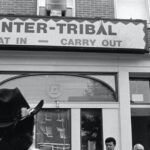
Header image: The Inter-Tribal Restaurant was owned and operated by the Baltimore American Indian Center in the unit block of South Broadway. Photo courtesy of the Baltimore American Indian Center, provided by Minner.
]]>
Assigned an oral history project in 2007 for her master’s degree in community arts at Maryland Institute College of Art, Ashley Minner—now professor of the practice and folklorist in the...
https://umbc.edu/stories/meaningful-representation/
https://my3.my.umbc.edu/api/v0/pixel/news/119738/guest@my.umbc.edu/49b08a27a2100d4afcf70d7e26c953eb/api/pixel
american-studies
cahss
discovery
fall-2020
professorsnottomiss
public-humanities
UMBC News & Magazine
https://my3.my.umbc.edu/groups/umbc-news-magazine
https://assets1-my.umbc.edu/system/shared/avatars/groups/000/001/943/24435aa6207c452e7bc15cc74b42c7bb/xsmall.png?1748556657
https://assets1-my.umbc.edu/system/shared/avatars/groups/000/001/943/24435aa6207c452e7bc15cc74b42c7bb/original.png?1748556657
https://assets2-my.umbc.edu/system/shared/avatars/groups/000/001/943/24435aa6207c452e7bc15cc74b42c7bb/xxlarge.png?1748556657
https://assets2-my.umbc.edu/system/shared/avatars/groups/000/001/943/24435aa6207c452e7bc15cc74b42c7bb/xlarge.png?1748556657
https://assets3-my.umbc.edu/system/shared/avatars/groups/000/001/943/24435aa6207c452e7bc15cc74b42c7bb/large.png?1748556657
https://assets1-my.umbc.edu/system/shared/avatars/groups/000/001/943/24435aa6207c452e7bc15cc74b42c7bb/medium.png?1748556657
https://assets2-my.umbc.edu/system/shared/avatars/groups/000/001/943/24435aa6207c452e7bc15cc74b42c7bb/small.png?1748556657
https://assets1-my.umbc.edu/system/shared/avatars/groups/000/001/943/24435aa6207c452e7bc15cc74b42c7bb/xsmall.png?1748556657
https://assets2-my.umbc.edu/system/shared/avatars/groups/000/001/943/24435aa6207c452e7bc15cc74b42c7bb/xxsmall.png?1748556657
UMBC News & Magazine
0
0
false
Wed, 25 Nov 2020 19:36:45 -0500
Welcoming Retrievers Back Home

When the NCAA canceled the 2020 spring and fall championship seasons due to the pandemic, UMBC Athletic Director Brian Barrio created a new game plan for Athletics communication staff: create UMBC’s first-ever Letterwinners Club. Similar to other universities’ clubs, the Retriever Letterwinners Club looks to welcome alumni home to UMBC by creating a network to connect them with current student-athletes and UMBC Athletics.
“I think it’s going to be a unique opportunity for student-athlete alumni from all walks of life, every sport that UMBC Athletics has ever sponsored, to really be able to connect and come together as one family,” says Assistant Director for Annual Giving Seth Nagle.
Athletic communications staff also used the launch as an opportunity to update data on athletes throughout the years. Led by Communications Director Steve Levy ’85, interdisciplinary studies, the staff dug through every athletic team’s roster since the start of UMBC Athletics in 1966 to create a full list of club members. Levy’s 30-plus years at UMBC has made him an indispensable resource. This longterm knowledge of Retriever Athletics is particularly helpful for team rosters prior to 1995—these lists are not available online and their accuracy is reliant on whoever put the media guide together for the team that year.
 UMBC’s Down and Dirty Dawg pep band plays in 2017. Photo by Marlayna Demond ’11.
Going through UMBC Athletics’ archives helped ensure that all former student-athletes were automatically inducted into the Letterwinners Club. Current student-athletes will become members at the end of their final year playing for UMBC. The club also includes alumni members of spirit teams like the Down and Dirty Dawg Band and Dance Team.
Nagle explained that the club is UMBC Athletics’ way to thank alumni for their contributions to its various sponsored programs over the years.
“Letterwinners clubs are fairly common around the nation, and it was definitely something we wanted to implement at UMBC just to really show our gratitude for all the dedication, time, blood, sweat, and tears that you put in as a student-athlete during their time here,” says Nagle.
No matter how long ago an alum played for or cheered on UMBC Athletics, Barrio wants them to know that they are part of the Retriever family.
If you played here 35 years ago, then you are part of the family today. Period.
— Brian Barrio, Athletics Director
“And we want to get through to our current student-athletes as well that, you know, you’ve chosen to be a part of the Retriever family and, because of that commitment you made, we’re going to give it back to you for the rest of your life.”
Barrio emphasized that alumni are “Retrievers for life.” In the release of the Letterwinners Club at the virtual Retriever Athletics Fall 2020 State of the Department meeting, Barrio reinforced that UMBC is home no matter whether you played only for a season, you were last on the roster, or an All-American.
“It’s so important from a culture standpoint that all our former student-athletes understand that they’re always welcome here, and they can always come back,” says Barrio. “And they don’t have to explain who they are, and it doesn’t have to be through their old coach.”
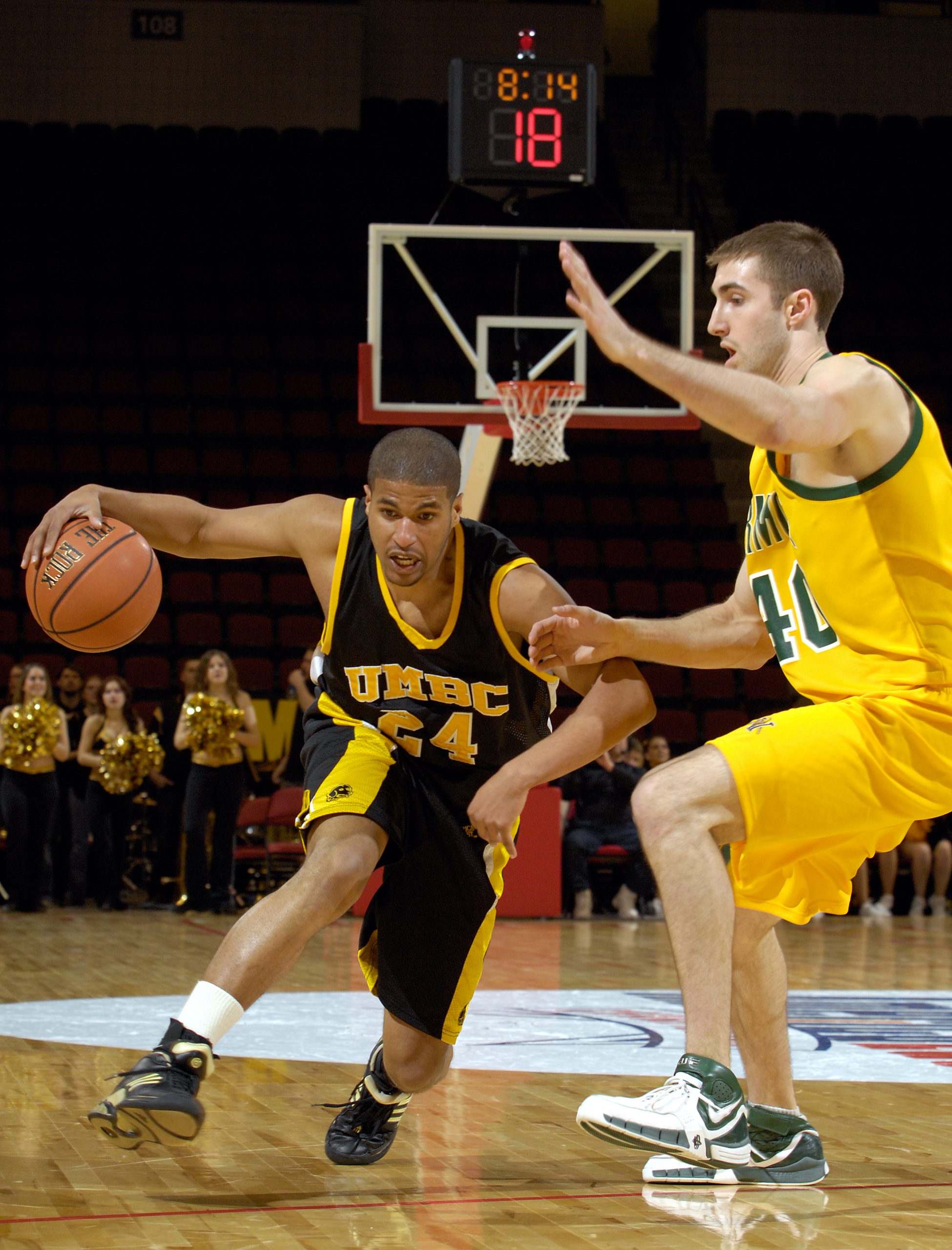
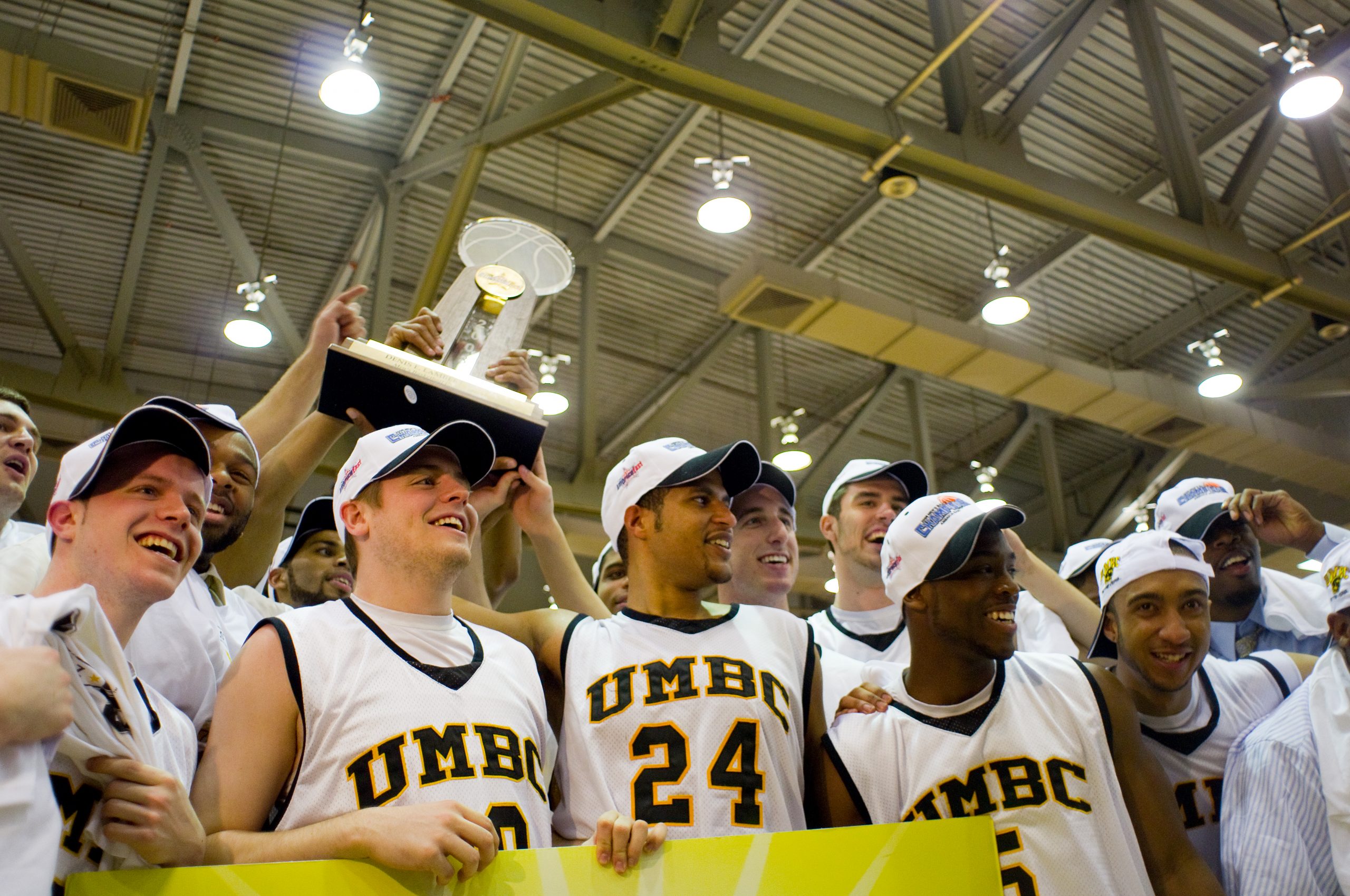
Brian Hodges ’07, financial economics and American studies, M.A. ’10, economic policy analysis,and UMBC men’s basketball alum, says he has always bled black and gold. Throughout his time as a student-athlete at UMBC, Hodges made many connections to the University and the UMBC community. He continued to maintain these connections through a period of membership on UMBC’s Alumni Board of Directors and as an avid fan of the men’s basketball team—even driving to Charlotte, North Carolina, to watch their historic NCAA upset.
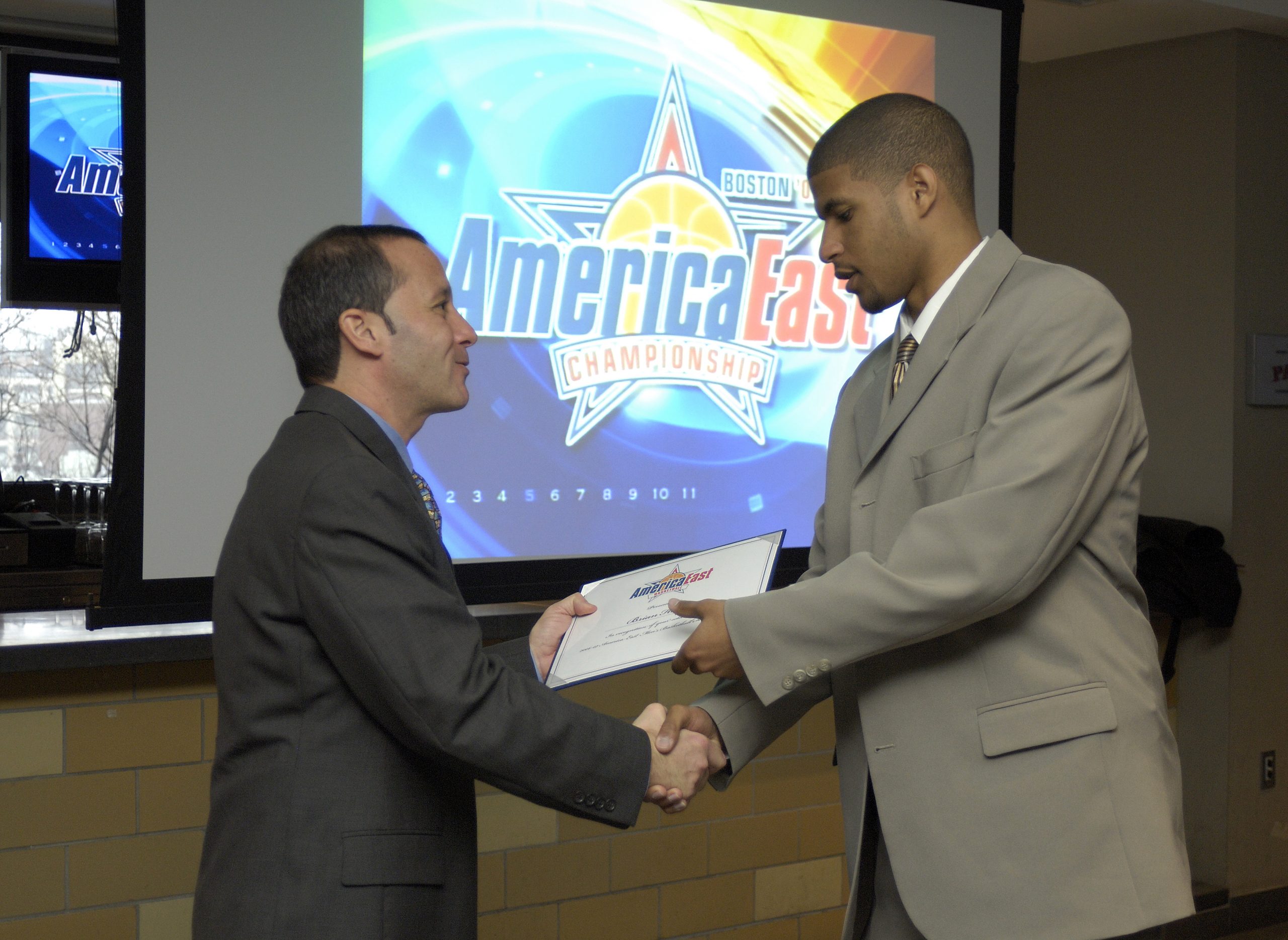
Brian Hodges (#24) competed for the 2008 UMBC men’s basketball team which won the America East Conference Championship, beating the University of Hartford and sending them to the first round of the NCAA Championships. Photos courtesy of UMBC Athletics.
“I am very much a strong advocate of UMBC and am very proud of my degrees,” says Hodges.
The announcement of UMBC’s Letterwinners Club gave Hodges a means to further connect with the UMBC community. Specifically, the club connected him with his former teammates as well as all the men’s basketball players that came after him.
“I was elated when I first read about the Letterwinners Club and started thinking about all of the possibilities that could result from its creation,” says Hodges. “It will definitely assist in connecting me with the University in a different way.”
While Athletics is doing due diligence to reach out to alumni, they can also register themselves through Athletics’ website. Barrio emphasized the importance of having as many alumni as possible register to be members.
“Behind each one of those names is a great story, it’s somebody’s life story,” says Barrio. “And so, the way I look at it, we’ve got hundreds of life stories out there waiting to be discovered.”
Learn more about the Letterwinners Club.
*****
Header image: True Grit pumps up the crowd at the 2018 UMBC men’s basketball celebration. Photo by Marlayna Demond ’11.
]]>
When the NCAA canceled the 2020 spring and fall championship seasons due to the pandemic, UMBC Athletic Director Brian Barrio created a new game plan for Athletics communication staff: create...
https://umbc.edu/stories/welcoming-retrievers-back-home/
https://my3.my.umbc.edu/api/v0/pixel/news/119745/guest@my.umbc.edu/ed56625301a3a7fe4b38e6083abb893e/api/pixel
alumni
fall-2020
news
umbc-athletics
umbc-retrievers
UMBC News & Magazine
https://my3.my.umbc.edu/groups/umbc-news-magazine
https://assets1-my.umbc.edu/system/shared/avatars/groups/000/001/943/24435aa6207c452e7bc15cc74b42c7bb/xsmall.png?1748556657
https://assets1-my.umbc.edu/system/shared/avatars/groups/000/001/943/24435aa6207c452e7bc15cc74b42c7bb/original.png?1748556657
https://assets2-my.umbc.edu/system/shared/avatars/groups/000/001/943/24435aa6207c452e7bc15cc74b42c7bb/xxlarge.png?1748556657
https://assets2-my.umbc.edu/system/shared/avatars/groups/000/001/943/24435aa6207c452e7bc15cc74b42c7bb/xlarge.png?1748556657
https://assets3-my.umbc.edu/system/shared/avatars/groups/000/001/943/24435aa6207c452e7bc15cc74b42c7bb/large.png?1748556657
https://assets1-my.umbc.edu/system/shared/avatars/groups/000/001/943/24435aa6207c452e7bc15cc74b42c7bb/medium.png?1748556657
https://assets2-my.umbc.edu/system/shared/avatars/groups/000/001/943/24435aa6207c452e7bc15cc74b42c7bb/small.png?1748556657
https://assets1-my.umbc.edu/system/shared/avatars/groups/000/001/943/24435aa6207c452e7bc15cc74b42c7bb/xsmall.png?1748556657
https://assets2-my.umbc.edu/system/shared/avatars/groups/000/001/943/24435aa6207c452e7bc15cc74b42c7bb/xxsmall.png?1748556657
UMBC News & Magazine
0
0
false
Fri, 20 Nov 2020 16:40:20 -0500
No Artist Stands Alone
Lockdown, quarantine, shelter in place—a new vocabulary defines this period of our lives that requires us to maintain space to protect one another. Alone, we spend our time consuming or creating art and media, but many are also having to reinvent how we share that pleasure with others.
We see comedians attempting to navigate satire from living rooms; movie releases being delayed in hopeful anticipation of a less restrictive future; and book tours being curtailed for long awaited novels. For other artists, this public pause has engendered a more private creativity—a book of poems examining anti-Asian racism, lush and gentle photographs of essential medical personnel in their personal protective equipment, a step back from the stage to perform a play over Zoom.
In facing a pandemic that’s disrupted the normal rhythms of open mics and art exhibits, these Retrievers have continued their craft, carving out unique ways to then share their creations.
Can we shape and share art in community even during a global pandemic? The answer is continually a resounding yes.
An exhibit in unusual circumstances
 Headshot provided by Hannah Basher.
As Hannah Bashar ’20, art history and biology, worked to curate pieces for campus-adjacent coffee shop OCA Mocha’s Art During the Time of COVID-19 exhibit, she found herself inspired by the unique ways the contributing artists had drawn from the isolation and monotony of recent months to create impactful art.
“Some artists find inspiration in their new and changed landscapes and environments,” says Bashar, OCA Mocha’s former arts intern. She cites pieces by photographer Julie Miller, which depict the strikingly empty urban areas that the artist passed in her walks through Silver Spring.
Other works featured in the exhibit were influenced by changes in routine; during the pandemic, Miller picked up the practice of joomchi, a centuries-old Korean art medium that involves layering paper in order to create unique shapes and textures. Miller’s artist statement describes the process of joomchi as meditative and “perfect for a day of isolation.”
Bashar wasn’t necessarily seeking art that made deep philosophical arguments about the pandemic. Instead, she wanted to display works that she thought viewers could relate to. “OCA Mocha stands for the community and it’s a strong force within the Arbutus community, so I want people to walk in and feel as though they can relate to what is on the walls,” she explains.
 Artist Julie Miller picked up the practice of joomchi, a centuries-old Korean art medium that
 i
nvolves layering paper in order to create unique shapes and textures. Photo courtesy of OCA Mocha.
This means the exhibit ranges from powerful celebrations of Black women’s resiliency in textured acrylic paintings by Kathleen McPartland to playful textiles, like a diploma box filled with a yarn rug made to look like a pizza by April Berardi ’16, modern languages and linguistics.
Bashar, who plans to pursue a career not in curation but emergency medicine, says that the unusual circumstances of this show made it an especially meaningful one to end her two-semester-long internship. “My own experience curating this show paralleled the theme of the exhibition, which is about how COVID has caused us to adapt and change with the times,” she says. “I felt like my experience curating the show was, in fact, part of the show itself.”
— Johanna Alonso ’20
Comic relief
Umar Khan knew he had a chance with the crowd when he kicked off his stand-up comedy career a decade ago as a student—most of the faces in the audience were his friends and fellow Retrievers, gathered around the Sports Center stage on the second floor of The Commons. “I think there were like eight people there, and I remember walking away thinking it went well, although I’m sure if I watched it now…” Khan trails off.
“All comics will tell you this, but we have to be some of the most delusional people in the world,” laughs Khan ’10, psychology. “What person in their right mind thinks they can captivate an audience of strangers for a set amount of time and on top of that make them audibly laugh?”
-
 Khan performing at a backyard comedy show in August 2020. Photos courtesy of Khan.

Armed with a notebook full of jokes he cringes at now, Khan performed at UMBC a few more times during his senior year. He kept going after that, making inroads into the DC comedy scene, maturing his content and honing his stage presence, filming his own special, performing shows almost every night while pursuing his day job as an elementary/middle school psychologist in Baltimore City. Fast forward 10 years, and COVID-19 hit comedy like so many other arts and industries.
“Now with COVID, everyone is having to take steps back,” says Khan. “If you used to sell out theaters, well, when is anyone going to pack a theater again? So now you’re going into comedy clubs. And the people headlining comedy clubs are getting pushed down to the next level. And it just keeps going.”
“I’m so thankful I have a career—my immigrant parents were right,” Khan laughs, “dreams are stupid. You gotta get a government job with benefits and a pension.”
In August, Khan was able to return to the stage, in a backyard show following pandemic protocols. “People are so hungry for entertainment and there’s so much going on in the world right now, says Khan. “We were pushing the line and people were loving it. It was so fun.”
“You can tell people just want to feel some sense of community and a comedy show offers you that community because you’re all laughing at the same thing. And you can leave and talk about the show—sharing the experience. It will be one of those shows we’ll look back on and be like, ‘oh remember when we had to do that during COVID?’”
— Randianne Leyshon ’09
Chocopies for world peace
In an era where simply eating inside a restaurant is considered risky behavior, there was no way an art installation that invites thousands of guests to share in consuming a huge pile of South Korean snack cakes could go on as planned.
Thus, Mina Cheon’s Eat Chocopie Together project, which was shown physically at the Busan Biennale 2018 in South Korea and had been slated to open at the Lincoln Center in June 2020, had to be postponed. But Cheon, M.F.A. ’02, imaging and digital arts, and her collaborators knew that, as the pandemic raged on around the world, the installation’s themes of love, peace, and unity were more relevant than ever.
 Cheon shows a map of North and South Korea, where people in both countries participated in the art project. Photo courtesy of Cheon.
To safely bring the project into the age of COVID-19, Cheon created a website, EatChocopieTogether.com, that allows friends to email one another digital versions of the marshmallow-filled treat. The chocopies are represented by graphics modeled after real chocopie wrappers but newly designed by the artist and emblazoned with one of five words: love, peace, share, eat, or unite. The recipient can “eat” the snack by clicking the graphic, and each chocopie sent and received contributes $2 to the Korean American Community Foundation COVID-19 Action Fund.
“It’s an extended version of the original. It’s taking all the inspiration, the sentiment, the spirit of Eat Chocopie Together, but going virtual allowed us to explore the different packaging with the multiple themes” and to fundraise, Cheon says. As of September, the project reached its $5,000 goal.
The original meaning of the installation lies in the history of the chocopie; the confection is incredibly popular in both South Korea and North Korea, despite being banned in the latter country. Sharing chocopies is “meant to bring awareness of the two Koreas working towards peace and unification,” according to a press release published by Asia Society Triennal.
 Cheon stands in front of 100,000 chocopies at a 2018 exhibit in South Korea. Photo courtesy of Cheon.
The virtual version of the project emphasizes an even more global message, according to Cheon. “We are socially distanced and separated, but we can still connect,” she says. “That was such a big, empowering idea, that we could still heal through our virtual connection.”
— Johanna Alonso ’20
Art by appointment
Bonnie Crawford describes looking at art like a religious experience. So when COVID-19 interrupted her life, she realized that what she missed most was experiencing art with her friends. Over the course of a month, Crawford, M.F.A. ’08, imaging and digital arts, invited people by appointment to view her work of dental floss weavings in the shed in her backyard.
“There’s a unique mindset when someone is looking at art,” says Crawford, who didn’t want people to lose out on that opportunity during the various stages of lockdown.
 Bonnie Crawford’s dental floss weavings ranged in size from a quilt to a pocket
square. She displayed the art in her emptied out shed. Photo courtesy of Crawford.
Crawford was worried at the beginning of the pandemic that she would possibly never make art again; she was finding it meaningless. Her weavings had usually been a way for her to channel creative energy, so she reinvisioned how to share her work with others which gave her renewed purpose.
Crawford’s dental floss weavings grew from the work she does on her Instagram feed, @brushhouse, where she shares pictures of her family brushing their teeth, sometimes including a guest appearance from a friend. The weavings extended from her desire to do more formal work. They range from small enough to fit in a wallet to a tall floss weaving that hangs like a tapestry.
“I would go to my studio until I had to use the bathroom,” Crawford laughs. This meant driving across the city to go at home, wanting to err on the side of caution in the face of a novel virus. In this way, Crawford slowly made progress on her largest dental floss weaving. When she was finished, she asked her sons and boyfriend to clear out their things from the shed and then got to installing.
The exhibition was up for about a month, available for viewing on Thursdays, Fridays, and Saturdays. Using an app to schedule appointment slots, in total 90 people came to see her work. “I hoped that it fulfilled that spiritual need for others like it did for me,” she says.
— Imani Spence ’16
All the world’s a digital stage
Like most things that cannot be held in person due to the coronavirus pandemic, theater has found its virtual home on Zoom.
These digital performances can be quite similar to the existing practice of staged readings, in which actors deliver their lines with little to no sets or costumes, often while sitting. But to tell some uniquely 2020 stories, some actors, playwrights, and directors have taken this medium to a new level.
Among them is Jurdan “JC” Payne ’21, theatre, who has spent the past few months performing in virtual plays featuring casts located throughout the country. Most recently, in a ten-minute play called High, Low, Uh-Oh, Payne is one of two characters on a video chat. He calls to wish a friend happy birthday, unable to celebrate in person due to COVID-19.
 Payne looks forward to the return to a real stage, but is making most of the virtual options during the pandemic. Photo courtesy of Payne.
It was the first time Payne had ever used his own house as a set and his own possessions—ketchup mixed with water to simulate blood and a sock puppet through which he sang “Happy birthday,” for example—as props. Most of the props weren’t listed in the script; instead, Payne used whatever he had laying around the house to supplement the existing material.
(And yes, that does mean he already owned a sock puppet with googly eyes).
“It was kind of new territory for me,” he says. “It’s different from being on stage, but also really different from filming a short film or a commercial.”
 Pre-pandemic stage photo courtesy of Payne.
Another element of working in theater that has changed in recent months are auditions, says Payne. Whereas actors were once expected to dedicate 8- to 10-hour-long days to auditioning, the pandemic has solidified the fact that virtual auditions can be just as effective and informative as in-person ones, signaling a welcome shift from the traditional long audition days.
“I hope that eventually theaters will adopt that practice moving forward,” Payne says. Still, he notes that a self-tape, as they’re called in the industry, can be challenging because it requires the auditioner to act as lightning designer, cinematographer, and director, all while trying to perform.
“It’s like learning a new language,” he says.
— Johanna Alonso ’20
Community of poets
Calista Ogburn ’21, health administration and policy, began writing poetry as a way to orient herself in a new environment. As a high school sophomore in Seoul, South Korea—after moving from Vietnam—Ogburn was looking for community so she joined a public speaking club that introduced her to speech tournaments and poetry readings.
At UMBC, Ogburn has continued to use poetry as a means of making a home for herself. She credits Lia Purpura, writer in residence at UMBC, with helping her reimagine her poetry and her process as a writer. Ogburn, who is the communications director for the Student Government Association, also connected with other students in the Retriever Poets, a student group that encourages poetry through open mics and workshops. Ogburn’s first book of poetry, a splash of yellow, edited by fellow Retriever Morgan Mullings, media and communications studies, was published just for Ogburn and her friends; a project to prove to herself what she could accomplish.
 Ogburn poses with her books of poetry. Photo from calista-ogburn.com.
Ogburn’s second book of poetry was for a broader audience. Written in the beginning stages of COVID-19, this is it addresses racism towards Asian Americans, on personal and institutional levels as misunderstandings about the virus have influenced people. As a senior health administration and policy major watching a public health and political crisis, she felt called to action.
“My hope,” Ogburn shares, “is that these poems can touch those who are feeling loss, loneliness, or the combined grief and rage of experiencing racism.”
 Promotional book photo courtesy of Ogburn.
this is it was a group effort, says Ogburn, praising Mullings, who also edited this volume. Support from other Retriever Poets helped push Ogburn to truly confront the emotions that she was feeling, and gave confidence to her voice. Since her time in South Korea,Ogburn realizes that she’s “always had a community of poets.”
— Imani Spence ’16
Meant to be connected
To counter her anxiety in the time of COVID, Jill Fannon, M.F.A. ’11, imaging and digital arts, decided to photograph people who are responding to the pandemic directly—healthcare workers. Her collection, Care in the Garden, features these essential workers in quiet intimate moments outside of the hospital.
“We’re meant to be connected and we affect each other, deeply,” says Fannon, who doesn’t see this project about the art of photography as much as about capturing a moment. She has found herself asking “What will we want to know about COVID-19 50 years from now?”
When Fannon began her project in April 2020, many people didn’t expect that the country would still be facing a pandemic half a year later. Her work, Fannon says, has kept her from experiencing what many people are calling “quarantine fatigue.”
It’s been a special experience, Fannon shares, for her to meet these medical professionals in these intimate moments. While most people are working from home, healthcare workers are forced to do everything possible to keep their work from coming home with them, mentally and physically. For these healthcare workers, concerned about transmission to their families, this has transformed their spaces drastically. One of the subjects of the photo series described to Fannon how she would take all her clothes off outside her home, throw them in the laundry, and shower before touching her family.
Photography has always been a way Fannon expresses herself and finds joy, but in this moment, she wanted to use them for the greater good—showing the humanity of essential personnel even hidden behind their PPE. The contrast between their face shields, scrubs, and the lush scenery tells a powerful story about how people are finding stillness and peace during a health crisis.
— Imani Spence ’16
*****
Header image by Jill Fannon, M.F.A. ’11.
]]>
Lockdown, quarantine, shelter in place—a new vocabulary defines this period of our lives that requires us to maintain space to protect one another. Alone, we spend our time consuming or creating...
https://umbc.edu/stories/no-artist-stands-alone/
https://my3.my.umbc.edu/api/v0/pixel/news/119746/guest@my.umbc.edu/a58772c9b81c11ba276a05470da97423/api/pixel
fall-2020
feature
imda
impact
oca-mocha
photo-essay
UMBC News & Magazine
https://my3.my.umbc.edu/groups/umbc-news-magazine
https://assets1-my.umbc.edu/system/shared/avatars/groups/000/001/943/24435aa6207c452e7bc15cc74b42c7bb/xsmall.png?1748556657
https://assets1-my.umbc.edu/system/shared/avatars/groups/000/001/943/24435aa6207c452e7bc15cc74b42c7bb/original.png?1748556657
https://assets2-my.umbc.edu/system/shared/avatars/groups/000/001/943/24435aa6207c452e7bc15cc74b42c7bb/xxlarge.png?1748556657
https://assets2-my.umbc.edu/system/shared/avatars/groups/000/001/943/24435aa6207c452e7bc15cc74b42c7bb/xlarge.png?1748556657
https://assets3-my.umbc.edu/system/shared/avatars/groups/000/001/943/24435aa6207c452e7bc15cc74b42c7bb/large.png?1748556657
https://assets1-my.umbc.edu/system/shared/avatars/groups/000/001/943/24435aa6207c452e7bc15cc74b42c7bb/medium.png?1748556657
https://assets2-my.umbc.edu/system/shared/avatars/groups/000/001/943/24435aa6207c452e7bc15cc74b42c7bb/small.png?1748556657
https://assets1-my.umbc.edu/system/shared/avatars/groups/000/001/943/24435aa6207c452e7bc15cc74b42c7bb/xsmall.png?1748556657
https://assets2-my.umbc.edu/system/shared/avatars/groups/000/001/943/24435aa6207c452e7bc15cc74b42c7bb/xxsmall.png?1748556657
UMBC News & Magazine
0
0
false
Fri, 20 Nov 2020 16:24:12 -0500
Leadership in Action – The Hrabowskis Participate in Vaccine Trial
UMBC President Freeman Hrabowski and his wife Jackie recently volunteered to take part in a 25-month clinical trial of the COVID-19 vaccine invented by alumna Kizzmekia Corbett ’08, M16, biological sciences, with her team at the Vaccine Research Center at the National Institute of Allergy and Infectious Diseases. We talked with the Hrabowskis to learn more about why being a part of this historic trial is so important to them both.
UMBC Magazine: Why did you decide to volunteer for this trial?
Jackie Hrabowski: Well, it’s for a couple of reasons, starting with the fact that this pandemic has affected minorities, and African Americans specifically, more directly than most. And so, it’s important for us to be represented in the solution. If we’re looking for cures, we need to be involved and to be able to step up to that, despite all of the fears. The second reason, of course, is that the person who is developing this vaccine is a UMBC alum, and we’re very proud of her. And we always believe in supporting our students. We know that they’re the best at whatever it is that they decide to do. So those are the primary reasons…but I also think we need to be role models and walk the talk. If we say it’s important to do this, we need to be able to demonstrate it through our actions, not just with our words.
 Kizzmekia Corbett ’08, M16, biological sciences, calls out UMBC as her best career decision yet.
Freeman Hrabowski: Exactly. We’re seeing people of color and particularly African Americans dying at higher proportions, higher rates than anyone from this disease right now. And we need to help find the solutions. And right now the vaccine our alumna Kizzmekia Corbett has developed is very promising. And, as Jackie says, of those to whom much is given much should be required. And we feel very fortunate to be in that position right now. I have been the beneficiary of so much support from so many people that we want to do our part during this time.
And of course many Black people will say, yeah, but we know about these studies. I grew up with Tuskegee study. So, I recognize the prejudice that was shown and the abuse by the medical and scientific community towards Blacks in the past. But the question is, what do we do now? Right now we need this vaccine for everyone. And the encouraging news is that we can see people of all races involved in the development and the implementation of this plan for this vaccine.
UMBC Magazine: You both clearly understand how important it is to set a good example.
Jackie Hrabowski: It’s like the story of my dad growing up in rural Virginia. He and my mom were always out in the community helping people. We didn’t have a lot of money, but it was about giving our time and our effort…and supporting people as much as we can. And growing up, I was always there in the background, running with him, taking somebody somewhere, giving them something. And so as I got to be a little older…I asked my dad, why do we have to always be the ones going and taking people and doing things for people? And he looked at me, and he just quietly said, “Because we can.”
Freeman Hrabowski: I just love that…. It just gives me goosebumps. And you know, there are certainly a lot of limitations about things that we can’t do. We often don’t do as much as we can…but this is a time when we, as human beings, have a responsibility to step up to the plate for the public good, for the common good. This is the time when we need to be focused on people beyond ourselves.
*****
Retrievers are on the front lines of COVID-19 research.
UMBC faculty and alumni have been putting their expertise to use since the beginning of the pandemic. In addition to Kizzmekia Corbett’s vaccine work, Kaitlyn Sadtler ’11, biological sciences, is orchestrating a 10,000-participant study at the National Institutes of Health to look for antibodies to SARS-CoV-2 in volunteers’ blood, allowing the research team to estimate just how many people have been infected across the country—whether they had symptoms or not.
Zoë McLaren, associate professor of public policy, writes about how COVID-19 cases are surging upward around the U.S. but rapid testing might allow a turnaround by a massive scale-up of testing. Katherine Seley-Radtke, professor of chemistry and biochemistry, chimes in her expertise to explain what makes some drugs work against viruses and how others aren’t effective treatment of SARS-CoV-2.
Header image and video courtesy of the University of Maryland School of Medicine. Learn more about volunteering for the clinical trial.
]]>
UMBC President Freeman Hrabowski and his wife Jackie recently volunteered to take part in a 25-month clinical trial of the COVID-19 vaccine invented by alumna Kizzmekia Corbett ’08, M16,...
https://umbc.edu/stories/vaccine-trial/
https://my3.my.umbc.edu/api/v0/pixel/news/119749/guest@my.umbc.edu/9858ff8adf334f614a467762bcade868/api/pixel
covidresearch
fall-2020
perspectives
up-on-the-roof-meyerhoff
UMBC News & Magazine
https://my3.my.umbc.edu/groups/umbc-news-magazine
https://assets1-my.umbc.edu/system/shared/avatars/groups/000/001/943/24435aa6207c452e7bc15cc74b42c7bb/xsmall.png?1748556657
https://assets1-my.umbc.edu/system/shared/avatars/groups/000/001/943/24435aa6207c452e7bc15cc74b42c7bb/original.png?1748556657
https://assets2-my.umbc.edu/system/shared/avatars/groups/000/001/943/24435aa6207c452e7bc15cc74b42c7bb/xxlarge.png?1748556657
https://assets2-my.umbc.edu/system/shared/avatars/groups/000/001/943/24435aa6207c452e7bc15cc74b42c7bb/xlarge.png?1748556657
https://assets3-my.umbc.edu/system/shared/avatars/groups/000/001/943/24435aa6207c452e7bc15cc74b42c7bb/large.png?1748556657
https://assets1-my.umbc.edu/system/shared/avatars/groups/000/001/943/24435aa6207c452e7bc15cc74b42c7bb/medium.png?1748556657
https://assets2-my.umbc.edu/system/shared/avatars/groups/000/001/943/24435aa6207c452e7bc15cc74b42c7bb/small.png?1748556657
https://assets1-my.umbc.edu/system/shared/avatars/groups/000/001/943/24435aa6207c452e7bc15cc74b42c7bb/xsmall.png?1748556657
https://assets2-my.umbc.edu/system/shared/avatars/groups/000/001/943/24435aa6207c452e7bc15cc74b42c7bb/xxsmall.png?1748556657
UMBC News & Magazine
0
0
false
Wed, 18 Nov 2020 20:39:18 -0500
Chasing Antibodies
Today, many Americans are asking themselves versions of this question: “Was that bad cough I had in January COVID-19?” Without comprehensive nationwide testing, it’s been impossible to measure in real time the total number of Americans who have been exposed to SARS-CoV-2, the virus that causes COVID-19. However, there is another way to come up with a reliable estimate, and Kaitlyn Sadtler ’11, biological sciences, is leading the charge.
The 10,000-participant study Sadtler is orchestrating at the National Institutes of Health (NIH) will look for antibodies to SARS-CoV-2 in volunteers’ blood, allowing the research team to estimate just how many people have been infected across the country—whether they had symptoms or not. The research team used U.S. Census data to select a representative sample of Americans based on factors such as age, sex, race, and geographic location. The project originated with a Twitter conversation about how Sadtler could use her expertise to support the current crisis.
 Portrait by Bret Hartman/TED.
“I think that a lot of people, including anyone with an immunology background, or a relation to infectious disease, was just sitting there thinking, ‘Okay, what can I do to help in this situation?’” says Sadtler, an Earl Stadtman tenure-track investigator at the National Institute of Biomedical Imaging and Bioengineering, a division of the NIH. “Because that’s what scientists want to do—we’re problem solvers, we love puzzles.”
“Mail-in blood”
The original plan was to collect a few hundred samples from the DC metro area. But bringing hundreds of people to NIH to draw their blood would increase the risk of spreading the coronavirus. Instead, they mailed volunteers finger-prick test kits they could use at home and then send back.
“Once we had that realization that we could mail in blood, the study expanded very rapidly,” Sadtler says. However, even she and her team didn’t expect the overwhelming response to their call for volunteers. More than 400,000 people emailed expressing interest, which necessitated writing code to sort through the volunteers’ information and ensure a representative sample.
Sadtler’s team and partners at the University of Alabama-Birmingham and University of Pittsburgh enrolled 11,000 volunteers and sent them their test kits. Then, Sadtler’s team collected and analyzed the samples as they were delivered to her laboratory at the NIH. By the end of September, the team had finished measuring antibodies in more than 10,000 samples, their target number.
Now, they’re analyzing the data, and they hope to have the information publicly available in the coming weeks. The results, Sadtler says, “will give us a statistically robust viewpoint of how many people have actually probably had this thing.”
Digging through the data
There are other questions the data can help answer, too, like how the disease differentially affects certain groups. Because volunteers supplied a range of information about themselves, the researchers can start to tease out the roles of different demographic factors on the disease.
For example, the virus has disproportionately affected Black people in the United States. Sadtler’s data may help explain whether race itself correlates with a greater chance of disease exposure and poor outcomes, or if effects of the disease more closely track factors like education level, employment status, or access to healthcare, which often follow racial lines in the U.S.
“There’s a lot to dig out of the data. Our team plans on releasing useful data as quickly as possible, but we will be mining and analyzing this data set for months to come,” Sadtler says.
Engineering mindset
So what comes next? “We do it again—twice,” Sadtler deadpans. The National Cancer Institute’s Serological Sciences Network has granted funding to repeat the study with the same participants six months and 12 months after the first round. Among other things, the repetition will allow the research team to see how the antibody response changes over time. That information will help determine whether booster doses will be required for an eventual vaccine, as they are for some other diseases whose immune responses fade, and potentially start answering some questions about re-infection rates.

Sadtler, right, at her UMBC graduation with her mom and sister, Samantha Bennett ’09.
The COVID-19 study aligns with Sadtler’s other projects, which focus on the body’s immune response to medical device implants and wound healing. Her work sits at the interface of engineering and immunology, and she works closely with people from a range of academic backgrounds. “I end up feeling like a bit of a translator sometimes,” she says.
It’s her “engineering mindset,” as Sadtler describes it, that’s helped her succeed. She says she’s always asking, “Is there an easier way that we could approach this? Is there an engineering solution to this problem?” which helps her come up with novel solutions other biologists might not initially consider.
A wide lens
Sadtler in part credits her broad education at UMBC for her ability to bridge different fields. “Something that I really liked about UMBC was that it was so focused on undergraduate education, and really making it a good environment for undergraduates to learn,” she says.
She took courses like plant physiology, physics, and organic chemistry, all of which she loved. “I was able to experience biology as a whole, and learn different ways that different fields learn within biology, so I could figure out what my niche was,” she says.
In Sadtler’s last semester, Tamra Mendelson, professor of biological sciences and her academic advisor, offered her a position working on her research. So, “Before starting a postbac in immunology at the NIH, before going into just focusing on cells in a petri dish in the lab, I was out in gaiters helping collect fish in streams across Maryland,” Sadtler recalls. “I loved the opportunity to see what the evolution and ecology side of biology was like, and I really enjoyed it.”
Retriever refresh
 Sadtler, center, with her rugby teammates.
Sadtler’s UMBC experience wasn’t all academic. She played on the women’s rugby team for almost all of her four years, half of them with her sister, Samantha Bennett ’09, biological sciences. “It was a great outlet and a great group of women,” she says. “I still keep in touch with women from the team.”
Fortunately, Sadtler and her sister got along well. “I loved having my sister in the same university as me,” Sadtler shares. They even purposely took a psychology class together during Sadtler’s sophomore year.
Now, Sadtler can’t wait to return to the campus, once it’s safe to do so, to witness big changes like the addition of the Performing Arts and Humanities Building, the UMBC Event Center, and the Interdisciplinary Life Sciences Building. But her top priority is visiting the UMBC Bookstore to refresh her Retriever wardrobe.
Whatever the reason, and no matter how busy she is with her important research, Sadtler will always be a Retriever wanting to come home, she says. “I can’t wait to make my way back to UMBC.”
******
Retrievers are on the front lines of COVID-19 research.
UMBC faculty and alumni have been putting their expertise to use since the beginning of the pandemic. In addition to Kaitlyn Sadtler‘s NIH study, Kizzmekia Corbett ’08, M16, biological sciences, is moving her vaccine work forward, with a 95 percent efficacy rate. UMBC President Freeman Hrabowski and his wife Jackie are participants in the Moderna vaccine trial, showing what leadership looks like in action.
Zoë McLaren, associate professor of public policy, writes about how COVID-19 cases are surging upward around the U.S. but rapid testing might allow a turnaround by a massive scale-up of testing. Katherine Seley-Radtke, professor of chemistry and biochemistry, chimes in her expertise to explain what makes some drugs work against viruses and how others aren’t effective treatment of SARS-CoV-2.
Header image: Kaitlyn Sadtler on stage at her TED talk. Phot by Ryan Lash/TED.
]]>
Today, many Americans are asking themselves versions of this question: “Was that bad cough I had in January COVID-19?” Without comprehensive nationwide testing, it’s been impossible to measure in...
https://umbc.edu/stories/chasing-antibodies/
https://my3.my.umbc.edu/api/v0/pixel/news/119751/guest@my.umbc.edu/3f99f6386d38b57af80948f8999893c6/api/pixel
cnms
covidresearch
discovery
fall-2020
UMBC News & Magazine
https://my3.my.umbc.edu/groups/umbc-news-magazine
https://assets1-my.umbc.edu/system/shared/avatars/groups/000/001/943/24435aa6207c452e7bc15cc74b42c7bb/xsmall.png?1748556657
https://assets1-my.umbc.edu/system/shared/avatars/groups/000/001/943/24435aa6207c452e7bc15cc74b42c7bb/original.png?1748556657
https://assets2-my.umbc.edu/system/shared/avatars/groups/000/001/943/24435aa6207c452e7bc15cc74b42c7bb/xxlarge.png?1748556657
https://assets2-my.umbc.edu/system/shared/avatars/groups/000/001/943/24435aa6207c452e7bc15cc74b42c7bb/xlarge.png?1748556657
https://assets3-my.umbc.edu/system/shared/avatars/groups/000/001/943/24435aa6207c452e7bc15cc74b42c7bb/large.png?1748556657
https://assets1-my.umbc.edu/system/shared/avatars/groups/000/001/943/24435aa6207c452e7bc15cc74b42c7bb/medium.png?1748556657
https://assets2-my.umbc.edu/system/shared/avatars/groups/000/001/943/24435aa6207c452e7bc15cc74b42c7bb/small.png?1748556657
https://assets1-my.umbc.edu/system/shared/avatars/groups/000/001/943/24435aa6207c452e7bc15cc74b42c7bb/xsmall.png?1748556657
https://assets2-my.umbc.edu/system/shared/avatars/groups/000/001/943/24435aa6207c452e7bc15cc74b42c7bb/xxsmall.png?1748556657
UMBC News & Magazine
0
0
false
Tue, 17 Nov 2020 21:34:28 -0500