Office Hours

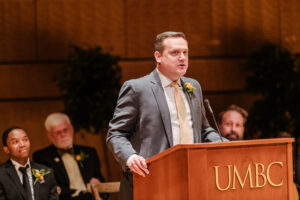
Each week during her student-facing office hours, UMBC President Valerie Sheares Ashby meets with students to chat about their lives and experiences at UMBC. Today, she’s speaking with Okechukwu Tabugbo ’25, computer engineering, president of UMBC’s Black Men’s Society, a group that provides mentorship, skills training, and community to students while trying to eliminate negative narratives and stigma around what it means to be a Black man in America.
Okechukwu Tabugbo: I found out about UMBC’s Black Men’s Society when I was in my first year. I knew Marvin Onwukwe, the club secretary at the time. He was always walking around campus smiling, and I would ask him, “Why are you smiling so much, Marvin?” He would say, “It’s because I have my life together. I have everything going for me. So what reason do I have to frown?” I would say, “Why do you have everything going for you?” He said, “Because I’m on top of my work. I can help you out, too. You should come to Black Men’s Society so that we can all be on top of our work.”
President Sheares Ashby: Oh, that is so good.
Tabugbo: But, in all honesty, I did not go to the first one. Then Amery Thompson…the current advisor, told me that I should come out, and I have to be honest, I did not go at that time either. [Laughs.] Then, finally, our current vice president, Israel Funmilayo…invited me, and he said, “It’s about financial literacy…I just need you to come out.” I looked at my bank account, and I said, “Okay.”
After getting there, I sat down. Amery was giving the introduction on financial literacy and telling us everything that we need to know. It honestly just made me feel at home and appreciated, the fact that someone took the time out of their day to teach me something that I constantly left on the back burner. I took that for what the club is.
I take it especially as a safe space for Black men on campus—to make them feel appreciated, to give them the time they need to grow in a world that rushes them so often. I appreciate the overall aspect of giving Black people on campus a space for professional development that they may not have had before and giving us a space to talk about issues surrounding the community. The Society allows everyone, despite their views, to be understood and to have time to understand others.
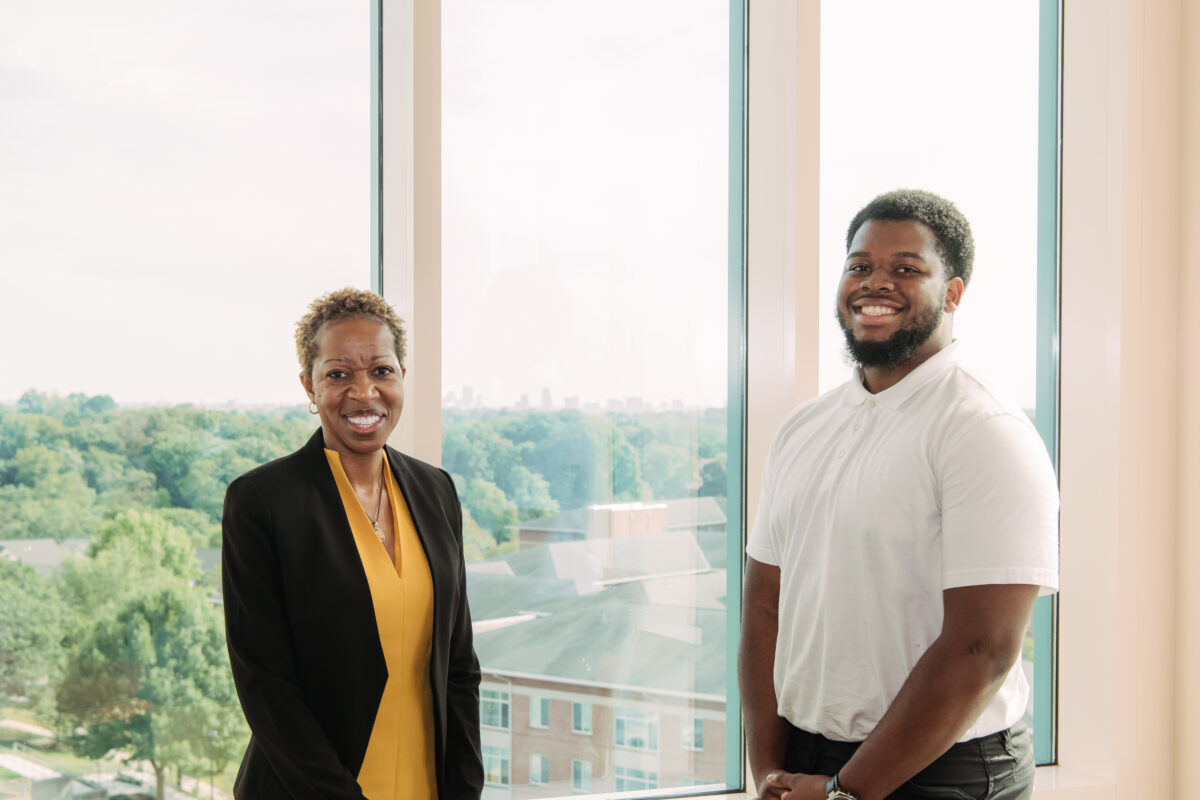 Sheares Ashby and Tabugbo pose on the 7th floor of the library. (Marlayna Demond ’11/UMBC)
Sheares Ashby: That is amazing. And what is so interesting to me is the mentorship of the more senior students to the younger students because I see it all the time. I see the senior students saying, “Hey, come on over here. This is where we are. This is what we’re doing. This is how we can support you.” They’re really living out the mentorship in ways that are so important. And it is so wonderful to see the younger students come in and then become those mentors to other people. I can see that growth even in a year.
Tabugbo: Exactly. And on that note of mentorship, that’s why we wanted to start moving toward outreach programs, especially to local high schools and middle schools. This effort is spearheaded by our secretary, Daniel Bajulaiye. If we can get to these students early and make them know that they’re appreciated, make them know that they can be heard, that will be important in fostering a good relationship, especially as they come into UMBC. Just letting people know that you’re there for them is so important because a lot of people, especially on this campus, don’t know their potential.
Sheares Ashby: I one hundred percent agree. One of the things I’m really excited about for UMBC is the work that we continue to do in Baltimore. We’re right here, and we know that there are a lot of Black men, young men, in Baltimore who would benefit. I don’t think too many Black men in Baltimore walk around feeling appreciated.
If we can get to these students early and make them know that they’re appreciated, make them know that they can be heard, that will be important in fostering a good relationship, especially as they come into UMBC.
Okechukwu Tabugbo ’25
Tabugbo: Even when I did get the role [as president of Black Men’s Society], I still had imposter syndrome. I didn’t truly feel I belonged until actually stepping into the shoes and having to take over. Talking to my brother all summer, the amount of encouragement he had to give me to say just, “You can do this. You are here for a reason.” Hearing it from Amery, hearing it from Israel, it took a lot to be able to have the confidence to come and do this again and again every day.
Sheares Ashby: Mentorship has always been important. Sometimes it just takes somebody to look at you and tell you, “I see you, and I think you’re pretty special,” or, “I see this gift or talent that you have,” and it can change somebody’s life just like that. I don’t know anybody who doesn’t need encouragement.
]]>
Each week during her student-facing office hours, UMBC President Valerie Sheares Ashby meets with students to chat about their lives and experiences at UMBC. Today, she’s speaking with Okechukwu...
https://umbc.edu/stories/office-hours-with-president-shears-ashby/
https://my3.my.umbc.edu/api/v0/pixel/news/137162/guest@my.umbc.edu/fb1a98339cc8ace85e30431255ecdccc/api/pixel
campus-life
coeit
computer-engineering
fall-2023
magazine
office-hours
perspectives
UMBC News & Magazine
https://my3.my.umbc.edu/groups/umbc-news-magazine
https://assets1-my.umbc.edu/system/shared/avatars/groups/000/001/943/24435aa6207c452e7bc15cc74b42c7bb/xsmall.png?1748556657
https://assets1-my.umbc.edu/system/shared/avatars/groups/000/001/943/24435aa6207c452e7bc15cc74b42c7bb/original.png?1748556657
https://assets2-my.umbc.edu/system/shared/avatars/groups/000/001/943/24435aa6207c452e7bc15cc74b42c7bb/xxlarge.png?1748556657
https://assets2-my.umbc.edu/system/shared/avatars/groups/000/001/943/24435aa6207c452e7bc15cc74b42c7bb/xlarge.png?1748556657
https://assets3-my.umbc.edu/system/shared/avatars/groups/000/001/943/24435aa6207c452e7bc15cc74b42c7bb/large.png?1748556657
https://assets1-my.umbc.edu/system/shared/avatars/groups/000/001/943/24435aa6207c452e7bc15cc74b42c7bb/medium.png?1748556657
https://assets2-my.umbc.edu/system/shared/avatars/groups/000/001/943/24435aa6207c452e7bc15cc74b42c7bb/small.png?1748556657
https://assets1-my.umbc.edu/system/shared/avatars/groups/000/001/943/24435aa6207c452e7bc15cc74b42c7bb/xsmall.png?1748556657
https://assets2-my.umbc.edu/system/shared/avatars/groups/000/001/943/24435aa6207c452e7bc15cc74b42c7bb/xxsmall.png?1748556657
UMBC News & Magazine
0
0
false
Fri, 17 Nov 2023 11:24:07 -0500
Fri, 17 Nov 2023 11:24:07 -0500
Grab a Seat at the Table

These days, it’s tempting to grow numb to the polarization of society and the breakdown in public discourse and to retreat into our silos of solidarity. But a liberal arts education has the potential to offer an antidote to these seemingly inevitable fates—through modeling and practicing empathy. At UMBC, students are invited to the table to share their stories and listen to their peers. These acts of educational hospitality help Retrievers find their why and pursue the public good.
Want weekly Top Stories sent to your inbox?

It’s the first day of class. You’re looking around, bright-eyed and a little nervous, and then your instructor smiles at the class and says, “One day you are all going to die.” Are you offended? Shocked? Titillated? Horrified? Collectively, the class titters. Already social bonds are forming as Christine Armstrong Mair, associate professor of sociology who specializes in gerontology, continues her spiel. “And if we’re all lucky, that won’t be for a long time.”
As sociologists, says Mair, or more broadly as leaders in an educational setting, “it’s not our task to make somebody think a certain way. Our task is to show them what exists in society and help them feel empathy for the human experience.”
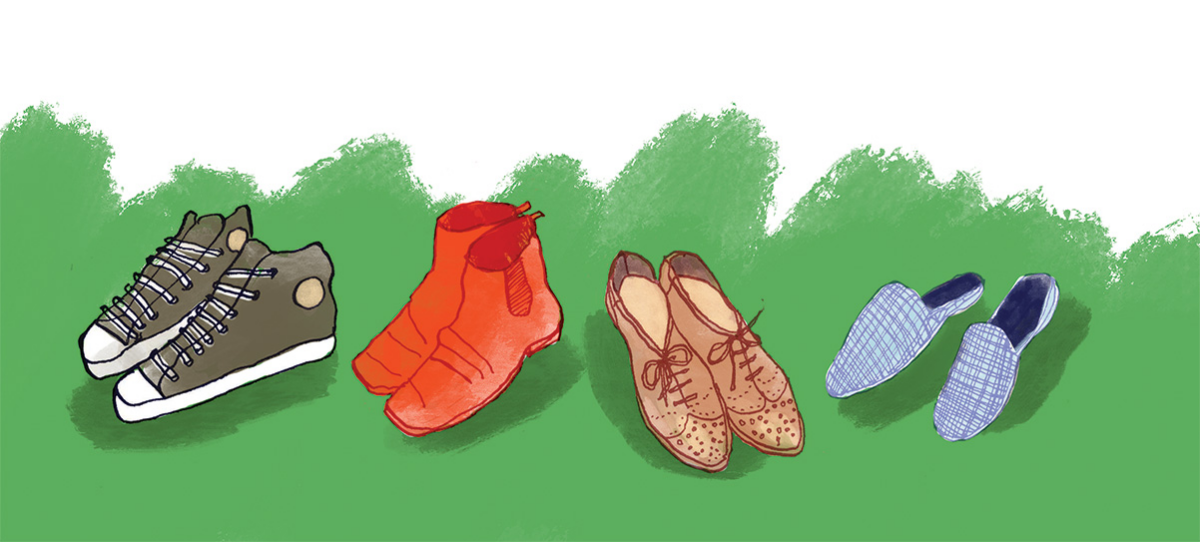
At its most pedestrian roots, empathy is putting yourself in someone else’s shoes. How can someone else’s emotional experience inform your own personal perspective?
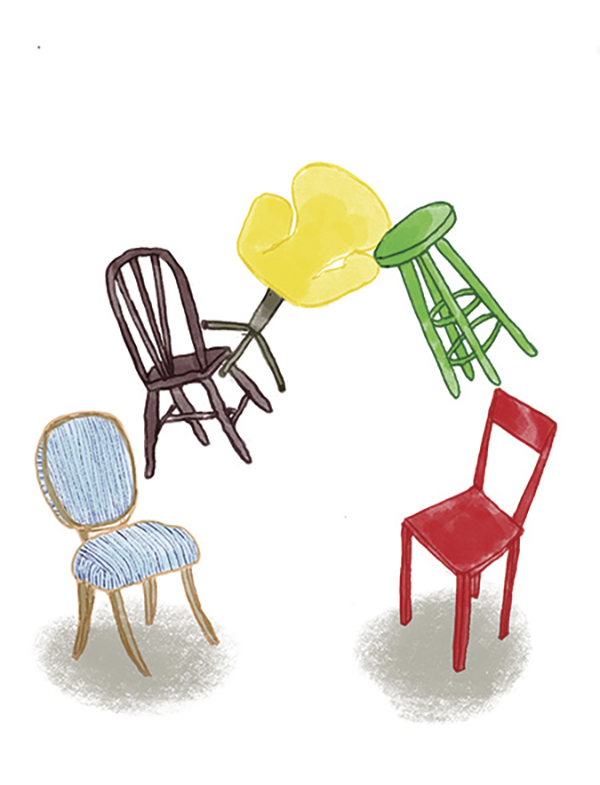
In the best-case scenario, a college campus is a microcosm of its society: a crosshatch of races, ages, and socio-economic backgrounds. And UMBC holds true to those measures. But something different happens when you step into the Loop—you sit next to someone who didn’t go to your high school. You eat at the same table with someone outside of your cultural background. You take a test side by side with someone who voted differently than you. And even more than sharing space, you start sharing notes and books and stories—even your own story—with these strangers and then suddenly they’re no longer strangers.
When empathy is on the table, students and colleagues expand their capacity for hard work. You might change your thesis to address human trafficking or leave your home island to work toward healthy aging for all populations. So pull up a chair, step into someone else’s shoes, and partake in this grand educational potluck.
“With my background—what I’ve seen with human trafficking and migrant smuggling—what can I do as a person with my knowledge and responsibility?”
– Saydeh Karabatis, Ph.D. candidate
Building bridges across campus
You’re sitting at a beach-side cafe in Greece with your husband. It’s 2015 and Greece’s financial troubles are in the news, but the waves of migrants washing ashore are not yet as publicized. As you enjoy your coffee, you see a group of 40 to 50 people sitting seemingly aimless and distraught nearby. Based on their clothing, you make a guess that they are Muslims and Arabic speakers. What do you do?
If you’re Saydeh Karabatis, originally from Lebanon—and a survivor of the 17-year Lebanon civil war—and fluent in Arabic, you let that immediate moment of empathy guide you and approach the group.
Karabatis and her husband George, a professor of information systems at UMBC and from Greece, changed the plans for their summer in the Mediterranean to volunteer as translators, food finders, and listeners for the refugees, primarily fleeing the war in Syria and arriving in Greece in dire straits. They did so again in 2017.
As Karabatis interacted with these desperate groups and read more about their plight, she realized familiar patterns were emerging in their stories. They were not just migrants fleeing a war, they were trafficked people, paying dearly for not-safe passage, and many others headed toward labor and a life they did not sign up for. Struck by the limits of her actions—and even her emotional capacity for empathy—when Karabatis returned home to Maryland, she found her next step.
Karabatis, who has a master’s in computer science from UMBC and works for the university’s Division of Information Technology, knew she would need to fill her time when her two sons left for college. Karabatis asked herself, “With my background—what I’ve seen with human trafficking and migrant smuggling—what can I do as a person with my knowledge and responsibility?”
She contacted Vandana Janeja, then chair of information systems, and explained the project she wanted to complete for her Ph.D. During her master’s, Karabatis had tried to conduct a research project on human trafficking for a class with Janeja but couldn’t find a robust data set to use for her project and ended up having to leave the work incomplete. This time, she pitched using the stories of trafficked people. “Instead of dealing with numbers, numbers as data, I am now dealing with stories as data—the stories of people being trafficked,” says Karabatis.
It’s not been easy going. Many trafficked people are not open about their stories, for fear of retribution or simply because of how horrific the experience was. Additionally, it’s hard for Karabatis to take in their trauma. “I’m reading about all these abuses,” says Karabatis. “I’m reading about sex trafficking, labor trafficking, organ trafficking, human smuggling. I can’t imagine—how can a human being do something like that to another human?”
Eventually though, with the end goal of combating the network of smuggling routes, Karabatis says, you need to reach a level where you can try to put your emotions aside: “You need to detach yourself from these emotions if you want to do something to help these people. If your emotions are the only thing driving you, you wouldn’t be able to produce the research. Use these emotions as a spark and then put them on the side.”
Caring starts with listening
You’re a teenager riding the bus for fun in Puerto Rico, killing time by people watching. You’re struck by the number of older adults on the bus, noticing their many bags stuffed with x-rays and other apparent medical paperwork. Unthinkingly, you just assume they’re enjoying the ride like yourself, but this older generation seems eager to talk.
If you’re Jaminette Nazario, a curious if bored high schooler, you strike up a conversation.
What she heard from her fellow travelers shook her: “‘We don’t have people to help….’ ‘My wife just died of cancer….’ ‘I need to use this bus to get to my medical appointments.’” It wasn’t until she was pursuing her bachelor’s degree in social sciences that Nazario was hit by the realization that those conversations might have been the only time those older bus riders had talked to someone that day. “So I started thinking about the many barriers older adults have in order to achieve healthy aging,” she says. “When older adults don’t have resources or people, they miss out on social networks that are vital to healthy aging.”
This aha moment would propel Nazario to a master’s degree in public health with a focus on gerontology, but in order to study further, she’d have to leave her island for the next academic step.
Now in her second year of UMBC’s Ph.D. program in gerontology—a joint program with the University of Maryland, Baltimore—Nazario is beginning to research aging Hispanic immigrants and their increasing challenges accessing medical care.
And unlike her fellow bus riders, she’s not doing this alone. “Even though it’s really hard to be far from family, I feel like I’m home here. And I love how Dr. Mair teaches.” Like most classes, says Nazario, there are readings and discussion, but Mair brings a “specific dynamic” to the setting. Each class starts with questions prepared by the students, which is really empowering, says Nazario. It might end up that the class all resonates with one question and they stay on that topic, guiding the trajectory of the discussion.
In summer 2022, Nazario joined Mair and others from the gerontology program at a conference in Japan. She presented a poster on her research and walked away from her talk with a new level of confidence. “There were professionals from Japan and China and they’re asking me about something in the United States…it was kind of cool. People came up and treated me with so much respect.”
Students in Mair’s gerontology classes are finding their drive to solve crises in aging care not only because they might have loved ones suffering, but because aging (if we’re lucky) and death are unifying elements. “It’s something that really applies to all of us,” says Mair, “to make sure that we’re taking care and setting up a good system so that when we all arrive there, that us and all of our people that we care about are okay.”
Inclusive classrooms by design
You walk to the front of the media and communications class you’re teaching. Students are sitting in traditional desks in rows, facing the whiteboard where you’ll teach. They’re silent, spaced out or on their phones. They seem to breathe a sigh of relief when you walk in, grateful to know where to put their attention. Later, in a different section of that class, you meet in a newly designed lecture hall filled with round tables and no clear lectern space. In this format, the students are already grouped together and chatting.
If you’re Donald Snyder, principal lecturer in media and communication studies, you know there is science behind what forms good class cohesion and participation. He learned it from the experts in UMBC’s Faculty Development Center (FDC).
In addition to learning about and playing around with classroom set-up to facilitate more natural conversations (and to rid the learning experience from a “perceived hierarchy” as FDC Director Linda Hodges calls it), Snyder and others who use the FDC are supported in using inclusive and culturally responsive teaching.
While culturally responsive pedagogy isn’t a new concept—it centers and nurtures students’ unique cultural strengths—Hodges says that recent world events have brought the teaching style more into focus. Citing the death of George Floyd and the nation’s response—especially young people—and the COVID-19 pandemic as two significant flashpoints, Hodges says inclusive pedagogy and empathetic practices have become more imperative than ever. Room design is just one tool in the FDC toolbelt that can work to democratize students’ experience. It can erase the divide between the front row handraiser and the back row hider, giving equal footing to all types of students and their stories.
“Instructors are recognizing that they need to try to connect with and hear their students’ voices,” says Hodges. “This will create a sense of belonging. It’s become quite clear in the research that one of the key factors in whether students succeed and persist in education is the feeling of belonging.”
Snyder has made the most of the FDC’s offerings, including inviting Hodges’ team to observe his teaching and offer feedback. He starts many of his classes with some tools for students to learn about self-regulation, basically how to use available resources to make the most of education. He introduces them to Bloom’s Taxonomy, which places rote memorization at the bottom of the pyramid and evaluating and creating a unique argument at top. “I want the students to know, I’m not asking to memorize anything,” says Snyder, “but we need to learn to be critical when we’re thinking about media and communication texts and how these things operate.”
Giving students tools to succeed in college—go to office hours, block out time for studying, get enough sleep—may seem basic and far afield from teaching and practicing empathy, but in the taxonomy of educational success, says Snyder, this foundation leads to the heavy-lifting tools at the top of the pyramid.
Snyder helps them harness existing interests, in tech or media, and then run with it, academically. He wants them to ask, “‘How can I turn that switch? What is the thing that I can grab onto? What do I really want to know about?’”
He also listens to them, and attempts to model vulnerability in the classroom. “Yes, these are students and they need to understand content, but they’re also humans who are struggling and we’re all struggling and there’s a human condition aspect we can’t ignore as instructors.”

Swapping stories strengthens neighborly bonds
You’re driving your car on tour in Texas when you’re hit by a criminally intoxicated drunk driver. You survive, but a host of physical and psychological repercussions are still taking their toll 10 years later. As a musician, you fuel your art with your resiliency and work through the healing process by creating music. But when the pandemic hits, and live, in-person music disappears, you look for a pivot point—and the community you’re missing.
If you’re Kristin Putchinski, a student in UMBC’s M.F.A. program for intermedia and digital arts, you lean into the concept of “platonic intimacy.”
Putchinski coined the term to sum up her goal of “trying to strengthen neighborly bonds. What I’m looking for is an intimate experience between two people. And when people hear intimacy, they tend to think that it’s about a romantic or sexual component. But how do I frame that intimacy—and how important intimacy is—in terms of friendship and neighborliness?”
Through a graduate assistantship jointly funded by jointly funded by UMBC and the University of Maryland, Baltimore’s Community Engagement Center (CEC), Putchinski was given the opportunity to shadow CEC’s then-director Tyrone Roper and learn about the center’s mission, which includes strengthening neighborly bonds. Roper told Putchinski they were looking for ways to engage the 18- to 24-year-old demographic. When Putchinski was tasked with creating an art project for CEC the following semester, she kept this age goal in mind.
As a student in UMBC’s intermedia program, Putchinski “explores the textures between mediums,” she says. As a musical artist who performed under the stage name ellen cherry, “I have 25 years of experience as a performing songwriter and storyteller, creating my own and interpreting other people’s stories.” So she began to imagine a strange game of telephone that would give participants the opportunity to swap stories, with the end result of creating instances of platonic intimacy.
This multifaceted project connected post-high-school-aged individuals with older generations through curated, facilitated sessions. The participant-pairs met four different times and talked about a song, a photograph, and a memory—and at the last session, the neighbors “swapped” their stories. A recording of the swap was sent to local artists who interpreted the stories into their own mediums—painting, poetry, and a video soundscape. Then, at an event open to the public in the CEC, the storytellers took the stage, retelling their neighbor’s story. For example, a Latinx college graduate took to the stage to reshare her stranger-turned-partner’s tale of being raised in foster care in 1970s Baltimore.
Putchinski was eager to find out “when you talk to somebody that’s 40 years different from you…did your perceptions change about yourself, about them, and what were those changes and the answers?”
It makes sense she’s asking these questions based on her ongoing empathy toward the man who altered her life in an accident 10 years ago. “It was very conflicting for me to be the victim of a crime that I really feel like was committed not by a criminal but by a person who abuses alcohol. At the base level, he’s a human being. How can we think about his human potential after this experience and mine?”
“Imagine intensely” a better way forward
One of the greatest assertions of the liberal arts comes from Percy Bysshe Shelley’s essay “A Defence of Poetry.” The short-lived husband of Frankenstein’s creator writes, “A man, to be greatly good, must imagine intensely and comprehensively; he must put himself in the place of another and of many others; the pains and pleasures of his species must become his own.”
On college campuses, and at UMBC in particular, through thoughtful classroom instruction and intentional commitment to community, students trade their stories—pains and pleasures alike. Less of a transaction and more of a gift, these stories are invitations to grow in understanding, change your opinion, or shape your research.
But walking in someone else’s shoes doesn’t mean you misplace your own shoes along the way—in fact professors hope it helps you find your footing at UMBC. “That open-mindedness and appreciation and empathy does not necessarily mean that you lose other parts of yourself,” says Anne Brodsky, professor and chair of the psychology department. “It shouldn’t be a zero-sum game.”
You’re walking down Academic Row. You’re a first-generation college student with a lot of questions. You’re a returning student giving college a second (or third) chance. You’re a first-year who misses the familiar halls of high school. You see other Retrievers walking in groups, heading into classrooms, rubbing True Grit’s bronze nose, making conversation with their peers. What do you do?
]]>
These days, it’s tempting to grow numb to the polarization of society and the breakdown in public discourse and to retreat into our silos of solidarity. But a liberal arts education has the...
https://umbc.edu/stories/grab-a-seat-at-the-table-empathy/
https://my3.my.umbc.edu/api/v0/pixel/news/137271/guest@my.umbc.edu/777eb34ff02b7fc72d1664adf771099a/api/pixel
campus-life
coeit
computer-science
fall-2023
feature
imda
information-systems
magazine
mcs
UMBC News & Magazine
https://my3.my.umbc.edu/groups/umbc-news-magazine
https://assets1-my.umbc.edu/system/shared/avatars/groups/000/001/943/24435aa6207c452e7bc15cc74b42c7bb/xsmall.png?1748556657
https://assets1-my.umbc.edu/system/shared/avatars/groups/000/001/943/24435aa6207c452e7bc15cc74b42c7bb/original.png?1748556657
https://assets2-my.umbc.edu/system/shared/avatars/groups/000/001/943/24435aa6207c452e7bc15cc74b42c7bb/xxlarge.png?1748556657
https://assets2-my.umbc.edu/system/shared/avatars/groups/000/001/943/24435aa6207c452e7bc15cc74b42c7bb/xlarge.png?1748556657
https://assets3-my.umbc.edu/system/shared/avatars/groups/000/001/943/24435aa6207c452e7bc15cc74b42c7bb/large.png?1748556657
https://assets1-my.umbc.edu/system/shared/avatars/groups/000/001/943/24435aa6207c452e7bc15cc74b42c7bb/medium.png?1748556657
https://assets2-my.umbc.edu/system/shared/avatars/groups/000/001/943/24435aa6207c452e7bc15cc74b42c7bb/small.png?1748556657
https://assets1-my.umbc.edu/system/shared/avatars/groups/000/001/943/24435aa6207c452e7bc15cc74b42c7bb/xsmall.png?1748556657
https://assets2-my.umbc.edu/system/shared/avatars/groups/000/001/943/24435aa6207c452e7bc15cc74b42c7bb/xxsmall.png?1748556657
UMBC News & Magazine
1
0
false
Wed, 15 Nov 2023 14:07:28 -0500
The long shot—4-time Olympian Cleopatra Borel ’02 inducted to Athletics Hall of Fame

Cleopatra Borel had no athletic aspirations when she arrived in Baltimore from Trinidad and Tobago in 1997. She enrolled at what was then Coppin State College on the advice of her high school math teacher, a Coppin alum. Powerfully built and an eager learner, Borel quickly developed in the throwing events and broke Coppin’s shot put record early in her tenure there.
After the Eagles’ coach left the program, UMBC offered Borel an athletic scholarship and she made the move to Hilltop Circle.
 Borel at a competition when she was a student. Photo courtesy of Borel.
Borel ’02, interdisciplinary studies, flourished both academically and athletically at UMBC. She earned All-America honors (top eight) in the shot put both indoors and outdoors in the 2000 – 01 season. However, she would have only one more crack at the NCAAs, with one year of indoor track and field eligibility remaining.
On March 9, 2002, Cleo, as she was known at UMBC, took to the shot put circle at the University of Arkansas. On her next-to-last throw, she uncorked a personal best of 17.50 meters (57’5”), putting her in first place. When the last shot had landed, the black-and-gold clad Retriever had outdistanced the field and captured UMBC’s first Division I national title.
In her first year of eligibility (2006 – 07), the UMBC Athletic Hall of Fame Committee tabbed Borel for induction. However, some events on her calendar kept getting in the way of her returning to campus—namely the 2004, 2008, 2012, and 2016 Olympics. At 37 years old, she produced her best finish, placing seventh at the 2016 Rio Games. Her final Olympic moment occurred as she served as Trinidad and Tobago’s flag bearer at the closing ceremonies.
Borel returned to the United States in January 2022 to coach the throwers at the University of Texas Rio Grande Valley. And, in October 2023, she finally made the journey back to Hilltop Circle to be inducted into the UMBC Athletics Hall of Fame.
We asked Borel to reflect on her incredible journey.
Q: You arrived at UMBC under unusual circumstances and remain the only Retriever to win an individual NCAA Championship. Reflecting on your time here, what did it mean for you to be a Retriever and how did your UMBC experience assist you in all of your endeavors?
Borel: I walked away from a very good situation at Coppin State College, not knowing how things would evolve at UMBC. However, I have to say, taking a chance on UMBC is still among the top three best decisions I have made thus far. My UMBC student-athlete experience prepared me for life as an Olympic athlete, essentially taking on the world.
I believe I was prepared to navigate life on the professional track and field circuit because of [UMBC Athletics Director] Dr. Charles Brown’s sports management class and because my event Coach Brian King and track and field Head Coach David Bobb ’97 taught me to work hard, be confident, and play to my strengths.
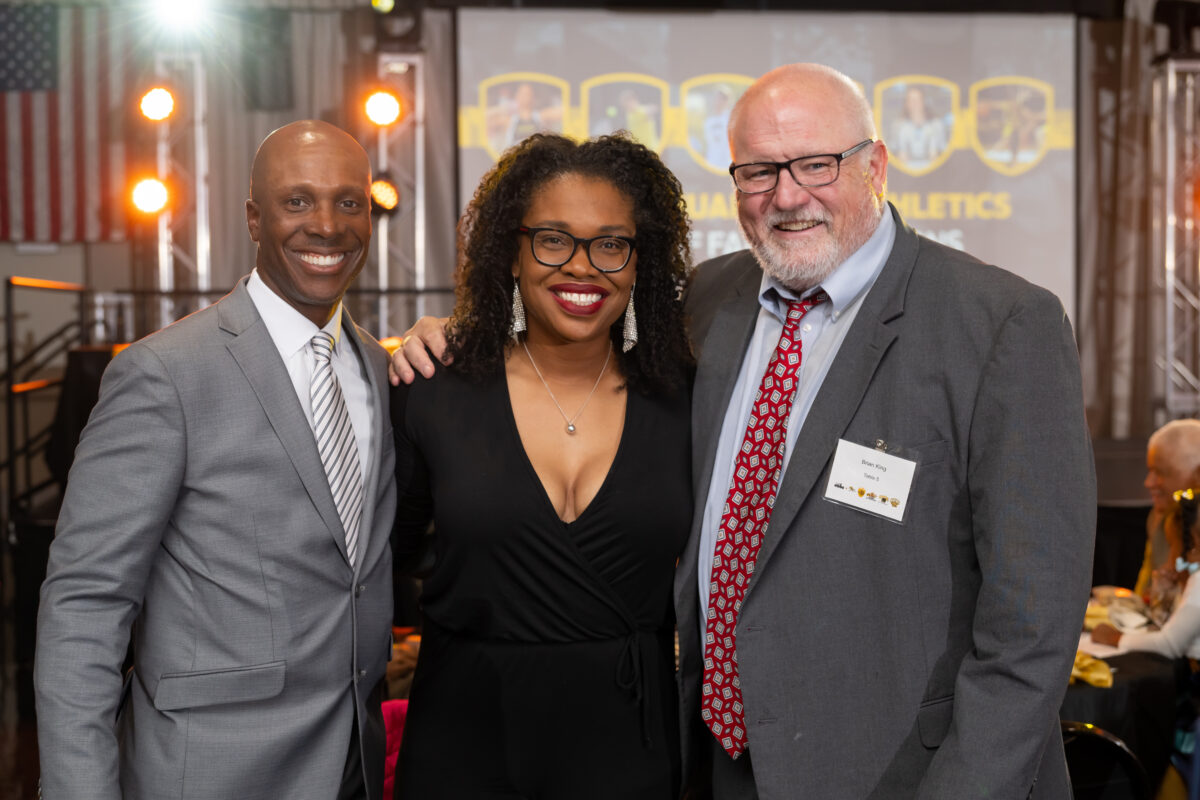 Left to right, David Bobb ’97, Borel, and Brian King. Photo by Max Franz for UMBC.
UMBC’s academic accomplishments, artistic expressions, community outreach initiatives, and of course athletic triumphs reflect the unwavering commitment we all share in making our school a truly exceptional place—a special place where a young person can take a chance and, through hard work and dedication, rise to the top of their field.
Q: What did it mean for you to represent Trinidad and Tobago in international competitions, including four Olympic Games?
Borel: Trinidad and Tobago is a small, developing nation in the Caribbean with a population of less than 1.4 million individuals on two islands. As a result, I felt like one of a few sporting ambassadors representing my country. I am proud to have been responsible for the playing of my national anthem at stadiums across the globe.
UMBC’s academic accomplishments, artistic expressions, community outreach initiatives, and of course athletic triumphs reflect the unwavering commitment we all share in making our school a truly exceptional place.
Cleopatra Borel ’02
Q: What prompted you to develop the Cleopatra Borel Foundation and what is its mission?
Borel: The mission of the Cleopatra Borel Foundation is to facilitate the development of youth through sport and education. We believe this can be accomplished at the grassroots level in Trinidad and Tobago by assisting with coaches’ education, gear, and equipment distribution.
Q: Anything else you would like to share with the UMBC community?
Borel: It was indeed an honor to represent you at the NCAAs and on a global level. I am a proud Retriever, excited to see how UMBC will continue to positively influence Maryland and the world.
 The 2023 Hall of Fame inductees included (left to right) Emily Escobedo, ’17, women’s swimming and diving; Pete Caringi III, ’15, men’s soccer; Brian Hodges, ’07, men’s basketball; Cornelia Carapcea, ’09, tennis and Cleopatra Borel, ’02 , track and field. Carlee Cassidy Dewey ’10, women’s basketball, could not attend for personal reasons and will be formally inducted in 2024. Photo by Max Franz for UMBC.
By Steve Levy ’85
]]>
Cleopatra Borel had no athletic aspirations when she arrived in Baltimore from Trinidad and Tobago in 1997. She enrolled at what was then Coppin State College on the advice of her high school math...
https://umbc.edu/stories/olympian-shot-put-cleopatra-borel-hall-of-fame/
https://my3.my.umbc.edu/api/v0/pixel/news/137085/guest@my.umbc.edu/be0c6305c621b5c05fcc162d2e4b26a5/api/pixel
alumni
at-play
athletics
fall-2023
inds
magazine
UMBC News & Magazine
https://my3.my.umbc.edu/groups/umbc-news-magazine
https://assets1-my.umbc.edu/system/shared/avatars/groups/000/001/943/24435aa6207c452e7bc15cc74b42c7bb/xsmall.png?1748556657
https://assets1-my.umbc.edu/system/shared/avatars/groups/000/001/943/24435aa6207c452e7bc15cc74b42c7bb/original.png?1748556657
https://assets2-my.umbc.edu/system/shared/avatars/groups/000/001/943/24435aa6207c452e7bc15cc74b42c7bb/xxlarge.png?1748556657
https://assets2-my.umbc.edu/system/shared/avatars/groups/000/001/943/24435aa6207c452e7bc15cc74b42c7bb/xlarge.png?1748556657
https://assets3-my.umbc.edu/system/shared/avatars/groups/000/001/943/24435aa6207c452e7bc15cc74b42c7bb/large.png?1748556657
https://assets1-my.umbc.edu/system/shared/avatars/groups/000/001/943/24435aa6207c452e7bc15cc74b42c7bb/medium.png?1748556657
https://assets2-my.umbc.edu/system/shared/avatars/groups/000/001/943/24435aa6207c452e7bc15cc74b42c7bb/small.png?1748556657
https://assets1-my.umbc.edu/system/shared/avatars/groups/000/001/943/24435aa6207c452e7bc15cc74b42c7bb/xsmall.png?1748556657
https://assets2-my.umbc.edu/system/shared/avatars/groups/000/001/943/24435aa6207c452e7bc15cc74b42c7bb/xxsmall.png?1748556657
UMBC News & Magazine
0
0
false
Tue, 14 Nov 2023 15:11:49 -0500
Tue, 14 Nov 2023 15:11:49 -0500
Biology department members create an experiment of note—a band called Fever Dream

Before you let your imagination run wild, we’re going to go ahead and temper whatever expectations you may have upon hearing the phrase “biology band.” Nobody is banging on a centrifuge in lieu of drums. Test tubes aren’t lined up as a makeshift xylophone. The final rock flourish is not a shattering of beakers. In fact, when the band members of Fever Dream get together, they leave biology in the lab and concentrate on what matters—the music.
“We are incredibly lucky to be able to do important research on the topics that we are interested in while at the same time being able to share our knowledge through teaching and mentoring students,” says Jeff Leips, professor of biological sciences.
“But our department also definitely embodies the motto of ‘work hard, play hard.’”
 Leips on the guitar and fellow biological sciences faculty member Steve Caruso on the drums. (Marlayna Demond ’11/UMBC)
“I’ve been involved with music my whole life and was actively looking for opportunities just like this, so it came at a perfect time,” said Michelle Moyer, M.S. ’22, a current biological sciences doctoral candidate. “I’m blown away by how much the idea has developed into a true passion project for all of us.”
The concept of a departmental band started simply enough. In his capacity as chair of the biology department “Fun Committee,” Leips asked around at his lab to see if anyone played an instrument and would be willing to play during their end-of-year departmental party. Leips joined the UMBC community in 2001 and this annual event has become one of his favorite traditions. The same year that Leips came to UMBC, he bought his first guitar.
Meet the band
Over the years, Leips has continued to gather a new musical cohort every few semesters with minimal practices and a one-time-only performance. While the revolving door of students each year allowed for new and exciting instruments to add to their sound, retention and growth were issues.
Last spring, Leips put out a call to see who would be interested in standing up a more permanent band, and soon his guitar and ukulele were joined by vocals, percussion, keys, and more.
Fever Dream is currently made up of biological sciences faculty member, Steve Caruso ’94, Ph.D. ’02, biology, on drums; Michelle Moyer, M.S. ’22 and a current biology doctoral candidate, on vocals and percussion; Ph.D. student Anthony Rosenthal ’20, biochemistry and molecular biology, on bass and harmonica; biochemistry doctoral candidate Winny Sun on keyboards and contributing vocals; Ryan Bacon ’23, biology doctoral candidate, on lead guitar; and Jeff Leips on guitar and vocals.
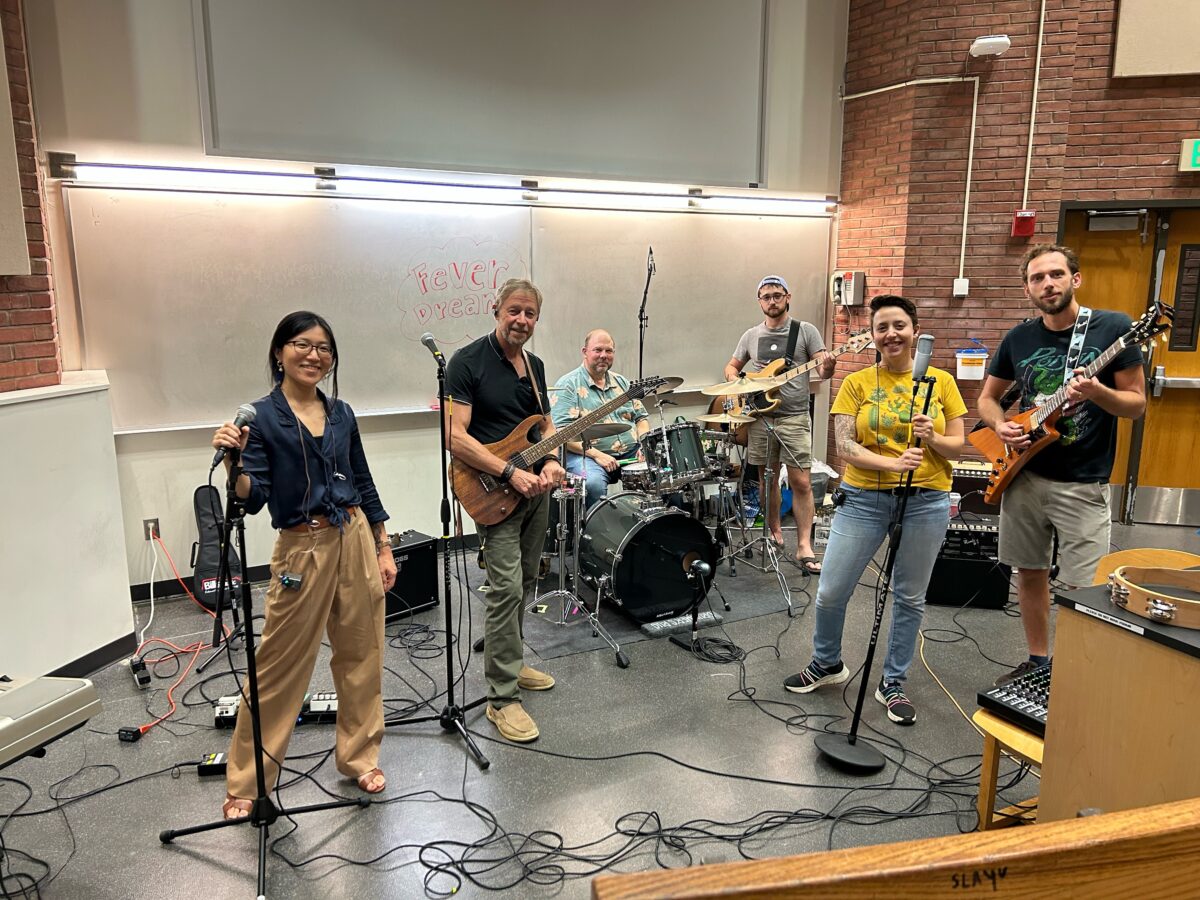 Left to right: Sun, Leips, Caruso, Rosenthal, Moyer, and Bacon. Photo courtesy of Chase Andre.
“I know Dr. Leips has previously labeled me as lead guitar, but I feel that might overpromise on my skill set! But it’s been a lot of fun,” says Ryan Bacon ’23, biology doctoral candidate, of his involvement.
While the group may have come together as a hodgepodge, their dedication was clear from the outset. “Anthony said he was just learning guitar, so I suggested that he learn bass. He borrowed the bass from our drummer and started playing and actually got pretty good, pretty fast,” said Leips.
In addition to jumping in feet first to learn how to actually play the instruments, the members of Fever Dream have also put in the time—upping their practice schedule to two nights a week, three hours per session—to make their ultimate goal of playing a show a reality.
The group works together to choose songs they think will speak to their skillset, with classics like “Piano Man” (with the added bonus of highlighting Rosenthal’s harmonica skills) and hits from Tom Petty and The Doors. But the students also become the teachers, introducing Leips to music he’s never heard of from bands like alt-J. The band is looking forward to showcasing their sound at a few biology department gatherings this semester and they’re kicking around the idea of potentially branching out to local venues.
It was all a (fever) dream
 Leips’ dog, Chiku, dreaming in front of the sound system. Photo courtesy of Leips.
And to answer your burning question—why the name Fever Dream? It’s both a bittersweet tribute to a dedicated fan and an explanation of their musical selections, which are “all over the place,” says Leips. When Leips first got his PA system, his dog Chiku would stand listening at the door. “If I made a mistake, she would look at me like she knew,” muses Leips.
After sharing a photo of Chiku visibly dreaming in front of the PA system, Leips’ pup became the band’s unofficial mascot. And when she sadly died, the group decided to make it permanent, inking her on their band shirts and settling into their official name.
Ultimately, the group is just glad to have found each other and have an outlet for their passion.
“When Jeff invited me to join a low-stakes, fun-oriented band, it seemed like a great idea,” said Caruso, who studies phage biology. “I’ve learned that while I really like playing the drums, I love playing with other people. Making music with people is just a wonderful kind of thing that people need to do to understand.”
]]>
Before you let your imagination run wild, we’re going to go ahead and temper whatever expectations you may have upon hearing the phrase “biology band.” Nobody is banging on a centrifuge in lieu of...
https://umbc.edu/stories/biology-experiment-of-note-fever-dream/
https://my3.my.umbc.edu/api/v0/pixel/news/136978/guest@my.umbc.edu/b4fcceef26c586180cda9914c966f413/api/pixel
at-play
biology
campus-life
cnms
fall-2023
magazine
UMBC News & Magazine
https://my3.my.umbc.edu/groups/umbc-news-magazine
https://assets1-my.umbc.edu/system/shared/avatars/groups/000/001/943/24435aa6207c452e7bc15cc74b42c7bb/xsmall.png?1748556657
https://assets1-my.umbc.edu/system/shared/avatars/groups/000/001/943/24435aa6207c452e7bc15cc74b42c7bb/original.png?1748556657
https://assets2-my.umbc.edu/system/shared/avatars/groups/000/001/943/24435aa6207c452e7bc15cc74b42c7bb/xxlarge.png?1748556657
https://assets2-my.umbc.edu/system/shared/avatars/groups/000/001/943/24435aa6207c452e7bc15cc74b42c7bb/xlarge.png?1748556657
https://assets3-my.umbc.edu/system/shared/avatars/groups/000/001/943/24435aa6207c452e7bc15cc74b42c7bb/large.png?1748556657
https://assets1-my.umbc.edu/system/shared/avatars/groups/000/001/943/24435aa6207c452e7bc15cc74b42c7bb/medium.png?1748556657
https://assets2-my.umbc.edu/system/shared/avatars/groups/000/001/943/24435aa6207c452e7bc15cc74b42c7bb/small.png?1748556657
https://assets1-my.umbc.edu/system/shared/avatars/groups/000/001/943/24435aa6207c452e7bc15cc74b42c7bb/xsmall.png?1748556657
https://assets2-my.umbc.edu/system/shared/avatars/groups/000/001/943/24435aa6207c452e7bc15cc74b42c7bb/xxsmall.png?1748556657
UMBC News & Magazine
2
0
false
Thu, 09 Nov 2023 17:01:50 -0500
Thu, 09 Nov 2023 17:01:50 -0500
How to plan a successful stage battle
Van Helsing straddles the vampire, brandishing her cross and wooden stake. The undead—mouth and shirt stained with blood—had just confessed to a brutal kill when the vampire slayer brings down her stake. A half second delayed, a comically small amount of blood spurts from the wooden prop. Van Helsing, played by Franchesca Parker ’25, acting, and the rest of the group in the theatre rehearsal space titter at the anticlimactic moment. Tessara Morgan Farley, production stage manager, and Sierra Young ’23, the fighting and intimacy director, immediately jump in to triage a better death for the vampire, Lucy (played by Liza Mupende ’25, action and information systems technology).
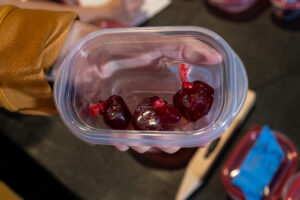
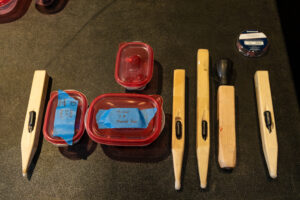
It’s stage blood rehearsal day for UMBC’s fall production of Dracula: a Feminist Revenge Fantasy, Really by Kate Hamill, directed by Kathryn Chase Bryer (running November 2 – 12). Snags like this are the reason the crew is spending four hours on a Monday evening trying out blood capsules, strawberries (aka, mini bags of stage blood), sponges loaded with blood dye, and grits mixed with edible stage blood for various effects on stage.
What does it take to pull off a veritable bloodbath on stage for six performances? That’s what this crew of staff and students aim to find out.
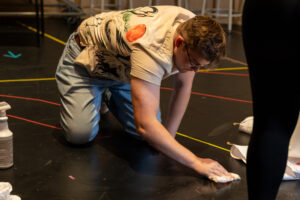
Left to right: Baggies of edible stage blood called strawberries; a crew member cleans the rehearsal floor during practice; various types of blood and props waiting for trial and error. (Kiirstn Pagan ’11/UMBC)
Tools of the Trade
1. 2,000 ounces of stage blood, some homemade, some bought
2. LOTS of baby wipes
3. Several mops and buckets
4. A taste for corn syrup
Step 1—Finding the right vein
For Morgan Farley and Emerson Balthis ’24, theatre design and production, assistant scenic designer and newly-christened stage blood mixologist, finding the perfect combination of purchased and homemade stage blood was a multi-month project. Several of the pressing questions at hand: Some of the blood needed to be edible—could they make it taste at least OK? Was anyone allergic to the substance? Most importantly, could it be washed out of the costumes every night? Oh yeah, and how to stay on budget?
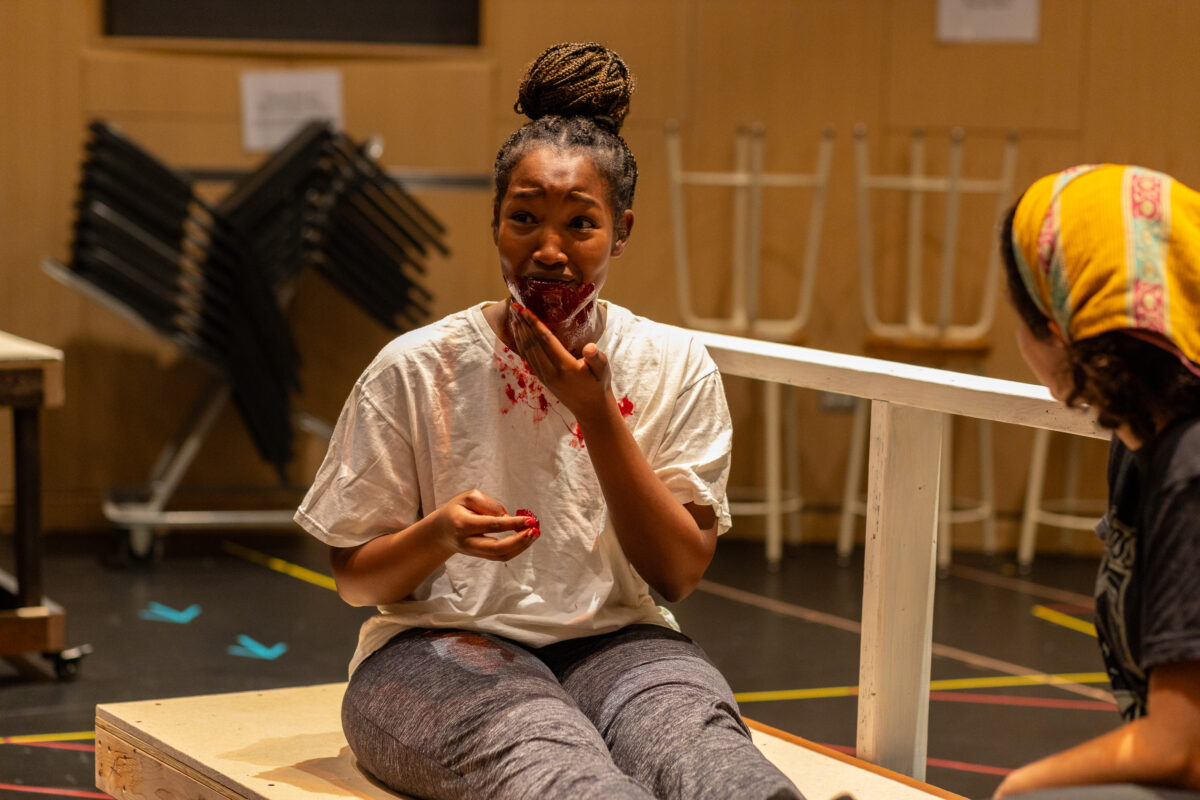 Liza Mupende as the vampire Lucy smears stage blood on her face and neck to get used to the texture in rehearsal. (Kiirstn Pagan ’11/UMBC)
“It’s going to be a bloodbath on stage,” says Morgan Farley, “but also not being too excessive to the point where it becomes funny. We’re trying to go more in the vein of reality versus comical, which also influenced our choice of color for blood. Of course, we were looking for washability, but we were also looking at the color and the viscosity.”
In order to stretch the budget, Morgan Farley and Balthis found ways to water down what they bought and manufacture the rest— simmering vats of chocolate syrup, corn syrup, food coloring, and various thickening agents dissolving into a viscous, sugary brew.
Step 2—Out damned spot
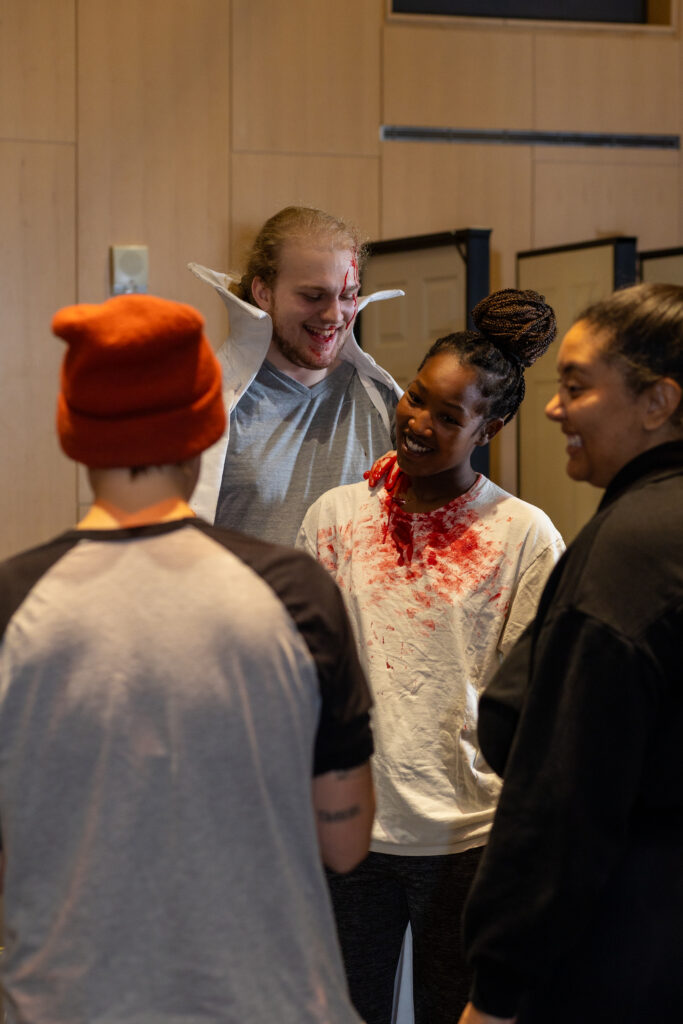 Dracula and Lucy are coached through a violent moment by Sierra Young, right, and Tessara Morgan Farley, left. (Kiirstn Pagan ’11/UMBC)
Moods are high, hands are stained red, and it’s obvious the student actors are having a blast (and most likely, a sugar high, based on the recipe). Standing in a six-foot-long pristine white cape—except for a few new blood smears—with a curved collar another foot high, Cece Smith ’24, acting, who plays Dracula, is nearly giggling with glee.
“I’m having so much fun,” says Smith. “I honestly don’t see a downside to the blood, even when it gets all sticky and nasty—it makes me feel pretty badass.”
Enter the people responsible for wardrobe and laundry: Margaret Caster, assistant costume shop manager and wardrobe supervisor, and Jennie Hardman ’23, theatre studies and environmental studies, wardrobe head for the show. While they could potentially see downsides galore, the duo is taking their tasks in stride.
“It was a little bit of ‘oh no,’ if I’m going to be honest,” says Hardman, who has worked on many UMBC shows in her time as a student, but this is her first as wardrobe head. “When you read the script, there is so much blood. So you think, ‘We’re going to do this with real red liquid. On white colored clothing. Oh boy, that’s going to be my problem, isn’t it!’”
“I’ve done blood shows before, so it’s not my first blood rodeo,” says Caster, “but I like to think of it like ‘How do you wrangle the blood?’ Because as you can see, it spreads everywhere. So my side is to think, ‘How can we contain it?’”
Their answer? Overnight soaks in Oxiclean and Shout spritzes for the tougher stains.
Step 3—Making the magic happen
In her role as an intimacy and fight director, Sierra Young has done vomit, has done other bodily fluids, has done blood—but never this much blood. Her job, as she puts it, “is to choreograph all of those big heightened moments so that they’re specific, repeatable, and narratively dynamic. And then give the actors tools to create a culture that is consent forward and trauma informed so they can feel secure in that space to create.”
In a feminist revenge fantasy based on Bram Stoker’s Dracula, unsurprisingly, there are a lot of opportunities for staging violence and intimacy, often at the same time. The added layer of Young’s already substantial task is designing the choreography so that the blood effects can be effectively masked.
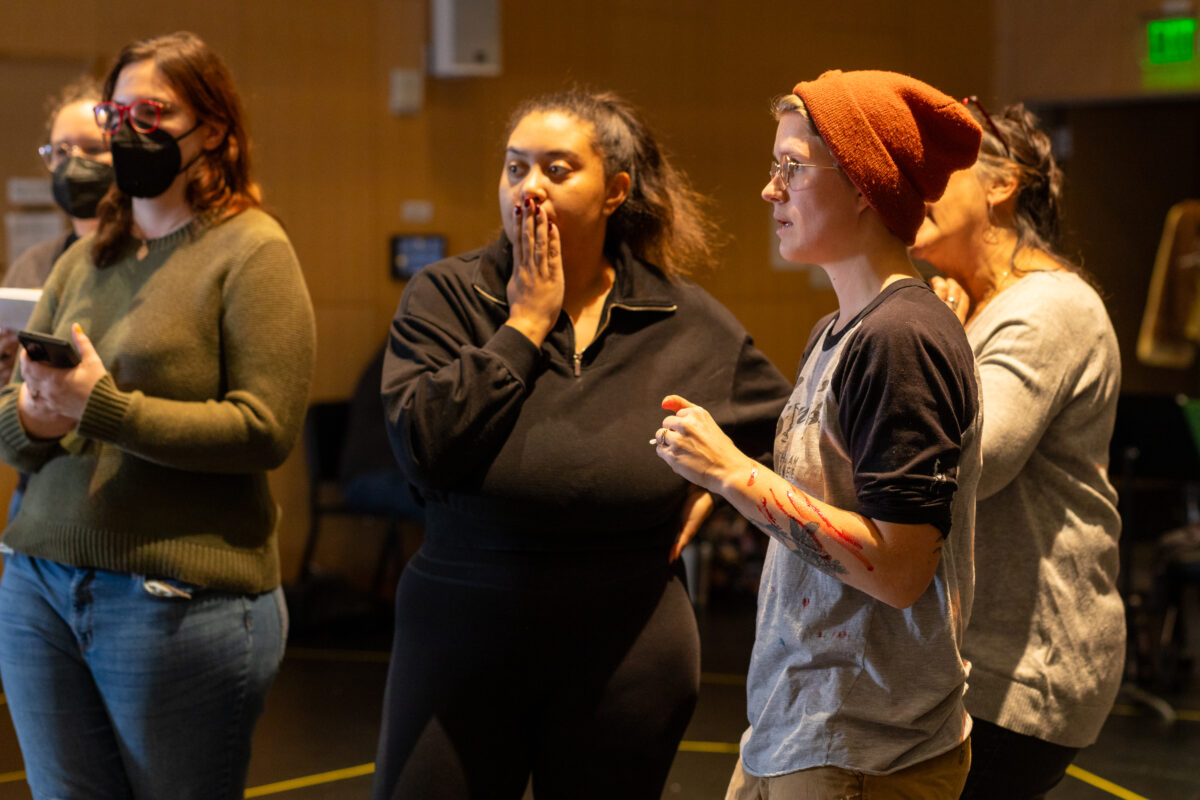 Sierra Young, center, and Tessara Morgan Farley, right, at rehearsal. (Kiirstn Pagan ’11/UMBC)
This means actors are subtly handing off blood capsules to each other, picking them up from behind stage props, or accessing them from hidden pockets. “In terms of choreography, how do I hide these things, because stage combat is the illusion of danger. It’s a lot of magic tricks and misdirection.”
“We’re doing this show on purpose,” adds Eve Muson, associate professor of theatre and chair of the Theatre Department at UMBC. “These extravagant elements are for teaching purposes.”
Step 4—In pursuit of a good death
Back to rehearsal and the problem of Van Helsing’s stake and the paltry amount of blood it produced. The actors, Parker and Mupende, are game to try any workarounds suggested by Morgan Farley and Young. They finally land on a blood strawberry that Parker-as-Van Helsing will place upstage of Mupende-as-the-vampire-Lucy.
While writhing after Van Helsing’s stab, Lucy puts the baggy of blood in her mouth and chomps down. She bends over to gasp her last undead breath, spewing the leftover plastic at the same time, looking as much like viscera as imaginable. The entire rehearsal space erupts in applause at the successful, bloody death.
]]>
Van Helsing straddles the vampire, brandishing her cross and wooden stake. The undead—mouth and shirt stained with blood—had just confessed to a brutal kill when the vampire slayer brings down her...
https://umbc.edu/stories/how-to-plan-a-successful-stage-battle/
https://my3.my.umbc.edu/api/v0/pixel/news/136787/guest@my.umbc.edu/3caf0334b520367b2d42ba587b782748/api/pixel
acting
cahss
campus-life
fall-2023
how-to
magazine
theatre
UMBC News & Magazine
https://my3.my.umbc.edu/groups/umbc-news-magazine
https://assets1-my.umbc.edu/system/shared/avatars/groups/000/001/943/24435aa6207c452e7bc15cc74b42c7bb/xsmall.png?1748556657
https://assets1-my.umbc.edu/system/shared/avatars/groups/000/001/943/24435aa6207c452e7bc15cc74b42c7bb/original.png?1748556657
https://assets2-my.umbc.edu/system/shared/avatars/groups/000/001/943/24435aa6207c452e7bc15cc74b42c7bb/xxlarge.png?1748556657
https://assets2-my.umbc.edu/system/shared/avatars/groups/000/001/943/24435aa6207c452e7bc15cc74b42c7bb/xlarge.png?1748556657
https://assets3-my.umbc.edu/system/shared/avatars/groups/000/001/943/24435aa6207c452e7bc15cc74b42c7bb/large.png?1748556657
https://assets1-my.umbc.edu/system/shared/avatars/groups/000/001/943/24435aa6207c452e7bc15cc74b42c7bb/medium.png?1748556657
https://assets2-my.umbc.edu/system/shared/avatars/groups/000/001/943/24435aa6207c452e7bc15cc74b42c7bb/small.png?1748556657
https://assets1-my.umbc.edu/system/shared/avatars/groups/000/001/943/24435aa6207c452e7bc15cc74b42c7bb/xsmall.png?1748556657
https://assets2-my.umbc.edu/system/shared/avatars/groups/000/001/943/24435aa6207c452e7bc15cc74b42c7bb/xxsmall.png?1748556657
UMBC News & Magazine
0
0
false
Fri, 03 Nov 2023 11:00:53 -0400
Fri, 03 Nov 2023 11:00:53 -0400
Alumni Awards 2023—Making impact through relationships

On the stage of the 35th annual Alumni Awards, awardees and their nominators repeated a shared theme: the freedom and flexibility to grow at UMBC—not alone—but in community.
Presented by the Alumni Association Board of Directors, the event recognizes inspiring alumni in a range of fields, as well as a rising star and an outstanding faculty and staff member. Rehana Shafi, recipient of the inaugural staff award, emphasized that she was only able to do so much “with so many.” Shafi, director emerita of the Sherman Teacher Scholars Program, said: “This work, this way, isn’t an individual endeavor….Impact happens inside of relationships.”
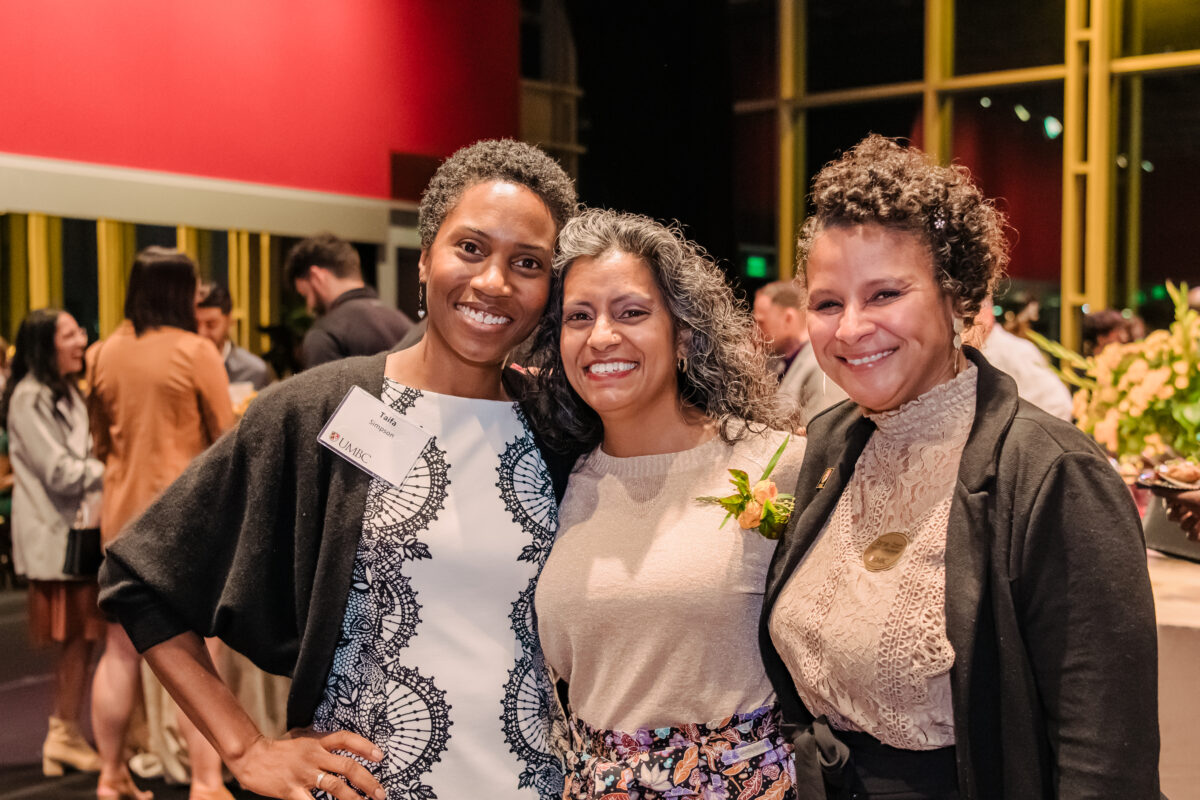 Taifa Simpson, former assistant director of MARC U*STAR, Rehana Shafi, and Stanyell Odom, director of Alumni Engagement at the 2023 Alumni Award reception. (Marlayna Demond ’11/UMBC)
The full circle moment
Several of the alumni recipients have come back to work at UMBC. Recipient of the Outstanding Engineering and Information Technology alumna award, Annica Wayman ’99, mechanical engineering, called it her “full circle” moment. Wayman, now associate dean for Shady Grove Affairs in the College of Natural and Mathematical Sciences, said, “Now that I’m on the ‘inside’ as a faculty member, it’s the same as I observed as a student and alumna—UMBC’s commitment to inclusive excellence, innovative teaching, and supportive community is authentic and I have the chance to see it every day working with UMBC faculty and staff.”
Annica Wayman ’99, left, and Josh Michael, right, speak at the 2023 Alumni Awards.
Josh Michael ’10, political science, Ph.D. ’22, public policy, found his why at UMBC. “I knew I was planted in the right place,” he said, “a place where I would evolve and grow…. It is here at UMBC where I developed a voice and confidence to lead in public education.” Michael, the awardee for Outstanding Alumnus in Social and Behavioral Sciences, is dedicated to public service and community engagement.
A former Baltimore City math teacher and now executive director of the Sherman Family Foundation, Michael took the opportunity on the stage to remind the audience, “For as a community, it is how we treat other people’s children that demonstrates our collective belief in our future.”
Creativity rooted in big ideas
Another teacher was honored for his long commitment to Maryland’s children. James Dorsey ’05, music technology and vocal performance, is in his 19th year as an elementary music teacher. He shared that, “All of our creativity is rooted in big ideas. Ideas that relate to our shared human experience and how we interact in our world.”
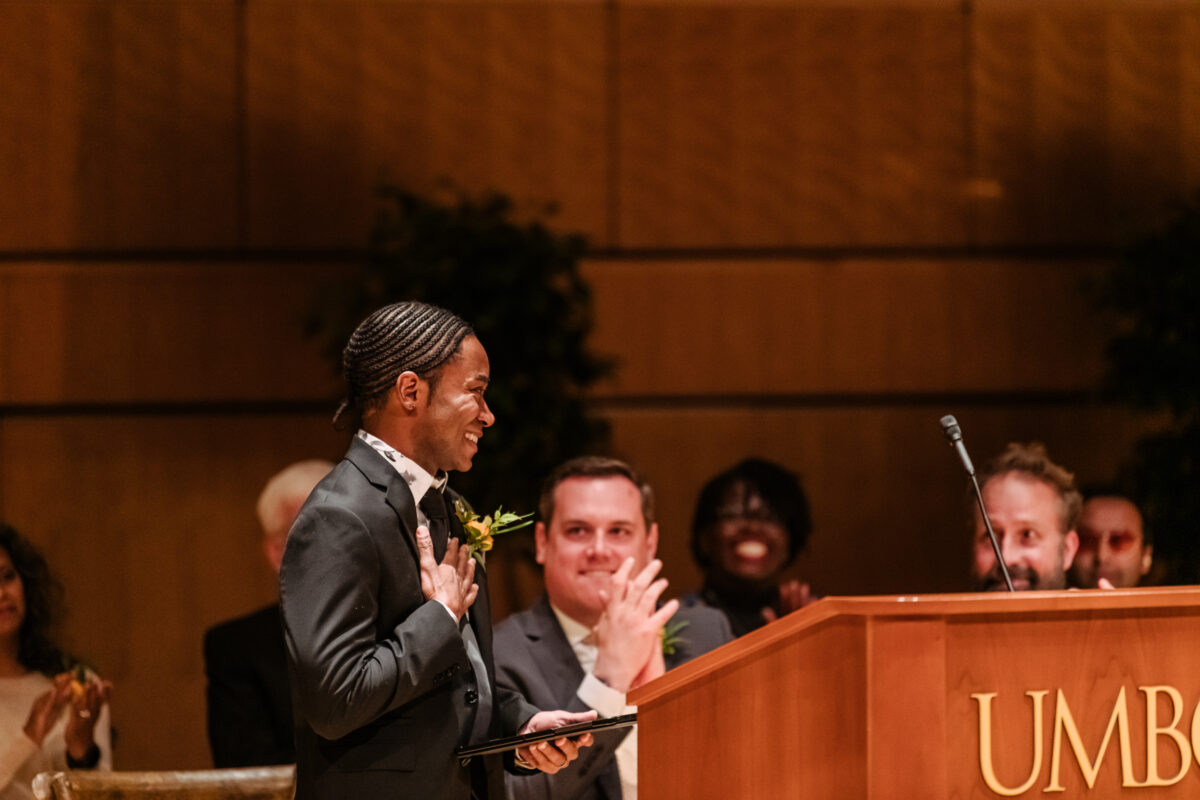 James Dorsey after giving his remarks at the 2023 Alumni Awards. (Marlayna Demond ’11/UMBC)
Dorsey, who received the award for Outstanding Alumnus in the Visual and Performing Arts, said, “I’m blessed to get to help students express their messages and respond to their cultures through creating. It sets a precedent that the arts are a natural way to respond to the issues of our community, self-expression, coping with change, and social justice.”
Other 2023 Outstanding Alumni awardees include: Humanities—Aaron Ralby ’05, English and modern languages and linguistics; and, Natural and Mathematical Sciences—Kay Bidle ’91, biological sciences. The Rising Star award was given to Asif Majid ’13, interdisciplinary studies, and the Outstanding Faculty award was presented to E.F. Charles LaBerge, Ph.D. ’03, professor of the practice in computer science and electrical engineering at UMBC.
]]>
On the stage of the 35th annual Alumni Awards, awardees and their nominators repeated a shared theme: the freedom and flexibility to grow at UMBC—not alone—but in community. Presented by the...
https://umbc.edu/stories/alumni-awards-making-impact-through-relationships/
https://my3.my.umbc.edu/api/v0/pixel/news/136729/guest@my.umbc.edu/e5045b2d07c000dd5467d178c9b199c2/api/pixel
alumni
alumni-awards
cahss
cnms
coeit
fall-2023
magazine
sherman-stem-teacher-scholars-program
UMBC News & Magazine
https://my3.my.umbc.edu/groups/umbc-news-magazine
https://assets1-my.umbc.edu/system/shared/avatars/groups/000/001/943/24435aa6207c452e7bc15cc74b42c7bb/xsmall.png?1748556657
https://assets1-my.umbc.edu/system/shared/avatars/groups/000/001/943/24435aa6207c452e7bc15cc74b42c7bb/original.png?1748556657
https://assets2-my.umbc.edu/system/shared/avatars/groups/000/001/943/24435aa6207c452e7bc15cc74b42c7bb/xxlarge.png?1748556657
https://assets2-my.umbc.edu/system/shared/avatars/groups/000/001/943/24435aa6207c452e7bc15cc74b42c7bb/xlarge.png?1748556657
https://assets3-my.umbc.edu/system/shared/avatars/groups/000/001/943/24435aa6207c452e7bc15cc74b42c7bb/large.png?1748556657
https://assets1-my.umbc.edu/system/shared/avatars/groups/000/001/943/24435aa6207c452e7bc15cc74b42c7bb/medium.png?1748556657
https://assets2-my.umbc.edu/system/shared/avatars/groups/000/001/943/24435aa6207c452e7bc15cc74b42c7bb/small.png?1748556657
https://assets1-my.umbc.edu/system/shared/avatars/groups/000/001/943/24435aa6207c452e7bc15cc74b42c7bb/xsmall.png?1748556657
https://assets2-my.umbc.edu/system/shared/avatars/groups/000/001/943/24435aa6207c452e7bc15cc74b42c7bb/xxsmall.png?1748556657
UMBC News & Magazine
0
0
false
Wed, 01 Nov 2023 12:56:42 -0400
Wed, 01 Nov 2023 12:56:42 -0400
Embarking on ‘Happily Ever After’

By Roni Rosenthal
For those who grew up—or still are—spellbound by movies like Beauty and the Beast, Toy Story, and The Lion King, you are part of what some historians dub the “Disney Generation.” Your childhood joins forces with a collective nostalgia that weaves Disney’s enchanting tales into our very own identities. In a country with many competing cultural icons, Disney—for better or worse—remains a singular unifying brand for anyone who spent their childhood in the U.S.
Smithsonian museum specialist and curator Bethanee Bemis ’09, history and anthropology, M.A. ’11, history, is an expert in weaving narratives with identity and a storyteller at heart. Her work shines best when married to her earliest passion—Disney.
Where the magic all started
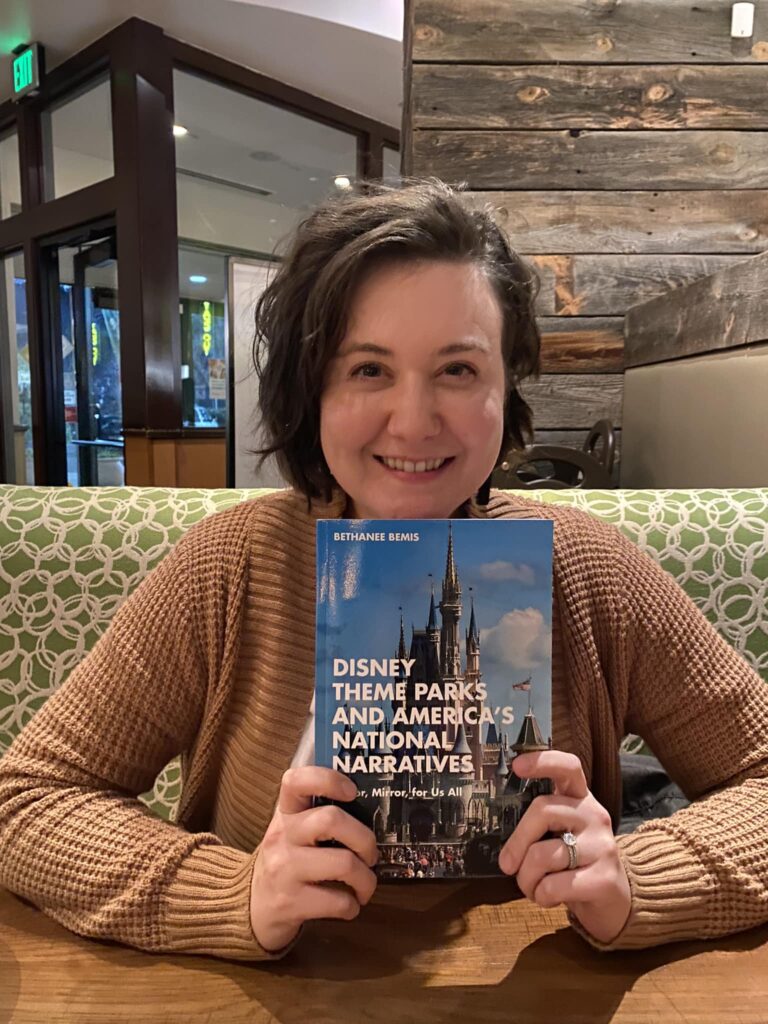 Bethanee Bemis holds up a copy of her book “Disney Theme Parks and America’s National Narratives.”
In her newly published book Disney Theme Parks and America’s National Narratives: Mirror, Mirror for Us All, Bemis shares her journey with Disney. She was brought home from the hospital to a Disney-themed nursery, went to Disney World at age two, and around that age, watched The Little Mermaid for the first time, marking her enchantment. Bemis acknowledges her mother’s infatuation with Disney World in the 1970s as the catalyst for her own passion and appreciation of the imaginary world.
This profound connection with Disney would eventually shape Bemis’ academic and then career path. During a recent installation of a Smithsonian exhibition on American democracy, Bemis recalls, “The central inquiry revolved around who holds the authority to narrate America’s tales. Must our collective narrative be uniform for national unity? Can such unity even exist? That’s when it hit me—Disney! Disney is the narrator of American stories.”
As the curator of the exhibit “Mirror, Mirror: Reflections of America in Disney Parks” at the National Museum of American History, Bemis explores Disney’s impact on American culture and reminds us of the significance of cultural artifacts like movies, dolls, and historical items. These artifacts can inspire conversations, challenge assumptions, and even drive change.
“A great way to launch”
Bemis used her time at UMBC to fuse her early fascination with storytelling and her dedication to exploring the intricate threads of history.
Reflecting on her UMBC days, she remembers the transformative role of Seth Messinger, then an associate professor of sociology and anthropology at UMBC. “Initially, I wasn’t sure what I wanted to do. Dr. Messinger, my undergraduate advisor, believed in me,” says Bemis. “He was convinced that I could achieve success with a little extra effort. He pushed me to go outside my comfort zone and grow, which I appreciated….Well, later on, not in the moment.”
 Bemis at graduation with her now husband, Benjamin D’Alessio ’10, M.S. ’11.
On campus, Bemis felt that she could unfold her wings and explore her interests. “I really appreciated how the community at UMBC was a safe space to experiment and think about the person I wanted to be when I finished college,” says Bemis, who met her husband Benjamin D’Alessio ’10, M.S. ’11, chemical engineering, when they were both grad students on campus. “It’s a lifetime community if you want it to be,” she smiles. “It’s not just a school.” Though only seven years old, her daughter already talks about being a Retriever someday.
With mentors like Messinger, Denise Meringolo, associate professor of history, and Amy Froide, professor and chair of history, Bemis found herself propelled beyond her comfort zone, guided to embrace challenges and expand her horizons. The influence of these educators was not confined to her university years; it stretched into the present day, with continued support and advice shaping her path.
Messinger, who has kept in touch with Bemis after they both moved on from UMBC, says Bemis has made him so proud. “In addition to taking my classes, she served as a research assistant for me. She’s very detail oriented and organized, as well as warm and kind as a person. I’ve loved watching her family and career flourish.”
Bemis’s journey through academia led her to a pivotal connection with the Smithsonian’s National Museum of American History. What began as an internship at the Smithsonian’s National Museum of American History grew into a career mission to uncover stories hidden within the museum’s vast collections. Over the years, she moved from intern to curator, specializing in political history and weaving narratives that resonate with the pulse of the nation.
In fact, she says, “I think that the key to finding success in my chosen field was internships and taking advantage of all the opportunities that UMBC provided as a student. Finding a job is often about who you know, and UMBC offers a safe space to grow your network. It is a great way to launch.”
Keep telling stories and making space
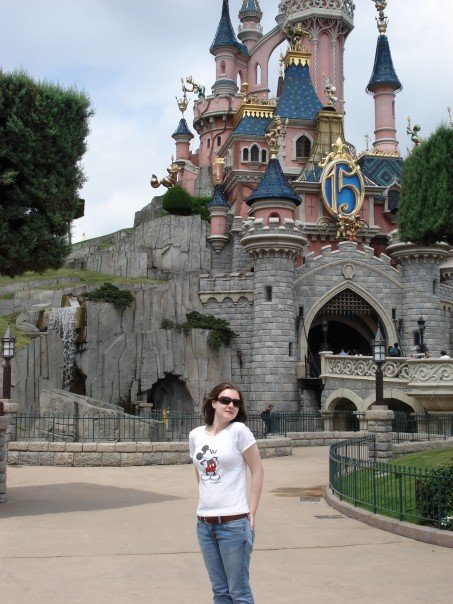 Bemis visited Disneyland, Paris, when she studied abroad.
In an era when entertainment is not just about escapism but also about challenging norms, forming identities, and prompting thought-provoking conversations, the Barbie movie emerges as a recent and unifying testament to the evolving storytelling landscape.
Although Barbie isn’t a Disney creation, Bemis says, “I think that our pop culture has always held the story of us. It isn’t just about entertainment; it’s a reflection of societal values, norms, and aspirations.”
Bemis is proud of her achievements but reminds us that “there’s so much more that needs to be done.” She plans to continue working in the public history field and to tell untold and uninvestigated stories, especially stories that are underrepresented in the public history field.
“We must keep telling the stories and make space in the museum for people to tell their own stories,” says Bemis. “I hope that whatever I do will contribute to that somehow.”
]]>
By Roni Rosenthal For those who grew up—or still are—spellbound by movies like Beauty and the Beast, Toy Story, and The Lion King, you are part of what some historians dub the “Disney...
https://umbc.edu/stories/embarking-on-happily-ever-after-disney-book/
https://my3.my.umbc.edu/api/v0/pixel/news/136487/guest@my.umbc.edu/310f3d20fafb2b6ad410a77a98f45bc9/api/pixel
alumni
alumni-profile
anthropology
cahss
fall-2023
history
magazine
UMBC News & Magazine
https://my3.my.umbc.edu/groups/umbc-news-magazine
https://assets1-my.umbc.edu/system/shared/avatars/groups/000/001/943/24435aa6207c452e7bc15cc74b42c7bb/xsmall.png?1748556657
https://assets1-my.umbc.edu/system/shared/avatars/groups/000/001/943/24435aa6207c452e7bc15cc74b42c7bb/original.png?1748556657
https://assets2-my.umbc.edu/system/shared/avatars/groups/000/001/943/24435aa6207c452e7bc15cc74b42c7bb/xxlarge.png?1748556657
https://assets2-my.umbc.edu/system/shared/avatars/groups/000/001/943/24435aa6207c452e7bc15cc74b42c7bb/xlarge.png?1748556657
https://assets3-my.umbc.edu/system/shared/avatars/groups/000/001/943/24435aa6207c452e7bc15cc74b42c7bb/large.png?1748556657
https://assets1-my.umbc.edu/system/shared/avatars/groups/000/001/943/24435aa6207c452e7bc15cc74b42c7bb/medium.png?1748556657
https://assets2-my.umbc.edu/system/shared/avatars/groups/000/001/943/24435aa6207c452e7bc15cc74b42c7bb/small.png?1748556657
https://assets1-my.umbc.edu/system/shared/avatars/groups/000/001/943/24435aa6207c452e7bc15cc74b42c7bb/xsmall.png?1748556657
https://assets2-my.umbc.edu/system/shared/avatars/groups/000/001/943/24435aa6207c452e7bc15cc74b42c7bb/xxsmall.png?1748556657
UMBC News & Magazine
0
0
false
Mon, 23 Oct 2023 13:09:17 -0400
Mon, 23 Oct 2023 13:09:17 -0400