UMBC researchers invent creative approach to remove dangerous pollutant from waterways
UMBC professors Kevin Sowers and Upal Ghosh have advanced a new technique to eliminate PCBs—one of the most persistent, pervasive, and dangerous chemical pollutants found in waterway sediments. Their innovative, environmentally-friendly approach, published in Environmental Science and Technology, resulted in reducing PCBs by over 50 percent in treated areas.
Sowers, a professor of marine biotechnology, and Ghosh, a professor of chemical, biochemical, and environmental engineering, had been working on PCB removal separately for years. Only recently did they realize their separate efforts could be combined to create a new, more-effective way to get rid of dangerous PCBs, even in ecologically sensitive or hard-to-reach areas, such as around piers and in fragile wetlands. Sowers and Ghosh have now formed a company, Rembac Environmental, to help bring their process to more areas that need PCB remediation.
From required to “remove it!”
PCBs were used extensively as fire retardants—and even required in some products—until they were banned in the U.S. in 1979 because of findings suggesting they might be neurotoxic, disrupt animals’ endocrine systems, and possibly cause cancer. Despite the fact that the ban has been in place for decades, PCBs still persist in sediments around the country, including in Chesapeake Bay. In the Mid-Atlantic, PCBs are the second most common reason for public advisories against consuming fish, just behind mercury.
“If they were to be left alone, PCBs would be in the sediments for decades, and depending on the level it could be a century,” says Sowers. “They’re very stable,” he adds. “That was their selling point.”
The best techniques to deal with PCBs are dredging, which physically removes the PCBs from the area (along with loads of sediment), and capping, which involves piling gravel on top of the sediment to keep the PCBs from interacting with aquatic life above. While each method has its place in the fight against PCB contamination, both are extremely costly, cannot be deployed in ecologically sensitive areas, and are not always effective.
People have tried for decades to develop and sell methods to remove PCBs from sediments biologically. Microorganisms that can break down PCBs occur naturally in sediment, and most efforts have focused on encouraging their populations to grow by adding cocktails of nutrients. None of those prior efforts worked especially well, and Sowers remembers hearing repeatedly that biological removal of PCBs was impossible, but he wasn’t quite ready to give up on the idea.
Never give up
“The technology itself started in the 1980s,” Sowers says, when officials were trying to show that naturally-occurring microbes alone could take care of PCBs in the Hudson River. The effort was not successful, because scientists couldn’t identify the specific microbes doing the work. In the mid-1990s, Sowers and another collaborator, Hal May at the Medical University of South Carolina, identified the species, and soon after that, they developed a method for growing them in the lab without sediment.
“Once we could isolate them, we could study them. We learned enough about them to scale them up and inject them back into sediment,” he says. And finally, about nine years ago, “We found that if we added them in high numbers, we could get rid of the PCBs.” Bingo.
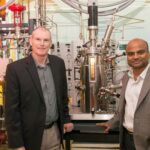
Upal Ghosh (left) and Kevin Sowers in Sowers’s lab at the Institute of Marine and Environmental Technology. Photo by Marlayna Demond ’11 for UMBC.
Well, almost. Sowers was still delivering the PCB-eating microbes to sediment set up in the lab. How could he inject the microbes over huge bodies of water in the real world?
Sowers’s microbes need to enter the sediment and settle there, not float around in the water. He needed a delivery method that was safe for sensitive areas, relatively quick, and ideally much less expensive than dredging or capping.
Collaboration opens doors
In parallel with Sowers’s work, Ghosh had also been working for years on PCB remediation, but he’d taken a different approach. He had developed pellets made of activated carbon. When the pellets enter the sediment, they bond tightly to PCBs.
“It doesn’t eliminate the PCBs, but it reduces the risk of PCBs getting into the food chain,” he explains. This, in turn, reduces the danger to aquatic life, and the need for fish consumption advisories.
Because carbon is one of the key building blocks of all life, it also wasn’t a significant environmental threat. Ghosh founded a company called Sediment Solutions to produce the pellets, known as SediMite. But it wasn’t until Ghosh and Sowers met that they realized their projects could complement each other.
“Working together allowed us to see the bottlenecks,” Ghosh says.
One breakthrough for the new team was figuring out why the naturally occurring PCB-eaters weren’t enough to have a substantial impact in bodies of water. As an environmental engineer, Ghosh dived into examining the energy balance in the sediment environment, and found it just wouldn’t facilitate growth of those populations in large enough numbers. “You need the microbes in higher levels to see PCB degradation happen in months, and not decades or centuries,” he explains.
With that realization, they began to see the tremendous potential of their partnership. Sowers could produce the microbes that could eliminate PCBs, and Ghosh had pellets that would settle into the sediment—a novel delivery mechanism for the microbes. “When we started working and talking together, we realized, ‘I can solve your problem and you can solve my problem,’” Ghosh says.
Scaling up
Their new publication is the result of the first field trial of the new combined technology. Sowers and Ghosh found a way to bind the microbes to the pellets, and sprayed them into a polluted body of water on the Quantico Marine Corps Base, which drains into the Potomac River. The Department of Defense funded the trial as part of its commitment to clean up PCB contamination at military bases.
The experiment was a success, showing not only that the method is effective at removing PCBs, but also that it didn’t negatively impact the local environment in any detectable way. Ghosh and Sowers also found that the plot treated with the combined microbes and pellets showed a greater reduction in PCBs than a plot treated with the carbon pellets alone. This is the first concrete evidence that a biological approach to removing PCBs can work if delivered in the right way.
Ghosh and Sowers hope the technique will become popular for use in sensitive and hard-to-reach areas. For now, their company is working with another biotech firm to produce the microbes at large scale, but as they take on more remediation projects, they hope to expand their company and start growing the organisms themselves, Sowers says.
It’s taken a long time to get to this point, partly because environmental work of this sort is scrutinized so heavily, “for good reasons,” Ghosh says. But now, Sowers adds, “The most exciting thing is seeing it out there in the field.”
Banner image: Kevin Sowers (left) and Upal Ghosh in Sowers’s lab at the Institute of Marine and Environmental Technology. Photo by Marlayna Demond ’11 for UMBC.
]]>
UMBC professors Kevin Sowers and Upal Ghosh have advanced a new technique to eliminate PCBs—one of the most persistent, pervasive, and dangerous chemical pollutants found in waterway sediments....https://umbc.edu/stories/umbc-researchers-invent-creative-approach-to-remove-dangerous-pollutant-from-waterways/https://my3.my.umbc.edu/api/v0/pixel/news/120168/guest@my.umbc.edu/d3c394b3e6772ff71c1366fbdd56b793/api/pixelcbeecirscacnmscoeitinterdisciplinarymarinebiotechresearchscience-and-technologyUMBC News & Magazinehttps://my3.my.umbc.edu/groups/umbc-news-magazinehttps://assets1-my.umbc.edu/system/shared/avatars/groups/000/001/943/24435aa6207c452e7bc15cc74b42c7bb/xsmall.png?1748556657https://assets1-my.umbc.edu/system/shared/avatars/groups/000/001/943/24435aa6207c452e7bc15cc74b42c7bb/original.png?1748556657https://assets2-my.umbc.edu/system/shared/avatars/groups/000/001/943/24435aa6207c452e7bc15cc74b42c7bb/xxlarge.png?1748556657https://assets2-my.umbc.edu/system/shared/avatars/groups/000/001/943/24435aa6207c452e7bc15cc74b42c7bb/xlarge.png?1748556657https://assets3-my.umbc.edu/system/shared/avatars/groups/000/001/943/24435aa6207c452e7bc15cc74b42c7bb/large.png?1748556657https://assets1-my.umbc.edu/system/shared/avatars/groups/000/001/943/24435aa6207c452e7bc15cc74b42c7bb/medium.png?1748556657https://assets2-my.umbc.edu/system/shared/avatars/groups/000/001/943/24435aa6207c452e7bc15cc74b42c7bb/small.png?1748556657https://assets1-my.umbc.edu/system/shared/avatars/groups/000/001/943/24435aa6207c452e7bc15cc74b42c7bb/xsmall.png?1748556657https://assets2-my.umbc.edu/system/shared/avatars/groups/000/001/943/24435aa6207c452e7bc15cc74b42c7bb/xxsmall.png?1748556657UMBC News & Magazine00falseWed, 10 Apr 2019 17:09:34 -0400UMBC Mock Trial takes 8th place at AMTA National Championship
UMBC Mock Trial has finished the most successful season in its eight-year history, placing eighth at the American Mock Trial Association National Championship Tournament in Philadelphia. This impressive ranking concludes a season where over 750 teams competed across the nation. Sophomore Sydney Gaskins received the All-American Attorney Award, the highest individual honor in college mock trial.
The team swept Penn State in the first round and tied with University of California, Berkeley and Columbia University in the second and third rounds, respectively. In the fourth round, UMBC fought Yale University, the eventual champion, to a draw, narrowly missing advancing to the final round.
Each round highlighted the team’s preparation and allowed for individuals to demonstrate expertise gained over a rigorous season. “I am so honored to make my community proud and represent not only our program but UMBC as a whole in such a positive way,” says Gaskins.
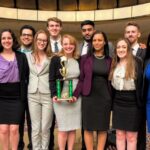
UMBC Mock Trial A-Team in front of Franklin Institute in Philadelphia.
UMBC’s leading Mock Trial A-Team includes Gaskins, ’21, political science;Linnea Collins ’21, global studies; Thomas Kiley ’21, chemistry; Ethan Hudson ’21, English; Natalie Murray ’21, biological sciences; Nihir Nanavaty ’19, political science; Thomas Azari‘21, individualized study, and Amrita Sarma ‘22, psychology. The team also included four non-competing alternates: Lauren Wotring ‘22, political science; Amanda Hampton‘22, biological science; Wendy Zhang ‘22, economics and psychology; and Kaitlyn Kauffman ’20, political science.
“In addition to earning an All-American Award at Nationals, Sydney earned two attorney awards at the national Opening Round Championship in 2019,” explains head coach Ben Garmoe, whoalso coached the first UMBC team to compete at nationals two years ago. “I lost count of how many coaches came up to me after the round and marveled at how Sydney is one of the greatest competitors they’ve ever seen. I am extremely proud of her and the team.”
Building success together
The UMBC Mock Trial program began in 2011. Ben Garmoe ’13, political science, a litigation attorney in Baltimore, co-founded the intellectual sports team with Travis Bell ’14, psychology and political science, a public defender in Alabama. Throughout the years the program’s success has drawn highly diverse, skilled, and committed student scholars, some of whom, like Garmoe, return as coaches during or after law school.
2017 UMBC Mock Trial members (l-r) Kayla Smith, Dylan Elliott, and Zuhair Riaz ’17, political science. Photo by Marlayna Demond ’11 for UMBC.
Current coaches include Summer Akhtar’18, financial economics and political science; Dylan Elliott ’17, history; and Kayla Smith’17, interdisciplinary studies, all members of the first UMBC Mock Trial team to go to nationals in 2017. Additional alumni coaches are Bell; Zachary Garmoe ’17, environmental studies; Jaedon Huie ’18, financial economics; andCheyenne Smith ’16, biological sciences and psychology.Whitney Whilder,an attorney at Bodey law firm in Baltimore City, also supports the team as a coach.
“As a competitor, qualifying for Nationals for the first time was incredible. UMBC Mock Trial was the underdog,” recalls Akhtar, now a student at the University of Maryland Francis King Carey School of Law. “That is no longer the case. As a coach, I am proud to see how students built a name for themselves as a formidable team competing and winning against the very best.”
Learning to manage challenges
For some A-Team members, the road to Philly began before UMBC. Hudson, Kiley, and Gaskins joined Mock Trial at Franklin High School. Hudson helped his team finish second out of over 120 teams in the 2016 state championship. He joined UMBC’s B-Team his freshman year and watched the A- team compete in Nationals in 2017. The following year Hudson earned a spot on the A-Team, and he was elected president two years later.
Mock Trial, for Hudson, is about following his dreams while managing severe anxiety. He says that his family, his teammates, and Garmoe have helped him to learn to manage his anxiety. “I take my victories where I can get them, day by day,” shares Hudson. “A win for me means being able to give a statement without twitches or body movements, or approaching someone whom I have anxiety to speak with.”
Hudson winning All-Region Attorney award at the 2019 regional competition.
His hard work has paid off tremendously. In addition to developing coping strategies and gaining confidence, he’s also been honored for his work on the team with an All-Region Attorney award at the 2019 regional competition.
Hudson also now shares his strategies with his teammates and his students as a coach for three high school Mock Trial teams. He plans to follow in Garmoe and Akhtar’s footsteps and give back to UMBC as a coach after law school.
Mock Trial also helped Gaskins persevere through difficult times in high school and college, and instilled in her a desire to be a lawyer. “I found my voice in high school mock trial when I felt I had nowhere to turn,” says Gaskins. “College mock trial is much harder. It helped me strengthen my voice as a self-assured woman and speak up against society’s biases about how women should act.”
Gaskins defending her case.
As Gaskins has gained confidence through the years, she has learned to enjoy and observe the impact of her performance, and to make calculated adjustments throughout the process.
“For me, this is like Division I sports,” Gaskins explains. “It’s extremely rigorous and competitive. Mock Trial demands a great deal of hard work, dedication, and commitment, to compete against some of the best teams and win. I always aim to win.”
Banner image: UMBC Mock Trial A-Team at AMTA 2019. All images courtesy of UMBC Mock Trial unless otherwise indicated.
]]>
UMBC Mock Trial has finished the most successful season in its eight-year history, placing eighth at the American Mock Trial Association National Championship Tournament in Philadelphia. This...https://umbc.edu/stories/umbc-mock-trial-takes-8th-place-at-amta-national-championship/https://my3.my.umbc.edu/api/v0/pixel/news/120172/guest@my.umbc.edu/6a4adde9649aac7e09b2053807ea26f7/api/pixelbiologycahsscnmseconomicsenglishglobalstudieshistoryindsinterdisciplinarypolicy-and-societypoliticalsciencepsychologyUMBC News & Magazinehttps://my3.my.umbc.edu/groups/umbc-news-magazinehttps://assets1-my.umbc.edu/system/shared/avatars/groups/000/001/943/24435aa6207c452e7bc15cc74b42c7bb/xsmall.png?1748556657https://assets1-my.umbc.edu/system/shared/avatars/groups/000/001/943/24435aa6207c452e7bc15cc74b42c7bb/original.png?1748556657https://assets2-my.umbc.edu/system/shared/avatars/groups/000/001/943/24435aa6207c452e7bc15cc74b42c7bb/xxlarge.png?1748556657https://assets2-my.umbc.edu/system/shared/avatars/groups/000/001/943/24435aa6207c452e7bc15cc74b42c7bb/xlarge.png?1748556657https://assets3-my.umbc.edu/system/shared/avatars/groups/000/001/943/24435aa6207c452e7bc15cc74b42c7bb/large.png?1748556657https://assets1-my.umbc.edu/system/shared/avatars/groups/000/001/943/24435aa6207c452e7bc15cc74b42c7bb/medium.png?1748556657https://assets2-my.umbc.edu/system/shared/avatars/groups/000/001/943/24435aa6207c452e7bc15cc74b42c7bb/small.png?1748556657https://assets1-my.umbc.edu/system/shared/avatars/groups/000/001/943/24435aa6207c452e7bc15cc74b42c7bb/xsmall.png?1748556657https://assets2-my.umbc.edu/system/shared/avatars/groups/000/001/943/24435aa6207c452e7bc15cc74b42c7bb/xxsmall.png?1748556657UMBC News & Magazine00falseTue, 09 Apr 2019 18:43:52 -0400UMBC Student Internship and Service Fund expands access to career-building experiences
Summer internships and service-learning offer college students experience and professional networks that can help them succeed in competitive career paths and graduate programs. UMBC prioritizes connecting students with paid internships whenever possible, and is successful in meeting this goal with 75 percent of placements. But not all organizations are able to offer paid internships, and this means that students with financial constraints may not be able to access career-advancing opportunities.
To tackle this roadblock, UMBC’s Career Center and Shriver Center partnered in 2018 to create the Student Internship and Service Fund to offer stipends to students interested in otherwise unpaid internship and service opportunities. The program launched a campaign through UMBC’s crowdfunding platform, Gritstarter, and generated enough support to offer six stipends in its first year, selected out of a highly competitive pool of 70 applicants.
“We are grateful to the alumni, UMBC community members, friends and family who donated to the Student Internship and Service Fund,” says Kacie Lawrence, associate director of internships and employment. “Their support made it possible for these students to pursue incredible summer opportunities, gain professional experience, and make an impact in their communities.”
Tyler Moore ’20
As a captain of UMBC women’s basketball team, Tyler Moore ’20, psychology, knows the importance of leadership skills. That’s why she took her talents to the Special Olympics Maryland (SOMD) this summer to help with their Athlete Leadership Program. Moore worked to redesign an online captain’s course to help athletes to get certified by SOMD.
“It allowed me to put what I know about leadership into a format that can be shared with others,” says Moore. “This not only enhances my own leadership skills, but gives me the opportunity to help those around me become leaders themselves.” She plans to apply this experience to a future career in sports psychology.
Emily Chetelat ’20. Photo courtesy of Chetelat.
Emily Chetelat ’20, interdisciplinary studies, spent her summer outdoors giving local students the opportunity to explore the environment. “SuperKids Camp aims to address the loss of academic skills that occurs when children lack access to academically enriching experiences during long breaks, known as the summer learning loss,” Chetelat explains.
This summer was Chetelat’s second time volunteering with SuperKids Camp, making the decision to return because she “found the experience to be incredibly enriching for both myself and the students I worked with.” The internship connected directly with Chetelat’s future career goal of helping to support Baltimore neighborhoods and increase children’s access to green spaces and environmental learning opportunities.
Laryssa Blanchard ’19
Laryssa Blanchard’19, psychology, began volunteering at Baltimore Animal Rescue and Care Shelter (BARCS) in fall 2017 as part of a service-learning experience, and she has continued her work there while exploring a possible career path in animal behavior.
“The Student Internship and Service Fund allowed me to be able to commute to and from the shelter two-three days a week, and made it possible for me to help BARCS during a time of the year when volunteers are scarce,” says Blanchard. “College students often struggle when it comes to wanting to give back to their communities, or taking on unpaid internship experiences, because as students we know that we need to finance our education in order to pursue our dream careers.”
Blanchard will continue working with BARCS as a student coordinator through UMBC’s Shriver Center this fall. She’ll be responsible for training and transporting a new cohort of service learners helping to guide prospective pet owners through the adoption process.
Samiksha Manjani ’19. Photo courtesy of Manjani.
Future prosecutor Samiksha Manjani ’19, political science and sociology, spent her summer in Washington D.C. interning for the Child Protection Section of the Family Services Division of the Office of the Attorney General.
“UMBC’s Student Internship and Service Fund allowed me to pursue an internship I cared deeply about,” says Manjani. “I was able to experience working in D.C. alongside attorneys and got to truly experience what working for the government would be like.”
Manjani was able to get a broad sense of each stage of a child welfare case, including the difficult processes of removing a child from a parent or guardian in cases of neglect and finding them a safe and secure home placement. In her role, she curated evidence, filed motions, and discovered facts that would help attorneys general build cases. In addition to gaining experience and skills, she developed relationships with mentors who will help her progress in her career.
Aubrey Livi ’19. Photo courtesy of Livi.
Aubrey Livi ’19, sociology and economics, returned to Brinkbit, Inc., a custom software development studio, for her second summer. Through an initial internship in 2017, Livi offered marketing support to the entrepreneurs behind the burgeoning company, but a year later, she says,“Because the company is still growing, they were only able to offer me an unpaid internship. I definitely wanted to return and work with them again, but I wasn’t sure if I could afford to.”
Seeing an opportunity through the fund, Livi applied and was granted a stipend to expand her work with the company. She spent several weeks creating original content, visuals, brand positioning, and design to help the local firm be competitive in a highly competitive sector. She hopes to pursue a career in market research.
Hello Dolly! set. Photo courtesy of Scott Sainz.
Scott Sainz ‘19, theatre, has been captivated by the Glyndon Area Players (GAP) since seeing their performance of The Little Mermaid in 2016. He didn’t even make it to the end of the show before tracking down the lighting designer and introducing himself. From there, Sainz began volunteering with the small theatre company in Reisterstown, Maryland, assisting with their next production from build to strike. When the opportunity arose to turn this experience into an internship for 2018, Sainz was intrigued but didn’t feel he would be able to commit to an unpaid summer.
“I think the problem UMBC Career Center and the Shriver Center recognized is that all unpaid interns grapple with the fact that unpaid often means sacrifice—sacrificing our apartments, credit, savings, and parents’ savings. For many of us, we aren’t only unpaid, but we lose money in transportation, supplies, and the potential to have a paycheck,” explains Sainz. “The question I was faced with is do I sacrifice everything for a career advancement, or do I stay at my paying job and sacrifice the career opportunities?”
With the help of the Student Internship and Service Fund, Sainz was able to pursue his theatre lighting ambitions, working start to finish on GAP’s summer production of Hello, Dolly! He earned hands-on experience and expanded technical knowledge in rigging, load calculation, genie lift practice, and other skills.
“I have spent my whole life wanting to control lighting for an audience and give them an experience they can’t forget,” Sainz shares. “I am confident that we did that this summer at GAP.”
“Contributions to the Student Internship and Service Fund broaden opportunities for our students to deepen their learning and make contributions in ways that might not have otherwise been possible,” says Lori Hardesty, associate director, applied learning and community engagement. “Generosity from students, faculty, staff, and alumni continue to make a difference for others.” For more information and to support this initiative, visit the fund’s Gritstarter page.
All photos by Marlayna Demond ’11 for UMBC unless otherwise noted.
]]>
Summer internships and service-learning offer college students experience and professional networks that can help them succeed in competitive career paths and graduate programs. UMBC prioritizes...https://umbc.edu/stories/umbc-student-internship-and-service-fund-expands-access-to-career-building-experiences/https://my3.my.umbc.edu/api/v0/pixel/news/120348/guest@my.umbc.edu/92e198a06e0d1c8d5da374471a1542d7/api/pixelcahsscommunityeconomicsinterdisciplinarypoliticalsciencepsychologysaphshrivercentertheatreUMBC News & Magazinehttps://my3.my.umbc.edu/groups/umbc-news-magazinehttps://assets1-my.umbc.edu/system/shared/avatars/groups/000/001/943/24435aa6207c452e7bc15cc74b42c7bb/xsmall.png?1748556657https://assets1-my.umbc.edu/system/shared/avatars/groups/000/001/943/24435aa6207c452e7bc15cc74b42c7bb/original.png?1748556657https://assets2-my.umbc.edu/system/shared/avatars/groups/000/001/943/24435aa6207c452e7bc15cc74b42c7bb/xxlarge.png?1748556657https://assets2-my.umbc.edu/system/shared/avatars/groups/000/001/943/24435aa6207c452e7bc15cc74b42c7bb/xlarge.png?1748556657https://assets3-my.umbc.edu/system/shared/avatars/groups/000/001/943/24435aa6207c452e7bc15cc74b42c7bb/large.png?1748556657https://assets1-my.umbc.edu/system/shared/avatars/groups/000/001/943/24435aa6207c452e7bc15cc74b42c7bb/medium.png?1748556657https://assets2-my.umbc.edu/system/shared/avatars/groups/000/001/943/24435aa6207c452e7bc15cc74b42c7bb/small.png?1748556657https://assets1-my.umbc.edu/system/shared/avatars/groups/000/001/943/24435aa6207c452e7bc15cc74b42c7bb/xsmall.png?1748556657https://assets2-my.umbc.edu/system/shared/avatars/groups/000/001/943/24435aa6207c452e7bc15cc74b42c7bb/xxsmall.png?1748556657UMBC News & Magazine00falseThu, 23 Aug 2018 20:49:08 -0400New CoLab Program Brings Interdisciplinary Approach to Summer Research
In piles on a table in the chilly back room of UMBC’s Special Collections office lie a science fiction lover’s dream: decades-worth of fanzines in all their hand-drawn, mimeographed glory. Compiled by amateur editors, they span topics from space travel to colonization to 1970s feminism.
Fittingly, the students poring over the zines as part of UMBC’s new month-long Interdisciplinary CoLab research program are just as different as the titles they explore. One studies biochemistry, another computer science. The third has interests in communications and gender and women’s studies, and was thrilled to find connections in the sci-fi zine Janus.
As it turns out, they say, bringing a variety of perspectives together results in an all new kind of inquiry.
“This took me out of my little box and really broadened what I thought research could be,” says junior biochemistry major Ashley Mitchell, who previously worked in a traditional laboratory setting. Together, her team studied a selection of the 15,000-plus titles in UMBC’s Coslet-Sapienza Fantasy and Science Fiction Fanzine Collection, and created an online exhibit of essays and videos.
“I fell in love with it, honestly,” she says, sifting through issues of the journals she grew to know well over the course of the month.
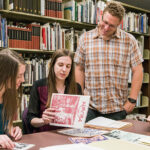
An array of titles from UMBC’s Coslet-Sapienza Fantasy and Science Fiction Fanzine Collection.
A New Kind of Research
Modeled after an interdisciplinary research program at Duke, and supported by the office of the Provost, the Interdisciplinary CoLab pilot brought together nine students for three research experiences: the Amazing Stories fanzine project; the Carbon Zero Project, which focused on ways of making UMBC a more environmentally sustainable community, and; Race and Social Justice, which centered on telling the stories of students in Baltimore city.
Each group had a set of goals to achieve, and received training in narrative-based humanities research practices before they started, said Carole McCann, professor and chair of gender and women’s studies, and head of UMBC’s Interdisciplinary Activities Advisory Committee.
“Here, students are learning things pertinent to their areas of study as well as outside their areas of study. They learn from each other about different tools and approaches based on their different disciplines,” she said, adding that the project-based structure also let students experience a professional work environment.
Donald Snyder, a lecturer in media and communication studies who oversaw the Amazing Stories group, enjoyed watching his students’ eyes open to the possibilities of what they might learn from the Albin O. Kuhn Library’s holdings. In fact, in the fall, he hopes to help the group present their work at the Mid-Atlantic Popular & American Culture Association conference in Baltimore.
“They all bring different strengths, different technical skills to it,” he said. “I’m very impressed with how they work together.”
Making a Difference on Campus
For The Carbon Zero Project, students interviewed a dozen campus stakeholders, and used the footage to create videos that will appear on the campus sustainability website to encourage the campus community to take individual steps that can build to create environmental impact.
“It shows that every single action, every move you make, really does add up,” said junior English major Kennedy Lamb, one of three students who shot and edited the videos on the topics of energy conservation, transportation, and waste reduction.
She and her colleagues said they each learned about things they can do personally to make the Earth a little cleaner, including using mass transit and carpool options, as well as recycling and composting in the dining hall.
“Hopefully people will be inspired by these videos and come together to make a difference,” she said.
Telling Untold Stories
A third CoLab group focused on Race and Social Justice in Baltimore city. They spoke with several young city residents about issues and values that matter to them, and what artifacts might represent them. In one case, a high school student shared a photo of her school’s trophy case, and talked about why it makes her proud.
Members of the Race and Social Justice CoLab group work on pulling their research together.
While out conducting interviews, junior information systems major Fikir Ejigineh noticed right away how her identity and actions might be perceived differently within different communities. Pointing a small, black handheld audio recorder at a subject might look innocuous in some contexts, but appear similar to a handgun in other situations, she said.
“Because of where I was, and because of my face and skin color, it made me more conscious of my actions,” she said.
The team used a software developed in UMBC’s Imaging Research Center to pull the artifacts they gathered – photos, videos, and short essays – together into a system that allows the user to roam a map and experience the stories as they travel across the digital landscape. Growing out of the map are tree-shaped pillars representing groups that offer support and connections for Baltimore youth, like UMBC’s Choice Program.
“Going out and viewing Baltimore through the eyes of the people who are doing work there was very powerful,” said senior media and communication studies major Michael Berardi, who, along with his colleagues, hopes to grow the collection of stories over time.
A close-up of the interactive tool members of the Race and Social Justice CoLab group used to present their research.
CoLab, Moving Forward
Given the success of this pilot year’s projects, McCann and others plan to expand CoLab next summer. The university community, as well as external partners and local groups, will have a chance to propose projects, she said.
“We hoped that the pilot would demonstrate the value of this program for UMBC students,” she said. “And the students did a great job. The final projects were superb.”
]]>
In piles on a table in the chilly back room of UMBC’s Special Collections office lie a science fiction lover’s dream: decades-worth of fanzines in all their hand-drawn, mimeographed glory....https://umbc.edu/stories/new-colab-program-brings-interdisciplinary-approach-to-summer-research/https://my3.my.umbc.edu/api/v0/pixel/news/120370/guest@my.umbc.edu/d7630035b2b66415fbe9a5e54bed8f8e/api/pixelcahsscnmscoeitcolabdiscoveryinterdisciplinaryUMBC News & Magazinehttps://my3.my.umbc.edu/groups/umbc-news-magazinehttps://assets1-my.umbc.edu/system/shared/avatars/groups/000/001/943/24435aa6207c452e7bc15cc74b42c7bb/xsmall.png?1748556657https://assets1-my.umbc.edu/system/shared/avatars/groups/000/001/943/24435aa6207c452e7bc15cc74b42c7bb/original.png?1748556657https://assets2-my.umbc.edu/system/shared/avatars/groups/000/001/943/24435aa6207c452e7bc15cc74b42c7bb/xxlarge.png?1748556657https://assets2-my.umbc.edu/system/shared/avatars/groups/000/001/943/24435aa6207c452e7bc15cc74b42c7bb/xlarge.png?1748556657https://assets3-my.umbc.edu/system/shared/avatars/groups/000/001/943/24435aa6207c452e7bc15cc74b42c7bb/large.png?1748556657https://assets1-my.umbc.edu/system/shared/avatars/groups/000/001/943/24435aa6207c452e7bc15cc74b42c7bb/medium.png?1748556657https://assets2-my.umbc.edu/system/shared/avatars/groups/000/001/943/24435aa6207c452e7bc15cc74b42c7bb/small.png?1748556657https://assets1-my.umbc.edu/system/shared/avatars/groups/000/001/943/24435aa6207c452e7bc15cc74b42c7bb/xsmall.png?1748556657https://assets2-my.umbc.edu/system/shared/avatars/groups/000/001/943/24435aa6207c452e7bc15cc74b42c7bb/xxsmall.png?1748556657UMBC News & Magazine00falseMon, 23 Jul 2018 13:27:41 -0400UMBC health justice research forum focuses on the value of community voices
The forum was the fourth in a series organized by UMBC’s Office of the Vice President for Research to bring together faculty tackling shared topics from widely diverse angles. “We established the research forum series in 2014 to provide an opportunity for scientists and scholars to collaboratively explore multiple facets of a topic central to the research and scholarship of UMBC,” says Karl Steiner, vice president for research. Previous forum focus areas include high-performance computing, climate change and the environment, and the visualization of science.
UMBC’s Dresher Center for the Humanities sponsored and helped organize the latest forum, focused on how the humanities can help address challenges related to health care access. Dresher Center Director Jessica Berman shared, “It was exciting to see how much humanistic scholarship is taking place all across campus and the potential partnerships it creates, between UMBC and other universities. This research forum helped to highlight the humanities in their capacity not only to ask good questions but also to help solve important problems such as health justice and access.”
Racism in Health Care Policy
Keynote speaker Graham Mooney, professor in the Institute of the History of Medicine at Johns Hopkins University, presented his research on the Baltimore Medical Care Plan of 1948. “By using the history of medicine and public policy we can better understand how the process of racism and segregation have interacted to prevent black residents’ access to quality medical care in Baltimore,” explained Mooney.
Graham Mooney, professor in the Institute of the History of Medicine at Johns Hopkins University
The topic led to an interactive conversation about the negative impact the 1948 plan had on the quality of life of Baltimore’s black community and how it served as a model for similar approaches in other states, and later for Medicare and Medicaid. During the discussion, Shawn Bediako, associate professor of psychology, argued that analyses of health care access across U.S. history should also include how black communities have responded to inequities. He mentioned, as examples, the establishment of the National Negro Health Movement and Office of Negro Health Work.
Shawn Bediako, associate professor of psychology
Listening to Communities
Valuing community voices was a key theme in the two interdisciplinary panel discussions that followed. These discussions revealed how key humanities methods, such as attending to history, paying attention to narrative—including who gets to speak and when—and thinking critically about how we understand and value specific human experiences can be crucial to addressing issues important to contemporary public life.
In the first of those panels, Kristen Slesar, from the Narrative Medicine Program at Columbia University, shared her experience using personal narratives to inform medical research. Slesar is a licensed clinical social worker and psychotherapist who focuses on child trauma. She regularly teaches about health care justice and health care for underserved communities.
Scott Casper, dean of the College of arts, humanities, and social sciences (CAHSS), then moderated a discussion on “Listening as Public Practice: Towards Equity and Justice” that included Bediako as well as colleagues Drew Holladay, assistant professor of English; Amy Hurst, associate professor of information systems; and Denise Meringolo, associate professor of history. The panelists explored how centering the narratives of individuals in their research improves the quality of their findings and the potential impact of their work. “Confronting the barriers to health equity compels us to look across disciplines and toward collaborations among social scientists, scientists and engineers, and humanists and artists,” noted Casper.
(L to R) Dean Casper, Kristen Slesar, Shawn Bediako, Drew Holladay, Amy Hurst, and Denise Meringolo.
Lawrence Brown, assistant professor of community health and policy at Morgan State University, spoke during the second panel about the impacts of residential displacement and financial disinvestment on community health. In addition to his work on the impact of historical trauma on community health, he also leads the student-driven #BmoreLEADfree project focused on ending lead poisoning in Baltimore.
Berman then led a group discussion on the topic “Communication, the Urban Environment, and Health Justice,” with Dena Aufseeser, assistant professor of geography and environmental systems; Katherine Bankole-Medina, professor of history at Coppin State University; Dawn Biehler, associate professor of geography and environmental systems; and Jennifer Maher, associate professor of English. The discussion showed how paying attention to the ways local communities understand issues of health and the environment can challenge the kinds of changes we propose and the ways we communicate about them.
New Health Equity Collaborative
The forum also introduced UMBC’s new Collaborative for the Interdisciplinary Promotion of Health Equity Research (CIPHER). The collaborative will form working groups bringing together UMBC researchers across different fields to examine current challenges to health care equity, and to inform innovative solutions for the future.
Bediako, whose research focuses on health care inequities experienced by patients with sickle cell disease, will serve as the founding convener of this initiative. He shares, “I am most excited that CIPHER will aim to reach across disciplinary boundaries and use multiple perspectives to address specific challenges to health equity.”
Banner image: (L to R) Courtney C. Hobson M.A.’14, history, coordinator for the Dresher Center; Karl Steiner; Rachel Brubaker M.A. ’00, history, assistant director for grants and program development for the Dresher Center; Don Engel, assistant vice president for research; Scott Casper; and Jessica Berman. All photos by Kait McCaffrey for UMBC.
]]>
How does unequal access to health care affect the lives and experiences of people from different communities across Baltimore and the nation? UMBC’s Public Humanities and Health Justice Research...https://umbc.edu/stories/umbc-health-justice-research-forum-focuses-on-the-value-of-community-voices/https://my3.my.umbc.edu/api/v0/pixel/news/120404/guest@my.umbc.edu/37df09496e22a201c580854e4d92402a/api/pixelcahsscnmscoeitdiversityandinclusiondreshercenterenglishgeshistoryinterdisciplinaryispolicy-and-societypsychologyresearchUMBC News & Magazinehttps://my3.my.umbc.edu/groups/umbc-news-magazinehttps://assets1-my.umbc.edu/system/shared/avatars/groups/000/001/943/24435aa6207c452e7bc15cc74b42c7bb/xsmall.png?1748556657https://assets1-my.umbc.edu/system/shared/avatars/groups/000/001/943/24435aa6207c452e7bc15cc74b42c7bb/original.png?1748556657https://assets2-my.umbc.edu/system/shared/avatars/groups/000/001/943/24435aa6207c452e7bc15cc74b42c7bb/xxlarge.png?1748556657https://assets2-my.umbc.edu/system/shared/avatars/groups/000/001/943/24435aa6207c452e7bc15cc74b42c7bb/xlarge.png?1748556657https://assets3-my.umbc.edu/system/shared/avatars/groups/000/001/943/24435aa6207c452e7bc15cc74b42c7bb/large.png?1748556657https://assets1-my.umbc.edu/system/shared/avatars/groups/000/001/943/24435aa6207c452e7bc15cc74b42c7bb/medium.png?1748556657https://assets2-my.umbc.edu/system/shared/avatars/groups/000/001/943/24435aa6207c452e7bc15cc74b42c7bb/small.png?1748556657https://assets1-my.umbc.edu/system/shared/avatars/groups/000/001/943/24435aa6207c452e7bc15cc74b42c7bb/xsmall.png?1748556657https://assets2-my.umbc.edu/system/shared/avatars/groups/000/001/943/24435aa6207c452e7bc15cc74b42c7bb/xxsmall.png?1748556657UMBC News & Magazine00falseWed, 06 Jun 2018 19:11:29 -0400UMBC Dresher Center hosts digital humanities conversation on inclusion in the field
The UMBC Dresher Center for the Humanities will host its second Humanities Teaching Lab (HT Lab) on Thursday, March 8, with a focus on how digital media tools can help boost access to and further equity in humanities education and research. The HT Labs theme “Digital Humanities and Difference in Research and Teaching” extends a conversation already underway in the vibrant humanities community convened through UMBC’s newInclusion Imperative program, funded by the Andrew W. Mellon Foundation.
Roopika Risam, assistant professor of English and secondary English education at Salem State University, will deliver the keynote address in the UMBC Dresher Center for the Humanities in the Performing Arts and Humanities Building from, 11:30 –1 p.m. Risam, who wrote the book New Digital World: Postcolonial Digital Humanities in Theory, Practice, and Pedagogy, will discuss her new project Mapping W.E.B. DuBois. Joining her will be UMBC faculty panelists Anne Sarah Rubin, professor of history and associate director of the Imaging Research Center; Bryce Peake, assistant professor of media and communication studies; Tania Lizarazo, assistant professor of modern languages, linguistics, and intercultural communication; and Drew Holladay, assistant professor of English.
Digital Humanities Teaching Lab: Frederick Douglass Day 2018.
The expanded use of digital tools has enabled new, visionary kinds of humanities work in formats that would have been impossible ten or twenty years ago. It has also increased the visibility and accessibility of existing humanities research that pushes the boundaries on issues of race, community, equity, access, and agency.
“The way I make sense of the giant field of digital humanities is that it emphasizes human creativity and how people creatively engage with issues of oppression and segregation,” says Peake. On one hand, he explains, “this approach is a way to help students use digital tools to create humanities scholarship through coding.” At the same time, “it is also a way of helping students think critically about existing humanities work through data science analysis by teaching them how to the understand algorithms that guide us to sources, how to talk to data scientists, and how to understand the social media platforms that they rely on to do humanities work.”
Risam, who focuses on what a postcolonial critique brings to the digital humanities, also sees the field as a major opportunity to reach new audiences and revisit questions humanities scholars have been asking for centuries with new tools like digital textual analysis, mapping, and data visualization. “For English majors, who are skilled at being incisive readers, communicating, writing effectively, making arguments, and evaluating evidence, it means having a new medium to critically apply existing skills,” she explains.
This process has allowed Risam to examine in new ways W.E.B. Du Bois’s work and legacy across audiences and disciplines. At the same time, she wants to highlight the importance of not just reexamining historical texts through digital tools, but also taking contemporary texts seriously as objects of research.
“There is so much textual production happening online and if we were to dismiss it we would be missing out on an important moment on how humans are producing text and composing,” Risam says. “We need to look at how these tools are being used and ask the same challenging questions of this new form of composition that we have traditionally asked about alphabetic or published text.”
Panelist Drew Holladay agrees that today’s popular digital platforms are essential to working in the humanities. Holladay’s health research centers on communication, specifically the digital rhetoric of health and medicine, by focusing on the ways in which people with disabilities talk about themselves online compared to how health practitioners describe them. He views platforms like Facebook as not only relevant subjects of or platforms for research, but also as a gateway to connect students with current research on how social media impacts our use of language and how persuasion changes in digital spaces.
“I often hear from students, I didn’t know you could do this in English,” reflects Holladay. “Digital humanities research helps dispel the stereotype that the humanities are disconnected from the way the world is changing right now.”
Through the digital humanities, he notes, English composition moves beyond writing to include composing with video, podcasts, building websites, or utilizing databases—a broader range of forms of cultural expression and communication. For example, Holladay suggests, digital humanities opens avenues for us to examine the multitude of media and public conversations around the film Black Panther: a comic that has become a blockbuster movie, and has now led to new cultural production in many forms, from fan fiction to cosplay.
To study Black Panther, Holladay argues, you must change your methods of analysis as forms of media and culture evolve. “You could analyze the film from a traditional text analysis point of view, but digital humanities also lets you consider the movie as a wider cultural event where narrative, art, culture, and activism come together,” he says. “It is a cultural text that communicates social and political issues of our time and inspires critical conversations in classrooms.”
]]>
The UMBC Dresher Center for the Humanities will host its second Humanities Teaching Lab (HT Lab) on Thursday, March 8, with a focus on how digital media tools can help boost access to and further...https://umbc.edu/stories/umbc-dresher-center-hosts-digital-humanities-conversation-on-inclusion-in-the-field/https://my3.my.umbc.edu/api/v0/pixel/news/120530/guest@my.umbc.edu/a39363dd105509153388da4e95568fa8/api/pixelarts-and-culturecahssdiversityandinclusiondreshercenterinterdisciplinarypolicy-and-societyUMBC News & Magazinehttps://my3.my.umbc.edu/groups/umbc-news-magazinehttps://assets1-my.umbc.edu/system/shared/avatars/groups/000/001/943/24435aa6207c452e7bc15cc74b42c7bb/xsmall.png?1748556657https://assets1-my.umbc.edu/system/shared/avatars/groups/000/001/943/24435aa6207c452e7bc15cc74b42c7bb/original.png?1748556657https://assets2-my.umbc.edu/system/shared/avatars/groups/000/001/943/24435aa6207c452e7bc15cc74b42c7bb/xxlarge.png?1748556657https://assets2-my.umbc.edu/system/shared/avatars/groups/000/001/943/24435aa6207c452e7bc15cc74b42c7bb/xlarge.png?1748556657https://assets3-my.umbc.edu/system/shared/avatars/groups/000/001/943/24435aa6207c452e7bc15cc74b42c7bb/large.png?1748556657https://assets1-my.umbc.edu/system/shared/avatars/groups/000/001/943/24435aa6207c452e7bc15cc74b42c7bb/medium.png?1748556657https://assets2-my.umbc.edu/system/shared/avatars/groups/000/001/943/24435aa6207c452e7bc15cc74b42c7bb/small.png?1748556657https://assets1-my.umbc.edu/system/shared/avatars/groups/000/001/943/24435aa6207c452e7bc15cc74b42c7bb/xsmall.png?1748556657https://assets2-my.umbc.edu/system/shared/avatars/groups/000/001/943/24435aa6207c452e7bc15cc74b42c7bb/xxsmall.png?1748556657UMBC News & Magazine00falseWed, 07 Mar 2018 16:40:43 -0500UMBC broadens access to life-changing international learning experiences
The UMBC Office of International Education Services (IES) hosted its first Passport Caravan this spring to jump-start students’ study abroad journeys. In partnership with UMBC’s study abroad affiliate, the Council on International Educational Exchange (CIEE), and the Baltimore County Public Library, the event, organized by Caylie Zidwick ’08, modern languages, linguistics and intercultural communication, IES assistant director, increased access to study abroad programs by fully funding 40 students’ new passport applications and providing information to students across all majors on how international education can enhance academic and professional opportunities.
The study abroad team (l-r): Caylie Zidwick, assistant director international education services; David Anguish ’12, political science and modern languages, linguistics, and intercultural communication and M.P.P. ’18, public management, international student advisor; Brian Souders, David Di Maria, and Rachel McCloud ’16, Asian studies, study abroad advisor.
Study abroad can involve a complex set of logistics and, while there are certainly support resources available, starting the process can be challenging for students who are juggling many responsibilities. “Getting a passport is often the first step in changing a student’s mindset about international education, to see it as a realistic option for them,” says Brian Souders, Ph.D. ’09, language literacy, and culture, IES associate director.
The program also highlighted how simply being prepared to travel internationally—by developing cross-cultural communication or foreign language skills, or securing that first passport—can make a new graduate more competitive in the job market.
“It is important for students to apply for a passport now to ensure they are ready for professional opportunities after graduation,” says David Di Maria, associate vice provost for international education. “If their boss needs someone to travel to another country to assist with an important project, we want UMBC graduates to be able to stand up and say, ‘I have my passport. I’m ready to go,’ or even better, ‘I have my passport, and I have prior international experience from studying abroad while a student at UMBC.’”
Heather Moore ‘18, media and communications studies, was thrilled to submit her passport application. She wants to use travel to merge her first career in business with her new focus on communications. “I have not traveled abroad before and it is something I have always wanted to do. I am now one step closer to making it happen.”
Study Abroad 101 student leaders (l-r): Sara Masoudi, Marijka Frazier, and Megan Savastuk.
Beyond the Passport Caravan, UMBC study abroad student leaders also work to share the messagethat credit-bearing international experiences can open doors for future careersthrough weekly Study Abroad 101 information sessions.
Marijka Frazier ‘19, social work, studied Spanish in Madrid, while living with a host family to strengthen her language skills. “I plan to go back as an English assistant in schools to further my knowledge of Spanish for a couple of years before continuing to a master’s in social work to become a bilingual play therapist,” she shares.
Megan Savastuk ‘18, emergency health services and global studies, studied Spanish in Costa Rica and will teach English in Japan next fall while studying building code design for national disasters. Sara Masoudi ‘18, computer science, who is also a Center for Women in Technology (CWIT) Scholar, studied computer science in Sweden, and says being part of CWIT and having an international study experience helped her secure a position on Disney’s ESPN web team for after she graduates this spring.
Faculty from CNMS, COEIT, and CAHSS participated in a workshop to learn more about faculty-led international educational experiences.
Zidwick is also working to increase awareness of credit-bearing international educational opportunities among faculty, recently hosting a packed workshop on faculty-led educational experiences abroad with CEA, another study abroad partner. Caroline Forestiere, associate professor and chair of political science, shared her successful experiences leading groups of students to Italy, focused on learning Italian language and politics. Faculty also heard about the work of colleagues like Chuck Eggleton, professor and chair of mechanical engineering, who is exploring bringing students to Colombia after winning a Fulbright award in the country last year, and Preminda Jacob, associate professor of visual arts, who is examining opportunities for arts-focused student experiences in India.
Christine Mallinson, professor of language, literacy, and culture, is already planning to lead a new credit-bearing educational experience in Amsterdam, English as A Global Language, this summer. The program is designed for students interested in studying the roots, development, and globalization of the English language and its many variations.
[nivoslider slug=”study-abroad-passport-caravan”]
Students interested in faculty-led international learning experiences for the summer of 2019 should apply by next February. The deadline for individual study abroad opportunities for the summer and fall of 2018 is Saturday, March 10. IES requests that students attend a Study Abroad 101 session before initiating the application process. Sessions are held on Mondays, 12 – 1 p.m., and Thursdays, 3 – 4 p.m., each week during the fall and spring semesters in Administration Building room 218.
All images by Marlayna Demond ‘11 for UMBC.
]]>
The UMBC Office of International Education Services (IES) hosted its first Passport Caravan this spring to jump-start students’ study abroad journeys. In partnership with UMBC’s study abroad...https://umbc.edu/stories/umbc-broadens-access-to-life-changing-international-learning-experiences/https://my3.my.umbc.edu/api/v0/pixel/news/120531/guest@my.umbc.edu/9ebf1a92847234a1b49b3219b378f451/api/pixelarts-and-culturecahsscoeitcommunitydiversityandinclusioninterdisciplinaryinternationalUMBC News & Magazinehttps://my3.my.umbc.edu/groups/umbc-news-magazinehttps://assets1-my.umbc.edu/system/shared/avatars/groups/000/001/943/24435aa6207c452e7bc15cc74b42c7bb/xsmall.png?1748556657https://assets1-my.umbc.edu/system/shared/avatars/groups/000/001/943/24435aa6207c452e7bc15cc74b42c7bb/original.png?1748556657https://assets2-my.umbc.edu/system/shared/avatars/groups/000/001/943/24435aa6207c452e7bc15cc74b42c7bb/xxlarge.png?1748556657https://assets2-my.umbc.edu/system/shared/avatars/groups/000/001/943/24435aa6207c452e7bc15cc74b42c7bb/xlarge.png?1748556657https://assets3-my.umbc.edu/system/shared/avatars/groups/000/001/943/24435aa6207c452e7bc15cc74b42c7bb/large.png?1748556657https://assets1-my.umbc.edu/system/shared/avatars/groups/000/001/943/24435aa6207c452e7bc15cc74b42c7bb/medium.png?1748556657https://assets2-my.umbc.edu/system/shared/avatars/groups/000/001/943/24435aa6207c452e7bc15cc74b42c7bb/small.png?1748556657https://assets1-my.umbc.edu/system/shared/avatars/groups/000/001/943/24435aa6207c452e7bc15cc74b42c7bb/xsmall.png?1748556657https://assets2-my.umbc.edu/system/shared/avatars/groups/000/001/943/24435aa6207c452e7bc15cc74b42c7bb/xxsmall.png?1748556657UMBC News & Magazine00falseTue, 06 Mar 2018 17:13:02 -0500Idea competition serves as springboard for young entrepreneurs
Each fall, student entrepreneurs at UMBC pitch their big ideas – Shark Tank-style, no less – for potential funding. And each year, their ideas span disciplines, including everything from a comic book series featuring a new brand of hero, to hydro-powered water bottles designed to track water consumption.
Now in its eighth year, the Alex. Brown Center for Entrepreneurship Idea Competition is just one of several ways UMBC is helping to turn students’ ideas into reality, providing monetary prizes for startup funds, and advice from alums and others who can help them along the route to success.
“I think this competition is an amazing opportunity to help young adults have the confidence and ambition to go beyond just spitballing ideas,” said Karla Negrete ’19, mechanical engineering. Negrete and her partner Nathan Eschbach ’19, mechanical engineering, took home first place and a $750 prize for their Puncture Perfect concept, a patch that lights up veins to aid medical professionals in drawing blood.
“I think with the emergence of ultrasonic and infrared technology our idea was really overlooked. We intend for the venipuncture assistance patch to be a tool utilized in hospitals as large as Johns Hopkins to overseas military bases to third world developing countries. For a procedure as simple as the venipuncture, there should be a simple solution that is universally available,” explained Negrete.
Three UMBC alumni returned to campus to pose questions to the young entrepreneurs and act as judges for the competition – Alexander Chizhik ’97, economics; Paul Mangus ’86, information systems management; and Angela Singleton ’95, interdisciplinary studies. When addressing the audience, all three focused on the importance of idea generation and perseverance. Singleton, inventor of footwear technology for women’s high heels, stressed the value of networking and relationship building, “so when you have your big idea, you know who to come to to make it happen.”
“Most people will tell you they have an idea but they don’t take steps to put it in action. If you don’t take that first step, there is no success,” said Chizhik, COO and general counsel for VIMRO, LLC. “It’s an incredible adventure to be part of something.”
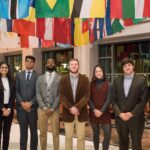
Winners of the 2017 Alex. Brown Center for Entrepreneurship Idea Competition
Mustafa Al-Adhami M.S. ’15 and current Ph.D. student, mechanical engineering, and his partner Ben Pushon-Smith M.S. ’17, electrical engineering, were awarded second place for their Neuro-Stablyzer concept. Utilizing virtual reality technology, the Neuro-Stablyzer would combat the symptoms of PTSD through game play by directly targeting the areas of the brain most affected. Their goal is to offer an alternative solution to those suffering from PTSD that wouldn’t be as traumatic as traditional treatment or require medication.
Pushon-Smith elaborated, saying, “We believe that our idea could revolutionize how we treat mood disorders, and could be tailored to treat a broad range of mood disorders such as anxiety, ADHD, depression, and even enhanced learning. We plan to better research the localized effect of VR on specific networks of the brain, and to work with commercial partners to develop prototype games for the Neuro-Stablyzer program.”
Third place winner Vincent Celebrado-Royer ’18, business technology administration, brought his idea to the table with the Skanaroo app he developed. Skanaroo buttons are designed to be affixed to an easily visible accessory like a backpack. Each button is customized with a QR code that leads to a student organization’s landing page, with the idea that passersby will scan to learn more. Celebrado-Royer has already developed a fully functional product and website and has found success in marketing his invention to various clubs on the UMBC campus. In addition to his third place award, Celebrado-Royer also won best presentation.
In addition to this fall event, the Center for Entrepreneurship’s annual Cangialosi Business Innovation Competition (CBIC) is another opportunity for students to showcase their entrepreneurial prowess. This spring event awards $3,000 to the first place winner who devises the most effective startup business plan. Both of these events serve as a foundational stepping stone for students interested in making a career as an entrepreneur. Al-Adhami won third place in last year’s CBIC competition and has received confirmation for a provisional patent. He reflected on his experiences saying, “It was great to share our idea with a panel of entrepreneurs; hopefully one day we will be on the other side of the discussion.”
Banner image: Participants in the 2017 Alex. Brown Center for Entrepreneurship Idea Competition. All photos by Marlayna Demond ‘11 for UMBC.
]]>
Each fall, student entrepreneurs at UMBC pitch their big ideas – Shark Tank-style, no less – for potential funding. And each year, their ideas span disciplines, including everything from a comic...https://umbc.edu/stories/idea-competition-serves-as-springboard-for-young-entrepreneurs/https://my3.my.umbc.edu/api/v0/pixel/news/120592/guest@my.umbc.edu/1443a43dc1e82cae773f95534beb8d2f/api/pixelalexbrowncentercahsscoeitcommunityeconomicsgraduateschoolinterdisciplinaryismecheresearchUMBC News & Magazinehttps://my3.my.umbc.edu/groups/umbc-news-magazinehttps://assets1-my.umbc.edu/system/shared/avatars/groups/000/001/943/24435aa6207c452e7bc15cc74b42c7bb/xsmall.png?1748556657https://assets1-my.umbc.edu/system/shared/avatars/groups/000/001/943/24435aa6207c452e7bc15cc74b42c7bb/original.png?1748556657https://assets2-my.umbc.edu/system/shared/avatars/groups/000/001/943/24435aa6207c452e7bc15cc74b42c7bb/xxlarge.png?1748556657https://assets2-my.umbc.edu/system/shared/avatars/groups/000/001/943/24435aa6207c452e7bc15cc74b42c7bb/xlarge.png?1748556657https://assets3-my.umbc.edu/system/shared/avatars/groups/000/001/943/24435aa6207c452e7bc15cc74b42c7bb/large.png?1748556657https://assets1-my.umbc.edu/system/shared/avatars/groups/000/001/943/24435aa6207c452e7bc15cc74b42c7bb/medium.png?1748556657https://assets2-my.umbc.edu/system/shared/avatars/groups/000/001/943/24435aa6207c452e7bc15cc74b42c7bb/small.png?1748556657https://assets1-my.umbc.edu/system/shared/avatars/groups/000/001/943/24435aa6207c452e7bc15cc74b42c7bb/xsmall.png?1748556657https://assets2-my.umbc.edu/system/shared/avatars/groups/000/001/943/24435aa6207c452e7bc15cc74b42c7bb/xxsmall.png?1748556657UMBC News & Magazine00falseWed, 29 Nov 2017 20:55:18 -0500UMBC dedicates new Earth and Space Institute, building on decades of NASA collaboration
On the third floor of the UMBC Physics Building, a glass sign with crisp white lettering announces UMBC’s newest research center: the Earth and Space Institute (ESI).
The institute includes a prototyping lab, operations center, and offices, but it is also much more than a collection of rooms, explains Karl Steiner, UMBC’s vice president for research. The ESI is a physical home for the interdisciplinary earth and space science UMBC researchers do with support from NASA, NOAA, and other federal agencies as well as collaborators around the world. It’s a hub where scientists, engineers, and students will take UMBC’s earth and space research to the next level.
The ESI, administered by UMBC’s College of Natural and Mathematical Sciences (CNMS), joins a set of other distinguished UMBC research centers, including the Center for Space Science and Technology (CSST), Goddard Planetary and Heliophysics Institute (GPHI), and Joint Center for Earth Systems Technology (JCET), all of which are collaborations with the NASA Goddard Spaceflight Center in Greenbelt, Maryland.
ESI director Vanderlei Martins (right), discusses research projects with Chris Scolese, director of NASA Goddard, in the prototyping room.
CNMS Dean Bill LaCourse believes NASA has served as “a role model and inspirational force,” that has led people to reach for the stars for generations, and he is excited to expand UMBC’s collaborative work with NASA. “The Earth and Space Institute is our opportunity to reach for new heights,” he shares. “To take that chance in the name of science, commitment, passion, and basic human curiosity.”
At a ribbon cutting for the new space, leaders from the three other centers, as well as the director of NASA Goddard, gathered to discuss current projects and ideas for future collaborations. They emphasized the strong and ongoing relationship between UMBC and NASA, which is only expected to deepen with the dedication of the new institute.
“It’s great to be here. The partnership with UMBC is just fantastic,” said NASA Goddard director Christopher Scolese. “All this happens because of the strength of your work, and we should say thank you to all of you,” added UMBC President Freeman Hrabowski, speaking to the scientists in the room. “It takes researchers to produce researchers.”
Guests learn about the ESI operation center.
Vanderlei Martins, professor of physics and director of the new institute, describes the ESI as a place “to develop new technologies and new science in earth and space fields.” Martins is currently working on HARP, a CubeSat mission intended to launch within the next year. But he and other UMBC scientists have their eyes on an ever bigger goal: a full-blown NASA mission with their equipment on it. The ESI will make planning and successfully proposing such a mission a real possibility.
Another important aspect of the institute is its role as a platform to boost collaboration across disciplines. “We want to collaborate even more with Goddard on the engineering side, on the science side, on the education side,” says Martins, noting that this could mean pulling in faculty and students at all levels and from a broad range of focus areas.
Lorraine Remer, JCET, discusses JCET’s current projects and areas for growth.
Jane Turner, director of CSST, shares that “one of our important roles is to connect our graduate and undergraduate students to mentors and project opportunities at Goddard”—a goal the new ESI shares. Lorraine Remer, a JCET research professor, adds that recruiting UMBC students to careers at NASA or other federal agencies via experiences with UMBC collaborative centers could also play a role in diversifying the federal workforce, because of UMBC’s strong track record for supporting the success of students from all backgrounds in STEM fields.
Alan Yeakley, chair of geography and environmental systems, also envisions opportunities for the ESI to utilize the social sciences in its work. “I see geography and environmental science as the connective tissue between the natural sciences and the social sciences,” he shares. Data collected by NOAA satellites, for example, can contribute to public health research on air quality, urbanization, and the effects of climate change.
UMBC and NASA Goddard representatives cut a ribbon to dedicate the ESI.
The ESI is intended to bring the UMBC community together in new ways, just as it came together to support the institute’s creation. “It takes a community—a wide spectrum of people giving support from all kinds of directions—to bring something like this together,” LaCourse says. From the crews that renovated the space to university administrators at the highest level, “There has been cross-campus support… This is a university facility that was a feat to get off the ground, and now it’s here.”
“The Earth and Space Institute leverages our resources and expands our potential,” LaCourse says. Inspired by NASA, “it allows UMBC to dream bigger and reach higher.”
Banner image: Dean LaCourse addresses guests just before they cut a ribbon at the entrance of the new Earth and Space Institute to dedicate the space. From left to right: Felicia Jones Selden ’81, biological sciences, director of applied engineering and technology at NASA Goddard; UMBC President Freeman Hrabowski; Chris Scolese, director of NASA Goddard; Colleen Hartman, director of sciences and exploration at NASA Goddard; Michael Hayden, UMBC professor and chair of physics; Bill LaCourse, dean of UMBC College of Natural and Mathematical Sciences; UMBC Provost Philip Rous (behind Dean LaCourse); Vanderlei Martins, ESI director and UMBC professor of physics; Karl Steiner, UMBC vice president for research.
All photos by Marlayna Demond ’11 for UMBC.
]]>
On the third floor of the UMBC Physics Building, a glass sign with crisp white lettering announces UMBC’s newest research center: the Earth and Space Institute (ESI). The institute includes a...https://umbc.edu/stories/umbc-dedicates-new-earth-and-space-institute-building-on-decades-of-nasa-collaboration/https://my3.my.umbc.edu/api/v0/pixel/news/120672/guest@my.umbc.edu/851bf3cf4f824f77b10d179a72900f86/api/pixelcnmscsstesigesgphiinterdisciplinaryjcetphysicsresearchscience-and-technologyUMBC News & Magazinehttps://my3.my.umbc.edu/groups/umbc-news-magazinehttps://assets1-my.umbc.edu/system/shared/avatars/groups/000/001/943/24435aa6207c452e7bc15cc74b42c7bb/xsmall.png?1748556657https://assets1-my.umbc.edu/system/shared/avatars/groups/000/001/943/24435aa6207c452e7bc15cc74b42c7bb/original.png?1748556657https://assets2-my.umbc.edu/system/shared/avatars/groups/000/001/943/24435aa6207c452e7bc15cc74b42c7bb/xxlarge.png?1748556657https://assets2-my.umbc.edu/system/shared/avatars/groups/000/001/943/24435aa6207c452e7bc15cc74b42c7bb/xlarge.png?1748556657https://assets3-my.umbc.edu/system/shared/avatars/groups/000/001/943/24435aa6207c452e7bc15cc74b42c7bb/large.png?1748556657https://assets1-my.umbc.edu/system/shared/avatars/groups/000/001/943/24435aa6207c452e7bc15cc74b42c7bb/medium.png?1748556657https://assets2-my.umbc.edu/system/shared/avatars/groups/000/001/943/24435aa6207c452e7bc15cc74b42c7bb/small.png?1748556657https://assets1-my.umbc.edu/system/shared/avatars/groups/000/001/943/24435aa6207c452e7bc15cc74b42c7bb/xsmall.png?1748556657https://assets2-my.umbc.edu/system/shared/avatars/groups/000/001/943/24435aa6207c452e7bc15cc74b42c7bb/xxsmall.png?1748556657UMBC News & Magazine00falseTue, 19 Sep 2017 21:43:19 -0400UMBC receives NSF grant to launch first-of-its-kind big data and high-performance computing training for researchers across disciplines
Today, data of all kinds is generated at a nearly incomprehensible rate, creating endless opportunities for advances in fields from health care to education. Yet plucking meaningful insights out of an overwhelming amount of information can be challenging, leading many researchers to seek out a firmer understanding of data science.
“On one hand, we have tons and tons of information, and on the other hand, we get lost in this information,” explains Zhibo Zhang, associate professor of physics, “so the question is how we can get something meaningful, something useful, from this ocean of data.”
Zhang and three UMBC colleagues will help researchers address this issue head-on with a unique interdisciplinary course for graduate students, postdocs, and junior faculty that will launch in spring 2018. The project is funded by a three-year National Science Foundation grant, with the expectation that after an initial on-campus test run, the program will be refined and expanded to reach researchers nationwide.
Zhibo Zhang, courtesy Zhibo Zhang.
The students in the course will spend at least one-third of their time working on interdisciplinary research projects with colleagues from other fields, under the mentorship of one of the faculty. “In this program, we are teaching the latest technology to the students, but also letting them do research together,” explains Jianwu Wang, assistant professor of information systems and the principal investigator on the grant.
“Often we use a siloed approach, where each discipline sticks to itself,” says AryyaGangopadhyay, professor and chair of information systems. Instead, this team’s approach creates opportunities “to leverage the multidisciplinary nature of problem-solving that is required” to address challenging, complex questions in the real world.
The new course will accept students studying atmospheric physics, information systems, and applied mathematics with a focus on high-performance computing. Moving forward, the team hopes to include a wider variety of researchers, with the goal to complement training in their disciplines with stronger computing and complex data analysis skills.
Jianwu Wang, courtesy Jianwu Wang.
“Data and computing are becoming two more pillars of science in all fields,” explains Wang, who sees strengthening collaborations across disciplines as beneficial to all. “We need each other,” he says. “For us, in information systems, we can get more concrete challenges to solve, and for scientists in other fields, they can learn from the techniques. Together, we can solve the multi-pronged challenges the world is facing today.”
In atmospheric physics, for example, pulling climate trends out of mountains of data from NASA and other sources is important, but it’s impossible to process vast quantities of complex climate data effectively and efficiently with outdated tools and training. “I used to be able to do everything on my laptop,” remembers Zhang, “but now you can’t put your data on a laptop. You have to put it on a huge data server.”
That’s where collaborations with information systems researchers and high-performance computing experts come in. “In traditional analytics, data is loaded in the memory of a computer, but in big data analytics, the data might be much larger than the machine can handle,” explains Gangopadhyay. “So how do you deal with that? New algorithms must be designed.”
Matthias Gobbert, courtesy Matthias Gobbert.
The fourth participating faculty member, Matthias Gobbert, professor of mathematics and faculty lead of UMBC’s High-Performance Computing Facility initiative, notes that NSF’s full funding of the grant proposal indicates this area is a priority for the agency, and his collaborators explain why. “There are no such training programs nationwide,” says Wang. As compared to industry, “for scientific research, we have specific challenges.” Gangopadhyay adds, “Big data analytics is arguably one of the most sought-after skill sets in today’s IT world.”
“In a way, we are training a new type of scientist, a new generation of scientists,” Zhang says. These scientists will access and analyze data in new ways, often relying on computing techniques previously unnecessary in their fields. And now that the four colleagues have begun working together, Zhang sees future collaboration opportunities in every new paper he reads. “They’re just popping up everywhere.”
Aryya Gangopadhyay, courtesy Aryya Gangopadhyay.
The team acknowledges that there will be hurdles along the way to changing how researchers understand and utilize data science, first and foremost teaching a group of students who are already all highly trained, but in vastly different fields. Zhang shares, “I think the challenge will be fitting it all together.”
Still, the team is excited and optimistic. “This type of work is only possible by people who have an adventurous spirit,” says Gangopadhyay. “Sometimes, taking risks is the only way to do something meaningful. And we are ready for the challenge.”
Image:Data servers at the climate computing facility at Goddard Space Flight Center in Greenbelt, Maryland. Photo by Flickr user ep_jhu, used under license CC BY-NC 2.0.
]]>
Today, data of all kinds is generated at a nearly incomprehensible rate, creating endless opportunities for advances in fields from health care to education. Yet plucking meaningful insights out...https://umbc.edu/stories/umbc-receives-nsf-grant-to-launch-first-of-its-kind-big-data-and-high-performance-computing-training-for-researchers-across-disciplines/https://my3.my.umbc.edu/api/v0/pixel/news/120687/guest@my.umbc.edu/6c8f53ec51a54b27d4d03ef3fb947820/api/pixelcnmscoeitinterdisciplinaryismathstatphysicsresearchscience-and-technologyUMBC News & Magazinehttps://my3.my.umbc.edu/groups/umbc-news-magazinehttps://assets1-my.umbc.edu/system/shared/avatars/groups/000/001/943/24435aa6207c452e7bc15cc74b42c7bb/xsmall.png?1748556657https://assets1-my.umbc.edu/system/shared/avatars/groups/000/001/943/24435aa6207c452e7bc15cc74b42c7bb/original.png?1748556657https://assets2-my.umbc.edu/system/shared/avatars/groups/000/001/943/24435aa6207c452e7bc15cc74b42c7bb/xxlarge.png?1748556657https://assets2-my.umbc.edu/system/shared/avatars/groups/000/001/943/24435aa6207c452e7bc15cc74b42c7bb/xlarge.png?1748556657https://assets3-my.umbc.edu/system/shared/avatars/groups/000/001/943/24435aa6207c452e7bc15cc74b42c7bb/large.png?1748556657https://assets1-my.umbc.edu/system/shared/avatars/groups/000/001/943/24435aa6207c452e7bc15cc74b42c7bb/medium.png?1748556657https://assets2-my.umbc.edu/system/shared/avatars/groups/000/001/943/24435aa6207c452e7bc15cc74b42c7bb/small.png?1748556657https://assets1-my.umbc.edu/system/shared/avatars/groups/000/001/943/24435aa6207c452e7bc15cc74b42c7bb/xsmall.png?1748556657https://assets2-my.umbc.edu/system/shared/avatars/groups/000/001/943/24435aa6207c452e7bc15cc74b42c7bb/xxsmall.png?1748556657UMBC News & Magazine00falseFri, 01 Sep 2017 15:48:16 -0400
 Upal Ghosh (left) and Kevin Sowers in Sowers’s lab at the Institute of Marine and Environmental Technology. Photo by Marlayna Demond ’11 for UMBC.