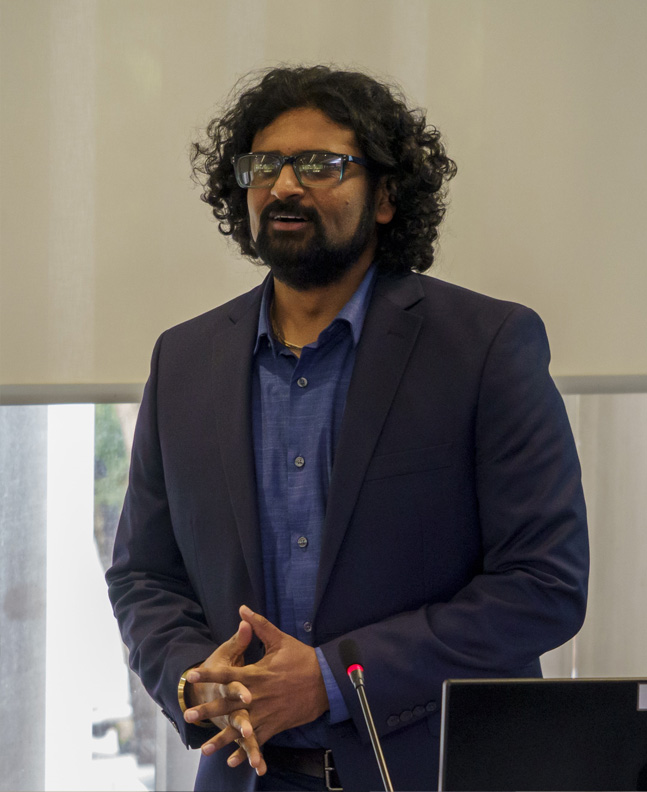
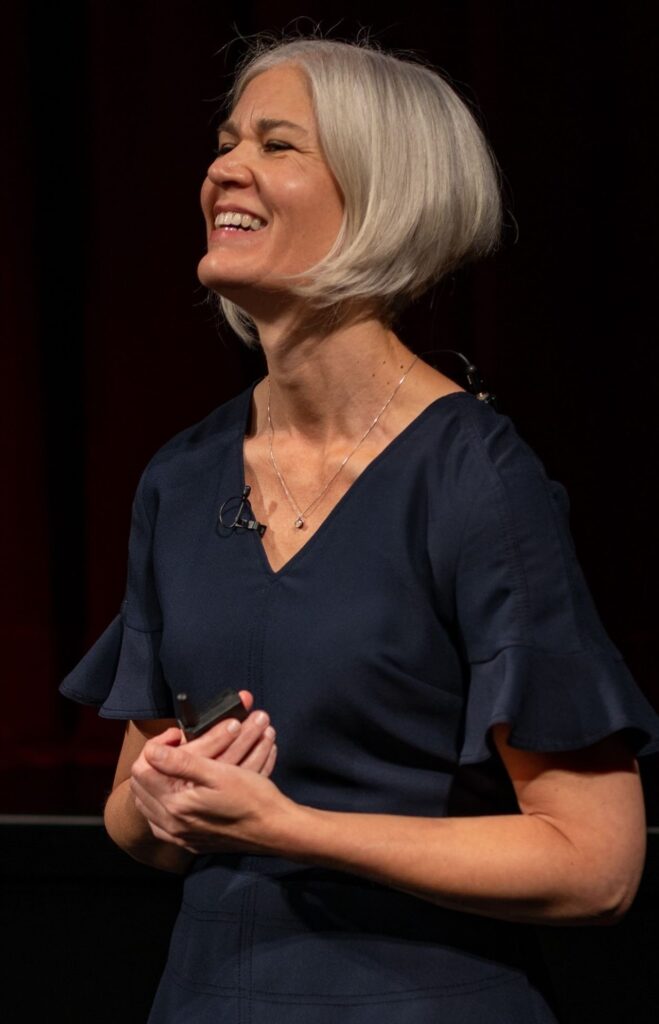
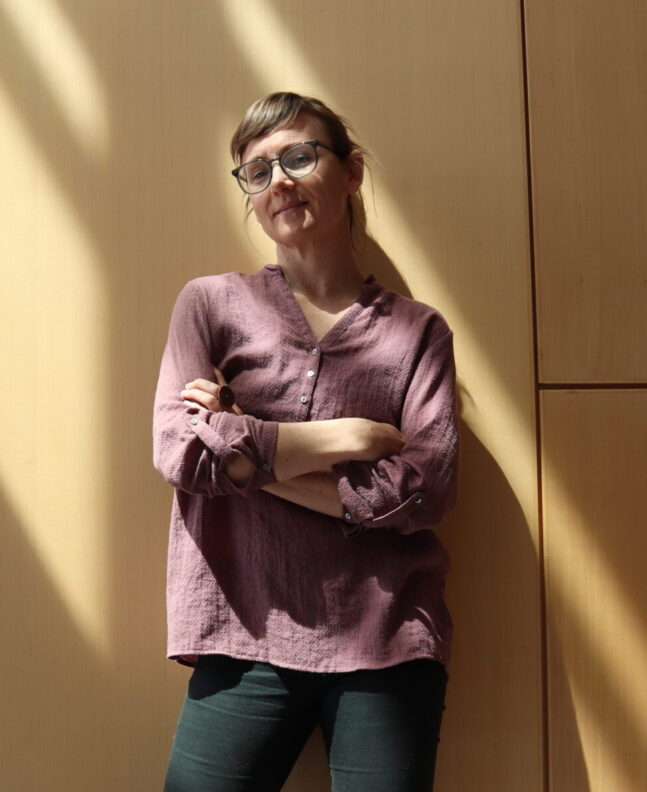
Off-road thrills—faculty and staff try out the SAE Baja cars on Drive Day
In a sparsely wooded expanse just off Hilltop Circle, engines rev and dirt flies. Drivers whoop as they steer through trees, clear rocks, traverse ditches, and accelerate down steep hills. You might expect UMBC Police would be handing out tickets for such shenanigans—but this is officially sanctioned fun. It’s all part of the annual Faculty and Staff Drive Day, hosted by UMBC’s Society of Automotive Engineers (SAE) Baja racing team on Halloween this year.
On the grass, an array of single-seat, off-road vehicles sit parked, showcasing the skills of the UMBC team, whose 20 or so student members pull together to design, build, and race a new car each year. On Drive Day, adventurous UMBC community members and industry sponsors are invited to feel the thrill of hopping behind the wheel.
Drivers hit the track on Faculty and Staff Drive Day 2025. (Video by Elijah Davis, M.F.A. ’21)
The club takes safety seriously. Drivers don a neck restraint, helmet, goggles, and gloves. They are buckled in with a 5-point harness and slip their hands through wrist restraints that will keep their arms inside the vehicle at all times. If things get really hairy, there’s a kill switch that shuts off the engine.
Plenty of team volunteers are on hand to calm nerves, free stuck vehicles, and fill empty gas tanks. When a suspension arm on one of the cars gets bent in a run-in with a tree, the team grabs tools, lifts up the vehicle, and swaps in a new arm.
 UMBC Racing team members, including William Busch (left) and Shawn Pourifarsi (center) replace a suspension arm on one of the cars. (Brad Ziegler/UMBC)
“I want two things: for people to be safe and for them to have fun,” says Shawn Pourifarsi, a junior computer engineering major and co-vice president of the club.
For two Residential Life staffers who stopped by for the first time, the event was a great success on both counts. “It was terrifyingly fun,” says Marnea Shamblen, an administrative assistant. “What a rush,” agrees her colleague Grace Collins, the residential education and leadership coordinator, still savoring the adrenaline kick. “I give it a 10 out of 10.”
]]>
In a sparsely wooded expanse just off Hilltop Circle, engines rev and dirt flies. Drivers whoop as they steer through trees, clear rocks, traverse ditches, and accelerate down steep hills. You...
https://umbc.edu/stories/umbc-racing-off-road-drive-day-2025/
https://my3.my.umbc.edu/api/v0/pixel/news/154512/guest@my.umbc.edu/70554f481a6f6099fb3faad063efb937/api/pixel
campus-life
coeit
csee
fall-2025
is
magazine
meche
story
wild-card
UMBC News & Magazine
https://my3.my.umbc.edu/groups/umbc-news-magazine
https://assets1-my.umbc.edu/system/shared/avatars/groups/000/001/943/24435aa6207c452e7bc15cc74b42c7bb/xsmall.png?1748556657
https://assets1-my.umbc.edu/system/shared/avatars/groups/000/001/943/24435aa6207c452e7bc15cc74b42c7bb/original.png?1748556657
https://assets2-my.umbc.edu/system/shared/avatars/groups/000/001/943/24435aa6207c452e7bc15cc74b42c7bb/xxlarge.png?1748556657
https://assets2-my.umbc.edu/system/shared/avatars/groups/000/001/943/24435aa6207c452e7bc15cc74b42c7bb/xlarge.png?1748556657
https://assets3-my.umbc.edu/system/shared/avatars/groups/000/001/943/24435aa6207c452e7bc15cc74b42c7bb/large.png?1748556657
https://assets1-my.umbc.edu/system/shared/avatars/groups/000/001/943/24435aa6207c452e7bc15cc74b42c7bb/medium.png?1748556657
https://assets2-my.umbc.edu/system/shared/avatars/groups/000/001/943/24435aa6207c452e7bc15cc74b42c7bb/small.png?1748556657
https://assets1-my.umbc.edu/system/shared/avatars/groups/000/001/943/24435aa6207c452e7bc15cc74b42c7bb/xsmall.png?1748556657
https://assets2-my.umbc.edu/system/shared/avatars/groups/000/001/943/24435aa6207c452e7bc15cc74b42c7bb/xxsmall.png?1748556657
UMBC News & Magazine
0
0
false
Thu, 13 Nov 2025 10:46:33 -0500
Thu, 13 Nov 2025 10:46:33 -0500
Michael Hunt ’06, Ph.D. ’25, Outstanding Staff award winner, lifts up students and builds community
When Shaniah Reece ’23, information systems, now a Ph.D. student in computer science at Emory University, was navigating her academic journey at UMBC, there were times she felt like giving up. One evening, around 10 p.m. at night, she was exhausted and considering not submitting an important application. But then Michael Hunt, director of the McNair Scholars Program, with which she was affiliated, gave her a call.
“He said, ‘There are two hours left, and I haven’t seen any indication that you’ve submitted it,’” Reece relates. “I could hear his family and the TV in the background—he was off the clock, at home—but he still made that call. That moment was so impactful because he thought about me, believed in me, and pushed me in a moment when I was too weak to push myself.”
It’s just one example of the many times that Hunt ’06, applied mathematics, Ph.D. ’25, language, literacy, and culture, has shown up for students in just the ways they need. Since 2019, Hunt has directed the federally funded UMBC McNair program with a goal of empowering students from underrepresented segments of society to earn research-based doctoral degrees. Not only does he support the 30 students who enter the full program each year—he’s worked hard to extend opportunities to affiliated students, through a program now called the Retriever Graduate Preparation Network, and to spread the supportive culture of the McNair program across the university as a whole.
On October 29, Hunt’s contributions will be recognized when he receives the 2025 Outstanding Staff award from UMBC’s Alumni Association Board of Directors.
Showing up for students
 From l-r: McNair Scholar Nogaye Khady Wade, McNair coordinator Antoinette Newsome, McNair Scholar Noor Huma and Michael Hunt at the American Educational Research Association annual meeting in 2023. (Photo courtesy of Hunt)
What makes Hunt such an effective mentor? For one thing, he asks students what they need and makes their voices and experiences a central part of his relationship with them. He strives to support them holistically, including emotional, cultural, and academic support. He wants the mentor-mentee relationship to be reciprocal, to honor the value of the mentee’s contributions, and to extend into a wider network of community support.
The approach, called holistic critical mentoring, has been central to the McNair Scholar’s Program under Hunt’s leadership. Hunt even wrote his Ph.D. dissertation on the subject and his interviews of former McNair scholars showed how much they valued the mentoring philosophy.
“I am one of the many UMBC students whose trajectory was forever changed by Dr. Hunt’s mentorship,” says Ting Huang ’21, psychology, the program coordinator for UMBC McNair Scholars Program and a former scholar herself. “I didn’t know my path until I stumbled onto McNair as an undergraduate. Through the program, I conducted research virtually for the first time during the height of the COVID-19 pandemic. Despite the remote nature of those years, I had never felt more connected to a community. That sense of belonging was cultivated by Dr. Hunt and his team, showing how intentional leadership can overcome even the most isolating circumstances.”
Building community
Hunt says the experience of reaching out to current and former McNair program participants to request their help supplying information for his dissertation research was ultimately very gratifying. He wondered how many would respond, given their busy schedules, but a large number were eager to engage.
“I was genuinely surprised, I didn’t expect that number of responses. But then my mentor pointed out: That’s what happens when you build relationships,” Hunt says.
 Michael Hunt with his family at the Black and Latine/x Celebration and Awards in spring 2025. (Brad Zeigler/UMBC)
Hunt says the continued support of program alumni makes him feel like he is making a difference. He’s happy that former participants, some as far away as California, regularly offer to serve as volunteer mentors for current students.
This summer, Hunt had the opportunity to sit in on the dissertation defense of one of the first students to go through the McNair Scholars Program under his watch.
“It’s wonderful to see these alums thriving,” Hunt says. “We are building community. And while we stood on the shoulders of giants, we’re making sure to also be the shoulders that others can stand on next.”
Mark your calendars for the 2025 Alumni Awards on Wednesday, October 29, at 6 p.m., and consider joining the UMBC community at the Chesapeake Employers Insurance Arena to celebrate Michael Hunt and the many remarkable individuals receiving awards. The event will be livestreamed for those unable to join in person. You can learn more at alumni.umbc.edu/alumniawards.
]]>
When Shaniah Reece ’23, information systems, now a Ph.D. student in computer science at Emory University, was navigating her academic journey at UMBC, there were times she felt like giving up. One...
https://umbc.edu/stories/michael-hunt-outstanding-staff-award/
https://my3.my.umbc.edu/api/v0/pixel/news/153998/guest@my.umbc.edu/9f1ef4212ec1126461db307e1dc3f9e0/api/pixel
alumni
alumni-awards
cahss
cnms
coeit
is
llc
magazine
math
mcnairscholars
meyerhoff
story
UMBC News & Magazine
https://my3.my.umbc.edu/groups/umbc-news-magazine
https://assets1-my.umbc.edu/system/shared/avatars/groups/000/001/943/24435aa6207c452e7bc15cc74b42c7bb/xsmall.png?1748556657
https://assets1-my.umbc.edu/system/shared/avatars/groups/000/001/943/24435aa6207c452e7bc15cc74b42c7bb/original.png?1748556657
https://assets2-my.umbc.edu/system/shared/avatars/groups/000/001/943/24435aa6207c452e7bc15cc74b42c7bb/xxlarge.png?1748556657
https://assets2-my.umbc.edu/system/shared/avatars/groups/000/001/943/24435aa6207c452e7bc15cc74b42c7bb/xlarge.png?1748556657
https://assets3-my.umbc.edu/system/shared/avatars/groups/000/001/943/24435aa6207c452e7bc15cc74b42c7bb/large.png?1748556657
https://assets1-my.umbc.edu/system/shared/avatars/groups/000/001/943/24435aa6207c452e7bc15cc74b42c7bb/medium.png?1748556657
https://assets2-my.umbc.edu/system/shared/avatars/groups/000/001/943/24435aa6207c452e7bc15cc74b42c7bb/small.png?1748556657
https://assets1-my.umbc.edu/system/shared/avatars/groups/000/001/943/24435aa6207c452e7bc15cc74b42c7bb/xsmall.png?1748556657
https://assets2-my.umbc.edu/system/shared/avatars/groups/000/001/943/24435aa6207c452e7bc15cc74b42c7bb/xxsmall.png?1748556657
UMBC News & Magazine
1
0
false
Tue, 28 Oct 2025 16:03:47 -0400
Tue, 28 Oct 2025 16:03:47 -0400
Hrabowski Fund for Innovation awardees continue to drive new approaches to teaching and learning
A cross-disciplinary incubator rooted in theatrical storytelling. Artificial intelligence and machine learning ethics education that blends ethical inquiry with hands-on technical exploration. Letterpress printing and bookmaking while students uncover “The Secret Lives of Books.” These are several of the 2024 – 2025 projects selected to receive grants in the Hrabowski Fund for Innovation competition. The fund supports initiatives to enhance teaching and learning at UMBC, with specific emphasis on innovative approaches to increase student success.
“The Hrabowski Innovation Fund has helped to drive innovation in pedagogy and student success at UMBC for the past 13 years. Recent projects have enhanced course and curriculum development, built generative AI literacy and introduced AI-powered tools, and engaged students in cross-disciplinary, international, and community-based projects that prepare them for their majors and careers.” says Kerrie Kephart, interim director of the Faculty Development Center.
Implementation and Research Awards
- IMPACT Lab: Interdisciplinary Music, Performance, Art, Collaboration, and Theatre Lab – Nigel Semaj (THTR) and Colleagues
- Developing Ethical Inquiry: A Participatory and Exploratory Lab Model for AI/ML Ethics Education – Rebecca Williams (CSEE)
- Computing for All: Cultivating a Culturally Responsive and Inclusive Computing Ecosystem – Patricia Ordóñez (IS) and colleague
Adaptation Award
- Hilltop Print Shop: Supporting Applied Learning in a Humanities Makerspace – Lindsay DiCuirci (ENGL) and colleague
Scholarship of Teaching and Learning Award
- Developing an Approach to Creating and Refining Innovative Learning Outcomes in a University Music Education Program – Brian Kaufman (MUSC) and colleague
SEED Awards
- Transforming Graduate Writing Support – Nicole Morse (LLC) and colleagues
- Centering Student Perspectives on Generative AI Integration in a Design Classroom – Yasmine Kotturi (IS)
The Hrabowski Fund for Innovation exemplifies UMBC’s commitment to investing in faculty initiatives that fuel creativity and enterprise and also create opportunities for student engagement. Proposals for the next round are due by October 31, 2025. For more information and to apply, visit UMBC’s Faculty Development Center website.
]]>
A cross-disciplinary incubator rooted in theatrical storytelling. Artificial intelligence and machine learning ethics education that blends ethical inquiry with hands-on technical exploration....
https://umbc.edu/quick-posts/hrabowski-fund-for-innovation-awardees-continue-to-drive-new-approaches-to-teaching-and-learning/
https://my3.my.umbc.edu/api/v0/pixel/news/153359/guest@my.umbc.edu/03473bb2ab97b0c705cfc6bf57f6f836/api/pixel
cahss
cnms
coeit
community
csee
english
is
language-literacy-and-culture
quick-post
theatre
UMBC News & Magazine
https://my3.my.umbc.edu/groups/umbc-news-magazine
https://assets1-my.umbc.edu/system/shared/avatars/groups/000/001/943/24435aa6207c452e7bc15cc74b42c7bb/xsmall.png?1748556657
https://assets1-my.umbc.edu/system/shared/avatars/groups/000/001/943/24435aa6207c452e7bc15cc74b42c7bb/original.png?1748556657
https://assets2-my.umbc.edu/system/shared/avatars/groups/000/001/943/24435aa6207c452e7bc15cc74b42c7bb/xxlarge.png?1748556657
https://assets2-my.umbc.edu/system/shared/avatars/groups/000/001/943/24435aa6207c452e7bc15cc74b42c7bb/xlarge.png?1748556657
https://assets3-my.umbc.edu/system/shared/avatars/groups/000/001/943/24435aa6207c452e7bc15cc74b42c7bb/large.png?1748556657
https://assets1-my.umbc.edu/system/shared/avatars/groups/000/001/943/24435aa6207c452e7bc15cc74b42c7bb/medium.png?1748556657
https://assets2-my.umbc.edu/system/shared/avatars/groups/000/001/943/24435aa6207c452e7bc15cc74b42c7bb/small.png?1748556657
https://assets1-my.umbc.edu/system/shared/avatars/groups/000/001/943/24435aa6207c452e7bc15cc74b42c7bb/xsmall.png?1748556657
https://assets2-my.umbc.edu/system/shared/avatars/groups/000/001/943/24435aa6207c452e7bc15cc74b42c7bb/xxsmall.png?1748556657
UMBC News & Magazine
0
0
false
Tue, 07 Oct 2025 15:51:37 -0400
Tue, 07 Oct 2025 15:51:37 -0400
Meet a Retriever—Meagan Wade ’13, goes above and beyond to make students feel welcome and engaged
Meet Meagan Wade ’13, psychology, the program coordinator for the Department of Information Systems. Part of Meagan’s job is planning professional development and social events for IS students. She’s organized standing-room-only talks with tech leaders, game nights with pizzas and snacks, resume workshops and job search training, and more. She’s loving it all—and shares why she’s so happy she returned to her alma mater as a staff member.
Q: How did you start working in higher ed?
A: I graduated from UMBC in 2013 with a B.A. in psychology and a minor in social welfare. I then graduated from Towson University with a M.A. in teaching for elementary education in 2016. I worked as an elementary teacher for four years before switching gears and finding a job in higher education.
Q: Tell us about someone in the community who has supported you, and how they did it.
A: Dwayne Butcher, assistant director of marketing for the IS department, has been an awesome supporter of me since I started back in October 2024. He has been a great mentor for the marketing aspects of my job, and an amazing supporter of my career growth, for example, by encouraging me to attend conferences.
I love that the department has essentially given me free reign to plan whatever events for IS students that I think will get them engaged in the community and help to prepare them for their careers post-graduation from UMBC.
Q: What part of your job do you enjoy the most and why?
A: My favorite part of my job has been planning events that students enjoy attending—such as our game night events; and planning events that will help students in their career journeys—such as the Career Talk series I planned this fall. Each week we host a different panel of tech industry professionals, with themes such as women in tech and the gaming industry, and company-specific events with Oracle, The Trevor Project, and more.


Wade organizes student events for the IS department throughout the year, including a Women in Tech Career Talk (left) and the IS department’s Welcome Week (right), complete with a visit from Spot, a robotic dog. (Images courtesy of Wade)
Q: What brought you to UMBC in the first place?
 Wade and her dog Baxter at the Homecoming Puppy Parade in 2024. (Image courtesy of Wade)
A: I originally came to UMBC as a starry-eyed 18-year-old, hoping to figure out what I wanted to do with my life and to make great friends along the way. I chose UMBC for a few different reasons: I’m originally from Towson, so UMBC was just the right distance away from home so that I could still easily visit. Also, my dad is a UMBC alum, and my best friend also ended up going to UMBC, so it felt like a “home away from home” for me, which my anxious freshman self needed at the time.
I’m happy to say that UMBC brought so many amazing people into my life, many of whom I am still friends with to this day. I wouldn’t have wanted to be anywhere other than UMBC because of all the happy memories I made here.
Years later, when I ended up working in higher education, I remembered the awesome culture of UMBC that I experienced as a student, and hoped to “come back home” as a staff member. I applied for a number of jobs at UMBC and am so grateful that the information systems department was willing to give me the opportunity to return to UMBC. Now that I am back, I’m so glad that the welcoming culture I experienced as a student is still here, and I hope to now give current students the opportunity to find their way in the world, just like I did years ago.
Q: Are you involved in any campus organizations?
A: Back when I was a student, I was involved with WMBC, UMBC’s radio station. My friend and I had a radio show called “Cuddlecore,” where we would chat and play our favorite music. I remember loving the seemingly infinite amount of CDs back in the WMBC studio that we were encouraged to listen to and write reviews for.
I was also a Resident Assistant, so I was pretty involved with ResLife. I loved the apartment RA family that we created after spending so many hours together, and all the events that we would do together as RAs, including bowling, dinner parties, and late night trips to Double T Diner.
Since returning as a staff member, I’ve resurrected Cuddlecore. It’s on Wednesdays at 5pm! I’ve also attended UMBC Homecoming and participated in the Puppy Parade with my dog Baxter, which was very fun!
Q: How have you found support and community here?
A: As a UMBC student, the main way that I met amazing people was making connections with classmates in my courses, becoming close with roommates and suitemates in the dorms/apartments, and bonding with my fellow Resident Assistants and other ResLife staff when I worked as an RA.
As a UMBC staff member, I’ve been able to help students find their way in the world by planning awesome events for them to meet other people with similar interests. (I had no idea there’d be so many people interested in Super Smash Brothers, specifically!) I’ve also been able to collaborate with other organizations on campus, such as the Information Systems Security Association (ISSA) student chapter and the Career Center, to plan even more meaningful events for IS students. Because UMBC’s culture is so welcoming, it has been surprisingly easy to reach out to other organizations on campus and plan things together to help UMBC students as a whole.


Wade and fellow apartment RAs bowling (left) and at the end-of-year ResLife banquet (right). (Images courtesy of Wade)
Q: What would you tell someone who is considering a career at UMBC?
A: DO IT! I am so happy that I made the switch to UMBC from my prior higher education institution (although I might be a little biased as a UMBC alum).
* * * * *
UMBC’s greatest strength is its people. When people meet Retrievers and hear about the passion they bring, the relationships they create, the ways they support each other, and the commitment they have to inclusive excellence, they truly get a sense of our community. That’s what “Meet a Retriever” is all about.
Learn more about how UMBC can help you achieve your goals.
]]>
Meet Meagan Wade ’13, psychology, the program coordinator for the Department of Information Systems. Part of Meagan’s job is planning professional development and social events for IS students....
https://umbc.edu/stories/meet-a-retriever-meagan-wade/
https://my3.my.umbc.edu/api/v0/pixel/news/153333/guest@my.umbc.edu/40d209e5cfc5de16fdb17400931cf00e/api/pixel
alumni
cahss
coeit
impact
is
magazine
meetaretriever
perspectives
story
UMBC News & Magazine
https://my3.my.umbc.edu/groups/umbc-news-magazine
https://assets1-my.umbc.edu/system/shared/avatars/groups/000/001/943/24435aa6207c452e7bc15cc74b42c7bb/xsmall.png?1748556657
https://assets1-my.umbc.edu/system/shared/avatars/groups/000/001/943/24435aa6207c452e7bc15cc74b42c7bb/original.png?1748556657
https://assets2-my.umbc.edu/system/shared/avatars/groups/000/001/943/24435aa6207c452e7bc15cc74b42c7bb/xxlarge.png?1748556657
https://assets2-my.umbc.edu/system/shared/avatars/groups/000/001/943/24435aa6207c452e7bc15cc74b42c7bb/xlarge.png?1748556657
https://assets3-my.umbc.edu/system/shared/avatars/groups/000/001/943/24435aa6207c452e7bc15cc74b42c7bb/large.png?1748556657
https://assets1-my.umbc.edu/system/shared/avatars/groups/000/001/943/24435aa6207c452e7bc15cc74b42c7bb/medium.png?1748556657
https://assets2-my.umbc.edu/system/shared/avatars/groups/000/001/943/24435aa6207c452e7bc15cc74b42c7bb/small.png?1748556657
https://assets1-my.umbc.edu/system/shared/avatars/groups/000/001/943/24435aa6207c452e7bc15cc74b42c7bb/xsmall.png?1748556657
https://assets2-my.umbc.edu/system/shared/avatars/groups/000/001/943/24435aa6207c452e7bc15cc74b42c7bb/xxsmall.png?1748556657
UMBC News & Magazine
1
0
false
Tue, 07 Oct 2025 10:39:02 -0400
Tue, 07 Oct 2025 10:39:02 -0400
Feeling supported at summer internships gives Retrievers a leg up in applied learning
“Support” is one of the most frequently used words when UMBC students reflect on their internship experiences on and off campus. From resources offered by the Career Center, to guidance from professors, and even sometimes from peers who wind up working side-by-side, UMBC students depend on university support and the many shapes it takes.
This summer, hundreds of Retrievers built upon the foundational knowledge they learned in the classroom and applied it to hands-on, real-world learning through internships. From getting front seat roles in bridge engineering and analyzing cyber threats to using inspiration drawn from campus, these UMBC students had plenty to write about for their “What I Did with My Summer Vacation” essays.
The science of sticking together
Mustafa Akpinar, a senior information systems major; Alek Read, a senior environmental science major; and Ty Allen, a junior mechanical engineering major, honed technical expertise, built teamwork and communication skills, and forged connections with peers and professionals on the Baltimore/D.C. biotech scene working at AstraZeneca.
Akpinar worked as a cyber threat intelligence and threat detection intern, a position that closely aligned with his career trajectory. “This internship is a perfect fit for both my academic path and long-term career goals,” Akpinar says, noting how the role builds on his data communications and networks and database design courses.
 A mixer for UMBC alumni employees and interns at AstraZeneca was a meaningful way for the students to network with potential mentors. (Courtesy of Miriam Friedman)
Read and Allen also used the summer to further their professional goals. Read contributed to sustainability efforts at AstraZeneca’s Frederick Manufacturing Center as an environmental health safety intern and Allen served as a site operations intern, applying his engineering skills to edit technical drawings in AutoCAD.
Building bridges
As all of Baltimore and most of the country recalls, Maryland’s Francis Scott Key Bridge was struck by a cargo ship and collapsed in March of 2024. The impacts of this catastrophe are still felt throughout the region with travel complications, economic hardships, and more. Through a partnership between the Maryland Transportation Authority and the Maryland Higher Education Commission, three Retrievers and six other Maryland-based students had the chance to join the Key Bridge Rebuild Internship Program.
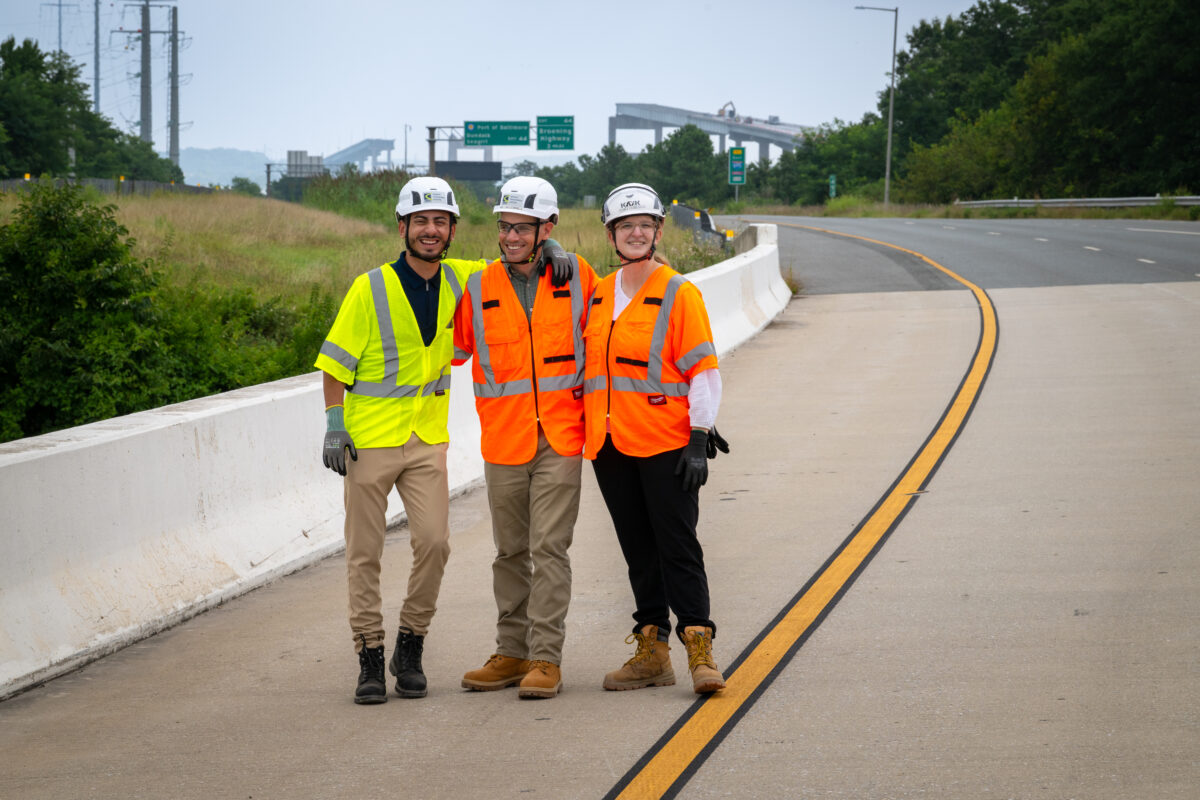 From left to right, Cristian Mena, William McConnell, and Emily DiMarzio pose for a photo near the site of the collapsed Key Bridge. The three worked on the bridge rebuilding project as interns with the Maryland Transportation Authority. (Brad Ziegler/UMBC)
Emily DiMarzio, a junior studying environmental science and geography, and Cristian Mena and William McConnell, both seniors studying mechanical engineering, all explored their individual areas of interest while actively helping to rebuild in their own community.
“It hurt when the bridge went down,” says McConnell, who grew up in Baltimore and now lives with his wife and three kids in Catonsville. “You could practically see it from our neighborhood, and now see that it is missing. So when the opportunity came along to apply for this internship, I jumped on it.”
Bustling Baltimore
The UMBC Career and Internship Fair is a first foot in the door for many UMBC students seeking to make networking connections. This was precisely the case for Wonder Akpabio, a junior computer science major, who connected with a recruiter from T. Rowe Price who helped guide her through the interview process.
With a massive network of UMBC alumni, T. Rowe Price is already a well-known investment management firm with Retrievers, with the added bonus of being headquartered in Baltimore. Gabriel Farmer, another junior computer science major, was impressed with the outreach efforts the company did with UMBC, like sending recruiters to events and hosting online programming.
 Gabriel Farmer in Baltimore’s Inner Harbor, near the headquarters of T. Rowe Price, where he interned in summer 2025. (Brad Ziegler/UMBC)
“Anytime you ask a question, people are ready to help,” Farmer says. “It’s been a very good experience, and T. Rowe Price is definitely a place I could see myself continuing to work at.”
Connections across campus
UMBC is far from a sleepy campus in the summer, with hundreds of research, internship, and student-employment opportunities available. So, while others traveled far and wide to secure an internship in their area of interest, some Retrievers saw the home-field advantage right in front of them.
Giovanna Orfali, a visual arts senior from São Paulo, Brazil, spent this summer behind the camera as a digital content intern at both the Maryland Center for History and Culture and UMBC’s event and conference services. Humanities Scholar Kendal Howell stepped off the plane after studying business management abroad in France this past spring and into the office as an intern at UMBC’s Division of Student Affairs for their new academic partnerships and high-impact experiences unit.
 Kendal Howell updates internship supervisor, James DeVita, on her latest project. (Brad Ziegler/UMBC)
Second-year gerontology doctoral student Claire McDonald also had the opportunity to conduct new research, working with Rowena Winkler, the new assistant director for graduate student career development at the UMBC Career Center, who was seeking graduate students to conduct a 10-week qualitative research project. Caleb Ruck ’22, modern languages, linguistics, and intercultural communication, and M.A. ’24, intercultural communication, continued his work becoming the first year-long graduate assistant for the Center for Social Justice Dialogue.
A numbers game
With so many resources available to help students land their dream internship, it’s not surprising to see the statistics of success—85 percent of recent alumni engaged in applied learning like internships, research, service-learning, or leadership during their time at UMBC. Thanks to the work they’re putting into their futures as a student, 93 percent graduate with firm plans for employment or graduate school within six months of graduation.
“I’m continually inspired by the way our students engage in applied learning to launch their careers,” says Marykate Conroy, associate director of internships and employment. “UMBC students are entering the workforce prepared and in demand.”
 Tanzila Malik speaking at the Women’s History Month panel, hosted by the Women’s, Gender, and Equity Center.
UMBC’s Career Center offers a comprehensive suite of resources including SteppingBlocks to explore alumni career paths and outcomes, UMBC Careers Unleashed Podcast for stories and insights, the Internship and Research Success Practicum course to complement student work experiences, Handshake for employer connections, and the UMBC Career Connectors network of faculty and staff linking the classroom to careers.
The annual Career and Internship Fair will be held on Wednesday, September 17, from 11:30 a.m. – 3:30 p.m. in the Retriever Activity Center. “Get engaged, ask the big questions, push yourself to achieve your goals, and influence the world. The UMBC community will be right there with you along your journey,” recommends Tanzila Malik ’26, women’s studies, who spent two years interning with the Women’s, Gender, and Equity Center.
Read more about where internships took Retrievers this summer.
]]>
“Support” is one of the most frequently used words when UMBC students reflect on their internship experiences on and off campus. From resources offered by the Career Center, to guidance from...
https://umbc.edu/stories/campus-support-umbc-summer-internships-2025/
https://my3.my.umbc.edu/api/v0/pixel/news/152407/guest@my.umbc.edu/bdde959821900d8673fa552b719cbdd0/api/pixel
cahss
careercenter
cnms
coeit
community
computer-science
ges
gwsst
humanities-scholar
internships
is
meche
mlli
news
story
visual-arts
UMBC News & Magazine
https://my3.my.umbc.edu/groups/umbc-news-magazine
https://assets1-my.umbc.edu/system/shared/avatars/groups/000/001/943/24435aa6207c452e7bc15cc74b42c7bb/xsmall.png?1748556657
https://assets1-my.umbc.edu/system/shared/avatars/groups/000/001/943/24435aa6207c452e7bc15cc74b42c7bb/original.png?1748556657
https://assets2-my.umbc.edu/system/shared/avatars/groups/000/001/943/24435aa6207c452e7bc15cc74b42c7bb/xxlarge.png?1748556657
https://assets2-my.umbc.edu/system/shared/avatars/groups/000/001/943/24435aa6207c452e7bc15cc74b42c7bb/xlarge.png?1748556657
https://assets3-my.umbc.edu/system/shared/avatars/groups/000/001/943/24435aa6207c452e7bc15cc74b42c7bb/large.png?1748556657
https://assets1-my.umbc.edu/system/shared/avatars/groups/000/001/943/24435aa6207c452e7bc15cc74b42c7bb/medium.png?1748556657
https://assets2-my.umbc.edu/system/shared/avatars/groups/000/001/943/24435aa6207c452e7bc15cc74b42c7bb/small.png?1748556657
https://assets1-my.umbc.edu/system/shared/avatars/groups/000/001/943/24435aa6207c452e7bc15cc74b42c7bb/xsmall.png?1748556657
https://assets2-my.umbc.edu/system/shared/avatars/groups/000/001/943/24435aa6207c452e7bc15cc74b42c7bb/xxsmall.png?1748556657
UMBC News & Magazine
0
0
false
Fri, 12 Sep 2025 16:12:34 -0400
Fri, 12 Sep 2025 16:12:34 -0400
From coursework to career: UMBC interns shine at AstraZeneca
In the heart of the BioHealth Capital Region—spanning Maryland, Virginia, and D.C.—more than 2,300 life science companies, 78 federal laboratories, and 35 million square feet of laboratory space create a vibrant hub for biotechnology and pharmaceutical innovation. For UMBC students interning at AstraZeneca, a global leader in healthcare, this summer offered a chance to bridge classroom learning with real-world challenges. Through their work, Mustafa Akpinar, Alek Read, and Ty Allen honed technical expertise, built teamwork and communication skills, and forged connections with peers and professionals on the Baltimore/D.C. biotech scene.
Building technical mastery
At AstraZeneca, UMBC interns are diving into hands-on projects that align with their academic training and career ambitions. Akpinar, a senior information systems major, works as a cyber threat intelligence and threat detection intern, analyzing potential cyber threats and sharpening detection systems using tools like Splunk.
“This internship is a perfect fit for both my academic path and long-term career goals,” Akpinar says, noting how the role builds on his data communications and networks and database design courses. “Long term, I want to work in cloud security or threat detection,” he adds, “and this internship gives me practical exposure to both.”
Alek Read, a senior environmental science major, contributes to sustainability efforts at AstraZeneca’s Frederick Manufacturing Center as an environmental health safety intern. His projects include measuring biochemical oxygen demand in wastewater and ensuring environmental compliance, directly tying into his passion for sustainable innovation.

 Left: Alek Read snapped this selfie while on a spill, prevention, control, and countermeasure (SPCC) inspection during his internship with AstraZeneca. Right: Read conducted parts of his internship in a high-level clean room, where strict procedures are in place to prevent contamination. (Courtesy of Read)
“This experience has helped me explore how large companies manage their environmental footprint,” Read explains. “It has been exciting to see how environmental practices are applied in real-world production settings.” He’s also learned about the environmental permitting process, he says.
Allen, a junior mechanical engineering major, is a site operations intern at AstraZeneca. He applies his engineering skills to edit technical drawings in AutoCAD. The role offers him a practical glimpse into the day-to-day life of an engineer, Allen says, allowing him to apply classroom knowledge in a professional setting. “It’s a great way to experience what being an engineer is like outside of school,” he shares.
Communicating for team success
Beyond technical skills, the interns are developing essential relational skills like collaboration and communication. Akpinar highlights the collaborative nature of his work, saying, “One major takeaway is how critical collaboration is in cyber defense—threat intelligence isn’t done in a vacuum.” His ability to share ideas with mentors and teammates has grown, and his suggestions are taken seriously and encouraged by his team, Akpinar says.
Read collaborates regularly with teammates across departments, giving him ample opportunities to practice clear communication. Plus, his teammates trust him to set task deadlines independently, boosting his project management skills. Similarly, Allen values the confidence his team has in him, explaining that as long as he checks in regularly, he can manage his work as he sees fit. Developing the ability to manage one’s workload independently and coordinate with colleagues across an organization are valuable skills that will serve these interns well in any future career.
 Alek Read, left, enjoyed the alumni and intern mixer at AstraZeneca, where he met Zulqifar Shah, M.P.S. ’13, engineering management. (Courtesy of Miriam Friedman)
A launchpad for future careers
The internship experience extends beyond individual tasks, offering opportunities to connect with fellow interns and industry professionals. Akpinar has enjoyed bonding with other UMBC interns across diverse roles at AstraZeneca. “It’s been great having that shared experience—we support each other and exchange insights from our different teams,” he says.
Read especially appreciated an AstraZeneca UMBC alumni and intern mixer, where he networked with former UMBC students now thriving at the company. These interactions not only broaden the interns’ perspectives on the kinds of careers available in the region, but also help them build lasting professional connections that could serve them in the future. Touring manufacturing facilities and participating in inspections was another highlight for Read.
For Akpinar, Read, and Allen, interning at AstraZeneca is more than a summer job—it’s a stepping stone to their future careers. From protecting digital assets to advancing sustainability and engineering innovation, their work has the potential for real-world impact well beyond the BioHealth Capital Region. As they grow in their roles, these UMBC students are building skills, forging connections, and laying the foundation for success in the booming biotech industry.
]]>
In the heart of the BioHealth Capital Region—spanning Maryland, Virginia, and D.C.—more than 2,300 life science companies, 78 federal laboratories, and 35 million square feet of laboratory space...
https://umbc.edu/stories/coursework-to-career-astrazeneca-interns/
https://my3.my.umbc.edu/api/v0/pixel/news/151596/guest@my.umbc.edu/2f97b6e044236edb45d81792abf54fa4/api/pixel
cahss
career-center
coeit
ges
internships
is
meche
news
science-and-tech
story
UMBC News & Magazine
https://my3.my.umbc.edu/groups/umbc-news-magazine
https://assets1-my.umbc.edu/system/shared/avatars/groups/000/001/943/24435aa6207c452e7bc15cc74b42c7bb/xsmall.png?1748556657
https://assets1-my.umbc.edu/system/shared/avatars/groups/000/001/943/24435aa6207c452e7bc15cc74b42c7bb/original.png?1748556657
https://assets2-my.umbc.edu/system/shared/avatars/groups/000/001/943/24435aa6207c452e7bc15cc74b42c7bb/xxlarge.png?1748556657
https://assets2-my.umbc.edu/system/shared/avatars/groups/000/001/943/24435aa6207c452e7bc15cc74b42c7bb/xlarge.png?1748556657
https://assets3-my.umbc.edu/system/shared/avatars/groups/000/001/943/24435aa6207c452e7bc15cc74b42c7bb/large.png?1748556657
https://assets1-my.umbc.edu/system/shared/avatars/groups/000/001/943/24435aa6207c452e7bc15cc74b42c7bb/medium.png?1748556657
https://assets2-my.umbc.edu/system/shared/avatars/groups/000/001/943/24435aa6207c452e7bc15cc74b42c7bb/small.png?1748556657
https://assets1-my.umbc.edu/system/shared/avatars/groups/000/001/943/24435aa6207c452e7bc15cc74b42c7bb/xsmall.png?1748556657
https://assets2-my.umbc.edu/system/shared/avatars/groups/000/001/943/24435aa6207c452e7bc15cc74b42c7bb/xxsmall.png?1748556657
UMBC News & Magazine
0
0
false
Mon, 18 Aug 2025 14:49:41 -0400
Mon, 18 Aug 2025 14:49:41 -0400
More people are turning to the internet to diagnose themselves—Can this Ph.D. student’s work help moderate medical content on the web?
In 2024, information systems Ph.D. student Ommo Clark penned an opinion piece for BusinessDay Nigeria exploring why many Nigerians diagnose and treat their medical conditions themselves, often turning to unreliable online information.
While the essay was inspired by firsthand experiences in her native country, the impulse to consult “Dr. Google” is a worrying global trend, Clark says, and one that has motivated her Ph.D. work. It’s unlikely that people will stop going online with health questions, so Clark is researching ways that AI could help patients, healthcare providers, public health officials, and content platforms better understand and evaluate the sea of medically related content on the internet.
A dual approach to misinformation
 Ommo Clark (Photo courtesy of Clark)
Ommo’s efforts were recently recognized when one of her research papers, co-authored with information systems professor Karuna Joshi, won the Best Student Paper Award at the IEEE International Conference on Digital Health 2025, held in July in Helsinki, Finland. The paper, titled “Real-Time Detection of Online Health Misinformation using an Integrated Knowledgegraph-LLM Approach,” describes the results of combining two types of AI approaches (a concept sometimes called third-wave AI) to tackle the problem of identifying online health misinformation.
Clark and Joshi combined a large language model (LLM), which excels at understanding nuanced language, with knowledge graphs, which provide structured factual verification—in this case of medical knowledge. They found the combined approach significantly outperformed either approach by itself.
“The most significant takeaway is that effective health misinformation detection requires both linguistic understanding and structured medical knowledge. Neither alone is sufficient for the complexity of health discourse online,” Clark says.
Equally important, the researchers built robust privacy protections into the system, a critical piece that is missing from many current misinformation detection systems, Clark says.
Informing, not dictating
Going forward, the team is working to further improve their system by giving it the ability to understand the emotional undertones, cultural cues, stance, and persuasive structures of online health stories, in which people may describe personal experience with health treatments. This “narrative” information is important, Clark says, because it illuminates how some stories can be particularly compelling. The researchers are also working to build a system that can evaluate the clinical risk of misinformation, sorting potentially harmless claims from those that could risk your health.
 Karuna Joshi accepts the best student paper award for her Ph.D. student Ommo Clark at the IEEE International Conference on Digital Health. (Photo courtesy of Joshi)
The upgrades will produce a tool that gives users critical information and meaningful risk assessments without presenting a “true/false” judgement, Clark says. “This nuanced approach respects user autonomy,” she says. “Rather than censoring content, we are giving people the tools to make informed decisions about the health information they encounter. In this era of declining institutional trust, transparency about methodology and risk assessment rather than authoritative declarations may be more effective in protecting public health while preserving democratic discourse.”
Clark has already received positive feedback from potential users of such tools. A nurse practitioner at Retriever Integrated Health whom she talked to about her work immediately asked if the system could be integrated into Google. Healthcare practitioners consult evidence-based medical sources before diagnosing or prescribing, the nurse said, “but patients go to Google!”
]]>
In 2024, information systems Ph.D. student Ommo Clark penned an opinion piece for BusinessDay Nigeria exploring why many Nigerians diagnose and treat their medical conditions themselves, often...
https://umbc.edu/stories/ai-moderating-online-medical-information/
https://my3.my.umbc.edu/api/v0/pixel/news/151463/guest@my.umbc.edu/6e3e48a2605e475ac4230a416aca3f0c/api/pixel
coeit
is
news
research
science-and-tech
story
UMBC News & Magazine
https://my3.my.umbc.edu/groups/umbc-news-magazine
https://assets1-my.umbc.edu/system/shared/avatars/groups/000/001/943/24435aa6207c452e7bc15cc74b42c7bb/xsmall.png?1748556657
https://assets1-my.umbc.edu/system/shared/avatars/groups/000/001/943/24435aa6207c452e7bc15cc74b42c7bb/original.png?1748556657
https://assets2-my.umbc.edu/system/shared/avatars/groups/000/001/943/24435aa6207c452e7bc15cc74b42c7bb/xxlarge.png?1748556657
https://assets2-my.umbc.edu/system/shared/avatars/groups/000/001/943/24435aa6207c452e7bc15cc74b42c7bb/xlarge.png?1748556657
https://assets3-my.umbc.edu/system/shared/avatars/groups/000/001/943/24435aa6207c452e7bc15cc74b42c7bb/large.png?1748556657
https://assets1-my.umbc.edu/system/shared/avatars/groups/000/001/943/24435aa6207c452e7bc15cc74b42c7bb/medium.png?1748556657
https://assets2-my.umbc.edu/system/shared/avatars/groups/000/001/943/24435aa6207c452e7bc15cc74b42c7bb/small.png?1748556657
https://assets1-my.umbc.edu/system/shared/avatars/groups/000/001/943/24435aa6207c452e7bc15cc74b42c7bb/xsmall.png?1748556657
https://assets2-my.umbc.edu/system/shared/avatars/groups/000/001/943/24435aa6207c452e7bc15cc74b42c7bb/xxsmall.png?1748556657
UMBC News & Magazine
0
0
false
Tue, 12 Aug 2025 15:29:35 -0400
Tue, 12 Aug 2025 15:29:35 -0400
Yasmine Kotturi named one of nine inaugural Computing Research Association Trustworthy AI Research Fellows
Yasmine Kotturi, an assistant professor of human-centered computing, was selected by the Computing Research Association (CRA) to be part of the inaugural cohort of Trustworthy AI Research Fellows. The fellowship program, sponsored by Microsoft, supports researchers working to integrate ethical and societal considerations into computing research, particularly in the field of AI. The nine inaugural fellows hail from institutions across the U.S. and bring expertise in the social sciences together with computing knowledge.
“I’m most excited about building connections with fellow scholars who are reimagining what trustworthy AI looks like—especially across institutions and disciplines—to fundamentally shift how we teach and practice computing,” says Kotturi, whose research focuses on designing and building sociotechnical systems that support worker resilience, especially among those navigating precarious employment and entrepreneurship. “At a time when civic participation feels increasingly urgent, I see this work as essential to preparing technologists to engage with both the technical and social realities of their practice,” she says.
The researchers began their work with a virtual kick-off meeting in July and will attend a four-day, in-person field school in August. Over the course of the 15-month fellowship, they will engage in collaborative research, contribute to the development of a national trustworthy AI lexicon and framework, and help lead initiatives at CRA partner institutions.
“This inaugural cohort brings a remarkable range of expertise, insight, and passion to the challenges of building more trustworthy AI,” says Mary L. Gray, senior principal researcher at Microsoft Research and the chair of the CRA Trustworthy AI Fellowship Advisory Committee, in an announcement of the cohort selection. “I can’t wait to get started and see what they accomplish together.”
]]>
Yasmine Kotturi, an assistant professor of human-centered computing, was selected by the Computing Research Association (CRA) to be part of the inaugural cohort of Trustworthy AI Research Fellows....
https://umbc.edu/quick-posts/kotturi-trustworthy-ai-research-fellow/
https://my3.my.umbc.edu/api/v0/pixel/news/151258/guest@my.umbc.edu/7abced85ba668507cc1c89f3f539c750/api/pixel
coeit
is
news
quick-post
research
science-and-tech
UMBC News & Magazine
https://my3.my.umbc.edu/groups/umbc-news-magazine
https://assets1-my.umbc.edu/system/shared/avatars/groups/000/001/943/24435aa6207c452e7bc15cc74b42c7bb/xsmall.png?1748556657
https://assets1-my.umbc.edu/system/shared/avatars/groups/000/001/943/24435aa6207c452e7bc15cc74b42c7bb/original.png?1748556657
https://assets2-my.umbc.edu/system/shared/avatars/groups/000/001/943/24435aa6207c452e7bc15cc74b42c7bb/xxlarge.png?1748556657
https://assets2-my.umbc.edu/system/shared/avatars/groups/000/001/943/24435aa6207c452e7bc15cc74b42c7bb/xlarge.png?1748556657
https://assets3-my.umbc.edu/system/shared/avatars/groups/000/001/943/24435aa6207c452e7bc15cc74b42c7bb/large.png?1748556657
https://assets1-my.umbc.edu/system/shared/avatars/groups/000/001/943/24435aa6207c452e7bc15cc74b42c7bb/medium.png?1748556657
https://assets2-my.umbc.edu/system/shared/avatars/groups/000/001/943/24435aa6207c452e7bc15cc74b42c7bb/small.png?1748556657
https://assets1-my.umbc.edu/system/shared/avatars/groups/000/001/943/24435aa6207c452e7bc15cc74b42c7bb/xsmall.png?1748556657
https://assets2-my.umbc.edu/system/shared/avatars/groups/000/001/943/24435aa6207c452e7bc15cc74b42c7bb/xxsmall.png?1748556657
UMBC News & Magazine
1
0
false
Fri, 01 Aug 2025 11:50:18 -0400
Internationally minded excellence: Faculty and staff across all three UMBC colleges receive Fulbright U.S. Scholar awards to teach and research abroad
Four UMBC faculty and staff members have received highly competitive Fulbright U.S. Scholar awards to teach, conduct research, and forge cross-cultural connections around the world in the coming year. The recipients span all three UMBC colleges and comprise three faculty members and one staff member. Augusto Casas, an associate teaching professor in information systems, will travel to Colombia; Cynthia Wagner, a teaching professor in biological sciences, will travel to Kyrgyzstan; Irene Chan, a professor in visual arts, will travel to Romania; and Tom Penniston, M.A. ’09, TESOL, Ph.D. ’14, language, literacy, and culture, the coordinator of learning analytics in the Division of Information Technology (DoIT), will travel to Croatia.
“Fulbright Scholar awards are not just a globally prestigious academic award; they are also a centerpiece of public diplomacy,” says Brian Souders, Ph.D. ’09, language, literacy, and culture, M.A. ’19, TESOL, the associate director for global learning in UMBC’s Center for Global Engagement.
The Fulbright Program was founded in 1946 with the goal of increasing mutual understanding and supporting friendly relations between people in the United States and other countries. It is the flagship international academic exchange program sponsored by the United States government. UMBC has had 18 Fulbright Scholars over the past 10 years, not including the upcoming year’s four recipients. Past awardees have taught or conducted research throughout the world, including in Ethiopia, Kosovo, Colombia, Germany, Australia, the United Kingdom, Denmark, and China.
Sharing a passion with international partners
The new UMBC awardees will connect with international partners in areas of shared interest.
 Augusto Casas (Photo courtesy of Casas)
“My primary responsibility at UMBC is to support data-informed pedagogy, and my Fulbright grant aligns directly with this work,” says Penniston, who will be working with colleagues at the University of Zagreb in Croatia on projects such as AI-assisted course redesigns and mapping how learning analytics tools are adopted within and between universities. “I am most excited to dive headfirst into work and be a data wonk,” he says.
Casas, who is an associate teaching professor in the online M.S. in information systems program at UMBC, will assist the Universidad del Atlántico in Barranquilla, Colombia, in creating an online software engineering degree program to reach beyond the university’s physical campus. He will support creating the curriculum, help select the most appropriate technology, and train their faculty.
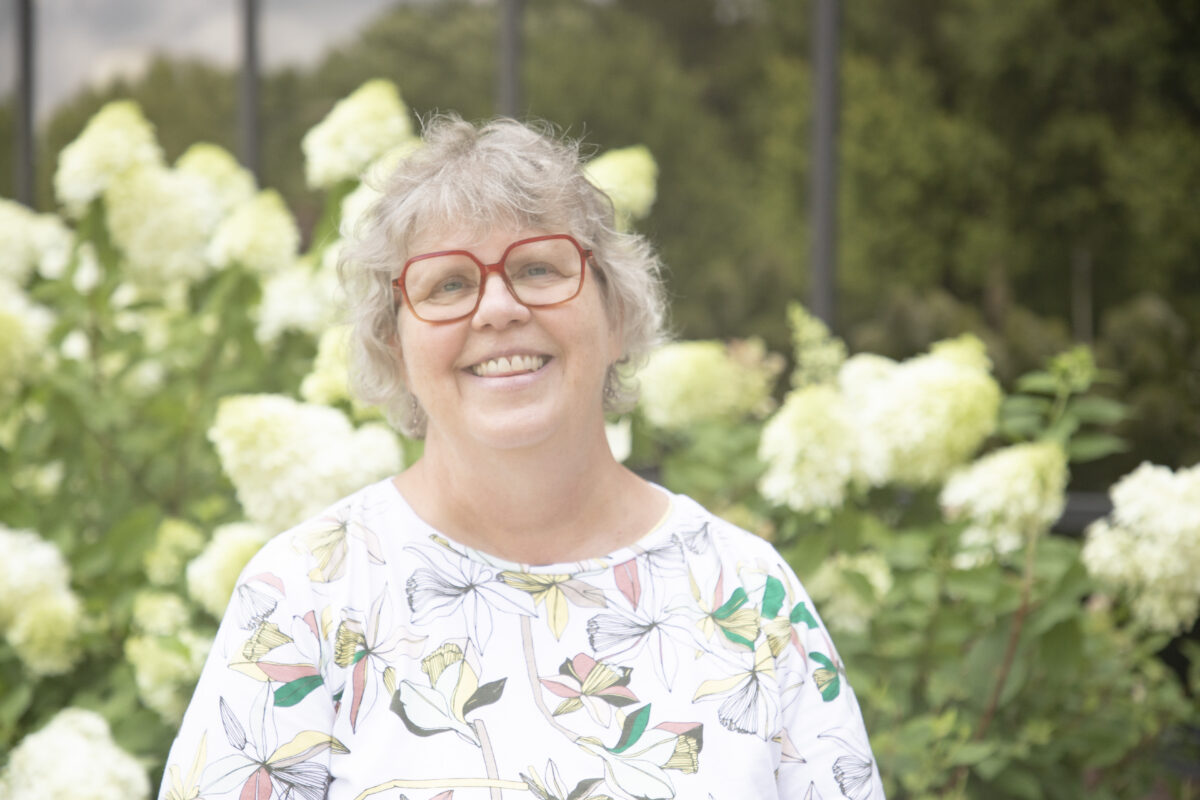 Cynthia Wagner (Photo courtesy of Wagner)
Wagner, who recently retired from UMBC after decades of inspiring students in her popular biology courses, will teach biology classes in English to students at Kyrgyz-Turkish Manas University in Bishkek, Kyrgyzstan. She’ll also conduct research searching for novel antimicrobial agents in the soil of Kyrgyzstan.
Lastly, Chan, a multidisciplinary artist engaged in conceptual work across print media, papermaking, installation art, and storytelling performance, will instruct both undergraduate and graduate students at the University of Art and Design in Cluj Napoca, Romania, utilizing concepts and methodologies she has developed during her tenure at UMBC. Additionally, she will produce a new collection of artist books, focusing on research into fiber art techniques and Romanian folk tales. These books, intended for display in both Romanian and international art collections, will also subtly reference corresponding motifs found within Chan’s own Chinese and American cultural heritage. This recognition of folk art traditions provides a foundation for cultural exchange, Chan says.
 Chan printing in August 2024 at ‘ace Proyecto, Buenos Aires, Argentina. (Photo courtesy of Chan)
Finding support at home and abroad
Souders, who serves as the Fulbright Scholar Liaison, says most UMBC faculty and staff work with him to hone their application. Casas shares that while he had been interested in the Fulbright awards since he started his academic career in the early 2000s, it wasn’t until he attended an informational webinar by Souders that he realized he was ready to apply. He met with Souders for advice, reached out to colleagues at the Universidad del Atlántico to assess where their needs and his interests overlapped, submitted his application, and “Here I am,” he says.
Penniston credits his supervisors and colleagues in DoIT with supporting his application and the opportunity for him to work remotely from Croatia following his six-month residency at the University of Zagreb. He hopes his time abroad will deepen his understanding of European Union education policy and seed partnerships that will ultimately benefit UMBC students and faculty.
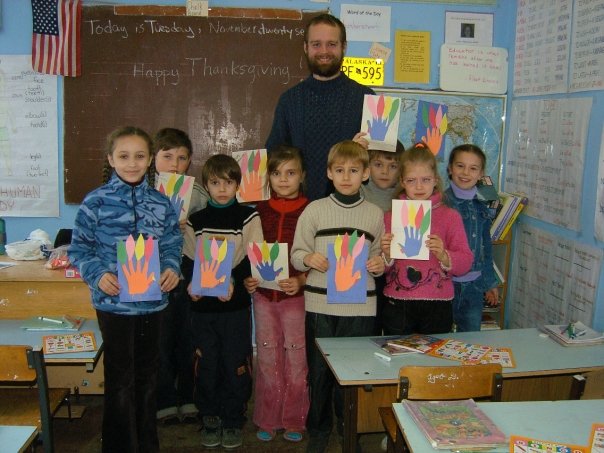 Tom Penniston with students at a school in Moldova, where he served as a U.S. Peace Corps volunteer. (Photo courtesy of Penniston)
Different scholars find different ways to bring bits of the world back with them when they return to the UMBC community, Souders says. For example, the College of Engineering and Information Technology’s award-winning Global Engineering course, co-taught with faculty at the University of Porto in Portugal, originated with the Fulbright project of Marc Zupan, an associate professor in the Department of Mechanical Engineering.
Wagner says it would be amazing to make a discovery that might one day help alleviate the antibiotic resistance crisis in the world. “A good majority of our current antibiotics come from soil microbes,” she says. “Kyrgyzstan has several different ecological niches in which the soil could vary and so could the microbes.”
Across the board, UMBC’s newest crop of Fulbright Scholars is excited to connect internationally and advance projects of shared interest.
“My Croatian hosts have already gone out of their way to make me feel welcome,” says Penniston. “I am thrilled to embark on this immersive intercultural experience, and to share it with my wife and our children.”
Wagner echoes the sense of excitement at a new, horizon-broadening opportunity: “It will be an adventure!” she says.
]]>
Four UMBC faculty and staff members have received highly competitive Fulbright U.S. Scholar awards to teach, conduct research, and forge cross-cultural connections around the world in the coming...
https://umbc.edu/stories/umbc-fulbright-scholar-awards-2025-2026/
https://my3.my.umbc.edu/api/v0/pixel/news/151242/guest@my.umbc.edu/40aedb34ecbc39cdccebef1442f801d5/api/pixel
biological-sciences
cahss
cnms
coeit
doit
fulbright
is
news
policy-and-society
research
story
visualarts
UMBC News & Magazine
https://my3.my.umbc.edu/groups/umbc-news-magazine
https://assets1-my.umbc.edu/system/shared/avatars/groups/000/001/943/24435aa6207c452e7bc15cc74b42c7bb/xsmall.png?1748556657
https://assets1-my.umbc.edu/system/shared/avatars/groups/000/001/943/24435aa6207c452e7bc15cc74b42c7bb/original.png?1748556657
https://assets2-my.umbc.edu/system/shared/avatars/groups/000/001/943/24435aa6207c452e7bc15cc74b42c7bb/xxlarge.png?1748556657
https://assets2-my.umbc.edu/system/shared/avatars/groups/000/001/943/24435aa6207c452e7bc15cc74b42c7bb/xlarge.png?1748556657
https://assets3-my.umbc.edu/system/shared/avatars/groups/000/001/943/24435aa6207c452e7bc15cc74b42c7bb/large.png?1748556657
https://assets1-my.umbc.edu/system/shared/avatars/groups/000/001/943/24435aa6207c452e7bc15cc74b42c7bb/medium.png?1748556657
https://assets2-my.umbc.edu/system/shared/avatars/groups/000/001/943/24435aa6207c452e7bc15cc74b42c7bb/small.png?1748556657
https://assets1-my.umbc.edu/system/shared/avatars/groups/000/001/943/24435aa6207c452e7bc15cc74b42c7bb/xsmall.png?1748556657
https://assets2-my.umbc.edu/system/shared/avatars/groups/000/001/943/24435aa6207c452e7bc15cc74b42c7bb/xxsmall.png?1748556657
UMBC News & Magazine
12
0
false
Thu, 31 Jul 2025 14:51:07 -0400
Thu, 31 Jul 2025 14:51:07 -0400
Could a robot dance partner help us de-stress? UMBC researchers explore the ‘algo-rhythmic’ possibilities
It wasn’t your usual scientific research presentation. Two dancers—one representing a robot and the other a human—take turns moving around each other. As the dance progresses the human is at first fearful, then curious, and finally happy.
The performance in June during the Movement, Music, and Brain Health National Science Foundation (NSF) AccelNet meeting on the UMBC campus was the brainchild of three UMBC faculty who have joined forces to explore whether and how dancing robots might offer humans new tools to improve their mental health. The research piggybacks off established practices of human-to-human dance/movement therapy, which can be used to treat some mental health challenges, such as schizophrenia, anxiety and depression.
The exact form that robotic dance therapy might take, and the range of mental health conditions it could treat, are still large open-ended questions for the team, which is led by Ramana Vinjamuri, an associate professor in computer science and electrical engineering, who has done extensive work in brain-computer interfaces, and Andrea Kleinsmith, an associate professor in information systems, who specializes in ways that computers can assess humans’ emotions.
“As a healthcare opportunity, dancing with a robot may sound weird at first,” says Ann Sofie Clemmensen, an associate professor of dance, who is also part of the interdisciplinary team. “Why not just dance with a human?” But, she says, people who are socially isolated or struggle with the stressors of human interactions might benefit from robot partners. “As humans we project emotions on objects, but the objects do not judge back,” she says.
“The most exciting thing about this project for me is the collaboration,” says Vinjamuri. “I’ve never done something like this, and so the possibility to bring these fields together to tackle an important issue like mental health is super exciting.”
First steps
The groundwork for the research was laid as part of over a decade of work in Vinjamuri’s lab searching for “alphabets” or “synergies” of hand movements and associated brain activity that combine to build the variety of our everyday movements. Vinjamuri’s Ph.D. student Parthan Olikkal had recently developed contactless human motion tracking methods, which he applied when teaching humanoid robots these alphabets to form new movements.
Against this backdrop, the spark for the interdisciplinary venture was struck when the College of Engineering and Information Technology (COEIT) launched a “COEIT Interdisciplinary Projects” program to encourage faculty to explore collaborations across disciplines to tackle big challenges. Vinjamuri reached out to Kleinsmith and Clemmensen to discuss the possibility of teaming up.
Together, the researchers developed a project proposal to study key questions surrounding the idea of robot-assisted dance therapy. They named the proposal SIVAM after the Indian mythological god of dance (also short for “Synergy-based, Intuitive, Virtual and Augmented therapy for Mental health”). The research would look into questions such as whether the coordination in a person’s arms and legs could be a proxy measure of mental well-being, how existing dance therapy movements affect brain activity, and how a humanoid robot dance partner compares in effectiveness to a flesh-and-blood one.
Creative solutions at the technological frontiers
Like any big endeavor, the project encountered unexpected hurdles. An existing robot that the team had couldn’t move fast enough or with the full range of motion needed for a dance partner. (A new robot will soon be ordered.) The team also had to wait for delivery of a special EEG cap that could measure a dancer’s brain activity without the typical gel and wires that would get in the way. The cap was also equipped to filter out the signal noise that comes from a person moving around.
When the team realized they would have to wait for the humanoid robot, they pivoted to developing a digital avatar. They designed a camera and software system to track a person’s motions and then created a digital representation of a person to mirror the movements back, a technique in dance/movement therapy.
Developing the motion tracking system was a big part of the project to date. “Even just a few years ago, it was so much more difficult to digitally capture a person’s movements without them wearing reflective markers that a camera can easily track,” says Kleinsmith. Now, the team is using the latest in computer vision and machine learning tools to implement a markerless tracking system. Eliminating the need for specialized attire should make the system more accessible and useful.
The team also laid the groundwork for the next stages of the project by testing sensors, including the new cap and wireless sensors that can measure physiological signals such as heart rate, skin conductance, and body temperature. All the equipment will help the team test novel ways of assessing, and perhaps ultimately altering, human subjects’ emotional states.
“If you tighten your body, that may mean anger or fright, if you are more loose, you are more relaxed,” says Clemmensen. “And it’s possible that you could then guide a person through movement into that emotional state. The next part of this research is to get the data on that, and I’m quite excited about it.”
A technology-infused stage debut
The June performance was a chance for the team to creatively demonstrate their progress to brain researchers and artists from around the world.
In the first half of the performance, the human dancer, performed by UMBC graduate Juju Ayoub ’25, dance, and a “robot” dancer, performed by Sarah McHale ’24, dance, sit opposite one another and take turns moving. Their movements are captured and displayed on a large screen by digital avatars. In the second half, the human and robot meet on the dance floor, while the human cycles through the emotions of fear, curiosity, and happiness. Sensors on Ayoub measured her brain activity, heart rate, and other signals that capture emotions, and displayed them on the screen. The second half of the performance was improvised by the dancers, within an accumulative structure provided by Clemmensen.


On left, dancers Juju Ayoub and Sarah McHale get ready to perform while Ph.D. student Parthan Olikkal sets up equipment. On right, Sarah McHale dances in front of the digital avatars. (Photos by Kiirstn Pagan ’11)
“Philosophically speaking, the first part of the performance represents humans and robots working in their own spaces. Part two is where they’re trying to work together, going through these phases of fear, curiosity, and then finally collaboration—and hopefully a happy collaboration,” says Vinjamuri.
The human researchers on the project have certainly found their own happy collaboration.
Clemmensen said she appreciated how the group’s focus could zoom out and in, transitioning from discussions of big ideas to tackling tricky troubleshooting for one piece of equipment.
“I would like to see if I can take that verbal process into the creative space of dance choreography too,” she says.
The students involved in the project—Olikkal, fellow Ph.D. students Sruthi Sundharram and Golnaz Moharrer, and undergraduates Oritsejolomisan Mebaghanje ’25, computer science, and first-year computer science student Viraj Janeja—agree it was a mind-stretching and rewarding experience.
“I was very excited to be involved in the performance, which was an unusual and creative experience,” says Sundharram, who is a first-year Ph.D. student in computer science in Vinjamuri’s lab and who helped set up and connect the cap and sensors before the dance. “It was nerve-racking right before the start, fearing that something wouldn’t work,” Sundharram laughed. But the dancers helped ease her jitters and the performance went well.
“The best part of the experience for me was seeing the virtual environment for the project come alive,” says Mebaghanje, who worked as the lead software developer on the project. “I also really enjoyed working with my team and debugging issues together.”
Olikkal, who has been involved in the project from the beginning, and who worked primarily on the motion capture system, says he’s been able to hone his career aspirations in a meaningful way after joining Vinjamuri’s lab in 2019 as a master’s student.
“Once I started really putting my heart into the research and seeing how these systems can help people, maybe not always immediately but certainly down the line, I felt like I had found my calling,” he says.
After the dancers exited the stage of the Fine Arts Recital Hall, Vinjamuri took the microphone to thank the whole team. And he hinted at the exciting work that lies ahead: “Maybe next time there will be a real robot on stage.”
]]>
It wasn’t your usual scientific research presentation. Two dancers—one representing a robot and the other a human—take turns moving around each other. As the dance progresses the human is at first...
https://umbc.edu/stories/robot-dance-partner-research/
https://my3.my.umbc.edu/api/v0/pixel/news/150994/guest@my.umbc.edu/d0e8122b74ccd4b9af234dffd3a0e5e8/api/pixel
cahss-research
coeit
csee
dance
is
news
research
science-and-tech
story
UMBC News & Magazine
https://my3.my.umbc.edu/groups/umbc-news-magazine
https://assets1-my.umbc.edu/system/shared/avatars/groups/000/001/943/24435aa6207c452e7bc15cc74b42c7bb/xsmall.png?1748556657
https://assets1-my.umbc.edu/system/shared/avatars/groups/000/001/943/24435aa6207c452e7bc15cc74b42c7bb/original.png?1748556657
https://assets2-my.umbc.edu/system/shared/avatars/groups/000/001/943/24435aa6207c452e7bc15cc74b42c7bb/xxlarge.png?1748556657
https://assets2-my.umbc.edu/system/shared/avatars/groups/000/001/943/24435aa6207c452e7bc15cc74b42c7bb/xlarge.png?1748556657
https://assets3-my.umbc.edu/system/shared/avatars/groups/000/001/943/24435aa6207c452e7bc15cc74b42c7bb/large.png?1748556657
https://assets1-my.umbc.edu/system/shared/avatars/groups/000/001/943/24435aa6207c452e7bc15cc74b42c7bb/medium.png?1748556657
https://assets2-my.umbc.edu/system/shared/avatars/groups/000/001/943/24435aa6207c452e7bc15cc74b42c7bb/small.png?1748556657
https://assets1-my.umbc.edu/system/shared/avatars/groups/000/001/943/24435aa6207c452e7bc15cc74b42c7bb/xsmall.png?1748556657
https://assets2-my.umbc.edu/system/shared/avatars/groups/000/001/943/24435aa6207c452e7bc15cc74b42c7bb/xxsmall.png?1748556657
UMBC News & Magazine
0
0
false
Fri, 11 Jul 2025 11:54:44 -0400
Fri, 11 Jul 2025 11:54:44 -0400