“Teaching them to think”: New course prepares students for success in proof-based mathematics

A new course in UMBC’s Department of Mathematics and Statistics is having a positive impact on student success in a notoriously difficult course for math majors everywhere. Two new papers by UMBC mathematicians and members of UMBC’s Faculty Development Center strongly suggest that MATH 300: Introduction to Mathematical Reasoning(IMR) is helping students succeed in MATH 301: Real Analysis, the first course math majors take that relies on one’s ability to construct and analyze proofs, rather than just do calculations.
In Real Analysis, “We’re switching gears of how students think. They go from calculational things to proof-based work,” says Kathleen Hoffman, professor of mathematics and lead author on the new papers. “Now your solution is a paragraph that you have to write in full sentences. It has to have logical structure. It has to start with a hypothesis and end with a conclusion. It’s a big hump for students to get over.”
Real Analysis is easily one of the most challenging courses for math majors nationwide, Hoffman says. Over the years, many institutions have introduced a preparatory course that teaches students how to develop proofs without requiring them to learn new math content at the same time. The conventional wisdom is that these courses help, but almost no one had conducted a rigorous study to find out.
“There was a huge gap in the literature,” Hoffman says.
Forming the team
UMBC math faculty had seen the need and been talking about adding a dedicated proof-writing course for years, but it hadn’t quite come together. Hoffman jump-started the process by applying for a Hrabowski Innovation Fund Grant in the Scholarship of Teaching and Learning category. These awards support faculty who want to do ambitious projects that they might not otherwise have bandwidth for.
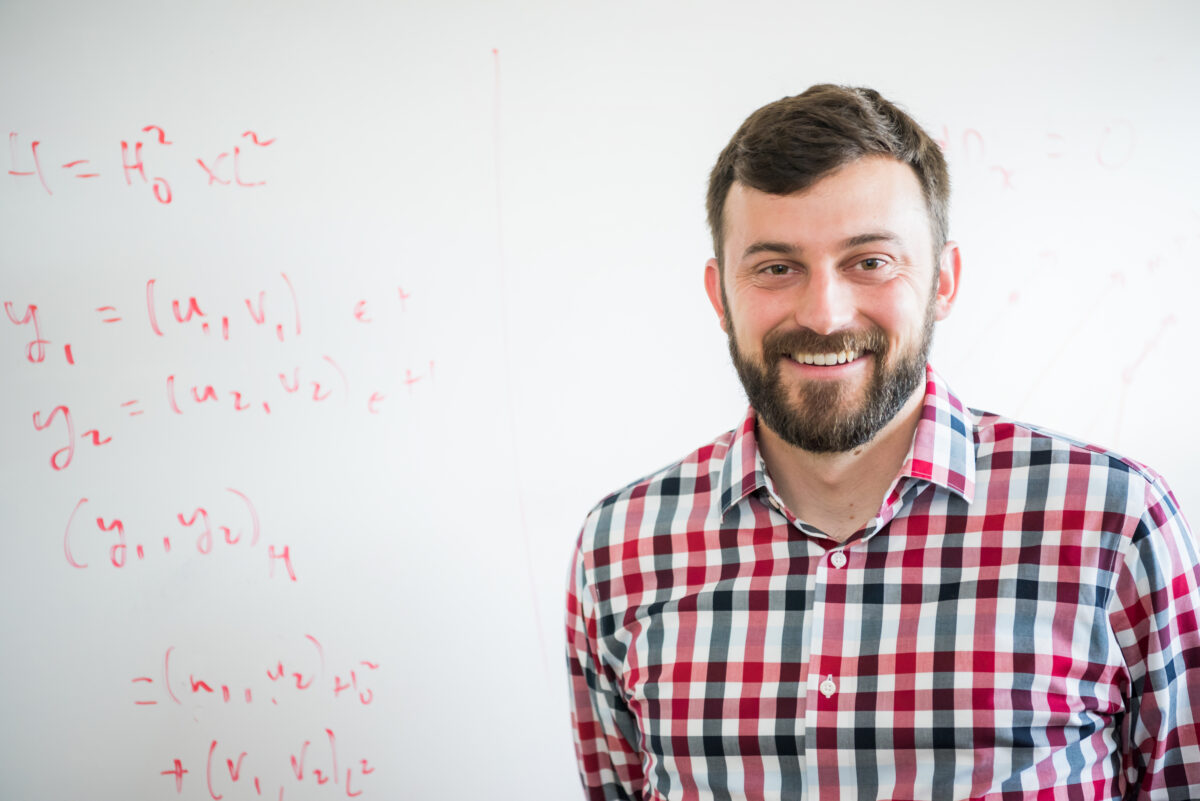
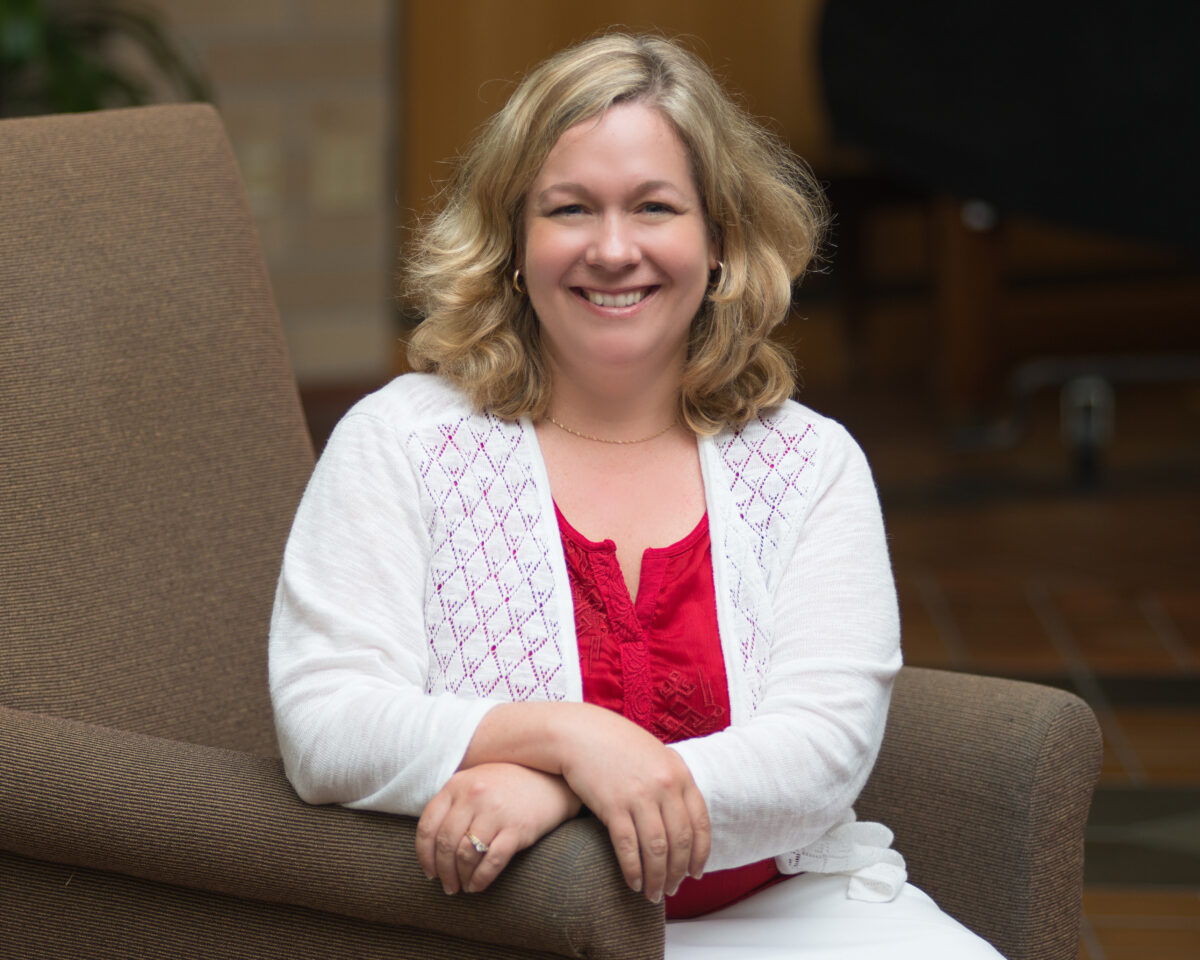 Kathleen Hoffman wrote the Hrabowski Fund for Innovation proposal that supported the team’s efforts to rigorously evaluate the effectiveness of their new course. (Courtesy of Hoffman)
When the award was funded, Hoffman formed a team with Justin Webster, associate professor of mathematics, and Kal Nanes, associate teaching professor of mathematics, to design the course for UMBC. Webster had re-designed and updated one of these proof-writing courses at his previous institution, the College of Charleston. The math team also worked with staff in UMBC’s Faculty Development Center to design a rigorous study to evaluate the course’s effectiveness over time. The team knows of only one other such study, from the 1980s, despite the rising incidence of proof-writing courses at universities nationwide.
Hoffman, Webster, and others believed that IMR would help UMBC math students, and informal observations supported their hunch once the course launched. These publications provide statistical analyses to back their intuition, and now Retrievers and students from other institutions can benefit from their successful formula.
Thinking about thinking
The first paper, published in a special issue of Educational Sciences, focused on written reflections the students completed every week along with their proofs. Prior research suggests that students tend to struggle in specific skills related to proof-writing, so the students were required to address how well they thought they did on each of four skills in their reflections.
“Students who did very thoughtful responses did much better in this course, but they also did much better in Real Analysis, where they didn’t do any reflections,” Hoffman says. The reflections “give the students a framework for understanding what they know and what they don’t know. It gives them the words to use.”
The study analyzed the quality of the reflections, but not necessarily the content. It didn’t seem to matter exactly what aspects of proof-writing the students addressed in their writing—simply the act of metacognition, or “thinking about thinking,” seemed beneficial.
The correlation was strong, but Hoffman admits the study does not prove causation. Strengthening the evidence, though, is that thoughtful reflections in IMR were not correlated with success in its prerequisite course, MATH 221: Introduction to Linear Algebra. That suggests the reflections, and potentially other elements of IMR, were the difference-maker for students moving forward.
A solid foundation
A second paper, published in the International Journal of Mathematical Education in Science and Technology, compared students’ grades in Real Analysis depending on whether or not they had taken the proof-writing course. The findings showed that IMR did not much affect the outcomes for students who earned As in the prerequisite linear algebra course—they were also likely to do well in Real Analysis whether they took IMR or not. However, students who earned a B or C in the prerequisite course were much more likely to successfully complete Real Analysis if they had taken IMR.
The researchers also received overwhelmingly positive feedback from students who had taken IMR about its benefits. One student said,
“I feel like [IMR] gave me a solid foundation in understanding how to write proofs, which allowed me to come into [Real Analysis] with a bit more confidence. Without it, I probably would have struggled through [Real Analysis] since I would have been learning how to write proofs and the [Real Analysis] material at the same time.”
Based on the results of these studies, the UMBC mathematics and statistics department has decided to make IMR a required part of the curriculum for math majors and minors. Minors used to take Real Analysis as their terminal course, but now they take IMR. For majors, IMR provides the foundation needed to support success in Real Analysis.
More than pushing symbols around
When he took it as an undergraduate, an IMR-type course “was the thing that made me want to be a math major,” Webster says, so designing this course for UMBC was an exciting prospect. Becoming proficient in writing and analyzing proofs, rather than doing calculations, is like “writing versus writing literature,” he says—you have to spend a lot of time thinking about what you’re trying to accomplish and how to structure your arguments. You can’t just “plug-and-chug,” applying various theorems and techniques to instances of a given type of problem. “Math isn’t just the act of pushing symbols around,” Webster says.
 Justin Webster often meets with students to support their progress in math courses. (Marlayna Demond ’11/UMBC)
To prepare students to write mathematical literature, Hoffman says that in IMR, “In one sense I’m teaching math, but in another sense I’m not. I’m teaching them how to think—how to structure their argument and express it clearly.” Almost never can a student simply sit down and write a proof in one sitting, like completing a problem set in prior math courses. It’s more like writing a paper.
When you work on a proof, “You think, you don’t get it, you go do something else, you think, ‘Oh, I think I know what to do,’ you come back, and that is normal,” Hoffman says. “They have to understand, this is not instant gratification—you will struggle with this and I’m expecting you to. It’s inevitable that they will struggle—I’m teaching them to persist through the struggle.”
A collective commitment
The studies would not have been possible without support from the Faculty Development Center. While many faculty might like to conduct more rigorous analysis of their teaching methods, it’s not their area of expertise. “If you want people like me who do disciplinary research to engage in pedagogical research, you have to give me some help,” as Hoffman put it.
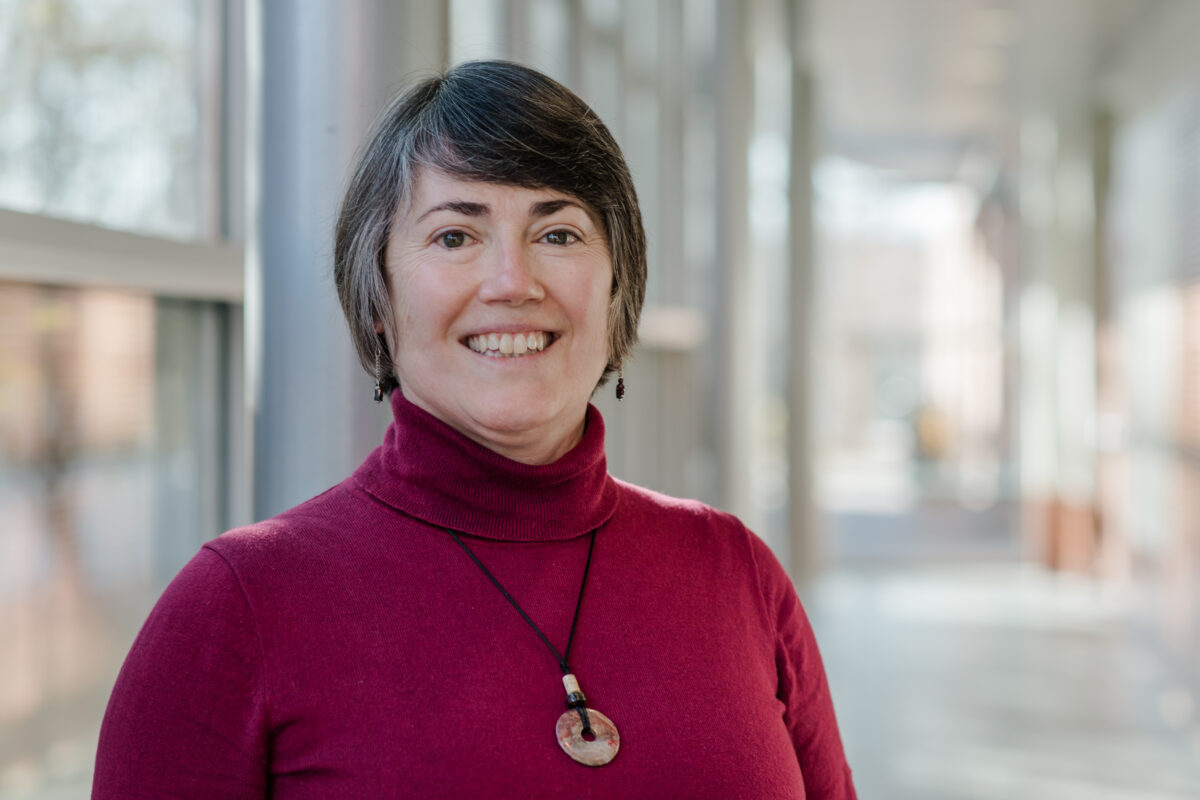 Kerrie Kephart was one of several members of the Faculty Development Center who contributed to the study of the new course’s impact. (Marlayna Demond ’11/UMBC)
That’s where the FDC came in. Several staff members became involved in the project, including Tory Williams, Jennifer Harrison, Kerrie Kephart, and Linda Hodges, adding their individual areas of expertise.
“The math faculty have deep expertise in math pedagogy, but needed our support to help plan the intervention, design the research study, and analyze the data. The project required all hands on deck.” shares Kephart, co-author on the written reflections study and interim FDC director. “As a qualitative researcher with expertise in the teaching of academic writing, I enjoyed the challenge of figuring out how to study the effects of incorporating reflective writing into a math class.”
The project is also a demonstration of the math department’s commitment to supporting student success, even if that required some culture change. Since IMR’s initial offering in 2019, several additional math faculty have taken on teaching the course. Each time someone new takes it on, they work closely with experienced instructors, and all sections of the course are closely coordinated to ensure quality and consistency for students.
The project is a masterclass in recognizing a challenge (a high failure rate in Real Analysis) and taking creative, concerted, and collective action to address it, with very positive results. “After realizing there was a gap in students’ preparation, a group worked together to fill it, and in the process learned a lot about how to measure progress in math education and pedagogy,” Webster says. “We leaped at this opportunity to effect change and measure outcomes in a novel and modern way.”
And because they carefully evaluated the project’s effects and published the results, now other math departments can benefit from their findings. That possibility was a highlight for Kephart. “Since our work in the FDC generally supports faculty, teaching, and learning here at UMBC,” she says, “it’s exciting to make a contribution toward the development of math pedagogy beyond our campus.”
]]>
A new course in UMBC’s Department of Mathematics and Statistics is having a positive impact on student success in a notoriously difficult course for math majors everywhere. Two new papers by UMBC...
https://umbc.edu/stories/new-course-for-success-in-proof-based-mathematics/
https://my3.my.umbc.edu/api/v0/pixel/news/147392/guest@my.umbc.edu/f1881142676dd57b1445f1260dc9b9c5/api/pixel
cnms
mathstat
news
research
science-and-tech
story
UMBC News & Magazine
https://my3.my.umbc.edu/groups/umbc-news-magazine
https://assets1-my.umbc.edu/system/shared/avatars/groups/000/001/943/24435aa6207c452e7bc15cc74b42c7bb/xsmall.png?1748556657
https://assets1-my.umbc.edu/system/shared/avatars/groups/000/001/943/24435aa6207c452e7bc15cc74b42c7bb/original.png?1748556657
https://assets2-my.umbc.edu/system/shared/avatars/groups/000/001/943/24435aa6207c452e7bc15cc74b42c7bb/xxlarge.png?1748556657
https://assets2-my.umbc.edu/system/shared/avatars/groups/000/001/943/24435aa6207c452e7bc15cc74b42c7bb/xlarge.png?1748556657
https://assets3-my.umbc.edu/system/shared/avatars/groups/000/001/943/24435aa6207c452e7bc15cc74b42c7bb/large.png?1748556657
https://assets1-my.umbc.edu/system/shared/avatars/groups/000/001/943/24435aa6207c452e7bc15cc74b42c7bb/medium.png?1748556657
https://assets2-my.umbc.edu/system/shared/avatars/groups/000/001/943/24435aa6207c452e7bc15cc74b42c7bb/small.png?1748556657
https://assets1-my.umbc.edu/system/shared/avatars/groups/000/001/943/24435aa6207c452e7bc15cc74b42c7bb/xsmall.png?1748556657
https://assets2-my.umbc.edu/system/shared/avatars/groups/000/001/943/24435aa6207c452e7bc15cc74b42c7bb/xxsmall.png?1748556657
UMBC News & Magazine
3
0
false
Mon, 17 Feb 2025 11:27:34 -0500
Mon, 17 Feb 2025 11:27:34 -0500
UMBC leverages interdisciplinary expertise to launch Quantum Science Institute

UMBC has received $1.5 million from the National Institute of Standards and Technology to organize a new UMBC Quantum Science Institute. The funding will support graduate fellowships for students pursuing quantum technology research, the development of new courses and academic programs focused on quantum, and equipment to enhance existing quantum labs and start new ones.
“This institute is the crowning jewel of several decades of pioneering quantum research here at UMBC,” says QSI director and professor of physics Todd Pittman, Ph.D. ’96, physics. “We have some heavy hitters here who are founders in the field, and the QSI is building on that foundation with a new generation of outstanding quantum-focused faculty.”
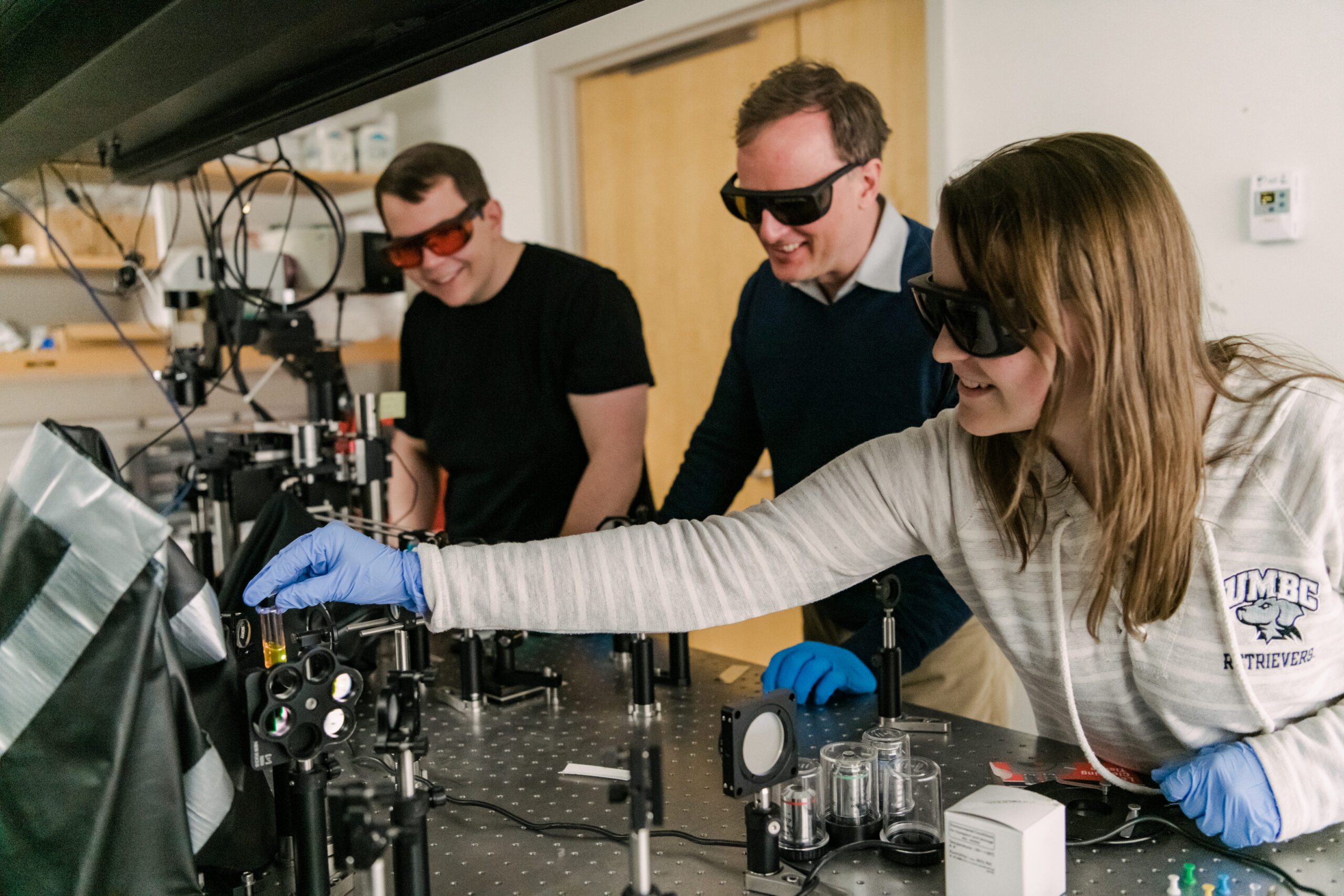 Matthew Pelton, center, leads a quantum optics laboratory at UMBC. (Marlayna Demond ’11/UMBC)
Quantum technologies harness the odd behaviors of particles at the atomic level to generate new functions, and are typically much more powerful than their conventional technology counterparts. To approach quantum research from every angle, the institute includes faculty across the College of Natural and Mathematical Sciences and the College of Engineering and IT in physics, mathematics and statistics, computer science, and information systems. They are pursuing quantum research in areas including computing, communications, sensing, information theory, algorithms, and more. “You just can’t do comprehensive quantum research without bringing together engineers, data analysts, computer scientists, mathematicians, and physicists,” Pittman says.
“I am thankful for the support provided by NIST to develop the UMBC Quantum Science Institute under the leadership of Dr. Pittman,” shares Karl V. Steiner, vice president for research and creative achievement. “QSI will catalyze a new quantum research effort, in support of Governor Moore’s ‘Capital of Quantum’ Initiative to position Maryland as a global leader in this rapidly growing field.”
Training quantum-ready workers
In addition to contributing to research innovation and discovery, the institute will train students from a range of backgrounds to take on skilled roles in the booming quantum industry.
“The quantum industry has exploded,” Pittman says. The quantum technology market was valued at $10 billion in 2021 and is projected to rise to $44 billion by 2028, with potential for much more growth beyond that. In addition to tech giants like Google and IBM, hundreds of start-ups are working in the quantum space. “The market is hungry for quantum-ready workers,” Pittman says, and UMBC is ready to train them.
UMBC marked World Quantum Day in 2022 with a short video highlighting the quantum technology research happening in the physics department.
Sandra Cheng, a fourth-year Ph.D. candidate in physics, is a member of the first cohort of quantum graduate fellows. “Quantum science research, particularly in computing and networking, is quite interdisciplinary by nature,” she says, “and I’m hopeful the QSI will bring together like minds from all the departments involved, so that we’ll be able to contribute towards a greater understanding of quantum science together.”
The QSI leadership team plans to offer social and professional development programming for the fellows. In addition to preparing them for the workforce, the connections they make will help generate a personal network of support, encouraging persistence in a demanding field. Organizing interdisciplinary offerings for the student cohort will also promote collaboration among faculty, Pittman says, adding, “Students are the glue that holds the center together.”
“This new institute is a celebration of our strength and history in quantum research,” Pittman says. “I’m looking forward to seeing QSI unify the quantum researchers on campus in a way that promotes and facilitates interdisciplinary collaboration.”
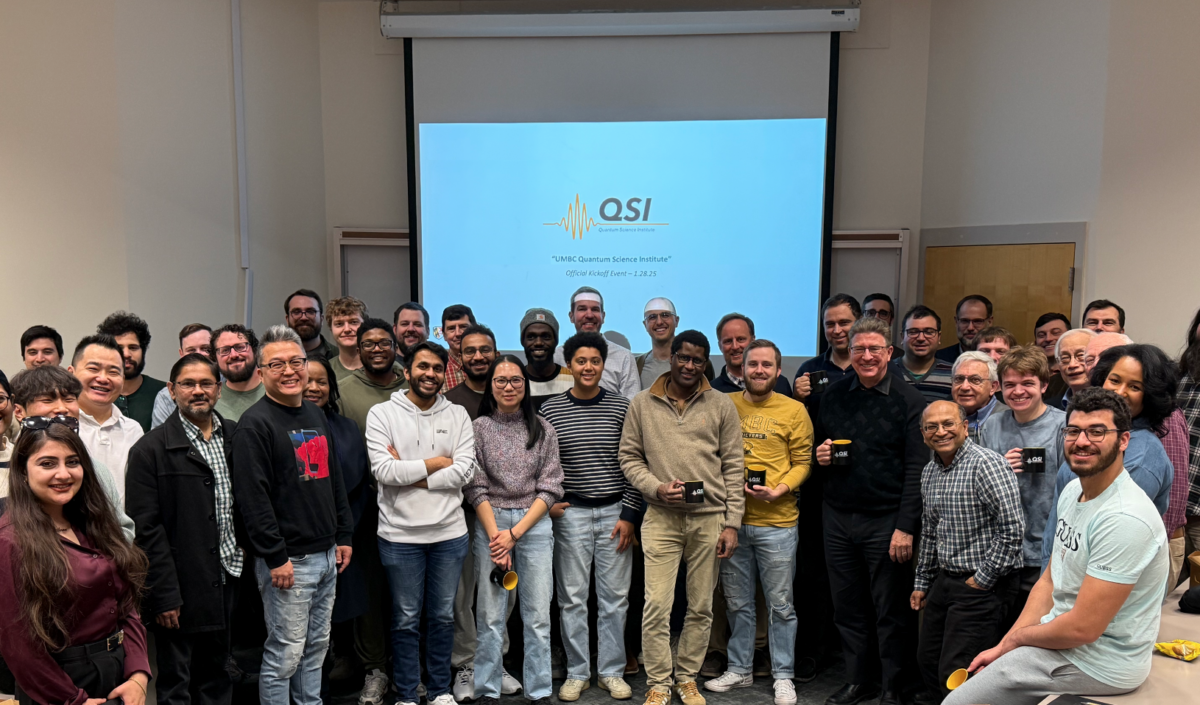 Representatives from all of the departments involved in the new QSI recently attended a launch event.
]]>
UMBC has received $1.5 million from the National Institute of Standards and Technology to organize a new UMBC Quantum Science Institute. The funding will support graduate fellowships for students...
https://umbc.edu/stories/quantum-science-institute-launch/
https://my3.my.umbc.edu/api/v0/pixel/news/147296/guest@my.umbc.edu/cb09589c98c92dd469d956539b185529/api/pixel
cnms
coeit
csee
information-systems
is
mathstat
news
physics
research
science-and-tech
story
UMBC News & Magazine
https://my3.my.umbc.edu/groups/umbc-news-magazine
https://assets1-my.umbc.edu/system/shared/avatars/groups/000/001/943/24435aa6207c452e7bc15cc74b42c7bb/xsmall.png?1748556657
https://assets1-my.umbc.edu/system/shared/avatars/groups/000/001/943/24435aa6207c452e7bc15cc74b42c7bb/original.png?1748556657
https://assets2-my.umbc.edu/system/shared/avatars/groups/000/001/943/24435aa6207c452e7bc15cc74b42c7bb/xxlarge.png?1748556657
https://assets2-my.umbc.edu/system/shared/avatars/groups/000/001/943/24435aa6207c452e7bc15cc74b42c7bb/xlarge.png?1748556657
https://assets3-my.umbc.edu/system/shared/avatars/groups/000/001/943/24435aa6207c452e7bc15cc74b42c7bb/large.png?1748556657
https://assets1-my.umbc.edu/system/shared/avatars/groups/000/001/943/24435aa6207c452e7bc15cc74b42c7bb/medium.png?1748556657
https://assets2-my.umbc.edu/system/shared/avatars/groups/000/001/943/24435aa6207c452e7bc15cc74b42c7bb/small.png?1748556657
https://assets1-my.umbc.edu/system/shared/avatars/groups/000/001/943/24435aa6207c452e7bc15cc74b42c7bb/xsmall.png?1748556657
https://assets2-my.umbc.edu/system/shared/avatars/groups/000/001/943/24435aa6207c452e7bc15cc74b42c7bb/xxsmall.png?1748556657
UMBC News & Magazine
0
0
false
Wed, 12 Feb 2025 15:54:40 -0500
Wed, 12 Feb 2025 15:54:40 -0500
In the world of math, the hunt for eloquent solutions excites these researchers
Representatives from all of the departments involved in the new QSI recently attended a launch event.
]]>
UMBC has received $1.5 million from the National Institute of Standards and Technology to organize a new UMBC Quantum Science Institute. The funding will support graduate fellowships for students...
https://umbc.edu/stories/quantum-science-institute-launch/
https://my3.my.umbc.edu/api/v0/pixel/news/147296/guest@my.umbc.edu/cb09589c98c92dd469d956539b185529/api/pixel
cnms
coeit
csee
information-systems
is
mathstat
news
physics
research
science-and-tech
story
UMBC News & Magazine
https://my3.my.umbc.edu/groups/umbc-news-magazine
https://assets1-my.umbc.edu/system/shared/avatars/groups/000/001/943/24435aa6207c452e7bc15cc74b42c7bb/xsmall.png?1748556657
https://assets1-my.umbc.edu/system/shared/avatars/groups/000/001/943/24435aa6207c452e7bc15cc74b42c7bb/original.png?1748556657
https://assets2-my.umbc.edu/system/shared/avatars/groups/000/001/943/24435aa6207c452e7bc15cc74b42c7bb/xxlarge.png?1748556657
https://assets2-my.umbc.edu/system/shared/avatars/groups/000/001/943/24435aa6207c452e7bc15cc74b42c7bb/xlarge.png?1748556657
https://assets3-my.umbc.edu/system/shared/avatars/groups/000/001/943/24435aa6207c452e7bc15cc74b42c7bb/large.png?1748556657
https://assets1-my.umbc.edu/system/shared/avatars/groups/000/001/943/24435aa6207c452e7bc15cc74b42c7bb/medium.png?1748556657
https://assets2-my.umbc.edu/system/shared/avatars/groups/000/001/943/24435aa6207c452e7bc15cc74b42c7bb/small.png?1748556657
https://assets1-my.umbc.edu/system/shared/avatars/groups/000/001/943/24435aa6207c452e7bc15cc74b42c7bb/xsmall.png?1748556657
https://assets2-my.umbc.edu/system/shared/avatars/groups/000/001/943/24435aa6207c452e7bc15cc74b42c7bb/xxsmall.png?1748556657
UMBC News & Magazine
0
0
false
Wed, 12 Feb 2025 15:54:40 -0500
Wed, 12 Feb 2025 15:54:40 -0500
In the world of math, the hunt for eloquent solutions excites these researchers

Some mathematical and statistical challenges are so fundamental that the solutions can be applied to an array of real-world applications—which we all benefit from. But it’s not necessarily the applications that excite researchers. They’re on the hunt to develop an elegant set of equations or a more accurate model because of the work’s inherent beauty and satisfaction, and, simply, because it’s fun.
This past fall, members of the UMBC Department of Mathematics and Statistics received at least three major grants to pursue work with significant real-world potential, from self-driving cars to treatments for Alzheimer’s. And while the mathematical work underpinning these potential uses can seem opaque, abstract, and just plain hard to many people, these mathematicians and statisticians see the process of thinking about the challenges as exciting and stimulating in and of themselves.
Optimizing optimization
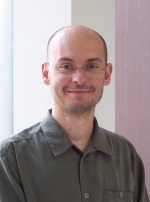 Andrei Draganescu (courtesy of Draganescu)
Andrei Draganescu, associate professor of mathematics, has received a grant from the National Science Foundation to pursue a creative new approach for solving optimization problems. Anytime a system performs a basic functionality, but you would like to make it better or more efficient, that’s an optimization problem, Draganescu explains.
Optimization means maximizing or minimizing something, such as cost, time, or power output. Think about today’s large language models, such as ChatGPT: Before it can respond effectively to any prompts, the model must rely on an algorithm to “learn” an optimal set of parameters from a vast amount of training data. Only once those parameters are fixed can it use them as a basis to determine the best response to your prompt. The time, electricity, and human work hours involved in training can cost billions of dollars, not including the capital investment in the hardware itself—so even a very small increase in efficiency makes a huge difference.
All of the possible combinations of parameters can be represented as points along a curved surface with hills and valleys. An algorithm developed by a mathematician can search for the lowest or highest point on that surface to solve the optimization problem, depending if you are looking for a minimum or a maximum. One risk with these algorithms is that they may end up at a local minimum or maximum—the peak of a single hill or the base of a single valley—that isn’t actually the global maximum or minimum across the entire surface.
In his grant application, Draganescu proposed a novel way of solving this kind of problem. “Because this type of problem is so old, it’s hard to find something new. But I think I did,” Draganescu says. Rather than searching for the minimum or maximum along a series of straight lines that approximate its curved surface, Draganescu has proposed a way to search directly along a set of well defined curves. The idea for the new approach “is a completely new angle,” he says, and in correspondence with colleagues to date, “nobody has contradicted me so far.”
 All of the possible combinations of parameters for a system can be represented as points along a curved surface with hills and valleys. (Fiona Suherman/UMBC)
Sticking with the hard problems
In math, there are many problems that are easy to express but extremely difficult to solve. Some have puzzled mathematicians for centuries. Draganescu’s Ph.D. advisor encouraged his students to think about these problems from time to time, in case they found a solution, of course, but also to keep their creative juices flowing. Draganescu continues the practice today.
“Sometimes I’ve spent days in a row on some of these very hard problems that nobody knows how to solve,” he says. “And of course I would love the glory, but honestly, that’s not where the fun is. I’m old enough to know that the fun is actually thinking about it.”
“And of course I would love the glory, but honestly, that’s not where the fun is. I’m old enough to know that the fun is actually thinking about it.”
Andrei Draganescu
Draganescu’s sticktoitiveness sometimes pays off in his everyday work. In the case of the idea that underpins his recent proposal, “I was surprised that it actually worked out. But ‘working out’ means many many months of work,” he says. “From having the initial idea to trusting that it could go somewhere, there were a lot of mistakes in the calculations and all that.” So why did he persist, knowing there was a good chance it wouldn’t “work out”? “I stuck with it because it was fun. I enjoy thinking about these problems.”
Draganescu is continuing to develop his new technique for solving optimization problems, which could improve efforts to optimize all kinds of systems, from AI to airline schedules to agriculture—all because he found joy from sitting with a sticky problem.
Replicating the real world
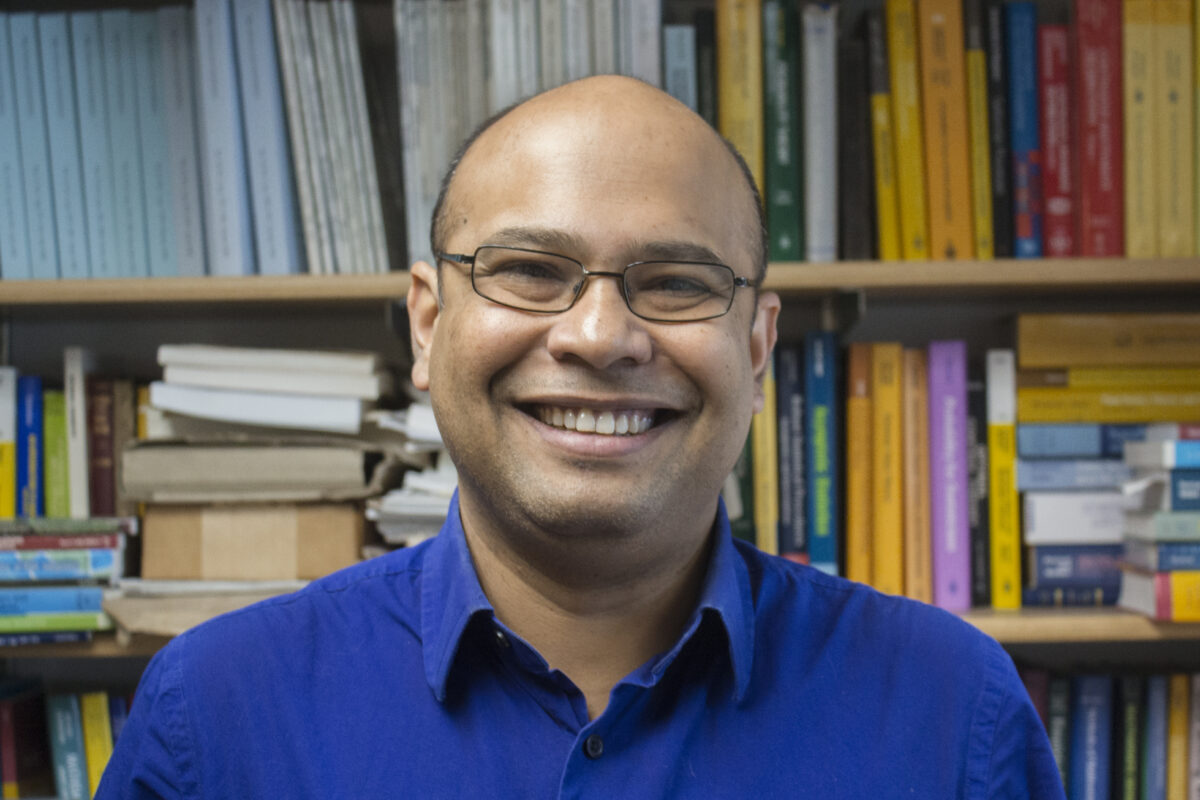 Ansu Chatterjee (courtesy of Chatterjee)
Ansu Chatterjee, professor of statistics, is another UMBC math mind whose work could have a major impact on a wide range of fields. He and UMBC colleagues Animikh Biswas, professor of mathematics, and Karuna Joshi, professor of information systems, have received an NSF grant to expand the use of “digital twin” technology. The grant proposal highlighted the potential to advance diagnosis and treatment for neurodegenerative diseases such as Alzheimer’s or Parkinson’s, but digital twin technology has a huge range of potential applications.
A digital twin is “essentially a clone of something in the physical world replicated inside a computer,” Chatterjee says. Additional applications could include forest management or weather forecasting. These twins can offer up predictions about which direction a hurricane will turn, which treatment protocol might be most effective for a particular patient, or whether it’s the right time for a prescribed burn in a forest—but there will always be uncertainties in the models.
“Measuring those uncertainties is a huge task,” Chatterjee says. How to deal with those uncertainties is one of the things the team wants to focus on with the new grant, which is very statistics-heavy, Chatterjee notes. Understanding and reducing the uncertainties requires understanding the physical processes at play in the real-world version of the system, and then working them into the model—and that’s hard.
Beyond the black box
Typical AI models are frequently “black box models,” which means even the people who created them don’t always understand exactly what they’re doing. For one thing, they are not constrained by objective truth in the physical world, Chatterjee explains. “It’s not even attempting to get the biology or the chemistry correct,” he says, and that’s not acceptable for a digital twin that’s modeling the human brain and may be used to determine a real human’s treatment plan.
“You don’t get the model right unless you get the underlying math of the molecules that constitute it right. So mathematics and statistics have to be the underpinning of anything related to digital twins.”
Ansu Chatterjee
“You don’t get the model right unless you get the underlying math of the molecules that constitute it right,” Chatterjee says. “So mathematics and statistics have to be the underpinning of anything related to digital twins.”
The digital twins Chatterjee and colleagues hope to further with their new research need not only replicate the outcomes of a system, but also the system’s mechanisms and internal processes. Again, that’s hard—especially when humans don’t yet fully understand many of these systems, such as the human brain, how cancer develops, or how various environmental factors influence carbon sequestration, for example.
“We are at the foundation of digital twins,” Chaterjee says. Once they are developed to a point where they are usable, digital twins and AI more generally would “open up a vast amount of opportunities for making fairly rapid progress with the actual science. This is where AI can help in scientific progress. It can suggest opportunities and possibilities which then can be verified,” Chatterjee says. “It would rule out certain possibilities. There would of course be false positives and false negatives, but as digital twins keep improving, it would be more and more convenient to use those first to find out a lot more interesting things.”
 A digital twin is “essentially a clone of something in the physical world replicated inside a computer,” Ansu Chatterjee says. (Illustration by Sadaf Rehman ’19/UMBC)
Fundamental building blocks
Chatterjee and colleagues are aware of the risks associated with digital twins. “There’s quite a lot of ethical issues that are related to digital twins in general, and it goes up several notches when it’s digital twins related to humans.” For example, there are regulatory concerns around who owns the data put into a digital twin (such as someone’s genomic data) and who is compensated when the twin is used for profit. “It’s exciting, and it’s also kind of a nightmare,” Chatterjee says.
That’s why he and colleagues will be working directly with federal regulatory agencies to make recommendations about how to handle these AI models. “This grant is sort of laying down the first fundamental steps—saying this is what should be done, this is how the first steps should be done,” Chatterjee says.
While that work is critical, it’s the math that truly excites Chatterjee. “For me, it’s about building the fundamental building blocks, whether it’s cancer or neurodegenerative diseases or forests” he says. “The essential ingredients for the digital component of it rely on the same math, the same statistics.”
Defining possible
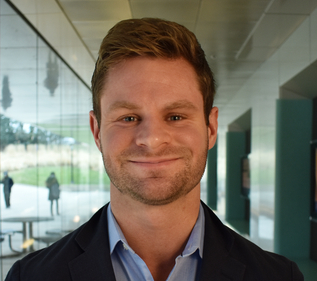 Matthew Kvalheim (courtesy of Kvalheim)
Matthew Kvalheim, assistant professor of mathematics, is also working on developing tools that can help people in a wide range of situations. His ultimate goal? To be able to tell researchers whether whatever they are trying to do with their system is possible or impossible. Sound vague? That’s the point.
“I’m never thinking about a specific application,” Kvalheim says. “I’m always working at the fundamental level, with a class of mathematical models that can describe all of them.” For Kvalheim, it’s the underlying math that is exciting—which is fortunate for all the people working on applications who will eventually use his multi-purpose tools.
“For any real world system, you might want it to do some behavior, or not do some behavior,” Kvalheim says. This might be making sure two self-driving cars don’t collide, preventing a humanoid robot from falling on its face, or keeping an electronic device at a safe temperature.
“Lots of people work on the set of models that I study,” he says, and the vast majority of them are investigating a particular application. These other researchers are very good at coming up with solutions that result in stability, or maintaining a certain state in a system, and safety, or preventing dangerous states in the system, “but there’s one thing they can’t do,” Kvalheim says. “They can’t determine if the thing they are trying to do, to make their system stable and safe in the way they want, is just fundamentally impossible. There could be a fundamental law of nature that says too bad, you can’t do it. You could try forever, but the heat death of the universe will occur first.”
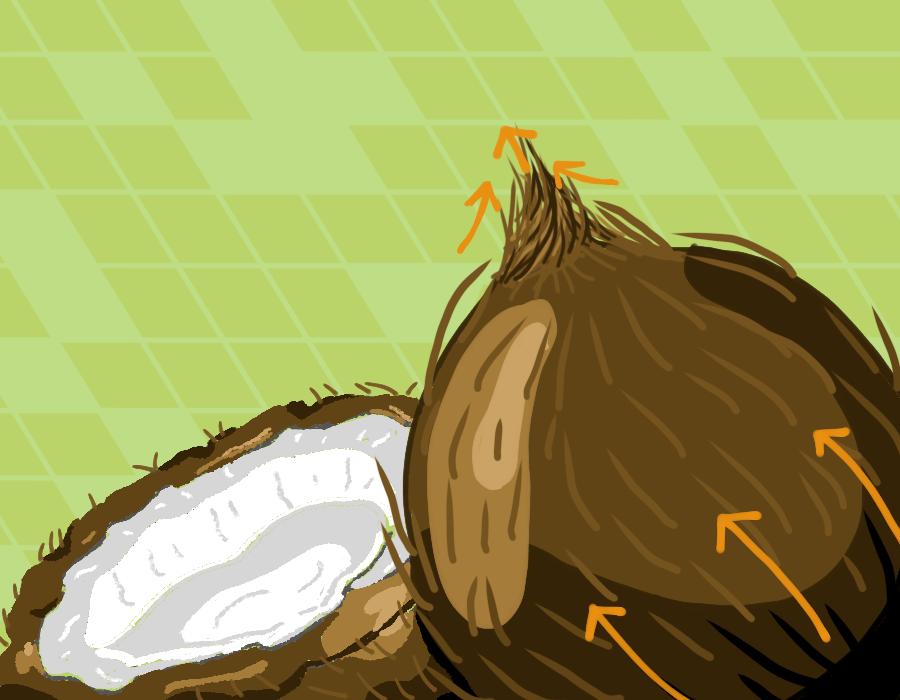 A tool Kvalheim has already published to help prove impossibility relies on math that is closely related to something called the “hairy ball theorem.” If you imagine certain 3D shapes covered by directional vectors—or, to make it simpler, hairs—”Try as you might, you can’t comb that hair flat everywhere without creating a cowlick somewhere,” Kvalheim says. (Illustration by Sadaf Rehman ’19/UMBC)
A license to look
Kvalheim would like to discover new fundamental limitations that hold true for any application you could come up with, and also new fundamental capabilities. The U.S. Air Force recently awarded him a grant to further this work. He’s trying to generate a sort of mathematical litmus test that any practitioner can use to find out whether the thing they are trying to do with their system (whatever it is!) is fundamentally possible or impossible. If it’s impossible, it saves them a lot of time, energy, and money. And if it’s possible? “It’s like giving people a license to go look for it,” Kvalheim says.
The best part is that the end user of one of Kvalheim’s tools wouldn’t need to understand all the pure math behind it. “The idea is to produce useful tools that they can use even if they don’t have the time or interest in diving into all the details,” he says.
 Kvalheim’s stability research is applicable even to the Lorenz system, which is a set of ordinary differential equations. Solutions to this system can vary chaotically depending on the initial parameters, but converge toward and stay within a bounded space. This space appears butterfly-shaped when represented visually.
(Illustration by Fiona Suherman/UMBC)
Math undergirds just about everything, Kvalhiem says, so it’s important to study the general case, rather than focus on specific applications. He wants people to see that it’s important “to know when there are fundamental laws of nature telling them that it is impossible or possible to do things that they want, and that math allows you to discover such laws of nature—and not just for one real-world system, but for many systems all at once.”
Somewhere a math or stat researcher is helping prevent your car from crashing, providing life-saving medical tools for yourself or a loved one, reducing wildfire risk where you live, or improving your experience with an AI tutor—and you might never even know it. There are humans behind each of these innovations who find joy and value in the math puzzles and problems that are all around us. And some of them work at UMBC.
]]>
Some mathematical and statistical challenges are so fundamental that the solutions can be applied to an array of real-world applications—which we all benefit from. But it’s not necessarily the...
https://umbc.edu/stories/math-hunt-for-solutions-excites-researchers/
https://my3.my.umbc.edu/api/v0/pixel/news/147113/guest@my.umbc.edu/5eda238a49360864da7dc841ee6f4d04/api/pixel
cnms
mathstat
news
research
science-and-tech
story
UMBC News & Magazine
https://my3.my.umbc.edu/groups/umbc-news-magazine
https://assets1-my.umbc.edu/system/shared/avatars/groups/000/001/943/24435aa6207c452e7bc15cc74b42c7bb/xsmall.png?1748556657
https://assets1-my.umbc.edu/system/shared/avatars/groups/000/001/943/24435aa6207c452e7bc15cc74b42c7bb/original.png?1748556657
https://assets2-my.umbc.edu/system/shared/avatars/groups/000/001/943/24435aa6207c452e7bc15cc74b42c7bb/xxlarge.png?1748556657
https://assets2-my.umbc.edu/system/shared/avatars/groups/000/001/943/24435aa6207c452e7bc15cc74b42c7bb/xlarge.png?1748556657
https://assets3-my.umbc.edu/system/shared/avatars/groups/000/001/943/24435aa6207c452e7bc15cc74b42c7bb/large.png?1748556657
https://assets1-my.umbc.edu/system/shared/avatars/groups/000/001/943/24435aa6207c452e7bc15cc74b42c7bb/medium.png?1748556657
https://assets2-my.umbc.edu/system/shared/avatars/groups/000/001/943/24435aa6207c452e7bc15cc74b42c7bb/small.png?1748556657
https://assets1-my.umbc.edu/system/shared/avatars/groups/000/001/943/24435aa6207c452e7bc15cc74b42c7bb/xsmall.png?1748556657
https://assets2-my.umbc.edu/system/shared/avatars/groups/000/001/943/24435aa6207c452e7bc15cc74b42c7bb/xxsmall.png?1748556657
UMBC News & Magazine
0
0
false
Thu, 06 Feb 2025 09:24:45 -0500
Thu, 06 Feb 2025 09:24:45 -0500
UMBC statistician selected to work with Addis Ababa University in Ethiopia
Yehenew Kifle, assistant professor of statistics at UMBC, has been awarded a fellowship by the Carnegie African Diaspora Fellowship Program (CADFP). Kifle will travel to Addis Ababa University (AAU) in Ethiopia to work with the Department of Epidemiology and Biostatistics. There, he will work with colleagues to enhance teaching and mentoring and grow research collaborations to support Ph.D. training in biostatistics.
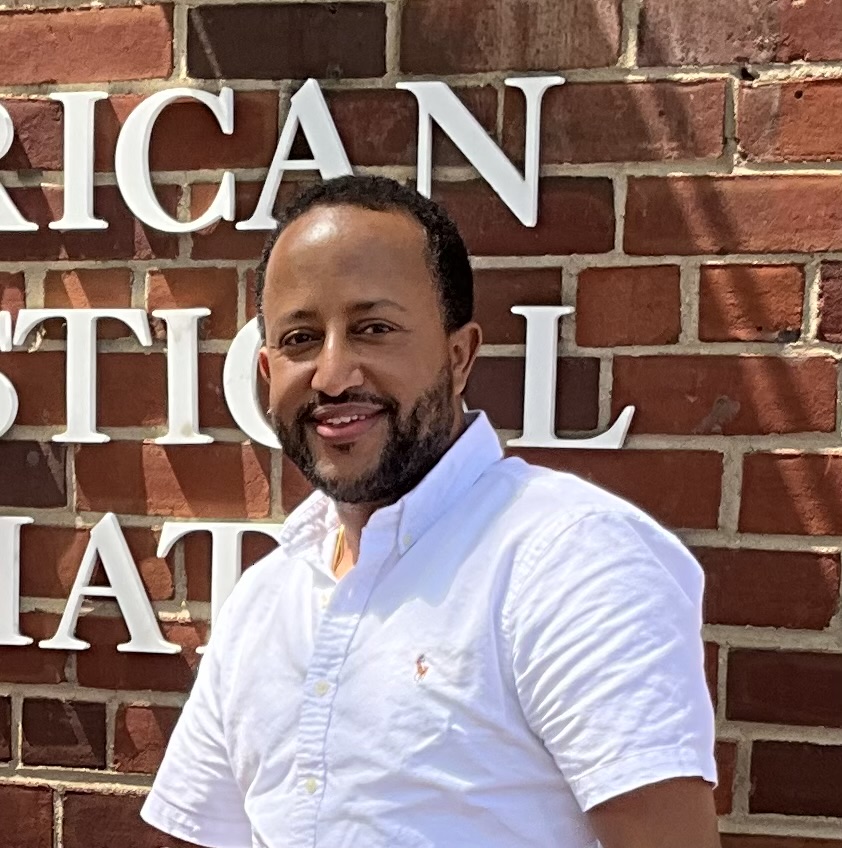 Yehenew Kifle visited the American Statistical Association in April 2024, around the signing of the agreement between the ASA and UMBC related to the African International Conference on Statistics. (Courtesy of Kifle)
Kifle will spend three months in Ethiopia this summer, working with his African host, Zeytu Gashaw Asfaw, associate professor of biostatistics at AAU. In addition to producing collaborative research, during his stay Kifle plans to conduct short-term training sessions and workshops on advanced software-aided statistical techniques for junior statisticians, graduate students, and medical professionals within the school of public health at AAU. He will also assist in crafting grant proposals aimed at increasing research collaborations in biostatistics between UMBC and AAU.
The Carnegie African Diaspora Fellowship Program, now in its 10th year, is designed to strengthen capacity for graduate education at host institutions and develop long-term, mutually beneficial collaborations between universities in Africa and the United States and Canada. It is funded by Carnegie Corporation of New York and managed by the Institute of International Education (IIE) in collaboration with the Association of African Universities. Nearly 650 fellowships have been awarded since the CADFP’s inception in 2013.
“I’m grateful for the opportunity to represent the University of Maryland, Baltimore County in its international outreach endeavors, highlighting the importance of CADFP,” Kifle says, adding, “I’m looking forward to sharing my expertise in teaching biostatistics graduate courses, offering mentorship, and supervising doctoral dissertations.” Additionally, Kifle plans to conduct seminars on his recent research findings and offer insights into improving graduate programs in biostatistics.
Building on international connections
Before arriving at UMBC, Kifle was a professor of statistics at the University of Limpopo in South Africa. UMBC signed a collaborative agreement with University of Limpopo in 2018, initiated by Kifle while he was a visiting faculty member from Limpopo at UMBC. Kifle first encountered UMBC’s strength in statistics at the 2015 African International Conference (AIC) on Statistics, a UMBC-led conference held in a different African country annually since 2014.
Since then, Kifle has been a leader in organizing the AIC, which recently received a pledge for support from the American Statistical Association. The Carnegie fellowship builds further on Kifle’s commitment to forging partnerships with African universities for the mutual benefit of scholars at UMBC and in Africa.
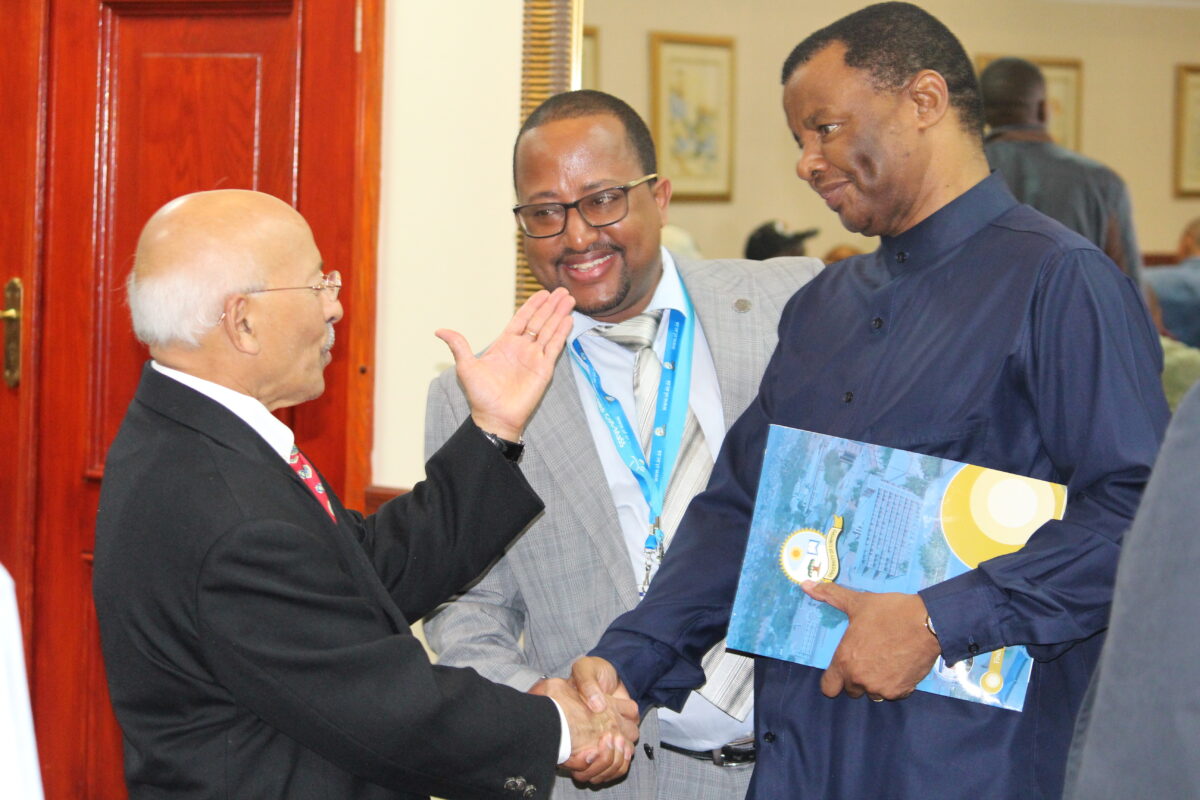 Bimal Sinha (left), professor of statistics at UMBC, and Yehenew Kifle (center), assistant professor of statistics at UMBC, with N.M. Mokgalongs, president of University of Limpopo, at the 4th Annual African International Conference on Statistics. (Courtesy of Kifle)
Kifle’s work in Ethiopia is one of 60 new projects supported by the CADFP that pair African diaspora scholars with higher education institutions and collaborators in Africa to work together on curriculum development, research, graduate training, and mentoring activities in 2024.
“This is indeed exciting news for all of us in the department and at UMBC,” shared Bimal Sinha, professor of statistics at UMBC. “We are thrilled to know that Dr. Kifle will represent UMBC in this extraordinary outreach effort to offer seminars and training courses and possibly to jointly supervise doctoral dissertations. There is no doubt that many statistics departments in Ethiopia will benefit from Dr. Kifle’s vast teaching and research experiences.”
]]>
Yehenew Kifle, assistant professor of statistics at UMBC, has been awarded a fellowship by the Carnegie African Diaspora Fellowship Program (CADFP). Kifle will travel to Addis Ababa University...
https://umbc.edu/stories/kifle-travels-to-ethiopia/
https://my3.my.umbc.edu/api/v0/pixel/news/142177/guest@my.umbc.edu/39b867af6145be9b62a0a5382d82c1d6/api/pixel
cnms
mathstat
news
research
science-and-tech
story
UMBC News & Magazine
https://my3.my.umbc.edu/groups/umbc-news-magazine
https://assets1-my.umbc.edu/system/shared/avatars/groups/000/001/943/24435aa6207c452e7bc15cc74b42c7bb/xsmall.png?1748556657
https://assets1-my.umbc.edu/system/shared/avatars/groups/000/001/943/24435aa6207c452e7bc15cc74b42c7bb/original.png?1748556657
https://assets2-my.umbc.edu/system/shared/avatars/groups/000/001/943/24435aa6207c452e7bc15cc74b42c7bb/xxlarge.png?1748556657
https://assets2-my.umbc.edu/system/shared/avatars/groups/000/001/943/24435aa6207c452e7bc15cc74b42c7bb/xlarge.png?1748556657
https://assets3-my.umbc.edu/system/shared/avatars/groups/000/001/943/24435aa6207c452e7bc15cc74b42c7bb/large.png?1748556657
https://assets1-my.umbc.edu/system/shared/avatars/groups/000/001/943/24435aa6207c452e7bc15cc74b42c7bb/medium.png?1748556657
https://assets2-my.umbc.edu/system/shared/avatars/groups/000/001/943/24435aa6207c452e7bc15cc74b42c7bb/small.png?1748556657
https://assets1-my.umbc.edu/system/shared/avatars/groups/000/001/943/24435aa6207c452e7bc15cc74b42c7bb/xsmall.png?1748556657
https://assets2-my.umbc.edu/system/shared/avatars/groups/000/001/943/24435aa6207c452e7bc15cc74b42c7bb/xxsmall.png?1748556657
UMBC News & Magazine
0
0
false
Fri, 24 May 2024 10:39:34 -0400
Fri, 24 May 2024 10:39:34 -0400
CNMS Awards and Recognition Day honors students, faculty, and staff

The College of Natural and Mathematical Sciences (CNMS) held its annual CNMS Awards and Recognition Day on May 10. Nearly 270 UMBC community members and friends attended the event in the University Center Ballroom. The department chairs presented 45 awards established by donors in support of students, faculty, and staff, such as the Carl S. Weber Award for Excellence in Teaching, awarded this year to Tamra Mendelson, professor of biological sciences.
“I would like to thank the members of the UMBC community—alumni, parents, faculty, staff, and friends—who have made possible many of the awards we are presenting here today. These are not just names on a page—they are stories of gratitude and giving, honoring loved ones and families,” shared William R. LaCourse, CNMS dean. “You are fueling the academic success of our students, helping us recruit and retain top-notch faculty, ensuring support for programs and people across the university, and inspiring others to give. On behalf of UMBC, thank you!”
The recognition day also honored eight CNMS faculty at all levels with Faculty Excellence Awards for research and teaching designated by the college, awarded college-level Staff Excellence Awards for outstanding service, and distributed departmental awards for undergraduate and graduate students recognizing academic excellence, research, and teaching.
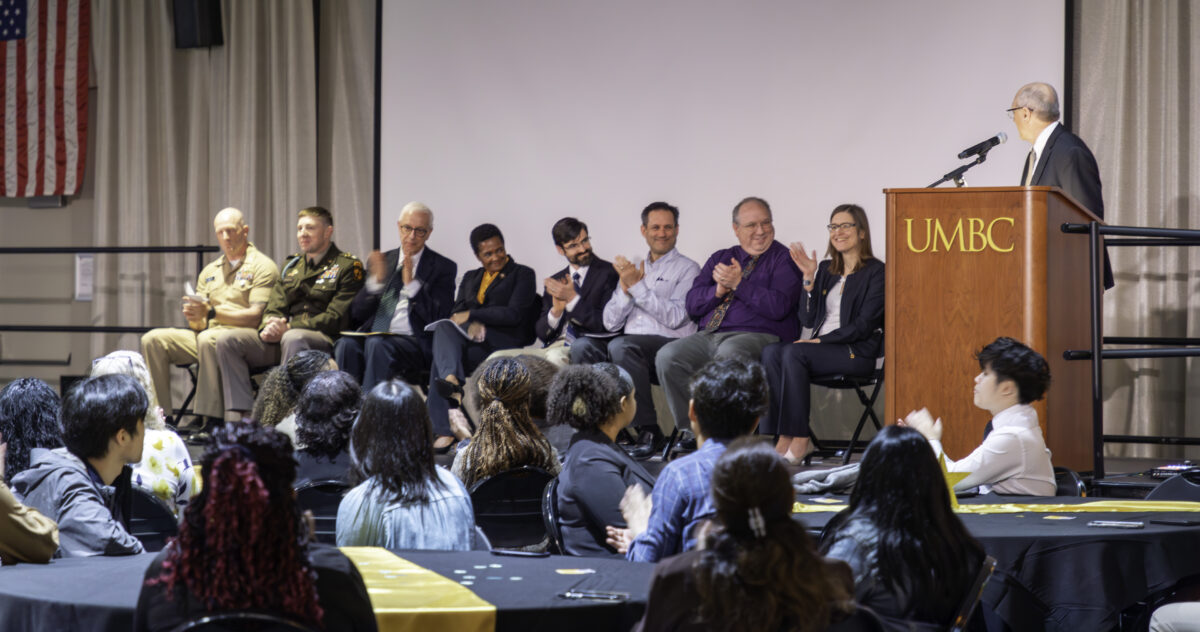 Dean LaCourse, at the podium, introduced the awards ceremony, and individual chairs or their designees presented the awards to members of their departments. From left to right: Commander Christopher Boehm, naval science; Captain John Howrey, naval science; Yonathan Zohar, professor and chair, marine biotechnology; Annica Wayman ’99, mechanical engineering, associate dean for Shady Grove affairs; Jason Kestner, associate professor and associate chair, physics; Bradford Peercy, professor, mathematics; Brian Cullum, professor and chair, chemistry and biochemistry; Michelle Starz-Gaiano, professor and chair, biological sciences. (Melissa Penley Cormier, M.F.A. ’17/UMBC)
CNMS also celebrated students who had been inducted into national honor societies, including Sigma Pi Sigma, the physics and astronomy honor society; Pi Mu Epsilon, the national mathematics honor society; Mu Sigma Rho, the national statistics honorary society; and the Phi Beta Kappa Society, which recognizes overall academic excellence.
LaCourse closed the ceremony by recognizing students in scholars programs within the college. The CNMS Scholars program supports students interested in the advancement of women in STEM fields where they are still underrepresented, and the Beckman Scholars program, funded by the Arnold and Mabel Beckman Foundation, supports students desiring to pursue doctoral study in the biological and chemical sciences.
“Students who have been recognized at this ceremony have met UMBC’s academic requirements and have excelled at high levels in their academics and/or service to their departments, college, and university,” LaCourse shared. “These honorees are poised to become scientists, physicians, mathematicians, teachers, and leaders in their chosen fields. These students are our leaders of the future, and we are fortunate to have the opportunity to help provide the critical foundations for their promising futures.”
The full event program, including additional remarks from Dean LaCourse and a complete list of awardees and award descriptions, is available here.
]]>
The College of Natural and Mathematical Sciences (CNMS) held its annual CNMS Awards and Recognition Day on May 10. Nearly 270 UMBC community members and friends attended the event in the...
https://umbc.edu/quick-posts/cnms-awards-and-recognition-day/
https://my3.my.umbc.edu/api/v0/pixel/news/142067/guest@my.umbc.edu/d470f1cd3c570305367c88562363b92a/api/pixel
biology
chembiochem
cnms
community
marinebiotech
mathstat
naval-science
news
physics
quick-post
science-and-tech
UMBC News & Magazine
https://my3.my.umbc.edu/groups/umbc-news-magazine
https://assets1-my.umbc.edu/system/shared/avatars/groups/000/001/943/24435aa6207c452e7bc15cc74b42c7bb/xsmall.png?1748556657
https://assets1-my.umbc.edu/system/shared/avatars/groups/000/001/943/24435aa6207c452e7bc15cc74b42c7bb/original.png?1748556657
https://assets2-my.umbc.edu/system/shared/avatars/groups/000/001/943/24435aa6207c452e7bc15cc74b42c7bb/xxlarge.png?1748556657
https://assets2-my.umbc.edu/system/shared/avatars/groups/000/001/943/24435aa6207c452e7bc15cc74b42c7bb/xlarge.png?1748556657
https://assets3-my.umbc.edu/system/shared/avatars/groups/000/001/943/24435aa6207c452e7bc15cc74b42c7bb/large.png?1748556657
https://assets1-my.umbc.edu/system/shared/avatars/groups/000/001/943/24435aa6207c452e7bc15cc74b42c7bb/medium.png?1748556657
https://assets2-my.umbc.edu/system/shared/avatars/groups/000/001/943/24435aa6207c452e7bc15cc74b42c7bb/small.png?1748556657
https://assets1-my.umbc.edu/system/shared/avatars/groups/000/001/943/24435aa6207c452e7bc15cc74b42c7bb/xsmall.png?1748556657
https://assets2-my.umbc.edu/system/shared/avatars/groups/000/001/943/24435aa6207c452e7bc15cc74b42c7bb/xxsmall.png?1748556657
UMBC News & Magazine
0
0
false
Fri, 17 May 2024 15:55:57 -0400
Fri, 17 May 2024 15:55:57 -0400
First CNMS GradFest fosters interdepartmental interaction among grads, postdocs
On April 12, more than 150 students, staff, and faculty attended the first College of Natural and Mathematical Sciences (CNMS) GradFest in the University Center Ballroom. The event was the result of listening sessions held with CNMS graduate students last summer, and it addressed their desire for more opportunities to forge interdepartmental connections and present their research.
“Every day, I hear about the great work being done by graduate students and postdocs in CNMS departments,” William R. LaCourse, CNMS dean, shared in his opening remarks. “Today is my chance to meet all of the graduate students the faculty are always bragging about.”
The event began with six “lightning talks,” where Ph.D. students were challenged to present the big idea of their thesis projects in only five minutes. Naghmeh Akhavan, mathematics, led off, presenting her project on cell migration in fruit fly development. She is co-mentored by Brad Peercy in mathematics and Michelle Starz-Gaiano in biological sciences. Misti Cartwright, chemistry and biochemistry, discussed her work with Aaron Smith on a post-translation protein modification called arginylation.
Sandra Cheng, physics, talked about her work with Todd Pittman in quantum computing, and Manju Ojha, chemistry and biochemistry, explained her work on RNA-based plant viruses with Deepak Koirala. Ji Li, statistics, described a protocol he developed under the mentorship of Yi Huang to improve data sets for randomized controlled trials. And Prableen Chowdhary, biological sciences, explained her work with Rachel Brewster on zebrafish development.
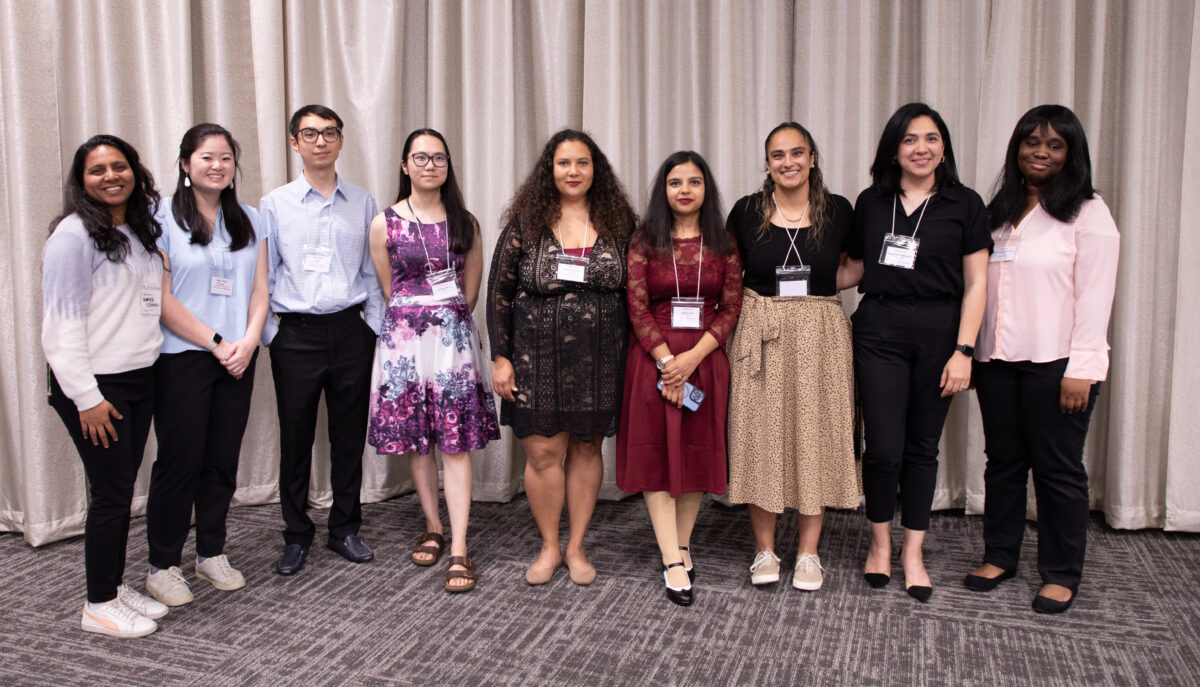 GradFest lightning talk presenters and the planning committee, from left to right: Ronita Sequeira, Ally Kido, Ji Li, Sandra Cheng, Misti Cartwright, Manju Ojha, Prableen Chowdhary, Naghmeh Akhavan, and Ayokunnumi Ogunsanya. (Image by Melissa Penley Cormier, M.F.A. ’17)
After the talks, two sessions featuring 46 posters allowed attendees to learn about the presenters’ research, ask questions, and make suggestions. A novel arrangement of posters in the ballroom facilitated interaction: Placing four posters each on round tables allowed guests to meander among the posters in many directions, unimpeded by long, linear poster displays.
Tasty mocktails, hors d’oeuvres, and desserts rounded out a successful event that brought graduate students and postdocs—collectively, the research engine of UMBC—together to socialize, practice presenting, and learn about each other’s work.
]]>
On April 12, more than 150 students, staff, and faculty attended the first College of Natural and Mathematical Sciences (CNMS) GradFest in the University Center Ballroom. The event was the result...
https://umbc.edu/quick-posts/inaugural-cnms-gradfest/
https://my3.my.umbc.edu/api/v0/pixel/news/141234/guest@my.umbc.edu/03a86a4db175b2e09f7b4c367757a010/api/pixel
biology
chembiochem
cnms
gradresearch
mathstat
physics
quick-post
research
UMBC News & Magazine
https://my3.my.umbc.edu/groups/umbc-news-magazine
https://assets1-my.umbc.edu/system/shared/avatars/groups/000/001/943/24435aa6207c452e7bc15cc74b42c7bb/xsmall.png?1748556657
https://assets1-my.umbc.edu/system/shared/avatars/groups/000/001/943/24435aa6207c452e7bc15cc74b42c7bb/original.png?1748556657
https://assets2-my.umbc.edu/system/shared/avatars/groups/000/001/943/24435aa6207c452e7bc15cc74b42c7bb/xxlarge.png?1748556657
https://assets2-my.umbc.edu/system/shared/avatars/groups/000/001/943/24435aa6207c452e7bc15cc74b42c7bb/xlarge.png?1748556657
https://assets3-my.umbc.edu/system/shared/avatars/groups/000/001/943/24435aa6207c452e7bc15cc74b42c7bb/large.png?1748556657
https://assets1-my.umbc.edu/system/shared/avatars/groups/000/001/943/24435aa6207c452e7bc15cc74b42c7bb/medium.png?1748556657
https://assets2-my.umbc.edu/system/shared/avatars/groups/000/001/943/24435aa6207c452e7bc15cc74b42c7bb/small.png?1748556657
https://assets1-my.umbc.edu/system/shared/avatars/groups/000/001/943/24435aa6207c452e7bc15cc74b42c7bb/xsmall.png?1748556657
https://assets2-my.umbc.edu/system/shared/avatars/groups/000/001/943/24435aa6207c452e7bc15cc74b42c7bb/xxsmall.png?1748556657
UMBC News & Magazine
1
0
false
Tue, 23 Apr 2024 10:09:29 -0400
Tue, 23 Apr 2024 10:09:29 -0400
UMBC partners with American Statistical Association to organize annual African International Conference on Statistics
The eighth iteration of the African International Conference on Statistics (AIC), scheduled for June 2024 in Tunis, Tunisia, will mark a new era for the conference. Originally championed by Bimal Sinha, UMBC professor of statistics, the first AIC took place in 2014 in Senegal. Each conference since has been held in a different African country in collaboration with local institutions.
In 2018, relationships that grew out of the conference led UMBC to sign a collaborative agreement with the University of Limpopo in South Africa to foster academic exchange. At that time, Yehenew Kifle, assistant professor of statistics, was a visiting professor at UMBC and a faculty member at the University of Limpopo. Today he has taken the helm of the AIC from the soon-to-retire Sinha, who remains a core member of the planning committee.
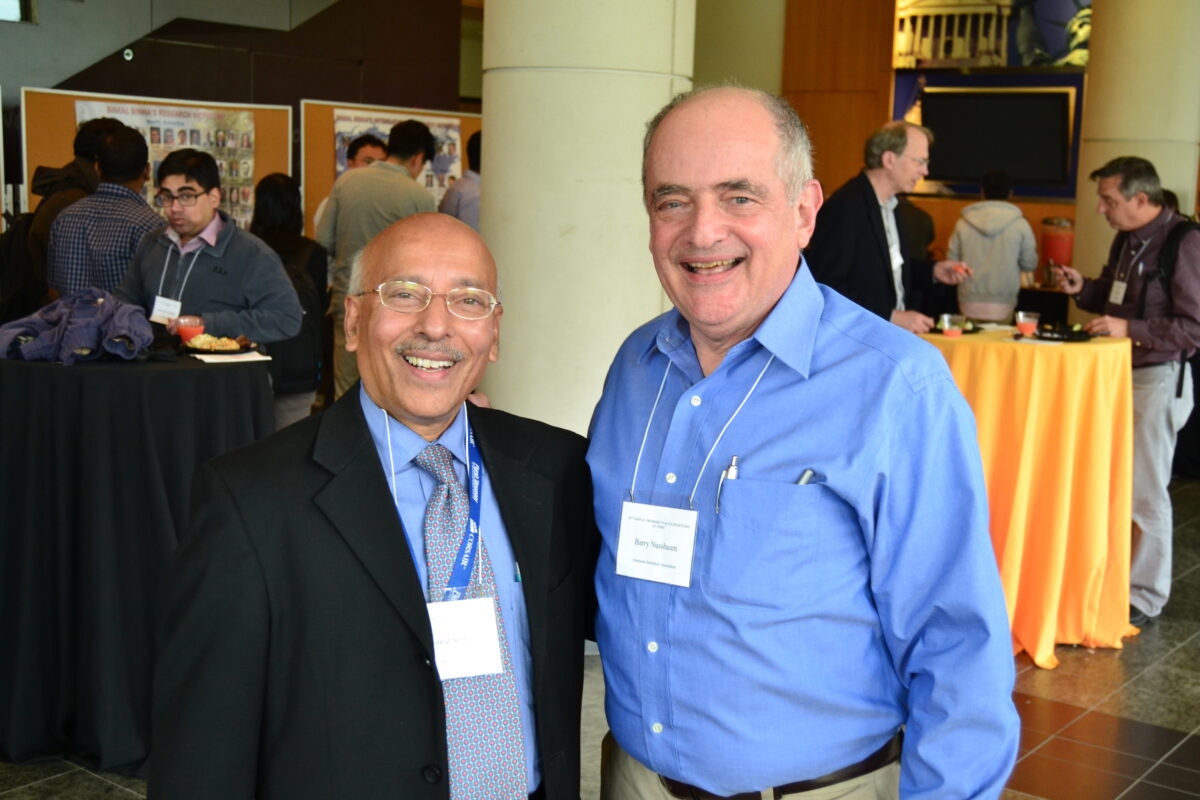 Bimal Sinha and Barry Nussbaum, former president of the American Statistical Association and current member of the AIC planning committee, at UMBC’s Probability and Statistics Day event in 2016. (Photo by Ricardo Moura)
This April, Kifle signed an agreement with the American Statistical Association (ASA) on behalf of UMBC that pledges financial support from the ASA for the conference for at least the next two years, with the possibility for an extended partnership.
“Through the African International Conference on Statistics, we achieved a significant milestone in 2018 by signing the first UMBC memorandum of understanding with an African university, which supports training for African students on a short- and long-term basis,” Kifle says. “Now we stand as partners with the world’s largest statistical association, the American Statistical Association. This partnership with ASA lays the foundation for great optimism about a promising future for the AIC.”
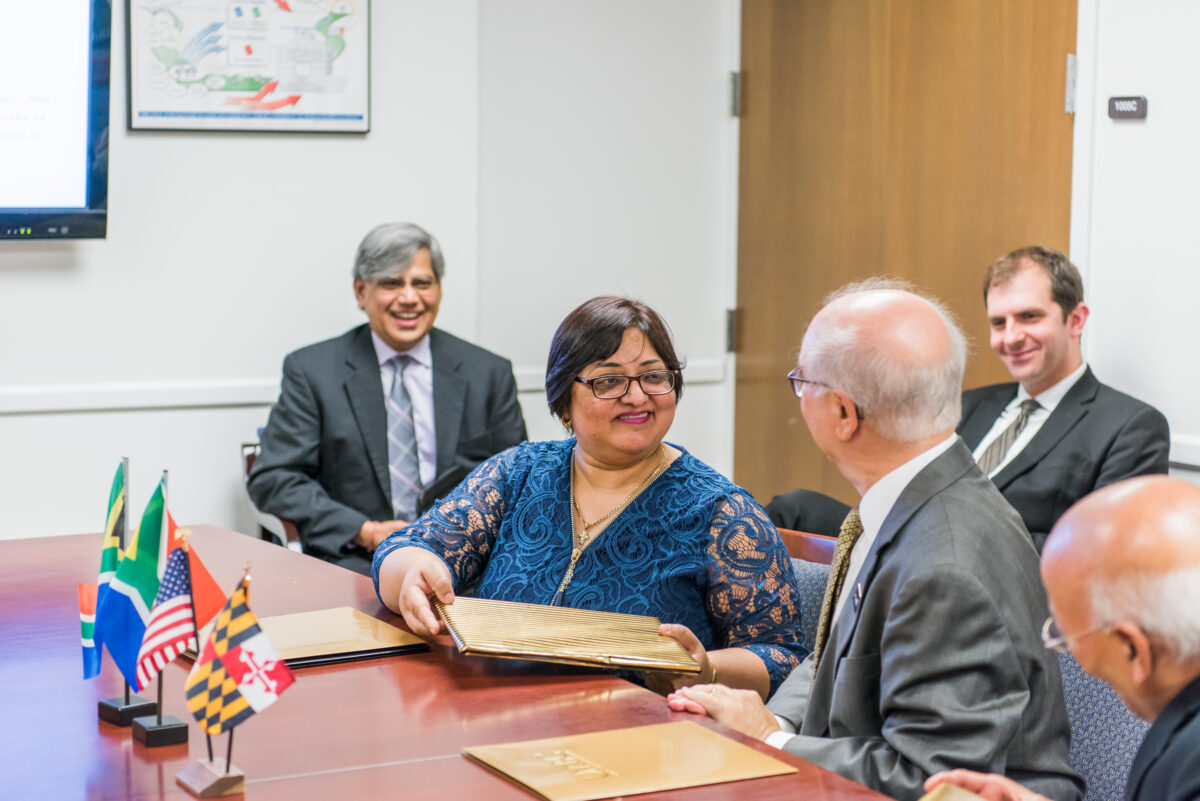 Jesika Singh, University of Limpopo (center left), and Antonio Moreira, vice provost for academic affairs at UMBC (center right), sign the agreement between UMBC and the University of Limpopo in 2018.
The theme of the 2024 AIC is “Empowering Innovation: Advanced Statistics and Data Science for Sustainable Development in Africa.” The theme speaks to the power of statistics to support progress in areas like agriculture, economic development, and environmental conservation that are relevant to people all over the world.
“ASA is delighted to partner with UMBC on the African International Conference on Statistics,” shares Ronald Wasserstein, executive director of ASA. “The AIC has established itself as an important contributor to advancing statistical science in Africa. We hope ASA’s support will provide the opportunity for the creative and enthusiastic minds at UMBC to take the conference to still higher levels.”
]]>
The eighth iteration of the African International Conference on Statistics (AIC), scheduled for June 2024 in Tunis, Tunisia, will mark a new era for the conference. Originally championed by Bimal...
https://umbc.edu/stories/new-partnership-supports-african-international-conference-on-statistics/
https://my3.my.umbc.edu/api/v0/pixel/news/141065/guest@my.umbc.edu/bd641865df629d7f29b02e70aaba7084/api/pixel
cnms
mathstat
news
rca-2
science-and-tech
story
UMBC News & Magazine
https://my3.my.umbc.edu/groups/umbc-news-magazine
https://assets1-my.umbc.edu/system/shared/avatars/groups/000/001/943/24435aa6207c452e7bc15cc74b42c7bb/xsmall.png?1748556657
https://assets1-my.umbc.edu/system/shared/avatars/groups/000/001/943/24435aa6207c452e7bc15cc74b42c7bb/original.png?1748556657
https://assets2-my.umbc.edu/system/shared/avatars/groups/000/001/943/24435aa6207c452e7bc15cc74b42c7bb/xxlarge.png?1748556657
https://assets2-my.umbc.edu/system/shared/avatars/groups/000/001/943/24435aa6207c452e7bc15cc74b42c7bb/xlarge.png?1748556657
https://assets3-my.umbc.edu/system/shared/avatars/groups/000/001/943/24435aa6207c452e7bc15cc74b42c7bb/large.png?1748556657
https://assets1-my.umbc.edu/system/shared/avatars/groups/000/001/943/24435aa6207c452e7bc15cc74b42c7bb/medium.png?1748556657
https://assets2-my.umbc.edu/system/shared/avatars/groups/000/001/943/24435aa6207c452e7bc15cc74b42c7bb/small.png?1748556657
https://assets1-my.umbc.edu/system/shared/avatars/groups/000/001/943/24435aa6207c452e7bc15cc74b42c7bb/xsmall.png?1748556657
https://assets2-my.umbc.edu/system/shared/avatars/groups/000/001/943/24435aa6207c452e7bc15cc74b42c7bb/xxsmall.png?1748556657
UMBC News & Magazine
0
0
false
Wed, 17 Apr 2024 16:22:09 -0400
Wed, 17 Apr 2024 16:22:09 -0400
From thousands to millions to billions to trillions to quadrillions and beyond: Do numbers ever end?

Written by Manil Suri, professor of mathematics, UMBC
Curious Kids is a series for children of all ages. If you have a question you’d like an expert to answer, send it to curiouskidsus@theconversation.com.
Why don’t numbers end? – Reyhane, age 7, Tehran, Iran
Here’s a game: Ask a friend to give you any number and you’ll return one that’s bigger. Just add “1” to whatever number they come up with and you’re sure to win.
The reason is that numbers go on forever. There is no highest number. But why? As a professor of mathematics, I can help you find an answer.
First, you need to understand what numbers are and where they come from. You learned about numbers because they enabled you to count. Early humans had similar needs – whether to count animals killed in a hunt or keep track of how many days had passed. That’s why they invented numbers.
But back then, numbers were quite limited and had a very simple form. Often, the “numbers” were just notches on a bone, going up to a couple hundred at most.
How numbers evolved throughout the centuries.
When numbers got bigger
As time went on, people’s needs grew. Herds of livestock had to be counted, goods and services traded, and measurements made for buildings and navigation. This led to the invention of larger numbers and better ways of representing them.
About 5,000 years ago, the Egyptians began using symbols for various numbers, with a final symbol for one million. Since they didn’t usually encounter bigger quantities, they also used this same final symbol to depict “many.”
The Greeks, starting with Pythagoras, were the first to study numbers for their own sake, rather than viewing them as just counting tools. As someone who’s written a book on the importance of numbers, I can’t emphasize enough how crucial this step was for humanity.
By 500 BCE, Pythagoras and his disciples had not only realized that the counting numbers – 1, 2, 3 and so on – were endless, but also that they could be used to explain cool stuff like the sounds made when you pluck a taut string.
Zero is a critical number
But there was a problem. Although the Greeks could mentally think of very large numbers, they had difficulty writing them down. This was because they did not know about the number 0.
Think of how important zero is in expressing big numbers. You can start with 1, then add more and more zeroes at the end to quickly get numbers like a million – 1,000,000, or 1 followed by six zeros – or a billion, with nine zeros, or a trillion, 12 zeros.
It was only around 1200 CE that zero, invented centuries earlier in India, came to Europe. This led to the way we write numbers today.
This brief history makes clear that numbers were developed over thousands of years. And though the Egyptians didn’t have much use for a million, we certainly do. Economists will tell you that government expenditures are commonly measured in millions of dollars.
Also, science has taken us to a point where we need even larger numbers. For instance, there are about 100 billion stars in our galaxy – or 100,000,000,000 – and the number of atoms in our universe may be as high as 1 followed by 82 zeros.
Don’t worry if you find it hard to picture such big numbers. It’s fine to just think of them as “many,” much like the Egyptians treated numbers over a million. These examples point to one reason why numbers must continue endlessly. If we had a maximum, some new use or discovery would surely make us exceed it.
The symbols of math include +, -, x and =.
Exceptions to the rule
But under certain circumstances, sometimes numbers do have a maximum because people design them that way for a practical purpose.
A good example is a clock – or clock arithmetic, where we use only the numbers 1 through 12. There is no 13 o’clock, because after 12 o’clock we just go back to 1 o’clock again. If you played the “bigger number” game with a friend in clock arithmetic, you’d lose if they chose the number 12.
Since numbers are a human invention, how do we construct them so they continue without end? Mathematicians started looking at this question starting in the early 1900s. What they came up with was based on two assumptions: that 0 is the starting number, and when you add 1 to any number you always get a new number.
These assumptions immediately give us the list of counting numbers: 0 + 1 = 1, 1 + 1 = 2, 2 + 1 = 3, and so on, a progression that continues without end.
You might wonder why these two rules are assumptions. The reason for the first one is that we don’t really know how to define the number 0. For example: Is “0” the same as “nothing,” and if so, what exactly is meant by “nothing”?
The second might seem even more strange. After all, we can easily show that adding 1 to 2 gives us the new number 3, just like adding 1 to 2002 gives us the new number 2003.
But notice that we’re saying this has to hold for any number. We can’t very well verify this for every single case, since there are going to be an endless number of cases. As humans who can perform only a limited number of steps, we have to be careful anytime we make claims about an endless process. And mathematicians, in particular, refuse to take anything for granted.
Here, then, is the answer to why numbers don’t end: It’s because of the way in which we define them.
Now, the negative numbers
How do the negative numbers -1, -2, -3 and more fit into all this? Historically, people were very suspicious about such numbers, since it’s hard to picture a “minus one” apple or orange. As late as 1796, math textbooks warned against using negatives.
The negatives were created to address a calculation issue. The positive numbers are fine when you’re adding them together. But when you get to subtraction, they can’t handle differences like 1 minus 2, or 2 minus 4. If you want to be able to subtract numbers at will, you need negative numbers too.
A simple way to create negatives is to imagine all the numbers – 0, 1, 2, 3 and the rest – drawn equally spaced on a straight line. Now imagine a mirror placed at 0. Then define -1 to be the reflection of +1 on the line, -2 to be the reflection of +2, and so on. You’ll end up with all the negative numbers this way.
As a bonus, you’ll also know that since there are just as many negatives as there are positives, the negative numbers must also go on without end!
This article is republished from The Conversation under a Creative Commons license. Read the original article and see more than 250 UMBC articles available in The Conversation.
]]>
Written by Manil Suri, professor of mathematics, UMBC Curious Kids is a series for children of all ages. If you have a question you’d like an expert to answer, send it to...
https://umbc.edu/stories/do-numbers-ever-end/
https://my3.my.umbc.edu/api/v0/pixel/news/140920/guest@my.umbc.edu/a8382a1f744aebb5e038899164f37293/api/pixel
cnms
discovery
magazine
mathstat
story
the-conversation
UMBC News & Magazine
https://my3.my.umbc.edu/groups/umbc-news-magazine
https://assets1-my.umbc.edu/system/shared/avatars/groups/000/001/943/24435aa6207c452e7bc15cc74b42c7bb/xsmall.png?1748556657
https://assets1-my.umbc.edu/system/shared/avatars/groups/000/001/943/24435aa6207c452e7bc15cc74b42c7bb/original.png?1748556657
https://assets2-my.umbc.edu/system/shared/avatars/groups/000/001/943/24435aa6207c452e7bc15cc74b42c7bb/xxlarge.png?1748556657
https://assets2-my.umbc.edu/system/shared/avatars/groups/000/001/943/24435aa6207c452e7bc15cc74b42c7bb/xlarge.png?1748556657
https://assets3-my.umbc.edu/system/shared/avatars/groups/000/001/943/24435aa6207c452e7bc15cc74b42c7bb/large.png?1748556657
https://assets1-my.umbc.edu/system/shared/avatars/groups/000/001/943/24435aa6207c452e7bc15cc74b42c7bb/medium.png?1748556657
https://assets2-my.umbc.edu/system/shared/avatars/groups/000/001/943/24435aa6207c452e7bc15cc74b42c7bb/small.png?1748556657
https://assets1-my.umbc.edu/system/shared/avatars/groups/000/001/943/24435aa6207c452e7bc15cc74b42c7bb/xsmall.png?1748556657
https://assets2-my.umbc.edu/system/shared/avatars/groups/000/001/943/24435aa6207c452e7bc15cc74b42c7bb/xxsmall.png?1748556657
UMBC News & Magazine
0
0
false
Mon, 15 Apr 2024 10:39:08 -0400
Stitching it all together, or how Ephraim Ruttenberg ’25 got hooked on math and crochet

In the back of a classroom, at a desk strewn with a colorful palette of commingled notebooks and skeins of yarn, sits Ephraim Ruttenberg ’25, mathematics. His fingers nimbly and nearly subconsciously manipulate a crochet hook while his ears eagerly take in a lecture on differential equations—one of his favorite subjects. Ruttenberg loves unraveling the principles behind complex theorems, and he’s eagerly extended that passion from mathematics to crochet.
Ruttenberg’s first love is math—he only picked up crochet in 2023 after seeing a math YouTuber explaining concepts with crocheted models of mathematical forms. But Ruttenberg’s math-themed crochet, where he creates intricate 3D shapes that bring abstract ideas into the physical world, has quickly become an important part of his life.
“Anything creative and artistic very much appeals to me, and I’m very inspired by what other people can make. Art seems to be a core part of the human experience,” Ruttenberg says. In particular, he says, “I like visual art. And this is the most fun and success I’ve had with making visual art.”
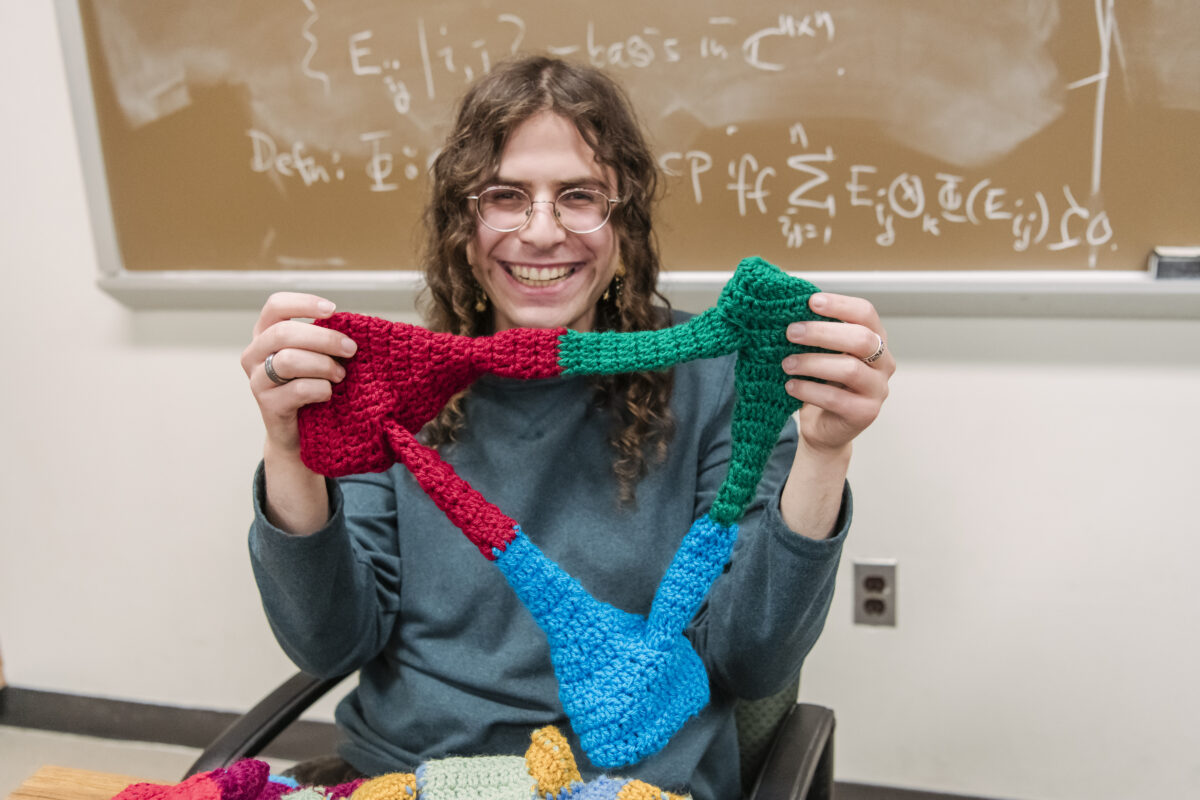 One of Ruttenberg’s creations is three Klein bottles stitched together. (Marlayna Demond ’11/UMBC)
Klein bottles and sea slugs
Although Ruttenberg’s primary motivation for pursuing crochet is as a hobby distinct from mathematics, as something to do with his hands while his mind chews on other things and simply as a way to create beautiful physical objects, he couldn’t help weaving in some math. He relies on a shape’s mathematical properties and reference images to translate them into crochet.
The shapes Ruttenberg creates include Klein bottles, single-sided surfaces reminiscent of Möbius strips closed up on themselves. Ruttenberg created a Klein bottle that can be worn as a hat, and another creation stitches three Klein bottles together. He’s also constructed dozens of what are called saddle surfaces, which are examples of “curved space” and look a lot like a brain coral or a sea slug with all of their folds and convolutions. Ruttenberg used three complete skeins of yarn—that’s nine football fields in length—to stitch the largest of these, and the surface’s curvaceous outer edge measures 50 feet despite it only being about a foot across.
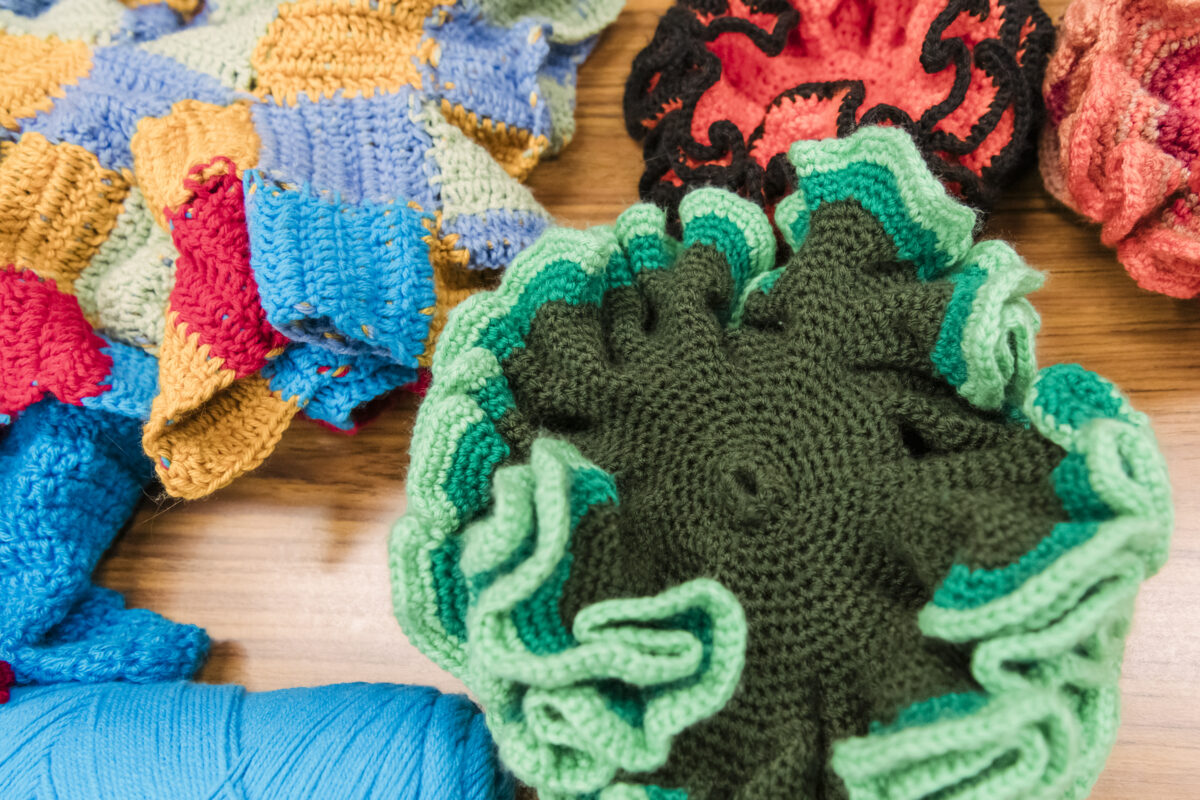 This saddle surface is Ruttenberg’s largest. Each shade of green required the same length of yarn, demonstrating how much the curvature adds length as you approach the perimeter of the piece. (Marlayna Demond ’11/UMBC)
Through his creations, Ruttenberg is hoping to investigate some mathematical concepts “that haven’t been explored in physical reality,” he says. “Also, I would like to do some math about crochet,” he says, such as how the physical properties of a crocheted object influence or define the pattern that describes it. In addition to the math, though, crochet for Ruttenberg is also “a creative, artistic pursuit.”
The beauty of patterns
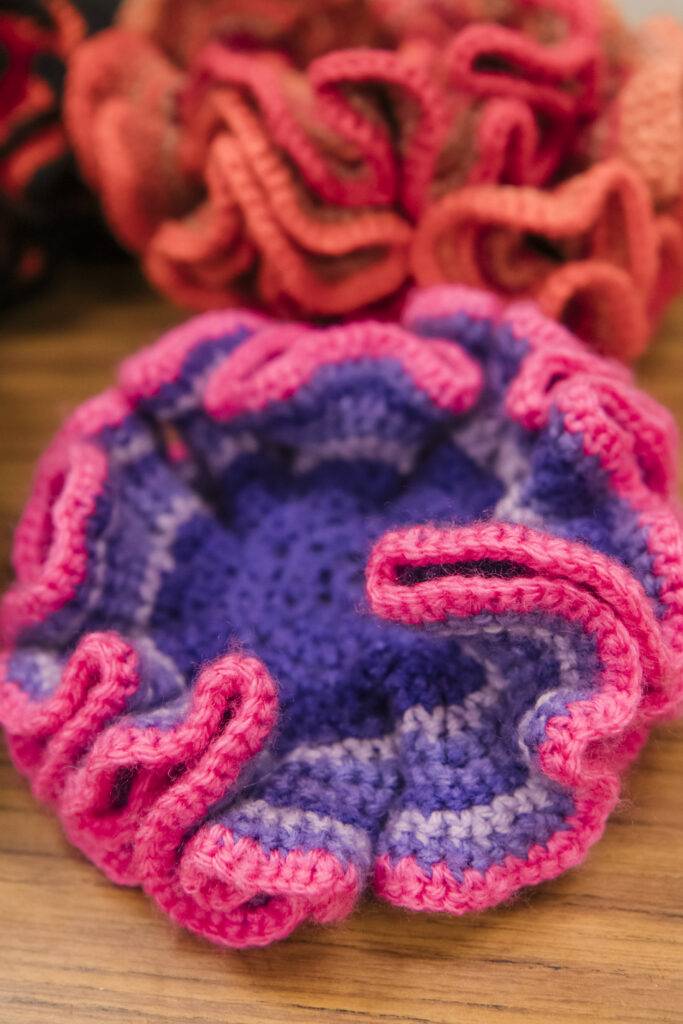
Ruttenberg doesn’t use traditional crochet patterns for his work, choosing instead to invent his own shorthand notation for various stitches. “Because I like to make it up as I go along, it’s a little more satisfying to me,” he says. In fact, the symbols for stitches in crochet patterns echo the symbols and patterns in mathematics that he enjoys. “I was always interested in the aesthetics and visuals of math; all the symbols and things were sort of fascinating to me,” he shares.
This eye for patterns extends to Ruttenberg’s other interests and hobbies, like word games and juggling. “I love English spelling. I think the confluence of different languages is super cool. It makes patterns that I find very aesthetically pleasing,” he says. Ruttenberg is a Scrabble aficionado and typically has an online game going with friends.
Even mathematics has its own language to absorb. While the discipline’s lingo may puzzle non-mathematicians, “Something that I love about mathematics is all the different words, and all the jargon,” Ruttenberg says. “I love that math co-opts all these normal words for very technical things,” he says, like “ring” or “flag.”
With juggling, “There’s some math in there if you get into complicated patterns,” he says. “It’s all about permutations, and ‘How long does this ball stay in the air?’, and all that.”
Threading math joy throughout life
Ruttenberg is selling a few of his creations on Etsy, and he takes time to share his passion for mathematics in other ways. He tutors students from elementary school through college.
“I like the puzzle of teaching someone something, especially if they already have a misconception of the material that’s not serving them,” Ruttenberg says. “That, I find, is a cool puzzle—what’s the core of the misunderstanding here, and how can we give them a better way of thinking about it?”
Justin Webster, associate professor of mathematics and Ruttenberg’s academic advisor, quickly noted his mathematical talent and willingness to help others when Ruttenberg was in one of his courses. Ruttenberg is the president of UMBC’s chapter of Pi Mu Epsilon, the national mathematics honor society, which serves as UMBC’s math club. Pi Mu Epsilon hosts events for students and participates in outreach at local middle and high schools.
 Justin Webster serves as Ruttenberg’s academic advisor and the faculty advisor to UMBC’s chapter of Pi Mu Epsilon, the national mathematics honor society.
At these events, “Ephraim’s crochet work always steals the show,” Webster says. “The students are perplexed and engaged by his work. It is wonderful to have something which is both visual and tactile to engage the younger students.”
In part as a result of Webster’s mentoring, Ruttenberg plans to pursue a Ph.D. after graduating from UMBC. Exactly what he’ll study is uncertain. “Ephraim’s interests are very broad. And, like him, they are unique,” Webster says. “There is a certain amount of intellectual confidence that he has, which is rare.”
Ruttenberg will carry that confidence paired with generosity as he moves forward, melding his artistic and mathematical instincts in the world as he perceives it—a world where abstract theorems collide with soft fibers, and the geometry of a sphere meets the warmth of scarves. His work proves that equations need not be confined to dusty textbooks; they can be stitched into existence, one loop at a time.
]]>
In the back of a classroom, at a desk strewn with a colorful palette of commingled notebooks and skeins of yarn, sits Ephraim Ruttenberg ’25, mathematics. His fingers nimbly and nearly...
https://umbc.edu/stories/stitching-it-all-together-math-and-crochet/
https://my3.my.umbc.edu/api/v0/pixel/news/140828/guest@my.umbc.edu/1593675d67ced084d5a5cf66454a07b4/api/pixel
campus-life
cnms
magazine
mathstat
story
UMBC News & Magazine
https://my3.my.umbc.edu/groups/umbc-news-magazine
https://assets1-my.umbc.edu/system/shared/avatars/groups/000/001/943/24435aa6207c452e7bc15cc74b42c7bb/xsmall.png?1748556657
https://assets1-my.umbc.edu/system/shared/avatars/groups/000/001/943/24435aa6207c452e7bc15cc74b42c7bb/original.png?1748556657
https://assets2-my.umbc.edu/system/shared/avatars/groups/000/001/943/24435aa6207c452e7bc15cc74b42c7bb/xxlarge.png?1748556657
https://assets2-my.umbc.edu/system/shared/avatars/groups/000/001/943/24435aa6207c452e7bc15cc74b42c7bb/xlarge.png?1748556657
https://assets3-my.umbc.edu/system/shared/avatars/groups/000/001/943/24435aa6207c452e7bc15cc74b42c7bb/large.png?1748556657
https://assets1-my.umbc.edu/system/shared/avatars/groups/000/001/943/24435aa6207c452e7bc15cc74b42c7bb/medium.png?1748556657
https://assets2-my.umbc.edu/system/shared/avatars/groups/000/001/943/24435aa6207c452e7bc15cc74b42c7bb/small.png?1748556657
https://assets1-my.umbc.edu/system/shared/avatars/groups/000/001/943/24435aa6207c452e7bc15cc74b42c7bb/xsmall.png?1748556657
https://assets2-my.umbc.edu/system/shared/avatars/groups/000/001/943/24435aa6207c452e7bc15cc74b42c7bb/xxsmall.png?1748556657
UMBC News & Magazine
3
0
false
Thu, 11 Apr 2024 15:18:13 -0400
Thu, 11 Apr 2024 15:18:13 -0400
William Gao, mentee of UMBC statistician Yi Huang, named finalist in Regeneron Talent Search

William Gao, a senior at Centennial High School in Howard County, Maryland, has been selected as one of 40 finalists in the 2024 Regeneron Science Talent Search. Yi Huang, associate professor of mathematics and statistics, has served as his research mentor for the past three years.
The Regeneron competition is one of the oldest and most prestigious youth science competitions in the country, and past finalists now include 13 Nobel Prize winners and 22 MacArthur Fellows. Judges select finalists whose projects demonstrate scientific rigor and who they believe have the potential to become world-changing scientific leaders. The 2024 finalists were selected from among nearly 2,000 entrants nationwide, and each received $25,000 to be used for their education.
Gao and Huang’s research led to the development of a mobile diagnostic system to identify cancerous regions in tumor samples, which they hope will eventually benefit patients in remote areas. The system applies modern data science technology, including artificial intelligence, to a prominent healthcare challenge. The findings were published in Cancer Informatics.
“I am beyond humbled and grateful to be a finalist in Regeneron’s Science Talent Search this year. I have always loved all things science and technology, and I have felt enormously lucky to grow as a young researcher under the guidance of Dr. Yi Huang,” Gao shares. “In the future, I plan to pursue a career that bridges my interests in technological innovation, research, and policy. Wherever I land, I hope to emulate Dr. Huang’s passion as a mentor and pay it forward.”
The finalists will participate in a week-long competition in March in Washington, D.C., where they will compete for more than $1.8 million in awards. The comprehensive judging process will not only test the students’ knowledge of their own projects, but also the depth of their understanding across multiple scientific disciplines.
“Serving the community and helping talented minds from various backgrounds get a boost from research early on has always been a core part of my career in education,” Huang says. “Since the start of his research journey in 2020, William has not only shown an impressive intellectual curiosity and resilience, and maturity in dealing with research challenges, but has also demonstrated exceptional initiative and independence. What sets William apart is his ability to bridge technological innovation with real-world problem solving, always considering the ethical and humanistic implications and the broad social impact of his research in the healthcare system.”
]]>
William Gao, a senior at Centennial High School in Howard County, Maryland, has been selected as one of 40 finalists in the 2024 Regeneron Science Talent Search. Yi Huang, associate professor of...
https://umbc.edu/quick-posts/umbc-mentee-regeneron-talent-search-finalist/
https://my3.my.umbc.edu/api/v0/pixel/news/139631/guest@my.umbc.edu/24957d8d366e2d62b8532590389d21d2/api/pixel
cnms
mathstat
news
quick-post
science-and-tech
UMBC News & Magazine
https://my3.my.umbc.edu/groups/umbc-news-magazine
https://assets1-my.umbc.edu/system/shared/avatars/groups/000/001/943/24435aa6207c452e7bc15cc74b42c7bb/xsmall.png?1748556657
https://assets1-my.umbc.edu/system/shared/avatars/groups/000/001/943/24435aa6207c452e7bc15cc74b42c7bb/original.png?1748556657
https://assets2-my.umbc.edu/system/shared/avatars/groups/000/001/943/24435aa6207c452e7bc15cc74b42c7bb/xxlarge.png?1748556657
https://assets2-my.umbc.edu/system/shared/avatars/groups/000/001/943/24435aa6207c452e7bc15cc74b42c7bb/xlarge.png?1748556657
https://assets3-my.umbc.edu/system/shared/avatars/groups/000/001/943/24435aa6207c452e7bc15cc74b42c7bb/large.png?1748556657
https://assets1-my.umbc.edu/system/shared/avatars/groups/000/001/943/24435aa6207c452e7bc15cc74b42c7bb/medium.png?1748556657
https://assets2-my.umbc.edu/system/shared/avatars/groups/000/001/943/24435aa6207c452e7bc15cc74b42c7bb/small.png?1748556657
https://assets1-my.umbc.edu/system/shared/avatars/groups/000/001/943/24435aa6207c452e7bc15cc74b42c7bb/xsmall.png?1748556657
https://assets2-my.umbc.edu/system/shared/avatars/groups/000/001/943/24435aa6207c452e7bc15cc74b42c7bb/xxsmall.png?1748556657
UMBC News & Magazine
3
0
false
Tue, 05 Mar 2024 14:06:32 -0500
Tue, 05 Mar 2024 14:06:32 -0500