Building the Fourth Wall
Theatre magic isn’t magic at all—it’s the result of months of students conceiving, designing, and constructing the theatre set under the guidance of their mentors. Throughout various stages of the process, UMBC students get to see the world they created come to life—from prologue to final curtain call. All the detailed measuring and crafting to scale pays off, because when the curtain goes up and the lights go down, the audience surrenders to a willing suspension of disbelief.
Prologue
“Attention on stage,” echoed loudly across UMBC’s Proscenium Theatre as Malaak McDonald, a theatre design and production and geography and environmental systems junior, warned the production crew to stop and await safety instructions.
It was a humid summer day, technically the off-season for UMBC’s theatre shows, but not for the production crew. From mid-May to mid-August, the undergraduate production staff set up construction stations across the Proscenium and the Black Box Theatres.
“Mine’s at 16, second electric, flying in, down stage,” said McDonald. The crew of five, in unison, looked up to ensure they were not underneath the second electric batten descending by a manual counterweight pulley system. The batten is a hollow metal bar, about the length of the stage, with electrical cables threaded inside, and rigged with hooks to hang stage lights and scenery. Fully loaded, it can weigh hundreds of pounds and can be flown in (lowered down) or flown out (raised) for seamless scene changes. Once the bar is at eye level and the line is locked, the crew returns to work.
All were trained by Gregg Schraven ’97, production manager for UMBC’s design shop, and Evan McDougall, assistant technical director, to use onsite industrial woodworking tools, welding machines, and behind-the-scenes stage technology. While McDonald tended to the lights, others were hand-painting a set floor. Another group inspected eight long wooden trellises drying on sawhorses, checking for scratches from their move from the paint booth to the stage through one of two 16-foot-high doors connecting the shop to both theatres.

Malaak McDonald looks up at the electric batten.Photo by Brad Ziegler.
To produce two fall plays and two spring plays annually, the faculty, staff, and students in UMBC’s theatre productions must adhere to a strict cycle that begins in November when the next season’s plays are chosen. Directors develop their script and then share their vision with the set, lighting, sound, and costume design directors. They then pick their student counterparts, all while producing the current season and teaching classes.
Theatre magic is not magic at all. It is the product of extreme organization, hefty technical skills, and commitment to learn, show up, and do the work. Theatre is a community service, explains Gerrad Alex Taylor, assistant professor of theatre and director of the 2025 – 2026 season opener, Shakespeare in Harlem, in celebration of a hundred years of the Harlem Renaissance and part of UMBC’s Arts+ initiative.
“This phenomenon of watching a play is cathartic and an important community service. It’s healing. It’s a service of the heart,” said Taylor, a classically trained Shakespearean actor. “We have to ask, ‘What do the hearts of people need right now?’ and what stories can we be telling to connect with their hearts?”
 Abigail Adams, media and communication studies junior; McDonald; Ann Davies, visual artsand theatre design and production senior; Tyler Brust; Adam Harper, mechanical engineering and theatre design and production junior; and Gregg Schraven at the scene shop. Photo by Brad Ziegler.
Act One: Tools of the Trade
That kind of passion needs precision. Three years after graduation, Tyler Brust, theatre, a scenic designer and technical director, is a staple at the UMBC set design shop, where he is often on contract for the build cycle through tech week while also working in local theatre. “Coming back as an alum, it felt like I did not miss a beat as a result,” said Brust. “I immediately felt like I had the tools I needed to effectively lead small groups of student staff where necessary, all while balancing my own personal task list.”
He remembers his first production team project in 2019, building the floor layout for The Turn of the Screw set in late 1800’s England. The students created an illusion, a forced-perspective floor. Wooden floorboards were designed to be widest near the audience and gradually narrow toward the back of the stage, making the stage appear deeper and longer, creating a railroad-track effect. “This was all done by hand, with a straight edge and a router,” said Brust.

The forced perspective floor designed for the 2019 The Turn of the Screw. Photo by Marlayna Demond ’11.
“Now, for Shakespeare in Harlem, Evan helped us through a multi-step process to modify the hardboard floor from last fall’s play. I now have the skills to completely fake these lines via paint and handle the complex layout of overlapping ovals and forced-perspective bricks,” said Brust.
McDougall calls this “theatre production with training wheels.” Before the drilling and the cutting commence, he has students start with what he calls the boring part—reading the manufacturers’ manuals. He then reminds students of his number one rule: Don’t trust anything—even if it’s in the manual. “The students say I have trust issues.
You can’t make any assumptions about what is true in theatre production,” said McDougall. As UMBC’s master electrician with decades of experience in woodworking, welding, and blacksmithing, he is indispensable for students to understand the mechanical, manual, and technical aspects of set design, growing in expertise over their time at UMBC.
“I joke with my students that they come in with this preconceived notion of ‘this is parallel, this is plumb or level’—and once we begin installing sets and moving pieces around in the space, those realities don’t exist anymore,” said McDougall. After all, the production director aims to execute the set designer’s vision, while the set designer works to visualize and create the environment the director imagines.
 Left to Right: Evan McDougall and Tyler Brust work on a set piece. Brust discusses the floor design with student staff. Photos by Brad Ziegler.
Brust absorbed every lesson alongside McDougall and Schraven, which helped him become a Swiss Army Knife of technical abilities as a carpenter, scenic artist, puppet artist, associate scenic designer, and design and technical coordinator. “The agency and mentorship that Gregg and Evan give students is what makes all the difference,” said Brust. “It allows us to flex our muscles into actual project management, which is otherwise difficult to emulate during a class session.”
Schraven and McDougall’s mentorship helped Brust branch out of UMBC to local theatre production companies like the Strand Theatre, Submersive, and True Penny Productions as a scenic artist, carpenter, general fabricator, and technical director. It is also why he is highly sought after in the UMBC theatre cycle.
“Tyler is a person I trust. I want to know what he’s thinking and can have dialogue about a problem,” said McDougall. “Here’s what my gut’s telling me. What do you see? We can start riffing off of each other. He’s now a coworker.”
Act Two: Metal, Steel, and Wood
In partnership with the Langston Hughes estate, Taylor adapted Hughes’ collection of monologue poems exploring the rhythms of jazz, the blues, Black love, and the daily struggles and joys of life in Harlem into a full-length play, blending poetry, music, and dance for an immersive journey into the world he so vividly celebrated. The only thing left to do was to construct an equally inspiring home into being. To bring the physical world of the Harlem Renaissance to UMBC, Taylor worked with Nate Sinnott, the scenic designer and faculty properties and paints supervisor.
Sinnott found inspiration in the original New York City Penn Station of the 1920s with 150-foot ceilings, granite columns, steel-vaulted ceilings, and an arching glass roof. Enter Schraven, McDougall, Brust, and the summer student production staff: McDonald, Adam Harper, a theatre and engineering and information systems senior, Ann Davies, a visual arts senior, and Abigail Adams, a media and communication senior.
 Left to Right: Photo courtesy of New-York Historical Society, “Manhattan: interior main concourse of Penn Station, 1911,” which served as the inspiration for UMBC’s Shakespeare in Harlem scenic design. Part of the set’s faux steel trellis after layers of paint have been applied. Photo by Brad Ziegler.
Together, they built the director’s vision creatively and safely—with a unique twist. Taylor, who is a member of the resident company at Chesapeake Shakespeare Company (CSC) and founder of the company’s Black Classical Acting Ensemble, thought through a project that could “uplift the Black students who are about to graduate and have the acting chops to handle the material, and bring some of the Black Baltimore community to UMBC,” said Taylor. “Then take this Black ensemble and bring it back to Baltimore City’s community.” In brainstorming what all that could look like, UMBC theatre developed a collaboration with CSC.
This means that the technical crew designed the set to work for both UMBC’s Proscenium Theatre and Baltimore City’s CSC’s stage. The production team built a forced-perspective floor and 16 faux steel trellis arches constructed from multiple layers of wood and foam. Each trellis was finely carved with intricate triangular patterns using a computer-controlled machine, then glued together in pairs to form eight lightweight units. The arches had built-in break points, allowing them to be disassembled, packed into a 16-foot truck, and reassembled identically at each theatre—even with performances months apart.
“My job is to teach the students to the point where they can do it all,” said Schraven, associate teaching professor and technical director. For Schraven, UMBC is more than where he began studying theatre in 1989 and more than the place where he has worked, off and on, since the 1990s. It is where he gets to pass down the more than 30 years of theatre tech knowledge to students working in a scene shop he helped design.
 Top Right: Davies works on steel to add to a set structure at the Black Box Theatre. Top Left: Brust and Harper inspect the height of the trellis. Bottom: The official technical drawings for the arches. Photos by Brad Ziegler.
“When I was a student, I was easily in the shop six to 10 hours a day. I probably did more welding in a year than they will do in their entire careers. That’s why I keep the shop open to students in the summer. That’s why I have a student labor budget and why 100 percent of all show proceeds are for undergraduate scholarships. I want to use every single penny of it on students,” said Schraven. “The more you’re in the shop, the more you learn. When students learn how to weld, I tell them to give it 80 times. Then they’ll be really comfortable with it.”
Act Three: Dress Rehearsal
It’s two weeks before showtime. At 6:30 p.m. sharp, the unspoken hero of the play, Tatiyana ‘Tati’ Terrelonge, an acting and media and communication studies junior, is poised at center stage on the floor designed to look like brown bricks. Terrelonge, who intrepidly served as the entire cast’s understudy, is holding a binder with the lead’s lines at the ready. Looming behind her is the finalized, floor-to-ceiling vaulted arch. Four costumed students sit in wooden chairs recently stained brown by the production crew, while another peeks out of a window, one of several frosted glass ceiling panes below the arch.
In the audience are four crew members managing lights, sound, props, and character lines. Today, the lines are for a scene where a character, Bruce, is writing a letter to his mother in the South, and another character, Leonard, is reading a letter to his sweetheart, begging her not to return to the South.
They represent the millions of Black men and women of the Great Migration, who fled the legacy of slavery and the terror of racism of the South between 1910 – 1970 for the North. Hundreds of thousands arrived at NYC’s Penn Station with the artistic talents and skilled labor that birthed the Harlem Renaissance. Their success inspired others to follow, who were ready to reap all the freedom that the Harlem Renaissance promised, only to be met first with the daily grind of work that made Harlem glimmer with the dreams of its people.

Dario Prioleau, acting senior, as Leonard. Photo by Kiirstn Pagan ’11.
 Top: LaTrelle Jamez, acting senior, as Bruce; Taylor; Terrelonge; and Prioleau. Bottom: Taylor directs the ensemble. In the background, left to right: Sumedha Bhat, student assistant stage manager; Lucas Sanchez, student assistant stage manager; Isaiah Mason Harvey, guest assistant director for Shakespeare in Harlem and a member of the Black Classical Acting Ensemble at CSC; and Grace Shepperd, UMBC’s production stage manager. Photos by Brad Ziegler.
“Langston Hughes was canonizing Black life in America in the same way that William Shakespeare did, of life during England’s Elizabethan era,” said Taylor, who added a personal touch by including some of his grandmother’s stories and kept the show going by stepping in as the character of Simple. “A lot of my research here at the university and as an artist is looking at African American stories and stories of the diaspora that have been forgotten about, misrepresented, and stolen,” said Taylor, “and bringing a new lens and a new perspective of our contemporary consciousness to them.”
Curtain Call

Lauren Davis, as Griot—the play’s storyteller—gives respects to the ancestors that made the play possible. Photo by Kiirstn Pagan ’11.
“You are here!” said Lauren Davis, in the commanding voice of her character, Griot—the play’s storyteller, historian, and cultural guide—to the first audience of the fall season. Davis, a guest artist and member of the CSC’s Black Classical Acting Ensemble, is radiant in golden light. Behind her, the arched glass ceiling transforms with a projection of stained glass in rich royal hues, thanks to McDonald, the show’s head electrician, and the lighting team, who hung the lighting designer’s light plot—a map, essentially—a month early to give lighting design students time to learn the process.
“I want to get the acknowledgment well of the ancestors into the space,” booms Griot, lowering a large basket—the well—onto the floor. “I call so that you remember the grandmothers on whose shoulders we stand. I’m no longer accepting the things I cannot change. I am changing the things I cannot accept.”
With that, the set morphs into bedrooms, apartments, and streets, made real by the artistry of UMBC’s theatre students and their mentors. Traveling trunks become an altar, and light posts double as clotheslines. The actors tap in, weaving with the words and sounds—reading, stomping, marching, crying, laughing, inhaling—that syncopate the lives of lovers, friends, entrepreneurs, religious leaders, landlords, family, and a fledgling poet—an homage to Hughes—whose future letters are masterfully projected across the Harlem sky.


Top: The ensemble creates a church with luggage trunks as the altar and chairs as pews. Bottom: The ensemble creates a church with luggage trunks as the altar and chairs as pews. Photos by Kiirstn Pagan ’11.
Learn more about UMBC’s spring 2026 theatre season.
]]>
Theatre magic isn’t magic at all—it’s the result of months of students conceiving, designing, and constructing the theatre set under the guidance of their mentors. Throughout various stages of the...
https://umbc.edu/stories/building-the-fourth-wall/
https://my3.my.umbc.edu/api/v0/pixel/news/155224/guest@my.umbc.edu/44aecced3123d78dc1c809a9b3b8ac74/api/pixel
cahss
coeit
ges
magazine
meche
story
theatre
UMBC News & Magazine
https://my3.my.umbc.edu/groups/umbc-news-magazine
https://assets1-my.umbc.edu/system/shared/avatars/groups/000/001/943/24435aa6207c452e7bc15cc74b42c7bb/xsmall.png?1748556657
https://assets1-my.umbc.edu/system/shared/avatars/groups/000/001/943/24435aa6207c452e7bc15cc74b42c7bb/original.png?1748556657
https://assets2-my.umbc.edu/system/shared/avatars/groups/000/001/943/24435aa6207c452e7bc15cc74b42c7bb/xxlarge.png?1748556657
https://assets2-my.umbc.edu/system/shared/avatars/groups/000/001/943/24435aa6207c452e7bc15cc74b42c7bb/xlarge.png?1748556657
https://assets3-my.umbc.edu/system/shared/avatars/groups/000/001/943/24435aa6207c452e7bc15cc74b42c7bb/large.png?1748556657
https://assets1-my.umbc.edu/system/shared/avatars/groups/000/001/943/24435aa6207c452e7bc15cc74b42c7bb/medium.png?1748556657
https://assets2-my.umbc.edu/system/shared/avatars/groups/000/001/943/24435aa6207c452e7bc15cc74b42c7bb/small.png?1748556657
https://assets1-my.umbc.edu/system/shared/avatars/groups/000/001/943/24435aa6207c452e7bc15cc74b42c7bb/xsmall.png?1748556657
https://assets2-my.umbc.edu/system/shared/avatars/groups/000/001/943/24435aa6207c452e7bc15cc74b42c7bb/xxsmall.png?1748556657
UMBC News & Magazine
0
0
false
Fri, 05 Dec 2025 12:00:48 -0500
Retrievers gone global: 5 ways UMBC fosters international engagement
As International Education Week 2025 comes to a close, we’ve rounded up a few of the many ways Retrievers engage globally through their work and studies. Even though it has been a particularly trying time for international students, “…more UMBC students studied abroad in Academic Year 2024 – 25 than ever before. Our students are discovering new perspectives, building global connections, and transforming their futures through these life-changing experiences,” says Katie Heird, director of education abroad and global learning at UMBC. Here are a few ways international students and Retrievers who have gone abroad play a role in the lifeblood of UMBC.
1. Who is Fulbright material?
UMBC’s six 2025 – 2026 Fulbright U.S. Student Program recipients share their not-so-secret recipe for success. Deciding to apply for a Fulbright is just the first step, and with the support of UMBC’s Center for Global Engagement, which hosts Fulbright information sessions in the spring for undergraduate, graduate, and recent alumni. Retrievers can apply to earn a master’s, conduct research, or be an English Teaching Assistant in more than 160 countries. With the UMBC 2025 – 2026 Fulbrights already settled in Taiwan, Norway, and Indonesia, Belgium, Israel, and Germany, these alumni are eager to share tips to inspire and prepare the next generations of Fulbright Retrievers.
 UMBC’s 2025 – 2026 U.S. Fulbright Program class. (Brad Ziegler/UMBC)
Additionally, this year, four UMBC faculty and staff members received highly competitive Fulbright U.S. Scholar awards to teach, conduct research, and foster cross-cultural connections globally. The recipients span all three UMBC colleges and comprise three faculty members and one staff member. The UMBC awardees are connecting with international partners in areas of shared interest. Augusto Casas, an associate teaching professor of information systems, is working in Colombia; Cynthia Wagner, a teaching professor of biological sciences, went to Kyrgyzstan; Irene Chan, a professor of visual arts, is in Romania; and Tom Penniston, M.A. ’09, TESOL, Ph.D. ’14, language, literacy, and culture, the coordinator of learning analytics in the Division of Information Technology, is working in Croatia.
2. Building intentional international connections
A six-person UMBC team built international connections at the “PIWOT – World of Technology” conference, held in early 2025 in Mumbai, India. The science and technology conference is organized by the alumni association for graduates of the prestigious Indian Institutes of Technology (IITs), and attracts many of the leaders in science and technology in India and around the world. The CEO of Alphabet, Inc. (Google’s parent company), the co-founder of Sun Microsystems, and the CEO of IBM are all graduates of IITs.
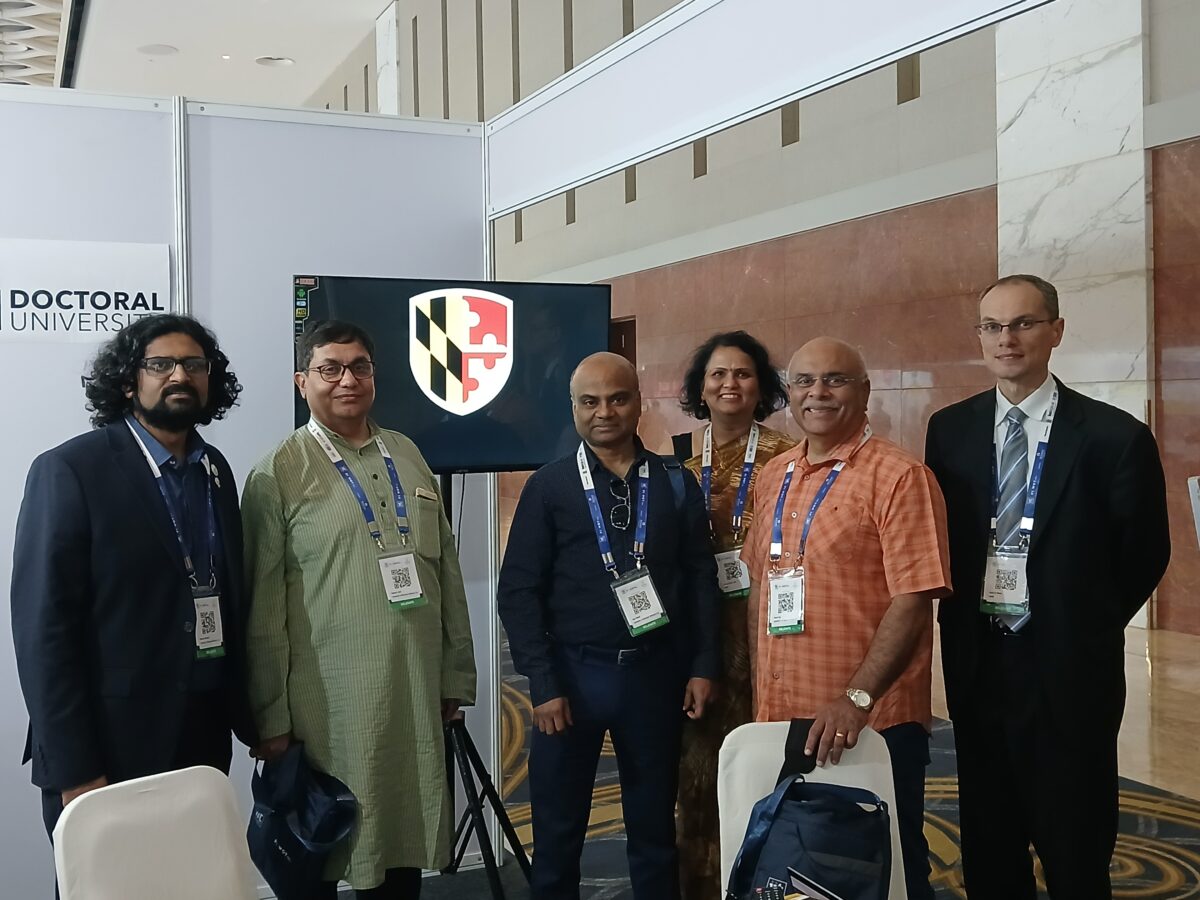 UMBC PIWOT attendees (l-r): Ramana Vinjamuri, associate professor of computer science and electrical engineering and director of the NSF IUCRC BRAIN Center; Joshi; Upal Ghosh, professor of chemical, biochemical, and environmental engineering; Karuna Pande Joshi, professor of information systems and director of the NSF IUCRC Center for Accelerated Real Time Analytics; Govind Rao, director of the Center for Advanced Sensor Technology and professor of chemical, biochemical and environmental engineering; and David Di Maria, associate vice provost for international education at UMBC. (Photo courtesy of Karuna Pande Joshi)
This year’s PIWOT conference focused on the impact of technology across multiple dimensions of life, from the professional to the personal. UMBC’s Anupam Joshi, acting dean of the College of Engineering and Information Technology, took part as a speaker on a panel about the impact of technology on education, and the UMBC booth also displayed the low-cost infant incubator developed by Professor Govind Rao.
3. International research collaboration challenges assumptions
Thanks to funding from the German Academic Exchange Service, Lorenz Kopp and Björn Michelmann, mechanical engineering students from Germany’s Regensburg University of Applied Sciences, came to UMBC to conduct research with UMBC’s mechanical engineering professor, Paris von Lockette. The project was part of a bigger assumption-questioning enterprise—in particular, probing the behavior of materials called soft magnets. Kopp’s and Michelmann’s advisor at Regensburg University of Applied Sciences knew von Lockette through the American Society of Mechanical Engineers, and together they arranged the details of the two-month visit with the help of the Office of International Students and Scholars at UMBC.
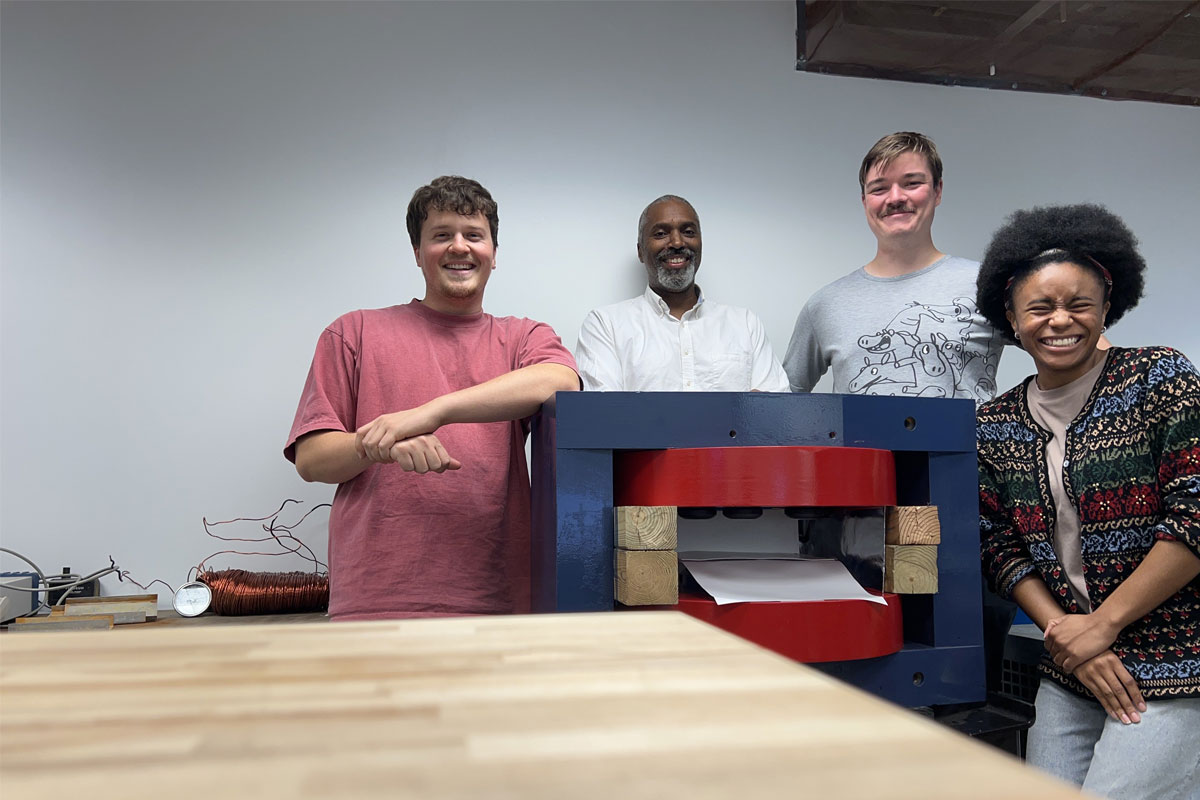 (l-r): Lorenz Kopp, Björn Michelmann, von Lockette, and Tamia Bowers ’23, mechanical engineering, with the electromagnet they set up in the lab. (Brad Ziegler/UMBC)
While Kopp and Michelmann spent plenty of time in the lab during their visit, they also had chances to explore the areas surrounding UMBC on weekends. They visited the National Aquarium in Baltimore, took in a Baltimore Ravens football game, and drove to Shenandoah National Park in Virginia. They also enjoyed campus life, attending Homecoming weekend, and regularly visiting the Retriever Activity Center to work out.
4. Exploring politics in a global context, virtually
Professor Filomeno’s 2024 Collaborative Online International Learning (COIL) Brazil project on climate change equips students with the technical and interpersonal skills to thrive in professional online international and intercultural environments. COIL makes international scholarship and intercultural learning accessible by removing barriers of cost and travel while preparing students with essential skills for future in-person exchanges. COIL Brazil was part of Filomeno’s Global Citizenship class in collaboration with former colleague Clarissa Dri, a professor of international relations at his alma mater, the Federal University of Santa Catarina, in southern Brazil.
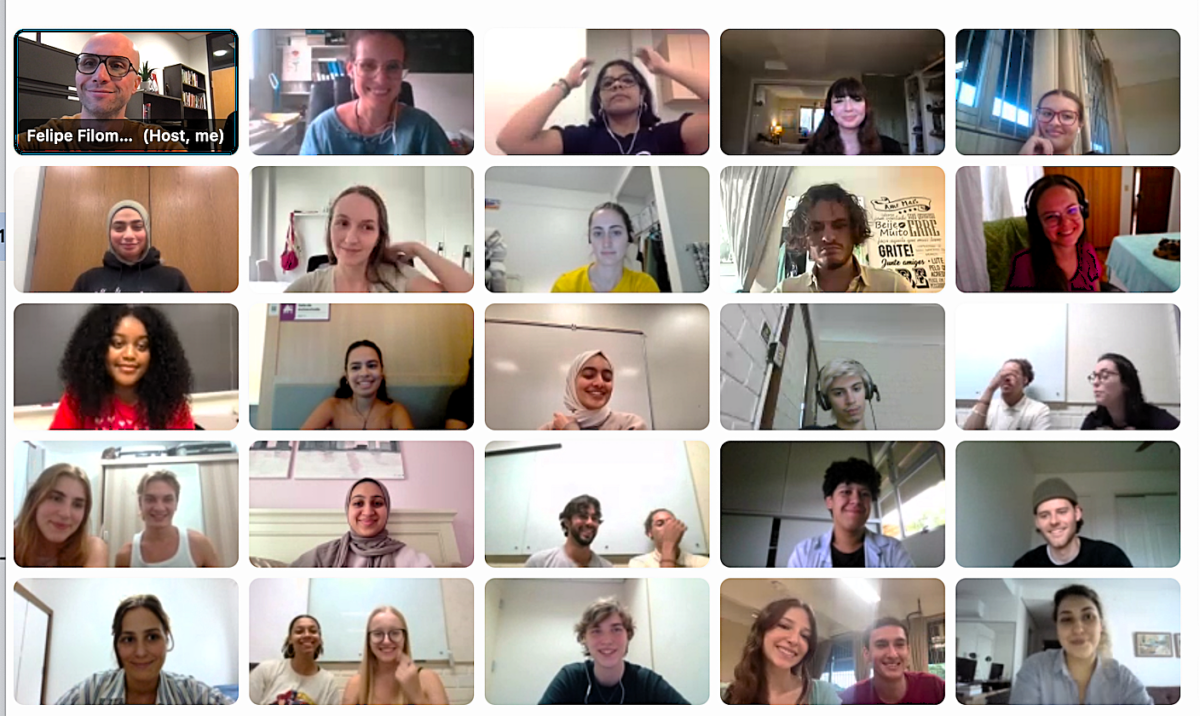 COIL Brazil met online so that students from UMBC and the Federal University of Santa Catarina in southern Brazil could participate. (Image courtesy of Felipe Filomeno.)
The ongoing Virtual Tandem Conversation project was created by Susanne Sutton, a teaching professor of German, and Talke Macfarland, a visiting lecturer of German in UMBC’s Department of Modern Languages, Linguistics, and Intercultural Communication. They established the program during COVID-19 to help UMBC students learning German and German students learning English socialize while continuing to improve their language skills.
The actual tandem meetings are entirely student-driven and take place outside of the classroom—each tandem pair arranges virtual meetings according to their schedule. Tandem participants have gone beyond the virtual classroom, such as UMBC Golden ID Program student Rebecca Smith, who, while on a recent trip to France, hopped over to Germany to visit Gertrud Krause-Traudes, her partner in UMBC’s Virtual Tandem Conversation project. After three semesters of virtual conversations in German and English, Smith was happy to meet Krause-Traudes in person.
5. Science that bridges two worlds
In 2020, as the COVID-19 pandemic disrupted lives worldwide, Greema Regmi began her Ph.D. in UMBC’s atmospheric physics program. Studying remotely from her home in Nepal, she navigated a grueling schedule due to the time difference. Now in her fifth year, Regmi’s perseverance has earned her NASA’s prestigious Future Investigators in NASA Earth and Space Science and Technology (FINESST) fellowship, which will provide up to $50,000 annually for up to three years to fuel her research on atmospheric dust.
 Greema Regmi discussed her research at a recent poster session at UMBC. (Brad Ziegler/UMBC)
Regmi has been able to accomplish so much in part because of the supportive community she found at UMBC, after finally arriving on campus in fall 2021. Regmi’s journey bridges her unique perspectives as a student in Nepal and the U.S. At UMBC, she’s embraced broader opportunities. “I think here you can push the limit. I don’t even know what the limit is in the U.S. Here you can dream more and be more experimental,” she observes.
Grounded in the UMBC physics department’s community of support, Regmi’s confidence has only grown since her arrival in Maryland. “There’s always a place for my opinion, which is very nice. Because of that, and all of the experiences I’ve had, now I have the confidence to start my own project,” she explains. “And that’s why I think now I’m confident to go back home, lead something there, and be helpful in some small way.”
Learn more about UMBC’s international opportunities.
]]>
As International Education Week 2025 comes to a close, we’ve rounded up a few of the many ways Retrievers engage globally through their work and studies. Even though it has been a particularly...
https://umbc.edu/stories/gone-global-umbc-international-engagement/
https://my3.my.umbc.edu/api/v0/pixel/news/154859/guest@my.umbc.edu/4a42a8215afbcd5c0ace5e35458352e2/api/pixel
cahss
cge
cnms
coeit
community
fulbright
international
is
llc
meche
mlli
news
physics
politicalscience
research
story
visualarts
UMBC News & Magazine
https://my3.my.umbc.edu/groups/umbc-news-magazine
https://assets1-my.umbc.edu/system/shared/avatars/groups/000/001/943/24435aa6207c452e7bc15cc74b42c7bb/xsmall.png?1748556657
https://assets1-my.umbc.edu/system/shared/avatars/groups/000/001/943/24435aa6207c452e7bc15cc74b42c7bb/original.png?1748556657
https://assets2-my.umbc.edu/system/shared/avatars/groups/000/001/943/24435aa6207c452e7bc15cc74b42c7bb/xxlarge.png?1748556657
https://assets2-my.umbc.edu/system/shared/avatars/groups/000/001/943/24435aa6207c452e7bc15cc74b42c7bb/xlarge.png?1748556657
https://assets3-my.umbc.edu/system/shared/avatars/groups/000/001/943/24435aa6207c452e7bc15cc74b42c7bb/large.png?1748556657
https://assets1-my.umbc.edu/system/shared/avatars/groups/000/001/943/24435aa6207c452e7bc15cc74b42c7bb/medium.png?1748556657
https://assets2-my.umbc.edu/system/shared/avatars/groups/000/001/943/24435aa6207c452e7bc15cc74b42c7bb/small.png?1748556657
https://assets1-my.umbc.edu/system/shared/avatars/groups/000/001/943/24435aa6207c452e7bc15cc74b42c7bb/xsmall.png?1748556657
https://assets2-my.umbc.edu/system/shared/avatars/groups/000/001/943/24435aa6207c452e7bc15cc74b42c7bb/xxsmall.png?1748556657
UMBC News & Magazine
7
0
false
Tue, 25 Nov 2025 13:03:08 -0500
Tue, 25 Nov 2025 13:03:08 -0500
UMBC sophomore wins first place at NSBE fall regional conference technical research exhibition
Members of UMBC’s chapter of the National Society of Black Engineers (NSBE) traveled to Raleigh, North Carolina, for their annual regional conference this November, where multiple members presented their work in the Technical Research Exhibition. Sophomore computer engineering student Amir Walton-Irvin, a Meyerhoff Program Scholar and Howard Hughes Medical Institute (HHMI) Scholar, earned first place for his research presentation.
Walton-Irvin investigates brain connectivity and health disparities in the Machine Learning for Signal Processing Lab of computer science and electrical engineering professor Tülay Adali. He uses statistical signal processing techniques to identify subclinical biomarkers that may predict neurological diseases such as stroke and dementia.
 Amir Walton-Irvin stands next to his scientific poster. (Image courtesy of Kayla MaGruder)
At the conference, Walton-Irvin gave a 5-minute technical talk about his research, followed by questions from the competition judges and audience.
“Presenting research is a huge part of engineering and science that makes it accessible,” says senior mechanical engineering student Kayla Magruder, vice president of the UMBC NSBE chapter, who also gave a talk at the conference.
“I’m extremely grateful for every opportunity to share my work, and being recognized for it is an incredible feeling,” shares Walton-Irvin. “Moments like this motivate me to keep pushing research that can improve people’s lives, and I’m excited for what the future holds.”
Other UMBC students who attended the conference include mechanical engineering senior Caly Ferguson, mechanical engineering sophomore Nathan Bolima, computer science and financial economics junior Glen Larbie-Mansah, and computer engineering junior Jessica Slaughter.
UMBC’s NSBE chapter supports members with conference preparations and also offers activities such as mentoring, networking, leadership development, and community outreach.
]]>
Members of UMBC’s chapter of the National Society of Black Engineers (NSBE) traveled to Raleigh, North Carolina, for their annual regional conference this November, where multiple members...
https://umbc.edu/quick-posts/umbc-nsbe-conference-2025/
https://my3.my.umbc.edu/api/v0/pixel/news/154837/guest@my.umbc.edu/f0dd03bdd4a9550bc6e42fce93266a75/api/pixel
coeit
csee
meche
quick-post
science-and-tech
UMBC News & Magazine
https://my3.my.umbc.edu/groups/umbc-news-magazine
https://assets1-my.umbc.edu/system/shared/avatars/groups/000/001/943/24435aa6207c452e7bc15cc74b42c7bb/xsmall.png?1748556657
https://assets1-my.umbc.edu/system/shared/avatars/groups/000/001/943/24435aa6207c452e7bc15cc74b42c7bb/original.png?1748556657
https://assets2-my.umbc.edu/system/shared/avatars/groups/000/001/943/24435aa6207c452e7bc15cc74b42c7bb/xxlarge.png?1748556657
https://assets2-my.umbc.edu/system/shared/avatars/groups/000/001/943/24435aa6207c452e7bc15cc74b42c7bb/xlarge.png?1748556657
https://assets3-my.umbc.edu/system/shared/avatars/groups/000/001/943/24435aa6207c452e7bc15cc74b42c7bb/large.png?1748556657
https://assets1-my.umbc.edu/system/shared/avatars/groups/000/001/943/24435aa6207c452e7bc15cc74b42c7bb/medium.png?1748556657
https://assets2-my.umbc.edu/system/shared/avatars/groups/000/001/943/24435aa6207c452e7bc15cc74b42c7bb/small.png?1748556657
https://assets1-my.umbc.edu/system/shared/avatars/groups/000/001/943/24435aa6207c452e7bc15cc74b42c7bb/xsmall.png?1748556657
https://assets2-my.umbc.edu/system/shared/avatars/groups/000/001/943/24435aa6207c452e7bc15cc74b42c7bb/xxsmall.png?1748556657
UMBC News & Magazine
4
0
false
Mon, 24 Nov 2025 11:39:29 -0500
Mon, 24 Nov 2025 11:39:29 -0500
Toy story—Engineering accessible play
When we think of toys, we imagine a finished product, a remote-controlled car, a mini piano, or a glitter-filled beach ball. The internal pieces that make up the toy are only seen if the toy breaks. However, for some children with disabilities, the feel, sound, and shape of a toy’s exterior can be as important as the internal components. Features such as a multi-button remote, pressing piano keys, or grasping a ball can reduce accessibility to developmentally essential play.
Molly Y. Mollica, assistant professor of mechanical engineering (ENME), challenges sophomores in her ENME 204 class, Engineering Design with Computer Aided Design (CAD), to create an accessible toy for an individual with a specific disability or a toy for collaborative play between children with and without disabilities. CAD helps students create, modify, and analyze technical drawings and 2D or 3D models.
Team Goat Cheese, a five-student collaboration that included Adam Harper, a mechanical engineering and theatre design sophomore, was voted the ENME 204’s Most Creative Design and the Most Viable Product by UMBC faculty, ENME 204 teaching staff, and needs experts. Their competitors also voted them the Most Creative Design for designing two accessible toys for children on the autism spectrum: a soft, stuffed sea turtle and a bald eagle with weighted body parts, textured fabrics, and interchangeable parts.


 Team Goat Cheese’s stuffed eagle and turtle with interchangeable parts. (Images courtesy of Harper)
Integral to their success was the involvement of community members on the autism spectrum. “Many of us have someone close to us on the autism spectrum,” said Harper. “We asked them what kind of toy they would have wanted when they were seven or eight.” Harper’s close friend shared that they never had a stuffed animal because the stuffed animals on the market never met their sensory needs.
“Students have the opportunity to design in collaboration with needs experts—including physical therapists, special education teachers, and potential product users,” said Mollica. “In some cases, the resulting designs are developed enough to be shared with these experts to help address real challenges in accessible play.”
Designing with needs experts
The team’s online market research found that stuffed animals with sensory designs, such as weighted bodies, textured fabric, and scents, can help reduce anxiety, increase focus, and ease transitions for children on the autism spectrum, fostering greater engagement with peers and family. Another key takeaway of their research was that many sensory toys included only one sensory feature, limiting their effectiveness for children who benefit from multiple tactile inputs.
Team Goat Cheese used this as their inspiration. “We felt we could do better,” said Harper. “We decided to create two cartoon-like stuffed animals with multiple sensory inputs.” First, they used CAD to design interchangeable body parts. After several trial-and-error sessions, they created a lock-and-release mechanism for interchangeable parts. The eagle’s head, wings, and legs all come off the body. The sea turtle’s front and back flippers and head are also interchangeable. If a child doesn’t like the texture of the bald eagle’s head, they can swap it for the turtle’s head, creating a completely different sensory experience.
Sewing tactile play
Choosing the materials was also a process. The team chose soft brown corduroy for the eagle’s wings due to its unique texture and geometry, and extra soft sweatshirt fleece for the eagle’s head and tail feathers. The beak and talons are a yellow iridescent mesh fabric with metallic gold squares fused onto it, noted Harper.
The turtle’s body was made of minky fabric—a soft, velvety green plush, polyester fabric—with raised almond-shaped dots that felt like soft scales. The shell was made from a soft brown fleece.


 Fabric for the turtle’s body and shell. (Images courtesy of Harper)
Harper—the team’s secret weapon as the only member who knew how to sew—owned a sewing machine and had years of experience sewing, welding, sawing, and constructing theatre sets, so he was in charge of sewing the final product.
“For the weighted components, I double-stitched corduroy pockets and filled them with glass microbeads, then placed them inside the wings, head, and body. I filled the rest of the body with polyester fiberfill—a synthetic fiber used for stuffed animals,” said Harper. “It was many hours and days of sewing and making pouches and remaking pouches and seam ripping and fixing.”
“Our goal is to prepare the next generation of engineers who understand the engineering design process,” said Mollica, “are proficient in engineering design tools, value input from needs experts, and are equipped to create high-quality products that are accessible to as many people as possible.”
While photos of the eagle and turtle stuffed animals still exist, the physical toy is no longer in the team’s possession—it has been passed on, and they hope it’s now in the hands of a child who is happily creating turtle-eagles with their friends.
Learn more about UMBC’s Department of Mechanical Engineering.
]]>
When we think of toys, we imagine a finished product, a remote-controlled car, a mini piano, or a glitter-filled beach ball. The internal pieces that make up the toy are only seen if the toy...
https://umbc.edu/stories/toy-story-engineering-accessible-play/
https://my3.my.umbc.edu/api/v0/pixel/news/154747/guest@my.umbc.edu/8a41745cb113ccb6aae046b6668a980d/api/pixel
arts-and-culture
cahss
coeit
meche
news
science-and-tech
story
theatre
UMBC News & Magazine
https://my3.my.umbc.edu/groups/umbc-news-magazine
https://assets1-my.umbc.edu/system/shared/avatars/groups/000/001/943/24435aa6207c452e7bc15cc74b42c7bb/xsmall.png?1748556657
https://assets1-my.umbc.edu/system/shared/avatars/groups/000/001/943/24435aa6207c452e7bc15cc74b42c7bb/original.png?1748556657
https://assets2-my.umbc.edu/system/shared/avatars/groups/000/001/943/24435aa6207c452e7bc15cc74b42c7bb/xxlarge.png?1748556657
https://assets2-my.umbc.edu/system/shared/avatars/groups/000/001/943/24435aa6207c452e7bc15cc74b42c7bb/xlarge.png?1748556657
https://assets3-my.umbc.edu/system/shared/avatars/groups/000/001/943/24435aa6207c452e7bc15cc74b42c7bb/large.png?1748556657
https://assets1-my.umbc.edu/system/shared/avatars/groups/000/001/943/24435aa6207c452e7bc15cc74b42c7bb/medium.png?1748556657
https://assets2-my.umbc.edu/system/shared/avatars/groups/000/001/943/24435aa6207c452e7bc15cc74b42c7bb/small.png?1748556657
https://assets1-my.umbc.edu/system/shared/avatars/groups/000/001/943/24435aa6207c452e7bc15cc74b42c7bb/xsmall.png?1748556657
https://assets2-my.umbc.edu/system/shared/avatars/groups/000/001/943/24435aa6207c452e7bc15cc74b42c7bb/xxsmall.png?1748556657
UMBC News & Magazine
1
0
false
Thu, 20 Nov 2025 10:48:44 -0500
Thu, 20 Nov 2025 10:48:44 -0500
Off-road thrills—faculty and staff try out the SAE Baja cars on Drive Day
In a sparsely wooded expanse just off Hilltop Circle, engines rev and dirt flies. Drivers whoop as they steer through trees, clear rocks, traverse ditches, and accelerate down steep hills. You might expect UMBC Police would be handing out tickets for such shenanigans—but this is officially sanctioned fun. It’s all part of the annual Faculty and Staff Drive Day, hosted by UMBC’s Society of Automotive Engineers (SAE) Baja racing team on Halloween this year.
On the grass, an array of single-seat, off-road vehicles sit parked, showcasing the skills of the UMBC team, whose 20 or so student members pull together to design, build, and race a new car each year. On Drive Day, adventurous UMBC community members and industry sponsors are invited to feel the thrill of hopping behind the wheel.
Drivers hit the track on Faculty and Staff Drive Day 2025. (Video by Elijah Davis, M.F.A. ’21)
The club takes safety seriously. Drivers don a neck restraint, helmet, goggles, and gloves. They are buckled in with a 5-point harness and slip their hands through wrist restraints that will keep their arms inside the vehicle at all times. If things get really hairy, there’s a kill switch that shuts off the engine.
Plenty of team volunteers are on hand to calm nerves, free stuck vehicles, and fill empty gas tanks. When a suspension arm on one of the cars gets bent in a run-in with a tree, the team grabs tools, lifts up the vehicle, and swaps in a new arm.
 UMBC Racing team members, including William Busch (left) and Shawn Pourifarsi (center) replace a suspension arm on one of the cars. (Brad Ziegler/UMBC)
“I want two things: for people to be safe and for them to have fun,” says Shawn Pourifarsi, a junior computer engineering major and co-vice president of the club.
For two Residential Life staffers who stopped by for the first time, the event was a great success on both counts. “It was terrifyingly fun,” says Marnea Shamblen, an administrative assistant. “What a rush,” agrees her colleague Grace Collins, the residential education and leadership coordinator, still savoring the adrenaline kick. “I give it a 10 out of 10.”
]]>
In a sparsely wooded expanse just off Hilltop Circle, engines rev and dirt flies. Drivers whoop as they steer through trees, clear rocks, traverse ditches, and accelerate down steep hills. You...
https://umbc.edu/stories/umbc-racing-off-road-drive-day-2025/
https://my3.my.umbc.edu/api/v0/pixel/news/154512/guest@my.umbc.edu/70554f481a6f6099fb3faad063efb937/api/pixel
campus-life
coeit
csee
fall-2025
is
magazine
meche
story
wild-card
UMBC News & Magazine
https://my3.my.umbc.edu/groups/umbc-news-magazine
https://assets1-my.umbc.edu/system/shared/avatars/groups/000/001/943/24435aa6207c452e7bc15cc74b42c7bb/xsmall.png?1748556657
https://assets1-my.umbc.edu/system/shared/avatars/groups/000/001/943/24435aa6207c452e7bc15cc74b42c7bb/original.png?1748556657
https://assets2-my.umbc.edu/system/shared/avatars/groups/000/001/943/24435aa6207c452e7bc15cc74b42c7bb/xxlarge.png?1748556657
https://assets2-my.umbc.edu/system/shared/avatars/groups/000/001/943/24435aa6207c452e7bc15cc74b42c7bb/xlarge.png?1748556657
https://assets3-my.umbc.edu/system/shared/avatars/groups/000/001/943/24435aa6207c452e7bc15cc74b42c7bb/large.png?1748556657
https://assets1-my.umbc.edu/system/shared/avatars/groups/000/001/943/24435aa6207c452e7bc15cc74b42c7bb/medium.png?1748556657
https://assets2-my.umbc.edu/system/shared/avatars/groups/000/001/943/24435aa6207c452e7bc15cc74b42c7bb/small.png?1748556657
https://assets1-my.umbc.edu/system/shared/avatars/groups/000/001/943/24435aa6207c452e7bc15cc74b42c7bb/xsmall.png?1748556657
https://assets2-my.umbc.edu/system/shared/avatars/groups/000/001/943/24435aa6207c452e7bc15cc74b42c7bb/xxsmall.png?1748556657
UMBC News & Magazine
0
0
false
Thu, 13 Nov 2025 10:46:33 -0500
Thu, 13 Nov 2025 10:46:33 -0500
Engineering confidence—Outstanding Faculty recipient and triple alum Jamie Gurganus is a persistent advocate for students
“There’s a little engineer in all of us. Because the truth is you’re iterating all the time. You’re failing, but you’re learning from those awesome failures.”
Jamie Gurganus ’04, M.S. ’11, Ph.D. ’20, mechanical engineering, doesn’t believe engineers need to be geniuses; she also doesn’t believe failure means it’s the end of the road—so much so that her winding and impressive career over the last twenty years has been a product of taking chances, accepting the small failures, and still marching onwards.
As an undergraduate, Gurganus pursued an opportunity to teach STEM subjects in local middle schools. The experience sparked her interest in engineering education. Her desire to help everyone see that they, too, could become an engineer has driven her professional life ever since. Students praise her for lifting them up when they felt discouraged and always encouraging them to aim high.
Gurganus’ tireless advocacy for students and continual innovation in teaching will be recognized on October 29, when she will receive the 2025 Outstanding Faculty Award from UMBC’s Alumni Association Board of Directors.
Building confidence
 Jamie Gurganus (Marlayna Demond ’11/UMBC)
Gurganus says that as a college student, she never expected to end up where she is today: “I didn’t think I’d ever be faculty or get a Ph.D.”
But when she got a National Science Foundation-funded fellowship in 2002 from the Teaching Enhancement Partnership Program at UMBC’s Shriver Center, she found herself enjoying the STEM classes she was teaching at local schools, especially connecting with students who may have assumed their options in life were limited.
“Many of these students came from precarious situations and weren’t thinking about going to college, much less having a STEM career,” Gurganus remembers of the Title I schools, which means they had high percentages of children from low-income families.
Gurganus taught as part of the partnership program for almost three years, and then proceeded to earn a graduate fellowship both through NSF and later NASA, which in turn cultivated a real passion for teaching and research.
Gurganus also became a substitute teacher for the Anne Arundel County public school system, focusing on teaching mathematics. “My goals were fostering engineering awareness in these kids and showing them they, too, could do this—and showing them the real-life applications of it all.”
Breaking down the basics of math and engineering got the kids excited. As they got excited, they became more engaged, and as they became more engaged, their grades began to improve significantly. It might not have been the only reason for the successful outcome, but Gurganus believes being a young college student played a hand in it all. The breadth of knowledge and sense of authority was always present but packaged in a way that the students weren’t familiar with.
While in graduate school at UMBC, Gurganus also helped lead professional development for Project Lead The Way, a national nonprofit organization that provides STEM education programs for PreK-12 students, and Engineering is Elementary, which provides engineering teaching materials. In 2012, she became an instructor in mechanical engineering and assistant director of engineering education initiatives in the College of Engineering and Information Technology at UMBC, transitioning to a faculty role in 2014.
 Jamie Gurganus with mentee Shannon Clancy ’19, mechanical engineering, who is now an assistant professor of engineering at Elizabethtown College. (Image courtesy of Gurganus)
Over the years, Guganus’ skills, passions, and love for her students have improved UMBC’s course offerings, reputation, and quality of education. Currently, Gurganus is the associate director for STEMed Research, director for the Center for the Integration for Research, Teaching and Learning in the Graduate School and an assistant teaching professor in the engineering and computing education program. She also serves as a faculty fellow in entrepreneurship for the Alex. Brown Center For Entrepreneurship and Innovation, has mentored around 150 engineering teams under the senior capstone design course (including teaming up with Steve McAlpine to guide the kinetic sculpture team this year), and is an honorary faculty coach for UMBC’s softball team.
Reaching across borders, she has also built international partnerships in Brazil, Portugal, Africa, Australia, the United Kingdom, and Germany, and collaborates widely on STEM education initiatives.
Embracing the journey
If her professional progression comes across as linear and like it unfolded at breakneck speed, Gurganus is here to assure you it did not.
“It’s been an interesting journey,” she says. “I stopped trying to plan my future and just accept (and expect!) the unexpected. I just take it on and see what happens.”
She’s never strayed from that principle, letting the journey—and the experiences it’s unveiled—guide her to new milestones. One of those milestones has been the nurturing of a strong undergraduate teaching fellows network on campus. Remembering her own experiences as a student and then seeing much of the same insecurity in the local middle school students from years ago, Gurganus struck out to find students who could guide other students by relating to the stresses of failure they might feel.
“I had this mission to foster a community of individuals who never thought of themselves as being ‘smart enough’ to teach others in their own technical field,” Gurganus says. If this sounds familiar, that’s because it’s how Gurganus expresses she felt as a student herself.
While the teaching fellows program was started nearly 20 years ago as a tool for undergraduate students to assist faculty, and more importantly their peers, in classes, Gurganus has expanded the program in an organic way.
“These students just became friends and bonded over their common interests or maybe their similar experiences in undergrad,” she says.
 Gurganus jokes with engineering teaching fellows. “This captures a joyful moment,” she says. (Photo courtesy of Gurganus)
“The teaching fellow program laid a foundation for growth and confidence-building in the formative stages of my career,” says De’Shaunna Scott ’19, computer engineering, who is now a principal RF integration engineer at Northrop Grumman. “I quickly felt overwhelmed and out of my element, but Dr. Gurganus was the guiding light I could always turn to. There were times, I would just show up after work and sit in Prof’s office unloading all the stresses I endured. Without fail and without question, Prof listened to every one of those complaints and provided words of advice that I still use to this day.”
“Prof G profoundly shaped my life and inspired me to become faculty,” adds Shannon Clancy ’19, mechanical engineering, who is now an assistant professor of engineering at Elizabethtown College. “As her teaching fellow and research assistant, I experienced mentorship rooted in care, unwavering support, and high expectations—even during my most uncertain moments. The teaching fellow program was the catalyst to get my Ph.D. I wanted to teach undergraduate students and build a community in my own way like Prof had.”
The fellows’ connection with each other, as well as the students they teach, has fueled the community’s growth. Gurganus begins naming fellows who are thriving post-UMBC, having gone on to receive master’s degrees, Ph.D.s, research fellowships, and more. It’s an obvious point of pride for her as she recalls the impact of all the work being a two-way street—for both her and the students.
“To teach is to engineer,” she adds. “You try it, you make it better, you bring your own spark, to keep improving with purpose and heart.”
By Nikoletta Gjoni ’09
Mark your calendars for the 2025 Alumni Awards on Wednesday, October 29, at 6 p.m., and consider joining the UMBC community at the Chesapeake Employers Insurance Arena to celebrate Jamie Gurganus and the many remarkable individuals receiving awards. The event will be livestreamed for those unable to join in person. You can learn more at alumni.umbc.edu/alumniawards.
]]>
“There’s a little engineer in all of us. Because the truth is you’re iterating all the time. You’re failing, but you’re learning from those awesome failures.” Jamie Gurganus ’04, M.S. ’11,...
https://umbc.edu/stories/jamie-gurganus-outstanding-faculty-award/
https://my3.my.umbc.edu/api/v0/pixel/news/153948/guest@my.umbc.edu/7d365a3b3cc52ee53177969a57d6df8a/api/pixel
alexbrowncenter
alumni
coeit
computer-engineering
cwit
graduate-school
magazine
meche
story
UMBC News & Magazine
https://my3.my.umbc.edu/groups/umbc-news-magazine
https://assets1-my.umbc.edu/system/shared/avatars/groups/000/001/943/24435aa6207c452e7bc15cc74b42c7bb/xsmall.png?1748556657
https://assets1-my.umbc.edu/system/shared/avatars/groups/000/001/943/24435aa6207c452e7bc15cc74b42c7bb/original.png?1748556657
https://assets2-my.umbc.edu/system/shared/avatars/groups/000/001/943/24435aa6207c452e7bc15cc74b42c7bb/xxlarge.png?1748556657
https://assets2-my.umbc.edu/system/shared/avatars/groups/000/001/943/24435aa6207c452e7bc15cc74b42c7bb/xlarge.png?1748556657
https://assets3-my.umbc.edu/system/shared/avatars/groups/000/001/943/24435aa6207c452e7bc15cc74b42c7bb/large.png?1748556657
https://assets1-my.umbc.edu/system/shared/avatars/groups/000/001/943/24435aa6207c452e7bc15cc74b42c7bb/medium.png?1748556657
https://assets2-my.umbc.edu/system/shared/avatars/groups/000/001/943/24435aa6207c452e7bc15cc74b42c7bb/small.png?1748556657
https://assets1-my.umbc.edu/system/shared/avatars/groups/000/001/943/24435aa6207c452e7bc15cc74b42c7bb/xsmall.png?1748556657
https://assets2-my.umbc.edu/system/shared/avatars/groups/000/001/943/24435aa6207c452e7bc15cc74b42c7bb/xxsmall.png?1748556657
UMBC News & Magazine
8
0
false
Mon, 27 Oct 2025 17:01:41 -0400
Mon, 27 Oct 2025 17:01:41 -0400
Feeling supported at summer internships gives Retrievers a leg up in applied learning
“Support” is one of the most frequently used words when UMBC students reflect on their internship experiences on and off campus. From resources offered by the Career Center, to guidance from professors, and even sometimes from peers who wind up working side-by-side, UMBC students depend on university support and the many shapes it takes.
This summer, hundreds of Retrievers built upon the foundational knowledge they learned in the classroom and applied it to hands-on, real-world learning through internships. From getting front seat roles in bridge engineering and analyzing cyber threats to using inspiration drawn from campus, these UMBC students had plenty to write about for their “What I Did with My Summer Vacation” essays.
The science of sticking together
Mustafa Akpinar, a senior information systems major; Alek Read, a senior environmental science major; and Ty Allen, a junior mechanical engineering major, honed technical expertise, built teamwork and communication skills, and forged connections with peers and professionals on the Baltimore/D.C. biotech scene working at AstraZeneca.
Akpinar worked as a cyber threat intelligence and threat detection intern, a position that closely aligned with his career trajectory. “This internship is a perfect fit for both my academic path and long-term career goals,” Akpinar says, noting how the role builds on his data communications and networks and database design courses.
 A mixer for UMBC alumni employees and interns at AstraZeneca was a meaningful way for the students to network with potential mentors. (Courtesy of Miriam Friedman)
Read and Allen also used the summer to further their professional goals. Read contributed to sustainability efforts at AstraZeneca’s Frederick Manufacturing Center as an environmental health safety intern and Allen served as a site operations intern, applying his engineering skills to edit technical drawings in AutoCAD.
Building bridges
As all of Baltimore and most of the country recalls, Maryland’s Francis Scott Key Bridge was struck by a cargo ship and collapsed in March of 2024. The impacts of this catastrophe are still felt throughout the region with travel complications, economic hardships, and more. Through a partnership between the Maryland Transportation Authority and the Maryland Higher Education Commission, three Retrievers and six other Maryland-based students had the chance to join the Key Bridge Rebuild Internship Program.
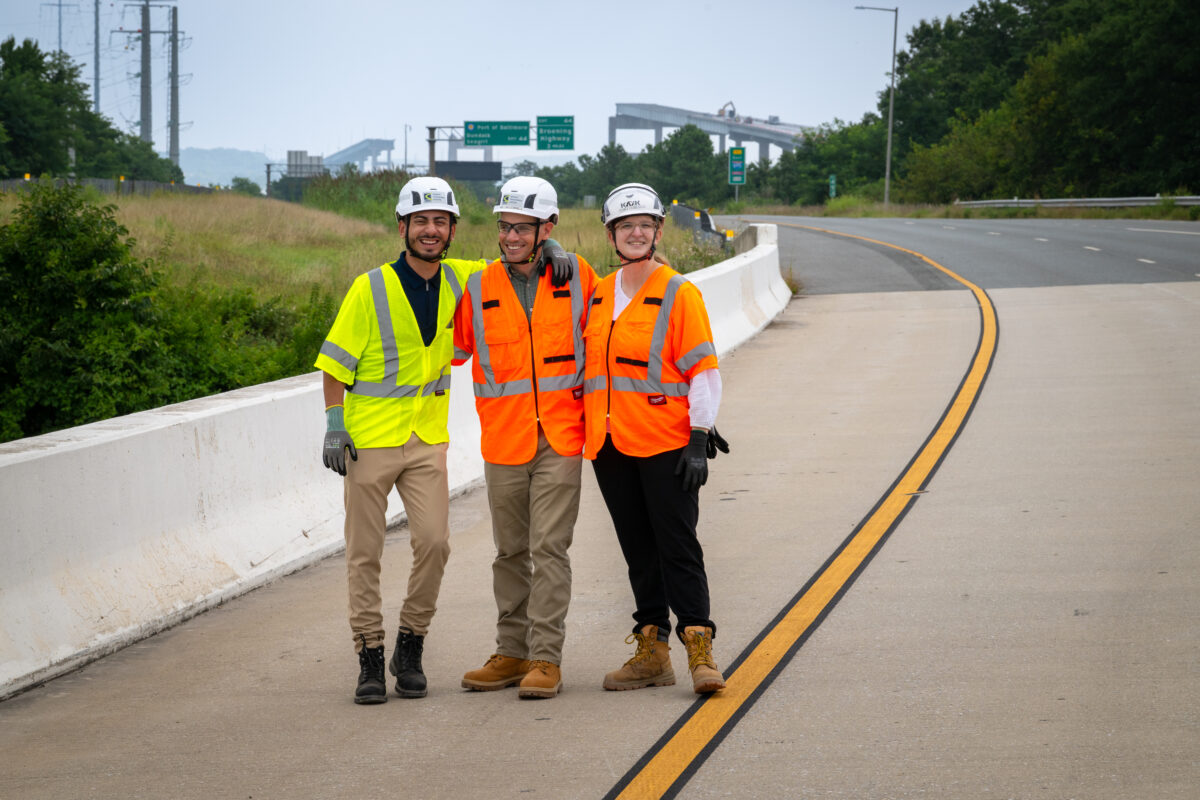 From left to right, Cristian Mena, William McConnell, and Emily DiMarzio pose for a photo near the site of the collapsed Key Bridge. The three worked on the bridge rebuilding project as interns with the Maryland Transportation Authority. (Brad Ziegler/UMBC)
Emily DiMarzio, a junior studying environmental science and geography, and Cristian Mena and William McConnell, both seniors studying mechanical engineering, all explored their individual areas of interest while actively helping to rebuild in their own community.
“It hurt when the bridge went down,” says McConnell, who grew up in Baltimore and now lives with his wife and three kids in Catonsville. “You could practically see it from our neighborhood, and now see that it is missing. So when the opportunity came along to apply for this internship, I jumped on it.”
Bustling Baltimore
The UMBC Career and Internship Fair is a first foot in the door for many UMBC students seeking to make networking connections. This was precisely the case for Wonder Akpabio, a junior computer science major, who connected with a recruiter from T. Rowe Price who helped guide her through the interview process.
With a massive network of UMBC alumni, T. Rowe Price is already a well-known investment management firm with Retrievers, with the added bonus of being headquartered in Baltimore. Gabriel Farmer, another junior computer science major, was impressed with the outreach efforts the company did with UMBC, like sending recruiters to events and hosting online programming.
 Gabriel Farmer in Baltimore’s Inner Harbor, near the headquarters of T. Rowe Price, where he interned in summer 2025. (Brad Ziegler/UMBC)
“Anytime you ask a question, people are ready to help,” Farmer says. “It’s been a very good experience, and T. Rowe Price is definitely a place I could see myself continuing to work at.”
Connections across campus
UMBC is far from a sleepy campus in the summer, with hundreds of research, internship, and student-employment opportunities available. So, while others traveled far and wide to secure an internship in their area of interest, some Retrievers saw the home-field advantage right in front of them.
Giovanna Orfali, a visual arts senior from São Paulo, Brazil, spent this summer behind the camera as a digital content intern at both the Maryland Center for History and Culture and UMBC’s event and conference services. Humanities Scholar Kendal Howell stepped off the plane after studying business management abroad in France this past spring and into the office as an intern at UMBC’s Division of Student Affairs for their new academic partnerships and high-impact experiences unit.
 Kendal Howell updates internship supervisor, James DeVita, on her latest project. (Brad Ziegler/UMBC)
Second-year gerontology doctoral student Claire McDonald also had the opportunity to conduct new research, working with Rowena Winkler, the new assistant director for graduate student career development at the UMBC Career Center, who was seeking graduate students to conduct a 10-week qualitative research project. Caleb Ruck ’22, modern languages, linguistics, and intercultural communication, and M.A. ’24, intercultural communication, continued his work becoming the first year-long graduate assistant for the Center for Social Justice Dialogue.
A numbers game
With so many resources available to help students land their dream internship, it’s not surprising to see the statistics of success—85 percent of recent alumni engaged in applied learning like internships, research, service-learning, or leadership during their time at UMBC. Thanks to the work they’re putting into their futures as a student, 93 percent graduate with firm plans for employment or graduate school within six months of graduation.
“I’m continually inspired by the way our students engage in applied learning to launch their careers,” says Marykate Conroy, associate director of internships and employment. “UMBC students are entering the workforce prepared and in demand.”
 Tanzila Malik speaking at the Women’s History Month panel, hosted by the Women’s, Gender, and Equity Center.
UMBC’s Career Center offers a comprehensive suite of resources including SteppingBlocks to explore alumni career paths and outcomes, UMBC Careers Unleashed Podcast for stories and insights, the Internship and Research Success Practicum course to complement student work experiences, Handshake for employer connections, and the UMBC Career Connectors network of faculty and staff linking the classroom to careers.
The annual Career and Internship Fair will be held on Wednesday, September 17, from 11:30 a.m. – 3:30 p.m. in the Retriever Activity Center. “Get engaged, ask the big questions, push yourself to achieve your goals, and influence the world. The UMBC community will be right there with you along your journey,” recommends Tanzila Malik ’26, women’s studies, who spent two years interning with the Women’s, Gender, and Equity Center.
Read more about where internships took Retrievers this summer.
]]>
“Support” is one of the most frequently used words when UMBC students reflect on their internship experiences on and off campus. From resources offered by the Career Center, to guidance from...
https://umbc.edu/stories/campus-support-umbc-summer-internships-2025/
https://my3.my.umbc.edu/api/v0/pixel/news/152407/guest@my.umbc.edu/bdde959821900d8673fa552b719cbdd0/api/pixel
cahss
careercenter
cnms
coeit
community
computer-science
ges
gwsst
humanities-scholar
internships
is
meche
mlli
news
story
visual-arts
UMBC News & Magazine
https://my3.my.umbc.edu/groups/umbc-news-magazine
https://assets1-my.umbc.edu/system/shared/avatars/groups/000/001/943/24435aa6207c452e7bc15cc74b42c7bb/xsmall.png?1748556657
https://assets1-my.umbc.edu/system/shared/avatars/groups/000/001/943/24435aa6207c452e7bc15cc74b42c7bb/original.png?1748556657
https://assets2-my.umbc.edu/system/shared/avatars/groups/000/001/943/24435aa6207c452e7bc15cc74b42c7bb/xxlarge.png?1748556657
https://assets2-my.umbc.edu/system/shared/avatars/groups/000/001/943/24435aa6207c452e7bc15cc74b42c7bb/xlarge.png?1748556657
https://assets3-my.umbc.edu/system/shared/avatars/groups/000/001/943/24435aa6207c452e7bc15cc74b42c7bb/large.png?1748556657
https://assets1-my.umbc.edu/system/shared/avatars/groups/000/001/943/24435aa6207c452e7bc15cc74b42c7bb/medium.png?1748556657
https://assets2-my.umbc.edu/system/shared/avatars/groups/000/001/943/24435aa6207c452e7bc15cc74b42c7bb/small.png?1748556657
https://assets1-my.umbc.edu/system/shared/avatars/groups/000/001/943/24435aa6207c452e7bc15cc74b42c7bb/xsmall.png?1748556657
https://assets2-my.umbc.edu/system/shared/avatars/groups/000/001/943/24435aa6207c452e7bc15cc74b42c7bb/xxsmall.png?1748556657
UMBC News & Magazine
0
0
false
Fri, 12 Sep 2025 16:12:34 -0400
Fri, 12 Sep 2025 16:12:34 -0400
These Retrievers have a role to play in rebuilding Baltimore’s Francis Scott Key Bridge
 Workers demolish parts of the old Key Bridge in preparation for building a new one. (Brad Ziegler/UMBC)
In the early morning of March 26, 2024, the massive cargo ship Dali lost power as it left the Port of Baltimore. The ship collided with one of the supports holding up the Francis Scott Key Bridge over the Patapsco River and the bridge collapsed, killing six construction workers and severely disrupting the flow of people and goods around Baltimore. In the immediate aftermath of the tragedy, officials began the process of planning for a new bridge, and now UMBC students are getting an up-close look at the massive project.
A year and half later, three Retrievers visited the bridge site, observing as workers demolished parts of the remaining structures in preparation for building a new bridge. Emily DiMarzio, a rising junior studying environmental science and geography, and Cristian Mena and William McConnell, both rising seniors studying mechanical engineering, were all selected to join The Key Bridge Rebuild Internship Program this summer. While their trip to the bridge this August was partly photo-op, it also represented their experiences throughout the summer, which included regular trips to the bridge and surrounding sites to learn about the ongoing work there.
The Key Bridge internship program launched this year as a partnership between the Maryland Transportation Authority (MDTA) and the Maryland Higher Education Commission (MHEC). This summer nine students from four Maryland universities, including Retrievers DiMarzio, Mena, and McConnell, got hands-on experience in project management, environmental analysis, construction oversight, and community outreach.
“It hurt when the bridge went down,” says McConnell, who grew up in Baltimore and now lives with his wife and three kids in Catonsville. “You could practically see it from our neighborhood, and now see that it is missing. So when the opportunity came along to apply for this internship, I jumped on it.”
Bridge building boot camp
At the start of the internship, the students were divided into teams based on their interests. McConnell and Mena were on the structural and geotechnical team, which worked to review, analyze, and visualize data that was collected earlier in the year while boring into the layers of sediment where the structural supports for the new bridge will go. DiMarzio was on the environmental compliance team that performed reviews of permitting documents and requirements and observed how the requirements are met during construction.
A large part of the process was coming up to speed fast on the bridge-building process.
“I’ve learned so much—I feel like a bridge expert after this summer,” laughs Mena.
McConnell noted that all the interns on the structural and geotechnical team came from mechanical engineering backgrounds. “It was nice for us to be exposed to and learn a lot about the civil engineering field,” he says.
The interns went on regular trips outside the office to see the bridge-building process in action. They visited the Chesapeake Bay Bridge, which was being redecked, and visited the Key Bridge site multiple times.
 From left to right, McConnell, DiMarzio, and Mena talk near the Key Bridge. (Brad Ziegler/UMBC)
They also visited the Turner-Fairbank Highway Research Center in McLean, Virginia, where they saw how researchers were testing a 3D model of the new bridge to better understand how the force of waves will affect the sand around the bridge’s supports.
“I thought that was super cool,” says Mena. “That was one of my favorite project sites.”
“The UMBC students are great to work with,” says Jason Stolicny, the deputy director of project development at MDTA who served as their supervisor this summer. “They show a genuine interest in learning and gaining exposure to new things.”
Community outreach
As part of the internship, DiMarzio, Mena, and McConnell also worked together to develop a hands-on workshop for students at Cherry Hill Middle School in Baltimore as part of the UMBC Summer Math Program through the George and Betsy Sherman Center. They prepared a presentation on different bridge types and the workers who come together to build and maintain them. They also worked with students to design and build model bridges. The workshop was part of a summer enrichment program that UMBC runs in partnership with Baltimore City Public Schools. The interns’ workshop fit into a curriculum about bridges that Malaysia McGinnis ’21, geography and environmental science, and M.A. ’24, secondary education and teaching, a teacher at Cherry Hill and Sherman Scholar, had designed for the summer program.
The interns agree it was rewarding to make connections with kids in the Baltimore community.
 Cristian Mena (left) works with students from Cherry Hill Middle School in Baltimore on a model bridge building activity. (Photo courtesy of Sara Krauss)
“There was one kid that stood out to me because during the whole presentation, he looked like he was asleep and so he kind of reminded me of myself,” says Mena. “So after the presentation I partnered up with him in the activity. He was super bright and answered all the questions I asked him. Hopefully, I inspired him to see his career choices and to continue learning and growing.”
MDTA plans to continue the Key Bridge internship program until the bridge has been rebuilt, which is currently anticipated to be in fall 2028.
“It was an honor to be part of the first group of interns,” says McConnell. “I hope we helped set the stage for future interns to have really great experiences too.”
Mena contemplates what it will feel like to see the new bridge spanning the river: “That’s going to be quite a sight. I think it’ll be pretty meaningful because even though I contributed in a very small way, it’ll stand in our community as something bigger than ourselves and a symbol of what we can do when we put our minds together.”
]]>
Workers demolish parts of the old Key Bridge in preparation for building a new one. (Brad Ziegler/UMBC) In the early morning of March 26, 2024, the massive cargo ship Dali lost power as it...
https://umbc.edu/stories/key-bridge-rebuild-internships/
https://my3.my.umbc.edu/api/v0/pixel/news/151663/guest@my.umbc.edu/020020d6aa1e73ea13283ada081591ae/api/pixel
cahss
career-center
coeit
community
ges
internships
meche
news
science-and-tech
story
UMBC News & Magazine
https://my3.my.umbc.edu/groups/umbc-news-magazine
https://assets1-my.umbc.edu/system/shared/avatars/groups/000/001/943/24435aa6207c452e7bc15cc74b42c7bb/xsmall.png?1748556657
https://assets1-my.umbc.edu/system/shared/avatars/groups/000/001/943/24435aa6207c452e7bc15cc74b42c7bb/original.png?1748556657
https://assets2-my.umbc.edu/system/shared/avatars/groups/000/001/943/24435aa6207c452e7bc15cc74b42c7bb/xxlarge.png?1748556657
https://assets2-my.umbc.edu/system/shared/avatars/groups/000/001/943/24435aa6207c452e7bc15cc74b42c7bb/xlarge.png?1748556657
https://assets3-my.umbc.edu/system/shared/avatars/groups/000/001/943/24435aa6207c452e7bc15cc74b42c7bb/large.png?1748556657
https://assets1-my.umbc.edu/system/shared/avatars/groups/000/001/943/24435aa6207c452e7bc15cc74b42c7bb/medium.png?1748556657
https://assets2-my.umbc.edu/system/shared/avatars/groups/000/001/943/24435aa6207c452e7bc15cc74b42c7bb/small.png?1748556657
https://assets1-my.umbc.edu/system/shared/avatars/groups/000/001/943/24435aa6207c452e7bc15cc74b42c7bb/xsmall.png?1748556657
https://assets2-my.umbc.edu/system/shared/avatars/groups/000/001/943/24435aa6207c452e7bc15cc74b42c7bb/xxsmall.png?1748556657
UMBC News & Magazine
1
0
false
Fri, 22 Aug 2025 10:53:13 -0400
Fri, 22 Aug 2025 10:53:13 -0400
From coursework to career: UMBC interns shine at AstraZeneca
In the heart of the BioHealth Capital Region—spanning Maryland, Virginia, and D.C.—more than 2,300 life science companies, 78 federal laboratories, and 35 million square feet of laboratory space create a vibrant hub for biotechnology and pharmaceutical innovation. For UMBC students interning at AstraZeneca, a global leader in healthcare, this summer offered a chance to bridge classroom learning with real-world challenges. Through their work, Mustafa Akpinar, Alek Read, and Ty Allen honed technical expertise, built teamwork and communication skills, and forged connections with peers and professionals on the Baltimore/D.C. biotech scene.
Building technical mastery
At AstraZeneca, UMBC interns are diving into hands-on projects that align with their academic training and career ambitions. Akpinar, a senior information systems major, works as a cyber threat intelligence and threat detection intern, analyzing potential cyber threats and sharpening detection systems using tools like Splunk.
“This internship is a perfect fit for both my academic path and long-term career goals,” Akpinar says, noting how the role builds on his data communications and networks and database design courses. “Long term, I want to work in cloud security or threat detection,” he adds, “and this internship gives me practical exposure to both.”
Alek Read, a senior environmental science major, contributes to sustainability efforts at AstraZeneca’s Frederick Manufacturing Center as an environmental health safety intern. His projects include measuring biochemical oxygen demand in wastewater and ensuring environmental compliance, directly tying into his passion for sustainable innovation.

 Left: Alek Read snapped this selfie while on a spill, prevention, control, and countermeasure (SPCC) inspection during his internship with AstraZeneca. Right: Read conducted parts of his internship in a high-level clean room, where strict procedures are in place to prevent contamination. (Courtesy of Read)
“This experience has helped me explore how large companies manage their environmental footprint,” Read explains. “It has been exciting to see how environmental practices are applied in real-world production settings.” He’s also learned about the environmental permitting process, he says.
Allen, a junior mechanical engineering major, is a site operations intern at AstraZeneca. He applies his engineering skills to edit technical drawings in AutoCAD. The role offers him a practical glimpse into the day-to-day life of an engineer, Allen says, allowing him to apply classroom knowledge in a professional setting. “It’s a great way to experience what being an engineer is like outside of school,” he shares.
Communicating for team success
Beyond technical skills, the interns are developing essential relational skills like collaboration and communication. Akpinar highlights the collaborative nature of his work, saying, “One major takeaway is how critical collaboration is in cyber defense—threat intelligence isn’t done in a vacuum.” His ability to share ideas with mentors and teammates has grown, and his suggestions are taken seriously and encouraged by his team, Akpinar says.
Read collaborates regularly with teammates across departments, giving him ample opportunities to practice clear communication. Plus, his teammates trust him to set task deadlines independently, boosting his project management skills. Similarly, Allen values the confidence his team has in him, explaining that as long as he checks in regularly, he can manage his work as he sees fit. Developing the ability to manage one’s workload independently and coordinate with colleagues across an organization are valuable skills that will serve these interns well in any future career.
 Alek Read, left, enjoyed the alumni and intern mixer at AstraZeneca, where he met Zulqifar Shah, M.P.S. ’13, engineering management. (Courtesy of Miriam Friedman)
A launchpad for future careers
The internship experience extends beyond individual tasks, offering opportunities to connect with fellow interns and industry professionals. Akpinar has enjoyed bonding with other UMBC interns across diverse roles at AstraZeneca. “It’s been great having that shared experience—we support each other and exchange insights from our different teams,” he says.
Read especially appreciated an AstraZeneca UMBC alumni and intern mixer, where he networked with former UMBC students now thriving at the company. These interactions not only broaden the interns’ perspectives on the kinds of careers available in the region, but also help them build lasting professional connections that could serve them in the future. Touring manufacturing facilities and participating in inspections was another highlight for Read.
For Akpinar, Read, and Allen, interning at AstraZeneca is more than a summer job—it’s a stepping stone to their future careers. From protecting digital assets to advancing sustainability and engineering innovation, their work has the potential for real-world impact well beyond the BioHealth Capital Region. As they grow in their roles, these UMBC students are building skills, forging connections, and laying the foundation for success in the booming biotech industry.
]]>
In the heart of the BioHealth Capital Region—spanning Maryland, Virginia, and D.C.—more than 2,300 life science companies, 78 federal laboratories, and 35 million square feet of laboratory space...
https://umbc.edu/stories/coursework-to-career-astrazeneca-interns/
https://my3.my.umbc.edu/api/v0/pixel/news/151596/guest@my.umbc.edu/2f97b6e044236edb45d81792abf54fa4/api/pixel
cahss
career-center
coeit
ges
internships
is
meche
news
science-and-tech
story
UMBC News & Magazine
https://my3.my.umbc.edu/groups/umbc-news-magazine
https://assets1-my.umbc.edu/system/shared/avatars/groups/000/001/943/24435aa6207c452e7bc15cc74b42c7bb/xsmall.png?1748556657
https://assets1-my.umbc.edu/system/shared/avatars/groups/000/001/943/24435aa6207c452e7bc15cc74b42c7bb/original.png?1748556657
https://assets2-my.umbc.edu/system/shared/avatars/groups/000/001/943/24435aa6207c452e7bc15cc74b42c7bb/xxlarge.png?1748556657
https://assets2-my.umbc.edu/system/shared/avatars/groups/000/001/943/24435aa6207c452e7bc15cc74b42c7bb/xlarge.png?1748556657
https://assets3-my.umbc.edu/system/shared/avatars/groups/000/001/943/24435aa6207c452e7bc15cc74b42c7bb/large.png?1748556657
https://assets1-my.umbc.edu/system/shared/avatars/groups/000/001/943/24435aa6207c452e7bc15cc74b42c7bb/medium.png?1748556657
https://assets2-my.umbc.edu/system/shared/avatars/groups/000/001/943/24435aa6207c452e7bc15cc74b42c7bb/small.png?1748556657
https://assets1-my.umbc.edu/system/shared/avatars/groups/000/001/943/24435aa6207c452e7bc15cc74b42c7bb/xsmall.png?1748556657
https://assets2-my.umbc.edu/system/shared/avatars/groups/000/001/943/24435aa6207c452e7bc15cc74b42c7bb/xxsmall.png?1748556657
UMBC News & Magazine
0
0
false
Mon, 18 Aug 2025 14:49:41 -0400
Mon, 18 Aug 2025 14:49:41 -0400
From better batteries to safer surgery: Three engineering grads to tackle society’s big challenges with support from prestigious NSF research fellowships
How can we make the world a better place? It’s a question that Nathaniel Glover ’25, chemical engineering, Jacob Lombardo ‘25, mechanical engineering, and August Phelps ’25, mechanical engineering, have spent a lot of time thinking about. And each has concluded that advancing science is a powerful way to advance humanity.
The three promising researchers were each recently recognized and rewarded by the National Science Foundation’s Graduate Research Fellowship Program (GRFP), which provides financial support to U.S. graduate students who have shown the potential to be high-achieving scientists and engineers.
“The NSF GRFP award is a very prestigious and competitive award,” says Deepa Madan, associate professor in the Department of Mechanical Engineering, who has worked with both Glover and Lombardo on research projects in her lab. So far this year the program has awarded 1,000 fellowships across the U.S., about half of the typical number, making the process even more competitive. This fall, Glover, Lombardo, and Phelps will all head to Johns Hopkins University in Baltimore to begin their graduate education and research.
The thrill of research
Glover, Lombardo, and Phelps knew early in their college careers that they wanted to become researchers. The three are part of the Meyerhoff Scholars Program at UMBC, which is at the forefront of efforts to increase diversity among future leaders in science, technology, engineering, and mathematics by supporting students who intend to pursue a Ph.D. or combined M.D./Ph.D. in these fields. Throughout their time at UMBC, they engaged in a variety of research projects with different faculty mentors.
 Nathaniel Glover stands next to the research poster he presented at the end of his internship at Argonne National Laboratory in summer 2024. (Photo courtesy of Glover)
“I really enjoy the quest to answer unanswered questions,” Glover says, explaining what attracts him to research. Most recently, he worked in Madan’s lab on a project to develop rechargeable, safe, and flexible zinc alkaline batteries, which could revolutionize how consumers power devices such as wearable health monitors.
Lombardo has also worked in Madan’s lab, studying materials that can convert wasted heat into electricity, while Phelps recently worked with mechanical engineering assistant professor Ankit Goel to develop methods for improving control over the flight trajectory of multicopters. Multicopters, which use multiple rotors for lift and maneuvering, are inherently unstable and underactuated, meaning the craft is limited in the ways it can move and must actively stabilize itself at all times. The researchers developed a method to guide the aircraft along a desired trajectory as precisely as possible despite variations in operating conditions and physical properties of the multicopter.
The problems the students and their mentors study—such as how to power and control machines—transcend any particular application, and the solutions the researchers develop could have profound effects on a variety of technologies.
For example, in graduate school, Phelps will join a lab that develops control systems for medical robots. There, he will study electrocauterization, a medical procedure that uses heat generated by an electric current to perform tasks such as removing harmful tissue and controlling bleeding during surgery. Phelps said the speed of the process needs to be carefully controlled to avoid excess damage to healthy tissue, and the lab he is joining is working on ways to automate this control. He notes that both his father and girlfriend have undergone medical procedures with long recovery times. Making the process better is personal to him.
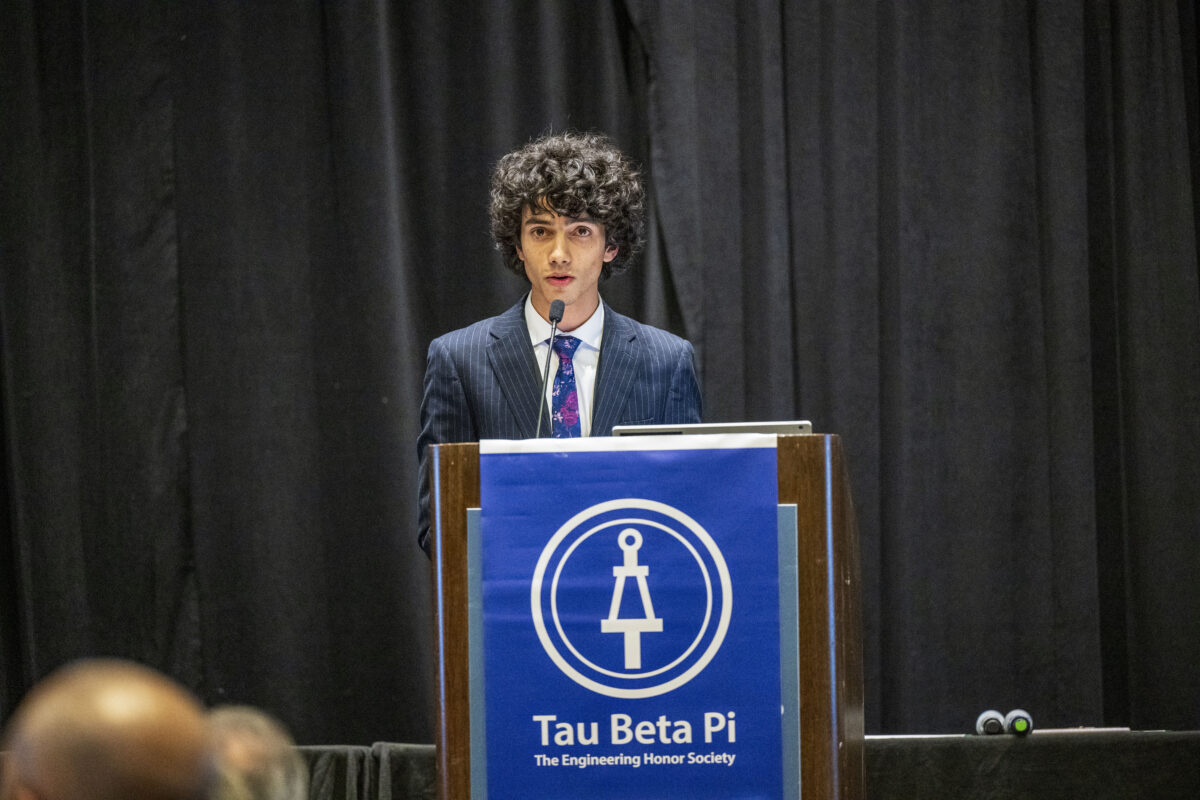 August Phelps speaks at the 2023 Tau Beta Pi National Convention in Atlanta, Georgia, as UMBC’s chapter delegate to the engineering honor society. (Photo by Kiffer Creveling)
Glover and Lombardo agree that what keeps them going, even through late-night problem solving and failed prototypes, is the desire to improve the way things get done. “I love how engineering research takes fundamental science principles and applies it to making a difference in the world,” says Lombardo.
“My real passion is figuring out how to progress as a species,” echoes Glover. “Science is one of our most powerful tools for that.”
A launch pad for big dreams
 Jacob Lombardo (left) and labmates Jiyuan Huang and Srushti Kulkarni attend the 2024 Consumer Electronics Showcase, as part of the Southwest I-Corp program. The program guides engineers to engage with stakeholders outside the lab to better understand market needs and consumer requirements. (Photo courtesy of Lombardo)
These Retrievers say UMBC offered the tools and the mentorship to progress toward their biggest ambitions.
“So many people took their time to sit with me, to push me forward,” says Lombardo. “I had the opportunity to go to scientific conferences, engage in world-class research, and find a community that embraced me.”
Lombardo notes that with support from programs such as the National Institute of Health’s Undergraduate Research Training Initiative for Student Enhancement (U-RISE) program and the Southwest Regional National Science Foundation Innovation Corps (I-Corps) program, he was able to network with researchers outside of his discipline, as well as with industry experts who understand the consumer market. The interactions honed his career goals and reinforced his passion for translating fundamental science principles into practical and impactful engineering, he says.
Glover, Lombardo and Phelps agree being awarded NSF GRFP fellowships is both a validation of the work they have done so far and an obligation to make a positive difference with research going forward. “It does make me feel that what we do is seen and appreciated,” Glover says. “I have this feeling that I will be able to have the impact that I am hoping to have on the world, which is inspiring and humbling.”
Phelps says he is excited to take the next steps: “I’m looking forward to exploring new topics, pushing the boundaries, and creating new things.”
]]>
How can we make the world a better place? It’s a question that Nathaniel Glover ’25, chemical engineering, Jacob Lombardo ‘25, mechanical engineering, and August Phelps ’25, mechanical...
https://umbc.edu/stories/three-engineering-grads-win-nsf-grfp-awards/
https://my3.my.umbc.edu/api/v0/pixel/news/150763/guest@my.umbc.edu/9e0b1a4e721e724c6e958f4ac3c812c3/api/pixel
cbee
coeit
meche
meyerhoff-program
news
research
science-and-tech
story
UMBC News & Magazine
https://my3.my.umbc.edu/groups/umbc-news-magazine
https://assets1-my.umbc.edu/system/shared/avatars/groups/000/001/943/24435aa6207c452e7bc15cc74b42c7bb/xsmall.png?1748556657
https://assets1-my.umbc.edu/system/shared/avatars/groups/000/001/943/24435aa6207c452e7bc15cc74b42c7bb/original.png?1748556657
https://assets2-my.umbc.edu/system/shared/avatars/groups/000/001/943/24435aa6207c452e7bc15cc74b42c7bb/xxlarge.png?1748556657
https://assets2-my.umbc.edu/system/shared/avatars/groups/000/001/943/24435aa6207c452e7bc15cc74b42c7bb/xlarge.png?1748556657
https://assets3-my.umbc.edu/system/shared/avatars/groups/000/001/943/24435aa6207c452e7bc15cc74b42c7bb/large.png?1748556657
https://assets1-my.umbc.edu/system/shared/avatars/groups/000/001/943/24435aa6207c452e7bc15cc74b42c7bb/medium.png?1748556657
https://assets2-my.umbc.edu/system/shared/avatars/groups/000/001/943/24435aa6207c452e7bc15cc74b42c7bb/small.png?1748556657
https://assets1-my.umbc.edu/system/shared/avatars/groups/000/001/943/24435aa6207c452e7bc15cc74b42c7bb/xsmall.png?1748556657
https://assets2-my.umbc.edu/system/shared/avatars/groups/000/001/943/24435aa6207c452e7bc15cc74b42c7bb/xxsmall.png?1748556657
UMBC News & Magazine
0
0
false
Mon, 23 Jun 2025 11:18:40 -0400
Mon, 23 Jun 2025 11:18:40 -0400


 (l-r): The eagle’s right wing insert, stuffed eagle without weighted wing pockets, and the fabric for the beak and talons. (Images courtesy of Harper)