Peace has long been elusive in rural Colombia – Black women’s community groups try to bring it closer each day
Written by Tania Lizarazo, associate professor of Latin American studies and global studies, UMBC
It’s been almost nine years since Colombia celebrated a landmark peace agreement between one guerrilla group and the government, and three years since President Gustavo Petro vowed “total peace.” But in reality, the country’s decades-long internal conflict continues – making it one of the oldest in the world.
Violence surged in early 2025, the most intense uptick in years. Fighting between two armed guerrilla groups in the northeastern Catatumbo region killed dozens of people and displaced tens of thousands more. Since the largest armed group – the Revolutionary Armed Forces of Colombia, known as FARC – signed the 2016 peace accord, more than 400 signatories have been killed. Meanwhile, more than 1,200 social leaders and human rights defenders have been assassinated.
We often define peace as the absence of war. The problem with thinking about peace and war as an all-or-nothing binary, however, is that it obscures the violence that takes place in “peaceful times.” For Colombians, that paradox is nothing new. In many communities most affected by the violence, thinking about a “post-conflict era” feels utopian.
As a Colombian researcher who has collaborated with Afro-Colombian leaders for over a decade, I have noticed that emphasizing peace talks and accords erases the historical violence that is still present, especially for racial minorities. Colombia has the largest Black population in Spanish-speaking Latin America. In Chocó – a region on the Pacific coast where I conducted my research – Afro-Colombians form a majority.
Communities there are contending not only with the contemporary conflict, but also ongoing challenges from the legacies of slavery, colonialism and extractive industries. Many residents, particularly women, work together every day to try to bring peace and justice within reach.
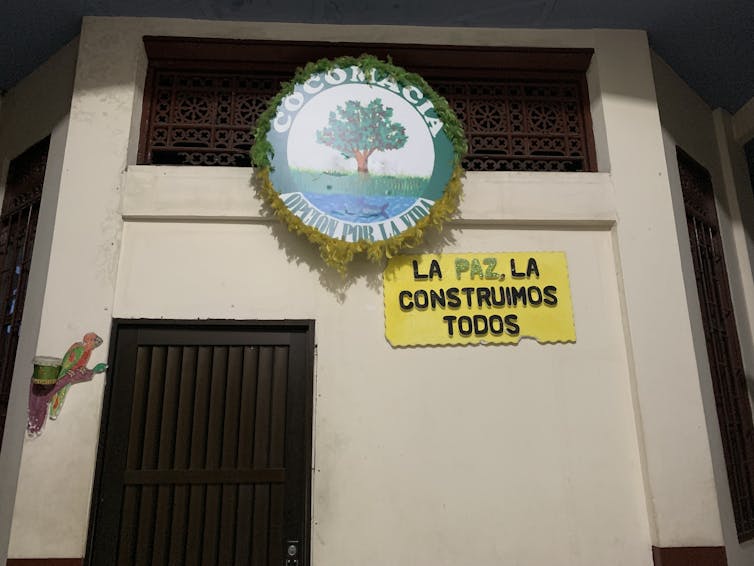 Signs in the office of COCOMACIA say ‘option for life’ and ‘peace, we all build it.’ Tania Lizarazo
Rights vs. reality
Colombia has been mired in war for over six decades, as legal and illegal armed groups across the political spectrum fight for territories and resources. The conflict is estimated to have killed around 450,000 people and displaced around 7 million.
Black and Indigenous communities have disproportionately suffered the brunt of the war – especially in rural areas, where their lives and territories have been threatened by armed groups and companies alike. In Chocó Department, the site of my research, the region’s remoteness and biodiversity have attracted illegal groups and practices like drug trafficking, as well as mining and other types of resource extraction that threaten traditional livelihoods. Mercury from industrial mining poses an additional danger to people’s health and the environment.
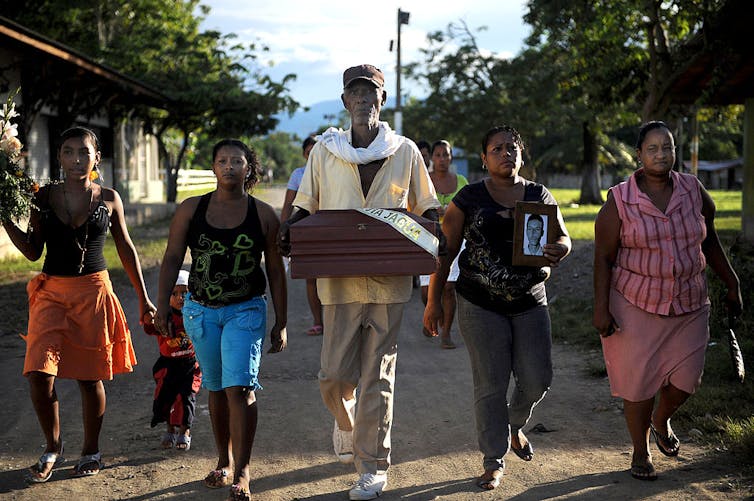 Andres Magallan carries an urn with the remains of Ivan Mejia, who was murdered by right-wing paramilitary guerrillas years before, in Santa Maria, Chocó, Colombia, in 2010. Raul Arboleda/AFP via Getty Images
Black rural communities in the Pacific lowlands, where most of Chocó is located, have a legal right to collective ownership of their territories and to be consulted about development plans. In reality, land grabs and targeted killings over illegal crops, mining and other extractive practices have become the norm here, as is true throughout rural Colombia.
The conflict has intensified racism and gender hierarchies, with Black women, particularly activists, especially vulnerable. Vice President Francia Márquez Mina, for example – who has won awards for her activism against illegal mining – survived an attack near her home in the nearby department of Cauca in 2019. She and her family have received other threats on their lives since then.
Building solidarity
Even in “postconflict” times, peace is a challenging task. It requires social change that does not happen overnight. Rather, it is the accumulation of tiny sparks in people’s daily commitments.
In my book “Postconflict Utopias: Everyday Survival in Chocó, Colombia,” I write about how Black women’s organizations care for their territories and communities. The “comisionadas,” for example, belong to one of the largest associations of community councils in rural Colombia, called COCOMACIA. These women travel the Atrato River and its tributaries to lead workshops about the organization, as well as territorial rights and women’s rights.
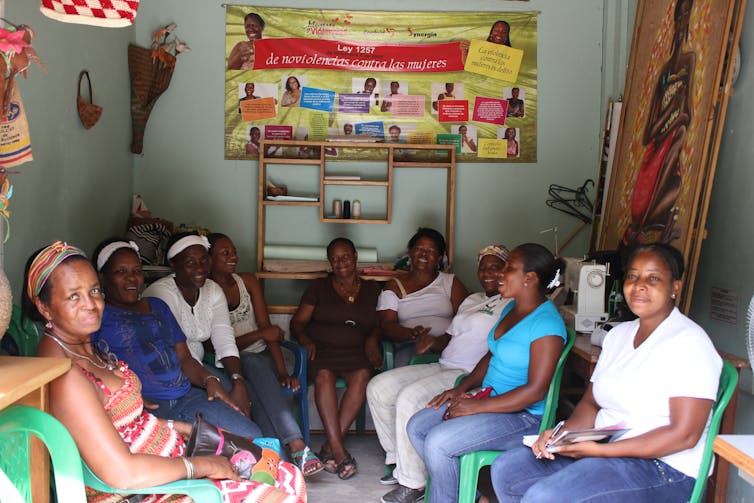 Comisionadas next to a poster with information about a landmark law against domestic violence, on July 7, 2012. María del Socorro Mosquera Pérez sits on the left. Tania Lizarazo
Everyone in the community is welcome to participate in dialogues about issues such as women’s political participation, land ownership and related legislation. Comisionada María del Socorro Mosquera Pérez, for example, wrote a song to share the importance of Law 1257, a landmark 2008 law against violence and discrimination against women.
In her story for the research project that I discuss in my book, “Mujeres Pacíficas,” comisionada Rubiela Cuesta Córdoba says it best: “The best legacy that one leaves to family and friends is resistance.”
One focus of these women’s groups’ work is the Atrato River itself. Since 2016, the same year of the peace accords, Colombian courts have recognized the river as a legal person, with rights to protection, conservation, maintenance and restoration.
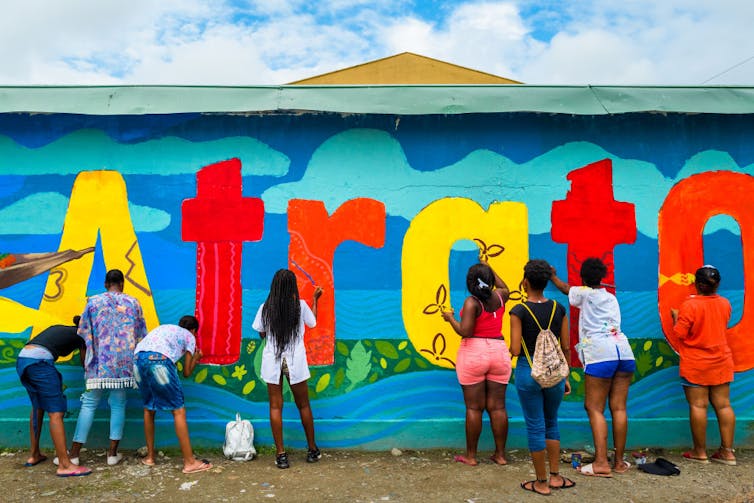 Students paint a mural in Quibdó, Chocó, Colombia, which says ‘Somos Atrato’: We are the Atrato River. Jan Sochor/Getty Images
The river is a source of food and transportation between many basin communities where potable water, electricity and other amenities are scarce. But it is also intertwined with politics and spirituality. Pilgrimages like “Atratiando,” a trip along the river and its tributaries that has taken place multiple times since 1999, highlight that there is no life without the river. Participants travel through areas where paramilitaries and guerrillas are active, showing solidarity with vulnerable communities.
COCOMACIA’s comisionadas are part of many other organizations – highlighting how survival is not only intertwined with lands and rivers, but other regions and countries. The struggle for women’s rights has led the comisionadas to collaborate with other organizations, creating wider networks of care. These include La Red Departamental de Mujeres Chocoanas, a feminist coalition of women’s organizations in Chocó; La Ruta Pacífica de las Mujeres, a feminist movement of 300 organizations from across Colombia; and Women in Black, an anti-militarism network with members in over 150 countries.
Their solidarity is a reminder that peace and justice are a collaborative, everyday effort. As Justa Germania Mena Córdoba, leader of the comisionadas at the time, told me in 2012: “One cannot change the world by herself.”
This article has been updated to correct the description of COCOMACIA.
This article is republished from The Conversation under a Creative Commons license. Read the original and see more than 250 UMBC articles available in The Conversation.
]]>
Written by Tania Lizarazo, associate professor of Latin American studies and global studies, UMBC It’s been almost nine years since Colombia celebrated a landmark peace agreement between one...
https://umbc.edu/stories/peace-has-long-been-elusive-in-rural-colombia-black-womens-community-groups-try-to-bring-it-closer-each-day/
https://my3.my.umbc.edu/api/v0/pixel/news/150570/guest@my.umbc.edu/8b74b892031103b9cca9adbc50966b27/api/pixel
cahss
cahss-research
discovery
global-studies
magazine
mlli
research
story
the-conversation
UMBC News & Magazine
https://my3.my.umbc.edu/groups/umbc-news-magazine
https://assets1-my.umbc.edu/system/shared/avatars/groups/000/001/943/24435aa6207c452e7bc15cc74b42c7bb/xsmall.png?1748556657
https://assets1-my.umbc.edu/system/shared/avatars/groups/000/001/943/24435aa6207c452e7bc15cc74b42c7bb/original.png?1748556657
https://assets2-my.umbc.edu/system/shared/avatars/groups/000/001/943/24435aa6207c452e7bc15cc74b42c7bb/xxlarge.png?1748556657
https://assets2-my.umbc.edu/system/shared/avatars/groups/000/001/943/24435aa6207c452e7bc15cc74b42c7bb/xlarge.png?1748556657
https://assets3-my.umbc.edu/system/shared/avatars/groups/000/001/943/24435aa6207c452e7bc15cc74b42c7bb/large.png?1748556657
https://assets1-my.umbc.edu/system/shared/avatars/groups/000/001/943/24435aa6207c452e7bc15cc74b42c7bb/medium.png?1748556657
https://assets2-my.umbc.edu/system/shared/avatars/groups/000/001/943/24435aa6207c452e7bc15cc74b42c7bb/small.png?1748556657
https://assets1-my.umbc.edu/system/shared/avatars/groups/000/001/943/24435aa6207c452e7bc15cc74b42c7bb/xsmall.png?1748556657
https://assets2-my.umbc.edu/system/shared/avatars/groups/000/001/943/24435aa6207c452e7bc15cc74b42c7bb/xxsmall.png?1748556657
UMBC News & Magazine
1
0
false
Fri, 06 Jun 2025 11:30:37 -0400
Fri, 06 Jun 2025 11:30:37 -0400
UMBC’s Virtual Tandem Conversation project with German universities is changing the way students see Germany and the U.S.
During a recent trip to Normandy, France, UMBC student Rebecca Smith hopped over to Lüneburg, a historic town in northern Germany, to visit Gertrud Krause-Traudes, her partner in UMBC’s Virtual Tandem Conversation project. After three semesters of virtual conversations in German and English, Smith was more than happy to go the extra kilometer (plus a few hundred more) to meet her in person. Krause-Traudes, a professional tour guide, was excited to show Smith Lüneburg’s historic sites.
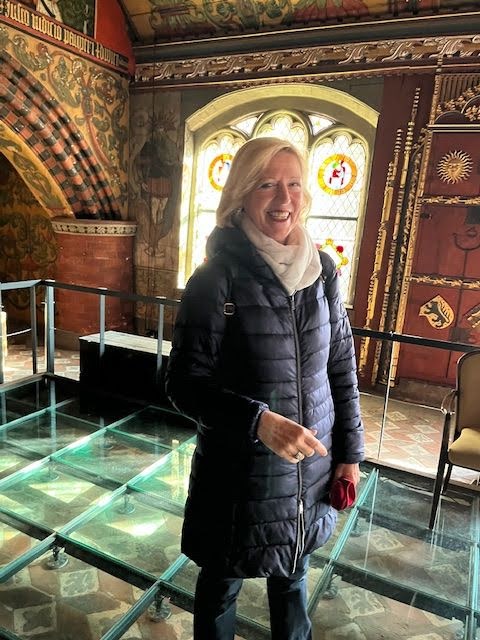 Gertrud Krause-Traudes giving Smith a tour of Lüneburg’s historic town hall. (Image courtesy of Sutton)
The Virtual Tandem Conversation project was created by Susanne Sutton, a teaching professor of German, and Talke Macfarland, a visiting lecturer of German in UMBC’s Department of Modern Languages, Linguistics, and Intercultural Communication. They established the program during COVID-19 to help UMBC students learning German and German students learning English socialize while continuing to improve their language skills.
“I asked the director of the International Center at Leuphana University Lüneburg to post a call for participants on their listserv,” says Sutton, who, while visiting her hometown, had met the director in nearby Lüneburg to discuss UMBC study abroad credit equivalencies. “That generated 35 applicants! It just grew from there,” Sutton says. Now, Sutton is managing partnerships and recruiting collaborators from two additional institutions: University of Kassel and BBS-1 Wirtschaftsgymnasium, a business vocational high school.
Smith, who is a professional harpist, enrolled in UMBC’s Golden ID Program at the beginning of the pandemic to continue taking classes with Macfarland, whom she first met at Anne Arundel Community College. “To my delight, faculty and students warmly welcomed me into their German classes,” says Smith, who was returning to take classes and rekindle her love of German after raising her family and pursuing her music career. “In 2023, I became involved with the tandem program, where my German counterpart, Gertrud, and I instantly developed a friendship through our mutual love of music and foreign languages.”
“How fortunate and privileged I feel to be part of this vibrant international community at UMBC, who seek not only to advance their students’ language abilities, but even more importantly, to build bridges between the two countries, one person at a time—diplomacy at its best!” says Smith.
Getting to know you
Macfarland and Sutton grew up in the state of Lower Saxony in northern Germany. Their joy for teaching their heritage language is a key reason the program has grown from one semester to a sequence of three semesters, each with increasing difficulty and 35 – 40 tandem participants per year.
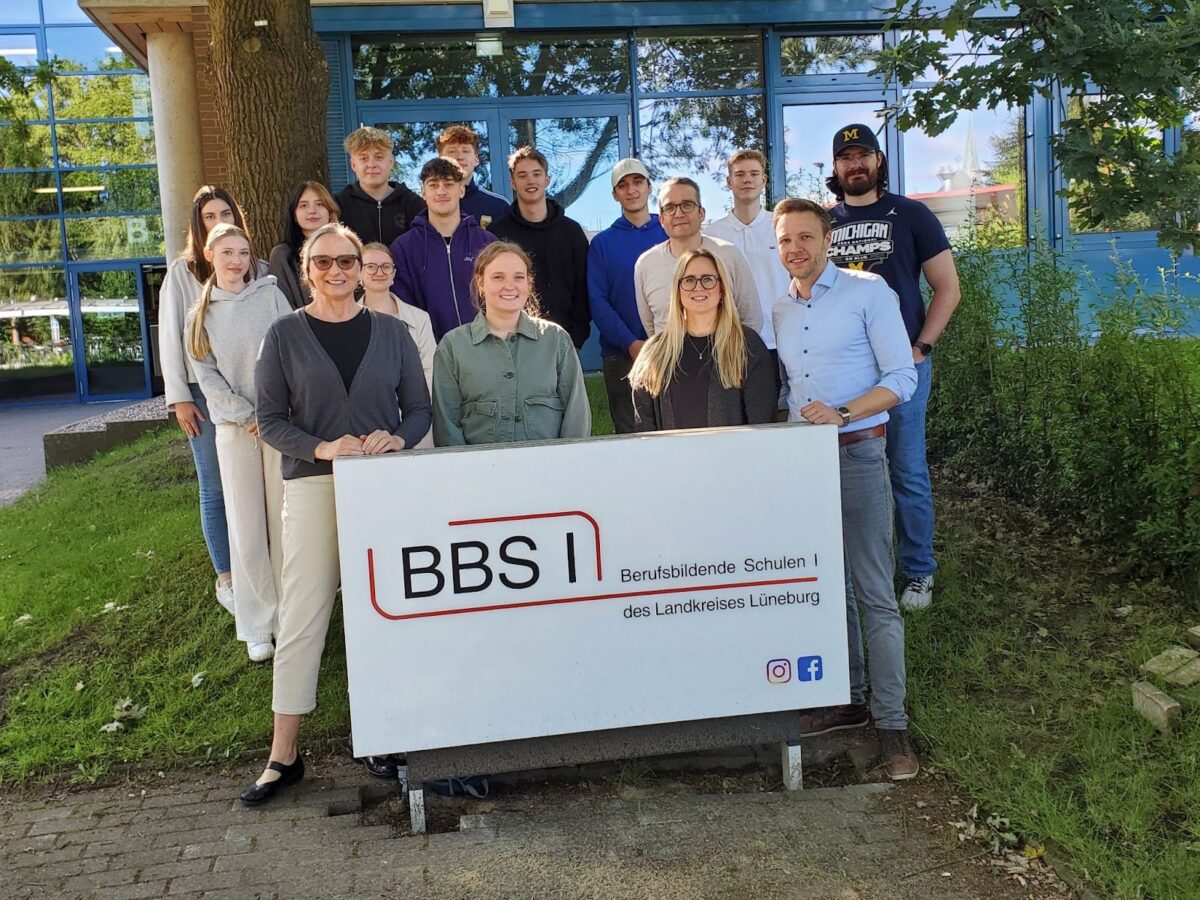 Sutton (front left) visits Rudolph Gawor (front right), team lead in English at BBS-1, and BBS-1 students, teachers, and American guests in Lüneburg, Germany. (Image courtesy of Sutton)
The tandem project is now a required component of the German course sequence to increase proficiency in reading, writing, speaking, and listening, emphasizing intercultural communication and global awareness. However, the actual tandem meetings are entirely student-driven and take place outside of the classroom—each tandem pair arranges virtual meetings according to their schedule. UMBC students keep a weekly diary, where they document their conversations. During the first three weeks, partners learn about each other, exploring their respective cities and universities.
“I provide questions that relate to what we currently do in class,” says Macfarland. “For instance, when we read about an exhibit by German visual artist Gerhart Richter, I asked partners to discuss art: Do you visit museums? What interests you? What’s nearby? Are you artistic? What art or work resonates with you and why?” The journal also allows instructors to monitor and give feedback on students’ weekly meetings. Some of these conversations have led to more personal exchanges, such as discussing video games they play or playing together, sharing the latest music, or exchanging photos.
“My students take what their tandem partners say seriously, and it sticks better than when we just cover the grammar in class. I think it is because they really get to experience the language in action and receive feedback from someone their age who can confirm (or deny) what they have learned in class,” says Dawn Nichols, a tandem faculty partner and lecturer of English at the University of Kassel in central Germany, an official UMBC exchange partner. “Their partners also add a little bit of context and experience to specific language choices and give them 1:1 attention, which is not always easy to do in every lesson.”
Overcoming linguistic and cultural barriers
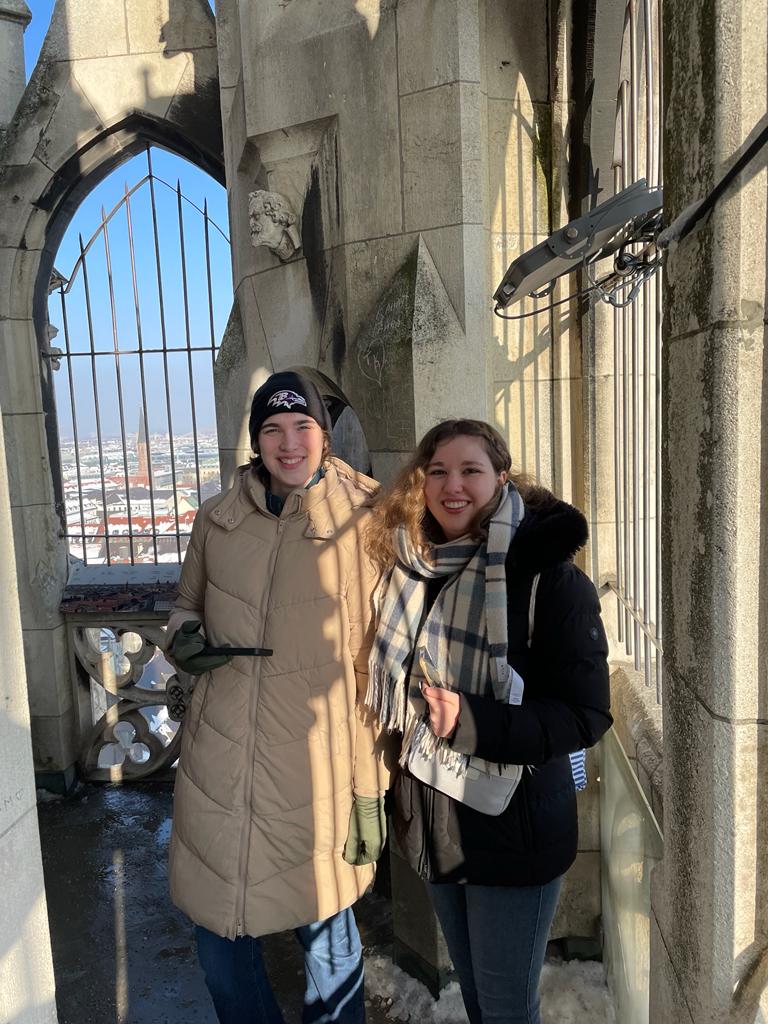 Grosko, left, and Heinrich met in Munich, Germany, while Grosko was in Europe to visit family in Italy. (Image courtesy of Grosko)
The Tandem Conversation Program has evolved to be a vehicle for dismantling stereotypes and misconceptions about the United States and Germany. Liana Grosko, a geography and environmental systems junior with a German minor, was apprehensive about participating in the project. “German was halting for me, and no matter how much I prepared for it, there was always a learning curve when interacting with a native German speaker,” says Grosko. “My German fluency has much improved since we started talking, as well as my knowledge and appreciation of my culture’s place in the world and, of course, my friendship with Malin Heinrich, my tandem partner. I ended up getting to meet her in person in Munich early last year.”
Nichols attests to the improvement in fluency and accuracy, but also more unexpected benefits like a decrease in anxiety some German students experience when speaking English. She continues to be excited each time she hears students learn day-to-day language that is sometimes left out of textbooks and knowledge that helps them better understand American culture and critique their system.
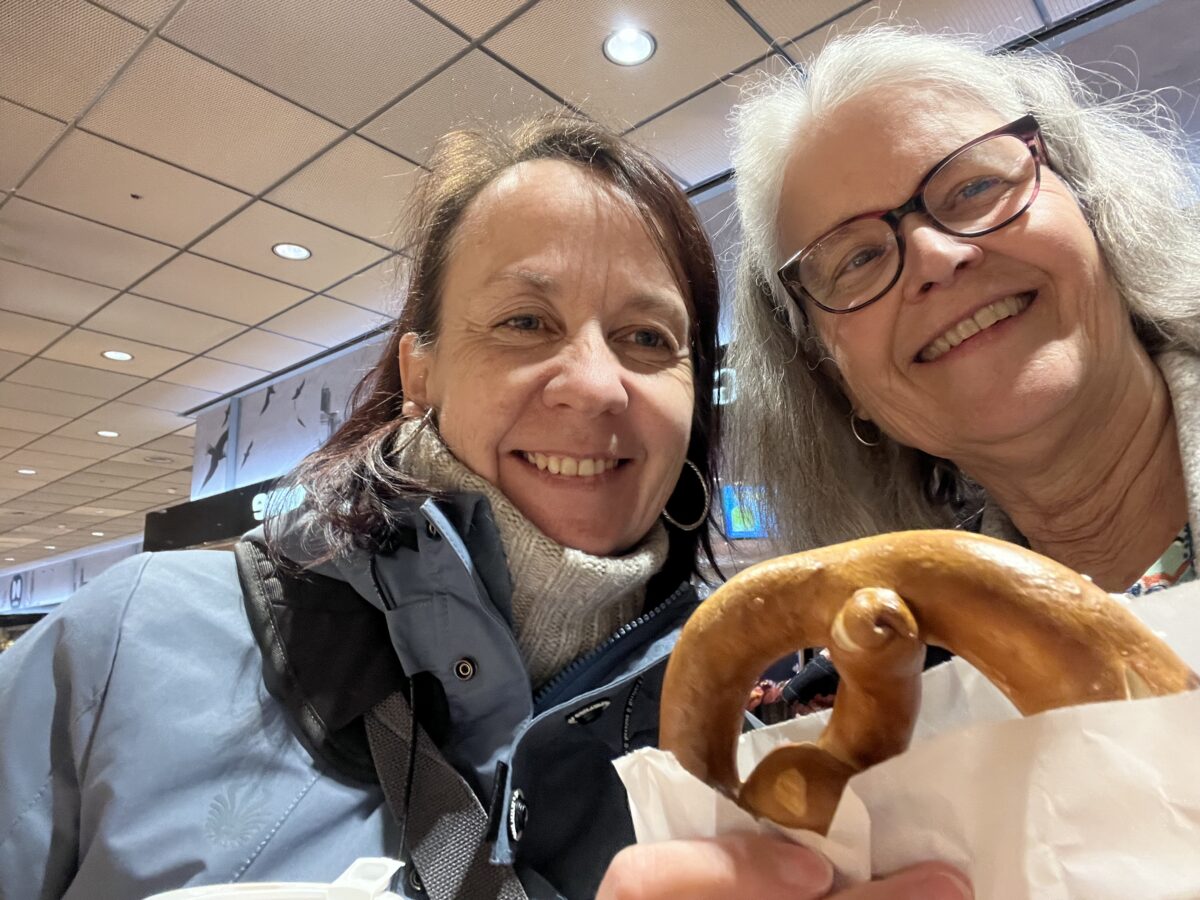 Smith (r) with classmate and former German teacher Doris Hoelscher-Stanley at the airport in Hamburg, Germany. (Image courtesy of Smith)
The program continues to have far-reaching effects. Smith has taken four classes with Macfarland and six with Sutton to date. She plans to visit Vienna this summer, where she hopes to connect for a second time with classmate and former German teacher Doris Hoelscher-Stanley, an MMLIC senior currently living in Hamburg, Germany. She first visited Hoelscher-Stanley in Hamburg on her trip to meet Krause-Traudes. Smith is not the only tandem participant to go beyond the virtual classroom. Last summer, Sutton and Macfarland had their own exchange in Leipzig, Germany, four hours from Lüneburg, where they attended a workshop on teaching German as a foreign language in the U.S.
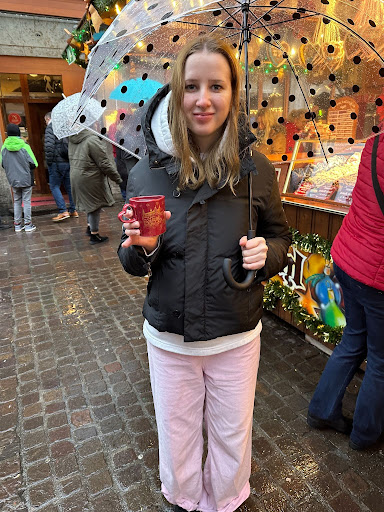 Gebhard at the Weihnachtsmarkt in Wiesbaden, Germany. (Image courtesy of Gebhard)
The tandem program inspired Emma Gebhard ’23, a psychology major with a German minor, to apply to the Congress-Bundestag Youth Exchange for Young Professionals program to study and work in Germany. She was one of 74 Americans chosen as a 2024 – 2025 fellow. Desire Hayes ’24, an English major with a German minor, put her skills to work studying abroad at Leuphana University Lüneburg, where she met Nele-Sophie Bauer, her German 202 tandem partner.
Other partners are making more plans to meet. “Now that the project has concluded for me, I can confidently say that it was a success. I have learned a great deal about American culture, and I feel much more confident in my English abilities. I no longer hesitate to start speaking English in everyday situations without any prior preparation,” says Heinrich, who was paired with UMBC student Liana Grosko. “The greatest success has been forming a friendship with Liana. We still communicate weekly, and I eagerly look forward to meeting her again in person this spring.”
“This tandem has put Baltimore on the map for some of my students, who generally only know something about California, Florida, and New York,” says Nichols at the University of Kassel. “Putting a very human and relatable face to the abstract concept of the United States—it’s normal to have some (mis)conceptions about people we don’t know. One part of this exchange that cannot be overvalued is how it helps our students see each other as real people and not just some image they see or read somewhere.”
Learn more about UMBC’s Modern Language, Linguistics, and Intercultural Communication German track options.
]]>
During a recent trip to Normandy, France, UMBC student Rebecca Smith hopped over to Lüneburg, a historic town in northern Germany, to visit Gertrud Krause-Traudes, her partner in UMBC’s Virtual...
https://umbc.edu/stories/virtual-tandem-conversation-project-with-germany-is-changing-the-way-students-see-germany-and-the-u-s/
https://my3.my.umbc.edu/api/v0/pixel/news/148661/guest@my.umbc.edu/aa2716667d7a4028274afb5f42844c94/api/pixel
cahss
community
english
ges
international
mlli
news
policy-and-society
psych
story
UMBC News & Magazine
https://my3.my.umbc.edu/groups/umbc-news-magazine
https://assets1-my.umbc.edu/system/shared/avatars/groups/000/001/943/24435aa6207c452e7bc15cc74b42c7bb/xsmall.png?1748556657
https://assets1-my.umbc.edu/system/shared/avatars/groups/000/001/943/24435aa6207c452e7bc15cc74b42c7bb/original.png?1748556657
https://assets2-my.umbc.edu/system/shared/avatars/groups/000/001/943/24435aa6207c452e7bc15cc74b42c7bb/xxlarge.png?1748556657
https://assets2-my.umbc.edu/system/shared/avatars/groups/000/001/943/24435aa6207c452e7bc15cc74b42c7bb/xlarge.png?1748556657
https://assets3-my.umbc.edu/system/shared/avatars/groups/000/001/943/24435aa6207c452e7bc15cc74b42c7bb/large.png?1748556657
https://assets1-my.umbc.edu/system/shared/avatars/groups/000/001/943/24435aa6207c452e7bc15cc74b42c7bb/medium.png?1748556657
https://assets2-my.umbc.edu/system/shared/avatars/groups/000/001/943/24435aa6207c452e7bc15cc74b42c7bb/small.png?1748556657
https://assets1-my.umbc.edu/system/shared/avatars/groups/000/001/943/24435aa6207c452e7bc15cc74b42c7bb/xsmall.png?1748556657
https://assets2-my.umbc.edu/system/shared/avatars/groups/000/001/943/24435aa6207c452e7bc15cc74b42c7bb/xxsmall.png?1748556657
UMBC News & Magazine
0
0
false
Tue, 01 Apr 2025 11:26:17 -0400
New scholarship offers Japanese high school students an admissions pathway to UMBC and increases Japanese opportunities on campus
As Sister States, Maryland and Kanagawa Prefecture, Japan, (south of Tokyo) have collaborated in various initiatives in business, education, healthcare, and culture exchange programs since 1981, including ongoing partnerships at UMBC. For the past six years, UMBC has proudly partnered with the Kanagawa Association of Private Junior/Senior Schools, welcoming their teachers and students for UMBC’s spring break and summer Intensive English Program and TESOL certificate programs. Likewise, UMBC students who are learning Japanese have participated in the Teach Abroad: Kanagawa Internship, an internship program with schools in Kanagawa Prefecture.
Following the great success of their education exchanges, UMBC’s Center for Global Engagement (CGE) has signed a Memorandum of Understanding with the Kanagawa Association of Private Junior/ Senior Schools to establish the annual Global Achievement Scholarship. This new partnership creates an undergraduate admissions pathway for up to 10 high school students from Kanagawa Prefecture beginning in fall 2026.
Career opportunities in Japan
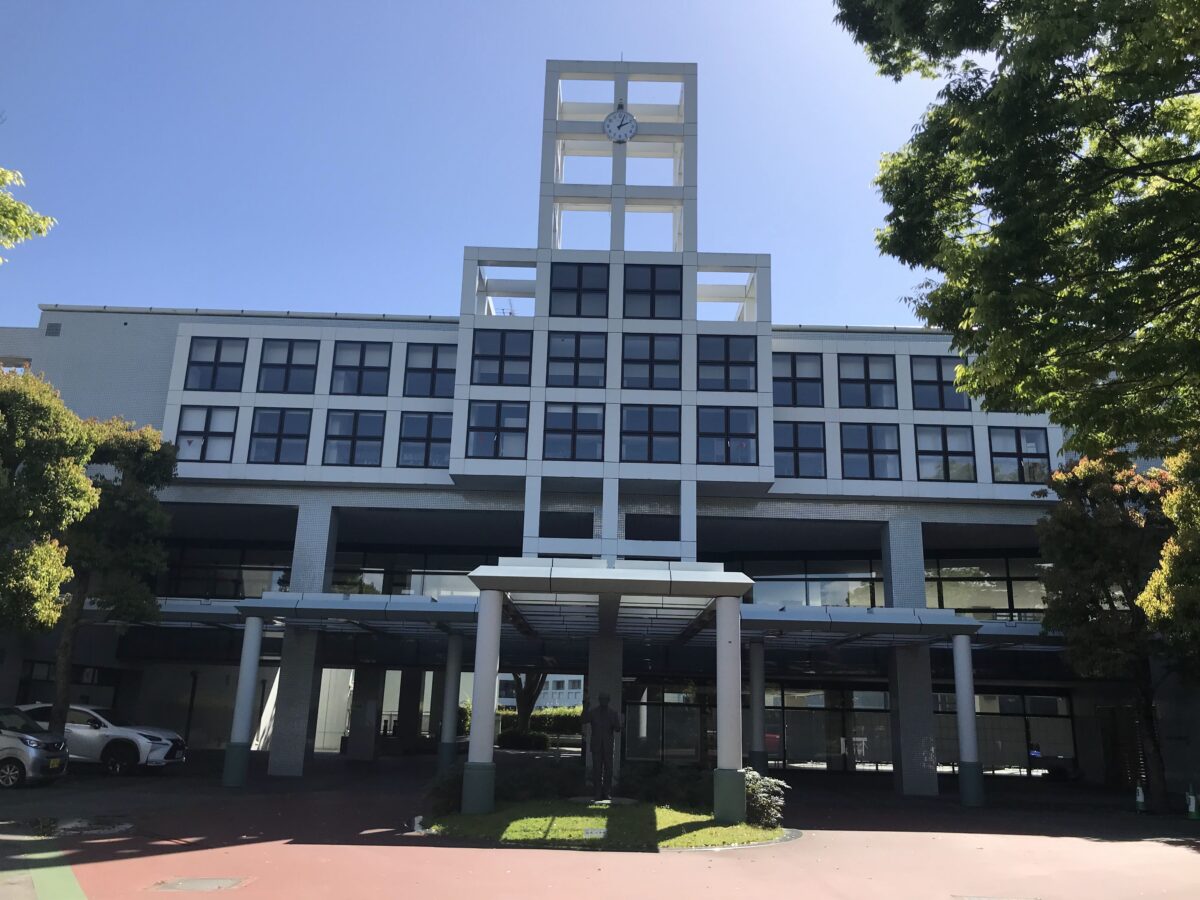 Kumon Kokusai Middle-High School where William worked. (Image courtesy of Mo)
For students like William Mo, a senior majoring in modern languages, linguistics, and intercultural communication with a concentration in Japanese, opportunities to immerse in the Japanese language and culture help build an invaluable professional and social network in preparation for the international job market. Mo, whose goal is to live and work in Japan, had the opportunity to participate in the Teach Abroad: Kanagawa Internship, which offered him three months of teaching middle school students while living in a student dorm.
This was Mo’s first internship and real work experience beyond his part-time job as a peer advisor in UMBC’s Education Abroad Office. “I participated in this internship to help make a stronger case for myself when I apply to JET [Japanese Exchange and Teaching Program], to satisfy my own desire to sightsee in Japan, and experience what it is like to teach English,” says Mo. He had to balance work and online classes as well as co-lead activities like English conversation cafes, where Japanese students practiced their conversational English. “All my skills related to communicating and interacting in Japanese strengthened greatly since I regularly talked to the office staff, students, and anyone I needed to talk to.”
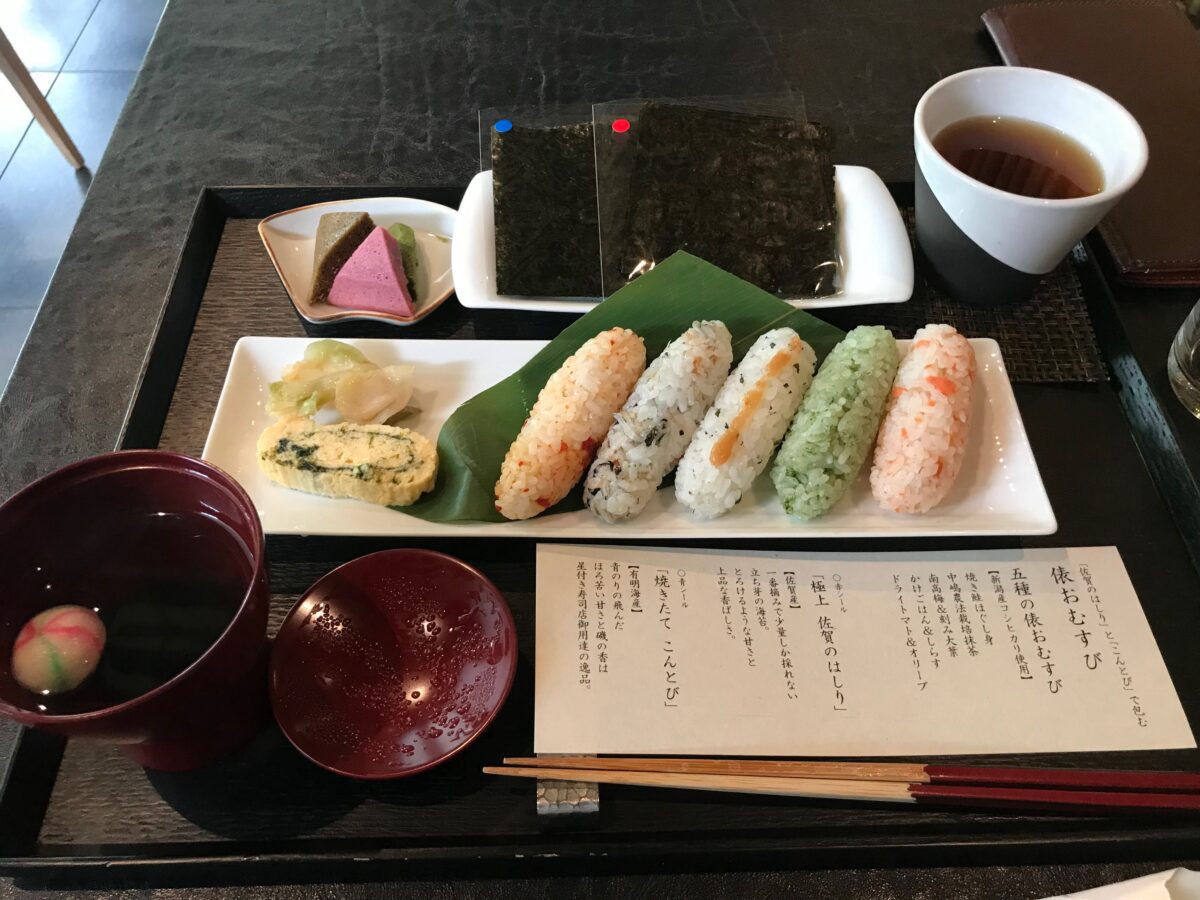
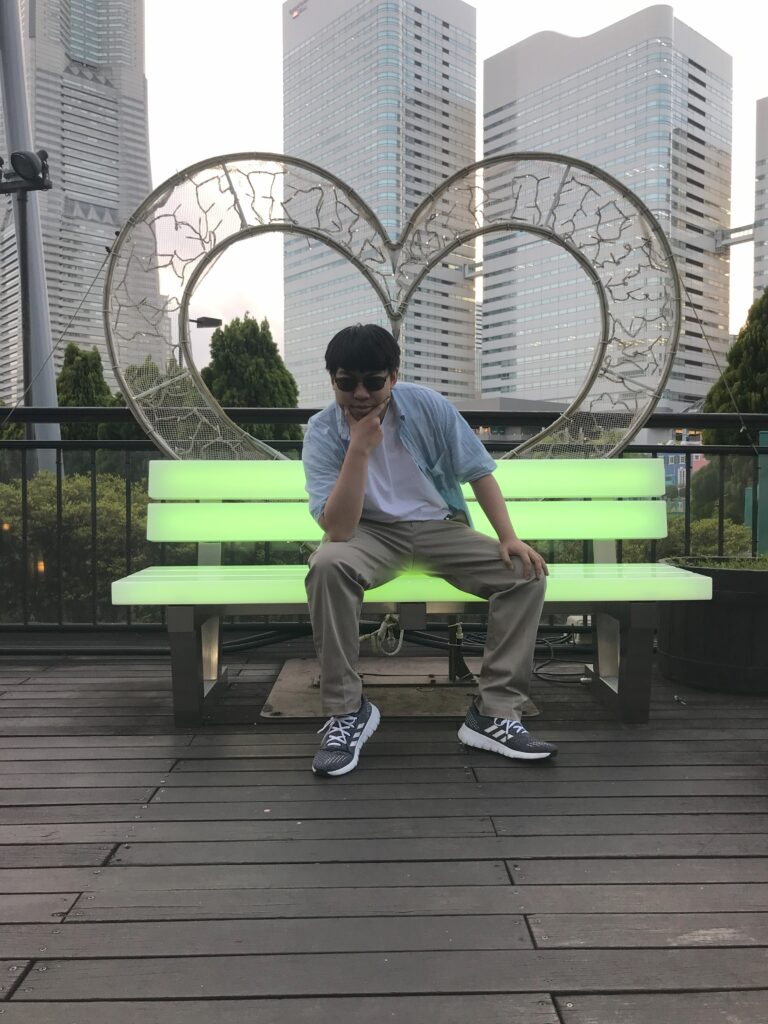
 (l-r): Rice ball and miso soup lunch, Mo at the Minato Mirai entertainment district, and the life-sized Unicorn Gundam Statue in Tokyo. (Images courtesy of Mo)
Keeping Japanese language skills sharp
Upon returning to UMBC, Mo found new ways to maintain his new level of proficiency. Last summer, when nearly 60 high school students and teachers from Kanagawa Prefecture arrived for the Intensive English Program and TESOL certificate programs, he volunteered in Japanese conversation cafes with the visiting students while playing board games. He also served as a guide and chaperone for the students’ trips to Washington, D.C., Baltimore City, and Annapolis.
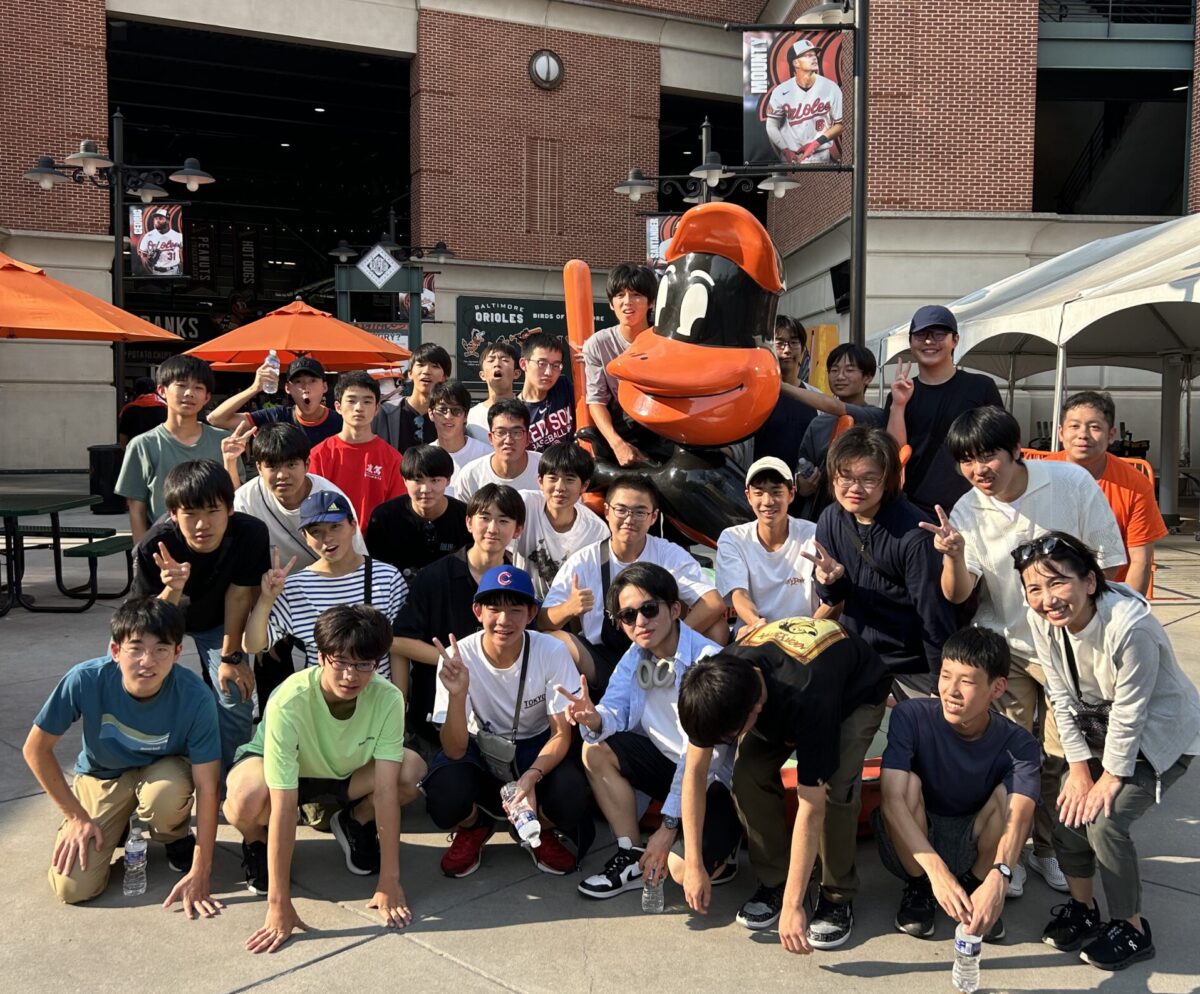 High school students and teachers from Kanagawa Prefecture, Japan, at an Orioles game. (Image courtesy of CGE)
Similar to Mo’s experience in Japan, some of the participants shared that the summer programs gave them important insights into what it would be like to live and work in the United States and study at UMBC. As the Global Achievement Scholarship gets underway in 2026, UMBC will be home to more Japanese students who will join the nearly 2,000 international students and those from the United States, who have entrusted UMBC with their desire to create extraordinary possibilities for themselves and their communities.
Learn more about UMBC’s Center for Global Engagement international exchange programs.
For more information about UMBC’s Teach Abroad: Kanagawa Internship contact Tomoko Hoogenboom, teaching professor of Japanese language and culture, at tmkhgnbm@umbc.edu.
]]>
As Sister States, Maryland and Kanagawa Prefecture, Japan, (south of Tokyo) have collaborated in various initiatives in business, education, healthcare, and culture exchange programs since 1981,...
https://umbc.edu/stories/scholarship-offers-japanese-high-school-students-umbc-admissions-pathway/
https://my3.my.umbc.edu/api/v0/pixel/news/147186/guest@my.umbc.edu/1a2ecfbbd53892cb7d5065c9fbb0c3b6/api/pixel
cahss
cge
community
education-abroad
mlli
news
story
UMBC News & Magazine
https://my3.my.umbc.edu/groups/umbc-news-magazine
https://assets1-my.umbc.edu/system/shared/avatars/groups/000/001/943/24435aa6207c452e7bc15cc74b42c7bb/xsmall.png?1748556657
https://assets1-my.umbc.edu/system/shared/avatars/groups/000/001/943/24435aa6207c452e7bc15cc74b42c7bb/original.png?1748556657
https://assets2-my.umbc.edu/system/shared/avatars/groups/000/001/943/24435aa6207c452e7bc15cc74b42c7bb/xxlarge.png?1748556657
https://assets2-my.umbc.edu/system/shared/avatars/groups/000/001/943/24435aa6207c452e7bc15cc74b42c7bb/xlarge.png?1748556657
https://assets3-my.umbc.edu/system/shared/avatars/groups/000/001/943/24435aa6207c452e7bc15cc74b42c7bb/large.png?1748556657
https://assets1-my.umbc.edu/system/shared/avatars/groups/000/001/943/24435aa6207c452e7bc15cc74b42c7bb/medium.png?1748556657
https://assets2-my.umbc.edu/system/shared/avatars/groups/000/001/943/24435aa6207c452e7bc15cc74b42c7bb/small.png?1748556657
https://assets1-my.umbc.edu/system/shared/avatars/groups/000/001/943/24435aa6207c452e7bc15cc74b42c7bb/xsmall.png?1748556657
https://assets2-my.umbc.edu/system/shared/avatars/groups/000/001/943/24435aa6207c452e7bc15cc74b42c7bb/xxsmall.png?1748556657
UMBC News & Magazine
1
0
false
Mon, 10 Feb 2025 10:24:05 -0500
Mon, 10 Feb 2025 10:24:05 -0500
Retrievers learn the art and heart of cooking Salvadoran food at True Grit’s Test Kitchen
“Recipes are like an address to a homeland, but they’re also very personal to your own story,” said Karla T. Vasquez, author of The SalviSoul Cookbook, in True Grit’s Test Kitchen. Celia Bonilla, a business technology administration sophomore, grinned and nodded—the addresses for her own recipes come from El Salvador and Maryland. Bonilla joined other UMBC students earlier this fall for the “More than Pupusas” cooking demonstration, sponsored by the Dresher Center for the Humanities, to learn how to cook Salvadoran street food.
Bonilla sat at one of two tables set with brown butcher paper with her classmates, Stephania Fonseca, a social work sophomore, and Jeffrey Molina Soriano, a computer science junior. They also have roots in Maryland and El Salvador. “Pastelitos [pah-steh-lee-tos] means little pie and it’s the Salvadoran version of empanadas [em-pah-nah-dahs],” said Vasquez. “Empanadas are well known all over Latin America. Greeks, Italians, and other Europeans make meat pies, too.”
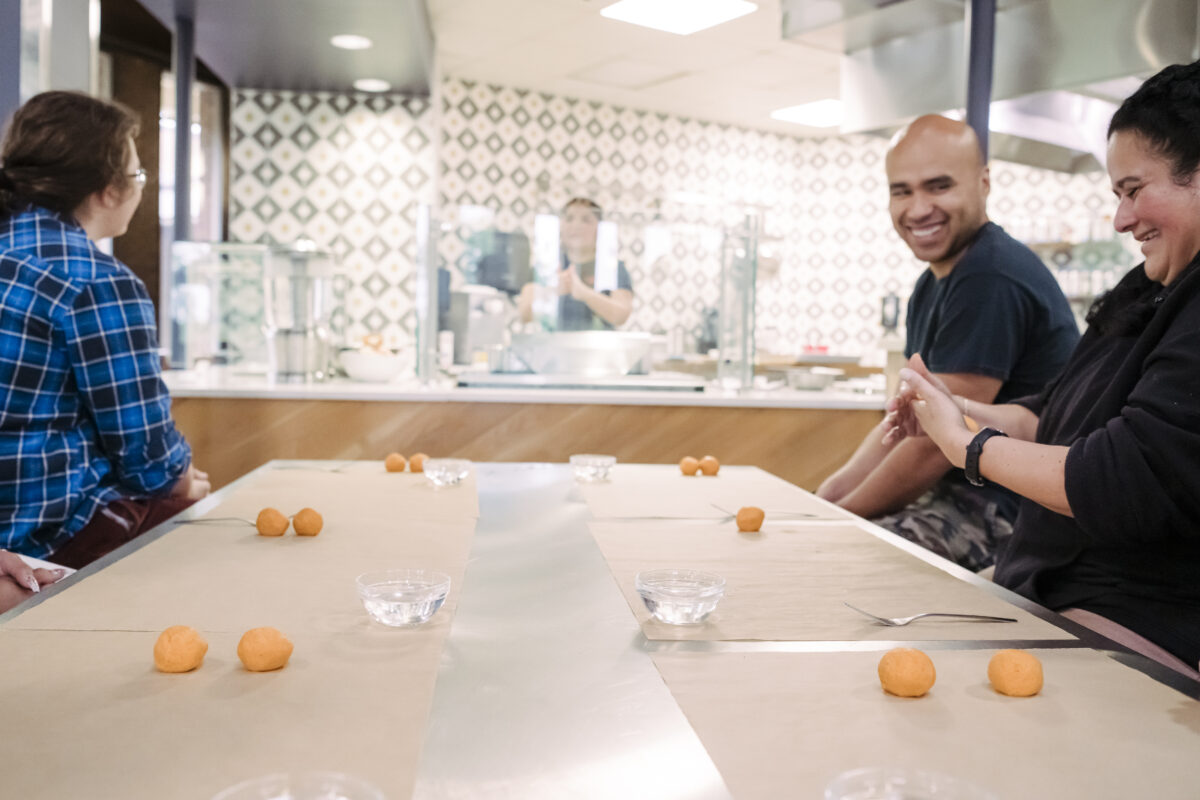 Celia Bonilla and Jeffrey Molina Soriano learn how to mold pastelito dough. (Marlayna Demond ’11/UMBC)
Like many Salvadoran students at UMBC, their journeys to UMBC are as complex as the ingredients they use for this meal. “Sometimes Hispanic Heritage Month events portray Latinx culture as a monolith, often focusing on the Caribbean or Mexican American experience,” said Courtney C. Hobson ’10, M.A. ’14, history, program manager at the James T. and Virginia M. Dresher Center for the Humanities. “I grew up in Prince George’s County, Maryland, where a significant part of the Latinx immigrant community comes from Central America, specifically El Salvador. Many of our Latinx students have roots in Central America—I wanted to organize an event that celebrated the rich culture they represent.”
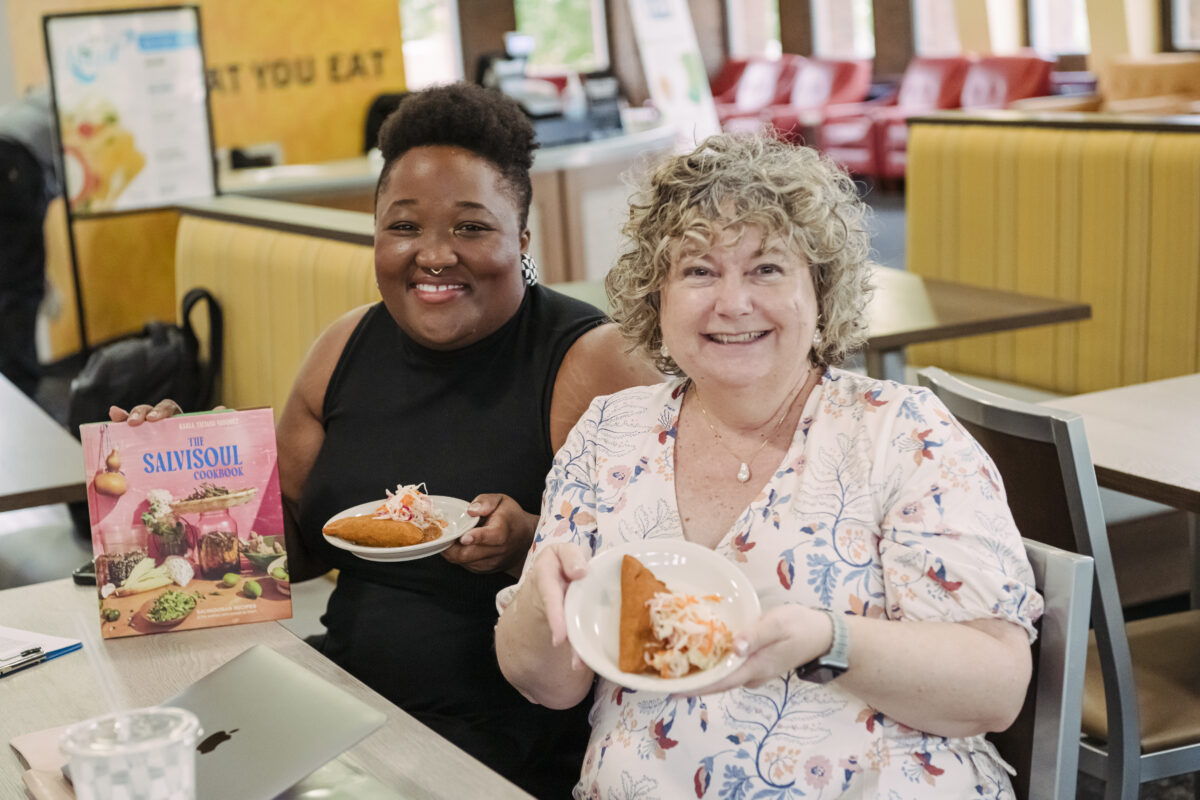 (l-r): Courtney C. Hobson and Amy Froide, professor of history and director of the Dresher Center for the Humanities. (Marlayna Demond ’11/UMBC)
“I came here when I was six years old from El Salvador,” said Bonilla, who attended the event as part of an assignment for the Spanish for Heritage Spanish Speakers class. Students must participate in two on-campus and two off-campus cultural events that celebrate Hispanic/Latinx culture. While Bonilla is familiar with campus events as the parent of a UMBC alum Jasmine Esmeralda Bonilla ’21, chemical engineering, this event felt different. “This class gives me a chance to learn more about my culture and language by engaging with people from various countries and age groups.”
Culinary traditions
Most students at the event said they had eaten pupusas (puh-poo-suhz) at home or at a restaurant. This flat corn flour cake, stuffed with cheese, beans, and sometimes meat is the national dish of El Salvador. “I have an aunt who is from El Salvador. She taught my mom, and then my mom taught me how to make pupusas with my sister,” said Fonseca. “My dad is from El Salvador, and my mom is from Mexico. We learned to make pupusas together as a family. So it became a typical food from my home.”
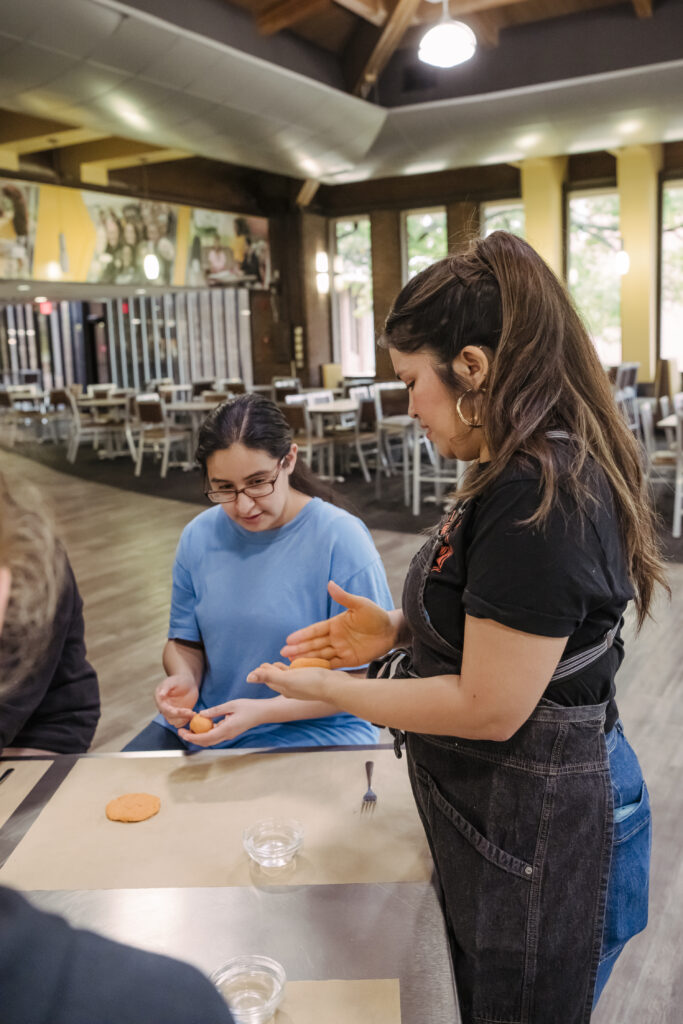
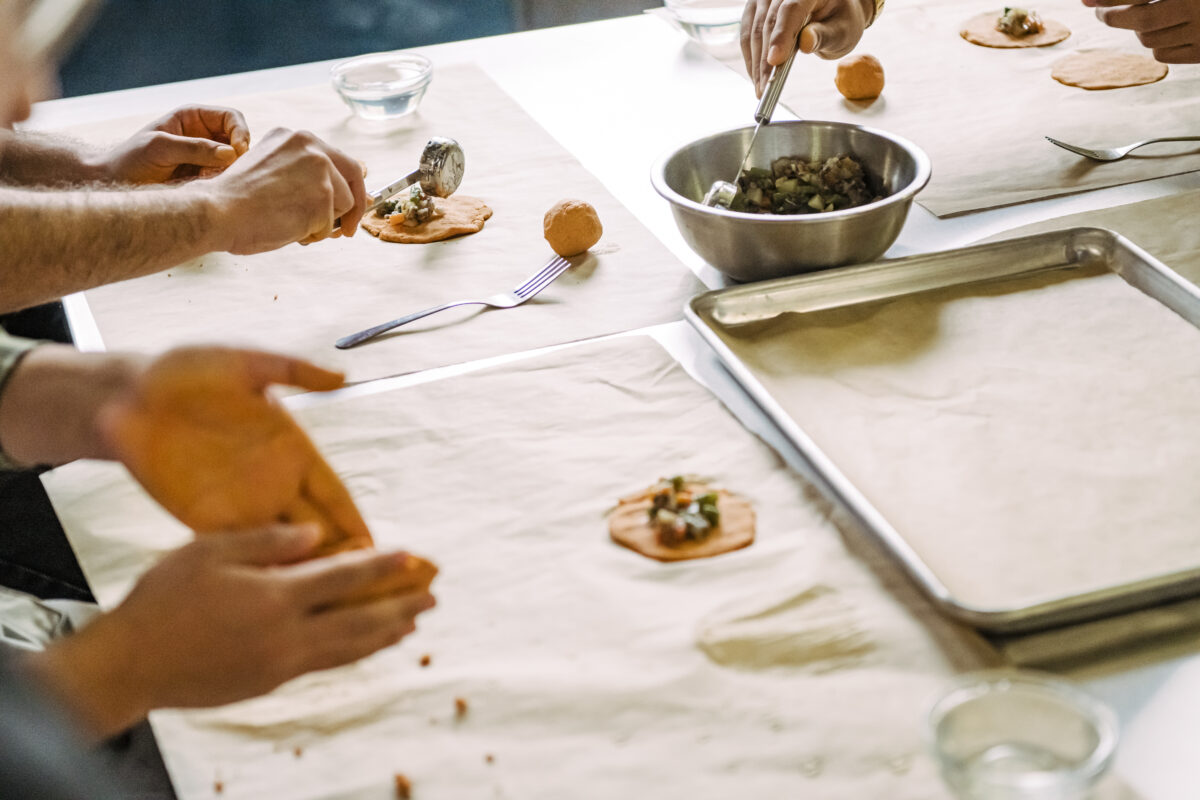
 (l-r): Stephania Fonseca watches Vasquez fold the dough to make a pocket. Students fill the pastelitos with a mushroom filling. (Marlayna Demond ’11/UMBC)
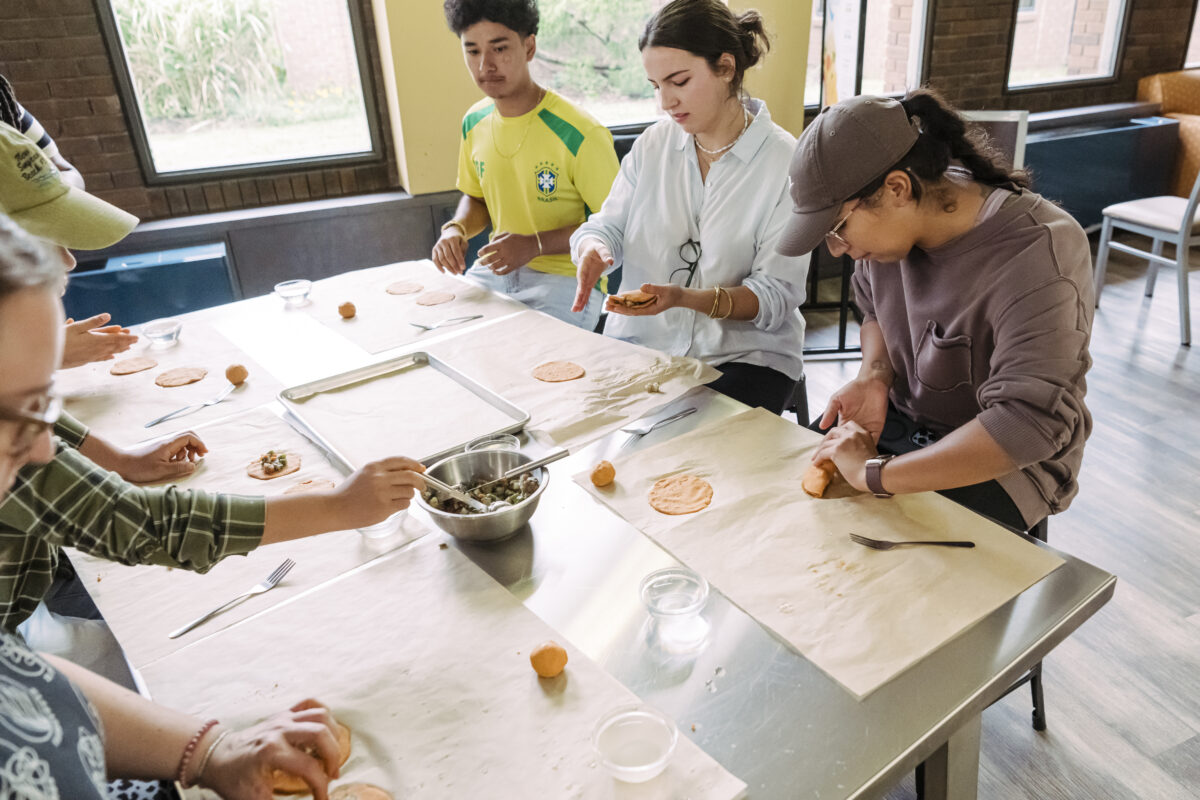
As students kneaded the dough into a palm-sized disc, filled it with sautéed mushrooms, and pinched the edges to seal the pastelitos, they also shared what food meant to them in the context of their family and student life. A clear theme emerged, culinary traditions can extend beyond the kitchen. “We have the Philly pretzel factory. I’ve never been able to find a soft pretzel as good as the Philly Pretzel Factory,” said Ashley Gutshall about her hometown of Royersford, Pennsylvania. Gutshall, a history and Spanish sophomore, shares, “It’s our family tradition to get Philly soft pretzels after doctor’s appointments.”
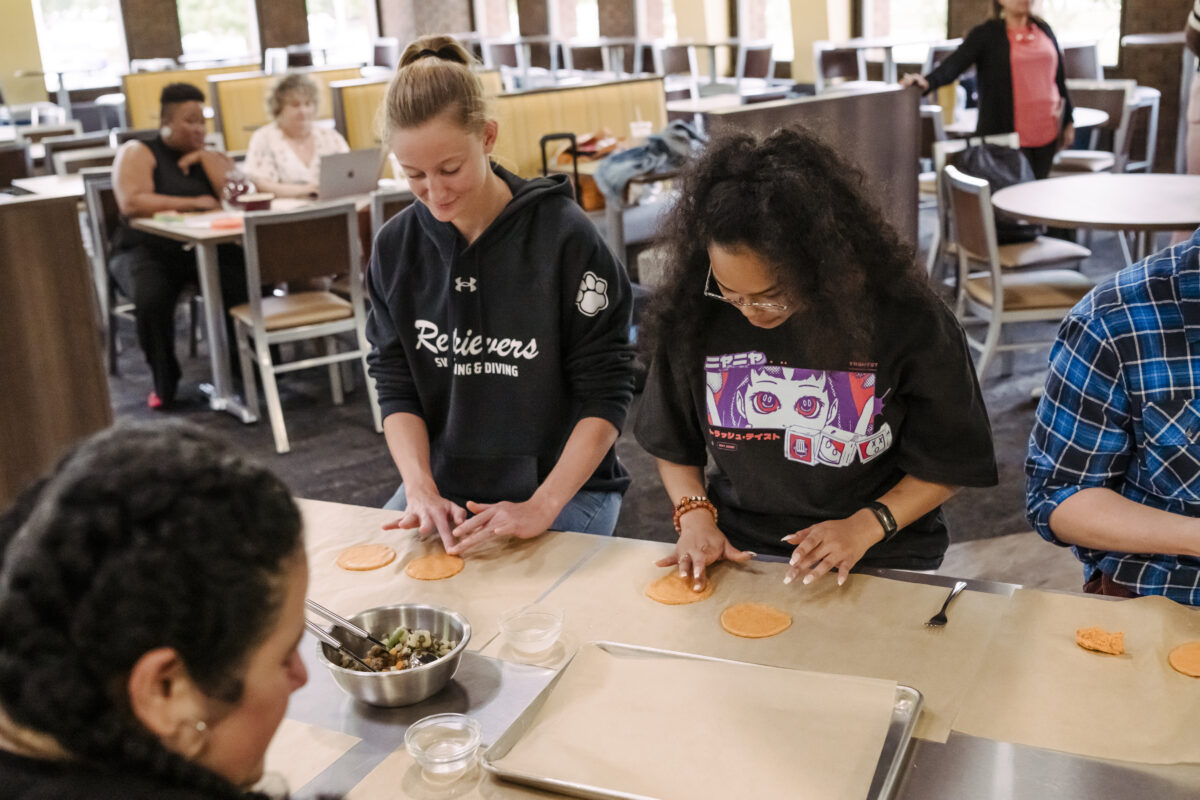 (l): Ashley Gutshall presses dough into a circular shape to make a pastelito. (Marlayna Demond ’11/UMBC)
Snack routines also create taste memories. “I was born in El Salvador during the Civil War [1980-1992] but was raised in Los Angeles. I would often fantasize about the routines my family would have had if they had been able to stay in their homeland,” said Vasquez, as she cooked down strawberries that she used to sweeten a large container of water filled with chan seeds—similar to chia seeds in texture and nutrition. “Fresco de chan satisfied that question for me because it’s a drink students have after school,” said Vasquez.
Food as a cultural bridge
Dishes are a fingerprint of a family’s traditions and tastes that can also serve as a timeline marking the evolution of ingredients locally and globally. “When my mom hears of these new trending food ingredients like chia seeds or quinoa,” says Vasquez, “she argues that they have been used in El Salvador and Central American communities for a long time.”
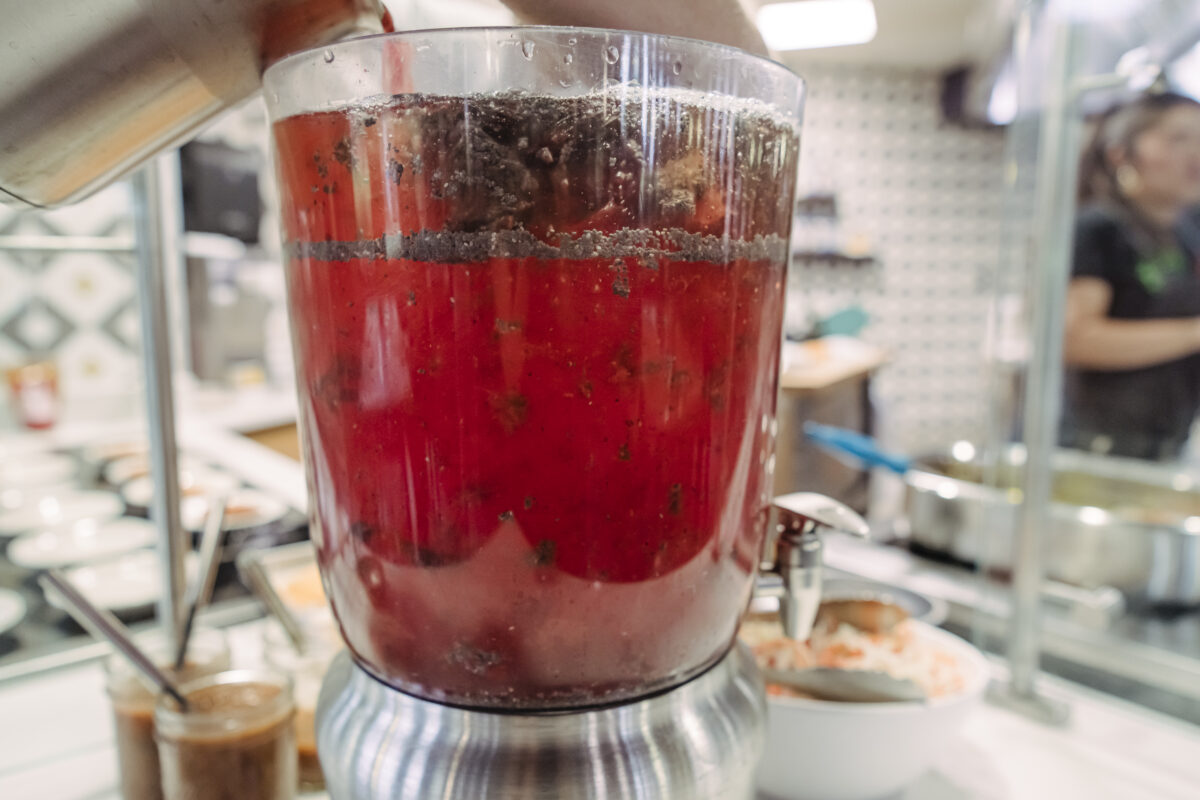
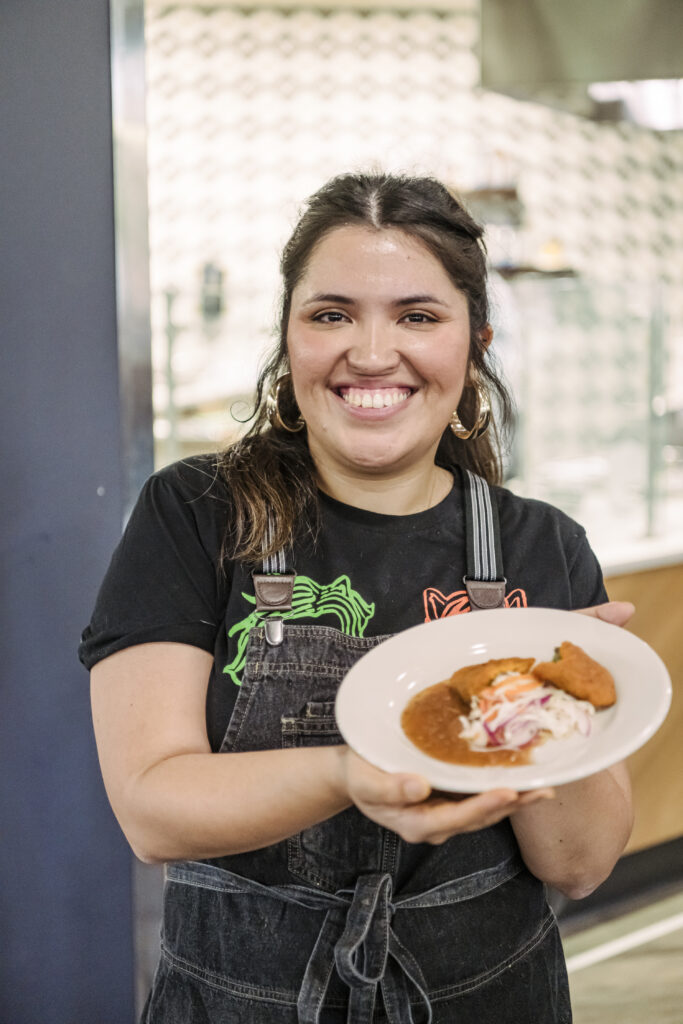
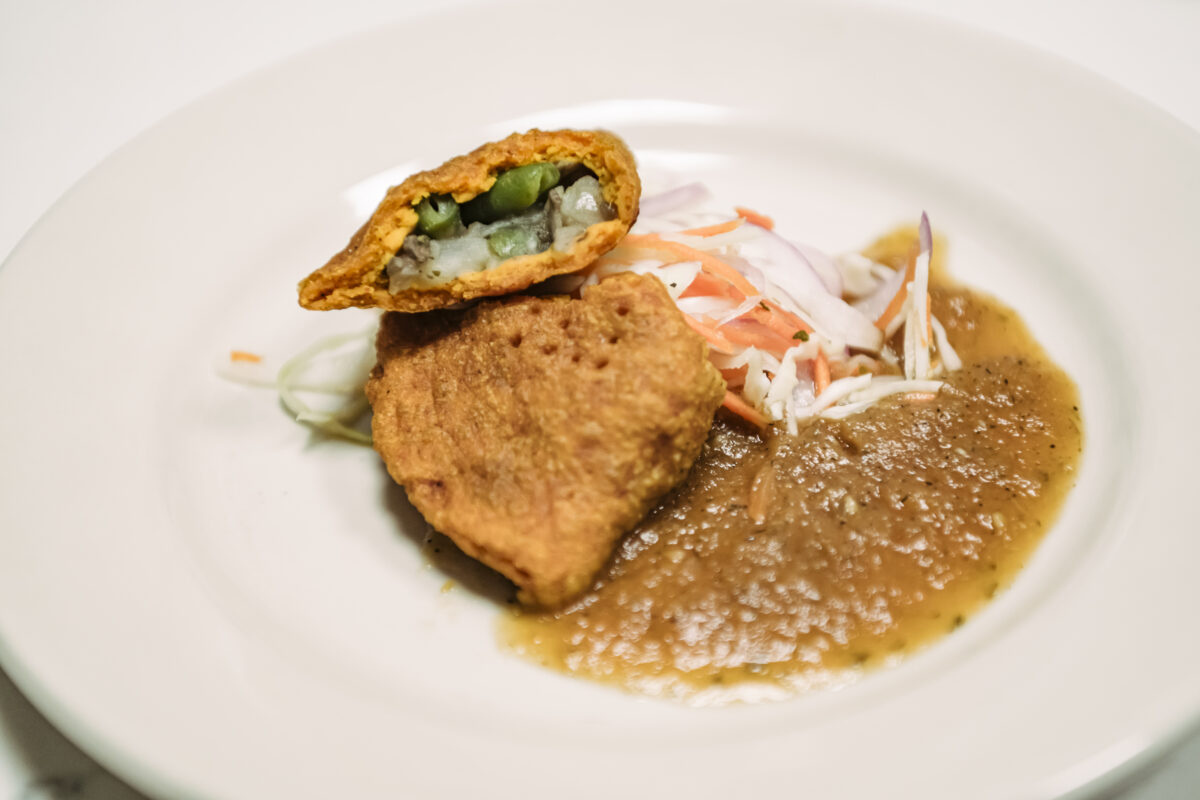 (l-r): Fresco de chan. Karla T. Vasques presents a Salvadoran mushroom pastelito with salsa and slaw. (Marlayna Demond ’11/UMBC)
Whether savory or sweet, the names of foods and spices across Latin America, and the dishes they inspire, are rooted in indigenous, African, and European languages and culinary traditions often fused to create unique dishes with local variations. Vasquez noted that achiote [ah-chee-oh-teh], the spice used to season and enhance the yellow color of the corn flour dough for the pastelitos, is a Nahuat word. Nahuat is a widely spoken indigenous language in Mexico and Central America. The rich legacy of Salvadoran food is seldom recognized alongside Western cuisine, even though many of its ingredients are sourced from the Global South—reinforcing cultural divisions. The Dresher Center’s “More than Pupusas” cooking event aimed to bridge this gap and celebrate the cultural footprint of Salvadoran cuisine.
“I interviewed more than 100 women while I’ve been working on this project. It’s taken me nine years,” says Vasquez about her recent release, The SalviSoul Cookbook. “I wanted to make sure that we’re giving credit where credit is due.”
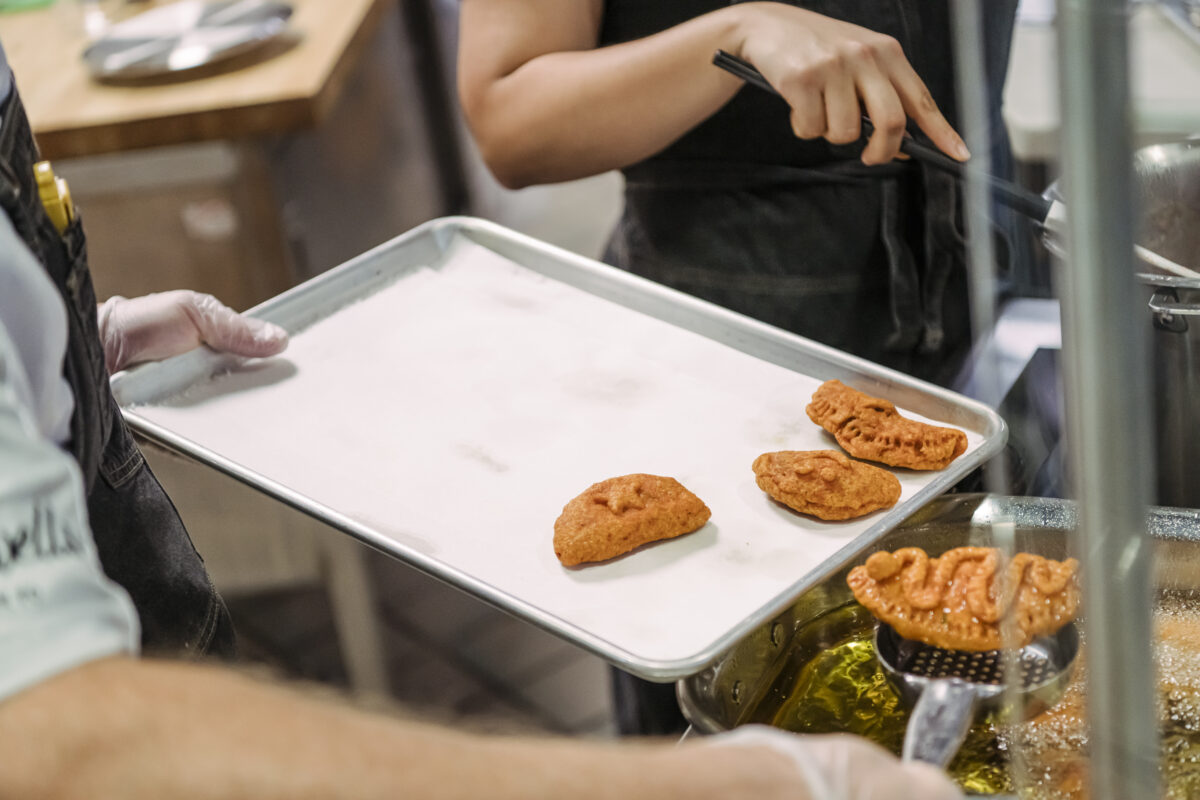
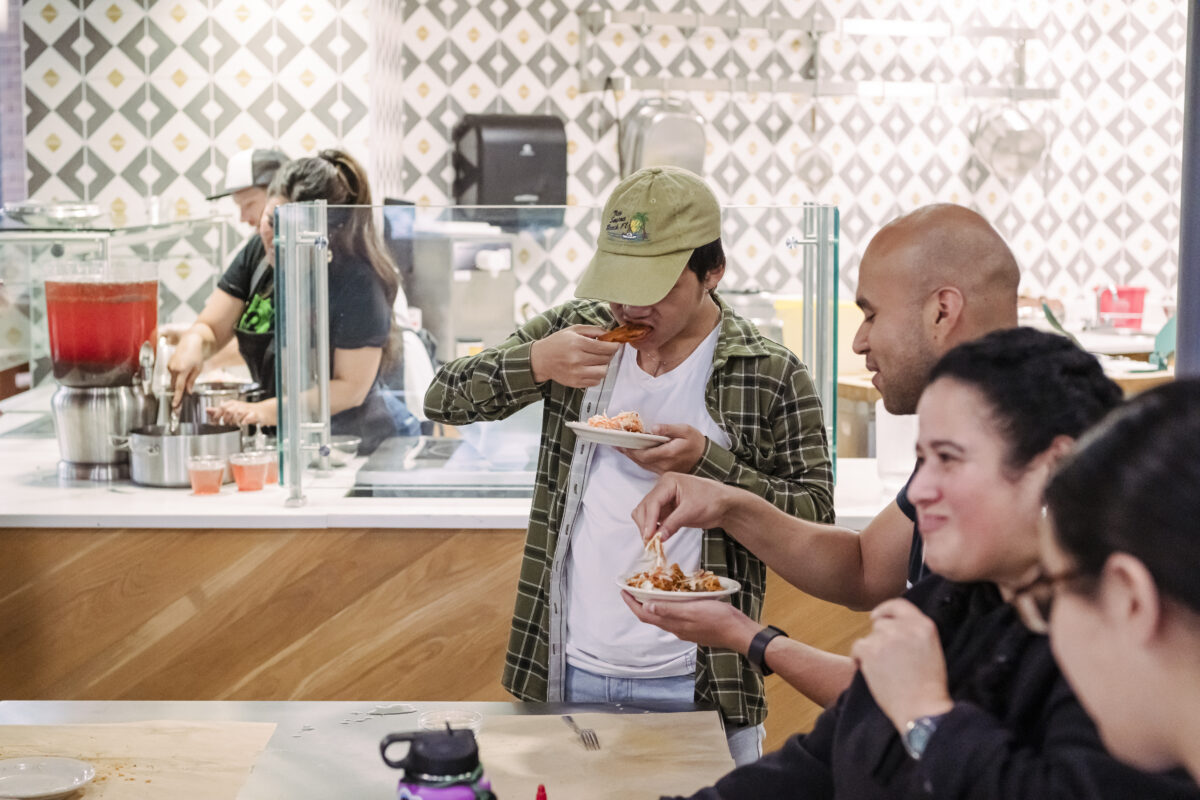
(r): Bonilla and Molina Soriano taste the fried pastelitos. (Marlayna Demond ’11/UMBC)
The tasters and aspiring chefs were grateful to be part of the long tradition of communities brought together across borders and time to learn, cook, and share a meal with new and old friends. They stamped their seal of approval with dough—a squiggly line, a star, a smile—sealing each pastelito with personal flair.
]]>
“Recipes are like an address to a homeland, but they’re also very personal to your own story,” said Karla T. Vasquez, author of The SalviSoul Cookbook, in True Grit’s Test Kitchen. Celia Bonilla,...
https://umbc.edu/stories/retrievers-learn-to-cook-salvadoran-food/
https://my3.my.umbc.edu/api/v0/pixel/news/145379/guest@my.umbc.edu/0e0931c682bcda13e479d7afdd5d4a25/api/pixel
business-technology-administration
cahss
campus-life
chemical-engineering
computer-science
dresher-center
history
magazine
mlli
spanish
story
UMBC News & Magazine
https://my3.my.umbc.edu/groups/umbc-news-magazine
https://assets1-my.umbc.edu/system/shared/avatars/groups/000/001/943/24435aa6207c452e7bc15cc74b42c7bb/xsmall.png?1748556657
https://assets1-my.umbc.edu/system/shared/avatars/groups/000/001/943/24435aa6207c452e7bc15cc74b42c7bb/original.png?1748556657
https://assets2-my.umbc.edu/system/shared/avatars/groups/000/001/943/24435aa6207c452e7bc15cc74b42c7bb/xxlarge.png?1748556657
https://assets2-my.umbc.edu/system/shared/avatars/groups/000/001/943/24435aa6207c452e7bc15cc74b42c7bb/xlarge.png?1748556657
https://assets3-my.umbc.edu/system/shared/avatars/groups/000/001/943/24435aa6207c452e7bc15cc74b42c7bb/large.png?1748556657
https://assets1-my.umbc.edu/system/shared/avatars/groups/000/001/943/24435aa6207c452e7bc15cc74b42c7bb/medium.png?1748556657
https://assets2-my.umbc.edu/system/shared/avatars/groups/000/001/943/24435aa6207c452e7bc15cc74b42c7bb/small.png?1748556657
https://assets1-my.umbc.edu/system/shared/avatars/groups/000/001/943/24435aa6207c452e7bc15cc74b42c7bb/xsmall.png?1748556657
https://assets2-my.umbc.edu/system/shared/avatars/groups/000/001/943/24435aa6207c452e7bc15cc74b42c7bb/xxsmall.png?1748556657
UMBC News & Magazine
1
0
false
Tue, 05 Nov 2024 16:30:49 -0500
Retrievers learn the art and heart of cooking Salvadoran food at True Grit’s Test Kitchen
“Recipes are like an address to a homeland, but they’re also very personal to your own story,” said Karla T. Vasquez, author of The SalviSoul Cookbook, in True Grit’s Test Kitchen. Celia Bonilla, a business technology administration sophomore, grinned and nodded—the addresses for her own recipes come from El Salvador and Maryland. Bonilla joined other UMBC students earlier this fall for the “More than Pupusas” cooking demonstration, sponsored by the Dresher Center for the Humanities, to learn how to cook Salvadoran street food.
Bonilla sat at one of two tables set with brown butcher paper with her classmates, Stephania Fonseca, a social work sophomore, and Jeffrey Molina Soriano, a computer science junior. They also have roots in Maryland and El Salvador. “Pastelitos [pah-steh-lee-tos] means little pie and it’s the Salvadoran version of empanadas [em-pah-nah-dahs],” said Vasquez. “Empanadas are well known all over Latin America. Greeks, Italians, and other Europeans make meat pies, too.”
Celia Bonilla and Jeffrey Molina Soriano learn how to mold pastelito dough. (Marlayna Demond ’11/UMBC)
Like many Salvadoran students at UMBC, their journeys to UMBC are as complex as the ingredients they use for this meal. “Sometimes Hispanic Heritage Month events portray Latinx culture as a monolith, often focusing on the Caribbean or Mexican American experience,” said Courtney C. Hobson ’10, M.A. ’14, history, program manager at the James T. and Virginia M. Dresher Center for the Humanities. “I grew up in Prince George’s County, Maryland, where a significant part of the Latinx immigrant community comes from Central America, specifically El Salvador. Many of our Latinx students have roots in Central America—I wanted to organize an event that celebrated the rich culture they represent.”
(l-r): Courtney C. Hobson and Amy Froide, professor of history and director of the Dresher Center for the Humanities. (Marlayna Demond ’11/UMBC)
“I came here when I was six years old from El Salvador,” said Bonilla, who attended the event as part of an assignment for the Spanish for Heritage Spanish Speakers class. Students must participate in two on-campus and two off-campus cultural events that celebrate Hispanic/Latinx culture. While Bonilla is familiar with campus events as the parent of a UMBC alum Jasmine Esmeralda Bonilla ’21, chemical engineering, this event felt different. “This class gives me a chance to learn more about my culture and language by engaging with people from various countries and age groups.”
Culinary traditions
Most students at the event said they had eaten pupusas (puh-poo-suhz) at home or at a restaurant. This flat corn flour cake, stuffed with cheese, beans, and sometimes meat is the national dish of El Salvador. “I have an aunt who is from El Salvador. She taught my mom, and then my mom taught me how to make pupusas with my sister,” said Fonseca. “My dad is from El Salvador, and my mom is from Mexico. We learned to make pupusas together as a family. So it became a typical food from my home.”
(l-r): Stephania Fonseca watches Vasquez fold the dough to make a pocket. Students fill the pastelitos with a mushroom filling. (Marlayna Demond ’11/UMBC)
As students kneaded the dough into a palm-sized disc, filled it with sautéed mushrooms, and pinched the edges to seal the pastelitos, they also shared what food meant to them in the context of their family and student life. A clear theme emerged, culinary traditions can extend beyond the kitchen. “We have the Philly pretzel factory. I’ve never been able to find a soft pretzel as good as the Philly Pretzel Factory,” said Ashley Gutshall about her hometown of Royersford, Pennsylvania. Gutshall, a history and Spanish sophomore, shares, “It’s our family tradition to get Philly soft pretzels after doctor’s appointments.”
(l): Ashley Gutshall presses dough into a circular shape to make a pastelito. (Marlayna Demond ’11/UMBC)
Snack routines also create taste memories. “I was born in El Salvador during the Civil War [1980-1992] but was raised in Los Angeles. I would often fantasize about the routines my family would have had if they had been able to stay in their homeland,” said Vasquez, as she cooked down strawberries that she used to sweeten a large container of water filled with chan seeds—similar to chia seeds in texture and nutrition. “Fresco de chan satisfied that question for me because it’s a drink students have after school,” said Vasquez.
Food as a cultural bridge
Dishes are a fingerprint of a family’s traditions and tastes that can also serve as a timeline marking the evolution of ingredients locally and globally. “When my mom hears of these new trending food ingredients like chia seeds or quinoa,” says Vasquez, “she argues that they have been used in El Salvador and Central American communities for a long time.”
(l-r): Fresco de chan. Karla T. Vasques presents a Salvadoran mushroom pastelito with salsa and slaw. (Marlayna Demond ’11/UMBC)
Whether savory or sweet, the names of foods and spices across Latin America, and the dishes they inspire, are rooted in indigenous, African, and European languages and culinary traditions often fused to create unique dishes with local variations. Vasquez noted that achiote [ah-chee-oh-teh], the spice used to season and enhance the yellow color of the corn flour dough for the pastelitos, is a Nahuat word. Nahuat is a widely spoken indigenous language in Mexico and Central America. The rich legacy of Salvadoran food is seldom recognized alongside Western cuisine, even though many of its ingredients are sourced from the Global South—reinforcing cultural divisions. The Dresher Center’s “More than Pupusas” cooking event aimed to bridge this gap and celebrate the cultural footprint of Salvadoran cuisine.
“I interviewed more than 100 women while I’ve been working on this project. It’s taken me nine years,” says Vasquez about her recent release, The SalviSoul Cookbook. “I wanted to make sure that we’re giving credit where credit is due.”
(r): Bonilla and Molina Soriano taste the fried pastelitos. (Marlayna Demond ’11/UMBC)
The tasters and aspiring chefs were grateful to be part of the long tradition of communities brought together across borders and time to learn, cook, and share a meal with new and old friends. They stamped their seal of approval with dough—a squiggly line, a star, a smile—sealing each pastelito with personal flair.
]]>
“Recipes are like an address to a homeland, but they’re also very personal to your own story,” said Karla T. Vasquez, author of The SalviSoul Cookbook, in True Grit’s Test Kitchen. Celia Bonilla,...
https://umbc.edu/stories/teaching-pupusas/
https://my3.my.umbc.edu/api/v0/pixel/news/145381/guest@my.umbc.edu/9ca276cb76c35ec0df767c000aca50ec/api/pixel
business-technology-administration
cahss
campus-life
chemical-engineering
computer-science
dresher-center
history
magazine
mlli
spanish
story
UMBC News & Magazine
https://my3.my.umbc.edu/groups/umbc-news-magazine
https://assets1-my.umbc.edu/system/shared/avatars/groups/000/001/943/24435aa6207c452e7bc15cc74b42c7bb/xsmall.png?1748556657
https://assets1-my.umbc.edu/system/shared/avatars/groups/000/001/943/24435aa6207c452e7bc15cc74b42c7bb/original.png?1748556657
https://assets2-my.umbc.edu/system/shared/avatars/groups/000/001/943/24435aa6207c452e7bc15cc74b42c7bb/xxlarge.png?1748556657
https://assets2-my.umbc.edu/system/shared/avatars/groups/000/001/943/24435aa6207c452e7bc15cc74b42c7bb/xlarge.png?1748556657
https://assets3-my.umbc.edu/system/shared/avatars/groups/000/001/943/24435aa6207c452e7bc15cc74b42c7bb/large.png?1748556657
https://assets1-my.umbc.edu/system/shared/avatars/groups/000/001/943/24435aa6207c452e7bc15cc74b42c7bb/medium.png?1748556657
https://assets2-my.umbc.edu/system/shared/avatars/groups/000/001/943/24435aa6207c452e7bc15cc74b42c7bb/small.png?1748556657
https://assets1-my.umbc.edu/system/shared/avatars/groups/000/001/943/24435aa6207c452e7bc15cc74b42c7bb/xsmall.png?1748556657
https://assets2-my.umbc.edu/system/shared/avatars/groups/000/001/943/24435aa6207c452e7bc15cc74b42c7bb/xxsmall.png?1748556657
UMBC News & Magazine
0
0
false
Tue, 05 Nov 2024 16:30:49 -0500
Tue, 05 Nov 2024 16:30:49 -0500
Christopher K. Tong, MLLI, returns from a research award in Mongolia to inform his work in Asian studies
Christopher K. Tong, an associate professor of modern languages, linguistics, and intercultural communication, has taught Asian studies for years. This fall, Tong brings a fresh perspective to his classes after spending two weeks in Mongolia as part of an award from the Council of American Overseas Research Centers (CAORC) to participate in the Overseas Faculty Development Seminar: Climate Change and Public Health—What Does Climate Change Mean for the People of Mongolia? Tong used this opportunity to advance research for his forthcoming book on the emergence of modern science and ecological consciousness in Asian and Western societies.
“Despite the grandeur of this country’s history, Mongolia as a modern nation is often understudied in Asian studies. Within China, Mongolians are an ethnic minority struggling to preserve their language and culture,” explains Tong. “Historically, the Mongolian empire stretched from Asia to Europe, so there is intrinsic value to studying Mongolia from a humanistic perspective. It was also interesting to see how present-day Mongolians understand and represent this history, for example, the life and legacy of Genghis Khan.”
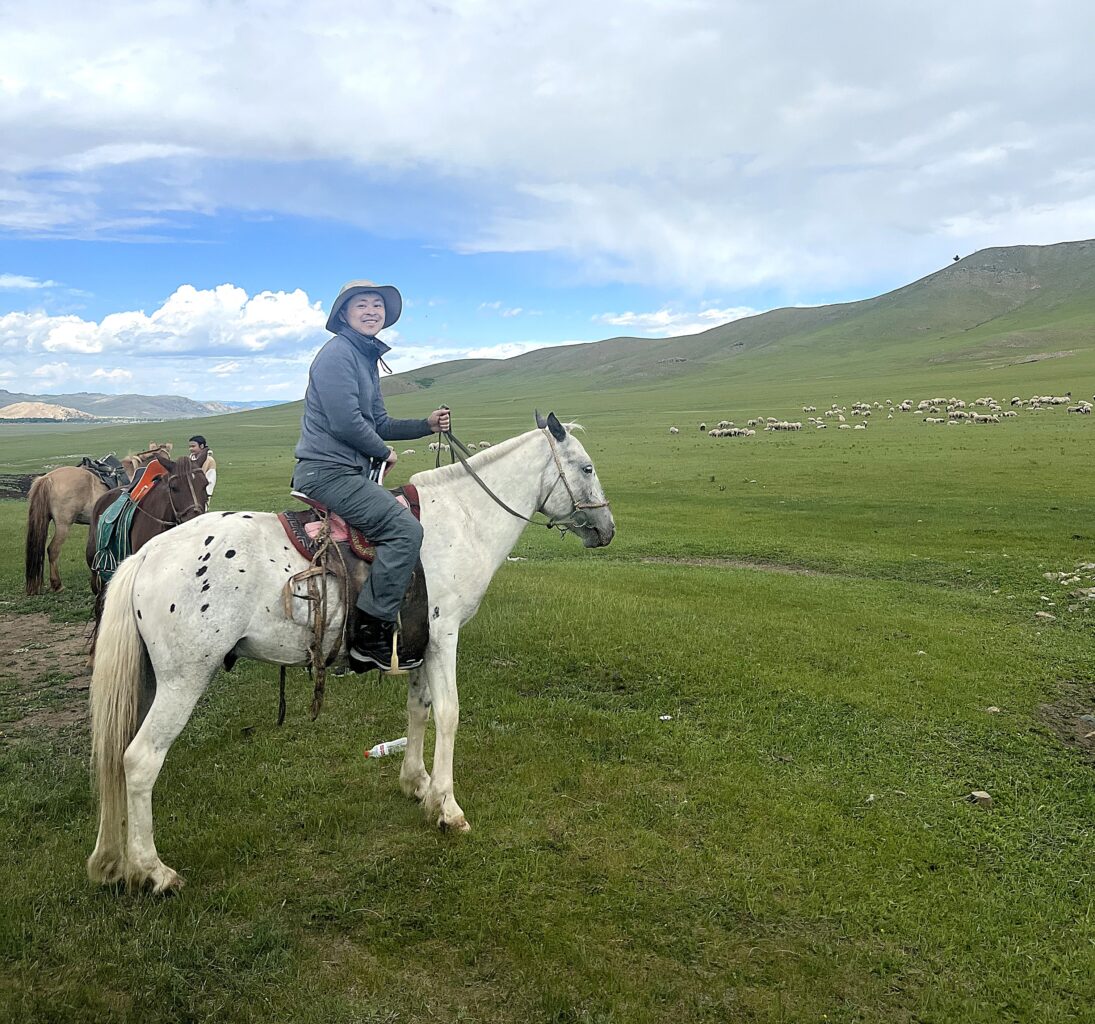 Tong rides a Mongolian horse during a visit to a nomadic family in the countryside near Ikh-Tamir in central Mongolia. (Image courtesy of Tong)
CAORC is a private, nonprofit federation of independent overseas research centers that promotes advanced research with an emphasis on the humanities and social sciences, the conservation and recording of cultural heritage, and the understanding and interpretation of modern societies. Tong was one of 44 faculty members from community colleges and minority-serving institutions, like UMBC, placed in one of three seminars that aimed to help faculty and administrators gain first-hand experience needed to develop and improve international courses, curricula, and teaching materials.
Learning from Mongolians
The seminar took place at the American Center for Mongolian Studies (ACMS) in Ulaanbaatar, the capital city of Mongolia. The 14 faculty assigned to the seminar in Mongolia visited Ulaanbaatar; the rural communities at Kharkhorin, the historic capital of the Mongol Empire; Erdene Zuu Monastery—the oldest Buddhist monastery in Mongolia; and Hustai National Park, home to the rare and endangered Przewalski’s horses. They also gained first-hand knowledge of the impact of hotter days, increasing wildfires, storms, colder winters, and drought on Mongolia’s communities and environment.
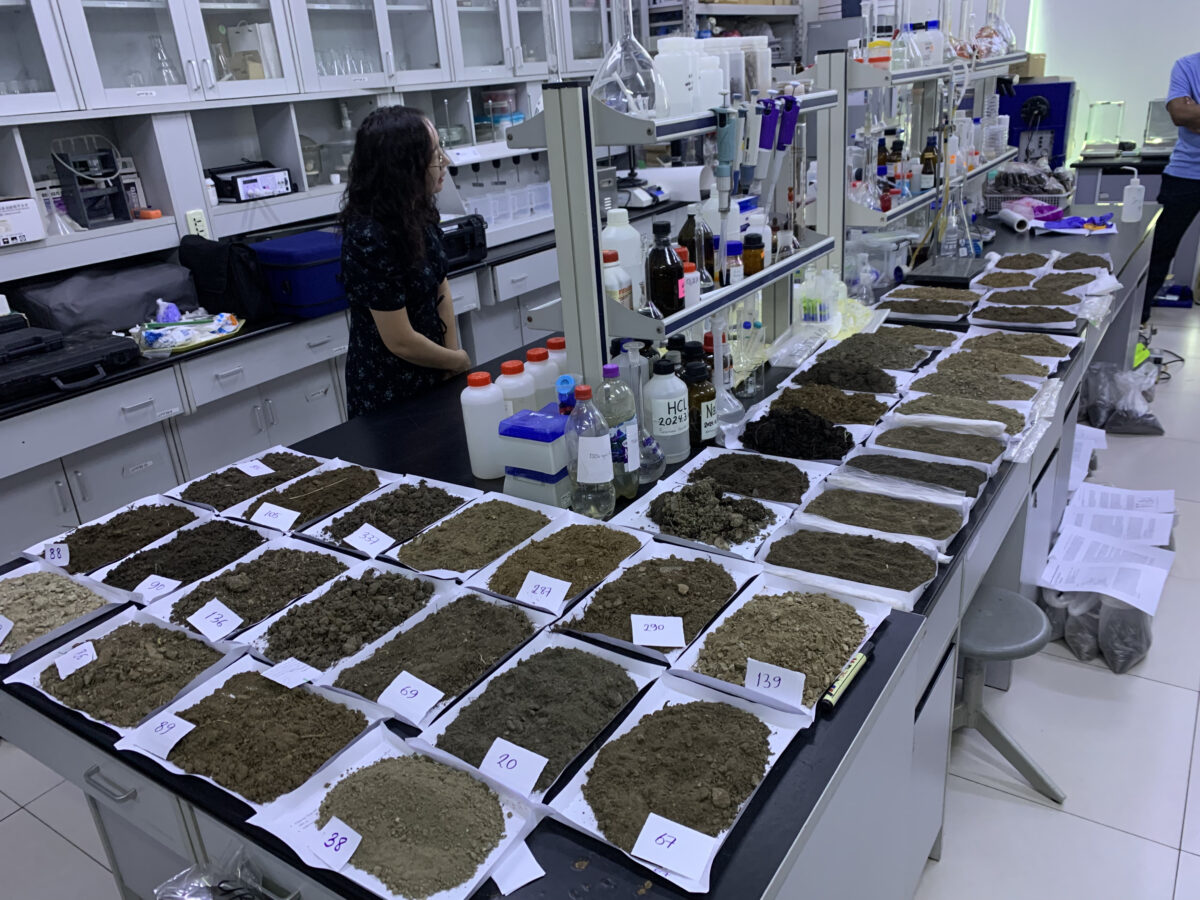 A soil scientist at the National University of Mongolia explains the different types of soil collected in the city of Ulaanbaatar and its vicinities. (Image courtesy of Tong)
“It was an eye-opening experience visiting Mongolia—meeting its people and experiencing the landscape. I have read novels and research about Mongolia,” shares Tong, “but visiting in person enriched my understanding and challenged my preconceptions.” He notes that Mongolia’s unusually cold winter this year wiped out entire herds of livestock, the primary source of income for nomadic families. Meanwhile, the use of low-grade coal for heating in Ulaanbaatar has increased air pollution and negatively impacted public health. “The effects of climate change are particularly noticeable to the people of Mongolia.”
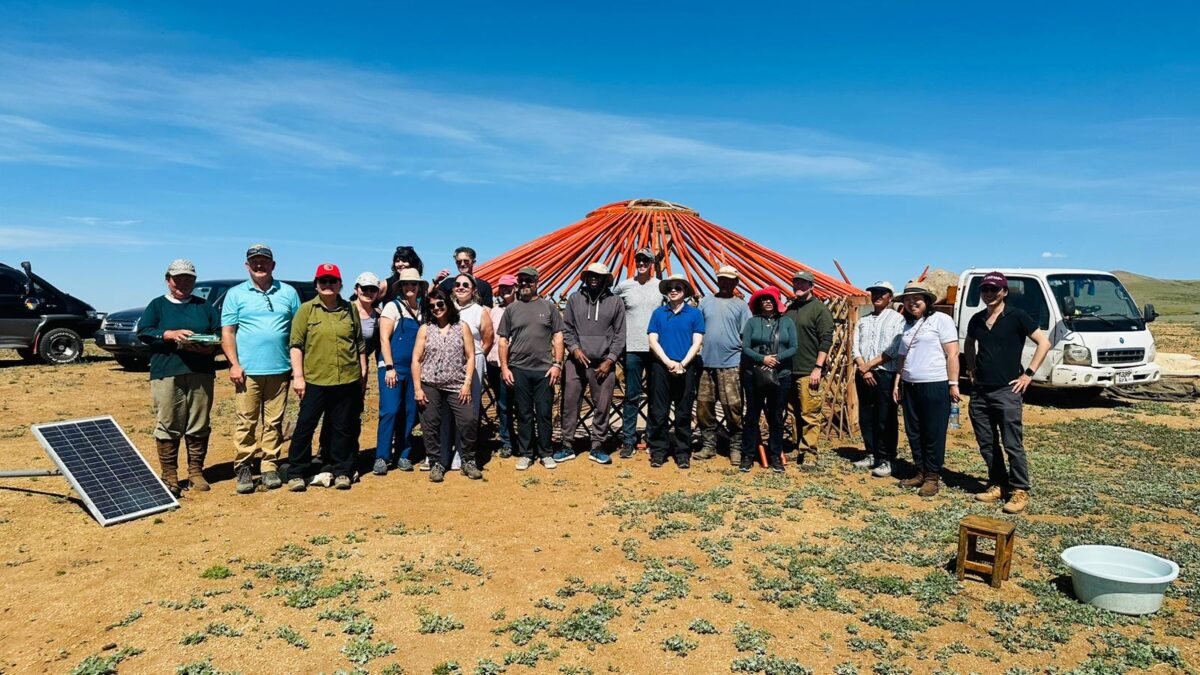 Tong (center with a blue polo and hat) stands with his CAORC colleagues and the nomadic family the team assisted in constructing their ger, a traditional Mongolian yurt. (Image courtesy of Tong)
The faculty met local officials, health specialists, climate scientists, and nomadic pastoralists to learn about their country and way of life from them. The scholars also assisted a nomadic family in constructing their ger, a traditional Mongolian yurt. These interactions and collaborations helped Tong better understand the Mongolian people’s perspectives on development and its relationship with China and the U.S. “My experience in Mongolia will inform my research in Asian studies and help me connect with Mongolian Americans back in the U.S.,” says Tong. “I’m very grateful that CAORC and ACMS allowed me to visit Mongolia.”
Bringing Mongolia to the classroom
This transformative experience will also benefit UMBC students. Tong has been teaching a course on China’s ethnic minorities, MLLI 335: Modern China: Culture, Society, and Environment, for many years. “A part of the traditional Mongolian homeland is in present-day China, an autonomous region known as Inner Mongolia,” says Tong. He teaches the novel Wolf Totem by Jiang Rong, which tells the story of a student from Beijing who travels to Inner Mongolia to live among the Mongols in the 1960s.
“Of course, the country of Mongolia is different from the Chinese region of Inner Mongolia. The field trip made these differences clear,” says Tong, who will develop new course materials on Mongolia as a modern nation and contextualize it within the broader field of Asian studies.
In addition to the CAORC award, Tong received a 2023 – 2024 short-term residential research fellowship from the American Philosophical Society to conduct research at the society’s library and museum in Philadelphia. During this time, Tong researched the history of evolutionary science in the U.S., including the contributions of Asian and African American scientists. He also helped launch UMBC’s new Mellon-funded Global Asias Initiative. The initiative supports rethinking Asian American issues on campus in a global, diasporic, and collaborative framework through community-engaged, public-facing scholarship, and teaching.
These work and research awards, along with a 2021 Early Career Fellowship in China Studies from the American Council of Learned Societies and a 2018 – 2019 Fulbright U.S. Scholar Program grant to China, have given Tong the time and resources to contribute new research to the field and new approaches to the teaching and learning of Asian studies.
Learn more about UMBC’s Asian Studies program and the Global Asias Initiative.
]]>
Christopher K. Tong, an associate professor of modern languages, linguistics, and intercultural communication, has taught Asian studies for years. This fall, Tong brings a fresh perspective to his...
https://umbc.edu/stories/christopher-tong-returns-from-mongolia-2024/
https://my3.my.umbc.edu/api/v0/pixel/news/142900/guest@my.umbc.edu/3a0919dba2696309e62ee8ca7517086e/api/pixel
asian-studies
cahss
cahss-research
international
mlli
news
policy-and-society
research
story
UMBC News & Magazine
https://my3.my.umbc.edu/groups/umbc-news-magazine
https://assets1-my.umbc.edu/system/shared/avatars/groups/000/001/943/24435aa6207c452e7bc15cc74b42c7bb/xsmall.png?1748556657
https://assets1-my.umbc.edu/system/shared/avatars/groups/000/001/943/24435aa6207c452e7bc15cc74b42c7bb/original.png?1748556657
https://assets2-my.umbc.edu/system/shared/avatars/groups/000/001/943/24435aa6207c452e7bc15cc74b42c7bb/xxlarge.png?1748556657
https://assets2-my.umbc.edu/system/shared/avatars/groups/000/001/943/24435aa6207c452e7bc15cc74b42c7bb/xlarge.png?1748556657
https://assets3-my.umbc.edu/system/shared/avatars/groups/000/001/943/24435aa6207c452e7bc15cc74b42c7bb/large.png?1748556657
https://assets1-my.umbc.edu/system/shared/avatars/groups/000/001/943/24435aa6207c452e7bc15cc74b42c7bb/medium.png?1748556657
https://assets2-my.umbc.edu/system/shared/avatars/groups/000/001/943/24435aa6207c452e7bc15cc74b42c7bb/small.png?1748556657
https://assets1-my.umbc.edu/system/shared/avatars/groups/000/001/943/24435aa6207c452e7bc15cc74b42c7bb/xsmall.png?1748556657
https://assets2-my.umbc.edu/system/shared/avatars/groups/000/001/943/24435aa6207c452e7bc15cc74b42c7bb/xxsmall.png?1748556657
UMBC News & Magazine
0
0
false
Tue, 23 Jul 2024 13:21:46 -0400
Tue, 23 Jul 2024 13:21:46 -0400
UMBC Center for Global Engagement welcomes its second cohort of the Young African Leaders Initiative
This summer, UMBC’s Center for Global Engagement (CGE) is excited to welcome its second cohort of the prestigious Mandela Washington Fellowship for Young African Leaders, the six-week flagship program of the U.S. Government’s Young African Leaders Initiative (YALI). The new cohort includes 25 innovators from countries across Sub-Saharan Africa representing education, journalism, tech, health care, and more. The fellows will spend six weeks living at UMBC networking and attending diversity and leadership skills workshops. They will also meet with campus, local, and state leaders, learn more about Baltimore’s LGBTQ+ leaders of color, developmental disabilities at The ARC Baltimore, trauma-informed practices, and more.
“The fellowship is a beacon of hope,” says Jok Thon, M.P.S. ’24, entrepreneurship, innovation, and leadership, a 2018 University of Delaware YALI fellow and UMBC’s first Global Peaceworker Fellow. Thon is a father of four and the director and founder of Promised Land Primary and Secondary School and Promised Land College in Juba, South Sudan, which has educated over 1500 displaced students. “As a witness and participant in this transformative experience, I wholeheartedly attest the journey is as profound for the mentors as it is for the fellows.”
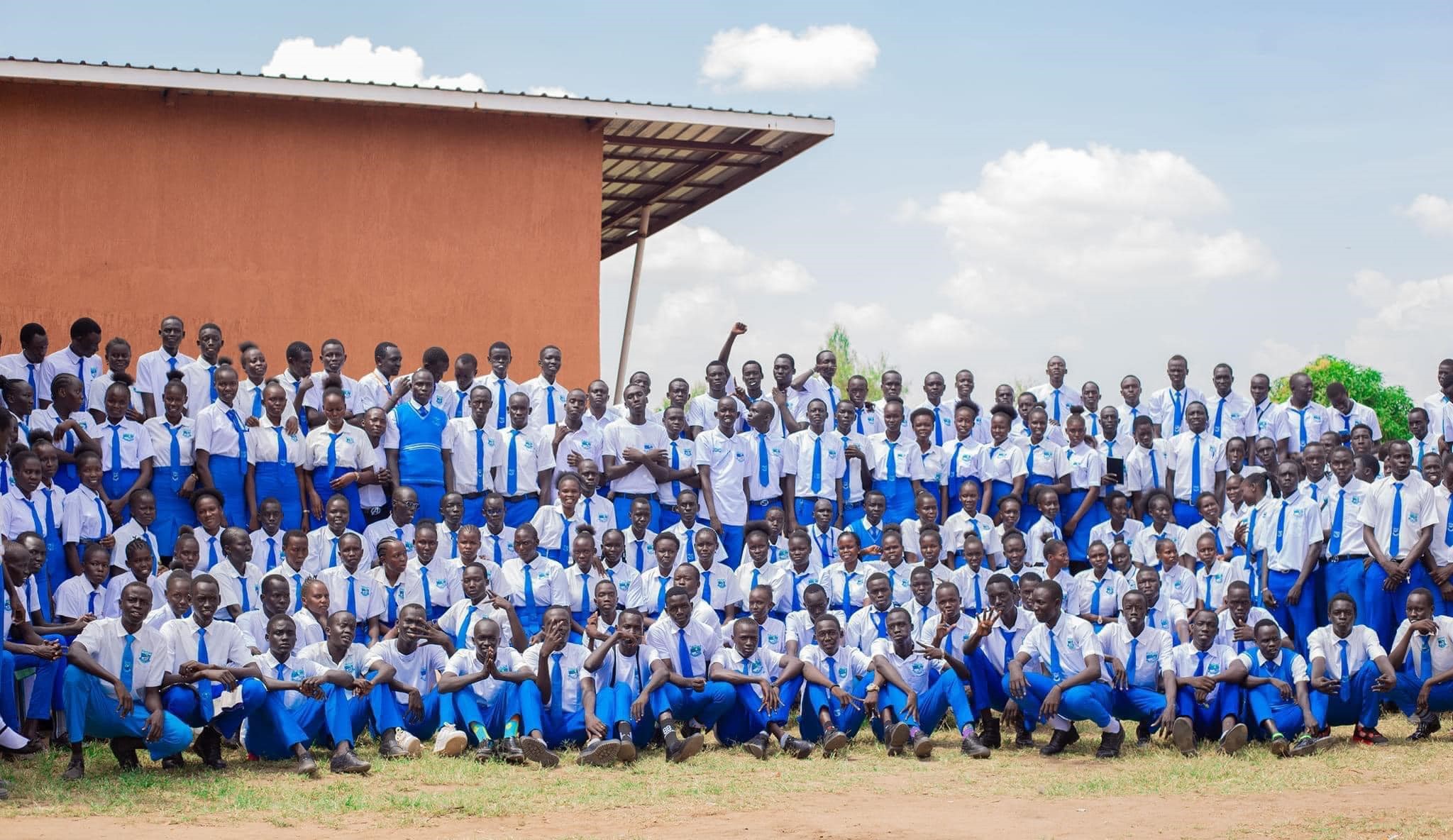 Promised Land Primary and Secondary School in Juba, South Sudan. (Image courtesy of Thon)
Thousands of leaders ages 25 – 35, across 49 Sub-Saharan African countries covet a prestigious YALI fellowship. YALI hopefuls must condense years of leadership in business, civic engagement, and public management into one application, demonstrating concrete ongoing efforts to broaden access to education, health care, and workforce development. These 700 spots across 28 U.S. educational institutions are considered a once-in-a-lifetime opportunity, for both fellows and host institutions, to strengthen connections between the U.S. and Africa and establish enduring partnerships between fellows, local communities, and private businesses through their expertise, perspectives, and experiences.
“YALI is a huge deal in my country and Africa. It’s a journey I want to take with my whole community, nation, and the world,” says 2023 UMBC YALI fellow Victoria Merab Akinyi. She is the CEO and co-founder of Streetlights Uganda, a visual and performing arts-based organization empowering children living on the streets with entrepreneurship and life skills to become self-employed and engaged citizens.
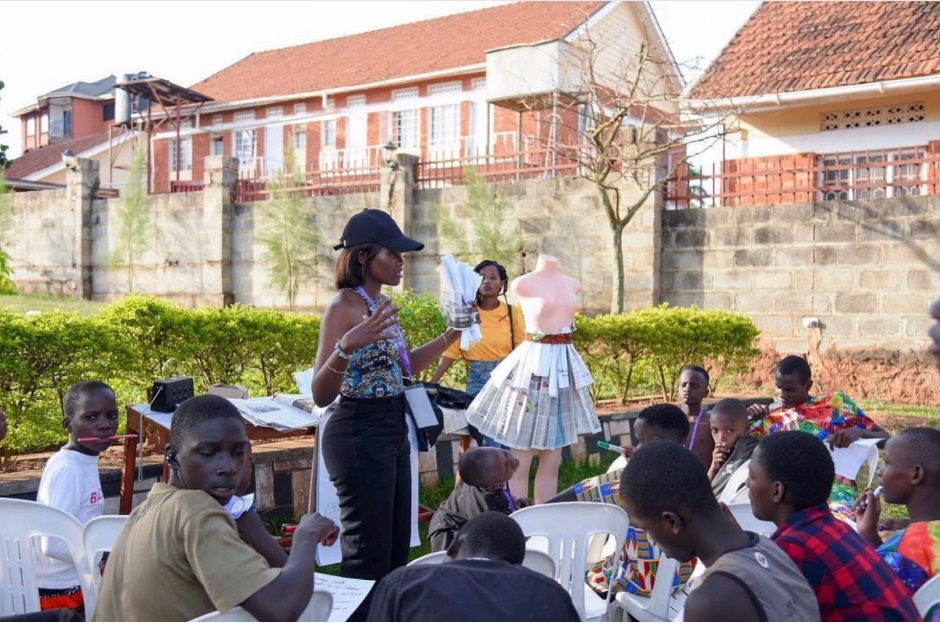 Victoria Merab Akinyi teaching a fashion design class at Streetlights Uganda. (Image courtesy of Merab Akinyi)
“I have a master’s degree in fine arts and two fashion companies. I don’t take my degrees, work with my community, and my YALI experiences for granted because they have all helped open doors for me.”
Creating a Retriever YALI Village
Becoming a YALI host is also an arduous but worthwhile process. It requires developing a six-week international residency program unique to the institution’s resources and the fellows’ needs. When Ryan Sheldon, M.A. ’15, teaching English to speakers of other languages, director of the English Language Institute and special programs within CGE, and Madison Pickard, M.A. ’24, intercultural communication, and assistant director of special programs and co-academic director of the YALI Fellowship, applied to bring YALI to UMBC in 2023, Thon was excited to join the team as a program assistant.
“It was so valuable to our fellowship having Jok as a program assistant and a resource for the fellows while they were here,” says Pickard. “Jok assisted the fellows in leadership activities, accompanied us on on-site visits, and facilitated their weekly feedback and reflection sessions as our leadership coordinator.”
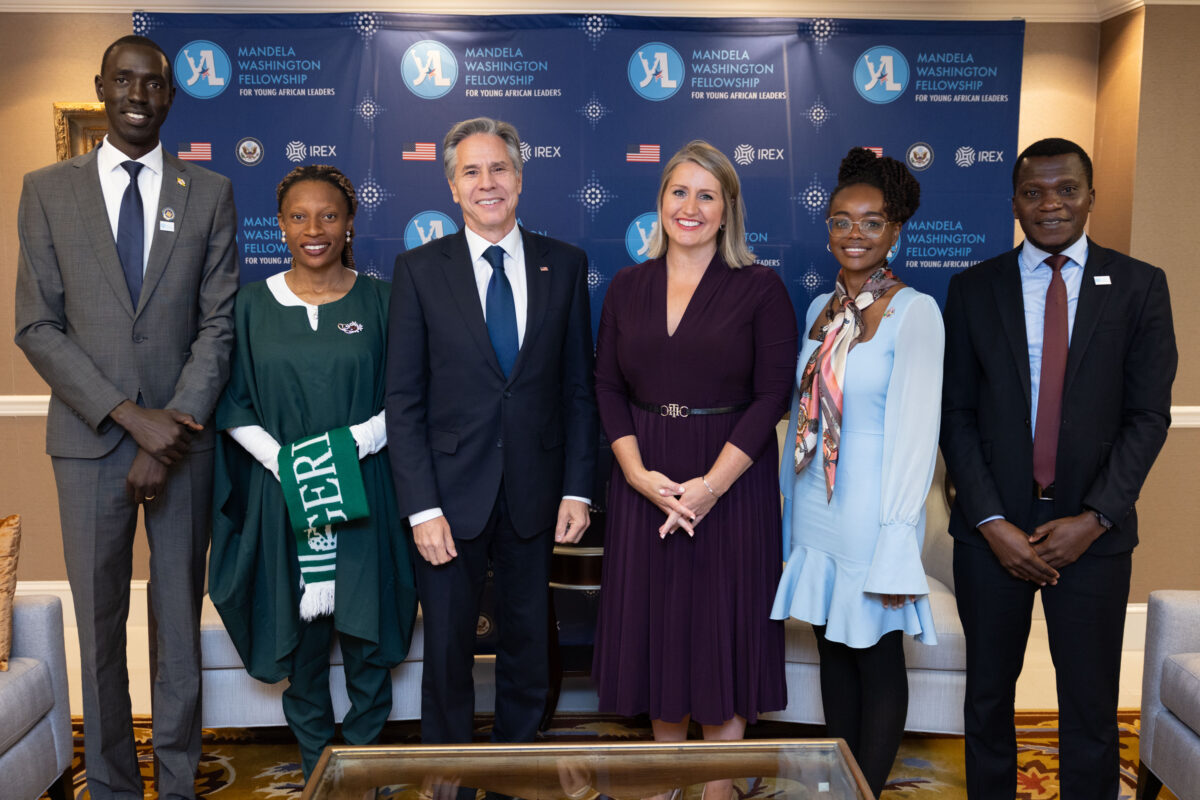 (l-r): Jok Thon, YALI fellow Blessing Ashi from Nigeria, U.S. Secretary of State Antony Blinken, Undersecretary of State Elizabeth Allen, and YALI fellows Shange-Ndamona Mungoba from Namibia and Khwima Mkamanga from Malawi. (Image courtesy of Thon)
Designing a “Retriever YALI Village” requires many hands. The village was equipped with campus housing, transportation, catering, activities, and a budget for each fellow. Thanks to campus and community partners, it also included workshops, projects, events, and speakers.
“We invited trusted partners aligned with our fellows, had conversations with them, and created a space for the fellows to choose their level of engagement,” says Pickard. The proposal was a winner.
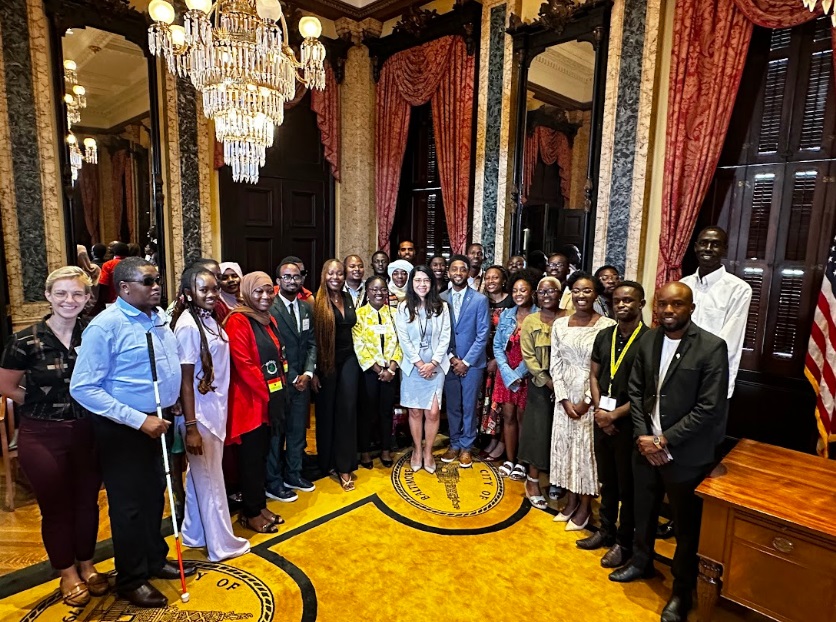 YALI fellows at Baltimore City Hall with Baltimore City Mayor Brandon Scott.
(Image courtesy of Mirab Akinyi)
In summer 2023, 24 young African leaders came to UMBC to share and learn new skills to empower them as critical leaders in addressing issues facing women, girls, and children, mental and public health, education, community organizing, NGO management, sustainability, and more. Fellows engaged in academic sessions, community service, site visits, and networking events and met state and local government leaders, businesses, and community organizations. They also joined in Baltimore’s baseball season at the Oriole Park at Camden Yards.
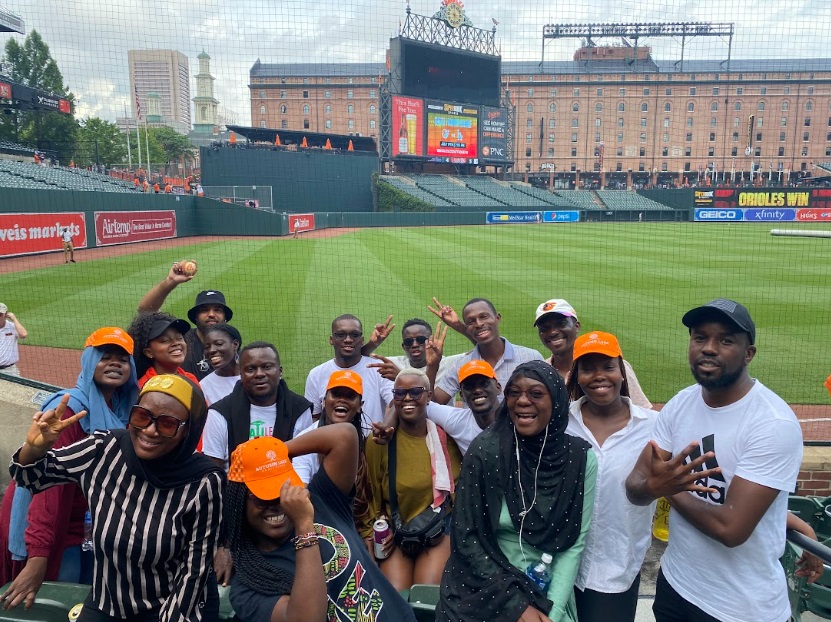 YALI fellows at the Oriole Park at Camden Yards in Baltimore City. (Image courtesy of CGE)
“Together, we explored the notion that true leadership is rooted in service and that we can drive meaningful progress by embracing diversity and harnessing collective strengths,” says Thon. Due to the program’s success, UMBC was chosen to host again in June 2024.
All for all
Fellows are often inspired into action by personal experiences. Their superpower is knowing they alone are not the answer. Fellows share their community-building strategies and acquire new expertise to address ongoing challenges. It’s not all-for-one, or one-for-all, but all-for-all.
Leveraging social media for social justice is a key approach for Ellen Kalaputse Nanyeni, a financial modeling and valuation analyst from Namibia. As a survivor of sexual and gender-based violence (SGBV), she understands the victim blaming and legal hurdles survivors face to access care and protection. Nanyeni promotes equal opportunity rights and the safety of women in Namibia via the #Shutitalldown Namibia SGBV awareness social media movement and through the #Breakfree #Befree support services initiative established by Monica Geingos, the First Lady of Namibia.
In Nigeria, Sunday Emmanuel Onuche networks with schools and disability organizations to further disability justice. Onuche promotes inclusion, leadership opportunities, and self-reliance for people with disabilities like himself via his VisionLink Initiative.
Skateboarding is John Kabiye Kalenga’s community development tool. As a professional skateboarder and the coach for Zambia’s first Olympic skateboard team at the 2022 Tokyo Olympics, Kalenga lives and breathes the sense of belonging skateboarding has given him. As vice president of the Skate Association of Zambia, he teamed up with more than 30 international skatepark construction volunteers to build Zambia’s first-ever skatepark creating a safe haven for young people.
CNN World: Zambian instructor empowers kids through skateboarding
These are just a few of the 2023 YALI fellows who connected over the summer of 2023 and returned to their countries with new leadership skills and tools for change.
Implementing the YALI Way
YALI is one summer, but it’s what comes afterward when the fellows return home that the work truly becomes YALI work. Merab Akinyi returned to Uganda intent on expanding Streetlights Uganda’s reach. She fundraised to remodel old houses in areas of high need. The additional classrooms and offices launched the Ntunga project, Changing Lives Through Fashion. It equips women and children with marketable skills to sustain their families. Her team continues to run the Mwalimu Mentorship, an apprenticeship connecting artists with youth, and the Unseen Me children’s exhibition.
Currently, Streetlights Uganda manages two training centers for women and two for street children. Merab Akinyi and her team of seven organizers have reached over 60 women in the past 3 years and over 400 street children.
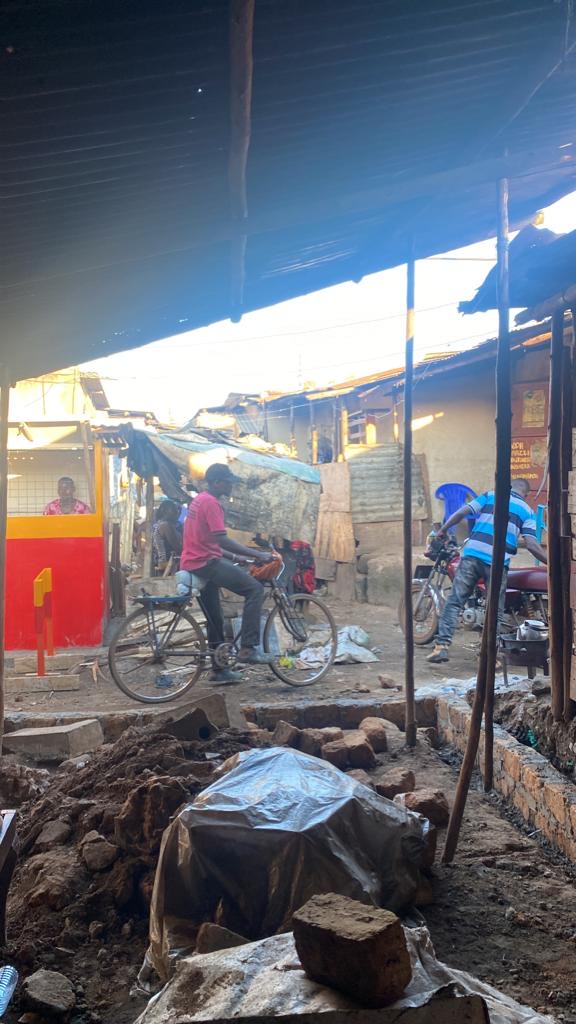
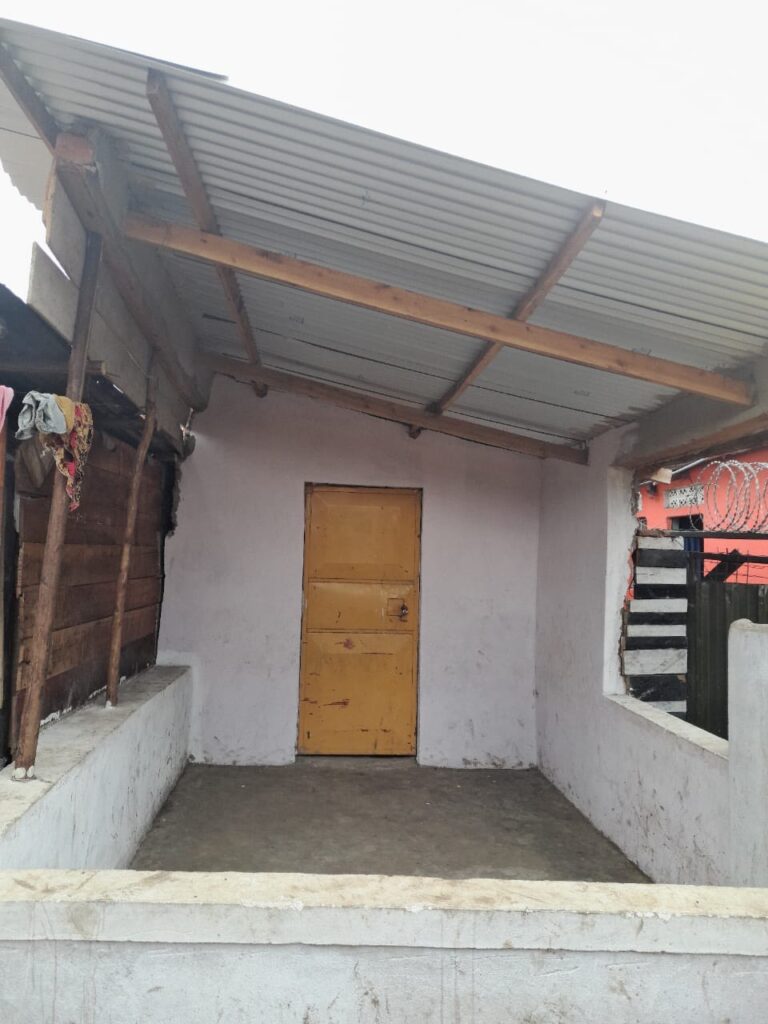
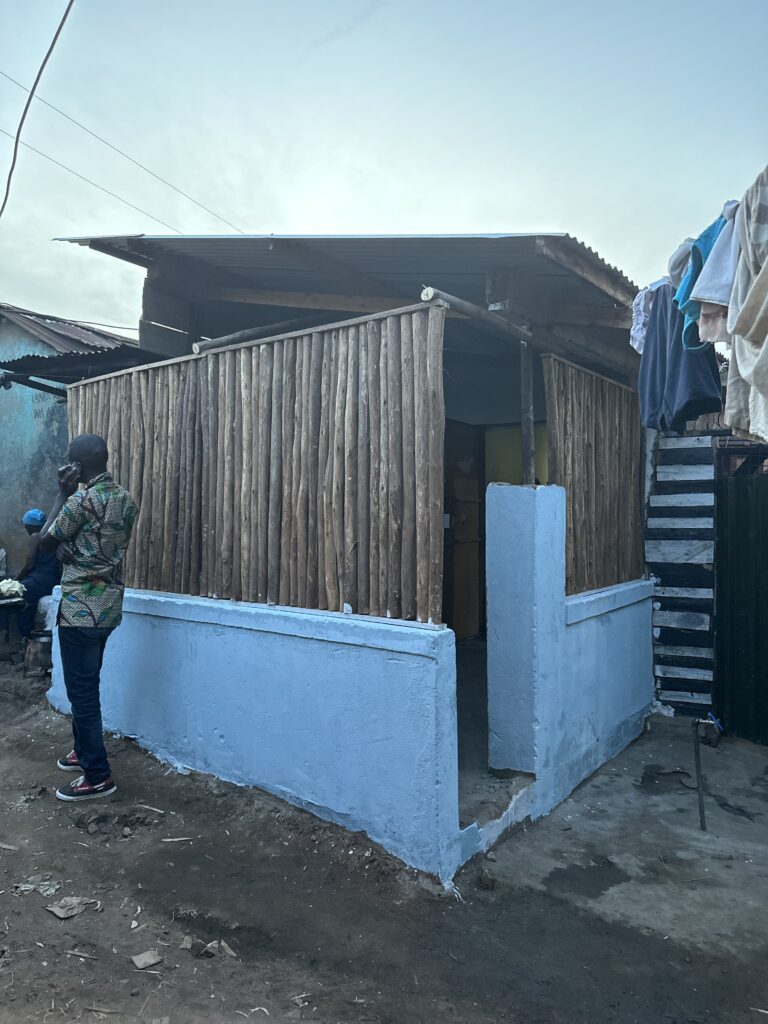 Streetlights Uganda’s phases of remodeling an additional center. (Images courtesy of Merab Akinyi)
Merab Akinyi’s next project is inspired by a YALI fellow who reuses empty bottles for building construction. “Many bottles are lying around. We are looking to develop an awareness campaign on how to use bottles to save the environment,” says Merab Akinyi. “These bottles can be repurposed to fix drainage problems around the centers and add more space.”
Pickard notes this is the goal of the fellowship. “We create opportunities for fellows to learn from each other and for everyone to challenge and develop their personal growth and values.”
Overlapping hearts and minds
The deep sense of camaraderie drew the attention of UMBC community members outside of YALI resulting in powerful friendships and mentorships that continue to this day. Pickard connected Merab Akinyi with artist Ariel Valéria Barbosa, M.P.S. ’24, community leadership, after noticing Merab Akinyi’s passion for using art as a vehicle for change. Barbosa is the program coordinator for UMBC’s food pantry Retriever Essentials and leads A Gente, an organization that gives opportunities to Black artists to travel to the African Diaspora to co-create free exhibitions for the local community.
“There are similarities in our surrealist art styles and wanting to use the little we have and our charisma and intelligence to expand impact for our people,” says Barbosa. “Victoria is really good at what she does, and I want her talents to be nurtured and supported.” Barbosa linked Pickard with DewMore, a nonprofit that uses poetry as a platform for youth leadership.
“It was full circle for me to listen to Victoria read a poem she wrote during the DewMore poetry workshop about her experience in Baltimore,” says Barbosa. “She carries herself with a lot of composure and dignity, like a voice for the people. That is just who she is.”
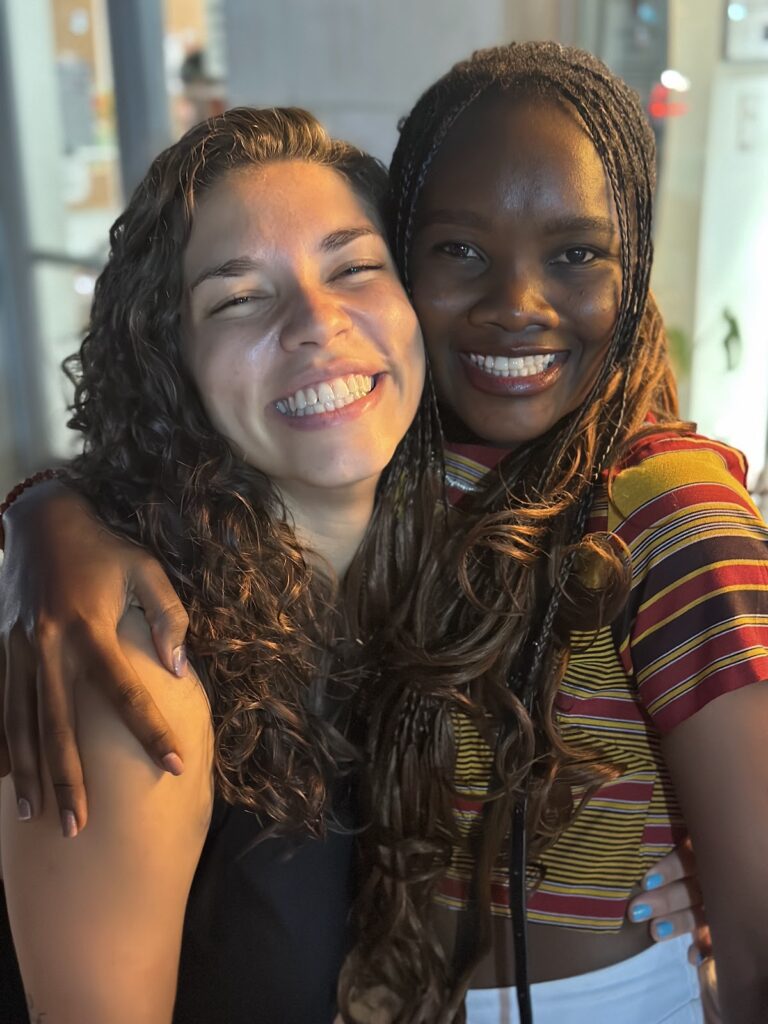
Ariel Barbosa and Victoria Merab Akinyi. (Image courtesy of Merab Akiniyi.)
A smile goes a long way
Lovetta Y. Qualah is the founder and CEO of Positive Actions Driving Safety (PADS), which addresses period poverty by providing free sanitary products to women and girls in Monrovia, Liberia. She found a kindred heart in Namrata Oruganti ’24, biology. As a summer conference assistant, Oruganti helped code keys, fold towels, organize sheets, and prepare comforters for the fellows. “I was blessed to be at that desk,” says Oruganti. The first night, the YALI group organized a party for a fellow who had arrived on his birthday.
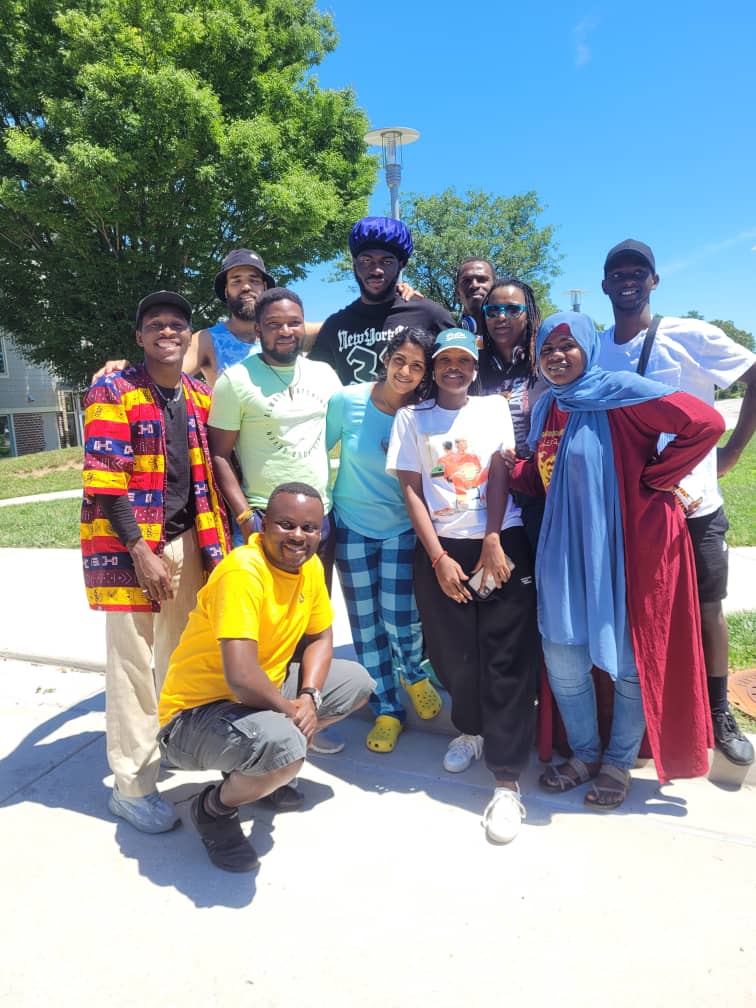
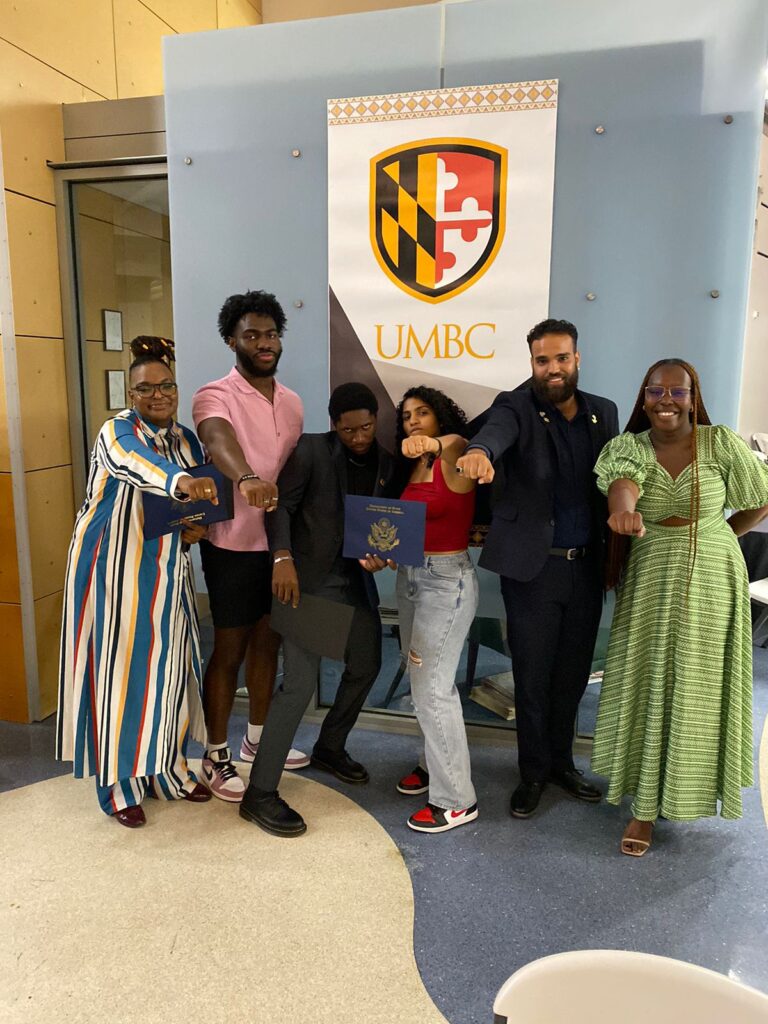 (l-r): Oruganti (center with plaid pants) with fellows on their last days and (center with red shirt) at the farewell ceremony. (Image courtesy of Oruganti)
“I couldn’t believe the fellows weren’t familiar with each other. Each person contributed something they already had,” says Oruganti. They invited her to share a meal and, once they learned of her love for Afro-beats, to dance.
Oruganti had no idea they were CEOs or experts. “Not one person made me feel like I was less than them. People in leadership sometimes forget that,” says Oruganti, known to her friends—which now include the fellows—as Smiley. “Sometimes I forget.”
“Smiley took an interest in me as a person, my work, and my progress,” says Qualah. “Smiley was a really good ambassador for UMBC. She is an image of positive energy. Always checking in on everybody.”
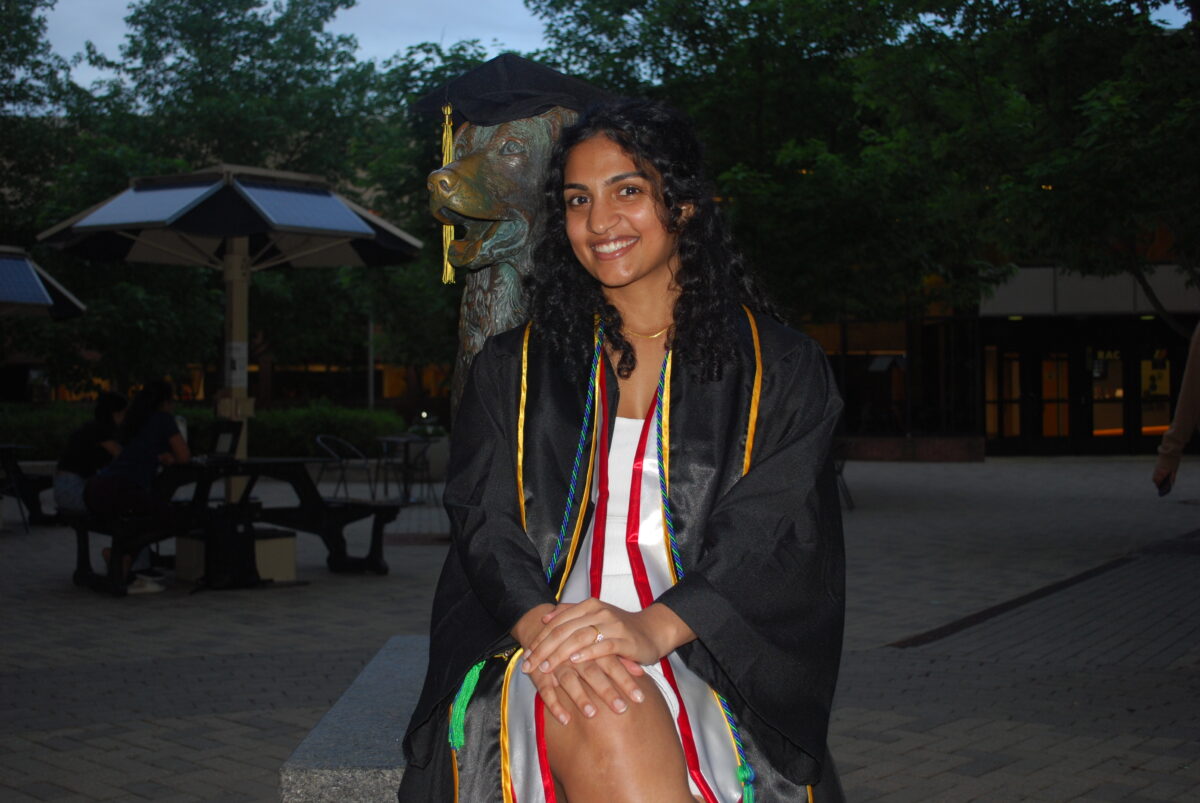
As Oruganti applies to medical school, she keeps her YALI lessons in mind. “The fellows are the most amazing, sweet, and humble people. They taught me how to be a collective,” says Oruganti. “They will always be part of my life story.” The fellows congratulated her on her recent graduation on their WhatsApp chat. “Smiley wasn’t even a part of YALI but she became an integral part,” says Qualah.
(Image courtesy of Oruganti)
Conversation + connection = action
Deep understanding is the goal. Mentorship is the path. To listen, think, share, and reflect is the YALI way. With the help of mentors like Joby Taylor, Ph.D. ’05, language, literacy, and culture, and director of the Shriver Center, fellows build mentorship tools to better communicate with their communities and instill mentorship programs. Taylor led a workshop on place, sense of place, and placemaking as social change in Africa and Baltimore City.
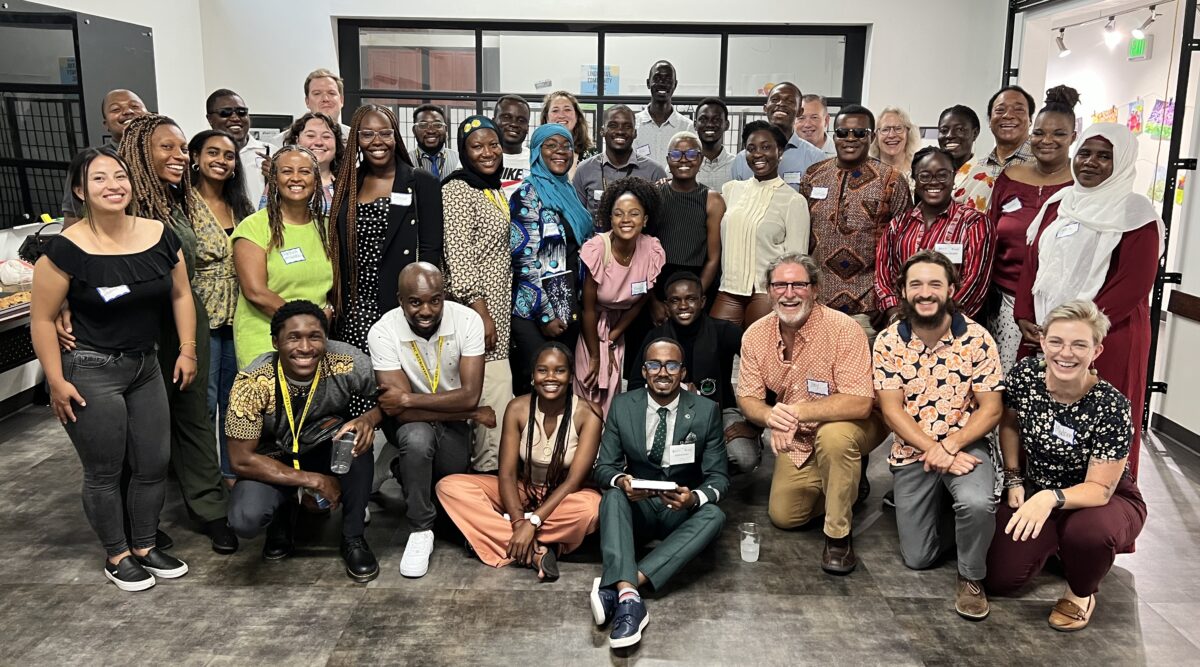 YALI fellows at OCA Mocha with UMBC Shriver Center and CGE staff, Peaceworker fellows, and the Baltimore Entrepreneurship and Leadership Network. (Image courtesy of Sally Scott, director of graduate programs in community leadership at The Shriver Center.)
“Jok and I have had a two-year conversation where we have learned so much about leadership from each other and South Sudan and Baltimore,” says Taylor, who is also Thon’s host family. “Living and working with him makes you want to be a better person.”
Thon put theory to practice by helping fellows complete paperwork and hone their professionalism skills. “This was my favorite part because I saw myself in their work and they saw themselves in my work at UMBC and back home in South Sudan,” says Thon. Heplayed basketball with them every Sunday. “They called me their mentor and big brother.”
Merab Akinyi appreciated the intention, “Beyond the classes, the dedication, and humility of the facilitators—especially Ryan Sheldon, Madison, and Jok—were great lessons to me as a leader and great virtues for me to take back home.”
(l-r): Pickard, Merab Akinyi, Sheldon, David Di Maria, senior international officer and associate vice provost for international education. (Image courtesy of Mirab Akinyi)
A year later, Qualah continues to reflect on the fears she had while at YALI and how UMBC community members helped her overcome this. “While at YALI I had imposter syndrome. I was looking for validation every day,” says Qualah. “Everything changed when I met amazing people at UMBC: President Valerie Sheares Ashby, Sally Scott, Madison Pickard, Ryan Sheldon, Jok Thon, and, my dear friend and YALI fellow, Lillian Ndilwa. They challenged my perspective, highlighting the unique value I bring and the importance of my contributions. Words like ‘You deserve to be here,’ and ‘Your work is needed’ resonated deeply.” Today, Qualah puts these beliefs to work and is a visible and outspoken leader sharing PADS’ success and her UMBC YALI experience on Facebook.
Africans for Africa
This year, YALI celebrates its 10th anniversary. Nearly 6,500 leaders have taken YALI’s multi-tiered mentorship approach across all sub-Saharan countries. Thon notes convening 20-plus African leaders in one room is a feat on its own. “It’s hard bringing people together in Africa,” he says. “I can have connections in Congo or Kenya because those are my neighboring countries, but you cannot really know what the young people are doing in South Africa from South Sudan or a West African country.”
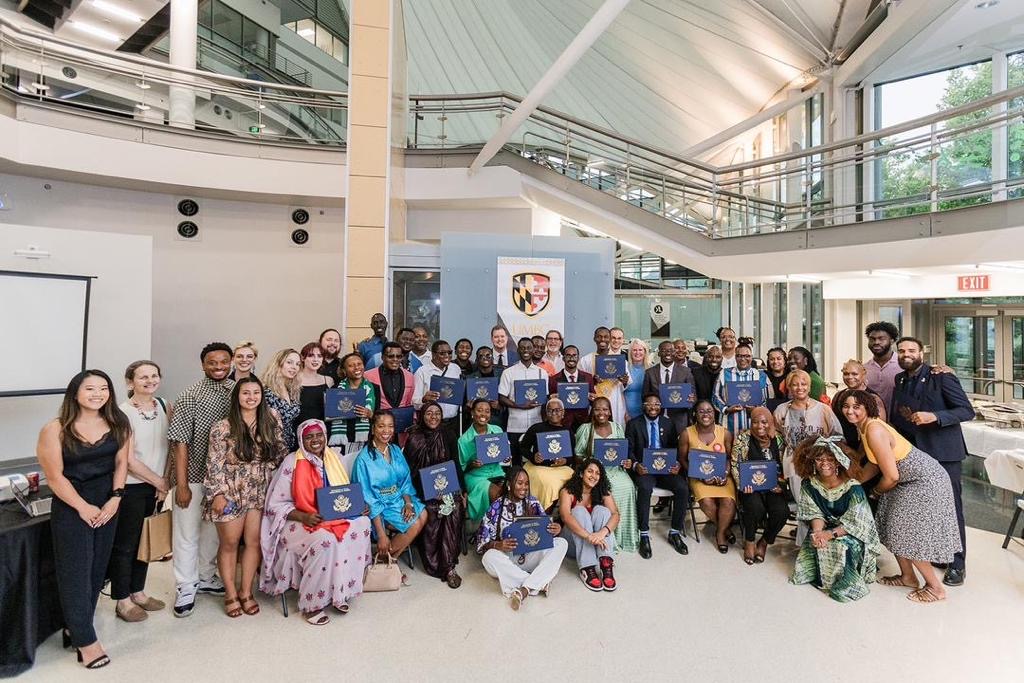 YALI 2023 fellows at their farewell ceremony with the CGE team, Peaceworker Fellows leadership, and Oruganti (center front row wearing red sneakers).
(Image courtesy of Oruganti)
This summer Thon will extend the YALI ripple effect, working as a partnership associate at CorpsAfrica, a non-profit organization focused on engaging youth and helping rural communities overcome extreme poverty.
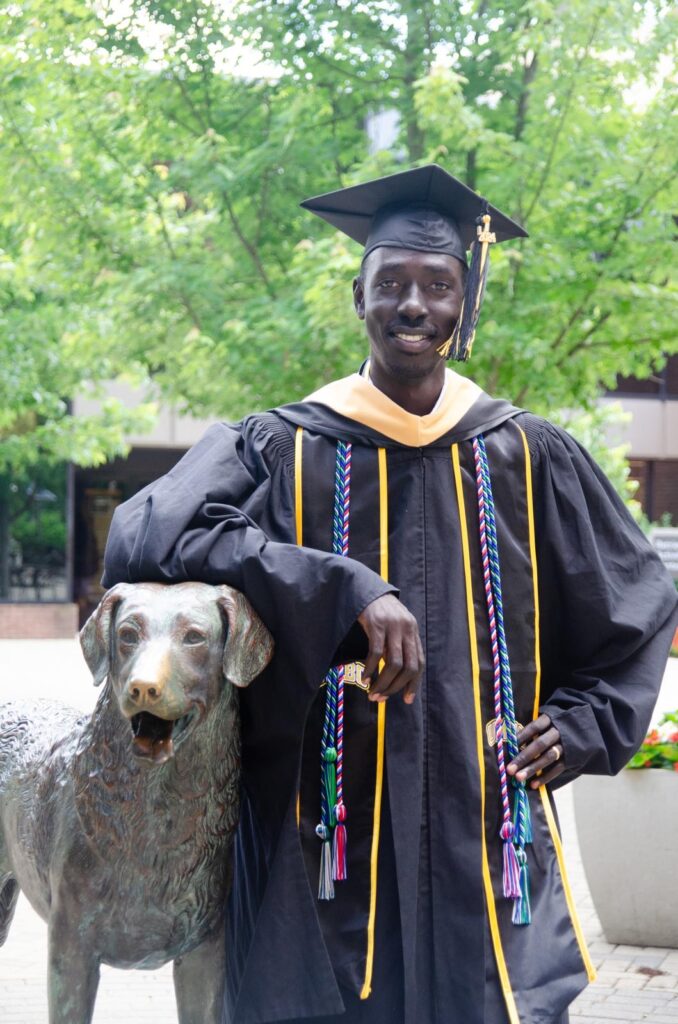 Jok Thon celebrating his 2024 graduation from UMBC.
(Image courtesy of Thon)
“Every little act of peace and kindness gets us closer to building a just and prosperous society where there is no weak or strong, poor or rich,” says Thon, “but a society that thrives on the basic principles of living a dignified life guided by empathy.”
]]>
This summer, UMBC’s Center for Global Engagement (CGE) is excited to welcome its second cohort of the prestigious Mandela Washington Fellowship for Young African Leaders, the six-week flagship...
https://umbc.edu/stories/umbc-center-for-global-engagement-welcomes-young-african-leaders/
https://my3.my.umbc.edu/api/v0/pixel/news/142500/guest@my.umbc.edu/ee1d8353c9a2f54a62f3581da961d3c9/api/pixel
biology
cge
community
international
llc
mlli
news
peaceworker
retriever-essentials
shrivercenter
story
tesol
UMBC News & Magazine
https://my3.my.umbc.edu/groups/umbc-news-magazine
https://assets1-my.umbc.edu/system/shared/avatars/groups/000/001/943/24435aa6207c452e7bc15cc74b42c7bb/xsmall.png?1748556657
https://assets1-my.umbc.edu/system/shared/avatars/groups/000/001/943/24435aa6207c452e7bc15cc74b42c7bb/original.png?1748556657
https://assets2-my.umbc.edu/system/shared/avatars/groups/000/001/943/24435aa6207c452e7bc15cc74b42c7bb/xxlarge.png?1748556657
https://assets2-my.umbc.edu/system/shared/avatars/groups/000/001/943/24435aa6207c452e7bc15cc74b42c7bb/xlarge.png?1748556657
https://assets3-my.umbc.edu/system/shared/avatars/groups/000/001/943/24435aa6207c452e7bc15cc74b42c7bb/large.png?1748556657
https://assets1-my.umbc.edu/system/shared/avatars/groups/000/001/943/24435aa6207c452e7bc15cc74b42c7bb/medium.png?1748556657
https://assets2-my.umbc.edu/system/shared/avatars/groups/000/001/943/24435aa6207c452e7bc15cc74b42c7bb/small.png?1748556657
https://assets1-my.umbc.edu/system/shared/avatars/groups/000/001/943/24435aa6207c452e7bc15cc74b42c7bb/xsmall.png?1748556657
https://assets2-my.umbc.edu/system/shared/avatars/groups/000/001/943/24435aa6207c452e7bc15cc74b42c7bb/xxsmall.png?1748556657
UMBC News & Magazine
3
0
false
Tue, 18 Jun 2024 13:55:38 -0400
Tue, 18 Jun 2024 13:55:38 -0400
UMBC’s first Fulbright Scholar-in-Residence shares unique research on neurodiversity in language teaching and learning
Neurodiversity inclusion and representation have been at the forefront of Michael Canale’s 20-year career in the disability services and education field. Canale, M.A. ’24, intercultural communication, is the assistant director of UMBC’s Office of Student Disability Services and teaches the first-year seminar Introduction to Disability Studies. “Sometimes parents of neurodivergent students worry that their child is incapable of learning another language,” says Canale. “I work with parents to ease their fears by showing them how their child can excel in college with the proper individualized accommodations.” These can include note-taking software, counseling services, tutoring, time management support, and more.
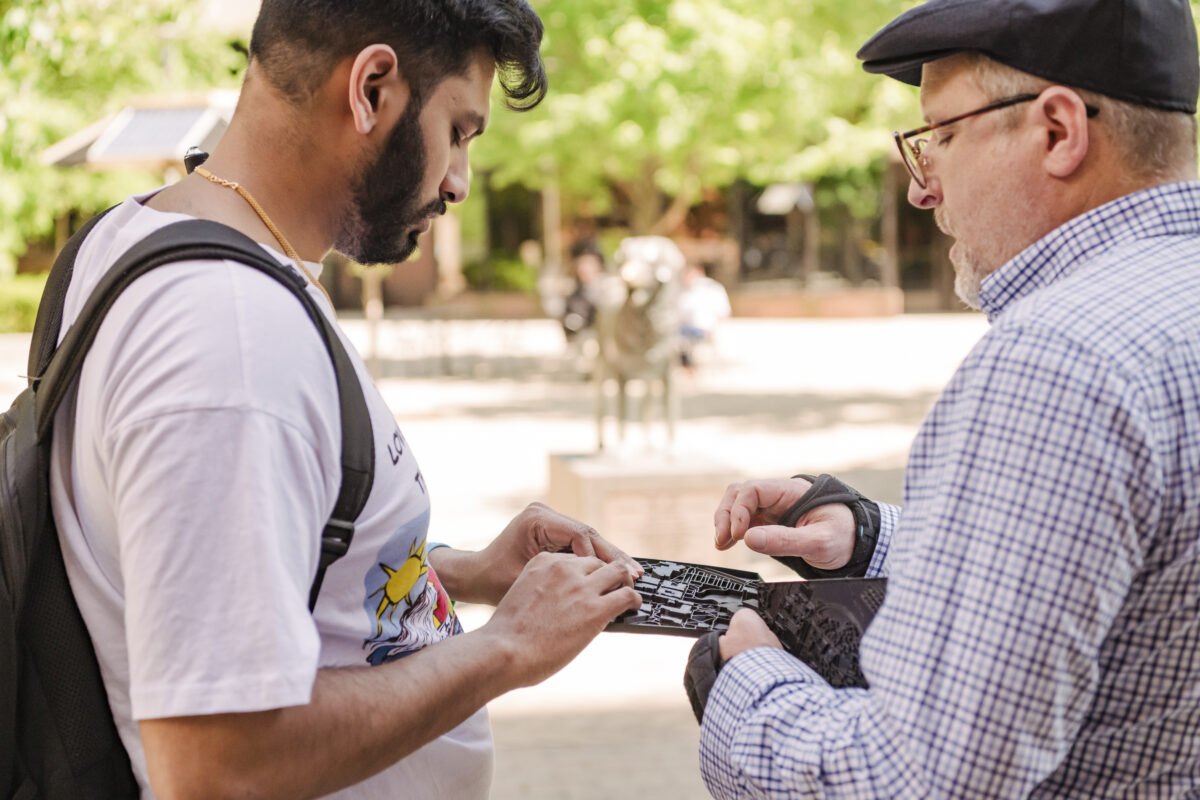 Michael Canale (r) has been working with Ph.D. students in human-centered computing to create personal tactile maps of campus for blind students at UMBC, like Shawn Abraham ’24, political science. (Marlayna Demond ’11/UMBC)
When Canele, who also received his post-master’s certificate in college teaching and learning science, heard that UMBC’s first Fulbright Scholar-in-Residence, Jules Buendgens-Kosten,would be teaching Language Learning and Special Education – Advanced Special Topics in Education, he was quick to enroll. The course, part of UMBC’s teaching English to speakers of other languages (TESOL) master’s program, was designed for anybody planning to work with heterogeneous groups of learners, including those of different neurotypes, both in special education and mainstream education settings.
Buendgens-Kosten, a research assistant at the Institute of English and American Studies at Goethe-Universität Frankfurt, Germany,began theirpartnership with UMBC as a research collaboration with Shannon Sauro, associate professor of education.Sauro recognized that Buendgens-Kosten’s expertise in English language teaching and teaching neurodivergent populations in Germany would add an international and non-U.S.-based perspective to UMBC’s TESOL program and education department.
My uni (@UMBC) just got so much geekier and cooler.
]]>
Neurodiversity inclusion and representation have been at the forefront of Michael Canale’s 20-year career in the disability services and education field. Canale, M.A. ’24, intercultural...
https://umbc.edu/stories/umbcs-first-fulbright-scholar-in-residence-research-on-neurodiversity/
https://my3.my.umbc.edu/api/v0/pixel/news/141776/guest@my.umbc.edu/9db27eba31ba49267d43df7a734d3ec0/api/pixel
cahss
cahss-research
coeit
community
education
fulbright
mlli
news
peaceworker
politicalscience
research
story
tesol
UMBC News & Magazine
https://my3.my.umbc.edu/groups/umbc-news-magazine
https://assets1-my.umbc.edu/system/shared/avatars/groups/000/001/943/24435aa6207c452e7bc15cc74b42c7bb/xsmall.png?1748556657
https://assets1-my.umbc.edu/system/shared/avatars/groups/000/001/943/24435aa6207c452e7bc15cc74b42c7bb/original.png?1748556657
https://assets2-my.umbc.edu/system/shared/avatars/groups/000/001/943/24435aa6207c452e7bc15cc74b42c7bb/xxlarge.png?1748556657
https://assets2-my.umbc.edu/system/shared/avatars/groups/000/001/943/24435aa6207c452e7bc15cc74b42c7bb/xlarge.png?1748556657
https://assets3-my.umbc.edu/system/shared/avatars/groups/000/001/943/24435aa6207c452e7bc15cc74b42c7bb/large.png?1748556657
https://assets1-my.umbc.edu/system/shared/avatars/groups/000/001/943/24435aa6207c452e7bc15cc74b42c7bb/medium.png?1748556657
https://assets2-my.umbc.edu/system/shared/avatars/groups/000/001/943/24435aa6207c452e7bc15cc74b42c7bb/small.png?1748556657
https://assets1-my.umbc.edu/system/shared/avatars/groups/000/001/943/24435aa6207c452e7bc15cc74b42c7bb/xsmall.png?1748556657
https://assets2-my.umbc.edu/system/shared/avatars/groups/000/001/943/24435aa6207c452e7bc15cc74b42c7bb/xxsmall.png?1748556657
UMBC News & Magazine
0
0
false
Tue, 07 May 2024 13:43:48 -0400
Tue, 07 May 2024 13:43:48 -0400
Mellon Foundation grants CAHSS $750K to establish Global Asias Initiative
Kimberly Moffitt, dean of the College of Arts, Humanities, and Socials Sciences, and co-pi Tamara Bhalla, associate professor of American studies and director of the Asian American studies minor, have been awarded a $750,000 grant from the Mellon Foundation to establish the Global Asias Initiative. The initiative will support the rethinking of Asian American issues on campus in a global, diasporic, and collaborative framework through community-engaged, public-facing scholarship and teaching.
“The impact and influence of the Asian diaspora in this region makes it clear that our world has more to offer in providing valuable opportunities for our students, while also creating additional partnerships with the greater Baltimore community,” says Moffitt.
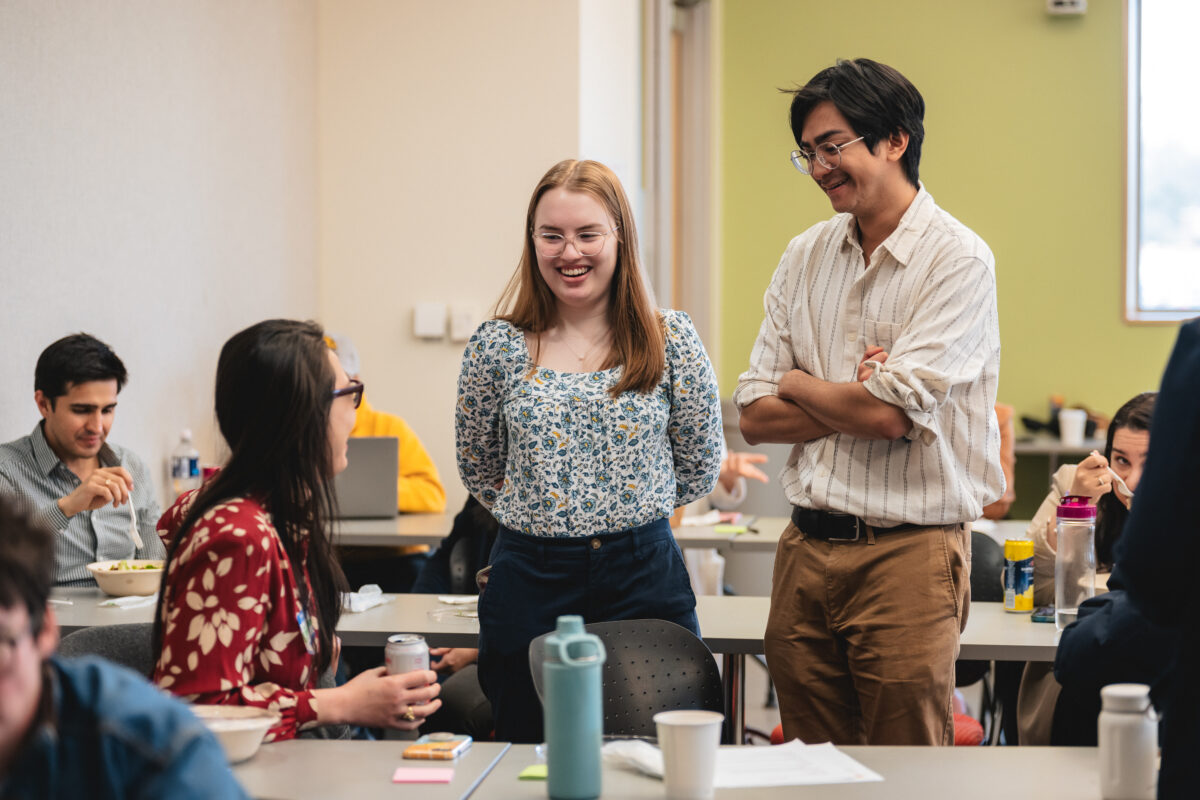 (l-r) Emily Yoon and students at the Global Asias Initiative launch workshop.
(Abnet Shiferaw)
UMBC’s existing Asian studies program and Asian American studies minor will grow into a more expansive Global Asias program that better serves and represents UMBC’s Asian American community, interested students, and beyond. This includes launching an undergraduate community-based research fellowship in Global Asias and the conversation series “Reframing Global Asias,” which invites prominent leaders, scholars, and community members in the field to present and discuss key issues, possibilities, challenges, and new research.
“Together,” says Bhalla, “we will create a forum for engaging in difficult yet productive intellectual conversations in Asian American studies, Asian diaspora studies, and Asian studies.”
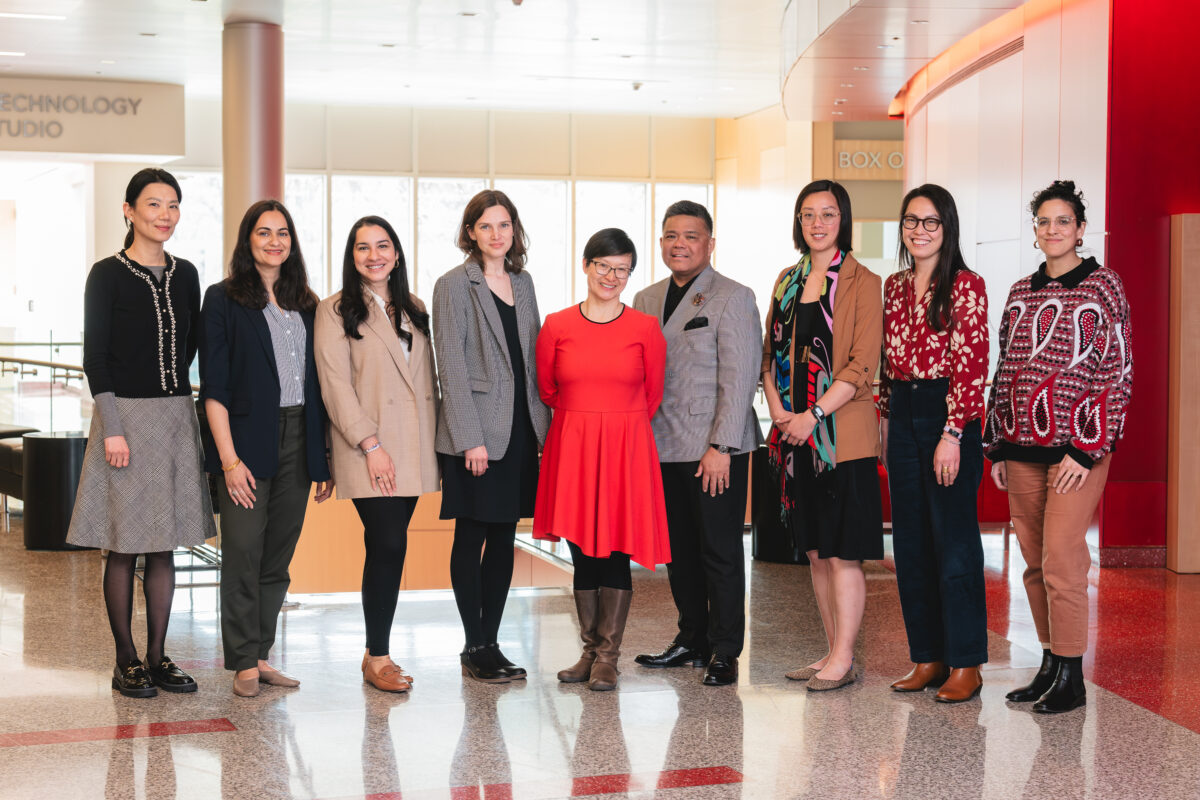 Global Asias Advisory Board, AY2023-2024. (l-r) Tamara Bhalla, Noor Zaidi, Meredith Oyen, Fan Yang, Theo Gonzalvez, Emily Yoon, and Priya Bhayana, project manager for the Global Asias Initiative. (Abnet Shiferaw)
Faculty across UMBC are collaborating to bring the Global Asia Initiative to fruition along with community partners:
-
Meredith Oyen, associate professor of history and director of the Asian studies program
-
Shin Yon Kim, Asian studies lecturer
-
Fan Yang, associate professor of media and communication studies
-
Emily Yoon, assistant professor of English
-
Noor Zaidi, assistant professor of history
-
Christopher Tong, associate professor of modern languages, linguistics, and intercultural communication
-
Theo Gonzalves, former American studies chair and professor, curator of Asian-Pacific American history at the Smithsonian National Museum of American History
-
Robbin Lee ’13, visual arts and media and communications studies, director of partnerships and mobilization at UpSurge Baltimore
Learn more about the Global Asias Iniatiave and Asian studies program.
]]>
Kimberly Moffitt, dean of the College of Arts, Humanities, and Socials Sciences, and co-pi Tamara Bhalla, associate professor of American studies and director of the Asian American studies minor,...
https://umbc.edu/quick-posts/umbc-to-establish-global-asias-initiative/
https://my3.my.umbc.edu/api/v0/pixel/news/140528/guest@my.umbc.edu/32bd2a6ff02002d0cfa31ee10d13251e/api/pixel
american-studies
asian-studies
cahss
english
history
mcs
mlli
news
policy-and-society
quick-post
quick-posts
research
visual-arts
UMBC News & Magazine
https://my3.my.umbc.edu/groups/umbc-news-magazine
https://assets1-my.umbc.edu/system/shared/avatars/groups/000/001/943/24435aa6207c452e7bc15cc74b42c7bb/xsmall.png?1748556657
https://assets1-my.umbc.edu/system/shared/avatars/groups/000/001/943/24435aa6207c452e7bc15cc74b42c7bb/original.png?1748556657
https://assets2-my.umbc.edu/system/shared/avatars/groups/000/001/943/24435aa6207c452e7bc15cc74b42c7bb/xxlarge.png?1748556657
https://assets2-my.umbc.edu/system/shared/avatars/groups/000/001/943/24435aa6207c452e7bc15cc74b42c7bb/xlarge.png?1748556657
https://assets3-my.umbc.edu/system/shared/avatars/groups/000/001/943/24435aa6207c452e7bc15cc74b42c7bb/large.png?1748556657
https://assets1-my.umbc.edu/system/shared/avatars/groups/000/001/943/24435aa6207c452e7bc15cc74b42c7bb/medium.png?1748556657
https://assets2-my.umbc.edu/system/shared/avatars/groups/000/001/943/24435aa6207c452e7bc15cc74b42c7bb/small.png?1748556657
https://assets1-my.umbc.edu/system/shared/avatars/groups/000/001/943/24435aa6207c452e7bc15cc74b42c7bb/xsmall.png?1748556657
https://assets2-my.umbc.edu/system/shared/avatars/groups/000/001/943/24435aa6207c452e7bc15cc74b42c7bb/xxsmall.png?1748556657
UMBC News & Magazine
0
0
false
Wed, 03 Apr 2024 11:06:07 -0400
Wed, 03 Apr 2024 11:06:07 -0400
For the third time in five years, UMBC is named a Fulbright Top Producing Institution
Within just a few months of living in Piątek, a small town in central Poland, Leah Michaels, M.F.A ’19, intermedia and digital arts, has already traveled to Romania, where many recipients of the Fulbright U.S. Student award placed throughout Europe gathered at a media literacy conference. She has also had an opportunity to research Polish film at Poland’s Film Archive and connect with a local genealogist who helped her find details about her Polish roots for a short documentary she is producing about her ancestry.
Michaels and nine other UMBC Fulbright student recipients researching and teaching English abroad this year helped propel UMBC, once again, to the elite ranks of a Fulbright Top Producing Institution, as reported today in The Chronicle of Higher Education. The designation recognizes colleges and universities with the highest number of students selected for the Fulbright U.S. Student Program, the U.S. government’s flagship international academic exchange program. UMBC first received this designation from the U.S. Department of State’s Bureau of Educational and Cultural Affairs in 2019 – 2020 and again in 2020 – 2021.
UMBC is one of 57 doctoral universities nationwide and three in Maryland to receive a Fulbright Top Producing Institution designation for Fulbright U.S. Students in 2023 – 2024.
More than 2,200 U.S. students from hundreds of colleges and universities are awarded Fulbright grants annually. However, only a few of these institutions are designated top producers yearly. In the last decade, UMBC students and recent graduates have received over 60 Fulbright U.S. Student Program awards in Africa, Asia and the Pacific, the Middle East, South America, and Europe.
“This achievement is a testament to your institution’s deep commitment to international exchange,” wrote Secretary of State Antony Blinken in a letter to President Valerie Sheares Ashby, congratulating her on UMBC’s Fulbright Top Producer designation, “and to building lasting connections between the people of the United States and the people of other countries.”
Mutual understanding
In partnership with more than 140 countries worldwide, the Fulbright U.S. Student Program offers unparalleled opportunities in all academic disciplines to graduating college seniors, graduate students, and young professionals from all backgrounds. Fulbright recipients play a critical role in U.S. public diplomacy, establishing long-term relationships between people and nations through graduate study, research, or teaching as English Teaching Assistants (ETAs). ETAs develop their own language skills and knowledge of the host country while teaching English to elementary, middle school, or college students.
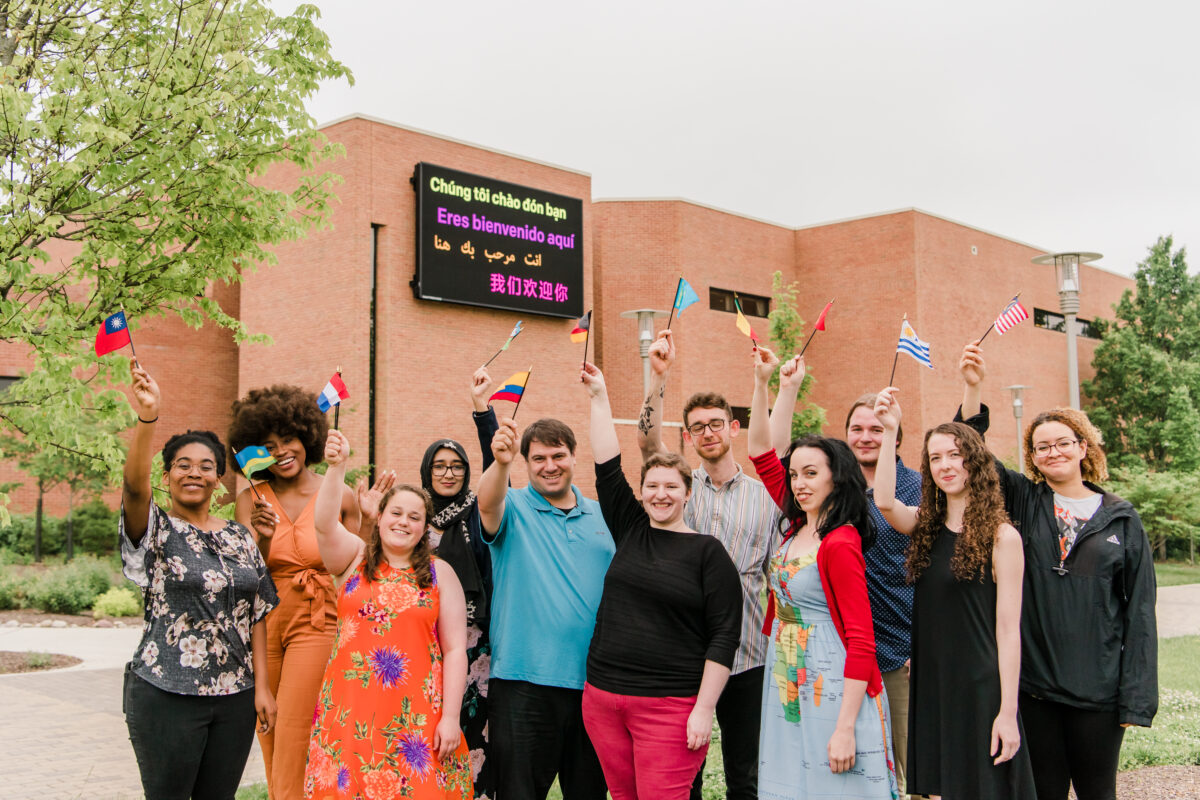 2019 – 2020 UMBC Fulbright U.S. Student recipients. (Marlayna Demond ’11/UMBC)
“As a public research university, it is imperative that we provide students with opportunities for global engagement,” says David Di Maria, associate vice provost for international education. “Fulbright is among the most prestigious of these opportunities.”
While Michaels has flourished in Poland, her 2023 – 2024 Fulbright class peers have also settled into their placements, which generally start in September with the new school year. Paul Ocone ’22, individualized study, is conducting research at the Meiji University School of Global Japanese Studies in Japan, and eight ETAs are teaching English across Europe and Asia:
- North Macedonia: David Bullman ’22, ancient studies
- Romania: Tiffany Powell, M.A.’23, teaching English to speakers of other languages (TESOL)
- Slovak Republic: Sianna Serio ’23, computer science
- South Korea: Tasneem Mansour ’20, modern languages, linguistics, and intercultural communication
- Taiwan: Nailah-Benā Chambers ’23, global studies; Kara Gavin ’20, English; and Milan Richardson ’23, bioinformatics
- Turkey: Grant Clifton, M.A. ’23, TESOL
“Being named a Top Producing Fulbright Institution is a tremendous honor—it not only shows the world what we already know about our amazing students, but it also lets our current students know that the Fulbright is a realistic opportunity for them,” says Brian Souders, Ph.D. ’09, language, literacy, and culture, M.A.’19, TESOL, and associate director of global learning at the Center for Global Engagement (CGE). Souders has led students through the Fulbright application process as UMBC’s Fulbright Program advisor for the last decade.
For Michaels, the experience has been life-changing. “My home city has been incredibly welcoming. I learned Polish folk dances, made Old Bay pierogi from scratch with some of my students, and joined a school trip to an art gallery,” says Michaels.
The Fulbright family
The Fulbright experience also includes college and university faculty and staff, as well as artists and professionals from a wide range of fields, who can join over 400,000 Fulbright alumni.
In October 2023,Renique Kersh, vice president of student affairs, and Souders traveled to Germany after receiving Fulbright International Education Administrator awards. Katherine Heird, director of education abroad and global learning, received the same award to travel to Taiwan in spring 2024. The award is geared to provide staff who support Fulbright applicants with a greater understanding of higher education worldwide.
Brian Souders is our assoc. director for global learning in the Center for Global Engagement and after years of helping faculty and students achieve their overseas learning and research goals, Brian recently took part in his own Fulbright exchange program. https://t.co/LvrOoabMou
— UMBC (@UMBC) November 15, 2023
Many UMBC faculty members and staff have received a Fulbright U.S. Scholar award over the years. This year, Lynn Cazabon, professor of visual arts and director of the Center for Innovation, Research, and Creativity in the Arts, received a Fulbright U.S. Scholar award to work at Queensland University, Australia, to create a public artwork based on local communities’ responses to climate change. Cazabon received her first Fulbright award in 2015 to the University of Liepāja, Latvia.
Fulbright Scholars globally are also drawn to UMBC’s welcoming community. Shannon Sauro, associate professor of education, hosted Jules Buendgens-Kosten, a research assistant at the Institute of English and American Studies at Goethe-Universität Frankfurt, Germany. Buendgens-Kosten joined UMBC as the institution’s first Fulbright Scholar-in-Residence to teach and share their research on inclusive education in teaching English as a foreign language to students in UMBC’s TESOL master’s program.
My uni (@UMBC) just got so much geekier and cooler.
]]>
Within just a few months of living in Piątek, a small town in central Poland, Leah Michaels, M.F.A ’19, intermedia and digital arts, has already traveled to Romania, where many recipients of the...
https://umbc.edu/stories/umbc-a-fulbright-top-producing-institution-2/
https://my3.my.umbc.edu/api/v0/pixel/news/138957/guest@my.umbc.edu/05838e8345b6084d69684b1796077d12/api/pixel
ancient-studies
biological-sciences
cahss
cnms
coeit
community
computer-science
education
english
fulbright-scholarship
global-studies
international
mlli
news
story
UMBC News & Magazine
https://my3.my.umbc.edu/groups/umbc-news-magazine
https://assets1-my.umbc.edu/system/shared/avatars/groups/000/001/943/24435aa6207c452e7bc15cc74b42c7bb/xsmall.png?1748556657
https://assets1-my.umbc.edu/system/shared/avatars/groups/000/001/943/24435aa6207c452e7bc15cc74b42c7bb/original.png?1748556657
https://assets2-my.umbc.edu/system/shared/avatars/groups/000/001/943/24435aa6207c452e7bc15cc74b42c7bb/xxlarge.png?1748556657
https://assets2-my.umbc.edu/system/shared/avatars/groups/000/001/943/24435aa6207c452e7bc15cc74b42c7bb/xlarge.png?1748556657
https://assets3-my.umbc.edu/system/shared/avatars/groups/000/001/943/24435aa6207c452e7bc15cc74b42c7bb/large.png?1748556657
https://assets1-my.umbc.edu/system/shared/avatars/groups/000/001/943/24435aa6207c452e7bc15cc74b42c7bb/medium.png?1748556657
https://assets2-my.umbc.edu/system/shared/avatars/groups/000/001/943/24435aa6207c452e7bc15cc74b42c7bb/small.png?1748556657
https://assets1-my.umbc.edu/system/shared/avatars/groups/000/001/943/24435aa6207c452e7bc15cc74b42c7bb/xsmall.png?1748556657
https://assets2-my.umbc.edu/system/shared/avatars/groups/000/001/943/24435aa6207c452e7bc15cc74b42c7bb/xxsmall.png?1748556657
UMBC News & Magazine
2
0
false
Tue, 13 Feb 2024 11:32:48 -0500
Tue, 13 Feb 2024 11:32:48 -0500
 Signs in the office of COCOMACIA say ‘option for life’ and ‘peace, we all build it.’ Tania Lizarazo
 Andres Magallan carries an urn with the remains of Ivan Mejia, who was murdered by right-wing paramilitary guerrillas years before, in Santa Maria, Chocó, Colombia, in 2010. Raul Arboleda/AFP via Getty Images
 Comisionadas next to a poster with information about a landmark law against domestic violence, on July 7, 2012. María del Socorro Mosquera Pérez sits on the left. Tania Lizarazo
 Students paint a mural in Quibdó, Chocó, Colombia, which says ‘Somos Atrato’: We are the Atrato River. Jan Sochor/Getty Images