New UMBC/Los Alamos research on megafire smoke plumes clarifies what they contain, how they move, and their potential impacts

In recent years, large, intense wildfires, known as megafires, have increasingly caused severe damage to forests, homes, and crops. In addition to megafires fatally impacting humans and wildlife alike, they may also be impacting climate change. New research led by UMBC’s Stephen Guimond provides insight into how the large smoke plumes produced by megafires can be more accurately modeled and characterized to improve our understanding of how they might impact the earth.
Guimond, an associate research professor of physics, collaborated with scientists at the Los Alamos National Laboratory to determine the long-term effects of smoke plumes from megafires. Their findings, recently published in the Journal of Advances in Modeling Earth Systems, demonstrates how previous research utilized a model grid spacing that does not sample smoke plumes accurately. These inaccuracies in defining the dynamics of the problem lead to errors in interpretation of the smoke’s properties, vertical and horizontal movement of the plume, and potential climatic effects.
Tracking how smoke rises
The smoke plumes from megafires are voluminous and can rise very high into the upper atmosphere. Initially, the plumes get transported upwards by convective cells and travel into the stratosphere, explains Guimond, who is also a scientist at UMBC’s Goddard Earth Sciences Technology and Research (GESTAR) II (previously known as the Joint Center for Earth Systems Technology).
 Stephen Guimond. (Photo courtesy of Stephen Guimond)
“Once it gets up into the stratosphere, the smoke can stay around for many months, even up to a year or more. The fact that it can stay up there so long means that you can get effects on the solar radiation reaching the surface,” says Guimond. “If you have a big, dark-colored blanket of smoke up there, it’s going to absorb most of the sunlight, which will lead to less sunlight reaching the surface of the earth. Because of this, you could get, over a long period of time, a cooling that happens on the surface of the earth,” among other impacts.
For three years, scientists at Los Alamos studied the chemical properties of smoke plumes by burning objects like trees in a controlled setting to determine the percentages of carbon that the smoke emitted. The scientists evaluated atmospheric particulates, or aerosols, which have a major effect on climate. Guimond used a NASA climate model to determine the carbon characteristics of the smoke plumes, how they rise into the atmosphere, and the underlying causes of rotation within the plumes.
“The measurements we looked at included particle types, the spectrum of the particles, and their sizes,” says Guimond. “We also looked at the contributions of different chemical species such as black carbon, organic carbon, and other chemical compounds that come off of burning materials.”
Assessing previous smoke plume research
The color of the smoke is an important factor, Guimond notes, as different types of smoke have different radiative properties. White smoke is composed mostly of organic carbon: brightly-colored aerosol particles that in large part reflect radiation back into the atmosphere. Black smoke is composed mostly of black carbon: dark-colored aerosol particles that absorb radiation.
The researchers determined that previous models didn’t accurately sample the types of carbon within smoke plumes, leading to miscalculations or incorrect assumptions about the percentage of black carbon the plumes contained.
As the black smoke absorbs solar radiation, the smoke heats up, which can create a lofting effect that pushes the smoke higher into the atmosphere. The higher the smoke rises, the longer it stays in the stratosphere. The longer it stays, the more time it has to impact the surface of the earth. This means that inaccurate characterization of the percentage of black carbon in wildfire smoke can lead to inaccurate calculations of the lofting effect, height of the plume and stratospheric lifetime, as well as climatic effects.
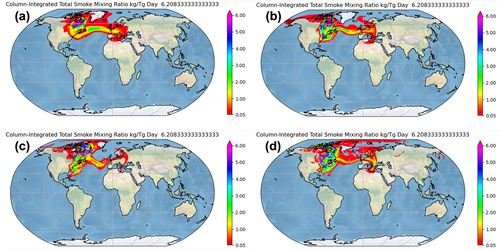 Figure 1
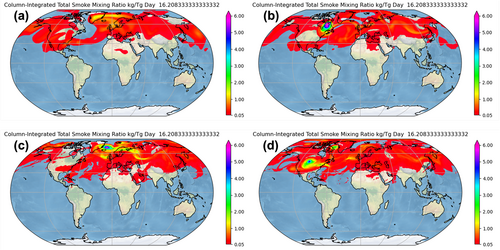 Figure 2
Figure 1 (left): The horizontal structure of the smoke plume at 6.2 days by vertically integrating the total smoke mixing ratio over the entire model atmosphere into the simulations for varying resolutions: (a) 2.0° (b) 1.0° (c) 0.25° and (d) 7 km.

    Figure 2 (right): The same as figure 1, except at 16.2 days. The horizontal structure of the smoke plume is significantly different between the various resolution simulations. (Images courtesy of Stephen Guimond and the Journal of Advances in Modeling Earth Systems)
Limits in how previous research represented the atmosphere also made for less accurate smoke plume simulations, Guimond said. He notes that prior smoke plume research used “coarse representation of the smoke plume in the model calculations, which has significant downstream effects on all other components of this problem, including the conclusions drawn from the research.”
Guimond hopes that his research can improve understanding of the dynamics of this problem: tracking of atmospheric motion and forces in three-dimensions, and how phenomena like rotating smoke plumes form and decay.
“Scientists need to accurately simulate the dynamics in order to get more accurate answers about aerosol properties inside the smoke plumes,” Guimond says, “such as how much of the smoke is black carbon, how long it is going to last in the stratosphere, how high it rises, and its effects on the radiation of the earth.”
With more accurate models and simulations, future research will be able to better inform climate policy and megafire response.
]]>
In recent years, large, intense wildfires, known as megafires, have increasingly caused severe damage to forests, homes, and crops. In addition to megafires fatally impacting humans and wildlife...
https://umbc.edu/stories/research-megafire-smoke-plumes/
https://my3.my.umbc.edu/api/v0/pixel/news/132851/guest@my.umbc.edu/1e34f79fff48056e08945b2093816fad/api/pixel
cnms
gestar
jcet
news
physics
rca-2
research
science-and-tech
UMBC News & Magazine
https://my3.my.umbc.edu/groups/umbc-news-magazine
https://assets1-my.umbc.edu/system/shared/avatars/groups/000/001/943/24435aa6207c452e7bc15cc74b42c7bb/xsmall.png?1748556657
https://assets1-my.umbc.edu/system/shared/avatars/groups/000/001/943/24435aa6207c452e7bc15cc74b42c7bb/original.png?1748556657
https://assets2-my.umbc.edu/system/shared/avatars/groups/000/001/943/24435aa6207c452e7bc15cc74b42c7bb/xxlarge.png?1748556657
https://assets2-my.umbc.edu/system/shared/avatars/groups/000/001/943/24435aa6207c452e7bc15cc74b42c7bb/xlarge.png?1748556657
https://assets3-my.umbc.edu/system/shared/avatars/groups/000/001/943/24435aa6207c452e7bc15cc74b42c7bb/large.png?1748556657
https://assets1-my.umbc.edu/system/shared/avatars/groups/000/001/943/24435aa6207c452e7bc15cc74b42c7bb/medium.png?1748556657
https://assets2-my.umbc.edu/system/shared/avatars/groups/000/001/943/24435aa6207c452e7bc15cc74b42c7bb/small.png?1748556657
https://assets1-my.umbc.edu/system/shared/avatars/groups/000/001/943/24435aa6207c452e7bc15cc74b42c7bb/xsmall.png?1748556657
https://assets2-my.umbc.edu/system/shared/avatars/groups/000/001/943/24435aa6207c452e7bc15cc74b42c7bb/xxsmall.png?1748556657
UMBC News & Magazine
0
0
false
Fri, 21 Apr 2023 08:02:38 -0400
Fri, 21 Apr 2023 08:02:38 -0400
Lighting design to flu treatment: UMBC students share research and creative work at URCAD 2023

In 2020, Renata Taylor-Smith ’24, theatre, eagerly prepared for her first trip to Munich, Germany to study theatrical lighting design, but a week before she was meant to fly to Germany, her trip was canceled due to COVID-19. She learned that the show she helped to prepare the lighting design for, a production of Jessica Dickey’s The Amish Project, would be postponed indefinitely.
“That roadblock forced me to think creatively about how I could redesign my project,” says Taylor-Smith. With the help of her faculty mentor Adam Mendelson, senior lecturer in theatre, Taylor-Smith sought new ways to gain hands-on experience in lighting design research. Mendelson connected her with other Baltimore-based lighting designers and encouraged her to attend the Live Design International conference and trade show to network with industry professionals.
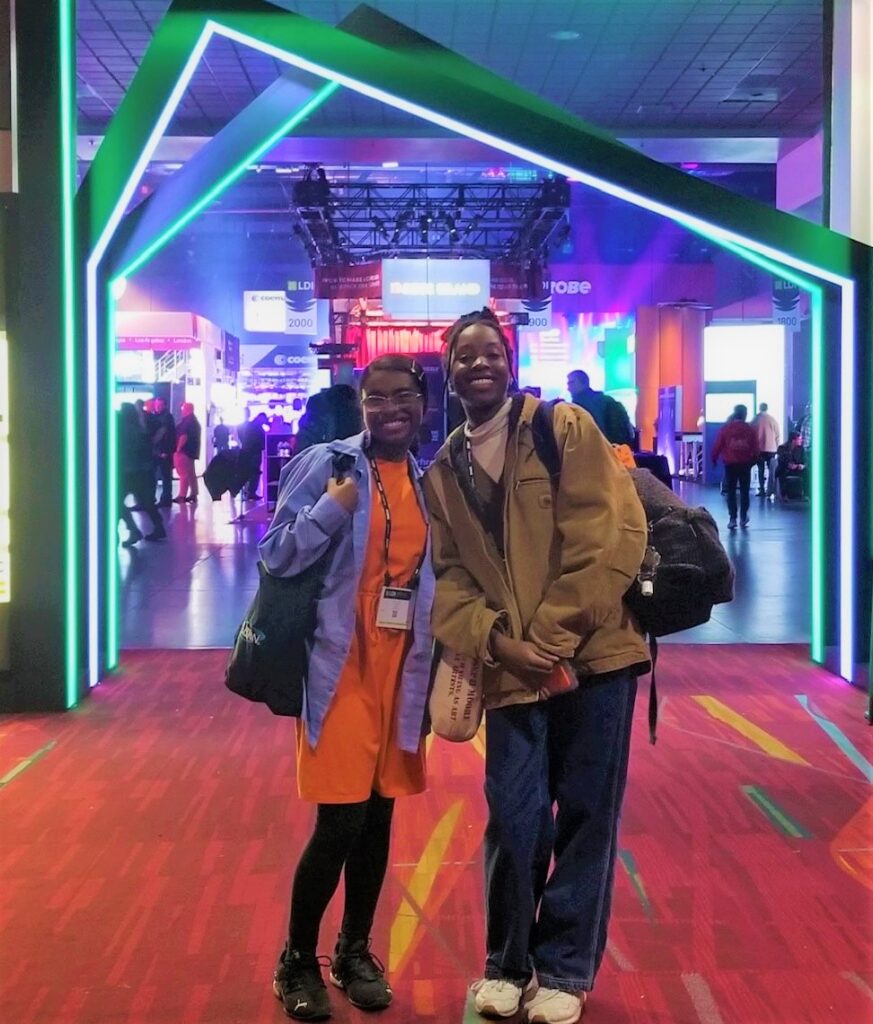 Renata Taylor-Smith (R) with Niya John ’24, theatre, at the Live Design International conference and trade show in November 2022. (Photo curtesy of Renata Taylor-Smith)
Taylor-Smith says, “I was able to meet the intended goal of my research project while also expanding the scope of my project to include opportunities to learn from other designers.” It came full-circle this year when Taylor-Smith worked as the assistant lighting designer, and later transitioned to head designer, for a production of The Amish Project at UMBC’s Black Box Theatre.
Last week Taylor-Smith showcased that work at UMBC’s 2023 Undergraduate Research and Creative Achievement Day (URCAD), held in person for the first time since COVID-19. There, she and nearly 200 other UMBC students convened to present their research and creative projects.
“I was really stressed about presenting my research,” says Taylor-Smith, sharing a feeling that many first-time URCAD presenters initially experience. “I had to remind myself that I spent almost a whole year working on this and all I had to do was talk about what I’ve done. I’m taking the experience that I’ve gained from doing shows to become more confident in my voice as a lighting designer and in my design choices.”
Lighting in the final scene of The Amish Project, designed by Renata Taylor-Smith. (Video courtesy of Renata Taylor-Smith)
Mendelson shares that he was excited to support Taylor-Smith with her URCAD project because hands-on research “allows students who have an interest to really get started, grow, and think through their ideas.”
With support from UMBC’s William T. Brown Shakespeare on Wheels Research Award and an Undergraduate Research Award, Taylor-Smith expects to finally make her way to Germany later this year.
“When someone believes in you…believe them.”
This year’s URCAD featured a talk by special guest Alicia Wilson’04, political science, who is the managing director and global head of philanthropy for the North America region for JPMorgan Chase. Wilson captivated an audience of URCAD presenters and attendees, sharing her personal journey, the value of her research experience, and the power of mentorship.
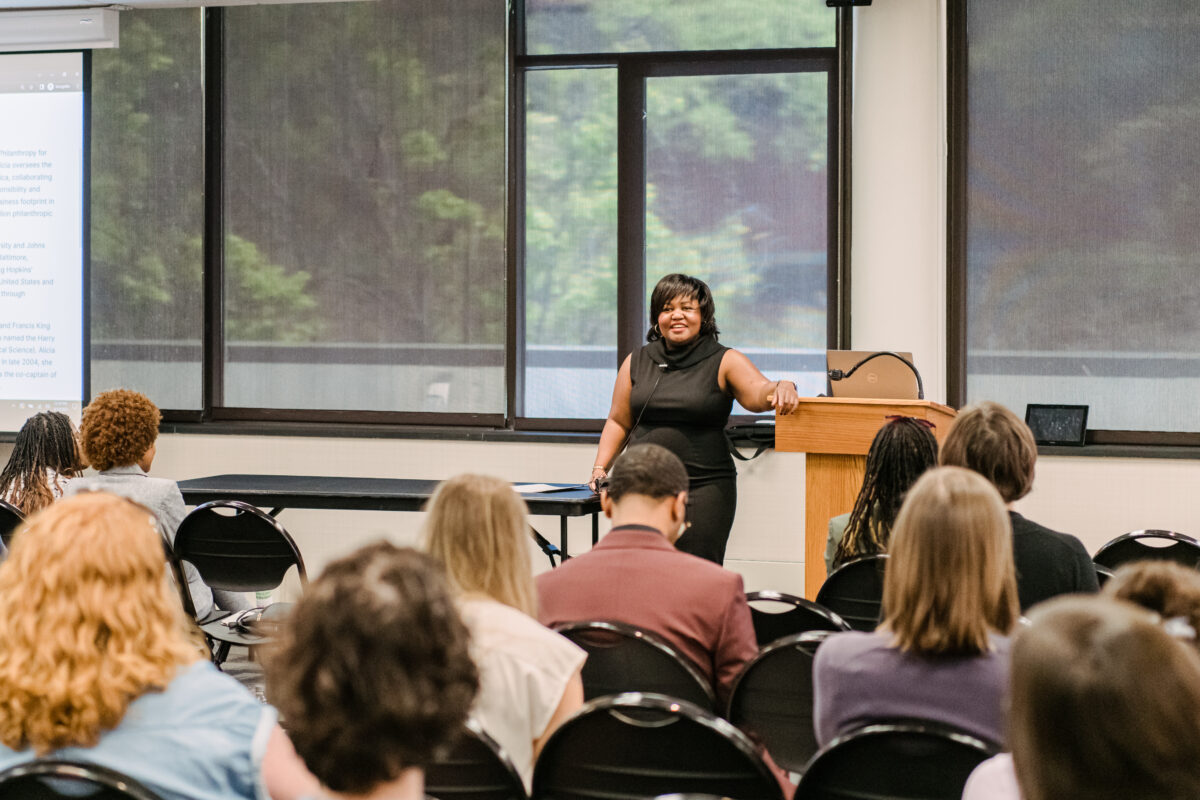 Alicia Wilson delivering the keynote speech at URCAD 2023. (Marlayna Demond ’11/UMBC)
“UMBC, for me, represents so much of who I am and what I want to be in the world,” says Wilson. “My pathway to where I am now is rooted in relationships, being able to care for my community and people regardless of their background. I learned at UMBC to treat everyone well and to research and understand things.”
She advised students to “explore any type of research that you might be interested in,” saying that “it all leads to a great place.” Wilson also encouraged students to take heed of their supporters’ belief in their abilities: “When someone believes in you—even if you can’t believe in yourself—believe them. Don’t believe your doubts. Believe in their belief in you.”
Wilson, who presented her research on community-building at UMBC’s 2022 GRIT-X event, also shared her experience building and sustaining connections, from an 8-year-old who became her mentee to former first lady Michelle Obama.
The language of toys
Theo Reinhert ’23, media and communications studies, is one of the hundreds of UMBC students who presented their work at URCAD this year. Reinhert engaged a crowd of URCAD observers with a display of children’s toys, gathered to demonstrate his analysis of how gender ideologies can be coded in toys.
“While growing up and struggling with my own gender, toys were one of those media that impacted and had power over how I viewed my gender,” Reinhert explained after his presentation. It made him curious to understand how material objects can have the power to carry ideas.
Reinhert found presenting at URCAD to be an important learning experience. “As I presented my research, I understood my ideas better,” he said. “Creating a presentation was a step for me to understand the final research outcomes.”
He also found the support of his faculty mentor, Jason Loviglio, associate professor of media and communication studies, to be essential. “Whenever I would feel lost, Dr. Loviglio would assure me that I was experiencing a normal stage in humanities research” and he’d provide valuable insight, Reinhart said.
Balancing privacy and utility in smart devices
Several students worked together to complete complex group research projects. Tartela Tabassum ’23, information systems; Luke Zimmermann ’24, computer science; Ruhshana Bobojonova ’24, biological sciences; and Joshua Cheeks ’25, computer science, collaborated to explore the tradeoffs that exist between privacy and utility when using smart devices at home.
The group worked in the DAta Management and Semantics (DAMS) research lab led by Roberto Yus, assistant professor of computer science and electrical engineering. They built a prototype of a framework to generate inferences about a person based on audio and video input like speech data collected by a smart speaker and images from a smart security camera, using open-source code and artificial intelligence and machine learning algorithms.
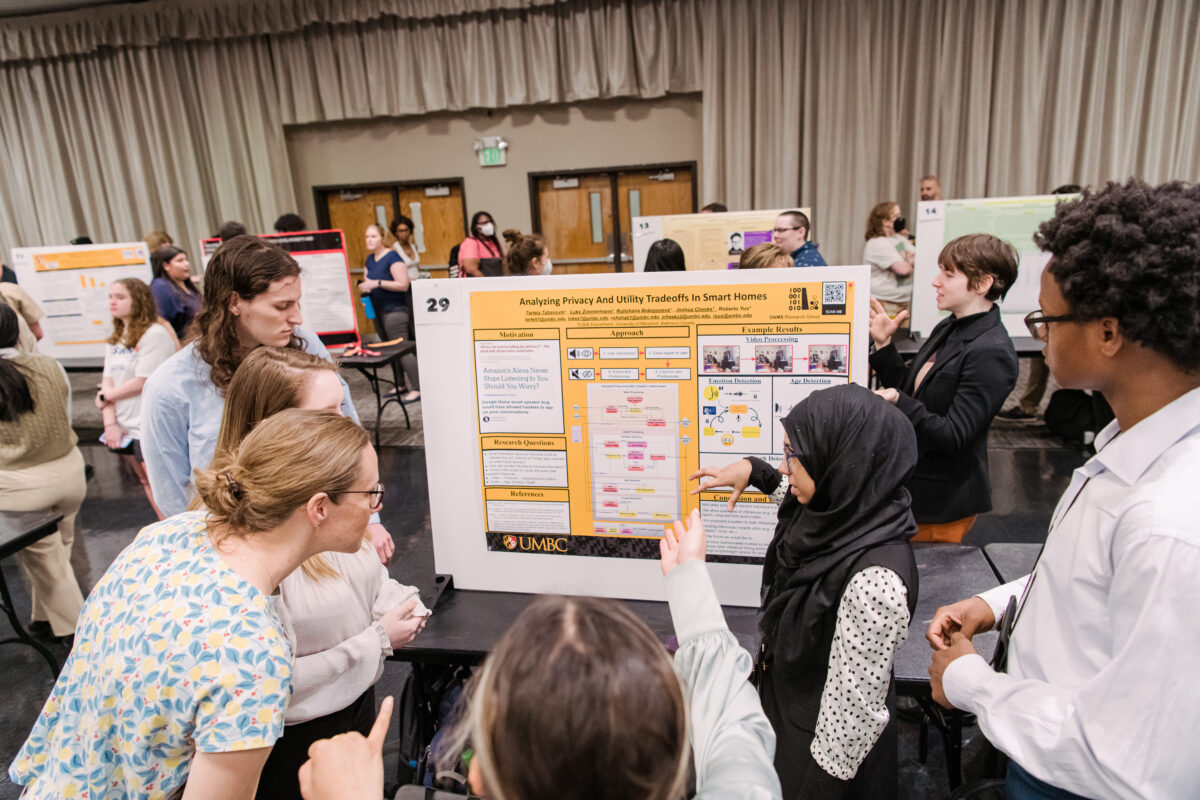 Tartela Tabassum (in black) with her group explaining their research at URCAD 2023 (Marlayna Demond ’11/UMBC)
“We think that privacy is a rising issue,” says Tabassum. “There are things going on with the government trying to ban social media platforms like Tik Tok because of these privacy issues. We want to give users more autonomy with their own privacy.”
Developing flu treatments
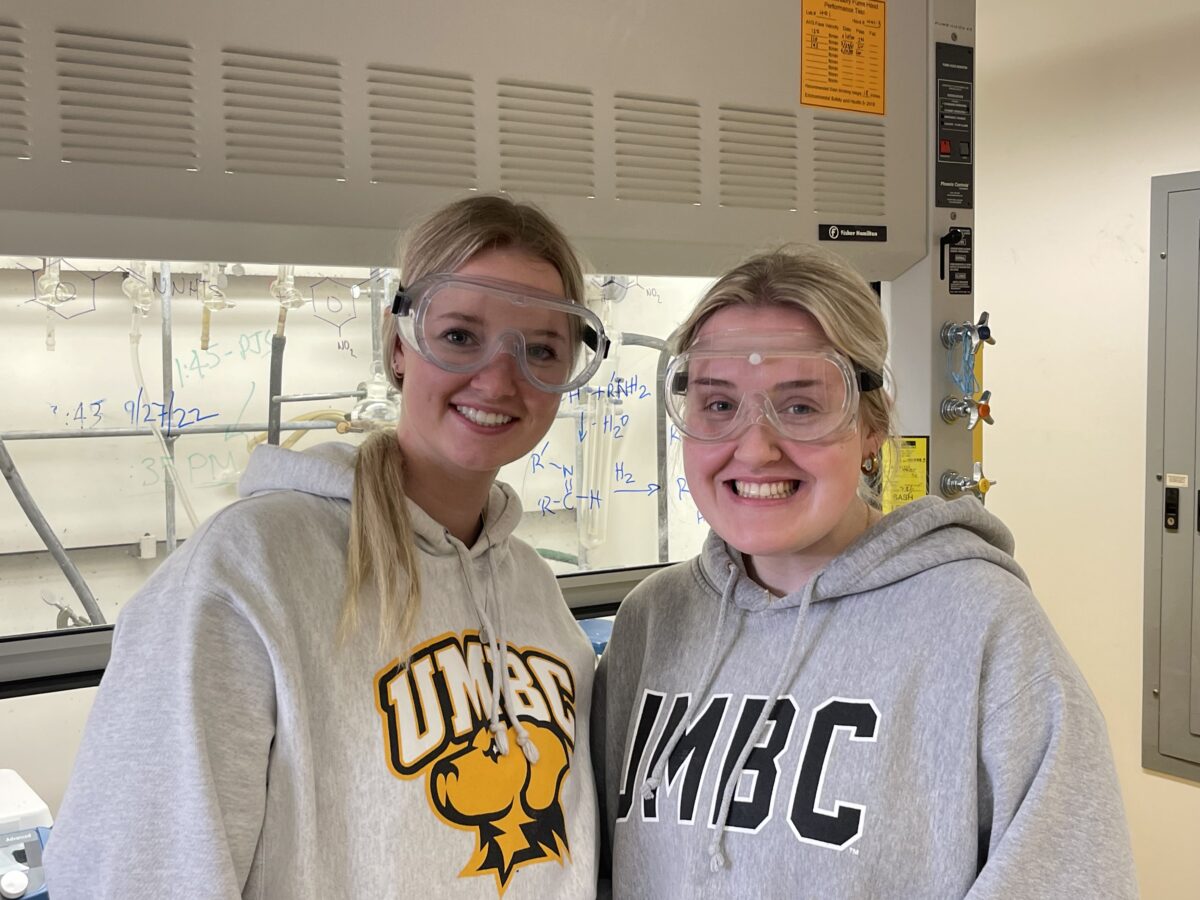 Brooke Nelson (left) and Lillian Kidd. (Photo courtesy of Lillian Kidd)
Lillian Kidd ’24, biochemistry and molecular biology, explored the design and synthesis of palmitoyltransferase inhibitors as potential therapeutics for influenza, or the flu, with her research partner Brooke Nelson ’23, biological sciences. Kidd and Nelson received an Undergraduate Research Award to support their work with faculty mentor Paul Smith, associate professor of chemistry and biochemistry.
“I think doing research is a lot like standing in front of a mirror. It exposes you to what you’re scared of and inversely, what you’re excited about. I learned a lot about my approaches to problem solving and discovered a deep interest in biochemistry,” says Kidd.
She shares that her preparation leading up to URCAD helped her to grow as a research scientist: “There is so much specificity to every single step in our synthesis of palmitoyltransferase inhibitors that pushed me beyond what I had learned in the class environment. Actively using all of the information I studied to carry out research in the lab was such a fundamental experience to my growth as a research scientist.”
A history of Baltimore’s LGBTQ+ nightlife
Ava Sekowski ’24, political science and media and communication studies, was inspired to explore the history of LGBTQ+ nightlife in Baltimore after growing up hearing stories about The Hippo, a now-defunct LGBTQ+ bar where her parents met. Sekowski created the short film “Out in the Open: Tracing the History of Gay Nightlife in Baltimore,” which chronicles the decline in LGBTQ+ nightlife establishments in the city.
“In coming to UMBC, I wanted to explore more about the history of Baltimore through the lens of the LGBTQ+ community,” shares Sekowski. For this project, she says, “I wanted to explore why The Hippo is gone. I heard about the bar my whole life being this amazing club that was welcoming, and I wanted to explore if that was true and who it was welcoming for.”
Ava Sekowski’s short film “Out in the Open: Tracing the History of Gay Nightlife in Baltimore.”
The project enabled Sekowski to practice her editing and interviewing skills and taught her how to navigate the post-production process. “The process was much harder than I thought it would be,” she shares. “I was a one-person filming and editing crew. The hardest part, for me, was filming and getting the lighting correct, but in the end, I’m pretty happy with how it turned out.”
A bioinformatics approach to understanding DNA
In his research, Emmanuel Mekasha ’25, biological sciences, explores promoter regions located in DNA structures and how they are fundamental to our understanding of how gene expression is regulated. He is helping to tackle the challenge of designing generic computational programs capable of finding promoters across different organisms, with the guidance of his mentor Ivan Erill, professor of biological sciences, and biological sciences Ph.D. student Elia Mascolo.
“I have always been an interdisciplinary learner. Based on bioinformatics approaches, my project combines the best aspects of mathematics, statistics, computation, and biology,” says Mekasha. “I thoroughly enjoyed everything that went into this project, from the literature review to the experimental design.”
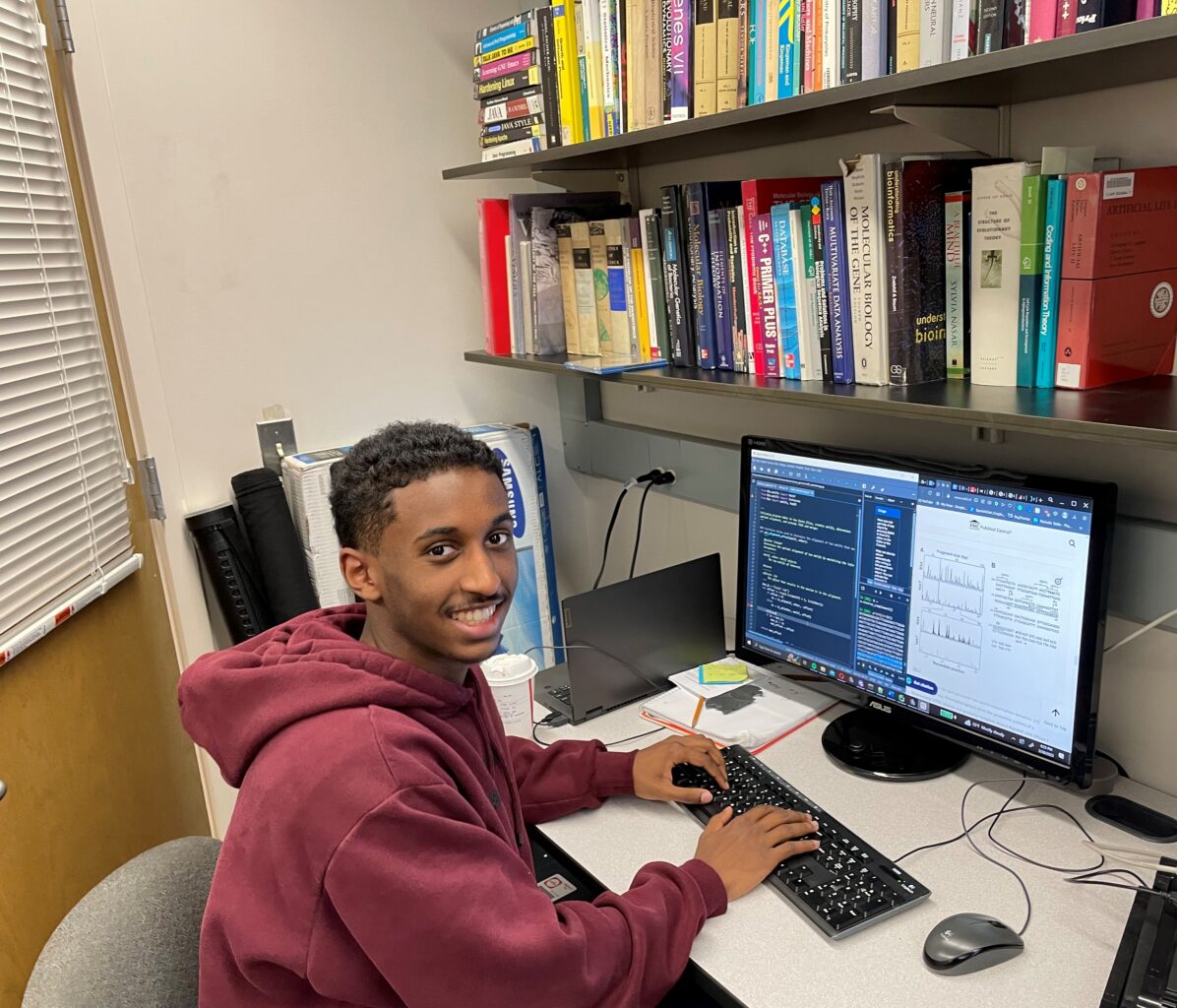 Emmanuel Mekasha (Photo courtesy of Emmanuel Mekasha)
Mekasha already has his sights set on continuing his research pursuits beyond his time at UMBC. “This project, and previous research experiences, have made me certain that I want to do research in the future, leading me to my goal of achieving an MD-Ph.D. degree.”
Implicit bias in healthcare
Thu Dinh ’23, biological sciences; Maryamah Ndao ’23, psychology; and Jorge Saucedo ’23, psychology, worked as research assistants in the Social Determinants of Health Inequities Lab (SoDHI), led by their faculty mentor Danielle Beatty Moody, associate professor of psychology. The group examined the systemic impact of implicit bias from healthcare providers on patient health outcomes. For Ndao, this was a research topic she’s been interested in since her first year at UMBC.
Ndao describes her main focus as “making sure that the healthcare needs…of Black people, especially Black women, are heard.”
 Maryamah Ndao (left) with President Valerie Sheares Ashby at URCAD 2023. (Marlayna Demond ’11/UMBC)
“The data is very clear and the disparities are clear but there’s a lack of action,” Ndao shared during the group’s poster presentation. “Having this opportunity at URCAD to be able to speak to people directly is beneficial because a lot of people [may not] know about this.”
For Saucedo, this research interested him on a personal level, as someone who has lived with chronic pain and felt that medical professionals didn’t believe the amount of pain he was experiencing.
“As a minority myself, I’ve faced a lot of discrepancies and had people not take my pain seriously. I’ve had experiences through the healthcare system that made me feel as if I wasn’t fully represented culturally. I felt as if I was neglected from having proper care because of that,” says Saucedo. Because of his experiences, Saucedo was interested in exploring the research being done at the SoDHI lab.
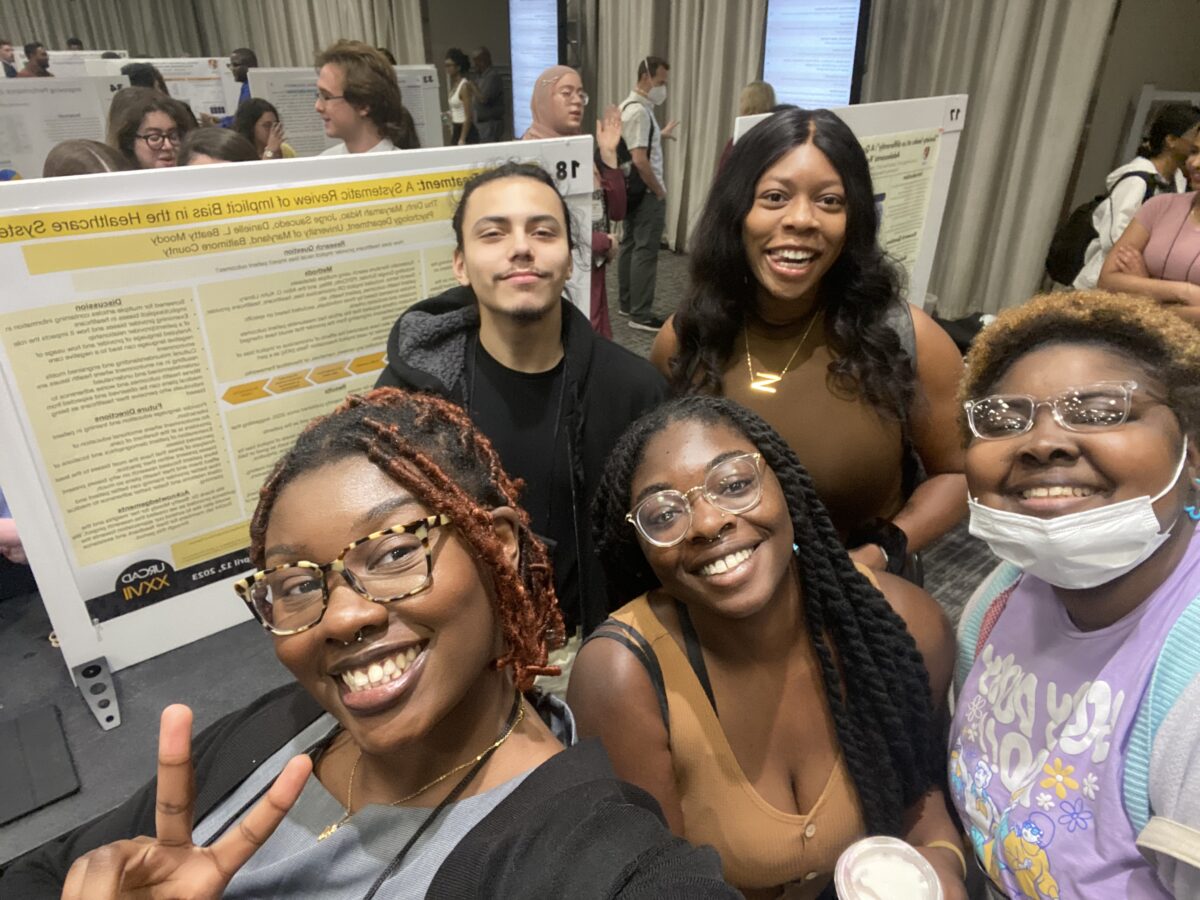 Maryamah Ndao (front row, left) with Jorge Saucedo (back row, left) and friends at URCAD 2023. (Photo courtesy of Maryamah Ndao)
Ndao hopes to one day open her own mental health medical practice to better help individuals from marginalized groups, and also impact the conversation on bias in healthcare. “I want to do more advocating. I love speaking about this topic,” says Ndao.
Reducing pain after shoulder surgery
Supported by UMBC’s Mechanical Engineering S-STEM program, Jacob Lombardo ’25, mechanical engineering, explored how the use of a cooling pad could be beneficial in the healing of surgical repair sites of shoulder injuries. His research asserts that effective cooling may temporarily reduce nerve activity by disrupting the transmission of pain signals and could be a cost-effective approach to decrease the use of painkiller medications during surgical recovery.
With the help of his faculty mentor Liang Zhu, professor of mechanical engineering, Lombardo learned how to circumvent obstacles that arose during the research process. “Research allows you to overcome problems that don’t have a textbook answer,” says Lombardo.
For example, he explains, “My research included the use of a blood flow measurement device. I initially encountered difficulties getting meaningful results from the device. With the encouragement of my advisor, I got in contact with the manufacturer.” Their engineers explained in more detail how the device worked and shared best practices for using it effectively in research.
This experience learning more about medical technologies has inspired him to continue to pursue biomedical engineering. He says, “I am motivated by the possibility of improving patient care through research, and I am eager to expand upon my experience in future projects.”
UMBC Review
Several URCAD presenters and other student researchers have shared the results of their research and creative work in UMBC Review, a peer-reviewed research publication completely directed by UMBC undergraduate students. Free print copies of the new 24th edition are available in the Office of Undergraduate Research and Prestigious Scholarships, located in the Albin O. Kuhn Library and Gallery.
]]>
In 2020, Renata Taylor-Smith ’24, theatre, eagerly prepared for her first trip to Munich, Germany to study theatrical lighting design, but a week before she was meant to fly to Germany, her trip...
https://umbc.edu/stories/urcad-2023/
https://my3.my.umbc.edu/api/v0/pixel/news/132830/guest@my.umbc.edu/488530977e3b461f9c2f11bb6ff1f78e/api/pixel
arts-and-culture
cahss
cnms
coeit
community
news
rca-2
research
science-and-tech
urcad
UMBC News & Magazine
https://my3.my.umbc.edu/groups/umbc-news-magazine
https://assets1-my.umbc.edu/system/shared/avatars/groups/000/001/943/24435aa6207c452e7bc15cc74b42c7bb/xsmall.png?1748556657
https://assets1-my.umbc.edu/system/shared/avatars/groups/000/001/943/24435aa6207c452e7bc15cc74b42c7bb/original.png?1748556657
https://assets2-my.umbc.edu/system/shared/avatars/groups/000/001/943/24435aa6207c452e7bc15cc74b42c7bb/xxlarge.png?1748556657
https://assets2-my.umbc.edu/system/shared/avatars/groups/000/001/943/24435aa6207c452e7bc15cc74b42c7bb/xlarge.png?1748556657
https://assets3-my.umbc.edu/system/shared/avatars/groups/000/001/943/24435aa6207c452e7bc15cc74b42c7bb/large.png?1748556657
https://assets1-my.umbc.edu/system/shared/avatars/groups/000/001/943/24435aa6207c452e7bc15cc74b42c7bb/medium.png?1748556657
https://assets2-my.umbc.edu/system/shared/avatars/groups/000/001/943/24435aa6207c452e7bc15cc74b42c7bb/small.png?1748556657
https://assets1-my.umbc.edu/system/shared/avatars/groups/000/001/943/24435aa6207c452e7bc15cc74b42c7bb/xsmall.png?1748556657
https://assets2-my.umbc.edu/system/shared/avatars/groups/000/001/943/24435aa6207c452e7bc15cc74b42c7bb/xxsmall.png?1748556657
UMBC News & Magazine
0
0
false
Thu, 20 Apr 2023 14:16:37 -0400
Thu, 20 Apr 2023 14:16:37 -0400
Michelle R. Scott illuminates the lives of Black Vaudeville performers and their broader social impact in Jazz Age America
Michelle Scott, associate professor of history, will discuss her new book T.O.B.A. Time: Black Vaudeville and the Theater Owners Booking Association in Jazz Age America(University of Illinois Press, 2023) on April 11, presenting the history department’s annual Lowe Lecture. In a conversation with UMBC News, Scott shares the artistic, social, and historic context of an association that brought Black artists to both Black and white audiences across the United States during the 1920s.
 Michelle Scott. (Marlayna Demond ’11/UMBC)
UMBC News: What are some of the central themes the book explores?
Scott: The book explores the lives of the performers, theater owners, producers, managers, and audiences that were part of Black Vaudeville and the Theater Owners Booking Association (T.O.B.A.). It’s a story about how these Black- and white-owned theaters fostered Black artistic exploration and development and the growth of Black-owned businesses. T.O.B.A. is the foundation of Black live entertainment in the 20th century. This is the first in-depth study of this circuit during a time of transition in the entertainment industry between WWI and the Great Depression in segregated America.
UMBC News: Who were some of the artists who began with T.O.B.A. and grew famous, leading to profitable and stable careers?
Scott: T.O.B.A. is a cornerstone in the history of the African American entertainment industry where artists like Cab Calloway, the famed singer, songwriter, bandleader, conductor, and dancer, honed their talents. Other artists include “The Empress of the Blues,” Bessie Smith, and Ethel Waters, who became the first Black woman to receive equal billing with white stars on Broadway. These headliners, including Sammy Davis Jr., the tap-dancing Nicholas Brothers, Count Basie, and the comedic duo Butterbeans and Susie, found fame lasting decades beyond the Jazz Age.
But there was also a place for novelty acts, like the person doing the hula hoop or playing the harmonica with their nostrils. There were also tabloid plays. These abbreviated musical comedies bootlegged off-Broadway plays in a few songs. It’s a much shorter version of today’s Broadway tours. Think of a cabaret version of Hamilton represented in three songs.
It might be a few minutes, but T.O.B.A gave an opportunity to a wide variety of talents to create shows that appealed to a wide audience.
It was a family, where many had multiple jobs to make the show happen. Singers would do makeup. An actor would help with costuming. It wasn’t “the show must go on.” It was “the show will go on.”
UMBC News: T.O.B.A. enabled artists to channel their talents and broaden their networks. What was the association’s impact beyond performances?
Scott: This was the entertainment business. In 1929, T.O.B.A. was among the 12th most profitable black-owned industries in the United States, alongside black-owned insurance agencies, beauty businesses, dressmakers, etc. It had headquarters in Chicago, Washington, D.C., and Chattanooga, Tennessee, running 100 theaters over a decade. For Black and white theater owners, T.O.B.A. provided a steady stream of entertainers, helping to contribute to the local and national economy.
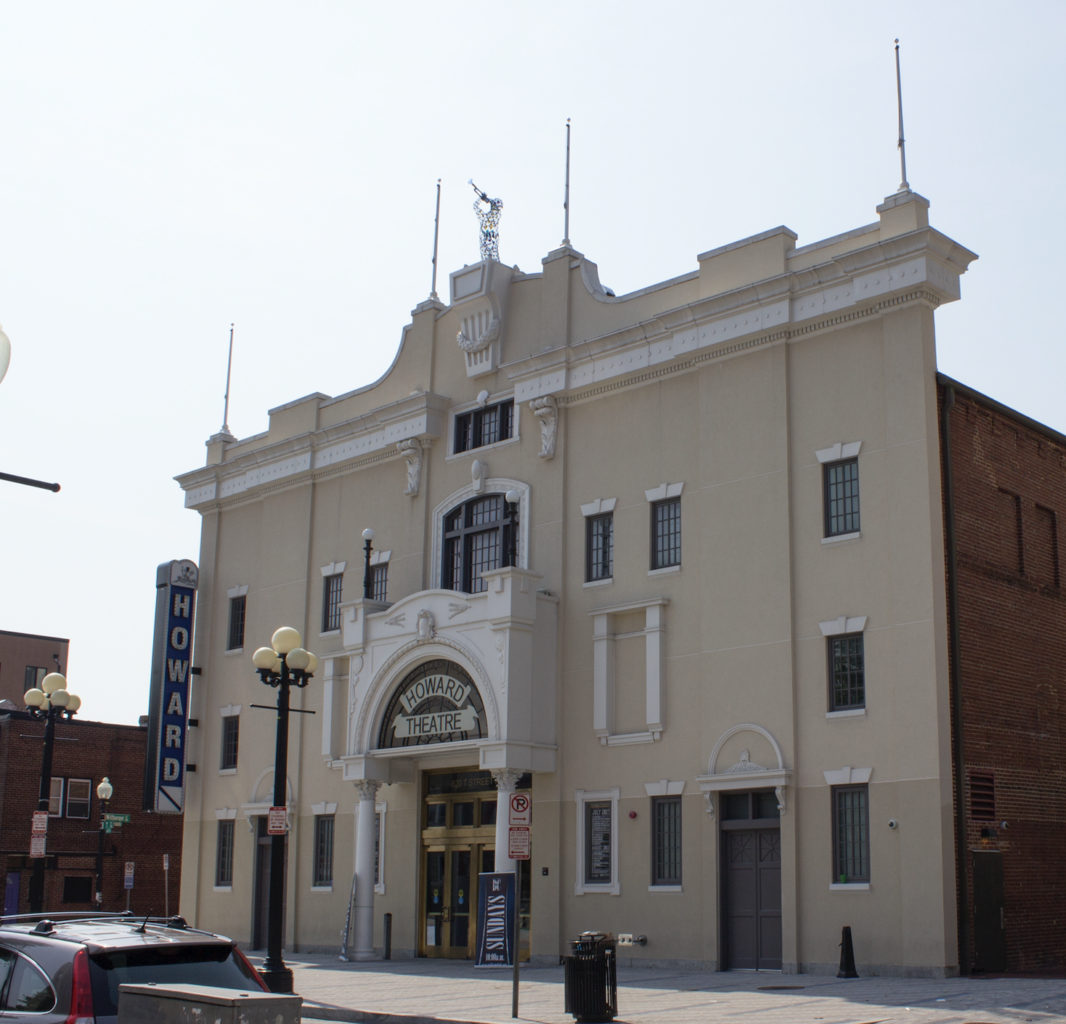 The Howard Theater in Washington DC, on T Street, Northwest. Photo by Dhousch, Wikemedia Commons.
The hospitality industry grew to meet the demands. This was a particularly important business venture for leading Black artists who were paid well like Cab Calloway and the “Mother of the Blues” Ma Rainey, who was paid $800 for four performances and could spend money on fine room, board, and clothing while traveling for performances. In segregated towns, the Black hospitality industry played an essential role in meeting the needs of entertainers. Black women found opportunities to operate boarding room homes and cook meals, and workers created a key union to fight for fair wages.
As traveling performers, women were also allowed more financial, sexual, and artistic freedom away from families that could be strict and religious. Yet, they also faced gender discrimination and sexual violence on the road.
UMBC News: Jazz Age America was a time of expansive Black artistic exploration and innovation within a heightened period of racial violence and segregation. How did this affect T.O.B.A.?
Scott: The world was trying to recover from WWI, the devastation of the Spanish Flu, and a slowly declining economy that would lead to the Great Depression. Returning white veterans and communities felt threatened by the prospect of losing jobs and housing to Black veterans and to families moving from the South. All of these tensions led to the “Red Summer” of 1919. Mass shootings, lynchings, and race riots spread throughout the country including in Chicago, Washington, D.C., and Baltimore.
Most of the T.O.B.A. theaters were in the South. Artists traveling the country and performing in theaters often risked their safety to make a living from their art. The Black working-class audiences were taking a risk going to see live shows and spending their hard-earned money while surrounded by racial violence and segregation.
One of the most haunting accounts that I found was of the Dreamland Theatre in Tulsa, Oklahoma owned by a Black couple. It was one of the earliest theaters to join the circuit. In 1921, it was leveled during the Tulsa Race Massacre. I was shocked that their records survived, allowing the shared history of the theater, owners, artists, and local community to be witness to the importance of Black theater to Tulsa’s Black community. The owners eventually opened up other Dreamland Theatres in Oklahoma.
T.O.B.A. is monumental because it helped Black artists and Black communities continue to thrive while fighting white supremacy. Many times, if churches were not able to provide a space to organize marches, communities organized in theaters. Sometimes, theater entrance fees were donated to help activists or communities hit by natural disasters, or to help with legal fees.
History definitely talks about the violence inflicted on Black communities, the death toll, and poverty, but it doesn’t always tell about Black innovation, economic prosperity, creativity, and thriving Black communities that existed before, during, and after the Jazz Age. It doesn’t always talk about art as an alternative resistance. T.O.B.A. is that story.
Learn more about this new book in Michelle Scott’s Low Lecture on April 11, 4-5 p.m., in the Albin O. Kuhn Library 7th floor. Research for the book was partially supported by UMBC’s Dresher Center for the Humanities and the CAHSS research grant.
]]>
Michelle Scott, associate professor of history, will discuss her new book T.O.B.A. Time: Black Vaudeville and the Theater Owners Booking Association in Jazz Age America(University of Illinois...
https://umbc.edu/stories/strongmichelle-r-scott-illuminates-the-lives-of-black-vaudeville-performers-in-jazz-age-america-strong/
https://my3.my.umbc.edu/api/v0/pixel/news/132431/guest@my.umbc.edu/6929e550dfebce03421d7732f37337f9/api/pixel
arts-and-culture
cahss
cahssresearch
dreshercenter
history
humanities
news
policy-and-society
rca-2
research
UMBC News & Magazine
https://my3.my.umbc.edu/groups/umbc-news-magazine
https://assets1-my.umbc.edu/system/shared/avatars/groups/000/001/943/24435aa6207c452e7bc15cc74b42c7bb/xsmall.png?1748556657
https://assets1-my.umbc.edu/system/shared/avatars/groups/000/001/943/24435aa6207c452e7bc15cc74b42c7bb/original.png?1748556657
https://assets2-my.umbc.edu/system/shared/avatars/groups/000/001/943/24435aa6207c452e7bc15cc74b42c7bb/xxlarge.png?1748556657
https://assets2-my.umbc.edu/system/shared/avatars/groups/000/001/943/24435aa6207c452e7bc15cc74b42c7bb/xlarge.png?1748556657
https://assets3-my.umbc.edu/system/shared/avatars/groups/000/001/943/24435aa6207c452e7bc15cc74b42c7bb/large.png?1748556657
https://assets1-my.umbc.edu/system/shared/avatars/groups/000/001/943/24435aa6207c452e7bc15cc74b42c7bb/medium.png?1748556657
https://assets2-my.umbc.edu/system/shared/avatars/groups/000/001/943/24435aa6207c452e7bc15cc74b42c7bb/small.png?1748556657
https://assets1-my.umbc.edu/system/shared/avatars/groups/000/001/943/24435aa6207c452e7bc15cc74b42c7bb/xsmall.png?1748556657
https://assets2-my.umbc.edu/system/shared/avatars/groups/000/001/943/24435aa6207c452e7bc15cc74b42c7bb/xxsmall.png?1748556657
UMBC News & Magazine
0
0
false
Fri, 07 Apr 2023 11:15:07 -0400
Fri, 07 Apr 2023 11:15:07 -0400
CIDER program supports new approach to measuring nursing home quality, plus more research collaborations

Assessing the quality of nursing home care has historically been a challenging and complex process that considers only a portion of the factors involved—generally, clinical indicators reported by the nursing homes themselves. UMBC researchers are collaborating on a new measure of nursing home quality that combines care experiences with clinical data. And they are doing it with funding from a new UMBC program designed to support novel research across different teams.
Principal investigator Roberto Millar M.A ’19, sociology, Ph.D. ’20, gerontology, who is a policy analyst advanced at The Hilltop Institute, is collaborating on the study with Nancy Kusmaul, associate professor of social work, and Ian Stockwell, associate professor of information systems. Their goal is to create “a more complete measure that nursing homes will be able to use to evaluate how they’re doing to improve the resident experience,” says Kusmaul.
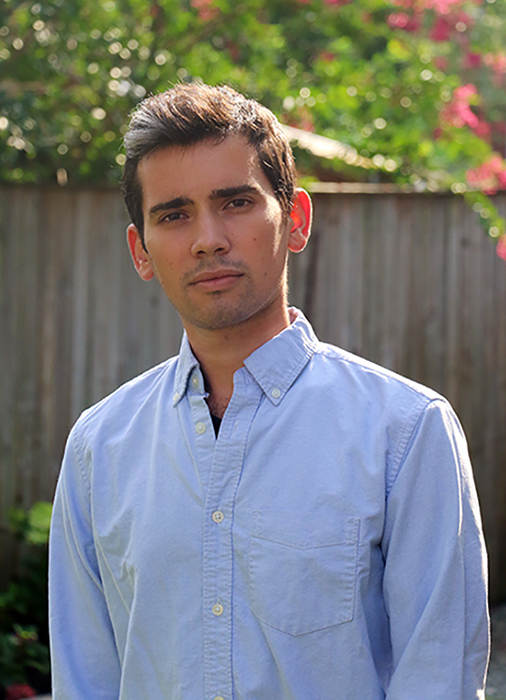 Roberto Millar (Image courtesy of The Hilltop Institute)
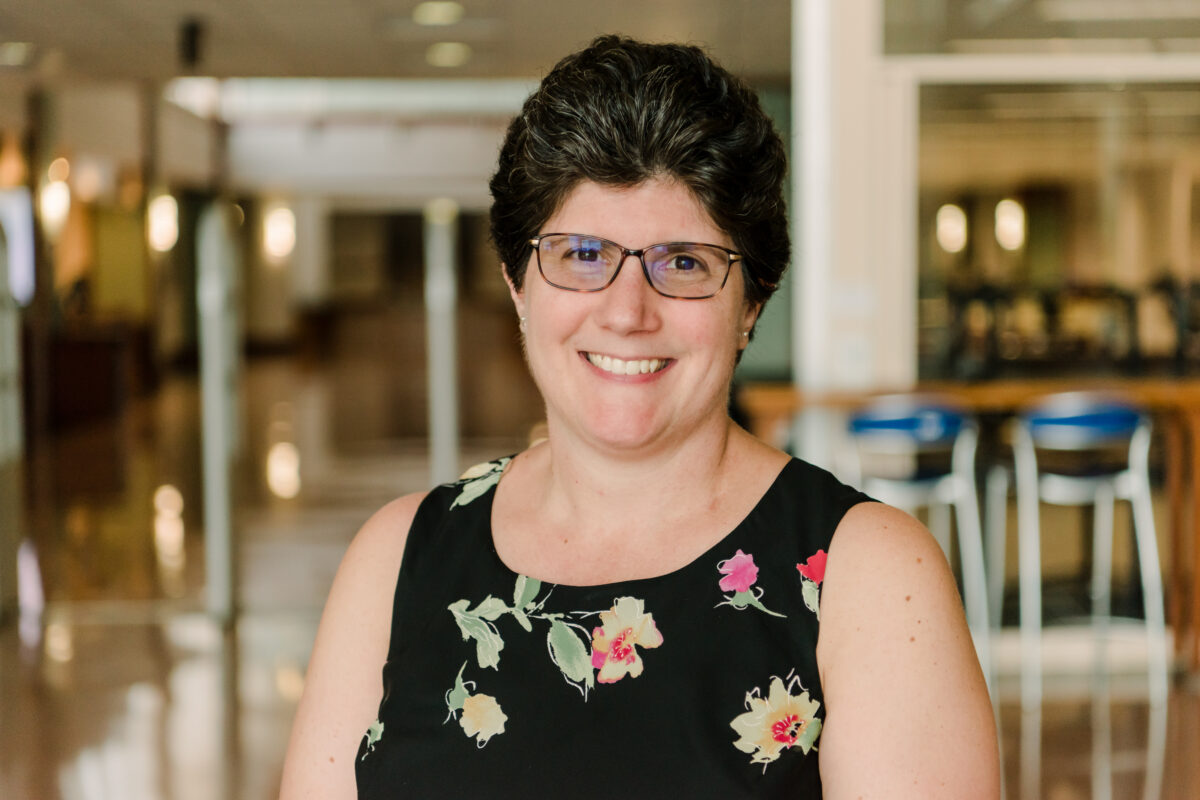 Nancy Kusmaul (Marlayna Demond ’11/UMBC)
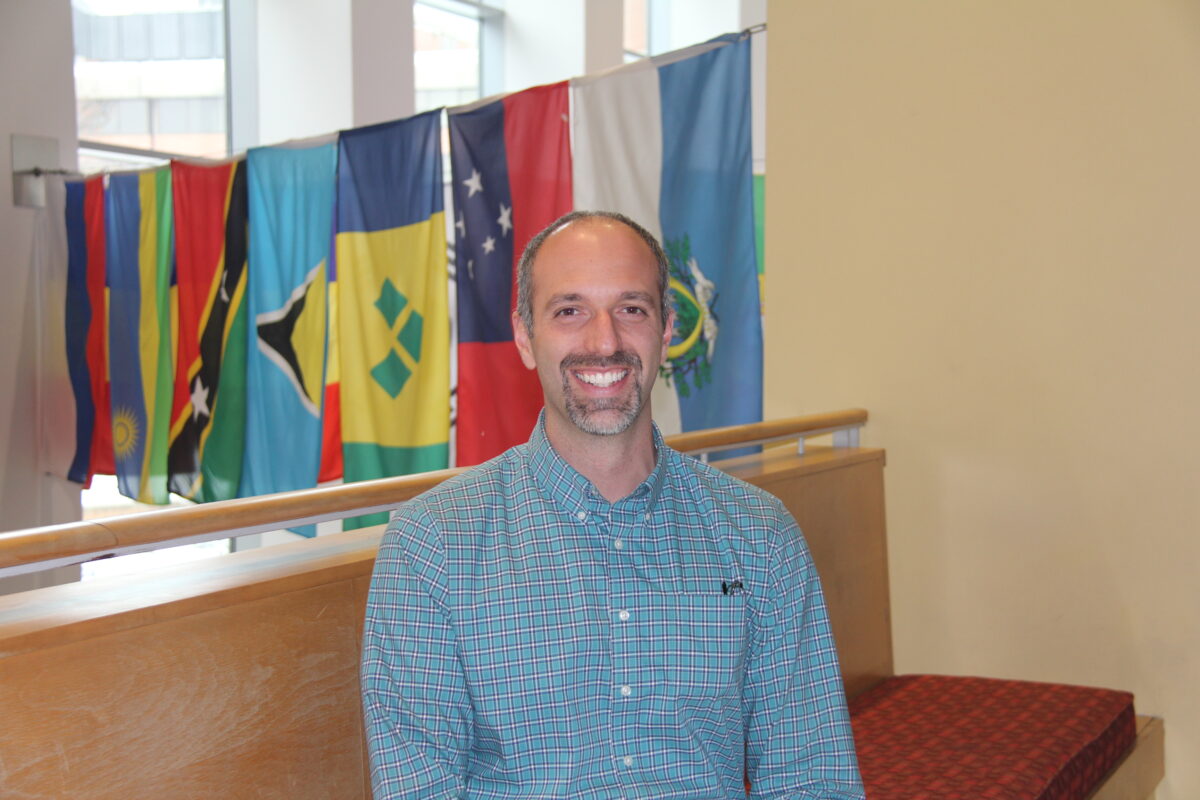 Ian Stockwell (Image courtesy of The Hilltop Institute)
The researchers will, for the first time, combine data from the Centers for Medicare and Medicaid Services’ Care Compare database and results of the Maryland Family Satisfaction Survey. The survey assesses the experiences of family members with loved ones in Maryland nursing homes and, Kusmaul notes, offers a unique approach to measuring quality of care.
“There are no national measures of nursing home quality that consider that side of things,” she explains. “When we think about what quality is and what are the outcomes that we’re measuring, we have to think about the different perspectives of what is good nursing home care.”
Creating a new national model
On a national level, the typical approach to measuring nursing home care focuses on clinical indicators that are measured quantitatively, Millar notes. This includes factors such as number of hospitalizations, vaccination rates, and staff training. It does not include more qualitative data that considers the experiences of people in nursing homes or their families. Maryland is one of only three states that assesses family satisfaction.
“What’s key here is bringing these two approaches together to see if these quantitative measures from the federal approach are actually predictive of family satisfaction across more qualitative domains,” says Millar.
“What we’re talking about is perhaps scaling this collection of qualitative data to a national level that does not exist right now,” says Stockwell. “We want to better measure quality of care to drive changes in the nursing home industry that would best help the patients.”
The team hopes to eventually create a more robust technical infrastructure to capture this data. Eventually, they might be able to utilize machine learning and artificial intelligence to better match prospective care recipients with the most suitable care facility.
Funding new collaborations
The nursing home study was funded through UMBC’s Office of Research Development via the new CIDER (Center and Institute Departmentally-Engaged Research) program. This internal funding opportunity brings together researchers from different disciplines and types of research units across UMBC.
At UMBC, a large volume of research and creative activity (RCA) happens within academic departments and colleges as well as outside of them, in a range of research centers and institutes. In fiscal year 2022, centers and institutes outside of academic departments were responsible for 48.6% of UMBC’s sponsored RCA expenditures ($42.3 million), with most of the rest falling within the departments. But while both groups contribute substantially, they don’t often receive shared project funding to collaborate.
CIDER was designed to increase collaboration between these groups. In this first round, four research teams were each awarded a $50,000 CIDER grant for 18 months to pursue their studies.
In addition to Millar’s team, the other three winning proposals include research across a very broad range of fields:
- “Visualizing the Factors in K-12 Education Success” is led by Lee Boot, director of UMBC’s Imaging Research Center (IRC), with co-investigator Amy Tondreau, assistant professor of education, and Anita Komlodi, associate professor of information systems and associate director of the IRC.
- “Harnessing the Power of Machine Learning to Discover What Powers Distant Galaxies” is led by Antara Basu-Zych, the Center for Research and Exploration in Space Science & Technology II, with co-investigator Sanjay Purushotham, assistant professor of information systems, and Kristen Garofali, NASA.
- “Model Development for Polarimetric Remote Sensing of Clouds in the Thermal Infrared” is led by Xiaoguang Xu, Goddard Earth Sciences Technology and Research II, with co-investigator Vanderlei Martins, professor of physics, and Jie Gong, NASA.
 Don Engel (Marlayna Demond ’11/UMBC)
Don Engel, associate vice president for research development and director of the Center for Space Sciences and Technology (CSST), helped to create CIDER. “We wanted to find a systemic way to make sure that everyone could draw value from being close to other researchers within the institution,” says Engel. “In addition to that, we wanted to make sure that research center faculty have internal funding opportunities that better connect them with the rest of the university. This better integrates them into the university and also makes sure that they have more opportunities to both contribute to and draw from the university’s other strengths and dimensions.”
Additional CIDER program creators include Cynthia Woodcock, director of The Hilltop Institute and Christine Mallinson, professor of language, literacy, and culture (LLC) and director of the Center of Social Science Scholarship. Kara Seidel ’18, psychology, an LLC doctoral student, also provided support in the program’s creation.
Program founders hope that CIDER can help kick-start successful partnerships that generate additional external support and grow far into the future. “We were really excited to see how much interest we had in this program,” says Engel. “We hope that our researchers can draw from each other’s expertise and this funding opportunity can enable the awardees to get subsequent grant funding.”
Ian Stockwell finds this kind of collaborative effort essential and can already see its growing impact. “It’s important for UMBC to facilitate the interaction of faculty across departments and in research centers. We are grateful for this opportunity in particular.”
]]>
Assessing the quality of nursing home care has historically been a challenging and complex process that considers only a portion of the factors involved—generally, clinical indicators reported by...
https://umbc.edu/stories/cider-program-nursing-home-study/
https://my3.my.umbc.edu/api/v0/pixel/news/131814/guest@my.umbc.edu/34544d5bfa4acb007b99792edf767459/api/pixel
coeit
gestar
hilltopinstitute
information-systems
news
policy-and-society
rca-2
research
socialwork
UMBC News & Magazine
https://my3.my.umbc.edu/groups/umbc-news-magazine
https://assets1-my.umbc.edu/system/shared/avatars/groups/000/001/943/24435aa6207c452e7bc15cc74b42c7bb/xsmall.png?1748556657
https://assets1-my.umbc.edu/system/shared/avatars/groups/000/001/943/24435aa6207c452e7bc15cc74b42c7bb/original.png?1748556657
https://assets2-my.umbc.edu/system/shared/avatars/groups/000/001/943/24435aa6207c452e7bc15cc74b42c7bb/xxlarge.png?1748556657
https://assets2-my.umbc.edu/system/shared/avatars/groups/000/001/943/24435aa6207c452e7bc15cc74b42c7bb/xlarge.png?1748556657
https://assets3-my.umbc.edu/system/shared/avatars/groups/000/001/943/24435aa6207c452e7bc15cc74b42c7bb/large.png?1748556657
https://assets1-my.umbc.edu/system/shared/avatars/groups/000/001/943/24435aa6207c452e7bc15cc74b42c7bb/medium.png?1748556657
https://assets2-my.umbc.edu/system/shared/avatars/groups/000/001/943/24435aa6207c452e7bc15cc74b42c7bb/small.png?1748556657
https://assets1-my.umbc.edu/system/shared/avatars/groups/000/001/943/24435aa6207c452e7bc15cc74b42c7bb/xsmall.png?1748556657
https://assets2-my.umbc.edu/system/shared/avatars/groups/000/001/943/24435aa6207c452e7bc15cc74b42c7bb/xxsmall.png?1748556657
UMBC News & Magazine
0
0
false
Wed, 15 Mar 2023 17:19:27 -0400
Wed, 15 Mar 2023 17:19:27 -0400
UMBC humanities faculty receive NEH fellowships for research into “the why and how of our past”

The National Endowment for the Humanities (NEH) has announced that George Derek Musgrove ‘97, associate professor of history, and Elizabeth Patton, associate professor of media and communication studies, have received the highly competitive 2023 NEH fellowship.
Only 70 scholars out of 1,029 applicants nationwide received the coveted fellowship this year. The one-year award supports individual scholars pursuing projects that embody exceptional humanistic research, rigorous analysis, and clear writing. Each scholar will receive $60,000 to support a current book project. Musgrove and Patton have received multiple fellowships supporting their prior and current work, affirming the importance of their scholarship.
Black political and cultural mobilizations
Musgrove, a 2022 Andrew Carnegie fellow, will be working on “We must take to the streets again:” The Black Power Resurgence in Conservative America, 1980–1997. The book aims to provide an in-depth history of the years between the Civil Rights movement and today’s Black Lives Matter movement. This new work will also further Musgrove’s highly acclaimed research on African American history in the nation’s capital, completed over the past decade.
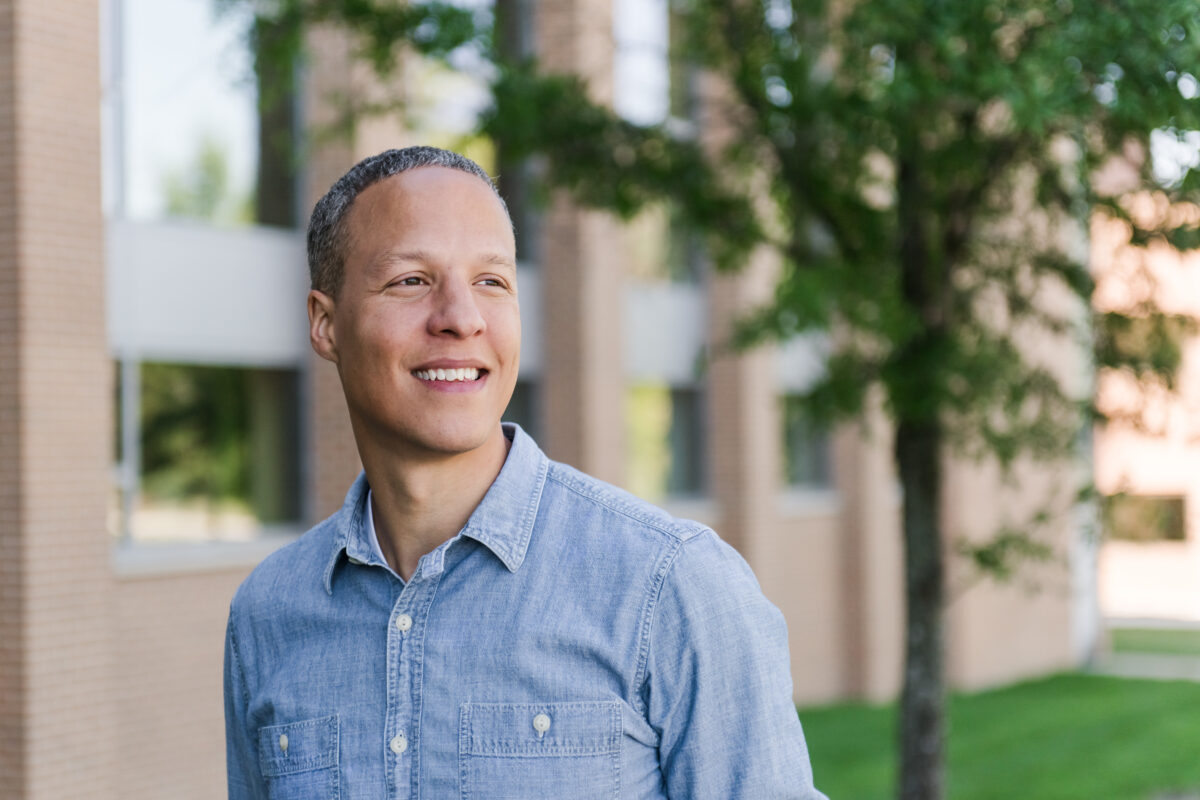 Derek Musgrove. (Marlayna Demond ’11/UMBC)
“The NEH Fellowship is one of the most prestigious awards granted in the humanities and I am honored that the selection committee deemed my forthcoming project worthy of support,” shares Musgrove. “That I was selected is a testament to my colleagues in the history department and Rachel Brubaker, who encouraged me to apply and shared essential feedback. UMBC’s generous, collaborative culture allows those of us who are lucky enough to work here to do amazing things.”
UMBC’s Dresher Center for the Humanities provides key support to faculty engaging in major scholarly and public projects. Rachel Brubaker, director of program administration at the Dresher Center, works with faculty one on one to identify and successfully apply for research funding.
After receiving the Carnegie Fellowship, Musgrove shared that the support his scholarship has garnered is “a powerful endorsement of the importance of exploring the Black political and cultural mobilizations of the 1980s and ‘90s.” He noted, “We continue to live in the world those activists helped make and to fight the battles that those activists fought.”
Black leisure and tourism
Patton, who was also a 2022 NEH summer fellow, will advance research for her forthcoming book Representation as a Form of Resistance: Documenting African American Spaces of Leisure during the Jim Crow Era. The book will examine the history of Black leisure and tourism in the U.S. through the perspective of photography and home movies. She seeks to put into context lingering forms of racism that still affect Black tourism on platforms like Airbnb.
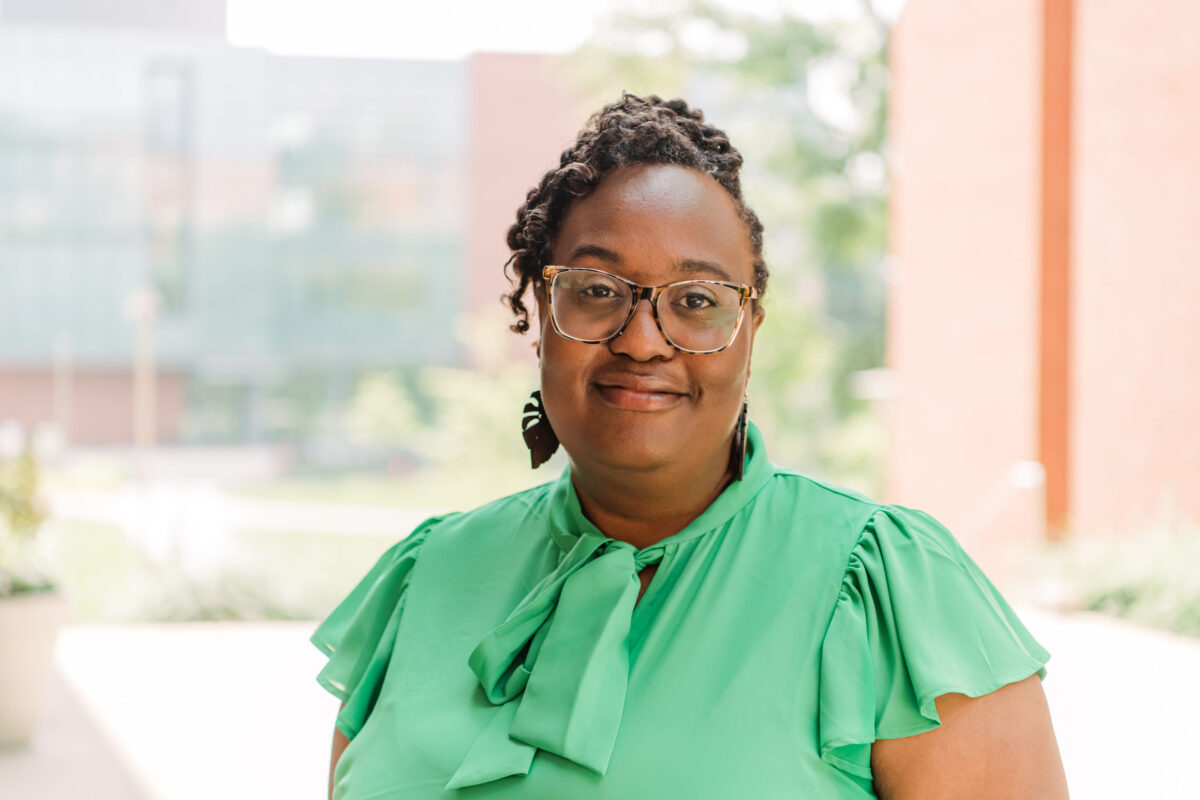 Elizabeth Patton. (Marlayna Demond ’11/UMBC)
The 2023 NEH award will further Patton’s archival research, begun in 2022 with combined funding from Duke University’s John W. Hartman Center for Sales, Advertising & Marketing History, the John Hope Franklin Research Center for African American History and Culture, and UMBC’s CAHSS Research Fund.
“I have found hundreds of examples of spaces where there is a history of people of color using those spaces, desegregating those spaces, or creating their own spaces for leisure and travel,” Patton said, after receiving her 2022 NEH summer fellowship. “These rich data sources will help me tell the invisible history of African American leisure through historical methods, discourse analysis, semiotics, and oral history.”
Humanities at work
Preminda Jacob, associate professor of visual arts and associate dean of the College of Arts, Humanities, and Social Sciences is thrilled the NEH continues to support UMBC’s leading humanities research. “Humanities scholarship at UMBC pursues the why and how of our past, present, and future with painstaking rigor,” says Jacob. “The NEH fellowship acknowledges our faculty’s innovative and relentless pursuit of answers to these questions.”
Musgrove and Patton join several previous UMBC NEH Fellows. A few of the university’s prior recipients include Anne Sarah Rubin, professor of history; Susan McDonough, associate professor of history; and Whitney Schwab, associate professor of philosophy.
]]>
The National Endowment for the Humanities (NEH) has announced that George Derek Musgrove ‘97, associate professor of history, and Elizabeth Patton, associate professor of media and communication...
https://umbc.edu/stories/neh-fellowships-2023/
https://my3.my.umbc.edu/api/v0/pixel/news/130994/guest@my.umbc.edu/2ef5d7d3b8be707d1d65f3be61292544/api/pixel
arts-and-culture
cahss
cahssresearch
history
majoraward
mcs
news
policy-and-society
rca-2
research
UMBC News & Magazine
https://my3.my.umbc.edu/groups/umbc-news-magazine
https://assets1-my.umbc.edu/system/shared/avatars/groups/000/001/943/24435aa6207c452e7bc15cc74b42c7bb/xsmall.png?1748556657
https://assets1-my.umbc.edu/system/shared/avatars/groups/000/001/943/24435aa6207c452e7bc15cc74b42c7bb/original.png?1748556657
https://assets2-my.umbc.edu/system/shared/avatars/groups/000/001/943/24435aa6207c452e7bc15cc74b42c7bb/xxlarge.png?1748556657
https://assets2-my.umbc.edu/system/shared/avatars/groups/000/001/943/24435aa6207c452e7bc15cc74b42c7bb/xlarge.png?1748556657
https://assets3-my.umbc.edu/system/shared/avatars/groups/000/001/943/24435aa6207c452e7bc15cc74b42c7bb/large.png?1748556657
https://assets1-my.umbc.edu/system/shared/avatars/groups/000/001/943/24435aa6207c452e7bc15cc74b42c7bb/medium.png?1748556657
https://assets2-my.umbc.edu/system/shared/avatars/groups/000/001/943/24435aa6207c452e7bc15cc74b42c7bb/small.png?1748556657
https://assets1-my.umbc.edu/system/shared/avatars/groups/000/001/943/24435aa6207c452e7bc15cc74b42c7bb/xsmall.png?1748556657
https://assets2-my.umbc.edu/system/shared/avatars/groups/000/001/943/24435aa6207c452e7bc15cc74b42c7bb/xxsmall.png?1748556657
UMBC News & Magazine
1
0
false
Wed, 15 Feb 2023 14:59:43 -0500
Wed, 15 Feb 2023 14:59:43 -0500
UMBC partners on STAR-X, a $3M NASA mission concept study through the CRESST II research consortium
UMBC researchers are partnering on STAR-X, a nine-month mission concept study investigating black holes, galaxy clusters, and often-elusive transient cosmic events like supernova explosions. STAR-X stands for Survey and Time-domain Astrophysical Research Explorer. It is one of two Explorer missions to receive $3 million from NASA for this concept phase, before NASA selects one in 2024 to proceed with implementation, targeted for launch in 2028.
“With STAR-X, we want to come up with a survey that will catch very rare transient events,” said Antara Basu-Zych, a UMBC associate research scientist with the Center for Research and Exploration in Space Science & Technology II (CRESST II). “We’re aiming to understand at what rate these events are happening, what types of systems they involve, and where in the universe they’re happening.”
Maintaining STAR-X’s mission data
 Antara Basu-Zych. (Photo curtesy of Antara Basu-Zych)
This mission reflects the important role of strategic research partnerships in moving forward space science—what CRESST II was designed to achieve. UMBC’s CRESST II partners on STAR-X include NASA’s Goddard Space Flight Center (GSFC) and the Massachusetts Institute of Technology, providing an X-ray telescope; the University of Colorado, providing an ultraviolet telescope; and Ball Aerospace, providing the spacecraft. UMBC’s role will focus on the mission data retrieved from STAR-X.
Basu-Zych works with NASA’s High Energy Astrophysics Science Archive Research Center (HEASARC). If the mission is selected for launch, HEASARC will house the data that STAR-X collects. Basu-Zych is currently developing a process to organize the data, along with methods of alerting the scientific community of interesting STAR-X discoveries, called targets of opportunity, that could be further explored.
“Our role is to make it so that average scientists outside of the mission are able to do something valuable with the mission data,” she said.
An agile spacecraft
The mission will conduct a medium survey covering 300 square degrees of the sky on a weekly basis, and a deep survey on a daily basis covering 12 square degrees. As NASA has described, those deep surveys would seek to map black holes and hot gas trapped in distant clusters of galaxies. Combined with infrared observations from NASA’s Roman Space Telescope, these observations would enable researchers to trace how massive galaxy clusters were built up over time.
Additionally, the spacecraft would be able to turn rapidly to point its wide-field X-ray and UV telescopes at transient cosmic sources, such as supernova explosions, gravitational wave events, and extreme black hole feeding events.
“STAR-X is fast moving, very agile, and can quickly go to a source that is interesting,” explains Basu-Zych. “It would be able to slew the sky within a day or within a couple of hours, depending on what event was happening, and target something very quickly.”
In addition to being agile, she notes, “the instrument itself has a large field of view and low particle background, so that helps us with picking out faint objects and will help us get to areas of deep sensitivity.”
With these time-domain surveys and detecting cosmic targets of opportunity, STAR-X seeks to address several key priorities outlined in the “Pathways to Discovery in Astronomy and Astrophysics for the 2020s,” the latest decadal survey of the field released by the National Academies.
]]>
UMBC researchers are partnering on STAR-X, a nine-month mission concept study investigating black holes, galaxy clusters, and often-elusive transient cosmic events like supernova explosions....
https://umbc.edu/stories/star-x-nasa-mission/
https://my3.my.umbc.edu/api/v0/pixel/news/130905/guest@my.umbc.edu/f8c6d5ac6a997ba6ee11dde520d63403/api/pixel
csst
nasa
nasa-goddard-space-flight-center
news
rca-2
research
science-and-tech
UMBC News & Magazine
https://my3.my.umbc.edu/groups/umbc-news-magazine
https://assets1-my.umbc.edu/system/shared/avatars/groups/000/001/943/24435aa6207c452e7bc15cc74b42c7bb/xsmall.png?1748556657
https://assets1-my.umbc.edu/system/shared/avatars/groups/000/001/943/24435aa6207c452e7bc15cc74b42c7bb/original.png?1748556657
https://assets2-my.umbc.edu/system/shared/avatars/groups/000/001/943/24435aa6207c452e7bc15cc74b42c7bb/xxlarge.png?1748556657
https://assets2-my.umbc.edu/system/shared/avatars/groups/000/001/943/24435aa6207c452e7bc15cc74b42c7bb/xlarge.png?1748556657
https://assets3-my.umbc.edu/system/shared/avatars/groups/000/001/943/24435aa6207c452e7bc15cc74b42c7bb/large.png?1748556657
https://assets1-my.umbc.edu/system/shared/avatars/groups/000/001/943/24435aa6207c452e7bc15cc74b42c7bb/medium.png?1748556657
https://assets2-my.umbc.edu/system/shared/avatars/groups/000/001/943/24435aa6207c452e7bc15cc74b42c7bb/small.png?1748556657
https://assets1-my.umbc.edu/system/shared/avatars/groups/000/001/943/24435aa6207c452e7bc15cc74b42c7bb/xsmall.png?1748556657
https://assets2-my.umbc.edu/system/shared/avatars/groups/000/001/943/24435aa6207c452e7bc15cc74b42c7bb/xxsmall.png?1748556657
UMBC News & Magazine
0
0
false
Tue, 14 Feb 2023 09:31:31 -0500
Tue, 14 Feb 2023 09:31:31 -0500
New “Life Magnified” USPS stamp series features Tagide deCarvalho’s images of microscopic life
Tagide deCarvalho, director of the Keith R. Porter Imaging Facility in UMBC’s College of Natural and Mathematical Sciences, produces artistic images that reveal microscopic life in vivid, thought-provoking ways. Her work combines her skill at the lab bench and behind the microscope with her artist’s eye, and it continues to earn her accolades worldwide.
deCarvalho has been recognized repeatedly in the Nikon Small World Photomicrography Competition. In 2020, she won the 2019 Olympus Image of the Year Global Life Science Light Microscopy Award for an image of a tardigrade, also known as a “water bear.” This year, she won the 2022 Zeiss Microscopy Image Contest in the Life Sciences category.
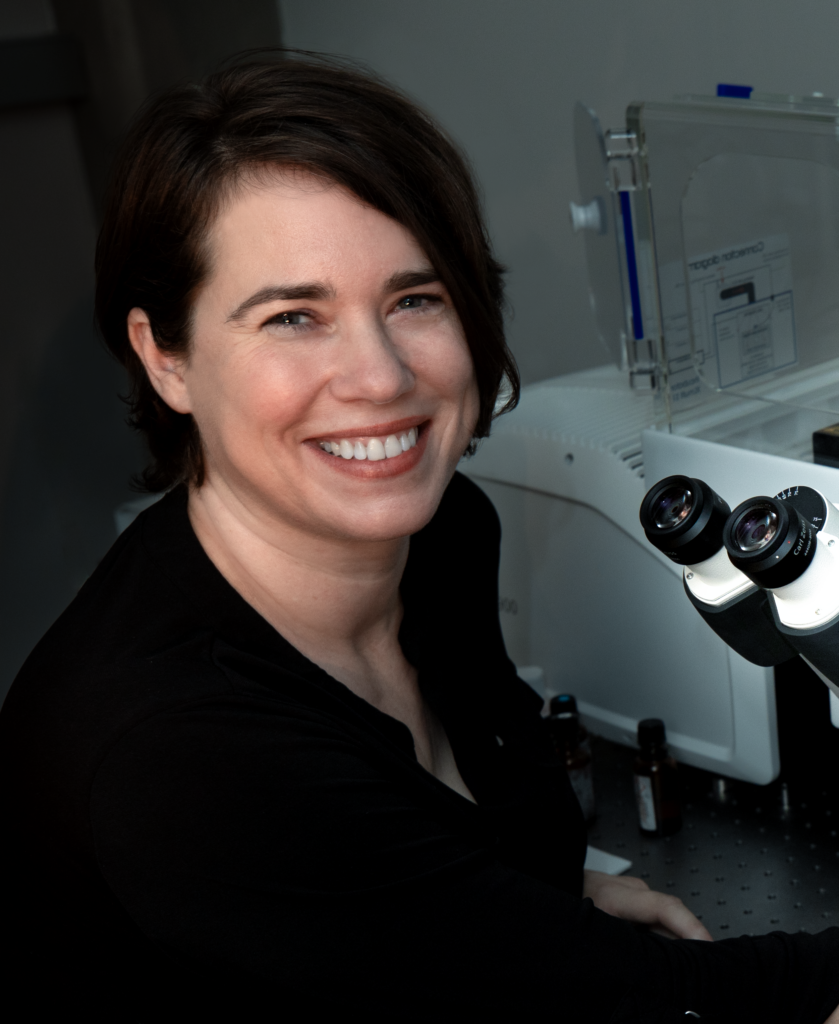 Tagide deCarvalho in front of a confocal microscope in the Keith R. Porter Imaging Facility at UMBC. (Melissa Cormier/UMBC)
“We use their equipment. I’m a big fan of their instruments, so it was nice to be recognized by that company,” deCarvalho says of the Zeiss award. The winning image portrayed bacteria that she scraped from her own tongue. At the time, she simply needed a quick sample to test some new materials for preparing specimens in the lab. Only later did she decide to refine the image into something beautiful.
“My superpower is finding everyday specimens and making them glamorous,” deCarvalho says, a bit tongue in cheek. She recently learned that her images will now reach a larger audience than ever before.
Putting her stamp on the art world
This summer, deCarvalho received an exciting request: An art curator wanted to include two of her images in an upcoming collection—except this was no typical art exhibit. A United States Postal Service (USPS) curator wanted to include deCarvalho’s work in a stamp collection featuring microscope images. USPS officially announced the “Life Magnified” collection in December, and the stamps will become available later in 2023.
The USPS recognition holds special significance for deCarvalho, whose grandfather collected stamps. When he passed away, deCarvalho inherited his collection. Her grandfather was a physician-scientist, and deCarvalho enjoyed looking through his microscopes as a child. He always told his granddaughter she would be a scientist one day.
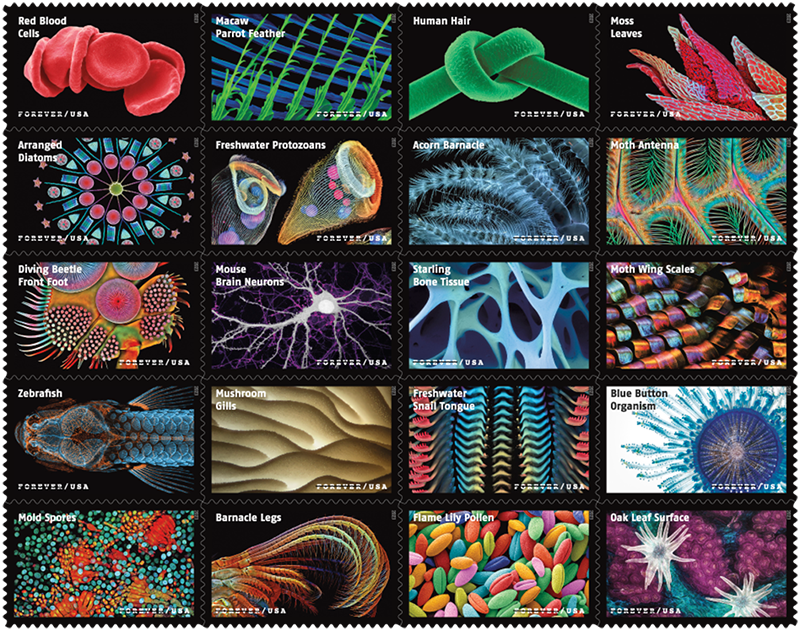 The “Life Magnified” stamp series, set to be released later this year. deCarvalho’s images are the Moss Leaves (upper right) and Mold Spores (lower left). (Image courtesy of U.S. Postal Service)
deCarvalho has had a lifelong interest in art, too, and began her academic career as an art photography major. As an undergraduate, she wanted to learn to use microscopes to create art in a biological context. To that end, she worked for a faculty member at the University of New Mexico School of Medicine creating transmission electron microscope images.
The professor was thrilled to work with a student who already knew how to develop film—the hardest thing to teach, and something deCarvalho had been doing for years in her own darkroom. In the lab, she started to learn techniques essential to her work today, but she never got to put her artistic talents to work. Instead, deCarvalho launched a scientific career, fulfilling her grandfather’s prophecy and eventually landing at UMBC in 2016.
Once she arrived at UMBC, art finally returned to her life. “Suddenly I realized I could do it,” deCarvalho says. “I’d say it was about 20 years later. I came full circle.”
Creating art, informing scientific research
The process of creating an artistic microscope image begins the exact same way as creating a research image. It’s only the post-processing that differs, deCarvalho explains.
“I take things further than what might be considered ethical for a research image, where there are clear guidelines as to what you can do,” she says. In a research image, “You can’t manipulate the image to alter any of the content.” For her art, she removes distracting elements like debris around the main specimen, and emphasizes the specimen’s key elements in a way that makes it more visually engaging.
Her modifications “allow you to focus your attention on [the specimen] more, and to find it more aesthetically pleasing,” explains deCarvalho. She believes this makes viewers “more interested in the content than you would be if I hadn’t slightly altered it,” she says. “I think it makes it more compelling.”
Her artistic work can still inform scientific image production. “I push the limits of my expertise by doing these art images,” deCarvalho says. “I can bring some of the experience and new techniques that I learn in doing that back to the research. It goes both ways.”
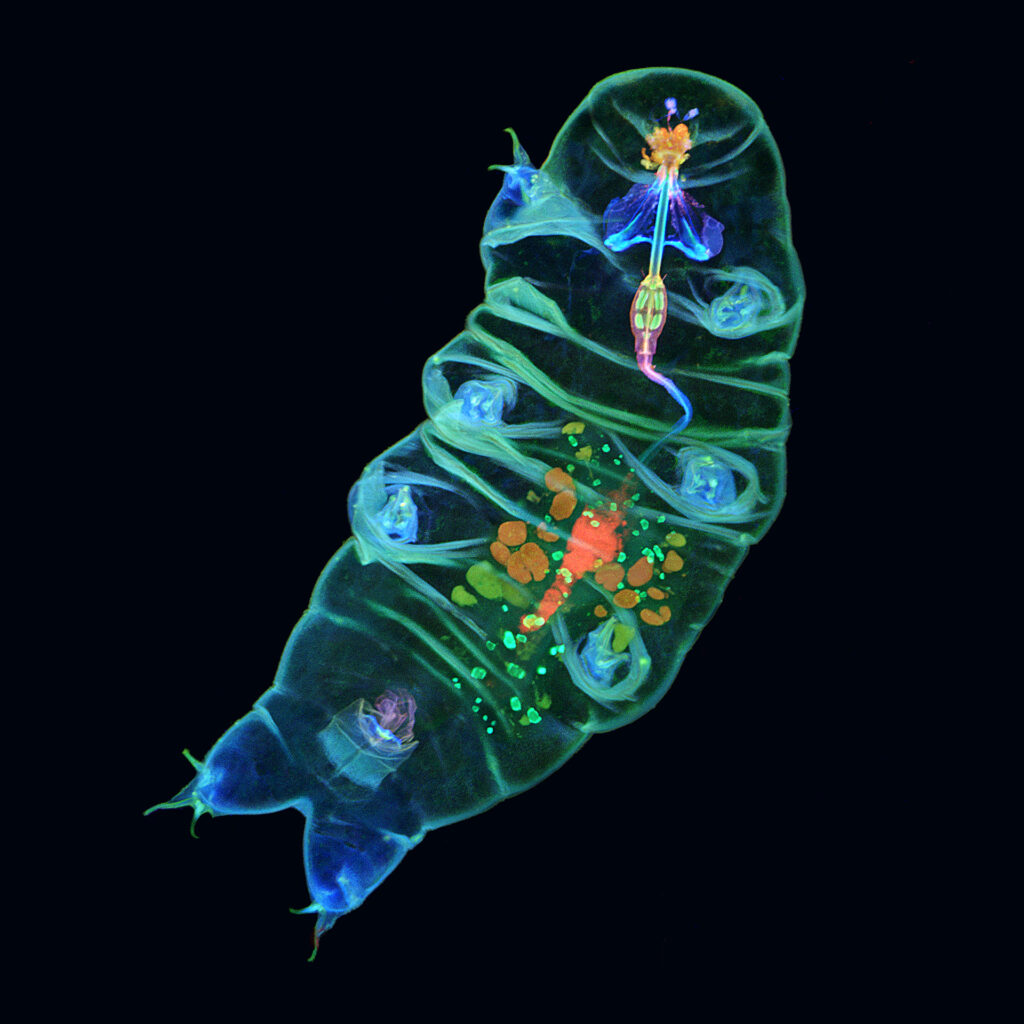 Tagide deCarvalho’s winning image of a tardigrade, or “water bear.” Tardigrades are approximately one millimeter long. (Image courtesy of deCarvalho)
For example, for the winning tardigrade image, “I came up with that staining just to create that pretty picture, and I’ve had tardigrade experts all across the world and people that use tardigrades in classrooms ask me for my technique, because they could see structures stained that they weren’t able to see before with the traditional staining techniques,” deCarvalho says. “So it informed research, just from me trying to make a nice picture.”
Public art, amplified
One of the images selected for “Life Magnified” features moss that deCarvalho scraped off the exterior of the UMBC Biological Sciences Building. “I feel like it’s kind of an homage to UMBC that one of the samples was taken right off the building,” she says.
When asked about her motivations for turning microscope images into beautiful works of art, her answer was simple. “It’s super cheesy, but I just get so excited when I see things under the microscope,” she says. “I look through the microscope, and I just think, ‘Wow, I can’t believe that’s real, and that it just looks so amazing.’” Her art, she says, is “a way to capture the excitement and share it with other people.”
In addition to the connections to UMBC and to her grandfather, having her work on stamps is special because it grants her images the ultimate visibility, she explains. Stamps “are like a public art museum,” deCarvalho says. “Each one is like a little piece of art—it’s the most public art form. So when USPS approached me, I thought, ‘This is the highest honor.’”
]]>
Tagide deCarvalho, director of the Keith R. Porter Imaging Facility in UMBC’s College of Natural and Mathematical Sciences, produces artistic images that reveal microscopic life in vivid,...
https://umbc.edu/stories/microscopic-life-stamps/
https://my3.my.umbc.edu/api/v0/pixel/news/130304/guest@my.umbc.edu/6fe8a84fcc3a5777f2abfd00df1fbb45/api/pixel
biology
cnms
kpif
news
rca-2
science-and-tech
UMBC News & Magazine
https://my3.my.umbc.edu/groups/umbc-news-magazine
https://assets1-my.umbc.edu/system/shared/avatars/groups/000/001/943/24435aa6207c452e7bc15cc74b42c7bb/xsmall.png?1748556657
https://assets1-my.umbc.edu/system/shared/avatars/groups/000/001/943/24435aa6207c452e7bc15cc74b42c7bb/original.png?1748556657
https://assets2-my.umbc.edu/system/shared/avatars/groups/000/001/943/24435aa6207c452e7bc15cc74b42c7bb/xxlarge.png?1748556657
https://assets2-my.umbc.edu/system/shared/avatars/groups/000/001/943/24435aa6207c452e7bc15cc74b42c7bb/xlarge.png?1748556657
https://assets3-my.umbc.edu/system/shared/avatars/groups/000/001/943/24435aa6207c452e7bc15cc74b42c7bb/large.png?1748556657
https://assets1-my.umbc.edu/system/shared/avatars/groups/000/001/943/24435aa6207c452e7bc15cc74b42c7bb/medium.png?1748556657
https://assets2-my.umbc.edu/system/shared/avatars/groups/000/001/943/24435aa6207c452e7bc15cc74b42c7bb/small.png?1748556657
https://assets1-my.umbc.edu/system/shared/avatars/groups/000/001/943/24435aa6207c452e7bc15cc74b42c7bb/xsmall.png?1748556657
https://assets2-my.umbc.edu/system/shared/avatars/groups/000/001/943/24435aa6207c452e7bc15cc74b42c7bb/xxsmall.png?1748556657
UMBC News & Magazine
1
0
false
Thu, 19 Jan 2023 19:03:01 -0500
Thu, 19 Jan 2023 19:03:01 -0500
UMBC and UMSOM work to more effectively reverse opioid overdose in real time through $500,000+ NIH award

Opioid-related deaths have risen sharply in the U.S. in recent years. In 2017, the Department of Health and Human Services declared the opioid crisis to be a public health emergency—one disproportionately affecting historically marginalized communities—and the crisis has worsened since then.
In response to the rising epidemic, UMBC researchers have partnered with the University of Maryland School of Medicine (UMSOM) to develop a device that could help prevent opioid overdose deaths. The device is a non-invasive CO2 monitor designed to more effectively detect and reverse an opioid overdose in real time. It was recently awarded a one-year grant of more than $500,000 from the National Institutes of Health (NIH).
“Opioid-related death is a serious problem for the country. We hope this new device will help to directly address this issue,” said the study’s co-PI Xudong Ge, research professor of chemical, biochemical, and environmental engineering (CBEE).
Meeting an urgent need
The Centers for Disease Control and Prevention’s (CDC) National Center for Health Statistics reported that during a 12-month period ending in April 2021, more than 100,000 drug overdoses were recorded in the U.S., with nearly 76,000 deaths attributed to opioid usage. In a separate 2022 report, the CDC noted the severity of this impact among underserved communities of color. Between 2019 and 2020 alone, overdose death rates increased 44 percent amongst Black populations and 39 percent in American Indian and Alaska Native populations.
“If you look at the statistics, the people who are dying from opioid overdoses largely come from underserved minority communities. They are the ones that need the most help,” said Thelma Wright, associate professor of pain medicine at UMSOM, who developed the idea for the study.
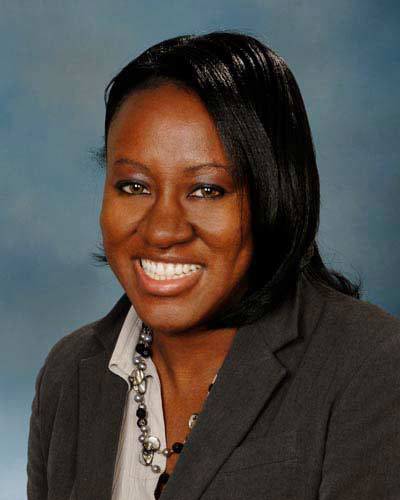 Thelma Wright (Image courtesy of UMSOM)
As a pain medicine physician, she said she was aware of how medically-prescribed opioids have contributed to the rise in overdose death rates. In 2016, Wright began to conceptualize a way to non-invasively monitor if a patient is about to die from an opioid overdose and ways to immediately administer naloxone, an opioid antagonist that can quickly reverse an overdose.
Despite administering naloxone to people experiencing opioid overdose, to reverse their respiratory depression, many overdose cases are fatal because the naloxone was not administered in time, Wright shared.
“When someone is dying from an overdose, they cannot get the antidote from their medicine cabinet to administer it to themselves. I asked around if there was a sensitive monitor that could immediately detect an opioid overdose, and there was nothing,” said Wright. “I needed to find some sort of parameter that would signal respiratory depression due to an overdose, and the most accurate parameter happened to be a carbon dioxide (CO2) monitor.”
Evolving CO2 monitoring research
Opioids stimulate receptors in the brain and can cause a decrease in pain perception. When brain receptors are overstimulated, the brainstem can then become desensitized to rises in CO2 levels. As a result, the opioid user could experience respiratory depression, loss of protective airway reflexes, and respiratory arrest.
Ge, who serves as the assistant director of UMBC’s Center for Advanced Sensor Technology (CAST), has spent more than a decade researching and developing non-invasive CO2 sensor systems. During the pandemic, Ge, along with Govind Rao, a professor of CBEE and the director of CAST, co-authored a study published in Medical Engineering & Physics analyzing the effects of face coverings on transdermal CO2 levels. The study demonstrated the potential effectiveness of monitoring CO2 levels through the use of wearable transdermal CO2 sensors.
“The original CO2 monitoring device is large, about the size of a suitcase,” said Ge. Wright approached Ge and Rao to develop a miniaturized, wearable version that could address some of the shortcomings of other devices available today.
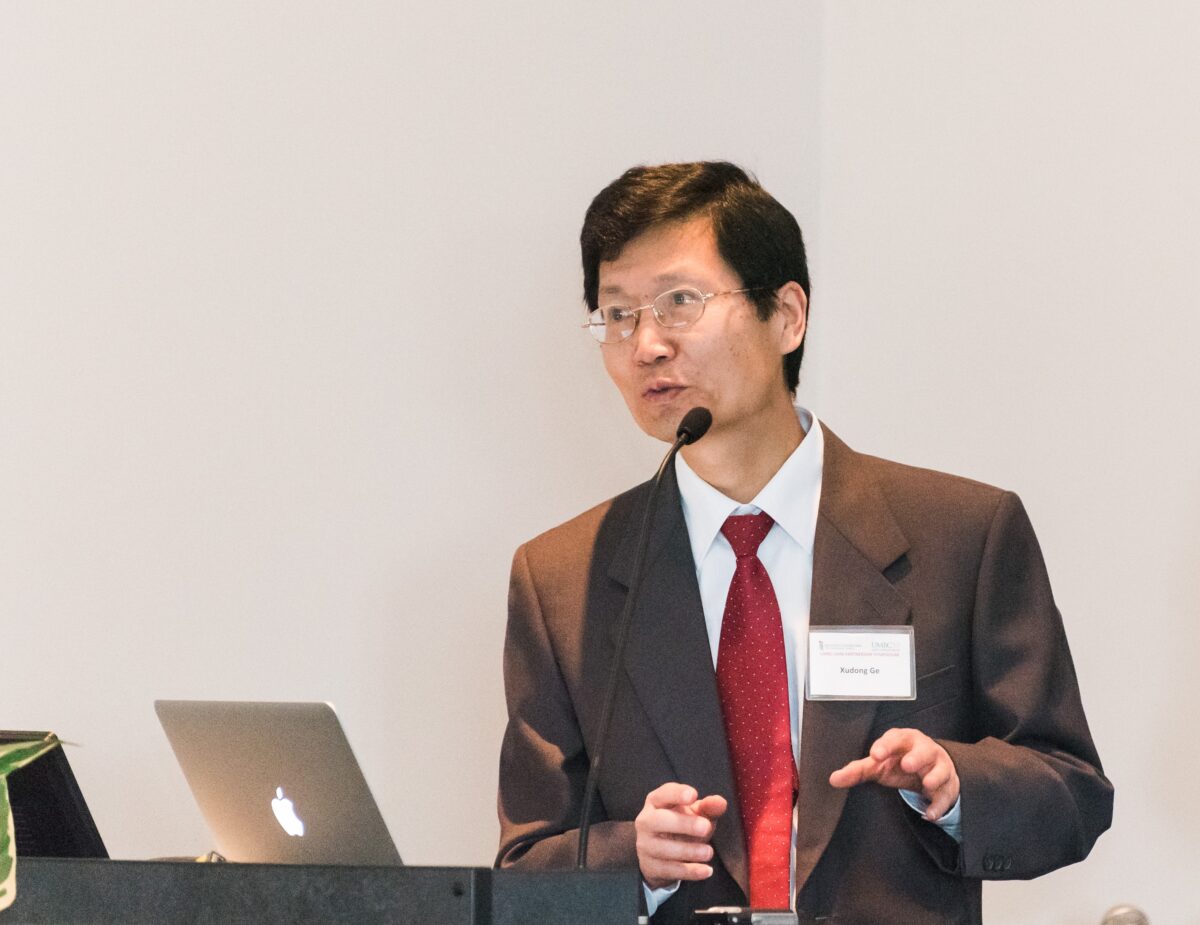 Xudong Ge (Marlayna Demond ’11/UMBC)
Ge explains that traditional non-invasive CO2 monitors that are used on the skin heat up to about 42 degrees Celsius, or more than 107 degrees Fahrenheit. Because of the high heat, they can leave burns on skin and cannot be worn for an extended amount of time. The monitors tend to work at a slower speed and can come with a price tag averaging about $25,000.
Along with miniaturizing the device, Ge aims to create a monitor that is safer and more comfortable, delivers data more efficiently, and is more affordable for the average consumer.
Developing the device
When a patient wears the CO2 device and experiences respiratory depression due to an overdose, the device will trigger an alarm that will automatically inject naloxone. In order to validate the study’s proof of principle, the initial phases of the study will start with developing and testing CO2 sensor prototypes. The test results will then be compared to data from a similar FDA-approved device that they are hoping to improve on.
“We will run side by side tests to see how accurate our device is and then do challenge studies, like holding your breath, breathing into a bag, or exercising to get the subjects’ CO2 levels up in the body to see if we are able to detect it,” says Rao. “We will incorporate some elements of machine learning to detect the signal accurately, to make sure that there are no false positives or false negatives.”
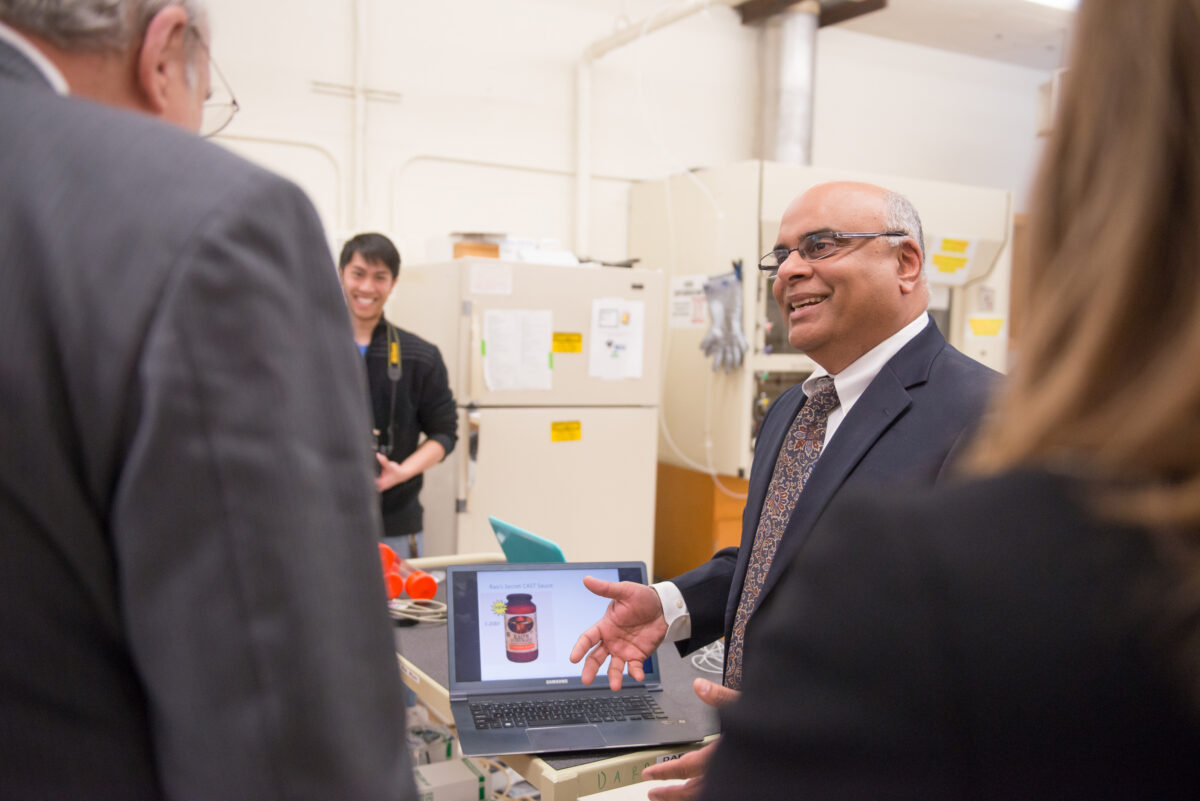 Govind Rao (Marlayna Demond ’11/UMBC)
The investigators have hired UMBC postdoctoral researcher Preety Ahuja to work on the prototyping. If the study is granted additional funding, Wright and her team of researchers will test the sensor on animal subjects to validate whether the wearable transdermal CO2 alarm will be effective. The researchers also intend to develop a mobile app to gather and share the data provided by the monitor.
Rao looks forward to collaborating closely with Wright through this UMBC-UMSOM partnership, noting the significance of her work with underserved populations in Baltimore. He shares, “Dr. Wright is very keen and passionate about finding solutions and our UMBC team is very excited to be working with her.”
]]>
Opioid-related deaths have risen sharply in the U.S. in recent years. In 2017, the Department of Health and Human Services declared the opioid crisis to be a public health emergency—one...
https://umbc.edu/stories/reverse-opioid-overdoses-in-real-time/
https://my3.my.umbc.edu/api/v0/pixel/news/129710/guest@my.umbc.edu/b903201bcdb55aa185c720f758b62002/api/pixel
cast
cbee
coeit
news
rca-2
research
science-and-tech
UMBC News & Magazine
https://my3.my.umbc.edu/groups/umbc-news-magazine
https://assets1-my.umbc.edu/system/shared/avatars/groups/000/001/943/24435aa6207c452e7bc15cc74b42c7bb/xsmall.png?1748556657
https://assets1-my.umbc.edu/system/shared/avatars/groups/000/001/943/24435aa6207c452e7bc15cc74b42c7bb/original.png?1748556657
https://assets2-my.umbc.edu/system/shared/avatars/groups/000/001/943/24435aa6207c452e7bc15cc74b42c7bb/xxlarge.png?1748556657
https://assets2-my.umbc.edu/system/shared/avatars/groups/000/001/943/24435aa6207c452e7bc15cc74b42c7bb/xlarge.png?1748556657
https://assets3-my.umbc.edu/system/shared/avatars/groups/000/001/943/24435aa6207c452e7bc15cc74b42c7bb/large.png?1748556657
https://assets1-my.umbc.edu/system/shared/avatars/groups/000/001/943/24435aa6207c452e7bc15cc74b42c7bb/medium.png?1748556657
https://assets2-my.umbc.edu/system/shared/avatars/groups/000/001/943/24435aa6207c452e7bc15cc74b42c7bb/small.png?1748556657
https://assets1-my.umbc.edu/system/shared/avatars/groups/000/001/943/24435aa6207c452e7bc15cc74b42c7bb/xsmall.png?1748556657
https://assets2-my.umbc.edu/system/shared/avatars/groups/000/001/943/24435aa6207c452e7bc15cc74b42c7bb/xxsmall.png?1748556657
UMBC News & Magazine
3
0
false
Fri, 09 Dec 2022 13:43:21 -0500
Fri, 09 Dec 2022 13:43:21 -0500
Centering Thriving Immigrant Voices in Immigration Research

UMBC faculty are leading interdisciplinary, community-engaged immigration research that is shifting the relationship between higher education institutions and immigrant communities. Their approaches include centering the economic, academic, social, and cultural contributions of immigrants to the well-being of U.S. cities. This scholarship challenges stereotypes and also works to dismantle systemic racism in higher education.
In 2020, New York Times reported that U.S.-born children of immigrants or immigrant students raised in the U.S. accounted for nearly 60 percent of the growth in U.S. university enrollment since 2000. The majority of these students are the children of international students from India who stayed in the U.S. to work, and the children of Latin Americans, and refugees who came to the U.S. in search of better living conditions.
Felipe Filomeno, associate professor of political science and global studies, and associate director of the Center for Social Science Scholarship, and Christopher Brown, a global studies lecturer, explore how immigrant students can be an asset to higher education with their study “Immigrant Students and Global Education.”
Filomeno and Brown designed a collaborative, project-based undergraduate course to study the intercultural experiences of immigrant students at UMBC. Students developed the ability to collect and analyze qualitative data and empathy for immigrants as they learned about diverse peer experiences. The study determined that project-based assignments designed to take advantage of immigrant students’ intercultural experiences could yield significant contributions to the global education of immigrant and non-immigrant students alike.
“It is important that there are such stellar colleagues committed to the vital work of exploring the realities, lived experiences, and challenges of our immigrant communities,” says Kimberly R. Moffitt, dean of the College of Arts, Humanities, and Social Sciences. “We can only thrive as a society by supporting and working together with all members of our community and recognizing their contributions to a global society.”
Digital storytelling for education and advocacy
Several of UMBC’s community-engaged researchers use digital storytelling to shift the focus away from the researcher creating information toward information being created by the community. One such project is “Intercultural Tales: Learning with Maryland’s Immigrant Communities,” developed by Thania Muñoz Davaslıoğlu, assistant professor of modern languages, linguistics, and intercultural communication (MLLI), and Tania Lizarazo, associate professor of MLLI and global studies.
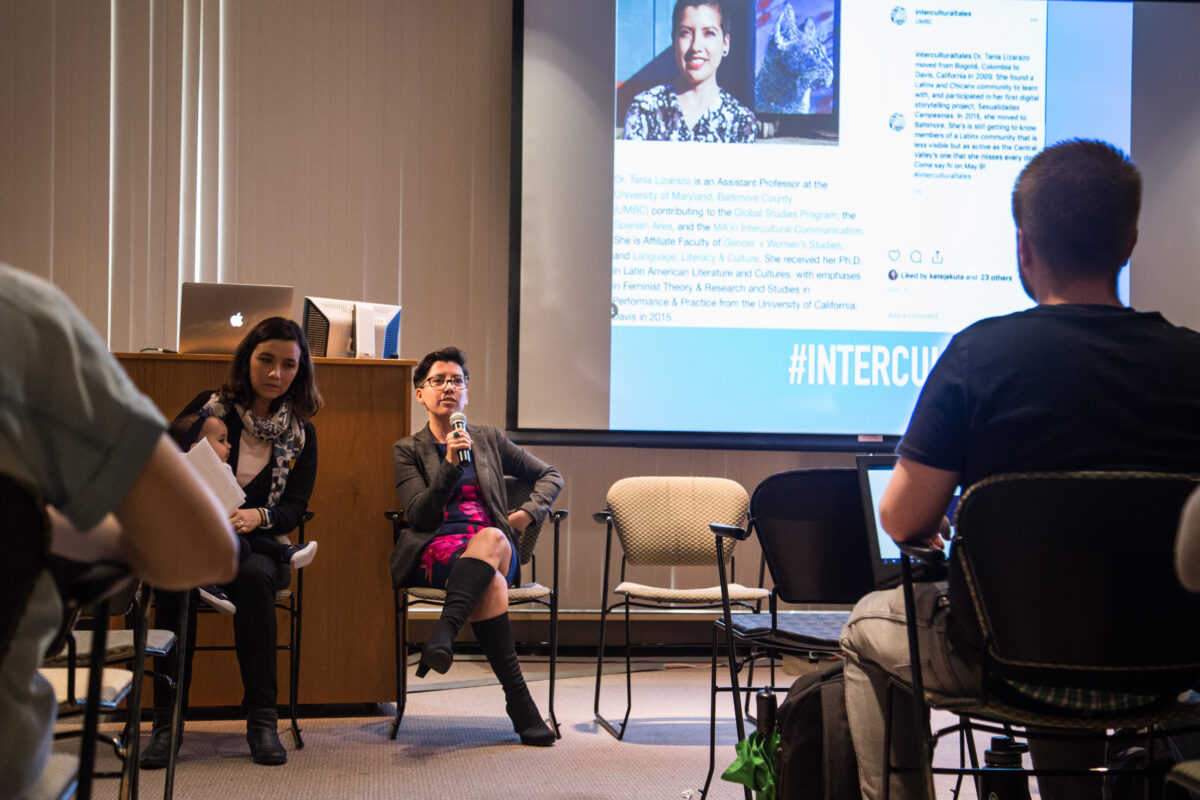 Tania Lizarazo speaking at Intercultural Tales with Thania Muñoz. Photo by Rachel Wallace
This project approaches digital storytelling from a feminist lens where non-academic knowledge such as lived experience is considered equally valuable in teaching and research. “Our project is informed by feminist theory and the field of critical intercultural communication in which power structures and hierarchies are emphasized when thinking about communication,” says Lizarazo, “Intercultural Tales is shaped by all of these fields/practices to facilitate (not guarantee) a more nuanced understanding of immigration as part of UMBC (instead of outside of it).”
This project, now in its third year, brings together students studying Spanish or global studies to produce digital stories of immigrant experiences with the goal of countering stereotypes. In one of the digital stories, “Pack Your Bag,” Heejin Hong ’18, MLLI, speaks of her parents’ transition from Korea to Paraguay, her time living in Brazil, moving to Mexico, and eventually settling in the U.S.
“My parents were first-generation immigrants from South Korea to Paraguay, where I was born. Their life as immigrants was not easy. They worked day and night to support our family,” Hong shared. “They constantly moved to other cities and countries looking for work. When I was little, I moved to Brazil to be with my grandparents because my parents had to work. Brazil was my first experience with immigration and learning a new language, new places, new food, and new cultures.”
She continued, “I have now been living in the U.S. for more than ten years. I used to see all of the changes that made me grow up quickly and think of what I didn’t have. Now, I realize that I gained something greater: courage, independence, patience, a positive outlook, not to lament, and to keep moving forward.”
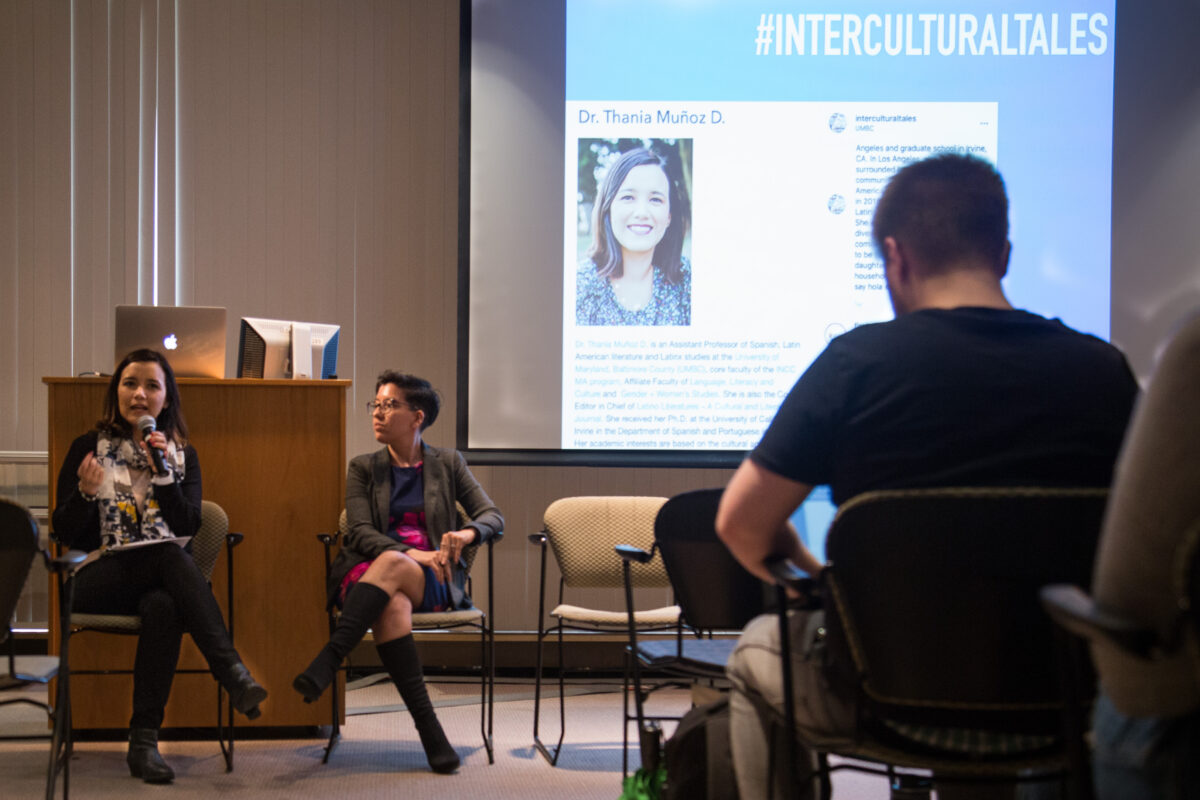 Thania Muñoz speaking about Intercultural Tales with Tania Lizarazo. Photo by Rachel Wallace.
Muñoz notes the findings, which were published in the Journal of Community Engagement and Higher Education, show the process of sharing and valuing knowledge through the project in some cases enabled the students to reframe fear, confusion, and shame through a new lens that revealed feelings of pride, solidarity, and insight.
“Most students had a more nuanced understanding of immigration,” says Lizarazo, “and a renewed appreciation for their classmate’s knowledge, which, in turn, shaped a less hierarchical learning space.”
Community-building through digital storytelling
Lizarazo also collaborated with local immigrant women to create “Moving Stories: Latinas en Baltimore.” The digital storytelling archive visualizes the immigrant experience from the perspective of Latinas in Baltimore. It aims to dispel stereotypes and share the diversity of their experiences.
Camila Daniel shared her experience of being a Black-Brazilian Latina living in Baltimore in her digital story “When Baltimore Became My Home.”
“In 2006 when I came to Baltimore, I lived the experience of what it means to be Black and Latina at the same time in a country that expects people to be only of one race. When people saw me with my accent, my hair, and my Black skin, they assumed I was African American. Many of the Brazilians were white. I didn’t feel I fit in anywhere. I suffered a lot,” says Daniel.
She continues, “Now, I feel it was good for me to come to Baltimore, live in a predominantly Black city, and learn from Black people what it is to have pride in how you look and your history. At the same time, with Spanish and Baltimore, I have created a family that does not have my blood or nationality but one heart.”
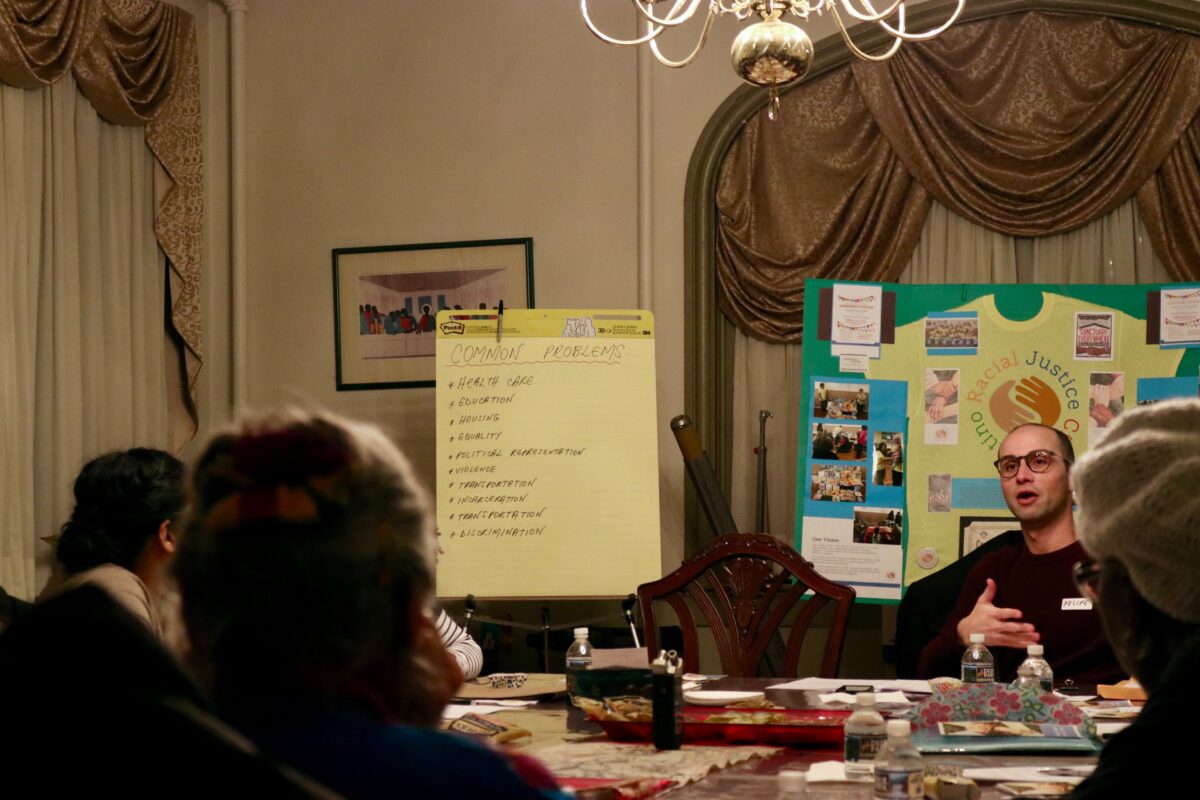 Filomeno leads a discussion with Baltimore’s Latino Racial Justice Circle. Photo courtesy of Filomeno.
Since 2017, Lizarazo and Filomeno have also worked in partnership with Baltimore’s Latino Racial Justice Circle to develop, design, execute, evaluate, and share the “Honest Conversations on Immigration” project. Through dialogue, and digital storytelling, the program fosters conversations between U.S.-born citizens and immigrants that share faith-based spaces but rarely engage in dialogue. Since 2019, about 85 members of 15 congregations have participated.
“Our goal as researchers is to use dialogue and digital stories as ways to bring different communities together around religion, race, and immigration,” explains Filomeno. “Through that process, we hope to create the potential to change the relationships among individuals, and between communities and society for the better.”
Baltimore’s immigration policies
Filomeno last year received the Hispanic Heritage Award from Baltimore Mayor Brandon Scott in recognition of his work facilitating dialogue as well as an earlier comprehensive assessment of Baltimore’s immigration policies. The study “Baltimore’s Policies to Attract and Retain Immigrants: A Community-Engaged Evaluation” was critical in shaping the strategic vision of the Mayor’s Office of Immigrant Affairs. It built on a prior study in which Filomeno reviewed Baltimore’s economic development, multicultural, and law enforcement policies, collaboration with civil society, and policy advocacy.
“In all these studies, I have engaged local groups and organizations in the creation of knowledge about immigration and the application of this knowledge to help solve real-world problems,” says Filomeno. “This research has helped a local government trying to encourage the city’s growth through immigration, a faith community trying to build connections between congregants of different nationalities, and a university trying to leverage student diversity of national origin to promote global learning. As we say at UMBC, it is public research for public good.”
Documenting places of belonging and meaning
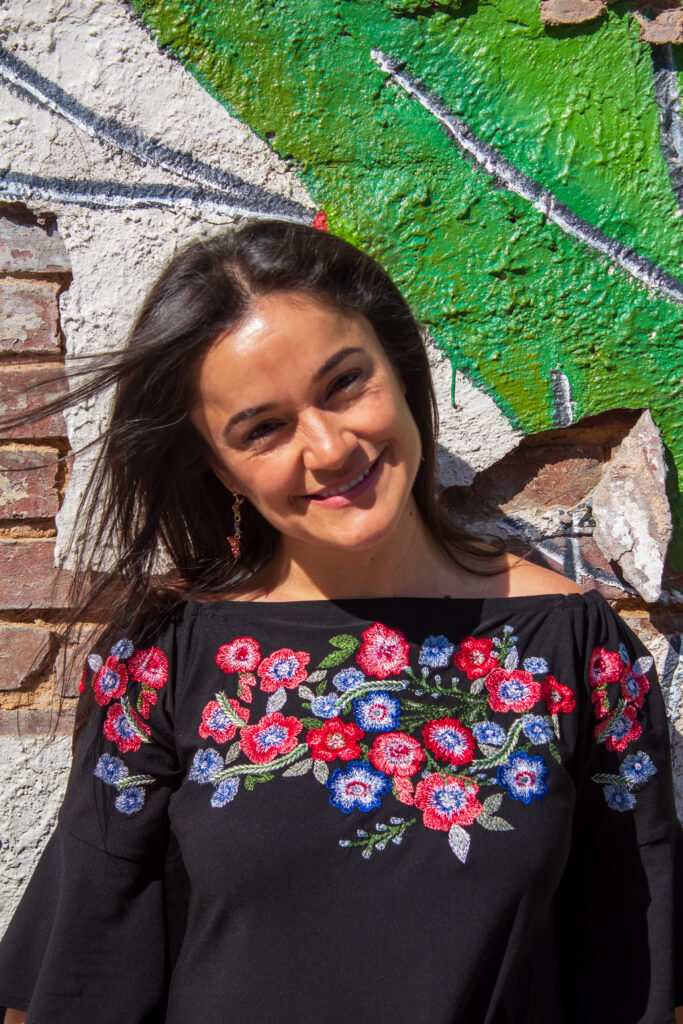 Headshot courtesy of Yolanda Valencia.
Beyond Maryland, Yolanda Valencia, assistant professor of geography and environmental systems, explores the Mexican immigrant community of Pasco, Washington, and how this community creates places of peace, tranquility, and family—places of belonging and meaning—under disadvantaged conditions. In the forthcoming book Relational Life: Legal Death, Valencia draws on years of fieldwork in Pasco, transnational ethnography, archival research, interviews with city leaders, and testimonies from undocumented Mexican immigrants.
“I aim to provide a historical political economy analysis of geographies of oppression overlaid with an analysis of spaces where this community thrives, as they both happen simultaneously across scale, time, and border,” says Valencia.
This year, Valencia received a 12-month Career Enhancement Fellowship, funded by the Mellon Foundation and administered by the Institute for Citizens and Scholars. She was also selected as a 2020 – 2022 Summer Institute on Tenure and Professional Advancement (SITPA) scholar. The mentoring and professional initiative is designed to facilitate junior faculty members’ successful transition to tenured associate professor status.
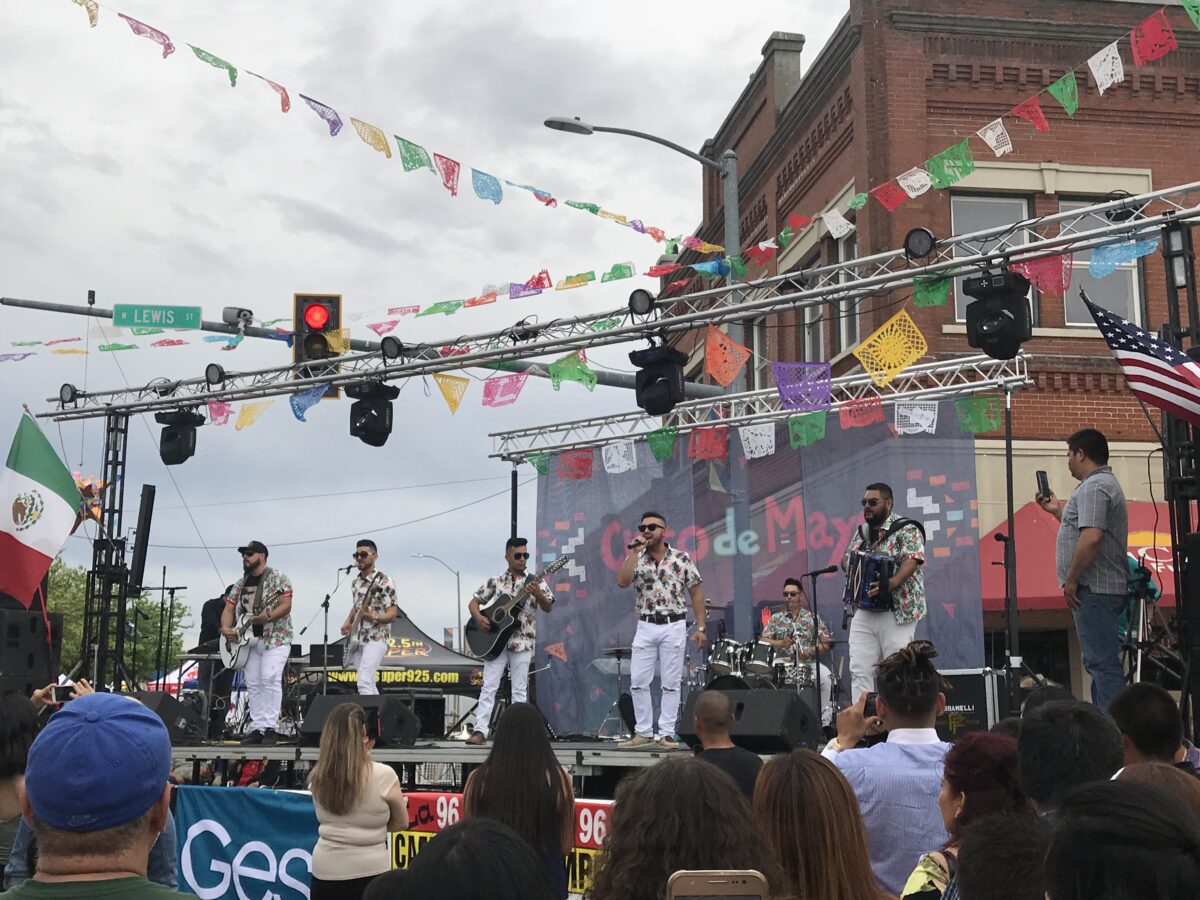 This Cinco de Mayo event in Pasco features second-generation Mexican immigrant musicians who have learned how to play, sing, and love traditional Mexican (and Latinx) music. Photo courtesy of Valencia.
Another faculty member has been highly engaged with immigrant communities in New Orleans. The success of taco trucks and Soul Food pop-ups there have raised complex questions about food truck regulation, worker rights, and immigration. The Whiting Foundation awarded a $50,000 Public Engagement Fellowship to Sarah Fouts, assistant professor of American studies, along with local New Orleans organizers Toya Ex Lewis and Fernando López, to implement “Project Neutral Grounds: At the Intersection of People, Street Food, and the Hustle.”
Lewis is the organizer of Project Hustle, born in New Orleans, and López is a Mexican-born documentarian. The three partners have worked together since 2013. Their latest collaboration will bring together Black, Brown, LGBTQ+, and immigrant food vendors in New Orleans to celebrate, share, and document their experiences and histories.
 Left to right: Toya Ex Lewis, Sarah Fouts, community members, and Fernando Lopez. Photo courtesy of Fouts.
Challenging extractive research
This innovative research intentionally values the knowledge of immigrants and creates new ways for academics to think about primary sources. It highlights thriving communities and enables communication, personal reflection, and empathy while challenging systemic racism and the role of education and institutions in perpetuating inequalities.
“Recognizing each other’s humanity is not an abstract process. It requires a commitment to questioning pedagogies that reproduce the hierarchies we critique,” Muñoz Davaslıoğlu and Lizarazo explain. “Teaching and learning are inextricable from struggles against the dehumanization of immigrants and minorities.”
]]>
UMBC faculty are leading interdisciplinary, community-engaged immigration research that is shifting the relationship between higher education institutions and immigrant communities. Their...
https://umbc.edu/stories/immigrant-voices-in-immigration-research/
https://my3.my.umbc.edu/api/v0/pixel/news/129593/guest@my.umbc.edu/b0f32c6867d89407d88e1ee16c263f2e/api/pixel
americanstudies
arts-and-culture
cahss
csss
discovery
ges
globalstudies
magazine
mlli
news
politicalscience
rca-2
UMBC News & Magazine
https://my3.my.umbc.edu/groups/umbc-news-magazine
https://assets1-my.umbc.edu/system/shared/avatars/groups/000/001/943/24435aa6207c452e7bc15cc74b42c7bb/xsmall.png?1748556657
https://assets1-my.umbc.edu/system/shared/avatars/groups/000/001/943/24435aa6207c452e7bc15cc74b42c7bb/original.png?1748556657
https://assets2-my.umbc.edu/system/shared/avatars/groups/000/001/943/24435aa6207c452e7bc15cc74b42c7bb/xxlarge.png?1748556657
https://assets2-my.umbc.edu/system/shared/avatars/groups/000/001/943/24435aa6207c452e7bc15cc74b42c7bb/xlarge.png?1748556657
https://assets3-my.umbc.edu/system/shared/avatars/groups/000/001/943/24435aa6207c452e7bc15cc74b42c7bb/large.png?1748556657
https://assets1-my.umbc.edu/system/shared/avatars/groups/000/001/943/24435aa6207c452e7bc15cc74b42c7bb/medium.png?1748556657
https://assets2-my.umbc.edu/system/shared/avatars/groups/000/001/943/24435aa6207c452e7bc15cc74b42c7bb/small.png?1748556657
https://assets1-my.umbc.edu/system/shared/avatars/groups/000/001/943/24435aa6207c452e7bc15cc74b42c7bb/xsmall.png?1748556657
https://assets2-my.umbc.edu/system/shared/avatars/groups/000/001/943/24435aa6207c452e7bc15cc74b42c7bb/xxsmall.png?1748556657
UMBC News & Magazine
0
0
false
Mon, 05 Dec 2022 15:44:58 -0500
Mon, 05 Dec 2022 15:44:58 -0500
UMBC’s Zhibo Zhang to clarify atmospheric dust’s role in climate with NSF grant
Natural dust particles and human-produced pollutants in the atmosphere affect Earth’s overall energy budget in different and nuanced ways. A new three-year, $620,000 NSF grant led by Zhibo Zhang, professor of physics, will study how dust, pollutants, and water vapor in the atmosphere interact, to increase understanding of their overall effects on the global climate.
Atmospheric dust particles are large enough that they can reflect the Sun’s energy back to space, producing a cooling effect—but they can also trap energy from the earth trying to escape, contributing to warming. Most pollutants are too small to contribute to cooling, and tend to warm the planet instead, Zhang explains. But when the two mix in the atmosphere, which is commonplace, things get complicated. The new project will work to disentangle the effects of different kinds of particles through a combination of techniques.
Zhang is particularly excited about the upcoming work, because research led by his former students made it possible. Qianqian Song, Ph.D. ’21, atmospheric physics, “wrote three papers over the last three years that gave us the credentials to apply for this program,” Zhang says. Olivia Norman’20, physics, also contributed substantially. Song is currently pursuing a postdoc at Princeton, and Norman is in graduate school at M.I.T.
Moving forward, Tony La Luna, a new Ph.D. student in Zhang’s lab, will focus on the project, and Zhang is looking forward to adding more students to his team.
Domino effect in the atmosphere
Wind is always lifting dust from Earth’s surface, especially in arid areas such as the Sahara and Gobi Deserts. Once airborne, the dust can travel long distances and interact with other particles in the atmosphere.
“When dust moves from its source region to a polluted area, it gets mixed with the pollution there. And we are interested in these interactions,” Zhang says. His team’s research has shown these interactions are most common in eastern China, India, and central Africa.
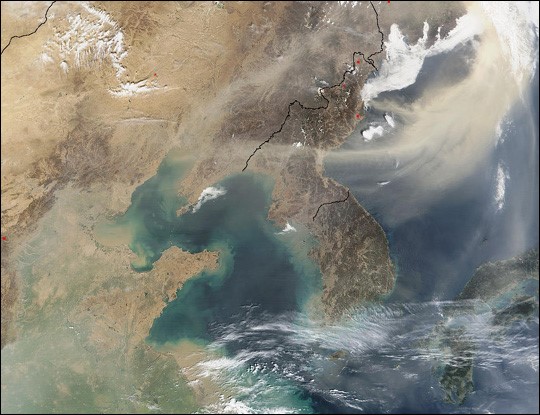 A satellite image centered on the Korean peninsula shows dust and clouds in the atmosphere. (Jacques Descloitres/NASA GSFC)
Until very recently, researchers typically modeled dust and pollutants separately, assuming they did not interact. But based on Zhang’s group’s research, that approach doesn’t produce a good approximation of what’s actually happening, he says.
Where dust and pollutants mix, tiny pollutant particles can condense onto larger dust particles. “The pollution particles can bump into the dust and stick together,” Zhang says. Then a domino effect ensues: “Once the pollution is coated on the dust,” he says, “it changes the way the dust interacts with water.”
Dust generally repels water, but pollutants are often attracted to water molecules. So dust coated with pollutants, called “coated dust,” can start to collect water. By changing how the dust reflects light, “This coating can change the net effect from cooling to warming,” Zhang says. By providing a surface to which water molecules can attach, the coated dust can also contribute to cloud formation, which affects precipitation.
Beyond satellite images
It can actually be difficult to tell whether a satellite image shows dust, pollution, or coated dust—so developing techniques to distinguish between different kinds of atmospheric particles is another one of the team’s goals.
“First, we need a good dust model,” Zhang says. His collaborator Dr. Diana Ortiz-Montalvo at the National Institute of Standards and Technology (NIST) uses a special imaging technique to precisely measure the shape of dust particles in the lab. Those measurements will help create models of different kinds of dust.
In general, pure dust has jagged edges. However, if the dust is thickly coated, it appears spherical again; this is called “smoothed dust.” A smoothing effect can also happen if water binds to dust and then evaporates.
Knowing exactly what each type of dust looks like will support efforts to more accurately identify them in satellite images, and understand how each type will behave in the sky.
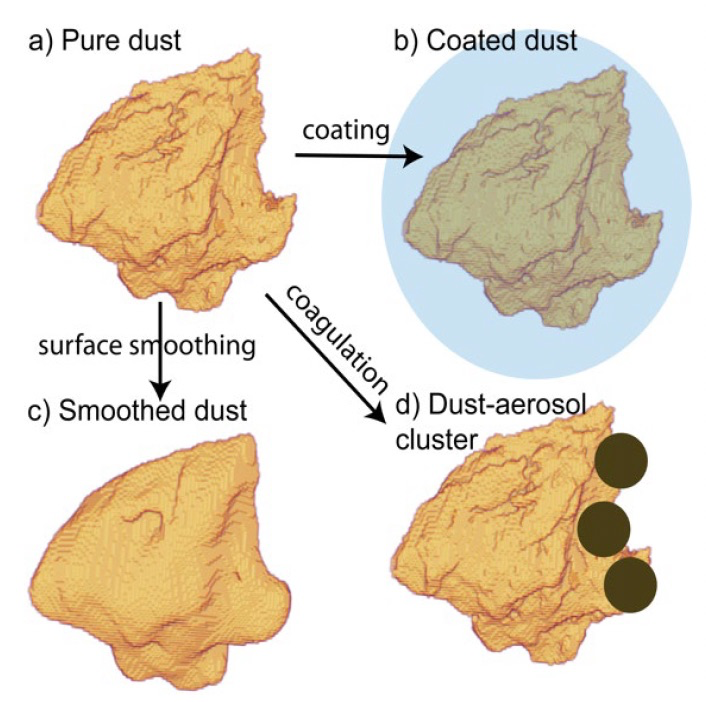 Different combinations of dust and pollutants take different shapes, which can be identified in the atmosphere through a combination of satellite data. (Image courtesy Zhibo Zhang)
Scattering light—and focusing on results
With the dust models in hand, Zhang’s team will calculate how the dust would interact with different particles it might encounter in the sky, like water, smoke, or industrial pollutants. Specifically, they will estimate how the dust would reflect—or “scatter”—light that strikes it. The scattering pattern depends on how rough or smooth the dust is.
The researchers will also analyze observational data that measure how dust all over the globe is scattering light. “Then we’ll combine lab measurements, the scattering calculations, and these satellite observations all together,” Zhang says, to answer the project’s ultimate question: Is dust and its interactions with other particles warming or cooling the planet, and how much?
Zhang’s research group melds computer science, physics, and climate science to address some of the least understood factors contributing to global climate. The new project will further those efforts, with the potential to clarify what roles dust and other atmospheric particles play. Along the way, it will also prepare students for successful careers in science.
“The new grant is indeed based on the success of the students. They laid the foundation for this project,” Zhang says. Much like his students, he adds, “I’m excited to take this essential next step in addressing an issue that affects our planet so profoundly.”
]]>
Natural dust particles and human-produced pollutants in the atmosphere affect Earth’s overall energy budget in different and nuanced ways. A new three-year, $620,000 NSF grant led by Zhibo Zhang,...
https://umbc.edu/stories/atmospheric-dusts-role-in-climate/
https://my3.my.umbc.edu/api/v0/pixel/news/129515/guest@my.umbc.edu/025047a936fc75ca4ae64cc21e4dfcd5/api/pixel
cnms
gradresearch
news
physics
rca-2
research
science-and-tech
undergraduate-research
UMBC News & Magazine
https://my3.my.umbc.edu/groups/umbc-news-magazine
https://assets1-my.umbc.edu/system/shared/avatars/groups/000/001/943/24435aa6207c452e7bc15cc74b42c7bb/xsmall.png?1748556657
https://assets1-my.umbc.edu/system/shared/avatars/groups/000/001/943/24435aa6207c452e7bc15cc74b42c7bb/original.png?1748556657
https://assets2-my.umbc.edu/system/shared/avatars/groups/000/001/943/24435aa6207c452e7bc15cc74b42c7bb/xxlarge.png?1748556657
https://assets2-my.umbc.edu/system/shared/avatars/groups/000/001/943/24435aa6207c452e7bc15cc74b42c7bb/xlarge.png?1748556657
https://assets3-my.umbc.edu/system/shared/avatars/groups/000/001/943/24435aa6207c452e7bc15cc74b42c7bb/large.png?1748556657
https://assets1-my.umbc.edu/system/shared/avatars/groups/000/001/943/24435aa6207c452e7bc15cc74b42c7bb/medium.png?1748556657
https://assets2-my.umbc.edu/system/shared/avatars/groups/000/001/943/24435aa6207c452e7bc15cc74b42c7bb/small.png?1748556657
https://assets1-my.umbc.edu/system/shared/avatars/groups/000/001/943/24435aa6207c452e7bc15cc74b42c7bb/xsmall.png?1748556657
https://assets2-my.umbc.edu/system/shared/avatars/groups/000/001/943/24435aa6207c452e7bc15cc74b42c7bb/xxsmall.png?1748556657
UMBC News & Magazine
0
0
false
Thu, 01 Dec 2022 16:46:00 -0500
Thu, 01 Dec 2022 16:46:00 -0500