UMBC supports promising internal research and creative endeavors with 2026 – 27 START, SURFF awards
UMBC’s Division of Research and Creative Achievement recently announced the recipients of the 2027 Strategic Awards for Research Transitions (START) and the 2026 Summer Research Faculty Fellowship (SURFF) awards, two of the university’s primary, internal funding opportunities that support faculty-led research and creative work.
The latest awards cover diverse projects, including exploring the genetic origins of a neurologic disorder in Siberian huskies, securing smartphones against voice scams, building novel animated sculpture, and exploring the legacy of Argentine-born American cellist Ennio Bolognini.
In total for fiscal year 2027, 12 faculty members and researchers across UMBC’s three colleges and the university’s research centers were awarded up to $25,000 in START funding to advance their research and creative projects. The awards help recipients build research momentum early in their careers and hone their research pitches to pursue external funding. They can also help faculty pivot to new fields of inquiry later in their careers.
For summer 2026, 21 faculty members received a SURFF award, which supports non-tenured, tenure-track faculty members in pursuing research and creative achievement projects during the summer. Recipients are awarded $8,000 in funding.
“Each year when we review applications, we find we have so many faculty who are being very creative and really pushing the edge of what’s known in their various disciplines,” says Don Engel, associate vice president for strategic research initiatives at UMBC, who coordinates the faculty committee that reviews prospective awards. “The proposals really illustrate the breadth of achievement that goes on across the university.”
]]>
UMBC’s Division of Research and Creative Achievement recently announced the recipients of the 2027 Strategic Awards for Research Transitions (START) and the 2026 Summer Research Faculty Fellowship...
https://umbc.edu/stories/umbc-2026-27-start-surff-awards/
https://my3.my.umbc.edu/api/v0/pixel/news/160970/guest@my.umbc.edu/3135e22beb3f1d1bead291c5198c4080/api/pixel
cahss
cnms
coeit
discovery
research
stories
story
UMBC News & Magazine
https://my3.my.umbc.edu/groups/umbc-news-magazine
https://assets1-my.umbc.edu/system/shared/avatars/groups/000/001/943/24435aa6207c452e7bc15cc74b42c7bb/xsmall.png?1748556657
https://assets1-my.umbc.edu/system/shared/avatars/groups/000/001/943/24435aa6207c452e7bc15cc74b42c7bb/original.png?1748556657
https://assets2-my.umbc.edu/system/shared/avatars/groups/000/001/943/24435aa6207c452e7bc15cc74b42c7bb/xxlarge.png?1748556657
https://assets2-my.umbc.edu/system/shared/avatars/groups/000/001/943/24435aa6207c452e7bc15cc74b42c7bb/xlarge.png?1748556657
https://assets3-my.umbc.edu/system/shared/avatars/groups/000/001/943/24435aa6207c452e7bc15cc74b42c7bb/large.png?1748556657
https://assets1-my.umbc.edu/system/shared/avatars/groups/000/001/943/24435aa6207c452e7bc15cc74b42c7bb/medium.png?1748556657
https://assets2-my.umbc.edu/system/shared/avatars/groups/000/001/943/24435aa6207c452e7bc15cc74b42c7bb/small.png?1748556657
https://assets1-my.umbc.edu/system/shared/avatars/groups/000/001/943/24435aa6207c452e7bc15cc74b42c7bb/xsmall.png?1748556657
https://assets2-my.umbc.edu/system/shared/avatars/groups/000/001/943/24435aa6207c452e7bc15cc74b42c7bb/xxsmall.png?1748556657
UMBC News & Magazine
0
0
false
Mon, 06 Jul 2026 15:17:16 -0400
Who gets to tell the story? The tricky back story of how radio shows can promote empathy but also build up cultural divides
In his new book, Empathy Machines: This American Life, Podcasting, and the Public Radio Structure of Feeling, Jason Loviglio, professor of media and communications, critiques and analyzes the making of and the impact of one of his favorite shows on National Public Radio (NPR), “This American Life”—a radio show turned podcast that received the 2021 Pulitzer Prize in Audio Reporting. “This American Life,” created and hosted by Baltimore-native Ira Glass, became a listener favorite for its magical way of weaving stories about everyday people into larger human issues, sounding more like a sympathetic, curious neighbor instead of a serious professor. The irony is not lost on Loviglio, who thanked his students in the book for reminding him that accessibility ensures that the public, his students, and their families, not only academic editors, understand the research. He wants this young audience to learn about radio and be inspired to research their own media and communications passions.
“The people I have had the honor of calling my students over the years have done more than anyone else to help me learn how to communicate ideas about communication and media clearly and simply,” writes Loviglio in his acknowledgements. “The MCS undergraduates are among the least pretentious and least entitled people I’ve ever had the pleasure of working with. Too numerous to name here, I give a collective thanks to you for the lessons of clarity you’ve taught me and for the laughs.”
Long before Loviglio became an author and the co-editor of Radio Journal: International Studies in Broadcast and Audio Media and of The Routledge Companion to Radio and Podcasting Studies, he was a young kid in love with “weird radio shows,” notes Loviglio. “I remember listening at night to my red transistor radio when I was little, maybe 9 or so. I put it under my pillow so my parents wouldn’t hear it,” says Loviglio. “I mostly listened to weird nationally-syndicated late night public radio shows, like Dr. Demento and local sports talk shows.”
While he doesn’t expect students to fall in love with radio as he did, in his History of Media class, he wants students to understand the power and importance of radio long before stories were mobilized in the palms of our hands 24/7 worldwide. Loviglio encourages students to look beyond Google and instead find people whose lives were shaped by radio.
He wants students to explore what radio meant in everyday life and how it conveyed and reflected emotions such as fear, danger, excitement, and joy—functioning as empathy machines that inspired deeper forms of storytelling and laid the groundwork for public radio and podcasts.
Q: What are empathy machines?
A: I think it’s safe to say that public radio has been explicitly understood as an empathy machine at least since the radio show “This American Life’s” debut in 1996. If we allow for synonyms of empathy, then radio has been understood this way for a lot longer. There’s a longer history regarding various media of communication as uniquely efficient machines for producing empathy. Most famously, of course, is the novel. And before that, oral storytelling. The idea of radio as an empathy machine stems from a specific history referred to as the technological sublime.
The notion that we can invent and communicate our way into equality is central to the way we understand Western history since at least the printing press. The book, particularly the novel, has been hailed for its powers to impart democracy and empathy. This history is opposed by an equally compelling one in which the machine represents the antithesis of democratic values of participation and empathy. A dominant theme in media history is the role of technology as an extension of human values, such that we no longer hear the metaphors in our arguments.
Q: Did you always know you were going to write about “This American Life” instead of general radio?
A: It wasn’t until a couple of years ago that I realized the best way to tell the story of public radio and podcasting was through NPR’s “This American Life.” It was first produced in 1996 by WBEZ, Chicago Public Radio, and then picked up nationally by Public Radio International. It became a massive show.
“This American Life” is also one of the first shows to start offering a podcast version, in case you missed an episode. Around 2014, “This American Life” started to shift, where more people were listening to it as a podcast. I wrote to Ira Glass last year, and he still calls it a radio show. That’s still his default understanding of it, even now.
Q: Did you have fun writing this?
A: Yes and no. I had fun thinking about it and fun listening to the shows. This is such a great way to tell stories. But it was hard to write because the shows kept changing. My thoughts kept changing. I began writing the book during President Obama’s administration, when I was thinking positively about American history. Then, Trump won.
I didn’t think that because President Obama was elected, it meant that everything was great and we had cured racism. I thought a particular version of liberalism had won. Definitely very capitalistic, definitely very interested in style, maybe more than substance, but there was a story everyone was telling about the country that was designed to make people feel very comfortable. Not only liberals, but also very privileged people, and not particularly political.
Trump winning the 2016 presidential election was a reminder that there is another story. I knew the other far-right story, but I thought that more people were happy for the positive symbolic victory that President Obama represented in terms of being biracial and being born to an immigrant father. This educated, cosmopolitan elite could also speak across different cultural registers. I thought that’s what I was writing about. Then the Trump administration began, and I felt I had to write about this darker story. That meant I had to think differently about the long, slow death of liberalism. There was something rotten in the creeping neoliberalism of the era that put some of us to sleep, left others out in the cold, and mobilized a politics of racial grievance on the right.
Q: What was the critique?
A: I’m not speaking for everyone, but people like me: privileged, educated, and progressive but kind of complacent. What did we do for the eight years of the Obama administration and the previous two or three decades of creeping neoliberalism? What were we listening to? Public radio. That’s what we were listening to. That’s the soundtrack of the frog and the pot. The pot slowly heats up, the frog is comfortable, and doesn’t realize it’s slowly boiling. I love public radio. I love “This American Life.” I love podcasting, but I also wanted to look critically at the story we were telling about empathy, who is telling the story, and who is the story about?
Important exceptions long persisted at the margins of the public radio industry. “Latino USA” is the longest-running public radio Latino news and cultural program in the United States. It is unique in that it has people of color behind the microphone. It is designed by the people that it speaks to, but most of public radio is not that way. In contrast, “This American Life,” in a way, is the epitome of white liberalism. It’s really beautiful storytelling, but in the service of this kind of sound effect of liberalism and empathy, instead of something a little bit more gritty and radically engaged that maybe we should have been trying to tune into.
I use “This American Life,” as a bridge, because of the way that it really epitomizes…radio, as a place for sonic innovation, experimentation, the primacy of the local, the intimacy of the familiar, weakly voice…
Then what happens is it becomes a national phenomenon…turning into inside the beltway, political relevance, and increasing market share…driven by an increasingly robust audience research, which discovers…that the folks who listen to public radio are disproportionately…highly educated, higher earners, and that in order to sustain a system that relies on donations…the programming has to not only appeal to them, but the variation between programs has to be minimal…which is borrowed from commercial radio.
Q: Did the mindset about who gets to tell the radio story shift during or after the social justice protests of the summer of 2020?
A: Yes. That is when it all falls apart. The whole public radio storytelling format starts to collapse in the late 2010s because most of these shows are run by white producers and white on-air talent who are telling stories about others. All the contradictions just start to crash into each other, and a lot of the shows go off the air. There are all these awkward moments of reckoning. Shows changed. One week, the radio show “Invisibilia,” an NPR podcast about the unseen forces that shape human behavior, like ideas and beliefs, was being produced by all-white women from NPR, The New Yorker, and Slate magazine. Then, in part due to the collapse of the specific logic of empathy that animated the show, there is a switchover to new hosts—two women of color, who cheerfully embraced a more politically engaged set of feelings, like confrontation and discomfort. The show was canceled in 2023, suggesting that the format could not bear certain kinds of changes to its structure of feeling.
The same thing happened with “Reply All,” a popular podcast about the internet and digital culture, created and hosted by Alex Goldman and PJ Vogt, two white men from New York City. They had a massive implosion. Goldman and Vogt were called out for perpetuating plantation culture in the workplace, where leadership and decision-making are dominated by white executives or managers, right in the middle of doing an exposé on Bon Appétit, a high-end food culture magazine, for doing precisely the same thing. “Reply All” was calling out a white-run magazine, and the people who were doing a lot of the grunt work but not getting paid were people of color and young people, who spoke up about the hypocrisy. That show collapsed in a couple of weeks.
It’s really a radical moment because radio shows and podcasts don’t get to tell the same stories without ever changing who gets to tell the stories. You don’t get to pretend you care, but not change. And so things really start to feel the strain by 2020.
Q: Are shows today more liberal or conservative as a result of the shift in 2020?
A: There are many shows today that center on conflict and unhappiness with the status quo—that Trumpism has gone too far. I try to write about how we are in a whiplash between this rhetoric of empathy and the rhetoric of Trumpism, this hostility to the idea of caring for others. I don’t know how many people took the political implications of empathy seriously, but rhetorically, it shaped a good deal of the public radio structure of feeling.
Q: Why did you thank your students in the book?
A: Students are reading less and less, and academics like me want to write clearly, and we usually don’t because we’re not thinking about 17-year-olds. We’re not thinking about the parents of 17-year-olds who might encounter our research in a faculty magazine or a newspaper. We’re thinking about the people who review academic journals or books.
One reason I thanked the students is that in the MCS methods class, students read articles written by MCS faculty. If they’re learning about history, they’re reading something I wrote or something Liz Patton, chair and associate professor of MCS, who writes about media history, identity, and space, wrote. If they’re reading about globalization and representation, they’ll read research byTracy Tinga, associate professor of MCS, who focuses on critical conversations about media, power, development, and digital cultures in African contexts, or research by Fan Yang, professor of MCS, who writes about the intersection of cultural studies, transnational media studies, globalization, postcolonialism/postsocialism, urban communication, and contemporary China. And now, they are reading work on social media and mental health, thanks to our newest colleague, Holly Avella. They’re also reading or viewing the work of Chung-Wei Huang, teaching assistant professor, Kristen Anchor, teaching associate professor, and Donald Snyder, teaching professor of MCS.
Students love reading faculty research, so I want to make sure what I’m writing is accessible to students. It’s a conversation starter when students connect personally with the research.
Q: Do students in your classes listen to the radio?
A: Some do. I think they do so a bit more after they’ve had a class with me. I want to make sure all my classes have opportunities for different kinds of creativity and engagement. In my History of Media class, I have students think about radio and pay attention to what is on the radio by having them interview a grandparent or someone older in their lives about their experiences with the radio. Students create small stories by conducting interviews and editing them into short radio diaries in a style similar to “This American Life.”
A lot of our students are immigrants or international students, and even more are children or grandchildren of immigrants. Radio remains especially important in much of the world, particularly in the Global South and in regions shaped by uneven development. This assignment helps students learn about their grandparents, and for some, it becomes the most meaningful conversation they have ever had with them. I’ve had students come back and tell me, “My grandfather died, and I have this recording of us talking for your assignment. It’s the only thing I have of him.” That’s why I really value this assignment.
Q: Is listening to the radio really a thing of the past?
A: Video games and gaming culture are increasingly central to sound studies because so much of these experiences are built around audio design. Many major games are intentionally structured to sound like radio, as in Grand Theft Auto, which features more than a dozen in-game radio stations with full playlists. In this sense, radio continues to shape not only podcasting but also video games, providing a template for how soundscapes are constructed for audiences. Even though radio may seem obsolete or old-fashioned, it remains one of the dominant frameworks through which people understand and design contemporary sound culture.
Register to attend an interview with Loviglio on July 21, 2026, at the Ivy Bookshop in Baltimore City, hosted by Aaron Henkin, award-winning public radio producer and podcaster. Read more UMBC Humanities Books stories.
]]>
In his new book, Empathy Machines: This American Life, Podcasting, and the Public Radio Structure of Feeling, Jason Loviglio, professor of media and communications, critiques and analyzes the...
https://umbc.edu/stories/public-radio-empathy-machines-loviglio/
Video Preview
https://assets3-my.umbc.edu/system/shared/attachments/4d20cc4a7ea336b3f69138944b10e169/6aa2857f/news/000/160/880/1421f658b20874eb200e6eeaca8d6d88/2ofgfOORQ1E.jpg?1782827406
https://my3.my.umbc.edu/api/v0/pixel/news/160880/guest@my.umbc.edu/04fc9b50e74032c6482b5f555a9ed286/api/pixel
arts-and-culture
cahss
humanitiesbooks
perspectives
research
retriever-authors
stories
story
UMBC News & Magazine
https://my3.my.umbc.edu/groups/umbc-news-magazine
https://assets1-my.umbc.edu/system/shared/avatars/groups/000/001/943/24435aa6207c452e7bc15cc74b42c7bb/xsmall.png?1748556657
https://assets1-my.umbc.edu/system/shared/avatars/groups/000/001/943/24435aa6207c452e7bc15cc74b42c7bb/original.png?1748556657
https://assets2-my.umbc.edu/system/shared/avatars/groups/000/001/943/24435aa6207c452e7bc15cc74b42c7bb/xxlarge.png?1748556657
https://assets2-my.umbc.edu/system/shared/avatars/groups/000/001/943/24435aa6207c452e7bc15cc74b42c7bb/xlarge.png?1748556657
https://assets3-my.umbc.edu/system/shared/avatars/groups/000/001/943/24435aa6207c452e7bc15cc74b42c7bb/large.png?1748556657
https://assets1-my.umbc.edu/system/shared/avatars/groups/000/001/943/24435aa6207c452e7bc15cc74b42c7bb/medium.png?1748556657
https://assets2-my.umbc.edu/system/shared/avatars/groups/000/001/943/24435aa6207c452e7bc15cc74b42c7bb/small.png?1748556657
https://assets1-my.umbc.edu/system/shared/avatars/groups/000/001/943/24435aa6207c452e7bc15cc74b42c7bb/xsmall.png?1748556657
https://assets2-my.umbc.edu/system/shared/avatars/groups/000/001/943/24435aa6207c452e7bc15cc74b42c7bb/xxsmall.png?1748556657
UMBC News & Magazine
4
0
false
Tue, 30 Jun 2026 09:33:36 -0400
Tue, 30 Jun 2026 09:33:36 -0400
A global perspective on aging: Alfred Boakye’s gerontology journey from Ghana to Japan and the U.S.
Alfred Boakye first began thinking deeply about the care and well-being of elders and their families while caring for his centenarian grandmother, Margaret Nyarko, in his home city of Tema, on the Atlantic coast of South East Ghana. She was in charge of her essential self-care routine—bathing, dressing, eating, toileting, transferring from sitting to standing, and continence—and more complex daily tasks necessary for independent living: medication management, meal preparation, transportation, and shopping. But even with her mobility, his grandmother lacked a social network.
Acting as both a devoted grandchild and a caretaker, Boakye experienced firsthand the complexities of aging. He learned to respect his grandmother’s independence while finding ways to support her where she needed help. Boakye, now a UMBC gerontology Ph.D. student in the social, cultural, and behavioral track, notes that his grandmother’s children didn’t live with her, and her grandchildren didn’t understand her aging process. As her friends and siblings passed away, her social circle shrank. “I asked her what motivated her to stay at church for hours, and she says the church supports her, brings her communion, visits her, and brings her Christmas gifts.”
After earning a bachelor’s degree in English and a master’s degree in human resources at the University of Ghana, Boakye wanted to broaden his understanding of aging and caregiving. In 2021, he moved to the United States to pursue a master’s degree in gerontology at Georgia State University (GSU), where he met his mentor and master’s thesis chair, Jennifer Craft Morgan, professor and director of the GSU Gerontology Institute.
 Boakye at his GSU master’s graduation. (l-r): Antonius Skipper, assistant professor of gerontology at GSU and Boakye’s master’s thesis committee member; Reverend Kwaku Owusu-Boachie, Boakye’s uncle; Boakye; and Craft Morgan. (Image courtesy of Boakye)
In 2023, the year his grandmother passed away and the year he completed his master’s at GSU, Boakye published his first aging-related article, “Does the Church Care? Assessment of Social Support Strategies on the Health and Wellbeing of Older Adults within the Tema Metropolitan Assembly-Ghana” in the African Journal of Ageing Studies.
Craft Morgan fostered Boakye’s interest in gerontology and encouraged him to continue his work at the doctoral level, leading him to UMBC’s gerontology doctoral program, which is an interdisciplinary program in collaboration with the University of Baltimore. “Professor Craft Morgan has held my hand from the day I started my master’s program and continues to do so today,” says Boakye. “I always feel privileged that I have her in my corner.”
Stigma of male caregivers
Boakye’s studies are also informed by his experience being the primary caregiver to his father. Before moving to the U.S., Boakye did the grocery shopping, cooking, and laundry for Stephen, his 76‑year‑old father. He became aware of the multiple obligations children have when caretaking for themselves, their families, and their parents, as well as the isolation that can happen, especially if you are a male caregiver.
At the time, Boakye saw himself as being a “helpful child,” a term associated with a Ghanaian proverb that states, “If they take care of you to grow your teeth, you take care of them to lose theirs.” The proverb is more than words—it is a way of life in Ghana, which reinforced Boakye’s caregiving role and emphasized what it takes to be a helpful child—one built on responsibility and reciprocity. But it’s easier said than done. “I had to juggle my ‘identity’ as a male caregiver in a historically patriarchal society with my caring masculinity,” says Boakye. “Caregiving is predominantly perceived as ‘women’s work’ in Ghana, and men who take on these roles are often stigmatized and labeled ‘Kojo besia,’ which translates to ‘man woman’. To avoid such labeling, I was hesitant to ask for help, despite the toll caregiving took on my physical and psychological well‑being.”
 Boakye presents his research on male caregiving to GSA leadership during their visit to UMBC in spring 2026. (Bradley Ziegler/UMBC)
Boakye presented his research and personal experience to the leadership of the Gerontological Society of America (GSA) during their visit to UMBC this spring. Thanks to the UMB Provost’s Global Scholar Program, Boakye will be traveling to Ghana this summer to engage with male caregivers—to listen to their caregiving experiences, explore what these experiences mean to them, and co‑create resources to support them. He will use this research to finish his master’s thesis in applied sociology—Boakye’s third master’s degree.
Meeting Japan’s centenarians
In 2024, Boakye joined the Global Healthy Aging in Japan study abroad program, organized by Taka Yamashita, professor of sociology, anthropology, and public health and co-director of the gerontology doctoral program. The two-week program leads students through research, community centers, and historic sites in Kanagawa Prefecture, near Tokyo. Japan is known for its cutting-edge research and policy that supports the active lives of the world’s largest aging population and the highest number of centenarians. The students visited multigenerational living communities and centers that merge theoretical research with real-world practice and outcomes.
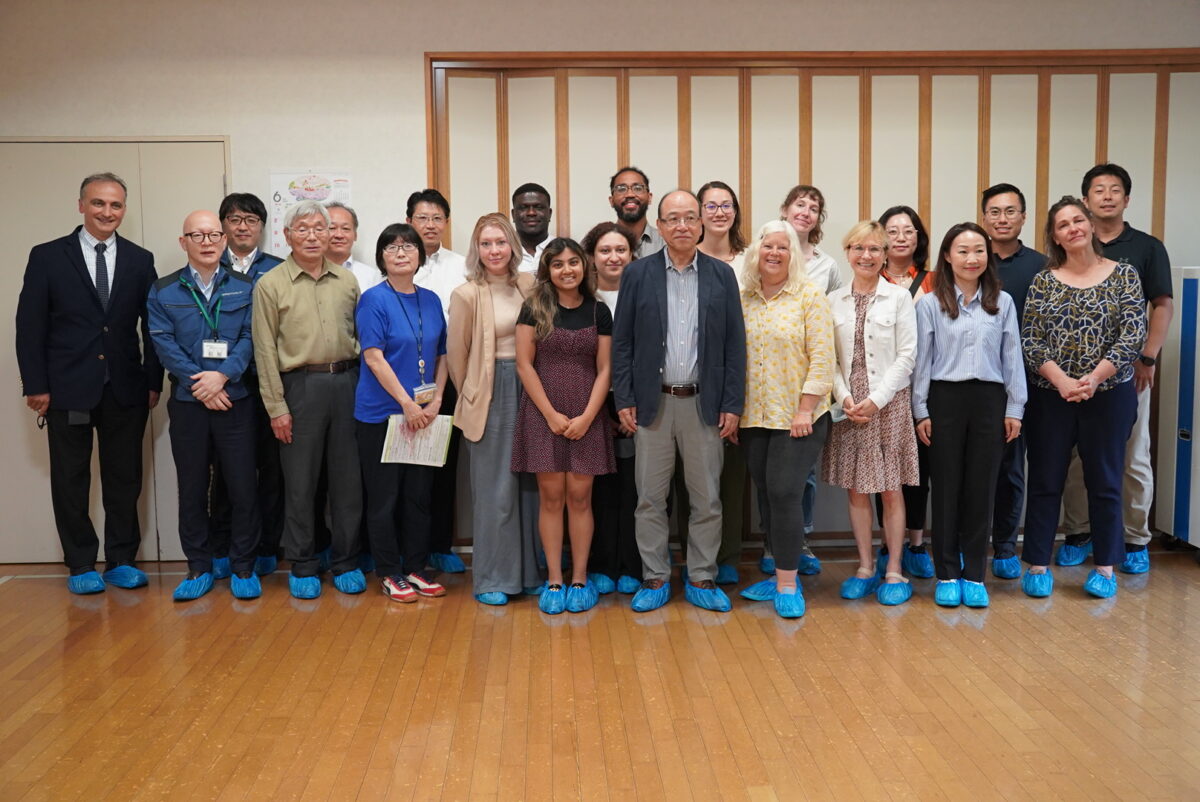 Boakye (second row, fifth from the left) at a senior center in Kanagawa Prefecture, Japan. (Image courtesy of TakaYamishita, professor of gerontology and sociology, second row, first on the right)
Boakye was not expecting that at a time when he was missing his grandmother the most, Kanagawa would make him feel like he was home in Tema. It wasn’t only that both Japan and Ghana operate on a similar collective familial care system focused on intergenerational living and inclusion, notes Boakye. It’s also the physical environment. “The buildings are close together, and people put chairs in front of their homes to talk,” says Boakye. “Older adults greet passersby, and people stop to have a conversation with them. They will tell you they are out for a little sun.”
A highlight of the trip for all the students was meeting a supercentenarian. The 110-year-old woman welcomed them and kissed each of them on the cheek. “All the students say that they were blessed to have this welcome and that she could still talk to us,” says Boakye. “It was really emotional for me. I just kept thinking of my grandmother.”
Boakye was also impressed by the Kanagawa ME-BYO approach to aging, which encourages monitoring vital signs using biomedical technologies. ME-BYO focuses on preventing and minimizing illness progression through programs that promote healthy behaviors such as a balanced diet, exercise, and social activities. “My experience in Japan has been one of the best things that has happened in my personal and academic life and in my career,” says Boakye, who wants to find a way to incorporate ME-BYO into his current and future caregiving research and practice. “This trip has equipped me with the cultural competence, literacy, sensitivity, communication, problem-solving, and critical thinking skills needed to have a real-world impact in the field of gerontology.”
Looking Ahead
With five years of longevity research, Boakye now understands that his grandmother’s experience is common for many older adults in Ghana. He discovered in the 2021 Population and Housing Census of Ghana that adults 65 years of age and older make up 4.3 percent of Ghana’s population. However, he explains, the need for person-centred and geriatric care services has not kept up with the demand.
“I feel like I am now clearly connecting the dots between my experiences in Ghana, what I saw in Japan, and what I have learned in class. I am passionate about encouraging more men to engage and support the people they love, but also seek help when they need it,” says Boakye. He plans to finish his doctoral program in fall 2027.
“It has been a pleasure to watch Alfred’s research grow during his time at UMBC,” says Nancy Kusmaul, professor at UMBC’s School of Social Work, his dissertation chair, who Boakye works with as a research assistant. “He is committed to raising the voices of paid and unpaid caregivers who provide vital services to older adults and people with disabilities in the US and abroad. I am confident that he will continue to make significant contributions to the field.”
He knows there is a long road ahead, but he is confident that he is on the right path. “I want to build culturally relevant and gender‑sensitive resources that support male caregivers, not only to improve their health and well‑being but also to amplify their voices when it matters most.” His grandmother, Margaret, continues to inspire Boakye’s work on how caregiving shapes the experiences of both the carer and the care recipient.
Learn more about UMBC’s gerontology doctoral program.
]]>
Alfred Boakye first began thinking deeply about the care and well-being of elders and their families while caring for his centenarian grandmother, Margaret Nyarko, in his home city of Tema, on the...
https://umbc.edu/stories/alfred-boakyes-gerontology-journey/
https://my3.my.umbc.edu/api/v0/pixel/news/160831/guest@my.umbc.edu/a44c085d6a24b6aba543a04a55557c3d/api/pixel
cahss
gerontology
international
policy-and-society
research
saph
socialwork
stories
story
UMBC News & Magazine
https://my3.my.umbc.edu/groups/umbc-news-magazine
https://assets1-my.umbc.edu/system/shared/avatars/groups/000/001/943/24435aa6207c452e7bc15cc74b42c7bb/xsmall.png?1748556657
https://assets1-my.umbc.edu/system/shared/avatars/groups/000/001/943/24435aa6207c452e7bc15cc74b42c7bb/original.png?1748556657
https://assets2-my.umbc.edu/system/shared/avatars/groups/000/001/943/24435aa6207c452e7bc15cc74b42c7bb/xxlarge.png?1748556657
https://assets2-my.umbc.edu/system/shared/avatars/groups/000/001/943/24435aa6207c452e7bc15cc74b42c7bb/xlarge.png?1748556657
https://assets3-my.umbc.edu/system/shared/avatars/groups/000/001/943/24435aa6207c452e7bc15cc74b42c7bb/large.png?1748556657
https://assets1-my.umbc.edu/system/shared/avatars/groups/000/001/943/24435aa6207c452e7bc15cc74b42c7bb/medium.png?1748556657
https://assets2-my.umbc.edu/system/shared/avatars/groups/000/001/943/24435aa6207c452e7bc15cc74b42c7bb/small.png?1748556657
https://assets1-my.umbc.edu/system/shared/avatars/groups/000/001/943/24435aa6207c452e7bc15cc74b42c7bb/xsmall.png?1748556657
https://assets2-my.umbc.edu/system/shared/avatars/groups/000/001/943/24435aa6207c452e7bc15cc74b42c7bb/xxsmall.png?1748556657
UMBC News & Magazine
0
0
false
Wed, 24 Jun 2026 12:31:18 -0400
Wed, 24 Jun 2026 12:31:18 -0400
A global perspective on aging: Alfred Boakye’s gerontology journey from Ghana to Japan and the U.S.
Alfred Boakye first began thinking deeply about the care and well-being of elders and their families while caring for his centenarian grandmother, Margaret Nyarko, in his home city of Tema, on the Atlantic coast of South East Ghana. She was in charge of her essential self-care routine—bathing, dressing, eating, toileting, transferring from sitting to standing, and continence—and more complex daily tasks necessary for independent living: medication management, meal preparation, transportation, and shopping. But even with her mobility, his grandmother lacked a social network.
Acting as both a devoted grandchild and a caretaker, Boakye experienced firsthand the complexities of aging. He learned to respect his grandmother’s independence while finding ways to support her where she needed help. Boakye, now a UMBC gerontology Ph.D. student in the social, cultural, and behavioral track, notes that his grandmother’s children didn’t live with her, and her grandchildren didn’t understand her aging process. As her friends and siblings passed away, her social circle shrank. “I asked her what motivated her to stay at church for hours, and she says the church supports her, brings her communion, visits her, and brings her Christmas gifts.”
After earning a bachelor’s degree in English and a master’s degree in human resources at the University of Ghana, Boakye wanted to broaden his understanding of aging and caregiving. In 2021, he moved to the United States to pursue a master’s degree in gerontology at Georgia State University (GSU), where he met his mentor and master’s thesis chair, Jennifer Craft Morgan, professor and director of the GSU Gerontology Institute.
Boakye at his GSU master’s graduation. (l-r): Antonius Skipper, assistant professor of gerontology at GSU and Boakye’s master’s thesis committee member; Reverend Kwaku Owusu-Boachie, Boakye’s uncle; Boakye; and Craft Morgan. (Image courtesy of Boakye)
In 2023, the year his grandmother passed away and the year he completed his master’s at GSU, Boakye published his first aging-related article, “Does the Church Care? Assessment of Social Support Strategies on the Health and Wellbeing of Older Adults within the Tema Metropolitan Assembly-Ghana” in the African Journal of Ageing Studies.
Craft Morgan fostered Boakye’s interest in gerontology and encouraged him to continue his work at the doctoral level, leading him to UMBC’s gerontology doctoral program, which is an interdisciplinary program in collaboration with the University of Baltimore. “Professor Craft Morgan has held my hand from the day I started my master’s program and continues to do so today,” says Boakye. “I always feel privileged that I have her in my corner.”
Stigma of male caregivers
Boakye’s studies are also informed by his experience being the primary caregiver to his father. Before moving to the U.S., Boakye did the grocery shopping, cooking, and laundry for Stephen, his 76‑year‑old father. He became aware of the multiple obligations children have when caretaking for themselves, their families, and their parents, as well as the isolation that can happen, especially if you are a male caregiver.
At the time, Boakye saw himself as being a “helpful child,” a term associated with a Ghanaian proverb that states, “If they take care of you to grow your teeth, you take care of them to lose theirs.” The proverb is more than words—it is a way of life in Ghana, which reinforced Boakye’s caregiving role and emphasized what it takes to be a helpful child—one built on responsibility and reciprocity. But it’s easier said than done. “I had to juggle my ‘identity’ as a male caregiver in a historically patriarchal society with my caring masculinity,” says Boakye. “Caregiving is predominantly perceived as ‘women’s work’ in Ghana, and men who take on these roles are often stigmatized and labeled ‘Kojo besia,’ which translates to ‘man woman’. To avoid such labeling, I was hesitant to ask for help, despite the toll caregiving took on my physical and psychological well‑being.”
Boakye presents his research on male caregiving to GSA leadership during their visit to UMBC in spring 2026. (Bradley Ziegler/UMBC)
Boakye presented his research and personal experience to the leadership of the Gerontological Society of America (GSA) during their visit to UMBC this spring. Thanks to the UMB Provost’s Global Scholar Program, Boakye will be traveling to Ghana this summer to engage with male caregivers—to listen to their caregiving experiences, explore what these experiences mean to them, and co‑create resources to support them. He will use this research to finish his master’s thesis in applied sociology—Boakye’s third master’s degree.
Meeting Japan’s centenarians
In 2024, Boakye joined the Global Healthy Aging in Japan study abroad program, organized by Taka Yamashita, professor of sociology, anthropology, and public health and co-director of the gerontology doctoral program. The two-week program leads students through research, community centers, and historic sites in Kanagawa Prefecture, near Tokyo. Japan is known for its cutting-edge research and policy that supports the active lives of the world’s largest aging population and the highest number of centenarians. The students visited multigenerational living communities and centers that merge theoretical research with real-world practice and outcomes.
Boakye (second row, fifth from the left) at a senior center in Kanagawa Prefecture, Japan. (Image courtesy of TakaYamishita, professor of gerontology and sociology, second row, first on the right)
Boakye was not expecting that at a time when he was missing his grandmother the most, Kanagawa would make him feel like he was home in Tema. It wasn’t only that both Japan and Ghana operate on a similar collective familial care system focused on intergenerational living and inclusion, notes Boakye. It’s also the physical environment. “The buildings are close together, and people put chairs in front of their homes to talk,” says Boakye. “Older adults greet passersby, and people stop to have a conversation with them. They will tell you they are out for a little sun.”
A highlight of the trip for all the students was meeting a supercentenarian. The 110-year-old woman welcomed them and kissed each of them on the cheek. “All the students say that they were blessed to have this welcome and that she could still talk to us,” says Boakye. “It was really emotional for me. I just kept thinking of my grandmother.”
Boakye was also impressed by the Kanagawa ME-BYO approach to aging, which encourages monitoring vital signs using biomedical technologies. ME-BYO focuses on preventing and minimizing illness progression through programs that promote healthy behaviors such as a balanced diet, exercise, and social activities. “My experience in Japan has been one of the best things that has happened in my personal and academic life and in my career,” says Boakye, who wants to find a way to incorporate ME-BYO into his current and future caregiving research and practice. “This trip has equipped me with the cultural competence, literacy, sensitivity, communication, problem-solving, and critical thinking skills needed to have a real-world impact in the field of gerontology.”
Looking Ahead
With five years of longevity research, Boakye now understands that his grandmother’s experience is common for many older adults in Ghana. He discovered in the 2021 Population and Housing Census of Ghana that adults 65 years of age and older make up 4.3 percent of Ghana’s population. However, he explains, the need for person-centred and geriatric care services has not kept up with the demand.
“I feel like I am now clearly connecting the dots between my experiences in Ghana, what I saw in Japan, and what I have learned in class. I am passionate about encouraging more men to engage and support the people they love, but also seek help when they need it,” says Boakye. He plans to finish his doctoral program in fall 2027.
“It has been a pleasure to watch Alfred’s research grow during his time at UMBC,” says Nancy Kusmaul, professor at UMBC’s School of Social Work, his dissertation chair, who Boakye works with as a research assistant. “He is committed to raising the voices of paid and unpaid caregivers who provide vital services to older adults and people with disabilities in the US and abroad. I am confident that he will continue to make significant contributions to the field.”
He knows there is a long road ahead, but he is confident that he is on the right path. “I want to build culturally relevant and gender‑sensitive resources that support male caregivers, not only to improve their health and well‑being but also to amplify their voices when it matters most.” His grandmother, Margaret, continues to inspire Boakye’s work on how caregiving shapes the experiences of both the carer and the care recipient.
Learn more about UMBC’s gerontology doctoral program.
]]>
Alfred Boakye first began thinking deeply about the care and well-being of elders and their families while caring for his centenarian grandmother, Margaret Nyarko, in his home city of Tema, on the...
https://umbc.edu/stories/a-global-perspective-on-aging-alfred-boakyes-gerontology-journey/
https://my3.my.umbc.edu/api/v0/pixel/news/160830/guest@my.umbc.edu/92ff94cfedaf1cafa34c3bbd1e692406/api/pixel
cahss
gerontology
international
policy-and-society
research
saph
socialwork
stories
story
UMBC News & Magazine
https://my3.my.umbc.edu/groups/umbc-news-magazine
https://assets1-my.umbc.edu/system/shared/avatars/groups/000/001/943/24435aa6207c452e7bc15cc74b42c7bb/xsmall.png?1748556657
https://assets1-my.umbc.edu/system/shared/avatars/groups/000/001/943/24435aa6207c452e7bc15cc74b42c7bb/original.png?1748556657
https://assets2-my.umbc.edu/system/shared/avatars/groups/000/001/943/24435aa6207c452e7bc15cc74b42c7bb/xxlarge.png?1748556657
https://assets2-my.umbc.edu/system/shared/avatars/groups/000/001/943/24435aa6207c452e7bc15cc74b42c7bb/xlarge.png?1748556657
https://assets3-my.umbc.edu/system/shared/avatars/groups/000/001/943/24435aa6207c452e7bc15cc74b42c7bb/large.png?1748556657
https://assets1-my.umbc.edu/system/shared/avatars/groups/000/001/943/24435aa6207c452e7bc15cc74b42c7bb/medium.png?1748556657
https://assets2-my.umbc.edu/system/shared/avatars/groups/000/001/943/24435aa6207c452e7bc15cc74b42c7bb/small.png?1748556657
https://assets1-my.umbc.edu/system/shared/avatars/groups/000/001/943/24435aa6207c452e7bc15cc74b42c7bb/xsmall.png?1748556657
https://assets2-my.umbc.edu/system/shared/avatars/groups/000/001/943/24435aa6207c452e7bc15cc74b42c7bb/xxsmall.png?1748556657
UMBC News & Magazine
1
0
false
Wed, 24 Jun 2026 12:31:18 -0400
How to make a (really) strong magnet
Magnets often attract curious minds. Einstein told of his profound sense of hidden order after witnessing the invisible forces of the Earth’s magnetic field guide the needle of a compass. For Ethan Bowers, it was the wonder of learning Maxwell’s laws—equations developed by 19th-century Scottish physicist James Clerk Maxwell that unite magnetism, electricity, and light—that really pulled him in.
Now a Ph.D. student in mechanical engineering, Bowers is building a massive, one-of-a-kind research magnet. It weighs more than 2,300 pounds and will be capable of generating a magnetic field of 7 tesla (roughly 140,000 times stronger than the Earth’s magnetic field and more than twice as strong as the field in most MRI machines).
Making the magnet has been the labor of multiple researchers over more than a decade, led by mechanical engineering associate professor Carlos Romero Talamás, who plans to use the magnet to conduct experiments on plasma, the superheated soup of particles found in stars, lighting, and the Aurora Borealis, and which makes up more than 99 percent of the visible universe.
An initial magnet design and analysis was completed by Evan Bates, M.S. ’15, Ph.D. ’18, mechanical engineering. In 2023, Bowers, who had returned as a student to UMBC following a stint in industry, joined the project. He redesigned key aspects of the magnet and began the meticulous work of assembling and testing it. In the coming months, Bowers plans to run the magnet up to full strength. Then the real fun begins: Unleashing the new tool to help answer the questions curious minds dream up.
Tools of the trade
- Mechanical and electrical know-how
- Perseverance
- Heavy-lifting equipment (custom designed)
- A serious power source and some chilled water (things are going to get hot)
Step 1: Brush up on your magnet basics
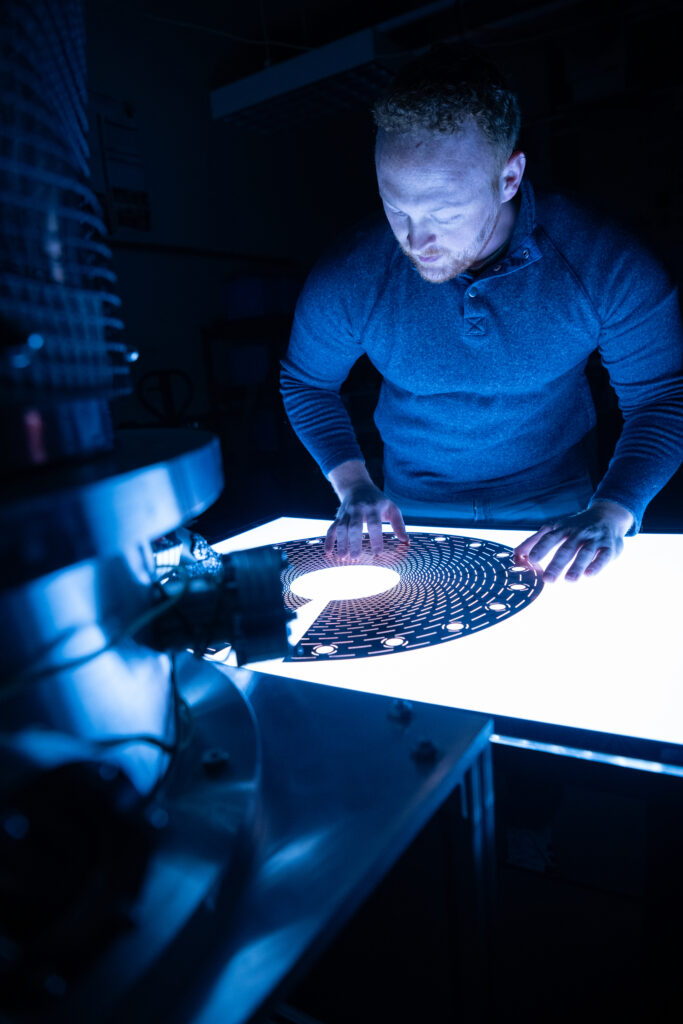 Bowers illuminates a Bitter disk with a backlight. (Brad Ziegler/UMBC)
Say “magnet,” and many people think first of the objects affixing their kids’ artwork to the fridge. Refrigerator magnets are an example of permanent magnets: materials in which the electrons permanently align in a way that generates a magnetic field. Permanent magnets can get quite strong—such as the rare earth neodymium magnets used in some maglev trains—but they top out at about 2 tesla.
To get an even stronger magnet, engineers can turn to a phenomenon that’s captured in the Maxwell equations that captivated Bowers: Electricity and magnetism are intrinsically linked.
Electrons flowing through a wire generate a magnetic field. Coil the wire and you can create a field similar in shape to a permanent bar magnet, with distinct north and south poles. This is the electromagnet. Higher current and more coils make a stronger magnet. However, high current also risks melting your magnet into a puddle and mangling it with the enormous pressure from the magnetic field pushing on the moving electrons (called Lorentz forces).
Superconducting electromagnets, which use material with the almost magical property of showing virtually zero electrical resistance when cooled with liquid helium, can eliminate the melting risk, but are expensive and finicky to operate, and have other limitations.
Another (more old-school) solution is called the Bitter electromagnet, invented in the 1930s by American physicist Francis Bitter. In place of coiled wires, circular metal disks separated with insulating spacers create a helical path that concentrates the current. The disks are shot through with holes for circulating water to whisk away heat and the structural design counteracts the mechanical stresses. “We chose a Bitter magnet because it offered the right combination of features for the tasks we wanted to perform,” Bowers says.
Step 2: Design, test, refine, repeat
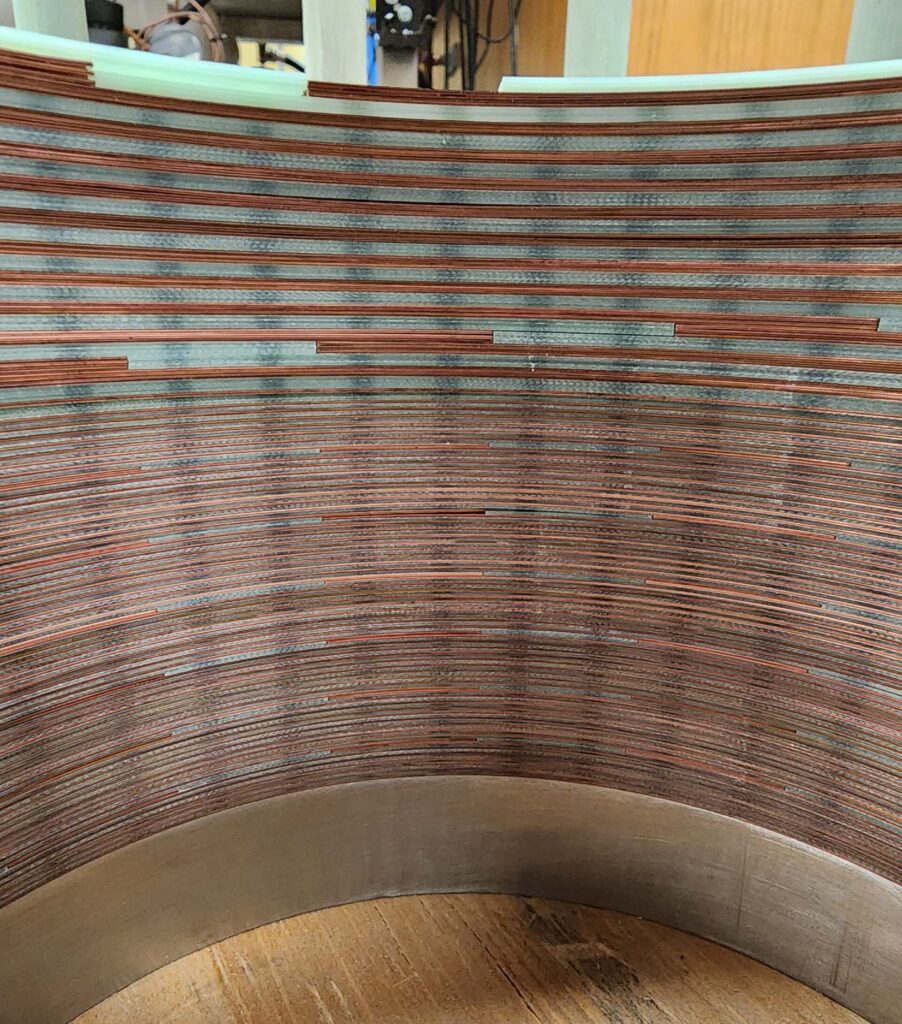 The turn density for the magnet is higher at the ends than at the middle. (Photo courtesy of Bowers)
The UMBC team’s initial vision was to create a 10-tesla Bitter magnet, with space in the center for a relatively large vacuum chamber to hold plasma. The magnet could generate either a steady or pulsed magnetic field, depending on the needs of the experiment. Bates analyzed the disk shape, stacking methods, cooling hole geometry, heat transfer, mechanical stress, and electrical properties of the magnet to optimize the design. He validated it by constructing and testing a 1-tesla prototype.
In 2023, the team decided to change the desired magnetic field profile, making it slightly higher on the ends of the magnet than in the middle, so that charged particles would be pushed toward the center. They didn’t want to redesign the Bitter disks, so they had to lower the maximum field strength to 7 tesla. They also had to vary the coil density, making tighter turns at the ends to get the stronger field.
Bowers analyzed the new field profile and worked out a clever trick of adding a tapered insulating disk to seamlessly transition between the areas of tighter and looser turns. He also performed a structural analysis of the whole assembly.
Step 3: Pallets, cranes, and painstaking planning
The final design called for 439 copper Bitter disks, four insulating transition disks, and 434 regular insulating disks housed inside a pressure vessel. Outside companies manufactured the disks, but Bowers personally inspected every single one, removing any with defects, and cleaning the copper ones with isopropyl alcohol. He built a custom pallet to hold the cylindrical assembly in place in the lab, and started stacking.
The process took about a month, and near the end “I was so sick of the monotony,” Bowers says. To push it across the finish line, he worked straight through the weekend, stacking the last disk on a Sunday afternoon in February. “It happened to be my friend’s birthday so I celebrated that completion and their birthday together,” he says.
Next up was moving the approximately 2-foot-high stack of disks to a movable swing set, created by a UMBC mechanical engineering capstone team to serve as a mobile and rotatable platform for the magnet. Bowers built a custom crane fixture to lift the assembly onto the platform and spent weeks planning every step of the move. “It was the last major place the structure could fail before we power the magnet,” he says. After one stressful day, Bowers says he was elated when it all went according to plan. “I felt genuinely grateful for all I had been given the chance to work on, and grateful that God had given me the ability to succeed.”
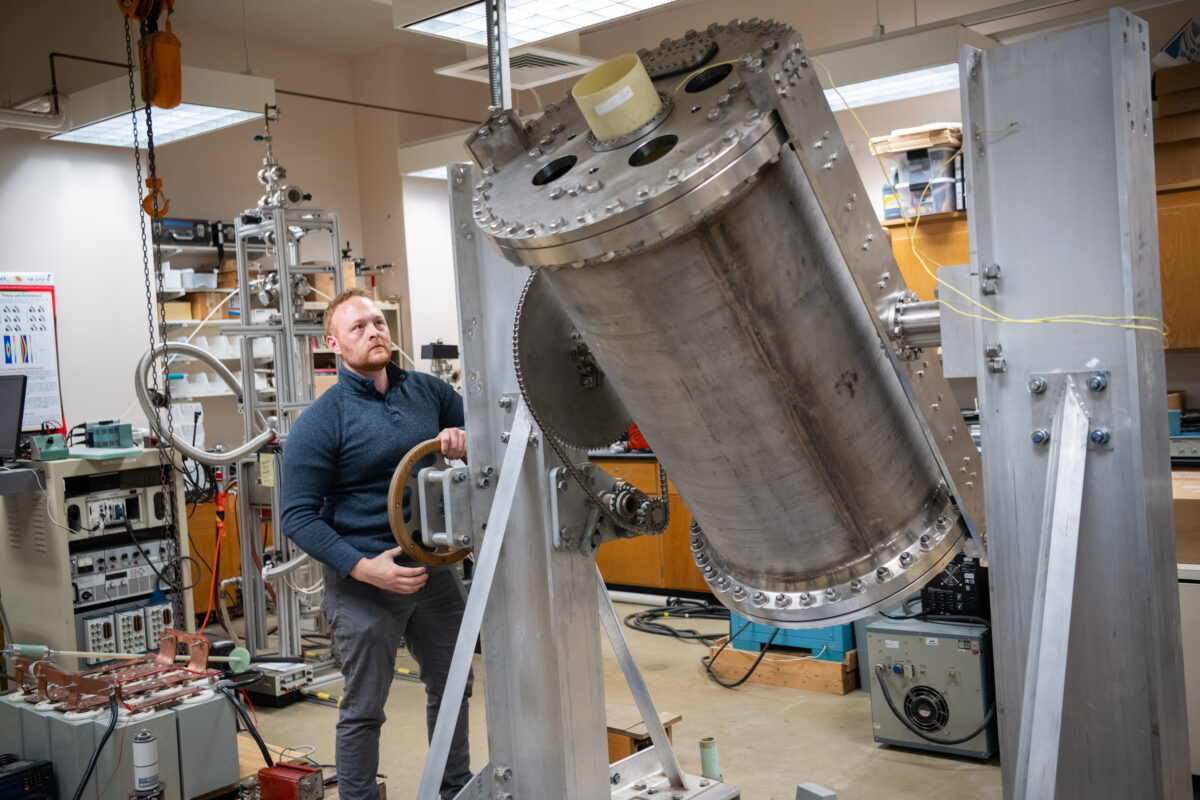 Bowers shows how the magnet core can be rotated. (Brad Ziegler/UMBC)
Step 4: Test some more
With the core of the magnet assembled, Bowers has also begun the detailed process of testing its electrical properties, using a host of measurement equipment.
At first, he is powering the magnet with lower currents, but eventually he will send 15,000 amps through the disks, about half the current that flows in an average lightning bolt. The voltage will be about five times the voltage in a wall socket.
Safety is of paramount concern to the team when working with such high power. When the magnet is operating at full strength, the energy in two cubic feet of the magnetic field alone will be more than the energy of a small SUV zooming by at 60 miles per hour.
Bowers is working on a set of detailed instructions to address all conceivable operating, maintenance, and failure scenarios. “We’re safe. We do all our due diligence,” he says.
Step 5: Serve up some science
Once the magnet is fully up and running, the science experiments can start. Bowers and Romero Talamás have a few ideas for initial experiments, including investigating how a high magnetic field affects when a gas will suddenly switch from being an insulator to a conductor, allowing current to arc through it. They are also interested in how the magnet might be used to separate different forms of hydrogen—particularly two forms that may form the fuel for future fusion reactors to supply clean and near limitless energy.
 Stars—nature’s original fusion reactors—show how plasma and magnetic fields can interact in spectacular fashion. In this image of our sun, taken in July 2012, million-degree plasma in the sun’s atmosphere began to cool and fall to the surface. Because the plasma is charged, it condensed along twisted magnetic field lines close to the surface and formed giant streaming arcs, some as tall as five Earths stacked high. (NASA Solar Dynamics Observatory)
Bowers grew up in rural Hagarstown, Maryland, a kid who enjoyed exploring everything from the rocks on the side of a path to the electrical motors his grandfather would wind. Research has offered him the chance to constantly challenge himself. After graduation, he’ll move on to new questions at the scientific frontiers, perhaps working at a fusion energy start-up or a national lab. But the 7T Bitter magnet will remain at UMBC, a gift to curious students who come after him.
]]>
Magnets often attract curious minds. Einstein told of his profound sense of hidden order after witnessing the invisible forces of the Earth’s magnetic field guide the needle of a compass. For...
https://umbc.edu/stories/how-to-make-a-really-strong-magnet/
https://my3.my.umbc.edu/api/v0/pixel/news/160699/guest@my.umbc.edu/daf60158f49bee7547aece6f2687d891/api/pixel
coeit
discovery
graduate-research
how-to
meche
research
science-and-tech
spring-2026
story
UMBC News & Magazine
https://my3.my.umbc.edu/groups/umbc-news-magazine
https://assets1-my.umbc.edu/system/shared/avatars/groups/000/001/943/24435aa6207c452e7bc15cc74b42c7bb/xsmall.png?1748556657
https://assets1-my.umbc.edu/system/shared/avatars/groups/000/001/943/24435aa6207c452e7bc15cc74b42c7bb/original.png?1748556657
https://assets2-my.umbc.edu/system/shared/avatars/groups/000/001/943/24435aa6207c452e7bc15cc74b42c7bb/xxlarge.png?1748556657
https://assets2-my.umbc.edu/system/shared/avatars/groups/000/001/943/24435aa6207c452e7bc15cc74b42c7bb/xlarge.png?1748556657
https://assets3-my.umbc.edu/system/shared/avatars/groups/000/001/943/24435aa6207c452e7bc15cc74b42c7bb/large.png?1748556657
https://assets1-my.umbc.edu/system/shared/avatars/groups/000/001/943/24435aa6207c452e7bc15cc74b42c7bb/medium.png?1748556657
https://assets2-my.umbc.edu/system/shared/avatars/groups/000/001/943/24435aa6207c452e7bc15cc74b42c7bb/small.png?1748556657
https://assets1-my.umbc.edu/system/shared/avatars/groups/000/001/943/24435aa6207c452e7bc15cc74b42c7bb/xsmall.png?1748556657
https://assets2-my.umbc.edu/system/shared/avatars/groups/000/001/943/24435aa6207c452e7bc15cc74b42c7bb/xxsmall.png?1748556657
UMBC News & Magazine
0
0
false
Mon, 15 Jun 2026 14:54:55 -0400
Mon, 15 Jun 2026 14:54:55 -0400
For the leaf peepers: How NASA’s PACE is improving fall color forecasts
Researchers have developed a new approach using data from NASA’s Plankton, Aerosol, Cloud, ocean Ecosystem (PACE) satellite to observe the timing and progression of fall colors across landscapes.
The study, published in Remote Sensing Letters and led by Karl F. Huemmrich, a research professor at UMBC’s Goddard Earth Sciences Technology and Research (GESTAR) II center, focuses on detecting changes in leaf pigments including chlorophylls (greens), anthocyanins (reds), and carotenoids (yellows and oranges).
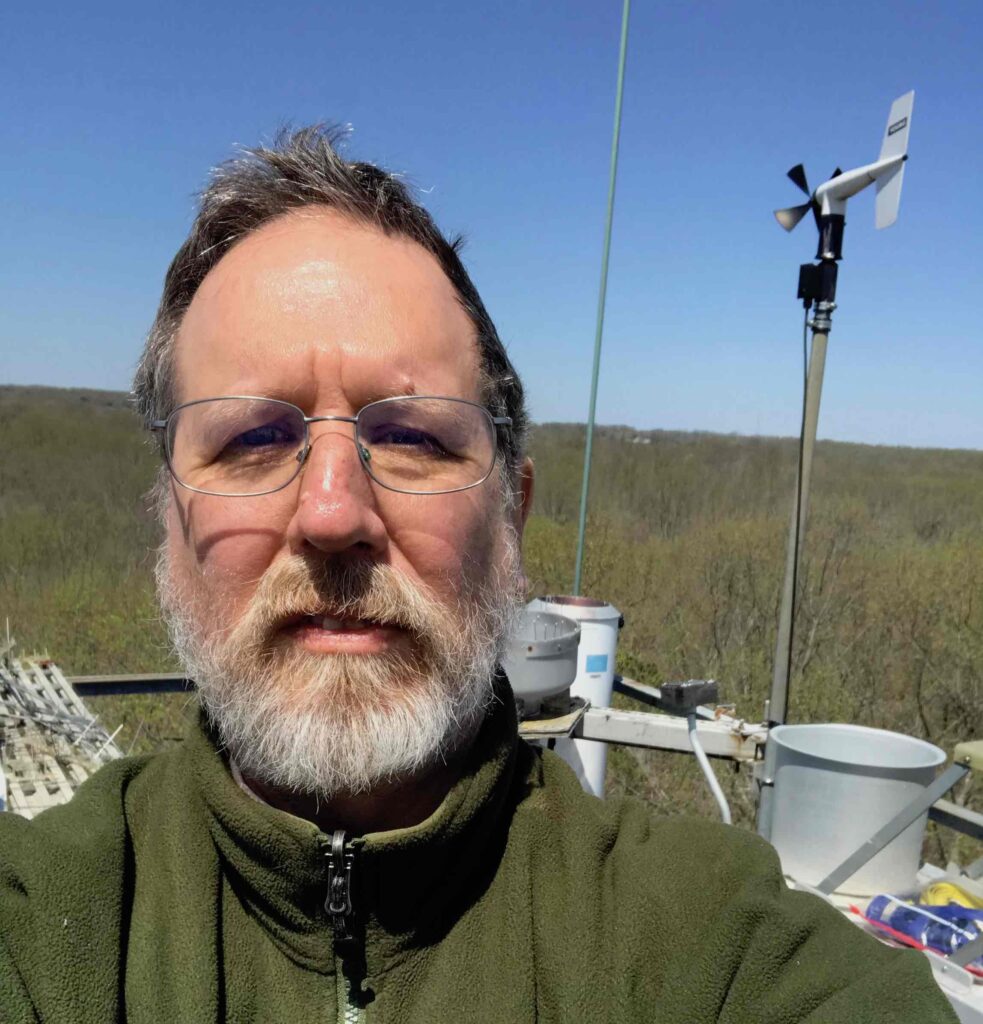 Fred Huemmrich stands 100 feet above the ground on a meteorology tower at the Smithsonian Environmental Research Center. (Courtesy of Huemmrich)
PACE’s advanced sensors capture fine details of light reflected from leaves, with near-daily global coverage. The research team used indices that associate the reflectance data with the presence of various pigments, allowing them to produce detailed leaf color maps and track color changes throughout the fall. These maps could help support the multi-billion-dollar leaf-peeping tourism economy by directing visitors to peak viewing areas in real time and helping communities manage visitor flows.
Traditional greenness indices, such as the Normalized Difference Vegetation Index (NDVI), primarily show a gradual decline in green leaves. The PACE-based indices improve on those methods by allowing scientists to identify more precise markers of the end of the growing season, including dates of peak fall color. Over time, the data could also yield insights into plant stress from drought or insect damage—with potential benefits for agriculture—and help improve models that predict fall color timing based on environmental conditions.
“PACE is the first mission that can measure these pigment indices over large areas, and repeatedly, so we can look at change through the fall,” Huemmrich says. The indices he and Caplan used were developed in the early 2000s, but the new paper applied them at a global scale for the first time. Huemmrich adds, “I anticipate that as we accumulate more years of PACE data, we will be able to observe changes in the timing of peak color, which may be related to climate change.”
PACE opens frontiers in ecosystem science
 Study co-author Skye Caplan visited the Ocean Color Instrument, the instrument on PACE whose data she and Huemmrich used in their new study, before it launched. It’s visible through the window. (Courtesy of Caplan)
Study co-author Skye Caplan, a NASA data scientist, expressed enthusiasm about the broader research potential unlocked by PACE. “I’m excited about observing fall colors with PACE, because I think it’s the beginning of a real exploratory period for global hyperspectral leaf pigment measurements,” she says. “I’m hoping we get to see folks read the paper, see how PACE observes these metrics like relative chlorophyll, anthocyanin, and carotenoid content, and apply those observations to their own work.”
“Working with PACE data is really fun, because you get to see the world in so many different ways,” Caplan adds. “It doesn’t just offer observations of the oceans, but also characterizations of the atmosphere and land—and all of these domains as a system, rather than as separate entities. I think that is critical and a real advantage of PACE.”
For example, Huemmrich previously published research that used PACE data to assess ecosystem productivity, and the UMBC-designed and -built HARP2 instrument flying on PACE is contributing to atmospheric chemistry studies.
Plus, PACE observations aren’t only for scientists: Caplan notes that the public can access NASA Worldview, an interactive site for browsing satellite images from many different NASA missions. “Sometimes I like to pull up PACE data on NASA Worldview and just scroll around to see what the world looked like on any given day,” she says. “I often find something interesting and worth exploring.”
Read more about UMBC’s NASA-related research and past news and magazine stories about UMBC researchers making discoveries in earth science.
]]>
Researchers have developed a new approach using data from NASA’s Plankton, Aerosol, Cloud, ocean Ecosystem (PACE) satellite to observe the timing and progression of fall colors across landscapes....
https://umbc.edu/stories/nasa-pace-tracks-fall-colors/
https://my3.my.umbc.edu/api/v0/pixel/news/160680/guest@my.umbc.edu/5709ef05dac12e723cdcca6a1cf1d631/api/pixel
goddard-earth-sciences-technology-and-research-gestar-ii
research
science-and-tech
story
UMBC News & Magazine
https://my3.my.umbc.edu/groups/umbc-news-magazine
https://assets1-my.umbc.edu/system/shared/avatars/groups/000/001/943/24435aa6207c452e7bc15cc74b42c7bb/xsmall.png?1748556657
https://assets1-my.umbc.edu/system/shared/avatars/groups/000/001/943/24435aa6207c452e7bc15cc74b42c7bb/original.png?1748556657
https://assets2-my.umbc.edu/system/shared/avatars/groups/000/001/943/24435aa6207c452e7bc15cc74b42c7bb/xxlarge.png?1748556657
https://assets2-my.umbc.edu/system/shared/avatars/groups/000/001/943/24435aa6207c452e7bc15cc74b42c7bb/xlarge.png?1748556657
https://assets3-my.umbc.edu/system/shared/avatars/groups/000/001/943/24435aa6207c452e7bc15cc74b42c7bb/large.png?1748556657
https://assets1-my.umbc.edu/system/shared/avatars/groups/000/001/943/24435aa6207c452e7bc15cc74b42c7bb/medium.png?1748556657
https://assets2-my.umbc.edu/system/shared/avatars/groups/000/001/943/24435aa6207c452e7bc15cc74b42c7bb/small.png?1748556657
https://assets1-my.umbc.edu/system/shared/avatars/groups/000/001/943/24435aa6207c452e7bc15cc74b42c7bb/xsmall.png?1748556657
https://assets2-my.umbc.edu/system/shared/avatars/groups/000/001/943/24435aa6207c452e7bc15cc74b42c7bb/xxsmall.png?1748556657
UMBC News & Magazine
3
0
false
Fri, 12 Jun 2026 14:13:20 -0400
Fri, 12 Jun 2026 14:13:20 -0400
Darter detective: Ph.D. student Payton Barry on ecosystems, outreach, and grant hunting
Payton Barry, a fourth-year Ph.D. candidate in biological sciences, is diving into the world of Maryland’s streams. Under Tamra Mendelson’s mentorship, he studies how introduced species of darters, a family of freshwater fish, are affecting native ones. Equal parts dedicated researcher and enthusiastic science communicator, Payton has creatively pieced together funding from organizations like The Explorers Club while sharing his work with the public through outreach events and his engaging Instagram account, @barrybiome.
Q: Why did you choose UMBC for graduate school, and how is it going?
A: I completed my undergrad at the University of Missouri and applied to UMBC specifically to work with Dr. Tamra Mendelson. I discovered her research on Twitter and thought, “This is really cool.” I sensed her great energy in our first virtual meeting, and I knew I could work with her. I moved from Missouri, and it’s been incredible ever since.
My project is pretty independent, but Tamra is always supportive. She is an awesome mentor—super approachable, really relaxed, and incredibly knowledgeable. Anything I have an issue with or a question about, she’s got an answer or knows who to direct me to. I’m one of three grad students in the lab, including Ph.D. students Georgie Puffer and Shea Buczkowski. Plenty of undergrads are involved in our work, too—sophomore James Keller has been especially helpful with my research. I was humbled to be selected as an Outstanding TA of the Year after nominations from Kevin Omland, Tamra, and Cheng-Yu Li for teaching introductory biology and evolution.
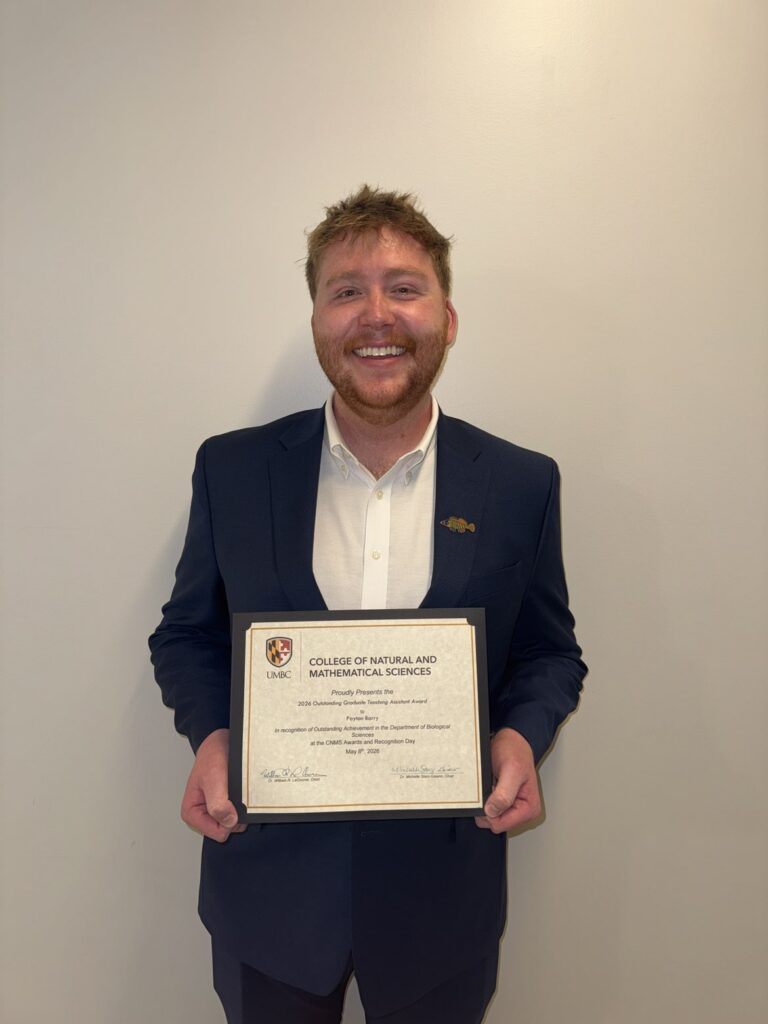
At right: Payton Barry holds the 2026 Outstanding Graduate Teaching Assistant Award presented at the CNMS Awards and Recognition Day. (Courtesy of Barry)
Q: What are the primary goals of your research, and why is this work important to you?
A: Darters are small freshwater fish common in streams. They primarily eat macroinvertebrates—little bugs—and reproduce in spring. My research evaluates how introduced darter species might affect native darter species in Maryland. We study two native species and two that were introduced in the late 1950s and 1970s, likely unintentionally by anglers using them for bait.
One of my projects focuses on habitat use. Native darters provide paternal care, with the males guarding eggs, so they need specific microhabitats to reproduce. We found a large degree of overlap between one introduced species and the native species, especially during the reproductive season—that added competition could hamper native reproduction.
We’re also studying what darters are eating, including whether introduced species prey on native eggs. We sample streams to compare how their diet matches or doesn’t with what’s available across the seasons.
This work matters because these little fish play important roles in stream ecosystems. Losing natives through competitive exclusion could affect Maryland’s biodiversity and even impact recreational fisheries.
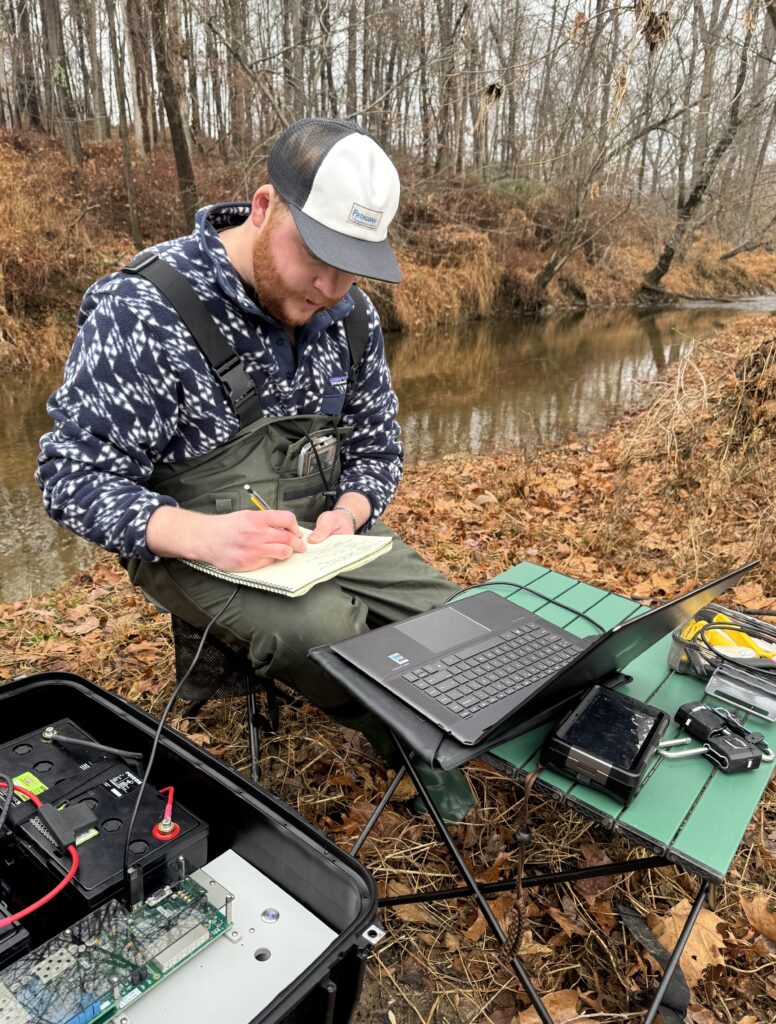
At left: Payton Barry conducts fieldwork to monitor the seasonal movement behavior of native and introduced darter species. (Courtesy of Barry)
Q: What does a day in the field look like?
A: It’s mostly me, though Dr. Mendelson joins when she can, and it’s a lot of fun. We drive about an hour to sites near Frederick, Maryland at Little Bennett Creek and the Little Monocacy River; in Montgomery County near Rock Creek; and in the Monocacy River area, plus closer sites on the Anacostia River.
First we catch the darters, and then we survey macroinvertebrates in the stream to measure food availability. We use a nonlethal technique called “gastric lavage” to wash out the fishes’ gut contents. We prep the gut samples and then send them out for genetic sequencing to identify what the fish are eating. We sampled six populations in spring, summer, and winter—when biodiversity is lowest.
Q: To support your work, you’ve sought a range of funding sources. Can you talk about that process and offer any advice?
A: With recent changes to the federal funding landscape, smaller grants from nonprofits have been crucial. I rely on racking up these small awards to support big projects. This project is funded by four or five grants combined. Our newest grant from The Explorers Club covers our genetic sequencing costs. Other support comes from the North American Native Fishes Association (NANFA), the Society for Freshwater Science, and Fly Fishers International.
I just search online for terms like “native fish research grants” or “stream fish restoration.” I tailor my applications and projects for the funders’ priorities—for example, I tied my work to the health of stocked fish populations for Fly Fishers. If you can find an organization focused on your research niche, you might have a greater chance of success, because fewer people are applying.
 Payton Barry presents on introduced freshwater fish species in the Potomac River at the Baltimore Underground Science Space Science Slam . (Courtesy of Barry)
Q: You’ve made an effort to share your research with members of the broader community. Can you describe some of that work?
A: I’m involved with the graduate student outreach group in UMBC’s biology department. For example, last fall, we hosted an event called Science on Tap at Checkerspot Brewing in Baltimore, where we invited UMBC graduate student researchers in biology and geography and environmental systems to give talks about what they do. We’ve also presented at events run by the Baltimore Underground Science Space. Plus, I run the Instagram account @barrybiome, where I post research updates and a weekly Fieldwork Friday series in collaboration with undergrads in the lab.
A lot of times researchers present only to specific audiences, which makes science less accessible. It is really fun for me to share my passion for what I do. I love getting questions about how my work relates to people. It really makes an impression when I’m able to tell them how important these little guys are and their role in the ecosystem—everybody’s got a part to play.
]]>
Payton Barry, a fourth-year Ph.D. candidate in biological sciences, is diving into the world of Maryland’s streams. Under Tamra Mendelson’s mentorship, he studies how introduced species of...
https://umbc.edu/stories/darter-detective-payton-barry/
https://my3.my.umbc.edu/api/v0/pixel/news/160575/guest@my.umbc.edu/364c90b8c15dfe8e03bf510300a1edf2/api/pixel
biology
cnms
community
graduate-research
news
research
science-and-tech
story
UMBC News & Magazine
https://my3.my.umbc.edu/groups/umbc-news-magazine
https://assets1-my.umbc.edu/system/shared/avatars/groups/000/001/943/24435aa6207c452e7bc15cc74b42c7bb/xsmall.png?1748556657
https://assets1-my.umbc.edu/system/shared/avatars/groups/000/001/943/24435aa6207c452e7bc15cc74b42c7bb/original.png?1748556657
https://assets2-my.umbc.edu/system/shared/avatars/groups/000/001/943/24435aa6207c452e7bc15cc74b42c7bb/xxlarge.png?1748556657
https://assets2-my.umbc.edu/system/shared/avatars/groups/000/001/943/24435aa6207c452e7bc15cc74b42c7bb/xlarge.png?1748556657
https://assets3-my.umbc.edu/system/shared/avatars/groups/000/001/943/24435aa6207c452e7bc15cc74b42c7bb/large.png?1748556657
https://assets1-my.umbc.edu/system/shared/avatars/groups/000/001/943/24435aa6207c452e7bc15cc74b42c7bb/medium.png?1748556657
https://assets2-my.umbc.edu/system/shared/avatars/groups/000/001/943/24435aa6207c452e7bc15cc74b42c7bb/small.png?1748556657
https://assets1-my.umbc.edu/system/shared/avatars/groups/000/001/943/24435aa6207c452e7bc15cc74b42c7bb/xsmall.png?1748556657
https://assets2-my.umbc.edu/system/shared/avatars/groups/000/001/943/24435aa6207c452e7bc15cc74b42c7bb/xxsmall.png?1748556657
UMBC News & Magazine
2
0
false
Fri, 05 Jun 2026 14:10:50 -0400
Fri, 05 Jun 2026 14:10:50 -0400
Revealing galactic history with cosmic rays
What if we could peer back in time to understand how our galaxy was built—one exploding star at a time?
When massive stars reach the end of their lives, they don’t go quietly. They explode in spectacular fashion, forging heavy elements and hurling them across space. Some of these particles, known as cosmic rays, eventually reach detectors built by humans. By studying which elements arrive and in what amounts, scientists hope to piece together the story of our galaxy’s chemical evolution.
But there’s a problem: As these cosmic rays race through space, they smash into hydrogen atoms and break apart. These reactions, called “proton spallation,” turn heavier elements like iron into lighter ones like sodium or chromium. Without knowing exactly how often these “break-ups” happen, it’s hard to translate what detectors see into a true picture of what’s out there. But if scientists could accurately reverse-engineer the process, determining how much of one element came from another, they would better understand the galaxy’s true chemical makeup.
Now, Priyarshini Ghosh, a nuclear physicist at UMBC’s Center for Space Sciences and Technology, is performing a first-of-its-kind experiment, hoping to fill some of this knowledge gap.
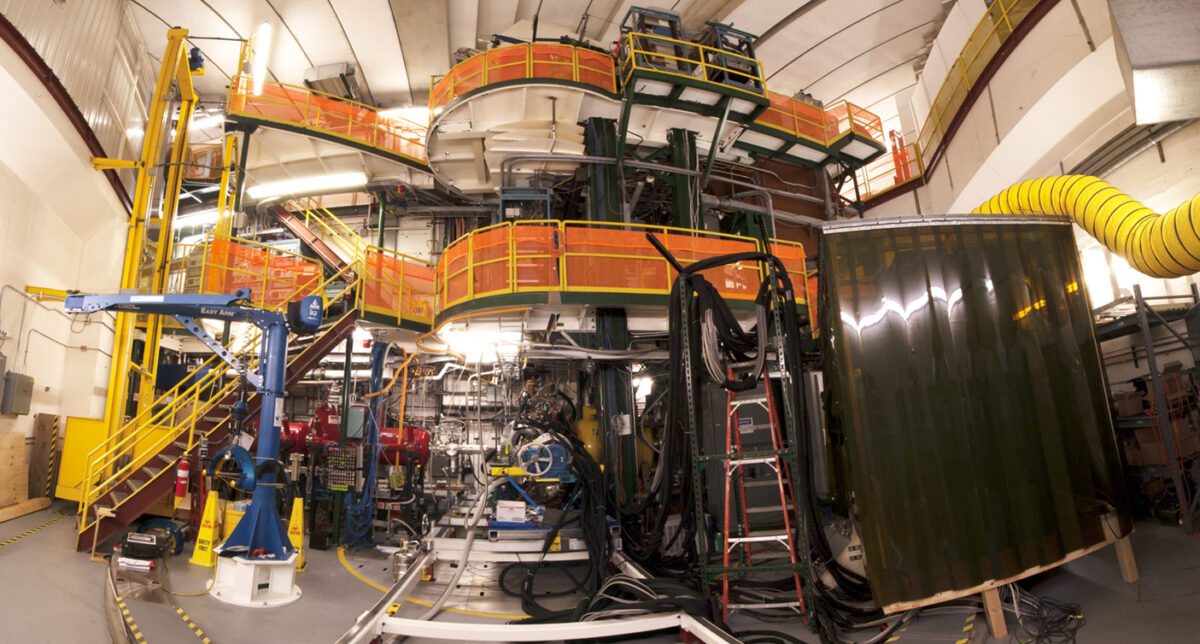 The research team will run a novel experiment on the S800 Spectrograph at the Facility for Rare Ion Beams at Michigan State University. They expect the results to increase understanding of the chemical makeup of the Milky Way galaxy. (Courtesy of FRIB)
In early June, Ghosh and her collaborators led the Facility for Rare Isotope Beams (FRIB) at Michigan State University to study, for the first time ever, how chromium-52 breaks apart when it interacts with hydrogen. Chromium-52 is of particular interest because it can shed light on processes happening in our galaxy, and yet it has never been measured before. Using a high-energy beam of this stable form of chromium, the team will record “proton spallation cross sections”—measures of the likelihood of violent interactions between protons and heavy ions. The experiment essentially recreates inside a Michigan laboratory what’s happening to cosmic rays in space, Ghosh says.
“Nuclear data acts as a translator from the data collected by missions like Voyager, converting it into a meaningful understanding of our galaxy,” Ghosh explains.
Mimicking cosmic rays
Current models don’t quite match what telescopes and spacecraft actually observe, especially for elements like chromium, titanium, and vanadium. The differences have puzzled researchers for years. These questions linger because the right kind of experimental data has been extremely laborious and expensive to obtain—until now.
“A sample of chromium-52 the size of a chocolate square can cost around $150,000,” Ghosh notes. So instead of using a large piece of chromium-52, FRIB’s chemists will collide a beam of less-expensive nickel-58 with a carbon target, producing a pure chromium beam—the first time this has ever been achieved.
 Priyarshini Ghosh operates a scanning electron microscope at Kansas State University, where she completed her Ph.D. in nuclear engineering. (Courtesy of Kansas State University)
The team will run the experiment for about 43 hours, collecting data on 50 to 60 different fragments produced as the chromium beam collides with various detectors and breaks apart. Then comes the long work of analysis. The results are expected to sharpen astrophysical models and bring us closer to understanding how elements are created and spread throughout the Milky Way.
“What makes this project exciting is that FRIB lets us reproduce, in a controlled way, a process that naturally happens in the universe: cosmic rays traveling from a dying star through the galaxy,” says Jorge Pereira, FRIB’s magnetic spectrometer operation group leader.
“Arm-wrestling with nature”
This chromium experiment is the first in a program that Ghosh is developing at UMBC dedicated to building a comprehensive proton-spallation cross-section database. Proton-based reactions—like the ones cosmic rays experience with hydrogen—have received little attention, even though they’re crucial for interpreting data from space.
By building a reliable database of these proton cross sections, the team is laying the groundwork that could transform how we read the cosmos. The results will directly support the upcoming TIGERISS mission, set to fly to the International Space Station in 2027. TIGERISS will be the first instrument to measure elements from boron all the way to lead with remarkable precision—and Ghosh’s nuclear data will help scientists make sense of what it sees.
For Ghosh, the thrill lies in the experimental challenge itself.
“This is such a feat of nuclear engineering,” she says. “We’re using detectors to expose the physics in very specific ways—arm-wrestling with nature to get the answers we need.”
]]>
What if we could peer back in time to understand how our galaxy was built—one exploding star at a time? When massive stars reach the end of their lives, they don’t go quietly. They explode in...
https://umbc.edu/stories/revealing-galactic-history-with-cosmic-rays/
https://my3.my.umbc.edu/api/v0/pixel/news/160273/guest@my.umbc.edu/410394584f051775b6fcd874feb81096/api/pixel
csst
discovery
magazine
research
science-and-tech
story
UMBC News & Magazine
https://my3.my.umbc.edu/groups/umbc-news-magazine
https://assets1-my.umbc.edu/system/shared/avatars/groups/000/001/943/24435aa6207c452e7bc15cc74b42c7bb/xsmall.png?1748556657
https://assets1-my.umbc.edu/system/shared/avatars/groups/000/001/943/24435aa6207c452e7bc15cc74b42c7bb/original.png?1748556657
https://assets2-my.umbc.edu/system/shared/avatars/groups/000/001/943/24435aa6207c452e7bc15cc74b42c7bb/xxlarge.png?1748556657
https://assets2-my.umbc.edu/system/shared/avatars/groups/000/001/943/24435aa6207c452e7bc15cc74b42c7bb/xlarge.png?1748556657
https://assets3-my.umbc.edu/system/shared/avatars/groups/000/001/943/24435aa6207c452e7bc15cc74b42c7bb/large.png?1748556657
https://assets1-my.umbc.edu/system/shared/avatars/groups/000/001/943/24435aa6207c452e7bc15cc74b42c7bb/medium.png?1748556657
https://assets2-my.umbc.edu/system/shared/avatars/groups/000/001/943/24435aa6207c452e7bc15cc74b42c7bb/small.png?1748556657
https://assets1-my.umbc.edu/system/shared/avatars/groups/000/001/943/24435aa6207c452e7bc15cc74b42c7bb/xsmall.png?1748556657
https://assets2-my.umbc.edu/system/shared/avatars/groups/000/001/943/24435aa6207c452e7bc15cc74b42c7bb/xxsmall.png?1748556657
UMBC News & Magazine
0
0
false
Thu, 21 May 2026 15:17:46 -0400
Thu, 21 May 2026 15:17:46 -0400
One photon, a trillion electrons: UMBC physicist Daniel Suárez-Forero explores the quantum frontier
Imagine a material where trillions of electrons are locked in an intricate, collective dance—so tightly choreographed that the tiniest nudge can send ripples across the entire system, transforming its behavior in dramatic ways. Now picture using light—especially the delicate touch of a single photon—to peek inside that dance, understand its hidden steps, and maybe even change the rhythm.
That’s the frontier Daniel Suárez-Forero is exploring at UMBC. He joined the Department of Physics as an assistant professor in August 2025 and leads the Quantum Optics of Correlated Materials group. His experimental approach sits at the intersection of two powerful fields: quantum optics, which studies how light behaves when quantum effects like entanglement come into play (the 2022 Nobel Prize recognized research in this area), and correlated materials, where electrons interact so intensely that they create physics impossible in ordinary conductors or insulators.
By shining quantum light into these strongly interacting systems, his lab aims to reveal quantum behaviors that existing tools can’t see, probe states that have so far been hidden, and help build the foundation for future technologies. His work, featured in two recent papers published in Science and Nature Materials, blends deep questions with real long-term promise, and he’s excited to build his lab here at UMBC.
Q: What will your research group at UMBC focus on, and how has your background prepared you for it?
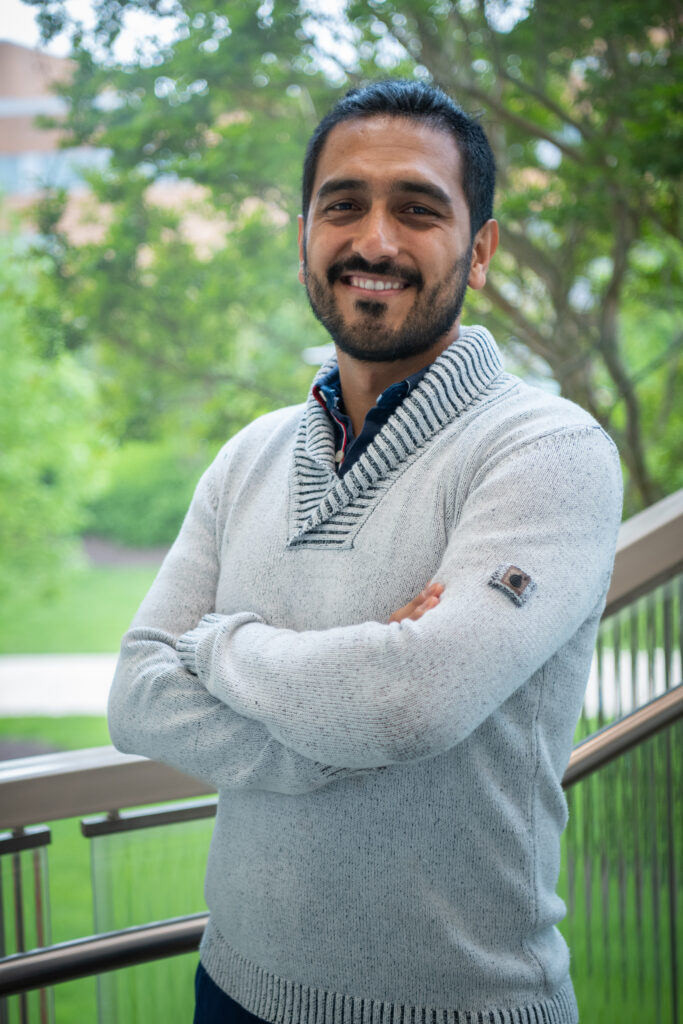 Daniel Suárez-Forero joined the UMBC faculty in 2025 and is already making waves in the physics department. (Brad Ziegler/UMBC)
A: At UMBC, my group will use single photons—the tiniest packets of light—to probe and even gently tweak materials where electrons interact extremely strongly. The exciting goal is to use one photon to affect about a trillion electrons at once: either to reveal hidden quantum details that ordinary tools miss, or to modify the whole material’s behavior with just one particle of light.
My path has been building toward this. In my Ph.D. in Italy, I worked on light-matter hybrids using entangled photons. Then, as a postdoc at the Joint Quantum Institute at the University of Maryland, I dived into these strongly interacting materials. Before joining UMBC, I spent a year in Geneva, Switzerland, learning new experimental techniques that I’m now bringing to campus. The fields of quantum optics and correlated materials had been developing separately, but technology is advancing so that the time is right to bridge them—and that’s what I’ll be doing at UMBC.
What excites me most is the scale: Using one photon to influence a trillion particles could unlock mysteries in these materials and help solve real challenges, like using photons more effectively in quantum computing or creating ultra-sensitive detectors. It’s fundamental science with huge potential for real impact.
Q: How did you choose UMBC and how is your first year going?
A: UMBC made the decision easy. The startup support for my lab’s equipment was strong, and infrastructure from recently retired professors transferred to incoming experimentalists like Geoffrey Diederich, Alex Senichev, and me—creating an excellent setup to build experiments.
Also, the DMV area is a major quantum hub, and Maryland’s initiative to become the “capital of quantum” aligns with UMBC’s Quantum Science Institute, which connects departments across science and engineering to advance quantum from every angle.
 Ph.D. student Nico Rueda-Becerra works with a laser in the Suarez-Forero laboratory. (Courtesy of Daniel Suárez-Forero)
My first year has been wonderful—I’ve gotten tremendous support from the administration, department, and students. I’ve taught graduate quantum mechanics, following the same cohort from their first to second semester. It’s rewarding to watch their understanding and independence grow. I now have one Ph.D. student from Colombia, another starting soon, and two enthusiastic undergrads helping set up the lab. It’s been a positive, exciting start.
Q: What were the key findings from your two recent papers, and how do they relate to your current work?
A: Both papers came from my time as a postdoc and looked at special layered materials where electrons interact very strongly with each other.
In the Science paper, we found something really surprising. Normally, when electrons get “stuck” in place because of their strong interactions (think of them crowding each other so much they can’t move easily), you’d expect other particles in the material to slow down too. But we saw the opposite: Certain particle pairs—made of an excited electron and the empty spot (or “hole”) it left behind—actually moved much faster, about 1,000 times faster than expected! The crowding actually helped these pairs zip around more freely by interfering with their usual tight pairing. It was a “wow” moment that showed how these interactions can lead to unexpected enhanced mobility.
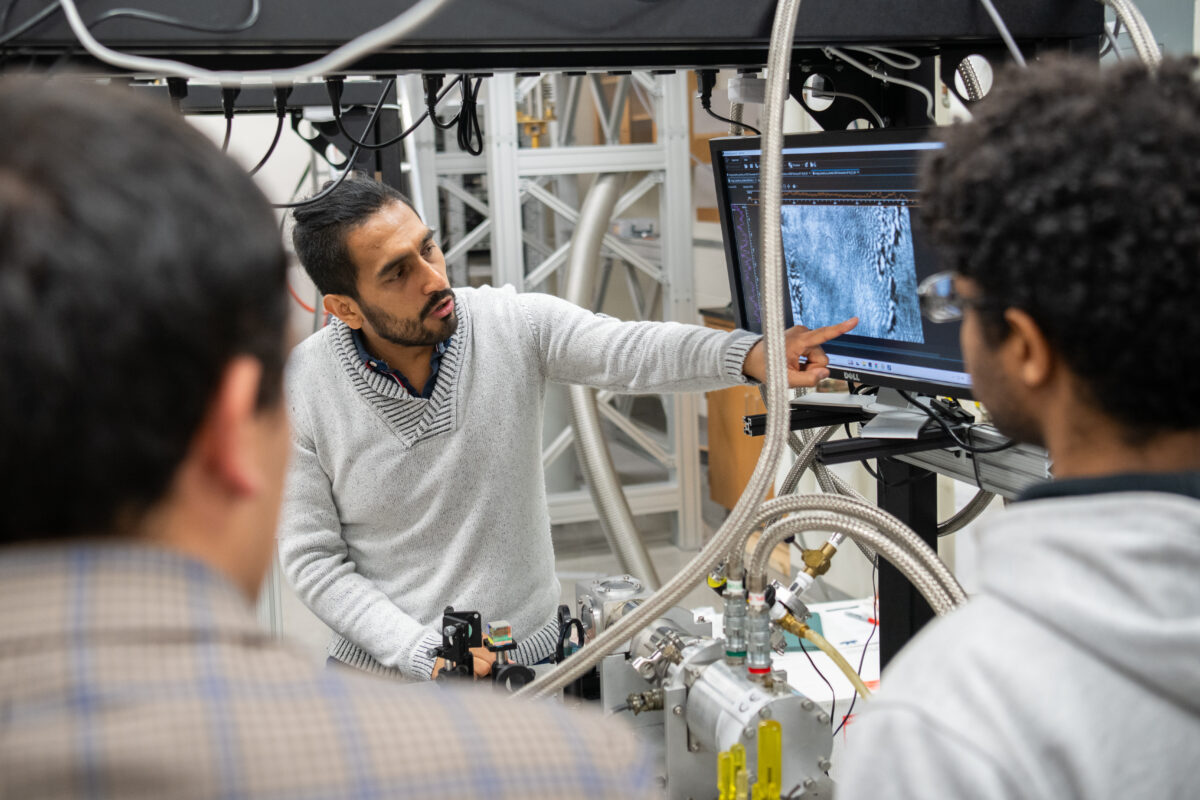 Daniel Suárez-Forero’s group uses complex optics systems to study the properties of correlated materials. Here, he explains the output of one of the research group’s tests. (Brad Ziegler/UMBC)
The Nature Materials paper looked at the flip side: When we shined laser light on the material to create more of those electron-hole pairs, they started lining up neatly all in the same direction—like tiny magnets snapping into alignment. And we could control and reverse this alignment just by turning the light on and off. It’s a way to use light to change how the material behaves, almost like flipping a switch.
These discoveries help us better understand how light and super-strong electron interactions can work together. That’s exactly what sets the stage for my research at UMBC: using single photons to explore or even tweak these materials in new ways—probing hidden details or switching states with just one photon.
Q: What advice do you have for students who are interested in quantum science?
A: If you’re already curious about quantum physics, of course I think that’s a good choice—it’s an exciting field. A Ph.D. can be challenging and involve a lot of failure—like experiments that don’t work—but persistence pays off. Keep digging, stay curious, try different approaches, and don’t get stuck on one path.
If you’re ready to start doing research, choose a group carefully—look at their publications and the tools they use to make sure they match what you’re passionate about. Get hands-on experience early. Quantum is challenging but incredibly rewarding—keep going, and the breakthroughs will eventually come.
 The gold cylinder Suárez-Forero (left) is holding is how samples are loaded into the cryostat instrument for experiments. Suárez-Forero discusses the process with Nico Rueda-Becerra. (Brad Ziegler/UMBC)
]]>
Imagine a material where trillions of electrons are locked in an intricate, collective dance—so tightly choreographed that the tiniest nudge can send ripples across the entire system, transforming...
https://umbc.edu/stories/daniel-suarez-forero-quantum-frontier/
https://my3.my.umbc.edu/api/v0/pixel/news/159598/guest@my.umbc.edu/d9a88a55ac343b89ac739bbddf00a736/api/pixel
cnms
news
physics
research
science-and-tech
story
UMBC News & Magazine
https://my3.my.umbc.edu/groups/umbc-news-magazine
https://assets1-my.umbc.edu/system/shared/avatars/groups/000/001/943/24435aa6207c452e7bc15cc74b42c7bb/xsmall.png?1748556657
https://assets1-my.umbc.edu/system/shared/avatars/groups/000/001/943/24435aa6207c452e7bc15cc74b42c7bb/original.png?1748556657
https://assets2-my.umbc.edu/system/shared/avatars/groups/000/001/943/24435aa6207c452e7bc15cc74b42c7bb/xxlarge.png?1748556657
https://assets2-my.umbc.edu/system/shared/avatars/groups/000/001/943/24435aa6207c452e7bc15cc74b42c7bb/xlarge.png?1748556657
https://assets3-my.umbc.edu/system/shared/avatars/groups/000/001/943/24435aa6207c452e7bc15cc74b42c7bb/large.png?1748556657
https://assets1-my.umbc.edu/system/shared/avatars/groups/000/001/943/24435aa6207c452e7bc15cc74b42c7bb/medium.png?1748556657
https://assets2-my.umbc.edu/system/shared/avatars/groups/000/001/943/24435aa6207c452e7bc15cc74b42c7bb/small.png?1748556657
https://assets1-my.umbc.edu/system/shared/avatars/groups/000/001/943/24435aa6207c452e7bc15cc74b42c7bb/xsmall.png?1748556657
https://assets2-my.umbc.edu/system/shared/avatars/groups/000/001/943/24435aa6207c452e7bc15cc74b42c7bb/xxsmall.png?1748556657
UMBC News & Magazine
2
0
false
Fri, 01 May 2026 16:13:03 -0400
Fri, 01 May 2026 16:13:03 -0400
UMBC Center for Precision Aquaculture launches to boost sustainable U.S. fish farming
The gold cylinder Suárez-Forero (left) is holding is how samples are loaded into the cryostat instrument for experiments. Suárez-Forero discusses the process with Nico Rueda-Becerra. (Brad Ziegler/UMBC)
]]>
Imagine a material where trillions of electrons are locked in an intricate, collective dance—so tightly choreographed that the tiniest nudge can send ripples across the entire system, transforming...
https://umbc.edu/stories/daniel-suarez-forero-quantum-frontier/
https://my3.my.umbc.edu/api/v0/pixel/news/159598/guest@my.umbc.edu/d9a88a55ac343b89ac739bbddf00a736/api/pixel
cnms
news
physics
research
science-and-tech
story
UMBC News & Magazine
https://my3.my.umbc.edu/groups/umbc-news-magazine
https://assets1-my.umbc.edu/system/shared/avatars/groups/000/001/943/24435aa6207c452e7bc15cc74b42c7bb/xsmall.png?1748556657
https://assets1-my.umbc.edu/system/shared/avatars/groups/000/001/943/24435aa6207c452e7bc15cc74b42c7bb/original.png?1748556657
https://assets2-my.umbc.edu/system/shared/avatars/groups/000/001/943/24435aa6207c452e7bc15cc74b42c7bb/xxlarge.png?1748556657
https://assets2-my.umbc.edu/system/shared/avatars/groups/000/001/943/24435aa6207c452e7bc15cc74b42c7bb/xlarge.png?1748556657
https://assets3-my.umbc.edu/system/shared/avatars/groups/000/001/943/24435aa6207c452e7bc15cc74b42c7bb/large.png?1748556657
https://assets1-my.umbc.edu/system/shared/avatars/groups/000/001/943/24435aa6207c452e7bc15cc74b42c7bb/medium.png?1748556657
https://assets2-my.umbc.edu/system/shared/avatars/groups/000/001/943/24435aa6207c452e7bc15cc74b42c7bb/small.png?1748556657
https://assets1-my.umbc.edu/system/shared/avatars/groups/000/001/943/24435aa6207c452e7bc15cc74b42c7bb/xsmall.png?1748556657
https://assets2-my.umbc.edu/system/shared/avatars/groups/000/001/943/24435aa6207c452e7bc15cc74b42c7bb/xxsmall.png?1748556657
UMBC News & Magazine
2
0
false
Fri, 01 May 2026 16:13:03 -0400
Fri, 01 May 2026 16:13:03 -0400
UMBC Center for Precision Aquaculture launches to boost sustainable U.S. fish farming
UMBC has secured $1.5 million in congressional funding to establish the UMBC Center for Precision Aquaculture, an interdisciplinary effort aimed at revolutionizing land-based fish production through real-time monitoring and smart technology.
The new center brings together faculty and students from UMBC’s marine biotechnology, chemistry and biochemistry, and computer science and electrical engineering (CSEE) departments. The interdisciplinary team will strive to make domestic aquaculture more efficient, healthier for fish, and environmentally responsible—while helping reduce America’s massive seafood trade deficit.
“Fish are the last ‘hunt-and-gather’ animal crop,” says Yonathan Zohar, professor and chair of marine biotechnology and the new center’s lead. “To relieve pressure on our oceans, fish—like other animal proteins—must be produced through farming or aquaculture.”
Bringing a “blue revolution”
The U.S. imports over 90 percent of its seafood and nearly all its Atlantic salmon, contributing to American seafood imports exceeding exports by roughly $20 billion, the largest deficit across all agricultural crops. And aquaculture is the fastest-growing sector of global and U.S. agriculture, yet the U.S. ranks only 18th in production.
 Researchers Keiko Saito (left) and Yonathan Zohar (right) discuss the remediation of liquid waste, which is carried out by bacteria in tanks like this one. (Brad Ziegler/UMBC)
To address these challenges, Zohar and his team at the Aquaculture Research Center (ARC) at the Institute of Marine and Environmental Technology in Baltimore’s Inner Harbor have long pioneered recirculating aquaculture systems (RAS)—self-contained, land-based tanks that recycle nearly all their water and discharge nothing into the environment. Compared to the floating, open-ocean pens currently used to farm fish, other perks of land-based operations include preventing commingling of captive fish with wild stocks, limiting disease exposure, the ability to bring fish to market size more quickly and more often throughout the year, and reduced transportation costs and emissions associated with bringing fresh seafood to inland areas. The ARC even converts solid fish waste into biogas that could supply part of the facility’s energy needs.
The new Center for Precision Aquaculture will add a high-tech layer to this work. Advanced underwater imaging, optical sensors, and artificial intelligence will track fish biomass, behavior, body condition, stress signals, and early disease indicators in real time. Producers can then intervene quickly and optimize tank conditions for better growth, health, and welfare.
Zohar, whose decades of work in sustainable aquaculture recently earned him the Distinguished Lifetime Achievement Award from the United States Aquaculture Society, said the project “will contribute to the U.S. and global ‘blue revolution’ by helping develop the next generation of highly efficient and environmentally responsible aquaculture technologies.”
Connecting disciplines, pursuing impact
The center’s strength lies in its cross-department collaboration. Brian Cullum, professor and chair of chemistry and biochemistry and co-investigator on the grant, brings long-standing expertise in multispectral imaging (MSI). His group will use MSI to detect subtle color changes in the visible, infrared, and UV light spectra that are invisible to standard cameras and signal early disease or unwanted sexual maturation, both of which can hurt profitability.

 Emmanuella Duruye, a UMBC chemistry Ph.D. student in Brian Cullum’s lab, is taking the lead on the multispectral imaging aspect of the project. (Brad Ziegler/UMBC)
“In high-density RAS tanks, disease can spread rapidly, so early detection is critical,” Cullum says. “This project combines multispectral imaging with AI to identify stressed or maturing fish early, allowing growers to remove them from the tank.”
“With global demand for protein rising, improving aquaculture systems means contributing to a more stable and responsible food supply,” says Emmanuella Duruye, a Ph.D. candidate in Cullum’s lab. “I am excited about the multidisciplinary aspect, and being part of a team whose goal is to improve systems that make real-world and long-term impacts.” She is focused on improving non-invasive monitoring of hidden stress signals via multispectral imaging.
Rebecca Williams, assistant professor of CSEE, is a co-investigator on the project, as is Don Engel, associate professor of CSEE. Beamlak Bekele, a master’s student in Williams’s group, is developing computer vision tools tailored to underwater environments. “I am excited about this project because it connects computer science with aquaculture, allowing me to apply computer vision to a real-world problem,” Bekele said. “As the project progresses, it can contribute methods that improve the application of underwater vision data to other scenarios as well.”
 Beamlak Bekele (left), Rebecca Williams (center), and Don Engel (right) are developing software to analyze heatmap images of the fish tanks, as pictured on the screen. (Brad Ziegler/UMBC)
Ph.D. students Sean Ravel and Max Prager; postdoctoral fellow Matthew Stromberg, Ph.D. ’26, environmental engineering; and John Stubblefield, ARC laboratory director, are all working with Zohar at IMET. Undergraduates are contributing, too: Krish Bakshi, a junior biochemistry and molecular biology major, and Mason Chialastri, junior biological sciences major, are currently doing research internships with the Zohar lab.
“Early maturation is one of the biggest challenges in salmon aquaculture, and I’m excited to be part of the cutting-edge research to better understand and manage it,” Ravel shares. “We are building tools that let us understand fish in ways that are only possible because we combine biology, engineering, and AI into a single, integrated system.”

 Juniors Krish Bakshi (left) and Mason Chialastri (right) have contributed to the precision aquaculture project as interns in the Zohar lab. (Brad Ziegler/UMBC)
Piloting the future of aquaculture
The new funding will support a pilot RAS system that integrates the new precision technologies. ARC will serve as a demonstration site for industry, hands-on student training, and public outreach. It builds directly on UMBC’s existing strengths, including ongoing USDA- and NOAA-funded salmon research and a popular Sustainable Aquaculture course. The center will also help train the next generation of skilled workers through internships and research opportunities for high school, undergraduate, and graduate students.
By combining UMBC’s deep foundation in RAS technology with state-of-the-art imaging and AI, the Center for Precision Aquaculture positions Maryland as an emerging hub for innovative, sustainable seafood production—reducing reliance on imports, easing pressure on wild fisheries, and delivering healthy food to American tables.
]]>
UMBC has secured $1.5 million in congressional funding to establish the UMBC Center for Precision Aquaculture, an interdisciplinary effort aimed at revolutionizing land-based fish production...
https://umbc.edu/stories/center-for-precision-aquaculture/
https://my3.my.umbc.edu/api/v0/pixel/news/159531/guest@my.umbc.edu/f7ab4a9b5d54e1fee92a2c9f1311367d/api/pixel
chemistry-and-biochemistry
cnms
coeit
csee
graduate-research
marinebiotech
news
research
science-and-tech
story
UMBC News & Magazine
https://my3.my.umbc.edu/groups/umbc-news-magazine
https://assets1-my.umbc.edu/system/shared/avatars/groups/000/001/943/24435aa6207c452e7bc15cc74b42c7bb/xsmall.png?1748556657
https://assets1-my.umbc.edu/system/shared/avatars/groups/000/001/943/24435aa6207c452e7bc15cc74b42c7bb/original.png?1748556657
https://assets2-my.umbc.edu/system/shared/avatars/groups/000/001/943/24435aa6207c452e7bc15cc74b42c7bb/xxlarge.png?1748556657
https://assets2-my.umbc.edu/system/shared/avatars/groups/000/001/943/24435aa6207c452e7bc15cc74b42c7bb/xlarge.png?1748556657
https://assets3-my.umbc.edu/system/shared/avatars/groups/000/001/943/24435aa6207c452e7bc15cc74b42c7bb/large.png?1748556657
https://assets1-my.umbc.edu/system/shared/avatars/groups/000/001/943/24435aa6207c452e7bc15cc74b42c7bb/medium.png?1748556657
https://assets2-my.umbc.edu/system/shared/avatars/groups/000/001/943/24435aa6207c452e7bc15cc74b42c7bb/small.png?1748556657
https://assets1-my.umbc.edu/system/shared/avatars/groups/000/001/943/24435aa6207c452e7bc15cc74b42c7bb/xsmall.png?1748556657
https://assets2-my.umbc.edu/system/shared/avatars/groups/000/001/943/24435aa6207c452e7bc15cc74b42c7bb/xxsmall.png?1748556657
UMBC News & Magazine
0
0
false
Thu, 30 Apr 2026 16:01:14 -0400
Thu, 30 Apr 2026 16:01:14 -0400