Beyond Watson
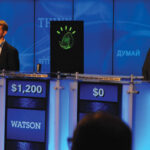
Computers can crunch mind-boggling arrays of data. They can even win quiz shows. But are there more powerful applications of this analytical power yet to come? Claudia Pearce ’89 M.S., ’94 Ph.D., computer science, is the Senior Computer Science Authority at the National Security Agency (NSA). The winner of UMBC’s Alumna of the Year Award in Engineering and Information Technology in 2014, Pearce is diligently seeking the answer to that question.
 Watson is IBM’s Deep Question Answering system. You might recall that when Watson was put to the test against human contestants on the television quiz show, Jeopardy!, the system successfully bested its competitors in providing questions to answers whose associated question was already known. (And won $1,000,000.)
But like any game, Jeopardy! has its rules – and its limits. Along with my colleagues and others in the field who study big data and predictive analytics, I’ve been wondering whether the techniques implemented in Watson could be used as a powerful knowledge discovery tool to find the questions to answers whose associated questions are unknown.
Subspecialties in the fields of computer science and statistics such as knowledge discovery, machine learning, data mining, and information retrieval are commonly applied in medicine and in the natural and physical sciences – and increasingly in the social sciences, advertising, and cybersecurity, too. (It’s often called “computational biology” or “computational advertising.”)
And as the scope of computational practices has increased, the resources needed to perform it have shrunken tremendously. Ten years ago, massive computation was primarily in the areas of physics, astronomy, and biology, where petabytes of data were collected and analyzed using massive high performance computing systems. The advent of Cloud computing technologies –and their increasing public availability – now allows institutions, companies, and users to rent time for large-scale computation without the enormous costs of creating and maintaining supercomputers.
Additionally, programming and data storage paradigms have evolved to make use of the inherent parallelism in many domain applications. This trend has created new applications for computer science that provide individuals and organizations access to a plethora of online information in real time.
Real-time data sources spur not only social media, but online commerce, video streaming, and geolocation. Wireless technologies and smartphones put that information in the palm of our hands.
The power and speed of these technologies have aided the machine learning and data mining techniques at the heart of analytics, from retrieval of simple facts to trends and predictions. Advertising applications, for instance, analyze your click stream and cookies so that ads tailored to your interests appear as you browse in real time.
Yet the process of developing and maintaining analytics has its costs. First, there is labor. It usually requires teams of people to identify and solve problems in various domains. Analysts (who are usually experts in their subject) develop a collection of research questions in their discipline. They are teamed with statisticians, computer scientists, and others to develop and write programs to put the data in a usable form and create machine learning applications, tools, and algorithms. This combination of data and programming combines into analytics designed to answer a question in a given line of inquiry.
Labor isn’t the only cost. Depending on the application, analytics can be reused – but eventually need to be refreshed with new data. This is particularly true when the analytic is designed to be predictive. Real-time financial industry data, for example, requires that credit card fraud models must be recreated at least annually. Computational advertising models must be refreshed weekly.
Outdated analytics become an artifact of the maintenance cycle. Reuse requires knowledge specific to the analytic, data, and inherent question, and is most likely unknown outside of a small development team. So how can we get beyond these limitations and make a simple easy-to-use system that helps people get answers to questions beyond Googling them?
Part of the answer may be found in a series of Beyond Watson workshops and other activities involving university, government, and industry partners, including one held at UMBC in February.
We’re looking at things like natural language, which is at the core of the ultimate computer human interface. Think back to Star Trek, when Spock would say something like: “Computer, what is the probability the Klingons will attack the Enterprise in this sector of the galaxy?” The computer would often engage in a back and forth interaction with Spock, asking for more information or clarification before offering one or more scenarios (and probabilities supporting those scenarios) to aid the crew of the Enterprise in their next move. When we can ask a computer a question and then engage in a dialogue with it in this way, we can freely use computers to their best advantage. This sort of exchange allows us to hone in on an answer (or answers) to our question, supported by knowing both how the information was derived and what level of confidence to place in it.
Envisioning such a model opens up new vistas. We may not be limited to retrieving existing answers from Wikipedia-like text, but use all available data to elicit answers to non-obvious questions, or to queries that have never been asked. We might also dispense with arcane interfaces that are poorly matched to both the task at hand and the needs of users and consumers. Database management systems, for instance, have historically been developed to ask a few specific questions of data, but imposing such a structure on the data makes it very difficult to anticipate (or answer) questions we weren’t thinking of when we built the system.
Pushing our thinking – and technology – to generalize on the automation of building big data analytics could permit us to leverage existing tools and build on them instead of shelving them. And pulling these tools together in yet another set of big data analytics may even allow for the entire enterprise of analytics (newly created systems as well as existing ones) to help us advance particular knowledge.
Your cell phone has a plethora of apps (collected in an “app store”) to help you make the best use of it. Creating a similar “analytics store” for our Question Answering systems will accelerate automation of these processes and encourage crowd sourcing in analytics development. It’s a vision of the future for which technology already exists. By specifying and clarifying what we want big data analytics to accomplish, we can start to build that future now.
 Note: The views and opinions expressed are those of Claudia Pearce and do not reflect those of NSA/CSS.
]]>
Computers can crunch mind-boggling arrays of data. They can even win quiz shows. But are there more powerful applications of this analytical power yet to come? Claudia Pearce ’89 M.S., ’94 Ph.D.,...
https://umbc.edu/stories/beyond-watson/
https://my3.my.umbc.edu/api/v0/pixel/news/121855/guest@my.umbc.edu/73109ca27d7ba0b9c5bf4e0561f29126/api/pixel
perspectives
spring-2015
UMBC News & Magazine
https://my3.my.umbc.edu/groups/umbc-news-magazine
https://assets1-my.umbc.edu/system/shared/avatars/groups/000/001/943/24435aa6207c452e7bc15cc74b42c7bb/xsmall.png?1748556657
https://assets1-my.umbc.edu/system/shared/avatars/groups/000/001/943/24435aa6207c452e7bc15cc74b42c7bb/original.png?1748556657
https://assets2-my.umbc.edu/system/shared/avatars/groups/000/001/943/24435aa6207c452e7bc15cc74b42c7bb/xxlarge.png?1748556657
https://assets2-my.umbc.edu/system/shared/avatars/groups/000/001/943/24435aa6207c452e7bc15cc74b42c7bb/xlarge.png?1748556657
https://assets3-my.umbc.edu/system/shared/avatars/groups/000/001/943/24435aa6207c452e7bc15cc74b42c7bb/large.png?1748556657
https://assets1-my.umbc.edu/system/shared/avatars/groups/000/001/943/24435aa6207c452e7bc15cc74b42c7bb/medium.png?1748556657
https://assets2-my.umbc.edu/system/shared/avatars/groups/000/001/943/24435aa6207c452e7bc15cc74b42c7bb/small.png?1748556657
https://assets1-my.umbc.edu/system/shared/avatars/groups/000/001/943/24435aa6207c452e7bc15cc74b42c7bb/xsmall.png?1748556657
https://assets2-my.umbc.edu/system/shared/avatars/groups/000/001/943/24435aa6207c452e7bc15cc74b42c7bb/xxsmall.png?1748556657
UMBC News & Magazine
0
0
false
Wed, 22 Apr 2015 19:08:10 -0400
Back Story – Spring 2015

The magical run to the NCAA Final Four by the UMBC’s men’s soccer team this past fall got two of our alumni – Brian Hodges ’07 and ’10, M.A., who played varsity basketball, and Miguel Calderon ’12, who played varsity soccer – thinking about why the university has been able to cultivate scholar athletes who excel in the classroom as well.
Top-flight college athletics are woven deeply into the American experience. For generations, fans have cheered their alma maters (or even schools that they adopt as favorites) on to victory. But the student-athletes have been and should be the main beneficiaries of collegiate sports. They build their bodies and minds, and acquire the discipline and drive necessary to compete at the Division I level and in life itself.
That experience for student-athletes is changing, however, as the elite schools in U.S. college sports have focused more on the business of athletics. For instance, the cost of competing at the highest levels of college football has exploded in recent decades. The stakes have become so high that in August the so-called Big Five conferences – SEC, ACC, Big 12, Big Ten and Pacific-12 – persuaded the NCAA Division I board of directors to grant them autonomy to enact changes in how college athletics is governed by a simple majority amongst themselves.
Universities who want to stay in the contest often must take radical steps – cutting teams in their athletics program, or building new facilities in tough economic times for students and institutions – just to keep up. And some are starting to decide they can’t stay in the game at all.
As former student-athletes at UMBC, we’ve been given the chance to take our own path by going to a school that celebrates both academic and athletic achievements. Student-athletes at UMBC expect to take their academic success just as seriously, if not more seriously, than the success they achieve on the field of competition. It’s a mindset – a choice we make initially by coming to UMBC that eventually becomes a part of who we are.
This past fall, our men’s soccer team advanced to the Final Four in college soccer, winning four victories on the road against schools from larger conferences. Billy Heavner, the standout goalkeeper of UMBC’s soccer team, carried a 4.0 GPA in financial economics on a squad that just received a National Soccer Coaches Association of America (NSCAA) Team Academic Awards for posting a cumulative team grade point average of 3.0 or better. And this is not unusual – about half of our athletes are on the Dean’s List.
UMBC doesn’t have a football team, and that decision has been a sore spot with some of our alumni and students throughout our history. They argued that the sport was essential to building school spirit and traditions such as Homecoming. But what we have given up traveling our distinctive path is far exceeded by the values we embrace as a campus by making that choice. Many of our student-athletes who excel academically go on to graduate and professional schools and outstanding careers. The relationship between excellence in academics and excellence in athletics at UMBC is something that makes our university so unique and special. It is the sort of relationship that only exists at some of the most privileged schools in the country.
The UMBC approach to college athletics has also inspired the university to recognize intercollegiate sports as a key element of student life and invest more money in the athletics program in recent years, including approval of a new Events Center that will open in 2017. The building will not only be a home for many of our athletics teams, but will also allow us to bring our spring commencement ceremonies back to campus.
Part of what we learned at UMBC is that student-athletes are part of a vibrant campus community. We attended a school that cheered us on not only when we took the field or the court, but also as we balanced our schoolwork and other responsibilities.
Every student-athlete dreams of playing his or her sport professionally one day. But UMBC taught us that taking every opportunity to excel – in the classroom and in athletic competition – is the key to our future success. UMBC is a place where we learned to put athletics in perspective.
]]>
The magical run to the NCAA Final Four by the UMBC’s men’s soccer team this past fall got two of our alumni – Brian Hodges ’07 and ’10, M.A., who played varsity basketball, and Miguel Calderon...
https://umbc.edu/stories/back-story-spring-2015/
https://my3.my.umbc.edu/api/v0/pixel/news/121856/guest@my.umbc.edu/dbfc6bf24bdf6feb2e211ffce01ad8cb/api/pixel
perspectives
spring-2015
UMBC News & Magazine
https://my3.my.umbc.edu/groups/umbc-news-magazine
https://assets1-my.umbc.edu/system/shared/avatars/groups/000/001/943/24435aa6207c452e7bc15cc74b42c7bb/xsmall.png?1748556657
https://assets1-my.umbc.edu/system/shared/avatars/groups/000/001/943/24435aa6207c452e7bc15cc74b42c7bb/original.png?1748556657
https://assets2-my.umbc.edu/system/shared/avatars/groups/000/001/943/24435aa6207c452e7bc15cc74b42c7bb/xxlarge.png?1748556657
https://assets2-my.umbc.edu/system/shared/avatars/groups/000/001/943/24435aa6207c452e7bc15cc74b42c7bb/xlarge.png?1748556657
https://assets3-my.umbc.edu/system/shared/avatars/groups/000/001/943/24435aa6207c452e7bc15cc74b42c7bb/large.png?1748556657
https://assets1-my.umbc.edu/system/shared/avatars/groups/000/001/943/24435aa6207c452e7bc15cc74b42c7bb/medium.png?1748556657
https://assets2-my.umbc.edu/system/shared/avatars/groups/000/001/943/24435aa6207c452e7bc15cc74b42c7bb/small.png?1748556657
https://assets1-my.umbc.edu/system/shared/avatars/groups/000/001/943/24435aa6207c452e7bc15cc74b42c7bb/xsmall.png?1748556657
https://assets2-my.umbc.edu/system/shared/avatars/groups/000/001/943/24435aa6207c452e7bc15cc74b42c7bb/xxsmall.png?1748556657
UMBC News & Magazine
0
0
false
Wed, 22 Apr 2015 19:05:51 -0400
At Play – Spring 2015

Road Warriors
The entire UMBC campus – and a Retriever Nation of alumni and fans – was excited by the men’s soccer team’s splendid run to the Final Four of college soccer. The team startled long-time observers of the sport with its dazzling series of victories, and its players created memories that will live on in the annals of Retrievers athletics.
The highlights if that run were numerous: Senior forward Kay Banjo’s amazing back heel goal against Vermont in the America East conference semifinal – a goal that went viral on the Internet. Redshirt freshman midfielder Gregg Hauck’s wonder goal that sealed the championship victory. A gritty penalty kick victory over Wake Forest in the first round of the
NCAA Tournament. The coolly-taken goal by junior midfielder Malcolm Harris that sealed a historic tournament win over College Park. Senior midfielder Mamadou Kansaye’s conversion of a crucial spot kick to sink the University of Louisville – and the amazing one-handed save by sophomore goalie Billy Heavner that preserved the victory. Banjo’s penalty kick that defeated Creighton to earn the Retrievers a trip to the Final Four.
Above all, a sterling Retrievers defense paved the way – led by senior defender Oumar Ballo (who was picked by the Houston Dynamo in this year’s Major League Soccer draft). The team did not surrender a single goal in open play during the entire run to the College Cup semifinal.
UMBC’s “Road Warriors” travelled to four different stadiums and won four straight games against nationally ranked opponents to earn their place in the Final Four. They showed that same true grit in the classroom, embodying a vision shared by the university and its athletics department for UMBC’s student-athletes to be winners in all aspects of college life.

The NCAA released statistics on the academic achievement of the four teams who reached this year’s Final Four of men’s soccer. UMBC and UCLA both topped the group with graduation success rates (GSR) of 88 percent, and the Retrievers edged the Bruins by 2 points (963 to 961) in academic progress rate (APR), which measures student-athletes’ eligibility and retention.
Heavner also took home The Elite 89 – an NCAA award presented to the student-athlete with the highest cumulative grade-point average participating at the finals site for each NCAA’s championship. Heavner maintains a 4.0 GPA as a major in financial economics, and achievement that also earned him this season’s inaugural America East Elite 18 award, which recognizes student-athletes competing in conference championship matches who possess high academic and athletic achievements.
The UMBC men’s and women’s soccer teams also earned National Soccer Coaches Association of America (NSCAA) Team Academic Awards for the 2013-14 academic year for posting cumulative team grade point averages of 3.0 or better.
Though the season ended with a tough 1-0 semifinal loss to the University of Virginia, the 2014 men’s soccer squad created one of the great seasons in UMBC athletics history – and they aim to sustain that excellence.
– Richard Byrne ’86
Notes of Distinction

Music brings people together. And for more than four decades, the UMBC Orchestra – under the direction of E. Michael Richards, a professor and chair of the university’s music department – has brought campus musicians and players from the surrounding community into harmony.
Richards says playing in the orchestra’s new home – the concert hall of UMBC’s Performing Arts and Humanities Building – is a major boost to its efforts.
“It’s acoustically fantastic, and a huge upgrade from the Fine Arts concert hall,” he observes. “It’s a place where professional musicians will want to play, and where students will have an opportunity to hear each other better onstage.”
The symphony draws a number of students to its ranks, including Linehan Artist Scholars, Honors College students, and Meyerhoff Scholars, as well as UMBC alumni and musicians from the region.
Another appealing element of the UMBC Symphony is that its performances balance well-known works of the classical repertoire with newer or less-familiar works. The upcoming program for May, for instance, features works by Finnish composer Jean Sibelius and Hector Berlioz’s Romantic masterpiece, Symphonie fantastique.
“We like to have a program that shows the strength of the people we have in our symphony,” says Richards. “But also feature pieces that challenge them as well.”
The UMBC Orchestra will perform on Sunday, May 3, at the Earl and Darielle Linehan Concert Hall in the Performing Arts and Humanities Building.
– Richard Byrne ’86
The Right Tune
 When Brian Reed’s son Aaron died suddenly in January 2014, the family looked for a way to honor his life and his passion for music.
“We wanted to ask for some type of donation in lieu of flowers,” says Reed, a professor and chair of UMBC’s chemical, biochemical and environmental engineering department. “I realized I had never heard of anyone doing a musical instrument drive.”
The result was the Pick Me Up (PMU) Foundation, created in Aaron’s memory to provide musical instruments to underprivileged children, and named after a song Aaron was working on when he died.
After a strong response to a request for financial donations, Reed, his wife, Esther, and daughter Julia organized a drive to collect instruments. They ended up with over 250.
The foundation gives both donations and instruments to two highly respected music organizations (Hungry for Music and Music is Art) which recondition the instruments and choose the recipients. To date, over 200 instruments have been given to children and school programs.
The family plans a live music fundraiser as well as a charity bike ride from Baltimore to Buffalo, where Reed grew up and Aaron lived at the time of his death.
“Some of the musicians Aaron hung out with didn’t have the opportunities he had,” says Reed. “Our hope is that every time a child has the chance to learn and appreciate music, Aaron’s spirit will live on as well.”
– Eleanor Lewis
For more information on the PMU Foundation and Aaron’s music, visit www.thepickmeupfoundation.com To donate, contact Reed at reedb@umbc.edu.
]]>
Road Warriors The entire UMBC campus – and a Retriever Nation of alumni and fans – was excited by the men’s soccer team’s splendid run to the Final Four of college soccer. The team startled...
https://umbc.edu/stories/at-play-spring-2015/
https://my3.my.umbc.edu/api/v0/pixel/news/121857/guest@my.umbc.edu/ec5b0eb23be2c0facf1eef6dc91b23a6/api/pixel
campus-life
spring-2015
UMBC News & Magazine
https://my3.my.umbc.edu/groups/umbc-news-magazine
https://assets1-my.umbc.edu/system/shared/avatars/groups/000/001/943/24435aa6207c452e7bc15cc74b42c7bb/xsmall.png?1748556657
https://assets1-my.umbc.edu/system/shared/avatars/groups/000/001/943/24435aa6207c452e7bc15cc74b42c7bb/original.png?1748556657
https://assets2-my.umbc.edu/system/shared/avatars/groups/000/001/943/24435aa6207c452e7bc15cc74b42c7bb/xxlarge.png?1748556657
https://assets2-my.umbc.edu/system/shared/avatars/groups/000/001/943/24435aa6207c452e7bc15cc74b42c7bb/xlarge.png?1748556657
https://assets3-my.umbc.edu/system/shared/avatars/groups/000/001/943/24435aa6207c452e7bc15cc74b42c7bb/large.png?1748556657
https://assets1-my.umbc.edu/system/shared/avatars/groups/000/001/943/24435aa6207c452e7bc15cc74b42c7bb/medium.png?1748556657
https://assets2-my.umbc.edu/system/shared/avatars/groups/000/001/943/24435aa6207c452e7bc15cc74b42c7bb/small.png?1748556657
https://assets1-my.umbc.edu/system/shared/avatars/groups/000/001/943/24435aa6207c452e7bc15cc74b42c7bb/xsmall.png?1748556657
https://assets2-my.umbc.edu/system/shared/avatars/groups/000/001/943/24435aa6207c452e7bc15cc74b42c7bb/xxsmall.png?1748556657
UMBC News & Magazine
0
0
false
Wed, 22 Apr 2015 19:04:07 -0400
The Sum of the Parts

By Andrew Myers
From the Apple Watch to Fitbit, the rage in technology these days is all about wearable, touchable devices. Tech gurus and cutting-edge engineers talk of a day when all the many electronic devices that surround us will be networked together in a magical electrical collaboration that will change how we live our daily lives. Many of these devices, if not all, will be controlled by touch.
Some have taken to calling this vision the “Internet of Things,” but others have begun to believe even that grandiose thinking may be too narrow. The “Internet of Everything” is more accurate, they say.
Unfortunately, for millions of people who are paralyzed or challenged by neuromuscular diseases, that vision of an “everything” Internet may be largely (and literally) out of reach.
The myriad touch-based interfaces that are filling, and will continue to fill, our world will be lost on them. And so, too, will the ability to control their lives and, perhaps, the dream of an independent life.
Buz Chmielewski is one of those people. At seventeen, a surfing accident confined him to a wheelchair. His legs no longer worked, but Chmielewski retained some movement in his arms and hands.
Putting that “Internet of Everything” into play for Chmielewski and others like him is what motivates a team of UMBC engineers working together as the ECLIPSE Cluster.
“Ironically, these are exactly the people who need these devices most of all, but they won’t be able to access or control the electronics that surround them if they can’t use a touch device,” says Nilanjan Banerjee, an assistant professor of computer science and electrical engineering at UMBC. “We’re trying to give them that control of their lives.”
Indeed, the numbers of those who need such help navigating new technologies are bigger than most would imagine. In the United States alone, some 1.5 million people are hospitalized yearly just from spinal injuries, strokes, and traumatic brain injuries.
So the researchers who make up the ECLIPSE Cluster are designing and building devices that will provide greater facility of use of electronics and other technology. They are collaborating with willing partners like Chmielewski and other researchers – including those at the University of Maryland, Baltimore – to find out if they work and how they can be improved.
With his fellow professors of engineering Ryan Robucci and Chintan Patel, and a group of eager students, Banerjee is imagining ways that the highly connected world of tomorrow and designing products today that could vastly improve the lives of people like Chmielewski.
Manufacturing Touch
The touchscreens and touch-based wearables at the heart of technological innovation don’t work very well for people with motor control issues.
Touchscreens are too rigid and too fragile for many of these users on a day-to-day basis and they are too sensitive to inadvertent motions to be practical for people with motor control problems.
“We’re working on touchless gestural devices that use sensors similar to what is used in your smartphone to control household electronics,” says Banerjee. “But in our case, the hand or arm only needs to be in the vicinity of the pad, not actually on it, for the sensor to detect the motion.”
 So why not use flexible fabric-based touch interfaces? The ECLIPSE researchers observe that while this technology solves the first two issues, it raises a third one. These interfaces require direct and repeated contact with the fabric, which can cause abrasions from the constant rubbing, often without notice to users who may lack sensation in the extremities.
“These abrasions can become severe, so we really wanted a device that did not require the user to make physical contact,” Robucci says.
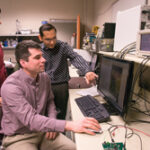
Working closely with Sandy McComb Waller, an associate professor of physical therapy and rehabilitation science at the University of Maryland School of Medicine, the ECLIPSE Cluster has designed and developed a fabric integrated with sensors that can read a person’s slightest gesture.
The ECLIPSE device is unassuming in appearance. It looks like a simple patch of fabric about the size of an electric heating pad. Woven into the fabric, however, is a grid of electrically conductive threads that can sense the changing electrical charge when a human hand or finger passes close by.
In engineering terms, these are known as capacitive sensors. They work in a way similar to the touchscreen technologies in smartphone and tablet computers, but they don’t require the user to physically touch the screen.
“In this case, close is more than good enough,” Banerjee says.
Such controllers might one day be integrated into bed sheets, pillows, wheelchair pads, or clothing. Their potential uses? Manipulate light switches, televisions, thermostats, or even make a 911 call. Virtually any electronic device, even a computer, could be controlled from this one device.
Training the Device
The flexible fabrics hold many advantages over their glass-screened cousins. First off, they conform to practically any surface without any loss of sensitivity. A user could wear it over a knee one day, on a forearm the next, and the device would work the same. No rigid glass touchscreen could ever be so versatile.
 Second, the ECLIPSE device is trainable. “We started out with predefined gestures, but the people we are designing for have limited range of motion and most have limited motor control, so they didn’t like it. It was too difficult for everyone to learn the same motions,” Robucci says.
Instead, the ECLIPSE team recalibrated. They began designing algorithms that help the users record their own gestures and to tell the computer what the gestures mean.
“Sometimes, a user is capable of only a finger twitch, but we can even map those motions to specific instructions. People will be able to control the devices around them with the slightest of movements,” Banerjee says.
Best of all, perhaps, the ECLIPSE sensors are ultra-low power and extremely affordable, costing just 5 to ten cents per device to produce.
Down the road, Banerjee talks of forward-looking applications that will help not only those with physical challenges, but just about everyone on the planet.
“You could imagine putting these sensors in car seats, where a driver might be falling asleep at the wheel or distracted looking at a smartphone. Our capacitors can be embedded to detect whole body motion: Is the driver facing the road? Is he is on a phone? Is she falling asleep?” Banerjee explains. “Instead of an Internet of Everything, we’ll have an Internet of Everyone.”
Banerjee adds that these or similar systems based on similar technologies also could be deployed in life-saving situations, such as in cribs to detect breathing patterns that could prevent Sudden Infant Death Syndrome (SIDS), a mysterious killer in which infants simply stop breathing in their sleep.
Getting End Results
Things are beginning to blossom for ECLIPSE, especially as researchers and funders outside the close-knit UMBC community to begin take note of their work and invest in it.
Last August, the National Science Foundation and the National Institutes of Health placed a big bet on their work, seeding the group with a $650,000, three-year grant to fuel their research. TEDCO, a program sponsored by the State of Maryland to facilitate transfer and commercialization of technology flowing out from the state’s research labs, soon followed with an additional $150,000. Microsoft Research and its “Lab of Things” rapid prototyping program are also supporters of the ECLIPSE work.
Robucci says that one key to the success of the ECLIPSE Cluster and its researchers are their focus – and capacity – to see the big picture and make it happen within their own lab. Banerjee is the software expert. Robucci focuses on analog to digital signal processing that turns the real world into data a computer can understand. And Patel is a chipmaker – an expert in very large-scale integrated circuits. The goal of ECLIPSE is to build end-to-end cyber-physical systems.
“We’re working on complete systems here, not on individual components,” observes Robucci, “so we have to be able to imagine the end result – the product – and then work at all levels…to design and optimize the components and algorithms to make it a reality.”
 Though ECLIPSE began as a loose affiliation of like-minded engineers, it is quickly growing into something more – an incubator of ideas and solutions to some of the most challenging questions of the day.
“If you’re working alone you often think, ‘Can I do this? Is this possible?’ and then you have to find the answers on your own,” Robucci says, “but at ECLIPSE we’re sort of all-inclusive. If you ask the same question, someone else has the answer, ‘Yeah, we could do that.’”
Banerjee agrees: “I couldn’t do it alone, and neither could Ryan or Chintan. Each of us brings unique and important expertise to the equation and the sum is greater than the parts. It’s as if you added three individuals together and you end up as four.”
]]>
By Andrew Myers From the Apple Watch to Fitbit, the rage in technology these days is all about wearable, touchable devices. Tech gurus and cutting-edge engineers talk of a day when all the many...
https://umbc.edu/stories/the-sum-of-the-parts/
https://my3.my.umbc.edu/api/v0/pixel/news/121858/guest@my.umbc.edu/12f85d7490223823e743c72cad69ecae/api/pixel
discovery
spring-2015
UMBC News & Magazine
https://my3.my.umbc.edu/groups/umbc-news-magazine
https://assets1-my.umbc.edu/system/shared/avatars/groups/000/001/943/24435aa6207c452e7bc15cc74b42c7bb/xsmall.png?1748556657
https://assets1-my.umbc.edu/system/shared/avatars/groups/000/001/943/24435aa6207c452e7bc15cc74b42c7bb/original.png?1748556657
https://assets2-my.umbc.edu/system/shared/avatars/groups/000/001/943/24435aa6207c452e7bc15cc74b42c7bb/xxlarge.png?1748556657
https://assets2-my.umbc.edu/system/shared/avatars/groups/000/001/943/24435aa6207c452e7bc15cc74b42c7bb/xlarge.png?1748556657
https://assets3-my.umbc.edu/system/shared/avatars/groups/000/001/943/24435aa6207c452e7bc15cc74b42c7bb/large.png?1748556657
https://assets1-my.umbc.edu/system/shared/avatars/groups/000/001/943/24435aa6207c452e7bc15cc74b42c7bb/medium.png?1748556657
https://assets2-my.umbc.edu/system/shared/avatars/groups/000/001/943/24435aa6207c452e7bc15cc74b42c7bb/small.png?1748556657
https://assets1-my.umbc.edu/system/shared/avatars/groups/000/001/943/24435aa6207c452e7bc15cc74b42c7bb/xsmall.png?1748556657
https://assets2-my.umbc.edu/system/shared/avatars/groups/000/001/943/24435aa6207c452e7bc15cc74b42c7bb/xxsmall.png?1748556657
UMBC News & Magazine
0
0
false
Wed, 22 Apr 2015 19:01:51 -0400
Rights and Wrongs

Tyson King-Meadows has forged a career examining the implementation of the 1965 Voting Rights Act – and helping a new generation of political scientists emerge from UMBC.
By David Glenn
 Signing of the Voting Rights Act/LBJ Library photo by Yoichi Okamoto (August 6, 1965)
Fifty years after the passage of the Voting Rights Act and seven years after the election of the first black president, what are the dynamics of African-American political participation? Can Southern states be trusted now to run fair elections without federal oversight? Can the Democratic Party sustain the coalitions that won the White House twice for Barack Obama?
Loose punditry on those topics is cheap and easy to find. But for empirically grounded analysis, scholars and policy experts are increasingly turning to Tyson D. King-Meadows, an associate professor of political science and chair of the department of Africana studies at UMBC.
King-Meadows has spent more than 20 years studying African-American political life, with an emphasis on the architecture and enforcement of the Voting Rights Act. When the Joint Center for Political and Economic Studies – one of Washington’s most venerable African-American policy organizations – wanted to develop an analytic forecast of the black vote in various states in 2014, King-Meadows was one of the two experts they sought.
Such assignments have not turned King-Meadows into a creature of Washington, D.C. He first arrived at UMBC in 2002, not long after completing his doctorate in political science at the University of North Carolina at Chapel Hill and a fellowship at Harvard University’s W.E.B. DuBois Institute for African and African-American Research. He also taught at Middle Tennessee State University and received a place in in the Fulbright Scholars Program, during which he traveled to West Africa, and taught and conducted research at the University of Ghana.
Since landing permanently at UMBC in 2004, King-Meadows has become a popular teacher and mentor at UMBC, and a campus leader on projects such as the creation of the minority postdoctoral fellowship program.
“Tyson is a strong scholar and a great teacher, but he also has this gift for administration and making things happen, which not many academics have,” says Tom Schaller, the chair of the political science department. Schaller first met King-Meadows in 1995, when both were graduate students at Chapel Hill. They also co-authored a book, Devolution and Black State Legislators, which published in 2006 by State University of New York Press.
“He seems to know everyone on campus on a first-name basis,” Schaller says.
Between The Lines
The Voting Rights Act (VRA) that King-Meadows has studied so closely is now approaching its fiftieth birthday. His research these days is turning much less to the history of the law itself, and to the huge range of dubious electoral practices that are not – and perhaps could never be – prohibited by federal law.
“Everybody knows about Julius Henson and the robocalls,” he says, referring to the 2010 case in which a Maryland campaign operative was prosecuted for deceptive phone calls that encouraged voters to stay home. “But there are practices out there that are subtler than that – for example, leaflets that say that you can’t vote if you’re behind on child support. The Supreme Court has sometimes argued that deceptive practices are freedom of speech, part and parcel of the practice of electoral politics. And maybe that’s correct. You really can’t legislate that kind of trickery away. What you have to have is a very aggressive or vibrant civic education strategy, so citizens reject those kinds of deceptions.”
That broad question of troubling electoral practices that are and are not covered by the VRA is the topic of one of two books King-Meadows is working on. The second book is a rhetorical analysis of how the how the Senate Judiciary Committee framed its discussions of race, representation, and democracy during the hearings which led to Sonia Sotomayor’s confirmation hearings to the Supreme Court.
King-Meadows is also co-editing a volume on African-American partisan identification, and supervising a team of undergraduate research assistants who are analyzing 55 years’ worth of U.S. newspaper coverage of voting rights, all in addition to directing UMBC’s Africana studies department.
“Tyson is incredibly thoughtful as a scholar, and I’ve also gotten to see him act as an institution-builder,” says Andra Gillespie, an associate professor of political science at Emory University, who was King-Meadows’ co-author on the 2014 analysis of African-American voting patterns. “When he served as president of the National Conference of Black Political Scientists, he encouraged us to be ambitious about where we could go as an organization. He’s a great colleague and a great friend. I feel lucky to have him in my circle.”
A Diverse Discourse
When King-Meadows started at North Carolina Central University in Durham, he expected to go to law school. Instead, he fell in love with political science, applying to graduate school a few miles away in Chapel Hill.
It was here that King-Meadows’ habit of multitasking took root. In addition to the eternal grad student burdens of studying and teaching, he plunged into several activist campaigns calling on UNC to do better at recruiting and retaining students and faculty of color.
“I realized that many of our concerns about the university’s commitment to diversity and inclusion were also related to curriculum,” he recalls. “Whose voices get into the syllabus, whose perspectives get elevated or excluded, and whose ideas get taken as empirical facts.”
Schaller joined King-Meadows in a few of those campaigns. “One of the formative early moments in our friendship,” he recalls, “was when he asked me, ‘How many times have you been stopped going into the building?,’ meaning Hamilton Hall, where the political science department is. And I said, ‘What? I’ve never been stopped.’ I always came in and out of the building late at night – that’s just part of the grad student life. You’re in your carrel reading or grading papers. No one ever questioned whether I was legitimately in the building. But every few months somebody would say to Tyson, ‘Excuse me, do you have any ID?’”
One of King-Meadows’ mentors at Chapel Hill was Terry Sullivan, a political scientist who is known for empirical studies of Congressional decision-making. (“Terry is where I got my love for Congress,” King-Meadows says.) Sullivan recalls that in King-Meadows’ first years of graduate school, he was besieged by appeals for support and advice from undergraduate students, especially students of color.
“He was drowning in these requests,” says Sullivan. “And that was hard on him as a graduate student, because he was trying to balance his obligations. But he took that burden, which was substantial, and turned it into something special. He used it as an opportunity to think hard about what he wanted to be as a teacher. By the time he left Chapel Hill, he was an award-winning instructor.”
Finding The Patterns
 Shawn Tang ’15 is not surprised to learn that King-Meadows won a teaching prize back in graduate school. “I took a course on Congress with him last semester,” Tang says. “It was a conversation more than a lecture. You couldn’t get away with not doing the reading. He kept all of his students accountable.”
Today, Tang is part of King-Meadows’ small army of research assistants. Among other projects, Tang is analyzing and coding archival newspaper articles on voting rights in general and the Voting Rights Act in particular.
 Another member of the team, Divya Prasad ‘16, says that King-Meadows gives his research assistants a generous degree of freedom, but also expects them to be able to defend their choices. “Whenever we do something in our research,” Prasad says, “he wants to make sure that we’ve really thought about how we’ve come to our decisions.”
Lauren Lochocki ’14, political science was hired as an analyst at IMPAQ International after serving on King-Meadows’ team of research assistants. The duo have given papers together at academic conferences, and their collaboration was spotlighted as an example of outstanding undergraduate research by the American Political Science Association.
Lochocki says that “when I was applying for jobs, I was confident in the skill sets [I had], and I am able to apply them to where I’m working now.”
Coding newspaper articles is inescapably tedious work, but the experience may pay dividends. Rhoanne Esteban ’11, political science, worked as a research assistant for King-Meadows several years ago, analyzing data from surveys of African-American state legislators and voters in a racially divided Congressional district in Tennessee. She is now a doctoral student in political science at the University of California at Santa Barbara.
“When I started here,” she says, “I don’t think anyone else in my cohort had the range of research skills that I had. Dr. King-Meadows made sure that all of his RAs knew our methods. He always reminded us that other scholars have to be able to replicate our work.”
The newspaper-coding project will inform King-Meadows’ book-in-progress on deceptive election practices and congressional authority to stop them – a sequel to his earlier work When the Letter Betrays the Spirit (Lexington Books, 2011). In that book, King-Meadows argued that throughout the Voting Rights Act’s history, Congress has been too passive in overseeing the law’s enforcement, and too willing to defer to the preferences of the executive branch.
 Marchers carrying banner lead way as 15,000 parade in Harlem (March 1965)/World Telegram & Sun. Photo by Stanley Wolfson. Library of Congress.
That passivity, King-Meadows believes, was baked into the law from the beginning: When Congressional members were crafting the bill in the spring and summer of 1965, Lyndon Johnson successfully pushed for language that gave enforcement discretion to the Department of Justice.
That impulse was understandable – the White House didn’t want to cope with obstruction from recalcitrant Southern senators. But the flexibility carried a heavy cost, King-Meadows believes. Because the VRA has given extensive discretion to the executive branch, certain presidents have chosen to enforce the law only weakly. If Congress had written the law more tightly, King-Meadows believes, it would have been less subject to watering down by the executive or by the courts.
“You have the same law that can be enforced strongly or weakly depending on the preferences of the executive branch,” King-Meadows says. “And the various coalitions in Congress have never really figured out how they want to respond to this.”
After completing his 2011 book, King-Meadows got to see that confusion and ambivalence up close. He won an American Political Science Association Congressional Fellowship, a program that embeds academics in the Capitol. He spent a year as a staffer on the House Judiciary Committee, which was then led by Chairman Robert Goodlatte, a Republican from Virginia, and ranking member John Conyers, who is a Democrat from Michigan.
“This was absolutely the greatest experience of my professional life,” he says. “I got to be in the room, to see documents, to attend strategy sessions, to write memos. I got to walk to the Supreme Court for the oral arguments in Shelby County v. Holder.” (In that 2013 case, the court voided a key component of the Voting Rights Act.)
“That year has absolutely changed the way I teach Congress and the way I mentor students,” says King-Meadows. Among other things, he was struck by the influence wielded by fresh-out-of-college legislative staffers.
“A lot of political science students think they have to go to law school and do this and that and wait years until they can change the world,” King-Meadows says. “And I try to explain to them: No. If you pick up the right skills as an undergraduate, you can go out and change the world right now.”
]]>
Tyson King-Meadows has forged a career examining the implementation of the 1965 Voting Rights Act – and helping a new generation of political scientists emerge from UMBC. By David Glenn Signing...
https://umbc.edu/stories/rights-and-wrongs/
https://my3.my.umbc.edu/api/v0/pixel/news/121859/guest@my.umbc.edu/4a957a8be7df4dd44432de7a58851108/api/pixel
discovery
spring-2015
UMBC News & Magazine
https://my3.my.umbc.edu/groups/umbc-news-magazine
https://assets1-my.umbc.edu/system/shared/avatars/groups/000/001/943/24435aa6207c452e7bc15cc74b42c7bb/xsmall.png?1748556657
https://assets1-my.umbc.edu/system/shared/avatars/groups/000/001/943/24435aa6207c452e7bc15cc74b42c7bb/original.png?1748556657
https://assets2-my.umbc.edu/system/shared/avatars/groups/000/001/943/24435aa6207c452e7bc15cc74b42c7bb/xxlarge.png?1748556657
https://assets2-my.umbc.edu/system/shared/avatars/groups/000/001/943/24435aa6207c452e7bc15cc74b42c7bb/xlarge.png?1748556657
https://assets3-my.umbc.edu/system/shared/avatars/groups/000/001/943/24435aa6207c452e7bc15cc74b42c7bb/large.png?1748556657
https://assets1-my.umbc.edu/system/shared/avatars/groups/000/001/943/24435aa6207c452e7bc15cc74b42c7bb/medium.png?1748556657
https://assets2-my.umbc.edu/system/shared/avatars/groups/000/001/943/24435aa6207c452e7bc15cc74b42c7bb/small.png?1748556657
https://assets1-my.umbc.edu/system/shared/avatars/groups/000/001/943/24435aa6207c452e7bc15cc74b42c7bb/xsmall.png?1748556657
https://assets2-my.umbc.edu/system/shared/avatars/groups/000/001/943/24435aa6207c452e7bc15cc74b42c7bb/xxsmall.png?1748556657
UMBC News & Magazine
0
0
false
Wed, 22 Apr 2015 18:58:24 -0400
Alumni Perk: the RAC

 With spring right around the corner (fingers crossed), we hope that you’ll shake off the winter lazies with us at the RAC.
The UMBC athletic/recreation department offers a special discounted rate to all alumni who want to use the facilities at the newly-renovated Retriever Activities Center. Amenities include exercise equipment, weight room, indoor track, pool, basketball courts, tennis courts, locker rooms, and group fitness classes. The alumni rate for membership is $250 per year, with 6 month, 3 month and 1 month rates available.
Click HERE to download the membership application and HERE for the 2015 Spring recreation and group fitness schedule.
]]>
With spring right around the corner (fingers crossed), we hope that you’ll shake off the winter lazies with us at the RAC. The UMBC athletic/recreation department offers a special discounted...
https://umbc.edu/stories/alumni-perk-the-rac/
https://my3.my.umbc.edu/api/v0/pixel/news/122002/guest@my.umbc.edu/f452c4e22d8e108aec167672997626e3/api/pixel
alumni
alumni-perks
discounted-rate
group-fitness
membership
perks-and-services
rac
recreation
retriever-activities-center
spring-2015
UMBC News & Magazine
https://my3.my.umbc.edu/groups/umbc-news-magazine
https://assets1-my.umbc.edu/system/shared/avatars/groups/000/001/943/24435aa6207c452e7bc15cc74b42c7bb/xsmall.png?1748556657
https://assets1-my.umbc.edu/system/shared/avatars/groups/000/001/943/24435aa6207c452e7bc15cc74b42c7bb/original.png?1748556657
https://assets2-my.umbc.edu/system/shared/avatars/groups/000/001/943/24435aa6207c452e7bc15cc74b42c7bb/xxlarge.png?1748556657
https://assets2-my.umbc.edu/system/shared/avatars/groups/000/001/943/24435aa6207c452e7bc15cc74b42c7bb/xlarge.png?1748556657
https://assets3-my.umbc.edu/system/shared/avatars/groups/000/001/943/24435aa6207c452e7bc15cc74b42c7bb/large.png?1748556657
https://assets1-my.umbc.edu/system/shared/avatars/groups/000/001/943/24435aa6207c452e7bc15cc74b42c7bb/medium.png?1748556657
https://assets2-my.umbc.edu/system/shared/avatars/groups/000/001/943/24435aa6207c452e7bc15cc74b42c7bb/small.png?1748556657
https://assets1-my.umbc.edu/system/shared/avatars/groups/000/001/943/24435aa6207c452e7bc15cc74b42c7bb/xsmall.png?1748556657
https://assets2-my.umbc.edu/system/shared/avatars/groups/000/001/943/24435aa6207c452e7bc15cc74b42c7bb/xxsmall.png?1748556657
UMBC News & Magazine
0
0
false
Tue, 24 Feb 2015 15:00:09 -0500
 Watson is IBM’s Deep Question Answering system. You might recall that when Watson was put to the test against human contestants on the television quiz show, Jeopardy!, the system successfully bested its competitors in providing questions to answers whose associated question was already known. (And won $1,000,000.)
 Note: The views and opinions expressed are those of Claudia Pearce and do not reflect those of NSA/CSS.

