Finding a lifetime of purpose in giving back
A bright yellow bead slides over a red pipe cleaner, then a blue bead followed by green. Soon, the rainbow of beads and wire is twisted this way and that until it resembles the Big Dipper. This same activity is happening throughout PHYS 401, a seminar room in the UMBC Physics building, as 20 Baltimore City middle and high school students and their parents recreate the constellations.
These students are part of their local Sigma Beta Club, a youth auxiliary of Phi Beta Sigma Fraternity, Inc., founded nationally in 1950 to help mentor young men and develop their leadership skills. “When we go out to UMBC, it’s always something special,” says Gary Brooks ’79, history, who played a large part in bringing these young people to Hilltop Circle. “UMBC does things second to none.”
The students came to campus in February with members of the Nu Sigma Sigma Alumni Chapter, which includes Phi Beta Sigma alumni—including Brooks—to tour the UMBC Observatory and attend a men’s basketball game.
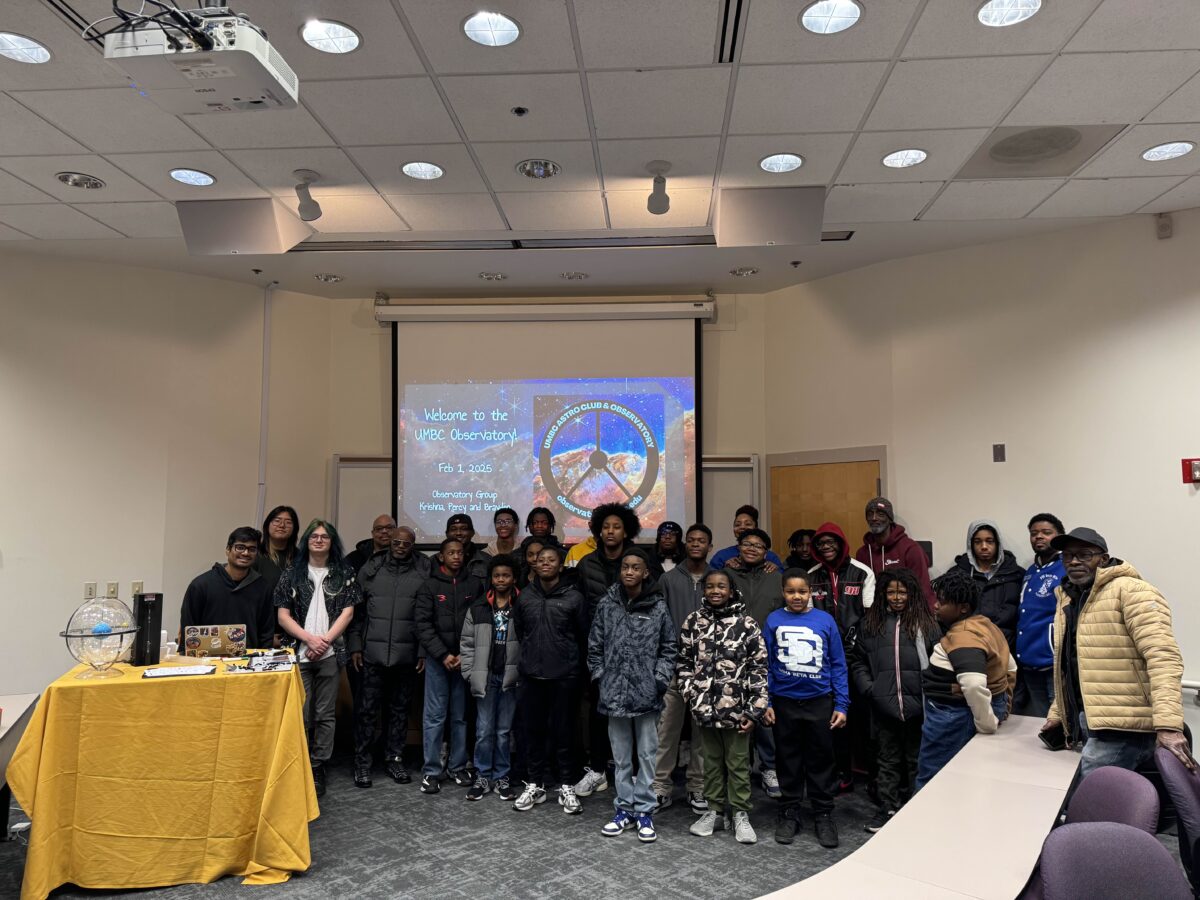 Gary Brooks ’79 and members of the Sigma Beta Club touring the UMBC Observatory with middle and high school students.
Nu Sigma Sigma partners with local universities like UMBC to offer Baltimore City youth interested in STEM the chance to experience college life. Most of these visits involve some sort of athletics event, and that’s about it—but not at UMBC.
Another Sigma Beta Club visit to UMBC involved a FIRST LEGO League competition, and another saw the students observe a robotics event. Brooks also makes sure that each visit includes a member of UMBC senior leadership. Recently, the students had the chance to speak with UMBC President Valerie Sheares Ashby and Athletics Director Tiffany Tucker.
Brooks wants each visit to UMBC to be as meaningful as possible for these young men because he knows how UMBC can change lives.
Staying connected
Even though Brooks graduated 45 years ago, he never really left UMBC. He remains closely involved with Phi Beta Sigma at UMBC, helping mentor students, and he is an active member of Nu Sigma Sigma, working closely with the university to bring Sigma Beta Club members to campus.
“The fraternity got me involved in community service,” says Brooks—a personal mission he carries on to this day.
“Since I met Gary almost 20 years ago, he has been a dedicated champion of UMBC,” says Stanyell Bruce, director of alumni engagement at UMBC.
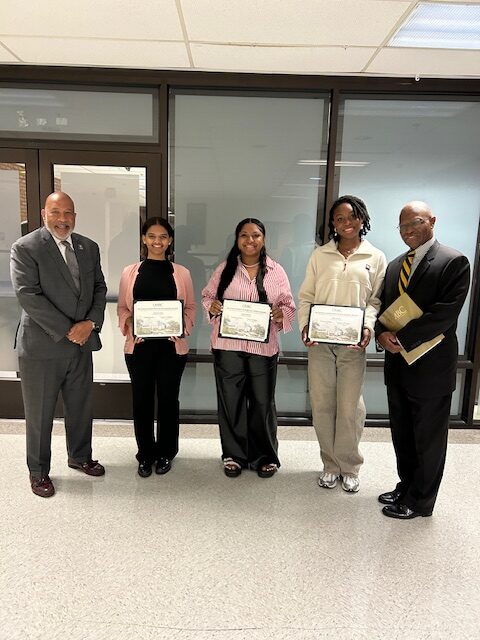
Brooks also serves on the UMBC Second Generation Scholarship Fund committee. The Second Generation Scholarship is awarded annually to outstanding undergraduate students who intend to pursue study at UMBC, are enrolled in or have completed a course in Africana studies, and demonstrate a commitment to improving the lives of racial/ethnic minorities through community service, extracurricular activities, or other community involvement. Brooks has served on the committee since 1986, when the scholarship was established.
Brooks is also the chairperson for the Historic St. James Episcopal Church Scholarship Fund—a position he has held since 2010—and helped establish the Dr. Lamont Smith, M.D. Scholarship through Sigma R.E.A.C.H., Inc. Brooks has served on that committee since its inception as well.
“Education is dear to my heart,” says Brooks, who went on to earn his M.P.A. from the University of Baltimore and his J.D. from the University of Maryland School of Law—an impressive resume for someone who initially struggled in college.
“My first semester at UMBC wasn’t the best,” admits Brooks. “I didn’t do well at all.”
Photo left: Gary Brooks ‘79 and Larry Wiggins ‘75 with the 2024 Second Generation Scholarship recipients.
Finding place and purpose
Instead of giving up, Brooks decided to lean into his weaknesses—reading and writing—by taking courses in Africana studies, a subject that interested him a great deal. These courses involved a lot of reading and writing, but Brooks found himself more immersed in the work. It was still difficult, but he enjoyed the subject matter, and the faculty was incredibly supportive. As a result, his grades began to improve.
“I saw that success, and I got more and more serious about school,” says Brooks.
After graduation, Brooks remained close to the Africana studies department. He spearheaded a committee tasked with hosting the annual “Party with a Purpose,” whose proceeds supported Africana studies and the Second Generation Scholarship. Brooks also continued to correspond with several Africana studies faculty members who mentored Brooks throughout graduate school, law school, and his career.
 Gary Brooks ‘79 and the Party with a Purpose planning committee during UMBC’s 50th anniversary.
After Brooks graduated from law school, one of those professors, Willie Lamousé-Smith, former chair of Africana studies, asked Brooks to step out of his comfort zone and step into the classroom to teach a course on the impact of the criminal justice system on the Black community. Despite some hesitancy—“I do estate planning and bankruptcy,” says Brooks. “I am not a criminal justice attorney.”—the young lawyer decided to take the leap into teaching after more than a little encouragement from Lamousé-Smith.
“Dr. Lamousé-Smith said, ‘Mr. Brooks, you are smart enough,’ and that was enough,” says Brooks. “He believed in me.”
Brooks taught this class for six years, connecting UMBC students with impactful, African American leaders, including the Baltimore City police commissioner and the Baltimore City state’s attorney. Brooks eventually handed the class over to his good friend and former law partner, Larry Wiggins ’75, political science, who played a large role in helping Brooks study for and pass the bar exam.
When the giving goes both ways
Brooks was honored at the 2001 UMBC Alumni Awards with an Alumni Community Leadership Award. He also received a special Visionary Leadership Award in 2006, recognizing members of the Reginald F. Lewis Museum of Maryland African American History and Culture Event Planning Committee for their outstanding contributions to advancing the mission of the UMBC Alumni Association. He’d like to thank his wife, Karen B. Brooks, their four children, Aja, Ashlea, Morgan, and Geron, and their three grandkids, Ryder, Ari, and Amari.
Over the years, Brooks has continued to give back to the UMBC community because of how much the UMBC community has given him.
“Gary’s commitment to UMBC never wavers,” says Bruce. “He’s someone I seek out for advice and guidance, and he embodies what it means to be Retriever Proud.”
]]>
A bright yellow bead slides over a red pipe cleaner, then a blue bead followed by green. Soon, the rainbow of beads and wire is twisted this way and that until it resembles the Big Dipper. This...
https://umbc.edu/stories/finding-a-lifetime-of-purpose-in-giving-back/
https://my3.my.umbc.edu/api/v0/pixel/news/149879/guest@my.umbc.edu/88822ec4ac81192ec039f21af5edb8c6/api/pixel
alumni
alumni-profile
baltimore-city
cahss
gary-brooks
history
impact
magazine
phi-beta-sigma
second-generation-scholarship
sigma-beta-club
spring-2025
story
UMBC News & Magazine
https://my3.my.umbc.edu/groups/umbc-news-magazine
https://assets1-my.umbc.edu/system/shared/avatars/groups/000/001/943/24435aa6207c452e7bc15cc74b42c7bb/xsmall.png?1748556657
https://assets1-my.umbc.edu/system/shared/avatars/groups/000/001/943/24435aa6207c452e7bc15cc74b42c7bb/original.png?1748556657
https://assets2-my.umbc.edu/system/shared/avatars/groups/000/001/943/24435aa6207c452e7bc15cc74b42c7bb/xxlarge.png?1748556657
https://assets2-my.umbc.edu/system/shared/avatars/groups/000/001/943/24435aa6207c452e7bc15cc74b42c7bb/xlarge.png?1748556657
https://assets3-my.umbc.edu/system/shared/avatars/groups/000/001/943/24435aa6207c452e7bc15cc74b42c7bb/large.png?1748556657
https://assets1-my.umbc.edu/system/shared/avatars/groups/000/001/943/24435aa6207c452e7bc15cc74b42c7bb/medium.png?1748556657
https://assets2-my.umbc.edu/system/shared/avatars/groups/000/001/943/24435aa6207c452e7bc15cc74b42c7bb/small.png?1748556657
https://assets1-my.umbc.edu/system/shared/avatars/groups/000/001/943/24435aa6207c452e7bc15cc74b42c7bb/xsmall.png?1748556657
https://assets2-my.umbc.edu/system/shared/avatars/groups/000/001/943/24435aa6207c452e7bc15cc74b42c7bb/xxsmall.png?1748556657
UMBC News & Magazine
1
0
false
Tue, 06 May 2025 17:06:34 -0400
Tue, 06 May 2025 17:06:34 -0400
Coming full circle on musical pathways—UMBC students now teach at the programs that launched their success
All musicians start out as absolute beginners. Some might progress as self-taught, others might have private music lessons, and many will pick up their first instrument in school. But without a musical pathway—consistent access to physical instruments and dedicated music educators year after year—budding musicians will falter on their journey.
For Nema Robinson, and the thousands of other Baltimore City student musicians who have benefited from extra-curricular, free, equitable music education through programs like the Baltimore Symphony’s OrchKids and Peabody Institute’s Tuned-In program, these communities have opened musical doors to a professional career in music and so much more. Now on track to graduate with a music education degree, Robinson has reached a full circle moment to teach at the programs that set the stage for her own success.
The first violinist plays a long, drawn out A. The other musicians settle their feet against the stage floor and their backs hover near, but don’t quite touch the backs of their chairs. Suddenly, the noise of the orchestra breaks across your ears—briefly discordant and separate—but as the players all search for the same A, the notes weave together into a pleasing buzz of anticipated energy. In tune together, they look expectantly at the conductor.
 Robinson instructs students at Tuned-In.
Among the Uggs and Vans and Crocs and Nikes nestled under the music stands are Nema Robinson’s double-buckled black platform Mary Janes. Robinson, a fourth-year music education student and Linehan Artist Scholar, is at one of her teaching gigs that supplement and complement her degree. Today, she’s in Friedberg Hall at the Peabody Institute in Mt. Vernon, Baltimore, as part of Tuned-In, a free musical study and youth development program for Baltimore-area students. The elegant marble relief sculptures that flank either side of the stage and the gentle curve of the stairs leading to the second story seating section are just the background to the real art on the stage: Middle and high schoolers are making music.
In Baltimore City, only 60 percent of public schools have some type of musical component, says Nick Skinner, the vice president and founding team member of BSO OrchKids—which also offers free, community-based, high-quality music instruction and programming in the city. Of that, only 12 percent of city schools have instrument programs, compared to nearly 100 percent in nearby Baltimore, Howard, and Montgomery county schools. “There’s no musical pathway. So if you’re lucky enough to have music in your elementary school, you may not be able to continue that music study sequentially into middle or high school,” says Skinner. “It’s a really patchwork model of how students can progress musically through their education.”
When former BSO conductor Marin Alsop began her tenure in the city, she saw a need to fill this gap, and in 2007 founded BSO OrchKids. As Skinner tells it, Alsop saw that “many of our students here in the city were locked out of these opportunities to have the power of music in their life—to benefit from the inherent value of playing an instrument and the benefits that come from the study and the artistic process of learning an instrument.”
Asked to lead
When Robinson was a kid, she was walking around Artscape with her mom waiting to see her cousin perform on stage. Artscape in Baltimore City is the nation’s largest free outdoor arts festival, famously held on whatever is the hottest weekend in the summer. Robinson recalls getting to the event early and waiting in the unbearable heat. They found a place to sit and wait for her cousin’s opera performance and during that period OrchKids took the stage. “And my mom was like, ‘Oh my God, all these Black musicians playing classical music.’ We immediately got applications, and all of this started from there.”
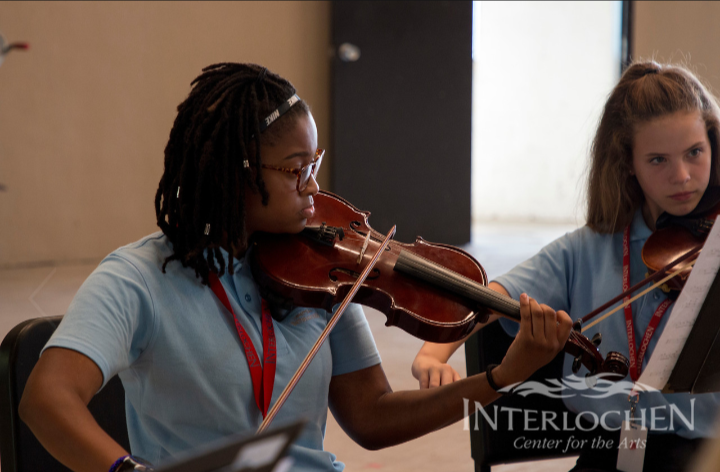
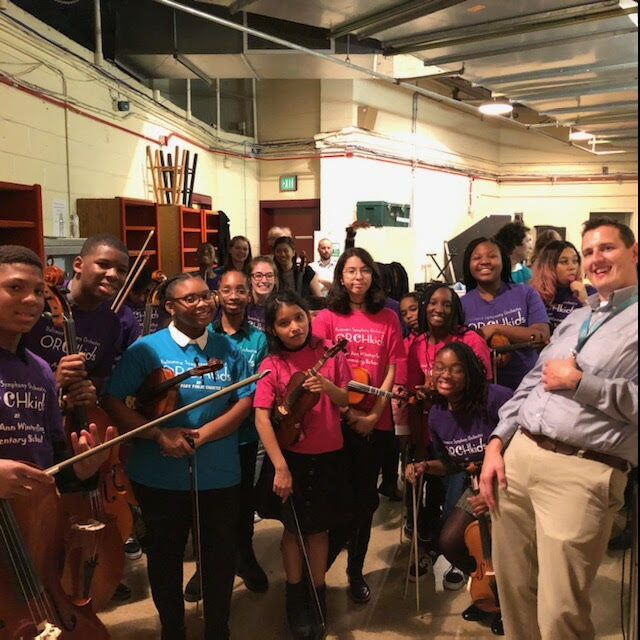
Young Nema Robinson playing the violin and with a group of BSO OrchKids. Robinson is crouching in purple, and fellow UMBC student Rickerra Bassett is standing in front with a teal shirt. Photos courtesy of Robinson.
In fourth grade, Robinson joined OrchKids and thought she wanted to play the tuba. Her mom shot that down for practical reasons, like 11-year-old Nema being able to even carry the instrument. “I’m still too small to play the tuba,” says Robinson. Her instrument of (second) choice was the violin, and through the daily after-school sessions at OrchKids and the all-day Saturdays at Tuned-In, along with numerous other musical opportunities she’s taken part in, Robinson has far surpassed the lauded 10,000 hours on her way to becoming an expert.
On stage in the Linehan Concert Hall rehearsing with UMBC’s Chamber Ensemble, Robinson stands in a semi-circle with a dozen other musicians. At this point, she’s been playing for 10 years. As the group launches into a slow baroque minor key waltz, Philip Mann, the conductor and assistant professor of music, stops them short. “Let’s move closer,” he says to the collection of string instrumentalists. With a shuffle of music stands, the ensemble tightens the circle. Black leather Doc Martens now firmly planted beneath her, Robinson leans into the music with her instrument familiarly tucked beneath her chin.
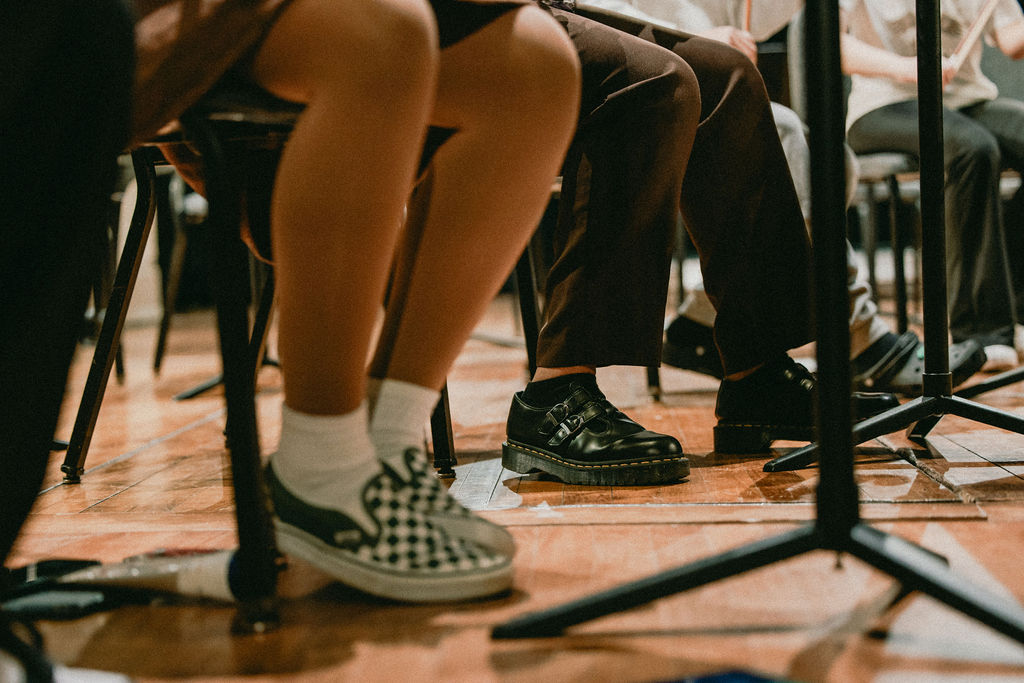

Before UMBC had a chamber orchestra—an intimate group of musicians—Robinson played in UMBC’s Symphony Orchestra, which is open to staff, students, and community members. She was a section leader her first year at UMBC. “I had to make sure I was locked in because this was a really big deal in a university just starting out. I think for me it was definitely nerve wracking, like, ‘Oh, I can’t mess up. But the conductor said, “You’re doing great. Just play.’” As time went on Robinson saw that as a music major and a Linehan Scholar, she was being asked to lead.
“I slowly adapted,” says Robinson, “and then I started to realize that music majors—maybe that’s why we are the section leaders—because we are setting an example for the community members.”
Listen to different nuances
Ann Sofie Clemmensen, director of the Linehan Artist Scholars Program, knows this was intentional. “Across the arts, we do lean on scholars to lead some assignments because they are receiving resources that others are not. In the music department, in dance and theater, and visual arts, we’re identifying leaders and those who can become leaders. And I think that’s what UMBC is very good at.”
 Robinson at the Peabody Institute.
This May, the Linehan Artist Scholars Program is celebrating three decades of supporting an arts-focused community at UMBC. Founded with support from Earl and Darielle Linehan, the scholarship supports students with an exceptional interest in the arts. Specifically, the program “acknowledges the importance of artists as leaders. As artists, we understand that a production or an orchestra is a component of many things that have to have some sort of organizational aspect,” says Clemmensen. “You have to listen to the different nuances.”
Robinson has found the scholars community to be uplifting and collaborative. “Insanely great,” to use her exact words. “It’s really cool to see how everyone else is very invested in their art, and it made me realize how it’s all tied together,” Robinson says. When she heard fellow OrchKid and Tuned-In student, Rickerra Bassett, was thinking about UMBC, Robinson immediately connected the young violist to Linehan, where she is now a first-year double major music education and performance scholar.
This is the dream
 Rickerra Bassett practices with the UMBC Chamber Ensemble.
Bassett started at BSO OrchKids during kindergarten, practically still a baby, she says. She stayed through her senior year, and like Robinson, has continued to work for the program as a graduate. Despite the camaraderie and the support BSO OrchKids offers, Bassett said it is rare that a student stay in the program for their full K-12 experience. “The main reason why I stuck with it is, well, I enjoyed it. I also realized how high demand violas are—there’s not as much competition for me to participate in orchestras compared with violin, so I feel like I’ve gotten way more opportunities because I play viola.”
“Rickerra and Nema are in so many ways, shape, and form what we always hope OrchKids to be,” says Skinner. “We’re always striving to improve, but looking at their trajectory—that is the dream in a lot of ways.” OrchKids has paved and paid the way for Robinson, Bassett, and many other musicians to attend prestigious music camps in other states, perform on the BSO’s Meyerhoff stage with world-class professional musicians, participate in the YOLA National Festival in Los Angeles, and so many other opportunities in addition to their daily musicianship classes and other education supports. And now they’re at UMBC, learning to mentor the next generation of musicians.
“In so many ways,” Skinner says, “they are the definition of what OrchKids is hoping to achieve.”
Watching other young people discover the joy of sticking with an instrument gave Bassett, who also played with Tuned-In, the idea to double major in music education. “Seeing the younger students get so excited about things that we would probably think of as small was just the sweetest thing,” says Bassett. “I was seeing myself in them since I started that young. And I’m just hoping that they keep going. I want to motivate them to keep going.”
Music as social transformation
It’s not just about the music. Or rather, the music is more than the music classes. “I can’t believe how much the musical development and the social development are connected,” says Daniel Trahey, who co-founded Tuned-In at Peabody in 2007, coincidentally the same year he was a founding team member at OrchKids. “When you see someone like Nema—when she saw what she was able to do—her confidence level just skyrocketed once she started practicing. And this is so key to all of our kids, we need our kids to be thinking about themselves and investing in themselves in order to be better for others. And the thing that’s the most amazing to me is to see someone like Nema start to invest in herself, start to map out time for only themselves to sit down and practice when their other friends are off doing other things.”
Skinner puts it similarly: “When learning an instrument, you’re developing skills that you don’t even really realize that you’re forming—creativity and collaboration, leadership, the responsibility of practicing your instrument or making sure you have your music for a rehearsal. These are skill sets that our students are forming from a very young age that become embedded in them and can then easily be reapplied. There’s a tremendous amount of research that’s been coming out over the past decade about the power of music and how it impacts the brain. There’s almost nothing like playing an instrument when it comes to really enhanced brain function and activity, cognitive development, and executive function capabilities.”


Rickerra Bassett has been playing the viola since kindergarten in programs like OrchKids and Tuned-In. Photos courtesy of Bassett.
For Robinson, the structure and consistency of the programs she played in was key. They gave shape to her education and the expectation of practice and performances, and ultimately shaped her talent and her work ethic that shines through her myriad teaching roles.
Trahey stops mid-sentence to brag on this young professional. “Nema is what, 20 years old? She has the best attendance, the best timeliness. She is the most professional at sending emails. She takes her job so dang seriously, it is inspiring to me. And Nema plays a very important role at Tuned-In because for our high school kids, who are really sick of hearing from me, they’re listening to Nema because Nema’s got real world experience.”
 Robinson looks on while Tuned-In student Mi’Onte McGhee asks a question.
Trahey’s hopes—and part of Tuned-In’s goals—is that the program would be fully staffed one day by graduates of the program. Commitment to continuum is how they put it: students become the teachers. “By valuing the community the student comes from, the student will want to come back and work toward creating an even healthier community,” says Trahey.
In the big picture view, the musicianship classes and camps and performances—they’re all leading toward social transformation, but Trahey doesn’t want that to mean that the students leave their communities behind along the way. “I hope for most of the kids, to do what they want to do, and then find a way to also give back to their communities. We’re already seeing this where our students have gone on to get political science degrees or medical degrees, and then they become our largest advocates, and so for many of the communities that we’re working in.”
“We are really looking at how we can use music as a vehicle to open up the world to our students,” says Skinner.
Robinson saw music education in action by watching Brian Kaufman, associate professor of music education, teach at BSO OrchKids. He helped her discover music education as a major and the idea to pursue it at UMBC. “He was just very passionate about it. And you can just see it in the work and the community he created,” she says. “And when I visited, UMBC felt so welcoming.”
From his years of watching her as a student and then as an assistant, Trahey says, “Nema’s always had it, but I think UMBC and the music education program has really helped her get a more global perspective. Before she would concentrate on maybe one kid’s problem or two kids’ problems. And now I’m seeing her be able to really serve the needs and hear the voices of every single child in her ensemble or in the room that she’s working in, and that’s been a huge growth point for her since being at UMBC.”
Not an everyday type of thing
Back in the marbled hall at the Peabody Institute, Robinson is threading through the music stands on stage to offer encouragement and correction to the young people on stage. The lead instructor has stepped away to give the reins to Robinson.
 Robinson plays outside the Peabody Institute in front of the Washington Monument in Baltimore, Maryland.
Mi’onte McGhee, a high school violinist who has been playing with Tuned-In for four years, says, “Nema is such a big help to us. She’s really good if you ask her a question about technique—you don’t even have to ask sometimes, she just comes up and says I can help you with that, but she’s really nice about it. She never makes you feel like you can’t play. She’s really kind and knowing that she’s gone through all this before helps me relate to her.”
For Robinson, there’s nothing like the feeling of creating music with people. “It’s like you’re in a different zone, if that makes sense. It’s not necessarily an everyday type of thing, she says. “You definitely have to have a good intention and really put your all toward it. It’s doing something you’re very passionate about and then putting it forward. It doesn’t always make sense, but when you do it, it feels right.”
]]>
All musicians start out as absolute beginners. Some might progress as self-taught, others might have private music lessons, and many will pick up their first instrument in school. But without a...
https://umbc.edu/stories/coming-full-circle-on-musical-pathways/
https://my3.my.umbc.edu/api/v0/pixel/news/149597/guest@my.umbc.edu/5851c1c34e6edf58c27f0881b3e27a30/api/pixel
baltimore-city
cahss
campus-life
feature
linehan-artist-scholars
magazine
music
music-education
spring-2025
story
UMBC News & Magazine
https://my3.my.umbc.edu/groups/umbc-news-magazine
https://assets1-my.umbc.edu/system/shared/avatars/groups/000/001/943/24435aa6207c452e7bc15cc74b42c7bb/xsmall.png?1748556657
https://assets1-my.umbc.edu/system/shared/avatars/groups/000/001/943/24435aa6207c452e7bc15cc74b42c7bb/original.png?1748556657
https://assets2-my.umbc.edu/system/shared/avatars/groups/000/001/943/24435aa6207c452e7bc15cc74b42c7bb/xxlarge.png?1748556657
https://assets2-my.umbc.edu/system/shared/avatars/groups/000/001/943/24435aa6207c452e7bc15cc74b42c7bb/xlarge.png?1748556657
https://assets3-my.umbc.edu/system/shared/avatars/groups/000/001/943/24435aa6207c452e7bc15cc74b42c7bb/large.png?1748556657
https://assets1-my.umbc.edu/system/shared/avatars/groups/000/001/943/24435aa6207c452e7bc15cc74b42c7bb/medium.png?1748556657
https://assets2-my.umbc.edu/system/shared/avatars/groups/000/001/943/24435aa6207c452e7bc15cc74b42c7bb/small.png?1748556657
https://assets1-my.umbc.edu/system/shared/avatars/groups/000/001/943/24435aa6207c452e7bc15cc74b42c7bb/xsmall.png?1748556657
https://assets2-my.umbc.edu/system/shared/avatars/groups/000/001/943/24435aa6207c452e7bc15cc74b42c7bb/xxsmall.png?1748556657
UMBC News & Magazine
4
0
false
Tue, 29 Apr 2025 14:51:29 -0400
Tue, 29 Apr 2025 14:51:29 -0400
Representative Johnny Olszewski, Ph.D. ’17, is starting his freshman year
When Johnny Olszewski walks the halls of the Longworth House Office Building across the street from the Capitol dome, he stands head and shoulders above most of his peers. And while his height may be the first thing that sets him apart from the flood of new legislators in Washington, D.C., his consistent dedication to his homebase constituents—including much of Baltimore County where he was born, raised, and eventually earned a Ph.D. in his backyard at UMBC—has helped him arrive as a first-term representative in Congress with a solid reputation preceding him.
“All around the Capitol, people are learning how to say ‘Johnny O, Johnny O.’ They were saying it the first day,” shares Olszewski’s fellow congressman Kweisi Mfume, who represents Maryland’s 7th district, which includes UMBC.
To say that public service in the Baltimore area has defined this Retriever’s career would be a bit of an understatement. Prior to getting sworn into the U.S. House of Representatives in early January 2025, Olszewski, Ph.D. ’17, public policy, served as the Baltimore County executive, leading the 73rd most populous county in the country. He came to that role with two terms in the Maryland House of Delegates. When he originally won the delegate position, Olszewski was a 24-year-old social studies and special education public school teacher.
How does a first-generation college student from Dundalk work his way up to the District? “There’s a saying in D.C.,” explains Olszewski, “that you’re generally one of two types of politicians—you’re a show horse or you’re a work horse. And my grounding at UMBC and elsewhere has me really wanting to come and do the right work and find solutions for some really important, but also very challenging and sometimes divisive, issues that are facing our country.”
From classroom to Congress
Many students daydream about an out-of-state school experience, but for Olszewski—seated in his congressional office with an extra-large painting of a crab with a can of Old Bay across from him—staying local was the goal.
“UMBC was a no-brainer,” says Olszewski, who points to his diploma hanging high on the wall, “first and foremost, because of the reputation of the institution. Secondly, the availability of and the reputation of the specific program—public policy. And then also, I do believe in taking advantage of it being a state school, and it’s in my county.”
With his personal experience of electoral politics and other hands-on practice as a Maryland delegate, the public policy professors eagerly welcomed Olszewski into the program. While originally Olszewski saw his Ph.D. as more of a personal project, he quickly realized how impactful his growth and connections gained on campus would be in governing.
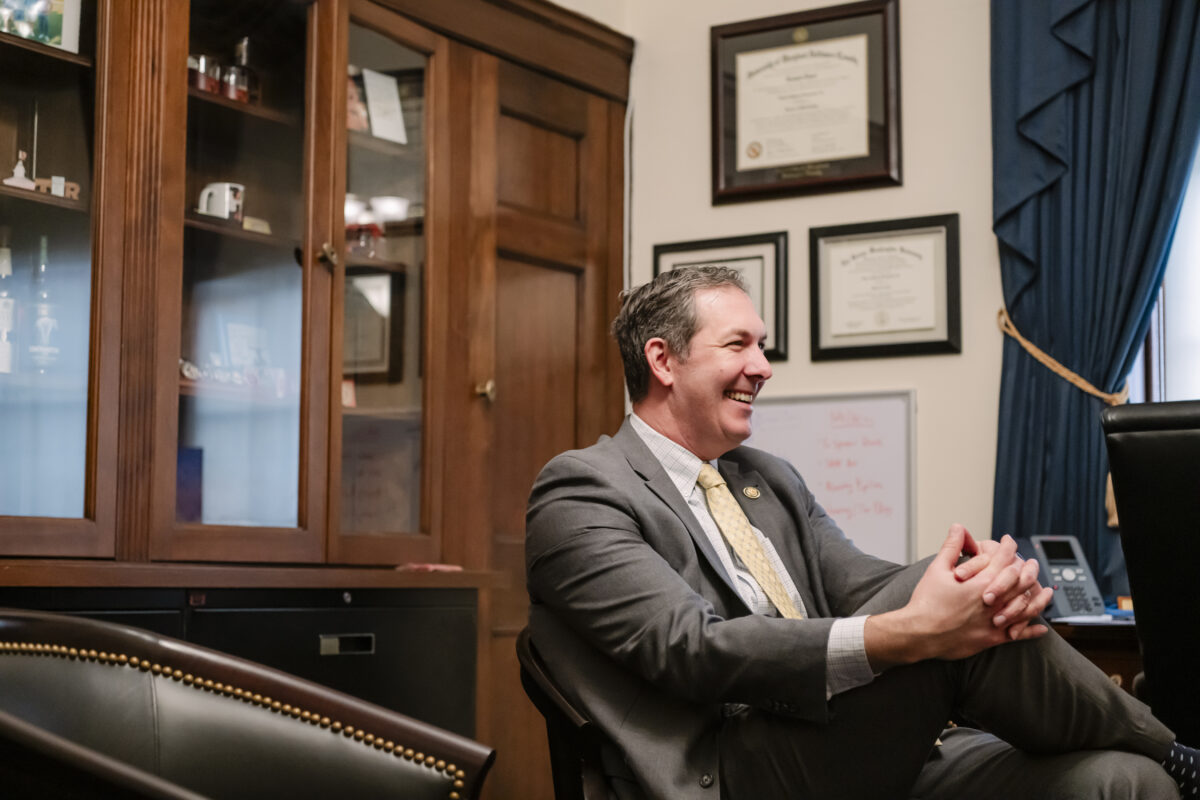 Olszewski’s office displays his UMBC diploma and other Maryland-related items.
Roy Meyers, professor emeritus, was Olszewski’s dissertation chair. “It was a great benefit to have him as a current legislator in the classroom,” says Meyers. “Other students learned from the real-world examples he provided, either confirming or improving on what I taught.”
Meyers notes that there’s a potential drawback for mid-career students with government experience—they might rely too much on that experience, and fail to pick up what the academic experience can provide: exposure to different theories, perspectives, and methods. “That was not the case with Johnny, quite the opposite,” says Meyers. “It was clear that he intended to use much of what he learned from all the courses in the program. An example is how Johnny emphasized transparency and communications with constituents on the Baltimore County budget, a big improvement from previous practice.”
My grounding at UMBC and elsewhere has me really wanting to come and do the right work and find solutions for some really important, but also very challenging and sometimes divisive, issues that are facing our country.
Johnny Olszewski, Ph.D. '17
U.S. Representative
Renee Whitby, M.P.P. ’15, one of Olszewski’s fellow students in a summer sociology course at UMBC, says that, “Johnny was smart, down to earth, and had a good sense of humor. We often have a preconceived notion about politicians, but he proved to be a regular person.” Whitby, who now works in Towson University’s College of Education, was so excited to cast her vote for her former classmate in his congressional run. “Johnny brings a wealth of knowledge and common sense that will benefit the constituents of District 2 in shaping federal legislation,” she says.
Meyers, who was occasionally tapped by Olszewski in his prior role to lead groups about spending affordability or process modernization, knows first hand that Olszewski is well-equipped to make the leap from county executive to congressman. “That he was elected by fellow Democratic freshmen to be their representative on the influential Steering and Policy Committee is a sign that he is already a respected member, and I expect that he will be visible,” says Meyers.
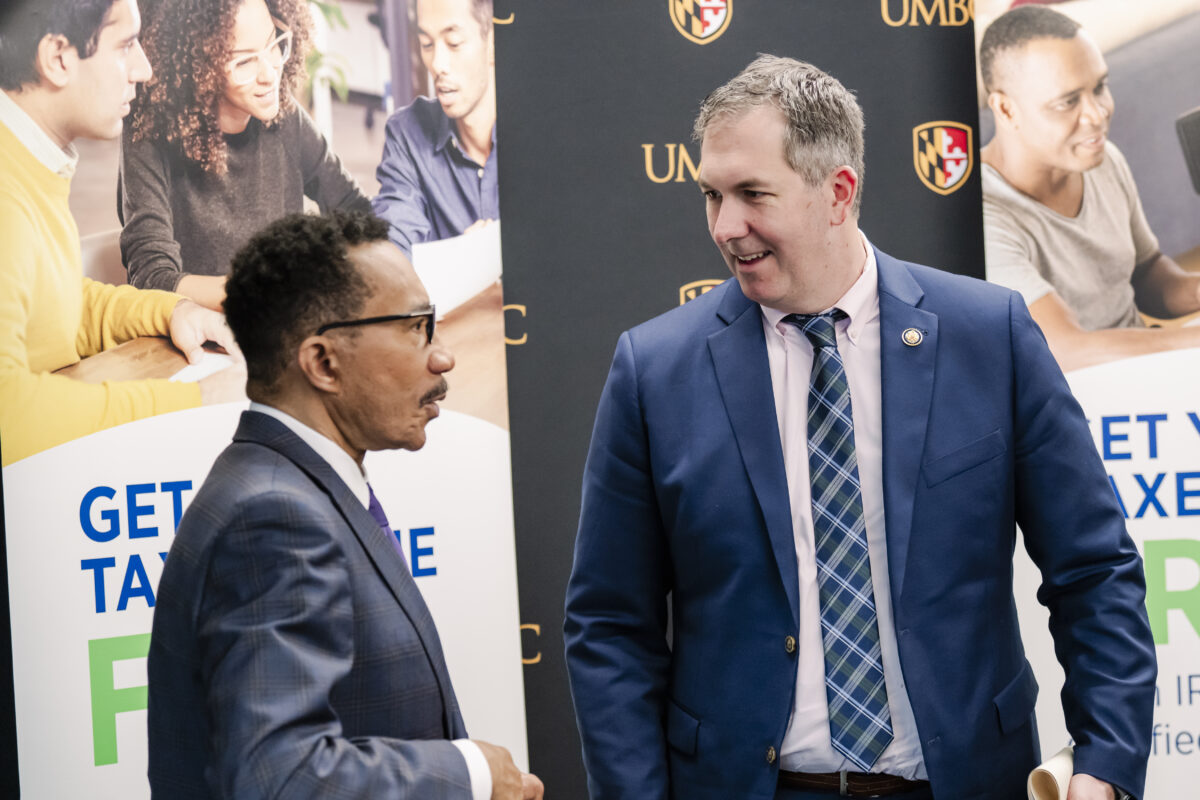 Representatives Kweisi Mfume and Johnny Olszewski chat at a tax-prep event at UMBC in January 2025.
Olszewski now represents the majority of Baltimore County, Carroll County, and a northern sliver of Baltimore City—as well as global reach with his committee assignment to Foreign Affairs—and he’s ready to call on his academic background and history of legislative experience to lead on a larger scale on issues like affordable housing, gun safety, workforce development, and other areas he took on as county executive. The congressman has a word of advice for students and constituents alike: “Don’t wait your turn. I think if you have a burning passion to get involved, there are so many ways you can do it.”
Common sense to scale
Olszewski is not naive about the polarization of federal politics but he wants the chance to scale some common sense bipartisan change like he aimed for in Baltimore County.
“One of the things that I prided myself on as county executive was just how open, accessible, and transparent we were about what was going on, how we made decisions, and what was happening. And I expect very much to continue that approach here,” says Olszewski, sweeping his hands around his congressional office space. “We passed bipartisan police reform. We had Republicans and Democrats voting unanimously for budgets, which is just unheard of these days.”
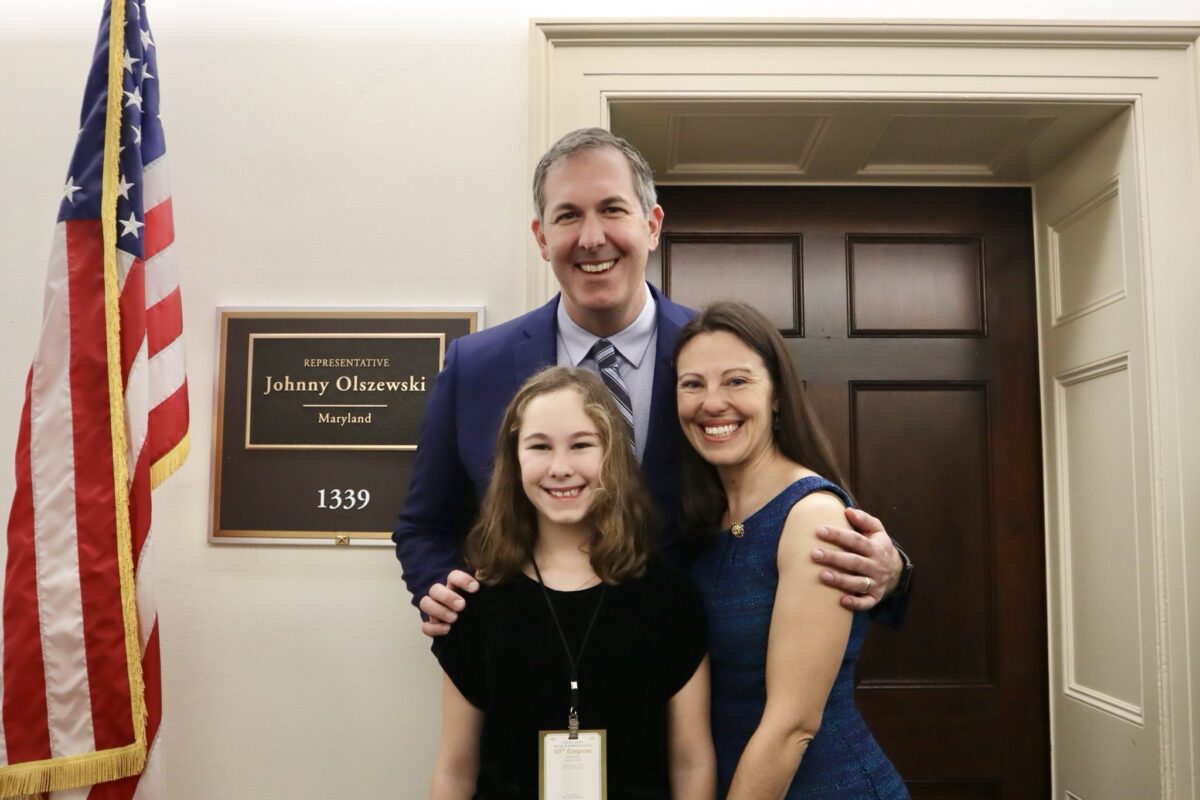 Olszewski poses with his wife, Marisa Olszewski, and daughter, Daria, on January 3rd after being sworn into his office as representative for Maryland’s 2nd congressional district. (Photo courtesy of the Olszewski family.)
Olszewski’s public policy dissertation at UMBC explored conditions under which lawmakers actually use evidence to drive policymaking as opposed to other considerations. What he discovered is that, “policymaking, unfortunately, isn’t just an academic exercise,” says Olszewski. “A lot of academics and researchers spend a lot of time coming up with really thoughtful research and understanding of the world…and there might be really compelling policy prescriptions that will move the needle on any number of issues. But there are folks across the aisle who, because of personal beliefs or political considerations, just can’t support that.”
“It’s still a little humbling and inspiring to know that a kid from Dundalk, who was the first in his family to go to college, is now part of a group that is responsible for leading our nation, but also still just being a kid from Dundalk,” says the freshman representative.
His commute and his title have changed, but Olszewski plans to still bring the best of himself, all 6 feet 6 inches to the job at hand. “Compromise is possible without compromising values,” he says. On this day in January, where the sidewalks are lined with stacks of disassembled but not yet removed barricades following the inauguration, he adds, “And that’s where it gets complicated. It might not be the pure, perfect answer, but I think that there are places where we can still find that common ground.”
]]>
When Johnny Olszewski walks the halls of the Longworth House Office Building across the street from the Capitol dome, he stands head and shoulders above most of his peers. And while his height may...
https://umbc.edu/stories/freshman-representative-olszewski-in-congress/
https://my3.my.umbc.edu/api/v0/pixel/news/147584/guest@my.umbc.edu/3bce57df30c73f7065ec1880bdcba30a/api/pixel
alumni
cahss
impact
magazine
ogrca
public-policy
spring-2025
story
UMBC News & Magazine
https://my3.my.umbc.edu/groups/umbc-news-magazine
https://assets1-my.umbc.edu/system/shared/avatars/groups/000/001/943/24435aa6207c452e7bc15cc74b42c7bb/xsmall.png?1748556657
https://assets1-my.umbc.edu/system/shared/avatars/groups/000/001/943/24435aa6207c452e7bc15cc74b42c7bb/original.png?1748556657
https://assets2-my.umbc.edu/system/shared/avatars/groups/000/001/943/24435aa6207c452e7bc15cc74b42c7bb/xxlarge.png?1748556657
https://assets2-my.umbc.edu/system/shared/avatars/groups/000/001/943/24435aa6207c452e7bc15cc74b42c7bb/xlarge.png?1748556657
https://assets3-my.umbc.edu/system/shared/avatars/groups/000/001/943/24435aa6207c452e7bc15cc74b42c7bb/large.png?1748556657
https://assets1-my.umbc.edu/system/shared/avatars/groups/000/001/943/24435aa6207c452e7bc15cc74b42c7bb/medium.png?1748556657
https://assets2-my.umbc.edu/system/shared/avatars/groups/000/001/943/24435aa6207c452e7bc15cc74b42c7bb/small.png?1748556657
https://assets1-my.umbc.edu/system/shared/avatars/groups/000/001/943/24435aa6207c452e7bc15cc74b42c7bb/xsmall.png?1748556657
https://assets2-my.umbc.edu/system/shared/avatars/groups/000/001/943/24435aa6207c452e7bc15cc74b42c7bb/xxsmall.png?1748556657
UMBC News & Magazine
4
0
false
Mon, 24 Feb 2025 15:30:08 -0500
Mon, 24 Feb 2025 15:30:08 -0500